Dr. Gary Chapman
 Hindi lang GWAPO…o maganda
But, MAPAGMAHAL, and in particular,
COMPASSIONATE
 is to seek the total well being of the person
[client, student], cf. Lk. 10: 30-35.
 to answer to the concrete need of the other.
 hence, a compassionate person has
developed some attitudes/values…
 LISTENING attitude [ to know the context of
the person in need of compassion]
 Understanding [empathy, entering into their
“world” in the spirit of dialogue]
 Concrete Compassionate Response
 listening heart
 comforting presence
 words of appreciation
 acts of service
 a pat on the shoulder
 or, any expression of kindness…
 Because everyone, or every student has
his/her own particular needs.
 one of the reason why we have this seminar:
Discovering our Primary Love Language.
 to understand the needs of our students, we
need to, first, understand, ours.
 1. Helping groups/teams work effectively.
 2. Grow Closer to your Friends
 3. Family Relationships Grow closer.
 4. Strengthening Romantic Relationships
 5. and, to be more effective in our
relationship with our students
1.1. I like to receive notes
of affirmation from you.
( A )
1.2. I like it when you hug
me. ( E )
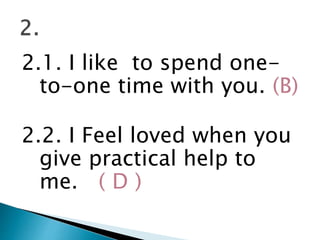
2.1. I like to spend one-
to-one time with you. (B)
2.2. I Feel loved when you
give practical help to
me. ( D )
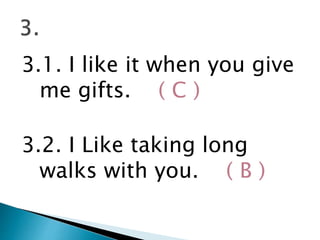
3.1. I like it when you give
me gifts. ( C )
3.2. I Like taking long
walks with you. ( B )
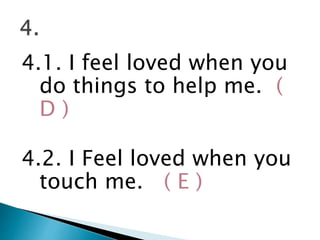
4.1. I feel loved when you
do things to help me. (
D )
4.2. I Feel loved when you
touch me. ( E )
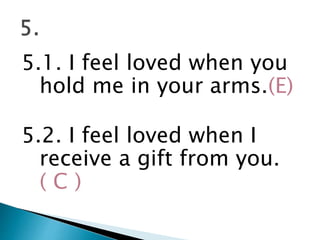
5.1. I feel loved when you
hold me in your arms.(E)
5.2. I feel loved when I
receive a gift from you.
( C )
6.1. I like to go places
with you. ( B )
6.2. I like to hold hands
with you. ( E )
7.1. Visible symbols of
love (gifts) are very
important to me.
( C )
7.2. I feel loved when you
affirm me. ( A )
8.1. I like to sit close to
you. ( E )
8.2. I like you to tell me I
am attractive/handsome.
( A )
9.1. I like to spend time
with you ( B )
9.2. I like to receive little
gifts from you. ( C )
10.1. Your words of
acceptance are
important to me. ( A )
10.2. I know you love me
when you help me. ( D )
11.1. I like us to be
together when we do
things. ( B )
11.2. I like the kind words
you say to me. ( A )
12.1. What you do affects
me more that what you
say. ( D )
12.2. I feel whole when we
hug. ( E )
13.1. I value your praise
and try to avoid
criticism.( A)
13.2. Several inexpensive gifts
from you mean more to me
that one large gift. ( C )
14.1. I feel close when we
are talking or doing
something together. ( B )
14.2. I feel close to you
when you touch me
often. ( E )
15.1. I like you to
compliment my
achievements. ( A )
15.2. I know you love me
when you do things for
me that you don’t enjoy
doing. ( D )
16.1. I like you to touch
me when you walk by.
( E )
16.2. I like it when you
listen to me
sympathetically.(B)
17.1. I feel loved when
you help me with my
jobs around the house.
( D )
17.2. I really enjoy
receiving gifts from you.
( C )
18.1. I like you to
compliment my
appearance. ( A )
18.2. I feel loved when
you take time to
understand my
feelings. ( B )
19.1. I feel secure when
you are touching me.( E )
19.2. Your acts of service
make me feel loved. ( D )
20.1. I appreciate the
many things you do for
me. ( D )
20.2. I Like receiving gifts
that you make . ( C )
21.1. I really enjoy the
feeling I get when you
give me your undivided
attention. ( B )
21.2. I really enjoy the
feeling I get when you
do some act of service
for me.(D)
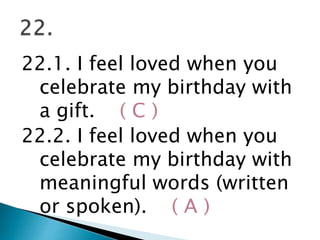
22.1. I feel loved when you
celebrate my birthday with
a gift. ( C )
22.2. I feel loved when you
celebrate my birthday with
meaningful words (written
or spoken). ( A )
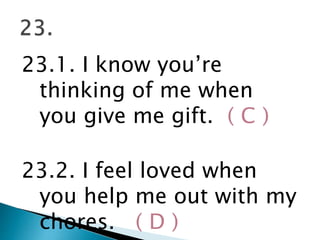
23.1. I know you’re
thinking of me when
you give me gift. ( C )
23.2. I feel loved when
you help me out with my
chores. ( D )
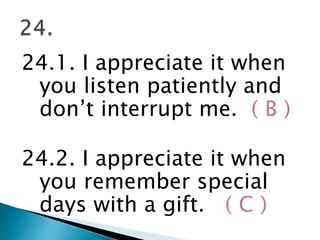
24.1. I appreciate it when
you listen patiently and
don’t interrupt me. ( B )
24.2. I appreciate it when
you remember special
days with a gift. ( C )
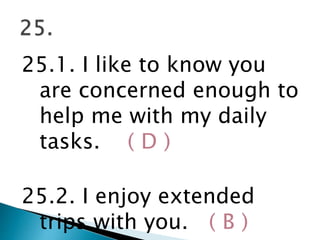
25.1. I like to know you
are concerned enough to
help me with my daily
tasks. ( D )
25.2. I enjoy extended
trips with you. ( B )
26.1. Kissing me
unexpectedly excites
me. ( E )
26.2. Giving me a gift for
no special occasion
excites me. ( C )
27.1. I like to be told that
you appreciate me. ( A )
27.2. I like you to talk to
me when we are
talking. ( B )
28.1. Your gifts are always
special to me. ( C )
28.2. I feel good when you
are touching me. ( E )
29.1. I feel loved when
you enthusiastically do
some task I have
requested. ( D )
29.2. I feel loved when
you tell me how much
you appreciate me. ( A )
30.1. I need to be touched
everyday. ( E )
30.2. I need your words of
affirmation daily. ( A )
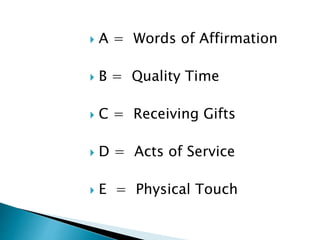
 A = Words of Affirmation
 B = Quality Time
 C = Receiving Gifts
 D = Acts of Service
 E = Physical Touch
 Mark Twain once said: “I can live for two
months on a good compliment.”
 Your partner/BF/GF, parents/friends,
students may need more.
 Solomon, author of the Book of Wisdom, says,
“The tongue has the power of life and
death.”* “An anxious heart weighs a man
down, but a kind word cheers him up.**
 Dr. Jose Rizal’s novels, NMT and EF, ignited
the Filipinos to revolt against the Spanish.
 “HE is a good provider, but he doesn’t spend
any time with me. What good is the house
and the recreational vehicle and all other
things if we don’t ever enjoy them together?”
 That’s the usual complain of spouses,
friends, students about their parents.
 Giving someone their undivided attention…
 Gift giving seems to be a universal
expression of love: Christmas, wedding and
other significant dates in our life are full of
gifts…
 gifts are visual symbols of love: rings,
flowers, etc.
 small tokens are expressions of: I am
thinking of you.
 Fiddler on the Roof:
 Husband: “Do you love me?”
 Wife: “I cook everyday for you and your
children; I wash your clothes,” etc., etc., etch
 Mrs. Tago and me: “When did you feel that
you loved me already?*
 Follow up question of Sir Tago: Did you love
me already when I kissed you and you did not
say anything?
 “babies who are held, hugged, and kissed
developed a healthier emotional life than
those who are left for long periods of time.”*
 breastfeeding is the best.
 “Wise parents, in any culture are touching
parents.” Dr. Gary Chapman
 My theory is: either
 1. we were fed by this language with our
significant persons in our life, so we develop
the habit, or
 2. we are deprived of it, so we desire to have
it even more?
 3. What do you think?
 developing all these love languages can be a
sign of personal growth and maturity…
 could expand your social horizon…
 could transcend your ability to love and have
compassion for people…
 Situation: Your birthday.
 Rate from 1 to 5 [five is the maximum] which
person would you prefer? *
 Person 1 = hands you a cute gift.
 Person 2 = texted you: “happy b day! I love
you my dear.”
 Person 3 = listens to your story: that you are so
happy today…first time you really
celebrate your special day.
 Person 4 = comes to your b day and hugs you
very tightly making you feel his/her love.
 Person 5 = came very early before the celebration
help out in the preparation.
 1. we normally have a preferred [favorite]
love language which we learn early in life [our
strength and weakness.
 2. we also have a secondary love language
 3. we have an underdeveloped language [we
are not comfortable expressing – our
weakness]
 4. all the 5 love languages are legitimate and
ideal to develop = Jesus was comfortable
using them to express his mercy and
compassion for people.
 “The emotional need for love is our deepest
emotional need and when that need is met,
we tend to respond positively to the person
who is meeting that need.”
 “When the emotional love tank is low [or
empty]… we have no feelings toward our
[spouse] but simply experience emptiness
and pain.” G. Chapman
 Physical Touch: He touch people when [if needed]
healing them: the blind, Peter’s mother in law…
 Words of Affirmation: He speaks with kind words;
truth that sets us free; comforting words:
“Come all of you who are weary and tired, I will
give you rest…”
 Gift : He offers his life as his ultimate gift;
a true and meaningful life; eternal life…
 Quality Time: He spend time patiently with his dis-
ciples forming them; visits friends; attend
weddings, etc.
 Acts of Service: “I came to serve, not to be served.”*
 1. To cultivate the underdeveloped love
language in our life.
 2. This would imply: a lot of sacrifices to
make or dying to our ourselves. Genuine
love is not doing what we like; but, doing
what we normally is not accustomed to
do…
 3. But, disciplining to develop our “shadows”
help us become more mature, more
loving persons.**
 we NEED to:
 Listen [discover the particular/concrete
needs of our students]; quality time is
needed, discover their love language
 Understand [empathic listening]
 Compassionate Action [LUCA: Listen,
Understand, Compassionate Action]
1. Share your Personal Experience of your
discovered primary [or secondary] love
language [an Ahah experience! Or, Kaya
pala!]
1.1. your loved ones: family or
BF/GF/partner in life
1.2. about your experience with
students. [ why you feel closer to some
students or some students feel closer to you]
2. How can you become more effective in your
relationship with your students using the five
love languages tool?
 1. We need to be compassionate to all
students, although, we cannot like all of
them.
 2. Let’s start to understand the uniqueness
of each one [e.g. every students primary love
language, but also their deepest needs,
struggles in life]
 3. In order to love our students, we need to
transcend from our comfort zone [our
primary love language], and “die” a little to
our selves to give life to them, like what Jesus
did to us.
 Thank You and let’s all
be:
 True Good Samaritans!
 hindi lang magaganda at
gwapo; above all,
mapagmahal and
compassionate people.

DISCOVERING-YOUR-PRIMARY-LANGUAGE-OF-LOVE2.ppt

  • 1.
  • 2.
     Hindi langGWAPO…o maganda But, MAPAGMAHAL, and in particular, COMPASSIONATE
  • 3.
     is toseek the total well being of the person [client, student], cf. Lk. 10: 30-35.  to answer to the concrete need of the other.  hence, a compassionate person has developed some attitudes/values…
  • 4.
     LISTENING attitude[ to know the context of the person in need of compassion]  Understanding [empathy, entering into their “world” in the spirit of dialogue]  Concrete Compassionate Response
  • 5.
     listening heart comforting presence  words of appreciation  acts of service  a pat on the shoulder  or, any expression of kindness…
  • 6.
     Because everyone,or every student has his/her own particular needs.  one of the reason why we have this seminar: Discovering our Primary Love Language.  to understand the needs of our students, we need to, first, understand, ours.
  • 7.
     1. Helpinggroups/teams work effectively.  2. Grow Closer to your Friends  3. Family Relationships Grow closer.  4. Strengthening Romantic Relationships  5. and, to be more effective in our relationship with our students
  • 9.
    1.1. I liketo receive notes of affirmation from you. ( A ) 1.2. I like it when you hug me. ( E )
  • 10.
    2.1. I liketo spend one- to-one time with you. (B) 2.2. I Feel loved when you give practical help to me. ( D )
  • 11.
    3.1. I likeit when you give me gifts. ( C ) 3.2. I Like taking long walks with you. ( B )
  • 12.
    4.1. I feelloved when you do things to help me. ( D ) 4.2. I Feel loved when you touch me. ( E )
  • 13.
    5.1. I feelloved when you hold me in your arms.(E) 5.2. I feel loved when I receive a gift from you. ( C )
  • 14.
    6.1. I liketo go places with you. ( B ) 6.2. I like to hold hands with you. ( E )
  • 15.
    7.1. Visible symbolsof love (gifts) are very important to me. ( C ) 7.2. I feel loved when you affirm me. ( A )
  • 16.
    8.1. I liketo sit close to you. ( E ) 8.2. I like you to tell me I am attractive/handsome. ( A )
  • 17.
    9.1. I liketo spend time with you ( B ) 9.2. I like to receive little gifts from you. ( C )
  • 18.
    10.1. Your wordsof acceptance are important to me. ( A ) 10.2. I know you love me when you help me. ( D )
  • 19.
    11.1. I likeus to be together when we do things. ( B ) 11.2. I like the kind words you say to me. ( A )
  • 20.
    12.1. What youdo affects me more that what you say. ( D ) 12.2. I feel whole when we hug. ( E )
  • 21.
    13.1. I valueyour praise and try to avoid criticism.( A) 13.2. Several inexpensive gifts from you mean more to me that one large gift. ( C )
  • 22.
    14.1. I feelclose when we are talking or doing something together. ( B ) 14.2. I feel close to you when you touch me often. ( E )
  • 23.
    15.1. I likeyou to compliment my achievements. ( A ) 15.2. I know you love me when you do things for me that you don’t enjoy doing. ( D )
  • 24.
    16.1. I likeyou to touch me when you walk by. ( E ) 16.2. I like it when you listen to me sympathetically.(B)
  • 25.
    17.1. I feelloved when you help me with my jobs around the house. ( D ) 17.2. I really enjoy receiving gifts from you. ( C )
  • 26.
    18.1. I likeyou to compliment my appearance. ( A ) 18.2. I feel loved when you take time to understand my feelings. ( B )
  • 27.
    19.1. I feelsecure when you are touching me.( E ) 19.2. Your acts of service make me feel loved. ( D )
  • 28.
    20.1. I appreciatethe many things you do for me. ( D ) 20.2. I Like receiving gifts that you make . ( C )
  • 29.
    21.1. I reallyenjoy the feeling I get when you give me your undivided attention. ( B ) 21.2. I really enjoy the feeling I get when you do some act of service for me.(D)
  • 30.
    22.1. I feelloved when you celebrate my birthday with a gift. ( C ) 22.2. I feel loved when you celebrate my birthday with meaningful words (written or spoken). ( A )
  • 31.
    23.1. I knowyou’re thinking of me when you give me gift. ( C ) 23.2. I feel loved when you help me out with my chores. ( D )
  • 32.
    24.1. I appreciateit when you listen patiently and don’t interrupt me. ( B ) 24.2. I appreciate it when you remember special days with a gift. ( C )
  • 33.
    25.1. I liketo know you are concerned enough to help me with my daily tasks. ( D ) 25.2. I enjoy extended trips with you. ( B )
  • 34.
    26.1. Kissing me unexpectedlyexcites me. ( E ) 26.2. Giving me a gift for no special occasion excites me. ( C )
  • 35.
    27.1. I liketo be told that you appreciate me. ( A ) 27.2. I like you to talk to me when we are talking. ( B )
  • 36.
    28.1. Your giftsare always special to me. ( C ) 28.2. I feel good when you are touching me. ( E )
  • 37.
    29.1. I feelloved when you enthusiastically do some task I have requested. ( D ) 29.2. I feel loved when you tell me how much you appreciate me. ( A )
  • 38.
    30.1. I needto be touched everyday. ( E ) 30.2. I need your words of affirmation daily. ( A )
  • 39.
     A =Words of Affirmation  B = Quality Time  C = Receiving Gifts  D = Acts of Service  E = Physical Touch
  • 40.
     Mark Twainonce said: “I can live for two months on a good compliment.”  Your partner/BF/GF, parents/friends, students may need more.  Solomon, author of the Book of Wisdom, says, “The tongue has the power of life and death.”* “An anxious heart weighs a man down, but a kind word cheers him up.**  Dr. Jose Rizal’s novels, NMT and EF, ignited the Filipinos to revolt against the Spanish.
  • 41.
     “HE isa good provider, but he doesn’t spend any time with me. What good is the house and the recreational vehicle and all other things if we don’t ever enjoy them together?”  That’s the usual complain of spouses, friends, students about their parents.  Giving someone their undivided attention…
  • 42.
     Gift givingseems to be a universal expression of love: Christmas, wedding and other significant dates in our life are full of gifts…  gifts are visual symbols of love: rings, flowers, etc.  small tokens are expressions of: I am thinking of you.
  • 43.
     Fiddler onthe Roof:  Husband: “Do you love me?”  Wife: “I cook everyday for you and your children; I wash your clothes,” etc., etc., etch  Mrs. Tago and me: “When did you feel that you loved me already?*
  • 44.
     Follow upquestion of Sir Tago: Did you love me already when I kissed you and you did not say anything?  “babies who are held, hugged, and kissed developed a healthier emotional life than those who are left for long periods of time.”*  breastfeeding is the best.  “Wise parents, in any culture are touching parents.” Dr. Gary Chapman
  • 45.
     My theoryis: either  1. we were fed by this language with our significant persons in our life, so we develop the habit, or  2. we are deprived of it, so we desire to have it even more?  3. What do you think?
  • 46.
     developing allthese love languages can be a sign of personal growth and maturity…  could expand your social horizon…  could transcend your ability to love and have compassion for people…
  • 47.
     Situation: Yourbirthday.  Rate from 1 to 5 [five is the maximum] which person would you prefer? *  Person 1 = hands you a cute gift.  Person 2 = texted you: “happy b day! I love you my dear.”  Person 3 = listens to your story: that you are so happy today…first time you really celebrate your special day.  Person 4 = comes to your b day and hugs you very tightly making you feel his/her love.  Person 5 = came very early before the celebration help out in the preparation.
  • 48.
     1. wenormally have a preferred [favorite] love language which we learn early in life [our strength and weakness.  2. we also have a secondary love language  3. we have an underdeveloped language [we are not comfortable expressing – our weakness]  4. all the 5 love languages are legitimate and ideal to develop = Jesus was comfortable using them to express his mercy and compassion for people.
  • 49.
     “The emotionalneed for love is our deepest emotional need and when that need is met, we tend to respond positively to the person who is meeting that need.”  “When the emotional love tank is low [or empty]… we have no feelings toward our [spouse] but simply experience emptiness and pain.” G. Chapman
  • 50.
     Physical Touch:He touch people when [if needed] healing them: the blind, Peter’s mother in law…  Words of Affirmation: He speaks with kind words; truth that sets us free; comforting words: “Come all of you who are weary and tired, I will give you rest…”  Gift : He offers his life as his ultimate gift; a true and meaningful life; eternal life…  Quality Time: He spend time patiently with his dis- ciples forming them; visits friends; attend weddings, etc.  Acts of Service: “I came to serve, not to be served.”*
  • 51.
     1. Tocultivate the underdeveloped love language in our life.  2. This would imply: a lot of sacrifices to make or dying to our ourselves. Genuine love is not doing what we like; but, doing what we normally is not accustomed to do…  3. But, disciplining to develop our “shadows” help us become more mature, more loving persons.**
  • 52.
     we NEEDto:  Listen [discover the particular/concrete needs of our students]; quality time is needed, discover their love language  Understand [empathic listening]  Compassionate Action [LUCA: Listen, Understand, Compassionate Action]
  • 53.
    1. Share yourPersonal Experience of your discovered primary [or secondary] love language [an Ahah experience! Or, Kaya pala!] 1.1. your loved ones: family or BF/GF/partner in life 1.2. about your experience with students. [ why you feel closer to some students or some students feel closer to you] 2. How can you become more effective in your relationship with your students using the five love languages tool?
  • 54.
     1. Weneed to be compassionate to all students, although, we cannot like all of them.  2. Let’s start to understand the uniqueness of each one [e.g. every students primary love language, but also their deepest needs, struggles in life]  3. In order to love our students, we need to transcend from our comfort zone [our primary love language], and “die” a little to our selves to give life to them, like what Jesus did to us.
  • 55.
     Thank Youand let’s all be:  True Good Samaritans!  hindi lang magaganda at gwapo; above all, mapagmahal and compassionate people.

Editor's Notes

  • #7 Note: We can also use this tool developed by Dr. Gary Chapman in his book, Five Love Languages, director of Marriage and Family Life Consultants, Inc., He travels the world presenting seminars, and his radio program airs on more than 100 stations. For more than 100 radio stations. For more information visit: www.garychapman.org. Or, www.fivelovelanguages.com.
  • #41 * Proverbs 18:21; ** Proverbs 12:15. *** Noli Me Tangere and El Filibusterismo ignited the Filipinos to revolt against the tyranny and abuses of the Spaniards. *** Words of appreciation can create good feelings towards each other, hence can create good relationships.
  • #44 * What was the answer of Mrs. Tago? What was the follow up question of Sir Tago? Abangan sa last love language.
  • #45 * It is unfortunate that “PHYSICAL TOUCH” for the Filipino Culture is not cultivated, even a suspect: Noli Me Tangere = touch me not * Those who have this primary love language are often misunderstood as “touchy,” “clingy,” “linta” * The Hebrews at that time of Jesus, recognizing him as a great teacher, brought their children “to have him touch them.” “Let the little children come to me, and do not hinder them, for the kingdom of God belongs to such as these…took them in his arms, put his hands on them and blessed them.” see, Mk. 10:13-16.
  • #48 * 5 means, your most preferred expression of love; and 1 is the least.
  • #51 * His entire life: words and actions are for service of all humanity…
  • #52 * Jungian term for underdeveloped love language or weaknesses. ** Group activity and sharing: Think of incidents in your life where you “sacrifice what you wanted, for a more noble reason.”
  • #54 Note: Each group should choose a Facilitator and a Secretary. Each group will be sharing to the whole assembly their learnings and insights from the group sharing.