Disaster
Management
By:
Dr. Alankar Shrivastav
Assistant Professor,
Pharmacy Academy, IFTM University
Moradabad
IFTM UNIVERSITY, MORADABAD
(Established under Section 2 (f) of UGC Act 1956 by UP Govt. Act No. 24 of 2010)
Table Contents
• Definition
• Introduction
• Types of Disaster
• Prevention of Disaster
• Preparation of Disaster Management
• Recovery of Disaster
• Conclusion
2
Definition
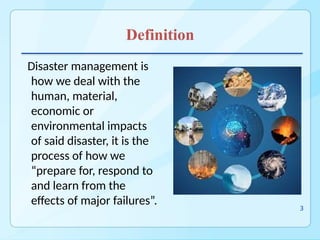
Disaster management is
how we deal with the
human, material,
economic or
environmental impacts
of said disaster, it is the
process of how we
“prepare for, respond to
and learn from the
effects of major failures”. 3
Introduction
• Natural disasters and armed conflict have
marked human existence throughout history
and have always caused peaks in mortality
and morbidity.
• The combination of hazards, vulnerability
and inability to reduce the potential negative
consequences of risk results in disaster
4
5
Types of Disaster
• Natural Disasters are naturally occurring
physical phenomena caused either by rapid
or slow onset events that have immediate
impacts on human health and secondary
impacts causing further death and
suffering.
●●●
6
Types of Disaster
These disasters can be :
• Geophysical (e.g. Earthquakes, Landslides,
Tsunamis and Volcanic Activity)
• Hydrological (e.g. Avalanches and Floods)
• Climatological (e.g. Extreme Temperatures,
Drought and Wildfires)
• Meteorological (e.g. Cyclones and Storms/Wave
Surges)
• Biological (e.g. Disease Epidemics and
Insect/Animal Plagues)
●●●
7
Types of Disaster
Man-Made Disasters as viewed by the
International Federation of Red Cross & Red
Crescent Societies are events that are caused by
humans which occur in or close to human
settlements often caused as a results
of Environmental or Technological Emergencies.
●●●
8
Types of Disaster
This can include:
• Environmental Degradation
• Pollution
• Accidents (e.g. Industrial, Technological and
Transport usually involving the production,
use or transport of hazardous materials)
●●●
9
Types of Disaster
Some disasters can result from multiple
hazards, or, more often, to a complex
combination of both natural and man-made
causes which involve a break-down of
authority, looting and attacks on strategic
installations, including conflict situations and
war.
●●●
10
Types of Disaster
These can include :
• Food Insecurity
• Epidemics
• Armed Conflicts
• Displaced Populations
Extensive Violence
• Displacements of Populations
• Loss of Life
• Widespread Damage to both Societies and
Economies
●●●
11
Types of Disaster
Pandemic (from Greek πᾶν pan "all" and δῆμος
demos "people") is an epidemic of infectious disease
that has spread across a large region, which can occur
to the human population or animal population and
may affect health and disrupt services leading to
economic and social costs.
●●●
12
Types of Disaster
These have included the following epidemics:
• Ebola
• Zika
• Avian Flu
• Cholera
• Dengue Fever
• Malaria
• Yellow Fever
• Coronavirus Disease (COVID-19)
13
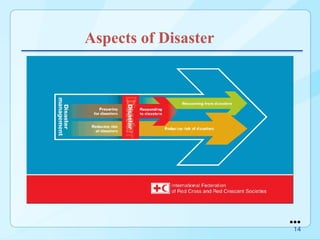
Aspects of Disaster
●●●
14
Prevention of Disaster
• UNISDR views Disaster Prevention as the
concept of engaging in activities which
intend to prevent or avoid potential
adverse impacts through action taken in
advance, activities designed to provide
protection from the occurrence of disasters
●●●
15
Prevention of Disaster
• WCPT similarly highlight that while not all
disasters can be prevented, good risk
management, evacuation plans,
environmental planning and design
standards can reduce risk of loss of life and
injury mitigation.
●●●
16
Prevention of Disaster
• The HYOGO Framework was one such
Global Plan for natural Disaster Risk
Reduction, which was adopted in 2005 as a
10 year Global Plan, signed by agreement
with 168 Governments which offered
guiding principles, priorities for action and
practical means for achieving disaster
resilience for vulnerable communities
17
Preparation of Disaster Management
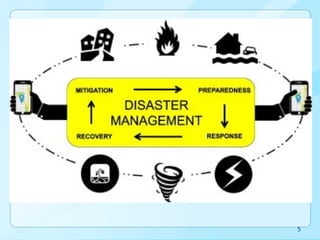
• Disaster Preparedness refers to measures
taken to prepare for and reduce the effects of
disasters, be they natural or man-made.
• This is achieved through research and
planning in order to try to predict areas or
regions that may be at risk of disaster and
where possible prevent these from occurring
and/or reduce the impact those disasters.
●●●
18
Preparation of Disaster Management
• Disaster preparedness activities embedded
with risk reduction measures can prevent
disaster situations and also result in saving
maximum lives and livelihoods during any
disaster situation, enabling the affected
population to get back to normalcy within a
short time period
●●●
19
Preparation of Disaster Management
• Minimisation of loss of life and damage to
property through facilitation of effective
disaster response and rehabilitation services
when required.
• Preparedness is the main way of reducing the
impact of disasters. Community-based
preparedness and management should be a
high priority in physical therapy practice
management
20
Recovery of Disaster
• Rescue
• Relocation
• Provision Food and Water
• Provision Emergency Health Care
• Prevention of Disease and Disability
• Repairing Vital Services e.g. Telecommunications,
Transport
• Provision Temporary Shelter
●●●
21
Recovery of Disaster
• Rebuilding Infrastructure e.g. Homes, Schools,
Hospitals, Roads
• Health Care and Rehabilitation
• Development Activities e.g. building human
resources for health
• Development Policies and Practices to avoid or
mitigate similar situations in future
22
Conclusion
 Disaster management is how we deal with
the human, material, economic or
environmental impacts of said disaster, it
is the process of how we “prepare for,
respond to and learn from the effects of
major failures”. Though often caused by
nature, disasters can have human origins.
23
References
– Google.com
– Wikipedia.org
– Studymafia.org
– Slidespanda.com
Thanks
To
ALL

DISASTER, TYPES AND ITS MANAGEMENT (BPUDM)

  • 1.
    Disaster Management By: Dr. Alankar Shrivastav AssistantProfessor, Pharmacy Academy, IFTM University Moradabad IFTM UNIVERSITY, MORADABAD (Established under Section 2 (f) of UGC Act 1956 by UP Govt. Act No. 24 of 2010)
  • 2.
    Table Contents • Definition •Introduction • Types of Disaster • Prevention of Disaster • Preparation of Disaster Management • Recovery of Disaster • Conclusion 2
  • 3.
    Definition Disaster management is howwe deal with the human, material, economic or environmental impacts of said disaster, it is the process of how we “prepare for, respond to and learn from the effects of major failures”. 3
  • 4.
    Introduction • Natural disastersand armed conflict have marked human existence throughout history and have always caused peaks in mortality and morbidity. • The combination of hazards, vulnerability and inability to reduce the potential negative consequences of risk results in disaster 4
  • 5.
  • 6.
    Types of Disaster •Natural Disasters are naturally occurring physical phenomena caused either by rapid or slow onset events that have immediate impacts on human health and secondary impacts causing further death and suffering. ●●● 6
  • 7.
    Types of Disaster Thesedisasters can be : • Geophysical (e.g. Earthquakes, Landslides, Tsunamis and Volcanic Activity) • Hydrological (e.g. Avalanches and Floods) • Climatological (e.g. Extreme Temperatures, Drought and Wildfires) • Meteorological (e.g. Cyclones and Storms/Wave Surges) • Biological (e.g. Disease Epidemics and Insect/Animal Plagues) ●●● 7
  • 8.
    Types of Disaster Man-MadeDisasters as viewed by the International Federation of Red Cross & Red Crescent Societies are events that are caused by humans which occur in or close to human settlements often caused as a results of Environmental or Technological Emergencies. ●●● 8
  • 9.
    Types of Disaster Thiscan include: • Environmental Degradation • Pollution • Accidents (e.g. Industrial, Technological and Transport usually involving the production, use or transport of hazardous materials) ●●● 9
  • 10.
    Types of Disaster Somedisasters can result from multiple hazards, or, more often, to a complex combination of both natural and man-made causes which involve a break-down of authority, looting and attacks on strategic installations, including conflict situations and war. ●●● 10
  • 11.
    Types of Disaster Thesecan include : • Food Insecurity • Epidemics • Armed Conflicts • Displaced Populations Extensive Violence • Displacements of Populations • Loss of Life • Widespread Damage to both Societies and Economies ●●● 11
  • 12.
    Types of Disaster Pandemic(from Greek πᾶν pan "all" and δῆμος demos "people") is an epidemic of infectious disease that has spread across a large region, which can occur to the human population or animal population and may affect health and disrupt services leading to economic and social costs. ●●● 12
  • 13.
    Types of Disaster Thesehave included the following epidemics: • Ebola • Zika • Avian Flu • Cholera • Dengue Fever • Malaria • Yellow Fever • Coronavirus Disease (COVID-19) 13
  • 14.
  • 15.
    Prevention of Disaster •UNISDR views Disaster Prevention as the concept of engaging in activities which intend to prevent or avoid potential adverse impacts through action taken in advance, activities designed to provide protection from the occurrence of disasters ●●● 15
  • 16.
    Prevention of Disaster •WCPT similarly highlight that while not all disasters can be prevented, good risk management, evacuation plans, environmental planning and design standards can reduce risk of loss of life and injury mitigation. ●●● 16
  • 17.
    Prevention of Disaster •The HYOGO Framework was one such Global Plan for natural Disaster Risk Reduction, which was adopted in 2005 as a 10 year Global Plan, signed by agreement with 168 Governments which offered guiding principles, priorities for action and practical means for achieving disaster resilience for vulnerable communities 17
  • 18.
    Preparation of DisasterManagement • Disaster Preparedness refers to measures taken to prepare for and reduce the effects of disasters, be they natural or man-made. • This is achieved through research and planning in order to try to predict areas or regions that may be at risk of disaster and where possible prevent these from occurring and/or reduce the impact those disasters. ●●● 18
  • 19.
    Preparation of DisasterManagement • Disaster preparedness activities embedded with risk reduction measures can prevent disaster situations and also result in saving maximum lives and livelihoods during any disaster situation, enabling the affected population to get back to normalcy within a short time period ●●● 19
  • 20.
    Preparation of DisasterManagement • Minimisation of loss of life and damage to property through facilitation of effective disaster response and rehabilitation services when required. • Preparedness is the main way of reducing the impact of disasters. Community-based preparedness and management should be a high priority in physical therapy practice management 20
  • 21.
    Recovery of Disaster •Rescue • Relocation • Provision Food and Water • Provision Emergency Health Care • Prevention of Disease and Disability • Repairing Vital Services e.g. Telecommunications, Transport • Provision Temporary Shelter ●●● 21
  • 22.
    Recovery of Disaster •Rebuilding Infrastructure e.g. Homes, Schools, Hospitals, Roads • Health Care and Rehabilitation • Development Activities e.g. building human resources for health • Development Policies and Practices to avoid or mitigate similar situations in future 22
  • 23.
    Conclusion  Disaster managementis how we deal with the human, material, economic or environmental impacts of said disaster, it is the process of how we “prepare for, respond to and learn from the effects of major failures”. Though often caused by nature, disasters can have human origins. 23
  • 24.
    References – Google.com – Wikipedia.org –Studymafia.org – Slidespanda.com
  • 25.

Editor's Notes

  • #2 SAY: Before we wrap up the course, let’s review what we have learned today. During this course, we have <READ the bullets from the slide.> GO to next slide.
  • #3 SAY: Before we wrap up the course, let’s review what we have learned today. During this course, we have <READ the bullets from the slide.> GO to next slide.
  • #4 SAY: Before we wrap up the course, let’s review what we have learned today. During this course, we have <READ the bullets from the slide.> GO to next slide.
  • #5 SAY: Before we wrap up the course, let’s review what we have learned today. During this course, we have <READ the bullets from the slide.> GO to next slide.
  • #6 SAY: The purpose of epidemiology in public health practice is to discover the agent, host, and environmental factors that affect health; determine the relative importance of causes of illness, disability, and death; identify those segments of the population that have the greatest risk from specific causes of ill health; and evaluate the effectiveness of health programs and services in improving population health. GO to next slide.
  • #7 SAY: The purpose of epidemiology in public health practice is to discover the agent, host, and environmental factors that affect health; determine the relative importance of causes of illness, disability, and death; identify those segments of the population that have the greatest risk from specific causes of ill health; and evaluate the effectiveness of health programs and services in improving population health. GO to next slide.
  • #8 SAY: The purpose of epidemiology in public health practice is to discover the agent, host, and environmental factors that affect health; determine the relative importance of causes of illness, disability, and death; identify those segments of the population that have the greatest risk from specific causes of ill health; and evaluate the effectiveness of health programs and services in improving population health. GO to next slide.
  • #9 SAY: The purpose of epidemiology in public health practice is to discover the agent, host, and environmental factors that affect health; determine the relative importance of causes of illness, disability, and death; identify those segments of the population that have the greatest risk from specific causes of ill health; and evaluate the effectiveness of health programs and services in improving population health. GO to next slide.
  • #10 SAY: The purpose of epidemiology in public health practice is to discover the agent, host, and environmental factors that affect health; determine the relative importance of causes of illness, disability, and death; identify those segments of the population that have the greatest risk from specific causes of ill health; and evaluate the effectiveness of health programs and services in improving population health. GO to next slide.
  • #11 SAY: The purpose of epidemiology in public health practice is to discover the agent, host, and environmental factors that affect health; determine the relative importance of causes of illness, disability, and death; identify those segments of the population that have the greatest risk from specific causes of ill health; and evaluate the effectiveness of health programs and services in improving population health. GO to next slide.
  • #12 SAY: The purpose of epidemiology in public health practice is to discover the agent, host, and environmental factors that affect health; determine the relative importance of causes of illness, disability, and death; identify those segments of the population that have the greatest risk from specific causes of ill health; and evaluate the effectiveness of health programs and services in improving population health. GO to next slide.
  • #13 SAY: The purpose of epidemiology in public health practice is to discover the agent, host, and environmental factors that affect health; determine the relative importance of causes of illness, disability, and death; identify those segments of the population that have the greatest risk from specific causes of ill health; and evaluate the effectiveness of health programs and services in improving population health. GO to next slide.
  • #14 SAY: The purpose of epidemiology in public health practice is to discover the agent, host, and environmental factors that affect health; determine the relative importance of causes of illness, disability, and death; identify those segments of the population that have the greatest risk from specific causes of ill health; and evaluate the effectiveness of health programs and services in improving population health. GO to next slide.
  • #15 SAY: The purpose of epidemiology in public health practice is to discover the agent, host, and environmental factors that affect health; determine the relative importance of causes of illness, disability, and death; identify those segments of the population that have the greatest risk from specific causes of ill health; and evaluate the effectiveness of health programs and services in improving population health. GO to next slide.
  • #16 SAY: The purpose of epidemiology in public health practice is to discover the agent, host, and environmental factors that affect health; determine the relative importance of causes of illness, disability, and death; identify those segments of the population that have the greatest risk from specific causes of ill health; and evaluate the effectiveness of health programs and services in improving population health. GO to next slide.
  • #17 SAY: The purpose of epidemiology in public health practice is to discover the agent, host, and environmental factors that affect health; determine the relative importance of causes of illness, disability, and death; identify those segments of the population that have the greatest risk from specific causes of ill health; and evaluate the effectiveness of health programs and services in improving population health. GO to next slide.
  • #18 SAY: The purpose of epidemiology in public health practice is to discover the agent, host, and environmental factors that affect health; determine the relative importance of causes of illness, disability, and death; identify those segments of the population that have the greatest risk from specific causes of ill health; and evaluate the effectiveness of health programs and services in improving population health. GO to next slide.
  • #19 SAY: The purpose of epidemiology in public health practice is to discover the agent, host, and environmental factors that affect health; determine the relative importance of causes of illness, disability, and death; identify those segments of the population that have the greatest risk from specific causes of ill health; and evaluate the effectiveness of health programs and services in improving population health. GO to next slide.
  • #20 SAY: The purpose of epidemiology in public health practice is to discover the agent, host, and environmental factors that affect health; determine the relative importance of causes of illness, disability, and death; identify those segments of the population that have the greatest risk from specific causes of ill health; and evaluate the effectiveness of health programs and services in improving population health. GO to next slide.
  • #21 SAY: The purpose of epidemiology in public health practice is to discover the agent, host, and environmental factors that affect health; determine the relative importance of causes of illness, disability, and death; identify those segments of the population that have the greatest risk from specific causes of ill health; and evaluate the effectiveness of health programs and services in improving population health. GO to next slide.
  • #22 SAY: The purpose of epidemiology in public health practice is to discover the agent, host, and environmental factors that affect health; determine the relative importance of causes of illness, disability, and death; identify those segments of the population that have the greatest risk from specific causes of ill health; and evaluate the effectiveness of health programs and services in improving population health. GO to next slide.
  • #23 SAY: The purpose of epidemiology in public health practice is to discover the agent, host, and environmental factors that affect health; determine the relative importance of causes of illness, disability, and death; identify those segments of the population that have the greatest risk from specific causes of ill health; and evaluate the effectiveness of health programs and services in improving population health. GO to next slide.