Incorporating Available Military
Infrastructures into a Capacitated Facility
           Disaster Relief Model
             MIDN 2/C John Moore
Overview of Presentation
 Premise of study
 Disaster locations
 Closed military bases
 Capacitated facility location model
 Goals of research
 Future research recommendations
Premise of Study
   Recent natural disasters in continental US
     4 successive Florida storms (2004)
     Hurricane Katrina (2005)
     Hurricane Rita (2005)
   How can aid supplies be most effectively
    stored and delivered to a disaster site?
     Utilize recently closed military bases as resource
      warehouses and distribution points
     Capacitated facility location model
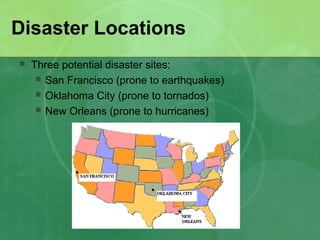
Disaster Locations
   Three potential disaster sites:
      San Francisco (prone to earthquakes)
      Oklahoma City (prone to tornados)
      New Orleans (prone to hurricanes)
Closed Military Bases
 Chosen from Base Realignment and Closure
  (BRAC) index
 Why use closed military bases?
     No cost to build new infrastructure
     Massive space conducive to storage

   Selection criteria?
     Included in BRAC index
     Close but not too close to disaster locations
Selected Bases
 Long Beach Naval Shipyard (Los Angeles,
  CA)
 Castle Air Force Base (Atwater, CA)
 Naval Station Ingleside, Texas
 Fort McPherson (East Point, GA)
 Carswell Air Force Base (Fort Worth, TX)
Purpose of the Capacitated Facility
Location Model
 Balance fixed costs of operating with variable
  costs involved with providing aid from
  facilities
 Identify avenues for efficient supply
  distribution
       Not all bases are needed for a certain disaster
   Opportunity to analyze various disaster and
    distribution scenarios
       Includes addition of political constraints
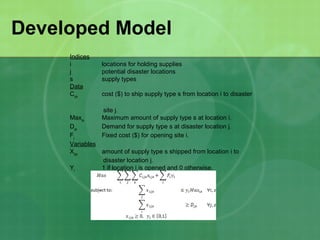
Developed Model
     Indices
     i          locations for holding supplies
     j          potential disaster locations
     s          supply types
     Data
     Cijs       cost ($) to ship supply type s from location i to disaster

                site j.
     Maxis      Maximum amount of supply type s at location i.
     Djs        Demand for supply type s at disaster location j.
     Fj         Fixed cost ($) for opening site i.
     Variables
     Xijs      amount of supply type s shipped from location i to
               disaster location j.
     Yi        1 if location i is opened and 0 otherwise.
Goals of Research
 Establish a basic model from which future
  disaster research endeavors can build upon
 Promote the idea of using recently closed
  military bases as spacious and cost-effective
  storage areas
 Identify future studies for enhancing disaster
  planning initiatives
Future Research
Recommendations
   Identify suitable unused infrastructure
    throughout the US
     Possible examples include abandoned
      warehouses/buildings
     Map proximity to potential disaster locations
     Expand on concept of closed military base
Future Research
Recommendations (cont.)
   Develop a list of characteristics for most
    suitable locations to hold disaster relief
    supplies
     Possible characteristics to look into: relative
      distance to site, regional climate, accessibility to
      highways and airports
     Set a numerical value to characteristics (identify
      highest scoring areas)
     Provide valuable insight on most efficient areas
      to allocate resources

Disaster Preparation Optimization Model

  • 1.
    Incorporating Available Military Infrastructuresinto a Capacitated Facility Disaster Relief Model MIDN 2/C John Moore
  • 2.
    Overview of Presentation Premise of study  Disaster locations  Closed military bases  Capacitated facility location model  Goals of research  Future research recommendations
  • 3.
    Premise of Study  Recent natural disasters in continental US  4 successive Florida storms (2004)  Hurricane Katrina (2005)  Hurricane Rita (2005)  How can aid supplies be most effectively stored and delivered to a disaster site?  Utilize recently closed military bases as resource warehouses and distribution points  Capacitated facility location model
  • 4.
    Disaster Locations  Three potential disaster sites:  San Francisco (prone to earthquakes)  Oklahoma City (prone to tornados)  New Orleans (prone to hurricanes)
  • 5.
    Closed Military Bases Chosen from Base Realignment and Closure (BRAC) index  Why use closed military bases?  No cost to build new infrastructure  Massive space conducive to storage  Selection criteria?  Included in BRAC index  Close but not too close to disaster locations
  • 6.
    Selected Bases  LongBeach Naval Shipyard (Los Angeles, CA)  Castle Air Force Base (Atwater, CA)  Naval Station Ingleside, Texas  Fort McPherson (East Point, GA)  Carswell Air Force Base (Fort Worth, TX)
  • 7.
    Purpose of theCapacitated Facility Location Model  Balance fixed costs of operating with variable costs involved with providing aid from facilities  Identify avenues for efficient supply distribution  Not all bases are needed for a certain disaster  Opportunity to analyze various disaster and distribution scenarios  Includes addition of political constraints
  • 8.
    Developed Model Indices i locations for holding supplies j potential disaster locations s supply types Data Cijs cost ($) to ship supply type s from location i to disaster site j. Maxis Maximum amount of supply type s at location i. Djs Demand for supply type s at disaster location j. Fj Fixed cost ($) for opening site i. Variables Xijs amount of supply type s shipped from location i to disaster location j. Yi 1 if location i is opened and 0 otherwise.
  • 9.
    Goals of Research Establish a basic model from which future disaster research endeavors can build upon  Promote the idea of using recently closed military bases as spacious and cost-effective storage areas  Identify future studies for enhancing disaster planning initiatives
  • 10.
    Future Research Recommendations  Identify suitable unused infrastructure throughout the US  Possible examples include abandoned warehouses/buildings  Map proximity to potential disaster locations  Expand on concept of closed military base
  • 11.
    Future Research Recommendations (cont.)  Develop a list of characteristics for most suitable locations to hold disaster relief supplies  Possible characteristics to look into: relative distance to site, regional climate, accessibility to highways and airports  Set a numerical value to characteristics (identify highest scoring areas)  Provide valuable insight on most efficient areas to allocate resources