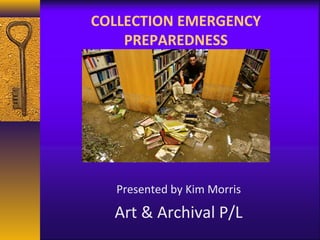
COLLECTION EMERGENCY 
PREPAREDNESS 
Presented by Kim Morris 
Art & Archival P/L
A Bit of History 
¨ Collection emergencies can occur anytime, 
anywhere 
¨ In 1985 the NLA suffered a devastating fire that 
identified the need to plan for Collection Disasters 
¨ No collection disaster plans existed in Australia at 
this time 
¨ Many different types of incidents have affected 
cultural collections before and since 
¨ Business recovery planning, risk management, 
insurance requirements and auditing have made 
disaster planning more essential
The 3 Phases of Disaster Planning 
Before 
Preparedness and Prevention 
¨ Risks identified and assessed 
¨ Collections prioritised 
¨ Resources identified 
¨ Plans prepared, updated and/or refined 
¨ Key roles allocated 
¨ Funding and support identified
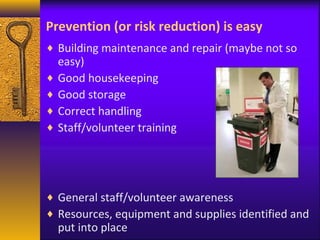
Prevention (or risk reduction) is easy 
¨ Building maintenance and repair (maybe not so 
easy) 
¨ Good housekeeping 
¨ Good storage 
¨ Correct handling 
¨ Staff/volunteer training 
¨ General staff/volunteer awareness 
¨ Resources, equipment and supplies identified and 
put into place
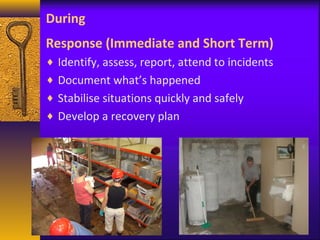
During 
Response (Immediate and Short Term) 
¨ Identify, assess, report, attend to incidents 
¨ Document what’s happened 
¨ Stabilise situations quickly and safely 
¨ Develop a recovery plan
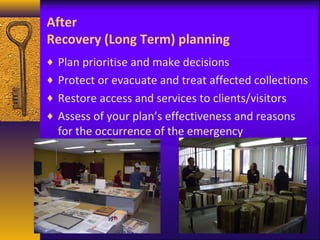
After 
Recovery (Long Term) planning 
¨ Plan prioritise and make decisions 
¨ Protect or evacuate and treat affected collections 
¨ Restore access and services to clients/visitors 
¨ Assess of your plan’s effectiveness and reasons 
for the occurrence of the emergency
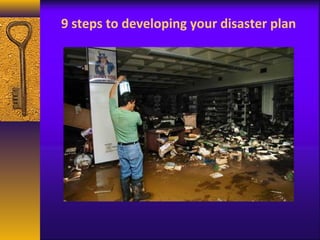
9 steps to developing your disaster plan
1 
Identify risks that may effect your building/s 
and collections 
 Flood 
 Fire & Smoke 
 Earthquake 
 Storm 
 Terrorist (Bomb) 
 Weather 
 Sewage 
 Water leak 
 Poor storage & 
handling 
 Mould 
 Equipment 
malfunction 
 Insect and vermin 
infestation 
 Vandalism 
 High dust levels 
 Accident 
 Theft 
 Building 
works/alterations 
And many more 
depending on your 
assessment
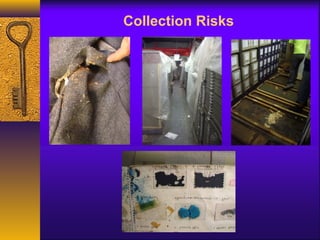
Collection Risks
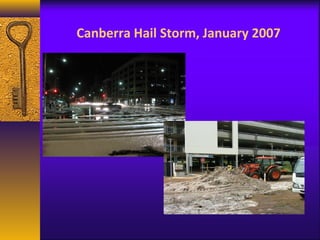
Canberra Hail Storm, January 2007
2 
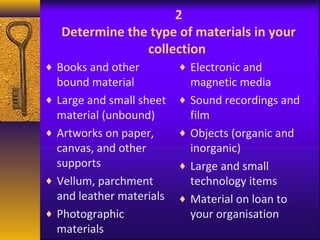
Determine the type of materials in your 
collection 
¨ Books and other 
bound material 
¨ Large and small sheet 
material (unbound) 
¨ Artworks on paper, 
canvas, and other 
supports 
¨ Vellum, parchment 
and leather materials 
¨ Photographic 
materials 
¨ Electronic and 
magnetic media 
¨ Sound recordings and 
film 
¨ Objects (organic and 
inorganic) 
¨ Large and small 
technology items 
¨ Material on loan to 
your organisation
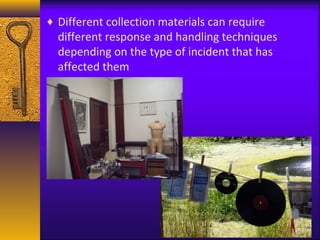
¨ Different collection materials can require 
different response and handling techniques 
depending on the type of incident that has 
affected them
3 
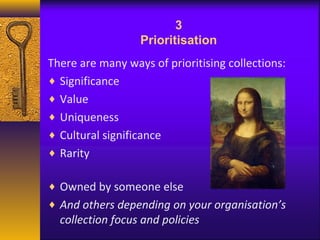
Prioritisation 
There are many ways of prioritising collections: 
¨ Significance 
¨ Value 
¨ Uniqueness 
¨ Cultural significance 
¨ Rarity 
¨ Owned by someone else 
¨ And others depending on your organisation’s 
collection focus and policies
Prioritisation can be a complicated process that 
requires good knowledge of collections, and 
careful consideration, debate and planning by 
managers and staff 
A simple categorisation of collections: 
¨ Category 1 items: those it is essential to save 
¨ Category 2 items: those it would be good to save 
¨ Category 3 items: those that it is not essential to 
save (at least in their original form)
4 
Determine resources that already exist on-site 
¨ An established security structure 
¨ Good Building maintenance 
¨ Cleaning personnel and supplies 
¨ Good cleaning practices 
¨ Emergency supplies 
¨ Emergency plans, risk management reports, business 
recovery and crisis management plans, etc. 
¨ Good storage 
¨ Smoke detection and Fire suppression systems 
¨ Fire safety precautions 
¨ And many more 
Recommendations for improvement in established resources 
can be made based on your findings.
5 
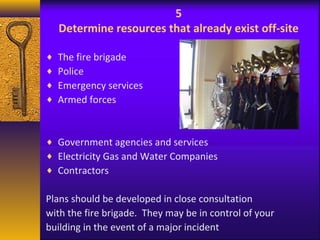
Determine resources that already exist off-site 
¨ The fire brigade 
¨ Police 
¨ Emergency services 
¨ Armed forces 
¨ Government agencies and services 
¨ Electricity Gas and Water Companies 
¨ Contractors 
Plans should be developed in close consultation 
with the fire brigade. They may be in control of your 
building in the event of a major incident
6 
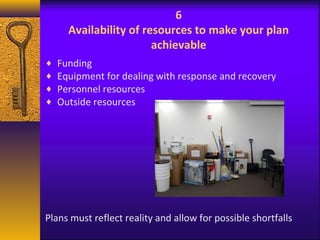
Availability of resources to make your plan 
achievable 
¨ Funding 
¨ Equipment for dealing with response and recovery 
¨ Personnel resources 
¨ Outside resources 
Plans must reflect reality and allow for possible shortfalls
7 
Write your plan 
Based on the information you have gathered: 
¨Prevention procedures 
¨Preparedness procedures: key contact list with allocated 
responsibilities and roles 
¨Awareness and training policy 
¨Emergency equipment and supplies lists and locations 
¨Emergency action procedures 
¨Special handling instructions for affected collections 
¨Outside resource lists 
The plan structure may vary depending on your 
organisation’s needs
8 
Allocate key responsibilities and tasks 
¨ Committee: Policy direction, funding, decision making 
¨ Collection managers: Knowledge of collections, 
prioritisation 
¨ Building manager: Building maintenance, upgrading 
building, cleaning, security 
¨ Personnel manager: Staff and volunteers, counselling, 
OH&S, training, resources 
¨ IT: Maintenance of computer services, data bases 
¨ Public relations: keeping people and media advised 
¨ Front of House: visitor safety 
¨ Collection emergency recovery team: response and 
recovery 
In small organisations these responsibilities may be under 
the control of a few people
9 
Maintain your plan on a regular basis 
Plans can quickly become outdated and should be revised 
regularly to remain fully useful 
Areas that need updating can include: 
¨ Key staff 
¨ Contact phone numbers 
¨ Outside Suppliers 
¨ Contractors 
¨ Collection priorities and locations 
¨ Emergency actions 
An out of date plan can be useless where quick decisive 
action is needed
Disaster preparedness - Kim Morris

Disaster preparedness - Kim Morris

  • 1.
    COLLECTION EMERGENCY PREPAREDNESS Presented by Kim Morris Art & Archival P/L
  • 2.
    A Bit ofHistory ¨ Collection emergencies can occur anytime, anywhere ¨ In 1985 the NLA suffered a devastating fire that identified the need to plan for Collection Disasters ¨ No collection disaster plans existed in Australia at this time ¨ Many different types of incidents have affected cultural collections before and since ¨ Business recovery planning, risk management, insurance requirements and auditing have made disaster planning more essential
  • 3.
    The 3 Phasesof Disaster Planning Before Preparedness and Prevention ¨ Risks identified and assessed ¨ Collections prioritised ¨ Resources identified ¨ Plans prepared, updated and/or refined ¨ Key roles allocated ¨ Funding and support identified
  • 4.
    Prevention (or riskreduction) is easy ¨ Building maintenance and repair (maybe not so easy) ¨ Good housekeeping ¨ Good storage ¨ Correct handling ¨ Staff/volunteer training ¨ General staff/volunteer awareness ¨ Resources, equipment and supplies identified and put into place
  • 5.
    During Response (Immediateand Short Term) ¨ Identify, assess, report, attend to incidents ¨ Document what’s happened ¨ Stabilise situations quickly and safely ¨ Develop a recovery plan
  • 6.
    After Recovery (LongTerm) planning ¨ Plan prioritise and make decisions ¨ Protect or evacuate and treat affected collections ¨ Restore access and services to clients/visitors ¨ Assess of your plan’s effectiveness and reasons for the occurrence of the emergency
  • 7.
    9 steps todeveloping your disaster plan
  • 8.
    1 Identify risksthat may effect your building/s and collections  Flood  Fire & Smoke  Earthquake  Storm  Terrorist (Bomb)  Weather  Sewage  Water leak  Poor storage & handling  Mould  Equipment malfunction  Insect and vermin infestation  Vandalism  High dust levels  Accident  Theft  Building works/alterations And many more depending on your assessment
  • 9.
  • 10.
  • 11.
    2 Determine thetype of materials in your collection ¨ Books and other bound material ¨ Large and small sheet material (unbound) ¨ Artworks on paper, canvas, and other supports ¨ Vellum, parchment and leather materials ¨ Photographic materials ¨ Electronic and magnetic media ¨ Sound recordings and film ¨ Objects (organic and inorganic) ¨ Large and small technology items ¨ Material on loan to your organisation
  • 12.
    ¨ Different collectionmaterials can require different response and handling techniques depending on the type of incident that has affected them
  • 13.
    3 Prioritisation Thereare many ways of prioritising collections: ¨ Significance ¨ Value ¨ Uniqueness ¨ Cultural significance ¨ Rarity ¨ Owned by someone else ¨ And others depending on your organisation’s collection focus and policies
  • 14.
    Prioritisation can bea complicated process that requires good knowledge of collections, and careful consideration, debate and planning by managers and staff A simple categorisation of collections: ¨ Category 1 items: those it is essential to save ¨ Category 2 items: those it would be good to save ¨ Category 3 items: those that it is not essential to save (at least in their original form)
  • 16.
    4 Determine resourcesthat already exist on-site ¨ An established security structure ¨ Good Building maintenance ¨ Cleaning personnel and supplies ¨ Good cleaning practices ¨ Emergency supplies ¨ Emergency plans, risk management reports, business recovery and crisis management plans, etc. ¨ Good storage ¨ Smoke detection and Fire suppression systems ¨ Fire safety precautions ¨ And many more Recommendations for improvement in established resources can be made based on your findings.
  • 17.
    5 Determine resourcesthat already exist off-site ¨ The fire brigade ¨ Police ¨ Emergency services ¨ Armed forces ¨ Government agencies and services ¨ Electricity Gas and Water Companies ¨ Contractors Plans should be developed in close consultation with the fire brigade. They may be in control of your building in the event of a major incident
  • 18.
    6 Availability ofresources to make your plan achievable ¨ Funding ¨ Equipment for dealing with response and recovery ¨ Personnel resources ¨ Outside resources Plans must reflect reality and allow for possible shortfalls
  • 19.
    7 Write yourplan Based on the information you have gathered: ¨Prevention procedures ¨Preparedness procedures: key contact list with allocated responsibilities and roles ¨Awareness and training policy ¨Emergency equipment and supplies lists and locations ¨Emergency action procedures ¨Special handling instructions for affected collections ¨Outside resource lists The plan structure may vary depending on your organisation’s needs
  • 20.
    8 Allocate keyresponsibilities and tasks ¨ Committee: Policy direction, funding, decision making ¨ Collection managers: Knowledge of collections, prioritisation ¨ Building manager: Building maintenance, upgrading building, cleaning, security ¨ Personnel manager: Staff and volunteers, counselling, OH&S, training, resources ¨ IT: Maintenance of computer services, data bases ¨ Public relations: keeping people and media advised ¨ Front of House: visitor safety ¨ Collection emergency recovery team: response and recovery In small organisations these responsibilities may be under the control of a few people
  • 21.
    9 Maintain yourplan on a regular basis Plans can quickly become outdated and should be revised regularly to remain fully useful Areas that need updating can include: ¨ Key staff ¨ Contact phone numbers ¨ Outside Suppliers ¨ Contractors ¨ Collection priorities and locations ¨ Emergency actions An out of date plan can be useless where quick decisive action is needed