Disaster response and planning for libraries Third Edition Kahn
Disaster response and planning for libraries Third Edition Kahn
Disaster response and planning for libraries Third Edition Kahn
Disaster response and planning for libraries Third Edition Kahn
Disaster response and planning for libraries Third Edition Kahn
1.
Visit https://ebookultra.com todownload the full version and
explore more ebooks
Disaster response and planning for libraries
Third Edition Kahn
_____ Click the link below to download _____
https://ebookultra.com/download/disaster-response-and-
planning-for-libraries-third-edition-kahn/
Explore and download more ebooks at ebookultra.com
2.
Here are somesuggested products you might be interested in.
Click the link to download
Disaster Planning for Libraries Process and Guidelines 1st
Edition Guy Robertson
https://ebookultra.com/download/disaster-planning-for-libraries-
process-and-guidelines-1st-edition-guy-robertson/
Disaster Response and Recovery Strategies and Tactics for
Resilience 2nd Edition David A. Mcentire
https://ebookultra.com/download/disaster-response-and-recovery-
strategies-and-tactics-for-resilience-2nd-edition-david-a-mcentire/
Veterinary Disaster Response 1st Edition Wayne E.
Wingfield
https://ebookultra.com/download/veterinary-disaster-response-1st-
edition-wayne-e-wingfield/
IT Disaster Recovery Planning for Dummies 1st Edition
Peter Gregory
https://ebookultra.com/download/it-disaster-recovery-planning-for-
dummies-1st-edition-peter-gregory/
3.
Planning Our FutureLibraries Blueprints for 2025 Kim
Leeder (Editor)
https://ebookultra.com/download/planning-our-future-libraries-
blueprints-for-2025-kim-leeder-editor/
Handbook for Pandemic and Mass Casualty Planning and
Response 1st Edition E. Gursky
https://ebookultra.com/download/handbook-for-pandemic-and-mass-
casualty-planning-and-response-1st-edition-e-gursky/
Business Continuity and Disaster Recovery Planning for IT
Professionals 1st Edition Susan Snedaker
https://ebookultra.com/download/business-continuity-and-disaster-
recovery-planning-for-it-professionals-1st-edition-susan-snedaker/
Disaster Recovery Planning A Guide for Facility Managers
2nd Edition Joseph F. Gustin
https://ebookultra.com/download/disaster-recovery-planning-a-guide-
for-facility-managers-2nd-edition-joseph-f-gustin/
Digital Libraries Policy Planning and Practice 1st Edition
Judith Andrews (Editor)
https://ebookultra.com/download/digital-libraries-policy-planning-and-
practice-1st-edition-judith-andrews-editor/
5.
Disaster response andplanning for libraries Third
Edition Kahn Digital Instant Download
Author(s): Kahn, Miriam
ISBN(s): 9780838911518, 083891151X
Edition: Third edition
File Details: PDF, 14.06 MB
Year: 2012
Language: english
vii
Contents
Preface xi
Arrangement andPurpose xv
Acknowledgments xvii
Introduction 1
Why Write a Disaster Response Plan? 2
What Is a Disaster Response Plan and Why Is It Important? 2
Response 3
Disaster Response Planning in a Nutshell 4
What If the Disaster Happens before You Have a Plan? 5
Section 1 Response 7
Phase One: Responding to Notification of the Disaster 8
Phase Two: Assessing the Situation and Damage 9
Phase Three: Beginning to Rescue and Recover Collections 10
Call for Outside Assistance 10
Damage Assessment 11
Response to Different-Sized Disasters 12
Dealing with the Media 14
Working with Contractors 15
Recovery Decisions and Priorities 16
Computers and Disaster Recovery 18
Emotional Issues 18
Section 2 Recovering Collections and Restoring Operations 21
Making Decisions 21
Resuming Services 22
Revising Disaster Response Plans 24
14.
Following Up 26
Marketingand Public Relations 27
Dealing with the Next Disaster—Physical and Psychological Issues 27
Section 3 Prevention 29
The Building Survey—Inside the Building 29
The Building Survey—Outside the Building 32
Correcting and Preventing Fire and Safety Hazards 32
Indoor Air Quality and Sick Building Syndrome 33
Remote Storage Facilities 34
Backup Routines to Prevent Loss of Computer Data 36
Survey to Identify Vulnerable Collections 37
Outside Contacts 38
Construction and Renovation Projects 38
Section 4 Planning 41
Elements of a Disaster Response Plan 42
Disaster Response Team 43
Roles and Responsibilities 44
Lists to Create and Update during the Planning Phase 48
Prioritization for Recovery 48
Planning for Small, Large, and Wide-Area Disasters 53
Planning for Damage to Computers and Data 56
Insurance 59
Communications 63
Phone and Internet Access 66
Contacting Disaster Response Companies and Consultants 66
Training 67
Section 5 Response and Recovery Procedures 71
Basic Response Procedures 71
Packing Procedures for Books, Documents, Archives, and Office Files 72
Selecting a Drying Method—Dehumidification vs. Vacuum Freeze-Drying 73
Documents and Files—In-House Handling and Drying Methods 77
Books and Paper Files—In-House Handling and Drying Methods 77
Large-Format Materials—Handling and Drying Methods 78
Textiles in All Formats—Handling and Drying Methods 80
Modern Film-Based Materials 1950–Present—Handling and Drying Methods 80
Magnetic Tape—Handling and Drying Methods 83
viii n CONTENTS
15.
CONTENTS n ix
CompactDiscs (CDs) and DVDs—Handling and Drying Methods 84
Phonograph Records—Handling and Drying Methods 86
Works of Art on Canvas and Paper—Handling and Drying Methods 86
Mold 87
Ozone 90
Insects and Pests 91
Disaster Response and Contingency Planning 92
Appendix A Checklists and Forms 93
1. Elements of a Disaster Response Plan 95
2. Disaster Response Team Contact Information 96
3. Emergency Contact List—Services 97
4. Phase I: Activate Plan—Gather Disaster Response Team 99
5. Phase II: Assessment—External Structural Damage 100
6. Phase II: Assessment—Internal Structural Damage 101
7. Phase II: Assessment—Contents and Furniture 102
8. Phase II: Assessment—Collections 103
9. Phase II: Assessment—Computers 104
10. Phase III: Rescue and Recovery 105
11. Phase III: Rescue and Recovery—Assignment of Disaster Response
Team Responsibilities 105
12. Phase III: Rescue and Recovery—Reallocation of Staff within
Building 106
13. Phase III: Rescue and Recovery—Reallocation of Staff outside
of Building 106
14. Phase III: Rescue and Recovery—Returning to Normal 107
15. Phase III: Rescue and Recovery—Communications 108
16. Prioritization for Recovery Checklist 109
17. Vital and Permanent Records Checklist 110
18. Recovery Decisions and Priorities Checklist 111
19. Paper Records Recovery Decision Checklist 112
20. Clay-Coated Paper Recovery Decision Checklist 113
21. Books and Bound Materials Recovery Decision Checklist 114
22. Microforms Recovery Decision Checklist 115
23. Software and Data Recovery Decision Checklist 116
24. Computer Equipment Recovery Decision Checklist 117
25. Checklist for Determining Drying Method 118
26. Environmental Conditions for Air Drying Books and
Paper Files Checklist 118
27. Current Suggested Temperature and Relative Humidity
for Cultural Institutions 119
28. Cleaning Books Checklist 120
16.
x n CONTENTS
29.Checklist for When Materials Are Returned from the Contractor 121
30. Building Survey Checklist 122
31. Fire Extinguisher Information List 123
32. Remote Storage Facilities Checklist 124
33. Computer Backup Tape and Data Storage Facilities Checklist 125
34. Telecommunications and Phone-Dependent Services Checklist 126
35. Computers and Data—Hardware Checklist 127
36. LANs and Servers Checklist 128
37. Printers Checklist 128
38. Battery Backup or UPS Checklist 129
39. Software Checklist—Commercial Software 129
40. Software Checklist—Customized and Proprietary Software 130
41. Software Checklist—Software Documentation 131
42. Backup Routines Checklist 132
43. Computer Backup Information Checklist 133
Appendix B Associations, Organizations, and Companies 135
Bibliography 143
Index 155
17.
xi
This is thethird time I have revised this book in an effort to help
librarians, archivists and museum curators deal with disasters, large and small.
Since 2002, libraries, archives, historical societies, museums, record centers, court-
houses, and all types of businesses and innumerable individuals have dealt with
disasters. Time after time, we realize that disasters come in all shapes and sizes, from
Hurricanes Katrina, Rita, and Wilma in 2004–2005 and Hurricane Irene in 2011 to tsu-
namis in Asia in 2006 and 2011, from the earthquakes in Haiti and Chile in 2010 and on
the east coast of North America in the summer of 2011 to the collapse of the archives
in Cologne in 2009. In the past ten years, rivers flooded, dams broke, roofs collapsed,
fires erupted—disasters too numerous to mention here. Still, libraries, archives, his-
torical societies, museums, and other cultural institutions need this basic book on
disaster response to help respond to and plan for the inevitable crisis that is too large
for a mop or wet vac.
There is an increased awareness that cultural institutions need a disaster response
plan that includes physical and virtual collections, services, administration, and cash flow.
Disaster response plans must include advice for dealing with computers, individuals,
and their families. The focus of this book continues to emphasize restoration of services
to our patrons. We must think beyond the standard bricks and mortar of our buildings
to the people and organizations we serve. We must respond to disasters quickly and
efficiently, helping others regain some semblance of their previous lives, reconnect with
families and jobs, and get back on their feet. That’s too large a task for this book, well
beyond what cultural institutions do, yet our services are now intertwined with the
lives of our patrons.
We must respond quickly and efficiently to restore services. That is the focus of this
book. To help cultural institutions respond to and recover from disasters, to plan and
prepare for disruption of services and dislocation from their normal routines.
Large and small, public and private, all types of institutions and businesses need to
plan for disasters. Disasters come whether or not we are prepared.
Changes since the last edition:
■
■ The field of disaster response is international. We hear about natural and man-
made disasters as they occur and respond with physical and financial assistance as
quickly as possible. The news keeps all of us informed almost instantaneously, espe-
cially when disasters strike. Conservators and preservation professionals travel to
Preface
18.
xii n PREFACE
disastersites, providing information and assistance
aimed at restoring access to collections in cultural
institutions.
■
■ Social networking is ubiquitous, so we need to con-
sider the implications for communications and pub-
lic relations. Facebook pages, Twitter feeds, wikis,
and blogs are everywhere. They seem to spring up
instantaneously when a disaster occurs. Cell phones
and digital cameras connect us seamlessly with one
another and the world around us, bringing voices
and images of disasters to the institution and to the
public. We must plan how to limit unofficial infor-
mation about disasters, because our staff members
will disseminate news with or without our permis-
sion and oversight.
■
■ Grief counseling is now an integral part of any
disaster response plan, no matter what the type of
disaster or crisis. Although this topic is beyond the
scope of this publication, it is necessary to consider
how and when your institution will provide grief
counseling. In the immediate aftermath of a disaster,
institutions must provide counseling to staff mem-
bers to help them cope with the stress.
■
■ Mission statements and collection development
policies are essential guidelines for prioritizing
the recovery of damaged materials. They are even
more important now that so many of our resources
are electronic and digital. The rate of recovery
and the order of recovery of services and materi-
als, both print and electronic, depends upon the
patron base and the scope of the disaster, what is
affected, the type of resources, and the needs of
your organization.
■
■ Preparedness serves two purposes: prevention of
the disaster in the first place, and preservation and
security of collections during and after the disaster.
Each section of this book pertains to all types of cul-
tural institutions, from one-person programs to com-
plex institutions with hierarchical management and
administration; from one room to multiple buildings
or campuses; from physical objects to digital or vir-
tual. Use the parts of this book that pertain to the size
of your institution, and adapt the rest to meet the cri-
sis you face. This publication continues to emphasize
the recovery of physical objects, while discussing the
importance of backup and remote sites for data and
electronic resources.
The events of September 11, 2001, continue to echo
in my mind. It is a date and event that changed disaster
response forever. The events of that day reinforced the
need for each and every business, cultural institution,
organization, and government agency to plan for disas-
ters. Since then, disaster response and all its related
fields are more visible and more important to all of us.
Heightened awareness of security issues, contingency
plans, disaster response plans, and many other buzz-
words are in the news and professional literature of
almost every industry. In the wake of those attacks and
of subsequent terrorist scares and natural and man-
made disasters, the revision of this book is important.
Even so, the primary focus of this publication is still
damage to tangible collections in libraries and archives,
historical societies and museums. In the light of past
events, library disaster response plans must be inte-
grated into disaster response and emergency plans of
cultural institutions and communities at large.
Disaster response and emergency plans are integral
to the survival of universities, museums, cities, coun-
ties, and states. Each crisis reminds us that preparing
for small disasters is just as important as planning for
the worst, or the unforeseen. Planning for disaster is
an attempt to minimize the loss of information to cli-
entele and decrease the loss of access to and closure of
collections. Without planning, the chances of survival
of a business, information center, library, archives, or
museum are next to impossible. Some planning will
ensure that part or all of the institution will survive to
rebuild itself in a new and stronger manner.
Disasters, emergencies, and crises can occur in many
forms, from fire, water, tornado, and loss of power and
phones to the destruction of buildings and collections.
Disasters occur when we lose a key employee, discover
the theft of rare items in our collections, and deal with
disruptive patrons. The disaster response team responds
to each disaster taking into account its scope and cir-
cumstances. Preparation is key for a successful recovery.
While this publication addresses only physical disas-
ters, keep in mind that many other events are disas-
trous for your institution, including bomb threats, major
thefts, and disruptive patrons.
This publication is designed to help libraries and
archives, historical societies, record centers, and muse-
ums respond to and recover from disasters. The materi-
als and suggestions will assist in the design of disaster
response plans. Adapt the plans and procedures to your
institution’s needs.
19.
PREFACE n xiii
Theplans and procedures in this publication are
generic for all types of cultural institutions and orga-
nizations. If you place this book on the shelf without
taking the time to modify its procedures to your insti-
tution’s needs, you did not write a disaster response
plan for your own organization. In the worst-case sce-
nario, there are sections designed to be used as situa-
tions warrant. Moreover, designing and completing any
plan do not guarantee that your institution will survive
a disaster. It is merely one step in considering all the
risks and preventing them. Planning for disasters will
accomplish two things: increase the chances for you
and your library to survive a disaster and decrease the
impact afterward.
Store copies of the disaster response plan and com-
puter backup data off-site at home, in record storage
centers, or in banks. Place digital copies on remote
servers and in digital repositories. Keep at least one
hard copy of the plan in each department and building.
Update the plan whenever there are changes in person-
nel, hardware and software, or in the physical layout of
the institution.
21.
xv
Arrangement and Purpose
Thispublication is divided into five sections, two appendices, and a bib-
liography. There is one section for each of the four phases of disaster response plan-
ning. The fifth section contains procedures for stabilization and basic treatment of
some collections once the recovery process is in full swing. The first appendix con-
tains checklists and forms to organize and coordinate various activities during the
response and planning phases. The second appendix lists different organizations, com-
panies, and suppliers of disaster response services, consultation, and assistance. A cur-
rent selective bibliography is appended to this work for consultation and for in-depth
information about some of the more complex issues.
This work provides practical, down-to-earth information and advice for dealing with
disasters and planning for their eventual occurrence. There are quite a number of books
in the field of disaster response and preparedness that cover theories of planning and
recovering print and nonprint materials. Some ideas from those books are included, but
the theory contained within is minimal and will mainly be found in the fifth section of
this book.
As the focus is practicality, this publication begins with the most important aspect of
a disaster response plan, “Response.” This section comes first, just in case a reader needs
to implement a response before there is an opportunity to put an actual plan together.
This first section contains information on small jobs and how to handle them in-house
with the institution’s own staff and suggestions for hiring out the labor and supervising
staff. The goal is to get back to normal as soon as possible.
Computers play an integrated part in libraries, archives, and information centers.
Catalogs, circulation systems, collections, and finding aids are located and preserved on
these computers. So we must create disaster response plans for recovery of lost data
and resumption of services. Plans that revolve around computers are usually called
“contingency plans” and focus on restoring the programs and data carefully backed up
every hour, day, or week. The specifics of planning for recovery of computer systems
go beyond the scope of this publication. But I would be remiss to ignore the comput-
ers, so basic information and references about where the computer disaster response
plan should be added or inserted will be included throughout. Some publications on the
subject will be found in the bibliography.
The second section is “Recovering Collections and Restoring Operations,” which dis-
cusses the resumption of services and operations. It includes guidelines for what to do
when the institution is no longer in disaster mode, including evaluating the effectiveness
of the plan and modifying it as needed with additional staff training in the weak spots.
22.
xvi n ARRANGEMENTAND PURPOSE
For the sake of simplicity, this book deals with re-
sponse and recovery separately. However, as Camila
Alire points out in the Library Disaster Planning and
Recovery Handbook, “the reality is that both activities
[disaster response and recovery] can be operating at the
same time.”1
“Prevention,” the third section, is closely tied in with
the fourth section, “Planning.” Prevention can stand
alone and be accomplished without a formal disaster
response plan.
“Planning,” the fourth section, lists all responsibili-
ties suggested for the team members; prioritizes the
order of recovering damaged collections; and provides
suggestions for staff training. This section is rounded
out with information on how to plan for loss of com-
puter services.
The fifth section, “Response and Recovery Proced
ures,” includes information on handling, packing, drying,
and cleaning print and nonprint, paper and nonpaper
materials. There is information about dealing with mold
and what effects ozone has on collections. Some of this
section is taken from information collected by the author
and distributed at seminars for libraries, archives, his-
torical societies, and disaster response companies.
There are two appendices. The first, “Checklists and
Forms,” contains checklists and forms for use during all
the phases of disaster response planning. They are fairly
generic and so should be adapted for use at your institu-
tion. The second appendix, “Associations, Organizations,
and Companies,” contains a selected list of organizations,
companies, and suppliers who can and will assist dur-
ing disaster response, recovery, and planning. Not every
organization or company is listed, mostly the large or
national ones. Add your local contacts to make this plan
your own.
The bibliography is divided into three parts. The
first is a basic bibliography of books and articles that
contain the basics of planning and response. The sec-
ond part lists publications by topic and is designed to
assist with specialized planning and recovery needs. The
third part is a general bibliography containing additional
readings that cross topic lines. The books, articles, and
journals included in the bibliography are only some
that are available in this flourishing field. Some cita-
tions refer to other bibliographies. Use the citations to
educate the disaster response team and staff members
of your institution.
While your plan is in draft form and when it is
completed, place basic response procedures with phone
numbers in the front of your disaster response manual
for easy reference and contact. Post the daytime num-
bers for the disaster response team at phones for a swift
response.
Note
1. Camila Alire, Library Disaster Planning and Recovery Hand-
book (New York: Neal-Schuman, 2000), 12.
23.
xvii
Acknowledgments
Thanks for thisthird edition go to Clark Searle, who helped me update
the topics of mold and insurance and the issues of responsible record keeping during
the response and recovery phases. Julie Callahan for helping me address the needs
of public and academic libraries. Kirk Lively, who provides information on current
disaster response companies, their specialized services, and mold removal. To my col-
leagues, Nancy Birk, Karen Gracy, and Margaret Maurer, thanks for listening to my
new ideas and helping me form them into coherent concepts. To my students, who
listened to my numerous lectures about disaster response and shared their own sto-
ries about water, fire, and mold. To Vic Fleischer, whose request to review his disaster
response plan jump-started the long-stalled revision of this book. To the librarians,
archivists, records managers, and book collectors who called for help with mold
removal and drying water-damaged books. To Nan Garrison, colleague and friend,
who fed me and listened to my complaints about yet another mold consultation.
Thanks to my editor Michael Jeffers for his encouragement during the slow and dif-
ficult spots. And, as always, thanks to my family for their support. The ideas and tech-
niques in this book are the result of my experiences, feedback from earlier editions,
and from my workshops. Any errors and omissions are mine alone.
25.
1
Introduction
Disasters happen. Youplan for them, work to prevent them, or turn a blind
eye and hope one will never occur. Sooner or later, you must deal with one.
Disasters come in all sizes. Sometimes disasters affect a small part of your
building, sometimes the entire building, and in the most extreme and tragic times the
entire area. Since you do not know when or how extensive the disaster will be, you can
only be prepared.
If this is the case, then why write about disasters at all? Well, in the twenty-odd
years I have been dealing with disasters, I know they will come, that we are never truly
prepared, and that we will respond, recover, and go on to rebuild even better cultural
institutions. To respond quickly and efficiently, you must plan and prepare for whatever
comes your way. Plan for the small disaster and the rest will begin to fall into place.
So where do you start? This book provides guidelines for responding to disasters
and recovering operations, materials, and resources, including staff and income. From
there you start the process all over again, by planning and preventing the next disaster.
Notice I started the process with response and not planning. The sad but true fact is that
most institutions, most businesses, most people never plan for disasters. They respond to
disasters and, in doing so, recover all they can, pick up the pieces, and plan for the next
one. The logical place to begin is with response and a determined, coordinated effort to
restore access to collections and resources, physical and digital.
When disaster strikes, your first reaction must be response. It is very important to
follow your plan and carry out the steps and policies you created. So if you have a plan,
activate it. If you don’t have a plan, all is not lost.
Respond using your knowledge of the institution and its needs, mission, and collec-
tion development policies. Respond with a sense of priorities based upon those needs and
your patron base. Respond with the goal of recovering access to services and resources
as quickly and painlessly as possible. Respond, don’t ignore the disaster, and don’t expect
others to do it for you.
Common sense tells us to evacuate a building in the case of fire, smoke, and some-
times severe weather. For tornados, find the tornado shelter in the building. Now is not
26.
2 n INTRODUCTION
thetime for heroics. Pull a fire alarm, call 911, and evacu-
ate the building. Response is part of making certain all
the people are safe.
Disasters come in various sizes and levels of serious-
ness. They strike departments, buildings, institutions,
communities, and regions. Fire, flood, and broken water
pipes are just as serious and stressful as hurricanes, tor-
nados, earthquakes, and blizzards. They wreak havoc
on our institutions, our routines, and our lives. Bomb
threats, hazardous waste contamination, and epidemics
may be beyond our control but we can plan for them.
Power and phone outages, loss of Internet, wireless, and
e-mail access can cripple an institution and reference
services if we don’t plan for them. That’s what disaster
response is all about. Consider the various crises that
can strike, large and small. Plan your response. Follow
your plans. Ask for help. When it is all over, revise your
plans so you are ready when the next disaster occurs.
This book provides guidance, suggestions, plans, and
checklists for responding to and recovering from disas-
ters. Planning is the key, planning for your response is
the best insurance for surviving each disaster whenever
it happens.
For the readers who don’t have time to design a plan
or read this book, this introduction provides guidance
for responding to disasters.
Why Write a Disaster
Response Plan?
Disaster response and prevention policies are essen-
tial for the continuation of libraries, archives, histori-
cal societies, and museums. Our patrons expect that
we are open for business at all hours and accessible
when they want information. With the proliferation of
computers and our dependence upon data and online
services, downtime and lack of accessibility are detri-
mental to quality service and our reputation. So what
is to be done? First, thinking about disasters, or “the
worst,” is the best first line of defense and prevention.
If nothing ever went wrong, then disaster plans would
be a waste of time. Sadly, this is not the case. Every
day we read about floods, mold infections, and fires
that cause irreparable harm to library and archival
collections. Even a slowdown of service or power out-
age has untold repercussions in quality of service and
the ability to provide information in a timely manner.
In the aftermath of the destruction of the World
Trade Center on September 11, 2001, financial institu-
tions immediately activated the contingency plans for
their computer systems. Through careful planning and
testing, mandated by the federal government, they were
able to restore operations quickly. Those businesses that
did not have plans or data backed up in remote loca-
tions struggled to get their operations up and running.
In some cases, all documents and data were lost forever.
After Hurricane Katrina, libraries and archives, uni-
versities and businesses scrambled to provide safe work
space for staff and recover collections as quickly as pos-
sible. Restoration of service, access to e-mail and the
Internet were key to providing benefits to the displaced
and a communication lifeline to residents of Louisiana
and Mississippi.
After the earthquakes in Haiti and Chile, cultural
institutions provided information and e-mail access to
individuals who lost homes and businesses, and helped
reunite families. We don’t always think about the roles
libraries and archives play during a disaster. Libraries
are safe havens from the chaotic storm of displaced
lives. They are the information hub of our information-
hungry society. If we don’t plan for response to disasters
and quick restoration of services, libraries and archives
are not available for our patrons to use to resume their
lives and contact with the outside world.
While dealing with the enormity of the human trag-
edy, disaster response teams plan to recover effectively
and efficiently from the worst and to provide access to
our resources as quickly as possible. While we cannot
necessarily plan for every contingency, we can plan how
we will restore services as quickly as possible. After each
disaster, the library and archives community is reminded
of the importance of foresight and planning for the loss
of collections and data, services and information.
What Is a Disaster
Response Plan and Why
Is It Important?
Disaster response is the procedures and processes
whereby a team of trained individuals responds to a
disaster and determines how to best recover the dam-
aged materials so that “business as usual” can resume
as quickly as possible. It is best if the response and
27.
INTRODUCTION n 3
recoveryprocedures are worked out ahead of time.
This will enable the disaster response team to imple-
ment response and recovery procedures as quickly as
possible based upon well-thought-out priorities and
techniques.
During the disaster response phase of the operation,
volunteers, outside consultants, and contractors are
often called in to assist with the recovery of damaged
materials. It is important to consider the role of outside
or volunteer assistance, where their services can best
be used, how they can relieve physical and emotional
stress from full-time staff, and how their services can be
used to perform many of the labor-intensive procedures.
A well-thought-out disaster response plan will decrease
the amount of time it takes to implement disaster recov-
ery procedures and should decrease the loss of materials
and contents and increase the recovery rate.
In the planning phase, select the disaster response
team. Team members are responsible for directing the
activities during the response and recovery phases. The
disaster response team allocates responsibilities and
assists with recovery prioritization decisions. The team
should be involved with training for themselves and any
staff and volunteers who will work on recovering the
collections and facility from the disaster.
Preparation, or preparedness, is the phase during
which the disaster response team surveys the building
and its collections for potential hazards and the iden-
tification of previous water leaks, and so on. During
this phase, the team creates simple floor plans showing
where collections are located and what is in various
rooms. Identify the location of fire alarms, fire escapes
and emergency doors, and fire extinguishers and mark
floor plans accordingly. Disaster response planning and
prevention, or preparedness, are performed when all
is sane and quiet, and decisions are made in a rational,
carefully considered manner.
On the flip side of the process, disaster response and
recovery plans are activated when all is chaos, amidst
conflicting demands to restore services, collections, and
access to the building. There is often a tension between
the disaster response team and the director, adminis-
trators, and patrons. The response phase concentrates
upon doing just that, responding to the news that a
“disaster” has occurred, assembling the appropriate
staff, outside assistance, and supplies, while recover-
ing the collection and the facility. The recovery phase
concentrates on restoring the collection to a usable
form and resuming services in a timely, efficient, and
cost-effective manner.
Taken as a whole, a disaster response plan is essen-
tial to the continuation of the institution, retention of
patrons, and fast and efficient resumption of services to
patrons and staff.
Response
At the worst possible moment, the phone rings or
your e-mail pings with news of a disaster in your
institution. You are heading out the door to an impor-
tant meeting, vacation, or just for the weekend. Your
adrenaline surges as you call the disaster response
team and race to the scene. Take a deep breath as you
respond to the situation based upon the careful plan-
ning and heated discussions of the past months and
years. All the planning and preparation finally pays
off. It is time to put your plan into action.
There are three basic stages of response:
1. Respond to the disaster by assembling your team
2. Assess the scope of the damage
3. Begin recovery of services and collections
Initial Response to the Disaster
First assemble your disaster response team. During
the planning phase, you selected two or three possi-
ble places to meet, one near the building if the library
or building is damaged, in a quiet location out of the
weather somewhere nearby. In the case of a small,
iso
lated disaster in the building, meet in a conference
room. Assemble your team at the appropriate location.
If you do not have a plan or a predetermined location,
select a place where you can talk and synchronize re-
sponse activities.
If you do not have a team, gather together depart-
ment heads, administrators, and staff with preservation
and/or disaster response experience. Include someone
from the IT (information technology) department. From
this group, select a team leader other than the director.
The director has a separate set of responsibilities during
a disaster, as does the head of IT or computer services.
The team leader should have enough authority to
supervise staff and assign tasks without asking permission
28.
4 n INTRODUCTION
fromsomeone else. In some institutions, the team leader
is the head of facilities and maintenance, in other cases,
the deputy director responsible for buildings and prop-
erties, in others, the head of preservation, archives, or
special collections. For every institution, there is a logi-
cal person to be in charge. The only time the head of the
disaster response team should be the director is if the
library has only one staff member. If the disaster affects
the entire institution or community, select a disaster
response team member as liaison with the institutional
or community emergency management team.
Once you have a disaster response team leader and
team, then the director and the team leader should brief
the team as to the scope of the disaster: what was dam-
aged and what was affected. Was there a fire? A broken
water pipe? Is there a power outage and are the phones
and Internet affected? When can the team get access to
the building(s)?
If the power is out, how long until the utility com-
pany can repair the damage and restore service? In the
meantime, can your staff provide services such as refer-
ence and circulation without power? If so, implement
manual circulation and reference procedures. If there
are battery-operated computers with circulation capa-
bility, then use them.
Activate the IT disaster response plan to provide
access to electronic services from a remote location or
off-site. Move all public services operations to a remote
location where some portable computers can provide
access to electronic resources and circulation systems.
In these days of wireless access, instant communica-
tion, and remote accessibility to electronic collections,
there is no excuse for loss of services to your patrons.
Assign staff to provide reference from alternative loca-
tions while you restore services at your primary location.
If there was water or fire damage, consider closing
the building until the scope of the damage to the collec-
tion can be ascertained.
If the structure of the building is damaged, from
fire, flood, hurricane, tornado, or earthquake, a struc-
tural engineer should check the physical integrity of the
building, ensuring it is safe to enter and work within.
If not, then contact a firm that can remove the collec-
tions from the building and store them in a safe, secure,
remote location. Discuss appropriate handling and pack-
ing procedures for this pack-out operation so materials
do not sustain additional damage.
Disaster Response Planning
in a Nutshell
Consider the types of disasters most likely to happen
or the crises that occur on a regular basis and plan for
these, while keeping in mind disasters might destroy
the entire building or collection.
When planning for disasters, consider what services
would be most affected by loss of access to the building
and its collections. Is it access to the specialized collec-
tions, microfilm, digital resources, and documents, or
the loss of payroll and financial information that keeps
the institution funded? What other services will be dis-
rupted? Other issues to consider and record:
■
■ Who has the authority to order and pay for supplies
and services that are needed?
■
■ Who can make such decisions as calling the insur-
ance company in to assess the loss and asking the
disaster response firm and consultants to determine
the scope of loss and the amount of work needed to
“restore” the collection?
■
■ Who has the authority to designate staff to “other
duties as assigned,” hire temporary staff, or rent
space and equipment to work? How does having a
union at your institution change work procedures?
■
■ Who is in charge of discussing the situation with the
board of trustees or the director of the institution?
■
■ Who will be the media spokesperson for the institu-
tion if there is no public information officer?
■
■ Who is responsible for declaring a disaster for the
computer systems? Where will they set up tempo-
rary operation? What firm or individual stores the
backup tapes? How quickly can the online system
get back up and running?
These are just some of the many issues to be con-
sidered when designing the response portion of a plan.
If you have ever been involved in a disaster, then you
are aware that making decisions on the fly is not best
for the library’s collection or its personnel. Everyone
is working under a high adrenaline level and may find
it difficult to make educated, rational assessments of
the situation and the condition of the remaining collec-
tions. Important materials could be damaged by being
overlooked or discarded accidentally. Recovery decisions
29.
INTRODUCTION n 5
needto be prioritized ahead of time, during the planning
process. Disaster response planning takes time but is
well worth the effort.
What If the Disaster Happens
before You Have a Plan?
If you don’t have a plan and a disaster occurs, take the
following seven steps.
1. Gather together key staff in a quiet place, either in
the building or near it.
2. Assess the scope of the damage and potential dis-
ruption of primary services and functions. Review
affected collections for importance within the library’s
mission and in terms of the magnitude of damage
from water or fire.
3. Contact colleagues outside of the institution for
assistance and recommendations for consultants
and disaster response/drying companies.
4. Assign staff to recovery responsibilities:
■
■ Performing physical work
■
■ Acting as liaison with the administration and
performing administrative work
■
■ Communicating with both internal and external
organizations (with media and others outside of
the institution)
■
■ Contacting your insurance agent (Ask about di
-
s
as
ter response assistance and available funds.)
■
■ Working with disaster response companies and
consultants
■
■ Locating alternative work areas and supplies
5. Meet again with key staff to coordinate the recovery
operation.
6. Begin the recovery operation, starting with primary
priorities and services.
7. Start phasing in the return of primary services and
functions.
31.
7
Response
Section 1
Disaster strikes!Suddenly everyone and everything goes crazy. Your adrenaline
pumps and the disaster response team has to do something about the disas-
ter! Hopefully, this is the moment you have been working toward, making
plans and trying to prevent additional damage to collections.
Response comes about in two distinct parts: reacting to the disaster as it occurs, and
dealing with the disaster as prelude to resuming operations. The safety of people always
comes before the collections and the building, no matter what. Once a disaster occurs,
the disaster response team needs to work together to ensure the swift recovery of the
collections and resumption of services.
Inevitably, at colleges and universities, circulation desks are staffed in the evenings by
students and paraprofessionals. It is essential these staff members be trained in disaster
response procedures. It is even more important that they be given the authority to make
decisions when confronted with an emergency or disaster. The disaster response team
and administrators must trust that the decisions made when encountering a disaster
were the correct ones at the time. Re-evaluate the immediate response procedures after
the disaster is over and operations are running smoothly.
The first part, reacting to the disaster when it happens, should be simple because it
entails evacuating the people from the building and calling for help. Make the procedures
for evacuating the building simple. Call for help, evacuate the building, and activate
the disaster response team. Take a deep breath. The disaster response team must work
together to both resume services and recover the damaged collections. Take the time
you need to gather your thoughts and review policies and procedures before wading
into the crisis.
Some sample immediate response procedures are
■
■ If there is a fire, pull the fire alarm and evacuate the building. Assemble the staff at
the designated meeting place. Confirm that all staff left the building. Notify the police
and fire department if there are missing staff members. Do not re-enter the building.
■
■ If there is water from a broken pipe, sprinkler system, or restroom, call the facilities
maintenance department. Get the water shut off immediately. Evacuate the building
32.
8 n RESPONSE
asneeded. Notify the disaster response team and
arrange to have standing water removed from the
building.
■
■ In case of natural disasters, follow the directions
from the emergency management agency announce-
ments. For tornados, proceed quickly to tornado
shelters in basements and ground-floor rooms with-
out windows. In the case of hurricanes and flooding,
there are usually warnings issued ahead of time, so
board up the windows, turn off computer systems,
make certain data backup is complete and stored
off-site away from the potential disaster area, and
staff know where to report when the hurricane or
flood has passed. If you cannot leave safely, go to
the shelters and wait for the storm to pass.
■
■ For blizzards and ice storms, stay indoors and wait
for the storm to pass. Tornado shelters are sup-
posed to be stocked with nonperishable food, pota-
ble water, flashlights, radios, and other emergency
supplies. If trapped by the storm, move patrons and
staff to the shelters and call for help.
■
■ In the case of bomb threat, get a staff member to
call the police and evacuate the building. Calmly try
to get information about the explosive. The same
for people wielding guns and knives; call for help
and evacuate the building as quickly and quietly as
possible.
No matter what, call for help and evacuate the build-
ing or the area quickly, then call the disaster response
team. Follow the plan and work together toward a
swift recovery. Do not throw all that hard work and
planning away. After the disaster is over, then take the
time to evaluate how the procedures worked and to
modify your plan accordingly.
Although this part of disaster response seems
straightforward, it does require some forethought.
Questions to consider during the planning and preven-
tion phase are: Do your student workers know what
to do in the event of a disaster? Where should all staff
meet? What are the institution’s policies for evacuation
during inclement weather? What types of emergency
supplies are stocked in tornado shelters? How many
people can the shelters house? Are there enough sup-
plies for a day or two? and finally, Who is responsible
for checking and updating the supplies?
During the planning phase, investigate the vari-
ous emergency policies with health and public safety
personnel, facilities and maintenance staff, risk man-
agement officers at your institution, the city or county
emergency management agency, and the city or county
fire and police departments. What are their procedures
and policies, and how does the library fit into the plan?
The smaller your institution, the more important it is to
work with local fire, police, and emergency personnel
to coordinate your response plan with their procedures.
The second part of disaster response, working to
resume services and operations, comes in three phases:
1. Responding to notification of the disaster
2. Assessing the situation and damage
3. Beginning to rescue and recover collections
and restore services
Of course, you need to restore services quickly and, in
some cases, even before you assess the scope of the
disaster. Maintaining services during a disaster may
be part of your institution’s emergency response plan.
If that is the case, then during the planning phase,
determine where the library/archives fits and what
roles you can provide. It is almost impossible to write
about response and recovery activities at one time
and cover everything logically. This chapter covers
response and the various activities associated with it.
The next chapter deals with recovery operations.
You may find it necessary to divide your disaster
response team to deal with recovery of operations and
services while assessing the damage to the structure and
collections. If this is the case, active communication and
coordination of activities is fundamental for a success-
ful resumption of services and recovery of collections.
Phase One: Responding to
Notification of the Disaster
First, assemble the disaster response team. During
the planning phase you selected a place to meet out-
side the building if the entire library or building was
damaged. That place should be quiet and away from
the emergency vehicles. If the building is intact and
accessible, meet in a conference room inside the
building. If there is no disaster response team in place,
gather together department heads, the preservation
or rare books/special collections librarian, the library/
archives director, and the head of technical services.
Contact someone from the facilities maintenance de-
33.
RESPONSE n 9
partmentfor assistance with removal of water, mud,
and debris.
This is a very chaotic time and place. Many people
with varying levels of authority and responsibility are
trying to get the situation under control. Stay calm and
work together. Take the time to decide who you need to
call, what supplies you might need, and whether other
staff members should report to the alternative location.
Find out who is in charge of the building or area
and ask to be notified when you can enter the building.
You might need some type of identification to confirm
that the disaster response team leader is in charge of the
response operation. During the planning phase, create
identification cards that show you are members of the
disaster response team (“DRT”). Consider obtaining vests
or T-shirts with “Library/Archives DRT” to identify team
members to the other people in the area. It is very pos-
sible that this is the first time you will come in contact
with the facilities maintenance staff and with safety and
security personnel.
The disaster response team should select a team
leader from this group if none was selected during the
planning phase. Don’t forget to include the head of infor-
mation systems in your discussions, because this depart-
ment may have special needs for the implementation
of its part of the disaster response plan. The disaster
response team leader should not be the library director
unless you are a one-person library. The library director
has many other responsibilities and will be busy commu-
nicating with administration, insurance companies, and
even the disaster response companies. In some institu-
tions, the head of facilities is the disaster response team
leader (more on this in section 4, “Planning”) because
this department deals with small disasters on a regu-
lar basis and has contacts with companies that provide
water removal, cleanup, and emergency maintenance.
Next, the disaster response team leader should brief
the disaster response team about the situation. Review
the responsibilities of the team and call in additional
staff as needed. The disaster may be caused by water,
fire (which will leave you with water afterward), or loss
of power, phones, and Internet access. If it is the latter,
implement procedures to provide services manually and
contact the utility company. At this point, the informa-
tion services or computer disaster response team should
activate their plan to operate from a remote location
and provide assistance to check collections in and out
using the backup circulation system, if any. If the power
or phones will be out for an extended period of time,
then determine how to provide access to various library
services, including reference and electronic resources,
from a remote location or by referral. Today’s social net-
working tools are great for reference staff who offer
ready reference and referral services. During the plan-
ning phase, consider how you will integrate social media
into your disaster response plan.
During this initial phase of disaster response, take
the time necessary to gather your thoughts. Review the
disaster response plan and coordinate the next phase of
the response plan. The disaster response team needs to
be working together to resume operations and recover
collections quickly and safely.
The following response procedures pertain primar-
ily to damage from fire and water:
■
■ Close the building or the damaged area to the public.
■
■ Shut the water off and find out if the other utilities
are on or should be turned off.
■
■ Start the response operations by activating the basic
internal communications policy and alerting the
disaster response team, consultants, or contractors.
Phase Two: Assessing
the Situation and Damage
This next phase of the disaster response plan begins
when the building or area is safe to enter.
First, the disaster response team needs to assess
the damage. Walk through the damaged area to see
what really happened. Make a list of the areas that
require pack-out, cleanup, or removal to storage. Check
the damaged collection against the “Prioritization for
Recovery Checklist” (see appendix A.16). Now is not the
time to weed the collection. If you did not prioritize
the recovery of collections during the planning phase,
call in the subject specialist or bibliographer to make
up a basic prioritization list, based upon recovery
time lines for water-damaged materials.1
(See appen-
dix A.18.) If your library has a small staff, contact the
local library/archives consortium, the state library, the
regional library consortium, or the Regional Alliance for
Preservation for assistance.
In addition to the disaster response team, the infor-
mation systems team should be called in to determine
the extent of damage to the online public access catalog
(OPAC), circulation systems, website, and all electronic
resources. Coordinate the use of personnel and resources
34.
10 n RESPONSE
duringthe phases of recovery of data and reintegration
of systems. Be certain to continue to include the liaison
from the information systems’ disaster response team
in all meetings.
Next, brief the director of the library/archives or
the head of the institution about the situation. Activate
the external communications plan. Decide if the build-
ing or area needs to remain closed, and if so, estimate
for how long.
Finally, contact the appropriate outside assistance,
consultants, and drying or disaster response company.
Call in additional staff to assist with the recovery opera-
tion. Reallocate staff as needed to other areas of the
library, the campus, or the area. Assemble the necessary
supplies to begin recovery and cleanup.
Phase Three: Beginning
to Rescue and Recover
Collections
Talk with facilities maintenance staff, or with the
disaster response/drying company if they will be per-
forming this service, and remove the standing water.
Start to pack out the water-damaged and smoke-
damaged items for freezing or air drying. A good rule of
thumb is, between 100 and 300 volumes can be air dried
locally if you have the manpower, otherwise freeze all
the wet books. Keep in mind, air-dried books will swell
and distort while drying and may need to be rebound
professionally before returning them to the shelves.
Freezing books buys time to dry and clean the building
and assess the scope of damage and loss of collections.
Vacuum freeze-dry all frozen books and papers. Do not
defrost before drying.
Next, move the dry and undamaged items into stor-
age or a temporary access area if a large portion of the
area or building was damaged. This will prevent second-
ary damage from increased levels of moisture and rela-
tive humidity. If it is impractical to move the undamaged
items to another location, then set up fans and drop
the temperature in the damaged area. Air movement
and decreased temperature will lower the chance for a
mold outbreak.
Then, discard irreparably damaged items and debris
so they no longer contribute moisture to the building
and other materials. This includes wet ceiling tiles and
loose carpet squares. Remove wet curtains, area rugs,
and furniture to decrease the moisture in the area.
Professionally clean and dry these furnishings and store
them in a safe place until the environment (temperature
and relative humidity) is stabilized and the building is
clean and dry. This will decrease the chance for a mold
outbreak.
Set up fans to move the air and adjust the HVAC (heat
-
ing, ventilating, and air-conditioning) system to dry the
air and stabilize the environment.
Now you are ready to concentrate on the recovery
phase. This begins after the immediate crisis, actions,
and emotions are under control. Recovery will be cov-
ered in section 2.
Remove all damaged or wet computer equipment for
cleaning, repair, and recertification. Move any undam-
aged computer equipment to a safe location, remote
storage, or off-site operations center. Coordinate with
information systems’ disaster response plan.
Call for Outside Assistance
During the response phase, it is important to ask for
outside assistance, even if the disaster response team
members think they can handle the situation alone. The
only time you might not call for help is if the disaster
is very isolated and has affected only a few volumes.
Otherwise, you will want outside guidance and assis-
tance for at least one or two days, until the situation is
under control and the emotional stress has decreased.
It is important for the person or company provid-
ing assistance to be familiar with the collection and the
institution’s policies. The outside consultant or company
is not emotionally tied to the collections and is therefore
capable of presenting choices and options where the
staff’s emotions and attachment to materials may rule.
Consultants provide additional assistance by recom-
mending disaster response/drying companies and others
who specialize in conservation of the unique, fragile, and
nonprint or nonpaper items in the collections. A consul-
tant, working in conjunction with the disaster response
team leader, relieves the director of the archives or
library of the day-to-day stress of dealing with cleaning
up, possibly with the help of temporary laborers hired
to do much of the nonskilled physical labor. If necessary,
the consultant and the disaster response team member
responsible for working with volunteers should work
with the disaster response company, demonstrating how
to move books and pack boxes for shipment. One or
35.
RESPONSE n 11
bothshould be the liaison between the company and
the library/archives.
If the facilities maintenance staff are available to dry
and clean the building and move the collections, you still
want a disaster response team member to act as liaison
to answer questions. Provide some basic training and
information about handling wet materials and packing
boxes. Stabilizing the environment is the first priority. If
facilities maintenance staff are also responsible for this
task, provide guidelines and parameters for decreasing
the temperature and relative humidity. This is counter-
intuitive, for most people assume you raise the tempera-
ture to dry a structure. Unfortunately, if you raise the
temperature, you increase the risk of a mold infection
in the building and HVAC system.
The director of the library/archives might wish to
have the consultant prepare recommendations and bid
specifications for specialized work. These recommen-
dations provide guidelines for disaster response and
drying companies. Ask the consultant to demonstrate
procedures for cleaning books, packing boxes, removing
dirt, and mold prevention and removal. Demonstrations
of packing and cleaning are best practiced during the
planning phase. A quick refresher in handling and pack-
ing wet books is essential for all personnel, employees,
students, volunteers, and contractors. If your institution
is small or the disaster is large in scope and damage,
you could ask the disaster response consultant to assist
with writing temporary policies for providing access to
collections and services from a remote location. As a
follow-up, ask the consultant to write recommendations
for preventing future disasters.
Damage Assessment
First, take out the “Prioritization for Recovery Check
list” (appendix A.16) and see the subsection “Priori
tization Categories” under “Prioritization for Recovery”
in section 4 and review the established criteria as well
as the collection policy and mission statement for the
institution. Do not change the criteria or prioritization
at this time. Decisions made under stress and with
adrenaline pumping, or when emotions are high, are
not always rational and justifiable, or based upon the
organization’s mission statement. If no decisions were
made prior to the disaster, ask for outside assistance
from a consultant familiar with your collections and
selection policies.
Now, walk through the damaged areas carefully.
Document the damage with photographs or video to
show the insurance adjuster. If the damage is extensive,
ask the insurance company to send an adjuster who
specializes in water damage claims. Checklists A.5–A.9
for documenting damage assessment are located in
appendix A. It is not always necessary for the adjuster
to be present when you begin the response and recov-
ery phases of disaster response. The insurance company
must be notified that the disaster occurred and that
the disaster response team knows what can and cannot
be done within the policy’s terms. During the planning
phase, the disaster response team should ask if there are
procedures that must be followed for a successful claim.
When contacting the insurance company, ask if there is
anything special you must do in terms of documentation
and proof of loss.
Check damaged collections against your checklist or
the prioritization categories. List damage and recovery
steps for specific parts of the collection. If the damage is
extensive, you may need to identify undamaged materi-
als for storage or relocation to a dry, secure section of
the institution or even another building. Do not mix wet
and dry materials in the same area.
Use copies of the floor plans to indicate the dam-
aged locations and to prioritize recovery operations.
Indicate the wet items to be removed for packing and
where the packing area will be. Mark the dry collections,
whether portions within the damaged areas will need
to be moved, and to where.
Note the types of damage (water, soot, debris, etc.)
to different areas of the collection and the types of
cleanup necessary when the recovery phase begins.
If there is structural damage to the building, such
as a hole in the roof, broken windows, or holes in doors
and walls, list the damage. Get security to protect the
building from unauthorized persons. Have facilities
maintenance staff board up the windows and doors.
Have a company come in to cover the holes in the roof.
Make certain the roof covering is secure enough to with-
stand the rain or snow. It should have some type of
drainage so the tarp does not fill with water and col-
lapse into the building. Repair roof damage right away.
This area is a prime candidate for additional damage to
the structural integrity of the building and an avenue
for mold infections. Decreasing secondary damage is
essential for a successful recovery. You want to protect
against a mold infection months after the building is
dried and cleaned.
36.
12 n RESPONSE
Ifit is possible to segregate the damaged area from
the rest of the building, do that. Close off the space
between the suspended ceiling and the true ceiling to
keep dust and debris out of the HVAC system and thus
the entire building. Begin to stabilize the environment
in the remaining undamaged parts of the building. Both
these activities will decrease additional damage to the
collection and the chance of a mold infestation.
Consult with the information systems disaster re-
sponse team and add their input into the assessment
phase. Once the IS team has their crisis under control,
ask when they expect circulation systems and electronic
resources will be available for users. The sooner the
circulation system is back in operation the better, espe-
cially if your manual circulation system entails writ-
ing out patron codes and bar codes for all borrowed
books. Studies show that for every hour data input oper-
tions are down, it takes a day to re-input information,
which is, of course, interspersed with regular, routine
operations.
Coordinate with IS to catalog and identify damaged
and destroyed computer equipment. Work with the IS
disaster response team to prioritize the replacement of
damaged equipment and the reconditioning of wet com-
puter components. Check with the insurance adjuster
to determine criteria for replacement of computers and
restoration of service. Part of the IS disaster response
plan should include a remote operating site, whether a
hot site or mobile trailer. Discuss these procedures and
hold a discussion of various recovery scenarios during
the planning phase.
While assessing the scope of the damage, make a
list of necessary supplies, equipment, and services. Have
the disaster response team member responsible for sup-
plies and pack-out requisition and collect the items. If no
disaster response team member is assigned to do this,
designate an appropriate staff member and obtain the
authorization to spend money from the director.
When the survey of the damaged building is com-
plete, review the list of work to be performed, using
checklists A.10–A.13 found in appendix A. Divide the
damaged area up among staff for supervision of activi-
ties. This is particularly important if more than one
floor was affected by the fire or flood. If you don’t have
enough disaster response team members to go around,
then use supervisory staff to assist you.
Begin recovery of the first-priority items unless you
are unable to access that part of the building or institu-
tion. Remove standing water and debris. Remove the
damaged items from the floor, then the shelves. After
dealing with first-priority collections in each area of the
building, move to the second-priority materials.
Response to Different-Sized
Disasters
Disasters come in all sizes, from wet carpet and ceil-
ing tiles from a roof leak to the loss of buildings or
communities from flood or tornado, from earthquake
to tsunami, from wildfires or arson. Construction acci-
dents are a major cause of disasters. If you haven’t
written a disaster response plan before renova-
tion begins, now is the time to put something sim-
ple together. Create guidelines for dealing with fire
or water damage, designate a liaison between the
library/archives and the construction foreman. If you
try to prepare for every type of disaster, you may
never complete your plan. Review safety precautions
with the construction crew. These precautions include
no smoking on the premises to prevent fire, cleaning
up and removing all food and drink at the end of each
day to prevent insect infestation and mold, and secur-
ing all doors and windows to prevent theft and dam-
age from inclement weather. Design your response
procedures from possible scenarios and work your
way up to large-scale disasters.
Small Scale
Small-scale disasters usually require the disaster re-
sponse team members, the department’s staff, and
facili
ties maintenance personnel. Collect supplies and
equipment for cleaning up the disaster from in-house
supplies. It may not be necessary to close the entire
building to deal with a very small disaster, but con-
sider closing the affected department until cleanup is
complete.
Examples of small disasters include excessive con-
densation and dripping from the air-handling system or
a sink or toilet that overflowed into the collection. The
former is sometimes difficult to detect and may come to
light when a mold infection is discovered. Water leaks
from sinks, pipe joints, and toilets should be shut off
or stopped as soon as they are discovered, the water
leak repaired, and the collection and the area dried out.
Watch for mold outbreaks afterward from water that
37.
RESPONSE n 13
wastrapped in the walls, ceilings, or carpets. Monitor
the relative humidity to confirm that the air-handling
system is controlling the environment.
Treat mold outbreaks that affect books, even in a
small, defined area, immediately. Isolate the materials
and cover over all the air-handling ducts to prevent
spreading the mold throughout the building. Drop the
temperature and relative humidity to control the spread
of mold. Remember, the best way to control or prevent
mold is to keep the environment stable. Contact a con-
sultant to help you deal with removing the mold. Advice
from the consultant should include referrals to disaster
recovery companies that handle mold and to industrial
hygienists who will test the quality of the air and iden-
tify the types of mold present. If you contract with an
industrial hygiene company, the disaster response/dry-
ing company must comply with their recommendations.
A small-scale disaster usually involves less than 300
damaged items (several stacks or ranges of books) or an
isolated area of the collection. Two to six people should
be sufficient to deal with the disaster and stabilize the
area. If the “small” disaster is large enough to require the
assistance of most of the staff, close the building until
the immediate response is well under way. Depending
upon the amount of damage caused by a “small” disaster,
operations and services should return to normal within
two to eight hours. Response steps should include
removing the water and packing up damaged items in
the collection for freezing and vacuum freeze-drying if
more than 300 items are wet or for air drying if fewer
than 100 items are damaged.
Don’t forget to let staff in the building and the insti-
tution’s administrators know about the disaster and
how it was handled. Remember to look at the disaster
response plan afterward and determine how it helped
with cleanup and recovery. Revise those sections of the
plan that were deficient or lacking.
Large Scale or Wide Area
Large-scale and wide-area disasters constitute the
more catastrophic situations that occur in libraries,
archives, and historical societies. They usually involve
a large portion of the building or the institution as a
whole. A large-scale disaster involves at least 500
items in the collection. A wide-area disaster involves
the entire institution, city, or county. Personnel to deal
with the response and recovery aspects of the disaster
include the disaster response team members, all staff,
facilities maintenance, security, and outside contrac-
tors (consultants or a disaster response/drying com-
pany or both).
Examples of large-scale disasters are a leak in the
roof or a major water-pipe break that soaks a large por-
tion of the collection or goes unreported overnight so
that there are four to six inches of standing water on
the floor. Other large-scale disasters include a collapsed
roof, mud slide, sewage backup into the basement, and
fire that engulfs the building. Wide-area disasters are
usually caused by nature, such as a hurricane, tornado,
earthquake, or flood, and involve an entire geographi-
cal area and disruption of utilities. There are wide-area
man-made disasters, such as the destruction of the
World Trade Center in New York City and the damage
to the Pentagon in Washington, DC, on September 11,
2001, caused by bombs and explosives, the collapse of
the Cologne Archives on March 9, 2009, due to under-
ground construction adjacent to the structure, and the
earthquake and tsunami in Japan in March 2011. In large-
scale and wide-area disasters, the area’s infrastructure
is damaged or destroyed, necessitating the temporary
relocation of the library/archives or at least reference,
public service, and information operations of the insti-
tution. Activate your disaster response plans and con-
tingency plans immediately and direct staff to alternate
work locations pending assessment of the damage.
Both large-scale and wide-area disasters necessitate
closing the building or operations for at least 24 to 48
hours or longer until the basic recovery operations are
well under way and all the standing water and debris
are removed. Damaged materials should be packed and
moved to freezer storage pending shipment to a vacuum
freeze-drying company for drying and cleaning. Supplies
and equipment necessary to perform the response and
recovery operations will initially be drawn from in-
house supplies, then obtained from the outside sources
identified during the planning phase.
If you need to relocate reference and public services,
you need to work with the IS disaster response team to
authorize IP addresses to service providers. Reference
staff may need to run remote authentication software.
Coordinate this phase of response and recovery with the
IS disaster response team.
When the disaster occurs, activate the communica-
tions plan. Let staff know where to report and which
staff should report at what time. Keep the institution’s
administration informed of the situation. Notify ven-
dors and suppliers of any changes in location or phone
38.
14 n RESPONSE
numbers,and let them know how to get in touch with
the institution. Release information to the press as to the
scope of the disaster, how long you plan to be closed,
how to contact the institution, and if donations or assis-
tance are needed. The designated spokesperson or public
relations officer from the institution should be the only
person speaking directly with the media. Remind staff
members that there is a spokesperson and all external
communication should be limited to safety check-in.
This is particularly important in today’s age of instan-
taneous communication and social networking. Modify
the scripts in your communications plan accordingly
to reflect the severity of the disaster and the need for
assistance. Don’t forget to ask for donations. (Consult the
subsection “Communications,” in section 4, for details.)
This information should also direct patrons and clients
to alternative locations and services in the community.
Basic information for dealing with the media follows in
the very next part of this section.
When the response and recovery operation is under
control, reopen the building. It might be necessary to
keep the badly damaged areas closed. If so, determine
how to get the undamaged materials to patrons while
keeping them out of the damaged area. After the water,
dust, soot, and debris are removed and the collection
is “safe” again, open up the area. It may take weeks or
months to get the damaged portion of the collection
back on the shelves. In the meantime, set up a routine
for checking the damaged areas for mold and standing
water. Monitor the relative humidity and temperature
of the damaged areas to confirm the HVAC system is
keeping the environment stable.
In the case of a wide-area disaster, where the build-
ing or surrounding areas are destroyed or untenable, the
library, archives, or information center needs to relocate
to another branch or location altogether. If the library
is part of a branch system, another library will have
to take on the additional burden, with staff distributed
throughout the system. If the library stands alone, then
a new location will have to be found. Empty storefronts
in shopping centers make excellent temporary locations
for libraries and archives with abundant parking, easy
access, and slab foundations that can hold the weight
of bookshelves.2
If the primary mission of the library is
information retrieval and dissemination, as in a busi-
ness library, then it should be possible to work from a
remote location or from another business library for a
short while, or even telecommute. Careful coordination
with the information systems disaster response team is
essential to get the information retrieval function of the
library or archives back to normal.
As follow-up to the disaster, issue another press
release informing the public that the situation is back
to “normal,” that operations and services have been
restored, and what the residual damage is, if any. Contact
vendors and suppliers and let them know the outcome
of the disaster. Write about the disaster and its after-
math for professional publications. Discuss the disaster
and its aftermath with staff, the disaster response team
members, and outside contractors. Answer questions
and evaluate the response plan for its strong and weak
points. Modify the plan accordingly.
Dealing with the Media
Once response efforts are under way, it is impor-
tant to let people know what happened and what is
needed, if anything. The communications portion of
the plan should be activated. Provide the communi-
cations or public relations officer of your institution
with an overview of the scope of the disaster and
information about immediate needs for restoring the
collection. Work out basic communication scripts dur-
ing the planning phase.
■
■ Inform the staff as soon as the immediate disaster
is discovered. Provide information about where and
when to report to work.
■
■ Release information to the vendors and suppliers
of products and services and to the media and the
public at the same time.
■
■ Press releases should be mailed, faxed, and e-mailed
to suppliers of services and products, giving them
the temporary location, phone and fax numbers,
contact person, and hours.
■
■ The designated spokesperson or public information
officer for the institution should let the media and
the public know what happened and what is being
done to recover collections and resume services. If
donations of time, supplies, collections, or money
are desired, tell them what you want and who to
contact. Be specific. Include the temporary location,
phone and fax numbers, contact person, and hours.
If items in circulation are out, let the public know
where to return them or if they should hold on to
the materials.
39.
RESPONSE n 15
■
■Distribute a press release to the local TV stations,
radio stations, and newspaper. If there is a web page
for the collections or institution, include temporary
contact information on the page.
Remember, only one person should be designated
to speak for the institution in order to avoid conflicting
or negative accounts of the disaster.
Working with Contractors
In the planning phase, the library/archives staff met
with consultants and disaster response/drying com-
panies. When the disaster occurs, contact the outside
contractors for assistance with response and recovery.
Provide a scope of work for the disaster response/dry-
ing company to follow. Discuss handling and security
issues with the company, and designate a member of
the disaster response team as liaison for questions
and problems. No matter how experienced the disas-
ter response company staff members are, they still
require some supervision to prevent theft, damage to
books, and to answer questions.
Keep a few things in mind. The insurance adjuster
has, or appears to have, a lot of control over whom to
hire. It is your right to select the contractor you want
to do the work based on the bids you receive. Check out
the company’s references. Remember that the adjuster
may not be familiar with the true costs to recover, dry,
and clean the collection and the building. Have some
cost ranges for recovery on hand to show the adjuster
just what to expect in terms of a bill. If a contractor is
predesignated in the response plan, this should work
in your favor for permission from the insurance com-
pany to go ahead with recovery. When in doubt, ask for
the water damage specialist in the insurance company
and discuss your options and costs. Talking with and
selecting a disaster response/drying company is an area
where the disaster response or preservation consultant
can help. You can also ask for consultation assistance
from the Regional Alliance for Preservation.3
For the bid, especially if you don’t have a predes-
ignated contractor, you need to invite representatives
from all the interested companies to see the damage.
Walk them through the building and discuss what is
damaged, the priorities for recovery, and the drying
technique required. Listen to their descriptions of ser-
vices and their interest in the successful cleaning of
your collections. You should provide written specifica-
tions for the type of work to be done and the type of
drying required. Hold the insurance adjuster and the
contractor to these specifications. Discuss specifications
for recovery of collections, furnishings, and the build-
ing with the adjuster. The institution has the right to
specify a company in its plan and to specify particular
treatments and drying techniques. Ask for an itemized
bid from each company.
When evaluating the bid, watch for hidden costs,
such as shipping, packing, and labor at the disaster
response/drying company site. Also ask for clarifica-
tion of any vague breakdown in price. Require a “Not
to Exceed” bid.
Once the contractor is hired, the disaster response
team member designated as the liaison starts to work
harder. Assign another staff member to alternate with
this disaster response team member. Get together with
the contractor to
■
■ Review the priorities for recovery and the “to do” list
■
■ Walk through the damaged area again
■
■ Schedule frequent, at least daily, meetings with the
contractor
■
■ Document all meetings, conversations, telephone
calls, and e-mail messages
■
■ Provide written instructions for all changes to bid
and get prices before approval of changes
■
■ Approve all changes in writing
Involve the director and the insurance adjuster if
additional expenditures of funds are needed.
The disaster response team member should moni-
tor the activities of the contractor and his or her staff;
how they are handling the collection and how they are
cleaning the building and collection. Provide feedback
to the contractor. The liaison is there to answer ques-
tions and make some additional prioritization decisions.
Watch the costs incurred by the contractor and the
institution. Remember that every change to what was
asked for in the “Request for Bid” increases the cost of
recovery. Do not sign off on the work until it is done to
your specifications.
Working with contractors is one phase of response
and recovery where an independent consultant will be
useful. You can ask the consultant to write the speci-
fications and recommendations for the bid and to per-
form quality-control checks. Consultants can be asked
to meet with the administrators, to explain processes
40.
16 n RESPONSE
andspecifications to insurance agents, and to discuss
the disaster and secondary ramifications with the staff.
In some cases, the consultant may be asked to work in
tandem with the disaster response team leader or as
an alternate.
Conservation centers typically provide two types of
services in disaster response: a consultant and conserva-
tion of specific items that require specialized treatments.
If you have an independent consultant already working
with the institution who is capable of handling pres-
ervation and disaster response issues, use that consul-
tant. This person is already familiar with the collections,
mission statements, and staff. If the institution has not
worked with an independent consultant, then contact
a local or regional conservation center to ask either for
their preservation consultant to help for a few days or
for a referral to an independent consultant.4
As to individual items requiring specialized treat-
ment, work with a local or regional conservation cen-
ter to get a bid on stabilization and treatment. The
items requiring this specialized treatment should be
segregated from the mass-recovery effort early in the
response phase. Such items should have been identified
during the prioritization phase. Get the materials sta-
bilized according to the conservator’s instructions and
placed in storage at the conservation center awaiting
permission or funding to begin treatment. Money for
conservation treatment may come from the insurance
company or from a contingency fund, depending upon
coverage and the type of work required. Be certain to
ask when the center can begin treatment.
It is important to keep in mind that conservation
centers traditionally treat specific items one by one and
not en masse. They will not be able to handle the thou-
sands or tens of thousands of items that are damaged
during the disaster. Rely upon the conservation centers
for specialized treatments, handling, and care.
Recovery Decisions
and Priorities
While you are assessing the damage to the building
and the collections, keep in mind that some materi-
als are more vulnerable to water than others. Some
should stay wet, others dry, and most need atten-
tion within 48 hours of exposure to water or excess
humidity. That means the disaster response team
members need to make decisions about the packing
and removal of materials as quickly as possible.
During the planning phase, the disaster response team
members in conjunction with the collection develop-
ment librarians, archivists, or curators identified col-
lections that should not get wet. Locate those items
first. If they are wet, they probably require the ser-
vices of a conservator. Contact the conservator for
instructions as to removal and stabilization. These
vulnerable collections are a first priority in terms of
treatment and recovery. Once the process of stabiliza-
tion and removal is under way, you can move onto the
rest of the collection.
Below are some guidelines for how quickly various
materials should be removed from water and stabilized
or treated. These are just guidelines. You may need to
adjust your priorities depending upon the size of your
collection and the amount of damage. For more exten-
sive discussion of stabilization and treatment of water-
damaged materials see section 2, “Recovery.”5
■
■ Paper, plain—Attend to within 72 hours.
■
■ Clay-coated (shiny) paper, including thermal-fax and
self-carboned paper—Remove from water and treat
within one to six hours of exposure to water.
■
■ Microfilm/microfiche—Attend to within 72 hours.
Hang to dry or keep wet and send for reprocessing.
■
■ Motion picture film, post-1950 negatives, slides,
and post-1950 photographs—Attend to within 72
hours. Hang to dry or keep wet. Do not freeze unless
directed by a photograph conservator.
■
■ Pre-1950 photographs and negatives—Contact pho-
tograph conservator before treating. Do not freeze.
■
■ CD-ROMs, DVDs, and optical discs—Treat immedi-
ately. Dry and clean appropriately.
■
■ Magnetic tape—Remove from water immediately.
Dry and clean appropriately.
■
■ Computer tapes without backup copies—Treat
immediately. Identify format, computer type, and
amount of space used on tapes. Send for drying,
cleaning, and copying.
■
■ Removable memory devices, including diskettes, Zip
drives, and thumb (USB) drives without backup cop-
ies—Treat immediately. Dry, clean, and recopy.
■
■ Hardware—Dry, clean, and recertify.
■
■ Keyboards and mouse—Replace.
■
■ Monitors—Clean or replace depending upon value
and age.
41.
RESPONSE n 17
■
■Unique or obsolete hardware—Upgrade or clean
depending upon insurance.
■
■ Office equipment: fax, copier, etc.—Dry, clean, and
recertify.
Wet clay-coated paper will stick together and form
a solid mass when allowed to dry without intervention.
The substance that makes the paper shiny is called “clay,”
and it is essentially an adhesive that will stick to what-
ever it touches when wet. Clay-coated paper is found
in many periodicals and books with reproductions of
artworks and photographs. During the prioritization for
recovery process (found in section 4, “Planning”), decide
what will be done to water-damaged clay-coated paper.
Deep-freeze or blast freeze (that is, freeze quickly)
soaked materials as soon as possible. This stabilizes the
materials and prevents additional damage, inhibits mold,
and prevents clay-coated papers from sticking together.
Freeze-drying clay-coated paper can still result in a solid
text block. There is an even chance that books with
clay-coated paper cannot be saved. For all other books
printed on paper, freezing is a delaying tactic until you
have time to evaluate materials and determine whether
to dry or discard the items.
Do not freeze books printed on or bound with vel-
lum. Do not freeze leather-bound books. In both cases,
the freezing process can damage the materials. Consult a
conservator if leather- and vellum-bound books are wet.
Vacuum thermal-drying and vacuum freeze-drying
were both invented in the 1960s and are the most com-
mon methods for drying water-damaged materials.
The vacuum thermal-drying process starts with
materials in a frozen state. A vacuum is introduced, and
the air is heated to between 50° and 100° Fahrenheit.
As the vacuum is reduced, the ice melts and the water
becomes a vapor. The freeze-and-thaw process may
cockle or wrinkle the paper. The vacuum thermal-drying
process can produce extreme warping due to the release
of adhesives in the binding and under the cloth when
exposed to heat; therefore, rebinding may be required.
This process may be okay for loose papers and nonvalu-
able materials. However, water-soluble inks may run,
and clay-coated papers may stick together due to the
extreme heat and moisture. Vacuum thermal-drying is
not suitable for leather or vellum.
Vacuum freeze-drying also starts with frozen mate-
rials. A vacuum is introduced, but no heat is added,
so the contents are dried at temperatures below 32°
Fahrenheit. Ice is sublimated into vapor by passing from
the frozen to a gaseous state. Therefore, papers do not
become wet a second time. As a result, less rebinding
is required. This process is good for coated papers if
they are frozen within six hours of exposure to water.
Vacuum freeze-drying may be suitable for leather or vel-
lum and water-soluble inks. Consult a conservator first.
Air drying and dehumidification are the best treat-
ments for materials that are slightly wet and that can
be handled within a working day. Clay-coated papers
should be frozen if you are not able to attend to them
within one to six hours of exposure to water.
Air drying uses fans in combination with a decrease
in temperature in the building. Books may be distorted
when dry and require rebinding. Dehumidification uses
dehumidifiers in a controlled space to dry the books. But
dehumidifiers heat the air, which can cause the paper
to become brittle. The bindings may be distorted after-
ward, requiring rebinding. If air drying or dehumidify-
ing, keep the temperature cool (below 65° Fahrenheit)
and the relative humidity low (30–40 percent) for the
best results.
Photographs and negatives (post-1950) are best
suited to air drying without freezing if it is possible to
treat them immediately. The same is true of microfilm
and microfiche. Hang them on monofilament line using
clothespins, and clean the surfaces carefully after the
items are dry. If you have a small number of photo-
graphs, you can dry them face up on lintless blotter
paper. Flatten the photographs after they are dry.
Otherwise, freeze the photographs and negatives if
you are unable to treat them within three working days.
Then either thaw and air dry or vacuum freeze-dry, if
there is no monetary value attached to the images. Be
aware that vacuum freeze-drying may result in loss of
the emulsion layer. Consult with a photograph conser-
vator if you have large quantities of photographs or
your photographs were made with pre-1950 processes.
Microfilm and microfiche can be stored wet in water
and shipped to a microfilm processing plant for repro-
cessing and drying.
Microcards or micro-opaque cards should be stored
in filing cabinets and drawers where they cannot get
wet. Treat like clay-coated paper if they get wet. Consult
a conservator if you need to dry them.
Remove video- and audiotapes, audio-, video-, and
magnetic tape reels from water as quickly as possible. If
these items were stored in plastic boxes, check to see if
the contents are wet. If not, store in a dry, safe location.
If wet, contact an AV conservator. Do not allow magnetic
42.
18 n RESPONSE
mediato dry without treatment or you will end up with
a paperweight.
Optical discs should be removed from water as
quickly as possible. Rinse off and set in dish racks to
dry. Clean the surface perpendicular to the central hole
with a soft, lintless cloth.
Paper, books, and film-based materials can be vac-
uum freeze-dried with a minimum of distortion and loss.
Magnetic tape can be vacuum freeze-dried but should
not be frozen. Freezing makes magnetic tape brittle and
can dry up the lubricants.
Remove soot, dirt, and mold after the drying process
is complete.
Computers and
Disaster Recovery
When systems crash or data are garbled, the infor-
mation systems department or librarian is usually
responsible for restoring computer services and get-
ting data loaded from backup tapes.
Computer systems that sustain damage from water,
dust, soot, fire, or construction are not automatically lost
or irreparably damaged. Hardware can sustain water
damage without many problems. For water damage,
turn off and unplug the equipment and peripherals, open
the covers or cases, remove the standing water, and dry
out the components. Clean the computer components,
and check with your insurance company or computer
maintenance contractor about recertification of the
hardware. Do not plug in the computers or peripherals
until they are dried and cleaned.
Fire and construction activities will introduce a
fine layer of dust, soot, or debris on every surface of
the library, archives, or historical society. If you are
aware that construction is taking place in the building,
cover all computer equipment and peripherals to pre-
vent damage. If the equipment becomes contaminated
with dust, soot, or debris, unplug the components and
vacuum out the debris. Do not use water. When the
equipment is clean, plug it in and check that everything
works properly.
If data storage devices and hard drives appear to
be damaged, do not lose hope. Remove the removable
storage devices that are lying in water. If there is water
inside the device, find out if there is a backup copy. If
not, open them up and let the water drain out, copy the
data to a new device, then clean the drive.
Check the new data storage device for complete-
ness of data and make certain the data function properly
before discarding the original. In some cases it is easier
and more efficient to hire out the cleaning of computer
equipment and peripherals and the copying of computer
data.
There are a number of companies that provide this
service in the aftermath of a disaster. When contracting
for services with computer disaster recovery companies,
be certain to differentiate between cleaning and recerti-
fying the hardware and recovering lost data. The former
entails cleaning the equipment, the latter reconstructing
data or copying data from damaged, dirty drives to clean
ones. Not all disaster response companies provide these
services. During the planning process, ask the insurance
company what aspects of data recovery the policy cov-
ers. Ask the disaster response companies you contact
what services they can provide.
A separate disaster response plan for restoration
of computer operations is imperative. The plan should
stand alone. Be certain to indicate where the pieces of
the disaster response plan for computers fit into the
institution’s disaster response plan. During a large-scale
or wide-area disaster, integration of the priorities for
restoring electronic and digital services, recovering
data and computer equipment, resuming functions in
accounts payable and receivable, payroll, and the use of
contingency and emergency funds should be included.
The assessment phase of the disaster response plan
should include when and where to reassign staff in the
case of a large-scale or wide-area disaster. Com
muni
cation between the disaster response teams responsible
for computer services and for collections during the
response and recovery phases of the plan is essential.
For basic plans for recovering the digital collections and
online services of libraries, archives, historical socie
ties, and museums, consult the publications listed in the
computer section of the bibliography.
Emotional Issues
During the response and recovery phases, emo-
tions fueled by excess adrenaline run high. Together
they create physical and mental stress. Sometimes
the stress manifests itself in an inability to function,
guilt complexes, and a decreased level of morale. In
the aftermath of disasters, crises, and emergencies
today, many institutions elect to bring in grief or crisis
43.
RESPONSE n 19
counselors.Provide opportunities for staff members to
talk with counselors in groups and individually.
The emotions, adrenaline, and the event itself com-
bine to create guilt. This shows itself in staff working
very long hours without sufficient breaks and striving
toward superhuman efforts to do more than possible in
an eight-to-ten-hour day. The guilt can manifest itself in
physical work that may result in accidents from doing
too much and being overtired. Some staff members take
disasters personally and think they are the only ones
who can “set things straight.”
In the case of a wide-area disaster, reactions may
range from shock and disbelief to anger and guilt, from
numbness and grief to depression. Some ways to deal
with this guilt complex are to require and enforce breaks
and to divide the staff into several shifts. Hold meetings
to remind staff that the disaster is not their fault and to
praise the staff members for their work and the results.
Mental stress will be most visible in the disaster
response team and director of the library/archives.
The mental stress comes from dealing with the over-
load of work to be done and the decisions to be made.
Minimizing this stress is one of the main reasons for
designing the plan and prioritizing recovery decisions
ahead of time.
Physical stress, along with an inability to function,
is the way some people deal with disasters. One way to
deal with this problem is to put the staff person to work
physically to try to release the tension and emotions
that are bottled up inside. If this does not relieve the
stress, either assign the staff member work unrelated
to the recovery efforts or send the person home for a
day or two.
Poor morale can be the result of a number of events,
but it usually is present when the disaster is a repeat of
the first or second disaster earlier in the year, or if the
recovery efforts are going slowly and seem hopeless.
Some ways to deal with decreased morale are to have
the director of the library/archives or the head of the
institution meet with the staff several times during the
response and recovery phases of the disaster to provide
updates on the situation. The director should praise the
work and recognize the efforts made by all. If morale
continues to decline or the recovery efforts continue for
many days, schedule “off time” for the disaster response
team and staff who are helping out, and arrange for food
and drink during breaks. Don’t forget that breaks are an
opportunity to get away from the stress and the physical
work and will assist with boosting morale.
During a wide-area disaster, emotional issues and
stress are compounded when staff members worry about
their families and homes. They will be torn between tak-
ing care of personal problems and the guilt associated
with helping out at work. Many will feel that personal
crises take precedence over work.
The following methods help deal with this conflict:
■
■ Increase reliance on staff living outside the disaster
zone. Put these staff members into the key positions
and rotate them with the disaster response team
members.
■
■ Increase the use of contractors and consultants.
Select the contractors from outside the disaster area
if possible. Even though there may be more start-
up difficulties with contractors unfamiliar with the
area, they should be able to draw from less-depleted
resources.
■
■ Provide time off for staff dealing with family and
home crises. This is especially important if all staff
live within the damaged area.
■
■ Allow for flexibility in the rules of reporting to work
on time and unscheduled absences to permit staff
to deal with home and family issues.
■
■ Make counseling available to all staff members. This
counseling serves two primary purposes: it allows
staff to talk out the emotional issues and conflicts,
and provides assistance with crises at home.
The disaster response team leader and members
should be aware of the increase in emotions and try to
channel them toward the desired end of the recovery
operation.
We plan for disasters with the intention of respond-
ing to them quickly and efficiently. The end result is
not always what we hoped for, that collections will be
saved, intact, and the staff will take it all in stride. The
larger and wider the disaster, the more everything and
everyone within the institution are affected.
The response phase continues until the cleanup is
well under way and administrators are beginning to
think about resuming the full range of services and
operations.
All too quickly, usually within hours, patrons and
sometimes administrators expect the library, archives,
historical society, or museum to resume reference ser-
vices, provide electronic resources, and possibly circu-
late materials to patrons. In this age of instantaneous
communication and connectivity, disaster response
44.
20 n RESPONSE
teamsmust consider how to recover collections at the
same time staff members resume services. The next
chapter discusses recovery, that is, resuming operations
and services.
Notes
1. For basic guidelines for how long materials can remain wet
and how to stabilize them, consult Betty Walsh, “Salvage at
a Glance,” http://cool.conservation-us.org/waac/wn/wn19/
wn19-2/wn19-207.html; and “Salvage Operations for Water
Damaged Archival Collections: A Second Glance,” WAAC
Newsletter 19, no. 2 (May 1997), http://cool.conservation-us
.org/waac/wn/wn19/wn19-2/wn19-206.html.
2. Floors must be able to bear the load of full bookshelves,
75 to 100 pounds per square foot. Have the floors tested to
confirm they can bear the weight.
3. The Regional Alliance for Preservation centers have a list of
consultants who help with disaster response, preservation,
and conservation of materials and objects in cultural insti-
tutions. These centers are located throughout the country:
www.rap-arcc.org/index.php.
4. The Regional Alliance for Preservation, www.rap-arcc
.org/index.php, has lists of consultants who can help with
disaster response. The American Institute for Conservation
of Historic and Artistic Works, www.conservation-us.org,
has lists of conservators who can treat valuable materials
damaged in the disaster.
5. Betty Walsh has a chart of time lines and stabilization for
most materials found in cultural institutions. See “Salvage
Operations for Water Damaged Archival Collections: A
Second Glance,” http://cool.conservation-us.org/waac/wn/
wn19/wn19-2/wn19-206.html; and “Salvage at a Glance,”
http://cool.conservation-us.org/waac/wn/wn19/wn19-2/
wn19-207.html. Judith Fortson has a chapter in Disaster
Planning and Recovery: A How-to-Do-It Manual for Librar-
ians and Archivists (New York: Neal-Schuman, 1992) outlin-
ing treatments for water-damaged materials. The guidelines
above are based on suggestions from Walsh, Fortson, and
numerous discussions with disaster response/drying
company specialists.
45.
21
Recovering Collections
and RestoringOperations
Section 2
After all the adrenaline and the high-level energy evoked by the disaster have
disappeared from your system, it is time to get down to the business of re-
suming operations and services. The standing water has been removed from
the building, holes in the roof and the windows are covered over, and the undamaged
collection is assembled to determine what is “still there.” Damaged materials were sent
to be dried and cleaned, or are frozen awaiting funding for cleaning. Other portions
of the collection were destroyed in the disaster. Yet another portion is untouched and
either in the building or in an alternative location to provide basic services to patrons,
clients, and staff.
For some, this will be a time of great creativity and freedom, a time when “we have
always done it this way” can be questioned, and innovations or changes introduced. This
attitude is a natural extension of having to replace portions of the collection that were
damaged or destroyed. Other aspects of this attitude arise from the need to provide ser-
vices quickly and efficiently, allowing for shortcuts, and accessing alternative sources for
information. In the long run, these “Band-Aid” methods may become the new routines.
The recovery phase is a three-pronged approach: resumption of services, restora-
tion of cash flow, and recovery of collections. Within each approach, there are several
activities to pursue while working toward normalcy. The recovery phase is followed by
an evaluation, review, and revision of the disaster response plan.
Making Decisions
If the building is intact, determine which areas of the building will be open to the
public, if any. It is important not to open the building to the public until the response
phase is complete. This avoids conflicts between “doing my job” and “helping with the
disaster response team’s job” of cleanup and recovery.
Bring up the most important and basic services first. These usually include circu-
lation, basic reference services, and fiscal and administrative services. In the case of
46.
22 n RECOVERINGCOLLECTIONS AND RESTORING OPERATIONS
information systems, the circulation and online catalogs
may be the first to be restored, and possibly the website
if it is running on the same system. Cataloging opera-
tions can usually follow later.
Determine the order for restoring services and oper-
ations during the prioritization for recovery phase. The
order for restoring the computer systems and operations
is also decided during the planning phase. Remember
that the information systems department is going to
have its own plan for restoring operations, data, and
services. Note the places where the two plans intersect
and keep each other informed. At this point, don’t rear-
range the order of resumption of services; save this for
the evaluation period.
Which services do you restore first? According to
new studies, disaster response planning should be holis-
tic.1
This means all operations and departments need to
be considered together so they act in concert with one
another—better yet, so that each piece of the plan, each
part of the institution, is not considered in isolation,
but as a part of a whole. This is doubly true of recovery
where time is a major factor in restoring the operations
of the institution. This is critical in a large institution
with multiple buildings or at a university where there
are many players, locations, and departments all vying
for time, funds, and reinstitution of services.
In today’s age of dependence upon electronic
resources, it seems logical to resume services as quickly
as possible. Then focus on fiscal issues, and last, upon
the collections. However, if you ignore the collections
until all operations are working smoothly again, you
risk additional damage to or destruction of the physical
materials and a mold outbreak. Therefore, the recov-
ery operations must be handled at the same time. It is
impossible to write about resumption of services, restor-
ing cash flow, and recovery of collections as intertwined
functions. Consider each separately and indicate where
the recovery plans intersect. Active and informative
communications throughout the recovery phase are
essential, especially as you coordinate the restoration
of services and operations.
Resuming Services
If your institution decides to resume public services
(circulation and reference) from a remote location
or alternative site, where will that be? This could be
on another library on campus, in a storefront in the
community, at another library or school in the com-
munity, or at a branch campus. One decision might be
to provide reference services from remote locations or
via chat or some other social media networking site.
This option might be satisfactory for a short period
of time, but in the long run operating remotely can
reduce communication and collaboration and increase
isolation.
Evaluate the staffing needs to operate from an alter-
native or remote site. How many staff members do you
need to manage circulation, electronic services, and ref-
erence? How many supervisors do you need? Rotate staff
between the disaster site and the alternative site. If you
have more staff than you can keep busy, you might have
to put some on leave or assign them to different branch
libraries and campuses. You might even consider hav-
ing staff work part-time for the duration of the disaster
cleanup. In the aftermath of Hurricane Katrina libraries
did all three. In the end, you must make decisions based
on the size of your collections and patron base.
Hardware and Software
Computers and data are often damaged during a disas
-
ter. The information systems or computer services de-
partment should have disaster response plans to deal
with wet and damaged hardware and software. During
the planning phase, find out where your depart
ment
fits in their response plan. In many cases in a large
institution, the library, archives, and museum are far
down on the prioritization list. If so, you’ll need to make
your own decisions or depend upon your own staff.
Below is a basic recovery plan for computers. In this
case, prevention and planning are the key. You should
practice the reinstallation of software and data. It takes
longer than you think, especially if you do not have all
the software in one place. No matter what, store back-
ups of operating systems, software, and data off-site in
a safe location. Make certain all are up to date and at
least two people in your institution know how to rein-
stall everything.
If computers are wet, all is not lost. Most hardware
can be dried, cleaned, and recertified. However, it is
best to keep equipment off the floor and away from
overhead pipes.
Computer software, depending upon the medium,
can also be dried and cleaned, and then copied. Don’t
delay, particularly as pertains to software on any type
of magnetic tape. If it dries by itself, then you will not
47.
RECOVERING COLLECTIONS ANDRESTORING OPERATIONS n 23
be able to operate the tape. If the data and software are
stored on other media such as diskettes, optical discs, or
removable drives, then you need to open the containers
and dry and clean the surfaces carefully. This is best left
to certified professionals.
Clean or replace the software. Reinstall the operat-
ing system, programs, and data. Information systems
should make images for each department or function
and keep copies off-site as well as in their offices and
in the institution’s main computer services department.
Images speed the installation of operating system and
software. They usually include the standard programs
your computer systems department supports. So if you
are running specialized programs, you’ll want to keep
copies or a list of them for installation later. These steps
are just the same as those you would follow when pur-
chasing a new computer for personal use. Think about
how long it takes to install all your favorite programs
and get them to function perfectly. Now multiply that
time by the number of computers in your institution.
Backing up your data and programs is particularly
important if you keep lots of information on your per-
sonal drives and not the network drives. Remember that
only network drives are backed up routinely by the com-
puter systems department.
If the operating system or software is obsolete or
proprietary, store the programs in remote locations, off-
site. During the planning phase consider upgrading the
software. Also discuss what would happen if you are
forced to upgrade. How will that affect the data recovery
time line?
If the hardware is obsolete, can the older operating
system and software be mounted on new hardware? If
not, how will you protect the old hardware from water
and fire damage? During a disaster is not the time to
learn the answers to these questions. (See “Backup
Routines to Prevent Loss of Computer Data” in section 3.)
Restoring Cash Flow and Operations
When an institution suffers a major loss, particularly if
the building will be inaccessible for many months, this
will affect cash flow, income, and your ability to bring
in money. At this point, you need to activate your con-
tinuous operations plan, which considers how your
institution will continue to operate without a steady
flow of funds or income. Loss of cash flow and income
should be covered under the “business interruption”
or “business resumption” rider of your insurance
plan. In many instances this conversation will trigger
a risk management audit, which takes into account
how much money your institution needs to oper-
ate in an emergency. Business interruption insurance
covers accounts payable, payroll, and funds for pay-
ing unemployment insurance. It covers rent for tem-
porary locations, furniture, and equipment, temporary
employment fees, and more.
The operations side may include reassigning admin-
istrative and support staff, hiring human resources con-
sultants to help place staff in temporary positions, and
providing a variety of counseling services for staff. In
addition, administrative and support staff may need to
focus on new operational models and organizational
reporting lines.
Some questions to consider during the planning
phase are: What are the insurance deductibles? What
types of emergency or contingency funds have you set
aside for just such an event? How will you handle pur-
chase orders for services contracted during a disaster?
Recovering Collections
The order in which you recover collections depends
upon the assessment made during the response phase.
Depending upon the amount of damage to the struc-
ture, you need to move the undamaged collections to
a dry, safe location. This could be at a remote loca-
tion, a branch, or just to another part of the building.
These decisions are based upon the amount of struc-
tural damage to the building, the estimated length
of time for inspection and repairs, and whether the
collections will remain in the building during build-
ing restoration. Your decisions about the locations of
staff and collections will depend upon whether the
building or institution will be closed for days, weeks,
months, or longer.
The damaged collections should be packed and
stored in freezer storage until they can be dried and
cleaned. Decision making for drying and cleaning col-
lections is covered in section 1 of this book.
If you choose to keep collections on-site but closed
to the public, set up a method and schedule for retriev-
ing books. Rotate staff members between public service
functions and necessary recovery operations. Recovery
operations include evaluating what is left of the collec-
tion and supervising any remaining physical cleanup.
As the damaged areas are restored, open them to the
public one at a time.
48.
24 n RECOVERINGCOLLECTIONS AND RESTORING OPERATIONS
Part of this phase of recovery is surveying and
evaluating what remains of the collection. Acquire new
materials using your institution’s mission statement
and collection development policy. Replace lost items
in the collection using established professional criteria.
The insurance adjuster may emphasize replacing items.
Before you do so, consider which lost and damaged
items still fit within the mission statement and collec-
tion development policy. There is no sense replacing
items that are outside the scope of the collection. During
a disaster is not the time to rewrite your institution’s
mission statement and collection development policy.
It is the time to strengthen the damaged collection by
replacing out-of-date materials with new editions and
publications and considering new formats and access
methods.
In addition to recovering the collection, you need
to make the building accessible to the public. Below
are just some of the tasks you need to prioritize and
schedule.
■
■ Repairing the building and structural damage
includes removing any damaged fixtures and fur-
nishings, such as furniture, shelving, desks, carpets,
and curtains.
■
■ Dry, clean, disinfect, and stabilize the HVAC system.
■
■ Dry, clean, and disinfect the fixtures and furnishings.
■
■ Return the fixtures and furnishings.
■
■ Return the collections, making certain all the sur-
faces are dry first to prevent mold infections.
■
■ Confirm that the HVAC system is keeping the envi-
ronment stable.
■
■ Reopen the collections to the public.
Stabilizing the Environment
It is important to keep an eye on the environmental
conditions of the library or archives after water dam-
age has been cleaned up. Make frequent and routine
checks of the temperature and relative humidity. Keep
a record of any fluctuations to document how the
HVAC system is controlling the environment. This im-
portant documentation supports future insurance
claims should the collections suffer a subsequent mold
infection. Ask the facilities maintenance staff or the
service contractor to examine the HVAC system and
adjust it accordingly to keep the environment stable.
It may require several adjustments to determine that
the HVAC system is working properly again. Filters,
drains, and intake vents should be checked, cleaned,
or replaced to remove any debris lodged within.
After water damage, the collections in the dried-
out and the undamaged parts of the building should be
checked regularly for mold. This is particularly impor-
tant during the first year after the water damage as
the building continues to dry and the trapped moisture
escapes into the air.2
A mold infection can occur even
six months after the excess water is removed. Check
for paint releasing itself from walls, or ceilings, watch
for floor or carpet tiles coming loose, and moist or dis-
torted acoustic ceiling tiles. These are all telltale signs
that moisture is trapped and trying to get out into the
building. If staff or patrons complain about unusual
odors, don’t ignore the reports. This is often a sign that
moisture is trapped under paint or carpets and mold is
growing there.
Simple, no-cost solutions for releasing trapped
moisture are removing ceiling tiles, loose floor and
carpet tiles, and scraping or removing the loose paint
from the walls. When the building structure is com-
pletely dry, then repaint the walls and replace carpets
and ceiling tiles.
Revising Disaster
Response Plans
Evaluating the Plan
After services and operations are back to normal, it is
time to evaluate the recovery plan. This is an opportu-
nity to see if the planning worked, if the best decisions
were made for dealing with the worst.
Look at the efficiency of the plan. Evaluate, review,
and revise the disaster response plan. Here are a series
of questions to ask during the review and evaluation
phase.
■
■ Were the instructions clear and easy to follow?
Assess and adjust the prioritization for recovery
decisions.
■
■ Did the prioritization decisions provide the neces-
sary guidance to recover and replace the collec-
tions? Discuss the effectiveness of predetermining
collections for primary and secondary recovery.
Assess your decisions in regard to the damaged
items, particularly in terms of your collection
49.
RECOVERING COLLECTIONS ANDRESTORING OPERATIONS n 25
development policies. Were those items that were
kept or recovered out of date? If yes, did they fit
within the mission of the institution?
■
■ Were there disaster response team roles and respon-
sibilities omitted from the plan?
■
■ Did guidelines for various disaster response activi-
ties work efficiently? Examine the effectiveness of
the disaster response team members in the opera-
tion. Is it necessary to reassign duties? Did you dis-
cover a staff member who is incapable of working
under stress? Did you discover strengths previously
unknown among the staff and disaster response
team, such as a great organizer or someone with lots
of contacts within the building trades? Perhaps there
are disaster response team members who are better
suited to different tasks. In some cases you will find
there are others who wish to participate more ac-
tively. Now that you have experienced a disaster, con-
sider assigning staff to administrative or clerical jobs.
■
■ Did you need more assistance than originally
planned? Evaluate the roles contractors and consul-
tants played in the response plan. Consider asking
for feedback from those contractors and consul-
tants and use their suggestions to strengthen your
response procedures.
■
■ Which relationships with other departments in
the institution need strengthening? Who else do
you need to get to know? Schedule a meeting with
facilities maintenance staff and public safety and
security officers. Discuss how your response plan
fit with theirs and where you can avoid conflicts
in the future. Repeat these discussions with emer-
gency management and public safety liaisons from
the community. The more you know about each
response plan, the more efficient the decisions and
actions during the next crisis.
■
■ How well did the disaster response plan integrate
with the information systems department’s disaster
response plan? With the institution’s plan? With the
emergency management plan in the city or county?
Revise your plan so it coordinates with their plans.
Add the names and contact information for liaisons
from these departments and organizations.
■
■ How effective was the communications plan for
keeping in contact with staff, patrons, and the com-
munity? What additional steps could you take to
make communications smoother and more efficient?
Consider which organizations you contacted to help
in this disaster. Establish some informal or formal
support networks to provide reference and other
public services for your patron groups. Evaluate the
procedures for contacting and informing staff about
the disaster. Modify your emergency communica-
tions plan accordingly.
■
■ Did the order of restoring services make a difference?
Did you discover that an operation was dependent
upon some service listed as a lower priority? If so,
rearrange the order of recovery of services.
■
■ What was missing from the plan? What could you
skip next time? Think about what was missing
from the response phase of the operation. Were
the instructions too complicated? Were there local
library/archives professionals who assisted who were
not included on the contact list? If so, add them.
■
■ Were the prioritization decisions the best that could
have been made? Were the response decisions use-
ful and easy to understand? What was left out?
Add the omitted procedures and decisions to the
response plan.
During the bombing of the Murrah Federal Build
ing
in Oklahoma City in 1995, the windows of the Metro
politan Library shattered. The disaster response team
members discovered their first aid kits were inadequate
for dealing with anything more than a small cut or
minor injury. Their first task upon evaluating the disas-
ter response plan was to upgrade the first aid kit to
include more supplies to deal with medical emergencies.
In another disaster, a library found that when the
disaster response team arrived at the location of the
disaster, none of the security, facility, or safety person-
nel could identify them. It made the response phase
more complicated and confusing than it needed to be.
Clearly identifying the disaster response team is essen-
tial. In the review session, the disaster response team
decided they needed either vests or T-shirts to identify
themselves.
Keeping in mind that the response plan should be
simple and easy to understand, consider what you would
like to add or omit, and revise the plan accordingly.
Revising the Plan
Now that the plan, disaster response team members,
and all assistance from staff and contractors have
been evaluated for efficiency, it is time to revise your
50.
26 n RECOVERINGCOLLECTIONS AND RESTORING OPERATIONS
plan. Change the plan to reflect whatever deficiencies
were noted during the evaluation. Amend the plan to
incorporate the current situation and layout of the
building. If you have moved collections to remote
locations, include these new sites.
When you revise the plan, don’t make it so specific
that it only covers the previous disaster. Keep the disas-
ter response team roles and responsibilities generic,
while considering additional activities to make recovery
faster and more efficient.
Revise and update the disaster response plan every
year and most especially after a disaster. At least twice a
year, the disaster response team should get together to
review the response plan, update the disaster response
team contact information, check the floor plans for accu-
racy, and perform a building survey.
Every year ask department heads to review and
update the recovery prioritization list. The list should
be revised based upon results of the disaster or, if there
has never been one, based upon the same criteria as
last time. Update prioritization for recovery to include
any major additions to the collections, deaccessioning
projects, and changes in the mission statement of the
institution.
Revise the disaster response plan when departments
and collections move due to a reorganization of respon-
sibilities or physical space. Prepare for disasters when
planning construction projects, large and small. Consider
revising your plan to include new hires, new functions,
new equipment, and most especially new locations.
Once each year hold a training session for the disas-
ter response team and interested staff. Base the training
upon any “new issues” that arose based upon experi-
ence with a disaster. Add new material to the training,
focusing on areas where knowledge is lacking. Ask a
consultant in security, safety, health, or emergency man-
agement to provide workshops and hands-on training
in various aspects of disaster response.
Hold a yearly meeting with the security and facili-
ties maintenance departments to focus on being better
prepared the next time a disaster strikes. Evaluate con-
flicts in responsibility or territory that arose during the
last disaster and how they were handled. Ask for input
on how to make the next response effort more efficient.
Discuss areas of conflicting responsibility so they are
not ignored or efforts duplicated next time. Modifying
responsibilities and dealing with labor union issues is
essential. The goal is to minimize the number of union
grievances during a disaster.
Schedule an annual building walk-through for the
security and facilities maintenance departments and
disaster response team members to discuss poten-
tial hazards. Familiarize contractors, consultants, and
facilities maintenance staff with new configurations in
departments and buildings. Include the fire and police
department liaisons when you conduct tours and train-
ing sessions on disaster response. The more people
who are familiar with your institution, the more suc-
cessful the recovery will be. This cooperative effort and
exchange will facilitate a smooth working relationship
and open communications among all the parties.
Following Up
It is essential to communicate with staff, administra-
tion, vendors/suppliers, and patrons after the disas-
ter and cleanup operation is over. Write articles and
memos about what happened. Describe the results of
the disaster and changes to the disaster response plan.
Highlight changes to the collection, services, and rou-
tines within the departments that were affected and
to the institution as a whole. The articles and memos
should come either from a single spokesperson within
the institution, as when the disaster first occurred,
from the disaster response team as a whole, or from
the director.
Give presentations and papers about the disaster
and your recovery efforts to professional organizations
in the area and state as well as to community and civic
organizations in your town. Talk about how your plan
was effective and what you are changing. Acknowledge
local support and funding from local organizations and
foundations. Enlist continuing assistance through pro-
grams and presentations about the disaster, highlighting
the recovery of collections and restoration of services
to the community.
The disaster response team and the director of the
institution should make recommendations to the admin-
istration and to facilities maintenance, aiming at the
prevention of future (re)occurrences of disasters. The
recommendations should include suggestions about
how to prevent disasters in the future by repairing what
went wrong in the first place. Solicit input from the
outside consultants and contractors and from security
and facilities maintenance departments.
When all is said and done, the library director
should publicly recognize the efforts of all staff. This
sitasten sen päänranteeseensa ja pudottaen kerän lattialle. Sitten
sammutti hän valon, kohotti verhot, avasi akkunan ja nosti
peitekäärön sen laudalle.
"Valmis", sanoi hän.
Bates veti kintaat käteensä ja tarttui köyteen. Rodney sovittautui
istuinsilmukkaan. "Olkaa hyvä, hra Montague, ja pitäkää noita
peitteitä paikoillaan, jos voitte."
Ja Bates avasi osan köysikimppua sekä sitasi sen ison kaapin
ympäri voiden siten keventää Rodneyn painoa.
"Pitäkää kiini nyt", sanoi tämä ja kiiveten yli akkunalaudan alkoi
käsiensä nojasta painautua köyden varaan.
"Nyt! Valmis", kuiskasi hän.
Bates tarttui köyteen ja nojaten polvensa kaappia vasten alkoi
laskea köyttä tuuma tuumalta. Montague piti peitettä paikoillaan
köyden notkelmassa ja Rodneyn hartiat ja pää painuivat vähitellen
näkymättömiin. Käsin hän vielä piti kiini.
"All right", kuiskasi hän, irroitti kädet ja luisui alas.
Montaguen sydän tykytti rajusti, mutta Bates oli tyyni ja
touhuissaan. Laskettuaan useita kierroksia köyttä, pysähtyi hän ja
sanoi: "Katsokaa ulos nyt."
Montague kurkisti alas. Hän näki valon virtaavan ulos alla olevasta
akkunasta. Rodney seisoi sen ylälaudalla.
53.
"Alemma", sanoi Montague,vetäen päänsä sisään ja Bates laski
köyttä.
"Entä nyt", kuiskasi hän ja Montague kurkisti taas. Rodney oli
taitavasti tarttunut akkunalautaan ja kiertäytynyt sivuun, niin ettei
häntä voitu nähdä akkunasta. Hän teki liikkeen kädellään ja
Montague kuiskasi sisään: "alemma."
Kun hän nyt kurkisti ulos, seisoi Rodney akkulaudalla painautuen
sivulle.
"Nyt kiini", mutisi Bates. Ja hänen pitäessään köydestä kiini kierti
Montague sen kaapin ympäri ja sitoi toisen pään vielä kylpyammeen
jalkaan.
"Luulenpa pitävän", sanoi Bates; ja hän meni akkunalle ottaen
käteensä lankakerän, jonka pää oli Rodneyn ranteessa kiinni.
"Tämä on merkinantaja", selitti hän. "Morsen telegrafi."
"Herranen aika!" sanoi Montague. "Ettepä jättänyt paljoa sattuman
varaan."
"Ei ollut varaa", sanoi Bates. "Nyt hiljaa."
Montague näki nyöristä nyittävän.
"Akkuna avoin", sanoi Bates; ja lisäsi: "Jumaliste! Saimmepa ne
käsiimme!"
54.
XIX.
Montague toi tuolitja he istuutuivat akkunan ääreen, sillä odotus
tuntui pitkältä.
"Kuinka saitte kokouksesta tiedon?" kyseli Montague.
"Ollaan hiljaa", kuiskasi toinen hänen korvaansa. "Ei saa olla
mitään ääniä, että Rodney voi kuulla."
Montague näki, että nyöriä taas nyittiin. Bates tavasi kirjaimen
kerrallaan.
"Waterman. Duval. Hän kertoo ketä siellä on. David Ward, Hegan,
Prentice."
"Prentice!" kuiskasi Montague. "Mutta hänhän on Adirondackin
vuoristossa!"
"Hän palasi tänään erikoisjunalla", kuiskasi toinen. "Ward sähkötti
hänelle — siitä mekin pääsimme jälille. Henry Patterson. Hän on
nykyisin Öljytrustin todellinen pää. Empire Bank'in Bascom. Hän on
Watermanin mies."
"Siitä luettelosta voitte arvata, että siellä on suuria tekeillä", mutisi
Bates; ja hän tavasi taas useitten pankkiirien nimet; kaikki Wall-
kadun tärkeimpäin laitosten päämiehiä.
"Puhuvat Stewartista", sähkötti Rodney.
"Vanha juttu", mutisi Bates. "Hän on kuollut."
55.
"Price", ilmoitti Rodney.
"Price!"huudahti Montague.
"Niin", sanoi toinen, "näin hänet eteisessä. Arvasin hänen
tulevan."
"Neuvotteluun Watermanin kanssa!" huudahti Montague.
"Miksei?" kysyi Bates.
"Mutta hehän ovat verivihollisia."
"Ah", sanoi toinen, "ettehän luule minun uskovan tuollaisia
juttuja."
"Mitä tarkotatte?" väitti Montague. "Ette kai kiellä heidän olevan
vihollisia?"
"Kiellän vahvasti", sanoi Bates.
"Mutta, mies! Minä voin kertoa selviä tosiseikkoja todisteeksi, että
he ovat."
"Jokaista teidän tosiseikkaanne vastaan", nauroi toinen, "voin
minä tuoda puolen tusinaa vastatodistetta."
"Mutta sehän on ihan mieletöntä!" alkoi Montague.
"Hss", sanoi Bates, kun nyöri taas nykähteli.
"Jäätä", sähkötti Rodney.
56.
"Se on Cummings— toinen vainaja", sanoi Bates. "Mutta kyllä ne
sen korvensivat."
"Kuka?" kysyi Montague.
"Waterman", vastasi toinen. "Laivatrusti kilpaili hänen Uuden
Englannin ratainsa kanssa ja on nyt uskottujen miesten hoidossa.
Pian kuulette, että se on hänen kynsissään."
"Arvelette siis, että viime mylläkkä oli suunniteltu?"
"Suunniteltu! Hitto vie. Se oli suurin pikku kalain nuottaan ajo,
mistä olen kuullut koko Wall-kadulla oloajallani!"
"Ja sen teki Waterman?"
"Yhdessä Öljytrustin kanssa. Stewartia ne pyydystivät. Hän sulki
heidät ulos Montanasta ja heidän täytyi ostaa hänet pois kymmenellä
miljoonalla dollarilla. Mutta hän oli kyllin tyhmä tullakseen New
Yorkiin ja ruvetakseen pankkialalle; ja nyt ne ottivat hänen pankkinsa
ja hyvän osan niistä kymmenestä miljoonastakin!"
"Tämä ihan raukasee", sanoi Montague.
"Säästäkää vain voimianne — tarvitsette niitä vielä tänä iltana",
sanoi Bates kuivasti.
Toinen istui hetken mietteissään. "Puhuimme Pricestä", hän
kuiskasi.
"Tarkotitteko John S. Priceä?"
"Tunnen vain yhden Pricen", oli vastaus.
"Ettekö usko hänen ja Watermanin olevan vihamiehiä?"
57.
"Tahdon sanoa, ettäPrice on vain Watermanin asiamies tämän
suurissa yrityksissä."
"Mutta, mies! Eikö hän ole Missisippi Teräsyhtiön omistaja?"
"On, Watermanin puolesta", sanoi Bates.
"Mutta se on mahdotonta", huudahti Montague.
"Eikö Waterman ole Terästrustin mies? Ja eikö Missisippi Teräs-
Yhtiö ole sen pääkilpailija?"
"Niin luullaan", sanoi toinen. "Mutta se juttu on vain sumua yleisön
silmiin. Ei ole ollut todellista kilpailua niiden kesken neljään vuoteen,
siitä pitäen kun Price otti sen osakkeet ja valtasi sen Watermanille."
Montague tuijotti ystäväänsä miltei mykkänä hämmästyksestä.
"Herra Bates", sanoi hän. "Olin juuri äskettäin hyvin läheisissä
tekemisissä Pricen ja Missisippi Teräs-Yhtiön kanssa; ja tiedän ihan
tarkkaan, että tuo juttunne ei ole tosi."
"Tuollaiseen väitteeseen on vaikea vastata", sanoi Bates. "Minun
pitäisi tietää teidän tosiasianne. Mutta hyvin vakuuttavia niiden
täytyy olla, jos mieli minuun vaikuttaa, sillä minä olen sen jutun tuiki
tarkkaan tutkinut. Olen saanut tietoni sieltä sisältä päin ja
yksityisseikkoja myöten. Sain Pricen naulituksi itse hänen omassa
konttorissaan. Paha vain, että lehti ei painattanut juttua."
* * * * *
Vähään aikaan Montague ei puhunut mitään. Hän kävi läpi
muistojaan koettaen käsittää Batesin tiedonantojen merkitystä.
58.
"Mutta Price tappeliWatermania vastaan!" hän kuiskasi. "Koko
joukko tappeli häntä vastaan! Se oli koko heidän tarkotuksensa.
Muutenhan se olisi ollut mieletöntä."
"Oletteko varma?" kysyi toinen. "Ajatelkaa tarkkaan! Ehkäpä he
vain olivat tappelevinaan?"
Taas vaiettiin.
"Huomatkaa" lisäsi Bates, "että minä puhun vain Pricestä
itsestään.
Hän on voinut niitä pettää — narrata ansaan —"
Ja äkkiä Montague tarttui tuolinsa kädennojiin. Hän tuijotti
eteensä sen ajatuksen huumaamana, jonka toisen sanat olivat hänen
aivoihinsa iskeneet.
"Jumalani" hän soperti; ja uudelleen, yhä uudelleen, "Jumalani!"
Ja asia avautui hänen eteensä, tapahtuma tapahtumalta. Price
pettämässä Ryderiä! Johtamassa tämän Northern Missisippi rautatie-
asiaan; saattaen tämän lainaamaan rahaa Missisippi Teräs-Yhtiön
osakkeita vastaan, luvaten, ehkä, kannattaa niitä osakkeita
markkinoilla, ja sitten ollen niitä alas lyömässä! Kiertäen Ryderin
sormiensa ympäri ja sitten murskaten hänet — miksi? Niin, miksi?
Montaguen ajatus pysähtyi. Oli kuin ehkä olisi hän äkkiä joutunut
pohjattoman syvänteen ääreen. Hän vetäytyi taapäin. Hän ei
uskaltanut katsoa omaa ajatustaan silmiin. Waterman! Se oli Dan
Waterman! Se oli hänen punomansa juoni! Se oli hänen uhkaamansa
kosto! Hän oli koko tämän ajan sitä punonut, kiertänyt nuottansa
Ryderin ympäri!
59.
Se aatos oliniin hurja ja hirvittävä, että Montague halusi siitä
päästä. Hän työnsi sen pois kerta kerran jälkeen. Ei, asia ei voinut
olla niin.
Ja kuitenkin, miksei voinut? Hän oli aina itse ollut varma siitä, että
se salapoliisi oli käynyt Watermanin asioilla. Tämä mies oli ottanut
selville Lucyn asiat heti, kun ukko oli tähän silmänsä iskenyt. Ja äkkiä
Montague muisti sen tulivuorivyöryn, joka oli suitsunut Watermanin
silmistä "Brünhilde" jahdin kannella. "Te muistatte vielä minut", oli
tuo vanha mies sanonut; ja nyt, kaikkien näiden hiljaisten
kuukausien jälkeen — hän muisti hänet nyt!
Miksei? Miksi ei? Montague kyseli itseltään. Mitä hän itse asiassa
tiesi Missisippi Teräs-Yhtiöstä? Mikä seikka todisti sen todella
kilpailevan Trustin kanssa? Mitä oli hän kuullut muuta kuin Stanley
Ryderin juttuja; ja selväähän oli, että Ryder vain matki Pricen sanoja.
Näiden ajatusten valtaamana oli Montague aivan unohtanut missä
oli. Nyöri oli nytkähdellyt taas ja ilmoittanut lisää kaupungin herroja
saapuneen, mutta hän ei ollut kuullut heidän nimiään. "Mitä
tarkotusta olisi ollut" hän kysyi, "sillä, että salattiin totuus — se, että
Price on Watermanin asiamies?"
"Tarkotusta!" huudahti Bates. "Herranen aika, onhan yleisö ihan
villinä monopoleja vastaan, ja presidentti juuri niiden kimpussa! Jos
tiedettäisiin, että Terästrusti on ottanut haltuunsa viimeisen suuren
kilpailijansa, niin mitä täytyisi hallituksen tehdä?"
"Ymmärrän", sanoi Montague. "Ja kuinka kauan on tätä kestänyt?"
"Neljä vuotta", oli vastaus; "ja he ovat vain odottaneet tällaista
tilaisuutta voidakseen saattaa yhtiön pulaan ja näytelläkseen
60.
hyväntekijän osaa ottaessaansen haltuunsa."
"Ymmärrän", sanoi Montague taas.
"Kuunnellaanpas", sanoi Bates ja nojautui ulos akkunasta. Hän
saattoi kuulla syvän äänen kaukaisen kaiun kokoushuoneesta.
"Waterman", nyki Rodney.
"Nyt kai ne alkavat", kuiskasi Bates.
"Sietämätön tilanne", tuli nyöriä myöden.
"Villikissapankkipeli lopetettava." [Villikissapankeiksi sanotaan
Amerikassa epävarmoja huijauspankkeja; nimi johtuu eräästä
Michiganin pankista, jonka leimassa oli pantterin kuva. Suoment.
muist.]
"Se merkitsee vastarinnan loppua", selitti Bates.
"Duval hyväksyy", jatkoi Rodney.
Akkunan ääressä odottavat olivat äärimäisessä jännityksessä. Oli
kiduttavaa odottaa useita minutteja saaden vain tuollaisia
tiedonantoja.
"Pian ne pääsevät puheitten ohi", kuiskasi Bates; ja se oli totta.
Kaksi seuraavaa sanaa panivat Montaguen hypähtämään ja
puristamaan tuolinsa kädensijaa.
"Gotham Trust!"
"Oh!" kuiskasi Bates. Montague ei äännähtänytkään.
61.
"Ryder hakotiellä", tiedottinyöri.
Bates tarttui toverinsa käsivarteen ja nojautui häntä kohti. "Herra
Jumala!" hän kuiskasi henkeään pidättäen, "luulenpa, että ne
murskaavat Gotham Trustin!"
"Eivät auta", ilmoitti Rodney; ja Montague tunsi Batesin käden
värisevän. "Ne eivät suostu selvittämään Ryderin asioita", hän
läähähti.
Montague ei puhunut; hän istui kuin kivettyneenä.
"Huomisaamuna", ilmoitti nyöri.
Bates tuskin pysyi paikoillaan.
"Ymmärrättekö?" hän kuiskasi. "Clearing-House heittää huomenna
Gotham
Trustin ulos!"
"Ne tuhoovat sen!" suhisi toinen.
"Herra Jumala, ne ovat hulluja!" huudahti Bates. "Eivätkö ne
ymmärrä, mitä se merkitsee? Siitä tulee paniikki, jonka vertaista
New-York ei ole ennen nähnyt. Se kaataa jokaisen kaupunkimme
pankin! Gotham Trust! Ajatelkaa! — Gotham Trust!"
"Prentice panee vastaan", oli Rodneyn seuraava tieto.
"Panee vastaan", kertasi Bates hierasten polveaan kiihkoa
hillitäkseen. "Arvasinhan, että hän panee vastaan. Jos Gotham Trust
menee kumoon, ei Republic Trustiyhtiö elä neljääkolmatta tuntia."
"Pelättävä on", ilmoitti nyöri. "Patterson vihanen."
62.
"Hänellä on paljonmenetettävää", mutisi Bates.
Montague hypähti ylös alkaen kiertää lattiaa. "Ah, tämä on
kauheaa, kauheaa!" hän huudahti.
Kaikkien niiden tuhon ja kärsimysten kuvien läpi, jotka Batesin
sanat esille loihtivat, tunkeutuivat hänen ajatuksensa siihen
kalpeaan, huolten painamaan naisparkaan, joka istui yksin
huoneissaan Riversidella. Hänen niskaansa kaikki tämä koitui.
Hänenkö takiansa tämä peloittava näytelmä näyteltiin? Montague
kuvitteli mieleensä sen julman, haukkakasvoisen vanhan miehen,
joka istui tuolla neuvottelupöydän päässä lukien lakia
Mailmankaupungin herroille. Ja tämänkin miehen aatokset ehkä
lennähtivät Lucyyn — vain hänen ja Montaguen aatokset kaikkien
niiden joukosta, jotka tappeluun osaa ottivat.
"Waterman ottaa Prenticen turviinsa", tiedotti Rodney.
"Vaatii Ryderin kukistusta. Kieltää rahat."
"Ei epäilystäkään", kuiskasi Bates; "he voivat tehdä hänestä lopun,
jos haluavat. Mutta, Jumalani, mitä tapahtuu New-Yorkissa
huomenna!"
"Ward turvaa lailliset pankit", oli seuraava tieto.
"Se veijari!" sähisi Bates. "Laillisilla pankeilla tarkottaa hän niitä,
jotka ovat hänen syndikaattiensa takana. Se on hänen turvansa!"
Mutta sanomalehtimies tuli myös esille Batesista. "Mutta tästäpä
tulee juttu", hän kuiskasi puristaen kätensä nyrkkiin ja takoen
polviaan. "Oiva juttu!"
63.
Montague muisti vainosan Rodneyn seuraavista tiedotuksista;
hänen ajatustensa kuohu oli liian valtava. Mutta Bates selvitteli yhä
sanomiaan; hän sai tietää kenraali Prenticen, yhden Gotham Trustin
johtokunnan jäsenen, uhkaavan äänestää jokaista yritystä vastaan,
joka tarkotti sulkea sen laitoksen ovet. Mutta kun kerran sitä
pyydystivät, niin tekevät ne siitä lopun.
Kuului myös lause: "hyödyllinen paniikki, Roosevelt,
katu-presidentti!" Ja hän kuuli Batesin kiihtyneet muistutukset:
"Kuuletteko?" hän huudahti. "Waterman on liikkeellä! Se on
rohkeata!
Tänä iltana tehdään historiaa, hra Montague."
* * * * *
Noin puolen tunnin kuluttua huomasi Montague seisoessaan
Batesin rinnalla, että tämän kättä temmattiin rajusti muutamia
kertoja.
"Se merkitsee: vetäkää ylös!" hän huudahti. "Pian!"
Ja hän tarttui köyteen. "Käykää siihen koko painollanne", kuiskasi
hän. "Se pitää."
He alkoivat vetää. Rodney auttoi tarttuen akkunan ylälautaan ja
vetäen itseään ylöspäin. Oli ankaran jännityksen hetki ja Montague
pidätti hengitystään; ja sitten taas köysi keveni. Rodney oli saanut
polvensa ala-akkunan ylälaudalle.
Jonkun hetken kuluttua hänen sormensa tarttuivat akkunan
reunaan. Hän ponnistautui ylös, Montague ja Bates tarttuivat hänen
käsivarsiinsa ja vetivät hänet huoneeseen.
64.
Hän hoiperteli jonkunaskeleen ja hetkisen kaikki vetivät
henkeään.
Sitten Rodney hyppäsi Batesin luo ja tarttui tätä hartioihin.
"Miekkonen!" hän huuti. "Me petimme ne. Me saimme jutun."
"Me saimme sen", nauroi toinen haltioissaan.
"Se oli tempaus", huuti Rodney. "Ei ole sen vertaa."
He olivat kuin koulupojat; he taputtivat toisiaan, nauroivat ja
tanssivat. Mutta pian he kävivät vakaviksi taas. Montague sytytti
valot ja sulki akkunan; ja Rodney seisoi siinä vaatteet
epäjärjestyksessä, kasvot kiihkosta hohtaen ja puhui heille.
"Oi, te ette voi kuvitella sitä näytelmää!" hän sanoi. "Tukkani
nousee pystyyn, kun sitä ajattelen. Aatelkaas — ei ollut minusta
kahtakymmentä askelta Watermaniin, ja enimmän ajan tuntui kuin
olisi hän tuijottanut minuun. Tuskin uskalsin hievahtaakaan, kun
pelkäsin hänen huomaavan; ja joka hetki luulin hänen hypähtävän
ylös ja ryntäävän akkunaan. Mutta hän istui paikallaan, takoi pöytää,
mulkoili niihin toisiin ja luki heille lakia."
"Olen kuullut hänen puhuvan", sanoi Bates. "Tiedän, kuinka se
käy."
"Sievästi hän ne nuijasi!" sanoi toinen. "Olisitte voineet kuulla
neulan putoavan, kun hän lopetti. Se oli kamalaa nähdä!"
"Tuskin sain hengitettyä", sanoi Bates. "En osaa sitä uskoa."
"He eivät käsitä, mitä se merkitsee", sanoi Montague.
65.
"Kyllä ne käsittävät",sanoi Rodney; "mutta ne eivät välitä. Niiden
nokkaan tuntuu veren haju. Niin on asia — ne ovat kuin ajokoirat
jäljillä. Olisittepa nähneet Watermanin; hänen terävät, ahneet
kasvonsa! 'Aika on tullut', sanoi hän. 'Jokainen täällä oleva tietää,
että ennemmin tai myöhemmin on tämä tehtävä. Meidän täytyy
murskata heidät, kerta ja kaikkiaan!' Ja olisittepa nähneet hänen
katsovan Prenticeen noin sanoessaan."
"Prentice ei siis pidä siitä?" kysyi Montague.
"Enpä luulisi!" vastasi Bates.
"Waterman lupasi turvata häntä", sanoi Rodney. "Mutta hänen on
antauduttava ehdottomasti heidän käsiinsä. Republic Trustiyhtiöllä
näyttää olevan miljona Gotham Trustilta ja se vedetään pois."
"Kuvitelkaa sitä!" sopersi Bates.
"Ja odottakaas!" huudahti toinen. "Sitten tultiin politiikkaan.
Antaisin toisen käteni, jos olisin saanut Dan Watermanin kuvan sinä
hetkenä — esittääkseni sen Amerikan kansalle kysyen, mitä he siitä
pitävät! David Ward oli huomauttanut, että pieni hälinä ei tee pahaa
juuri nyt! Ja Waterman iski nyrkkinsä pöytään. 'Tämä maa tarvitsee
läksyn', hän huuti. 'Täällä on liiaksi häväisty vastuunalaisia miehiä, ja
korkeista paikoista on puhuttu varomattomia sanoja. Jos kansa saa
hiukan huonojen aikain esimakua, niin alkavat ajatella muutakin kuin
niiden herjaamista, jotka ovat luoneet tämän maan edistyksen; ja
minusta näyttää, hyvät herrat, että vallassamme nyt on tehdä loppu
tästä radikaalien sotaretkestä'."
"Ajatelkaas!" huohahti Bates. "Se vanha perkele."
66.
"Ja sitten Duvalsäesti, nauraen: 'Lyhyesti sanoakseni, herrat, me
murskaamme Ryderin ja säikäytämme presidenttiä'."
"Joko kokous loppui?" kysyi Bates hetken kuluttua.
"Käsiä jäivät puristelemaan", sanoi toinen. "En uskaltanut olla
enää, kun ne rupesivat käyskentelemään."
Ja Bates hypähti äkkiä. "Tulkaa!" sanoi hän. "Ei ole hetkeäkään
hukattava. Ei ole työmme vielä lopussa, ei läheskään."
Hän irroitti köyden ja kääri sen kokoon. Rodney levitti huovat
vuoteelle kätkien päällyspeitteen alle köyden kuluttamat reiät. Hän
keri nyörin ja heitti kerän laukkuunsa sekä mitä muuta siinä oli ollut.
Bates otti hattunsa ja takkinsa ja astui ovelle.
"Anteeksi, hra Montague", sanoi hän. "Mutta ymmärrättehän, että
tämä juttu vaatii vielä työtä."
"Kyllä ymmärrän", sanoi Montague.
"Koetetaan olla kiitolliset, kun keritään", lisäsi Bates. "Tulkaa
toimistoon, kun lehti menee painoon, niin pidämme pikku juhlat."
67.
XX.
He lähtivät jaodotettuaan minutin, pari, lähti Montague alas.
Elevaattorin pysähtyessä seuraavan kerroksen kohdalla näki hän
miesryhmän, jossa olivat Duval, Ward ja Prentice. Tämä oli
kuolonkalpea, ei sanonut mitään, vaan meni käytävään. Montague
teki äkkipäätöksen ja meni perässä. Tämän astuessa ovesta ulos
tervehti hän tätä sanoen: "Hyvää iltaa, kenraali."
Toinen tuijotti häneen kuin pökerryksissään, sanoi sitten: "Oh,
Montague, kuinka voitte?"
"Hyvin vain."
Nähdessään odottavain autojen joukossa kenraalin limousine-
vaunun kysyi hän: "Mihin menette?"
"Kotiin."
"Saanko tulla mukaanne; minulla olisi asiaa?"
"All right", sanoi kenraali ja Montague auttoi hänet vaunuun
astuen itse perässä. Katseltuaan sivusta hetken tuijottavaa
68.
tuttavaansa sanoi hän:"Miksi annoitte niiden houkutella itsenne
siihen?"
"Mitä?"
"Kysyn, miksi annoitte houkutella itsenne?" Ja kun toinen tuijotti
yhä häneen, sanoi hän: "Minä tiedän, mitä tapahtui siinä
kokouksessa."
"Mitä tarkoitatte?"
"Tiedän mitä teidät saatiin lupaamaan. Nehän tuhoavat Gotham
Trustin."
Typertyneenä kuiski kenraali: "Kuinka? Mitä? Kuka kertoi? Mistä
voitte —" Ja vihdoin pääsi häneltä: "En voinut sitä auttaa."
"Voittehan olla poissa niiden pelistä."
"Ne pelaavat sen kumminkin. Ja kuinka kauan kestäisin, jos
kieltäytyisin?"
"Mutta ajatelkaa mitä se merkitsee. Mikä turmio! Ja te saatte sen
niskaanne."
"Tiedän, tiedän", huusi kenraali kuin tuskassa. "Älkää luulko, etten
ole taistellut. Mutta minä olen aivan avuton. — En olisi uskonut
tällaista hetkeä eläväni. Halveksia itseään ja olla koko maailman
halveksima. Luulette että minä olen vaikutusvaltainen mies, johtaja
suuressa liikkeessä, johon ihmiset luottavat. Erehdys. Minä olen
nukke — häpeä nimelleni."
69.
Äkkiä painoi hänkasvonsa kämmeniinsä, ettei Montague näkisi
hänen tuskaansa. He vaikenivat kauan. Montague oli kauhusta
mykkänä. Hän tunsi olevansa liikaa siinä. Vihdoin nosti kenraali
päänsä ja itsensä halliten sanoi: "Olen osani valinnut ja pelaan sen
loppuun. Miltä minusta tuntuu, se ei merkitse mitään."
Montague ei sanonut mitään ja kenraali jatkoi: "Ei minulla ole
oikeutta itseäni kaunistella. Olen Dan Watermanin mies ja täytän
hänen käskynsä."
"Mutta kuinka olette siihen joutunut?"
"Muuan ystäväni järjesti Republic Trust Yhtiön. Hän pyysi minua
johtajaksi, koska nimestäni oli hyötyä. Suostuin, sillä luotin häneen.
Hoidin liikettä menestyksellä, kunnes kolme vuotta sitten toiset
ostivat liikkeen valtaansa. Silloin tuli pula. Minun olisi ollut erottava.
Mutta minun täytyi ajatella perhettäni ja ystäviäni, joita en voinut
jättää. Ja minä jäin paikalleni — nukeksi. Ja nyt on myöhä."
"Ettekö voi erota nyt?"
"Nytkö, kriitillisimmällä hetkellä, jolloin ystäväini kohtalo riippuu
minusta? Se olisi mieluisinta vihollisilleni, jotka silloin sysäisivät
syntinsä minun niskaani. Joutuisin Stewartin ja Ryderin asemaan."
"Ymmärrän", sanoi Montague hiljaa.
"Nyt kun pula tuli, sain tietää, kuka on todellinen isäntäni. Minua
käsketään ja minä tottelen. Ei kukaan uhkaa; ymmärrän ilmankin.
Oi, herra Montague, jos voisin kertoa osankaan siitä, mitä olen tässä
kaupungissa nähnyt. Mitä tekoja on miehillä teetetty ja mitä
70.
törkeyksiä heidän syykseenpantu. Ja he ovat olleet yhteiskunnan
palveluksessa kunnialla harmaantuneita miehiä. Hirveätä!"
Hetken vaitiolon jälkeen kysyi Montague: "Ja te ette voi tehdä
mitään?"
"En mitään."
"Sanokaa, onko laitoksenne terve?"
"Täysin."
"Ettekö ole tehnyt mitään kunnotonta?"
"En."
"Miksi sitten pelkäätte Watermania?"
"Koska olen vastuussa sijotusten 80 prosentista ja minulla on vain
5 pros. reservejä. On valittava Ryderin ja itseni välillä. Ja hän saa
taistella taistelunsa yksin."
Ei ollut muuta sanottavaa. Kuului vain auton hyrinää sen kiitäessä
pitkin Broadwayta. Montague ilmoitti lähtevänsä ensi kulmasta ja
kenraali painoi nappia.
"Hyvää yötä, kenraali."
"Hyvää yötä", vastasi kenraali heikolla äänellä, kättä ojentamatta.
Ja auto kiiti edelleen.
Montague meni kävellen Riverside Drivelle ja nousi Lucyn
asuntoon.
Eteismieheltä kysyi hän:
71.
"Onko rouva Taylorkotona? Asia on hyvin tärkeä."
"Minä katson."
Lucy tuli itse ovelle. Hän oli iltapuvussa ja hänen kasvonsa
kuvastivat onnettomuutta. "Mitä on tapahtunut, Allan?" Ja kun tämä
oli tullut sisään, uudisti hän kysymyksensä.
"Lucy, tiedätkö missä Stanley Ryder on?"
"Kyllä. Huonoja uutisia?"
"Niin. Hänet on löydettävä heti." Lucy mietti hetken, sanoi sitten:
"Hän on tuossa huoneessa."
"Kutsu hänet tänne."
Lucy teki sen ja Ryder tuli. Hän oli kalpea ja kadonnut oli hänen
ylimyksellinen ryhtinsä. Montague puhui:
"Herra Ryder, olen juuri saanut tietooni teitä koskevia uutisia.
Huomisaamuna on teillä johtokunnan kokous, jossa ilmoitetaan, että
pankki, joka hoitaa Gotham Trust Yhtiön asiat, lopettaa sen."
Ryder retkahti kuin ammuttu; hänen kasvonsa vihertyivät. Lucy
kiljahti. Montague jatkoi: "Tietoni on täysin varma. Ne ovat
päättäneet tuhota teidän laitoksenne."
"Kutka?" änkytti Ryder tuoliin nojaten.
"Duval ja Waterman."
"Dan Waterman!" huudahti Lucy kauhusta tuijottavin silmin.
72.
"Niin, Lucy."
Tämä huudahtihurjasti: "Kerro! En ymmärrä. Mitä tämä
merkitsee?"
"Sitä että minä olen hukassa", sanoi Ryder.
"Hukassa?"
"Täydelleen! Tiesin että ne minua kiertivät, mutta en luullut niiden
uskaltavan."
Hän oli raivoissaan, mutta Montague katsoi vain Lucyyn. Tämän
kärsimykset koskivat häneen. Ja hän kuuli tämän naisparan
voihkivan: "Se on minun tähteni."
"Lucy", alkoi Montague, mutta tämä keskeytti: "Hsh, hän ei tiedä;
en ole kertonut." Ja kääntyen Ryderiin sanoi hän: "Mutta täytyyhän
löytyä keino?"
Ryder vaipui tuoliinsa painaen kasvot käsiinsä. "Täydelleen
hukassa.
Minulle ei jää dollariakaan."
"Ei, ei", huusi Lucy. Ja hän puristi kätensä ohimoihin miettien. "Se
on estettävä. Minä menen hänen luokseen."
"Et mene", sanoi Montague.
Mutta Lucy hoki vain: "Ei sanaakaan!" Ja hän juoksi viereiseen
huoneeseen tullen sieltä hetken kuluttua lähtövalmiina.
"Allan", sanoi hän. "Pyydä kutsumaan ajuri."
73.
Montague yritti pannavastaan, mutta Lucy ei tahtonut kuulla.
"Voit tulla mukaani. Puhu sitten. Kutsu ajuri. Ole hyvä."
Hän kutsui ja odottaessaan seisoi Lucy käsiään väännellen. "Mene
alas nyt, Allan", sanoi hän ja tämä meni heitettyään katseen
murtuneeseen Ryderiin.
Montague käyskenteli eteisessä odotellen. Ajuri saapui ja samassa
tuli Lucykin kasvot paksun hunnun verhossa. He nousivat
umpivaunuihin ja Lucy antoi Watermanin marmoripalatsin osotteen.
Sitten sanoi hän nopeasti Montaguelle:
"Tiedän mitä aiot sanoa. Mutta sinun täytyy säästää minut siltä —
ja itsesi. Ikävä, että sinun piti saada tietää tämä, mutta minä en
voinut auttaa. Sitä ei voi tekemättömäksi tehdä. Minun täytyy
koettaa pelastaa hänet."
"Mutta Lucy, kuule —"
"En halua kuulla", huusi nainen hermostuneena. "En voi siitä
järkeillä. Kova se on ilmankin."
"Ajattele asiaa käytännöllisesti. Luuletko voivasi pysäyttää sen
suuren koneiston, jonka Waterman on pannut liikkeelle?"
"En tiedä, en tiedä", sanoi hän itkua pidättäen. "Teen mitä voin.
Jos hänellä on tunteita ollenkaan. Minä lankean hänen jalkoihinsa,
minä rukoilen —"
"Mutta Lucy. Nyt on yö! Sinä olet hänen vallassaan!"
"En välitä — en pelkää. Olen liian kauan ajatellut vain itseäni. Nyt
täytyy minun ajatella sitä miestä jota rakastan." —
74.
"Lucy, voitko sanoa,miten olet ajatellut yhden asian."
"Kyllä, kyllä", huusi tämä kiihtyneenä. "Minä olen tuntenut
Watermanin vainoavan minua. En ole puhunut Ryderillekään."
"Olet säästänyt häntä."
"Ei, ei", kuiski Lucy tarttuen vapisevin käsin toisen hiaan. "Minä
salasin, kun pelkäsin Ryderin jättävän minut. Ja minä rakastin häntä
niin. Tällainen olen. Itse kerron sen sinulle. Mitä voin hävetä tämän
jälkeen? Mikä voi tämän jälkeen minua alentaa? Voinko tehdä muuta
kuin mennä Watermanille ja yrittää korjata."
Montague vaikeni tuskalla ajatellen tätä alennusta. Lucy tarttui
taas häneen ja kuiskasi: "Allan, minä tiedän, että sinun on
koetettava minua estää. Mutta siitä ei ole hyötyä. Minun täytyy. En
voi kuulla sinua, se koskee liian kovin. Olen valinnut tieni eikä sitä
voi mikään mailmassa auttaa. Pyydän että lähdet — nyt. En pelkää
Watermania. Pelkään vain sinua ja sitä, että olet onneton. Jätä minut
kohtaloni käsiin ja unohda minut."
"En voi, Lucy."
"Ole hyvä ja jätä minut", rukoili nainen. "Mene, mene."
Ja hän meni tuskin ymmärtäen, mitä teki. "Aja", käski Lucy vetäen
oven kiinni. Montague seisoi puiston ajotiellä ja näki vaunun lyhdyn
vilahtavan kulman käänteessä.
75.
XXI.
Montague lähti kävelemääntietämättä minne. Kaikki pyöri hänen
päässään ja hän lienee vaeltanut tuntikausia, koskapa hän äkkiä
huomasi kellosepän akkunassa olevan kellon osottavan kahta. Hän
katseli ympärilleen ja näki vieressään "Expressin" talon. Hän muisti
Batesin sanoneen: "Tulkaa kun lehti on mennyt painoon."
Hän meni taloon ja astui elevaattoriin sanoen hissimiehelle:
"Tahtoisin tavata herra Bates'ia."
"Kaupungin huone, yhdestoista kerros."
Montague tapasi unisen juoksupojan ja kysyi: "Onko herra Bates
täällä?"
"En tiedä", kuului vastaus ja Montague antoi korttinsa. Poika
pistäytyi poissa ja sanoi: "Täällä". Montague astui isoon huoneeseen,
jonka lattia lainehti papereita. Siellä oli kymmenkunta miestä. "Tuolla
hän on", sanoi poika ja hän näki Batesin istuvan pää käsivarren
nojassa. "Väsyksissä", ajatteli hän.
"Halloo, Bates" sanoi hän ja toinen hypähti ylös.
76.
"Mikäs on?" huudahtihän. Ja lisäsi samassa kuiskaten: "Ne myivät
minut."
"Mitä?"
"Leikkasivat jutun pois. Kas tässä!" Ja hän näytti korehtuuriliuskan,
jossa oli suuri otsake: "Gotham Trust Yhtiö tuhotaan." Ja sinikynällä
oli reunukseen merkitty: "Ei julkaista."
Montague osasi tuskin vastata. "Kertokaa", sanoi hän.
"Ei siinä ole mitään kertomista. Eivät vain julkaise."
"Mutta miksette vie muuanne?"
"Myöhäistä. Ne lurjukset eivät edes sanoneet." Hän kiroili. "Puoli
11 ilmoitin vastaavalle. Hän oli ihastunut ja käski panna etusivulle
suurella otsakkeella. Ja me kävimme Rodneyn kanssa työhön. Hän
selosti asian ja minä panin kehyksen. Hitto vie, se oli juttu! Ja se oli
ladottu ja korehtuuri luettu ja vasta tunti sitten, kun sivut jo olivat
valmiit, tulee Hodges, omistajia, ja sanoo: Mitä tämä on? Menee
sitten vastaavan luo ja ne melkein tappelivat. — Tätä ei paineta,
sanoo Hodges. Vastaava uhkaa erota, mutta se ei auta. Ja juuri sain
tämän korehtuurin. Lehti on painossa ilman sitä."
"Mutta mikä on syy?"
"Syy? Hodges on kiero. Hän sanoo: Jos me painatamme tämän, ei
Gotham
Trustin johtokunta kokoonnukaan ja sen tuho pannaan meidän
syyksemme.
— Tuo on tekosyy; mehän voimme todistaa, että se kokous
pidettiin."
77.
"Te olitte niinvarma", sanoi Montague.
"Varma! Se oli paras uutinen, mikä millään sanomalehdellä on ollut
— jos vain 'Express' olisi lehti. Mutta Hodges ei julkaise tietolehteä,
vaan palvelee herrojaan. Tiesin mitä se merkitsi, kun hän osti
'Expressin'. Hän oli 'Gazetten' vastaava ja rikastui myymällä sen
politiikan — sen raha-asiain uutiset sepitetään yhäkin Wymanin
pankkien konttoreissa. Sen voin todistaa. Mitä siis maksaa hankkia
uutisia?" Ja Bates nousi kiroten sekä potkasi tuolinsa kumoon.
"Lähdetään", sanoi hän. "En tiedä, tulenko enää takasin."
Tuntikauden he kävelivät ja Bates purki ajatuksiaan
Mailmankaupungin lehdistä. Sitten meni Montague kotiin, mutta ei
käynyt levolle, vaan istui pari tuntia tuolissaan. Kun hän vihdoin
uupuneena oikasi vuoteelleen, virtasi päivän valo jo huoneeseen.
Kello kahdeksan hän nousi ja soitti puhelimella Lucyn asuntoon:
"Täällä on Montague. Onko rouva Taylor kotona?"
"Hän ei ole palannut."
* * * * *
Montaguella oli kiireellistä työtä, niin että hän kylpi, ajoi partansa
ja joi kahvin huoneessaan. Konttoriin mennessään näki hän
pankkialueella suuren väkijoukon. Ja kun hän tuli lunchille, huusivat
lehtipojat jo uutista Gotham Trust Yhtiön kohtalosta. Lucy ei siis ollut
onnistunut; isku oli pudonnut.
Pörssissä oli miltei paniikki ja alakaupungilla olivat ihmisten kasvot
huolestuneet. Mutta hänen oli mentävä oikeuteen, ja kun hän sieltä
78.
pääsi, näki hänväkijoukkojen pankkien edustalla ja luki lehdistä
tallettajain piirittävän Gotham Trustia.
Konttorissa odotti häntä veljensä sähkösanoma: "Rahaa Republic
Trustissa. Ilmota heti, jos horjuu."
Hän vastasi, ettei ole hätää ja ajatteli asiaa. Hänen omaa rahaansa
oli yli 60,000 Prenticen laitoksessa — suurin osa hänen
omaisuudestaan, mutta kun Prentice oli vakuuttanut sen olevan
terveen, ei hän lähtenyt sen piirittäjäin joukkoon. Hän aterioi äitinsä
kanssa ja luki lehdistä Stanley Ryderin jättäneen Gotham Trust
Yhtiön johtajanpaikan. Sitten meni hän Lucyn asunnolle ja kysyi tätä.
Hetken kuluttua sai hän vapisevalla kädellä kirjotetun lapun: "Rakas
Allan. Olet ystävällinen, kun koetat auttaa minua. Mutta en kestä
sitä. Ole hyvä ja mene. Älä ajattele minua. Lucy."
Montague näki tuskan puhuvan noiden rivien lomista, mutta ei
voinut mitään. Hän muisti majurin ja meni klubiin, mutta tämä oli
lähdössä kokoukseen; myrsky oli hänetkin temmannut mukaan.
Montague meni sitten "Expressiin", jossa Bates oli työn touhussa
paitahiasillaan.
"Aina sitä on aikaa lörpöttää", sanoi hän, kun Montague aikoi
lähteä.
"Te tulitte takasin."
"Mitäs muuta. Olen kuin varsahevonen kiertomyllyssä." Hän nojasi
tuolinsa selkämystään ja peukalot liivinsä hianreijissä sanoi: "No, he
tappoivat teuraansa."
"Niin tekivät."
79.
"Mutta se einäy riittävän. Toista jo kiertävät."
"Mitä."
"Olin David Wardin luona kysymässä Clearing Housen asioita
Garyn, 'Despatchin' toimittajan kanssa. Ward tarinoi puolisentuntia,
tapansa mukaan; kertoi kuinka pankkiherrat koettavat vastustaa
tulvaa, mutta että Republic Trust Yhtiö on vaarassa ja että sitä
yritetään pelastaa. Huomatkaa, ettei sillä laitoksella ole ollut
pienintäkään hätää." — Saako sen jutun julaista kysyi Gary. — Kyllä,
sanoi Ward. — Mutta se synnyttää levottomuutta. — Se on tosi…
Sellaista kuulin. Mitä ajattelette?
Montague oli tyrmistynyt. "Mutta luulen niiden luvanneen turvata
Prenticen", sanoi hän.
"Kyllä", sanoi Bates ilkeästi irvistäen, "ja nyt heittävät hänet
kumoon."
"Luuletteko Watermanin tietävän?"
"Totta kai; Ward on vain hänen konttoristinsa."
"Ja 'Despatch' painattaa sen?"
"Miksei. Pac lupasi panna lehteen, ja kun minä sanoin, että siitä
tulee toinen paniikki, vastasi hän: paniikeista saa uutisia."
Montague ei sanonut mitään pariin minuttiin. Huomautti vihdoin:
"Olen hyvällä syyllä pitänyt Republic Trust Yhtiötä täysin terveenä."
"Epäilemättä se onkin."
"Miksi sitten —"
80.
Bates kohautti olkapäitään:"Kysykää Watermanilta. Jotain
rettelöitä. Hän tahtoo panna jonkun pihtiin. Ehkä hän tahtoo
säikäyttää presidenttiä, tai alentaa joidenkin osakkeiden arvoja.
Hänellä kuuluu olevan varattuna 75 miljonaa tätä leikkiä varten. —
Ja vielä toinen juttu. Öljytrusti on kaapannut kilpailijansa,
sähkötarveyhtiön."
"Tärkeitä uutisia minulle", sanoi Montague. "Minulla on rahaa
Republic Trustissa. Antavatkohan ne sen sortua?"
"Rodney sanoo Watermanin antaneen selvän lupauksen
Prenticelle. Ja mitä tahansa sanotaankaan ukko Dan'ista — sanaansa
ei hän petä. Luulen hänen pelastaneen sen."
"Mutta mikä sitten tämä uutinen?"
"Ettekö ymmärrä. Hän tahtoo pelastaa sen."
Montaguen leuka retkahti. "Oh", sanoi hän.
"Se on selvä kuin nenä naamassanne", sanoi Bates. "Kun juttu on
huomisissa lehdissä, pidetään sen julkaisemista sanomalehtien
erehdyksenä, ja sitten esiintyy Waterman ja pelastaa. Niinkuin
teatterissa."
"Prentice on ystäväni ja tekisi mieleni kertoa hänelle, mutta enpä
luule siitä olevan hänelle mitään hyötyä."
"Prentice parka ei voi asiaa auttaa. Kertomalla toimittaisitte vain
hänelle unettoman yön."
Montague lähti uusia aateltavia aivoissa. Hän kulki ohi Gotham
Trustin komean talon, jonka edustalla oleva joukko näytti
81.
valmistautuneen viettämään siinäyön. Koko iltapäivän oli piiritystä
kestänyt ja miljoonia dollareita oli otettu ulos. Montague tiesi, että
samallainen joukko oli huomenna oleva Republic Trust Yhtiön ovella,
mutta hän päätti pysyä poissa. Oliverille hän kuitenkin sähkötti
varotuksen.
Kotona oli seuraava kirje: "Rakas Allan. Olet tietysti kuullut
uutisen, että Ryder on karkotettu Gotham Trustista. Mutta minä
onnistuin osaksi — Waterman lupasi auttaa hänet jaloilleen tämän
mellakan jälkeen. Minä olen saanut käskyn vetäytyä myös sivuun. Se
on parasta. Niinhän itsekin neuvoit. Ryder ei voi tulla tänne, kun
lehtimiehet ahdistavat joka askeleelta. Älä koeta etsiä minua. Et
koskaan näe minua. Ainoa mitä voit minulle tehdä, on se, että
tarjoat apuasi Ryderille — tarkotan hänen asioittensa selvittämistä.
Hän on epätoivoinen ja ilman ystävää. Tee se minun tähteni. Lucy."
82.
XXII.
Kello 8 seuraavanaaamuna saapui juna ja Montague heräsi
telefoonin soittoon. Oliverin ensi kysymys oli: "Oletko nähnyt
Despatchin?"
"En, mutta tiedän mitä siinä on."
"Republic Trustista?"
"Niin. Sen takia sähkötin."
"Mikset sitten ole siellä?"
"Annan rahojeni olla."
"Mitä?"
"Minusta liike on vankka, enkä halua saattaa Prenticea pulaan. Tee
mitä tahdot."
"Sinä olet hullu. Minulla on mies rivissä ja täytyy joutua. — Terve."
Montague pukeutui ja söi aamiaisensa. Luki "Despatchin" ja
ajatteli, miten lehdet petkuttivat yleisöä. Ne kertoivat, mitä eivät
83.
voineet olla kertomatta,mutta ne eivät sanoneet syytä — voi luulla,
että nämät pankkiromahdukset olivat taivaan salamoita. Ja joka
päivä ne vakuuttivat, ettei uusia enää tule.
Alakaupungille mennessään ajoi hän asemavälin pitemmälle kuin
tavallisesti nähdäkseen Republic Trust Yhtiön. Väkeä oli jo kulman
ohi puolen matkaa sivuseinän viertä ja uusia liittyi joka hetki. Poliisit
pitivät järjestystä ja pian täytyi niiden antaa numerolippuja
tulokkaille. Montague kulki juuri pitkin riviä tavatakseen veljensä,
kun hän näki tutun henkilön. "Majuri Venable!" huudahti hän. Tämä
käännähti huudahtaen: "Montague! Tulittepa oikeaan aikaan
pelastamaan henkeni. Hankkikaa tuoli, olen seisonut jo kaksi tuntia."
"Mistä saan tuolin?"
"Ostakaa, tuolta Broodwaylta, maksakaa mitä tahansa."
Montague meni nahkatavarain kauppaan, jossa näki keveitä
tuoleja. Hän selitti myyjälle asian, joka lupasi 10 dollarista ottaa
vastaan isäntänsä moitteet. 50 senttiä maksoi hän pojalle, joka toi
tuolin paikkaansa.
"En odottanut teitä täällä näkeväni", sanoi hän majurille. "Luulin
teidän tietävän edeltä käsin."
"Hitto vieköön", mutisi toinen, "minulla on neljännesmiljona
täällä."
"Minulla on vain neljännes siitä", sanoi Montague.
"Mitä? Mitä teette?"
84.
Welcome to ourwebsite – the ideal destination for book lovers and
knowledge seekers. With a mission to inspire endlessly, we offer a
vast collection of books, ranging from classic literary works to
specialized publications, self-development books, and children's
literature. Each book is a new journey of discovery, expanding
knowledge and enriching the soul of the reade
Our website is not just a platform for buying books, but a bridge
connecting readers to the timeless values of culture and wisdom. With
an elegant, user-friendly interface and an intelligent search system,
we are committed to providing a quick and convenient shopping
experience. Additionally, our special promotions and home delivery
services ensure that you save time and fully enjoy the joy of reading.
Let us accompany you on the journey of exploring knowledge and
personal growth!
ebookultra.com




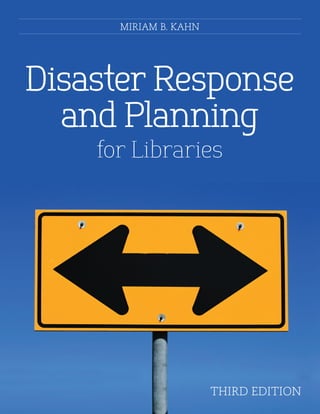





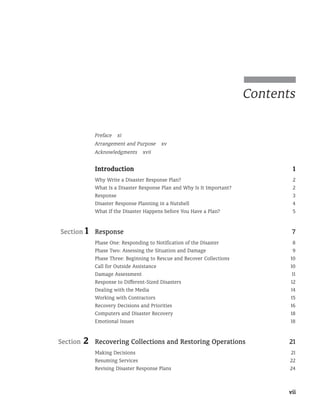
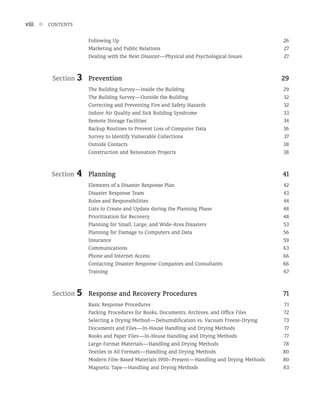
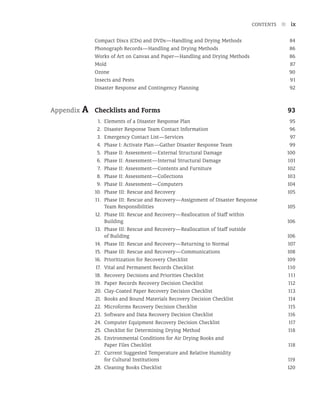
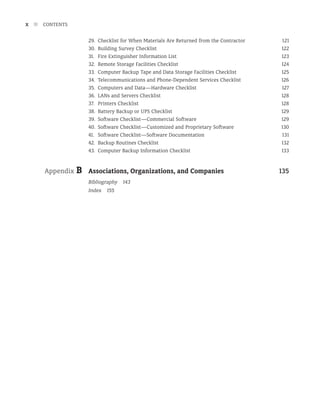
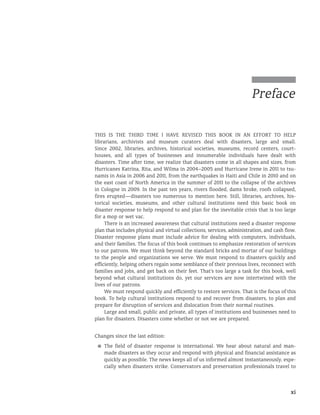

![xvi n ARRANGEMENT AND PURPOSE
For the sake of simplicity, this book deals with re-
sponse and recovery separately. However, as Camila
Alire points out in the Library Disaster Planning and
Recovery Handbook, “the reality is that both activities
[disaster response and recovery] can be operating at the
same time.”1
“Prevention,” the third section, is closely tied in with
the fourth section, “Planning.” Prevention can stand
alone and be accomplished without a formal disaster
response plan.
“Planning,” the fourth section, lists all responsibili-
ties suggested for the team members; prioritizes the
order of recovering damaged collections; and provides
suggestions for staff training. This section is rounded
out with information on how to plan for loss of com-
puter services.
The fifth section, “Response and Recovery Proced
ures,” includes information on handling, packing, drying,
and cleaning print and nonprint, paper and nonpaper
materials. There is information about dealing with mold
and what effects ozone has on collections. Some of this
section is taken from information collected by the author
and distributed at seminars for libraries, archives, his-
torical societies, and disaster response companies.
There are two appendices. The first, “Checklists and
Forms,” contains checklists and forms for use during all
the phases of disaster response planning. They are fairly
generic and so should be adapted for use at your institu-
tion. The second appendix, “Associations, Organizations,
and Companies,” contains a selected list of organizations,
companies, and suppliers who can and will assist dur-
ing disaster response, recovery, and planning. Not every
organization or company is listed, mostly the large or
national ones. Add your local contacts to make this plan
your own.
The bibliography is divided into three parts. The
first is a basic bibliography of books and articles that
contain the basics of planning and response. The sec-
ond part lists publications by topic and is designed to
assist with specialized planning and recovery needs. The
third part is a general bibliography containing additional
readings that cross topic lines. The books, articles, and
journals included in the bibliography are only some
that are available in this flourishing field. Some cita-
tions refer to other bibliographies. Use the citations to
educate the disaster response team and staff members
of your institution.
While your plan is in draft form and when it is
completed, place basic response procedures with phone
numbers in the front of your disaster response manual
for easy reference and contact. Post the daytime num-
bers for the disaster response team at phones for a swift
response.
Note
1. Camila Alire, Library Disaster Planning and Recovery Hand-
book (New York: Neal-Schuman, 2000), 12.](https://image.slidesharecdn.com/41860-250303130009-ec16d971/85/Disaster-response-and-planning-for-libraries-Third-Edition-Kahn-22-320.jpg)



![hyväntekijän osaa ottaessaan sen haltuunsa."
"Ymmärrän", sanoi Montague taas.
"Kuunnellaanpas", sanoi Bates ja nojautui ulos akkunasta. Hän
saattoi kuulla syvän äänen kaukaisen kaiun kokoushuoneesta.
"Waterman", nyki Rodney.
"Nyt kai ne alkavat", kuiskasi Bates.
"Sietämätön tilanne", tuli nyöriä myöden.
"Villikissapankkipeli lopetettava." [Villikissapankeiksi sanotaan
Amerikassa epävarmoja huijauspankkeja; nimi johtuu eräästä
Michiganin pankista, jonka leimassa oli pantterin kuva. Suoment.
muist.]
"Se merkitsee vastarinnan loppua", selitti Bates.
"Duval hyväksyy", jatkoi Rodney.
Akkunan ääressä odottavat olivat äärimäisessä jännityksessä. Oli
kiduttavaa odottaa useita minutteja saaden vain tuollaisia
tiedonantoja.
"Pian ne pääsevät puheitten ohi", kuiskasi Bates; ja se oli totta.
Kaksi seuraavaa sanaa panivat Montaguen hypähtämään ja
puristamaan tuolinsa kädensijaa.
"Gotham Trust!"
"Oh!" kuiskasi Bates. Montague ei äännähtänytkään.](https://image.slidesharecdn.com/41860-250303130009-ec16d971/85/Disaster-response-and-planning-for-libraries-Third-Edition-Kahn-60-320.jpg)