Syracuse University
SUrface


Planning for Disaster : Webinar
David J. Stokoe
Syracuse University


                      Presentations.
Planning for
  Disaster
Brought to you by


David Stokoe, Conservation Librarian.
Syracuse University


November 8th , 2012
2
3
Introduction
 David Stokoe is Syracuse University's Rare Book & Paper Conservation Librarian in
 the Department of Preservation.
 Stokoe’ s responsibilities include undertaking & managing all conservation
 procedures & treatments, primarily with rare book & manuscript materials, also
 including exhibition preparation and installation within the Library.
 He teaches classes in support of Museums Studies & School of Information
 Studies, as well as presenting workshops to local libraries and heritage
 organizations.
 He is leader of the University’s Library Disaster Response Team, responsible for all
 aspects of planning, training, reaction and equipping for disasters.
 Stokoe has over 30 years conservation experience working in many UK and US
 institutions. He is a certified, registered and accredited member of the UK’s
 Society of Archivists and is also a Professional Associate member of the American
 Institute for Conservation.


                                                                                        4
Aims and scope of this presentation
 Aimed primarily at libraries & archives.
 Emphasize the importance of disaster preparedness
 Familiarize & give an overview of different aspects of
 planning and reaction.
 Demonstrate & discuss how to dry water damaged
 books.
 Web resources at end of presentation


                                                          5
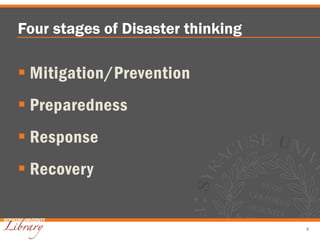
Four stages of Disaster thinking

 Mitigation/Prevention
 Preparedness
 Response
 Recovery


                                   6
What Is A Disaster ?

 Minor incident – leaking/dripping pipes, spills. etc.
 Common in older buildings, can be extensive & not noticed for
 some time.
 Mold.
 Pages stuck together, especially clay coated stock like that
 found in most art books and many serials

 Major incident - Storm related flood, Water main
 break, Fire .

                                                                 7
Minor Incident: < 500 Damp or Wet Books

  Returned by patron in that condition.
  Work related such as spilled water.
  Leaky book drops.
  Building deficiency - burst drain / pipe, roof leak etc.


These types of incidents can usually be effectively dealt
with by any trained staff member or volunteer.

                                                             8
9
10
Major Incident
 Will usually involve more than 500 pieces.
 Access to collections may be restricted for extended
 periods of time due to safety concerns.
 Could be result of water-main break, fire, or storm.
 Mold (and possibly) smoke damage likely.


                                                        11
Syracuse University Library
Flash Flood, April 2011


           http://youtu.be/jUha6ti61N8

                                         12
13
14
How to Prepare
 Know and understand your Disaster Plan
 Regular training and updates
 Coping strategies
  — Disaster Response Team (DRT)
  — Work space allocations
  — Demarcation or processes

 Location of supplies, what & how to use them.
 Administrative support.
  — Specialist help. Freeze drying, conservation specialists,
    medical, legal, press etc.
                                                                15
Coping Strategies
 Staff should be prepared to deal with incidents
 where they occur.
  — 99% of incidents fall into minor category and are easily
    dealt with.

  — Make location of Disaster Supply Lockers common
    knowledge, and easily accessible. Lockers contain
    Disaster Plan Manual and Staff Call Lists.

  — Know where to find help, i.e. Preservation Department,
    your first resource.


                                                               16
CREATING A DISASTER PLAN

 Does your institution have a disaster preparedness
 plan currently in effect?
 Disaster Manual “Self Planning Workbook”
 Using Blank Forms and Checklists
   http://nedcc.org/disaster/dplan.php
   http://www.clrc.org/downloads/disastermanualrev.pdf

 Need for constant revision


                                                         17
Disaster Prevention & Preparedness Planning

1. Identify & train the Disaster Team
2. Fill out organizational Sheet i.e. phone #’s and each
   individuals various duties and responsibilities.
3. Procedures for Recovering Materials
4. Annual review of plan.
5. Regular staff training sessions on basic recovery
   techniques.


                                                           18
Presentation on Recovering Wet Books


          http://youtu.be/zMYW4bseI5s

                                        19
MOLD !
What is Mold ? And Where Does It Come From?

Mold is a type of fungus. It grows on surfaces in masses of branching
threads that resemble dense cobwebs and it can flourish in the presence
of dampness and decay.

Active mold produces microscopic spores in enormous quantities which
are spread by air currents or by adhering to plants or animals.

The spores of fungi that become mold or mildew are always present in
the air and on objects.

Optimum conditions for mold and mildew development exist when
temperature is above 70º F and relative humidity (RH) is above 70%.


                                                                       20
21
http://youtu.be/jUha6ti61N8

                              22
Establish Collection Priorities
   —Establish priorities
   —Duplicate vital records (metadata)and locate
    off-site.
   —Rank collections for evacuation
Some considerations to keep in mind when prioritizing
collections
     1.   Historic value
     2.   Monetary value
     3.   Uniqueness
     4.   Ability to replace in the same or other format

                                                           23
Identifying and Eliminating Potential Disasters
  The Building Audit
  1.   Water Systems
  2.   External Features
  3.   Fire Exits and Smoke Detectors
  4.   Identify Trouble spots
  5.   Document all events

  Draw up Floor Plans
  Where are the control shut offs?
     - power, electricity, water, gas?


                                              24
Response Kit Contents
Absorbent booms (4' & 10' length)       Aprons
Box cutter & refill blades              Clothes Pins
Duct tape                               Extension cords
Flashlights & batteries                 Hard hats & safety goggles
Package tape dispensers & extra rolls   Latex gloves
Paper towels (folded)                   Permanent markers (red & black)
Plastic sheeting (rolled 10 x 25 ft.)   Plastic sheeting (rolled 10 x 100 ft.)
Scissors                                String
Surge protector strips                  Trash bags (33 gallon)
Wax paper                               Whistles
Yellow "CAUTION" tape                   Zip lock bags

                                                                             25
DISASTER SUPPLIES – FLOOR LAYOUT


                                   26
Emergency Kit, Water, React Pak™ Series
The essential first step to recovery from a water
emergency — created by a disaster professional

Description:
Created by a disaster professional, this kit includes
materials for the following: protection of a recovery
team, clean up, preparing a written damage survey,
visibility, deflecting water and wrapping/packing wet
books.


                                                        27
REACT PACK – SOLD BY GAYLORD


                               28
Emergency Kit, Collection Protection, 2-Person Team
                            Flashlight with Extra Batteries
                            12-hour Light Sticks
                            Personal Protection
                            Waterproof Tarp
                            Plastic Sheeting
                            Duct Tape
                            Utility Knife
                            Barricade Tape
                            Mop & Bucket
                            Sponges & Paper Towels
                            Triage Tags & Marker
                            Pencils Notebook
                            Emergency Instruction Sheet
                            Waterproof Document Pouch


                                                              29
Disaster Planning Resources
  Syracuse University Library Disaster Plan
   — http://library.syr.edu/about/departments/preservation/PDF/SULDisasterManual.pdf

  CLRC Disaster Recovery Resource Guide
   — http://www.clrc.org/downloads/disastermanualrev.pdf

  Conservation Online
   — http://cool.conservation-us.org/bytopic/disasters/

  Northeast Document Conservation Center
   — http://www.nedcc.org/disaster/sources.php
  The New York State Program for the Conser vation and Preser vation of Librar y Research Materials
   — http://www.clrc.org/downloads/disastermanualrev.pdf

  American Institute for Conservation
   — http://www.conservation-
     us.org/index.cfm?fuseaction=page.viewPage&PageID=593&d:CFusionMX7verityDatadummy.txt

  Library of Congress
   — http://www.loc.gov/preserv/familytreasures/ftpreserv.html


                                                                                                      30
Thank you
 Please feel free to contact me if you have any
 questions at


                 David Stokoe djstokoe@syr.edu
            Department of Preservation and Conservation
      http://library.syr.edu/about/departments/preservation
         See also our resource guide and YouTube channel.
        http://researchguides.library.syr.edu/preservation
         http://www.youtube.com/user/SULPreservation

                                                              31
32

Disaster planning and response for archives and libraries

  • 1.
    Syracuse University SUrface Planning forDisaster : Webinar David J. Stokoe Syracuse University Presentations.
  • 2.
    Planning for Disaster Brought to you by David Stokoe, Conservation Librarian. Syracuse University November 8th , 2012
  • 3.
  • 4.
  • 5.
    Introduction David Stokoeis Syracuse University's Rare Book & Paper Conservation Librarian in the Department of Preservation. Stokoe’ s responsibilities include undertaking & managing all conservation procedures & treatments, primarily with rare book & manuscript materials, also including exhibition preparation and installation within the Library. He teaches classes in support of Museums Studies & School of Information Studies, as well as presenting workshops to local libraries and heritage organizations. He is leader of the University’s Library Disaster Response Team, responsible for all aspects of planning, training, reaction and equipping for disasters. Stokoe has over 30 years conservation experience working in many UK and US institutions. He is a certified, registered and accredited member of the UK’s Society of Archivists and is also a Professional Associate member of the American Institute for Conservation. 4
  • 6.
    Aims and scopeof this presentation Aimed primarily at libraries & archives. Emphasize the importance of disaster preparedness Familiarize & give an overview of different aspects of planning and reaction. Demonstrate & discuss how to dry water damaged books. Web resources at end of presentation 5
  • 7.
    Four stages ofDisaster thinking Mitigation/Prevention Preparedness Response Recovery 6
  • 8.
    What Is ADisaster ? Minor incident – leaking/dripping pipes, spills. etc. Common in older buildings, can be extensive & not noticed for some time. Mold. Pages stuck together, especially clay coated stock like that found in most art books and many serials Major incident - Storm related flood, Water main break, Fire . 7
  • 9.
    Minor Incident: <500 Damp or Wet Books Returned by patron in that condition. Work related such as spilled water. Leaky book drops. Building deficiency - burst drain / pipe, roof leak etc. These types of incidents can usually be effectively dealt with by any trained staff member or volunteer. 8
  • 10.
  • 11.
  • 12.
    Major Incident Willusually involve more than 500 pieces. Access to collections may be restricted for extended periods of time due to safety concerns. Could be result of water-main break, fire, or storm. Mold (and possibly) smoke damage likely. 11
  • 13.
    Syracuse University Library FlashFlood, April 2011 http://youtu.be/jUha6ti61N8 12
  • 14.
  • 15.
  • 16.
    How to Prepare Know and understand your Disaster Plan Regular training and updates Coping strategies — Disaster Response Team (DRT) — Work space allocations — Demarcation or processes Location of supplies, what & how to use them. Administrative support. — Specialist help. Freeze drying, conservation specialists, medical, legal, press etc. 15
  • 17.
    Coping Strategies Staffshould be prepared to deal with incidents where they occur. — 99% of incidents fall into minor category and are easily dealt with. — Make location of Disaster Supply Lockers common knowledge, and easily accessible. Lockers contain Disaster Plan Manual and Staff Call Lists. — Know where to find help, i.e. Preservation Department, your first resource. 16
  • 18.
    CREATING A DISASTERPLAN Does your institution have a disaster preparedness plan currently in effect? Disaster Manual “Self Planning Workbook” Using Blank Forms and Checklists http://nedcc.org/disaster/dplan.php http://www.clrc.org/downloads/disastermanualrev.pdf Need for constant revision 17
  • 19.
    Disaster Prevention &Preparedness Planning 1. Identify & train the Disaster Team 2. Fill out organizational Sheet i.e. phone #’s and each individuals various duties and responsibilities. 3. Procedures for Recovering Materials 4. Annual review of plan. 5. Regular staff training sessions on basic recovery techniques. 18
  • 20.
    Presentation on RecoveringWet Books http://youtu.be/zMYW4bseI5s 19
  • 21.
    MOLD ! What isMold ? And Where Does It Come From? Mold is a type of fungus. It grows on surfaces in masses of branching threads that resemble dense cobwebs and it can flourish in the presence of dampness and decay. Active mold produces microscopic spores in enormous quantities which are spread by air currents or by adhering to plants or animals. The spores of fungi that become mold or mildew are always present in the air and on objects. Optimum conditions for mold and mildew development exist when temperature is above 70º F and relative humidity (RH) is above 70%. 20
  • 22.
  • 23.
  • 24.
    Establish Collection Priorities —Establish priorities —Duplicate vital records (metadata)and locate off-site. —Rank collections for evacuation Some considerations to keep in mind when prioritizing collections 1. Historic value 2. Monetary value 3. Uniqueness 4. Ability to replace in the same or other format 23
  • 25.
    Identifying and EliminatingPotential Disasters The Building Audit 1. Water Systems 2. External Features 3. Fire Exits and Smoke Detectors 4. Identify Trouble spots 5. Document all events Draw up Floor Plans Where are the control shut offs? - power, electricity, water, gas? 24
  • 26.
    Response Kit Contents Absorbentbooms (4' & 10' length) Aprons Box cutter & refill blades Clothes Pins Duct tape Extension cords Flashlights & batteries Hard hats & safety goggles Package tape dispensers & extra rolls Latex gloves Paper towels (folded) Permanent markers (red & black) Plastic sheeting (rolled 10 x 25 ft.) Plastic sheeting (rolled 10 x 100 ft.) Scissors String Surge protector strips Trash bags (33 gallon) Wax paper Whistles Yellow "CAUTION" tape Zip lock bags 25
  • 27.
    DISASTER SUPPLIES –FLOOR LAYOUT 26
  • 28.
    Emergency Kit, Water,React Pak™ Series The essential first step to recovery from a water emergency — created by a disaster professional Description: Created by a disaster professional, this kit includes materials for the following: protection of a recovery team, clean up, preparing a written damage survey, visibility, deflecting water and wrapping/packing wet books. 27
  • 29.
    REACT PACK –SOLD BY GAYLORD 28
  • 30.
    Emergency Kit, CollectionProtection, 2-Person Team Flashlight with Extra Batteries 12-hour Light Sticks Personal Protection Waterproof Tarp Plastic Sheeting Duct Tape Utility Knife Barricade Tape Mop & Bucket Sponges & Paper Towels Triage Tags & Marker Pencils Notebook Emergency Instruction Sheet Waterproof Document Pouch 29
  • 31.
    Disaster Planning Resources Syracuse University Library Disaster Plan — http://library.syr.edu/about/departments/preservation/PDF/SULDisasterManual.pdf CLRC Disaster Recovery Resource Guide — http://www.clrc.org/downloads/disastermanualrev.pdf Conservation Online — http://cool.conservation-us.org/bytopic/disasters/ Northeast Document Conservation Center — http://www.nedcc.org/disaster/sources.php The New York State Program for the Conser vation and Preser vation of Librar y Research Materials — http://www.clrc.org/downloads/disastermanualrev.pdf American Institute for Conservation — http://www.conservation- us.org/index.cfm?fuseaction=page.viewPage&PageID=593&d:CFusionMX7verityDatadummy.txt Library of Congress — http://www.loc.gov/preserv/familytreasures/ftpreserv.html 30
  • 32.
    Thank you Pleasefeel free to contact me if you have any questions at David Stokoe djstokoe@syr.edu Department of Preservation and Conservation http://library.syr.edu/about/departments/preservation See also our resource guide and YouTube channel. http://researchguides.library.syr.edu/preservation http://www.youtube.com/user/SULPreservation 31
  • 33.