1
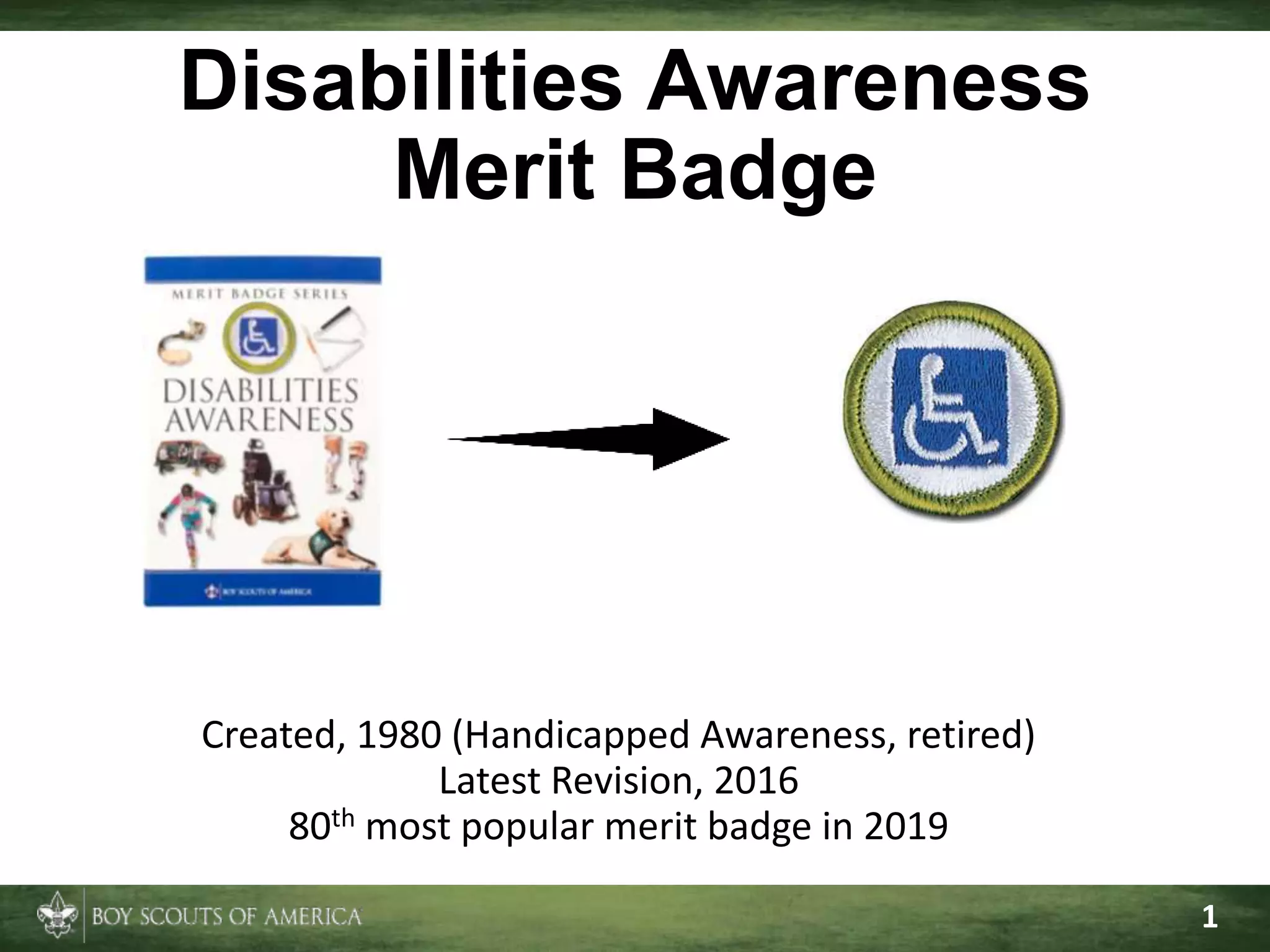
Disabilities Awareness
Merit Badge
Created, 1980 (Handicapped Awareness, retired)
Latest Revision, 2016
80th most popular merit badge in 2019
2
Merit Badge Class Expectations
Be prepared.*
Participate in EACH
requirement.
No unnecessary distractions
(audio or video).
Ask questions.
How to contact counselor.
Scout’s responsibility, not parent
2-deep leadership
Etiquette
*Always be sure to have proper permission before
using the internet. To learn about appropriate behavior
and etiquette while online, consider earning the BSA
Cyber Chip. Go to www.scouting.org/training/youth-
protection/cyber-chip/ for more information.
3
Any issues?
Technical challenges?
Learning disabilities?
Physical disabilities?
I can’t change the
requirements, but I can
change how I interact with
you. Let me know!
4
Why is this merit
badge important?
• The knowledge and skills learned through
Disabilities Awareness merit badge are useful to
demonstrating these points of the scout law:
helpful, friendly, courteous, kind, and brave.
• You might need these skills to complete your
Eagle project.
• You will need these skills to function as an adult in
society.
• Most students never learn these skills in school.
5
SESSION 1
6
Requirement 1
1. Do the following:
(a) Define and discuss with your counselor the
following disabilities awareness terms:
disability, accessibility, adaptation,
accommodation, invisible disability, and
person-first language.
(b) Explain why proper disability etiquette is
important, and how it may differ depending
on the specific disability.
7
Requirement 1a
“Having a disability means only that someone is
‘differently-abled,’ not that they are unable.” (from
the merit badge pamphlet, p.7)
What is a disability?
Each of us is different, having our own skills, strengths, needs,
and situations.
Those who are disabled may do things in a very different way
than those around them.
8
Requirement 1a
• Amputation
• Arthritis
• Asthma
• ADHD
• ASD
• Blindness/low
vision
• Brain injury
• Cerebral palsy
• Cleft Palate
• Cognitive
disabilities
• Cystic fibrosis
• Diabetes
• Down syndrome
• Dwarfism
• Epilepsy
• Deaf/hard of
hearing
• Heart conditions
• Hemophilia
• Learning
disabilities
• Leukemia/cancers
• Multiple sclerosis
• Muscular
dystrophy
• Polio/post-polio
• Sickle-cell anemia
• Speech
impairments
• Spina bifida
• Spinal cord injuries
• Stroke
• Many, many more!
A few examples:
9
Requirement 1a
Modifications that make the impossible possible (p.35)
What is accessibility?
Examples:
• A cut-out section of curb to allow the entrance/exit of a wheelchair
(sidewalk does not change)
• Steps placed near a water fountain for those with dwarfism
(fountain does not change)
• Signs and directions printed in braille or signaled in ASL (content
does not change)
• Illustrated menus so non-verbal customers can point to their
selections (menu does not change)
• Doorknob replaced with door handle or automated door
10
Requirement 1a
Examples:
• No-spill spoon
• Service animal
• Smoke detector or doorbell replaced with flashing lights rather than
sounds
• Customized sports equipment
• White cane for the blind
• Books in braille
• Alternative requirements for ranks and merit badges! (p.33 Talk to
your scoutmaster if you think you may qualify.)
What does adaptation mean?
Tools specifically created, changed, or trained to allow
more independence. (p.21-33)
11
Requirement 1a
Examples:
• Timing (speed up, slow down, take breaks, time of day)
• Sensory (ear plugs, dark glasses, open/closed environment,
adjust ventilation, fidget object)
• Presentation/communication (theater cc device, visual
cues, group size, technology rather than face-to-face)
• Organization, memory, and attention (medication,
electronic devices, personal assistant)
What does accommodation mean?
Accommodations are like accessibility modifications,
but not usually noticed by others. p.39-41
12
Requirement 1a
Examples:
• ADHD
• OCD/Anxiety/Depression
• Dyslexia/Dysgraphia
• Mild Autism Spectrum Disorder
• Motor Skill & Coordination Delays
• Sensory Processing Disorder
What is an invisible disability?
A disability that is not immediately obvious to others (p.10)
13
Requirement 1a
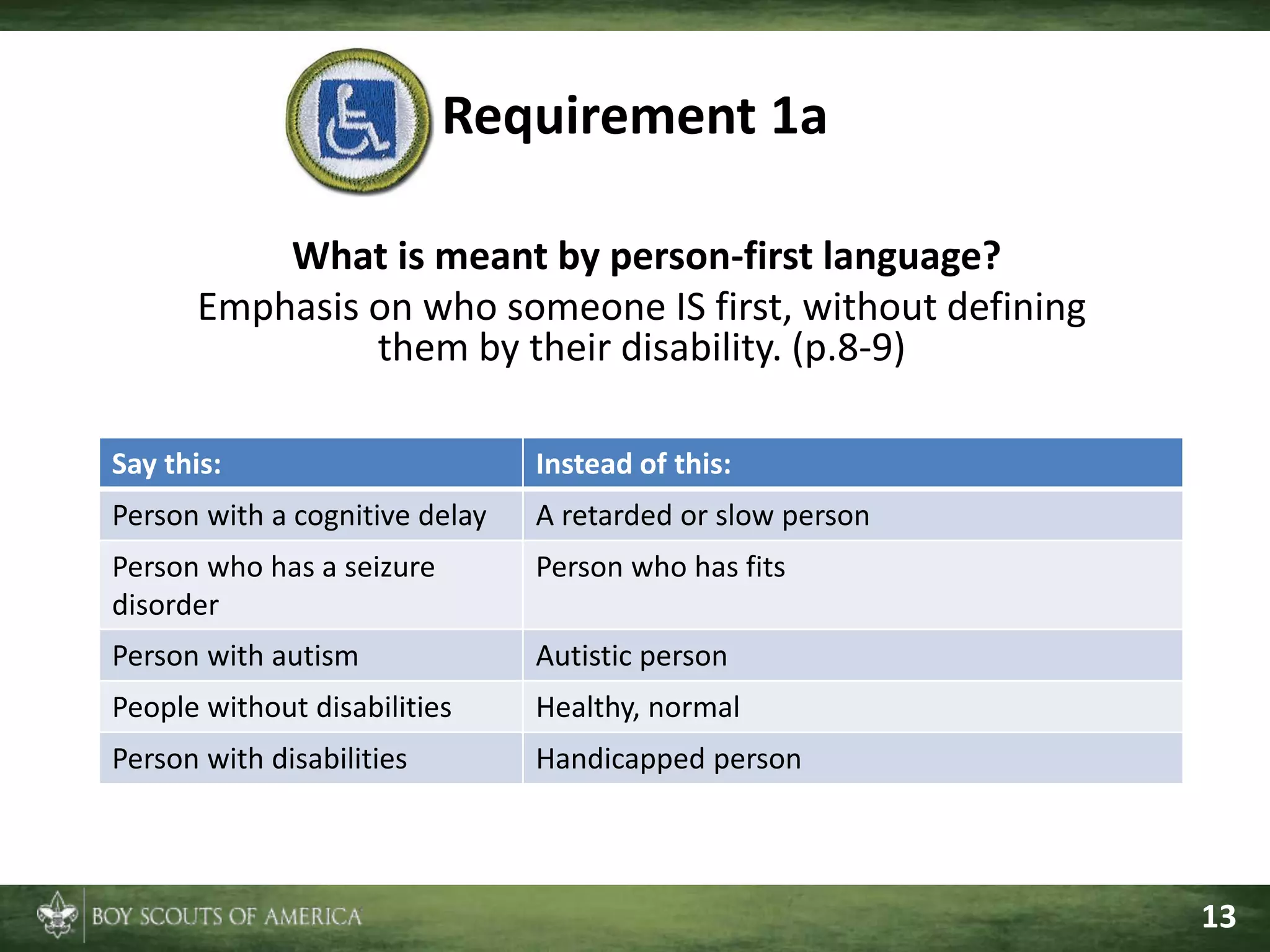
What is meant by person-first language?
Emphasis on who someone IS first, without defining
them by their disability. (p.8-9)
Say this: Instead of this:
Person with a cognitive delay A retarded or slow person
Person who has a seizure
disorder
Person who has fits
Person with autism Autistic person
People without disabilities Healthy, normal
Person with disabilities Handicapped person
14
Requirement 1a
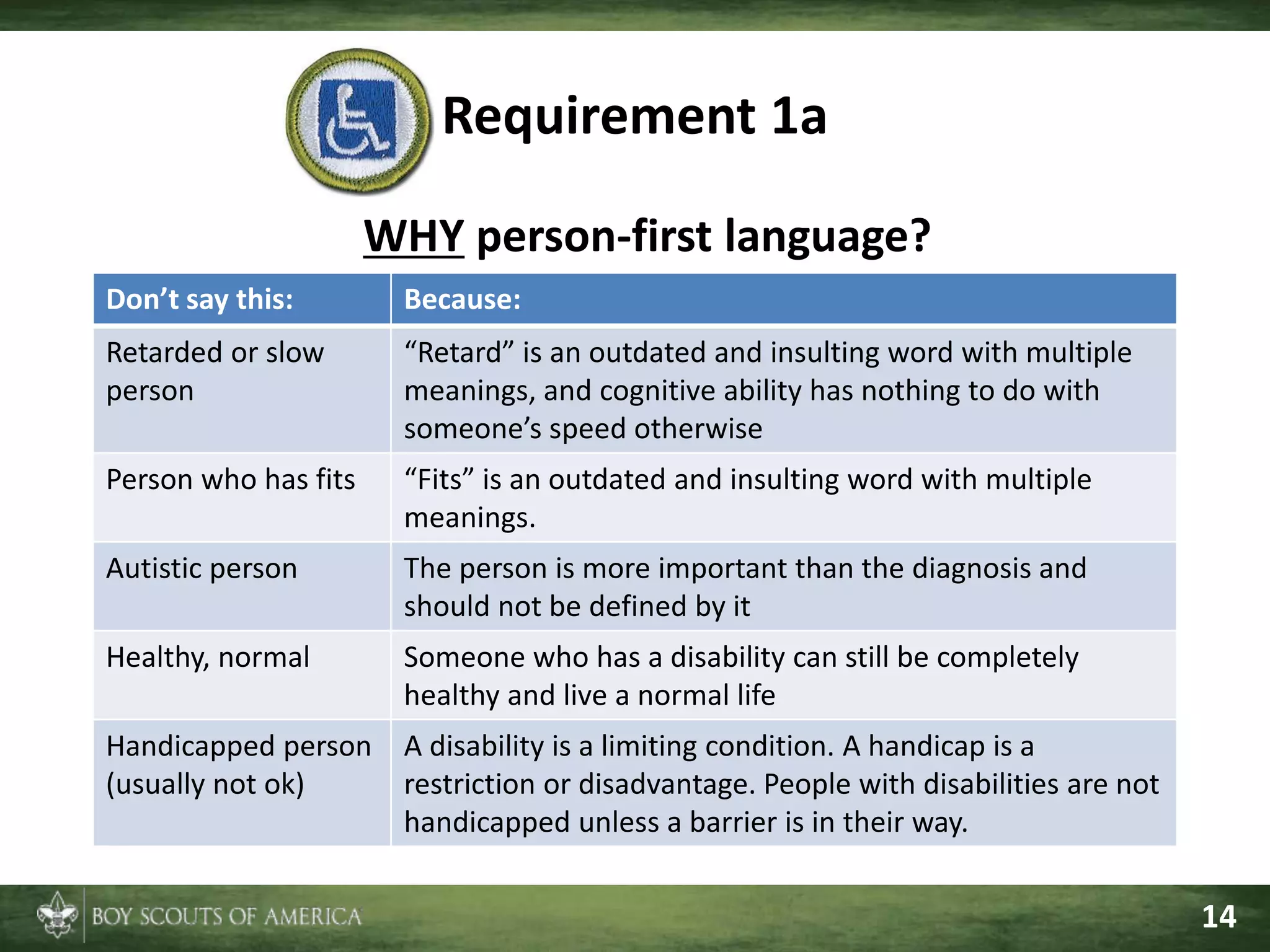
WHY person-first language?
Don’t say this: Because:
Retarded or slow
person
“Retard” is an outdated and insulting word with multiple
meanings, and cognitive ability has nothing to do with
someone’s speed otherwise
Person who has fits “Fits” is an outdated and insulting word with multiple
meanings.
Autistic person The person is more important than the diagnosis and
should not be defined by it
Healthy, normal Someone who has a disability can still be completely
healthy and live a normal life
Handicapped person
(usually not ok)
A disability is a limiting condition. A handicap is a
restriction or disadvantage. People with disabilities are not
handicapped unless a barrier is in their way.
15
Requirement 1b
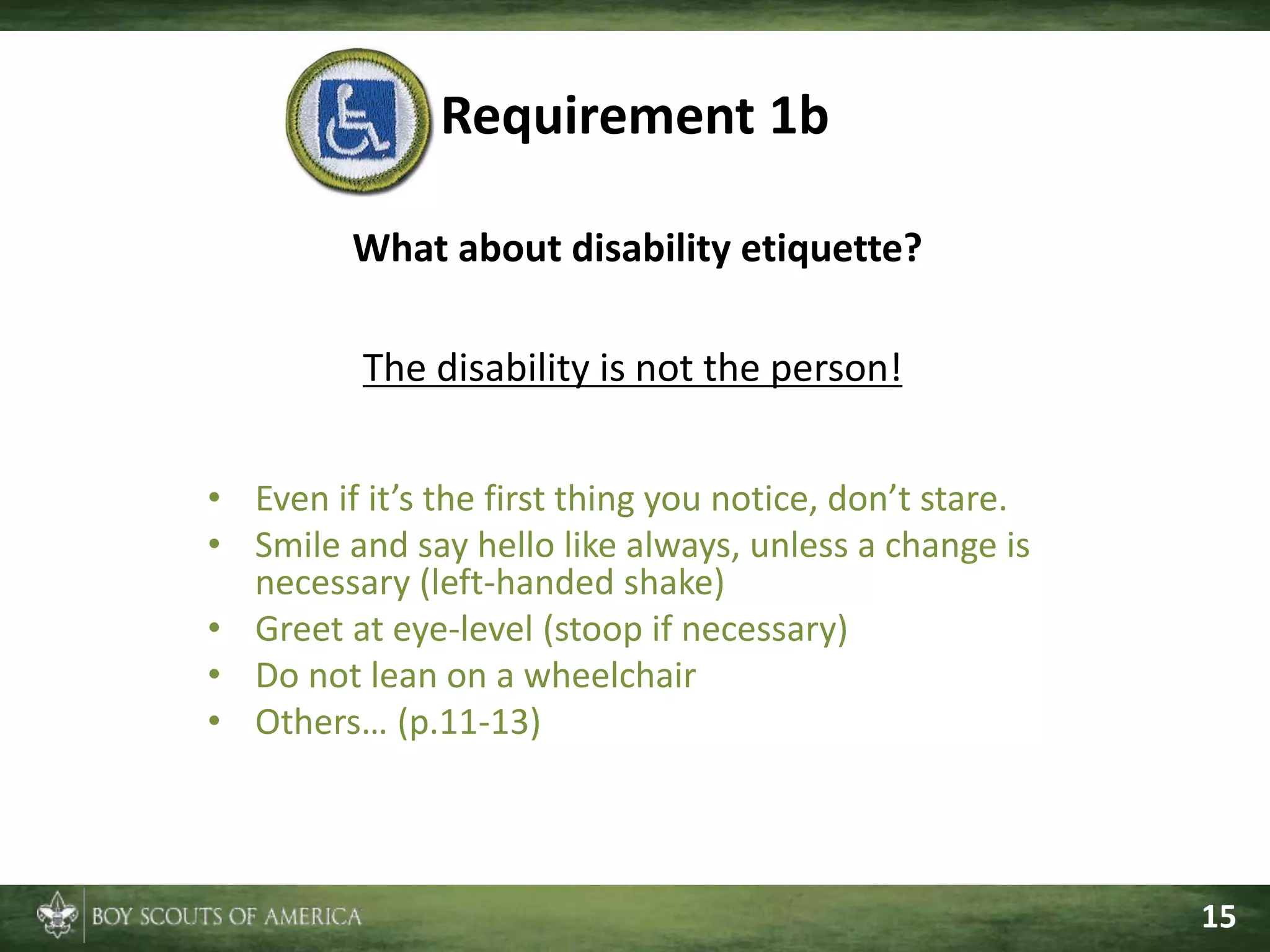
• Even if it’s the first thing you notice, don’t stare.
• Smile and say hello like always, unless a change is
necessary (left-handed shake)
• Greet at eye-level (stoop if necessary)
• Do not lean on a wheelchair
• Others… (p.11-13)
What about disability etiquette?
The disability is not the person!
16
Requirement 2 – (date/time)
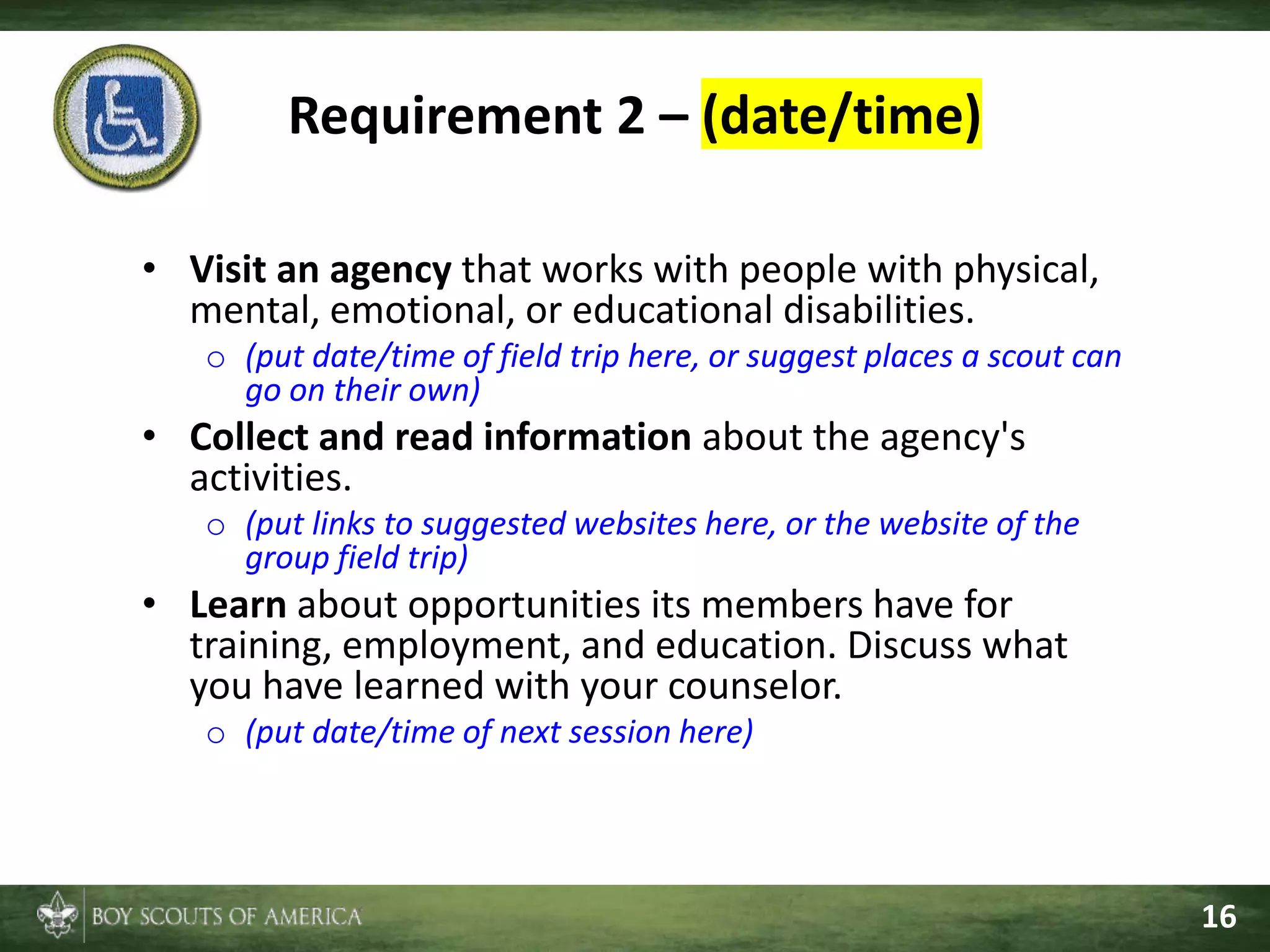
• Visit an agency that works with people with physical,
mental, emotional, or educational disabilities.
o (put date/time of field trip here, or suggest places a scout can
go on their own)
• Collect and read information about the agency's
activities.
o (put links to suggested websites here, or the website of the
group field trip)
• Learn about opportunities its members have for
training, employment, and education. Discuss what
you have learned with your counselor.
o (put date/time of next session here)
17
Requirement 3a
• Talk with a Scout who has a disability and learn
about the Scout's experiences taking part in
Scouting activities and earning different merit
badges.
o Volunteers?
o (Each group of scouts is almost guaranteed to have
someone with a disability. Have another scout in mind
to join you just in case one is needed, though.)
• Discuss what you have learned with your
counselor.
18
Requirement 3e
• Plan or participate in an activity that helps
others understand what a person with a visible
or invisible disability experiences. Discuss
what you have learned with your counselor.
o Each of you take a turn…
19
Requirement 4 – Option A
• Visit TWO of the following locations and take notes about the
accessibility to people with disabilities. In your notes, give
examples of five things that could be done to improve upon the
site and five things about the site that make it friendly to people
with disabilities. Discuss your observations with your counselor.
• (a) Your school
• (b) Your place of worship
• (c) A Scouting event or campsite
o (my virtual visit example)
http://www.nystateparkstours.com/fourmilecreek/
• (d) A public exhibit or attraction (such as a theater, museum, or
park)
o (my virtual visit example) https://www.upworthy.com/disneyland-
virtual-tour-walkthrough-videos
20
See you next time!
ANY QUESTIONS???
21
SESSION 2
22
Requirement 2
• Visit an agency that works with people with physical,
mental, emotional, or educational disabilities.
• Collect and read information about the agency's
activities.
o (Put website of field trip or example here)
• Learn about opportunities its members have for
training, employment, and education.
• Discuss what you have learned with your counselor.
o (Reminder of next meeting and any additional homework)
23
See you next time!
ANY QUESTIONS???
24
SESSION 3
25
Requirement 2
• Visit an agency that works with people with physical,
mental, emotional, or educational disabilities.
• Collect and read information about the agency's
activities.
• Learn about opportunities its members have for
training, employment, and education.
• Discuss what you have learned with your counselor.
o What did you learn from our visit?
26
Requirement 5c
5. Explain what advocacy is. Do ONE of the following advocacy
activities:
(c) Using resources such as disability advocacy agencies,
government agencies, the Internet (with your parent's
permission), and news magazines, learn about myths and
misconceptions that influence the general public's
understanding of people with disabilities. List 10 myths and
misconceptions about people with disabilities and learn the
facts about each myth. Share your list with your counselor,
then use it to make a presentation to a Cub Scout pack or
other group.
27
Requirement 5
What is advocacy?
“Advocacy means supporting, promoting, encouraging, or
defending something.” (p.43)
• Encourage positive attitudes toward those with disabilities
• Challenge false & unfair beliefs
• Help strip away labels
• Build bridges of understanding and respect, regardless of
the ability or disability
28
Requirement 5
How can I be an advocate?
• Teach what you’ve learned to Cub Scouts
• Demonstrate person-first language daily
• Help your “circle” (friends, family, neighbors, etc.) who
have disabilities
• Use what you’ve learned toward an Eagle project
• Take part as a competitor or volunteer with the Special
Olympics
29
Requirement 5
How can I be an advocate?
• Acceptance
o (“Ableism” is a bias or discrimination much like racism.
It is the attitude that people with disabilities need to be
“fixed” and are better off without their disability, even if
they are happy the way they are.
• Watch for bullying – teasing, excluding, harassing
• Change attitudes by volunteering!
30
Requirement 5
• Amputation
• Arthritis
• Asthma
• ADHD
• ASD
• Blindness/low
vision
• Brain injury
• Cerebral palsy
• Cleft Palate
• Cognitive
disabilities
• Cystic fibrosis
• Diabetes
• Down syndrome
• Dwarfism
• Epilepsy
• Deaf/hard of
hearing
• Heart conditions
• Hemophilia
• Learning
disabilities
• Leukemia/cancers
• Multiple sclerosis
• Muscular
dystrophy
• Polio/post-polio
• Sickle-cell anemia
• Speech
impairments
• Spina bifida
• Spinal cord injuries
• Stroke
• Many, many more!
Volunteer for advocacy programs with these groups:
31
Requirement 5c
Common Myths & Misconceptions (p.46-49):
1. A person with a disability is sick.
2. A person with a disability has a poor quality of life or
lives totally different.
3. People with disabilities deserve special treatment or
admiration of courage and creativity to overcome.
4. Only people in wheelchairs are disabled.
5. People with disabilities have to have expensive, high-
tech devices and assistance to function.
32
Requirement 5c
6. People with disabilities can only do light or
simple, repetitive work.
7. People with disabilities have to be protected so
they will never fail.
8. People with disabilities always have a hard time
with school and work.
9. People who are deaf should have jobs in a noisy
environment.
10. People who are deaf cannot speak.
33
Requirement 5c
11. People who are deaf do not enjoy TV or movies
because they can’t hear.
12. All deaf and hard of hearing people can read lips and
know ASL.
13. People who are blind have super hearing like bats.
14. People who are blind develop a “sixth sense” power
of perception that others do not have.
15. Those with disabilities miss work more than their co-
workers do.
16. Everyone without disabilities should take care of
those who have disabilities.
34
Requirement 6
• Make a commitment to your merit badge
counselor describing what you will do to show
a positive attitude about people with
disabilities and to encourage positive attitudes
among others.
• Discuss how your awareness has changed as a
result of what you have learned.
35
Requirement 7
• Name five professions that provide services to
people with disabilities. (p.53)
• Pick one that interests you and find out the
education, training, and experience required for
this profession. Discuss what you learn with your
counselor, and tell why this profession interests
you.
36
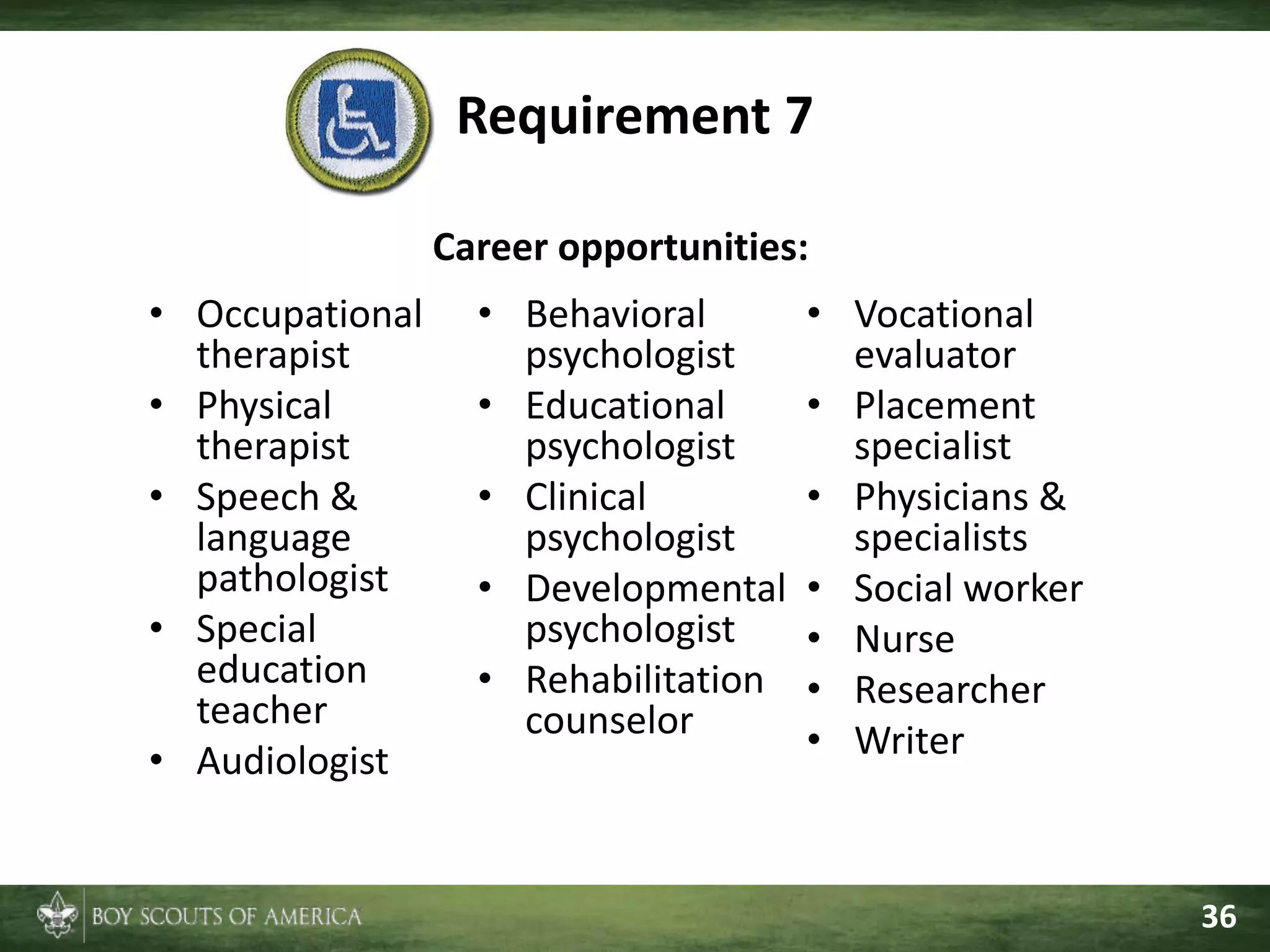
Requirement 7
• Occupational
therapist
• Physical
therapist
• Speech &
language
pathologist
• Special
education
teacher
• Audiologist
• Behavioral
psychologist
• Educational
psychologist
• Clinical
psychologist
• Developmental
psychologist
• Rehabilitation
counselor
• Vocational
evaluator
• Placement
specialist
• Physicians &
specialists
• Social worker
• Nurse
• Researcher
• Writer
Career opportunities:
37
See you next time!
ANY QUESTIONS???

Disabilities Awareness Merit Badge

  • 1.
    1 Disabilities Awareness Merit Badge Created,1980 (Handicapped Awareness, retired) Latest Revision, 2016 80th most popular merit badge in 2019
  • 2.
    2 Merit Badge ClassExpectations Be prepared.* Participate in EACH requirement. No unnecessary distractions (audio or video). Ask questions. How to contact counselor. Scout’s responsibility, not parent 2-deep leadership Etiquette *Always be sure to have proper permission before using the internet. To learn about appropriate behavior and etiquette while online, consider earning the BSA Cyber Chip. Go to www.scouting.org/training/youth- protection/cyber-chip/ for more information.
  • 3.
    3 Any issues? Technical challenges? Learningdisabilities? Physical disabilities? I can’t change the requirements, but I can change how I interact with you. Let me know!
  • 4.
    4 Why is thismerit badge important? • The knowledge and skills learned through Disabilities Awareness merit badge are useful to demonstrating these points of the scout law: helpful, friendly, courteous, kind, and brave. • You might need these skills to complete your Eagle project. • You will need these skills to function as an adult in society. • Most students never learn these skills in school.
  • 5.
  • 6.
    6 Requirement 1 1. Dothe following: (a) Define and discuss with your counselor the following disabilities awareness terms: disability, accessibility, adaptation, accommodation, invisible disability, and person-first language. (b) Explain why proper disability etiquette is important, and how it may differ depending on the specific disability.
  • 7.
    7 Requirement 1a “Having adisability means only that someone is ‘differently-abled,’ not that they are unable.” (from the merit badge pamphlet, p.7) What is a disability? Each of us is different, having our own skills, strengths, needs, and situations. Those who are disabled may do things in a very different way than those around them.
  • 8.
    8 Requirement 1a • Amputation •Arthritis • Asthma • ADHD • ASD • Blindness/low vision • Brain injury • Cerebral palsy • Cleft Palate • Cognitive disabilities • Cystic fibrosis • Diabetes • Down syndrome • Dwarfism • Epilepsy • Deaf/hard of hearing • Heart conditions • Hemophilia • Learning disabilities • Leukemia/cancers • Multiple sclerosis • Muscular dystrophy • Polio/post-polio • Sickle-cell anemia • Speech impairments • Spina bifida • Spinal cord injuries • Stroke • Many, many more! A few examples:
  • 9.
    9 Requirement 1a Modifications thatmake the impossible possible (p.35) What is accessibility? Examples: • A cut-out section of curb to allow the entrance/exit of a wheelchair (sidewalk does not change) • Steps placed near a water fountain for those with dwarfism (fountain does not change) • Signs and directions printed in braille or signaled in ASL (content does not change) • Illustrated menus so non-verbal customers can point to their selections (menu does not change) • Doorknob replaced with door handle or automated door
  • 10.
    10 Requirement 1a Examples: • No-spillspoon • Service animal • Smoke detector or doorbell replaced with flashing lights rather than sounds • Customized sports equipment • White cane for the blind • Books in braille • Alternative requirements for ranks and merit badges! (p.33 Talk to your scoutmaster if you think you may qualify.) What does adaptation mean? Tools specifically created, changed, or trained to allow more independence. (p.21-33)
  • 11.
    11 Requirement 1a Examples: • Timing(speed up, slow down, take breaks, time of day) • Sensory (ear plugs, dark glasses, open/closed environment, adjust ventilation, fidget object) • Presentation/communication (theater cc device, visual cues, group size, technology rather than face-to-face) • Organization, memory, and attention (medication, electronic devices, personal assistant) What does accommodation mean? Accommodations are like accessibility modifications, but not usually noticed by others. p.39-41
  • 12.
    12 Requirement 1a Examples: • ADHD •OCD/Anxiety/Depression • Dyslexia/Dysgraphia • Mild Autism Spectrum Disorder • Motor Skill & Coordination Delays • Sensory Processing Disorder What is an invisible disability? A disability that is not immediately obvious to others (p.10)
  • 13.
    13 Requirement 1a What ismeant by person-first language? Emphasis on who someone IS first, without defining them by their disability. (p.8-9) Say this: Instead of this: Person with a cognitive delay A retarded or slow person Person who has a seizure disorder Person who has fits Person with autism Autistic person People without disabilities Healthy, normal Person with disabilities Handicapped person
  • 14.
    14 Requirement 1a WHY person-firstlanguage? Don’t say this: Because: Retarded or slow person “Retard” is an outdated and insulting word with multiple meanings, and cognitive ability has nothing to do with someone’s speed otherwise Person who has fits “Fits” is an outdated and insulting word with multiple meanings. Autistic person The person is more important than the diagnosis and should not be defined by it Healthy, normal Someone who has a disability can still be completely healthy and live a normal life Handicapped person (usually not ok) A disability is a limiting condition. A handicap is a restriction or disadvantage. People with disabilities are not handicapped unless a barrier is in their way.
  • 15.
    15 Requirement 1b • Evenif it’s the first thing you notice, don’t stare. • Smile and say hello like always, unless a change is necessary (left-handed shake) • Greet at eye-level (stoop if necessary) • Do not lean on a wheelchair • Others… (p.11-13) What about disability etiquette? The disability is not the person!
  • 16.
    16 Requirement 2 –(date/time) • Visit an agency that works with people with physical, mental, emotional, or educational disabilities. o (put date/time of field trip here, or suggest places a scout can go on their own) • Collect and read information about the agency's activities. o (put links to suggested websites here, or the website of the group field trip) • Learn about opportunities its members have for training, employment, and education. Discuss what you have learned with your counselor. o (put date/time of next session here)
  • 17.
    17 Requirement 3a • Talkwith a Scout who has a disability and learn about the Scout's experiences taking part in Scouting activities and earning different merit badges. o Volunteers? o (Each group of scouts is almost guaranteed to have someone with a disability. Have another scout in mind to join you just in case one is needed, though.) • Discuss what you have learned with your counselor.
  • 18.
    18 Requirement 3e • Planor participate in an activity that helps others understand what a person with a visible or invisible disability experiences. Discuss what you have learned with your counselor. o Each of you take a turn…
  • 19.
    19 Requirement 4 –Option A • Visit TWO of the following locations and take notes about the accessibility to people with disabilities. In your notes, give examples of five things that could be done to improve upon the site and five things about the site that make it friendly to people with disabilities. Discuss your observations with your counselor. • (a) Your school • (b) Your place of worship • (c) A Scouting event or campsite o (my virtual visit example) http://www.nystateparkstours.com/fourmilecreek/ • (d) A public exhibit or attraction (such as a theater, museum, or park) o (my virtual visit example) https://www.upworthy.com/disneyland- virtual-tour-walkthrough-videos
  • 20.
    20 See you nexttime! ANY QUESTIONS???
  • 21.
  • 22.
    22 Requirement 2 • Visitan agency that works with people with physical, mental, emotional, or educational disabilities. • Collect and read information about the agency's activities. o (Put website of field trip or example here) • Learn about opportunities its members have for training, employment, and education. • Discuss what you have learned with your counselor. o (Reminder of next meeting and any additional homework)
  • 23.
    23 See you nexttime! ANY QUESTIONS???
  • 24.
  • 25.
    25 Requirement 2 • Visitan agency that works with people with physical, mental, emotional, or educational disabilities. • Collect and read information about the agency's activities. • Learn about opportunities its members have for training, employment, and education. • Discuss what you have learned with your counselor. o What did you learn from our visit?
  • 26.
    26 Requirement 5c 5. Explainwhat advocacy is. Do ONE of the following advocacy activities: (c) Using resources such as disability advocacy agencies, government agencies, the Internet (with your parent's permission), and news magazines, learn about myths and misconceptions that influence the general public's understanding of people with disabilities. List 10 myths and misconceptions about people with disabilities and learn the facts about each myth. Share your list with your counselor, then use it to make a presentation to a Cub Scout pack or other group.
  • 27.
    27 Requirement 5 What isadvocacy? “Advocacy means supporting, promoting, encouraging, or defending something.” (p.43) • Encourage positive attitudes toward those with disabilities • Challenge false & unfair beliefs • Help strip away labels • Build bridges of understanding and respect, regardless of the ability or disability
  • 28.
    28 Requirement 5 How canI be an advocate? • Teach what you’ve learned to Cub Scouts • Demonstrate person-first language daily • Help your “circle” (friends, family, neighbors, etc.) who have disabilities • Use what you’ve learned toward an Eagle project • Take part as a competitor or volunteer with the Special Olympics
  • 29.
    29 Requirement 5 How canI be an advocate? • Acceptance o (“Ableism” is a bias or discrimination much like racism. It is the attitude that people with disabilities need to be “fixed” and are better off without their disability, even if they are happy the way they are. • Watch for bullying – teasing, excluding, harassing • Change attitudes by volunteering!
  • 30.
    30 Requirement 5 • Amputation •Arthritis • Asthma • ADHD • ASD • Blindness/low vision • Brain injury • Cerebral palsy • Cleft Palate • Cognitive disabilities • Cystic fibrosis • Diabetes • Down syndrome • Dwarfism • Epilepsy • Deaf/hard of hearing • Heart conditions • Hemophilia • Learning disabilities • Leukemia/cancers • Multiple sclerosis • Muscular dystrophy • Polio/post-polio • Sickle-cell anemia • Speech impairments • Spina bifida • Spinal cord injuries • Stroke • Many, many more! Volunteer for advocacy programs with these groups:
  • 31.
    31 Requirement 5c Common Myths& Misconceptions (p.46-49): 1. A person with a disability is sick. 2. A person with a disability has a poor quality of life or lives totally different. 3. People with disabilities deserve special treatment or admiration of courage and creativity to overcome. 4. Only people in wheelchairs are disabled. 5. People with disabilities have to have expensive, high- tech devices and assistance to function.
  • 32.
    32 Requirement 5c 6. Peoplewith disabilities can only do light or simple, repetitive work. 7. People with disabilities have to be protected so they will never fail. 8. People with disabilities always have a hard time with school and work. 9. People who are deaf should have jobs in a noisy environment. 10. People who are deaf cannot speak.
  • 33.
    33 Requirement 5c 11. Peoplewho are deaf do not enjoy TV or movies because they can’t hear. 12. All deaf and hard of hearing people can read lips and know ASL. 13. People who are blind have super hearing like bats. 14. People who are blind develop a “sixth sense” power of perception that others do not have. 15. Those with disabilities miss work more than their co- workers do. 16. Everyone without disabilities should take care of those who have disabilities.
  • 34.
    34 Requirement 6 • Makea commitment to your merit badge counselor describing what you will do to show a positive attitude about people with disabilities and to encourage positive attitudes among others. • Discuss how your awareness has changed as a result of what you have learned.
  • 35.
    35 Requirement 7 • Namefive professions that provide services to people with disabilities. (p.53) • Pick one that interests you and find out the education, training, and experience required for this profession. Discuss what you learn with your counselor, and tell why this profession interests you.
  • 36.
    36 Requirement 7 • Occupational therapist •Physical therapist • Speech & language pathologist • Special education teacher • Audiologist • Behavioral psychologist • Educational psychologist • Clinical psychologist • Developmental psychologist • Rehabilitation counselor • Vocational evaluator • Placement specialist • Physicians & specialists • Social worker • Nurse • Researcher • Writer Career opportunities:
  • 37.
    37 See you nexttime! ANY QUESTIONS???