Merit Badge
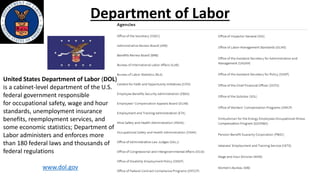
Department of Labor
United States Department of Labor (DOL)
is a cabinet-level department of the U.S.
federal government responsible
for occupational safety, wage and hour
standards, unemployment insurance
benefits, reemployment services, and
some economic statistics; Department of
Labor administers and enforces more
than 180 federal laws and thousands of
federal regulations
www.dol.gov
Background on the American Worker
Using resources available to you, learn about working people and work-
related concerns. List and briefly describe or give examples of at least EIGHT
concerns of American workers. These may include, but are not limited to,
working conditions, workplace safety, hours, wages, seniority, job security,
equal opportunity employment and discrimination, guest workers,
automation and technologies that replace workers, unemployment, layoffs,
outsourcing, and employee benefits such as health care, child care, profit
sharing, continuing education, and retirement benefits.
Requirement 1
1. Pay keeping up with the standard of living costs
Maintaining a certain standard of living
• Housing
• Mortgage / Rent
• Utilities (Electric / Gas, etc…)
• Communication / Internet / TV
• Maintaining living space
- Food
- Clothes
- Electronics (Phone, Computer, TV, etc…)
- Entertainment (Streaming services, Movie/Concerts, Sporting events, etc...)
Transportation
• Car Payment / Uber, Lift / Public Transportation
• Gas
• Insurance
• Maintenance / Repairs
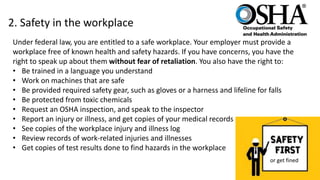
2. Safety in the workplace
Under federal law, you are entitled to a safe workplace. Your employer must provide a
workplace free of known health and safety hazards. If you have concerns, you have the
right to speak up about them without fear of retaliation. You also have the right to:
• Be trained in a language you understand
• Work on machines that are safe
• Be provided required safety gear, such as gloves or a harness and lifeline for falls
• Be protected from toxic chemicals
• Request an OSHA inspection, and speak to the inspector
• Report an injury or illness, and get copies of your medical records
• See copies of the workplace injury and illness log
• Review records of work-related injuries and illnesses
• Get copies of test results done to find hazards in the workplace
or get fined
3. Job Security
Job Security is the probability that an individual will keep their job; a job with a high level of security is such that a
person with the job would have a small chance of losing it.
Threats to Job Security
• Globalization
• Contractors
• Economy
Job security will improve a company’s reputation, their profits, and will keep employees engaged. It will also keep
everyone focused on achieving the company’s vision, goals, and mission.
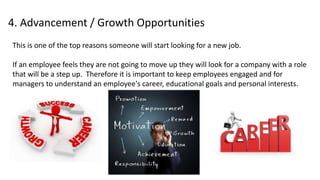
4. Advancement / Growth Opportunities
This is one of the top reasons someone will start looking for a new job.
If an employee feels they are not going to move up they will look for a company with a role
that will be a step up. Therefore it is important to keep employees engaged and for
managers to understand an employee's career, educational goals and personal interests.
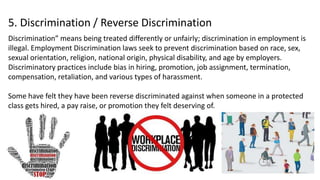
5. Discrimination / Reverse Discrimination
Discrimination” means being treated differently or unfairly; discrimination in employment is
illegal. Employment Discrimination laws seek to prevent discrimination based on race, sex,
sexual orientation, religion, national origin, physical disability, and age by employers.
Discriminatory practices include bias in hiring, promotion, job assignment, termination,
compensation, retaliation, and various types of harassment.
Some have felt they have been reverse discriminated against when someone in a protected
class gets hired, a pay raise, or promotion they felt deserving of.
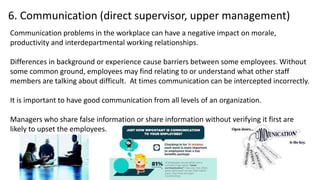
6. Communication (direct supervisor, upper management)
Communication problems in the workplace can have a negative impact on morale,
productivity and interdepartmental working relationships.
Differences in background or experience cause barriers between some employees. Without
some common ground, employees may find relating to or understand what other staff
members are talking about difficult. At times communication can be intercepted incorrectly.
It is important to have good communication from all levels of an organization.
Managers who share false information or share information without verifying it first are
likely to upset the employees.
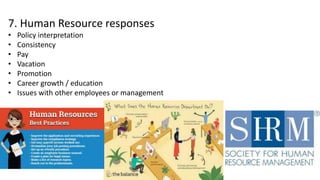
7. Human Resource responses
• Policy interpretation
• Consistency
• Pay
• Vacation
• Promotion
• Career growth / education
• Issues with other employees or management
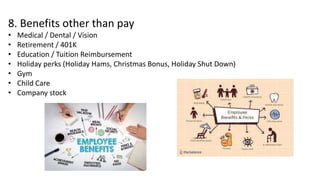
8. Benefits other than pay
• Medical / Dental / Vision
• Retirement / 401K
• Education / Tuition Reimbursement
• Holiday perks (Holiday Hams, Christmas Bonus, Holiday Shut Down)
• Gym
• Child Care
• Company stock
With your counselor's and parent's approval and permission, visit the office or attend a
meeting of a local union, a central labor council, or an employee organization, or contact one
of these organizations via the Internet. Then do EACH of the following:
a) Find out what the organization does.
b) Share the list of issues and concerns you made for requirement
1. Ask the people you communicate with which issues are of greatest interest or concern
to them and why.
c) Draw a diagram showing how the organization is structured, from the local to the national
level, if applicable.
Requirement 2
This is a prerequisite
Explain to your counselor what labor unions are, what they do, and what services they provide
to members. In your discussion, show that you understand the concepts of labor, management,
collective bargaining, negotiation, union shops, open shops, grievance procedures, mediation,
arbitration, work stoppages, strikes, and lockouts.
Requirement 3
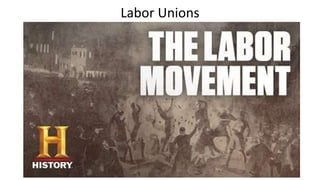
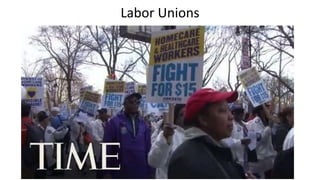
Labor Unions
Labor Unions
What is a labor union?
A labor union, also called a trade union or worker’s union, is an organization that
represents the collective interests of employees
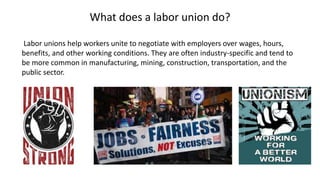
What does a labor union do?
Labor unions help workers unite to negotiate with employers over wages, hours,
benefits, and other working conditions. They are often industry-specific and tend to
be more common in manufacturing, mining, construction, transportation, and the
public sector.
What services does a labor union provide?
All workers benefit from unions, because unions set pay standards and workplace protections.
Union members — workers like you — benefit most from the union's collective bargaining
power to negotiate with employers on their behalf. This basic right gives you as a union
member more power than if you tried to negotiate as an individual.
More benefits of union membership.
• Union employees make an average of 30% more than non-union workers.
• 92% of union workers have job-related health coverage versus 68% of non-union workers.
• Union workers are more likely to have guaranteed pensions than non-union employees.
Unions help protect employees from unjust dismissal through collective bargaining agreements (CBA). Because
of this, most union employees cannot be fired without "just cause." This is unlike many nonunion workers who
are considered "at-will" employees and can be fired at any time for almost any reason.
Union members also benefit from having the collective power to go on strike. A strike is when a group of workers
stops working either in protest of labor conditions or as a bargaining tool during labor/management
negotiations.
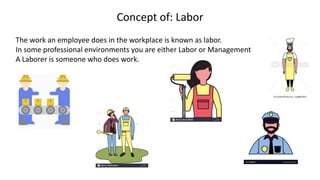
Concept of: Labor
The work an employee does in the workplace is known as labor.
In some professional environments you are either Labor or Management
A Laborer is someone who does work.
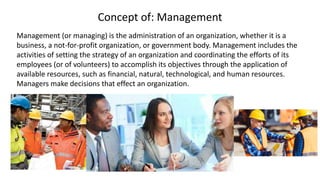
Concept of: Management
Management (or managing) is the administration of an organization, whether it is a
business, a not-for-profit organization, or government body. Management includes the
activities of setting the strategy of an organization and coordinating the efforts of its
employees (or of volunteers) to accomplish its objectives through the application of
available resources, such as financial, natural, technological, and human resources.
Managers make decisions that effect an organization.
Concept of: Collective Bargaining
Collective bargaining is the process in which working people, through their unions, negotiate
contracts with their employers to determine their terms of employment, including pay, benefits,
hours, leave, job health and safety policies, ways to balance work and family, and more.
Collective bargaining is a way to solve workplace problems. It is also the best means for raising
wages in America. A Collective Bargaining Agreement is a contract good for a set amount of
years that both the Union and Management agree upon for the terms of workers employment.
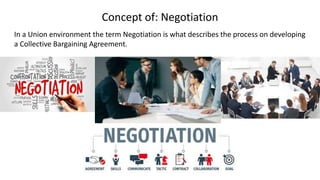
Concept of: Negotiation
In a Union environment the term Negotiation is what describes the process on developing
a Collective Bargaining Agreement.
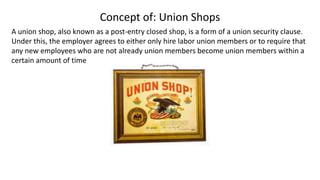
Concept of: Union Shops
A union shop, also known as a post-entry closed shop, is a form of a union security clause.
Under this, the employer agrees to either only hire labor union members or to require that
any new employees who are not already union members become union members within a
certain amount of time
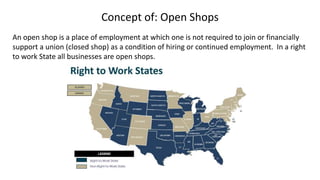
Concept of: Open Shops
An open shop is a place of employment at which one is not required to join or financially
support a union (closed shop) as a condition of hiring or continued employment. In a right
to work State all businesses are open shops.
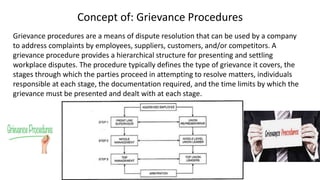
Concept of: Grievance Procedures
Grievance procedures are a means of dispute resolution that can be used by a company
to address complaints by employees, suppliers, customers, and/or competitors. A
grievance procedure provides a hierarchical structure for presenting and settling
workplace disputes. The procedure typically defines the type of grievance it covers, the
stages through which the parties proceed in attempting to resolve matters, individuals
responsible at each stage, the documentation required, and the time limits by which the
grievance must be presented and dealt with at each stage.
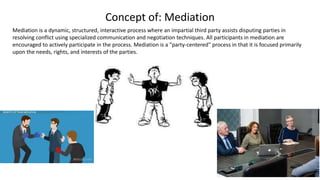
Concept of: Mediation
Mediation is a dynamic, structured, interactive process where an impartial third party assists disputing parties in
resolving conflict using specialized communication and negotiation techniques. All participants in mediation are
encouraged to actively participate in the process. Mediation is a "party-centered" process in that it is focused primarily
upon the needs, rights, and interests of the parties.
Concept of: Arbitration
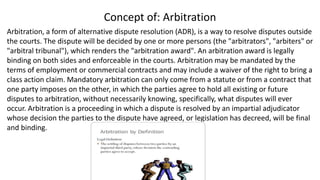
Arbitration, a form of alternative dispute resolution (ADR), is a way to resolve disputes outside
the courts. The dispute will be decided by one or more persons (the "arbitrators", "arbiters" or
"arbitral tribunal"), which renders the "arbitration award". An arbitration award is legally
binding on both sides and enforceable in the courts. Arbitration may be mandated by the
terms of employment or commercial contracts and may include a waiver of the right to bring a
class action claim. Mandatory arbitration can only come from a statute or from a contract that
one party imposes on the other, in which the parties agree to hold all existing or future
disputes to arbitration, without necessarily knowing, specifically, what disputes will ever
occur. Arbitration is a proceeding in which a dispute is resolved by an impartial adjudicator
whose decision the parties to the dispute have agreed, or legislation has decreed, will be final
and binding.
Concept of: Work Stoppages
A work stoppage refers to the temporary cessation of work as a form of protest
initiated by employees. When initiated work stoppages refer to a single employee
or group of employees ceasing work purposefully as a means of protest
Concept of: Strikes
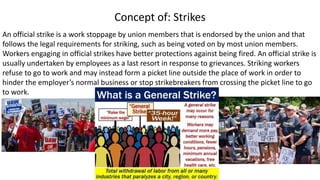
An official strike is a work stoppage by union members that is endorsed by the union and that
follows the legal requirements for striking, such as being voted on by most union members.
Workers engaging in official strikes have better protections against being fired. An official strike is
usually undertaken by employees as a last resort in response to grievances. Striking workers
refuse to go to work and may instead form a picket line outside the place of work in order to
hinder the employer’s normal business or stop strikebreakers from crossing the picket line to go
to work.
Concept of: Lockouts
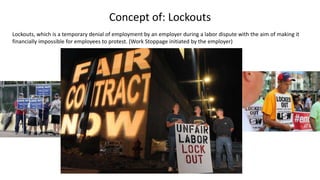
Lockouts, which is a temporary denial of employment by an employer during a labor dispute with the aim of making it
financially impossible for employees to protest. (Work Stoppage initiated by the employer)
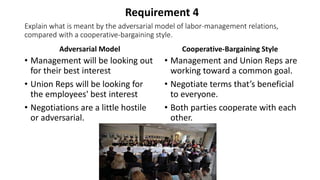
Explain what is meant by the adversarial model of labor-management relations,
compared with a cooperative-bargaining style.
Adversarial Model
• Management will be looking out
for their best interest
• Union Reps will be looking for
the employees' best interest
• Negotiations are a little hostile
or adversarial.
Cooperative-Bargaining Style
• Management and Union Reps are
working toward a common goal.
• Negotiate terms that’s beneficial
to everyone.
• Both parties cooperate with each
other.
Requirement 4
Do ONE of the following:
a) Develop a timeline of significant events in the history of the American labor movement
from the 1770s to the present.
b) Prepare an exhibit, a scrapbook, or a computer presentation, such as a slide show,
illustrating three major achievements of the American labor movement and how those
achievements affect American workers.
c) With your counselor's and parent's approval and permission, watch a movie that addresses
organized labor in the United States. Afterward, discuss the movie with your counselor and
explain what you learned.
d) Read a biography (with your counselor's approval) of someone who has contributed to the
American labor movement. Explain what contribution this person has made to the
American labor movement.
Requirement 5
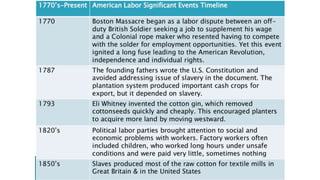
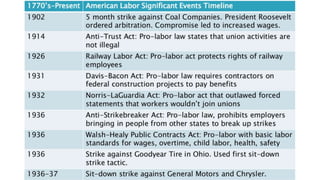
1770’s - Present American Labor Significant Events Timeline
1945-46 44 States strike against General Motors, largest and longest strike, demanded wage
increase, 1st cost of living clause
1964 Civil Rights Act: Law prohibits unions and employers from discriminating against workers
or clients
1965 Filipino grape workers strike, national grape boycott, led to ban on toxic pesticides, and a
new union contract with growers gave workers better working conditions and benefits.
1970’s New York postal workers, 1st national walkout strike by federal employees. President
Nixon called in the National Guard to move mail. Ended with pay increase
1981 Air Traffic Controllers strike due to stress, lack of staff & new equipment. President
Reagan ordered them to return to work. They did not so he fired them. With in a month
he hired replacement and 75% or air service was restored. President Reagan’s actions
signaled an anti-labor position.
1997 The United Parcel Service strike of 1997, led by International Brotherhood of
Teamsters (IBT) President Ron Carey, started on August 4, 1997, and involved over
185,000 teamsters (IBT members). The strike effectively shut down United Parcel
Service (UPS) operations for 16 days and cost UPS hundreds of millions of dollars. The
strike was a victory for the union, resulting in a new contract that increased their wages,
secured their existing benefits and gave increased job security
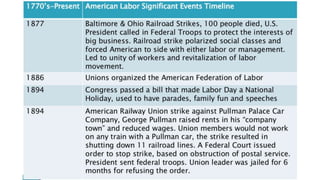
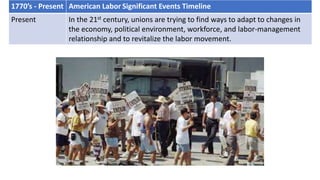
1770’s - Present American Labor Significant Events Timeline
Present In the 21st century, unions are trying to find ways to adapt to changes in
the economy, political environment, workforce, and labor-management
relationship and to revitalize the labor movement.
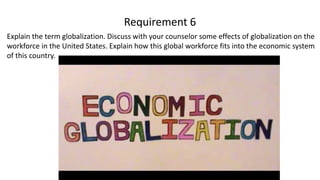
Explain the term globalization. Discuss with your counselor some effects of globalization on the
workforce in the United States. Explain how this global workforce fits into the economic system
of this country.
Requirement 6
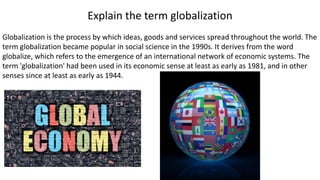
Explain the term globalization
Globalization is the process by which ideas, goods and services spread throughout the world. The
term globalization became popular in social science in the 1990s. It derives from the word
globalize, which refers to the emergence of an international network of economic systems. The
term 'globalization' had been used in its economic sense at least as early as 1981, and in other
senses since at least as early as 1944.
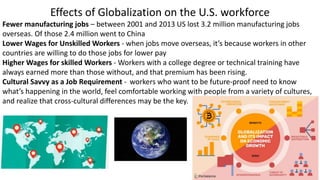
Effects of Globalization on the U.S. workforce
Fewer manufacturing jobs – between 2001 and 2013 US lost 3.2 million manufacturing jobs
overseas. Of those 2.4 million went to China
Lower Wages for Unskilled Workers - when jobs move overseas, it’s because workers in other
countries are willing to do those jobs for lower pay
Higher Wages for skilled Workers - Workers with a college degree or technical training have
always earned more than those without, and that premium has been rising.
Cultural Savvy as a Job Requirement - workers who want to be future-proof need to know
what’s happening in the world, feel comfortable working with people from a variety of cultures,
and realize that cross-cultural differences may be the key.
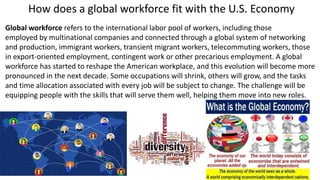
How does a global workforce fit with the U.S. Economy
Global workforce refers to the international labor pool of workers, including those
employed by multinational companies and connected through a global system of networking
and production, immigrant workers, transient migrant workers, telecommuting workers, those
in export-oriented employment, contingent work or other precarious employment. A global
workforce has started to reshape the American workplace, and this evolution will become more
pronounced in the next decade. Some occupations will shrink, others will grow, and the tasks
and time allocation associated with every job will be subject to change. The challenge will be
equipping people with the skills that will serve them well, helping them move into new roles.
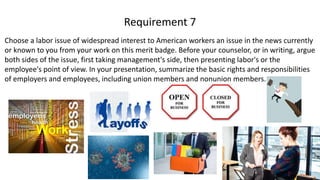
Choose a labor issue of widespread interest to American workers an issue in the news currently
or known to you from your work on this merit badge. Before your counselor, or in writing, argue
both sides of the issue, first taking management's side, then presenting labor's or the
employee's point of view. In your presentation, summarize the basic rights and responsibilities
of employers and employees, including union members and nonunion members.
Requirement 7
Non-Union: COVID-19 scenario
Good news your company meets the states essential business requirements and will not be shut
down. But to remain open employees must follow strict cleanliness and social distancing rules.
To meet the customers needs and maintain distancing requirements employees will go from a 3
shift 8-hour day to a 12-hour rotating shift. Production has been split into 2 groups each group
has an AM shift and a PM shift. AM shift works from 5am to 4:30pm, they clean the work area
and leave by 5pm; at 5pm the PM shift comes on and works till 4:40am and cleans and leaves so
the next shift can start at 5am. Group A works Monday and Tuesday, is off Wednesday and
Thursday, then works Friday Saturday and Sunday. The next week Group A will be off Monday
and Tuesday, work Wednesday and Thursday, and have Friday, Saturday and Sunday off. When
group A is off Group B will be working. This will be the schedule till after the pandemic. One of
the workers who is on the PM shift has let HR and management know this shift is putting stress
on his family.
Discuss with your counselor the different goals that may motivate the owners of a business, its
stockholders, its customers, its employees, the employees' representatives, the community, and
public officials. Explain why agreements and compromises are made and how they affect each
group in achieving its goals.
Requirement 8
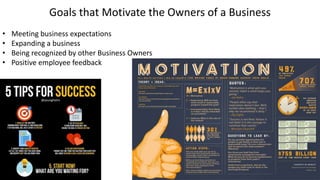
Goals that Motivate the Owners of a Business
• Meeting business expectations
• Expanding a business
• Being recognized by other Business Owners
• Positive employee feedback
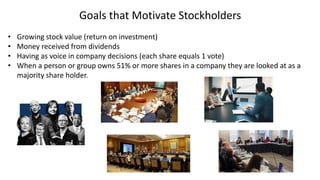
Goals that Motivate Stockholders
• Growing stock value (return on investment)
• Money received from dividends
• Having as voice in company decisions (each share equals 1 vote)
• When a person or group owns 51% or more shares in a company they are looked at as a
majority share holder.
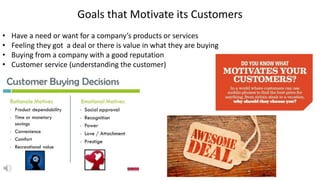
Goals that Motivate its Customers
• Have a need or want for a company’s products or services
• Feeling they got a deal or there is value in what they are buying
• Buying from a company with a good reputation
• Customer service (understanding the customer)
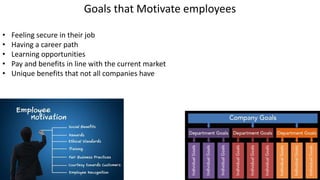
Goals that Motivate employees
• Feeling secure in their job
• Having a career path
• Learning opportunities
• Pay and benefits in line with the current market
• Unique benefits that not all companies have
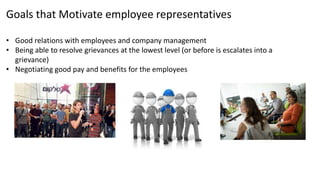
Goals that Motivate employee representatives
• Good relations with employees and company management
• Being able to resolve grievances at the lowest level (or before is escalates into a
grievance)
• Negotiating good pay and benefits for the employees
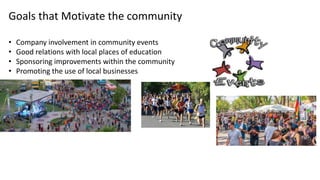
Goals that Motivate the community
• Company involvement in community events
• Good relations with local places of education
• Sponsoring improvements within the community
• Promoting the use of local businesses
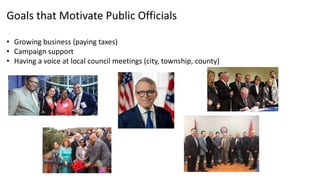
Goals that Motivate Public Officials
• Growing business (paying taxes)
• Campaign support
• Having a voice at local council meetings (city, township, county)
Learn about opportunities in the field of labor relations. Choose one career in which you are
interested and discuss with your counselor the major responsibilities of that position and the
qualifications, education, and training such a position requires.
Requirement 9
This is a prerequisite

Presentation American Labor Merit Badge

  • 1.
  • 2.
    Department of Labor UnitedStates Department of Labor (DOL) is a cabinet-level department of the U.S. federal government responsible for occupational safety, wage and hour standards, unemployment insurance benefits, reemployment services, and some economic statistics; Department of Labor administers and enforces more than 180 federal laws and thousands of federal regulations www.dol.gov
  • 3.
    Background on theAmerican Worker
  • 4.
    Using resources availableto you, learn about working people and work- related concerns. List and briefly describe or give examples of at least EIGHT concerns of American workers. These may include, but are not limited to, working conditions, workplace safety, hours, wages, seniority, job security, equal opportunity employment and discrimination, guest workers, automation and technologies that replace workers, unemployment, layoffs, outsourcing, and employee benefits such as health care, child care, profit sharing, continuing education, and retirement benefits. Requirement 1
  • 5.
    1. Pay keepingup with the standard of living costs Maintaining a certain standard of living • Housing • Mortgage / Rent • Utilities (Electric / Gas, etc…) • Communication / Internet / TV • Maintaining living space - Food - Clothes - Electronics (Phone, Computer, TV, etc…) - Entertainment (Streaming services, Movie/Concerts, Sporting events, etc...) Transportation • Car Payment / Uber, Lift / Public Transportation • Gas • Insurance • Maintenance / Repairs
  • 6.
    2. Safety inthe workplace Under federal law, you are entitled to a safe workplace. Your employer must provide a workplace free of known health and safety hazards. If you have concerns, you have the right to speak up about them without fear of retaliation. You also have the right to: • Be trained in a language you understand • Work on machines that are safe • Be provided required safety gear, such as gloves or a harness and lifeline for falls • Be protected from toxic chemicals • Request an OSHA inspection, and speak to the inspector • Report an injury or illness, and get copies of your medical records • See copies of the workplace injury and illness log • Review records of work-related injuries and illnesses • Get copies of test results done to find hazards in the workplace or get fined
  • 7.
    3. Job Security JobSecurity is the probability that an individual will keep their job; a job with a high level of security is such that a person with the job would have a small chance of losing it. Threats to Job Security • Globalization • Contractors • Economy Job security will improve a company’s reputation, their profits, and will keep employees engaged. It will also keep everyone focused on achieving the company’s vision, goals, and mission.
  • 8.
    4. Advancement /Growth Opportunities This is one of the top reasons someone will start looking for a new job. If an employee feels they are not going to move up they will look for a company with a role that will be a step up. Therefore it is important to keep employees engaged and for managers to understand an employee's career, educational goals and personal interests.
  • 9.
    5. Discrimination /Reverse Discrimination Discrimination” means being treated differently or unfairly; discrimination in employment is illegal. Employment Discrimination laws seek to prevent discrimination based on race, sex, sexual orientation, religion, national origin, physical disability, and age by employers. Discriminatory practices include bias in hiring, promotion, job assignment, termination, compensation, retaliation, and various types of harassment. Some have felt they have been reverse discriminated against when someone in a protected class gets hired, a pay raise, or promotion they felt deserving of.
  • 10.
    6. Communication (directsupervisor, upper management) Communication problems in the workplace can have a negative impact on morale, productivity and interdepartmental working relationships. Differences in background or experience cause barriers between some employees. Without some common ground, employees may find relating to or understand what other staff members are talking about difficult. At times communication can be intercepted incorrectly. It is important to have good communication from all levels of an organization. Managers who share false information or share information without verifying it first are likely to upset the employees.
  • 11.
    7. Human Resourceresponses • Policy interpretation • Consistency • Pay • Vacation • Promotion • Career growth / education • Issues with other employees or management
  • 12.
    8. Benefits otherthan pay • Medical / Dental / Vision • Retirement / 401K • Education / Tuition Reimbursement • Holiday perks (Holiday Hams, Christmas Bonus, Holiday Shut Down) • Gym • Child Care • Company stock
  • 13.
    With your counselor'sand parent's approval and permission, visit the office or attend a meeting of a local union, a central labor council, or an employee organization, or contact one of these organizations via the Internet. Then do EACH of the following: a) Find out what the organization does. b) Share the list of issues and concerns you made for requirement 1. Ask the people you communicate with which issues are of greatest interest or concern to them and why. c) Draw a diagram showing how the organization is structured, from the local to the national level, if applicable. Requirement 2 This is a prerequisite
  • 14.
    Explain to yourcounselor what labor unions are, what they do, and what services they provide to members. In your discussion, show that you understand the concepts of labor, management, collective bargaining, negotiation, union shops, open shops, grievance procedures, mediation, arbitration, work stoppages, strikes, and lockouts. Requirement 3
  • 15.
  • 16.
  • 17.
    What is alabor union? A labor union, also called a trade union or worker’s union, is an organization that represents the collective interests of employees
  • 18.
    What does alabor union do? Labor unions help workers unite to negotiate with employers over wages, hours, benefits, and other working conditions. They are often industry-specific and tend to be more common in manufacturing, mining, construction, transportation, and the public sector.
  • 19.
    What services doesa labor union provide? All workers benefit from unions, because unions set pay standards and workplace protections. Union members — workers like you — benefit most from the union's collective bargaining power to negotiate with employers on their behalf. This basic right gives you as a union member more power than if you tried to negotiate as an individual. More benefits of union membership. • Union employees make an average of 30% more than non-union workers. • 92% of union workers have job-related health coverage versus 68% of non-union workers. • Union workers are more likely to have guaranteed pensions than non-union employees. Unions help protect employees from unjust dismissal through collective bargaining agreements (CBA). Because of this, most union employees cannot be fired without "just cause." This is unlike many nonunion workers who are considered "at-will" employees and can be fired at any time for almost any reason. Union members also benefit from having the collective power to go on strike. A strike is when a group of workers stops working either in protest of labor conditions or as a bargaining tool during labor/management negotiations.
  • 20.
    Concept of: Labor Thework an employee does in the workplace is known as labor. In some professional environments you are either Labor or Management A Laborer is someone who does work.
  • 21.
    Concept of: Management Management(or managing) is the administration of an organization, whether it is a business, a not-for-profit organization, or government body. Management includes the activities of setting the strategy of an organization and coordinating the efforts of its employees (or of volunteers) to accomplish its objectives through the application of available resources, such as financial, natural, technological, and human resources. Managers make decisions that effect an organization.
  • 22.
    Concept of: CollectiveBargaining Collective bargaining is the process in which working people, through their unions, negotiate contracts with their employers to determine their terms of employment, including pay, benefits, hours, leave, job health and safety policies, ways to balance work and family, and more. Collective bargaining is a way to solve workplace problems. It is also the best means for raising wages in America. A Collective Bargaining Agreement is a contract good for a set amount of years that both the Union and Management agree upon for the terms of workers employment.
  • 23.
    Concept of: Negotiation Ina Union environment the term Negotiation is what describes the process on developing a Collective Bargaining Agreement.
  • 24.
    Concept of: UnionShops A union shop, also known as a post-entry closed shop, is a form of a union security clause. Under this, the employer agrees to either only hire labor union members or to require that any new employees who are not already union members become union members within a certain amount of time
  • 25.
    Concept of: OpenShops An open shop is a place of employment at which one is not required to join or financially support a union (closed shop) as a condition of hiring or continued employment. In a right to work State all businesses are open shops.
  • 26.
    Concept of: GrievanceProcedures Grievance procedures are a means of dispute resolution that can be used by a company to address complaints by employees, suppliers, customers, and/or competitors. A grievance procedure provides a hierarchical structure for presenting and settling workplace disputes. The procedure typically defines the type of grievance it covers, the stages through which the parties proceed in attempting to resolve matters, individuals responsible at each stage, the documentation required, and the time limits by which the grievance must be presented and dealt with at each stage.
  • 27.
    Concept of: Mediation Mediationis a dynamic, structured, interactive process where an impartial third party assists disputing parties in resolving conflict using specialized communication and negotiation techniques. All participants in mediation are encouraged to actively participate in the process. Mediation is a "party-centered" process in that it is focused primarily upon the needs, rights, and interests of the parties.
  • 28.
    Concept of: Arbitration Arbitration,a form of alternative dispute resolution (ADR), is a way to resolve disputes outside the courts. The dispute will be decided by one or more persons (the "arbitrators", "arbiters" or "arbitral tribunal"), which renders the "arbitration award". An arbitration award is legally binding on both sides and enforceable in the courts. Arbitration may be mandated by the terms of employment or commercial contracts and may include a waiver of the right to bring a class action claim. Mandatory arbitration can only come from a statute or from a contract that one party imposes on the other, in which the parties agree to hold all existing or future disputes to arbitration, without necessarily knowing, specifically, what disputes will ever occur. Arbitration is a proceeding in which a dispute is resolved by an impartial adjudicator whose decision the parties to the dispute have agreed, or legislation has decreed, will be final and binding.
  • 29.
    Concept of: WorkStoppages A work stoppage refers to the temporary cessation of work as a form of protest initiated by employees. When initiated work stoppages refer to a single employee or group of employees ceasing work purposefully as a means of protest
  • 30.
    Concept of: Strikes Anofficial strike is a work stoppage by union members that is endorsed by the union and that follows the legal requirements for striking, such as being voted on by most union members. Workers engaging in official strikes have better protections against being fired. An official strike is usually undertaken by employees as a last resort in response to grievances. Striking workers refuse to go to work and may instead form a picket line outside the place of work in order to hinder the employer’s normal business or stop strikebreakers from crossing the picket line to go to work.
  • 31.
    Concept of: Lockouts Lockouts,which is a temporary denial of employment by an employer during a labor dispute with the aim of making it financially impossible for employees to protest. (Work Stoppage initiated by the employer)
  • 32.
    Explain what ismeant by the adversarial model of labor-management relations, compared with a cooperative-bargaining style. Adversarial Model • Management will be looking out for their best interest • Union Reps will be looking for the employees' best interest • Negotiations are a little hostile or adversarial. Cooperative-Bargaining Style • Management and Union Reps are working toward a common goal. • Negotiate terms that’s beneficial to everyone. • Both parties cooperate with each other. Requirement 4
  • 33.
    Do ONE ofthe following: a) Develop a timeline of significant events in the history of the American labor movement from the 1770s to the present. b) Prepare an exhibit, a scrapbook, or a computer presentation, such as a slide show, illustrating three major achievements of the American labor movement and how those achievements affect American workers. c) With your counselor's and parent's approval and permission, watch a movie that addresses organized labor in the United States. Afterward, discuss the movie with your counselor and explain what you learned. d) Read a biography (with your counselor's approval) of someone who has contributed to the American labor movement. Explain what contribution this person has made to the American labor movement. Requirement 5
  • 37.
    1770’s - PresentAmerican Labor Significant Events Timeline 1945-46 44 States strike against General Motors, largest and longest strike, demanded wage increase, 1st cost of living clause 1964 Civil Rights Act: Law prohibits unions and employers from discriminating against workers or clients 1965 Filipino grape workers strike, national grape boycott, led to ban on toxic pesticides, and a new union contract with growers gave workers better working conditions and benefits. 1970’s New York postal workers, 1st national walkout strike by federal employees. President Nixon called in the National Guard to move mail. Ended with pay increase 1981 Air Traffic Controllers strike due to stress, lack of staff & new equipment. President Reagan ordered them to return to work. They did not so he fired them. With in a month he hired replacement and 75% or air service was restored. President Reagan’s actions signaled an anti-labor position. 1997 The United Parcel Service strike of 1997, led by International Brotherhood of Teamsters (IBT) President Ron Carey, started on August 4, 1997, and involved over 185,000 teamsters (IBT members). The strike effectively shut down United Parcel Service (UPS) operations for 16 days and cost UPS hundreds of millions of dollars. The strike was a victory for the union, resulting in a new contract that increased their wages, secured their existing benefits and gave increased job security
  • 38.
    1770’s - PresentAmerican Labor Significant Events Timeline Present In the 21st century, unions are trying to find ways to adapt to changes in the economy, political environment, workforce, and labor-management relationship and to revitalize the labor movement.
  • 39.
    Explain the termglobalization. Discuss with your counselor some effects of globalization on the workforce in the United States. Explain how this global workforce fits into the economic system of this country. Requirement 6
  • 41.
    Explain the termglobalization Globalization is the process by which ideas, goods and services spread throughout the world. The term globalization became popular in social science in the 1990s. It derives from the word globalize, which refers to the emergence of an international network of economic systems. The term 'globalization' had been used in its economic sense at least as early as 1981, and in other senses since at least as early as 1944.
  • 42.
    Effects of Globalizationon the U.S. workforce Fewer manufacturing jobs – between 2001 and 2013 US lost 3.2 million manufacturing jobs overseas. Of those 2.4 million went to China Lower Wages for Unskilled Workers - when jobs move overseas, it’s because workers in other countries are willing to do those jobs for lower pay Higher Wages for skilled Workers - Workers with a college degree or technical training have always earned more than those without, and that premium has been rising. Cultural Savvy as a Job Requirement - workers who want to be future-proof need to know what’s happening in the world, feel comfortable working with people from a variety of cultures, and realize that cross-cultural differences may be the key.
  • 43.
    How does aglobal workforce fit with the U.S. Economy Global workforce refers to the international labor pool of workers, including those employed by multinational companies and connected through a global system of networking and production, immigrant workers, transient migrant workers, telecommuting workers, those in export-oriented employment, contingent work or other precarious employment. A global workforce has started to reshape the American workplace, and this evolution will become more pronounced in the next decade. Some occupations will shrink, others will grow, and the tasks and time allocation associated with every job will be subject to change. The challenge will be equipping people with the skills that will serve them well, helping them move into new roles.
  • 44.
    Choose a laborissue of widespread interest to American workers an issue in the news currently or known to you from your work on this merit badge. Before your counselor, or in writing, argue both sides of the issue, first taking management's side, then presenting labor's or the employee's point of view. In your presentation, summarize the basic rights and responsibilities of employers and employees, including union members and nonunion members. Requirement 7
  • 45.
    Non-Union: COVID-19 scenario Goodnews your company meets the states essential business requirements and will not be shut down. But to remain open employees must follow strict cleanliness and social distancing rules. To meet the customers needs and maintain distancing requirements employees will go from a 3 shift 8-hour day to a 12-hour rotating shift. Production has been split into 2 groups each group has an AM shift and a PM shift. AM shift works from 5am to 4:30pm, they clean the work area and leave by 5pm; at 5pm the PM shift comes on and works till 4:40am and cleans and leaves so the next shift can start at 5am. Group A works Monday and Tuesday, is off Wednesday and Thursday, then works Friday Saturday and Sunday. The next week Group A will be off Monday and Tuesday, work Wednesday and Thursday, and have Friday, Saturday and Sunday off. When group A is off Group B will be working. This will be the schedule till after the pandemic. One of the workers who is on the PM shift has let HR and management know this shift is putting stress on his family.
  • 46.
    Discuss with yourcounselor the different goals that may motivate the owners of a business, its stockholders, its customers, its employees, the employees' representatives, the community, and public officials. Explain why agreements and compromises are made and how they affect each group in achieving its goals. Requirement 8
  • 47.
    Goals that Motivatethe Owners of a Business • Meeting business expectations • Expanding a business • Being recognized by other Business Owners • Positive employee feedback
  • 48.
    Goals that MotivateStockholders • Growing stock value (return on investment) • Money received from dividends • Having as voice in company decisions (each share equals 1 vote) • When a person or group owns 51% or more shares in a company they are looked at as a majority share holder.
  • 49.
    Goals that Motivateits Customers • Have a need or want for a company’s products or services • Feeling they got a deal or there is value in what they are buying • Buying from a company with a good reputation • Customer service (understanding the customer)
  • 50.
    Goals that Motivateemployees • Feeling secure in their job • Having a career path • Learning opportunities • Pay and benefits in line with the current market • Unique benefits that not all companies have
  • 51.
    Goals that Motivateemployee representatives • Good relations with employees and company management • Being able to resolve grievances at the lowest level (or before is escalates into a grievance) • Negotiating good pay and benefits for the employees
  • 52.
    Goals that Motivatethe community • Company involvement in community events • Good relations with local places of education • Sponsoring improvements within the community • Promoting the use of local businesses
  • 53.
    Goals that MotivatePublic Officials • Growing business (paying taxes) • Campaign support • Having a voice at local council meetings (city, township, county)
  • 54.
    Learn about opportunitiesin the field of labor relations. Choose one career in which you are interested and discuss with your counselor the major responsibilities of that position and the qualifications, education, and training such a position requires. Requirement 9 This is a prerequisite