Presentation to the Senate
Committee on Gas.
By Sowunmi Olabode III
Cabtree Limited
April 2016
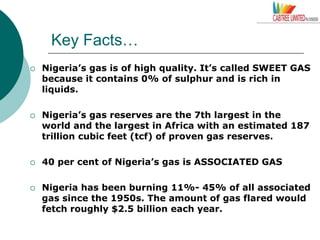
Key Facts…
 Nigeria’s gas is of high quality. It’s called SWEET GAS
because it contains 0% of sulphur and is rich in
liquids.
 Nigeria’s gas reserves are the 7th largest in the
world and the largest in Africa with an estimated 187
trillion cubic feet (tcf) of proven gas reserves.
 40 per cent of Nigeria’s gas is ASSOCIATED GAS
 Nigeria has been burning 11%- 45% of all associated
gas since the 1950s. The amount of gas flared would
fetch roughly $2.5 billion each year.
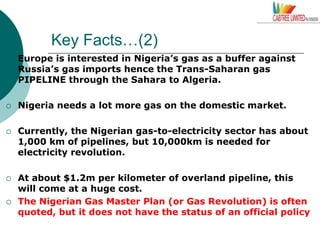
Key Facts…(2)
 Europe is interested in Nigeria’s gas as a buffer against
Russia’s gas imports hence the Trans-Saharan gas
PIPELINE through the Sahara to Algeria.
 Nigeria needs a lot more gas on the domestic market.
 Currently, the Nigerian gas-to-electricity sector has about
1,000 km of pipelines, but 10,000km is needed for
electricity revolution.
 At about $1.2m per kilometer of overland pipeline, this
will come at a huge cost.
 The Nigerian Gas Master Plan (or Gas Revolution) is often
quoted, but it does not have the status of an official policy
Primary areas for oversight
 Europe is interested in Nigeria’s gas as a buffer against
Russia’s gas imports hence the Trans-Saharan gas
PIPELINE through the Sahara to Algeria.
 Nigeria needs a lot more gas on the domestic market.
 Currently, the Nigerian gas-to-electricity sector has about
1,000 km of pipelines, but 10,000km is needed for
electricity revolution.
 At about $1.2m per kilometer of overland pipeline, this
will come at a huge cost.
 The Nigerian Gas Master Plan (or Gas Revolution) is often
quoted, but it does not have the status of an official policy
What to expect from the Consultant(s)
 Provision of a road map for the Senate Committee on Gas for
the next four years.
 A provision of a concept paper on a Gas Laws for Nigeria.
 A breakdown of the partnerships and agreements with Nigeria
on gas resources.
 Listing of infractions of MDAs related to the Gas sector to help
the Senate in her oversight functions.
 Bringing a new dimension to the dealings with NNPC, the
IOCs, foreign government and all the other areas of the value
chain of the Gas market.
 Working with the Chairman and his vice to ensure a job
opportunities for the members of their constituents and more.
The Nigerian Power Market
Environment: Overview & Drivers ...(2)
 There was an estimated 90 mil people without
access to grid electricity.
 Sector was government owned and vertically
integrated.
 Poor funding & general neglect of the sector.
 Lack of commercial operating environment
and poor liquidity.
 Improper declaration of TEM (lack of
contracts).
 HR capacity Issues, Facilities & low morale.
 Radial Power Transmission system.
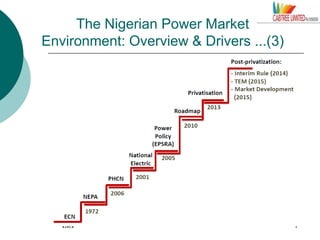
The Nigerian Power Market
Environment: Overview & Drivers ...(3)
The Nigerian Power Market
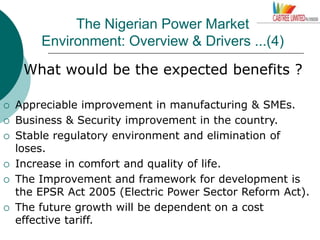
Environment: Overview & Drivers ...(4)
What would be the expected benefits ?
 Appreciable improvement in manufacturing & SMEs.
 Business & Security improvement in the country.
 Stable regulatory environment and elimination of
loses.
 Increase in comfort and quality of life.
 The Improvement and framework for development is
the EPSR Act 2005 (Electric Power Sector Reform Act).
 The future growth will be dependent on a cost
effective tariff.
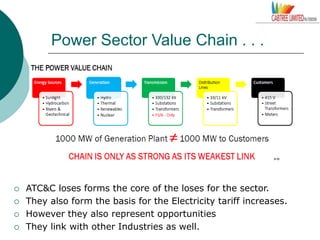
Power Sector Value Chain . . .
 ATC&C loses forms the core of the loses for the sector.
 They also form the basis for the Electricity tariff increases.
 However they also represent opportunities
 They link with other Industries as well.
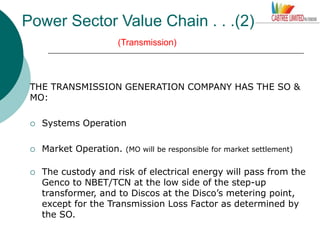
Power Sector Value Chain . . .(2)
(Transmission)
THE TRANSMISSION GENERATION COMPANY HAS THE SO &
MO:
 Systems Operation
 Market Operation. (MO will be responsible for market settlement)
 The custody and risk of electrical energy will pass from the
Genco to NBET/TCN at the low side of the step-up
transformer, and to Discos at the Disco’s metering point,
except for the Transmission Loss Factor as determined by
the SO.
DISCLAIMERS
 This presentation has been
prepared solely by the presenter
and is for information purposes
only!
 This presentation cannot be
reproduced or shared partly or
wholly without the permission of the
author. 
•The Illiterate of the 21st Century will not be those who cannot read
or write but those who cannot LERAN, UN-LEARN & RE-LEARN.
- – Alvin Toefl
…any questions

Directions for the gas sector

  • 1.
    Presentation to theSenate Committee on Gas. By Sowunmi Olabode III Cabtree Limited April 2016
  • 2.
    Key Facts…  Nigeria’sgas is of high quality. It’s called SWEET GAS because it contains 0% of sulphur and is rich in liquids.  Nigeria’s gas reserves are the 7th largest in the world and the largest in Africa with an estimated 187 trillion cubic feet (tcf) of proven gas reserves.  40 per cent of Nigeria’s gas is ASSOCIATED GAS  Nigeria has been burning 11%- 45% of all associated gas since the 1950s. The amount of gas flared would fetch roughly $2.5 billion each year.
  • 3.
    Key Facts…(2)  Europeis interested in Nigeria’s gas as a buffer against Russia’s gas imports hence the Trans-Saharan gas PIPELINE through the Sahara to Algeria.  Nigeria needs a lot more gas on the domestic market.  Currently, the Nigerian gas-to-electricity sector has about 1,000 km of pipelines, but 10,000km is needed for electricity revolution.  At about $1.2m per kilometer of overland pipeline, this will come at a huge cost.  The Nigerian Gas Master Plan (or Gas Revolution) is often quoted, but it does not have the status of an official policy
  • 4.
    Primary areas foroversight  Europe is interested in Nigeria’s gas as a buffer against Russia’s gas imports hence the Trans-Saharan gas PIPELINE through the Sahara to Algeria.  Nigeria needs a lot more gas on the domestic market.  Currently, the Nigerian gas-to-electricity sector has about 1,000 km of pipelines, but 10,000km is needed for electricity revolution.  At about $1.2m per kilometer of overland pipeline, this will come at a huge cost.  The Nigerian Gas Master Plan (or Gas Revolution) is often quoted, but it does not have the status of an official policy
  • 5.
    What to expectfrom the Consultant(s)  Provision of a road map for the Senate Committee on Gas for the next four years.  A provision of a concept paper on a Gas Laws for Nigeria.  A breakdown of the partnerships and agreements with Nigeria on gas resources.  Listing of infractions of MDAs related to the Gas sector to help the Senate in her oversight functions.  Bringing a new dimension to the dealings with NNPC, the IOCs, foreign government and all the other areas of the value chain of the Gas market.  Working with the Chairman and his vice to ensure a job opportunities for the members of their constituents and more.
  • 6.
    The Nigerian PowerMarket Environment: Overview & Drivers ...(2)  There was an estimated 90 mil people without access to grid electricity.  Sector was government owned and vertically integrated.  Poor funding & general neglect of the sector.  Lack of commercial operating environment and poor liquidity.  Improper declaration of TEM (lack of contracts).  HR capacity Issues, Facilities & low morale.  Radial Power Transmission system.
  • 7.
    The Nigerian PowerMarket Environment: Overview & Drivers ...(3)
  • 8.
    The Nigerian PowerMarket Environment: Overview & Drivers ...(4) What would be the expected benefits ?  Appreciable improvement in manufacturing & SMEs.  Business & Security improvement in the country.  Stable regulatory environment and elimination of loses.  Increase in comfort and quality of life.  The Improvement and framework for development is the EPSR Act 2005 (Electric Power Sector Reform Act).  The future growth will be dependent on a cost effective tariff.
  • 9.
    Power Sector ValueChain . . .  ATC&C loses forms the core of the loses for the sector.  They also form the basis for the Electricity tariff increases.  However they also represent opportunities  They link with other Industries as well.
  • 10.
    Power Sector ValueChain . . .(2) (Transmission) THE TRANSMISSION GENERATION COMPANY HAS THE SO & MO:  Systems Operation  Market Operation. (MO will be responsible for market settlement)  The custody and risk of electrical energy will pass from the Genco to NBET/TCN at the low side of the step-up transformer, and to Discos at the Disco’s metering point, except for the Transmission Loss Factor as determined by the SO.
  • 11.
    DISCLAIMERS  This presentationhas been prepared solely by the presenter and is for information purposes only!  This presentation cannot be reproduced or shared partly or wholly without the permission of the author. 
  • 12.
    •The Illiterate ofthe 21st Century will not be those who cannot read or write but those who cannot LERAN, UN-LEARN & RE-LEARN. - – Alvin Toefl …any questions