PRESENTATION BY
MANISH KUMAR
BSC NURSING 4TH YEAR
CH. SUGHAR SINGH NURSING AND PARAMEDICAL
COLLEGE
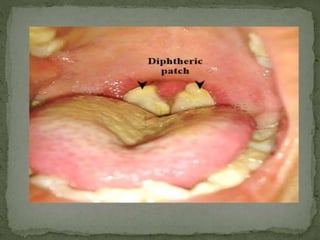
 Diphtheria is a potentially deadly contagious disease
that usually involves the nose throat and air passages
but may also infect the skin its most predominant
feature is the development of greyish membrane over
the tonsils and upper of the throat
@manishchaudhary4054
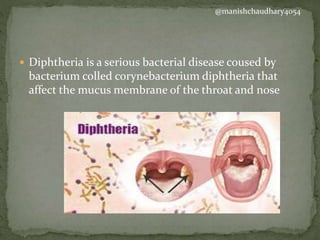
 Diphtheria is a serious bacterial disease coused by
bacterium colled corynebacterium diphtheria that
affect the mucus membrane of the throat and nose
@manishchaudhary4054
 Diphtheria is an infection caused by caryne bacterium
diphtheria bacteria it is a gram – positive non-motile
organism
 Source of infection may be case or carrier
 Period of infectivity varies from 14 to 28 day .
 Nasopharyngeal secretion discharges from the skin
lesions contaminate fomites and dust are infectious
there are nasal and throat carriers nasal carriers are
very dangerous because of frequent shedding of
organism into environment.
@manishchaudhary4054
 Under five children are more affected .
 Both sexes are affected.
 Infant born of immune mothers are relatively immune
during the first few weeks of life.
 Diphtheria occurs in all seasons although more cases
are reported during winter season.
@manishchaudhary4054
 Diphtheria is transmitted from person to person usually
through respiratory droplets from coughing or sneezing
 Rarely, spreads from skin lesions or cloths that are
contaminated with discharges from lesions of an infected
person
 Fomites- A person also can get infected with diphtheria by
coming in contact with an object like a toy ,that has been
contaminatet with the bacteria that cause diphtheria
 Respiratory route .
 Non-respiratory route skin cuts open wound ulcers and
umbilicus of new –born.
@manishchaudhary4054
 2-6 days sometimes may be longer.
@manishchaudhary4054
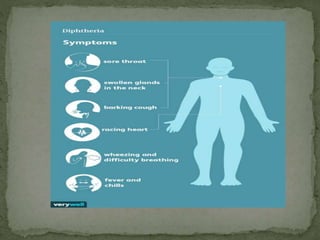
 Pseudo membrane.
 Bull neck.
 Dysphagia.
 Dispnea .
 Fever.
 Fatigue.
 Sore throat.
 Horse ness voice.
 Cough headache.
@manishchaudhary4054
 Pharyngotonsillar diphtheria .
 Laryngotracheal diphtheria .
 Nasal diphtheria .
 Cutaneous diphtheria .
 Sore throat .
 Difficulty in swolling low grade fever .
 Obstruction of the airway may result in respiratory
problems and death .
 Hoarsness of voice .
 Croupy cough.
@manishchaudhary4054
 It is a real public health problem because it spreads the
disease more rapidly than other forms of diphtheria .
 Cutaneous diphtheria lesion .
 Appears as secondary infection .
 Lesion may be surrounded by edema and covered with
a membrane .
 Nose and throat swab.
 Schick test .
Early detection
 Active search for cases should begin in family and school
contacts.
 Nasal and throat swab-culture test should be done to
detect the cases.
Isolation
 Isolate all cases carriers in the hospital at least for 14
days.
 Respiratory failure
 DPT-Diphtheria pertusis and tetanus vaccine. 16-24
months
 DT- Diphtheria and tetanus toxoid .
 Pentavalent – It vaccine ( give protection against diseases
diphtheria ,pertussis tetanus hepatitis-B and and
hemophilus influenza-B )
 Dose . 0.5 ml of the vaccine administered intramuscularly
THANK YOU

DIPHTHERIA by Manish Kumar diphtheria ppt

  • 1.
    PRESENTATION BY MANISH KUMAR BSCNURSING 4TH YEAR CH. SUGHAR SINGH NURSING AND PARAMEDICAL COLLEGE
  • 3.
     Diphtheria isa potentially deadly contagious disease that usually involves the nose throat and air passages but may also infect the skin its most predominant feature is the development of greyish membrane over the tonsils and upper of the throat @manishchaudhary4054
  • 4.
     Diphtheria isa serious bacterial disease coused by bacterium colled corynebacterium diphtheria that affect the mucus membrane of the throat and nose @manishchaudhary4054
  • 5.
     Diphtheria isan infection caused by caryne bacterium diphtheria bacteria it is a gram – positive non-motile organism  Source of infection may be case or carrier  Period of infectivity varies from 14 to 28 day .  Nasopharyngeal secretion discharges from the skin lesions contaminate fomites and dust are infectious there are nasal and throat carriers nasal carriers are very dangerous because of frequent shedding of organism into environment. @manishchaudhary4054
  • 6.
     Under fivechildren are more affected .  Both sexes are affected.  Infant born of immune mothers are relatively immune during the first few weeks of life.
  • 7.
     Diphtheria occursin all seasons although more cases are reported during winter season. @manishchaudhary4054
  • 8.
     Diphtheria istransmitted from person to person usually through respiratory droplets from coughing or sneezing  Rarely, spreads from skin lesions or cloths that are contaminated with discharges from lesions of an infected person  Fomites- A person also can get infected with diphtheria by coming in contact with an object like a toy ,that has been contaminatet with the bacteria that cause diphtheria
  • 9.
     Respiratory route.  Non-respiratory route skin cuts open wound ulcers and umbilicus of new –born. @manishchaudhary4054
  • 10.
     2-6 dayssometimes may be longer. @manishchaudhary4054
  • 11.
     Pseudo membrane. Bull neck.  Dysphagia.  Dispnea .  Fever.  Fatigue.  Sore throat.  Horse ness voice.  Cough headache. @manishchaudhary4054
  • 14.
     Pharyngotonsillar diphtheria.  Laryngotracheal diphtheria .  Nasal diphtheria .  Cutaneous diphtheria .
  • 15.
     Sore throat.  Difficulty in swolling low grade fever .  Obstruction of the airway may result in respiratory problems and death .
  • 16.
     Hoarsness ofvoice .  Croupy cough. @manishchaudhary4054
  • 17.
     It isa real public health problem because it spreads the disease more rapidly than other forms of diphtheria .  Cutaneous diphtheria lesion .  Appears as secondary infection .  Lesion may be surrounded by edema and covered with a membrane .
  • 18.
     Nose andthroat swab.  Schick test .
  • 19.
    Early detection  Activesearch for cases should begin in family and school contacts.  Nasal and throat swab-culture test should be done to detect the cases. Isolation  Isolate all cases carriers in the hospital at least for 14 days.
  • 20.
  • 21.
     DPT-Diphtheria pertusisand tetanus vaccine. 16-24 months  DT- Diphtheria and tetanus toxoid .  Pentavalent – It vaccine ( give protection against diseases diphtheria ,pertussis tetanus hepatitis-B and and hemophilus influenza-B )  Dose . 0.5 ml of the vaccine administered intramuscularly
  • 22.