












Bulding a Agile Marketing Plan for 2015
Roger Lopez
2
Roger Lopez
VP Marketing
@inemode
www.sideqik.com
Linkedin.com/in/imroger
Sideqik
Marketing used to
work like this.
A
B
Today, it feels
more like this.
A
B
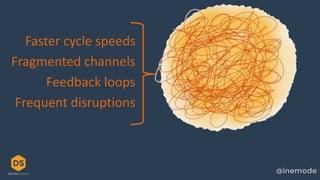
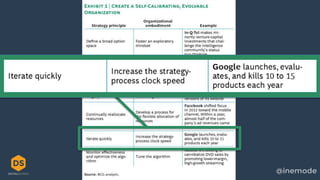
Faster cycle speeds
Fragmented channels
Feedback loops
Frequent disruptions
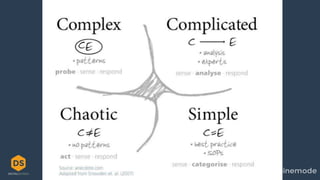
Marketing used to be complicated.
Now it is complex.
Technology (alone) is not the solution.
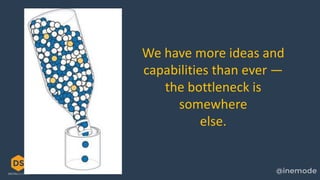
We have more ideas and
capabilities than ever —
the bottleneck is
somewhere
else.
We need new organizational capital.
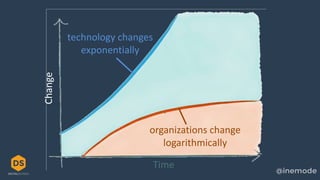
technology changes
exponentially
organizations change
logarithmically
Time
Change
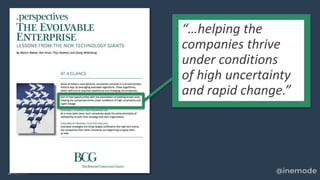
“…helping the
companies thrive
under conditions
of high uncertainty
and rapid change.”
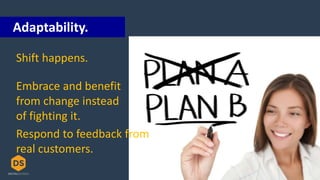
Shift happens.
Embrace and benefit
from change instead
of fighting it.
Respond to feedback from
real customers.
Adaptability.
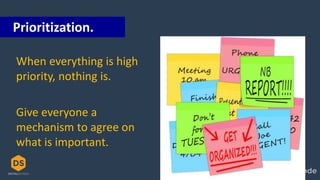
When everything is high
priority, nothing is.
Give everyone a
mechanism to agree on
what is important.
Prioritization.
Helps teams coordinate
in a highly dynamic
environment.
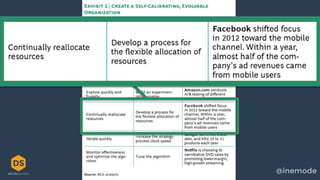
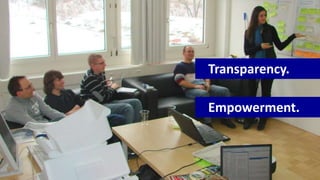
Give knowledge
workers knowledge.
Transparency.
Give teams greater
responsibility to make a
difference, to shape their
work — and to be
recognized for their
contributions.
Empowerment.
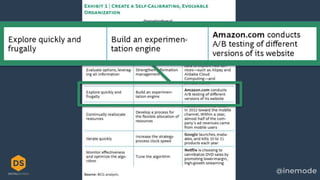
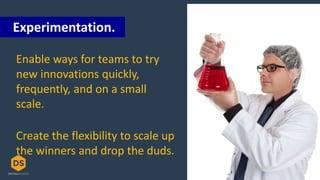
Enable ways for teams to try
new innovations quickly,
frequently, and on a small
scale.
Create the flexibility to scale up
the winners and drop the duds.
Experimentation.
Sounds great. But how?
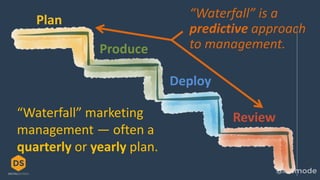
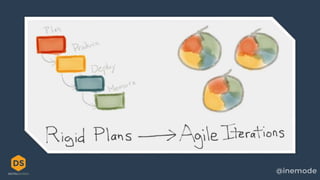
Plan
Review
Produce
Deploy
“Waterfall” marketing
management — often a
quarterly or yearly plan.
“Waterfall” is a
predictive approach
to management.
Not
predictable
A
B
Reasonably
predictable
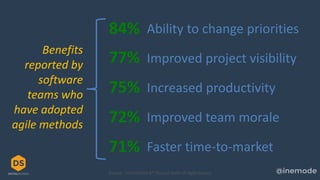
72% Improved team morale
71% Faster time-to-market
75% Increased productivity
77% Improved project visibility
84% Ability to change priorities
Benefits
reported by
software
teams who
have adopted
agile methods
Source: VersionOne 6th Annual State of Agile Survey
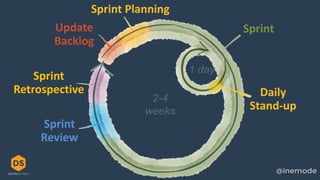
Sprint Planning
Sprint
Sprint
Retrospective Daily
Stand-up
1 day
2-4
weeks
Sprint
Review
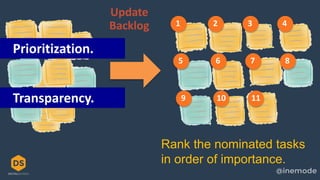
Update
Backlog
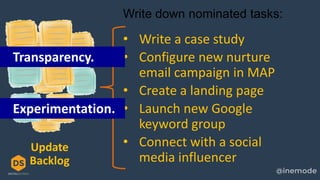
Write down nominated tasks:
Update
Backlog
• Write a case study
• Configure new nurture
email campaign in MAP
• Create a landing page
• Launch new Google
keyword group
• Connect with a social
media influencer
Transparency.
Experimentation.
1 2 3 4
5 6 7 8
9 10 11
Rank the nominated tasks
in order of importance.
Update
Backlog
Prioritization.
Transparency.
1 2 3 4
5 6 7 8
9 10 11 1
2
3
4
5
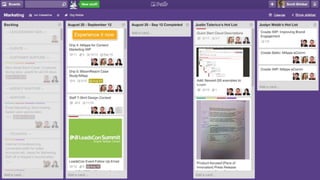
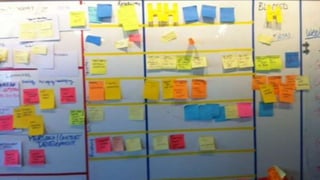
To Do In Progress Done
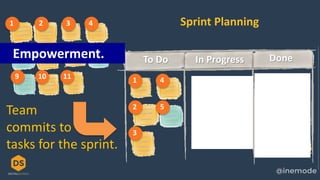
Sprint Planning
Empowerment.
Team
commits to
tasks for the sprint.
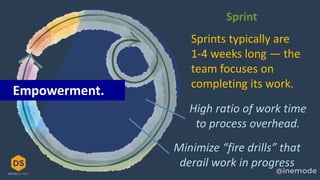
Sprint
High ratio of work time
to process overhead.
Minimize “fire drills” that
derail work in progress
Sprints typically are
1-4 weeks long — the
team focuses on
completing its work.
Empowerment.
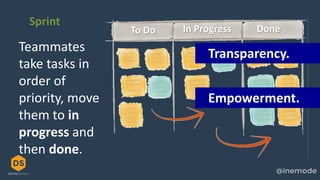
To Do In Progress Done
Sprint
Teammates
take tasks in
order of
priority, move
them to in
progress and
then done.
Empowerment.
Transparency.
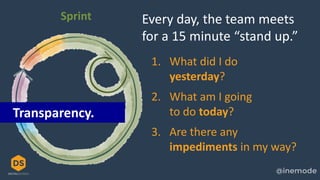
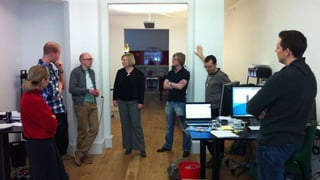
Sprint Every day, the team meets
for a 15 minute “stand up.”
1. What did I do
yesterday?
2. What am I going
to do today?
3. Are there any
impediments in my way?
Transparency.
If there’s an issue in
Europe, I want the
head of African
diplomacy to know
about it.
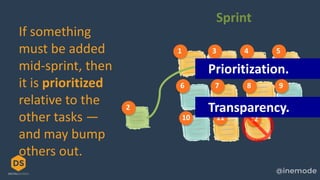
1 3 4 5
6 7 8 9
11 12
2
10
Sprint
If something
must be added
mid-sprint, then
it is prioritized
relative to the
other tasks —
and may bump
others out.
Transparency.
Prioritization.
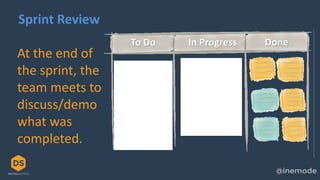
To Do In Progress Done
Sprint Review
At the end of
the sprint, the
team meets to
discuss/demo
what was
completed.
Empowerment.
Transparency.
Sprint Review
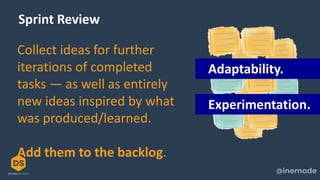
Collect ideas for further
iterations of completed
tasks — as well as entirely
new ideas inspired by what
was produced/learned.
Add them to the backlog.
Adaptability.
Experimentation.
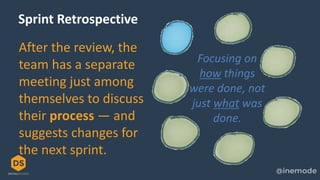
Focusing on
how things
were done, not
just what was
done.
Sprint Retrospective
After the review, the
team has a separate
meeting just among
themselves to discuss
their process — and
suggests changes for
the next sprint.
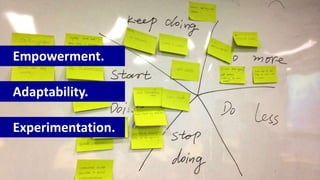
Empowerment.
Adaptability.
Experimentation.
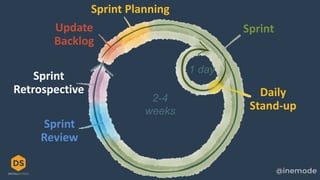
Sprint Planning
Sprint
Sprint
Retrospective Daily
Stand-up
1 day
2-4
weeks
Sprint
Review
Update
Backlog
There’s no sleight of hand.
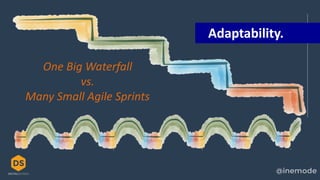
One Big Waterfall
vs.
Many Small Agile Sprints
Adaptability.
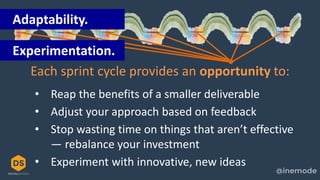
Each sprint cycle provides an opportunity to:
• Reap the benefits of a smaller deliverable
• Adjust your approach based on feedback
• Stop wasting time on things that aren’t effective
— rebalance your investment
• Experiment with innovative, new ideas
Adaptability.
Experimentation.
1
2
3
4
5
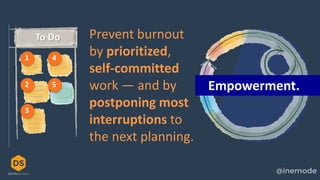
To Do Prevent burnout
by prioritized,
self-committed
work — and by
postponing most
interruptions to
the next planning.
Empowerment.
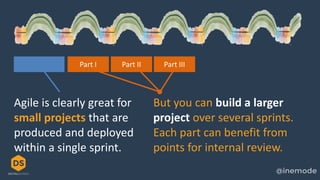
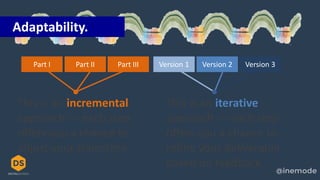
Part I Part II Part III
Agile is clearly great for
small projects that are
produced and deployed
within a single sprint.
But you can build a larger
project over several sprints.
Each part can benefit from
points for internal review.
Part I Part II Part III Version 1 Version 2 Version 3
This is an incremental
approach — each step
offers you a chance to
adjust your trajectory.
This is an iterative
approach — each step
offers you a chance to
refine your deliverable
based on feedback.
Adaptability.
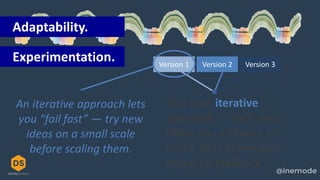
Version 1 Version 2 Version 3
This is an iterative
approach — each step
offers you a chance to
refine your deliverable
based on feedback.
An iterative approach lets
you “fail fast” — try new
ideas on a small scale
before scaling them.
Experimentation.
Adaptability.
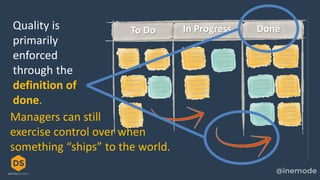
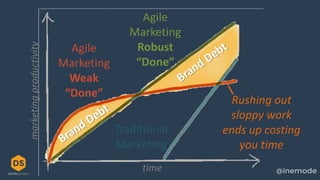
What about quality?
Is everything done “quick and dirty?”
To Do In Progress DoneQuality is
primarily
enforced
through the
definition of
done.
Managers can still
exercise control over when
something “ships” to the world.
time
marketingproductivity
Agile
Marketing
Robust
“Done”
Agile
Marketing
Weak
“Done”
Traditional
Marketing
Rushing out
sloppy work
ends up costing
you time
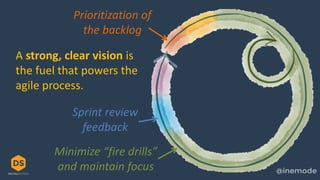
What about a larger vision?
Is everything just planned on-the-fly?
Prioritization of
the backlog
Sprint review
feedback
Minimize “fire drills”
and maintain focus
A strong, clear vision is
the fuel that powers the
agile process.
What about work that doesn’t
seem to fit the agile process?
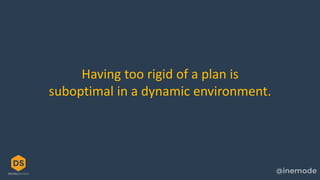
Having too rigid of a plan is
suboptimal in a dynamic environment.
65
Roger Lopez
VP Marketing
@inemode
www.sideqik.com
Linkedin.com/in/imroger
Sideqik

Digitial school Atlanta -Agile-marketing