Department of Communications Engineering
Digital Communications
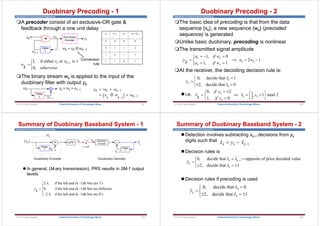
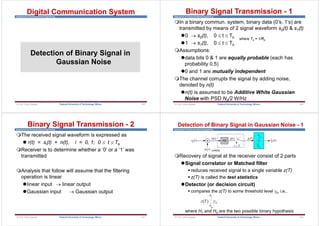
CME 624 May 2016
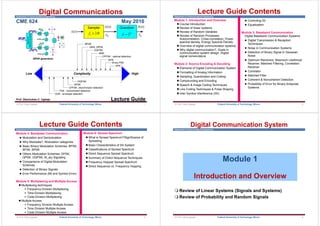
Lecture Guide
Prof. Okechukwu C. Ugweje
Complexity High
APK
M-ary PSK
QPR
CPFSK - optimal detection
MSK
OQPSK
QAM, QPSK
BPSK
Low
OOK - envelope detection
DQPSK
DPSK
CPFSK -discriminator detection
FSK - noncoherent detection
Sampler
f B
s  2
Quantizer
L k
 2
x n
( )
xk 
xk
( )
x n
x t
( )
© Prof. Okey Ugweje 1
Federal University of Technology, Minna
Department of Communications Engineering
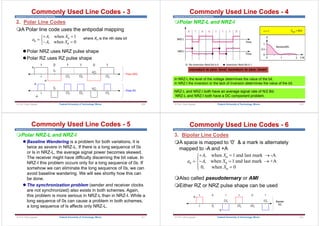
Lecture Guide Contents
Module 1: Introduction and Overview
 Course Introduction
 Review of linear systems
 Review of Random Variables
 Review of Random Processes:
Autocorrelation, Cross-correlation, Power
spectral density, Energy Spectral Density
 Overview of digital communication systems
 Why digital communication?, Goals in
communication system design, Digital
signal nomenclature
Module 2: Source Encoding & Decoding
 Elements of Digital Communication System
 Formatting of Analog Information
 Sampling, Quantization and Coding
 Compounding and Encoding
 Speech & Image Coding Techniques
 Line Coding Techniques & Pulse Shaping
 Inter Symbol Interference (ISI)
 Controling ISI
 Equalization
Module 3: Baseband Communication
Digital Baseband Communication Systems
 Digital Transmission & Reception
Techniques
 Noise in Communication Systems
 Detection of Binary Signal in Gaussian
Noise
 Optimum Receivers: Maximum Likelihood
Receiver, Matched Filtering, Correlation
Receiver
 Correlator
 Matched Filter
 Coherent & Noncoherent Detection
 Probability of Error for Binary Antipodal
Systems
© Prof. Okey Ugweje 2
Federal University of Technology, Minna
Department of Communications Engineering
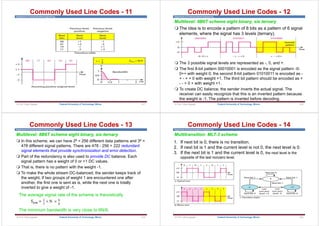
Lecture Guide Contents
Module 4: Bandpass Communication
 Modulation and Demodulation
 Why Modulate?, Modulation categories
 Basic Binary Modulation Schemes: BPSK,
BFSK, BPSK
 Others Modulation Schemes: DPSK,
QPSK, OQPSK, M_ary Signaling
 Comparisons of Digital Modulation
Schemes
 Detection of Binary Signals
 Error Performance (Bit and Symbol Error)
Module 5: Multiplexing and Multiple Access
 Multiplexing techniques
 Frequency-Division Multiplexing
 Time-Division Multiplexing
 Code-Division Multiplexing
 Multiple Access
 Frequency Division Multiple Access
 Time Division Multiple Access
 Code Division Multiple Access
© Prof. Okey Ugweje 3
Federal University of Technology, Minna
Module 6: Spread Spectrum
 What is Spread Spectrum?/Significance of
Spreading
 Basic Characteristics of SS System
 Classifications of Spread Spectrum
 Direct Sequence Spread Spectrum
 Summary of Direct Sequence Techniques
 Frequency Hopped Spread Spectrum
 Direct Sequence vs. Frequency Hopping
Department of Communications Engineering
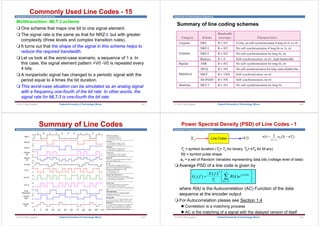
Digital Communication System
Module 1
Introduction and Overview
 Review of Linear Systems (Signals and Systems)
 Review of Probability and Random Signals
© Prof. Okey Ugweje 4
Federal University of Technology, Minna
Department of Communications Engineering
 Introductions
 Course Outline/Syllabus
 Course Calendar
 Course Overview
Introduction and Handout
Digital Communication System
© Prof. Okey Ugweje 5
Federal University of Technology, Minna
Department of Communications Engineering
Digital Communication System
 Note:
 Some of the material contained in Module 1 is a review
of prerequisite materials covered in undergraduate
classes such as:
 Signals and Systems
 Communications and Signal Processing
 Random Signals and Processes
 Some of the materials are included in this section for
your benefit
 It is your responsibility to review most of the material in
this Module
 Most materials in this section can be found in Chapter
1 and the Appendix of the recommended textbook
© Prof. Okey Ugweje 6
Federal University of Technology, Minna
Department of Communications Engineering
 Signals and Systems
 Continuous Convolution
 Parseval’s’ theorem
 Linear Transform
 Fourier Transform Techniques
 Concept of Bandwidth/ Filtering
Signals and Systems
Digital Communication System
© Prof. Okey Ugweje 7
Federal University of Technology, Minna
Department of Communications Engineering
Signals - 1
Signals are used to convey information
Signals and waveforms (voltage, current and intensity)
are central to communication and signal processing
Signals can be viewed either in time or frequency
domain
A signal is any physical quantity that varies with time,
space, or any other independent variables
Often, the independent variables for most signals is
“time”
Theoretical signals can be described mathematically,
graphically or in tabular form
Real signals are however difficult to describe, and more
often can be described approximately
© Prof. Okey Ugweje 8
Federal University of Technology, Minna
Department of Communications Engineering
Signals - 2
Mathematically, a signal is defined as a function of one
or more independent variables, e.g.,
x(t) = 10t
x(t) = 5t2
s(x,y) = 3x + 2xy + 10y2
Sometimes the functional dependence on the
independent variable is not precisely known, e.g.,
speech signal
Sometimes a signal is a combination of other signals
e.g., sum of sinusoid of different amplitudes,
frequency & phase
 
1
( ) ( )sin 2 ( ) ( )
n
i i i
i
s t A t F t t
 

 

© Prof. Okey Ugweje 9
Federal University of Technology, Minna
Department of Communications Engineering
Signals - 3
Mathematically, a signal is defined as a function of one or
more independent variables, e.g.,
 x(t) = 10t
 x(t) = 5t2
 s(x,y) = 3x + 2xy + 10y2
Sometimes the functional dependence on the independent
variable is not precisely known, e.g., speech signal
Sometimes a signal is a combination of other signals
 e.g., sum of sinusoid of different amplitudes, frequency & phase
Signals are the inputs outputs, and internal functions that
the systems process or produce, such as voltage,
current, pressure, displacements, intensity, etc.
 
1
( ) ( )sin 2 ( ) ( )
n
i i i
i
s t A t F t t
 

 

© Prof. Okey Ugweje 10
Federal University of Technology, Minna
Department of Communications Engineering
Signals - 4
The variable time may be continuous or discrete and the
value of the signal may be represented as
 Continuous-valued x(t)
 Discrete-valued x(nts)
 Quantized xQ(t), and
 Digital x[n]
These types of signals occur at different stages of the
process
Other variables (distance, angle, etc.) can also be the
independent variable, especially for 2-D signals like
images and video
© Prof. Okey Ugweje 11
Federal University of Technology, Minna
Department of Communications Engineering
Physical realizable signals must
 Have time duration
 Occupy finite frequency spectrum
 Are continuous (as in analog signal)
 Have finite peak value, and
 Are real-valued
All real-world signals will have these properties
Sometimes we use mathematical signal models which violate
these conditions
 e.g., Dirac delta function (or impulse function)
The most commonly used analog signals are the sinusoidal
signals (sine, cosine, etc.)
In communication systems, we are concerned with info
bearing signals that evolve as a function of the independent
variable, t
© Prof. Okey Ugweje 12
Federal University of Technology, Minna
Signals - 5
Department of Communications Engineering
Systems - 1
When signals are corrupted by noise, they no longer convey
the required information directly, hence they often require
processing
 Radio receivers are especially sensitive to noise
Signals are processed by systems, which may modify them
or extract additional information from them
Thus, a system is an entity that processes a set of signals
(inputs) to yield another set of signals (outputs)
A system can also be associated to the signal as in the
source or sink of the signal
A system may be made up of physical components
(hardware realization), as in electrical, mechanical, or
hydraulic systems, or it may be an algorithm (software
realization) that computes an output from an input signal
© Prof. Okey Ugweje 13
Federal University of Technology, Minna
Department of Communications Engineering
Systems - 2
 Many systems have signals that are not wanted (commonly
known as noise or interference)
 A system is a device, process, or algorithm that, given an
input x(t), produces an output y(t)
 A system is characterized by its input (excitation or forcing
function), its output (response), and the rules of operation
(internal functions)
 From a communication engineers’ viewpoint, a system is a law
that assigns output signals to various input signals
 Systems may be realized as an integration of sub-systems or
as a single entity
 In practice, systems with feedback is of great importance
© Prof. Okey Ugweje 14
Federal University of Technology, Minna
Department of Communications Engineering
Systems - 3
Systems may be classified functionally as in
Analyzers, Synthesizers, Transducers, Channels,
Filters, and Equalizers, etc.
or descriptively as in
linear, nonlinear, causal, discrete, continues, time
invariant, etc.
Examples of Systems
Electronic systems: resistors, inductors, Radio/TV,
phone networks, sonar and radar, guidance &
navigation, satellite, lab instrumentation, biomedical
instrumentation, etc.
Mechanical systems: loudspeakers, microphones,
vibration analyzers, springs, dampers
© Prof. Okey Ugweje 15
Federal University of Technology, Minna
Department of Communications Engineering
Systems - 4
To understand the behavior of systems
(electronic/mechanical), the response to inputs
(usually signals) must be understood
Terminology of Systems
State:
Variables that allow us to determine the energy level
of the system
All physical systems are referenced to zero-energy
state, e.g., ground state, rest state, relaxed state
Initial Conditions
The initial conditions or initial state is the state of the
system before an input is applied
© Prof. Okey Ugweje 16
Federal University of Technology, Minna
Department of Communications Engineering
Broad Classification of Systems
 We are
interested only
on the systems
that intersect the
dotted path.
Distributed
Parameters
SYSTEMS
Lumped Parameters
Stochastic Deterministic
Continuous Time Discrete Time
Nonlinear Linear
Nonlinear Linear
Time
Varying
Time
Invariant
Time
Varying
Time
Invariant
© Prof. Okey Ugweje 17
Federal University of Technology, Minna
Systems - 5 Department of Communications Engineering
Operation on Linear Systems
 An operator, T, is a rule to transform one function to another
 Additive
 Homogeneous
 Principle of Superposition
 Superposition implies both additive & homogeneous rules
 If a system fails either rule, the function is nonlinear
 Addition or homogeneity is sufficient condition to test for
linearity
T x t y t
( ) ( )
  
T x t x t T x t T x t
1 2 1 2
( ) ( ) ( ) ( )
  
k p k p k p
T Kx t KT x t
( ) ( )
    
T Ax t Bx t AT x t BT x t
1 2 1 2
( ) ( ) ( ) ( )
  
k p k p k p
© Prof. Okey Ugweje 18
Federal University of Technology, Minna
Systems - 6
Department of Communications Engineering
Linear Time-Invariant (LTI) Systems
Linear systems are characterized by the ability to accept
input and produce output in response to the input
Most communication systems can be modeled as linear
systems with signals forming the input and output functions
h(t)
h[n]
H(ejw)
H(f)
H(z)
LTI
y(t)
y[n]
Y(ejw)
Y(f)
Y(z)
x(t)
x[n]
x(ejw)
X(f)
X(z)
Time Function
Pole-Zero Plot
Difference Equation
H - Function
Frequency Function
© Prof. Okey Ugweje 19
Federal University of Technology, Minna
Department of Communications Engineering
Why study signals and systems?
In signals and systems theory we study the definition
and description of signals, and the behavior of systems
under different conditions
Signals form the inputs, outputs and internal
functions of systems
In electrical & computer engineering, the understanding
of signals and the behavior of systems is of immense
importance
Communication engineers are concerned with systems
which transmit, receive, and process signals carrying
information
Hence before one can characterize a system, one must
be able to characterize the system
© Prof. Okey Ugweje 20
Federal University of Technology, Minna
Department of Communications Engineering
Size of a Signal - 1
 The size of a signal is the value of the strength of the
signal
 The signal strength may be measures in its entirety
or in a given interval
 Such a measure must consider not only the signal
amplitude, but also its duration
 There are two major ways of determining the signal
strength
© Prof. Okey Ugweje 21
Federal University of Technology, Minna
Department of Communications Engineering
Size of a Signal - 2
1. Signal Energy
 A signal is classified as energy-type if its energy Eg is
finite (0<Eg<)
 Energy may be computed in either time or frequency
domain, whichever is easier using the following
formula
 where G(f) is the Fourier transform of g(t)
 All time-limited signals of finite amplitude are energy
signals
 Energy signals have zero power
 Since signal energy also depends on the “load” the actual
signal energy should be normalized by the load R
2 2 2
/2
lim
/2
( ) ( ) ( )
T
g T
T
E g t dt g t dt G f df
 
  

  
   (unit)2s
© Prof. Okey Ugweje 22
Federal University of Technology, Minna
Department of Communications Engineering
Size of a Signal - 3
2. Signal Power
 A signal is power-type if its power Pg is finite (0<Pg<)
 The power Pg of a signal can be computed using the
formula
 Notice that the signal power is the time-average
(mean) of the signal amplitude squared
 Most periodic signals are power-type signals
 For periodic signals Eg & Pg can be computed by
integrating over one period
/ 2
lim lim
/ 2
2 2
1 1
2 ( ) ( )
T T
T T
T T
g T T
P g t dt g t dt
 
 

 
 (unit)2
© Prof. Okey Ugweje 23
Federal University of Technology, Minna
Department of Communications Engineering
Important Signal Classifications
Deterministic and Random Signals
 Value of the signal is known or not known at all
times
Periodic and Non-periodic Signals
Analog (Continuous-Time) and Discrete Signals
 Exists for all times t vs. exists at discrete time
only
Signals and Spectra - 1
0
( ) ( ),
x t x t T t
      
© Prof. Okey Ugweje 24
Federal University of Technology, Minna
Department of Communications Engineering
 Energy- and Power-Type Signals
with waveform
 Unit Impulse Function
Signals and Spectra - 2
.5 2 2
.5
lim ( ) ( )
T
X T
T
E x t dt x t dt

 

 
 
.5 2 2
.5
1 1
lim ( ) ( )
T
x T
T T T
P x t dt x t dt

 

 
 
( ) 1, ( ) 0 0
t dt t for t
 


  

0
( ) ( ) ( )
o
x t t d x t
  


 

.5 2
.5
( )
T
T
x T
E x t dt

 
.5 2
.5
1 1
( )
T
T T
x x T
T T
P E x t dt

  
© Prof. Okey Ugweje 25
Federal University of Technology, Minna
Department of Communications Engineering
 Others
 Even and Odd Signals
 Real and Complex Signals
 Causal and Noncausal
Signals and Spectra - 3
© Prof. Okey Ugweje 26
Federal University of Technology, Minna
Department of Communications Engineering
Spectral Density
 Energy Spectral Density
 Power Spectral Density
 For periodic signals, the PSD is given by
Signals and Spectra - 4
2
2
( )
2
0
( ) '
( )
( ) ( ) is defined as energy spectral density
( )
X
X
f
X
X
E x t dt df Parseval s Theorem
x f
f df f
f df

 

 
 



  
 
 

 



2
2
2
2
1
( )
T
T
X n
n
P x t dt power
C
T




  

 
2
0
( )
X n
n
G f C f nf




 
© Prof. Okey Ugweje 27
Federal University of Technology, Minna
Department of Communications Engineering
Examples
1. Example 1
 Signal Power
2. Example 2
 Signal Energy
3. Example 3
 Signal Energy
© Prof. Okey Ugweje 28
Federal University of Technology, Minna
Department of Communications Engineering
 Some Important or Common Signals & Functions
 Sinusoidal Signal
 Complex Exponential (harmonics)
 Unit Step Function [denoted by u(t)]
 Ramp Function [denoted by r(t)]
 Rectangular Pulse Function [denoted by rect(t) or
(t)]
 Triangular Pulse Function[denoted by (t)]
 Sign (Signum) Function [denoted by sgn(t)]
 Sinc Function [denoted by sinc(t)]
 Impulse (Delta, Dirac) Function [denoted by (t)]
Signals and Spectra - 6
© Prof. Okey Ugweje 29
Federal University of Technology, Minna
Department of Communications Engineering
 Operations on Signals
 Amplitude Scaling
 Amplitude Shifting
 Time Shifting
 Displaces a signal in time without changing its
shape
Signals and Spectra - 7
( ) ( )
"+"shifts the signal left by
"-" shifts the signal right by (delayed)
y t x t 


 
© Prof. Okey Ugweje 30
Federal University of Technology, Minna
Department of Communications Engineering
 Time Scaling
 Slows down or speeds up time which results in signal
compression or stretching
 The expression
 Reflection or Folding
 A scaling operation with  = -1  x(t) = x(-t)
 The mirror image of x(t) about the y-axis through t = 0
 Operations in Combinations
 x(t)  delay (shift right) by   x(t-)
 compress by   x(t-)
 x(t)  compress by   x(t)
 delay (shift right) by /  x(t-)
Signals and Spectra - 8
( )
t
y t x

 
  
 
© Prof. Okey Ugweje 31
Federal University of Technology, Minna
Department of Communications Engineering
 Some useful signal operations and models
 Continuous/Discrete Convolution
 Parseval’s’ theorem
 Hilbert Transform
Concept of Bandwidth and Filtering
 Some Important Properties of Signals
 DC Value
 Is the time average of a signal or the time average
over a finite interval [t1, t2]
 Average Power
 The ensemble average
 RMS Value
Signals and Spectra - 9
© Prof. Okey Ugweje 32
Federal University of Technology, Minna
Department of Communications Engineering
 Fourier Series and Transform
 Definition and Properties
 Important Fourier transform cases
 Energy and power spectral density
 Different Types of Sampling Techniques
 Idea Sampling
 Natural Sampling
 Sample-and-Hold
Signals and Spectra - 10
© Prof. Okey Ugweje 33
Federal University of Technology, Minna
Department of Communications Engineering
Examples
4. Example 4
 Periodicity of Signal
5. Example 5
 Even and Odd Signals
 Even  x(t) = x(-t)
 Odd  x(t) = -x(-t)
6. Example 6
 Even and Odd Signals
 
0
( )
g t g t T
 
© Prof. Okey Ugweje 34
Federal University of Technology, Minna
Department of Communications Engineering
Examples
7. Example 7 : Convolution
 Convolution is a technique of finding the zero state
response of LTI system
8. Example 8: Convolution
h(t) y(t)
x(t)
( ) ( ) ( ) ( ) ( ) ( ) ( )
y t x t h t x h t d x t h d
     
 
 
     
 
© Prof. Okey Ugweje 35
Federal University of Technology, Minna
Department of Communications Engineering
Fourier Transform Table
© Prof. Okey Ugweje 36
Federal University of Technology, Minna
Department of Communications Engineering
Fourier Transform Pair
© Prof. Okey Ugweje 37
Federal University of Technology, Minna
Department of Communications Engineering
Examples
9. Example 9: Fourier Transform
10.Example 10: Fourier Transform
11.Example 11: Fourier Transform
12.Example 12: Fourier Transform
13.Example 13: Inverse Fourier Transform
X f F x t x t e j ftdt
( ) ( ) ( )
  
z


2
x t F X f X f e j ftdf
( ) ( ) ( )
  z



1 2
© Prof. Okey Ugweje 38
Federal University of Technology, Minna
Department of Communications Engineering
 Probability Theory
 Distribution Functions
 Density Functions
 Expectations
 Random Processes, etc
Review of Probability and
Random Signals
Please review the course
CME621:Stochastic
Processes
Digital Communication System
© Prof. Okey Ugweje 39
Federal University of Technology, Minna
Department of Communications Engineering
Examples – Random Signals
14. Example 14
 Random Signals
15. Example 15
 Random Processes
© Prof. Okey Ugweje 40
Federal University of Technology, Minna
Department of Communications Engineering
Digital Communication System
Module 2
Source Encoding & Decoding
© Prof. Okey Ugweje 41
Federal University of Technology, Minna
 Elements of Digital Communication
 Formatting of Analog Signal
 Sampling and Quantization
 Compounding
 Encoding and Line Coding Techniques
 Intersymbol interference
Department of Communications Engineering
Digital Communication System
Elements of Digital
Communication System
© Prof. Okey Ugweje 42
Federal University of Technology, Minna
Department of Communications Engineering
Elements of Digital Communication - 1
© Prof. Okey Ugweje 43
Federal University of Technology, Minna
Department of Communications Engineering
 Each of these blocks represents one or more transformations
 Each block identifies a major signal processing function which changes or
transforms the signal from one signal space to another
 Some of the transformation block overlap in functions
Elements of Digital Communication - 2
Format Multiplex
Channel
Encoder
Source
Encoder
Spread
Modulate
Format Demultiplex
Channel
Decoder
Source
Decoder
Despread
Demodulate
&
Detect
Performance
Measure
Bits or
Symbol
To other
destinations
From other
sources
Digital
input
Digital
output
Source
bits
Source
bits
Channel
bits
Carrier & symbol
synchronization
Channel
bits
$
mi
n s
mi
l q
Pe
Multiple
Access
Waveforms
Multiple
Access
Tx
Rx
© Prof. Okey Ugweje 44
Federal University of Technology, Minna
Department of Communications Engineering
Why Digital Communications? - 1
1. Advantages
 Two-state signal representation
 Hardware is more flexible
 Hardware implementation is flexible and permits the use of
microprocessors, mini-processors, LSI or VLSI, etc.
 Low cost
 With LSI/VLSI, implementation cost is reduced
 Easy to regenerate the distorted signal
 Repeaters can detect a digital signal and retransmit a new,
clean (noise free) signal
 Hence, prevent accumulation of noise along the path
Less subject to distortion and interference
 Digital system is more immune to channel noise/ distortion
© Prof. Okey Ugweje 45
Federal University of Technology, Minna
Department of Communications Engineering
Easier and more efficient to multiplex several digital
signals
 Digital multiplexing techniques – TDMA and CDMA - are
easier to implement than analog techniques such as FDMA
Can combine different signal types – data, voice,
TV, text, etc.
 It is possible to combine both format for transmission
through a common medium
Can use packet switching
Encryption and privacy techniques are easier to
implement
Better overall performance
 Inherently more efficient than analog techniques in
realizing the exchange of SNR for bandwidth
Why Digital Communications? - 2
© Prof. Okey Ugweje 46
Federal University of Technology, Minna
Department of Communications Engineering
2. Disadvantages
 Requires reliable “synchronization”
 Requires A/D conversions at high data rate
 Requires larger bandwidth (require BW efficient
MODEM)
 Banalog = W Hz
 Bdigital = nW Hz
– where n is the # of bits used to quantize the amplitude
of the signal
 Generally an increase in complexity over analog
system
Why Digital Communications? - 3
© Prof. Okey Ugweje 47
Federal University of Technology, Minna
Department of Communications Engineering
 To maximize transmission rate, R, e.g., symbols per sec
 To minimize bit error rate, Pe, or Pb
 To minimize required power, Eb/No (or ~ly required signal
power)
 To minimize required systems bandwidth, W
 To maximize system utilization, U
 To minimize system complexity, Cx
Goals in Communication System Design
R U Pe W Cx Eb/No
• In most practical
applications trade-
offs are necessary
© Prof. Okey Ugweje 48
Federal University of Technology, Minna
Department of Communications Engineering
 Information Source
Discrete output values, e.g. Keyboard (1~26 (A~Z) symbols)
Analog signal source information is continuous valued
 Textual Message
A meaningful sequence of character or symbols, e.g.,
 How are you? I am ok, thank you; I feel like a million dollars!
 Character
 Member of an alphanumeric/symbol (A ~ Z, 0 ~ 9)
 Characters can be mapped into a sequence of binary digits
using one of the standardized codes such as
 ASCII: American Standard Code for Information
Interchange
 Others: EBCDIC, Hollerith, Baudot, Murray, Morse, etc.
Digital Signal Nomenclature - 1
© Prof. Okey Ugweje 49
Federal University of Technology, Minna
Department of Communications Engineering
Symbol
 A digital message made up of groups of k-bits considered as a unit
 A member of source alphabet. May or may not be binary, e.g. 2
symbol binary, 4 symbol PSK, 128 symbol ASCII
Digital Message
Messages constructed from a finite # of symbols (26 letters, 10
numbers, “space” and punctuation marks).
 Hence a text is a digital message with about 50 symbols
Morse-coded telegraph message is a digital message
constructed from 2 symbols “Mark” and “Space”
M_ary
A digital message constructed with M symbols
 Digital Waveform
 Current or voltage waveform that represents a digital symbol
Digital Signal Nomenclature - 2
© Prof. Okey Ugweje 50
Federal University of Technology, Minna
Department of Communications Engineering
 Binary Digit (Bit)
Fundamental unit of info made up of 2 symbols (0 and 1)
Quantity of info carried by a symbol with probability P = ½
 Bit: number with value 0 or 1
 n bits: digital representation for 0, 1, … , 2n
 Byte or Octet, n = 8
 Computer word, n = 16, 32, or 64
 n bits allows enumeration of 2n possibilities
 n-bit field in a header
 n-bit representation of a voice sample
 Message consisting of n bits
 The number of bits required to represent a message is a measure
of its information content
 More bits → More content
Digital Signal Nomenclature - 3
© Prof. Okey Ugweje 51
Federal University of Technology, Minna
Department of Communications Engineering
Binary Stream (or bit stream or baseband signal)
 A sequence of binary digits, e.g., 10011100101010
Digital Signal Nomenclature - 4
© Prof. Okey Ugweje 52
Federal University of Technology, Minna
Block
 Information that occurs in
a single block
 Text message
 Data file
 JPEG image
 MPEG file
 Size = Bits / block
or bytes/block
 1 kbyte = 210 bytes
 1 Mbyte = 220 bytes
 1 Gbyte = 230 bytes
Stream
• Information that is
produced & transmitted
continuously
– Real-time voice
– Streaming video
• Bit rate = bits / second
– 1 kbps = 103 bps
– 1 Mbps = 106 bps
– 1 Gbps =109 bps
Department of Communications Engineering
Digital Signal Nomenclature - 5
Examples of Block Information
Type Method Format Original Compressed
(Ratio)
Text Zip,
compress
ASCII Kbytes-
Mbytes
(2-6)
Fax CCITT
Group 3
A4 page
200x100
pixels/in2
256
kbytes
5-54 kbytes
(5-50)
Color
Image
JPEG 8x10 in2 photo
4002 pixels/in2
38.4
Mbytes
1-8 Mbytes
(5-30)
© Prof. Okey Ugweje Federal University of Technology, Minna 53
Department of Communications Engineering
Digital Signal Nomenclature - 6
 L number of bits in message
 R bps speed of digital transmission system
 L/R time to transmit the information
 tprop time for signal to propagate across medium
 d distance in meters
 c speed of light (3x10⁸ m/s in vacuum)
Use data compression to reduce L
Use higher speed modem to increase R
Place server closer to reduce d
Delay = tprop + L/R = d/c + L/R seconds
Transmission Delay
© Prof. Okey Ugweje Federal University of Technology, Minna 54
Department of Communications Engineering
Bit Rate
 Actual rate at which info is transmitted per second
Baud Rate
 The rate at which bits are transmitted, i.e. # of signaling elements per
second
Bit Error Rate
 The probability that one bit is in error, Pb, or simply the probability of
error, Pe
Data Rate
 The rate at which info is transferred in bits per second
 If binary symbols are independent & equiprobable, the bit rate = baud
rate
Character Rate
 Characters transmitted per second
Digital Signal Nomenclature - 7
© Prof. Okey Ugweje 55
Federal University of Technology, Minna
Department of Communications Engineering
Bit Rate of Digitized Signal
Bandwidth Ws Hertz: how fast the signal changes
 Higher bandwidth → more frequent samples
 Minimum sampling rate = 2 x Ws
Representation accuracy: range of approximation error
 Higher accuracy
→ smaller spacing between approximation values
→ more bits per sample
© Prof. Okey Ugweje Federal University of Technology, Minna 56
Department of Communications Engineering
Th e s p ee ch s i g n al l e v el v a r ie s w i th t i m(e)
Stream Information
A real-time voice signal must be digitized &
transmitted as it is produced
Analog signal level varies continuously in time
© Prof. Okey Ugweje Federal University of Technology, Minna 57
Department of Communications Engineering
Sampling Rate and Bandwidth
A signal that varies faster needs to be sampled more
frequently
Bandwidth measures how fast a signal varies
 What is the bandwidth of a signal?
 How is bandwidth related to sampling rate?
1 ms
1 1 1 1 0 0 0 0
. . . . . .
t
x2(t)
1 0 1 0 1 0 1 0
. . . . . .
t
1 ms
x1(t)
© Prof. Okey Ugweje Federal University of Technology, Minna 58
Department of Communications Engineering
Bandwidth of General Signals
 Not all signals are periodic
 E.g. voice signals varies according
to sound
 Vowels are periodic, “s” is noiselike
 Spectrum of long-term signal
 Averages over many sounds, many
speakers
 Involves Fourier transform
 Telephone speech: 4 kHz
 CD Audio: 22 kHz
s (noisy ) | p (air stopped) | ee (periodic) | t (stopped) | sh (noisy)
X(f)
f
0 Ws
“speech”
© Prof. Okey Ugweje Federal University of Technology, Minna 59
Department of Communications Engineering
Analog vs. Digital Communications
Analog Digital
Older technology Newer technology
Used to design mainly for voice Used to design for data and voice
Inefficient for data Efficient for data
Noisy and error prone Noise can be easily filtered out
Lower speeds Higher speeds
High overhead Low overhead
Info is precise since recorded,
transmitted or displayed
continuously in time
Digital is accurate since info is displayed in
terms of values; but we don't know if the
precise value is displayed
Interpretation of display is harder Interpretation of display is easier
More test options
Discrete-level information
Performance measured with SNR Performance measured with BER
© Prof. Okey Ugweje 60
Federal University of Technology, Minna
Department of Communications Engineering
Analog vs. Digital Transmission
Analog transmission: all details must be reproduced accurately
Sent
Sent
Received
Received
Distortion
Attenuation
Digital transmission: only discrete levels need to be reproduced
Distortion
Attenuation
Simple Receiver:
Was original pulse
positive or
negative?
© Prof. Okey Ugweje Federal University of Technology, Minna 61
Department of Communications Engineering
Bandwidth Dilemma
All bandwidth criteria have in common the attempt to
specify a measure of the width, W, of a nonnegative
real-valued spectral density defined for all frequencies
f < ∞
The single-sided power spectral density for a single
heterodyned pulse xc(t) takes the analytical form:
(1.73)
2
sin ( )
( )
( )
c
x
c
f f T
G f T
f f T


 

  

 
© Prof. Okey Ugweje Federal University of Technology, Minna 62
Department of Communications Engineering
Different Bandwidth Criteria
(a) Half-power
bandwidth.
(b) Equivalent
rectangular or noise
equivalent bandwidth.
(c) Null-to-null bandwidth.
(d) Fractional power
containment
bandwidth.
(e) Bounded power
spectral density.
(f) Absolute bandwidth.
© Prof. Okey Ugweje Federal University of Technology, Minna 63
Department of Communications Engineering
Digital Communication Transformations
© Prof. Okey Ugweje 64
Federal University of Technology, Minna
Department of Communications Engineering
Formatting of Analog
Signal
Baseband Systems
Formatting Textual Data (messages, character, symbols)
Formatting Analog Information
Sampling (see prerequisite section)
Quantization
Line Coding
Digital Communication System
© Prof. Okey Ugweje 65
Federal University of Technology, Minna
Department of Communications Engineering
Encoding and Decoding of Messages
(Baseband Systems)
Multiplex
Channel
Encoder
Spread
Modulate
Demultiplex
Channel
Decoder
Despread
Demodulate &
Detect
Bits or
Symbol
To other
destinations
From other
sources
Source bits
Source bits Channel bits
Carrier and symbol
synchronization
Channel bits

mi
l q
mi
l q

Pe
Multiple
Access
Waveforms
Multiple
Access
Format
Source
Decoder
Digital
output
Digital
input
Source
Encoder
Format
Performance
Measure
Pulse
Modulation
© Prof. Okey Ugweje 66
Federal University of Technology, Minna
Department of Communications Engineering
Digital Communication Transformations - 1
67
© Prof. Okey Ugweje Federal University of Technology, Minna
Department of Communications Engineering
Transmit and Receive Formatting
 Transition from info source  digital symbols  info sink
Sampler Quantizer Coder
Waveform
Encoder
(Modulator)
Transmitter
Channel
Receiver
Waveform
Detector
LPF Decoder
Digital Information
Textual
Information
Analog
Information
Format
Analog
Information
Textual
Information
Digital Information
Source
Sink
Digital Communication Transformations - 2
© Prof. Okey Ugweje 68
Federal University of Technology, Minna
Department of Communications Engineering
Character Coding (Textual Info)
A textual info is a sequence of alphanumeric characters
Characters are encoded into bits
Groups of k bits can be combined to form new digits or
symbols of size M
A symbol set of size M is referred to as M-ary system
Textual
Message
Encoder
Group of k bits
M=2k
Waveform
Encoder
(Modulator)
... 01101 ... M_ary
2k
M 
Digital Communication Transformations - 3
© Prof. Okey Ugweje 69
Federal University of Technology, Minna
Department of Communications Engineering
Character coding, messages and symbols
Alphanumeric and symbolic characters are encoded
into digital bits using one of several standard formats
 ASCII
 EBCDIC
 Others Baudot, Hollerith, Morse
Digital Communication Transformations - 4
© Prof. Okey Ugweje 70
Federal University of Technology, Minna
Department of Communications Engineering
Digital Communication Transformations - 5
© Prof. Okey Ugweje 71
Federal University of Technology, Minna
Department of Communications Engineering
Example 16:
In ASCII alphabets, numbers, and symbols are encoded
using a 7-bit code
A total of 27 = 128 different characters can be
represented using a 7-bit unique ASCII code
1 0
1
0
1
1
0
1
0
1
0 0 1 1 1 0
0
0
0
0 1
7-bit ASCII
16_ary digits
(symbols)
A
U S
1 5 C
9
6 1
b7 b1
b2
b3
b4
b5
b6
b8
7-bit ASCII
Least significant
Most significant
Parity
Digital Communication Transformations - 6
© Prof. Okey Ugweje 72
Federal University of Technology, Minna
Department of Communications Engineering
Digital Representation of Analog Signals
Most practical signal of interest are analog in nature
e.g., speech
biological signals
seismic signals
radar signals
sonar, and
various communication signals (audio, video, text, etc)
Conversion to digital form is necessary
Interface
(A/D)
Analog
Signal
Digital
Signal
© Prof. Okey Ugweje 73
Federal University of Technology, Minna
Department of Communications Engineering
Sampling
Digital Communication System
© Prof. Okey Ugweje 74
Federal University of Technology, Minna
Department of Communications Engineering
Digitization of Analog Signals
1. Sampling: obtain samples of x(t) at uniformly spaced
time intervals
2. Quantization: map each sample into an approximation
value of finite precision
 Pulse Code Modulation: telephone speech
 CD audio
3. Compression: to lower bit rate further, apply additional
compression method
 Differential coding: cellular telephone speech
 Subband coding: MP3 audio
 Compression discussed in Chapter 12
© Prof. Okey Ugweje Federal University of Technology, Minna 75
Department of Communications Engineering
Transmitter Side Encoding
(Formatting Analog Information)
Structure of Digital Communication Transmitter
Analog-to-Digital (A/D) Conversion
Sampling Quantization
Digital
Modulation
Input
Signal
Transmitted
Signal
Transmitter
Sampler Quantizer
xa(t)
Analog signal
A/D Converter
Discrete-time
signal
Quantized
signal
x[n] xq
(n)
Quantized
Output Signal
Analog Input
Signal
© Prof. Okey Ugweje 76
Federal University of Technology, Minna
Department of Communications Engineering
Sampling - 1
A/D conversion involves a 2 step process:
Sampling (Review 341 course notes)
 Converts CT analog signal x(t) to DT continuous value signal
xs(t)
 Obtained by taking the “samples” of x(t) at DT intervals, Ts
 xs(t) is discrete time signal (but still continuous valued)
 Proper sampling must satisfy Nyquist theorem
 Sampling does not introduce error or distortion
Quantization
 Converts DT continuous valued signal to DT discrete valued
signal
Sampling
Continuous
Time Analog
Signal
Discrete-time
continuous-valued
signal
© Prof. Okey Ugweje 77
Federal University of Technology, Minna
Department of Communications Engineering
Illustration of sampling:
Sampling - 2
78
Federal University of Technology, Minna
© Prof. Okey Ugweje
Department of Communications Engineering
Sampling Theorem (section 2.4.1)
Let the signal x(t) be bandlimited @ B (or fm), with
Fourier Transform (or spectrum) X(f)
x(t) can be perfectly reconstructed provided Rs 
2B (fs  2fm)
2B is called the Nyquist Rate
If Rs < 2B, aliasing (overlapping of spectra) results
If signal is not strictly bandlimited, then it must be
passed through LPF before sampling
Sampling - 3
© Prof. Okey Ugweje 79
Federal University of Technology, Minna
Department of Communications Engineering
The first step in PCM is sampling.
The analog signal is sampled every Ts sec, where Ts is the
sample interval or period.
The inverse of the sampling interval is the sampling rate or
sampling frequency and denoted by fs, where fs = 1/Ts.
Sampling - 4
© Prof. Okey Ugweje 80
Federal University of Technology, Minna
Department of Communications Engineering
 There are 3 sampling methods.
 Ideal (or Impulse) Sampling
 Natural Sampling
 Sample-and-Hold
 Practical Sampling
 Flat-Top Sampling
Covered in 4400:341
Communications and
Signal Processing
Sampling - 5
© Prof. Okey Ugweje 81
Federal University of Technology, Minna
 In ideal sampling, pulses from the analog signal are sampled.
This method is ideal and cannot be easily implemented.
 In natural sampling, a high-speed switch is turned on for only
the small period of time when the sampling occurs. The result is
a sequence of samples that retains the shape of the analog
signal.
 The most common sampling method, called sample and hold,
however, creates flat-top samples by using a circuit.
Department of Communications Engineering
Sampling - 6
© Prof. Okey Ugweje 82
Federal University of Technology, Minna
Department of Communications Engineering
Ideal Sampling (or Impulse Sampling)
Natural Sampling (or Gating)
Sample-and-Hold
( ) ( ) ( )
( ) ( ) ( ) ( )
x t x t x t
s
x t t nTs x nTs t nTs
n n

 

 
   
 
 
Sampling - 7
© Prof. Okey Ugweje 83
Federal University of Technology, Minna
x t x t x t x t c j nf t
e
s p n s
n
( ) ( ) ( ) ( )
  


2
( ) '( ) ( )
( ) ( ) ( )
x t x t p t
s
x t t n p t
T s
n

 

 
  

 
 

 
Department of Communications Engineering
For all sampling techniques
If fs > 2B then we recover x(t) exactly
If fs < 2B) spectral overlapping known as aliasing
will occur
Sampling - 8
© Prof. Okey Ugweje 84
Federal University of Technology, Minna
According to the Nyquist theorem, the
sampling rate must be
at least 2 times the highest frequency
contained in the signal.
Note
Department of Communications Engineering
 First, we can sample a signal only if the signal is band-limited. A
signal with an infinite bandwidth cannot be sampled.
 Second, the sampling rate must be at least 2 times the highest
frequency, not the bandwidth.
 If the analog signal is low-pass, the bandwidth and the highest
frequency are the same value.
 If the analog signal is bandpass, the bandwidth value is lower than
the value of the maximum frequency
Please Note
© Prof. Okey Ugweje 85
Federal University of Technology, Minna
Department of Communications Engineering
17.Example 17
Consider the analog signal x(t) given by
What is the Nyquist rate for this signal?
Can this signal be reconstructed at the receiver at
the Nyquist rate?
18.Examples 18
Sampling
19.Examples 19
Sampling
     
( ) 100sin
50 300 100
x t t t t
  
  
3cos cos
Examples
© Prof. Okey Ugweje 86
Federal University of Technology, Minna
Department of Communications Engineering
Speech:
 Telephone quality speech has a bandwidth of 4 kHz
 Most digital telephone systems are sampled at 8000
samples/sec
Audio:
 The highest frequency the human ear can hear is
approximately 15 kHz
 CD quality audio are sampled at rate of 44,000
samples/sec
Video:
 The human eye requires samples at a rate of at least
20 frames/sec to achieve smooth motion
Practical Sampling Rates
© Prof. Okey Ugweje 87
Federal University of Technology, Minna
Department of Communications Engineering
Quantization & Pulse
Code Modulation
Digital Communication System
© Prof. Okey Ugweje 88
Federal University of Technology, Minna
Department of Communications Engineering
Quantization - 1
Sample values require infinite # of bits for perfect
representation since sampler output still continuous in
amplitude
 each sample can take on any value, e.g. 4.752, 0.001, etc
 the number of possible values is infinite
To transmit as a digital signal we must restrict the # of
possible values to finite bits
Sampler Quantizer
x(t)
Analog signal
A/D Converter
Discrete-time signal Quantized signal
x[n] xq
(n)
Analog
Input
signal
Quantized
output signal
© Prof. Okey Ugweje 89
Federal University of Technology, Minna
Department of Communications Engineering
Quantization - 2
Definition:
 Quantization is the process of approximating
continuous-valued samples with a finite number of
bits
Quantizer
 device that operates on a discrete-time signal to
produce finite # of amplitudes by approximating the
sampled values
 maps each sampled value to one of pre-assigned
output levels
 the process of “rounding off” a sample according to
some rule
© Prof. Okey Ugweje 90
Federal University of Technology, Minna
Department of Communications Engineering
 e.g., suppose we must round to the nearest tenth,
then:
4.752  4.8
0.001  0
 rounds off the sample values to the nearest
discrete value in a set of L quantum levels
 quantized samples xq(n) are discrete in time (by
virtues of sampling) and discrete in amplitude (by
virtue of quantization)
 Because we are approximating the analog sample
values by using finite # of levels, L, error is
introduced during quantization
Quantization - 3
© Prof. Okey Ugweje 91
Federal University of Technology, Minna
Department of Communications Engineering
Definition
number, size, location of its quantizing cell
boundaries, and step size of the quantization process
Quantization Resolution
# of bits, n, used to represent each sample
where L = number of levels
more bits results in better fidelity
 However, the bit rate is higher and more bandwidth is required
Xq
(nT)
X[nT] Quantizer
random process
Quantizer Model and Definitions - 1
n L
 log2
© Prof. Okey Ugweje 92
Federal University of Technology, Minna
Department of Communications Engineering
Telephone systems typically use 8 bits of resolution
 64 kbps
CD players use 16 bits of resolution/channel
 705.6 kbps (mono)
Quantization error = difference of xs(t) and xq(nT)
Unlike sampling quantization is an irreversible
process
It results in signal distortion
Quantizer Model and Definitions - 2
© Prof. Okey Ugweje 93
Federal University of Technology, Minna
Department of Communications Engineering
Illustration and Description of Quantization - 1
Operational Description
Process of approximating DT continuous valued samples
with a finite # of bits
the process of “rounding off” a sample according to some
rule maps each sampled value to one of pre-assigned
output levels, L
quantized samples xq(n) are discrete in time and discrete
in amplitude
the approximation introduces errors
LPF Sampler Quantizer Encoder
input
signal
Binary
codes
© Prof. Okey Ugweje 94
Federal University of Technology, Minna
Department of Communications Engineering
Range over which a quantizer will operate
Vmax, Vmin (Vp, -Vp)
Peak-to-peak voltage range
Vpp = Vp – (-Vp) = 2Vp
 
max
min
max
2
/
max
V
Dynamic Range
V
V k
L
V L

  
 Dynamic Range depends on the
resolution of the converter
 min detectable signal variation is
Vmax/L volts =
 ~ quantization step size, q
Illustration and Description of Quantization - 2
© Prof. Okey Ugweje 95
Federal University of Technology, Minna
Department of Communications Engineering
Illustration and Description of Quantization - 3
© Prof. Okey Ugweje 96
Federal University of Technology, Minna
Department of Communications Engineering
Illustration and Description of Quantization - 4
© Prof. Okey Ugweje 97
Federal University of Technology, Minna
Department of Communications Engineering
Mathematically
 Sampled values are converted to one of L allowable
levels, m1, m2, …, mL, according to some desired rule
 Output is a sequence of levels, Xq(t)
 Improvement can be achieved by careful selection of xi's
and mi's
 Let X be a random variable representing a sample of data
X kT m if x x kT x
q s i k s k
( ) , ( )
  
1
X t X kT if kT t k T
q q s s s
( ) ( ), ( )
   1
Quantizer
+
x
e t x x
( ) 
 
 ( ) ( )
x f x x e t
  
Illustration and Description of Quantization - 5
( )
e t x x
 

© Prof. Okey Ugweje 98
Federal University of Technology, Minna
Department of Communications Engineering
Then, the quantized value of X is given by
If a quantizer has L quantization levels
Then, with the endpoints, we have L+1 values
This implies that
 ( )
X f X

  ,  ,  , , 
X x x x xL
 1 2 3 
k p
 ,  ,  , ,  ,  , 
x x x x where x x
L L
0 1 2 0

k p    
x x x X f X X
k k k
     
1
 ( ) 
Illustration and Description of Quantization - 6
© Prof. Okey Ugweje 99
Federal University of Technology, Minna
Department of Communications Engineering
In Tabular Form
k xk xk xk

  
  
  
 

1
1 3 35
2 3 2 2 5
3 2 1 15
4 1 0 0 5
5 0 1 0 5
6 1 2 15
7 2 3 2 5
8 3 35

.
.
.
.
.
.
.
.
In Concise Form
 {-3.5, -2.5, -1.5, -0.5, 0.5, 1.5, 2.5, 3.5}
 Why?
We assume that all points are
quantized to the nearest
quantization level
This determines the position of the
borders of the quantization regions
Illustration and Description of Quantization - 7
© Prof. Okey Ugweje 100
Federal University of Technology, Minna
Department of Communications Engineering
Transfer Functions
Illustration and Description of Quantization - 8
 Graphical representation
of the input and output
characteristics of the
quantizer
© Prof. Okey Ugweje 101
Federal University of Technology, Minna
Department of Communications Engineering
 Quantizer’s input/output characteristics ~ simple staircase
graphs
x1 x2 x6
x5
x4
y6
y7
y3
y2
y1
y5
x3
x nTs
a f
x nT
q s
a f
output
input
(odd # of levels)
x1 x2
x5
x4
y6
y3
y2
y1
y5
x3
x nTs
a f
x nT
q s
a f
output
input
(even # of levels)
MIDTREAD MIDRISER
Nonuniform Biased
Biased
(Truncation)
Zero assigned
to a quantization
level
Zero assigned
to a decision level
Illustration and Description of Quantization - 9
© Prof. Okey Ugweje 102
Federal University of Technology, Minna
Department of Communications Engineering
Uniform (linear) vs. Nonuniform
Uniform => equally spaced quantization levels
Nonuniform => levels not equally spaced
Scalar vs. Vector
Scalar => operates on each output separately
Vector => works on several samples at a time
Many signals exhibit strong correlation between samples
This implies that RX(t)  RX(t + TS)
– e,.g., in speech correlation b/w adjacent samples =0.9
quantizing 2 or more samples at a time exploits this
correlation
Classification of Quantizers - 1
© Prof. Okey Ugweje 103
Federal University of Technology, Minna
Department of Communications Engineering
Differential Pulse-Code Modulation (DPCM)
quantizes the prediction error rather than the actual
signal samples
uses a linear prediction filter
Classification of Quantizers - 2
© Prof. Okey Ugweje 104
Federal University of Technology, Minna
Department of Communications Engineering
Adaptive DPCM (ADPCM)
allows the spacing between quantization levels to be
changed on the fly
used to avoid “slope overload”
Delta modulation
1-bit DPCM
Vocoding (Voice Coding)
Transmits a mathematical model of a set of samples
rather than actual samples
Classification of Quantizers - 3
© Prof. Okey Ugweje 105
Federal University of Technology, Minna
Department of Communications Engineering
Uniform Quantizer (UQ) - 1
A uniform quantizer is a quantizer for which
Has equal quantization levels
Each sample is approximated within a quantile interval
Optimal when the input pdf is uniform
i.e. all values within the range are equally likely
Most ADC’s are implemented using UQ
Error of a UQ is bounded by
 
1
ˆ ˆ , 0,1, ..., 1
k k
x x q k L
     
  
q
e
q
2 2
x
q
2
1
q
0

q
2
© Prof. Okey Ugweje 106
Federal University of Technology, Minna
Department of Communications Engineering
Uniform Quantizer (UQ) - 1
Uniform Quantization Transfer function
Output
signal
Input signal
2 4 6 8
-8 -6 -4
-2
2
4
6
-6
-4
-2
Uniform 3 bit Quantizer
X(t)
Xq
(t)
2 p
V
q
L

© Prof. Okey Ugweje 107
Federal University of Technology, Minna
Department of Communications Engineering
Nonuniform Quantizer (NQ) - 1
NQ have unequally spaced levels
 spacing chosen to optimize the SNR
Characterized by:
 Variable step size
 Quantizer step size depend on signal pdf
Basic principle ~ use variable level sizes at regions
with variable pdf
 concentrate q-levels in areas of largest pdf
 use small (large) step size for weak (strong) signals
© Prof. Okey Ugweje 108
Federal University of Technology, Minna
Department of Communications Engineering
Nonuniform Quantizer (NQ) - 2
Practically, NQ is realized by
sample compression followed
by UQ
Compression transforms the
input variable X to another
variable Y using a nonlinear
transformation
Output signal
Xq(t)
Input signal
X(t)
X X
X
X X
X
X
X
X X
X
X
X
© Prof. Okey Ugweje 109
Federal University of Technology, Minna
Department of Communications Engineering
Advantages:
NQ yields a higher average SNR than UQ when the
pdf is nonuniform which is usually the case in
practice
The rms value of
the noise power is
proportional to the
sampled values
hence distortion is
minimized
Nonuniform Quantizer (NQ) - 3
© Prof. Okey Ugweje 110
Federal University of Technology, Minna
Department of Communications Engineering
Mathematical Description of Quantizer - 1
Quantization adds random “noise” to the true value of
the sample
Process can be interpreted as an additive noise process
Let the quantizer error variance be
where fX(x) is the probability density function
2 2 2
ˆ ˆ
( ) ( ) ( ) ( )
X X
x x f x dx x x f x dx
  
 
   
 
Quantizer
+
 
x t
   
ˆ
( )
e t x t x t
 
   
ˆ ( ) ( )
x t f x x t e t
  
© Prof. Okey Ugweje 111
Federal University of Technology, Minna
Department of Communications Engineering
Mathematical Description of Quantizer - 2
The variance corresponds to the average quantization
noise power, i.e.,
In NQ, we wish to make small when fX(x) is large
We can accept larger when fX(x) is small
Want to minimize average noise variance
MSE penalizes large errors more than small errors
 
2 2
2
ˆ
( ) ( )
ˆ X
E x x f x dx
x x
 

  
  

  See eqn. 13.13
 
2
ˆ
x x

 
2
ˆ
x x

© Prof. Okey Ugweje 112
Federal University of Technology, Minna
Department of Communications Engineering
Mathematical Description of Quantizer - 3
Signal-to-quantization noise ratio (SQNR) (or
simply SNR)
From above equation, average SNR can be written as
 
 
 
 
2
2
2
2 2
2
2
{ }
( )
( )
{ } { }
ˆ
( ) ( )
ˆ
avg
X
X
Signal Power
S
NoisePower
N
E x
E e t
x f x dx
E x E x
D x x f x dx
E x x




 

 
 


  



© Prof. Okey Ugweje 113
Federal University of Technology, Minna
Department of Communications Engineering
We have assumed
1. e(t) is uniformly distributed
2. {e(t)} is a stationary white noise process, i.e. e(j)
and e(k) are uncorrelated for j = k
3. e(t) is uncorrelated with the input signal x(t), and
4. signal sample xs(t) is zero mean and stationary
As a rule of thumb, each bit of quantization increases
the SNR by 6 dB provided that
a) xs(t) has a uniform distribution, and
b) the quantizer is a uniform quantizer
Mathematical Description of Quantizer - 4
© Prof. Okey Ugweje 114
Federal University of Technology, Minna
Department of Communications Engineering
If the input signal is a sequence, then
1
2
0
1
[ ]
N
S s
n
P x n
N


 
1
2
0
1
[ ]
N
N
n
P e n
N


 
1
2
0
1
2
0
[ ]
[ ]
N
s
S n
N
N
n
x n
P
SNR
P e n





 

Signal power
Noise power
Signal-to-noise ratio
Mathematical Description of Quantizer - 5
© Prof. Okey Ugweje 115
Federal University of Technology, Minna
Department of Communications Engineering
Given
q = step size, max quantization error is
where L = 2n is the # of quantization levels
The noise variance of the quantization error is given by
L/2 –1 positive levels
L/2 –1 negative levels
1 zero level
1
pp pp
V V
q
L L
 

SNR for Uniform Quantizer - 1
2 2 2 2
1 1
2 2 2
2 2 2
2
3 2
2
( ) ( ) ( ) ( )
1
3 12
q q q
q q q
q q
q
q
error p e de e de e de
q
e
q

  
  
  
  

Equation 13.12
L –1 level
L –2 intervals
This is the MSE
(noise variance)
© Prof. Okey Ugweje 116
Federal University of Technology, Minna
Department of Communications Engineering
Given
q = step size
max quantization error is
where L = 2n is the # of quantization levels
Peak signal power
Average quantization noise power
1
pp pp
V V
q
L L
 

2
2
pp
peak signal
V
P 
 
  
 
Assuming Vpp is peak power
centered around zero (±Vpp/2)
 
2
2
2
12 12
pp
average
V
q
P
L
 
SNR for Uniform Quantizer - 2
© Prof. Okey Ugweje 117
Federal University of Technology, Minna
Department of Communications Engineering
For UQ with nonuniform inputs use the formula
Therefore, if a quantizer is (a) uniform with L levels,
(b) input is uniform pdf, then SNR is
This is the peak signal power to the average
quantization error power
S
N avg
E x
E x x
FH IK 

 
{ }

2
2
l q
2
2
2
3
2
12
4
peak signal pp
L
avg average q pp
P V
S
SNR L
P V
N



  
 
    
   
 
   
 
See eqn. 2.20
SNR for Uniform Quantizer n- 3
D = 2 = MSE
© Prof. Okey Ugweje 118
Federal University of Technology, Minna
Department of Communications Engineering
We can also find the peak signal power to the peak
quantization error power
Peak signal power
Peak quantization noise power
The quantization error is at worst half the
distance between quantization levels
The power of this error is therefore
2
2
pp
peak signal
V
P 
 
  
 
2
2
2 2
pp
peak q
V
q
P
L

 
 
 
   
   
SNR for Uniform Quantizer - 4
© Prof. Okey Ugweje 119
Federal University of Technology, Minna
Department of Communications Engineering
 Therefore the SNR is
Hence, there are two SNRs: Peak-to-Average and
Peak-to-Peak
For the peak, since L = 2n, SNR = 22n or in decibels
gain, each additional bit (doubling L) increases SNR
by 6 dB
Same technique is used to compute the SNR of a NQ
S
N
n dB
dB
n
FH IK  
10 2 6
10
2
log c h
SNR for Uniform Quantizer - 5
S
N
n dB
averageSNR
peak SNR
dB
e j a f
   
R
S
T
6
0
4 77
 
,
. ,
2
2 2
2
4
4
peak signal pp
peak peak q pp
P V
S
SNR L L
P V
N


  
 
   
 
   
 
   
 
© Prof. Okey Ugweje 120
Federal University of Technology, Minna
Department of Communications Engineering
Non-uniform Quantization - 1
For many classes of signals, UQ is not efficient
E.g., in speech signal smaller amplitudes predominate
and larger amplitudes are relatively rare
UQ will be wasteful for speech signals since many of
the quantizing levels are rarely used
© Prof. Okey Ugweje 121
Federal University of Technology, Minna
Department of Communications Engineering
Non-uniform Quantization - 2
An efficient scheme is to employ a non-uniform
quantizing method
Variable step sizes
smaller steps for small amplitudes
Let x = input
q(x) = quantized version
e(x) = x - q(x) = error
p(x) = pdf of x
122
Federal University of Technology, Minna
© Prof. Okey Ugweje
Department of Communications Engineering
Non-uniform Quantization - 3
NQ operates in 2 regions (linear and saturation)
Let Emax = saturation amplitude of the quantizer
The noise variance is given by
 
max
max
2
2
2
2
2
0
2 2
2 2
0
2 2
( )
( ) ( )
( ) ( )
( ) ( ) ( ) ( )
q
E
E
Lin sat
E x q x
e x p x dx
e x p x dx
e x p x dx e x p x dx

 




 
 
 
 
 
 
 
 
 see eqn. 13.14
123
Federal University of Technology, Minna
© Prof. Okey Ugweje
Department of Communications Engineering
Non-uniform Quantization - 4
For NQ, error is amplitude dependent
 can be formulated into discrete outputs as in UQ
where xn is a quantizer level
Note: In Chapter 13, your textbook uses N instead of L
2
1
1
2 2
0
2 ( ) ( )
L
n
x
Lin xn
n
e x p x dx
 


  
2
Lin

2
2 2 2
2
3 2
1 1 1
3
2
0 0 0
2 ( ) 2 ( ) 2 ( )
12 12
3
qn
L L L
qn
x
n n
Lin n n n n
n n n
x
q q
x p x p x p x q


  
  

  
  
If we consider a quantile interval qn = (xn+1 – xn) and
assume e(x)  x
124
Federal University of Technology, Minna
© Prof. Okey Ugweje
Department of Communications Engineering
Non-uniform Quantization - 5
Error is the weighted sum of error powers in each
quantile
weighted by p(xn)qn
If the quantizer has uniform quantiles (i.e., UQ), then
If the Q does not operate in the saturation region, then
 
 
2
2
1
2 2
0
1
2
0
2
2
2 ( )
12
1
2
12 2
1
2 1
12 12
2 2
L
L
Lin n n n
n
n n
n n
q p x q
q q
q L
q
L
q q
q L





 
 
   

 
 
 
 
  
 
  
 
2 2
q Lin
 

125
Federal University of Technology, Minna
© Prof. Okey Ugweje
Department of Communications Engineering
##Uniform vs. Nonuniform Quantization
Let
Numerical integration will indicate that
However, NQ will yield a better result
The “best” possible quantizer has
NQ can give better performance for most signals than UQ
f x e
X
x
( ) 

1
2
2
2

 . ,  . ,  . ,  .
x x x x
1 1494 2 0498 3 0498 4 1494
   
l q
D E x
 
01188 1
2
. , [ ]
S
N
dB
avg
F
H
I
K  F
H
I
K 
10
1
01188
9 25
10
log
.
.
S
N avg
dB
FH IK  12 0
.
126
Federal University of Technology, Minna
© Prof. Okey Ugweje
Department of Communications Engineering
Types of Noise in Quantizer
Overload Noise (Saturation Noise)
when input signal > Lmax resulting in clipping of signal
Granularity Noise (Quantization Noise)
when L are not finely spaced apart enough to accurately
approximate input signal
 Truncation or Rounding error
This type of noise is signal dependent
Timing Jitter
Error caused by a shift in the sampler position
Easily isolated with stable clock reference and power
supply isolation
127
Federal University of Technology, Minna
© Prof. Okey Ugweje
Department of Communications Engineering
Reading Assignment:
Differential Quantization
Is used to reduce the dynamic range
Interpolation from previous value if samples are
correlated
Correlation can be increased by oversampling
Important/Practical Systems Using Quantization - 1
x
Differeence
Value
(k+2)T
(k+3)T
kT
Actual data
predited (linear interpolation)
Oversampling Predictor Differential
more samples/sec fewer samples/sec
128
Federal University of Technology, Minna
© Prof. Okey Ugweje
Department of Communications Engineering
Differential PCM (DPCM)
Delta Modulation
Linear Predictive Coding
Adaptive Predictive Coding
Important/Practical Systems Using Quantization - 2
129
Federal University of Technology, Minna
© Prof. Okey Ugweje
20.Example 20
 Quantization
21.Example 21
 Uniform Qantrizer
Department of Communications Engineering
Example 22: (uniform quantization)
Sampler
f B
s  2
Quantizer
2n
L 
x n
( )
xk 
xk
( )
x n
x t
( )
 n = # of binary bits used to
represent each sample
 fs = sampling frequency or
sampling rate
 = quantized
value of x(t)
2q
1
2 q
q k
x
ˆk
x
3q
2q
 q

3q

3
2 q
5
2 q
7
2 q
1
2 q

3
2 q

5
2 q

7
2 q

111
110
101
100
011
010
001
000
ˆ ˆ[ ] [ ]
k q
x x n x n
 
Uniform Quantizer
130
Federal University of Technology, Minna
© Prof. Okey Ugweje
Department of Communications Engineering
 Let the quantization level be {1,3,5,7}. Assume that
the input signal to a quantizer have the pdf shown
a) Compute the signal mean power
b) Compute the mean square error at the quantizer
output
c) Compute the output SNR
d) How would you change the distribution of the
quantization level in order to decrease the
distortion?
Example - Quantization
f x
x
else
x
( )
,
,

 
R
S
T
32 0 8
0
1
4
x t
( )
8
f x
( )
131
Federal University of Technology, Minna
© Prof. Okey Ugweje
Department of Communications Engineering
Federal University of Technology, Minna 132
Companding
Digital Communication System
© Prof. Okey Ugweje
Department of Communications Engineering
Companding - 1
Quantization along with sampling is used to generate
a Pulse Code Modulated (PCM) signal.
Using quantization, the instantaneous voltage value of
an analog signal is quantized into 28 (256) discrete
signal levels
With each sample, the signal is instantaneously
measured and adjusted to match one of the 256
discrete voltage levels
The adjustments of the voltage levels (256 discrete
levels), introduces some signal distortion
133
Federal University of Technology, Minna
© Prof. Okey Ugweje
Department of Communications Engineering
Companding - 2
This distortion (quantizing noise) is greater for low-
amplitude signals than for high-amplitude signals.
A technique called companding is used to correct this
problem
a method that compresses and divides the lower-
amplitude signals into more voltage levels and
provides more signal detail at the lower-voltage
amplitudes
134
Federal University of Technology, Minna
© Prof. Okey Ugweje
Department of Communications Engineering
Companding - 3
Definition: Companding is a process of COMpressing the
signal at the Tx and exPANDING the signal at the Rx
Compressor
S/H +
ADC
Transmitter
Expander DAC Receiver
Regenerative
Repeater
Signal
Input
Signal
Output
Signal
In
Signal
Out
Transmitter Side
Receiver Side
LPF
LPF
ADC
DAC
law
law
amplitude of one of the
signals is compressed
135
Federal University of Technology, Minna
© Prof. Okey Ugweje
Department of Communications Engineering
Companding - 4
Why Compand?
improve resolution (enhance SQNR) of weak
signals by
enlarging the signal, or
decreasing quantization step size
improves resolution of strong signals by
reducing the signal or
increasing the required quantization step size
reducing the # of bits required in the ADC & DAC
while reducing the dynamic range or improving the
SQNR
136
Federal University of Technology, Minna
© Prof. Okey Ugweje
Department of Communications Engineering
Companding - 5
Since NQ are expensive and difficult to make, we
compand the signal and then use UQ
after compression, input of quantizer will have ly
uniform pdf
Companding introduces nonlinearity into the signal
maps nonuniform pdf into something resembling
uniform pdf
137
Federal University of Technology, Minna
© Prof. Okey Ugweje
Department of Communications Engineering
Companding - 6
Companding is important for speech signals and has
been standardized for telephone interconnect around
the world
Two standards of companding techniques
US standard called -law algorithm
European standard called A-law algorithm
 conversion is required when calls are made between
countries using different algorithms.
138
Federal University of Technology, Minna
© Prof. Okey Ugweje
Department of Communications Engineering
Input/Output Relationship
 Y = log X is the most commonly used compander
 Taking the log of Y = log X reduces the dynamic range since
0
0
x t
x
( )
max
  0

y t
y
( )
max
1
1
0
1.0
-1.0
0
1.0
x t
x
( )
max
1.0
y t
y
( )
max
 
log if 0
1
e x x
x  

139
Federal University of Technology, Minna
© Prof. Okey Ugweje
Department of Communications Engineering
Types of Companding - 1
-Law Companding (North & South America,
Japan)
where
x and y represent the input and output voltages
 is a constant number determined by
experiment
y x y
x
x
x
y
x
x x
x
y
x
x x
x
e
e
e
e
e
( )
log
log
sgn( )
log
,
log
log
,
max
max
max
max
max
max
max
max

 FH IK
L
NM O
QP


FH IK FH IK 
FH IK
L
NM O
QP FH IK 
R
S
|
|
|
T
|
|
|
1
1
1
1








a f
140
Federal University of Technology, Minna
© Prof. Okey Ugweje
Department of Communications Engineering
Types of Companding - 2
In U.S., telephone lines uses  = 255
Samples 4 kHz speech waveform at 8,000
sample/sec
Encodes each sample with 8 bits, L = 256 quantizer
levels
Hence data rate R = 64 kbit/sec
 = 0 corresponds to uniform quantization
141
Federal University of Technology, Minna
© Prof. Okey Ugweje
Department of Communications Engineering
A-Law Companding (Europe, China, Russia, Asia,
Africa)
where
 x and y represent the input and output voltages
 A is a constant number determined by experiment, A = 87.6
You can find the companding gain by differentiating
the output
y x
y
A x
x
A
x
x
x A
y
A x
x
A
x
A
x
x
e
e
( )
sgn( ),
log
log
sgn( ),
max
max
max
max
max
max


 
 
 FH IK
L
NM O
QP

 
R
S
|
|
|
T
|
|
|
1
0 1
1
1
1 1
G
d
dx
y x
x
 ( )
 0
See eqn. 2.23
Types of Companding - 3
142
Federal University of Technology, Minna
© Prof. Okey Ugweje
Department of Communications Engineering
Federal University of Technology, Minna 143
Encoding
Digital Communication System
© Prof. Okey Ugweje
Department of Communications Engineering
Quantizer output  is one of L possible signal levels
For binary transmission, each quantized sample is
mapped into an n-bit binary word
Encoding is the process of representing each of
the L outputs of the quantizer by an n-bit code
word
one-to-one mapping - no distortion introduced
xa(t)
Analog
signal
A/D Converter
Discrete-Time
signal
Quantized
signal
x[n] xq[n]
Sampler Quantizer
Line
Coder
an
Encoding - 1
144
Federal University of Technology, Minna
© Prof. Okey Ugweje
Department of Communications Engineering
Pulse Code Modulation (PCM) is commonly used
PCM refers to a digital baseband signal that is
generated directly from the quantizer output
Sometimes PCM is used interchangeably with
quantization
Encoding - 2
145
Federal University of Technology, Minna
© Prof. Okey Ugweje
Department of Communications Engineering
Pulse Modulation Techniques - 1
Recall that analog signals can be represented by a
sequence of discrete samples (output of sampler)
APM results when some characteristic of the pulse
(amplitude, width or position) is varied in
correspondence with the data signal
Can be obtained either by Natural or Flat top Sampling
146
Federal University of Technology, Minna
© Prof. Okey Ugweje
Department of Communications Engineering
Pulse Modulation Techniques - 2
 Two Types:
Pulse Amplitude Modulation (PAM)
 The amplitude of the periodic pulse train is varied in
proportion to the sample values of the analog signal
Pulse Time Modulation
 Encodes the sample values into the time axis of the digital
signal
 Pulse Width Modulation (PWM)
– Constant amplitude, width varied in proportion to the
signal
 Pulse Duration Modulation (PDM)
– sample values of the analog waveform are used in
determining the width of the pulse signal
147
Federal University of Technology, Minna
© Prof. Okey Ugweje
Department of Communications Engineering
Pulse Modulation Techniques - 3
148
Federal University of Technology, Minna
© Prof. Okey Ugweje
Department of Communications Engineering
Pulse Code Modulation (PCM) - 1
Sample
Quantize
Assign Code #
Convert to Binary #s
Analog PCM
149
Federal University of Technology, Minna
© Prof. Okey Ugweje
Department of Communications Engineering
Pulse Code Modulation (PCM) - 1
See Figure 2.16
150
Federal University of Technology, Minna
© Prof. Okey Ugweje
Department of Communications Engineering
Quantization and encoding of a sampled signal
© Prof. Okey Ugweje 151
Federal University of Technology, Minna
Department of Communications Engineering
Pulse Code Modulation (PCM) - 2
152
Federal University of Technology, Minna
© Prof. Okey Ugweje
Department of Communications Engineering
Pulse Code Modulation (PCM) - 3
153
Federal University of Technology, Minna
© Prof. Okey Ugweje
Department of Communications Engineering
Pulse Code Modulation (PCM) - 4
154
Federal University of Technology, Minna
© Prof. Okey Ugweje
Department of Communications Engineering
 Advantages of PCM
 Relatively inexpensive
 Easily multiplexed
 PCM waveforms from different sources can be
transmitted over a common digital channel (TDM)
 Easily regenerated:
 useful for long-distance communication  e.g., telephone
 Better noise performance than analog system
 Modem is all digital, thus affording reliability, stability and is
readily adaptable to integrated circuits
 Signals may be stored and time-scaled efficiently (e.g.,
satellite communication)
 Efficient codes are readily available
 Disadvantage
 Requires wider bandwidth than analog signals
Pulse Code Modulation (PCM) - 5
155
Federal University of Technology, Minna
© Prof. Okey Ugweje
Department of Communications Engineering
Implementation of A/D Converters
Serial Input Output (SIO) circuit converts quantization
level to a sequence of bits n = log2 L
ADC SIO
 ( )
x f x

x n bits
Quantizer
Sampler Quantizer Coder
xa(t)
Analog signal
A/D Converter
Discrete-Time signal Quantized signal Digital signal
x[n] xq[n]
n
156
Federal University of Technology, Minna
© Prof. Okey Ugweje
Department of Communications Engineering
Comparison of Practical ADCs
 Counting or Ramp ADC
 Test value is incremented in equal steps until
it is equal to input sample
 Serial or Successive Approximation ADC
 Uses binary search to narrow range of input
sample until desired accuracy is reached
 Parallel or Flash ADC
 Input samples compared with all possible
quantization levels at once
157
Federal University of Technology, Minna
© Prof. Okey Ugweje
Department of Communications Engineering
Federal University of Technology, Minna 158
Speech Coding
Digital Communication System
© Prof. Okey Ugweje
Department of Communications Engineering
Speech Coding - 1
Introduction To Speech Coding
To date, most source encoding techniques is based on
the -law or the A-law companding of A/D and D/A
converters
They are often referred to as CODECS
A CODEC is a device designed to convert analog
signals, such as voice, into PCM-compressed samples
to be sent into digital carries
The process is reversed at the receiver
The term CODEC is an acronym for CODer/DECoder
signifying the pulse coding/decoding function of the
device
159
Federal University of Technology, Minna
© Prof. Okey Ugweje
Department of Communications Engineering
Speech Coding - 2
Originally, CODEC functions were managed by
separate devices, each performing the function
necessary for PCM communication such as, sampling,
quantization, A/D, D/A, filtering, companding, etc.
Presently, these function are integrated into a single
chip e.g. Intel’s 2913
CODECS form the digital interface for most telephone
lines all over the world
At the exchange each analog signal from the local
telco is converted using an 8-bit -law or A-law codec,
with a standardized sampling rate of 8000 times per/s
 For max voice frequency  3400 Hz, Nyquist criterion is
satisfied
160
Federal University of Technology, Minna
© Prof. Okey Ugweje
Department of Communications Engineering
Speech Coding - 3
 This results in a data rate of 64 kbps for each voice link
 At the exchange, a number of these 8-bit data words from
different phone sources are multiplexed into a frame (32 for E-
type and 24 for A-type systems)
 They are then sent using either baseband or bandpass
signaling methods over the national and international exchange
See Digital Communications by Andy
Bateman
 They are then sent using
either baseband or
bandpass signaling
methods
 In order to keep pace with
the codec sampling rate, a
new frame must be
constructed and sent
every 1/8000 sec (see fig.)
161
Federal University of Technology, Minna
© Prof. Okey Ugweje
Department of Communications Engineering
Characteristics of Speech Signal - 1
Speech waveform have a number of useful properties
that can be exploited when designing efficient coders
1. Nonuniform probability
distribution of speech amplitude
2. Nonzero autocorrelation between
successive speech samples
3. Non-flat nature of the speech
spectra
4. Existence of voiced and unvoiced
segments in speech
5. Quasi-periodicity of voice speech
signals
6. Speech signals are essentially
bandlimited
(also see Fig. 13.18,
page 836)
Power spectrum
162
Federal University of Technology, Minna
© Prof. Okey Ugweje
Department of Communications Engineering
Characteristics of Speech Signal - 2
The most basic property of speech waveform that is
exploited in speech encoders is that they are
essentially bandlimited
A finite bandwidth means that it can be sampled at a
finite rate and reconstructed completely provided that
fs  2fmax (Nyquist criteria)
163
Federal University of Technology, Minna
© Prof. Okey Ugweje
Department of Communications Engineering
Hierarchy of Speech Coders
Speech Coders
Source Coders
Waveform Coders
Linear Predictive Coders
Frequency
Domain
Time
Domain
Vocoders
Nondifferential Differential
PCM ADPCM
Delta
CVSDM APC
Adaptive Transform Coding
Subband Coding
164
Federal University of Technology, Minna
© Prof. Okey Ugweje
Department of Communications Engineering
Coding Techniques for Speech - 1
“The goal of all speech coding systems is to
transmit speech with the highest possible quality
using the least possible channel capacity”
Speech coders differ widely in their approach to
achieve this objective
They all employ quantization & exploits different
properties of speech signal
165
Federal University of Technology, Minna
© Prof. Okey Ugweje
Department of Communications Engineering
Coding Techniques for Speech - 2
Waveform Coding
A) Time Domain
 Designed to represent the time domain characteristics of
speech signal
 For high bit rates (16 - 64 kbps) it is sufficient to just sample
and quantize the time domain voice waveform, e.g., Differential
Pulse Code Modulation (DPCM)
 Differential Pulse Code Modulation (DPCM)
 In DPCM, the difference between successive samples are
encoded rather than the samples themselves
 Since difference b/w samples are expected to be smaller than the
samples themselves, fewer bits are required to represent the
difference
 because most signals sampled at Nyquist rate or faster exhibit
significant correlation between successive samples
166
Federal University of Technology, Minna
© Prof. Okey Ugweje
Department of Communications Engineering
Coding Techniques for Speech - 3
 i.e., average change in successive samples is relatively
small
 Speech signals fall into this group because samples of
speech signals is very strongly correlated from one sample
instant to the next
Antialiasing
Filter
Sampler
Prediction
Filter
+ Quantizer
Digital Communication Channel
Regeneration
Circuit
Prediction
Filter
DAC
+
+
+ Analog
Input
Signal
Analog
Input
Signal
-
DPCM
Signal
+
DPCM Block Diagram
167
Federal University of Technology, Minna
© Prof. Okey Ugweje
Department of Communications Engineering
Hence exploiting this redundancy will result in better
performance
This is the concept behind DPCM
A refinement to this general approach is to predict
the current samples based on the previous sample
DPCM quantizes the difference of one sample and
the predicted value of the next sample (this is
usually much less than the absolute value of the
samples)
In practice, DPCM is implemented using a
prediction scheme that exploits the correlation
between successive samples
Coding Techniques for Speech - 4
168
Federal University of Technology, Minna
© Prof. Okey Ugweje
Department of Communications Engineering
Instead of quantizing & coding sample values, as in
PCM, an estimate is made (with linear prediction
filter) for the next sample value based on previous
sample
 In DPCM, the error at the output of a prediction filter is
quantized, rather than the voice signal itself
 It is assumed that the error of the prediction filter is much
smaller than the actual signal itself
DPCM Issues
 Linear prediction filter is usually just a feed forward finite-
duration impulse response (FIR) filter
 The filter coefficients must be periodically transmitted
 While DPCM works well on speech, it does not work well
for modem signals
Coding Techniques for Speech - 5
169
Federal University of Technology, Minna
© Prof. Okey Ugweje
Department of Communications Engineering
Adaptive PCM (APCM) and Adaptive DPCM
(ADPCM):
Many sources are quasi-stationary in nature such
that the variance and the ACF of the source vary
slowly with time
The efficiency and performance of PCM can be
improved by exploiting the slowly time-varying
statistics of the source
A simple implementation is to use a uniform
quantizer that varies its step size according to the
past signal samples
Such techniques are known as APCM and ADPCM
Coding Techniques for Speech - 6
170
Federal University of Technology, Minna
© Prof. Okey Ugweje
Department of Communications Engineering
Unlike PCM, APCM and ADPCM however exploit
the redundancies present in the speech signal
 because adaptive quantizers vary the step size between
quantization levels depending on whether speech is
“loud” or “soft”
Since the speech samples are highly correlated, it
means that the variance of the difference between
adjacent speech amplitude is smaller than the
variance of the signal itself
In ADPCM, the quantization resolution can be
changed on the fly
ADPCM allows speech to be encoded at 32 kb/s
 This is used in the – DECT
Coding Techniques for Speech - 7
171
Federal University of Technology, Minna
© Prof. Okey Ugweje
Department of Communications Engineering
 Delta Modulation (-mod):
 In communication systems application, bandwidth is limited
 A given transmission channel (wires-pairs, coaxial cables,
optical fibers, microwave links, and others) represents a
finite spectral resource
 Hence, developing spectrally efficient (reduced bandwidth)
signaling technique is important
 This is the motivation for Delta Modulation (DM)
 If a quantizer of a DPCM is restricted to 1 bit (i.e. 2 levels
only ±q), then the resulting scheme is called DM
 In other words, DM is a special case of DPCM where
there are only two quantization levels
 Delta modulation can be implemented with an extremely
simple 1 bit quantizer
Coding Techniques for Speech - 8
172
Federal University of Technology, Minna
© Prof. Okey Ugweje
Department of Communications Engineering
Adaptive Delta Modulation
In conventional DM, both quantization and slope
overload noise is a problem
The exploitation of signal correlation in DPCM suggest
that oversampling a signal will increase the correlation
between samples
This can be overcome by oversampling (i.e., keeping
the DM size small and sampling at many times the
Nyquist rate)
It is an extreme case of DPCM in which signal is
oversampled and R = 1 bit/sample
Adaptive Delta Modulation at 16 kbits/sec can produce
reasonable quality speech
Coding Techniques for Speech - 9
173
Federal University of Technology, Minna
© Prof. Okey Ugweje
Department of Communications Engineering
B) Frequency Domain
Spectral Waveform Coders manipulates the spectral
characteristics of speech waveform
Frequency domain samples are represented
according to their perceptual criteria
Subband Coding (SBC) is an example of spectral
waveform coding
Coding Techniques for Speech - 10
174
Federal University of Technology, Minna
© Prof. Okey Ugweje
Department of Communications Engineering
Subband Coding
Human ear cannot detect quantization distortion at
all frequency equally well
Human perceptions of speech quality depend on
the frequency band
Subband coders filter the speech signal into
multiple bands using Quadrature Mirror Filters
(QMF) or Discrete Fourier Transform (DFT)
That is, the speech is divided into many smaller
bands and then encode each subband separately
according to some perception criteria
Coding Techniques for Speech - 11
175
Federal University of Technology, Minna
© Prof. Okey Ugweje
Department of Communications Engineering
Band splitting is used to exploit the fact that individual
bands do not all contain signals with the same energy
This permits the accuracy of quantizer to be reduced in
bands with very low energy and very high energy
 Higher MSE may be tolerated at very low and very high
frequencies
Band splitting can be done in many ways (equally or
unequally) using a bank of filters
Each subband is sampled at a bandpass Nyquist rate
(lower than the sampling rate) and then encoded with
different accuracy based on perception criteria
Filtered signals are quantized using standard PCM
(different R for each signal)
Coding Techniques for Speech - 12
176
Federal University of Technology, Minna
© Prof. Okey Ugweje
Department of Communications Engineering
Adaptive Transform Coding
Signal samples are grouped into frames and
encoded into number of bits proportional to its
perception significance
Correlated time samples are transformed into
(hopefully) uncorrelated frequency domain samples
using FFT or Discrete Cosine Transform
This is a more complex technique which involves
block transformations of input segment of the
speech signal
Coding Techniques for Speech - 13
177
Federal University of Technology, Minna
© Prof. Okey Ugweje
Department of Communications Engineering
Source Coding (Model-Based Encoding)
For low bit rate voice encoding it is necessary to
mathematically model the voice and transmit the
parameters associated with the model
This type of coding attempts to replicate a model of
the process by which speech was constructed
Coding Techniques for Speech - 14
178
Federal University of Technology, Minna
© Prof. Okey Ugweje
Department of Communications Engineering
A) Linear Predictive Coding (LPC)
Linear Predictive Coding (LPC) uses a prediction
algorithm for synthesis of the desired signal
Human speech is modeled as noise (air from lungs)
exciting a linear filter (throat, vocal cords, and mouth)
The excitation sequence and filter coefficients are
quantized by a linear prediction speech encoder
LPC quantizes excitation sequence, filter coefficients
and filter gain and transmits them to receiver
Prediction Filter X
Excitted
Sequence
Filter Coefficients
Filter Gain
Output Speech
Coding Techniques for Speech - 15
179
Federal University of Technology, Minna
© Prof. Okey Ugweje
Department of Communications Engineering
 Vector quantization is frequently used in this technique
 In LPC, speech is divided into frames of approximately 20 ms
 Linear predictive coding is similar to DPCM with the following
exceptions:
 prediction filter is more complex
 more taps in the FIR filter
 filter coefficients are transmitted more frequently
 once every 20 milliseconds
 The error signal is not transmitted directly
 The error signal can be considered as a type of noise
 Instead the statistics of the “noise” are transmitted
– Power level
– Whether voiced (vowels) or unvoiced (consonants)
 This is where big savings (in terms of bit rate) comes from
Coding Techniques for Speech - 16
180
Federal University of Technology, Minna
© Prof. Okey Ugweje
Department of Communications Engineering
B) Vocoder (voice coders)
Vocoders are coding devices that extract significant
components of a speech waveform, exploiting speech
redundancies, to achieve low bit rate transmission
Most vocoding techniques are based on linear
predictive coding
Vector Sum Excited Linear Prediction (VSELP)
Employed in U.S. Digital Cellular (IS-136) standard
Uses 20 ms frames
Each frame is represented with 159 bits (Total data
rate is  8 kbps)
A two stage vector quantizer is used to quantize the
excitation sequence
Coding Techniques for Speech - 17
181
Federal University of Technology, Minna
© Prof. Okey Ugweje
Department of Communications Engineering
Some bits (like filter gain) are much more important for
perpetual quality than others. These are protected by
error correction coding
RPE-LTP
Regular Pulse Excited Long Term Prediction
Used in GSM (European Digital Cellular)  13 kbps
QCELP
Qualcomm Code Excited Linear Predictive Coder
Used in IS-95. (US Spread Spectrum Cellular)
Variable bit rate (full, half, quarter, eighth)
Original full rate was 9.6 kbps
Revised standard (QCELP-13) uses 14.4 kbps
Coding Techniques for Speech - 18
182
Federal University of Technology, Minna
© Prof. Okey Ugweje
Department of Communications Engineering
Comparison of Speech Coding Standards
 References for Speech Coding Techniques:
 N. S. Jayant, “Coding Speech at Low Bit Rates,” IEEE
Spectrum, August 1986.
 N. S. Jayant, et. al., “Coding of Speech and Wideband
Audio,” AT&T Technical Journal, October 1990.
this article is more technical than the first, but still very
readable
Type Rate
(kb/s)
Complexity
(MIPS)
Delay
(ms)
Quality
PCM 64 0.01 0 High
ADPCM 32 0.1 0 High
Subband 16 1 25 High
VSELP 8 ~100 35 Fair
Theory ~1 ? ? High
183
Federal University of Technology, Minna
© Prof. Okey Ugweje
Department of Communications Engineering
The bit rate produced by the voice coder can be
reduced at a price
Increased hardware complexity
Reduced perceived speech quality
Tradeoff: Voice Quality vs. Bit Rate
(1)
(5)
(4)
(3)
(2)
Unsatisfactory
Poor
Fair
Good
Excellent
1.2 24
16
9.6
4.8
2.4 32 64
Waveform coders
Vocoders
Communications
quality
Toll quality
Bit Rate (kbps)
Perceived
Speech
Quality
184
Federal University of Technology, Minna
© Prof. Okey Ugweje
Department of Communications Engineering
Image and Video Coding
1000x1000 pixel image with 8 bits for each of 3 colors
requires 24 Mbits to encode
Video requires ~ 20 frames/second
Compression standards vital for any hope of digital
video
JPEG: Image compression of 20:1 or more
MPEG: Video compression of 100:1 or more
Reference:
P. H. Ang, et. al., “Video Compression Makes Big
Gains,” IEEE Spectrum, October 1990
185
Federal University of Technology, Minna
© Prof. Okey Ugweje
Department of Communications Engineering
Federal University of Technology, Minna 186
Digital-To-Digital Conversion
(Line Coding)
Digital Communication System
© Prof. Okey Ugweje
Department of Communications Engineering
In this section, we see how we can represent digital
data by using digital signals.
The conversion involves three techniques: line coding,
block coding, and scrambling.
Line coding is always needed; block coding and
scrambling may or may not be needed.
Federal University of Technology, Minna 187
Digital-To-Digital Conversion
© Prof. Okey Ugweje
Department of Communications Engineering
Line coding is the process of converting digital data
to digital signals. We assume that data, in the form of
text, numbers, graphical images, audio, or video, are
stored in computer memory as sequences of bits.
Federal University of Technology, Minna 188
Line Coding - 1
© Prof. Okey Ugweje
Line coding and decoding
Department of Communications Engineering
Signal Element Vs Data Element
In data communications, our goal is to send data
elements.
A data element is the smallest entity that can represent
a piece of information: this is the bit.
In digital data communications, a signal element carries
data elements.
A signal element is the shortest unit (timewise) of a
digital signal. In other words, data elements are what
we need to send; signal elements are what we can
send. Data elements are being carried; signal elements
are the carriers.
Federal University of Technology, Minna 189
Line Coding - 2
© Prof. Okey Ugweje
Department of Communications Engineering
Let r be the number of data elements carried by each
signal element. Figure below shows several situations
with different values of r.
Federal University of Technology, Minna 190
Line Coding - 3
© Prof. Okey Ugweje
Signal element versus data element
Department of Communications Engineering
 Data Rate Vs Signal Rate
 Data rate defines the number of data elements (bits) sent in
1s. The unit is bits per second (bps).
 Signal rate is the number of signal elements sent in 1s. The
unit is the baud.
 The data rate is sometimes called the bit rate; the signal rate
is sometimes called the pulse rate, the modulation rate, or
the baud rate.
 Relationship of data rate & signal rate (bit rate & baud rate).
 This relationship, of course, depends on the value of r. It also
depends on the data pattern C. If we have a data pattern of all 1s
or all 0s, the signal rate may be different from a data pattern of
alternating 0s and 1s.
Federal University of Technology, Minna 191
Line Coding - 4
© Prof. Okey Ugweje
Department of Communications Engineering
 A signal is carrying data in which one data element is encoded
as one signal element ( r = 1). If the bit rate is 100 kbps, what is
the average value of the baud rate if c is between 0 and 1?
 Solution
 We assume that the average value of c is 1/2 . The baud rate is
then
Federal University of Technology, Minna 192
Example
© Prof. Okey Ugweje
Department of Communications Engineering
Although the actual bandwidth of a digital signal is
infinite, the effective bandwidth is finite.
we can say that the bandwidth (range of frequencies)
is proportional to the signal rate (baud rate). The
minimum bandwidth can be given as
 We can solve for the maximum data rate if the bandwidth of the
channel is given.
Federal University of Technology, Minna 193
Line Coding - 5
© Prof. Okey Ugweje
Department of Communications Engineering
 The maximum data rate of a channel (see Chapter 3) is
Nmax = 2 × B × log2 L (defined by the Nyquist formula).
Does this agree with the previous formula for Nmax?
 Solution
 A signal with L levels actually can carry log2L bits per level. If each
level corresponds to one signal element and we assume the average
case (c = 1/2), then we have
Federal University of Technology, Minna 194
Example
© Prof. Okey Ugweje
Department of Communications Engineering
Output of the A/D converter is a set of binary bits
 which are abstract entities that have no physical definition
We use pulses to convey a bit of information, e.g.,
To transmit over a physical channel, bits must be
transformed into a physical waveform
Baseband systems transmit data using many kinds of
pulses
Before signals are applied to the modulator, it may be
put into several different waveforms
Transmitter - 1
1
0
t
f(t) t
f(t)
T
T
1
-1
195
Federal University of Technology, Minna
© Prof. Okey Ugweje
Department of Communications Engineering
A line coder or baseband binary transmitter
transforms a stream of bits into a physical waveform
suitable for transmission over a channel
There are many types of waveforms. Why? 
performance criteria!
Each line code type have merits and demerits
The choice of waveform depends on operating
characteristics of a system such as
Modulation-demodulation requirements
Bandwidth requirement
Synchronization requirement
Receiver complexity, etc.,
Transmitter - 2
196
Federal University of Technology, Minna
© Prof. Okey Ugweje
Department of Communications Engineering
 Baseline Wandering
 In decoding a digital signal, the receiver calculates a running
average of the received signal power. This average is called
the baseline.
 The incoming signal power is evaluated against this baseline
to determine the value of the data element.
 A long string of 0s or 1s can cause a drift in the baseline
(baseline wandering) and make it difficult for the receiver to
decode correctly.
 A good line coding scheme needs to prevent baseline
wandering.
Goals of Line Coding (qualities to look for) - 1
197
Federal University of Technology, Minna
© Prof. Okey Ugweje
Department of Communications Engineering
 DC Components
 When the voltage level in a digital signal is constant for a
while, the spectrum creates very low frequencies.
 These frequencies around zero, called DC (direct-current)
components, present problems for a system that cannot
pass low frequencies or a system that uses electrical
coupling (via a transformer).
 For example, a telephone line cannot pass frequencies
below 200 Hz. Also a long-distance link may use one or
more transformers to isolate different parts of the line
electrically.
 For these systems, we need a scheme with no DC
component.
Goals of Line Coding (qualities to look for) - 2
198
Federal University of Technology, Minna
© Prof. Okey Ugweje
Department of Communications Engineering
Self-synchronization
To correctly interpret the signals received from the
sender, the receiver's bit intervals must correspond
exactly to the sender's bit intervals. If the receiver clock
is faster or slower, the bit intervals are not matched and
the receiver might misinterpret the signals.
The ability to recover timing from the signal itself
 i.e., self-clocking (self-synchronization)
- ease of clock lock or signal recovery for symbol synch.
Long series of ones and zeros could cause a problem
Goals of Line Coding (qualities to look for) - 3
199
Federal University of Technology, Minna
© Prof. Okey Ugweje
Department of Communications Engineering
Low probability of bit error
Receiver needs to be able to distinguish the waveform
associated with a mark (or 1) from a space (or 0)
BER performance
 relative immunity to noise
Error detection capability
 enhances low probability of error
Transparency
property that any arbitrary symbol or bit pattern can be
transmitted and received, i.e., all possible data
sequence should be faithfully reproducible
Goals of Line Coding (qualities to look for) - 4
200
Federal University of Technology, Minna
© Prof. Okey Ugweje
Department of Communications Engineering
Spectrum suitable for the channel
Spectrum matching of the channel
 e.g. presence or absence of DC level
In some cases DC components should be avoided
The transmission bandwidth should be minimized
Power Spectral Density (PSD)
Particularly it’s value at zero
 PSD of code should be negligible at the frequency near zero
Transmission bandwidth
Should be as small as possible
Goals of Line Coding (qualities to look for) - 5
201
Federal University of Technology, Minna
© Prof. Okey Ugweje
Department of Communications Engineering
Summary of Major Line Codes - 1
Categories of Line Codes
1. Polar - send pulse or negative of pulse
2. Unipolar - send pulse or a “0”
3. Bipolar (a.k.a. Alternate Mark Inversion (AMI), pseudoternary)
 Represent 1 by alternating signed pulses
Generalized Pulse Shapes
1. NRZ - pulse lasts entire bit period
2. RZ - pulse lasts just half of bit period
3. Manchester Line Code
 Send a 2- pulse for either 1 (highlow) or 0 (lowhigh)
4. HS ( Half Sine)
202
Federal University of Technology, Minna
© Prof. Okey Ugweje
Department of Communications Engineering
Summary of Major Line Codes - 2
Combined category and generalized pulse shapes
 Polar NRZ
 Wireless, radio, satellite applications (bandwidth efficient)
 Unipolar NRZ
 Turn the pulse ON for a ‘1’, leave the pulse OFF for a ‘0’ in
entire bit period
 For noncoherent communication where receiver can’t decide
the sign of a pulse
 fiber optic communication often use this signaling format
 Unipolar RZ
 RZ signaling has both a rising and falling edge of the pulse
 This can be useful for timing and synchronization purposes
203
Federal University of Technology, Minna
© Prof. Okey Ugweje
Department of Communications Engineering
 Bipolar RZ
 Alternate between positive and negative pulses to send a ‘1’
 This alternation eliminates the DC component
 desirable for many channels that cannot transmit DC components
 Generalized Grouping
 Non-Return-to-Zero: NRZ-L, NRZ-M NRZ-S
 Return-to-Zero: Unipolar, Bipolar, AMI
 Phase-Coded: bi--L, bi--M, bi--S, Miller, Delay Mod.
 Multilevel Binary: dicode, doubinary
 There are many other variations of line codes (see Fig. 2.22,
page 87 for more)
Summary of Major Line Codes - 3
204
Federal University of Technology, Minna
© Prof. Okey Ugweje
Department of Communications Engineering
Summary of Major Line Codes - 4
205
Federal University of Technology, Minna
© Prof. Okey Ugweje
 NRZ = Non-Return-to-Zero
 RZ = Return-to-Zero
 AMI = Alternate Mark Inversion
Department of Communications Engineering
Line Coder
Input Xn is the output of the A/D converter
or a sequence of values that is a function of the data bit
Output is given by
where
an = symbol mapping function
f(t) = pulse shape function
Tb = bit period (Tb=Ts/n for n bit quantizer)
These values are determined by the type of line code
that is being used
s t a f t nT
n b
n
( ) ( )
 



Line Coder
n
X s t
( )
206
Federal University of Technology, Minna
© Prof. Okey Ugweje
Department of Communications Engineering
Commonly Used Line Codes - 1
1. Unipolar NRZ
Unipolar NRZ is defined by unipolar mapping
The pulse shape for unipolar NRZ is:
where Tb is the bit period
a
A X
X
n
n
n

 

R
S
T
,
,
when
when
1
0 0
f t
t
T
NRZ
b
( ) ,

F
HG I
KJ
 Pulse Shape
1 0
0 1
1 1
A
3Tb
0 Tb 2Tb 5Tb
4Tb
207
Federal University of Technology, Minna
© Prof. Okey Ugweje
Department of Communications Engineering
Commonly Used Line Codes - 2
208
Federal University of Technology, Minna
© Prof. Okey Ugweje
Unipolar NRZ
Compared with its polar counterpart, this scheme is
very costly
The normalized power (power needed to send 1 bit
per unit line resistance) is double that for polar NRZ
For this reason, this scheme is normally not used in
data communications today
Department of Communications Engineering
2. Polar Line Codes
A Polar line code uses the antipodal mapping
Polar NRZ uses NRZ pulse shape
Polar RZ uses RZ pulse shape
a
A X
A X
n
n
n

 
 
R
S
T
,
,
when
when
1
0
A
3Tb
0
Tb
2Tb 5Tb
4Tb
1 0
0 1
1 1
A
3Tb
0
Tb
2Tb 5Tb
4Tb
-A
-A
Polar RZ
Polar NRZ
Commonly Used Line Codes - 3
where Xn is the nth data bit
209
Federal University of Technology, Minna
© Prof. Okey Ugweje
Department of Communications Engineering
Polar NRZ-L and NRZ-I
Commonly Used Line Codes - 4
210
Federal University of Technology, Minna
© Prof. Okey Ugweje
nonreturn to zero- level; nonreturn to zero- invert
NRZ-L and NRZ-I both have an average signal rate of N/2 Bd.
NRZ-L and NRZ-I both have a DC component problem.
In NRZ-L the level of the voltage determines the value of the bit.
In NRZ-I the inversion or the lack of inversion determines the value of the bit.
Department of Communications Engineering
Commonly Used Line Codes - 5
Polar NRZ-L and NRZ-I
 Baseline Wandering is a problem for both variations, it is
twice as severe in NRZ-L. If there is a long sequence of 0s
or ls in NRZ-L, the average signal power becomes skewed.
The receiver might have difficulty discerning the bit value. In
NRZ-I this problem occurs only for a long sequence of 0s. If
somehow we can eliminate the long sequence of 0s, we can
avoid baseline wandering. We will see shortly how this can
be done.
 The synchronization problem (sender and receiver clocks
are not synchronized) also exists in both schemes. Again,
this problem is more serious in NRZ-L than in NRZ-I. While a
long sequence of 0s can cause a problem in both schemes,
a long sequence of ls affects only NRZ-L.
211
Federal University of Technology, Minna
© Prof. Okey Ugweje
Department of Communications Engineering
Commonly Used Line Codes - 6
3. Bipolar Line Codes
A space is mapped to '0' & a mark is alternately
mapped to -A and +A
Also called pseudoternary or AMI
Either RZ or NRZ pulse shape can be used
a
A X
A X
X
n
n
n
n

  
  

R
S
|
T
|
,
,
,
when and last mark -A
when and last mark +A
when 0
1
1
0
1 0
0 1
1 1
A
3Tb
0 Tb
2Tb 5Tb
4Tb
Bipolar
RZ
-A
212
Federal University of Technology, Minna
© Prof. Okey Ugweje
Department of Communications Engineering
Polar Biphase: Manchester Line Codes
Uses antipodal mapping and split-phase pulse shape
f t
t
T
T
t
T
T
b
b
b
b
( ) 

F
H
GG
I
K
JJ
 

F
H
GG
I
K
JJ

4
2
4
2
A
-A
1 0
1
1
0 1
Commonly Used Line Codes - 7
213
Federal University of Technology, Minna
© Prof. Okey Ugweje
 In Manchester and differential Manchester encoding, the transition at
the middle of the bit is used for synchronization.
 The minimum bandwidth of Manchester and differential Manchester is
2 times that of NRZ.
Department of Communications Engineering
Commonly Used Line Codes - 8
 The Manchester scheme overcomes several problems associated with NRZ-L, and
differential Manchester overcomes several problems associated with NRZ-I.
 First, there is no baseline wandering. There is no DC component because each bit
has a positive and negative voltage contribution.
 The only drawback is the signal rate. The signal rate for Manchester and differential
Manchester is double that for NRZ. The reason is that there is always one transition
at the middle of the bit and maybe one transition at the end of each bit.
214
Federal University of Technology, Minna
© Prof. Okey Ugweje
Department of Communications Engineering
Commonly Used Line Codes - 9
 The bipolar scheme was developed as an alternative to NRZ. It has the
same signal rate as NRZ, but there is no DC component.
 The NRZ scheme has most of its energy concentrated near zero frequency,
which makes it unsuitable for transmission over channels with poor
performance around this frequency. The concentration of the energy in
bipolar encoding is around frequency N/2.
215
Federal University of Technology, Minna
© Prof. Okey Ugweje
Bipolar schemes: AMI and pseudoternary
Bipolar encoding (a.k.a multilevel binary), three levels are used: positive,
zero, and negative.
Department of Communications Engineering
Commonly Used Line Codes - 10
 mBnL Multilevel Scheme:
 In the schemes, a pattern of m data elements is encoded as
a pattern of n signal elements in which 2m ≤ Ln.
 E.g., Multilevel: 2B1Q scheme (two binary, one
quaternary).
 It uses data patterns of size 2 and encodes the 2-bit patterns
as one signal element belonging to a four-level signal. In this
type of encoding m = 2, n = 1, and L = 4 (quaternary).
 The average signal rate of 2B1Q is S = N/4. This means that
using 2B1Q, we can send data 2 times faster than by using
NRZ-L. However, 2B 1Q uses four different signal levels,
which means the receiver has to discern four different
thresholds.
216
Federal University of Technology, Minna
© Prof. Okey Ugweje
Department of Communications Engineering
Commonly Used Line Codes - 11
217
Federal University of Technology, Minna
© Prof. Okey Ugweje
Department of Communications Engineering
Commonly Used Line Codes - 12
 The idea is to encode a pattern of 8 bits as a pattern of 6 signal
elements, where the signal has 3 levels (ternary).
218
Federal University of Technology, Minna
© Prof. Okey Ugweje
Multilevel: 8B6T scheme eight binary, six ternary
 The 3 possible signal levels are represented as -, 0, and +.
 The first 8-bit pattern 00010001 is encoded as the signal pattern -0-
0++ with weight 0; the second 8-bit pattern 01010011 is encoded as -
+ - + + 0 with weight +1. The third bit pattern should be encoded as +
- - + 0 + with weight +1.
 To create DC balance, the sender inverts the actual signal. The
receiver can easily recognize that this is an inverted pattern because
the weight is -1. The pattern is inverted before decoding.
Department of Communications Engineering
Commonly Used Line Codes - 13
 In this scheme, we can have 28 = 256 different data patterns and 36 =
478 different signal patterns. There are 478 - 256 = 222 redundant
signal elements that provide synchronization and error detection.
 Part of the redundancy is also used to provide DC balance. Each
signal pattern has a weight of 0 or +1 DC values.
 That is, there is no pattern with the weight -1.
 To make the whole stream DC-balanced, the sender keeps track of
the weight. If two groups of weight 1 are encountered one after
another, the first one is sent as is, while the next one is totally
inverted to give a weight of -1.
219
Federal University of Technology, Minna
© Prof. Okey Ugweje
Multilevel: 8B6T scheme eight binary, six ternary
The minimum bandwidth is very close to 6N/8.
The average signal rate of the scheme is theoretically
Department of Communications Engineering
Commonly Used Line Codes - 14
220
Federal University of Technology, Minna
© Prof. Okey Ugweje
Multitransition: MLT-3 scheme
1. If next bit is 0, there is no transition.
2. If next bit is 1 and the current level is not 0, the next level is 0.
3. If the next bit is 1 and the current level is 0, the next level is the
opposite of the last nonzero level.
Department of Communications Engineering
Commonly Used Line Codes - 15
 One scheme that maps one bit to one signal element.
 The signal rate is the same as that for NRZ-I, but with greater
complexity (three levels and complex transition rules).
 It turns out that the shape of the signal in this scheme helps to
reduce the required bandwidth.
 Let us look at the worst-case scenario, a sequence of 1 s. In
this case, the signal element pattern +V0 -V0 is repeated every
4 bits.
 A nonperiodic signal has changed to a periodic signal with the
period equal to 4 times the bit duration.
 This worst-case situation can be simulated as an analog signal
with a frequency one-fourth of the bit rate. In other words, the
signal rate for MLT-3 is one-fourth the bit rate.
221
Federal University of Technology, Minna
© Prof. Okey Ugweje
Multitransition: MLT-3 scheme
Department of Communications Engineering
222
Federal University of Technology, Minna
© Prof. Okey Ugweje
Summary of line coding schemes
Department of Communications Engineering
Summary of Line Codes
NRZ level (or change)
"1" represented by one level
"0" represented by other level
NRZ-L
+V
-V
+V
+V
+V
+V
+V
+V
+V
+V
+V
+V
+V
-V
-V
-V
-V
-V
-V
-V
-V
-V
0
-V
0 T 2T 3T 6T 7T 8T 9T 10T 11T
4T 5T
Decode
NRZ
Delay
Modulation
Bi-o-S
Bi-o-M
Bi-o-L
RZ-AMI
Bipolar
RZ
Unipolar
RZ
NRZ-S
NRZ-M
Decode
RZ
NRZ Mark
"1" represented by a change in level
"0" represented by no change in level
NRZ Space
"1" represented by no change in level
"0" represented by a change in level
Unipolar RZ
"1" represented by a 1/2-bit wide pulse
"0" represented by no pulse condition
Bipolar RZ
"0's" & "1's" represented by opposite level polar
pulses that are half-bit wide
RZ AMI
"0" represented by no signal; successive "1's"
represented by equal amplitude alternating pulses
Bi-phase Level (Manchester II + 180)
"1" represented by a "10"
"0" represented by a "01"
Bi-phase Mark (Manchester I)
A transition at beginning of every bit period
"1" represented by a 2nd transition 1/2 bit period later
"0" represented by no 2nd transition
Bi-phase Space
A transition at beginning of every bit period
"1" represented by a no 2nd transition
"0" represented by a 2nd transition one-half bit period
later
Delay Modulation
A "1" to "0" or "0" to "1" changes polarity;
otherwise a zero is sent.
Decode NRZ
A "1" to "0" or "0" to "1" transition produces a half
duration polarity change; otherwise a zero is sent.
Decode RZ
A "1" represented by a transition at the midpoint of a
bit interval; a "0" is represented by no transition
unless it is followed by another zero; In this case, a
transition is placed at the end of the bit period.
1 1
0 0
0
0
1
1 0
1 1
223
Federal University of Technology, Minna
© Prof. Okey Ugweje
Department of Communications Engineering
Power Spectral Density (PSD) of Line Codes - 1
Ts = symbol duration (Ts= Tb for binary, Ts= kTb for M-ary)
f(t) = symbol pulse shape
an = a set of Random Variables representing data bits (voltage level of data)
 Average PSD of a line code is given by
where R(k) is the Autocorrelation (AC) Function of the data
sequence at the encoder output
 For Autocorrelation please see Section 1.4
 Correlation is a matching process
 AC is the matching of a signal with the delayed version of itself
s t a f t nT
n s
n
( )  


 a f
2
2
( )
( ) ( ) s
j fkT
s
k
s
X f
G f R k e
T



 
  
 

Line Coder
n
X s t
( )
224
Federal University of Technology, Minna
© Prof. Okey Ugweje
Department of Communications Engineering
Power Spectral Density (PSD) of Line Codes - 2
AC is denoted as RXX(t1,t2) or RXX(t, t+) or RXX()
AC of a random process X(t) is given by
It follows that
Value of RX(t1, t2) when t1 = t2 = t is the average power
of X(t), i.e.,
Reading Assignment: Section 1.4
     
  

*
1 2 1 2
1 2 1 2 1 2 1 2
,
, ; ,
XX
R t t E X t X t
x x f x x t t dx dx
 
 
 
  
  
R t t E X t X t
XX 1 2 2 1
, *
a f a f a f

R t t E X t
XX ,
a f 
 
2
0
225
Federal University of Technology, Minna
© Prof. Okey Ugweje
Department of Communications Engineering
Power Spectral Density (PSD) of Line Codes - 3
Average PSD of a line code (cont’d)
where
Pi = probability of getting (anan+k)i
M = # of positive values of anan+k
R k E a a k
a a P
n n k
n n k i i
i
M
( ) , , , ,
*
 






0 1 2
1

b g
226
Federal University of Technology, Minna
© Prof. Okey Ugweje
Department of Communications Engineering
“Brute-force” Method
Model s(t) as a Wide Sense Stationary (WSS) random
process
Find Autocorrelation Function (ACF) of s(t)
this step can be tricky & cumbersome!
Apply Wiener-Khintchine theorem to get PSD
PSD of a RP X(t), GX(f), is the Fourier transform of the ACF
Shortcut Method for Finding PSD of a Line Code
Assume equiprobable & independent data symbols
Polar line codes
X(f) = Fourier Transform of the pulse shape
2
2
( ) ( )
s
b
A
G f X f
T

How to Compute PSD of Line Codes - 1
227
Federal University of Technology, Minna
© Prof. Okey Ugweje
Department of Communications Engineering
Unipolar line codes
Bipolar line codes
Unipolar Line Codes with NRZ Pulse Shapes
If the pulse shape is NRZ, then
Thus
2
2 1
( ) ( ) 1
4
s
n
b b b
A n
G f X f f
T T T



 
 
  
  
 
 
 
 
2
2 2
( ) ( ) sin
s b
b
A
G f X f fT
T


( ) 0for when 0
b
n
X f f n
T
  
 
2
2
( ) ( ) 1 ( )
4
s
b
A
G f X f f
T

 
How to Compute PSD of Line Codes - 2
228
Federal University of Technology, Minna
© Prof. Okey Ugweje
Department of Communications Engineering
 Find the PSD of x(t) – Unipolar NRZ
 Possible levels = A, 0
 Assume that values are equally likely to occur with probability Pi = 0.5
For k=0:
1 0
0 1
1 1
A
3Tb
0 Tb 2Tb 5Tb
4Tb
Example 24
1( ) , 0 1
b
x t A t T binary
   
0 ( ) 0, 0 0
b
x t t T binary
   
k = 0 k  0
anan anan+k
00 00
11 01
10
11
 
   
   
2
1
1 2
1 2
2
1 1
2 2
(0)
0 0
2
i
n n i
i
n n n n
R p
a a
p p
a a a a
A
A A

 
 
    
 
229
Federal University of Technology, Minna
© Prof. Okey Ugweje
Department of Communications Engineering
For k  0:
Hence,
Example 24 Solution
 
       
       
4
1
1 2 3 4
1 2 3 4
1 1 1 1
4 4 4 4
2
( )
0 0 0 0
4
i
n n k i
i
n n k n n k n n k n n k
R k p
a a
p p p p
a a a a a a a a
A A A A
A


   
 
   
       
   

2
2
, 0
2
( )
, 0
4
A
k
R k
A
k




 
 


230
Federal University of Technology, Minna
© Prof. Okey Ugweje
Department of Communications Engineering
But
Applying the formula
Example 24 Solution
 
b
b
b b
sin fT
t
T
T fT



 

 
 
   
 
 
 
2 2
2
2
2
2
2
, 0
2
2 0
2 2
0
1
( )
( )
2
4
2
4
b
b
b
b b
j fkT
s
k
b
j fkT
b
b
k
b
j fkT
b
b
k k
b
j fkT j fkT
b
b
k k
b
G X R k e
f f
T
sin fT
T R k e
fT
sin fT
A T
e
fT
sin fT
A T
e e
fT



 











 

 
 
 
 
 
 
   

 
   
 
 
   
  
 
   
 
 
2
2
4
2
A
A

231
Federal University of Technology, Minna
© Prof. Okey Ugweje
Department of Communications Engineering
Using the fact that
we can write
Since
we have
Example 24 Solution
 
 
2
2
2
1
4
b
j fkT
b
b
s
k
b
sin fT
A T
G e
f
fT





   
  
   
 
 
 
2 1
b
b
j fkT k
T
k k
b
f
e Fourier Series
T


 
 

 
 
 
 
 
2
2
1
1
4
b
k
b
b
T
s
k
b
b
sin fT
A T f
G f
T
fT





   

 
    
 
 
  0 @ , 0
b
b k
T
b
sin fT
f k
fT


  
 
   
2
2
1
1
4
b
b
s
b
b
sin fT
A T
f
G f
T
fT



   

    
 
 
232
Federal University of Technology, Minna
© Prof. Okey Ugweje
Department of Communications Engineering
 Find the PSD of x(t) – Unipolar RZ
 This is the same as Unipolar NRZ except for pulse duration
of Tb/2 instead of Tb
 Hence
0
x t
2( )
3Tb 4Tb
2Tb
Tb
A
1 1
0 1 0
Example 25
2
1
2
, 0
( ) 1
0,
b
b
T
T
b
A t
x t binary
t T
  
 

 

0 ( ) 0, 0 0
b
x t t T binary
   
 
 
2
2
2
b
b
T
b
T
sin
T f
X f
f


 
  
 
 
   
2
2
2
2
1
1
16
b
b
b
T
n
b
T
s T n
b
sin
A T f f
G f
T
f





   

 
    
 
 
233
Federal University of Technology, Minna
© Prof. Okey Ugweje
Department of Communications Engineering
Find the PSD of x(t) – NRZ-L
(Left as an exercise. Please do)
0
x t
3( )
A 1 1
0 1
1 1 0 0
-A
Example 26
234
Federal University of Technology, Minna
© Prof. Okey Ugweje
Department of Communications Engineering
Comparison of Line Codes - 1
Self-synchronization (SS)
SS codes are good for error detection and correction
 Manchester codes have built in timing info because they
always have a zero crossing in the center of the pulse
 Polar RZ codes tend to be good because the signal level
always goes to zero for the 2nd half of the pulse
 NRZ signals do not have good SS capabilities
Error probability
Polar codes perform better (more energy efficient) than
Unipolar or Bipolar codes
Channel characteristics
Requires PSD of the line codes to determine channel
matching characteristics
235
Federal University of Technology, Minna
© Prof. Okey Ugweje
Department of Communications Engineering
Comparison of Line Codes - 2
Power Spectral Density comparison:
Different pulse shapes are used
 to control the spectrum of the transmitted signal
– (no DC value, bandwidth, etc.)
 guarantee transitions every symbol interval to assist in
symbol timing recovery
After line coding, the pulses may be filtered or shaped
to further improve there properties such as
 Spectral efficiency
 Immunity to Inter-symbol Interference (ISI)
Distinction between Line Coding and Pulse Shaping is
not easy
236
Federal University of Technology, Minna
© Prof. Okey Ugweje
Department of Communications Engineering
Comparison of Line Codes - 3
237
Federal University of Technology, Minna
© Prof. Okey Ugweje
Department of Communications Engineering
Comparison of Line Codes - 4
238
Federal University of Technology, Minna
© Prof. Okey Ugweje
Department of Communications Engineering
DC Components
Unipolar NRZ, polar NRZ, and unipolar RZ all have DC
components
Bipolar RZ and Manchester NRZ do not have DC
components
First Null Bandwidth
Unipolar NRZ, polar NRZ, and bipolar all have 1st null
bandwidths of Rb = 1/Tb
Unipolar RZ has 1st null BW of 2Rb
Manchester NRZ also has 1st null BW of 2Rb, although
the spectrum becomes very low at 1.6Rb
Comparison of Line Codes - 5
239
Federal University of Technology, Minna
© Prof. Okey Ugweje
Department of Communications Engineering
Summary
Timing Error
Detection
Average
Power
Peak
Power
First Null
Bandwidth
AC
coupled
Transparent
Unipolar NRZ Difficult No 2 4 f0 No No
Unipolar RZ Simple No 1 4 2f0 No No
Polar NRZ Difficult No 1 1 f0 No No
Polar RZ Rectify No 1/2 1 2f0 No No
Bipolar NRZ Difficult No 2 4 2f0 Yes No
Bipolar RZ Simple No 1 1 2f0 Yes Yes
Dipolar NRZ Rectify Yes 1 4 f0 Yes No
Dipolar RZ Difficult Yes 2 4 f0/2 Yes No
HDB3 Rectify Yes 1 4 f0 Yes Yes
CMI Simple Yes - - 2f0 Yes Yes
Comparison of Line Codes - 6
240
Federal University of Technology, Minna
© Prof. Okey Ugweje
Department of Communications Engineering
Generation of Line Codes
Transmitter:
 The FIR filter realizes the different pulse shapes
 Baseband modulation with arbitrary pulse shapes can be detected by
 correlation detector
 matched filter detector (this is the most common detector)
ROM
Make
Impulse
h[n] = p[n]
0 -1
1 +1
binary
bits
an anp[n]
an [n]
s[n]
impulse train which
represents the data
pulse shape defined by impulse
response of FIR filter
N
5N
3N
2N
4N
0
1 1 1 1
0 0
N 5N
3N
2N 4N
0
1 1 1 1
0 0
241
Federal University of Technology, Minna
© Prof. Okey Ugweje
Department of Communications Engineering
Federal University of Technology, Minna 242
Pulse Shaping
Inter-symbol Interference
Digital Communication System
© Prof. Okey Ugweje
Department of Communications Engineering
Baseband Communication System
Baseband Communication System:
We have been considering the transmitter side
Transmitted signal is created by the line coder
according to
where an is the information sequence & g(t) is pulse shape
s t a g t nT
n b
n
( ) ( )
 



A/D
Converter
Line
Coder
Channel
Analog Input To Receiver
an s t
( )
Transmiter
A/D
Converter
Line
Coder
Channel
Input
an s t
( )
Transmiter
Decoder
A/D
Converter
Receiver
Output
243
Federal University of Technology, Minna
© Prof. Okey Ugweje
Department of Communications Engineering
Problems with Line Codes - 1
A) Line codes are not bandlimited
absolute bandwidth, B, is infinite
power outside the 1st null bandwidth is not negligible
 i.e., power in the sidelobes can be quite high
 This can cause Adjacent Channel Interference (ACI)
If transmission channel is bandlimited, then high freq
components will be cut off
 High freq components correspond to sharp transition in
pulses
 Hence, the pulse will spread out
 If pulse spreads out into adjacent symbol period, then
inter-symbol interference (ISI) occurred
244
Federal University of Technology, Minna
© Prof. Okey Ugweje
Department of Communications Engineering
B) Inter-symbol Interference (ISI)
 ISI occurs when a pulse spreads out in such a way that
it interferes with adjacent pulses at the sample instant
 Causes
1. Channel induced distortion which spreads or disperses
the pulses
2. Multipath effects (echo)
3. Due to improper filtering (@ Tx and/or Rx), the received
pulses overlap one another thus making detection
difficult
Problems with Line Codes - 2
245
Federal University of Technology, Minna
© Prof. Okey Ugweje
Department of Communications Engineering
Illustration of ISI
 Assume polar NRZ line code
 Input data stream and bit superposition
 Tb
 Tb
Tb
0
0
Tb
 Tb
Tb
0
 Tb Tb
0
data 1
data 0
input output
1 0
0 1
1 1
A
3Tb
0 Tb 2Tb 5Tb
4Tb
3Tb
0 Tb 2Tb 5Tb
4Tb
Problems with Line Codes - 3
246
Federal University of Technology, Minna
© Prof. Okey Ugweje
Department of Communications Engineering
Channel output is the sum of the contributions from
each bit
 Some Notes on ISI
 ISI can occur whenever a non-bandlimited line code is
used over a bandlimited channel
 ISI can occur only at the sampling instants
 Overlapping pulses will not cause ISI if they have zero
amplitude at the time the signal is sampled
1 0
0 1
1 1
A
3Tb
0 Tb 2Tb 5Tb
4Tb
3Tb
0 Tb 2Tb 5Tb
4Tb
Problems with Line Codes - 4
247
Federal University of Technology, Minna
© Prof. Okey Ugweje
Department of Communications Engineering
Strategies for Eliminating ISI - 1
Nyquist in the 1940’s, studied the problem of ISI
He suggested that by carefully manipulating the filtering
characteristics of the channel (Tx and/or Rx), ISI can be control
Recall filter Characteristics
 A filter is a freq selective device used to limit the spectrum of signal to
some band of interest
 Filters take an input waveform and modify the freq spectrum to produce
an output waveform
 Filters are energy storing elements used as frequency discriminator
Filter Classifications
Ideal Filter:
Filter is not physically realizable, only used for problem solving
X(f)
B
-B f
A
 Has a constant passband
 Perfect rejection
 No transition region
248
Federal University of Technology, Minna
© Prof. Okey Ugweje
Department of Communications Engineering
 Filter functions are implied in their respective names,
e.g., a LPF passes all freqs in the neighborhood of zero
LPF
-f1 f
A
f1
-f1
f1
-f1 f1
-f1 f1
-f2 f2
f2
-f2
H f
( )
H f
( )
H f
( )
H f
( )
f
f
f
HPF 
BPF 
BSF 
 Low-Pass Filter (LPF)
 High-Pass Filter (HPF)
 Band-Pass Filter (BPF)
 Band-Stop Filter (BSF)
Strategies for Eliminating ISI - 2
249
Federal University of Technology, Minna
© Prof. Okey Ugweje
Department of Communications Engineering
Ideal Filters
 For the ideal low-pass filter transfer function with bandwidth Wf =
fu hertz can be written as:
Ideal low-pass filter
(1.58)
Where
(1.59)
(1.60)
( )
( ) ( ) j f
H f H f e 


1 | |
( )
0 | |
u
u
for f f
H f
for f f





0
2
( ) j ft
j f
e e 
 


Strategies for Eliminating ISI - 3
© Prof. Okey Ugweje Federal University of Technology, Minna 250
Department of Communications Engineering
Ideal Filters
 The impulse response of the ideal low-pass filter:
0
0
1
2
2 2
2 ( )
0
0
0
( ) { ( )}
( )
sin 2 ( )
2
2 ( )
2 sin 2 ( )
u
u
u
u
j ft
f
j ft j ft
f
f
j f t t
f
u
u
u
u u
h t H f
H f e df
e e df
e df
f t t
f
f t t
f nc f t t

 










 






 



Strategies for Eliminating ISI - 4
© Prof. Okey Ugweje Federal University of Technology, Minna 251
Department of Communications Engineering
Ideal Filters
 For the ideal band-pass filter
transfer function
 For the ideal high-pass filter
transfer function
Ideal band-pass filter Ideal high-pass filter
Strategies for Eliminating ISI - 5
© Prof. Okey Ugweje Federal University of Technology, Minna 252
Department of Communications Engineering
Realizable Filters
 The simplest example of a realizable low-pass filter; an RC filter
( )
2
1 1
( )
1 2 1 (2 )
j f
H f e
j f f

 

 
   
 
Strategies for Eliminating ISI - 6
© Prof. Okey Ugweje Federal University of Technology, Minna 253
Department of Communications Engineering
Strategies for Eliminating ISI - 7
Frequency response of a typical filter is shown below:
Such a filter is characterized by three regions:
1.Passband:
 freqs in this band are transmitted with little or no attenuation
2.Stopband:
 the freqs in this band are completely rejected
3.Transition band (roll off):
 the gain of the freqs gradually falls off
H f
( )
0 707
. ( ) max
H f
H f
( ) max
f2
f1
Passband
Transition
Band
Transition
Band
Stop Band
Stop Band
1/2-power
bandwidth, B
Skirt of the filter
f
254
Federal University of Technology, Minna
© Prof. Okey Ugweje
Department of Communications Engineering
Realizable Filters
Phase characteristic of RC filter
Strategies for Eliminating ISI - 8
© Prof. Okey Ugweje Federal University of Technology, Minna 255
Department of Communications Engineering
Realizable Filters
 There are several useful approximations to the ideal low-pass filter
characteristic and one of these is the Butterworth filter
 Butterworth filters are
popular because they
are the best
approximation to the
ideal, in the sense of
maximal flatness in the
filter passband.
2
1
( ) 1
1 ( / )
n n
u
H f n
f f
 

Strategies for Eliminating ISI - 9
© Prof. Okey Ugweje Federal University of Technology, Minna 256
Department of Communications Engineering
Strategies for Eliminating ISI - 10
Nyquist suggested that the overall channel filter
transfer function (TF) must have a transition region
“Nyquist frequency response”
This TF should have a transition band between
passband & stopband and symmetric about a freq
equal to 0.5 x 1/Ts
Point of symmetry
1 1
2 s
fs T
 
Attn
Frequency
257
Federal University of Technology, Minna
© Prof. Okey Ugweje
Department of Communications Engineering
Avoiding ISI
Use line code that is absolutely bandlimited
 Can’t actually do this (but can approximate)
 Would require Sa(.) or sinc(.) pulse shape
Use a line code that is zero during adjacent sample
instants
 It is ok for pulses to overlap somewhat, as long as there is no
overlap at the sample instants
 Question: Is there pulse shapes that don’t overlap during
adjacent sample instants?
 Answer: Yes, e.g., Raised-Cosine Rolloff pulse
Use a filter at the receiver to “undo” the distortion
introduced by the channel
 This is known as “Equalization”
258
Federal University of Technology, Minna
© Prof. Okey Ugweje
Department of Communications Engineering
Baseband Communication System Model - 1
hT(t) = Impulse response of the transmitter
hC(t) = Impulse response of the channel
hR(t) = Impulse response of the receiver
s t a h t nT T n
T
n T
n
s
b
( ) ,
 
 
 


where
 
( ) ( ) ( ),
1
where ( )= ( ) ( ),
n T
n
T C s
s
r t a g t nT n t h t
g t h t h t T
f


   

 
y t a h t nT n t
h t h t h t h t n t n t h t h t
n e
n
e
e T C R e R C
( ) ( )
( ) ( ) ( ) ( ), ( ) ( ) ( ) ( )
 
 
     
 


where
Transmitter
HT(f)
Receiver
HR(f)
Channel
HC(f)
+
n(t)
s(t) y(t)
r(t)
t = kT
x(t)
T = k/Tb
259
Federal University of Technology, Minna
© Prof. Okey Ugweje
Department of Communications Engineering
Note that he(t) is the equivalent impulse response of the
receiving filter
To recover the information sequence {an}, the output y(t)
is sampled at t = kT, k = 0, 1, 2, …
The sampled sequence is
or equivalently
 h0 is an arbitrary constant
 
( ) ( )
n e e
n
y kT a h kT nT n kT


  

y a h n h a a h n
k n k n
n
k o k n k n
n n k
k
      




 

,
Desired symbol scaled
by gain parameters ho
ISI terms - effect of other symbols at
the sampling instants t = kT
noise term
where h h kT n n kT k
k o k o
    
( ), ( ), , , ,
0 1 2 
Baseband Communication System Model - 2
260
Federal University of Technology, Minna
© Prof. Okey Ugweje
Department of Communications Engineering
Generally, the optimum filter at the Rx is matched to
the received pulse he(t)
If the received signal is matched, then
By proper design of transmitting and receiving filters, it
is possible to satisfy the condition that he(kT - nT) = 0
for n  k
This will eliminate the ISI term
2
2 2 2
( )
( ) ( ) ( )
o
R C T
h h t dt
H f df H f H f df


 
 
 
 
 
Baseband Communication System Model - 3
261
Federal University of Technology, Minna
© Prof. Okey Ugweje
Department of Communications Engineering
Signal Design for Bandlimited Channel
Zero ISI
To remove ISI, it is necessary and sufficient to make
the term he(kT - nT) = 0 for n  k and h0  0
This means that
A pulse will produce zero ISI if it satisfies the following
condition:
Nyquist studied this problem many years ago
 
,
( ) ( )
n n k
y kT h a a h kT nT n kT
o k n e e

 
   

h
e
nT
n
n
( )
,
,



R
S
T
1 0
0 0
h
e
t at t kT k
( )    
0 0
262
Federal University of Technology, Minna
© Prof. Okey Ugweje
Department of Communications Engineering
A pulse will produce zero ISI at sampling instants if
provided that its Fourier Transform satisfy
For channel bandwidth B, HC(f)  0, |f| > B and He(f) =
0 for |f| > B
H f H
e
f
n
T
T
n
( )  
FH IK 



h
e
nT
n
n
( )
,
,



R
S
T
1 0
0 0
Nyquist first method for zero ISI - 1
263
Federal University of Technology, Minna
© Prof. Okey Ugweje
Department of Communications Engineering
Case I: Sampling at above Nyquist rate:
 H(f) consist of non-overlapping replicas separated by fs = 1/T
In this case, elimination of ISI is not possible. Why?
 we cannot design He(f) to ensure that H(f)  T
T
B
or
T
B
 
F
H
I
K
1
2
1
2
B
B
 
B fs
fs
H f
( )
 fs
2 fs 0
B fs

2 fs
f
Nyquist first method for zero ISI - 2
264
Federal University of Technology, Minna
© Prof. Okey Ugweje
Department of Communications Engineering
Case II: Sampling at Nyquist rate:
 In this case, the pulses touch and almost begin to overlap
 There exist one He(f) for which H(f)  T
 Pulse shape that satisfy this criteria is Sa(.) or Sinc(.)
function, e.g.,
T
B
or
T
B
 
FH IK
1
2
1
2
B
B fs
0 2 fs
 fs
2 fs
H f
( )
H
e
f B
f B
f B B
f
B
h
e
t c
t
T
( )
,
( ) sin



 FH IK

R
S
|
T
|
  FH IK
1
2
0
1
2 2
h
e
t c
t
T
c Bt
( ) sin sin
 FH IK   
2
Nyquist first method for zero ISI - 3
265
Federal University of Technology, Minna
© Prof. Okey Ugweje
Department of Communications Engineering
 The smallest value of T for which transmission with zero
ISI is possible is
 Problems with Sa(.) or Sinc(.) function
 It is not possible to create Sinc pulses due to
1.Infinite time duration
2.Sharp transition band in the frequency domain
 Sa(.) pulse shape can cause ISI in the presence of timing
errors
 signal is not sampled at exactly the bit instant, then ISI will occur
We seek a pulse shape that
 Has a more gradual transition in the frequency domain
 Is more robust to timing errors
 Yet still satisfies Nyquist’s first condition for zero ISI
T
B
 1
2
Nyquist first method for zero ISI - 4
266
Federal University of Technology, Minna
© Prof. Okey Ugweje
Department of Communications Engineering
Case III: Sampling at below Nyquist rate
In this case, pulses touch and overlap
There are many He(f) for which H(f)  T
T
B
or
T
B
 
F
H
I
K
1
2
1
2
fs
0
2 fs 2 fs
 fs
H f
( )
f
Nyquist first method for zero ISI - 5
267
Federal University of Technology, Minna
© Prof. Okey Ugweje
Department of Communications Engineering
Raised Cosine Pulse - 1
 For fs > 2B, a particular pulse spectrum that has a desirable
spectral properties is the Raised Cosine (RC) spectrum
 The following pulse shape satisfies Nyquist’s method for zero
ISI
 The Fourier Transform of this pulse shape is
where  is the roll-off factor that determines the bandwidth
(0 1)
h
e
t
t
T
t
T
t
T
t
T
c
t
T
t
T
t
T
( )
sin cos
sin
cos


 FH IK 






e j e j e j
1 4 1 4
2 2
2
2 2
2
H
e
f
T f
T
T T
f
T T
f
T
f
T
( )
,
cos ,
,

 

 

F
H
I
K
L
NM O
QP

 



R
S
|
|
|
T
|
|
|
0
1
2
2
1
1
2
1
2
1
2
0
1
2



  

268
Federal University of Technology, Minna
© Prof. Okey Ugweje
Department of Communications Engineering
Raised Cosine Pulse - 2
 BW occupied beyond 1/2T is called excess bandwidth (EB)
 EB is usually expressed as a %tage of the Nyquist frequency,
e.g.,
  = 1/2 ===> excess bandwidth is 50 %
  = 1 ===> excess bandwidth is 100 %
 RC filter is used to realized Nyquist filter since the transition
band can be changed using the roll-off factor
 The sharpness of the filter is controlled by the parameter 
 When  = 0 this corresponds to an ideal rectangular pulse
 B occupied by a RC filtered signal is increased from its min
value
to actual modulation bandwidth
B
Ts
min 
1
2
B B
 
 
min 1 
269
Federal University of Technology, Minna
© Prof. Okey Ugweje
Department of Communications Engineering
The Nyquist pulse shape can now be written as
with Fourier Transform
This is equivalent to equation 3.78, p. 139 in your text
h
e
t f Sa f t
f t
f t
( )
cos( )


L
NM O
QP
2 2
2
1 4
0 0 2


a f a f


where f
R
T
b
0
2
1
2
 
H
e
f
f f
f f
f
f f B
f B
( )
,
cos ,
,




F
HG I
KJ
L
NM O
QP  

R
S
|
T
|
|
1
1
2
1
2
0
1
1
1
a f

f f B
1 0
2
 
f B f
   0
H f
f W W
f W W
W W
W W f W
f W
( )
,
cos ,
,

 
 

F
HG I
KJ   

R
S
|
T
|
1 2
4
2
2
0
0
2 0
0
0
 a f
Raised Cosine Pulse - 3
270
Federal University of Technology, Minna
© Prof. Okey Ugweje
Department of Communications Engineering
Comparatively
 A RC rolloff pulse shape is defined in this case by the rolloff
factor
 where fo is the 6 dB bandwidth of the pulse
 f1 and f are related to the pulse bandwidth B (or W) as follows
where absolute bandwidth theoretical minimum BW
excess bandwidth =
-
rolloff factor,
=
,
- ,
W
W W
W
R
T
r
W W
W
r
o
s
o
o
o
  
 

2
1
2
0 1

f W W f W W
1 0 0
2
   
, 
=
r
f
f
W W
W

0
0
0


 fo  f1 fo
f1 B
B
f
f
0 5
.
10
.
He f
( )
f B f f f f
 
   
0 1 0
,
Also see Fig. 3.17
Raised Cosine Pulse - 4
271
Federal University of Technology, Minna
© Prof. Okey Ugweje
Department of Communications Engineering
Note that the bandwidth of a RC pulse shape is a
function of the bit rate and the rolloff factor
or solving for bit rate yields the expression
This is the max transmitted bit rate when an RC pulse
shape with rolloff factor  is used over a baseband
channel with bandwidth B
 This means that to achieve zero ISI, it is necessary
sometimes to reduce the symbol rate below the Nyquist rate,
for practically realizable filters
0 0 0 0
0
, 1 ( 1)
f
f B f B f f f f
f


 
 
        
 
 
R
B
b 

2
1 
Raised Cosine Pulse - 5
272
Federal University of Technology, Minna
© Prof. Okey Ugweje
Department of Communications Engineering
Raised Cosine Pulse - 6
273
Federal University of Technology, Minna
© Prof. Okey Ugweje
Department of Communications Engineering
Root RC rolloff Pulse Shaping
Later, we will show that the noise is minimized at the
receiver by using a matched filter
If the transmit filter is H(f), then the receive filter should
be H*(f)
The combination of transmit and receive filters must
satisfy Nyquist’s first method for zero ISI
Transmit filter with the above response is called the
root raised cosine-rolloff filter
Root RC rolloff pulse shapes are used in many
applications such as IS-54 and IS-136
H
e
f H f H f H f H
e
f
( ) ( ( ) ( )
   
( ) )
274
Federal University of Technology, Minna
© Prof. Okey Ugweje
Department of Communications Engineering
Practical Issues with Pulse Shaping - 1
 Like the Sa(.) pulse, RC rolloff pulses extend infinitely in time
 However, a very good approximation can be obtained by
truncating the pulse
 Can make h(t) extend from -3Tb to +3Tb
 RC rolloff pulses are less sensitive to timing errors than Sa(.)
pulses
 Larger values of  are more robust against timing errors
 Sample Applications:
 US Digital Cellular (IS-54/136) uses root RC rolloff pulse
shaping with = 0.35
 IS-95 uses pulse shape that is slightly different from RC
rolloff shape
 European GSM uses Gaussian shaped pulses
275
Federal University of Technology, Minna
© Prof. Okey Ugweje
Department of Communications Engineering
Practical Issues with Pulse Shaping - 2
Implementation of Raised Cosine Pulse:
Can be digitally implemented with an FIR filter
Analog filters such as Butterworth filters may also
be used
Practical pulses must be truncated in time
Truncation leads to sidelobes - even in RC
pulses
Sometimes a “square-root” raised cosine spectrum
is used at Tx and Rx
This has to do with matched filtering
276
Federal University of Technology, Minna
© Prof. Okey Ugweje
Department of Communications Engineering
EYE Diagram - 1
Effect of ISI and noise in digital communication can be
viewed on an oscilloscope from an eye diagram
 Width = time interval over which received signal can be sampled
 Height = defines the noise margin of the system
 Sensitivity to timing error = rate of closure of the eye
 Diagram displays y(t) on vertical with horizontal sweep rate set to fs = 1/Ts
277
Federal University of Technology, Minna
© Prof. Okey Ugweje
Department of Communications Engineering
ISI causes:
 the eye to close thereby reducing the margin of error
 distorts the position of the zero crossing, thereby causing the
system to be more sensitive to synchronization error
 Effect of timing error is seen as a skewing of the eye diagram
and a closing of the eye due to the received symbol stream no
longer being sampled at the point of zero ISI
 The addition of noise affects the timing recovery circuitry and also causes a
general closing of the eye
 Noise may occasionally causes full 'eye-closure'
EYE Diagram - 2
278
Federal University of Technology, Minna
© Prof. Okey Ugweje
Department of Communications Engineering
With no
bandwidth
limitation
With
bandwidth
limitation
EYE Diagram - 3
279
Federal University of Technology, Minna
© Prof. Okey Ugweje
Department of Communications Engineering
Eye Diagrams for Raised Cosine Filtered Data - 1
Small :
As  is reduced, the eye opening narrows, requiring the
accuracy of symbol timing to be even more exact
‘overshoot’ caused by filtering is greater for small 
 This increases the peak-to-mean ratio of the data energy
 Increases peak signal handling requirement of the
modulator/demodulator
A benefits of small  is greater bandwidth efficiency
280
Federal University of Technology, Minna
© Prof. Okey Ugweje
Department of Communications Engineering
Large :
Simpler filter
 fewer stages (or taps), hence easier to implement with
less processing delay
Less signal overshoot, resulting in lower peak to mean
excursions of the transmitted signal
Less sensitivity to symbol timing accuracy – wider eye
opening
 = 0 corresponds to Sa(.) function
Eye Diagrams for Raised Cosine Filtered Data - 2
281
Federal University of Technology, Minna
© Prof. Okey Ugweje
Department of Communications Engineering
Federal University of Technology, Minna 282
Controlling ISI
Partial Response Signaling
Duobinary Signaling
Digital Communication System
© Prof. Okey Ugweje
Department of Communications Engineering
Controlled ISI
To achieve zero ISI, we have seen that it is necessary to
transmit at below the Nyquist rate
Is it possible to relax condition on zero ISI and allow for
some amount of ISI in order to achieve fs > 2B?
The idea behind this is to introduce some controlled
amount of ISI instead of trying to eliminate it
ISI that we introduce is deterministic (or controlled) and
hence we can take care of it at the receiver
How do we do this?
 Controlled amount of ISI is introduced by combining a
number of successive binary pulses prior to transmission
 Since the combination is done in a known way, the receiver
can be designed to correctly recover the signal
283
Federal University of Technology, Minna
© Prof. Okey Ugweje
Department of Communications Engineering
Partial Response Signaling (PRS) - 1
A.k.a Doubinary signaling, Correlative coding, Polybinary
PRS is a technique that deliberately introduces some
amounts of ISI into the transmitted signal in order to ease the
burden on the pulse-shaping filters
It removes the need to strive at achieving Nyquist filtering
conditions, and high rolloff factors
This strategy involves two key operation
 Correlative filtering
 Digital precoding
Correlated filtering purposely introduces some ISI, resulting
in a pulse train with higher & correlated amplitude sequences
Nyquist rate no longer applies since the correlated
symbols are no longer independent
 Hence higher signaling rate can be used
284
Federal University of Technology, Minna
© Prof. Okey Ugweje
Department of Communications Engineering
The transfer function H(f) is equivalent to the Tap
Delay line
x t a t kT
k
k
( )  
  

y t a h t kT h t F H f
k
k
( ) , ( ) ( )
 
 
  
where 1
Digital
Precoding
Regenerator
H(f)
Impulse
Generator
ak
a k
' x t
( ) y t
( )
ak
T
T T
T
C1
Cn-2
C0
Cn-1 Cn
+
LPF @
B = R/2
x t
( )
y t
( )

Partial Response Signaling (PRS) - 2
285
Federal University of Technology, Minna
© Prof. Okey Ugweje
Department of Communications Engineering
Since h(t) = sinc(t/T) and R=1/T, the overall impulse
response is
and
where
y t a
k
c
n
c
t
T
n k k
a c
t
T
k
n
N
k k
( ) sin sin
  
FH IK

R
S
T
U
V
W
   
FH IK


0
k
a c a c a c a c a
o k k N k N n k n
n
N
     
  

 1 1
0

h t c
n
c
t
T
n
n
N
( ) sin
 
FH IK

0
Partial Response Signaling (PRS) - 3
286
Federal University of Technology, Minna
© Prof. Okey Ugweje
Department of Communications Engineering
Partial Response signaling changes the amplitude
sequence ak  a+
k
a+
k has a correlated amplitude span of N symbols
since each a+
k depends on the previous N values of ak
Also, when ak has M levels, a+
k sequence has M+ > M
levels
A whole family of Partial Response Signaling (PRS)
methods exists
Lets look at a few specific cases of PRS
Partial Response Signaling (PRS) - 4
287
Federal University of Technology, Minna
© Prof. Okey Ugweje
Department of Communications Engineering
Duobinary Signaling - 1
Simplest form of PRS with M = 2, N = 1, Co = C1 = 1
Input sequence is combined with a 1-bit delayed
version of itself and then pulse-shaped
Duobinary Encoder
x
a
a
k
k
k

R
S
T
1
0
,
,
if symbol = 1
if symbol = 0
+
Delay
T
xk
l q yk
xk1
H1

1
2T
1
2T
0
He f
( )
t kT


1
2T
1
2T
H2
0
288
Federal University of Technology, Minna
© Prof. Okey Ugweje
y x x
k k k
  1
Department of Communications Engineering
Each incoming pulse is added to the previous pulse
The bit or data sequence {yk} are not independent
Each yk digit caries with it the memory of the prior
digit
It is this correlation between digit that is considered
the controlled ISI which can be easily removed at
the receiver
Impulse Response of Duobinary Signal:
H f e j fT
1
2
1
( )    
H f
T f T
2
1
2
0
( )
,
,


R
S
T otherwise
Duobinary Signaling - 2
289
Federal University of Technology, Minna
© Prof. Okey Ugweje
Department of Communications Engineering
From
it can be shown that (exercise show this)
H f H f H f e T T e e e
T fT e
j fT f
e
j fT j fT j fT j fT
T
( ) ( ) ( )
cos( ) ,
,
    



R
S
T
  
1 2
2
1
2
1
2
0
   
 
b g b g
else
h t
t T
t T
t T T
t T T
t T
t T
t T
t T T
c
t
T
c
t T
T
T t T
t T t
e( )
sin( / )
/
sin( ( ) / )
( ) /
sin( / )
/
sin( / )
( ) /
sin sin
sin( / )
( )
 


 

 













e j e j
2
H f T e e e
e
j fT j fT j fT
( )    
  
b g
Duobinary Signaling - 3
290
Federal University of Technology, Minna
© Prof. Okey Ugweje
Department of Communications Engineering
Impulse response h(t) for the duobinary scheme is
simply the sum of two sinc waveforms, delayed by one
bit period w.r.t each other:
Duobinary signaling can be interpreted as adjacent
pulse summation followed by rectangular low pass
filtering
Encoder takes a 2 level waveform and produces a 3
level waveform

1
2T
1
2T
0
He f
( )

1
2T
1
2T
0
arg ( )
He f
f
f


2

2
Amplitude Response Phase Response
Duobinary Signaling - 4
291
Federal University of Technology, Minna
© Prof. Okey Ugweje
Department of Communications Engineering
Duobinary Decoding:
The role of the receiver is to recover xk from yk
Transmitted signal (assuming no noise) is
xk can assume one of 2 values A, depending on
whether the k-th bit is 1 or 0
Since yk depends on xk and xk-1, yk can have 3 values
(no noise)
+
Delay
T
Decision
Circuit

xk
yk

xk1

yk
t kT

Duobinary Decoder
 A A
, ,
0
a f
-
y x x
k k k
  1
Duobinary Signaling - 5
292
Federal University of Technology, Minna
© Prof. Okey Ugweje
Department of Communications Engineering
In general, (M-ary transmission), PRS results in 2M-
1 output levels
Detection involves subtracting xk-1 decisions from yk
digits such that
Decision rules is
y
k
A
A


R
S
|
T
|
2
0
2
,
,
,
if the kth and (k -1)th bits are 1's
if the kth and (k -1)th bits are different
if the kth and (k -1)th bits are 0's
 
x y x
k k k
  1
0, decide that opposite of previous
ˆ ˆ
ˆ
2, decide that 1
ˆ
k k
k
k
x x
y
x



  

Duobinary Signaling - 6
293
Federal University of Technology, Minna
© Prof. Okey Ugweje
Department of Communications Engineering
The detection process is the reverse of the transmitter
process
Major drawback
 once errors are made, they tend to propagate through the
system
+
Delay
T
xk
l q
xk1
H1
-
Delay
T
Decision
Circuit

xk
yk

xk1

yk
t kT

Duobinary Decoder
LPF
Duobinary Encoder
A Duo-binary Baseband System
Duobinary Signaling - 7
294
Federal University of Technology, Minna
© Prof. Okey Ugweje
Department of Communications Engineering
Advantage:
Duobinary signaling permits transmission at the
Nyquist rate without the need for linear phase,
rectangular shaped LPF
Disadvantages:
There is no one-to-one mapping between the
original binary digits and detected ternary symbol
(2  3)
Require more power
Ternary nature of duobinary signal requires about
3 dB greater SNR compared to ideal signaling
(i.e, binary) for a given PB
Duobinary Signaling - 8
295
Federal University of Technology, Minna
© Prof. Okey Ugweje
Department of Communications Engineering
Decoding process, xk = yk-xk-1, results in errors
propagation, Why?
output data bits are decoded using previous data
bit. If previous bit is in error, then the new output
will be in error, and so on
–i.e., errors will propagate through the system
It is ineffective for AC coupled signal
AC coupling means that zero and low fred. data
are rejected
The PSD has substantial values at zero making it
unsuitable for AC coupled transmission
Duobinary Signaling - 9
296
Federal University of Technology, Minna
© Prof. Okey Ugweje
Department of Communications Engineering
Note:
Problem 3 can be solved with a technique known
as precoding
Problem 4 can be solved with a technique known
as modified duobinary
Duobinary Signaling - 10
297
Federal University of Technology, Minna
© Prof. Okey Ugweje
Department of Communications Engineering
Duobinary Transfer
Function and pulse
shape
(a) Cosine Filter
(b) Impulse
response of the
cosine filter
Duobinary Signaling - 11
298
Federal University of Technology, Minna
© Prof. Okey Ugweje
Department of Communications Engineering
Composite pulses arising from like and unlike
combinations of input impulse pair
Duobinary Signaling - 12
299
Federal University of Technology, Minna
© Prof. Okey Ugweje
Department of Communications Engineering
Duobinary waveform arising from an example binary
sequence
Duobinary Signaling - 13
300
Federal University of Technology, Minna
© Prof. Okey Ugweje
Department of Communications Engineering
Duobinary Precoding - 1
A precoder consist of an exclusive-OR gate &
feedback through a one unit delay
The binary stream wk is applied to the input of the
duobinary filter with output yk
y w w
x w w
k k k
k k k
 
  

 
1
1 1
c h
1
1, if either or is 1
0,
k k
x w
w
k otherwise




Delay
T
+
w x w
k k k
  1
xk Duo-binary
Encoder
wk
wk1
yk
Delay
T
wk
wk1
y w w
k k k
  1
xk wk-1 wk wk+wk-1
0 0 0 0
0 1 1 2
1 0 1 1
1 1 0 1
Conversion
rule
301
Federal University of Technology, Minna
© Prof. Okey Ugweje
Department of Communications Engineering
The basic idea of precoding is that from the data
sequence {xk}, a new sequence {wk} (precoded
sequence) is generated
Unlike basic duobinary, precoding is nonlinear
The transmitted signal amplitude
At the receiver, the decoding decision rule is:
i.e,
y
k
a if w
a if w
a w
k k
k k
k k

  
 
R
S
T   
1 0
1 1
2 1
,
,
0, 2 1 1 mod 2
ˆ ˆ
2
1, 0
k
k k
k
if y
x x y
k if y
 
  
   
  


0, decide that 1
ˆ
2, decide that 0
ˆ
k
k
k
x
y
x



 

Duobinary Precoding - 2
302
Federal University of Technology, Minna
© Prof. Okey Ugweje
Department of Communications Engineering
 In general, (M-ary transmission), PRS results in 2M-1 output
levels
y
k
A
A


R
S
|
T
|
2
0
2
,
,
,
if the kth and (k -1)th bits are 1's
if the kth and (k -1)th bits are different
if the kth and (k -1)th bits are 0's
+
Delay
T
xk
l q
xk1
H1
-
Delay
T
Decision
Circuit

xk
yk

xk1

yk
t kT

Duobinary Decoder
LPF
Duobinary Encoder
Summary of Duobinary Baseband System - 1
303
Federal University of Technology, Minna
© Prof. Okey Ugweje
Department of Communications Engineering
Detection involves subtracting xk-1 decisions from yk
digits such that
Decision rules is
Decision rules if precoding is used

, 
, 
y
x
x
k
k
k


  
R
S
T
0 0
2 1
decide that
decide that
Summary of Duobinary Baseband System - 2
 
x y x
k k k
  1
1
0, decide that opposite of prior decoded value
ˆ ˆ
ˆ
2, decide that 1
ˆ
k k
k
k
x x
y
x

 


  

304
Federal University of Technology, Minna
© Prof. Okey Ugweje
Department of Communications Engineering
Modified Duobinary Signaling - 1
Also called class 4 signaling
Problem #4 (i.e, large DC value of duobinary PSD) can
be addressed by this signaling techniques
The encoder involves a two-bit delay, causing the ISI to
spread over two symbols (correlation span of 2 binary
digits)
Here again, we find that a 3 level signal is generated
Similarly
y x x
k k k
  2
H f e j fT
1
4
1
( )     H f
T f
T
2
1
2
0
( )
,
,


R
S
|
T
| otherwise
+
Delay
2T
xk
l q yk
xk2
H1
 1
2T
1
2T
H2
0
-
T
305
Federal University of Technology, Minna
© Prof. Okey Ugweje
Department of Communications Engineering
Modified Duobinary Signaling - 2
 From
it can be shown that (exercise show this)
 Spectrum shows a null @ zero but is still strictly bandlimited to 1/2T
H f H f H f e T T e e e
jT fT e f
e
j fT j fT j fT j fT
j fT
T
( ) ( ) ( )
sin( ) ,
,
    


R
S
T
  

1 2
4 2 2 2
2 1
2
1
2 2
0
   


b g b g
else
H f T e e e
e
j fT j fT j fT
( )    
2 2 2
  
b g
h t
t T
t T
t T T
t T T
t T
t T
t T
t T T
T t T
t T t
e( )
sin( / )
/
sin( ( ) / )
( ) /
sin( / )
/
sin( / )
( ) /
sin( / )
( )
 


 













2
2
2
2
2
2
306
Federal University of Technology, Minna
© Prof. Okey Ugweje
Department of Communications Engineering
Similar to basic duobinary, error propagation
necessitates the use of a precoding which is
implemented in a similar manner
Delay
2T
+
Delay
2T
k
x k
w
2
k
w 
 
k
x
2
k
x 
k
y
2
H
1
2T
 1
2T
1
H
Modified Duobinary Signaling - 3
307
Federal University of Technology, Minna
© Prof. Okey Ugweje
Department of Communications Engineering
 For consistency, lets characterize the PRS systems
Characterization of PRS Systems - 1
D D D
wk 

wk 

wk
yk
xk yk ŷk
x̂k 

duo

Mod.duo


x̂k
1, Duobinary
2, Modified Duobinary


 

, Duobinary
2 , Modified Duobinary
T
D
T

 

308
Federal University of Technology, Minna
© Prof. Okey Ugweje
Department of Communications Engineering
 Duobinary:
a) Without Precoding: (wk = xk)
b) With Precoding:
Characterization of PRS Systems - 2
1
1
:
ˆ ˆ ˆ
:
k k k
k k k
Code y x x
Decode x y x


 
 
 
1
1 1
1
: k k k
k k k k
k k
Code w x w
y w w w
x w

 

 
   

ˆ
1, 0
ˆ
ˆ
0, 2
k
k
k
if y
Decode x
if y


 
 

309
Federal University of Technology, Minna
© Prof. Okey Ugweje
Department of Communications Engineering
 Modified Duobinary:
a) Without Precoding: (wk = xk)
b) With Precoding:
2
2
:
ˆ ˆ
:
ˆ
1, 1
ˆ
:
0,
k k k
k k k
k
k
Code y x x
Decode x y x
y
Output sequence x
else


 
 


 

 
2
2 2
2
: k k k
k k k k
k k
Code w x w
y w w w
x w

 

 
   

ˆ
1, 2
ˆ
:
ˆ
0, 0
k
k
k
if y
Decode x
if y
 

 


Characterization of PRS Systems - 3
310
Federal University of Technology, Minna
© Prof. Okey Ugweje
Department of Communications Engineering
Example: (Duobinary Coding)
Find the output sequence of duobinary signaling
system if the input data sequence is 1 1 0 0 0 1 0 1
0 0 1 1 1
a) without precoding, b) with precoding
 Example: (Duobinary Coding)
Examples
311
Federal University of Technology, Minna
© Prof. Okey Ugweje
Department of Communications Engineering
Multipath Channels - 1
Have already seen that bandlimited channel induce ISI
A good strategy was to pick a pulse shape that was
bandlimited and thus was not distorted by the
channel
It is also possible for a channel that is not bandlimited
to cause ISI, e.g., the multipath channel
h t t t
c
( ) ( ) ( )
   
   
1 2
Difused
Component
Transmitter
Direct Ray
Specular
Component
Antenna
Gain Pattern
Receiver
312
Federal University of Technology, Minna
© Prof. Okey Ugweje
Department of Communications Engineering
If the direct path has time delay 1 and the reflected
path has time delay 2 (2 > 1) then the impulse
response of the channel is
The channel’s frequency response
A plot of the magnitude response will not be flat!
Because the magnitude response is not flat, the signal
will undergo distortion, possibly resulting in ISI
It is therefore possible to encounter ISI even when the
channel itself has an infinite bandwidth
So, how do we handle this problem?
  1 2
2 2
1 2
( ) ( ) ( ) j f j f
c
H f F t t e e
   
     
     
Multipath Channels - 2
313
Federal University of Technology, Minna
© Prof. Okey Ugweje
Department of Communications Engineering
Federal University of Technology, Minna 314
Equalization
Digital Communication System
© Prof. Okey Ugweje
Department of Communications Engineering
Equalization - 1
Nyquist filtering and pulse shaping schemes assumes
that the channel is precisely known and its
characteristics do not change with time
However, in practice we encounter channels whose
frequency response are either unknown or change
with time
e.g., each time we dial a phone #, the communication
channel will be different because the communication
route will be different
But, when connection is made, the channel becomes
time-invariant (land line only)
The characteristics of such channels are not known a
priori
315
Federal University of Technology, Minna
© Prof. Okey Ugweje
Department of Communications Engineering
Equalization - 2
Examples of time-varying channels are radio channels
These channels are characterized by time-varying
frequency response characteristics
To compensate for channel induced ISI and other
distortions, we use a process known as Equalization
a technique of correcting the frequency response of
the channel
The filter used to perform such a process is called an
equalizer
Channel
hC
(t)
Receiver
hR
(t)
Transmiter
hT
(t)
Equalizer
hEQ
(t)
+
Noise
n(t)
316
Federal University of Technology, Minna
© Prof. Okey Ugweje
Department of Communications Engineering
Equalization - 3
Since HR(f) is matched to HT(f), we usually worry
about HC(f)
Goal is to pick the frequency response Heq(f) of the
equalizer such that
with amplitude
and phase
( )
1
( ) ( ) 1 ( )
( )
j f
c
c eq eq
c
H f H f H f e
H f
 
  
( )
1
( )
H f
eq
c
H f

( ) ( )
eq c
f f
 

317
Federal University of Technology, Minna
© Prof. Okey Ugweje
Department of Communications Engineering
1. It can be difficult to determine the inverse of the channel
response
 If the channel response is zero at any frequency, then the
inverse is not defined at that frequency
 Rx generally does not know what the channel response is
 Channel changes in real time, so realistic equalization must be
adaptive
2. The equalizer can have an infinite impulse response even if
the channel has a finite impulse response
 The impulse response of the equalizer must usually be
truncated
3. The equalizer can actually enhance the noise in the channel
 Nonlinear equalization techniques are available that
minimize the amount of noise enhancement
Problems with Equalization
318
Federal University of Technology, Minna
© Prof. Okey Ugweje
Department of Communications Engineering
Equalization Techniques or Structures
Three Basic Equalization Structures
Linear Transversal Filter
 Simple implementation using Tap Delay Line or FIR filters
 FIR filter has guaranteed stability (although adaptive
algorithm which determines coefficients may still be
unstable)
Decision Feedback Equalizer
 Extra step in subtracting estimated residual error from
signal
Maximal Likelihood Sequence Estimator (Viterbi)
 “Optimal” performance
 High complexity and implementation problem (not heavily
used)
319
Federal University of Technology, Minna
© Prof. Okey Ugweje
Department of Communications Engineering
Linear Transversal Equalizer - 1
This is simply a linear filter with adjustable parameters
Parameters are adjusted on the basis of the measurement of
channel characteristics
A common choice for implementation is the transversal filter
(Tap Delay Line (TDL)) or the FIR filter with adjustable tap
coefficient
 Total number of taps = 2N+1
 Total delay = 2NT = 2N
C-N+1 CN-2
C-N
CN-1 CN
Algorithm for
coefficient adjustment
xk 
  yk
 


1
k
x 
320
Federal University of Technology, Minna
© Prof. Okey Ugweje
Department of Communications Engineering
Linear Transversal Equalizer - 2
N is chosen sufficiently large so that equalizer spans
length of the ISI
Assuming the ISI is limited to a finite # of samples, say
L, then 2N+1 > L
Output yk of the equalizer in response to the input
sequence {xk} is
where cn is the weight of the nth tap
y c x
k n k n k N N
n N
N
    

, , ,
2 2

321
Federal University of Technology, Minna
© Prof. Okey Ugweje
Department of Communications Engineering
Linear Transversal Equalizer - 3
Ideally, we would like the equalizer to eliminate ISI
resulting in
But this cannot be achieved
However, the tap gains can be chosen such that
There are two types of such equalizer (i.e., linear
equalizers)
y
k
k N
k 

   
R
S
T
1 0
0 1 2
,
, , , ,

y
k
k
k 


R
S
T
1 0
0 0
,
,
322
Federal University of Technology, Minna
© Prof. Okey Ugweje
Department of Communications Engineering
Linear Transversal Equalizer - 4
Preset Equalizer:
Transmits a training sequence that is compared at the
receiver with a locally generated sequence
Requires an initial training sequence
Differences between sequences are used to update the
coefficient cn
Time varying channel can change the sequence, since
the coefficients are fixed
Adaptive Equalizer:
Equalizer adjust itself periodically during transmission of
data
The tap weights constitute the adaptive filter coefficient
323
Federal University of Technology, Minna
© Prof. Okey Ugweje
Department of Communications Engineering
Linear Transversal Equalizer - 5
The 2 techniques can be combined into a robust
equalizer
In this case, there are two modes of operation
Training Mode
For the training mode, a known sequence is
transmitted and a synchronized version is
generated at the receiver
Decision-Directed Mode
When training mode is complete, the adaptive
algorithm is switched on
The tap weights are then adjusted with info from
training mode
324
Federal University of Technology, Minna
© Prof. Okey Ugweje
Department of Communications Engineering
Linear Transversal Equalizer - 6
The impulse response of the transversal filter is
If x(t) is the signal pulse corresponding to
then the equalized output signal is
2
( ) ( )
( )
N
eq n
n N
N
j fn
eq n
n N
h t c t n
H f c e  
 


 


  
y t c
n
x t n
n N
N
( ) ( )
 



X f H f H f H f
T C R
( ) = ( ) ( ) ( )
325
Federal University of Technology, Minna
© Prof. Okey Ugweje
Department of Communications Engineering
Linear Transversal Equalizer - 7
Nyquist zero ISI condition implies that
Since there are 2N+1 coefficients, we may express in
matrix form as
where
x = (2N+1)  (2N+1) matrix with elements x(kT - n)
c = (2N+1) column coefficient vector
y = (2N+1) column vector
 
( )
1, 0
0, 1, 2, ,
k
N
n
n N
y y kT
k
c x kT n
k N





  
 
   
 
326
Federal University of Technology, Minna
© Prof. Okey Ugweje
y xc

Department of Communications Engineering
Since this design forces the ISI to be zero at sampling
instants t = kT, the equalizer is called Zero-Forcing
Equalizer (ZFE)
Thus we obtain a set of (2N+1) linear equations for
ZFE
In the figure,  is chosen as high as T
 = T  Symbol-spaced equalizer;
 < T  Fractional-spaced equalizer
Linear Transversal Equalizer - 8
327
Federal University of Technology, Minna
© Prof. Okey Ugweje
Department of Communications Engineering
Survey of Equalizers
Types
Structures
Algorithms
Equalizer
Linear Nonlinear
DFE
ML Symbol
Detector
MLSE
Transversal Lattice Transversal
Channel Estimator
Transversal Lattice
 Zero Forcing
 LMS
 RLS
 Fast RLS
 Square Root RLS
 LMS
 RLS
 Fast RLS
 Square Root RLS
 LMS
 RLS
 Fast RLS
 Square Root RLS
 Gradient RLS  Gradient RLS
328
Federal University of Technology, Minna
© Prof. Okey Ugweje
Department of Communications Engineering
Example: Equalization
Problem
Example: Equalizer/Equalization
Example: Equalization
Example: Equalizer/Equalization
Problem
Examples: (Equalizer/Equalization)
329
Federal University of Technology, Minna
© Prof. Okey Ugweje
Department of Communications Engineering
‡ Decision Feedback Equalizer
 A Decision-Feedback Equalizer (DFE) is a nonlinear equalizer
that employs previous decisions to eliminate the ISI caused by
previously detected symbol
 It consists of a feed forward section a feedback section and a
detector connected together as shown
 The filters are usually fractionally spaced FIR with adjustable tap coefficients
 The detector is a symbol-by-symbol detector
 Note
 ‡  self study
Feedforward
Filter
Detector
Feedback
Filter
output
data
Input from
matched
filter
+
-
m
z
ˆm
z
330
Federal University of Technology, Minna
© Prof. Okey Ugweje
Department of Communications Engineering
‡ Maximum Likelihood Sequence Detector (MLSD)
 This technique provides an algorithm for searching through the trellis for the
ML signal path
 A trellis is a schematic used to represent signal waveforms with memory,
e.g., the trellis for duobinary PRS is given by
 For binary, this trellis contains 2 states corresponding to 2 possible input values
 Since the duobinary have memory of length L = 1, the number of states is S = 2L
 In general, for M-ary, the number of trellis states is S = ML
 Maximum Likelihood Sequence Detector selects the most probable path through
the trellis upon observing the received sequence y(kT)
 In general each node in the trellis will have M incoming paths and M metrics
 Search through the trellis for the minimum distance may be performed sequentially
using Viterbi algorithm - beyond the scope of this class!


1
2
t0
1
-1
1/2
new data bit/received signal level
1/2
1/2


1
2


1
2
t T
 t T
2 t T
3

1
0
1
0
1
0
1
0
1
0
1
0
331
Federal University of Technology, Minna
© Prof. Okey Ugweje
Department of Communications Engineering
Digital Communication System
Module 3
Baseband Communication System
Federal University of Technology, Minna
© Prof. Okey Ugweje 332
Department of Communications Engineering
Federal University of Technology, Minna 333
Noise in Communication System
Digital Communication System
© Prof. Okey Ugweje
Transmitter Channel Receiver
y0(t)
n(t)
yi(t)
Si
, Ni
x(t)
m(t)
s(t)
S0
, N0
input output
PT
Department of Communications Engineering
Noise on Communication Systems
In the process of communication, noise arises in
various forms
m(t) is corrupted in the transmitter by thermal noise due
to the presence of electronic devices (e.g., Audio
Amplifier)
c(t) is not a pure sine wave - in fact, it contains
harmonic distortions
s(t) experiences multiplicative noise in the process of
being transmitted thru the channel due to turbulence in
the air, reflection, refractions, multipath etc.
s(t) also suffers from additive noise during transmission
(passing automobiles, static electricity, lightning, power
lines, sunspots, etc)
thermal and short noise at the receiver
334
Federal University of Technology, Minna
© Prof. Okey Ugweje
Department of Communications Engineering
Noise Modeling - 1
All these different noise components degrade the
performance of communications system
Among these types of noise, the additive noise is the
most annoying
usually contains most power and is of most interest
in many applications
Transmitter Channel Receiver
+ r(t)
s(t)
n(t)
(noise)
(modulated signal ) (received signal )
335
Federal University of Technology, Minna
© Prof. Okey Ugweje
Department of Communications Engineering
Noise Modeling - 2
In the channel, the signal experience attenuation, time
delay (precisely known) and additive noise
Most disturbances, interference, attenuation, etc., are
usually classified as noise
The most important type of noise that occur in
communications system is said to be “white noise”,
n(t)
Usually n(t) is assumed to be Additive, White and a
Gaussian Noise (AWGN) with power spectral density
Gn(f)
336
Federal University of Technology, Minna
© Prof. Okey Ugweje
Department of Communications Engineering
 White Noise is a random process having a flat
(constant) power spectral density Gn(f), over the entire
frequency range
 white because it is analogous to white light
 assumed to be a Gaussian random process
 usually additive in nature
 Hence this type of noise is commonly called Additive,
White and Gaussian (AWGN) with power spectral
density such that 0
( )
2
n
N
G f 
White Noise and Filtered Noise - 1
(f)
Gn
f
2-sided power spectral density of noise
0
0
2
N
337
Federal University of Technology, Minna
© Prof. Okey Ugweje
Department of Communications Engineering
This type of noise is wideband and cannot be expressed
in terms of quardrature components
However, in most communications systems operating at
carrier frequency fc, the bandwidth of the channel B (or
W), is small compared to fc  narrowband systems
In such situations, it is mathematically convenient to
represent the white noise process in terms of the
quadrature components
 Accomplished by passing signal plus noise at the receiving
terminal through an ideal BPF having a passband as
(f)
Gn
f
fc
-fc
0
2
N
0
B B
White Noise and Filtered Noise - 2
338
Federal University of Technology, Minna
© Prof. Okey Ugweje
Department of Communications Engineering
Signal-to-Noise Ratio (SNR) - 1
SNR is the figure of merit for evaluating the performance
of analog communications systems
 A certain signal m(t) (or x(t)) is transmitted with power PT
 s(t) is corrupted by additive noise n(t) during transmission
 Channel may also attenuate (and/or distort) the signal
 At receiver, we have a signal mixed with noise
 Signal and noise power at the receiver input are Si and Ni
 Receiver processes the signal (filters, demodulation, etc.)
to yield the desired signal power So, plus noise power No
Transmitter Channel Receiver
y0(t)
n(t)
yi(t)
Si
, Ni
x(t)
m(t)
s(t)
S0
, N0
input output
PT
339
Federal University of Technology, Minna
© Prof. Okey Ugweje
Department of Communications Engineering
Assume that:
 Noise n(t) is zero-mean Gaussian with PSD Gn(f) = N0/2 or
η/2
Noise is uncorrelated with s(t)
Hence output power is
The output signal-to-noise ratio (SNR) is
2 2 2
0 0 0
0 0
( ) ( ) ( )
 
     
     
 
E y t E s t E n t
S N
Signal-to-Noise Ratio (SNR) - 2
0 0
( ) ( ) ( )
o
y t s t n t
 
2
0
0
0 2
0
0 0
( )
( )
E s t
S S
SNR
N N E n t
 
   
  
 
 
   
340
Federal University of Technology, Minna
© Prof. Okey Ugweje
Department of Communications Engineering
In baseband systems, signal is transmitted w/o modulation
and we also assume that channel is distortionless, hence
This mode of communication is used in short-haul links
over a pair of wires or coaxial cable
Although this mode of communication is not widely used,
their study is important because many of the basic
concepts can be carried over to modulated systems
Also, baseband systems are used as benchmark for
comparing the performance of analog systems
A baseband Communication System Model
Baseband System Model - 1
LPF Channel LPF
+
m(t)
o
S
0
N
i
N
i
S
T
S
)
(t
n Noise
input
)
(t
yD
)
( f
H p )
( f
HC )
( f
Hd
limits m(t) eliminates out-
of-band noise
   
0 0 d
x t x t t
 
341
Federal University of Technology, Minna
© Prof. Okey Ugweje
Department of Communications Engineering
Assumes:
m(t) is zero-mean, wide sense stationary random
process bandlimited to B Hz
Assume that the channel is distortionless with unit gain,
Signal-to-noise ratio is then given as
Therefore, for a baseband system,
0
, 2 ( )
B
i T n
S P N where N G f df
   
o
o
N
S
SNR 

Power
Noise
Power
Signal
Mean
0
i
S
S
SNR
N N B
b b
 
 
 
   
   
This is used as a
standard for making
comparisons of the
various analog
modulation schemes
Baseband System Model - 2
342
Federal University of Technology, Minna
© Prof. Okey Ugweje
Department of Communications Engineering
Receiver output SNR does not depend on the gain, gR
However, channel gain or losses will affect the output
2
T T T X
S g x g S
 
Channel
L
gT LPF
gR
( )
n t
( )
x t
X
S R
S
( )
R
x t
T
S
0 0
( ) ( )
x t n t

0 0
S N

Receiver
2 T
R R
S
S x
L
 
2
0 0 R R
S x g S
    0
0 R
output
g N B
N 
0
R
S S
N N B
o
  
 
 
0
T
S S
N LN B
o
  
 
 
With Gain - 1
343
Federal University of Technology, Minna
© Prof. Okey Ugweje
Department of Communications Engineering
Therefore
Larger value of SNR is desirable
This can be achieved by simply increasing PT
However, this is usually not possible since in practice,
(PT)max is limited by other considerations such as
 FCC (NCC) rule; transmitter cost; channel capacity;
interference with other channels, and so on
In practice, it is more convenient to deal with received
signal power Si instead of PT
With Gain - 2
0 i
S S

2
0 0 0
0
2
( ) ( )
B B
n
B B
N
N E n t G f df df N B
 
   
   
 
0
0 0
i
S S
S
N N B

   
 
 
344
Federal University of Technology, Minna
© Prof. Okey Ugweje
Department of Communications Engineering
Federal University of Technology, Minna 345
Detection of Binary Signal in
Gaussian Noise
Digital Communication System
© Prof. Okey Ugweje
Department of Communications Engineering
Binary Signal Transmission - 1
In a binary commun. system, binary data (0’s, 1’s) are
transmitted by means of 2 signal waveform s0(t) & s1(t)
0  s0(t), 0  t  Tb
1  s1(t), 0  t  Tb
Assumptions:
data bits 0 & 1 are equally probable (each has
probability 0.5)
0 and 1 are mutually independent
The channel corrupts the signal by adding noise,
denoted by n(t)
n(t) is assumed to be Additive White Gaussian
Noise with PSD N0/2 W/Hz
where Tb = 1/Rb
346
Federal University of Technology, Minna
© Prof. Okey Ugweje
Department of Communications Engineering
Binary Signal Transmission - 2
The received signal waveform is expressed as
 r(t) = si(t) + n(t), i = 0, 1; 0  t  Tb
Receiver is to determine whether a ‘0’ or a ‘1’ was
transmitted
Analysis that follow will assume that the filtering
operation is linear
linear input  linear output
Gaussian input  Gaussian output
347
Federal University of Technology, Minna
© Prof. Okey Ugweje
Department of Communications Engineering
Detection of Binary Signal in Gaussian Noise - 1
Recovery of signal at the receiver consist of 2 parts
Signal correlator or Matched filter
reduces received signal to a single variable z(T)
z(T) is called the test statistics
Detector (or decision circuit)
 compares the z(T) to some threshold level 0, i.e.,
where H1 and H0 are the two possible binary hypothesis
1
0
0
( )
H
H
z T 


 ( )
si t
n t
( )
z t
( )
t T

x h(t)
si t
( )
r t
( )
(AWGN)
z T
( )
1
H
0
H
348
Federal University of Technology, Minna
© Prof. Okey Ugweje
Department of Communications Engineering
Signal correlator and detector processes are
independent
Once r(t) is transformed to z(T), the shape of the
waveform is no longer important
This means that any kind of transmitter waveform
transforms to z(T) for detection purposes
Hence, detection for baseband and bandpass are the
same
A particular detector that minimizes the probability of
error is known as the maximum likelihood detector
That is, it minimizes the cost of making an error
Detection of Binary Signal in Gaussian Noise - 2
349
Federal University of Technology, Minna
© Prof. Okey Ugweje
Department of Communications Engineering
Maximum Likelihood Detector (MLD) - 1
The concept of maximum likelihood detector is based
on Statistical Decision Theory
It allows us to
 formulate hypothesis that characterizes the transmission
 test the hypothesis
 formulate the decision rule that operates on the data
 optimize the detection criterion
The formulation of this topic requires the knowledge of
probability (in particular Bayes’ rules) and random
variables
For a binary data stream there are two types of decision
 Soft decision (multi-level)
 Hard decision (2 level)
350
Federal University of Technology, Minna
© Prof. Okey Ugweje
Department of Communications Engineering
Hard decision is more common than soft decision
 Decides immediately whether the signal is 0 or 1
 Uses either Bayes decision criterion or Newman-Pearson
criterion
Digital 0
000
Matched
Filter
8-level 3-bit
quantization
Combined Soft decision/
error control decoding
S & H
Matched
Filter
Binary
quantization
Error control
soft decision hard decision
a) Soft decision Receiver
hard decision
Digital 1
010 100 110
000 010 100 110
1
0
b) Hard decision Receiver
soft decision
hard decision
S & H
Maximum Likelihood Detector (MLD) - 2
351
Federal University of Technology, Minna
© Prof. Okey Ugweje
Department of Communications Engineering
Each soft decision contains
Information about the most likely transmitted signal
000 to 011  0
100 to 111  1
Information about the likelihood of a decision
Soft decisions are converted to hard decisions by
some algorithm
Let T be the length of time it takes to transmit one bit
of data
0
1
( ), 0 for a binary 0
( )
( ), 0 for a binary 1
s t t T
s t
s t t T
 

 
 

Maximum Likelihood Detector (MLD) - 3
352
Federal University of Technology, Minna
© Prof. Okey Ugweje
Department of Communications Engineering
At the output of the demodulator
where ai(t) is the signal component & noise n is zero mean
Gaussian
At the sampling instant t = T
For simplicity we will drop the index such that z = ai + n
0 0
1 1
( ) ( ) ( ), 0 for a binary 0
( )
( ) ( ) ( ), 0 for a binary 1
z t a t n t t T
z t
z t a t n t t T
   

 
   

0 0
1 1
( ) ( ) ( ), 0 for a binary 0
( )
( ) ( ) ( ), 0 for a binary 1
z T a T n T t T
z T
z T a T n T t T
   

 
   

Maximum Likelihood Detector (MLD) - 4
353
Federal University of Technology, Minna
© Prof. Okey Ugweje
Department of Communications Engineering
z(T) is known as decision variable or test statistics
and it is a random process corrupted by noise
Assume that pdf of z0(T) and z1(T) are Gaussian with
equal likelihood, and with 0 = a0, 1 = a1
a0
Region 0
Likelihood of s0
Region 1
Likelihood of s1
Decision
Line
P[z|s1 sent]
P[z|s0 sent]
Pe(s0)
a0
 o
p z s z a
( | ) exp
0
0
0
0
2
1
2
1
2
 

F
HG I
KJ
L
NM O
QP
  
p z s z a
( | ) exp
1
1
1
1
2
1
2
1
2
 

F
HG I
KJ
L
NM O
QP
  
Minimum error criterion  


 0
0 1
2
0
a a
Maximum Likelihood Detector (MLD) - 5
354
Federal University of Technology, Minna
© Prof. Okey Ugweje
Department of Communications Engineering
This is an averaging operation
It makes sense because the logical point is halfway
between the two voltage levels representing each
symbol
Questions:
How do we implement this averaging operation?
How do we choose the threshold, 0?
Hypothesis:
H0: r(t) = s0(t) + n(t)  “0” sent
H1: r(t) = s1(t) + n(t)  “1” sent
Maximum Likelihood Detector (MLD) - 6
355
Federal University of Technology, Minna
© Prof. Okey Ugweje
Department of Communications Engineering
Definitions of Probabilities:
P[s0], P[s1]  a priori probabilities
 These probabilities are known before transmission
P[z]
 probability of the received sample
p(z|s0), p(z|s1)
 conditional pdf of received signal z, conditioned on the class si
P[s0|z], P[s1|z]  a posteriori probabilities
 After examining the sample, we make a refinement of our previous
knowledge
P[s1|s0], P[s0|s1]
 wrong decision (error)
P[s1|s1], P[s0|s0]  correct decision
Maximum Likelihood Detector (MLD) - 7
356
Federal University of Technology, Minna
© Prof. Okey Ugweje
Department of Communications Engineering
Decision Rule:
 Acquiring information at the receiver about the transmitted
signal involves making decisions
 We must decide which of the set of hypothesis best
describes the received signal
 This involves uncertain (error in judgment)
 If the signals we are trying to detect do not overlap, we
can make a decision without error
 On the contrary, we need some rules to help classify the
received signal once they fall in the overlap region
 A set of rules known as decision rules allow us to decide
( )
ˆi
z t
0

z T
( )
1
H
0
H
Maximum Likelihood Detector (MLD) - 8
357
Federal University of Technology, Minna
© Prof. Okey Ugweje
Department of Communications Engineering
1. Bayes’ decision criterion:
It formulates the problem of making a decision
under conditions of uncertainty by selecting the
hypothesis with the greatest a posteriori probability
This scheme assumes that some errors are more
costly than others
Hence, it assigns cost (weighting factors) that
reflect the risk involved
This is the most widely applied decision rule in
communications
Types of Decision Rules - 1
358
Federal University of Technology, Minna
© Prof. Okey Ugweje
Department of Communications Engineering
2. Maximum a posteriori (MAP) criterion:
Decide that the received signal belongs to the class
with the maximum a posteriori probabilities, i.e.,
maximize P(si|z)
It equivalently examines the pdf conditioned on
each signal class (p(z|s0), p(z|s1)) and choose the
maximum
For the received signal za, the likelihood that za
belongs to s1 or s2 corresponds to the circled point
on the pdf
The decision criterion is based on the likelihood of
P[z|si], i = 0,
Types of Decision Rules - 2
359
Federal University of Technology, Minna
© Prof. Okey Ugweje
Department of Communications Engineering
3. Newman-Pearson (N-P) criterion
Makes no assumption on the a priori source
statistics (requires only a posteriori probabilities)
Widely used in pulse detection in Gaussian noise as
in Radar applications where the source probabilities
(presence or absence of a target) is unknown
fix probability of false alarm
minimize probability of error
maximize probability of correct decision
Types of Decision Rules - 3
360
Federal University of Technology, Minna
© Prof. Okey Ugweje
Department of Communications Engineering
4. Min-max criterion
Also in this criterion, the a priori probability is not
known
Since P(H1) is unknown, the rule maximizes the risk
with respect to P(H1) and minimizes the risk with
respect to P(H0)
Types of Decision Rules - 4
361
Federal University of Technology, Minna
© Prof. Okey Ugweje
Department of Communications Engineering
Bayes’ Decision Criterion - 1
Recall that the Bayes equation is given by
where
Recall from probability theory that
In communications, we can interpret the Bayes’
equation as a description of an experiment involving
a received sample, and
a statistical knowledge of the signal classes to
which the received sample may belong
1
[ ] [ | ] [ ]
M
i i
i
P z P z s P s

 
[ | ] [ ]
[ | ] , 0,2, , 1
[ ]
i i
i
P z s P s
P s z i M
P z
  

[ | ] [ ] ( | ) [ ]
i i i
P s z P z p z s P s

362
Federal University of Technology, Minna
© Prof. Okey Ugweje
Department of Communications Engineering
That is,
si denote the ith transmitted signal class from a set
of M classes
zj denotes the jth sample of the received signal
Hence, we can write the Bayes equation in terms of
the pdf
where
( | ) [ ]
[ | ] , 0,2, , 1
( )
i i
i
p z s P s
P s z i M
p z
  

1
( ) ( | ) [ ]
M
i i
i
p z p z s P s

 
Bayes’ Decision Criterion - 2
363
Federal University of Technology, Minna
© Prof. Okey Ugweje
Department of Communications Engineering
By examining a particular received sample zj, it is
possible to find likelihood that zj belongs to class si
This means that after the experiment, we will refine our
knowledge by computing the a posteriori probability
Note that the terms a priori and a posteriori imply
“cause to effect” and “effect to cause,” respectively
Assume that
Pdf of z0(T) and z1(T) are Gaussian with equal
likelihood, having mean values of a0 and a1 respectively
a0 and a1 are mutually independent
Noise n0 is independent zero mean AWGN with PSD No
Bayes’ Decision Criterion - 3
364
Federal University of Technology, Minna
© Prof. Okey Ugweje
Department of Communications Engineering
In this case, for binary signal
The last equation corresponds to making a decision
based on the comparison of received signal to some
threshold level
1 0
[ | ] [ | ] decision rule
P s z P s z
 

0 0
1 1 ( | ) [ ]
( | ) [ ]
( ) ( )
p z s P s
p z s P s
p z p z
 
 1 1 0 0
( | ) [ ] ( | ) [ ]
p z s P s p z s P s


0
1
0 1
[ ]
( | )
( ) likelihood ratio test (LRT)
( | ) [ ]
P s
p z s
L z
p z s P s

 

Bayes’ Decision Criterion - 4
365
Federal University of Technology, Minna
© Prof. Okey Ugweje
Department of Communications Engineering
The right-hand side (RHS) is called the likelihood ratio
When the two signals, s0(t) and s1(t), are equally likely,
i.e., P[s0] = P[s1] = 0.5, then the decision rule becomes
In terms of the Bayes criterion, it implies that the cost of
both types of error is the same
This type of decision rule is called the maximum a
posteriori (MAP) criterion (or minimum error
criterion)
0
1
0 1
[ ]
( | )
( ) likelihood ratio test (LRT)
( | ) [ ]
P s
p z s
L z
p z s P s

 

1
0
( | )
( ) 1 max likelihood ratio test
( | )
p z s
L z
p z s

 

Bayes’ Decision Criterion - 5
366
Federal University of Technology, Minna
© Prof. Okey Ugweje
Department of Communications Engineering
Substituting the pdfs
2
0
0 0
0 0
1 1
: ( | ) exp
2 2
z a
H p z s
  
 
 

 
 
 
 
 
2
1
1 1
1 1
1 1
: ( | ) exp
2 2
z a
H p z s
  
 
 

 
 
 
 
 
2
1
2
1
1 1
2
0
0
2
0
0
1
1
( )
exp
2
( | ) 2
( ) 1 1
1
1
( | )
( )
exp
2
2
z a
p z s
L z
p z s
z a

 

 
 
 
 
 
 
 
 
 
 
 
 
2 2
0 1
 
 
2 2
1 0 1 0
2 2
0 0
( ) ( )
exp 1
2
z a a a a
 

 
 

   
 
Bayes’ Decision Criterion - 6
367
Federal University of Technology, Minna
© Prof. Okey Ugweje
Department of Communications Engineering
Taking the log of both sides will give
Hence
where z is minimum error criterion and 0 is optimum threshold
2 2
1 0 1 0
2 2
0 0
( ) ( )
ln{ ( )} 0
2
z a a a a
L z
 
  
   

2 2
1 0 1 0 1 0 1 0
2 2 2
0 0 0
( ) ( )( )
2 2
z a a a a a a a a
  
   

 

2
0 1 0 1 0
2
0 1 0
( )( )
2 ( )
a a a a
z
a a


 

 
1 0
0
( )
2
a a
z 

 

Bayes’ Decision Criterion - 7
368
Federal University of Technology, Minna
© Prof. Okey Ugweje
Department of Communications Engineering
For antipodal signal, s1(t) = - s0(t)  a1 = - a0
This means that if received signal was positive, s1(t)
was sent, else s0(t) is sent
0
z 

Bayes’ Decision Criterion - 8
369
Federal University of Technology, Minna
© Prof. Okey Ugweje
Department of Communications Engineering
Probability of Error - 1
Error will occur if
s1 is sent  s0 is received
 P[H0|s1] = P[e|s1]
s0 is sent  s1 is received
 P[H1|s0] = P[e|s0]
The total probability of error is the sum of the errors
0
1 1
[ | ] ( | )
P e s p z s dz


 
0 0
0
[ | ] ( | )
P e s p z s dz


 
2
1 1 0 0
1
0 1 1 1 0 0
( , ) [ | ] [ ] [ | ] [ ]
[ | ] [ ] [ | ] [ ]
B i
i
P P e s P e s P s P e s P s
P H s P s P H s P s

  

 
 o
ao a1
0 1
 o
ao a1
0 1
See pp. 121~122 & section
B.2
370
Federal University of Technology, Minna
© Prof. Okey Ugweje
Department of Communications Engineering
If signals are equally probable
Hence, PB, is probability that an incorrect hypothesis is
made
Think of PB as the area under the tail of either of the
conditional distributions, p(z|s1) or p(z|s2), i.e.,
 
0 1 1 1 0 0
1
0 1 1 0
2
[ | ] [ ] [ | ] [ ]
[ | ] [ | ]
B
P P H s P s P H s P s
P H s P H s
 
 
 
1
1 0
0 1 1 0
2
[ | ]
[ | ] [ | ]
B
by symmetry
P P H s
P H s P H s
 


1 0 0
0 0
2
0
0
0 0
( | ) ( | )
1 1
exp
2 2
B
P p H s dz p z s dz
z a
dz
 

  
 

 
 
 
 

 
  
 
 
 
Probability of Error - 2
371
Federal University of Technology, Minna
© Prof. Okey Ugweje
Department of Communications Engineering
 This equation cannot be evaluated in closed form
 This is the famous Q-function or complementary error
function
 Hence,
1 0
0
2
B
a a
P Q


 
  
 
1 0
2
0
0
0 0
0
0
0
2
( )/ 2
1
1 1
exp
2 2
( )
,
1
exp *
2 2
B
a a
z a
P dz
z a
u du dz
u du A


  






 
 

 
  
 
 
 

  
 
   

  
 
Probability of Error - 3
372
Federal University of Technology, Minna
© Prof. Okey Ugweje
Department of Communications Engineering
Pe is minimized by choosing h(t) or H(f) such that optimum
threshold 0 is minimized
That is
A note on the Q(x) - complementary (co) error function
Equivalent Definitions
For large arguments (x large), Q function 
2
2
0 1 0 1
0 0
( ) ( ) [ ( ) ( )]
2 4
a t a t a T a T
or
 
 
 
2
1
( ) exp
2 2
x
Q x
x 
 
 
 
 
1
( ) e
2 2
x
Q x rfc
 
  
 
   
e 2 2
rfc Q
x x

Probability of Error - 4
373
Federal University of Technology, Minna
© Prof. Okey Ugweje
Department of Communications Engineering
Federal University of Technology, Minna 374
Correlator
© Prof. Okey Ugweje
Department of Communications Engineering
Correlator-Type Receiver - 1
The correlator cross-correlates r(t), with the 2
possible transmitted symbols s0(t) and s1(t)
Output for either z0 or z1 is given by
This cross-correlation process basically computes the
projection of r(t) into 2 basis functions s0(t) and s1(t)
 The outputs z0 and z1 are then feed to the Threshold Detector
x
Threshold
Detector
r t
( ) s t
0
( )
t T

z T
0
( )
 ( )
s t
i
x
z T
1
( )
s t
1
( )
()

z dt
T
0
()

z dt
T
0
z t
0
( )
z t
1
( )
0 0
0
( ) ( ) ( )
T
z T r t s t dt
  1 1
0
( ) ( ) ( )
T
z T r t s t dt
 
375
Federal University of Technology, Minna
© Prof. Okey Ugweje
Department of Communications Engineering
Correlator-Type Receiver - 2
The detector compares z1 and z0 and decides that
 1 was transmitted if z1 > z0
 0 was transmitted if z1 < z0
So when s1(t) is transmitted,
PB = P[z0 > z1] = P[n0 > E + n1] = P[n0 -n1> E]
Let x = n0 - n1
 
   
2
2 2 2
0 1 0 1 0 1
2 2
0 0
0
2
2 ( ) 2
4 2
n
E x zeromean
E x E n n E n E n E n n
N N
E n t 
 
 
     
    
     
 
 
 
   
 
   
0, orthogonal
Noise Variance
376
Federal University of Technology, Minna
© Prof. Okey Ugweje
Department of Communications Engineering
Hence PB is
2
2
2
0
1
exp
2
2
1
exp
2
2
E
x
x
E
x
P dx
B
x
dx
E
Q
N

 



 
 
  
 
 
 
 

 
 
  
 
E
Correlator-Type Receiver - 3
377
Federal University of Technology, Minna
© Prof. Okey Ugweje
Department of Communications Engineering
Other Forms of the Correlator
Form 1:
 A similar procedure can be used to derive the PB
Form 2:
 observe the correlating signal given by s1(t)-s0(t)
x
r t
( )
s t s t
1 0
( ) ( )

t T

 ( )
s t
i
()

z dt
T
0
x
r t
( )
s t
0
( )
t T

 ( )
s t
i
x

s t
1
( )
()

z dt
T
0
()

z dt
T
0
-
+
z t
0
( )
z t
1
( )
z T
( )
Correlator-Type Receiver - 4
378
Federal University of Technology, Minna
© Prof. Okey Ugweje
Department of Communications Engineering
Suppose there are many signals si(t), i = 0, 2, …, M-1,
the received signal can be correlated using a bank of
correlators
x
Selects
si(t) with
the
max zi(t)
r t
( )
s t
0
( )
t T

z T
0
( )
 ( )
s t
i
x
z T
1
( )
s t
1
( )
()

z dt
T
0
()

z dt
T
0
x
z T
M1( )
s t
M1( )
()

z dt
T
0


Correlator-Type Receiver - 5
379
Federal University of Technology, Minna
© Prof. Okey Ugweje
Department of Communications Engineering
Federal University of Technology, Minna 380
Matched Filter
Digital Communication System
© Prof. Okey Ugweje
Department of Communications Engineering
Matched Filter Receivers - 1
A matched filter is a linear filter that optimizes the
SNR for a symbol
i.e., maximizes the SNR at the output for a given
transmitted symbol waveform
Given r(t) = s(t) + n(t) at the input, we want to find the
filter characteristics h(t) or H(f) that maximizes the
output SNR
r t
( )
t T

 ( )
s t
i
z t
( ) z T
( )
h t s T t
b
( ) ( )
 
+
s t
( )
n t
( )
381
Federal University of Technology, Minna
© Prof. Okey Ugweje
Department of Communications Engineering
Matched Filter Receivers - 2
A filter that is matched to the waveform s(t), has an
impulse response
h(t) = s(Tb-t), 0  t  Tb
Notice that h(t) is a delayed version of the mirror
image (rotated on the t = 0 axis) of the original signal
waveform
E.g.,
s t
( ) s t
( )
 h t s T t
b
( ) ( )
 
Tb Tb
0 0 0
Tb
t
t
t
signal image signal delayed by Tb
382
Federal University of Technology, Minna
© Prof. Okey Ugweje
Department of Communications Engineering
This is a causal system
a system is causal if before an excitation is applied
at time t = T, the response is zero for - < t < T
Signal waveform at the output of the matched filter is
If we sample z(t) at t = Tb, we obtain
Hence the sampled output of the filter at time t = T is
exactly the same as the output of the correlator
0
0
( ) ( ) ( )
( ) ( )
t
t
b
z t r h t d convolution
r s T t d
  
  
  

  

0
( ) ( ) ( ) ( )
Tb
b
b
z T z t r s d
t T   
  

Matched Filter Receivers - 3
383
Federal University of Technology, Minna
© Prof. Okey Ugweje
Department of Communications Engineering
Important Property of Matched Filter:
If s(t) is corrupted by an AWGN, the filter with impulse
response h(t) maximizes the SNR
To prove this let
r(t) = si(t) + n(t), t0  t  t0+Tb , i= 0,1
S(f) = Fourier Transform of s(t)
H(f) = Transfer function of the filter h(t)
For MF, we want to determine h(t) or H(f) that
maximizes output SNR
Matched Filter Receivers - 4
384
Federal University of Technology, Minna
© Prof. Okey Ugweje
Department of Communications Engineering
Time Domain Analysis:
h(t) y(t)
r(t)
0
0 0
0 0
( ) ( ) ( )
( ) ( ) ( ) ( )
( ) ( ) ( ) ( )
( ) ( )
t
t t
T T
s n
y t r h t d
s h t d n h t d
sampleatt T
s h T d n h T d
y T y T
  
     
     
 

   
 
 
   
 
 
2
2
( )
( )
s
T n
y T
S
E
N y T
  
 
   
 
noise variance
Matched Filter Receivers - 5
385
Federal University of Technology, Minna
© Prof. Okey Ugweje
Department of Communications Engineering
But
 
2
2
0
( ) ( ) ( )
T
n
E E
y T n h T d
  
 

  
  
 
 
 
2
0 0
0
0 0
2
0
0
( ) ( )
( ) ( )
( )
( ) ( )
2
( )
2
T T
n
T T
T
E E h T h T t dtd
n n t
y T
N
h T h T t dtd
t
N
h T t dt
 

  

  
   
 
  

 
 

Matched Filter Receivers - 6
386
Federal University of Technology, Minna
© Prof. Okey Ugweje
Department of Communications Engineering
The noise variance depends on the PSD of the
noise and the energy in the impulse response, h(t)
 We can maximize this expression by holding the
denominator constant and then optimizing the numerator
From Cauchy-Schwarz inequality, we know that
with equality when x(t) = ky(t), k = constant
2 2
0 0
2 2
0 0
0 0
( ) ( ) ( ) ( )
( ) ( )
2 2
T T
T T
T
s h T d h s T d
S
N N
N h T t dt h T t dt
     
   
 
 
     
 
 
   
 
   
2 2 2
( ) ( )
( ) ( ) dt dt
x t y t
x t y t dt
 

 

 
   

 
Matched Filter Receivers - 7
387
Federal University of Technology, Minna
© Prof. Okey Ugweje
Department of Communications Engineering
Hence by replacing x(t) = h(t), y(t) = s(T-t)
It is clear here that SNR is maximum when h(t) =
ks(T-t)
2 2 2
2
0 0
0
2 2
0 0
0
0
( ) ( ) 2
( )
( )
2
2
T T
T
T
T
k s T t dt s T d
S
s t dt
N N
N k s T t dt
E
N
 
  
 
    
 
  


0
2 2
0 0
2
0
2
( ) ( )
( )
T T
N T
T
h d s T d
S
N h T t dt
   
 
 
  
 
  

Matched Filter Receivers - 8
388
Federal University of Technology, Minna
© Prof. Okey Ugweje
Department of Communications Engineering
Frequency Domain Analysis:
Since z(t) = a(t) + n0(t), where a(t) is the signal
component, we can write
Therefore
but the denominator is the noise variance
 
1 2
( ) ( ) ( ) ( ) ( ) j f
i i i
t
a t FT H f S f H f S f e df




  
 
2
2
( )
( )
T
a t
S
N E n t
  
 
 
 
0
2
2
2
2
( ) (0) ( )
( ) ( )
( )
n ny
nx
N
E n t R G f df
H f G f df
H f df






  
 
 
2
( ) ( ) ( )
ny nx
G f H f G f

eqn. 1.53
eqn. 1.42
Matched Filter Receivers - 9
389
Federal University of Technology, Minna
© Prof. Okey Ugweje
Department of Communications Engineering
Substituting
The numerator is of the form
 where Y(f) = S(f)ej2ft
If written with Cauchy-Schwartz inequality we have
0
2
2
2
2
( ) ( )
( )
j ft
N
T
H f S f e dt
S
N H f df






  
 
  
2
( ) ( )
H f Y f df



2 2 2
2 2
( ) ( ) ( ) ( )
( ) ( )
H f Y f df H f df Y f df
H f df S f df
  
  
 
 
 
  
 
 
Equality holds iff H(f) = KY*(f)
max at 0
Matched Filter Receivers - 10
390
Federal University of Technology, Minna
© Prof. Okey Ugweje
Department of Communications Engineering
Hence
But
2
2
2
0
2
2
2
0
2
0
( ) ( )
2
( )
( ) ( )
2
( )
2
( )
j ft
T
H f S f e df
S
N
N H f df
H f df S f df
N H f df
S f df
N

 



  
 





  
 
  

 


 
2 2
( ) ( )
S f df s t dt E Energyof thesignal
 
 
  
 
Parsaval’s theorem
Matched Filter Receivers - 11
391
Federal University of Technology, Minna
© Prof. Okey Ugweje
Department of Communications Engineering
Hence
This is the maximum SNR
It depends on signal energy E and noise PSD
Does not depend on signal waveform
When the signal is matched, it means that the transfer
function achieves the equality condition, i.e.,
This also means that the optimum choice of H(f) is
2
0 0
2 2
( )
T
E
S
S f df
N N
N


   

 
 
0 max
0
2
max
T
E
S
N
N
 
    
 
 
2
0 ( ) ( ) ( ) j fT
H f H f kS f e 


 
Matched Filter Receivers - 12
392
Federal University of Technology, Minna
© Prof. Okey Ugweje
Department of Communications Engineering
This implies that
If the signal is real, then
Thus
 
 
 
 
   
 
1 2 2
2 ( )
2 ( )
( ) ( ) ( )
( )
( )
j fT j ft
j f T t
j f T t
h t F H f kS f e e df
kS f e df
kS f e df
ks T t ks T t
 



  


   


  

 
  
 
 
   
   
 
ks T t ks T t

 
  
 
 
 
( )
h t ks T t
 
Matched Filter Receivers - 13
393
Federal University of Technology, Minna
© Prof. Okey Ugweje
Department of Communications Engineering
Similarly, bank of Matched filters is used to receive
several signals
The impulse response of the M matched filters are
given by
where sk(t) are the set of basis function
( ) ( ),
k k b
h t ks T t o t T
   
Selects
si(t)
with
the
max zi
(t)
r t
( )
t T

z T
0
( )
 ( )
s t
i
z T
1
( )
h t s T t
b
( ) ( )
 
0
z T
M1( )


h t s T t
b
( ) ( )
 
1
h t s T t
M b
( ) ( )
 
1
z t
0
( )
z t
1
( )
z t
M1( )
Matched Filter Receivers - 14
394
Federal University of Technology, Minna
© Prof. Okey Ugweje
Department of Communications Engineering
Summary of Matched Filters
A Matched filter is a detection filter that optimizes the
output SNR
r t
( )
t T

 ( )
s t
i
z t
( ) z T
( )
h t s T t
b
( ) ( )
 
+
s t
( )
n t
( )
Selects
si(t)
with
the
max zi(t)
r t
( )
t T

z T
0
( )
 ( )
s t
i
z T
1
( )
h t s T t
b
( ) ( )
 
0
z T
M1( )


h t s T t
b
( ) ( )
 
1
h t s T t
M b
( ) ( )
 
1
z t
0
( )
z t
1
( )
z t
M1( )
395
Federal University of Technology, Minna
© Prof. Okey Ugweje
Department of Communications Engineering
Correlator vs. Matched Filter - 1
The functions of the correlator and matched filter
are the same
Comparing (a) and (b) have
From (a)
x
r t
( )
s t
( )
t T

 ( )
s t
i
()

z dt
T
0
z t
( )
r t
( )
t T

 ( )
s t
i
z t
( ) z T
( )
h t s T t
b
( ) ( )
 
+
s t
( )
n t
( )
(a)
(b)
0
( ) ( ) ( )
T
z t r t s t dt
 
0
( ) ( ) ( ) ( )
T
z t z T s r d
t T   
  

396
Federal University of Technology, Minna
© Prof. Okey Ugweje
Department of Communications Engineering
From (b):
But
At sampling instant t = T, we have
This is the same result obtained in (a)
Hence
z T z T
( ) '( )

h t s T t h t s T t s T t
( ) ( ) ( ) [ ( )] ( )
         
  
   
z
z t r s T t d
t
'( ) ( ) ( )
  
0
z t r t h t r h t d r h t d
t
'( ) ( ) ( ) ( ) ( ) ( ) ( )
   
z  
z


     
0
' '
0
0
( ) ( ) ( ) ( )
( ) ( )
T
t T
T
T
z t z r s T T d
r s d
  
  

   


Correlator vs. Matched Filter - 2
397
Federal University of Technology, Minna
© Prof. Okey Ugweje
Department of Communications Engineering
Examples
Example Signal to Noise Ratio
Example Correlator Output
Example Matched Filter
398
Federal University of Technology, Minna
© Prof. Okey Ugweje
Department of Communications Engineering
#Generalized One Dimensional Signals - 1
One Dimensional Signal Constellation
-A +A
so s1
M=2
0
-A +A
s1 s2
M=4
0
-3A
so
+3A
s3
-5A -3A
s1 s2
M=8
0
-7A
so
-A
s3
+3A +5A
s5 s6
+A
s4
+7A
s7
E A A A
avg   
2 2
2
2
E A A A A A
avg     
9 9
4
5
2 2 2 2
2
E A A A A A A A A A
avg         
49 25 9 9 25 49
8
21
2 2 2 2 2 2 2 2
2
399
Federal University of Technology, Minna
© Prof. Okey Ugweje
Department of Communications Engineering
Binary Baseband Orthogonal Signals
 Binary Antipodal Signals
 Binary Orthogonal Signals
2-Dimensional Signal Constellation
An example:
+A
+A
s1
s0
1
E A A A
avg   
2 2
2
2
2
-A +A
so
s1
0
1
E A A A
avg   
2 2
2
2
1( )
t
 
1 2 0
( ) ( )
t t dt
o
T

z
2
( )
t
1
T
T
1
T
 1
T
T t
2
T
2
T
#Generalized One Dimensional Signals - 2
400
Federal University of Technology, Minna
© Prof. Okey Ugweje
Department of Communications Engineering
 Generalization to M-ary Orthogonal Signals
TimeDomain Signal Space
s t A t s A
s t A t s A
s t A t s A
s t A t s A
0 1 0
1 2 1
2 3 2
3 4 3
0 0 0
0 0 0
0 0 0
0 0 0
( ) ( ) ( , , , )
( ) ( ) ( , , , )
( ) ( ) ( , , , )
( ) ( ) ( , , , )
 
 
 
 




where {1(t), 2(t), 3(t) 4(t)}
are a set of orthonormal basis
functions
TimeDomain Signal Space
s t A t s A
s t A t s A
s t A t s A
s t A t s A
s t A t s A
s t A t s
0 1 0
1 2 1
2 3 2
3 4 3
4 5 4
5 6 5
0 0 0 0 0 0 0
0 0 0 0 0 0 0
0 0 0 0 0 0 0
0 0 0 0 0 0 0
0 0 0 0 0 0 0
( ) ( ) ( , , , , , , , )
( ) ( ) ( , , , , , , , )
( ) ( ) ( , , , , , , , )
( ) ( ) ( , , , , , , , )
( ) ( ) ( , , , , , , , )
( ) ( ) (
 
 
 
 
 
 





 0 0 0 0 0 0 0
0 0 0 0 0 0 0
0 0 0 0 0 0 0
6 7 6
7 8 7
, , , , , , , )
( ) ( ) ( , , , , , , , )
( ) ( ) ( , , , , , , , )
A
s t A t s A
s t A t s A
 
 


M=8
M=4
where {1(t), 2(t), 3(t)
4(t), 5(t), 6(t), 7(t)
8(t)} are a set of
orthonormal basis
functions
#Generalized One Dimensional Signals - 3
401
Federal University of Technology, Minna
© Prof. Okey Ugweje
Department of Communications Engineering
where {1(t), 2(t), 3(t) … M-1(t)} are a set of orthonormal basis functions
0 1 0
1 2 1
2 3 2
3 4 3
1 1
Time Domain Signal Space
( ) ( ) ( , 0, 0, 0, 0, 0, 0, 0)
( ) ( ) (0, , 0, 0, 0, 0, 0, 0)
( ) ( ) (0, 0, , 0, 0, 0, 0, 0)
( ) ( ) (0, 0, 0, , 0, 0, 0, 0)
( ) ( ) (0, 0, 0, 0, 0, 0, 0, , )
M M M
s t A t s A
s t A t s A
s t A t s A
s t A t s A
s t A t s A





 
 
 
 
 
 
 

General M
(M is a power of 2)
#Generalized One Dimensional Signals - 4
402
Federal University of Technology, Minna
© Prof. Okey Ugweje
Department of Communications Engineering
Constellation is a method of representing the symbol
states of modulated bandpass signals in terms of their
amplitude and phase
That is, a geometric representation of signals
Three common types of binary signals:
Antipodal
 Two signals are said to be antipodal if one signal is the
negative of the other  s1(t) = - s0(t)
 Signal have equal energy with signal point on the real line
so s1
0
1 E E E E
avg   
2
E
 E
Most Common Signal Constellations - 1
403
Federal University of Technology, Minna
© Prof. Okey Ugweje
Department of Communications Engineering
On-Off Keying
Are one dimensional signals either ON or OFF
with signaling points falling on the real line
With OOK, there are just 2 symbol states to map
onto the constellation space
–a(t) = 0 (no carrier amplitude, giving a point at
the origin)
–a(t) = A cosct (giving a point on the positive
horizontal axis at a distance A from the origin)
Most Common Signal Constellations - 2
so
s1
0
1 E E E
avg   
0
2 2
E
0
404
Federal University of Technology, Minna
© Prof. Okey Ugweje
Department of Communications Engineering
Orthogonal
Requires a 2 dimensional geometric
representation since there are 2 linearly
independent functions s1(t) and s0(t)
Typically, the horizontal axis is taken as a
reference for symbols that are In-phase with the
carrier cosct, and the vertical axis represents
the Quadrature carrier component, sinct
so
s1
0
E E E E
avg   
2
E
E
Most Common Signal Constellations - 3
405
Federal University of Technology, Minna
© Prof. Okey Ugweje
Department of Communications Engineering
Maximum Likelihood Receiver
(derivation will be given in class)
Digital Communication System
406
Federal University of Technology, Minna
© Prof. Okey Ugweje
Department of Communications Engineering
Federal University of Technology, Minna 407
Probability of Error
Digital Communication System
© Prof. Okey Ugweje
Department of Communications Engineering
Probability of Error for Binary Signals - 1
Unipolar Baseband Signaling
For s1(t):
   
 
   
 
 
   
1 1 1 0
0 0
1 1 1 0
0 0
2
1
0
2
( ) ( ) | ( ) ( ) ( ) ( ) ( )
( ) ( ) ( ) ( )
( ) 0 0 0
T T
T T
T
a T E z T s t E r s d r s d
E s n s d s n s d
E s d
A T
     
       
 
  
 
   
 
 
   
  

1
0
( ) , 0 , 1
( ) 0, 0 , 0
s t A t T for binary
s t t T for binary
  
  
A
t
T 3T 5T
1 1
1
0
0
x
r t
( )
s t s t
1 0
( ) ( )

t T

 ( )
s t
i
()

z dt
T
0
z t
( )
z T
( )
z T o
( )

r(t) = s(t) + n(t)
408
Federal University of Technology, Minna
© Prof. Okey Ugweje
Department of Communications Engineering
Probability of Error for Binary Signals - 2
For s0(t):
 
 
 
   
 
 
 
 
0 0
1 0
0 0
0 1 0 0
0 0
2
0 1 0
0 0
( ) ( ) | ( )
( ) ( ) ( ) ( )
( ) ( ) ( ) ( )
( ) ( ) 0 ( ) 0
0
T T
T T
T T
a T E z T s t
E r s d r s d
E s n s d s n s d
E s s d s d
     
       
    

 
 
   
 
 
   
   

2
1 0
0
2 2
a a A T


  
409
Federal University of Technology, Minna
© Prof. Okey Ugweje
Department of Communications Engineering
Probability of Error for Binary Signals - 3
Also:
 2 2
1 0
0
( ) ( )
T
d
E s t s t dt A T
  

0
2
d
E
P Q
B N
 
  
 
2
0
0 0
2
A T
P Q Q
B N N
  
 
   
 
   
0
b
E
P Q
B N
 
  
 
410
Federal University of Technology, Minna
© Prof. Okey Ugweje
Department of Communications Engineering
Bipolar Signaling (antipodal)
1
0
( ) , 0 , 1
( ) , 0 , 0
s t A t T for binary
  
   
A
t
T
3T 5T
1 1
1
0
0
-A
x
r t
( )
s t
0
( )
t T

 ( )
s t
i
x

s t
1
( )
()

z dt
T
0
()

z dt
T
0
-
+
z t
0
( )
z t
1
( )
z T
( )
z T o
( )

1 0 1 0 0
( ) ( ) ( ) 0 0
z t z t z t a a 
      
E A A dt A T
d
T
  
z  
2
0
2
2
P Q
E
N
Q A T
N
Q
E
N
b
d
o o
b
o

F
HG I
KJ 
F
HG I
KJ 
F
HG I
KJ
2
4
2
2
2
Probability of Error for Binary Signals - 4
411
Federal University of Technology, Minna
© Prof. Okey Ugweje
Department of Communications Engineering
Unipolar (orthogonal) Bipolar (antipodal)
P Q
E
N
b
b
o

F
HG I
KJ
2
P Q
E
N
b
b
o

F
HG I
KJ
 Bipolar signals require a
factor of 2 increase in
energy compared to
Unipolar
 Since 10log102 = 3 dB, we
say that bipolar signaling
offers a 3 dB better
performance than Unipolar 0 2 4 6 8 10 12 14 16 18 20
10
-10
10
-8
10
-6
10
-4
10
-2
10
0
Eb/No (dB)
P
robability
of
Bit
Error
Othogonal
Antipodal
Q
E
N
b
o
F
HG I
KJ
Q
E
N
b
o
2
F
HG I
KJ 3-dB
Probability of Error for Binary Signals - 5
412
Federal University of Technology, Minna
© Prof. Okey Ugweje
Department of Communications Engineering
Comparing BER Performance
For the same received signal to noise ratio, antipodal
provides lower bit error rate than orthogonal
0 2 4 6 8 10 12 14 16 18 20
10
-10
10
-8
10
-6
10
-4
10
-2
10
0
Eb/No (dB)
Probability
of
Bit
Error
Othogonal
Antipodal
  
78 10 4
.
 

9 2 10
2
.
 For Eb/No = 10 dB
 Pb,orthogonal = 9.2x10⁻²
 Pb, antipodal = 7.8x10⁻⁴
Probability of Error for Binary Signals - 6
413
Federal University of Technology, Minna
© Prof. Okey Ugweje
Department of Communications Engineering
Examples
Example
Probability of Error
Example
Probability of Error
414
Federal University of Technology, Minna
© Prof. Okey Ugweje
Department of Communications Engineering
Federal University of Technology, Minna 415
Digital Baseband
Communication System
Digital Communication System
© Prof. Okey Ugweje
Department of Communications Engineering
Baseband Communication Systems
A baseband signal x(t) with bandwidth B is a signal for
which X(f) is non-zero for |f|  B and for which X(f) = 0 for
|f| > B (PSD concentrated near DC)
A baseband communication system transmits
information using a baseband signal
Here the transmitter is simply a line coder (w/pulse
shaping function) that maps the sequence of bits an onto a
line code signal s(t)
A/D
Converter
Line
Coder
Channel
Analog Input To Receiver
an s t
( )
Transmiter
B
-B 0
X(f)
f
416
Federal University of Technology, Minna
© Prof. Okey Ugweje
Department of Communications Engineering
Problems with Baseband Communication - 1
Most channels require that the baseband signal be
shifted to a higher frequency
Since antenna size is inversely proportional to the
center frequency fc, this is difficult to realize
 Problems:
 Higher frequencies allow for the use of smaller antennas -
size versus 
 For speech signal f = 3 kHz   = 105
 Antenna size w/o modulation  = 105 m = 60 miles -
practically unrealizable
 This is evident that efficient antenna of realistic physical
size is needed for radio communication system
f
c


417
Federal University of Technology, Minna
© Prof. Okey Ugweje
Department of Communications Engineering
Problems with Baseband Communication - 2
Most channels are shared by several transmitters at
the same time
Shifting each user to different freq the channel can
be divided into freq slots
Frequency Division Multiple Access (FDMA)
Thus we must look at the process of shifting a
baseband signal to higher frequency
This process is called Carrier Wave Modulation
418
Federal University of Technology, Minna
© Prof. Okey Ugweje
Department of Communications Engineering
Problems with Baseband Communication - 3
Solution is to use Bandpass Communication Systems
 A bandpass signal has non-negligible spectrum only about
some carrier frequency fc >> 0
 i.e., x(t) with bandwidth B is a signal for which X(f) is non-
zero at some region about  fc and for which X(f) = 0
elsewhere
 Note: the bandwidth of a bandpass signal is the range of
positive frequencies for which the spectrum is non-zero
 Usually, the bandwidth of bandpass signal is twice the
bandwidth of the baseband signal used to create it
 Effective transmission of baseband information signal
usually requires the use of a bandpass signal
f
fc
X(f)
0
-fc
B
419
Federal University of Technology, Minna
© Prof. Okey Ugweje
Department of Communications Engineering
Problems with Baseband Communication - 4
In a bandpass digital communication system, the
bit stream an is first converted to a baseband line code
m(t) by a line coder and is then converted to a
bandpass signal s(t) by a modulator
Baseband signals m(t) may be transformed into
bandpass signals s(t) through the process of
modulation
A/D
Converter
Line
Coder
Channel
Analog
Input
To
Receiver
an s t
( )
Transmiter
Modulator
m t
( )
420
Federal University of Technology, Minna
© Prof. Okey Ugweje
Department of Communications Engineering
Problems with Baseband Communication - 5
We need some additional analytical tools to handle
bandpass signals
3 Major ways of Representing Bandpass Signals
Magnitude and Phase (M&P) Representation
In-phase and Quadrature (I&Q) Representation
Complex Envelope Representation
421
Federal University of Technology, Minna
© Prof. Okey Ugweje
Department of Communications Engineering
‡ Representation of Bandpass Signals
1. Magnitude and Phase (M & P)
Any bandpass signal can be represented as:
 R(t)  0 is real valued signal representing the magnitude
 (t) is a real valued signal representing the phase
This representation is easy to interpret physically, but
often is not mathematically convenient
In this form, modulated signal can represent information
through changing three parameters of the signal namely:
 Amplitude R(t): as in Amplitude Shift Keying (ASK)
 Phase (t): as in Phase Shift Keying (PSK)
 Frequency d(t)/dt: Frequency Shift Keying (FSK)
 
( ) ( )cos ( )
c
s t R t t t
 
 
© Prof. Okey Ugweje 422
Federal University of Technology, Minna
Department of Communications Engineering
‡ Representation of Bandpass Signals
2. In-phase and Quadrature (I & Q) Representation
Any bandpass signal can also be represented as
 x(t) is a real-valued signal called In-phase (I)
 y(t) is a real-valued signal called Quadrature (Q)
This is often a convenient form which
 Emphasizes the fact that two signals may be
transmitted within the same bandwidth
 Closely parallels the physical implementation of
the Tx/Rx
( ) ( )cos( ) ( )sin( )
c c
s t x t t y t t
 
 
© Prof. Okey Ugweje 423
Federal University of Technology, Minna
Department of Communications Engineering
Relationship Between M & P and I & Q Forms:
 To transform from M&P to I&Q
x(t) = R(t)cos(t), y(t) = R(t)sin(t)
To transform from I&Q to M&P
I and Q portions of the signal are orthogonal
Look at the correlation between I & Q portions
2 2
( ) ( ) ( )
R t x t y t
  ( ) tan
( )
( )
t
y t
x t
 L
NM O
QP
1
   
 
   
 
0
0
0
( )cos ( )sin
1
( ) ( ) sin sin
2
1
( ) ( ) 0
sin sin 2
0
2
T
c c
T
c c c c
T
c
x t t y t tdt
x t y t dt
t t t t
x t y t dt
t
 
   





 
 
 

‡ Representation of Bandpass Signals
© Prof. Okey Ugweje 424
Federal University of Technology, Minna
Department of Communications Engineering
3. Complex Envelope (CE) Representation
Any bandpass signal can also be represented as
where g(t) = complex envelope - complex-valued signal
S(t) is convenient in many instances for analysis. Why?
 Compact
 Easy to manipulate without recourse to trig. identities
 Relationship: Complex Envelope and M&P Forms
 To transform from CE to M&P:
R(t) = |g(t)|, (t) = g(t)
 To transform from M&P to CE:
g(t) = R(t)ej(t)
 
( ) Re ( )exp( )
c
s t g t j t


‡ Representation of Bandpass Signals
© Prof. Okey Ugweje 425
Federal University of Technology, Minna
Department of Communications Engineering
 Relationship: CE and I & Q Forms
 To transform from CE to I&Q:
x(t) = Re[g(t)], y(t) = Im[g(t)]
s(t) = Re[g(t)ejt] = Re[(x(t)+jy(t)).(cosct+jsinct)]
= x(t)cosct - y(t)sinct
 Relationship between Spectral Representations
 Assume that
 Fourier Transform (Deterministic Signals):
( ) Re ( )
j t
c
s t g t e

 
  
S f G f fc G f fc
( ) ( ) ( )
     
1
2
‡ Representation of Bandpass Signals
© Prof. Okey Ugweje 426
Federal University of Technology, Minna
Department of Communications Engineering
 Power Spectral Density (Random Signals):
 Relationship: Power and Envelope of Bandpass
 Power of bandpass signal is one half of power in
complex envelope:
G f G f f G f f
s g c g c
( ) ( ) ( )
    
1
4
2
(0)
1 1 1
( ) (0)
2 2 2
s s
g g
G R
g t R G

  
‡ Representation of Bandpass Signals
© Prof. Okey Ugweje 427
Federal University of Technology, Minna
Department of Communications Engineering
Bandpass Modulation & Demodulation - 1
Format Multiplex
Channel
Encoder
Source
Encoder
Spread
Format Demultiplex
Channel
Decoder
Source
Decoder
Despread
Performance
Measure Bits or
Symbol
To other
destinations
From other
sources
Digital
input
Digital
output
Source
bits
Source
bits
Channel
bits
Carrier and symbol
synchronization
Channel
bits

mi
l q
mi
l q

Pe
Multiple
Access
Waveforms
Multiple
Access
Modulate
Demodulate
&
Detect
428
Federal University of Technology, Minna
© Prof. Okey Ugweje
Department of Communications Engineering
Bandpass Modulation & Demodulation - 1
 Bandpass Modulation shifts the spectrum of a baseband
signal so that it becomes a bandpass signal
 Why Modulate? (a review)
 signals propagate well through the atmosphere
 allows many signals w/different carrier freqs to share the
spectrum
 is used to place signals at desired freq band for signal
processing
 Info signal must conform to limitation of it’s channel
 is used to map digital data sequence into waveform
Message
source
Signal
transmission
encoder
Signal
transmission
decoder
Decoder
Channel
Modulator
m t
( ) si
s t
i( )
Carrier Wave
x t
( ) x 
m
Transmitter Receiver
429
Federal University of Technology, Minna
© Prof. Okey Ugweje
Department of Communications Engineering
Aspects of Conversion
430
Federal University of Technology, Minna
© Prof. Okey Ugweje
r = bits/signal = log2( L )
L = number of levels (signal elements)
N = bps
S = signals/sec (baud)
c = 1 for broadband (WAN digital-to-analog)
c = ½ for baseband (LAN digital-to-digital)
cN
S
r

Department of Communications Engineering
Digital Modulation
431
Federal University of Technology, Minna
© Prof. Okey Ugweje
Department of Communications Engineering
Digital Modulation Schemes
Basic Digital Modulation Schemes:
Amplitude Shift Keying (ASK)  not commonly used
Frequency Shift Keying (FSK)  very useful
Phase Shift Keying (PSK)  very useful
For Binary signals (M = 2), we obtain BASK, BPSK,
BFSK, BAPK
For M > 2, many variations of the above techniques
exit usually classified as M-ary Modulation/detection,
e.g., MPSK
432
Federal University of Technology, Minna
© Prof. Okey Ugweje
Department of Communications Engineering
Most Common Digital Nodulation
433
Federal University of Technology, Minna
© Prof. Okey Ugweje
Department of Communications Engineering
MOdulation and DEModulation - 1
MODEM
NONCOHERENT
COHERENT
BINARY M-ary HYBRID BINARY M-ary HYBRID
ASK
(OOK)
FSK
(MSK)
PSK
ASK
FSK
PSK
(QPSK,
OQPSK)
APK(QAM)
ASK
FSK
DPSK
CPM
ASK
(OOK)
FSK
DPSK
CPM
(Phase info
required)
(No Phase info
required)
434
Federal University of Technology, Minna
© Prof. Okey Ugweje
Department of Communications Engineering
MOdulation and DEModulation - 1
Analysis or Method of Approach:
Modulation Process
 Mathematical Signal Representation
Power Spectral Density of the modulated signal
 Bandwidth of the System
Detection Processes
Performance of the system
 Error Probability
435
Federal University of Technology, Minna
© Prof. Okey Ugweje
Department of Communications Engineering
Federal University of Technology, Minna 436
Amplitude Shift Keying
Digital Communication System
© Prof. Okey Ugweje
Department of Communications Engineering
In amplitude shift keying, the amplitude of the carrier
signal is varied to create signal elements.
Both frequency and phase remain constant while the
amplitude changes.
Federal University of Technology, Minna 437
Amplitude Shift Keying - 1
© Prof. Okey Ugweje
Department of Communications Engineering
Amplitude Shift Keying - 2
Modulation Process
 Also called ON-OFF Keying (OOK))
 In ASK, amplitude of carrier is switched between 2 (or more)
levels according to the digital data
 “1s” & “0s” are represented by two amplitude levels A1 & A0
x
m t
( )
A t
o
cos( )

s t
( )
Baseband Data Modulated bandpass Signal
OOK Modulator
Product modulator or
ON-OFF switch
0 T 3T
438
Federal University of Technology, Minna
© Prof. Okey Ugweje
Department of Communications Engineering
Federal University of Technology, Minna 439
Implementation of binary ASK
© Prof. Okey Ugweje
Amplitude Shift Keying - 3
Department of Communications Engineering
 Analytical Expression:
where Ai = peak amplitude
 Hence,
Amplitude Shift Keying - 4
0
cos( ), 0 1
( )
0, 0 0
i
A t t T binary
s t
t T binary
  

 
 

2
0 0 0
2
0
0
2
( ) cos( ) 2 cos( ) 2 cos( )
2 cos( )
cos( )
rms rms
E
T
s t A t A t A t
V
P t P
R
t
  


  
  

0
2
0 , 1
0 , 0
cos( ),
( )
0,
E
t T binary
T
t T binary
t
s t
  
 


 


440
Federal University of Technology, Minna
© Prof. Okey Ugweje
Department of Communications Engineering
 Generally, we can write
where
We may also write
This can be used to derive the transmitter for ASK:
Amplitude Shift Keying - 5
2
0
( ) , 0,1,2, ..., 1
T
i i
E s t dt i M
  

0
2 ( )
0,1, 2,..., 1
( ) cos( ), 0 ,
i
E t
i i M
T
s t t t T
   
   
1 0 0 1
( ) ( )cos( ),
c t T binary
s t A m t t
   
 
0 0 0
( ) 0, t T binary
s t  

Ac
x
line coder
cos( )
c
t
m t
( )
Xn
441
Federal University of Technology, Minna
© Prof. Okey Ugweje
Department of Communications Engineering
Power Spectral Density (PSD)
From the given signal
The PSD can be found using
To evaluate this we must first find the PSD of the
complex envelope m(t)
Using the fact that m(t) is a unipolar NRZ line code
given by
( ) ( )cos
c c
s t A m t t


 
2
( ) ( ) ( )
2
s M c M c
A
G f G f f G f f
   
Amplitude Shift Keying - 6
2, 1
( ) ( ),
0, 0
n n
n
for binary
m t a f t nT a
for binary



  
 

442
Federal University of Technology, Minna
© Prof. Okey Ugweje
Department of Communications Engineering
With and using the general expression for
PSD of a unipolar line code, we obtain
Note:
The spectrum of a digitally modulated signal depends
on the baseband data format used to represent the
digital data
 
 
 
 
2
2
2
2 1
4
2
1
2
2
2
2
( ) ( ) 1 ( )
( ) 1 ( )
( ) ( )
g c
c
A
c
T T
A
c
T T
A
c
G f F f f
TSa fT f
f TSa fT

 
 
 
 
 
2
c
A A

Amplitude Shift Keying - 7
443
Federal University of Technology, Minna
© Prof. Okey Ugweje
Department of Communications Engineering
It can be seen that the bandwidth B of ASK modulated
signal is twice that occupied by the source baseband
stream
2
Tb f R
c b

f R
c b
 2
impulse
Amplitude Shift Keying - 8
444
Federal University of Technology, Minna
© Prof. Okey Ugweje
Department of Communications Engineering
Bandwidth of ASK
 Bandwidth B, of ASK can be found from its power spectral
density
 B is twice that of unipolar NRZ line code used to create it, i.e.,
 This is the null-to-null bandwidth of ASK
 If raised cosine rolloff pulse shaping is used, then
 Spectral efficiency of ASK is half that of a baseband unipolar
NRZ line code
 This is because the quadrature component is wasted
 95% energy bandwidth
B r R W r R
b b
    
( ) ( )
1 1
2
1
B
T
R
b
b
 
3 3
B R
T
b
b
 
2 2
Amplitude Shift Keying - 9
445
Federal University of Technology, Minna
© Prof. Okey Ugweje
Department of Communications Engineering
1) Low Pass Filter Receiver
Coherent detection requires the phase information
A coherent detector mixes the incoming signal with a
locally generated carrier reference
Multiplying r(t) by the receiver LO (say cos(ct)) yields a
signal with a baseband component plus a component at
2fc
x LPF
r t
( )
cos( )
t
t T

 ( )
s t
i
z T
( )
Receivers - Demodulators & Detectors
Coherent Receiver - 1
446
Federal University of Technology, Minna
© Prof. Okey Ugweje
Department of Communications Engineering
Passing this signal through a low pass filter
eliminates the high frequency component
An integrator can be used in place of the LPF
The output of the LPF is sampled once per bit
period
This sample z(T) is applied to a decision rule
–z(T) is called the decision statistic
Receivers - Demodulators & Detectors
Coherent Receiver - 2
447
Federal University of Technology, Minna
© Prof. Okey Ugweje
Department of Communications Engineering
2) Matched Filter Receiver
MF receivers are very common approach in
signal detection in most bandpass data
modems
r t
( )
t T

 ( )
s t
i
z t
( ) z T
( )
h t s T t
b
( ) ( )
 
Receivers - Demodulators & Detectors
Coherent Receiver - 3
448
Federal University of Technology, Minna
© Prof. Okey Ugweje
Department of Communications Engineering
3) Correlator Receiver
4) Quasi-coherent Square-law Receiver
x
r t
( )
s t s t
1 0
( ) ( )

t T

 ( )
s t
i
()

z dt
T
0
z t
( )
z T
( )
r t
( )
t T

 ( )
s t
i
()

z dt
T
0
z t
( )
z T
( )
( )2
Receivers - Demodulators & Detectors
Coherent Receiver - 3
449
Federal University of Technology, Minna
© Prof. Okey Ugweje
Department of Communications Engineering
Does not require a phase reference info at the receiver
If we do not know the phase and frequency of the carrier,
we can use a non-coherent technique to recover signal
1) Envelope Detector:
Receivers - Demodulators & Detectors
Non-Coherent Receiver - 1
LPF
r t
( )
t T

 ( )
s t
i
z t
( )
z T
( )
Rectifier
BPF
@ fo
Envelope Detector
 The simplest implementation
of an envelope detector
comprises a diode rectifier
and smoothing filter
450
Federal University of Technology, Minna
© Prof. Okey Ugweje
Department of Communications Engineering
2) Square-law Detector:
 If quadrature versions of the modulated carrier signal are
available then we may use the following receiver
 Noncoherent reception of OOK is popular in fiber optics
r t
( )
t T

 ( )
s t
i
z t
( ) z T
( )
( )2
()
( / )
( / )

z 

dt
T n
T n
1 2
1 2
I
Q
Receivers - Demodulators & Detectors
Non-Coherent Receiver - 2
451
Federal University of Technology, Minna
© Prof. Okey Ugweje
Department of Communications Engineering
BASK effectively uses unipolar signal source and the
performance depends on whether coherent or non-
coherent detection is used
Error analysis is similar for both cases
For both cases,
 s(t) is exactly the same as in both cases
 For coherent detection n(t) is Gaussian, however for
noncoherent detection n(t) is no longer Gaussian due to
the squaring operation
 Because of this squaring, the optimal threshold is not
necessarily halfway between the 2 possible values of s(t)
Derivation given in class
Probability of Error (Bit Error Rate)
( ) ( ) ( )
r t s t n t
 
452
Federal University of Technology, Minna
© Prof. Okey Ugweje
Department of Communications Engineering
Derivation
Probability of Error (Bit Error Rate) - ASK
453
Federal University of Technology, Minna
© Prof. Okey Ugweje
Department of Communications Engineering
Example 39: ASK
A binary ASK communication system employs
rectangular pulses of duration Tb and amplitude A to
transmit digital information at a rate R = 105 bps. If the
PSD of the AWGN is N0/2, where N0 = 10-2 W/Hz,
determine the value of A that is required to achieve the
probability of error of PB = 10-6
454
Federal University of Technology, Minna
© Prof. Okey Ugweje
Department of Communications Engineering
Federal University of Technology, Minna 455
Frequency Shift Keying
© Prof. Okey Ugweje
Department of Communications Engineering
Frequency Shift Keying (FSK) - 1
In frequency shift keying (FSK), the frequency of the
carrier signal is varied to represent data.
The frequency of the modulated signal is constant for
the duration of one signal element, but changes for the
next signal element if the data element changes.
Both peak amplitude and phase remain constant for all
signal elements.
456
Federal University of Technology, Minna
© Prof. Okey Ugweje
Department of Communications Engineering
Frequency Shift Keying (FSK) - 2
457
Federal University of Technology, Minna
© Prof. Okey Ugweje
Department of Communications Engineering
Frequency Shift Keying (FSK) - 3
Modulation Process:
 The instantaneous carrier freq is switched b/w 2 or
more levels according to the baseband digital data
data bits select a carrier at one or more freqs
the data is encoded in the freq
 FSK conveys the data using distinct carrier freqs to
represent symbol states
 Important property = amplitude of the modulated
wave is constant
458
Federal University of Technology, Minna
© Prof. Okey Ugweje
Department of Communications Engineering
Analytical Expression
Can also be expressed as
where
 
2
( ) cos , 0,1, , 1
i
E
T
s t t i M
i
 
   

0
( ) ( ) )
t
i d
t t m d
    

 
  
 
0
( ) ( )
i i d
d
f t f f m t
dt

  
 
0
2
( ) cos 2 2 , 0,1, , 1
i
E
s t f t i ft i M
T
 
    

1,
i i
i o
f f f
f f i f

  
  
Analog form
freq offset
Frequency Shift Keying (FSK) - 4
459
Federal University of Technology, Minna
© Prof. Okey Ugweje
Department of Communications Engineering
 Generally, MFSK may be used to transmit k = log2M bps
waveforms
 f determines the degree to which we can discriminate among
M possible signals
 As a measure of similarity (or dissimilarity) between a pair of
signal waveforms, a correlation coefficient ij, is used
   
   
1
2
1
1 1
( ) ( )
cos 2 2 cos 2 2
cos cos 4 2 ( )
2 ( )
sin 2 ( )
2 ( )
T
i j
o
T
o o
o
T T
o
o o
E
s
E
s
E T
s
T T
s t s t dt
ij
f t i ft f t j ft dt
dt f t i j ft dt
i j ft
i j fT
i j fT

   
 



 
    

    
 
 
 

 
0 since fo >> 1/T
Frequency Shift Keying (FSK) - 5
460
Federal University of Technology, Minna
© Prof. Okey Ugweje
Department of Communications Engineering
 Note:
 ij, is orthogonal when f is a multiple of 1/2T
 Minimum of ij, = - 0.217 @ f = 0.715/T



ij
i j fT
i j fT



sin ( )
( )
2
2


-0.217
0 715
.
Tb
1
Tb
3
2Tb
2
Tb
1
2Tb
f
1

ij
Frequency Shift Keying (FSK) - 6
461
Federal University of Technology, Minna
© Prof. Okey Ugweje
Department of Communications Engineering
Binary FSK - 1
2 different freqs, f1 and f2 = f1 + f are used to transmit
binary data
Data is encoded in the freqs
That is, m(t) is used to select between 2 freqs
f1 is the mark freq, and f2 is the space freq
s t A t
o c
( ) cos( )
 
 
1 1 s t A t
c
1 2 2
( ) cos( )
 
 
0 0 0
1 1 1
2
( ) cos(2 ), 0
2
( ) cos(2 ), 0
E
s t f t t T
T
E
s t f t t T
T
 
 
   
   
f1
f2
462
Federal University of Technology, Minna
© Prof. Okey Ugweje
Department of Communications Engineering
Binary Orthogonal Phase FSK
When 0 an 1 are chosen so that 1(t) and 2(t) are
orthogonal, i.e.,
form a set of k = 2 basis orthonormal basis functions
s1
so
0
A
A
1( )
t
2( )
t
1
0
1
1 1
2 2 2
2
( ) cos( )
2
( ) cos( )
E
t t
T
E
t t
T
  
  
 
 
1 2
( ) ( ) 0
t t
 

 

Binary FSK - 2
463
Federal University of Technology, Minna
© Prof. Okey Ugweje
Department of Communications Engineering
 For NRZ Pulse Shape:
 We need to look at two cases
1.Continuous Phase: 1 = 2
2.Non-continuous Phase: 1  2
   
 
   
 
1 2 1 2
1 2 1 2
sin 2 sin
2sin
sin 4 2 sin 2
2sin 2
b b b
ij
b
b b b
b
T T T
T
fT fT fT
T
      


      
 
        


        


1 2
1 1 2 2
( ) ( )
2
cos( )cos( )
t t dt
ij
E
t t dt
T
  
   




 
  

Binary FSK - 3
464
Federal University of Technology, Minna
© Prof. Okey Ugweje
Department of Communications Engineering
Discontinuous Phase FSK
Phase discontinuities occur at symbol boundaries
 
1 2

Phase Discontinuities
1 1 1 1
0
0
Binary FSK - 4
465
Federal University of Technology, Minna
© Prof. Okey Ugweje
Department of Communications Engineering
Requiring 2 oscillators adds to the system
complexity and cost
Because there are 2 different fc it is difficult to use
complex envelope notation
This makes analysis difficult
Discontinuities in phase of s(t) at switching instants
result in undesirable spectral characteristics
Corresponds to high sidelobe levels which could
cause adjacent channel interference
Discontinuous-phase FSK is not used much in
practice
Binary FSK - 5
466
Federal University of Technology, Minna
© Prof. Okey Ugweje
Department of Communications Engineering
Continuous Phase FSK
No Phase Discontinuities
1 1 1 1
0
0
 
0 1

Frequency Modulator @ fo
m(t) BFSK
ON-OFF Level
Encoder
m(t) BFSK
X
x
+
 
1
2
1
2
( ) cos
t f t
Tb

 
2
2
2
2
( ) cos
t f t
Tb

Binary FSK - 6
467
Federal University of Technology, Minna
© Prof. Okey Ugweje
Department of Communications Engineering
Implementation of BFSK
Binary FSK - 7
468
Federal University of Technology, Minna
© Prof. Okey Ugweje
Department of Communications Engineering
A continuous-phase FSK (CPFSK) signal is
represented by:
Df is the frequency deviation constant
m(t) is a digital line code
Usually polar, either with or without pulse shaping
CPFSK is an FM signal with digital line code modulating
signal
CPFSK is much more common than discontinuous phase
FSK
 Unless otherwise specified, FSK will usually mean CPFSK
 
( ) cos ( )
cos( ( ) )
c c
t
c o f
i
s t A t
A t D m d

  


  
Binary FSK - 8
469
Federal University of Technology, Minna
© Prof. Okey Ugweje
Department of Communications Engineering
Peak Frequency Deviation
Thus:
Modulation Index
 minimum value of h for which the 2 possible signals do not
interfere with one another is h = 0.5
 CPFSK with h = 0.5 is called minimum shift keying (MSK)
 GSM uses MSK with Gaussian pulse shapes (GMSK)
1 ,
c
f f f
  2 ,
c
f f f
  1 2 2
f f f
  
2
2
f
h fT
R

  
2
f
D
f

 
Binary FSK - 9
470
Federal University of Technology, Minna
© Prof. Okey Ugweje
Department of Communications Engineering
Other FSK Modulation Methods
Vector or Quadrature
 FSK requires the generation of 2 symbols, one at a frequency
(c + 1) and one at a frequency (c – 1)
 To generate a freq. shift of  1 at modulator output , the I and
Q inputs need to be fed with  cos1 and 1sin respectively
 This approach is now frequently used to generate some of the
more elaborate filtered CPFSK formats in cellular handsets
See Fig. 4.24
Binary FSK - 10
471
Federal University of Technology, Minna
© Prof. Okey Ugweje
Department of Communications Engineering
Representation of Continuous Phase FSK
Magnitude and Phase
Complex Envelope Notation
Quadrature Notation
Alternate Representation for CPFSK
Because frequency is the time rate of change of the
phase, we can represent a bandpass signal as
( ) cos( ( ) )
t
c f
x t A D m d
 

 
g t A jD m d
c f
t
( ) exp( ( ) )
 z  
( )
( ) ( )
c
t
f
R t A
t D m d
  


 
( ) sin( ( ) )
t
c f
y t A D m d
 

 
Binary FSK - 11
472
Federal University of Technology, Minna
© Prof. Okey Ugweje
Department of Communications Engineering
Hence for CPFSK
If m(t) is polar NRZ (and A = 1)
( ) ( )
( ) ( )cos ( )cos 2
2
c c
d t d t
s t R t t R t f t
dt dt
 
 

   
   
   
   
   
   
   
( )
( ) ( )
c f
d t
R t A and D m t
dt

 
( )
( ) cos 2 cos(2 )
2
c c c i
D m t
f
s t A f t A f t
dt
 

 
 
 
 
  
 
 
 
1
2
, when ( ) 1
2
, when ( ) 1
2
f
c
i
f
c
D
f f m t
f
D
f f m t



  


 
   


Binary FSK - 12
473
Federal University of Technology, Minna
© Prof. Okey Ugweje
Department of Communications Engineering
PSD of CPFSK
Because complex envelope g(t) is a nonlinear function of
m(t), an exact expression for the PSD is difficult to obtain
A good approximation for s(t) can be found by considering
FSK to be the sum of 2 OOK signals
1 ( )
( ) cos(2 ( ) )
2
1 ( )
cos(2 ( ) )
2
c c
c c
m t
s t A f f t
m t
A f f t



 
  
 
 

 
  
 
 
 This approximation can be used to find the PSD
 Result is that the null-to-null bandwidth is
B f
r
Tb
 

2 1
2

e j
Binary FSK - 13
474
Federal University of Technology, Minna
© Prof. Okey Ugweje
Department of Communications Engineering
Clearly, the overall bandwidth occupied by the FSK
signal depends f
An FSK system using continuous phase transitions will
have much lower side-lobe energy than the
discontinuous case
Binary FSK - 14
475
Federal University of Technology, Minna
© Prof. Okey Ugweje
Department of Communications Engineering
 Sunde's FSK
 Sunde's FSK arises when the spacing between the 2
symbol frequencies is made exactly equal to the symbol
rate
 The spectrum uniquely contains 2 discrete spectral lines
at the two symbol frequencies in addition to a broad
spectral spread
 These spectral lines may be used in coherent FSK
detector as the source of carrier references, often
extracted using a PLL
Minimum Shift Keying (MSK)
MSK employs symbol spacing of one half the
symbol rate
Binary FSK - 15
476
Federal University of Technology, Minna
© Prof. Okey Ugweje
Department of Communications Engineering
 It produces a smooth spectrum with narrow main lobe
and reduced side-lobe energy
 This narrow symbol spacing means that MSK is spectrally
efficient (more than BASK and BPSK, and about QPSK)
 The price to be paid for this excellent performance is
more complexity in the generation and detection process
compared with Sunde's FSK
 Bandwidth is minimized when h = 0.5 (i.e. for MSK)
3
2
b
B r R
 
 
 
 
Binary FSK - 16
477
Federal University of Technology, Minna
© Prof. Okey Ugweje
Department of Communications Engineering
Detection of FSK:
Coherent
 Coherent detection of FSK is similar to that for ASK but in this
case there are 2 detectors tuned to the 2 carrier frequencies
 Drawback of using Sunde's FSK
 The bandwidth of the FSK signal is approximately 1.5 to 2
times that of an optimally filtered ASK or PSK binary signal
Binary FSK - 17
 Recovery of fc in receiver
is made simple if the
frequency spacing
between symbols is made
equal to the symbol rate
(Sunde’s FSK)
478
Federal University of Technology, Minna
© Prof. Okey Ugweje
Department of Communications Engineering
 The following configurations can be used for detecting FSK
signal
x
r t
( )
s t s t
1 0
( ) ( )

t T

 ( )
s t
i
()

z dt
T
0
z t
( )
z T
( )
x
Threshold
Detector
r t
( ) s t
0
( )
t T

z T
0
( )
 ( )
s t
i
x
z T
1
( )
s t
1
( )
()

z dt
T
0
()

z dt
T
0
z t
0
( )
z t
1
( )
h(t) = s(Tb-t)
t T

y t
( ) z T
( )
h(t) = s(Tb-t)
r t
( )
t T

 ( )
s t
i
y t
( ) z T
( )
+
Binary FSK - 18
479
Federal University of Technology, Minna
© Prof. Okey Ugweje
Department of Communications Engineering
Noncoherent
BPF/Envelope Detector:
 Pass the signal through 2 BPF tuned to the 2 frequencies
and detect which has the larger output averaged over a Ts

r(t)
BPF
Tuned @ f1
BPF
Tuned @ f2
Envelope
Detector
Envelope
Detector
Sampler
Time
Sync
Binary FSK - 19
480
Federal University of Technology, Minna
© Prof. Okey Ugweje
Department of Communications Engineering
Phase Locked Loop (PLL)
Zero-Crossing:
 One simple digital method involves counting the zero-
crossings of the carrier during a symbol and hence
directly estimating the frequency on a symbol-by-symbol
basis
Quadrature Receiver
Alternate BFSK demodulator is shown in Fig. 4.16
Binary FSK - 20
481
Federal University of Technology, Minna
© Prof. Okey Ugweje
Department of Communications Engineering
Probability of Error Performance for FSK
 (see derivation in class handout)
Coherent
Noncoherent
 Coherent orthogonal BFSK performance is identical to coherent ASK
 Eb/N0 penalty of noncoh. detection is only about 1 dB lower
 Note:noncoherent FSK performance is not nearly as bad as ASK
P Q
E
N
b
b
o

F
HG I
KJ
P
E
N
b
b
o
 
F
H
I
K
1
2 2
exp
Binary FSK - 21
482
Federal University of Technology, Minna
© Prof. Okey Ugweje
Department of Communications Engineering
Derivation
Probability of Error (Bit Error Rate) - FSK
483
Federal University of Technology, Minna
© Prof. Okey Ugweje
Department of Communications Engineering
Example 40: FSK
If a system's main performance criterion is bit error
probability, which of the following two modulation
schemes would be selected for an AWGN channel?
Show computations.
Binary noncoherent orthogonal FSK with Eb/NO = 13 dB
Binary coherent PSK with Eb/NO = 8 dB
484
Federal University of Technology, Minna
© Prof. Okey Ugweje
Department of Communications Engineering
Federal University of Technology, Minna 485
Phase Shift Keying
Digital Communication System
© Prof. Okey Ugweje
Department of Communications Engineering
Phase Shift Keying (PSK) - 1
In PSK, the phase of the carrier signal is switched
between 2 or more phases in response to the
baseband digital data
The info is contained in the instantaneous phase of
the carrier
For binary PSK, phase states of 0o and 180o are used
Waveform:
486
Federal University of Technology, Minna
© Prof. Okey Ugweje
Department of Communications Engineering
Phase Shift Keying (PSK) - 2
487
Federal University of Technology, Minna
© Prof. Okey Ugweje
Department of Communications Engineering
Analytical expression can be written as
where
g(t) = transmitting signal pulse shape
A = amplitude of the signal
 = carrier phase
Range of the carrier phase can be determined using
For a rectangular pulse, we obtain
 
( ) ( )cos , 0 , 1,2,...,
i o i
s t Ag t t t T i M
 
    
2 ( 1) 2
i i
i i
or
M M
 
 

 
2
( ) , 0 ; and assume
g t t T A E
T
   
Phase Shift Keying (PSK) - 3
488
Federal University of Technology, Minna
© Prof. Okey Ugweje
Department of Communications Engineering
We can now write the analytical expression as
 the carrier phase changes abruptly at the beginning of each
signal interval while the amplitude remains constant
 
 
0
2 1
2
( ) cos , 0 , 1,2,...,



    
s
i
i
E
M
T
s t t t T i M
Constant envelope
carrier phase changes abruptly at
the beginning of each signal interval
t
4T
3T
2T
T
0
180-phase
shift
0-phase
shift
-90-phase
shift
Phase Shift Keying (PSK) - 4
489
Federal University of Technology, Minna
© Prof. Okey Ugweje
Department of Communications Engineering
Also can be written as
For M-ary phase modulation M = 2k, where k is the # of
info bits per transmitted symbol
In an M-ary system, one of M  2 possible symbols, s1(t),
…, sm(t), is transmitted during each Ts-second signaling
interval
The mapping or assignment of k info bits into M = 2k
possible phases may be done in many ways, e.g. for M = 4
 
 
2 1
2
2 ( 1) 2 ( 1)
2
( ) cos
cos cos sin sin
c
c c
i
E
M
T
i i
E
M M
T
s t t
i
t t

 

 

 
 
 
 
 
Phase Shift Keying (PSK) - 5
490
Federal University of Technology, Minna
© Prof. Okey Ugweje
Department of Communications Engineering
It is also possible to transmit data encoded as the
phase change (phase difference) between
consecutive symbols
This technique is known as Differential PSK (DPSK)
There is no non-coherent detection equivalent for PSK
Q
I
Q
I
01
00
10
11
10
01
11
00




0
2
3
2
, , ,
3 5 7
, , ,
4 4 4 4
   
 
Phase Shift Keying (PSK) - 6
491
Federal University of Technology, Minna
© Prof. Okey Ugweje
Department of Communications Engineering
M_ary Constellations
M k MPSK
BPSK
QPSK
PSK
PSK



2
2
4
8 8
16 16
 
E
E
E
E














00
10
11
01
000
001
011
010
110 100
101
111
M=8
M=4
E








000
001
011
010
110
100
101
111
M=8
E




00
01
11
M=4
10
Phase Shift Keying (PSK) - 7
492
Federal University of Technology, Minna
© Prof. Okey Ugweje
Department of Communications Engineering
Binary Phase Shift Keying (BPSK) - 1
Is also called Phase Reversal Keying (PRK)
For BPSK, M = 2 and o = 0, 1 = 
 i.e.,2 carrier phases at o= 0 and 1 = rad are used to transmit data
There is a 1800 ( radian) phase shift
the two phases are separated by 180o
 Thus, binary phase modulated signal may be viewed as 2
quadrature carrier with amplitude depending on transmitted
phase of each signal
 
0
2
( ) cos , 0

 s
c
E
T
s t t for binary
 
 
1
2
2
( ) cos
cos 1
 

 
 
s
s
c
c
E
T
E
T
s t t
t for binary
493
Federal University of Technology, Minna
© Prof. Okey Ugweje
Department of Communications Engineering
In your text, BPSK modulated signal is also written as
where m(t) is the message waveform
Representation of BPSK
The complex envelope of an OOK signal is:
Complex envelope is entirely real
Complex envelope is equivalent to polar NRZ signaling
Imaginary portion of corresponds to Q component
 
2
( ) ( ) cos 2 
 
s
c c
E
T
s t m t f t
( ) Re ( ) c
j t
v t g t e

 
   where g t
binary
binary
( )
,
,


R
S
T
1 1
1 0
Binary Phase Shift Keying (BPSK) - 2
494
Federal University of Technology, Minna
© Prof. Okey Ugweje
Department of Communications Engineering
The magnitude and phase of an OOK signal are:
The in-phase and quadrature components are:
where y(t) = 0 and no Q component
( ) 1, constant envelope
0, binary1
( )
, binary0
where R t
t




 

0
( ) ( )cos( ( ))
i i
s t R t t t
 
 
0 0
( ) ( )cos( ) ( )sin( )
s t x t t y t t
 
 
Binary Phase Shift Keying (BPSK) - 3
495
Federal University of Technology, Minna
© Prof. Okey Ugweje
Department of Communications Engineering
The entire quadrature component is not used
 This means that half the bandwidth is wasted
 BPSK requires twice as much bandwidth as the polar line
code used to create it
 If y(t) can be used, then loss in spectral efficiency is
recovered
I-component is just the polar NRZ signal
If the second BPSK is transmitted as the Q-component,
then we have QPSK (quadrature PSK) signal
1, binary1
( )
1, binary0
x t

 


Binary Phase Shift Keying (BPSK) - 4
496
Federal University of Technology, Minna
© Prof. Okey Ugweje
Department of Communications Engineering
PSK Generation (Modulators)
The simplest means of realizing BPSK is to switch the sign
of fc with data signal, causing a 0° or 180° phase shift
This method is not too good because of the difficulty in
implementing bandpass high frequency, high Q filters
Data stream may be pre-shaped at baseband prior to
modulation  Because the modulation process
is linear, the baseband filter
shape is imposed directly onto
the bandpass modulating signal
Binary Phase Shift Keying (BPSK) - 5
497
Federal University of Technology, Minna
© Prof. Okey Ugweje
Department of Communications Engineering
Transmitters for PSK (Modulators)
Product modulators
Switching modulators
Differential encoding
Receivers for PSK (Demodulators)
 Coherent Receiver
 Maximum Likelihood Detector
 Square Law Detector
 Correlator Detector or Costas Loop
 Noncoherent Receiver
 Differential PSK
Binary Phase Shift Keying (BPSK) - 6
498
Federal University of Technology, Minna
© Prof. Okey Ugweje
Department of Communications Engineering
Modulation/Transmitter Process
Product modulators
Switching modulators
Differential encoding
 
 
2 1
2
2 ( 1) 2 ( 1)
2
( ) cos
cos cos sin sin

 

 

 
 
 
 
 
s
s
c
c c
i
E
M
T
i i
E
M M
T
s t t
i
t t
Binary Phase Shift Keying (BPSK) - 7
499
Federal University of Technology, Minna
© Prof. Okey Ugweje
Department of Communications Engineering
Power Spectral Density of PSK
or
In fact, a BPSK signal can be viewed as an ASK signal with
the carrier amplitudes as +A and –A (rather than +A and 0)
P f E f f T
f f T
f f T
f f T
b c b
c b
c b
c b
a f a f
a f
a f
a f



F
HG I
KJ  
 
F
HG I
KJ
L
N
MM
O
Q
PP

2
2 2
sin sin
 
P f c f f T c f f T
A T
b
b
A T
b
b
C C
( ) sin ( ) . sin ( ) .
     
2
2
2 2
2
2
025 025
e in s e in s
2
2
Bandwidth R
T
 
 Bbpsk signal is identical to Bbask
assuming the same degree of
pulse shaping
Binary Phase Shift Keying (BPSK) - 8
500
Federal University of Technology, Minna
© Prof. Okey Ugweje
Department of Communications Engineering
Receiver for PSK (Demodulators)
 Coherent Receiver
1. Low Pass Filtering
2. Maximum Likelihood Detector (matched filter &
correlator)
3. Square Law Detector
4. Correlator Detector/Costas Loop
Binary Phase Shift Keying (BPSK) - 9
501
Federal University of Technology, Minna
© Prof. Okey Ugweje
Department of Communications Engineering
1) Low Pass Filtering
 Incoming data signal is mixed with a locally generated
carrier reference, and the difference component is selected
at the output
 Multiplying r(t) by receiver LO (say Accos(ct)) yields 2
components: a baseband component & a component at
2fc
 LPF eliminates the high frequency component (@ 2fc )
 The output of the LPF is sampled once per bit period
 The sampled value z(T) is applied to a decision rule
x LPF
r t
( )
cos( )
t
t T

 ( )
s t
i
z T
( )
Binary Phase Shift Keying (BPSK) - 10
502
Federal University of Technology, Minna
© Prof. Okey Ugweje
Department of Communications Engineering
2. Matched Filter
3. Correlator receiver
4. Quasi-coherent square-law receiver
r t
( )
t T

 ( )
s t
i
z t
( ) z T
( )
h t s T t
b
( ) ( )
 
x
r t
( )
s t s t
1 0
( ) ( )

t T

 ( )
s t
i
()

z dt
T
0
z t
( )
z T
( )
r t
( )
t T

 ( )
s t
i
()

z dt
T
0
z t
( )
z T
( )
( )2
Binary Phase Shift Keying (BPSK) - 11
503
Federal University of Technology, Minna
© Prof. Okey Ugweje
Department of Communications Engineering
 Noncoherent Receiver
 There is no “noncoherent PSK” because non-
coherency implies no phase information
 With no phase, there is no PSK
 Instead, we use a pseudo noncoherent technique
known as Differential PSK (DPSK)
Binary Phase Shift Keying (BPSK) - 12
504
Federal University of Technology, Minna
© Prof. Okey Ugweje
Department of Communications Engineering
Probability of Error for BPSK
(see derivation in class notes or see class handout)
Probability of Error (Bit Error Rate) - FSK
505
Federal University of Technology, Minna
© Prof. Okey Ugweje
0
2 b
B
E
P Q
N
 
  
 
Department of Communications Engineering
Examples
Example
 Suppose that the binary PSK is used in transmitting info over
AWGN channel with power spectral density of N0/2 = 10-10
watts/Hz and Eb=A2T/2. Determine the signal amplitude
required to achieve an error probability of 10-6 if the data rate is
(a) 10 kbps, (b) 1Mbps
Example
 Find the expected number of bit errors made in one day by the
following continuously operating coherent BPSK receiver. The
data rate is 5000 bits/s. The input digital waveforms are s1(t) =
Acos(w0t) and s2(t) = -Acos(w0t) where A = 1 mV and the single-
sided noise power spectral density is N0 = 10-11 W/Hz. Assume
that signal power and energy per bit are normalized relative to a
1 ohm resistive load.
506
Federal University of Technology, Minna
© Prof. Okey Ugweje
Department of Communications Engineering
Binary Differential PSK - 1
 Binary DPSK is regarded as the noncoherent version of BPSK
 Data is encoded in phase shift between successive symbols
rather than the actual value of the phase
 The Basic Idea:
 If ak = 0 then shift carrier phase by 180o
 If ak = 1 then no shift in carrier phase
 Differential BPSK looks just like BPSK except that the phase shift are in
a different place
1 0 0 1 1 1 0 0
D-BPSK
BPSK
ak
507
Federal University of Technology, Minna
© Prof. Okey Ugweje
Department of Communications Engineering
This requires differential encoding of the data
The idea is to come up with an encoding/decoding
scheme that will give the same decoded output
regardless of whether the received data is inverted
In DPSK, the carrier phase of the previous data bit can
be used as a reference
Binary Differential PSK - 2
508
Federal University of Technology, Minna
© Prof. Okey Ugweje
Department of Communications Engineering
Differential Data Encoding:
 The 1-bit delay can be realized very simply using a clocked shift register
1 0 1 1 1 1 0 1
D-BPSK
dk
1 0 0 1 1 1 0 0
ak
Delay
Ts
dk
dk1
d
d a
d a
k
k k
k k



R
S
T


1
1
0
1
,
,
ak
ak dk dk
1
0 0 1
0 1 0
1 0 0
1 1 1
Binary Differential PSK - 3
509
Federal University of Technology, Minna
© Prof. Okey Ugweje
Department of Communications Engineering
If ak = 1, leave dk unchanged w.r.t. the previous bit
If ak = 0, change dk w.r.t. the previous bit
The encoded sequence {dk} is used to phase-shift a
carrier with phase angle 0 and  representing symbols 1
and 0 respectively
This encoding process is efficient since it does not
introduce any extra data bits and hence does not
affect the throughput
Binary Differential PSK - 4
510
Federal University of Technology, Minna
© Prof. Okey Ugweje
Department of Communications Engineering
Differential Data Decoding:
The differential decoding process is equally simple to
implement using a 2nd exclusive-nor gate and a 1-bit
delay
Delay
Ts
dk
dk1

ak
EX-NOR
Binary Differential PSK - 5
511
Federal University of Technology, Minna
© Prof. Okey Ugweje
Department of Communications Engineering
Drawback of Differential Encoding/Decoding:
When single bit errors occur in the received data
sequence due to noise, they tend to propagate as
double bit errors
Since the decoder is comparing the logic state of
current bit with previous bit, and if the previous bit is
in error, the next decoded bit will also be in error
Delay
Ts
dk
dk1

ak
EX-NOR
Delay
Ts
dk
dk1
ak
01101100 01111100
Error
Binary Differential PSK - 6
512
Federal University of Technology, Minna
© Prof. Okey Ugweje
Department of Communications Engineering
DPSK Modulation:
DPSK combines two basic operations at the
transmitter
Differential encoding of the binary data, and
modulation
Binary Differential PSK - 7
513
Federal University of Technology, Minna
© Prof. Okey Ugweje
Department of Communications Engineering
Demodulation of DPSK
 Exercise:
 Draw a matched filter implementation of the optimum
detector
Delay
T
r
k
r
k1
x
r t
( )
t T

 ( )
s t
i
()

z dt
T
0
z t
( )
z T
( )
Suboptimum Detector
x
r t
( ) cos0t
t T

 ( )
s t
i
( )

z dt
T
0
z t
( )
z T
( )
x ( )

z dt
T
0
z t
( ) x
x
T
T
+
sin0t
Optimum Detector
See Fig. 4.17 (b)
Binary Differential PSK - 8
514
Federal University of Technology, Minna
© Prof. Okey Ugweje
Department of Communications Engineering
BER Performance for DPSK
 Theoretical performance for CPSK & DPSK is shown for an AWGN channel
 BER for CPSK is exactly the same as that derived for bipolar baseband
transmission
r t s t n t
( ) ( ) ( )
 
Delay
T
x t
( )
r
k1
x LPF
r t
( )
t T

 ( )
s t
i
y t
( )
z T
( )
x t A t n t A t T n t T
o o b b
( ) cos ( ) cos ( ) ( )
    
 
y t const A n t A n t T n n t T
c c b s s b
( ) ( ) ( ) ( )
      
P Z T
B b
 
Pr ( ) 0
k p
0
1
exp
2
b
B
E
P
N
 
 
 
 
Binary Differential PSK - 9
515
Federal University of Technology, Minna
© Prof. Okey Ugweje
Department of Communications Engineering
 In general, DPSK performs less than BPSK because the errors
tend to propagate due to correlation between bit waveforms
 BPSK performs about 3 dB better than DPSK
 The difference decreases with increasing Eb/No
 Differentially Encoded PSK (DEPSK)
Sometimes, differentially encoded PSK is coherently
detected (see section 4.7.2)
In this case, the probability of error is
0 0
2 2
2 1
b b
B
E E
P Q Q
N N
 
   
 
 
   
   
 
Binary Differential PSK - 10
516
Federal University of Technology, Minna
© Prof. Okey Ugweje
Department of Communications Engineering
Example 43 - DPSK
a) The bit stream 11011100101 is to be
transmitted using DPSK. Determine the
encoded sequence, the transmitted phase
sequence and the detected sequence.
517
Federal University of Technology, Minna
© Prof. Okey Ugweje
Department of Communications Engineering
Federal University of Technology, Minna 518
M-ary Modulation
Digital Communication System
© Prof. Okey Ugweje
Department of Communications Engineering
M-ary Digital Communications
 In M-ary signaling scheme, we may send one of M = 2k possible
symbols, s1(t), s2(t), … , sM(t) during each interval Ts
 We refer to each M-ary message sequence as a character or
symbol
 The rate at which M-ary symbols are transmitted through the channel
is called the Baud Rate
 M-ary signals may be generated by changing the Amplitude,
Frequency or Phase of the carrier in M discrete steps resulting to the
following:
 M-ary PSK
 M-ary ASK
 M-ary FSK
 Another way of generating M-ary signals is to combine different
methods of modulation into a hybrid form e.g.,
 Amplitude Phase Keying (APK)  ASK + PSK
519
Federal University of Technology, Minna
© Prof. Okey Ugweje
Department of Communications Engineering
Abbreviation Descriptive Names
 MASK M-ary Amplitude Shift Keying
 MQAM M-ary Quadrature Amplitude Modulation
 MFSK M-ary Frequency Shift Keying
 MPSK M-ary Phase Shift Keying
 M = 4
 QPSK Quadrature Phase Shift Keying
 /4 QPSK /4 Quadrature Phase Shift Keying
 OQPSK Offset Quadrature Phase Shift Keying
 DQPSK Differential QPSK
 /4 DQPSK /4 Differential QPSK
 M > 4 MPSK (e.g, 8-PSK, 16-PSK, 64-PSK, etc., )
 DMPSK Differential MPSK
 MSK Minimum Shift Keying
 DMSK (GMSK) Differential MSK (Gaussian MSK)
 MAPK M-ary Amplitude Phase Keying
M-ary Modulation Types – Partial List
520
Federal University of Technology, Minna
© Prof. Okey Ugweje
Department of Communications Engineering
Modulation Type Applications
 FM (analog)  AMPS
 MSK  CT2
 GMSK  GSM, DCS 1800, CT3, DECT, HIPERLAN-1
 QPSK  NADC (CDMA) - base transmitter
 OQPSK  NADC (CDMA) - mobile transmitter
 4-DQPSK  NADC (TDMA), PDC, PHP (Japan)
 /4-DQPSK  N. A. TDMA, PHS
 QPSK/OQPSK  CDMA One
 QAM  IEEE 802.11 (5.7 GHz), HIPERLAN-2
 GFSK  Bluetooth, IEEE 802.11-FHSS)
 DPSK  IEEE 802.11-DSSS
 CCK  IEEE 802.11-DSSS
Practical Modulation Schemes
521
Federal University of Technology, Minna
© Prof. Okey Ugweje
Department of Communications Engineering
M-ary vs. Binary
Each symbol in an M-ary alphabet can be related to a
unique sequence of k-bits
where M is the size of the alphabet
Any digital system that transmits k bits in Ts seconds using
bandwidth efficiency of
 Any digital system will become bandwidth efficient if its BTb is
increase
2
log 1
/ /
b
B
s b
R M
bits s Hz
B BT BT
   
2
2
log
log
1 1
b
s
s s
s
b
b s
R
k M bits
R
T T M s
T
T
R k kR
  
  
2
2 log
k
M k M
  
522
Federal University of Technology, Minna
© Prof. Okey Ugweje
Department of Communications Engineering
Federal University of Technology, Minna 523
Quadrature PSK (QPSK)
Digital Communication System
© Prof. Okey Ugweje
Department of Communications Engineering
Quadrature PSK (QPSK) - 1
QPSK (4PSK) is just 2 BPSK
arranged in phase-
quadrature, each operating
at half the bit rate of the
original bit stream
It transmits 2-bit of info using
4 states of phases
 2 bits are transmitted per
modulation symbol 2Tb=Ts)
The I and Q channels are
aligned and phase transition
occur once every Ts = 2Tb
seconds with a maximum at
180 degrees
524
Federal University of Technology, Minna
© Prof. Okey Ugweje
Department of Communications Engineering
Quadrature PSK (QPSK) - 2
Example QPSK encoding
General expression:
Also can be written as
2-bit
information

00 0
01 /2
10 
11 3/2
2 2 ( 1)
( ) cos 2 , 1,2,3,4 0
QPSK o s
E i
s
M
T
s
s t f t i t T

 
 
    
 
 Each symbol
corresponds to two bits
2 2 ( 1) 2 ( 1)
( ) cos cos sin sin
b
i c c
b
E i i
s t t t
T M M
 
 
 
 
 
 
 
525
Federal University of Technology, Minna
© Prof. Okey Ugweje
Department of Communications Engineering
The signals are:
 
1
2
cos
s
s
c
E
T
s t


   
2
2
2
2
cos sin
s
c c
s
E
E s
T T
s
s t t

 
  
   
3
2 2
cos cos
s s
c c
s s
E E
T T
s t t
  
  
   
4
3
2 2
2
cos sin
s s
c c
s s
E E
T T
s t t

 
  
1,3
2,4
2
2
( ) cos2 , 0 180
( ) sin 2 , 90 270
o o
s
o
s
o o
s
o
s
E
T
E
T
s t f t shift of and
 
 
  
 

(see next slide for
illustration)
Quadrature PSK (QPSK) - 3
526
Federal University of Technology, Minna
© Prof. Okey Ugweje
Department of Communications Engineering
E
10
01
11
00
s0
s1
s2
s3
Quadrature PSK (QPSK) - 4
527
Federal University of Technology, Minna
© Prof. Okey Ugweje
Department of Communications Engineering
In terms of basis functions
we can write sQPSK(t) as
 With this expression, the constellation diagram can easily be
drawn
 For example:
   
1 1
2 2
( ) cos 2 ( ) sin 2
o o
s s
T T
t f t and t f t
   
 
 
1 2
2 ( 1) 2 ( 1)
( ) cos ( ) sin ( )
QPSK s s
i i
E E
M M
s t t t
 
 
 
   
 
   
s
E
00
10
11
01
2 s
E
00
10
11 01
I
Q
I
Q
3 5 7
, , ,
4 4 4 4
   
 
3
0, , ,
2 2
 
 

Quadrature PSK (QPSK) - 5
528
Federal University of Technology, Minna
© Prof. Okey Ugweje
Department of Communications Engineering
QPSK Modulator:
 Source data is first split into 2 data streams (often by allocating alternate bits
to the upper and lower modulator)
 with each data stream runs at half the rate of the input data stream
 Think of m1 & m2 as bit stream that modulates the quadrature carriers
 In QPSK the Tx is 2 BPSK Transmitters arranged in phase-quadrature, each
operating at half the bit rate of the original bit stream
Serial-to-
Parrallel
Converter
X
X

90o
~
I
Q
R
R
s
b

2
R
R
s
b

2
R T
b b
 1
m2
1
1



R
S
T
m1
1
1



R
S
T
A
ot
2
sin
A t
o
cos
A
ot
2
cos
A
o
m t t
2 2( )cos
A
o
m t t
2 1( )sin
R
R
s
b

2
m(t)
Quadrature PSK (QPSK) - 6
529
Federal University of Technology, Minna
© Prof. Okey Ugweje
Department of Communications Engineering
SystemView
0
0
2.5e-3
2.5e-3
5.e-3
5.e-3
7.5e-3
7.5e-3
10.e-3
10.e-3
12.5e-3
12.5e-3
-1.5
-500.e-3
500.e-3
1.5
Amplitude
Time in Seconds
Modulated QPSK (t22)
Quadrature PSK (QPSK) - 7
530
Federal University of Technology, Minna
© Prof. Okey Ugweje
Department of Communications Engineering
QPSK Demodulator:
QPSK receiver is composed of 2 BPSK receivers
one that locks on to the sine carrier and
the other that locks onto the cosine carrier
x
Compare
Z1 and Z0
r t
( ) 1
( )
t
t T

z T
1
( )
 ( )
s t
i
x
z T
0( )
2
( )
t
()

z dt
T
0
()

z dt
T
0
z t
1
( )
z t
0( )
 
2 ( ) sin
t A t
o

 
1( ) cos
t A t
o

z t s t t dt A t A t dt
A T
L
T
o o
T s
o
s s
1 1 1
0 0
2
2
( ) ( ) ( ) cos cos
  
z z
  
a fa f 
z t s t t dt A t A t dt
o
T
o o
T
s s
( ) ( ) ( ) cos sin
  
z z
1 2
0 0 0
  
a fa f
Quadrature PSK (QPSK) - 8
531
Federal University of Technology, Minna
© Prof. Okey Ugweje
Department of Communications Engineering
Quadrature PSK (QPSK) - 9
532
Federal University of Technology, Minna
© Prof. Okey Ugweje
Department of Communications Engineering
Implementation of QPSK
Binary Phase Shift Keying (BPSK) - 10
533
Federal University of Technology, Minna
© Prof. Okey Ugweje
Department of Communications Engineering
534
Federal University of Technology, Minna
© Prof. Okey Ugweje
Department of Communications Engineering
Phase Diagrams:
In QPSK phase transition between all the states are
possible
Since transition through the origin is possible (phase shift
of p), the signal envelope can pass through zero
momentarily
 This could lead to errors or signal loss during transmission



s1




s2
s3
s4
45o
Phasechanges: 0 90 180
, ,
 
o o
Quadrature PSK (QPSK) - 12
535
Federal University of Technology, Minna
© Prof. Okey Ugweje
Department of Communications Engineering
Federal University of Technology, Minna 536
Offset QPSK
Digital Communication System
© Prof. Okey Ugweje
Department of Communications Engineering
Offset QPSK - 1
 Offset Quadrature Phase Shift Keying (OQPSK), also called
staggered QPSK (SQPSK) is a modified version of QPSK
 Recall that in QPSK, the bit transition in I- & Q-channels occur
simultaneously
 However, in OQPSK, I-channel (or Q-channel) bit stream is
offset by one bit period relative to Q-channel (or I-channel) prior
to modulation  Notice that the I and Q channels
are not aligned
 This misalignment implies that
only one phase transition can
occur once every Ts = Tb sec with
a maximum at 90o
 Q-channel: even bits, mI(t)
 I-channel: odd bits, mQ(t)
537
Federal University of Technology, Minna
© Prof. Okey Ugweje
Department of Communications Engineering
 Offset between I and Q means that transition is potentially
possible every Tb sec
 OQPSK can be used to achieve a non-zero envelope in the
modulated signal
Offset QPSK - 2
538
Federal University of Technology, Minna
© Prof. Okey Ugweje
Department of Communications Engineering
 For OQPSK, symbol transition across the origin (phase
changes of 180o) is prohibited (Compare this to QPSK)
 OQPSK is a constant envelope modulation scheme that is
attractive for systems using nonlinear transponders, e.g.,
satellite communication
 Unlike QPSK, signal transition do not
pass through the origin
QPSK OQPSK
Offset QPSK - 3
539
Federal University of Technology, Minna
© Prof. Okey Ugweje
Department of Communications Engineering
Federal University of Technology, Minna 540
Differential QPSK (DQPSK)
Digital Communication System
© Prof. Okey Ugweje
Department of Communications Engineering
Differential QPSK (DQPSK)
For M = 4, the PSK signal can be considered as 2 BPSK
signals using sint and cost as carriers
 The 4-phases can then be differentially encoded by encoding 2
BPSK signals differentially as discussed
 i.e., DQPSK modulator uses same differential data encoder for
each parallel data stream as binary DPSK counterpart
It employs the same principle of using a 1 symbol delayed
version of the received symbol stream to act as the
reference for demodulation
541
Federal University of Technology, Minna
© Prof. Okey Ugweje
Department of Communications Engineering
/4 QPSK - 1
Another variant of QPSK which is now widely used in
majority of digital radio modems is the /4 QPSK format
It is so called because the 4 symbol set is rotated by /4 or
45o at every new symbol transition
The reason for this rotation is to ensure that the
modulation envelope of the QPSK signal never passes
through zero
450 450
Symbol 1 Symbol 2 Symbol 3
Time
/4 rotating symbol set
542
Federal University of Technology, Minna
© Prof. Okey Ugweje
Department of Communications Engineering
The fact that the modulation envelope does not pass
through zero is important for the design of radio power
amplifiers
Comparing the vector diagrams for QPSK and /4 QPSK,
this property is clearly evident
Since envelope never goes through zero, /4 QPSK
mitigates spectral spreading caused by system nonlinearity
/4-QPSK differs from QPSK in that I-Q phases of 0 & /2 &
those of –/4 & /4 are alternatively changed every Ts sec
Qk
Ik
/4 QPSK - 2
543
Federal University of Technology, Minna
© Prof. Okey Ugweje
Department of Communications Engineering
/4-QPSK is a compromise between QPSK and QPSK
It performs better in multipath environment
It is possible to differentially encode /4 QPSK  /4-
DQPSK
/4-QPSK is widely used because it can be noncoherently
detected
/4-QPSK Mapping:
Data bits
mI, mQ
Phase shift 
T=2mTs
Phase shift 
T=(2m+1)Ts
00 -3/4 
01 3/4 /2
10 -/4 -/2
11 /4 0
180
90
/ 4 135
Modulation Max pahsechange
o
QPSK
o
OQPSK
o
QPSK
  
/4 QPSK - 3
544
Federal University of Technology, Minna
© Prof. Okey Ugweje
Department of Communications Engineering
Generalized M-ary Differential PSK - 1
For the case of M > 2, the signal can also be differentially
encoded using the phase comparisons
Increasing M > 4 allows further improvements in
bandwidth efficiency, but the additional symbol states are
no longer orthogonal
 they do not lie on the sine or cosine axis of constellation diagram
Error Probability Performance:
BER is difficult to compute
Symbol error probability for general M-ary PSK is given
by
P M Q
E
N M
E
s
o
( ) sin

F
HG I
KJ
2
2 
545
Federal University of Technology, Minna
© Prof. Okey Ugweje
Department of Communications Engineering
For differentially coherent detection of DPSK it is given
by
P M Q
E
N M
E
s
o
( ) sin

F
HG I
KJ
2
2
2

Generalized M-ary Differential PSK - 2
546
Federal University of Technology, Minna
© Prof. Okey Ugweje
Department of Communications Engineering
M-ary ASK
 Generation and detection process is scaled up, requiring multi-level symbol
mapping and comparison
 Detection of MASK is performed with the same methods employed with
binary ASK for either coherent or non-coherent detection
 MASK is not practically useful because of
 its relatively poor BER performance
 its sensitivity to any gain variations in the
channel
 its need for reasonable linearity in the
transceiver processing
 Only BASK is usually used in practice
547
Federal University of Technology, Minna
© Prof. Okey Ugweje
Department of Communications Engineering
Orthogonal M-ary FSK - 1
Recall that in M-ary FSK we have M transmitted
signals si(t), i = 1,2, …, M having waveforms
A minimum frequency separation is required
Modulator is same as BFSK and individual
frequencies are separated by 1/2Ts
For coherent MFSK, the Rx consist of bank of M-
correlators or MF
 
2
( ) cos 2 2 , 1,2, , ,0
i o s
E
s
T
s
s t f t i ft i M t T
 
     

1
,
i i o
i
f f f f f i f

     
   
1 1 2
1
, log
2
i i i i s b
s
or f f where T T M
T Ts

   
    
548
Federal University of Technology, Minna
© Prof. Okey Ugweje
Department of Communications Engineering
MFSK is good for reliable data transmission in the
presence of high levels of noise
Orthogonal M-ary FSK - 2
549
Federal University of Technology, Minna
© Prof. Okey Ugweje
Department of Communications Engineering
Probability of Error Performance:
Unlike M-ary ASK, M-ary FSK is important because of
its increased noise immunity compared to binary FSK
   
( ) 1 1
E
E kE
s b
N N
o o
P M M Q M Q
   
   
   
   
(eqn.
3.122)
P M
k
M
k
kE
k N
M
E
N
M
k
E
k N
M E
N
E
k
k
M
s
o
s
o
k
k
M
s
o
s
o
( )
( )
( )





FH IK 

F
H
I
K
 
F
H
I
K 
 FH IK 
F
H
I
K
  
F
H
I
K




1
1
1
1
1 1
1
2 2
1
1
1
2
exp
( )
exp exp
( )
exp
coherent
noncoherent
Orthogonal M-ary FSK - 3
550
Federal University of Technology, Minna
© Prof. Okey Ugweje
Department of Communications Engineering
 The Eb/N0 required for error-free transmission will thus
approach the Shannon-Hartley limit of -1.6 dB
 M-ary FSK is a very effective modulation technique in
applications where the optimum performance in noise is
required
 for example in deep space missions where the path loss is so great
 As the number of symbol states
increases, the symbol averaging time
becomes very large, reducing the
effect of noise to almost zero
Orthogonal M-ary FSK - 4
551
Federal University of Technology, Minna
© Prof. Okey Ugweje
Department of Communications Engineering
Federal University of Technology, Minna 552
Quadrature Amplitude
Modulation
Digital Communication System
© Prof. Okey Ugweje
Department of Communications Engineering
Quadrature Amplitude Modulation - 1
The most commonly used combination of amplitude
and phase signaling is the Quadrature Amplitude
Modulation (QAM)
Some books regard it as an extension of the QPSK
since it consist of two independent amplitude-
modulated carrier in quadrature. i.e.,
where ai and bi are amplitude levels obtained by
mapping k-bit sequence into amplitudes, or
where g(t) is the signal pulse shaping function
2
( ) [ cos sin ]
i i o i o
E
s t a t b t
T
 
 
( ) ( )[ cos sin ]
i i o i o
s t g t a t b t
 
 
553
Federal University of Technology, Minna
© Prof. Okey Ugweje
Department of Communications Engineering
Quadrature Amplitude Modulation - 2
It is sometimes regarded as M-ary APK with
constraints put on the amplitude and phase
where
In this case, both the amplitude and phase can be
varied
Any combination of M1-level amplitude and M2-level
phase can be used in the construction of QAM
1 2
2
( ) cos[ ], 1,2, , , 1,2, ,
i i o j
E
s t V t i M j M
T
 
   
 
1 2 2 1 2
2 , 2 , log ,
m n
M M m n M M
   
 
b
s
R
R
m n


554
Federal University of Technology, Minna
© Prof. Okey Ugweje
Department of Communications Engineering
Any combination of M1-level amplitude and M2-level
phase can be used in the construction of QAM
QAM waveform can be represented as a linear
combination of 2 orthogonal signals 1(t) and 2(t)
where
In vector notation:
1 2
( ) ( ) ( )
i i i
s t A t B t
 
 
1 2
2 2
( ) cos[ ], ( ) sin[ ]
o o
T T
s s
t t t t
   
 
   
1 2
, , ,
i i i i i i i
s s s A E B E a b
 
  
 
Quadrature Amplitude Modulation - 3
555
Federal University of Technology, Minna
© Prof. Okey Ugweje
Department of Communications Engineering
Using the vector representation, we can realize an L-
by-L matrix representing the coordinates of (ai, bi)
where
( 1, 1) ( 3, 1) ( 1, 1)
( 1, 3) ( 3, 3) ( 1, 3)
{ , }
( 1, 1) ( 3, 1) ( 1, 1)
L L L L L L
L L L L L L
a b
i i
L L L L L L
       
 
 
       
 

 
 
          
 


   

L M

Quadrature Amplitude Modulation - 4
556
Federal University of Technology, Minna
© Prof. Okey Ugweje
Department of Communications Engineering
The 4-QAM and 8-QAM constellations
557
Federal University of Technology, Minna
© Prof. Okey Ugweje
Department of Communications Engineering
16-QAM constellations
558
Federal University of Technology, Minna
© Prof. Okey Ugweje
Department of Communications Engineering
MQAM Modulator:
 Then each branch is applied to a DSB-SC AM modulator
 The output of both quadrature is added to yield an MQAM
signal
 Although the modulator above is for 16QAM, it is good for any
M-ary QAM by changing the level shifter
 A serial-to-parallel
converter divides the
incoming data stream
into two bit stream each
at one-half the rate
Quadrature Amplitude Modulation - 7
559
Federal University of Technology, Minna
© Prof. Okey Ugweje
Department of Communications Engineering
Conventional M-ary QAM Modulation
Data
Slicer
2-to-L-level
converter
2-to-L-level
converter
Premod
LPF
Premod
LPF
LO
Phase
split
X
X
+ BPF IF AMP
fb
2
fb
2
fb
f
L
b
2
1
2
log
90o
0o
DSB-SC
AM Mod
DSB-SC
AM Mod
I
Q
Quadrature Amplitude Modulation - 8
560
Federal University of Technology, Minna
© Prof. Okey Ugweje
Department of Communications Engineering
Correlator Receiver Structure:
With this receiver, any QAM signal can be recovered
with only two correlators
The output of the correlators give a point on the signal
constellation
x
Threshold
and
Decision
Logic
r t
( )
2
T ot
cos
t T

 ( )
s t
i
x
( )

z dt
T
0
2
T ot
sin
( )

z dt
T
0
Quadrature Amplitude Modulation - 9
561
Federal University of Technology, Minna
© Prof. Okey Ugweje
Department of Communications Engineering
M-ary QAM Demodulation:
This demodulator uses I & Q
remodulation of the received signal
It can be used to demodulate any MQAM signal by changing
the level shifter
Level shifter can be implemented by A/D flash decoder
consisting of M-1 comparators each which is set at various
M-threshold levels
Their output are sampled and applied to parallel-to-serial
converter
Quadrature Amplitude Modulation - 10
562
Federal University of Technology, Minna
© Prof. Okey Ugweje
Department of Communications Engineering
QAM Signal Constellation
Signal space diagram (constellation) is very important
in QAM
This is because any combination of M1-level amplitude
and M2-level phase (or amplitude) can be used to
construct M=M1M2 QAM signal
QAM allows the signal vectors to be placed anywhere
on the constellation plane
Usually, signal points are placed at equally spaced
distance
A particular constellation gives rise to different
probability of error
Quadrature Amplitude Modulation - 11
563
Federal University of Technology, Minna
© Prof. Okey Ugweje
Department of Communications Engineering
16-QAM Constellations
 Type I QAM (Star Constellation)
 C. R. Cahn, 1960
 Type II QAM Constellation
 J. C. Hancock and R. W. Lucky
 Type III QAM Constellation
 Compopiano & Glazer, 1962; J. Salz, J. R. Sheenhan, & D.J. Paris 1971
Q
I
I I
Q
Q
Type I Type II Type III
16 QAM (8, 8) 16 QAM (4, 12) 16 QAM (4, 8, 4)
Quadrature Amplitude Modulation - 12
564
Federal University of Technology, Minna
© Prof. Okey Ugweje
Department of Communications Engineering
Since we desire min radial distance, but max
separation between points the square constellation is
easier to implement and has a slightly better
probability of error performance
Type I and Type II constellations are not preferred for
Gaussian channels
need higher energy to achieve the same min
distance compared to Type III
Quadrature Amplitude Modulation - 13
565
Federal University of Technology, Minna
© Prof. Okey Ugweje
Department of Communications Engineering
QAM is used by high-speed wireline modems
Allows data rates of 9,600 bps and above over
ordinary telephone lines
9,600 bps modem uses 16-QAM or 32-QAM (V.22
and V.32)
14.4 kbps uses 128-QAM
28.8 kbps uses 512-QAM
Quadrature Amplitude Modulation - 14
566
Federal University of Technology, Minna
© Prof. Okey Ugweje
Department of Communications Engineering
Comparing the constellation diagrams of M-ary QAM
with M-ary PSK we can see that the spacing between
symbol states for QAM is greater than that for PSK
This is because PSK constellation are restricted to
symbol states of equal amplitude and thus on a circle
equidistant from the origin
The larger spacing between symbols for QAM means
that the detection process should be less susceptible
to noise
Quadrature Amplitude Modulation - 15
567
Federal University of Technology, Minna
© Prof. Okey Ugweje
Department of Communications Engineering
General Decision Rule for M-ary - 1
 Once a point on the signal constellation plane is determined for
the received signal, a decision can be made
 The decision rule is to pick the signal point that is closest to
the received point
 The distance between the signal point and the received point is
a function of the noise in the environment during the symbol
interval
 If the noise has moved the received point closer to a different
signal point, then the receiver will make an error
d
d
x
If the receiver
calculates this point
R
S
T
Then, it will pick the symbol
corresponding to this signal point
R
S
T
568
Federal University of Technology, Minna
© Prof. Okey Ugweje
Department of Communications Engineering
 Thus, for decision purposes, we partition the signal
constellation diagram into decision regions
min Euclidean distance amongst phasors gives rise to noise
immunity
 the min distance between any pair of signal vectors is
Minimum phase rotation amongst constellation points
 determines the phase jitter immunity
 resilience against clock recovery imperfections & channel
phase rotations
Peak-to-average phase power ratio
 robustness against nonlinear distortion of power amplifier
d s s E a a b b
ij i j i j i j
     
1
2
2 2
b g b g
n s
General Decision Rule for M-ary - 2
569
Federal University of Technology, Minna
© Prof. Okey Ugweje
Department of Communications Engineering
 In a special case where amplitudes take discrete values (2i-1-
M)d, constellation is rectangular
 Min separation between signal points determines PE(M)
 Energy of signal depends on the radial distance from origin to
signal point
 desire minimum radial distance, but max separation between
points
I
Q
E
d
d
 2( )
t
1( )
t
s2
s1
d d E
min  2
( , ) cos tan
a b a b t
b
a
o
  
FH IK

2 2 1

General Decision Rule for M-ary - 3
570
Federal University of Technology, Minna
© Prof. Okey Ugweje
Department of Communications Engineering
BER Performance for QAM - 1
 The exact performance of QAM depends on the shape of a
particular signal constellation diagram
 For a rectangular constellation, the probability of correct
detection is
 Hence the probability of error is given by
 This probability of error is exact for M = 2k, k is even
 That is, a rectangular QAM (Type III) can only be
implemented when k = 2M (even)
 Odd-bit constellations add complexities to the CODEC
 
1 3
( 1)
2 1
M
E
av
M M N
o
where P Q 

 
   
 
 
2
( ) 1
C M
P M P
 
 
2
( ) 1 ( ) 1 1
E C M
P M P M P
    
571
Federal University of Technology, Minna
© Prof. Okey Ugweje
Department of Communications Engineering
 A general performance of coherent QAM (even or odd), the
symbol error probability can be bounded as (M > 4)
 Eav is the average energy per bit
 k is the number of bits per symbol
2
3 3
( ) 1 1 2 4 , 1
( 1) ( 1)
av b
E
o o
E kE
P M Q Q k
M N M N
 
   
    
 
   
 
   
 
I
Q
d
d
d
5-bit QAM Constellation
• For this odd-bit constellation root of
M is not an integer
• It is not possible to gray encode
BER Performance for QAM - 2
572
Federal University of Technology, Minna
© Prof. Okey Ugweje
Department of Communications Engineering
 The improvement of 16-QAM over 16-PSK comes from the
noise immunity capability of QAM
 However, the design requirements of QAM is more complicated
needing to handle both amplitude and phase
1 2
3log
2(1 ) 2
2
log ( 1)
2
( )
B
E
M
M b
M N
M o
P M Q



 
  
 

BER Performance for QAM - 3
573
Federal University of Technology, Minna
© Prof. Okey Ugweje
Department of Communications Engineering
Offset QAM Modulation
Data
Slicer
2-to-L-level
converter
2-to-L-level
converter
Premod
LPF
Premod
LPF
LO
Phase
split
X
X
+ BPF IF AMP
fb
2
fb
2
fb
90o
0o
DSB-SC
AM Mod
DSB-SC
AM Mod
I
Q
Half
Symbol
Delay
Variants of QAM - 1
   
 
2 2 1
( ) 2 cos 2 1 sin
k k
k k
c c
s t a h t kT t a h t k T t
 

 
   
    
   
574
Federal University of Technology, Minna
© Prof. Okey Ugweje
Department of Communications Engineering
Superposed M-ary QAM Modulation
Be able to use built-in PSK MODEMs in realization
Less efficient than the conventional QAM
implementation
Data
input
QPSK
Modulator
Serial-to-2x2 bit
paralel converter
LO
+ BPF IF AMP
QPSK
Modulator
Variants of QAM - 2
575
Federal University of Technology, Minna
© Prof. Okey Ugweje
Department of Communications Engineering
Variable Rate QAM Modulations
QAM transmission over Rayleigh Fading Channel
 Burst error due to deep fades
 Varying the modulation levels in response to fading
conditions
Suitable for data transmission
Variable QAM constellation
QPSK
32-level Star
QAM
16 Star QAM
Type 1
2-level QPSK
BPSK
64-level Star
QAM
Variants of QAM - 3
576
Federal University of Technology, Minna
© Prof. Okey Ugweje
Department of Communications Engineering
Trellis-Coded Modulation - 1
Combined coding and modulation scheme
TCM achieves coding gain without BW expansion and reduction
of effective information rate
Both power and bandwidth efficient
In power limited environment:
 Use error correcting code  increases power efficiency
 Requires higher rate  higher bandwidth
In bandwidth limited environment:
 Choose higher-order modulation  increases spectral
efficiency
 Larger signal power is needed for the same signal separation
TCM combines the choice of higher-order modulation with
convolutional code
TCM achieves coding gain without BW expansion and reduction
of effective information rate
577
Federal University of Technology, Minna
© Prof. Okey Ugweje
Department of Communications Engineering
TCM is classified into two basic types
 Lattice type MPAM and MQAM
 Better power efficiency
 Constant amplitude type  MPSK
 Lower power efficiency, better over satellite channel
 Observations:
 We can use coding gain without BW expansion
 Coding and modulation are not separate entities
 Demodulation and decoding in single step
 Performance is governed by “free Euclidean” distance not
free hamming distance of the code
 Optimization of TCM is based on the “free Euclidean”
distance
 Detection is based on “soft decision”
Part 5: Digial Bandpass Communication
Trellis-Coded Modulation - 2
578
Federal University of Technology, Minna
© Prof. Okey Ugweje
Department of Communications Engineering
Summary list of Digital MODEM - 1
 Binary Modulation Schemes
 Amplitude Shift Keying or ON-OFF Keying
 Coherent and Noncoherent
 Frequency Shift Keying (FSK) or Continuous-Phase FSK
 Coherent and Noncoherent
 Phase Shift Keying (PSK)
 Coherent and Differential PSK
 M-ary (multi-level) Modulation Schemes
 M-ary Amplitude Shift Keying (MASK)
 M-ary Frequency Shift Keying (MFSK)
 M-ary Phase Shift Keying (MPSK)
 QPSK, Differential QPSK, OQPSK, /4 PSK and /4 QPSK
 M-ary Amplitude Phase Keying (MAPK)
 Quadrature Amplitude Modulation (MQAM)
579
Federal University of Technology, Minna
© Prof. Okey Ugweje
Department of Communications Engineering
 Minimum Shift Keying (MSK) or Fast Frequency Shift Keying
 Differential MPSK (MPSK)
 Differential Encoded MPSK (DEMPSK)
 Differential MSK (DMSK)
 Gaussian MSK (GMSK)
 Superposed QAM (SQAM)
 /4 Differential PSK
 Quadrature Partial Response (QPR)
 Sinusoidal Frequency Shift Keying (SFSK)
 Comparison of Modulation Schemes
 For practical application, the choice of digital MODEM depends on:
 bandwidth efficiency,
 power efficiency,
 error performance,
 Complexity of implementation, and
 Cost
Summary list of Digital MODEM - 2
580
Federal University of Technology, Minna
© Prof. Okey Ugweje
Department of Communications Engineering
 Probability of symbol error or Probability of bit error is related to:
Power efficiency
Bandwidth efficiency (spectral efficiency)
 The performance of modulation schemes is summarized based on BER and
complexity
 Usually transmitted power and complexity increases with increase in
bandwidth efficiency
 The linear or nonlinear nature of the channel also affect the choice of
digital MODEM
 Lastly, but not the least, government regulations also affect the choice of
digital MODEM
 A desirable characteristics of any modulation scheme is the simultaneous
conservation of bandwidth and power
This has lead to the combination of coding and modulation (also known
as Trellis Coded Modulation)
Summary list of Digital MODEM - 3
581
Federal University of Technology, Minna
© Prof. Okey Ugweje
Department of Communications Engineering
Power Efficiency - 1
 Definition:
 Power Efficiency (), is a measure of how much received
power is needed to achieve a specified bit error rate
 Power efficient modulation schemes requires less power for
satisfactory BER
  is a function of signal-to-noise ratio (SNR)
 In the computation of , it is assumed that:
 All modulation levels occur with equal probability, 1/M
 Gray encoding is used to map the information bits into levels
 Differential encoding may be employed
 Power efficient modems are not bandwidth efficient (next 2
slides)
 Power efficient schemes are more appropriate for satellite &
mobile communications
582
Federal University of Technology, Minna
© Prof. Okey Ugweje
Department of Communications Engineering
Power efficient modulation schemes include:
BPSK (or equivalently DSB-SC-AM in analog
system)
QPSK and 4-QAM
Assuming both I- and Q-channel is an unfiltered
balanced NRZ bit stream
BPSK and QPSK
 is 2 b/s/Hz theoretical (1.5 ~ 1.8 b/s/Hz
practical)
Low Eb/No for good error probability performance
Relatively simple hardware design
Power Efficiency - 2
583
Federal University of Technology, Minna
© Prof. Okey Ugweje
Department of Communications Engineering
Summary of Power efficient modulation
More appropriate for satellite communications
systems
BPSK and QPSK
Requires less power for satisfactory BER
They are not bandwidth efficient modulation
Expressed in terms of SNR for required BER
Power efficient:
If a Pe= 10-8 requires an Eb / No < 14 dB
Power Efficiency - 3
584
Federal University of Technology, Minna
© Prof. Okey Ugweje
Department of Communications Engineering
Bandwidth Efficiency - 1
Definition:
Bandwidth efficiency () is the ratio of the bit rate to
channel bandwidth expressed in bit per second per
hertz (b/s/Hz)
It is also called “Spectral Efficiency”
The primary objective of spectrally efficient modulation
is to maximize the bandwidth efficiency
With data rate denoted as R, and the channel
bandwidth by B, then Bandwidth Efficiency  is given
as
2
1
log 2 / /
b
b
R
M bits s Hz
B BT
   
585
Federal University of Technology, Minna
© Prof. Okey Ugweje
Department of Communications Engineering
Bandwidth Efficiency - 2
 In theory, BT  1 (for role-off-factor,  = 0)
 In practice,  > 0,  out-of-band emission constraints
imposed by FCC spectrum regulation
 T is well defined, but B is not - hence  of a digitally
modulated signal depends on the definition adopted for B
Capacity of a digital communication system is directly
related to 
The max possible bandwidth efficiency is
 Note that binary systems are more power efficient, but
less spectral efficient than M-ary systems
max 2
log 1
C S bps
B N Hz

 
  
 
 
586
Federal University of Technology, Minna
© Prof. Okey Ugweje
Department of Communications Engineering
Note that bandwidth efficient modem are not power
efficient
Spectrally efficient modems include:
M-ary QAM
 In theory,  = 4, 6, & 8 b/s/Hz for 16-, 64-, and 256-
QAM, respectively
But in practice we have, 2.5-3.5, 4.5-5, & 5-6, respectively
 Available Eb/No > 30 dB
Usually, in spectral efficient modulation, the common
carrier band is subdivided into channels of width B
4-, 6-, 11-GHz bands in the USA have channel
bandwidths of 20, 30, and 40 MHz, respectively
More appropriate for digital microwave radio
Bandwidth Efficiency - 3
587
Federal University of Technology, Minna
© Prof. Okey Ugweje
Department of Communications Engineering
Summary of Bandwidth efficient modulation
More appropriate for microwave radio
M-ary level schemes (MPSK, MQAM) (M > 4)
Can transmit more information bit / BW
They are not power efficient modulation
Expressed in terms of Rb/B (b/s/Hz)
Spectral Efficiency:
If spectral efficiency > 2 b/s/Hz
Bandwidth Efficiency - 4
588
Federal University of Technology, Minna
© Prof. Okey Ugweje
Department of Communications Engineering
Spectral Efficiency Plane
589
Federal University of Technology, Minna
© Prof. Okey Ugweje
Department of Communications Engineering
How do I compare one modulation format to another?
Bandwidth of Coherent Binary Modulation Schemes
Comparison of some PSK Modulation Schemes
Modulation
Scheme
Required
Eb/No
Min Channel B for
ISI free signaling
Max 
(bits/s/Hz)
Required
CNR
BPSK 10.6 dB Rb 1 10.6 dB
QPSK 10.6 dB 0.5Rb 2 13.6 dB
8-PSK 14.0 dB 0.33Rb 3 18.8 dB
16-PSK 18.3 dB 0.25Rb 4 24.3 dB
Rectangular Pulses Raised Cosine
ASK 2/T (1+r)/T
FSK 4/T 2(1+r)/T
PSK 2/T (1+r)/T
Pb = 10-6
Comparison of Digital MODEM - 1
590
Federal University of Technology, Minna
© Prof. Okey Ugweje
Department of Communications Engineering
 Bandwidth Efficiency of some Modulation Schemes

Modulation
Scheme
EbNo
(dB)
Bandwidth Efficiency,  Immunity to
Nonlinearity
Implementation
Complexity
Nyquist Null-to-Null
BPSK 9.6 dB 1.0 0.5 D (worst) a (simple)
QPSK 9.6 dB 2.0 1.0 C a
OQPSK 9.6 dB 2.0 1.0 B c
MSK 9.6 dB N/A 2/3 A (best) d (complex)
M-ary System Bandwidth Efficiency bits/s/Hz
PSK, QAM
Coherent FSK Assuming frequency separation of Rs/2
Noncoherent FSK , Assuming frequency separation of 2Rs/2
1 log
2
2
M
2log2
3
M
M 
log
2
2
M
M
Pb = 10-5
Comparison of Digital MODEM - 2
591
Federal University of Technology, Minna
© Prof. Okey Ugweje
Department of Communications Engineering
Bandwidth Efficiency of M-ary PSK
M 2 4 8 16 32 64

(bits/s/Hz)
0.5 1.0 1.5 2.0 2.5 3.0
Bandwidth Efficiency of M-ary FSK
M 2 4 8 16 32 64

(bits/s/Hz)
1.0 1.0 0.75 0.5 0.3125 0.1875
Comparison of Digital MODEM - 3
592
Federal University of Technology, Minna
© Prof. Okey Ugweje
Department of Communications Engineering
Modulation
Scheme
Eb/No
(dB)
Bandwidth,
B
Equipment
Complexity
Comments
coh. ASK
noncoh. ASK
coh. FSK
noncoh. FSK
14.45
15.33
10.60
18.33
Moderate
Major
Minor
Major
 Rarely used;
8.45
2Rb
2Rb
2Rb
 2Rb
 Seldom used
 Performance does not justify complexity

 Used for slow speed data transmission
 Poor utilization of power and bandwidth

 Used for high speed data transmission
 Better overall performance but requires
complex equipment

Minor
coh. PSK 2Rb
Major
9.30
 Most commonly used in medium speed
data transmission
 Error tend to occur in pairs

Differential
PSK 2Rb
 0 0

 0 0

 0 0

 0 0

 o b
A T
 2 4
/
 o A
 /2 P P
eo e
 1
Assuming PB 

10
6
Comparison of Digital MODEM - 4
593
Federal University of Technology, Minna
© Prof. Okey Ugweje
Department of Communications Engineering
Complexity of Modulation Schemes
Complexity High
APK
M-ary PSK
QPR
CPFSK - optimal detection
MSK
OQPSK
QAM, QPSK
BPSK
Low
OOK - envelope detection
DQPSK
DPSK
CPFSK -discriminator detection
FSK - noncoherent detection
IEEE 1979
Comparison of Digital MODEM - 5
594
Federal University of Technology, Minna
© Prof. Okey Ugweje
Department of Communications Engineering
Federal University of Technology, Minna 595
Probability of Error Calculations
Digital Communication System
© Prof. Okey Ugweje
Department of Communications Engineering
Probability of Error Calculation - 1
What is the difference between symbol error and bit error?
Probability of symbol error vs. Probability of bit error?
 One important parameter of communication systems is the
SNR or the Eb/No defined as:
Also, p. 158 of your textbook defines
where S = Average message signal power
N = Noise variance NoW
W = Bandwidth
R = Rate
Generally,
 b
b
o
b
o o o o
E
N
ST
N
S
RN
SW
RN W
S
N W
W
R
S
N
W
R
     
e j e j
 b
b
o
b
o o b o
E
N
A T
N
A
N T
A
N W
   
2 2 2
1
( / )
E
M
E
b avg

1
2
log
596
Federal University of Technology, Minna
© Prof. Okey Ugweje
Department of Communications Engineering
Symbol Energy and SNR per Symbol:
Consider the signals sm, m = 1, 2, …, M
Assume symbols are equiprobable
Energy of signal m is Em: (called Es if Em is equal for all m)
Average energy per symbol
Average power
Average SNR per symbol
1
( ) , 1,2, ,
m M
P s m M
  
1
1
, ( equalforall )
M
av m s m
m
M
E E E if E m

 

1
, where the symbol rate is
T
av
av
E
T
P 
( if equal for all )
av s
m
o
o
E E
S
N
N
N
E m
 
 
 

Probability of Error Calculation - 2
597
Federal University of Technology, Minna
© Prof. Okey Ugweje
Department of Communications Engineering
Bit Energy and SNR per Bit
 Bit rate is R
 Average Energy per bit
 Average Power
 Average SNR per bit
Bit Rate
Symbol Rate
RT M
  log2
2
(called if is equal for all )
log
av
bav b s m
E
E E E E m
M
 
( if is equal for all )
av av b m
P E R E R E m
 
E
N
E
M N
E
N
E
M N
E m
bav av
o
b
o
s
o
m
0 2 2


 

log
(
log
if is equal for all )
Probability of Error Calculation - 3
598
Federal University of Technology, Minna
© Prof. Okey Ugweje
Department of Communications Engineering
Error Probability:
Probability of bit error is Pb
Probability of symbol error is Pe or PM or P(M)
We can compare modulation schemes in terms of the
Eb/No required to achieve a specified or Pe or Pb
Generally,
Relation between Pe and Pb for Orthogonal Signals
 Since the Euclidean distance between any 2 signals is
the same, there is no benefit to Gray coding
 When a symbol error occurs, each of the (M-1) remaining
symbols is chosen with probability (1/M-1)
P
M
P M
b e

1
2
log
( )
Probability of Error Calculation - 4
599
Federal University of Technology, Minna
© Prof. Okey Ugweje
Department of Communications Engineering
 The number of symbols conveying an incorrect bit in one
of the log2M positions is M/2
 The probability of having an incorrect bit in any one of the
log2M positions is
 The probability of bit error is
Relation between Pe and Pb and for PAM, QAM, PSK
 Assume that Gray coding is used, then the most probable
symbol errors cause exactly one bit error each, since
each symbol encodes bits:
 Hence
P
M
M
P
b e


2 1
( )
M
M
2
1
1


P
M
P M
b e

1
2
log
( )
Probability of Error Calculation - 5
600
Federal University of Technology, Minna
© Prof. Okey Ugweje
Department of Communications Engineering
Probability of Symbol Error for M-ary Orthogonal
Signals
Coherent Exact
Coherent Union Bound
Noncoherent Exact
All Cases
P
M
P
b M


1
2 1
( )
E
E
M
b
s

log2
P e y dy
M
y
M E
N
x
s
o
   





z
z
1
2
1 1
2
1
1
2
2
2
2
2
 
c h e j
exp
P M Q
E
N
M
s
o
 
F
HG I
KJ
 
1
P
M
n n
nE
n N
M
n
n
M s
o
 

F
HG I
KJ 


F
HG I
KJ



 ( ) exp
( )
1
1
1 1 1
1 1
Probability of Error Calculation - 6
601
Federal University of Technology, Minna
© Prof. Okey Ugweje
Department of Communications Engineering
Probability of Error of Modulation Schemes - 1
Modulation PM (coherent) Pb (coherent) Pb (noncoherent)
 Baseband Systems
 Antipodal
 Orthogonal
 Bandpass Systems
 BASK (OOK)
 BFSK
 BPSK
 
0
Es
N
Q
2 b
o
E
Q
N
 
 
 
0
2 b
E
Q
N
 
 
 
2
0
1 exp
8
2
A
N
 

 
 
0
1 exp
2 2
b
E
N
 

 
 
0
b
E
Q
N
 
 
 
0
b
E
Q
N
 
 
 
0
b
E
Q
N
 
 
 
0
s
E
Q
N
 
 
 
 
2Es
No
Q
0
1 exp
2
b
E
N
 

 
 
602
Federal University of Technology, Minna
© Prof. Okey Ugweje
Department of Communications Engineering
Modulation PM (coherent) Pb (coherent) Pb (noncoherent)
 QPSK
 OQPSK
 DPSK
 MASK
 MFSK
 MPSK
   
0 0
2
2 1
b b
E E
N N
Q Q

 
   
1 exp
2
b
o
E
N

0
2
2 sin
s
E
Q
N M

 
 
 
 
2
0
2 log
2 sin
E M
b
N M
Q 

2 1 6 2
2 1
( ) log
( )
M
M
MEb
M No
Q


F
H
I
K
 
2
0
Eb
N
Q
 
0
( 1) b
kE
N
M Q


 
0
4
2 sin
Es
N M
Q 

0
2
2 s
E
Q
N
 
 
 
 
2
0
Eb
N
Q
0
2Es
Q
N
 
 
 
2
1
2
e
Eb
No
M 


2( 1)
2
( 1)
E
M b
M M No
Q


 
 
 
 
0
( 1)
kEb
N
M Q
 
Probability of Error of Modulation Schemes - 2
603
Federal University of Technology, Minna
© Prof. Okey Ugweje
Department of Communications Engineering
Modulation PM (coherent) Pb (coherent) Pb (noncoherent)
 MDPSK
 /4QPSK
 MQAM
 MSK
 GMSK
2
0 2
Q
Es
N M
sin 
e j
 2
2
0
Q
Es
N M
sin 
e j
 
4
3
1 0
Q
kEs
M N
( )
e j  FH IK
 

2 1 1
2
3 2
2 1
2
0
( )
log
log
( )
M
M
M
M
Eb
N
Q
 
0
2 b
E
N
Q 
 
0
2 b
E
N
Q
0.68
 
 
0
2 s
E
N
Q
Probability of Error of Modulation Schemes - 3
604
Federal University of Technology, Minna
© Prof. Okey Ugweje
Department of Communications Engineering
Digital Communications
 Resource Sharing Techniques
 Duplexing
 Multiplexing Techniques
 Frequency Division Multiplexing
(FDM)
 Time Division Multiplexing (TDM)
 Code Division Multiplexing (CDM)
 Wavelength Division Multiplexing
(WDM)
 What is Multiple Access?
Module 5
Multiplexing & Multiple Access
 Multiple Access Techniques
 Frequency Division Multiple
Access (FDMA)
 Time Division Multiple Access
(TDMA)
 Practical TDMA Systems
 Code Division Multiple Access
(CDMA)
 How CDMA Works
 Practical CDMA Systems
 Hybrid Multiple Access
Techniques
 Multiple Access Techniques
 Frequency Division Multiple
Access (FDMA)
 Time Division Multiple Access
(TDMA)
 Practical TDMA Systems
 Code Division Multiple Access
(CDMA)
 How CDMA Works
 Practical CDMA Systems
 Hybrid Multiple Access
Techniques
© Prof. Okey Ugweje 605
Federal University of Technology, Minna
Department of Communications Engineering
Resource Sharing Techniques - 1
Duplexing (Review – Read Section 9.1)
Multiplexing Techniques (self study)
Frequency Division Multiplexing (FDM)
Time Division Multiplexing (TDM)
Code Division Multiplexing (CDM)
Wavelength Division Multiplexing (WDM)
Multiple Access Techniques
Frequency Division Multiple Access (FDMA)
Time Division Multiple Access (TDMA)
Code Division Multiple Access (CDMA)
Direct Sequence CDMA
Other Multiple Access Techniques
© Prof. Okey Ugweje 606
Federal University of Technology, Minna
Department of Communications Engineering
Resource Sharing Techniques - 2
Since the RF spectrum is a finite and limited resource,
it is necessary to share the available resources
between users
Forma
t
Channel
Encoder
Source
Encoder
Format
Channel
Decoder
Source
Decoder
Bits or
Symbol
To other
destinations
From other
sources
Digital
input
Digital
output
Source
bits
Source
bits
Channel
bits
Carrier & symbol
synchronization
Channel
bits

mi
l q
mi
l q
Tx
Rx
Performance
Measure

Pe
Modulate
Demodulate
&
Detect
Spread
Multiple
Access
Waveforms
Multiple
Access
Despread
Demultiplex
Multiplex
© Prof. Okey Ugweje 607
Federal University of Technology, Minna
Department of Communications Engineering
Duplexing Techniques - 1
 A technique commonly used in many
radio and telecommunication between a
pair of users – Tx and Rx
 Simplex
 Info is transmitted in one and only
one pre-assigned direction
 Half Duplex
 Transmission of information in only
one direction at a time
 Uses simplex operation both end
 Full Duplex
 Simultaneous transmission and reception of info in both directions
 In general, duplex operation require 2 frequencies
 May be achieved by simplex operation of 2 or more simplex at both ends
 Duplexing can be implemented in either Frequency or Time domain
 Frequency Division Duplexing (FDD) & Time Division Duplexing (TDD)
Terminal
A
Terminal
B
Terminal
A
Terminal
B
Terminal
A
Terminal
B
Full-duplex
Half-duplex
Simplex
© Prof. Okey Ugweje 608
Federal University of Technology, Minna
Department of Communications Engineering
Duplexing Techniques - 2
 Frequency Division Duplexing (FDD)
 Multiplexes the Tx and Rx in one time slot in which
transmission and reception is on 2 different frequencies
 It provides simultaneous transmission channels for
mobile/base station
 i.e. each channel has a Forward and a Reverse
frequency
 At the base station, separate transmit and receive antennas
are used to accommodate the two separate channels
 At the mobile unit, a single antenna (with duplexer) is used
to enable transmission and reception
 To facilitate FDD, sufficient frequency isolation of the
transmit and receive frequencies is necessary
 FDD is used exclusively in analog mobile radio systems
© Prof. Okey Ugweje 609
Federal University of Technology, Minna
Department of Communications Engineering
Duplexing Techniques - 3
Time Division Duplexing (TDD)
 Multiplexes the Tx & Rx in one frequency at different time slots
 A portion of the time is used to transmit and a portion is used to
receive
 TDD is used, for example, in a simple 2-way radio where a button
is pressed to talk and released to listen
 If the data rate from the base station >> the end-user’s data rate,
it is possible to use buffer-and-burst transmission (giving the
appearance of full duplex)
 TDD is only possible for digital transmission
Time Division Duplexing
Time
Amplitude
T T
R R
© Prof. Okey Ugweje 610
Federal University of Technology, Minna
Department of Communications Engineering
Multiplexing Techniques
 Multiplexing (sometimes called channelization) is the process of
simultaneously transmitting several information signals using a
single communication channel
 Commonly used to separate different users such that they share the
same resource without interference
 Communication recourses are allocated a priori and allocated resources are
fixed
 Only one pair of transceivers are required
Three major kinds
Frequency Division
Multiplexing
Time Division Multiplexing
Code Division Multiplexing
© Prof. Okey Ugweje 611
Federal University of Technology, Minna
Department of Communications Engineering
Frequency Division Multiplexing (FDM)
 In Frequency Division Multiplexing (FDM), the available
bandwidth is divided into non-overlapping frequency slots
 Each message is assigned a frequency slot within the available
band
 Signals are translated to different frequency band using
modulation and then added together to form a baseband signal
 The signals are narrowband and frequency limited
 FDM can be used for either digital or analog transmission
Frequency Band 1
Frequency Band 2
Frequency Band N
f0
f2
fN-2
fN-1
f1
f3
Time
Frequency
© Prof. Okey Ugweje 612
Federal University of Technology, Minna
Department of Communications Engineering
Time Division Multiplexing (TDM)
 Digitized info from several sources are multiplexed in time and transmitted
over a single communication channel
 The communication channel is divided into frames of length Tf
 Each frame is further segmented into N subinterval called slots, each with
duration Ts = Tf/N, where N is the number of users
 Each user is assigned a slot (or channel) within each time frame
 TDM is used to combine several low bit rate signals to form a high-rate
signal to be transmitted over a high bit rate medium
 Individual message signals need not have the same rate, or same type of
signal since each channel is independent of one another
 TDM is usually used for digital communication and cannot be used in analog
communication
 Different combining techniques are shown below
Slot
1
Slot
2
Slot
N
s1 s2 sk . . .
FRAME
. . .
Sync word Information or data word
s1 s2
. . .
Slot
N
. . .
© Prof. Okey Ugweje 613
Federal University of Technology, Minna
Department of Communications Engineering
Code Division Multiplexing (CDM)
 CDM is a multiplexing method
where multiple users are
permitted to transmit
simultaneously on the same
time and same frequency
 In CDM system, users time
share a higher-rate digital
channel by overlaying a higher-
rate digital sequence on their
transmission
 Each user is assigned distinct
code sequence (or waveform)
 This technique may be viewed
as a combination of FDM and
TDM using some sort of code
Signal 1
Signal 3
Signal 2
Frequency
Time
Signal 2
Signal 1
Signal 3
Signal 1
Signal 3
Signal 2
Slot 1 Slot 2 Slot 3
Band 1
Band 2
Band 3
Code Division Multiplexing
© Prof. Okey Ugweje 614
Federal University of Technology, Minna
Department of Communications Engineering
Wavelength Division Multiplexing (WDM)
In optics, the process of using laser source, repeater
amplifier, and optical detector to independently
modulated light carriers to be sent over a single fiber is
known as WDM
 Each individual light carrier could support data rates of up to
10 Gbps with users time multiplexed onto the channel
 WDM thus offers the possibility of several hundreds of gigabits
transmission over a single fiber and also bi-direction
transmission over the same fiber
 This process has been very
difficult until recently
 fc of light with sufficient
spectral stability is required
and was not available until
recently
© Prof. Okey Ugweje 615
Federal University of Technology, Minna
Department of Communications Engineering
What is Multiple Access?
Definition:
Multiple Access (MA) techniques
are multiplexing protocols that allow
more than a pair of transceivers
to share a common medium
i.e., the simultaneous use of a
channel by more than one user
Allocation of resources
 not defined a priori
 not necessarily fixed
Each user’s signal must be kept
uniquely distinguishable from other
users’ signals, to allow private
communications on demand
Users can be separated many ways:
physically: on separate wires by
arbitrarily defined “channels”
established in frequency, time, or
any other variable imaginable
© Prof. Okey Ugweje 616
Federal University of Technology, Minna
Department of Communications Engineering
Multiple Access Techniques
Multiple Access can be implemented in:
Frequency Division Multiple Access
 A user’s channel is a private frequency -
uses different frequencies for different users
Time Division Multiple Access (TDMA)
 A user’s channel is a specific frequency, but
it only belongs to the user during certain
time slots in a repeating sequence
 That is, same frequency is used but
different time for different users
Code Division Multiple Access (CDMA)
 Each user’s signal is a continuous unique
code pattern buried within a shared signal,
mingled with other users’ code patterns
 If a user’s code pattern is known, the
presence or absence of their signal can be
detected, thus conveying information
 Uses same frequencies and time but
different codes (3G wireless systems)
© Prof. Okey Ugweje 617
Federal University of Technology, Minna
Department of Communications Engineering
Space Division Multiple Access (SDMA)
Uses spot beam antennas to separate radio signals by
pointing at different users with different spot beam, e.g.,
ACTS
Multiple Access Protocol
Contention
(Random Access)
Contentionless
(Scheduling Access)
CDMA
Fixed
Assigned
Demand
Assigned
FDMA
TDMA
Polling
Token Passing
Repeated Random
Access
ALOHA
Slotted ALOHA
Random Access
w/reservation
Implicit
Explicit
 Demand Access Multiple
Access (DAMA)
Uses dynamic
assignment protocol
(allocates resources on
request)
 Random Access Multiple
Access (RAMA)
 Hybrid Multiple
Accesses
 Time Division CDMA, Time
Division Frequency
Hopping, FDMA/CDMA,
etc.
© Prof. Okey Ugweje 618
Federal University of Technology, Minna
Department of Communications Engineering
FDMA - 1
FDMA is the oldest and most familiar method of radio
communication
used since 1890 in broadcasting, two-way radio, and
cellular systems
Individual frequencies (private frequencies) are
assigned to individual users on demand for the
duration of their call
1 2 n
B
FRAME
Guard band (at the edges & between) to
minimize crosstalk

© Prof. Okey Ugweje 619
Federal University of Technology, Minna
Department of Communications Engineering
FDMA - 2
 Distant users are far enough that they cause no interference
 When the call is finished, the channel is released and available for a
new call
 If the transmission path deteriorates, the controller switches the
system to another channel
 FDMA is the method used in the original cellular systems
 “AMPS” Advanced Mobile Phone System
 Although technically simple to implement, FDMA is wasteful of BW
 Channel is assigned to a single conversation whether or not
somebody is speaking
 It cannot handle alternate forms of data, only voice is permissible
 Used extensively in the early telephone and wireless multi-user
communication systems
 FDMA is the most commonly used access protocol especially for
satellite communication
© Prof. Okey Ugweje 620
Federal University of Technology, Minna
Department of Communications Engineering
FDMA - 3
In a cluster, each user is assigned a portion of the
available bandwidth
Let
Ndata = number of data channel
Nctl = number of control channel
Total Bandwidth
Number of Channels
 
,
s data ctl
N N N
or N  
2
s s c g
B N B B
 
2
s g
s
c
B B
N N
B

 
2
s data c ctl c g
B N B N B B
  
data c s
N B B
 
Channel
1
Channel
2 ...... Channel
Ns
Bs
Bc
Bg
MHz
© Prof. Okey Ugweje 621
Federal University of Technology, Minna
Department of Communications Engineering
FDMA - 4
Number of channels/cluster
Number of channels/cell
Number of data channels/cluster
Number of data channels/cell
/
2
s g
ch cluster
c
B B
N
B


/
/
ch cluster
ch cell
N
N
N

/ / /
data cluster ch cluster ctl cluster
N N N
 
/
/
data cluster
data cell
N
N
N

 We can also determine the # of control channels per cluster of
cell in a similar manner
 Number of calls per hour per cell (where t is the trunk
efficiency)
/
number of calls per hour
ch cluster
calls t
N
N
N

  
© Prof. Okey Ugweje 622
Federal University of Technology, Minna
Department of Communications Engineering
FDMA - 5
Average number of
users per hour per cell
Spectral Efficiency
FDMA Capacity
number of calls/hour/cell
average # of calls/user/hour
user
N 
    
2
# of data channel/cluster
chls/MHz/km
sytem BW
data / cluster
cluster s cell
N
A B N A
  

 
BW available for data transmission
1
sytem bandwidth
data c
FDMA
s
N B
B
   
s
s c g
B
C
N B B


Channel
1
Channel
2 ...... Channel
Ns
Bs
Bc
Bg
MHz
Guard Bands
623
Federal University of Technology, Minna
© Prof. Okey Ugweje
Department of Communications Engineering
TDMA - 1
In TDMA, each user has a specific
frequency but only during an
assigned time slot
The freq is used by other users
during other time slots
Available time is divided into frames
of equal duration
 In each time slot, only one user is allowed to either transmit or
receive
 Number of time slots/ frame is a design parameter depending
on requirements (e.g., modulation, bandwidth, data rate, etc.)
 In TDMA, bitstream are broken into frames, frames broken into
slots and slots are assigned to users
© Prof. Okey Ugweje 624
Federal University of Technology, Minna
Department of Communications Engineering
TDMA - 2
 Forward and Reverse channels are duplexed within time domain (TDD) or
frequency domain (FDD)
 Slots contain data, error check, guard, synchronization training, and control
bits
 TDMA transmits data in a “buffer-and-burst” technique and hence
transmission is not continuous
 low battery consumption is achieved, and simplification of handoff
process is achievable
 Transmission from users are interlaced into cyclic time structure
 TDMA requires very high data rate compared to FDMA and hence
equalization is not required
Control Bits
Slot 1
Trail Bits
Information Data
Slot 2 Slot 3 Slot N
Guard Bits
Information Data
Trail Bits Sync. Bits
One TDMA Frame
TDMA/FDD
Also see Fig. 9.4
© Prof. Okey Ugweje 625
Federal University of Technology, Minna
Department of Communications Engineering
TDMA - 3
 Illustration of TDMA Transmission
 Each earth station
is assigned a time
slot in a repetitive
time frame
 Over the length
of the time slot-
the earth station
occupies the
entire bandwidth
of the
transponder
© Prof. Okey Ugweje 626
Federal University of Technology, Minna
Department of Communications Engineering
TDMA Operation
TDMA - 4
© Prof. Okey Ugweje 627
Federal University of Technology, Minna
Department of Communications Engineering
TDMA Systems
TDMA can operate in wideband or narrowband
 Wideband TDMA (W-TDMA)
– entire freq spectrum is available to any individual user
 Narrowband TDMA (N-TDMA)
– total available freq spectrum is divided into subbands, with each
subband operating as a TDMA system
– A user only uses the allocated subband
– Both frequency and time are partitioned
Basic Frame Structure
 Let
– Bs = Bt = total spectrum allocation
– Bg = guard band
TDMA - 5
© Prof. Okey Ugweje 628
Federal University of Technology, Minna
Department of Communications Engineering
TDMA - 6
–Bc = Channel bandwidth of individual user
–N = frequency reuse factor
–Nu = number of subbands
–Ld = number of information data symbols in
each slot
–Ls, = the total number of symbols in each slot
1 2 ...... (N-1)slot
Trailer
Preamble
Tf
T1 sec
Nslot
3
T2
TNslot
p
 t

© Prof. Okey Ugweje 629
Federal University of Technology, Minna
Department of Communications Engineering
TDMA - 7
s u slot
N N N
 
1, for W-TDMA
2
, for N-TDMA
s g
u
c
B B
N
B



 


u slot
cell
N N
N
N


u slot
cell
f
N N
N
s N



For voice communication with talk spurt
(on) state and silence (off) state
Nslot = m in your textbook
© Prof. Okey Ugweje 630
Federal University of Technology, Minna
Department of Communications Engineering
Overhead bits per frame
where
 bOH =overhead bits per frame
 Nr = # of reference burst per frame
 br = # of overhead bits per frame
 bp = # of overhead bits per preamble in each time slot
 bg = # of equivalent bits in each guard time interval
Total number of traffic bits per frame
Frame efficiency
TDMA - 8
OH r r t p t g r g
b N b N b N b N b
   
T f
b T R
 where R = channel bit rate
1 100%
OH
f
T
b
b

 

 
 
 
© Prof. Okey Ugweje 631
Federal University of Technology, Minna
Department of Communications Engineering
Total number of bits per frame
Information bit burst rate, Rb+
Spectral Efficiency of TDMA
TDMA Capacity
TDMA - 9
T 0
b H
b b
 
frame
b b
slot
T
R R
T
 
, for W-TDMA
2
, for N-TDMA
f p t d
f s
f p t s g
d
f s s
T L
T L
T B B
L
T L B
 

 
 




 
  
  


traffic frame b
f f
slot slot b
T T R
C
T T R
  
  
© Prof. Okey Ugweje 632
Federal University of Technology, Minna
Department of Communications Engineering
TDMA - 10
Advantages:
 No inter-modulation impairment
 Since TDMA uses one carrier at a time
 No interference from other simultaneous transmissions
 TDMA’s technology separates users in time ensuring that they will not
experience interference from other simultaneous transmissions
 Flexibility
 TDMA can be easily adapted for the transmission of data or voice
 Variable rates
 TDMA offers the ability to carry data rates of 64 kbps to 120 Mbps
(expandable in multiples of 64 kbps)
 This enables operators to offer PCS (fax, voice-band data, and SMS,
etc.), as well as bandwidth-intensive applications – multimedia and
videoconferencing
 Bandwidth efficient protocol
 TDMA uses bandwidth more effectively because no frequency guard
bands are required between channels
 Low power consumption
 since transmission is bursty and non-continuous
© Prof. Okey Ugweje 633
Federal University of Technology, Minna
Department of Communications Engineering
 i.e, TDMA provides the user with extended battery life and talk time since
the mobile is only transmitting a portion of the time (from 1/3 to 1/10)
during conversations
 Guard time between time slots may be used to accommodate
 clock instability
 delay spread
 transmission (or propagation) delays and pulse spreading
 Achieves selectivity in time domain, and selectivity is simpler than FDMA
 TDMA devices can be mass produced by VLSI giving rise to low cost
 TDMA offers the possibility of a frame monitoring of signal strength (or BER)
to enable better handoff strategies
 Ideal for digital communications
 TDMA is also the most cost-effective technology for upgrading a current
AMPS analog system to digital
TDMA - 11
© Prof. Okey Ugweje 634
Federal University of Technology, Minna
Department of Communications Engineering
 Ideal for satellite on-board processing
 TDMA is the only technology that offers an efficient utilization of hierarchical cell
structures offering pico-, micro-, and macro-cells
 Hierarchical cell structures allow coverage for the system to be tailored to support
specific traffic and service needs
 By using this approach, system capacities of more than 40-times AMPS can be
achieved in a cost-efficient way
 Because of its inherent compatibility with FDMA analog systems, TDMA allows
service compatibility with the use of dual-mode handsets
Disadvantage
 In TDMA, each user has a predefined time slot. However, users roaming
from one cell to another are not allotted a time slot
 Thus, if all the time slots in the next cell are already occupied, a call
might well be disconnected
 Likewise, if all the time slots in the cell in which a user happens to be in are
already occupied, a user will not receive a dial tone
 TDMA is subjected to multipath distortion because of its sensitivity to timing
 Even at thousandths of seconds, these multipath signals cause problems
 Overall TDMA is more complex and costly compared to FDMA
TDMA - 12
© Prof. Okey Ugweje 635
Federal University of Technology, Minna
Department of Communications Engineering
Practical TDMA Systems
IS-54 and IS-136 (TDMA)
IS-54: The original TDMA format, intended for use
within existing AMPS systems
 These systems use TDMA by dividing a 30-kHz channel into 3 time
slots, enabling 3 different users to occupy it at same time
 IS-54 provides a 3-fold increase in traffic capacity relative to AMPS,
given the same bandwidth allocation
 This effectively triples the capacity of the system (freq reuse)
 A second phase of the IS-54 standard provides for 6 (instead of 3)
TDMA user channels in each 30 kHz radio channel
 IS-136: Enhanced TDMA with special control channels to
allow short message service, battery life extension, other
features 6 timeslots, three users occupy in rotation
© Prof. Okey Ugweje 636
Federal University of Technology, Minna
Department of Communications Engineering
GSM (Groupe Special Mobile)
GSM standard was developed as a Pan-European
digital cellular standard to replace six incompatible
analog cellular systems then in use in different
geographic areas
GSM standard is similar to IS-54, employing TDMA, but
with 8 timeslots (7 or 8 users occupy in rotation), and
with RF carriers spaced 200 kHz apart
Japanese Digital Cellular
Please note that TDMA is well understood, commonly
employed, and is an efficient media access technique
© Prof. Okey Ugweje 637
Federal University of Technology, Minna
Department of Communications Engineering
CDMA
Each user’s signal is a continuous unique code pattern
buried within a shared signal, mingled with other users’
code patterns
If a user’s code pattern is known, the presence or absence
of their signal can be detected, thus conveying information
All CDMA users occupy same frequency at the same time!
Time and frequency are not used as discriminators
CDMA operates by using coding to discriminate between
users - instead of using freq or time slots
Each user is assigned a unique PN code sequence
© Prof. Okey Ugweje 638
Federal University of Technology, Minna
Department of Communications Engineering
The assigned code is uncorrelated with the data
Because the signals are distinguished by digital codes,
many users can share the same bandwidth simultaneously
i.e., signals transmitted in same frequency & same time
The PN code used for spreading must have
low cross-correlation values and
be unique to every user
Each user is a small voice in a roaring crowd - but with a
uniquely recoverable code
CDMA technology focuses primarily on the “DSSS”
technique
© Prof. Okey Ugweje 639
Federal University of Technology, Minna
Department of Communications Engineering
How CDMA Works – An Analogy
4 speakers are simultaneously giving presentation, each
with different language -- Arabic, Chinese, English & Hindu
CDMA
Principles
OF
English
Chinese
Hindu
Arabic English
Major
 You are in the audience, and English is your native language
© Prof. Okey Ugweje 640
Federal University of Technology, Minna
Department of Communications Engineering
How CDMA Works
You only understand the words of the English speaker
and tune out the Arabic, Chinese, and Hindu speakers
You hear only what you know and recognize
This is the general idea of CDMA systems
Multiple users share the same frequency band at the
same time, yet each user can only recognize his or her
own code
This technique allows numerous phone calls to be
simultaneously transmitted in one radio frequency band
 Coded conversations are encoded/decoded for each user
A signal correlated with a given PN code and
decorrelated with the same PN code returns the original
signal
© Prof. Okey Ugweje 641
Federal University of Technology, Minna
Department of Communications Engineering
Universal Frequency Reuse
Uses one universal cell frequency reuse pattern
improves the capacity of the system
Ease of freq management is also found in
DS/CDMA
Power Control
Reverse Link (from mobile unit to base station)
link is designed to be asynchronous and is
susceptible to the “near-far” problem
In order to remedy this, the use of power control is
employed
Characteristic of DS/CDMA
© Prof. Okey Ugweje 642
Federal University of Technology, Minna
Department of Communications Engineering
Effective use of the power control will ensure that
power control must be accurate and fast enough to
compensate for fading
Forward Link (from base station to mobile unit)
Link does not suffer much from near-far problem
since all cell signals can be received at the mobile
with equal power
When at excessive intercell interference, the power
control can be applied by increasing the power to the
mobile
Characteristic of DS/CDMA
© Prof. Okey Ugweje 643
Federal University of Technology, Minna
Department of Communications Engineering
1. In CDMA, a signal is spread into a larger freq band
than is needed to represent it - the redundancy gives
error resilience, and the wideband frequency combats
multipath effects because of frequency diversity
2.Cell-reuse patterns are no longer strictly necessary
3.CDMA is described as having a universal one-cell
reuse pattern
In Summary
© Prof. Okey Ugweje 644
Federal University of Technology, Minna
Department of Communications Engineering
1.Voice Activities Cycles
 CDMA is the only technique that succeeds in taking
advantage of the nature of human conversation
 In CDMA, all the users are sharing one radio channel
 The human voice activity cycle is 35%, the rest of the time
we are listening
 Because each channel user is active just 35% of the entire
cycle, all others benefit with less interference in a single
CDMA radio channel
2.Improved call quality, with better and more consistent sound
as compared to other systems
3.No Equalizer Needed
 When the transmission rate is much higher than 10 kbps in
both FDMA and TDMA, an equalizer is required
 On the other hand, CDMA only needs a correlator, which is
cheaper than the equalizer
Advantages of CDMA
© Prof. Okey Ugweje 645
Federal University of Technology, Minna
Department of Communications Engineering
4.No Hard Handoff
 In CDMA, every cell uses the same radio
 This feature avoids the process of handoff from one freq to another while
moving from one cell to another
5.No Guard Time in CDMA
 TDMA requires the use of guard time between time slots
 guard time does occupy the time interval for some info bits
 This “waste” of bits does not exists in CDMA, because guard time is not
needed in CDMA technique
6.Less Fading
 Less fading is observed in the wide-band signal while propagating in a
mobile ratio environment
7.Capacity Advantage
 Given correct parameters, CDMA can have as much as four times the
TDMA capacity; and twenty times FDMA capacity per channel/cell
8.No frequency management or assignment needed
 In both, TDMA and FDMA, the frequency management is always a critical
 Since there is only one channel in CDMA, no frequency management is
needed
Advantages of CDMA
© Prof. Okey Ugweje 646
Federal University of Technology, Minna
Department of Communications Engineering
9.Enhanced privacy
 CDMA signals resistant to interception or jamming
10.Soft Capacity
 Because in CDMA all the traffic channels share a single radio channel,
we can add one additional user so the voice quality is just slightly
degraded
11.Coexistence
 Both systems, analog and CDMA can operate in two different spectra,
with no interference at all
12.Simplified system planning through the use of the same frequency in
every sector of every cell
 Improved coverage characteristics, allowing for the possibility of fewer
cell sites
13.Increased talk time for portables
14.Bandwidth on demand
Advantages of CDMA
© Prof. Okey Ugweje 647
Federal University of Technology, Minna
Department of Communications Engineering
1.Capacity not well defined
The capacity of CDMA systems is not well defined. The
effective (Eb/No) formula demonstrates the interference-
limited nature of the system, but more than one factor in that
formula is affected by the number of users, making it hard to
gauge how performance degrades as a function of users
2. The Near-Far Problem
 Effect is present when an
interfering Tx is much closer
to Rx than the intended Tx
 Assume there are 2 users,
one near the base and one
far from the base as shown
 CDMA interference comes
mainly from nearby users Near-Far effect illustrated
Disadvantages of CDMA
© Prof. Okey Ugweje 648
Federal University of Technology, Minna
Department of Communications Engineering
Although the cross-correlation between codes A and B is low, the correlation between
the received signal from the interfering Rx and code A can be higher than the
correlation between the received signal from the intended Rx and code A
In CDMA, stronger received signal levels raise the noise floor at the base station
demodulators for the weaker signals, thereby decreasing the probability that weaker
signals will be received
The result is that proper data detection is not possible
To help eliminate the “Near-Far” effect, power control is used
 Base Station (BS) rapidly samples the signal strength of each mobile and
then sends a power change command over the forward link
 This sampling is done 800 times per second and can be adjusted in 84
steps of 1 dB
The purpose of this is so that the received powers from all users are roughly
equal
That is, when a mobile unit is close to a BS, its power output is lower
 the mobile unit transmits only at the power necessary to maintain
connection
This solves the problem of a nearby subscriber overpowering the BS receiver
and drowning out the signals of far away subscribers
An extra benefit of power control is extended battery life
Disadvantages of CDMA
© Prof. Okey Ugweje 649
Federal University of Technology, Minna
Department of Communications Engineering
IS-95 (cdmaOne)
After the development of the IS-54 standard,
Qualcomm, a San Diego-based company, developed a
new digital cellular system design utilizing Code Division
Multiple Access (CDMA)
This is known as IS-95
Unlike IS-54, which utilizes the same 30-kHz (same as
AMPS), IS-95 uses a SS signal with 1.2288 MHz
spreading bandwidth
 a frequency span equivalent to 41 AMPS channels
IS-95 has been shown to theoretically offer greater
traffic capacity than TDMA
CDMA2000
Practical CDMA Systems
© Prof. Okey Ugweje 650
Federal University of Technology, Minna
Department of Communications Engineering
CDMA Performance - 1
CDMA System Analysis
Users are identified by unique code sequence
Let
 K = number of users
 dk = kth users baseband data sequence with amplitude 1
 ak = kth users spreading code sequence with amplitude 1
 Please note that ak(t) and dk(t) are completely independent
   
b
b
k ki ki T b
i i
b
t iT
d s s P t iT
t
T

 
   
 
 
 
   
c
c
k kl kl T c
l l
c
t lT
a a a P t lT
t
T



 
   
 
 
 
© Prof. Okey Ugweje 651
Federal University of Technology, Minna
Department of Communications Engineering
CDMA Transmitter
 First the data symbols dk(t) are spread into ak(t)dk(t)
 Then spread signal is modulated (usually by PSK)
 Notice that
N=PG = Gp = number of chips per data symbol = processing gain
 Hence, resulting spread spectrum signal can be written as
CDMA Performance - 2
x
Baseband
BPF
PN Code
Generator
Data signal Transmitted Signal
xk(t)
Chip Clock
~
ak(t)
dk
(t)
ak(t)dk(t)
Modulator
 
c
Acos t

1
c
c
f
T
 b
b c
c
T
T NT N
T
  
 
( ) cos 2
b c
k c ki kl c
i l c
t iT lT
s t A s a f t
T
 
 
 
 
  
   
 
 
 
© Prof. Okey Ugweje 652
Federal University of Technology, Minna
Department of Communications Engineering
where fc = carrier frequency,  = carrier phase
We can simplify the expression above and use
where , Pk = k-th user power
CDMA Performance - 3
     
( ) 2 cos 2
k k k k c k
s t P a d f t
t t  
 
2 b
k
b
E
P
T

2 s
k
s
E
or P
T

 The Channel Model
 channel output is  
1
( ) kl
L
j
kl
k kl
l
t
h t e 

 


 
© Prof. Okey Ugweje 653
Federal University of Technology, Minna
Department of Communications Engineering
CDMA Performance - 4
   
       
     
1
1
( )
- - -
2 cos
- -
2 cos
kl
k
k
L
j
k k kl
k kl k k c k
l
L
kl kl
k kl k k c kl
l
t
y t h s d
t t t
P a d t e d
t t
P a d t

 

  
    
 
  







 
 
 
 

where
Asynchronism
kl k kl c kl
    
   
Let L be the number of resolvable paths which is
assumed to satisfy the condition
1
m
c
T
L
T
 
 
 
 
•Tm = maximum delay spread
•Tc = chip period
© Prof. Okey Ugweje 654
Federal University of Technology, Minna
Department of Communications Engineering
CDMA Receiver
Signal is first demodulated and then despread
The signal is despread by the same amount through a
cross-correlation by locally generated PN sequence
 i.e., demodulation accomplished by remodulating w/spreading
code
 involves correlation of the received signal with the delayed
version of the spreading signal (despreading operation)
 In other words, the received signal is multiplied again by a
synchronized version of the PN code
 
0
b
T
dt

 kl
ŝ
( )
k d
a t T

 
r t
2 cos( )
k c k
P t
 

Demodulator
 
y t Decision
Device
CDMA Performance - 5
© Prof. Okey Ugweje 655
Federal University of Technology, Minna
Department of Communications Engineering
CDMA system model (k-th user)
Notice that the despreading operation is similar to the
spreading operation
X
 
k
a t
 
k
d t X  +
r(t)
(t)
n
X
k
a (t-τ) c k
Acos(ω t+ )

X ( )

z0
T
dt
kl
s (t)
ˆ
c
Acos(ω t+ )
k

PN signal
Generator
Channel
Receiver
Transmitter
CDMA Performance - 6
© Prof. Okey Ugweje 656
Federal University of Technology, Minna
Department of Communications Engineering
CDMA system model (K active users)
 Using a simplified diagram, can determine the received signal
X
1
a (t)
1
d (t) X 1
X
K
a (t)
(t)
K
d X 1
+
+
 r t
( )
 
n t
( )
n t
( )
X
(t-τ)
a
k
c c
A cos(ω t+ )

X ( )

z0
T
dt (t)
k
ŝ
c 1
cos(ω t+ )

c K
cos(ω t+ )

 
     
1
1 1
( ) ( )
- -
2 cos 2 ( )
K
k k
k
K L
kl kl
k kl k k c kl
k l
r t y n t
t
t t
P a d f t n t
 
  

 
 

  
 
CDMA Performance - 7
© Prof. Okey Ugweje 657
Federal University of Technology, Minna
Department of Communications Engineering
 Assuming user #1 is our reference user.
 Assume that bit zero is transmitted and is being detected
(i.e., i = 0)
 Substituting
     
( 1)
1 1 cos 2
i Tb
c
iTb
z r a f t dt
t t 

 
     
1 1
0
cos 2
Tb
c
z r a f t dt
t t 
 
         
     
1 1
0
1 1
1
0
- -
2 cos cos
cos
K L Tb
kl kl
i k kl k k c c kl
k l
Tb
c
t t
z P a a d t t
t
n a t dt
t t
 
   

 
 
  
 
CDMA Performance - 8
© Prof. Okey Ugweje 658
Federal University of Technology, Minna
Department of Communications Engineering
 What is Spread Spectrum?
 Significance of Spreading
 Basic Characteristics of SS System
 Classifications/ Benefits/Applications of Spread Spectrum
 Direct Sequence Spread Spectrum
 Summary of Direct Sequence Techniques
 Frequency Hopped Spread Spectrum
 Direct Sequence vs. Frequency Hopping
Module 6
Spread Spectrum (SS)
Digital Communication System
659
Federal University of Technology, Minna
© Prof. Okey Ugweje
Department of Communications Engineering
What is Spread Spectrum? - 1
 Spread Spectrum (SS) is a modulation technique where the
bandwidth of the transmitted signal is made to be greater than
the Bmin required for transmission
 The data is scattered (spread) across the available frequency
band in a pseudo random pattern
 The idea behind SS is to transform a signal with bandwidth B
into a noise-like signal of much larger bandwidth Bss
660
Federal University of Technology, Minna
© Prof. Okey Ugweje
Department of Communications Engineering
What is Spread Spectrum? - 2
 Spreading Action
 At the transmitter, the baseband signal m(t), is usually
spread by a pseudo-noise (PN) code sequence p(t)
 Spreading is achieved by modulating the original
signal with a pseudo-random code sequence p(t)
 The code sequence p(t) is independent of the data
sequence m(t)
 In Spreading the signal
 The original signal is embedded in noise (see fig.)
 Power of spread signal = Power of original signal
 Total power is the area under the spectral density
curve (see fig.)
661
Federal University of Technology, Minna
© Prof. Okey Ugweje
Department of Communications Engineering
What is Spread Spectrum? - 3
signals with equivalent total power may have
either a large signal power concentrated in a
small area or a small signal power spread over a
large area
Typically, power of SS signal is spread between
10-30 dB
i.e., power is spread over 10-1000 times original
power
Make signal resistant to noise, interference, and
snooping
Increases the probability of correct reception
662
Federal University of Technology, Minna
© Prof. Okey Ugweje
Department of Communications Engineering
Despreading
At the receiver, the received signal r(t) is despread by the
same amount
 by cross-correlating r(t) by a locally generated version of the PN
sequence p(t)
Cross-correlating with the correct sequence recovers the
original data
 Is evident from Shannon's capacity equation
 Observe the effect of increasing the bandwidth B
 If B is increased, we may decrease SNR without decreasing
capacity
2
log 1
S
C B
N
 
 
 
 
C = channel capacity in bits
B = bandwidth in hertz
S = signal power
N = noise power
What is Spread Spectrum? - 4
663
Federal University of Technology, Minna
© Prof. Okey Ugweje
Department of Communications Engineering
Processing gain (PG or Gp) or “spreading factor” is
defined as
Gp is the improvement gained by spreading the BW
Gp determines the # of users that can be allowed in a system
Gp determines the amount of multipath effect reduction
Gp determines the difficulty of jamming or detecting a signal
Gp may be viewed as performance increase achieved by
spreading
 It can be used to describe the signal fidelity gained at the
cost of bandwidth expansion
Spread Bandwidth
Information Bandwidth
ss
p
B
PG G
B
  
Significance of Spreading - 1
664
Federal University of Technology, Minna
© Prof. Okey Ugweje
Department of Communications Engineering
It is through Gp that increased system performance
is achieved without requiring a high SNR
Gp (# of chips per data symbol ) can also be written
as
For SS systems, it is advantageous to have Gp as
high as possible
G
T
T
R
R
B
R
p
s
c
c
s
ss
s
  
2
Significance of Spreading - 2
665
Federal University of Technology, Minna
© Prof. Okey Ugweje
Department of Communications Engineering
 Carrier is unpredictable (pseudo-random noise) and
is wideband
BW of the transmitted signal must be greater then the
BW of the data signal
BW of transmitted signal must be determined by some
function that is independent of the message and is
known to the receiver
Despreading involves cross correlation of the received
signal with a synchronously generated replica of the
wideband carrier
Basic Characteristics of SS System
666
Federal University of Technology, Minna
© Prof. Okey Ugweje
Department of Communications Engineering
Direct Sequence Spread Spectrum (DS-SS)
Signal is modulated a 2nd (or 1st) time using a
wideband spreading signal/code
Frequency Hopping Spread Spectrum (FH-SS)
fc is randomly switched from one band to another
during radio transmission according to some specified
algorithm
Time Hopping Spread Spectrum (TH-SS)
The signal hope within a particular time frame
Only one time slot in a frame is modulated
Multi-Carrier Spread Spectrum (MC-SS)
Different carriers are used to transmit the signal
Classifications of Spread Spectrum - 1
667
Federal University of Technology, Minna
© Prof. Okey Ugweje
Department of Communications Engineering
Hybrid Forms of Spread Spectrum
These techniques implement SS in different ways, but
implementations requires:
Signal spreading by means of a code
Synchronization between pairs of users is required
Ensure that some signals do not overwhelm others
(power control)
Uses source and channel coding to optimize
performance
Direct Sequence and Frequency Hopping techniques
are the two most popular SS techniques
Classifications of Spread Spectrum - 2
668
Federal University of Technology, Minna
© Prof. Okey Ugweje
Department of Communications Engineering
Anti-jam (AJ) capability (especially narrow-band (NB)
jamming)
AJ capability is due to the unpredictable nature of the carrier
signal
Since NB interference affects only a small portion of the
spectrum, it is difficult to jam the entire spectrum
Because of the difficulty to jam or detect SS signals, the first
applications were in the military
Covert operation or low probability of intercept (LPI)
LPI can be achieved with high Gp and unpredictable fc
When power is spread thinly and uniformly in freq domain,
detection by surveillance receiver is difficult
Benefits and Applications of SS - 1
669
Federal University of Technology, Minna
© Prof. Okey Ugweje
Department of Communications Engineering
Multiple-access capability
SS systems are used for random and multiple
access systems
Users can start their transmission at an arbitrary
time without worrying about channel saturation
Multipath protection
SS implies a reduction of multipath effects, hence a
reduction in fading
i.e., high time resolution is attained by the correlation
detection of wide-band signals
Benefits and Applications of SS - 2
670
Federal University of Technology, Minna
© Prof. Okey Ugweje
Department of Communications Engineering
Secure communications
SS systems achieves privacy due to unknown
random codes
Since code is unknown to a hostile user,
detection is difficult
Cryptographic capabilities result when the data
cannot be distinguished from the carrier to an
unauthorized observer
In this case, SS carrier is like a key in a cipher
system
A system using indistinguishable data and SS
carrier modulation is a form of privacy system
Benefits and Applications of SS - 3
671
Federal University of Technology, Minna
© Prof. Okey Ugweje
Department of Communications Engineering
Low power spectral density (PSD)
Spreading over a large frequency-band reduces the
PSD, while Gaussian Noise level increases
This improved the spectral efficiency in some
special circumstances
Interference limited operation
Performance is limited by interference rather than
noise
Transmitter-receiver pairs using independent
random carriers can operate in the same BW with
minimal co-channel interference
Benefits and Applications of SS - 4
672
Federal University of Technology, Minna
© Prof. Okey Ugweje
Department of Communications Engineering
Definition:
K = number of users, k = 1, 2, …, K
m(t) = user data signal with bit duration, Tb
p(t) = spreading code sequence (pulse or symbol of the PN
code) or “chip” with duration Tc
Note that Tc << Tb
each Tb is coded into a spreading sequence of Gp chip durations
Both m(t) and p(t) has amplitude ± 1 (anti-podal or polar)
In DS-SS, m(t) is directly multiplied by p(t)
B= bandwidth of data signal m(t)
Bss = bandwidth of spread signal s(t)
Note that Bss >> B
Please note that m(t) and p(t) are completely independent
Direct Sequence Spread Spectrum - 1
673
Federal University of Technology, Minna
© Prof. Okey Ugweje
Department of Communications Engineering
Direct Sequence Spread Spectrum - 2
DS-SS Transmitter
DS-SS
Modulation
Multipath
Channel
Diversity
Receiver
Narrowband
Data Out
Narrowband
Data In
Spreading
Process
Data Bits
m(t)
Code Sequence, p(t)
Spread Signal
s(t)
1 1 0 1
1 0 0 0
1
0 0
0
1
0
1 0
1
Tb
+1
-1
m(t)
p(t)
m(t) x p(t)
-1
+1
+1
-1
1 0
1
1
0
1
0
1
1
0
1 0
1
1
0
1 0
chip
Spreading
Process
Data Bits
m(t)
PN Code Sequence
p(t)
Spread Signal
s(t)
2
b c ss
p
c b b
T R B
G
T R R
  
674
Federal University of Technology, Minna
© Prof. Okey Ugweje
Department of Communications Engineering
Direct Sequence Spread Spectrum - 3
For example in IS-95, we have
b
c
p
T
T
G

Gp
Tb
Tc




Processing Gain
Bandwidth Expansion Factor
Code Length
Gp
Tb
Tc



=
9.6x10³
12288 106
128
.
1 1 0 1
1 0 0 0
1
0 0
0
1
0
1 0
1
Tb
+V
-V
m(t)
p(t)
m(t) x p(t)
-V
+V
+1
-1
1 0
1
1
0
1
0
1
1
0
1 0
1
1
0
1 0
chip
Tc
IS-95
675
Federal University of Technology, Minna
© Prof. Okey Ugweje
Department of Communications Engineering
Direct Sequence Spread Spectrum - 4
Each Tb is coded into a sequence of Gp chips
 This increases the rate by a factor of Gp
 Each binary chip can change with probability 0.5 in Tc sec.
First the data symbols m(t) are spread into p(t)m(t)
Then spread signal is modulated (usually by MPSK)
We must have
x
Baseband
BPF
PN Code
Generator
X
Message Transmitted
Signal
Sss(t)
Chip Clock
~
LO @ fc
 
2
( ) ( ) ( )cos 2
s
ss c
s
E
s t m t p t f t
T
 
 
1
;
c
c
f
T

b p c
b
c
T G T
T
G
T

 
676
Federal University of Technology, Minna
© Prof. Okey Ugweje
Department of Communications Engineering
DS-SS Receiver
r(t) is first demodulated and then despread
Demodulation is accomplished in part by re-modulation
with a PN spreading (coherent detection)
 The correlation of r(t) with the delayed version of the p(t)
(despreading operation)
 
0
b
T
dt

 m̂
( )
d
p t T

 
r t
2 cos( )
c
P t
 

Demodulator
 
y t Decision
Device
Direct Sequence Spread Spectrum - 5
677
Federal University of Technology, Minna
© Prof. Okey Ugweje
Department of Communications Engineering
fc of DS is fixed, but m(t) is spread out into a much larger BW (at
least 10 times) by using PN code sequence
Both m(t) and Sss(t) signal use same amount of transmit power
However, the PSD of Sss(t) is much lower than that of m(t)
As a result, it is more difficult to detect the presence of
Sss(t)
In this case, the power density of m(t) is 10 times higher
than Sss(t), assuming the spreading ratio is 10
If there is an interference or jammer in the same band, it will be
spread out during the spreading operation
Hence, its impact is greatly reduced
i.e, the offending jammer's power is reduced by at least 90%
At the Rx the spread signal Sss(t), is despread in a similar
manner to recover m(t)
Summary of Direct Sequence Techniques
678
Federal University of Technology, Minna
© Prof. Okey Ugweje
Department of Communications Engineering
Frequency Hopped Spread Spectrum - 1
FH is the repeated switching of fc from one band to
another during transmission
Radio signal hops from one fc to another at a specific
hopping rate and sequence that appears to be random
(see animated)
 Overall BW required for FH is much wider than that required to
transmit the same info using only one fc
 Each fc and its associated sidebands must stay within a defined BW
 The fi(t) output of the Tx
jumps from one value to
another based on the
pseudo-random input
from the code generator
679
Federal University of Technology, Minna
© Prof. Okey Ugweje
Department of Communications Engineering
Frequency Hopped Spread Spectrum - 2
Typically, each fc is chosen from a set of 2k frequencies
spaced  Tb
The # of discrete frequency determines the BW of the
system
Gp is directly dependent on # of available freq choices for
a data rate
PN code does not directly modulate the data, but is used
to control the hopping sequence of fc
p t
( )
2P ct
cos( )

m t
( )
680
Federal University of Technology, Minna
© Prof. Okey Ugweje
Department of Communications Engineering
Frequency Hopped Spread Spectrum - 3
Minimum time required to change the frequency is
dependent on
the chip rate
the amount of redundancy used,
the distance to the nearest interference source
 Other FH transmitters will be
using different patterns, which
usually will be on non-interfering
freqs
 At Rx, FH is removed by mixing
with a local oscillator signal
which is hopping synchronously
with received signal

m t
 
r t
( )
681
Federal University of Technology, Minna
© Prof. Okey Ugweje
Department of Communications Engineering
Frequency Hopped Spread Spectrum - 4
To successfully jam a hopper, either the entire band
must be saturated with noise or jamming source must
be able to track the hopping sequence
Neither of these scenarios is likely to occur
naturally, and they are quite difficult to achieve
intentionally
FH-SS enjoys jamming & multipath immunity, as in
DS-SS
If data cannot be received on a particular channel due
to fading, hopper moves to an unfaded channel and
retransmits the data
FH is less effected by the “Near-Far” problem
682
Federal University of Technology, Minna
© Prof. Okey Ugweje
Department of Communications Engineering
Frequency Hopped Spread Spectrum - 5
FH sequences have only a limited number of “hits”
with each other
This means that if a near interferer is present, only
a number of “frequency-hops” will be blocked
instead of the whole signal
Usually FH is accomplished by multiple frequency
code selected FSK
Obtaining a high Gp is hard because of the
requirement that a frequency synthesizer be able
perform fast-hopping over fc
The faster the hopping-rate the higher the Gp
683
Federal University of Technology, Minna
© Prof. Okey Ugweje
Department of Communications Engineering
Frequency Hopped Spread Spectrum - 6
FH may be classified as either fast or slow
Slow FH is when the hopping rate is less than the
data rate
single hop per symbol bit
Fast FH is the converse
multiple hops per symbol bit
Hopping sequence is designed for allowing
orthogonality in cells and
minimum correlation with respect to intercell
interference
The motivation and advantages of FH is similar to that
of DS system
684
Federal University of Technology, Minna
© Prof. Okey Ugweje
Department of Communications Engineering
 Processing Gain
 FH does not spread the signal  no processing gain from spreading
 Power Usage
 FH requires more power to achieve same SNR compared to DS
 Synchronization
 Communication in FH is more difficult to synchronize compared to the DS
since both time and fc need to be in tune
In DS, only the timing of the chips needs to be synchronized since the
carrier fc is fixed
 Latency Time
 FH spend more time to search the signal to lock to it (longer latency time)
 DS radio can lock-in the chip sequence in just a few bits
 Usually, to make the initial synchronization possible, the hopper will park
at a fixed fc before hopping. If the jammer happens to locate at the same fc
as the parking fc, the hopper will not be able to hop at all!
 And once it hops, it will be very difficult, if not impossible to re-synchronize
if the Rx ever lost sync
Direct Sequence vs. Frequency Hopping - 1
685
Federal University of Technology, Minna
© Prof. Okey Ugweje
Department of Communications Engineering
 Complexity and Cost
 FH is usually more costly and more complicated than the DS because it
needs extra circuits for hopping and synchronizing
 Performance in Multipath
 FH performs better than DS in multipath fading environment
FH does not stay at the same fc and a null at one fc is usually not a null
at other fc (survives multipath environment better)
 Capacity
 FH can usually carry more data than the DS since FH is completely
narrowband at all times
 Interference Rejection Capability
 FH reduces its impact by avoiding the jammer and DS reduces its impact
by spreading or diluting the effect of the jammer (net effect is the same)
 Application
 Hence FH is more popular for voice than data communication because of
their higher error tolerance
Direct Sequence vs. Frequency Hopping - 2
686
Federal University of Technology, Minna
© Prof. Okey Ugweje
Department of Communications Engineering
Potable Comparison
Direct Sequence Frequency Hopper
Easy and Simple Complicated
Use Lower Power Use Higher Power
Short Latency Time Long Latency Time
Quick Lock-In Slow Lock-In
Short Indoor Range Long Indoor Range
Low Data Rate High Data Rate
Better for multipath channel
Less susceptible to
jamming
Direct Sequence vs. Frequency Hopping - 3
687
Federal University of Technology, Minna
© Prof. Okey Ugweje

Digital-communication.pdf

  • 1.
    Department of CommunicationsEngineering Digital Communications CME 624 May 2016 Lecture Guide Prof. Okechukwu C. Ugweje Complexity High APK M-ary PSK QPR CPFSK - optimal detection MSK OQPSK QAM, QPSK BPSK Low OOK - envelope detection DQPSK DPSK CPFSK -discriminator detection FSK - noncoherent detection Sampler f B s  2 Quantizer L k  2 x n ( ) xk  xk ( ) x n x t ( ) © Prof. Okey Ugweje 1 Federal University of Technology, Minna Department of Communications Engineering Lecture Guide Contents Module 1: Introduction and Overview  Course Introduction  Review of linear systems  Review of Random Variables  Review of Random Processes: Autocorrelation, Cross-correlation, Power spectral density, Energy Spectral Density  Overview of digital communication systems  Why digital communication?, Goals in communication system design, Digital signal nomenclature Module 2: Source Encoding & Decoding  Elements of Digital Communication System  Formatting of Analog Information  Sampling, Quantization and Coding  Compounding and Encoding  Speech & Image Coding Techniques  Line Coding Techniques & Pulse Shaping  Inter Symbol Interference (ISI)  Controling ISI  Equalization Module 3: Baseband Communication Digital Baseband Communication Systems  Digital Transmission & Reception Techniques  Noise in Communication Systems  Detection of Binary Signal in Gaussian Noise  Optimum Receivers: Maximum Likelihood Receiver, Matched Filtering, Correlation Receiver  Correlator  Matched Filter  Coherent & Noncoherent Detection  Probability of Error for Binary Antipodal Systems © Prof. Okey Ugweje 2 Federal University of Technology, Minna Department of Communications Engineering Lecture Guide Contents Module 4: Bandpass Communication  Modulation and Demodulation  Why Modulate?, Modulation categories  Basic Binary Modulation Schemes: BPSK, BFSK, BPSK  Others Modulation Schemes: DPSK, QPSK, OQPSK, M_ary Signaling  Comparisons of Digital Modulation Schemes  Detection of Binary Signals  Error Performance (Bit and Symbol Error) Module 5: Multiplexing and Multiple Access  Multiplexing techniques  Frequency-Division Multiplexing  Time-Division Multiplexing  Code-Division Multiplexing  Multiple Access  Frequency Division Multiple Access  Time Division Multiple Access  Code Division Multiple Access © Prof. Okey Ugweje 3 Federal University of Technology, Minna Module 6: Spread Spectrum  What is Spread Spectrum?/Significance of Spreading  Basic Characteristics of SS System  Classifications of Spread Spectrum  Direct Sequence Spread Spectrum  Summary of Direct Sequence Techniques  Frequency Hopped Spread Spectrum  Direct Sequence vs. Frequency Hopping Department of Communications Engineering Digital Communication System Module 1 Introduction and Overview  Review of Linear Systems (Signals and Systems)  Review of Probability and Random Signals © Prof. Okey Ugweje 4 Federal University of Technology, Minna
  • 2.
    Department of CommunicationsEngineering  Introductions  Course Outline/Syllabus  Course Calendar  Course Overview Introduction and Handout Digital Communication System © Prof. Okey Ugweje 5 Federal University of Technology, Minna Department of Communications Engineering Digital Communication System  Note:  Some of the material contained in Module 1 is a review of prerequisite materials covered in undergraduate classes such as:  Signals and Systems  Communications and Signal Processing  Random Signals and Processes  Some of the materials are included in this section for your benefit  It is your responsibility to review most of the material in this Module  Most materials in this section can be found in Chapter 1 and the Appendix of the recommended textbook © Prof. Okey Ugweje 6 Federal University of Technology, Minna Department of Communications Engineering  Signals and Systems  Continuous Convolution  Parseval’s’ theorem  Linear Transform  Fourier Transform Techniques  Concept of Bandwidth/ Filtering Signals and Systems Digital Communication System © Prof. Okey Ugweje 7 Federal University of Technology, Minna Department of Communications Engineering Signals - 1 Signals are used to convey information Signals and waveforms (voltage, current and intensity) are central to communication and signal processing Signals can be viewed either in time or frequency domain A signal is any physical quantity that varies with time, space, or any other independent variables Often, the independent variables for most signals is “time” Theoretical signals can be described mathematically, graphically or in tabular form Real signals are however difficult to describe, and more often can be described approximately © Prof. Okey Ugweje 8 Federal University of Technology, Minna
  • 3.
    Department of CommunicationsEngineering Signals - 2 Mathematically, a signal is defined as a function of one or more independent variables, e.g., x(t) = 10t x(t) = 5t2 s(x,y) = 3x + 2xy + 10y2 Sometimes the functional dependence on the independent variable is not precisely known, e.g., speech signal Sometimes a signal is a combination of other signals e.g., sum of sinusoid of different amplitudes, frequency & phase   1 ( ) ( )sin 2 ( ) ( ) n i i i i s t A t F t t       © Prof. Okey Ugweje 9 Federal University of Technology, Minna Department of Communications Engineering Signals - 3 Mathematically, a signal is defined as a function of one or more independent variables, e.g.,  x(t) = 10t  x(t) = 5t2  s(x,y) = 3x + 2xy + 10y2 Sometimes the functional dependence on the independent variable is not precisely known, e.g., speech signal Sometimes a signal is a combination of other signals  e.g., sum of sinusoid of different amplitudes, frequency & phase Signals are the inputs outputs, and internal functions that the systems process or produce, such as voltage, current, pressure, displacements, intensity, etc.   1 ( ) ( )sin 2 ( ) ( ) n i i i i s t A t F t t       © Prof. Okey Ugweje 10 Federal University of Technology, Minna Department of Communications Engineering Signals - 4 The variable time may be continuous or discrete and the value of the signal may be represented as  Continuous-valued x(t)  Discrete-valued x(nts)  Quantized xQ(t), and  Digital x[n] These types of signals occur at different stages of the process Other variables (distance, angle, etc.) can also be the independent variable, especially for 2-D signals like images and video © Prof. Okey Ugweje 11 Federal University of Technology, Minna Department of Communications Engineering Physical realizable signals must  Have time duration  Occupy finite frequency spectrum  Are continuous (as in analog signal)  Have finite peak value, and  Are real-valued All real-world signals will have these properties Sometimes we use mathematical signal models which violate these conditions  e.g., Dirac delta function (or impulse function) The most commonly used analog signals are the sinusoidal signals (sine, cosine, etc.) In communication systems, we are concerned with info bearing signals that evolve as a function of the independent variable, t © Prof. Okey Ugweje 12 Federal University of Technology, Minna Signals - 5
  • 4.
    Department of CommunicationsEngineering Systems - 1 When signals are corrupted by noise, they no longer convey the required information directly, hence they often require processing  Radio receivers are especially sensitive to noise Signals are processed by systems, which may modify them or extract additional information from them Thus, a system is an entity that processes a set of signals (inputs) to yield another set of signals (outputs) A system can also be associated to the signal as in the source or sink of the signal A system may be made up of physical components (hardware realization), as in electrical, mechanical, or hydraulic systems, or it may be an algorithm (software realization) that computes an output from an input signal © Prof. Okey Ugweje 13 Federal University of Technology, Minna Department of Communications Engineering Systems - 2  Many systems have signals that are not wanted (commonly known as noise or interference)  A system is a device, process, or algorithm that, given an input x(t), produces an output y(t)  A system is characterized by its input (excitation or forcing function), its output (response), and the rules of operation (internal functions)  From a communication engineers’ viewpoint, a system is a law that assigns output signals to various input signals  Systems may be realized as an integration of sub-systems or as a single entity  In practice, systems with feedback is of great importance © Prof. Okey Ugweje 14 Federal University of Technology, Minna Department of Communications Engineering Systems - 3 Systems may be classified functionally as in Analyzers, Synthesizers, Transducers, Channels, Filters, and Equalizers, etc. or descriptively as in linear, nonlinear, causal, discrete, continues, time invariant, etc. Examples of Systems Electronic systems: resistors, inductors, Radio/TV, phone networks, sonar and radar, guidance & navigation, satellite, lab instrumentation, biomedical instrumentation, etc. Mechanical systems: loudspeakers, microphones, vibration analyzers, springs, dampers © Prof. Okey Ugweje 15 Federal University of Technology, Minna Department of Communications Engineering Systems - 4 To understand the behavior of systems (electronic/mechanical), the response to inputs (usually signals) must be understood Terminology of Systems State: Variables that allow us to determine the energy level of the system All physical systems are referenced to zero-energy state, e.g., ground state, rest state, relaxed state Initial Conditions The initial conditions or initial state is the state of the system before an input is applied © Prof. Okey Ugweje 16 Federal University of Technology, Minna
  • 5.
    Department of CommunicationsEngineering Broad Classification of Systems  We are interested only on the systems that intersect the dotted path. Distributed Parameters SYSTEMS Lumped Parameters Stochastic Deterministic Continuous Time Discrete Time Nonlinear Linear Nonlinear Linear Time Varying Time Invariant Time Varying Time Invariant © Prof. Okey Ugweje 17 Federal University of Technology, Minna Systems - 5 Department of Communications Engineering Operation on Linear Systems  An operator, T, is a rule to transform one function to another  Additive  Homogeneous  Principle of Superposition  Superposition implies both additive & homogeneous rules  If a system fails either rule, the function is nonlinear  Addition or homogeneity is sufficient condition to test for linearity T x t y t ( ) ( )    T x t x t T x t T x t 1 2 1 2 ( ) ( ) ( ) ( )    k p k p k p T Kx t KT x t ( ) ( )      T Ax t Bx t AT x t BT x t 1 2 1 2 ( ) ( ) ( ) ( )    k p k p k p © Prof. Okey Ugweje 18 Federal University of Technology, Minna Systems - 6 Department of Communications Engineering Linear Time-Invariant (LTI) Systems Linear systems are characterized by the ability to accept input and produce output in response to the input Most communication systems can be modeled as linear systems with signals forming the input and output functions h(t) h[n] H(ejw) H(f) H(z) LTI y(t) y[n] Y(ejw) Y(f) Y(z) x(t) x[n] x(ejw) X(f) X(z) Time Function Pole-Zero Plot Difference Equation H - Function Frequency Function © Prof. Okey Ugweje 19 Federal University of Technology, Minna Department of Communications Engineering Why study signals and systems? In signals and systems theory we study the definition and description of signals, and the behavior of systems under different conditions Signals form the inputs, outputs and internal functions of systems In electrical & computer engineering, the understanding of signals and the behavior of systems is of immense importance Communication engineers are concerned with systems which transmit, receive, and process signals carrying information Hence before one can characterize a system, one must be able to characterize the system © Prof. Okey Ugweje 20 Federal University of Technology, Minna
  • 6.
    Department of CommunicationsEngineering Size of a Signal - 1  The size of a signal is the value of the strength of the signal  The signal strength may be measures in its entirety or in a given interval  Such a measure must consider not only the signal amplitude, but also its duration  There are two major ways of determining the signal strength © Prof. Okey Ugweje 21 Federal University of Technology, Minna Department of Communications Engineering Size of a Signal - 2 1. Signal Energy  A signal is classified as energy-type if its energy Eg is finite (0<Eg<)  Energy may be computed in either time or frequency domain, whichever is easier using the following formula  where G(f) is the Fourier transform of g(t)  All time-limited signals of finite amplitude are energy signals  Energy signals have zero power  Since signal energy also depends on the “load” the actual signal energy should be normalized by the load R 2 2 2 /2 lim /2 ( ) ( ) ( ) T g T T E g t dt g t dt G f df             (unit)2s © Prof. Okey Ugweje 22 Federal University of Technology, Minna Department of Communications Engineering Size of a Signal - 3 2. Signal Power  A signal is power-type if its power Pg is finite (0<Pg<)  The power Pg of a signal can be computed using the formula  Notice that the signal power is the time-average (mean) of the signal amplitude squared  Most periodic signals are power-type signals  For periodic signals Eg & Pg can be computed by integrating over one period / 2 lim lim / 2 2 2 1 1 2 ( ) ( ) T T T T T T g T T P g t dt g t dt         (unit)2 © Prof. Okey Ugweje 23 Federal University of Technology, Minna Department of Communications Engineering Important Signal Classifications Deterministic and Random Signals  Value of the signal is known or not known at all times Periodic and Non-periodic Signals Analog (Continuous-Time) and Discrete Signals  Exists for all times t vs. exists at discrete time only Signals and Spectra - 1 0 ( ) ( ), x t x t T t        © Prof. Okey Ugweje 24 Federal University of Technology, Minna
  • 7.
    Department of CommunicationsEngineering  Energy- and Power-Type Signals with waveform  Unit Impulse Function Signals and Spectra - 2 .5 2 2 .5 lim ( ) ( ) T X T T E x t dt x t dt         .5 2 2 .5 1 1 lim ( ) ( ) T x T T T T P x t dt x t dt         ( ) 1, ( ) 0 0 t dt t for t         0 ( ) ( ) ( ) o x t t d x t         .5 2 .5 ( ) T T x T E x t dt    .5 2 .5 1 1 ( ) T T T x x T T T P E x t dt     © Prof. Okey Ugweje 25 Federal University of Technology, Minna Department of Communications Engineering  Others  Even and Odd Signals  Real and Complex Signals  Causal and Noncausal Signals and Spectra - 3 © Prof. Okey Ugweje 26 Federal University of Technology, Minna Department of Communications Engineering Spectral Density  Energy Spectral Density  Power Spectral Density  For periodic signals, the PSD is given by Signals and Spectra - 4 2 2 ( ) 2 0 ( ) ' ( ) ( ) ( ) is defined as energy spectral density ( ) X X f X X E x t dt df Parseval s Theorem x f f df f f df                         2 2 2 2 1 ( ) T T X n n P x t dt power C T           2 0 ( ) X n n G f C f nf       © Prof. Okey Ugweje 27 Federal University of Technology, Minna Department of Communications Engineering Examples 1. Example 1  Signal Power 2. Example 2  Signal Energy 3. Example 3  Signal Energy © Prof. Okey Ugweje 28 Federal University of Technology, Minna
  • 8.
    Department of CommunicationsEngineering  Some Important or Common Signals & Functions  Sinusoidal Signal  Complex Exponential (harmonics)  Unit Step Function [denoted by u(t)]  Ramp Function [denoted by r(t)]  Rectangular Pulse Function [denoted by rect(t) or (t)]  Triangular Pulse Function[denoted by (t)]  Sign (Signum) Function [denoted by sgn(t)]  Sinc Function [denoted by sinc(t)]  Impulse (Delta, Dirac) Function [denoted by (t)] Signals and Spectra - 6 © Prof. Okey Ugweje 29 Federal University of Technology, Minna Department of Communications Engineering  Operations on Signals  Amplitude Scaling  Amplitude Shifting  Time Shifting  Displaces a signal in time without changing its shape Signals and Spectra - 7 ( ) ( ) "+"shifts the signal left by "-" shifts the signal right by (delayed) y t x t      © Prof. Okey Ugweje 30 Federal University of Technology, Minna Department of Communications Engineering  Time Scaling  Slows down or speeds up time which results in signal compression or stretching  The expression  Reflection or Folding  A scaling operation with  = -1  x(t) = x(-t)  The mirror image of x(t) about the y-axis through t = 0  Operations in Combinations  x(t)  delay (shift right) by   x(t-)  compress by   x(t-)  x(t)  compress by   x(t)  delay (shift right) by /  x(t-) Signals and Spectra - 8 ( ) t y t x         © Prof. Okey Ugweje 31 Federal University of Technology, Minna Department of Communications Engineering  Some useful signal operations and models  Continuous/Discrete Convolution  Parseval’s’ theorem  Hilbert Transform Concept of Bandwidth and Filtering  Some Important Properties of Signals  DC Value  Is the time average of a signal or the time average over a finite interval [t1, t2]  Average Power  The ensemble average  RMS Value Signals and Spectra - 9 © Prof. Okey Ugweje 32 Federal University of Technology, Minna
  • 9.
    Department of CommunicationsEngineering  Fourier Series and Transform  Definition and Properties  Important Fourier transform cases  Energy and power spectral density  Different Types of Sampling Techniques  Idea Sampling  Natural Sampling  Sample-and-Hold Signals and Spectra - 10 © Prof. Okey Ugweje 33 Federal University of Technology, Minna Department of Communications Engineering Examples 4. Example 4  Periodicity of Signal 5. Example 5  Even and Odd Signals  Even  x(t) = x(-t)  Odd  x(t) = -x(-t) 6. Example 6  Even and Odd Signals   0 ( ) g t g t T   © Prof. Okey Ugweje 34 Federal University of Technology, Minna Department of Communications Engineering Examples 7. Example 7 : Convolution  Convolution is a technique of finding the zero state response of LTI system 8. Example 8: Convolution h(t) y(t) x(t) ( ) ( ) ( ) ( ) ( ) ( ) ( ) y t x t h t x h t d x t h d                   © Prof. Okey Ugweje 35 Federal University of Technology, Minna Department of Communications Engineering Fourier Transform Table © Prof. Okey Ugweje 36 Federal University of Technology, Minna
  • 10.
    Department of CommunicationsEngineering Fourier Transform Pair © Prof. Okey Ugweje 37 Federal University of Technology, Minna Department of Communications Engineering Examples 9. Example 9: Fourier Transform 10.Example 10: Fourier Transform 11.Example 11: Fourier Transform 12.Example 12: Fourier Transform 13.Example 13: Inverse Fourier Transform X f F x t x t e j ftdt ( ) ( ) ( )    z   2 x t F X f X f e j ftdf ( ) ( ) ( )   z    1 2 © Prof. Okey Ugweje 38 Federal University of Technology, Minna Department of Communications Engineering  Probability Theory  Distribution Functions  Density Functions  Expectations  Random Processes, etc Review of Probability and Random Signals Please review the course CME621:Stochastic Processes Digital Communication System © Prof. Okey Ugweje 39 Federal University of Technology, Minna Department of Communications Engineering Examples – Random Signals 14. Example 14  Random Signals 15. Example 15  Random Processes © Prof. Okey Ugweje 40 Federal University of Technology, Minna
  • 11.
    Department of CommunicationsEngineering Digital Communication System Module 2 Source Encoding & Decoding © Prof. Okey Ugweje 41 Federal University of Technology, Minna  Elements of Digital Communication  Formatting of Analog Signal  Sampling and Quantization  Compounding  Encoding and Line Coding Techniques  Intersymbol interference Department of Communications Engineering Digital Communication System Elements of Digital Communication System © Prof. Okey Ugweje 42 Federal University of Technology, Minna Department of Communications Engineering Elements of Digital Communication - 1 © Prof. Okey Ugweje 43 Federal University of Technology, Minna Department of Communications Engineering  Each of these blocks represents one or more transformations  Each block identifies a major signal processing function which changes or transforms the signal from one signal space to another  Some of the transformation block overlap in functions Elements of Digital Communication - 2 Format Multiplex Channel Encoder Source Encoder Spread Modulate Format Demultiplex Channel Decoder Source Decoder Despread Demodulate & Detect Performance Measure Bits or Symbol To other destinations From other sources Digital input Digital output Source bits Source bits Channel bits Carrier & symbol synchronization Channel bits $ mi n s mi l q Pe Multiple Access Waveforms Multiple Access Tx Rx © Prof. Okey Ugweje 44 Federal University of Technology, Minna
  • 12.
    Department of CommunicationsEngineering Why Digital Communications? - 1 1. Advantages  Two-state signal representation  Hardware is more flexible  Hardware implementation is flexible and permits the use of microprocessors, mini-processors, LSI or VLSI, etc.  Low cost  With LSI/VLSI, implementation cost is reduced  Easy to regenerate the distorted signal  Repeaters can detect a digital signal and retransmit a new, clean (noise free) signal  Hence, prevent accumulation of noise along the path Less subject to distortion and interference  Digital system is more immune to channel noise/ distortion © Prof. Okey Ugweje 45 Federal University of Technology, Minna Department of Communications Engineering Easier and more efficient to multiplex several digital signals  Digital multiplexing techniques – TDMA and CDMA - are easier to implement than analog techniques such as FDMA Can combine different signal types – data, voice, TV, text, etc.  It is possible to combine both format for transmission through a common medium Can use packet switching Encryption and privacy techniques are easier to implement Better overall performance  Inherently more efficient than analog techniques in realizing the exchange of SNR for bandwidth Why Digital Communications? - 2 © Prof. Okey Ugweje 46 Federal University of Technology, Minna Department of Communications Engineering 2. Disadvantages  Requires reliable “synchronization”  Requires A/D conversions at high data rate  Requires larger bandwidth (require BW efficient MODEM)  Banalog = W Hz  Bdigital = nW Hz – where n is the # of bits used to quantize the amplitude of the signal  Generally an increase in complexity over analog system Why Digital Communications? - 3 © Prof. Okey Ugweje 47 Federal University of Technology, Minna Department of Communications Engineering  To maximize transmission rate, R, e.g., symbols per sec  To minimize bit error rate, Pe, or Pb  To minimize required power, Eb/No (or ~ly required signal power)  To minimize required systems bandwidth, W  To maximize system utilization, U  To minimize system complexity, Cx Goals in Communication System Design R U Pe W Cx Eb/No • In most practical applications trade- offs are necessary © Prof. Okey Ugweje 48 Federal University of Technology, Minna
  • 13.
    Department of CommunicationsEngineering  Information Source Discrete output values, e.g. Keyboard (1~26 (A~Z) symbols) Analog signal source information is continuous valued  Textual Message A meaningful sequence of character or symbols, e.g.,  How are you? I am ok, thank you; I feel like a million dollars!  Character  Member of an alphanumeric/symbol (A ~ Z, 0 ~ 9)  Characters can be mapped into a sequence of binary digits using one of the standardized codes such as  ASCII: American Standard Code for Information Interchange  Others: EBCDIC, Hollerith, Baudot, Murray, Morse, etc. Digital Signal Nomenclature - 1 © Prof. Okey Ugweje 49 Federal University of Technology, Minna Department of Communications Engineering Symbol  A digital message made up of groups of k-bits considered as a unit  A member of source alphabet. May or may not be binary, e.g. 2 symbol binary, 4 symbol PSK, 128 symbol ASCII Digital Message Messages constructed from a finite # of symbols (26 letters, 10 numbers, “space” and punctuation marks).  Hence a text is a digital message with about 50 symbols Morse-coded telegraph message is a digital message constructed from 2 symbols “Mark” and “Space” M_ary A digital message constructed with M symbols  Digital Waveform  Current or voltage waveform that represents a digital symbol Digital Signal Nomenclature - 2 © Prof. Okey Ugweje 50 Federal University of Technology, Minna Department of Communications Engineering  Binary Digit (Bit) Fundamental unit of info made up of 2 symbols (0 and 1) Quantity of info carried by a symbol with probability P = ½  Bit: number with value 0 or 1  n bits: digital representation for 0, 1, … , 2n  Byte or Octet, n = 8  Computer word, n = 16, 32, or 64  n bits allows enumeration of 2n possibilities  n-bit field in a header  n-bit representation of a voice sample  Message consisting of n bits  The number of bits required to represent a message is a measure of its information content  More bits → More content Digital Signal Nomenclature - 3 © Prof. Okey Ugweje 51 Federal University of Technology, Minna Department of Communications Engineering Binary Stream (or bit stream or baseband signal)  A sequence of binary digits, e.g., 10011100101010 Digital Signal Nomenclature - 4 © Prof. Okey Ugweje 52 Federal University of Technology, Minna Block  Information that occurs in a single block  Text message  Data file  JPEG image  MPEG file  Size = Bits / block or bytes/block  1 kbyte = 210 bytes  1 Mbyte = 220 bytes  1 Gbyte = 230 bytes Stream • Information that is produced & transmitted continuously – Real-time voice – Streaming video • Bit rate = bits / second – 1 kbps = 103 bps – 1 Mbps = 106 bps – 1 Gbps =109 bps
  • 14.
    Department of CommunicationsEngineering Digital Signal Nomenclature - 5 Examples of Block Information Type Method Format Original Compressed (Ratio) Text Zip, compress ASCII Kbytes- Mbytes (2-6) Fax CCITT Group 3 A4 page 200x100 pixels/in2 256 kbytes 5-54 kbytes (5-50) Color Image JPEG 8x10 in2 photo 4002 pixels/in2 38.4 Mbytes 1-8 Mbytes (5-30) © Prof. Okey Ugweje Federal University of Technology, Minna 53 Department of Communications Engineering Digital Signal Nomenclature - 6  L number of bits in message  R bps speed of digital transmission system  L/R time to transmit the information  tprop time for signal to propagate across medium  d distance in meters  c speed of light (3x10⁸ m/s in vacuum) Use data compression to reduce L Use higher speed modem to increase R Place server closer to reduce d Delay = tprop + L/R = d/c + L/R seconds Transmission Delay © Prof. Okey Ugweje Federal University of Technology, Minna 54 Department of Communications Engineering Bit Rate  Actual rate at which info is transmitted per second Baud Rate  The rate at which bits are transmitted, i.e. # of signaling elements per second Bit Error Rate  The probability that one bit is in error, Pb, or simply the probability of error, Pe Data Rate  The rate at which info is transferred in bits per second  If binary symbols are independent & equiprobable, the bit rate = baud rate Character Rate  Characters transmitted per second Digital Signal Nomenclature - 7 © Prof. Okey Ugweje 55 Federal University of Technology, Minna Department of Communications Engineering Bit Rate of Digitized Signal Bandwidth Ws Hertz: how fast the signal changes  Higher bandwidth → more frequent samples  Minimum sampling rate = 2 x Ws Representation accuracy: range of approximation error  Higher accuracy → smaller spacing between approximation values → more bits per sample © Prof. Okey Ugweje Federal University of Technology, Minna 56
  • 15.
    Department of CommunicationsEngineering Th e s p ee ch s i g n al l e v el v a r ie s w i th t i m(e) Stream Information A real-time voice signal must be digitized & transmitted as it is produced Analog signal level varies continuously in time © Prof. Okey Ugweje Federal University of Technology, Minna 57 Department of Communications Engineering Sampling Rate and Bandwidth A signal that varies faster needs to be sampled more frequently Bandwidth measures how fast a signal varies  What is the bandwidth of a signal?  How is bandwidth related to sampling rate? 1 ms 1 1 1 1 0 0 0 0 . . . . . . t x2(t) 1 0 1 0 1 0 1 0 . . . . . . t 1 ms x1(t) © Prof. Okey Ugweje Federal University of Technology, Minna 58 Department of Communications Engineering Bandwidth of General Signals  Not all signals are periodic  E.g. voice signals varies according to sound  Vowels are periodic, “s” is noiselike  Spectrum of long-term signal  Averages over many sounds, many speakers  Involves Fourier transform  Telephone speech: 4 kHz  CD Audio: 22 kHz s (noisy ) | p (air stopped) | ee (periodic) | t (stopped) | sh (noisy) X(f) f 0 Ws “speech” © Prof. Okey Ugweje Federal University of Technology, Minna 59 Department of Communications Engineering Analog vs. Digital Communications Analog Digital Older technology Newer technology Used to design mainly for voice Used to design for data and voice Inefficient for data Efficient for data Noisy and error prone Noise can be easily filtered out Lower speeds Higher speeds High overhead Low overhead Info is precise since recorded, transmitted or displayed continuously in time Digital is accurate since info is displayed in terms of values; but we don't know if the precise value is displayed Interpretation of display is harder Interpretation of display is easier More test options Discrete-level information Performance measured with SNR Performance measured with BER © Prof. Okey Ugweje 60 Federal University of Technology, Minna
  • 16.
    Department of CommunicationsEngineering Analog vs. Digital Transmission Analog transmission: all details must be reproduced accurately Sent Sent Received Received Distortion Attenuation Digital transmission: only discrete levels need to be reproduced Distortion Attenuation Simple Receiver: Was original pulse positive or negative? © Prof. Okey Ugweje Federal University of Technology, Minna 61 Department of Communications Engineering Bandwidth Dilemma All bandwidth criteria have in common the attempt to specify a measure of the width, W, of a nonnegative real-valued spectral density defined for all frequencies f < ∞ The single-sided power spectral density for a single heterodyned pulse xc(t) takes the analytical form: (1.73) 2 sin ( ) ( ) ( ) c x c f f T G f T f f T            © Prof. Okey Ugweje Federal University of Technology, Minna 62 Department of Communications Engineering Different Bandwidth Criteria (a) Half-power bandwidth. (b) Equivalent rectangular or noise equivalent bandwidth. (c) Null-to-null bandwidth. (d) Fractional power containment bandwidth. (e) Bounded power spectral density. (f) Absolute bandwidth. © Prof. Okey Ugweje Federal University of Technology, Minna 63 Department of Communications Engineering Digital Communication Transformations © Prof. Okey Ugweje 64 Federal University of Technology, Minna
  • 17.
    Department of CommunicationsEngineering Formatting of Analog Signal Baseband Systems Formatting Textual Data (messages, character, symbols) Formatting Analog Information Sampling (see prerequisite section) Quantization Line Coding Digital Communication System © Prof. Okey Ugweje 65 Federal University of Technology, Minna Department of Communications Engineering Encoding and Decoding of Messages (Baseband Systems) Multiplex Channel Encoder Spread Modulate Demultiplex Channel Decoder Despread Demodulate & Detect Bits or Symbol To other destinations From other sources Source bits Source bits Channel bits Carrier and symbol synchronization Channel bits  mi l q mi l q  Pe Multiple Access Waveforms Multiple Access Format Source Decoder Digital output Digital input Source Encoder Format Performance Measure Pulse Modulation © Prof. Okey Ugweje 66 Federal University of Technology, Minna Department of Communications Engineering Digital Communication Transformations - 1 67 © Prof. Okey Ugweje Federal University of Technology, Minna Department of Communications Engineering Transmit and Receive Formatting  Transition from info source  digital symbols  info sink Sampler Quantizer Coder Waveform Encoder (Modulator) Transmitter Channel Receiver Waveform Detector LPF Decoder Digital Information Textual Information Analog Information Format Analog Information Textual Information Digital Information Source Sink Digital Communication Transformations - 2 © Prof. Okey Ugweje 68 Federal University of Technology, Minna
  • 18.
    Department of CommunicationsEngineering Character Coding (Textual Info) A textual info is a sequence of alphanumeric characters Characters are encoded into bits Groups of k bits can be combined to form new digits or symbols of size M A symbol set of size M is referred to as M-ary system Textual Message Encoder Group of k bits M=2k Waveform Encoder (Modulator) ... 01101 ... M_ary 2k M  Digital Communication Transformations - 3 © Prof. Okey Ugweje 69 Federal University of Technology, Minna Department of Communications Engineering Character coding, messages and symbols Alphanumeric and symbolic characters are encoded into digital bits using one of several standard formats  ASCII  EBCDIC  Others Baudot, Hollerith, Morse Digital Communication Transformations - 4 © Prof. Okey Ugweje 70 Federal University of Technology, Minna Department of Communications Engineering Digital Communication Transformations - 5 © Prof. Okey Ugweje 71 Federal University of Technology, Minna Department of Communications Engineering Example 16: In ASCII alphabets, numbers, and symbols are encoded using a 7-bit code A total of 27 = 128 different characters can be represented using a 7-bit unique ASCII code 1 0 1 0 1 1 0 1 0 1 0 0 1 1 1 0 0 0 0 0 1 7-bit ASCII 16_ary digits (symbols) A U S 1 5 C 9 6 1 b7 b1 b2 b3 b4 b5 b6 b8 7-bit ASCII Least significant Most significant Parity Digital Communication Transformations - 6 © Prof. Okey Ugweje 72 Federal University of Technology, Minna
  • 19.
    Department of CommunicationsEngineering Digital Representation of Analog Signals Most practical signal of interest are analog in nature e.g., speech biological signals seismic signals radar signals sonar, and various communication signals (audio, video, text, etc) Conversion to digital form is necessary Interface (A/D) Analog Signal Digital Signal © Prof. Okey Ugweje 73 Federal University of Technology, Minna Department of Communications Engineering Sampling Digital Communication System © Prof. Okey Ugweje 74 Federal University of Technology, Minna Department of Communications Engineering Digitization of Analog Signals 1. Sampling: obtain samples of x(t) at uniformly spaced time intervals 2. Quantization: map each sample into an approximation value of finite precision  Pulse Code Modulation: telephone speech  CD audio 3. Compression: to lower bit rate further, apply additional compression method  Differential coding: cellular telephone speech  Subband coding: MP3 audio  Compression discussed in Chapter 12 © Prof. Okey Ugweje Federal University of Technology, Minna 75 Department of Communications Engineering Transmitter Side Encoding (Formatting Analog Information) Structure of Digital Communication Transmitter Analog-to-Digital (A/D) Conversion Sampling Quantization Digital Modulation Input Signal Transmitted Signal Transmitter Sampler Quantizer xa(t) Analog signal A/D Converter Discrete-time signal Quantized signal x[n] xq (n) Quantized Output Signal Analog Input Signal © Prof. Okey Ugweje 76 Federal University of Technology, Minna
  • 20.
    Department of CommunicationsEngineering Sampling - 1 A/D conversion involves a 2 step process: Sampling (Review 341 course notes)  Converts CT analog signal x(t) to DT continuous value signal xs(t)  Obtained by taking the “samples” of x(t) at DT intervals, Ts  xs(t) is discrete time signal (but still continuous valued)  Proper sampling must satisfy Nyquist theorem  Sampling does not introduce error or distortion Quantization  Converts DT continuous valued signal to DT discrete valued signal Sampling Continuous Time Analog Signal Discrete-time continuous-valued signal © Prof. Okey Ugweje 77 Federal University of Technology, Minna Department of Communications Engineering Illustration of sampling: Sampling - 2 78 Federal University of Technology, Minna © Prof. Okey Ugweje Department of Communications Engineering Sampling Theorem (section 2.4.1) Let the signal x(t) be bandlimited @ B (or fm), with Fourier Transform (or spectrum) X(f) x(t) can be perfectly reconstructed provided Rs  2B (fs  2fm) 2B is called the Nyquist Rate If Rs < 2B, aliasing (overlapping of spectra) results If signal is not strictly bandlimited, then it must be passed through LPF before sampling Sampling - 3 © Prof. Okey Ugweje 79 Federal University of Technology, Minna Department of Communications Engineering The first step in PCM is sampling. The analog signal is sampled every Ts sec, where Ts is the sample interval or period. The inverse of the sampling interval is the sampling rate or sampling frequency and denoted by fs, where fs = 1/Ts. Sampling - 4 © Prof. Okey Ugweje 80 Federal University of Technology, Minna
  • 21.
    Department of CommunicationsEngineering  There are 3 sampling methods.  Ideal (or Impulse) Sampling  Natural Sampling  Sample-and-Hold  Practical Sampling  Flat-Top Sampling Covered in 4400:341 Communications and Signal Processing Sampling - 5 © Prof. Okey Ugweje 81 Federal University of Technology, Minna  In ideal sampling, pulses from the analog signal are sampled. This method is ideal and cannot be easily implemented.  In natural sampling, a high-speed switch is turned on for only the small period of time when the sampling occurs. The result is a sequence of samples that retains the shape of the analog signal.  The most common sampling method, called sample and hold, however, creates flat-top samples by using a circuit. Department of Communications Engineering Sampling - 6 © Prof. Okey Ugweje 82 Federal University of Technology, Minna Department of Communications Engineering Ideal Sampling (or Impulse Sampling) Natural Sampling (or Gating) Sample-and-Hold ( ) ( ) ( ) ( ) ( ) ( ) ( ) x t x t x t s x t t nTs x nTs t nTs n n               Sampling - 7 © Prof. Okey Ugweje 83 Federal University of Technology, Minna x t x t x t x t c j nf t e s p n s n ( ) ( ) ( ) ( )      2 ( ) '( ) ( ) ( ) ( ) ( ) x t x t p t s x t t n p t T s n                  Department of Communications Engineering For all sampling techniques If fs > 2B then we recover x(t) exactly If fs < 2B) spectral overlapping known as aliasing will occur Sampling - 8 © Prof. Okey Ugweje 84 Federal University of Technology, Minna According to the Nyquist theorem, the sampling rate must be at least 2 times the highest frequency contained in the signal. Note
  • 22.
    Department of CommunicationsEngineering  First, we can sample a signal only if the signal is band-limited. A signal with an infinite bandwidth cannot be sampled.  Second, the sampling rate must be at least 2 times the highest frequency, not the bandwidth.  If the analog signal is low-pass, the bandwidth and the highest frequency are the same value.  If the analog signal is bandpass, the bandwidth value is lower than the value of the maximum frequency Please Note © Prof. Okey Ugweje 85 Federal University of Technology, Minna Department of Communications Engineering 17.Example 17 Consider the analog signal x(t) given by What is the Nyquist rate for this signal? Can this signal be reconstructed at the receiver at the Nyquist rate? 18.Examples 18 Sampling 19.Examples 19 Sampling       ( ) 100sin 50 300 100 x t t t t       3cos cos Examples © Prof. Okey Ugweje 86 Federal University of Technology, Minna Department of Communications Engineering Speech:  Telephone quality speech has a bandwidth of 4 kHz  Most digital telephone systems are sampled at 8000 samples/sec Audio:  The highest frequency the human ear can hear is approximately 15 kHz  CD quality audio are sampled at rate of 44,000 samples/sec Video:  The human eye requires samples at a rate of at least 20 frames/sec to achieve smooth motion Practical Sampling Rates © Prof. Okey Ugweje 87 Federal University of Technology, Minna Department of Communications Engineering Quantization & Pulse Code Modulation Digital Communication System © Prof. Okey Ugweje 88 Federal University of Technology, Minna
  • 23.
    Department of CommunicationsEngineering Quantization - 1 Sample values require infinite # of bits for perfect representation since sampler output still continuous in amplitude  each sample can take on any value, e.g. 4.752, 0.001, etc  the number of possible values is infinite To transmit as a digital signal we must restrict the # of possible values to finite bits Sampler Quantizer x(t) Analog signal A/D Converter Discrete-time signal Quantized signal x[n] xq (n) Analog Input signal Quantized output signal © Prof. Okey Ugweje 89 Federal University of Technology, Minna Department of Communications Engineering Quantization - 2 Definition:  Quantization is the process of approximating continuous-valued samples with a finite number of bits Quantizer  device that operates on a discrete-time signal to produce finite # of amplitudes by approximating the sampled values  maps each sampled value to one of pre-assigned output levels  the process of “rounding off” a sample according to some rule © Prof. Okey Ugweje 90 Federal University of Technology, Minna Department of Communications Engineering  e.g., suppose we must round to the nearest tenth, then: 4.752  4.8 0.001  0  rounds off the sample values to the nearest discrete value in a set of L quantum levels  quantized samples xq(n) are discrete in time (by virtues of sampling) and discrete in amplitude (by virtue of quantization)  Because we are approximating the analog sample values by using finite # of levels, L, error is introduced during quantization Quantization - 3 © Prof. Okey Ugweje 91 Federal University of Technology, Minna Department of Communications Engineering Definition number, size, location of its quantizing cell boundaries, and step size of the quantization process Quantization Resolution # of bits, n, used to represent each sample where L = number of levels more bits results in better fidelity  However, the bit rate is higher and more bandwidth is required Xq (nT) X[nT] Quantizer random process Quantizer Model and Definitions - 1 n L  log2 © Prof. Okey Ugweje 92 Federal University of Technology, Minna
  • 24.
    Department of CommunicationsEngineering Telephone systems typically use 8 bits of resolution  64 kbps CD players use 16 bits of resolution/channel  705.6 kbps (mono) Quantization error = difference of xs(t) and xq(nT) Unlike sampling quantization is an irreversible process It results in signal distortion Quantizer Model and Definitions - 2 © Prof. Okey Ugweje 93 Federal University of Technology, Minna Department of Communications Engineering Illustration and Description of Quantization - 1 Operational Description Process of approximating DT continuous valued samples with a finite # of bits the process of “rounding off” a sample according to some rule maps each sampled value to one of pre-assigned output levels, L quantized samples xq(n) are discrete in time and discrete in amplitude the approximation introduces errors LPF Sampler Quantizer Encoder input signal Binary codes © Prof. Okey Ugweje 94 Federal University of Technology, Minna Department of Communications Engineering Range over which a quantizer will operate Vmax, Vmin (Vp, -Vp) Peak-to-peak voltage range Vpp = Vp – (-Vp) = 2Vp   max min max 2 / max V Dynamic Range V V k L V L      Dynamic Range depends on the resolution of the converter  min detectable signal variation is Vmax/L volts =  ~ quantization step size, q Illustration and Description of Quantization - 2 © Prof. Okey Ugweje 95 Federal University of Technology, Minna Department of Communications Engineering Illustration and Description of Quantization - 3 © Prof. Okey Ugweje 96 Federal University of Technology, Minna
  • 25.
    Department of CommunicationsEngineering Illustration and Description of Quantization - 4 © Prof. Okey Ugweje 97 Federal University of Technology, Minna Department of Communications Engineering Mathematically  Sampled values are converted to one of L allowable levels, m1, m2, …, mL, according to some desired rule  Output is a sequence of levels, Xq(t)  Improvement can be achieved by careful selection of xi's and mi's  Let X be a random variable representing a sample of data X kT m if x x kT x q s i k s k ( ) , ( )    1 X t X kT if kT t k T q q s s s ( ) ( ), ( )    1 Quantizer + x e t x x ( )     ( ) ( ) x f x x e t    Illustration and Description of Quantization - 5 ( ) e t x x    © Prof. Okey Ugweje 98 Federal University of Technology, Minna Department of Communications Engineering Then, the quantized value of X is given by If a quantizer has L quantization levels Then, with the endpoints, we have L+1 values This implies that  ( ) X f X    ,  ,  , ,  X x x x xL  1 2 3  k p  ,  ,  , ,  ,  ,  x x x x where x x L L 0 1 2 0  k p     x x x X f X X k k k       1  ( )  Illustration and Description of Quantization - 6 © Prof. Okey Ugweje 99 Federal University of Technology, Minna Department of Communications Engineering In Tabular Form k xk xk xk              1 1 3 35 2 3 2 2 5 3 2 1 15 4 1 0 0 5 5 0 1 0 5 6 1 2 15 7 2 3 2 5 8 3 35  . . . . . . . . In Concise Form  {-3.5, -2.5, -1.5, -0.5, 0.5, 1.5, 2.5, 3.5}  Why? We assume that all points are quantized to the nearest quantization level This determines the position of the borders of the quantization regions Illustration and Description of Quantization - 7 © Prof. Okey Ugweje 100 Federal University of Technology, Minna
  • 26.
    Department of CommunicationsEngineering Transfer Functions Illustration and Description of Quantization - 8  Graphical representation of the input and output characteristics of the quantizer © Prof. Okey Ugweje 101 Federal University of Technology, Minna Department of Communications Engineering  Quantizer’s input/output characteristics ~ simple staircase graphs x1 x2 x6 x5 x4 y6 y7 y3 y2 y1 y5 x3 x nTs a f x nT q s a f output input (odd # of levels) x1 x2 x5 x4 y6 y3 y2 y1 y5 x3 x nTs a f x nT q s a f output input (even # of levels) MIDTREAD MIDRISER Nonuniform Biased Biased (Truncation) Zero assigned to a quantization level Zero assigned to a decision level Illustration and Description of Quantization - 9 © Prof. Okey Ugweje 102 Federal University of Technology, Minna Department of Communications Engineering Uniform (linear) vs. Nonuniform Uniform => equally spaced quantization levels Nonuniform => levels not equally spaced Scalar vs. Vector Scalar => operates on each output separately Vector => works on several samples at a time Many signals exhibit strong correlation between samples This implies that RX(t)  RX(t + TS) – e,.g., in speech correlation b/w adjacent samples =0.9 quantizing 2 or more samples at a time exploits this correlation Classification of Quantizers - 1 © Prof. Okey Ugweje 103 Federal University of Technology, Minna Department of Communications Engineering Differential Pulse-Code Modulation (DPCM) quantizes the prediction error rather than the actual signal samples uses a linear prediction filter Classification of Quantizers - 2 © Prof. Okey Ugweje 104 Federal University of Technology, Minna
  • 27.
    Department of CommunicationsEngineering Adaptive DPCM (ADPCM) allows the spacing between quantization levels to be changed on the fly used to avoid “slope overload” Delta modulation 1-bit DPCM Vocoding (Voice Coding) Transmits a mathematical model of a set of samples rather than actual samples Classification of Quantizers - 3 © Prof. Okey Ugweje 105 Federal University of Technology, Minna Department of Communications Engineering Uniform Quantizer (UQ) - 1 A uniform quantizer is a quantizer for which Has equal quantization levels Each sample is approximated within a quantile interval Optimal when the input pdf is uniform i.e. all values within the range are equally likely Most ADC’s are implemented using UQ Error of a UQ is bounded by   1 ˆ ˆ , 0,1, ..., 1 k k x x q k L          q e q 2 2 x q 2 1 q 0  q 2 © Prof. Okey Ugweje 106 Federal University of Technology, Minna Department of Communications Engineering Uniform Quantizer (UQ) - 1 Uniform Quantization Transfer function Output signal Input signal 2 4 6 8 -8 -6 -4 -2 2 4 6 -6 -4 -2 Uniform 3 bit Quantizer X(t) Xq (t) 2 p V q L  © Prof. Okey Ugweje 107 Federal University of Technology, Minna Department of Communications Engineering Nonuniform Quantizer (NQ) - 1 NQ have unequally spaced levels  spacing chosen to optimize the SNR Characterized by:  Variable step size  Quantizer step size depend on signal pdf Basic principle ~ use variable level sizes at regions with variable pdf  concentrate q-levels in areas of largest pdf  use small (large) step size for weak (strong) signals © Prof. Okey Ugweje 108 Federal University of Technology, Minna
  • 28.
    Department of CommunicationsEngineering Nonuniform Quantizer (NQ) - 2 Practically, NQ is realized by sample compression followed by UQ Compression transforms the input variable X to another variable Y using a nonlinear transformation Output signal Xq(t) Input signal X(t) X X X X X X X X X X X X X © Prof. Okey Ugweje 109 Federal University of Technology, Minna Department of Communications Engineering Advantages: NQ yields a higher average SNR than UQ when the pdf is nonuniform which is usually the case in practice The rms value of the noise power is proportional to the sampled values hence distortion is minimized Nonuniform Quantizer (NQ) - 3 © Prof. Okey Ugweje 110 Federal University of Technology, Minna Department of Communications Engineering Mathematical Description of Quantizer - 1 Quantization adds random “noise” to the true value of the sample Process can be interpreted as an additive noise process Let the quantizer error variance be where fX(x) is the probability density function 2 2 2 ˆ ˆ ( ) ( ) ( ) ( ) X X x x f x dx x x f x dx            Quantizer +   x t     ˆ ( ) e t x t x t       ˆ ( ) ( ) x t f x x t e t    © Prof. Okey Ugweje 111 Federal University of Technology, Minna Department of Communications Engineering Mathematical Description of Quantizer - 2 The variance corresponds to the average quantization noise power, i.e., In NQ, we wish to make small when fX(x) is large We can accept larger when fX(x) is small Want to minimize average noise variance MSE penalizes large errors more than small errors   2 2 2 ˆ ( ) ( ) ˆ X E x x f x dx x x             See eqn. 13.13   2 ˆ x x    2 ˆ x x  © Prof. Okey Ugweje 112 Federal University of Technology, Minna
  • 29.
    Department of CommunicationsEngineering Mathematical Description of Quantizer - 3 Signal-to-quantization noise ratio (SQNR) (or simply SNR) From above equation, average SNR can be written as         2 2 2 2 2 2 2 { } ( ) ( ) { } { } ˆ ( ) ( ) ˆ avg X X Signal Power S NoisePower N E x E e t x f x dx E x E x D x x f x dx E x x                    © Prof. Okey Ugweje 113 Federal University of Technology, Minna Department of Communications Engineering We have assumed 1. e(t) is uniformly distributed 2. {e(t)} is a stationary white noise process, i.e. e(j) and e(k) are uncorrelated for j = k 3. e(t) is uncorrelated with the input signal x(t), and 4. signal sample xs(t) is zero mean and stationary As a rule of thumb, each bit of quantization increases the SNR by 6 dB provided that a) xs(t) has a uniform distribution, and b) the quantizer is a uniform quantizer Mathematical Description of Quantizer - 4 © Prof. Okey Ugweje 114 Federal University of Technology, Minna Department of Communications Engineering If the input signal is a sequence, then 1 2 0 1 [ ] N S s n P x n N     1 2 0 1 [ ] N N n P e n N     1 2 0 1 2 0 [ ] [ ] N s S n N N n x n P SNR P e n         Signal power Noise power Signal-to-noise ratio Mathematical Description of Quantizer - 5 © Prof. Okey Ugweje 115 Federal University of Technology, Minna Department of Communications Engineering Given q = step size, max quantization error is where L = 2n is the # of quantization levels The noise variance of the quantization error is given by L/2 –1 positive levels L/2 –1 negative levels 1 zero level 1 pp pp V V q L L    SNR for Uniform Quantizer - 1 2 2 2 2 1 1 2 2 2 2 2 2 2 3 2 2 ( ) ( ) ( ) ( ) 1 3 12 q q q q q q q q q q error p e de e de e de q e q               Equation 13.12 L –1 level L –2 intervals This is the MSE (noise variance) © Prof. Okey Ugweje 116 Federal University of Technology, Minna
  • 30.
    Department of CommunicationsEngineering Given q = step size max quantization error is where L = 2n is the # of quantization levels Peak signal power Average quantization noise power 1 pp pp V V q L L    2 2 pp peak signal V P         Assuming Vpp is peak power centered around zero (±Vpp/2)   2 2 2 12 12 pp average V q P L   SNR for Uniform Quantizer - 2 © Prof. Okey Ugweje 117 Federal University of Technology, Minna Department of Communications Engineering For UQ with nonuniform inputs use the formula Therefore, if a quantizer is (a) uniform with L levels, (b) input is uniform pdf, then SNR is This is the peak signal power to the average quantization error power S N avg E x E x x FH IK     { }  2 2 l q 2 2 2 3 2 12 4 peak signal pp L avg average q pp P V S SNR L P V N                          See eqn. 2.20 SNR for Uniform Quantizer n- 3 D = 2 = MSE © Prof. Okey Ugweje 118 Federal University of Technology, Minna Department of Communications Engineering We can also find the peak signal power to the peak quantization error power Peak signal power Peak quantization noise power The quantization error is at worst half the distance between quantization levels The power of this error is therefore 2 2 pp peak signal V P         2 2 2 2 pp peak q V q P L                SNR for Uniform Quantizer - 4 © Prof. Okey Ugweje 119 Federal University of Technology, Minna Department of Communications Engineering  Therefore the SNR is Hence, there are two SNRs: Peak-to-Average and Peak-to-Peak For the peak, since L = 2n, SNR = 22n or in decibels gain, each additional bit (doubling L) increases SNR by 6 dB Same technique is used to compute the SNR of a NQ S N n dB dB n FH IK   10 2 6 10 2 log c h SNR for Uniform Quantizer - 5 S N n dB averageSNR peak SNR dB e j a f     R S T 6 0 4 77   , . , 2 2 2 2 4 4 peak signal pp peak peak q pp P V S SNR L L P V N                          © Prof. Okey Ugweje 120 Federal University of Technology, Minna
  • 31.
    Department of CommunicationsEngineering Non-uniform Quantization - 1 For many classes of signals, UQ is not efficient E.g., in speech signal smaller amplitudes predominate and larger amplitudes are relatively rare UQ will be wasteful for speech signals since many of the quantizing levels are rarely used © Prof. Okey Ugweje 121 Federal University of Technology, Minna Department of Communications Engineering Non-uniform Quantization - 2 An efficient scheme is to employ a non-uniform quantizing method Variable step sizes smaller steps for small amplitudes Let x = input q(x) = quantized version e(x) = x - q(x) = error p(x) = pdf of x 122 Federal University of Technology, Minna © Prof. Okey Ugweje Department of Communications Engineering Non-uniform Quantization - 3 NQ operates in 2 regions (linear and saturation) Let Emax = saturation amplitude of the quantizer The noise variance is given by   max max 2 2 2 2 2 0 2 2 2 2 0 2 2 ( ) ( ) ( ) ( ) ( ) ( ) ( ) ( ) ( ) q E E Lin sat E x q x e x p x dx e x p x dx e x p x dx e x p x dx                         see eqn. 13.14 123 Federal University of Technology, Minna © Prof. Okey Ugweje Department of Communications Engineering Non-uniform Quantization - 4 For NQ, error is amplitude dependent  can be formulated into discrete outputs as in UQ where xn is a quantizer level Note: In Chapter 13, your textbook uses N instead of L 2 1 1 2 2 0 2 ( ) ( ) L n x Lin xn n e x p x dx        2 Lin  2 2 2 2 2 3 2 1 1 1 3 2 0 0 0 2 ( ) 2 ( ) 2 ( ) 12 12 3 qn L L L qn x n n Lin n n n n n n n x q q x p x p x p x q                If we consider a quantile interval qn = (xn+1 – xn) and assume e(x)  x 124 Federal University of Technology, Minna © Prof. Okey Ugweje
  • 32.
    Department of CommunicationsEngineering Non-uniform Quantization - 5 Error is the weighted sum of error powers in each quantile weighted by p(xn)qn If the quantizer has uniform quantiles (i.e., UQ), then If the Q does not operate in the saturation region, then     2 2 1 2 2 0 1 2 0 2 2 2 ( ) 12 1 2 12 2 1 2 1 12 12 2 2 L L Lin n n n n n n n n q p x q q q q L q L q q q L                                 2 2 q Lin    125 Federal University of Technology, Minna © Prof. Okey Ugweje Department of Communications Engineering ##Uniform vs. Nonuniform Quantization Let Numerical integration will indicate that However, NQ will yield a better result The “best” possible quantizer has NQ can give better performance for most signals than UQ f x e X x ( )   1 2 2 2   . ,  . ,  . ,  . x x x x 1 1494 2 0498 3 0498 4 1494     l q D E x   01188 1 2 . , [ ] S N dB avg F H I K  F H I K  10 1 01188 9 25 10 log . . S N avg dB FH IK  12 0 . 126 Federal University of Technology, Minna © Prof. Okey Ugweje Department of Communications Engineering Types of Noise in Quantizer Overload Noise (Saturation Noise) when input signal > Lmax resulting in clipping of signal Granularity Noise (Quantization Noise) when L are not finely spaced apart enough to accurately approximate input signal  Truncation or Rounding error This type of noise is signal dependent Timing Jitter Error caused by a shift in the sampler position Easily isolated with stable clock reference and power supply isolation 127 Federal University of Technology, Minna © Prof. Okey Ugweje Department of Communications Engineering Reading Assignment: Differential Quantization Is used to reduce the dynamic range Interpolation from previous value if samples are correlated Correlation can be increased by oversampling Important/Practical Systems Using Quantization - 1 x Differeence Value (k+2)T (k+3)T kT Actual data predited (linear interpolation) Oversampling Predictor Differential more samples/sec fewer samples/sec 128 Federal University of Technology, Minna © Prof. Okey Ugweje
  • 33.
    Department of CommunicationsEngineering Differential PCM (DPCM) Delta Modulation Linear Predictive Coding Adaptive Predictive Coding Important/Practical Systems Using Quantization - 2 129 Federal University of Technology, Minna © Prof. Okey Ugweje 20.Example 20  Quantization 21.Example 21  Uniform Qantrizer Department of Communications Engineering Example 22: (uniform quantization) Sampler f B s  2 Quantizer 2n L  x n ( ) xk  xk ( ) x n x t ( )  n = # of binary bits used to represent each sample  fs = sampling frequency or sampling rate  = quantized value of x(t) 2q 1 2 q q k x ˆk x 3q 2q  q  3q  3 2 q 5 2 q 7 2 q 1 2 q  3 2 q  5 2 q  7 2 q  111 110 101 100 011 010 001 000 ˆ ˆ[ ] [ ] k q x x n x n   Uniform Quantizer 130 Federal University of Technology, Minna © Prof. Okey Ugweje Department of Communications Engineering  Let the quantization level be {1,3,5,7}. Assume that the input signal to a quantizer have the pdf shown a) Compute the signal mean power b) Compute the mean square error at the quantizer output c) Compute the output SNR d) How would you change the distribution of the quantization level in order to decrease the distortion? Example - Quantization f x x else x ( ) , ,    R S T 32 0 8 0 1 4 x t ( ) 8 f x ( ) 131 Federal University of Technology, Minna © Prof. Okey Ugweje Department of Communications Engineering Federal University of Technology, Minna 132 Companding Digital Communication System © Prof. Okey Ugweje
  • 34.
    Department of CommunicationsEngineering Companding - 1 Quantization along with sampling is used to generate a Pulse Code Modulated (PCM) signal. Using quantization, the instantaneous voltage value of an analog signal is quantized into 28 (256) discrete signal levels With each sample, the signal is instantaneously measured and adjusted to match one of the 256 discrete voltage levels The adjustments of the voltage levels (256 discrete levels), introduces some signal distortion 133 Federal University of Technology, Minna © Prof. Okey Ugweje Department of Communications Engineering Companding - 2 This distortion (quantizing noise) is greater for low- amplitude signals than for high-amplitude signals. A technique called companding is used to correct this problem a method that compresses and divides the lower- amplitude signals into more voltage levels and provides more signal detail at the lower-voltage amplitudes 134 Federal University of Technology, Minna © Prof. Okey Ugweje Department of Communications Engineering Companding - 3 Definition: Companding is a process of COMpressing the signal at the Tx and exPANDING the signal at the Rx Compressor S/H + ADC Transmitter Expander DAC Receiver Regenerative Repeater Signal Input Signal Output Signal In Signal Out Transmitter Side Receiver Side LPF LPF ADC DAC law law amplitude of one of the signals is compressed 135 Federal University of Technology, Minna © Prof. Okey Ugweje Department of Communications Engineering Companding - 4 Why Compand? improve resolution (enhance SQNR) of weak signals by enlarging the signal, or decreasing quantization step size improves resolution of strong signals by reducing the signal or increasing the required quantization step size reducing the # of bits required in the ADC & DAC while reducing the dynamic range or improving the SQNR 136 Federal University of Technology, Minna © Prof. Okey Ugweje
  • 35.
    Department of CommunicationsEngineering Companding - 5 Since NQ are expensive and difficult to make, we compand the signal and then use UQ after compression, input of quantizer will have ly uniform pdf Companding introduces nonlinearity into the signal maps nonuniform pdf into something resembling uniform pdf 137 Federal University of Technology, Minna © Prof. Okey Ugweje Department of Communications Engineering Companding - 6 Companding is important for speech signals and has been standardized for telephone interconnect around the world Two standards of companding techniques US standard called -law algorithm European standard called A-law algorithm  conversion is required when calls are made between countries using different algorithms. 138 Federal University of Technology, Minna © Prof. Okey Ugweje Department of Communications Engineering Input/Output Relationship  Y = log X is the most commonly used compander  Taking the log of Y = log X reduces the dynamic range since 0 0 x t x ( ) max   0  y t y ( ) max 1 1 0 1.0 -1.0 0 1.0 x t x ( ) max 1.0 y t y ( ) max   log if 0 1 e x x x    139 Federal University of Technology, Minna © Prof. Okey Ugweje Department of Communications Engineering Types of Companding - 1 -Law Companding (North & South America, Japan) where x and y represent the input and output voltages  is a constant number determined by experiment y x y x x x y x x x x y x x x x e e e e e ( ) log log sgn( ) log , log log , max max max max max max max max   FH IK L NM O QP   FH IK FH IK  FH IK L NM O QP FH IK  R S | | | T | | | 1 1 1 1         a f 140 Federal University of Technology, Minna © Prof. Okey Ugweje
  • 36.
    Department of CommunicationsEngineering Types of Companding - 2 In U.S., telephone lines uses  = 255 Samples 4 kHz speech waveform at 8,000 sample/sec Encodes each sample with 8 bits, L = 256 quantizer levels Hence data rate R = 64 kbit/sec  = 0 corresponds to uniform quantization 141 Federal University of Technology, Minna © Prof. Okey Ugweje Department of Communications Engineering A-Law Companding (Europe, China, Russia, Asia, Africa) where  x and y represent the input and output voltages  A is a constant number determined by experiment, A = 87.6 You can find the companding gain by differentiating the output y x y A x x A x x x A y A x x A x A x x e e ( ) sgn( ), log log sgn( ), max max max max max max        FH IK L NM O QP    R S | | | T | | | 1 0 1 1 1 1 1 G d dx y x x  ( )  0 See eqn. 2.23 Types of Companding - 3 142 Federal University of Technology, Minna © Prof. Okey Ugweje Department of Communications Engineering Federal University of Technology, Minna 143 Encoding Digital Communication System © Prof. Okey Ugweje Department of Communications Engineering Quantizer output  is one of L possible signal levels For binary transmission, each quantized sample is mapped into an n-bit binary word Encoding is the process of representing each of the L outputs of the quantizer by an n-bit code word one-to-one mapping - no distortion introduced xa(t) Analog signal A/D Converter Discrete-Time signal Quantized signal x[n] xq[n] Sampler Quantizer Line Coder an Encoding - 1 144 Federal University of Technology, Minna © Prof. Okey Ugweje
  • 37.
    Department of CommunicationsEngineering Pulse Code Modulation (PCM) is commonly used PCM refers to a digital baseband signal that is generated directly from the quantizer output Sometimes PCM is used interchangeably with quantization Encoding - 2 145 Federal University of Technology, Minna © Prof. Okey Ugweje Department of Communications Engineering Pulse Modulation Techniques - 1 Recall that analog signals can be represented by a sequence of discrete samples (output of sampler) APM results when some characteristic of the pulse (amplitude, width or position) is varied in correspondence with the data signal Can be obtained either by Natural or Flat top Sampling 146 Federal University of Technology, Minna © Prof. Okey Ugweje Department of Communications Engineering Pulse Modulation Techniques - 2  Two Types: Pulse Amplitude Modulation (PAM)  The amplitude of the periodic pulse train is varied in proportion to the sample values of the analog signal Pulse Time Modulation  Encodes the sample values into the time axis of the digital signal  Pulse Width Modulation (PWM) – Constant amplitude, width varied in proportion to the signal  Pulse Duration Modulation (PDM) – sample values of the analog waveform are used in determining the width of the pulse signal 147 Federal University of Technology, Minna © Prof. Okey Ugweje Department of Communications Engineering Pulse Modulation Techniques - 3 148 Federal University of Technology, Minna © Prof. Okey Ugweje
  • 38.
    Department of CommunicationsEngineering Pulse Code Modulation (PCM) - 1 Sample Quantize Assign Code # Convert to Binary #s Analog PCM 149 Federal University of Technology, Minna © Prof. Okey Ugweje Department of Communications Engineering Pulse Code Modulation (PCM) - 1 See Figure 2.16 150 Federal University of Technology, Minna © Prof. Okey Ugweje Department of Communications Engineering Quantization and encoding of a sampled signal © Prof. Okey Ugweje 151 Federal University of Technology, Minna Department of Communications Engineering Pulse Code Modulation (PCM) - 2 152 Federal University of Technology, Minna © Prof. Okey Ugweje
  • 39.
    Department of CommunicationsEngineering Pulse Code Modulation (PCM) - 3 153 Federal University of Technology, Minna © Prof. Okey Ugweje Department of Communications Engineering Pulse Code Modulation (PCM) - 4 154 Federal University of Technology, Minna © Prof. Okey Ugweje Department of Communications Engineering  Advantages of PCM  Relatively inexpensive  Easily multiplexed  PCM waveforms from different sources can be transmitted over a common digital channel (TDM)  Easily regenerated:  useful for long-distance communication  e.g., telephone  Better noise performance than analog system  Modem is all digital, thus affording reliability, stability and is readily adaptable to integrated circuits  Signals may be stored and time-scaled efficiently (e.g., satellite communication)  Efficient codes are readily available  Disadvantage  Requires wider bandwidth than analog signals Pulse Code Modulation (PCM) - 5 155 Federal University of Technology, Minna © Prof. Okey Ugweje Department of Communications Engineering Implementation of A/D Converters Serial Input Output (SIO) circuit converts quantization level to a sequence of bits n = log2 L ADC SIO  ( ) x f x  x n bits Quantizer Sampler Quantizer Coder xa(t) Analog signal A/D Converter Discrete-Time signal Quantized signal Digital signal x[n] xq[n] n 156 Federal University of Technology, Minna © Prof. Okey Ugweje
  • 40.
    Department of CommunicationsEngineering Comparison of Practical ADCs  Counting or Ramp ADC  Test value is incremented in equal steps until it is equal to input sample  Serial or Successive Approximation ADC  Uses binary search to narrow range of input sample until desired accuracy is reached  Parallel or Flash ADC  Input samples compared with all possible quantization levels at once 157 Federal University of Technology, Minna © Prof. Okey Ugweje Department of Communications Engineering Federal University of Technology, Minna 158 Speech Coding Digital Communication System © Prof. Okey Ugweje Department of Communications Engineering Speech Coding - 1 Introduction To Speech Coding To date, most source encoding techniques is based on the -law or the A-law companding of A/D and D/A converters They are often referred to as CODECS A CODEC is a device designed to convert analog signals, such as voice, into PCM-compressed samples to be sent into digital carries The process is reversed at the receiver The term CODEC is an acronym for CODer/DECoder signifying the pulse coding/decoding function of the device 159 Federal University of Technology, Minna © Prof. Okey Ugweje Department of Communications Engineering Speech Coding - 2 Originally, CODEC functions were managed by separate devices, each performing the function necessary for PCM communication such as, sampling, quantization, A/D, D/A, filtering, companding, etc. Presently, these function are integrated into a single chip e.g. Intel’s 2913 CODECS form the digital interface for most telephone lines all over the world At the exchange each analog signal from the local telco is converted using an 8-bit -law or A-law codec, with a standardized sampling rate of 8000 times per/s  For max voice frequency  3400 Hz, Nyquist criterion is satisfied 160 Federal University of Technology, Minna © Prof. Okey Ugweje
  • 41.
    Department of CommunicationsEngineering Speech Coding - 3  This results in a data rate of 64 kbps for each voice link  At the exchange, a number of these 8-bit data words from different phone sources are multiplexed into a frame (32 for E- type and 24 for A-type systems)  They are then sent using either baseband or bandpass signaling methods over the national and international exchange See Digital Communications by Andy Bateman  They are then sent using either baseband or bandpass signaling methods  In order to keep pace with the codec sampling rate, a new frame must be constructed and sent every 1/8000 sec (see fig.) 161 Federal University of Technology, Minna © Prof. Okey Ugweje Department of Communications Engineering Characteristics of Speech Signal - 1 Speech waveform have a number of useful properties that can be exploited when designing efficient coders 1. Nonuniform probability distribution of speech amplitude 2. Nonzero autocorrelation between successive speech samples 3. Non-flat nature of the speech spectra 4. Existence of voiced and unvoiced segments in speech 5. Quasi-periodicity of voice speech signals 6. Speech signals are essentially bandlimited (also see Fig. 13.18, page 836) Power spectrum 162 Federal University of Technology, Minna © Prof. Okey Ugweje Department of Communications Engineering Characteristics of Speech Signal - 2 The most basic property of speech waveform that is exploited in speech encoders is that they are essentially bandlimited A finite bandwidth means that it can be sampled at a finite rate and reconstructed completely provided that fs  2fmax (Nyquist criteria) 163 Federal University of Technology, Minna © Prof. Okey Ugweje Department of Communications Engineering Hierarchy of Speech Coders Speech Coders Source Coders Waveform Coders Linear Predictive Coders Frequency Domain Time Domain Vocoders Nondifferential Differential PCM ADPCM Delta CVSDM APC Adaptive Transform Coding Subband Coding 164 Federal University of Technology, Minna © Prof. Okey Ugweje
  • 42.
    Department of CommunicationsEngineering Coding Techniques for Speech - 1 “The goal of all speech coding systems is to transmit speech with the highest possible quality using the least possible channel capacity” Speech coders differ widely in their approach to achieve this objective They all employ quantization & exploits different properties of speech signal 165 Federal University of Technology, Minna © Prof. Okey Ugweje Department of Communications Engineering Coding Techniques for Speech - 2 Waveform Coding A) Time Domain  Designed to represent the time domain characteristics of speech signal  For high bit rates (16 - 64 kbps) it is sufficient to just sample and quantize the time domain voice waveform, e.g., Differential Pulse Code Modulation (DPCM)  Differential Pulse Code Modulation (DPCM)  In DPCM, the difference between successive samples are encoded rather than the samples themselves  Since difference b/w samples are expected to be smaller than the samples themselves, fewer bits are required to represent the difference  because most signals sampled at Nyquist rate or faster exhibit significant correlation between successive samples 166 Federal University of Technology, Minna © Prof. Okey Ugweje Department of Communications Engineering Coding Techniques for Speech - 3  i.e., average change in successive samples is relatively small  Speech signals fall into this group because samples of speech signals is very strongly correlated from one sample instant to the next Antialiasing Filter Sampler Prediction Filter + Quantizer Digital Communication Channel Regeneration Circuit Prediction Filter DAC + + + Analog Input Signal Analog Input Signal - DPCM Signal + DPCM Block Diagram 167 Federal University of Technology, Minna © Prof. Okey Ugweje Department of Communications Engineering Hence exploiting this redundancy will result in better performance This is the concept behind DPCM A refinement to this general approach is to predict the current samples based on the previous sample DPCM quantizes the difference of one sample and the predicted value of the next sample (this is usually much less than the absolute value of the samples) In practice, DPCM is implemented using a prediction scheme that exploits the correlation between successive samples Coding Techniques for Speech - 4 168 Federal University of Technology, Minna © Prof. Okey Ugweje
  • 43.
    Department of CommunicationsEngineering Instead of quantizing & coding sample values, as in PCM, an estimate is made (with linear prediction filter) for the next sample value based on previous sample  In DPCM, the error at the output of a prediction filter is quantized, rather than the voice signal itself  It is assumed that the error of the prediction filter is much smaller than the actual signal itself DPCM Issues  Linear prediction filter is usually just a feed forward finite- duration impulse response (FIR) filter  The filter coefficients must be periodically transmitted  While DPCM works well on speech, it does not work well for modem signals Coding Techniques for Speech - 5 169 Federal University of Technology, Minna © Prof. Okey Ugweje Department of Communications Engineering Adaptive PCM (APCM) and Adaptive DPCM (ADPCM): Many sources are quasi-stationary in nature such that the variance and the ACF of the source vary slowly with time The efficiency and performance of PCM can be improved by exploiting the slowly time-varying statistics of the source A simple implementation is to use a uniform quantizer that varies its step size according to the past signal samples Such techniques are known as APCM and ADPCM Coding Techniques for Speech - 6 170 Federal University of Technology, Minna © Prof. Okey Ugweje Department of Communications Engineering Unlike PCM, APCM and ADPCM however exploit the redundancies present in the speech signal  because adaptive quantizers vary the step size between quantization levels depending on whether speech is “loud” or “soft” Since the speech samples are highly correlated, it means that the variance of the difference between adjacent speech amplitude is smaller than the variance of the signal itself In ADPCM, the quantization resolution can be changed on the fly ADPCM allows speech to be encoded at 32 kb/s  This is used in the – DECT Coding Techniques for Speech - 7 171 Federal University of Technology, Minna © Prof. Okey Ugweje Department of Communications Engineering  Delta Modulation (-mod):  In communication systems application, bandwidth is limited  A given transmission channel (wires-pairs, coaxial cables, optical fibers, microwave links, and others) represents a finite spectral resource  Hence, developing spectrally efficient (reduced bandwidth) signaling technique is important  This is the motivation for Delta Modulation (DM)  If a quantizer of a DPCM is restricted to 1 bit (i.e. 2 levels only ±q), then the resulting scheme is called DM  In other words, DM is a special case of DPCM where there are only two quantization levels  Delta modulation can be implemented with an extremely simple 1 bit quantizer Coding Techniques for Speech - 8 172 Federal University of Technology, Minna © Prof. Okey Ugweje
  • 44.
    Department of CommunicationsEngineering Adaptive Delta Modulation In conventional DM, both quantization and slope overload noise is a problem The exploitation of signal correlation in DPCM suggest that oversampling a signal will increase the correlation between samples This can be overcome by oversampling (i.e., keeping the DM size small and sampling at many times the Nyquist rate) It is an extreme case of DPCM in which signal is oversampled and R = 1 bit/sample Adaptive Delta Modulation at 16 kbits/sec can produce reasonable quality speech Coding Techniques for Speech - 9 173 Federal University of Technology, Minna © Prof. Okey Ugweje Department of Communications Engineering B) Frequency Domain Spectral Waveform Coders manipulates the spectral characteristics of speech waveform Frequency domain samples are represented according to their perceptual criteria Subband Coding (SBC) is an example of spectral waveform coding Coding Techniques for Speech - 10 174 Federal University of Technology, Minna © Prof. Okey Ugweje Department of Communications Engineering Subband Coding Human ear cannot detect quantization distortion at all frequency equally well Human perceptions of speech quality depend on the frequency band Subband coders filter the speech signal into multiple bands using Quadrature Mirror Filters (QMF) or Discrete Fourier Transform (DFT) That is, the speech is divided into many smaller bands and then encode each subband separately according to some perception criteria Coding Techniques for Speech - 11 175 Federal University of Technology, Minna © Prof. Okey Ugweje Department of Communications Engineering Band splitting is used to exploit the fact that individual bands do not all contain signals with the same energy This permits the accuracy of quantizer to be reduced in bands with very low energy and very high energy  Higher MSE may be tolerated at very low and very high frequencies Band splitting can be done in many ways (equally or unequally) using a bank of filters Each subband is sampled at a bandpass Nyquist rate (lower than the sampling rate) and then encoded with different accuracy based on perception criteria Filtered signals are quantized using standard PCM (different R for each signal) Coding Techniques for Speech - 12 176 Federal University of Technology, Minna © Prof. Okey Ugweje
  • 45.
    Department of CommunicationsEngineering Adaptive Transform Coding Signal samples are grouped into frames and encoded into number of bits proportional to its perception significance Correlated time samples are transformed into (hopefully) uncorrelated frequency domain samples using FFT or Discrete Cosine Transform This is a more complex technique which involves block transformations of input segment of the speech signal Coding Techniques for Speech - 13 177 Federal University of Technology, Minna © Prof. Okey Ugweje Department of Communications Engineering Source Coding (Model-Based Encoding) For low bit rate voice encoding it is necessary to mathematically model the voice and transmit the parameters associated with the model This type of coding attempts to replicate a model of the process by which speech was constructed Coding Techniques for Speech - 14 178 Federal University of Technology, Minna © Prof. Okey Ugweje Department of Communications Engineering A) Linear Predictive Coding (LPC) Linear Predictive Coding (LPC) uses a prediction algorithm for synthesis of the desired signal Human speech is modeled as noise (air from lungs) exciting a linear filter (throat, vocal cords, and mouth) The excitation sequence and filter coefficients are quantized by a linear prediction speech encoder LPC quantizes excitation sequence, filter coefficients and filter gain and transmits them to receiver Prediction Filter X Excitted Sequence Filter Coefficients Filter Gain Output Speech Coding Techniques for Speech - 15 179 Federal University of Technology, Minna © Prof. Okey Ugweje Department of Communications Engineering  Vector quantization is frequently used in this technique  In LPC, speech is divided into frames of approximately 20 ms  Linear predictive coding is similar to DPCM with the following exceptions:  prediction filter is more complex  more taps in the FIR filter  filter coefficients are transmitted more frequently  once every 20 milliseconds  The error signal is not transmitted directly  The error signal can be considered as a type of noise  Instead the statistics of the “noise” are transmitted – Power level – Whether voiced (vowels) or unvoiced (consonants)  This is where big savings (in terms of bit rate) comes from Coding Techniques for Speech - 16 180 Federal University of Technology, Minna © Prof. Okey Ugweje
  • 46.
    Department of CommunicationsEngineering B) Vocoder (voice coders) Vocoders are coding devices that extract significant components of a speech waveform, exploiting speech redundancies, to achieve low bit rate transmission Most vocoding techniques are based on linear predictive coding Vector Sum Excited Linear Prediction (VSELP) Employed in U.S. Digital Cellular (IS-136) standard Uses 20 ms frames Each frame is represented with 159 bits (Total data rate is  8 kbps) A two stage vector quantizer is used to quantize the excitation sequence Coding Techniques for Speech - 17 181 Federal University of Technology, Minna © Prof. Okey Ugweje Department of Communications Engineering Some bits (like filter gain) are much more important for perpetual quality than others. These are protected by error correction coding RPE-LTP Regular Pulse Excited Long Term Prediction Used in GSM (European Digital Cellular)  13 kbps QCELP Qualcomm Code Excited Linear Predictive Coder Used in IS-95. (US Spread Spectrum Cellular) Variable bit rate (full, half, quarter, eighth) Original full rate was 9.6 kbps Revised standard (QCELP-13) uses 14.4 kbps Coding Techniques for Speech - 18 182 Federal University of Technology, Minna © Prof. Okey Ugweje Department of Communications Engineering Comparison of Speech Coding Standards  References for Speech Coding Techniques:  N. S. Jayant, “Coding Speech at Low Bit Rates,” IEEE Spectrum, August 1986.  N. S. Jayant, et. al., “Coding of Speech and Wideband Audio,” AT&T Technical Journal, October 1990. this article is more technical than the first, but still very readable Type Rate (kb/s) Complexity (MIPS) Delay (ms) Quality PCM 64 0.01 0 High ADPCM 32 0.1 0 High Subband 16 1 25 High VSELP 8 ~100 35 Fair Theory ~1 ? ? High 183 Federal University of Technology, Minna © Prof. Okey Ugweje Department of Communications Engineering The bit rate produced by the voice coder can be reduced at a price Increased hardware complexity Reduced perceived speech quality Tradeoff: Voice Quality vs. Bit Rate (1) (5) (4) (3) (2) Unsatisfactory Poor Fair Good Excellent 1.2 24 16 9.6 4.8 2.4 32 64 Waveform coders Vocoders Communications quality Toll quality Bit Rate (kbps) Perceived Speech Quality 184 Federal University of Technology, Minna © Prof. Okey Ugweje
  • 47.
    Department of CommunicationsEngineering Image and Video Coding 1000x1000 pixel image with 8 bits for each of 3 colors requires 24 Mbits to encode Video requires ~ 20 frames/second Compression standards vital for any hope of digital video JPEG: Image compression of 20:1 or more MPEG: Video compression of 100:1 or more Reference: P. H. Ang, et. al., “Video Compression Makes Big Gains,” IEEE Spectrum, October 1990 185 Federal University of Technology, Minna © Prof. Okey Ugweje Department of Communications Engineering Federal University of Technology, Minna 186 Digital-To-Digital Conversion (Line Coding) Digital Communication System © Prof. Okey Ugweje Department of Communications Engineering In this section, we see how we can represent digital data by using digital signals. The conversion involves three techniques: line coding, block coding, and scrambling. Line coding is always needed; block coding and scrambling may or may not be needed. Federal University of Technology, Minna 187 Digital-To-Digital Conversion © Prof. Okey Ugweje Department of Communications Engineering Line coding is the process of converting digital data to digital signals. We assume that data, in the form of text, numbers, graphical images, audio, or video, are stored in computer memory as sequences of bits. Federal University of Technology, Minna 188 Line Coding - 1 © Prof. Okey Ugweje Line coding and decoding
  • 48.
    Department of CommunicationsEngineering Signal Element Vs Data Element In data communications, our goal is to send data elements. A data element is the smallest entity that can represent a piece of information: this is the bit. In digital data communications, a signal element carries data elements. A signal element is the shortest unit (timewise) of a digital signal. In other words, data elements are what we need to send; signal elements are what we can send. Data elements are being carried; signal elements are the carriers. Federal University of Technology, Minna 189 Line Coding - 2 © Prof. Okey Ugweje Department of Communications Engineering Let r be the number of data elements carried by each signal element. Figure below shows several situations with different values of r. Federal University of Technology, Minna 190 Line Coding - 3 © Prof. Okey Ugweje Signal element versus data element Department of Communications Engineering  Data Rate Vs Signal Rate  Data rate defines the number of data elements (bits) sent in 1s. The unit is bits per second (bps).  Signal rate is the number of signal elements sent in 1s. The unit is the baud.  The data rate is sometimes called the bit rate; the signal rate is sometimes called the pulse rate, the modulation rate, or the baud rate.  Relationship of data rate & signal rate (bit rate & baud rate).  This relationship, of course, depends on the value of r. It also depends on the data pattern C. If we have a data pattern of all 1s or all 0s, the signal rate may be different from a data pattern of alternating 0s and 1s. Federal University of Technology, Minna 191 Line Coding - 4 © Prof. Okey Ugweje Department of Communications Engineering  A signal is carrying data in which one data element is encoded as one signal element ( r = 1). If the bit rate is 100 kbps, what is the average value of the baud rate if c is between 0 and 1?  Solution  We assume that the average value of c is 1/2 . The baud rate is then Federal University of Technology, Minna 192 Example © Prof. Okey Ugweje
  • 49.
    Department of CommunicationsEngineering Although the actual bandwidth of a digital signal is infinite, the effective bandwidth is finite. we can say that the bandwidth (range of frequencies) is proportional to the signal rate (baud rate). The minimum bandwidth can be given as  We can solve for the maximum data rate if the bandwidth of the channel is given. Federal University of Technology, Minna 193 Line Coding - 5 © Prof. Okey Ugweje Department of Communications Engineering  The maximum data rate of a channel (see Chapter 3) is Nmax = 2 × B × log2 L (defined by the Nyquist formula). Does this agree with the previous formula for Nmax?  Solution  A signal with L levels actually can carry log2L bits per level. If each level corresponds to one signal element and we assume the average case (c = 1/2), then we have Federal University of Technology, Minna 194 Example © Prof. Okey Ugweje Department of Communications Engineering Output of the A/D converter is a set of binary bits  which are abstract entities that have no physical definition We use pulses to convey a bit of information, e.g., To transmit over a physical channel, bits must be transformed into a physical waveform Baseband systems transmit data using many kinds of pulses Before signals are applied to the modulator, it may be put into several different waveforms Transmitter - 1 1 0 t f(t) t f(t) T T 1 -1 195 Federal University of Technology, Minna © Prof. Okey Ugweje Department of Communications Engineering A line coder or baseband binary transmitter transforms a stream of bits into a physical waveform suitable for transmission over a channel There are many types of waveforms. Why?  performance criteria! Each line code type have merits and demerits The choice of waveform depends on operating characteristics of a system such as Modulation-demodulation requirements Bandwidth requirement Synchronization requirement Receiver complexity, etc., Transmitter - 2 196 Federal University of Technology, Minna © Prof. Okey Ugweje
  • 50.
    Department of CommunicationsEngineering  Baseline Wandering  In decoding a digital signal, the receiver calculates a running average of the received signal power. This average is called the baseline.  The incoming signal power is evaluated against this baseline to determine the value of the data element.  A long string of 0s or 1s can cause a drift in the baseline (baseline wandering) and make it difficult for the receiver to decode correctly.  A good line coding scheme needs to prevent baseline wandering. Goals of Line Coding (qualities to look for) - 1 197 Federal University of Technology, Minna © Prof. Okey Ugweje Department of Communications Engineering  DC Components  When the voltage level in a digital signal is constant for a while, the spectrum creates very low frequencies.  These frequencies around zero, called DC (direct-current) components, present problems for a system that cannot pass low frequencies or a system that uses electrical coupling (via a transformer).  For example, a telephone line cannot pass frequencies below 200 Hz. Also a long-distance link may use one or more transformers to isolate different parts of the line electrically.  For these systems, we need a scheme with no DC component. Goals of Line Coding (qualities to look for) - 2 198 Federal University of Technology, Minna © Prof. Okey Ugweje Department of Communications Engineering Self-synchronization To correctly interpret the signals received from the sender, the receiver's bit intervals must correspond exactly to the sender's bit intervals. If the receiver clock is faster or slower, the bit intervals are not matched and the receiver might misinterpret the signals. The ability to recover timing from the signal itself  i.e., self-clocking (self-synchronization) - ease of clock lock or signal recovery for symbol synch. Long series of ones and zeros could cause a problem Goals of Line Coding (qualities to look for) - 3 199 Federal University of Technology, Minna © Prof. Okey Ugweje Department of Communications Engineering Low probability of bit error Receiver needs to be able to distinguish the waveform associated with a mark (or 1) from a space (or 0) BER performance  relative immunity to noise Error detection capability  enhances low probability of error Transparency property that any arbitrary symbol or bit pattern can be transmitted and received, i.e., all possible data sequence should be faithfully reproducible Goals of Line Coding (qualities to look for) - 4 200 Federal University of Technology, Minna © Prof. Okey Ugweje
  • 51.
    Department of CommunicationsEngineering Spectrum suitable for the channel Spectrum matching of the channel  e.g. presence or absence of DC level In some cases DC components should be avoided The transmission bandwidth should be minimized Power Spectral Density (PSD) Particularly it’s value at zero  PSD of code should be negligible at the frequency near zero Transmission bandwidth Should be as small as possible Goals of Line Coding (qualities to look for) - 5 201 Federal University of Technology, Minna © Prof. Okey Ugweje Department of Communications Engineering Summary of Major Line Codes - 1 Categories of Line Codes 1. Polar - send pulse or negative of pulse 2. Unipolar - send pulse or a “0” 3. Bipolar (a.k.a. Alternate Mark Inversion (AMI), pseudoternary)  Represent 1 by alternating signed pulses Generalized Pulse Shapes 1. NRZ - pulse lasts entire bit period 2. RZ - pulse lasts just half of bit period 3. Manchester Line Code  Send a 2- pulse for either 1 (highlow) or 0 (lowhigh) 4. HS ( Half Sine) 202 Federal University of Technology, Minna © Prof. Okey Ugweje Department of Communications Engineering Summary of Major Line Codes - 2 Combined category and generalized pulse shapes  Polar NRZ  Wireless, radio, satellite applications (bandwidth efficient)  Unipolar NRZ  Turn the pulse ON for a ‘1’, leave the pulse OFF for a ‘0’ in entire bit period  For noncoherent communication where receiver can’t decide the sign of a pulse  fiber optic communication often use this signaling format  Unipolar RZ  RZ signaling has both a rising and falling edge of the pulse  This can be useful for timing and synchronization purposes 203 Federal University of Technology, Minna © Prof. Okey Ugweje Department of Communications Engineering  Bipolar RZ  Alternate between positive and negative pulses to send a ‘1’  This alternation eliminates the DC component  desirable for many channels that cannot transmit DC components  Generalized Grouping  Non-Return-to-Zero: NRZ-L, NRZ-M NRZ-S  Return-to-Zero: Unipolar, Bipolar, AMI  Phase-Coded: bi--L, bi--M, bi--S, Miller, Delay Mod.  Multilevel Binary: dicode, doubinary  There are many other variations of line codes (see Fig. 2.22, page 87 for more) Summary of Major Line Codes - 3 204 Federal University of Technology, Minna © Prof. Okey Ugweje
  • 52.
    Department of CommunicationsEngineering Summary of Major Line Codes - 4 205 Federal University of Technology, Minna © Prof. Okey Ugweje  NRZ = Non-Return-to-Zero  RZ = Return-to-Zero  AMI = Alternate Mark Inversion Department of Communications Engineering Line Coder Input Xn is the output of the A/D converter or a sequence of values that is a function of the data bit Output is given by where an = symbol mapping function f(t) = pulse shape function Tb = bit period (Tb=Ts/n for n bit quantizer) These values are determined by the type of line code that is being used s t a f t nT n b n ( ) ( )      Line Coder n X s t ( ) 206 Federal University of Technology, Minna © Prof. Okey Ugweje Department of Communications Engineering Commonly Used Line Codes - 1 1. Unipolar NRZ Unipolar NRZ is defined by unipolar mapping The pulse shape for unipolar NRZ is: where Tb is the bit period a A X X n n n     R S T , , when when 1 0 0 f t t T NRZ b ( ) ,  F HG I KJ  Pulse Shape 1 0 0 1 1 1 A 3Tb 0 Tb 2Tb 5Tb 4Tb 207 Federal University of Technology, Minna © Prof. Okey Ugweje Department of Communications Engineering Commonly Used Line Codes - 2 208 Federal University of Technology, Minna © Prof. Okey Ugweje Unipolar NRZ Compared with its polar counterpart, this scheme is very costly The normalized power (power needed to send 1 bit per unit line resistance) is double that for polar NRZ For this reason, this scheme is normally not used in data communications today
  • 53.
    Department of CommunicationsEngineering 2. Polar Line Codes A Polar line code uses the antipodal mapping Polar NRZ uses NRZ pulse shape Polar RZ uses RZ pulse shape a A X A X n n n      R S T , , when when 1 0 A 3Tb 0 Tb 2Tb 5Tb 4Tb 1 0 0 1 1 1 A 3Tb 0 Tb 2Tb 5Tb 4Tb -A -A Polar RZ Polar NRZ Commonly Used Line Codes - 3 where Xn is the nth data bit 209 Federal University of Technology, Minna © Prof. Okey Ugweje Department of Communications Engineering Polar NRZ-L and NRZ-I Commonly Used Line Codes - 4 210 Federal University of Technology, Minna © Prof. Okey Ugweje nonreturn to zero- level; nonreturn to zero- invert NRZ-L and NRZ-I both have an average signal rate of N/2 Bd. NRZ-L and NRZ-I both have a DC component problem. In NRZ-L the level of the voltage determines the value of the bit. In NRZ-I the inversion or the lack of inversion determines the value of the bit. Department of Communications Engineering Commonly Used Line Codes - 5 Polar NRZ-L and NRZ-I  Baseline Wandering is a problem for both variations, it is twice as severe in NRZ-L. If there is a long sequence of 0s or ls in NRZ-L, the average signal power becomes skewed. The receiver might have difficulty discerning the bit value. In NRZ-I this problem occurs only for a long sequence of 0s. If somehow we can eliminate the long sequence of 0s, we can avoid baseline wandering. We will see shortly how this can be done.  The synchronization problem (sender and receiver clocks are not synchronized) also exists in both schemes. Again, this problem is more serious in NRZ-L than in NRZ-I. While a long sequence of 0s can cause a problem in both schemes, a long sequence of ls affects only NRZ-L. 211 Federal University of Technology, Minna © Prof. Okey Ugweje Department of Communications Engineering Commonly Used Line Codes - 6 3. Bipolar Line Codes A space is mapped to '0' & a mark is alternately mapped to -A and +A Also called pseudoternary or AMI Either RZ or NRZ pulse shape can be used a A X A X X n n n n         R S | T | , , , when and last mark -A when and last mark +A when 0 1 1 0 1 0 0 1 1 1 A 3Tb 0 Tb 2Tb 5Tb 4Tb Bipolar RZ -A 212 Federal University of Technology, Minna © Prof. Okey Ugweje
  • 54.
    Department of CommunicationsEngineering Polar Biphase: Manchester Line Codes Uses antipodal mapping and split-phase pulse shape f t t T T t T T b b b b ( )   F H GG I K JJ    F H GG I K JJ  4 2 4 2 A -A 1 0 1 1 0 1 Commonly Used Line Codes - 7 213 Federal University of Technology, Minna © Prof. Okey Ugweje  In Manchester and differential Manchester encoding, the transition at the middle of the bit is used for synchronization.  The minimum bandwidth of Manchester and differential Manchester is 2 times that of NRZ. Department of Communications Engineering Commonly Used Line Codes - 8  The Manchester scheme overcomes several problems associated with NRZ-L, and differential Manchester overcomes several problems associated with NRZ-I.  First, there is no baseline wandering. There is no DC component because each bit has a positive and negative voltage contribution.  The only drawback is the signal rate. The signal rate for Manchester and differential Manchester is double that for NRZ. The reason is that there is always one transition at the middle of the bit and maybe one transition at the end of each bit. 214 Federal University of Technology, Minna © Prof. Okey Ugweje Department of Communications Engineering Commonly Used Line Codes - 9  The bipolar scheme was developed as an alternative to NRZ. It has the same signal rate as NRZ, but there is no DC component.  The NRZ scheme has most of its energy concentrated near zero frequency, which makes it unsuitable for transmission over channels with poor performance around this frequency. The concentration of the energy in bipolar encoding is around frequency N/2. 215 Federal University of Technology, Minna © Prof. Okey Ugweje Bipolar schemes: AMI and pseudoternary Bipolar encoding (a.k.a multilevel binary), three levels are used: positive, zero, and negative. Department of Communications Engineering Commonly Used Line Codes - 10  mBnL Multilevel Scheme:  In the schemes, a pattern of m data elements is encoded as a pattern of n signal elements in which 2m ≤ Ln.  E.g., Multilevel: 2B1Q scheme (two binary, one quaternary).  It uses data patterns of size 2 and encodes the 2-bit patterns as one signal element belonging to a four-level signal. In this type of encoding m = 2, n = 1, and L = 4 (quaternary).  The average signal rate of 2B1Q is S = N/4. This means that using 2B1Q, we can send data 2 times faster than by using NRZ-L. However, 2B 1Q uses four different signal levels, which means the receiver has to discern four different thresholds. 216 Federal University of Technology, Minna © Prof. Okey Ugweje
  • 55.
    Department of CommunicationsEngineering Commonly Used Line Codes - 11 217 Federal University of Technology, Minna © Prof. Okey Ugweje Department of Communications Engineering Commonly Used Line Codes - 12  The idea is to encode a pattern of 8 bits as a pattern of 6 signal elements, where the signal has 3 levels (ternary). 218 Federal University of Technology, Minna © Prof. Okey Ugweje Multilevel: 8B6T scheme eight binary, six ternary  The 3 possible signal levels are represented as -, 0, and +.  The first 8-bit pattern 00010001 is encoded as the signal pattern -0- 0++ with weight 0; the second 8-bit pattern 01010011 is encoded as - + - + + 0 with weight +1. The third bit pattern should be encoded as + - - + 0 + with weight +1.  To create DC balance, the sender inverts the actual signal. The receiver can easily recognize that this is an inverted pattern because the weight is -1. The pattern is inverted before decoding. Department of Communications Engineering Commonly Used Line Codes - 13  In this scheme, we can have 28 = 256 different data patterns and 36 = 478 different signal patterns. There are 478 - 256 = 222 redundant signal elements that provide synchronization and error detection.  Part of the redundancy is also used to provide DC balance. Each signal pattern has a weight of 0 or +1 DC values.  That is, there is no pattern with the weight -1.  To make the whole stream DC-balanced, the sender keeps track of the weight. If two groups of weight 1 are encountered one after another, the first one is sent as is, while the next one is totally inverted to give a weight of -1. 219 Federal University of Technology, Minna © Prof. Okey Ugweje Multilevel: 8B6T scheme eight binary, six ternary The minimum bandwidth is very close to 6N/8. The average signal rate of the scheme is theoretically Department of Communications Engineering Commonly Used Line Codes - 14 220 Federal University of Technology, Minna © Prof. Okey Ugweje Multitransition: MLT-3 scheme 1. If next bit is 0, there is no transition. 2. If next bit is 1 and the current level is not 0, the next level is 0. 3. If the next bit is 1 and the current level is 0, the next level is the opposite of the last nonzero level.
  • 56.
    Department of CommunicationsEngineering Commonly Used Line Codes - 15  One scheme that maps one bit to one signal element.  The signal rate is the same as that for NRZ-I, but with greater complexity (three levels and complex transition rules).  It turns out that the shape of the signal in this scheme helps to reduce the required bandwidth.  Let us look at the worst-case scenario, a sequence of 1 s. In this case, the signal element pattern +V0 -V0 is repeated every 4 bits.  A nonperiodic signal has changed to a periodic signal with the period equal to 4 times the bit duration.  This worst-case situation can be simulated as an analog signal with a frequency one-fourth of the bit rate. In other words, the signal rate for MLT-3 is one-fourth the bit rate. 221 Federal University of Technology, Minna © Prof. Okey Ugweje Multitransition: MLT-3 scheme Department of Communications Engineering 222 Federal University of Technology, Minna © Prof. Okey Ugweje Summary of line coding schemes Department of Communications Engineering Summary of Line Codes NRZ level (or change) "1" represented by one level "0" represented by other level NRZ-L +V -V +V +V +V +V +V +V +V +V +V +V +V -V -V -V -V -V -V -V -V -V 0 -V 0 T 2T 3T 6T 7T 8T 9T 10T 11T 4T 5T Decode NRZ Delay Modulation Bi-o-S Bi-o-M Bi-o-L RZ-AMI Bipolar RZ Unipolar RZ NRZ-S NRZ-M Decode RZ NRZ Mark "1" represented by a change in level "0" represented by no change in level NRZ Space "1" represented by no change in level "0" represented by a change in level Unipolar RZ "1" represented by a 1/2-bit wide pulse "0" represented by no pulse condition Bipolar RZ "0's" & "1's" represented by opposite level polar pulses that are half-bit wide RZ AMI "0" represented by no signal; successive "1's" represented by equal amplitude alternating pulses Bi-phase Level (Manchester II + 180) "1" represented by a "10" "0" represented by a "01" Bi-phase Mark (Manchester I) A transition at beginning of every bit period "1" represented by a 2nd transition 1/2 bit period later "0" represented by no 2nd transition Bi-phase Space A transition at beginning of every bit period "1" represented by a no 2nd transition "0" represented by a 2nd transition one-half bit period later Delay Modulation A "1" to "0" or "0" to "1" changes polarity; otherwise a zero is sent. Decode NRZ A "1" to "0" or "0" to "1" transition produces a half duration polarity change; otherwise a zero is sent. Decode RZ A "1" represented by a transition at the midpoint of a bit interval; a "0" is represented by no transition unless it is followed by another zero; In this case, a transition is placed at the end of the bit period. 1 1 0 0 0 0 1 1 0 1 1 223 Federal University of Technology, Minna © Prof. Okey Ugweje Department of Communications Engineering Power Spectral Density (PSD) of Line Codes - 1 Ts = symbol duration (Ts= Tb for binary, Ts= kTb for M-ary) f(t) = symbol pulse shape an = a set of Random Variables representing data bits (voltage level of data)  Average PSD of a line code is given by where R(k) is the Autocorrelation (AC) Function of the data sequence at the encoder output  For Autocorrelation please see Section 1.4  Correlation is a matching process  AC is the matching of a signal with the delayed version of itself s t a f t nT n s n ( )      a f 2 2 ( ) ( ) ( ) s j fkT s k s X f G f R k e T            Line Coder n X s t ( ) 224 Federal University of Technology, Minna © Prof. Okey Ugweje
  • 57.
    Department of CommunicationsEngineering Power Spectral Density (PSD) of Line Codes - 2 AC is denoted as RXX(t1,t2) or RXX(t, t+) or RXX() AC of a random process X(t) is given by It follows that Value of RX(t1, t2) when t1 = t2 = t is the average power of X(t), i.e., Reading Assignment: Section 1.4           * 1 2 1 2 1 2 1 2 1 2 1 2 , , ; , XX R t t E X t X t x x f x x t t dx dx             R t t E X t X t XX 1 2 2 1 , * a f a f a f  R t t E X t XX , a f    2 0 225 Federal University of Technology, Minna © Prof. Okey Ugweje Department of Communications Engineering Power Spectral Density (PSD) of Line Codes - 3 Average PSD of a line code (cont’d) where Pi = probability of getting (anan+k)i M = # of positive values of anan+k R k E a a k a a P n n k n n k i i i M ( ) , , , , *         0 1 2 1  b g 226 Federal University of Technology, Minna © Prof. Okey Ugweje Department of Communications Engineering “Brute-force” Method Model s(t) as a Wide Sense Stationary (WSS) random process Find Autocorrelation Function (ACF) of s(t) this step can be tricky & cumbersome! Apply Wiener-Khintchine theorem to get PSD PSD of a RP X(t), GX(f), is the Fourier transform of the ACF Shortcut Method for Finding PSD of a Line Code Assume equiprobable & independent data symbols Polar line codes X(f) = Fourier Transform of the pulse shape 2 2 ( ) ( ) s b A G f X f T  How to Compute PSD of Line Codes - 1 227 Federal University of Technology, Minna © Prof. Okey Ugweje Department of Communications Engineering Unipolar line codes Bipolar line codes Unipolar Line Codes with NRZ Pulse Shapes If the pulse shape is NRZ, then Thus 2 2 1 ( ) ( ) 1 4 s n b b b A n G f X f f T T T                      2 2 2 ( ) ( ) sin s b b A G f X f fT T   ( ) 0for when 0 b n X f f n T      2 2 ( ) ( ) 1 ( ) 4 s b A G f X f f T    How to Compute PSD of Line Codes - 2 228 Federal University of Technology, Minna © Prof. Okey Ugweje
  • 58.
    Department of CommunicationsEngineering  Find the PSD of x(t) – Unipolar NRZ  Possible levels = A, 0  Assume that values are equally likely to occur with probability Pi = 0.5 For k=0: 1 0 0 1 1 1 A 3Tb 0 Tb 2Tb 5Tb 4Tb Example 24 1( ) , 0 1 b x t A t T binary     0 ( ) 0, 0 0 b x t t T binary     k = 0 k  0 anan anan+k 00 00 11 01 10 11           2 1 1 2 1 2 2 1 1 2 2 (0) 0 0 2 i n n i i n n n n R p a a p p a a a a A A A             229 Federal University of Technology, Minna © Prof. Okey Ugweje Department of Communications Engineering For k  0: Hence, Example 24 Solution                   4 1 1 2 3 4 1 2 3 4 1 1 1 1 4 4 4 4 2 ( ) 0 0 0 0 4 i n n k i i n n k n n k n n k n n k R k p a a p p p p a a a a a a a a A A A A A                          2 2 , 0 2 ( ) , 0 4 A k R k A k           230 Federal University of Technology, Minna © Prof. Okey Ugweje Department of Communications Engineering But Applying the formula Example 24 Solution   b b b b sin fT t T T fT                     2 2 2 2 2 2 2 , 0 2 2 0 2 2 0 1 ( ) ( ) 2 4 2 4 b b b b b j fkT s k b j fkT b b k b j fkT b b k k b j fkT j fkT b b k k b G X R k e f f T sin fT T R k e fT sin fT A T e fT sin fT A T e e fT                                                                2 2 4 2 A A  231 Federal University of Technology, Minna © Prof. Okey Ugweje Department of Communications Engineering Using the fact that we can write Since we have Example 24 Solution     2 2 2 1 4 b j fkT b b s k b sin fT A T G e f fT                       2 1 b b j fkT k T k k b f e Fourier Series T                  2 2 1 1 4 b k b b T s k b b sin fT A T f G f T fT                        0 @ , 0 b b k T b sin fT f k fT            2 2 1 1 4 b b s b b sin fT A T f G f T fT                  232 Federal University of Technology, Minna © Prof. Okey Ugweje
  • 59.
    Department of CommunicationsEngineering  Find the PSD of x(t) – Unipolar RZ  This is the same as Unipolar NRZ except for pulse duration of Tb/2 instead of Tb  Hence 0 x t 2( ) 3Tb 4Tb 2Tb Tb A 1 1 0 1 0 Example 25 2 1 2 , 0 ( ) 1 0, b b T T b A t x t binary t T          0 ( ) 0, 0 0 b x t t T binary         2 2 2 b b T b T sin T f X f f                2 2 2 2 1 1 16 b b b T n b T s T n b sin A T f f G f T f                      233 Federal University of Technology, Minna © Prof. Okey Ugweje Department of Communications Engineering Find the PSD of x(t) – NRZ-L (Left as an exercise. Please do) 0 x t 3( ) A 1 1 0 1 1 1 0 0 -A Example 26 234 Federal University of Technology, Minna © Prof. Okey Ugweje Department of Communications Engineering Comparison of Line Codes - 1 Self-synchronization (SS) SS codes are good for error detection and correction  Manchester codes have built in timing info because they always have a zero crossing in the center of the pulse  Polar RZ codes tend to be good because the signal level always goes to zero for the 2nd half of the pulse  NRZ signals do not have good SS capabilities Error probability Polar codes perform better (more energy efficient) than Unipolar or Bipolar codes Channel characteristics Requires PSD of the line codes to determine channel matching characteristics 235 Federal University of Technology, Minna © Prof. Okey Ugweje Department of Communications Engineering Comparison of Line Codes - 2 Power Spectral Density comparison: Different pulse shapes are used  to control the spectrum of the transmitted signal – (no DC value, bandwidth, etc.)  guarantee transitions every symbol interval to assist in symbol timing recovery After line coding, the pulses may be filtered or shaped to further improve there properties such as  Spectral efficiency  Immunity to Inter-symbol Interference (ISI) Distinction between Line Coding and Pulse Shaping is not easy 236 Federal University of Technology, Minna © Prof. Okey Ugweje
  • 60.
    Department of CommunicationsEngineering Comparison of Line Codes - 3 237 Federal University of Technology, Minna © Prof. Okey Ugweje Department of Communications Engineering Comparison of Line Codes - 4 238 Federal University of Technology, Minna © Prof. Okey Ugweje Department of Communications Engineering DC Components Unipolar NRZ, polar NRZ, and unipolar RZ all have DC components Bipolar RZ and Manchester NRZ do not have DC components First Null Bandwidth Unipolar NRZ, polar NRZ, and bipolar all have 1st null bandwidths of Rb = 1/Tb Unipolar RZ has 1st null BW of 2Rb Manchester NRZ also has 1st null BW of 2Rb, although the spectrum becomes very low at 1.6Rb Comparison of Line Codes - 5 239 Federal University of Technology, Minna © Prof. Okey Ugweje Department of Communications Engineering Summary Timing Error Detection Average Power Peak Power First Null Bandwidth AC coupled Transparent Unipolar NRZ Difficult No 2 4 f0 No No Unipolar RZ Simple No 1 4 2f0 No No Polar NRZ Difficult No 1 1 f0 No No Polar RZ Rectify No 1/2 1 2f0 No No Bipolar NRZ Difficult No 2 4 2f0 Yes No Bipolar RZ Simple No 1 1 2f0 Yes Yes Dipolar NRZ Rectify Yes 1 4 f0 Yes No Dipolar RZ Difficult Yes 2 4 f0/2 Yes No HDB3 Rectify Yes 1 4 f0 Yes Yes CMI Simple Yes - - 2f0 Yes Yes Comparison of Line Codes - 6 240 Federal University of Technology, Minna © Prof. Okey Ugweje
  • 61.
    Department of CommunicationsEngineering Generation of Line Codes Transmitter:  The FIR filter realizes the different pulse shapes  Baseband modulation with arbitrary pulse shapes can be detected by  correlation detector  matched filter detector (this is the most common detector) ROM Make Impulse h[n] = p[n] 0 -1 1 +1 binary bits an anp[n] an [n] s[n] impulse train which represents the data pulse shape defined by impulse response of FIR filter N 5N 3N 2N 4N 0 1 1 1 1 0 0 N 5N 3N 2N 4N 0 1 1 1 1 0 0 241 Federal University of Technology, Minna © Prof. Okey Ugweje Department of Communications Engineering Federal University of Technology, Minna 242 Pulse Shaping Inter-symbol Interference Digital Communication System © Prof. Okey Ugweje Department of Communications Engineering Baseband Communication System Baseband Communication System: We have been considering the transmitter side Transmitted signal is created by the line coder according to where an is the information sequence & g(t) is pulse shape s t a g t nT n b n ( ) ( )      A/D Converter Line Coder Channel Analog Input To Receiver an s t ( ) Transmiter A/D Converter Line Coder Channel Input an s t ( ) Transmiter Decoder A/D Converter Receiver Output 243 Federal University of Technology, Minna © Prof. Okey Ugweje Department of Communications Engineering Problems with Line Codes - 1 A) Line codes are not bandlimited absolute bandwidth, B, is infinite power outside the 1st null bandwidth is not negligible  i.e., power in the sidelobes can be quite high  This can cause Adjacent Channel Interference (ACI) If transmission channel is bandlimited, then high freq components will be cut off  High freq components correspond to sharp transition in pulses  Hence, the pulse will spread out  If pulse spreads out into adjacent symbol period, then inter-symbol interference (ISI) occurred 244 Federal University of Technology, Minna © Prof. Okey Ugweje
  • 62.
    Department of CommunicationsEngineering B) Inter-symbol Interference (ISI)  ISI occurs when a pulse spreads out in such a way that it interferes with adjacent pulses at the sample instant  Causes 1. Channel induced distortion which spreads or disperses the pulses 2. Multipath effects (echo) 3. Due to improper filtering (@ Tx and/or Rx), the received pulses overlap one another thus making detection difficult Problems with Line Codes - 2 245 Federal University of Technology, Minna © Prof. Okey Ugweje Department of Communications Engineering Illustration of ISI  Assume polar NRZ line code  Input data stream and bit superposition  Tb  Tb Tb 0 0 Tb  Tb Tb 0  Tb Tb 0 data 1 data 0 input output 1 0 0 1 1 1 A 3Tb 0 Tb 2Tb 5Tb 4Tb 3Tb 0 Tb 2Tb 5Tb 4Tb Problems with Line Codes - 3 246 Federal University of Technology, Minna © Prof. Okey Ugweje Department of Communications Engineering Channel output is the sum of the contributions from each bit  Some Notes on ISI  ISI can occur whenever a non-bandlimited line code is used over a bandlimited channel  ISI can occur only at the sampling instants  Overlapping pulses will not cause ISI if they have zero amplitude at the time the signal is sampled 1 0 0 1 1 1 A 3Tb 0 Tb 2Tb 5Tb 4Tb 3Tb 0 Tb 2Tb 5Tb 4Tb Problems with Line Codes - 4 247 Federal University of Technology, Minna © Prof. Okey Ugweje Department of Communications Engineering Strategies for Eliminating ISI - 1 Nyquist in the 1940’s, studied the problem of ISI He suggested that by carefully manipulating the filtering characteristics of the channel (Tx and/or Rx), ISI can be control Recall filter Characteristics  A filter is a freq selective device used to limit the spectrum of signal to some band of interest  Filters take an input waveform and modify the freq spectrum to produce an output waveform  Filters are energy storing elements used as frequency discriminator Filter Classifications Ideal Filter: Filter is not physically realizable, only used for problem solving X(f) B -B f A  Has a constant passband  Perfect rejection  No transition region 248 Federal University of Technology, Minna © Prof. Okey Ugweje
  • 63.
    Department of CommunicationsEngineering  Filter functions are implied in their respective names, e.g., a LPF passes all freqs in the neighborhood of zero LPF -f1 f A f1 -f1 f1 -f1 f1 -f1 f1 -f2 f2 f2 -f2 H f ( ) H f ( ) H f ( ) H f ( ) f f f HPF  BPF  BSF   Low-Pass Filter (LPF)  High-Pass Filter (HPF)  Band-Pass Filter (BPF)  Band-Stop Filter (BSF) Strategies for Eliminating ISI - 2 249 Federal University of Technology, Minna © Prof. Okey Ugweje Department of Communications Engineering Ideal Filters  For the ideal low-pass filter transfer function with bandwidth Wf = fu hertz can be written as: Ideal low-pass filter (1.58) Where (1.59) (1.60) ( ) ( ) ( ) j f H f H f e    1 | | ( ) 0 | | u u for f f H f for f f      0 2 ( ) j ft j f e e      Strategies for Eliminating ISI - 3 © Prof. Okey Ugweje Federal University of Technology, Minna 250 Department of Communications Engineering Ideal Filters  The impulse response of the ideal low-pass filter: 0 0 1 2 2 2 2 ( ) 0 0 0 ( ) { ( )} ( ) sin 2 ( ) 2 2 ( ) 2 sin 2 ( ) u u u u j ft f j ft j ft f f j f t t f u u u u u h t H f H f e df e e df e df f t t f f t t f nc f t t                           Strategies for Eliminating ISI - 4 © Prof. Okey Ugweje Federal University of Technology, Minna 251 Department of Communications Engineering Ideal Filters  For the ideal band-pass filter transfer function  For the ideal high-pass filter transfer function Ideal band-pass filter Ideal high-pass filter Strategies for Eliminating ISI - 5 © Prof. Okey Ugweje Federal University of Technology, Minna 252
  • 64.
    Department of CommunicationsEngineering Realizable Filters  The simplest example of a realizable low-pass filter; an RC filter ( ) 2 1 1 ( ) 1 2 1 (2 ) j f H f e j f f             Strategies for Eliminating ISI - 6 © Prof. Okey Ugweje Federal University of Technology, Minna 253 Department of Communications Engineering Strategies for Eliminating ISI - 7 Frequency response of a typical filter is shown below: Such a filter is characterized by three regions: 1.Passband:  freqs in this band are transmitted with little or no attenuation 2.Stopband:  the freqs in this band are completely rejected 3.Transition band (roll off):  the gain of the freqs gradually falls off H f ( ) 0 707 . ( ) max H f H f ( ) max f2 f1 Passband Transition Band Transition Band Stop Band Stop Band 1/2-power bandwidth, B Skirt of the filter f 254 Federal University of Technology, Minna © Prof. Okey Ugweje Department of Communications Engineering Realizable Filters Phase characteristic of RC filter Strategies for Eliminating ISI - 8 © Prof. Okey Ugweje Federal University of Technology, Minna 255 Department of Communications Engineering Realizable Filters  There are several useful approximations to the ideal low-pass filter characteristic and one of these is the Butterworth filter  Butterworth filters are popular because they are the best approximation to the ideal, in the sense of maximal flatness in the filter passband. 2 1 ( ) 1 1 ( / ) n n u H f n f f    Strategies for Eliminating ISI - 9 © Prof. Okey Ugweje Federal University of Technology, Minna 256
  • 65.
    Department of CommunicationsEngineering Strategies for Eliminating ISI - 10 Nyquist suggested that the overall channel filter transfer function (TF) must have a transition region “Nyquist frequency response” This TF should have a transition band between passband & stopband and symmetric about a freq equal to 0.5 x 1/Ts Point of symmetry 1 1 2 s fs T   Attn Frequency 257 Federal University of Technology, Minna © Prof. Okey Ugweje Department of Communications Engineering Avoiding ISI Use line code that is absolutely bandlimited  Can’t actually do this (but can approximate)  Would require Sa(.) or sinc(.) pulse shape Use a line code that is zero during adjacent sample instants  It is ok for pulses to overlap somewhat, as long as there is no overlap at the sample instants  Question: Is there pulse shapes that don’t overlap during adjacent sample instants?  Answer: Yes, e.g., Raised-Cosine Rolloff pulse Use a filter at the receiver to “undo” the distortion introduced by the channel  This is known as “Equalization” 258 Federal University of Technology, Minna © Prof. Okey Ugweje Department of Communications Engineering Baseband Communication System Model - 1 hT(t) = Impulse response of the transmitter hC(t) = Impulse response of the channel hR(t) = Impulse response of the receiver s t a h t nT T n T n T n s b ( ) ,         where   ( ) ( ) ( ), 1 where ( )= ( ) ( ), n T n T C s s r t a g t nT n t h t g t h t h t T f          y t a h t nT n t h t h t h t h t n t n t h t h t n e n e e T C R e R C ( ) ( ) ( ) ( ) ( ) ( ), ( ) ( ) ( ) ( )               where Transmitter HT(f) Receiver HR(f) Channel HC(f) + n(t) s(t) y(t) r(t) t = kT x(t) T = k/Tb 259 Federal University of Technology, Minna © Prof. Okey Ugweje Department of Communications Engineering Note that he(t) is the equivalent impulse response of the receiving filter To recover the information sequence {an}, the output y(t) is sampled at t = kT, k = 0, 1, 2, … The sampled sequence is or equivalently  h0 is an arbitrary constant   ( ) ( ) n e e n y kT a h kT nT n kT       y a h n h a a h n k n k n n k o k n k n n n k k               , Desired symbol scaled by gain parameters ho ISI terms - effect of other symbols at the sampling instants t = kT noise term where h h kT n n kT k k o k o      ( ), ( ), , , , 0 1 2  Baseband Communication System Model - 2 260 Federal University of Technology, Minna © Prof. Okey Ugweje
  • 66.
    Department of CommunicationsEngineering Generally, the optimum filter at the Rx is matched to the received pulse he(t) If the received signal is matched, then By proper design of transmitting and receiving filters, it is possible to satisfy the condition that he(kT - nT) = 0 for n  k This will eliminate the ISI term 2 2 2 2 ( ) ( ) ( ) ( ) o R C T h h t dt H f df H f H f df             Baseband Communication System Model - 3 261 Federal University of Technology, Minna © Prof. Okey Ugweje Department of Communications Engineering Signal Design for Bandlimited Channel Zero ISI To remove ISI, it is necessary and sufficient to make the term he(kT - nT) = 0 for n  k and h0  0 This means that A pulse will produce zero ISI if it satisfies the following condition: Nyquist studied this problem many years ago   , ( ) ( ) n n k y kT h a a h kT nT n kT o k n e e         h e nT n n ( ) , ,    R S T 1 0 0 0 h e t at t kT k ( )     0 0 262 Federal University of Technology, Minna © Prof. Okey Ugweje Department of Communications Engineering A pulse will produce zero ISI at sampling instants if provided that its Fourier Transform satisfy For channel bandwidth B, HC(f)  0, |f| > B and He(f) = 0 for |f| > B H f H e f n T T n ( )   FH IK     h e nT n n ( ) , ,    R S T 1 0 0 0 Nyquist first method for zero ISI - 1 263 Federal University of Technology, Minna © Prof. Okey Ugweje Department of Communications Engineering Case I: Sampling at above Nyquist rate:  H(f) consist of non-overlapping replicas separated by fs = 1/T In this case, elimination of ISI is not possible. Why?  we cannot design He(f) to ensure that H(f)  T T B or T B   F H I K 1 2 1 2 B B   B fs fs H f ( )  fs 2 fs 0 B fs  2 fs f Nyquist first method for zero ISI - 2 264 Federal University of Technology, Minna © Prof. Okey Ugweje
  • 67.
    Department of CommunicationsEngineering Case II: Sampling at Nyquist rate:  In this case, the pulses touch and almost begin to overlap  There exist one He(f) for which H(f)  T  Pulse shape that satisfy this criteria is Sa(.) or Sinc(.) function, e.g., T B or T B   FH IK 1 2 1 2 B B fs 0 2 fs  fs 2 fs H f ( ) H e f B f B f B B f B h e t c t T ( ) , ( ) sin     FH IK  R S | T |   FH IK 1 2 0 1 2 2 h e t c t T c Bt ( ) sin sin  FH IK    2 Nyquist first method for zero ISI - 3 265 Federal University of Technology, Minna © Prof. Okey Ugweje Department of Communications Engineering  The smallest value of T for which transmission with zero ISI is possible is  Problems with Sa(.) or Sinc(.) function  It is not possible to create Sinc pulses due to 1.Infinite time duration 2.Sharp transition band in the frequency domain  Sa(.) pulse shape can cause ISI in the presence of timing errors  signal is not sampled at exactly the bit instant, then ISI will occur We seek a pulse shape that  Has a more gradual transition in the frequency domain  Is more robust to timing errors  Yet still satisfies Nyquist’s first condition for zero ISI T B  1 2 Nyquist first method for zero ISI - 4 266 Federal University of Technology, Minna © Prof. Okey Ugweje Department of Communications Engineering Case III: Sampling at below Nyquist rate In this case, pulses touch and overlap There are many He(f) for which H(f)  T T B or T B   F H I K 1 2 1 2 fs 0 2 fs 2 fs  fs H f ( ) f Nyquist first method for zero ISI - 5 267 Federal University of Technology, Minna © Prof. Okey Ugweje Department of Communications Engineering Raised Cosine Pulse - 1  For fs > 2B, a particular pulse spectrum that has a desirable spectral properties is the Raised Cosine (RC) spectrum  The following pulse shape satisfies Nyquist’s method for zero ISI  The Fourier Transform of this pulse shape is where  is the roll-off factor that determines the bandwidth (0 1) h e t t T t T t T t T c t T t T t T ( ) sin cos sin cos    FH IK        e j e j e j 1 4 1 4 2 2 2 2 2 2 H e f T f T T T f T T f T f T ( ) , cos , ,        F H I K L NM O QP       R S | | | T | | | 0 1 2 2 1 1 2 1 2 1 2 0 1 2        268 Federal University of Technology, Minna © Prof. Okey Ugweje
  • 68.
    Department of CommunicationsEngineering Raised Cosine Pulse - 2  BW occupied beyond 1/2T is called excess bandwidth (EB)  EB is usually expressed as a %tage of the Nyquist frequency, e.g.,   = 1/2 ===> excess bandwidth is 50 %   = 1 ===> excess bandwidth is 100 %  RC filter is used to realized Nyquist filter since the transition band can be changed using the roll-off factor  The sharpness of the filter is controlled by the parameter   When  = 0 this corresponds to an ideal rectangular pulse  B occupied by a RC filtered signal is increased from its min value to actual modulation bandwidth B Ts min  1 2 B B     min 1  269 Federal University of Technology, Minna © Prof. Okey Ugweje Department of Communications Engineering The Nyquist pulse shape can now be written as with Fourier Transform This is equivalent to equation 3.78, p. 139 in your text h e t f Sa f t f t f t ( ) cos( )   L NM O QP 2 2 2 1 4 0 0 2   a f a f   where f R T b 0 2 1 2   H e f f f f f f f f B f B ( ) , cos , ,     F HG I KJ L NM O QP    R S | T | | 1 1 2 1 2 0 1 1 1 a f  f f B 1 0 2   f B f    0 H f f W W f W W W W W W f W f W ( ) , cos , ,       F HG I KJ     R S | T | 1 2 4 2 2 0 0 2 0 0 0  a f Raised Cosine Pulse - 3 270 Federal University of Technology, Minna © Prof. Okey Ugweje Department of Communications Engineering Comparatively  A RC rolloff pulse shape is defined in this case by the rolloff factor  where fo is the 6 dB bandwidth of the pulse  f1 and f are related to the pulse bandwidth B (or W) as follows where absolute bandwidth theoretical minimum BW excess bandwidth = - rolloff factor, = , - , W W W W R T r W W W r o s o o o       2 1 2 0 1  f W W f W W 1 0 0 2     ,  = r f f W W W  0 0 0    fo  f1 fo f1 B B f f 0 5 . 10 . He f ( ) f B f f f f       0 1 0 , Also see Fig. 3.17 Raised Cosine Pulse - 4 271 Federal University of Technology, Minna © Prof. Okey Ugweje Department of Communications Engineering Note that the bandwidth of a RC pulse shape is a function of the bit rate and the rolloff factor or solving for bit rate yields the expression This is the max transmitted bit rate when an RC pulse shape with rolloff factor  is used over a baseband channel with bandwidth B  This means that to achieve zero ISI, it is necessary sometimes to reduce the symbol rate below the Nyquist rate, for practically realizable filters 0 0 0 0 0 , 1 ( 1) f f B f B f f f f f                    R B b   2 1  Raised Cosine Pulse - 5 272 Federal University of Technology, Minna © Prof. Okey Ugweje
  • 69.
    Department of CommunicationsEngineering Raised Cosine Pulse - 6 273 Federal University of Technology, Minna © Prof. Okey Ugweje Department of Communications Engineering Root RC rolloff Pulse Shaping Later, we will show that the noise is minimized at the receiver by using a matched filter If the transmit filter is H(f), then the receive filter should be H*(f) The combination of transmit and receive filters must satisfy Nyquist’s first method for zero ISI Transmit filter with the above response is called the root raised cosine-rolloff filter Root RC rolloff pulse shapes are used in many applications such as IS-54 and IS-136 H e f H f H f H f H e f ( ) ( ( ) ( )     ( ) ) 274 Federal University of Technology, Minna © Prof. Okey Ugweje Department of Communications Engineering Practical Issues with Pulse Shaping - 1  Like the Sa(.) pulse, RC rolloff pulses extend infinitely in time  However, a very good approximation can be obtained by truncating the pulse  Can make h(t) extend from -3Tb to +3Tb  RC rolloff pulses are less sensitive to timing errors than Sa(.) pulses  Larger values of  are more robust against timing errors  Sample Applications:  US Digital Cellular (IS-54/136) uses root RC rolloff pulse shaping with = 0.35  IS-95 uses pulse shape that is slightly different from RC rolloff shape  European GSM uses Gaussian shaped pulses 275 Federal University of Technology, Minna © Prof. Okey Ugweje Department of Communications Engineering Practical Issues with Pulse Shaping - 2 Implementation of Raised Cosine Pulse: Can be digitally implemented with an FIR filter Analog filters such as Butterworth filters may also be used Practical pulses must be truncated in time Truncation leads to sidelobes - even in RC pulses Sometimes a “square-root” raised cosine spectrum is used at Tx and Rx This has to do with matched filtering 276 Federal University of Technology, Minna © Prof. Okey Ugweje
  • 70.
    Department of CommunicationsEngineering EYE Diagram - 1 Effect of ISI and noise in digital communication can be viewed on an oscilloscope from an eye diagram  Width = time interval over which received signal can be sampled  Height = defines the noise margin of the system  Sensitivity to timing error = rate of closure of the eye  Diagram displays y(t) on vertical with horizontal sweep rate set to fs = 1/Ts 277 Federal University of Technology, Minna © Prof. Okey Ugweje Department of Communications Engineering ISI causes:  the eye to close thereby reducing the margin of error  distorts the position of the zero crossing, thereby causing the system to be more sensitive to synchronization error  Effect of timing error is seen as a skewing of the eye diagram and a closing of the eye due to the received symbol stream no longer being sampled at the point of zero ISI  The addition of noise affects the timing recovery circuitry and also causes a general closing of the eye  Noise may occasionally causes full 'eye-closure' EYE Diagram - 2 278 Federal University of Technology, Minna © Prof. Okey Ugweje Department of Communications Engineering With no bandwidth limitation With bandwidth limitation EYE Diagram - 3 279 Federal University of Technology, Minna © Prof. Okey Ugweje Department of Communications Engineering Eye Diagrams for Raised Cosine Filtered Data - 1 Small : As  is reduced, the eye opening narrows, requiring the accuracy of symbol timing to be even more exact ‘overshoot’ caused by filtering is greater for small   This increases the peak-to-mean ratio of the data energy  Increases peak signal handling requirement of the modulator/demodulator A benefits of small  is greater bandwidth efficiency 280 Federal University of Technology, Minna © Prof. Okey Ugweje
  • 71.
    Department of CommunicationsEngineering Large : Simpler filter  fewer stages (or taps), hence easier to implement with less processing delay Less signal overshoot, resulting in lower peak to mean excursions of the transmitted signal Less sensitivity to symbol timing accuracy – wider eye opening  = 0 corresponds to Sa(.) function Eye Diagrams for Raised Cosine Filtered Data - 2 281 Federal University of Technology, Minna © Prof. Okey Ugweje Department of Communications Engineering Federal University of Technology, Minna 282 Controlling ISI Partial Response Signaling Duobinary Signaling Digital Communication System © Prof. Okey Ugweje Department of Communications Engineering Controlled ISI To achieve zero ISI, we have seen that it is necessary to transmit at below the Nyquist rate Is it possible to relax condition on zero ISI and allow for some amount of ISI in order to achieve fs > 2B? The idea behind this is to introduce some controlled amount of ISI instead of trying to eliminate it ISI that we introduce is deterministic (or controlled) and hence we can take care of it at the receiver How do we do this?  Controlled amount of ISI is introduced by combining a number of successive binary pulses prior to transmission  Since the combination is done in a known way, the receiver can be designed to correctly recover the signal 283 Federal University of Technology, Minna © Prof. Okey Ugweje Department of Communications Engineering Partial Response Signaling (PRS) - 1 A.k.a Doubinary signaling, Correlative coding, Polybinary PRS is a technique that deliberately introduces some amounts of ISI into the transmitted signal in order to ease the burden on the pulse-shaping filters It removes the need to strive at achieving Nyquist filtering conditions, and high rolloff factors This strategy involves two key operation  Correlative filtering  Digital precoding Correlated filtering purposely introduces some ISI, resulting in a pulse train with higher & correlated amplitude sequences Nyquist rate no longer applies since the correlated symbols are no longer independent  Hence higher signaling rate can be used 284 Federal University of Technology, Minna © Prof. Okey Ugweje
  • 72.
    Department of CommunicationsEngineering The transfer function H(f) is equivalent to the Tap Delay line x t a t kT k k ( )       y t a h t kT h t F H f k k ( ) , ( ) ( )        where 1 Digital Precoding Regenerator H(f) Impulse Generator ak a k ' x t ( ) y t ( ) ak T T T T C1 Cn-2 C0 Cn-1 Cn + LPF @ B = R/2 x t ( ) y t ( )  Partial Response Signaling (PRS) - 2 285 Federal University of Technology, Minna © Prof. Okey Ugweje Department of Communications Engineering Since h(t) = sinc(t/T) and R=1/T, the overall impulse response is and where y t a k c n c t T n k k a c t T k n N k k ( ) sin sin    FH IK  R S T U V W     FH IK   0 k a c a c a c a c a o k k N k N n k n n N            1 1 0  h t c n c t T n n N ( ) sin   FH IK  0 Partial Response Signaling (PRS) - 3 286 Federal University of Technology, Minna © Prof. Okey Ugweje Department of Communications Engineering Partial Response signaling changes the amplitude sequence ak  a+ k a+ k has a correlated amplitude span of N symbols since each a+ k depends on the previous N values of ak Also, when ak has M levels, a+ k sequence has M+ > M levels A whole family of Partial Response Signaling (PRS) methods exists Lets look at a few specific cases of PRS Partial Response Signaling (PRS) - 4 287 Federal University of Technology, Minna © Prof. Okey Ugweje Department of Communications Engineering Duobinary Signaling - 1 Simplest form of PRS with M = 2, N = 1, Co = C1 = 1 Input sequence is combined with a 1-bit delayed version of itself and then pulse-shaped Duobinary Encoder x a a k k k  R S T 1 0 , , if symbol = 1 if symbol = 0 + Delay T xk l q yk xk1 H1  1 2T 1 2T 0 He f ( ) t kT   1 2T 1 2T H2 0 288 Federal University of Technology, Minna © Prof. Okey Ugweje y x x k k k   1
  • 73.
    Department of CommunicationsEngineering Each incoming pulse is added to the previous pulse The bit or data sequence {yk} are not independent Each yk digit caries with it the memory of the prior digit It is this correlation between digit that is considered the controlled ISI which can be easily removed at the receiver Impulse Response of Duobinary Signal: H f e j fT 1 2 1 ( )     H f T f T 2 1 2 0 ( ) , ,   R S T otherwise Duobinary Signaling - 2 289 Federal University of Technology, Minna © Prof. Okey Ugweje Department of Communications Engineering From it can be shown that (exercise show this) H f H f H f e T T e e e T fT e j fT f e j fT j fT j fT j fT T ( ) ( ) ( ) cos( ) , ,         R S T    1 2 2 1 2 1 2 0       b g b g else h t t T t T t T T t T T t T t T t T t T T c t T c t T T T t T t T t e( ) sin( / ) / sin( ( ) / ) ( ) / sin( / ) / sin( / ) ( ) / sin sin sin( / ) ( )                       e j e j 2 H f T e e e e j fT j fT j fT ( )        b g Duobinary Signaling - 3 290 Federal University of Technology, Minna © Prof. Okey Ugweje Department of Communications Engineering Impulse response h(t) for the duobinary scheme is simply the sum of two sinc waveforms, delayed by one bit period w.r.t each other: Duobinary signaling can be interpreted as adjacent pulse summation followed by rectangular low pass filtering Encoder takes a 2 level waveform and produces a 3 level waveform  1 2T 1 2T 0 He f ( )  1 2T 1 2T 0 arg ( ) He f f f   2  2 Amplitude Response Phase Response Duobinary Signaling - 4 291 Federal University of Technology, Minna © Prof. Okey Ugweje Department of Communications Engineering Duobinary Decoding: The role of the receiver is to recover xk from yk Transmitted signal (assuming no noise) is xk can assume one of 2 values A, depending on whether the k-th bit is 1 or 0 Since yk depends on xk and xk-1, yk can have 3 values (no noise) + Delay T Decision Circuit  xk yk  xk1  yk t kT  Duobinary Decoder  A A , , 0 a f - y x x k k k   1 Duobinary Signaling - 5 292 Federal University of Technology, Minna © Prof. Okey Ugweje
  • 74.
    Department of CommunicationsEngineering In general, (M-ary transmission), PRS results in 2M- 1 output levels Detection involves subtracting xk-1 decisions from yk digits such that Decision rules is y k A A   R S | T | 2 0 2 , , , if the kth and (k -1)th bits are 1's if the kth and (k -1)th bits are different if the kth and (k -1)th bits are 0's   x y x k k k   1 0, decide that opposite of previous ˆ ˆ ˆ 2, decide that 1 ˆ k k k k x x y x        Duobinary Signaling - 6 293 Federal University of Technology, Minna © Prof. Okey Ugweje Department of Communications Engineering The detection process is the reverse of the transmitter process Major drawback  once errors are made, they tend to propagate through the system + Delay T xk l q xk1 H1 - Delay T Decision Circuit  xk yk  xk1  yk t kT  Duobinary Decoder LPF Duobinary Encoder A Duo-binary Baseband System Duobinary Signaling - 7 294 Federal University of Technology, Minna © Prof. Okey Ugweje Department of Communications Engineering Advantage: Duobinary signaling permits transmission at the Nyquist rate without the need for linear phase, rectangular shaped LPF Disadvantages: There is no one-to-one mapping between the original binary digits and detected ternary symbol (2  3) Require more power Ternary nature of duobinary signal requires about 3 dB greater SNR compared to ideal signaling (i.e, binary) for a given PB Duobinary Signaling - 8 295 Federal University of Technology, Minna © Prof. Okey Ugweje Department of Communications Engineering Decoding process, xk = yk-xk-1, results in errors propagation, Why? output data bits are decoded using previous data bit. If previous bit is in error, then the new output will be in error, and so on –i.e., errors will propagate through the system It is ineffective for AC coupled signal AC coupling means that zero and low fred. data are rejected The PSD has substantial values at zero making it unsuitable for AC coupled transmission Duobinary Signaling - 9 296 Federal University of Technology, Minna © Prof. Okey Ugweje
  • 75.
    Department of CommunicationsEngineering Note: Problem 3 can be solved with a technique known as precoding Problem 4 can be solved with a technique known as modified duobinary Duobinary Signaling - 10 297 Federal University of Technology, Minna © Prof. Okey Ugweje Department of Communications Engineering Duobinary Transfer Function and pulse shape (a) Cosine Filter (b) Impulse response of the cosine filter Duobinary Signaling - 11 298 Federal University of Technology, Minna © Prof. Okey Ugweje Department of Communications Engineering Composite pulses arising from like and unlike combinations of input impulse pair Duobinary Signaling - 12 299 Federal University of Technology, Minna © Prof. Okey Ugweje Department of Communications Engineering Duobinary waveform arising from an example binary sequence Duobinary Signaling - 13 300 Federal University of Technology, Minna © Prof. Okey Ugweje
  • 76.
    Department of CommunicationsEngineering Duobinary Precoding - 1 A precoder consist of an exclusive-OR gate & feedback through a one unit delay The binary stream wk is applied to the input of the duobinary filter with output yk y w w x w w k k k k k k         1 1 1 c h 1 1, if either or is 1 0, k k x w w k otherwise     Delay T + w x w k k k   1 xk Duo-binary Encoder wk wk1 yk Delay T wk wk1 y w w k k k   1 xk wk-1 wk wk+wk-1 0 0 0 0 0 1 1 2 1 0 1 1 1 1 0 1 Conversion rule 301 Federal University of Technology, Minna © Prof. Okey Ugweje Department of Communications Engineering The basic idea of precoding is that from the data sequence {xk}, a new sequence {wk} (precoded sequence) is generated Unlike basic duobinary, precoding is nonlinear The transmitted signal amplitude At the receiver, the decoding decision rule is: i.e, y k a if w a if w a w k k k k k k       R S T    1 0 1 1 2 1 , , 0, 2 1 1 mod 2 ˆ ˆ 2 1, 0 k k k k if y x x y k if y               0, decide that 1 ˆ 2, decide that 0 ˆ k k k x y x       Duobinary Precoding - 2 302 Federal University of Technology, Minna © Prof. Okey Ugweje Department of Communications Engineering  In general, (M-ary transmission), PRS results in 2M-1 output levels y k A A   R S | T | 2 0 2 , , , if the kth and (k -1)th bits are 1's if the kth and (k -1)th bits are different if the kth and (k -1)th bits are 0's + Delay T xk l q xk1 H1 - Delay T Decision Circuit  xk yk  xk1  yk t kT  Duobinary Decoder LPF Duobinary Encoder Summary of Duobinary Baseband System - 1 303 Federal University of Technology, Minna © Prof. Okey Ugweje Department of Communications Engineering Detection involves subtracting xk-1 decisions from yk digits such that Decision rules is Decision rules if precoding is used  ,  ,  y x x k k k      R S T 0 0 2 1 decide that decide that Summary of Duobinary Baseband System - 2   x y x k k k   1 1 0, decide that opposite of prior decoded value ˆ ˆ ˆ 2, decide that 1 ˆ k k k k x x y x          304 Federal University of Technology, Minna © Prof. Okey Ugweje
  • 77.
    Department of CommunicationsEngineering Modified Duobinary Signaling - 1 Also called class 4 signaling Problem #4 (i.e, large DC value of duobinary PSD) can be addressed by this signaling techniques The encoder involves a two-bit delay, causing the ISI to spread over two symbols (correlation span of 2 binary digits) Here again, we find that a 3 level signal is generated Similarly y x x k k k   2 H f e j fT 1 4 1 ( )     H f T f T 2 1 2 0 ( ) , ,   R S | T | otherwise + Delay 2T xk l q yk xk2 H1  1 2T 1 2T H2 0 - T 305 Federal University of Technology, Minna © Prof. Okey Ugweje Department of Communications Engineering Modified Duobinary Signaling - 2  From it can be shown that (exercise show this)  Spectrum shows a null @ zero but is still strictly bandlimited to 1/2T H f H f H f e T T e e e jT fT e f e j fT j fT j fT j fT j fT T ( ) ( ) ( ) sin( ) , ,        R S T     1 2 4 2 2 2 2 1 2 1 2 2 0       b g b g else H f T e e e e j fT j fT j fT ( )     2 2 2    b g h t t T t T t T T t T T t T t T t T t T T T t T t T t e( ) sin( / ) / sin( ( ) / ) ( ) / sin( / ) / sin( / ) ( ) / sin( / ) ( )                    2 2 2 2 2 2 306 Federal University of Technology, Minna © Prof. Okey Ugweje Department of Communications Engineering Similar to basic duobinary, error propagation necessitates the use of a precoding which is implemented in a similar manner Delay 2T + Delay 2T k x k w 2 k w    k x 2 k x  k y 2 H 1 2T  1 2T 1 H Modified Duobinary Signaling - 3 307 Federal University of Technology, Minna © Prof. Okey Ugweje Department of Communications Engineering  For consistency, lets characterize the PRS systems Characterization of PRS Systems - 1 D D D wk   wk   wk yk xk yk ŷk x̂k   duo  Mod.duo   x̂k 1, Duobinary 2, Modified Duobinary      , Duobinary 2 , Modified Duobinary T D T     308 Federal University of Technology, Minna © Prof. Okey Ugweje
  • 78.
    Department of CommunicationsEngineering  Duobinary: a) Without Precoding: (wk = xk) b) With Precoding: Characterization of PRS Systems - 2 1 1 : ˆ ˆ ˆ : k k k k k k Code y x x Decode x y x         1 1 1 1 : k k k k k k k k k Code w x w y w w w x w            ˆ 1, 0 ˆ ˆ 0, 2 k k k if y Decode x if y        309 Federal University of Technology, Minna © Prof. Okey Ugweje Department of Communications Engineering  Modified Duobinary: a) Without Precoding: (wk = xk) b) With Precoding: 2 2 : ˆ ˆ : ˆ 1, 1 ˆ : 0, k k k k k k k k Code y x x Decode x y x y Output sequence x else              2 2 2 2 : k k k k k k k k k Code w x w y w w w x w            ˆ 1, 2 ˆ : ˆ 0, 0 k k k if y Decode x if y        Characterization of PRS Systems - 3 310 Federal University of Technology, Minna © Prof. Okey Ugweje Department of Communications Engineering Example: (Duobinary Coding) Example: (Duobinary Coding) Find the output sequence of duobinary signaling system if the input data sequence is 1 1 0 0 0 1 0 1 0 0 1 1 1 a) without precoding, b) with precoding  Example: (Duobinary Coding) Examples 311 Federal University of Technology, Minna © Prof. Okey Ugweje Department of Communications Engineering Multipath Channels - 1 Have already seen that bandlimited channel induce ISI A good strategy was to pick a pulse shape that was bandlimited and thus was not distorted by the channel It is also possible for a channel that is not bandlimited to cause ISI, e.g., the multipath channel h t t t c ( ) ( ) ( )         1 2 Difused Component Transmitter Direct Ray Specular Component Antenna Gain Pattern Receiver 312 Federal University of Technology, Minna © Prof. Okey Ugweje
  • 79.
    Department of CommunicationsEngineering If the direct path has time delay 1 and the reflected path has time delay 2 (2 > 1) then the impulse response of the channel is The channel’s frequency response A plot of the magnitude response will not be flat! Because the magnitude response is not flat, the signal will undergo distortion, possibly resulting in ISI It is therefore possible to encounter ISI even when the channel itself has an infinite bandwidth So, how do we handle this problem?   1 2 2 2 1 2 ( ) ( ) ( ) j f j f c H f F t t e e                 Multipath Channels - 2 313 Federal University of Technology, Minna © Prof. Okey Ugweje Department of Communications Engineering Federal University of Technology, Minna 314 Equalization Digital Communication System © Prof. Okey Ugweje Department of Communications Engineering Equalization - 1 Nyquist filtering and pulse shaping schemes assumes that the channel is precisely known and its characteristics do not change with time However, in practice we encounter channels whose frequency response are either unknown or change with time e.g., each time we dial a phone #, the communication channel will be different because the communication route will be different But, when connection is made, the channel becomes time-invariant (land line only) The characteristics of such channels are not known a priori 315 Federal University of Technology, Minna © Prof. Okey Ugweje Department of Communications Engineering Equalization - 2 Examples of time-varying channels are radio channels These channels are characterized by time-varying frequency response characteristics To compensate for channel induced ISI and other distortions, we use a process known as Equalization a technique of correcting the frequency response of the channel The filter used to perform such a process is called an equalizer Channel hC (t) Receiver hR (t) Transmiter hT (t) Equalizer hEQ (t) + Noise n(t) 316 Federal University of Technology, Minna © Prof. Okey Ugweje
  • 80.
    Department of CommunicationsEngineering Equalization - 3 Since HR(f) is matched to HT(f), we usually worry about HC(f) Goal is to pick the frequency response Heq(f) of the equalizer such that with amplitude and phase ( ) 1 ( ) ( ) 1 ( ) ( ) j f c c eq eq c H f H f H f e H f      ( ) 1 ( ) H f eq c H f  ( ) ( ) eq c f f    317 Federal University of Technology, Minna © Prof. Okey Ugweje Department of Communications Engineering 1. It can be difficult to determine the inverse of the channel response  If the channel response is zero at any frequency, then the inverse is not defined at that frequency  Rx generally does not know what the channel response is  Channel changes in real time, so realistic equalization must be adaptive 2. The equalizer can have an infinite impulse response even if the channel has a finite impulse response  The impulse response of the equalizer must usually be truncated 3. The equalizer can actually enhance the noise in the channel  Nonlinear equalization techniques are available that minimize the amount of noise enhancement Problems with Equalization 318 Federal University of Technology, Minna © Prof. Okey Ugweje Department of Communications Engineering Equalization Techniques or Structures Three Basic Equalization Structures Linear Transversal Filter  Simple implementation using Tap Delay Line or FIR filters  FIR filter has guaranteed stability (although adaptive algorithm which determines coefficients may still be unstable) Decision Feedback Equalizer  Extra step in subtracting estimated residual error from signal Maximal Likelihood Sequence Estimator (Viterbi)  “Optimal” performance  High complexity and implementation problem (not heavily used) 319 Federal University of Technology, Minna © Prof. Okey Ugweje Department of Communications Engineering Linear Transversal Equalizer - 1 This is simply a linear filter with adjustable parameters Parameters are adjusted on the basis of the measurement of channel characteristics A common choice for implementation is the transversal filter (Tap Delay Line (TDL)) or the FIR filter with adjustable tap coefficient  Total number of taps = 2N+1  Total delay = 2NT = 2N C-N+1 CN-2 C-N CN-1 CN Algorithm for coefficient adjustment xk    yk     1 k x  320 Federal University of Technology, Minna © Prof. Okey Ugweje
  • 81.
    Department of CommunicationsEngineering Linear Transversal Equalizer - 2 N is chosen sufficiently large so that equalizer spans length of the ISI Assuming the ISI is limited to a finite # of samples, say L, then 2N+1 > L Output yk of the equalizer in response to the input sequence {xk} is where cn is the weight of the nth tap y c x k n k n k N N n N N       , , , 2 2  321 Federal University of Technology, Minna © Prof. Okey Ugweje Department of Communications Engineering Linear Transversal Equalizer - 3 Ideally, we would like the equalizer to eliminate ISI resulting in But this cannot be achieved However, the tap gains can be chosen such that There are two types of such equalizer (i.e., linear equalizers) y k k N k       R S T 1 0 0 1 2 , , , , ,  y k k k    R S T 1 0 0 0 , , 322 Federal University of Technology, Minna © Prof. Okey Ugweje Department of Communications Engineering Linear Transversal Equalizer - 4 Preset Equalizer: Transmits a training sequence that is compared at the receiver with a locally generated sequence Requires an initial training sequence Differences between sequences are used to update the coefficient cn Time varying channel can change the sequence, since the coefficients are fixed Adaptive Equalizer: Equalizer adjust itself periodically during transmission of data The tap weights constitute the adaptive filter coefficient 323 Federal University of Technology, Minna © Prof. Okey Ugweje Department of Communications Engineering Linear Transversal Equalizer - 5 The 2 techniques can be combined into a robust equalizer In this case, there are two modes of operation Training Mode For the training mode, a known sequence is transmitted and a synchronized version is generated at the receiver Decision-Directed Mode When training mode is complete, the adaptive algorithm is switched on The tap weights are then adjusted with info from training mode 324 Federal University of Technology, Minna © Prof. Okey Ugweje
  • 82.
    Department of CommunicationsEngineering Linear Transversal Equalizer - 6 The impulse response of the transversal filter is If x(t) is the signal pulse corresponding to then the equalized output signal is 2 ( ) ( ) ( ) N eq n n N N j fn eq n n N h t c t n H f c e              y t c n x t n n N N ( ) ( )      X f H f H f H f T C R ( ) = ( ) ( ) ( ) 325 Federal University of Technology, Minna © Prof. Okey Ugweje Department of Communications Engineering Linear Transversal Equalizer - 7 Nyquist zero ISI condition implies that Since there are 2N+1 coefficients, we may express in matrix form as where x = (2N+1)  (2N+1) matrix with elements x(kT - n) c = (2N+1) column coefficient vector y = (2N+1) column vector   ( ) 1, 0 0, 1, 2, , k N n n N y y kT k c x kT n k N                 326 Federal University of Technology, Minna © Prof. Okey Ugweje y xc  Department of Communications Engineering Since this design forces the ISI to be zero at sampling instants t = kT, the equalizer is called Zero-Forcing Equalizer (ZFE) Thus we obtain a set of (2N+1) linear equations for ZFE In the figure,  is chosen as high as T  = T  Symbol-spaced equalizer;  < T  Fractional-spaced equalizer Linear Transversal Equalizer - 8 327 Federal University of Technology, Minna © Prof. Okey Ugweje Department of Communications Engineering Survey of Equalizers Types Structures Algorithms Equalizer Linear Nonlinear DFE ML Symbol Detector MLSE Transversal Lattice Transversal Channel Estimator Transversal Lattice  Zero Forcing  LMS  RLS  Fast RLS  Square Root RLS  LMS  RLS  Fast RLS  Square Root RLS  LMS  RLS  Fast RLS  Square Root RLS  Gradient RLS  Gradient RLS 328 Federal University of Technology, Minna © Prof. Okey Ugweje
  • 83.
    Department of CommunicationsEngineering Example: Equalization Problem Example: Equalizer/Equalization Example: Equalization Example: Equalizer/Equalization Problem Examples: (Equalizer/Equalization) 329 Federal University of Technology, Minna © Prof. Okey Ugweje Department of Communications Engineering ‡ Decision Feedback Equalizer  A Decision-Feedback Equalizer (DFE) is a nonlinear equalizer that employs previous decisions to eliminate the ISI caused by previously detected symbol  It consists of a feed forward section a feedback section and a detector connected together as shown  The filters are usually fractionally spaced FIR with adjustable tap coefficients  The detector is a symbol-by-symbol detector  Note  ‡  self study Feedforward Filter Detector Feedback Filter output data Input from matched filter + - m z ˆm z 330 Federal University of Technology, Minna © Prof. Okey Ugweje Department of Communications Engineering ‡ Maximum Likelihood Sequence Detector (MLSD)  This technique provides an algorithm for searching through the trellis for the ML signal path  A trellis is a schematic used to represent signal waveforms with memory, e.g., the trellis for duobinary PRS is given by  For binary, this trellis contains 2 states corresponding to 2 possible input values  Since the duobinary have memory of length L = 1, the number of states is S = 2L  In general, for M-ary, the number of trellis states is S = ML  Maximum Likelihood Sequence Detector selects the most probable path through the trellis upon observing the received sequence y(kT)  In general each node in the trellis will have M incoming paths and M metrics  Search through the trellis for the minimum distance may be performed sequentially using Viterbi algorithm - beyond the scope of this class!   1 2 t0 1 -1 1/2 new data bit/received signal level 1/2 1/2   1 2   1 2 t T  t T 2 t T 3  1 0 1 0 1 0 1 0 1 0 1 0 331 Federal University of Technology, Minna © Prof. Okey Ugweje Department of Communications Engineering Digital Communication System Module 3 Baseband Communication System Federal University of Technology, Minna © Prof. Okey Ugweje 332
  • 84.
    Department of CommunicationsEngineering Federal University of Technology, Minna 333 Noise in Communication System Digital Communication System © Prof. Okey Ugweje Transmitter Channel Receiver y0(t) n(t) yi(t) Si , Ni x(t) m(t) s(t) S0 , N0 input output PT Department of Communications Engineering Noise on Communication Systems In the process of communication, noise arises in various forms m(t) is corrupted in the transmitter by thermal noise due to the presence of electronic devices (e.g., Audio Amplifier) c(t) is not a pure sine wave - in fact, it contains harmonic distortions s(t) experiences multiplicative noise in the process of being transmitted thru the channel due to turbulence in the air, reflection, refractions, multipath etc. s(t) also suffers from additive noise during transmission (passing automobiles, static electricity, lightning, power lines, sunspots, etc) thermal and short noise at the receiver 334 Federal University of Technology, Minna © Prof. Okey Ugweje Department of Communications Engineering Noise Modeling - 1 All these different noise components degrade the performance of communications system Among these types of noise, the additive noise is the most annoying usually contains most power and is of most interest in many applications Transmitter Channel Receiver + r(t) s(t) n(t) (noise) (modulated signal ) (received signal ) 335 Federal University of Technology, Minna © Prof. Okey Ugweje Department of Communications Engineering Noise Modeling - 2 In the channel, the signal experience attenuation, time delay (precisely known) and additive noise Most disturbances, interference, attenuation, etc., are usually classified as noise The most important type of noise that occur in communications system is said to be “white noise”, n(t) Usually n(t) is assumed to be Additive, White and a Gaussian Noise (AWGN) with power spectral density Gn(f) 336 Federal University of Technology, Minna © Prof. Okey Ugweje
  • 85.
    Department of CommunicationsEngineering  White Noise is a random process having a flat (constant) power spectral density Gn(f), over the entire frequency range  white because it is analogous to white light  assumed to be a Gaussian random process  usually additive in nature  Hence this type of noise is commonly called Additive, White and Gaussian (AWGN) with power spectral density such that 0 ( ) 2 n N G f  White Noise and Filtered Noise - 1 (f) Gn f 2-sided power spectral density of noise 0 0 2 N 337 Federal University of Technology, Minna © Prof. Okey Ugweje Department of Communications Engineering This type of noise is wideband and cannot be expressed in terms of quardrature components However, in most communications systems operating at carrier frequency fc, the bandwidth of the channel B (or W), is small compared to fc  narrowband systems In such situations, it is mathematically convenient to represent the white noise process in terms of the quadrature components  Accomplished by passing signal plus noise at the receiving terminal through an ideal BPF having a passband as (f) Gn f fc -fc 0 2 N 0 B B White Noise and Filtered Noise - 2 338 Federal University of Technology, Minna © Prof. Okey Ugweje Department of Communications Engineering Signal-to-Noise Ratio (SNR) - 1 SNR is the figure of merit for evaluating the performance of analog communications systems  A certain signal m(t) (or x(t)) is transmitted with power PT  s(t) is corrupted by additive noise n(t) during transmission  Channel may also attenuate (and/or distort) the signal  At receiver, we have a signal mixed with noise  Signal and noise power at the receiver input are Si and Ni  Receiver processes the signal (filters, demodulation, etc.) to yield the desired signal power So, plus noise power No Transmitter Channel Receiver y0(t) n(t) yi(t) Si , Ni x(t) m(t) s(t) S0 , N0 input output PT 339 Federal University of Technology, Minna © Prof. Okey Ugweje Department of Communications Engineering Assume that:  Noise n(t) is zero-mean Gaussian with PSD Gn(f) = N0/2 or η/2 Noise is uncorrelated with s(t) Hence output power is The output signal-to-noise ratio (SNR) is 2 2 2 0 0 0 0 0 ( ) ( ) ( )                 E y t E s t E n t S N Signal-to-Noise Ratio (SNR) - 2 0 0 ( ) ( ) ( ) o y t s t n t   2 0 0 0 2 0 0 0 ( ) ( ) E s t S S SNR N N E n t                  340 Federal University of Technology, Minna © Prof. Okey Ugweje
  • 86.
    Department of CommunicationsEngineering In baseband systems, signal is transmitted w/o modulation and we also assume that channel is distortionless, hence This mode of communication is used in short-haul links over a pair of wires or coaxial cable Although this mode of communication is not widely used, their study is important because many of the basic concepts can be carried over to modulated systems Also, baseband systems are used as benchmark for comparing the performance of analog systems A baseband Communication System Model Baseband System Model - 1 LPF Channel LPF + m(t) o S 0 N i N i S T S ) (t n Noise input ) (t yD ) ( f H p ) ( f HC ) ( f Hd limits m(t) eliminates out- of-band noise     0 0 d x t x t t   341 Federal University of Technology, Minna © Prof. Okey Ugweje Department of Communications Engineering Assumes: m(t) is zero-mean, wide sense stationary random process bandlimited to B Hz Assume that the channel is distortionless with unit gain, Signal-to-noise ratio is then given as Therefore, for a baseband system, 0 , 2 ( ) B i T n S P N where N G f df     o o N S SNR   Power Noise Power Signal Mean 0 i S S SNR N N B b b               This is used as a standard for making comparisons of the various analog modulation schemes Baseband System Model - 2 342 Federal University of Technology, Minna © Prof. Okey Ugweje Department of Communications Engineering Receiver output SNR does not depend on the gain, gR However, channel gain or losses will affect the output 2 T T T X S g x g S   Channel L gT LPF gR ( ) n t ( ) x t X S R S ( ) R x t T S 0 0 ( ) ( ) x t n t  0 0 S N  Receiver 2 T R R S S x L   2 0 0 R R S x g S     0 0 R output g N B N  0 R S S N N B o        0 T S S N LN B o        With Gain - 1 343 Federal University of Technology, Minna © Prof. Okey Ugweje Department of Communications Engineering Therefore Larger value of SNR is desirable This can be achieved by simply increasing PT However, this is usually not possible since in practice, (PT)max is limited by other considerations such as  FCC (NCC) rule; transmitter cost; channel capacity; interference with other channels, and so on In practice, it is more convenient to deal with received signal power Si instead of PT With Gain - 2 0 i S S  2 0 0 0 0 2 ( ) ( ) B B n B B N N E n t G f df df N B             0 0 0 i S S S N N B          344 Federal University of Technology, Minna © Prof. Okey Ugweje
  • 87.
    Department of CommunicationsEngineering Federal University of Technology, Minna 345 Detection of Binary Signal in Gaussian Noise Digital Communication System © Prof. Okey Ugweje Department of Communications Engineering Binary Signal Transmission - 1 In a binary commun. system, binary data (0’s, 1’s) are transmitted by means of 2 signal waveform s0(t) & s1(t) 0  s0(t), 0  t  Tb 1  s1(t), 0  t  Tb Assumptions: data bits 0 & 1 are equally probable (each has probability 0.5) 0 and 1 are mutually independent The channel corrupts the signal by adding noise, denoted by n(t) n(t) is assumed to be Additive White Gaussian Noise with PSD N0/2 W/Hz where Tb = 1/Rb 346 Federal University of Technology, Minna © Prof. Okey Ugweje Department of Communications Engineering Binary Signal Transmission - 2 The received signal waveform is expressed as  r(t) = si(t) + n(t), i = 0, 1; 0  t  Tb Receiver is to determine whether a ‘0’ or a ‘1’ was transmitted Analysis that follow will assume that the filtering operation is linear linear input  linear output Gaussian input  Gaussian output 347 Federal University of Technology, Minna © Prof. Okey Ugweje Department of Communications Engineering Detection of Binary Signal in Gaussian Noise - 1 Recovery of signal at the receiver consist of 2 parts Signal correlator or Matched filter reduces received signal to a single variable z(T) z(T) is called the test statistics Detector (or decision circuit)  compares the z(T) to some threshold level 0, i.e., where H1 and H0 are the two possible binary hypothesis 1 0 0 ( ) H H z T     ( ) si t n t ( ) z t ( ) t T  x h(t) si t ( ) r t ( ) (AWGN) z T ( ) 1 H 0 H 348 Federal University of Technology, Minna © Prof. Okey Ugweje
  • 88.
    Department of CommunicationsEngineering Signal correlator and detector processes are independent Once r(t) is transformed to z(T), the shape of the waveform is no longer important This means that any kind of transmitter waveform transforms to z(T) for detection purposes Hence, detection for baseband and bandpass are the same A particular detector that minimizes the probability of error is known as the maximum likelihood detector That is, it minimizes the cost of making an error Detection of Binary Signal in Gaussian Noise - 2 349 Federal University of Technology, Minna © Prof. Okey Ugweje Department of Communications Engineering Maximum Likelihood Detector (MLD) - 1 The concept of maximum likelihood detector is based on Statistical Decision Theory It allows us to  formulate hypothesis that characterizes the transmission  test the hypothesis  formulate the decision rule that operates on the data  optimize the detection criterion The formulation of this topic requires the knowledge of probability (in particular Bayes’ rules) and random variables For a binary data stream there are two types of decision  Soft decision (multi-level)  Hard decision (2 level) 350 Federal University of Technology, Minna © Prof. Okey Ugweje Department of Communications Engineering Hard decision is more common than soft decision  Decides immediately whether the signal is 0 or 1  Uses either Bayes decision criterion or Newman-Pearson criterion Digital 0 000 Matched Filter 8-level 3-bit quantization Combined Soft decision/ error control decoding S & H Matched Filter Binary quantization Error control soft decision hard decision a) Soft decision Receiver hard decision Digital 1 010 100 110 000 010 100 110 1 0 b) Hard decision Receiver soft decision hard decision S & H Maximum Likelihood Detector (MLD) - 2 351 Federal University of Technology, Minna © Prof. Okey Ugweje Department of Communications Engineering Each soft decision contains Information about the most likely transmitted signal 000 to 011  0 100 to 111  1 Information about the likelihood of a decision Soft decisions are converted to hard decisions by some algorithm Let T be the length of time it takes to transmit one bit of data 0 1 ( ), 0 for a binary 0 ( ) ( ), 0 for a binary 1 s t t T s t s t t T         Maximum Likelihood Detector (MLD) - 3 352 Federal University of Technology, Minna © Prof. Okey Ugweje
  • 89.
    Department of CommunicationsEngineering At the output of the demodulator where ai(t) is the signal component & noise n is zero mean Gaussian At the sampling instant t = T For simplicity we will drop the index such that z = ai + n 0 0 1 1 ( ) ( ) ( ), 0 for a binary 0 ( ) ( ) ( ) ( ), 0 for a binary 1 z t a t n t t T z t z t a t n t t T             0 0 1 1 ( ) ( ) ( ), 0 for a binary 0 ( ) ( ) ( ) ( ), 0 for a binary 1 z T a T n T t T z T z T a T n T t T             Maximum Likelihood Detector (MLD) - 4 353 Federal University of Technology, Minna © Prof. Okey Ugweje Department of Communications Engineering z(T) is known as decision variable or test statistics and it is a random process corrupted by noise Assume that pdf of z0(T) and z1(T) are Gaussian with equal likelihood, and with 0 = a0, 1 = a1 a0 Region 0 Likelihood of s0 Region 1 Likelihood of s1 Decision Line P[z|s1 sent] P[z|s0 sent] Pe(s0) a0  o p z s z a ( | ) exp 0 0 0 0 2 1 2 1 2    F HG I KJ L NM O QP    p z s z a ( | ) exp 1 1 1 1 2 1 2 1 2    F HG I KJ L NM O QP    Minimum error criterion      0 0 1 2 0 a a Maximum Likelihood Detector (MLD) - 5 354 Federal University of Technology, Minna © Prof. Okey Ugweje Department of Communications Engineering This is an averaging operation It makes sense because the logical point is halfway between the two voltage levels representing each symbol Questions: How do we implement this averaging operation? How do we choose the threshold, 0? Hypothesis: H0: r(t) = s0(t) + n(t)  “0” sent H1: r(t) = s1(t) + n(t)  “1” sent Maximum Likelihood Detector (MLD) - 6 355 Federal University of Technology, Minna © Prof. Okey Ugweje Department of Communications Engineering Definitions of Probabilities: P[s0], P[s1]  a priori probabilities  These probabilities are known before transmission P[z]  probability of the received sample p(z|s0), p(z|s1)  conditional pdf of received signal z, conditioned on the class si P[s0|z], P[s1|z]  a posteriori probabilities  After examining the sample, we make a refinement of our previous knowledge P[s1|s0], P[s0|s1]  wrong decision (error) P[s1|s1], P[s0|s0]  correct decision Maximum Likelihood Detector (MLD) - 7 356 Federal University of Technology, Minna © Prof. Okey Ugweje
  • 90.
    Department of CommunicationsEngineering Decision Rule:  Acquiring information at the receiver about the transmitted signal involves making decisions  We must decide which of the set of hypothesis best describes the received signal  This involves uncertain (error in judgment)  If the signals we are trying to detect do not overlap, we can make a decision without error  On the contrary, we need some rules to help classify the received signal once they fall in the overlap region  A set of rules known as decision rules allow us to decide ( ) ˆi z t 0  z T ( ) 1 H 0 H Maximum Likelihood Detector (MLD) - 8 357 Federal University of Technology, Minna © Prof. Okey Ugweje Department of Communications Engineering 1. Bayes’ decision criterion: It formulates the problem of making a decision under conditions of uncertainty by selecting the hypothesis with the greatest a posteriori probability This scheme assumes that some errors are more costly than others Hence, it assigns cost (weighting factors) that reflect the risk involved This is the most widely applied decision rule in communications Types of Decision Rules - 1 358 Federal University of Technology, Minna © Prof. Okey Ugweje Department of Communications Engineering 2. Maximum a posteriori (MAP) criterion: Decide that the received signal belongs to the class with the maximum a posteriori probabilities, i.e., maximize P(si|z) It equivalently examines the pdf conditioned on each signal class (p(z|s0), p(z|s1)) and choose the maximum For the received signal za, the likelihood that za belongs to s1 or s2 corresponds to the circled point on the pdf The decision criterion is based on the likelihood of P[z|si], i = 0, Types of Decision Rules - 2 359 Federal University of Technology, Minna © Prof. Okey Ugweje Department of Communications Engineering 3. Newman-Pearson (N-P) criterion Makes no assumption on the a priori source statistics (requires only a posteriori probabilities) Widely used in pulse detection in Gaussian noise as in Radar applications where the source probabilities (presence or absence of a target) is unknown fix probability of false alarm minimize probability of error maximize probability of correct decision Types of Decision Rules - 3 360 Federal University of Technology, Minna © Prof. Okey Ugweje
  • 91.
    Department of CommunicationsEngineering 4. Min-max criterion Also in this criterion, the a priori probability is not known Since P(H1) is unknown, the rule maximizes the risk with respect to P(H1) and minimizes the risk with respect to P(H0) Types of Decision Rules - 4 361 Federal University of Technology, Minna © Prof. Okey Ugweje Department of Communications Engineering Bayes’ Decision Criterion - 1 Recall that the Bayes equation is given by where Recall from probability theory that In communications, we can interpret the Bayes’ equation as a description of an experiment involving a received sample, and a statistical knowledge of the signal classes to which the received sample may belong 1 [ ] [ | ] [ ] M i i i P z P z s P s    [ | ] [ ] [ | ] , 0,2, , 1 [ ] i i i P z s P s P s z i M P z     [ | ] [ ] ( | ) [ ] i i i P s z P z p z s P s  362 Federal University of Technology, Minna © Prof. Okey Ugweje Department of Communications Engineering That is, si denote the ith transmitted signal class from a set of M classes zj denotes the jth sample of the received signal Hence, we can write the Bayes equation in terms of the pdf where ( | ) [ ] [ | ] , 0,2, , 1 ( ) i i i p z s P s P s z i M p z     1 ( ) ( | ) [ ] M i i i p z p z s P s    Bayes’ Decision Criterion - 2 363 Federal University of Technology, Minna © Prof. Okey Ugweje Department of Communications Engineering By examining a particular received sample zj, it is possible to find likelihood that zj belongs to class si This means that after the experiment, we will refine our knowledge by computing the a posteriori probability Note that the terms a priori and a posteriori imply “cause to effect” and “effect to cause,” respectively Assume that Pdf of z0(T) and z1(T) are Gaussian with equal likelihood, having mean values of a0 and a1 respectively a0 and a1 are mutually independent Noise n0 is independent zero mean AWGN with PSD No Bayes’ Decision Criterion - 3 364 Federal University of Technology, Minna © Prof. Okey Ugweje
  • 92.
    Department of CommunicationsEngineering In this case, for binary signal The last equation corresponds to making a decision based on the comparison of received signal to some threshold level 1 0 [ | ] [ | ] decision rule P s z P s z    0 0 1 1 ( | ) [ ] ( | ) [ ] ( ) ( ) p z s P s p z s P s p z p z    1 1 0 0 ( | ) [ ] ( | ) [ ] p z s P s p z s P s   0 1 0 1 [ ] ( | ) ( ) likelihood ratio test (LRT) ( | ) [ ] P s p z s L z p z s P s     Bayes’ Decision Criterion - 4 365 Federal University of Technology, Minna © Prof. Okey Ugweje Department of Communications Engineering The right-hand side (RHS) is called the likelihood ratio When the two signals, s0(t) and s1(t), are equally likely, i.e., P[s0] = P[s1] = 0.5, then the decision rule becomes In terms of the Bayes criterion, it implies that the cost of both types of error is the same This type of decision rule is called the maximum a posteriori (MAP) criterion (or minimum error criterion) 0 1 0 1 [ ] ( | ) ( ) likelihood ratio test (LRT) ( | ) [ ] P s p z s L z p z s P s     1 0 ( | ) ( ) 1 max likelihood ratio test ( | ) p z s L z p z s     Bayes’ Decision Criterion - 5 366 Federal University of Technology, Minna © Prof. Okey Ugweje Department of Communications Engineering Substituting the pdfs 2 0 0 0 0 0 1 1 : ( | ) exp 2 2 z a H p z s                   2 1 1 1 1 1 1 1 : ( | ) exp 2 2 z a H p z s                   2 1 2 1 1 1 2 0 0 2 0 0 1 1 ( ) exp 2 ( | ) 2 ( ) 1 1 1 1 ( | ) ( ) exp 2 2 z a p z s L z p z s z a                             2 2 0 1     2 2 1 0 1 0 2 2 0 0 ( ) ( ) exp 1 2 z a a a a               Bayes’ Decision Criterion - 6 367 Federal University of Technology, Minna © Prof. Okey Ugweje Department of Communications Engineering Taking the log of both sides will give Hence where z is minimum error criterion and 0 is optimum threshold 2 2 1 0 1 0 2 2 0 0 ( ) ( ) ln{ ( )} 0 2 z a a a a L z           2 2 1 0 1 0 1 0 1 0 2 2 2 0 0 0 ( ) ( )( ) 2 2 z a a a a a a a a            2 0 1 0 1 0 2 0 1 0 ( )( ) 2 ( ) a a a a z a a        1 0 0 ( ) 2 a a z      Bayes’ Decision Criterion - 7 368 Federal University of Technology, Minna © Prof. Okey Ugweje
  • 93.
    Department of CommunicationsEngineering For antipodal signal, s1(t) = - s0(t)  a1 = - a0 This means that if received signal was positive, s1(t) was sent, else s0(t) is sent 0 z   Bayes’ Decision Criterion - 8 369 Federal University of Technology, Minna © Prof. Okey Ugweje Department of Communications Engineering Probability of Error - 1 Error will occur if s1 is sent  s0 is received  P[H0|s1] = P[e|s1] s0 is sent  s1 is received  P[H1|s0] = P[e|s0] The total probability of error is the sum of the errors 0 1 1 [ | ] ( | ) P e s p z s dz     0 0 0 [ | ] ( | ) P e s p z s dz     2 1 1 0 0 1 0 1 1 1 0 0 ( , ) [ | ] [ ] [ | ] [ ] [ | ] [ ] [ | ] [ ] B i i P P e s P e s P s P e s P s P H s P s P H s P s         o ao a1 0 1  o ao a1 0 1 See pp. 121~122 & section B.2 370 Federal University of Technology, Minna © Prof. Okey Ugweje Department of Communications Engineering If signals are equally probable Hence, PB, is probability that an incorrect hypothesis is made Think of PB as the area under the tail of either of the conditional distributions, p(z|s1) or p(z|s2), i.e.,   0 1 1 1 0 0 1 0 1 1 0 2 [ | ] [ ] [ | ] [ ] [ | ] [ | ] B P P H s P s P H s P s P H s P H s       1 1 0 0 1 1 0 2 [ | ] [ | ] [ | ] B by symmetry P P H s P H s P H s     1 0 0 0 0 2 0 0 0 0 ( | ) ( | ) 1 1 exp 2 2 B P p H s dz p z s dz z a dz                              Probability of Error - 2 371 Federal University of Technology, Minna © Prof. Okey Ugweje Department of Communications Engineering  This equation cannot be evaluated in closed form  This is the famous Q-function or complementary error function  Hence, 1 0 0 2 B a a P Q          1 0 2 0 0 0 0 0 0 0 2 ( )/ 2 1 1 1 exp 2 2 ( ) , 1 exp * 2 2 B a a z a P dz z a u du dz u du A                                            Probability of Error - 3 372 Federal University of Technology, Minna © Prof. Okey Ugweje
  • 94.
    Department of CommunicationsEngineering Pe is minimized by choosing h(t) or H(f) such that optimum threshold 0 is minimized That is A note on the Q(x) - complementary (co) error function Equivalent Definitions For large arguments (x large), Q function  2 2 0 1 0 1 0 0 ( ) ( ) [ ( ) ( )] 2 4 a t a t a T a T or       2 1 ( ) exp 2 2 x Q x x          1 ( ) e 2 2 x Q x rfc            e 2 2 rfc Q x x  Probability of Error - 4 373 Federal University of Technology, Minna © Prof. Okey Ugweje Department of Communications Engineering Federal University of Technology, Minna 374 Correlator © Prof. Okey Ugweje Department of Communications Engineering Correlator-Type Receiver - 1 The correlator cross-correlates r(t), with the 2 possible transmitted symbols s0(t) and s1(t) Output for either z0 or z1 is given by This cross-correlation process basically computes the projection of r(t) into 2 basis functions s0(t) and s1(t)  The outputs z0 and z1 are then feed to the Threshold Detector x Threshold Detector r t ( ) s t 0 ( ) t T  z T 0 ( )  ( ) s t i x z T 1 ( ) s t 1 ( ) ()  z dt T 0 ()  z dt T 0 z t 0 ( ) z t 1 ( ) 0 0 0 ( ) ( ) ( ) T z T r t s t dt   1 1 0 ( ) ( ) ( ) T z T r t s t dt   375 Federal University of Technology, Minna © Prof. Okey Ugweje Department of Communications Engineering Correlator-Type Receiver - 2 The detector compares z1 and z0 and decides that  1 was transmitted if z1 > z0  0 was transmitted if z1 < z0 So when s1(t) is transmitted, PB = P[z0 > z1] = P[n0 > E + n1] = P[n0 -n1> E] Let x = n0 - n1       2 2 2 2 0 1 0 1 0 1 2 2 0 0 0 2 2 ( ) 2 4 2 n E x zeromean E x E n n E n E n E n n N N E n t                                       0, orthogonal Noise Variance 376 Federal University of Technology, Minna © Prof. Okey Ugweje
  • 95.
    Department of CommunicationsEngineering Hence PB is 2 2 2 0 1 exp 2 2 1 exp 2 2 E x x E x P dx B x dx E Q N                                E Correlator-Type Receiver - 3 377 Federal University of Technology, Minna © Prof. Okey Ugweje Department of Communications Engineering Other Forms of the Correlator Form 1:  A similar procedure can be used to derive the PB Form 2:  observe the correlating signal given by s1(t)-s0(t) x r t ( ) s t s t 1 0 ( ) ( )  t T   ( ) s t i ()  z dt T 0 x r t ( ) s t 0 ( ) t T   ( ) s t i x  s t 1 ( ) ()  z dt T 0 ()  z dt T 0 - + z t 0 ( ) z t 1 ( ) z T ( ) Correlator-Type Receiver - 4 378 Federal University of Technology, Minna © Prof. Okey Ugweje Department of Communications Engineering Suppose there are many signals si(t), i = 0, 2, …, M-1, the received signal can be correlated using a bank of correlators x Selects si(t) with the max zi(t) r t ( ) s t 0 ( ) t T  z T 0 ( )  ( ) s t i x z T 1 ( ) s t 1 ( ) ()  z dt T 0 ()  z dt T 0 x z T M1( ) s t M1( ) ()  z dt T 0   Correlator-Type Receiver - 5 379 Federal University of Technology, Minna © Prof. Okey Ugweje Department of Communications Engineering Federal University of Technology, Minna 380 Matched Filter Digital Communication System © Prof. Okey Ugweje
  • 96.
    Department of CommunicationsEngineering Matched Filter Receivers - 1 A matched filter is a linear filter that optimizes the SNR for a symbol i.e., maximizes the SNR at the output for a given transmitted symbol waveform Given r(t) = s(t) + n(t) at the input, we want to find the filter characteristics h(t) or H(f) that maximizes the output SNR r t ( ) t T   ( ) s t i z t ( ) z T ( ) h t s T t b ( ) ( )   + s t ( ) n t ( ) 381 Federal University of Technology, Minna © Prof. Okey Ugweje Department of Communications Engineering Matched Filter Receivers - 2 A filter that is matched to the waveform s(t), has an impulse response h(t) = s(Tb-t), 0  t  Tb Notice that h(t) is a delayed version of the mirror image (rotated on the t = 0 axis) of the original signal waveform E.g., s t ( ) s t ( )  h t s T t b ( ) ( )   Tb Tb 0 0 0 Tb t t t signal image signal delayed by Tb 382 Federal University of Technology, Minna © Prof. Okey Ugweje Department of Communications Engineering This is a causal system a system is causal if before an excitation is applied at time t = T, the response is zero for - < t < T Signal waveform at the output of the matched filter is If we sample z(t) at t = Tb, we obtain Hence the sampled output of the filter at time t = T is exactly the same as the output of the correlator 0 0 ( ) ( ) ( ) ( ) ( ) t t b z t r h t d convolution r s T t d               0 ( ) ( ) ( ) ( ) Tb b b z T z t r s d t T        Matched Filter Receivers - 3 383 Federal University of Technology, Minna © Prof. Okey Ugweje Department of Communications Engineering Important Property of Matched Filter: If s(t) is corrupted by an AWGN, the filter with impulse response h(t) maximizes the SNR To prove this let r(t) = si(t) + n(t), t0  t  t0+Tb , i= 0,1 S(f) = Fourier Transform of s(t) H(f) = Transfer function of the filter h(t) For MF, we want to determine h(t) or H(f) that maximizes output SNR Matched Filter Receivers - 4 384 Federal University of Technology, Minna © Prof. Okey Ugweje
  • 97.
    Department of CommunicationsEngineering Time Domain Analysis: h(t) y(t) r(t) 0 0 0 0 0 ( ) ( ) ( ) ( ) ( ) ( ) ( ) ( ) ( ) ( ) ( ) ( ) ( ) t t t T T s n y t r h t d s h t d n h t d sampleatt T s h T d n h T d y T y T                                   2 2 ( ) ( ) s T n y T S E N y T            noise variance Matched Filter Receivers - 5 385 Federal University of Technology, Minna © Prof. Okey Ugweje Department of Communications Engineering But   2 2 0 ( ) ( ) ( ) T n E E y T n h T d                   2 0 0 0 0 0 2 0 0 ( ) ( ) ( ) ( ) ( ) ( ) ( ) 2 ( ) 2 T T n T T T E E h T h T t dtd n n t y T N h T h T t dtd t N h T t dt                          Matched Filter Receivers - 6 386 Federal University of Technology, Minna © Prof. Okey Ugweje Department of Communications Engineering The noise variance depends on the PSD of the noise and the energy in the impulse response, h(t)  We can maximize this expression by holding the denominator constant and then optimizing the numerator From Cauchy-Schwarz inequality, we know that with equality when x(t) = ky(t), k = constant 2 2 0 0 2 2 0 0 0 0 ( ) ( ) ( ) ( ) ( ) ( ) 2 2 T T T T T s h T d h s T d S N N N h T t dt h T t dt                                   2 2 2 ( ) ( ) ( ) ( ) dt dt x t y t x t y t dt                Matched Filter Receivers - 7 387 Federal University of Technology, Minna © Prof. Okey Ugweje Department of Communications Engineering Hence by replacing x(t) = h(t), y(t) = s(T-t) It is clear here that SNR is maximum when h(t) = ks(T-t) 2 2 2 2 0 0 0 2 2 0 0 0 0 ( ) ( ) 2 ( ) ( ) 2 2 T T T T T k s T t dt s T d S s t dt N N N k s T t dt E N                    0 2 2 0 0 2 0 2 ( ) ( ) ( ) T T N T T h d s T d S N h T t dt                  Matched Filter Receivers - 8 388 Federal University of Technology, Minna © Prof. Okey Ugweje
  • 98.
    Department of CommunicationsEngineering Frequency Domain Analysis: Since z(t) = a(t) + n0(t), where a(t) is the signal component, we can write Therefore but the denominator is the noise variance   1 2 ( ) ( ) ( ) ( ) ( ) j f i i i t a t FT H f S f H f S f e df          2 2 ( ) ( ) T a t S N E n t          0 2 2 2 2 ( ) (0) ( ) ( ) ( ) ( ) n ny nx N E n t R G f df H f G f df H f df              2 ( ) ( ) ( ) ny nx G f H f G f  eqn. 1.53 eqn. 1.42 Matched Filter Receivers - 9 389 Federal University of Technology, Minna © Prof. Okey Ugweje Department of Communications Engineering Substituting The numerator is of the form  where Y(f) = S(f)ej2ft If written with Cauchy-Schwartz inequality we have 0 2 2 2 2 ( ) ( ) ( ) j ft N T H f S f e dt S N H f df               2 ( ) ( ) H f Y f df    2 2 2 2 2 ( ) ( ) ( ) ( ) ( ) ( ) H f Y f df H f df Y f df H f df S f df                    Equality holds iff H(f) = KY*(f) max at 0 Matched Filter Receivers - 10 390 Federal University of Technology, Minna © Prof. Okey Ugweje Department of Communications Engineering Hence But 2 2 2 0 2 2 2 0 2 0 ( ) ( ) 2 ( ) ( ) ( ) 2 ( ) 2 ( ) j ft T H f S f e df S N N H f df H f df S f df N H f df S f df N                                2 2 ( ) ( ) S f df s t dt E Energyof thesignal          Parsaval’s theorem Matched Filter Receivers - 11 391 Federal University of Technology, Minna © Prof. Okey Ugweje Department of Communications Engineering Hence This is the maximum SNR It depends on signal energy E and noise PSD Does not depend on signal waveform When the signal is matched, it means that the transfer function achieves the equality condition, i.e., This also means that the optimum choice of H(f) is 2 0 0 2 2 ( ) T E S S f df N N N            0 max 0 2 max T E S N N            2 0 ( ) ( ) ( ) j fT H f H f kS f e      Matched Filter Receivers - 12 392 Federal University of Technology, Minna © Prof. Okey Ugweje
  • 99.
    Department of CommunicationsEngineering This implies that If the signal is real, then Thus               1 2 2 2 ( ) 2 ( ) ( ) ( ) ( ) ( ) ( ) j fT j ft j f T t j f T t h t F H f kS f e e df kS f e df kS f e df ks T t ks T t                                        ks T t ks T t             ( ) h t ks T t   Matched Filter Receivers - 13 393 Federal University of Technology, Minna © Prof. Okey Ugweje Department of Communications Engineering Similarly, bank of Matched filters is used to receive several signals The impulse response of the M matched filters are given by where sk(t) are the set of basis function ( ) ( ), k k b h t ks T t o t T     Selects si(t) with the max zi (t) r t ( ) t T  z T 0 ( )  ( ) s t i z T 1 ( ) h t s T t b ( ) ( )   0 z T M1( )   h t s T t b ( ) ( )   1 h t s T t M b ( ) ( )   1 z t 0 ( ) z t 1 ( ) z t M1( ) Matched Filter Receivers - 14 394 Federal University of Technology, Minna © Prof. Okey Ugweje Department of Communications Engineering Summary of Matched Filters A Matched filter is a detection filter that optimizes the output SNR r t ( ) t T   ( ) s t i z t ( ) z T ( ) h t s T t b ( ) ( )   + s t ( ) n t ( ) Selects si(t) with the max zi(t) r t ( ) t T  z T 0 ( )  ( ) s t i z T 1 ( ) h t s T t b ( ) ( )   0 z T M1( )   h t s T t b ( ) ( )   1 h t s T t M b ( ) ( )   1 z t 0 ( ) z t 1 ( ) z t M1( ) 395 Federal University of Technology, Minna © Prof. Okey Ugweje Department of Communications Engineering Correlator vs. Matched Filter - 1 The functions of the correlator and matched filter are the same Comparing (a) and (b) have From (a) x r t ( ) s t ( ) t T   ( ) s t i ()  z dt T 0 z t ( ) r t ( ) t T   ( ) s t i z t ( ) z T ( ) h t s T t b ( ) ( )   + s t ( ) n t ( ) (a) (b) 0 ( ) ( ) ( ) T z t r t s t dt   0 ( ) ( ) ( ) ( ) T z t z T s r d t T        396 Federal University of Technology, Minna © Prof. Okey Ugweje
  • 100.
    Department of CommunicationsEngineering From (b): But At sampling instant t = T, we have This is the same result obtained in (a) Hence z T z T ( ) '( )  h t s T t h t s T t s T t ( ) ( ) ( ) [ ( )] ( )                  z z t r s T t d t '( ) ( ) ( )    0 z t r t h t r h t d r h t d t '( ) ( ) ( ) ( ) ( ) ( ) ( )     z   z         0 ' ' 0 0 ( ) ( ) ( ) ( ) ( ) ( ) T t T T T z t z r s T T d r s d              Correlator vs. Matched Filter - 2 397 Federal University of Technology, Minna © Prof. Okey Ugweje Department of Communications Engineering Examples Example Signal to Noise Ratio Example Correlator Output Example Matched Filter 398 Federal University of Technology, Minna © Prof. Okey Ugweje Department of Communications Engineering #Generalized One Dimensional Signals - 1 One Dimensional Signal Constellation -A +A so s1 M=2 0 -A +A s1 s2 M=4 0 -3A so +3A s3 -5A -3A s1 s2 M=8 0 -7A so -A s3 +3A +5A s5 s6 +A s4 +7A s7 E A A A avg    2 2 2 2 E A A A A A avg      9 9 4 5 2 2 2 2 2 E A A A A A A A A A avg          49 25 9 9 25 49 8 21 2 2 2 2 2 2 2 2 2 399 Federal University of Technology, Minna © Prof. Okey Ugweje Department of Communications Engineering Binary Baseband Orthogonal Signals  Binary Antipodal Signals  Binary Orthogonal Signals 2-Dimensional Signal Constellation An example: +A +A s1 s0 1 E A A A avg    2 2 2 2 2 -A +A so s1 0 1 E A A A avg    2 2 2 2 1( ) t   1 2 0 ( ) ( ) t t dt o T  z 2 ( ) t 1 T T 1 T  1 T T t 2 T 2 T #Generalized One Dimensional Signals - 2 400 Federal University of Technology, Minna © Prof. Okey Ugweje
  • 101.
    Department of CommunicationsEngineering  Generalization to M-ary Orthogonal Signals TimeDomain Signal Space s t A t s A s t A t s A s t A t s A s t A t s A 0 1 0 1 2 1 2 3 2 3 4 3 0 0 0 0 0 0 0 0 0 0 0 0 ( ) ( ) ( , , , ) ( ) ( ) ( , , , ) ( ) ( ) ( , , , ) ( ) ( ) ( , , , )             where {1(t), 2(t), 3(t) 4(t)} are a set of orthonormal basis functions TimeDomain Signal Space s t A t s A s t A t s A s t A t s A s t A t s A s t A t s A s t A t s 0 1 0 1 2 1 2 3 2 3 4 3 4 5 4 5 6 5 0 0 0 0 0 0 0 0 0 0 0 0 0 0 0 0 0 0 0 0 0 0 0 0 0 0 0 0 0 0 0 0 0 0 0 ( ) ( ) ( , , , , , , , ) ( ) ( ) ( , , , , , , , ) ( ) ( ) ( , , , , , , , ) ( ) ( ) ( , , , , , , , ) ( ) ( ) ( , , , , , , , ) ( ) ( ) (                   0 0 0 0 0 0 0 0 0 0 0 0 0 0 0 0 0 0 0 0 0 6 7 6 7 8 7 , , , , , , , ) ( ) ( ) ( , , , , , , , ) ( ) ( ) ( , , , , , , , ) A s t A t s A s t A t s A       M=8 M=4 where {1(t), 2(t), 3(t) 4(t), 5(t), 6(t), 7(t) 8(t)} are a set of orthonormal basis functions #Generalized One Dimensional Signals - 3 401 Federal University of Technology, Minna © Prof. Okey Ugweje Department of Communications Engineering where {1(t), 2(t), 3(t) … M-1(t)} are a set of orthonormal basis functions 0 1 0 1 2 1 2 3 2 3 4 3 1 1 Time Domain Signal Space ( ) ( ) ( , 0, 0, 0, 0, 0, 0, 0) ( ) ( ) (0, , 0, 0, 0, 0, 0, 0) ( ) ( ) (0, 0, , 0, 0, 0, 0, 0) ( ) ( ) (0, 0, 0, , 0, 0, 0, 0) ( ) ( ) (0, 0, 0, 0, 0, 0, 0, , ) M M M s t A t s A s t A t s A s t A t s A s t A t s A s t A t s A                     General M (M is a power of 2) #Generalized One Dimensional Signals - 4 402 Federal University of Technology, Minna © Prof. Okey Ugweje Department of Communications Engineering Constellation is a method of representing the symbol states of modulated bandpass signals in terms of their amplitude and phase That is, a geometric representation of signals Three common types of binary signals: Antipodal  Two signals are said to be antipodal if one signal is the negative of the other  s1(t) = - s0(t)  Signal have equal energy with signal point on the real line so s1 0 1 E E E E avg    2 E  E Most Common Signal Constellations - 1 403 Federal University of Technology, Minna © Prof. Okey Ugweje Department of Communications Engineering On-Off Keying Are one dimensional signals either ON or OFF with signaling points falling on the real line With OOK, there are just 2 symbol states to map onto the constellation space –a(t) = 0 (no carrier amplitude, giving a point at the origin) –a(t) = A cosct (giving a point on the positive horizontal axis at a distance A from the origin) Most Common Signal Constellations - 2 so s1 0 1 E E E avg    0 2 2 E 0 404 Federal University of Technology, Minna © Prof. Okey Ugweje
  • 102.
    Department of CommunicationsEngineering Orthogonal Requires a 2 dimensional geometric representation since there are 2 linearly independent functions s1(t) and s0(t) Typically, the horizontal axis is taken as a reference for symbols that are In-phase with the carrier cosct, and the vertical axis represents the Quadrature carrier component, sinct so s1 0 E E E E avg    2 E E Most Common Signal Constellations - 3 405 Federal University of Technology, Minna © Prof. Okey Ugweje Department of Communications Engineering Maximum Likelihood Receiver (derivation will be given in class) Digital Communication System 406 Federal University of Technology, Minna © Prof. Okey Ugweje Department of Communications Engineering Federal University of Technology, Minna 407 Probability of Error Digital Communication System © Prof. Okey Ugweje Department of Communications Engineering Probability of Error for Binary Signals - 1 Unipolar Baseband Signaling For s1(t):                   1 1 1 0 0 0 1 1 1 0 0 0 2 1 0 2 ( ) ( ) | ( ) ( ) ( ) ( ) ( ) ( ) ( ) ( ) ( ) ( ) 0 0 0 T T T T T a T E z T s t E r s d r s d E s n s d s n s d E s d A T                                      1 0 ( ) , 0 , 1 ( ) 0, 0 , 0 s t A t T for binary s t t T for binary       A t T 3T 5T 1 1 1 0 0 x r t ( ) s t s t 1 0 ( ) ( )  t T   ( ) s t i ()  z dt T 0 z t ( ) z T ( ) z T o ( )  r(t) = s(t) + n(t) 408 Federal University of Technology, Minna © Prof. Okey Ugweje
  • 103.
    Department of CommunicationsEngineering Probability of Error for Binary Signals - 2 For s0(t):                   0 0 1 0 0 0 0 1 0 0 0 0 2 0 1 0 0 0 ( ) ( ) | ( ) ( ) ( ) ( ) ( ) ( ) ( ) ( ) ( ) ( ) ( ) 0 ( ) 0 0 T T T T T T a T E z T s t E r s d r s d E s n s d s n s d E s s d s d                                          2 1 0 0 2 2 a a A T      409 Federal University of Technology, Minna © Prof. Okey Ugweje Department of Communications Engineering Probability of Error for Binary Signals - 3 Also:  2 2 1 0 0 ( ) ( ) T d E s t s t dt A T     0 2 d E P Q B N        2 0 0 0 2 A T P Q Q B N N                0 b E P Q B N        410 Federal University of Technology, Minna © Prof. Okey Ugweje Department of Communications Engineering Bipolar Signaling (antipodal) 1 0 ( ) , 0 , 1 ( ) , 0 , 0 s t A t T for binary s t A t T for binary        A t T 3T 5T 1 1 1 0 0 -A x r t ( ) s t 0 ( ) t T   ( ) s t i x  s t 1 ( ) ()  z dt T 0 ()  z dt T 0 - + z t 0 ( ) z t 1 ( ) z T ( ) z T o ( )  1 0 1 0 0 ( ) ( ) ( ) 0 0 z t z t z t a a         E A A dt A T d T    z   2 0 2 2 P Q E N Q A T N Q E N b d o o b o  F HG I KJ  F HG I KJ  F HG I KJ 2 4 2 2 2 Probability of Error for Binary Signals - 4 411 Federal University of Technology, Minna © Prof. Okey Ugweje Department of Communications Engineering Unipolar (orthogonal) Bipolar (antipodal) P Q E N b b o  F HG I KJ 2 P Q E N b b o  F HG I KJ  Bipolar signals require a factor of 2 increase in energy compared to Unipolar  Since 10log102 = 3 dB, we say that bipolar signaling offers a 3 dB better performance than Unipolar 0 2 4 6 8 10 12 14 16 18 20 10 -10 10 -8 10 -6 10 -4 10 -2 10 0 Eb/No (dB) P robability of Bit Error Othogonal Antipodal Q E N b o F HG I KJ Q E N b o 2 F HG I KJ 3-dB Probability of Error for Binary Signals - 5 412 Federal University of Technology, Minna © Prof. Okey Ugweje
  • 104.
    Department of CommunicationsEngineering Comparing BER Performance For the same received signal to noise ratio, antipodal provides lower bit error rate than orthogonal 0 2 4 6 8 10 12 14 16 18 20 10 -10 10 -8 10 -6 10 -4 10 -2 10 0 Eb/No (dB) Probability of Bit Error Othogonal Antipodal    78 10 4 .    9 2 10 2 .  For Eb/No = 10 dB  Pb,orthogonal = 9.2x10⁻²  Pb, antipodal = 7.8x10⁻⁴ Probability of Error for Binary Signals - 6 413 Federal University of Technology, Minna © Prof. Okey Ugweje Department of Communications Engineering Examples Example Probability of Error Example Probability of Error 414 Federal University of Technology, Minna © Prof. Okey Ugweje Department of Communications Engineering Federal University of Technology, Minna 415 Digital Baseband Communication System Digital Communication System © Prof. Okey Ugweje Department of Communications Engineering Baseband Communication Systems A baseband signal x(t) with bandwidth B is a signal for which X(f) is non-zero for |f|  B and for which X(f) = 0 for |f| > B (PSD concentrated near DC) A baseband communication system transmits information using a baseband signal Here the transmitter is simply a line coder (w/pulse shaping function) that maps the sequence of bits an onto a line code signal s(t) A/D Converter Line Coder Channel Analog Input To Receiver an s t ( ) Transmiter B -B 0 X(f) f 416 Federal University of Technology, Minna © Prof. Okey Ugweje
  • 105.
    Department of CommunicationsEngineering Problems with Baseband Communication - 1 Most channels require that the baseband signal be shifted to a higher frequency Since antenna size is inversely proportional to the center frequency fc, this is difficult to realize  Problems:  Higher frequencies allow for the use of smaller antennas - size versus   For speech signal f = 3 kHz   = 105  Antenna size w/o modulation  = 105 m = 60 miles - practically unrealizable  This is evident that efficient antenna of realistic physical size is needed for radio communication system f c   417 Federal University of Technology, Minna © Prof. Okey Ugweje Department of Communications Engineering Problems with Baseband Communication - 2 Most channels are shared by several transmitters at the same time Shifting each user to different freq the channel can be divided into freq slots Frequency Division Multiple Access (FDMA) Thus we must look at the process of shifting a baseband signal to higher frequency This process is called Carrier Wave Modulation 418 Federal University of Technology, Minna © Prof. Okey Ugweje Department of Communications Engineering Problems with Baseband Communication - 3 Solution is to use Bandpass Communication Systems  A bandpass signal has non-negligible spectrum only about some carrier frequency fc >> 0  i.e., x(t) with bandwidth B is a signal for which X(f) is non- zero at some region about  fc and for which X(f) = 0 elsewhere  Note: the bandwidth of a bandpass signal is the range of positive frequencies for which the spectrum is non-zero  Usually, the bandwidth of bandpass signal is twice the bandwidth of the baseband signal used to create it  Effective transmission of baseband information signal usually requires the use of a bandpass signal f fc X(f) 0 -fc B 419 Federal University of Technology, Minna © Prof. Okey Ugweje Department of Communications Engineering Problems with Baseband Communication - 4 In a bandpass digital communication system, the bit stream an is first converted to a baseband line code m(t) by a line coder and is then converted to a bandpass signal s(t) by a modulator Baseband signals m(t) may be transformed into bandpass signals s(t) through the process of modulation A/D Converter Line Coder Channel Analog Input To Receiver an s t ( ) Transmiter Modulator m t ( ) 420 Federal University of Technology, Minna © Prof. Okey Ugweje
  • 106.
    Department of CommunicationsEngineering Problems with Baseband Communication - 5 We need some additional analytical tools to handle bandpass signals 3 Major ways of Representing Bandpass Signals Magnitude and Phase (M&P) Representation In-phase and Quadrature (I&Q) Representation Complex Envelope Representation 421 Federal University of Technology, Minna © Prof. Okey Ugweje Department of Communications Engineering ‡ Representation of Bandpass Signals 1. Magnitude and Phase (M & P) Any bandpass signal can be represented as:  R(t)  0 is real valued signal representing the magnitude  (t) is a real valued signal representing the phase This representation is easy to interpret physically, but often is not mathematically convenient In this form, modulated signal can represent information through changing three parameters of the signal namely:  Amplitude R(t): as in Amplitude Shift Keying (ASK)  Phase (t): as in Phase Shift Keying (PSK)  Frequency d(t)/dt: Frequency Shift Keying (FSK)   ( ) ( )cos ( ) c s t R t t t     © Prof. Okey Ugweje 422 Federal University of Technology, Minna Department of Communications Engineering ‡ Representation of Bandpass Signals 2. In-phase and Quadrature (I & Q) Representation Any bandpass signal can also be represented as  x(t) is a real-valued signal called In-phase (I)  y(t) is a real-valued signal called Quadrature (Q) This is often a convenient form which  Emphasizes the fact that two signals may be transmitted within the same bandwidth  Closely parallels the physical implementation of the Tx/Rx ( ) ( )cos( ) ( )sin( ) c c s t x t t y t t     © Prof. Okey Ugweje 423 Federal University of Technology, Minna Department of Communications Engineering Relationship Between M & P and I & Q Forms:  To transform from M&P to I&Q x(t) = R(t)cos(t), y(t) = R(t)sin(t) To transform from I&Q to M&P I and Q portions of the signal are orthogonal Look at the correlation between I & Q portions 2 2 ( ) ( ) ( ) R t x t y t   ( ) tan ( ) ( ) t y t x t  L NM O QP 1             0 0 0 ( )cos ( )sin 1 ( ) ( ) sin sin 2 1 ( ) ( ) 0 sin sin 2 0 2 T c c T c c c c T c x t t y t tdt x t y t dt t t t t x t y t dt t                   ‡ Representation of Bandpass Signals © Prof. Okey Ugweje 424 Federal University of Technology, Minna
  • 107.
    Department of CommunicationsEngineering 3. Complex Envelope (CE) Representation Any bandpass signal can also be represented as where g(t) = complex envelope - complex-valued signal S(t) is convenient in many instances for analysis. Why?  Compact  Easy to manipulate without recourse to trig. identities  Relationship: Complex Envelope and M&P Forms  To transform from CE to M&P: R(t) = |g(t)|, (t) = g(t)  To transform from M&P to CE: g(t) = R(t)ej(t)   ( ) Re ( )exp( ) c s t g t j t   ‡ Representation of Bandpass Signals © Prof. Okey Ugweje 425 Federal University of Technology, Minna Department of Communications Engineering  Relationship: CE and I & Q Forms  To transform from CE to I&Q: x(t) = Re[g(t)], y(t) = Im[g(t)] s(t) = Re[g(t)ejt] = Re[(x(t)+jy(t)).(cosct+jsinct)] = x(t)cosct - y(t)sinct  Relationship between Spectral Representations  Assume that  Fourier Transform (Deterministic Signals): ( ) Re ( ) j t c s t g t e       S f G f fc G f fc ( ) ( ) ( )       1 2 ‡ Representation of Bandpass Signals © Prof. Okey Ugweje 426 Federal University of Technology, Minna Department of Communications Engineering  Power Spectral Density (Random Signals):  Relationship: Power and Envelope of Bandpass  Power of bandpass signal is one half of power in complex envelope: G f G f f G f f s g c g c ( ) ( ) ( )      1 4 2 (0) 1 1 1 ( ) (0) 2 2 2 s s g g G R g t R G     ‡ Representation of Bandpass Signals © Prof. Okey Ugweje 427 Federal University of Technology, Minna Department of Communications Engineering Bandpass Modulation & Demodulation - 1 Format Multiplex Channel Encoder Source Encoder Spread Format Demultiplex Channel Decoder Source Decoder Despread Performance Measure Bits or Symbol To other destinations From other sources Digital input Digital output Source bits Source bits Channel bits Carrier and symbol synchronization Channel bits  mi l q mi l q  Pe Multiple Access Waveforms Multiple Access Modulate Demodulate & Detect 428 Federal University of Technology, Minna © Prof. Okey Ugweje
  • 108.
    Department of CommunicationsEngineering Bandpass Modulation & Demodulation - 1  Bandpass Modulation shifts the spectrum of a baseband signal so that it becomes a bandpass signal  Why Modulate? (a review)  signals propagate well through the atmosphere  allows many signals w/different carrier freqs to share the spectrum  is used to place signals at desired freq band for signal processing  Info signal must conform to limitation of it’s channel  is used to map digital data sequence into waveform Message source Signal transmission encoder Signal transmission decoder Decoder Channel Modulator m t ( ) si s t i( ) Carrier Wave x t ( ) x  m Transmitter Receiver 429 Federal University of Technology, Minna © Prof. Okey Ugweje Department of Communications Engineering Aspects of Conversion 430 Federal University of Technology, Minna © Prof. Okey Ugweje r = bits/signal = log2( L ) L = number of levels (signal elements) N = bps S = signals/sec (baud) c = 1 for broadband (WAN digital-to-analog) c = ½ for baseband (LAN digital-to-digital) cN S r  Department of Communications Engineering Digital Modulation 431 Federal University of Technology, Minna © Prof. Okey Ugweje Department of Communications Engineering Digital Modulation Schemes Basic Digital Modulation Schemes: Amplitude Shift Keying (ASK)  not commonly used Frequency Shift Keying (FSK)  very useful Phase Shift Keying (PSK)  very useful For Binary signals (M = 2), we obtain BASK, BPSK, BFSK, BAPK For M > 2, many variations of the above techniques exit usually classified as M-ary Modulation/detection, e.g., MPSK 432 Federal University of Technology, Minna © Prof. Okey Ugweje
  • 109.
    Department of CommunicationsEngineering Most Common Digital Nodulation 433 Federal University of Technology, Minna © Prof. Okey Ugweje Department of Communications Engineering MOdulation and DEModulation - 1 MODEM NONCOHERENT COHERENT BINARY M-ary HYBRID BINARY M-ary HYBRID ASK (OOK) FSK (MSK) PSK ASK FSK PSK (QPSK, OQPSK) APK(QAM) ASK FSK DPSK CPM ASK (OOK) FSK DPSK CPM (Phase info required) (No Phase info required) 434 Federal University of Technology, Minna © Prof. Okey Ugweje Department of Communications Engineering MOdulation and DEModulation - 1 Analysis or Method of Approach: Modulation Process  Mathematical Signal Representation Power Spectral Density of the modulated signal  Bandwidth of the System Detection Processes Performance of the system  Error Probability 435 Federal University of Technology, Minna © Prof. Okey Ugweje Department of Communications Engineering Federal University of Technology, Minna 436 Amplitude Shift Keying Digital Communication System © Prof. Okey Ugweje
  • 110.
    Department of CommunicationsEngineering In amplitude shift keying, the amplitude of the carrier signal is varied to create signal elements. Both frequency and phase remain constant while the amplitude changes. Federal University of Technology, Minna 437 Amplitude Shift Keying - 1 © Prof. Okey Ugweje Department of Communications Engineering Amplitude Shift Keying - 2 Modulation Process  Also called ON-OFF Keying (OOK))  In ASK, amplitude of carrier is switched between 2 (or more) levels according to the digital data  “1s” & “0s” are represented by two amplitude levels A1 & A0 x m t ( ) A t o cos( )  s t ( ) Baseband Data Modulated bandpass Signal OOK Modulator Product modulator or ON-OFF switch 0 T 3T 438 Federal University of Technology, Minna © Prof. Okey Ugweje Department of Communications Engineering Federal University of Technology, Minna 439 Implementation of binary ASK © Prof. Okey Ugweje Amplitude Shift Keying - 3 Department of Communications Engineering  Analytical Expression: where Ai = peak amplitude  Hence, Amplitude Shift Keying - 4 0 cos( ), 0 1 ( ) 0, 0 0 i A t t T binary s t t T binary          2 0 0 0 2 0 0 2 ( ) cos( ) 2 cos( ) 2 cos( ) 2 cos( ) cos( ) rms rms E T s t A t A t A t V P t P R t             0 2 0 , 1 0 , 0 cos( ), ( ) 0, E t T binary T t T binary t s t            440 Federal University of Technology, Minna © Prof. Okey Ugweje
  • 111.
    Department of CommunicationsEngineering  Generally, we can write where We may also write This can be used to derive the transmitter for ASK: Amplitude Shift Keying - 5 2 0 ( ) , 0,1,2, ..., 1 T i i E s t dt i M     0 2 ( ) 0,1, 2,..., 1 ( ) cos( ), 0 , i E t i i M T s t t t T         1 0 0 1 ( ) ( )cos( ), c t T binary s t A m t t       0 0 0 ( ) 0, t T binary s t    Ac x line coder cos( ) c t m t ( ) Xn 441 Federal University of Technology, Minna © Prof. Okey Ugweje Department of Communications Engineering Power Spectral Density (PSD) From the given signal The PSD can be found using To evaluate this we must first find the PSD of the complex envelope m(t) Using the fact that m(t) is a unipolar NRZ line code given by ( ) ( )cos c c s t A m t t     2 ( ) ( ) ( ) 2 s M c M c A G f G f f G f f     Amplitude Shift Keying - 6 2, 1 ( ) ( ), 0, 0 n n n for binary m t a f t nT a for binary          442 Federal University of Technology, Minna © Prof. Okey Ugweje Department of Communications Engineering With and using the general expression for PSD of a unipolar line code, we obtain Note: The spectrum of a digitally modulated signal depends on the baseband data format used to represent the digital data         2 2 2 2 1 4 2 1 2 2 2 2 ( ) ( ) 1 ( ) ( ) 1 ( ) ( ) ( ) g c c A c T T A c T T A c G f F f f TSa fT f f TSa fT            2 c A A  Amplitude Shift Keying - 7 443 Federal University of Technology, Minna © Prof. Okey Ugweje Department of Communications Engineering It can be seen that the bandwidth B of ASK modulated signal is twice that occupied by the source baseband stream 2 Tb f R c b  f R c b  2 impulse Amplitude Shift Keying - 8 444 Federal University of Technology, Minna © Prof. Okey Ugweje
  • 112.
    Department of CommunicationsEngineering Bandwidth of ASK  Bandwidth B, of ASK can be found from its power spectral density  B is twice that of unipolar NRZ line code used to create it, i.e.,  This is the null-to-null bandwidth of ASK  If raised cosine rolloff pulse shaping is used, then  Spectral efficiency of ASK is half that of a baseband unipolar NRZ line code  This is because the quadrature component is wasted  95% energy bandwidth B r R W r R b b      ( ) ( ) 1 1 2 1 B T R b b   3 3 B R T b b   2 2 Amplitude Shift Keying - 9 445 Federal University of Technology, Minna © Prof. Okey Ugweje Department of Communications Engineering 1) Low Pass Filter Receiver Coherent detection requires the phase information A coherent detector mixes the incoming signal with a locally generated carrier reference Multiplying r(t) by the receiver LO (say cos(ct)) yields a signal with a baseband component plus a component at 2fc x LPF r t ( ) cos( ) t t T   ( ) s t i z T ( ) Receivers - Demodulators & Detectors Coherent Receiver - 1 446 Federal University of Technology, Minna © Prof. Okey Ugweje Department of Communications Engineering Passing this signal through a low pass filter eliminates the high frequency component An integrator can be used in place of the LPF The output of the LPF is sampled once per bit period This sample z(T) is applied to a decision rule –z(T) is called the decision statistic Receivers - Demodulators & Detectors Coherent Receiver - 2 447 Federal University of Technology, Minna © Prof. Okey Ugweje Department of Communications Engineering 2) Matched Filter Receiver MF receivers are very common approach in signal detection in most bandpass data modems r t ( ) t T   ( ) s t i z t ( ) z T ( ) h t s T t b ( ) ( )   Receivers - Demodulators & Detectors Coherent Receiver - 3 448 Federal University of Technology, Minna © Prof. Okey Ugweje
  • 113.
    Department of CommunicationsEngineering 3) Correlator Receiver 4) Quasi-coherent Square-law Receiver x r t ( ) s t s t 1 0 ( ) ( )  t T   ( ) s t i ()  z dt T 0 z t ( ) z T ( ) r t ( ) t T   ( ) s t i ()  z dt T 0 z t ( ) z T ( ) ( )2 Receivers - Demodulators & Detectors Coherent Receiver - 3 449 Federal University of Technology, Minna © Prof. Okey Ugweje Department of Communications Engineering Does not require a phase reference info at the receiver If we do not know the phase and frequency of the carrier, we can use a non-coherent technique to recover signal 1) Envelope Detector: Receivers - Demodulators & Detectors Non-Coherent Receiver - 1 LPF r t ( ) t T   ( ) s t i z t ( ) z T ( ) Rectifier BPF @ fo Envelope Detector  The simplest implementation of an envelope detector comprises a diode rectifier and smoothing filter 450 Federal University of Technology, Minna © Prof. Okey Ugweje Department of Communications Engineering 2) Square-law Detector:  If quadrature versions of the modulated carrier signal are available then we may use the following receiver  Noncoherent reception of OOK is popular in fiber optics r t ( ) t T   ( ) s t i z t ( ) z T ( ) ( )2 () ( / ) ( / )  z   dt T n T n 1 2 1 2 I Q Receivers - Demodulators & Detectors Non-Coherent Receiver - 2 451 Federal University of Technology, Minna © Prof. Okey Ugweje Department of Communications Engineering BASK effectively uses unipolar signal source and the performance depends on whether coherent or non- coherent detection is used Error analysis is similar for both cases For both cases,  s(t) is exactly the same as in both cases  For coherent detection n(t) is Gaussian, however for noncoherent detection n(t) is no longer Gaussian due to the squaring operation  Because of this squaring, the optimal threshold is not necessarily halfway between the 2 possible values of s(t) Derivation given in class Probability of Error (Bit Error Rate) ( ) ( ) ( ) r t s t n t   452 Federal University of Technology, Minna © Prof. Okey Ugweje
  • 114.
    Department of CommunicationsEngineering Derivation Probability of Error (Bit Error Rate) - ASK 453 Federal University of Technology, Minna © Prof. Okey Ugweje Department of Communications Engineering Example 39: ASK A binary ASK communication system employs rectangular pulses of duration Tb and amplitude A to transmit digital information at a rate R = 105 bps. If the PSD of the AWGN is N0/2, where N0 = 10-2 W/Hz, determine the value of A that is required to achieve the probability of error of PB = 10-6 454 Federal University of Technology, Minna © Prof. Okey Ugweje Department of Communications Engineering Federal University of Technology, Minna 455 Frequency Shift Keying © Prof. Okey Ugweje Department of Communications Engineering Frequency Shift Keying (FSK) - 1 In frequency shift keying (FSK), the frequency of the carrier signal is varied to represent data. The frequency of the modulated signal is constant for the duration of one signal element, but changes for the next signal element if the data element changes. Both peak amplitude and phase remain constant for all signal elements. 456 Federal University of Technology, Minna © Prof. Okey Ugweje
  • 115.
    Department of CommunicationsEngineering Frequency Shift Keying (FSK) - 2 457 Federal University of Technology, Minna © Prof. Okey Ugweje Department of Communications Engineering Frequency Shift Keying (FSK) - 3 Modulation Process:  The instantaneous carrier freq is switched b/w 2 or more levels according to the baseband digital data data bits select a carrier at one or more freqs the data is encoded in the freq  FSK conveys the data using distinct carrier freqs to represent symbol states  Important property = amplitude of the modulated wave is constant 458 Federal University of Technology, Minna © Prof. Okey Ugweje Department of Communications Engineering Analytical Expression Can also be expressed as where   2 ( ) cos , 0,1, , 1 i E T s t t i M i        0 ( ) ( ) ) t i d t t m d              0 ( ) ( ) i i d d f t f f m t dt       0 2 ( ) cos 2 2 , 0,1, , 1 i E s t f t i ft i M T         1, i i i o f f f f f i f        Analog form freq offset Frequency Shift Keying (FSK) - 4 459 Federal University of Technology, Minna © Prof. Okey Ugweje Department of Communications Engineering  Generally, MFSK may be used to transmit k = log2M bps waveforms  f determines the degree to which we can discriminate among M possible signals  As a measure of similarity (or dissimilarity) between a pair of signal waveforms, a correlation coefficient ij, is used         1 2 1 1 1 ( ) ( ) cos 2 2 cos 2 2 cos cos 4 2 ( ) 2 ( ) sin 2 ( ) 2 ( ) T i j o T o o o T T o o o E s E s E T s T T s t s t dt ij f t i ft f t j ft dt dt f t i j ft dt i j ft i j fT i j fT                                 0 since fo >> 1/T Frequency Shift Keying (FSK) - 5 460 Federal University of Technology, Minna © Prof. Okey Ugweje
  • 116.
    Department of CommunicationsEngineering  Note:  ij, is orthogonal when f is a multiple of 1/2T  Minimum of ij, = - 0.217 @ f = 0.715/T    ij i j fT i j fT    sin ( ) ( ) 2 2   -0.217 0 715 . Tb 1 Tb 3 2Tb 2 Tb 1 2Tb f 1  ij Frequency Shift Keying (FSK) - 6 461 Federal University of Technology, Minna © Prof. Okey Ugweje Department of Communications Engineering Binary FSK - 1 2 different freqs, f1 and f2 = f1 + f are used to transmit binary data Data is encoded in the freqs That is, m(t) is used to select between 2 freqs f1 is the mark freq, and f2 is the space freq s t A t o c ( ) cos( )     1 1 s t A t c 1 2 2 ( ) cos( )     0 0 0 1 1 1 2 ( ) cos(2 ), 0 2 ( ) cos(2 ), 0 E s t f t t T T E s t f t t T T             f1 f2 462 Federal University of Technology, Minna © Prof. Okey Ugweje Department of Communications Engineering Binary Orthogonal Phase FSK When 0 an 1 are chosen so that 1(t) and 2(t) are orthogonal, i.e., form a set of k = 2 basis orthonormal basis functions s1 so 0 A A 1( ) t 2( ) t 1 0 1 1 1 2 2 2 2 ( ) cos( ) 2 ( ) cos( ) E t t T E t t T           1 2 ( ) ( ) 0 t t       Binary FSK - 2 463 Federal University of Technology, Minna © Prof. Okey Ugweje Department of Communications Engineering  For NRZ Pulse Shape:  We need to look at two cases 1.Continuous Phase: 1 = 2 2.Non-continuous Phase: 1  2             1 2 1 2 1 2 1 2 sin 2 sin 2sin sin 4 2 sin 2 2sin 2 b b b ij b b b b b T T T T fT fT fT T                                         1 2 1 1 2 2 ( ) ( ) 2 cos( )cos( ) t t dt ij E t t dt T                  Binary FSK - 3 464 Federal University of Technology, Minna © Prof. Okey Ugweje
  • 117.
    Department of CommunicationsEngineering Discontinuous Phase FSK Phase discontinuities occur at symbol boundaries   1 2  Phase Discontinuities 1 1 1 1 0 0 Binary FSK - 4 465 Federal University of Technology, Minna © Prof. Okey Ugweje Department of Communications Engineering Requiring 2 oscillators adds to the system complexity and cost Because there are 2 different fc it is difficult to use complex envelope notation This makes analysis difficult Discontinuities in phase of s(t) at switching instants result in undesirable spectral characteristics Corresponds to high sidelobe levels which could cause adjacent channel interference Discontinuous-phase FSK is not used much in practice Binary FSK - 5 466 Federal University of Technology, Minna © Prof. Okey Ugweje Department of Communications Engineering Continuous Phase FSK No Phase Discontinuities 1 1 1 1 0 0   0 1  Frequency Modulator @ fo m(t) BFSK ON-OFF Level Encoder m(t) BFSK X x +   1 2 1 2 ( ) cos t f t Tb    2 2 2 2 ( ) cos t f t Tb  Binary FSK - 6 467 Federal University of Technology, Minna © Prof. Okey Ugweje Department of Communications Engineering Implementation of BFSK Binary FSK - 7 468 Federal University of Technology, Minna © Prof. Okey Ugweje
  • 118.
    Department of CommunicationsEngineering A continuous-phase FSK (CPFSK) signal is represented by: Df is the frequency deviation constant m(t) is a digital line code Usually polar, either with or without pulse shaping CPFSK is an FM signal with digital line code modulating signal CPFSK is much more common than discontinuous phase FSK  Unless otherwise specified, FSK will usually mean CPFSK   ( ) cos ( ) cos( ( ) ) c c t c o f i s t A t A t D m d          Binary FSK - 8 469 Federal University of Technology, Minna © Prof. Okey Ugweje Department of Communications Engineering Peak Frequency Deviation Thus: Modulation Index  minimum value of h for which the 2 possible signals do not interfere with one another is h = 0.5  CPFSK with h = 0.5 is called minimum shift keying (MSK)  GSM uses MSK with Gaussian pulse shapes (GMSK) 1 , c f f f   2 , c f f f   1 2 2 f f f    2 2 f h fT R     2 f D f    Binary FSK - 9 470 Federal University of Technology, Minna © Prof. Okey Ugweje Department of Communications Engineering Other FSK Modulation Methods Vector or Quadrature  FSK requires the generation of 2 symbols, one at a frequency (c + 1) and one at a frequency (c – 1)  To generate a freq. shift of  1 at modulator output , the I and Q inputs need to be fed with  cos1 and 1sin respectively  This approach is now frequently used to generate some of the more elaborate filtered CPFSK formats in cellular handsets See Fig. 4.24 Binary FSK - 10 471 Federal University of Technology, Minna © Prof. Okey Ugweje Department of Communications Engineering Representation of Continuous Phase FSK Magnitude and Phase Complex Envelope Notation Quadrature Notation Alternate Representation for CPFSK Because frequency is the time rate of change of the phase, we can represent a bandpass signal as ( ) cos( ( ) ) t c f x t A D m d      g t A jD m d c f t ( ) exp( ( ) )  z   ( ) ( ) ( ) c t f R t A t D m d        ( ) sin( ( ) ) t c f y t A D m d      Binary FSK - 11 472 Federal University of Technology, Minna © Prof. Okey Ugweje
  • 119.
    Department of CommunicationsEngineering Hence for CPFSK If m(t) is polar NRZ (and A = 1) ( ) ( ) ( ) ( )cos ( )cos 2 2 c c d t d t s t R t t R t f t dt dt                                  ( ) ( ) ( ) c f d t R t A and D m t dt    ( ) ( ) cos 2 cos(2 ) 2 c c c i D m t f s t A f t A f t dt                     1 2 , when ( ) 1 2 , when ( ) 1 2 f c i f c D f f m t f D f f m t                 Binary FSK - 12 473 Federal University of Technology, Minna © Prof. Okey Ugweje Department of Communications Engineering PSD of CPFSK Because complex envelope g(t) is a nonlinear function of m(t), an exact expression for the PSD is difficult to obtain A good approximation for s(t) can be found by considering FSK to be the sum of 2 OOK signals 1 ( ) ( ) cos(2 ( ) ) 2 1 ( ) cos(2 ( ) ) 2 c c c c m t s t A f f t m t A f f t                        This approximation can be used to find the PSD  Result is that the null-to-null bandwidth is B f r Tb    2 1 2  e j Binary FSK - 13 474 Federal University of Technology, Minna © Prof. Okey Ugweje Department of Communications Engineering Clearly, the overall bandwidth occupied by the FSK signal depends f An FSK system using continuous phase transitions will have much lower side-lobe energy than the discontinuous case Binary FSK - 14 475 Federal University of Technology, Minna © Prof. Okey Ugweje Department of Communications Engineering  Sunde's FSK  Sunde's FSK arises when the spacing between the 2 symbol frequencies is made exactly equal to the symbol rate  The spectrum uniquely contains 2 discrete spectral lines at the two symbol frequencies in addition to a broad spectral spread  These spectral lines may be used in coherent FSK detector as the source of carrier references, often extracted using a PLL Minimum Shift Keying (MSK) MSK employs symbol spacing of one half the symbol rate Binary FSK - 15 476 Federal University of Technology, Minna © Prof. Okey Ugweje
  • 120.
    Department of CommunicationsEngineering  It produces a smooth spectrum with narrow main lobe and reduced side-lobe energy  This narrow symbol spacing means that MSK is spectrally efficient (more than BASK and BPSK, and about QPSK)  The price to be paid for this excellent performance is more complexity in the generation and detection process compared with Sunde's FSK  Bandwidth is minimized when h = 0.5 (i.e. for MSK) 3 2 b B r R         Binary FSK - 16 477 Federal University of Technology, Minna © Prof. Okey Ugweje Department of Communications Engineering Detection of FSK: Coherent  Coherent detection of FSK is similar to that for ASK but in this case there are 2 detectors tuned to the 2 carrier frequencies  Drawback of using Sunde's FSK  The bandwidth of the FSK signal is approximately 1.5 to 2 times that of an optimally filtered ASK or PSK binary signal Binary FSK - 17  Recovery of fc in receiver is made simple if the frequency spacing between symbols is made equal to the symbol rate (Sunde’s FSK) 478 Federal University of Technology, Minna © Prof. Okey Ugweje Department of Communications Engineering  The following configurations can be used for detecting FSK signal x r t ( ) s t s t 1 0 ( ) ( )  t T   ( ) s t i ()  z dt T 0 z t ( ) z T ( ) x Threshold Detector r t ( ) s t 0 ( ) t T  z T 0 ( )  ( ) s t i x z T 1 ( ) s t 1 ( ) ()  z dt T 0 ()  z dt T 0 z t 0 ( ) z t 1 ( ) h(t) = s(Tb-t) t T  y t ( ) z T ( ) h(t) = s(Tb-t) r t ( ) t T   ( ) s t i y t ( ) z T ( ) + Binary FSK - 18 479 Federal University of Technology, Minna © Prof. Okey Ugweje Department of Communications Engineering Noncoherent BPF/Envelope Detector:  Pass the signal through 2 BPF tuned to the 2 frequencies and detect which has the larger output averaged over a Ts  r(t) BPF Tuned @ f1 BPF Tuned @ f2 Envelope Detector Envelope Detector Sampler Time Sync Binary FSK - 19 480 Federal University of Technology, Minna © Prof. Okey Ugweje
  • 121.
    Department of CommunicationsEngineering Phase Locked Loop (PLL) Zero-Crossing:  One simple digital method involves counting the zero- crossings of the carrier during a symbol and hence directly estimating the frequency on a symbol-by-symbol basis Quadrature Receiver Alternate BFSK demodulator is shown in Fig. 4.16 Binary FSK - 20 481 Federal University of Technology, Minna © Prof. Okey Ugweje Department of Communications Engineering Probability of Error Performance for FSK  (see derivation in class handout) Coherent Noncoherent  Coherent orthogonal BFSK performance is identical to coherent ASK  Eb/N0 penalty of noncoh. detection is only about 1 dB lower  Note:noncoherent FSK performance is not nearly as bad as ASK P Q E N b b o  F HG I KJ P E N b b o   F H I K 1 2 2 exp Binary FSK - 21 482 Federal University of Technology, Minna © Prof. Okey Ugweje Department of Communications Engineering Derivation Probability of Error (Bit Error Rate) - FSK 483 Federal University of Technology, Minna © Prof. Okey Ugweje Department of Communications Engineering Example 40: FSK If a system's main performance criterion is bit error probability, which of the following two modulation schemes would be selected for an AWGN channel? Show computations. Binary noncoherent orthogonal FSK with Eb/NO = 13 dB Binary coherent PSK with Eb/NO = 8 dB 484 Federal University of Technology, Minna © Prof. Okey Ugweje
  • 122.
    Department of CommunicationsEngineering Federal University of Technology, Minna 485 Phase Shift Keying Digital Communication System © Prof. Okey Ugweje Department of Communications Engineering Phase Shift Keying (PSK) - 1 In PSK, the phase of the carrier signal is switched between 2 or more phases in response to the baseband digital data The info is contained in the instantaneous phase of the carrier For binary PSK, phase states of 0o and 180o are used Waveform: 486 Federal University of Technology, Minna © Prof. Okey Ugweje Department of Communications Engineering Phase Shift Keying (PSK) - 2 487 Federal University of Technology, Minna © Prof. Okey Ugweje Department of Communications Engineering Analytical expression can be written as where g(t) = transmitting signal pulse shape A = amplitude of the signal  = carrier phase Range of the carrier phase can be determined using For a rectangular pulse, we obtain   ( ) ( )cos , 0 , 1,2,..., i o i s t Ag t t t T i M        2 ( 1) 2 i i i i or M M        2 ( ) , 0 ; and assume g t t T A E T     Phase Shift Keying (PSK) - 3 488 Federal University of Technology, Minna © Prof. Okey Ugweje
  • 123.
    Department of CommunicationsEngineering We can now write the analytical expression as  the carrier phase changes abruptly at the beginning of each signal interval while the amplitude remains constant     0 2 1 2 ( ) cos , 0 , 1,2,...,         s i i E M T s t t t T i M Constant envelope carrier phase changes abruptly at the beginning of each signal interval t 4T 3T 2T T 0 180-phase shift 0-phase shift -90-phase shift Phase Shift Keying (PSK) - 4 489 Federal University of Technology, Minna © Prof. Okey Ugweje Department of Communications Engineering Also can be written as For M-ary phase modulation M = 2k, where k is the # of info bits per transmitted symbol In an M-ary system, one of M  2 possible symbols, s1(t), …, sm(t), is transmitted during each Ts-second signaling interval The mapping or assignment of k info bits into M = 2k possible phases may be done in many ways, e.g. for M = 4     2 1 2 2 ( 1) 2 ( 1) 2 ( ) cos cos cos sin sin c c c i E M T i i E M M T s t t i t t                  Phase Shift Keying (PSK) - 5 490 Federal University of Technology, Minna © Prof. Okey Ugweje Department of Communications Engineering It is also possible to transmit data encoded as the phase change (phase difference) between consecutive symbols This technique is known as Differential PSK (DPSK) There is no non-coherent detection equivalent for PSK Q I Q I 01 00 10 11 10 01 11 00     0 2 3 2 , , , 3 5 7 , , , 4 4 4 4       Phase Shift Keying (PSK) - 6 491 Federal University of Technology, Minna © Prof. Okey Ugweje Department of Communications Engineering M_ary Constellations M k MPSK BPSK QPSK PSK PSK    2 2 4 8 8 16 16   E E E E               00 10 11 01 000 001 011 010 110 100 101 111 M=8 M=4 E         000 001 011 010 110 100 101 111 M=8 E     00 01 11 M=4 10 Phase Shift Keying (PSK) - 7 492 Federal University of Technology, Minna © Prof. Okey Ugweje
  • 124.
    Department of CommunicationsEngineering Binary Phase Shift Keying (BPSK) - 1 Is also called Phase Reversal Keying (PRK) For BPSK, M = 2 and o = 0, 1 =   i.e.,2 carrier phases at o= 0 and 1 = rad are used to transmit data There is a 1800 ( radian) phase shift the two phases are separated by 180o  Thus, binary phase modulated signal may be viewed as 2 quadrature carrier with amplitude depending on transmitted phase of each signal   0 2 ( ) cos , 0   s c E T s t t for binary     1 2 2 ( ) cos cos 1        s s c c E T E T s t t t for binary 493 Federal University of Technology, Minna © Prof. Okey Ugweje Department of Communications Engineering In your text, BPSK modulated signal is also written as where m(t) is the message waveform Representation of BPSK The complex envelope of an OOK signal is: Complex envelope is entirely real Complex envelope is equivalent to polar NRZ signaling Imaginary portion of corresponds to Q component   2 ( ) ( ) cos 2    s c c E T s t m t f t ( ) Re ( ) c j t v t g t e       where g t binary binary ( ) , ,   R S T 1 1 1 0 Binary Phase Shift Keying (BPSK) - 2 494 Federal University of Technology, Minna © Prof. Okey Ugweje Department of Communications Engineering The magnitude and phase of an OOK signal are: The in-phase and quadrature components are: where y(t) = 0 and no Q component ( ) 1, constant envelope 0, binary1 ( ) , binary0 where R t t        0 ( ) ( )cos( ( )) i i s t R t t t     0 0 ( ) ( )cos( ) ( )sin( ) s t x t t y t t     Binary Phase Shift Keying (BPSK) - 3 495 Federal University of Technology, Minna © Prof. Okey Ugweje Department of Communications Engineering The entire quadrature component is not used  This means that half the bandwidth is wasted  BPSK requires twice as much bandwidth as the polar line code used to create it  If y(t) can be used, then loss in spectral efficiency is recovered I-component is just the polar NRZ signal If the second BPSK is transmitted as the Q-component, then we have QPSK (quadrature PSK) signal 1, binary1 ( ) 1, binary0 x t      Binary Phase Shift Keying (BPSK) - 4 496 Federal University of Technology, Minna © Prof. Okey Ugweje
  • 125.
    Department of CommunicationsEngineering PSK Generation (Modulators) The simplest means of realizing BPSK is to switch the sign of fc with data signal, causing a 0° or 180° phase shift This method is not too good because of the difficulty in implementing bandpass high frequency, high Q filters Data stream may be pre-shaped at baseband prior to modulation  Because the modulation process is linear, the baseband filter shape is imposed directly onto the bandpass modulating signal Binary Phase Shift Keying (BPSK) - 5 497 Federal University of Technology, Minna © Prof. Okey Ugweje Department of Communications Engineering Transmitters for PSK (Modulators) Product modulators Switching modulators Differential encoding Receivers for PSK (Demodulators)  Coherent Receiver  Maximum Likelihood Detector  Square Law Detector  Correlator Detector or Costas Loop  Noncoherent Receiver  Differential PSK Binary Phase Shift Keying (BPSK) - 6 498 Federal University of Technology, Minna © Prof. Okey Ugweje Department of Communications Engineering Modulation/Transmitter Process Product modulators Switching modulators Differential encoding     2 1 2 2 ( 1) 2 ( 1) 2 ( ) cos cos cos sin sin                  s s c c c i E M T i i E M M T s t t i t t Binary Phase Shift Keying (BPSK) - 7 499 Federal University of Technology, Minna © Prof. Okey Ugweje Department of Communications Engineering Power Spectral Density of PSK or In fact, a BPSK signal can be viewed as an ASK signal with the carrier amplitudes as +A and –A (rather than +A and 0) P f E f f T f f T f f T f f T b c b c b c b c b a f a f a f a f a f    F HG I KJ     F HG I KJ L N MM O Q PP  2 2 2 sin sin   P f c f f T c f f T A T b b A T b b C C ( ) sin ( ) . sin ( ) .       2 2 2 2 2 2 025 025 e in s e in s 2 2 Bandwidth R T    Bbpsk signal is identical to Bbask assuming the same degree of pulse shaping Binary Phase Shift Keying (BPSK) - 8 500 Federal University of Technology, Minna © Prof. Okey Ugweje
  • 126.
    Department of CommunicationsEngineering Receiver for PSK (Demodulators)  Coherent Receiver 1. Low Pass Filtering 2. Maximum Likelihood Detector (matched filter & correlator) 3. Square Law Detector 4. Correlator Detector/Costas Loop Binary Phase Shift Keying (BPSK) - 9 501 Federal University of Technology, Minna © Prof. Okey Ugweje Department of Communications Engineering 1) Low Pass Filtering  Incoming data signal is mixed with a locally generated carrier reference, and the difference component is selected at the output  Multiplying r(t) by receiver LO (say Accos(ct)) yields 2 components: a baseband component & a component at 2fc  LPF eliminates the high frequency component (@ 2fc )  The output of the LPF is sampled once per bit period  The sampled value z(T) is applied to a decision rule x LPF r t ( ) cos( ) t t T   ( ) s t i z T ( ) Binary Phase Shift Keying (BPSK) - 10 502 Federal University of Technology, Minna © Prof. Okey Ugweje Department of Communications Engineering 2. Matched Filter 3. Correlator receiver 4. Quasi-coherent square-law receiver r t ( ) t T   ( ) s t i z t ( ) z T ( ) h t s T t b ( ) ( )   x r t ( ) s t s t 1 0 ( ) ( )  t T   ( ) s t i ()  z dt T 0 z t ( ) z T ( ) r t ( ) t T   ( ) s t i ()  z dt T 0 z t ( ) z T ( ) ( )2 Binary Phase Shift Keying (BPSK) - 11 503 Federal University of Technology, Minna © Prof. Okey Ugweje Department of Communications Engineering  Noncoherent Receiver  There is no “noncoherent PSK” because non- coherency implies no phase information  With no phase, there is no PSK  Instead, we use a pseudo noncoherent technique known as Differential PSK (DPSK) Binary Phase Shift Keying (BPSK) - 12 504 Federal University of Technology, Minna © Prof. Okey Ugweje
  • 127.
    Department of CommunicationsEngineering Probability of Error for BPSK (see derivation in class notes or see class handout) Probability of Error (Bit Error Rate) - FSK 505 Federal University of Technology, Minna © Prof. Okey Ugweje 0 2 b B E P Q N        Department of Communications Engineering Examples Example  Suppose that the binary PSK is used in transmitting info over AWGN channel with power spectral density of N0/2 = 10-10 watts/Hz and Eb=A2T/2. Determine the signal amplitude required to achieve an error probability of 10-6 if the data rate is (a) 10 kbps, (b) 1Mbps Example  Find the expected number of bit errors made in one day by the following continuously operating coherent BPSK receiver. The data rate is 5000 bits/s. The input digital waveforms are s1(t) = Acos(w0t) and s2(t) = -Acos(w0t) where A = 1 mV and the single- sided noise power spectral density is N0 = 10-11 W/Hz. Assume that signal power and energy per bit are normalized relative to a 1 ohm resistive load. 506 Federal University of Technology, Minna © Prof. Okey Ugweje Department of Communications Engineering Binary Differential PSK - 1  Binary DPSK is regarded as the noncoherent version of BPSK  Data is encoded in phase shift between successive symbols rather than the actual value of the phase  The Basic Idea:  If ak = 0 then shift carrier phase by 180o  If ak = 1 then no shift in carrier phase  Differential BPSK looks just like BPSK except that the phase shift are in a different place 1 0 0 1 1 1 0 0 D-BPSK BPSK ak 507 Federal University of Technology, Minna © Prof. Okey Ugweje Department of Communications Engineering This requires differential encoding of the data The idea is to come up with an encoding/decoding scheme that will give the same decoded output regardless of whether the received data is inverted In DPSK, the carrier phase of the previous data bit can be used as a reference Binary Differential PSK - 2 508 Federal University of Technology, Minna © Prof. Okey Ugweje
  • 128.
    Department of CommunicationsEngineering Differential Data Encoding:  The 1-bit delay can be realized very simply using a clocked shift register 1 0 1 1 1 1 0 1 D-BPSK dk 1 0 0 1 1 1 0 0 ak Delay Ts dk dk1 d d a d a k k k k k    R S T   1 1 0 1 , , ak ak dk dk 1 0 0 1 0 1 0 1 0 0 1 1 1 Binary Differential PSK - 3 509 Federal University of Technology, Minna © Prof. Okey Ugweje Department of Communications Engineering If ak = 1, leave dk unchanged w.r.t. the previous bit If ak = 0, change dk w.r.t. the previous bit The encoded sequence {dk} is used to phase-shift a carrier with phase angle 0 and  representing symbols 1 and 0 respectively This encoding process is efficient since it does not introduce any extra data bits and hence does not affect the throughput Binary Differential PSK - 4 510 Federal University of Technology, Minna © Prof. Okey Ugweje Department of Communications Engineering Differential Data Decoding: The differential decoding process is equally simple to implement using a 2nd exclusive-nor gate and a 1-bit delay Delay Ts dk dk1  ak EX-NOR Binary Differential PSK - 5 511 Federal University of Technology, Minna © Prof. Okey Ugweje Department of Communications Engineering Drawback of Differential Encoding/Decoding: When single bit errors occur in the received data sequence due to noise, they tend to propagate as double bit errors Since the decoder is comparing the logic state of current bit with previous bit, and if the previous bit is in error, the next decoded bit will also be in error Delay Ts dk dk1  ak EX-NOR Delay Ts dk dk1 ak 01101100 01111100 Error Binary Differential PSK - 6 512 Federal University of Technology, Minna © Prof. Okey Ugweje
  • 129.
    Department of CommunicationsEngineering DPSK Modulation: DPSK combines two basic operations at the transmitter Differential encoding of the binary data, and modulation Binary Differential PSK - 7 513 Federal University of Technology, Minna © Prof. Okey Ugweje Department of Communications Engineering Demodulation of DPSK  Exercise:  Draw a matched filter implementation of the optimum detector Delay T r k r k1 x r t ( ) t T   ( ) s t i ()  z dt T 0 z t ( ) z T ( ) Suboptimum Detector x r t ( ) cos0t t T   ( ) s t i ( )  z dt T 0 z t ( ) z T ( ) x ( )  z dt T 0 z t ( ) x x T T + sin0t Optimum Detector See Fig. 4.17 (b) Binary Differential PSK - 8 514 Federal University of Technology, Minna © Prof. Okey Ugweje Department of Communications Engineering BER Performance for DPSK  Theoretical performance for CPSK & DPSK is shown for an AWGN channel  BER for CPSK is exactly the same as that derived for bipolar baseband transmission r t s t n t ( ) ( ) ( )   Delay T x t ( ) r k1 x LPF r t ( ) t T   ( ) s t i y t ( ) z T ( ) x t A t n t A t T n t T o o b b ( ) cos ( ) cos ( ) ( )        y t const A n t A n t T n n t T c c b s s b ( ) ( ) ( ) ( )        P Z T B b   Pr ( ) 0 k p 0 1 exp 2 b B E P N         Binary Differential PSK - 9 515 Federal University of Technology, Minna © Prof. Okey Ugweje Department of Communications Engineering  In general, DPSK performs less than BPSK because the errors tend to propagate due to correlation between bit waveforms  BPSK performs about 3 dB better than DPSK  The difference decreases with increasing Eb/No  Differentially Encoded PSK (DEPSK) Sometimes, differentially encoded PSK is coherently detected (see section 4.7.2) In this case, the probability of error is 0 0 2 2 2 1 b b B E E P Q Q N N                     Binary Differential PSK - 10 516 Federal University of Technology, Minna © Prof. Okey Ugweje
  • 130.
    Department of CommunicationsEngineering Example 43 - DPSK a) The bit stream 11011100101 is to be transmitted using DPSK. Determine the encoded sequence, the transmitted phase sequence and the detected sequence. 517 Federal University of Technology, Minna © Prof. Okey Ugweje Department of Communications Engineering Federal University of Technology, Minna 518 M-ary Modulation Digital Communication System © Prof. Okey Ugweje Department of Communications Engineering M-ary Digital Communications  In M-ary signaling scheme, we may send one of M = 2k possible symbols, s1(t), s2(t), … , sM(t) during each interval Ts  We refer to each M-ary message sequence as a character or symbol  The rate at which M-ary symbols are transmitted through the channel is called the Baud Rate  M-ary signals may be generated by changing the Amplitude, Frequency or Phase of the carrier in M discrete steps resulting to the following:  M-ary PSK  M-ary ASK  M-ary FSK  Another way of generating M-ary signals is to combine different methods of modulation into a hybrid form e.g.,  Amplitude Phase Keying (APK)  ASK + PSK 519 Federal University of Technology, Minna © Prof. Okey Ugweje Department of Communications Engineering Abbreviation Descriptive Names  MASK M-ary Amplitude Shift Keying  MQAM M-ary Quadrature Amplitude Modulation  MFSK M-ary Frequency Shift Keying  MPSK M-ary Phase Shift Keying  M = 4  QPSK Quadrature Phase Shift Keying  /4 QPSK /4 Quadrature Phase Shift Keying  OQPSK Offset Quadrature Phase Shift Keying  DQPSK Differential QPSK  /4 DQPSK /4 Differential QPSK  M > 4 MPSK (e.g, 8-PSK, 16-PSK, 64-PSK, etc., )  DMPSK Differential MPSK  MSK Minimum Shift Keying  DMSK (GMSK) Differential MSK (Gaussian MSK)  MAPK M-ary Amplitude Phase Keying M-ary Modulation Types – Partial List 520 Federal University of Technology, Minna © Prof. Okey Ugweje
  • 131.
    Department of CommunicationsEngineering Modulation Type Applications  FM (analog)  AMPS  MSK  CT2  GMSK  GSM, DCS 1800, CT3, DECT, HIPERLAN-1  QPSK  NADC (CDMA) - base transmitter  OQPSK  NADC (CDMA) - mobile transmitter  4-DQPSK  NADC (TDMA), PDC, PHP (Japan)  /4-DQPSK  N. A. TDMA, PHS  QPSK/OQPSK  CDMA One  QAM  IEEE 802.11 (5.7 GHz), HIPERLAN-2  GFSK  Bluetooth, IEEE 802.11-FHSS)  DPSK  IEEE 802.11-DSSS  CCK  IEEE 802.11-DSSS Practical Modulation Schemes 521 Federal University of Technology, Minna © Prof. Okey Ugweje Department of Communications Engineering M-ary vs. Binary Each symbol in an M-ary alphabet can be related to a unique sequence of k-bits where M is the size of the alphabet Any digital system that transmits k bits in Ts seconds using bandwidth efficiency of  Any digital system will become bandwidth efficient if its BTb is increase 2 log 1 / / b B s b R M bits s Hz B BT BT     2 2 log log 1 1 b s s s s b b s R k M bits R T T M s T T R k kR       2 2 log k M k M    522 Federal University of Technology, Minna © Prof. Okey Ugweje Department of Communications Engineering Federal University of Technology, Minna 523 Quadrature PSK (QPSK) Digital Communication System © Prof. Okey Ugweje Department of Communications Engineering Quadrature PSK (QPSK) - 1 QPSK (4PSK) is just 2 BPSK arranged in phase- quadrature, each operating at half the bit rate of the original bit stream It transmits 2-bit of info using 4 states of phases  2 bits are transmitted per modulation symbol 2Tb=Ts) The I and Q channels are aligned and phase transition occur once every Ts = 2Tb seconds with a maximum at 180 degrees 524 Federal University of Technology, Minna © Prof. Okey Ugweje
  • 132.
    Department of CommunicationsEngineering Quadrature PSK (QPSK) - 2 Example QPSK encoding General expression: Also can be written as 2-bit information  00 0 01 /2 10  11 3/2 2 2 ( 1) ( ) cos 2 , 1,2,3,4 0 QPSK o s E i s M T s s t f t i t T              Each symbol corresponds to two bits 2 2 ( 1) 2 ( 1) ( ) cos cos sin sin b i c c b E i i s t t t T M M               525 Federal University of Technology, Minna © Prof. Okey Ugweje Department of Communications Engineering The signals are:   1 2 cos s s c E T s t       2 2 2 2 cos sin s c c s E E s T T s s t t           3 2 2 cos cos s s c c s s E E T T s t t           4 3 2 2 2 cos sin s s c c s s E E T T s t t       1,3 2,4 2 2 ( ) cos2 , 0 180 ( ) sin 2 , 90 270 o o s o s o o s o s E T E T s t f t shift of and s t f t shift of and           (see next slide for illustration) Quadrature PSK (QPSK) - 3 526 Federal University of Technology, Minna © Prof. Okey Ugweje Department of Communications Engineering E 10 01 11 00 s0 s1 s2 s3 Quadrature PSK (QPSK) - 4 527 Federal University of Technology, Minna © Prof. Okey Ugweje Department of Communications Engineering In terms of basis functions we can write sQPSK(t) as  With this expression, the constellation diagram can easily be drawn  For example:     1 1 2 2 ( ) cos 2 ( ) sin 2 o o s s T T t f t and t f t         1 2 2 ( 1) 2 ( 1) ( ) cos ( ) sin ( ) QPSK s s i i E E M M s t t t                 s E 00 10 11 01 2 s E 00 10 11 01 I Q I Q 3 5 7 , , , 4 4 4 4       3 0, , , 2 2      Quadrature PSK (QPSK) - 5 528 Federal University of Technology, Minna © Prof. Okey Ugweje
  • 133.
    Department of CommunicationsEngineering QPSK Modulator:  Source data is first split into 2 data streams (often by allocating alternate bits to the upper and lower modulator)  with each data stream runs at half the rate of the input data stream  Think of m1 & m2 as bit stream that modulates the quadrature carriers  In QPSK the Tx is 2 BPSK Transmitters arranged in phase-quadrature, each operating at half the bit rate of the original bit stream Serial-to- Parrallel Converter X X  90o ~ I Q R R s b  2 R R s b  2 R T b b  1 m2 1 1    R S T m1 1 1    R S T A ot 2 sin A t o cos A ot 2 cos A o m t t 2 2( )cos A o m t t 2 1( )sin R R s b  2 m(t) Quadrature PSK (QPSK) - 6 529 Federal University of Technology, Minna © Prof. Okey Ugweje Department of Communications Engineering SystemView 0 0 2.5e-3 2.5e-3 5.e-3 5.e-3 7.5e-3 7.5e-3 10.e-3 10.e-3 12.5e-3 12.5e-3 -1.5 -500.e-3 500.e-3 1.5 Amplitude Time in Seconds Modulated QPSK (t22) Quadrature PSK (QPSK) - 7 530 Federal University of Technology, Minna © Prof. Okey Ugweje Department of Communications Engineering QPSK Demodulator: QPSK receiver is composed of 2 BPSK receivers one that locks on to the sine carrier and the other that locks onto the cosine carrier x Compare Z1 and Z0 r t ( ) 1 ( ) t t T  z T 1 ( )  ( ) s t i x z T 0( ) 2 ( ) t ()  z dt T 0 ()  z dt T 0 z t 1 ( ) z t 0( )   2 ( ) sin t A t o    1( ) cos t A t o  z t s t t dt A t A t dt A T L T o o T s o s s 1 1 1 0 0 2 2 ( ) ( ) ( ) cos cos    z z    a fa f  z t s t t dt A t A t dt o T o o T s s ( ) ( ) ( ) cos sin    z z 1 2 0 0 0    a fa f Quadrature PSK (QPSK) - 8 531 Federal University of Technology, Minna © Prof. Okey Ugweje Department of Communications Engineering Quadrature PSK (QPSK) - 9 532 Federal University of Technology, Minna © Prof. Okey Ugweje
  • 134.
    Department of CommunicationsEngineering Implementation of QPSK Binary Phase Shift Keying (BPSK) - 10 533 Federal University of Technology, Minna © Prof. Okey Ugweje Department of Communications Engineering 534 Federal University of Technology, Minna © Prof. Okey Ugweje Department of Communications Engineering Phase Diagrams: In QPSK phase transition between all the states are possible Since transition through the origin is possible (phase shift of p), the signal envelope can pass through zero momentarily  This could lead to errors or signal loss during transmission    s1     s2 s3 s4 45o Phasechanges: 0 90 180 , ,   o o Quadrature PSK (QPSK) - 12 535 Federal University of Technology, Minna © Prof. Okey Ugweje Department of Communications Engineering Federal University of Technology, Minna 536 Offset QPSK Digital Communication System © Prof. Okey Ugweje
  • 135.
    Department of CommunicationsEngineering Offset QPSK - 1  Offset Quadrature Phase Shift Keying (OQPSK), also called staggered QPSK (SQPSK) is a modified version of QPSK  Recall that in QPSK, the bit transition in I- & Q-channels occur simultaneously  However, in OQPSK, I-channel (or Q-channel) bit stream is offset by one bit period relative to Q-channel (or I-channel) prior to modulation  Notice that the I and Q channels are not aligned  This misalignment implies that only one phase transition can occur once every Ts = Tb sec with a maximum at 90o  Q-channel: even bits, mI(t)  I-channel: odd bits, mQ(t) 537 Federal University of Technology, Minna © Prof. Okey Ugweje Department of Communications Engineering  Offset between I and Q means that transition is potentially possible every Tb sec  OQPSK can be used to achieve a non-zero envelope in the modulated signal Offset QPSK - 2 538 Federal University of Technology, Minna © Prof. Okey Ugweje Department of Communications Engineering  For OQPSK, symbol transition across the origin (phase changes of 180o) is prohibited (Compare this to QPSK)  OQPSK is a constant envelope modulation scheme that is attractive for systems using nonlinear transponders, e.g., satellite communication  Unlike QPSK, signal transition do not pass through the origin QPSK OQPSK Offset QPSK - 3 539 Federal University of Technology, Minna © Prof. Okey Ugweje Department of Communications Engineering Federal University of Technology, Minna 540 Differential QPSK (DQPSK) Digital Communication System © Prof. Okey Ugweje
  • 136.
    Department of CommunicationsEngineering Differential QPSK (DQPSK) For M = 4, the PSK signal can be considered as 2 BPSK signals using sint and cost as carriers  The 4-phases can then be differentially encoded by encoding 2 BPSK signals differentially as discussed  i.e., DQPSK modulator uses same differential data encoder for each parallel data stream as binary DPSK counterpart It employs the same principle of using a 1 symbol delayed version of the received symbol stream to act as the reference for demodulation 541 Federal University of Technology, Minna © Prof. Okey Ugweje Department of Communications Engineering /4 QPSK - 1 Another variant of QPSK which is now widely used in majority of digital radio modems is the /4 QPSK format It is so called because the 4 symbol set is rotated by /4 or 45o at every new symbol transition The reason for this rotation is to ensure that the modulation envelope of the QPSK signal never passes through zero 450 450 Symbol 1 Symbol 2 Symbol 3 Time /4 rotating symbol set 542 Federal University of Technology, Minna © Prof. Okey Ugweje Department of Communications Engineering The fact that the modulation envelope does not pass through zero is important for the design of radio power amplifiers Comparing the vector diagrams for QPSK and /4 QPSK, this property is clearly evident Since envelope never goes through zero, /4 QPSK mitigates spectral spreading caused by system nonlinearity /4-QPSK differs from QPSK in that I-Q phases of 0 & /2 & those of –/4 & /4 are alternatively changed every Ts sec Qk Ik /4 QPSK - 2 543 Federal University of Technology, Minna © Prof. Okey Ugweje Department of Communications Engineering /4-QPSK is a compromise between QPSK and QPSK It performs better in multipath environment It is possible to differentially encode /4 QPSK  /4- DQPSK /4-QPSK is widely used because it can be noncoherently detected /4-QPSK Mapping: Data bits mI, mQ Phase shift  T=2mTs Phase shift  T=(2m+1)Ts 00 -3/4  01 3/4 /2 10 -/4 -/2 11 /4 0 180 90 / 4 135 Modulation Max pahsechange o QPSK o OQPSK o QPSK    /4 QPSK - 3 544 Federal University of Technology, Minna © Prof. Okey Ugweje
  • 137.
    Department of CommunicationsEngineering Generalized M-ary Differential PSK - 1 For the case of M > 2, the signal can also be differentially encoded using the phase comparisons Increasing M > 4 allows further improvements in bandwidth efficiency, but the additional symbol states are no longer orthogonal  they do not lie on the sine or cosine axis of constellation diagram Error Probability Performance: BER is difficult to compute Symbol error probability for general M-ary PSK is given by P M Q E N M E s o ( ) sin  F HG I KJ 2 2  545 Federal University of Technology, Minna © Prof. Okey Ugweje Department of Communications Engineering For differentially coherent detection of DPSK it is given by P M Q E N M E s o ( ) sin  F HG I KJ 2 2 2  Generalized M-ary Differential PSK - 2 546 Federal University of Technology, Minna © Prof. Okey Ugweje Department of Communications Engineering M-ary ASK  Generation and detection process is scaled up, requiring multi-level symbol mapping and comparison  Detection of MASK is performed with the same methods employed with binary ASK for either coherent or non-coherent detection  MASK is not practically useful because of  its relatively poor BER performance  its sensitivity to any gain variations in the channel  its need for reasonable linearity in the transceiver processing  Only BASK is usually used in practice 547 Federal University of Technology, Minna © Prof. Okey Ugweje Department of Communications Engineering Orthogonal M-ary FSK - 1 Recall that in M-ary FSK we have M transmitted signals si(t), i = 1,2, …, M having waveforms A minimum frequency separation is required Modulator is same as BFSK and individual frequencies are separated by 1/2Ts For coherent MFSK, the Rx consist of bank of M- correlators or MF   2 ( ) cos 2 2 , 1,2, , ,0 i o s E s T s s t f t i ft i M t T          1 , i i o i f f f f f i f            1 1 2 1 , log 2 i i i i s b s or f f where T T M T Ts           548 Federal University of Technology, Minna © Prof. Okey Ugweje
  • 138.
    Department of CommunicationsEngineering MFSK is good for reliable data transmission in the presence of high levels of noise Orthogonal M-ary FSK - 2 549 Federal University of Technology, Minna © Prof. Okey Ugweje Department of Communications Engineering Probability of Error Performance: Unlike M-ary ASK, M-ary FSK is important because of its increased noise immunity compared to binary FSK     ( ) 1 1 E E kE s b N N o o P M M Q M Q                 (eqn. 3.122) P M k M k kE k N M E N M k E k N M E N E k k M s o s o k k M s o s o ( ) ( ) ( )      FH IK   F H I K   F H I K   FH IK  F H I K    F H I K     1 1 1 1 1 1 1 2 2 1 1 1 2 exp ( ) exp exp ( ) exp coherent noncoherent Orthogonal M-ary FSK - 3 550 Federal University of Technology, Minna © Prof. Okey Ugweje Department of Communications Engineering  The Eb/N0 required for error-free transmission will thus approach the Shannon-Hartley limit of -1.6 dB  M-ary FSK is a very effective modulation technique in applications where the optimum performance in noise is required  for example in deep space missions where the path loss is so great  As the number of symbol states increases, the symbol averaging time becomes very large, reducing the effect of noise to almost zero Orthogonal M-ary FSK - 4 551 Federal University of Technology, Minna © Prof. Okey Ugweje Department of Communications Engineering Federal University of Technology, Minna 552 Quadrature Amplitude Modulation Digital Communication System © Prof. Okey Ugweje
  • 139.
    Department of CommunicationsEngineering Quadrature Amplitude Modulation - 1 The most commonly used combination of amplitude and phase signaling is the Quadrature Amplitude Modulation (QAM) Some books regard it as an extension of the QPSK since it consist of two independent amplitude- modulated carrier in quadrature. i.e., where ai and bi are amplitude levels obtained by mapping k-bit sequence into amplitudes, or where g(t) is the signal pulse shaping function 2 ( ) [ cos sin ] i i o i o E s t a t b t T     ( ) ( )[ cos sin ] i i o i o s t g t a t b t     553 Federal University of Technology, Minna © Prof. Okey Ugweje Department of Communications Engineering Quadrature Amplitude Modulation - 2 It is sometimes regarded as M-ary APK with constraints put on the amplitude and phase where In this case, both the amplitude and phase can be varied Any combination of M1-level amplitude and M2-level phase can be used in the construction of QAM 1 2 2 ( ) cos[ ], 1,2, , , 1,2, , i i o j E s t V t i M j M T         1 2 2 1 2 2 , 2 , log , m n M M m n M M       b s R R m n   554 Federal University of Technology, Minna © Prof. Okey Ugweje Department of Communications Engineering Any combination of M1-level amplitude and M2-level phase can be used in the construction of QAM QAM waveform can be represented as a linear combination of 2 orthogonal signals 1(t) and 2(t) where In vector notation: 1 2 ( ) ( ) ( ) i i i s t A t B t     1 2 2 2 ( ) cos[ ], ( ) sin[ ] o o T T s s t t t t           1 2 , , , i i i i i i i s s s A E B E a b        Quadrature Amplitude Modulation - 3 555 Federal University of Technology, Minna © Prof. Okey Ugweje Department of Communications Engineering Using the vector representation, we can realize an L- by-L matrix representing the coordinates of (ai, bi) where ( 1, 1) ( 3, 1) ( 1, 1) ( 1, 3) ( 3, 3) ( 1, 3) { , } ( 1, 1) ( 3, 1) ( 1, 1) L L L L L L L L L L L L a b i i L L L L L L                                                L M  Quadrature Amplitude Modulation - 4 556 Federal University of Technology, Minna © Prof. Okey Ugweje
  • 140.
    Department of CommunicationsEngineering The 4-QAM and 8-QAM constellations 557 Federal University of Technology, Minna © Prof. Okey Ugweje Department of Communications Engineering 16-QAM constellations 558 Federal University of Technology, Minna © Prof. Okey Ugweje Department of Communications Engineering MQAM Modulator:  Then each branch is applied to a DSB-SC AM modulator  The output of both quadrature is added to yield an MQAM signal  Although the modulator above is for 16QAM, it is good for any M-ary QAM by changing the level shifter  A serial-to-parallel converter divides the incoming data stream into two bit stream each at one-half the rate Quadrature Amplitude Modulation - 7 559 Federal University of Technology, Minna © Prof. Okey Ugweje Department of Communications Engineering Conventional M-ary QAM Modulation Data Slicer 2-to-L-level converter 2-to-L-level converter Premod LPF Premod LPF LO Phase split X X + BPF IF AMP fb 2 fb 2 fb f L b 2 1 2 log 90o 0o DSB-SC AM Mod DSB-SC AM Mod I Q Quadrature Amplitude Modulation - 8 560 Federal University of Technology, Minna © Prof. Okey Ugweje
  • 141.
    Department of CommunicationsEngineering Correlator Receiver Structure: With this receiver, any QAM signal can be recovered with only two correlators The output of the correlators give a point on the signal constellation x Threshold and Decision Logic r t ( ) 2 T ot cos t T   ( ) s t i x ( )  z dt T 0 2 T ot sin ( )  z dt T 0 Quadrature Amplitude Modulation - 9 561 Federal University of Technology, Minna © Prof. Okey Ugweje Department of Communications Engineering M-ary QAM Demodulation: This demodulator uses I & Q remodulation of the received signal It can be used to demodulate any MQAM signal by changing the level shifter Level shifter can be implemented by A/D flash decoder consisting of M-1 comparators each which is set at various M-threshold levels Their output are sampled and applied to parallel-to-serial converter Quadrature Amplitude Modulation - 10 562 Federal University of Technology, Minna © Prof. Okey Ugweje Department of Communications Engineering QAM Signal Constellation Signal space diagram (constellation) is very important in QAM This is because any combination of M1-level amplitude and M2-level phase (or amplitude) can be used to construct M=M1M2 QAM signal QAM allows the signal vectors to be placed anywhere on the constellation plane Usually, signal points are placed at equally spaced distance A particular constellation gives rise to different probability of error Quadrature Amplitude Modulation - 11 563 Federal University of Technology, Minna © Prof. Okey Ugweje Department of Communications Engineering 16-QAM Constellations  Type I QAM (Star Constellation)  C. R. Cahn, 1960  Type II QAM Constellation  J. C. Hancock and R. W. Lucky  Type III QAM Constellation  Compopiano & Glazer, 1962; J. Salz, J. R. Sheenhan, & D.J. Paris 1971 Q I I I Q Q Type I Type II Type III 16 QAM (8, 8) 16 QAM (4, 12) 16 QAM (4, 8, 4) Quadrature Amplitude Modulation - 12 564 Federal University of Technology, Minna © Prof. Okey Ugweje
  • 142.
    Department of CommunicationsEngineering Since we desire min radial distance, but max separation between points the square constellation is easier to implement and has a slightly better probability of error performance Type I and Type II constellations are not preferred for Gaussian channels need higher energy to achieve the same min distance compared to Type III Quadrature Amplitude Modulation - 13 565 Federal University of Technology, Minna © Prof. Okey Ugweje Department of Communications Engineering QAM is used by high-speed wireline modems Allows data rates of 9,600 bps and above over ordinary telephone lines 9,600 bps modem uses 16-QAM or 32-QAM (V.22 and V.32) 14.4 kbps uses 128-QAM 28.8 kbps uses 512-QAM Quadrature Amplitude Modulation - 14 566 Federal University of Technology, Minna © Prof. Okey Ugweje Department of Communications Engineering Comparing the constellation diagrams of M-ary QAM with M-ary PSK we can see that the spacing between symbol states for QAM is greater than that for PSK This is because PSK constellation are restricted to symbol states of equal amplitude and thus on a circle equidistant from the origin The larger spacing between symbols for QAM means that the detection process should be less susceptible to noise Quadrature Amplitude Modulation - 15 567 Federal University of Technology, Minna © Prof. Okey Ugweje Department of Communications Engineering General Decision Rule for M-ary - 1  Once a point on the signal constellation plane is determined for the received signal, a decision can be made  The decision rule is to pick the signal point that is closest to the received point  The distance between the signal point and the received point is a function of the noise in the environment during the symbol interval  If the noise has moved the received point closer to a different signal point, then the receiver will make an error d d x If the receiver calculates this point R S T Then, it will pick the symbol corresponding to this signal point R S T 568 Federal University of Technology, Minna © Prof. Okey Ugweje
  • 143.
    Department of CommunicationsEngineering  Thus, for decision purposes, we partition the signal constellation diagram into decision regions min Euclidean distance amongst phasors gives rise to noise immunity  the min distance between any pair of signal vectors is Minimum phase rotation amongst constellation points  determines the phase jitter immunity  resilience against clock recovery imperfections & channel phase rotations Peak-to-average phase power ratio  robustness against nonlinear distortion of power amplifier d s s E a a b b ij i j i j i j       1 2 2 2 b g b g n s General Decision Rule for M-ary - 2 569 Federal University of Technology, Minna © Prof. Okey Ugweje Department of Communications Engineering  In a special case where amplitudes take discrete values (2i-1- M)d, constellation is rectangular  Min separation between signal points determines PE(M)  Energy of signal depends on the radial distance from origin to signal point  desire minimum radial distance, but max separation between points I Q E d d  2( ) t 1( ) t s2 s1 d d E min  2 ( , ) cos tan a b a b t b a o    FH IK  2 2 1  General Decision Rule for M-ary - 3 570 Federal University of Technology, Minna © Prof. Okey Ugweje Department of Communications Engineering BER Performance for QAM - 1  The exact performance of QAM depends on the shape of a particular signal constellation diagram  For a rectangular constellation, the probability of correct detection is  Hence the probability of error is given by  This probability of error is exact for M = 2k, k is even  That is, a rectangular QAM (Type III) can only be implemented when k = 2M (even)  Odd-bit constellations add complexities to the CODEC   1 3 ( 1) 2 1 M E av M M N o where P Q             2 ( ) 1 C M P M P     2 ( ) 1 ( ) 1 1 E C M P M P M P      571 Federal University of Technology, Minna © Prof. Okey Ugweje Department of Communications Engineering  A general performance of coherent QAM (even or odd), the symbol error probability can be bounded as (M > 4)  Eav is the average energy per bit  k is the number of bits per symbol 2 3 3 ( ) 1 1 2 4 , 1 ( 1) ( 1) av b E o o E kE P M Q Q k M N M N                          I Q d d d 5-bit QAM Constellation • For this odd-bit constellation root of M is not an integer • It is not possible to gray encode BER Performance for QAM - 2 572 Federal University of Technology, Minna © Prof. Okey Ugweje
  • 144.
    Department of CommunicationsEngineering  The improvement of 16-QAM over 16-PSK comes from the noise immunity capability of QAM  However, the design requirements of QAM is more complicated needing to handle both amplitude and phase 1 2 3log 2(1 ) 2 2 log ( 1) 2 ( ) B E M M b M N M o P M Q            BER Performance for QAM - 3 573 Federal University of Technology, Minna © Prof. Okey Ugweje Department of Communications Engineering Offset QAM Modulation Data Slicer 2-to-L-level converter 2-to-L-level converter Premod LPF Premod LPF LO Phase split X X + BPF IF AMP fb 2 fb 2 fb 90o 0o DSB-SC AM Mod DSB-SC AM Mod I Q Half Symbol Delay Variants of QAM - 1       2 2 1 ( ) 2 cos 2 1 sin k k k k c c s t a h t kT t a h t k T t                   574 Federal University of Technology, Minna © Prof. Okey Ugweje Department of Communications Engineering Superposed M-ary QAM Modulation Be able to use built-in PSK MODEMs in realization Less efficient than the conventional QAM implementation Data input QPSK Modulator Serial-to-2x2 bit paralel converter LO + BPF IF AMP QPSK Modulator Variants of QAM - 2 575 Federal University of Technology, Minna © Prof. Okey Ugweje Department of Communications Engineering Variable Rate QAM Modulations QAM transmission over Rayleigh Fading Channel  Burst error due to deep fades  Varying the modulation levels in response to fading conditions Suitable for data transmission Variable QAM constellation QPSK 32-level Star QAM 16 Star QAM Type 1 2-level QPSK BPSK 64-level Star QAM Variants of QAM - 3 576 Federal University of Technology, Minna © Prof. Okey Ugweje
  • 145.
    Department of CommunicationsEngineering Trellis-Coded Modulation - 1 Combined coding and modulation scheme TCM achieves coding gain without BW expansion and reduction of effective information rate Both power and bandwidth efficient In power limited environment:  Use error correcting code  increases power efficiency  Requires higher rate  higher bandwidth In bandwidth limited environment:  Choose higher-order modulation  increases spectral efficiency  Larger signal power is needed for the same signal separation TCM combines the choice of higher-order modulation with convolutional code TCM achieves coding gain without BW expansion and reduction of effective information rate 577 Federal University of Technology, Minna © Prof. Okey Ugweje Department of Communications Engineering TCM is classified into two basic types  Lattice type MPAM and MQAM  Better power efficiency  Constant amplitude type  MPSK  Lower power efficiency, better over satellite channel  Observations:  We can use coding gain without BW expansion  Coding and modulation are not separate entities  Demodulation and decoding in single step  Performance is governed by “free Euclidean” distance not free hamming distance of the code  Optimization of TCM is based on the “free Euclidean” distance  Detection is based on “soft decision” Part 5: Digial Bandpass Communication Trellis-Coded Modulation - 2 578 Federal University of Technology, Minna © Prof. Okey Ugweje Department of Communications Engineering Summary list of Digital MODEM - 1  Binary Modulation Schemes  Amplitude Shift Keying or ON-OFF Keying  Coherent and Noncoherent  Frequency Shift Keying (FSK) or Continuous-Phase FSK  Coherent and Noncoherent  Phase Shift Keying (PSK)  Coherent and Differential PSK  M-ary (multi-level) Modulation Schemes  M-ary Amplitude Shift Keying (MASK)  M-ary Frequency Shift Keying (MFSK)  M-ary Phase Shift Keying (MPSK)  QPSK, Differential QPSK, OQPSK, /4 PSK and /4 QPSK  M-ary Amplitude Phase Keying (MAPK)  Quadrature Amplitude Modulation (MQAM) 579 Federal University of Technology, Minna © Prof. Okey Ugweje Department of Communications Engineering  Minimum Shift Keying (MSK) or Fast Frequency Shift Keying  Differential MPSK (MPSK)  Differential Encoded MPSK (DEMPSK)  Differential MSK (DMSK)  Gaussian MSK (GMSK)  Superposed QAM (SQAM)  /4 Differential PSK  Quadrature Partial Response (QPR)  Sinusoidal Frequency Shift Keying (SFSK)  Comparison of Modulation Schemes  For practical application, the choice of digital MODEM depends on:  bandwidth efficiency,  power efficiency,  error performance,  Complexity of implementation, and  Cost Summary list of Digital MODEM - 2 580 Federal University of Technology, Minna © Prof. Okey Ugweje
  • 146.
    Department of CommunicationsEngineering  Probability of symbol error or Probability of bit error is related to: Power efficiency Bandwidth efficiency (spectral efficiency)  The performance of modulation schemes is summarized based on BER and complexity  Usually transmitted power and complexity increases with increase in bandwidth efficiency  The linear or nonlinear nature of the channel also affect the choice of digital MODEM  Lastly, but not the least, government regulations also affect the choice of digital MODEM  A desirable characteristics of any modulation scheme is the simultaneous conservation of bandwidth and power This has lead to the combination of coding and modulation (also known as Trellis Coded Modulation) Summary list of Digital MODEM - 3 581 Federal University of Technology, Minna © Prof. Okey Ugweje Department of Communications Engineering Power Efficiency - 1  Definition:  Power Efficiency (), is a measure of how much received power is needed to achieve a specified bit error rate  Power efficient modulation schemes requires less power for satisfactory BER   is a function of signal-to-noise ratio (SNR)  In the computation of , it is assumed that:  All modulation levels occur with equal probability, 1/M  Gray encoding is used to map the information bits into levels  Differential encoding may be employed  Power efficient modems are not bandwidth efficient (next 2 slides)  Power efficient schemes are more appropriate for satellite & mobile communications 582 Federal University of Technology, Minna © Prof. Okey Ugweje Department of Communications Engineering Power efficient modulation schemes include: BPSK (or equivalently DSB-SC-AM in analog system) QPSK and 4-QAM Assuming both I- and Q-channel is an unfiltered balanced NRZ bit stream BPSK and QPSK  is 2 b/s/Hz theoretical (1.5 ~ 1.8 b/s/Hz practical) Low Eb/No for good error probability performance Relatively simple hardware design Power Efficiency - 2 583 Federal University of Technology, Minna © Prof. Okey Ugweje Department of Communications Engineering Summary of Power efficient modulation More appropriate for satellite communications systems BPSK and QPSK Requires less power for satisfactory BER They are not bandwidth efficient modulation Expressed in terms of SNR for required BER Power efficient: If a Pe= 10-8 requires an Eb / No < 14 dB Power Efficiency - 3 584 Federal University of Technology, Minna © Prof. Okey Ugweje
  • 147.
    Department of CommunicationsEngineering Bandwidth Efficiency - 1 Definition: Bandwidth efficiency () is the ratio of the bit rate to channel bandwidth expressed in bit per second per hertz (b/s/Hz) It is also called “Spectral Efficiency” The primary objective of spectrally efficient modulation is to maximize the bandwidth efficiency With data rate denoted as R, and the channel bandwidth by B, then Bandwidth Efficiency  is given as 2 1 log 2 / / b b R M bits s Hz B BT     585 Federal University of Technology, Minna © Prof. Okey Ugweje Department of Communications Engineering Bandwidth Efficiency - 2  In theory, BT  1 (for role-off-factor,  = 0)  In practice,  > 0,  out-of-band emission constraints imposed by FCC spectrum regulation  T is well defined, but B is not - hence  of a digitally modulated signal depends on the definition adopted for B Capacity of a digital communication system is directly related to  The max possible bandwidth efficiency is  Note that binary systems are more power efficient, but less spectral efficient than M-ary systems max 2 log 1 C S bps B N Hz           586 Federal University of Technology, Minna © Prof. Okey Ugweje Department of Communications Engineering Note that bandwidth efficient modem are not power efficient Spectrally efficient modems include: M-ary QAM  In theory,  = 4, 6, & 8 b/s/Hz for 16-, 64-, and 256- QAM, respectively But in practice we have, 2.5-3.5, 4.5-5, & 5-6, respectively  Available Eb/No > 30 dB Usually, in spectral efficient modulation, the common carrier band is subdivided into channels of width B 4-, 6-, 11-GHz bands in the USA have channel bandwidths of 20, 30, and 40 MHz, respectively More appropriate for digital microwave radio Bandwidth Efficiency - 3 587 Federal University of Technology, Minna © Prof. Okey Ugweje Department of Communications Engineering Summary of Bandwidth efficient modulation More appropriate for microwave radio M-ary level schemes (MPSK, MQAM) (M > 4) Can transmit more information bit / BW They are not power efficient modulation Expressed in terms of Rb/B (b/s/Hz) Spectral Efficiency: If spectral efficiency > 2 b/s/Hz Bandwidth Efficiency - 4 588 Federal University of Technology, Minna © Prof. Okey Ugweje
  • 148.
    Department of CommunicationsEngineering Spectral Efficiency Plane 589 Federal University of Technology, Minna © Prof. Okey Ugweje Department of Communications Engineering How do I compare one modulation format to another? Bandwidth of Coherent Binary Modulation Schemes Comparison of some PSK Modulation Schemes Modulation Scheme Required Eb/No Min Channel B for ISI free signaling Max  (bits/s/Hz) Required CNR BPSK 10.6 dB Rb 1 10.6 dB QPSK 10.6 dB 0.5Rb 2 13.6 dB 8-PSK 14.0 dB 0.33Rb 3 18.8 dB 16-PSK 18.3 dB 0.25Rb 4 24.3 dB Rectangular Pulses Raised Cosine ASK 2/T (1+r)/T FSK 4/T 2(1+r)/T PSK 2/T (1+r)/T Pb = 10-6 Comparison of Digital MODEM - 1 590 Federal University of Technology, Minna © Prof. Okey Ugweje Department of Communications Engineering  Bandwidth Efficiency of some Modulation Schemes  Modulation Scheme EbNo (dB) Bandwidth Efficiency,  Immunity to Nonlinearity Implementation Complexity Nyquist Null-to-Null BPSK 9.6 dB 1.0 0.5 D (worst) a (simple) QPSK 9.6 dB 2.0 1.0 C a OQPSK 9.6 dB 2.0 1.0 B c MSK 9.6 dB N/A 2/3 A (best) d (complex) M-ary System Bandwidth Efficiency bits/s/Hz PSK, QAM Coherent FSK Assuming frequency separation of Rs/2 Noncoherent FSK , Assuming frequency separation of 2Rs/2 1 log 2 2 M 2log2 3 M M  log 2 2 M M Pb = 10-5 Comparison of Digital MODEM - 2 591 Federal University of Technology, Minna © Prof. Okey Ugweje Department of Communications Engineering Bandwidth Efficiency of M-ary PSK M 2 4 8 16 32 64  (bits/s/Hz) 0.5 1.0 1.5 2.0 2.5 3.0 Bandwidth Efficiency of M-ary FSK M 2 4 8 16 32 64  (bits/s/Hz) 1.0 1.0 0.75 0.5 0.3125 0.1875 Comparison of Digital MODEM - 3 592 Federal University of Technology, Minna © Prof. Okey Ugweje
  • 149.
    Department of CommunicationsEngineering Modulation Scheme Eb/No (dB) Bandwidth, B Equipment Complexity Comments coh. ASK noncoh. ASK coh. FSK noncoh. FSK 14.45 15.33 10.60 18.33 Moderate Major Minor Major  Rarely used; 8.45 2Rb 2Rb 2Rb  2Rb  Seldom used  Performance does not justify complexity   Used for slow speed data transmission  Poor utilization of power and bandwidth   Used for high speed data transmission  Better overall performance but requires complex equipment  Minor coh. PSK 2Rb Major 9.30  Most commonly used in medium speed data transmission  Error tend to occur in pairs  Differential PSK 2Rb  0 0   0 0   0 0   0 0   o b A T  2 4 /  o A  /2 P P eo e  1 Assuming PB   10 6 Comparison of Digital MODEM - 4 593 Federal University of Technology, Minna © Prof. Okey Ugweje Department of Communications Engineering Complexity of Modulation Schemes Complexity High APK M-ary PSK QPR CPFSK - optimal detection MSK OQPSK QAM, QPSK BPSK Low OOK - envelope detection DQPSK DPSK CPFSK -discriminator detection FSK - noncoherent detection IEEE 1979 Comparison of Digital MODEM - 5 594 Federal University of Technology, Minna © Prof. Okey Ugweje Department of Communications Engineering Federal University of Technology, Minna 595 Probability of Error Calculations Digital Communication System © Prof. Okey Ugweje Department of Communications Engineering Probability of Error Calculation - 1 What is the difference between symbol error and bit error? Probability of symbol error vs. Probability of bit error?  One important parameter of communication systems is the SNR or the Eb/No defined as: Also, p. 158 of your textbook defines where S = Average message signal power N = Noise variance NoW W = Bandwidth R = Rate Generally,  b b o b o o o o E N ST N S RN SW RN W S N W W R S N W R       e j e j  b b o b o o b o E N A T N A N T A N W     2 2 2 1 ( / ) E M E b avg  1 2 log 596 Federal University of Technology, Minna © Prof. Okey Ugweje
  • 150.
    Department of CommunicationsEngineering Symbol Energy and SNR per Symbol: Consider the signals sm, m = 1, 2, …, M Assume symbols are equiprobable Energy of signal m is Em: (called Es if Em is equal for all m) Average energy per symbol Average power Average SNR per symbol 1 ( ) , 1,2, , m M P s m M    1 1 , ( equalforall ) M av m s m m M E E E if E m     1 , where the symbol rate is T av av E T P  ( if equal for all ) av s m o o E E S N N N E m        Probability of Error Calculation - 2 597 Federal University of Technology, Minna © Prof. Okey Ugweje Department of Communications Engineering Bit Energy and SNR per Bit  Bit rate is R  Average Energy per bit  Average Power  Average SNR per bit Bit Rate Symbol Rate RT M   log2 2 (called if is equal for all ) log av bav b s m E E E E E m M   ( if is equal for all ) av av b m P E R E R E m   E N E M N E N E M N E m bav av o b o s o m 0 2 2      log ( log if is equal for all ) Probability of Error Calculation - 3 598 Federal University of Technology, Minna © Prof. Okey Ugweje Department of Communications Engineering Error Probability: Probability of bit error is Pb Probability of symbol error is Pe or PM or P(M) We can compare modulation schemes in terms of the Eb/No required to achieve a specified or Pe or Pb Generally, Relation between Pe and Pb for Orthogonal Signals  Since the Euclidean distance between any 2 signals is the same, there is no benefit to Gray coding  When a symbol error occurs, each of the (M-1) remaining symbols is chosen with probability (1/M-1) P M P M b e  1 2 log ( ) Probability of Error Calculation - 4 599 Federal University of Technology, Minna © Prof. Okey Ugweje Department of Communications Engineering  The number of symbols conveying an incorrect bit in one of the log2M positions is M/2  The probability of having an incorrect bit in any one of the log2M positions is  The probability of bit error is Relation between Pe and Pb and for PAM, QAM, PSK  Assume that Gray coding is used, then the most probable symbol errors cause exactly one bit error each, since each symbol encodes bits:  Hence P M M P b e   2 1 ( ) M M 2 1 1   P M P M b e  1 2 log ( ) Probability of Error Calculation - 5 600 Federal University of Technology, Minna © Prof. Okey Ugweje
  • 151.
    Department of CommunicationsEngineering Probability of Symbol Error for M-ary Orthogonal Signals Coherent Exact Coherent Union Bound Noncoherent Exact All Cases P M P b M   1 2 1 ( ) E E M b s  log2 P e y dy M y M E N x s o          z z 1 2 1 1 2 1 1 2 2 2 2 2   c h e j exp P M Q E N M s o   F HG I KJ   1 P M n n nE n N M n n M s o    F HG I KJ    F HG I KJ     ( ) exp ( ) 1 1 1 1 1 1 1 Probability of Error Calculation - 6 601 Federal University of Technology, Minna © Prof. Okey Ugweje Department of Communications Engineering Probability of Error of Modulation Schemes - 1 Modulation PM (coherent) Pb (coherent) Pb (noncoherent)  Baseband Systems  Antipodal  Orthogonal  Bandpass Systems  BASK (OOK)  BFSK  BPSK   0 Es N Q 2 b o E Q N       0 2 b E Q N       2 0 1 exp 8 2 A N        0 1 exp 2 2 b E N        0 b E Q N       0 b E Q N       0 b E Q N       0 s E Q N         2Es No Q 0 1 exp 2 b E N        602 Federal University of Technology, Minna © Prof. Okey Ugweje Department of Communications Engineering Modulation PM (coherent) Pb (coherent) Pb (noncoherent)  QPSK  OQPSK  DPSK  MASK  MFSK  MPSK     0 0 2 2 1 b b E E N N Q Q        1 exp 2 b o E N  0 2 2 sin s E Q N M          2 0 2 log 2 sin E M b N M Q   2 1 6 2 2 1 ( ) log ( ) M M MEb M No Q   F H I K   2 0 Eb N Q   0 ( 1) b kE N M Q     0 4 2 sin Es N M Q   0 2 2 s E Q N         2 0 Eb N Q 0 2Es Q N       2 1 2 e Eb No M    2( 1) 2 ( 1) E M b M M No Q           0 ( 1) kEb N M Q   Probability of Error of Modulation Schemes - 2 603 Federal University of Technology, Minna © Prof. Okey Ugweje Department of Communications Engineering Modulation PM (coherent) Pb (coherent) Pb (noncoherent)  MDPSK  /4QPSK  MQAM  MSK  GMSK 2 0 2 Q Es N M sin  e j  2 2 0 Q Es N M sin  e j   4 3 1 0 Q kEs M N ( ) e j  FH IK    2 1 1 2 3 2 2 1 2 0 ( ) log log ( ) M M M M Eb N Q   0 2 b E N Q    0 2 b E N Q 0.68     0 2 s E N Q Probability of Error of Modulation Schemes - 3 604 Federal University of Technology, Minna © Prof. Okey Ugweje
  • 152.
    Department of CommunicationsEngineering Digital Communications  Resource Sharing Techniques  Duplexing  Multiplexing Techniques  Frequency Division Multiplexing (FDM)  Time Division Multiplexing (TDM)  Code Division Multiplexing (CDM)  Wavelength Division Multiplexing (WDM)  What is Multiple Access? Module 5 Multiplexing & Multiple Access  Multiple Access Techniques  Frequency Division Multiple Access (FDMA)  Time Division Multiple Access (TDMA)  Practical TDMA Systems  Code Division Multiple Access (CDMA)  How CDMA Works  Practical CDMA Systems  Hybrid Multiple Access Techniques  Multiple Access Techniques  Frequency Division Multiple Access (FDMA)  Time Division Multiple Access (TDMA)  Practical TDMA Systems  Code Division Multiple Access (CDMA)  How CDMA Works  Practical CDMA Systems  Hybrid Multiple Access Techniques © Prof. Okey Ugweje 605 Federal University of Technology, Minna Department of Communications Engineering Resource Sharing Techniques - 1 Duplexing (Review – Read Section 9.1) Multiplexing Techniques (self study) Frequency Division Multiplexing (FDM) Time Division Multiplexing (TDM) Code Division Multiplexing (CDM) Wavelength Division Multiplexing (WDM) Multiple Access Techniques Frequency Division Multiple Access (FDMA) Time Division Multiple Access (TDMA) Code Division Multiple Access (CDMA) Direct Sequence CDMA Other Multiple Access Techniques © Prof. Okey Ugweje 606 Federal University of Technology, Minna Department of Communications Engineering Resource Sharing Techniques - 2 Since the RF spectrum is a finite and limited resource, it is necessary to share the available resources between users Forma t Channel Encoder Source Encoder Format Channel Decoder Source Decoder Bits or Symbol To other destinations From other sources Digital input Digital output Source bits Source bits Channel bits Carrier & symbol synchronization Channel bits  mi l q mi l q Tx Rx Performance Measure  Pe Modulate Demodulate & Detect Spread Multiple Access Waveforms Multiple Access Despread Demultiplex Multiplex © Prof. Okey Ugweje 607 Federal University of Technology, Minna Department of Communications Engineering Duplexing Techniques - 1  A technique commonly used in many radio and telecommunication between a pair of users – Tx and Rx  Simplex  Info is transmitted in one and only one pre-assigned direction  Half Duplex  Transmission of information in only one direction at a time  Uses simplex operation both end  Full Duplex  Simultaneous transmission and reception of info in both directions  In general, duplex operation require 2 frequencies  May be achieved by simplex operation of 2 or more simplex at both ends  Duplexing can be implemented in either Frequency or Time domain  Frequency Division Duplexing (FDD) & Time Division Duplexing (TDD) Terminal A Terminal B Terminal A Terminal B Terminal A Terminal B Full-duplex Half-duplex Simplex © Prof. Okey Ugweje 608 Federal University of Technology, Minna
  • 153.
    Department of CommunicationsEngineering Duplexing Techniques - 2  Frequency Division Duplexing (FDD)  Multiplexes the Tx and Rx in one time slot in which transmission and reception is on 2 different frequencies  It provides simultaneous transmission channels for mobile/base station  i.e. each channel has a Forward and a Reverse frequency  At the base station, separate transmit and receive antennas are used to accommodate the two separate channels  At the mobile unit, a single antenna (with duplexer) is used to enable transmission and reception  To facilitate FDD, sufficient frequency isolation of the transmit and receive frequencies is necessary  FDD is used exclusively in analog mobile radio systems © Prof. Okey Ugweje 609 Federal University of Technology, Minna Department of Communications Engineering Duplexing Techniques - 3 Time Division Duplexing (TDD)  Multiplexes the Tx & Rx in one frequency at different time slots  A portion of the time is used to transmit and a portion is used to receive  TDD is used, for example, in a simple 2-way radio where a button is pressed to talk and released to listen  If the data rate from the base station >> the end-user’s data rate, it is possible to use buffer-and-burst transmission (giving the appearance of full duplex)  TDD is only possible for digital transmission Time Division Duplexing Time Amplitude T T R R © Prof. Okey Ugweje 610 Federal University of Technology, Minna Department of Communications Engineering Multiplexing Techniques  Multiplexing (sometimes called channelization) is the process of simultaneously transmitting several information signals using a single communication channel  Commonly used to separate different users such that they share the same resource without interference  Communication recourses are allocated a priori and allocated resources are fixed  Only one pair of transceivers are required Three major kinds Frequency Division Multiplexing Time Division Multiplexing Code Division Multiplexing © Prof. Okey Ugweje 611 Federal University of Technology, Minna Department of Communications Engineering Frequency Division Multiplexing (FDM)  In Frequency Division Multiplexing (FDM), the available bandwidth is divided into non-overlapping frequency slots  Each message is assigned a frequency slot within the available band  Signals are translated to different frequency band using modulation and then added together to form a baseband signal  The signals are narrowband and frequency limited  FDM can be used for either digital or analog transmission Frequency Band 1 Frequency Band 2 Frequency Band N f0 f2 fN-2 fN-1 f1 f3 Time Frequency © Prof. Okey Ugweje 612 Federal University of Technology, Minna
  • 154.
    Department of CommunicationsEngineering Time Division Multiplexing (TDM)  Digitized info from several sources are multiplexed in time and transmitted over a single communication channel  The communication channel is divided into frames of length Tf  Each frame is further segmented into N subinterval called slots, each with duration Ts = Tf/N, where N is the number of users  Each user is assigned a slot (or channel) within each time frame  TDM is used to combine several low bit rate signals to form a high-rate signal to be transmitted over a high bit rate medium  Individual message signals need not have the same rate, or same type of signal since each channel is independent of one another  TDM is usually used for digital communication and cannot be used in analog communication  Different combining techniques are shown below Slot 1 Slot 2 Slot N s1 s2 sk . . . FRAME . . . Sync word Information or data word s1 s2 . . . Slot N . . . © Prof. Okey Ugweje 613 Federal University of Technology, Minna Department of Communications Engineering Code Division Multiplexing (CDM)  CDM is a multiplexing method where multiple users are permitted to transmit simultaneously on the same time and same frequency  In CDM system, users time share a higher-rate digital channel by overlaying a higher- rate digital sequence on their transmission  Each user is assigned distinct code sequence (or waveform)  This technique may be viewed as a combination of FDM and TDM using some sort of code Signal 1 Signal 3 Signal 2 Frequency Time Signal 2 Signal 1 Signal 3 Signal 1 Signal 3 Signal 2 Slot 1 Slot 2 Slot 3 Band 1 Band 2 Band 3 Code Division Multiplexing © Prof. Okey Ugweje 614 Federal University of Technology, Minna Department of Communications Engineering Wavelength Division Multiplexing (WDM) In optics, the process of using laser source, repeater amplifier, and optical detector to independently modulated light carriers to be sent over a single fiber is known as WDM  Each individual light carrier could support data rates of up to 10 Gbps with users time multiplexed onto the channel  WDM thus offers the possibility of several hundreds of gigabits transmission over a single fiber and also bi-direction transmission over the same fiber  This process has been very difficult until recently  fc of light with sufficient spectral stability is required and was not available until recently © Prof. Okey Ugweje 615 Federal University of Technology, Minna Department of Communications Engineering What is Multiple Access? Definition: Multiple Access (MA) techniques are multiplexing protocols that allow more than a pair of transceivers to share a common medium i.e., the simultaneous use of a channel by more than one user Allocation of resources  not defined a priori  not necessarily fixed Each user’s signal must be kept uniquely distinguishable from other users’ signals, to allow private communications on demand Users can be separated many ways: physically: on separate wires by arbitrarily defined “channels” established in frequency, time, or any other variable imaginable © Prof. Okey Ugweje 616 Federal University of Technology, Minna
  • 155.
    Department of CommunicationsEngineering Multiple Access Techniques Multiple Access can be implemented in: Frequency Division Multiple Access  A user’s channel is a private frequency - uses different frequencies for different users Time Division Multiple Access (TDMA)  A user’s channel is a specific frequency, but it only belongs to the user during certain time slots in a repeating sequence  That is, same frequency is used but different time for different users Code Division Multiple Access (CDMA)  Each user’s signal is a continuous unique code pattern buried within a shared signal, mingled with other users’ code patterns  If a user’s code pattern is known, the presence or absence of their signal can be detected, thus conveying information  Uses same frequencies and time but different codes (3G wireless systems) © Prof. Okey Ugweje 617 Federal University of Technology, Minna Department of Communications Engineering Space Division Multiple Access (SDMA) Uses spot beam antennas to separate radio signals by pointing at different users with different spot beam, e.g., ACTS Multiple Access Protocol Contention (Random Access) Contentionless (Scheduling Access) CDMA Fixed Assigned Demand Assigned FDMA TDMA Polling Token Passing Repeated Random Access ALOHA Slotted ALOHA Random Access w/reservation Implicit Explicit  Demand Access Multiple Access (DAMA) Uses dynamic assignment protocol (allocates resources on request)  Random Access Multiple Access (RAMA)  Hybrid Multiple Accesses  Time Division CDMA, Time Division Frequency Hopping, FDMA/CDMA, etc. © Prof. Okey Ugweje 618 Federal University of Technology, Minna Department of Communications Engineering FDMA - 1 FDMA is the oldest and most familiar method of radio communication used since 1890 in broadcasting, two-way radio, and cellular systems Individual frequencies (private frequencies) are assigned to individual users on demand for the duration of their call 1 2 n B FRAME Guard band (at the edges & between) to minimize crosstalk  © Prof. Okey Ugweje 619 Federal University of Technology, Minna Department of Communications Engineering FDMA - 2  Distant users are far enough that they cause no interference  When the call is finished, the channel is released and available for a new call  If the transmission path deteriorates, the controller switches the system to another channel  FDMA is the method used in the original cellular systems  “AMPS” Advanced Mobile Phone System  Although technically simple to implement, FDMA is wasteful of BW  Channel is assigned to a single conversation whether or not somebody is speaking  It cannot handle alternate forms of data, only voice is permissible  Used extensively in the early telephone and wireless multi-user communication systems  FDMA is the most commonly used access protocol especially for satellite communication © Prof. Okey Ugweje 620 Federal University of Technology, Minna
  • 156.
    Department of CommunicationsEngineering FDMA - 3 In a cluster, each user is assigned a portion of the available bandwidth Let Ndata = number of data channel Nctl = number of control channel Total Bandwidth Number of Channels   , s data ctl N N N or N   2 s s c g B N B B   2 s g s c B B N N B    2 s data c ctl c g B N B N B B    data c s N B B   Channel 1 Channel 2 ...... Channel Ns Bs Bc Bg MHz © Prof. Okey Ugweje 621 Federal University of Technology, Minna Department of Communications Engineering FDMA - 4 Number of channels/cluster Number of channels/cell Number of data channels/cluster Number of data channels/cell / 2 s g ch cluster c B B N B   / / ch cluster ch cell N N N  / / / data cluster ch cluster ctl cluster N N N   / / data cluster data cell N N N   We can also determine the # of control channels per cluster of cell in a similar manner  Number of calls per hour per cell (where t is the trunk efficiency) / number of calls per hour ch cluster calls t N N N     © Prof. Okey Ugweje 622 Federal University of Technology, Minna Department of Communications Engineering FDMA - 5 Average number of users per hour per cell Spectral Efficiency FDMA Capacity number of calls/hour/cell average # of calls/user/hour user N       2 # of data channel/cluster chls/MHz/km sytem BW data / cluster cluster s cell N A B N A       BW available for data transmission 1 sytem bandwidth data c FDMA s N B B     s s c g B C N B B   Channel 1 Channel 2 ...... Channel Ns Bs Bc Bg MHz Guard Bands 623 Federal University of Technology, Minna © Prof. Okey Ugweje Department of Communications Engineering TDMA - 1 In TDMA, each user has a specific frequency but only during an assigned time slot The freq is used by other users during other time slots Available time is divided into frames of equal duration  In each time slot, only one user is allowed to either transmit or receive  Number of time slots/ frame is a design parameter depending on requirements (e.g., modulation, bandwidth, data rate, etc.)  In TDMA, bitstream are broken into frames, frames broken into slots and slots are assigned to users © Prof. Okey Ugweje 624 Federal University of Technology, Minna
  • 157.
    Department of CommunicationsEngineering TDMA - 2  Forward and Reverse channels are duplexed within time domain (TDD) or frequency domain (FDD)  Slots contain data, error check, guard, synchronization training, and control bits  TDMA transmits data in a “buffer-and-burst” technique and hence transmission is not continuous  low battery consumption is achieved, and simplification of handoff process is achievable  Transmission from users are interlaced into cyclic time structure  TDMA requires very high data rate compared to FDMA and hence equalization is not required Control Bits Slot 1 Trail Bits Information Data Slot 2 Slot 3 Slot N Guard Bits Information Data Trail Bits Sync. Bits One TDMA Frame TDMA/FDD Also see Fig. 9.4 © Prof. Okey Ugweje 625 Federal University of Technology, Minna Department of Communications Engineering TDMA - 3  Illustration of TDMA Transmission  Each earth station is assigned a time slot in a repetitive time frame  Over the length of the time slot- the earth station occupies the entire bandwidth of the transponder © Prof. Okey Ugweje 626 Federal University of Technology, Minna Department of Communications Engineering TDMA Operation TDMA - 4 © Prof. Okey Ugweje 627 Federal University of Technology, Minna Department of Communications Engineering TDMA Systems TDMA can operate in wideband or narrowband  Wideband TDMA (W-TDMA) – entire freq spectrum is available to any individual user  Narrowband TDMA (N-TDMA) – total available freq spectrum is divided into subbands, with each subband operating as a TDMA system – A user only uses the allocated subband – Both frequency and time are partitioned Basic Frame Structure  Let – Bs = Bt = total spectrum allocation – Bg = guard band TDMA - 5 © Prof. Okey Ugweje 628 Federal University of Technology, Minna
  • 158.
    Department of CommunicationsEngineering TDMA - 6 –Bc = Channel bandwidth of individual user –N = frequency reuse factor –Nu = number of subbands –Ld = number of information data symbols in each slot –Ls, = the total number of symbols in each slot 1 2 ...... (N-1)slot Trailer Preamble Tf T1 sec Nslot 3 T2 TNslot p  t  © Prof. Okey Ugweje 629 Federal University of Technology, Minna Department of Communications Engineering TDMA - 7 s u slot N N N   1, for W-TDMA 2 , for N-TDMA s g u c B B N B        u slot cell N N N N   u slot cell f N N N s N    For voice communication with talk spurt (on) state and silence (off) state Nslot = m in your textbook © Prof. Okey Ugweje 630 Federal University of Technology, Minna Department of Communications Engineering Overhead bits per frame where  bOH =overhead bits per frame  Nr = # of reference burst per frame  br = # of overhead bits per frame  bp = # of overhead bits per preamble in each time slot  bg = # of equivalent bits in each guard time interval Total number of traffic bits per frame Frame efficiency TDMA - 8 OH r r t p t g r g b N b N b N b N b     T f b T R  where R = channel bit rate 1 100% OH f T b b           © Prof. Okey Ugweje 631 Federal University of Technology, Minna Department of Communications Engineering Total number of bits per frame Information bit burst rate, Rb+ Spectral Efficiency of TDMA TDMA Capacity TDMA - 9 T 0 b H b b   frame b b slot T R R T   , for W-TDMA 2 , for N-TDMA f p t d f s f p t s g d f s s T L T L T B B L T L B                      traffic frame b f f slot slot b T T R C T T R       © Prof. Okey Ugweje 632 Federal University of Technology, Minna
  • 159.
    Department of CommunicationsEngineering TDMA - 10 Advantages:  No inter-modulation impairment  Since TDMA uses one carrier at a time  No interference from other simultaneous transmissions  TDMA’s technology separates users in time ensuring that they will not experience interference from other simultaneous transmissions  Flexibility  TDMA can be easily adapted for the transmission of data or voice  Variable rates  TDMA offers the ability to carry data rates of 64 kbps to 120 Mbps (expandable in multiples of 64 kbps)  This enables operators to offer PCS (fax, voice-band data, and SMS, etc.), as well as bandwidth-intensive applications – multimedia and videoconferencing  Bandwidth efficient protocol  TDMA uses bandwidth more effectively because no frequency guard bands are required between channels  Low power consumption  since transmission is bursty and non-continuous © Prof. Okey Ugweje 633 Federal University of Technology, Minna Department of Communications Engineering  i.e, TDMA provides the user with extended battery life and talk time since the mobile is only transmitting a portion of the time (from 1/3 to 1/10) during conversations  Guard time between time slots may be used to accommodate  clock instability  delay spread  transmission (or propagation) delays and pulse spreading  Achieves selectivity in time domain, and selectivity is simpler than FDMA  TDMA devices can be mass produced by VLSI giving rise to low cost  TDMA offers the possibility of a frame monitoring of signal strength (or BER) to enable better handoff strategies  Ideal for digital communications  TDMA is also the most cost-effective technology for upgrading a current AMPS analog system to digital TDMA - 11 © Prof. Okey Ugweje 634 Federal University of Technology, Minna Department of Communications Engineering  Ideal for satellite on-board processing  TDMA is the only technology that offers an efficient utilization of hierarchical cell structures offering pico-, micro-, and macro-cells  Hierarchical cell structures allow coverage for the system to be tailored to support specific traffic and service needs  By using this approach, system capacities of more than 40-times AMPS can be achieved in a cost-efficient way  Because of its inherent compatibility with FDMA analog systems, TDMA allows service compatibility with the use of dual-mode handsets Disadvantage  In TDMA, each user has a predefined time slot. However, users roaming from one cell to another are not allotted a time slot  Thus, if all the time slots in the next cell are already occupied, a call might well be disconnected  Likewise, if all the time slots in the cell in which a user happens to be in are already occupied, a user will not receive a dial tone  TDMA is subjected to multipath distortion because of its sensitivity to timing  Even at thousandths of seconds, these multipath signals cause problems  Overall TDMA is more complex and costly compared to FDMA TDMA - 12 © Prof. Okey Ugweje 635 Federal University of Technology, Minna Department of Communications Engineering Practical TDMA Systems IS-54 and IS-136 (TDMA) IS-54: The original TDMA format, intended for use within existing AMPS systems  These systems use TDMA by dividing a 30-kHz channel into 3 time slots, enabling 3 different users to occupy it at same time  IS-54 provides a 3-fold increase in traffic capacity relative to AMPS, given the same bandwidth allocation  This effectively triples the capacity of the system (freq reuse)  A second phase of the IS-54 standard provides for 6 (instead of 3) TDMA user channels in each 30 kHz radio channel  IS-136: Enhanced TDMA with special control channels to allow short message service, battery life extension, other features 6 timeslots, three users occupy in rotation © Prof. Okey Ugweje 636 Federal University of Technology, Minna
  • 160.
    Department of CommunicationsEngineering GSM (Groupe Special Mobile) GSM standard was developed as a Pan-European digital cellular standard to replace six incompatible analog cellular systems then in use in different geographic areas GSM standard is similar to IS-54, employing TDMA, but with 8 timeslots (7 or 8 users occupy in rotation), and with RF carriers spaced 200 kHz apart Japanese Digital Cellular Please note that TDMA is well understood, commonly employed, and is an efficient media access technique © Prof. Okey Ugweje 637 Federal University of Technology, Minna Department of Communications Engineering CDMA Each user’s signal is a continuous unique code pattern buried within a shared signal, mingled with other users’ code patterns If a user’s code pattern is known, the presence or absence of their signal can be detected, thus conveying information All CDMA users occupy same frequency at the same time! Time and frequency are not used as discriminators CDMA operates by using coding to discriminate between users - instead of using freq or time slots Each user is assigned a unique PN code sequence © Prof. Okey Ugweje 638 Federal University of Technology, Minna Department of Communications Engineering The assigned code is uncorrelated with the data Because the signals are distinguished by digital codes, many users can share the same bandwidth simultaneously i.e., signals transmitted in same frequency & same time The PN code used for spreading must have low cross-correlation values and be unique to every user Each user is a small voice in a roaring crowd - but with a uniquely recoverable code CDMA technology focuses primarily on the “DSSS” technique © Prof. Okey Ugweje 639 Federal University of Technology, Minna Department of Communications Engineering How CDMA Works – An Analogy 4 speakers are simultaneously giving presentation, each with different language -- Arabic, Chinese, English & Hindu CDMA Principles OF English Chinese Hindu Arabic English Major  You are in the audience, and English is your native language © Prof. Okey Ugweje 640 Federal University of Technology, Minna
  • 161.
    Department of CommunicationsEngineering How CDMA Works You only understand the words of the English speaker and tune out the Arabic, Chinese, and Hindu speakers You hear only what you know and recognize This is the general idea of CDMA systems Multiple users share the same frequency band at the same time, yet each user can only recognize his or her own code This technique allows numerous phone calls to be simultaneously transmitted in one radio frequency band  Coded conversations are encoded/decoded for each user A signal correlated with a given PN code and decorrelated with the same PN code returns the original signal © Prof. Okey Ugweje 641 Federal University of Technology, Minna Department of Communications Engineering Universal Frequency Reuse Uses one universal cell frequency reuse pattern improves the capacity of the system Ease of freq management is also found in DS/CDMA Power Control Reverse Link (from mobile unit to base station) link is designed to be asynchronous and is susceptible to the “near-far” problem In order to remedy this, the use of power control is employed Characteristic of DS/CDMA © Prof. Okey Ugweje 642 Federal University of Technology, Minna Department of Communications Engineering Effective use of the power control will ensure that power control must be accurate and fast enough to compensate for fading Forward Link (from base station to mobile unit) Link does not suffer much from near-far problem since all cell signals can be received at the mobile with equal power When at excessive intercell interference, the power control can be applied by increasing the power to the mobile Characteristic of DS/CDMA © Prof. Okey Ugweje 643 Federal University of Technology, Minna Department of Communications Engineering 1. In CDMA, a signal is spread into a larger freq band than is needed to represent it - the redundancy gives error resilience, and the wideband frequency combats multipath effects because of frequency diversity 2.Cell-reuse patterns are no longer strictly necessary 3.CDMA is described as having a universal one-cell reuse pattern In Summary © Prof. Okey Ugweje 644 Federal University of Technology, Minna
  • 162.
    Department of CommunicationsEngineering 1.Voice Activities Cycles  CDMA is the only technique that succeeds in taking advantage of the nature of human conversation  In CDMA, all the users are sharing one radio channel  The human voice activity cycle is 35%, the rest of the time we are listening  Because each channel user is active just 35% of the entire cycle, all others benefit with less interference in a single CDMA radio channel 2.Improved call quality, with better and more consistent sound as compared to other systems 3.No Equalizer Needed  When the transmission rate is much higher than 10 kbps in both FDMA and TDMA, an equalizer is required  On the other hand, CDMA only needs a correlator, which is cheaper than the equalizer Advantages of CDMA © Prof. Okey Ugweje 645 Federal University of Technology, Minna Department of Communications Engineering 4.No Hard Handoff  In CDMA, every cell uses the same radio  This feature avoids the process of handoff from one freq to another while moving from one cell to another 5.No Guard Time in CDMA  TDMA requires the use of guard time between time slots  guard time does occupy the time interval for some info bits  This “waste” of bits does not exists in CDMA, because guard time is not needed in CDMA technique 6.Less Fading  Less fading is observed in the wide-band signal while propagating in a mobile ratio environment 7.Capacity Advantage  Given correct parameters, CDMA can have as much as four times the TDMA capacity; and twenty times FDMA capacity per channel/cell 8.No frequency management or assignment needed  In both, TDMA and FDMA, the frequency management is always a critical  Since there is only one channel in CDMA, no frequency management is needed Advantages of CDMA © Prof. Okey Ugweje 646 Federal University of Technology, Minna Department of Communications Engineering 9.Enhanced privacy  CDMA signals resistant to interception or jamming 10.Soft Capacity  Because in CDMA all the traffic channels share a single radio channel, we can add one additional user so the voice quality is just slightly degraded 11.Coexistence  Both systems, analog and CDMA can operate in two different spectra, with no interference at all 12.Simplified system planning through the use of the same frequency in every sector of every cell  Improved coverage characteristics, allowing for the possibility of fewer cell sites 13.Increased talk time for portables 14.Bandwidth on demand Advantages of CDMA © Prof. Okey Ugweje 647 Federal University of Technology, Minna Department of Communications Engineering 1.Capacity not well defined The capacity of CDMA systems is not well defined. The effective (Eb/No) formula demonstrates the interference- limited nature of the system, but more than one factor in that formula is affected by the number of users, making it hard to gauge how performance degrades as a function of users 2. The Near-Far Problem  Effect is present when an interfering Tx is much closer to Rx than the intended Tx  Assume there are 2 users, one near the base and one far from the base as shown  CDMA interference comes mainly from nearby users Near-Far effect illustrated Disadvantages of CDMA © Prof. Okey Ugweje 648 Federal University of Technology, Minna
  • 163.
    Department of CommunicationsEngineering Although the cross-correlation between codes A and B is low, the correlation between the received signal from the interfering Rx and code A can be higher than the correlation between the received signal from the intended Rx and code A In CDMA, stronger received signal levels raise the noise floor at the base station demodulators for the weaker signals, thereby decreasing the probability that weaker signals will be received The result is that proper data detection is not possible To help eliminate the “Near-Far” effect, power control is used  Base Station (BS) rapidly samples the signal strength of each mobile and then sends a power change command over the forward link  This sampling is done 800 times per second and can be adjusted in 84 steps of 1 dB The purpose of this is so that the received powers from all users are roughly equal That is, when a mobile unit is close to a BS, its power output is lower  the mobile unit transmits only at the power necessary to maintain connection This solves the problem of a nearby subscriber overpowering the BS receiver and drowning out the signals of far away subscribers An extra benefit of power control is extended battery life Disadvantages of CDMA © Prof. Okey Ugweje 649 Federal University of Technology, Minna Department of Communications Engineering IS-95 (cdmaOne) After the development of the IS-54 standard, Qualcomm, a San Diego-based company, developed a new digital cellular system design utilizing Code Division Multiple Access (CDMA) This is known as IS-95 Unlike IS-54, which utilizes the same 30-kHz (same as AMPS), IS-95 uses a SS signal with 1.2288 MHz spreading bandwidth  a frequency span equivalent to 41 AMPS channels IS-95 has been shown to theoretically offer greater traffic capacity than TDMA CDMA2000 Practical CDMA Systems © Prof. Okey Ugweje 650 Federal University of Technology, Minna Department of Communications Engineering CDMA Performance - 1 CDMA System Analysis Users are identified by unique code sequence Let  K = number of users  dk = kth users baseband data sequence with amplitude 1  ak = kth users spreading code sequence with amplitude 1  Please note that ak(t) and dk(t) are completely independent     b b k ki ki T b i i b t iT d s s P t iT t T                  c c k kl kl T c l l c t lT a a a P t lT t T                © Prof. Okey Ugweje 651 Federal University of Technology, Minna Department of Communications Engineering CDMA Transmitter  First the data symbols dk(t) are spread into ak(t)dk(t)  Then spread signal is modulated (usually by PSK)  Notice that N=PG = Gp = number of chips per data symbol = processing gain  Hence, resulting spread spectrum signal can be written as CDMA Performance - 2 x Baseband BPF PN Code Generator Data signal Transmitted Signal xk(t) Chip Clock ~ ak(t) dk (t) ak(t)dk(t) Modulator   c Acos t  1 c c f T  b b c c T T NT N T      ( ) cos 2 b c k c ki kl c i l c t iT lT s t A s a f t T                      © Prof. Okey Ugweje 652 Federal University of Technology, Minna
  • 164.
    Department of CommunicationsEngineering where fc = carrier frequency,  = carrier phase We can simplify the expression above and use where , Pk = k-th user power CDMA Performance - 3       ( ) 2 cos 2 k k k k c k s t P a d f t t t     2 b k b E P T  2 s k s E or P T   The Channel Model  channel output is   1 ( ) kl L j kl k kl l t h t e         © Prof. Okey Ugweje 653 Federal University of Technology, Minna Department of Communications Engineering CDMA Performance - 4                   1 1 ( ) - - - 2 cos - - 2 cos kl k k L j k k kl k kl k k c k l L kl kl k kl k k c kl l t y t h s d t t t P a d t e d t t P a d t                                  where Asynchronism kl k kl c kl          Let L be the number of resolvable paths which is assumed to satisfy the condition 1 m c T L T         •Tm = maximum delay spread •Tc = chip period © Prof. Okey Ugweje 654 Federal University of Technology, Minna Department of Communications Engineering CDMA Receiver Signal is first demodulated and then despread The signal is despread by the same amount through a cross-correlation by locally generated PN sequence  i.e., demodulation accomplished by remodulating w/spreading code  involves correlation of the received signal with the delayed version of the spreading signal (despreading operation)  In other words, the received signal is multiplied again by a synchronized version of the PN code   0 b T dt   kl ŝ ( ) k d a t T    r t 2 cos( ) k c k P t    Demodulator   y t Decision Device CDMA Performance - 5 © Prof. Okey Ugweje 655 Federal University of Technology, Minna Department of Communications Engineering CDMA system model (k-th user) Notice that the despreading operation is similar to the spreading operation X   k a t   k d t X  + r(t) (t) n X k a (t-τ) c k Acos(ω t+ )  X ( )  z0 T dt kl s (t) ˆ c Acos(ω t+ ) k  PN signal Generator Channel Receiver Transmitter CDMA Performance - 6 © Prof. Okey Ugweje 656 Federal University of Technology, Minna
  • 165.
    Department of CommunicationsEngineering CDMA system model (K active users)  Using a simplified diagram, can determine the received signal X 1 a (t) 1 d (t) X 1 X K a (t) (t) K d X 1 + +  r t ( )   n t ( ) n t ( ) X (t-τ) a k c c A cos(ω t+ )  X ( )  z0 T dt (t) k ŝ c 1 cos(ω t+ )  c K cos(ω t+ )          1 1 1 ( ) ( ) - - 2 cos 2 ( ) K k k k K L kl kl k kl k k c kl k l r t y n t t t t P a d f t n t                 CDMA Performance - 7 © Prof. Okey Ugweje 657 Federal University of Technology, Minna Department of Communications Engineering  Assuming user #1 is our reference user.  Assume that bit zero is transmitted and is being detected (i.e., i = 0)  Substituting       ( 1) 1 1 cos 2 i Tb c iTb z r a f t dt t t           1 1 0 cos 2 Tb c z r a f t dt t t                    1 1 0 1 1 1 0 - - 2 cos cos cos K L Tb kl kl i k kl k k c c kl k l Tb c t t z P a a d t t t n a t dt t t                 CDMA Performance - 8 © Prof. Okey Ugweje 658 Federal University of Technology, Minna Department of Communications Engineering  What is Spread Spectrum?  Significance of Spreading  Basic Characteristics of SS System  Classifications/ Benefits/Applications of Spread Spectrum  Direct Sequence Spread Spectrum  Summary of Direct Sequence Techniques  Frequency Hopped Spread Spectrum  Direct Sequence vs. Frequency Hopping Module 6 Spread Spectrum (SS) Digital Communication System 659 Federal University of Technology, Minna © Prof. Okey Ugweje Department of Communications Engineering What is Spread Spectrum? - 1  Spread Spectrum (SS) is a modulation technique where the bandwidth of the transmitted signal is made to be greater than the Bmin required for transmission  The data is scattered (spread) across the available frequency band in a pseudo random pattern  The idea behind SS is to transform a signal with bandwidth B into a noise-like signal of much larger bandwidth Bss 660 Federal University of Technology, Minna © Prof. Okey Ugweje
  • 166.
    Department of CommunicationsEngineering What is Spread Spectrum? - 2  Spreading Action  At the transmitter, the baseband signal m(t), is usually spread by a pseudo-noise (PN) code sequence p(t)  Spreading is achieved by modulating the original signal with a pseudo-random code sequence p(t)  The code sequence p(t) is independent of the data sequence m(t)  In Spreading the signal  The original signal is embedded in noise (see fig.)  Power of spread signal = Power of original signal  Total power is the area under the spectral density curve (see fig.) 661 Federal University of Technology, Minna © Prof. Okey Ugweje Department of Communications Engineering What is Spread Spectrum? - 3 signals with equivalent total power may have either a large signal power concentrated in a small area or a small signal power spread over a large area Typically, power of SS signal is spread between 10-30 dB i.e., power is spread over 10-1000 times original power Make signal resistant to noise, interference, and snooping Increases the probability of correct reception 662 Federal University of Technology, Minna © Prof. Okey Ugweje Department of Communications Engineering Despreading At the receiver, the received signal r(t) is despread by the same amount  by cross-correlating r(t) by a locally generated version of the PN sequence p(t) Cross-correlating with the correct sequence recovers the original data  Is evident from Shannon's capacity equation  Observe the effect of increasing the bandwidth B  If B is increased, we may decrease SNR without decreasing capacity 2 log 1 S C B N         C = channel capacity in bits B = bandwidth in hertz S = signal power N = noise power What is Spread Spectrum? - 4 663 Federal University of Technology, Minna © Prof. Okey Ugweje Department of Communications Engineering Processing gain (PG or Gp) or “spreading factor” is defined as Gp is the improvement gained by spreading the BW Gp determines the # of users that can be allowed in a system Gp determines the amount of multipath effect reduction Gp determines the difficulty of jamming or detecting a signal Gp may be viewed as performance increase achieved by spreading  It can be used to describe the signal fidelity gained at the cost of bandwidth expansion Spread Bandwidth Information Bandwidth ss p B PG G B    Significance of Spreading - 1 664 Federal University of Technology, Minna © Prof. Okey Ugweje
  • 167.
    Department of CommunicationsEngineering It is through Gp that increased system performance is achieved without requiring a high SNR Gp (# of chips per data symbol ) can also be written as For SS systems, it is advantageous to have Gp as high as possible G T T R R B R p s c c s ss s    2 Significance of Spreading - 2 665 Federal University of Technology, Minna © Prof. Okey Ugweje Department of Communications Engineering  Carrier is unpredictable (pseudo-random noise) and is wideband BW of the transmitted signal must be greater then the BW of the data signal BW of transmitted signal must be determined by some function that is independent of the message and is known to the receiver Despreading involves cross correlation of the received signal with a synchronously generated replica of the wideband carrier Basic Characteristics of SS System 666 Federal University of Technology, Minna © Prof. Okey Ugweje Department of Communications Engineering Direct Sequence Spread Spectrum (DS-SS) Signal is modulated a 2nd (or 1st) time using a wideband spreading signal/code Frequency Hopping Spread Spectrum (FH-SS) fc is randomly switched from one band to another during radio transmission according to some specified algorithm Time Hopping Spread Spectrum (TH-SS) The signal hope within a particular time frame Only one time slot in a frame is modulated Multi-Carrier Spread Spectrum (MC-SS) Different carriers are used to transmit the signal Classifications of Spread Spectrum - 1 667 Federal University of Technology, Minna © Prof. Okey Ugweje Department of Communications Engineering Hybrid Forms of Spread Spectrum These techniques implement SS in different ways, but implementations requires: Signal spreading by means of a code Synchronization between pairs of users is required Ensure that some signals do not overwhelm others (power control) Uses source and channel coding to optimize performance Direct Sequence and Frequency Hopping techniques are the two most popular SS techniques Classifications of Spread Spectrum - 2 668 Federal University of Technology, Minna © Prof. Okey Ugweje
  • 168.
    Department of CommunicationsEngineering Anti-jam (AJ) capability (especially narrow-band (NB) jamming) AJ capability is due to the unpredictable nature of the carrier signal Since NB interference affects only a small portion of the spectrum, it is difficult to jam the entire spectrum Because of the difficulty to jam or detect SS signals, the first applications were in the military Covert operation or low probability of intercept (LPI) LPI can be achieved with high Gp and unpredictable fc When power is spread thinly and uniformly in freq domain, detection by surveillance receiver is difficult Benefits and Applications of SS - 1 669 Federal University of Technology, Minna © Prof. Okey Ugweje Department of Communications Engineering Multiple-access capability SS systems are used for random and multiple access systems Users can start their transmission at an arbitrary time without worrying about channel saturation Multipath protection SS implies a reduction of multipath effects, hence a reduction in fading i.e., high time resolution is attained by the correlation detection of wide-band signals Benefits and Applications of SS - 2 670 Federal University of Technology, Minna © Prof. Okey Ugweje Department of Communications Engineering Secure communications SS systems achieves privacy due to unknown random codes Since code is unknown to a hostile user, detection is difficult Cryptographic capabilities result when the data cannot be distinguished from the carrier to an unauthorized observer In this case, SS carrier is like a key in a cipher system A system using indistinguishable data and SS carrier modulation is a form of privacy system Benefits and Applications of SS - 3 671 Federal University of Technology, Minna © Prof. Okey Ugweje Department of Communications Engineering Low power spectral density (PSD) Spreading over a large frequency-band reduces the PSD, while Gaussian Noise level increases This improved the spectral efficiency in some special circumstances Interference limited operation Performance is limited by interference rather than noise Transmitter-receiver pairs using independent random carriers can operate in the same BW with minimal co-channel interference Benefits and Applications of SS - 4 672 Federal University of Technology, Minna © Prof. Okey Ugweje
  • 169.
    Department of CommunicationsEngineering Definition: K = number of users, k = 1, 2, …, K m(t) = user data signal with bit duration, Tb p(t) = spreading code sequence (pulse or symbol of the PN code) or “chip” with duration Tc Note that Tc << Tb each Tb is coded into a spreading sequence of Gp chip durations Both m(t) and p(t) has amplitude ± 1 (anti-podal or polar) In DS-SS, m(t) is directly multiplied by p(t) B= bandwidth of data signal m(t) Bss = bandwidth of spread signal s(t) Note that Bss >> B Please note that m(t) and p(t) are completely independent Direct Sequence Spread Spectrum - 1 673 Federal University of Technology, Minna © Prof. Okey Ugweje Department of Communications Engineering Direct Sequence Spread Spectrum - 2 DS-SS Transmitter DS-SS Modulation Multipath Channel Diversity Receiver Narrowband Data Out Narrowband Data In Spreading Process Data Bits m(t) Code Sequence, p(t) Spread Signal s(t) 1 1 0 1 1 0 0 0 1 0 0 0 1 0 1 0 1 Tb +1 -1 m(t) p(t) m(t) x p(t) -1 +1 +1 -1 1 0 1 1 0 1 0 1 1 0 1 0 1 1 0 1 0 chip Spreading Process Data Bits m(t) PN Code Sequence p(t) Spread Signal s(t) 2 b c ss p c b b T R B G T R R    674 Federal University of Technology, Minna © Prof. Okey Ugweje Department of Communications Engineering Direct Sequence Spread Spectrum - 3 For example in IS-95, we have b c p T T G  Gp Tb Tc     Processing Gain Bandwidth Expansion Factor Code Length Gp Tb Tc    = 9.6x10³ 12288 106 128 . 1 1 0 1 1 0 0 0 1 0 0 0 1 0 1 0 1 Tb +V -V m(t) p(t) m(t) x p(t) -V +V +1 -1 1 0 1 1 0 1 0 1 1 0 1 0 1 1 0 1 0 chip Tc IS-95 675 Federal University of Technology, Minna © Prof. Okey Ugweje Department of Communications Engineering Direct Sequence Spread Spectrum - 4 Each Tb is coded into a sequence of Gp chips  This increases the rate by a factor of Gp  Each binary chip can change with probability 0.5 in Tc sec. First the data symbols m(t) are spread into p(t)m(t) Then spread signal is modulated (usually by MPSK) We must have x Baseband BPF PN Code Generator X Message Transmitted Signal Sss(t) Chip Clock ~ LO @ fc   2 ( ) ( ) ( )cos 2 s ss c s E s t m t p t f t T     1 ; c c f T  b p c b c T G T T G T    676 Federal University of Technology, Minna © Prof. Okey Ugweje
  • 170.
    Department of CommunicationsEngineering DS-SS Receiver r(t) is first demodulated and then despread Demodulation is accomplished in part by re-modulation with a PN spreading (coherent detection)  The correlation of r(t) with the delayed version of the p(t) (despreading operation)   0 b T dt   m̂ ( ) d p t T    r t 2 cos( ) c P t    Demodulator   y t Decision Device Direct Sequence Spread Spectrum - 5 677 Federal University of Technology, Minna © Prof. Okey Ugweje Department of Communications Engineering fc of DS is fixed, but m(t) is spread out into a much larger BW (at least 10 times) by using PN code sequence Both m(t) and Sss(t) signal use same amount of transmit power However, the PSD of Sss(t) is much lower than that of m(t) As a result, it is more difficult to detect the presence of Sss(t) In this case, the power density of m(t) is 10 times higher than Sss(t), assuming the spreading ratio is 10 If there is an interference or jammer in the same band, it will be spread out during the spreading operation Hence, its impact is greatly reduced i.e, the offending jammer's power is reduced by at least 90% At the Rx the spread signal Sss(t), is despread in a similar manner to recover m(t) Summary of Direct Sequence Techniques 678 Federal University of Technology, Minna © Prof. Okey Ugweje Department of Communications Engineering Frequency Hopped Spread Spectrum - 1 FH is the repeated switching of fc from one band to another during transmission Radio signal hops from one fc to another at a specific hopping rate and sequence that appears to be random (see animated)  Overall BW required for FH is much wider than that required to transmit the same info using only one fc  Each fc and its associated sidebands must stay within a defined BW  The fi(t) output of the Tx jumps from one value to another based on the pseudo-random input from the code generator 679 Federal University of Technology, Minna © Prof. Okey Ugweje Department of Communications Engineering Frequency Hopped Spread Spectrum - 2 Typically, each fc is chosen from a set of 2k frequencies spaced  Tb The # of discrete frequency determines the BW of the system Gp is directly dependent on # of available freq choices for a data rate PN code does not directly modulate the data, but is used to control the hopping sequence of fc p t ( ) 2P ct cos( )  m t ( ) 680 Federal University of Technology, Minna © Prof. Okey Ugweje
  • 171.
    Department of CommunicationsEngineering Frequency Hopped Spread Spectrum - 3 Minimum time required to change the frequency is dependent on the chip rate the amount of redundancy used, the distance to the nearest interference source  Other FH transmitters will be using different patterns, which usually will be on non-interfering freqs  At Rx, FH is removed by mixing with a local oscillator signal which is hopping synchronously with received signal  m t   r t ( ) 681 Federal University of Technology, Minna © Prof. Okey Ugweje Department of Communications Engineering Frequency Hopped Spread Spectrum - 4 To successfully jam a hopper, either the entire band must be saturated with noise or jamming source must be able to track the hopping sequence Neither of these scenarios is likely to occur naturally, and they are quite difficult to achieve intentionally FH-SS enjoys jamming & multipath immunity, as in DS-SS If data cannot be received on a particular channel due to fading, hopper moves to an unfaded channel and retransmits the data FH is less effected by the “Near-Far” problem 682 Federal University of Technology, Minna © Prof. Okey Ugweje Department of Communications Engineering Frequency Hopped Spread Spectrum - 5 FH sequences have only a limited number of “hits” with each other This means that if a near interferer is present, only a number of “frequency-hops” will be blocked instead of the whole signal Usually FH is accomplished by multiple frequency code selected FSK Obtaining a high Gp is hard because of the requirement that a frequency synthesizer be able perform fast-hopping over fc The faster the hopping-rate the higher the Gp 683 Federal University of Technology, Minna © Prof. Okey Ugweje Department of Communications Engineering Frequency Hopped Spread Spectrum - 6 FH may be classified as either fast or slow Slow FH is when the hopping rate is less than the data rate single hop per symbol bit Fast FH is the converse multiple hops per symbol bit Hopping sequence is designed for allowing orthogonality in cells and minimum correlation with respect to intercell interference The motivation and advantages of FH is similar to that of DS system 684 Federal University of Technology, Minna © Prof. Okey Ugweje
  • 172.
    Department of CommunicationsEngineering  Processing Gain  FH does not spread the signal  no processing gain from spreading  Power Usage  FH requires more power to achieve same SNR compared to DS  Synchronization  Communication in FH is more difficult to synchronize compared to the DS since both time and fc need to be in tune In DS, only the timing of the chips needs to be synchronized since the carrier fc is fixed  Latency Time  FH spend more time to search the signal to lock to it (longer latency time)  DS radio can lock-in the chip sequence in just a few bits  Usually, to make the initial synchronization possible, the hopper will park at a fixed fc before hopping. If the jammer happens to locate at the same fc as the parking fc, the hopper will not be able to hop at all!  And once it hops, it will be very difficult, if not impossible to re-synchronize if the Rx ever lost sync Direct Sequence vs. Frequency Hopping - 1 685 Federal University of Technology, Minna © Prof. Okey Ugweje Department of Communications Engineering  Complexity and Cost  FH is usually more costly and more complicated than the DS because it needs extra circuits for hopping and synchronizing  Performance in Multipath  FH performs better than DS in multipath fading environment FH does not stay at the same fc and a null at one fc is usually not a null at other fc (survives multipath environment better)  Capacity  FH can usually carry more data than the DS since FH is completely narrowband at all times  Interference Rejection Capability  FH reduces its impact by avoiding the jammer and DS reduces its impact by spreading or diluting the effect of the jammer (net effect is the same)  Application  Hence FH is more popular for voice than data communication because of their higher error tolerance Direct Sequence vs. Frequency Hopping - 2 686 Federal University of Technology, Minna © Prof. Okey Ugweje Department of Communications Engineering Potable Comparison Direct Sequence Frequency Hopper Easy and Simple Complicated Use Lower Power Use Higher Power Short Latency Time Long Latency Time Quick Lock-In Slow Lock-In Short Indoor Range Long Indoor Range Low Data Rate High Data Rate Better for multipath channel Less susceptible to jamming Direct Sequence vs. Frequency Hopping - 3 687 Federal University of Technology, Minna © Prof. Okey Ugweje