COMMUNICATION SYSTEMS
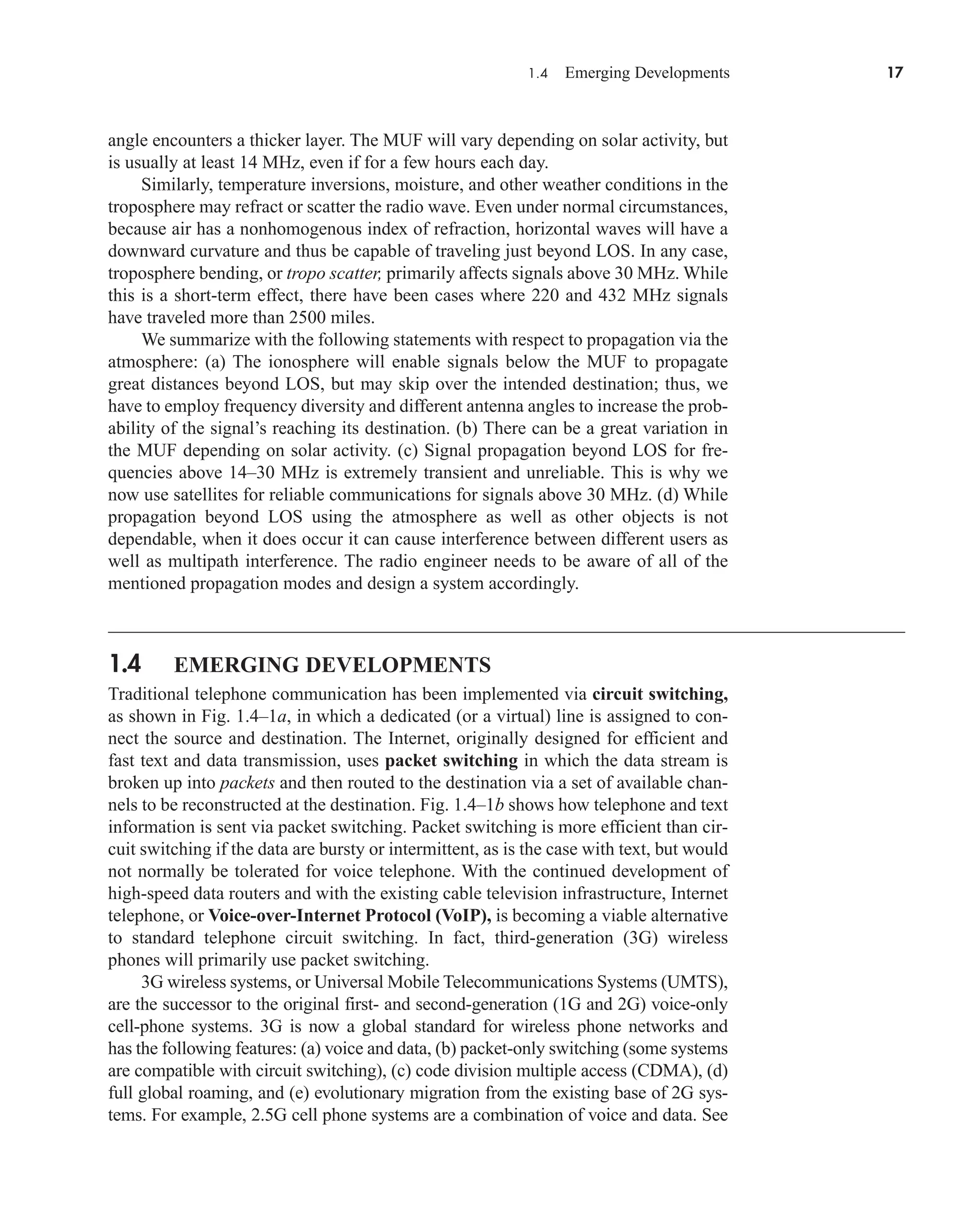
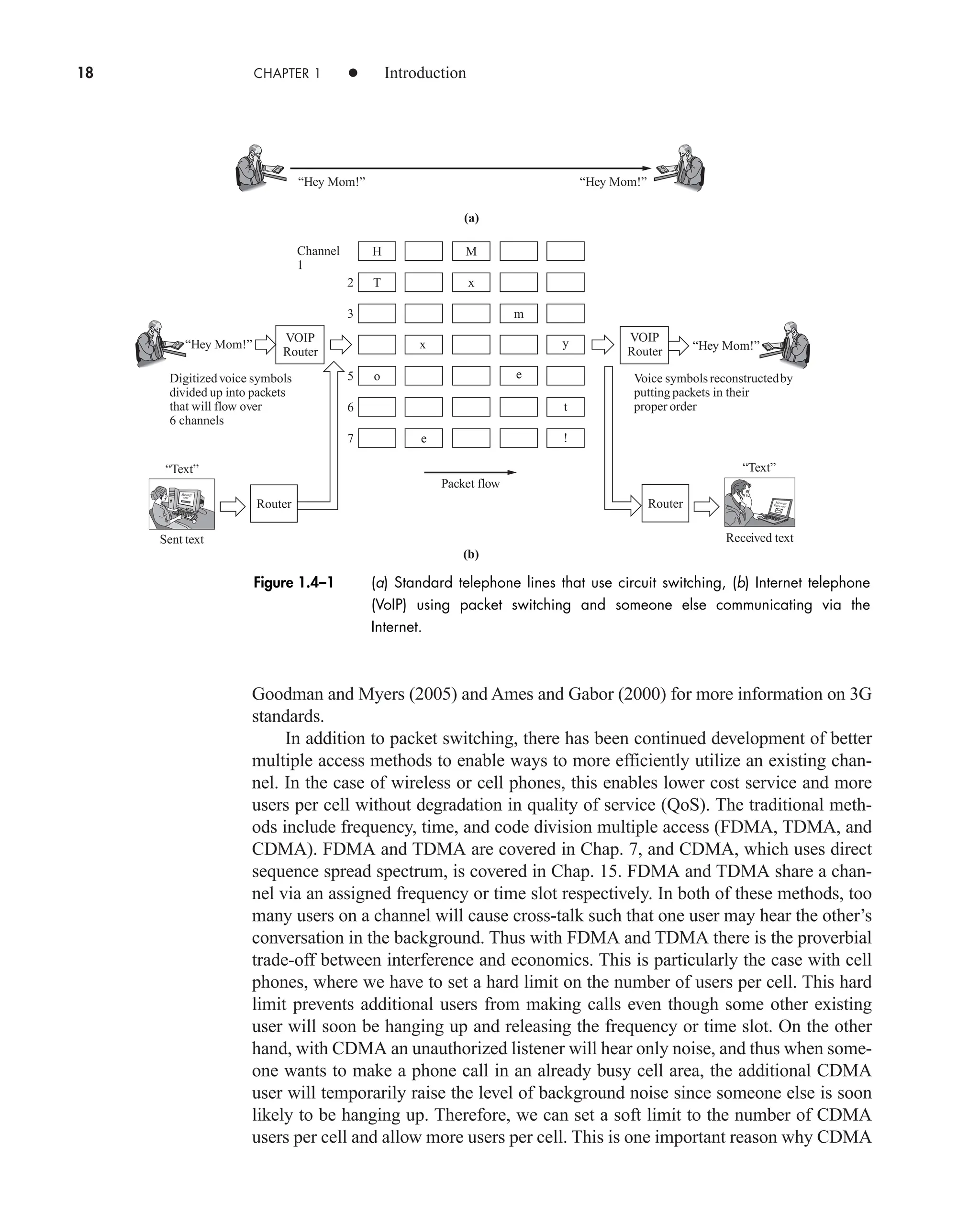
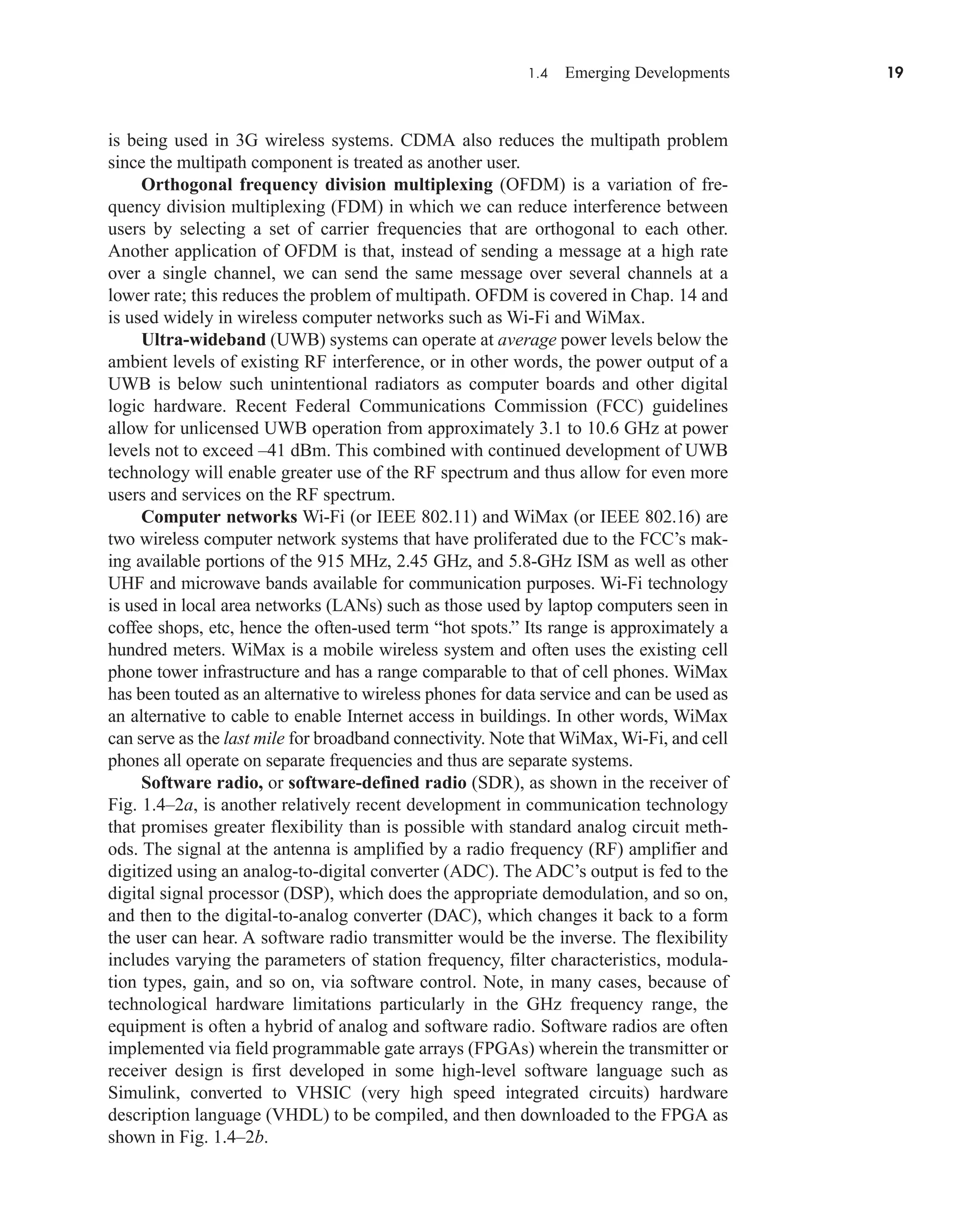
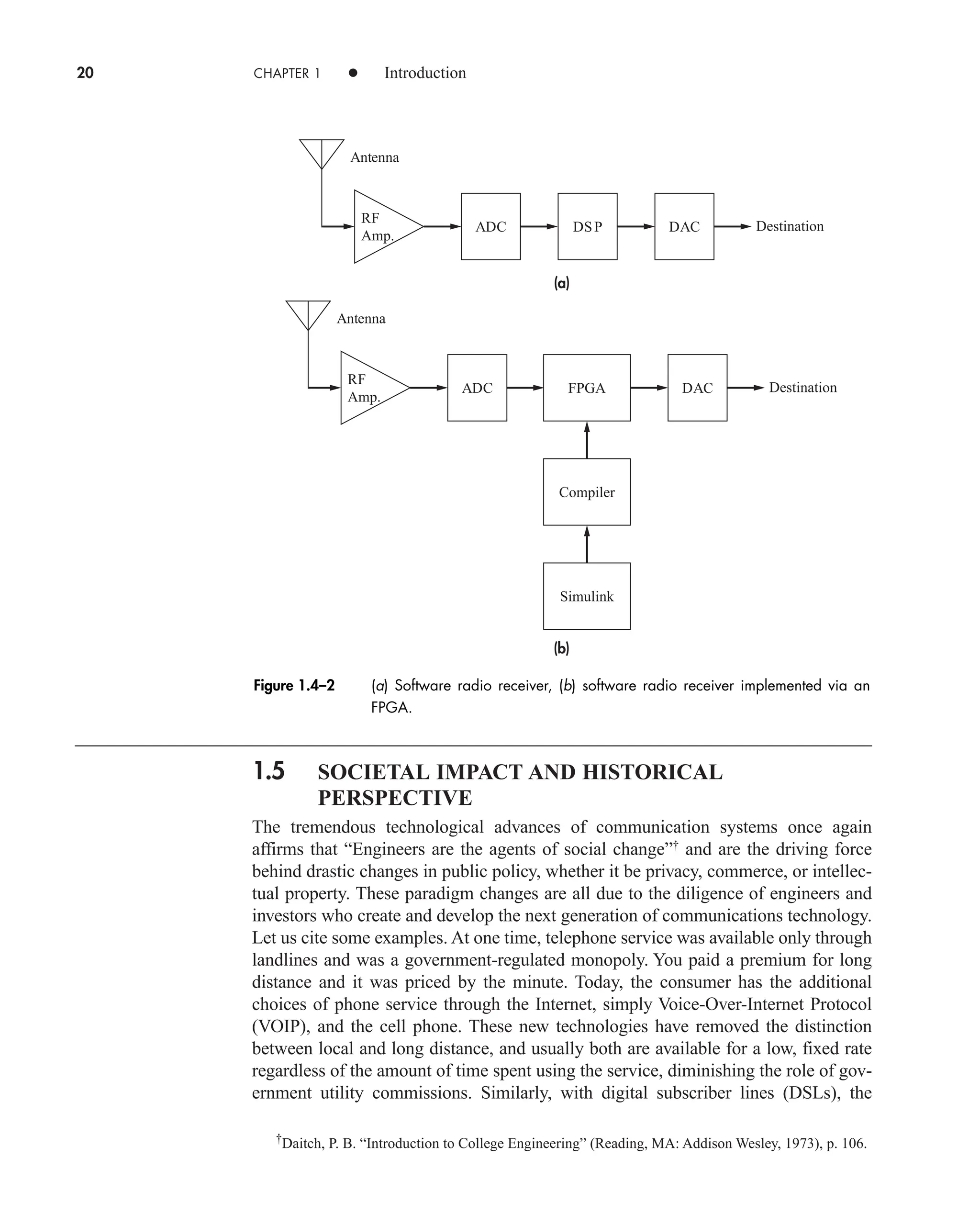
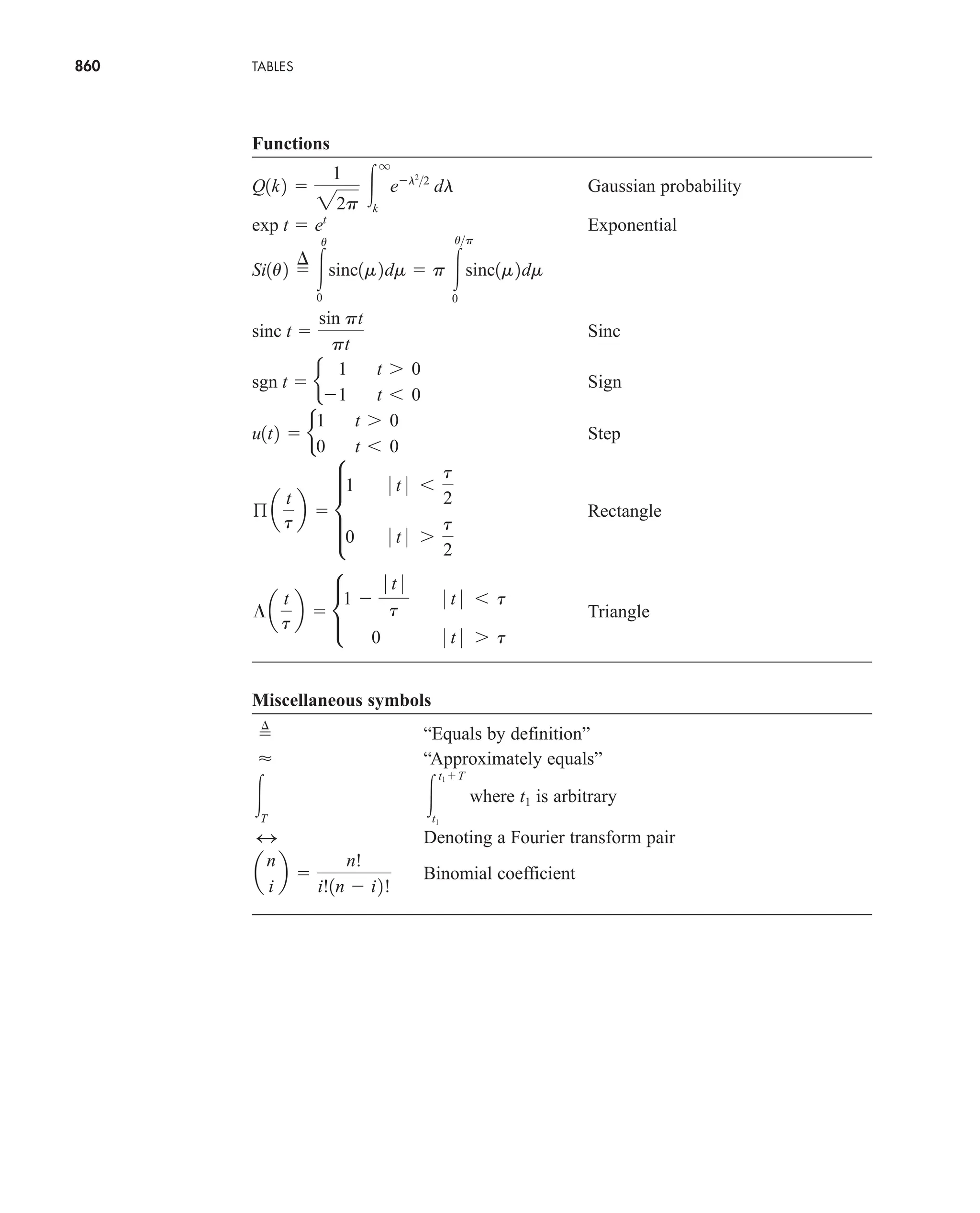
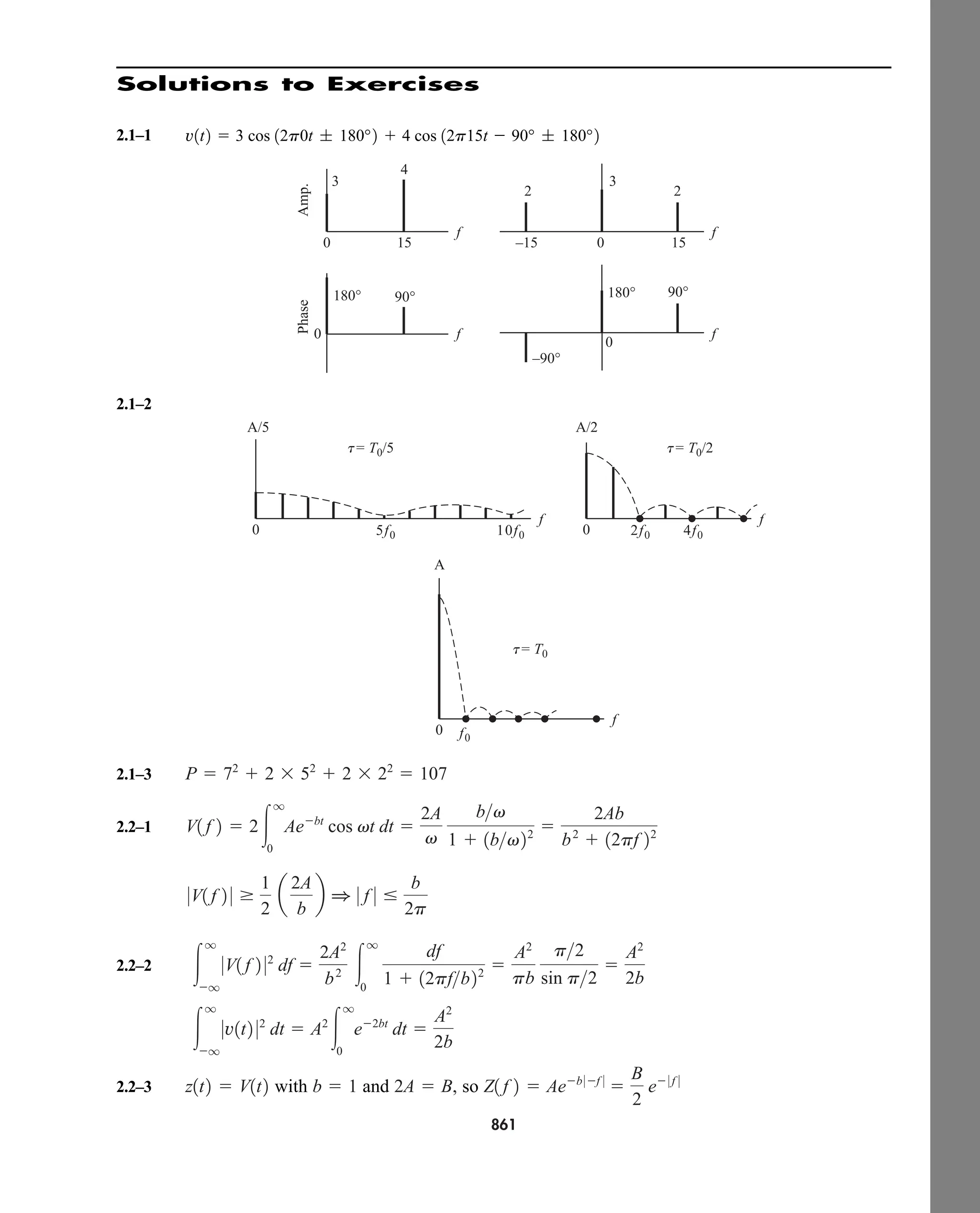
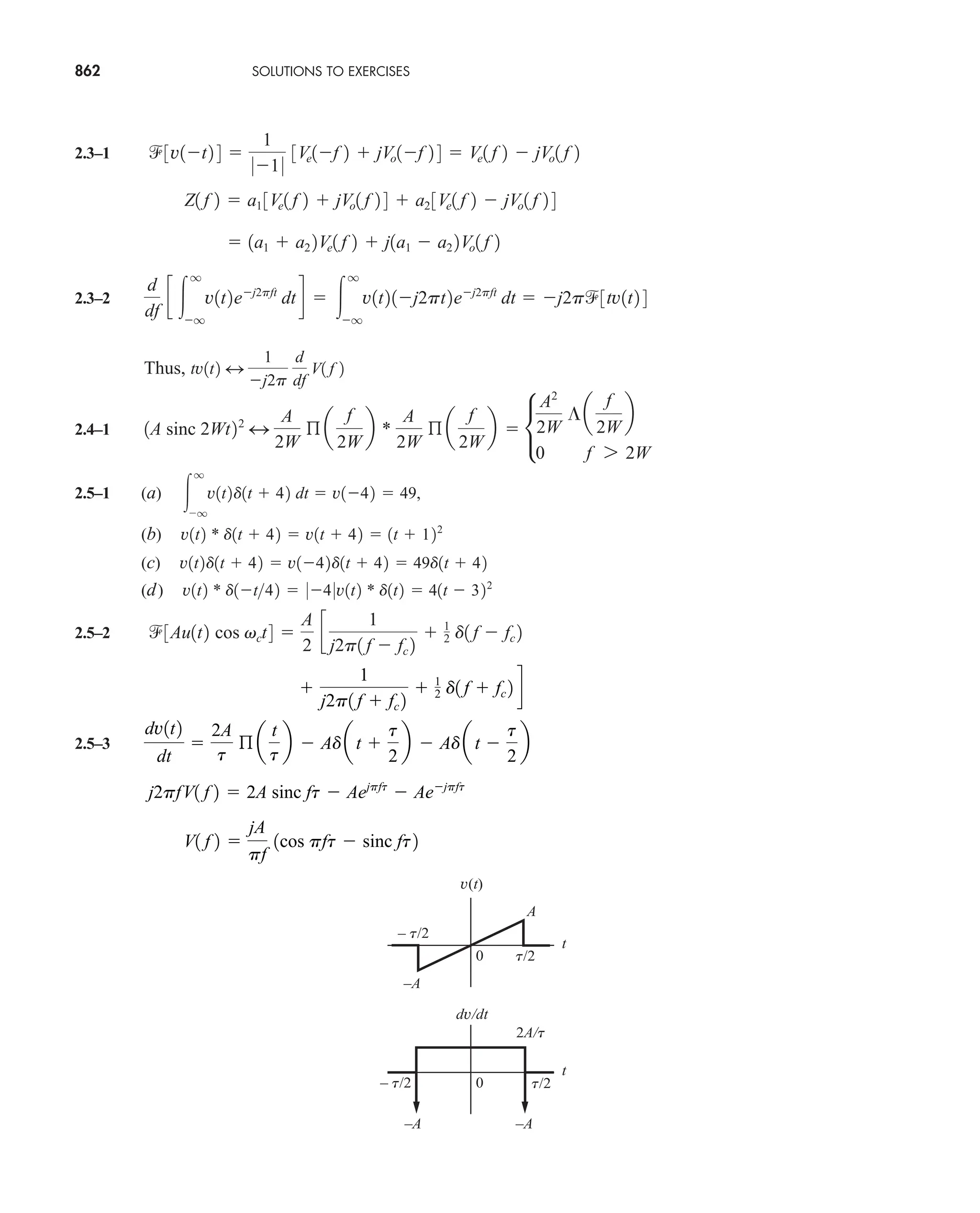
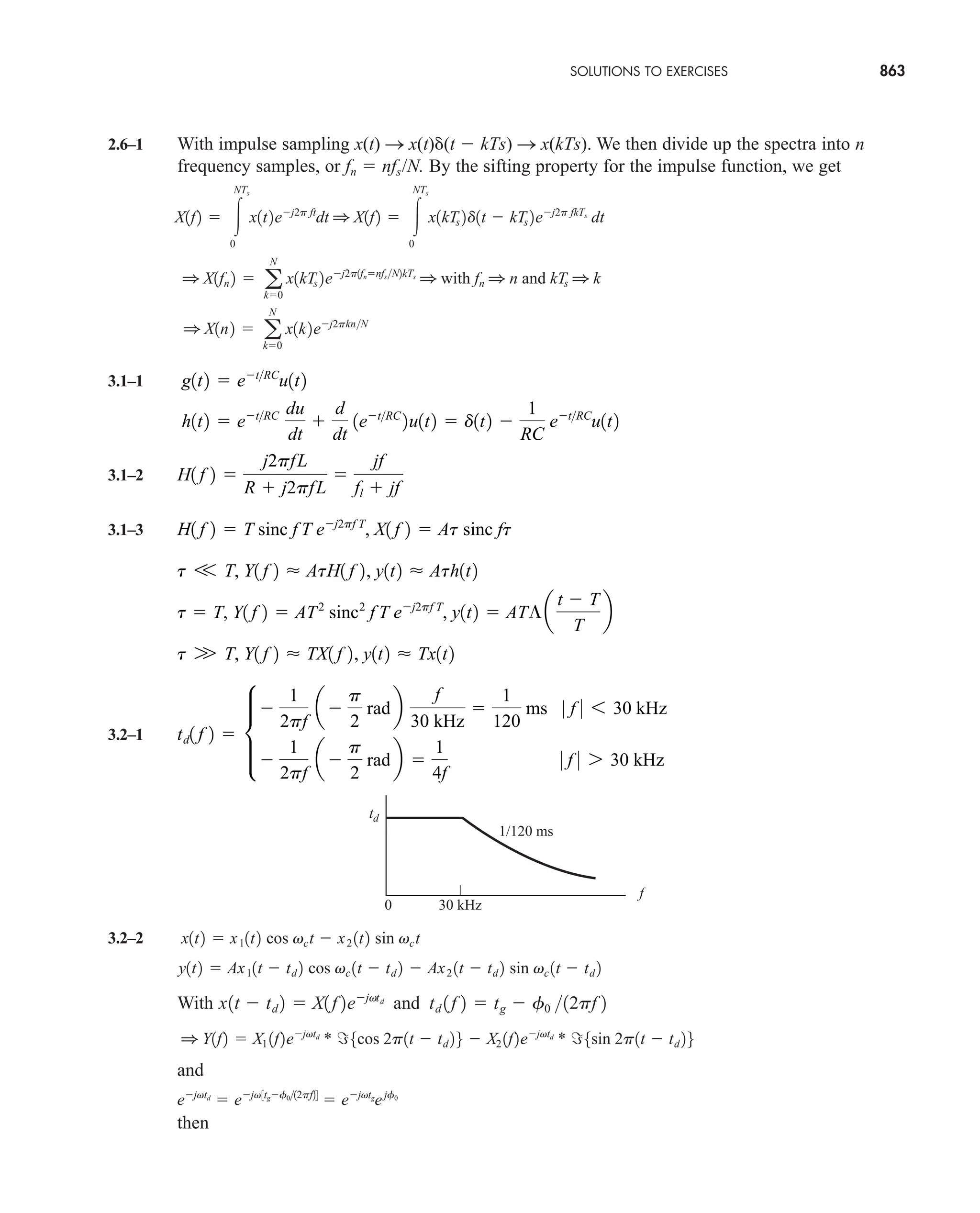
An Introduction to Signals and Noise
in Electrical Communication
FIFTH EDITION
A. Bruce Carlson
Late of Rensselaer Polytechnic Institute
Paul B. Crilly
University of Tennessee
COMMUNICATION SYSTEMS:AN INTR
ODUCTION TO SIGNALS AND NOISE IN ELECTRICAL
COMMUNICATION, FIFTH EDITION
Published by McGraw-Hill, a b
usiness unit of The McGraw-Hill Companies, Inc.,1221Avenue of the
Americas, Ne
w York, NY 10020. Cop
yright © 2010 byThe McGraw-Hill Companies, Inc.All rights
reserved. Previous editions © 2002,1986,and 1975. No part of this publication may be reproduced or
distributed in any form or by any means, or stored in a database or retrie
val system, without the prior
written consent of The McGraw-Hill Companies, Inc.,including,b
ut not limited to, in an
y network or
other electronic storage or transmission, or broadcast for distance learning.
Some ancillaries, including electronic and print components,may not be a
vailable to customers outside the
United States.
This book is printed on acid-free paper.
1 2 3 4 5 6 7 8 9 0 DOC/DOC 0 9
ISBN 978–0–07–338040–7
MHID 0–07–338040–7
Global Publisher: Raghothaman Srinivasan
Director of Development: Kristine T
ibbetts
Developmental Editor: Lora Neyens
Senior Marketing Manager: Curt Reynolds
Project Manager: Melissa M. Leick
Senior Production Supervisor: Sherry L. Kane
Senior Media Project Manager: Jodi K. Banowetz
Associate Design Coordinator: Brenda A. Rolwes
Cover Designer: Studio Montage, St. Louis,Missouri
Compositor: Laserwords Private Limited
Typeface: 10/12 T
imes Roman
Printer: R. R. Donnelley Crawfordsville, IN
All credits appearing on page or at the end of the book are considered to be an extension of the
copyright page.
Library of Congress Cataloging-in-Publication Data
Carlson, A. Bruce,1937–
Communication systems : an introduction to signals and noise in electrical communication /
A. Bruce Carlson, P
aul B. Crilly.—5th ed.
p. cm.
Includes index.
ISBN 978–0–07–338040–7—ISBN 0–07–338040–7 (hard copy : alk. paper) 1. Signal theory
(Telecommunication) 2. Modulation (Electronics) 3. Digital communications. I. Crilly, P
aul B. II. Title.
TK5102.5.C3 2010
621.382 ' 23—dc22
2008049008
To my wife and best friend,
Alice Kathleen Eiland Crilly
To my parents,
Lois Brown Crilly and Ira Benjamin Crilly
To my grandmother,
Harriet Wilson Crilly
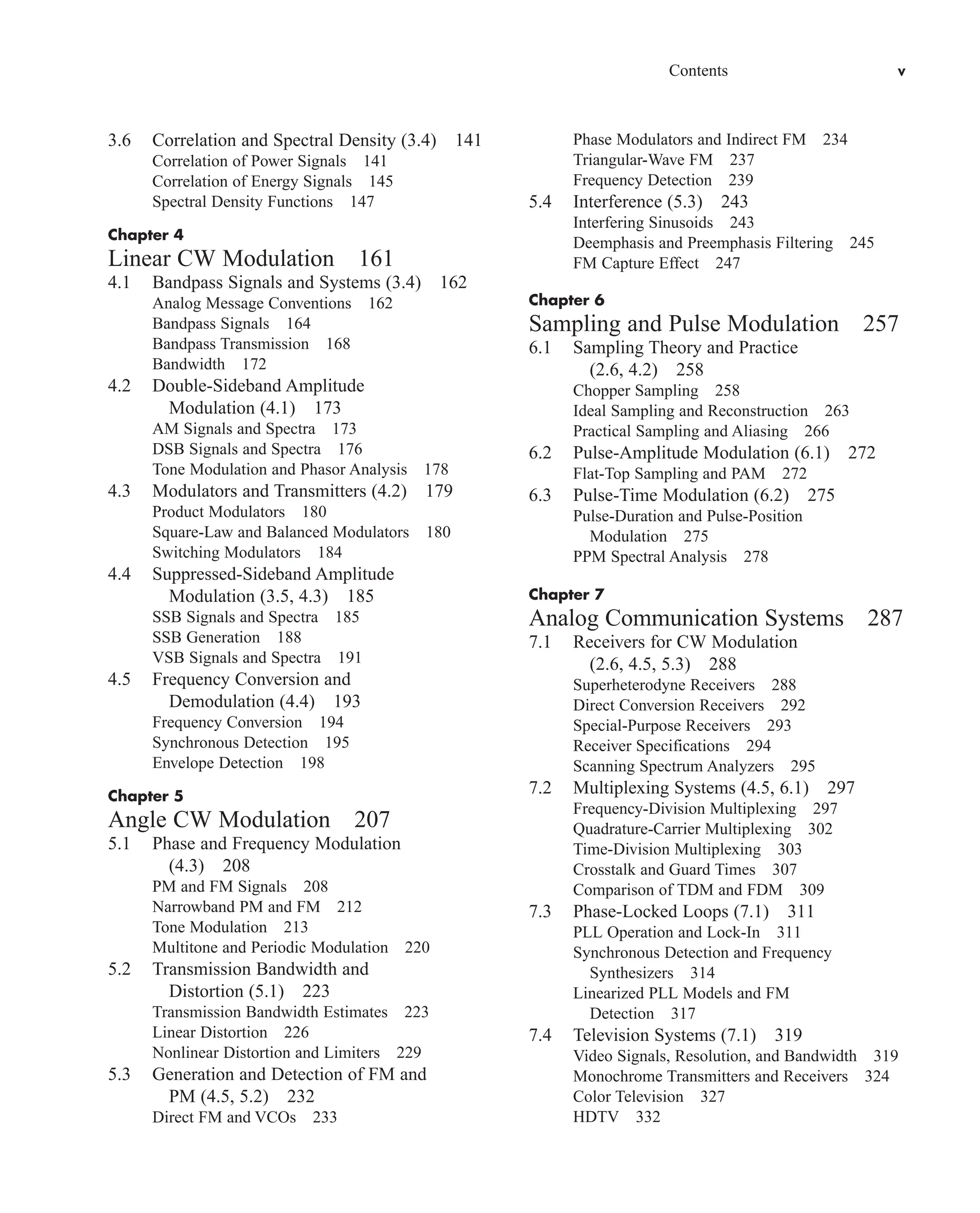
Contents
The numbers in parentheses after section titles identify previous sections that contain the minimum prerequisite
material.
Chapter 1
Introduction 1
1.1 Elements and Limitations
of Communication Systems 2
Information, Messages, and Signals 2
Elements of a Communication System 3
Fundamental Limitations 5
1.2 Modulation and Coding 6
Modulation Methods 6
Modulation Benefits and Applications 8
Coding Methods and Benefits 11
1.3 Electromagnetic Wave Propagation Over
Wireless Channels 12
RF Wave Deflection 14
Skywave Propagation 14
1.4 Emerging Developments 17
1.5 Societal Impact and Historical
Perspective 20
Historical Perspective 21
1.6 Prospectus 24
Chapter 2
Signals and Spectra 27
2.1 Line Spectra and Fourier Series 29
Phasors and Line Spectra 29
Periodic Signals and Average Power 33
Fourier Series 35
Convergence Conditions and Gibbs
Phenomenon 39
Parseval’s Power Theorem 42
2.2 Fourier Transforms and Continuous Spectra
(2.1) 43
Fourier Transforms 43
Symmetric and Causal Signals 47
Rayleigh’s Energy Theorem 50
Duality Theorem 52
Transform Calculations 54
2.3 Time and Frequency Relations (2.2) 54
Superposition 55
Time Delay and Scale Change 55
Frequency Translation and Modulation 58
Differentiation and Integration 60
2.4 Convolution (2.3) 62
Convolution Integral 63
Convolution Theorems 65
2.5 Impulses and Transforms
in the Limit (2.4) 68
Properties of the Unit Impulse 68
Impulses in Frequency 71
Step and Signum Functions 74
Impulses in Time 76
2.6 Discrete Time Signals and the Discrete
Fourier Transform 80
Convolution Using the DFT (2.4) 83
Chapter 3
Signal Transmission and Filtering 91
3.1 Response of LTI Systems (2.4) 92
Impulse Response and the Superposition
Integral 93
Transfer Functions and Frequency
Response 96
Block-Diagram Analysis 102
3.2 Signal Distortion in Transmission
(3.1) 105
Distortionless Transmission 105
Linear Distortion 107
Equalization 110
Nonlinear Distortion and Companding 113
3.3 Transmission Loss and Decibels (3.2) 116
Power Gain 116
Transmission Loss and Repeaters 118
Fiber Optics 119
Radio Transmission 122
3.4 Filters and Filtering (3.3) 126
Ideal Filters 126
Bandlimiting and Timelimiting 128
Real Filters 129
Pulse Response and Risetime 134
3.5 Quadrature Filters and Hilbert
Transforms (3.4) 138
iv
car80407_fm_i-xx.qxd 1/15/09 4:14 PM Page iv
Rev.Confirming Pages
Contents v
3.6 Correlation and Spectral Density (3.4) 141
Correlation of Power Signals 141
Correlation of Energy Signals 145
Spectral Density Functions 147
Chapter 4
Linear CW Modulation 161
4.1 Bandpass Signals and Systems (3.4) 162
Analog Message Conventions 162
Bandpass Signals 164
Bandpass Transmission 168
Bandwidth 172
4.2 Double-Sideband Amplitude
Modulation (4.1) 173
AM Signals and Spectra 173
DSB Signals and Spectra 176
Tone Modulation and Phasor Analysis 178
4.3 Modulators and Transmitters (4.2) 179
Product Modulators 180
Square-Law and Balanced Modulators 180
Switching Modulators 184
4.4 Suppressed-Sideband Amplitude
Modulation (3.5, 4.3) 185
SSB Signals and Spectra 185
SSB Generation 188
VSB Signals and Spectra 191
4.5 Frequency Conversion and
Demodulation (4.4) 193
Frequency Conversion 194
Synchronous Detection 195
Envelope Detection 198
Chapter 5
Angle CW Modulation 207
5.1 Phase and Frequency Modulation
(4.3) 208
PM and FM Signals 208
Narrowband PM and FM 212
Tone Modulation 213
Multitone and Periodic Modulation 220
5.2 Transmission Bandwidth and
Distortion (5.1) 223
Transmission Bandwidth Estimates 223
Linear Distortion 226
Nonlinear Distortion and Limiters 229
5.3 Generation and Detection of FM and
PM (4.5, 5.2) 232
Direct FM and VCOs 233
Phase Modulators and Indirect FM 234
Triangular-Wave FM 237
Frequency Detection 239
5.4 Interference (5.3) 243
Interfering Sinusoids 243
Deemphasis and Preemphasis Filtering 245
FM Capture Effect 247
Chapter 6
Sampling and Pulse Modulation 257
6.1 Sampling Theory and Practice
(2.6, 4.2) 258
Chopper Sampling 258
Ideal Sampling and Reconstruction 263
Practical Sampling and Aliasing 266
6.2 Pulse-Amplitude Modulation (6.1) 272
Flat-Top Sampling and PAM 272
6.3 Pulse-Time Modulation (6.2) 275
Pulse-Duration and Pulse-Position
Modulation 275
PPM Spectral Analysis 278
Chapter 7
Analog Communication Systems 287
7.1 Receivers for CW Modulation
(2.6, 4.5, 5.3) 288
Superheterodyne Receivers 288
Direct Conversion Receivers 292
Special-Purpose Receivers 293
Receiver Specifications 294
Scanning Spectrum Analyzers 295
7.2 Multiplexing Systems (4.5, 6.1) 297
Frequency-Division Multiplexing 297
Quadrature-Carrier Multiplexing 302
Time-Division Multiplexing 303
Crosstalk and Guard Times 307
Comparison of TDM and FDM 309
7.3 Phase-Locked Loops (7.1) 311
PLL Operation and Lock-In 311
Synchronous Detection and Frequency
Synthesizers 314
Linearized PLL Models and FM
Detection 317
7.4 Television Systems (7.1) 319
Video Signals, Resolution, and Bandwidth 319
Monochrome Transmitters and Receivers 324
Color Television 327
HDTV 332
car80407_fm_i-xx.qxd 1/15/09 4:14 PM Page v
Rev.Confirming Pages
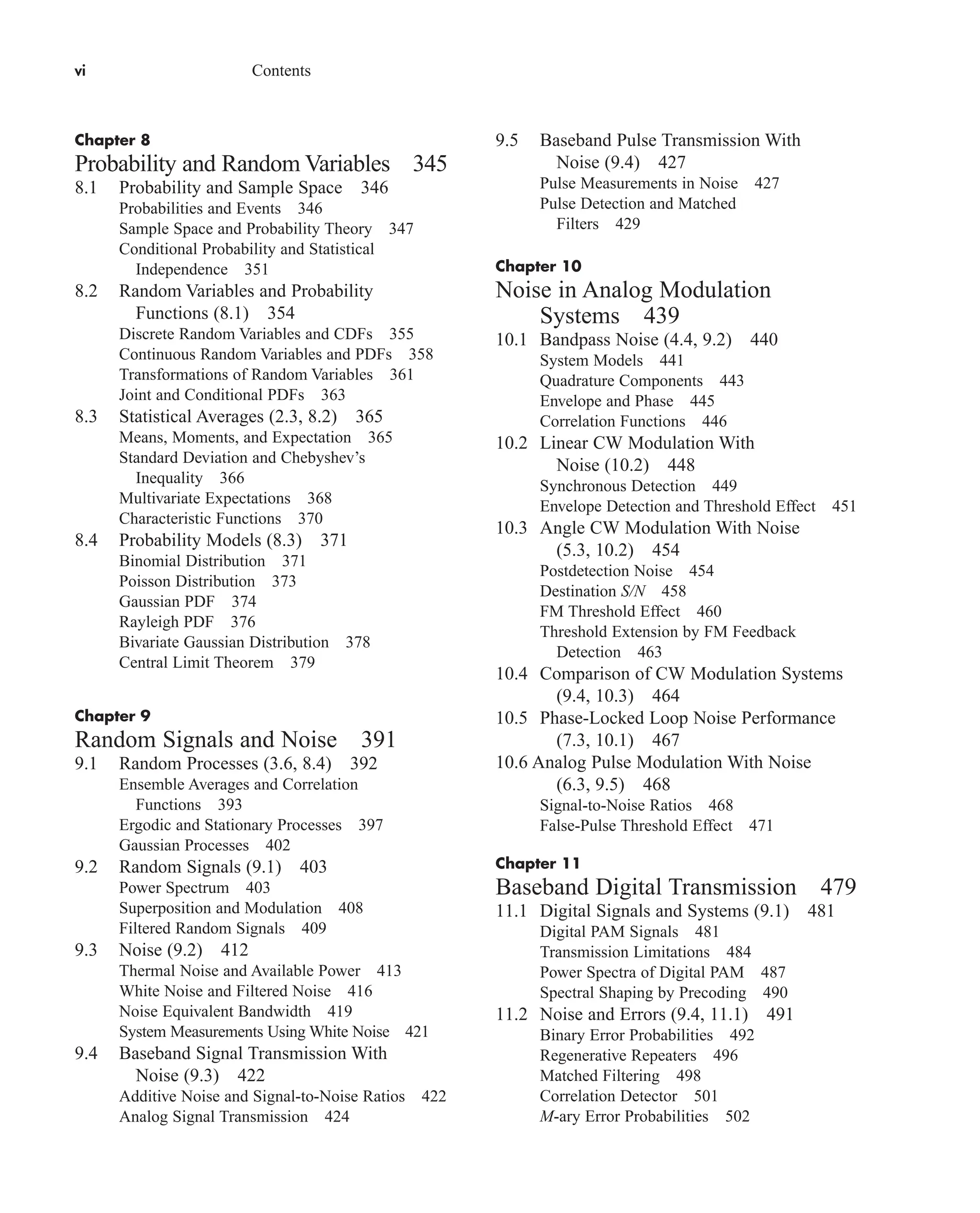
vi Contents
Chapter 8
Probability and Random Variables 345
8.1 Probability and Sample Space 346
Probabilities and Events 346
Sample Space and Probability Theory 347
Conditional Probability and Statistical
Independence 351
8.2 Random Variables and Probability
Functions (8.1) 354
Discrete Random Variables and CDFs 355
Continuous Random Variables and PDFs 358
Transformations of Random Variables 361
Joint and Conditional PDFs 363
8.3 Statistical Averages (2.3, 8.2) 365
Means, Moments, and Expectation 365
Standard Deviation and Chebyshev’s
Inequality 366
Multivariate Expectations 368
Characteristic Functions 370
8.4 Probability Models (8.3) 371
Binomial Distribution 371
Poisson Distribution 373
Gaussian PDF 374
Rayleigh PDF 376
Bivariate Gaussian Distribution 378
Central Limit Theorem 379
Chapter 9
Random Signals and Noise 391
9.1 Random Processes (3.6, 8.4) 392
Ensemble Averages and Correlation
Functions 393
Ergodic and Stationary Processes 397
Gaussian Processes 402
9.2 Random Signals (9.1) 403
Power Spectrum 403
Superposition and Modulation 408
Filtered Random Signals 409
9.3 Noise (9.2) 412
Thermal Noise and Available Power 413
White Noise and Filtered Noise 416
Noise Equivalent Bandwidth 419
System Measurements Using White Noise 421
9.4 Baseband Signal Transmission With
Noise (9.3) 422
Additive Noise and Signal-to-Noise Ratios 422
Analog Signal Transmission 424
9.5 Baseband Pulse Transmission With
Noise (9.4) 427
Pulse Measurements in Noise 427
Pulse Detection and Matched
Filters 429
Chapter 10
Noise in Analog Modulation
Systems 439
10.1 Bandpass Noise (4.4, 9.2) 440
System Models 441
Quadrature Components 443
Envelope and Phase 445
Correlation Functions 446
10.2 Linear CW Modulation With
Noise (10.2) 448
Synchronous Detection 449
Envelope Detection and Threshold Effect 451
10.3 Angle CW Modulation With Noise
(5.3, 10.2) 454
Postdetection Noise 454
Destination S/N 458
FM Threshold Effect 460
Threshold Extension by FM Feedback
Detection 463
10.4 Comparison of CW Modulation Systems
(9.4, 10.3) 464
10.5 Phase-Locked Loop Noise Performance
(7.3, 10.1) 467
10.6 Analog Pulse Modulation With Noise
(6.3, 9.5) 468
Signal-to-Noise Ratios 468
False-Pulse Threshold Effect 471
Chapter 11
Baseband Digital Transmission 479
11.1 Digital Signals and Systems (9.1) 481
Digital PAM Signals 481
Transmission Limitations 484
Power Spectra of Digital PAM 487
Spectral Shaping by Precoding 490
11.2 Noise and Errors (9.4, 11.1) 491
Binary Error Probabilities 492
Regenerative Repeaters 496
Matched Filtering 498
Correlation Detector 501
M-ary Error Probabilities 502
car80407_fm_i-xx.qxd 1/16/09 9:43 AM Page vi
Rev.Confirming Pages
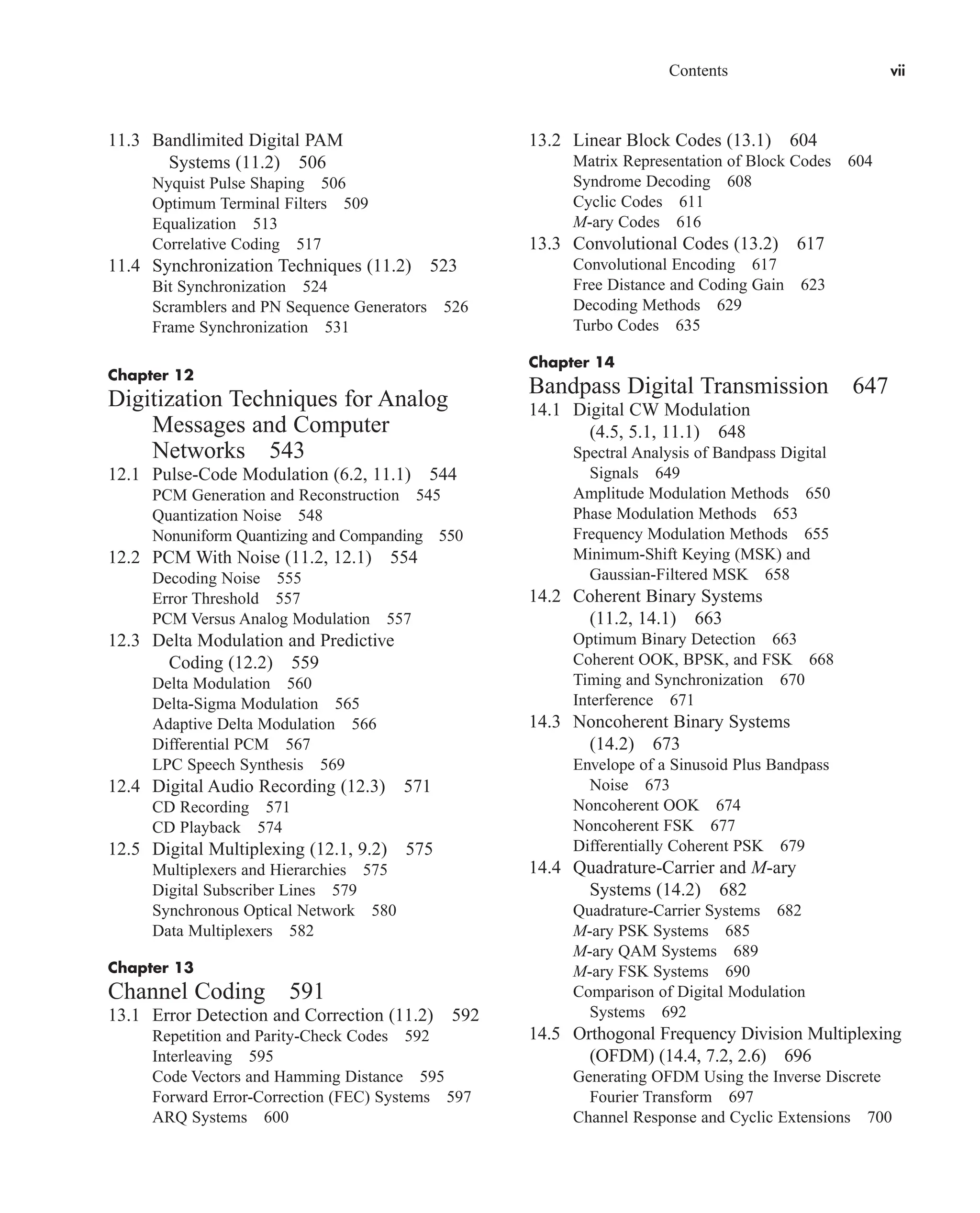
Contents vii
11.3 Bandlimited Digital PAM
Systems (11.2) 506
Nyquist Pulse Shaping 506
Optimum Terminal Filters 509
Equalization 513
Correlative Coding 517
11.4 Synchronization Techniques (11.2) 523
Bit Synchronization 524
Scramblers and PN Sequence Generators 526
Frame Synchronization 531
Chapter 12
Digitization Techniques for Analog
Messages and Computer
Networks 543
12.1 Pulse-Code Modulation (6.2, 11.1) 544
PCM Generation and Reconstruction 545
Quantization Noise 548
Nonuniform Quantizing and Companding 550
12.2 PCM With Noise (11.2, 12.1) 554
Decoding Noise 555
Error Threshold 557
PCM Versus Analog Modulation 557
12.3 Delta Modulation and Predictive
Coding (12.2) 559
Delta Modulation 560
Delta-Sigma Modulation 565
Adaptive Delta Modulation 566
Differential PCM 567
LPC Speech Synthesis 569
12.4 Digital Audio Recording (12.3) 571
CD Recording 571
CD Playback 574
12.5 Digital Multiplexing (12.1, 9.2) 575
Multiplexers and Hierarchies 575
Digital Subscriber Lines 579
Synchronous Optical Network 580
Data Multiplexers 582
Chapter 13
Channel Coding 591
13.1 Error Detection and Correction (11.2) 592
Repetition and Parity-Check Codes 592
Interleaving 595
Code Vectors and Hamming Distance 595
Forward Error-Correction (FEC) Systems 597
ARQ Systems 600
13.2 Linear Block Codes (13.1) 604
Matrix Representation of Block Codes 604
Syndrome Decoding 608
Cyclic Codes 611
M-ary Codes 616
13.3 Convolutional Codes (13.2) 617
Convolutional Encoding 617
Free Distance and Coding Gain 623
Decoding Methods 629
Turbo Codes 635
Chapter 14
Bandpass Digital Transmission 647
14.1 Digital CW Modulation
(4.5, 5.1, 11.1) 648
Spectral Analysis of Bandpass Digital
Signals 649
Amplitude Modulation Methods 650
Phase Modulation Methods 653
Frequency Modulation Methods 655
Minimum-Shift Keying (MSK) and
Gaussian-Filtered MSK 658
14.2 Coherent Binary Systems
(11.2, 14.1) 663
Optimum Binary Detection 663
Coherent OOK, BPSK, and FSK 668
Timing and Synchronization 670
Interference 671
14.3 Noncoherent Binary Systems
(14.2) 673
Envelope of a Sinusoid Plus Bandpass
Noise 673
Noncoherent OOK 674
Noncoherent FSK 677
Differentially Coherent PSK 679
14.4 Quadrature-Carrier and M-ary
Systems (14.2) 682
Quadrature-Carrier Systems 682
M-ary PSK Systems 685
M-ary QAM Systems 689
M-ary FSK Systems 690
Comparison of Digital Modulation
Systems 692
14.5 Orthogonal Frequency Division Multiplexing
(OFDM) (14.4, 7.2, 2.6) 696
Generating OFDM Using the Inverse Discrete
Fourier Transform 697
Channel Response and Cyclic Extensions 700
car80407_fm_i-xx.qxd 1/15/09 4:14 PM Page vii
Rev.Confirming Pages
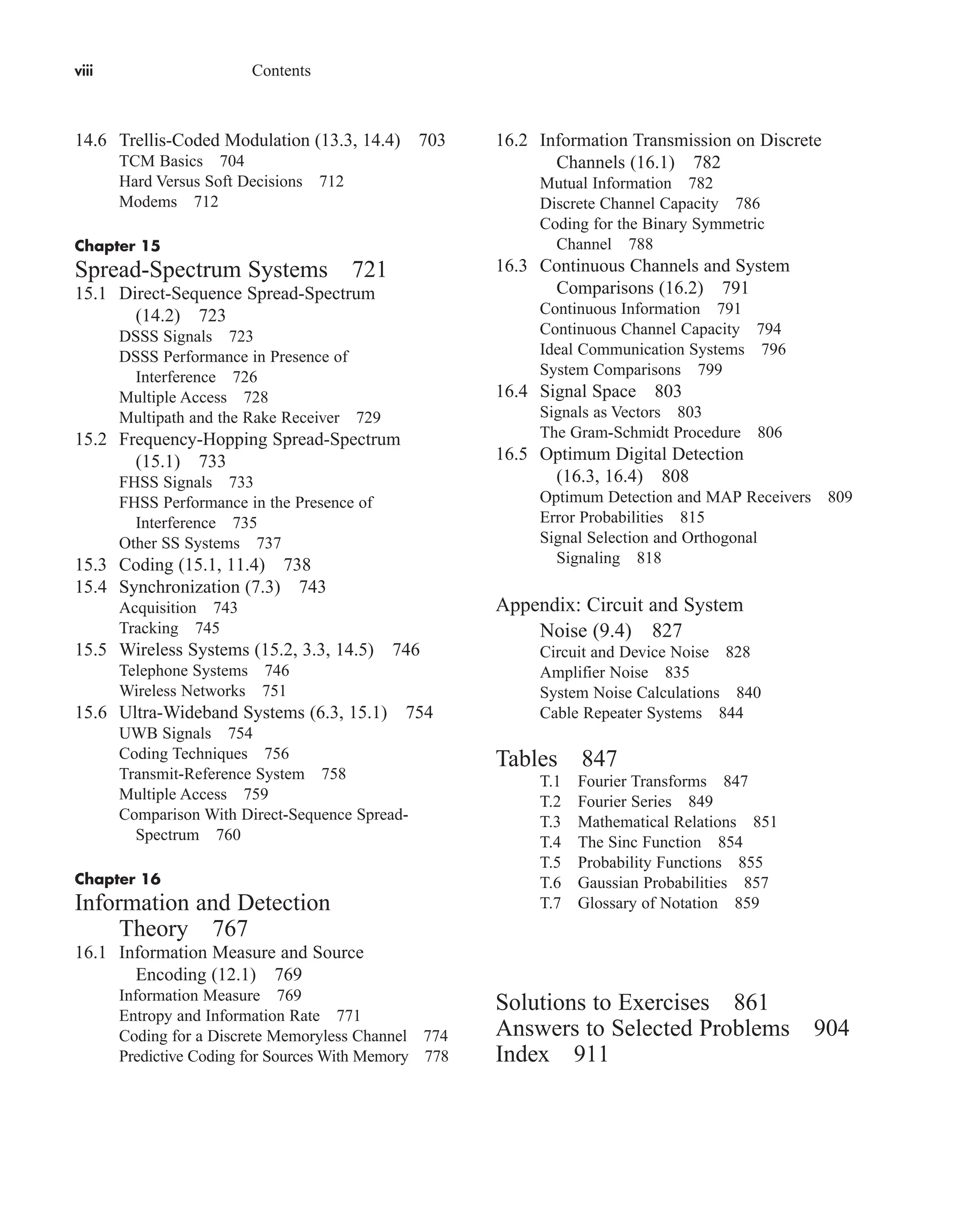
viii Contents
14.6 Trellis-Coded Modulation (13.3, 14.4) 703
TCM Basics 704
Hard Versus Soft Decisions 712
Modems 712
Chapter 15
Spread-Spectrum Systems 721
15.1 Direct-Sequence Spread-Spectrum
(14.2) 723
DSSS Signals 723
DSSS Performance in Presence of
Interference 726
Multiple Access 728
Multipath and the Rake Receiver 729
15.2 Frequency-Hopping Spread-Spectrum
(15.1) 733
FHSS Signals 733
FHSS Performance in the Presence of
Interference 735
Other SS Systems 737
15.3 Coding (15.1, 11.4) 738
15.4 Synchronization (7.3) 743
Acquisition 743
Tracking 745
15.5 Wireless Systems (15.2, 3.3, 14.5) 746
Telephone Systems 746
Wireless Networks 751
15.6 Ultra-Wideband Systems (6.3, 15.1) 754
UWB Signals 754
Coding Techniques 756
Transmit-Reference System 758
Multiple Access 759
Comparison With Direct-Sequence Spread-
Spectrum 760
Chapter 16
Information and Detection
Theory 767
16.1 Information Measure and Source
Encoding (12.1) 769
Information Measure 769
Entropy and Information Rate 771
Coding for a Discrete Memoryless Channel 774
Predictive Coding for Sources With Memory 778
16.2 Information Transmission on Discrete
Channels (16.1) 782
Mutual Information 782
Discrete Channel Capacity 786
Coding for the Binary Symmetric
Channel 788
16.3 Continuous Channels and System
Comparisons (16.2) 791
Continuous Information 791
Continuous Channel Capacity 794
Ideal Communication Systems 796
System Comparisons 799
16.4 Signal Space 803
Signals as Vectors 803
The Gram-Schmidt Procedure 806
16.5 Optimum Digital Detection
(16.3, 16.4) 808
Optimum Detection and MAP Receivers 809
Error Probabilities 815
Signal Selection and Orthogonal
Signaling 818
Appendix: Circuit and System
Noise (9.4) 827
Circuit and Device Noise 828
Amplifier Noise 835
System Noise Calculations 840
Cable Repeater Systems 844
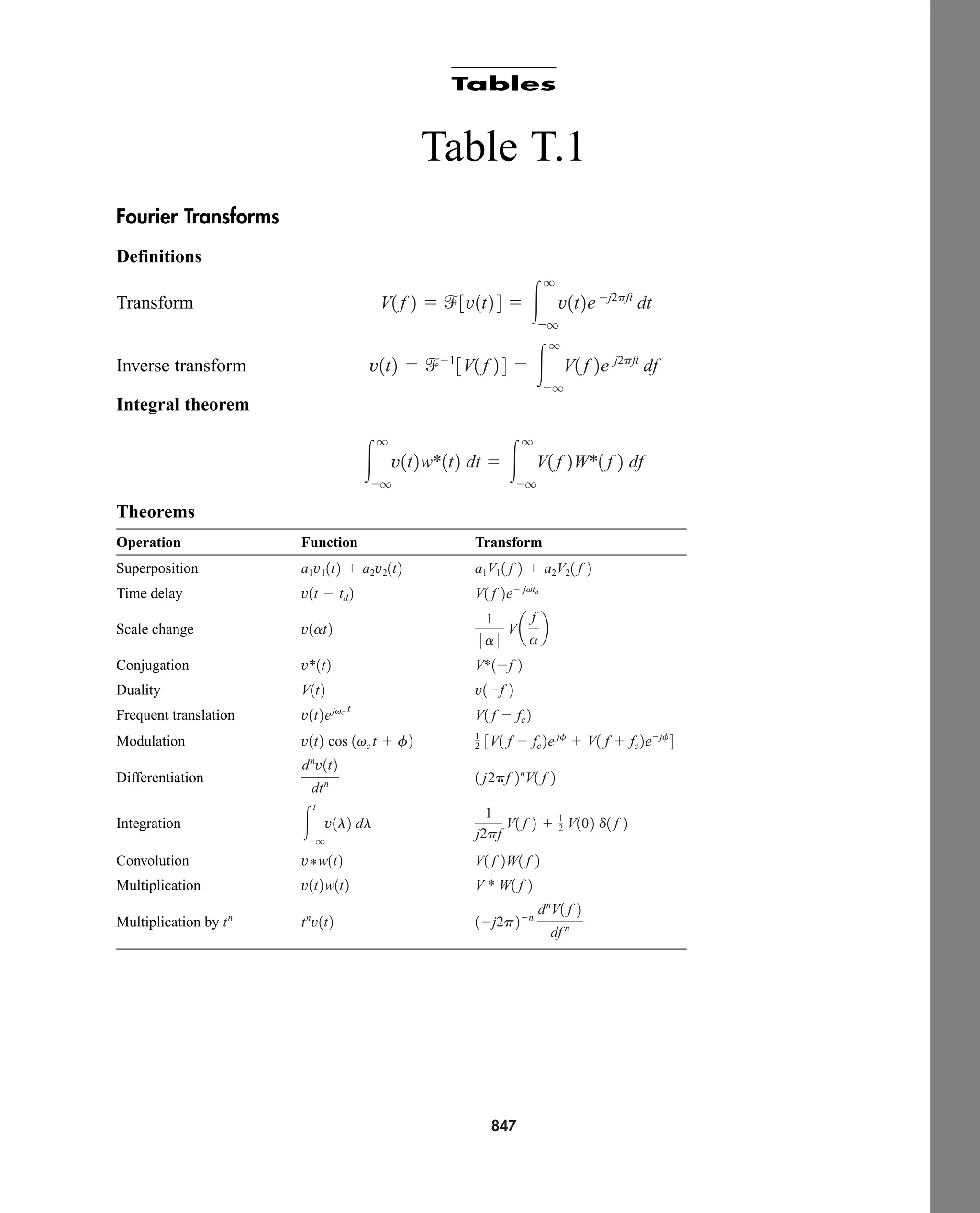
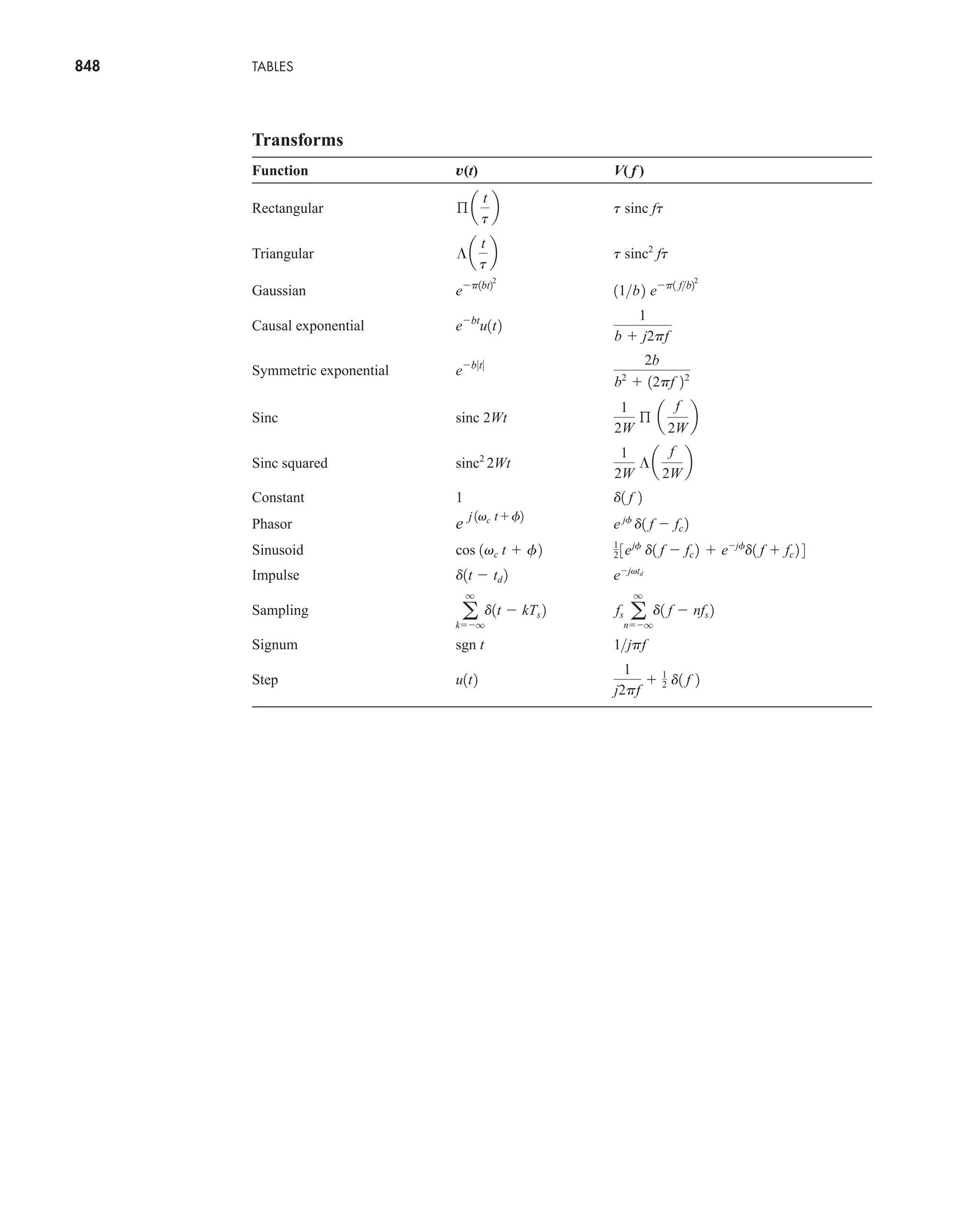
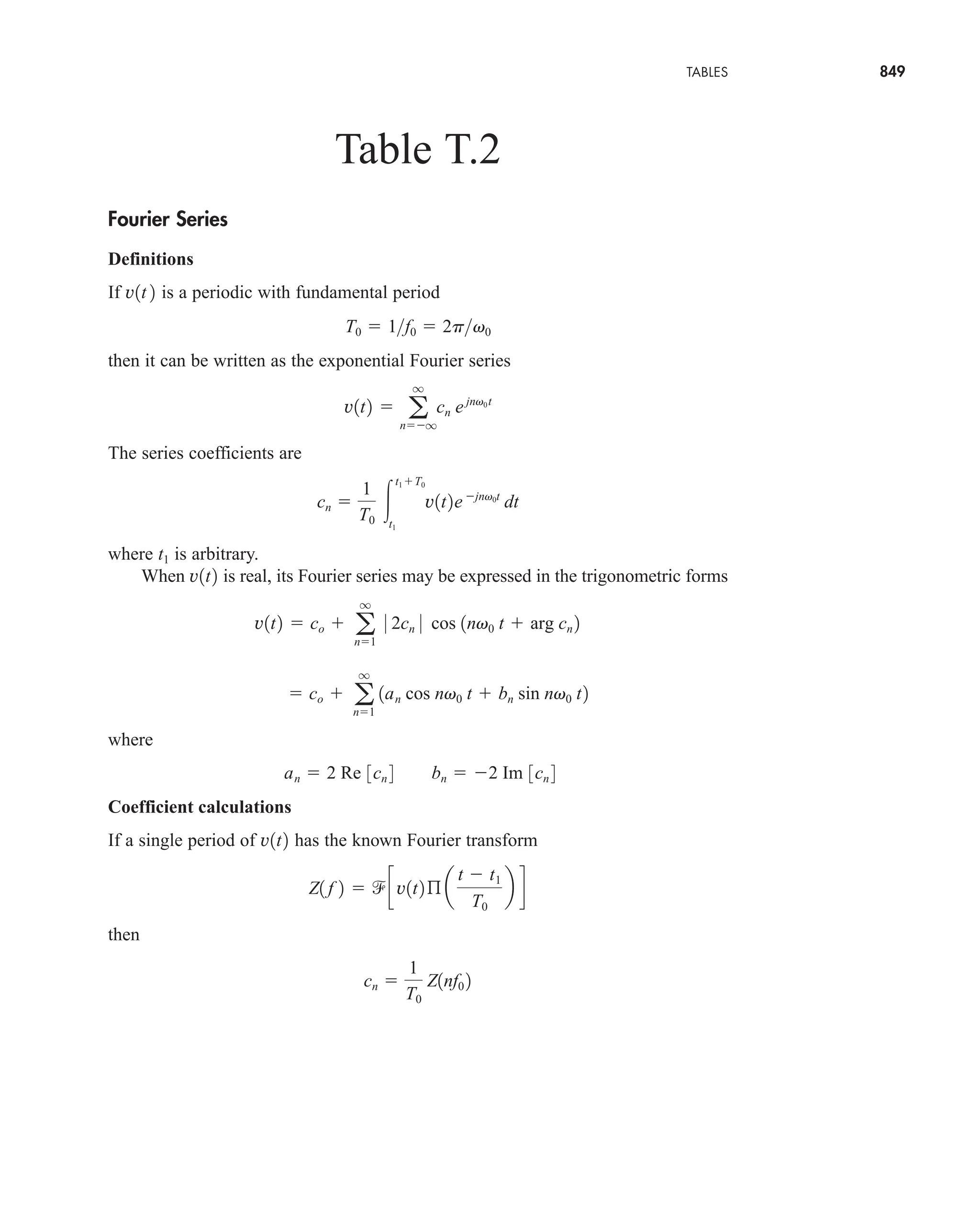
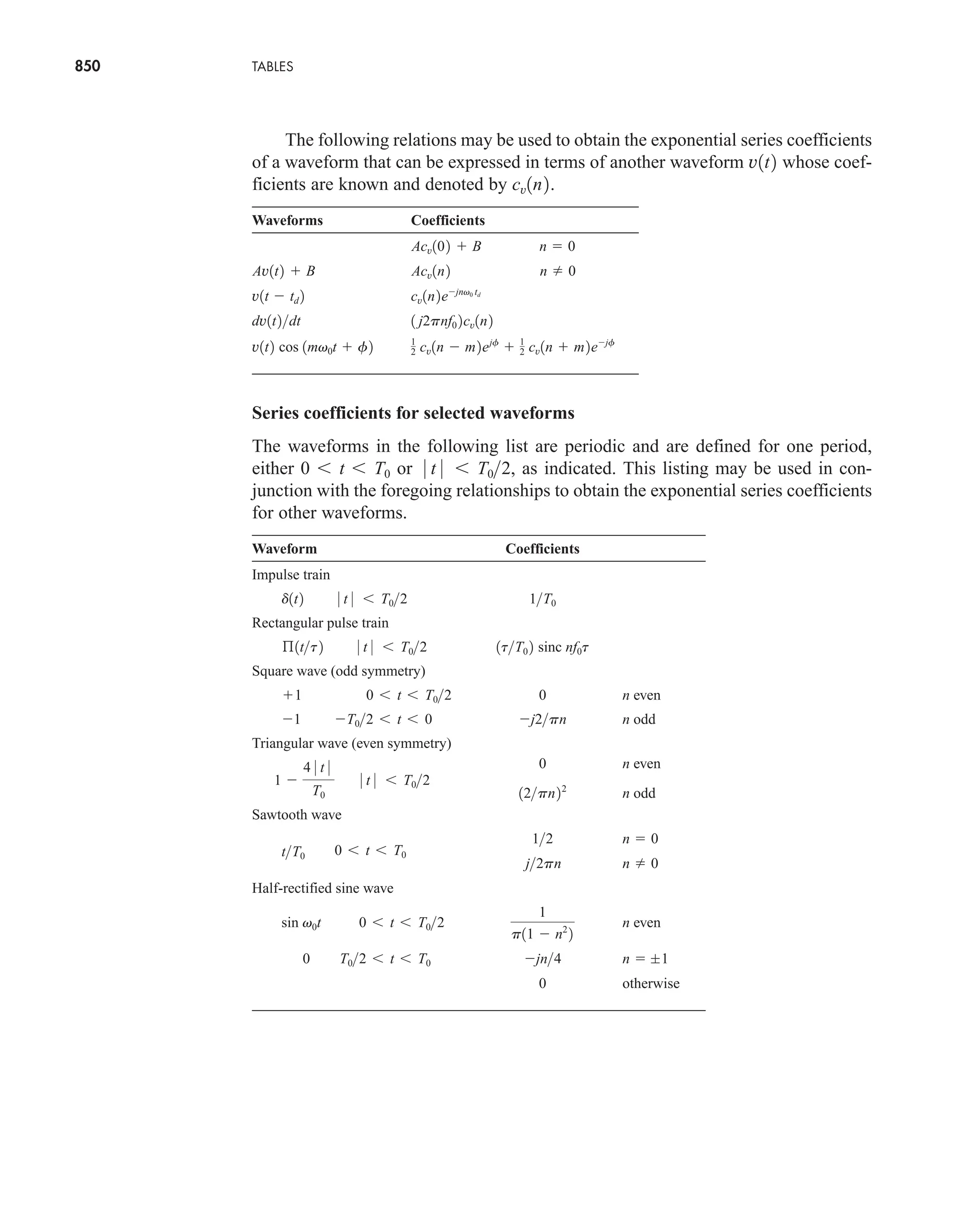
Tables 847
T.1 Fourier Transforms 847
T.2 Fourier Series 849
T.3 Mathematical Relations 851
T.4 The Sinc Function 854
T.5 Probability Functions 855
T.6 Gaussian Probabilities 857
T.7 Glossary of Notation 859
Solutions to Exercises 861
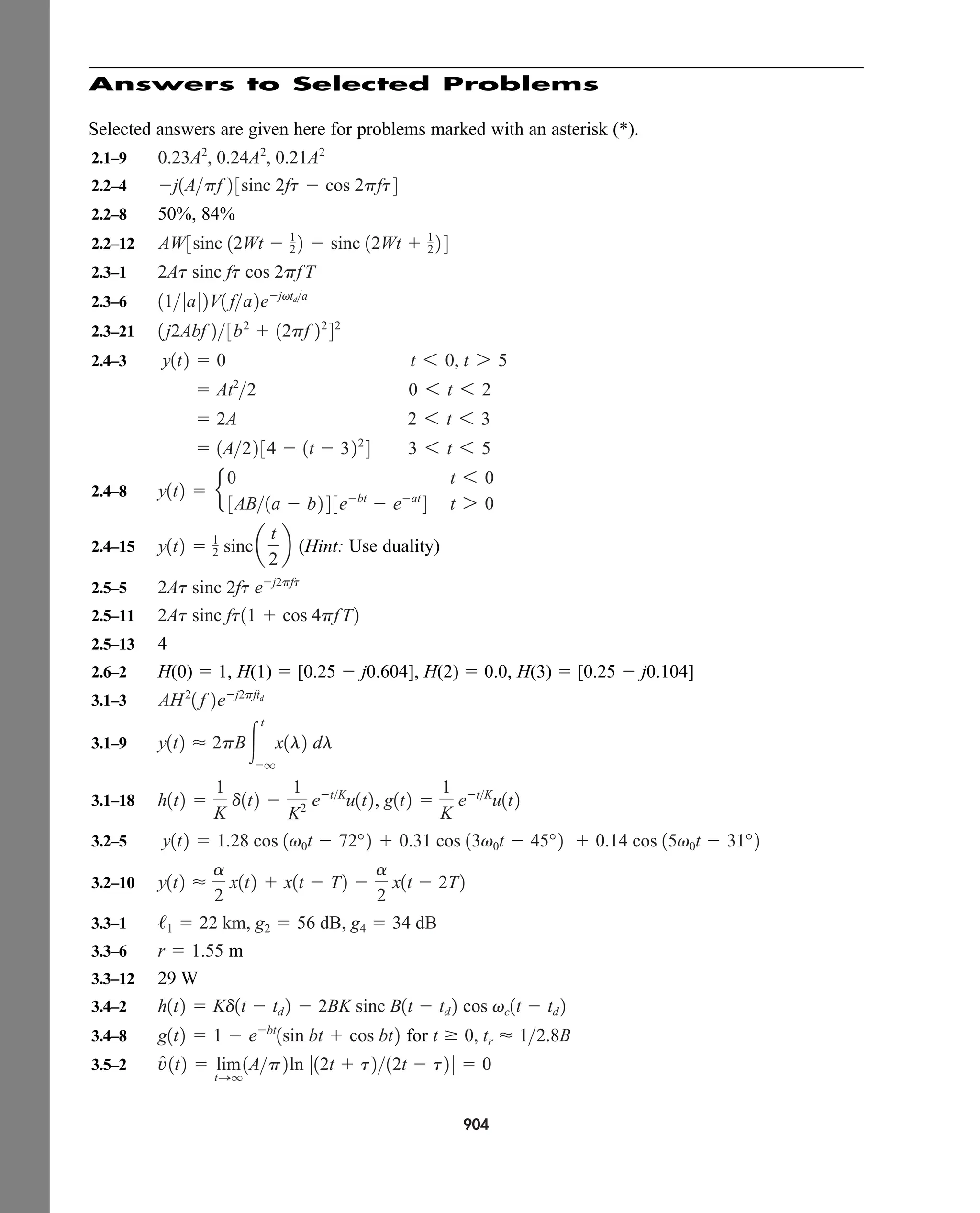
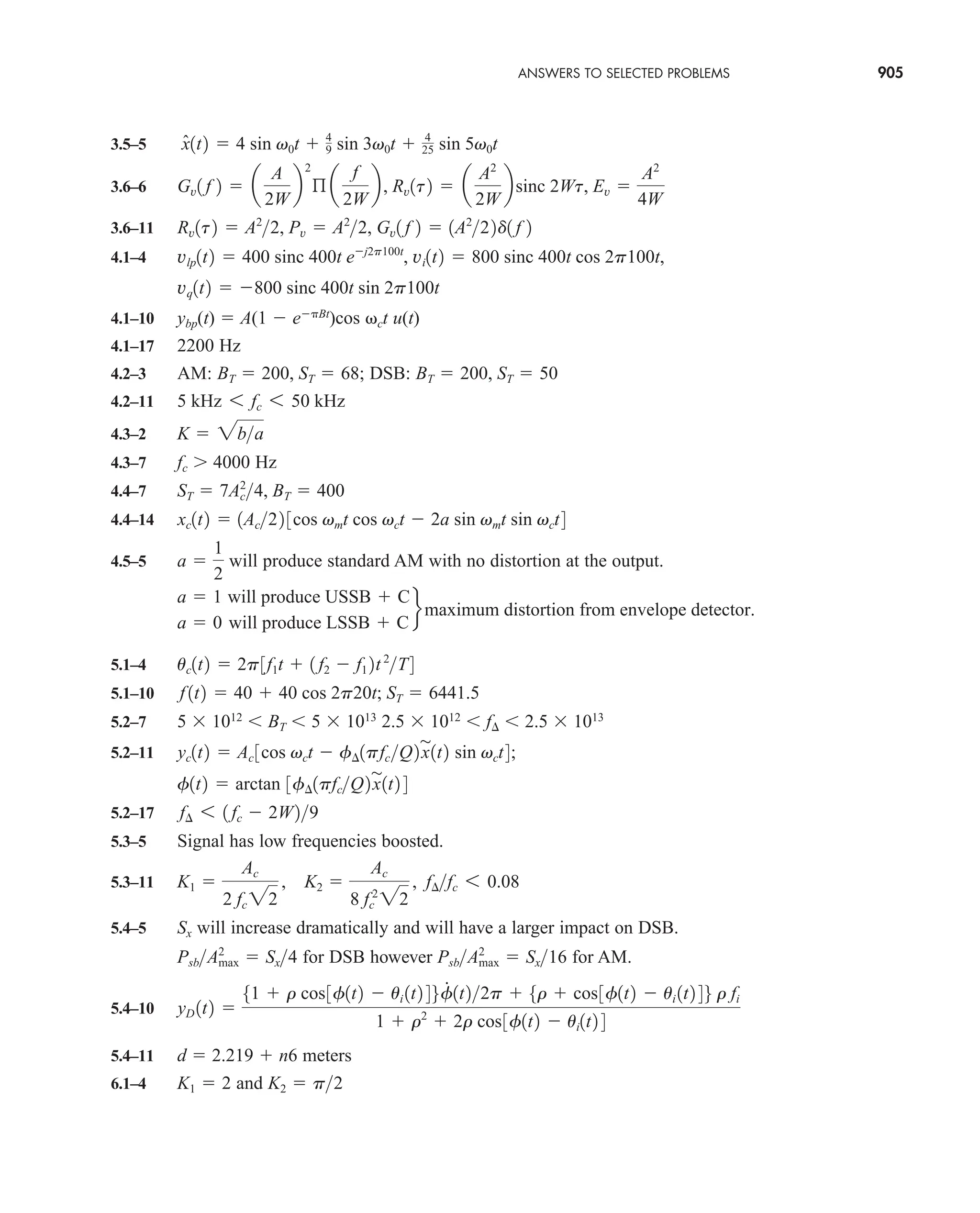
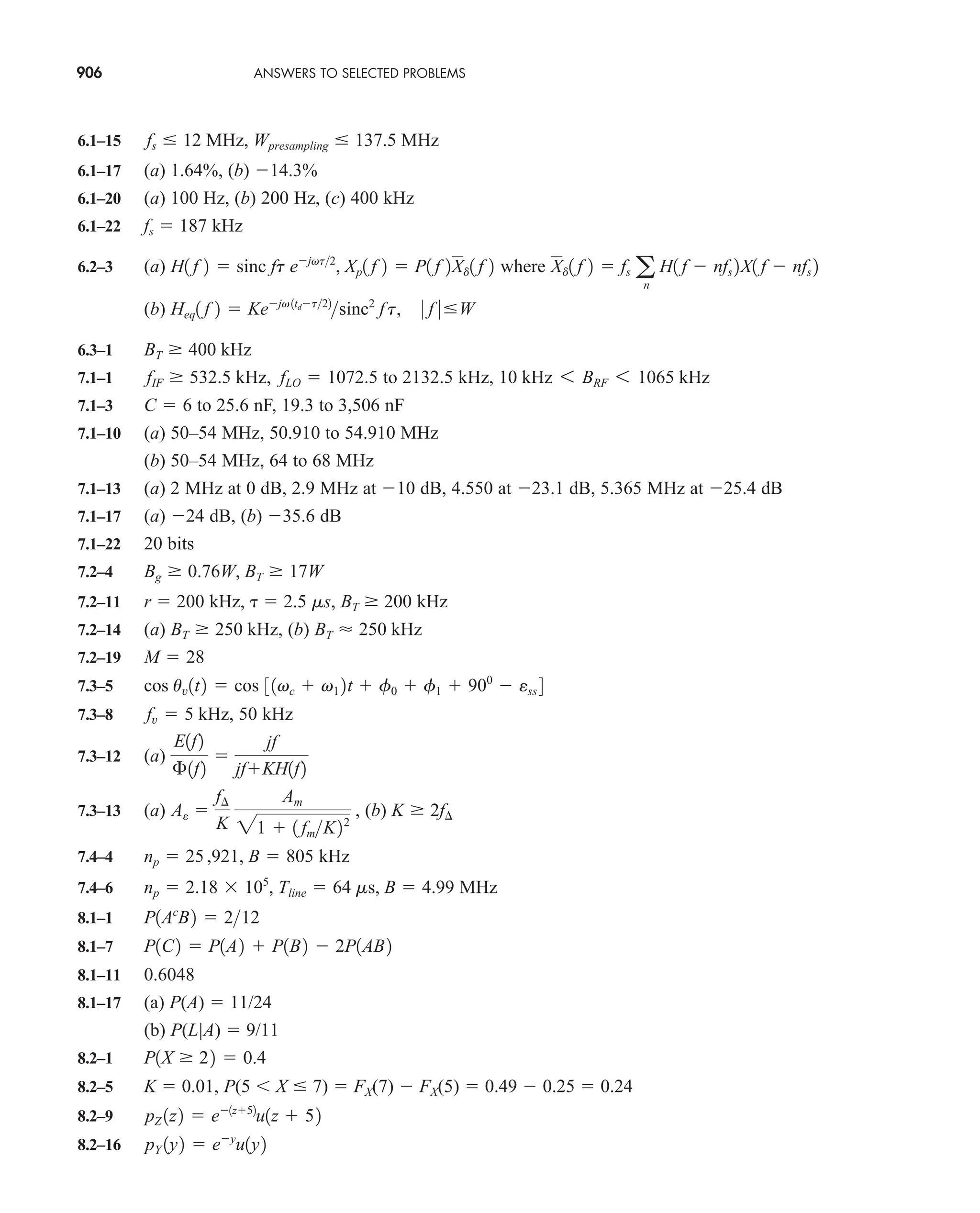
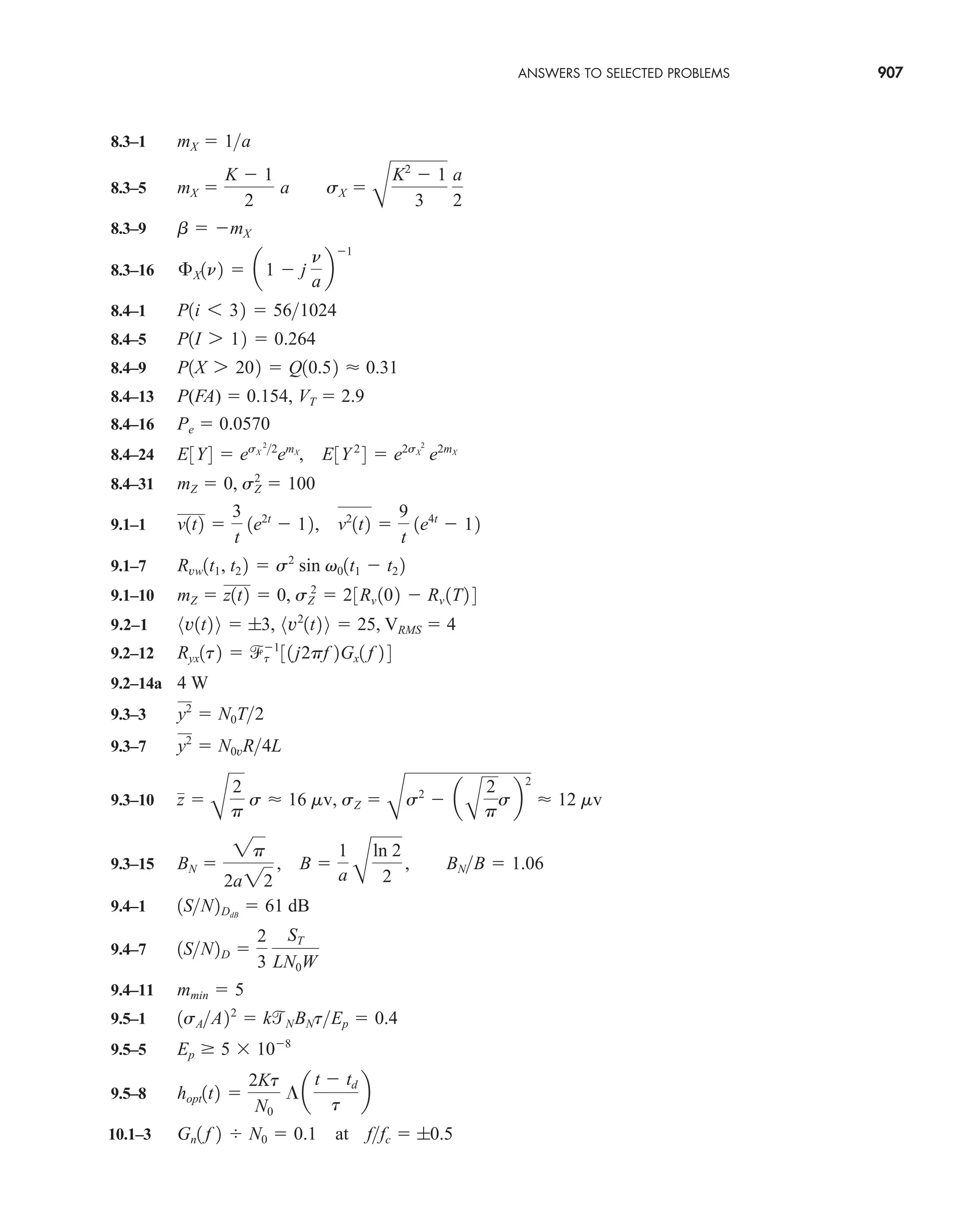
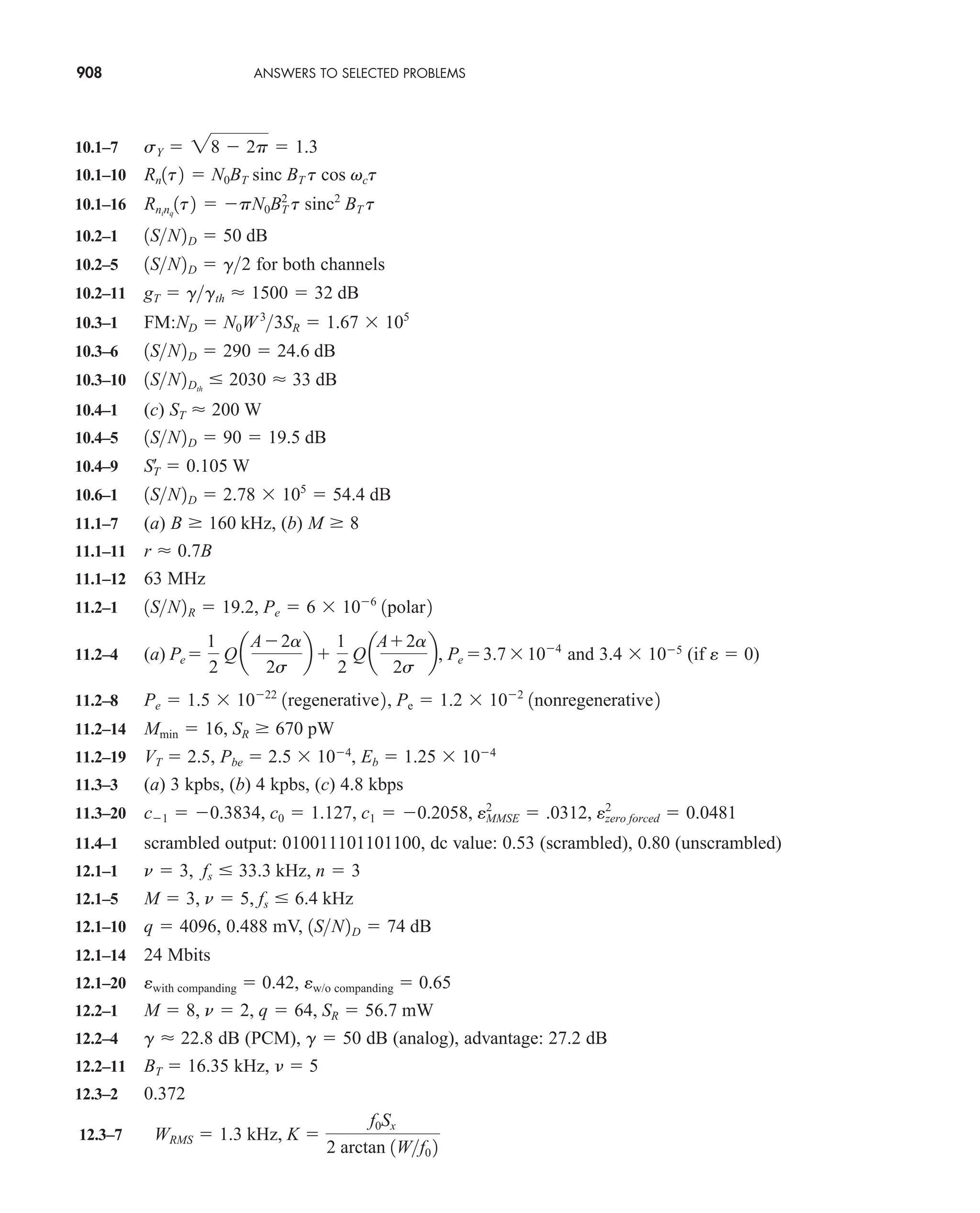
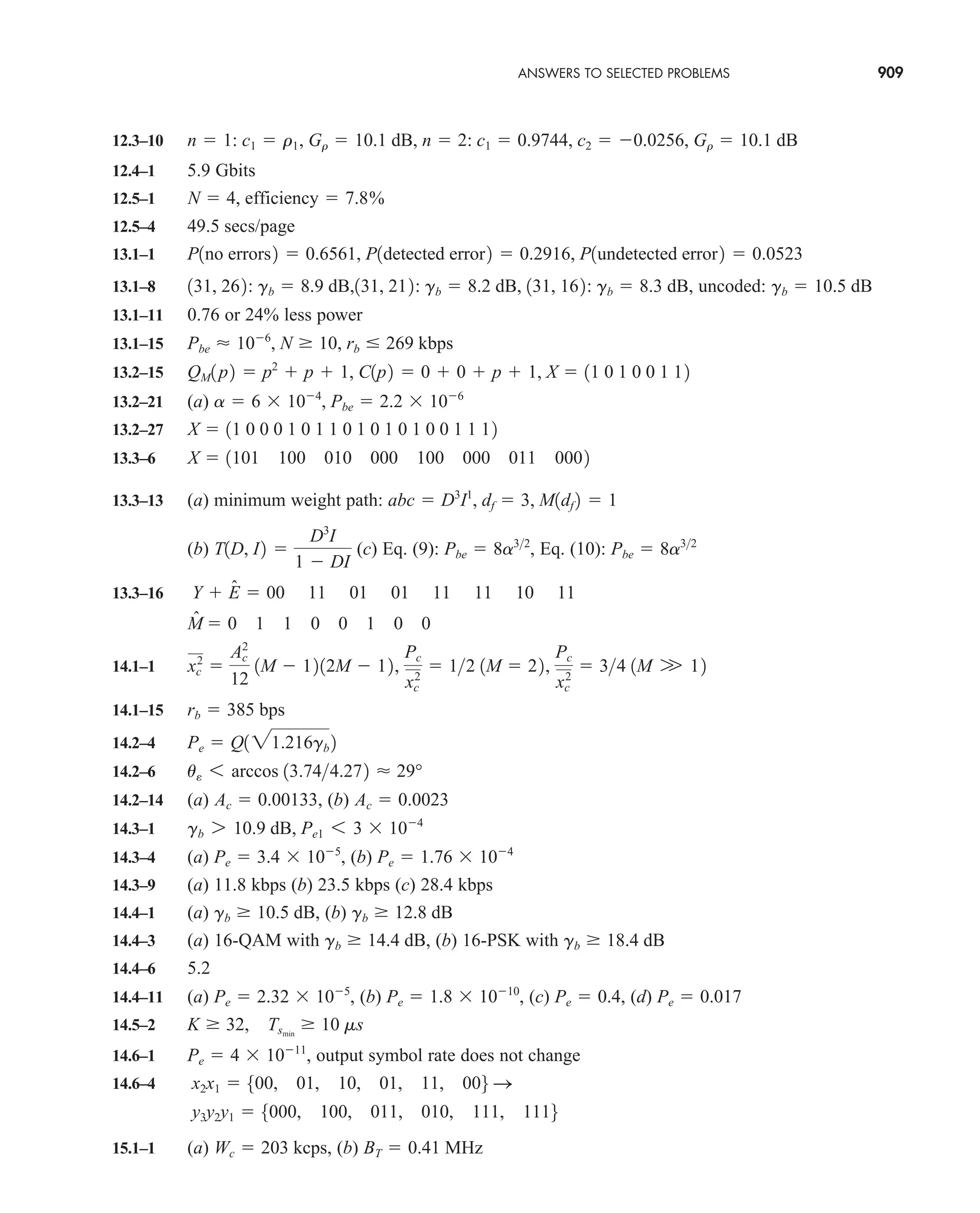
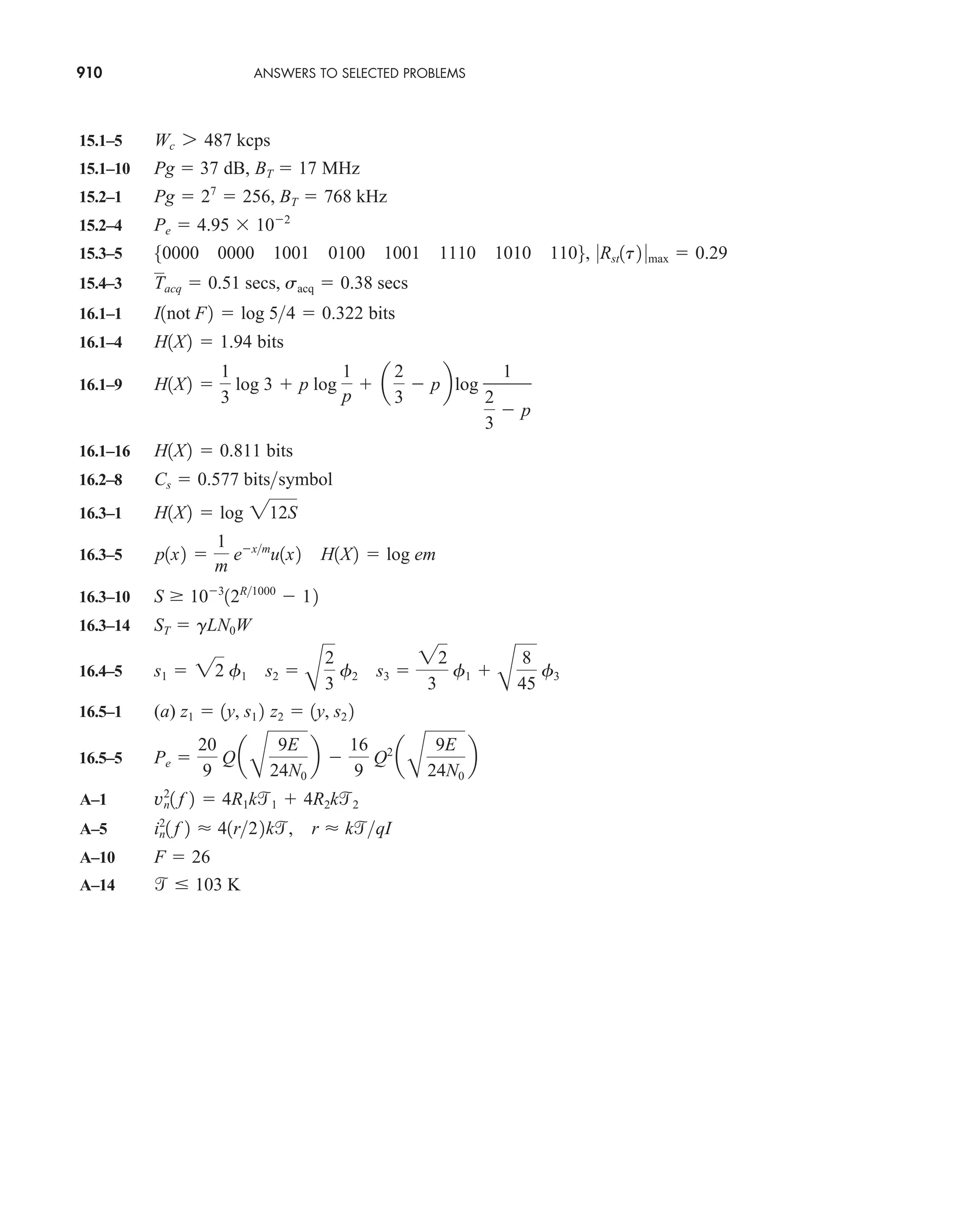
Answers to Selected Problems 904
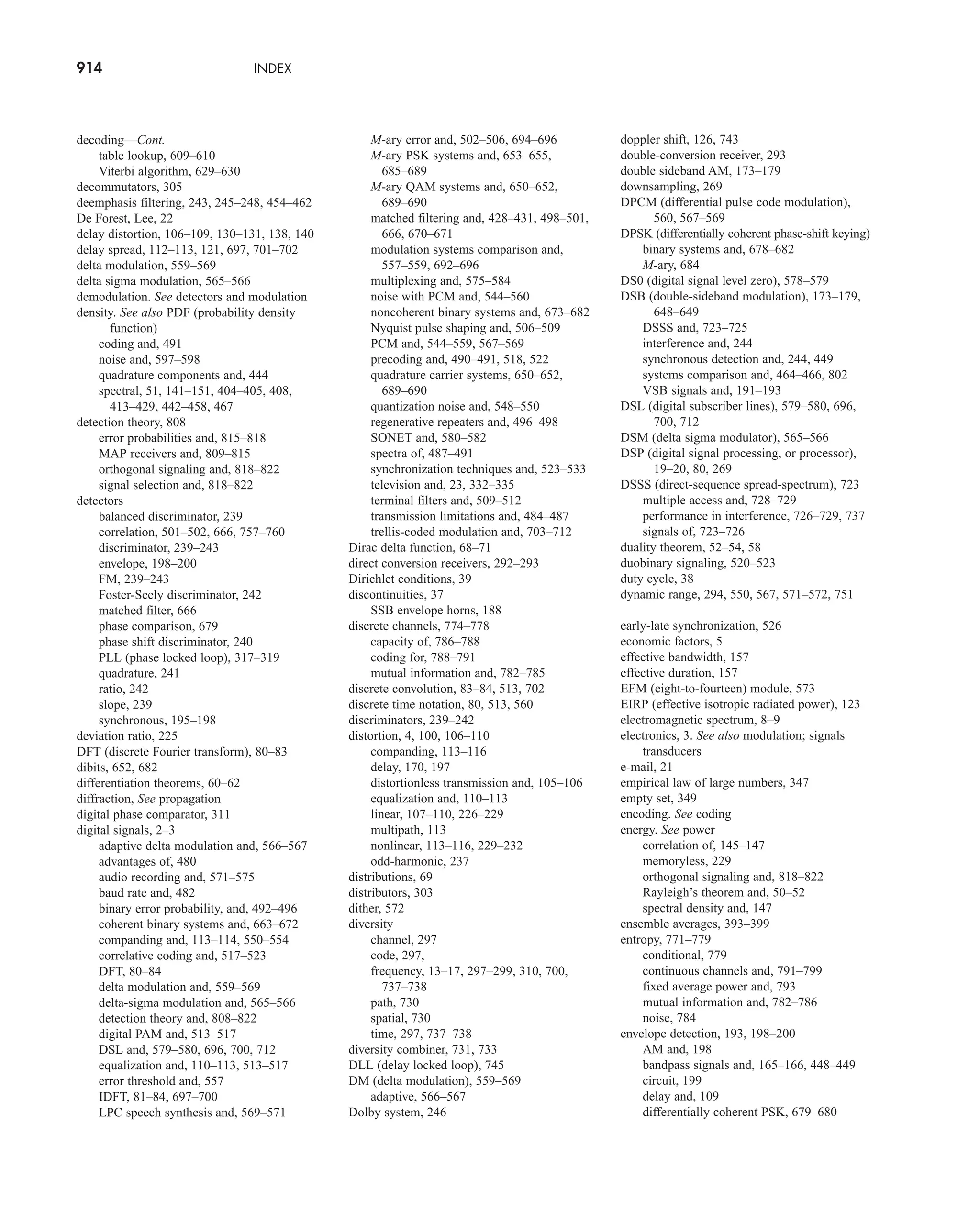
Index 911
car80407_fm_i-xx.qxd 1/15/09 4:14 PM Page viii
Rev.Confirming Pages
Preface
ix
This text, like its previous four editions, is an introduction to communication sys-
tems written at a level appropriate for advanced undergraduates and first-year gradu-
ate students in electrical or computer engineering.
An initial study of signal transmission and the inherent limitations of physical
systems establishes unifying concepts of communication. Attention is then given to
analog communication systems, random signals and noise, digital systems, and
information theory.
Mathematical techniques and models necessarily play an important role
throughout the book, but always in the engineering context as means to an end.
Numerous applications have been incorporated for their practical significance and as
illustrations of concepts and design strategies. Some hardware considerations are
also included to justify various communication methods, to stimulate interest, and to
bring out connections with other branches of the field.
PREREQUISITE BACKGROUND
The assumed background is equivalent to the first two or three years of an electrical
or computer engineering curriculum. Essential prerequisites are differential equa-
tions, steady-state and transient circuit analysis, and a first course in electronics. Stu-
dents should also have some familiarity with operational amplifiers, digital logic,
and matrix notation. Helpful but not required are prior exposure to linear systems
analysis, Fourier transforms, and probability theory.
CONTENTS AND ORGANIZATION
New features of this fifth edition include (a) the addition of MATLAB†
examples,
exercises and problems that are available on the book’s website, www.mhhe.com/
carlsoncrilly; (b) new end-of-chapter conceptual questions to reinforce the theory,
provide practical application to what has been covered, and add to the students’
problem-solving skills; (c) expanded coverage of wireless communications and an
introduction to radio wave propagation that enables the reader to better appreciate the
challenges of wireless systems; (d) expanded coverage of digital modulation systems
such as the addition of orthogonal frequency division modulation and ultra wideband
systems; (e) expanded coverage of spread spectrum; (f) a discussion of wireless net-
works; and (g) an easy-to-reference list of abbreviations and mathematical symbols.
Following an updated introductory chapter, this text has two chapters dealing
with basic tools. These tools are then applied in the next four chapters to analog com-
munication systems, including sampling and pulse modulation. Probability, random
signals, and noise are introduced in the following three chapters and applied to analog
systems. An appendix separately covers circuit and system noise. The remaining
†
MATLAB is a registered trademark of MathWorks Inc.
car80407_fm_i-xx.qxd 9/1/09 8:59 AM Page ix
x Preface
six chapters are devoted to digital communication and information theory, which
require some knowledge of random signals and include coded pulse modulation.
All sixteen chapters can be presented in a yearlong undergraduate course with
minimum prerequisites. Or a one-term undergraduate course on analog communica-
tion might consist of material in the first seven chapters. If linear systems and prob-
ability theory are covered in prerequisite courses, then most of the last eight chapters
can be included in a one-term senior/graduate course devoted primarily to digital
communication.
The modular chapter structure allows considerable latitude for other formats.
As a guide to topic selection, the table of contents indicates the minimum prerequi-
sites for each chapter section.
INSTRUCTIONAL AIDS
Each chapter after the first one includes a list of instructional objectives to guide stu-
dent study. Subsequent chapters also contain several examples and exercises. The
exercises are designed to help students master their grasp of new material presented
in the text, and exercise solutions are given at the back. The examples have been cho-
sen to illuminate concepts and techniques that students often find troublesome.
Problems at the ends of chapters are numbered by text section. They range from
basic manipulations and computations to more advanced analysis and design tasks.
A manual of problem solutions is available to instructors from the publisher.
Several typographical devices have been incorporated to serve as aids for
students. Specifically,
• Technical terms are printed in boldface type when they first appear.
• Important concepts and theorems that do not involve equations are printed
inside boxes.
• Asterisks (*) after problem numbers indicate that answers are provided at the
back of the book.
• The symbol ‡ identifies the more challenging problems.
Tables at the back of the book include transform pairs, mathematical relations,
and probability functions for convenient reference.
Communication system engineers use many abbreviations, so in addition to the
index, there is a section that lists common abbreviations. Also included is a list of the
more commonly used mathematical symbols.
Online Resources
The website that accompanies this text can be found at www.mhhe.com/carlsoncrilly
and features new MATLAB problems as well as material on computer networks
(TCP/IP) and data encryption. The website also includes an annotated bibliography
in the form of a supplementary reading list and the list of references. The complete
car80407_fm_i-xx.qxd 9/1/09 8:59 AM Page x
Preface xi
solutions manual, PowerPoint lecture notes, and image library are available online
for instructors. Contact your sales representative for additional information on the
website.
Electronic Textbook Options
This text is offered through CourseSmart for both instructors and students. Course-
Smart is an online resource where students can purchase the complete text online at
almost half the cost of a traditional text. Purchasing the eTextbook allows students to
take advantage of CourseSmart’s web tools for learning, which include full text
search, notes and highlighting, and email tools for sharing notes between classmates.
To learn more about CourseSmart options, contact your sales representative or visit
www.CourseSmart.com.
ACKNOWLEDGMENTS
I am indebted to the many people who contributed to previous editions. I want to
thank Professors Marshall Pace, Seddick Djouadi, and Aly Fathy for their feedback
and the use of their libraries; the University of Tennessee Electrical Engineering and
Computer Science Department for support; Ms. Judy Evans, Ms. Dana Bryson,
Messrs. Robert Armistead, Jerry Davis, Matthew Smith, and Tobias Mueller for their
assistance in manuscript preparation.
Thanks, too, for the wonderful feedback from our reviewers: Ali Abdi, New
Jersey Institute of Technology; Venkatachalam Anantharam, University of
California–Berkeley; Nagwa Bekir, California State University–Northridge; Deva
K. Borah, New Mexico State University; Sohail Dianat, Rochester Institute of
Technology; David C. Farden, North Dakota State University; Raghvendra Gejji,
Western Michigan University; Christoforos Hadjicostis, University of Illinois;
Dr. James Kang, California State Polytechnic University–Pomona; K.R. Rao,
University of Texas at Arlington; Jitendra K. Tugnait, Auburn University.
Thanks go to my friends Ms. Anissa Davis, Mrs. Alice LaFoy and Drs. Stephen
Derby, Samir ElGhazaly, Walter Green, Melissa Meyer, and John Sahr for their
encouragement; to my brother Peter Crilly for his encouragement; and to my children
Margaret, Meredith, Benjamin, and Nathan Crilly for their support and sense of
humor. Special thanks go to Dr. Stephen Smith of Oak Ridge National Laboratory
for the many hours he spent reviewing the manuscript. I also want to thank Dr.
Lonnie Ludeman, who as a role model demonstrated to me what a professor should
be. Finally, I am indebted to the late A. Bruce Carlson, who created within me the
desire and enthusiasm to continue my education and pursue graduate study in com-
munication systems.
Paul B. Crilly
car80407_fm_i-xx.qxd 1/15/09 4:14 PM Page xi
Rev.Confirming Pages
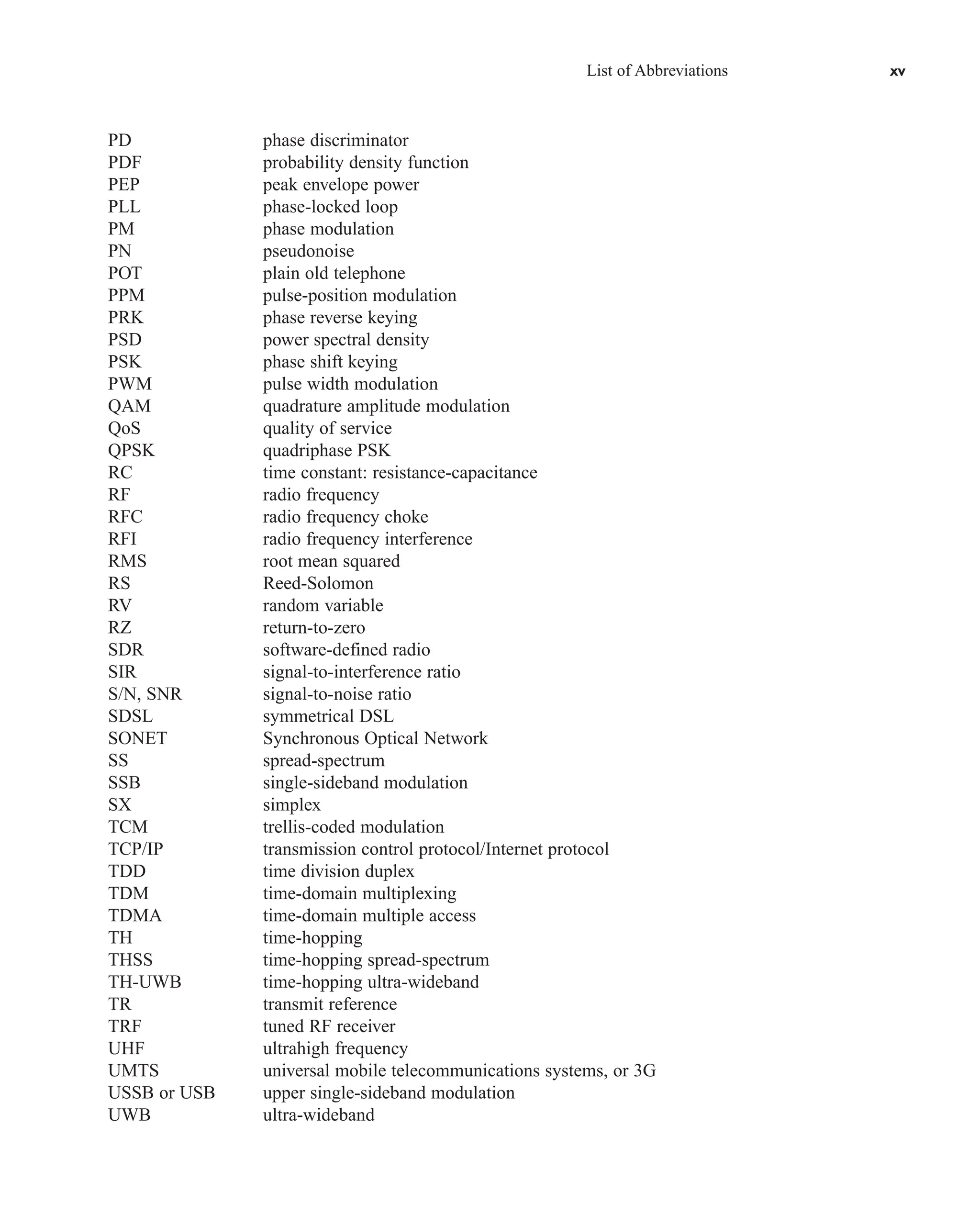
List of Abbreviations
1 EV-DO evolution data optimized one time
1G, 2G, 3G first-, second- and third-generation wireless phones
3GPP third-generation partnership project
AC alternating current
ACK positive acknowledgment
ADC analog-to-digital converter
ADSL asynchronous DSL
AFC automatic frequency control
AGC automatic gain control
AM amplitude modulation
AMI alternate mark inversion
AMPS Advanced Mobile Phone Service
APK amplitude-phase shift keying
ARQ automatic repeat request
ASK amplitude-shift keying
ASCII American Standard Code for Information Interchange
AVC automatic volume control
AWGN additive white gaussian noise
BER bit error rate or bit error probability
BJT bipolar junction transistor
BPF bandpass filter
BPSK binary PSK
BSC binary symmetric channel
CCD charge-coupled devices
CCIR International Radio Consultative Committee
CCIT International Telegraph and Telephone Consultative Committee of the
Internationals Union
CD compact disc
CDF cumulative distribution function
CDMA code-division multiple access
CIRC cross-interleave Reed-Solomon error control code
CNR carrier-to-noise ratio
CPFSK continuous-phase FSK
CPS chips
CRC cyclic redundancy code or cyclic reduncancy check
CSMA carrier sense multiple access
CVSDM continuously variable slope delta modulation
CW continuous-wave
DAC digital-to-analog converter
dB decibels
dBm decibel milliwatts
dBW decibel watts
DC direct current, or direct conversion (receiver)
xii
car80407_fm_i-xx.qxd 9/1/09 8:59 AM Page xii
List of Abbreviations xiii
DCT discrete cosine transform
DDS direct digital synthesis
DFT discrete Fourier transform
DLL delay-locked loop
DM delta modulation
DPCM differential pulse-code modulation
DPSK differentially coherent PSK
DSB or DSB-SC double-sideband-suppressed carrier modulation
DSL digital subscriber line
DSM delta-sigma modulator
DSP digital signal processing or digital signal processor
DSSS or DSS direct-sequence spread-spectrum
DTV digital TV
EIRP effective isotropic radiated power
EV-DV evolution, data, and voice
FCC Federal Communications Commission (USA)
FDD frequency-division duplex
FDM frequency-division multiplexing
FDMA frequency-division multiple access
FDX full duplex
FEC forward error correction
FET field effect transistor
FFT fast Fourier transform
FHSS frequency-hopping spread-spectrum
FM frequency modulation
FOH first order hold
FSK frequency-shift keying
GMSK gaussian filtered MSK
GPRS general packet radio system
GPS global positioning system
GSM Group Special Mobile, or Global System for Mobile
Communications
HDSL high bit rate DSL
HDX half duplex
HDTV high definition television
HPF highpass filter
Hz hertz
IDFT inverse discrete Fourier transform
IFFT inverse fast Fourier transform
IF intermediate frequency
IMT–2000 international mobile telecommunications–2000
IP internet protocol
IS-95 Interim Standard 95
ISDN integrated services digital network
ISI intersymbol interference
car80407_fm_i-xx.qxd 9/1/09 8:59 AM Page xiii
xiv List of Abbreviations
ISM industrial, scientific, and medical
ISO International Standards Organization
ITU International Telecommunications Union
JFET junction field-effect transistor
kHz kilohertz
kW kilowatt
LAN local area network
LC inductor/capacitor resonant circuit
LO local oscillator
LOS line of sight
LPC linear predictive code
LPF lowpass filter
LSSB or LSB lower single-sideband modulation
LTI linear time-invariant systems
MA multiple access
MAI multiple access interference
MAP maximum a posteriori
MC multicarrier modulation
MHz megahertz
MMSE minimum means-squared error
modem modulator/demodulator
MPEG motion picture expert group
MSK minimum shift keying
MTSO mobile telephone switching office
MUF maximum useable frequency
MUX multiplexer
NAK negative acknowledgment
NAMPS narrowband advanced mobile phone service
NBFM narrowband frequency modulation
NBPM narrowband phase modulation
NET network
NF noise figure
NIST National Institute of Standards and Technology
NRZ nonreturn-to-zero
NTSC National Television System Committee
OFDM orthogonal frequency multiplexing
OFDMA orthogonal frequency-division multiple access
OOK on-off keying
OQPSK offset quadrature phase shift keying
OSI open systems interconnection
PAM pulse-amplitude modulation
PAR peak-to-average ratio (power)
PCC parallel concatenated codes
PCM pulse-code modulation
PCS personal communications systems or services
car80407_fm_i-xx.qxd 9/1/09 8:59 AM Page xiv
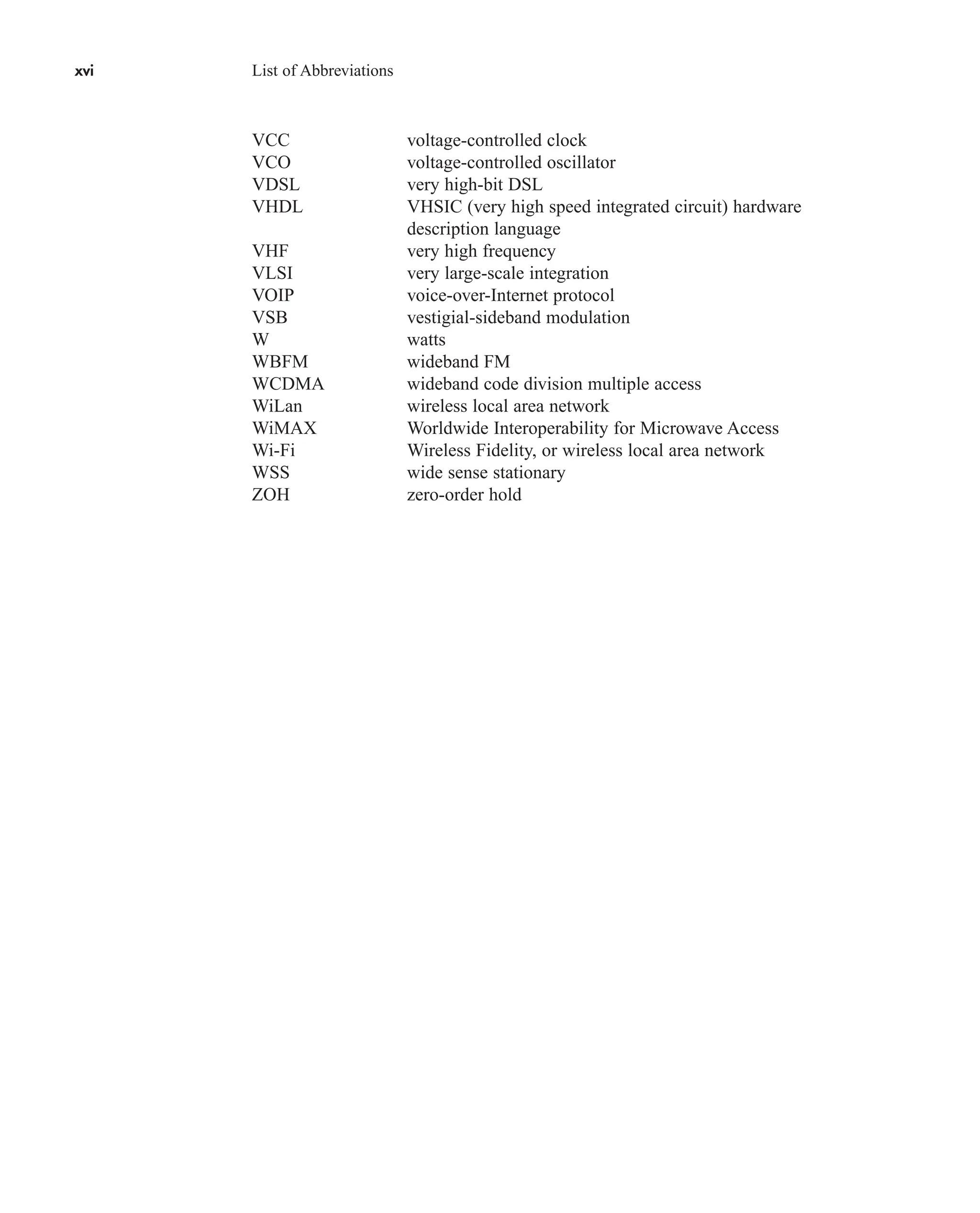
List of Abbreviations xv
PD phase discriminator
PDF probability density function
PEP peak envelope power
PLL phase-locked loop
PM phase modulation
PN pseudonoise
POT plain old telephone
PPM pulse-position modulation
PRK phase reverse keying
PSD power spectral density
PSK phase shift keying
PWM pulse width modulation
QAM quadrature amplitude modulation
QoS quality of service
QPSK quadriphase PSK
RC time constant: resistance-capacitance
RF radio frequency
RFC radio frequency choke
RFI radio frequency interference
RMS root mean squared
RS Reed-Solomon
RV random variable
RZ return-to-zero
SDR software-defined radio
SIR signal-to-interference ratio
S/N, SNR signal-to-noise ratio
SDSL symmetrical DSL
SONET Synchronous Optical Network
SS spread-spectrum
SSB single-sideband modulation
SX simplex
TCM trellis-coded modulation
TCP/IP transmission control protocol/Internet protocol
TDD time division duplex
TDM time-domain multiplexing
TDMA time-domain multiple access
TH time-hopping
THSS time-hopping spread-spectrum
TH-UWB time-hopping ultra-wideband
TR transmit reference
TRF tuned RF receiver
UHF ultrahigh frequency
UMTS universal mobile telecommunications systems, or 3G
USSB or USB upper single-sideband modulation
UWB ultra-wideband
car80407_fm_i-xx.qxd 9/1/09 8:59 AM Page xv
xvi List of Abbreviations
VCC voltage-controlled clock
VCO voltage-controlled oscillator
VDSL very high-bit DSL
VHDL VHSIC (very high speed integrated circuit) hardware
description language
VHF very high frequency
VLSI very large-scale integration
VOIP voice-over-Internet protocol
VSB vestigial-sideband modulation
W watts
WBFM wideband FM
WCDMA wideband code division multiple access
WiLan wireless local area network
WiMAX Worldwide Interoperability for Microwave Access
Wi-Fi Wireless Fidelity, or wireless local area network
WSS wide sense stationary
ZOH zero-order hold
car80407_fm_i-xx.qxd 9/1/09 8:59 AM Page xvi
xvii
Mathematical Symbols
A, Ac amplitude constant and carrier amplitude constant
Ae aperture area
Am tone amplitude
Av(t) envelope of a BP signal
B bandwidth in hertz (Hz)
BT transmission bandwidth, or bandwidth of a bandpass signal
C channel capacity, bits per second, capacitance in Farads, or check vector
Cvw(t1, t2) covariance function of signals v(t) and w(t)
D deviation ratio, or pulse interval
DR dynamic range
DFT[ ], IDFT[ ] discrete and inverse discrete Fourier transorm
E error vector
E, E1, E0, Eb signal energy, energy in bit 1, energy in bit 0, and bit energy
E[ ] expected value operator
FX(x) cumulative distribution function of X
FXY(x,y) joint cumulative distribution of X and Y
G generator vector
Gx(f) power spectral density of signal x(t)
Gvw(f) cross-spectral density functions of signals v(t), w(t)
H(f) transfer or frequency-response function of a system
HC(f) channel’s frequency response
Heq(f) channel equalizer frequency response
HQ(f) transfer function of quadrature filter
IR image rejection
Jn(b) Bessell function of first kind, order n, argument b
L,LdB loss in linear and decibel units
Lu, Ld uplink and downlink losses
M numerical base, such that q  Mv
or message vector
ND destination noise power
NR received noise power
N0 power spectral density or spectral density of white noise
NF, or F noise figure
N(f) noise signal spectrum
P power in watts
Pc unmodulated carrier power
P(f) pulse spectrum
Pe, Pe0, Pe1 probability of error, probability of zero error, probability of 1 error
Pbe, Pwe probability of bit and word errors
Pout, Pin output and input power (watts)
PdBW, PdBmW power in decibel watts and milliwatts
Psb power per sideband
P(A), P(i,n) probability of event A occurring and probability of i errors in n-bit word
Q[ ] gaussian probability function
car80407_fm_i-xx.qxd 9/1/09 8:59 AM Page xvii
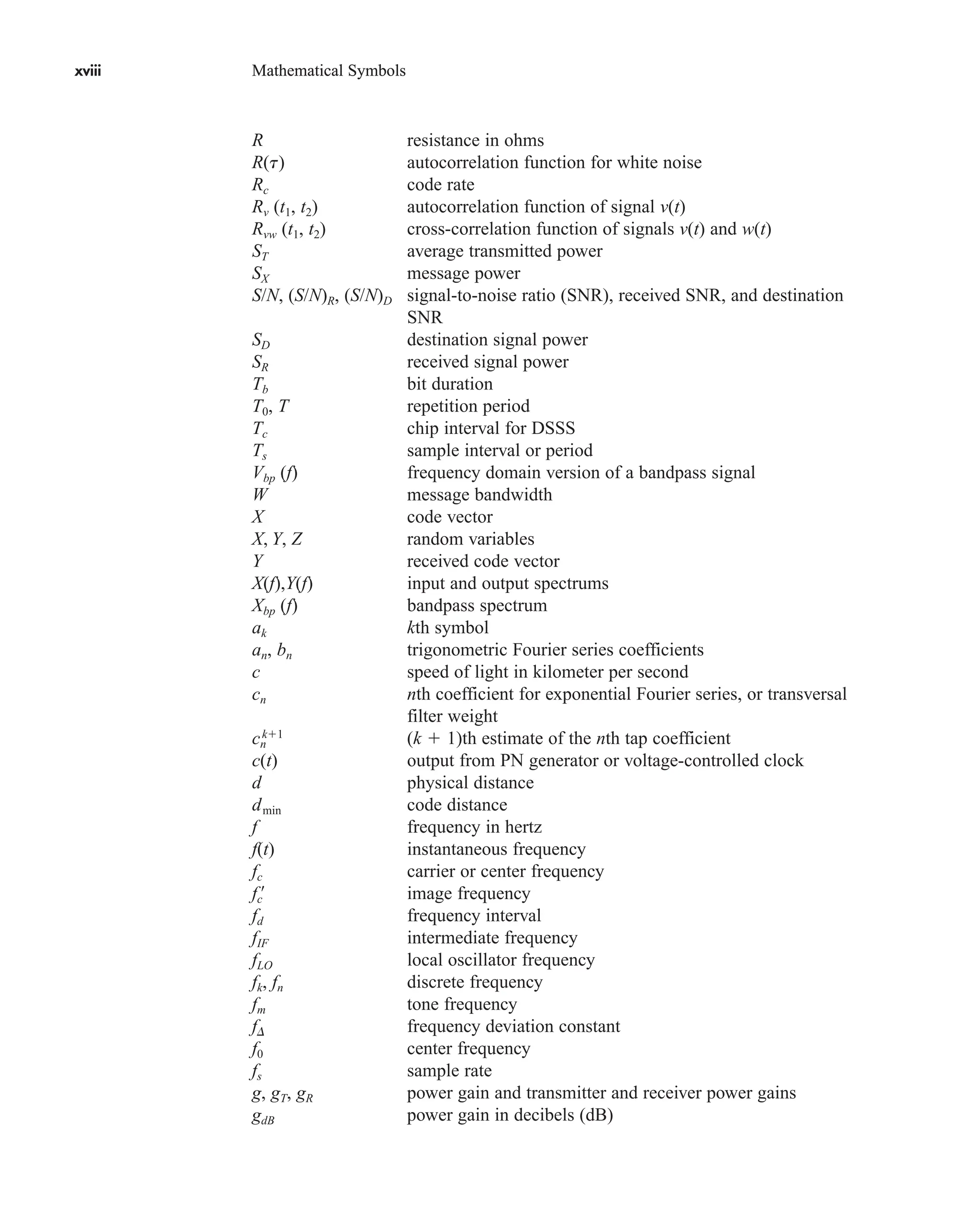
xviii Mathematical Symbols
R resistance in ohms
R(t) autocorrelation function for white noise
Rc code rate
Rv (t1, t2) autocorrelation function of signal v(t)
Rvw (t1, t2) cross-correlation function of signals v(t) and w(t)
ST average transmitted power
SX message power
S/N, (S/N)R, (S/N)D signal-to-noise ratio (SNR), received SNR, and destination
SNR
SD destination signal power
SR received signal power
Tb bit duration
T0, T repetition period
Tc chip interval for DSSS
Ts sample interval or period
Vbp (f) frequency domain version of a bandpass signal
W message bandwidth
X code vector
X, Y, Z random variables
Y received code vector
X(f),Y(f) input and output spectrums
Xbp (f) bandpass spectrum
ak kth symbol
an, bn trigonometric Fourier series coefficients
c speed of light in kilometer per second
cn nth coefficient for exponential Fourier series, or transversal
filter weight
cn
k1
(k  1)th estimate of the nth tap coefficient
c(t) output from PN generator or voltage-controlled clock
d physical distance
dmin code distance
f frequency in hertz
f(t) instantaneous frequency
fc carrier or center frequency
fc¿ image frequency
fd frequency interval
fIF intermediate frequency
fLO local oscillator frequency
fk, fn discrete frequency
fm tone frequency
fD frequency deviation constant
f0 center frequency
fs sample rate
g, gT, gR power gain and transmitter and receiver power gains
gdB power gain in decibels (dB)
car80407_fm_i-xx.qxd 9/1/09 8:59 AM Page xviii
Mathematical Symbols xix
h(t) impulse-response function of a system
hC(t) impulse-response function of a channel
hk(t), hk(n) impulse-response function of kth portion of subchannel
hQ(t) impulse-response function of a quadrature filter
Im[x] and Re[x] imaginary and real components of x
j imaginary number operator
l length in kilometers
m number of repeater sections
mk, k actual and estimated k message symbol
n(t) noise signal
p(t) pulse signal
p0
(t), p1
(t) gaussian and first-order monocycle pulses
output of transversal filter’s nth delay element
input to equalizing filter
peq(tk) output of an equalizing filter
pX(x) probability density function of X
pXY(x) joint probability density function of X and Y
q number of quantum levels
r, rb signal rate, bit rate
s(t) switching function for sampling
s0(t), s1(t) inputs to multiplier of correlation detector
sgn(t) signum function
t time in seconds
td time delay in seconds
tk kth instant of time
tr rise time in seconds
u(t) unit step function, or output from rake diversity combiner
v number of bits
v(t) input to a detector
vk (t) kth subcarrier function
v(t) average value of v(t)
vbp(t) time-domain expression of a bandpass signal
w*(t) complex conjugate of w(t)
Hilbert transform of x, or estimate of x
x(t), y(t) input and output time functions
x(t) message signal
x(k), x(kTs) sampled version of x(t)
X(n) discrete Fourier transform of x(k)
xb(t) modulated signal at a subcarrier frequency
xc(t) modulated signal
xq(k) quantized value for kth value of x
y(t) detector output
xk(t), yk(t) subchannel signal
yD(t) signal at destination
zm(t) output of matched filter or correlation detector
x̂
p

1t2
p

n
m̂
car80407_fm_i-xx.qxd 9/1/09 8:59 AM Page xix
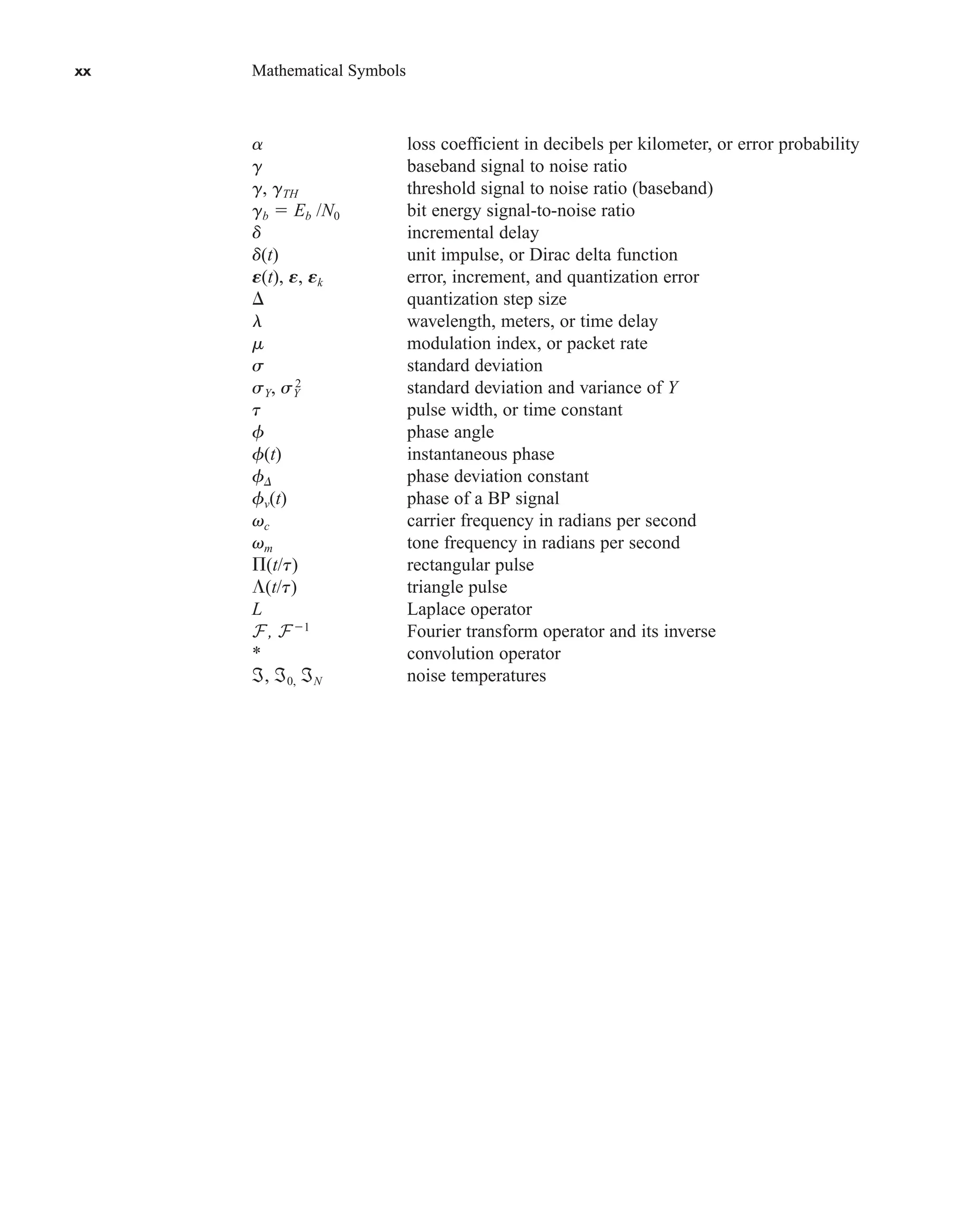
xx Mathematical Symbols
a loss coefficient in decibels per kilometer, or error probability
g baseband signal to noise ratio
g, gTH threshold signal to noise ratio (baseband)
gb  Eb /N0 bit energy signal-to-noise ratio
d incremental delay
d(t) unit impulse, or Dirac delta function
E(t), E, Ek error, increment, and quantization error
 quantization step size
l wavelength, meters, or time delay
m modulation index, or packet rate
s standard deviation
sY, sY
2
standard deviation and variance of Y
t pulse width, or time constant
f phase angle
f(t) instantaneous phase
fD phase deviation constant
fv(t) phase of a BP signal
vc carrier frequency in radians per second
vm tone frequency in radians per second
(t/t) rectangular pulse
(t/t) triangle pulse
L Laplace operator
F, F1
Fourier transform operator and its inverse
* convolution operator
ℑ, ℑ0, ℑN noise temperatures
car80407_fm_i-xx.qxd 9/1/09 8:59 AM Page xx
1
chapter
1
Introduction
CHAPTER OUTLINE
1.1 Elements and Limitations of Communication Systems
Information, Messages, and Signals Elements of a Communication System Fundamental Limitations
1.2 Modulation and Coding
Modulation Methods Modulation Benefits and Applications Coding Methods and Benefits
1.3 Electromagnetic Wave Propagation Over Wireless Channels
RF Wave Deflection Skywave Propagation
1.4 Emerging Developments
1.5 Societal Impact and Historical Perspective
1.6 Prospectus
1.7 Questions
car80407_ch01_001-026.qxd 12/8/08 10:21 PM Page 1
2 CHAPTER 1 • Introduction
“ ttention, the Universe! By kingdoms, right wheel!” This prophetic phrase represents the first telegraph message
on record. Samuel F. B. Morse sent it over a 16 km line in 1838. Thus a new era was born: the era of electri-
cal communication.
Now, over a century and a half later, communication engineering has advanced to the point that earthbound TV
viewers watch astronauts working in space. Telephone, radio, and television are integral parts of modern life. Long-
distance circuits span the globe carrying text, data, voice, and images. Computers talk to computers via interconti-
nental networks, and control virtually every electrical appliance in our homes. Wireless personal communication
devices keep us connected wherever we go. Certainly great strides have been made since the days of Morse.
Equally certain, coming decades will usher in many new achievements of communication engineering.
This textbook introduces electrical communication systems, including analysis methods, design principles, and hard-
ware considerations. We begin with a descriptive overview that establishes a perspective for the chapters that follow.
1.1 ELEMENTS AND LIMITATIONS
OF COMMUNICATION SYSTEMS
A communication system conveys information from its source to a destination some
distance away. There are so many different applications of communication systems
that we cannot attempt to cover every type, nor can we discuss in detail all the indi-
vidual parts that make up a specific system. A typical system involves numerous
components that run the gamut of electrical engineering—circuits, electronics, elec-
tromagnetics, signal processing, microprocessors, and communication networks, to
name a few of the relevant fields. Moreover, a piece-by-piece treatment would
obscure the essential point that a communication system is an integrated whole that
really does exceed the sum of its parts.
We therefore approach the subject from a more general viewpoint. Recognizing
that all communication systems have the same basic function of information trans-
fer, we’ll seek out and isolate the principles and problems of conveying information
in electrical form. These will be examined in sufficient depth to develop analysis and
design methods suited to a wide range of applications. In short, this text is concerned
with communication links as systems.
Information, Messages, and Signals
Clearly, the concept of information is central to communication. But information is
a loaded word, implying semantic and philosophical notions that defy precise defini-
tion. We avoid these difficulties by dealing instead with the message, defined as the
physical manifestation of information as produced by the source. Whatever form the
message takes, the goal of a communication system is to reproduce at the destination
an acceptable replica of the source message.
There are many kinds of information sources, including machines as well as
people, and messages appear in various forms. Nonetheless, we can identify two dis-
tinct message categories, analog and digital. This distinction, in turn, determines the
criterion for successful communication.
A
car80407_ch01_001-026.qxd 12/8/08 10:21 PM Page 2
1.1 Elements and Limitations of Communication Systems 3
An analog message is a physical quantity that varies with time, usually in a
smooth and continuous fashion. Examples of analog messages are the acoustic pres-
sure produced when you speak, the angular position of an aircraft gyro, or the light
intensity at some point in a television image. Since the information resides in a time-
varying waveform, an analog communication system should deliver this waveform
with a specified degree of fidelity.
A digital message is an ordered sequence of symbols selected from a finite set
of discrete elements. Examples of digital messages are the letters printed on this
page, a listing of hourly temperature readings, or the keys you press on a computer
keyboard. Since the information resides in discrete symbols, a digital communica-
tion system should deliver these symbols with a specified degree of accuracy in a
specified amount of time.
Whether analog or digital, few message sources are inherently electrical. Conse-
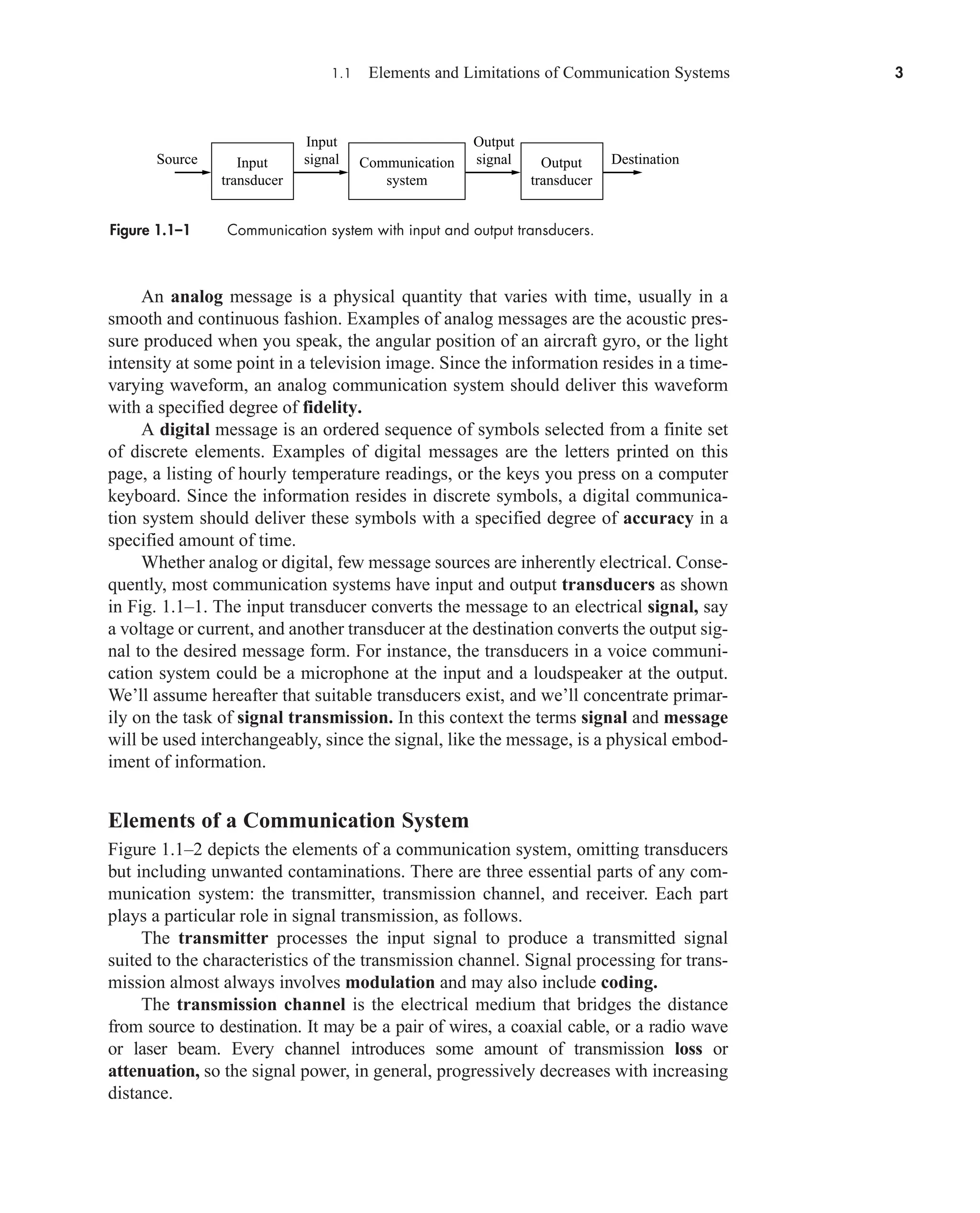
quently, most communication systems have input and output transducers as shown
in Fig. 1.1–1. The input transducer converts the message to an electrical signal, say
a voltage or current, and another transducer at the destination converts the output sig-
nal to the desired message form. For instance, the transducers in a voice communi-
cation system could be a microphone at the input and a loudspeaker at the output.
We’ll assume hereafter that suitable transducers exist, and we’ll concentrate primar-
ily on the task of signal transmission. In this context the terms signal and message
will be used interchangeably, since the signal, like the message, is a physical embod-
iment of information.
Elements of a Communication System
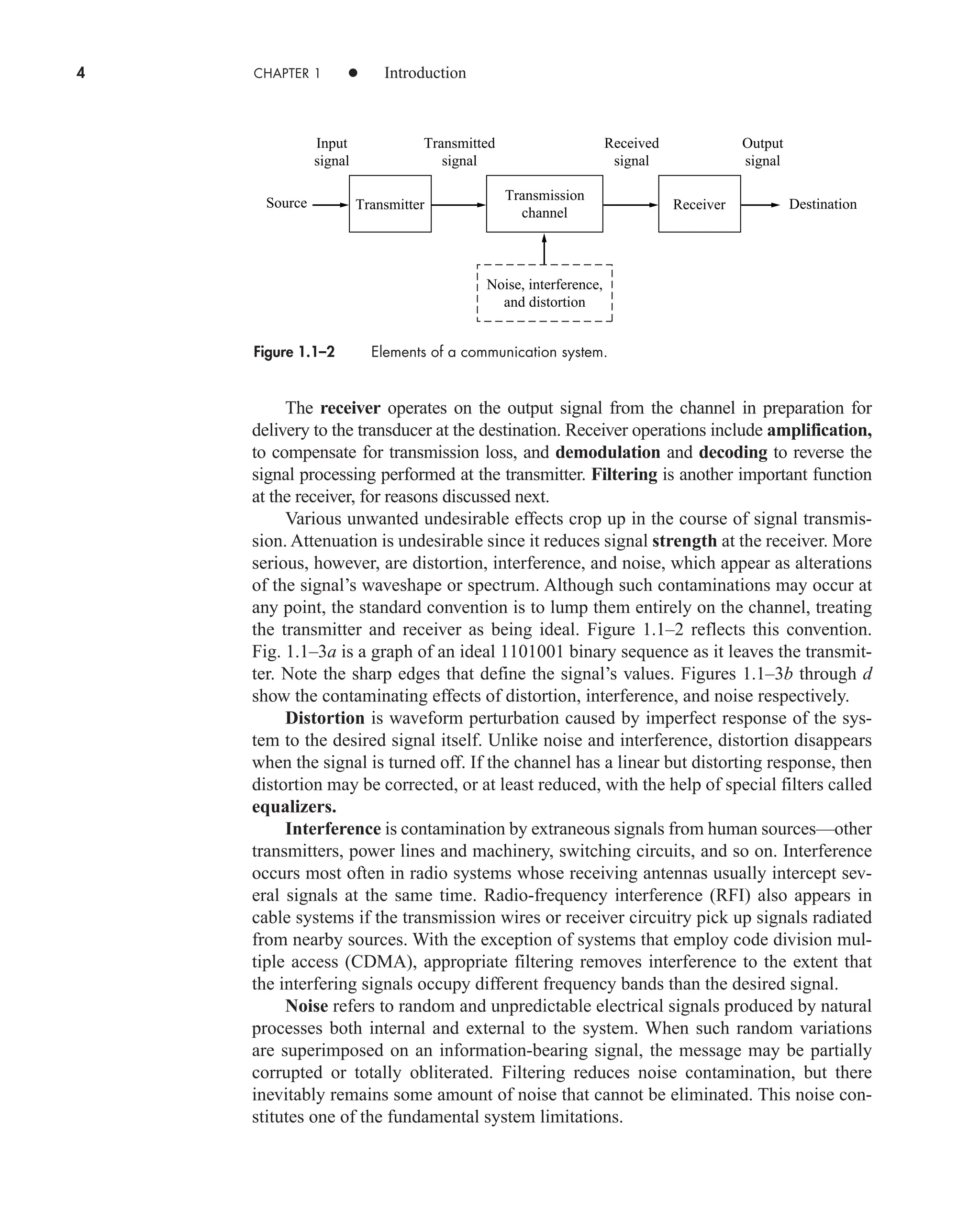
Figure 1.1–2 depicts the elements of a communication system, omitting transducers
but including unwanted contaminations. There are three essential parts of any com-
munication system: the transmitter, transmission channel, and receiver. Each part
plays a particular role in signal transmission, as follows.
The transmitter processes the input signal to produce a transmitted signal
suited to the characteristics of the transmission channel. Signal processing for trans-
mission almost always involves modulation and may also include coding.
The transmission channel is the electrical medium that bridges the distance
from source to destination. It may be a pair of wires, a coaxial cable, or a radio wave
or laser beam. Every channel introduces some amount of transmission loss or
attenuation, so the signal power, in general, progressively decreases with increasing
distance.
Figure 1.1–1 Communication system with input and output transducers.
Output
transducer
Communication
system
Input
transducer
Input
signal
Output
signal
Source Destination
car80407_ch01_001-026.qxd 12/8/08 10:21 PM Page 3
Confirming Pages
4 CHAPTER 1 • Introduction
The receiver operates on the output signal from the channel in preparation for
delivery to the transducer at the destination. Receiver operations include amplification,
to compensate for transmission loss, and demodulation and decoding to reverse the
signal processing performed at the transmitter. Filtering is another important function
at the receiver, for reasons discussed next.
Various unwanted undesirable effects crop up in the course of signal transmis-
sion. Attenuation is undesirable since it reduces signal strength at the receiver. More
serious, however, are distortion, interference, and noise, which appear as alterations
of the signal’s waveshape or spectrum. Although such contaminations may occur at
any point, the standard convention is to lump them entirely on the channel, treating
the transmitter and receiver as being ideal. Figure 1.1–2 reflects this convention.
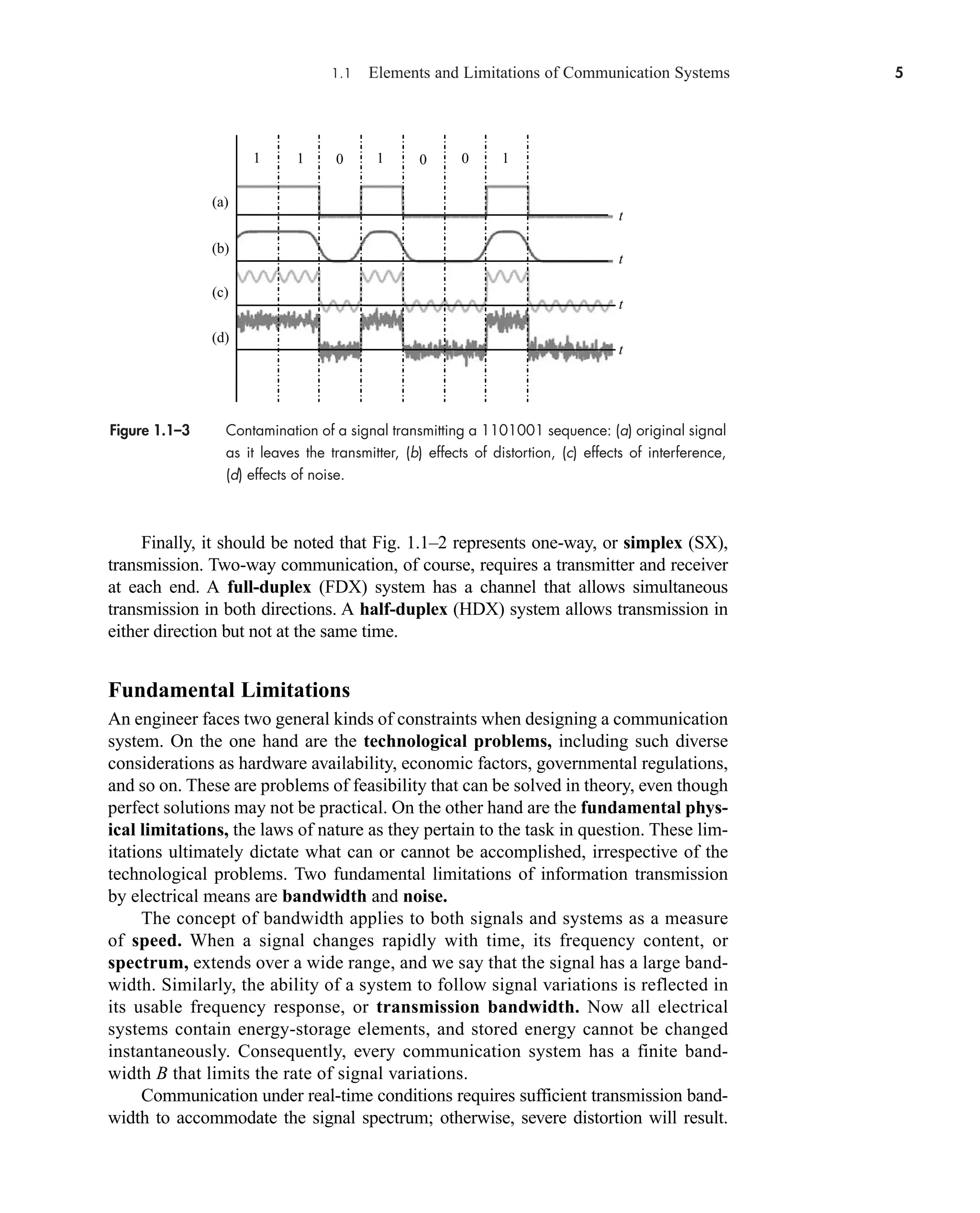
Fig. 1.1–3a is a graph of an ideal 1101001 binary sequence as it leaves the transmit-
ter. Note the sharp edges that define the signal’s values. Figures 1.1–3b through d
show the contaminating effects of distortion, interference, and noise respectively.
Distortion is waveform perturbation caused by imperfect response of the sys-
tem to the desired signal itself. Unlike noise and interference, distortion disappears
when the signal is turned off. If the channel has a linear but distorting response, then
distortion may be corrected, or at least reduced, with the help of special filters called
equalizers.
Interference is contamination by extraneous signals from human sources—other
transmitters, power lines and machinery, switching circuits, and so on. Interference
occurs most often in radio systems whose receiving antennas usually intercept sev-
eral signals at the same time. Radio-frequency interference (RFI) also appears in
cable systems if the transmission wires or receiver circuitry pick up signals radiated
from nearby sources. With the exception of systems that employ code division mul-
tiple access (CDMA), appropriate filtering removes interference to the extent that
the interfering signals occupy different frequency bands than the desired signal.
Noise refers to random and unpredictable electrical signals produced by natural
processes both internal and external to the system. When such random variations
are superimposed on an information-bearing signal, the message may be partially
corrupted or totally obliterated. Filtering reduces noise contamination, but there
inevitably remains some amount of noise that cannot be eliminated. This noise con-
stitutes one of the fundamental system limitations.
Figure 1.1–2 Elements of a communication system.
Receiver
Transmission
channel
Noise, interference,
and distortion
Transmitter
Transmitted
signal
Input
signal
Received
signal
Output
signal
Source Destination
car80407_ch01_001-026.qxd 12/16/08 11:06 PM Page 4
1.1 Elements and Limitations of Communication Systems 5
Figure 1.1–3 Contamination of a signal transmitting a 1101001 sequence: (a) original signal
as it leaves the transmitter, (b) effects of distortion, (c) effects of interference,
(d) effects of noise.
(a)
(b)
(c)
(d)
1 1 1 1
0 0 0
t
t
t
t
Finally, it should be noted that Fig. 1.1–2 represents one-way, or simplex (SX),
transmission. Two-way communication, of course, requires a transmitter and receiver
at each end. A full-duplex (FDX) system has a channel that allows simultaneous
transmission in both directions. A half-duplex (HDX) system allows transmission in
either direction but not at the same time.
Fundamental Limitations
An engineer faces two general kinds of constraints when designing a communication
system. On the one hand are the technological problems, including such diverse
considerations as hardware availability, economic factors, governmental regulations,
and so on. These are problems of feasibility that can be solved in theory, even though
perfect solutions may not be practical. On the other hand are the fundamental phys-
ical limitations, the laws of nature as they pertain to the task in question. These lim-
itations ultimately dictate what can or cannot be accomplished, irrespective of the
technological problems. Two fundamental limitations of information transmission
by electrical means are bandwidth and noise.
The concept of bandwidth applies to both signals and systems as a measure
of speed. When a signal changes rapidly with time, its frequency content, or
spectrum, extends over a wide range, and we say that the signal has a large band-
width. Similarly, the ability of a system to follow signal variations is reflected in
its usable frequency response, or transmission bandwidth. Now all electrical
systems contain energy-storage elements, and stored energy cannot be changed
instantaneously. Consequently, every communication system has a finite band-
width B that limits the rate of signal variations.
Communication under real-time conditions requires sufficient transmission band-
width to accommodate the signal spectrum; otherwise, severe distortion will result.
car80407_ch01_001-026.qxd 12/8/08 10:21 PM Page 5
Confirming Pages
6 CHAPTER 1 • Introduction
Thus, for example, a bandwidth of several megahertz is needed for a TV video signal,
while the much slower variations of a voice signal fit into B  3 kHz. For a digital sig-
nal with r symbols per second, the bandwidth must be B  r/2. In the case of informa-
tion transmission without a real-time constraint, the available bandwidth determines
the maximum signal speed. The time required to transmit a given amount of informa-
tion is therefore inversely proportional to B.
Noise imposes a second limitation on information transmission. Why is noise
unavoidable? Rather curiously, the answer comes from kinetic theory. At any tem-
perature above absolute zero, thermal energy causes microscopic particles to exhibit
random motion. The random motion of charged particles such as electrons generates
random currents or voltages called thermal noise. There are also other types of
noise, but thermal noise appears in every communication system.
We measure noise relative to an information signal in terms of the signal-to-
noise power ratio S/N (or SNR). Thermal noise power is ordinarily quite small, and
S/N can be so large that the noise goes unnoticed. At lower values of S/N, however,
noise degrades fidelity in analog communication and produces errors in digital
communication. These problems become most severe on long-distance links when
the transmission loss reduces the received signal power down close to the noise level.
Amplification at the receiver is then to no avail, because the noise will be amplified
along with the signal.
Taking both limitations into account, Shannon (1948)†
stated that the rate of
information transmission cannot exceed the channel capacity.
C  B log2 (1  S/N)  3.32 B log10 (1  S/N)
This relationship, known as the Hartley-Shannon law, sets an upper limit on the per-
formance of a communication system with a given bandwidth and signal-to-noise
ratio. Note, this law assumes the noise is random with a gaussian distribution, and the
information is randomly coded.
1.2 MODULATION AND CODING
Modulation and coding are operations performed at the transmitter to achieve effi-
cient and reliable information transmission. So important are these operations that
they deserve further consideration here. Subsequently, we’ll devote several chapters
to modulating and coding techniques.
Modulation Methods
Modulation involves two waveforms: a modulating signal that represents the message
and a carrier wave that suits the particular application. A modulator systematically
alters the carrier wave in correspondence with the variations of the modulating signal.
†
References are indicated in this fashion throughout the text. Complete citations are listed alphabeti-
cally by author in the References at www.mhhe.com/carlsoncrilly.
car80407_ch01_001-026.qxd 6/1/09 7:49 AM Page 6
Rev. Confirming Pages
1.2 Modulation and Coding 7
(a)
(b)
(c)
t
t
t
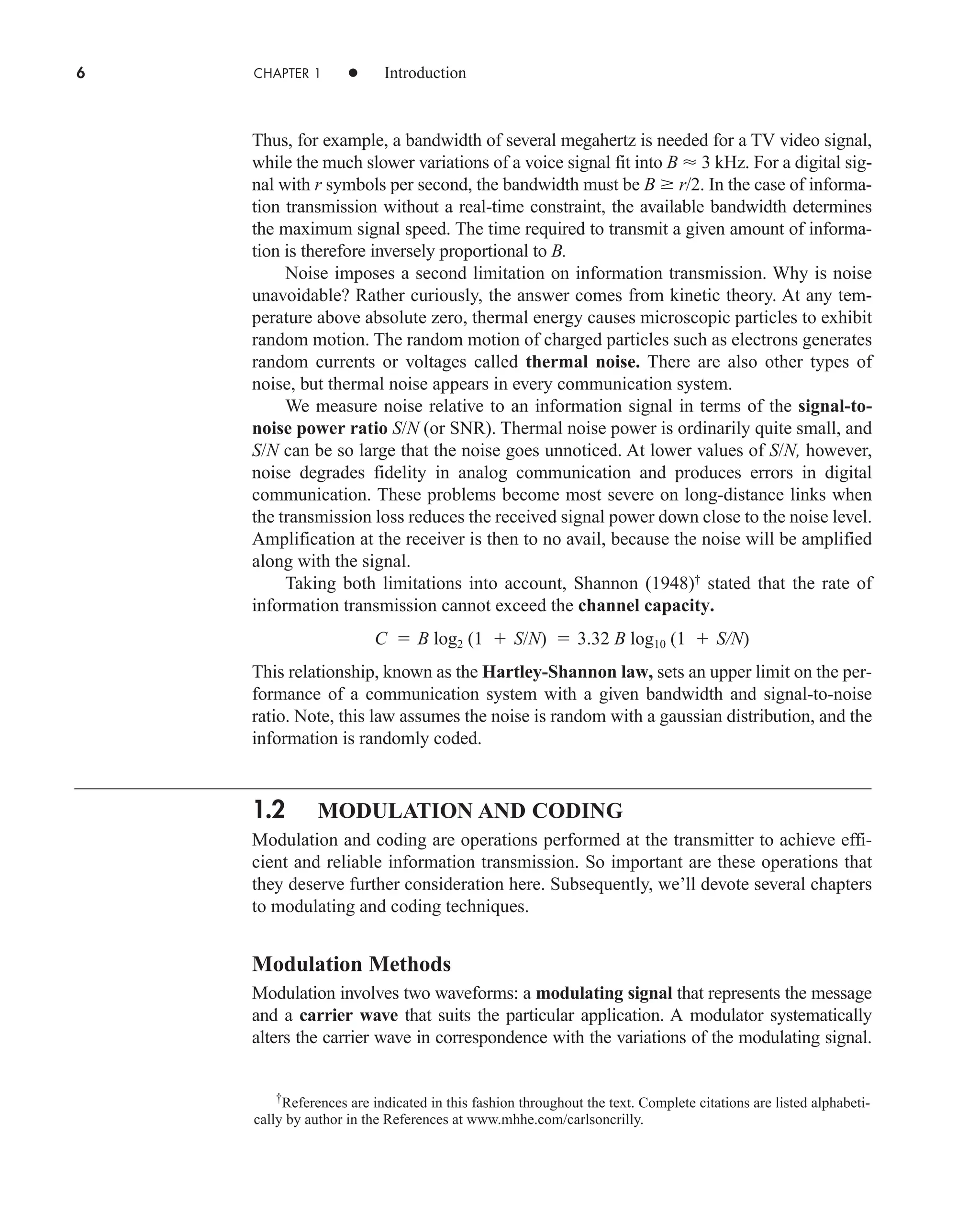
The resulting modulated wave thereby “carries” the message information. We generally
require that modulation be a reversible operation, so the message can be retrieved by the
complementary process of demodulation.
Figure 1.2–1 depicts a portion of an analog modulating signal (part a) and the cor-
responding modulated waveform obtained by varying the amplitude of a sinusoidal
carrier wave (part b). This is the familiar amplitude modulation (AM) used for radio
broadcasting and other applications. A message may also be impressed on a sinusoidal
carrier by frequency modulation (FM) or phase modulation (PM). All methods for
sinusoidal carrier modulation are grouped under the heading of continuous-wave
(CW) modulation.
Incidentally, you act as a CW modulator whenever you speak. The transmission
of voice through air is accomplished by generating carrier tones in the vocal cords
and modulating these tones with muscular actions of the oral cavity. Thus, what the
ear hears as speech is a modulated acoustic wave similar to an AM signal.
Most long-distance transmission systems employ CW modulation with a carrier
frequency much higher than the highest frequency component of the modulating sig-
nal. The spectrum of the modulated signal then consists of a band of frequency com-
ponents clustered around the carrier frequency. Under these conditions, we say that
CW modulation produces frequency translation. In AM broadcasting, for example,
the message spectrum typically runs from 100 Hz to 5 kHz; if the carrier frequency is
600 kHz, then the spectrum of the modulated carrier covers 595–605 kHz.
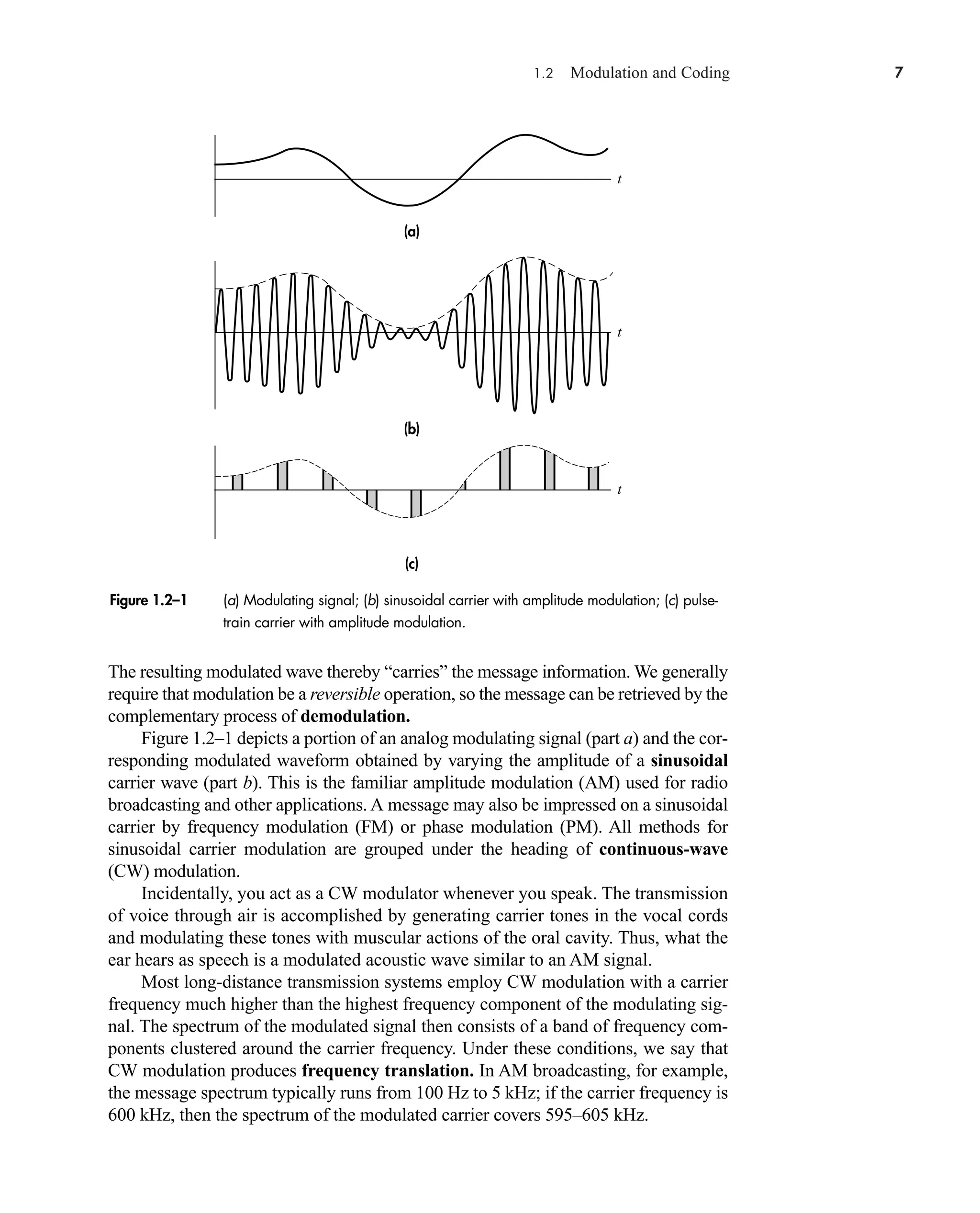
Figure 1.2–1 (a) Modulating signal; (b) sinusoidal carrier with amplitude modulation; (c) pulse-
train carrier with amplitude modulation.
car80407_ch01_001-026.qxd 12/8/08 10:21 PM Page 7
Confirming Pages
8 CHAPTER 1 • Introduction
Another modulation method, called pulse modulation, has a periodic train of
short pulses as the carrier wave. Figure 1.2–1c shows a waveform with pulse ampli-
tude modulation (PAM). Notice that this PAM wave consists of short samples
extracted from the analog signal at the top of the figure. Sampling is an important
signal-processing technique, and, subject to certain conditions, it’s possible to
reconstruct an entire waveform from periodic samples.
But pulse modulation by itself does not produce the frequency translation needed
for efficient signal transmission. Some transmitters therefore combine pulse and CW
modulation. Other modulation techniques, described shortly, combine pulse modula-
tion with coding.
Modulation Benefits and Applications
The primary purpose of modulation in a communication system is to generate a mod-
ulated signal suited to the characteristics of the transmission channel. Actually, there
are several practical benefits and applications of modulation briefly discussed below.
Modulation for Efficient Transmission Signal transmission over appreciable distance
always involves a traveling electromagnetic wave, with or without a guiding medium.
The efficiency of any particular transmission method depends upon the frequency of
the signal being transmitted. By exploiting the frequency-translation property of CW
modulation, message information can be impressed on a carrier whose frequency has
been selected for the desired transmission method.
As a case in point, efficient line-of-sight ratio propagation requires antennas
whose physical dimensions are at least 1/10 of the signal’s wavelength. Unmodu-
lated transmission of an audio signal containing frequency components down to
100 Hz would thus call for antennas some 300 km long. Modulated transmission at
100 MHz, as in FM broadcasting, allows a practical antenna size of about one meter.
At frequencies below 100 MHz, other propagation modes have better efficiency with
reasonable antenna sizes.
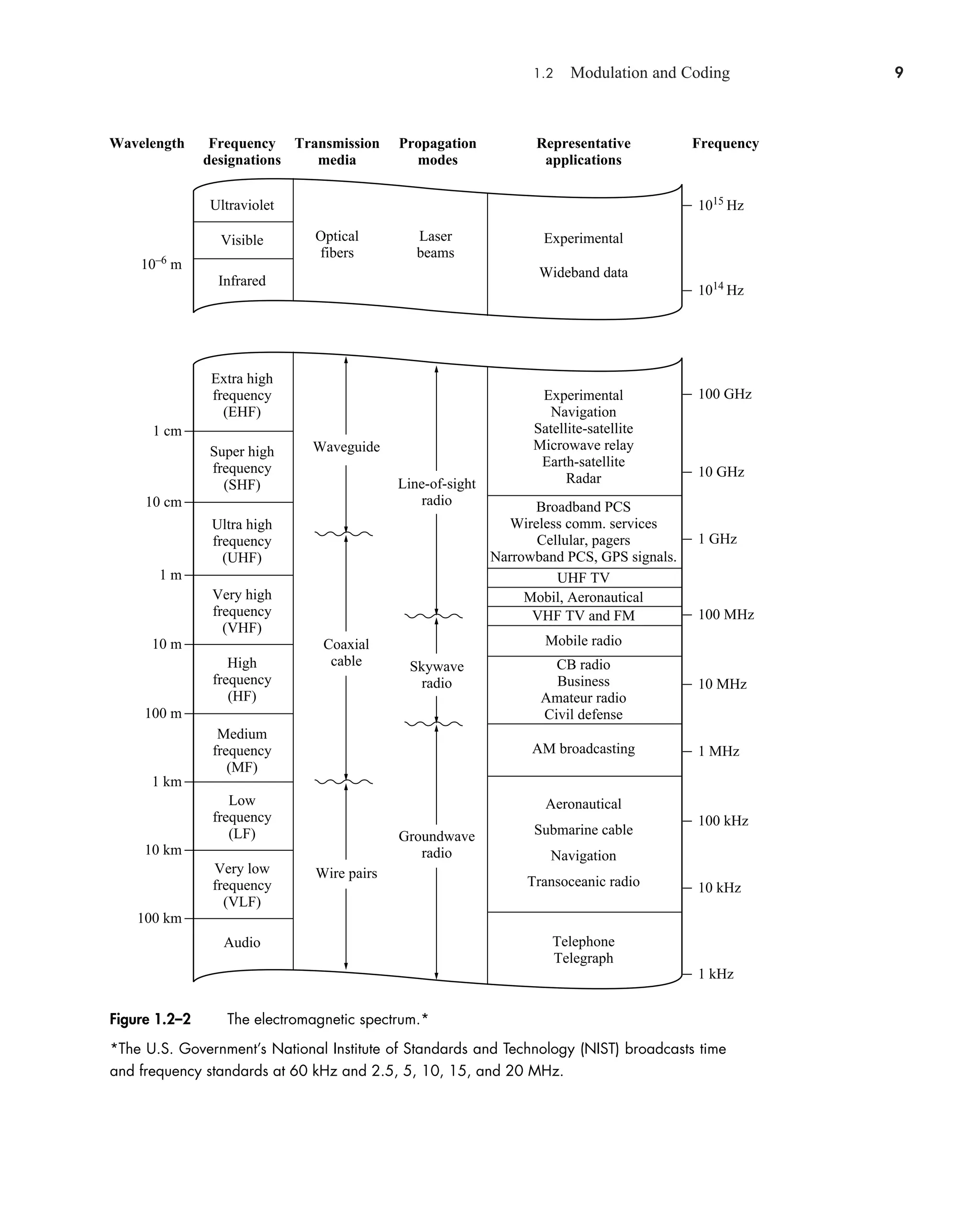
For reference purposes, Fig. 1.2–2 shows those portions of the electromagnetic
spectrum suited to signal transmission. The figure includes the free-space wavelength,
frequency-band designations, and typical transmission media and propagation modes.
Also indicated are representative applications authorized by the U.S. Federal Commu-
nications Commission (FCC). See http://www.ntia.doc.gov/osmhome/chap04chart.pdf
for a complete description of U.S. frequency allocations. It should be noted that,
throughout the spectrum, the FCC has authorized industrial, scientific, and medical
(ISM) bands.†
These bands allow limited power transmission from various wireless
industrial, medical, and experimental transmitting devices as well as unintentional radi-
ators such as microwave ovens, etc. It is understood that ISM users in these bands must
tolerate interference from inputs from other ISM radiators.
†
ISM bands with center frequencies include 6.789 MHz, 13.560 MHz, 27.120 MHz, 40.68 MHz,
915 MHz, 2.45 GHz, 5.8 GHz, 24.125 GHz, 61.25 GHz, 122.5 GHz, and 245 GHz.
car80407_ch01_001-026.qxd 12/8/08 10:21 PM Page 8
Confirming Pages
1.2 Modulation and Coding 9
1014
Hz
1015
Hz
100 GHz
10 GHz
1 GHz
100 MHz
10 MHz
1 MHz
100 kHz
10 kHz
1 kHz
1 cm
10 cm
1 m
10 m
100 m
1 km
10 km
100 km
10–6
m
Frequency
designations
Wavelength Frequency
Ultraviolet
Visible
Infrared
Extra high
frequency
(EHF)
Super high
frequency
(SHF)
Ultra high
frequency
(UHF)
Very high
frequency
(VHF)
High
frequency
(HF)
Medium
frequency
(MF)
Low
frequency
(LF)
Very low
frequency
(VLF)
Audio
Transmission
media
Optical
fibers
Laser
beams
Waveguide
Coaxial
cable
Wire pairs
Line-of-sight
radio
Skywave
radio
Groundwave
radio
Propagation
modes
Representative
applications
Experimental
Wideband data
Experimental
Navigation
Satellite-satellite
Microwave relay
Earth-satellite
Radar
Broadband PCS
Wireless comm. services
Cellular, pagers
Narrowband PCS, GPS signals.
UHF TV
Mobil, Aeronautical
VHF TV and FM
Mobile radio
CB radio
Business
Amateur radio
Civil defense
AM broadcasting
Aeronautical
Submarine cable
Navigation
Transoceanic radio
Telephone
Telegraph
Figure 1.2–2 The electromagnetic spectrum.*
*The U.S. Government’s National Institute of Standards and Technology (NIST) broadcasts time
and frequency standards at 60 kHz and 2.5, 5, 10, 15, and 20 MHz.
car80407_ch01_001-026.qxd 12/8/08 10:21 PM Page 9
Confirming Pages
10 CHAPTER 1 • Introduction
Modulation to Overcome Hardware Limitations The design of a communication sys-
tem may be constrained by the cost and availability of hardware, hardware whose
performance often depends upon the frequencies involved. Modulation permits the
designer to place a signal in some frequency range that avoids hardware limitations.
A particular concern along this line is the question of fractional bandwidth, defined
as absolute bandwidth divided by the center frequency. Hardware costs and compli-
cations are minimized if the fractional bandwidth is kept within 1–10 percent.
Fractional-bandwidth considerations account for the fact that modulation units are
found in receivers as well as in transmitters.
It likewise follows that signals with large bandwidth should be modulated on high-
frequency carriers. Since information rate is proportional to bandwidth, according to
the Hartley-Shannon law, we conclude that a high information rate requires a high
carrier frequency. For instance, a 5 GHz microwave system can accommodate
10,000 times as much information in a given time interval as a 500 kHz radio channel.
Going even higher in the electromagnetic spectrum, one optical laser beam has a
bandwidth potential equivalent to 10 million TV channels.
Modulation to Reduce Noise and Interference A brute-force method for combating
noise and interference is to increase the signal power until it overwhelms the con-
taminations. But increasing power is costly and may damage equipment. (One of the
early transatlantic cables was apparently destroyed by high-voltage rupture in an
effort to obtain a usable received signal.) Fortunately, FM and certain other types of
modulation have the valuable property of suppressing both noise and interference.
This property is called wideband noise reduction because it requires the trans-
mission bandwidth to be much greater than the bandwidth of the modulating signal.
Wideband modulation thus allows the designer to exchange increased bandwidth for
decreased signal power, a trade-off implied by the Hartley-Shannon law. Note that a
higher carrier frequency may be needed to accommodate wideband modulation.
Modulation for Frequency Assignment When you tune a radio or television set to a
particular station, you are selecting one of the many signals being received at that
time. Since each station has a different assigned carrier frequency, the desired signal
can be separated from the others by filtering. Were it not for modulation, only one
station could broadcast in a given area; otherwise, two or more broadcasting stations
would create a hopeless jumble of interference.
Modulation for Multiplexing Multiplexing is the process of combining several signals
for simultaneous transmission on one channel. Frequency-division multiplexing
(FDM) uses CW modulation to put each signal on a different carrier frequency, and a
bank of filters separates the signals at the destination. Time-division multiplexing
(TDM) uses pulse modulation to put samples of different signals in nonoverlapping
time slots. Back in Fig. 1.2–1c, for instance, the gaps between pulses could be filled
with samples from other signals. A switching circuit at the destination then separates
the samples for signal reconstruction. Applications of multiplexing include FM stereo-
phonic broadcasting, cable TV, and long-distance telephone.
car80407_ch01_001-026.qxd 12/8/08 10:21 PM Page 10
Confirming Pages
1.2 Modulation and Coding 11
A variation of multiplexing is multiple access (MA). Whereas multiplexing
involves a fixed assignment of the common communications resource (such as fre-
quency spectrum) at the local level, MA involves the remote sharing of the resource.
For example, code-division multiple access (CDMA) assigns a unique code to each
digital cellular user, and the individual transmissions are separated by correlation
between the codes of the desired transmitting and receiving parties. Since CDMA
allows different users to share the same frequency band simultaneously, it provides
another way of increasing communication efficiency.
Coding Methods and Benefits
We’ve described modulation as a signal-processing operation for effective transmis-
sion. Coding is a symbol-processing operation for improved communication
when the information is digital or can be approximated in the form of discrete sym-
bols. Both coding and modulation may be necessary for reliable long-distance digital
transmission.
The operation of encoding transforms a digital message into a new sequence of
symbols. Decoding converts an encoded sequence back to the original message
with, perhaps, a few errors caused by transmission contaminations. Consider a com-
puter or other digital source having M W 2 symbols. Uncoded transmission of a
message from this source would require M different waveforms, one for each sym-
bol. Alternatively, each symbol could be represented by a binary codeword consist-
ing of K binary digits. Since there are 2K
possible codewords made up of K binary
digits, we need K  log2 M digits per codeword to encode M source symbols. If the
source produces r symbols per second, the binary code will have Kr digits per sec-
ond, and the transmission bandwidth requirement is K times the bandwidth of an
uncoded signal.
In exchange for increased bandwidth, binary encoding of M-ary source symbols
offers two advantages. First, less complicated hardware is needed to handle a binary
signal composed of just two different waveforms. Second, everything else being
equal, contaminating noise has less effect on a binary signal than it does on a signal
composed of M different waveforms, so there will be fewer errors caused by the
noise. Hence, this coding method is essentially a digital technique for wideband
noise reduction. The exception to the above rule would be if each of the M dif-
ferent waveforms were transmitted on a different frequency, space, or were mutually
orthogonal.
Channel coding is a technique used to introduce controlled redundancy to fur-
ther improve the performance reliability in a noisy channel. Error-control coding
goes further in the direction of wideband noise reduction. By appending extra check
digits to each binary codeword, we can detect, or even correct, most of the errors that
do occur. Error-control coding increases both bandwidth and hardware complexity,
but it pays off in terms of nearly error-free digital communication despite a low
signal-to-noise ratio.
Now, let’s examine the other fundamental system limitation: bandwidth. Many
communication systems rely on the telephone network for transmission. Since the
car80407_ch01_001-026.qxd 12/8/08 10:21 PM Page 11
Confirming Pages
12 CHAPTER 1 • Introduction
bandwidth of the transmission system is limited by decades-old design specifica-
tions, in order to increase the data rate, the signal bandwidth must be reduced. High-
speed modems (data modulator/demodulators) are one application requiring such
data reduction. Source-coding techniques take advantage of the statistical knowl-
edge of the source signal to enable efficient encoding. Thus, source coding can be
viewed as the dual of channel coding in that it reduces redundancy to achieve the
desired efficiency.
Finally, the benefits of digital coding can be incorporated in analog communi-
cation with the help of an analog-to-digital conversion method such as pulse-code-
modulation (PCM). A PCM signal is generated by sampling the analog message,
digitizing (quantizing) the sample values, and encoding the sequence of digitized
samples. In view of the reliability, versatility, and efficiency of digital transmission,
PCM has become an important method for analog communication. Furthermore,
when coupled with high-speed microprocessors, PCM makes it possible to substitute
digital signal processing for analog operations.
1.3 ELECTROMAGNETIC WAVE PROPAGATION
OVER WIRELESS CHANNELS
Over 100 years ago, Marconi established the first wireless communication between
North America and Europe. Today, wireless communication is more narrowly defined
to primarily mean the ubiquitous cell phones, wireless computer networks, other
personal communication devices, and wireless sensors.
Like light waves, radio signals by nature only travel in a straight line, and there-
fore propagation beyond line-of-sight (LOS) requires a means of deflecting the
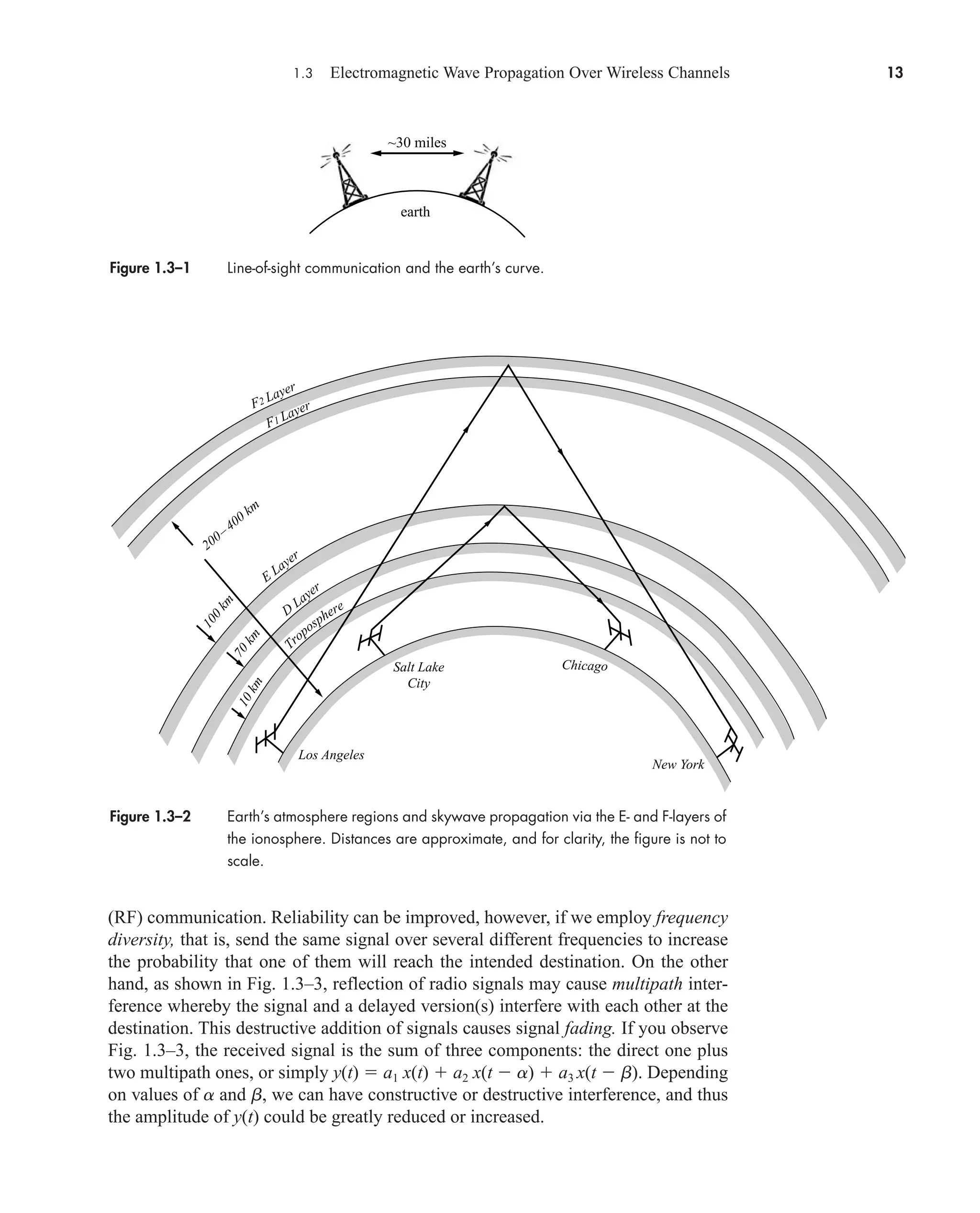
waves. Given that the earth is spherical, the practical distance for LOS communica-
tion is approximately 48 kM, or 30 miles, depending on the terrain and the height of
the antennas, as illustrated in Fig. 1.3–1. In order to maximize coverage, therefore,
television broadcast antennas and cell-phone base antennas are usually located on
hills, high towers, and/or mountains.
However, there are several effects that enable light as well as electromagnetic
(EM) waves to propagate around obstructions or beyond the earth’s horizon. These
are refraction, diffraction, reflection, and scattering. These mechanisms can be both
useful and troublesome to the radio engineer. For example, before satellite technol-
ogy, international broadcasts and military communications took advantage of the
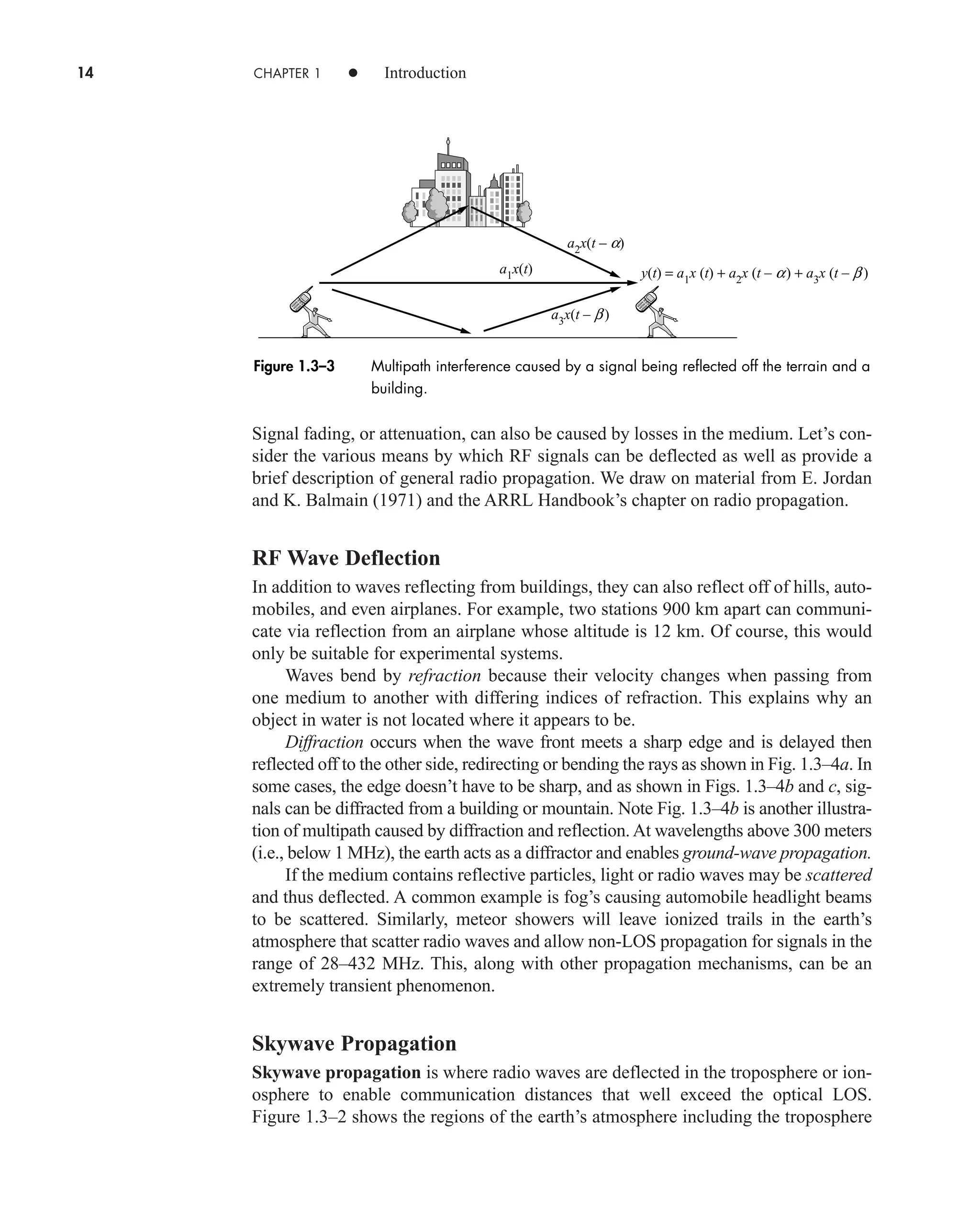
fact that the ionosphere’s F-layer reflects†
short-wave radio signals, as shown in
Fig. 1.3–2. Here signals from Los Angeles (LA) travel 3900 km to New York City
(NY). However, the ability to reach a specific destination using ionospheric reflec-
tion is dependent on the frequency, type of antenna, solar activity, and other phe-
nomena that affect the ionosphere. We also observe that, while our signal of interest
will propagate from LA to NY, it will likely skip over Salt Lake City and Chicago.
Therefore, ionospheric propagation is a relatively unreliable means of radio frequency
†
Radio waves actually refract off the ionosphere. See further discussion.
car80407_ch01_001-026.qxd 12/8/08 10:21 PM Page 12
Confirming Pages
1.3 Electromagnetic Wave Propagation Over Wireless Channels 13
Figure 1.3–1 Line-of-sight communication and the earth’s curve.
Figure 1.3–2 Earth’s atmosphere regions and skywave propagation via the E- and F-layers of
the ionosphere. Distances are approximate, and for clarity, the figure is not to
scale.
(RF) communication. Reliability can be improved, however, if we employ frequency
diversity, that is, send the same signal over several different frequencies to increase
the probability that one of them will reach the intended destination. On the other
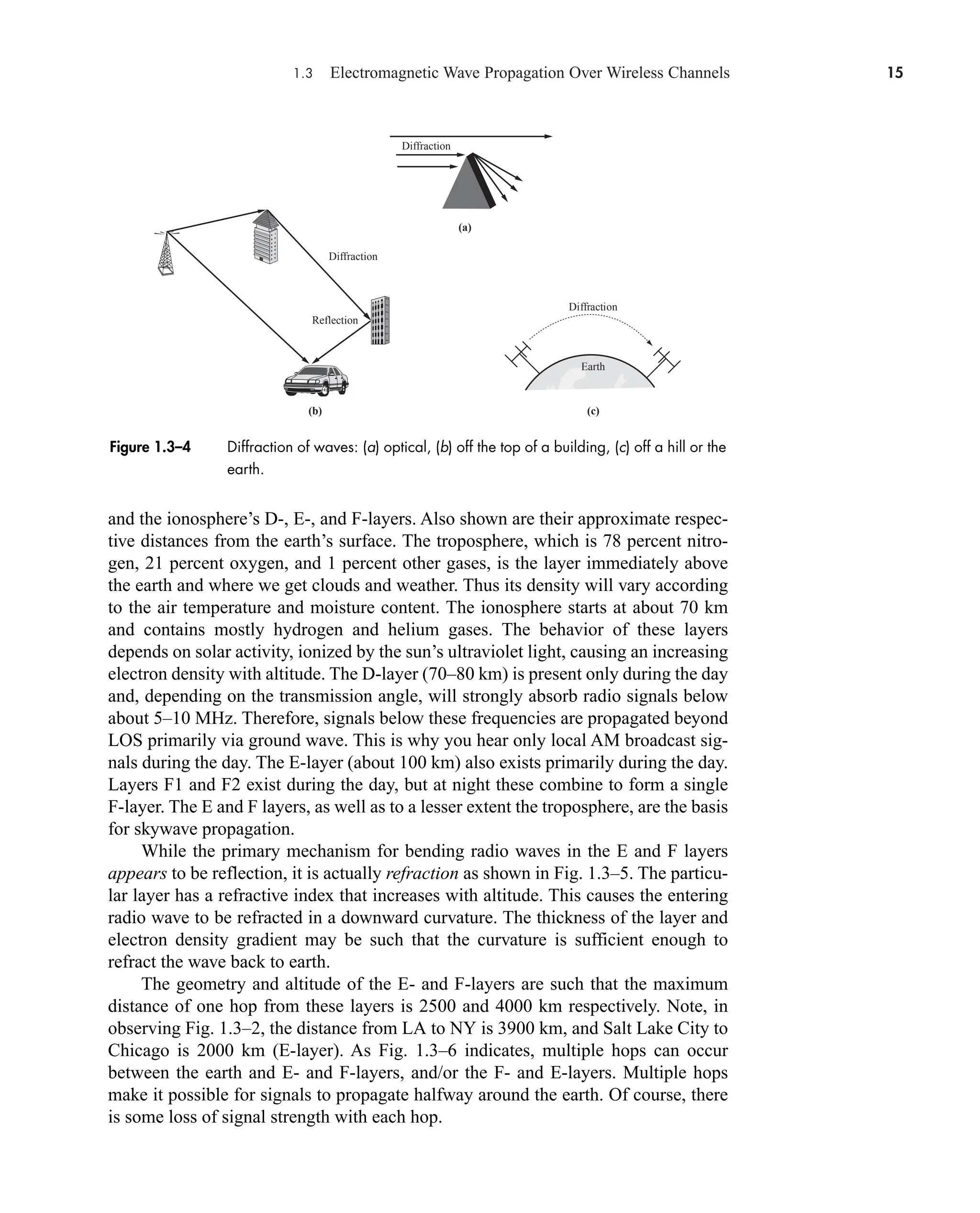
hand, as shown in Fig. 1.3–3, reflection of radio signals may cause multipath inter-
ference whereby the signal and a delayed version(s) interfere with each other at the
destination. This destructive addition of signals causes signal fading. If you observe
Fig. 1.3–3, the received signal is the sum of three components: the direct one plus
two multipath ones, or simply y(t)  a1 x(t)  a2 x(t  a)  a3 x(t  b). Depending
on values of a and b, we can have constructive or destructive interference, and thus
the amplitude of y(t) could be greatly reduced or increased.
Los Angeles
Chicago
Salt Lake
City
New York
D
Layer
E
Layer
F2 Layer
F1 Layer
200–400 km
1
0
0
k
m
7
0
k
m
1
0
k
m
T
roposphere
~30 miles
earth
car80407_ch01_001-026.qxd 12/8/08 10:21 PM Page 13
Confirming Pages
14 CHAPTER 1 • Introduction
Signal fading, or attenuation, can also be caused by losses in the medium. Let’s con-
sider the various means by which RF signals can be deflected as well as provide a
brief description of general radio propagation. We draw on material from E. Jordan
and K. Balmain (1971) and the ARRL Handbook’s chapter on radio propagation.
RF Wave Deflection
In addition to waves reflecting from buildings, they can also reflect off of hills, auto-
mobiles, and even airplanes. For example, two stations 900 km apart can communi-
cate via reflection from an airplane whose altitude is 12 km. Of course, this would
only be suitable for experimental systems.
Waves bend by refraction because their velocity changes when passing from
one medium to another with differing indices of refraction. This explains why an
object in water is not located where it appears to be.
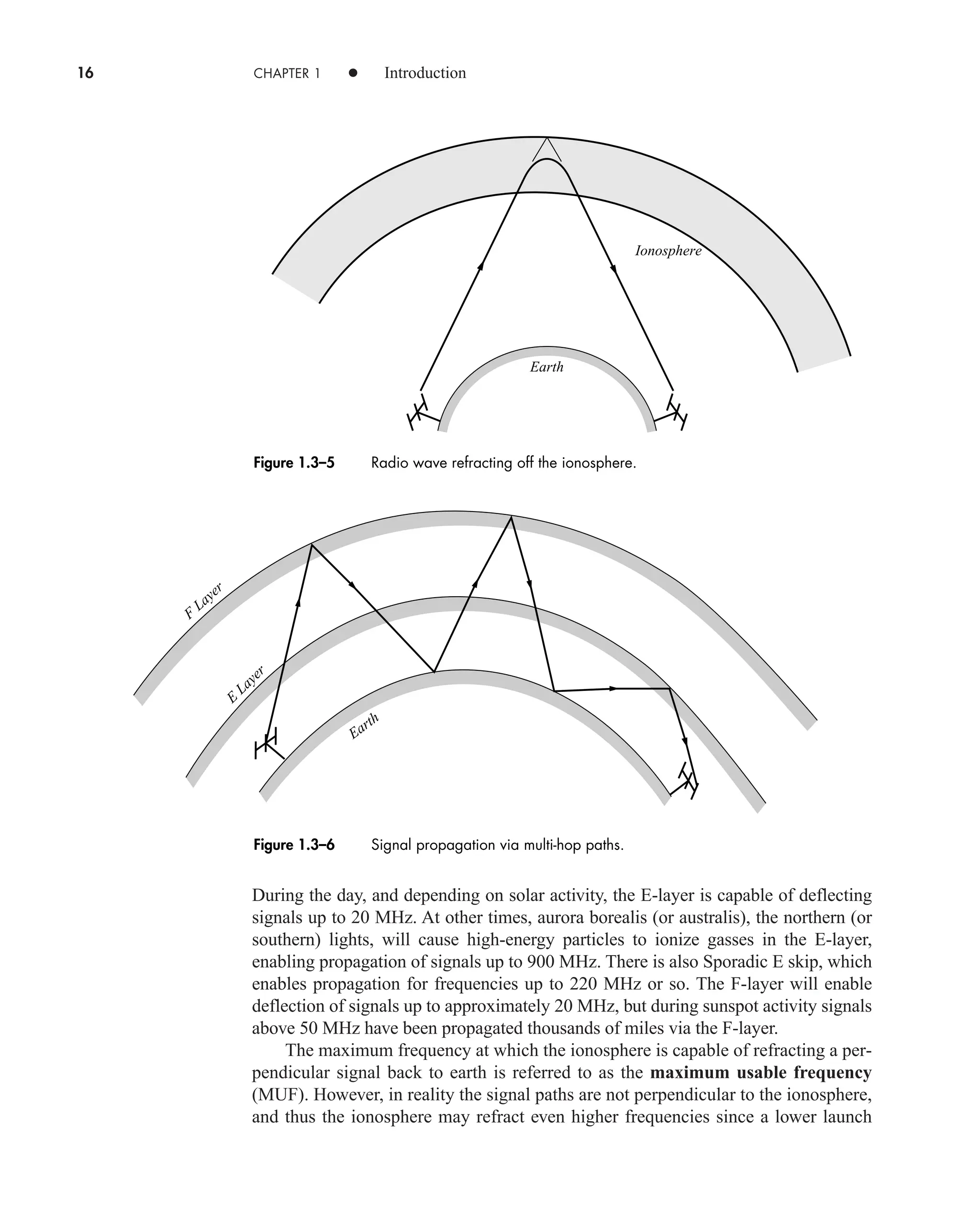
Diffraction occurs when the wave front meets a sharp edge and is delayed then
reflected off to the other side, redirecting or bending the rays as shown in Fig. 1.3–4a. In
some cases, the edge doesn’t have to be sharp, and as shown in Figs. 1.3–4b and c, sig-
nals can be diffracted from a building or mountain. Note Fig. 1.3–4b is another illustra-
tion of multipath caused by diffraction and reflection.At wavelengths above 300 meters
(i.e., below 1 MHz), the earth acts as a diffractor and enables ground-wave propagation.
If the medium contains reflective particles, light or radio waves may be scattered
and thus deflected. A common example is fog’s causing automobile headlight beams
to be scattered. Similarly, meteor showers will leave ionized trails in the earth’s
atmosphere that scatter radio waves and allow non-LOS propagation for signals in the
range of 28–432 MHz. This, along with other propagation mechanisms, can be an
extremely transient phenomenon.
Skywave Propagation
Skywave propagation is where radio waves are deflected in the troposphere or ion-
osphere to enable communication distances that well exceed the optical LOS.
Figure 1.3–2 shows the regions of the earth’s atmosphere including the troposphere
a2x(t – a)
a3x(t – b )
y(t) = a1x (t) + a2x (t – a) + a3x (t – b )
a1
x(t)
Figure 1.3–3 Multipath interference caused by a signal being reflected off the terrain and a
building.
car80407_ch01_001-026.qxd 12/8/08 10:21 PM Page 14
Confirming Pages
1.3 Electromagnetic Wave Propagation Over Wireless Channels 15
(b) (c)
(a)
Reflection
Diffraction
Diffraction
Earth
Diffraction
Figure 1.3–4 Diffraction of waves: (a) optical, (b) off the top of a building, (c) off a hill or the
earth.
and the ionosphere’s D-, E-, and F-layers. Also shown are their approximate respec-
tive distances from the earth’s surface. The troposphere, which is 78 percent nitro-
gen, 21 percent oxygen, and 1 percent other gases, is the layer immediately above
the earth and where we get clouds and weather. Thus its density will vary according
to the air temperature and moisture content. The ionosphere starts at about 70 km
and contains mostly hydrogen and helium gases. The behavior of these layers
depends on solar activity, ionized by the sun’s ultraviolet light, causing an increasing
electron density with altitude. The D-layer (70–80 km) is present only during the day
and, depending on the transmission angle, will strongly absorb radio signals below
about 5–10 MHz. Therefore, signals below these frequencies are propagated beyond
LOS primarily via ground wave. This is why you hear only local AM broadcast sig-
nals during the day. The E-layer (about 100 km) also exists primarily during the day.
Layers F1 and F2 exist during the day, but at night these combine to form a single
F-layer. The E and F layers, as well as to a lesser extent the troposphere, are the basis
for skywave propagation.
While the primary mechanism for bending radio waves in the E and F layers
appears to be reflection, it is actually refraction as shown in Fig. 1.3–5. The particu-
lar layer has a refractive index that increases with altitude. This causes the entering
radio wave to be refracted in a downward curvature. The thickness of the layer and
electron density gradient may be such that the curvature is sufficient enough to
refract the wave back to earth.
The geometry and altitude of the E- and F-layers are such that the maximum
distance of one hop from these layers is 2500 and 4000 km respectively. Note, in
observing Fig. 1.3–2, the distance from LA to NY is 3900 km, and Salt Lake City to
Chicago is 2000 km (E-layer). As Fig. 1.3–6 indicates, multiple hops can occur
between the earth and E- and F-layers, and/or the F- and E-layers. Multiple hops
make it possible for signals to propagate halfway around the earth. Of course, there
is some loss of signal strength with each hop.
car80407_ch01_001-026.qxd 12/22/08 3:53 PM Page 15
Rev. Confirming Pages
16 CHAPTER 1 • Introduction
During the day, and depending on solar activity, the E-layer is capable of deflecting
signals up to 20 MHz. At other times, aurora borealis (or australis), the northern (or
southern) lights, will cause high-energy particles to ionize gasses in the E-layer,
enabling propagation of signals up to 900 MHz. There is also Sporadic E skip, which
enables propagation for frequencies up to 220 MHz or so. The F-layer will enable
deflection of signals up to approximately 20 MHz, but during sunspot activity signals
above 50 MHz have been propagated thousands of miles via the F-layer.
The maximum frequency at which the ionosphere is capable of refracting a per-
pendicular signal back to earth is referred to as the maximum usable frequency
(MUF). However, in reality the signal paths are not perpendicular to the ionosphere,
and thus the ionosphere may refract even higher frequencies since a lower launch
Earth
Ionosphere
Figure 1.3–5 Radio wave refracting off the ionosphere.
Earth
F
Layer
E
Layer
Figure 1.3–6 Signal propagation via multi-hop paths.
car80407_ch01_001-026.qxd 12/8/08 10:21 PM Page 16
Confirming Pages
1.4 Emerging Developments 17
angle encounters a thicker layer. The MUF will vary depending on solar activity, but
is usually at least 14 MHz, even if for a few hours each day.
Similarly, temperature inversions, moisture, and other weather conditions in the
troposphere may refract or scatter the radio wave. Even under normal circumstances,
because air has a nonhomogenous index of refraction, horizontal waves will have a
downward curvature and thus be capable of traveling just beyond LOS. In any case,
troposphere bending, or tropo scatter, primarily affects signals above 30 MHz. While
this is a short-term effect, there have been cases where 220 and 432 MHz signals
have traveled more than 2500 miles.
We summarize with the following statements with respect to propagation via the
atmosphere: (a) The ionosphere will enable signals below the MUF to propagate
great distances beyond LOS, but may skip over the intended destination; thus, we
have to employ frequency diversity and different antenna angles to increase the prob-
ability of the signal’s reaching its destination. (b) There can be a great variation in
the MUF depending on solar activity. (c) Signal propagation beyond LOS for fre-
quencies above 14–30 MHz is extremely transient and unreliable. This is why we
now use satellites for reliable communications for signals above 30 MHz. (d) While
propagation beyond LOS using the atmosphere as well as other objects is not
dependable, when it does occur it can cause interference between different users as
well as multipath interference. The radio engineer needs to be aware of all of the
mentioned propagation modes and design a system accordingly.
1.4 EMERGING DEVELOPMENTS
Traditional telephone communication has been implemented via circuit switching,
as shown in Fig. 1.4–1a, in which a dedicated (or a virtual) line is assigned to con-
nect the source and destination. The Internet, originally designed for efficient and
fast text and data transmission, uses packet switching in which the data stream is
broken up into packets and then routed to the destination via a set of available chan-
nels to be reconstructed at the destination. Fig. 1.4–1b shows how telephone and text
information is sent via packet switching. Packet switching is more efficient than cir-
cuit switching if the data are bursty or intermittent, as is the case with text, but would
not normally be tolerated for voice telephone. With the continued development of
high-speed data routers and with the existing cable television infrastructure, Internet
telephone, or Voice-over-Internet Protocol (VoIP), is becoming a viable alternative
to standard telephone circuit switching. In fact, third-generation (3G) wireless
phones will primarily use packet switching.
3G wireless systems, or Universal Mobile Telecommunications Systems (UMTS),
are the successor to the original first- and second-generation (1G and 2G) voice-only
cell-phone systems. 3G is now a global standard for wireless phone networks and
has the following features: (a) voice and data, (b) packet-only switching (some systems
are compatible with circuit switching), (c) code division multiple access (CDMA), (d)
full global roaming, and (e) evolutionary migration from the existing base of 2G sys-
tems. For example, 2.5G cell phone systems are a combination of voice and data. See
car80407_ch01_001-026.qxd 12/8/08 10:21 PM Page 17
18 CHAPTER 1 • Introduction
Goodman and Myers (2005) and Ames and Gabor (2000) for more information on 3G
standards.
In addition to packet switching, there has been continued development of better
multiple access methods to enable ways to more efficiently utilize an existing chan-
nel. In the case of wireless or cell phones, this enables lower cost service and more
users per cell without degradation in quality of service (QoS). The traditional meth-
ods include frequency, time, and code division multiple access (FDMA, TDMA, and
CDMA). FDMA and TDMA are covered in Chap. 7, and CDMA, which uses direct
sequence spread spectrum, is covered in Chap. 15. FDMA and TDMA share a chan-
nel via an assigned frequency or time slot respectively. In both of these methods, too
many users on a channel will cause cross-talk such that one user may hear the other’s
conversation in the background. Thus with FDMA and TDMA there is the proverbial
trade-off between interference and economics. This is particularly the case with cell
phones, where we have to set a hard limit on the number of users per cell. This hard
limit prevents additional users from making calls even though some other existing
user will soon be hanging up and releasing the frequency or time slot. On the other
hand, with CDMA an unauthorized listener will hear only noise, and thus when some-
one wants to make a phone call in an already busy cell area, the additional CDMA
user will temporarily raise the level of background noise since someone else is soon
likely to be hanging up. Therefore, we can set a soft limit to the number of CDMA
users per cell and allow more users per cell. This is one important reason why CDMA
VOIP
Router “Hey Mom!”
Router
“Hey Mom!”
t
y
e
m
x
M
x
o
T
H
!
e
Digitizedvoice symbols
divided up into packets
that will flow over
6 channels
Voice symbolsreconstructedby
putting packets in their
proper order
Packet flow
Channel
1
2
3
7
5
6
(b)
Router
VOIP
Router
“Text” “Text”
Received text
Sent text
“Hey Mom!” “Hey Mom!”
(a)
Figure 1.4–1 (a) Standard telephone lines that use circuit switching, (b) Internet telephone
(VoIP) using packet switching and someone else communicating via the
Internet.
car80407_ch01_001-026.qxd 12/16/08 11:06 PM Page 18
1.4 Emerging Developments 19
is being used in 3G wireless systems. CDMA also reduces the multipath problem
since the multipath component is treated as another user.
Orthogonal frequency division multiplexing (OFDM) is a variation of fre-
quency division multiplexing (FDM) in which we can reduce interference between
users by selecting a set of carrier frequencies that are orthogonal to each other.
Another application of OFDM is that, instead of sending a message at a high rate
over a single channel, we can send the same message over several channels at a
lower rate; this reduces the problem of multipath. OFDM is covered in Chap. 14 and
is used widely in wireless computer networks such as Wi-Fi and WiMax.
Ultra-wideband (UWB) systems can operate at average power levels below the
ambient levels of existing RF interference, or in other words, the power output of a
UWB is below such unintentional radiators as computer boards and other digital
logic hardware. Recent Federal Communications Commission (FCC) guidelines
allow for unlicensed UWB operation from approximately 3.1 to 10.6 GHz at power
levels not to exceed –41 dBm. This combined with continued development of UWB
technology will enable greater use of the RF spectrum and thus allow for even more
users and services on the RF spectrum.
Computer networks Wi-Fi (or IEEE 802.11) and WiMax (or IEEE 802.16) are
two wireless computer network systems that have proliferated due to the FCC’s mak-
ing available portions of the 915 MHz, 2.45 GHz, and 5.8-GHz ISM as well as other
UHF and microwave bands available for communication purposes. Wi-Fi technology
is used in local area networks (LANs) such as those used by laptop computers seen in
coffee shops, etc, hence the often-used term “hot spots.” Its range is approximately a
hundred meters. WiMax is a mobile wireless system and often uses the existing cell
phone tower infrastructure and has a range comparable to that of cell phones. WiMax
has been touted as an alternative to wireless phones for data service and can be used as
an alternative to cable to enable Internet access in buildings. In other words, WiMax
can serve as the last mile for broadband connectivity. Note that WiMax, Wi-Fi, and cell
phones all operate on separate frequencies and thus are separate systems.
Software radio, or software-defined radio (SDR), as shown in the receiver of
Fig. 1.4–2a, is another relatively recent development in communication technology
that promises greater flexibility than is possible with standard analog circuit meth-
ods. The signal at the antenna is amplified by a radio frequency (RF) amplifier and
digitized using an analog-to-digital converter (ADC). The ADC’s output is fed to the
digital signal processor (DSP), which does the appropriate demodulation, and so on,
and then to the digital-to-analog converter (DAC), which changes it back to a form
the user can hear. A software radio transmitter would be the inverse. The flexibility
includes varying the parameters of station frequency, filter characteristics, modula-
tion types, gain, and so on, via software control. Note, in many cases, because of
technological hardware limitations particularly in the GHz frequency range, the
equipment is often a hybrid of analog and software radio. Software radios are often
implemented via field programmable gate arrays (FPGAs) wherein the transmitter or
receiver design is first developed in some high-level software language such as
Simulink, converted to VHSIC (very high speed integrated circuits) hardware
description language (VHDL) to be compiled, and then downloaded to the FPGA as
shown in Fig. 1.4–2b.
car80407_ch01_001-026.qxd 12/8/08 10:21 PM Page 19
20 CHAPTER 1 • Introduction
1.5 SOCIETAL IMPACT AND HISTORICAL
PERSPECTIVE
The tremendous technological advances of communication systems once again
affirms that “Engineers are the agents of social change”†
and are the driving force
behind drastic changes in public policy, whether it be privacy, commerce, or intellec-
tual property. These paradigm changes are all due to the diligence of engineers and
investors who create and develop the next generation of communications technology.
Let us cite some examples. At one time, telephone service was available only through
landlines and was a government-regulated monopoly. You paid a premium for long
distance and it was priced by the minute. Today, the consumer has the additional
choices of phone service through the Internet, simply Voice-Over-Internet Protocol
(VOIP), and the cell phone. These new technologies have removed the distinction
between local and long distance, and usually both are available for a low, fixed rate
regardless of the amount of time spent using the service, diminishing the role of gov-
ernment utility commissions. Similarly, with digital subscriber lines (DSLs), the
†
Daitch, P. B. “Introduction to College Engineering” (Reading, MA: Addison Wesley, 1973), p. 106.
(a)
ADC
RF
Amp.
Antenna
DSP DAC Destination
ADC
RF
Amp.
Antenna
FPGA
Compiler
Simulink
DAC Destination
(b)
Figure 1.4–2 (a) Software radio receiver, (b) software radio receiver implemented via an
FPGA.
car80407_ch01_001-026.qxd 12/16/08 11:06 PM Page 20
1.5 Societal Impact and Historical Perspective 21
telephone companies can also provide both standard phone and video services. WiMax
and, to a lesser extent, Wi-Fi technologies are diminishing the need for wired access
to the network. For example, just like cable can now provide a home or business with
video, data, and voice services, WiMax is expected to do the same. What is even more
interesting is that, unlike many cell phone providers that are part of a local telephone
company, WiMax companies are often small independent startups. Some of the moti-
vation for WiMax startups is to provide an alternative to the regulated local phone or
cable company (Andrews et al., 2007). Finally, television via satellite is now available
using dishes less than a meter in diameter, making it possible to receive satellite TV
without running afoul of local zoning restrictions. You can observe on any college
campus that most college students have a wireless phone service that can reach any-
where in the United States at a quality and cost rivaling those of landlines. Phones can
send and receive voice, music, text, and video information. E-commerce sales via
the Internet have forced state governments to rethink their sales tax policies, but at the
same time the VOIP and cell phone service has provided government another resource
to tax! The ubiquitous cell phone and Internet has made us all available “24/7” no mat-
ter where we are. An employee who wants to take his or her vacation in some remote
spot to “get away from it all” may now have to politely tell the employer that he or she
does not want to be reached by cell phone and that, since there will be no “hot spots,”
he or she will not be checking email. Internet and digital recording techniques that
make it easier to download music and video content have caused the recording indus-
try to rethink their business model as well as find new ways to protect their copyrights.
However, this upheaval in public policy and societal norms driven by advances in
communication science and technology has really always been the case. The dynamics of
diplomacy drastically changed after the mid 1800s with the laying down of transoceanic
telegraph cables, whereas previously, international diplomacy had been limited by the
speed of ship or ground travel, which could take months. Prior to the telegraph, high-
speed communication was a fast runner or perhaps smoke signals. The advent of wireless
communication allowed for rapid military communications, but it also enabled intercep-
tion, code breaking, and jamming by rival states and thus has affected the outcomes of
wars and diplomacy. It has been said that many national upheavals and revolutions have
been facilitated by citizens’being able to easily and quickly communicate with outsiders
via Internet or fax. Whether it be by creating the annoyance of a cell phone going off in a
theater or influencing the outcome of a major political conflict, the communications
engineers have had and will continue to have a significant impact on society.
Historical Perspective
The organization of this text is dictated by pedagogical considerations and does not
necessarily reflect the evolution of communication systems. To provide at least some
historical perspective, a chronological outline of electrical communication is pre-
sented in Table 1.5–1. The table lists key inventions, scientific discoveries, and
important papers and the names associated with these events.
Several of the terms in the chronology have been mentioned already, while oth-
ers will be described in later chapters when we discuss the impact and interrelation-
ships of particular events.You may therefore find it helpful to refer back to this table
from time to time.
car80407_ch01_001-026.qxd 12/8/08 10:21 PM Page 21
22 CHAPTER 1 • Introduction
Table 1.5–1 A chronology of electrical communication
Year Event
1800–1837 Preliminary developments Volta discovers the primary battery; the mathematical
treatises by Fourier, Cauchy, and Laplace; experiments on electricity and magnetism
by Oersted, Ampere, Faraday, and Henry; Ohm’s law (1826); early telegraph systems
by Gauss, Weber, and Wheatstone.
1838–1866 Telegraphy Morse perfects his system; Steinheil finds that the earth can be used for a
current path; commercial service initiated (1844); multiplexing techniques devised;
William Thomson (Lord Kelvin) calculates the pulse response of a telegraph line
(1855); transatlantic cables installed by Cyrus Field and associates.
1845 Kirchhoff’s circuit laws enunciated.
1864 Maxwell’s equations predict electromagnetic radiation.
1876–1899 Telephony Acoustic transducer perfected by Alexander Graham Bell, after earlier
attempts by Reis; first telephone exchange, in New Haven, with eight lines (1878);
Edison’s carbon-button transducer; cable circuits introduced; Strowger devises auto-
matic step-by-step switching (1887); the theory of cable loading by Heaviside, Pupin,
and Campbell.
1887–1907 Wireless telegraphy Heinrich Hertz verifies Maxwell’s theory; demonstrations by
Marconi and Popov; Marconi patents a complete wireless telegraph system (1897);
the theory of tuning circuits developed by Sir Oliver Lodge; commercial service
begins, including ship-to-shore and transatlantic systems.
1892–1899 Oliver Heaviside’s publications on operational calculus, circuits, and electromagnetics.
1904–1920 Communication electronics Lee De Forest invents the Audion (triode) based on
Fleming’s diode; basic filter types devised by G. A. Campbell and others; experi-
ments with AM radio broadcasting; transcontinental telephone line with electronic
repeaters completed by the Bell System (1915); multiplexed carrier telephony intro-
duced; E. H. Armstrong perfects the superheterodyne radio receiver (1918); first
commercial broadcasting station, KDKA, Pittsburgh.
1920–1928 Transmission theory Landmark papers on the theory of signal transmission and noise
by J. R. Carson, H. Nyquist, J. B. Johnson, and R. V. L. Hartley.
1923–1938 Television Mechanical image-formation system demonstrated by Baird and Jenkins;
theoretical analysis of bandwidth requirements; Farnsworth and Zworykin propose
electronic systems; vacuum cathode-ray tubes perfected by DuMont and others; field
tests and experimental broadcasting begin.
1927 Federal Communications Commission established.
1931 Teletypewriter service initiated.
1934 H. S. Black develops the negative-feedback amplifier.
1936 Armstrong’s paper states the case for FM radio.
1937 Alec Reeves conceives pulse-code modulation.
1938–1945 World War II Radar and microwave systems developed; FM used extensively for mil-
itary communications; improved electronics, hardware, and theory in all areas.
1944–1947 Statistical communication theory Rice develops a mathematical representation of
noise; Weiner, Kolmogoroff, and Kotel’nikov apply statistical methods to signal
detection. Arthur C. Clarke proposes geosynchronous satellites.
1948–1950 Information theory and coding C. E. Shannon publishes the founding papers of
information theory; Hamming and Golay devise error-correcting codes at ATT Labs.
1948–1951 Transistor devices invented by Bardeen, Brattain, and Shockley at ATT Labs.
car80407_ch01_001-026.qxd 1/23/09 12:39 PM Page 22
Rev.Confirming Pages
1.5 Societal Impact and Historical Perspective 23
Table 1.5–1 A chronology of electrical communication (continued)
Year Event
1950 Time-division multiplexing applied to telephony.
1953 Color TV standards established in the United States.
1955 J. R. Pierce proposes satellite communication systems.
1956 First transoceanic telephone cable (36 voice channels).
1958 Long-distance data transmission system developed for military purposes.
1960 Maiman demonstrates the first laser.
1961 Integrated circuits go into commercial production; stereo FM broadcasts begin in
the U.S.
1962 Satellite communication begins with Telstar I.
1962–1966 High-speed digital communication Data transmission service offered commercially;
Touch-Tone telephone service introduced; wideband channels designed for digital
signaling; pulse-code modulation proves feasible for voice and TV transmission;
major breakthroughs in theory and implementation of digital transmission, including
error-control coding methods by Viterbi and others, and the development of adaptive
equalization by Lucky and coworkers.
1963 Solid-state microwave oscillators perfected by Gunn.
1964 Fully electronic telephone switching system (No. 1 ESS) goes into service.
1965 Mariner IV transmits pictures from Mars to Earth.
1966–1975 Wideband communication systems Cable TV systems; commercial satellite relay
service becomes available; optical links using lasers and fiber optics.
1969 ARPANET created (precursor to Internet).
1971 Intel develops first single-chip microprocessor.
1972 Motorola develops cellular telephone; first live TV broadcast across Atlantic ocean
via satellite.
1980 Compact disc developed by Philips and Sony.
1981 FCC adopts rules creating commercial cellular telephone service; IBM PC is intro-
duced (hard drives introduced two years later).
1982 ATT agrees to divest 22 local service telephone companies; seven regional Bell
system operating companies formed.
1985 Fax machines widely available in offices.
1985 FCC opens 900 MHz, 2.4 GHz, and 5.8 GHz bands for unlicensed operation. These
eventually were used for Wi-Fi technology/standards for short range, broadband
wireless networks.
1988–1989 Installation of trans-Pacific and trans-Atlantic optical cables for light-wave commu-
nications.
1990–2000 Digital communication systems 2G digital cellular phones; digital subscriber lines
(DSLs); Wi-Fi for wireless local area networks; digital television (DTV) standards
developed; digital pagers.
1994–1995 FCC raises $7.7 billion in auction of frequency spectrum for broadband personal
communication devices.
1997–2000 Wi-Fi (IEEE 802.11) standards published; Wi-Fi products start being used.
1998 Digital television service launched in U.S.
(continued)
car80407_ch01_001-026.qxd 12/8/08 10:21 PM Page 23
24 CHAPTER 1 • Introduction
Table 1.5–1 A chronology of electrical communication (continued)
Year Event
2000–present Third-generation (3G) cell phone systems introduced; WiMax (IEEE 802.16) for
mobile and longer, wider-area networks.
2002 FCC permits marketing and operation of products containing ultra-wideband
technology.
2009 All over the air, TV signals will be by digital programming; analog-only TVs will no
longer work.
1.6 PROSPECTUS
This text provides a comprehensive introduction to analog and digital communica-
tions. A review of relevant background material precedes each major topic that is
presented. Each chapter begins with an overview of the subjects covered and a listing
of learning objectives. Throughout the text we rely heavily on mathematical models
to cut to the heart of complex problems. Keep in mind, however, that such models
must be combined with appropriate physical reasoning and engineering judgment.
Chapters 2 and 3 deal with deterministic signals, emphasizing time-domain and
frequency-domain analysis of signal transmission, distortion, and filtering. Included
in Chap. 2 is a brief presentation of the discrete fourier transform (DFT). The DFT is
not only an essential part of signal processing, but its implementation and that of the
inverse DFT enables us to efficiently implement orthogonal frequency division mul-
tiplexing (OFDM). OFDM is covered in Chap. 14. Chapters 4 and 5 discuss the how
and why of various types of CW modulation. Particular topics include modulated
waveforms, transmitters, and transmission bandwidth. Sampling and pulse modula-
tion are covered in Chap. 6. Chapter 7 covers topics in analog modulation systems,
including receiver and multiplexing systems and television. In preparation for a
discussion of the impact of noise on CW modulation systems in Chap. 10, Chaps. 8
and 9 apply probability theory and statistics to the representation of random signals
and noise.
The discussion of digital communication starts in Chap. 11 with baseband
(unmodulated) transmission, so that we can focus on the important concepts of digital
signals and spectra, noise and errors, and synchronization. Chapter 12 then draws
upon previous chapters for the study of coded pulse modulation, including PCM and
digital multiplexing systems. Error control coding is presented in Chap. 13. Chapter
14 describes and analyzes digital transmission systems with CW modulation, culmi-
nating in a performance comparison of various methods. Chapter 15 covers both
spread spectrum-systems, other wireless systems, and a new section on ultra-
wideband systems. Finally, an introduction to information theory in Chap. 16 pro-
vides a retrospective view of digital communication and returns us to the fundamental
Hartley-Shannon law. Because computer networks have become a separate but related
field, the book’s website (www.mhhe.com/Carlson) has a brief section on computer
networks in order to tie together the area of networks with traditional communications
car80407_ch01_001-026.qxd 12/8/08 10:21 PM Page 24
1.7 Questions 25
(i.e., the physical and the upper, or data-transmission protocol, layers). The website
also includes a brief discussion of encryption.
Each chapter contains various exercises designed to clarify and reinforce the
concepts and analytical techniques. You should work these exercises as you come to
them, checking your results with the answers in the back of the book. Also, at the
back of the book, you’ll find tables containing handy summaries of important text
material and mathematical relations pertinent to the exercises and problems at the
end of each chapter. In addition to the end-of-chapter problems, we have added qual-
itative questions that have been designed to help students gain insight for applying
the theory and to provide practical meaning to the formulas. Answers may require
you to use information covered in previous chapters or even in previous courses.
Computer problems have also been added to the book’s website (www.mhhe.com/
Carlson) to reinforce the theory and add to students’ problem-solving skills. Finally,
there is a list of key symbols and abbreviations.
Although we mostly describe communication systems in terms of “black boxes”
with specified properties, we’ll occasionally lift the lid to look at electronic circuits
that carry out particular operations. Such digressions are intended to be illustrative
rather than compose a comprehensive treatment of communication electronics.
Besides discussions of electronics, certain optional or more advanced topics are
interspersed in various chapters and identified by an asterisk (*). These topics may
be omitted without loss of continuity. Other optional material of a supplementary
nature is also contained in the Appendix.
Two types of references have been included. Books and papers cited within
chapters provide further information about specific items. Additional references are
further collected in a supplementary reading list and serve as an annotated bibliogra-
phy for those who wish to pursue subjects in greater depth.
1.7 QUESTIONS
1. In the London bombings of July 7, 2005, people near the bomb blast were not
able to communicate via voice with their wireless phones, but could send and
receive text messages. Why?
2. Why are more AM broadcast stations heard at night than during the day, and
why is there so much more interference at night?
3. Why is the upper bit rate on a telephone modem only 56 kbits/s versus a DSL
or cable modem whose speed can be in Mbits/s?
4. Why is bandwidth important?
5. List the means by which several users share a channel.
6. Why can shortwave radio signals go worldwide, whereas AM, FM, and TV
broadcast signals are local?
7. What are FM, AM, UHF and VHF, PCS, CDMA, TDMA, and FDMA?
8. How are data transferred via the Internet versus conventional telephone lines?
car80407_ch01_001-026.qxd 12/8/08 10:21 PM Page 25
26 CHAPTER 1 • Introduction
9. What are the primary metrics for analog and digital communications?
10. Why are wireless phones with their relatively low bandwidth able to receive
pictures, whereas standard television requires relatively high bandwidth?
11. Why do some AM stations go off the air or reduce their power at sunset?
12. Provide at least two reasons why satellite repeaters operate above the short-
wave bands.
13. What object above the atmosphere has been used to reflect radio signals (note:
a satellite retransmits the signal)?
14. Give a non-radio-wave example of multipath communication.
15. Why is a high-speed router essential for Internet telephone?
16. Why do TV signals use high frequencies and voice use low frequencies?
17. Why do antennas vary in shape and size?
18. Why do some FM broadcast stations want the FCC to assign them a carrier
frequency at the lower portion of the band (i.e. fc  92 MHz versus fc 
100 MHz)?
19. Consider a bandlimited wireless channel. How can we increase the channel
capacity without an increase in bandwidth or signal-to-noise ratio and not
violate the Hartley-Shannon law?
20. How can we make fire talk?
21. Define a microsecond, nanosecond, and picosecond in a way that a nontechni-
cal person could understand.
car80407_ch01_001-026.qxd 12/8/08 10:21 PM Page 26
chapter
2
Signals and Spectra
CHAPTER OUTLINE
2.1 Line Spectra and Fourier Series
Phasors and Line Spectra Periodic Signals and Average Power Fourier Series Convergence Conditions
and Gibbs Phenomenon Parseval’s Power Theorem
2.2 Fourier Transforms and Continuous Spectra
Fourier Transforms Symmetric and Causal Signals Rayleigh’s Energy Theorem Duality Theorem
Transform Calculations
2.3 Time and Frequency Relations
Superposition Time Delay and Scale Change Frequency Translation and Modulation Differentiation and
Integration
2.4 Convolution
Convolution Integral Convolution Theorems
2.5 Impulses and Transforms in the Limit
Properties of the Unit Impulse Impulses in Frequency Step and Signum Functions Impulses in Time
2.6 Discrete Time Signals and the Discrete Fourier Transform
Convolution using the DFT
27
car80407_ch02_027-090.qxd 12/8/08 11:03 PM Page 27
28 CHAPTER 2 • Signals and Spectra
Electrical communication signals are time-varying quantities such as voltage or current. Although a signal physically
exists in the time domain, we can also represent it in the frequency domain where we view the signal as con-
sisting of sinusoidal components at various frequencies. This frequency-domain description is called the spectrum.
Spectral analysis, using the Fourier series and transform, is one of the fundamental methods of communication
engineering. It allows us to treat entire classes of signals that have similar properties in the frequency domain, rather
than getting bogged down in detailed time-domain analysis of individual signals. Furthermore, when coupled with the
frequency-response characteristics of filters and other system components, the spectral approach provides valuable
insight for design work.
This chapter therefore is devoted to signals and spectral analysis, giving special attention to the frequency-domain
interpretation of signal properties. We’ll examine line spectra based on the Fourier series expansion of periodic signals,
and continuous spectra based on the Fourier transform of nonperiodic signals. These two types of spectra will ultimately
be merged with the help of the impulse concept.
As the first step in spectral analysis we must write equations representing signals as functions of time. But such
equations are only mathematical models of the real world, and imperfect models at that. In fact, a completely faith-
ful description of the simplest physical signal would be quite complicated and impractical for engineering purposes.
Hence, we try to devise models that represent with minimum complexity the significant properties of physical signals.
The study of many different signal models provides us with the background needed to choose appropriate models for
specific applications. In many cases, the models will apply only to particular classes of signals. Throughout the chap-
ter the major classifications of signals will be highlighted for their special properties.
OBJECTIVES
After studying this chapter and working the exercises, you should be able to do each of the following:
1. Sketch and label the one-sided or two-sided line spectrum of a signal consisting of a sum of sinusoids (Sect. 2.1).
2. Calculate the average value, average power, and total energy of a simple signal (Sects. 2.1 and 2.2).
3. Write the expressions for the exponential Fourier series and coefficients, the trigonometric Fourier series, and the
direct and inverse Fourier transform (Sects. 2.1 and 2.2).
4. Identify the time-domain properties of a signal from its frequency-domain representation and vice versa (Sect. 2.2).
5. Sketch and label the spectrum of a rectangular pulse train, a single rectangular pulse, or a sinc pulse (Sects. 2.1
and 2.2).
6. State and apply Parseval’s power theorem and Rayleigh’s energy theorem (Sects. 2.1 and 2.2).
7. State the following transform theorems: superposition, time delay, scale change, frequency translation and modu-
lation, differentiation, and integration (Sect. 2.3).
8. Use transform theorems to find and sketch the spectrum of a signal defined by time-domain operations (Sect. 2.3).
9. Set up the convolution integral and simplify it as much as possible when one of the functions is a rectangular pulse
(Sect. 2.4).
10. State and apply the convolution theorems (Sect. 2.4).
11. Evaluate or otherwise simplify expressions containing impulses (Sect. 2.5).
12. Find the spectrum of a signal consisting of constants, steps, impulses, sinusoids, and/or rectangular and triangular
functions (Sect. 2.5).
13. Determine the discrete Fourier transform (DFT) for a set of signal samples.
car80407_ch02_027-090.qxd 12/8/08 11:03 PM Page 28
2.1 Line Spectra and Fourier Series 29
2.1 LINE SPECTRA AND FOURIER SERIES
This section introduces and interprets the frequency domain in terms of rotating pha-
sors. We’ll begin with the line spectrum of a sinusoidal signal. Then we’ll invoke the
Fourier series expansion to obtain the line spectrum of any periodic signal that has
finite average power.
Phasors and Line Spectra
Consider the familiar sinusoidal or AC (alternating-current) waveform y(t) plotted in
Fig. 2.1–1. By convention, we express sinusoids in terms of the cosine function and
write
(1)
where A is the peak value or amplitude and v0 is the radian frequency. The phase
angle f represents the fact that the peak has been shifted away from the time origin
and occurs at t  f/v0. Equation (1) implies that y(t) repeats itself for all time,
with repetition period T0  2p/v0. The reciprocal of the period equals the cyclical
frequency
(2)
measured in cycles per second, or hertz (Hz).
Obviously, no real signal goes on forever, but Eq. (1) could be a reasonable
model for a sinusoidal waveform that lasts a long time compared to the period. In
particular, AC steady-state circuit analysis depends upon the assumption of an eter-
nal sinusoid—usually represented by a complex exponential or phasor. Phasors also
play a major role in the spectral analysis.
The phasor representation of a sinusoidal signal comes from Euler’s theorem
(3)
eju
 cos u  j sin u
f0 
^ 1
T0

v0
2p
v1t2  A cos 1v0t  f2
v(t)
T0 = ––––
A
A cos f
– A
t
0
– f/v0
v0
2p
Figure 2.1–1 A sinusoidal waveform v(t)  A cos (v0t f).
car80407_ch02_027-090.qxd 12/8/08 11:03 PM Page 29
30 CHAPTER 2 • Signals and Spectra
where and u is an arbitrary angle. If we let u  v0t  f, we can write any
sinusoid as the real part of a complex exponential, namely
(4)
This is called a phasor representation because the term inside the brackets may
be viewed as a rotating vector in a complex plane whose axes are the real and imag-
inary parts, as Fig. 2.1–2a illustrates. The phasor has length A, rotates counterclock-
wise at a rate of f0 revolutions per second, and at time t  0 makes an angle f with
respect to the positive real axis.†
The projection of the phasor on the real axis equals
the sinusoid in Eq. (4).
Now observe that only three parameters completely specify a phasor: amplitude,
phase angle, and rotational frequency. To describe the same phasor in the frequency
domain, we must associate the corresponding amplitude and phase with the particu-
lar frequency f0. Hence, a suitable frequency-domain description would be the line
spectrum in Fig. 2.1–2b, which consists of two plots: amplitude versus frequency
and phase versus frequency. While this figure appears simple to the point of being
trivial, it does have great conceptual value when extended to more complicated signals.
But before taking that step, four conventions regarding line spectra should be stated.
1. In all our spectral drawings the independent variable will be cyclical frequency
f hertz, rather than radian frequency v, and any specific frequency such as f0 will
be identified by a subscript. (We’ll still use v with or without subscripts as a
shorthand notation for 2pf since that combination occurs so often.)
2. Phase angles will be measured with respect to cosine waves or, equivalently,
with respect to the positive real axis of the phasor diagram. Hence, sine waves
need to be converted to cosines via the identity
(5)
sin vt  cos 1vt  90°2
 Re 3Aejf
ejv0 t
4
A cos 1v0 t  f2  A Re 3ej1v0 tf2
4
j 
^
21
†
The phasor can be represented in 3-D by the right hand rule, where positive time is upward out of the page;
the phasor’s trajectory will appear as a helix rotating counter-clockwise and simultaneously rising out of the
page toward the reader. The time rate of precession is one revolution per period, f0 rev/s (P. Ceperley, 2007).
Figure 2.1–2 Representations of A cos (v0t  f): (a) phasor diagram; (b) line spectrum.
(a) (b)
Amplitude
f
0 f0
f0
A
A
f
Phase
Imaginary
axis
0
Real axis A cos (v0t + f)
v0t + f
f0
f
car80407_ch02_027-090.qxd 12/8/08 11:03 PM Page 30
2.1 Line Spectra and Fourier Series 31
3. We regard amplitude as always being a positive quantity. When negative signs
appear, they must be absorbed in the phase using
(6)
It does not matter whether you take 180 or 180 since the phasor ends up in
the same place either way.
4. Phase angles usually are expressed in degrees even though other angles such as
vt are inherently in radians. No confusion should result from this mixed nota-
tion since angles expressed in degrees will always carry the appropriate symbol.
To illustrate these conventions and to carry further the idea of line spectrum,
consider the signal
which is sketched in Fig. 2.1–3a. Converting the constant term to a zero frequency or
DC (direct-current) component and applying Eqs. (5) and (6) gives the sum of cosines
whose spectrum is shown in Fig. 2.1–3b.
Drawings like Fig. 2.1–3b, called one-sided or positive-frequency line spectra,
can be constructed for any linear combination of sinusoids. But another spectral rep-
resentation turns out to be more valuable, even though it involves negative frequen-
cies. We obtain this representation from Eq. (4) by recalling that
where z is any complex quantity with complex conjugate z*. Hence, if
then and Eq. (4) becomes
(7)
so we now have a pair of conjugate phasors.
The corresponding phasor diagram and line spectrum are shown in Fig. 2.1–4.
The phasor diagram consists of two phasors with equal lengths but opposite angles
and directions of rotation. The phasor sum always falls along the real axis to yield A
cos (v0t  f). The line of spectrum is two-sided since it must include negative fre-
quencies to allow for the opposite rotational directions, and one-half of the original
amplitude is associated with each of the two frequencies f0. The amplitude spectrum
has even symmetry while the phase spectrum has odd symmetry because we are
dealing with conjugate phasors. This symmetry appears more vividly in Fig. 2.1–5,
which is the two-sided version of Fig. 2.1–3b.
It should be emphasized that these line spectra, one-sided or two-sided, are just
pictorial ways of representing sinusoidal or phasor time functions. A single line in
the one-sided spectrum represents a real cosine wave, whereas a single line in the
two-sided spectrum represents a complex exponential, and the conjugate term must be
added to get a real cosine wave. Thus, whenever we speak of some frequency inter-
val such as f1 to f2 in a two-sided spectrum, we should also include the corresponding
A cos 1v0 t  f2 
A
2
ejf
ejv0t

A
2
ejf
ejv0t
z*  Aejf
ejv0t
z  Aejf
ejv0t
Re3z4  1
21z  z*2,
w1t2  7 cos 2p0t  10 cos 12p20t  120°2  4 cos 12p60t  90°2
w1t2  7  10 cos 140pt  60°2  4 sin 120pt
A cos vt  A cos 1vt  180°2
car80407_ch02_027-090.qxd 12/8/08 11:03 PM Page 31
32 CHAPTER 2 • Signals and Spectra
(a)
(b)
–90°
120°
Amplitude
20
1
w(t)
20
0 20
10
7
10
0
t
f
60
4
Phase
0
20
f
60
Figure 2.1–3
(a) (b)
f
–f
f0
f0
– f0 f0
Real
axis
A/2 A/2
0
Amplitude
Phase
f
– f0
f0
A/2
A/2
0
f
v0t + f
A cos (v0t + f)
v0t + f
Imaginary
axis
Figure 2.1–4 (a) Conjugate phasors; (b) two-sided spectrum.
car80407_ch02_027-090.qxd 12/8/08 11:03 PM Page 32
2.1 Line Spectra and Fourier Series 33
negative-frequency interval f1 to f2. A simple notation for specifying both inter-
vals is f1  f   f2.
Finally, note that
The amplitude spectrum in either version conveys more information than the
phase spectrum. Both parts are required to define the time-domain function, but
the amplitude spectrum by itself tells us what frequencies are present and in
what proportion.
Putting this another way, the amplitude spectrum displays the signal’s frequency
content.
Construct the one-sided and two-sided spectrum of v(t)  3  4 sin 30pt.
Periodic Signals and Average Power
Sinusoids and phasors are members of the general class of periodic signals. These
signals obey the relationship
(8)
where m is any integer and T0 is the fundamental signal period. This equation simply
says that shifting the signal by an integer number of periods to the left or right leaves
the waveform unchanged. Consequently, a periodic signal is fully described by spec-
ifying its behavior over any one period.
The frequency-domain representation of a periodic signal is a line spectrum
obtained by Fourier series expansion. The expansion requires that the signal have
v1t  mT0 2  v1t2 q 6 t 6 q
90°
–90°
–120°
120°
– 20
– 60 20 60
0
7
5
2
5
2
f
f
0
Figure 2.1–5
EXERCISE 2.1–1
car80407_ch02_027-090.qxd 12/8/08 11:03 PM Page 33
34 CHAPTER 2 • Signals and Spectra
finite average power. Because average power and other time averages are important
signal properties, we’ll formalize these concepts here.
Given any time function v(t), its average value over all time is defined as
(9)
The notation v(t) represents the averaging operation on the right-hand side, which com-
prises three steps: integrate v(t) to get the net area under the curve from T/2  t  T/2;
divide that area by the duration T of the time interval; then let T → q to encompass all
time. In the case of a periodic signal, Eq. (9) reduces to the average over any interval of
duration T0. Thus
(10)
where the shorthand symbol stands for an integration from any time t1 to t1  T0.
If v(t) happens to be the voltage across a resistance R, it produces the current
i(t)  v(t)/R, and we could compute the resulting average power by averaging the
instantaneous power v(t)i(t)  v2
(t)/R  Ri2
(t). But we don’t necessarily know
whether a given signal is a voltage or current, so let’s normalize power by assuming
henceforth that R  1 Ω. Our definition of the average power associated with an
arbitrary periodic signal then becomes
(11)
where we have written v(t)2
instead of v2
(t) to allow for the possibility of complex
signal models. In any case, the value of P will be real and nonnegative.
When the integral in Eq. (11) exists and yields 0  P  q, the signal v(t) is said
to have well-defined average power, and will be called a periodic power signal.
Almost all periodic signals of practical interest fall in this category. The average
value of a power signal may be positive, negative, or zero.
Some signal averages can be found by inspection, using the physical interpreta-
tion of averaging. As a specific example take the sinusoid
which has
(12)
You should have no trouble confirming these results if you sketch one period of v(t)
and v(t)2
.
8v1t2 9  0 P 
A2
2
v1t2  A cos 1v0 t  f2
P 
^
8v1t22
9 
1
T0
T0
v1t22
dt
T0
8v1t2 9 
1
T0

t1T0
t1
v1t2 dt 
1
T0
T0
v1t2 dt
8v1t2 9 
^
lim
TSq
1
T 
T2
T2
v1t2 dt
car80407_ch02_027-090.qxd 12/8/08 11:03 PM Page 34
2.1 Line Spectra and Fourier Series 35
Fourier Series
The signal w(t) back in Fig. 2.1–3 was generated by summing a DC term and two
sinusoids. Now we’ll go the other way and decompose periodic signals into sums of
sinusoids or, equivalently, rotating phasors. We invoke the exponential Fourier
series for this purpose.
Let v(t) be a power signal with period T0  1/f0. Its exponential Fourier series
expansion is
(13)
The series coefficients are related to v(t) by
(14)
so cn equals the average of the product Since the coefficients are com-
plex quantities in general, they can be expressed in the polar form
where arg cn stands for the angle of cn. Equation (13) thus expands a periodic power
signal as an infinite sum of phasors, the nth term being
The series convergence properties will be discussed after considering its spectral
implications.
Observe that v(t) in Eq. (13) consists of phasors with amplitude cn and angle
arg cn at the frequencies nf0  0, f0, 2f0, . . . Hence, the corresponding frequency-
domain picture is a two-sided line spectrum defined by the series coefficients. We
emphasize the spectral interpretation by writing
so that c(nf0) represents the amplitude spectrum as a function of f, and arg c(nf0)
represents the phase spectrum. Three important spectral properties of periodic
power signals are listed below.
1. All frequencies are integer multiples or harmonics of the fundamental fre-
quency f0  1/T0. Thus the spectral lines have uniform spacing f0.
2. The DC component equals the average value of the signal, since setting n  0
in Eq. (14) yields
(15)
c102 
1
T0
T0
v1t2 dt  8v1t2 9
c1nf0 2 
^
cn
cn ej2pn f0 t
 cn ej arg cn
ej2pn f0t
cn  cn ej arg cn
v1t2ej2pn f0t
.
cn 
1
T0
T0
v1t2ej2pn f0t
dt
v1t2  a
q
nq
cn e j2pn f0t
n  0, 1, 2, p
car80407_ch02_027-090.qxd 12/8/08 11:03 PM Page 35
36 CHAPTER 2 • Signals and Spectra
Calculated values of c(0) may be checked by inspecting v(t)—a wise practice
when the integration gives an ambiguous result.
3. If v(t) is a real (noncomplex) function of time, then
(16a)
which follows from Eq. (14) with n replaced by n. Hence
(16b)
which means that the amplitude spectrum has even symmetry and the phase
spectrum has odd symmetry.
When dealing with real signals, the property in Eq. (16) allows us to regroup the
exponential series into complex-conjugate pairs, except for c0. Equation (13) then
becomes
(17a)
or
(17b)
an  Re[cn]
and bn  Im[cn]. Re[ ] and Im[ ] being the real and imaginary operators respectively.
Equation 17a is the trigonometric Fourier Series and suggests a one-sided
spectrum. Most of the time, however, we’ll use the exponential series and two-sided
spectra.
The sinusoidal terms in Eq. (17) represent a set of orthogonal basis functions.
Functions vn(t) and vm(t) are orthogonal over an interval from t1 to t2 if
Later we will see in Sect. 7.2 (QAM) and 14.5 that a set of users can share a
channel without interfering with each other by using orthogonal carrier signals.
One final comment should be made before taking up an example. The integra-
tion for cn often involves a phasor average in the form
(18)
Since this expression occurs time and again in spectral analysis, we’ll now introduce
the sinc function defined by

1
pf T
sin pf T
1
T 
T2
T2
ej2pft
dt 
1
j2pf T
1ejpf T
 ejpf T
2

t2
t1
vn1t2vm1t2dt  e
0 n  m
K n  m
with K a constant.
v1t2  c0  a
q
n1
3an cos 2pnf0t  bn sin 2pf0t4
v1t2  c0  a
q
n1
2cn cos12pnf0t  arg cn 2
c1nf0 2  c1nf0 2 arg c1nf0 2  arg c1nf0 2
cn  c*
n  cn ej arg cn
car80407_ch02_027-090.qxd 12/8/08 11:03 PM Page 36
2.1 Line Spectra and Fourier Series 37
(19)
where l represents the independent variable. Some authors use the related sampling
function defined as so that sinc l  Sa (pl). Fig. 2.1–6 shows
that sinc l is an even function of l having its peak at l  0 and zero crossings at all
other integer values of l, so
Numerical values of sinc l and sinc2
l are given in Table T.4 at the back of the book,
while Table T.3 includes several mathematical relations that you’ll find helpful for
Fourier analysis.
Rectangular Pulse Train
Consider the periodic train of rectangular pulses in Fig. 2.1–7. Each pulse has height,
or amplitude, A and width, or duration, t. There are stepwise discontinuities at each
pulse-edge location t  t/2, and so on, so the values of v(t) are mathematically
undefined at these points of discontinuity. This brings out another possible difference
between a physical signal and its mathematical model, for a physical signal never
makes a perfect stepwise transition. However, the model may still be reasonable if
the actual transition times are quite small compared to the pulse duration.
To calculate the Fourier coefficients, we’ll take the range of integration in
Eq. (14) over the central period T0 /2  t  T0 /2, where
Thus
cn 
1
T0

T02
T02
v1t2ej2pn f0t
dt 
1
T0

t2
t2
Aej2pn f0t
dt
v1t2  e
A t 6 t2
0 t 7 t2
sinc l  e
1 l  0
0 l  1, 2, p
Sa 1x2 
^
1sin x2x
sinc l 
^ sin pl
pl
sinc l
l
1
–5 – 4 –3 –2 –1 0
1.0
2 3 4 5
Figure 2.1–6 The function sinc l  (sin pl)/pl.
EXAMPLE 2.1–1
car80407_ch02_027-090.qxd 1/13/09 2:37 PM Page 37
Rev.Confirming Pages
38 CHAPTER 2 • Signals and Spectra
Multiplying and dividing by t finally gives
(20)
which follows from Eq. (19) with l  nf0 t.
The amplitude spectrum obtained from c(nf0)  cn  Af0 tsinc nf0  is shown
in Fig. 2.1–8a for the case of /T0  f0  1/4. We construct this plot by drawing the
continuous function Af0 tsinc ft as a dashed curve, which becomes the envelope of
the lines. The spectral lines at  4f0,  8f0, and so on, are “missing” since they fall
precisely at multiples of 1/t where the envelope equals zero. The dc component has
amplitude c(0)  At/T0 which should be recognized as the average value of v(t) by
inspection of Fig. 2.1–7. Incidentally, t/T0 equals the ratio of “on” time to period,
frequently designated as the duty cycle in pulse electronics work.
cn 
At
T0
sinc nf0 t

A
T0
sin pnf0 t
pnf0

A
j2pnf0 T0
1ejpn f0t
 ejpn f0t
2
Figure 2.1–7 Rectangular pulse train.
v(t)
0 T0
– T0 –
A
t
t
2
t
2
Figure 2.1–8 Spectrum of rectangular pulse train with fct  1/4. (a) Amplitude; (b) phase.
(a)
(b)
180°
–180°
A f0t
– f0 2 f0
= 4 f0
f0
A f0t|sinc ft|
|c(nf0)|
arg [c( f0)]
f
0
0
– t
1
t
1
t
2
t
3
t
4
t
2
t
1
t
3
t
4
car80407_ch02_027-090.qxd 12/8/08 11:03 PM Page 38
2.1 Line Spectra and Fourier Series 39
The phase spectrum in Fig. 2.1–8b is obtained by observing that cn is always
real but sometimes negative. Hence, arg c(nf0) takes on the values 0 and  180,
depending on the sign of sinc nf0 t. Both 180 and 180 were used here to bring
out the odd symmetry of the phase.
Having decomposed the pulse train into its frequency components, let’s build it
back up again. For that purpose, we’ll write out the trigonometric series in Eq. (17),
still taking t/T0  f0 t  1/4 so c0  A/4 and 2cn (2A/4) sinc n/4 
(2A/pn)sin pn/4. Thus
Summing terms through the third harmonic gives the approximation of v(t) sketched
in Fig. 2.1–9a. This approximation contains the gross features of the pulse train but
lacks sharp corners. A more accurate approximation shown in Fig. 2.1–9b comprises
all components through the seventh harmonic. Note that the small-amplitude higher
harmonics serve primarily to square up the corners. Also note that the series is con-
verging toward the midpoint value A/2 at t  t/2 where v(t) has discontinuities.
Sketch the amplitude spectrum of a rectangular pulse train for each of the following
cases: t  T0/5, t  T0/2, t  T0. In the last case the pulse train degenerates into a
constant for all time; how does this show up in the spectrum?
Convergence Conditions and Gibbs Phenomenon
We’ve seen that a periodic signal can be approximated with a finite number of terms
of its Fourier series. But does the infinite series converge to v(t)? The study of con-
vergence involves subtle mathematical considerations that we’ll not go into here.
Instead, we’ll state without proof some of the important results. Further details are
given by Ziemer, Tranter, and Fannin (1998) or Stark, Tuteur, and Anderson (1988).
The Dirichlet conditions for Fourier series expansion are as follows: If a peri-
odic function v(t) has a finite number of maxima, minima, and discontinuities per
period, and if v(t) is absolutely integrable, so that v(t) has a finite area per period,
then the Fourier series exists and converges uniformly wherever v(t) is continuous.
These conditions are sufficient but not strictly necessary.
An alternative condition is that v(t) be square integrable, so that v(t)2
has
finite area per period—equivalent to a power signal. Under this condition, the series
converges in the mean such that if
then
lim
NSq T0
|v1t2  vN1t2|2
dt  0
vN1t2  a
N
nN
cn ej2pn f0t
v1t2 
A
4

22 A
p
cos v0 t 
A
p
cos 2v0 t 
22 A
3p
cos 3v0 t  p
EXERCISE 2.1–2
car80407_ch02_027-090.qxd 12/8/08 11:03 PM Page 39
40 CHAPTER 2 • Signals and Spectra
(a)
(b)
–t/2 0 t/2
A/2
T0
–t/2 0 t/2 T0
t
Sum through
3rd harmonic
Sum through
7th harmonic
t
DC + fundamental
A
0
–t/2 t/2
t
A
Sum through
40th harmonic
T0
(c)
Figure 2.1–9 Fourier-series reconstruction of a rectangular pulse train.
car80407_ch02_027-090.qxd 12/8/08 11:03 PM Page 40
2.1 Line Spectra and Fourier Series 41
In other words, the mean square difference between v(t) and the partial sum vN(t)
vanishes as more terms are included.
Regardless of whether v(t) is absolutely integrable or square integrable, the
series exhibits a behavior known as Gibbs phenomenon at points of discontinuity.
Figure 2.1–10 illustrates this behavior for a stepwise discontinuity at t  t0. The par-
tial sum vN(t) converges to the midpoint at the discontinuity, which seems quite rea-
sonable. However, on each side of the discontinuity, vN(t) has oscillatory overshoot
with period T0 /2N and peak value of about 9 percent of the step height, independent
of N. Thus, as N → q, the oscillations collapse into nonvanishing spikes called
“Gibbs ears” above and below the discontinuity as shown in Fig. 2.1–9c. Kamen and
Heck (1997, Chap. 4) provide MATLAB examples to further illustrate Gibbs phe-
nomenon.
Since a real signal must be continuous, Gibbs phenomenon does not occur,
and we’re justified in treating the Fourier series as being identical to v(t). But ideal-
ized signal models like the rectangular pulse train often do have discontinuities.
You therefore need to pay attention to convergence when working with such
models.
Gibbs phenomenon also has implications for the shapes of the filters used
with real signals. An ideal filter that is shaped like a rectangular pulse will result
in discontinuities in the spectrum that will lead to distortions in the time signal.
Another way to view this is that multiplying a signal in the frequency domain by
a rectangular filter results in the time signal being convolved with a sinc
function. Therefore, real applications use other window shapes with better time-
frequency characteristics, such as Hamming or Hanning windows. See Oppen-
heim, Schafer, and Buck (1999) for a more complete discussion on the effects of
window shape.
Figure 2.1–10 Gibbs phenomenon at a step discontinuity.
vN(t)
0.09A
A/2
A
t
T0/2N
t0
car80407_ch02_027-090.qxd 12/8/08 11:03 PM Page 41
42 CHAPTER 2 • Signals and Spectra
Parseval’s Power Theorem
Parseval’s theorem relates the average power P of a periodic signal to its Fourier
coefficients. To derive the theorem, we start with
Now replace v*
(t) by its exponential series
so that
and the integral inside the sum equals cn. Thus
(21)
which is Parseval’s theorem.
The spectral interpretation of this result is extraordinarily simple:
The average power can be found by squaring and adding the heights
cnc(nf0) of the amplitude lines.
Observe that Eq. (21) does not involve the phase spectrum, underscoring our prior
comment about the dominant role of the amplitude spectrum relative to a signal’s
frequency content. For further interpretation of Eq. (21) recall that the exponential
Fourier series expands v(t) as a sum of phasors of the form You can easily
show that the average power of each phasor is
(22)
Therefore, Parseval’s theorem implies superposition of average power, since the
total average power of v(t) is the sum of the average powers of its phasor components.
Several other theorems pertaining to Fourier series could be stated here. How-
ever, they are more conveniently treated as special cases of Fourier transform theo-
rems covered in Sect. 2.3. Table T.2 lists some of the results, along with the Fourier
coefficients for various periodic waveforms encountered in communication systems.
8 0cn ej2pn f0t
02
9  0cn 02
cnej2pn f0 t
.
P  a
q
nq
cncn
*  a
q
nq
cn2
 a
q
nq
c
1
T0
T0
v1t2ej2pn f0t
dtdc*
n
P 
1
T0
T0
v1t2 c a
q
nq
c*
n ej2pn f0t
d dt
v*1t2  c a
q
nq
cn e j2pn f0t
d
*
 a
q
nq
c*
n ej2pn f0t
P 
1
T0
T0
v1t22
dt 
1
T0
T0
v1t2v*1t2 dt
car80407_ch02_027-090.qxd 1/23/09 2:22 PM Page 42
Rev.Confirming Pages
2.2 Fourier Transforms and Continuous Spectra 43
Use Eq. (21) to calculate P from Fig. 2.1–5.
2.2 FOURIER TRANSFORMS AND
CONTINUOUS SPECTRA
Now let’s turn from periodic signals that last forever (in theory) to nonperiodic sig-
nals concentrated over relatively short time durations. If a nonperiodic signal has
finite total energy, its frequency-domain representation will be a continuous spec-
trum obtained from the Fourier transform.
Fourier Transforms
Figure 2.2–1 shows two typical nonperiodic signals. The single rectangular pulse
(Fig. 2.2–1a) is strictly timelimited since v(t) is identically zero outside the pulse
duration. The other signal is asymptotically timelimited in the sense that v(t) → 0
as t →  q. Such signals may also be described loosely as “pulses.” In either case,
if you attempt to average v(t) or v(t)2
over all time you’ll find that these averages
equal zero. Consequently, instead of talking about average power, a more meaning-
ful property of a nonperiodic signal is its energy.
If v(t) is the voltage across a resistance, the total delivered energy would be
found by integrating the instantaneous power v2
(t)/R. We therefore define normal-
ized signal energy as
(1)
E 
^

q
q
v1t22
dt
EXERCISE 2.1–3
(a)
(b)
v(t)
0
0
–t/2 t/2
t
t
A
A
–1/b 1/b
Figure 2.2–1
car80407_ch02_027-090.qxd 12/8/08 11:03 PM Page 43
44 CHAPTER 2 • Signals and Spectra
Some energy calculations can be done by inspection, since E is just the total area
under the curve of v(t)2
. For instance, the energy of a rectangular pulse as in
Fig. 2.2–1a with amplitude A is simply E  A2
t.
When the integral in Eq. (1) exists and yields 0  E  q, the signal v(t) is said
to have well-defined energy and is called a nonperiodic energy signal. Almost all
timelimited signals of practical interest fall in this category, which is the essential
condition of spectral analysis using the Fourier transform.
To introduce the Fourier transform, we’ll start with the Fourier series represen-
tation of a periodic power signal
(2)
where the integral expression for c(nf0) has been written out in full. According to the
Fourier integral theorem there’s a similar representation for a nonperiodic energy
signal that may be viewed as a limiting form of the Fourier series of a signal as the
period goes to infinity. Example 2.1–1 showed that the spectral components of a
pulse train are spaced at intervals of nf0  n/T0, so they become closer together as the
period of the pulse train increased. However, the shape of the spectrum remains
unchanged if the pulse width t stays constant. Let the frequency spacing
approach zero (represented in Eq. 3 as df) and the index n approach infinity such that
the product nf0 approaches a continuous frequency variable f. Then
(3)
The bracketed term is the Fourier transform of v(t) symbolized by V( f) or
and defined as
(4)
an integration over all time that yields a function of the continuous variable f.
The time function v(t) is recovered from V(f) by the inverse Fourier transform
(5)
an integration over all frequency f. To be more precise, it should be stated that
converges in the mean to v(t), similar to Fourier series convergence, with
Gibbs phenomenon occurring at discontinuities. But we’ll regard Eq. (5) as being an
equality for most purposes. A proof that will be outlined in
Sect. 2.5.
1
3V1 f 2 4  v1t2
1
3V1f2 4
v1t2  1
3V1 f 2 4 
^

q
q
V1 f 2ej2pft
df
V1 f 2  3v1t2 4 
^

q
q
v1t2ej2p ft
dt
3v1t2 4
v1t2  
q
q
c 
q
q
v1t2ej2p ft
dt dej2p ft
df
f0  T0
˛ 1
 a
q
nq
c
1
T0
T0
v1t2ej2pn f0 t
dt dej2pn f0 t
v1t2  a
q
nq
c1nf0 2ej2pn f0 t
car80407_ch02_027-090.qxd 12/8/08 11:03 PM Page 44
2.2 Fourier Transforms and Continuous Spectra 45
Equations (4) and (5) constitute the pair of Fourier integrals.†
At first glance,
these integrals seem to be a closed circle of operations. In a given problem, however,
you usually know either V(f) or v(t). If you know V(f ), you can find v(t) from Eq.
(5); if you know v(t), you can find V(f ) from Eq. (4).
Turning to the frequency-domain picture, a comparison of Eqs. (2) and (5) indi-
cates that V(f ) plays the same role for nonperiodic signals that c(nf0) plays for peri-
odic signals. Thus, V(f ) is the spectrum of the nonperiodic signal v(t). But V(f) is a
continuous function defined for all values of f whereas c(nf0) is defined only for dis-
crete frequencies. Therefore, a nonperiodic signal will have a continuous spectrum
rather than a line spectrum. Again, comparing Eqs. (2) and (5) helps explain this
difference: in the periodic case we return to the time domain by summing discrete-
frequency phasors, while in the nonperiodic case we integrate a continuous
frequency function. Three major properties of V(f ) are listed below.
1. The Fourier transform is a complex function, so V(f) is the amplitude spectrum
of v(t) and arg V(f) is the phase spectrum.
2. The value of V(f) at f  0 equals the net area of v(t), since
(6)
which compares with the periodic case where c(0) equals the average value of v(t).
3. If v(t) is real, then
(7a)
and
(7b)
so again we have even amplitude symmetry and odd phase symmetry. The term
hermitian symmetry describes complex functions that obey Eq. (7).
Rectangular Pulse
In the last section we found the line spectrum of a rectangular pulse train. Now con-
sider the single rectangular pulse in Fig. 2.2–1a. This is so common a signal model
that it deserves a symbol of its own. Let’s adopt the pictorial notation
(8)
ß1tt2 
^
e
1 t 6 t2
0 t 7 t2
V1f 2  V1 f 2 arg V1f 2  arg V1 f 2
V1f 2  V*1 f 2
V102  
q
q
v1t2 dt
†
Other definitions take v for the frequency variable and therefore include 1/2p or as
multiplying terms.
122p
EXAMPLE 2.2–1
car80407_ch02_027-090.qxd 12/8/08 11:03 PM Page 45
46 CHAPTER 2 • Signals and Spectra
which stands for a rectangular function with unit amplitude and duration t centered
at t  0. Some of the literature uses the expression Rect () instead of Π (). The pulse
in the figure is then written
(9a)
Inserting v(t) in Eq. (4) yields
(9b)
so V(0)  At, which clearly equals the pulse’s area. The corresponding spectrum,
plotted in Fig. 2.2–2, should be compared with Fig. 2.1–8 to illustrate the similarities
and differences between line spectra and continuous spectra.
Further inspection of Fig. 2.2–2 reveals that the significant portion of the spec-
trum is in the range f  1/t since V(f) V V(0) for f 1/t. We therefore may take
1/t as a measure of the spectral “width.” Now if the pulse duration is reduced (small t),
the frequency width is increased, whereas increasing the duration reduces the spec-
tral width. Thus, short pulses have broad spectra, and long pulses have narrow
spectra. This phenomenon, called reciprocal spreading, is a general property of all
signals, pulses or not, because high-frequency components are demanded by rapid
time variations while smoother and slower time variations require relatively little
high-frequency content.
 At sinc ft
V1 f 2  
t2
t2
Aej2p ft
dt 
A
pf
sin pft
v1t2  Aß1tt2
Figure 2.2–2 Rectangular pulse spectrum V(f )  At sinc ft.
180°
–180°
At
–1/t 0 1/t 2/t 3/t 4/t
–1/t 1/t 2/t 3/t 4/t
|V( f )|
f
arg V( f )
f
car80407_ch02_027-090.qxd 12/8/08 11:03 PM Page 46
2.2 Fourier Transforms and Continuous Spectra 47
Symmetric and Causal Signals
When a signal possesses symmetry with respect to the time axis, its transform inte-
gral can be simplified. Of course any signal symmetry depends upon both the wave-
shape and the location of the time origin. But we’re usually free to choose the time
origin since it’s not physically unique—as contrasted with the frequency-domain ori-
gin which has a definite physical meaning.
To develop the time-symmetry properties, we’ll sometimes write v in place of
2pf for notational convenience and expand Eq. (4) using ej2pft
 cos vt  j sin vt.
Thus, in general
(10a)
where
(10
(10b
b)
)
which are the even and odd parts of V(f), regardless of v(t). Incidentally, note that if
v(t) is real, then
so V*(f )  Ve(f)  jVo(f )  V(f ) , as previously asserted in Eq. (7).
When v(t) has time symmetry, we simplify the integrals in Eq. (10b) by apply-
ing the general relationship
(11)
where w(t) stands for either v(t) cos v t or v(t) sin v t. If v(t) has even symmetry so that
(12a)
then v(t) cos vt is even whereas v(t) sin vt is odd. Hence, Vo(f)  0 and
(12b)
Conversely, if v(t) has odd symmetry so that
(13a)
v1t2  v1t2
V1 f 2  Ve1 f 2  2
q
0
v1t2 cos vt dt
v1t2  v1t2
 •
2
q
0
w1t2 dt w1t2 even
0 w1t2 odd

q
q
w1t2 dt  
q
0
w1t2 dt  
0
q
w1t2 dt
Re 3V1 f 2 4  Ve1 f 2 Im 3V1 f 2 4  Vo1 f 2
Vo1 f 2 
^

q
q
v1t2 sin 2p ft dt
Ve1 f 2 
^

q
q
v1t2 cos 2p ft dt
V1 f 2  Ve1 f 2  jVo1 f 2
car80407_ch02_027-090.qxd 12/8/08 11:03 PM Page 47
48 CHAPTER 2 • Signals and Spectra
then
(13b)
and Ve(f)  0.
Equations (12) and (13) further show that the spectrum of a real symmetrical
signal will be either purely real and even or purely imaginary and odd. For instance,
the rectangular pulse in Example 2.2–1 is a real and even time function and its spec-
trum was found to be a real and even frequency function.
Now consider the case of a causal signal, defined by the property that
(14a)
This simply means that the signal “starts” at or after t  0. Since causality precludes
any time symmetry, the spectrum consists of both real and imaginary parts computed
from
(14b)
This integral bears a resemblance to the Laplace transform commonly used for the
study of transients in linear circuits and systems. Therefore, we should briefly con-
sider the similarities and differences between these two types of transforms.
The unilateral or one-sided Laplace transform is a function of the complex vari-
able s  s  jv defined by
which implies that v(t)  0 for t  0. Comparing with Eq. (14b) shows that
if v(t) is a causal energy signal, you can get V( f) from the Laplace transform by let-
ting s  jv  j2pf. But a typical table of Laplace transforms includes many
nonenergy signals whose Laplace transforms exist only with s 0 so that
y(t)est
y(t)est
→ 0 as t → . Such signals do not have a Fourier transform
because s  s  jv falls outside the frequency domain when s  0. On the other
hand, the Fourier transform exists for noncausal energy signals that do not have a
Laplace transform. See Kamen and Heck (1997, Chap. 7) for further discussion.
Causal Exponential Pulse
Figure 2.2–3a shows a causal waveform that decays exponentially with time con-
stant 1/b, so
(15a)
v1t2  e
Aebt
t 7 0
0 t 6 0
3v1t2 4
3v1t2 4 
^

q
0
v1t2est
dt
V1 f 2  
q
0
v1t2ej2pft
dt
v1t2  0 t 6 0
V1 f 2  jVo1 f 2  j2
q
0
v1t2 sin vt dt
EXAMPLE 2.2–2
car80407_ch02_027-090.qxd 12/8/08 11:03 PM Page 48
2.2 Fourier Transforms and Continuous Spectra 49
The spectrum can be obtained from Eq. (14b) or from the Laplace transform
with the result that
(15b)
which is a complex function in unrationalized form. Multiplying numerator and
denominator of Eq. (15b) by b  j2pf yields the rationalized expression
V1 f 2 
b  j2pf
b2
 12pf 22 A
V1 f 2 
A
b  j2pf
3v1t2 4  A1s  b2,
(b)
(a)
– 45°
–90°
45°
90°
v(t)
0
0
0.707
– b/2p b/2p
A
A/b
|V( f )|
arg V( f )
t
f
f
1/b
Figure 2.2–3 Causal exponential pulse: (a) waveform; (b) spectrum.
car80407_ch02_027-090.qxd 12/8/08 11:03 PM Page 49
50 CHAPTER 2 • Signals and Spectra
and we see that
Conversion to polar form then gives the amplitude and phase spectrum
which are plotted in Fig. 2.2–3b.
The phase spectrum in this case is a smooth curve that includes all angles from
90 to 90. This is due to the signal’s lack of time symmetry. But V(f) still has
hermitian symmetry since y(t) is a real function. Also note that the spectral width is
proportional to b, whereas the time “width” is proportional to the time constant
1/b—another illustration of reciprocal spreading.
Find and sketch V(f) for the symmetrical decaying exponential y(t)  Aeb|t|
in
Fig. 2.2–1b. (You must use a definite integral from Table T.3.) Compare your result
with Ve(f) in Example 2.2–2. Confirm the reciprocal-spreading effect by calculating the
frequency range such that V(f)  (1/2)V(0).
Rayleigh’s Energy Theorem
Rayleigh’s energy theorem is analogous to Parseval’s power theorem. It states that
the energy E of a signal y(t) is related to the spectrum V(f) by
(16)
Therefore,
Integrating the square of the amplitude spectrum over all frequency yields the
total energy.
E  
q
q
V1 f 2V*1 f 2 df  
q
q
V1 f 22
df
arg V1 f 2  arctan
Vo1 f 2
Ve1 f 2
 arctan
2pf
b
V1 f 2  2V 2
e1 f 2  V 2
o1 f 2 
A
2b2
 12pf 22
Vo1 f 2  Im 3V1 f 2 4  
2pfA
b2
 12pf 22
Ve1 f 2  Re 3V1 f 2 4 
bA
b2
 12pf 22
EXERCISE 2.2–1
car80407_ch02_027-090.qxd 12/8/08 11:03 PM Page 50
2.2 Fourier Transforms and Continuous Spectra 51
The value of Eq. (16) lies not so much in computing E, since the time-domain
integration of y(t)2
often is easier. Rather, it implies that V(f)2
gives the distribution
of energy in the frequency domain, and therefore may be termed the energy spectral
density. By this we mean that the energy in any differential frequency band df equals
V(f)2
df, an interpretation we’ll further justify in Sect. 3.6. That interpretation, in
turn, lends quantitative support to the notion of spectral width in the sense that most
of the energy of a given signal should be contained in the range of frequencies taken
to be the spectral width.
By way of illustration, Fig. 2.2–4 is the energy spectral density of a rectangular
pulse, whose spectral width was claimed to be f   1/t. The energy in that band is
the shaded area in the figure, namely
a calculation that requires numerical methods. But the total pulse energy is E  A2
t,
so the asserted spectral width encompasses more than 90 percent of the total energy.
Rayleigh’s theorem is actually a special case of the more general integral rela-
tionship
(17)
where y(t) and w(t) are arbitrary energy signals with transforms V(f) and W(f). Equa-
tion (17) yields Eq. (16) if you let w(t)  y(t) and note that
Other applications of Eq. (17) will emerge subsequently.
The proof of Eq. (17) follows the same lines as our derivation of Parseval’s the-
orem. We substitute for w*
(t) the inverse transform
w*1t2  c 
q
q
W1 f 2ejvt
dfd
*
 
q
q
W*1 f 2ejvt
df

q
q
v1t2v*1t2dt  E.

q
q
v1t2w*1t2 dt  
q
q
V1 f 2W*1 f 2 df

1t
1t
V1 f 22
df  
1t
1t
1At22
sinc2
ft df  0.92A2
t
Figure 2.2–4 Energy spectral density of a rectangular pulse.
A2t2
–1/t
–2/t
–3/t 1/t 2/t 3/t
f
0
|V( f )|2
car80407_ch02_027-090.qxd 12/8/08 11:03 PM Page 51
52 CHAPTER 2 • Signals and Spectra
Interchanging the order of time and frequency integrations then gives
which completes the proof since the bracketed term equals V(f).
The interchange of integral operations illustrated here is a valuable technique in
signal analysis, leading to many useful results. However, you should not apply the tech-
nique willy-nilly without giving some thought to the validity of the interchange. As a
pragmatic guideline, you can assume that the interchange is valid if the results make
sense. If in doubt, test the results with some simple cases having known answers.
Calculate the energy of a causal exponential pulse by applying Rayleigh’s theorem
to V(f) in Eq. (15b). Then check the result by integrating y(t)2
.
Duality Theorem
If you reexamine the pair of Fourier integrals, you’ll see that they differ only by the
variable of integration and the sign in the exponent. A fascinating consequence of
this similarity is the duality theorem. The theorem states that if y(t) and V(f) con-
stitute a known transform pair, and if there exists a time function z(t) related to the
function V(f) by
(18a)
then
(18b)
where y(f) equals y(t) with t  f.
Proving the duality theorem hinges upon recognizing that Fourier transforms
are definite integrals whose variables of integration are dummy variables. Therefore,
we may replace f in Eq. (5) with the dummy variable and write
Furthermore, since t is a dummy variable in Eq. (4) and since z(t)  V(t) in the theorem,
Comparing these integrals then confirms that 3z1t2 4  v1f2.
3z1t2 4  
q
q
z1l2ej2pfl
dl  
q
q
V1l2ej2pl1f2
dl
v1t2  
q
q
V1l2ej2plt
dl
3z1t2 4  v1f 2
z1t2  V1t2
 
q
q
c 
q
q
v1t2e
jvt
dt dW*1 f 2 df

q
q
v1t2w*1t2 dt  
q
q
v1t2 c 
q
q
W*1 f 2ejvt
dfd dt
EXERCISE 2.2–2
car80407_ch02_027-090.qxd 12/8/08 11:03 PM Page 52
2.2 Fourier Transforms and Continuous Spectra 53
Although the statement of duality in Eq. (18) seems somewhat abstract, it turns
out to be a handy way of generating new transform pairs without the labor of inte-
gration. The theorem works best when y(t) is real and even so z(t) will also be real
and even, and The following example should clar-
ify the procedure.
Sinc Pulse
A rather strange but important time function in communication theory is the sinc
pulse plotted in Fig. 2.2–5a and defined by
(19a)
We’ll obtain Z(f) by applying duality to the transform pair
Rewriting Eq. (19a) as
brings out the fact that z(t)  V(t) with t  2W and B  A/2W. Duality then says that
or
(19b)
since the rectangle function has even symmetry.
The plot of Z(f), given in Fig. 2.2–5b, shows that the spectrum of a sinc pulse
equals zero for f W. Thus, the spectrum has clearly defined width W, measured in
terms of positive frequency, and we say that Z(f ) is bandlimited. Note, however,
that the signal z(t) goes on forever and is only asymptotically timelimited.
Find the transform of z(t)  B/[1  (2pt)2
] by applying duality to the result of
Exercise 2.2–1.
Z1 f 2 
A
2W
ß a
f
2W
b
3z1t2 4  v1f2  Bß1ft2  1A2W2ß1f2W2
z1t2  a
A
2W
b 12W2 sinc t12W2
v1t2  Bß1tt2 V1 f 2  Bt sinc ft
z1t2  A sinc 2Wt
Z1f2  3z1t2 4  v1f2  v1f2.
EXAMPLE 2.2–3
Figure 2.2–5 A sinc pulse and its bandlimited spectrum.
EXERCISE 2.2–3
0 0
f f
W
–W
z(t)
A
Z( f )
–1/2W
A/2W
1/2W
(b)
(a)
car80407_ch02_027-090.qxd 12/8/08 11:03 PM Page 53
54 CHAPTER 2 • Signals and Spectra
Transform Calculations
Except in the case of a very simple waveform, brute-force integration should be
viewed as the method of last resort for transform calculations. Other, more practical
methods are discussed here.
When the signal in question is defined mathematically, you should first consult
a table of Fourier transforms to see if the calculation has been done before. Both
columns of the table may be useful, in view of the duality theorem. A table of
Laplace transforms also has some value, as mentioned in conjunction with Eq. (14).
Besides duality, there are several additional transform theorems covered in
Sect. 2.3. These theorems often help you decompose a complicated waveform into
simpler parts whose transforms are known. Along this same line, you may find it
expedient to approximate a waveform in terms of idealized signal models. Suppose
z̃(t) approximates z(t) and magnitude-squared error z(t) z̃(t)2
is a small quantity. If
Z(f)  [z(t)] and
~
Z(f )  [z̃(t)] then
(20)
which follows from Rayleigh’s theorem with v(t)  z(t)  z̃(t). Thus, the integrated
approximation error has the same value in the time and frequency domains.
The above methods are easily modified for the calculation of Fourier series
coefficients. Specifically, let v(t) be a periodic signal and let z(t)  v(t)Π (t/T0), a
nonperiodic signal consisting of one period of v(t). If you can obtain
(21a)
then, from Eq. (14), Sect. 2.1, the coefficients of v(t) are given by
(21b)
This relationship facilitates the application of transform theorems to Fourier series
calculations.
Finally, if the signal is expressed in numerical form as a set of samples, its trans-
form, as we will see in Sect. 2.6, can be found via numerical calculations. For this
purpose the Discrete Fourier Transform (DFT) and its faster version, the Fast Fourier
Transform is used.
2.3 TIME AND FREQUENCY RELATIONS
Rayleigh’s theorem and the duality theorem in the previous section helped us draw
useful conclusions about the frequency-domain representation of energy signals.
Now we’ll look at some of the many other theorems associated with Fourier trans-
forms. They are included not just as manipulation exercises but for two very practical
reasons. First, the theorems are invaluable when interpreting spectra, for they express
cn 
1
T0
Z1nf0 2
Z1 f 2  3v1t2ß1tT0 2 4

q
q
0 Z1 f 2  Z

1 f 2 02
df  
q
q
0z1t2  z
1t2 02
dt
car80407_ch02_027-090.qxd 12/15/08 9:29 PM Page 54
2.3 Time and Frequency Relations 55
relationships between time-domain and frequency-domain operations. Second, we
can build up an extensive catalog of transform pairs by applying the theorems to
known pairs—and such a catalog will be useful as we seek new signal models.
In stating the theorems, we indicate a signal and its transform (or spectrum) by
lowercase and uppercase letters, as in and This is
also denoted more compactly by Table T.1 at the back lists the theo-
rems and transform pairs covered here, plus a few others.
Superposition
Superposition applies to the Fourier transform in the following sense. If a1 and a2 are
constants and
then
Generalizing to sums with an arbitrary number of terms, we write the superposition
(or linearity) theorem as
(1)
This theorem simply states that linear combinations in the time domain become lin-
ear combinations in the frequency domain.
Although proof of the theorem is trivial, its importance cannot be overempha-
sized. From a practical viewpoint Eq. (1) greatly facilitates spectral analysis when
the signal in question is a linear combination of functions whose individual spectra
are known. From a theoretical viewpoint it underscores the applicability of the
Fourier transform for the study of linear systems.
Time Delay and Scale Change
Given a time function y(t), various other waveforms can be generated from it by
modifying the argument of the function. Specifically, replacing t by t  td produces
the time-delayed signal y(t  td). The delayed signal has the same shape as y(t) but
shifted td units to the right along the time axis. In the frequency domain, time delay
causes an added linear phase with slope 2ptd, so that
(2)
If td is a negative quantity, the signal is advanced in time and the added phase has
positive slope. The amplitude spectrum remains unchanged in either case, since
V1f2ej2pftd
  V1f2ej2pftd
  V1f2.
v1t  td 2 4 V1 f 2ej2pftd
a
k
ak vk1t2 4 a
k
ak Vk1 f 2
3v1t2 4  a13v11t2 4  a23v21t2 4
v1t2  a1v11t2  a2v21t2
v1t2 4 V1f2.
v1t2  1
3V1f2 4.
V1f2  3v1t2 4
car80407_ch02_027-090.qxd 12/8/08 11:03 PM Page 55
56 CHAPTER 2 • Signals and Spectra
Proof of the time-delay theorem is accomplished by making the change of vari-
able  t  td in the transform integral. Thus, using v  2pf for compactness, we
have
The integral in brackets is just V(f), so
Another time-axis operation is scale change, which produces a horizontally
scaled image of y(t) by replacing t with t. The scale signal y(t) will be expanded
if   1 or compressed if  1; a negative value of  yields time reversal as
well as expansion or compression. These effects may occur during playback of
recorded signals, for instance.
Scale change in the time domain becomes reciprocal scale change in the fre-
quency domain, since
(3)
Hence, compressing a signal expands its spectrum, and vice versa. If   1, then
so both the signal and spectrum are reversed.
We’ll prove Eq. (3) for the case   0 by writing    and making the
change of variable  t. Therefore, t  /, dt  d /, and
Observe how this proof uses the general relationship
Hereafter, the intermediate step will be omitted when this type of manipulation occurs.

b
a
x1l2 d1l2  
b
a
x1l2 dl  
a
b
x1l2 dl

1
a
Va
f
a
b

1
a 
q
q
v1l2ej2p1 fa2l
dl

1
a 
q
q
v1l2ejvla
dl
3v1at2 4  
q
q
v1at2ejvt
dt
v1t2 4 V1f2
v1at2 4
1
a
Va
f
a
b a  0
3v1t  td 2 4  V1f2ejvtd
.
 c 
q
q
v1l2ejvl
dldejvtd
 
q
q
v1l2ejv1ltd2
dl
3v1t  td 2 4  
q
q
v1t  td 2ejvt
dt
car80407_ch02_027-090.qxd 12/8/08 11:03 PM Page 56
2.3 Time and Frequency Relations 57
Superposition and Time Delay
The signal in Fig. 2.3–1a has been constructed using two rectangular pulses
y(t)  AΠ (t/t) such that
Application of the superposition and time-delay theorems yields
where V(f)  At sinc ft.
The bracketed term in Za(f) is a particular case of the expression
which often turns up in Fourier analysis. A more informative version of this expres-
sion is obtained by factoring and using Euler’s theorem, as follows:
(4)
The upper result in Eq. (4) corresponds to the upper () sign and the lower result to
the lower () sign.
In the problem at hand we have u1  pftd and u2  pf(td  T), so
u1  u2  pfT and u1  u2  2pft0 where t0  td  T/2 as marked in Fig. 2.3–1a.
Therefore, after substituting for V(f), we obtain
Note that Za(0)  0, agreeing with the fact that za(t) has zero net area.
If t0  0 and T  t, za(t) degenerates to the waveform in Fig. 2.3–1b where
zb1t2  Aß a
t  t2
t
b  Aß a
t  t2
t
b
Za1 f 2  1At sinc ft21 j2 sin pf T ej2pft0
2
 e
2 cos 1u1  u2 2ej 1u1u22
j2 sin 1u1  u2 2ej 1u1u22
e j2u1
 e j2u2
 3e j1u1u22
 ej1u1u22
4e j 1u1u22
ej2u1
; ej2u2
 V1 f 2 3ej2pftd
 ej2pf 1tdT2
4
Za1 f 2  V1 f 2ej2pftd
 112V1 f 2ej2pf 1tdT 2
za1t2  v1t  td 2  112v3t  1td  T2 4
EXAMPLE 2.3–1
Figure 2.3–1 Signals in Example 2.3–1.
(a) (b)
T/2 T/2
td + T
0 t0
– t t
t
t
t
za(t) zb(t)
td
A A
– A – A
car80407_ch02_027-090.qxd 12/8/08 11:03 PM Page 57
58 CHAPTER 2 • Signals and Spectra
the spectrum then becomes
This spectrum is purely imaginary because zb(t) has odd symmetry.
Let y(t) be a real but otherwise arbitrary energy signal. Show that if
(5a)
then
(5b)
where Ve(f) and Vo(f) are the real and imaginary parts of V(f).
Frequency Translation and Modulation
Besides generating new transform pairs, duality can be used to generate transform
theorems. In particular, a dual of the time-delay theorem is
(6)
We designate this as frequency translation or complex modulation, since multiply-
ing a time function by causes its spectrum to be translated in frequency by fc.
To see the effects of frequency translation, let y(t) have the bandlimited spec-
trum of Fig. 2.3–2a, where the amplitude and phase are plotted on the same axes
using solid and broken lines, respectively. Also let fc W. Inspection of the translated
spectrum V(f  fc) in Fig. 2.3–2b reveals the following:
ejvct
v1t2ejvct
4 V1 f  fc 2 vc  2pfc
Z1 f 2  1a1  a2 2Ve1 f 2  j1a1  a2 2Vo1 f 2
z1t2  a1v1t2  a2v1t2
 1 j2pf t2At sinc2
f t
Zb1 f 2  1At sinc f t21 j2 sin pf t2
EXERCISE 2.3–1
Figure 2.3–2 Frequency translation of a bandlimited spectrum.
(a) (b)
– W W fc – W fc + W
0 0
f
fc
|V( f )|
arg V( f )
V( f – fc)
f
car80407_ch02_027-090.qxd 12/8/08 11:03 PM Page 58
2.3 Time and Frequency Relations 59
1. The significant components are concentrated around the frequency fc.
2. Though V(f) was bandlimited in W, V (f  fc) has a spectral width of 2W. Trans-
lation has therefore doubled spectral width. Stated another way, the negative-
frequency portion of V(f) now appears at positive frequencies.
3. V(f  fc) is not hermitian but does have symmetry with respect to translated ori-
gin at f  fc.
These considerations may appear somewhat academic in view of the fact that
is not a real time function and cannot occur as a communication signal.
However, signals of the form y(t) cos (vct  f) are common—in fact, they are the
basis of carrier modulation—and by direct extension of Eq. (6) we have the follow-
ing modulation theorem:
(7)
In words, multiplying a signal by a sinusoid translates its spectrum up and down in
frequency by fc. All the comments about complex modulation also apply here. In
addition, the resulting spectrum is hermitian, which it must be if y(t) cos (vct  f) is
a real function of time. The theorem is easily proved with the aid of Euler’s theorem
and Eq. (6).
RF Pulse
Consider the finite-duration sinusoid of Fig. 2.3–3a, sometimes referred to as an RF
pulse when fc falls in the radio-frequency band. (See Fig. 1.1–2 for the range of fre-
quencies that supports radio waves.) Since
we have immediately
obtained by setting y(t)  AΠ (t/t) and V(f)  At sinc ft in Eq. (7). The resulting
amplitude spectrum is sketched in Fig. 2.3–3b for the case of fc W 1/t so the two
translated sinc functions have negligible overlap.
Because this is a sinusoid of finite duration, its spectrum is continuous and con-
tains more than just the frequencies f   fc. Those other frequencies stem from the
fact that z(t)  0 for t t/2, and the smaller t is, the larger the spectral spread
around  fc — reciprocal spreading, again. On the other hand, had we been dealing
with a sinusoid of infinite duration, the frequency-domain representation would be a
two-sided line spectrum containing only the discrete frequencies  fc.
Z1 f 2 
At
2
sinc 1 f  fc 2t 
At
2
sinc 1 f  fc 2t
z1t2  Aß a
t
t
b cos vc t
v1t2 cos 1vc t  f2 4
e jf
2
V1 f  fc 2 
ejf
2
V1 f  fc 2
v1t2ejvct
EXAMPLE 2.3–2
car80407_ch02_027-090.qxd 12/8/08 11:03 PM Page 59
60 CHAPTER 2 • Signals and Spectra
Differentiation and Integration
Certain processing techniques involve differentiating or integrating a signal. The
frequency-domain effects of these operations are indicated in the theorems below. A
word of caution, however: The theorems should not be applied before checking to
make sure that the differentiated or integrated signal is Fourier-transformable; the
fact that y(t) has finite energy is not a guarantee that the same holds true for its deriv-
ative or integral.
To derive the differentiation theorem, we replace y(t) by the inverse transform
integral and interchange the order of operations, as follows:
Referring back to the definition of the inverse transform reveals that the bracketed
term must be so
and by iteration we get
d
dt
v1t2 4 j2pf V1 f2
3dv1t2dt4,
 
q
q
3 j2pf V1 f 2 4ej2pft
df
 
q
q
V1 f 2 a
d
dt
ej2pft
b df
d
dt
v1t2 
d
dt
c 
q
q
V1 f 2ej2pft
dfd
(a)
(b)
z(t)
fc
fc
– fc fc –
At/2
–t/2 t/2
t
f
t
1 fc + t
1
– A
|Z( f )|
Figure 2.3–3 (a) RF pulse; (b) amplitude spectrum.
car80407_ch02_027-090.qxd 12/8/08 11:03 PM Page 60
2.3 Time and Frequency Relations 61
(8)
which is the differentiation theorem.
Now suppose we generate another function from y(t) by integrating it over all
past time. We write this operation as where the dummy variable is
needed to avoid confusion with the independent variable t in the upper limit. The
integration theorem says that if
(9a)
then
(9b)
The zero net area condition in Eq. (9a) ensures that the integrated signal goes to zero
as t → q. (We’ll relax this condition in Sect. 2.5.)
To interpret these theorems, we see that
Differentiation enhances the high-frequency components of a signal, since
j 2pfV(f) V(f ) for f  1/2p. Conversely, integration suppresses the high-
frequency components.
Spectral interpretation thus agrees with the time-domain observation that differenti-
ation accentuates time variations while integration smooths them out.
Triangular Pulse
The waveform zb(t) in Fig. 2.3–1b has zero net area, and integration produces a
triangular pulse shape. Specifically, let
which is sketched in Fig. 2.3–4a. Applying the integration theorem to Zb(f) from
Example 2.3-1, we obtain
as shown in Fig. 2.3–4b. A comparison of this spectrum with Fig. 2.2–2 reveals that
the triangular pulse has less high-frequency content than a rectangular pulse with
W1 f 2 
1
t
1
j2pf
Zb1 f 2  At sinc2
f t
w1t2 
1
t 
t
q
zb1l2 dl  •
Aa1 
|t|
t
b t 6 t
0 t 7 t

t
q
v1l2 dl 4
1
j2pf
V1 f 2
V102  
q
q
v1l2 dl  0

t
q
v1l2 dl,
dn
dtn v1t2 4 1 j2pf 2n
V1 f 2
EXAMPLE 2.3–3
car80407_ch02_027-090.qxd 12/8/08 11:03 PM Page 61
62 CHAPTER 2 • Signals and Spectra
amplitude A and duration t, although they both have area At. The difference is
traced to the fact that the triangular pulse is spread over 2t seconds and does not
have the sharp, stepwise time variations of the rectangular shape.
This transform pair can be written more compactly by defining the triangular
function
(10)
Then w(t)  AΛ (t/t) and
(11)
Some of the literature uses the expression Tri() instead of Λ(). It so happens that tri-
angular functions can be generated from rectangular functions by another mathemat-
ical operation, namely, convolution. And convolution happens to be the next item on
our agenda.
A dual of the differentiation theorem is
(12)
Derive this relationship for n  1 by differentiating the transform integral
with respect to f.
2.4 CONVOLUTION
The mathematical operation known as convolution ranks high among the tools used
by communication engineers. Its applications include systems analysis and probabil-
ity theory as well as transform calculations. Here we are concerned with convolu-
tion, specifically in the time and frequency domains.
3v1t2 4
t n
v1t2 4
1
1j2p2n
dn
df n V1 f 2
A¶a
t
t
b 4 At sinc2
f t
¶a
t
t
b 
^
•
1 
0t 0
t
0t0 6 t
0 0t0 7 t
(a) (b)
w(t)
A
0 0
At
– t t
–1/t 1/t
f
t
W( f )
Figure 2.3–4 A triangular pulse and its spectrum.
EXERCISE 2.3–2
car80407_ch02_027-090.qxd 12/8/08 11:03 PM Page 62
2.4 Convolution 63
Convolution Integral
The convolution of two functions of the same variable, say y(t) and w(t), is defined by
(1)
The notation y(t) * w(t) merely stands for the operation on the right-hand side of
Eq. (1) and the asterisk (*) has nothing to do with complex conjugation. Equation (1)
is the convolution integral, often denoted y * w when the independent variable is
unambiguous. At other times the notation [y(t)] * [w(t)] is necessary for clarity. Note
carefully that the independent variable here is t, the same as the independent variable
of the functions being convolved; the integration is always performed with respect to a
dummy variable (such as ), and t is a constant insofar as the integration is concerned.
Calculating y(t) * w(t) is no more difficult than ordinary integration when the
two functions are continuous for all t. Often, however, one or both of the functions is
defined in a piecewise fashion, and the graphical interpretation of convolution
becomes especially helpful.
By way of illustration, take the functions in Fig. 2.4–1a where
For the integrand in Eq. (1), y( ) has the same shape as y(t) and
But obtaining the picture of w(t  ) as a function of requires two steps: First, we
reverse w(t) in time and replace t with to get w( ); second, we shift w( ) to the
right by t units to get w[(  t)]  w(t  ) for a given value of t. Fig. 2.4–1b
shows y( ) and w(t  ) with t  0. The value of t always equals the distance from
the origin of y( ) to the shifted origin of w( ) indicated by the dashed line.
As y(t) * w(t) is evaluated for q  t  q, w(t  ) slides from left to right
with respect to y( ), so the convolution integrand changes with t. Specifically, we
see in Fig. 2.4–1b that the functions don’t overlap when t  0; hence, the integrand
equals zero and
When 0  t  T as in Fig. 2.4–1c, the functions overlap for 0   t, so t
becomes the upper limit of integration and

A
T
1t  1  et
2 0 6 t 6 T
v1t2 * w1t2  
t
0
Ael
a
t  l
T
b dl
v1t2 * w1t2  0 t 6 0
w1t  l2 
t  l
T
0 6 t  l 6 T
w1t2  tT 0 6 t 6 T
v1t2  Aet
0 6 t 6 q
v1t2 * w1t2 
^

q
q
v1l2w1t  l2 dl
car80407_ch02_027-090.qxd 12/8/08 11:03 PM Page 63
64 CHAPTER 2 • Signals and Spectra
Finally, when t T as in Fig. 2.4–1d, the functions overlap for t  T   t and
The complete result plotted in Fig. 2.4–2 shows that convolution is a smoothing oper-
ation in the sense that y * w(t) is “smoother” than either of the original functions.

A
T
1T  1  eT
2e1tT2
t 7 T
v1t2 * w1t2  
t
tT
Ael
a
t  l
T
b dl
(a)
(b)
(c)
(d)
A
w(t)
v(l)
v(l)
v(l)
v(t)
0 0
1.0
t
t – T
t – T t
t
w(t – l)
w(t – l)
w(t – l)
t
T
0
l
0
t – T t
0
l
l
Figure 2.4–1 Graphical interpretation of convolution.
car80407_ch02_027-090.qxd 12/8/08 11:03 PM Page 64
2.4 Convolution 65
Convolution Theorems
The convolution operation satisfies a number of important and useful properties.
They can all be derived from the convolution integral in Eq. (1). In some cases they
are also apparent from graphical analysis. For example, further study of Fig. 2.4–1
should reveal that you get the same result by reversing y and sliding it past w, so
convolution is commutative. This property is listed below along with the
associative and distributive properties.
(2a)
(2b)
(2c)
All of these can be derived from Eq. (1).
Having defined and examined the convolution operation, we now list the two
convolution theorems:
(3)
(4)
These theorems state that convolution in the time domain becomes multiplication in
the frequency domain, while multiplication in the time domain becomes convolution
in the frequency domain. Both of these relationships are important for future work.
The proof of Eq. (3) uses the time-delay theorem, as follows:
 
q
q
v1l2 3W1 f 2ejvl
4 dl
 
q
q
v1l2 c 
q
q
w1t  l2ejvt
dt d dl
3v * w1t2 4  
q
q
c 
q
q
v1l2w1t  l2 dldejvt
dt
v1t2w1t2 4 V1f2 * W1 f 2
v1t2 * w1t2 4 V1 f 2W1 f 2
v * 1w  z2  1v * w2  1v * z2
v * 1w * z2  1v * w2 * z
v * w  w * v
Figure 2.4–2 Result of the convolution in Fig. 2.4–1.
t
0 T
(T – 1 + e–T )e–(t – T )
(t – 1 + e–t )
A
T
A
T
car80407_ch02_027-090.qxd 12/8/08 11:03 PM Page 65
66 CHAPTER 2 • Signals and Spectra
Equation (4) can be proved by writing out the transform of y(t)w(t) and replacing
w(t) by the inversion integral
Trapezoidal Pulse
To illustrate the convolution theorem—and to obtain yet another transform pair—
let’s convolve the rectangular pulses in Fig. 2.4–3a. This is a relatively simple task
using the graphical interpretation and symmetry considerations. If t1 t2, the prob-
lem breaks up into three cases: no overlap, partial overlap, and full overlap.
Fig. 2.4–3b shows y( ) and w(t  ) in one case where there is no overlap and
y(t) * w(t)  0. For this region
or
There is a corresponding region with no overlap where t  t2/2 t1/2, or
t (t1  t2)/2. Combining these together yields the region of no overlap as t
(t1  t2)/2. In the region where there is partial overlap, t  t2/2 t1/2 and
t  t2/2  t1/2, which yields
By properties of symmetry the other region of partial overlap can be found to be
Finally, the convolution in the region of total overlap is
The result is the trapezoidal pulse shown in Fig. 2.4–3c, whose transform will be the
product V(f)W(f)  (A1t1 sinc ft1) (A2t2 sinc ft2).
Now let t1  t2  t so the trapezoidal shape reduces to the triangular pulse
back in Fig. 2.3–4a with A  A1A2t. Correspondingly, the spectrum becomes (A1t
sinc ft) (A2t sinc ft)  At sinc2
ft, which agrees with our prior result.
v1t2 * w1t2  
t
t2
2
t 
t2
2
A1A2 dl  A1A2t2 0t0 6
t1  t2
2
v1t2 * w1t2  
t1
2
t
ts
2
A1A2 dl  A1A2 at 
t1  t2
2
b
t1  t2
2
6 t 6
t1  t2
2
v1t2 * w1t2  
t
t2
2

t1
2
A1A2 dl  A1A2 at 
t1  t2
2
b 
t1  t2
2
6 t 6 
t1  t2
2
t 6 
1t1  t2 2
2
t 
t2
2
6 
t1
2
1
3W1f2 4.
 c 
q
q
v1l2ejvl
dldW1 f 2  V1 f 2W1 f 2
EXAMPLE 2.4.1
car80407_ch02_027-090.qxd 12/18/08 3:33 PM Page 66
Rev. Confirming Pages
2.4 Convolution 67
Ideal Lowpass Filter
In Section 2.1 we mentioned the impact of the discontinuities introduced in a signal
as a result of filtering with an ideal filter. We will examine this further by taking the
rectangular function from Example 2.2-1 v(t)  AΠ (t/t) whose transform,
V(f)  At sinc ft, exists for all values of f. We can lowpass filter this signal at f  1/t
by multiplying V(f) by the rectangular function
Figure 2.4–3 Convolution of rectangular pulses.
(a)
w(t)
v(t)
A1
A2
t1 t2
t
t
(b)
v(l) w(t – l)
A1
A2
– t1/2 t1/2 t – t2/2 t + t2/2
t
l l
(c)
v(t) * w(t)
A1A2t2
t1 – t2
t1 + t2
t
EXAMPLE 2.4–2
car80407_ch02_027-090.qxd 12/8/08 11:03 PM Page 67
68 CHAPTER 2 • Signals and Spectra
The output function is
This integral cannot be evaluated in closed form; however, it can be evaluated
numerically using Table T.4 to obtain the result shown in Fig. 2.4–4. Note the simi-
larity to the result in Fig. 2.1–9b.
Let v(t)  A sinc 2Wt, whose spectrum is bandlimited in W. Use Eq. (4) with
w(t)  v(t) to show that the spectrum of v2
(t) will be bandlimited in 2W.
2.5 IMPULSES AND TRANSFORMS IN THE LIMIT
So far we’ve maintained a distinction between two spectral classifications: line spec-
tra that represent periodic power signals and continuous spectra that represent non-
periodic energy signals. But the distinction poses something of a quandary when you
encounter a signal consisting of periodic and nonperiodic terms. We’ll resolve this
quandary here by allowing impulses in the frequency domain for the representation
of discrete frequency components. The underlying notion of transforms in the limit
also permits the spectral representation of time-domain impulses and other signals
whose transforms don’t exist in the usual sense.
Properties of the Unit Impulse
The unit impulse or Dirac delta function d(t) is not a function in the strict mathe-
matical sense. Rather, it belongs to a special class known as generalized functions
z1t2  v1t2 * w1t2  w1t2 * v1t2  
tt
2
tt
2
2A
t
sinc
2l
t
dl
W1 f 2  ß a
f
2t
b 4
2
t
sinca
2t
t
b
z(t)
t
t/2
Figure 2.4–4
EXERCISE 2.4–1
car80407_ch02_027-090.qxd 12/8/08 11:03 PM Page 68
2.5 Impulses and Transforms in the Limit 69
or distributions whose definitions are stated by assignment rules. In particular, the
properties of d (t) will be derived from the defining relationship
(1)
where y(t) is any ordinary function that’s continuous at t  0. This rule assigns a
number—either y(0) or 0 — to the expression on the left-hand side. Equation (1) and
all subsequent expressions will also apply to the frequency-domain impulse  (f) by
replacing t with f.
If y(t)  1 in Eq. (1), it then follows that
(2)
with  being arbitrarily small. We interpret Eq. (2) by saying that (t) has unit area
concentrated at the discrete point t  0 and no net area elsewhere. Carrying this
argument further suggests that
(3)
Equations (2) and (3) are the more familiar definitions of the impulse, and lead to the
common graphical representation. For instance, the picture of A  (t  td) is shown
in Fig. 2.5–1, where the letter A next to the arrowhead means that A  (t  td) has
area or weight A located at t  td.
Although an impulse does not exist physically, there are numerous conventional
functions that have all the properties of  (t) in the limit as some parameter  goes to
zero. In particular, if the function (t) is such that
(4a)
then we say that
(4b)
lim
PS0
dP1t2  d1t2
lim
PS0 
q
q
v1t2 dP1t2 dt  v102
d1t2  0 t  0

q
q
d1t2 dt  
P
P
d1t2 dt  1

t2
t1
v1t2 d1t2 dt  e
v102 t1 6 0 6 t2
0 otherwise
Figure 2.5–1 Graphical representation of A (t  td).
0 td
A
t
car80407_ch02_027-090.qxd 12/8/08 11:04 PM Page 69
70 CHAPTER 2 • Signals and Spectra
Two functions satisfying Eq. (4a) are
(5)
(6)
which are plotted in Fig. 2.5–2.You can easily show that Eq. (5) satisfies Eq. (4a) by
expanding v(t) in a Maclaurin series prior to integrating. An argument for Eq. (6)
will be given shortly when we consider impulses and transforms.
By definition, the impulse has no mathematical or physical meaning unless it
appears under the operation of integration. Two of the most significant integration
properties are
(7)
(8)
both of which can derived from Eq. (1). Equation (7) is a replication operation,
since convolving y(t) with  (t  td) reproduces the entire function y(t) delayed by td.
In contrast, Eq. (8) is a sampling operation that picks out or samples the value of y(t)
at t  td —the point where  (t  td) is “located.”
Given the stipulation that any impulse expression must eventually be integrated,
you can use certain nonintegral relations to simplify expressions before integrating.
Two such relations are
(9a)
(9b)
d1at2 
1
a
d1t2 a  0
v1t2 d1t  td 2  v1td 2 d1t  td 2

q
q
v1t2 d1t  td 2 dt  v1td 2
v1t2 * d1t  td 2  v1t  td 2
dP1t2 
1
P
sinc
t
P
dP1t2 
1
P
ß a
t
P
b
Figure 2.5–2 Two functions that become impulses as  → 0.
0
t t
( )
–
1 t
1 1
sinc
2
2
2⑀
– 2⑀
Π
1 t
⑀ ⑀
⑀
⑀
⑀
⑀
⑀
⑀
car80407_ch02_027-090.qxd 12/8/08 11:04 PM Page 70
2.5 Impulses and Transforms in the Limit 71
which are justified by integrating both sides over q  t  q. The product relation
in Eq. (9a) simply restates the sampling property. The scale-change relation in Eq.
(9b) says that, relative to the independent variable t, d(at) acts like d(t)/. Setting
  1 then brings out the even-symmetry property  (t)  (t).
Evaluate or simplify each of the following expressions with y(t)  (t  3)2
:
Impulses in Frequency
Impulses in frequency represent phasors or constants. In particular, let y(t)  A be a
constant for all time. Although this signal has infinite energy, we can obtain its trans-
form in a limiting sense by considering that
(10a)
Now we already have the transform pair A sinc 2Wt ↔ (A/2W)( f/2W), so
(10b)
which follows from Eq. (5) with   2W and t  f. Therefore,
(11)
and the spectrum of a constant in the time domain is an impulse in the frequency
domain at f  0.
This result agrees with intuition in that a constant signal has no time variation
and its spectral content ought to be confined to f  0. The impulsive form results
simply because we use integration to return to the time domain, via the inverse trans-
form, and an impulse is required to concentrate the nonzero area at a discrete point in
frequency. Checking this argument mathematically using Eq. (1) gives
which justifies Eq. (11) for our purposes. Note that the impulse has been integrated
to obtain a physical quantity, namely the signal v(t)  A.
As an alternative to the above procedure, we could have begun with a rectangu-
lar pulse, AΠ(t/t), and let t → q to get a constant for all time. Then, since
agreement with Eq. (11) requires that
lim
tSq
At sinc ft  A d1 f 2
3Aß1tt2 4  At sinc ft,
1
3A d1 f 2 4  
q
q
A d1 f 2ej2pft
dt  Aej2pft
`
f0
 A
A 4 A d1 f 2
3v1t2 4  lim
WS0
A
2W
ß a
f
2W
b  A d1 f 2
v1t2  lim
WS0
A sinc 2Wt  A
1a2 
q
q
v1t2 d1t  42 dt; 1b2 v1t2 * d1t  42; 1c2 v1t2 d1t  42; 1d2 v1t2 * d1t42.
EXERCISE 2.5–1
car80407_ch02_027-090.qxd 12/8/08 11:04 PM Page 71
72 CHAPTER 2 • Signals and Spectra
Further, this supports the earlier assertion in Eq. (6) that a sinc function becomes an
impulse under appropriate limiting conditions.
To generalize Eq. (11), direct application of the frequency-translation and mod-
ulation theorems yields
(12)
(13)
Thus, the spectrum of a single phasor is an impulse at f  fc while the spectrum of a
sinusoid has two impulses, shown in Fig. 2.5–3. Going even further in this direction,
if y(t) is an arbitrary periodic signal whose exponential Fourier series is
(14a)
then its Fourier transform is
(14b)
where superposition allows us to transform the sum term by term.
By now it should be obvious from Eqs. (11)–(14) that any two-sided line spec-
trum can be converted to a “continuous” spectrum using this rule: convert the spec-
tral lines to impulses whose weights equal the line heights. The phase portion of the
line spectrum is absorbed by letting the impulse weights be complex numbers.
Hence, with the aid of transforms in the limit, we can represent both periodic and
nonperiodic signals by continuous spectra. That strange beast the impulse function
thereby emerges as a key to unifying spectral analysis.
But you may well ask: What’s the difference between the line spectrum and the
“continuous” spectrum of a period signal? Obviously there can be no physical dif-
ference; the difference lies in the mathematical conventions. To return to the time
domain from the line spectrum, we sum the phasors which the lines represent. To
return to the time domain from the continuous spectrum, we integrate the impulses to
get phasors.
V1 f 2  a
q
nq
c1nf0 2 d1 f  nf0 2
v1t2  a
q
nq
c1nf0 2ej2pnf0t
A cos 1vc t  f2 4
Aejf
2
d1 f  fc 2 
Aejf
2
d1 f  fc 2
Aejvct
4 A d1 f  fc 2
Figure 2.5–3 Spectrum of A cos (vct  f).
e –jf
0
f
A
2
e jf
A
2
– fc fc
car80407_ch02_027-090.qxd 12/8/08 11:04 PM Page 72
2.5 Impulses and Transforms in the Limit 73
Impulses and Continuous Spectra
The sinusoidal waveform in Fig. 2.5–4a has constant frequency fc except for the
interval 1/fc  t  1/fc where the frequency jumps to 2fc. Such a signal might be
produced by the process of frequency modulation, to be discussed in Chap. 5. Our
interest here is the spectrum, which consists of both impulsive and nonimpulsive
components.
For analysis purposes, we’ll let t  2/fc and decompose y(t) into a sum of three
terms as follows:
The first two terms represent a cosine wave with a “hole” to make room for an RF
pulse at frequency 2fc represented by the third term. Transforming y(t) term by term
then yields
where we have drawn upon Eq.(13) and the results of Example 2.3–2. The amplitude
spectrum is sketched in Fig. 2.5–4b, omitting the negative-frequency portion. Note
that V(f )  is not symmetric about f  fc because the nonimpulsive component must
include the term at 2fc.

At
2
3sinc 1 f  2fc 2t  sinc 1 f  2fc 2t4

At
2
3sinc 1 f  fc 2t  sinc 1 f  fc 2t4
V1 f 2 
A
2
3d1 f  fc 2  d1 f  fc 2 4
v1t2  A cos vc t  Aß1tt2 cos vc t  Aß1tt2 cos 2vc t
EXAMPLE 2.5–1
Figure 2.5–4 Waveform and amplitude spectrum in Example 2.5–1.
(a)
(b)
A/2
A
v(t)
0
0
t
f
|V( f )|
1/fc
–1/fc 2/fc
2 fc
fc
car80407_ch02_027-090.qxd 12/8/08 11:04 PM Page 73
74 CHAPTER 2 • Signals and Spectra
Step and Signum Functions
We’ve seen that a constant for all time becomes a DC impulse in the frequency
domain. Now consider the unit step function in Fig. 2.5–5a which steps from “off”
to “on” at t  0 and is defined as
(15)
This function has several uses in Fourier theory, especially with regard to causal sig-
nals since any time function multiplied by u(t) will equal zero for t  0. However,
the lack of symmetry creates a problem when we seek the transform in the limit,
because limiting operations are equivalent to contour integrations and must be per-
formed in a symmetrical fashion—as we did in Eq. (10). To get around this problem,
we’ll start with the signum function (also called the sign function) plotted in
Fig. 2.5–5b and defined as
(16)
which clearly has odd symmetry.
The signum function is a limited case of the energy signal z(t) in Fig. 2.5–6
where y(t)  ebt
u(t) and
z1t2  v1t2  v1t2  e
ebt
t 7 0
ebt
t 6 0
sgn t 
^
e
1 t 7 0
1 t 6 0
u1t2 
^
e
1 t 7 0
0 t 6 0
(a)
(b)
u(t)
t
t
0
1
1
–1
0
sgn t
Figure 2.5–5 (a) Unit step function; (b) signum function.
car80407_ch02_027-090.qxd 12/8/08 11:04 PM Page 74
2.5 Impulses and Transforms in the Limit 75
so that z(t) → sgn t if b → 0. Combining the results of Example 2.2–2 and Exercise
2.3–1 yields
Therefore,
and we have the transform pair
(17)
We then observe from Fig. 2.5–5 that the step and signum functions are related by
Hence,
(18)
since
Note that the spectrum of the signum function does not include a DC impulse.
This agrees with the fact that sgn t is an odd function with zero average value when
averaged over all time, as in Eq. (9), Sect. 2.1. In contrast, the average value of the
unit step is u(t)  1/2 so its spectrum includes —just as the transform of a
periodic signal with average value c(0) would include the DC term c(0) (f).
An impulsive DC term also appears in the integration theorem when the signal
being integrated has nonzero net area. We derive this property by convolving u(t)
with an arbitrary energy signal y(t) to get
(19)
v1t2 * u1t2  
q
q
v1l2u1t  l2 dl
1
2 d1f2
3124  1
2d1f2.
u1t2 4
1
j2pf

1
2
d1 f 2
u1t2  1
21sgn t  12  1
2 sgn t  1
2
sgn t 4
1
jpf
3sgn t4  lim
bS0
Z1 f 2 
j
pf
3z1t2 4  Z1f2  j2Vo1 f 2 
j4pf
b2
 12pf 22
z(t)
v(t)
– v(– t)
t
0
1
–1/b
1/b
– 1
Figure 2.5–6
car80407_ch02_027-090.qxd 12/15/08 9:29 PM Page 75
76 CHAPTER 2 • Signals and Spectra
EXERCISE 2.5–2
since u(t  )  0 for t. But from the convolution theorem and Eq. (18)
so
(20)
where we have used V(f) (f)  V(0) (f). Equation (20) reduces to our previous
statement of the integration theorem when V(0)  0.
Apply the modulation theorem to obtain the spectrum of the causal sinusoid
y(t)  Au(t) cos vct.
Impulses in Time
Although the time-domain impulse (t) seems a trifle farfetched as a signal model,
we’ll run into meaningful practical applications in subsequent chapters. Equally
important is the value of (t) as an analytic device. To derive its transform, we let
t → 0 in the known pair
which becomes
(21)
Hence, the transform of a time impulse has constant amplitude, meaning that its
spectrum contains all frequencies in equal proportion.
You may have noticed that A is the dual of This dual rela-
tionship embraces the two extremes of reciprocal spreading in that
An impulsive signal with “zero” duration has infinite spectral width, whereas a
constant signal with infinite duration has “zero” spectral width.
Applying the time-delay theorem to Eq. (21) yields the more general pair
(22)
A d1t  td 2 4 Aej2pftd
A 4 A d1f2.
d1t2 4 A
A d1t2 4 A
A
t
ß a
t
t
b 4 A sinc f t

t
q
v1l2 dl 4
1
j2pf
V1 f 2 
1
2
V102 d1 f 2
3v1t2 * u1t2 4  V1 f 2 c
1
j2pf

1
2
d1 f 2 d
 
t
q
v1l2 dl
car80407_ch02_027-090.qxd 12/8/08 11:04 PM Page 76
2.5 Impulses and Transforms in the Limit 77
It’s a simple matter to confirm the direct transform relationship [Ad(t  td)] 
consistency therefore requires that  A d(t  td), which
leads to a significant integral expression for the unit impulse. Specifically, since
we conclude that
(23)
Thus, the integral on the left side may be evaluated in the limiting form of the unit
impulse—a result we’ll put immediately to work in a proof of the Fourier integral
theorem.
Let y(t) be a continuous time function with a well-defined transform
Our task is to show that the inverse transform does, indeed, equal
y(t). From the definitions of the direct and inverse transforms we can write
But the bracketed integral equals (t  ), from Eq. (23), so
(24)
Therefore equals y(t), in the same sense that y(t) * (t)  y(t). A more
rigorous proof, including Gibbs’s phenomena at points of discontinuity, is given by
Papoulis (1962, Chap. 2).
Lastly, we relate the unit impulse to the unit step by means of the integral
(25)
Differentiating both sides then yields
(26)
which provides another interpretation of the impulse in terms of the derivative of a
step discontinuity.
Equations (26) and (22), coupled with the differentiation theorem, expedite cer-
tain transform calculations and help us predict a signal’s high-frequency spectral
d1t  td 2 
d
dt
u1t  td 2
 u1t  td 2

t
q
d1l  td 2 dl  e
1 t 7 td
0 t 6 td
1
3V1f2 4
1
3V1 f 2 4  
q
q
v1l2 d1t  l2 dl  v1t2 * d1t2
 
q
q
v1l2 c 
q
q
ej2p1tl2 f
df d dl
1
3V1 f 2 4  
q
q
c 
q
q
v1l2ej2pfl
dldej2pft
df
V1f2  3v1t2 4.

q
q
ej2pf 1ttd2
df  d1t  td 2
1
3ej2pftd
4  
q
q
ej2pftd
ej2pft
df
1
3Aej2pftd
4
Aej2pftd
;
car80407_ch02_027-090.qxd 12/8/08 11:04 PM Page 77
78 CHAPTER 2 • Signals and Spectra
rolloff. The method is as follows. Repeatedly differentiate the signal in question until
one or more stepwise discontinuities first appear. The next derivative, say the nth,
then includes an impulse Ak (t  tk) for each discontinuity of height Ak at t  tk, so
(27a)
where w(t) is a nonimpulsive function. Transforming Eq. (27a) gives
(27b)
which can be solved for V(f) if we know
Furthermore, if W(f) → 0 as f → , the high-frequency behavior of V(f) will
be proportional to f n
and we say that the spectrum has an nth-order rolloff. A
large value of n thus implies that the signal has very little high-frequency content—
an important consideration in the design of many communication systems.
Raised Cosine Pulse
Figure 2.5–7a shows a waveform called the raised cosine pulse because
We’ll use the differentiation method to find the spectrum V(f) and the high-frequency
rolloff. The first three derivatives of y(t) are sketched in Fig. 2.5–7b, and we
see that
which has no discontinuities. However, d2
y(t)/dt2
is discontinuous at t  t so
This expression has the same form as Eq. (27a), but we do not immediately know the
transform of the first term.
Fortunately, a comparison of the first and third derivatives reveals that the first
term of d3
y(t)/dt3
can be written as w(t)  (p/t)2
dy(t)/dt. Therefore,
W(f)  (p/t)2
(j2p f)V(f) and Eq. (27b) gives
1 j2pf 23
V1 f 2   a
p
t
b
2
1 j2pf2V1 f 2  a
p
t
b
2
A
2
1ej2pft
 ej2pft
2
d3
dt3 v1t2  a
p
t
b
3
A
2
sin
pt
t
ß a
t
2t
b  a
p
t
b
2
A
2
d1t  t2  a
p
t
b
2
A
2
d1t  t2
dv1t2
dt
  a
p
t
b
A
2
sin
pt
t
ß a
t
2t
b
v1t2 
A
2
a1  cos
pt
t
b ß a
t
2t
b
W1f2   3w1t2 4.
1 j2pf 2n
V1 f 2  W1 f 2  a
k
Ak ej2pftk
dn
dtn v1t2  w1t2  a
k
Ak d1t  tk 2
EXAMPLE 2.5–2
car80407_ch02_027-090.qxd 12/8/08 11:04 PM Page 78
(a)
A/2
A
v(t)
dv
dt
2
A
– t – t/2 t/2 t
– t t
t
t
0
0
p
t
(c)
(b)
– t t
t
1/2t 1/t 3/2t 2/t
t
t
f
0
0
0
2
2
A
p
t
|V( f )|
( )
3
2
A
p
t
( )
2
2
2
A
At
At At
p
( )
2
2
2
A
p
2 2 ft|1 – (2 ft)2|
( )
d2v
dt2
d3v
dt3
2.5 Impulses and Transforms in the Limit 79
Figure 2.5–7 Raised cosine pulse. (a) Waveform; (b) derivatives; (c) amplitude spectrum.
Routine manipulations finally produce the result
whose amplitude spectrum is sketched in Fig. 2.5–7c for f  0. Note that V(f) has
a third-order rolloff (n  3), whereas a rectangular pulse with V(f)sinc ft
(sin p ft)/(p ft) would have only a first-order rolloff.
V1 f 2 
jA sin 2pft
j2pf  1tp22
1 j2pf 23 
At sinc 2ft
1  12ft22
car80407_ch02_027-090.qxd 12/8/08 11:04 PM Page 79
80 CHAPTER 2 • Signals and Spectra
Let y(t)  (2At/t)Π (t/t). Sketch dy(t)/dt and use Eq. (27) to find V(f).
2.6 DISCRETE TIME SIGNALS AND THE DISCRETE
FOURIER TRANSFORM
It will be shown in Sect. 6.1 that if we sample a signal at a rate at least twice its
bandwidth, then it can be completely represented by its samples. Consider a rectan-
gular pulse train that has been sampled at rate fs  1/Ts and is shown in Fig. 2.6–1a.
It is readily observed that the sampling interval is t  Ts. The samples can be
expressed as
(1a)
Furthermore, if our sampler is a periodic impulse function, we have
(1b)
Then we drop the Ts to get
(1c)
where x(k) is a discrete-time signal, an ordered sequence of numbers, possibly com-
plex, and consists of k  0, 1, . . . N  1, a total of N points.
It can be shown that because our sampler is a periodic impulse function
(t  kTs), then we can replace the Fourier transform integral of Eq. (4) of Sect. 2.2
with a summation operator, giving us
(2)
Alternatively, we can get Eq. (2) by converting the integral of Eq. (4), Sect. 2.2, to a sum-
mation and changing dt → t  Ts. Function X(n) is the Discrete Fourier transform
(DFT), written as DFT[x(k)] and consisting of N samples, where each sample is spaced
at a frequency of 1/(NTs)  fs/N Hz. The DFT of the sampled signal of Fig. 2.6–1a is
shown in Fig. 2.6–1b. Note how the DFT spectrum repeats itself every N samples or
every fs Hz. The DFT is computed only for positive N. Note the interval from n → (n  1)
represents fs /N Hz, and thus the discrete frequency would then be
(3)
Observe that both x(k) and X(n) are an ordered sequence of numbers and thus can
easily be processed by a computer or some other digital signal processor (DSP).
n S fn  nfsN
X1n2  a
N1
k0
x1k2ej2pnkN
n  0, 1 p N
x1k2  x1kTs 2
x1kTs 2  x1t2d1t  kTs 2
x1t2|tkTs
 x1kTs 2
EXERCISE 2.5–3
car80407_ch02_027-090.qxd 12/8/08 11:04 PM Page 80
2.6 Discrete Time Signals and the Discrete Fourier Transform 81
The corresponding inverse discrete Fourier transform (IDFT) is
(4)
Equations (2) and (4) can be separated into their real and imaginary components giving
and
Sect. 6.1 will discuss how x(t) is reconstructed from from X(n) or x(k).
In examining Eqs. (2) and (4) we see that the number of complex multiplica-
tions required to do a DFT or IDFT is N2
. If we are willing to work with N  2y
sam-
ples, where y is an integer, we can use the Cooley-Tukey technique, otherwise
known as the fast Fourier transform (FFT) and inverse FFT (IFFT), and thereby
reduce the number of complex multiplications to This technique greatly
N
2
log2 N.
xR1k2  Re3x1k2 4 and xI 1k2  Im3x1k2 4.
XR1n2  Re3X1n2 4 and XI 1n2  Im3X1n2 4
x1k2  IDFT3X1n2 4 
1
N a
N
n0
X1n2ej2pnkN
k  0, 1 p N
Figure 2.6-1 (a) Sampled rectangular pulse train with (b) corresponding N  16 point
DFT[x(k)]. Also shown is the analog frequency axis.
0 1
0 1 2 3 8 13 14 15 16
8 15 16
f
N
2
N
2
0 fs
2
fs
N
∆f =
∆t = Ts
n
X(n)
x(k)
(b)
N−1
N−1
k
A1
A2
(a)
fs
car80407_ch02_027-090.qxd 12/8/08 11:04 PM Page 81
82 CHAPTER 2 • Signals and Spectra
improves the system throughput. Furthermore, as we will see in Sect. 14.5, the archi-
tecture of the IFFT/IFT enables an efficient implementation of orthogonal frequency
multiplexing.
Discrete Time Monocycle and Its DFT
Use MATLAB to generate and plot a N  64-point monocycle pulse centered at
k  32 and constant a  100, sampled at fs  1 Hz, then calculate and plot its DFT.
A monocycle is a derivative of the gaussian function and can be shown to be
(5)
Let’s assume the sample interval is 1 second, to reflect the k  32 point delay, Eq. (6)
becomes
(6)
The DFT calculation produces the real and imaginary components, and therefore its
power spectrum is the magnitude squared or
The MATLAB program is shown below. Fig. 2.6–2 is a plot of its sampled signal,
with the real and imaginary components of its DFT.
clear
a100;
N64;
% Generate a 64 point monocycle centered at
% n32.
k(0:N-1);
for j1:N
x(j)(j-N/2)/a*exp(-((j-N/2)^2)/a);
end;
xx/max(x); % normalize x
subplot(4,1,1), stem(k,x);
% Generate its 64 point-DFT, plot real, imaginary and
% magnitude squared
n(0:N-1);
ufft(x,N);
xrealreal(u);
ximagimag(u);
Puuu.*conj(u)/N;
subplot(4,1,2), stem(n,xreal);
subplot(4,1,3), stem(n,ximag);
subplot(4,1,4), stem(n,Puu);
end
Puu1n2  X1n2X*
1n2  |X1n2|2
x1k2 
1k  322
100
e1k32
100 22
x1t2 
t
a
e1t
a22
EXAMPLE 2.6–1
car80407_ch02_027-090.qxd 12/8/08 11:04 PM Page 82
2.6 Discrete Time Signals and the Discrete Fourier Transform 83
Note that k to (k  1) corresponds to a 1-second interval and n to (n  1) corre-
sponds to a 1/64  Hz interval. Therefore, the graphs of x(k) and X(n) span 64 sec-
onds and 64 Hz respectively.
Derive Eq. (2). Assume the signal was sampled by an impulse train.
Convolution Using the DFT
Just as with the continuous-time system, the output of a discrete-time system is the
linear convolution of the input with the system’s impulse response system, or simply
(7)
where the lengths of x(k) and h(k) are bounded by N1 and N2 respectively, the length of
y(k) is bounded by N  (N1  N2  1), y(k) and x(k) are the sampled versions of y(t)
and x(t) respectively, and * denotes the linear convolution operator. The system’s
discrete-time impulse response function, h(k), is approximately equal to its analog
counterpart, h(t).†
However, for reasons of brevity, we will not discuss under what con-
ditions they are closely equal. Note that we still have the DFT pair of
where H(k) is discrete system response.
h1k2 4 H1k2
y1k2  x1k2 * h1k2  a
N
l0
x1l2h1k  l2
Figure 2.6-2 Monocycle and its DFT: (a) Monocycle x(k) with Ts  1 s.; (b) Re[X(n)];
(c) Im[X(n)]; (d) Puu(n) |X(n)|2
.
x(k)
XR(n)
XI(n)
Puu(n)
n
n
n
n
k
(a)
(b)
(c)
(d)
1
0
0 10 20 30 40 50 60 70
−1
5
0
0 10 20 30 40 50 60 70
−5
20
0
0 10 20 30 40 50 60 70
−20
4
2
0 10 20 30 40 50 60 70
0
EXERCISE 2.6–1
†
Function h(k) ≅ h(t) if fs Nyquist rate. See Ludeman (1986) for more information.
W
car80407_ch02_027-090.qxd 12/8/08 11:04 PM Page 83
84 CHAPTER 2 • Signals and Spectra
If
then we have
(8)
where ⊗ denotes circular convolution. Circular convolution is similar to linear con-
volution, except both functions must be the same length, and the resultant function’s
length can be less than the bound of N1  N2  1. Furthermore, while the operation
of linear convolution adds to the resultant sequence’s length, with circular convolu-
tion, the new terms will circulate back to the beginning of the sequence.
It is advantageous to use specialized DFT hardware to perform the computa-
tions, particularly as we will see in Sect. 14.5. If we are willing to constrain the
lengths of N1  N2 and N  (2N1  1), then the linear convolution is equal to the cir-
cular convolution,
(9a)
[9b]
(9c)
and
(9d)
The lengths of x1(k) and x2(k) can be made equal by appending zeros to the sequence
with the shorter length. Thus, just as the CFT replaces convolution in continuous-
time systems, so can the DFT be used to replace linear convolution for discrete-time
systems. For more information on the the DFT and circular convolution, see Oppen-
heim, Schafer, and Buck (1999).
2.7 QUESTIONS AND PROBLEMS
Questions
1. Why would periodic signals be easier to intercept than nonperiodic ones?
2. Both the H(f)  sinc(ft) and H(f)  sinc2
(ft) have low-pass-frequency responses,
and thus could be used to reconstruct a sampled signal. What is their equivalent
operation in the time domain?
3. You have designed a noncommunications product that emits radio frequency
(RF) interference that exceeds the maximum limits set by the FCC. What signal
shapes would most likely be the culprit?
y1k2  IDFT3Y1n2 4
Y1k2  DFT3x11n2 z x21n2 4
Y1n2  DFT3x11k2 4  DFT3x21k2 4
y1k2  x11k2 * x21k2  x11k2 z x21k2
x11k2 z x21k2 4 X11n2X21n2
X11n2  DFT3x1 1k2 4 and X2 1n2  DFT3x21k2 4
car80407_ch02_027-090.qxd 12/8/08 11:04 PM Page 84
2.7 Questions and Problems 85
4. What is the effect on the output pulse width if two identical signals are multi-
pled in the frequency domain?
5. What is the effect on the output bandwidth if two signals are multiplied in the
time domain?
6. Why is an ideal filter not realizable?
7. What is the effect on a signal’s bandwidth if the pulse width is reduced?
8. Using a numerical example, show that the integration operator obeys the linear-
ity theorem.
9. Give an example of a nonlinear math function. Justify your result.
10. Many electrical systems such as resistive networks have a linear relationship
between the input and output voltages. Give an example of a device where volt-
age output is not a linear function of voltage input.
11. Why is the term nonperiodic energy signal redundant?
Problems
2.1–1 Consider the phasor signal Confirm that Eq. (14)
yields just one nonzero coefficient cm having the appropriate amplitude
and phase.
2.1–2 If a periodic signal has the even-symmetry property y(t)  y(t), then
Eq. (14) may be written as
Use this expression to find cn when y(t)  A for t  T0/4 and y(t)  A
for T0/4  t  T0/2. As a preliminary step you should sketch the wave-
form and determine c0 directly from y(t) . Then sketch and label the
spectrum after finding cn.
2.1–3 Do Prob. 2.1–2 with y(t)  A  2At/T0 for t  T0/2.
2.1–4 Do Prob. 2.1–2 with y(t)  A cos (2pt/T0) for t  T0/2.
2.1–5 If a periodic signal has the odd-symmetry property y(t)  y(t), then
Eq. (14) may be written as
Use this expression to find cn when y(t)  A for 0  t  T0/2 and
y(t)  A for T0/2  t  0. As a preliminary step you should sketch
the waveform and determine c0 directly from y(t) . Then sketch and
label the spectrum after finding cn.
cn  j
2
T0

T02
0
v1t2 sin 12pntT0
2 dt
cn 
2
T0

T02
0
v1t2 cos 12pntT0 2 dt
v1t2  Aejf
ej2pmf0t
.
car80407_ch02_027-090.qxd 12/8/08 11:04 PM Page 85
86 CHAPTER 2 • Signals and Spectra
2.1–6 Do Prob. 2.1–5 with y(t)  A sin(2pt/T0) for t  T0/2.
2.1–7‡
Consider a periodic signal with the half-wave symmetry property
y(tT0/2)  y(t) , so the second half of any period looks like the first
half inverted. Show that cn  0 for all even harmonics.
2.1–8 How many harmonic terms are required in the Fourier series of a peri-
odic square wave with 50 percent duty cycle and amplitude  A to rep-
resent 99 percent of its power?
2.1–9* Use Parseval’s power theorem to calculate the average power in the rec-
tangular pulse train with t/T0  1/4 if all frequencies above f 1/t are
removed. Repeat for the cases where all frequencies above f  2/t and
f 1/2t are removed.
2.1–10 Let y(t) be the triangular wave with even symmetry listed in Table T.2,
and let y(t) be the approximating obtained with the first three nonzero
terms of the trigonometric Fourier series. (a) What percentage of the
total signal power is contained in y(t)? (b) Sketch y(t) for t  T0/2.
2.1–11 Do Prob. 2.1–10 for the square wave in Table T.2.
2.1–12‡
Calculate P for the sawtooth wave listed in Table T.2. Then apply Parse-
val’s power theorem to show that the infinite sum 1/12
 1/22
 1/32

. . . equals p2
/6.
2.1–13‡
Calculate P for the triangular wave listed in Table T.2. Then apply Parse-
val’s power theorem to show that the infinite sum 1/14
 1/34
 1/54

. . . equals p4
/96.
2.2–1 Consider the cosine pulse y(t)  Acos(pt/t)Π(t/t). Show that
V(f)  (At/2)[sinc(ft  1/2)  sinc(ft  1/2)]. Then sketch and label
V(f) for f  0 to verify reciprocal spreading.
2.2–2 Consider the sine pulse y(t)  Asin(2pt/t)Π(t/t). Show that V(f) 
j(At/2)[sinc(ft  1)  sinc(ft  1)]. Then sketch and label V(f) for
f  0 to verify reciprocal spreading.
2.2–3 Find V(f) when y(t)  (A  At/t)Π(t/2t). Express your result in terms
of the sinc function.
2.2–4* Find V(f) when y(t)  (At/t)Π(t/2t). Express your result in terms of the
sinc function.
2.2–5 Given y(t)  Π(t/t) with t  1 ms. Determine f0 such that
for all f f0
2.2–6 Repeat Prob. 2.2–5 for y(t)  Λ (t/t).
V1f2 6
1
30
V102
*
Indicates answer given in the back of the book.
car80407_ch02_027-090.qxd 12/8/08 11:04 PM Page 86
2.7 Questions and Problems 87
2.2–7 Use Rayleigh’s theorem to calculate the energy in the signal
y(t)  sinc2Wt.
2.2–8* Let y(t) be the causal exponential pulse in Example 2.2–2. Use
Rayleigh’s theorem to calculate the percentage of the total energy con-
tained in f   W when W  b/2p and W  2b/p.
2.2–9 Suppose the left-hand side of Eq. (17) had been written as
Find the resulting right-hand side and simplify for the case when y(t) is
real and w(t)  y(t).
2.2–10 Show that Then use Eq. (17) to obtain a frequency-
domain expression for
2.2–11 Use the duality theorem to find the Fourier transform of y(t)  sinc2t/t.
2.2–12* Apply duality to the result of Prob. 2.2–1 to find z(t) when
Z(f)  Acos(pf/2W)Π(f/2W).
2.2–13 Apply duality to the result of Prob. 2.2–2 to find z(t) when
Z(f)  jAsin(pf/W)Π(f/2W).
2.2–14‡
Use Eq. (16) and a known transform pair to show that
2.3–1* Let y(t) be the rectangular pulse in Fig. 2.2–1a. Find and sketch Z(f) for
z(t)  y(t  T)  y(t  T) taking t 
 T.
2.3–2 Repeat Prob. 2.3–1 for z(t)  y(t  2T)  2y(t)  y(t  2T).
2.3–3 Repeat Prob. 2.3–1 for z(t)  y(t  2T)  2y(t)  y(t  2T).
2.3–4 Sketch y(t) and find V(f) for
2.3–5 Sketch y(t) and find V(f) for
2.3–6* Find Z(f) in terms of V(f) when z(t)  y(at  td).
2.3–7 Prove Eq. (6).
2.3–8 Consider 100 MHz sine wave functions as an on-off keyed binary sys-
tem such that a logic 1 has a duration of t seconds and is determined by
v1t2  Aß a
t  2T
4T
b  Bß a
t  2T
2T
b
v1t2  Aß a
t  T2
T
b  Bß a
t  3T2
T
b

q
0
1a2
 x2
22
dx  p4a3

q
q
v1t2z1t2dt.
3w*
1t2 4  W*
1f2.

q
q
v1t2w1t2 dt
car80407_ch02_027-090.qxd 12/8/08 11:04 PM Page 87
88 CHAPTER 2 • Signals and Spectra
a rectangular window. What is the minimum t such that the magnitude
of its spectrum at 100.2 MHz will not exceed 1/10 of its maximum value?
2.3–9 Repeat Prob. 2.3–8 for a triangle pulse. Compare this with the
result obtained from Prob. 2.3–8. Which waveform occupies more spec-
trum?
2.3–10 Given a system with input-output relationship of y  f(x)  2x  10, is
this system linear?
2.3–11 Do Prob. 2.3–10 with y  f(x)  x2
.
2.3–12 Do Prob. 2.3–10 with y  ∫2xdx.
2.3-13 Convert x(t)  10cos(20ptp/5) to its equivalent time-delayed version.
2.3–14 Signal xc(t)  10cos(2p  7  106
) is transmitted to some destination.
The received signal is xR(t)  10cos(2p  7  106
 tp/6). What is
the minimum distance between the source and destination, and what are
the other possible distances?
2.3–15 Two delayed versions of signal xc(t)  10cos(2p  7  106
) are
received with delays of 10 and 30 us respectively. What are the possible
differences in path lengths?
2.3–16 Use Eq. (7) to obtain the transform pair in Prob. 2.2–1.
2.3–17 Use Eq. (7) to obtain the transform pair in Prob. 2.2–2.
2.3–18 Use Eq. (7) to find Z(f) when z(t)  Aet
cos vct.
2.3–19 Use Eq. (7) to find Z(f) when z(t)  Aet
sin vct for t  0 and z(t)  0 for
t  0.
2.3–20 Use Eq. (12) to do Prob. 2.2–4.
2.3–21 Use Eq. (12) to find Z(f) when z(t)  Atebt
.
2.3–22 Use Eq. (12) to find Z(f) when z(t)  At2
et
for t  0 and z(t)  0 for
t  0.
2.3–23 Consider the gaussian pulse listed in Table T.1. Generate a new trans-
form pair by (a) applying Eq. (8) with n  1; (b) applying Eq. (12) with
n  1.
2.4–1 Using convolution, prove Eq. (7) in Sect. 2.3. You may assume f  0.
2.4–2 Find and sketch y(t)  y(t) * w(t) when y(t)  t for 0  t  2 and
w(t)  A for t 0. Both signals equal zero outside the specified ranges.
2.4–3 Do Prob. 2.4–2 with w(t)  A for 0  t  3.
2.4–4 Do Prob. 2.4–2 with w(t)  A for 0  t  1.
2.4–5 Find and sketch y(t)  y(t) * w(t) when w(t)  A for
t  4, and w(t)  0 otherwise.
2.4–6 Do Prob. 2.4–5 with w(t)  e2t
for t 0 and w(t)  0 otherwise.
2.4–7 Do Prob. 2.4–5 with w1t2  ¶1t
t 2.
v1t2  2ß1t1
2 2,
car80407_ch02_027-090.qxd 12/15/08 9:29 PM Page 88
2.7 Questions and Problems 89
2.4–8* Find y(t)  y(t) * w(t) for y(t)  Aeat
for t 0 and w(t)  Bebt
for
t 0. Both signals equal zero outside the specified ranges.
2.4–9 Do Prob. 2.4–8 with w(t)  sin pt for 0  t  2, w(t)  0 otherwise.
(Hint: Express a sinusoid as a sum of exponentials.)
2.4–10 Prove Eq. (2a) from Eq. (1).
2.4–11 Let y(t) and w(t) have even symmetry. Show from Eq. (1) that y(t) * w(t)
will have even symmetry.
2.4–12 Let y(t) and w(t) have odd symmetry. Show from Eq. (1) that y(t) * w(t)
will have odd symmetry.
2.4–13 Find and sketch y(t) * y(t) * y(t) when You may use the
symmetry property stated in Prob. 2.4–11.
2.4–14 Use Eq. (3) to prove Eq. (2b).
2.4–15* Find and sketch y(t)  y(t) *w(t) when y(t)  sinc 4t and
2.5–1 Consider the signal z(t) and its transform Z(f) from Example 2.3–2. Find
z(t) and Z(f) as t → 0.
2.5–2 Let y(t) be a periodic signal whose Fourier series coefficients are
denoted by cy(nf0). Use Eq. (14) and an appropriate transform theorem to
express cw(nf0) in terms of cy(nf0) when w(t)  y(t  td).
2.5–3 Do Prob. 2.5–2 with w(t)  dy(t)/dt.
2.5–4‡
Do Prob. 2.5–2 with w(t)  y(t) cos mv0t.
2.5–5* Let y(t)  A for 0  t  2t and y(t)  0 otherwise. Use Eq. (18) to find
V(f). Check your result by writing y(t) in terms of the rectangle function.
2.5–6 Let y(t)  A for t t and y(t)  0 otherwise. Use Eq. (18) to find V(f).
Check your result by writing y(t) in terms of the rectangle function.
2.5–7 Let y(t)  A for t  T, and y(t)  A for t T, and y(t)  0 other-
wise. Use Eq. (18) to find V(f). Check your result by letting T → 0.
2.5–8 Let
with y(t)  (1/)Π(t/). Sketch w(t) and use Eq. (20) to find W(f). Then
let  → 0 and compare your results with Eq. (18).
2.5–9 Do Prob. 2.5–8 with y(t)  (1/)et/
u(t).
2.5–10 Obtain the transform of the signal in Prob. 2.3–1 by expressing z(t) as
the convolution of y(t) with impulses.
2.5–11* Do Prob. 2.5–10 for the signal in Prob. 2.3–2.
2.5–12 Do Prob. 2.5–10 for the signal in Prob. 2.3–3.
w1t2  
t
q
v1l2 dl
w1t2  2 sinc t
2 .
v1t2  ß1t
t 2.
car80407_ch02_027-090.qxd 12/15/08 9:29 PM Page 89
90 CHAPTER 2 • Signals and Spectra
2.5–13* Find and sketch the signal using
Eq. (9a).
2.5–14 Find and sketch the signal using
Eq. (9a).
2.6–1 Show that the DFT of a rectangular pulse is proportional to the terms of
the Fourier coefficients of its periodic version.
2.6–2* A noisy sampled signal is processed using an averaging filter such that
the filter’s output consists of the average of the present and past three
samples. What is H(n) for N  8?
2.6–3 Repeat Prob. 2.6–2 except that the filter’s output is the weighted average
of the present and past three samples with most significance given to the
present input. The weights are 8/16, 4/16, 3/16, 1/16.
2.6–4 Given an 8-point DFT where XR(n)  (6,0,0,4,0,4,0,0),
XI(n)  (0,0, 1,0,0,1,0,0), and fs  160 Hz, (a) calculate x(n), (b) cal-
culate the equivalent x(t), (c) what is the analog frequency resolution, (d)
what is the DC value of its equivalent analog signal?
2.6–5 Calculate the 4-point DFT for x(k)  3,1,1,0.
2.6–6 What are the minimum values of fs and N to achieve a resolution of 0.01
MHz for a signal and where W  20 MHz?
2.6–7 Given x1 (k)  (4,2,2,5) and x2 (k)  (1,1,3,5,8,0,1), what is the value of
N required so that the circular and linear convolutions are identical?
2.6–8 If your processor can do a multiply in 10 ns, how long will it take to cal-
culate a N  256 point DFT if you use the standard algorithm? How
about the FFT?
2.6–9 Do Prob. 2.6–8 for N  4096.
x1t2 4 X1f2
v1t2  a
10
n10
cos 12pt2d1t  0.1n2
v1t2  a
8
n0
sin 12pt2d1t  0.5n2
car80407_ch02_027-090.qxd 12/8/08 11:04 PM Page 90
91
chapter
3
Signal Transmission and Filtering
CHAPTER OUTLINE
3.1 Response of LTI Systems
Impulse Response and the Superposition Integral Transfer Functions and Frequency Response
Block-Diagram Analysis
3.2 Signal Distortion in Transmission
Distortionless Transmission Linear Distortion Equalization Nonlinear Distortion and Companding
3.3 Transmission Loss and Decibels
Power Gain Transmission Loss and Repeaters Fiber Optics Radio Transmission
3.4 Filters and Filtering
Ideal Filters Bandlimiting and Timelimiting Real Filters Pulse Response and Risetime
3.5 Quadrature Filters and Hilbert Transforms
3.6 Correlation and Spectral Density
Correlation of Power Signals Correlation of Energy Signals Spectral Density Functions
car80407_ch03_091-160.qxd 12/8/08 11:15 PM Page 91
92 CHAPTER 3 • Signal Transmission and Filtering
Signal transmission is the process whereby an electrical waveform gets from one location to another, ideally arriv-
ing without distortion. In contrast, signal filtering is an operation that purposefully distorts a waveform by altering
its spectral content. Nonetheless, most transmission systems and filters have in common the properties of linearity and
time invariance. These properties allow us to model both transmission and filtering in the time domain in terms of the
impulse response, or in the frequency domain in terms of the frequency response.
This chapter begins with a general consideration of system response in both domains. Then we’ll apply our
results to the analysis of signal transmission and distortion for a variety of media and systems such as fiber optics and
satellites. We’ll examine the use of various types of filters and filtering in communication systems. Some related
topics—notably transmission loss, Hilbert transforms, and correlation—are also included as starting points for subse-
quent development.
OBJECTIVES
After studying this chapter and working the exercises, you should be able to do each of the following:
1. State and apply the input–output relations for an LTI system in terms of its impulse response h(t), step response
g(t), or transfer function H(f) (Sect. 3.1).
2. Use frequency-domain analysis to obtain an exact or approximate expression for the output of a system (Sect. 3.1).
3. Find H(f) from the block diagram of a simple system (Sect. 3.1).
4. Distinguish between amplitude distortion, delay distortion, linear distortion, and nonlinear distortion (Sect. 3.2).
5. Identify the frequency ranges that yield distortionless transmission for a given channel, and find the equalization
needed for distortionless transmission over a specified range (Sect. 3.2).
6. Use dB calculations to find the signal power in a cable transmission system with amplifiers (Sect. 3.3).
7. Discuss the characteristics of and requirements for transmission over fiber optic and satellite systems (Sect. 3.3).
8. Identify the characteristics and sketch H(f) and h(t) for an ideal LPF, BPF, or HPF (Sect. 3.4).
9. Find the 3 dB bandwidth of a real LPF, given H(f) (Sect. 3.4).
10. State and apply the bandwidth requirements for pulse transmission (Sect. 3.4).
11. State and apply the properties of the Hilbert transform (Sect. 3.5).
12. Define the crosscorrelation and auto-correlation functions for power or energy signals, and state their properties
(Sect. 3.6).
13. State the Wiener-Kinchine theorem and the properties of spectral density functions (Sect. 3.6).
14. Given H(f) and the input correlation or spectral density function, find the output correlation or spectral density
(Sect. 3.6).
3.1 RESPONSE OF LTI SYSTEMS
Figure 3.1–1 depicts a system inside a “black box” with an external input signal
x(t) and an output signal y(t). In the context of electrical communication, the sys-
tem usually would be a two-port network driven by an applied voltage or current at
the input port, producing another voltage or current at the output port. Energy stor-
age elements and other internal effects may cause the output waveform to look quite
different from the input. But regardless of what’s in the box, the system is character-
ized by an excitation-and-response relationship between input and output.
car80407_ch03_091-160.qxd 12/8/08 11:15 PM Page 92
3.1 Response of LTI Systems 93
x(t) y(t)
Black box
Input Output
System
Figure 3.1–1 System showing external input and output.
Here we’re concerned with the special but important class of linear time-
invariant systems—or LTI systems for short. We’ll develop the input–output rela-
tionship in the time domain using the superposition integral and the system’s impulse
response. Then we’ll turn to frequency-domain analysis expressed in terms of the sys-
tem’s transfer function.
Impulse Response and the Superposition Integral
Let Fig. 3.1–1 be an LTI system having no internal stored energy at the time the input
x(t) is applied. The output y(t) is then the forced response due entirely to x(t), as rep-
resented by
(1)
where F[x(t)] stands for the functional relationship between input and output. The
linear property means that Eq. (1) obeys the principle of superposition. Thus, if
(2a)
where are constants, then
(2b)
The time-invariance property means that the system’s characteristics remain fixed
with time. Thus, a time-shifted input produces
(3)
so the output is time-shifted but otherwise unchanged.
Most LTI systems consist entirely of lumped-parameter elements (such as resis-
tors capacitors, and inductors), as distinguished from elements with spatially distrib-
uted phenomena (such as transmission lines). Direct analysis of a lumped-parameter
system starting with the element equations leads to the input–output relation as a
linear differential equation in the form
(4)
an
dn
y1t2
dtn  p  a1
dy1t2
dt
 a0 y1t2  bm
dm
x1t2
dtm  p  b1
dx1t2
dt
 b0 x1t2
F3x1t  td 2 4  y1t  td 2
x1t  td 2
y1t2  a
k
ak F3xk1t2 4
ak
x1t2  a
k
ak xk1t2
y1t2  F3x1t2 4
car80407_ch03_091-160.qxd 12/8/08 11:15 PM Page 93
94 CHAPTER 3 • Signal Transmission and Filtering
where the a’s and b’s are constant coefficients involving the element values. The
number of independent energy-storage elements determines the value of n, known as
the order of the system. Unfortunately, Eq. (4) doesn’t provide us with a direct ex-
pression for y(t).
To obtain an explicit input–output equation, we must first define the system’s
impulse response function
(5)
which equals the forced response when . Now any continuous input sig-
nal can be written as the convolution , so
in which the interchange of operations is allowed by virtue of the system’s linearity.
Now, from the time-invariance property, and hence
(6a)
(6b)
where we have drawn upon the commutativity of convolution.
Either form of Eq. (6) is called the superposition integral. It expresses the
forced response as a convolution of the input x(t) with the impulse response h(t).
System analysis in the time domain therefore requires knowledge of the impulse
response along with the ability to carry out the convolution.
Various techniques exist for determining h(t) from a differential equation or some other
system model. However, you may be more comfortable taking and calculating
the system’s step response
(7a)
from which
(7b)
This derivative relation between the impulse and step response follows from the gen-
eral convolution property
Thus, since g(t)  h(t) * u(t) by definition, dg(t)/dt  h(t) * [du(t)/dt]  h(t) * d (t)  h(t).
d
dt
3v1t2 * w1t2 4  v1t2 * c
dw1t2
dt
d
h1t2 
dg1t2
dt
g1t2 
^
F3u1t2 4
x1t2  u1t2
 
q
q
h1l2x1t  l2 dl
y1t2  
q
q
x1l2h1t  l2 dl
F3d1t  l2 4  h1t  l2
 
q
q
x1l2F3d1t  l2 4 dl
y1t2  F c 
q
q
x1l2d1t  l2 dld
x1t2  x1t2 * d1t2
x1t2  d1t2
h1t2 
^
F3d1t2 4
car80407_ch03_091-160.qxd 12/8/08 11:15 PM Page 94
3.1 Response of LTI Systems 95
+
–
+
–
x(t) y(t)
C
R
Figure 3.1–2 RC lowpass filter.
Time Response of a First-Order System
The simple RC circuit in Fig. 3.1–2 has been arranged as a two-port network with
input voltage x(t) and output voltage y(t). The reference voltage polarities are indi-
cated by the / notation where the assumed higher potential is indicated by the +
sign. This circuit is a first-order system governed by the differential equation
Similar expressions describe certain transmission lines and cables, so we’re particu-
larly interested in the system response.
From either the differential equation or the circuit diagram, the step response is
readily found to be
(8a)
Interpreted physically, the capacitor starts at zero initial voltage and charges toward
with time constant RC when . Figure 3.1–3a plots this behav-
ior, while Fig. 3.1–3b shows the corresponding impulse response
(8b)
obtained by differentiating g(t). Note that g(t) and h(t) are causal waveforms since
the input equals zero for .
The response to an arbitrary input x(t) can now be found by putting Eq. (8b) in
the superposition integral. For instance, take the case of a rectangular pulse applied
at , so for . The convolution divides into
three parts, like the example back in Fig. 2.4–1 with the result that
(9)
as sketched in Fig. 3.1–4 for three values of .
tRC
y1t2  •
0 t 6 0
A11  etRC
2 0 6 t 6 t
A11  etRC
2e1tt2RC
t 7 t
y1t2  h1t2 * x1t2
0 6 t 6 t
x1t2  A
t  0
t 6 0
h1t2 
1
RC
etRC
u1t2
x1t2  u1t2
y1q2  1
g1t2  11  etRC
2u1t2
RC
dy1t2
dt
 y1t2  x1t2
EXAMPLE 3.1–1
car80407_ch03_091-160.qxd 12/8/08 11:15 PM Page 95
96 CHAPTER 3 • Signal Transmission and Filtering
(a)
(b)
g(t)
h(t)
t
RC
RC
0
1
t
0
1
RC
Figure 3.1–3 Output of an RC lowpass filter: (a) step response; (b) impulse response.
Let the resistor and the capacitor be interchanged in Fig. 3.1–2. Find the step and
impulse response.
Transfer Functions and Frequency Response
Time-domain analysis becomes increasingly difficult for higher-order systems, and
the mathematical complications tend to obscure significant points. We’ll gain a
(a)
(c)
t t
t + RC
t t + RC
t + RC
t
A
0
(b)
t
A
0
t
A
0
Figure 3.1–4 Rectangular pulse response of an RC lowpass filter: (a) t W RC; (b) t L RC;
(c) t V RC.
EXERCISE 3.1–1
car80407_ch03_091-160.qxd 12/8/08 11:15 PM Page 96
3.1 Response of LTI Systems 97
different and often clearer view of system response by going to the frequency
domain. As a first step in this direction, we define the system transfer function to be
the Fourier transform of the impulse response, namely,
(10)
This definition requires that H(f) exists, at least in a limiting sense. In the case of an
unstable system, h(t) grows with time and H(f) does not exist.
When h(t) is a real time function, H(f) has the hermitian symmetry
(11a)
so that
(11b)
We’ll assume this property holds unless otherwise stated.
The frequency-domain interpretation of the transfer function comes from
with a phasor input, say
(12a)
The stipulation that x(t) persists for all time means that we’re dealing with steady-
state conditions, like the familiar case of ac steady-state circuit analysis. The steady-
state forced response is
where, from Eq. (10), equals H(f) with . Converting to polar form
then yields
(12b)
in which we have identified the output phasor’s amplitude and angle
(13)
Using conjugate phasors and superposition, you can similarly show that if
then
with and as in Eq. (13).
fy
Ay
y1t2  Ay cos 12pf0t  fy 2
x1t2  Ax cos 12pf0t  fx 2
Ay  H1 f0 2Ax fy  arg H1 f0 2  fx
y1t2  Ay ejfy
ej2pf0t
q 6 t 6 q
H1 f0 2
f  f0
H1 f0 2
 H1 f0 2Ax ejfx
ej2pf0t
 c 
q
q
h1l2ej2p f0l
dld Ax ejfx
ej2pf0t
y1t2  
q
q
h1l2Ax ejfx
ej2pf01tl2
dl
x1t2  Ax e jfx
e j2pf0 t
q 6 t 6 q
y1t2  h * x1t2
0 H1f 2 0  0 H1 f 2 0 arg H1f 2  arg H1 f 2
H1f 2  H*1 f 2
H1 f 2 
^
3h1t2 4  
q
q
h1t2ej2pft
dt
car80407_ch03_091-160.qxd 12/8/08 11:15 PM Page 97
98 CHAPTER 3 • Signal Transmission and Filtering
Since at any frequency , we conclude that represents
the system’s amplitude ratio as a function of frequency (sometimes called the
amplitude response or gain). By the same token, arg H(f) represents the phase
shift, since . Plots of and arg H(f) versus frequency give
us the frequency-domain representation of the system or, equivalently, the system’s
frequency response. Henceforth, we’ll refer to H(f) as either the transfer function or
frequency-response function.
Now let x(t) be any signal with spectrum X(f). Calling upon the convolution the-
orem, we take the transform of to obtain
(14)
This elegantly simple result constitutes the basis of frequency-domain system analy-
sis. It says that
The output spectrum Y(f) equals the input spectrum X(f) multiplied by the trans-
fer function H(f).
The corresponding amplitude and phase spectra are
which compare with the single-frequency expressions in Eq. (13). If x(t) is an energy
signal, then y(t) will be an energy signal whose spectral density and total energy are
given by
(15a)
(15b)
as follows from Rayleigh’s energy theorem.
Equation (14) sheds new light on the meaning of the system transfer function
and the transform pair . For if we let be a unit impulse, then
and — in agreement with the definition when
. From the frequency-domain viewpoint, the “flat” input spectrum
contains all frequencies in equal proportion and, consequently, the output
spectrum takes on the shape of the transfer function H(f).
Figure 3.1–5 summarizes our input–output relations in both domains. Clearly,
when H(f) and X(f) are given, the output spectrum Y(f) is much easier to find than the
output signal y(t). In principle, we could compute y(t) from the inverse transform
But this integration does not necessarily offer any advantages over time-domain con-
volution. Indeed, the power of frequency-domain system analysis largely depends on
y1t2  1
3H1 f 2X1 f 2 4  
q
q
H1 f 2X1 f 2ej2pft
df
X1 f 2  1
x1t2  d1t2
y1t2  h1t2
Y1 f 2  H1 f 2
X1 f 2  1
x1t2
h1t2 4 H1 f 2
Ey  
q
q
H1 f 22
X1 f 22
df
Y1 f 22
 H1 f 22
X1 f 2 2
arg Y1 f 2  arg H1 f 2  arg X1 f 2
Y1 f 2  H1 f 2 |X1 f 2
Y1 f 2  H1 f 2X1 f 2
y1t2  h1t2 * x1t2
H1 f 2
fy  fx  arg H1 f0 2
H1 f 2
f0
AyAx  H1 f0 2
car80407_ch03_091-160.qxd 12/8/08 11:15 PM Page 98
3.1 Response of LTI Systems 99
h(t)
System Output
Input
H( f )
x(t)
X( f )
y(t) = h * x(t)
Y( f ) = H( f )X( f )
Figure 3.1–5 Input–output relations for an LTI system.
staying in that domain and using our knowledge of spectral properties to draw infer-
ences about the output signal.
Finally, we point out two ways of determining H(f) that don’t involve h(t). If you
know the differential equation for a lumped-parameter system, you can immediately
write down its transfer function as the ratio of polynomials
(16)
whose coefficients are the same as those in Eq. (4). Equation (16) follows from
Fourier transformation of Eq. (4).
Alternatively, if you can calculate a system’s steady-state phasor response,
Eqs. (12) and (13) show that
(17)
This method corresponds to impedance analysis of electrical circuits, but is equally
valid for any LTI system. Furthermore, Eq. (17) may be viewed as a special case of
the s domain transfer function H(s) used in conjunction with Laplace transforms.
Since in general, H(f) is obtained from H(s) simply by letting
These methods assume, of course, that the system is stable.
Frequency Response of a First-Order System
The RC circuit from Example 3.1–1 has been redrawn in Fig. 3.1–6a with the im-
pedances ZR  R and ZC  1/jvC replacing the elements. Since y(t)/x(t) 
ZC/(ZC  ZR) when x(t)  ejvt
, Eq. (17) gives
(18a)
where we have introduced the system parameter
(18b)
B 
^ 1
2pRC

1
1  j1 fB2
H1 f 2 
11j2pfC2
11j2pfC2  R

1
1  j2pfRC
s  j2pf.
s  s  jv
H1 f 2 
y1t2
x1t2
when x1t2  ej2pf t
H1 f 2 
bm1 j2pf 2m
 p  b11 j2pf 2  b0
an1 j2pf 2n
 p  a11 j2pf 2  a0
EXAMPLE 3.1–2
car80407_ch03_091-160.qxd 12/8/08 11:15 PM Page 99
100 CHAPTER 3 • Signal Transmission and Filtering
Identical results would have been obtained from Eq. (16), or from .
(In fact, the system’s impulse response has the same form as the causal exponential
pulse discussed in Example 2.2–2.) The amplitude ratio and phase shift are
(18c)
as plotted in Fig. 3.1–6b for . The hermitian symmetry allows us to omit
without loss of information.
The amplitude ratio has special significance relative to any frequency-
selective properties of the system. We call this particular system a lowpass filter because
it has almost no effect on the amplitude of low-frequency components, say ,
while it drastically reduces the amplitude of high-frequency components, say .
The parameter B serves as a measure of the filter’s passband or bandwidth.
To illustrate how far you can go with frequency-domain analysis, let the input
be an arbitrary signal whose spectrum has negligible content for . There
are three possible cases to consider, depending on the relative values of B and W:
1. If , as shown in Fig. 3.1–7a, then and arg over the
signal’s frequency range Thus, and
so we have undistorted transmission through the filter.
2. If , as shown in Fig. 3.1–7b, then depends on both and . We
can say that the output is distorted, since will differ significantly from ,
but time-domain calculations would be required to find the actual waveform.
x1t2
y1t2
X1 f 2
H1 f 2
Y1 f 2
W  B
x1t2
y1t2 
Y1 f 2  H1 f 2X1 f 2  X1 f 2
 f  6 W.
H1 f 2  0
H1 f 2  1
W V B
 f  7 W
x1t2
 f  W B
 f  V B
H1 f 2
f 6 0
f  0
H1 f 2 
1
21  1 fB22
arg H1 f 2  arctan
f
B
H1 f 2  3h1t2 4
Figure 3.1–6 RC lowpass filter. (a) circuit; (b) transfer function.
+
–
+
–
(a)
(b)
–45°
–90°
f
f
1.0
0.707
0
|H( f )|
arg H( f )
ZR
x y B
B
ZC
car80407_ch03_091-160.qxd 12/8/08 11:15 PM Page 100
3.1 Response of LTI Systems 101
3. If , as shown in Fig. 3.1–7c, the input spectrum has a nearly constant
value for so . Thus, , and the out-
put signal now looks like the filter’s impulse response. Under this condition, we
can reasonably model the input signal as an impulse.
Our previous time-domain analysis with a rectangular input pulse confirms
these conclusions since the nominal spectral width of the pulse is . The case
thus corresponds to or , and we see in
Fig. 3.1–4a that . Conversely, corresponds to as in
Fig. 3.1–4c where looks more like .
Find when replaces in Fig. 3.1–6a. Express your result in terms
of the system parameter , and justify the name “highpass filter” by
sketching versus f.
H1 f 2
f/  R2pL
ZC
ZL  jvL
H1 f 2
h1t2
y1t2
tRC V 1
W W B
y1t2  x1t2
tRC W 1
1t V 12pRC
W V B
W  1t
y1t2  X102h1t2
Y1 f 2  X102H1 f 2
 f  6 B
X102
W W B
Figure 3.1–7 Frequency-domain analysis of a first-order lowpass filter. (a) B W W;
(b) B L W; (c) B V W.
f
0
|X( f )|
|H( f )|
|Y( f )|
W
f
0
f
0 0
B
0
f
f
f
0 0
W W W
B B
f
0 W
f
0 W
(a) (b) (c)
f
EXERCISE 3.1–2
car80407_ch03_091-160.qxd 12/8/08 11:15 PM Page 101
102 CHAPTER 3 • Signal Transmission and Filtering
Block-Diagram Analysis
More often than not, a communication system comprises many interconnected build-
ing blocks or subsystems. Some blocks might be two-port networks with known
transfer functions, while other blocks might be given in terms of their time-domain
operations. Any LTI operation, of course, has an equivalent transfer function. For
reference purposes, Table 3.1–1 lists the transfer functions obtained by applying
transform theorems to four primitive time-domain operations.
Table 3.1–1
Time-Domain Operation Transfer Function
Scalar multiplication
Differentiation
Integration
Time delay H1 f 2  ej2pftd
y1t2  x1t  td 2
H1 f 2 
1
j2pf
y1t2  
t
q
x1l2 dl
H1 f 2  j2pf
y1t2 
dx1t2
dt
H1 f 2  K
y1t2  Kx1t2
When the subsystems in question are described by individual transfer functions,
it is possible and desirable to lump them together and speak of the overall system
transfer function. The corresponding relations are given below for two blocks con-
nected in parallel, cascade, and feedback. More complicated configurations can be
analyzed by successive application of these basic rules. One essential assumption
must be made, however, namely, that any interaction or loading effects have been ac-
counted for in the individual transfer functions so that they represent the actual re-
sponse of the subsystems in the context of the overall system. (A simple op-amp
voltage follower might be used to provide isolation between blocks and prevent
loading.)
Figure 3.1–8a diagrams two blocks in parallel: both units have the same input
and their outputs are summed to get the system’s output. From superposition it fol-
lows that so the overall transfer function is
(19a)
In the cascade connection, Fig. 3.1–8b, the output of the first unit is the input to the
second, so and
(19b)
The feedback connection, Fig. 3.1–8c, differs from the other two in that the output is
sent back through and subtracted from the input. Thus,
and rearranging yields so
Y1f2  5H11f231  H11f2H21f2 46X1f2
Y1f2  H11f2 3X1f2  H21f2Y1f2 4
H21f2
H1f2  H11f2H21f2 Cascade connection
Y1f2  H21f2 3H11f2X1f2 4
H1f2  H11f2  H21f2 Parallel connection
Y1f2  3H11f2  H21f2 4X1f2
car80407_ch03_091-160.qxd 12/8/08 11:15 PM Page 102
3.1 Response of LTI Systems 103
Figure 3.1–8 (a) Parallel connection; (b) cascade connection; (c) feedback connection.
(19c)
This case is more properly termed the negative feedback connection as distinguished
from positive feedback, where the returned signal is added to the input instead of
subtracted.
Zero-Order Hold
The zero-order hold system in Fig. 3.1–9a has several applications in electrical com-
munication. Here we take it as an instructive exercise of the parallel and cascade re-
lations. But first we need the individual transfer functions, determined as follows:
the upper branch of the parallel section is a straight-through path so, trivially,
; the lower branch produces pure time delay of T seconds followed by
sign inversion, and lumping them together gives ; the integrator in
the final block has . Figure 3.1–9b is the equivalent block diagram
in terms of these transfer functions.
Having gotten this far, the rest of the work is easy. We combine the parallel
branches in and use the cascade rule to obtain
H121 f 2  H11 f 2  H21 f 2
H31 f 2  1j2pf
H21 f 2  ej2pfT
H11 f 2  1
H1f2 
H11f2
1  H11f2H21f2
Feedback connection
+
–
(a)
(b)
(c)
+
+
H1( f )
H1( f ) X( f )
H2( f ) X( f )
H1( f ) X( f )
H2( f ) Y( f )
H1( f )
Y( f ) = [H1( f ) + H2( f )] X( f )
1 + H1( f )H2( f )
Y( f ) = ––––––––––––––––– X( f )
Y( f ) = H1( f )H2( f ) X( f )
X( f )
X( f )
X( f )
H1( f ) H2( f )
H2( f )
H1( f )
H2( f )
EXAMPLE 3.1–3
car80407_ch03_091-160.qxd 12/8/08 11:15 PM Page 103
104 CHAPTER 3 • Signal Transmission and Filtering
Hence we have the unusual result that the amplitude ratio of this system is a sinc
function in frequency!
To confirm this result by another route, let’s calculate the impulse response h(t) draw-
ing upon the definition that y(t)  h(t) when x(t)  d(t). Inspection of Fig. 3.1–9a shows
that the input to the integrator then is x(t)  x(t  T)  d(t)  d(t  T), so
which represents a rectangular pulse starting at . Rewriting the impulse re-
sponse as helps verify the transform relation .
Let be applied to the zero-order hold. Use frequency-domain analy-
sis to find y(t) when , and .
If we have a signal consisting of discrete sample points, we can use a zero-order
hold to interpolate between the points as, we will see in Fig. 6.1–8a. The “zero” denoting
that a 0th order function is used to connect the points. Similarly, as shown in Fig. 6.1–8b,
we can employ a first-order hold, or first-order function, to do a linear interpolation.
t W T
t V T, t  T
x1t2  Aß1tt2
h1t2 4 H1 f 2
h1t2  ß31t  T22T4
t  0
h1t2  
t
q
3d1l2  d1l  T2 4 dl  u1t2  u1t  T2
 T sinc f Tejpf T

ejpfT
 ejpf T
j2pf
ejpf T

sin pfT
pf
ejpf T
 31  ej2pf T
4
1
j2pf
H1 f 2  H121 f 2H31 f 2  3H11 f 2  H21 f 2 4H31 f 2
+
–
(a)
(b)
y(t)
x(t)

+
= –e –j2p f T
H1( f ) = 1
X( f ) Y( f )
Delay
T
H2( f )
j2p f
H3( f )
+
= ––––––
1
Figure 3.1–9 Block diagrams of a zero-order hold. (a) Time domain; (b) frequency domain.
EXERCISE 3.1–3
car80407_ch03_091-160.qxd 12/8/08 11:15 PM Page 104
3.2 Signal Distortion in Transmission 105
3.2 SIGNAL DISTORTION IN TRANSMISSION
A signal transmission system is the electrical channel between an information source
and destination. These systems range in complexity from a simple pair of wires to a
sophisticated laser-optics link. But all transmission systems have two physical attrib-
utes of particular concern in communication: internal power dissipation that reduces
the size of the output signal, and energy storage that alters the shape of the output.
Our purpose here is to formulate the conditions for distortionless signal trans-
mission, assuming an LTI system so we can work with its transfer function. Then
we’ll define various types of distortion and address possible techniques for minimiz-
ing their effects.
Distortionless Transmission
Distortionless transmission means that the output signal has the same “shape” as the
input. More precisely, given an input signal x(t), we say that
The output is undistorted if it differs from the input only by a multiplying con-
stant and a finite time delay.
Analytically, we have distortionless transmission if
(1)
where K and are constants.
The properties of a distortionless system are easily found by examining the out-
put spectrum
Now by definition of transfer function, , so
(2a)
In words, a system giving distortionless transmission must have constant amplitude
response and negative linear phase shift, so
(2b)
Note that arg H(f) must pass through the origin or intersect at an integer multiple of
180°. We have added the term m180° to the phase to account for K being positive
or negative. In the case of zero time delay, the phase is constant at 0 or 180°.
An important and rather obvious qualification to Eq. (2) should be stated imme-
diately. The conditions on H(f) are required only over those frequencies where the
input signal has significant spectral content. To underscore this point, Fig. 3.2–1
shows the energy spectral density of an average voice signal obtained from laboratory
measurements. Since the spectral density is quite small for Hz and
f 6 200
H1 f 2  K arg H1 f 2  2ptdf  m180°
H1 f 2  Kejvtd
Y1 f 2  H1 f 2X1 f 2
Y1 f 2  3y1t2 4  Kejvtd
X1 f 2
td
y1t2  Kx1t  td 2
car80407_ch03_091-160.qxd 12/8/08 11:15 PM Page 105
EXAMPLE 3.2–1
Hz, we conclude that a system satisfying Eq. (2) over
Hz would yield nearly distortion-free voice transmission. Similarly, since the human
ear only processes sounds between about 20 Hz and 20,000 Hz, an audio system that
is distortion free in this range is sufficient.
However, the stringent demands of distortionless transmission can only be satis-
fied approximately in practice, so transmission systems always produce some
amount of signal distortion. For the purpose of studying distortion effects on various
signals, we’ll define three major types of distortion:
1. Amplitude distortion, which occurs when
2. Delay distortion, which occurs when
3. Nonlinear distortion, which occurs when the system includes nonlinear ele-
ments
The first two types can be grouped under the general designation of linear distortion,
described in terms of the transfer function of a linear system. For the third type, the
nonlinearity precludes the existence of a conventional (purely linear) transfer function.
Amplitude and Phase Distortion
Suppose a transmission system has the frequency response plotted in Fig. 3.2–2. This
system satisfies Eq. (2) for . Otherwise, there’s amplitude distor-
tion for and , and delay distortion for .
 f  7 30 kHz
 f  7 50 kHz
 f  6 20 kHz
20   f   30 kHz
arg H1 f 2  2ptd f  m180°
H1 f 2  K
200  | f |  3200
f 7 3200
106 CHAPTER 3 • Signal Transmission and Filtering
f
200
0 3200
|X( f )|2
Figure 3.2–1 Energy spectral density of an average voice signal.
car80407_ch03_091-160.qxd 12/8/08 11:15 PM Page 106
3.2 Signal Distortion in Transmission 107
Linear Distortion
Linear distortion includes any amplitude or delay distortion associated with a linear
transmission system. Amplitude distortion is easily described in the frequency do-
main; it means simply that the output frequency components are not in correct pro-
portion. Since this is caused by not being constant with frequency, amplitude
distortion is sometimes called frequency distortion.
The most common forms of amplitude distortion are excess attenuation or en-
hancement of extreme high or low frequencies in the signal spectrum. Less common,
but equally bothersome, is disproportionate response to a band of frequencies within
the spectrum. While the frequency-domain description is easy, the effects in the time
domain are far less obvious, except for very simple signals. For illustration, a suit-
ably simple test signal is , a rough
approximation to a square wave sketched in Fig. 3.2–3. If the low-frequency or high-
frequency component is attenuated by one-half, the resulting outputs are as shown in
Fig. 3.2–4. As expected, loss of the high-frequency term reduces the “sharpness” of
the waveform.
x1t2  cos v0t  13 cos 3v0t  15 cos 5v0t
H1 f 2
t
0
1
Figure 3.2–3 Test signal x(t)  cos v0t  1/3 cos 3v0t  1/5 cos 5v0t.
f, kHz
|H( f )|
arg H( f )
–90°
0
0 20 30 50
1.0
(a)
(b)
Figure 3.2–2 Transfer function for Example 3.2–1. (a) Magnitude, (b) phase.
car80407_ch03_091-160.qxd 12/8/08 11:15 PM Page 107
108 CHAPTER 3 • Signal Transmission and Filtering
Beyond qualitative observations, there’s little more we can say about amplitude
distortion without experimental study of specific signal types. Results of such stud-
ies are usually couched in terms of required “flat” frequency response—meaning the
frequency range over which must be constant to within a certain tolerance so
that the amplitude distortion is sufficiently small.
We now turn our attention to phase shift and time delay. If the phase shift is not
linear, the various frequency components suffer different amounts of time delay,
and the resulting distortion is termed phase or delay distortion. For an arbitrary
phase shift, the time delay is a function of frequency and can be found by writing
arg with all angles expressed in radians. Thus
(3)
which is independent of frequency only if arg H(f) is linear with frequency.
A common area of confusion is constant time delay versus constant phase
shift. The former is desirable and is required for distortionless transmission. The lat-
ter, in general, causes distortion. Suppose a system has the constant phase shift u not
equal to 0° or  m180°. Then each signal frequency component will be delayed by
u/2p cycles of its own frequency; this is the meaning of constant phase shift. But the
time delays will be different, the frequency components will be scrambled in time,
and distortion will result.
That constant phase shift does give distortion is simply illustrated by returning
to the test signal of Fig. 3.2–3 and shifting each component by one-fourth cycle,
u  –90°. Whereas the input was roughly a square wave, the output will look like the
triangular wave in Fig. 3.2–5. With an arbitrary nonlinear phase shift, the deteriora-
tion of waveshape can be even more severe.
You should also note from Fig. 3.2–5 that the peak excursions of the phase-shifted
signal are substantially greater (by about 50 percent) than those of the input test signal.
This is not due to amplitude response, since the output amplitudes of the three fre-
quency components are, in fact, unchanged; rather, it is because the components of the
distorted signal all attain maximum or minimum values at the same time, which was
not true of the input. Conversely, had we started with Fig. 3.2–5 as the test signal, a
td1 f 2  
arg H1 f 2
2pf
H1f 2  2pftd 1 f 2
H1 f 2
(b)
(a)
t
0
1
t
0
1
Figure 3.2–4 Test signal with amplitude distortion. (a) Low frequency attenuated; (b) high fre-
quency attenuated.
car80407_ch03_091-160.qxd 12/8/08 11:15 PM Page 108
3.2 Signal Distortion in Transmission 109
constant phase shift of 90° would yield Fig. 3.2–3 for the output waveform. Thus we
see that delay distortion alone can result in an increase or decrease of peak values as
well as other waveshape alterations.
Clearly, delay distortion can be critical in pulse transmission, and much labor is spent
equalizing transmission delay for digital data systems and the like. On the other
hand, an untrained human ear is curiously insensitive to delay distortion; the wave-
forms of Figs. 3.2–3 and 3.2–5 would sound just about the same when driving a
loudspeaker, the exception being a mastering engineer or musician. Thus, delay
distortion is seldom of concern in voice and music transmission.
Let’s take a closer look at the impact of phase delay on a modulated signal. The
transfer function of a channel with a flat or constant frequency response and linear
phase shift can be expressed as
(4)
where arg leads to from Eq. (3). If the
input to this bandpass channel is
(5)
then by the time-delay property of Fourier transforms, the output will be delayed by .
Since can be incorporated into the sine and cosine terms, the output of the channel is
We observe that arg so that
(6)
From Eq. (6) we see that the carrier has been delayed by td and the signals that mod-
ulate the carrier, x1 and x2, are delayed by tg. The time delay td corresponding to the
phase shift in the carrier is called the phase delay of the channel. This delay is also
sometimes referred to as the carrier delay. The delay between the envelope of the
input signal and that of the received signal, tg, is called the envelope or group delay
of the channel. In general, td  tg.
y1t2  Ax11t  tg 2 cos 3vc1t  td 2 4  Ax21t  tg 2 sin 3vc1t  td 2 4
H1 fc 2  vctg  f0  vctd
y1t2  Ax11t  tg 2 cos 3vc1t  tg 2  f0 4  Ax21t  tg 2 sin 3vc1t  tg 2  f0 4
ejf0
tg
x1t2  x11t2 cos vct  x21t2 sin vct
td1 f 2  tg  f02pf
H1 f 2  2pftg  f0
H1 f 2  Aej12pftgf02
 1Aejf0
2ej2pftg
Figure 3.2–5 Test signal with constant phase shift u  90°.
t
0
1
–1
car80407_ch03_091-160.qxd 12/8/08 11:15 PM Page 109
110 CHAPTER 3 • Signal Transmission and Filtering
This leads to a set of conditions under which a linear bandpass channel is dis-
tortionless. As in the general case of distortionless transmission described earlier, the
amplitude response must be constant. For the channel in Eq. (4) this implies
. In order to recover the original signals x1 and x2, the group delay must
be constant. Therefore, from Eq. (4) this implies that tg can be found directly from
the derivative of arg as
(7)
Note that this condition on arg H(f) is less restrictive than in the general case pre-
sented earlier. If then the general conditions of distortionless transmission
are met and .
While Eq. (4) does describe some channels, many if not most channels are fre-
quency selective, that is, A → A(f) and arg H(f) is not a linear function of frequency.
The former is one reason why frequency diversity is employed in wireless systems to
enhance reliability.
Use Eq. (3) to plot from arg H(f) given in Fig. 3.2–2.
Using the relations in Eqs. (4) and (5), derive Eq. (6)
Equalization
Linear distortion—both amplitude and delay—is theoretically curable through the
use of equalization networks. Figure 3.2–6 shows an equalizer in cascade with
a distorting transmission channel . Since the overall transfer function is
the final output will be distortionless if
, where K and are more or less arbitrary constants. Therefore, we require that
(8)
wherever .
Rare is the case when an equalizer can be designed to satisfy Eq. (8) exactly—
which is why we say that equalization is a theoretical cure. But excellent approxima-
tions often are possible so that linear distortion can be reduced to a tolerable level.
Probably the oldest equalization technique involves the use of loading coils on twisted-
pair telephone lines. These coils are lumped inductors placed in shunt across the line
every kilometer or so, giving the improved amplitude ratio typically illustrated
in Fig. 3.2–7. Other lumped-element circuits have been designed for specific equaliza-
tion tasks.
X1 f 2  0
Heq1 f 2 
Kejvtd
HC 1 f 2
td
Kejvtd
HC 1 f 2Heq1 f 2 
H1 f 2  HC 1 f 2Heq1 f 2
HC 1 f 2
Heq1 f 2
td1 f 2
td  tg
f0  0
tg  
1
2p
du1 f 2
df
H1 f 2  u1 f 2
H1 f 2   A
EXERCISE 3.2–1
EXERCISE 3.2–2
car80407_ch03_091-160.qxd 12/8/08 11:15 PM Page 110
3.2 Signal Distortion in Transmission 111
More recently, the tapped-delay-line equalizer, or transversal filter, has
emerged as a convenient and flexible device. To illustrate the principle, Fig. 3.2–8
shows a delay line with total time delay having taps at each end and the middle.
Variable  is the symbol’s time duration. The tap outputs are passed through ad-
justable gains, c–1, c0, and c1, and summed to form the final output. Thus
(9a)
and
(9b)
Generalizing Eq. (9b) to the case of a delay line with taps yields
(10)
which has the form of an exponential Fourier series with frequency periodicity .
Therefore, given a channel to be equalized over you can approxi-
mate the right-hand side of Eq. (8) by a Fourier series with frequency periodicity
(thereby determining ), estimate the number of significant terms (which
determines M), and match the tap gains to the series coefficients.
The natural extension of the tapped delay line is the digital filter, the difference
being the input to the digital filter is a sequence of symbols, whereas the transversal
filter has a continuous time input.
In many applications, the tap gains must be readjusted from time to time to com-
pensate for changing channel characteristics. Adjustable equalization is especially
important in switched communication networks, such as a telephone system, since the
¢
12¢  W
 f  6 W,
HC 1 f 2
1¢
Heq1 f 2  a a
M
mM
cm ejvm¢
bejvM¢
2M  1
2M¢
 1c1ejv¢
 c0  c1ejv¢
2ejv¢
Heq1 f 2  c1  c0 ejv¢
 c1ejv2¢
y1t2  c1x1t2  c0 x1t  ¢2  c1x1t  2¢2
2¢
x(t) y(t)
Channel Equalizer
Heq( f )
HC ( f )
Figure 3.2–6 Channel with equalizer for linear distortion.
f, kHz
2
Unloaded
Loaded
0 4
|H( f )|
Figure 3.2–7 Amplitude ratio of a typical telephone line with and without loading coils for
equalization.
car80407_ch03_091-160.qxd 12/8/08 11:15 PM Page 111
112 CHAPTER 3 • Signal Transmission and Filtering
route between source and destination cannot be determined in advance. Sophisticated
adaptive equalizers have therefore been designed with provision for automatic read-
justment.
Adaptive equalization is usually implemented with digital circuitry and micro-
processor control, in which case the delay line may be replaced by a shift register or
charge-coupled device (CCD). For fixed (nonadjustable) equalizers, the transversal filter
can be fabricated in an integrated circuit using a surface-acoustic-wave (SAW) device.
You recall that Sect. 1.3 stated that multipath can cause a loss of signal strength
in the channel output. Suppose the two signals of our channel, K1 x(t  t1) and
K2 x(t  t2) are as shown in Fig. 3.2–9. It is readily observed that the destructive in-
terference between these two signals results in a reduced amplitude channel output
as given by y(t)  K1x(t  t1)  K2 x(t  t2).
A wireless channel, carrying digital symbols, with multipath can also introduce delay
spread, causing the smearing of received symbols or pulses. An example of what this
might look like is shown in the pulses of Fig. 1.1–3b. If the delay spread is of sufficient
degree, successive symbols would overlap, causing intersymbol interference (ISI).
Delay spread is defined as the standard deviation of the multipath channel’s impulse
response duration hC (t) and is the arrival time difference between the first and last
reflections (Andrews, Ghosh,  Muhamed, 2007; Nekoogar, 2006). Recall from Sect. 3.1
∆ ∆
+
Input
Output
Tapped delay line
+
Adjustable
gains
c1
c0
c–1
Figure 3.2–8 Transversal filter with three taps.
Figure 3.2–9 Destructive interference of multipath that effects channel output.
K1x(t−t1)
K2x(t−t2)
y(t)
t
car80407_ch03_091-160.qxd 12/8/08 11:15 PM Page 112
3.2 Signal Distortion in Transmission 113
that the narrower a system’s impulse response, the less the input shape is affected;
thus, we want a low ratio of delay spread to symbol duration. A general rule of thumb
is that a delay spread of less than 5 or 10 times the symbol width will not be a signif-
icant factor for ISI. The effects of delay spread can be mitigated by reducing the
symbol rate and/or including sufficient guard times between symbols.
Multipath Distortion
Radio systems sometimes suffer from multipath distortion caused by two (or more)
propagation paths between transmitter and receiver. This can be seen in Chapter 1,
Fig. 1.3–3. Reflections due to mismatched impedance on a cable system produce the
same effect. As a simple example, suppose the channel output is
whose second term corresponds to an echo of the first if . Then
(11)
where and .
If we take and for simplicity in Eq. (8), the required equalizer
characteristic becomes
The binomial expansion has been used here because, in this case, it leads to the form
of Eq. (10) without any Fourier-series calculations. Assuming a small echo, so that
, we drop the higher-power terms and rewrite as
Comparison with Eqs. (9b) or (10) now reveals that a three-tap transversal filter will
do the job if , and .
Sketch and arg needed to equalize the frequency response in
Fig. 3.2–2 over kHz. Take and ms in Eq. (8).
Nonlinear Distortion and Companding
A system having nonlinear elements cannot be described by a classical transfer func-
tion. Instead, the instantaneous values of input and output are related by a curve or
function , commonly called the transfer characteristic. Figure 3.2–10
is a representative transfer characteristic; the flattening out of the output for large
input excursions is the familiar saturation-and-cutoff effect of transistor amplifiers.
y1t2  T3x1t2 4
td  1120
K  14
5  0 f 0  50
Heq1 f 2
0 Heq1 f 2 0
¢  t0
c1  1, c0  k, c1  k2
Heq1 f 2  1ejvt0
 k  k2
ejvt0
2ejvt0
Heq1 f 2
k2
V 1
Heq1 f 2 
1
1  kejvt0
 1  kejvt0
 k2
ej2vt0
 p
td  t1
K  K1
t0  t2  t1
k  K2K1
 K1 ejvt1
11  kejvt0
2
HC 1 f 2  K1 ejvt1
 K2 ejvt2
t2 7 t1
y1t2  K1 x1t  t1 2  K2 x1t  t2 2
EXAMPLE 3.2–2
EXERCISE 3.2–3
car80407_ch03_091-160.qxd 12/8/08 11:15 PM Page 113
114 CHAPTER 3 • Signal Transmission and Filtering
We’ll consider only memoryless devices, for which the transfer characteristic is a
complete description. It should be noted that the transfer function is a purely linear
concept and is only relevant in linear or linearized systems.
Under small-signal input conditions, it may be possible to linearize the transfer
characteristic in a piecewise fashion, as shown by the thin lines in the figure. The
more general approach is a polynomial approximation to the curve, of the form
(12a)
and the higher powers of x(t) in this equation give rise to the nonlinear distortion.
Even though we have no transfer function, the output spectrum can be found, at least
in a formal way, by transforming Eq. (12a). Specifically, invoking the convolution theorem,
(12b)
Now if x(t) is bandlimited in W, the output of a linear network will contain no fre-
quencies beyond But in the nonlinear case, we see that the output includes
, which is bandlimited in , which is bandlimited in ,
and so on. The nonlinearities have therefore created output frequency components
that were not present in the input. Furthermore, since may contain compo-
nents for this portion of the spectrum overlaps that of . Using filtering
techniques, the added components at can be removed, but there is no con-
venient way to get rid of the added components at These, in fact, constitute
the nonlinear distortion.
A quantitative measure of nonlinear distortion is provided by taking a simple co-
sine wave, , as the input. Inserting in Eq. (12a) and expanding yields
 a
a2
2

a4
4
 pb cos 2v0t  p
y1t2  a
a2
2

3a4
8
 pb  aa1 
3a3
4
 pb cos v0t
x1t2  cos v0t
 f  6 W.
 f  7 W
X1 f 2
 f  6 W,
X * X1 f 2
3W
2W, X * X * X1 f 2
X * X1 f 2
 f  6 W.
Y1 f 2  a1 X1 f 2  a2 X * X1 f 2  a3 X * X * X1 f 2  p
y1t2  a1 x1t2  a2 x2
1t2  a3 x3
1t2  p
x
y = T[x]
Figure 3.2–10 Transfer characteristic of a nonlinear device.
car80407_ch03_091-160.qxd 12/8/08 11:15 PM Page 114
3.2 Signal Distortion in Transmission 115
Therefore, the nonlinear distortion appears as harmonics of the input wave. The
amount of second-harmonic distortion is the ratio of the amplitude of this term to
that of the fundamental, or in percent:
Higher-order harmonics are treated similarly. However, their effect is usually much
less, and many can be removed entirely by filtering.
If the input is a sum of two cosine waves, say cos , the output will
include all the harmonics of f1 and f2, plus crossproduct terms which yield
f2  f1, f2  f1, f2  2f1, etc. These sum and difference frequencies are designated as
intermodulation distortion. Generalizing the intermodulation effect, if x(t)  x1(t)  x2(t),
then y(t) contains the cross-product x1(t)x2(t) (and higher-order products, which we ignore
here). In the frequency domain x1(t)x2(t) becomes X1 * X2(f); and even though X1(f)
and X2(f) may be separated in frequency, X1 * X2(f) can overlap both of them, pro-
ducing one form of crosstalk. Note that nonlinearity is not required for other forms
of crosstalk (e.g., signals traveling over adjacent cables can have crosstalk). This as-
pect of nonlinear distortion is of particular concern in telephone transmission sys-
tems. On the other hand the cross-product term is the desired result when nonlinear
devices are used for modulation purposes.
It is important to note the difference between crosstalk and other types of inter-
ference. Crosstalk occurs when one signal crosses over to the frequency band of an-
other signal due to nonlinear distortion in the channel. Picking up a conversation on
a cordless phone or baby monitor occurs because the frequency spectrum allocated
to such devices is too crowded to accommodate all of the users on separate frequen-
cy carriers. Therefore some “sharing” may occur from time to time. While crosstalk
resulting from nonlinear distortion is now rare in telephone transmission due to ad-
vances in technology, it was a major problem at one time.
The cross-product term is the desired result when nonlinear devices are used for
modulation purposes. In Sect. 4.3 we will examine how nonlinear devices can be
used to achieve amplitude modulation. In Chap. 5, carefully controlled nonlinear dis-
tortion again appears in both modulation and detection of FM signals.
Although nonlinear distortion has no perfect cure, it can be minimized by care-
ful design. The basic idea is to make sure that the signal does not exceed the linear
operating range of the channel’s transfer characteristic. Ironically, one strategy along
this line utilizes two nonlinear signal processors, a compressor at the input and an
expander at the output, as shown in Fig. 3.2–11.
A compressor has greater amplification at low signal levels than at high signal lev-
els, similar to Fig. 3.2–10, and thereby compresses the range of the input signal. If the
compressed signal falls within the linear range of the channel, the signal at the channel
output is proportional to Tcomp[x(t)] which is distorted by the compressor but not the chan-
nel. Ideally, then, the expander has a characteristic that perfectly complements the com-
pressor so the expanded output is proportional to Texp{Tcomp[x(t)]}  x(t), as desired.
The joint use of compressing and expanding is called companding (surprise?)
and is of particular value in telephone systems. Besides reducing nonlinear
v1t  cos v2t
Second-harmonic distortion  `
a22  a44  p
a1  3a34  p ` 100%
car80407_ch03_091-160.qxd 12/8/08 11:15 PM Page 115
116 CHAPTER 3 • Signal Transmission and Filtering
distortion, companding tends to compensate for the signal-level difference between
loud and soft talkers. Indeed, the latter is the key advantage of companding com-
pared to the simpler technique of linearly attenuating the signal at the input (to keep
it in the linear range of the channel) and linearly amplifying it at the output. Boyd,
Tang, and Leon (1983) and Wiener and Spina (1980) analyze nonlinear systems
using psuedolinear techniques to facilitate harmonic analysis.
3.3 TRANSMISSION LOSS AND DECIBELS
In addition to any signal distortion, a transmission system also reduces the power
level or “strength” of the output signal. This signal-strength reduction is expressed in
terms of transmission power loss. Although transmission loss can be compensated
by power amplification, the ever-present electrical noise may prevent successful sig-
nal recovery in the face of a large transmission loss.
This section describes transmission loss encountered on cable and radio com-
munication systems. We’ll start with a brief review of the more familiar concept of
power gain, and we’ll introduce decibels as a handy measure of power ratios used by
communication engineers.
Power Gain
Let Fig. 3.3–1 represent an LTI system whose input signal has average power . If
the system is distortionless, the average signal power at the output will be propor-
tional to . Thus, the system’s power gain is
(1)
a constant parameter not to be confused with our step-response notation g(t). Sys-
tems that include amplification may have very large values of g, so we’ll find it con-
venient to express power gain in decibels (dB) defined as
(2)
The “B” in dB is capitalized in honor of Alexander Graham Bell who first used log-
arithmic power measurements.
Since the decibel is a logarithmic unit, it converts powers of 10 to products of 10.
For instance, becomes dB. Power gain is always positive, of
course, but negative dB values occur when and hence dB.
Note carefully that 0 dB corresponds to unity gain . Given a value in dB, the
ratio value is
(3)
g  101gdB102
1g  12
gdB  0
g  1.0  100
gdB  m 10
g  10m
gdB 
^
10 log10 g
g 
^
PoutPin
Pin
Pin
Expander
Channel
Compressor
Input Output
Figure 3.2–11 Companding system.
car80407_ch03_091-160.qxd 12/8/08 11:15 PM Page 116
3.3 Transmission Loss and Decibels 117
obtained by inversion of Eq. (2).
While decibels always represent power ratios, signal power itself may be ex-
pressed in dB if you divide P by one watt or one milliwatt, as follows:
(4)
Rewriting Eq. (1) as and taking the logarithm of both
sides then yields the dB equation
Such manipulations have particular advantages for the more complicated relations en-
countered subsequently, where multiplication and division become addition and sub-
traction of known dB quantities. Communication engineers usually work with dBm
because the signal powers are quite small at the output of a transmission system.
Now consider a system described by its transfer function H(f). A sinusoidal
input with amplitude produces the output amplitude , and the
normalized signal powers are and . These nor-
malized powers do not necessarily equal the actual powers in Eq. (1). However,
when the system has the same impedance level at input and output, the ratio
does equal . Therefore, if , then
(5)
In this case, the power gain also applies to energy signals in the sense that .
When the system has unequal input and output impedances, the power (and energy)
gain is proportional to .
If the system is frequency-selective, Eq. (5) does not hold but still tells
us how the gain varies as a function of frequency. For a useful measure of frequency
dependence in terms of signal power we take
(6)
which represents the relative gain in dB.
(a) Verify that . (b) Show that if then
and . The significance of this result is discussed in the
section on real filters.
H1 f 22
 1
2
H1 f 2  112
H1 f 2dB  3 dB
PdBm  PdBW  30 dB
0 H1 f 2 0dB 
^
10 log10 0 H1 f 2 02
H1 f 22
K2
Ey  gEx
g  H1 f 22
 K2
H1 f 2  Kejvtd
PoutPin
PyPx
Py  Ay
2
2  H1 f 22
Px
Px  Ax
2
2
Ay   H1 f 2Ax
Ax
PoutdBm
 gdB  PindBm
1Pout1 mW2  g1Pin1 mW2
PdBW  10 log10
P
1 W
PdBm  10 log10
P
1 mW
Figure 3.3–1 LTI system with power gain g.
Pin Pout = gPin
g
EXERCISE 3.3–1
car80407_ch03_091-160.qxd 12/8/08 11:15 PM Page 117
118 CHAPTER 3 • Signal Transmission and Filtering
Transmission Loss and Repeaters
Any passive transmission medium has power loss rather than gain, since
We therefore prefer to work with the transmission loss, or attenuation
(7)
Hence, and .
In the case of transmission lines, coaxial and fiber-optic cables, and waveguides,
the output power decreases exponentially with distance. We’ll write this relation in
the form
where is the path length between source and destination and is the attenuation
coefficient in dB per unit length. Equation (7) then becomes
(8)
showing that the dB loss is proportional to the length. Table 3.3–1 lists some typical
values of for various transmission media and signal frequencies.
Attenuation values in dB somewhat obscure the dramatic decrease of signal
power with distance. To bring out the implications of Eq. (8) more clearly, suppose
you transmit a signal on a 30 km length of cable having dB/km. Then
, and . Doubling the path length
doubles the attenuation to 180 dB, so that and Pout = 10–18
Pin. This loss is
so great that you’d need an input power of one megawatt ( W) to get an output
power of one picowatt ( W)!
1012
106
L  1018
Pout  109
Pin
LdB  3 30  90 dB, L  109
a  3
a
L  101a/102
LdB  a/
a
/
Pout  101a/102
Pin
PoutdBm
 PindBm
 LdB
Pout  PinL
LdB  gdB  10 log10 PinPout
L 
^
1g  PinPout
Pout 6 Pin.
Table 3.3–1 Typical values of transmission loss
Transmission Medium Frequency Loss dB/km
Open-wire pair (0.3 cm diameter) 1 kHz 0.05
Twisted-wire pair (16 gauge) 10 kHz 2
100 kHz 3
300 kHz 6
Coaxial cable (1 cm diameter) 100 kHz 1
1 MHz 2
3 MHz 4
Coaxial cable (15 cm diameter) 100 MHz 1.5
Rectangular waveguide (5 2.5 cm) 10 GHz 5
Helical waveguide (5 cm diameter) 100 GHz 1.5
Fiber-optic cable 3.6 1014
Hz 2.5
2.4 1014
Hz 0.5
1.8 1014
Hz 0.2
car80407_ch03_091-160.qxd 12/8/08 11:15 PM Page 118
3.3 Transmission Loss and Decibels 119
Large attenuation certainly calls for amplification to boost the output signal. As an
example, Fig. 3.3–2 represents a cable transmission system with an output amplifier
and a repeater amplifier inserted near the middle of the path. (Any preamplification at
the input would be absorbed in the value of .) Since power gains multiply in a cas-
cade connection like this,
(9a)
which becomes the dB equation
(9b)
We’ve dropped the dB subscripts here for simplicity, but the addition and subtraction
in Eq. (9b) unambiguously identifies it as a dB equation. Of course, the units of
(dBW or dBm) will be the same as those of .
The repeater in Fig. 3.3–2 has been placed near the middle of the path to prevent
the signal power from dropping down into the noise level of the amplifier. Long-haul
cable systems have repeaters spaced every few kilometers for this reason, and a
transcontinental telephone link might include more than 2000 repeaters. The signal-
power analysis of such systems follows the same lines as Eq. (9). The noise analysis
is presented in the Appendix.
Fiber Optics
Optical communication systems have become increasingly popular over the last two
decades with advances in laser and fiber-optic technologies. Because optical systems
use carrier frequencies in the range of Hz, the transmitted signals can have
much larger bandwidth than is possible with metal cables such as twisted-wire pair
and coaxial cable. We will see in the next chapter that the theoretical maximum
bandwidth for that carrier frequency is on the order of Hz! While we may
never need that much bandwidth, it is nice to have extra if we need it. We can get ad-
ditional capacity on the channel if we incorporate additional light wavelengths. Sec-
tion 12.5 is a brief description of SONET, a fiber-optic standard for carrying multiple
broadband signals.
In the 1960s fiber-optic cables were extremely lossy, with losses around 1000
dB/km, and were impractical for commercial use. Today these losses are on the order of
0.2 to 2 dB/km depending on the type of fiber used and the wavelength of the signal.
This is lower than most twisted-wire pair and coaxial cable systems. There are many
2 1013
2 1014
Pin
Pout
Pout  1g2  g4 2  1L1  L3 2  Pin
Pout  1g1 g2 g3 g4 2Pin 
g2 g4
L1 L3
Pin
Pin
Pin Pout
g1
g2 g4
Cable
section
Repeater
amplifier
Cable
section
Output
amplifier
L1 = ––
1
g3
L3 = ––
1
Figure 3.3–2 Cable transmission system with a repeater amplifier.
car80407_ch03_091-160.qxd 12/8/08 11:15 PM Page 119
120 CHAPTER 3 • Signal Transmission and Filtering
advantages to using fiber-optic channels in addition to large bandwidth and low loss.
The dielectric waveguide property of the optical fiber makes it less susceptible to inter-
ference from external sources. Since the transmitted signal is light rather than current,
there is nonexternal electromagnetic field to generate crosstalk and no radiated RF ener-
gy to interfere with other communication systems. In addition, since moving photons do
not interact, there is no noise generated inside the optical fiber. Fiber-optic channels are
safer to install and maintain since there is no large current or voltage to worry about.
Furthermore, since it is virtually impossible to tap into a fiber-optic channel without the
user detecting it, they are secure enough for military applications. They are rugged and
flexible, and operate over a larger temperature variation than metal cable. The small size
(about the diameter of a human hair) and weight mean they take up less storage space
and are cheaper to transport. Finally, they are fabricated from quartz or plastic, which
are plentiful. While the up-front installation costs are higher, it is predicted that the long-
term costs will ultimately be lower than with metal-based cables.
Most fiber-optic communication systems are digital because system limitations
on attaining high-quality analog modulation at low cost make it impractical. The sys-
tem is a hybrid of electrical and optical components, since the signal sources and
final receivers are still made up of electronics. Optical transmitters use either LEDs
or solid-state lasers to generate light pulses. The choice between these two is driven
by design constraints. LEDs, which produce noncoherent (multiple wavelengths)
light, are rugged, inexpensive, and have low power output (∼0.5 mW). Lasers are
much higher in cost and have a shorter lifetime; however they produce coherent (sin-
gle wavelength) light and have a power output of around 5 mW. The receivers are
usually PIN diodes or avalanche photodiodes (APD), depending on the wavelength
of the transmitted signal. An envelope detector is typically used because it does not
require a coherent light source (see Sect. 4.5). In the remainder of this discussion we
will concentrate our attention on the fiber-optic channel itself.
Fiber-optic cables have a core made of silica glass surrounded by a cladding
layer also made of silica glass. The difference between these two layers is due to ei-
ther differences in the level of doping or their respective processing temperatures.
The cladding can also be made of plastic. There is an outer, thin protective jacket
made of plastic in most cases. In the core the signal traverses the fiber. The cladding
reduces losses by keeping the signal power within the core. There are three main
types of fiber-optic cable: single-mode fibers, multimode step-index fibers, and mul-
timode graded-index fibers. Figure 3.3–3a shows three light rays traversing a single-
mode fiber. Because the diameter of the core is sufficiently small (∼8 mm), there is
only a single path for each of the rays to follow as they propagate down the length of
the fiber. The difference in the index of refraction between the core and cladding lay-
ers causes the light to be reflected back into the channel, and thus the rays follow a
straight path through the fiber. Consequently, each ray of light travels the same dis-
tance in a given period of time, and a pulse input would have essentially the same
shape at the output. Therefore single-mode fibers have the capacity for large trans-
mission bandwidths, which makes them very popular for commercial applications.
However, the small core diameter makes it difficult to align cable section boundaries
and to couple the source to the fiber, and thus losses can occur.
car80407_ch03_091-160.qxd 12/8/08 11:15 PM Page 120
3.3 Transmission Loss and Decibels 121
Multimode fibers allow multiple paths through the cable. Because they have a
larger core diameter (∼50 mm) it is easier to splice and couple the fiber segments,
resulting in less loss. In addition, more light rays at differing angles can enter the
channel. In a multimode step-index fiber there is a step change between the index of
refraction of the core and cladding, as there is with single-mode fibers.
Figure 3.3–3b shows three rays entering a multimode step-index fiber at various an-
gles. It is clear that the paths of the rays will be quite different. Ray 1 travels straight
through as in the case of the single-mode fiber. Ray 2 is reflected off of the core-
cladding boundary a few times and thus takes a longer path through the cable. Ray 3,
with multiple reflections, has a much longer path. As Fig. 3.3–3b shows, the angle of
incidence impacts the time to reach the receiver. We can define two terms to describe
this channel delay. The average time difference between the arrivals of the various
rays is termed mean-time delay, and the standard deviation is called the delay
spread. The impact on a narrow pulse would be to broaden the pulse width as the
signal propagates down the channel. If the broadening exceeds the gap between the
(a)
Cladding
Core
Cladding
1
2
3
1
2
3
Output rays
Input rays
(b)
Cladding
Core
Cladding
1
1
Output rays
Input rays
2
2
3
3
(c)
Cladding
Core
Cladding
1
1
2
3
Output rays
Input rays
2
3
Figure 3.3–3 (a) Light propagation down a single-mode step-index fiber. (b) Light propaga-
tion down a multimode step-index fiber. (c) Light propagation down a multi-
mode graded-index fiber.
car80407_ch03_091-160.qxd 12/8/08 11:15 PM Page 121
122 CHAPTER 3 • Signal Transmission and Filtering
pulses, overlap may result and the pulses will not be distinguishable at the output.
Therefore the maximum bandwidth of the transmitted signal in a multimode step-
index channel is much lower than in the single mode case.
Multimode graded-index fibers give us the best of both worlds in performance.
The large central core has an index of refraction that is not uniform. The refractive
index is greatest at the center and tapers gradually toward the outer edge. As shown
in Fig. 3.3–3c, the rays again propagate along multiple paths; however, because they
are constantly refracted there is a continuous bending of the light rays. The velocity
of the wave is inversely proportional to the refractive index so that those waves far-
thest from the center propagate fastest. The refractive index profile can be designed
so that all of the waves have approximately the same delay when they reach the out-
put. Therefore the lower dispersion permits higher transmission bandwidth. While
the bandwidth of a multimode graded-index fiber is lower than that of a single-mode
fiber, the benefits of the larger core diameter are sufficient to make it suitable for
long-distance communication applications.
With all of the fiber types there are several places where losses occur, including
where the fiber meets the transmitter or receiver, where the fiber sections connect to
each other, and within the fiber itself. Attenuation within the fiber results primarily
from absorption losses due to impurities in the silica glass, and scattering losses
due to imperfections in the waveguide. Losses increase exponentially with distance
traversed and also vary with wavelength. There are three wavelength regions where
there are relative minima in the attenuation curve, and they are given in Table 3.3–1.
The smallest amount of loss occurs around 1300 and 1500 nm, so those frequencies
are used most often for long-distance communication systems.
Current commercial applications require repeaters approximately every 40 km.
However, each year brings technology advances, so this spacing continues to in-
crease. Conventional repeater amplifiers convert the light wave to an electrical sig-
nal, amplify it, and convert it back to an optical signal for retransmission. However,
direct light-wave amplifiers are being developed and may be available soon.
Fiber-optic communication systems are quickly becoming the standard for long-
distance telecommunications. Homes and businesses are increasingly wired internally
and externally with optical fibers. Long-distance telephone companies advertise the
clear, quiet channels with claims that listeners can hear a pin drop. Underwater fiber
cables now cover more than two-thirds of the world’s circumference and can handle
over 100,000 telephone conversations at one time. Compare that to the first transocean-
ic cable that was a technological breakthrough in 1956 and carried just 36 voice chan-
nels! While current systems can handle 90 Mbits/sec to 2.5 Gbits/sec, there have been
experimental results as high as 1000 Gbits/sec. At current transmission rates of 64
kbits/sec, this represents 15 million telephone conversations over a single optical fiber.
As capacity continues to expand, we will no doubt find new ways to fill it.
Radio Transmission
Signal transmission by radiowave propagation can reduce the required number of re-
peaters and has the additional advantage of eliminating long cables. Although radio in-
volves modulation processes described in later chapters, it seems appropriate here to
car80407_ch03_091-160.qxd 12/8/08 11:15 PM Page 122
3.3 Transmission Loss and Decibels 123
examine the transmission loss for line-of-sight propagation illustrated in Fig. 3.3–4,
where the radio wave travels a direct path from transmitting to receiving antenna. This
propagation mode is commonly employed for long-distance communication at fre-
quencies above about 100 MHz.
The free-space loss on a line-of-sight path is due to spherical dispersion of the
energy in the radio wave. This loss is given by
(10a)
in which is the wavelength, f the signal frequency, and c the speed of light. If we
express in kilometers and f in gigahertz ( Hz), Eq. (10a) becomes
(10b)
We see that increases as the logarithm of , rather than in direct proportion to path
length. Thus, for instance, doubling the path length increases the loss by only 6 dB. In
the case of terrestrial propagation, signals can also be attenuated due to absorption
and/or scattering by the medium (i.e., air and moisture). Severe weather conditions
can increase the losses. For example, satellite television signals are sometimes not
received during inclement weather. On the other hand, the nonhomogenousness of
the medium makes it possible for radar to detect air turbulence or various other
weather conditions.
Furthermore, directional antennas have a focusing effect that acts like amplifi-
cation in the sense that
(11)
where and represent the antenna gains at the transmitter and receiver. The max-
imum transmitting or receiving gain of an antenna with effective aperture area is
(12)
where km/s. The value of for a horn or dish antenna approximately
equals its physical area, and large parabolic dishes may provide gains in excess of 60 dB.
The transmitter power and antenna gain can be combined to give us the effective isotropic
radiated power (EIRP), or EIRP  sTgT.
Ae
c  3 105
g 
4pAe
l2 
4pAe f 2
c2
Ae
gR
gT
Pout 
gT gR
L
Pin
/
LdB
LdB  92.4  20 log10 fGHz  20 log10 /km
109
/
l
L  a
4p/
l
b
2
 a
4pf/
c
b
2
Figure 3.3–4 Line-of-sight radio transmission.
gT gR
L

Pin Pout
car80407_ch03_091-160.qxd 12/8/08 11:15 PM Page 123
124 CHAPTER 3 • Signal Transmission and Filtering
Commercial radio stations often use compression to produce a transmitted signal
that has higher power but doesn’t exceed the system’s linear operating region. As men-
tioned in Sect. 3.2, compression provides greater amplification of low-level signals, and
can raise them above the background noise level. However, since your home radio does
not have a built-in expander to complete the companding process, some audible distor-
tion may be present. To partially cope with this, music production companies often pre-
process the materials sent to radio stations to ensure the integrity of the desired sound.
Satellites employ line-of-sight radio transmission over very long distances.
They have a broad coverage area and can reach areas that are not covered by cable or
fiber, including mobile platforms such as ships and planes. Even though fiber-optic
systems are carrying an increasing amount of transoceanic telephone traffic (and
may make satellites obsolete for many applications), satellite relays still handle the
bulk of very long distance telecommunications. Satellite relays also make it possible
to transmit TV signals across the ocean. They have a wide bandwidth of about 500
MHz that can be subdivided for use by individual transponders. Most satellites are in
geostationary orbit. This means that they are synchronous with Earth’s rotation and
are located directly above the equator, and thus they appear stationary in the sky. The
main advantage is that antennas on Earth pointing at the satellite can be fixed.
A typical C-band satellite has an uplink frequency of 6 GHz, a downlink fre-
quency of 4 GHz, and 12 transponders each having a bandwidth of 36 MHz. The ad-
vantages in using this frequency range are that it allows use of relatively inexpensive
microwave equipment, has low attenuation due to rainfall (the primary atmospheric
cause of signal loss), and has a low sky background noise. However, there can be se-
vere interference from terrestrial microwave systems, so many satellites now use the
Ku-band. The Ku-band frequencies are 14 GHz for uplink and 12 GHz for downlink.
This allows smaller and less expensive antennas. C-band satellites are most com-
monly used for commercial cable TV systems, whereas Ku-band is used for video-
conferencing. A newer service that allows direct broadcast satellites (DBS) for home
television service uses 17 GHz for uplink and 12 GHz for downlink.
By their nature, satellites require multiple users to access them from different
locations at the same time. A variety of multiple access techniques have been devel-
oped, and will be discussed further in a later chapter. Personal communication de-
vices such as cellular phones rely on multiple access techniques such as time
division multiple access (TDMA) and code division multiple access (CDMA). Prop-
agation delay can be a problem over long distances for voice communication, and
may require echo cancellation in the channel.
Current technology allows portable satellite uplink systems to travel to where
news or an event is happening. In fact, all equipment can fit in a van or in several
large trunks that can be shipped on an airplane. See Ippolito (2008) and Tomasi
(1998) for more information on satellite communications (1998, Chap. 18).
Satellite Relay System
Figure 3.3–5 shows a simplified transoceanic television system with a satellite relay
serving as a repeater. The satellite is in geostationary orbit and is about 22,300 miles
EXAMPLE 3.3–1
car80407_ch03_091-160.qxd 12/8/08 11:15 PM Page 124
3.3 Transmission Loss and Decibels 125
(36,000 km) above the equator. The uplink frequency is 6 GHz, and the downlink
frequency is 4 GHz. Equation (10b) gives an uplink path loss
and a downlink loss
since the distance from the transmitter and receiver towers to the satellite is approxi-
mately the same as the distance from Earth to the satellite. The antenna gains in dB
are given on the drawing with subscripts identifying the various functions—for ex-
ample, stands for the receiving antenna gain on the uplink from ground to satel-
lite. The satellite has a repeater amplifier that produces a typical output of 18 dBW.
If the transmitter input power is 35 dBW, the power received at the satellite is
. The power output at the
receiver is . Inverting
Eq. (4) gives
Such minute power levels are typical for satellite systems.
A 40 km cable system has W and a repeater with 64 dB gain is inserted 24
km from the input. The cable sections have dB/km. Use dB equations to
find the signal power at: (a) the repeater’s input; (b) the final output.
a  2.5
Pin  2
Pout  101110.6102
1 W  8.7 1012
W
18 dBW  16 dB  195.6 dB  51 dB  110.6 dBW
35 dBW  55 dB  199.1 dB  20 dB  89.1 dBW
gRU
Ld  92.4  20 log10 4  20 log10 3.6 104
 195.6 dB
Lu  92.4  20 log10 6  20 log10 3.6 104
 199.1 dB
gTu
(55 dB)
Lu Ld
gRd
(51 dB)
gRu (20 dB) gTd (16 dB)
36,000 km
5000 km
gamp
Pin
Pout
Figure 3.3–5 Satellite relay system.
EXERCISE 3.3–2
car80407_ch03_091-160.qxd 12/8/08 11:15 PM Page 125
126 CHAPTER 3 • Signal Transmission and Filtering
Doppler Shift
You may notice that a passing automobile’s horn will appear to change pitch as it
passes by, particularly when traveling at high speed. This change in frequency is
Doppler shift and can also occur with radio frequencies. If a radiator is approaching
the receiver, the maximum Doppler shift is given by
(12)
where  f, fc, v, c are the Doppler shift, nominal radiated frequency, the object’s ve-
locity and speed of light, respectively. If the object were moving away from the re-
ceiver, then the sign in Eq. (12) would be negative. If the approaching object were
elevated, creating an approach angle f, then Eq. (12) would become
(13)
Consider an approaching automobile that is transmitting on a cell-phone frequency
of 825 MHz. As the automobile passes by, from the time of initial observation to
when it passes directly by the observer, the frequency shift is 40 Hz. How fast was
the automobile going?
3.4 FILTERS AND FILTERING
Virtually every communication system includes one or more filters for the purpose
of separating an information-bearing signal from unwanted contaminations such as
interference, noise, and distortion products. In this section we’ll define ideal filters,
describe the differences between real and ideal filters, and examine the effect of fil-
tering on pulsed signals.
Ideal Filters
By definition, an ideal filter has the characteristics of distortionless transmission
over one or more specified frequency bands and zero response at all other frequen-
cies. In particular, the transfer function of an ideal bandpass filter (BPF) is
(1)
as plotted in Fig. 3.4–1. The parameters and are the lower and upper cutoff fre-
quencies, respectively, since they mark the end points of the passband. The filter’s
bandwidth is
which we measure in terms of the positive-frequency portion of the passband.
B  fu  f/
fu
f/
H1 f 2  e
Kejvtd
f/  f   fu
0 otherwise
¢f  40 
825 106
3 108 v 1 v  14.5 ms  52.4 kmhour
¢f  fc
v
c
cos f
¢f  fc
v
c
EXAMPLE 3.3–2
car80407_ch03_091-160.qxd 12/8/08 11:15 PM Page 126
3.4 Filters and Filtering 127
In similar fashion, an ideal lowpass filter (LPF) is defined by Eq. (1) with
, so , while an ideal highpass filter (HPF) has and .
Ideal band-rejection or notch filters provide distortionless transmission over all fre-
quencies except some stopband, say , where .
But all such filters are physically unrealizable in the sense that their character-
istics cannot be achieved with a finite number of elements. We’ll skip the general
proof of this assertion. Instead, we’ll give an instructive plausibility argument based
on the impulse response.
Consider an ideal LPF whose transfer function, shown in Fig. 3.4–2a, can be
written as
(2a)
Its impulse response will be
(2b)
which is sketched in Fig. 3.4–2b. Since h(t) is the response to and h(t) has non-
zero values for the output appears before the input is applied. Such a filter is
t 6 0,
d1t2
h1t2  1
3H1 f 2 4  2BK sinc 2B1t  td 2
H1 f 2  Kejvtd
ß a
f
2B
b
H1 f 2  0
f/   f   fu
fu  q
f/ 7 0
B  fu
f/  0
Figure 3.4–1 Transfer function of an ideal bandpass filter.
– f f
– fu fu
f
K
0
–2ptd
|H( f )|
arg H( f )
Passband
Figure 3.4–2 Ideal lowpass filter: (a) transfer function; (b) impulse response.
(b)
(a)
t
f
0 td
td + –––
2 BK
2B
1
td – –––
2B
1
H( f )
K
B
B
– B
car80407_ch03_091-160.qxd 12/8/08 11:15 PM Page 127
128 CHAPTER 3 • Signal Transmission and Filtering
said to be anticipatory or noncausal, and the portion of the output appearing before
the input is called a precursor. Without doubt, such behavior is physically impossi-
ble, and hence the filter must be unrealizable. Like results hold for the ideal BPF
and HPF.
Fictitious though they may be, ideal filters have great conceptual value in the
study of communication systems. Furthermore, many real filters come quite close to
ideal behavior.
Show that the impulse response of an ideal BPF is
where .
Bandlimiting and Timelimiting
Earlier we said that a signal v(t) is bandlimited if there exists some constant W such
that
Hence, the spectrum has no content outside . Similarly, a timelimited sig-
nal is defined by the property that, for the constants
Hence, the signal “starts” at and “ends” at . Let’s further examine these
two definitions in the light of real versus ideal filters.
The concepts of ideal filtering and bandlimited signals go hand in hand, since
applying a signal to an ideal LPF produces a bandlimited signal at the output. We’ve
also seen that the impulse response of an ideal LPF is a sinc pulse lasting for all time.
We now assert that any signal emerging from an ideal LPF will exist for all time.
Consequently, a strictly bandlimited signal cannot be timelimited. Conversely, by
duality, a strictly timelimited signal cannot be bandlimited. Every transform pair
we’ve encountered supports these assertions, and a general proof is given in Wozen-
craft and Jacobs (1965, App. 5B). Thus,
Perfect bandlimiting and timelimiting are mutually incompatible.
This observation raises concerns about the signal and filter models used in the
study of communication systems. Since a signal cannot be both bandlimited and
timelimited, we should either abandon bandlimited signals (and ideal filters) or else
accept signal models that exist for all time. On the one hand, we recognize that any
real signal is timelimited, having starting and ending times. On the other hand, the
concepts of bandlimited spectra and ideal filters are too useful and appealing to be
dismissed entirely.
t  t2
t  t1
v1t2  0 t 6 t1 and t 7 t2
t1 6 t2,
 f  7 W
V1 f 2  0  f  7 W
vc  p1 f/  fu 2
h1t2  2BK sinc B1t  td 2 cos vc1t  td 2
EXERCISE 3.4–1
car80407_ch03_091-160.qxd 12/8/08 11:15 PM Page 128
3.4 Filters and Filtering 129
The resolution of our dilemma is really not so difficult, requiring but a small
compromise. Although a strictly timelimited signal is not strictly bandlimited, its
spectrum may be negligibly small above some upper frequency limit W. Likewise, a
strictly bandlimited signal may be negligibly small outside a certain time interval
. Therefore, we will often assume that signals are essentially both ban-
dlimited and timelimited for most practical purposes.
Real Filters
The design of realizable filters that approach ideal behavior is an advanced topic out-
side the scope of this book. But we should at least look at the major differences be-
tween real and ideal filters to gain some understanding of the approximations
implied by the assumption of an ideal filter. Further information on filter design and
implementation can be found in texts such as Van Valkenburg (1982).
To begin our discussion, Fig. 3.4–3 shows the amplitude ratio of a typical real
bandpass filter. Compared with the ideal BPF in Fig. 3.4–1, we see a passband where
is relatively large (but not constant) and stopbands where is quite small
(but not zero). The end points of the passband are usually defined by
(3)
so that falls no lower than for . The bandwidth
is then called the half-power or 3 dB bandwidth. Similarly, the end
points of the stopbands can be taken where drops to a suitably small value
such as K/10 or K/100.
Between the passband and stopbands are transition regions, shown shaded,
where the filter neither “passes” nor “rejects” frequency components. Therefore, ef-
fective signal filtering often depends on having a filter with very narrow transition
regions. We’ll pursue this aspect by examining one particular class of filters in some
detail. Then we’ll describe other popular designs.
The simplest of the standard filter types is the nth-order Butterworth LPF,
whose circuit contains n reactive elements (capacitors and inductors). The transfer
function with has the form
K  1
H1 f 2
B  fu  f/
f/   f   fu
K2
2
H1 f 22
H1 f 2 
1
22
H1 f 2max 
K
22
f  f/, fu
H1 f 2
H1 f 2
t1  t  t2
Figure 3.4–3 Typical amplitude ratio of a real bandpass filter.
K/
K
2
f fu
f
Stopband Passband Stopband
Transition regions
0
|H( f )|
car80407_ch03_091-160.qxd 12/8/08 11:15 PM Page 129
130 CHAPTER 3 • Signal Transmission and Filtering
(4a)
where B equals the 3 dB bandwidth and is a complex polynomial. The fam-
ily of Butterworth polynomials is defined by the property
so that
(4b)
Consequently, the first n derivatives of equal zero at and we say that
is maximally flat. Table 3.4–1 lists the Butterworth polynomials for
through 4, using the normalized variable .
A first-order Butterworth filter has the same characteristics as an RC lowpass
filter and would be a poor approximation of an ideal LPF. But the approximation im-
proves as you increase n by adding more elements to the circuit. For instance, the im-
pulse response of a third-order filter sketched in Fig. 3.4–4a bears obvious
resemblance to that of an ideal LPF—without the precursors, of course. The
frequency-response curves of this filter are plotted in Fig. 3.4–4b. Note that the
phase shift has a reasonably linear slope over the passband, implying time delay plus
some delay distortion. Increasing the Butterworth filter’s order causes increased
ringing in the filters impulse response.
A clearer picture of the amplitude ratio in the transition region is obtained from a
Bode diagram, constructed by plotting in dB versus f on a logarithmic scale.
H1 f 2
p  jfB
n  1
H1 f 2
f  0
H1 f 2
H1 f 2 
1
21  1 fB22n
Pn1 jfB22
 1  1 fB22n
Pn 1 jfB2
H1 f 2 
1
Pn 1 jfB2
(b)
(a)
h(t)
f
t
0 0
2B
3B
2B
B
1
|H( f )|
arg H( f )
Figure 3.4–4 Third-order Butterworth LPF: (a) impulse response; (b) transfer function.
car80407_ch03_091-160.qxd 12/8/08 11:15 PM Page 130
3.4 Filters and Filtering 131
Figure 3.4–5 shows the Bode diagram for Butterworth lowpass filters with various val-
ues of n. If we define the edge of the stopband at dB, the width of the
transition region when is but only when
. Clearly, approaches the ideal square characteristic in the limit as
. At the same time, however, the slope of the phase shift (not shown) increases
with n and the delay distortion may become intolerably large.
In situations where potential delay distortion is a major concern, a Bessel-
Thomson filter would be the preferred choice. This class of filters is characterized
by maximally linear phase shift for a given value of n, but has a wider transition re-
gion. At the other extreme, the class of equiripple filters (including Chebyshev and
elliptic filters) provides the sharpest transition for a given value of n; but these filters
have small amplitude ripples in the passband and significantly nonlinear phase shift.
Equiripple filters would be satisfactory in audio applications, for instance, whereas
n S q
H1 f 2
n  10
1.25B  B  0.25B
10B  B  9B
n  1
H1 f 2  20
Table 3.4–1 Butterworth polynomials
n
1
2
3
4 11  0.765p  p2
211  1.848p  p2
2
11  p211  p  p2
2
1  22 p  p2
1  p
Pn1p2
–10
–3 dB
–20
0 f
B 10B
0.1B
|H(
f
)|
dB
10
5
3
2
n = 1
Figure 3.4–5 Bode diagram for Butterworth LPFs.
car80407_ch03_091-160.qxd 12/8/08 11:15 PM Page 131
132 CHAPTER 3 • Signal Transmission and Filtering
pulse applications might call for the superior transient performance of Bessel-Thomson
filters. See Williams and Taylor (2006) for more information on filter design.
All three filter classes can be implemented with active devices (such as opera-
tional amplifiers) that eliminate the need for bulky inductors. Switched-capacitor
filter designs go even further and eliminate resistors that would take up too much
space in a large-scale integrated circuit. All three classes can also be modified to ob-
tain highpass or bandpass filters. However, some practical implementation problems
do arise when you want a bandpass filter with a narrow but reasonably square pass-
band. Special designs that employ electromechanical phenomena have been devel-
oped for such applications. For example, Fig. 3.4–6 shows the amplitude ratio of a
seventh-order monolithic crystal BPF intended for use in an AM radio.
f, kHz
Mechanical
filter
(7th order)
Tuned
circuit
(2d order)
462
455
448
0
1.0
0.707
|H(
f
)|
Figure 3.4–6 Amplitude ratio of a mechanical filter.
EXAMPLE 3.4–1 Second-order LPF
The circuit in Fig. 3.4–7 is one implementation of a second-order Butterworth LPF
with
We can obtain an expression for the transfer function as
H1 f 2 
ZRC
ZRC  jvL
B 
1
2p2LC
car80407_ch03_091-160.qxd 12/8/08 11:15 PM Page 132
3.4 Filters and Filtering 133
where
Thus
From Table 3.4–1 with , we want
The required relationship between R, L, and C that satisfies the equation can be
found by setting
which yields .
Show that a Butterworth LPF has when . Then
find the minimum value of n needed so that for .
Signals often become contaminated by interference by some human source. One
example is an audio signal that is contaminated by a 60 Hz power source. The obvi-
ous solution is a notch or band reject filter that will reject the 60 Hz component
but pass everything else. However, there is no such thing as an ideal filter, and prac-
tical real notch filters may reject some desirable components in addition to the
60 Hz interference. Let’s consider adaptive cancellation as shown in Fig. 3.4–8.
The observed signal consists of the desired signal, x(t), and a 60 Hz interference,
resulting in
f  2B
H1 f 2  110
f 7 B
H1 f 2dB  20n log10 1 fB2
R 
B
L
2C
2pL
R

22
B
 22 2p2LC
H1 f 2  c1  j 22
f
B
 a
f
B
b
2
d
1
p  jfB
 c1  j
2pL
R
f  12p2LC f 22
d
1
H1 f 2 
1
1  jvLR  v2
LC
ZRC 
RjvC
R  1jvC

R
1  jvRC
Figure 3.4–7 Second-order Butterworth LPF.
+
–
+
–
x(t) y(t)
C
R
L
EXERCISE 3.4–2
car80407_ch03_091-160.qxd 12/8/08 11:15 PM Page 133
134 CHAPTER 3 • Signal Transmission and Filtering
with AI and fI being the interfering signal’s amplitude and phase respectively. We
then create a 60 Hz reference
with AR and fR being the reference signal’s amplitude and phase respectively. We vary AR
and fR such that when we subtract xR(t) from the original contaminated signal y(t) the 60
Hz interfering signal is canceled out and we get an estimate of x(t). In other words, vary-
ing our reference signal’s amplitude we such that AR  AI and fR  fI gives us
The varying of the amplitude and phase of the reference signal to get an accurate es-
timate of the desired signal is an iterative process and done as a gradient or some
other optimization process. The theory of adaptive cancellation was originally devel-
oped by B. Widrow (Widrow and Stearns, 1985) and is also employed for echo can-
cellation and other interferences. We will use a similar theory in Chapter 15 to deal
with multipath interference.
Pulse Response and Risetime
A rectangular pulse, or any other signal with an abrupt transition, contains signifi-
cant high-frequency components that will be attenuated or eliminated by a lowpass
filter. Pulse filtering therefore produces a smoothing or smearing effect that must be
studied in the time domain. The study of pulse response undertaken here leads to
useful information about pulse transmission systems.
Let’s begin with the unit step input signal , which could represent the
leading edge of a rectangular pulse. In terms of the filter’s impulse response the
step response will be
(5)
g1t2 
^

q
q
h1l2u1t  l2 dl  
t
q
h1l2 dl
h1t2,
x1t2  u1t2
x̂1t2  y1t2  xR1t2  x1t2
xR1t2  AR cos12p60t  fR 2
y1t2  x1t2  AI cos12p60t  fI 2
Figure 3.4–8 Adaptive cancellation filter to reject 60 Hz interference.
+
Phase
adjust
Amplitude
adjust
−
y(t) = x(t) + AI cos(2p60t + fI)
xR (t) = AR cos(2p60t + fR)
x(t) = y(t) − xR (t)
~
60 Hz Reference
+
ˆ
car80407_ch03_091-160.qxd 12/8/08 11:15 PM Page 134
3.4 Filters and Filtering 135
since for . We saw in Examples 3.1–1 and 3.1–2, for instance,
that a first-order lowpass filter has
where B is the 3 dB bandwidth.
Of course a first-order LPF doesn’t severely restrict high-frequency transmis-
sion. So let’s go to the extreme case of an ideal LPF, taking unit gain and zero time
delay for simplicity. From Eq. (2b) we have and Eq. (5) becomes
where . The first integral is known to equal 1/2, but the second requires
numerical evaluation. Fortunately, the result can be expressed in terms of the tabulat-
ed sine integral function
(6)
which is plotted in Fig. 3.4–9 for and approaches the value as .
The function is also defined for by virtue of the odd-symmetry property
. Using Eq. (6) in the problem at hand we get
(7)
obtained by setting .
For comparison purposes, Fig. 3.4–10 shows the step response of an ideal LPF
along with that of a first-order LPF. The ideal LPF completely removes all high fre-
quencies , producing precursors, overshoot, and oscillations in the step re-
sponse. (This behavior is the same as Gibbs’s phenomenon illustrated in Fig. 2.1–10
and in Example 2.4–2.) None of these effects appears in the response of the first-
order LPF, which gradually attenuates but does not eliminate high frequencies. The
step response of a more selective filter—a third-order Butterworth LPF, for exam-
ple—would more nearly resemble a time-delayed version of the ideal LPF response.
Before moving on to pulse response per se, there’s an important conclusion to be
drawn from Fig. 3.4–10 regarding risetime. Risetime is a measure of the “speed” of a
step response, usually defined as the time interval between and
and known as the 10–90 percent risetime. The risetime of a first-order
lowpass filter can be computed from g(t) as , while the ideal filter has
. Both values are reasonably close to 0.5/B so we’ll use the approximation
(8)
tr 
1
2B
tr  0.44B
tr  0.35B
g1t2  0.9
g1t2  0.1
tr
 f  7 B
up  2Bt
g1t2 
1
2

1
p
Si 12pBt2
Si 1u2  Si 1u2
u 6 0
u S q
p2
u 7 0
Si 1u2 
^

u
0
sin a
a
da  p
up
0
sinc m dm
m  2Bl
 
0
q
sinc m dm  
2Bt
0
sinc m dm
g1t2  
t
q
2B sinc 2Bl dl
h1t2  2B sinc 2Bt
g1t2  11  e2pBt
2u1t2
l 7 t
u1t  l2  0
car80407_ch03_091-160.qxd 12/8/08 11:15 PM Page 135
136 CHAPTER 3 • Signal Transmission and Filtering
for the risetime of an arbitrary lowpass filter with bandwidth B.
Our work with step response pays off immediately in the calculation of pulse re-
sponse if we take the input signal to be a unit-height rectangular pulse with duration
starting at . Then we can write
and hence
which follows from superposition.
Using from Eq. (7), we obtain the pulse response of an ideal LPF as
(9)
which is plotted in Fig. 3.4–11 for three values of the product . The response has a
more-or-less rectangular shape when , whereas it becomes badly smeared and
spread out if . The intermediate case gives a recognizable but not rec-
tangular output pulse. The same conclusions can be drawn from the pulse response of
Bt  1
2
Bt  1
4
Bt  2
Bt
y1t2 
1
p
5Si 12pBt2  Si 32pB1t  t2 46
g1t2
y1t2  g1t2  g1t  t2
x1t2  u1t2  u1t  t2
t  0
t
u
p/2
p/2
3p
2p
p
0
1.85
Si (u)
1.42
Figure 3.4–9 The sine integral function.
g(t)
t
0
––
B
1
0.9
1.0
0.1
–––
2B
1
– –––
2B
1
Ideal
1st order
0.5
Figure 3.4–10 Step response of ideal and first-order LPFs.
car80407_ch03_091-160.qxd 12/8/08 11:15 PM Page 136
3.4 Filters and Filtering 137
a first-order lowpass filter previously sketched in Fig. 3.1–3, and similar results would
hold for other input pulse shapes and other lowpass filter characteristics.
Now we’re in a position to make some general statements about bandwidth re-
quirements for pulse transmission. Reproducing the actual pulse shape requires a
large bandwidth, say
where represents the smallest output pulse duration. But if we only need to
detect that a pulse has been sent, or perhaps measure the pulse amplitude, we can get
by with the smaller bandwidth
(10)
an important and handy rule of thumb.
Equation (10) also gives the condition for distinguishing between, or resolving,
output pulses spaced by or more. Figure 3.4–12 shows the resolution condition
for an ideal lowpass channel with . A smaller bandwidth or smaller spacing
would result in considerable overlap, making it difficult to identify separate pulses.
Besides pulse detection and resolution, we’ll occasionally be concerned with
pulse position measured relative to some reference time. Such measurements have
inherent ambiguity due to the rounded output pulse shape and nonzero risetime of
leading and trailing edges. For a specified minimum risetime, Eq. (8) yields the
bandwidth requirement
B  1
2 t
tmin
B 
1
2tmin
tmin
B W
1
tmin
Figure 3.4–11 Pulse response of an ideal LPF.
t
t
Bt  1/4
Bt  1/2
Bt  2
t t t
t
Input
Output
Figure 3.4–12 Pulse resolution of an ideal LPF. B  1/2t.
car80407_ch03_091-160.qxd 12/8/08 11:15 PM Page 137
138 CHAPTER 3 • Signal Transmission and Filtering
(11)
another handy rule of thumb.
Throughout the foregoing discussion we’ve tacitly assumed that the transmis-
sion channel has satisfactory phase-shift characteristics. If not, the resulting delay
distortion could render the channel useless for pulse transmission, regardless of the
bandwidth. Therefore, our bandwidth requirements in Eqs. (10) and (11) imply the
additional stipulation of nearly linear phase shift over . A phase equalization
network may be needed to achieve this condition.
A certain signal consists of pulses whose durations range from 10 to 25 ms; the puls-
es occur at random times, but a given pulse always starts at least 30 ms after the start-
ing time of the previous pulse. Find the minimum transmission bandwidth required
for pulse detection and resolution, and estimate the resulting risetime at the output.
3.5 QUADRATURE FILTERS AND HILBERT
TRANSFORMS
The Fourier transform serves most of our needs in the study of filtered signals since,
in most cases, we are interested in the separation of signals based on their frequency
content. However, there are times when separating signals on the basis of phase is
more convenient. For these applications we’ll use the Hilbert transform, which we’ll
introduce in conjunction with quadrature filtering. In Chap. 4 we will make use of
the Hilbert transform in the study of two important applications: the generation of
single-sideband amplitude modulation and the mathematical representation of band-
pass signals.
A quadrature filter is an allpass network that merely shifts the phase of posi-
tive frequency components by 90° and negative frequency components by 90°.
Since a 90° phase shift is equivalent to multiplying by , the transfer
function can be written in terms of the signum function as
(1a)
which is plotted in Fig. 3.5–1. The corresponding impulse response is
(1b)
We obtain this result by applying duality to which yields
, so .
Now let an arbitrary signal x(t) be the input to a quadrature filter. The output
signal will be defined as the Hilbert transform of x(t), denoted
by . Thus
x̂1t2
y1t2  x1t2 * hQ 1t2
1
3j sgn f 4  jjpt  1pt
31jpt4  sgn 1f 2  sgn f
3sgn t4  1jpf
hQ1t2 
1
pt
HQ1 f 2  j sgn f  e
j f 7 0
j f 6 0
e
˛
j90°
 j
 f   B
B 
1
2trmin
EXERCISE 3.4–3
car80407_ch03_091-160.qxd 12/8/08 11:15 PM Page 138
3.5 Quadrature Filters and Hilbert Transforms 139
(2)
Note that Hilbert transformation is a convolution and does not change the domain, so
both x(t) and are functions of time. Even so, we can easily write the spectrum of
, namely
(3)
since phase shifting produces the output spectrum .
The catalog of Hilbert transform pairs is quite short compared to our Fourier trans-
form catalog, and the Hilbert transform does not even exist for many common signal
models. Mathematically, the trouble comes from potential singularities in Eq. (2) when
and the integrand becomes undefined. Physically, we see from Eq. (1b) that
is noncausal, which means that the quadrature filter is unrealizable—although its
behavior can be approximated over a finite frequency band using a real network.
Although the Hilbert transform operates exclusively in the time domain, it has a
number of useful properties. Those applicable to our interests are discussed here. In
all cases we will assume that the signal x(t) is real.
1. A signal x(t) and its Hilbert transform have the same amplitude spectrum. In
addition, the energy or power in a signal and its Hilbert transform are also equal.
These follow directly from Eq. (3) since sgn for all f.
2. If is the Hilbert transform of x(t), then is the Hilbert transform of
The details of proving this property are left as an exercise; however, it follows
that two successive shifts of result in a total shift of .
3. A signal x(t) and its Hilbert transform are orthogonal. As stated in Sect. 2.1,
this means
and
lim
TSq
1
2T 
T
T
x1t2x̂1t2 dt  0 for power signals

q
q
x1t2x̂1t2 dt  0 for energy signals
x̂1t2
180°
90°
x̂1t2.
x1t2
x̂1t2
f   1
j
x̂1t2
hQ1t2
l  t
HQ1 f 2X1 f 2
3x̂1t2 4  1j sgn f 2X1 f 2
x̂1t2
x̂1t2
x̂1t2 
^
x1t2 *
1
pt

1
p 
q
q
x1l2
t  l
dl
Figure 3.5–1 Transfer function of a quadrature phase shifter.
f
0
HQ( f )
j
– j
car80407_ch03_091-160.qxd 12/15/08 9:35 PM Page 139
140 CHAPTER 3 • Signal Transmission and Filtering
Hilbert Transform of a Cosine Signal
The simplest and most obvious Hilbert transform pair follows directly from the
phase-shift property of the quadrature filter. Specifically, if the input is
then
and thus .
This transform pair can be used to find the Hilbert transform of any signal that
consists of a sum of sinusoids. However, most other Hilbert transforms involve per-
forming the convolution operation in Eq. (2), as illustrated by the following example.
Hilbert Transform of a Rectangular Pulse
Consider the delayed rectangular pulse . The Hilbert
transform is
whose evaluation requires graphical interpretation. Figure 3.5–2a shows the case
and we see that the areas cancel out between and , leaving
This result also holds for , when the areas cancel out between
and . There is no area cancellation for or , and
These separate cases can be combined in one expression
(4)
which is plotted in Fig. 3.5–2b along with x(t).
The infinite spikes in at and can be viewed as an extreme man-
ifestation of delay distortion. See Fig. 3.2–5 for comparison.
t  t
t  0
x̂1t2
x̂1t2 
A
p
ln `
t
t  t
`
x̂1t2 
A
p 
t
0
dl
t  l

A
p
ln a
t
t  t
b
t 7 t
t 6 0
l  t
l  2t  t
t2 6 t 6 t

A
p
ln a
t
t  t
b 
A
p
ln a
t
t  t
b
x̂1t2 
A
p 
t
2t
dl
t  l

A
p
3ln 1t2  ln 1t  t2 4
l  2t
l  0
0 6 t 6 t2
x̂1t2 
A
p 
t
0
1
t  l
dl
x1t2  A3u1t2  u1t  t2 4
x̂1t2  A sin 1v0t  f2

A
2j
3d1 f  f0 2eff
 d1 f  f0 2eff
4
X̂1 f 2  j sgn f X1 f 2 
jA
2
3d1 f  f0 2ejf
 d1 f  f0 2ejf
4 sgn f
x1t2  A cos 1v0t  f2
EXAMPLE 3.5–1
EXAMPLE 3.5–2
car80407_ch03_091-160.qxd 12/18/08 7:43 PM Page 140
Rev. Confirming Pages
3.6 Correlation and Spectral Density 141
The inverse Hilbert transform recovers x(t) from . Use spectral analysis to show
that .
3.6 CORRELATION AND SPECTRAL DENSITY
This section introduces correlation functions as another approach to signal and sys-
tem analysis. Correlation focuses on time averages and signal power or energy. Tak-
ing the Fourier transform of a correlation function leads to frequency-domain
representation in terms of spectral density functions, equivalent to energy spectral
density in the case of an energy signal. In the case of a power signal, the spectral
density function tells us the power distribution over frequency.
But the signals themselves need not be Fourier transformable. Hence, spectral
density allows us to deal with a broader range of signal models, including the impor-
tant class of random signals. We develop correlation and spectral density here as an-
alytic tools for nonrandom signals.You should then feel more comfortable with them
when we get to random signals in Chap. 9.
Correlation of Power Signals
Let y(t) be a power signal, but not necessarily real nor periodic. Our only stipulation
is that it must have well-defined average power
(1)
The time-averaging operation here is interpreted in the general form
8z1t2 9  lim
TSq
1
T 
T2
T2
z1t2 dt
Pv 
^
8 0 v1t2 02
9  8v1t2v*1t2 9  0
x̂1t2 * 11pt2  x1t2
x̂1t2
(b)
(a)
x(t)
x(t)
A A
t
0 0
2t
t
–––
1
ˆ
t 2 t
t  l
–––
1
t  l
t l
Figure 3.5–2 Hilbert transform of a rectangular pulse. (a) Convolution; (b) result.
EXERCISE 3.5–1
car80407_ch03_091-160.qxd 12/8/08 11:15 PM Page 141
142 CHAPTER 3 • Signal Transmission and Filtering
where z(t) is an arbitrary time function. For reference purposes, we note that this op-
eration has the following properties:
(2a)
(2b)
(2c)
We’ll have frequent use for these properties in conjunction with correlation.
If v(t) and w(t) are power signals, the average is called the scalar
product of v(t) and w(t). The scalar product is a number, possibly complex, that
serves as a measure of similarity between the two signals. Schwarz’s inequality re-
lates the scalar product to the signal powers and , in that
(3)
You can easily confirm that the equality holds when , with a being an
arbitrary constant. Hence, is maximum when the signals are
proportional. We’ll soon define correlation in terms of the scalar product.
First, however, let’s further interpret and prove Schwarz’s inequali-
ty by considering
(4a)
The average power of z(t) is
(4b)
where Eqs. (2a) and (2c) have been used to expand and combine terms. If ,
then and
A large value of the scalar product thus implies similar signals, in the sense that the
difference signal has small average power. Conversely, a small scalar
product implies dissimilar signals and .
To prove Schwarz’s inequality from Eq. (4b), let so
Then , which reduces to Eq. (3) and completes the
preliminary work.
Now we define the cross-correlation of two power signals as†
(5)
Rvw1t2 
^
8v1t2w*1t  t2 9  8v1t  t2w*1t2 9
Pz  Pv  8v1t2w*1t2 92
Pw  0
aa*Pw  a*8v1t2w*1t2 9  8v1t2w*1t2 92
Pw
a  8v1t2w*1t2 9Pw
Pz  Pv  Pw
v1t2  w1t2
Pz  Pv  Pw  2 Re 8v1t2w*1t2 9
z1t2  v1t2  w1t2
a  1
 Pv  aa*Pw  2 Re 3a*8v1t2w*1t2 9 4
 8v1t2v*1t2 9  aa*8w1t2w*1t2 9  a*8v1t2w*1t2 9  a8v*1t2w1t2 9
Pz  8z1t2z*1t2 9  8 3v1t2  aw1t2 4 3v*1t2  a*w*1t2 4 9
z1t2  v1t2  aw1t2
8v1t2w*1t2 9
8v1t2w*1t2 9
v1t2  aw1t2
8v1t2w*1t2 92
 P
v Pw
Pw
Pv
8v1t2w*1t2 9
8a1z11t2  a2z21t2 9  a1 8z11t2 9  a2 8z21t2 9
8z1t  td 2 9  8z1t2 9 any td
8z*1t2 9  8z1t2 9*
†
Another definition used by some authors is , equivalent to interchanging the sub-
scripts on in Eq. (5).
Rvw1t2
8v*1t2w1t  t2 9
car80407_ch03_091-160.qxd 12/8/08 11:15 PM Page 142
3.6 Correlation and Spectral Density 143
This is a scalar product with the second signal delayed by t relative to the first or,
equivalently, the first signal advanced by t relative to the second. The relative dis-
placement t is the independent variable in Eq. (5), the variable t having been washed
out in the time average. General properties of Rvw(t) are
(6a)
(6b)
Equation (6a) simply restates Schwarz’s inequality, while Eq. (6b) points out that
.
We conclude from our previous observations that Rvw(t) measures the similarity
between v(t) and as a function of . Cross-correlation is thus a more so-
phisticated measure than the ordinary scalar product since it detects time-shifted
similarities or differences that would be ignored in .
But suppose we correlate a signal with itself, generating the autocorrelation
function
(7)
This autocorrelation tells us something about the time variation of v(t), at least in an
averaged sense. If is large, we infer that is very similar to v(t) for
that particular value of t; whereas if is small, then v(t) and must look
quite different.
Properties of the autocorrelation function include
(8a)
(8b)
(8c)
Hence, has hermitian symmetry and a maximum value at the origin equal to
the signal power. If v(t) is real, then will be real and even. If v(t) happens to be
periodic, will have the same periodicity.
Lastly, consider the sum or difference signal
(9a)
Upon forming its autocorrelation, we find that
(9b)
If v(t) and w(t) are uncorrelated for all , so
then and setting yields
Superposition of average power therefore holds for uncorrelated signals.
Pz  Pv  Pw
t  0
Rz1t2  Rv1t2  Rw1t2
Rvw1t2  Rwv1t2  0
t
Rz1t2  Rv1t2  Rw1t2  3Rvw1t2  Rwv1t2 4
z1t2  v1t2  w1t2
Rv1t2
Rv1t2
Rv1t2
Rv1t2  Rv
*1t2
Rv1t2  Rv102
Rv102  Pv
v1t  t2
Rv1t2
v1t  t2
Rv1t2
Rv1t2 
^
Rvv1t2  8v1t2v*1t  t2 9  8v1t  t2v*1t2 9
8v1t2w*1t2 9
t
w1t  t2
Rwv1t2  Rvw1t2
Rwv1t2  Rvw
* 1t2
Rvw1t22
 Pv Pw
car80407_ch03_091-160.qxd 12/8/08 11:15 PM Page 143
144 CHAPTER 3 • Signal Transmission and Filtering
Correlation of Phasors and Sinusoids
The calculation of correlation functions for phasors and sinusoidal signals is expe-
dited by calling upon Eq. (18), Sect. 2.1, written as
(10)
We’ll apply this result to the phasor signals
(11a)
where Cv and Cw are complex constants incorporating the amplitude and phase
angle. The crosscorrelation is
(11b)
Hence, the phasors are uncorrelated unless they have identical frequencies. The au-
tocorrelation function is
(11c)
which drops out of Eq. (11b) when .
Now it becomes a simple task to show that the sinusoidal signal
(12a)
has
(12b)
Clearly, is real, even, and periodic, and has the maximum value
. This maximum also occurs whenever equals a multiple of
radians, so . On the other hand, when and
z(t) are in phase quadrature.
But notice that the phase angle does not appear in , owing to the averag-
ing effect of correlation. This emphasizes the fact that the autocorrelation function
does not uniquely define a signal.
Derive Eq. (12b) by writing z(t) as a sum of conjugate phasors and applying Eqs. (9)
and (11).
Rz1t2
f
z1t  t2
Rz1t2  0
z1t  t2  z1t2
2p
v0t
Rz102  A2
2  Pz
Rz1t2
Rz1t2 
A2
2
cos v0t
z1t2  A cos 1v0t  f2
w1t2  v1t2
Rv1t2  Cv2
ejvvt
 e
0 vw  vv
CvCw
*ejvvt
vw  vv
 CvCw
*e jvwt
8e jvvt
ejvwt
9
Rvw1t2  8 3Cve jvv t
4 3Cwe jvw1tt2
4*9
v1t2  Cvejvvt
w1t2  Cwe jvw t
 lim
TSq
sinc
1v1  v2 2T
2p
 e
0 v2  v1
1 v2  v1
8ejv1t
ejv2t
9  lim
TSq
1
T 
T2
T2
ej 1v1v22 t
dt
EXAMPLE 3.6–1
EXERCISE 3.6–1
car80407_ch03_091-160.qxd 12/8/08 11:15 PM Page 144
3.6 Correlation and Spectral Density 145
Correlation of Energy Signals
Averaging products of energy signals over all time yields zero. But we can meaning-
fully speak of the total energy
(13)
Similarly, the correlation functions for energy signals can be defined as
(14a)
(14b)
Since the integration operation has the same mathematical properties as
the time-average operation , all of our previous correlation relations hold for
the case of energy signals if we replace average power with total energy . Thus,
for instance, we have the property
(15)
as the energy-signal version of Eq. (6a).
Closer examination of Eq. (14) reveals that energy-signal correlation is a type of
convolution. For with and , the right-hand side of Eq. (14a) be-
comes
and therefore
(16)
Likewise, .
Some additional relations are obtained in terms of the Fourier transforms
, etc. Specifically, from Eqs. (16) and (17), Sect. 2.2,
Combining these integrals with yields
(17)
Equation (17) is a frequency-domain statement of Schwarz’s inequality. The equali-
ty holds when V(f) and W(f) are proportional.
` 
q
q
V1 f 2W*1 f 2 df `
2
 
q
q
V1 f 22
df
q
q
W1 f 22
df
Rvw1022
 EvEw  Rv102Rw102
Rvw102  
q
q
v1t2w*1t2 dt  
q
q
V1 f 2W*1 f 2 df
Rv102  Ev  
q
q
V1 f 22
df
V1 f 2  3v1t2 4
Rv1t2  v1t2 * v*1t2
Rvw1t2  v1t2 * w*1t2

q
q
v1l2z1t  l2 dl  v1t2 * z1t2
t  l
z1t2  w*1t2
Rvw1t22
 Ev Ew
Ev
Pv
8z1t2 9

q
q
z1t2 dt
Rv1t2 
^
Rvv1t2
Rvw1t2 
^

q
q
v1t2w*1t  t2 dt
Ev 
^

q
q
v1t2v*1t2 dt  0
car80407_ch03_091-160.qxd 12/8/08 11:15 PM Page 145
146 CHAPTER 3 • Signal Transmission and Filtering
Pattern Recognition
Cross-correlation can be used in pattern recognition tasks. If the cross-correlation of ob-
jects A and B is similar to the autocorrelation of A, then B is assumed to match A. Oth-
erwise B does not match A. For example, the autocorrelation of x(t)  (t) can be
found from performing the graphical correlation in Eq. (14b) as Rx(t)  (t). If we ex-
amine the similarity of y(t)  2 (t) to x(t) by finding the cross-correlation Rxy(t) 
2 (t), we see that Rxy(t) is just a scaled version of Rx(t). Therefore y(t) matches x(t).
However, if we take the cross-correlation of z(t)  u(t) with x(t), we obtain
and conclude that z(t) doesn’t match x(t)
This type of graphical correlation is particularly effective for signals that do not
have a closed-form solution. For example, autocorrelation can find the pitch (funda-
mental frequency) of speech signals. The cross-correlation can determine if two speech
samples have the same pitch, and thus may have come from the same individual.
Let v(t)  A[u(t)  u(t  D)] and w(t)  v(t  td). Use Eq. (16) with z(t)  w*(t)
to sketch Rvw(t). Confirm from your sketch that and that
at .
We next investigate system analysis in the “ domain,” as represented by
Fig. 3.6–1. A signal x(t) having known autocorrelation is applied to an LTI sys-
tem with impulse response h(t), producing the output signal
We’ll show that the input-output cross-correlation function is
(18)
and that the output autocorrelation function is
(19a)
Substituting Eq. (18) into (19a) then gives
(19b)
Note that these t-domain relations are convolutions, similar to the time-domain relation.
Ry1t2  h*1t2 * h1t2 * Rx1t2
Ry1t2  h*1t2 * Ryx1t2  
q
q
h*1m2Ryx 1t  m2 dm
Ryx1t2  h1t2 * Rx1t2  
q
q
h1l2 Rx1t  l2 dl
y1t2  h1t2 * x1t2  
q
q
h1l2 x1t  l2 dl
Rx1t2
t
t  td
0Rvw1t2 0max
2
 EvEw
0Rvw1t2 02
 EvEw
Rxz1t2  •
1 for t 6 12
12  t for 12  t  12
0 for t 7 12
EXAMPLE 3.6–2
EXERCISE 3.6–2
car80407_ch03_091-160.qxd 12/8/08 11:15 PM Page 146
3.6 Correlation and Spectral Density 147
For derivation purposes, let’s assume that x(t) and y(t) are power signals so we
can use the compact time-averaged notation. Obviously, the same results will hold
when x(t) and y(t) are both energy signals. The assumption of a stable system ensures
that y(t) will be the same type of signal as x(t).
Starting with the cross-correlation , we insert the con-
volution integral h(t) * x(t) for y(t) and interchange the order of operations to get
Ryx1t2  
q
q
h1l2 8x1t  l2x*1t  t2 9 dl
Ryx1t2  8y1t2x*1t  t2 9
Figure 3.6–1 LTI system.
h(t)
x(t) y(t)
Rx(t) Ry(t)
But since for any ,
Hence,
Proceeding in the same fashion for we arrive at
in which . Equation (19a) follows from the
change of variable .
Spectral Density Functions
At last we’re prepared to discuss spectral density functions. Given a power or ener-
gy signal v(t), its spectral density function represents the distribution of
power or energy in the frequency domain and has two essential properties. First, the
area under equals the average power or total energy, so
(20)
Second, if x(t) is the input to an LTI system with , then the input
and output spectral density functions are related by
H1 f 2  3h1t2 4

q
q
Gv1 f 2 df  Rv102
Gv1 f 2
Gv1 f 2
m  l
8y1t2x*1t  t  l2 9  Ryx1t  l2
Ry1t2  
q
q
h*1l2 8y1t2x*1t  t  l2 9dl
Ry1t2  8y1t2y*1t  t2 9
Ryx1t2  
q
q
h1l2Rx1t  l2 dl
 Rx1t  l2
 8x1t2x*3t  1t  l2 4 9
8x1t  l2x*1t  t2 9  8x1t  l  l2x*1t  l  t2 9
l
8z1t2 9  8z1t  l2 9
car80407_ch03_091-160.qxd 12/18/08 7:43 PM Page 147
Rev. Confirming Pages
148 CHAPTER 3 • Signal Transmission and Filtering
(21)
since is the power or energy gain at any f. These two properties are combined in
(22)
which expresses the output power or energy Ry(0) in terms of the input spectral
density.
Equation (22) leads to a physical interpretation of spectral density with the help
of Fig. 3.6–2. Here, is arbitrary and acts like a narrowband filter with
unit gain, so
If is sufficiently small, the area under will be and
We conclude that at any frequency equals the signal power or energy
per unit frequency. We further conclude that any spectral density function must be
real and nonnegative for all values of f.
f  fc, Gx1 fc 2
Gx1 fc 2  Ry102¢f
Ry102  Gx1 fc 2¢f
Gy1 f 2
¢f
Gy1 f 2  •
Gx1 f 2 fc 
¢f
2
6 f 6 fc 
¢f
2
0 otherwise
H1 f 22
Gx1 f 2
Ry102  
q
q
H1 f 22
Gx1 f 2 df
H1 f 22
Gy1 f 2  H1 f 22
Gx1 f 2
Figure 3.6–2 Interpretation of spectral density functions.
fc
f
0
1
fc
fc
f
0
f
0
∆ f
∆ f
|H( f )|2
Gx( f )
Gy( f )
Gx( fc)
car80407_ch03_091-160.qxd 12/8/08 11:15 PM Page 148
3.6 Correlation and Spectral Density 149
But how do you determine from v(t)? The Wiener-Kinchine theorem
states that you first calculate the autocorrelation function and then take its Fourier
transform. Thus,
(23a)
where stands for the Fourier transform operation with in place of t. The inverse
transform is
(23b)
so we have the Fourier transform pair
All of our prior transform theorems therefore may be invoked to develop relation-
ships between autocorrelation and spectral density.
If v(t) is an energy signal with , application of Eqs. (16) and
(23a) shows that
(24)
and we have the energy spectral density. If v(t) is a periodic power signal with the
Fourier series expansion
(25a)
the Wiener-Kinchine theorem gives the power spectral density, or power spec-
trum, as
(25b)
This power spectrum consists of impulses representing the average phasor power
concentrated at each harmonic frequency . Substituting Eq. (25b)
into Eq. (20) then yields a restatement of Parseval’s power theorem. In the special
case of a sinusoidal signal
we use from Eq. (12b) to get
which is plotted in Fig. 3.6–3.

A2
4
d1 f  f0 2 
A2
4
d1 f  f0 2
Gv1 f 2  t 31A2
22 cos 2pf0t4
Rz1t2
z1t2  A cos 1v0t  f2
f  nf0
c1nf0 22
Gv1 f 2  a
q
nq
c1nf0 22
d1 f  nf0 2
v1t2  a
q
nq
c1nf0 2ej2pn f0t
Gv1 f 2  V1 f 22
V1 f 2  3v1t2 4
Rv1t2 4 Gv1 f 2
Rv1t2  t
1
3Gv1 f 2 4 
^

q
q
Gv1 f 2ej 2pf t
df
t
t
Gv1 f 2  t 3Rv1t2 4 
^

q
q
Rv1t2ej2pft
dt
Gv1 f 2
car80407_ch03_091-160.qxd 12/8/08 11:15 PM Page 149
150 CHAPTER 3 • Signal Transmission and Filtering
All of the foregoing cases lend support to the Wiener-Kinchine theorem but do
not constitute a general proof. To prove the theorem, we must confirm that taking
satisfies the properties in Eqs. (20) and (21). The former imme-
diately follows from the inverse transform in Eq. (23b) with . Now recall the
output autocorrelation expression
Since
the convolution theorem yields
and thus if we take , etc.
Energy Spectral Density Output of an LTI System
The signal is input to the system in Fig. 3.6–1 having the transfer
function
We can find the energy spectral density of x(t) from Eq. (24)
and the corresponding spectral density of the output y(t)

9
100
ß a
f
4
b
 c9ß a
f
4
b d c
1
100
ß a
f
10
b d
Gy1 f 2  H1 f 22
Gx 1 f 2
Gx1 f 2  X1 f 22

1
100
ß a
f
10
b
H1 f 2  3ß a
f
4
bej4pf
x1t2  sinc 10t
t 3Ry1t2 4  Gy1 f 2
Gy1 f 2  H1 f 22
Gx1 f 2
t 3Ry1t2 4  H*1 f 2H1 f 2t 3Rx1t2 4
t 3h1t2 4  H1 f 2 t 3h*1t2 4  H*1 f 2
Ry1t2  h*1t2 * h1t2 * Rx1t2
t  0
Gv1 f 2  t 3Rv1t2 4
Figure 3.6–3 Power spectrum of z(t)  A cos (v0t  f).
f0
– f0
A2/4 A2/4
0
Gz( f )
f
EXAMPLE 3.6–3
car80407_ch03_091-160.qxd 1/13/09 2:48 PM Page 150
Rev.Confirming Pages
3.6 Correlation and Spectral Density 151
since the amplitudes multiply only in the region where the functions overlap. There
are several ways to find the total energies and . We know that
Or we can find from which .
Similarly,
And correspondingly which leads to the same re-
sult that . We can find the output signal y(t) directly from the rela-
tionship
by doing the same type of multiplication between rectangular functions as we did
earlier for the spectral density. Using the Fourier transform theorems,
.
Comb Filter
Consider the comb filter in Fig. 3.6–4a. The impulse response is
so
and
The sketch of in Fig. 3.6–4b explains the name of this filter.
If we know the input spectral density, the output density and autocorrelation can
be found from
H1 f 22
 4 sin2
2p1 ffc 2 fc  2T
H1 f 22
 2  ej2pf T
 ej2pf T
H1 f 2  1  ej2pf T
h1t2  d1t2  d1t  T2
y1t2  6
5 sinc 41t  22
Y1 f 2  X1 f 2H1 f 2 
3
10
ß a
f
4
bej4pf
Ey  Ry102  9
25
Ry1t2  t
1
5Gy1 f 26  9
25 sinc 4t
 
2
2
9
100
df 
9
25
Ey  
q
q
y1t22
dt  
q
q
Y1 f 22
df  
q
q
Gy1 f 2 df
Ex  Rx102  1
10
Rx1t2  t
1
5Gx1 f 26  1
10 sinc 10t
 
5
5
1
100
df 
1
10
Ex  
q
q
x1t22
dt  
q
q
X1 f 22
df  
q
q
Gx1 f 2 df
Ey
Ex
EXAMPLE 3.6–4
car80407_ch03_091-160.qxd 12/8/08 11:15 PM Page 151
152 CHAPTER 3 • Signal Transmission and Filtering
If we also know the input autocorrelation, we can write
where, using the exponential expression for ,
Therefore,
and the output power or energy is .
Let v(t) be an energy signal. Show that . Then derive
by applying Eq. (23a) to Eq. (16).
3.7 QUESTIONS AND PROBLEMS
Questions
1. Why does fiber have more bandwidth than copper?
2. How can we increase the Q of a bandpass filter without eliminating the parasitic
resistances in the capacitors and/or inductors?
3. How are satellites used for communications?
4. What is multipath, and why is it a problem?
Gv1 f 2  V1 f 22
t 3v*1t2 4  V*1 f 2
Ry102  2Rx102  Rx1T2  Rx1T2
Ry1t2  2Rx1t2  Rx1t  T2  Rx1t  T2
t
1
3H1 f 22
4  2d1t2  d1t  T2  d1t  T2
H1 f 22
Ry1t2  t
1
3H1 f 22
4 * Rx1 f 2
Ry1t2  t
1
3Gy1 f 2 4
Gy1 f 2  4 sin2
2p1 ffc 2Gx1 f 2
+
–
(b)
(a)
x(t)
y(t)
+
fc
3 fc /4
fc /2
fc /4
– fc /4
f
Delay
T
0
4
|H( f )|2
Figure 3.6–4 Comb filter.
EXERCISE 3.6–3
car80407_ch03_091-160.qxd 12/8/08 11:15 PM Page 152
3.7 Questions and Problems 153
5. How would you determine responsibility if someone is operating at 28 MHz
and is causing television interference (TVI) for channel 2, which operates from
54 to 60 MHz?
6. What is the cost in signal strength if the receiver antenna uses both horizontal
and vertical polarization to ensure the signal will be received if transmitted
using either polarization?
7. Section 3.3 demonstrates how a satellite is used to relay signals via amplifying,
translation, and then rebroadcasting. Describe an alternative system(s) to ac-
complish the same goal.
8. Why do terrestrial television translators have different input and output
frequencies?
9. Describe a method using square waves to evaluate the fidelity of an audio am-
plifier. Assume the amplifier has a linear phase response. Would triangle waves
be better?
10. Devise a method using square waves to evaluate phase distortion of an amplifier.
11. Why would a satellite with a linear repeater FDMA system have a limit on a
particular user’s effective radiated power (ERP)?
12. Give some practical examples of electrical networks with ordinary R, L, and/or
C components that are not time-invariant.
13. Why do some analog systems seem to “age” with time?
14. At what frequencies is the lumped parameter model no longer valid? State some
specific examples why this is so.
15. What assumptions are required to enable the validity of the cascade relationship
of Eq. (19b)?
16. Given a multiplicity of input signals, describe at least two methods, either of
which we can choose at the exclusion of the others.
17. What is the difference between cascode and cascade circuits?
Problems
3.1–1 A given system has impulse response h(t) and transfer function H(f). Ob-
tain expressions for y(t) and Y(f) when .
3.1–2 Do Prob. 3.1–1 with
3.1–3* Do Prob. 3.1–1 with .
3.1–4 Do Prob. 3.1–1 with .
3.1–5 Justify Eq. (7b) from Eq. (14) with .
3.1–6 Find and sketch and arg H(f) for a system described by the differ-
ential equation .
3.1–7 Do Prob. 3.1–6 with .
dy1t2dt  16py1t2  dx1t2dt  4px1t2
dy1t2dt  4py1t2  dx1t2dt  16px1t2
H1 f 2
x1t2  u1t2
x1t2  Au1t  td 2
x1t2  Ah1t  td 2
x1t2  A3d1t  td 2  d1t2 4
x1t2  A3d1t  td 2  d1t  td 2 4
car80407_ch03_091-160.qxd 1/23/09 12:23 PM Page 153
Rev.Confirming Pages
154 CHAPTER 3 • Signal Transmission and Filtering
3.1–8 Do Prob. 3.1–6 with .
3.1–9* Use frequency-domain analysis to obtain an approximate expression for
y(t) when and x(t) is such that for
with .
3.1–10 Use frequency-domain analysis to obtain an approximate expression for
y(t) when and x(t) is such that for
with .
3.1–11 The input to an RC lowpass filter is . Plot the energy
ratio versus B/W.
3.1–12 Sketch and label the impulse response of the cascade system in
Fig. 3.1–8b when the blocks represent zero-order holds with time delays
.
3.1–13 Sketch and label the impulse response of the cascade system in
Fig. 3.1–8b when and the second block repre-
sents a zero-order hold with time delay .
3.1–14 Show how a non-ideal filter can be used to take the time derivative of a
signal.
3.1–15 Given two identical modules to be connected in cascade. Each one by it-
self has a voltage gain AV  5. Both have input resistances of 100 ohms
and output resistances of 50 ohms. What is the overall voltage gain of
the system when connected in cascade?
3.1–16 What is the power loss or gain when a transmitter with a 75 ohm output
resistance connected to an antenna whose resistance is 300 ohms?
3.1–17 What is the loss or gain in decibels when a stereo amplifier with a 8 ohm
output is connected to a speaker with 4 ohms?
3.1–18* Find the step and impulse response of the feedback system in
Fig. 3.1–8c when is a differentiator and is a gain K.
3.1–19 Find the step and impulse response of the feedback system in
Fig. 3.1–8c when is a gain K and is a differentiator.
3.1–20‡
If H(f) is the transfer function of a physically realizable system, then h(t)
must be real and causal. As a consequence, for show that
where and .
3.2–1 Given an input determine
the steady-state output if the system’s frequency response is 5e–j3ω
.
x1t2  10 cos
p
2
1t  22  10 cos
p
4
1t  22,
Hi 1 f 2  Im3H1 f 2 4
Hr1 f 2  Re3H1 f 2 4
h1t2  4
q
0
Hr1 f 2 cos vt df  4
q
0
Hi1 f 2 cos vt df
t  0
H21 f 2
H11 f 2
H21 f 2
H11 f 2
T W 1B
H11 f 2  31  j1 fB2 41
T1 7 T2
EyEx
x1t2  2 sinc 4Wt
W V B
 f  7 W
X1 f 2  0
H1 f 2  jf1B  jf 2
W W B
 f  6 W
X1 f 2  0
H1 f 2  B1B  jf 2
dy1t2dt  4py1t2   dx1t2dt  4px1t2
car80407_ch03_091-160.qxd 12/8/08 11:15 PM Page 154
3.7 Questions and Problems 155
Express your answer in the form of y(t)  Kx(t  td). How does the
phase term affect the output time delays?
3.2–2 Do Prob. 3.2–1 with a system whose frequency response is What
is the effect of nonlinear phase distortion?
3.2–3 Show that a first-order lowpass system yields essentially distortionless
transmission if x(t) is bandlimited to .
3.2–4 Find and sketch y(t) when the test signal
, which approximates a triangular wave, is applied to a first-order
lowpass system with .
3.2–5* Find and sketch y(t) when the test signal from Prob. 3.2–4 is applied to a
first-order highpass system with and .
3.2–6 The signal 2 sinc 40t is to be transmitted over a channel with transfer
function H(f). The output is . Find H(f) and
sketch its magnitude and phase over .
3.2–7 Evaluate at , 0.5, 1, and 2 kHz for a first-order lowpass sys-
tem with kHz.
3.2–8 A channel has the transfer function
Sketch the phase delay and group delay . For what values of f
does ?
3.2–9 Consider a transmission channel with HC(f)  (1  2a cos vT)ejvT
, which has
amplitude ripples. (a) Show that , so
theoutputincludesaleadingandtrailingecho.(b)Let and .
Sketch y(t) for and
3.2–10* Consider a transmission channel with HC(f )  exp[j(vT  a sin vT)],
which has phase ripples. Assume and use a series expansion
to show that the output includes a leading and trailing echo.
3.2–11 Design a tapped-delay line equalizer for in Prob. 3.2–10 with
.
3.2–12 Design a tapped-delay line equalizer for in Prob. 3.2–9 with
.
3.2–13 Supposex(t)Acosv0tisappliedtoanonlinearsystemwithy(t)2x(t)–3x3
(t).
Write y(t) as a sum of cosines. Then evaluate the second-harmonic and third-
harmonic distortion when and .
A  2
A  1
a  0.4
Hc1 f 2
a  0.4
Hc1 f 2
a V p2
4T
3 .
t  2T
3
a  1
2
x1t2  ß1tt2
y1t2  ax1t2  x1t  T2  ax1t  2T2
td1 f 2  tg1 f 2
tg1 f 2
td1 f 2
H1 f 2  µ
4ß a
f
40
bejpf30
for f   15 Hz
4ß a
f
40
bejp2
for f  7 15 Hz
B  2
f  0
td1 f 2
 f   30
y1t2  20 sinc 140t  2002
B  3f0
H1 f 2  jf1B  jf 2
B  3f0
4
25 cos 5v0t
x1t2  4 cos v0t  4
9 cos 3v0t 
W V B
5ejv2
.
car80407_ch03_091-160.qxd 1/23/09 12:23 PM Page 155
Rev.Confirming Pages
156 CHAPTER 3 • Signal Transmission and Filtering
3.2–14 Do Prob. 3.2–13 with .
3.3–1* Let the repeater system in Fig. 3.3–2 have W, dB/km,
and a total path length of 50 km. Find the amplifier gains and the loca-
tion of the repeater so that mW and the signal power at the
input to each amplifier equals 20m W.
3.3–2 Do Prob. 3.3–1 with mW and W.
3.3–3 A 400 km repeater system consists of m identical cable sections with
a  0.4 dB/km and m identical amplifiers with 30 dB maximum gain.
Find the required number of sections and the gain per amplifier so that
P out  50 mW when P in  2W.
3.3–4 A 3000 km repeater system consists of m identical fiber-optic cable sec-
tions with dB/km and m identical amplifiers. Find the required
number of sections and the gain per amplifier so that mW
and the input power to each amplifier is at least
3.3–5 Do Prob. 3.3–4 with dB/km.
3.3–6* Suppose the radio link in Fig. 3.3–4 has f  3 GHz,   40 km, and
P in  5W. If both antennas are circular dishes with the same radius r,
find the value of r that yields .
3.3–7 Do Prob. 3.3–6 with MHz and km.
3.3–8 The radio link in Fig. 3.3–4 is used to transmit a metropolitan TV signal
to a rural cable company 50 km away. Suppose a radio repeater with a
total gain of grpt (including antennas and amplifier) is inserted in the
middle of the path. Obtain the condition on the value of grpt so that Pout is
increased by 20 percent.
3.3–9 A direct broadcast satellite (DBS) system uses 17 GHz for the uplink
and 12 GHz for the downlink. Using the values of the amplifiers from
Example 3.3–1, find assuming dBW.
3.3–10 Given a geostationary satellite with 36,000 km altitude, a downlink fre-
quency of 4 GHz and a ground receiver with a 1/3 m diameter dish. What
is the satellite transmitter’s EIRP in order for a 1 pW input to the ground
receiver?
3.3–11 What size antenna dish is required to bounce a signal off the moon and
have it received back again at the transmitter location? Assume the follow-
ing: Earth to moon distance is 385,000 km, transmitter power is 1000 W,
operating frequency is 432 MHz, and 0.25 pW is required at the receiver’s
input.You may also neglect losses due to absorption or multipath.
3.3–12* Given a LEO satellite system with a dish gain of 20 dB, orbiting altitude
of 789 km, and download frequency of 1626 MHz, what is the satellite’s
transmitter output power required so that it is received by a wireless
phone with 1 pW? You may assume the phone’s antenna has unity gain.
Pin  30
Pout
/  10
f  200
Pout  2 mW
a  2.5
67 mW.
Pout  Pin  5
a  0.5
Pout  0.1
Pin  100
Pout  50
a  2
Pin  0.5
y1t2  5x1t2  2x2
1t2  4x3
1t2
car80407_ch03_091-160.qxd 12/8/08 11:15 PM Page 156
3.7 Questions and Problems 157
3.3–13 Given a LEO satellite with an altitude of 789 km and if f  1626 MHz,
what is its maximum linear velocity when its output frequency shifts by
1 kHz? State any assumptions.
3.3–14 Wireless cell-phone technology uses a system in which a given area is
divided up into hexagonal cells, each cell having a radius of approxi-
mately r. A cell phone is able to communicate with the base tower using
0.5 watts of power. How much less power is required if the radius is
reduced by half?
3.4–1 Find and sketch the impulse response of the ideal HPF defined by
Eq. (1) with .
3.4–2* Find and sketch the impulse response of an ideal band-rejection filter
having for and distortionless
transmission for all other frequencies.
3.4–3 Find the minimum value of n such that a Butterworth filter has
dB for Then calculate in dB.
3.4–4 Find the minimum value of n such that a Butterworth filter has
dB for Then calculate in dB.
3.4–5 The impulse response of a second-order Butterworth LPF is
with . Derive this result using a table of
Laplace transforms by taking in Table 3.4–1.
3.4–6 Let in Fig. 3.4–7. (a) Show that
with . (b) Find the 3 dB band-
width in terms of . Then sketch and compare with a second-order
Butterworth response.
3.4–7 Show that the 10–90 percent risetime of a first-order LPF equals
1/2.87B.
3.4–8* Use h(t) given in Prob. 3.4–5 to find the step response of a second-order
Butterworth LPF. Then plot g(t) and estimate the risetime in terms of B.
3.4–9 Let x(t)  A sinc 4Wt be applied to an ideal LPF with bandwidth B.
Taking the duration of sinc at to be , plot the ratio of output to
input pulse duration as a function of B/W.
3.4–10‡
The effective bandwidth of an LPF and the effective duration of its
impulse response are defined by
Obtain expressions for H(0) and from and
respectively. Then show that teff  12 Beff.
1
3H1 f 2 4,
3h1t2 4
h1t2
Beff 
^

q
q
H1 f 2  df
2H102
teff 
^

q
q
h1t2 dt
h1t2 max
t  2a
H1 f 2
f0
f0  112p1LC2
1 ff0 22
 1 ff0 24
41
H1 f 22
 31 
R  1LC
p  s2pB
b  2pB12
2bebt
sin bt u1t2
h1t2 
H13B2
 f  6 0.9B.
H1 f 2  1
H13B2
 f  6 0.7B.
H1f 2  1
fc  B2 6 0 f 0 6 fc  B2
H1 f 2  0
fu  q
car80407_ch03_091-160.qxd 1/23/09 12:23 PM Page 157
Rev.Confirming Pages
158 CHAPTER 3 • Signal Transmission and Filtering
3.4–11‡
Let the impulse response of an ideal LPF be truncated to obtain the
causal function
and elsewhere. (a) Show by Fourier transformation that
(b) Sketch h(t) and for and .
3.5–1 Let . (a) Find from Eq. (2) and use your result to confirm
that . (b) Then derive another Hilbert transform
pair from the property .
3.5–2* Use Eq. (3), Sect. 3.1, and the results in Example 3.5–2 to obtain the
Hilbert transform of . Now show that if for all time,
then .
3.5–3 Use Eq. (3) to show that if then .
3.5–4 Find the Hilbert transform of the signal in Fig. 3.2–3 using the results of
Example 3.5–1.
3.5–5* Find the Hilbert transform of the signal
3.5–6 Show that the functions that form the Hilbert transform pair in
Prob. 3.5–3 have the same amplitude spectrum by finding the magnitude
of the Fourier transform of each. (Hint: Express the term as the
product of a sine function and sinc function.)
3.5–7 Show that for .
3.5–8‡ Let the transfer function of a filter be written in the form
, as in Eq. (10), Sect. 2.2. If the filter is physi-
cally realizable, then its impulse response must have the causal property
for Hence, we can write where
for . Show that and
thus causality requires that .
3.6–1 Prove Eq. (6b).
3.6–2 Prove the relation x2
 xx*
.
3.6–3 Let v(t) be periodic with period . Show from Eq. (7) that has the
same periodicity.
3.6–4 Derive Eq. (8b) by taking in Eq. (3).
w1t2  v1t  t2
Rv1t2
T0
Ho1 f 2  Ĥe1 f 2
3he1t2 4  He1 f 2
q 6 t 6 q
he1t2  1
2 h1t 2
h1t2  11  sgn t2he1t2
t 6 0.
h1t2  0
H1 f 2  He1 f 2  jHo1 f 2
x1t2  A cos v0t

q
q
x1t2x̂1t2dt  0
sinc2
x1t2  4 cos v0t  4
9 cos 3v0t  4
25 cos 5v0t.
x̂1t2  pWt sinc2
Wt
x1t2  sinc 2Wt
v̂1t2  0
v1t2  A
Aß1tt2
x̂1t2*11pt2  x1t2
1
3j sgn f 4  1pt
x̂1t2
x1t2  d1t2
td  12B
td W 1B
H1 f 2
H1 f 2 
K
p
ejvtd
5Si 32p1 f  B2td 4  Si 32p1 f  B2td 46
h1t2  0
h1t2  2KB sinc 2B1t  td 2 0 6 t 6 2td
car80407_ch03_091-160.qxd 12/8/08 11:15 PM Page 158
3.7 Questions and Problems 159
3.6–5 Use the method of pattern recognition demonstrated in Example 3.6–2
to determine whether is similar to .
3.6–6* Use Eq. (24) to obtain the spectral density, autocorrelation, and signal
energy when .
3.6–7 Do Prob. 3.6–6 with .
3.6–8 Do Prob. 3.6–7 with .
3.6–9 Use Eq. (25) to obtain the spectral density, autocorrelation, and signal
power when .
3.6–10 Do Prob. 3.6–9 with .
3.6–11* Obtain the autocorrelation of from Eq. (7). Use your result
to find the signal power and spectral density.
3.6–12 The energy signal is input to an ideal lowpass filter sys-
tem with , , and , producing the output signal
y(t). Write and simplify an expression for .
3.6–13 Given Y(f)  H(f)X(f) where Y(f) and X(f) are either voltages or currents,
prove Gy (f) H(f)2
Gx (f).
3.6–14 What is RX(t) when x(t)  Acos(vt  u)?
3.6–15 What is Rxy(t) when x(t)  Acos(vt – u) and y(t)  Asin(vt  u)?
3.6–16 Let v(t)  d(t)d(t  1)d(t  2)d(t  4) and
w(t)  d(t)d(t  1)d(t  3)d(t  6). Calculate Rvv (t) and Rvw (t).
3.6–17 Do Prob. 3.6–16 assume that the functions are periodic and the lengths
of v(t) and w(t) are 7. What are the periods of Rvv (t) and Rvw (t)?
Ry1t2
td  0.05
B  20
K  3
x1t2  ß110t2
v1t2  Au1t2
v1t2  A1 cos 1v0t  f1 2  A2 sin 12v0t  f1 2
v1t2  A0  A1 sin 1v0t  f2
v1t2  Aebt
u1t2
v1t2  A sinc 4W1t  td 2
v1t2  Aß31t  td 2D4
x1t2  cos 2v0t
y1t2  sin 2v0t
car80407_ch03_091-160.qxd 1/23/09 12:23 PM Page 159
Rev.Confirming Pages
car80407_ch03_091-160.qxd 12/8/08 11:15 PM Page 160
161
chapter
4
Linear CW Modulation
CHAPTER OUTLINE
4.1 Bandpass Signals and Systems
Analog Message Conventions Bandpass Signals Bandpass Transmission
Bandwidth
4.2 Double-Sideband Amplitude Modulation
AM Signals and Spectra DSB Signals and Spectra Tone Modulation and
Phasor Analysis
4.3 Modulators and Transmitters
Product Modulators Square-Law and Balanced Modulators Switching Modulators
4.4 Suppressed-Sideband Amplitude Modulation
SSB Signals and Spectra SSB Generation VSB Signals and Spectra
4.5 Frequency Conversion and Demodulation
Frequency Conversion Synchronous Detection Envelope Detection
car80407_ch04_161-206.qxd 12/8/08 11:28 PM Page 161
162 CHAPTER 4 • Linear CW Modulation
The several purposes of modulation were itemized in Chap. 1 along with a qualitative description of the process.
To briefly recapitulate: modulation is the systematic alteration of one waveform, called the carrier, according to the
characteristics of another waveform, the modulating signal or message. The fundamental goal is to produce an
information-bearing modulated wave whose properties are best suited to the given communication task.
We now embark on a tour of continuous-wave (CW) modulation systems. The carrier in these systems
is a sinusoidal wave modulated by an analog signal—AM and FM radio being familiar examples. The abbreviation
CW also refers to on-off keying of a sinusoid, as in radio telegraphy, but that process is more accurately termed
interrupted continuous wave (ICW).
This chapter deals specifically with linear CW modulation, which involves direct frequency translation of the mes-
sage spectrum. Double-sideband modulation (DSB) is precisely that. Minor modifications of the translated spectrum
yield conventional amplitude modulation (AM), single-sideband modulation (SSB), or vestigial-sideband modulation
(VSB). Each of these variations has its own distinct advantages and significant practical applications. Each will be given
due consideration, including such matters as waveforms and spectra, modulation methods, transmitters, and demodu-
lation. The chapter begins with a general discussion of bandpass signals and systems, pertinent to all forms of CW
modulation.
OBJECTIVES
After studying this chapter and working the exercises, you should be able to do each of the following:
1. Given a bandpass signal, find its envelope and phase, in-phase and quadrature components, and lowpass equiva-
lent signal and spectrum (Sect. 4.1).
2. State and apply the fractional-bandwidth rule of thumb for bandpass systems (Sect. 4.1).
3. Sketch the waveform and envelope of an AM or DSB signal, and identify the spectral properties of AM, DSB,
SSB, and VSB (Sects. 4.2 and 4.4).
4. Construct the line spectrum and phasor diagram, and find the sideband power and total power of an AM, DSB,
SSB or VSB signal with tone modulation (Sects. 4.2 and 4.4).
5. Distinguish between product, power-law, and balanced modulators, and analyze a modulation system (Sect. 4.3).
6. Identify the characteristics of synchronous, homodyne, and envelope detection (Sect. 4.5).
4.1 BANDPASS SIGNALS AND SYSTEMS
Effective communication over appreciable distance usually requires a high-frequency
sinusoidal carrier. Consequently, by applying the frequency translation (or modula-
tion) property of the Fourier transform from Sect. 2.3 to a bandlimited message sig-
nal, we can see that most long-haul transmission systems have a bandpass frequency
response. The properties are similar to those of a bandpass filter, and any signal trans-
mitted on such a system must have a bandpass spectrum. Our purpose here is to pres-
ent the characteristics and methods of analysis unique to bandpass systems and
signals. Before plunging into the details, let’s establish some conventions regarding
the message and modulated signals.
Analog Message Conventions
Whenever possible, our study of analog communication will be couched in terms of
an arbitrary message waveform x(t)—which might stand for a sample function from
car80407_ch04_161-206.qxd 12/8/08 11:28 PM Page 162
f
0
|X( f )|
arg X( f )
W
– W
Figure 4.1–1 Message spectrum with bandwidth W.
4.1 Bandpass Signals and Systems 163
EXAMPLE 4.1–1
the ensemble of possible messages produced by an information source. The one
essential condition imposed on x(t) is that it must have a reasonably well-defined
message bandwidth W, so there’s negligible spectral content for . Accord-
ingly, Fig. 4.1–1 represents a typical message spectrum assuming
the message is an energy signal.
For mathematical convenience, we’ll also scale or normalize all messages to
have a magnitude not exceeding unity, so
(1)
This normalization puts an upper limit on the average message power, namely
(2)
when we assume x(t) is a deterministic power signal. Both energy-signal and power-
signal models will be used for x(t), depending on which one best suits the circum-
stances at hand.
Occasionally, analysis with arbitrary x(t) turns out to be difficult if not impossi-
ble. As a fall-back position we may then resort to the specific case of sinusoidal or
tone modulation, taking
(3)
Tone modulation allows us to work with one-sided line spectra and simplifies power
calculations. Moreover, if you can find the response of the modulation system at a
particular frequency , you can infer the response for all frequencies in the message
band—barring any nonlinearities. To reveal potential nonlinear effects, you must
use multitone modulation such as
with to satisfy Eq. (1).
Modulation of an arbitrary signal
Before we formally discuss bandpass signals and modulation, let’s consider the follow-
ing example. Given the message spectrum of Fig. 4.1–1, using the Fourier transform
A1  A2  p  1
x1t2  A1 cos v1t  A2 cos v2t  p
fm
x1t2  Am cos vmt Am  1 fm 6 W
Sx  8x2
1t2 9  1
0 x1t2 0  1
X1 f 2  3x1t2 4
0 f 0 7 W
car80407_ch04_161-206.qxd 1/16/09 10:13 AM Page 163
Rev.Confirming Pages
f
f
0
− W
− W W
− W
+ W + W
− fc
− fc − fc fc fc fc
Modulation
Xbp( f )
X( f )
modulation property we modulate x(t) onto a carrier frequency to create the bandpass
signal
The message and modulated spectrums are plotted in Fig. 4.1–2. Multiplying the
message by cos 2p t in the time domain translates its spectrum to frequency fc.
Note how the shape of X(f) is preserved in the graph of Xbp (f); the modulated signal
occupies BT  2W Hz of spectrum.
Bandpass Signals
We next explore the characteristics unique to bandpass signals and establish some
useful analysis tools that will aid our discussions of bandpass transmission. Consider
a real energy signal whose spectrum has the bandpass characteristic
sketched in Fig. 4.1–3a. This spectrum exhibits hermitian symmetry, because
is real, but is not necessarily symmetrical with respect to . We define a
bandpass signal by the frequency domain property
(4)
which simply states that the signal has no spectral content outside a band of width
2W centered at . The values of and W may be somewhat arbitrary, as long as they
satisfy Eq. (4) with .
The corresponding bandpass waveform in Fig. 4.1–3b looks like a sinusoid at
frequency with slowly changing amplitude and phase angle. Formally we write
(5)
vbp1t2  A1t2 cos 3vct  f1t2 4
fc
W 6 fc
fc
fc
 f  7 fc  W
Vbp1 f 2  0  f  6 fc  W
fc
Vbp1 f 2
vbp1t2
Vbp1 f 2
vbp1t2
fc
xbp 1t2  x1t2 cos 2pfct 4 Xbp 1f2 
1
2
3X1f  fc 2  X1f  fc 2 4.
fc
164 CHAPTER 4 • Linear CW Modulation
Figure 4.1–2 Spectrum of a message and its modulated version.
car80407_ch04_161-206.qxd 1/15/09 4:19 PM Page 164
Rev.Confirming Pages
(a)
(b)
|A(t)|
0
– fc fc – W fc + W
fc
f
t
Vbp( f )
|Vbp( f )|
vbp(t)
arg Vbp( f )
1/fc
4.1 Bandpass Signals and Systems 165
Figure 4.1–3 Bandpass signal. (a) Spectrum; (b) waveform.
where A(t) is the envelope and is the phase, both functions of time. The enve-
lope, shown as a dashed line, is defined as nonnegative, so that . Negative
“amplitudes,” when they occur, are absorbed in the phase by adding .
Figure 4.1–4a depicts as a complex-plane vector whose length equals A(t)
and whose angle equals . But the angular term represents a steady
counterclockwise rotation at revolutions per second and can just as well be sup-
pressed, leading to Fig. 4.1–4b. This phasor representation, used regularly hereafter,
relates to Fig. 4.1–4a in the following manner: If you pin the origin of Fig. 4.1–4b
and rotate the entire figure counterclockwise at the rate , it becomes Fig. 4.1–4a.
Further inspection of Fig. 4.1–4a suggests another way of writing . If we let
(6)
then
(7)
Equation (7) is called the quadrature-carrier description of a bandpass signal, as
distinguished from the envelope-and-phase description in Eq. (5). The functions
and are named the in-phase and quadrature components, respectively.
The quadrature-carrier designation comes about from the fact that the two terms
in Eq. (7) may be represented by phasors with the second at an angle of
compared to the first.
90°
vq1t2
vi 1t2
 vi 1t2 cos vct  vq1t2 cos 1vct  90°2
vbp1t2  vi1t2 cos vct  vq1t2 sin vct
vi1t2 
^
A1t2 cos f1t2 vq1t2 
^
A1t2 sin f1t2
vbp1t2
fc
fc
vct
vct  f1t2
vbp1t2
180°
A1t2  0
f1t2
car80407_ch04_161-206.qxd 1/15/09 4:19 PM Page 165
Rev.Confirming Pages
(b)
(a)
vct + f(t)
f(t)
A(t)
A(t)
vbp(t)
vbp(t)
vq(t)
vi(t)
Figure 4.1–4 (a) Rotating phasor; (b) phasor diagram with rotation suppressed.
166 CHAPTER 4 • Linear CW Modulation
While both descriptions of a bandpass signal are useful, the quadrature-carrier
version has advantages for the frequency-domain interpretation. Specifically, Fourier
transformation of Eq. (7) yields
(8)
where
To obtain Eq. (8) we have used the modulation theorem from Eq. (7), Sect. 2.3, along
with . The envelope-and-phase description does not readily convert to
the frequency domain since, from Eq. (6) or Fig. 4.1–4b,
(9)
which are not Fourier-transformable expressions.
An immediate implication of Eq. (8) is that, in order to satisfy the bandpass con-
dition in Eq. (4), the in-phase and quadrature functions must be lowpass signals with
In other words,
Vbp(f) consists of two lowpass spectra that have been translated and, in the
case of Vq(f), quadrature phase shifted.
We’ll capitalize upon this property in the definition of the lowpass equivalent
spectrum
(10a)
V/p1 f 2 
^ 1
2 3Vi 1 f 2  jVq 1 f 2 4
Vi1 f 2  Vq1 f 2  0 0 f 0 7 W
A1t2  2vi
2
1t2  vq
2
1t2 f1t2  arctan
vq1t2
vi 1t2
e j 90°
  j
Vi1 f 2  3vi 1t2 4 Vq1 f 2  3vq1t2 4
Vbp1 f 2 
1
2
3Vi 1 f  fc 2  Vi 1 f  fc 2 4 
j
2
3Vq 1 f  fc 2  Vq1 f  fc 2 4
car80407_ch04_161-206.qxd 12/8/08 11:28 PM Page 166
|Vp( f )|
Vp( f )
arg Vp( f )
f
0 W
– W
Figure 4.1–5 Lowpass equivalent spectrum.
4.1 Bandpass Signals and Systems 167
(10b)
As shown in Fig. 4.1–5, simply equals the positive-frequency portion of
translated down to the origin.
Going from Eq. (10) to the time domain, we obtain the lowpass equivalent
signal
(11a)
Thus, is a fictitious complex signal whose real part equals and whose
imaginary part equals . Alternatively, rectangular-to-polar conversion yields
(11b)
where we’ve drawn on Eq. (9) to write in terms of the envelope and phase func-
tions. The complex nature of the lowpass equivalent signal can be traced back to its
spectrum , which lacks the hermitian symmetry required for the transform of a
real time function. Nonetheless, does represent a real bandpass signal.
The connection between and is derived from Eqs. (5) and (11b) as
follows:
(12)
This result expresses the lowpass-to-bandpass transformation in the time domain.
The corresponding frequency-domain transformation is
(13a)
whose first term constitutes the positive-frequency portion of while the sec-
ond term constitutes the negative-frequency portion. Since we’ll deal only with real
Vbp1 f 2
Vbp1 f 2  V/p1 f  fc 2  V/p
* 1f  fc 2
 2 Re 3v/p1t2ejvc t
4
 2 Re 31
2 A1t2ejvct
ejf1t2
4
vbp1t2  Re 5A1t2ej 3vctf1t24
6
vbp1t2
v/p1t2
v/p1t2
V/p1 f 2
v/p1t2
v/p1t2  1
2 A1t2e j f1t2
1
2 vq1t2
1
2 vi1t2
v/p1t2
v/p1t2  1
3V/p1 f 2 4  1
2 3vi1t2  jvq1t2 4
Vbp1 f 2
V/p1 f 2
 Vbp1 f  fc 2u1 f  fc 2
car80407_ch04_161-206.qxd 1/15/09 4:19 PM Page 167
Rev.Confirming Pages
Figure 4.1–6 (a) Bandpass system; (b) lowpass model.
(a) (b)
xbp(t) ybp(t) xp(t) yp(t)
Hbp( f ) Hp( f )
168 CHAPTER 4 • Linear CW Modulation
bandpass signals, we can keep the hermitian symmetry of in mind and use the
simpler expression
(13b)
which follows from Figs. 4.1–3a and 4.1–5.
Let and use 2 Re [z(t)] = z(t) + z*(t) to derive Eq. (13a) from Eq. (12).
Bandpass Transmission
Now we have the tools needed to analyze bandpass transmission represented by
Fig. 4.1–6a where a bandpass signal applied to a bandpass system with transfer
function produces the bandpass output . Obviously, you could attempt
direct bandpass analysis via . But it’s usually easier to work
with the lowpass equivalent spectra related by
(14a)
where
(14b)
which is the lowpass equivalent transfer function.
Equation (14) permits us to replace a bandpass system with the lowpass equiva-
lent model in Fig. 4.1–6b. Besides simplifying analysis, the lowpass model provides
valuable insight to bandpass phenomena by analogy with known lowpass relation-
ships. We move back and forth between the bandpass and lowpass models with the
help of our previous results for bandpass signals.
In particular, after finding from Eq. (14), you can take its inverse Fourier
transform
The lowpass-to-bandpass transformation in Eq. (12) then yields the output signal
. Or you can get the output quadrature components or envelope and phase
immediately from as
y/p1t2
ybp1t2
y/p1t2  1
3Y/p1 f 2 4  1
3H/p1 f 2X/p1 f 2 4
Y/p1 f 2
H/p1 f 2  Hbp1 f  fc 2u1 f  fc 2
Y/p1 f 2  H/p1 f 2 X/p1 f 2
Ybp1 f 2  Hbp1 f 2Xbp1 f 2
ybp1t2
Hbp1 f 2
xbp1t2
z1t2  v/p1t2e jvct
Vbp1 f 2  V/p1 f  fc 2 f 7 0
Vbp1 f 2
EXERCISE 4.1–1
car80407_ch04_161-206.qxd 1/15/09 4:19 PM Page 168
Rev.Confirming Pages
(a) (b)
u( f )
u( fc)
u( fc) u( f + fc)
fc
f
fu – fc
f – fc
fu
f
f
K K
0
|Hbp( f )|
Hbp( f ) Hp( f )
0
4.1 Bandpass Signals and Systems 169
(15)
which follow from Eq. (10). The example below illustrates an important application
of these techniques.
Carrier and Envelope Delay
Consider a bandpass system having constant amplitude ratio but nonlinear phase
shift over its passband. Thus,
an
and
as sketched in Fig. 4.1–7. Assuming the phase nonlinearities are relatively smooth,
we can write the approximation
where
(16)
This approximation comes from the first two terms of the Taylor series expansion of
.
To interpret the parameters and , let the input signal have zero phase so that
and . If the input spectrum falls
entirely within the system’s passband, then, from Eq. (14),
Xbp1 f 2
x/p1t2  1
2 Ax 1t2
xbp1t2  Ax 1t2 cos vct
t1
t0
u1 f  fc 2
t0 
^

u1 fc 2
2pfc
t1 
^

1
2p
du1 f 2
df
`
ffc
u1 f  fc 2  2p1t0 fc  t1 f 2
H/p1 f 2  Keju1 ffc 2
u1 f  fc 2 f/  fc 6 f 6 fu  fc
Hbp1 f 2  Ke ju1 f 2
f/ 6 0 f 0 6 fu
u1f2
Ay1t2  2 0y/p1t2 0 fy 1t2  arg 3y/p1t2 4
yi 1t2  2 Re 3y/p1t2 4 yq1t2  2 Im 3y/p1t2 4
EXAMPLE 4.1–2
Figure 4.1–7 (a) Bandpass transfer function; (b) lowpass equivalent.
car80407_ch04_161-206.qxd 1/15/09 4:19 PM Page 169
Rev.Confirming Pages
170 CHAPTER 4 • Linear CW Modulation
Recalling the time-delay theorem, we see that the second term corresponds to
delayed by . Hence,
and Eq. (12) yields the bandpass output
Based on this result, we conclude that is the carrier delay while is the
envelope delay of the system. And since is independent of frequency, at least to
the extent of our approximation for , the envelope has not suffered delay
distortion. Envelope delay is also called the group delay.
We’ll later describe multiplexing systems in which several bandpass signals at
different carrier frequencies are transmitted over a single channel. Plots of
versus f are used in this context to evaluate the channel’s delay characteristics. If the
curve is not reasonably flat over a proposed band, phase equalization may be
required to prevent excessive envelope distortion.
Suppose a bandpass system has zero phase shift but Hbp(f )  K0  (K1/fc) (f  fc) for
f  f  fu, where K0  (K1/fc)(f  fc). Sketch Hp(f ) taking f  fc and fu  fc. Now
show that if xbp(t)  Ax(t) cos vct then the quadrature components of ybp(t) are
provided that falls entirely within the bandpass of the system.
The simplest bandpass system is the parallel resonant or tuned circuit represented
by Fig. 4.1–8a. The voltage transfer function plotted in Fig. 4.1–8b can be written as
(17a)
in which the resonant frequency and quality factor Q are related to the element
values by
f0 
1
2p2LC
Q  R
B
C
L
f0
H1 f 2 
1
1  jQ a
f
f0

f0
f
b
Xbp1 f 2
yi 1t2  K0 Ax1t2 yq1t2  
K1
2pfc
dAx1t2
dt
dudf
u1 f  fc 2
t1
t1
t0
ybp1t2  KAx1t  t1 2 cos vc1t  t0 2
y/p1t2  Kejvct0
x/p1t  t1 2  Kejvct0 1
2 Ax1t  t1 2
t1
x/p1t2
 Kejvct0
3X/p1 f 2ej 2pft1
4
Y/p1 f 2  Ke ju 1 f  fc 2
X/p1 f 2  Kej2p1t0 fc  t1 f 2
X/p1 f 2
EXERCISE 4.1–2
car80407_ch04_161-206.qxd 1/16/09 10:13 AM Page 170
Rev.Confirming Pages
(a)
(b)
R
B
0.707
45°
90°
0°
–45°
–90°
1.0
0
vin vout f0
f
f
fu
f0 fu
f
f
|H(
f
)|
arg
H(
f
)|
L C
Figure 4.1–8 (a) Tuned circuit; (b) transfer function.
4.1 Bandpass Signals and Systems 171
The 3 dB bandwidth between the lower and upper cutoff frequencies is
(17b)
Since practical tuned circuits usually have , the 3 dB bandwidth falls
between 1 and 10 percent of the center-frequency value.
A complete bandpass system consists of the transmission channel plus tuned
amplifiers and coupling devices connected at each end. Hence, the overall frequency
response has a more complicated shape than that of a simple tuned circuit. Nonethe-
less, various physical effects result in a loose but significant connection between the
system’s bandwidth and the carrier frequency similar to Eq. (17b).
For instance, the antennas in a radio system produce considerable distortion
unless the frequency range is small compared to . Moreover, designing a reason-
ably distortionless bandpass amplifier turns out to be quite difficult if B is either very
large or very small compared to . As a rough rule of thumb, the fractional band
width should be kept within the range
(18)
Otherwise, the signal distortion may be beyond the scope of practical equalizers.
From Eq. (18) we see that
Large bandwidths require high carrier frequencies.
This observation is underscored by Table 4.1–1, which lists selected carrier frequen-
cies and the corresponding nominal bandwidth for different frequency
bands. Larger bandwidths can be achieved, of course, but at substantially greater
B  0.02fc
0.01 6
B
fc
6 0.1
Bfc
fc
fc
fc
10 6 Q 6 100
B  fu  f/ 
f0
Q
car80407_ch04_161-206.qxd 1/15/09 4:19 PM Page 171
Rev.Confirming Pages
cost. As a further consequence of Eq. (18), the terms bandpass and narrowband are
virtually synonymous in signal transmission.
Bandpass Pulse Transmission
We found in Sect. 3.4 that transmitting a pulse of duration requires a lowpass
bandwidth . We also found in Example 2.3–2 that frequency translation
converts a pulse to a bandpass waveform and doubles its spectral width. Putting these
two observations together, we conclude that bandpass pulse transmission requires
Since Eq. (18) imposes the additional constraint , the carrier frequency
must satisfy
These relations have long served as useful guidelines in radar work and related
fields. To illustrate, if then bandpass transmission requires MHz
and MHz.
Bandwidth
At this point it is useful to provide a more quantitative and practical description of the
bandwidth of bandpass signals particularly because bandwidth often is mentioned in
the literature and yet loosely specified. This is often the case when we specify that
some modulation type has a given transmission bandwidth, BT. Unfortunately in real
systems, there isn’t just one definition of bandwidth. Before we tackle this subject,
let’s present a problem that could be encountered by an FM broadcast radio engineer.
As you might know, the FCC assigns an FM broadcast station a particular carrier fre-
quency between 88.1 to 107.9 MHz, with a transmission bandwidth BT of 200 kHz;
that’s why the digital frequency readout in your FM car radio dial generally displays
frequencies only in odd 200 kHz increments (e.g., 95.3, 95.5, . . . etc.). The FM station
is required to limit its emissions to within this 200 kHz bandpass. But does this mean
that the station is not allowed to radiate any energy outside the 200 kHz bandwidth?
fc 7 10
B  1
t  1 ms
fc 7 10t
0.1fc 7 B
B  1t
B  12t
t
172 CHAPTER 4 • Linear CW Modulation
Table 4.1–1 Selected carrier frequencies and nominal bandwidth
Frequency Band Carrier Frequency Bandwidth
Longwave radio 100 kHz 2 kHz
Shortwave radio 5 MHz 10 kHz
VHF 100 MHz 2 MHz
Microwave 5 GHz 100 MHz
Millimeterwave 100 GHz 2 GHz
Optical Hz Hz
1013
5 1014
EXAMPLE 4.1–3
car80407_ch04_161-206.qxd 1/15/09 4:19 PM Page 172
Rev.Confirming Pages
4.2 Double-sideband Amplitude Modulation 173
Of course not, since anything that is time limited will have unlimited bandwidth, and
there is no such thing as an ideal BPF. And as you will see in Chapter 5, formulas for
FM bandwidth are only approximations. However, the FCC could say that 99% of the
radiated energy has to be confined to the 200 kHz slot, or that the power level outside
the bandwidth must be at least 50 dB below the maximum level transmitted. The FCC
website with the relevant Code of Federal Regulations (CFR) that pertain to bandwidth
is at http://access.gpo.gov/nara/cfr/waisidx_07/47cfr2_07.html (47 CFR 2.202). Let’s
consider the following definitions of bandwidth:
1. Absolute bandwidth. This is where 100% of the energy is confined between
some frequency range of fa S f b. We can speak of absolute bandwidth if we
have ideal filters and unlimited time signals.
2. 3 dB bandwidth. This is also called the half-power bandwidth and is the fre-
quency(s) where the signal power starts to decrease by 3 dB This is shown
in Fig. 4.1–8.
3. Noise equivalent bandwidth. This is described in Sect. 9.3.
4. Null-to-null bandwidth. Frequency spacing between a signal spectrum’s first set
of zero crossings. For example, in the triangle pulse of Fig. 2.3–4, the null-to-
null bandwidth is .
5. Occupied bandwidth. This is an FCC definition, which states, “The frequency band-
width such that, below its lower and above its upper frequency limits, the mean pow-
ers radiated are each equal to 0.5 percent of the total mean power radiated by a given
emission” (47 CFR 2.202 at http://access.gpo.gov/nara/cfr/waisidx_07/47cfr2_07.html). In
other words, 99% of the energy is contained in the signal’s bandwidth.
6. Relative power spectrum bandwidth. This is where the level of power outside
the bandwidth limits is reduced to some value relative to its maximum level.
This is usually specified in negative decibels (dB). For example, consider a
broadcast FM signal with a maximum carrier power of 1000 watts and relative
power spectrum bandwidth of 40 dB (i.e., 1/10,000). Thus we would expect
the station’s power emission to not exceed 0.1 W outside of fc  100 kHz.
In subsequent sections of this chapter and book, there may be a specific formula for
a modulated signal’s BT, but keep in mind that this value is based on several assump-
tions and is relative to other modulation types.
4.2 DOUBLE-SIDEBAND AMPLITUDE MODULATION
There are two types of double-sideband amplitude modulation: standard amplitude
modulation (AM) and suppressed-carrier double-sideband modulation (DSB). We’ll
examine both types and show that the minor theoretical difference between them has
major repercussions in practical applications.
AM Signals and Spectra
The unique property of AM is that the envelope of the modulated carrier has the
same shape as the message. If Ac denotes the unmodulated carrier amplitude, modu-
lation by x(t) produces the AM signal
2
t
11
2 2.
car80407_ch04_161-206.qxd 12/8/08 11:28 PM Page 173
174 CHAPTER 4 • Linear CW Modulation
(1)
where is a positive constant called the modulation index. The signal’s envelope is
then
(2)
Since has no time-varying phase, its in-phase and quadrature components are
as obtained from Eqs. (5) and (6), Sect. 4.1, with . Actually, we should
include a constant carrier phase shift to emphasize that the carrier and message come
from independent and unsynchronized sources. However, putting a constant phase in
Eq. (2) increases the notational complexity without adding to the physical under-
standing.
Figure 4.2–1 shows part of a typical message and the resulting AM signal with
two values of . The envelope clearly reproduces the shape of if
(3)
When these conditions are satisfied, the message is easily extracted from
by use of a simple envelope detector whose circuitry will be described in Sect. 4.5.
The condition ensures that the carrier oscillates rapidly compared to
the time variation of ; otherwise, an envelope could not be visualized. The con-
dition ensures that does not go negative. With 100 percent
modulation , the envelope varies between and .
Overmodulation , causes phase reversals and envelope distortion illus-
trated by Fig. 4.2–1c.
Going to the frequency domain, Fourier transformation of Eq. (2) yields
(4)
where we’ve written out only the positive-frequency half of . The negative-
frequency half will be the hermitian image of Eq. (4) since is a real bandpass
signal. Both halves of are sketched in Fig. 4.2–2 with from Fig. 4.1–1.
The AM spectrum consists of carrier-frequency impulses and symmetrical side
bands centered at . The presence of upper sidebands and lower sidebands
accounts for the name double-sideband amplitude modulation. It also accounts for
the AM transmission bandwidth
(5)
Note that AM requires twice the bandwidth needed to transmit at baseband
without modulation.
x1t2
BT  2W
fc
X1 f 2
Xc1 f 2
xc1t2
Xc1 f 2
Xc1 f 2 
1
2
Ac d1f  fc 2 
m
2
Ac X1 f  fc 2 f 7 0
1m 7 12
Amax  2Ac
Amin  0
1m  12
Ac 31  mx1t2 4
m  1
x1t2
fc W W
xc1t2
x1t2
fc W W and m  1
x1t2
m
f1t2  0
xci1t2  A1t2 xcq1t2  0
xc1t2
A1t2  Ac 31  mx1t2 4
m
 Ac cos vct  Acmx1t2 cos vct
xc1t2  Ac 31  mx1t2 4 cos vct
car80407_ch04_161-206.qxd 1/15/09 4:19 PM Page 174
Rev.Confirming Pages
(b)
(a)
(c)
–1
m  1
1
Ac
– Ac
Amin = Ac (1 – m)
Amax = Ac (1 + m)
t
t
t
xc(t)
m  1
Ac
– Ac
xc(t)
x(t)
Phase reversal
Xc(f)
2W
fc – W
0
Carrier
– fc
f
Upper
sideband
Lower
sideband
fc + W
4.2 Double-sideband Amplitude Modulation 175
Figure 4.2–1 AM waveforms: (a) message; (b) AM wave with m  1; (c) AM wave with m 1.
Figure 4.2–2 AM spectrum.
Transmission bandwidth is an important consideration for the comparison of mod-
ulation systems. Another important consideration is the average transmitted power
Upon expanding from Eq. (2), we have
ST  1
2 Ac
2
81  2mx1t2  m2
x2
1t2 9  1
2 Ac
2
8 31  mx1t2 42
cos 2vc t9
xc
2
1t2
ST 
^
8x2
c1t2 9
car80407_ch04_161-206.qxd 12/8/08 11:28 PM Page 175
176 CHAPTER 4 • Linear CW Modulation
whose second term averages to zero under the condition . Thus, if
and then
(6)
The assumption that the message has zero average value (or no dc component) anti-
cipates the conclusion from Sect. 4.5 that ordinary AM is not practical for transmit-
ting signals with significant low-frequency content.
We bring out the interpretation of Eq. (6) by putting it in the form
where
(7)
The term represents the unmodulated carrier power, since when ;
the term represents the power per sideband since, when consists of the
power in the carrier plus two symmetric sidebands. The modulation constraint
requires that , so and
(8)
Consequently, at least 50 percent (and often close to 2/3) of the total transmitted
power resides in a carrier term that’s independent of and thus conveys no mes-
sage information.
DSB Signals and Spectra
The “wasted” carrier power in amplitude modulation can be eliminated by setting
and suppressing the unmodulated carrier-frequency component. The resulting
modulated wave becomes
(9)
which is called double-sideband–suppressed-carrier modulation—or DSB for
short. (The abbreviations DSB–SC and DSSC are also used.) The transform of
Eq. (9) is simply
and the DSB spectrum looks like an AM spectrum without the unmodulated carrier
impulses. The transmission bandwidth thus remains unchanged at .
Although DSB and AM are quite similar in the frequency domain, the time-
domain picture is another story. As illustrated by Fig. 4.2–3 the DSB envelope and
phase are
(10)
A1t2  Ac 0x1t2 0 f1t2  e
0 x1t2 7 0
180° x1t2 6 0
BT  2W
Xc1 f 2  1
2 AcX1 f  fc 2 f 7 0
xc1t2  Acx1t2 cos vct
m  1
x1t2
Pc  ST  2Psb  1
2 ST Psb  1
4 ST
Psb  1
2 Pc
m2
Sx  1
0mx1t2 0  1
m 0, ST
Psb
m  0
ST  Pc
Pc
Pc  1
2 Ac
2
Psb  1
4 Ac
2
m2
Sx  1
2 m2
Sx Pc
ST  Pc  2Psb
ST  1
2 Ac
2
11  m2
Sx 2
8x2
1t2 9  Sx
8x1t2 9  0
fc W W
car80407_ch04_161-206.qxd 1/16/09 10:13 AM Page 176
Rev.Confirming Pages
x(t)
xc(t)
Ac
Amax = Ac
1
Phase reversal
–1
– Ac
t
t
4.2 Double-sideband Amplitude Modulation 177
The envelope here takes the shape of , rather than x(t), and the modulated wave
undergoes a phase reversal whenever x(t) crosses zero. Full recovery of the message
requires knowledge of these phase reversals, and could not be accomplished by an
envelope detector. Suppressed-carrier DSB thus involves more than just “amplitude”
modulation and, as we’ll see in Sect. 4.5, calls for a more sophisticated demodula-
tion process.
However, carrier suppression does put all of the average transmitted power into
the information-bearing sidebands. Thus
(11)
which holds even when x(t) includes a DC component. From Eqs. (11) and (8) we
see that DSB makes better use of the total average power available from a given
transmitter. Practical transmitters also impose a limit on the peak envelope power
. We’ll take account of this peak-power limitation by examining the ratio
under maximum modulation conditions. Using Eq. (11) with for
DSB and using Eq. (7) with for AM, we find that
(12)
Hence, if is fixed and other factors are equal, a DSB transmitter produces four
times the sideband power of an AM transmitter.
The foregoing considerations suggest a trade-off between power efficiency and
demodulation methods.
DSB conserves power but requires complicated demodulation circuitry,
whereas AM requires increased power to permit simple envelope detection.
Amax
2
PsbAmax
2
 e
Sx 4 DSB
Sx 16 AM with m  1
Amax  2Ac
Amax  Ac
PsbAmax
2
Amax
2
ST  2Psb  1
2 Ac
2
Sx
x1t2
Figure 4.2–3 DSB waveforms.
car80407_ch04_161-206.qxd 1/15/09 4:19 PM Page 177
Rev.Confirming Pages
178 CHAPTER 4 • Linear CW Modulation
Consider a radio transmitter rated for kW and kW. Let the modu-
lating signal be a tone with so . If the modulation is DSB,
the maximum possible power per sideband equals the lesser of the two values deter-
mined from Eqs. (11) and (12). Thus
which gives the upper limit kW.
If the modulation is AM with , then Eq. (12) requires that
kW. To check on the average-power limitation, we note from
Eq. (7) that so and kW.
Hence, the peak power limit again dominates and the maximum sideband power is
kW. Since transmission range is proportional to , the AM path length
would be only 25 percent of the DSB path length with the same transmitter.
Let the modulating signal be a square wave that switches periodically between
and . Sketch when the modulation is AM with ,
AM with , and DSB. Indicate the envelopes by dashed lines.
Suppose a voice signal has and . Calculate the values of
and needed to get W for DSB and for AM with .
Tone Modulation and Phasor Analysis
Setting in Eq. (9) gives the tone-modulated DSB waveform
(13a)
where we have used the trigonometric expansion for the product of cosines. Similar
expansion of Eq. (2) yields the tone-modulated AM wave
(13b)
Figure 4.2–4 shows the positive-frequency line spectra obtained from Eqs. (13a)
and (13b).
It follows from Fig. 4.2–4 that tone-modulated DSB or AM can be viewed as a
sum of ordinary phasors, one for each spectral line. This viewpoint prompts the use
xc1t2  Ac cos vct 
AcmAm
2
cos 1vc  vm 2t 
AcmAm
2
cos 1vc  vm 2t

Ac Am
2
cos 1vc  vm 2t 
Ac Am
2
cos 1vc  vm 2t
xc1t2  Ac Am cos vmt cos vct
x1t2  Am cos vmt
m  1
Psb  10
Amax
2
ST
Sx  15
0 x1t2 0 max  1
m  1
m  0.5
xc1t2
x1t2  1
x1t2  1
Psb
Psb  0.25
Psb  ST6  0.5
ST  Pc  2Psb  6Psb
Psb  Pc4
Psb  Amax
2
32  0.25
m  1
Psb  1.0
Psb  1
2 ST  1.5 kW Psb  1
8 Amax
2
 1.0 kW
Sx  Am
2
2  1
2
Am  1
Amax
2
 8
ST  3
EXAMPLE 4.2–1
EXERCISE 4.2–1
EXERCISE 4.2–2
car80407_ch04_161-206.qxd 1/16/09 10:13 AM Page 178
Rev.Confirming Pages
(a)
 Ac Am  mAm Ac
Ac
Amplitude
fc + fm
fc
fc – fm fc + fm
fc
fc – fm
f
(b)
Amplitude
f
1
2
1
2
4.3 Modulators and Transmitters 179
of phasor analysis to find the envelope-and-phase or quadrature-carrier terms. Pha-
sor analysis is especially helpful for studying the effects of transmission distortion,
interference, and so on, as demonstrated in the example below.
AM and Phasor Analysis
Let’s take the case of tone-modulated AM with for convenience. The pha-
sor diagram is constructed in Fig. 4.2–5a by adding the sideband phasors to the tip
of the horizontal carrier phasor. Since the carrier frequency is , the sideband pha-
sors at rotate with speeds of relative to the carrier phasor. The resultant
of the sideband phasors is seen to be collinear with the carrier, and the phasor sum
equals the envelope .
But suppose a transmission channel completely removes the lower sideband, so
we get the diagram in Fig. 4.2–5b. Now the envelope becomes
from which the envelope distortion can be determined. Also note that the transmis-
sion amplitude distortion has produced a time-varying phase .
Draw the phasor diagram for tone-modulated DSB with . Then find A(t) and
when the amplitude of the lower sideband is cut in half.
4.3 MODULATORS AND TRANSMITTERS
The sidebands of an AM or DSB signal contain new frequencies that were not pres-
ent in the carrier or message. The modulator must therefore be a time-varying or
nonlinear system, because LTI systems never produce new frequency components.
This section describes the operating principles of modulators and transmitters that
f1t2
Am  1
f1t2
 Ac 210
9  2
3 cos vmt
A1t2  31Ac  1
3 Ac cos vmt22
 11
3 Ac sin vmt22
412
Ac11  2
3 cos vmt2
fm
fc  fm
fc
mAm  2
3
EXAMPLE 4.2–2
Figure 4.2–4 Line spectra for tone modulation. (a) DSB; (b) AM.
EXERCISE 4.2–3
car80407_ch04_161-206.qxd 1/16/09 10:13 AM Page 179
Rev.Confirming Pages
(a)
(b)
A(t)
A(t)
f(t) vmt
 Ac
fm
fm
Ac
Ac
 Ac sin vmt
 Ac cos vmt
 Ac
1
3
1
3
1
3
1
3
Figure 4.2–5 Phasor diagrams for Example 4.2–2.
180 CHAPTER 4 • Linear CW Modulation
employ product, square-law, or switching devices. Detailed circuit designs are given
in the references cited in the Supplementary Reading.
Product Modulators
Figure 4.3–1a is the block diagram of a product modulator for AM based on
the equation . The schematic diagram in
Fig. 4.3–1b implements this modulator with an analog multiplier and an op-amp
summer. Of course, a DSB product modulator needs only the multiplier to produce
. In either case, the crucial operation is multiplying two ana-
log signals.
Analog multiplication can be carried out electronically in a number of different
ways. One popular integrated-circuit design is the variable transconductance mul-
tiplier illustrated by Fig. 4.3–2. Here, input voltage is applied to a differential
amplifier whose gain depends on the transconductance of the transistors which, in
turn, varies with the total emitter current. Input controls the emitter current by
means of a voltage-to-current converter, so the differential output equals .
Other circuits achieve multiplication directly with Hall-effect devices, or indirectly
with log amplifiers and antilog amplifiers arranged to produce antilog (log v1 
log v2) = v1v2. However, most analog multipliers are limited to low power levels and
relatively low frequencies.
Square-Law and Balanced Modulators
Signal multiplication at higher frequencies can be accomplished by the square-law
modulator diagrammed in Fig. 4.3–3a. The circuit realization in Fig. 4.3–3b uses a
Kv1v2
v2
v1
xc1t2  x1t2Ac cos vct
xc1t2  Ac cos vct  mx1t2Ac cos vct
car80407_ch04_161-206.qxd 1/15/09 4:19 PM Page 180
Rev.Confirming Pages
+
+
–
–
v1
v2
Vout  K v1v2
(a)
(b)
×
×
+ xc(t)
xc(t)
x(t)
mx(t)
Ac cos vmt
Multiplier
+
–
4.3 Modulators and Transmitters 181
field-effect transistor as the nonlinear element and a parallel RLC circuit as the filter.
We assume the nonlinear element approximates the square-law transfer curve
Thus, with ,
(1)
The last term is the desired AM wave, with and , provided it
can be separated from the rest.
m  2a2a1
Ac  a1
vout1t2  a1x1t2  a2x2
1t2  a2 cos2
vct  a1 c1 
2a2
a1
x1t2 d cos vct
vin1t2  x1t2  cos vct
vout  a1vin  a2vin
2
Figure 4.3–1 (a) Product modulator for AM; (b) schematic diagram with analog multiplier.
Figure 4.3–2 Circuit for variable transconductance multiplier.
car80407_ch04_161-206.qxd 1/15/09 4:19 PM Page 181
Rev.Confirming Pages
+
–
+
–
+
–
(a)
(b)
VG
xc(t)
x(t)
x(t)
vin vout
+
cos vct
cos vct
Nonlinear
element
Filter
Figure 4.3–3 (a) Square-law modulator; (b) FET circuit realization.
182 CHAPTER 4 • Linear CW Modulation
As to the feasibility of separation, Fig. 4.3–4 shows the spectrum
taking X( f) as in Fig. 4.1–1. Note that the term in Eq. (1)
becomes , which is bandlimited in 2W. Therefore, if , there is no
spectral overlapping and the required separation can be accomplished by a bandpass
filter of bandwidth centered at . Also note that the carrier-frequency
impulse disappears and we have a DSB wave if —corresponding to the per-
fect square-law curve .
Unfortunately, perfect square-law devices are rare, so high-frequency DSB is
obtained in practice using two AM modulators arranged in a balanced configuration
to cancel out the carrier. Figure 4.3–5 shows such a balanced modulator in block-
diagram form. Assuming the AM modulators are identical, save for the reversed sign
of one input, the outputs are and . Sub-
tracting one from the other yields , as required. Hence, a bal-
anced modulator is a multiplier. You should observe that if the message has a dc
term, that component is not canceled out in the modulator, even though it appears at
the carrier frequency in the modulated wave.
Another modulator that is commonly used for generating DSB signals is the
ring modulator shown in Fig. 4.3–6. A square-wave carrier c(t) with frequency
causes the diodes to switch on and off. When , the top and bottom diodes
are switched on, while the two inner diodes in the cross-arm section are off. In this
case, . Conversely, when , the inner diodes are switched on and
the top and bottom diodes are off, resulting in . Functionally, the ring
vout  x1t2
c1t2 6 0
vout  x1t2
c1t2 7 0
fc
xc1t2  x1t2Ac cos vct
Ac 31  1
2 x1t2 4 cos vct
Ac 31  1
2 x1t2 4 cos vct
vout  a2 vin
2
a1  0
fc
BT  2W
fc 7 3W
X * X1 f 2
x2
1t2
Vout1 f 2  3vout 1t2 4
car80407_ch04_161-206.qxd 1/15/09 4:19 PM Page 182
Rev.Confirming Pages
fc + W
fc – W fc
a2d( f )
a1X( f )
a2[X( f ) * X( f )]
/2
1
a1d( f – fc)
a2X( f – fc)
/2
1
a2d( f – 2fc)
2fc
2W
0 W
/4
1
f
Figure 4.3–4 Spectral components in Eq. (1).
+
Ac cos vct
x(t)Ac cos vct
Ac [1 + x(t)] cos vct
x(t)
/2
1
/2
1
Ac [1 – x(t)] cos vct
/2
1
x(t)
/2
1
–
AM
mod
AM
mod
+
–
Figure 4.3–5 Balanced modulator.
+
–
xc(t)
x(t)
c(t)
vout
+
–
+
+–
–
BPF
Figure 4.3–6 Ring modulator.
4.3 Modulators and Transmitters 183
modulator can be thought of as multiplying x(t) and c(t). However because c(t) is a
periodic function, it can be represented by a Fourier series expansion. Thus
Observe that the DSB signal can be obtained by passing through a bandpass
filter having bandwidth 2W centered at . This modulator is often referred to as a
double-balanced modulator since it is balanced with respect to both x(t) and c(t).
A balanced modulator using switching circuits is discussed in Example 6.1–1
regarding bipolar choppers. Other circuit realizations can be found in the literature.
fc
vout1t2
vout1t2 
4
p
x1t2 cos vct 
4
3p
x1t2 cos 3vct 
4
5p
x1t2 cos 5vct  p
car80407_ch04_161-206.qxd 12/8/08 11:28 PM Page 183
(a)
(b)


V + Nx(t)
V
x(t)
v(t)
v(t)
fc
t
1 : N
Active device
Tank
circuit
Figure 4.3–7 Class C amplifier with supply-voltage modulation: (a) equivalent circuit; (b) out-
put waveform.
184 CHAPTER 4 • Linear CW Modulation
Suppose the AM modulators in Fig. 4.3–5 are constructed with identical nonlinear
elements having . Take and
show that the AM signals have second-harmonic distortion but, nonetheless, the final
output is undistorted DSB.
Switching Modulators
In view of the heavy filtering required, square-law modulators are used primarily for
low-level modulation, i.e., at power levels lower than the transmitted value. Substantial
linear amplification is then necessary to bring the power up to . But RF power
amplifiers of the required linearity are not without problems of their own, and it often
is better to employ high-level modulation if is to be large.
Efficient high-level modulators are arranged so that undesired modulation prod-
ucts never fully develop and need not be filtered out. This is usually accomplished
with the aid of a switching device, whose detailed analysis is postponed to Chap. 6.
However, the basic operation of the supply-voltage modulated class C amplifier is
readily understood from its idealized equivalent circuit and waveforms in Fig. 4.3–7.
The active device, typically a transistor, serves as a switch driven at the carrier
frequency, closing briefly every seconds. The RLC load, called a tank circuit,
is tuned to resonate at , so the switching action causes the tank circuit to “ring”
sinusoidally. The steady-state load voltage in absence of modulation is then
. Adding the message to the supply voltage, say via transformer,
v1t2  V cos vct
fc
1fc
ST
ST
vin  x1t2  Ac cos vct
vout  a1vin  a2vin
2
 a3vin
3
EXERCISE 4.3–1
car80407_ch04_161-206.qxd 1/16/09 10:13 AM Page 184
Rev.Confirming Pages
Audio
amp
Carrier
amp
Crystal osc
Modulating
signal
Antenna
Modulator
fc
Figure 4.3–8 AM transmitter with high-level modulation.
4.4 Suppressed-sideband Amplitude Modulation 185
gives , where N is the transformer turns ratio. If V and N
are correctly proportioned, the desired modulation has been accomplished without
appreciable generation of undesired components.
A complete AM transmitter is diagrammed in Fig. 4.3–8 for the case of high-
level modulation. The carrier wave is generated by a crystal-controlled oscillator to
ensure stability of the carrier frequency. Because high-level modulation demands
husky input signals, both the carrier and message are amplified before modulation.
The modulated signal is then delivered directly to the antenna.
4.4 SUPPRESSED-SIDEBAND
AMPLITUDE MODULATION
Conventional amplitude modulation is wasteful of both transmission power and band-
width. Suppressing the carrier reduces the transmission power. Suppressing one side-
band, in whole or part, reduces transmission bandwidth and leads to single-sideband
modulation (SSB) or vestigial-sideband modulation (VSB) discussed in this section.
SSB Signals and Spectra
The upper and lower sidebands of DSB are uniquely related by symmetry about
the carrier frequency, so either one contains all the message information. Hence,
transmission bandwidth can be cut in half if one sideband is suppressed along with
the carrier.
Figure 4.4–1a presents a conceptual approach to single-sideband modulation.
Here, the DSB signal from a balanced modulator is applied to a sideband filter that
suppresses one sideband. If the filter removes the lower sideband, the output spec-
trum consists of the upper sideband alone, as illustrated by Fig. 4.4–1b. We’ll
label this a USSB spectrum to distinguish it from the LSSB spectrum containing
Xc1 f 2
v1t2  3V  Nx1t2 4 cos vc t
car80407_ch04_161-206.qxd 1/15/09 4:19 PM Page 185
Rev.Confirming Pages
(c)
(b)
(a)
Xc( f )
Xc( f )
x(t)
cos vct
fc – W
fc
W
W
– fc
f
f
Bal
mod
Sideband
filter
0
fc – W fc
– fc
0
SSB
DSB
USSB*
LSSB*
186 CHAPTER 4 • Linear CW Modulation
just the lower sideband, as illustrated by Fig. 4.4–1c. The resulting signal in either
case has
(1)
which follow directly from our DSB results.
Although SSB is readily visualized in the frequency domain, the time-domain
description is not immediately obvious—save for the special case of tone modula-
tion. By referring back to the DSB line spectrum in Fig. 4.2–4a, we see that remov-
ing one sideband line leaves only the other line. Hence,
(2)
in which the upper sign stands for USSB and the lower for LSSB, a convention
employed hereafter. Note that the frequency of a tone-modulated SSB wave is offset
from by and the envelope is a constant proportional to . Obviously, enve-
lope detection won’t work for SSB.
To analyze SSB with an arbitrary message x(t), we’ll draw upon the fact that the
sideband filter in Fig. 4.4–1a is a bandpass system with a bandpass DSB input
Am
fm
fc
xc1t2  1
2 Ac Am cos 1vc  vm 2t
BT  W ST  Psb  1
4 Ac
2
Sx
Figure 4.4–1 Single-sideband modulation: (a) modulator; (b) USSB spectrum; (c) LSSB
spectrum.
*USSB is also USB, and LSSB is also LSB
car80407_ch04_161-206.qxd 1/16/09 10:13 AM Page 186
Rev.Confirming Pages
(a)
(b)
fc  W
fc + W fc  W fc
W
W
fc
fc
fc fc
W
f
f
0
0
0
0
1
1
1
1
Hbp( f ) Hp( f )
Hp( f )
Hbp( f )
f
f
4.4 Suppressed-sideband Amplitude Modulation 187
and a bandpass SSB output . Hence, we’ll find
by applying the equivalent lowpass method from Sect. 4.1. Since has no
quadrature component, the lowpass equivalent input is simply
The bandpass filter transfer function for USSB is plotted in Fig. 4.4–2a along with
the equivalent lowpass function
The corresponding transfer functions for LSSB are plotted in Fig. 4.4–2b, where
Both lowpass transfer functions can be represented by
(3)
You should confirm for yourself that this rather strange expression does include both
parts of Fig. 4.4–2.
Multiplying and yields the lowpass equivalent spectrum for
either USSB or LSSB, namely
Now recall that , where is the Hilbert transform of
x(t) defined in Sect. 3.5. Therefore, and
y/p1t2  1
4 Ac 3x1t2 ; jx̂1t2 4
1
31sgn f 2X1 f 2 4  jx̂1t2
x̂1t2
1j sgn f 2X1 f 2  3x̂1t2 4
Y/p1 f 2  1
4 Ac11  sgn f 2X1 f 2  1
4 Ac 3X1 f 2  1sgn f 2X1 f 2 4
X/p1 f 2
H/p1 f 2
H/p1 f 2  1
2 11  sgn f 2 0 f 0  W
H/p1 f 2  u1 f  W2  u1 f 2
H/p1 f 2  Hbp1 f  fc 2u1 f  fc 2  u1 f 2  u1 f  W2
x/p1t2  1
2 Acx1t2 X/p 1 f 2  1
2 AcX1 f 2
xbp1t2
xc1t2
ybp1t2  xc1t2
xbp1t2  Ac x1t2 cos vc t
Figure 4.4–2 Ideal sideband filters and lowpass equivalents: (a) USSB; (b) LSSB.
car80407_ch04_161-206.qxd 1/15/09 4:19 PM Page 187
Rev.Confirming Pages
Finally, we perform the lowpass-to-bandpass transformation
to obtain
(4)
This is our desired result for the SSB waveform in terms of an arbitrary message x(t).
Closer examination reveals that Eq. (4) has the form of a quadrature-carrier
expression. Hence, the in-phase and quadrature components are
while the SSB envelope is
(5)
The complexity of Eqs. (4) and (5) makes it a difficult task to sketch SSB waveforms
or to determine the peak envelope power. Instead, we must infer time-domain prop-
erties from simplified cases such as tone modulation or pulse modulation.
SSB with Pulse Modulation
Whenever the SSB modulating signal has abrupt transitions, the Hilbert transform
contains sharp peaks. These peaks then appear in the envelope A(t), giving rise
to the effect known as envelope horns. To demonstrate this effect, let’s take the rec-
tangular pulse so we can use found in Example 3.5–2.
The resulting SSB envelope plotted in Fig. 4.4–3 exhibits infinite peaks at and
, the instants when x(t) has stepwise discontinuities. Clearly, a transmitter
couldn’t handle the peak envelope power needed for these infinite horns. Also note
the smears in A(t) before and after each peak.
We thus conclude that
SSB is not appropriate for pulse transmission, digital data, or similar applica-
tions, and more suitable modulating signals (such as audio waveforms) should
still be lowpass filtered before modulation in order to smooth out any abrupt
transitions that might cause excessive horns or smearing.
Show that Eqs. (4) and (5) agree with Eq. (2) when so
SSB Generation
Our conceptual SSB generation system (Fig. 4.4–1a) calls for the ideal filter func-
tions in Fig. 4.4–2. But a perfect cutoff at cannot be synthesized, so a real
f  fc
Am sin vm t
x̂1t2 
Am cos vm t
x1t2 
t  t
t  0
x̂ 1t2
x1t2  u1t2  u1t  t2
x̂1t2
A1t2  1
2 Ac 2x2
1t2  x̂2
1t2
xci 1t2  1
2 Ac x1t2 xcq1t2  1
2 Acx̂1t2
xc1t2  1
2 Ac 3x1t2 cos vc t x̂1t2 sin vc t4
2 Re3y/p1t2ejvct
4

ybp1t2

xc1t2
188 CHAPTER 4 • Linear CW Modulation
EXAMPLE 4.4–1
EXERCISE 4.4–1
car80407_ch04_161-206.qxd 1/16/09 10:13 AM Page 188
Rev.Confirming Pages
A(t)
Ac
/2
1
t
t
Horns
0
Smear
4.4 Suppressed-sideband Amplitude Modulation 189
sideband filter will either pass a portion of the undesired sideband or attenuate a por-
tion of the desired sideband. (The former is tantamount to vestigial-sideband modu-
lation.) Fortunately, many modulating signals of practical interest have little or no
low-frequency content, their spectra having “holes” at zero frequency as shown in
Fig. 4.4–4a. Such spectra are typical of audio signals (voice and music), for exam-
ple. After translation by the balanced modulator, the zero-frequency hole appears as
a vacant space centered about the carrier frequency into which the transition region
of a practical sideband filter can be fitted. Figure 4.4–4b illustrates this point.
As a rule of thumb, the width of the transition region cannot be much smaller
than 1 percent of the nominal cutoff frequency, which imposes the limit .
Since is constrained by the width of the spectral hole and should equal , it
may not be possible to obtain a sufficiently high carrier frequency with a given mes-
sage spectrum. For these cases the modulation process can be carried out in two (or
more) steps using the system in Fig. 4.4–5 (see Prob. 4.4–5).
fc
fco
2b
fco 6 200b
2b
Figure 4.4–3 Envelope of SSB with pulse modulation.
(a)
(b)
2b
Xc( f )
X( f )
fc – f fc + f
f W
f
f
0
0
Hbp( f )
Figure 4.4–4 (a) Message spectrum with zero-frequency hole; (b) practical sideband filter.
car80407_ch04_161-206.qxd 1/15/09 4:19 PM Page 189
Rev.Confirming Pages
+
±
–90°
HQ( f )
xc(t)
x(t)
x(t)
×
×
+
Ac /2 cos vct
Ac /2 x(t) sin vct
ˆ
Ac /2 x(t) cos vct
ˆ
Figure 4.4–5 Two-step SSB generation.
xc(t)
x(t) ×
f2
f1
BPF-1 BPF-2
×
190 CHAPTER 4 • Linear CW Modulation
Another method for SSB generation is based on writing Eq. (4) in the form
(6)
This expression suggests that an SSB signal consists of two DSB waveforms with
quadrature carriers and modulating signals x(t) and . Figure 4.4–6 diagrams a
system that implements Eq. (6) and produces either USSB or LSSB, depending upon
the sign at the summer. This system, known as the phase-shift method, bypasses the
need for sideband filters. Instead, the DSB sidebands are phased such that they can-
cel out on one side of and add on the other side to create a single-sideband output.
However, the quadrature phase shifter is itself an unrealizable network
that can only be approximated — usually with the help of additional but identical
phase networks in both branches of Fig. 4.4–6. Approximation imperfections gener-
ally cause low-frequency signal distortion, and the phase-shift system works best
with message spectra of the type in Fig. 4.4–4a. A third method for SSB generation,
Weaver’s method, which avoids both sideband filters and quadrature phase shifters is
considered in Example 4.4–2.
Weaver’s SSB Modulator
Consider the modulator in Fig. 4.4–7 taking with . Then
where is the signal from the upper part of the loop and is from
the lower part. Taking these separately, the input to the upper LPF is
. The output of LPF1 is multiplied by ,
cos 2p1 fc  W
2 2t
cos 2p fm t cos 2p W
2 t
v2
v1
xc1t2  v1  v2
fm 6 W
x1t2  cos 2p fm t
HQ 1 f 2
fc
x̂1t2
xc1t2 
Ac
2
x1t2 cos vc t
Ac
2
x̂1t2 cos 1vc t  90°2
Figure 4.4–6 Phase-shift method for SSB generation.
EXAMPLE 4.4–2
car80407_ch04_161-206.qxd 1/15/09 4:19 PM Page 190
Rev.Confirming Pages
xc(t)
x(t)
90°
×
×
–90°
LPF1
B  W 2
f  W/2
f  fc  W/2
LPF2
B  W 2
Figure 4.4–7 Weaver’s SSB modulator.
4.4 Suppressed-sideband Amplitude Modulation 191
resulting in .
The input to the lower LPF is . The output of LPF2 is multi-
plied by resulting in
Taking the upper signs,
, which corresponds to USSB. Similarly,
we achieve LSSB by taking the lower signs, resulting in .
Take in Fig. 4.4–6 and confirm the sideband cancellation by sketch-
ing line spectra at appropriate points.
VSB Signals and Spectra
Consider a modulating signal of very large bandwidth having significant low-fre-
quency content. Principal examples are analog television video, facsimile, and high-
speed data signals. Bandwidth conservation argues for the use of SSB, but practical
SSB systems have poor low-frequency response. On the other hand, DSB works quite
well for low message frequencies but the transmission bandwidth is twice that of
SSB. Clearly, a compromise modulation scheme is desired; that compromise is VSB.
VSB is derived by filtering DSB (or AM) in such a fashion that one sideband is
passed almost completely while just a trace, or vestige, of the other sideband is
included. The key to VSB is the sideband filter, a typical transfer function being that
of Fig. 4.4–8a While the exact shape of the response is not crucial, it must have odd
symmetry about the carrier frequency and a relative response of 1/2 at . Therefore,
taking the upper sideband case, we have
(7a)
where
(7b)
Hb1f 2  Hb1 f 2 and Hb1 f 2  0  f  7 b
H1 f 2  u1 f  fc 2  Hb1 f  fc 2 f 7 0
fc
x1t2  cos vm t
xc1t2  1
2 cos 1vc  vm 2t
1
2 cos 1vc  vm 2t
2p1fc  W
2  W
2  fm 2t 
xc1t2  2 1
4 cos
1 fc  W
2  W
2  fm 2t4.
t  cos 2p
1 fc  W
2  W
2  fm 2
3cos 2p
v2  1
4
sin 2p1 fc  W
2 2t,
cos 2p fm t sin 2p W
2 t
1
4 3 cos 2p1 fc  W
2  W
2  fm 2t  cos 2p1 fc  W
2  W
2  fm 2t4
v1 
EXERCISE 4.4–2
car80407_ch04_161-206.qxd 12/8/08 11:28 PM Page 191
(a)
(b)
u( f – fc)
fc – b
b
– b
–1/2
fc + b
fc
f
f
0
0
Hb( f )
H( f )
1/2
1/2
Figure 4.4–8 VSB filter characteristics.
192 CHAPTER 4 • Linear CW Modulation
as shown in Fig. 4.4–8b.
The VSB filter is thus a practical sideband filter with transition width .
Because the width of the partial sideband is one-half the filter transition width, the
transmission bandwidth is
(8)
However, in some applications the vestigial filter symmetry is achieved primarily at
the receiver, so the transmission bandwidth must be slightly larger than .
When , which is usually true, the VSB spectrum looks essentially like
an SSB spectrum. The similarity also holds in the time domain, and a VSB waveform
can be expressed as a modification of Eq. (4). Specifically,
(9a)
where is the quadrature message component defined by
(9b)
with
(9c)
xb1t2  j2
b
b
Hb1 f 2X1 f 2ejvt
df
xq1t2  x̂1t2  xb1t2
xq1t2
xc1t2  1
2 Ac 3x1t2 cos vc t  xq1t2 sin vc t4
b V W
W  b
BT  W  b  W
2b
car80407_ch04_161-206.qxd 1/15/09 4:19 PM Page 192
Rev.Confirming Pages
4.5 Frequency Conversion and Demodulation 193
If , VSB approximates SSB and ; conversely, for large , VSB
approximates DSB and . The transmitted power is not easy to
determine exactly, but is bounded by
(10)
depending on the vestige width .
Finally, suppose an AM wave is applied to a vestigial sideband filter. This mod-
ulation scheme, termed VSB plus carrier (VSB  C), is used for television video
transmission. The unsuppressed carrier allows for envelope detection, as in AM,
while retaining the bandwidth conservation of suppressed sideband. Distortionless
envelope modulation actually requires symmetric sidebands, but VSB  C can
deliver a fair approximation.
To analyze the envelope of VSB  C, we incorporate a carrier term and modu-
lation index in Eq. (9) which becomes
(11)
The in-phase and quadrature components are then
so the envelope is or
(12)
Hence, if is not too large and not too small, then and
as desired. Empirical studies with typical signals are needed to find values for and
that provide a suitable compromise between the conflicting requirements of distor-
tionless envelope modulation, power efficiency, and bandwidth conservation.
4.5 FREQUENCY CONVERSION AND DEMODULATION
Linear CW modulation—be it AM, DSB, SSB, or VSB—produces upward transla-
tion of the message spectrum. Demodulation therefore implies downward frequency
translation in order to recover the message from the modulated wave. Demodulators
that perform this operation fall into the two broad categories of synchronous detec-
tors and envelope detectors.
Frequency translation, or conversion, is also used to shift a modulated signal to
a new carrier frequency (up or down) for amplification or other processing. Thus,
b
m
A1t2  Ac 31  mx1t2 4
0 mxq1t2 0 V 1
b
m
A1t2  Ac 31  mx1t2 4 e1  c
mxq1t2
1  mx1t2
d
2
f
12
A1t2  3xci
2
1t2  xcq
2
1t2 412
xci 1t2  Ac 31  mx1t2 4 xcq1t2  Ac mxq1t2
xc1t2  Ac531  mx1t2 4 cos vc t  mxq1t2 sin vc t6
m
b
1
4 Ac
2
Sx  ST  1
2 Ac
2
Sx
ST
x̂1t2  xb1t2  0
b
xb1t2  0
b V W
car80407_ch04_161-206.qxd 12/8/08 11:28 PM Page 193
×
Multiplier
Filter
Oscillator
Input
194 CHAPTER 4 • Linear CW Modulation
translation is a fundamental concept in linear modulation systems and includes mod-
ulation and detection as special cases. Before examining detectors, we’ll look briefly
at the general process of frequency conversion.
Frequency Conversion
Frequency conversion starts with multiplication by a sinusoid. Consider, for exam-
ple, the DSB wave . Multiplying by , we get
(1)
The product consists of the sum and difference frequencies, and ,
each modulated by x(t). We write for clarity, since
. Assuming , multiplication has translated the signal spectra to
two new carrier frequencies. With appropriate filtering, the signal is up-converted or
down-converted. Devices that carry out this operation are called frequency convert-
ers or mixers. The operation itself is termed heterodyning or mixing.
Figure 4.5–1 diagrams the essential components of a frequency converter.
Implementation of the multiplier follows the same line as the modulator circuits dis-
cussed in Sect. 4.3. Converter applications include beat-frequency oscillators, regen-
erative frequency dividers, speech scramblers, and spectrum analyzers, in addition to
their roles in transmitters and receivers.
Satellite Transponder
Figure 4.5–2 represents a simplified transponder in a satellite relay that provides
two-way communication between two ground stations. Different carrier frequencies,
6 GHz and 4 GHz, are used on the uplink and downlink to prevent self-oscillation
due to positive feedback from the transmitting side to the receiving side. A frequency
converter translates the spectrum of the amplified uplink signal to the passband of
the downlink amplifier.
Sketch the spectrum of Eq. (1) for , and , taking X(f) as in
Fig. 4.1–1.
f2 7 f1
f2 6 f1, f2  f1
f2 f1
cos 1v1  v2 2t

cos 1v2  v1 2t
0 f1  f2 0
0 f1  f2 0
f1  f2
x1t2 cos v1t cos v2 t  1
2 x1t2 cos 1v1  v2 2t  1
2 x1t2 cos 1v1  v2 2t
cos v2t
x1t2 cos v1t
EXAMPLE 4.5–1
EXERCISE 4.5–1
Figure 4.5–1 Frequency converter.
car80407_ch04_161-206.qxd 1/15/09 4:19 PM Page 194
Rev.Confirming Pages
×
×
6 GHz
4 GHz 6 GHz
4 GHz
4 GHz
6 GHz
6 GHz
4 GHz
2 GHz
4.5 Frequency Conversion and Demodulation 195
Synchronous Detection
All types of linear modulation can be detected by the product demodulator of
Fig. 4.5–3. The incoming signal is first multiplied with a locally generated sinusoid
and then lowpass-filtered, the filter bandwidth being the same as the message band-
width W or somewhat larger. It is assumed that the local oscillator (LO) is exactly
synchronized with the carrier, in both phase and frequency, accounting for the name
synchronous or coherent detection.
For purposes of analysis, we’ll write the input signal in the generalized form
(2)
which can represent any type of linear modulation with proper identification of
, and —i.e., take for suppressed carrier, for double
sideband, and so on. The filter input is thus the product
Since , the double-frequency terms are rejected by the lowpass filter, leaving
only the leading term
(3)
where is the detection constant. The DC component corresponds to the
translated carrier if present in the modulated wave. This can be removed from the
KD Kc
KD
yD1t2  KD 3Kc  Km x1t2 4
fc 7 W

ALO
2
53Kc  Km x1t2 4  3Kc  Km x1t2 4 cos 2vc t  Km xq1t2 sin 2vc t6
xc1t2ALO cos vc t
xq1t2  0
Kc  0
xq1t2
Kc, Km
xc1t2  3Kc  Km x1t2 4 cos vc t  Km xq1t2 sin vc t
Figure 4.5–2 Satellite transponder with frequency conversion.
yD(t)
xc(t) ×
ALO cos vct
LPF
B = W
sync
y(t)
Figure 4.5–3 Synchronous product detection.
car80407_ch04_161-206.qxd 1/15/09 4:19 PM Page 195
Rev.Confirming Pages
(a) (b)
(c)
Xc( f )
fc + W
–2fc 2fc
– fc fc
f
f
X( f )
– W W
– W W
f
196 CHAPTER 4 • Linear CW Modulation
output by a blocking capacitor or transformer—which also removes any DC term in
x(t) as well. With this minor qualification we can say that the message has been fully
recovered from .
Although perfectly correct, the above manipulations fail to bring out what goes
on in the demodulation of VSB. This is best seen in the frequency domain with the
message spectrum taken to be constant over W (Fig. 4.5–4a) so the modulated spec-
trum takes the form of Fig. 4.5–4b. The downward-translated spectrum at the filter
input will then be as shown in Fig. 4.5–4c. Again, high-frequency terms are elimi-
nated by filtering, while the down-converted sidebands overlap around zero fre-
quency. Recalling the symmetry property of the vestigial filter, we find that the
portion removed from the upper sideband is exactly restored by the corresponding
vestige of the lower sideband, so X(f) has been reconstructed at the output and the
detected signal is proportional to x(t).
Theoretically, product demodulation borders on the trivial; in practice, it can be
rather tricky. The crux of the problem is synchronization—synchronizing an oscil-
lator to a sinusoid that is not even present in the incoming signal if carrier is sup-
pressed. To facilitate the matter, suppressed-carrier systems may have a small
amount of carrier reinserted in at the transmitter. This pilot carrier is picked
off at the receiver by a narrow bandpass filter, amplified, and used in place of an LO.
The system, shown in Fig. 4.5–5, is called homodyne detection. (Actually, the
amplified pilot more often serves to synchronize a separate oscillator rather than
being used directly.)
A variety of other techniques are possible for synchronization, including phase-
locked loops (to be covered in Sect. 7.3) or the use of highly stable, crystal-
controlled oscillators at transmitter and receiver. Nonetheless, some degree of
asynchronism must be expected in synchronous detectors. It is therefore important to
investigate the effects of phase and frequency drift in various applications. This we’ll
do for DSB and SSB in terms of tone modulation.
xc1t2
xc1t2
Figure 4.5–4 VSB spectra. (a) Message; (b) modulated signal; (c) frequency-translated signal
before lowpass filtering.
car80407_ch04_161-206.qxd 1/15/09 4:19 PM Page 196
Rev.Confirming Pages
xc(t) + pilot carrier
× LPF
Amp
Pilot
filter
4.5 Frequency Conversion and Demodulation 197
Let the local oscillator wave be , where and repre-
sent slowly drifting frequency and phase errors compared to the carrier. For double
sideband with tone modulation, the detected signal becomes
(4)
Similarly, for single sideband with , we get
(5)
All of the foregoing expressions come from simple trigonometric expansions.
Clearly, in both DSB and SSB, a frequency drift that’s not small compared to W
will substantially alter the detected tone. The effect is more severe in DSB since a pair
of tones, and , is produced. If , this sounds like warbling or
the beat note heard when two musical instruments play in unison but slightly out of
tune. While only one tone is produced with SSB, this too can be disturbing, particu-
larly for music transmission. To illustrate, the major triad chord consists of three notes
whose frequencies are related as the integers 4, 5, and 6. Frequency error in detection
shifts each note by the same absolute amount, destroying the harmonic relationship
and giving the music an East Asian flavor. (Note that the effect is not like playing
recorded music at the wrong speed, which preserves the frequency ratios.) For voice
transmission, subjective listener tests have shown that frequency drifts of less than
Hz are tolerable, otherwise, everyone sounds rather like Donald Duck.
As to phase drift, again DSB is more sensitive, for if (LO and carrier
in quadrature), the detected signal vanishes entirely. With slowly varying , we get
an apparent fading effect. Phase drift in SSB appears as delay distortion, the extreme
case being when and the demodulated signal becomes . However, as
x̂1t2
f¿  90°
f¿
f¿  90°
10
f ¿ V fm
fm  f ¿
fm  f ¿
 e
KD cos 1vm v¿2t f¿  0
KD cos 1vm t f¿2 v¿  0
yD1t2  KD cos 3vm t 1v¿t  f¿2 4
xc1t2  cos 1vc  vm 2t
 •
KD
2
3cos 1vm  v¿2t  cos 1vm  v¿2t4 f¿  0
KD cos vm t cos f¿ v¿  0
yD1t2  KD cos vm t cos 1v¿t  f¿2
f¿
v¿
cos 1vc t  v¿t  f¿2
Figure 4.5–5 Homodyne detection.
car80407_ch04_161-206.qxd 1/15/09 4:19 PM Page 197
Rev.Confirming Pages
198 CHAPTER 4 • Linear CW Modulation
was remarked before, the human ear can tolerate sizeable delay distortion, so phase
drift is not so serious in voice-signal SSB systems.
To summarize,
Phase and frequency synchronization requirements are rather modest for voice
transmission via SSB. But in data, facsimile, and video systems with suppressed
carrier, careful synchronization is a necessity. Consequently, television broad-
casting employs VSB  C rather than suppressed-carrier VSB.
Envelope Detection
Very little has been said here about synchronous demodulation of AM for the simple
reason that it’s almost never used. True, synchronous detectors work for AM, but as
we will see in Sect. 10.2, synchronous detectors are best for weak signal reception.
However, in most cases, the envelope detector is much simpler and more suitable.
Because the envelope of an AM wave has the same shape as the message, independ-
ent of carrier frequency and phase, demodulation can be accomplished by extracting
the envelope with no worries about synchronization.
Envelope detection can only demodulate signals with a carrier.
Generally speaking, this means that the envelope detector will demodulate only
AM signals or, in the case of suppressed carrier systems (i.e., DSB, SSB), when a
carrier is inserted into the signal at the receiver end, as shown in Fig. 4.5–7.
A simplified envelope detector and its waveforms are shown in Fig. 4.5–6,
where the diode is assumed to be piecewise-linear. In absence of further circuitry, the
voltage v would be just the half-rectified version of the input vin. But acts as a
lowpass filter, responding only to variations in the peaks of vin provided that
(6)
Thus, as noted earlier, we need so the envelope is clearly defined. Under
these conditions, discharges only slightly between carrier peaks, and approxi-
mates the envelope of . More sophisticated filtering produces further improvement
if needed. Finally, acts as a DC block to remove the bias of the unmodulated
carrier component. Since the DC block distorts low-frequency message components,
conventional envelope detectors are inadequate for signals with important low-
frequency content.
The voltage may also be filtered to remove the envelope variations and pro-
duce a DC voltage proportional to the carrier amplitude. This voltage in turn is fed
back to earlier stages of the receiver for automatic volume control (AVC) to com-
pensate for fading. Despite the nonlinear element, Fig. 4.5–6 is termed a linear
v
R2C2
vin
v
C1
fc W W
W V
1
R1C1
V fc
R1C1
car80407_ch04_161-206.qxd 1/15/09 4:19 PM Page 198
Rev.Confirming Pages
+
–
+
–
+
–
(a)
(b)
vin
vin
v
v
vout
vout
C1
C2
R2
R1
t
t
t
4.5 Frequency Conversion and Demodulation 199
envelope detector; the output is linearly proportional to the input envelope. Power-
law diodes can also be used, but then will include terms of the form , and so
on, and there may be appreciable second-harmonic distortion unless
Some DSB and SSB demodulators employ the method of envelope reconstruc-
tion diagrammed in Fig. 4.5–7. The addition of a large, locally generated carrier to
the incoming signal reconstructs the envelope for recovery by an envelope detector.
This method eliminates signal multiplication but does not get around the synchro-
nization problem, for the local carrier must be as well synchronized as the LO in a
product demodulator.
m V 1
vin
2
, vin
3
v
Figure 4.5–6 Envelope detection: (a) circuit; (b) waveforms.
xc(t) +
ALO cos vct
Envelope
detector
sync
Figure 4.5–7 Envelope reconstruction for suppressed-carrier modulation.
car80407_ch04_161-206.qxd 1/15/09 4:19 PM Page 199
Rev.Confirming Pages
Let the input in Fig. 4.5–7 be SSB with tone modulation, and let the LO have a phase
error but no frequency error. Use a phasor diagram to obtain an expression for the
resulting envelope. Then show that if
.
Envelope detection of suppressed carrier signals
Write a MATLAB program that emulates the envelope detector of Fig. 4.5–6a to
have it detect a 100 percent modulated AM signal and then a DSB signal. Show why
it is not suitable for detection of DSB signals. Use a single-tone message and plot
the message, modulated signal, and the envelope detector output.
ALO W Ac Am
A1t2  ALO  1
2 Ac Am cos 1vm t f¿2
f¿
200 CHAPTER 4 • Linear CW Modulation
4.6 QUESTIONS AND PROBLEMS
Questions
1. Some areas of the world have a tax on radios and televisions. How would you
determine if a particular homeowner is in compliance without entering his or
her property or tracking his or her purchases?
2. Why are TV and cell-phone signals assigned the VHF and UHF frequencies,
whereas AM broadcasters assigned the low-frequency bands?
3. An oscillator circuit’s frequency can be governed by either a single crystal or a
RLC BPF network. List the pros and cons of each type.
4. In addition to what is already described in Sects. 4.5 and 7.3, describe at least
one way to synchronize the receiver’s product detector local oscillator to the
sender’s carrier frequency.
5. Which modulation type(s) is (are) suitable for transmitting messages with low
frequency or DC content?
6. What modulation type is highly prone to interception and why?
7. Describe why fc  100B as specified in Sect. 4.1, Eq. (18).
8. List at least one reason why a transmitter’s carrier frequency would vary over a
relatively short time period.
9. The product detector’s LO has a 500 Hz error while detecting an AM signal.
What will the receiver’s output sound like? What if the receiver is listening to a
DSB or SSB signal?
10. Given the condition in question 9, describe a mechanical analogy.
11. Why are class C amplifiers not suitable for DSB or SSB applications?
12. Under what conditions can a class C amplifier be used for AM?
EXERCISE 4.5–2
EXERCISE 4.5–3
car80407_ch04_161-206.qxd 12/15/08 9:57 PM Page 200
4.6 Questions and Problems 201
13. Why is the tank circuit used in Fig. 4.3–7?
14. What difficulty is there with practical multiplier circuits?
15. Why would germanium diodes be preferred over silicon diodes for envelope
detectors?
16. Why would it be difficult to modulate and demodulate an ordinary light source
versus a laser source?
17. Why is the parallel RC LPF for the envelope detector in Fig. 4.5–6, used instead
of the series RC LPF of Fig. 3.1–2?
18. What two benefits do we gain from increasing the order of a filter?
Problems
4.1–1 Use a phasor diagram to obtain expressions for , A(t), and
when . Then simplify A(t)
and assuming
4.1–2 Do Prob. 4.1–1 with
4.1–3 Let and in Eq. (7) be lowpass signals with energy and ,
respectively, and bandwidth . (a) Use Eq. (17), Sect. 2.2, to prove
that
(b) Now show that the bandpass signal energy equals .
4.1–4* Find and when Hz and
4.1–5 Do Prob. 4.1–4 with
4.1–6 Let . Find and to obtain
4.1–7 Derive Eq. (17b) by obtaining expressions for and from Eq. (17a).
fu
f/
v/p1t2  z1t2 exp j1v0 t  a2
vq1t2
vi1t2
vbp1t2  2z1t2 cos 31vc  v0 2t  a4
Vbp1 f 2  •
1 1100  0 f 0 6 1200
12 1200  0 f 0 6 1350
0 otherwise
Vbp1 f 2  e
1 900  0 f 0 6 1300
0 otherwise
fc  1200
vq1t2
v/p1t2, vi1t2
1Ei  Eq 22

q
q
vbp1t2dt  0
W 6 fc
Eq
Ei
vq1t2
vi1t2
vbp1t2  v11t2 cos 1vc  v0 2t  v21t2 cos 1vc  v0 2t
0v21t20 V 0 v11t20.
f1t2
vbp1t2  v11t2 cos vc t  v21t2 cos 1vc t  a2
f1t2
vi1t2, vq1t2
car80407_ch04_161-206.qxd 12/8/08 11:28 PM Page 201
202 CHAPTER 4 • Linear CW Modulation
4.1–8 Let in Eq. (17a) and assume that . Derive the
handy approximation
which holds for and .
4.1–9 A stagger-tuned bandpass system centered at has
, where is given by Eq. (17a) with
and while is given by Eq. (17a) with
and . Use the approximation in Prob. 4.1–8 to plot
for and compare it with a simple tuned
circuit having and .
4.1–10* Use lowpass time-domain analysis to find and sketch when
u(t) and for ,
which corresponds to the tuned-circuit approximation in Prob. 4.1–8.
4.1–11 Do Prob. 4.1–10 with for , which
corresponds to an ideal BPF. Hint: See Eq. (9), Sect. 3.4.
4.1–12‡
The bandpass signal in Prob. 4.1–6 has and is applied to an
ideal BPF with unit gain, zero time delay, and bandwidth B centered at .
Use lowpass frequency-domain analysis to obtain an approximation for the
bandpass output signal when .
4.1–13‡
Consider a BPF with bandwidth B centered at , unit gain, and parabolic
phase shift for . Obtain a quadrature-carrier
approximation for the output signal when and
, where z(t) has a bandlimited lowpass spectrum with
.
4.1–14 Design a notch filter circuit using C  300 pf that will block a trouble-
some 1080 kHz signal from entering your receiver’s input. State any
assumptions.
4.1–15 Restate the following signal so it is in quadrature carrier form:
4.1–16 Given the circuit of Fig. 4.1–8, what is the bandwidth if R  1000 and
C  300 pf? Is L relevant and if not, why not?
4.1–17* What is the null-to-null bandwidth of an AM signal with a single-tone
message whose duration is 10 ms and whose frequency is 1 kHz?
4.1–18 Do Prob 4.1–17 for a relative bandwidth of  21 dB.
4.2–1 Let with . Sketch and indicate the
envelope when the modulation is AM with AM with , and
DSB. Identify locations where any phase reversals occur.
m 7 1
m 6 1,
xc1t2
fm V fc
x1t2  cos 2pfm t u1t2
y1t2  20 cos 2p10t cos12p1000t2  cos 2p1010t.
W  B
2
 z1t2 cos vct
xbp1t2
b W 1B222
f 7 0
u1 f 2  1 f  fc 22
b
fc
B V f0
fc
z1t2  2u1t2
f 7 0
Hbp1 f 2  ß31 f  fc 2B4ejvtd
f 7 0
Hbp1 f 2  131  j21 f  fc 2B4
xbp1t2  A cos vct
ybp1t2
B  2b12
f0  fc
fc  2b 6 f 6 fc  2b
0H1 f 2 0
Q  f02b
f0  fc  b
H21 f 2
Q  f02b
f0  fc  b
H11 f 2
H1 f 2  2H11 f 2H21 f 2
f  fc
0 f  f0 0 V f0
f 7 0
H1 f 2  131  j2Q1 f  f0 2f0 4
0d0 V 1
f  11  d2f0
car80407_ch04_161-206.qxd 12/8/08 11:28 PM Page 202
4.6 Questions and Problems 203
4.2–2 Do Prob. 4.2–1 with with .
4.2–3* If , find and for the AM modulated signal assum-
ing and . Repeat for DSB transmission.
4.2–4 The signal x(t)  sinc2
40t is to be transmitted using AM with
Sketch the double-sided spectrum of and find .
4.2–5 Calculate the transmitted power of an AM wave with 100 percent tone
modulation and peak envelope power 32 kW.
4.2–6 Consider a radio transmitter rated for 4 kW peak envelope power. Find
the maximum allowable value of for AM with tone modulation and
kW.
4.2–7 Consider a 50 MHz DSB system that was originally a 100 percent AMed
with SX  0.5. The DSB signal has ST  1000 W and carrier suppression
is  40 dB. Assuming the signal is radiating from a directional antenna
with gT  10 dB, how does the information power compare to the carrier
power at a distance of 1.6 km?
4.2–8 Consider a AM broadcast station that will be transmitting music. What
order of LPF is required on the audio section to ensure that signals out-
side BT  10 kHz will be reduced by 40 dB, but that voice signals will
not be attenuated by more than 3 dB?
4.2–9 The multitone modulating signal is
input to an AM transmitter with and . Find K so that
x(t) is properly normalized, draw the positive-frequency line spectrum of
the modulated wave, and calculate the upper bound on .
4.2–10 Do Prob. 4.2–9 with .
4.2–11* The signal is transmitted by DSB. What range of carrier
frequencies can be used?
4.2–12 The signal in Prob. 4.2–11 is transmitted by AM with . Draw the
phasor diagram. What is the minimum amplitude of the carrier such that
phase reversals don’t occur?
4.2–13 The signal is transmitted using DSB.
Sketch the positive-frequency line spectrum and the phasor diagram.
4.3–1 The signal is input to the square-law
modulator system given in Fig. 4.3–3a with a carrier frequency of 10 kHz.
Assume : (a) Give the center frequency and bandwidth
of the filter such that this system will produce a standard AM signal, and
(b) determine values of and such that and .
4.3–2* A modulation system with nonlinear elements produces the signal
. If the carrier
has frequency and , show that an appropriate choice of K
produces DSB modulation without filtering. Draw a block diagram of
the modulation system.
v1t2  x1t2
fc
xc1t2  aK2
1v1t2  A cos vct22
 b1v1t2  A cos vct22
m  1
2
Ac  10
a2
a1
vout  a1vin  a2vin
2
x1t2  1
2 cos 2p70t  1
3 cos 2p120t
x1t2  cos 2p40t  1
2 cos 2p90t
m  1
x1t2  4 sin p
2 t
x1t2  2K1cos 8pt  12 cos 20pt
2PsbST
fc  1000
m  1
x1t2  3K1cos 8pt  2 cos 20pt2
ST  1
m
BT
xc1t2
m 6 1.
m  0.6
Ac  10
ST
BT
x1t2  cos 200pt
T W 1fc
x1t2  0.5u1t2  1.5u1t  T2
car80407_ch04_161-206.qxd 12/8/08 11:28 PM Page 203
204 CHAPTER 4 • Linear CW Modulation
4.3–3 Find K and v(t) so that the modulation system from Prob. 4.3–2 pro-
duces AM without filtering. Draw a block diagram of the modulation
system.
4.3–4 A modulator similar to the one in Fig. 4.3–3a has a nonlinear element of
the form . Sketch for the input signal in
Fig. 4.1–1. Find the parameters of the oscillator and BPF to produce a
DSB signal with carrier frequency .
4.3–5 Design in block-diagram form an AM modulator using the nonlinear ele-
ment from Prob. 4.3–4 and a frequency doubler. Carefully label all com-
ponents and find a required condition on in terms of W to realize this
system.
4.3–6 Find the output signal in Fig. 4.3–5 when the AM modulators are unbal-
anced, so that one nonlinear element has
while the other has .
4.3–7* The signal is input to the ring modulator in
Fig. 4.3–6. Sketch the spectrum of and find the range of values of
that can be used to transmit this signal.
4.4–1 Derive Eq. (4) from .
4.4–2 Take the transform of Eq. (4) to obtain the SSB spectrum
4.4–3 Confirm that the expression for in Prob. 4.4–2 agrees with Figs.
4.4–1b and 4.4–1c.
4.4–4 Find the SSB envelope when which
approximates a triangular wave. Sketch A(t) taking and com-
pare with x(t).
4.4–5 The system in Fig. 4.4–5 produces USSB with when the
lower cutoff frequency of the first BPF equals and the lower cutoff
frequency of the second BPF equals . Demonstrate the system’s opera-
tion by taking X(f) as in Fig. 4.4–4a and sketching spectra at appropriate
points. How should the system be modified to produce LSSB?
4.4–6 Suppose the system in Fig. 4.4–5 is designed for USSB as described in
Prob. 4.4–5. Let x(t) be a typical voice signal, so X(f) has negligible
content outside Hz. Sketch the spectra at appropri-
ate points to find the maximum permitted value of when the transition
regions of the BPFs must satisfy .
4.4–7* The signal is
input to an LSSB amplitude modulation system with a carrier frequency
of 10 kHz. Sketch the double-sided spectrum of the transmitted signal.
Find the transmitted power and bandwidth .
BT
ST
x1t2  cos 2p100t  3 cos 2p200t  2 cos 2p400t
2b  0.01fco
fc
200 6 0 f 0 6 3200
f2
f1
fc  f1  f2
Ac  81
x1t2  cos vm t  1
9 cos 3vm t
Xc1 f 2
 31 sgn1 f  fc 2 4 X1 f  fc 26.
Xc1 f 2  1
4 Ac531  sgn1 f  fc 2 4X1 f  fc 2
y/p1t2
fc
vout
x1t2  20sinc2
400t
vout  b1vin  b2vin
2
 b3vin
3
vout  a1vin  a2vin
2
 a3vin
3
fc
fc
Vout1 f 2
vout  a1vin  a3vin
3
car80407_ch04_161-206.qxd 12/15/08 9:57 PM Page 204
4.6 Questions and Problems 205
4.4–8 Draw the block diagram of a system that would generate the LSSB sig-
nal in Prob. 4.4–7, giving exact values for filter cutoff frequencies and
oscillators. Make sure your filters meet the fractional bandwidth rule.
4.4–9 Consider a message with
and Ac  10. Sketch the positive output spectra if the
modulation were 100 percent modulated AM, DSB, LSSB, and USSB.
4.4–10 Show mathematically how a product detector can be used to detect a
USSB signal.
4.4–11 Suppose the carrier phase shift in Fig. 4.4–6 is actually ,
where is a small angular error. Obtain approximate expressions for
and A(t) at the output.
4.4–12 Obtain an approximate expression for at the output in Fig. 4.4–6
when and the quadrature phase shifter has
and arg , where and are
small errors. Write your answer as a sum of two sinusoids.
4.4–13 The tone signal is input to a modulator.
The resulting transmitted signal is
Sketch the phasor diagram assuming . Find the quadrature com-
ponent .
4.4–14* Obtain an expression for VSB with tone modulation taking so
the VSB filter has . Then show that reduces
to DSB when or SSB when .
4.4–15 Obtain an expression for VSB with tone modulation taking .
Construct the phasor diagram and find A(t).
4.5–1 Given a bandpass amplifier centered at 66 MHz, design a television
transponder that receives a signal on Channel 11 (199.25 MHz) and
transmits it on Channel 4 (67.25 MHz). Use only one oscillator.
4.5–2 Do Prob. 4.5–1 with the received signal on Channel 44 (651.25 MHz)
and the transmitted signal on Channel 22 (519.25 MHz).
4.5–3 The system in Fig. 4.4–5 becomes a scrambler when the first BPF passes
only the upper sideband, the second oscillator frequency is , and the second
BPF is replaced by an LPF with . Sketch the output spectrum taking
X(f) as in Fig. 4.4–4a, and explain why this output would be unintelligible
when x(t) is a voice signal. How can the output signal be unscrambled?
4.5–4 Take as in Eq. (2) and find the output of a synchronous detector
whose local oscillator produces , where is a constant
phase error. Then write separate answers for AM, DSB, SSB, and VSB
by appropriate substitution of the modulation parameters.
f
2 cos 1vct  f2
xc1t2
B  W
fm 7 b
a  0.5
a  0
xc1t2
H1 fc  fm 2  0.5  a
fm 6 b
xcq1t2
a 7 1
2
 1
2 11  a2Am Ac cos 32p1 fc  fm 2t4.
xc1t2  Ac cos 2p fct  1
2 aAm Ac cos 32p1 fc  fm 2t4
VSB  C
x1t2  Am cos 2pfmt
d
P
HQ 1 fm 2  90°  d
HQ 1 fm 2  1  P
x1t2  cos vmt
xc1t2
xc1t2
d
90°  d
 1
2 cos 2p1800t
x1t2  cos 2p1000t  1
3 cos 2p1500t
car80407_ch04_161-206.qxd 12/8/08 11:28 PM Page 205
206 CHAPTER 4 • Linear CW Modulation
4.5–5* The transmitted signal in Prob. 4.4–13 is demodulated using envelope
detection. Assuming , what values of a minimize and maxi-
mize the distortion at the output of the envelope detector?
4.5–6 The signal is transmitted by DSB. Sketch the output
signal if envelope detection is used for demodulation.
4.5–7 Design a system whereby a 7 MHz LSSB signal is converted to a 50
MHz USSB one. Justify your design by sketching the output spectra
from the various stages of your system.
4.5–8 Consider a DSB signal where the message consists of  1s. Design a
demodulator using a nonlinear element in the form of
without using a local oscillator. Express the solution in block diagram
form and justify your answer by describing the signal output of each
block.
vout  a1vin  a2vin
2
x1t2  2 cos 4pt
0  a  1
4.5–9 Design and AM demodulator using a nonlinear element in the form of
without using a local oscillator or multiplier. Express
the solution in block diagram form and justify your answer by describing
the signal output of each block.You may assume
4.5–10 You wish to send a sequence of zeros and ones by turning on and off the
carrier. Thus, xc(t)  m(t) cos 2p fct with m(t)  0 or 1. Show how
either an envelope or product detector can be used to detect your signal.
4.5–11 Suppose the DSB waveform from Prob. 4.5–6 is demodulated using a
synchronous detector that has a square wave with a fundamental fre-
quency of fc as the local oscillator. Will the detector properly demodulate
the signal? Will the same be true if periodic signals other than the square
wave are substituted for the oscillator?
4.5–12 Sketch a half-rectified AM wave having tone modulation with
and . Use your sketch to determine upper and lower limits on the
time constant of the envelope detector in Fig. 4.5–6. From these
limits find the minimum practical value of .
fcW
R1C1
fm  W
mAm  1
x1t2 V 1.
vout  a1vin  a2v2
in
car80407_ch04_161-206.qxd 12/8/08 11:28 PM Page 206
chapter
5
Angle CW Modulation
CHAPTER OUTLINE
5.1 Phase and Frequency Modulation
PM and FM Signals Narrowband PM and FM Tone Modulation Multitone and Periodic Modulation
5.2 Transmission Bandwidth and Distortion
Transmission Bandwidth Estimates Linear Distortion Nonlinear Distortion and Limiters
5.3 Generation and Detection of FM and PM
Direct FM and VCOs Phase Modulators and Indirect FM Triangular-Wave FM Frequency Detection
5.4 Interference
Interfering Sinusoids Deemphasis and Preemphasis Filtering FM Capture Effect
207
car80407_ch05_207-256.qxd 12/15/08 10:04 PM Page 207
5.1 PHASE AND FREQUENCY MODULATION
This section introduces the concepts of instantaneous phase and frequency for the
definition of PM and FM signals. Then, since the nonlinear nature of exponential
modulation precludes spectral analysis in general terms, we must work instead with
the spectra resulting from particular cases such as narrowband modulation and tone
modulation.
PM and FM Signals
Consider a CW signal with constant envelope but time-varying phase, so
(1)
Upon defining the total instantaneous angle
uc1t2 
^
vct  f1t2
xc1t2  Ac cos 3vct  f1t2 4
208 CHAPTER 5 • Angle CW Modulation
Two properties of linear CW modulation bear repetition at the outset of this chapter: the modulated spectrum is
basically the translated message spectrum and the transmission bandwidth never exceeds twice the message
bandwidth. A third property, derived in Chap. 10, is that the destination signal-to-noise ratio (S/N)D is no better
than baseband transmission and can be improved only by increasing the transmitted power. Angle or exponential
modulation differs on all three counts.
In contrast to linear modulation, angle modulation is a nonlinear process; therefore, it should come as no surprise
that the modulated spectrum is not related in a simple fashion to the message spectrum. Moreover, it turns out that the
transmission bandwidth is usually much greater than twice the message bandwidth. Compensating for the bandwidth
liability is the fact that exponential modulation can provide increased signal-to-noise ratios without increased transmitted
power. Exponential modulation thus allows you to trade bandwidth for power in the design of a communication system.
Moreover, unlike linear modulation, in which the message information resides in the signal’s amplitude, with angle mod-
ulation, the message information resides where the signal crosses the time axis or the zero crossings.
We begin our study of angle modulation by defining the two basic types, phase modulation (PM) and frequency
modulation (FM). We’ll examine signals and spectra, investigate the transmission bandwidth and distortion problem,
and describe typical hardware for generation and detection. The analysis of interference at the end of the chapter brings
out the value of FM for radio broadcasting and sets the stage for our consideration of noise in Chap. 10.
OBJECTIVES
After studying this chapter and working the exercises, you should be able to do each of the following:
1. Find the instantaneous phase and frequency of a signal with exponential modulation (Sect. 5.1).
2. Construct the line spectrum and phasor diagram for FM or PM with tone modulation (Sect. 5.1).
3. Estimate the bandwidth required for FM or PM transmission (Sect. 5.2).
4. Identify the effects of distortion, limiting, and frequency multiplication on an FM or PM signal (Sect. 5.2).
5. Design an FM generator and detector appropriate for an application (Sect. 5.3).
6. Use a phasor diagram to analyze interference in AM, FM, and PM (Sect. 5.4).
car80407_ch05_207-256.qxd 12/8/08 10:49 PM Page 208
uc(t)
f(t)
f(t)
vct
Ac
Figure 5.1–1 Rotating-phasor representation of exponential modulation.
5.1 Phase and Frequency Modulation 209
we can express xc(t) as
Hence, if uc(t) contains the message information x(t), we have a process that may be
termed either angle modulation or exponential modulation. We’ll use the latter
name because it emphasizes the nonlinear relationship between xc(t) and x(t).
As to the specific dependence of uc(t) on x(t), phase modulation (PM) is
defined by
(2)
so that
(3)
These equations state that the instantaneous phase varies directly with the modulat-
ing signal. The constant f represents the maximum phase shift produced by x(t),
since we’re still keeping our normalization convention x(t)  1. The upper bound
f  180 (or p radians) limits f(t) to the range 180 and prevents phase ambigu-
ities—after all, in the relative time series there’s no physical distinction between
angles of 270 and 90, for instance. The bound on f is analogous to the restric-
tion m  1 in AM, and f can justly be called the phase modulation index, or the
phase deviation.
The rotating-phasor diagram in Fig. 5.1–1 helps interpret phase modulation and
leads to the definition of frequency modulation. The total angle uc(t) consists of the
constant rotational term ct plus f(t), which corresponds to angular shifts relative to
the dashed line. Consequently, the phasor’s instantaneous rate of rotation in cycles
per second or Hz will be
(4)
in which the dot notation stands for the time derivative, that is, and
so on. We call f(t) the instantaneous frequency of xc(t). Although f(t) is measured in
hertz, it should not be equated with spectral frequency. Spectral frequency f is the
independent variable of the frequency domain, whereas instantaneous frequency f(t)
is a time-dependent property of waveforms with exponential modulation.
f
#
1t2  df1t2dt,
f 1t2 
^ 1
2p
u
#
c1t2  fc 
1
2p
f
#
1t2
xc1t2  Ac cos 3vct  f¢ x1t2 4
f1t2 
^
f¢x1t2 f¢  180°
xc1t2  Ac cos uc1t2  Ac Re 3ejuc 1t2
4
car80407_ch05_207-256.qxd 12/8/08 10:49 PM Page 209
210 CHAPTER 5 • Angle CW Modulation
In the case of frequency modulation (FM), the instantaneous frequency of the
modulated wave is defined to be
(5)
so f(t) varies in proportion with the modulating signal. The proportionality constant
f, called the frequency deviation, represents the maximum shift of f(t) relative to
the carrier frequency fc. The upper bound f fc simply ensures that f(t) 0. How-
ever, we usually want f V fc in order to preserve the bandpass nature of xc(t).
Equations (4) and (5) show that an FM wave has and integra-
tion yields the phase modulation
(6a)
If t0 is taken such that f(t0)  0, we can drop the lower limit of integration and use
the informal expression
(6b)
The FM waveform is then written as
(7)
But it must be assumed that the message has no DC component so the above inte-
grals do not diverge when t S . Physically, a DC term in x(t) would produce a con-
stant carrier-frequency shift equal to .
A comparison of Eqs. (3) and (7) implies little difference between PM and FM,
the essential distinction being the integration of the message in FM. Moreover,
nomenclature notwithstanding, both FM and PM have both time-varying phase and
frequency, as underscored by Table 5.1–1. These relations clearly indicate that, with
the help of integrating and differentiating networks, a phase modulator can produce
frequency modulation and vice versa. In fact, in the case of tone modulation it’s
nearly impossible visually to distinguish FM and PM waves.
On the other hand, a comparison of angle modulation with linear modulation
reveals some pronounced differences. For one thing,
The amplitude of an angle-modulated wave is constant.
Therefore, regardless of the message x(t), the average transmitted power is
(8)
ST  1
2 Ac
2
f¢ 8x1t2 9
xc1t2  Ac cos cvct  2pf¢ 
t
x1l2 dld
f1t2  2pf¢ 
t
x1l2 dl
f1t2  2pf¢ 
t
t0
x1l2 dl  f1t0 2 t t0
f
#
1t2  2pf¢ x1t2,
f 1t2 
^
fc  f¢x1t2 f¢ 6 fc
car80407_ch05_207-256.qxd 12/8/08 10:49 PM Page 210
Table 5.1–1 Comparison of PM and FM
Instantaneous phase F(t) Instantaneous frequency f(t)
PM
FM fc  f¢x1t2
2pf¢ 
t
x1l2 dl
fc 
1
2p
f¢ x
#
1t2
f¢ x1t2
5.1 Phase and Frequency Modulation 211
For another, the zero crossings of an exponentially modulated wave are not periodic,
though they do follow the equations for the phase as above, whereas they are always
periodic in linear modulation. Indeed, because of the constant-amplitude property of
FM and PM, it can be said that
The message resides in the zero crossings alone, providing the carrier frequency
is large.
Finally, since exponential modulation is a nonlinear process,
The modulated wave does not resemble the message waveform.
Figure 5.1–2 illustrates some of these points by showing typicalAM, FM, and PM
waves. As a mental exercise you may wish to check these waveforms against the cor-
responding modulating signals. For FM and PM this is most easily done by consider-
ing the instantaneous frequency rather than by substituting x(t) in Eqs. (3) and (7).
Again, note from Fig. 5.1–2 that the message information for a PM or FM signal
resides in the carrier’s zero crossings versus in the amplitude of the AM signal.
Despite the many similarities of PM and FM, frequency modulation turns out to
have superior noise-reduction properties and thus will receive most of our attention.
To gain a qualitative appreciation of FM noise reduction, suppose a demodulator
simply extracts the instantaneous frequency f(t)  fc  fx(t) from xc(t). The demod-
ulated output is then proportional to the frequency deviation f, which can be
increased without increasing the transmitted power ST. If the noise level remains
constant, increased signal output is equivalent to reduced noise. However, noise
reduction does require increased transmission bandwidth to accommodate large fre-
quency deviations.
Ironically, frequency modulation was first conceived as a means of bandwidth
reduction, the argument going somewhat as follows: If, instead of modulating the
car80407_ch05_207-256.qxd 12/8/08 10:49 PM Page 211
AM
FM
PM
Modulating
signal
Figure 5.1–2 Illustrative AM, FM, and PM waveforms.
212 CHAPTER 5 • Angle CW Modulation
carrier amplitude, we modulate the frequency by swinging it over a range of, say,
50 Hz, then the transmission bandwidth will be 100 Hz regardless of the message
bandwidth. As we’ll soon see, this argument has a serious flaw, for it ignores the dis-
tinction between instantaneous and spectral frequency. Carson (1922) recognized
the fallacy of the bandwidth-reduction notion and cleared the air on that score.
Unfortunately, he and many others also felt that exponential modulation had no
advantages over linear modulation with respect to noise. It took some time to over-
come this belief but, thanks to Armstrong (1936), the merits of exponential modula-
tion were finally appreciated. Before we can understand them quantitatively, we
must address the problem of spectral analysis.
Suppose FM had been defined in direct analogy to AM by writing xc(t)  Ac cos vc(t) t
with vc(t)  vc[1  mx(t)]. Demonstrate the physical impossibility of this definition by
finding f(t) when x(t)  cos vmt.
Narrowband PM and FM
Our spectral analysis of exponential modulation starts with the quadrature-carrier
version of Eq. (1), namely
(9)
where
(10)
xci1t2  Ac cos f1t2  Ac c1 
1
2!
f2
1t2  p d
xc1t2  xci1t2 cos vct  xcq1t2 sin vct
EXERCISE 5.1–1
car80407_ch05_207-256.qxd 12/8/08 10:49 PM Page 212
5.1 Phase and Frequency Modulation 213
Now we impose the simplifying condition
(11a)
so that
(11b)
Then it becomes an easy task to find the spectrum xc(f) of the modulated wave in
terms of an arbitrary message spectrum X(f).
Specifically, the transforms of Eqs. (9) and (11b) yield
(12a)
in which
(12b)
The FM expression comes from the integration theorem applied to f(t) in Eq. (6).
Based on Eq. (12), we conclude that if x(t) has message bandwidth W V fc, then
xc(t) will be a bandpass signal with bandwidth 2W. But this conclusion holds only
under the conditions of Eq. (11). For larger values of f(t), the terms f2
(t), f3
(t), . . .
cannot be ignored in Eq. (10) and will increase the bandwidth of xc(t). Hence, Eqs. (11)
and (12) describe the special case of narrowband phase or frequency modulation
(NBPM or NBFM), which approximates an AM signal with a large corner component.
NBFM Spectra
An informative illustration of Eq. (12) is provided by taking x(t)  sinc 2Wt, so
X(f)  (1/2W) (f/2W). The resulting NBPM and NBFM spectra are depicted in
Fig. 5.1–3. Both spectra have carrier-frequency impulses and bandwidth 2W. How-
ever, the lower sideband in NBFM is 180 out of phase (represented by the negative
sign), whereas both NBPM sidebands have a 90 phase shift (represented by j).
Except for the phase shift, the NBPM spectrum looks just like an AM spectrum with
the same modulating signal.
Use the second-order approximations and xcq(t)  Acf(t) to
find and sketch the components of the PM spectrum when x(t)  sinc 2Wt.
Tone Modulation
The study of FM and PM with single-tone modulation can be carried out jointly by the
simple expedient of allowing a 90 difference in the modulating tones. For if we take
xci1t2  Ac 31  1
2 f2
1t2 4
£1f2  3f1t2 4  e
f¢X1f2 PM
jf¢X1f2f FM
xc1f2 
1
2
Acd1f  fc 2 
j
2
Ac£ 1f  fc 2 f 7 0
xci1t2  Ac xcq1t2  Acf1t2
0f1t2 0 V 1 rad
xcq1t2  Ac sin f1t2  Ac cf1t2 
1
3!
f3
1t2  p d
EXAMPLE 5.1–1
EXERCISE 5.1–2
car80407_ch05_207-256.qxd 12/8/08 10:49 PM Page 213
(a)
(b)
fc – W fc + W
fc
fc – W
–
fc + W
fc
jAc f∆
Ac/2
Ac/2
f
0
4W
f
0
Ac f∆
4W 2
Ac f∆
4W 2
Figure 5.1–3 Narrowband modulated spectra with x(t)  5 sinc 2Wt. (a) PM: (b) FM.
214 CHAPTER 5 • Angle CW Modulation
then Eqs. (2) and (6) both give
(13a)
where
(13b)
The parameter b serves as the modulation index for PM or FM with tone modula-
tion. This parameter equals the maximum phase deviation and is proportional to
the tone amplitude Am in both cases. Note, however, that b for FM is inversely pro-
portional to the tone frequency fm since the integration of cos vmt yields (sin vmt)/vm.
Narrowband tone modulation requires b V 1, and Eq. (9) simplifies to
(14)
The corresponding line spectrum and phasor diagram are shown in Fig. 5.1–4.
Observe how the phase reversal of the lower sideband line produces a component
perpendicular or quadrature to the carrier phasor. This quadrature relationship is
precisely what’s needed to create phase or frequency modulation instead of ampli-
tude modulation.
 Ac cos vct 
Acb
2
cos 1vc  vm 2t 
Acb
2
cos 1vc  vm 2t
xc1t2  Ac cos vct  Acb sin vmt sin vct
b 
^
e
f¢Am PM
1Amfm 2f¢ FM
f1t2  b sin vmt
x1t2  e
Am sin vmt PM
Am cos vmt FM
car80407_ch05_207-256.qxd 12/8/08 10:49 PM Page 214
(a) (b)
f(t)
A(t)
fc + fm
fc – fm
fc
fm fm
Acb
Ac
Ac
f
0
–
2
bAc
2
bAc
2
Acb
2
Figure 5.1–4 NBFM with tone modulation: (a) line spectrum; (b) phasor diagram.
5.1 Phase and Frequency Modulation 215
Now, to determine the line spectrum with an arbitrary value of the modulation
index, we drop the narrowband approximation and write
(15)
Then we use the fact that, even though xc(t) is not necessarily periodic, the terms
cos (b sin vmt) and sin (b sin vmt) are periodic and each can be expanded as a
trigonometric Fourier series with f0  fm. Indeed, a well-known result from applied
mathematics states that
(16)
where n is positive and
(17)
The coefficients Jn(b) are Bessel functions of the first kind, of order n and argument b.
With the aid of Eq. (17), you should encounter little difficulty in deriving the
trigonometric expansions given in Eq. (16).
Substituting Eq. (16) into Eq. (15) and expanding products of sines and cosines
finally yields
(18a)
 a
q
n even
Ac Jn1b2 3cos 1vc  nvm 2t  cos 1vc  nvm 2t4
 a
q
n odd
Ac Jn1b2 3cos 1vc  nvm 2t  cos 1vc  nvm 2t4
xc1t2  AcJ01b2 cos vct
Jn1b2 
^ 1
2p 
p
p
e j1b sin lnl2
dl
sin1b sin vmt2  a
q
n odd
2 Jn1b2 sin nvmt
cos 1b sin vmt2  J01b2  a
q
n even
2 Jn1b2 cos nvmt
 Ac 3cos 1b sin vmt2 cos vct  sin 1b sin vmt2 sin vct4
xc1t2  Ac 3cos f1t2 cos vct  sin f1t2 sin vct4
car80407_ch05_207-256.qxd 12/8/08 10:49 PM Page 215
f
fc + fm
fc + 2fm
fc
J0(b)
J1(b)
J2(b) J3(b)
J2(b)
– J3(b)
– J1(b)
Figure 5.1–5 Line spectrum of FM with single-tone modulation.
216 CHAPTER 5 • Angle CW Modulation
Alternatively, taking advantage of the property that Jn(b)  (1)n
Jn(b), we get the
more compact but less informative expression
(18b)
In either form, Eq. (18) is the mathematical representation for a constant-amplitude
wave whose instantaneous frequency varies sinusoidally. A phasor interpretation, to
be given shortly, will shed more light on the matter.
Examining Eq. (18), we see that
The FM spectrum consists of a carrier-frequency line plus an infinite number of
sideband lines at frequencies fc  nfm. All lines are equally spaced by the mod-
ulating frequency, and the odd-order lower sideband lines are reversed in
phase or inverted relative to the unmodulated carrier. In a positive-frequency
line spectrum, any apparent negative frequencies (fc  nfm 0) must be fold-
ed back to the positive values fc  nfm.
A typical spectrum is illustrated in Fig. 5.1–5. Note that negative frequency compo-
nents will be negligible as long as bfm V fc. In general, the relative amplitude of a
line at fc  nfm is given by Jn(b), so before we can say more about the spectrum, we
must examine the behavior of Bessel functions.
Figure 5.1–6a shows a few Bessel functions of various order plotted versus the
argument b. Several important properties emerge from this plot.
1. The relative amplitude of the carrier line J0(b) varies with the modulation index
and hence depends on the modulating signal. Thus, in contrast to linear modula-
tion, the carrier-frequency component of an FM wave “contains” part of the
message information. Nonetheless, there will be spectra in which the carrier line
has zero amplitude since J0(b)  0 when b  2.4, 5.5, and so on.
xc1t2  Ac a
q
nq
Jn1b2 cos 1vc  nvm 2t
car80407_ch05_207-256.qxd 12/8/08 10:49 PM Page 216
(a)
(b)
b
n = 0
n = 1
n = 2
n = 3 n = 10
Jn(b)
Jn(b)
n/b
1 2
1
10
2
3 10 15
0
1.0
0.8
0.4
0
–0.4
b = 1
5
2
5.1 Phase and Frequency Modulation 217
Figure 5.1–6 Plots of Bessel functions: (a) fixed order n, variable argument b; (b) fixed argu-
ment b, variable order n.
2. The number of sideband lines having appreciable relative amplitude also
depends on b. With b V 1 only J0 and J1 are significant, so the spectrum will
consist of carrier and two sideband lines as in Fig. 5.1–4a. But if b 1, there
will be many sideband lines, giving a spectrum quite unlike linear modulation.
3. Large b implies a large bandwidth to accommodate the extensive sideband
structure, agreeing with the physical interpretation of large frequency deviation.
Some of the above points are better illustrated by Fig. 5.1–6b, which gives Jn(b)
as a function of n/b for various fixed values of b. These curves represent the “enve-
lope” of the sideband lines if we multiply the horizontal axis by bfm to obtain the line
W
car80407_ch05_207-256.qxd 12/8/08 10:49 PM Page 217
Table 5.1–2 Selected values of Jn(b)
n Jn(0.1) Jn(0.2) Jn(0.5) Jn(1.0) Jn(2.0) Jn(5.0) Jn(10) n
0 1.00 0.99 0.94 0.77 0.22 0.18 0.25 0
1 0.05 0.10 0.24 0.44 0.58 0.33 0.04 1
2 0.03 0.11 0.35 0.05 0.25 2
3 0.02 0.13 0.36 0.06 3
4 0.03 0.39 0.22 4
5 0.26 0.23 5
6 0.13 0.01 6
7 0.05 0.22 7
8 0.02 0.32 8
9 0.29 9
10 0.21 10
11 0.12 11
12 0.06 12
13 0.03 13
14 0.01 14
218 CHAPTER 5 • Angle CW Modulation
position nfm relative to fc. Observe in particular that all Jn(b) decay monotonically for
n/b 1 and that Jn(b) V 1 if n/b 1. Table 5.1–2 lists selected values of Jn(b),
rounded off at the second decimal place. Blanks in the table correspond to conditions
where Jn(b) 0.01.
Line spectra drawn from the data in Table 5.1–2 are shown in Fig. 5.1–7, omit-
ting the sign inversions. Part (a) of the figure has b increasing with fm held fixed, and
applies to FM and PM. Part (b) applies only to FM and illustrates the effect of
increasing b by decreasing fm with Amf held fixed. The dashed lines help bring out
the concentration of significant sideband lines within the range fc  bfm as b
becomes large.
For the phasor interpretation of xc(t) in Eq. (18), we first return to the narrow-
band approximation and Fig. 5.1–4. The envelope and phase constructed from the
carrier and first pair of sideband lines are seen to be
Thus the phase variation is approximately as desired, but there is an additional
amplitude variation at twice the tone frequency. To cancel out the latter we should
f1t2  arctan c
21b22Ac sin vmt
Ac
d  b sin vmt
A1t2 
B
Ac
2
 a2
b
2
Ac sin vmtb
2
 Ac c1 
b2
4

b2
4
cos 2vmt4 d
W
car80407_ch05_207-256.qxd 12/8/08 10:49 PM Page 218
(a) (b)
fc fc
Ac
2bfm
2bfm
Ac
b = 0.2
b = 1
b = 5
b = 10
5.1 Phase and Frequency Modulation 219
include the second-order pair of sideband lines that rotate at 2fm relative to the car-
rier and whose resultant is collinear with the carrier. While the second-order pair vir-
tually wipes out the undesired amplitude modulation, it also distorts f(t). The phase
distortion is then corrected by adding the third-order pair, which again introduces
amplitude modulation, and so on ad infinitum.
When all spectral lines are included, the odd-order pairs have a resultant in
quadrature with the carrier that provides the desired frequency modulation plus
unwanted amplitude modulation. The resultant of the even-order pairs, being
collinear with the carrier, corrects for the amplitude variations. The net effect is then
as illustrated in Fig. 5.1–8. The tip of the resultant sweeps through a circular arc
reflecting the constant amplitude Ac.
Tone Modulation With NBFM
The narrowband FM signal xc(t)  100 cos [2p 5000t  0.05 sin 2p 200t] is trans-
mitted. To find the instantaneous frequency f(t) we take the derivative of u(t)
 5000  10 cos 2p 200 t

1
2p
32p 5000  0.0512p 2002 cos 2p 200 t4
f1t2 
1
2p
u
#
1t2
Figure 5.1–7 Single-tone-modulated line spectra: (a) FM or PM with fm fixed; (b) FM with
Amf fixed.
EXAMPLE 5.1–2
car80407_ch05_207-256.qxd 12/8/08 10:49 PM Page 219
EXERCISE 5.1–3
Ac
Even-order
sidebands
Odd-order
sidebands
Figure 5.1–8 FM phasor diagram for arbitrary b.
220 CHAPTER 5 • Angle CW Modulation
From f(t) we determine that fc  5000 Hz, f  10, and x(t)  cos 2p 200t. There
are two ways to find b. For NBFM with tone modulation we know that
f(t)  b sin vmt. Since xc(t)  Ac cos [vct  f(t)], we can see that b  0.05. Alter-
natively we can calculate
From f(t) we find that Amf  10 and fm  200 so that b  10/200  0.05 just as
we found earlier. The line spectrum has the form of Fig. 5.1–4a with Ac  100 and
sidelobes Acb /2  2.5. The minor distortion from the narrowband approximation shows
up in the transmitted power. From the line spectrum we get
versus when there are
enough sidelobes so that there is no amplitude distortion.
Consider tone-modulated FM with Ac  100, Am f  8 kHz, and fm  4 kHz. Draw
the line spectrum for fc  30 kHz and for fc  11kHz.
Multitone and Periodic Modulation
The Fourier series technique used to arrive at Eq. (18) also can be applied to the case
of FM with multitone modulation. For instance, suppose that x(t)  A1 cos v1t 
A2 cos v2t, where f1 and f2 are not harmonically related. The modulated wave is first
written as
xc1t2  Ac 31cos a1 cos a2  sin a1 sin a2 2 cos vct
ST  1
2 Ac
2
 1
2110022
 5000
1
2 110022
 1
2 12.522
 5006.25
ST  1
2 12.522

b 
Am
fm
f¢
car80407_ch05_207-256.qxd 12/15/08 10:04 PM Page 220
fc + f2
fc + f1
fc fc + 2f2
fc – 2f2 fc – f2
fc – f1
f
Figure 5.1–9 Double-tone FM line spectrum with f1 V f2 and b1 b2.
5.1 Phase and Frequency Modulation 221
where a1  b1 sin v1t, b1  A1f/f1, and so on. Terms of the form cos a1, sin a1, and
so on, are then expanded according to Eq. (16), and after some routine manipulations
we arrive at the compact result
(19)
This technique can be extended to include three or more nonharmonic tones; the pro-
cedure is straightforward but tedious.
To interpret Eq. (19) in the frequency domain, the spectral lines can be divided
into four categories: (1) the carrier line of amplitude Ac J0(b1) J0(b2); (2) sideband
lines at fc  nf1 due to f1 alone; (3) sideband lines at fc  mf2 due to the f2 tone alone;
and (4) sideband lines at fc  nf1  mf2 which appear to be beat-frequency modula-
tion at the sum and difference frequencies of the modulating tones and their
harmonics. (This last category would not occur in linear modulation where simple
superposition of sideband lines is the rule.) A double-tone FM spectrum showing the
various types of spectral lines is given in Fig. 5.1–9 for f1 V f2 and b1 b2. Under
these conditions there exists the curious property that each sideband line at fc  mf2
looks like another FM carrier with tone modulation of frequency f1.
When the tone frequencies are harmonically related—meaning that x(t) is a
periodic waveform—then f(t) is periodic and so is . The latter can be expanded
in an exponential Fourier series with coefficients
(20a)
Therefore
(20b)
and Accn equals the magnitude of the spectral line at f  fc  nf0.
xc1t2  Ac Rec a
q
nq
cnej1vcnv02 t
d
cn 
1
T0
T0
exp j3f1t2  nv0 t4 dt
ejf1t2
xc1t2  Ac a
q
nq
a
q
mq
Jn1b1 2Jm1b2 2 cos 1vc  nv1  mv2 2t
1sin a1 cos a2  cos a1 sin a2 2 sin vct4
car80407_ch05_207-256.qxd 12/8/08 10:49 PM Page 221
(a)
(b) (c)
f(t)
f∆ = 2p f∆ t
f(t)
fc – f∆ fc + f∆
fc
fc + (1 – d)f∆
f∆
f∆
fc
f0
t f
t
0 0.8
0.6
0.4
0.2
0
–t T0 – t T0
0
–t T0 – t T0
4
1
4
3
Figure 5.1–10 FM with pulse-train modulation: (a) instantaneous frequency; (b) phase; (c) line spectrum for d  1
4 .
222 CHAPTER 5 • Angle CW Modulation
FM With Pulse-Train Modulation
Let x(t) be a unit-amplitude rectangular pulse-train modulating function with period
T0, pulse duration t, and duty cycle d  t/T0. After removing the DC component
, the instantaneous frequency of the resulting FM wave is as shown in
Fig. 5.1–10a. The time origin is chosen such that f(t) plotted in Fig. 5.1–10b has a
peak value f  2p ft at t  0. We’ve also taken the constant of integration such
that f(t) 0. Thus
which defines the range of integration for Eq. (20a).
The evaluation of cn is a nontrivial exercise involving exponential integrals and
trigonometric relations. The final result can be written as
where we’ve let
which plays a role similar to the modulation index for single-tone modulation.
Figure 5.1–10c plots the magnitude line spectrum for the case of
and Ac  1. Note the absence of symmetry here and the peaking around f  fc  1
4 f¢
d  1
4 , b  4,
b  f¢T0  f¢f0

bd
1b  n2d  n
sinc 1b  n2d ejp1bn2d
cn  c
sin p1b  n2d
p1b  n2

11  d2 sin p1b  n2d
p1b  n2d  pn
dejp1bn2d
f1t2  e
f¢11  tt2  t 6 t 6 0
f¢ 31  t1T0  t2 4 0 6 t 6 T0  t
8x1t2 9  d
EXAMPLE 5.1–3
car80407_ch05_207-256.qxd 1/13/09 4:03 PM Page 222
Rev.Confirming Pages
5.2 Transmission Bandwidth and Distortion 223
and the two values taken on by the instantaneous frequency. The fact
that the spectrum contains other frequencies as well underscores the difference
between spectral frequency and instantaneous frequency. The same remarks apply for
the continuous spectrum of FM with a single modulating pulse—demonstrated by our
results in Example 2.5–1.
5.2 TRANSMISSION BANDWIDTH AND DISTORTION
The spectrum of a signal with exponential modulation has infinite extent, in general.
Hence, generation and transmission of pure FM requires infinite bandwidth, whether
or not the message is bandlimited. But practical FM systems having finite bandwidth
do exist and perform quite well. Their success depends upon the fact that, suffi-
ciently far away from the carrier frequency, the spectral components are quite small
and may be discarded. True, omitting any portion of the spectrum will cause
distortion in the demodulated signal; but the distortion can be minimized by keeping
all significant spectral components.
We’ll formulate in this section estimates of transmission bandwidth require-
ments by drawing upon results from Sect. 5.1. Then we’ll look at distortion pro-
duced by linear and nonlinear systems. Topics encountered in passing include the
concept of wideband FM and that important piece of FM hardware known as a
limiter. We’ll concentrate primarily on FM, but minor modifications make the
analyses applicable to PM.
Transmission Bandwidth Estimates
Determination of FM transmission bandwidth boils down to the question: How
much of the modulated signal spectrum is significant? Of course, significance stan-
dards are not absolute, being contingent upon the amount of distortion that can be
tolerated in a specific application. However, rule-of-thumb criteria based on studies
of tone modulation have met with considerable success and lead to useful approxi-
mate relations. Our discussion of FM bandwidth requirements therefore begins with
the significant sideband lines for tone modulation.
Figure 5.1–6 indicated that Jn(b) falls off rapidly for n/b 1, particularly if
b 1. Assuming that the modulation index b is large, we can say that Jn(b) is
significant only for n  b  Am f/fm. Therefore, all significant lines are contained
in the frequency range fc  b fm  fc  Am f, a conclusion agreeing with intuitive
reasoning. On the other hand, suppose the modulation index is small; then all side-
band lines are small compared to the carrier, since when b V 1.
But we must retain at least the first-order sideband pair, else there would be no fre-
quency modulation at all. Hence, for small b, the significant sideband lines are con-
tained in fc  fm.
To put the above observations on a quantitative footing, all sideband lines hav-
ing relative amplitude Jn(b)  are defined as being significant, where  ranges
J01b2 W Jn01b2
W
f  fc  3
4 f¢ ,
car80407_ch05_207-256.qxd 1/13/09 4:03 PM Page 223
Rev.Confirming Pages
20
0.5
0.2
2
5
10
15
20
1
1 1.5 2 5 10 15
M
b (or D)
b + 2
⑀ = 0.01
⑀ = 0.1
Figure 5.2–1 The number of significant sideband pairs as a function of b (or D).
224 CHAPTER 5 • Angle CW Modulation
from 0.01 to 0.1 according to the application. Then, if JM(b)  and JM  1(b) ,
there are M significant sideband pairs and 2M  1 significant lines all told. The
bandwidth is thus written as
(1)
since the lines are spaced by fm and M depends on the modulation index b. The con-
dition M(b) 1 has been included in Eq. (1) to account for the fact that B cannot be
less than 2fm.
Figure 5.2–1 shows M as a continuous function of b for   0.01 and 0.1.
Experimental studies indicate that the former is often overly conservative, while the
latter may result in small but noticeable distortion. Values of M between these two
bounds are acceptable for most purposes and will be used hereafter.
But the bandwidth B is not the transmission bandwidth BT; rather it’s the mini-
mum bandwidth necessary for modulation by a tone of specified amplitude and fre-
quency. To estimate BT, we should calculate the maximum bandwidth required when
the tone parameters are constrained by and . For this purpose, the
dashed line in Fig. 5.2–1 depicts the approximation
(2)
which falls midway between the solid lines for b 2. Inserting Eq. (2) into Eq. (1)
gives
B  21b  22fm  2 a
Amf¢
fm
 2b fm  21Amf¢  2 fm 2
M1b2  b  2
fm  W
Am  1
B  2M1b2fm M1b2 1
car80407_ch05_207-256.qxd 12/8/08 10:49 PM Page 224
5.2 Transmission Bandwidth and Distortion 225
Now, bearing in mind that f is a property of the modulator, what tone produces the
maximum bandwidth? Clearly, it is the maximum-amplitude–maximum-frequency
tone having Am  1 and fm  W. The worst-case tone-modulation bandwidth is then
Note carefully that the corresponding modulation index b  f/W is not the maxi-
mum value of b but rather the value which, combined with the maximum modulat-
ing frequency, yields the maximum bandwidth. Any other tone having Am 1 or
fm W will require less bandwidth even though b may be larger.
Finally, consider a reasonably smooth but otherwise arbitrary modulating sig-
nal having the message bandwidth W and satisfying the normalization convention
x(t)  1. We’ll estimate BT directly from the worst-case tone-modulation analysis,
assuming that any component in x(t) of smaller amplitude or frequency will require
a smaller bandwidth than BT. Admittedly, this procedure ignores the fact that super-
position is not applicable to exponential modulation. However, our investigation of
multitone spectra has shown that the beat-frequency sideband pairs are contained
primarily within the bandwidth of the dominating tone alone, as illustrated by
Fig. 5.1–9.
Therefore, extrapolating tone modulation to an arbitrary modulating signal, we
define the deviation ratio
(3)
which equals the maximum deviation divided by the maximum modulating fre-
quency, analogous to the modulation index of worst-case tone modulation. The
transmission bandwidth required for x(t) is then
(4)
where D is treated just like b to find M(D), say from Fig. 5.2–1.
Lacking appropriate curves or tables for M(D), there are several approximations
to BT that can be invoked. With extreme values of the deviation ratio we find that
paralleling our results for tone modulation with b very large or very small. Both of
these approximations are combined in the convenient relation
(5)
known as Carson’s rule. Perversely, the majority of actual FM systems have
2 D 10, for which Carson’s rule somewhat underestimates the transmission
bandwidth. A better approximation for equipment design is then
(6)
BT  21f¢  2W2  21D  22W D 7 2
BT  21f¢  W2  21D  12W
D W 1
D V 1
BT  e
2DW  2f¢ D W 1
2W D V 1
BT  2 M1D2W
D 
^ f¢
W
BT  21f¢  2W2 if b 7 2
car80407_ch05_207-256.qxd 12/8/08 10:49 PM Page 225
226 CHAPTER 5 • Angle CW Modulation
which would be used, for example, to determine the 3 dB bandwidths of FM ampli-
fiers. Note that Carson’s rule overestimates BT for some applications using the nar-
rowband approximation. The bandwidth of the transmitted signal in Example 5.1–2
is 400 Hz, whereas Eq. (5) estimates BT  420 Hz.
Physically, the deviation ratio represents the maximum phase deviation of an
FM wave under worst-case bandwidth conditions. Our FM bandwidth expressions
therefore apply to phase modulation if we replace D with the maximum phase devi-
ation f of the PM wave. Accordingly, the transmission bandwidth for PM with arbi-
trary x(t) is estimated to be
(7a)
or
(7b)
which is the approximation equivalent to Carson’s rule. These expressions differ
from the FM case in that f is independent of W.
You should review our various approximations and their conditions of validity.
In deference to most of the literature, we’ll usually take BT as given by Carson’s rule
in Eqs. (5) and (7b). But when the modulating signal has discontinuities—a rectan-
gular pulse train, for instance—the bandwidth estimates become invalid and we must
resort to brute-force spectral analysis.
Commercial FM Bandwidth
Commercial FM broadcast stations in the United States are limited to a maximum
frequency deviation of 75 kHz, and modulating frequencies typically cover 30 Hz to
15 kHz. Letting W  15 kHz, the deviation ratio is D  75 kHz/15 kHz  5 and
Eq. (6) yields BT  2(5  2)  15 kHz  210 kHz. High-quality FM radios have
bandwidths of at least 200 kHz. Carson’s rule in Eq. (5) underestimates the band-
width, giving BT  180 kHz.
If a single modulating tone has Am  1 and fm  15 kHz, then b  5, M(b)  7,
and Eq. (1) shows that B  210 kHz. A lower-frequency tone, say 3 kHz, would result
in a larger modulation index (b  25), a greater number of significant sideband pairs
(M  27), but a smaller bandwidth since B  2  27  3 kHz  162 kHz.
Calculate BT/W for D  0.3, 3, and 30 using Eqs. (5) and (6) where applicable.
Linear Distortion
The analysis of distortion produced in an FM or PM wave by a linear network is an
exceedingly knotty problem—so much so that several different approaches to it have
BT  21f¢  12W
BT  2M1f¢ 2W M1f¢ 2 1
EXAMPLE 5.2–1
EXERCISE 5.2–1
car80407_ch05_207-256.qxd 12/8/08 10:49 PM Page 226
fc
fc
f
K0
K1
0
–2pt1
–2pt0 fc
H( f )
|H( f )|
arg H( f )
(Amplitude)
(Phase)
Figure 5.2–3 Transfer function of system in Fig. 5.2–2.
xc(t) yc(t)
H( f )
Figure 5.2–2 Angle modulation applied to a linear system.
5.2 Transmission Bandwidth and Distortion 227
been devised, none of them easy. Panter (1965) devotes three chapters to the subject
and serves as a reference guide. Since we’re limited here to a few pages, we can only
view the “tip of the iceberg.” Nonetheless, we’ll gain some valuable insights regard-
ing linear distortion of FM and PM.
Figure 5.2–2 represents an angle-modulated bandpass signal xc(t) applied to a
linear system with transfer function H(f), producing the output yc(t). The constant-
amplitude property of xc(t) allows us to write the lowpass equivalent input
(8)
where f(t) contains the message information. In terms of X/p(f), the lowpass equiva-
lent output spectrum is
(9)
Lowpass-to-bandpass transformation finally gives the output as
(10)
While this method appears simple on paper, the calculations of
and generally prove to be major stumbling blocks. Computer-
aided numerical techniques are then necessary.
One of the few cases for which Eqs. (8)–(10) yield closed-form results is the
transfer function plotted in Fig. 5.2–3. The gain H(f) equals K0 at fc and increases
(or decreases) linearly with slope K1/fc; the phase-shift curve corresponds to carrier
y/p1t2  1
3Y/p1f2 4
X/p1f2  3x/p1t2 4
yc1t2  2 Re 3y/p1t2ejvct
4
Y/p1f2  H1f  fc 2u1f  fc 2X/p1f2
x/p1t2  1
2 Acejf1t2
car80407_ch05_207-256.qxd 12/8/08 10:49 PM Page 227
228 CHAPTER 5 • Angle CW Modulation
delay t0 and group delay t1, as discussed in Example 4.1–1. The lowpass equivalent
of H(f) is
and Eq. (9) becomes
Invoking the time-delay and differentiation theorems for we see that
where
obtained from Eq. (8).
Inserting these expressions into Eq. (10) gives the output signal
(11a)
which has a time-varying amplitude
[11b)
In the case of an FM input, so
(12)
Equation (12) has the same form as the envelope of an AM wave with m  K1 f/K0 fc.
We thus conclude that H(f) in Fig. 5.2–3 produces FM-to-AM conversion, along
with the carrier delay t0 and group delay t1 produced by arg H(f). In practice the AM
variations are minimized by the use of a limiter and filter in the FM receiver, as will
be shown shortly. (By the way, a second look at Example 4.2–2 reveals that amplitude
distortion of an AM wave can produce AM-to-PM conversion.)
FM-to-AM conversion does not present an insurmountable problem for FM or
PM transmission, as long as f(t) suffers no ill effects other than time delay. We
therefore ignore the amplitude distortion from any reasonably smooth gain curve.
But delay distortion from a nonlinear phase-shift curve can be quite severe and must
be equalized in order to preserve the message information.
A simplified approach to phase-distortion effects is provided by the quasi-static
approximation which assumes that the instantaneous frequency of an FM wave with
f W varies so slowly compared to 1/W that xc(t) looks more or less like an
W
A1t2  Ac cK0 
K1f¢
fc
x1t  t1 2 d
f
#
1t2  2pf¢ x1t2
A1t2  Ac cK0 
K1
vc
f
#
1t  t1 2 d
yc1t2  A1t2 cos 3vc1t  t0 2  f1t  t1 2 4
x
#
/p1t  t1 2 
d
dt
c
1
2
Ac ejf1tt12
d 
j
2
Acf
#
1t  t1 2ejf1tt12
y/p1t2  K0ejvc t0
x/p1t  t1 2 
K1
jvc
ejvc t0
x
#
/p1t  t1 2
1
3Y/p1f2 4
Y/p1f2  K0ejvc t0
3X/p1f2ej2pt1f
4 
K1
jvc
ejvc t0
31j2p f2X/p1f2ej2pt1f
4
H1 f  fc 2 u 1 f  fc 2  aK0 
K1
fc
fb ej2p1t0 fct1 f 2
car80407_ch05_207-256.qxd 12/8/08 10:49 PM Page 228
5.2 Transmission Bandwidth and Distortion 229
ordinary sinusoid at frequency f(t)  fc  f x(t). For if the system’s response to a
carrier-frequency sinusoid is
and if xc(t) has a slowly changing instantaneous frequency f(t), then
(13)
It can be shown that this approximation requires the condition
(14)
in which for tone-modulated FM with fm  W. If H(f) represents a
single-tuned bandpass filter with 3 dB bandwidth B, then the second term in Eq. (14)
equals 8/B2
and the condition becomes 4fW/B2
V 1 which is satisfied by the trans-
mission bandwidth requirement B BT.
Now suppose that Eq. (14) holds and the system has a nonlinear phase shift such
as arg H( f)  af 2
, where a is a constant. Upon substituting
we get
Thus, the total phase in Eq. (13) will be distorted by the addition of and
Let H(f) 1 and arg H(f)  2pt1(f  fc). Show that Eqs. (11) and (13) give the
same result with f(t)  b sin vmt provided that vmt1 V p.
Nonlinear Distortion and Limiters
Amplitude distortion of an FM wave produces FM-to-AM conversion. Here we’ll
show that the resulting AM can be eliminated through the use of controlled
nonlinear distortion and filtering.
For purposes of analysis, let the input signal in Fig. 5.2–4 be
where uc(t)  vct  f(t) and A(t) is the amplitude. The nonlinear element is assumed
to be memoryless—meaning no energy storage—so the input and output are related
by an instantaneous nonlinear transfer characteristic vout  T[vin]. We’ll also assume
for convenience that T[0]  0.
Although vin(t) is not necessarily periodic in time, it may be viewed as a
periodic function of uc with period 2p. (Try to visualize plotting vin versus uc with
vin1t2  A1t2 cos uc1t2
f
# 2
1t2.
f
#
1t2
arg H 3 f 1t2 4  a f c
2

a fc
p
f
#
1t2 
a
4p2 f
#2
1t2
f1t2  fc  f
#
1t22p
0 f
.
.
1t2 0  4p2
f¢W
0f
..
1t20max `
1
H1 f 2
d2
H1 f 2
df 2 `
max
V 8p2
yc1t2  AcH3f 1t2 4 cos 5vct  f1t2  arg H3f 1t2 46
yc1t2  AcH1fc 2 cos 3vct  arg H1fc 2 4
EXERCISE 5.2–2
car80407_ch05_207-256.qxd 1/13/09 4:03 PM Page 229
Rev.Confirming Pages
vin(t) vout(t) = T [vin(t)]
Nonlinear element
Figure 5.2–4 Nonlinear system to reduce envelope variations (AM).
230 CHAPTER 5 • Angle CW Modulation
time held fixed.) Likewise, the output is a periodic function of uc and can be
expanded in the trigonometric Fourier series
(15a)
where
(15b)
The time variable t does not appear explicitly here, but vout depends on t via the time-
variation of uc. Additionally, the coefficients an may be functions of time when the
amplitude of vin has time variations.
But we’ll first consider the case of an undistorted FM input, so A(t) equals the
constant Ac and all the an are constants. Hence, writing out Eq. (15a) term by term
with t explicitly included, we have
(16)
This expression reveals that the nonlinear distortion produces additional FM waves
at harmonics of the carrier frequency, the nth harmonic having constant amplitude
2an and phase modulation nf(t) plus a constant phase shift arg an.
If these waves don’t overlap in the frequency domain, the undistorted input
can be recovered by applying the distorted output to a bandpass filter. Thus, we
say that FM enjoys considerable immunity from the effects of memoryless nonlin-
ear distortion.
Now let’s return to FM with unwanted amplitude variations A(t). Those varia-
tions can be flattened out by an ideal hard limiter or clipper whose transfer char-
acteristic is plotted in Fig. 5.2–5a. Figure 5.2–5b shows a clipper circuit that uses a
comparator or high-gain operational amplifier such that any input voltages greater
or less than zero cause the output to reach either the positive or negative power sup-
ply rails.
The clipper output looks essentially like a square wave, since T[vin]  V0 sgn vin
and
vout  e
 V0 vin 7 0
 V0 vin 6 0
 p
 02a2 0 cos 32vc t  2f1t2  arg a2 4
vout1t2  02a1 0 cos 3vc t  f1t2  arg a1 4
an 
1
2p 2p
T 3vin 4ejnuc
duc
vout  a 0
q
n1
2an 0 cos 1n uc  arg an 2
car80407_ch05_207-256.qxd 12/15/08 10:04 PM Page 230
(a)
(b)
A(t) cos [vct + f(t)]
Ac cos [vct + f(t)]
cos [vct + f(t)]
|2an| cos [nvct + nf(t) + arg an]
4V0
BPF
at fc
BPF
at n fc
p
(a) (b)
vin
vin
vout
vin
+ V0 + +
+
−
−
−
– V0
0
Figure 5.2–5 Hard limiter: (a) transfer characteristic; (b) circuit realization with Zener diodes.
5.2 Transmission Bandwidth and Distortion 231
Figure 5.2–6 Nonlinear processing circuits: (a) amplitude limiter; (b) frequency multiplier.
The coefficients are then found from Eq. (15b) to be
which are independent of time because the amplitude A(t)  0 does not affect the
sign of vin. Therefore,
(17)
and bandpass filtering yields a constant-amplitude FM wave if the components of
vout(t) have no spectral overlap. Incidentally, this analysis lends support to the previ-
ous statement that the message information resides entirely in the zero-crossings of
an FM or PM wave.
Figure 5.2–6 summarizes our results. The limiter plus BPF in part a removes
unwanted amplitude variations from an AM or PM wave, and would be used in a
receiver. The nonlinear element in part b distorts a constant-amplitude wave, but the
BPF passes only the undistorted term at the nth harmonic. This combination acts as
a frequency multiplier if n  1, and is used in certain types of transmitters.
vout1t2 
4V0
p
cos3vct  f1t2 4 
4V0
3p
cos 33vct  3f1t2 4  p
an  •
2V0pn n  1, 5, 9, p
2V0pn n  3, 7, 11, p
0 n  2, 4, 6, p
car80407_ch05_207-256.qxd 1/19/09 10:15 AM Page 231
Rev.Confirming Pages
5.3 GENERATION AND DETECTION OF FM AND PM
The operating principles of several methods for the generation and detection of
exponential modulation are presented in this section. Other FM and PM systems that
involve phase-locked loops will be mentioned in Sect. 7.3. Additional methods and
information regarding specific circuit designs can be found in the radio electronics
texts cited at the back of the book.
When considering equipment for angle modulation, you should keep in mind
that the instantaneous phase or frequency varies linearly with the message wave-
form. Devices are thus required that produce or are sensitive to phase or frequency
variation in a linear fashion. Such characteristics can be approximated in a variety of
ways, but it is sometimes difficult to obtain a suitably linear relationship over a wide
operating range.
On the other hand, the constant-amplitude property of angle modulation is a def-
inite advantage from the hardware viewpoint. For one thing, the designer need not
worry about excessive power dissipation or high-voltage breakdown due to extreme
envelope peaks. For another, the relative immunity to nonlinear distortion allows the
use of nonlinear electronic devices that would hopelessly distort a signal with linear
(a)
(b)
(c)
(d)
t
t
t
t
232 CHAPTER 5 • Angle CW Modulation
FM Limiter
Consider the FM waveform in Fig. 5.2–7a. Figure 5.2–7b is the version that has been
corrupted by additive noise. We input the signal of Fig. 5.2–7b to the limiter of
Fig. 5.2–5, which outputs the square-wave signal shown in Fig. 5.2–7c. Although the
square wave has some glitches, the amplitude variations have largely been removed.
We then input the square-wave signal to a bandpass filter, giving us a “cleaned up”
FM signal as shown in Fig. 5.2–7d. The filter not only removes the high-frequency
components of the square wave but also “smooths out” the glitches. While the result-
ant signal in Fig. 5.2–7d may have some slight distortion, as compared to the origi-
nal signal in Fig. 5.2–7a, most of the noise of Fig. 5.2–7b has been removed.
EXAMPLE 5.2–1
Figure 5.2–7 FM signal processing using a hard limiter: (a) FM signal without noise; (b) FM
signal corrupted by noise; (c) output from limiter; (d) output from bandpass filter.
car80407_ch05_207-256.qxd 12/8/08 10:49 PM Page 232
5.3 Generation and Detection of FM and PM 233
modulation. Consequently, considerable latitude is possible in the design and selec-
tion of equipment. As a case in point, the microwave repeater links of long-distance
telephone communications employ FM primarily because the wideband linear
amplifiers required for amplitude modulation are unavailable or too inefficient at
microwave frequencies.
Direct FM and VCOs
Conceptually, direct FM is straightforward and requires nothing more than a voltage-
controlled oscillator (VCO) whose oscillation frequency has a linear dependence on
applied voltage. It’s possible to modulate a conventional tuned-circuit oscillator by
introducing a variable-reactance element as part of the LC parallel resonant circuit.
If the equivalent capacitance has a time dependence of the form
and if Cx(t) is “small enough” and “slow enough,” then the oscillator produces
xc(t)  Ac cos uc(t) where
Letting and assuming (C/C0)x(t) V 1, the binomial series expan-
sion gives or
(1)
which constitutes frequency modulation with f  (C/2C0)fc. Since x(t)  1, the
approximation is good to within 1 percent when C/C0 0.013 so the attainable fre-
quency deviation is limited by
(2)
This limitation quantifies our meaning of Cx(t) being “small” and seldom imposes a
design hardship. Similarly, the usual condition W V fc ensures that Cx(t) is “slow
enough.”
Figure 5.3–1 shows a tuned-circuit oscillator with a varactor diode biased to get
Cx(t). The input transformer, RF choke (RFC), and DC block serve to isolate the
low-frequency, high-frequency, and DC voltages. The major disadvantage with this
type of circuit is that the carrier frequency tends to drift and must be stabilized by
rather elaborate feedback frequency control. For this reason, many older FM trans-
mitters are of the indirect type.
Linear integrated-circuit (IC) voltage-controlled oscillators can generate a direct
FM output waveform that is relatively stable and accurate. However, in order to
operate, IC VCOs require several additional external components to function.
f¢ 
C
2C0
fc  0.006 fc
uc1t2  2pfct  2p
C
2C0
fc 
t
x1l2dl
u
#
c1t2  vc 31  1C2C0 2x1t2 4,
vc  12LC0
u
#
c1t2 
1
2LC1t2

1
2LC0
c1 
C
C0
x1t2 d
12
C1t2  C0  Cx1t2
car80407_ch05_207-256.qxd 12/8/08 10:49 PM Page 233
x(t)
VCC = 5.0 V
1
2
3
4
5
6
7
8
VCO
270 pF
47 pF
470 pF
1.8 kΩ
Antenna
MPS 6601
MC1376
1.0 kΩ
56 kΩ
1.0 mF
0.001 mF
33 mH
+
–
+
–
Cv(t)
x(t)
xc(t)
VB
C1 L
RFC
Varactor
N : 1 DC block
Tuned
circuit
Oscillator
234 CHAPTER 5 • Angle CW Modulation
Because of their low output power, they are most suitable for applications such as
cordless telephones. Figure 5.3–2 shows the schematic diagram for a direct FM
transmitter using the Motorola MC1376, an 8-pin IC FM modulator. The MC1376
operates with carrier frequencies between 1.4 and 14 MHz. The VCO is fairly linear
between 2 and 4 volts and can produce a peak frequency deviation of approximately
150 kHz. Higher power outputs can be achieved by utilizing an auxiliary transistor
connected to a 12-V power supply.
Phase Modulators and Indirect FM
Although we seldom transmit a PM wave, we’re still interested in phase modulators
because (1) the implementation is relatively easy; (2) the carrier can be supplied by a
stable frequency source, such as a crystal-controlled oscillator; and (3) integrating
the input signal to a phase modulator produces a frequency-modulated output.
Figure 5.3–3 depicts a narrowband phase modulator derived from the approxima-
tion xc(t)  Ac cos vct  Acfx(t) sin vct—see Eqs. (9) and (11), Sect. 5.1. The evident
simplicity of this modulator depends upon the approximation condition uf fx(t)
V 1 radian, and phase deviations greater than 10 result in distorted modulation.
Figure 5.3–1 VCO circuit with varactor diode for variable reactance.
Figure 5.3–2 Schematic diagram of IC VCO direct FM generator utilizing the Motorola
MC1376.
car80407_ch05_207-256.qxd 12/8/08 10:49 PM Page 234
(a)
(b)
xc(t)
x(t)
x(t)
1/fc 1/fc
2fc
Comparator
output
Flip-flop
output
Comparator
Flip-
flop
f  0 f = 0 f  0
BPF
+
−
+90°
Ac cos vct
– Ac sin vct
xc(t)
f∆x(t) × +
5.3 Generation and Detection of FM and PM 235
Larger phase shifts can be achieved by the switching-circuit modulator in
Fig. 5.3–4. The typical waveforms shown in Fig. 5.3–4 help explain the operation.
The modulating signal and a sawtooth wave at twice the carrier frequency are
applied to a comparator. The comparator’s output voltage goes high whenever x(t)
exceeds the sawtooth wave, and the flip-flop switches states at each rising edge of a
comparator pulse. The flip-flop thus produces a phase-modulated square wave (like
the output of a hard limiter), and bandpass filtering yields xc(t).
Now consider the indirect FM transmitter diagrammed in Fig. 5.3–5. The inte-
grator and phase modulator constitute a narrowband frequency modulator that gen-
erates an initial NBFM signal with instantaneous frequency
f11t2  fc1

f¢
2pT
x1t2
Figure 5.3–3 Narrowband phase modulator.
Figure 5.3–4 Switching-circuit phase modulator: (a) schematic diagram (b) waveforms.
car80407_ch05_207-256.qxd 12/8/08 10:49 PM Page 235
f1(t) f2(t) f(t)
xc(t)
x(t)
fc1
fLO
∫ ×
Frequency
multiplier
× n
RF
power
amp
Narrowband frequency modulator
Phase
modulator
T
1
236 CHAPTER 5 • Angle CW Modulation
where T is the integrator’s proportionality constant. The initial frequency deviation
therefore equals f/2pT and must be increased to the desired value f by a
frequency multiplier.
The frequency multiplier produces n-fold multiplication of instantaneous fre-
quency, so
(3)
where
Typical frequency multipliers consist of a chain of doublers and triplers, each unit
constructed as shown in Fig. 5.2–6b. Note that this multiplication is a subtle process,
affecting the range of frequency variation but not the rate. Frequency multiplication
of a tone-modulated signal, for instance, increases the carrier frequency and modula-
tion index but not the modulation frequency, so the amplitude of the sideband lines is
altered while the line spacing remains the same. (Compare the spectra in Fig. 5.1–7a
with b  5 and b  10.)
The amount of multiplication required to get f usually results in being much
higher than the desired carrier frequency. Hence, Fig. 5.3–5 includes a frequency
converter that translates the spectrum intact down to and the final
instantaneous frequency becomes f(t)  fc  fx(t). (The frequency conversion may
actually be performed in the middle of the multiplier chain to keep the frequencies at
reasonable values.) The last system component is a power amplifier, since all of the
previous operations must be carried out at low power levels. Note the similarity to
the ring modulator discussed in Sect. 4.3 that is used to generate DSB signals.
Indirect FM
The indirect FM system originally designed by Armstrong employed a narrowband
phase modulator in the form of Fig. 5.3–3 and produced a minute initial frequency
deviation. As an illustration with representative numbers, suppose that f/2p T 
15 Hz (which ensures negligible modulation distortion) and that
(which falls near the lower limit of practical crystal-oscillator circuits). A broadcast
fc1
 200 kHz
fc  0nfc1
; fLO 0
nfc1
f¢  na
f¢
2pT
b
f21t2  nf11t2  nfc1
 f¢x1t2
Figure 5.3–5 Indirect FM transmitter.
EXAMPLE 5.3–1
car80407_ch05_207-256.qxd 12/8/08 10:49 PM Page 236
5.3 Generation and Detection of FM and PM 237
FM output with f75 kHz requires frequency multiplication by the factor
n  75,000  15  5000. This could be achieved with a chain of four triplers and six
doublers, so n  34
 26
 5184. But and a
down-converter with fLO  900 MHz is needed to put fc in the FM band of
88–108 MHz.
Show that the phase at the output of Fig. 5.3–3 is given by
(4)
Hence, f(t) contains odd-harmonic distortion unless f is quite small.
Triangular-Wave FM
Triangular-wave FM is a modern and rather novel method for frequency modulation
that overcomes the inherent problems of conventional VCOs and indirect FM sys-
tems. The method generates virtually distortionless modulation at carrier frequencies
up to 30 MHz, and is particularly well suited for instrumentation applications.
We’ll define triangular FM by working backwards from xc(t)  Ac cos uc(t) with
where the initial phase shift f(0) has been included so that uc(0)  0. This phase
shift does not affect the instantaneous frequency
Expressed in terms of uc(t), a unit-amplitude triangular FM signal is
(5a)
which defines a triangular waveform when f(t)  0. Even with f(t),  0, Eq. (5a)
represents a periodic triangular function of uc, as plotted in Fig. 5.3–6a. Thus,
(5b)
and so forth for uc 2p.
Figure 5.3–6b shows the block diagram of a system that produces x(t) from the
voltage
v1t2 
2
p
.
uc1t2  43 fc  f¢x1t2 4
x¶  •
1 
2
p
uc 0 6 uc 6 p
3 
2
p
uc p 6 uc 6 2p
x¶1t2 
2
p
arcsin 3cos uc1t2 4
f 1t2 
1
2p
u
#
c1t2  fc  f¢x1t2
uc1t2  vct  f1t2  f102
f1t2  f¢x1t2  1
3 f¢
3
x3
1t2  1
5 f¢
5
x5
1t2  p
nfc1
 5000  200 kHz  1000 MHz,
EXERCISE 5.3–1
car80407_ch05_207-256.qxd 12/8/08 10:49 PM Page 237
(b)
(a)
xΛ(t)
v(t) = 2 uc(t)
= 4[ fc + f∆x(t)]
∫
uc
xΛ
1
0
Schmitt trigger
Electronic switch
–1
–1
–2
p 3p/2
–p/2 2p
•
p
238 CHAPTER 5 • Angle CW Modulation
which is readily derived from the message waveform x(t). The system consists of an
analog inverter, an integrator, and a Schmitt trigger controlling an electronic switch.
The trigger puts the switch in the upper position whenever x(t) increases to 1 and
puts the switch in the lower position whenever x(t) decreases to 1.
Suppose the system starts operating at t  0 with x(0)  1 and the switch in
the upper position. Then, for 0 t t1,
so x(t) traces out the downward ramp in Fig. 5.3–6a until time t1 when x(t1)  1,
corresponding to uc(t1)  p. Now the trigger throws the switch to the lower position
and
so x(t) traces out the upward ramp in Fig. 5.3–6a. The upward ramp continues until
time t2 when uc(t2)  2p and x(t2)  1. The switch then triggers back to the upper
position, and the operating cycle goes on periodically for t t2.
 3 
2
p
uc1t2 t1 6 t 6 t2
x¶1t2  1  
t
t1
v1l2 dl   1 
2
p
3uc1t2  uc1t1 2 4
 1 
2
p
uc1t2 0 6 t 6 t1
x¶1t2  1  
t
0
v1l2 dl  1 
2
p
3uc1t2  uc102 4
Figure 5.3–6 Triangular-wave FM: (a) waveform; (b) modulation system.
car80407_ch05_207-256.qxd 12/8/08 10:49 PM Page 238
5.3 Generation and Detection of FM and PM 239
A sinusoidal FM wave is obtained from x(t) using a nonlinear waveshaper with
transfer characteristics T[x(t)]  Ac sin [(p/2)x(t)], which performs the inverse of
Eq. (5a). Or x(t) can be applied to a hard limiter to produce square-wave FM. A
laboratory test generator might have all three outputs available.
Frequency Detection
A frequency detector, often called a discriminator, produces an output voltage that
should vary linearly with the instantaneous frequency of the input. There are perhaps
as many different circuit designs for frequency detection as there are designers who
have considered the problem. However, almost every circuit falls into one of the fol-
lowing four operational categories:
1. FM-to-AM conversion
2. Phase-shift discrimination
3. Zero-crossing detection
4. Frequency feedback
We’ll look at illustrative examples from the first three categories, postponing fre-
quency feedback to Sect. 7.3. Analog phase detection is not discussed here because
it’s seldom needed in practice and, if needed, can be accomplished by integrating the
output of a frequency detector.
Any device or circuit whose output equals the time derivative of the input pro-
duces FM-to-AM conversion. To be more specific, let xc(t)  Ac cos uc(t) with
then
(6)
Hence, an envelope detector with input yields an output proportional to
f(t)  fc  fx(t).
Figure 5.3–7a diagrams a conceptual frequency detector based on Eq. (6). The dia-
gram includes a limiter at the input to remove any spurious amplitude variations from
xc(t) before they reach the envelope detector. It also includes a DC block to remove the
constant carrier-frequency offset from the output signal. Typical waveforms are
sketched in Fig. 5.3–7b taking the case of tone modulation. A LPF has been included
after the limiter to remove waveform discontinuities and thereby facilitate differentia-
tion. However with slope detection, filtering and differentiation occur in the same stage.
For actual hardware implementation of FM-to-AM conversion, we draw upon the
fact that an ideal differentiator has . Slightly above or below resonance,
the transfer function of an ordinary tuned circuit shown in Fig. 5.3–8a approximates
the desired linear amplitude response over a small frequency range. Thus, for
instance, a detuned AM receiver will roughly demodulate FM via slope detection.
Extended linearity is achieved by the balanced discriminator circuit in
Fig. 5.3–8b. A balanced discriminator includes two resonant circuits, one tuned
above fc and the other below, and the output equals the difference of the two
0H1 f 2 0  2pf
x
#
c1t2
 2pAc 3fc  f¢ x1t2 4 sin 3uc1t2 ; 180°4
.
xc1t2  Acu
.
c1t2 sin uc1t2
u
#
c1t2  2p3fc  f¢x1t2 4;
car80407_ch05_207-256.qxd 12/15/08 10:04 PM Page 239
(a)
(b)
xc(t)
xc(t)
xc(t)
yD(t)
yD(t)
d/dt
t
Lim
Env
det
DC
block
LPF
t
t
•
240 CHAPTER 5 • Angle CW Modulation
envelopes. The resulting frequency-to-voltage characteristic takes the form of the
well-known S curve in Fig. 5.3–8c. No DC block is needed, since the carrier-frequency
offset cancels out, and the circuit has good performance at low modulating frequen-
cies. The balanced configuration easily adapts to the microwave band, with resonant
cavities serving as tuned circuits and crystal diodes for envelope detectors.
Phase-shift discriminators involve circuits with linear phase response, in con-
trast to the linear amplitude response of slope detection. The underlying principle
comes from an approximation for time differentiation, namely
(7)
providing that t1 is small compared to the variation of v(t). Now an FM wave has
so
(8)
f1t2  f1t  t1 2  t1f
#
1t2  2pf¢ t1 x1t2
f
#
1t2  2pf¢x1t2
.
v1t2 
1
t1
3v1t2  v1t  t1 2 4
Figure 5.3–7 (a) Frequency detector with limiter and FM-to-AM conversion; (b) waveforms.
car80407_ch05_207-256.qxd 12/15/08 10:04 PM Page 240
(a)
(b)
(c)
Kx(t)
xc(t)
fc
fc
f0
f0  fc
f0  fc
f
f
Slope
approximation
|H( f )|
+
–
+
–
5.3 Generation and Detection of FM and PM 241
The term f(t  t1) can be obtained with the help of a delay line or, equivalently, a
linear phase-shift network.
Figure 5.3–9 represents a phase-shift discriminator built with a network having
group delay t1 and carrier delay t0 such that vct0  90—which accounts for the
name quadrature detector. From Eq. (11), Sect. 5.2, the phase-shifted signal is pro-
portional to cos[vct  90  f(t  t1)]  sin [vct  f(t  t1)]. Multiplication by
cos [vct  f(t)] followed by lowpass filtering yields an output proportional to
sin3f1t2  f1t  t1 2 4  f1t2  f1t  t1 2
Figure 5.3–8 (a) Slope detection with a tuned circuit; (b) balanced discriminator circuit;
(c) frequency-to-voltage characteristic.
car80407_ch05_207-256.qxd 12/8/08 10:49 PM Page 241
cos [vct + f(t)]
sin [vct + f(t – t1)]
xc(t) ×
Lim BPF LPF
Phase-shift
network
y
D(t)  KD f∆x(t)
242 CHAPTER 5 • Angle CW Modulation
assuming t1 is small enough that f(t)  f(t  t1)V p. Therefore,
where the detection constant KD includes t1. Despite these approximations, a quadra-
ture detector provides better linearity than a balanced discriminator and is often
found in high-quality receivers.
Other phase-shift circuit realizations include the Foster-Seely discriminator
and the popular ratio detector. The latter is particularly ingenious and economical,
for it combines the operations of limiting and demodulation into one unit. See
Tomasi (1998, Chap. 7) for further details.
Lastly, Fig. 5.3–10 gives the diagram and waveforms for a simplified zero-
crossing detector. The square-wave FM signal from a hard limiter triggers a
monostable pulse generator, which produces a short pulse of fixed amplitude A and
duration t at each upward (or downward) zero crossing of the FM wave. If we invoke
the quasi-static viewpoint and consider a time interval T such that W V 1/T V fc,
the monostable output v(t) looks like a rectangular pulse train with nearly constant
period 1/f(t). Thus, there are nT  Tf(t) pulses in this interval, and continually inte-
grating v(t) over the past T seconds yields
which becomes yD(t)  KD fx(t) after the DC block.
Commercial zero-crossing detectors may have better than 0.1 percent linearity
and operate at center frequencies from 1 Hz to 10 MHz. A divide-by-ten counter
inserted after the hard limiter extends the range up to 100 MHz.
Today most FM communication devices utilize linear integrated circuits for FM
detection. Their reliability, small size, and ease of design have fueled the growth of
portable two-way FM and cellular radio communications systems. Phase-locked
loops and FM detection will be discussed in Sect. 7.3.
Given a delay line with time delay t0 V 1/fc, devise a frequency detector based on
Eqs. (6) and (7).
1
T 
t
tT
v1l2 dl 
1
T
nT At  Atf 1t2
yD1t2  KDf¢x1t2
Figure 5.3–9 Phase-shift discriminator or quadrature detector.
EXERCISE 5.3–2
car80407_ch05_207-256.qxd 12/8/08 10:49 PM Page 242
(a)
(b)
xc(t)
T
v(t)
v(t) t
t – T
∫
t
t
Limiter
output
Hard
limiter
Monostable y
D(t)
––
T
1
t
DC
block
A
––
f(t)
1
5.4 Interference 243
5.4 INTERFERENCE
Interference refers to the contamination of an information-bearing signal by another
similar signal, usually from a human source. This occurs in radio communication
when the receiving antenna picks up two or more signals in the same frequency
band. Interference may also result from multipath propagation, or from electromag-
netic coupling between transmission cables. Regardless of the cause, severe interfer-
ence prevents successful recovery of the message information.
Our study of interference begins with the simple but nonetheless informative
case of interfering sinusoids, representing unmodulated carrier waves. This simpli-
fied case helps bring out the differences between interference effects in AM, FM,
and PM. Then we’ll see how the technique of deemphasis filtering improves FM
performance in the face of interference. We conclude with a brief examination of the
FM capture effect.
Interfering Sinusoids
Consider a receiver tuned to some carrier frequency fc. Let the total received sig-
nal be
The first term represents the desired signal as an unmodulated carrier, while the sec-
ond term is an interfering carrier with amplitude Ai, frequency fc  fi, and relative
phase angle fi.
To put v(t) in the envelope-and-phase form v(t)  Av(t) cos [vct  fv(t)], we’ll
introduce
(1)
r 
^
AiAc ui1t2 
^
vit  fi
v1t2  Ac cos vc t  Ai cos 31vc  vi 2t  fi 4
Figure 5.3–10 Zero-crossing detector: (a) diagram; (b) waveforms.
car80407_ch05_207-256.qxd 12/8/08 10:49 PM Page 243
Av(t)
fv(t) ui(t)
Ac r sin ui(t)
Ac [1 + r cos ui(t)]
Ac
rAc
244 CHAPTER 5 • Angle CW Modulation
Hence, Ai  rAc and the phasor construction in Fig. 5.4–1 gives
(2)
These expressions show that interfering sinusoids produce both amplitude and phase
modulation. In fact, if r V 1 then
(3)
which looks like tone modulation at frequency fi with AM modulation index m  r
and FM or PM modulation index b  r. At the other extreme, if r 1 then
so the envelope still has tone modulation but the phase corresponds to a shifted car-
rier frequency fc  fi plus the constant fi.
Next we investigate what happens when v(t) is applied to an ideal envelope,
phase, or frequency demodulator with detection constant KD. We’ll take the weak
interference case (r V 1) and use the approximation in Eq. (3) with fi  0. Thus,
the demodulated output is
(4)
provided that fi  W—otherwise, the lowpass filter at the output of the demodulator
would reject fi W. The constant term in the AM result would be removed if the
demodulator includes a DC block. As written, this result also holds for synchronous
detection in DSB and SSB systems since we’ve assumed fi  0. The multiplicative
factor fi in the FM result comes from the instantaneous frequency deviation .
Equation (4) reveals that weak interference in a linear modulation system or phase
modulation system produces a spurious output tone with amplitude proportional
f
#
y1t22p
yD1t2  •
KD 11  r cos vit2 AM
KD r sin vit PM
KD r fi cos vit FM
fv1t2  vi t  fi
Av1t2  Ai 31  r1
cos 1vi t  fi 2 4
W
fv1t2  r sin 1vi t  fi 2
Av1t2  Ac 31  r cos 1vi t  fi 2 4
f v1t2  arctan
r sin ui1t2
1  r cos ui1t2
Av1t2  Ac 21  r2
 2r cos ui1t2
Figure 5.4–1 Phasor diagram of interfering carriers.
car80407_ch05_207-256.qxd 12/8/08 10:49 PM Page 244
| fi |
AM and
PM
0
FM
Amplitude
W
5.4 Interference 245
to r  Ai/Ac, independent of fi. But the tone amplitude is proportional to rfi in an FM
system. Consequently, FM will be less vulnerable to interference from a cochannel
signal having the same carrier frequency, so fi  0, and more vulnerable to adjacent-
channel interference . Figure 5.4–2 illustrates this difference in the form of a
plot of demodulated interference amplitude versus fi. (The crossover point would cor-
respond to fi 1 Hz if all three detector constants had the same numerical value.)
The analysis of demodulated interference becomes a much more difficult task
with arbitrary values of r and/or modulated carriers. We’ll return to that problem
after exploring the implications of Fig. 5.4–2.
Let Ai  Ac so r  1 in Eq. (2). Take fi  0 and use trigonometric identities to show
that
Then sketch the demodulated output waveform for envelope, phase, and frequency
detection assuming fi V W.
Deemphasis and Preemphasis Filtering
The fact that detected FM interference is most severe at large values of fi suggests a
method for improving system performance with selective postdetection filtering,
called deemphasis filtering. Suppose the demodulator is followed by a lowpass fil-
ter having an amplitude ratio that begins to decrease gradually below W; this will
deemphasize the high-frequency portion of the message band and thereby reduce the
more serious interference. A sharp-cutoff (ideal) lowpass filter is still required to
remove any residual components above W, so the complete demodulator consists of
a frequency detector, deemphasis filter, and lowpass filter, as in Fig. 5.4–3.
Obviously deemphasis filtering also attenuates the high-frequency components
of the message itself, causing distortion of the output signal unless corrective meas-
ures are taken. But it’s a simple matter to compensate for deemphasis distortion by
predistorting or preemphasizing the modulating signal at the transmitter before
modulation. The preemphasis and deemphasis filter characteristics should be
related by
Av1t2  2Ac 0 cos 1vi t22 0 fv1t2  vi t2
1 fi  02
Figure 5.4–2 Amplitude of demodulated interference from a carrier at frequency fc  fi.
EXERCISE 5.4–1
car80407_ch05_207-256.qxd 12/8/08 10:49 PM Page 245
Frequency
det
Deemphasis
filter
LPF
246 CHAPTER 5 • Angle CW Modulation
(5)
to yield net undistorted transmission. In essence,
We preemphasize the message before modulation (where the interference is
absent) so we can deemphasize the interference relative to the message after
demodulation.
Preemphasis/deemphasis filtering offers potential advantages whenever unde-
sired contaminations tend to predominate at certain portions of the message band.
For instance, the Dolby system for tape recording dynamically adjusts the amount of
preemphasis/deemphasis in inverse proportion to the high-frequency signal content;
see Stremler (1990, App. F) for details. However, little is gained from deemphasizing
phase modulation or linear modulation because the demodulated interference ampli-
tude does not depend on the frequency.
The FM deemphasis filter is usually a simple first-order network having
(6)
where the 3 dB bandwidth Bde is considerably less than the message bandwidth W.
Since the interference amplitude increases linearly with fi in the absence of filter-
ing, the deemphasized interference response is Hde(fi)  fi, as sketched in
Fig. 5.4–4. Note that, like PM, this becomes constant for fi Bde. Therefore, FM
can be superior to PM for both adjacent-channel and cochannel interference.
At the transmitting end, the corresponding preemphasis filter function should be
(7)
which has little effect on the lower message frequencies. At higher frequencies, how-
ever, the filter acts as a differentiator, the output spectrum being proportional to fX(f)
for f Bde. But differentiating a signal before frequency modulation is equiva-
lent to phase modulation! Hence, preemphasized FM is actually a combination of
W
Hpe1 f 2  c1  ja
f
Bde
b d  •
1 0 f 0 V Bde
jf
Bde
0 f 0 W Bde
W
Hde1 f 2  c1  ja
f
Bde
b d
1
 •
1 0 f 0 V Bde
Bde
jf
0 f 0 W Bde
Hpe1 f 2 
1
Hde1 f 2
0 f 0  W
Figure 5.4–3 Complete FM demodulator.
car80407_ch05_207-256.qxd 12/8/08 10:49 PM Page 246
| fi |
W
Bde
FM
Amplitude
PM
FM with deemphasis
0
5.4 Interference 247
FM and PM, combining the advantages of both with respect to interference. As
might be expected, this turns out to be equally effective for reducing noise, as will be
discussed in more detail in Chap. 10.
Referring to Hpe(f) as given above, we see that the amplitude of the maximum
modulating frequency is increased by a factor of W/Bde, which means that the fre-
quency deviation is increased by this same factor. Generally speaking, the increased
deviation requires a greater transmission bandwidth, so the preemphasis-deemphasis
improvement is not without price. Fortunately, many modulating signals of interest,
particularly audio signals, have relatively less energy in the high-frequency end of
the message band, and therefore the higher frequency components do not generally
develop maximum deviation, the transmission bandwidth being dictated by lower
components of larger amplitude. Adding high-frequency preemphasis tends to equal-
ize the message spectrum so that all components require the same bandwidth. Under
this condition, the transmission bandwidth need not be increased.
Deemphasis and Preemphasis
Typical deemphasis and preemphasis networks for commercial FM in North Amer-
ica are shown in Fig. 5.4–5 along with their Bode diagrams. The RC time constant in
both circuits equals 75 ms, so Bde  1/2p RC  2.1 kHz. The preemphasis filter has
an upper break frequency at fu  (R  r)/2p RrC, usually chosen to be well above
the audio range, say fu 30 kHz.
Suppose an audio signal is modeled as a sum of tones with low-frequency amplitudes
Am  1 for fm  1 kHz and high-frequency amplitudes Am  1 kHz/fm for fm 1 kHz.
Use Eqs. (1) and (2), Sect. 5.2 to estimate the bandwidth required for a single tone at
fm  15 kHz whose amplitude has been preemphasized by Hpe(f) given in Eq. (7)
with Bde  2 kHz. Assume f  75 kHz and compare your result with BT  210 kHz.
FM Capture Effect
Capture effect is a phenomenon that takes place in FM systems when two signals
have nearly equal amplitudes at the receiver. Small variations of relative amplitude
Figure 5.4–4 Demodulated interference amplitude with FM deemphasis filtering.
EXAMPLE 5.4–1
EXERCISE 5.4–2
car80407_ch05_207-256.qxd 12/8/08 10:49 PM Page 247
+
–
+
–
+
–
+
–
(a)
(b)
vin vout
vin vout
fu
Bde
Bde
f
f
0
|Hde| dB
0
|Hpe| dB
R
R r
C
C
248 CHAPTER 5 • Angle CW Modulation
then cause the stronger of the two to dominate the situation, suddenly displacing the
other signal at the demodulated output. You may have heard the annoying results
when listening to a distant FM station with co-channel interference.
For a reasonably tractable analysis of capture effect, we’ll consider an unmodu-
lated carrier with modulated cochannel interference (fi  0). The resultant phase
fv(t) is then given by Eq. (2) with ui(t)  fi(t), where fi(t) denotes the phase modu-
lation of the interfering signal. Thus, if KD  1 for simplicity, the demodulated sig-
nal becomes
(8a)
where
(8b)
The presence of in Eq. (8a) indicates potentially intelligible interference (or
crosstalk) to the extent that a(r, fi) remains constant with time. After all, if r 1
then a (r, fi)  1 and
But capture effect occurs when Ai  Ac, so r  1 and Eq. (8b) does not imme-
diately simplify. Instead, we note that
and we resort to plots of a(r, fi) versus fi as shown in Fig. 5.4–6a. Except for the
negative spikes, these plots approach a (r, fi)  0.5 as r S 1, and thus
a1r, fi 2  •
r11  r2 fi  0, ; 2p, p
r2
11  r2
2 fi  ; p2, ; 3p2, p
r11  r2 fi  ; p, ; 3p, p
yD1t2  f
#
i1t2.
W
f
#
i1t2
a1r, fi 2 
^ r2
 r cos fi
1  r2
 2r cos fi
 a1r, fi 2 f
#
i1t2
yD1t2  f
#
v1t2 
d
dt
carctan
r sin fi1t2
1  r cos fi1t2
d
Figure 5.4–5 (a) Deemphasis filter; (b) preemphasis filter.
car80407_ch05_207-256.qxd 1/13/09 4:03 PM Page 248
Rev.Confirming Pages
(b)
(a)
a
pp
p
r
0.2 0.4 0.6 0.8 1.0
r = 0.5
r = 0.75
0.5
0
5
4
3
2
1
0
1
2
3
a(r,
f
i
)
fi
2p
5.5 Questions and Problems 249
For r 1, the strength of the demodulated interference essentially
depends on the peak-to-peak value
which is plotted versus r in Fig. 5.4–6b. This knee-shaped curve reveals that if trans-
mission fading causes r to vary around a nominal value of about 0.7, the interference
almost disappears when r 0.7 whereas it takes over and “captures” the output
when r 0.7 (the capture ratio being about 3 dB).
Panter (1965, Chap. 11) presents a detailed analysis of FM interference, includ-
ing waveforms that result when both carriers are modulated.
5.5 QUESTIONS AND PROBLEMS
Questions
1. Why are there so many background “whistles” heard during nighttime AM
broadcast reception? Describe all possible reasons.
2. Why would FM reception have a higher received signal power than a comparable
AM reception? List all reasons.
3. Describe why FM is superior to linear modulation systems with respect to battery
life and power efficiency.
4. What are the possible causes of power line interference?
5. What linear modulation scheme would result in less of the nighttime background
“whistle” interference? Why?
6. At what distances would multipath cause interference to AM, DSB, or SSB, etc.,
communication?
app  a1r, 02  a1r, p2  2r11  r2
2
yD1t2  0.5 f
#
i1t2.
Figure 5.4–6 Interference levels due to capture effect. (a) As a function of relative phase,
(b) as a function of amplitude ratio.
car80407_ch05_207-256.qxd 12/8/08 10:49 PM Page 249
250 CHAPTER 5 • Angle CW Modulation
7. Why is SSB and DSB preferred, and AM or NBFM signals, while legal, are dis-
couraged for crowded Ham radio bands?
8. What linear modulation detection method is preferred for immunity to
interference?
9. What is the main practical problem with implementing the slope and balanced
discriminator?
10. Under what conditions will DSB give the same output as PSK?
11. List several reasons why FM has superior destination signal strength for the
same transmitter output power as that of DSB or SSB.
12. Why is it possible to use nonlinear amplifiers such as class C to amplify FM
signals?
13. If a class C amplifier is employed with an FM transmitter, what else is needed
to ensure the output is confined to the assigned carrier frequency? Why?
14. You have a shortwave AM receiver that receives an NBFM voice signal at some
carrier frequency fc. However, you notice that, while the signal strength is max-
imized when the receiver is tuned to the carrier frequency, the voice message is
best received when you tune to some frequency a few kHz from fc. Explain why.
15. What is the purpose of the LPF in the FM detector in Fig. 5.3–7a?
Problems
5.1–1 Sketch and label f(t) and f(t) for PM and FM when x(t)  A (t/t). Take
f( )  0 in the FM case.
5.1–2 Do Prob. 5.1–1 with x(t)  Acos(p t/t) (t/2t).
5.1–3 Do Prob. 5.1–1 with for t 4.
5.1–4* A frequency-sweep generator produces a sinusoidal output whose
instantaneous frequency increases linearly from f1 at t  0 to f2 at t  T.
Write uc(t) for 0  t  T.
5.1–5 Besides PM and FM, two other possible forms of exponential modula-
tion are phase-integral modulation, with f(t)  K dx(t)/dt, and phase-
acceleration modulation, with
Add these to Table 5.1–1 and find the maximum values of f(t) and f(t)
for all four types when x(t)  cos 2p fm t.
5.1–6 Use Eq. (16) to obtain Eq. (18a) from Eq. (15).
5.1–7* Derive Eq. (16) by finding the exponential Fourier series of the complex
periodic function exp (j b sin vmt).
f 1t2  fc  K
t
x1l2dl
x1t2 
4At
t2
 16
car80407_ch05_207-256.qxd 12/8/08 10:49 PM Page 250
5.5 Questions and Problems 251
5.1–8 Tone modulation is applied simultaneously to a frequency modulator and a
phase modulator and the two output spectra are identical. Describe how
these two spectra will change when (a) the tone amplitude is increased or
decreased; (b) the tone frequency is increased or decreased; (c) the tone
amplitude and frequency are increased or decreased in the same proportion.
5.1–9 Consider a tone-modulated FM or PM wave with fm  10 kHz, b  2.0,
Ac  100, and fc  30 kHz. (a) Write an expression for f(t). (b) Draw the
line spectrum and show therefrom that
5.1–10* Do Prob. 5.1–9 with fm  20 kHz and fc  40 kHz, in which case
5.1–11 Derive a mathematical expression to show how the information power of
an FM signal is proportional to and compare this to the infor-
mation power of a DSB signal.
5.1–12 Show that the FM carrier’s amplitude is nonlinear with respect to mes-
sage amplitude.
5.1–13 Construct phasor diagrams for tone-modulated FM with Ac  10 and
b  0.5 when vmt  0, p/4, and p/2. Calculate A and f from each dia-
gram and compare with the theoretical values.
5.1–14 Do Prob. 5.1–13 with b  1.0.
5.1–15 A tone-modulated FM signal with b  1.0 and fm  100 Hz is applied to
an ideal BPF with B  250 Hz centered at fc  500. Draw the line spec-
trum, phasor diagram, and envelope of the output signal.
5.1–16 Do Prob. 5.1–15 with b  5.0.
5.1–17 One implementation of a music synthesizer exploits the harmonic struc-
ture of FM tone modulation. The violin note C2 has a frequency of
f0  405 Hz with harmonics at integer multiples of f0 when played with
a bow. Construct a system using FM tone modulation and frequency
converters to synthesize this note with f0 and three harmonics.
5.1–18 Consider FM with periodic square-wave modulation defined by x(t)  1
for 0 t T0/2 and x(t)  1 for T0/2 t 0. (a) Take f (0)  0
and plot f (t) for T0/2 t T0/2. Then use Eq. (20a) to obtain
where b  fT0. (b) Sketch the resulting magnitude line spectrum when
b is a large integer.
5.2–1 A message has W  15 kHz. Estimate the FM transmission bandwidth
for f  0.1, 0.5, 1, 5, 10, 50, 100, and 500 kHz.
5.2–2 Do Prob. 5.2–1 with W  5 kHz.
cn 
1
2
e jpb
csinc a
n  b
2
b ejpn2
 sinca
n  b
2
b ejpn2
d
1
2
Ac
2
f ¢
2
Sx
ST 7 Ac
2
2.
ST 6 Ac
2
2.
car80407_ch05_207-256.qxd 12/8/08 10:49 PM Page 251
252 CHAPTER 5 • Angle CW Modulation
5.2–3 What is the maximum frequency deviation for a FM system where
W  3 kHz and BT  30 kHz?
5.2–4 Do Prob. 5.2–3 with BT  10 kHz?
5.2–5 An FM system has f  10 kHz. Use Table 9.4–1 and Fig. 5.2–1 to estimate
the bandwidth for: (a) barely intelligible voice transmission; (b) telephone-
quality voice transmission: (c) high-fidelity audio transmission.
5.2–6 A video signal with W  5 MHz is to be transmitted via FM with
f  25 MHz. Find the minimum carrier frequency consistent with frac-
tional bandwidth considerations. Compare your results with transmis-
sion via DSB amplitude modulation.
5.2–7* Your new wireless headphones use infrared FM transmission and have a
frequency response of 30–15,000 Hz. Find BT and f consistent with
fractional bandwidth considerations, assuming fc  5  1014
Hz.
5.2–8 A commercial FM radio station alternates between music and talk
show/call-in formats. The broadcasted CD music is bandlimited to 15 kHz
based on convention. Assuming D  5 is used for both music and voice,
what percentage of the available transmission bandwidth is used during
the talk show if we take W  5 kHz for voice signals?
5.2–9 An FM system with f  30 kHz has been designed for W  10 kHz.
Approximately what percentage of BT is occupied when the modulating
signal is a unit-amplitude tone at fm  0.1, 1.0, or 5.0 kHz? Repeat your
calculations for a PM system with f  3 rad.
5.2–10 Consider phase-integral and phase-acceleration modulation defined in
Prob. 5.1–5. Investigate the bandwidth requirements for tone modula-
tion, and obtain transmission bandwidth estimates. Discuss your results.
5.2–11* The transfer function of a single-tuned BPF is H(f)  1/[1  j2Q (f  fc)/fc]
over the positive-frequency passband. Use Eq. (10) to obtain an expression
for the output signal and its instantaneous phase when the input is an
NBPM signal.
5.2–12 Use Eq. (10) to obtain an expression for the output signal and its ampli-
tude when an FM signal is distorted by a system having H(f)  K0 
K3(f  fc)3
over the positive-frequency passband.
5.2–13 Use Eq. (13) to obtain an expression for the output signal and its instan-
taneous frequency when an FM signal is distorted by a system having
H(f) 1 and arg H(f)  a1(f  fc)  a3(f  fc)3
over the positive-
frequency passband.
5.2–14 An FM signal is applied to the BPF in Prob. 5.2–11. Let
a  2Qf/fc V 1 and use Eq. (13) to obtain an approximate expression
for the output signal and its instantaneous frequency.
5.2–15 Let the input to the system in Fig. 5.2–6a be an FM signal with
D  f/W and spurious amplitude variations. Sketch the spectrum at the
car80407_ch05_207-256.qxd 12/8/08 10:49 PM Page 252
5.5 Questions and Problems 253
output of the limiter and show that successful operation requires
f (fc  W)/2.
5.2–16 The input to the system in Fig. 5.2–6b is an FM signal with D  f/W
and the BPF is centered at 3fc, corresponding to a frequency tripler.
Sketch the spectrum at the filter’s input and obtain a condition on f in
terms of fc and W that ensures successful operation.
5.2–17* Do Prob. 5.2–16 with the BPF centered at 4fc, corresponding to a fre-
quency quadrupler.
5.3–1 The equivalent tuning capacitance in Fig. 5.3–1 is C(t)  C1  Cv(t) where
Show that C(t)  C0  Cx(t) with 1 percent
accuracy if NVB 300/4. Then show that the corresponding limitation on
the frequency deviation is f fc/300.
5.3–2 The direct FM generator in Fig. 5.3–2 is used for a remote-controlled toy
car. Find the range of allowable values for W so that BT satisfies the frac-
tional bandwidth requirements, assuming the maximum frequency devi-
ation of 150 kHz is used.
5.3–3 Confirm that xc(t)  Ac cos uc(t) is a solution of the integrodifferential
equation Then draw the block diagram of
a direct FM generator based on this relationship.
5.3–4 Suppose an FM detector receives the transmitted signal that was gener-
ated by the phase modulator in Fig. 5.3–3. Describe the distortion in the
output message signal. (Hint: Consider the relationship between the
message signal amplitude and frequency, and the modulation index.)
5.3–5* An audio message signal is transmitted using frequency modulation.
Describe the distortion on the output message signal if it is received by a
PM detector. (Hint: Consider the relationship between the message sig-
nal amplitude and frequency, and the modulation index.)
5.3–6 Design a wireless stereo speaker system using indirect FM. Assuming
W  15 kHz, D  5, fc1  500 kHz, fc  915 MHz, and f/2p T 20,
determine the number of triplers needed in your multiplier stage, and
find the value of fLO needed to design your system.
5.3–7 The audio portion of a television transmitter is an indirect FM system
having W  10 kHz, D  2.5, and fc  4.5 MHz. Devise a block diagram
of this system with f/2p T 20 Hz and fc  200 kHz. Use the shortest
possible multiplier chain consisting of frequency triplers and doublers,
and locate the down-converter such that no frequency exceeds 100 MHz.
5.3–8 A signal with W  4 kHz is transmitted using indirect FM with fc  1 MHz
and f  12 kHz. If f/2p T 100 and fc1  10 kHz, how many dou-
blers will be needed to achieve the desired output parameters? Draw the
block diagram of the system indicating the value and location of the
local oscillator such that no frequency exceeds 10 MHz.
x
#
c1t2  u
#
c1t2 u
#
c1t2 xc1t2 dt.
Cv1t2  C21VB  x1t2N.
car80407_ch05_207-256.qxd 12/8/08 10:49 PM Page 253
254 CHAPTER 5 • Angle CW Modulation
5.3–9 Suppose the phase modulator in Fig. 5.3–5 is implemented as in
Fig. 5.3–3. Take x(t)  Am cos vmt and let b  (f/2p T)(Am/fm).
(a) Show that if b V 1, then
(b) Obtain a condition on f/2p T so the third-harmonic distortion does
not exceed 1 percent when Am  1 and 30 Hz  fm  15 kHz, as in FM
broadcasting.
5.3–10 Let the input to Fig. 5.3–7a be an FM signal with f V fc and let the differ-
entiator be implemented by a tuned circuit with H(f)  1/[1  j(2Q/f0)
(f  f0)] for f  f0. Use the quasi-static method to show that yD(t)  KD f x(t)
when f0  fc  b provided that f V b V f0/2Q.
5.3–11* Let the input to Fig. 5.3–7a be an FM signal with f V fc and let the dif-
ferentiator be implemented by a first-order lowpass filter with B  fc. Use
quasi-static analysis to show that yD1t2  K1 f¢x1t2  K2 f ¢
2
x2
1t2.
f11t2  fc  bfm 3cos vmt  1b222
cos 3vmt4
Then take x(t)  cos vmt and obtain a condition on f/fc so the second-
harmonic distortion is less than 1%.
5.3–12 The tuned circuits in Fig. 5.3–8b have transfer functions of the form
H(f)  1/[1  j(2Q/f0)(f  f0] for f  f0). Let the two center frequencies
be f0  fc  b with f  b V fc. Use quasi-static analysis to show that if
both circuits have (2Q/f0)b  a V 1, then yD(t)  K1x(t)  K3x3
(t)
where K3/K1 V 1.
5.3–13 You have been given an NBFM exciter with fc  7 MHz, W  2.5 kHz,
and f  1.25 kHz. Using a series of frequency doublers and triplers and
possibly a heterodyne stage, design a converter that will enable a WBFM
signal with fc  220 MHz, and f  15 kHz. Justify your results.
5.3–14 Given a NBFM exciter with fc  8 MHz, W  3 kHz, f  0.3 kHz,
using frequency triplers and heterodyning units, design an FM system
with fc  869–894 MHz and BT  30 kHz.
5.4–1 Obtain an approximate expression for the output of an amplitude
demodulator when the input is an AM signal with 100 percent modula-
tion plus an interfering signal Ai[1  xi(t)] cos [(vc  vi)t  fi] with
r  Ai/Ac V 1. Is the demodulated interference intelligible?
5.4–2 Obtain an approximate expression for the output of a phase demodulator
when the input is an NBPM signal with 100 percent modulation plus an
interfering signal Ai cos [(vc  vi)t  fi(t)] with r  Ai/Ac V 1. Is the
demodulated interference intelligible?
5.4–3 Investigate the performance of envelope detection versus synchronous
detection of AM in the presence of multipath propagation, so that
v(t)  xc(t)  axc(t  td) with a2
1. Consider the special cases
vctd  p/2 and vctd  p.
car80407_ch05_207-256.qxd 12/8/08 10:49 PM Page 254
5.5 Questions and Problems 255
5.4–4 You are talking on your cordless phone, which uses amplitude modula-
tion, when someone turns on a motorized appliance, causing static on
the phone. You switch to your new FM cordless phone, and the call is
clear. Explain.
5.4–5* In World War II they first used preemphasis/deemphasis in amplitude
modulation for mobile communications to make the high-frequency por-
tion of speech signals more intelligible. Assuming that the amplitude of
the speech spectrum is bandlimited to 3.5 kHz and rolls off at about 6 dB
per decade (factor of 10 on a log-frequency scale) above 500 Hz, draw
the Bode diagrams of the preemphasis and deemphasis filters so that the
message signal has a flattened spectrum prior to transmission. Discuss
the impact on the transmitted power for DSB versus standard AM with
m  1.
5.4–6 Preemphasis filters can also be used in hearing aid applications. Suppose a
child has a hearing loss that gets worse at high frequencies.A preemphasis
filter can be designed to be the approximate inverse of the high-frequency
deemphasis that takes place in the ear. In a noisy classroom it is often help-
ful to have the teacher speak into a microphone and have the signal trans-
mitted by FM to a receiver that the child is wearing. Is it better to have the
preemphasis filter at the microphone end prior to FM transmission or at
the receiver worn by the child? Discuss your answer in terms of transmit-
ted power, transmitted bandwidth, and susceptibility to interference.
5.4–7 A message signal x(t) has an energy or power spectrum that satisfies the
condition
where Gmax is the maximum of Gx(f) in f Bde. If the preemphasis filter
in Eq. (7) is applied to x(t) before FM transmission, will the transmitted
bandwidth be increased?
5.4–8 Equation (8) also holds for the case of unmodulated adjacent-channel
interference if we let fi(t)  vit. Sketch the resulting demodulated
waveform when r  0.4, 0.8, and 1.2.
5.4–9 If the amplitude of an interfering sinusoid and the amplitude of the sinu-
soid of interest are approximately equal, r  Ai/Ac  1 and Eq. (8b)
appears to reduce to a(r, fi)  1/2 for all fi, resulting in cross talk.
However, large spikes will appear at the demodulator output when
fi   p. Show that if fi  p and r  1  , then a(r, p) S  as
 S 0. Conversely, show that if r is slightly less than 1 and fi  p  ,
then a (r, fi) S  as  S 0.
5.4–10‡
* Develop an expression for the demodulated signal when an FM signal
with instantaneous phase f(t) has interference from an unmodulated
adjacent-channel carrier. Write your result in terms of f(t), r  A/Ac,
and ui(t)  vit  fi.
Gx1 f 2  1Bdef 22
Gmax 0 f 0 7 Bde
car80407_ch05_207-256.qxd 12/8/08 10:49 PM Page 255
256 CHAPTER 5 • Angle CW Modulation
5.4–11* Given fc  50 MHz, what multipath distance(s) would cause the
received signal to be attenuated by 10 dB? State any assumptions.
5.4–12 Do Prob. 5.4–11 for fc  850 MHz.
5.4–13 Given an indoor environment of no more than 10 m  10 m  3 m, what
is the minimum or maximum carrier frequency required such that multi-
path interference will not exceed 3 dB?
5.4–14 A cell phone operating at 825 MHz has a power output of ST. Due to mul-
tipath interference losses, it is received at the destination with a 6 dB
power reduction. Let’s assume no other losses and the receiver and trans-
mitter locations are fixed. (a) What is the relative time delay between the
two paths? (b) To reduce the multipath loss, it has been decided to employ
frequency diversity such that we periodically hop to a second carrier fre-
quency of 850 MHz. What is the power of the 850 MHz received signal
relative to its transmitted power? Is there any improvement?
car80407_ch05_207-256.qxd 12/15/08 10:04 PM Page 256
chapter
6
Sampling and Pulse Modulation
CHAPTER OUTLINE
6.1 Sampling Theory and Practice
Chopper Sampling Ideal Sampling and Reconstruction Practical Sampling and Aliasing
6.2 Pulse-Amplitude Modulation
Flat-top Sampling and PAM
6.3 Pulse-Time Modulation
Pulse-Duration and Pulse-Position Modulation PPM Spectral Analysis
257
car80407_ch06_257-286.qxd 12/8/08 11:41 PM Page 257
6.1 SAMPLING THEORY AND PRACTICE
The theory of sampling presented here sets forth the conditions for signal sampling
and reconstruction from sample values. We’ll also examine practical implementation
of the theory and some related applications.
Chopper Sampling
A simple but highly informative approach to sampling theory comes from the
switching operation of Fig. 6.1–1a. The switch periodically shifts between two con-
tacts at a rate of fs  1/Ts Hz, dwelling on the input signal contact for t seconds and
258 CHAPTER 6 • Sampling and Pulse Modulation
Experimental data and mathematical functions are frequently displayed as continuous curves, even though a finite
number of discrete points was used to construct the graphs. If these points, or samples, have sufficiently close spac-
ing, a smooth curve drawn through them allows us to interpolate intermediate values to any reasonable degree of
accuracy. It can therefore be said that the continuous curve is adequately described by the sample points alone.
In similar fashion, an electric signal satisfying certain requirements can be reproduced from an appropriate set of
instantaneous samples. Sampling therefore makes it possible to transmit a message in the form of pulse modulation,
rather than a continuous signal. Usually the pulses are quite short compared to the time between them, so a pulse-
modulated wave has the property of being “off” most of the time.
This property of pulse modulation offers two potential advantages over CW modulation. First, the transmitted
power can be concentrated into short bursts instead of being generated continuously. The system designer then has
greater latitude for equipment selection, and may choose devices such as lasers and high-power microwave tubes
that operate only on a pulsed basis. Second, the time interval between pulses can be filed with sample values from
other signals, a process called time-division multiplexing (TDM).
But pulse modulation has the disadvantage of requiring very large transmission bandwidth compared to the mes-
sage bandwidth. Consequently, the methods of analog pulse modulation discussed in this chapter are used primarily
as message processing for TDM and/or prior to CW modulation. Digital or coded pulse modulation has additional
advantages that compensate for the increased bandwidth, as we’ll see in Chapter 12. As we will see in Chapter 15,
pulse modulation is the basis for ultra-wideband (UWB) radio.
OBJECTIVES
After studying this chapter and working the exercises, you should be able to do each of the following:
1. Draw the spectrum of a sampled signal (Sect. 6.1).
2. Define the minimum sampling frequency to adequately represent a signal given the maximum value of aliasing
error, message bandwidth, LPF characteristics, and so forth (Sect. 6.1).
3. Know what is meant by the Nyquist rate and know where it applies (Sect. 6.1).
4. Describe the implications of practical sampling versus ideal sampling (Sect. 6.1).
5. Reconstruct a signal from its samples using an ideal LPF (Sect. 6.1).
6. Explain the operation of pulse-amplitude modulation, pulse-duration modulation, and pulse-position modulation;
sketch their time domain waveforms; and calculate their respective bandwidths (Sects. 6.2 and 6.3).
car80407_ch06_257-286.qxd 12/8/08 11:41 PM Page 258
(a)
(c)
(b)
0
xs(t)
xs(t)
xs(t)
t
Ts 2Ts
fs
t
x(t)
x(t)
x(t)
Clock
+
–
+
–
+
–
+
–
Figure 6.1–1 Switching sampler: (a) functional diagram; (b) waveforms; (c) circuit realization
with diode bridge.
6.1 Sampling Theory and Practice 259
on the grounded contact for the remainder of each period. The output xs(t) then con-
sists of short segments for the input x(t), as shown in Fig. 6.1–1b. Figure 6.1–1c is an
electronic version of Fig. 6.1–1a; the output voltage equals the input voltage except
when the clock signal forward-biases the diodes and thereby clamps the output to
zero. This operation, variously called single-ended or unipolar chopping, is not
instantaneous sampling in the strict sense. Nonetheless, xs(t) will be designated the
sampled wave and fs the sampling frequency.
We now ask: Are the sampled segments sufficient to describe the original input
signal and, if so, how can x(t) be retrieved from xs(t)? The answer to this question lies
in the frequency domain, in the spectrum of the sampled wave.
As a first step toward finding the spectrum, we introduce a switching function
s(t) such that
(1)
Thus the sampling operation becomes multiplication by s(t), as indicated schemati-
cally in Fig. 6.1–2a, where s(t) is nothing more than the periodic pulse train of
Fig. 6.1–2b. Since s(t) is periodic, it can be written as a Fourier series. Using the
results of Example 2.1–1 we have
(2)
where
cn  fst sinc nfst vs  2pfs
s1t2  a
q
nq
fst sinc nfst ej2pnfst
 c0  a
q
n1
2cn cos nvst
xs1t2  x1t2s1t2
car80407_ch06_257-286.qxd 12/8/08 11:41 PM Page 259
(b)
(a)
xs(t) = x(t)s(t)
x(t)
s(t)
s(t)
t
Ts
t
×
Figure 6.1–2 Sampling as multiplication: (a) functional diagram; (b) switching function.
260 CHAPTER 6 • Sampling and Pulse Modulation
Combining Eq. (2) with Eq. (1) yields the term-by-term expansion
(3)
Thus, if the input message spectrum is X(f)  [x(t)], the output spectrum is
(4)
which follows directly from the modulation theorem.
While Eq. (4) appears rather messy, the spectrum of a sampled wave is readily
sketched if the input signal is assumed to be bandlimited. Figure 6.1–3 shows a con-
venient X(f) and the corresponding Xs(f) for two cases, fs  2W and fs  2W. This fig-
ure reveals something quite surprising: The sampling operation has left the message
spectrum intact, merely repeating it periodically in the frequency domain with a
spacing of fs. We also note that the first term of Eq. (4) is precisely the message spec-
trum, attenuated by the duty cycle c0  fst  t/Ts.
If sampling preserves the message spectrum, it should be possible to recover or
reconstruct x(t) from the sampled wave xs(t). The reconstruction technique is not at
all obvious from the time-domain relations in Eqs. (1) and (3). But referring again to
Fig. 6.1–3, we see that X(f) can be separated from Xs(f) by lowpass filtering, pro-
vided that the spectral sidebands don’t overlap. And if X(f) alone is filtered from
Xs(f), we have recovered x(t). Two conditions obviously are necessary to prevent
overlapping spectral bands: the message must be bandlimited, and the sampling fre-
quency must be sufficiently great that fs – W  W. Thus we require
and
(5a)
If the sampled signal is sinusoidal, its frequency spectrum will consist of impulses
and equality of Eq. (5a) does not hold, and we thus require
fs  2W or Ts 
1
2W
X1 f 2  0 0 f 0 7 W
Xs1 f 2  c0 X1 f 2  c1 3X1 f  fs 2  X1 f  fs 2 4
 c2 3X1 f  2fs 2  X1 f  2fs 2 4
 p

xs 1t2  c0 x1t2  2c1x1t2 cos vst  2c2 x1t2 cos 2vst  p
car80407_ch06_257-286.qxd 12/8/08 11:41 PM Page 260
0
0
Guard band
(a)
(b)
(c)
X( f )
Xs( f )
Xs( f )
2fs
fs
fs – W
fs – W
– W W
W
0 2fs
fs
W
f
f
f
Figure 6.1–3 Spectra for switching sampling: (a) message; (b) properly sampled message,
fs  2W; (c) undersampled aliased message, fs  2W.
6.1 Sampling Theory and Practice 261
(Sinusoidal signals) (5b)
The minimum sampling frequency or in the case of sinusoidal signals
is called the Nyquist rate. To further make the point that the equality of
Eq. (5a) does not hold, if sample frequency is fs  2W it is possible for the sine wave
to be sampled at its zero crossings; thus, the samples would be equal to zero, and
reconstruction would not be possible. When Eq. (5) is satisfied and xs(t) is filtered by
an ideal LPF, the output signal will be proportional to x(t); thus message reconstruc-
tion from the sampled signal has been achieved. The exact value of the filter band-
width B is unimportant as long as
(6)
so the filter passes X(f) and rejects all higher components in Fig. 6.1–3b. Sampling at
fs  2W creates a guard band into which the transition region of a practical LPF can
be fitted. On the other hand, if we examine Fig. 6.1–3c, a signal that is undersampled
will cause spectral overlapping of the message, or aliasing, and thus result in signif-
icant reconstruction errors.
W 6 B 6 fs  W
fsmin
 2W
,
fsmin
 2W,
fs 7 2W or Ts 6
1
2W
car80407_ch06_257-286.qxd 1/21/09 11:57 AM Page 261
Rev.Confirming Pages
(a)
(b)
0
|Xs( f )|
2
Ts
2
Ts
xs(t)
xs(t)
fs
x(t)
x(t)
t
3fs
fs
f
5fs
–1
Figure 6.1–4 Bipolar chopper: (a) circuit and waveforms; (b) spectrum.
262 CHAPTER 6 • Sampling and Pulse Modulation
This analysis has shown that if a bandlimited signal is sampled at a frequency
greater than the Nyquist rate, it can be completely reconstructed from the sampled
wave. Reconstruction is accomplished by lowpass filtering. These conclusions may
be difficult to believe at first exposure; they certainly test our faith in spectral analy-
sis. Nonetheless, they are quite correct.
Finally, it should be pointed out that our results are independent of the sample-
pulse duration, save as it appears in the duty cycle. If t is made very small, xs(t)
approaches a string of instantaneous sample points, which corresponds to ideal sam-
pling. We’ll pursue ideal sampling theory after a brief look at the bipolar chopper,
which has t  Ts/2.
Bipolar Choppers
Figure 6.1–4a depicts the circuit and waveforms for a bipolar chopper. The
equivalent switching function is a square wave alternating between s(t)  1 and 1.
From the series expansion of s(t) we get
(7)
whose spectrum is sketched in Fig. 6.1–4b for f  0. Note that Xs(f) contains no DC
component and only the odd harmonics of fs. Clearly, we can’t recover x(t) by
lowpass filtering. Instead, the practical applications of bipolar choppers involve
bandpass filtering.
If we apply xs(t) to a BPF centered at some odd harmonic nfs, the output will be
proportional to x(t) cos nvst—a double-sideband suppressed-carrier waveform.
xs1t2 
4
p
x1t2 cos vst 
4
3p
x1t2 cos 3vst 
4
5p
x1t2 cos 5vst  p
EXAMPLE 6.1–1
car80407_ch06_257-286.qxd 12/8/08 11:41 PM Page 262
6.1 Sampling Theory and Practice 263
Thus, a bipolar chopper serves as a balanced modulator. It also serves as a
synchronous detector when the input is a DSB or SSB signal and the output is
lowpass filtered. These properties are combined in the chopper-stabilized ampli-
fier, which makes possible DC and low-frequency amplification using a high-gain
AC amplifier. Additionally, Prob. 6.1–4 indicates how a bipolar chopper can be mod-
ified to produce the baseband multiplexed signal for FM stereo.
Ideal Sampling and Reconstruction
By definition, ideal sampling is instantaneous sampling. The switching device of
Fig. 6.1–1a yields instantaneous values only if t S 0; but then fst S 0, and so does
xs(t). Conceptually, we overcome this difficulty by multiplying xs(t) by 1/t so that, as
t S 0 and 1/t S , the sampled wave becomes a train of impulses whose areas
equal the instantaneous sample values of the input signal. Formally, we write the rec-
tangular pulse train as
from which we define the ideal sampling function
(8)
The ideal sampled wave is then
(9a)
(9b)
since x(t) d(t – kTs)  x(kTs) d(t – kTs).
To obtain the corresponding spectrum Xd(f)  [xd(t)] we note that
(1/t)xs(t) S xd(t) as t S 0 and, likewise, (1/t)Xs(f) S Xd(f). But each coefficient in
Eq. (4) has the property cn/t  fs sinc nfst  fs when t  0. Therefore,
(10)
which is illustrated in Fig. 6.1–5 for the message spectrum of Fig. 6.1–3a, taking
fs  2W. We see that Xd(f) is periodic in frequency with period fs, a crucial
observation in the study of sampled-data systems.
 fs a
q
nq
X1 f  nfs 2
Xd 1 f 2  fsX1 f 2  fs 3X1 f  fs 2  X1 f  fs 2 4  p

 a
q
kq
x1kTs 2 d1t  kTs 2
 x1t2 a
q
kq
d1t  kTs 2
xd1t2 
^
x1t2sd1t2
sd1t2 
^
lim
tS0
1
t
s1t2  a
q
kq
d1t  kTs 2
s1t2  a
q
kq
ß a
t  kTs
t
b
car80407_ch06_257-286.qxd 12/8/08 11:41 PM Page 263
0
Xd( f )
2fs
fs – W
fs
W
f
Figure 6.1–5 Spectrum of ideally sampled message.
264 CHAPTER 6 • Sampling and Pulse Modulation
Somewhat parenthetically, we can also develop an expression for Sd(f) 
[sd(t)] as follows. From Eq. (9a) and the convolution theorem, Xd(f)  X(f) * Sd(f)
whereas Eq. (10) is equivalent to
Therefore, we conclude that
(11)
so the spectrum of a periodic string of unit-weight impulses in the time domain is a
periodic string of impulses in the frequency domain with spacing fs  1/Ts; in both
domains we have a function that looks like the uprights in a picket fence.
Returning to the main subject and Fig. 6.1–5, it’s immediately apparent that if
we invoke the same conditions as before—x(t) bandlimited in W and fs  2W—then
a filter of suitable bandwidth will reconstruct x(t) from the ideal sampled wave.
Specifically, for an ideal LPF of gain K, time delay td, and bandwidth B, the transfer
function is
so filtering xd(t) produces the output spectrum
assuming B satisfies Eq. (6). The output time function is then
(12)
which is the original signal amplified by Kfs and delayed by td.
Further confidence in the sampling process can be gained by examining recon-
struction in the time domain. The impulse response of the LPF is
h1t2  2BK sinc 2B1t  td 2
y1t2  1
3Y1 f 2 4  Kfsx1t  td 2
Y1 f 2  H1 f 2Xd1 f 2  KfsX1 f 2ejvtd
H1 f 2  Kß a
f
2B
bejvtd
Sd1 f 2  fs a
q
nq
d1 f  nfs 2
Xd 1 f 2  X1 f 2 * c a
q
nq
fs d1 f  nfs 2 d

car80407_ch06_257-286.qxd 12/8/08 11:41 PM Page 264
2Ts 3Ts
x(3Ts)
x(3Ts) sinc ( fst – 3)
y(t) = x(t)
4Ts
t
Figure 6.1–6 Ideal reconstruction.
6.1 Sampling Theory and Practice 265
And since the input xd(t) is a train of weighted impulses, the output is a train of
weighted impulse responses, namely,
(13)
Now suppose for simplicity that B  fs/2, K  1/fs, and td  0, so
We can then carry out the reconstruction process graphically, as shown in Fig. 6.1–6.
Clearly the correct values are reconstructed at the sampling instants t  kTs, for all
sinc functions are zero at these times save one, and that one yields x(kTs). Between
sampling instants x(t) is interpolated by summing the precursors and postcursors
from all the sinc functions. For this reason the LPF is often called an interpolation
filter, and its impulse response is called the interpolation function.
The above results are well summarized by stating the important theorem of
uniform (periodic) sampling. While there are many variations of this theorem, the
following form is best suited to our purposes.
If a signal contains no frequency components for |f|  W, it is completely
described by instantaneous sample values uniformly spaced in time with period
Ts  1/2W. If a signal has been sampled at the Nyquist rate or greater
(fs  2W) and the sample values are represented as weighted im-pulses, the
signal can be exactly reconstructed from its samples by an ideal LPF of band-
width B, where W  B  fs – W.
Another way to express the theorem comes from Eqs. (12) and (13) with K  Ts and
td  0. Then y(t)  x(t) and
(14)
x1t2  2BTs a
q
kq
x1kTs 2 sinc 2B1t  kTs 2
y1t2  a
k
x1kTs 2 sinc 1 fst  k2
y1t2  h1t2 * xd1t2  a
k
x1kTs 2h1t  kTs 2
 2BK a
q
kq
x1kTs 2 sinc 2B1t  td  kTs 2
car80407_ch06_257-286.qxd 12/8/08 11:41 PM Page 265
266 CHAPTER 6 • Sampling and Pulse Modulation
provided Ts  1/2W and B satisfies Eq. (6). Therefore, just as a periodic signal is
completely described by its Fourier series coefficients, a bandlimited signal is com-
pletely described by its instantaneous sample values whether or not the signal actu-
ally is sampled.
Consider a sampling pulse train of the general form
(15a)
whose pulse type p(t) equals zero for t  Ts/2 but is otherwise arbitrary. Use an
exponential Fourier series and Eq. (21), Sect. 2.2, to show that
(15b)
where P(f)  [p(t)]. Then let p(t)  d(t) to obtain Eq. (11).
Practical Sampling and Aliasing
Practical sampling differs from ideal sampling in three obvious aspects:
1. The sampled wave consists of pulses having finite amplitude and duration,
rather than impulses.
2. Practical reconstruction filters are not ideal filters.
3. The messages to be sampled are timelimited signals whose spectra are not and
cannot be strictly bandlimited.
The first two differences may present minor problems, while the third leads to the
more troublesome effect known as aliasing.
Regarding pulse-shape effects, our investigation of the unipolar chopper and the
results of Exercise 6.1–1 correctly imply that almost any pulse shape p(t) will do
when sampling takes the form of a multiplication operation x(t)sp(t). Another opera-
tion produces flat-top sampling described in the next section. This type of sampling
may require equalization, but it does not alter our conclusion that pulse shapes are
relatively inconsequential.
Regarding practical reconstruction filters, we consider the typical filter response
superimposed in a sampled-wave spectrum in Fig. 6.1–7. As we said earlier, recon-
struction can be done by interpolating between samples. The ideal LPF does a per-
fect interpolation. With practical systems, we can reconstruct the signal using a
zero-order hold (ZOH) with
(16)
y1t2  a
k
x1kTs 2ß a
t  kTs
Ts
b

Sp1 f 2  fs a
q
nq
P1nfs 2 d1 f  nfs 2
sp1t2  a
q
kq
p1t  kTs 2
EXERCISE 6.1–1
car80407_ch06_257-286.qxd 12/8/08 11:41 PM Page 266
(a)
t
x(t)
xZOH (t)
kTs
x(kTs)
(b)
t
kTs
x(t)
xFOH (t)
Figure 6.1–8 Signal reconstruction from samples using (a) ZOH, (b) FOH.
0
Filter response
Xs( f )
fs
fs – W
W
f
Figure 6.1–7 Practical reconstruction filter.
6.1 Sampling Theory and Practice 267
or a first-order hold (FOH) which performs a linear interpolation using
(17)
The reconstruction process for each of these is shown in Fig. 6.1–8. Both the ZOH
and FOH functions are lowpass filters with transfer function magnitudes of
HZOH(f)Ts sinc (fTs) and respec-
tively. See Problems 6.1–11 and 6.1–12 for more insight.
If the filter is reasonably flat over the message band, its output will consist of x(t)
plus spurious frequency components at f  fs – W outside the message band. In
audio systems, these components would sound like high-frequency hissing or “noise.”
However, they are considerably attenuated and their strength is proportional to x(t), so
they disappear when x(t)  0. When x(t) 0, the message tends to mask their pres-
ence and render them more tolerable. The combination of careful filter design and an
adequate guard band created by taking fs  2W makes practical reconstruction filter-
ing nearly equivalent to ideal reconstruction. In the case of ZOH and FOH recon-
struction, their frequency response shape sinc(fTs) and sinc2
(fTs) will distort the
spectra of x(t). We call this aperture error, which can be minimized by either
increasing the sampling rate or compensating with the appropriate inverse filter.
0HFOH 1 f 2 0  0Ts 21  12pfTs 22
sinc2
1 fTs 2 0,
y1t2  a
k
x1kTs 2¶a
t  kTs
Ts
b
car80407_ch06_257-286.qxd 12/8/08 11:41 PM Page 267
(b)
(a)
0.707
W
f
|X( f )|
fs
fa
W B
f
|Xs( f )|
1.0
Figure 6.1–9 Message spectrum: (a) output of RC filter; (b) after sampling. Shaded area
represents aliasing spillover into passband.
268 CHAPTER 6 • Sampling and Pulse Modulation
Regarding the timelimited nature of real signals, a message spectrum like
Fig. 6.1–9a may be viewed as a bandlimited spectrum if the frequency content above
W is small and presumably unimportant for conveying the information. When such a
message is sampled, there will be unavoidable overlapping of spectral components
as shown in Fig. 6.1–9b. In reconstruction, frequencies originally outside the normal
message band will appear at the filter output in the form of much lower frequencies.
Thus, for example, f1  W becomes fs – f1  W, as indicated in the figure.
This phenomenon of downward frequency translation is given the descriptive
name of aliasing. The aliasing effect is far more serious than spurious frequencies
passed by nonideal reconstruction filters, for the latter fall outside the message band,
whereas aliased components fall within the message band. Aliasing is combated by
filtering the message as much as possible before sampling and, if necessary, sam-
pling at higher than the Nyquist rate. This is often done when the antialiasing filter
does not have a sharp cutoff characteristic, as is the case of RC filters. Let’s consider
a broadband signal whose message content has a bandwidth of W but is corrupted by
other frequency components such as noise. This signal is filtered using the simple
first-order RC LPF antialiasing filter that has bandwidth B  1/2pRC with W V B
and is shown in Fig. 6.1–9a. It is then sampled to produce the spectra shown in
Fig. 6.1–9b. The shaded area represents the aliased components that have spilled into
the filter’s passband. Observe that the shaded area decreases if fs increases or if we
employ a more ideal LPF. Assuming reconstruction is done with the first-order
Butterworth LPF, the maximum percent aliasing error in the passband is
car80407_ch06_257-286.qxd 12/8/08 11:41 PM Page 268
6.1 Sampling Theory and Practice 269
(18)
with fa  fs – B and the 0.707 factor is due to the filter’s gain at its half-power
frequency, B. See Ifeachor and Jervis (1993).
Oversampling
When using VLSI technology for digital signal processing (DSP) of analog signals,
we must first sample the signal. Because sharp analog filters are relatively expensive
relative to digital filters, we use the most feasible RC LPF and then oversample the
signal at several times its Nyquist rate. We follow with a digital filter to reduce
frequency components above the information bandwidth W. We then reduce the effective
sampling frequency to its Nyquist rate using a process called downsampling. Both the
digital filtering and downsampling processes are readily done with VLSI technology.
Let’s say the maximum values of R and C we can put on a chip are 10 kΩ and
100 pF, respectively, and we want to sample a telephone quality voice such that the
aliased components will be at least 30 dB below the desired signal. Using Eq. (18) with
we get
Solving yields fa  4.49 MHz, and therefore the sampling frequency is
fs  fa  B  4.65 MHz. With our RC LPF, and fa  4.49 MHz, any aliased compo-
nents at 159 kHz will be no more than 5 percent of the signal level at the half-power
frequency. Of course the level of aliasing will be considerably less than 5 percent at
frequencies below the telephone bandwidth of 3.2 kHz.
Sampling Oscilloscopes
A practical application of aliasing occurs in the sampling oscilloscope, which
exploits undersampling to display high-speed periodic waveforms that would other-
wise be beyond the capability of the electronics. To illustrate the principle, consider
the periodic waveform x(t) with period Tx  1/fx in Fig. 6.1–10a. If we use a sam-
pling interval Ts slightly greater than Tx and interpolate the sample points, we get
the expanded waveform y(t)  x( t) shown as a dashed curve. The corresponding
sampling frequency is
fs  11  a2fx 0 6 a 6 1
5%  °
10.707
21  1 fa159 kHz22
¢ 100%.
B 
1
2pRC

1
2p 104
10012  159 kHz
Error%  °
10.707
21  1 fa B22
¢ 100%
EXAMPLE 6.1–2
EXAMPLE 6.1–3
car80407_ch06_257-286.qxd 12/8/08 11:41 PM Page 269
(a)
(b)
(c)
0
x(t) y(t) = x(at)
2Ts
Ts
2Tx
Tx
t
–2fx
f
–fx 0 fx 2fx
–2fs
f
–fs –fy fy
0 fs 2fs
Figure 6.1–10 (a) Periodic waveform with undersampling; (b) spectrum of x(t); (c) spectrum of
y(t)  x( t), 1.
270 CHAPTER 6 • Sampling and Pulse Modulation
so fs  fx and even the fundamental frequency of x(t) will be undersampled. Now
let’s find out if and how this system actually works by going to the frequency
domain.
We assume that x(t) has been prefiltered to remove any frequency components
higher than the mth harmonic. Figure 6.1–10b shows a typical two-sided line spec-
trum of x(t), taking m  2 for simplicity. Since sampling translates all frequency
components up and down by nfs, the fundamental will appear in the spectrum of the
sampled signal at
as well as at fx and at fx nfs  (1  n)fx nfy. Similar translations applied to the
DC component and second harmonic yield the spectrum in Fig. 6.1–10c, which
contains a compressed image of the original spectrum centered at each multiple of fs.
Therefore, a lowpass filter with B  fs/2 will construct y(t)  x(at) from xs(t)
provided that
which prevents spectral overlap.
a 6
1
2m  1
fy  0 fx  fs 0  afx
car80407_ch06_257-286.qxd 12/8/08 11:41 PM Page 270
t,k t, k'
(a)
x(k)
x(t)
x'(k')
x(t)
k +1
k k +2 k +3
(b)
k' +2
k' k' +4 k' +6
upsampling
=
Ts T's
Figure 6.1–11 Upsampling by linear interpolation: (a) original signal and its version sampled
at fs; (b) upsampled version with effective sample rate of fs
œ
 2fs .
6.1 Sampling Theory and Practice 271
Demonstrate the aliasing effect for yourself by making a careful sketch of cos 2p10t
and cos 2p70t for Put both sketches on the same set of axes and find the
sample values at which corresponds to fs  80. Also, convince
yourself that no other waveform bandlimited in 10  W  40 can be interpolated
from the sample values of cos 2p10t.
Upsampling
It is sometimes the case with instrumentation and other systems that a signal cannot
be sampled much above the Nyquist rate, and yet, in applications that use adaptive
filter algorithms, we need more samples than are obtained by sampling at the
Nyquist rate. Instead of going to the additional expense of increasing the sampling
frequency, we obtain the additional samples by interpolating between the original
samples. This process called upsampling. Upsampling by linear interpolation is
shown in Fig. 6.1–11. Figure 6.1–11a shows the original sampled signal, and
Figure 6.1–11b shows the upsampled version obtained by linearly interpolation
between each set of samples, thus increasing the effective sampling rate by a factor
of 2, or The following should be noted: (a) Since it is assumed that the
original signal was sampled at the Nyquist rate, the upsampled signal obtained with
ideal interpolation has no more or less information than the original sampled
version. (b) New samples obtained by linear interpolation may have errors due to the
non-ideal nature of linear interpolation, and therefore, higher order interpolation will
give more accurate samples. Note the similarity of upsampling and reconstruction.
See Oppenheim, Schafer, and Buck (1999) for more information on upsampling.
fs
œ
 2fs .
t  0, 1
80, 2
80, . . . , 8
80,
0  t  1
10 .
EXERCISE 6.1–2
EXAMPLE 6.1–4
EXERCISE 6.1–3
Show how we can achieve ideal interpolation and thus errorless upsampling by
taking the sampled signal’s DFT and zero padding in the discrete frequency domain.
car80407_ch06_257-286.qxd 12/8/08 11:41 PM Page 271
PAM
x(t)
A0
t
t
Ts
Figure 6.2–1 PAM waveform obtained by the S/H technique.
272 CHAPTER 6 • Sampling and Pulse Modulation
6.2 PULSE-AMPLITUDE MODULATION
If a message waveform is adequately described by periodic sample values, it can be
transmitted using analog pulse modulation wherein the sample values modulate the
amplitude of a pulse train. This process is called pulse-amplitude modulation
(PAM). An example of a message waveform and corresponding PAM signal are
shown in Fig. 6.2–1.
As Fig. 6.2–1 indicates, the pulse amplitude varies in direct proportion to the
sample values of x(t). For clarity, the pulses are shown as rectangular and their dura-
tions have been grossly exaggerated. Actual modulated waves would also be delayed
slightly compared to the message because the pulses can’t be generated before the
sampling instances.
It should be evident from the waveform that a PAM signal has significant DC
content and that the bandwidth required to preserve the pulse shape far exceeds the
message bandwidth. Consequently you seldom encounter a single-channel commu-
nication system with PAM or, for that matter, other analog pulse-modulated meth-
ods. Nevertheless, analog pulse modulation deserves attention for its major roles in
time-division multiplexing, data telemetry, and instrumentation systems.
Flat-Top Sampling and PAM
Although a PAM wave could be obtained from a chopper circuit, a more popular
method employs the sample-and-hold (S/H) technique. This operation produces flat-
top pulses, as in Fig. 6.2–1, rather than curved-top chopper pulses. We therefore begin
here with the properties of flat-top sampling, i.e., zero-order hold (ZOH) technique.
A rudimentary S/H circuit consists of two FET switches and a capacitor, con-
nected as shown in Fig. 6.2–2a. A gate pulse at G1 briefly closes the sampling switch
and the capacitor holds the sampled voltage until discharged by a pulse applied to
G2. (Commercial integrated-circuit S/H units have further refinements, including
isolating op-amps at input and output). Periodic gating of the sample-and-hold
circuit generates the sampled wave
(1)
xp1t2  a
k
x1kTs 2p1t  kTs 2
car80407_ch06_257-286.qxd 12/8/08 11:41 PM Page 272
(a) (b)
Sampling
switch
Discharge
switch
xp(t)
C
G2
G1
x(t)
x(t) x(kTs)
kTs
t
t
+
–
+
–
Figure 6.2–2 Flat-top sampling: (a) sample-and-hold circuit; (b) waveforms.
(a)
(b)
0 fs
f
0 fs
– fs
– fs
f
|Xd( f )|
|Xp( f )|
|P( f )|
Figure 6.2–3 (a) Spectrum for ideal sampling when X(f)  Π (f/2W); (b) aperture effect in
flat-top sampling.
6.2 Pulse-Amplitude Modulation 273
illustrated by Fig. 6.2–2b. Note that each output pulse of duration t represents a sin-
gle instantaneous sample value.
To analyze flat-top sampling, we’ll draw upon the relation p(t – kTs)
 p(t) * d(t – kTs) and write
Fourier transformation of this convolution operation yields
(2)
Figure 6.2–3 provides a graphical interpretation of Eq. (2), taking X(f)  Π (f/2W).
We see that flat-top sampling is equivalent to passing an ideal sampled wave through
a network having the transfer function P(f)  [p(t)].
Xp1 f 2  P1 f 2 c fs a
n
X1 f  nfs 2 d  P1 f 2Xd1 f 2
xp1t2  p1t2 * c a
k
x1kTs 2 d1t  kTs 2 d  p1t2 * xd1t2
car80407_ch06_257-286.qxd 12/8/08 11:41 PM Page 273
274 CHAPTER 6 • Sampling and Pulse Modulation
The high-frequency rolloff characteristic of a typical P(f) acts like a lowpass
filter and attenuates the upper portion of the message spectrum. This loss of high-
frequency content is called aperture effect. The larger the pulse duration or aperture
t, the larger the effect. Aperture effect can be corrected in reconstruction by includ-
ing an equalizer with
(3)
However, little if any equalization is needed when t/Ts V 1.
Now consider a unipolar flat-top PAM signal defined by
(4)
The constant A0 equals the unmodulated pulse amplitude, and the modulation index
m controls the amount of amplitude variation. The condition
(5)
ensures a unipolar (single-polarity) waveform with no missing pulses. The resulting
constant pulse rate fs is particularly important for synchronization in time-division
multiplexing.
Comparison of Eqs. (1) and (4) shows that a PAM signal can be obtained from a
sample-and-hold circuit with input A0[1  mx(t)]. Correspondingly, the PAM
spectrum will look like Fig. 6.2–3b with X(f) replaced by
which results in spectral impulses at all harmonics of fs and at f  0. Reconstruction
of x(t) from xp(t) therefore requires a DC block as well as lowpass filtering and equal-
ization.
Clearly, PAM has many similarities to AM CW modulation—modulation index,
spectral impulses, and dc blocks. (In fact, an AM wave could be derived from PAM
by bandpass filtering). But the PAM spectrum extends from DC up through several
harmonics of fs, and the estimate of required transmission bandwidth BT must be
based on time-domain considerations. For this purpose, we assume a small pulse
duration t compared to the time between pulses, so
Adequate pulse resolution then requires
(6)
Hence, practical applications of PAM are limited to those situations in which the
advantages of a pulsed waveform outweigh the disadvantages of large bandwidth.
BT 
1
2t
W W
t V Ts 
1
2W
5A0 31  mx1t2 46  A0 3d1 f 2  mX1 f 2 4,
1  mx1t2 7 0
xp1t2  a
k
A0 31  mx1kTs 2 4 p1t  kTs 2
Heq1 f 2  Kejvtd
P1 f 2
car80407_ch06_257-286.qxd 12/8/08 11:41 PM Page 274
PDM
(PWM)
PPM
x(t)
t0
t
t
t
Ts
Figure 6.3–1 Types of pulse-time modulation.
6.3 Pulse-Time Modulation 275
Consider PAM transmission of a voice signal with W  3 kHz. Calculate BT if
fs  8 kHz and t  0.1 Ts.
6.3 PULSE-TIME MODULATION
The sample values of a message can also modulate the time parameters of a pulse train,
namely the pulse width or its position. The corresponding processes are designated as
pulse-duration (PDM) and pulse-position modulation (PPM) and are illustrated in
Fig. 6.3–1. PDM is also called pulse-width modulation (PWM). Note the pulse width
or pulse position varies in direct proportion to the sample values of x(t).
Pulse-Duration and Pulse-Position Modulation
We lump PDM and PPM together under one heading for two reasons. First, in both
cases a time parameter of the pulse is being modulated, and the pulses have constant
amplitude. Second, a close relationship exists between the modulation methods for
PDM and PPM.
To demonstrate these points, Fig. 6.3–2 shows the block diagram and waveforms
of a system that combines the sampling and modulation operations for either PDM or
PPM. The system employs a comparator and a sawtooth-wave generator with period
Ts. The output of the comparator is zero except when the message waveform x(t)
exceeds the sawtooth wave, in which case the output is a positive constant A. Hence,
as seen in the figure, the comparator produces a PDM signal with trailing-edge
modulation of the pulse duration. (Reversing the sawtooth results in leading-edge
modulation while replacing the sawtooth with a triangular wave results in modulation
on both edges.) Position modulation is obtained by applying the PDM signal to a
monostable pulse generator that triggers on trailing edges at its input and produces
short output pulses of fixed duration.
EXERCISE 6.2–1
car80407_ch06_257-286.qxd 12/8/08 11:41 PM Page 275
+
–
(a)
(b)
x(t)
x(t)
tk
t
t
t
A
A
Comparator
PDM
PPM
PDM
PPM
kTs
kTs tk
Monostable
Sawtooth
generator
Figure 6.3–2 Generation of PDM or PPM: (a) block diagram; (b) waveforms.
276 CHAPTER 6 • Sampling and Pulse Modulation
Careful examination of Fig. 6.3–2b reveals that the modulated duration or
position depends on the message value at the time location tk of the pulse edge, rather
than the apparent sample time kTs. Thus, the sample values are nonuniformly spaced.
Inserting a sample-and-hold circuit at the input of the system gives uniform
sampling if desired, but there’s little difference between uniform and nonuniform
sampling in the practical case of small amounts of time modulation such that
tk – kTs V Ts.
If we assume nearly uniform sampling, the duration of the kth pulse in the PDM
signal is
(1)
in which the unmodulated duration t0 represents x(kTs)  0 and the modulation index
m controls the amount of duration modulation. Our prior condition on m in Eq. (5),
Sect. 6.2, applies here to prevent missing pulses and “negative” durations when
x(kTs)  0. The PPM pulses have fixed duration and amplitude so, unlike PAM and
PDM, there’s no potential problem of missing pulses. The kth pulse in a PPM signal
begins at time
(2)
in which the unmodulated position kTs  td represents x(kTs)  0 and the constant t0
controls the displacement of the modulated pulse.
tk  kTs  td  t0 x1kTs 2
tk  t0 31  mx1kTs 2 4
car80407_ch06_257-286.qxd 12/8/08 11:41 PM Page 276
t
t
t
tk
kTs (k + 1)Ts
PDM
PPM
Figure 6.3–3 Conversion of PDM or PPM into PAM.
6.3 Pulse-Time Modulation 277
The variable time parameters in Eqs. (1) and (2) make the expressions for xp(t)
rather awkward. However, an informative approximation for the PDM waveform is
derived by taking rectangular pulses with amplitude A centered at t  kTs and assum-
ing that tk varies slowly from pulse to pulse. Series expansion then yields
(3)
where f(t)  pfst0[1  mx(t)]. Without attempting to sketch the corresponding
spectrum, we see from Eq. (3) that the PDM signal contains the message x(t) plus a
DC component and phase-modulated waves at the harmonics of fs. The phase modu-
lation has negligible overlap in the message band when t0 V Ts, so x(t) can be
recovered by lowpass filtering with a DC block.
Another message reconstruction technique converts pulse-time modulation into
pulse-amplitude modulation, and works for PDM and PPM. To illustrate this technique
the middle waveform in Fig. 6.3–3 is produced by a ramp generator that starts at time
kTs, stops at tk, restarts at (k  1)Ts, and so forth. Both the start and stop commands can
be extracted from the edges of a PDM pulse, whereas PPM reconstruction must have
an auxiliary synchronization signal for the start command.
Regardless of the particular details, demodulation of PDM or PPM requires
received pulses with short risetime in order to preserve accurate message information.
For a specified risetime tr V Ts, the transmission bandwidth must satisfy
(4)
which will be substantially greater than the PAM transmission bandwidth. In
exchange for the extra bandwidth, we gain the benefit of constant-amplitude pulses
that suffer no ill effects from nonlinear distortion in transmission since nonlinear
distortion does not appreciably alter pulse duration or position.
Additionally, like PM and FM CW modulation, PDM and PPM have the
potential for wideband noise reduction—a potential more fully realized by PPM than
by PDM. To appreciate why this is so, recall that the information resides in the time
BT 
1
2tr
xp1t2  Afs t0 31  mx1t2 4  a
q
n1
2A
pn
sin nf1t2 cos nvst
car80407_ch06_257-286.qxd 12/8/08 11:41 PM Page 277
278 CHAPTER 6 • Sampling and Pulse Modulation
location of the pulse edges, not in the pulses themselves. Thus, somewhat like the
carrier-frequency power of AM, the pulse power of pulse-time modulation is
“wasted” power, and it would be more efficient to suppress the pulses and just trans-
mit the edges! Of course we cannot transmit edges without transmitting pulses to
define them. But we can send very short pulses indicating the position of the edges,
a process equivalent to PPM. The reduced power required for PPM is a fundamental
advantage over PDM, an advantage that becomes more apparent when we examine
the signal-to-noise ratios. Thus PAM is somewhat similar to analog AM, whereas
PDM and PWM correspond to FM.
Derive Eq. (3) by the following procedure. First, assume constant pulse duration t,
and write xp(t)  As(t) with s(t) given by Eq. (2), Sect. 6.1. Then apply the quasi-
static approximation t  t0[1  m x(t)].
PPM Spectral Analysis
Because PPM with nonuniform sampling is the most efficient type of analog pulse
modulation for message transmission, we should take the time to analyze its spec-
trum. The analysis method itself is worthy of examination.
Let the kth pulse be centered at time tk. If we ignore the constant time delay td in
Eq. (2), nonuniform sampling extracts the sample value at tk, rather than kTs, so
(5)
By definition, the PPM wave is a summation of constant-amplitude position-modulated
pulses, and can be written as
where A is the pulse amplitude and p(t) the pulse shape. A simplification at this point
is made possible by noting that p(t) will (or should) have a very small duration com-
pared to Ts. Hence, for our purposes, the pulse shape can be taken as impulsive, and
(6)
If desired, Eq. (6) can later be convolved with p(t) to account for the nonimpulsive
shape.
In their present form, Eqs. (5) and (6) are unsuited to further manipulation; the
trouble is the position term tk, which cannot be solved for explicitly. Fortunately, tk
can be eliminated entirely. Consider any function g(t) having a single first-order zero
xp1t2  A a
k
d1t  tk 2
xp1t2  a
k
Ap1t  tk 2  Ap1t2 * c a
k
d1t  tk 2 d
tk  kTs  t0 x1tk 2
EXERCISE 6.3–1
car80407_ch06_257-286.qxd 12/8/08 11:41 PM Page 278
6.3 Pulse-Time Modulation 279
at t  l, such that g(l)  0, g(t) 0 for t l, and at t  l. The distribu-
tion theory of impulses then shows that
(7)
whose right-hand side is independent of l. Equation (7) can therefore be used to
remove tk from d(t – tk) if we can find a function g(t) that satisfies g(tk)  0 and the
other conditions but does not contain tk.
Suppose we take g(t)  t – kTs – t0 x(t), which is zero at t  kTs  t0 x(t). Now,
for a given value of k, there is only one PPM pulse, and it occurs at tk  kTs  t0x(tk).
Thus g(tk)  tk – kTs – t0x(tk)  0, as desired. Inserting l  tk,
etc., into Eq. (7) gives
and the PPM wave of Eq. (6) becomes
The absolute value is dropped since for most signals of interest if
t0 V Ts. We then convert the sum of impulses to a sum of exponentials via
(8)
which is Poisson’s sum formula. Thus, we finally obtain
(9)
The derivation of Eq. (8) is considered in Prob. 6.3–6.
Interpreting Eq. (9), we see that PPM with nonuniform sampling is a combina-
tion of linear and exponential carrier modulation, for each harmonic of fs is
phase-modulated by the message x(t) and amplitude-modulated by the derivative
The spectrum therefore consists of AM and PM sidebands centered at all multi-
ples of fs, plus a dc impulse and the spectrum of Needless to say, sketching such
a spectrum is a tedious exercise even for tone modulation. The leading term of
Eq. (9) suggests that the message can be retrieved by lowpass filtering and
integrating. However, the integration method does not take full advantage of the
noise-reduction properties of PPM, so the usual procedure is conversion to PAM or
PDM followed by lowpass filtering.
x
#
1t2.
x
#
1t2.
 Afs 31  t0 x
#
1t2 4 e 1  a
q
n1
2 cos 3nvst  nvst0 x1t2 4 f
xp1t2  Afs 31  t0 x
#
1t2 4 a
q
nq
ejnvs3tt0 x1t24
a
q
kq
d1t  kTs 2  fs a
q
nq
ejnvst
0t0 x
#
1t2 0 6 1
xp1t2  A31  t0 x
#
1t2 4 a
k
d3t  t0 x1t2  kTs 4
d1t  tk 2  01  t0 x
#
1t20 d3t  kTs  t0 x1t2 4
g
#
1t2  1  t0 x
#
1t2,
d1t  l2  0g
#
1t20 d3g1t2 4
g
#
1t2 0
car80407_ch06_257-286.qxd 12/8/08 11:41 PM Page 279
280 CHAPTER 6 • Sampling and Pulse Modulation
6.4 QUESTIONS AND PROBLEMS
Questions
1. Describe a system whereby we can adequately sample a modulated BP signal at
some rate below the carrier frequency.
2. Why do many instrumentation systems that measure signals with high DC con-
tent, first modulate the signal prior to amplification and processing?
3. The front end of an EKG monitor has to be completely electrically isolated
from ground, etc., such that the resistance between any input probe and
ground or any input probe and a power circuit is in excess of 1 megaohm. Yet
we need to amplify and display the signal. Describe a system that would
accomplish this task.
4. List at least two reasons why we oversample.
5. Why is the fs  2W and not fs  2W for sampling a pure sine wave?
6. We have a sampled a signal at slightly above the Nyquist rate and have N – 1
stored values. We would like to represent the signal’s samples as if the signal
were sampled at eight times the Nyquist rate. The only samples we have to
work with are the original samples. Describe at least two means to increase the
sample rate.
7. Describe a system(s) to demodulate a PAM, PWM, and PPM signals.
8. The period of an electrocardiogram (EKG) signal can vary from 20 beats per
minute (bpm) to several hundred bpm. What would be the minimum sample rate
needed to adequately acquire an EKG signal?
9. List and describe some alternate means to overcome aperture errors.
10. Under what conditions does the worst case of aperture error occur? Why would
or wouldn’t the worst case occur in musical recordings?
Problems
6.1–1 Consider the chopper-sampled waveform in Eq. (3) with t  Ts/2,
fs  100 Hz, and x(t)  2  2 cos 2p30t  cos 2p80t. Draw and label
the one-sided line spectrum of xs(t) for 0  f  300 Hz. Then
find the output waveform when xs(t) is applied to an ideal LPF with
B  75 Hz.
6.1–2 Do Prob. 6.1–1 with x(t)  2  2 cos 2p30t  cos 2p140t.
6.1–3 The usable frequency range of a certain amplifier is f to f  B, with
B 
f. Devise a system that employs bipolar choppers and allows the
amplifier to handle signals having significant dc content and bandwidth
W V B.
6.1–4* The baseband signal for FM stereo is
car80407_ch06_257-286.qxd 12/8/08 11:41 PM Page 280
6.1–5 A popular stereo decoder circuit employs transistor switches to generate
vL(t)  x1(t) – Kx2(t) and vR(t)  x2(t) – Kx1(t) where K is a constant,
x1(t)  xb(t)s(t), x2(t)  xb(t)[1 – s(t)], xb(t) is the FM stereo baseband
signal in Prob. 6.1–4, and s(t) is a unipolar switching function with
t  Ts/2. (a) Determine K such that lowpass filtering of vL(t) and vR(t)
yields the desired left- and right-channel signals. (b) What’s the disad-
vantage of a simpler switching circuit that has K  0?
6.1–6 Derive Eq. (11) using Eq. (14), Sect. 2.5.
6.1–7 Suppose x(t) has the spectrum in Fig. P6.1–7 with fu  25 kHz and
W  10 kHz. Sketch xd(f) for fs  60, 45, and 25 kHz. Comment in each
case on the possible reconstruction of x(t) from xd(t).
0
X( f )
f
– fu – fu + W fu – W fu
Figure P6.1–7
LPF
19 kHz
Switch
drive
+
xL(t)
xs(t) xb(t)
xR(t)
× 2
Figure P6.1–4
6.4 Questions and Problems 281
with fs  38 kHz. The chopper system in Fig. P6.1–4 is intended to gen-
erate this signal. The LPF has gain K1 for f   15 kHZ, gain K2 for
23  f  53 kHz, and rejects f   99 kHz. Use a sketch to show that
xs(t)  xL(t)s(t)  xR(t)[1 – s(t)], where s(t) is a unipolar switching func-
tion with t  Ts/2. Then find the necessary values of K1 and K2.
xb1t2  3xL1t2  xR1t2 4  3xL1t2  xR1t2 4 cos vs t  A cos vs t2
car80407_ch06_257-286.qxd 12/8/08 11:41 PM Page 281
+
+
+
–
xd(t) y(t)
ZOH
Delay
Ts
ZOH
1
Ts
Figure P6.1–12
282 CHAPTER 6 • Sampling and Pulse Modulation
6.1–8 Consider the bandpass signal spectrum in Fig. P6.1–7 whose Nyquist
rate is fs  2fu. However, the bandpass sampling theorem states that x(t)
can be reconstructed from xd(t) by bandpass filtering if fs  2fu/m and
the integer m satisfies (fu/W) – 1  m  fu/W. (a) Find m and plot fs/W
versus fu/W for 0  fu/W  5. (b) Check the theorem by plotting Xd(f)
when fu  2.5W and fs  2.5W. Also show that the higher rate fs  4W
would not be acceptable.
6.1–9 The signal x(t)  sinc2
5t is ideally sampled at t  0, 0.1, 0.2, . . . ,
and reconstructed by an ideal LPF with B  5, unit gain, and zero time
delay. Carry out the reconstruction process graphically, as in Fig. 6.1–6
for t  0.2.
6.1–10 A rectangular pulse with t  2 is ideally sampled and reconstructed
using an ideal LPF with B  fs/2. Sketch the resulting output waveforms
when Ts  0.8 and 0.4, assuming one sample time is at the center of the
pulse.
6.1–11 Suppose an ideally sampled wave is reconstructed using a zero-order
hold with time delay T  Ts. (a) Find and sketch y(t) to show that the
reconstructed waveform is a staircase approximation of x(t). (b) Sketch
Y(f) for X(f)  Π (f/2W) with W V fs. Comment on the significance of
your result.
6.1–12‡
The reconstruction system in Fig. P6.1–12 is called a first-order hold.
Each block labeled ZOH is a zero-order hold with time delay T  Ts.
(a) Find h(t) and sketch y(t) to interpret the reconstruction operation.
(b) Show that H(f)  Ts(1  j2pfTs)(sinc2
fTs) exp (–j2p fTs). Then
sketch Y(f) for X(f)  Π (f/2W) with W  fs/2.
6.1–13‡
Use Parseval’s theorem and Eq. (14) with Ts  1/2W and B  W to show
that the energy of a bandlimited signal is related to its sample values by
E  112W2 a
q
kq
0 x1k2W202
car80407_ch06_257-286.qxd 12/8/08 11:41 PM Page 282
6.4 Questions and Problems 283
6.1–14 The frequency-domain sampling theorem says that if x(t) is a
timelimited signal, such that x(t)  0 for t  T, then X(f) is completely
determined by its sample values X(nf0) with f0  1/2T. Prove this
theorem by writing the Fourier series for the periodic signal
v(t)  x(t) * [ k d(t – kT0)], where T0  2T, and using the fact that
x(t)  v(t)Π(t/2T).
6.1–15* A signal with period Tx  0.08 ms is to be displayed using a sampling
oscilloscope whose internal high-frequency response cuts off at B 
6 MHz. Determine maximum values for the sampling frequency and the
bandwidth of the presampling LPF.
6.1–16 Explain why the sampling oscilloscope in Prob. 6.1–15 will not provide
a useful display when Tx  1/3B.
6.1–17* A W  15 kHz signal has been sampled at 150 kHz. What will be the
maximum percent aperture error if the signal is reconstructed using a (a)
ZOH, (b) FOH?
6.1–18 A W  15 kHz signal is sampled at 150 kHz with a first-order Butter-
worth antialiasing filter. What will be the maximum percent aliasing
error in the passband?
6.1–19 Show that the equality in Eq. (5) of Sect. 6.1 does not hold for a sinu-
soidal signal.
6.1–20* What is the Nyquist rate to adequately sample the following signals:
(a) sinc (100t), (b) sinc2
(100t), (c) 10 cos3
(2p105
t)?
6.1–21 Repeat Example 6.1–2 such that aliased components will be least 40 dB
below the signal level at the half-power frequency of 159 kHz.
6.1–22* What is the minimum required sampling rate needed to sample a gauss-
ian waveform with s  4 ms such that the samples capture 98 percent of
the waveform?
Hint: Use Table T.1, T.6 and Fig. 8.4–2
6.1–23 The music on a CD has W  20 kHz and fs  44 kHz. What is the max-
imum percentage of aperture error for reconstruction using (a) ZOH and
(b) FOH?
6.2–1 Sketch Xp(f) and find Heq(f) for flat-top sampling with t  Ts/2, fs  2.5W,
and p(t)  Π (t/t). Is equalization essential in this case?
6.2–2 Do Prob. 6.2–1 for p(t)  (cos pt/t)Π(t/t).
6.2–3‡
Some sampling devices extract from x(t) its average value over the
sampling duration, so x(kTs) in Eq. (1) is replaced by
x
1kTs 2 
^ 1
t 
kTs
kTst
x1l2 dl
car80407_ch06_257-286.qxd 12/8/08 11:41 PM Page 283
284 CHAPTER 6 • Sampling and Pulse Modulation
(a) Devise a frequency-domain model of this process using an averaging
filter, with input x(t) and output followed by instantaneous flat-top
sampling. Then obtain the inpulse response of the averaging filter and
write the resulting expression for Xp(f). (b) Find the equalizer needed
when p(t) is a rectangular pulse.
6.2–4 Consider the PAM signal in Eq. (4). (a) Show that its spectrum is
(b) Sketch Xp(f) when p(t)  Π(t/t) with t  Ts/2 and mx(t)  cos
2pfm/t with fm  fs/2.
6.2–5 Suppose the PAM signal in Eq. (4) is to be transmitted over a trans-
former-coupled channel, so the pulse shape is taken as p(t)  Π[(t –
t/2)/t] – Π[(t  t/2)/t] to eliminate the DC component of xp(t). (a) Use
the expression in Prob. 6.2–4a to sketch Xp(f) when t  Ts/4,
X(f)  Π(f/2W), and fs  2W. (b) Find an appropriate equalizer, assum-
ing that x(t) has negligible frequency content for f f  W. Why is this
assumption necessary?
6.2–6 Show how a PAM signal can be demodulated using a product detector.
Be sure to describe frequency parameters for the LO and the LPF.
6.3–1* Calculate the transmission bandwidth needed for voice PDM with fs  8
kHz, mx(t)  0.8, and t0  Ts/5 when we want tr  0.25t min.
6.3–2 A voice PDM signal with fs  8 kHz and mx(t)  0.8 is to be transmit-
ted over a channel having BT  500 kHz. Obtain bounds on t0 such that
tmax  Ts/3 and tmin  3tr.
6.3–3 A pulse-modulated wave is generated by uniformly sampling the signal
x(t)  cos 2pt/Tm at t  kTs, where Ts  Tm/3. Sketch and label xp(t)
when the modulation is: (a) PDM with m  0.8, t0  0.4Ts, and leading
edges fixed at t  kTs; (b) PPM with td  0.5Ts and t0  t  0.2Ts.
6.3–4 Do Prob. 6.3–3 with Ts  Tm/6.
6.3–5 Use Eq. (9) to devise a system that employs a PPM generator and
produces narrowband phase modulation with fc  mfs.
6.3–6 Poisson’s sum formula states in general that
a
q
nq
e j2pnlL
 L a
q
mq
d1l  mL2
Xp1 f 2  A0 fsP1 f 2 ea
n
3d1 f  nfs 2  mX1 f  nfs 2 4 f
x
1t2,
car80407_ch06_257-286.qxd 12/8/08 11:41 PM Page 284
6.4 Questions and Problems 285
where l is an independent variable and L is a constant. (a) Derive the
time-domain version as given in Eq. (8) by taking –1
[sd(f)]. (b) Derive
the frequency-domain version by taking [sd(t)].
6.3–7‡
Let g(t) be any continuous function that monotonically increases or
decreases over a  t  b and crosses zero at t  l within this range.
Justify Eq. (7) by making the change-of-variable v  g(t) in

b
a
d3g1t2 4 dt
car80407_ch06_257-286.qxd 12/8/08 11:41 PM Page 285
car80407_ch06_257-286.qxd 12/8/08 11:41 PM Page 286
chapter
7
Analog Communication Systems
CHAPTER OUTLINE
7.1 Receivers for CW Modulation
Superheterodyne Receivers Direct Conversion Receivers Special-Purpose Receivers Receiver Specifications
Scanning Spectrum Analyzers
7.2 Multiplexing Systems
Frequency-Division Multiplexing Quadrature-Carrier Multiplexing Time-Division Multiplexing
Crosstalk and Guard Times Comparison of TDM and FDM
7.3 Phase-Locked Loops
PLL Operation and Lock-In Synchronous Detection and Frequency Synthesizers
Linearized PLL Models and FM Detection
7.4 Television Systems
Video Signals, Resolution, and Bandwidth Monochrome Transmitters and Receivers
Color Television HDTV
287
car80407_ch07_287-344.qxd 12/11/08 11:03 PM Page 287
7.1 RECEIVERS FOR CW MODULATION
All that is really essential in a CW receiver is some tuning mechanism, demodula-
tion, and amplification. With a sufficiently strong received signal, you may even get
by without amplification—witness the historic crystal radio set. However, most
receivers operate on a more sophisticated superheterodyne principle, which we’ll
discuss first. Then we’ll consider other types of receivers and the related scanning
spectrum analyzer.
Superheterodyne Receivers
Beside demodulation, a typical broadcast receiver must perform three other opera-
tions: (1) carrier-frequency tuning to select the desired signal, (2) filtering to sepa-
rate that signal from others received with it, and (3) amplification to compensate for
transmission loss. And at least some of the amplification should be provided before
demodulation to bring the signal up to a level useable by the demodulator circuitry.
For example, if the demodulator is based on a diode envelope detector, the input sig-
nal must overcome the diode’s forward voltage drop. In theory, all of the foregoing
288 CHAPTER 7 • Analog Communication Systems
Communication systems that employ linear or angle CW modulation may differ in many respects—type of
modulation, carrier frequency, transmission medium, and so forth. But they have in common the property that a sinu-
soidal bandpass signal with time-varying envelope and/or phase conveys the message information. Consequently,
generic hardware items such as oscillators, mixers, and bandpass filters are important building blocks for all CW mod-
ulation systems. Furthermore, many systems involve both linear- and angle-modulate CW techniques techniques.
This chapter therefore takes a broader look at CW modulation systems and hardware, using concepts and results
from Chaps. 4 through 6. Specific topics include CW receivers, frequency- and time-division multiplexing, phase-lock
loops, and television systems.
OBJECTIVES
After studying this chapter and working the exercises, you should be able to do each of the following:
1. Design, in block-diagram form, a superheterodyne receiver that satisfies stated specifications (Sect. 7.1).
2. Predict at what frequencies a superheterodyne is susceptible to spurious inputs (Sect. 7.1).
3. Draw the block diagram of either an FDM or TDM system, given the specifications, and calculate the various
bandwidths (Sect. 7.2).
4. Identify the phase-locked loop structures used for pilot filtering, frequency synthesis, and FM detection
(Sect. 7.3).
5. Analyze a simple phase-locked loop system and determine the condition for locked operation (Sect. 7.3).
6. Explain the following TV terms: scanning raster, field, frame, retrace, luminance, chrominance, and color com-
patibility (Sect. 7.4).
7. Estimate the bandwidth requirement for image transmission given the vertical resolution, active line time, and
aspect ratio (Sect. 7.4).
8. Describe the significant performance differences of NTSC versus HDTV systems (Sect. 7.4).
car80407_ch07_287-344.qxd 12/11/08 11:03 PM Page 288
The spectral drawings of Fig. 7.1–2 help clarify the action of a superhet receiver.
Here we assume a modulated signal with symmetric sidebands (as distinguished
from SSB or VSB). We also assume high-side conversion whereby fLO  fc (more
about this later). Thus, we take fLO  fc  fIF so
The RF input spectrum in Fig. 7.1–2a includes our desired signal plus adjacent-
channel signals on either side and another signal at the image frequency
(3)
f ¿
c  fc  2fIF  fLO  fIF
fc  fLO  fIF
7.1 Receivers for CW Modulation 289
requirements could be met with a high-gain tunable bandpass amplifier. In practice,
fractional-bandpass (i.e., a relatively low ratio of bandwidth to carrier center fre-
quency) and stability problems make such an amplifier expensive and difficult to
build. More specifically, with analog components it’s difficult and uneconomical to
implement both a selective (i.e., high Q) filter that will reject adjacent channel sig-
nals and one that is tuneable (i.e., has variable center frequency). Armstrong devised
the superheterodyne or “superhet” receiver to circumvent these problems.
The superhet principle calls for two distinct amplification and filtering sections
prior to demodulation, as diagrammed in Fig. 7.1–1. The incoming signal xc(t) is first
selected and amplified by a radio-frequency (RF) section tuned to the desired car-
rier frequency fc. The amplifier has a relatively broad bandwidth BRF that partially
passes adjacent-channel signals along with xc(t). Next a frequency converter com-
prised of a mixer and local oscillator translates the RF output down to an
intermediate-frequency (IF) at fIF  fc. The adjustable LO frequency tracks with
the RF tuning such that
(1)
and hence
(2)
An IF section with bandwidth BIF  BT now removes the adjacent-channel signals.
This section is a fixed bandpass amplifier, called the IF strip, which provides most
of the gain. Finally, the IF output goes to the demodulator for message recovery and
baseband amplification. The parameters for commercial broadcast AM and FM
receivers for North America are given in Table 7.1–1. Other nations have generally
the same AM bands but somewhat different FM ranges.
0 fc  fLO 0  fIF
fLO  fc  fIF or fLO  fc  fIF
Table 7.1–1 Parameters of AM and FM radios
AM FM
Carrier frequency 540–1700 kHz 88.1–107.9 MHz
Carrier spacing 10 kHz 200 kHz
Intermediate frequency 455 kHz 10.7 MHz
IF bandwidth 6–10 kHz 200–250 kHz
Audio bandwidth 3–5 kHz 15 kHz
car80407_ch07_287-344.qxd 12/11/08 11:03 PM Page 289
xc(t)
x(t)
fc fIF
BIF ≈ BT
BT  BRF  2fIF
fLO = fc ± fIF
RF IF
Other
signals
Antenna
LO
Mixer
Demod
Baseband
×
Figure 7.1–1 Superheterodyne receiver.
(a)
(b)
RF
input
IF
input
f
f
|HRF( f )| fLO
fc = fLO – fIF fc′ = fLO + fIF
BRF
fIF
BIF
BT
|HIF( f )|
Figure 7.1–2 Spectrums in a superhetrodyne receiver. (a) At the antenna, (b) in the IF section.
290 CHAPTER 7 • Analog Communication Systems
Note the two acceptable frequencies fc and are a consequence of the absolute value
operator of Eq. (2).†
The main task of the RF section is to pass at least fc  BT/2 while rejecting the
image frequency signal. For to reach the mixer, it would be down-converted to
and the image frequency signal would produce an effect similar to cochannel inter-
ference. Hence, we want an RF response HRF(f ) like the dashed line, with
(4)
Note also, as indicated in Fig 7.1–2, fLO has to be outside the tunable front-end BPF
to avoid blocking effects.You can also observe that, the higher the IF, the greater will
be the image frequency, thus reducing the need for a narrowband BPF for the front
BT 6 BRF 6 2fIF
f ¿
c  fLO  1 fLO  fIF 2  fLO  fIF
f œ
c
f œ
c
†
Note also in the mixer stage
cosa cosb  cosb cosa  [cos(a  b)  cos(a  b)]  [cos(b  a)  cos(b  a)]
1
2
1
2
car80407_ch07_287-344.qxd 12/16/08 6:10 PM Page 290
end. It should also be pointed out that, while a selective IF-BPF is necessary to reject
adjacent channel signals, it will not help in rejecting images. The filtered and down-
converted spectrum at the IF input is shown in Fig 7.1–2b. The indicated IF response
HIF(f) with BIF  BT completes the task of adjacent-channel rejection.
The superheterodyne structure results in several practical benefits. First, tuning
takes place entirely in the “front” end so the rest of the circuitry, including the
demodulator, requires no adjustment to change fc. Second, the separation between fc
and fIF eliminates potential instability due to stray feedback from the amplified out-
put to the receiver’s inputs. Third, most of the gain and selectivity is concentrated in
the fixed-frequency IF strip. Since fIF is an internal design parameter, it can be cho-
sen to obtain a reasonable fractional bandwidth BIF/fIF for ease of implementation.
Taken together, these benefits make it possible to build superhets with extremely
high gain—75 dB or more in the IF strip alone. We can also employ high-Q mechan-
ical, ceramic, crystal, and SAW bandpass filters and thus achieve tremendous reduc-
tions in adjacent channel interference.
Additionally, when the receiver must cover a wide carrier-frequency range, the
choice of fLO  fc  fIF (high-side conversion) may result in a smaller and more read-
ily achieved LO tuning ratio. For example, with AM broadcast radios, where
540  fc  1700 kHz and fIF  455 kHz results in 995  fLO  2155 kHz and thus a
LO tuning range of 2:1. On the other hand, if we chose fLO  fc  fIF, (low-side con-
version) then for the same IF and input frequency range, we get 85  fLO  1245 kHz
or a LO tuning range of  13:1. We should point out, moreover that taking fLO  fc in
an SSB superhet causes sideband reversal in the down-converted signal, so USSB at
RF becomes LSSB at IF, and vice versa.
A major disadvantage of the superhet structure is its potential for spurious
responses at frequencies beside fc. Image-frequency response is the most obvious
problem. The radio of Fig. 7.1–1 employs a tunable BPF for image rejection. Given
today’s integrated electronics technology, high-Q tunable BPFs may not be econom-
ical and thus some other means of image rejection must be employed. Raising fIF will
increase the spacing between fc and and thus reduce the requirements for the RF
amplifier’s BPF. In fact, if we set fIF high enough, we could use a more economical
LPF for image rejection.
Unfortunately images are not the only problem superhets face with respect to
spurious responses. Any distortion in the LO signal will generate harmonics that get
mixed with a spurious input and be allowed to pass to the IF strip. That’s why the LO
must be a “clean” sine wave. The nonsinusoidal shape of digital signals is loaded
with harmonics and thus if a receiver contains digital circuitry, special care must be
taken to prevent these signals from “leaking” into the mixer stage. Further problems
come from signal feedthrough and nonlinearities. For example, when a strong signal
frequency near gets to the IF input, its second harmonic may be produced if the
first stage of the IF amplifier is nonlinear. This second harmonic, approximately fIF,
will then be amplified by later stages and appear at the detector input as interference.
Superheterodyne receivers usually contain an automatic gain control (AGC)
such that the receiver’s gain is automatically adjusted according to the input signal
level. AGC is accomplished by rectifying and heavily low-pass filtering the receiver’s
1
2 fIF
f œ
c
7.1 Receivers for CW Modulation 291
car80407_ch07_287-344.qxd 1/13/09 4:06 PM Page 291
Rev.Confirming Pages
292 CHAPTER 7 • Analog Communication Systems
audio signal, thus calculating its average value. This DC value is then fed back to the
IF or RF stage to increase or decrease the stage’s gain. The AGC in an AM radio is
usually called an automatic volume control (AVC) and is implemented via feedback
signal from the demodulator back to the IF, while an FM receiver often has an auto-
matic frequency control (AFC) fed back to the LO to correct small frequency drifts.
Superhets and Spurious Signal Response
A superhet receiver with fIF  500 kHz and 3.5  fLO  4.0 MHz has a tuning dial
calibrated to receive signals from 3 to 3.5 MHz. It is set to receive a 3.0 MHz signal.
The receiver has a broadband RF amplifier, and it has been found that the LO has a
significant third harmonic output. If a signal is heard, what are all its possible carrier
frequencies? With fLO  3.5 MHz, fc  fLO  fIF  3.5  0.5  3.0 MHz, and the
image frequency is fc
  fc  2fIF  4.0 MHz. But the oscillator’s third harmonic is
10.5 MHz and thus fc
  3fLO  fIF  10.5  0.5  10.0 MHz. The corresponding
image frequency is then fc  fc
  2fIF  10  1  11 MHz. Therefore, with this
receiver, even though the dial states the station is transmitting at 3.0 MHz, it actually
may also be 4, 10, or 11 MHz.
Determine the spurious frequencies for the receiver of Example 7.1–1 if fIF  7.0
MHz with 10 fLO 10.5 MHz and the local oscillator outputs a third harmonic.
What would the minimum spurious input rejection be in dB, if the receiver’s input
was preceded by a first-order Butterworth LPF with B  4 MHz.
Direct Conversion Receivers
Direct conversion receivers (DC) are a class of tuned-RF (TRF) receivers that
consist of an RF amplifier followed by a product detector and suitable message
amplification. They are often called homodyne or zero IF receivers. A DC receiver
is diagrammed in Fig. 7.1–3. Adjacent-channel interference rejection is accom-
plished by the LPF after the mixer. The DC receiver does not suffer from the same
image problem that affects the superhet and because of improved circuit technology,
particularly with higher gain and more stable RF amplifiers, it is capable of good
performance. The DC’s simplicity lends itself to subminiature wireless sensor
applications.
The DC’s chief drawback is that it does not reject the image signal that is present
in the opposite sideband and is thus more susceptible to noise and interference.
Figure 7.1–4 illustrates the output from two single-tone SSB signals, one transmitting
at the upper sideband, or fc  f1, and an interfering signal at the lower sideband, or
fc  f2. Both f1 and f2 will appear at the receiver’s output. However, the system shown
in Fig. 7.1–4, which was originally developed by Campbell (1993), eliminates the
other sideband. If the nodes in Fig. 7.1–4 are studied, the receiver’s output only
EXAMPLE 7.1–1
EXERCISE 7.1–1
car80407_ch07_287-344.qxd 12/11/08 11:03 PM Page 292
cos 2p fct
Ac Ac
′
×
RF
xc(t) = Ac cos 2p( fc + f1)t (upper sideband)
x(t) = ––– cos 2p f1t + ––– cos 2pf2t
+ Ac
′ cos 2p( fc – f2)t (lower sideband)
LPF
2 2
LO
Figure 7.1–3 Direct conversion receiver.
cos 2p fct
sin 2p fct
×
×
RF
x(t) = Ac cos 2pf1t
xc(t) = Ac cos 2p( fc + f1)t
(upper sideband)
+ Ac
′ cos 2p( fc – f2)t
(lower sideband)
LPF
LPF
+
Ac
––– cos 2p f1t
+ ––– cos 2pf2t
2
2
Ac
––– cos 2p f1t
2
LO
–90°
–90°
Ac
′
Ac
′
– ––– cos 2pf2t
2
Figure 7.1–4 Direct conversion receiver with opposite sideband rejection.
7.1 Receivers for CW Modulation 293
contains the upper sideband fc  f1 signal. Converting the final summer to a subtrac-
tor will permit reception of the LSSB signal.
Special-Purpose Receivers
Other types of receivers used for special purposes include the heterodyne, the TRF,
and the double-conversion structure. A heterodyne receiver is a superhet without
the RF section, which raises potential image-frequency problems. Such receivers can
be built at microwave frequencies with a diode mixer preceded by a fixed microwave
filter to reject images. In addition to the DC TRF receiver, we can also have a TRF
using a tunable RF amplifier and envelope detector. The classic crystal radio is the
simplest TRF.
car80407_ch07_287-344.qxd 12/11/08 11:03 PM Page 293
fc
LO-2
1st
mixer
2nd
mixer
Demod
×
LO- 1
× IF-1 IF-2
RF
Figure 7.1–5 Double-conversion receiver.
A double-conversion receiver in Fig. 7.1–5 takes the superhet principle one
step further by including two frequency converters and two IF sections. The second
IF is always fixed-tuned, while the first IF and second LO may be fixed or tunable. In
either case, double conversion permits a larger value of fIF  1 to improve image
rejection in the RF section, and a smaller value of fIF  2 to improve adjacent-channel
rejection in the second IF. High-performance receivers for SSB and shortwave AM
usually improve this design strategy.
Notice that a double-conversion SSB receiver with synchronous detection
requires three stable oscillators plus automatic frequency control and synchroniza-
tion circuitry. Fortunately IC technology has made the frequency synthesizer avail-
able for this application. We’ll discuss frequency synthesis using phase-locked loops
in Sect. 7.3.
Receiver Specifications
We now want to consider several parameters that determine the ability of a receiver
to successfully demodulate a radio signal. Receiver sensitivity is the minimum input
voltage necessary to produce a specified signal-to-noise ratio (S/N) at the output of
the IF section. A good-quality shortwave radio typically has sensitivity of 1 mV for
a 40 dB SNR. Dynamic range (DR) is
(5a)
or in dB
(5b)
DR is usually specified in decibels. DR is a measure of a receiver’s ability to retain
its linearity over a wide range of signal powers. Let’s say we are listening to a weak
AM broadcast signal, and a strong station transmitting at a significantly different fre-
quency, but within the RF amplifier’s passband, goes on the air. The strong station
can overload the RF amplifier and thus wipe out the weak signal. Overloading can
also cause cross-modulation and other forms of distortion. In the case of software
radio, as shown in Fig.1.4–2, the DR of the analog-to-digital converter (ADC) is
(5c)
DRdB  20log10 2v
DRdB  10log10 a
Pmax
Pmin
b  20log a
Vmax
Vmin
b
DR 
Pmax
Pmin

Vmax
2
Vmin
2
294 CHAPTER 7 • Analog Communication Systems
car80407_ch07_287-344.qxd 12/16/08 6:10 PM Page 294
where v is the number of bits to the ADC. Selectivity specifies a receiver’s ability to
discriminate against adjacent channel signals. It is a function of the IF strip’s BPF or,
in the case of a direct-conversion receiver, the bandwidth of the LPF. The noise
figure indicates how much the receiver degrades the input signal’s S/N and is
(6)
Typical noise figures are 5–10 dB. Finally, image rejection is
(7)
A typical value of image rejection is 50 dB. This equation may apply to other types
of spurious inputs as well.
Suppose a superhet’s RF section is a typical tuned circuit described by Eq. (17),
Sect. 4.1, with fo  fc and Q  50. Show that achieving IR  60 dB requires
when This requirement could easily be satisfied by a
double conversion receiver with fIF  1  9.5fc.
Scanning Spectrum Analyzers
If the LO in a superhet is replaced by a VCO, then the predetection portion acts like
a voltage-tunable bandpass amplifier with center frequency f0  fLO  fIF and band-
width B  BIF. This property is at the heart of the scanning spectrum analyzer in
Fig. 7.1–6a—a useful laboratory instrument that displays the spectral magnitude of
an input signal over some selected frequency range.
f œ
c  fc  2fIF .
fc
œ
fc  20
IR  10log0HRF1fc 2HRF1f¿
c 2 02
dB
NF 
1SN2input
1SN2output
(a)
v(t)
×
f2
f0 (t) =
fLO(t) – fIF
f0 (t) + 2fIF
f1
IF
BPF
VCO
Env
det
Ramp
generator
f
fLO(t)
B
|HBPF( f )|
|HIF( f )|
Oscilloscope
V
0 T
H
Figure 7.1–6 Scanning spectrum analyzer: (a) block diagram; (b) amplitude response.
EXERCISE 7.1–2
7.1 Receivers for CW Modulation 295
car80407_ch07_287-344.qxd 12/18/08 3:43 PM Page 295
Rev. Confirming Pages
Anti-
alias
RF
Amp. Calculate FFT
ADC
vq(n)
v(t)
V(k)
V(k)V* (k)→Y(k)
→Y( f )
Y( f )
Figure 7.1–7 DFT/FFT spectrum analyzer.
296 CHAPTER 7 • Analog Communication Systems
The VCO is driven by a periodic ramp generator that sweeps the instantaneous
frequency fLO(t) linearly from f1 to f2 in T seconds. The IF section has a narrow band-
width B, usually adjustable, and the IF output goes to an envelope detector. Hence,
the system’s amplitude response at any instant t looks like Fig. 7.1–6b. where
f0(t)  fLO(t)  fIF. A fixed BPF (or LPF) at the input passes f1 f f2 while reject-
ing the image at f0(t)  2fIF.
As f0(t) repeatedly scans past the frequency components of an input signal v(t),
its spectrum is displayed by connecting the envelope detector and ramp generator to
the vertical and horizontal deflections of an oscilloscope. Obviously, a transient signal
would not yield a fixed display, so v(t) must be either a periodic or quasi-periodic
signal or a stationary random signal over the time of observation. Correspondingly,
the display represents the amplitude line spectrum or the power spectral density. (A
square-law envelope detector would be used for the latter.)
Some of the operational subtleties of this system are best understood by assum-
ing that v(t) consists of two or more sinusoids. To resolve one spectral line from the
others, the IF bandwidth must be smaller than the line spacing. Hence, we call B the
frequency resolution, and the maximum number of resolvable lines equals
(f2  f1)/B. The IF output produced by a single line takes the form of a bandpass
pulse with time duration
where represents the frequency sweep rate in hertz per second.
However, a rapid sweep rate may exceed the IF pulse response. Recall that our
guideline for bandpass pulses requires or
(8)
This important relation shows that accurate resolution (small B) calls for a slow rate
and correspondingly long observation time. Also note that Eq. (8) involves four
parameters adjustable by the user. Some scanning spectrum analyzers have built-in
hardware that prevents you from violating Eq. (8); others simply have a warning light.
The scanning spectrum analyzer is not the only way to determine the spectral con-
tent of a signal. If you recall from Sect. 2.6, if we digitize (sample and quantize) an
incoming signal with an analog-to-digital converter (ADC), then calculate its DFT or
FFT, we can obtain a signal’s spectrum. This is shown in Fig. 7.1–7. Note the last stage
computes the spectrum’s magnitude or V(k)V*
(k)  V(k)2
1 Y(k)  1 Y(f)
Section 12.1 has more information on ADCs.
2V1k22
f
#
0 
f2  f1
T
B2
B 1t  f
#
oB,
f
#
0  1f2  f1 2T
t  BT1 f2  f1 2  Bf
#
0
car80407_ch07_287-344.qxd 12/16/08 6:10 PM Page 296
7.2 Multiplexing System 297
Rewrite the MATLAB code in Example 2.6–1 so that the signal’s power spectrum
would appear as it would on a spectrum analyzer.
7.2 MULTIPLEXING SYSTEMS
When several communication channels are needed between the same two points for
either multiple access or channel diversity (i.e., message redundancy), significant
economies may be realized by sending all the messages on one transmission facil-
ity—a process called multiplexing. Applications of multiplexing range from the
telephone network to wireless cell phones, wireless networks, FM stereo, and
space-probe telemetry systems. Three basic multiplexing techniques are frequency-
division multiplexing (FDM), time-division multiplexing (TDM), and code-
division multiplexing, treated in Chap. 15. An objective of these techniques is to
enable multiple users to share a channel, and hence they are referred to as fre-
quency-divison multiple access (FDMA), time-division multiple access (TDMA),
and code-division multiple access (CDMA). Variations of FDM are quadrature-
carrier multiplexing and orthogonal frequency division multiplexing (OFDM).
OFDM is covered in Chap. 14. A fourth multiple access method, spatial multiplex-
ing, exists in wireless systems, whereby we separate signals based on the spatial or
directional and polarization properties of the transmitter and receiver antennas. For
example, signals sent via an antenna with horizontal polarization can be picked up
only by an antenna with horizontal polarization. It is similar for signals sent using
vertical, right-hand, and left-hand circular polarizations. With directional antennas,
we can send different signals at the same time, frequency, etc., if the destinations
are at different locations.
Multiplexing can serve two purposes: First, it enables several users to share a
channel resource. Second, with the appropriate redundancy using frequency,
code, time, or spatial diversity, we can improve the reliability of a message
reaching its destination.
Frequency-Division Multiplexing
The principle of FDM is illustrated by Fig. 7.2–1a, where several input messages
(three are shown) individually modulate the subcarriers fc1, fc2, and so forth, after
passing through LPFs to limit the message bandwidths. We show the subcarrier
modulation as SSB as it often is, but any of the CW modulation techniques could be
employed, or a mixture of them. The modulated signals are then summed to produce
the baseband signal, with spectrum Xb(f) as shown in Fig. 7.2–1b. (The designation
“baseband” indicates that final carrier modulation has not yet taken place.) The
baseband time function xb(t) is left to the reader is imagination.
EXERCISE 7.1–3
car80407_ch07_287-344.qxd 12/11/08 11:03 PM Page 297
(a)
(b)
fc1
fc2
fc3
fc1
fc1
+ W1 fc2
+ W2 fc3
+ W3
fc2
fc3
Σ
X1( f )
x1(t)
x2(t)
xc2
(t)
xc1
(t)
xc3
(t)
xb(t) xc(t)
x3(t)
W1
f
Xb( f )
f
LPF SSB
LPF SSB
Guard band
LPF
Carrier
mod
SSB
X2( f )
W2
f
X3( f )
W3
f
Figure 7.2–1 Typical FDM transmitter: (a) input spectra and block diagram; (b) baseband
FDM spectrum.
298 CHAPTER 7 • Analog Communication Systems
Assuming that the subcarrier frequencies are properly chosen, the multiplexing
operation has assigned a slot in the frequency domain for each of the individual mes-
sages in modulated form, hence the name frequency-division multiplexing. The
baseband signal may then be transmitted directly or used to modulate a transmitted
carrier of frequency fc. We are not particularly concerned here with the nature of the
final carrier modulation, since the baseband spectrum tells the story.
Message recovery or demodulation of FDM is accomplished in three steps por-
trayed by Fig. 7.2–2. First, the carrier demodulator reproduces the baseband signal
xb(t). Then the modulated subcarriers are separated by a bank of bandpass filters in
parallel, following which the messages are individually detected.
The major practical problem of FDM is crosstalk, the unwanted coupling of
one message into another. Intelligible crosstalk (cross-modulation) arises primarily
because of nonlinearities in the system which cause one message signal to appear as
car80407_ch07_287-344.qxd 12/16/08 6:10 PM Page 298
x1(t)
xc1
(t)
BPF Det
Carrier
demod
x2(t)
xc2
(t)
xc(t) xb(t)
BPF Det
x3(t)
xc3
(t)
BPF Det
Figure 7.2–2 Typical FDM receiver.
7.2 Multiplexing System 299
modulation on another subcarrier. Consequently, standard practice calls for negative
feedback to minimize amplifier nonlinearity in FDM systems. (As a matter of histor-
ical fact, the FDM crosstalk problem was a primary motivator for the development of
negative-feedback amplifiers.)
Unintelligible crosstalk may come from nonlinear effects or from imperfect
spectral separation by the filter bank. To reduce the latter, the modulated message
spectra are spaced out in frequency by guard bands into which the filter transition
regions can be fitted. For example, the guard band marked in Fig. 7.2–1b is of width
fc2  (fc1  W1). The net baseband bandwidth is therefore the sum of the modulated
message bandwidths plus the guard bands. But the scheme in Fig. 7.2–2 is not the
only example of FDM. The commercial AM or FM broadcast bands are everyday
examples of FDMA, where several broadcasters can transmit simultaneously in the
same band, but at slightly different frequencies.
So far our discussion of FDM has applied to situations in which several users
are assigned their own carrier frequency. However, it may be advantageous to have a
given user’s message parsed and then have the pieces sent over different carrier fre-
quencies to be transmitted at a lower rate. A system that transmits a message via
multiple carriers is called multicarrier (MC) modulation; hence we have frequency
diversity. For the case of frequency selective channel fading, frequency diversity in
conjunction with the appropriate redundancy will increase the reliability of the trans-
mission. Some examples of systems that employ frequency diversity will be
described with the GSM phone system of Example 7.2–4, the orthogonal frequency
division multiplexing of Sect. 14.5, and the frequency-hopping spread-spectrum
of Sect. 15.2.
FDMA Satellite Systems
The Intelsat global network adds a third dimension to long-distance communication.
Since a particular satellite links several ground stations in different countries, various
access methods have been devised for international telephony. One scheme, known
as frequency-division multiple access (FDMA), assigns a fixed number of voice
EXAMPLE 7.2–1
car80407_ch07_287-344.qxd 12/11/08 11:03 PM Page 299
1
to France
to Brazil
Brazil
Groups
Supergroup
2
3
1
France
Groups
2
3
4
5
Groups
4
5
FM
Xmttr
United States
6 GHz
4 GHz
Rcvr
Rcvr
Figure 7.2–3 Simplified FDMA satellite system.
300 CHAPTER 7 • Analog Communication Systems
channels between pairs of ground stations. These channels are grouped with stan-
dard FDM hardware, and relayed through the satellite using FM carrier modulation.
For the sake of example, suppose a satellite over the Atlantic Ocean serves
ground stations in the United States, Brazil, and France. Further suppose that 36
channels (three groups) are assigned to the U.S.–France route and 24 channels (two
groups) to the U.S.–Brazil route. Figure 7.2–3 shows the arrangement of the U.S.
transmitter and the receivers in Brazil and France. Not shown are the French and
Brazilian transmitters and the U.S. receiver needed for two-way conversations. Addi-
tional transmitters and receivers at slightly different carrier frequencies would pro-
vide a Brazil–France route.
The FDMA scheme creates at the satellite a composite FDM signal assembled
with the FM signals from all ground stations. The satellite equipment consists of a
bank of transponders. Each transponder has 36 MHz bandwidth accommodating 336
to 900 voice channels, depending on the ground-pair assignments. More details and
other satellite access schemes can be found in the literature.
Suppose an FDM baseband amplifier has cubic-law nonlinearity which produces a
baseband component proportional to (v2 cos v2t)2
v1 cos v1t, where f1 and f2 are two
subcarrier frequencies. Show that AM subcarrier modulation with v1  1  x1(t) and
v2  1  x2(t) results in both intelligible and unintelligible crosstalk on subcarrier f1.
Compare with the DSB case v1  x1(t) and v2  x2(t).
FM Stereo Multiplexing
Figure 7.2–4a diagrams the FDM system that generates the baseband signal for FM
stereophonic broadcasting. The left-speaker and right-speaker signals are first
matrixed and preemphasized to produce xL(t)  xR(t) and xL(t)  xR(t). The sum
EXERCISE 7.2–1
EXAMPLE 7.2–2
car80407_ch07_287-344.qxd 12/11/08 11:03 PM Page 300
signal is heard with a monophonic receiver; matrixing is required so the monaural
listener will hear a fully balanced program and will not be subjected to sound gaps in
program material having stereophonic ping-pong effects. The xL(t)  xR(t) signal is
then inserted directly into the baseband, while xL(t)  xR(t) DSB modulates a 38 kHz
subcarrier. Double-sideband modulation is employed to simplify decoding hardware
and to preserve fidelity at low frequencies, and a 19 kHz pilot tone is added for
receiver synchronization.
The resulting baseband spectrum is sketched in Fig. 7.2–4b.Also shown is another
spectral component labeled SCA, which stands for Subsidiary Communication Autho-
rization. The SCA signal has NBFM subcarrier modulation and is transmitted by some
FM stations for the use of private subscribers who pay for commercial-free program
material—the so-called background heard in stores and offices.
For stereo broadcasting without SCA, the pilot carrier is allocated 10 percent of
the peak frequency deviation and the “seesaw” (interleaving) relationship between
L  R and L  R component permits each to achieve nearly 90 percent deviation.
The fact that the baseband spectrum extends to 53 kHz (or 75 kHz with SCA) does
not appreciably increase the transmission bandwidth requirement because the higher
frequencies produce smaller deviation ratios. High-fidelity stereo receivers typically
have BIF  250 kHz.
The stereo demultiplexing or decoding system is diagrammed in Fig. 7.2–5.
Notice how the pilot tone is used to actuate the stereo indicator as well as for syn-
chronous detection. Integrated-circuit decoders employ switching circuits or phase-
locked loops to carry out the functional operations.
(a)
(b)
Matrix
FM
mod
19 kHz
38 kHz
xL(t)
xb(t)
xL(t) – xR (t)
xL(t) + xR (t)
xc(t)
xR(t)
75
Xb( f )
f, kHz
67
59
53
SCA
Pilot
38
L – R
L + R
23
15 19
0
fc  100 MHz
Hpe
Hpe Σ
DSB
× 2
Figure 7.2–4 FM stereo multiplexing: (a) transmitter; (b) baseband spectrum.
7.2 Multiplexing System 301
car80407_ch07_287-344.qxd 12/11/08 11:03 PM Page 301
Matrix
FM
det
BPF
23-53 kHz
LPF
0-15 kHz
LPF
0-15 kHz
35 kHz
Pilot
filter
19 kHz
×
xc(t) xb(t)
xL(t) + xR (t)
xL(t)
xr(t)
xL(t) – xR (t)
Hde
Hde
× 2
Stereo
indicator
302 CHAPTER 7 • Analog Communication Systems
Incidentally, on a historical note, discrete four-channel (quadraphonic) (“CD-4”)
disk recording took a logical extension of the FM stereo strategy to multiplex four
independent signals on the two channels of a stereophonic record. Let’s denote the
four signals as LF, LR, RF, and RR (for left-front, left-rear, etc.). The matrixed signal
LF  LR was recorded directly on one channel along with LF  LR multiplexed via
frequency modulation of a 30-kHz subcarrier. The matrixed signals RF  RR and
RF  RR were likewise multiplexed on the other channel. Because the resulting base-
band spectrum went up to 45 kHz, discrete quadraphonic signals could be transmitted
in full on stereo FM. Proposals for a full four-channel discrete FM signal format were
actually developed but were never adopted for broadcasts due to their cost, complex-
ity, and lower signal-to-noise ratio in transmission. Other quadraphonic systems
(so-called “matrixed”) have only two independent channels and are thus compatible
with FM stereo.
Quadrature-Carrier Multiplexing
Quadrature-carrier multiplexing, also known as quadrature amplitude modulation
(QAM), utilizes carrier phase shifting and synchronous detection to permit two DSB
signals to occupy the same frequency band. Figure 7.2–6 illustrates the multiplexing
and demultiplexing arrangement. The transmitted signal is has the form
(1)
This multiplexing method functions due to the fact that the two DSB signals are
orthogonal. Since the modulated spectra overlap each other, this technique is more
properly characterized as phasedomain rather than frequency-division multiplex-
ing. The next exercise illustrates how we can concurrently send signals x1(t) and x2(t)
over the same carrier frequency without interference.
From our prior study of synchronous detection for DSB and SSB, you should
readily appreciate the fact that QAM involves more stringent synchronization than,
say, an FDM system with SSB subcarrier modulation. Hence, QAM is limited to
specialized applications, notably the “color” subcarriers in and of television and dig-
ital data transmission.
xc1t2  Ac 3x11t2 cos vc t  x2 1t2 sin vc t4
Figure 7.2–5 FM stereo multiplex receiver.
car80407_ch07_287-344.qxd 12/11/08 11:03 PM Page 302
Sync
Channel
±90° ±90°
×
×
x2(t) x2(t)
x1(t)
x1(t)
×
×
+
LPF
LPF
7.2 Multiplexing System 303
Show how the QAM scheme of Fig. 7.2–6 enables x1(t) or x2(t) to be transmitted over
the same channel without interference.
Time-Division Multiplexing
A sampled waveform is “off” most of the time, leaving the time between samples
available for other purposes. In particular, sample values from several different sig-
nals can be interleaved into a single waveform. This is the principle of time-division
multiplexing (TDM) discussed here.
The simplified system in Fig. 7.2–7 demonstrates the essential features of time-
division multiplexing. Several input signals are prefiltered by the bank of input LPFs
and sampled sequentially. The rotating sampling switch or commutator at the trans-
mitter extracts one sample from each input per revolution. Hence, its output is a
PAM waveform that contains the individual samples periodically interleaved in time.
A similar rotary switch at the receiver, called a decommutator or distributor, sepa-
rates the samples and distributes them to another bank of LPFs for reconstruction of
the individual messages.
If all inputs have the same message bandwidth W, the commutator should rotate
at the rate fs 2W so that successive samples from any one input are spaced by
Ts  1/fs 1/2W. The time interval Ts containing one sample from each input is
called a frame. If there are M input channels, the pulse-to-pulse spacing within a
frame is Ts/M  1/Mfs. Thus, the total number of pulses per second will be
(2)
which represents the pulse rate or signaling rate of the TDM signal.
Our primitive example system shows mechanical switching to generate multi-
plexed PAM, but almost all practical TDM systems employ electronic switching.
Furthermore, other types of pulse modulation can be used instead of PAM. There-
fore, a more generalized commutator might have the structure diagrammed in
Fig. 7.2–8, where pulse-modulation gates process the individual inputs to form the
r  Mfs 2MW
Figure 7.2–6 Quadrature-carrier multiplexing.
EXERCISE 7.2–2
car80407_ch07_287-344.qxd 12/11/08 11:03 PM Page 303
(a)
(b)
1/Mfs
1/fs
Inputs
Clock
Clock
Pulse modulation gates
TDM
output
xM(t)
QM
QM
Q1
Q1
Q2
Q3
Q2 Q3
x1(t)
x2(t)
x3(t)
Σ
Flip-flop chain
Mfs
Figure 7.2–8 (a) Electronic commutator for TDM; (b) timing diagram.
304 CHAPTER 7 • Analog Communication Systems
(a)
(b)
t
fs fs
1
fs
1
Mfs
Inputs Output
LPFs LPFs
x1(t)
x1(t)
x1
x2 x3
xM
x1
x1
x2(t)
x3(t)
xM(t)
x1(t)
x2(t)
x3(t)
xM(t)
t
t
Transmission
channel
Frame
Multiplexed
PAM wave
Figure 7.2–7 TDM system: (a) block diagram; (b) waveforms.
car80407_ch07_287-344.qxd 12/16/08 6:10 PM Page 304
TDM output. The gate control signals come from a flip-flop chain (a broken-ring a
Johnson counter) driven by a digital clock at frequency Mfs. The decommutator
would have a similar structure.
Regardless of the type of pulse modulation, TDM systems require careful
synchronization between commutator and decommutator. Synchronization is a criti-
cal consideration in TDM, because each pulse must be distributed to the correct out-
put line at the appropriate time. A popular brute-force synchronization technique
devotes one time slot per frame to a distinctive marker pulse or nonpulse, as illus-
trated in Fig. 7.2–9. These markers establish the frame frequency fs at the receiver,
but the number of signal channels is reduced to M  1. Other synchronization meth-
ods involve auxiliary pilot tones or the statistical properties of the TDM signal itself.
Radio-frequency transmission of TDM necessitates the additional step of CW
modulation to obtain a bandpass waveform. For instance, a TDM signal composed
of duration or position-modulated pulses could be applied to an AM transmitter with
100 percent modulation, thereby producing a train of constant-amplitude RF pulses.
The compound process would be designated PDM/AM or PPM/AM, and the
required transmission bandwidth would be twice that of the baseband TDM signal.
The relative simplicity of this technique suits low-speed multichannel applications
such as radio control for model airplanes.
More sophisticated TDM systems may use PAM/SSB for bandwidth conserva-
tion or PAM/FM for wideband noise reduction. The complete transmitter diagram in
Fig. 7.2–10a now includes a lowpass baseband filter with bandwidth
(3)
Baseband filtering prior to CW modulation produces a smooth modulating wave-
form xb(t) having the property that it passes through the individual sample values at
the corresponding sample times, as portrayed in Fig. 7.2–10b. Since the interleaved
sample spacing equals 1/Mfs, the baseband filter constructs xb(t) in the same way that
an LPF with B  fs/2 would reconstruct a waveform x(t) from its periodic samples
x(kTs) with Ts  1/fs.
Bb  1
2˛r  1
2˛Mfs
PAM
PDM
PPM
Frame
t
t
t
x1
xM – 1 xM – 1
x2 x1
Marker
Marker
Figure 7.2–9 TDM synchronization markers.
7.2 Multiplexing System 305
car80407_ch07_287-344.qxd 12/11/08 11:03 PM Page 305
(a)
(b)
Commu-
tator
fs
Baseband
filter
Bb = Mfs/2
CW
mod
t
1
Mfs
xM(t)
xb(t)
xb(t)
xc(t)
fc
x1(t)
x2(t)
x1 x2 x3
Figure 7.2–10 (a) TDM transmitter with baseband filtering; (b) baseband waveform.
306 CHAPTER 7 • Analog Communication Systems
If baseband filtering is employed, and if the sampling frequency is close to the
Nyquist rate for the individual inputs, then the transmission bandwidth
for PAM/SSB becomes
Under these conditions, TDM approaches the theoretical minimum bandwidth of
frequency-division multiplexing with SSB subcarrier modulation.
Although we’ve assumed so far that all input signals have the same bandwidth,
this restriction is not essential and, moreover, would be unrealistic for the important
case of analog data telemetry. The purpose of a telemetry system is to combine and
transmit physical measurement data from different sources at some remote location.
The sampling frequency required for a particular measurement depends on the phys-
ical process involved and can range from a fraction of a hertz up to several kilohertz.
A typical telemetry system has a main multiplexer plus submultiplexers arranged to
handle 100 or more data channels with various sampling rates.
TDM Telemetry
For the sake of illustration, suppose we need five data channels with minimum
sampling rates of 3000, 700, 600, 300, and 200 Hz. If we used a five-channel multi-
plexer with fs  3000 Hz for all channels, the TDM signaling rate would be
r  5 3000  15 kHz—not including synchronization markers. A more efficient
scheme involves an eight-channel main multiplexer with fs  750 Hz and a
two-channel submultiplexer with fs  375 Hz connected as shown in Fig. 7.2–11.
The two lowest-rate signals x4(t) and x5(t) are combined by the submultiplexer to
create a pulse rate of 2 375  750 Hz for insertion into one channel of the main
multiplexer. Hence, the samples of x4(t) and x5(t) will appear in alternate frames.
BT  1
2˛M 2W  MW
fsmin
 2W
EXAMPLE 7.2–3
car80407_ch07_287-344.qxd 12/11/08 11:03 PM Page 306
x1(t)
x2(t)
x3(t)
x4(t)
x5(t)
3000
700
600
300
200
4 × 750
750
750
1/2 × 750
1/2 × 750
fs = 375
M = 2
fs = 750
M = 8
Sampling rate, Hz
Marker
TDM
output
Minimum
Signal Actual
Clock
6 kHz
÷ 8
Figure 7.2–11 TDM telemetry system with main multiplexer and submultiplexer.
On the other hand, the highest-rate signal x1(t) is applied to four inputs on the main
multiplexer. Consequently, its samples appear in four equispaced slots within each
frame, for an equivalent sampling rate of 4 750  3000 Hz. The total output
signaling rate, including a marker, is r  8 750 Hz  6 kHz. Baseband filtering
would yield a smoothed signal whose bandwidth Bb  3 kHz fits nicely into a voice
telephone channel!
Suppose the output in Fig. 7.2–11 is an unfiltered PAM signal with 50 percent duty
cycle. Sketch the waveform for two successive frames, labeling each pulse with its
source signal. Then calculate the required transmission bandwidth BT from Eq. (6),
Sect. 6.2.
Crosstalk and Guard Times
When a TDM system includes baseband filtering, the filter design must be done with
extreme care to avoid interchannel crosstalk from one sample value to the next in the
frame. Digital signals suffer a similar problem called intersymbol interference, and
we defer the treatment of baseband waveform shaping to Sect. 11.3.
A TDM signal without baseband filtering also has crosstalk if the transmission
channel results in pulses whose tails or postcursors overlap into the next time slot of
the frame. Pulse overlap is controlled by establishing guard times between pulses,
analogous to the guard bands between channels in an FDM system. Practical TDM
systems have both guard times and guard bands, the former to suppress crosstalk, the
latter to facilitate message reconstruction with nonideal filters.
For a quantitative estimate of crosstalk, let’s assume that the transmission chan-
nel acts like a first-order lowpass filter with 3 dB bandwidth B. The response to a rec-
tangular pulse then decays exponentially, as sketched in Fig. 7.2–12. The guard time
Tg represents the minimum pulse spacing, so the pulse tail decays to a value no larger
7.2 Multiplexing System 307
EXERCISE 7.2–3
car80407_ch07_287-344.qxd 12/11/08 11:03 PM Page 307
Tg
Ts
M
t0 t0
τ/2
τ/2
t
Figure 7.2–13 TDM/PPM with guard time.
Act
Tg
A
t
Figure 7.2–12 Crosstalk in TDM.
308 CHAPTER 7 • Analog Communication Systems
than Act  Ae2pBTg
by the time the next pulse arrives. Accordingly, we define the
crosstalk reduction factor.
(4)
Keeping the crosstalk below 30 dB calls for Tg  1/2B.
Guard times are especially important in TDM with pulse-duration or pulse-
position modulation because the pulse edges move around within their frame slots.
Consider the PPM case in Fig. 7.2–13: here, one pulse has been position-modulated
forward by an amount t0 and the next pulse backward by the same amount. The
allowance for guard time Tg requires that Tg  2t0  2(t/2) Ts/M or
(5)
A similar modulation limit applies in the case of PDM.
t0
1
2
˛ a
Ts
M
 t  Tg b
kct 
^
10log 1ActA22
 54.5 BTg dB
car80407_ch07_287-344.qxd 12/16/08 6:10 PM Page 308
7.2 Multiplexing System 309
Nine voice signals plus a marker are to be transmitted via PPM on a channel having
B  400 kHz. Calculate Tg such that kct  60 dB. Then find the maximum permit-
ted value of t0 if fs  8 kHz and
Comparison of TDM and FDM
Time-division and frequency-division multiplexing accomplish the same end by dif-
ferent means. Indeed, they may be classified as dual techniques. Individual TDM
channels are assigned to distinct time slots but jumbled together in the frequency
domain; conversely, individual FDM channels are assigned to distinct frequency
slots but united together in the time domain. What advantages then does each offer
over the other?
Many of the TDM advantages are technology driven. TDM is readily imple-
mented with high-density VLSI circuitry where digital switches are extremely eco-
nomical. Recall that the traditional FDM described so far requires an analog
subcarrier, bandpass filter, and demodulator for every message channel. These are
relatively expensive to implement in VLSI. However, all of these are replaced by a
TDM commutator and decommutator switching circuits, easily put on a chip. How-
ever, as will be described in Chap. 14, the OFDM version of FDM is readily imple-
mented in digital hardware.
Second, TDM is invulnerable to the usual causes of crosstalk in FDM, namely,
imperfect bandpass filtering and nonlinear cross-modulation. However, TDM
crosstalk immunity does depend on the transmission bandwidth and the absence of
delay distortion.
Third, the use of submultiplexers as per Example 7.2–3 allows a TDM system to
accommodate different signals whose bandwidths or pulse rates may differ by more
than an order of magnitude. This flexibility has particular value for multiplexing dig-
ital signals, as we’ll see in Sect. 12.5.
Finally, TDM may or may not be advantageous when the transmission medium
is subject to fading. Rapid wideband fading might strike only occasional pulses in a
given TDM channel, whereas all FDM channels would be affected. Slow narrow-
band fading wipes out all TDM channels, whereas it might hurt only one FDM chan-
nel. To minimize the time of being in that one channel that gets wiped out, we can
employ the frequency-hopping concept used by GSM systems, or some other type of
multicarrier modulation.
For the most part, most multiple access systems are hybrids of FDMA and/or
TDMA. GSM, satellite relay, and the CDMA phone system described in Chap. 15
are examples of such hybrid systems.
Group Special Mobile (GSM)
GSM is a second-generation (2G) digital telephone standard that uses FDMA and
TDMA and was originally developed in Europe to replace various national analog
wireless cell-phone systems. Although it’s being superseded by 2.5G, it has some
t  1
5˛ 1TsM2.
EXERCISE 7.2–4
EXAMPLE 7.2–4
car80407_ch07_287-344.qxd 12/11/08 11:03 PM Page 309
.
.
Time
1 2 3 4 5 6 7 8 1 2 3 4 5 6 7 8
9 10 11 12 13 14 15 16 9 10 11 12 13 14 15 16
.
.
.
156.25 bits / 576.92 ms
(a)
.
Frequency, MHz
890.2
890.4
914.8 994 995 996 997 998 999 1000
993 994 995 996 997 998 999 1000
993
1 frame/8 users
4.165 ms
3 57 1 26 57 3 8.25
1
156.25 bits / 576.92 ms
Data bits Data bits Guard
bits
Flag
Tail Tail
Time slot-1 user
User
2
(b)
Training bits
Figure 7.2–14 FDMA/TDMA structure for GSM signals: (a) FDMA with 8 TDM users/channel,
(b) frame structure.
310 CHAPTER 7 • Analog Communication Systems
interesting design features to consider. In Europe, handset (cell phone) to base
(tower) uses the 890–915 MHz portion of the spectrum, and the tower to handset is
from 935 to 960 MHz. As shown in Fig. 7.2–14, each 25 MHz portion is divided up
into 125 carrier frequencies or channels, with each channel having a bandwidth of
about 200 kHz and with 8 users/channel, thus allowing up to 1,000 possible users.
Further examination of Fig. 7.2–14 shows that each user transmits a data burst every
4.615 ms (216.7 kHz), with each burst having duration of 576.92 ms to accommodate
156.25 bits. This includes two sets of user data at 57 bits each, and 26 bits are
allocated to measure the path characteristics. The few remaining bits are used for
control, etc. Like the system in Fig. 7.2–7, each frame consists of TDM’d data from
several users. Again, note each GSM frame contains two bursts of data of 57 bits
each; this allows for data other than voice. In order to provide for frequency diversity
car80407_ch07_287-344.qxd 12/11/08 11:03 PM Page 310
7.2 Multiplexing System 311
to combat frequency selective narrowband fading, GSM also employs pseudoran-
dom frequency hopping, such that each the carrier frequency changes at a rate of 217
hops per second. Section 15.2 discusses in detail frequency hopping in spread-
spectrum systems.
7.3 PHASE-LOCKED LOOPS
The phase-locked loop (PLL) is undoubtedly the most versatile building block avail-
able for CW modulation systems. PLLs are found in modulators, demodulators, fre-
quency synthesizers, multiplexers, and a variety of signal processors. We’ll illustrate
some of these applications after discussing PLL operation and lock-in conditions.
Our introductory study provides a useful working knowledge of PLLs but does not
go into detailed analysis of nonlinear behavior and transients. Treatments of these
advanced topics are given in Blanchard (1976), Gardner (1979), Meyr and Ascheid
(1990), and Lindsey (1972).
PLL Operation and Lock-In
The basic aim of a PLL is to lock or synchronize the instantaneous angle (i.e., phase
and frequency) of aVCO output to the instantaneous angle of an external bandpass sig-
nal that may have some type of CW modulation. For this purpose, the PLL must per-
form phase comparison. We therefore begin with a brief look at phase comparators.
The system in Fig. 7.3–1a is an analog phase comparator. It produces an out-
put y(t) that depends on the instantaneous angular difference between two bandpass
input signals, xc(t)  Ac cos uc(t) and v(t)  Av cos uv(t). Specifically, if
(1)
and if the LPF simply extracts the difference-frequency term from the product
xc(t)v(t), then
We interpret P(t) as the angular error, and the plot of y versus P emphasizes that
y(t)  0 when P(t)  0. Had we omitted the 90° shift in Eq. (1), we would get y(t)  0
at P(t)  90°. Thus, zero output from the phase comparator corresponds to a quad-
rature phase relationship.
Also note that y(t) depends on Ac Av when P(t) 0, which could cause problems
if the input signals vary in magnitude or have amplitude modulation. These problems
are eliminated by the digital phase comparator in Fig. 7.3–1b. where hard limiters
convert input sinusoids to square waves applied to a switching circuit. The resulting
plot of y versus P has a triangular or sawtooth shape, depending on the switching cir-
cuit details. However, all three phase-comparison curves are essentially the same
(except for gain) when P(t) V 90°—the intended operating condition in a PLL.
y1t2  1
2 Ac Av cos 3uc1t2  uv1t2 4
 1
2 Ac Av cos 3P1t2  90°4  1
2 Ac Av sin P1t2
uv1t2  uc1t2  P1t2  90°
car80407_ch07_287-344.qxd 12/11/08 11:03 PM Page 311
(a)
(b)
×
xc(t) = Ac cos uc (t)
xc(t) y(t)
v(t)
y(t) = Ac Av sin P(t)
Ac Av
v(t) = Av cos uv(t)
uv (t) = uc(t) – P(t) + 90°
90°
–90° 180°
90° 180°
–180°
–90°
–180°
/2
1
/2
1
y
y
0
0
LPF
LPF
Lim
Lim
Switching
circuit
P
P
Figure 7.3–1 Phase comparators: (a) analog; (b) digital.
×
v(t) = cos uv(t)
xc(t) = 2 cos uc(t) y(t) = Ka sin P (t)
Ka
LPF
VCO
Kv
Figure 7.3–2 Phase-locked loop.
312 CHAPTER 7 • Analog Communication Systems
Hereafter, we’ll work with the analog PLL structure in Fig. 7.3–2. We assume
for convenience that the external input signal has constant amplitude Ac  2 so that
xc(t)  2 cos uc(t) where, as usual,
(2)
We also assume a unit-amplitude VCO output v(t)  cos uv(t) and a loop amplifier
with gain Ka. Hence,
(3)
which is fed back for the control voltage to the VCO.
Since the VCO’s free-running frequency with y(t)  0 may not necessarily equal
fc, we’ll write it as fv  fc  f where f stands for the frequency error. Application
of the control voltage produces the instantaneous angle
(4a)
uv1t2  2p1 fc  ¢f 2t  fv1t2  90°
y1t2  Ka sin P1t2
uc1t2  vc˛t  f1t2 vc  2pfc
car80407_ch07_287-344.qxd 12/16/08 6:10 PM Page 312
7.3 Phase-Locked Loops 313
with
(4b)
when Kv equals the frequency-deviation constant. The angular error is then
and differentiation with respect to t gives
Upon combining this expression with Eq. (3) we obtain the nonlinear differential
equation.
(5)
in which we’ve introduced the loop gain
This gain is measured in hertz (sec1
) and turns out to be a critical parameter.
Equation (5) governs the dynamic operation of a PLL, but it does not yield a
closed-form solution with an arbitrary f(t). To get a sense of PLL behavior and
lock-in conditions, consider the case of a constant input phase f(t)  f0 starting at
t  0. Then and we rewrite Eq. (5) as
(6)
Lock-in with a constant phase implies that the loop attains a steady state with ·
P(t)  0
and P(t)  Pss. Hence, sin Pss  f/K at lock-in, and it follows that
(7a)
(7b)
(7c)
Note that the nonzero value of yss cancels out the VCO frequency error, and vss(t) is
locked to the frequency of the input signal xc(t). The phase error Pss will be negligi-
ble if  f/K V 1.
However, Eq. (6) has no steady-state solution and Pss in Eq. (7a) is undefined
when  f/K  1. Therefore, lock-in requires the condition
(8)
K 0¢f 0
vss1t2  cos 1vc t  f0  Pss  90°2
yss  Ka sin Pss 
¢f
Kv
Pss  arcsin
¢f
K
1
2pK
P
#
1t2  sin P1t2 
¢f
K
t 0
f
#
1t2  0
K 
^
Kv Ka
P
#
1t2  2pK sin P1t2  2p¢f  f
#
1t2
P
#
1t2  2p¢f  f
#
1t2  2pKvy1t2
P1t2  uc1t2  uv1t2  90°
 2p¢ft  f1t2  fv1t2
fv1t2  2pKv 
t
y1l2 dl
car80407_ch07_287-344.qxd 12/11/08 11:03 PM Page 313
–90°
Main PD
cos (vct + f0)
cos (vct + f0 – Pss)
plus
modulated
waveform
Tuning voltage
to sync det
Quad PD
VCO
Lock-in
indicator
cos Pss
yss = sin Pss
vss(t)
Figure 7.3–3 PLL pilot filter with two phase discriminators (PD).
314 CHAPTER 7 • Analog Communication Systems
Stated another way, a PLL will lock to any constant input frequency within the range
 K hertz of the VCO’s free-running frequency fv.
Additional information regarding PLL behavior comes from Eq. (6) when we
require sufficient loop gain that Pss  0. Then, after some instant t0  0, P(t) will be
small enough to justify the approximation sin P(t)  P(t) and
(9a)
This linear equation yields the well-known solution
(9b)
a transient error that virtually disappears after five time constants have elapsed, that is,
P(t)  0 for t  t0  5/(2pK). We thus infer that if the input xc(t) has a time-varying
phase f(t) whose variations are slow compared to 1/(2pK), and if the instantaneous
frequency fc  does not exceed the range of fv  K, then the PLL will stay in
lock and track f(t) with negligible error—provided that the LPF in the phase compara-
tor passes the variations of f(t) on to the VCO.
The phase-plane plot of versus P is defined by rewriting Eq. (6) in the form
(a) Sketch versus P for K  2 f and show that an arbitrary initial value P(0) must
go to Pss  30  m 360 where m is an integer. Hint: P(t) increases when
and decreases when (b) Now sketch the phase-plane plot for K  f to
show that for any P(t) and, consequently, Pss does not exist.
Synchronous Detection and Frequency Synthesizers
The lock-in ability of a PLL makes it ideally suited to systems that have a pilot car-
rier for synchronous detection. Rather than attempting to filter the pilot out of the
accompanying modulated waveform, the augmented PLL circuit in Fig. 7.3–3 can be
0P
#
1t2 0 7 0
P
#
1t2 6 0.
P
#
1t2 7 0
P
#
P
#
 2p1¢f  K sin P2
P
#
f
#
1t22p
P1t2  P1t0 2e2pK1tt02
t t0
1
2pK
P
#
1t2  P1t2  0 t t0
EXERCISE 7.3–1
car80407_ch07_287-344.qxd 12/11/08 11:03 PM Page 314
×
–90°
t
t – T
∫
Main PD
VCO
2
T
Multiplier
(error signals)
Quad PD
x(t) cos Pss
x(t) cos vct
cos (vct – Pss + 90°)
x(t) sin Pss
yss ≈ –– Sx sin 2 Pss
Output
Figure 7.3–4 Costas PLL system for synchronous detection.
7.3 Phase-Locked Loops 315
used to generate a sinusoid synchronized with the pilot. To minimize clutter here,
we’ve lumped the phase comparator, lowpass filter, and amplifier into a phase dis-
criminator (PD) and we’ve assumed unity sinusoidal amplitudes throughout.
Initial adjustment of the tuning voltage brings the VCO frequency close to fc and
Pss  0, a condition sensed by the quadrature phase discriminator and displayed by
the lock-in indicator. Thereafter, the PLL automatically tracks any phase or fre-
quency drift in the pilot, and the phase-shifted VCO output provides the LO signal
needed for the synchronous detector. Thus, the whole unit acts as a narrowband pilot
filter with a virtually noiseless output.
Incidentally, a setup like Fig. 7.3–3 can be used to search for a signal at some
unknown frequency. You disconnect the VCO control voltage and apply a ramp gen-
erator to sweep the VCO frequency until the lock-in indicator shows that a signal has
been found. Some radio scanners employ an automated version of this procedure.
For synchronous detection of DSB without a transmitted pilot, Costas invented
the PLL system in Fig. 7.3–4. The modulated DSB waveform x(t) cos vct with band-
width 2W is applied to a pair of phase discriminators whose outputs are proportional
to x(t) sin Pss and x(t) cos Pss. Multiplication and integration over T W 1/W produces
the VCO control voltage
If f  0, the PLL locks with Pss  0 and the output of the quadrature discriminator
is proportional to the demodulated message x(t). Of course the loop loses lock if
x(t)  0 for an extended interval.
The frequency-offset loop in Fig. 7.3–5 translates the input frequency (and
phase) by an amount equal to that of an auxiliary oscillator. The intended output fre-
quency is now fc  f1, so the free-running frequency of the VCO must be
The oscillator and VCO outputs are mixed and filtered to obtain the difference-
frequency signal cos [uv(t)  (v1t  f1)] applied to the phase discriminator. Under
locked conditions with Pss  0, the instantaneous angles at the input to the
discriminator will differ by 90. Hence, uv(t)  (v1t  f1)  vct  f0  90, and
the VCO produces cos [(vc  v1)t  f0  f1  90].
fv  1 fc  f1 2  ¢f  fc  f1
yss  T8x2
1t2 9 sin Pss cos Pss 
T
2
Sx sin 2Pss
car80407_ch07_287-344.qxd 12/16/08 6:10 PM Page 315
fv ≈ nfc
÷ n
VCO
PD
cos (nvct + nf0 + n90°)
cos (vct + f0)
cos [uv(t)/n]
Figure 7.3–6 PLL frequency multiplier.
cos uv(t)
cos [(vc + v1)t + f0 + f1 + 90°]
fv ≈ fc + f1
cos (vct + f0)
cos (v1t + f1)
PD
LPF
Mixer
Aux. osc.
VCO
Figure 7.3–5 Frequency-offset loop.
316 CHAPTER 7 • Analog Communication Systems
By likewise equating instantaneous angles, you can confirm that Fig. 7.3–6 per-
forms frequency multiplication. Like the frequency multiplier discussed in Sect. 5.2,
this unit multiplies the instantaneous angle of the input by a factor of n. However, it
does so with the help of a frequency divider which is easily implemented using a
digital counter. Commercially available divide-by-n counters allow you to select any
integer value for n from 1 to 10 or even higher. When such a counter is inserted in a
PLL, you have an adjustable frequency multiplier.
A frequency synthesizer starts with the output of one crystal-controlled master
oscillator; various other frequencies are synthesized therefrom by combinations of
frequency division, multiplication, and translation. Thus, all resulting frequencies
are stabilized by and synchronized with the master oscillator. General-purpose labo-
ratory synthesizers incorporate additional refinements and have rather complicated
diagrams, so we’ll illustrate the principles of frequency synthesis by an example.
Adjustable Local Oscillator Using a Frequency Synthesizer
Suppose a double-conversion SSB receiver needs fixed LO frequencies at 100 kHz
(for synchronous detection) and 1.6 MHz (for the second mixer), and an adjustable
LO that covers 9.90–9.99 MHz in steps of 0.01 MHz (for RF tuning). The custom-
tailored synthesizer in Fig. 7.3–7 provides all the required frequencies by dividing
down, multiplying up, and mixing with the output of a 10 MHz oscillator. You can
quickly check out the system by putting a frequency-multiplication block in place of
each PLL with a divider.
EXAMPLE 7.3–1
car80407_ch07_287-344.qxd 12/11/08 11:03 PM Page 316
×
10
MHz
÷ 10 ÷ 10 ÷ 10 PD VCO
÷ n
÷ 5 PD VCO
÷ 8
1 MHz
10 MHz
Mixer
(10 – 0.01n)
MHz
0.01n MHz
100 kHz
1.6 MHz
0.1 MHz
0.2 MHz
0.01 MHz
LPF
fu = 10 MHz
Figure 7.3–7 Frequency synthesizer with fixed and adjustable outputs.
7.3 Phase-Locked Loops 317
Observe here that all output frequencies are less than the master-oscillator fre-
quency. This ensures that any absolute frequency drift will be reduced rather than
increased by the synthesis operations; however, the proportional drift remains the
same.
Draw the block diagram of a PLL system that synthesizes the output frequency nfc/m
from a master-oscillator frequency fc. State the condition for locked operation in
terms of the loop gain K and the VCO free-running frequency fv.
Linearized PLL Models and FM Detection
Suppose that a PLL has been tuned to lock with the input frequency fc, so f  0.
Suppose further that the PLL has sufficient loop gain to track the input phase f(t)
within a small error P(t), so sin P(t)  P(t)  f(t)  fv(t). These suppositions con-
stitute the basis for the linearized PLL model in Fig. 7.3–8a. where the LPF has been
represented by its impulse response h(t).
Since we’ll now focus on the phase variations, we view f(t) as the input “sig-
nal” which is compared with the feedback “signal”
to produce the output y(t). We emphasize that viewpoint by redrawing the linearized
model as a negative feedback system, Fig. 7.3–8b. Note that the VCO becomes an
integrator with gain 2pKv, while phase comparison becomes subtraction.
fv1t2  2pKv 
t
y1l2 dl
EXERCISE 7.3–2
car80407_ch07_287-344.qxd 12/16/08 6:10 PM Page 317
+
–
+
–
(a)
× h(t)
y(t)
v(t) = cos [vct + fv(t) + 90°]
f(t)
Φ( f )
Φv( f )
xc(t) = 2 cos [vct + f(t)]
Ka
t
∫
VCO
(b)
+ h(t) y(t)
Ka
2pKv
(c)
+ H( f ) Y( f )
Ka
Kv/jf
fv(t)
Figure 7.3–8 Linearized PLL models: (a) time domain; (b) phase; (c) frequency domain.
318 CHAPTER 7 • Analog Communication Systems
Fourier transformation finally takes us to the frequency-domain model in
Fig. 7.3–8c. where and so forth. Routine analysis
yields
(10)
which expresses the frequency-domain relationship between the input phase and out-
put voltage.
Now let xc(t) be an FM wave with and, accordingly,
Substituting for (f) in Eq. (10) gives
(11a)
where
(11b)
HL1 f 2 
H1 f 2
H1 f 2  j1 fK2
Y1 f 2 
f¢
Kv
HL1 f 2X1 f 2
£1 f 2  2pf¢ X1 f 21 j2pf 2  1 f¢jf 2X1 f 2
f
#
1t2  2pf¢ x1t2
Y1 f 2 
Ka H1 f 2
1  Ka H1 f 21Kvjf 2
£1 f 2 
1
Kv
jfKH1 f 2
jf  KH1 f 2
£1 f 2
£1f2  3f1t2 4, H1f2  3h1t2 4,
car80407_ch07_287-344.qxd 12/16/08 6:10 PM Page 318
7.4 Television System 319
which we interpret as the equivalent loop transfer function. If X(f) has message
bandwidth W and if
(12a)
then HL(f) takes the form of a first-order lowpass filter with 3 dB bandwidth K,
namely
(12b)
Thus, Y(f)  (f /Kv)X(f) when K W so
(13)
Under these conditions, the PLL recovers the message x(t) from xc(t) and thereby
serves as an FM detector.
A disadvantage of the first-order PLL with H(f)  1 is that the loop gain K
determines both the bandwidth of HL(f) and the lock-in frequency range. In order to
track the instantaneous input frequency f(t)  fc  f x(t) we must have K f . The
large bandwidth of HL(f) may then result in excessive interference and noise at the
demodulated output. For this reason, and other considerations, HL(f) is usually a
more sophisticated second-order function in practical PLL FM detectors.
7.4 TELEVISION SYSTEMS
The message transmitted by a television is a two-dimensional image with motion,
and therefore a function of two spatial variables as well as time. This section intro-
duces the theory and practice of analog image transmission via an electrical signal.
Our initial discussion of monochrome (black and white) video signals and band-
width requirements also applies to facsimile systems which transmit only still pic-
tures. Then we’ll describe TV transmitters, in block-diagram form, and the
modifications needed for color television.
There are several types of television systems with numerous variations found in
different countries. We’ll concentrate on the NTSC (National Television Systems
Committee) system used in North America, South America, and Japan and its digital
replacement, the HDTV (high-definition television system). More details about
HDTV are given by Whitaker (1999), and ATSC (1995).
Video Signals, Resolution, and Bandwidth
To start with the simplest case, consider a motion-free monochrome intensity pattern
I(h, v ), where h and v are the horizontal and vertical coordinates. Converting I(h, v)
to a signal x(t)—and vice versa—requires a discontinuous mapping process such as
the scanning raster diagrammed in Fig. 7.4–1. The scanning device, which produces
a voltage or current proportional to intensity, starts at point A and moves with
y1t2 
f¢
Kv
x1t2
HL1 f 2 
1
1  j1 fK2
0 f 0 W
H1 f 2  1 0 f 0 W
car80407_ch07_287-344.qxd 12/11/08 11:03 PM Page 319
320 CHAPTER 7 • Analog Communication Systems
constant but unequal rates in the horizontal and vertical directions, following the
path AB. Thus, if sh and sv are the horizontal and vertical scanning speeds, the output
of the scanner is the video signal
(1)
since h  sht, and so forth. Upon reaching point B, the scanning spot quickly flies
back to C (the horizontal retrace) and proceeds similarly to point D, where facsimile
scanning would end.
In standard TV, however, image motion must be accommodated, so the spot
retraces vertically to E and follows an interlaced pattern ending at F. The process is
then repeated starting again at A. The two sets of lines are called the first and second
fields; together they constitute one complete picture or frame. The frame rate is just
rapid enough (25 to 30 per second) to create the illusion of continuous motion, while
the field rate (twice the frame rate) makes the flickering imperceptible to the human
eye. Hence, interlaced scanning allows the lowest possible picture repetition rate
without visible flicker. Non-interlaced (or progressive scanning) is reserved for com-
puter graphics, faxes, and modern digital TV systems.
Two modifications are made to the video signal after scanning: blanking pulses
are inserted during the retrace intervals to blank out retrace lines on the receiving
picture tube; and synchronizing pulses are added on top of the blanking pulses to
synchronize the receiver’s horizontal and vertical sweep circuits. Figure 7.4–2 shows
the waveform for one complete line, with amplitude levels and durations correspon-
ding to NTSC standards. Other parameters are listed in Table 7.4–1 along with some
comparable values for the European CCIR (International Radio Consultative Com-
mittee) system and the high-definition (HDTV) system.
Analyzing the spectrum of the video signal in absence of motion is relatively
easy with the aid of Fig. 7.4–3 where, instead of retraced scanning, the image has
been periodically repeated in both directions so the equivalent scanning path is
unbroken (noninterlaced or progressive scanning). Now any periodic function of two
variables may be expanded as a two-dimensional Fourier series by straightforward
extension of the one-dimensional series. For the case at hand with H and V
x1t2  I1sh t, sv t2
y
h
E
B
F
D
A
C
Figure 7.4–1 Interlaced scanning raster with two fields (line spacing grossly exaggerated).
car80407_ch07_287-344.qxd 12/16/08 6:10 PM Page 320
Sync 100
Black 75
White 12.5
53.5
10
t, ms
Active line time Horizontal retrace
(blanking interval)
Horizontal
sync pulse
(Carrier Amplitude %)
Back
porch
5
Figure 7.4–2 Video waveform for one full horizontal line (NTSC standards) (blanking interval).
representing the horizontal and vertical periods (including retrace allowance), the
image intensity is
(2)
where
(3)
Therefore, letting
fh 
sh
H
fv 
sv
V
cmn 
1
HV 
H
0

V
0
I1h, v2 exp cj2p a
mh
H

nv
V
b d dh dv
I1h, v2  a
q
mq
a
q
nq
cmn exp cj2pa
mh
H

nv
V
b d
Table 7.4–1 Television system parameters
NTSC CCIR HDTV/USA
Aspect ratio, horizontal/vertical 4/3 4/3 16/9
Total of lines per frame 525 625 1125
Field frequency, Hz 60 50 60
Line frequency, kHz 15.75 15.625 33.75
Line time, ms 63.5 64 29.63
Video bandwidth, MHz 4.2 5.0 24.9
Optimal viewing distance 7H 7H 3H
Sound Mono/Stereo Mono/Stereo 6 channel Dolby
output output Digital Surround
Horizontal retrace time, ms 10 3.7
Vertical retrace, lines/field 21 45
7.4 Television System 321
car80407_ch07_287-344.qxd 12/11/08 11:03 PM Page 321
0
f
fh
2fv
fv
2fh
Figure 7.4–4 Video spectrum for still image.
Scanning path
H
V RPI R
RPI
Figure 7.4–3 Periodically repeated image with unbroken scanning path.
322 CHAPTER 7 • Analog Communication Systems
and using Eqs. (1) and (2), we obtain
(4)
This expression represents a doubly periodic signal containing all harmonics of the
line frequency fh and the field frequency fv, plus their sums and differences. Since
fh W fv and since cmn generally decreases as the product mn increases, the amplitude
spectrum has the form shown in Fig. 7.4–4, where the spectral lines cluster around
the harmonics of fh and there are large gaps between clusters.
Equation (4) and Fig. 7.4–4 are exact for a still picture, as in facsimile systems.
When the image has motion, the spectral lines merge into continuous clumps around
x1t2  a
q
mq
a
q
nq
cmnej2p1mfhnfv2 t
car80407_ch07_287-344.qxd 12/16/08 6:10 PM Page 322
7.4 Television System 323
the harmonics of fh. Even so, the spectrum remains mostly “empty” everywhere else,
a property used to advantage in the subsequent development of color TV. Despite the
gaps in Fig. 7.4–4, the video spectrum theoretically extends indefinitely—similar to
an FM line spectrum. Determining the bandwidth required for a video signal thus
involves additional considerations.
Two basic facts stand in the way of perfect image reproduction: (1) There can be
only a finite number of lines in the scanning raster, which limits the image clarity or
resolution in the vertical direction; and (2) the video signal must be transmitted with
a finite bandwidth, which limits horizontal resolution. Quantitatively, we measure
resolution in terms of the maximum number of discrete image lines that can be dis-
tinguished in each direction, say nh and nv. In other words, the most detailed image
that can be resolved is taken to be a checkerboard pattern having nh columns and nv
rows. We usually desire equal horizontal and vertical resolution in lines per unit
distance, so nh/H  nv/V and
(5)
which is called the aspect ratio.
Clearly, vertical resolution is related to the total number of raster lines N;
indeed, nv equals N if all scanning lines are active in image formation (as in facsim-
ile but not TV) and the raster aligns perfectly with the rows of the image. Experi-
mental studies show that arbitrary raster alignment reduces the effective resolution
by a factor of about 70 percent, called the Kerr factor, so
(6)
where Nvr is the number of raster lines lost during vertical retrace.
Horizontal resolution is determined by the baseband bandwidth B allotted to the
video signal. If the video signal is a sinusoid at frequency fmax  B, the resulting pic-
ture will be a sequence of alternating dark and light spots spaced by one-half cycle in
the horizontal direction. It then follows that
(7)
Where Tline is the total duration of one line and Thr is the horizontal retrace time.
Solving Eq. (7) for B and using Eqs. (5) and (6) yields
(8)
Another, more versatile bandwidth expression is obtained by multiplying both sides
of Eq. (8) by the frame time Tframe  NTline and explicitly showing the desired reso-
lution. Since N  nv/0.7(1  Nvr/N), this results in
(9a)
BTframe 
0.714np
a1 
Nvr
N
b a 1 
Thr
Tline
b
B 
1HV2nv
21Tline  Thr 2
 0.351HV2
N  Nvr
Tline  Thr
nh  2B1Tline  Thr 2
nv  0.71N  Nvr 2
nh
nv

H
V
car80407_ch07_287-344.qxd 12/11/08 11:03 PM Page 323
324 CHAPTER 7 • Analog Communication Systems
where
(9b)
The parameter np represents the number of picture elements or pixels. Equation (9)
brings out the fact that the bandwidth (or frame time) requirement increases in pro-
portion to the number of pixels or as the square of the vertical resolution.
Video Bandwidth
The NTSC system has N  525 and Nvr  2 21  42 so there are 483 active
lines. The line time is Tline  1/fh  63.5 ms and Thr  10 ms, leaving an active line
time of 53.5 ms. Therefore, using Eq. (8) with H/V  4/3, we get the video
bandwidth
This bandwidth is sufficiently large to reproduce the 5-ms sync pulses with reason-
ably square corners.
Facsimile systems require no vertical retrace and the horizontal retrace time is negli-
gible. Calculate the time Tframe needed for facsimile transmission of a newspaper
page, 37 by 59 cm, with a resolution of 40 lines/cm using a voice telephone channel
with B  3.2 kHz.
Monochrome Transmitters and Receivers
The large bandwidth and significant low-frequency content of the video signal,
together with the desired simplicity of envelope detection, have led to the selection
of VSB  C (as described in Sect. 4.4) for TV broadcasting in the United States.
However, since precise vestigial sideband shaping is more easily carried out at the
receiver where the power levels are small, the actual modulated-signal spectrum is as
indicated in Fig. 7.4–5a. The half-power frequency of the upper sideband is about
4.2 MHz above the video carrier fcv while the lower sideband has a roughly 1 MHz
bandwidth. Figure 7.4–5b shows the frequency shaping at the receiver.
The monaural audio signal is frequency-modulated on a separate carrier
fca  fcv  fa, with fa  4.5 MHz and frequency deviation f  25 kHz. Thus, assum-
ing an audio bandwidth of 10 kHz, D  2.5 and the modulated audio occupies about
80 kHz. TV channels are spaced by 6 MHz, leaving a 250 kHz guard band. Carrier
frequencies are assigned in the VHF ranges 54–72, 76–88, and 174–216 MHz, and in
the UHF range 470–806 MHz.
B  0.35
4
3
483
53.5 106
 4.2 MHz
np 
H
V
n2
v  nh nv
EXAMPLE 7.4–1
EXERCISE 7.4–1
car80407_ch07_287-344.qxd 12/11/08 11:03 PM Page 324
fca
fcv
+
Audio
Audio
amp
Sync
gen
Video
amp
Camera
DC restorer
and
white clipper
AM
mod
Sideband filt
and
power amp
FM
mod
Figure 7.4–6 Monochrome TV transmitter.
(a)
(b)
–0.75
–1.25 0
Video carrier Audio carrier
4.0 4.5 4.75
4.75
4.5
0.75
0
–0.75
f – fcv, MHz
f – fcv, MHz
Figure 7.4–5 (a) Transmitted TV spectrum; (b) VSB shaping at receiver.
7.4 Television System 325
The essential parts of a TV transmitter are block-diagrammed in Fig. 7.4–6. The
synchronizing generator controls the scanning raster and supplies blanking and sync
pulses for the video signal. The DC restorer and white clipper working together
ensure that the amplified video signal levels are in proportion. The video modulator
is of the high-level AM type with m  0.875, and a filter following the power ampli-
fier removes the lower portion of the lower sideband.
A filter-based or “balanced-bridge” diplexer network combines the outputs of
the audio and video transmitters so that they are radiated by the same antenna with-
out interfering with each other. The transmitted audio power is 10 to 20 percent of
the video carrier power.
As indicated in Fig. 7.4–7, a TV receiver is of the superheterodyne type. The
main IF amplifier has fIF in the 41 to 46 MHz range and provides the vestigial shap-
ing per Fig. 7.4–5b. Note that the modulated audio signal is also passed by this
amplifier, but with substantially less gain. Thus, drawing upon Eq. (11), Sect. 4.4,
the total signal at the input to the envelope detector is
car80407_ch07_287-344.qxd 12/11/08 11:03 PM Page 325
×
Ay(t)
y(t)
IF
IF Audio
Video
RF
fLO
Mixer
Env
det
FM
det
DC
restorer
Sync
separator
Sweep
gen
Contrast
Brightness
Figure 7.4–7 Monochrome TV receiver.
326 CHAPTER 7 • Analog Communication Systems
(10)
where x(t) is the video signal, f(t) is the FM audio, and va  2pfa. Since
m xq(t)V 1 and Aca V Acv, the resulting envelope is approximately
(11)
which gives the signal at the output of the envelope detector.
The video amplifier has a lowpass filter that removes the audio component from
Ay(t) as well as a DC restorer that electronically clamps the blanking pulses and
thereby restores the correct DC level to the video signal. The amplified and DC-
restored video signal is applied to the picture tube and to a sync-pulse separator that
provides synchronization for the sweep generators. The “brightness” control permits
manual adjustment of the DC level while the “contrast” control adjusts the gain of
the IF and/or video amplifier.
Equation (11) shows that the envelope detector output also includes the modu-
lated audio. This component is picked out and amplified by another IF amplifier
tuned to 4.5 MHz. FM detection and amplification then yields the audio signal.
Observe that, although the transmitted composite audio and video signal is a
type of frequency-division multiplexing, separate frequency conversion is not
required for the audio. This is because the video carrier acts like a local oscillator for
the audio in the envelope-detection process, an arrangement called the intercarrier-
sound system having the advantageous feature that the audio and video are always
tuned in together. Successful operation depends on the fact that the video component
is large compared to the audio at the envelope detector input, as made possible by the
white clipper at the transmitter (which prevents the modulated video signal from
becoming too small) and the relative attenuation of the audio by the receiver’s IF
response.
Some additional features not shown on our transmitter and receiver diagrams
relate to the vertical retrace interval. The NTSC system allots 21 lines per field to
vertical retracing, or about 1.3 ms every 1/60 sec. The first 9 lines carry control
Ay1t2  Acv 31  mx1t2 4  Aca cos 3va t  f1t2 4
y1t2  Acv 31  mx1t2 4 cos vcvt  Acvmxq1t2 sin vcvt
 Aca cos 31vcv  va 2t  f1t2 4
car80407_ch07_287-344.qxd 12/11/08 11:03 PM Page 326
7.4 Television System 327
pulses, but the remaining 12 may be utilized for other purposes while the retrace
goes on. Applications of these available lines include: the vertical-interval test signal
(VITS) for checking transmission quality; the vertical-interval reference (VIR) for
receiver servicing and/or automatic adjustments; and digital signals that generate the
closed-captioning characters on special receivers for the hearing-impaired.
Use a phasor diagram to derive Eq. (11) from Eq. (10).
Color Television
Any color can be synthesized from a mixture of the three additive primary colors,
red, green, and blue. Accordingly, a brute-force approach to color TV would involve
direct transmission of three video signals, say xR(t), xG(t), and xB(t)—one for each
primary. But, aside from the increased bandwidth requirement, this method would
not be compatible with existing monochrome systems. A fully compatible color TV
signal that fits into the monochrome channel was developed in 1954 by the NTSC,
largely based an developments by RCA (Radio Corporation of America), drawing
upon certain characteristics of human color perception. The salient features of that
system are outlined here.
To begin with, the three primary color signals can be uniquely represented by
any three other signals that are independent linear combinations of xR(t), xG(t), and
xB(t). In addition, by proper choice of coefficients, one of the linear combinations
can be made the same as the intensity or luminance signal of monochrome TV. In
particular, it turns out that if
(12a)
then xY(t) is virtually identical to the conventional video signal previously symbol-
ized by x(t). The remaining two signals, called the chrominance signals, are taken as
(12b)
(12c)
Here, the color signals are normalized such that 0 xR(t) 1, and so forth, so the
luminance signal is never negative while the chrominance signals are bipolar.
Understanding the chrominance signals is enhanced by introducing the color vector
(13)
whose magnitude xc(t) is the color intensity or saturation and whose angle arg xc(t)
is the hue. Figure 7.4–8 shows the vector positions of the saturated primary colors in
the IQ plane. A partially saturated (pastel) blue-green, for instance, might have
xR  0 and xB  xG  0.5, so xC  0.300  j0.105,xC 0.318, and arg
xC  160. Since the origin of the IQ plane represents the absence of color, the
luminance signal may be viewed as a vector perpendicular to this plane.
xC 1t2  xI1t2  jxQ 1t2
xQ1t2  0.21xR1t2  0.52xG1t2  0.31xB1t2
xI1t2  0.60xR1t2  0.28xG1t2  0.32xB1t2
xY 1t2  0.30xR1t2  0.59xG1t2  0.11xB1t2
EXERCISE 7.4–2
car80407_ch07_287-344.qxd 12/11/08 11:03 PM Page 327
Q
I
Blue
Red
Green
0.45 0.63
0.59
46°
20°
28°
Figure 7.4–8 Saturated primary color vectors in the IQ plane.
328 CHAPTER 7 • Analog Communication Systems
Because xY(t) serves as the monochrome signal, it must be alloted the entire 4.2
MHz baseband bandwidth to provide adequate horizontal resolution. Consequently,
there would seem to be no room for the chrominance signals. Recall, however, that
the spectrum of xY(t) has periodic gaps between the harmonics of the line frequency
fh—and the same holds for the chrominance signals. Moreover, subjective tests have
shown that the human eye is less perceptive of chrominance resolution than lumi-
nance resolution, so that xI(t) and xQ(t) can be restricted to about 1.5 MHz and 0.5
MHz, respectively, without significant visible degradation of the color picture. Com-
bining these factors permits multiplexing the chrominance signals in an interleaved
fashion in the baseband spectrum of the luminance signal.
The chrominance signals are multiplexed on a color subcarrier whose fre-
quency falls exactly halfway between the 227th and 228th harmonic of fh, namely,
(14)
Therefore, by extension of Fig. 7.4–3, the luminance and chrominance frequency
components are interleaved as indicated in Fig. 7.4–9a. and there is 0.6 MHz
between fcc and the upper end of the baseband channel. The subcarrier modulation
will be described shortly, after we examine frequency interleaving and compatibility.
What happens when a color signal is applied to a monochrome picture tube?
Nothing, surprisingly, as far as the viewer sees. True, the color subcarrier and its
sidebands produce sinusoidal variations on top of the luminance signal. But because
all of these sinusoids are exactly an odd multiple of one-half the line frequency, they
reverse in phase from line to line and from field to field—illustrated by Fig. 7.4–9b.
This produces flickering in small areas that averages out over time and space to the
correct luminance value and goes essentially unnoticed by the viewer. Thus, the
NTSC color system is reverse compatible with monochrome TVs.
By means of this averaging effect, frequency interleaving renders the color sig-
nal compatible with an unmodified monochrome receiver. It also simplifies the
fcc 
455
2
˛fh  3.58 MHz
car80407_ch07_287-344.qxd 12/16/08 6:10 PM Page 328
(a)
(b)
0
1
fh
fh 227fh 228fh
fcc
f
t
Figure 7.4–9 (a) Chrominance spectral lines (dashed) interleaved between luminance lines;
(b) line-to-line phase reversal of chrominance variations on luminance.
7.4 Television System 329
design of color receivers since, reversing the above argument, the luminance signal
does not visibly interfere with the chrominance signals. There is a minor interference
problem caused by the difference frequency fa  fcc between the audio and color sub-
carriers. That problem was solved by slightly changing the line frequency to
fh  fa/286  15.73426 kHz giving fa  fcc  4500  3,579.545  920.455
kHz  (107/2)fh which is an “invisible” frequency. (As a result of this change, the
field rate is actually 59.94 Hz rather than 60 Hz!)
A modified version of quadrature-carrier multiplexing puts both chrominance
signals on the color subcarrier. Figure 7.4–10 shows how the luminance and chromi-
nance signals are combined to form the baseband signal xb(t) in a color transmitter.
Not shown is the nonlinear gamma correction introduced at the camera output to
compensate for the brightness distortion of color picture tubes.
The gamma-corrected color signals are first matrixed to obtain xY(t), xI(t), and
xQ(t) in accordance with Eq. (12). Next, the chrominance signals are lowpass filtered
(with different bandwidths) and applied to the subcarrier modulators. Subsequent
bandpass filtering produces conventional DSB modulation for the Q channel and
modified VSB for the I channel—for example, DSB for baseband frequencies of xI(t)
below 0.5 MHz and LSSB for 0.5  f  1.5 MHz. The latter keeps the modulated
chrominance signals as high as possible in the baseband spectrum, thereby confining
car80407_ch07_287-344.qxd 12/11/08 11:03 PM Page 329
×
×
–90°
xR
xG
xI
xY
xQ
fcc
xB
+
xb(t)
Color
camera
LPF
1.5 MHz
LPF
0.5 MHz
BPF
3.1–4.1 MHz
Gate
Color
burst
Horiz
sync
Matrix
LPF
4.2 MHz
BPF
2.1–4.1 MHz
Figure 7.4–10 Color subcarrier modulation system.
330 CHAPTER 7 • Analog Communication Systems
the flicker to small areas, while still allowing enough bandwidth for proper resolu-
tion of xI(t). Total sideband suppression cannot be used owing to the significant low-
frequency content in xI(t) and xQ(t).
Including xY(t), the entire baseband signal becomes
(15)
where is the Hilbert transform of the high-frequency portion of xI(t) and
accounts for the asymmetric sidebands. This baseband signal takes the place of the
monochrome video signal in Fig. 7.4–6. Additionally, an 8-cycle piece of the color
subcarrier known as the color burst is put on the trailing portion or “back porch” of
the blanking pulses for purposes of synchronization in the receiver.
Demultiplexing is accomplished in a color TV receiver after the envelope detec-
tor, as laid out in Fig. 7.4–11. Since the luminance signal is at baseband here, it
requires no further processing save for amplification and a 3.58-MHz trap or rejec-
tion filter to eliminate the major flicker component; the chrominance sidebands need
not be removed, thanks to frequency interleaving. The chrominance signals pass
through a bandpass amplifier and are applied to a pair of synchronous detectors
whose local oscillator is the VCO in a PLL synchronized by phase comparison with
the received color burst. Manual controls usually labeled “color level” (i.e., satura-
tion) and “tint” (i.e., hue) are provided to adjust the gain of the chrominance ampli-
fier and the phase of the VCO; their effect on the picture is readily explained in terms
of the color vector and Fig. 7.4–8.
x̂IH1t2
xb1t2  xY1t2  xQ1t2 sin vcct  xI1t2 cos vcct  x̂IH1t2 sin vcct
car80407_ch07_287-344.qxd 12/11/08 11:03 PM Page 330
×
×
–90°
xI
xY
xQ
xb(t)
xR
xG
xB
Matrix
BPF
2.1-4.1 MHz
PLL
3.6 MHz
Gate
LPF
4.2 MHz
Phase
adj
3.6 MHz
trap
LPF
1.5 MHz
LPF
0.5 MHz
Horiz
sync
Color
level
Tint
Figure 7.4–11 Color demodulation system.
7.4 Television System 331
Assuming good synchronization, it follows from Eq. (15) that the detected but
unfiltered I- and Q-channel signals are proportional to
(16a)
(16b)
where xYH(t) represents the luminance frequency components in the 2.1 to 4.1 MHz
range. Clearly, lowpass filtering will remove the double-frequency terms, while the
terms involving xYH(t) are “invisible” frequencies. Furthermore, in Eq. (16b)
has no components less than 0.5 MHz, so it is rejected by the LPF in the Q channel.
(Imperfect filtering here results in a bothersome effect called quadrature color
crosstalk). Therefore, ignoring the invisible-frequency terms, xI(t) and xQ(t) have
been recovered and can then be matrixed with xY(t) to generate the color signals for
the picture tube. Specifically, by inversion of Eq. (12),
(17)
xR1t2  xY 1t2  0.95xI1t2  0.62xQ1t2
xG1t2  xY 1t2  0.28xI1t2  0.64xQ1t2
xB1t2  xY 1t2  1.10xI1t2  1.70xQ1t2
x̂IH1t2
vQ1t2  xQ1t2  x̂IH 1t2  2xYH 1t2 sin vcct  xI 1t2 sin 2vcct
 3xQ1t2  x̂IH1t2 4 cos 2vcct
vI1t2  xI 1t2  2xYH1t2 cos vcct  xI 1t2 cos 2vcct
 3xQ1t2  x̂IH1t2 4 sin 2vcct
car80407_ch07_287-344.qxd 12/11/08 11:03 PM Page 331
332 CHAPTER 7 • Analog Communication Systems
If the received signal happens to be monochrome, then the three color signals will be
equal and the reproduced picture will be an accurate rendition of the original black-
and-white transmission. This is termed reverse compatibility with the monochrome
signal.
The NTSC color system described here certainly ranks high as an extraordinary
engineering achievement! It solved the problems of color reproduction with direct
and reverse monochrome compatibility while staying within the confines of the
existing 6 MHz channel allocation.
HDTV†
The tremendous advances in digital technology combined with consumer demand
for better picture and sound quality, plus computer compatibility, has motivated
television manufacturers to develop a new US color TV standard: high-definition
television (HDTV). A digital standard provides multimedia options such as special
effects, editing, and so forth, and better computer interfacing. The HDTV standard
supports at least 18 different formats and is a significant advancement over NTSC
with respect to TV quality. One of the HDTV standards is shown in Table 7.4–1.
First, with respect to the NTSC system, the number of vertical and horizontal lines
has doubled, and thus the picture resolution is four times greater. Second, the aspect
ratio has been changed from 4/3 to 16/9. Third, as Figs. 7.4–12 and 7.4–13 indicate,
HDTV has improved scene capture and viewing angle features. For example, with H
equal to the TV screen height and with a viewing distance of 10 feet (7H) in the
NTSC system, the viewing angle is approximately 10 degrees. Whereas with HDTV,
the same 10 foot viewing distance (3H) yields a viewing angle of approximately
20 degrees.
HDTV has also adopted the AC-3 surround sound system instead of mono-
phonic two-channel or stereo sound. This system has six channels: right, right sur-
round, left, left surround, center, and low-frequency effects (LFE). The LFE channel
has only a bandwidth of 120 Hz, effectively providing only 5.1 channels.
HDTV can achieve a given signal-to-noise ratio with 12 dB less radiated power
than NTSC-TV. Thus, for the same transmitter power, reception that was marginal
with NTSC broadcasts will be greatly improved with HDTV.
Although there was no attempt to make HDTV broadcast signals compatible
with existing NTSC TV receivers, by Feb 2009 the FCC will require that only digi-
tal signals (DTV) be broadcast, of which HDTV is one kind. Thus, in order to
receive TV broadcasts, existing TV sets will have to be replaced or augmented by
some type of analog-to-DTV converter.
The system for encoding and transmitting HDTV signals is shown in
Fig. 7.4–14. The transmitter consists of several stages. First, the 24.9 MHz video
signal and corresponding audio signals are compressed, so they will fit into the allo-
cated 6 MHz channel bandwidth. The compressed audio and video data is then com-
bined with ancillary data that includes control data, closed captioning, and so forth,
†
João O. P. Pinto drafted this section.
car80407_ch07_287-344.qxd 12/11/08 11:03 PM Page 332
HDTV
camera
NTSC
camera
Figure 7.4–12 Scene capabilities of conventional NTSC system and HDTV.
7.4 Television System 333
using a multiplexer. The multiplexer then formats the data into packets. Next, the
packetized data is scrambled to remove any undesirable discrete frequency compo-
nents, and is channel encoded. During channel coding the data is encoded with
check or parity symbols using Reed-Solomon coding to enable error correction at the
receiver. The symbols are interleaved to minimize the effects of burst-type errors
where noise in the channel can cause successive symbols to be corrupted. Finally, the
symbols are Trellis-Code Modulated (TCM). TCM, which will be discussed in
Chap. 14, combines coding and modulation and makes it possible to increase the
symbol transmission rate without an increase in error probability. The encoded data
is combined with synchronization signals and is then 8-VSB modulated. 8-VSB is a
VSB technique where an 8-level baseband code is VSB modulated onto a given car-
rier frequency.
The HDTV receiver shown in Fig. 7.4–15 reverses the above process. As broad-
casters and listeners make the transition from NTSC-TV to HDTV, they will be
allowed to transmit both signals simultaneously. To overcome potential interference,
the HDTV receiver uses the NTSC rejection filter to reject NTSC signals. A channel
equalizer/ghost canceller stage, not shown, performs ghost cancellation and channel
equalization. The phase tracker minimizes the effects of phase noise caused by the
system’s PLL.
car80407_ch07_287-344.qxd 12/11/08 11:03 PM Page 333
xc(t)
Transport
packetization
and
multiplexing
Video
coding
and
compression
Video
coding
and
compression
Data
scrambler
Channel
coding
MUX
8VSB
mod and
up converter RF out
Segment sync
Ancillary data
Video
Audio
Field sync
Transport
packets
Clock
Figure 7.4–14 HDTV transmitter block diagram.
(a)
(b)
20°
10°
7H (10 feet)
3H (10 feet)
H
H
Figure 7.4–13 Viewing angles as a function of distance: (a) conventional NTSC; (b) HDTV.
334 CHAPTER 7 • Analog Communication Systems
car80407_ch07_287-344.qxd 12/11/08 11:03 PM Page 334
xc(t)
RF
converter
Clock
control
Transport
depacketization
and
demultiplexing
RF input
Synchronous
detector
NTSC
rejection
filter
Phase
tracker
Channel
decoder
Descrambler
Transport packets
Video
presentation
Audio
presentation
Video
decoding
and
decompression
Audio
decoding
and
decompression
Clock
Video
display
Audio
speaker
Ancillary data
Figure 7.4–15 HDTV receiver block diagram.
7.5 Questions and Problems 335
When optimal digitized, the 24.9 MHz composite video signal has a bit rate of 1
Gbps, whereas a 6-MHz television channel can only accommodate  20 Mbps.
Therefore a compression ratio of more than 50:1 is required. The raw video signal
obtained by the scanning process contains significant temporal and spatial redundan-
cies. These are used to advantage during the compression process. During the trans-
mission of each frame, only those parts in the scene that move or change are actually
transmitted. The specific compression process is the MPEG-2 (Motion Picture
Expert Group-2), which uses the Discrete Cosine Transform (DCT). See Gonzalez
and Woods (1992) for more information on the DCT. The MPEG-2 signals are
readily interfaced to computers for multimedia capability.
7.5 QUESTIONS AND PROBLEMS
Questions
1. Why would an FM broadcast radios have an IF of 10.7 MHz instead of 10.0
MHz?
2. How would you determine what FM radio station your neighbor was listening
to without going inside his house?
car80407_ch07_287-344.qxd 1/23/09 12:26 PM Page 335
Rev.Confirming Pages
336 CHAPTER 7 • Analog Communication Systems
3. Describe various means to synchronize your receiver’s local oscillator without
the transmitter’s having to send a pilot carrier or the receiver’s having to use
phase-locked loop methods.
4. Describe some reasons why AM radio sets have a relatively low IF.
5. Describe why digital TV takes less comparative bandwidth than standard TV.
6. Why would it be easier to implement without complicated test equipment, a
PLL instead of a discriminator for an FM detector? Why?
7. A cosine waveform has been displayed on a spectrum analyzer, but instead of it
being an impulse, it takes on a sinc appearance. Why?
8. Describe a method to transmit a message to your neighbor’s radio or TV such
that no matter what station they select, your message will be heard.
9. List the various ways we can have a variable frequency oscillator, and describe
the pros and cons of each one.
10. How can we mitigate the effects of carrier frequency drift while detecting an
AM or DSB signal?
11. Why does a traditional superhet have fLO  fc?
12. What are the potential problems associated with double-conversion superhets?
13. List and describe at least two adverse consequences of receiver images.
14. How should we specify and design a superhet in order to minimize its response
to images?
15. What are the disadvantages of DC receivers as compared to superhets?
16. Why does an AGC for DSB/SSB signals differ from one for AM signals?
17. What two components of a software radio system affect DR?
18. List ways to increase DR for a receiver system (analog and digital).
19. What types of filter designs/components provide good selectivity?
20. Why are AM broadcast receivers (or most other receivers for that matter)
superhets versus tuned-RF designs?
21. A superhet radio listener is subject to interference such that, no matter what the
dial setting is, the interference persists. After some investigation it is found out
that the interfering source is transmitting only on their assigned frequency and
doesn’t appear to cause problems to other radio listeners. What is a likely cause
of the problem?
22. Television reception can be subject to ghost images due to multipath. Describe
one way to eliminate or reduce the multipath component(s).
23. Why would TV reception on a channel near the transmitting antenna be dis-
torted?
24. What is at least one advantage of a scanning spectrum analyzer over the newer
FFT spectrum analyzers?
car80407_ch07_287-344.qxd 12/22/08 3:57 PM Page 336
Rev. Confirming Pages
7.5 Questions and Problems 337
25. Describe and include a block diagram for a system whereby you can quickly
determine the frequency response of a network using a spectrum analyzer.
26. One benefit of HDTV versus conventional TV is that, as the transmitter and
receiver distance increases, there is a “graceful degradation” of the picture
quality in that the HDTV the resolution merely decreases. In contrast, with
analog TV, the picture becomes “snowy.” Why is this so?
27. Describe two ways in which two users can share a channel when each one is
transmitting exactly at the same time, same frequency, and, if using spread-
spectrum, the same code?
28. What practical implementation problem does the PLL overcome for detection
of FM signals?
29. Consider two broadcasters operating nearby at 99.1 and 99.3 MHz. The 99.1
MHz has ST  1 kW. A listener at 99.1 MHz has a receiver with an IF strip that
has an adjacent channel rejection of 30 dB. “How much power is required for
the 99.3 MHz broadcaster in order to significantly interfere with the 99.1 MHz
broadcaster?
30. What factor affects the upper limit on TDM capacity? How can this be mitigated?
31. List and briefly describe some practical filter implementations.
Problems
7.1–1* Suppose a commercial AM superhet has been designed such that the
image frequency always falls above the broadcast band. Find the mini-
mum value of fIF, the corresponding range of fLO, and the bounds on BRF.
7.1–2 Suppose a commercial FM superhet has been designed such that the
image frequency always falls below the broadcast band. Find the mini-
mum value of fIF, the corresponding range of fLO, and the bounds on BRF.
7.1–3* Suppose a commercial AM superhet has fIF  455 kHz and
where L  1 mH and C is a variable capacitor for
tuning. Find the range of C when fLO  fc  fIF and when fLO  fc  fIF.
7.1–4 Suppose the RF stage of a commercial AM superhet is a tuned circuit
like Fig. 4.1–8 with L  1 mH and variable C for tuning. Find the range
of C and the corresponding bounds on R.
7.1–5 Design a system such that, no matter what station your neighbor tunes
his FM radio to, he or she will hear your broadcast.
7.1–6 Consider a superhet intended for USSB modulation with W  4 kHz and
fc  3.57–3.63 MHz. Take fLO  fc  fIF and choose the receiver param-
eters so that all bandpass stages have B/f0  0.02. Then sketch HRF(f) to
show that the RF stage can be fixed-tuned. Also sketch HIF(f), account-
ing for sideband reversal.
fLO  12p2LC,
car80407_ch07_287-344.qxd 12/22/08 3:57 PM Page 337
Rev. Confirming Pages
338 CHAPTER 7 • Analog Communication Systems
7.1–7 Do Prob. 7.1–6 for LSSB modulation with W  6 kHz and
fc  7.14–7.26 MHz.
7.1–8 Sketch the spectrum of xc(t) cos 2p fLOt to demonstrate the sideband-
reversal effect in an SSB superhet when fLO  fc  fIF.
7.1–9 For automatic frequency control in an FM superhet, the LO is replaced
by a VCO that generates ALO cos u(t) with
.
u(t)  2p[fc  fIF  Kv(t) 
P(t)] where P(t) is a slow and random frequency drift. The control volt-
age v(t) is derived by applying the demodulated signal to an LPF with
B V W. The demodulated signal is yD(t)  where fIF(t) is
the instantaneous phase at the IF output. Analyze this AFC system by
finding yD(t) in terms of x(t) and P(t).
7.1–10* Consider a superhet that receives signals in the 50–54 MHz range with
fLO  fc  fIF. Assuming there is little filtering prior to the mixer, what
range of input signals will be received if the fIF is (a) 455 kHz, (b) 7
MHz?
7.1–11 Design a receiver that will receive USSB signals in the 50–54 MHz
range where fIF  100 MHz and does not exhibit sideband reversal.
Assume there is little filtering prior to the mixer. Specify fLO, the product
detector oscillator frequency, the center frequency of the IF bandpass
filter, and any image frequencies that will be received.
7.1–12 Consider a superhet with fLO  fc  fIF, fIF  455 kHz, and fc  2 MHz.
The RF amplifier is preceded by a first-order RLC bandpass filter with
f0  2 MHz and B  0.5 MHz. Assume the IF-BPF is nearly ideal and
that the mixer has unity gain. What is the minimum spurious frequency
input rejection ratio in dB?
7.1–13* Suppose the receiver in Prob. 7.1–12 has a LO with a second harmonic
whose voltage level is half that of the fundamental component. (a) What
input frequencies will be accepted, and at what power level in dB as
compared to the correct input? (b) Discuss all ways to minimize these
interfering inputs.
7.1–14 Consider a superhet that receives signals in the 7.0 to 8.0 MHz range
with fLO  fc  fIF, and fIF  455 kHz. The receiver’s RF amplifier has a
passband of 2 MHz, and its IF-BPF is nearly ideal and has a bandwidth
of 3 kHz. Design a frequency converter that has a fixed LO frequency
that will enable the reception of 50.0- to 51.0-MHz signals. Assume the
converter’s RF amplifier is relatively wideband. (a) If the incoming fre-
quency is supposed to be fc  50 MHz, what other spurious frequencies
will this receiver respond to? (b) Describe how to minimize these spuri-
ous responses.
7.1–15 What is the minimum value of fIF for a 825–850 MHz cell phone
receiver such that images from other cell phone signals would not be a
problem and thus a variable BPF at the front end would not be needed?
KDf
#
JF1t22p
car80407_ch07_287-344.qxd 12/16/08 6:10 PM Page 338
7.5 Questions and Problems 339
7.1–16 Repeat Prob. 7.1–15 for a 1850–1990 MHz cell phone receiver.
7.1–17 What is the image rejection performance of a single conversion superhet
receiver that receives signals in the 50–54 MHz range, fLO  fc, and has
an RF amplifier that includes a fixed frequency RLC-BPF with B  4
MHz with (a) fIF  20 MHz, (b) fIF  100 MHz?
7.1–18 Design a superhet receiver for a dual-mode cellular phone system that
will accept either 850 MHz analog cellular signals or 1900 MHz digital
personal communications systems (PCS) signals. Specify the fLO, fIF,
and image frequencies.
7.1–19 Find suitable parameters of a double-conversion receiver having IR  60
dB and intended for DSB modulation with W  10 kHz and fc  4 MHz.
7.1–20 A double conversion receiver designed for fc  300 MHz has fIF  1  30
MHz and fIF  2  3 MHz, and each LO frequency is set at the higher of
the two possible values. Insufficient filtering by the RF and first
IF stages results in interference from three image frequencies. What
are they?
7.1–21 Do Prob. 7.1–20 with each LO frequency set at the lower of the two pos-
sible values.
7.1–22* For software radio system of Fig. 1.4–2, how many bits are needed in
order for the “front end” to handle levels that span from 1 microvolt to 1
picovolt?
7.1–23 What is the dynamic range for a 12-bit software radio system?
7.1–24 What is the sampling rate and number of FFT bins required to obtain a
100 Hz resolution on a FFT spectrum analyzer whose highest frequency
is 100 MHz?
7.1–25 Specify the settings on a scanning spectrum analyzer to display the spec-
trum up to the 10th harmonic of a signal with a 50 ms period.
7.1–26 Specify the settings on a scanning spectrum analyzer to display the spec-
trum of a tone-modulated FM signal with fc  100 kHz, fm  1 kHz, and
b  5.
7.1–27‡
The magnitude spectrum of an energy signal v(t) can be displayed by
multiplying v(t) with the swept-frequency wave cos (vct  at2
) and
applying the product to a bandpass filter having hbp(t)  cos
(vct  at2
). Use equivalent lowpass time-domain analysis to show that
and that the envelope of the bandpass output is propor-
tional to V(f) with f  a t/p.
7.2–1 Four signals, each having W  3 kHz, are to be multiplexed with 1-kHz
guard bands between channels. The subcarrier modulation is USSB,
except for the lowest channel which is unmodulated, and the carrier
modulation is AM. Sketch the spectrum of the baseband and transmitted
signal, and calculate the transmission bandwidth.
h/p1t2  1
2˛ejat2
car80407_ch07_287-344.qxd 12/16/08 6:10 PM Page 339
340 CHAPTER 7 • Analog Communication Systems
7.2–2 Do Prob. 7.2–1 with AM subcarrier modulation.
7.2–3 Let fi be an arbitrary carrier in an FDM signal. Use frequency-translation
sketches to show that the BPFs in Fig. 7.2–2 are not necessary if the sub-
carrier modulation is DSB and the detector includes an LPF. Then show
that the BPFs are needed, in general, for SSB subcarrier modulation.
7.2–4* Ten signals with bandwidth W are to be multiplexed using SSB subcar-
rier modulation and a guard band Bg between channels. The BPFs at the
receiver have H(f)  exp {[1.2( f  f0)/W]2
}, where f0 equals the
center frequency for each subcarrier signal. Find Bg so that the adjacent-
channel response satisfies H(f) 0.1. Then calculate the resulting
transmission bandwidth of the FDM signal.
7.2–5 Design an FDMA system to accommodate the maximum number of
users on a 25 MHz channel with W  3 kHz and with crosstalk less than
30 dB. Assume that second-order Butterworth low-pass filters are used.
7.2–6 Suppose the voice channels in a group signal have Bg  1 kHz and are
separated at the receiver using BPFs with H( f )  {1  [2(f 
f0)/B]2n
}1/2
. Make a careful sketch of three adjacent channels in the
group spectrum, taking account of the fact that a baseband voice signal
has negligible content outside 200  f   3200 Hz. Use your sketch to
determine values for B, f0, and n so that H( f) 0.1 outside the desired
passband.
7.2–7 Some FDM telemetry systems employ proportional bandwidth FM sub-
carrier modulation when the signals to be multiplexed have different
bandwidths. All subcarrier signals have the same deviation ratio but the
ith subcarrier frequency and message bandwidth are related by fi  Wi/a
where a is a constant. (a) Show that the subcarrier signal bandwidth Bi is
proportional to fi, and obtain an expression for fi  1 in terms of fi to
provide a guard band Bg between channels. (b) Calculate the next three
subcarrier frequencies when f1  2 kHz, B1  800 Hz, and Bg  400 Hz.
7.2–8 Find the output signals of the quadrature-carrier system in Fig. 7.2–6
when the receiver local oscillator has a phase error f.
7.2–9 In one proposed system for FM quadraphonic multiplexing, the baseband
signal in Fig. 7.2–4 is modified as follows: The unmodulated signal is
x0(t)  LF  LR  RF  RR (for monophonic compatibility), the 38-kHz
subcarrier has quadrature-carrier multiplexing with modulating signals
x1(t) and x2(t), and the SCA signal is replaced by a 76-kHz subcarrier with
DSB modulation by x3(t)  LF  LR  RF  RR. What should be the
components of x1(t) for stereophonic compatibility? Now consider
x0(t)  x1(t)  x3(t) to determine the components of x2(t). Draw a block
diagram of the corresponding transmitter and quadraphonic receiver.
7.2–10‡
Suppose the transmission channel in Fig. 7.2–6 has linear distortion rep-
resented by the transfer function HC(f). Find the resulting spectrum at the
car80407_ch07_287-344.qxd 12/11/08 11:03 PM Page 340
7.5 Questions and Problems 341
lower output and show that the condition for no crosstalk is
HC(f  fc)  HC(f  fc) for f W. If this condition holds, what must be
done to recover x1(t)?
7.2–11* Twenty-four voice signals are to be transmitted via multiplexed PAM
with a marker pulse for frame synchronization. The sampling frequency
is 8 kHz and the TDM signal has a 50 percent duty cycle. Calculate the
signaling rate, pulse duration, and minimum transmission bandwidth.
7.2–12* Do Prob. 7.2–11 with a 6 kHz sampling frequency and 30 percent duty
cycle.
7.2–13 Twenty signals, each with W  4 kHz, are sampled at a rate that allows
a 2 kHz guard band for reconstruction filtering. The multiplexed samples
are transmitted on a CW carrier. Calculate the required transmission
bandwidth when the modulation is (a) PAM/AM with 25 percent duty
cycle; (b) PAM/SSB with baseband filtering.
7.2–14* Ten signals, each with W  2 kHz, are sampled at a rate that allows a 1
kHz guard band for reconstruction filtering. The multiplexed samples
are transmitted on a CW carrier. Calculate the required transmission
bandwidth when the modulation is: (a) PPM/AM with 20 percent duty
cycle; (b) PAM/FM with baseband filtering and f  75 kHz.
7.2–15 Given a six-channel main multiplexer with fs  8 kHz, devise a teleme-
try system similar to Fig. 7.2–11 (including a marker) that accommo-
dates six input signals having the following bandwidths: 8.0, 3.5, 2.0,
1.8, 1.5, and 1.2 kHz. Make sure that successive samples of each input
signal are equispaced in time. Calculate the resulting baseband band-
width and compare with the minimum transmission bandwidth for an
FDM-SSB system.
7.2–16 Do Prob. 7.2–15 for seven input signals having the following band-
widths: 12.0, 4.0, 1.0, 0.9, 0.8, 0.5, and 0.3 kHz.
7.2–17 Do Prob. 7.2–15 for eight input signals having the following band-
widths: 12.0, 3.5, 2.0, 0.5, 0.4, 0.3, 0.2, and 0.1 kHz
7.2–18 Calculate the bandwidth required so the crosstalk does not exceed 40
dB when 25 voice signals are transmitted via PPM-TDM with fs  8
kHz and t0  t  0.2(Ts/M).
7.2–19* Find the maximum number of voice signals that can be transmitted via
TDM-PPM with fs  8 kHz and t0  t  0.25(Ts/M) when the channel
has B  500 kHz and the crosstalk is to be kept below 30 dB.
7.2–20 Crosstalk also occurs when a transmission system has inadequate low-
frequency response, usually as a result of transformer coupling or block-
ing capacitors. Demonstrate this effect by sketching the pulse response
of a high-pass filter whose step response is g(t)  exp (2pft) u(t).
Consider the extreme cases ft V 1 and ft W 1.
car80407_ch07_287-344.qxd 12/11/08 11:03 PM Page 341
342 CHAPTER 7 • Analog Communication Systems
7.3–1 For one implementation of digital phase comparison, the switching cir-
cuit in Fig. 7.3–1b has a set–reset flip-flop whose output becomes
s(t)  A after a positive-going zero-crossing of xc(t) and s(t)  A
after a positive-going zero-crossing of v(t). (a) Take xc(t)  cos vct and
v(t)  cos (vct  fv) and sketch one period of s(t) for fv  45, 135,
180, 225, and 315. (b) Now plot y versus P  fv  180 assuming that
y(t)  s(t). Note that this implementation requires 180 phase dif-
ference between the inputs for y  0.
7.3–2 Do part (a) of Prob. 7.3–1 for a digital phase comparator with a switch
controlled by v(t) so its output is s(t)  A sgn xc(t) when v(t)  0 and
s(t)  0 when v(t)  0. Now plot y versus P  fv  90 assuming that
y(t)  s(t).
7.3–3 Consider a PLL in the steady state with Pss V 1 for t  0. The input fre-
quency has a step change at t  0, so f(t)  2pf1t for t  0. Solve Eq.
(5) to find and sketch P(t), assuming that K W  f  f1.
7.3–4 Explain why the Costas PLL system in Fig. 7.3–4 cannot be used for
synchronous detection of SSB or VSB.
7.3–5* Consider a PLL in steady-state locked conditions. If the external input is
xc(t)  Ac cos (vct  f0), then the feedback signal to the phase com-
parator must be proportional to cos (vct  f0  90  Pss). Use this
property to find the VCO output in Fig. 7.3–5 when Pss 0.
7.3–6 Use the property stated in Prob. 7.3–5 to find the VCO output in
Fig. 7.3–6 when Pss 0.
7.3–7 Modify the FM stereo receiver in Fig. 7.2–5 to incorporate a PLL with
fv  38 kHz for the subcarrier. Also include a dc stereo indicator.
7.3–8* Given a 100 kHz master oscillator and two adjustable divide-by-n coun-
ters with n  1 to 10, devise a system that synthesizes any frequency
from 1 kHz to 99 kHz in steps of 1 kHz. Specify the nominal free-
running frequency of each VCO.
7.3–9 Referring to Table 7.1–1, devise a frequency synthesizer to generate
fLO  fc  fIF for an FM radio. Assume you have available a master oscilla-
tor at 120.0 MHz and adjustable divide-by-n counters with n  1 to 1000.
7.3–10 Referring to Table 7.1–1, devise a frequency synthesizer to generate
fLO  fc  fIF for an AM radio. Assume you have available a master oscil-
lator at 2105 kHz and adjustable divide-by-n counters with n  1 to 1000.
7.3–11 The linearized PLL in Fig. 7.3–8 becomes a phase demodulator if we
add an ideal integrator to get
Find Z(f)/X(f) when the input is a PM signal. Compare with Eq. (11).
z1t2  
t
y1l2 dl
car80407_ch07_287-344.qxd 12/16/08 6:10 PM Page 342
7.5 Questions and Problems 343
7.3–12* Consider the PLL model in Fig. 7.3–8c. where E(f)  (f)  v(f). (a)
Find E(f)/(f) and derive Eq. (10) therefrom. (b) Show that if the input is
an FM signal, then E(f)  (f/K)HP(f)X(f) with HP(f)  1/[H(f)  j(f/K)].
7.3–13* Suppose an FM detector is a linearized first-order PLL with H(f)  1.
Let the input signal be modulated by x(t)  Am cos 2p fmt where
Am  1 and 0  fm  W. (a) Use the relationship in Prob. 7.3–12b to
find the steady-state amplitude of P(t). (b) Since linear operation
requires P(t)  0.5 rad, so sin P  P, show that the minimum loop
gain is K  2f.
7.3–14‡
Suppose an FM detector is a second-order PLL with loop gain K and
H(f)  1  K/j2f. Let the input signal be modulated by x(t)  Am cos 2p fmt
where Am  1 and 0  fm  W. (a) Use the relationship in Prob. 7.3–12b to
show that the steady-state amplitude of P(t) is maximum when
if and f  W. Since linear operation requires P(t) 0.5 rad,
so sin P  P, show that the minimum loop gain is
7.3–15‡
Consider the second-order PLL in Prob. 7.3–14. (a) Show that HL(f)
becomes a second-order LPF with HL maximum at f  0.556K and 3
dB bandwidth B  1.14K. (b) Use the loop-gain conditions in Probs.
7.3–13 and 7.3–14 to compare the minimum 3 dB bandwidths of a first-
order and second-order PLL FM detector when f/W  2, 5, and 10.
7.4–1 Explain the following statements: (a) A TV frame should have an odd
number of lines. (b) The waveform that drives the scanning path should
be a sawtooth, rather than a sinusoid or triangle.
7.4–2 Consider a scanning raster with very small slope and retrace time.
Sketch the video signal and its spectrum, without using Eq. (4), when the
image consists of: (a) alternating black and white vertical bars of width
H/4; (b) alternating black and white horizontal bars of height V/4.
7.4–3 Consider an image that’s entirely black (I  0) except for a centered
white rectangle (I  1.0) of width aH and height bV. (a) Show that
cmn ab sinc am sinc bn. (b) Sketch the resulting line spectrum
when a  1/2, b  1/4, and fv  fh/100.
7.4–4* Calculate the number of pixels and the video bandwidth requirement for
a low-resolution TV system with a square image, 230 active lines, and
100-ms active line time.
7.4–5 Calculate the number of pixels and the video bandwidth requirement for
the HDTV system in Table 7.4–1 if Nvr V N and Thr  0.2Tline.
7.4–6* Calculate the number of pixels and the video bandwidth requirement for
the CCIR system in Table 7.4–1 if Nvr  48 and Thr  10 ms.
7.4–7 Horizontal aperture effect arises when the scanning process in a TV
camera produces the output.
K  22f¢W.
K 22  W.
fm  K22
car80407_ch07_287-344.qxd 1/19/09 10:16 AM Page 343
Rev.Confirming Pages
344 CHAPTER 7 • Analog Communication Systems
where x(t) is the desired video signal and t V Tline. (a) Describe the
resulting TV picture. (b) Find an equalizer that will improve the picture
quality.
7.4–8 Describe what happens to a color TV picture when (a) the gain of the
chrominance amplifier is too high or too low; (b) the phase adjustment
of the color subcarrier is in error by 90 or 180°.
7.4–9 Carry out the details leading from Eq. (15) to Eq. (16).
7.4–10 Obtain expressions equivalent to Eqs. (15) and (16) when all the filters
in the xQ channel (at transmitter and receiver) are the same as the xI
channel. Discuss your results.
x

1t2  
t
tt
x1l2 dl
car80407_ch07_287-344.qxd 12/11/08 11:03 PM Page 344
chapter
8
Probability and Random Variables
CHAPTER OUTLINE
8.1 Probability and Sample Space
Probabilities and Events Sample Space and Probability Theory
Conditional Probability and Statistical Independence
8.2 Random Variables and Probability Functions
Discrete Random Variables and CDFs Continuous Random Variables and PDFs
Transformations of Random Variables Joint and Conditional PDFs
8.3 Statistical Averages
Means, Moments, and Expectation Standard Deviation and Chebyshev’s Inequality
Multivariate Expectations Characteristic Functions
8.4 Probability Models
Binomial Distribution Poisson Distribution Gaussian PDF Rayleigh PDF
Bivariate Gaussian Distribution Central Limit Theorem
345
car80407_ch08_345-390.qxd 12/11/08 5:55 PM Page 345
346 CHAPTER 8 • Probability and Random Variables
Chapters 2 through 7 dealt entirely with deterministic signals, for when we write an explicit time function v(t) we
presume that the behavior of the signal is known or determined for all time. In Chapter 9 we’ll deal with random
signals whose exact behavior cannot be described in advance. Random signals occur in communication both as
unwanted noise and as desired information-bearing waveforms. Lacking detailed knowledge of the time variation of
a random signal, we must speak instead in terms of probabilities and statistical properties. This chapter therefore pres-
ents the groundwork for the description of random signals.
The major topics include probabilities, random variables, statistical averages, and important probability models.
We direct our coverage specifically toward those aspects used in later chapters and rely heavily on intuitive rea-
soning rather than mathematical rigor.
If you’ve previously studied probability and statistics, then you can skim over this chapter and go to Chap. 9.
(However, be alert for possible differences of notation and emphasis.) If you want to pursue the subject in greater
detail, you’ll find a wealth of material in texts devoted to the subject.
OBJECTIVES
After studying this chapter and working the exercises, you should be able to do each of the following:
1. Calculate event probabilities using frequency of occurrence and the relationships for mutually exclusive, joint,
conditional, and statistically independent events (Sect. 8.1).
2. Define and state the properties of the probability functions of discrete and continuous random variables (Sect. 8.2).
3. Write an expression for the probability of a numerical-valued event, given a frequency function, CDF, or PDF
(Sect. 8.2).
4. Find the mean, mean-square, and variance of a random variable, given its frequency function or PDF (Sect. 8.3).
5. Define and manipulate the expectation operation (Sect. 8.3).
6. Describe applications of the binomial, Poisson, gaussian, and Rayleigh probability models (Sect. 8.4).
7. Write probabilities for a gaussian random variable in terms of the Q function (Sect. 8.4).
8.1 PROBABILITY AND SAMPLE SPACE
Probability theory establishes a mathematical framework for the study of random
phenomena. The theory does not deal with the nature of random processes per se,
but rather with their experimentally observable manifestations. Accordingly, we’ll
discuss probability here in terms of events associated with the outcomes of experi-
ments. Then we’ll introduce sample space to develop probability theory and to
obtain the probabilities of various types of events.
Probabilities and Events
Consider an experiment involving some element of chance, so the outcome varies
unpredictably from trial to trial. Tossing a coin is such an experiment, since a trial toss
could result in the coin landing heads up or tails up. Although we cannot predict the
car80407_ch08_345-390.qxd 12/11/08 5:55 PM Page 346
8.1 Probability and Sample Space 347
outcome of a single trial, we may be able to draw useful conclusions about the results
of a large number of trials.
For this purpose, let’s identify a specific event A as something that might be
observed on any trial of a chance experiment. We repeat the experiment N times and
record NA, the number of times A occurs. The ratio NA/N then equals the relative fre-
quency of occurrence of the event A for that sequence of trials.
The experiment obeys the empirical law of large numbers if NA/N approach-
es a definite limit as N becomes very large and if every sequence of trials yields the
same limiting value. Under these conditions we take the probability of A to be
(1)
The functional notation P(A) emphasizes that the value of the probability depends
upon the event in question. Nonetheless, every probability is a nonnegative number
bounded by
since 0  NA  N for any event A.
Our interpretation of probability as frequency of occurrence agrees with intu-
ition and common experience in the following sense: You can’t predict the specific
result of a single trial of a chance experiment, but you expect that the number of
times A occurs in N W 1 trials will be NA  NP(A). Probability therefore has mean-
ing only in relation to a large number of trials.
By the same token, Eq. (1) implies the need for an infinite number of trials to
measure an exact probability value. Fortunately, many experiments of interest pos-
sess inherent symmetry that allows us to deduce probabilities by logical reasoning,
without resorting to actual experimentation. We feel certain, for instance, that an
honest coin would come up heads half the time in a large number of trial tosses, so
the probability of heads equals Probability derived from intution and logical rea-
soning, is referred to as a priori probability, whereas probability derived after the
experiment is performed is a posteriori probability.
Suppose, however, that you seek the probability of getting two heads in three
tosses of an honest coin. Or perhaps you know that there were two heads in three
tosses and you want the probability that the first two tosses match. Although such
problems could be tackled using relative frequencies, formal probability theory pro-
vides a more satisfactory mathematical approach as discussed next.
Sample Space and Probability Theory
A typical experiment may have several possible outcomes, and there may be various
ways of characterizing the associated events. To construct a systematic model of a
chance experiment let the sample space S denote the set of outcomes, and let S be
partitioned into sample points s1, s2, . . . corresponding to the specific outcomes.
Thus, in set notation,
S  5s1, s2, p 6
1
2 .
0  P1A2  1
P1A2  NAN N S q
car80407_ch08_345-390.qxd 1/13/09 4:07 PM Page 347
Rev.Confirming Pages
348 CHAPTER 8 • Probability and Random Variables
Although the partitioning of S is not unique, the sample points are subject to two
requirements:
1. The set {s1, s2, . . .} must be exhaustive, so that S consists of all possible out-
comes of the experiment in question.
2. The outcomes s1, s2, . . . must be mutually exclusive, so that one and only one
of them occurs on a given trial.
Consequently, any events of interest can be described by subsets of S containing
zero, one, or more than one sample points.
By way of example, consider the experiment of tossing a coin three times and
observing the sequence of heads (H) and tails (T). The sample space then contains
2  2  2  8 distinct sequences, namely,
where the order of the listing is unimportant. What is important is that the eight
sample-point sequences are exhaustive and mutually exclusive. The event A  “two
heads” can therefore be expressed as the subset
Likewise, the events B  “second toss differs from the other two” and C  “first two
tosses match” are expressed as
Figure 8.1–1 depicts the sample space and the relationships between A, B, and
C in the form of a Venn diagram, with curves enclosing the sample points for each
event. This diagram brings out the fact that B and C happen to be mutually exclusive
events, having no common sample points, whereas A contains one point in common
with B and another point in common with C.
B  5HTH, THT 6 C  5HHH, HHT, TTH, TTT 6
A  5HTH, HHT, THH 6
S  5HHH, HTH, HHT, THH, THT, TTH, HTT, TTT 6
B
C
A
S
H H H
H H T
H T H T H H
T T H
T H T H T T
T T T
Figure 8.1–1 Sample space and Venn diagram of three events.
car80407_ch08_345-390.qxd 12/11/08 5:55 PM Page 348
8.1 Probability and Sample Space 349
Other events may be described by particular combinations of event subsets, as
follows:
• The union event A  B (also symbolized by A ∪ B) stands for the occurrence of
A or B or both, so its subset consists of all si in either A or B.
• The intersection event AB (also symbolized by A ∩ B) stands for the occur-
rence of A and B, so its subset consists only of those si in both A and B.
For instance, in Fig. 8.1–1 we see that
But since B and C are mutually exclusive and have no common sample points,
where  denotes the empty set.
Probability theory starts with the assumption that a probability P(si) has been
assigned to each point si in the sample space S for a given experiment. The theory
says nothing about those probabilities except that they must be chosen to satisfy
three fundamental axioms:
(2a)
(2b)
(2c)
These axioms form the basis of probability theory, even though they make no men-
tion of frequency of occurrence. Nonetheless, axiom (2a) clearly agrees with Eq. (1),
and so does axiom (2b) because one of the outcomes in S must occur on every trial.
To interpret axiom (2c) we note that if A1 occurs N1 times in N trials and A2 occurs N2
times, then the event “A1 or A2” occurs N1  N2 times since the stipulation A1A2  
means that they are mutually exclusive. Hence, as N becomes large,
P(A1  A2)  (N1  N2)/N  (N1/N)  (N2/N)  P(A1)  P(A2).
Now suppose that we somehow know all the sample-point probabilities P(si) for
a particular experiment. We can then use the three axioms to obtain relationships for
the probability of any event of interest. To this end, we’ll next state several impor-
tant general relations that stem from the axioms. The omitted derivations are exer-
cises in elementary set theory, and the relations themselves are consistent with our
interpretation of probability as relative frequency of occurrence.
Axiom (2c) immediately generalizes for three or more mutually exclusive
events. For if
then
(3)
P1A1  A2  A3  p 2  P1A1 2  P1A2 2  P1A3 2  p
A1A2  A1A3  A2A3  A1A2A3 . . . .  
P1A1  A2 2  P1A1 2  P1A2 2 if A1A2  
P1S2  1
P1A2  0 for any event A in S
BC  
A  B  5HTH, HHT, THH, THT 6 and AB  5HTH 6
car80407_ch08_345-390.qxd 12/11/08 5:55 PM Page 349
350 CHAPTER 8 • Probability and Random Variables
Furthermore, if M mutually exclusive events have the exhaustive property
then, from axioms (2c) and (2b),
(4)
Note also that Eq. (4) applies to the sample-point probabilities P(si).
Equation (4) takes on special importance when the M events happen to be
equally likely, meaning that they have equal probabilities. The sum of the probabil-
ities in this case reduces to M  P(Ai)  1, and hence
(5)
This result allows you to calculate probabilities when you can identify all possible
outcomes of an experiment in terms of mutually exclusive, equally likely events. The
hypothesis of equal likelihood might be based on experimental data or symmetry
considerations—as in coin tossing and other honest games of chance.
Sometimes we’ll be concerned with the nonoccurrence of an event. The event
“not A” is called the complement of A, symbolized by AC
(also written ). The
probability of AC
is
(6)
since A  AC
 S and AAC
 .
Finally, consider events A and B that are not mutually exclusive, so axiom (2c)
does not apply. The probability of the union event A  B is then given by
(7a)
in which P(AB) is the probability of the intersection or joint event AB. We call P(AB)
the joint probability and interpret it as
where NAB stands for the number of times A and B occur together in N trials. Equa-
tion (7) reduces to the form of axiom (2c) when AB  , so A and B cannot occur
together and P(AB)  0.
Equation (7a) can be generalized to
(7b)
Coin Probability Experiment
As an application of our probability relationships, we’ll calculate some event prob-
abilities for the experiment of tossing an honest coin three times. Since H and T are
P1AB2  P1AC2  P1BC2  P1ABC2
P1A  B  C2  P1A2  P1B2  P1C2 
P1AB2  NABN N S q
P1A  B2  P1A2  P1B2  P1AB2
P1AC
2  1  P1A2
A
P1Ai 2  1M i  1, 2, p , M
P1A1  A2  p  AM 2  a
M
i1
P1Ai 2  1
A1  A2  p  AM  S
EXAMPLE 8.1–1
car80407_ch08_345-390.qxd 12/11/08 5:55 PM Page 350
8.1 Probability and Sample Space 351
equally likely to occur on each toss, the eight sample-point sequences back in
Fig. 8.1–1 must also be equally likely. We therefore use Eq. (5) with M  8 to get
The probabilities of the events A, B, and C are now calculated by noting that A
contains three sample points, B contains two, and C contains four, so Eq. (3) yields
Similarly, the joint-event subsets AB and AC each contain just one sample point, so
whereas P(BC)  0 since B and C are mutually exclusive.
The probability of the complementary event AC
is found from Eq. (6) to be
The probability of the union event A  B is given by Eq. (7) as
Our results for P(AC
) and P(A  B) agree with the facts that the subset AC
contains
five sample points and A  B contains four.
A certain honest wheel of chance is divided into three equal segments colored green
(G), red (R), and yellow (Y), respectively. You spin the wheel twice and take the out-
come to be the resulting color sequence—GR, RG, and so forth. Let A  “neither
color is yellow” and let B  “matching colors.” Draw the Venn diagram and calcu-
late P(A), P(B), P(AB), and P(A  B).
Conditional Probability and Statistical Independence
Sometimes an event B depends in some way on another event A having P(A)  0.
Accordingly, the probability of B should be adjusted when you know that A has
occurred. Mutually exclusive events are an extreme example of dependence, for if
you know that A has occurred, then you can be sure that B did not occur on the same
trial. Conditional probabilities are introduced here to account for event dependence
and also to define statistical independence.
We measure the dependence of B on A in terms of the conditional probability
(8)
The notation BA stands for the event B given A, and P(BA) represents the probabil-
ity of B conditioned by the knowledge that A has occurred. If the events happen to
be mutually exclusive, then P(AB)  0 and Eq. (8) confirms that P(BA)  0 as
P1B0A2 
^
P1AB2P1A2
P1A  B2  3
8  2
8  1
8  4
8
P1AC
2  1  3
8  5
8
P1AB2  P1AC2  1
8
P1A2  1
8  1
8  1
8  3
8 P1B2  2
8 P1C2  4
8
P1si 2  18 i  1, 2, p , 8
EXERCISE 8.1–1
car80407_ch08_345-390.qxd 12/11/08 5:55 PM Page 351
352 CHAPTER 8 • Probability and Random Variables
expected. With P(AB)  0, we interpret Eq. (8) in terms of relative frequency by
inserting P(AB)  NAB/N and P(A)  NA/N as N → . Thus,
which says that P(BA) equals the relative frequency of A and B together in the NA
trials where A occurred with or without B.
Interchanging B and A in Eq. (8) yields P(AB)  P(AB)/P(B), and we thereby
obtain two relations for the joint probability, namely,
(9)
Or we could eliminate P(AB) to get Bayes’s theorem
(10)
This theorem plays an important role in statistical decision theory because it allows us
to reverse the conditioning event. Another useful expression is the total probability
(11)
where the conditioning events A1, A2, . . . , AM must be mutually exclusive and
exhaustive.
Combining Eq. (10) and (11) gives
(12)
Events A and B are said to be statistically independent when they do not
depend on each other, as indicated by
(13)
Inserting Eq. (13) into Eq. (9) then gives
so the joint probability of statistically independent events equals the product of the
individual event probabilities. Furthermore, if three or more events are all independ-
ent of each other, then
(14)
in addition to pairwise independence.
As a rule of thumb, physical independence is a sufficient condition for statisti-
cal independence. We may thus apply Eq. (13) to situations in which events have no
physical connection. For instance, successive coin tosses are physically independent,
P1ABC p 2  P1A2P1B2P1C2 p
P1AB2  P1A2P1B2
P1B0A2  P1B2 P1A0B2  P1A2
P1A0B2 
P1B0A2P1A2
a
M
i1
P1B0Ai 2P1Ai 2
P1B2  a
M
i1
P1B0Ai 2P1Ai 2
P1B0A2 
P1B2P1A0B2
P1A2
P1AB2  P1A0B2P1B2  P1B0A2P1A2
P1B0A2 
NABN
NAN

NAB
NA
car80407_ch08_345-390.qxd 1/13/09 4:07 PM Page 352
Rev.Confirming Pages
8.1 Probability and Sample Space 353
and a sequence such as TTH may be viewed as a joint event. Invoking the equally
likely argument for each toss alone, we have and
—in agreement with our conclusion in
Example 8.1–1 that for any three-toss sequence.
Conditional Probability
In Example 8.1–1 we calculated the probabilities and
We’ll now use these values to investigate the dependence of events A
and B.
Since we immediately conclude that A and B are not
statistically independent. The dependence is reflected in the conditional probabilities
so P(BA)  P(B) and P(A|B)  P(A).
Reexamination of Fig. 8.1–1 reveals why P(B|A) P(B). Event A corresponds
to any one of three equally likely outcomes, and one of those outcomes also corre-
sponds to event B. Hence, B occurs with frequency of the NA trials in
which A occurs—as contrasted with for all N trials. Similar rea-
soning justifies the value of P(AB).
Statistical Independence
The resistance R of a resistor drawn randomly from a large batch has five possible
values, all in the range 40–60 Ω. Table 8.1–1 gives the specific values and their
probabilities.
Table 8.1–1 Resistor values and their probability of occurance
R: 40 45 50 55 60
PR(R): 0.1 0.2 0.4 0.2 0.1
Let the event A be “R  50 Ω” so
Similarly, the event B  45 Ω  R  55 Ω has
The events A and B are not independent since
P1AB2  P
R1452  P
R1502  0.6
P1B2  P
R1452  P
R1502  P
R1552  0.8
P1A2  P1R  40 or R  45 or R  502  P
R1402  P
R1452  P
R1502  0.7
P1B2  NBN  2
8
NABNA  1
3
P1B0A2 
P1AB2
P1A2

18
38

1
3
P1A0B2 
P1AB2
P1B2

18
28

1
2
P1A2P1B2  6
64  P1AB2,
P1AB2  1
8 .
P1A2  3
8 , P1B2  2
8 ,
P1si 2  1
8
P1TTH2  P1T2P1T2P1H2  11
2 23
 1
8
P1H2  P1T2  1
2
EXAMPLE 8.1–2
EXAMPLE 8.1–3
car80407_ch08_345-390.qxd 1/13/09 4:07 PM Page 353
Rev.Confirming Pages
354 CHAPTER 8 • Probability and Random Variables
which does not equal the product P(A)P(B). Then, using Eqs. (7) and (9),
The value of P(A  B) is easily confirmed from Table 8.1–1, but the conditional
probabilities are most easily calculated from Eq. (9).
Referring to Fig. 8.1–1, let
which expresses the event “two or three tails.” Confirm that B and D are statistically
independent by showing that P(BD)  P(B), P(DB)  P(D), and P(B)P(D)  P(BD).
Error Probability For a Noisy Channel
Consider a noisy binary communication channel where the probability of the trans-
mitter sending a 0 is 0.4, the probability of receiving a 0 when the sender is trans-
mitting a 1 is 0.2, and the probability of receiving a 1 when the sender is sending a
0 is 0.25. Let X0 and X1 be the respective transmitted 0 and 1 symbols and Y0, and Y1
be the respective received 0 and 1 symbols. Thus,
and
Thus using Eq. (11) we have P(Y0)  P(Y0X0)P(X0)  P(Y0X1)P(X1)  0.8  0.4 
0.2  0.6  0.44. Error probabilities can be stated as P(e0)  Pe0  P(Y1X0) and
P(e1)  Pe1  P(Y0X1). Thus the total error probability is
P(e)  P(eX1) P(X1)  P(eX0)P(X0).
 0.8  0.6  0.25  0.4  0.58
8.2 RANDOM VARIABLES AND PROBABILITY
FUNCTIONS
Coin tossing and other games of chance are natural and fascinating subjects for prob-
ability calculations. But communication engineers are more concerned with random
processes that produce numerical outcomes—the instantaneous value of a noise
voltage, the number of errors in a digital message, and so on. We handle such prob-
lems by defining an appropriate random variable, or RV for short.
Despite the name, a random variable is actually neither random nor a variable.
Instead, it’s a function that generates numbers from the outcomes of a chance exper-
iment. Specifically,
P1Y1 0X0 2  0.25 1 P1Y1 0X1 2  1  P1Y1 0X0 2  0.75.
P1Y0 0X1 2  0.2 1 P1Y0 0X0 2  1  P1Y0 0X1 2  0.8,
P1X0 2  0.4 1 P1X1 2  1  P1X0 2  0.6,
D  5THT, TTH, HTT, TTT 6
P1A  B2  0.7  0.8  0.6  0.9 P1B0A2 
0.6
0.7
 0.857 P1A0B2 
0.6
0.8
 0.75
EXERCISE 8.1–2
EXAMPLE 8.1–4
car80407_ch08_345-390.qxd 12/16/08 6:11 PM Page 354
8.2 Random Variables and Probability Functions 355
A random variable is a rule or relationship, denoted by X, that assigns a
real number X(s) to every point in the sample space S.
Almost any relationship may serve as an RV, provided that X is real and single-
valued and that
The essential property is that X maps the outcomes in S into numbers along the real
line  x . (More advanced presentations deal with complex numbers.)
We’ll distinguish between discrete and continuous RVs, and we’ll develop
probability functions for the analysis of numerical-valued random events.
Discrete Random Variables and CDFs
If S contains a countable number of sample points, then X will be a discrete RV hav-
ing a countable number of distinct values. Figure 8.2–1 depicts the corresponding
mapping processes and introduces the notation x1 x2 . . . for the values of X(s)
in ascending order. Each outcome produces a single number, but two or more out-
comes may map into the same number.
Although a mapping relationship underlies every RV, we usually care only about
the resulting numbers. We’ll therefore adopt a more direct viewpoint and treat X
itself as the general symbol for the experimental outcomes. This viewpoint allows us
to deal with numerical-valued events such as X  a or X  a, where a is some point
on the real line. Furthermore, if we replace the constant a with the independent vari-
able x, then we get probability functions that help us calculate probabilities of
numerical-valued events.
The probability function P(X  x) is known as the cumulative distribution
function (CDF), symbolized by
(1)
FX 1x2 
^
P1X  x2
P1X  q2  P1X  q2  0
X(s)
S
x
x1 x2 xk
Figure 8.2–1 Sample points mapped by the discrete RV X(s) into numbers on the real line.
car80407_ch08_345-390.qxd 12/11/08 5:55 PM Page 355
356 CHAPTER 8 • Probability and Random Variables
Pay careful attention to the notation here: The subscript X identifies the RV whose
characteristics determine the function FX(x), whereas the argument x defines the
event X  x so x is not an RV. Since the CDF represents a probability, it must be
bounded by
(2a)
with extreme values
(2b)
The lower limit reflects our condition that P(X   )  0, whereas the upper limit
says that X always falls somewhere along the real line. The complementary events
X  x and X x encompass the entire real line, so
(3)
Other CDF properties will emerge as we go along.
Suppose we know FX(x) and we want to find the probability of observing
a X  b. Figure 8.2–2 illustrates the relationship of this event to the events X  a
and X b. The figure also brings out the difference between open and closed
inequalities for specifying numerical events. Clearly, the three events here are mutu-
ally exclusive when b a, and
Substituting P(X  a)  FX(a) and P(X b)  1  FX(b) yields the desired result
(4)
Besides being an important relationship in its own right, Eq. (4) shows that FX(x) has
the nondecreasing property FX(b)  FX(a) for any b a. Furthermore, FX(x) is
continuous from the right in the sense that if P 0 then FX(x  P) → FX(x) as P → 0.
Now let’s take account of the fact that a discrete RV is restricted to distinct values
x1, x2, . . . This restriction means that the possible outcomes X  xi constitute a set of
mutually exclusive events. The corresponding set of probabilities will be written as
(5)
P
X 1xi 2 
^
P1X  xi 2 i  1, 2, p
P1a 6 X  b2  FX 1b2  FX 1a2 b 7 a
P1X  a2  P1a 6 X  b2  P1X 7 b2  P1X  q2  1
P1X 7 x2  1  FX 1x2
FX 1q2  0 FX 1q2  1
0  FX 1x2  1
X ≤ a a  X ≤ b X  b
a b
x
Figure 8.2–2 Numerical-valued events along the real line.
car80407_ch08_345-390.qxd 1/13/09 4:07 PM Page 356
Rev.Confirming Pages
8.2 Random Variables and Probability Functions 357
which we call the frequency function. Since the xi are mutually exclusive, the prob-
ability of the event X  xk equals the sum
Thus, the CDF can be obtained from the frequency function PX(xi) via
(6)
This expression indicates that FX(x) looks like a staircase with upward steps of
height PX(xi) at each x  xi. The staircase starts at FX(x)  0 for x x1 and reaches
FX(x)  1 at the last step. Between steps, where xk x xk  1, the CDF remains
constant at FX(xk).
Digit Errors In a Noisy Channel
Consider the experiment of transmitting a three-digit message over a noisy channel.
The channel has error probability per digit, and errors are statisti-
cally independent from digit to digit, so the probability of receiving a correct digit is
We’ll take X to be the number of errors in a received mes-
sage, and we’ll find the corresponding frequency function and CDF.
The sample space for this experiment consists of eight distinct error patterns, like
the head-tail sequences back in Fig. 8.1–1. But now the sample points are not equally
likely since the error-free pattern has P(CCC)  P(C)P(C)P(C) 
 0.216, whereas the all-error pattern has Similarly, each of
the three patterns with one error has probability and each of the three pat-
terns with two errors has probability Furthermore, although there are eight
points in S, the RV X has only four possible values, namely, xi  0, 1, 2, and 3 errors.
Figure 8.2–3a shows the sample space, the mapping for X, and the resulting val-
ues of PX(xi). The values of FX(xi) are then calculated via
and so forth in accordance with Eq. (6). The frequency function and CDF are plot-
ted in Fig. 8.2–3b. We see from the CDF plot that the probability of less than two
errors is and the probability of more than one
error is
Let a random variable be defined for the experiment in Exercise 8.1–1 by the
following rule: The colors are assigned the numerical weights G  2, R  1, and
Y  0, and X is taken as the average of the weights observed on a given trial of two
spins. For instance, the outcome RY maps into the value X(RY)  (1  0)/2
 0.5. Find and plot PX(xi) and FX(xi). Then calculate P(1 X  1.0).
1  FX112  44
125  0.352.
FX12  e2  FX112  81
125  0.648
FX 102  P
X 102 FX 112  PX102  P
X 112
12
5 22
 13
5 2.
12
5 2  13
5 22
P1EEE2  12
5 23
 0.064.
13
5 23
P1C2  1  2
5  3
5  0.6.
P1E2  2
5  0.4
FX 1xk 2  a
k
i1
P
X 1xi 2
P1X  xk 2  P
X 1x1 2  P
X 1x2 2  p  P
X 1xk 2
EXAMPLE 8.2–1
EXERCISE 8.2–1
car80407_ch08_345-390.qxd 1/13/09 4:07 PM Page 357
Rev.Confirming Pages
358 CHAPTER 8 • Probability and Random Variables
Continuous Random Variables and PDFs
A continuous RV may take on any value within a certain range of the real line,
rather than being restricted to a countable number of distinct points. For instance,
you might spin a pointer and measure the final angle u. If you take X(u)  tan2
u, as
shown in Fig. 8.2–4, then every value in the range 0  x , is a possible outcome
of this experiment. Or you could take X(u)  cos u, whose values fall in the range
1.0  x  1.0.
Since a continuous RV has an uncountable number of possible values, the
chance of observing X  a must be vanishingly small in the sense that P(X  a)  0
for any specific a. Consequently, frequency functions have no meaning for continu-
ous RVs. However, events such as X  a and a X  b may have nonzero
3
xi P(xi )
S
2
1
0
3 ×
E E E
E E C
E C E C E E
C C E C E C
E C C
C C C
(a)
5
3
( )
5
2
( )
5
2
( )2
5
2
( )3
5
3
( )3
3 × 5
3
( )2
(b)
125
27
125
27
125
81 125
117
125
54
125
36
125
8
0 1
1
2 3
Px(x1)
x
0 1 2 3
Fx(x)
x
Figure 8.2–3 (a) Mapping for Example 8.2–1; (b) frequency function and CDF for the discrete
RV in Example 8.2–1.
car80407_ch08_345-390.qxd 12/11/08 5:55 PM Page 358
8.2 Random Variables and Probability Functions 359
probabilities, and FX(x) still provides useful information. Indeed, the properties
stated before in Eqs. (1)–(4) remain valid for the CDF of a continuous RV.
In contrast a more common description of a continuous RV is its probability
density function (or PDF), defined by
(7)
provided that the derivative exists. We don’t lose information when differentiating
FX(x) because we know that FX( )  0. We can therefore write
(8)
where we’ve used the dummy integration variable for clarity. Other important PDF
properties are
(9)
and
(10)
Thus,
A PDF is a nonnegative function whose total area equals unity and whose area
in the range a x  b equals the probability of observing X in that range.
As a special case of Eq. (10), let a  x  dx and b  x. The integral then reduces
to the differential area pX(x) dx and we see that
(11)
This relation serves as another interpretation of the PDF, emphasizing its nature as a
probability density. Figure 8.2–5 shows a typical PDF for a continuous RV and the
areas involved in Eqs. (10) and (11).
pX 1x2 dx  P1x  dx 6 X 6 x2
P1a 6 X  b2  FX 1b2  FX 1a2  
b
a
pX 1x2 dx
pX 1x2  0 
q
q
pX 1x2 dx  1
P1X  x2  FX 1x2  
x
q
pX
1l2 dl
pX 1x2 
^
dFX 1x2dx
0
X = tan2 u
u
x
Figure 8.2–4 Mapping by a continuous RV.
car80407_ch08_345-390.qxd 12/11/08 5:55 PM Page 359
360 CHAPTER 8 • Probability and Random Variables
Occasionally we’ll encounter mixed random variables having both continuous
and discrete values. We treat such cases using impulses in the PDF, similar to our
spectrum of a signal containing both nonperiodic and periodic components. Specif-
ically, for any discrete value x0 with nonzero probability PX(x0)  P(X  x0)  0,
the PDF must include an impulsive term PX(x0)d (x  x0) so that FX(x) has an appro-
priate jump at x  x0. Taking this approach to the extreme, the frequency function of
a discrete RV can be converted into a PDF consisting entirely of impulses.
But when a PDF includes impulses, we need to be particularly careful with
events specified by open and closed inequalities. For if pX(x) has an impulse at
x0, then the probability that X  x0 should be written out as P(X  x0)
 P(X x0)  P(X  x0). In contrast, there’s no difference between P(X  x0)
and P(X x0) for a strictly continuous RV having P(X  x0)  0.
Uniform PDF
To illustrate some of the concepts of a continuous RV, let’s take X  u (radians) for
the angle of the pointer back in Fig. 8.2–4. Presumably all angles between 0 and 2p
are equally likely, so pX(x) has some constant value C for 0 x  2p and pX(x)  0
outside this range. We then say that X has a uniform PDF.
The unit-area property requires that
so
which is plotted in Fig. 8.2–6a. Integrating pX(x) per Eq. (8) yields the CDF in
Fig. 8.2–6b, where
FX 1x2  x2p 0 6 x  2p
pX 1x2 
1
2p
3u1x2  u1x  2p2 4  e
1
2p 0 6 x  2p
0 otherwise

q
q
pX
1x2 dx  
2p
0
C dx  1 1 C  1
2p
0
px(x)
dx a b
x
P(x – dx  X ≤ x)
P(a  X ≤ b)
Figure 8.2–5 A typical PDF and the area interpretation of probabilities.
EXAMPLE 8.2–2
car80407_ch08_345-390.qxd 12/11/08 5:55 PM Page 360
8.2 Random Variables and Probability Functions 361
so, for example, These functions describe a continuous
RV uniformly distributed over the range 0 x  2p.
But we might also define another random variable Z such that
Then and P(Z  z)  P(X  z) for
z p. Hence, using z as the independent variable for the real line, the PDF of Z is
The impulse here accounts for the discrete value Z  p.
Use the PDFs in Example 8.2–2 to calculate the probabilities of the following
events: (a) p X  3p/2, (b) X 3p/2, (c) p Z  3p/2, and (d) p  Z  3p/2.
Transformations of Random Variables
The preceding example touched upon a transformation that defines one RV in terms
of another. Here, we’ll develop a general expression for the resulting PDF when the
new RV is a continuous function of a continuous RV with a known PDF.
Suppose we know pX(x) and we want to find pZ(z) for the RV related to X by the
transformation function
Z  g(X)
pZ 1z2 
1
2
d1z  p2 
1
2p
3u1z  p2  u1z  2p2 4
P1Z 6 p2  0, P1Z  p2  P1X  p2  1
2 ,
Z  e
p X  p
X X 7 p
P1X  p2  FX1p2  1
2 .
0
(a)
(b)
2p
2p
p
2p
1
2
1
1
px(x)
x
0
Fx(x)
x
Figure 8.2–6 PDF and CDF of A uniformly distributed RV.
EXERCISE 8.2–2
car80407_ch08_345-390.qxd 1/13/09 4:07 PM Page 361
Rev.Confirming Pages
362 CHAPTER 8 • Probability and Random Variables
We initially assume that g(X) increases monotonically, so the probability of observ-
ing Z in the differential range z  dz Z  z equals the probability that X occurs in
the corresponding range x  dx X  x, as illustrated in Fig. 8.2–7. Equation (10)
then yields pZ(z) dz  pX(x) dx, from which pZ(z)  pX(x) dx/dz. But if g(X) decreases
monotonically, then Z increases when X decreases and pZ(z)  pX(x)(dx/dz). We
combine both of these cases by writing
Finally, since x transforms to z  g(x), we insert the inverse transformation
x  g1
(z) to obtain
(12)
which holds for any monotonic function.
A simple but important monotonic function is the linear transformation
(13a)
where a and b are constants. Noting that z  g(x)  a x  b, x  g1
(z) 
(z  b)/a, and dg1
(z)/dz  1/a, Eq. (12) becomes
(13b)
Hence, pZ(z) has the same shape as pX(x) shifted by b and expanded or compressed
by a.
If g(X) is not monotonic, then two or more values of X produce the same value
of Z. We handle such cases by subdividing g(x) into a set of monotonic functions,
g1(x), g2(x), . . ., defined over different ranges of x. Since these ranges correspond to
mutually exclusive events involving X, Eq. (12) generalizes as
(14)
The following example illustrates this method.
pZ 1z2  pX 3g1
1
1z2 4 `
dg1
1
1z2
dz
`  pX 3g1
2 1z2 4 `
dg2
1
1z2
dz
`  p
pZ 1z2 
1
0a0
pX a
z  b
a
b
Z  aX  b
pZ 1z2  pX 3g1
1z2 4 `
dg1
1z2
dz
`
pZ 1z2  pX 1x2 `
dx
dz
`
Z = g(X)
X
z
z – dz
x
x – dy
Figure 8.2–7 Transformation of an RV.
car80407_ch08_345-390.qxd 12/11/08 5:55 PM Page 362
8.2 Random Variables and Probability Functions 363
RV Transformation
Consider the transformation Z  cos X with X being the uniformly distributed angle
from Example 8.2–2. The plot of Z versus X in Fig. 8.2–8a brings out the fact that Z
goes twice over the range 1 to 1 as X goes from 0 to 2p, so the transformation is
not monotonic.
To calculate pZ(z), we first subdivide g(x) into the two monotonic functions
which happen to be identical except for the defining ranges. For the range 0 x  p,
we have with x  g1
1 (z)  cos1
z, so dg1
1 (z)/dz  (1  z2
)1/2
and
pX[g1
1 (z)]  over 1  z  1. The same results hold for p x  2p because
pX(x) still equals and g2(x)  g1(x). Thus, from Eq. (14),
As illustrated in Fig. 8.2–8b, this PDF has peaks at z  1 because cos X occurs
more often near 1 than any other value when X is uniformly distributed over 2p
radians.
Find pZ(z) when and pX(x) is uniform over 0 x  4.
Joint and Conditional PDFs
Concluding our introduction to random variables, we briefly discuss the case of two
continuous RVs that can be observed simultaneously. A classic example of this
situation is the dart-throwing experiment, with X and Y taken as the rectangular coor-
dinates of the dart’s position relative to the center of the target.
Z  2X
pZ 1z2  2 
1
2p
P 11  z212
P 
1
p21  z2
1  z  1
1
2p
1
2p
pX1x2  1
2p
g21x2  cos x p 6 x  2p
g11x2  cos x 0 6 x  p
EXAMPLE 8.2–3
(a) (b)
1/p
2p
p
1
–1
0 –1 0 1
g1 g2
Z = cos X
X z
pz(z)
Figure 8.2–8 Transformation of an RV where g(x) is not monotonic.
EXERCISE 8.2–3
car80407_ch08_345-390.qxd 1/13/09 4:07 PM Page 363
Rev.Confirming Pages
364 CHAPTER 8 • Probability and Random Variables
The joint probability density function of X and Y will be denoted by pXY(x,y),
where the comma stands for and. This function represents a surface over the x-y
plane such that
which is the two-dimensional version of Eq. (11). In words, the differential volume
pXY(x,y) dx dy equals the probability of observing the joint event x  dx X  x and
y  dy Y  y. Hence, the probability of the event a X  b and c Y  d is
(15)
Equation (15) corresponds to the volume between the x-y plane and the surface
pXY(x,y) for the stated ranges of x and y.
If X and Y happen to be statistically independent, then their joint PDF reduces
to the product
(16)
Otherwise, the dependence of Y on X is expressed by the conditional PDF
(17)
which corresponds to the PDF of Y given that X  x.
The PDF for X alone may be obtained from the joint PDF by noting that
P(X  x)  P(X  x,  Y ) since the value of Y doesn’t matter when we’re
only concerned with X. Thus,
(18)
We call pX(x) a marginal PDF when it’s derived from a joint PDF per Eq. (18).
The joint PDF of two noise voltages is known to be
From Eq. (18), the marginal PDF for X alone is
where we have made the change of variable l  y  x/2. In like manner,
pY1y2  
q
q
1
2p
e1 y2
xyx2
22
dx 
1
22p
e
y2
2
pX 1x2  
q
q
1
2p
e1 y2
xyx2
22
dy 
1
p
e
x2
4

q
0
e
l2
dl 
1
22p
e
x2
4
pXY 1x, y2 
1
2p
e1 y2
xy  x2
22
q 6 x 6 q, q 6 y 6 q
pX 1x2  
q
q
pXY
1x, y2 dy
pY 1y0x2 
pXY 1x, y2
pX 1x2
pXY 1x, y2  pX 1x2pY 1y2
P1a 6 X  b, c 6 Y  d2  
d
c

b
a
pXY 1x, y2 dx dy
pXY 1x, y2 dx dy  P1x  dx 6 X  x, y  dy 6 Y  y2
EXAMPLE 8.2–4
car80407_ch08_345-390.qxd 12/11/08 5:55 PM Page 364
8.3 Statistical Averages 365
Thus, X and Y are not independent since pX(x)pY(y)  pXY(x,y). But Eq. (17) yields
the conditional PDFs
8.3 STATISTICAL AVERAGES
For some purposes, a probability function provides more information about an RV
than actually needed. Indeed, the complete description of an RV may prove to be an
embarrassment of riches, more confusing than illuminating. Thus, we often find it
more convenient to describe an RV by a few characteristic numbers. These numbers
are the various statistical averages presented here.
Means, Moments, and Expectation
The mean of the random variable X is a constant mX that equals the sum of the val-
ues of X weighted by their probabilities. This statistical average corresponds to an
ordinary experimental average in the sense that the sum of the values observed over
N W 1 trials is expected to be about NmX. For that reason, we also call mX the
expected value of X, and we write E[X] or to stand for the expectation operation
that yields mX.
To formulate an expression for the statistical average or expectation, we begin
by considering N independent observations of a discrete RV. If the event X  xi
occurs Ni times, then the sum of the observed values is
(1a)
Upon dividing by N and letting N → , the relative frequency Ni/N becomes
P(X  xi)  PX(xi). Thus, the statistical average value is
(1b)
which expresses the mean of a discrete RV in terms of its frequency function PX(xi).
For the mean of a continuous RV, we replace PX(xi) with P(x  dx X x)
 pX(x) dx and pass from summation to integration so that
(2)
This expression actually includes Eq. (1b) as a special case obtained by writing the
discrete PDF as
pX 1x2  a
i
P
X 1xi 2d1x  xi 2
mX  
q
q
x pX
1x2 dx
mX  a
i
xi P
X 1xi 2
N1x1  N2 x2p  a
i
Ni xi
X
pY 1y0x2 
1
2p
e
1y2
xyx2
4
2
pX 1x0y2 
1
22p
e1y2
2 xyx2
2
2
car80407_ch08_345-390.qxd 12/11/08 5:55 PM Page 365
366 CHAPTER 8 • Probability and Random Variables
Hence, when we allow impulses in the PDF, Eq. (2) applies to any RV—continuous,
discrete, or mixed. Hereafter, then, statistical averages will be written mostly in inte-
gral form with PDFs. The corresponding expressions for a strictly discrete RV are
readily obtained by substituting the frequency function in place of the PDF or, more
directly, by replacing the integration with the analogous summation.
When a function g(X) transforms X into another random variable Z, its expect-
ed value can be found from pX(x) by noting that the event X  x transforms to
Z  g(x), so
(3)
If g(X)  Xn
, then E[Xn
] is known as the nth moment of X. The first moment, of
course, is just the mean value E[X]  mX. The second moment E[X2
] or is called
the mean-square value, as distinguished from the mean squared Writing
out Eq. (3) with g(X)  X2, we have
or, for a discrete RV,
The mean-square value will be particularly significant when we get to random sig-
nals and noise.
Like time averaging, the expectation in Eq. (3) is a linear operation. Thus, if a
and b are constants and if g(X)  aX  b, then
(4)
Although this result seems rather trivial, it leads to the not-so-obvious relation
since is a constant inside
Standard Deviation and Chebyshev’s Inequality
The standard deviation of X, denoted by sX, provides a measure of the spread of
observed values of X relative to mX. The square of the standard deviation is called the
variance, or second central moment, defined by
(5)
But a more convenient expression for the standard deviation emerges when we
expand (X  mX)2
and invoke Eq. (4), so
E31X  mX 22
4  E3X2
 2mX X  mX
2
4  X2
 2mX X

 mX
2
 X2
 mX
2
s2
X 
^
E31X  mX 22
4
E3X

X4.
X

E3X

X4  X

E3X4  X
2
E3aX  b4  aX

 b
X2
 a
i
xi
2
PX 1xi 2
X2
 
q
q
x2
pX 1x2 dx
mX
2
 X
2
.
X2
E3g1X2 4  
q
q
g1x2pX 1x2 dx
car80407_ch08_345-390.qxd 1/13/09 4:07 PM Page 366
Rev.Confirming Pages
8.3 Statistical Averages 367
and
(6)
Hence, the standard deviation equals the square root of the mean-square value minus
the mean value squared.
For an interpretation of sX, let k be any positive number and consider the event
X  mX  ksX. Chebyshev’s inequality (also spelled Tchebycheff) states that
(7a)
regardless of pX(x). Thus, the probability of observing any RV outside k standard
deviations of its mean is no larger than 1/k2
. By the same token,
(7b)
With k  2, for instance, we expect X to occur within the range mX 2sX for more
than of the observations. A small standard deviation therefore implies a small
spread of likely values, and vice versa.
The proof of Eq. (7a) starts by taking Z  X  mX and a  ksX 0. We then
let P be a small positive quantity and note that
But z2
 a2
over the range a  z , so
where the first integral inside the brackets represents P(Z  a) whereas the second
represents P(Z  a). Therefore,
and Eq. (7a) follows by inserting and a  ksX.
Statistical Averages
To illustrate the calculation of statistical averages, let’s take the case where
with a being a positive constant. This PDF describes a continuous RV with a
Laplace distribution.
Drawing upon the even symmetry of pX(x), Eqs. (2) and (3) yield
mX  
q
q
x
a
2
ea 0x 0
dx  0 E3X2
4  2
q
0
x2 a
2
eax
dx 
2
a2
pX 1x2 
a
2
ea 0x 0
q 6 x 6 q
Z  X  mX , E3Z2
4  sX
2
,
P1 0Z0  a2  P1Z  a2  P1Z  a2  E3Z2
4a2
E3Z2
4  a2
c 
a
q
pZ 1z2 dz  
q
a
pZ 1z2 dzd
E3Z2
4  
q
q
z2
pZ 1z2 dz  
a
q
z2
pZ 1z2 dz  
q
a
z2
pZ 1z2 dz
3
4
P1 0X  mX 0 6 ksX 2 7 1  1k2
P1 0X  mX 0  ksX 2  1k2
sX  2 X2  m2
X
EXAMPLE 8.3–1
car80407_ch08_345-390.qxd 12/11/08 5:55 PM Page 367
368 CHAPTER 8 • Probability and Random Variables
Hence, from Eq. (6),
The probability that an observed value of a Laplacian RV falls within 2sX of
the mean is given by
as compared with the lower bound of 0.75 from Chebyshev’s inequality.
Let X have a uniform distribution over 0 X  2p, as in Example 8.2–2 (p. 360).
Calculate mX, and sX. What’s the probability of X  mX 2sX?
Multivariate Expectations
Multivariate expectations involve two or more RVs, and they are calculated using
multiple integration over joint PDFs. Specifically, when g(X,Y) defines a function of
X and Y, its expected value is
(8)
However, we’ll restrict our attention to those cases in which the multiple integration
reduces to separate integrals.
First, suppose that X and Y are independent, so pXY(x,y)  pX(x)pY(y). Assume
further that we can write g(X,Y) as a product in the form g(X,Y)  gX(X)gY(Y). Equa-
tion (8) thereby becomes
(9)
If we take g(X,Y)  XY, for instance, then gX(X)  X and gY(Y)  Y so E[XY] 
E[X]E[Y] or
(10)
Hence, the mean of the product of independent RVs equals the product of their
means.
Next, consider the sum g(X,Y)  X  Y, where X and Y are not necessarily inde-
pendent. Routine manipulation of Eq. (8) now leads to E[X  Y]  E[X]  E[Y] or
(11)
X  Y  X  Y  mX  mY
XY  X Y  mX mY
 E3gX 1X2 4E3gY 1Y 2 4
 
q
q
gX
1x2pX
1x2 dx
q
q
gY
1y2pY
1y2 dy
E3g1X, Y2 4  
q
q
gX 1x2gY 1y2pX 1x2pY 1y2 dx dy
E3g1X, Y2 4 
^

q
q
g1x, y2pXY 1x, y2 dx dy
X2
,
P1 0X  00 6 222a2  
212a
212a
a
2
ea 0 x 0
dx  0.94
sX  2E3X2
4  m2
X  22a.
EXERCISE 8.3–1
car80407_ch08_345-390.qxd 1/13/09 4:07 PM Page 368
Rev.Confirming Pages
8.3 Statistical Averages 369
Hence, the mean of the sum equals the sum of the means, irrespective of statistical
independence.
Finally, let Z  X  Y so we know that mZ  mX  mY. But what’s the variance
? To answer that question we calculate the mean-square value E[Z2
] via
Thus,
The last term of this result vanishes when Eq. (10) holds, so the variance of the sum
of independent RVs is
(12)
Equations (9) through (12) readily generalize to include three or more RVs.
Keep in mind, however, that only Eq. (11) remains valid when the RVs are not
independent.
Sample Mean and Frequency of Occurrence
Let X1, X2, . . . XN be sample values obtained from N independent observations of a
random variable X having mean mX and variance Each sample value is an RV,
and so is the sum
and the sample mean
and sample variance
We’ll investigate the statistical properties of m, and we’ll use them to reexamine the
meaning of probability.
From Eqs. (11) and (12) we have and sX
2

NsX
2
. Thus, whereas
Since the spread of the sample mean decreases with increasing N,
and m approaches mX as N → . Furthermore, from Chebyshev’s inequality, the
probability that m differs from mX by more than some positive amount e is upper-
bounded by
P1 0m  mX 0  P2  sX
2
NP2
sm  sX2N,
sm
2
 E31m  m
 22
4 
1
N2 E31Z  Z 22
4 
1
N 2 sZ
2

1
N
sX
2
m
  ZN  mX,
Z  X1  X2  p  XN  NmX
sm 
B
1
N a
N
i1
1xi  m22
m  ZN
Z  X1  X2  p  XN
sX
2
.
sZ
2
 sX
2
 sY
2
sZ
2
 Z2
 1mX  mY 22
 1X2
 mX
2
2  1Y2
 mY
2
2  21XY  mxmY 2
Z2
 E3X2
 2XY  Y2
4  X2
 2XY  Y2
sZ
2
EXAMPLE 8.3–2
car80407_ch08_345-390.qxd 12/11/08 5:55 PM Page 369
370 CHAPTER 8 • Probability and Random Variables
Although not immediately obvious, this result provides further justification for the
relative-frequency interpretation of probability.
To develop that point, let A be a chance-experiment event and let X be a discrete
RV defined such that X  1 when A occurs on a given trial and X  0 when A does
not occur. If A occurs NA times in N independent trials, then Z  NA and m  NA/N.
Thus, our definition of X makes the sample mean m equal to the frequency of occur-
rence of A for that set of trials. Furthermore, since P(A)  P(X  1)  PX(1) and
P(Ac
)  PX(0), the statistical averages of X are
so
We therefore conclude that, as N → , NA/N must approach P(A) in the sense that
the probability of a significant difference between NA/N and P(A) becomes negligi-
bly small.
Prove Eq. (11) using marginal PDFs as defined by Eq. (18), Sect. 8.2, for pX(x)
and pY(y).
Characteristic Functions
Having found the mean and variance of a sum Z  X  Y, we’ll now investigate the
PDF of Z and its relation to pX(x) and pY(y) when X and Y are independent. This
investigation is appropriate here because the best approach is an indirect one using
a special type of expectation.
The characteristic function of an RV X is an expectation involving an auxil-
iary variable n defined by
(13)
Upon closer inspection of Eq. (13), the presence of the complex exponential ej
X
suggests similarity to a Fourier integral. We bring this out explicitly by letting
n  2pt and x  f so that
(14a)
Consequently, by the Fourier integral theorem,
£X 12pt2  
q
q
pX
1 f 2e
j2pf t
df  1
3 pX
1 f 24
£X 1n2 
^
E3ejnX
4  
q
q
ejnx
pX 1x2 dx
P1 0m  mX 0  P2  Pc `
NA
N
 P1A2 `  Pd 
P1A2  P2
1A2
NP2
mX  0  P
X 102  1  P
X 112  P1A2
E3X2
4  02
 P
X 102  12
 P
X 112  P1A2
sX
2
 P1A2  P2
1A2
EXERCISE 8.3–2
car80407_ch08_345-390.qxd 12/11/08 5:55 PM Page 370
8.4 Probability Models 371
(14b)
Hence, the characteristic function and PDF of a random variable constitute the
Fourier-transform pair
Now, for the PDF of a sum of independent RVs, we let Z  X  Y and we use
Eqs. (13) and (9) to write
Then, from the convolution theorem,
Appropriate change of variables yields the final result
(15)
Thus, the PDF of X  Y equals the convolution of pX(x) and pY(y) when X and Y are
independent. As we’ll discuss in the latter part of Sect. 8.4, Eq. (15) is used in con-
junction with the central limit theorem to show how the sum of independent random
variables form a normal distribution.
Other applications of characteristic functions are explored in problems at the
end of the chapter.
Use Eq. (14a) to find X() for the uniform PDF pX(x)  a1
Π (x/a).
8.4 PROBABILITY MODELS
Many probability functions have been devised and studied as models for various
random phenomena. Here we discuss the properties of two discrete functions (bino-
mial and Poisson) and two continuous functions (gaussian and Rayleigh). These
models, together with the uniform and Laplace distributions, cover most of the cases
encountered in our latter work. Table T.5 at the back of the book summarizes our
results and includes a few other probability functions for reference purposes.
Binomial Distribution
The binomial model describes an integer-valued discrete RV associated with repeat-
ed trials. Specifically,
A binomial random variable corresponds to the number of times an event
with probability a occurs in n independent trials of a chance experiment.
pZ 1z2  
q
q
pX 1z  l2pY 1l2 dl  
q
q
pX
1l2pY
1z  l2 dl
pZ1 f 2  3£X 12pt2£Y 12pt2  pX 1 f 2 * pY 1 f 2
£Z 1n2  E3ejn 1XY 2
4  E3ejnX
ejnY
4  E3ejnX
4E3ejnY
4  £X 1n2£Y 1n2
£X12pt2 4 pX1f2.
pX 1 f 2  3£X 12pt2 4  
q
q
£X 12pt2ej 2pf t
dt
EXERCISE 8.3–3
car80407_ch08_345-390.qxd 12/11/08 5:55 PM Page 371
372 CHAPTER 8 • Probability and Random Variables
This model thus applies to repeated coin tossing when I stands for the number of
heads in n tosses and P(H)  a. But, more significantly for us, it also applies to dig-
ital transmission when I stands for the number of errors in an ndigit message with
per-digit error probability a.
To formulate the binomial frequency function PI(i)  P(I  i), consider any
sequence of n independent trials in which event A occurs i times. If P(A)  a, then
P(AC
)  1  a and the sequence probability equals ai
(1  a)ni
. The number of dif-
ferent sequences with i occurrences is given by the binomial coefficient, denoted ,
so we have
(1)
The corresponding CDF is
These functions were previously evaluated in Fig. 8.2–3 for the case of n  3 and
a  2/5.
The binomial coefficient in Eq. (1) equals the coefficient of the (i  1) term in
the expansion of (a  b)n
, defined in general by the factorial expression
(2)
where it’s understood that 0!  1 when i  0 or i  n. This quantity has the sym-
metry property
We thus see that
and so on. Other values can be found using Pascal’s triangle, tables, or a calculator
or computer with provision for factorials.
The statistical averages of a binomial RV are obtained by inserting Eq. (1) into
the appropriate discrete expectation formulas. Some rather laborious algebra then
yields simple results for the mean and variance, namely,
(3)
where we’ve omitted the subscript I for simplicity. The relative spread s/m decreas-
es as meaning that the likely values of I cluster around m when n is large.
12n,
m  na s2
 na11  a2  m11  a2
a
n
0
b  a
n
n
b  1 a
n
1
b  a
n
n  1
b  n a
n
2
b  a
n
n  2
b 
n1n  12
2
a
n
i
b  a
n
n  i
b
a
n
i
b 
^ n!
i!1n  i2!
FI 1k2  a
k
i0
PI 1i2 k  0, 1 p , n
PI 1i2  a
n
i
bai
11  a2ni
i  0, 1 p , n
1n
i 2
car80407_ch08_345-390.qxd 12/11/08 5:55 PM Page 372
8.4 Probability Models 373
Error Statistics For a Noisy Binary Channel
Suppose 10,000 digits are transmitted over a noisy channel with per-digit error prob-
ability a  0.01. Equation (3) then gives
Hence, the likely range m 2s tells us to expect about 80 to 120 errors.
Poisson Distribution
The Poisson model describes another integer-valued RV associated with repeated
trials, in that
A Poisson random variable corresponds to the number of times an event
occurs in an interval T when the probability of a single occurrence in the small
interval T is mT.
The resulting Poisson frequency function is
(4)
from which
These expressions describe random phenomena such as radioactive decay and shot
noise in electronic devices, which relate to the time distribution of events (e.g., an
atom decaying in a sample or an electron being emitted from a cathode).
The Poisson model also approximates the binomial model when n is very large,
a is very small, and the product na remains finite. Equation (1) becomes awkward
to handle in this case, but we can let mT  m in Eq. (4) to obtain the more conven-
ient approximation
(5)
Neither n nor a appears here since they have been absorbed in the mean value
m  na.
Use Eq. (5) to estimate the probability of I  2 errors when 10,000 digits are trans-
mitted over a noisy channel having error probability a  5  105
.
P
I 1i2  em mi
i!
m  mT s2
 m
P
I 1i2  emT
1mT 2i
i!
m  10,000  0.01  100 s2
 10011  0.012  99
EXAMPLE 8.4–1
EXERCISE 8.4–1
car80407_ch08_345-390.qxd 1/13/09 4:07 PM Page 373
Rev.Confirming Pages
374 CHAPTER 8 • Probability and Random Variables
Gaussian PDF
The gaussian model describes a continuous RV having the normal distribution
encountered in many different applications in engineering, physics, and statistics.
The gaussian model often holds when the quantity of interest results from the sum-
mation of many small fluctuating components. Thus, for instance, random
measurement errors usually cause experimental values to have a gaussian distribu-
tion around the true value. Similarly, the random motion of thermally agitated elec-
trons produces the gaussian random variable known as thermal noise.
A gaussian RV is a continuous random variable X with mean m, variance s2
,
and PDF
(6)
This function defines the bell-shaped curve plotted in Fig. 8.4–1. The even symme-
try about the peak at x  m indicates that
so observed values of X are just as likely to fall above or below the mean.
Now assume that you know the mean m and variance s2
of a gaussian RV and
you want to find the probability of the event X m  ks. Since the integral in ques-
tion cannot be evaluated in closed form, numerical methods have been used to gen-
erate extensive tables of the normalized integral known as the Q-function.
(7)
The change of variable l  (x  m)/s then shows that
We therefore call Q(k) the area under the gaussian tail, as illustrated by Fig. 8.4–2.
This figure also brings out the fact that which
follows from the symmetry and unit-area properties of pX(x).
You can calculate any desired gaussian probability in terms of Q(k) using
Fig. 8.4–2 and the symmetry of the PDF. In particular,
(8a)
(8b)
(8c)
(8d)
Table 8.4–1 compares some values of this last quantity with the lower bound (11/k2
)
from Chebyshev’s inequality. The lower bound is clearly conservative, and the likely
P1 0X  m0  ks2  1  2Q1k2
P1 0X  m0 7 ks2  2Q1k2
P1m 6 X  m  ks2  P1m  ks 6 X  m2  1
2  Q1k2
P1X 7 m  ks2  P1X  m  ks2  Q1k2
P1m 6 X  m  ks2  1
2  Q1k2,
P1X 7 m  ks2  Q1k2
Q1k2 
^ 1
22p

q
k
e
l2
2
dl
P1X  m2  P1X 7 m2  1
2
pX 1x2 
1
22ps2
e1xm22
2s2
q 6 x 6 q
car80407_ch08_345-390.qxd 12/16/08 6:11 PM Page 374
8.4 Probability Models 375
range of observed values is somewhat less than m 2s. We usually take the likely
range of a gaussian RV to be m s since P(X  m  s)  0.68.
Table 8.4–1
k 1  2Q(k) 1  1/k2
0.5 0.38
1.0 0.68 0.00
1.5 0.87 0.56
2.0 0.95 0.75
2.5 0.99 0.84
For larger values of k, the area under the gaussian tail becomes too small for
numerical integration. But we can then use the analytical approximation
(9)
This approximation follows from Eq. (7) by integration by parts.
Table T.6 at the back of the book gives a detailed plot of Q(k) for 0  k  7.
Also given are relationships between Q(k) and other gaussian probability functions
found in the literature.
Q1k2 
1
22pk2
ek2
2
k 7 3
m + s
m – s m
x
Px(x)
Figure 8.4–1 Gaussian PDF.
m + ks
m
2
1
2
1
x
Px(x)
Q(k)
– Q(k)
Figure 8.4–2 Area interpretation of Q(k).
car80407_ch08_345-390.qxd 12/11/08 5:55 PM Page 375
376 CHAPTER 8 • Probability and Random Variables
Events With Gaussian RVs
Suppose you want to evaluate the probability of X  m  3 when X is gaussian with
s2
 4.You can use Eq. (8d) and Table 8.4–1 by noting that s  2 and ks  3 when
k  3/s  1.5. Hence,
Given that X is gaussian with m  5 and s  8, sketch the PDF and mark the bound-
aries of the area in question to show that P(9  X  25)  Q(0.5)  Q(2.5)  0.3.
Rayleigh PDF
The Rayleigh model describes a continuous RV obtained from two gaussian RVs as
follows:
If X and Y are independent gaussian RVs with zero mean and the same variance
s2
, then the random variable defined by has a Rayleigh
distribution.
Thus, as shown in Fig. 8.4–3, the Rayleigh model applies to any rectangular-to-
polar conversion when the rectangular coordinates are identical but independent
gaussians with zero mean.
To derive the corresponding Rayleigh PDF, we introduce the random angle 
from Fig. 8.4–3 and start with the joint PDF relationship
where
r2
 x2
 y2
w  arctan 1yx2 dx dy  r dr dw
pR£1r,w2 0dr dw0  pXY1x, y2 0dx dy0
R  2X2
 Y2
P1 0X  m0  32  P1 0X  m0  1.5s2  1  2Q11.52  0.87
EXAMPLE 8.4–2
EXERCISE 8.4–2
R
Y
X
Φ
0
x
y
Figure 8.4–3 Rectangular to polar conversion.
car80407_ch08_345-390.qxd 1/23/09 5:08 PM Page 376
Rev.Confirming Pages
8.4 Probability Models 377
Since X and Y are independent gaussians with m  0 and variance s2
,
Hence, including u(r) to reflect the fact that r  0, we have
(10)
The angle w does not appear explicitly here, but its range is clearly limited to 2p
radians.
We now obtain the PDF for R alone by integrating Eq. (10) with respect to w.
Taking either 0 w  2p or p w  p yields the Rayleigh PDF
(11)
which is plotted in Fig. 8.4–4. The resulting mean and second moment of R are
(12)
For probability calculations, the Rayleigh CDF takes the simple form
(13)
derived by integrating pR(l) over 0  l  r.
Returning to Eq. (10), we get the marginal PDF for the random angle  via
so  has a uniform distribution over 2p radians. We also note that pR(r,w) 
pR(r)p(w), which means that the polar coordinates R and  are statistically inde-
pendent. These results will be of use in Chap. 10 for the representation of bandpass
noise.
p£1w2  
q
0
pR£1r, w2 dr 
1
2p
FR1r2  P1R  r2  11  er2
 2s2
2 u1r2
R

 2p
2 s R2
 2s2
pR1r2 
r
s2 er2
2s2
u1r2
pR£1r, w2 
r
2ps2 er2
2s2
u1r2
pXY1x, y2  pX 1x2pY 1y2 
1
2ps2 e1x2
y 2
22s2
R
0
r
pR(r)
–
Figure 8.4–4 Rayleigh PDF.
car80407_ch08_345-390.qxd 12/11/08 5:55 PM Page 377
378 CHAPTER 8 • Probability and Random Variables
Rayleigh Event
Suppose you throw darts at a target whose bull’s eye has a radius of 3 cm. If the rec-
tangular coordinates of the impact points are gaussianly distributed about the origin
with spread s  4 cm in either direction, then your probability of hitting the bull’s
eye is given by Eq. (13) as
Derive Eq. (13) from Eq. (11).
Bivariate Gaussian Distribution
Lastly, we want to investigate the joint PDF of two gaussian RVs that are neither
identically distributed nor independent. As preparation, we first introduce a general
measure of interdependence between any two random variables.
Let X and Y be arbitrarily distributed with respective means and variances
and The degree of dependence between them is expressed by the
correlation coefficient
(14)
where the expectation E[(X  mX)(Y  mY)] is called the covariance of X and Y. At
one extreme, if X and Y are statistically independent, then E[(X  mX)(Y  mY)] 
E[(X  mX)]E(Y  mY)]  0 so the covariance equals zero and r  0. At the other
extreme, if Y depends entirely upon X in the sense that Y  aX, then
and the covariance equals so r  1. Thus, the correlation coefficient ranges
over 1  r  1, and r reflects the degree of interdependence.
When X and Y are interdependent gaussian RVs, their joint PDF is given by the
bivariate gaussian model
(15a)
with
(15b)
This formidable-looking expression corresponds to a bell-shaped surface over the x-y
plane, the peak being at x  mX and y  mY.
If r  0, then the last term of Eq. (15b) disappears and pXY(x,y)  pX(x)pY(y).
We thus conclude that
• Uncorrelated gaussian RVs are statistically independent.
f 1x, y2 
1x  mX 22
2sX
2 
1y  mY 22
2sY
2 
1x  mX 21y  mY 2r
sX sY
pXY 1x, y2 
1
2psX sY 21  r2
ef 1x, y211r2
2
asX
2
sY
2
 1asX 22
r 
^ 1
sX sY
E31X  mX 21Y  mY 2 4
sY
2
.
mX , mY , sX
2
,
P1R  32  1  e932
 25%
EXAMPLE 8.4–3
EXERCISE 8.4–3
car80407_ch08_345-390.qxd 1/13/09 4:07 PM Page 378
Rev.Confirming Pages
8.4 Probability Models 379
Further study leads to the additional conclusions that
• The marginal and conditional PDFs derived from the bivariate gaussian PDF
with any r are all gaussian functions.
• Any linear combination Z  aX  bY will also be a gaussian RV.
These three properties are unique characteristics of the bivariate gaussian case, and
they do not necessarily hold for other distributions.
All of the foregoing analysis can be extended to the case of three or more joint-
ly gaussian RVs. In such cases, matrix notation is usually employed for compact
PDF expressions.
Central Limit Theorem
Consider a set of independent random variables, X1, X2, . . . XN with i - means, vari-
ances, and PDFs of and respectively. Let’s also define the random
variable Z as a sum of random variables Xi, or
(16)
The central limit theorem states that, as N → , the sum Z approaches a
gaussian PDF. Furthermore, if the individual components of Z make only a small
contribution to the sum, then the PDF approaches a gaussian PDF as N
becomes large regardless of the distribution of the individual components.
If you recall from Sect. 8.3, Eqs. (11) and (12), the random variable formed by
the sum of the individual random variables will have its mean and variance to be
(17)
(18)
Let’s consider another approach to the central limit theorem. Recall from Eq. (15) of
Sect. 8.3
(19)
with * denoting the convolution operator and denoting the PDF of the random
variable Xi. If we consider the sum of Eq. (16) here and the convolution of Eq. (19),
it can be shown that pZ(z) approaches a gaussian PDF. This will be presented in the
next example.
pXi
1xi 2
pZ1x2  pX1
1x1 2* pX2
1x2 2* p * pXN
1xN 2
sZ
2
 a
N
i1
sXi
2
.
mZ  a
N
i1
mXi
Z  a
N
i1
Xi
pXi
1xi 2
mXi
, sXi
2
,
car80407_ch08_345-390.qxd 12/11/08 5:55 PM Page 379
380 CHAPTER 8 • Probability and Random Variables
Central Limit Theorem
Suppose we have a large barrel of resistors whose values are 10 20 percent ohms
and uniformly distributed around the average of 10 ohms. The PDF is shown in
Fig. 8.4–5. We pull out a set of 15 resistors from the barrel, and for each set we
measure the individual values and then calculate the ith mean; thus
Similarly, for two sets, or i  2, we get Z  Z1  Z2, and so on for four sets. Using
Eq. (19) for 2 sets of resistors we get Assuming each batch
has identical PDFs, then pZ(z)  pR(r) * pR(r), as shown in Fig. 8.4–5. If we form
Z  Z1  Z2  Z3  Z4, then its corresponding PDF is pZ(z)  pR(r) * pR(r) *
pR(r) * pR(r), as shown in Fig. 8.4–5. Note as we increase the number of sets, the
PDF of the means starts to look more and more like a gaussian RV, even though the
original PDF for a given set of samples is uniform. Thus the mean becomes a
gaussian RV.
8.5 QUESTIONS AND PROBLEMS
Questions
1. Some systems incorporate redundancy such that if device A fails, then device
B will take over. What prevents the probability of failure for each unit not being
independent from the other?
2. What would you expect to be the PDF for the means of the FE scores from dif-
ferent schools? Why?
3. What PDF has identical mean, median, and mode values?
4. If someone says the statistics were biased, what does that tell you about them?
pZ1z2  pR1
1r1 2* pR2
1r2 2.
Zi 
1
15 a
15
j1
Rj .
EXAMPLE 8.4–4
0.00
0.00 10.00 20.00 30.00 40.00 50.00 60.00
0.30
0.25
0.20
0.15
0.10
0.05
pR(r)
Z = Z1+Z2
Z = Z1+Z2+Z3+Z4
pZ(z) = pR(r)* pR(r)
pZ(z) = pR(r)* pR(r)* pR(r)* pR(r)
r, z
Figure 8.4–5 PDF of the 10 ohm resistors, PDF of the sum of 2 means, and PDF of the sum
of 4 means.
car80407_ch08_345-390.qxd 12/11/08 5:55 PM Page 380
8.5 Questions and Problems 381
5. Why would or wouldn’t a modern-day telephone presidential poll be biased?
State any assumptions.
6. What information do the mean and standard deviation tell you about your data?
7. Give some examples of random variables.
8. Define independent and uncorrelated random variables, and give some examples.
9. Two common expressions are “lightning doesn’t strike twice in the same
place,” and “a cannon ball doesn’t hit the same foxhole twice.” How could
there be any truth to these sayings?
Problems
8.1–1* The outcome of an experiment is an integer I whose value is equally
likely to be any integer in the range 1  I  12. Let A be the event that
I is odd, let B be the event that I is exactly divisible by 3, and let C be
the event that I is exactly divisible by 4. Draw the Venn diagram and find
the probabilities of the events A, B, C, AB, AC, BC, and ACB.
8.1–2 The outcome of an experiment is an integer I whose value is equally
likely to be any integer in the range 1  I  4. The experiment is per-
formed twice, yielding the outcomes I1 and I2. Let A be the event that
I1  I2, let B be the event that I1  I2, and let C be the event that
I1  I2  6. Draw the Venn diagram and find the probabilities of the
events A, B, C, AB, AC, BC, and AC
B.
8.1–3 A binary data system uses two symbols 0 and 1 transmitted with proba-
bilities of 0.45 and 0.55 respectively. Owing to transmission errors, the
probability of receiving a 1 when a 0 was transmitted is 0.05 and the
probability of receiving a 0 when a 1 was transmitted is 0.02. What is
(a) the probability that a 1 was transmitted given that a that a 1 was
received, and (b) the overall symbol error probability? Hint: Combine
Sect. 8.1 Eqs. (10) and (11) to get
8.1–4 Let’s assume the probability of having a fixable failure during the war-
ranty period of 0.1 and having a failure that cannot be fixed during the
warranty period of 0.05. What is the probability during the warranty
period that the first two cars sold will both have (a) no failures, and (b)
failures that cannot be fixed?
8.1–5 If A and B are not mutually exclusive events, then the number of times
A occurs in N trials can be written as where NABC
NA  NAB  NABC,
P1Ai 0B2 
P1B0Ai 2P1Ai 2
P1B2

P1B0Ai 2P1Ai 2
a
M
i1
P1B0Ai 2P1Ai 2
car80407_ch08_345-390.qxd 12/11/08 5:55 PM Page 381
382 CHAPTER 8 • Probability and Random Variables
stands for the number of times A occurs without B. Use this notation to
show that P(ABC
)  P(A)  P(AB).
8.1–6 Use the notation in Prob. 8.1–5 to justify Eq. (7) in Sect. 8.1.
8.1–7 Let C stand for the event that either A or B occurs but not both. Use the
notation in Prob. 8.1–5 to express P(C) in terms of P(A), P(B), and
P(AB).
8.1–8 A system transmits binary symbols over a noisy channel, with
and Additive noise is such that a 1 turning into a 0 has a
probability of 0.3, and a 0 turning into a 1 has a probability of 0.1. Find
the probability of (a) receiving a 0 without error, (b) receiving a 1 with-
out error, and (c) the overall system error.
8.1–9 A biased coin is loaded such that P(H)  (1  P)/2 with 0 P 1.
Show that the probability of a match in two independent tosses will be
greater than
8.1–10 A certain computer becomes inoperable if two components CA and CB
both fail. The probability that CA fails is 0.01 and the probability that CB
fails is 0.005. However, the probability that CB fails is increased by a fac-
tor of 4 if CA has failed. Calculate the probability that the computer
becomes inoperable. Also find the probability that CA fails if CB has
failed.
8.1–11* A link between New York and Los Angeles consists of a transmitter and
receiver and two satellite repeaters. Their respective failure probability
rates are P(T)  0.1, P(R)  0.2, and P(S1)  P(S2)  0.4. If one satel-
lite fails, then the other will relay the signal. Thus, a failure occurs when
either the transmitter, receiver, or both satellites fail. What is the proba-
bility that there will be no communication from New York to Los
Angels?
8.1–12 To ensure reliable communication between New York and Washington,
DC, the phone company has three separate links. The first one is a direct
link via satellite and has a probability of failure of 0.4; the second is a
series of three relay stations, with each one having a probability of fail-
ure of 0.2; and the third is a series of two relay stations with each one
having a probability of failure of 0.1. What is the probability of failure
of communication between New York and Washington?
8.1–13 A communication link consists of a transmitter T that sends a message
over two separate paths. Path 1 consists of a fiber cable with two
repeaters, R1 and R2, and path 2 is a satellite repeater, S. The probabili-
ties of these working are P(T)  0.9, P(R1)  P(R2)  0.5, and
P(S)  0.4. What is the overall probability of getting a message to the
receiver?
8.1–14 An honest coin is tossed twice and you are given partial information
about the outcome. (a) Use Eq. (8), Sect. 8.1 to find the probability of a
1
2 .
P112  2
3 .
P102  1
3
car80407_ch08_345-390.qxd 12/11/08 5:55 PM Page 382
8.5 Questions and Problems 383
match when you are told that the first toss came up heads.
(b) Use Eq. (8) in Section 8.1 to find the probability of a match when you
are told that heads came up on at least one toss. (c) Use Eq. (10) in Sec-
tion 8.1 to find the probability of heads on at least one toss when you are
told that a match has occurred.
8.1–15 Do Prob. 8.1–14 for a loaded coin having
8.1–16 Derive from Eq. (9) in Sect. 8.1 the chain rule
8.1–17* A box contains 10 fair coins with P(H)  and 20 loaded coins with
A coin is drawn at random from the box and tossed twice.
(a) Use Eq. (11) in Sect. 8.1 to find the probability of the event “all
tails.” Let the conditioning events be the honesty of the coin. (b) If the
event “all tails” occurs, what’s the probability that the coin was loaded?
8.1–18 Do Prob. 8.1–17 for the case when the withdrawn coin is tossed three
times.
8.1–19 Two marbles are randomly withdrawn without replacement from a bag
initially containing five red marbles, three white marbles, and two green
marbles. (a) Use Eq. (11) in Sect. 8.1 to find the probability that the
withdrawn marbles have matching colors. Let the conditioning events be
the color of the first marble withdrawn. (b) If the withdrawn marbles
have matching colors, what’s the probability that they are white?
8.1–20 Do Prob. 8.1–19 for the case when three marbles are withdrawn from the
bag.
8.2–1* Let where N is a random integer whose value is equally like-
ly to be any integer in the range 1  N  3. Plot the CDF of X and use
it to evaluate the probabilities of X  0, 2 X  3, X 2, and X  2.
8.2–2 Do Prob. 8.2–1 with X  4 cos p N/3.
8.2–3 Let pX(x)  xex
u(x). Find FX(x), and use it to evaluate P(X  1),
P(1 X  2), and P(X 2).
8.2–4 Let Find FX(x), and use it to evaluate P(X  0),
P(0 X  1), and P(X 1).
8.2–5* Suppose a certain random variable has the CDF
Evaluate K, write the corresponding PDF, and find the values of
P(X  5) and P(5 X  7).
FX 1x2  µ
0 x  0
Kx2
0 6 x  10
100K x 7 10
pX 1x2  1
2 e0 x 0
.
X  1
2N2
,
P1H2  1
4 .
1
2
P1XYZ2  P1X2P1Y 0X2P1Z 0XY 2
P1H2  1
4 .
car80407_ch08_345-390.qxd 12/11/08 5:55 PM Page 383
384 CHAPTER 8 • Probability and Random Variables
8.2–6 Do Prob. 8.2–5 with
8.2–7 Given that FX(x)  (p  2 tan1
x)/2p, find the CDF and PDF of the
random variable Z defined by Z  0 for X  0 and Z  X for X 0.
8.2–8‡
Do Prob. 8.2–7 with Z  –1 for X  0 and Z  X for X 0.
8.2–9* Let pX(x)  2e2x
u(x). Find the PDF of the random variable defined by
the transformation Z  2X  5. Then sketch both PDFs on the same set
of axes.
8.2–10 Do Prob. 8.2–9 with Z  –2X  1.
8.2–11 Let X have a uniform PDF over 1  x  3. Find and sketch the PDF
of Z defined by the transformation
8.2–12 Do Prob. 8.2–11 with Z X.
8.2–13‡
Do Prob. 8.2–11 with
8.2–14 Consider the square-law transformation Z  X2
. Show that
8.2–15 Let pX(x) be a gaussian pdf with zero mean and sX. Find the PDF of the
random variable defined by the transformation of Y  e2X
u(X).
8.2–16* Find pY(y) when pXY(x,y)  yey(x  1)
u(x)u(y). Then show that X and Y
are not statistically independent, and find pX(x|y).
8.2–17 Do Prob. 8.2–16 with pXY(x,y)  [(x  y)2
/40]Π(x/2)Π(y/6).
8.2–18 Show that Explain why this must be true.
8.2–19 Obtain an expression for pY(yx) in terms of pX(xy) and pY(y).
8.3–1* Find the mean, second moment, and standard deviation of X when
pX(x)  aeax
u(x) with a 0.
8.3–2 Find the mean, second moment, and standard deviation of X when
pX(x)  a2
xeax
u(x) with a 0.
8.3–3 Find the mean, second moment, and standard deviation of X when
8.3–4 A discrete RV has two possible values, a and b. Find the mean, second
moment, and standard deviation in terms of p  P(X  a).
pX 1x2 
22
p31  1x  a244

q
q
px1x0y2 dx  1.
pZ 1z2 
1
22z
3 pX 12z2  pX 12z 2 4u1z2
Z  20X 0 .
Z  2X  1.
FX 1x2  µ
0 x  0
K sin px40 0 6 x  10
K sin p4 x 7 10
car80407_ch08_345-390.qxd 12/16/08 6:12 PM Page 384
8.5 Questions and Problems 385
8.3–5* A discrete RV has K equally likely possible values, 0, a, 2a,. . . (K  1)a.
Find the mean, second moment, and standard deviation.
8.3–6 Find the mean, second moment, and standard deviation of Y  a cos X,
where a is a constant and X has a uniform PDF over u  x  u  2p.
8.3–7 Do Prob. 8.3–6 for the case when X has a uniform PDF over
u  x  u  p.
8.3–8 Let Y  aX  b. Show that sY asX.
8.3–9* Let Y  X  b. What value of b minimizes E[Y2
]?
8.3–10‡
Let X be a nonnegative continuous RV and let a be any positive constant.
By considering E[X], derive Markov’s inequality P(X  a)  mX/a.
8.3–11 Use E[(X  Y)2
] to obtain upper and lower bounds on E[XY] when X and
Y are not statistically independent.
8.3–12 The covariance of X and Y is defined as CXY  E[(X  mX)(Y  mY)].
Expand this joint expectation and simplify it for the case when: (a) X and
Y are statistically independent; (b) Y is related to X by Y  aX  b.
8.3–13 Let received signal Y  X  N, where X and N are the desired signal and
zero- mean additive noise respectively. Assume that X and N are
independent, and statistics and mN are known. Determine an
estimator a that X  aY minimizes the mean squared error ε2

E[(X  aY)2
]
8.3–14 In linear estimation we estimate Y from X by writing  aX  b.
Obtain expressions for a and b to minimize the mean square error
8.3–15 Show that the nth moment of X can be found from its characteristic func-
tion via
8.3–16* Obtain the characteristic function of X when pX(x)  aeax
u(x) with
a 0. Then use the relation in Prob. 8.3–15 to find the first three
moments.
8.3–17 Let X have a known PDF and let Y  g(X), so
If this integral can be rewritten in the form
£Y 1n2  
q
q
ejnl
h1l2 dl
£Y 1n2  E3ejng1X 2
4  
q
q
e
jng1x2
pX
1x2 dx
E3Xn
4  jn
dn
£X1n2
dnn `
n  0
P2
 E31Y  Y

22
4.
Y

sN
2
, sX
2
, mX ,
car80407_ch08_345-390.qxd 12/11/08 5:55 PM Page 385
386 CHAPTER 8 • Probability and Random Variables
then pY(y)  h(y). Use this method to obtain the PDF of Y  X2
when
pX(x) 
8.3–18‡
Use the method in Prob. 8.3–17 to obtain the PDF of Y  sin X when X
has a uniform PDF over x  p/2.
8.3–19 Early component failures can be modeled by an exponential PDF with
pX(x)  aeax
u(x), with the mean time to failure of mX  6 months.
(a) Derive the PDF function and determine and (b) determine the
probability of failure after 12 months.
8.4–1* Ten honest coins are tossed. What’s the likely range of the number of
heads? What’s the probability that there will be fewer than three heads?
8.4–2 Do Prob. 8.4–1 with biased coins having P(H)  3/5.
8.4–3 The one-dimensional random walk can be described as follows. An ine-
briated man walking in a narrow hallway takes steps of equal length l. He
steps forward with probability or backwards with probability
Let X be his distance from the starting point after 100 steps.
Find the mean and standard deviation of X.
8.4–4 A noisy transmission channel has per-digit error probability a  0.01.
Calculate the probability of more than one error in 10 received digits.
Repeat this calculation using the Poisson approximation.
8.4–5* A radioactive source emits particles at the average rate of 0.5 particles
per second. Use the Poisson model to find the probability that: (a) exact-
ly one particle is emitted in two seconds; (b) more than one particle is
emitted in two seconds.
8.4–6‡
Show that the Poisson distribution in Eq. (5), Sect. 8.4, yields E[I]  m
and E[I2
]  m2
 m. The summations can be evaluated by writing the
series expansion for em
and differentiating it twice.
8.4–7 Observations of a noise voltage X are found to have a gaussian distribu-
tion with m  100 and s  2. Evaluate and the probability that X
falls outside the range m s.
8.4–8 A gaussian RV has and Evaluate the probabilities of the
events X 5 and 2 X  5.
8.4–9* A gaussian RV has E[X]  10 and E[X2
]  500. Find P(X 20),
P(10 X  20), P(0 X  20), and P(X 0).
8.4–10 When a binomial CDF has n W 1, it can be approximated by a gaussian
CDF with the same mean and variance. Suppose an honest coin is tossed
100 times. Use the gaussian approximation to find the probability that
(a) heads occurs more than 70 times; (b) the number of heads is between
40 and 60.
8.4–11 Let X be a gaussian RV with mean m and variance s2
. Write an expres-
sion in terms of the Q function for P(a X  b) with a m b.
X2
 13.
X  2
X2
1  a  1
4.
a  3
4
sX
2
,
2axeax 2
u1x2.
car80407_ch08_345-390.qxd 12/11/08 5:55 PM Page 386
8.5 Questions and Problems 387
8.4–12 Consider a home burglar system that uses motion detectors such that
movement detected above a specific threshold will trigger an alarm.
There is always some random motion in the house, but an intruder
increases the level that triggers the alarm. The random motion has a
Rayleigh PDF with s  1.5 V2
. Testing shows that an intruder causes a
random motion with a voltage output  intruder, that has a gaussian distri-
bution with a mean and standard deviation of 7.5 and 2.0 V respective-
ly. If the threshold is low enough, the random motion can reach a level
to trigger a false alarm. Determine the threshold level such that the
probability of a false alarm is P(FA)  0.005. Then calculate the
corresponding probability of detecting an intruder.
8.4–13* Consider the burglar system of Prob. 8.4–12. What would the threshold
be if we wanted the probability of detection to be greater than 0.99, and
what would be the corresponding false alarm probability?
8.4–14 A digital signal whereby a “1” → 5 volts, and a “0” → 0 volts is trans-
mitted over a channel that has been corrupted by zero-mean gaussian
noise with s  2 volts. Furthermore, the data is such that and
The detector’s threshold is such that, if the received signal is
above 3 volts, it is interpreted as a logic 1, otherwise it is considered a
logic 0. (a) Calculate the overall probability of error Pe for your system,
and (b) suggest ways to reduce Pe.
8.4–15 Do Prob 8.4–14 with the noise having a uniform PDF whose range is
4 volts.
8.4–16* Do Prob 8.4–14 with the noise having a PDF of
8.4–17 As course instructor you have decided that the final grades have to fit a
normal or gaussian distribution such that 5% of the class are assigned
grades of A and F, 20% are assigned grades B and D, and the remaining
50% are assigned a grade of C. If the class statistics are mX  60 and
s  15, what are the breakpoints for grades A–F?
8.4–18 A professional licensing exam is set up so that the passing grade is cal-
culated to be a score greater than 1.5 standard deviations below the mean.
What is the pass percentage for a given exam that has an average of 60
and standard deviation of 20? Assume grades have a normal distribution.
8.4–19 A random noise voltage X is known to be gaussian with E[X]  0 and
E[X2
]  9. Find the value of c such that X c for (a) 90 percent of the
time; (b) 99 percent of the time.
8.4–20 Write to show that the approximation in
Eq. (9), Sect. 8.4, is an upper bound on Q(k). Then justify the approxi-
mation for k W 1.
el2
2
dl  11l2d1el2
2
2
pN1n2 
1
2
e0x0
.
P102 
1
4
.
P112 
3
4
car80407_ch08_345-390.qxd 12/11/08 5:55 PM Page 387
388 CHAPTER 8 • Probability and Random Variables
8.4–21 Let X be a gaussian RV with mean m and variance s2
. (a) Show that
E[(X  m)n]  0 for odd n. (b) For even n, use integration by parts to
obtain the recursion relation
Then show for n  2, 4, 6, . . . that
8.4–22 Let X be a gaussian RV with mean m and variance s2
. Show that its
characteristic function is
8.4–23 Let Z  X  Y, where X and Y are independent gaussian RVs with differ-
ent means and variances. Use the characteristic function in Prob. 8.4–22
to show that Z has a gaussian PDF. Then extrapolate your results for
where the Xi are mutually independent gaussian RVs.
8.4–24 A random variable Y is said to be log-normal if the transformation
X  ln Y yields a gaussian RV. Use the gaussian characteristic function
in Prob. 8.4–22 to obtain E[Y] and E[Y2
] in terms of mX and Do not
find the PDF or characteristic function of Y.
8.4–25 Let Z  X2
, where X is a gaussian RV with zero mean and variance s2
.
(a) Use Eqs. (3) and (13), Sect. 8.3, to show that
(b) Apply the method in Prob. 8.3–17 to find the first three moments of Z.
What statistical properties of X are obtained from these results?
8.4–26 The resistance R of a resistor drawn randomly from a large batch is
found to have a Rayleigh distribution with Write the PDF pR(r)
and evaluate the probabilities of the events R 6 and 4.5 R  5.5.
8.4–27 The noise voltage X at the output of a rectifier is found to have a
Rayleigh distribution with Write the PDF pX(x) and evaluate
P(X 3), P(X 4), and P(3 X  4).
8.4–28 Certain radio channels suffer from Rayleigh fading such that the
received signal power is a random variable Z  X2
and X has a Rayleigh
distribution. Use Eq. (12), Sect. 8.2, to obtain the PDF
where m  E[Z]. Evaluate the probability P(Z  km) for k  1 and
k  0.1.
pZ 1z2 
1
m
ezm
u1z2
X2
 18.
R2
 32.
£Z 1n2  11  j2s2
n212
sX
2
.
Z 
1
n a
n
i1
Xi
£X 1n2  es2
n2
2
e jmn
.
E31X  m2n
4  1 # 3 # 5 p 1n  12sn
E31X  m2n
4  1n  12s2
E31X  m2n2
4
car80407_ch08_345-390.qxd 12/11/08 5:55 PM Page 388
8.5 Questions and Problems 389
8.4–29‡
Let R1 and R2 be independent Rayleigh RVs with E[R1
2
]  E[R2
2
]  2s2
.
(a) Use the characteristic function from Prob. 8.4–18 to obtain the PDF of
A  R1
2
. (b) Now apply Eq. (15), Sect. 8.3, to find the PDF of W  R1
2
 R2
2
.
8.4–30 Let the bivariate gaussian PDF in Eq. (15), Sect. 8.4, have mX  mY  0
and sX  sY  s. Show that pY(y) and pX(xy) are gaussian functions.
8.4–31 Find the PDF of Z  X  3Y when X and Y are gaussian RVs with
mX  6, mY  –2, sX  sY  4, and E[XY]  22.
8.4–32 Let X  Y2
, so X and Y are not independent. Nevertheless, show that they
are uncorrelated if the PDF of X has even symmetry.
car80407_ch08_345-390.qxd 12/11/08 5:55 PM Page 389
car80407_ch08_345-390.qxd 12/11/08 5:55 PM Page 390
chapter
9
Random Signals and Noise
CHAPTER OUTLINE
9.1 Random Processes
Ensemble Averages and Correlation Functions Ergodic and Stationary Processes Gaussian Processes
9.2 Random Signals
Power Spectrum Superposition and Modulation Filtered Random Signals
9.3 Noise
Thermal Noise and Available Power White Noise and Filtered Noise Noise Equivalent Bandwidth
System Measurements Using White Noise
9.4 Baseband Signal Transmission With Noise
Additive Noise and Signal-to-Noise Ratios Analog Signal Transmission
9.5 Baseband Pulse Transmission With Noise
Pulse Measurements in Noise Pulse Detection and Matched Filters
391
car80407_ch09_391-438.qxd 12/17/08 5:20 PM Page 391
Confirming Pages
9.1 RANDOM PROCESSES
A random signal is the manifestation of a random electrical process that takes place
over time. Such processes are also called stochastic processes. When time enters the
picture, the complete description of a random process becomes quite complicated—
especially if the statistical properties change with time. But many of the random
processes encountered in communication systems have the property of stationarity
or even ergodicity, which leads to rather simple and intuitively meaningful relation-
ships between statistical properties, time averages, and spectral analysis.
This section introduces the concepts and description of random process and
briefly discusses the conditions implied by stationarity and ergodicity.
392 CHAPTER 9 • Random Signals and Noise
All meaningful communication signals are unpredictable or random as viewed from the receiving end. Otherwise,
there would be little value in transmitting a signal whose behavior was completely known beforehand. Furthermore,
all communication systems suffer to some degree from the adverse effects of electrical noise. The study of random
signals and noise undertaken here is therefore essential for evaluating the performance of communication systems.
Sections 9.1 and 9.2 of this chapter combine concepts of signal analysis and probability to construct mathe-
matical models of random electrical processes, notably random signals and noise. Don’t be discouraged if the mate-
rial seems rather theoretical and abstract, for we’ll put our models to use in Sects. 9.3 through 9.5. Specifically, Sect.
9.3 is devoted to the descriptions of noise per se, while Sects. 9.4 and 9.5 examine signal transmission in the pres-
ence of noise. Most of the topics introduced here will be further developed and extended in later chapters of the text.
OBJECTIVES
After studying this chapter and working the exercises, you should be able to do each of the following:
1. Define the mean and autocorrelation function of a random process, and state the properties of a stationary or
gaussian process (Sect. 9.1)
2. Relate the time and ensemble averages of a random signal from an ergodic process (Sect. 9.1).
3. Obtain the mean-square value, variance, and power spectrum of a stationary random signal, given its autocorrela-
tion function (Sect. 9.2).
4. Find the power spectrum of a random signal produced by superposition, modulation, or filtering (Sect. 9.2).
5. Write the autocorrelation and spectral density of white noise, given the noise temperature (Sect. 9.3).
6. Calculate the noise bandwidth of a filter, and find the power spectrum and total output power with white noise at
the input (Sect. 9.3).
7. State the conditions under which signal-to-noise ratio is meaningful (Sect. 9.4).
8. Analyze the performance of an analog baseband transmission system with noise (Sect. 9.4).
9. Find the optimum filter for pulse detection in white noise (Sect. 9.5).
10. Analyze the performance of a pulse transmission system with noise (Sect. 9.5).
car80407_ch09_391-438.qxd 12/17/08 5:20 PM Page 392
Confirming Pages
v2(t)
V1 V2
t
v1(t)
v1(t1)
v2(t1)
t1 t2
vi(t1)
t
vi(t) t
Figure 9.1–1 Waveforms in an ensemble v(t,s).
9.1 Random Processes 393
Ensemble Averages and Correlation Functions
Previously we said that a random variable (RV) maps the outcomes of a chance
experiment into numbers X(s) along the real line. We now include time variation by
saying that
A random process maps experimental outcomes into real functions of time.
The collection of time functions is known as an ensemble, and each member
is called a sample function.
We’ll represent ensembles formally by v(t,s) where t is time and s is the ensemble
member/sample function. When the process in question is electrical, the sample
functions are random signals.
Consider, for example, the set of voltage waveforms generated by thermal elec-
tron motion in a large number of identical resistors. The underlying experiment
might be to pick a resistor at random and observe the waveform across its terminals.
Figure 9.1–1 depicts some of the random signals from the ensemble v(t,s) associated
with this experiment. A particular outcome (or choice of resistor) corresponds to the
sample function vi(t)  v(t,si) having the value vi(t1)  v(t1,si) at time t1. If we know
the experimental outcome then, in principle, we know the entire behavior of the sam-
ple function and all randomness disappears.
Unfortunately, the basic premise regarding random processes is that we don’t
know which sample function we’re observing. So at time t1, we could expect any
value from the ensemble of possible values v(t1,s). In other words, v(t1,s) constitutes
a random variable, say V1, defined by a “vertical slice” through the ensemble at t  t1,
as illustrated in Fig. 9.1–1. Likewise, the vertical slice at t2 defines another random
variable V2. Viewed in this light, a random process boils down to a family of RVs.
car80407_ch09_391-438.qxd 12/17/08 5:20 PM Page 393
Confirming Pages
394 CHAPTER 9 • Random Signals and Noise
Now let’s omit s and represent the random process by v(t), just as we did when
we used X for a single random variable. The context will always make it clear
when we’re talking about random processes rather than nonrandom signals, so
we’ll not need a more formal notation. (Some authors employ boldface letters or
use V(t) for the random process and for the random variables.) Our streamlined
symbol v(t) also agrees with the fact that we hardly ever know nor care about the
details of the underlying experiment. What we do care about are the statistical
properties of v(t).
For a given random process, the mean value of v(t) at arbitrary time t is
defined as
(1)
Here, E[v(t)] denotes an ensemble average obtained by averaging over all the sam-
ple functions with time t held fixed at an arbitrary value. Setting t  t1 then yields
which may differ from
To investigate the relationship between the RVs V1 and V2 we define the
autocorrelation function
(2)
where the lowercase subscript has been used to be consistent with our previous work
in Chapter 3. This function measures the relatedness or dependence between V1 and
V2. If they happen to be statistically independent, then However, if
t2  t1, then V2  V1 and More generally, setting t2  t1  t yields
which is the mean-square value of v(t) as a function of time.
Equations (1) and (2) can be written out explicitly when the process in question
involves an ordinary random variable X in the functional form
Thus, at any time ti, we have the RV transformation Vi  g(X,ti). Consequently,
knowledge of the PDF of X allows you to calculate the ensemble average and the
autocorrelation function via
(3a)
(3b)
Equations (3a) and (3b) also generalize to the case of a random process defined in
terms of two or more RVs. If v(t)  g(X,Y,t), for instance, then Eq. (3b) becomes
Rv(t1,t2)  E[g(X,Y,t1)g(X,Y,t2)].
Rv 1t1, t2 2  E3g1X, t1 2g1X, t2 2 4  
q
q
g1x, t1 2g1x, t2 2pX 1x2 dx
v1t2  E3g1X, t2 4  
q
q
g1x, t2pX 1x2 dx
v1t2  g1X, t2
Rv 1t, t2  E3v2
1t2 4  v2
1t2
Rv1t1, t2 2  V2
1.
Rv 1t1, t2 2  V1V2.
Rv 1t1, t2 2 
^
E3v1t1 2v1t2 2 4
V2.
E3v1t1 2 4  V1,
v1t2 
^
E3v1t2 4
V
ti
car80407_ch09_391-438.qxd 12/17/08 5:20 PM Page 394
Confirming Pages
9.1 Random Processes 395
Occasionally we need to examine the joint statistics of two random processes,
say v(t) and w(t). As an extension of Eq. (2), their relatedness is measured by the
cross-correlation function
(4)
Similarly, the covariance function between signals v(t) and w(t) is defined by
(5)
The processes are said to be uncorrelated if, for all t1 and t2,
(6)
If we consider Cvw(t1, t2), then Eq. (5) becomes
and with
we have
Thus if a process has a zero covariance, then it is uncorrelated. Physically inde-
pendent random processes are usually statistically independent and, hence, uncorre-
lated. However, except for jointly gaussian processes, uncorrelated processes are not
necessarily independent. Finally, two random processes are said to be orthogonal if
(7)
Ensemble Averages
Consider the random processes v(t) and w(t) defined by
where X and Y are random variables. Although the PDFs of X and Y are not given,
we can still obtain expressions for the ensemble averages from the corresponding
expectation operations.
The mean and autocorrelation of v(t) are found using Eqs. (3a) and (3b), keeping
in mind that time is not a random quantity. Thus,
 E3t1t2  1t1  t2 2X  X2
4  t1t2  1t1  t2 2X  X2
Rv 1t1, t2 2  E31t1  X21t2  X2 4
v1t2  E3t  X4  t  E3X4  t  X
v1t2  t  X w1t2  tY
Rvw1t1 , t2 2  0 for all t1 and t2 .
Cvw1t1 , t2 2  0.
Rvw1t1 , t2 2  v1t1 2  w1 t2 2
Cvw1t1 , t2 2  Rvw1t1 , t2 2  v1 t1 2  w1t2 2
Rvw 1t1, t2 2  v1t1 2  w1t2 2
Cvw1t1 , t2 2 
^
E35V1t1 2  E3V1t1 2 46 5W1t2 2  E3W1t2 2 464
Rvw1t1, t2 2 
^
E3v1t1 2w1t2 2 4
EXAMPLE 9.1–1
car80407_ch09_391-438.qxd 12/17/08 5:20 PM Page 395
Confirming Pages
396 CHAPTER 9 • Random Signals and Noise
Likewise, for w(t),
Taking the crosscorrelation of v(t) with w(t), we get
If X and Y happen to be independent, then and
so the processes are uncorrelated.
Randomly Phased Sinusoid
Suppose you have an oscillator set at some nonrandom amplitude A and frequency v0,
but you don’t know the phase angle until you turn the oscillator on and observe the
waveform. This situation can be viewed as an experiment in which you pick an oscil-
lator at random from a large collection with the same amplitude and frequency but no
phase synchronization. A particular oscillator having phase angle wi generates the
sinusoidal sample function vi(t)  A cos (v0t  wi), and the ensemble of sinusoids
constitutes a random process defined by
where  is a random angle presumably with a uniform PDF over 2p radians. We’ll
find the mean value and autocorrelation function of this randomly phased sinusoid.
Since v(t) is defined by transformation of , we can apply Eqs. (3a) and (3b)
with g(, t)  A cos (v0t  ) and p(w)  1/2p for 0  w  2p. As a
preliminary step, let n be a nonzero integer and consider the expected value of
cos (a  n). Treating a as a constant with respect to the integration over w,
Of course, with n  0, E[cos a]  cos a because cos a does not involve the random
variable .
Now we find the mean value of v(t) by inserting g(, t) with a  v0t into
Eq. (3a), so
which shows that the mean value equals zero at any time. Next, for the autocorre-
lation function, we use Eq. (3b) with a1  v0t1 and a2  v0t2. Trigonometric
expansion then yields
 1A2
22 E3cos 1a1  a2 2  cos 1a1  a2  2£ 2 4
Rv1t1, t2 2  E3A cos 1a1  £ 2  A cos 1a2  £ 2 4
v1t2  E3g1£, t2 4  AE3cos 1v0t  £2 4  0
 3sin 1a  2pn2  sin a42pn  0 n  0
E3cos 1a  n£ 2 4  
q
q
cos 1a n£2 p£ 1w2 dw  
2p
0
cos 1a  n£ 2
1
2p
dw
v1t2  A cos 1v0t  £2
Rvw1t1, t2 2  t1t2Y  t2X Y  1t1  X 21t2Y 2  v1t1 2  w1t2 2
XY  X  Y
Rvw1t1, t2 2  E31t1  X2t2Y 4  E3t1t2Y  t2XY 4  t1t2Y  t2XY
w1t2  E3tY4  tY Rw 1t1, t2 2  E3t1Yt2Y 4  t1t2Y2
EXAMPLE 9.1–2
car80407_ch09_391-438.qxd 12/17/08 5:20 PM Page 396
Confirming Pages
9.1 Random Processes 397
and hence
Finally, setting t2  t1  t gives
so the mean-square value stays constant over time.
Let v(t)  X  3t where X is an RV with and Show that
and Rv(t1, t2)  5  9t1t2.
Ergodic and Stationary Processes
The randomly phased sinusoid in Example 9.1–2 illustrates the property that some
ensemble averages may equal the corresponding time averages of an arbitrary sam-
ple function. To elaborate, recall that if g[vi(t)] is any function of vi(t), then its time
average is given by
With vi(t)  a cos (v0t  wi), for instance, time averaging yields vi(t)  0  E[v(t)]
and
Using a time average instead of an ensemble average has strong practical appeal
when valid, because an ensemble average involves every sample function rather than
just one. We therefore say that
A random process is ergodic if all time averages of sample functions equal
the corresponding ensemble averages.
This means that we can take time averages of one sample function to determine or
at least estimate ensemble averages.
The definition of ergodicity requires that an ergodic process has
g[vi(t)]  E{g[v(t)]} for any vi(t) and any function g[vi(t)]. But the value of
g[vi(t)] must be independent of t, so we conclude that
All ensemble averages of an ergodic process are independent of time.
6vi
2
1t2 7  1
2 a2
 E3v2
1t2 4.
6 g3vi1t2 4 7  lim
TS q
1
T 
T2
T2
g3vi 1t2 4 dt
v1t2  3t
X2
 5.
X  0
v2
1t2  Rv 1t, t2  A2
2
Rv1t1, t2 2  1A2
22 cos v0 1t1  t2 2
 1A2
22 5cos 1a1  a2 2  06
 1A2
225E3cos 1a1  a2 2 4  E3cos 1a1  a2  2£ 2 46
EXERCISE 9.1–1
car80407_ch09_391-438.qxd 12/17/08 5:20 PM Page 397
Confirming Pages
398 CHAPTER 9 • Random Signals and Noise
The randomly phased sinusoid happens to ergodic, whereas the process in Exercise
9.1–1 is not, since E[v(t)] varies with time.
When a random signal comes from an ergodic source, the mean and mean-
square values will be constants. Accordingly, we write
(8)
where mV and denote the mean and variance of v(t). Then, observing that any
sample function has vi(t)  E[v(t)] and we can interpret
certain ensemble averages in more familiar terms as follows:
1. The mean value mV equals the DC component  vi(t) .
2. The mean squared equals the DC power vi(t) 2
.
3. The mean-square value equals the total average power
4. The variance equals the AC power, meaning the power in the time-varying
component.
5. The standard deviation sV equals the RMS value of the time-varying compo-
nent.
These relations help make an electrical engineer feel more at home in the world
of random processes.
Regrettably, testing a given process for ergodicity generally proves to be a
daunting task because we must show that g[vi(t)]  E{g[v(t)]} for any and all
g[v(t)]. Instead, we introduce a useful but less stringent condition by saying that
A random process is wide-sense stationary (WSS) when the mean E[v(t)]
is independent of time [i.e., stationary) and the autocorrelation function Rv(t1,t2)
depends only on the time difference t1  t2.
In contrast to WSS, we say that
A random process is said to be strictly stationary when the statistics are the
same regardless of any shift in the time origin.
“Strictly stationary” for stochastic systems is analogous to “time-invariant” for
deterministic systems.
Expressed in mathematical form, wide-sense stationarity requires that
(9)
Any ergodic process satisfies Eq. (9) and thus is wide-sense stationary. However,
stationarity does not guarantee ergodicity because any sample function of an ergodic
E3v1t2 4  mV Rv1t1, t2 2  Rv 1t1  t2 2
sV
2
6vi
2
1t27.
v2
mV
2
6vi
2
1t27  E3v2
1t2 4,
sV
2
E3v1t2 4  v

 mV E3v2
1t2 4  v2
 sV
2
 mV
2
car80407_ch09_391-438.qxd 1/13/09 4:16 PM Page 398
Rev.Confirming Pages
9.1 Random Processes 399
process must be representative of the entire ensemble. Furthermore, an ergodic process
is strictly stationary in that all ensemble averages are independent of time. Hereafter,
unless otherwise indicated, the term stationary will mean wide-sense stationary per
Eq. (9).
Although a stationary process is not necessarily ergodic, its autocorrelation
function is directly analogous to the autocorrelation function of a deterministic sig-
nal. We emphasize this fact by letting t  t1  t2 and taking either t1  t or t2  t to
rewrite Rv(t1  t2) as
(10)
Equation (10) then leads to the properties
(11a)
(11b)
(11c)
so the autocorrelation function Rv(t) of a stationary process has even symmetry
about a maximum at t  0, which equals the mean-square value.
For t  0, Rv(t) measures the statistical similarity of v(t) and v(t t). On the
one hand, if v(t) and v(t t) become independent as t S , then
(12)
On the other hand, if the sample functions are periodic with period T0, then
(13)
and Rv(t) does not have a unique limit as tS .
Returning to the randomly phased sinusoid, we now see that the stationarity
conditions in Eq. (9) are satisfied by E[v(t)]  0 and Rv(t1, t2) 
(A2
/2) cos v0(t1  t2)  Rv(t1  t2). We therefore write Rv(t)  (A2
/2) cos v0t, which
illustrates the properties in Eqs. (11a)–(11c). Additionally, each sample function
vi(t)  A cos (v0t  wi) has period T0  2p/v0 and so does Rv(t), in agreement with
Eq. (13).
Finally, we define the average power of a random process v(t) to be the ensem-
ble average of v2
(t) , so
(14)
This definition agrees with our prior observation that the average power of an
ergodic process is since an ergodic process has
and E[v2
(t)]  E[v2
(t)] when E[v2
(t)] is independent of time. If the process is
stationary but not necessarily ergodic, then E[v2
(t)]  Rv(0) and Eq. (14) reduces to
(15)
All stationary processes of practical interest have Rv(0) 0, so most of the sample
functions are power signals rather than finite-energy signals.
P  Rv 102
E3v2
1t2 4  6vi
2
1t27
6 vi
2
1t27  v2
,
P 
^
E36v2
1t274  6E3v2
1t2 47
Rv 1t nT0 2  Rv 1t2 n  1, 2, p
Rv 1 q2  v
2
 mV
2
0Rv 1t2 0  Rv 102
Rv 102  v2
 s2
V  mV
2
Rv 1t2  Rv 1t2
Rv1t2  E3v1t2v1t  t2 4  E3v1t  t2v1t2 4
car80407_ch09_391-438.qxd 12/17/08 5:20 PM Page 399
Confirming Pages
(a)
(b)
vi(t)
Td
ak
a0
a1
t1 t2
kD + Td (k + 1)D + Td
D
D
a2
t
t
D
0
Figure 9.1–2 Random digital wave: (a) sample function; (b) kth pulse interval.
400 CHAPTER 9 • Random Signals and Noise
Random Digital Wave
The random digital wave comes from an ensemble of rectangular pulse trains like the
sample function in Fig. 9.1–2a. All pulses have fixed nonrandom duration D, but
the ensemble involves two random variables, as follows:
1. The delay Td is a continuous RV uniformly distributed over 0  td  D, indi-
cating that the ensemble consists of unsynchronized waveforms.
2. The amplitude ak of the kth pulse is a discrete RV with mean E[ak]  0 and vari-
ance s2
, and the amplitudes in different intervals are statistically independent so
E[ajak]  E[aj]E[ak]  0 for j  k.
Note that we’re using the lowercase symbol ak here for the random amplitude, and
that the subscript k denotes the sequence position rather than the amplitude value.
We’ll investigate the stationarity of this process, and we’ll find its autocorrelation
function.
Consider the kth pulse interval defined by kD  Td  t  (k  1)D  Td and
shown in Fig. 9.1–2b. Since v(ti)  ak when ti falls in this interval, and since all such
intervals have the same statistics, we conclude that
Being independent of time, these results suggest a stationary process. To complete
the test for wide-sense stationarity, we must find Rv(t1, t2). However, since the prob-
ability function for the pulse amplitudes is not known, our approach will be based
on the expectation interpretation of the ensemble average E[v(t1)v(t2)] when t1 and
t2 fall in the same or different pulse intervals.
Clearly, t1 and t2 must be in different intervals when t2  t1 D, in which case
v(t1)  aj and v(t2)  ak with j  k so
E3v1t1 2v1t2 2 4  E3ajak 4  0 0t2  t1 0 7 D
E3v1t2 4  E3ak 4  0 E3v2
1t2 4  E3ak
2
4  s2
EXAMPLE 9.1–3
car80407_ch09_391-438.qxd 12/17/08 5:20 PM Page 400
Confirming Pages
9.1 Random Processes 401
But if t2  t1 D, then either t1 and t2 are in adjacent intervals and E[v(t1)v(t2)]  0,
or else t1 and t2 are in the same interval and
We therefore let A stand for the event “t1 and t2 in adjacent intervals” and write
From Fig. 9.1–2b, the probability P(A) involves the random delay Td as well as t1
and t2. For t1  t2 as shown, t1 and t2 are in adjacent intervals if t1  kD  Td  t2, and
Including the other case when t2  t1, the probability of t1 and t2 being in adjacent
intervals is
and hence,
Combining this result with our previous result for t2  t1 D, we have
Since Rv(t1,t2) depends only on the time difference t1  t2, the random digital wave
is wide-sense stationary.
Accordingly, we now let t  t1  t2 and express the correlation function in the
compact form
where ( ) is the triangle function. The corresponding plot of Rv(t) in Fig. 9.1–3
deserves careful study because it further illustrates the autocorrelation properties
stated in Eqs. (11a)–(11c), with mV  0 and
The average power of this process is then given by Eq. (15) as
However, the process is not ergodic and the average power of a particular sample
function could differ from P. By way of example, if vi(t) happens to have ak  a0 for
all k, then We use P as the “best” prediction for the
value of because we don’t know the behavior of vi(t) in advance.
6vi
2
1t27
6vi
2
1t27  6a0
2
7  a0
2
 P.
P  Rv 102  s2
v2
 sV
2
 mV
2
 s2
.
t
D
Rv 1t2  s2
¶a
t
D
b
 0 0 t2  t1 0 7 D
Rv 1t1,t2 2  s2
a1 
0t2  t1 0
D
b 0 t2  t1 0 6 D
E3v1t1 2v1t2 2 4  s2
31  0t2  t1 0D4 0t2  t1 0 6 D
P1A2 
0t2  t1 0
D
P1t1  kD 6 T
d 6 t2  kD2  
t2kD
t1kD
1
D
dtd 
t2  t1
D
 s2
31  P1A2 4 0t2  t1 0 6 D
E3v1t1 2v1t2 2 4  E3ajak 4P1A2  E3ak
2
4 31  P1A2 4
E3v1t1 2v1t2 2 4  E3ak
2
4  s2
.
car80407_ch09_391-438.qxd 12/22/08 2:44 PM Page 401
Rev. Confirming Pages
0
s2
D
– D
Rv(t)
Figure 9.1–3 Autocorrelation of the random digital wave.
402 CHAPTER 9 • Random Signals and Noise
Let v(t) be a stationary process and let z(t1, t2)  v(t1) v(t2). Use the fact that
E[z2
(t1, t2)] 0 to prove Eq. (11c).
Gaussian Processes
A random process is called a gaussian process if all marginal, joint, and condi-
tional PDFs for the random variables Vi  v(ti) are gaussian functions. But instead
of finding all these PDFs, we usually invoke the central-limit to determine if a given
process is gaussian. Gaussian processes play a major role in the study of communi-
cation systems because the gaussian model applies to so many random electrical
phenomena—at least as a first approximation.
Having determined or assumed that v(t) is gaussian, several important and
convenient properties flow therefrom. Specifically, more advanced investigations
show that:
1. The process is completely described by E[v(t)] and Rv(t1, t2).
2. If Rv(t1, t2)  E[v(t1)]E[v(t2)], then v(t1) and v(t2) are uncorrelated and statisti-
cally independent.
3. If v(t) satisfies the conditions for wide-sense stationarity, then the process is also
strictly stationary and ergodic.
4. Any linear operation on v(t) produces another gaussian process.
These properties greatly simplify the analysis of random signals, and they will be
drawn upon frequently hereafter. Keep in mind, however, that they hold in general
only for gaussian processes.
By considering Rw(t1, t2), determine the properties of w(t)  2v(t)  8 when v(t) is
a gaussian process with E[v(t)]  0 and Rv1t1, t2 2  9e5 0t1t2 0
.
EXERCISE 9.1–2
EXERCISE 9.1–3
car80407_ch09_391-438.qxd 12/22/08 2:44 PM Page 402
Rev. Confirming Pages
Poisson Random Process—Aloha†
In Chapter 7, channel access was achieved by a given user’s being assigned a spe-
cific frequency and/or time slot. A variation of time-division multiplexing for ran-
dom access to a channel is called Aloha. Here we have a channel with multiple users
sending data packets of length T, at various times and independent of one another. A
user will send a packet to some destination regardless of other existing users on the
channel. If the transmission is not acknowledged by the destination, it is assumed
lost because of a collision with one or more packets sent by other users on the chan-
nel. The sender retransmits the packet until it is finally acknowledged. We will
assume that a collision with any portion of our packet will cause it to be lost. There-
fore, the time frame of a collision can be up to 2T. Packets arriving at some point can
be modeled as a Poisson process. Let m be the packet rate of all channel users with
i packets being sent during interval 2T. The probability of having i packets colliding
during interval 2T is thus
(16)
Thus the probability of no (i  0) collisions is
(17)
With m as the number of packets per second, then the probability of a packet being
successfully received is
(18)
We can improve the performance of Aloha by requiring that each user on the
channel be synchronized so all packet transmission is done at specific times.
This modification is called slotted Aloha. By synchronizing the packet trans-
missions, a collision will occur over the entire packet interval or not occur at all.
Thus the collision interval is reduced from 2T S T. Slotted Aloha provides dou-
ble the performance over unslotted Aloha. See Abrahamson (1970) for more
information on Aloha.
9.2 RANDOM SIGNALS
This section focuses on random signals from ergodic or at least stationary sources.
We’ll apply the Wiener-Kinchine theorem to obtain the power spectrum, and we’ll
use correlation and spectral analysis to investigate filtering and other operations on
random signals.
Power Spectrum
When a random signal v(t) is stationary, then we can meaningfully speak of its
power spectrum Gv(f) as the distribution of the average power P over the frequency
P1packet successfully received2  ue2mT
P1no collisions during interval 2T2  e2mT
PI1i2  em2T
1m2T2i
i!
9.2 Random Signals 403
EXAMPLE 9.1–4
†
The Aloha system originated at the University of Hawaii by Abrahamson (1970).
car80407_ch09_391-438.qxd 1/13/09 4:16 PM Page 403
Rev.Confirming Pages
404 CHAPTER 9 • Random Signals and Noise
domain. According to the Wiener-Kinchine theorem, Gv(f) is related to the
autocorrelation Rv(t) by the Fourier transform
(1a)
Conversely,
(1b)
Thus, the autocorrelation and spectral density constitute a Fourier transform pair,
just as in the case of deterministic power signals. Properties of Gv(f) include
(2)
(3)
The even-symmetry property comes from the fact that Rv(t) is real and even, since
v(t) is real.
The power spectrum of a random process may be continuous, impulsive, or
mixed, depending upon the nature of the source. By way of illustration, the randomly
phased sinusoid back in Example 9.1–2 has
(4)
The resulting impulsive spectrum, plotted in Fig. 9.2–1a, is identical to that of a
deterministic sinusoid because the randomly phased sinusoid comes from an ergod-
ic process whose sinusoidal sample functions differ only in phase angle. In contrast,
the random digital wave in Example 9.1–3 has
(5)
Figure 9.2–1b shows this continuous power spectrum.
Since the autocorrelation of a random signal has the same mathematical prop-
erties as those of a deterministic power signal, justification of the Wiener-Kinchine
theorem for random signals could rest on our prior proof for deterministic signals.
Rv 1t2  s2
¶1t
D 2 4 Gv 1 f 2  s2
D sinc2
fD
Rv 1t2 
A2
2
cos 2pf0t 4 Gv 1 f 2 
A2
4
d1 f  f0 2 
A2
4
d1 f  f0 2
Gv 1 f 2 0 Gv 1f 2  Gv 1 f 2

q
q
Gv1 f 2 df  Rv 102  v2
 P
Rv 1t2  t
1
3Gv1 f 2 4 
^

q
q
Gv 1 f 2ej 2pf t
df
Gv 1 f 2  t 3Rv1t2 4 
^

q
q
Rv 1t2e
j 2pft
dt
Figure 9.2–1 Power spectra: (a) randomly phased sinusoid; (b) random digital wave.
0 0
(a) (b)
s2D
4
A
2
4
A
2
1
D
f
f0
– f0
f
–
1
D
car80407_ch09_391-438.qxd 12/17/08 5:20 PM Page 404
Confirming Pages
9.2 Random Signals 405
However, an independent derivation based on physical reasoning provides addition-
al insight and a useful alternative definition of power spectrum.
Consider the finite-duration or truncated random signal
Since each truncated sample function has finite energy, we can introduce the
Fourier transform
(6)
Then VT(f,si)2
is the energy spectral density of the truncated sample function vT(t,si).
Furthermore, drawing upon Rayleigh’s energy theorem in the form
the average power of v(t) becomes
Accordingly, we now define the power spectrum of v(t) as
(7)
which agrees with the properties in Eqs.(2) and (3).
Conceptually, Eq. (7) corresponds to the following steps: (1) calculate the ener-
gy spectral density of the truncated sample functions; (2) average over the ensemble;
(3) divide by T to obtain power; and (4) take the limit T S . Equation (7) provides
the basis for experimental spectra estimation. For if we observe a sample function
v(t,si) for a long time T, then we can estimate Gv(f) from
The spectral estimate is called the periodogram because it originated in the
search for periodicities in seismic records and similar experimental data.
Now, to complete our derivation of the Wiener-Kinchine theorem, we outline the
proof that Gv(f) in Eq. (7) equals T[Rv(t)]. First, we substitute Eq. (6) into
and interchange integration and expectation to get
E30V
T 1 f, s2 024  
T2
T2
E3v1t2v1l2 4ejv1tl2
dt dl
E3 0VT1f, s2 02
4  E3VT1f, s2VT
*1f, s2 4
G

v1 f 2
Gv

1 f 2 
1
T
ƒVT 1 f,si 2ƒ 2
Gv 1 f 2 
^
lim
TSq
1
T
E3 ƒV
T 1 f, s2 ƒ 24
 lim
TSq
Ec
1
T 
q
q
ƒV
T 1 f, s2 ƒ 2
df d  
q
q
lim
TSq
1
T
E3ƒV
T 1 f, s2 ƒ 24 df
P  lim
TSq 
T2
T2
E3v2
1t2 4 dt

T2
T2
v2
1t2 dt  
q
q
vT
2
1t2 dt  
q
q
0VT 1 f, s2 02
df
VT 1 f, s2  
q
q
vT
1t2ejvt
dt  
T2
T2
v1t2ejvt
dt
vT 1t2 
^
e
v1t2 0t0 6 T2
0 0t0 7 T2
car80407_ch09_391-438.qxd 12/17/08 5:20 PM Page 405
Confirming Pages
406 CHAPTER 9 • Random Signals and Noise
in which
Next, let t  t  l and m  t so the double integration is performed over the region
of the tm plane shown in Fig. 9.2–2. Integrating with respect to m for the two cases
t  0 and t 0 then yields
Finally, since t  t for t  0, we have
(8)
Therefore,
which confirms that Gv(f)  t[Rv(t)].
Random Telegraph Wave
Figure 9.2–3a represents a sample function of a random telegraph wave. This signal
makes independent random shifts between two equally likely values, A and 0. The
number of shifts per unit time is governed by a Poisson distribution, with m being
the average shift rate.
We’ll find the power spectrum given the autocorrelation function
Rv1t2 
A2
4
1e2m 0t 0
 12
lim
TSq
1
T
E3 0V
T 1 f, s2 024  
q
q
Rv 1t2ejvt
dt
E 3 0V
T 1 f, s2 024  T
T
T
a1 
0t0
T
bRv1t2ejvt
dt
 
0
T
Rv 1t2ejvt
1T  t2dt  
T
0
Rv 1t2ejvt
1T  t2dt
E3 0V
T 1 f, s2 024  
0
T
Rv1t2ejvt
a 
tT2
T2
dmbdt  
T
0
Rv 1t2ejvt
a 
T2
tT2
dmbdt
E3v1t2v1l2 4  Rv1t, l2  Rv 1t  l2
Figure 9.2–2 Integration region in the tm plane.
T/2
–T/2
m = t + T/2
m = t – T/2
–T T
m
t
0
EXAMPLE 9.2–1
car80407_ch09_391-438.qxd 12/22/08 2:44 PM Page 406
Rev. Confirming Pages
Figure 9.2–3 Random telegraph wave: (a) sample function; (b) autocorrelation; (c) power
spectrum.
(b)
(a)
(c)
–1/2m
–m m
1/2m
vi(t)
0
A
2
/2
A
2
/4
A
2
/4
f
A2
/4m
A
t
t
0
0
Rv(t)
Gv( f )
9.2 Random Signals 407
which is sketched in Fig. 9.2–3b. From Rv(t) we see that
so the RMS value is
Taking the Fourier transform of Rv(t) gives the power spectrum
which includes an impulse at the origin representing the DC power This
mixed spectrum is plotted in Fig. 9.2–3c. Although m equals the average shift rate,
about 20 percent of the AC power (measured in terms of ) is contained in the
higher frequencies f m.
sV
2
mV
2
 A2
4 .
Gv 1 f 2 
A2
4m31  1pfm224

A2
4
d1 f 2
sV  3 v2  mV
2
 A2.
P  v2  Rv 102 
A2
2
mV
2
 Rv 1 q2 
A2
4
car80407_ch09_391-438.qxd 1/13/09 4:16 PM Page 407
Rev.Confirming Pages
408 CHAPTER 9 • Random Signals and Noise
To confirm in general that Gv(f) includes an impulse when mV  0, let
z(t)  v(t)  mV and show from Rz(t) that
Superposition and Modulation
Some random signals may be viewed as a combination of other random signals. In
particular, let v(t) and w(t) be jointly stationary so that their cross-correlation
and let
(9)
Then
and
where we have introduced the cross-spectral density
(10)
The cross-spectral density vanishes when v(t) and w(t) are uncorrelated and mVmW  0,
so
(11a)
Under this condition
(11b)
(11c)
and
(11d)
Thus, we have superposition of autocorrelation, power spectra, and average power.
When Eq. (11a) holds, the random signals are said to be incoherent or nonco-
herent. Signals from independent sources are usually incoherent, and superposition
of average power is a common physical phenomenon. For example, if two musicians
play in unison but without perfect synchronization, then the total acoustical power
simply equals the sum of the individual powers.
Now consider the modulation operation defined by the product
(12)
where v(t) is stationary random signal and  is a random angle independent of v(t)
and uniformly distributed over 2p radians. If we didn’t include , then z(t) would
z1t2  v1t2 cos 1vct  £2
z2
 v2
 w2
Gz 1 f 2  Gv1 f 2  Gw 1 f 2
Rz1t2  Rv 1t2  Rw 1t2
Rvw 1t2  Rwv 1t2  0
Gvw 1 f 2 
^
t 3Rvw 1t2 4
Gz1 f 2  Gv 1 f 2  Gw 1 f 2 3Gvw 1 f 2  Gwv 1 f 2 4
Rz1t2  Rv 1t2  Rw 1t2 3Rvw 1t2  Rwv 1t2 4
z1t2  v1t2 w1t2
Rvw 1t1, t2 2  Rvw 1t1  t2 2
Gv1 f 2  Gz1 f 2  mV
2
d1 f 2.
EXERCISE 9.2–1
car80407_ch09_391-438.qxd 12/17/08 5:21 PM Page 408
Confirming Pages
9.2 Random Signals 409
be nonstationary; including  merely recognizes the arbitrary choice of the time ori-
gin when v(t) and cos vct come from independent sources.
Since modulation is a time-varying process, we must determine Rz(t) from
Rz(t1, t2)  E[z(t1)z(t2)] by taking the joint expectation with respect to both v and .
After trigonometric expansion we get
Thus, with t  t1  t2,
(13a)
and Fourier transformation yields
(13b)
Not surprisingly, modulation translates the power spectrum of v(t) up and down by
fc units.
Modulation is a special case of the product operation
(14)
If v(t) and w(t) are independent and jointly stationary, then
(15a)
and
(15b)
which follows from the convolution theorem.
Derive Eq. (13b) from Eq. (15b) by making a judicious choice for w(t).
Filtered Random Signals
Figure 9.2–4 represents a random signal x(t) applied to the input of a filter (or any
LTI system) having transfer function H(f) and impulse response h(t). The resulting
output signal is given by the convolution
(16)
Since convolution is a linear operation, a gaussian input produces a gaussian output
whose properties are completely described by mY and Ry(t). These output statistics
can be found from H(f) or h(t), and they will be useful even in the nongaussian case.
y1t2  
q
q
h1l2x1t  l2dl
Gz1 f 2  Gv1 f 2*Gw1 f 2
Rz1t2  Rv1t2Rw 1t2
z1t2  v1t2w1t2
Gz1 f 2  1
4 3Gv1 f  fc 2  Gv1 f  fc 2 4
Rz1t2  1
2Rv1t2 cos 2pfct
 1
2Rv1t1, t2 2 cos vc 1t1  t2 2
Rz1t1, t2 2  1
2 E 3v1t1 2v1t2 2 45cos vc1t1  t2 2  E3cos 1vct1  vct2  2£ 2 46
EXERCISE 9.2–2
car80407_ch09_391-438.qxd 12/17/08 5:21 PM Page 409
Confirming Pages
410 CHAPTER 9 • Random Signals and Noise
We’ll assume that h(t) is real, so both x(t) and y(t) are real. We’ll also assume
that x(t) is a stationary power signal and that the system is stable. Under these con-
ditions, y(t) will be a stationary power signal and the output-input cross-correlation
is a convolution with the impulse response, namely,
(17a)
The proof of this relation starts with Ryx(t1,t2)  E[y(t1)x(t2)]. Inserting y(t1) from
Eq. (16) and exchanging the order of operations yields
Then, since x(t) is stationary,
Finally, letting t2  t1  t,
so Ryx(t)  h(t)*Rx(t). Proceeding in the same fashion, the output autocorrelation is
found to be
(17b)
which also establishes the fact that y(t) is at least wide-sense stationary.
From Eq. (17b), it follows that the power spectra are related by
(18)
Consequently,
(19a)
(19b)
Furthermore, the mean value of the output is
(20)
mY  c 
q
q
h1l2dldmX  H102mX
y2
 Ry 102  
q
q
0H1 f 202
Gx1 f 2 df
Ry1t2  t
1
3 0H1 f 202
Gx1 f 2 4
Gy1 f 2  0H1 f 202
Gx1 f 2
Ry1t2  h1t2*Ryx 1t2  h1t2*h1t2*Rx 1t2
Ryx 1t1, t1  t2  Ryx 1t2  
q
q
h1l2Rx1t  l2 dl
E3x1t1  l2x1t2 2 4  Rx 1t1  l, t2 2  Rx 1t1  l  t2 2
Ryx 1t1, t2 2  
q
q
h1l2E3x1t1  l2x1t2 2 4dl
Ryx 1t2  h1t2*Rx 1t2
h(t)
x(t)
Rx(t)
Gx( f )
y(t)
Ry(t)
Gy( f )
H( f )
Figure 9.2–4 Random signal applied to a filter.
car80407_ch09_391-438.qxd 12/17/08 5:21 PM Page 410
Confirming Pages
Figure 9.2–5 Filtered power spectrum in Example 9.2–2.
Gy( f )
Gx( f )
B
0
A2
/8m
f
– fc fc
9.2 Random Signals 411
where H(0) equals the system’s DC gain.
The power spectrum relation in Eq. (18) has additional value for the study of
linear operations on random signals, whether or not filtering is actually involved. In
particular, suppose that we know Gx( f) and we want to find Gy( f) when
y(t)  dx(t)/dt. Conceptually, y(t) could be obtained by applying x(t) to an ideal
differentiator which we know has H( f)  j2p f. We thus see from Eq. (18) that if
(21a)
then
(21b)
Conversely, if
(22a)
then
(22b)
These relations parallel the differentiation and integration theorems for Fourier
transforms.
Let the random telegraph wave from Example 9.2–1 be applied to an ideal bandpass
filter with unity gain and narrow bandwidth B centered at fc  m/p. Figure 9.2–5
shows the resulting output power spectrum Gy(f) H( f)2
Gx( f).
With Gx( f c)  A2
/8m and B V f c, we have
Gy1 f 2  •
A2
8m
B
2
6 0 f  fc 0 6
B
2
0 otherwise
Gy1 f 2  12pf 22
Gx1 f 2
y1t2  
t
q
x1l2dl mX  0
Gy1 f 2  12pf 22
Gx1 f 2
y1t2  dx1t2dt
EXAMPLE 9.2–2
car80407_ch09_391-438.qxd 12/17/08 5:21 PM Page 411
Confirming Pages
412 CHAPTER 9 • Random Signals and Noise
and the output power equals the area under Gy(f), namely
whereas Moreover, since H(0)  0, we know from Eq. (20) that mY  0
even though mX  A/2. Note that we obtained these results without the added labor
of finding Ry(t).
Hilbert Transform of a Random Signal
The Hilbert transform was previously defined as the output of a quadrature
phase-shifting filter having
Since HQ( f)2
 1, we now conclude that if x(t) is a random signal and y(t) 
then
Thus, Hilbert transformation does not alter the values of mX or
However, from Eq. (17a),
where stand for the Hilbert transform of Rx(t). It can also be shown that
We’ll apply these results in the next chapter.
Let the random digital wave described by Eq. (5) be applied to a first-order LPF with
H( f)  [1  j( f/B)]1
and B V 1/D. Obtain approximate expressions for Gy( f)
and Ry(t).
9.3 NOISE
Unwanted electric signals come from a variety of sources, generally classified as either
human interference or naturally occurring noise. Human interference is produced by
other communication systems, ignition and commutator sparking, AC hum, and so
forth. Natural noise-generating phenomena include atmospheric disturbances, extra-
terrestrial radiation, and random electron motion. By careful engineering, the effects
Rxx̂1t2  R̂x1t2
R̂x 1t2
Rx̂x 1t2  hQ1t2*Rx1t2  R̂
x 1t2
x2
.
Gx̂ 1 f 2  Gx 1 f 2 Rx̂ 1t2  t
1
3Gx̂ 1 f 2 4  Rx 1t2
x̂1t2,
hQ 1t2 
1
pt
HQ 1 f 2  j sgn f
x̂1t2
x2
 A2
2.
y2
 2B  a
A2
8m
b 
A2
B
4m
V
A2
4p
EXAMPLE 9.2–3
EXERCISE 9.2–3
car80407_ch09_391-438.qxd 12/17/08 5:21 PM Page 412
Confirming Pages
9.3 Noise 413
of many unwanted signals can be reduced or virtually eliminated. Nevertheless, there
always remain certain inescapable random signals that present a fundamental limit to
system performance.
One unavoidable cause of electrical noise is the thermal motion of electrons in
conducting media—wires, resistors, and so on. Accordingly, this section begins with
a brief discussion of thermal noise that, in turn, leads to the convenient abstraction
of white noise—a useful model in communication. We then consider filtered white
noise and the corresponding input–output relations. Other aspects of noise analysis
are developed in subsequent chapters and the appendix. In particular, the special
properties of bandpass noise will be discussed in Sect. 10.1.
Thermal Noise and Available Power
For our purposes,
Thermal noise is the noise produced by the random motion of charged particles
(usually electrons) in conducting media.
From kinetic theory, the average energy of a particle at absolute temperature  is pro-
portional to k, k being the Boltzmann constant. We thus expect thermal-noise values
to involve the product k. In fact, we’ll develop a measure of noise power in terms of
temperature. Historically, Johnson (1928) and Nyquist (1928b) first studied noise in
metallic resistors—hence, the designation Johnson noise or resistance noise. There
now exists an extensive body of theoretical and experimental studies pertaining to
noise, from which we’ll freely draw.
When a metallic resistance R is at temperature , random electron motion pro-
duces a noise voltage v(t) at the open terminals. Consistent with the central-limit
theorem, v(t) has a gaussian distribution with zero mean and variance
(1)
where  is measured in kelvins (K) and
The presence of the Planck constant in Eq. (1) indicates a result from quantum theory.
The theory further shows that the mean square spectral density of thermal noise is
(2a)
Gv1 f 2 
2Rh 0 f 0
eh 0 f 0k
 1
V2
Hz
h  Planck constant  6.62  1034
J-s
k  Boltzmann constant  1.38  1023
JK
v2
 sV
2

21pk22
3h
R V2
car80407_ch09_391-438.qxd 12/17/08 5:21 PM Page 413
Confirming Pages
414 CHAPTER 9 • Random Signals and Noise
which is plotted in Fig. 9.3–1 for f 0. This expression reduces at “low” frequen-
cies to
(2b)
Both Eq. (2a) and (2b) omit a term corresponding to the zero-point energy, which
is independent of temperature and plays no part in thermal noise transferred to
a load.
Fortunately, communication engineers almost never have need for Eqs. (2a)
and (2b). To see why, let room temperature or the standard temperature be
(3a)
which is rather on the chilly side but simplifies numerical work since
(3b)
If the resistance in question is at 0, then Gv(f) is essentially constant for
f  0.1k0/h  1012
Hz. But this upper limit falls in the infrared part of the elec-
tromagnetic spectrum, far above the point where conventional electrical components
have ceased to respond. And this conclusion holds even at cryogenic temperatures
(  0.0010).
Therefore, for almost all purposes we can say to a good practical accuracy that
the mean square voltage spectral density of thermal noise is constant at
(4)
obtained from Eq. (2b) with hf/k V 1. The one trouble with Eq. (4) is that it
erroneously predicts when Gv(f) is integrated over all f. However, you
seldom have to deal directly with because v(t) is always subject to the filtering
effects of other circuitry. That topic will be examined shortly. Meanwhile, we’ll
use Eq. (4) to construct the Thévenin equivalent model of a resistance, as shown
in Fig. 9.3–2a. Here the resistance is replaced by a noiseless resistance of the
same value, and the noise is represented by a mean square voltage generator. Sim-
ilarly, Fig. 9.3–2b is the Norton equivalent with a mean square current generator
having Gi( f)  Gv( f)/R2
 2k/R. Both generators are shaded to indicate their
special nature.
v2
v2
 q
Gv1 f 2  2Rk V2
Hz
k0  4  1021
W-s
0 
^
290 K 163°F2
Gv1 f 2  2Rk a1 
h0 f 0
2k
b 0 f 0 V
k
h
Gv( f )
0.1
2Rk
0.5 1.0
0
h
k
f


Figure 9.3–1 Thermal noise spectra density, V2
/Hz.
car80407_ch09_391-438.qxd 12/17/08 5:21 PM Page 414
Confirming Pages
Figure 9.3–2 Thermal resistance noise: (a) Thévenin equivalent; (b) Norton equivalent.
(a) (b)
Gv( f ) =
2Rk
Gi( f ) =
2k/R
R
R
+
–
9.3 Noise 415
Instead of dealing with mean square voltage or current, describing thermal noise
by its available power cleans up the notation and speeds calculations. Recall that
available power is the maximum power that can be delivered to a load from a source
having fixed nonzero source resistance. The familiar theorem for maximum power
transfer states that this power is delivered only when the load impedance is the com-
plex conjugate of the source impedance. The load is then said to be matched to the
source, a condition usually desired in communication systems.
Let the sinusoidal source in Fig. 9.3–3a have impedance Zs  Rs  jXs, and
let the open-circuit voltage be vs. If the load impedance is matched, so that
then the terminal voltage is vs/2 and the available power is
Using our Thévenin model, we extend this concept to a thermal resistor viewed as a
noise source in Fig. 9.3–3b. By comparison, the available spectral density at the
load resistance is
(5)
A thermal resistor therefore delivers a maximum power density of k/2 W/Hz to a
matched load, regardless of the value of R!
Calculate from Eq. (1) the RMS noise voltage across the terminals of a 1 k
resistance at   29 K. Then use Eq. (2b) to find the percentage of the mean
square voltage that comes from frequency components in the range f  1 GHz.
Ga1 f 2 
Gv1 f 2
4R

1
2
k WHz
P
a 
63vs 1t2242
7
Rs

6v2
s 1t27
4Rs
ZL  Zs
*  Rs  jXs ,
Figure 9.3–3 Available power: (a) AC source with matched load; (b) thermal resistance with
matched load.
(a)
Gv( f ) =
2Rk
Ga( f )
Pa
ZS
ZL = ZS
*
(b)
R
R
+
–
+
–
vS
EXERCISE 9.3–1
car80407_ch09_391-438.qxd 1/13/09 4:16 PM Page 415
Rev.Confirming Pages
Figure 9.3–4 White noise: (a) power spectrum; (b) autocorrelation.
(a) (b)
f
G( f )
0
2
N0
2
N0
t
0
R(t)
416 CHAPTER 9 • Random Signals and Noise
White Noise and Filtered Noise
Besides thermal resistors, many other types of noise sources are gaussian and have
a flat spectral density over a wide frequency range. Such a spectrum has all fre-
quency components in equal proportion, and is therefore called white noise by anal-
ogy to white light. White noise is a convenient model (and often an accurate one) in
communications, and the assumption of a gaussian process allows us to invoke all
the aforementioned properties—but some applications (beyond our scope) may need
a more advanced model to accurately characterize the noise.
We’ll write the spectral density of white noise in general as
(6a)
where N0 represents a density constant in the standard notation. The seemingly
extraneous factor of 1/2 is included to indicate that half the power is associated with
positive frequency and half with negative frequency, as shown in Fig. 9.3–4a. Alter-
natively, N0 stands for the one-sided spectral density. Note that Eq. (6a) is derived
from the graph of Fig. 9.3–1 and assumes that the noise power is constant for all fre-
quency. In reality, the graph indicates the noise power slowly decreasing with
increasing frequency but at a rate such that it stays within 10 percent of N0/2 for fre-
quencies up to 1000 GHz, above the normal RF spectrum. The autocorrelation func-
tion for white noise follows immediately by Fourier transformation of G( f), so
(6b)
as in Fig. 9.3–4b.
We thus see that R(t)  0 for t  0, so any two different samples of a gaussian
white noise signal are uncorrelated and hence statistically independent. This obser-
vation, coupled with the constant power spectrum, leads to an interesting conclusion,
to wit: When white noise is displayed on an oscilloscope, successive sweeps are
always different from each other; but the spectrum in general always looks the same,
no matter what sweep speed is used, since all rates of time variation (frequency com-
ponents) are contained in equal proportion. Similarly, when white noise drives a
loudspeaker, it always sounds the same, somewhat like a waterfall.
R1t2 
N0
2
d1t2
G1 f 2 
N0
2
car80407_ch09_391-438.qxd 12/17/08 5:21 PM Page 416
Confirming Pages
9.3 Noise 417
The value of N0 in Eqs. (6a) and (6b) depends upon two factors: the type of
noise, and the type of spectral density. If the source is a thermal resistor, then the
mean square voltage and mean square current densities are
(7)
where the added subscripts v and i identify the type of spectral density. Moreover,
any thermal noise source by definition has the available one-sided noise spectral
density 2Ga(f)  k. Other white noise sources are nonthermal in the sense that the
available power is unrelated to a physical temperature. Nonetheless, we can speak of
the noise temperature N of almost any white noise source, thermal or nonthermal,
by defining
(8a)
Then, given a source’s noise temperature,
(8b)
It must be emphasized that N is not necessarily a physical temperature. For
instance, some noise generators have N  100  3000 K (5000 F), but the
devices surely aren’t physically that hot.
Now consider gaussian white noise x(t) with spectral density Gx(f)  N0/2
applied to an LTI filter having transfer function H(f). The resulting output y(t) will
be gaussian noise described by
(9a)
(9b)
(9c)
Pay careful attention to Eq. (9a) which shows that the spectral density of filtered white
noise takes the shape of H( f)2
. We therefore say that filtering white noise produces
colored noise with frequency content primarily in the range passed by the filter.
Colored noise can originate from semiconductor devices and includes flicker
noise and popcorn noise, or burst noise. These noise sources are in addition to the
internal thermal white noise caused by the ohmic resistance of the devices. In com-
parison to the relatively flat frequency spectrum of white noise, flicker noise has a
1/f spectrum, and burst noise has a 1/f2
spectrum. See Appendix A, particularly
Fig. A–5 for more information on colored noise.
As an illustration of filtered noise, let H( f) be an ideal lowpass function with
unit gain and bandwidth B. Then
y2

N0
2 
q
q
0H1 f 2 02
df
Ry 1t2 
N0
2
t
1 3 0H1 f 2 024
Gy 1 f 2 
N0
2
0H1 f 2 02
N0  k
N

N 
^ 2Ga1 f 2
k

N0
k
N0v  4Rk N0i 
4k
R
car80407_ch09_391-438.qxd 12/22/08 2:44 PM Page 417
Rev. Confirming Pages
418 CHAPTER 9 • Random Signals and Noise
(10a)
which are plotted in Fig. 9.3–5. Besides the spectral shaping, we see that lowpass fil-
tering causes the output noise to be correlated over time intervals of about 1/2B. We
also see that
(10b)
so the output power is directly proportional to the filter’s bandwidth.
Thermal Noise in an RC Network
To pull together several of the topics so far, consider the RC network in Fig. 9.3–6a
with the resistor at temperature . Replacing this thermal resistor with its Thévenin
model leads to Fig. 9.3–6b, a white-noise mean square voltage source with
Gx( f)  2Rk V2
/Hz applied to a noiseless RC LPF. Since H( f)2
 [1  ( f/B)2
]1,
the output spectral density is
(11a)
The inverse transform then yields
(11b)
Ry1t2  2RkpBe2pB0 t 0

k
C
e0t 0RC
Gy1 f 2  0H1 f 2 0 2
Gx1 f 2 
2Rk
1  1 fB22 B 
1
2pRC
y2
 N0B
Gy1 f 2 
N0
2
ß a
f
2B
b Ry 1t2  N0B sinc 2Bt
Figure 9.3–5 White noise passed by an ideal LPF: (a) power spectrum; (b) autocorrelation.
(a) (b)
–B B
f
Gy( f )
0
2
N0
N0B
2B
1
–
2B
1
t
0
Ry(t)
(a) (b)
Gx( f ) =
y2 = k/C
2Rk
C C
R
R
+
–
Figure 9.3–6 (a) RC network with resistance noise; (b) noise equivalent model.
EXAMPLE 9.3–1
car80407_ch09_391-438.qxd 12/17/08 5:21 PM Page 418
Confirming Pages
9.3 Noise 419
which shows that the interval over which the filtered noise voltage has appreciable
correlation approximately equals the network’s time constant RC, as might have
been suspected.
We can further say that y(t) is a gaussian random signal with no DC component—
since x(t) is a zero-mean gaussian—and
(12)
Surprisingly, depends on C but not on R, even though the noise source is the ther-
mal resistor! This paradox will be explained shortly; here we conclude our example
with a numerical calculation.
Suppose the resistor is at room temperature 0 and C  0.1 mF; then
and the RMS output voltage is sY  2  107
 0.2 mV. Such exceedingly small
values are characteristic of thermal noise, which is why thermal noise goes unno-
ticed in ordinary situations. However, the received signal in a long-distance commu-
nication system may be of the same order of magnitude or even smaller.
Noise Equivalent Bandwidth
Filtered white noise usually has finite power. To emphasize this property, we designate
average noise power by N and write Eq. (9c) in the form
Noting that the integral depends only on the filter’s transfer function, we can sim-
plify discussion of noise power by defining a noise equivalent bandwidth BN (or
just the noise bandwidth) as
(13)
where
which stands for the center-frequency power ratio (assuming that the filter has a
meaningful center frequency). Hence the filtered noise power is
(14)
This expression becomes more meaningful if you remember that N0 represents
density.
Examining Eq. (14) shows that the effect of the filter has been separated into two
parts: the relative frequency selectivity as described by BN, and the power gain (or
attenuation) represented by g. Thus, BN equals the bandwidth of an ideal rectangular
N  gN0 BN
g  0H1 f 2 02
max
BN 
^ 1
g 
q
0
0H1 f 2 02
df
N 
N0
2 
q
q
0H1 f 2 0 2
df  N0 
q
0
0H1 f 2 02
df
y2
 4  1021
107
 4  1014
V2
y2
y2
 Ry 102 
k
C
car80407_ch09_391-438.qxd 12/17/08 5:21 PM Page 419
Confirming Pages
420 CHAPTER 9 • Random Signals and Noise
filter with the same gain that would pass as much white noise power as the filter in
question, as illustrated in Fig. 9.3–7a for a bandpass filter and Fig. 9.3–7b for a low-
pass filter.
Let’s apply Eqs. (13) and (14) to the RC LPF in Example 9.3–1. The filter’s cen-
ter frequency is f  0 so g H(0)2
 1, and
(15)
The reason why in Eq. (12) is independent of R now becomes apparent if we write
Thus, increasing R increases the noise den-
sity N0 (as it should) but decreases the noise bandwidth BN. These two effects pre-
cisely cancel each other and
By definition, the noise bandwidth of an ideal filter is its actual bandwidth. For
practical filters, BN is somewhat greater than the 3 dB bandwidth. However, as the
filter becomes more selective (sharper cutoff characteristics), its noise bandwidth
approaches the 3 dB bandwidth, and for most applications we are not too far off in
taking them to be equal.
In summary, if y(t) is filtered white noise of zero mean, then
(16)
This means that given a source of white noise, an average power meter (or mean square
voltage meter) will read where BN is the noise bandwidth of the meter
itself. Working backward, the source power density can be inferred via N0  N/BN,
provided that the noise is white over the frequency-response range of the meter.
Consider an nth-order Butterworth LPF defined by Eq. (4), Sect. 9.3. Show that the
noise bandwidth BN is related to the 3 dB bandwidth B by
(17)
Hence, BN S B as n S .
BN 
pB
2n sin1p2n2
y2
 N  N0BN ,
y2
 sY
2
 N  gN0BN sY  2N  2gN0BN
y2
 kC.
y2
 N  N0BN  14Rk2  114RC2.
y2
BN  
q
0
df
1  1 fB22 
p
2
B 
1
4RC
Figure 9.3–7 Noise equivalent bandwidth of (a) bandpass filter; (b) lowpass filter.
Equal
areas
g
|H( f )|2
0
f
BN
(a)
Equal
areas
g
|H( f )|2
0
BN = W
f
(b)
EXERCISE 9.3–2
car80407_ch09_391-438.qxd 12/17/08 5:21 PM Page 420
Confirming Pages
9.3 Noise 421
System Measurements Using White Noise
Since white noise contains all frequencies in equal proportion, it’s a convenient signal
for system measurements and experimental design work. Consequently, white noise
sources with calibrated power density have become standard laboratory instruments. A
few of the measurements that can be made with these sources are outlined here.
Noise Equivalent Bandwidth Suppose the gain of an amplifier is known, and we
wish to find its noise equivalent bandwidth. To do so, we can apply white noise to
the input and measure the average output power with a meter whose frequency
response is essentially constant over the amplifier’s passband. The noise bandwidth
in question is then, from Eq. (14), BN  N/gN0.
Amplitude Response To find the amplitude response (or amplitude ratio) of a given
system, we apply white noise to the input so the output power spectrum is proportion-
al to H( f)2
. Then we scan the output with a tunable bandpass filter whose bandwidth
is constant and small compared to the variations of H( f)2
. Figure 9.3–8a diagrams the
experimental setup. If the scanning filter is centered at f c, the rms noise voltage at its
output is proportional to H(fc). By varying fc, a point-by-point plot of H( f) is
obtained.
Impulse Response Figure 9.3–8b shows a method for measuring the impulse
response h(t) of a given system. The instrumentation required is a white noise
source, a variable time delay, a multiplier, and an averaging device. Denoting the
input noise as x(t), the system output is h(t) * x(t), and the delayed signal is x(t  td).
Thus, the output of the multiplier is
z1t2  x1t  td 2 3h1t2*x1t2 4  x1t  td 2 
q
q
h1l2x1t  l2dl
Figure 9.3–8 System measurements using white noise: (a) amplitude response; (b) impulse
response.
(a)
(b)
System
System
White
noise
White
noise
Multiplier Averager
×
h(t)* x(t)
z(t)
x(t – td)
Narrow
BPF
RMS
meter
Delay
td
car80407_ch09_391-438.qxd 12/17/08 5:21 PM Page 421
Confirming Pages
422 CHAPTER 9 • Random Signals and Noise
Now suppose that z(t) is averaged over a long enough time to obtain z(t) . If the
noise source is ergodic and the system is linear and time-invariant, then the average
output approximates the ensemble average
But with x(t) being white noise, Eq. (6b) says that Rx(l  td)  (N0/2)d(l  td).
Hence,
and h(t) can be measured by varying the time delay td.
The measurement techniques in Fig. 9.3–8 have special value for industrial pro-
cessing or control systems. A conventional sinusoidal or pulsed input could drive
such a system out of its linear operating region and, possibly, cause damage to the
system. Low-level white noise then provides an attractive non-upsetting alternative
for the test input signal.
9.4 BASEBAND SIGNAL TRANSMISSION WITH NOISE
At last we’re ready to investigate the effects of noise on electrical communication. We
begin here by studying baseband signal transmission systems with additive noise, and
we’ll introduce the signal-to-noise ratio as a measure of system performance in regard
to analog communication. Section 9.5 focuses on pulse transmission.
Throughout this section and Sec. 9.5, we’ll restrict our consideration to a linear
system that does not include carrier modulation. This elementary type of signal
transmission will be called baseband communication. The results obtained for
baseband systems serve as a benchmark for comparison when we discuss carrier
modulation systems with noise in subsequent chapters.
Additive Noise and Signal-to-Noise Ratios
Contaminating noise in signal transmission usually has an additive effect in the
sense that
Noise often adds to the information-bearing signal at various points between
the source and the destination.
For purposes of analysis, all the noise will be lumped into one source added to the
signal xR(t) at the input of the receiver. Figure 9.4–1 diagrams our model of additive
noise.
6 z1t27 
N0
2 
q
q
h1l2d1l  td 2dl 
N0
2
h1td 2
E3z1t2 4  
q
q
h1l2E3x1t  td 2x1t  l2 4dl  
q
q
h1l2Rx 1l  td 2dl
car80407_ch09_391-438.qxd 12/17/08 5:21 PM Page 422
Confirming Pages
9.4 Baseband Signal Transmission with Noise 423
This model emphasizes the fact that the most vulnerable point in a transmission
system is the receiver input where the signal level has its weakest value. Furthermore,
noise sources at other points can be “referred” to the receiver input using techniques
covered in the appendix.
Since the receiver is presumed to be linear, its combined input produces output
signal plus noise at the destination. Accordingly, we write the output waveform as
(1)
where xD(t) and nD(t) stand for the signal and noise waveforms at the destination. The
total output power is then found by averaging
To calculate this average, we’ll treat the signal as a sample function of an ergodic
process and we’ll make two reasonable assumptions about additive noise:
1. The noise comes from an ergodic source with zero mean and power spectral
density Gn(f).
2. The noise is physically independent of the signal and therefore uncorrelated
with it.
Under these conditions the statistical average of the crossproduct xD(t)nD(t) equals
zero because xD(t) and nD(t) are incoherent. Thus, the statistical average of
yields
(2)
which states that we have superposition of signal and noise power at the destination.
Let’s underscore the distinction between desired signal power and unwanted
noise power by introducing the notation
(3a)
so that
(3b)
The signal-to-noise ratio (SNR) will now be defined as the ratio of signal power to
noise power, symbolized by
(4)
and often expressed in decibels.
1SN 2D 
^
SDND  xD
2
 nD
2
y2
D  SD  ND
SD 
^
xD
2
ND 
^
nD
2
y2
D  xD
2
 nD
2
yD
2
1t2
yD
2
1t2  xD
2
1t2  2xD1t2nD1t2  nD
2
1t2.
yD 1t2  xD 1t2  nD 1t2
Figure 9.4–1 Model of received signal with additive noise.
Received
signal
Additive noise
Destination
Gn( f )
xR(t)
yD(t) =
xD(t) + nD(t)
+
Linear
receiver
car80407_ch09_391-438.qxd 12/17/08 5:21 PM Page 423
Confirming Pages
Figure 9.4–2 Analog baseband transmission system with noise.
Receiver Destination
White noise
Gn( f ) = N0/2
Distortionless
channel
Transmitter
Source
xR(t)
Sx ST SR
gT gR
x(t) xD(t) + nD(t)
SD + ND
+
L LPF
424 CHAPTER 9 • Random Signals and Noise
This ratio provides an important and handy indication of the degree to which the
signal has been contaminated with additive noise. But note that the interpretation of
signal-to-noise ratio is meaningful only when Eq. (2) holds. Otherwise, would
include additional terms involving the crossproduct of signal times noise.
Superposition of signal and noise power is a helpful condition in experimental
work because you can’t turn off the noise to determine SD alone. Instead, you must
measure ND alone (with the signal off) and measure (with the signal
on). Given these measured values, you can calculate (S/N)D from the relationship
For analytic work, we generally take the case of white noise with Gn(f)  N0/2.
If the receiver has gain gR and noise bandwidth BN, the destination noise power
becomes
(5)
When the noise has a gaussian distribution, this case is called additive white gaussian
noise (AWGN), which is often the assumed model.
In any white-noise case, the noise density may also be expressed in terms of the
noise temperature N referred to the receiver input, so that
(6)
where we’ve introduced the standard temperature 0 for numerical convenience.
Typical values of N range from about 0.20 (60 K) for a carefully designed low-
noise system up to 100 or more for a “noisy” system.
Analog Signal Transmission
Figure 9.4–2 represents a simple analog signal baseband transmission system. The
information generates an analog message waveform x(t), which is to be reproduced
at the destination. We’ll model the source as an ergodic process characterized by a
message bandwidth W such that any sample function x(t) has negligible spectral con-
tent for f W. The channel is assumed to be distortionless over the message band-
width so that xD(t)  Kx(t  td), where K and td account for the total amplification
and time delay of the system. We’ll concentrate on the contaminating effects of addi-
tive white noise, as measured by the system’s signal-to-noise ratio at the destination.
The average signal power generated at the source can be represented as
Since the channel does not require equalization, the transmitter and receiver merely
Sx 
^
x2
.
N0  kN  k01
N0 2  4  1021
1
N 0 2 WHz
ND  gRN0BN
yD
2
ND  1SD  ND 2ND  1SN2D  1.
y2
D  SD  ND
y2
D
car80407_ch09_391-438.qxd 12/17/08 5:21 PM Page 424
Confirming Pages
9.4 Baseband Signal Transmission with Noise 425
act as amplifiers over the message band with power gains gT and gR compensating
for the transmission loss L. Thus, the transmitted signal power, the received signal
power, and the destination signal power are related by
(7)
These three parameters are labeled at the corresponding locations in Fig. 9.4–2.
The figure also shows a lowpass filter as part of the receiver. This filter has the
crucial task of passing the message while reducing the noise at the destination.
Obviously, the filter should reject all noise frequency components that fall outside
the message band—which calls for an ideal LPF with bandwidth B  W. The result-
ing destination noise power will be ND  gRN0W, obtained from Eq. (5) with
BN  B  W.
We now see that the receiver gain gR amplifies signal and noise equally. Therefore,
gR cancels out when we divide SD by ND, and
(8)
This simple result gives the destination signal-to-noise ratio in terms of three funda-
mental system parameters: the signal power SR and noise density N0 at the receiver
input, and the message bandwidth W. We can also interpret the denominator N0W as
the noise power in the message band before amplification by gR. Consequently, a
wideband signal suffers more from noise contamination than a narrowband signal.
For decibel calculations of (S/N)D, we’ll express the signal power in milliwatts
(or dBm) and write the noise power in terms of the noise temperature N. Thus,
(9)
where the constant 174 dB comes from Eq. (6) converted to milliwatts.
Table 9.4–1 lists typical dB values of (S/N)D along with the frequency range
needed for various types of analog communication systems. The upper limit of the
frequency range equals the nominal message bandwidth W. The lower limit also has
design significance because many transmission systems include transformers or cou-
pling capacitors that degrade the low-frequency response.
Table 9.4–1 Typical transmission requirements for selected analog signals
Signal Type Frequency Range Signal-to-Noise Ratio, dB
Barely intelligible voice 500 Hz to 2 kHz 5–10
Telephone-quality voice 200 Hz to 3.2 KHz 25–35
AM broadcast quality audio 100 Hz to 5 kHz 40–50
FM broadcast quality audio 50 Hz to 15 kHz 50–60
High-fidelity audio 20 Hz to 20 kHz 55–65
Video 60 Hz to 4.2 MHz 45–55
a
S
N
b
DdB
 10 log10
SR
kNW
 SRdBm
 174  10 log10 a

N
0
Wb
1SN 2D  SRN0W
ST  gT x2
 gT Sx SR  xR
2
 STL SD  xD
2
 gR SR
car80407_ch09_391-438.qxd 12/17/08 5:21 PM Page 425
Confirming Pages
426 CHAPTER 9 • Random Signals and Noise
The destination signal-to-noise ratio doesn’t depend on the receiver gain, which
only serves to produce the desired signal level at the output. However, (S/N)D will be
affected by any gains or losses that enter the picture before the noise has been added.
Specifically, substituting SR  ST/L in Eq. (8) yields
(10)
so (S/N)D is directly proportional to the transmitted power ST and inversely propor-
tional to the transmission loss L—a rather obvious but nonetheless significant
conclusion.
When all the parameters in Eq. (10) are fixed and (S/N)D turns out to be too small,
consideration should be given to the use of repeaters to improve system performance.
In particular, suppose that the transmission path is divided into equal sections, each
having loss L1. If a repeater amplifier with noise density N0 is inserted at the end of
the first section, its output signal-to-noise ratio will be
which follows immediately from Eq. (10). Repeaters are often designed so the
amplifier gain just equals the section loss. The analysis in the appendix then shows
that if the system consists of m identical repeater sections (including the receiver),
the overall signal-to-noise ratio becomes
(11)
Compared to direct transmission, this result represents potential improvement by a
factor of L/mL1.
It should be stressed that all of our results have been based on distortionless
transmission, additive white noise, and ideal filtering. Consequently, Eqs. (8)–(11)
represent upper bounds on (S/N)D for analog communication. If the noise bandwidth
of the lowpass filter in an actual system is appreciably greater than the message
bandwidth, the signal-to-noise ratio will be reduced by the factor W/BN. System non-
linearities that cause the output to include signal-times-noise terms also reduce
(S/N)D. However, nonlinear companding may yield a (S/N)D net improvement in
both linear and nonlinear cases.
Consider a cable system having L  140 dB  1014
and N  50. If you want
high-fidelity audio transmission with W  20 kHz and (S/N)D 60 dB, the neces-
sary signal power at the receiver can be found from Eq. (9) written as
Hence, SR 64 dBm  4  107
mW and the transmitted power must be
ST  LSR 4  107
mW  40,000 W.
Needless to say, you wouldn’t even try to put 40 kW on a typical signal trans-
mission cable! Instead, you might insert a repeater at the midpoint so that L1  70
SRdBm
 174  10 log10 15  20  103
2 60 dB
a
S
N
b
D

1
m
a
S
N
b
1

L
mL1
a
ST
LN0W
b
1SN 21  STL1N0W
1SN 2D  STLN0W
EXAMPLE 9.4–1
car80407_ch09_391-438.qxd 12/17/08 5:21 PM Page 426
Confirming Pages
Figure 9.5–1 Pulse measurement in noise: (a) model; (b) waveform.
LPF
(a)
(b)
2t
1
BN ≥
G( f ) = N0/2
p(t)
y(t) = p(t) + n(t)
v(t)
+
ta
tr tr
A
A + n(ta)
t
9.5 Baseband Pulse Transmission with Noise 427
dB  107
. (Recall that cable loss in dB is directly proportional to length.) The result-
ing improvement factor in Eq. (11) is
which reduces the transmitted-power requirement to ST (4  107
mW)/
(5  106
)  8 mW—a much more realistic value. You would probably take ST in
the range of 10–20 mW to provide a margin of safety.
Repeat the calculations in Example 9.4–1 for the case of video transmission with
W  4.2 MHz and (S/N)D 50 dB.
9.5 BASEBAND PULSE TRANSMISSION WITH NOISE
This section looks at baseband pulse transmission with noise, which differs from
analog signal transmission in two major respects. First, rather than reproducing a
waveform, we’re usually concerned with measuring the pulse amplitude or arrival
time or determining the presence or absence of a pulse. Second, we may know the
pulse shape in advance, but not its amplitude or arrival time. Thus, the concept of
signal-to-noise ratio as introduced in Sect. 9.4 has little meaning here.
Pulse Measurements in Noise
Consider initially the problem of measuring some parameter of a single received
pulse p(t) contaminated by additive noise, as represented by the receiver dia-
grammed in Fig. 9.5–1a. Let the pulse be more-or-less rectangular with received
L
mL1

1014
2  107  5  106
EXERCISE 9.4–1
car80407_ch09_391-438.qxd 12/17/08 5:21 PM Page 427
Confirming Pages
428 CHAPTER 9 • Random Signals and Noise
amplitude A, duration t, and energy Ep  A2
t. Let the noise be white with power
spectral density G(f)  N0/2 and zero mean value. The pulse will be passed and the
excess noise will be removed by a reasonably selective lowpass filter having unity
gain and bandwidth B  BN 1/2t. Thus, the output y(t)  p(t)  n(t) sketched in
Fig. 9.5–1b consists of noise variations superimposed on a trapezoidal pulse shape
with risetime tr  1/2BN.
If you want to measure the pulse amplitude, you should do so at some instant ta
near the center of the output pulse. A single measurement then yields the random
quantity
where eA  n(ta) represents the amplitude error. Thus, the error variance is
(1)
which should be small compared to A2
for an accurate measurement. Since A2
 Ep/t
and BN 1/2t, we can write the lower bound of this error variance as
(2)
Any filter bandwidth less than about 1/2t would undesirably reduce the output pulse
amplitude as well as the noise. Achieving the lower bound requires a matched filter
as discussed later.
Measurements of pulse arrival time or duration are usually carried out by detect-
ing the instant tb when y(t) crosses some fixed level such as A/2. The noise perturba-
tion n(tb) shown in the enlarged view of Fig. 9.5–2 causes a time-position error et.
From the similar triangles here we see that et/n(tb)  tr/A, so et  (tr/A)n(tb) and
Substituting tr  1/2BN and A2
 Ep/t yields
(3)
s2
t 
N0
4BN A2 
N0t
4BN Ep
s2
t  1trA22
n2
 1trA22
N0BN
sA
2
N0
2t

N0 A2
2Ep
sA
2
 n2
 N0BN
y1ta 2  A  n1ta 2  A  PA
Figure 9.5–2 Time-position error caused by noise.
A/2
n(tb)
tr
A
t

car80407_ch09_391-438.qxd 12/22/08 2:44 PM Page 428
Rev. Confirming Pages
9.5 Baseband Pulse Transmission with Noise 429
which implies that we can make st arbitrarily small by letting BN S so that tr S 0.
But the received pulse actually has a nonzero risetime determined by the
transmission bandwidth BT. Hence,
(4)
and the lower bound is obtained with filter bandwidth BN  BT—in contrast to the
lower bound on sA obtained with BN  1/2t.
Suppose a 10-ms pulse is transmitted on a channel having BT  800 kHz and
N0  Ep/50. Calculate sA/A and st/t when: (a) BN  1/2t; (b) BN  Bt.
Pulse Detection and Matched Filters
When we know the pulse shape, we can design optimum receiving filters for
detecting pulses buried in additive noise of almost any known spectral density
Gn(f). Such optimum filters, called matched filters, have extensive applications in
digital communication, radar systems, and the like.
Figure 9.5–3a will be our model for pulse detection. The received pulse has
known shape p(t) but unknown amplitude Ap and arrival time t0, so the received
signal is
(5a)
Thus, the Fourier transform of xR(t) will be
(5b)
where P(f)  [p(t)]. The total received pulse energy is
(5c)
Ep  
q
q
0XR1 f 2 02
df  Ap
2

q
q
0P1 f 2 02
df
XR1 f 2  ApP1 f 2ejvt0
xR1t2  Ap p1t  t0 2
s2
t
N0
4BT A2 
N0t
4BT Ep
EXERCISE 9.5–1
Figure 9.5–3 Pulse detection in noise: (a) model; (b) filtered output.
(b)
(a)
Gn( f )
xR(t) =
App(t – t0)
t0 + td
A + n
y(t)
y(t)
H( f )
+ t
car80407_ch09_391-438.qxd 12/22/08 2:44 PM Page 429
Rev. Confirming Pages
430 CHAPTER 9 • Random Signals and Noise
To detect the pulse in the face of additive noise, the receiving filter should compress
the pulse energy into an output pulse with peak amplitude A at some specific instant,
say t  t0  td, and the filter should also minimize the RMS output noise (output
noise power). The output waveform would thus look something like Fig. 9.5–3b. We
seek the filter transfer function H(f) that achieves this goal, given p(t) and Gn(f).
First, we write the peak pulse amplitude in terms of H(f) and P(f), namely,
(6)
Next, assuming that the noise has zero mean, its output variance is
We want to maximize the ratio of peak output amplitude A to RMS noise s or,
equivalently,
(7)
where H(f) is the only function at our disposal. Normally, optimization requires the
methods of variational calculus. Fortunately this particular problem (and a few oth-
ers) can be solved by the clever application of Schwarz’s inequality.
For our present purposes we draw upon the inequality from Eq. (17), Sect. 3.6
in the form
where V(f) and W(f) are arbitrary functions of f. The left-hand side of this inequality
is identical to Eq. (7) with
and the inequality becomes an equality when V(f) is proportional to W(f). Therefore,
if V(f)  KW(f)/AR, then we obtain the maximum value
(8)
a
A
s
b
2
max
 Ap
2

q
q
0 P1 f 2 02
Gn 1 f 2
df
W*1 f 2 
ApH1 f 2P1 f 2ejvtd
V1 f 2

ApP1 f 2ejvtd
2Gn 1 f 2
V1 f 2  H1 f 2 2Gn 1 f 2
` 
q
q
V1 f 2W*1 f 2df ` 2

q
q
0V1 f 2 0 2
df
 
q
q
0W1 f 2 02
df
a
A
s
b
2
 Ap
2
` 
q
q
H1 f 2P1 f 2ejvtd
df ` 2

q
q
0H1 f 2 02
Gn 1 f 2 df
s2
 
q
q
0H1 f 2 02
Gn 1 f 2 df
A  1
3H1 f 2X
R 1 f 2 4 `
t t0td
 Ap 
q
q
H1 f 2P1 f 2ejvtd
df
car80407_ch09_391-438.qxd 12/17/08 5:21 PM Page 430
Confirming Pages
9.5 Baseband Pulse Transmission with Noise 431
The corresponding optimum filter must have
(9)
where K is an arbitrary gain constant. Observe that H opt(f) is proportional to P(f)
and inversely proportional to Gn(f). Hence, the optimum filter emphasizes those fre-
quencies where the pulse spectrum is large and deemphasizes those frequencies
where the noise spectrum is large—a very sensible thing to do. Note also, as shown
in the derivation of Eq. (10) the signal-to-noise ratio is only a function of signal
energy and noise energy, not on the signal’s wave shape.
In the special but important case of white noise with Gn(f)  N0/2, Eq. (8)
reduces to
(10)
which brings out the significance of the energy Ep for pulse detection. The impulse
response of the optimum filter is then
(11)
The name-matched filter comes from the fact that hopt (t) is obtained from the pulse
p(t) reversed in time and shifted by td. The value of td equals the delay between the
pulse arrival and the output peak, and it may be chosen by the designer.
Sometimes the matched filter turns out to be physically unrealizable because
hopt(t) has precursors for t  0. However, a reasonable approximation may be
obtained by taking td large enough so that the precursors are negligible.
Consider the rectangular pulse shape p(t)  u(t)  u(t  t). Find h opt(t) from
Eq. (11) when K  N0/2, and determine the condition on td for realizability of the
matched filter. Then use the convolution hopt(t)*xR(t) to obtain the peak value A of the
output pulse.
Signal-to-Noise Ratio for a RC LPF
Consider a unity amplitude sinusoidal signal in the presence of noise that is filtered
using a RC-LPF. Derive the expression that maximizes the output signal-to-noise
ratio with respect to time constant t  RC.
The sinusoidal signal, x(t)  cos 2pf0t is inputted to the RC network of
Fig. 3.1–2. From Eq. (18) of Sect. 3.1 and Eq. (21) of Sect. 3.6, the signal output power
is From Eqs. (15) and (16) of Sect. 9.3, the noise power
S  Gs1f0 2 
A2
2
1  12pf0RC22 .
hopt 1t2  1
c
2K
N0
P*1 f 2ejvtd
d 
2K
N0
p1td  t2
a
A
s
b
2
max

2Ap
2
N0

q
q
0P1 f 2 0 2
df 
2Ep
N0
Hopt 1 f 2  K
P*1 f 2ejvtd
Gn 1 f 2
EXERCISE 9.5–2
EXAMPLE 9.5–1
car80407_ch09_391-438.qxd 12/17/08 5:21 PM Page 431
Confirming Pages
432 CHAPTER 9 • Random Signals and Noise
is Thus
(12)
To determine the value of t  RC that maximizes the output (S/N), we take the
derivative of (S/N) with respect to t, set it to zero, giving us
(13)
Substituting Eq. (13) back into (12) gives
(14)
In contrast, if a matched filter were used with the noisy sinusoidal input, Eq. (10)
would give us (S/N)  A2
/N0.
Let y(t)  x(t)  n(t) be a received signal that consists of a of 1 Hz, unity-ampli-
tude sinusoidal signal x(t) that is corrupted by AWGN n(t). The noise has s  1.
(a) Write a computer program that implements a matched filter to obtain an esti-
mate of x(t) from y(t). (b) Repeat (a) but use a single-stage Butterworth filter as
specified in Eq. (8b) of Sect. 3.1. Plot x(t), y(t), and the filter output for both
filters.
9.6 QUESTIONS AND PROBLEMS
Questions
1. Give some practical examples of random variables and random processes.
2. In your own words, describe the terms autocorrelation and cross-correlation.
3. Under what conditions will an uncorrelated process be independent?
4. What are the possible causes of power line noise?
5. Describe how you could assemble an array of sensors where you could receive
extremely weak signals at an acceptable SNR.
6. Given that the output power from a satellite transmitter has not changed, what
change in technology has enabled satellite television with 12-inch dishes instead
of the 20 foot ones?
7. How might you determine if the source of noise is in the channel or the receiver
circuitry?
x̂1t2
1SN2 
A2
2pf0N0
1SN2max when t  112pf0 2

2A2
t
N0 31  12pf0t22
4
.
1SN2 
2A2
RC
N0 31  12pf0RC22
4
`
tRC
N 
N0
4RC
.
EXERCISE 9.5–3
car80407_ch09_391-438.qxd 12/17/08 5:21 PM Page 432
Confirming Pages
9.6 Questions and Problems 433
8. Explain why in an antenna-transmission line-receiver system the best SNR
performance requires that the preamp be located nearest to the antenna.
9. Give a real-world example of why amplifying a signal in the latter stages of the
receiver (e.g., the IF or AF stages) does not necessarily improve reception quality.
10. Can an amplifier at the receiver’s input improve the signal-to-noise ratio? Why
or why not?
11. Give an analogy to an Aloha system.
12. Many instrumentation systems suffer when the sensor amplifier suffers from 1/f
noise. How can we mitigate against this?
13. Why would thermal noise have a gaussian distribution?
Problems
9.1–1* The random variable X has a uniform distribution over 0  x  2. Find
Rv(t1, t2), and for the random process v(t)  6eXt
.
9.1–2 Do Prob. 9.1–1 with v(t)  6 cos Xt.
9.1–3 Let X and Y be independent RVs. Given that X has a uniform distribution
over 1  x  1 and that and find Rv(t1, t2), and
for the random process v(t)  (Y  3Xt)t.
9.1–4 Do Prob. 9.1–3 with v(t)  YeXt
.
9.1–5 Do Prob. 9.1–3 with v(t)  Y cos Xt.
9.1–6‡ Let v(t)  A cos (2pFt  ) where A is a constant and F and  are
RVs. If  has a uniform distribution over 2p radians and F has an arbi-
trary PDF pF(f), show that
Also find and
9.1–7* Let X and Y be independent RVs, both having zero mean and variance s2
.
Find the crosscorrelation function of the random processes
9.1–8 Consider the process v(t) defined in Prob. 9.1–7. (a) Find and
Rv(t1, t2) to confirm that this process is wide-sense stationary. (b) Show,
from E[v2
(t)] and that the process is not ergodic.
9.1–9 Let v(t)  A cos (v 0t  ), where A and  are independent RVs and 
has a uniform distribution over 2p radians. (a) Find and Rv(t1, t2) to
v1t2
6vi
2
1t27,
v1t2
w1t2  Y cos v0t  X sin v0t
v1t2  X cos v0t  Y sin v0t
v2
1t2 .
v1t2
Rv 1t1, t2 2 
A2
2 
q
q
cos 2pl1t1  t2 2pF 1l2 dl
v2
1t2
v1t2,
Y2
 6,
Y  2
v2
1t2
v1t2 ,
car80407_ch09_391-438.qxd 12/17/08 5:21 PM Page 433
Confirming Pages
434 CHAPTER 9 • Random Signals and Noise
confirm that this process is wide-sense stationary. (b) Show, from
E[v2
(t)] and that the process is not ergodic.
9.1–10* Let z(t)  v(t)  v(t  T), where v(t) is a stationary nonperiodic process
and T is a constant. Find the mean and variance of z(t) in terms of Rv(t).
9.1–11 Do Prob. 9.1–10 with z(t)  v(t)  v(t  T).
9.1–12 Let v(t) and w(t) be two independent processes. Show that they will be
uncorrelated.
9.2–1* A certain random signal has  9. Find the power spec-
trum and determine the signal’s dc value, average power, and rms value.
9.2–2 Do Prob. 9.2–1 with Rv(t)  32sinc2
8t  4cos 8t.
9.2–3 Consider the signal defined in Prob. 9.1–6. Show that Gv( f) 
(A2
/4)[pF( f)  pF(f)]. Then simplify this expression for the case when
F  f0, where f0 is a constant.
9.2–4 Consider the spectral estimate Use Eq. (8) to show
that What happens in the limit as
T S ?
9.2–5‡
Let v(t) be a randomly phased sinusoid. Show that Eq. (7) yields Gv(f)
in Eq. (4).
9.2–6 Modify Eqs. (11b)–(11d), for the case when v(t) and w(t) are independ-
ent stationary signals with mVmW  0. Show from your results that
Rz ( )  (mV mW)2
and that
9.2–7 Let v(t) and w(t) be jointly stationary, so that Rvw(t1, t2)  Rvw(t1  t2).
Show that
What’s the corresponding relationship between the cross-spectral densities?
9.2–8 Let z(t)  v(t)  v(t  T), where v(t) is a stationary random signal and
T is a constant. Start with Rz(t1, t2) to find Rz(t) and Gz( f) in terms of
Rv(t) and Gv( f).
9.2–9 Do Prob. 9.2–8 with z(t)  v(t)  v(t  T).
9.2–10 Let z(t)  A cos (2pf1t  1) cos (2pf2t  2), where A, f1, and f2
are constants, and 1 and 2 are independent RVs, both uniformly dis-
tributed over 2p radians. Find Gz( f) and simplify it for the case f1  f2.
9.2–11 Confirm that Ry(t)  h(t) * Ryx(t).
9.2–12* Let y(t)  dx(t)/dt. Find R y(t) and Ryx(t) in terms of Rx(t) by taking the
inverse transforms of Gy( f) and Gyx( f).
9.2–13 Let y(t)  x(t)  ax(t  T), where a and T are constants. Obtain expres-
sions for Gy( f) and Ry(t).
Rwv 1t2  Rvw1t2
z2
7 0.
E 3Gv

1 f 2 4  1T sinc2
f T2 * Gv 1 f 2
G

v1 f 2  0VT 1 f, s2 02
T.
Rv1t2  16e18t22
6vi
2
1t27,
car80407_ch09_391-438.qxd 12/22/08 2:44 PM Page 434
Rev. Confirming Pages
+
–
R
L
Gv( f ) = N0v/2
Figure P9.3–7
9.6 Questions and Problems 435
9.2–14* What is the average power for the following signals. (a) Gx ( f)  6e3f
,
(b)
9.2–15 Use the relation in Prob. 9.2–7 to show that
9.2–16‡
The moving average of a random signal x(t) is defined as
Find H( f) such that y(t)  h(t)*x(t) and show that
9.3–1 Derive Eq. (2b) by using series approximations in Eq. (2a).
9.3–2 Use Eq. (17b) to show that Eq. (9b) can be written in the alternate form
9.3–3* Find Gy(f), Ry(t), and when white noise is filtered by the zero-order
hold on Eq. (17), Sect. 6.1.
9.3–4 Do Prob. 9.3–3 with a gaussian filter having
9.3–5 Do Prob. 9.3–3 with an ideal BPF having gain K and delay t0 over the
frequency range f0  B/2 f f0  B/2.
9.3–6 Do Prob. 9.3–3 with an ideal HPF having gain K and delay t0 over the
frequency range f f0.
9.3–7* Figure P9.3–7 represents a white-noise voltage source connected to a
noiseless RL network. Find Gy( f), Ry(t), and taking y(t) as the volt-
age across R.
9.3–8‡
Do Prob. 9.3–7 taking y(t) as the voltage across L.
9.3–9 The spectral density of the current i(t) in Fig. P9.3–7 is
Gi(f)  N0v/(2R  jvL2
). If the source represents thermal noise from
y2
H1 f 2  Ke1af 22
.
y2
Ry 1t2 
N0
2 
q
q
h1t2 h1t  t2dt
Ry 1t2 
1
T 
T
T
a1 
0l0
T
bRx 1t  l2dl
y1t2 
1
T 
tT2
tT2
x1l2 dl
Rxx̂ 1t2  R̂x 1t2
Gx1 f 2  4ef 2
100
.
car80407_ch09_391-438.qxd 12/22/08 2:44 PM Page 435
Rev. Confirming Pages
436 CHAPTER 9 • Random Signals and Noise
the resistance, then the equipartition theorem of statistical mechanics
requires that As a consequence, show that in
agreement with Eq. (7).
9.3–10* Thermal noise from a 10 k resistance at room temperature is applied
to an ideal LPF with B  2.5 MHz and unit gain. The filtered noise is
applied to a full-wave rectifier, producing z(t) y(t). Calculate the
mean and RMS value of z(t).
9.3–11‡
Do Prob. 9.3–10 with a half-wave rectifier, so that z(t)  0 for y(t)  0.
9.3–12 Thermal noise from a 10 k resistance at room temperature is applied
to an ideal LPF with B  2.5 MHz and unit gain. The filtered noise volt-
age is then applied to a delay line producing z(t)  y(t  T). Use Eqs.
(14) and (15), to find the joint PDF of the random variables Y  y(t) and
Z  z(t) when T  1 ms.
9.3–13‡
Do Prob. 9.3–12 with T  0.1 ms.
9.3–14 In Sect. 9.3, it was stated that maximum power is delivered to the load
when Consider an antenna that has an impedance of
ZL  50  j75 with the transmitter having Zs  300 and fc  21 MHz.
Describe the means to deliver maximum power from the transmitter to
the antenna.
9.3–15* Find BN for the gaussian LPF in Prob. 9.3–4. Compare BN with the 3 dB
bandwidth B.
9.3–16 Impulse noise, which occurs in some communication systems, can be
modeled as the random signal
where the Ak and Tk are independent sets of random variables. The
impulse weights Ak are independent and have zero mean and variance
s2
. The delay times Tk are governed by a Poisson process such that the
expected number of impulses in time T equals mT. Use Eq. (7), Sect. 9.2
to show that impulse noise has a constant spectral density given by
Gx(f)  ms2
.
9.4–1* Calculate (S/N)D in dB for a baseband system with N  0, W  4
MHz, and SR  0.02 mW.
9.4–2 Calculate (S/N)D in dB for a baseband system with N  50, W  2
MHz, and SR  0.004 mW.
9.4–3 A baseband analog transmission system with W  5 kHz has
(S/N)D  46 dB when ST  100 mW. If the receiver bandwidth is
changed accordingly, what value of ST is appropriate to (a) upgrade the
system for high-fidelity audio; (b) downgrade the system for telephone-
quality voice?
x1t2  a
q
kq
Akd1t  T
k 2
ZL  Zs
*
.
N0v  4Rk,
1
2 Li2
 1
2 k.
car80407_ch09_391-438.qxd 12/17/08 5:21 PM Page 436
Confirming Pages
9.6 Questions and Problems 437
9.4–4 Consider an AWGN baseband transmission system with W  10 kHz.
Express (S/N)D in a form like Eq. (8), when the receiving filter is: (a) a
first-order LPF with B  15 kHz; (b) a second-order Butterworth LPF
with B  12 kHz.
9.4–5 Consider a baseband system with (S/D)D  30 dB, W  3 kHz,
ST  100 W. What is new value of W if the system were changed so that
(S/N)D  10 dB, and W  100 Hz?
9.4–6 Consider a baseband system carrying a voice messages with a given
(S/N)D, and W over a wireless link at a carrier frequency fc. Let’s assume
the noise figure of the receiver and channel cannot be changed. Describe
all possible means to increase the (S/N)D.
9.4–7* Consider a baseband transmission system with additive white noise and
a distorting channel having HC(f)2
 1/{L[1  (f/W)2
]}. The distortion
is equalized by a receiving filter with HR(f)2
 [K/HC(f)]2
(f/2W).
Obtain an expression for (S/N)D in the form like Eq. (10).
9.4–8 Do Prob. 9.4–7 with HC(f)2
 1/{L[1  (2f/W)4
]}.
9.4–9 A baseband signal with W  5 kHz is transmitted 40 km via a cable
whose loss is a  3 dB/km. The receiver has N  100. (a) Find ST
needed to get (S/N)D  60 dB. (b) Repeat the calculation assuming a
repeater at the midpoint.
9.4–10 A cable transmission system with L  240 dB has m  6 equal-length
repeater sections and (S/N)D  30 dB. Find the new value of (S/N)D if
(a) m is increased to 12; (b) m is decreased to 4.
9.4–11* The cable for a 400 km repeater system has a  0.5 dB/km. Find the
minimum number of equal-length repeater sections needed to get
(S/N)D 30 dB if ST/N0W  80 dB.
9.4–12 If all other parameters of a cable transmission system are fixed, show
that the number of equal-length repeater sections that maximizes (S/N)D
is m  0.23L dB.
9.4–13 Given a cable system with a  2 dB/km, l  3000 km, (S/D)D  30 dB,
N  50, and W  3 kHz. What is the minimum number of repeater
links to enable ST  100 W?
9.4–14‡
The open-circuit signal voltage output of an oscillator is A cos 2pf0t. The
oscillator has a noiseless source resistance R and internally generated
thermal noise at temperature N. A capacitance C is connected across
the output terminals to improve the signal-to-noise ratio. Obtain an
expression for S/N in terms of C, and find the value of C that maximizes
S/N.
9.5–1* A baseband pulse transmission system has BN  1/t, N  0, and
Ep  1020
J. Find (sA/A)2
.
car80407_ch09_391-438.qxd 12/17/08 5:21 PM Page 437
Confirming Pages
438 CHAPTER 9 • Random Signals and Noise
9.5–2 Show that when BN  BT.
9.5–3 A baseband pulse transmission system has t  5 ms, BT  1 MHz, and
N0  1012
W/Hz. Find the minimum value of Ep so that sA  A/100,
and calculate the corresponding value of st/t.
9.5–4 A baseband pulse transmission system has t  50 ms, BT  1 MHz, and
N0  1012
W/ Hz. Find the minimum value of Ep so that st  t/100,
and calculate the corresponding value of sA/A.
9.5–5* A baseband pulse transmission system has t  1 ms, BT  1 MHz, and
N0  1012
. Find the minimum value of Ep and the corresponding value
of BN so that sA  A/100 and st  t/1000.
9.5–6 A rectangular pulse with duration t has been contaminated by white
noise. The receiving filter is a first-order LPF with 3 dB bandwidth
B 1/t, rather than a matched filter. Obtain an expression for (A/s)2
in terms of Ep/N0.
9.5–7 Do Prob. 9.5–6 for arbitrary B.
9.5–8* Let the shape of a received pulse be p(t)  (t/t). Find the characteris-
tics of the matched filter assuming white noise. Then find the condition
on td so that this filter can be realized.
9.5–9 Let the shape of a received pulse be p(t)  ebt
u(t). Find the character-
istics of the matched filter assuming white noise. Then find the condi-
tion on td so that a good approximation of this filter can be realized.
st tr  sAA  2N0BNtEp
car80407_ch09_391-438.qxd 12/17/08 5:21 PM Page 438
Confirming Pages
chapter
10
Noise in Analog Modulation Systems
CHAPTER OUTLINE
10.1 Bandpass Noise
System Models Quadrature Components Envelope and Phase Correlation Functions
10.2 Linear CW Modulation with Noise
Synchronous Detection Envelope Detection and Threshold Effect
10.3 Angle CW Modulation with Noise
Postdetection Noise Destination S/N FM Threshold Effect Threshold Extension by FM Feedback
Detection
10.4 Comparison of CW Modulation Systems
10.5 Phase-Locked Loop Noise Performance
10.6 Analog Pulse Modulation with Noise
Signal-to-Noise Ratios False-Pulse Threshold Effect
439
car80407_ch10_439-478.qxd 12/17/08 5:22 PM Page 439
Confirming Pages
10.1 BANDPASS NOISE
Although we must give individual attention to the effects of noise on specific types
of analog modulation, all analog CW communication systems have the same general
structure and suffer from bandpass noise. This section summarizes the system models
and describes bandpass noise, assuming that the noise comes from an additive white
gaussian noise (AWGN) process. In particular, we’ll state the statistical properties of
the quadrature components and the envelope and phase of bandpass noise. The stated
properties are subsequently justified by studying the correlation functions.
440 CHAPTER 10 • Noise in Analog Modulation Systems
This chapter rounds out our study of analog modulation with an examination of system performance in the presence
of contaminating noise. Our emphasis will be on CW modulation systems, but we’ll also look at analog pulse
modulation.
We’ll begin with the properties of the bandpass noise that appears in CW modulation systems. The assumption
of bandpass-filtered white noise from a stationary gaussian process leads to mathematical descriptions that we
employ to investigate additive noise effects in linear and exponential modulation systems. Our work culminates in a
relative comparison of the several types of CW modulation. Then we’ll examine the effects of additive noise on phase-
lock loops and analog pulse modulation.
Further comparisons including both CW and pulse modulation will be made in Chap. 16, based upon absolute
standards derived from information theory.
OBJECTIVES
After studying this chapter and working the exercises, you should be able to do each of the following:
1. Sketch the noise power spectrum at the input of a CW demodulator (Sect. 10.1).
2. Write the quadrature and envelope-and-phase expressions for bandpass noise, and relate the components to the
power spectrum (Sect. 10.1).
3. Write expressions for the predetection and postdetection signal-plus-noise when a CW modulation system has
additive noise (Sects. 10.2 and 10.3).
4. Sketch the noise power spectrum and calculate the noise power at the output of a CW demodulator with input
bandpass noise (Sects. 10.2 and 10.3).
5. Explain the meaning and significance of threshold effect, deemphasis improvement, and wideband noise reduction
(Sect. 10.3).
6. Calculate (S/N)D and the threshold level, if any, for a CW modulation system with specified parameters (Sects.
10.2 and 10.3).
7. Select a suitable analog CW modulation type, given the desired system performance and constraints (Sect. 10.4).
8. Describe the effects of additive noise on phase-locked loop performance (Sect. 10.5).
9. Determine suitable parameters for a PAM, PDM, or PPM system given the desired (S/N)D (Sect. 10.6).
10. Explain the meaning and significance of false-pulse threshold effect in PDM or PPM (Sect. 10.6).
car80407_ch10_439-478.qxd 12/17/08 5:22 PM Page 440
Confirming Pages
Xmttr Det
Channel
L
BPF
HR( f )
LPF
HD
Receiver
L xc(t)
xc(t) y(t)
x(t)
v(t) = xc(t) + n(t)
Noise: G( f ) = N0 /2
+
ST
SR = xc
2
Figure 10.1–1 Model of a CW communication system with noise.
10.1 Bandpass Noise 441
System Models
Figure 10.1–1 depicts our generalized model of an analog CW communication sys-
tem. The message x(t) is a lowpass signal coming from an ergodic process with
bandwidth W, normalized such that
All message signal averages will be taken in the statistical sense over the ensemble.
The channel has transmission loss L but otherwise provides nearly distortionless
transmission and negligible time delay. (A distorting channel would require equal-
ization by a bandpass device located before the detector because demodulation is a
nonlinear operation—except for synchronous detection, which permits baseband
equalization.) To minimize notational changes, the modulated signal at the output of
the channel will be represented by xc(t) with carrier amplitude Ac. The received sig-
nal power is then
(1)
The corresponding transmitted waveform is so our previous expressions
for ST still apply but with Ac replaced by
We’ll model the entire predetection portion of the receiver as a bandpass filter
with transfer function HR(f) having unity gain over the transmission bandwidth BT.
We can ignore any predetection frequency translation since it has the same effect on
signal and noise—which is also true for any predetection gain. Thus, in the usual
case of superheterodyne receiver, HR(f) is the frequency response of the IF amplifier
with fIF  fc.
Under the foregoing conditions with the assumption of additive noise at the
receiver’s input, the total signal-plus-noise at the detector becomes
(2)
where n(t) represents the predetection noise. Eventually, we’ll recast v(t) in envelope-
and-phase or quadrature carrier form as
v1t2  Av1t2 cos 3vct  fv1t2 4  vi 1t2 cos vct  vq 1t2 sin vct
v1t2  xc1t2  n1t2
2LAc.
2Lxc1t2,
SR 
ST
L
 xc
2
0x1t20  1 Sx  x2  6x2
1t27  1
car80407_ch10_439-478.qxd 12/17/08 5:22 PM Page 441
Confirming Pages
442 CHAPTER 10 • Noise in Analog Modulation Systems
(a)
(b)
Gn( f ) =
Gn( f )
– fc fc + aBT fc – aBT fc
|HR( f )|2
HR( f )
BT
N0 N0
2
0
|HR( f )2|
N0
2
G( f ) =
2
N0
2
Figure 10.1–2 Bandpass filtered white noise: (a) block diagram; (b) power spectrum.
which facilitates analysis of the demodulated signal-plus-noise y(t). Lastly, the
demodulated waveform goes through a lowpass filter with HD(f) to yield the final
output signal yD(t) at the destination. This postdetection filtering may include deem-
phasis or other processing operations.
The additive form of Eq. (2) together with the reasonable assumption of statisti-
cally independent signal and noise allows us to write
(3)
where is the predetection noise power. Before discussing the signal-to-
noise ratio, we’ll turn off the signal and examine NR by itself.
Figure 10.1–2a isolates that part of the system diagram relevant to NR. Here, we
treat the channel noise plus any noise generated in the predetection portion of the
receiver as being equivalent to white noise. Hence, the filtered output n(t) has spec-
tral density
as sketched in Fig. 10.1–2b. The density parameter N0 includes all noise referred to
the input of the receiver. We then say that
Bandpass noise results when white noise passes through a bandpass filter.
Figure 10.1–2b is based upon a predetection filter with nearly square frequency
response, so its noise bandwidth equals BT and
Gn 1 f 2 
N0
2
0HR 1 f 2 02
NR  n2
v2  xc
2  n2  SR  NR
car80407_ch10_439-478.qxd 12/17/08 5:22 PM Page 442
Confirming Pages
10.1 Bandpass Noise 443
(4)
A less selective filter would, of course, pass more noise power.
Note that the carrier frequency fc does not necessarily fall in the center of the
passband in Fig. 10.1–2b. We’ve written the lower cutoff as fc  aBT to include the
symmetric-sideband case and the suppressed-sideband case (a  0 or 1).
Needless to say, the value of BT depends upon the message bandwidth W and the type
of modulation.
From Eqs. (3) and (4), we now define the predetection signal-to-noise ratio
(5)
which looks similar to the destination signal-to-noise ratio SR/N0W defined in Sect. 9.4
relative to baseband transmission. But (S/N)R should not be confused with SR/N0W.
To bring out the distinction, we’ll introduce the system parameter
(6)
such that
(7)
and hence (S/N)R  g since BT  W. You should keep in mind the interpretation that
g equals the maximum destination S/N for analog baseband transmission with identi-
cal values of SR and N0 at the receiver. By the same token, Eqs. (5) and (7) are actu-
ally upper bounds on (S/N)R since the various imperfections in a practical system
inevitably degrade the signal-to-noise ratio to some extent.
Quadrature Components
Now let n(t) be a sample function of an AWGN process. Then
which follows from the absence of a DC component in Gn(f). The shape of Gn(f) in
Fig. 10.1–2b suggests expressing the noise in the usual bandpass form
(8)
with in-phase component ni(t) and quadrature component nq(t). These components
are jointly stationary and gaussian, like n(t), and have the following properties:
(9a)
and
(9b)
ni
2  nq
2  n2  NR
ni  nq  0 ni 1t2nq 1t2  0
n1t2  ni 1t2 cos vct  nq 1t2 sin vct
n
  0 n2  sN
2
 NR
a
S
N
b
R

W
BT
g
g 
^ SR
N0W
a
S
N
b
R

^ SR
NR

SR
N0BT
1a  1
2 2
NR  
q
q
Gn 1 f 2df  N0BT
car80407_ch10_439-478.qxd 12/17/08 5:22 PM Page 443
Confirming Pages
(a)
(b)
(c)
Gn( f – fc) [1 – u( f + fc)]
– (1 – a)BT (1 – a)BT
– aBT
– BT /2
– BT BT
BT /2
aBT
Gn( f + fc)u( f + fc)
f
f
f
0
0
0
N0 /2
N0 /2
N0
N0
N0 /2
Figure 10.1–3 Lowpass power spectra of the quadrature components of bandpass noise:
(a) general case; (b) symmetric-sideband case; (c) suppressed-sideband case.
444 CHAPTER 10 • Noise in Analog Modulation Systems
Equation (9a) means that the random variables ni(t) and nq(t) are independent at any
instant t, so their joint probability density function is the product of identical gauss-
ian PDF’s.
The power spectral densities of the quadrature components are identical
lowpass functions related to Gn(f) by
(10)
where the term Gn(f  fc)u(f  fc) simply stands for the positive frequency portion of
Gn(f) translated downward and Gn(f  fc)[1  u(f  fc)] stands for the negative-
frequency portion translated upward. These terms then overlap and add for f aBT,
as illustrated by Fig. 10.1–3a. Figure 10.1–3b shows the complete overlap in the
symmetric-sideband case (a  1/2), and Fig. 10.1–3c shows the lack of overlap in the
suppressed-sideband case (a  0 or 1). When Gn(f) has local symmetry around fc, as
reflected in Fig. 10.1–3b, the quadrature components are uncorrelated processes.
Sketch Gn(f) and when HR(f) has the VSB shaping shown in Fig. 10.1–4 for
f  0 (this is similar to the actual case in analog television).
Gni
1 f 2
Gni
1 f 2  Gnq
1 f 2  Gn 1 f  fc 2u1 f  fc 2  Gn 1 f  fc 2 31  u1 f  fc 2 4
EXERCISE 10.1–1
car80407_ch10_439-478.qxd 12/17/08 5:22 PM Page 444
Confirming Pages
fn
An
nq
ni
Figure 10.1–5 Phasor diagram for bandpass noise components.
f – fc, MHz
0 1 4
–1
|HR ( f )|
Figure 10.1–4 Bandpass Filter with VSB Shape.
10.1 Bandpass Noise 445
Envelope and Phase
As an alternative to Eq. (8), we also want to express bandpass noise in the form
(11)
with envelope An(t) and phase fn(t). The standard phasor diagram in Fig. 10.1–5
relates our two sets of components. Clearly, at any instant of time,
(12a)
and conversely
(12b)
These nonlinear relationships make spectral analysis of An and fn difficult, even though
we know and However, the lowpass spectrum of the quadrature
components suggests that the time variations of An(t) and fn(t) will be slow com-
pared to fc, in agreement with the bandpass nature of n(t).
Furthermore, Eq. (12a) constitutes a rectangular-to-polar conversion of inde-
pendent gaussian RVs, just like the one that led to the Rayleigh distribution. We thus
conclude that the PDF of the envelope is a Rayleigh function given by
(13)
pAn
1An 2 
An
NR
eAn
2
2NR
u1An 2
Gnq
1 f 2.
Gni
1 f 2
ni  An cos fn nq  An sin fn
An
2
 n2
i  nq
2
fn  tan1
nq
ni
n1t2  An1t2 cos 3vct  fn 1t2 4
car80407_ch10_439-478.qxd 1/13/09 4:19 PM Page 445
Rev.Confirming Pages
446 CHAPTER 10 • Noise in Analog Modulation Systems
with mean and second moment
The probability that An exceeds some specified positive value a is then
(14)
These results follow from Eqs. (11)–(13) in Sect. 8.4.
The phase fn has a uniform PDF over 2p radians, independent of An. Hence,
which explains the factor of 2 in
Suppose bandpass noise with NR  1 mW is applied to a one-ohm resistor. Calculate
the mean and rms value of the envelope voltage. Also evaluate
Correlation Functions
The properties of the quadrature components of bandpass noise were presented with-
out proof in order to put the important results up front. Now we’ll outline the deriva-
tion of those results by drawing upon various correlation functions. This analysis
brings together concepts and relations from several previous chapters to shed further
light on bandpass noise.
We begin with the fictitious lowpass equivalent noise waveform defined by
in which is the Hilbert transform of the bandpass noise n(t). The lowpass nature
of is easily confirmed by deterministic Fourier transformation. But the quadra-
ture components of n(t) should be such that
Thus, equating the real and imaginary parts of yields
(15a)
(15b)
which establishes explicit relationships between the quadrature components and n(t).
This expression contains much valuable information, as follows:
1. It states the physically obvious fact that ni(t) and nq(t) depend entirely on n(t)—
remember that represents a linear operation on n(t).
2. If n(t) is gaussian then is gaussian, and since Eqs. (15a) and (15b) show that
the quadrature components are linear combinations of gaussian RVs at any
instant, they must also be gaussian.
n̂1t2
n̂1t2
nq 1t2  n̂1t2 cos vct  n1t2 sin vct
ni 1t2  n1t2 cos vct  n̂1t2 sin vct
n/p1t2
1
2 3ni 1t2  jnq 1t2 4  n/p 1t2
n/p1t2
n̂1t2
n/p 1t2 
^ 1
2 3n1t2  jn̂1t2 4 ejvct
P1An 7 2An 2.
An
2
 2NR.
n2
 An
2
cos2
1vct  f
n 2  An
2
 1
2  NR
P1An 7 a2  ea2
2NR
An  2pNR2 A2
n  2NR
EXERCISE 10.1–2
car80407_ch10_439-478.qxd 12/17/08 5:22 PM Page 446
Confirming Pages
10.1 Bandpass Noise 447
3. Equations (15a) and (15b) provides the starting point for correlation analysis.
4. Equations (15a) and (15b) brings out the importance of Hilbert transforms in the
study of bandpass noise.
The Hilbert transform of a random signal was previously considered in
Example 9.2–3. Applying those results to the case at hand, we have
(16a)
and
(16b)
Here, stands for the Hilbert transform of Rn(t), defined by
with hQ(t)  1/pt.
Having completed the necessary groundwork, we proceed to the autocorrelation
function of the in-phase component ni(t). Into the basic definition
we insert Eq. (15a) and perform some manipulations to get
This cumbersome expression then simplifies with the help of Eq. (16) to
which is independent of t. The same result holds for the autocorrelation of nq(t). Thus
(17)
so the quadrature components are stationary and have identical autocorrelation and
spectral density functions.
To obtain the power spectral density via Fourier transformation of Eq. (17), we
note that
Then, using the convolution and modulation theorems,
and
 
j
2 3j sgn 1 f  fc 2Gn 1 f  fc 2 4 
j
2
3jsgn 1 f  fc 2Gn 1 f  fc 2 4
t 3R̂n1t2 sin vct4  t 3R̂n1t2 cos 1vct  p22 4
t 3R̂n1t2 4  t 3hQ1t2 4 t 3Rn1t2 4  1j sgn f 2Gn1 f 2
t 3Rn1t2 cos vct4  1
2 3Gn 1 f  fc 2  Gn 1 f  fc 2 4
Rni
1t2  Rnq
1t2  Rn 1t2 cos vct  R̂n1t2 sin vct
Rni
1t, t  t2  Rn 1t2 cos vct  R̂n 1t2 sin vct
 3Rn 1t2  Rn̂ 1t2 4 cos vc 12t  t2  3Rn̂n 1t2  Rnn̂ 1t2 4 sin vc12t  t2f
Rni
1t, t  t2  1
2
e3Rn1t2  Rn̂1t24 cos vct  3Rn̂n 1t2  Rnn̂ 1t24 sin vct
Rni
1t, t  t2  E3ni 1t2ni 1t  t2 4
hQ1t2*Rn1t2
R̂n 1t2 
R̂n 1t2
Rn̂n 1t2  R̂n 1t2 Rnn̂ 1t2  R̂n 1t2
Gn̂ 1 f 2  Gn 1 f 2 Rn̂ 1t2  Rn1t2
car80407_ch10_439-478.qxd 12/17/08 5:22 PM Page 447
Confirming Pages
G( f ) =
v(t) = xc(t) + n(t)
+
xc(t)
SR
BPF
HR( f )
LPF
HD( f )
yD(t)
y(t)
Det
N0
2
( )
N D
S
( )
N R
S
Figure 10.2–1 Model of receiver for CW modulation with noise.
448 CHAPTER 10 • Noise in Analog Modulation Systems
Therefore,
which reduces to Eq. (10) because the first term vanishes for f fc whereas the
second term vanishes for f  fc.
Finally, a similar analysis for the crosscorrelation of the quadrature components
produces
(18)
and
(19)
If Gn(f) has local symmetry around f  fc, then the right-hand side of Eq. (19)
equals zero for all f. This means that for all t, so the quadrature compo-
nents are uncorrelated. As we said in Chap. 9, processes that are uncorrelated are not
necessarily independent. However, as noted in Sect. 9.1, if the process is jointly
gaussian then the quadrature components are also independent.
10.2 LINEAR CW MODULATION WITH NOISE
Now we’re prepared to deal with the situation in Fig. 10.2–1. The linearly modu-
lated signal xc(t) is contaminated by AWGN at the input to the receiver. Predetection
bandpass filtering produces v(t)  xc(t)  n(t) with and so
The bandpass noise can be expressed in quadrature form as
where The demodulation operation will be represented by
one of the following idealized mathematical models:
y1t2  b
vi 1t2 Synchronous detector
Av 1t2  Av Envelope detector
ni
2  nq
2  NR  N0 BT.
n1t2  ni 1t2 cos vct  nq 1t2 sin vct
a
S
N
b
R

SR
NR

SR
N0BT

W
BT
g
n2  NR
xc
2  SR
Rninq
1t2  0
t 3Rninq
1t24  j5Gn 1 f  fc 2u1 f  fc 2  Gn 1 f  fc 2 31  u1 f  fc 2 46
Rninq
1t2  Rn 1t2 sin vct  R̂
n 1t2 cos vct
 1
2 31  sgn 1 f  fc 2 4Gn 1 f  fc 2
Gni
1 f 2  Gnq
1 f 2  1
2 31  sgn 1 f  fc 2 4Gn 1 f  fc 2
car80407_ch10_439-478.qxd 12/17/08 5:22 PM Page 448
Confirming Pages
10.2 Linear CW Modulation with Noise 449
These models presuppose perfect synchronization, and so forth, as appropriate. The
term reflects the DC block normally found in an envelope detector. A
detection constant could be included in our models but it adds nothing in the way of
generality.
The questions at hand are these: Given xc(t) and the type of detector, what’s the
final signal-plus-noise waveform yD(t) at the destination? And if the signal and noise
are additive at the output, what’s the destination signal-to-noise ratio (S/N)D?
Synchronous Detection
An ideal synchronous detector simply extracts the in-phase component of v(t). If the
modulation is DSB, then xc(t)  Ac x(t) cos vct so
(1)
and y(t)  vi(t)  Ac x(t)  ni(t). Thus, if the postdetection filter approximates an
ideal LPF with bandwidth W,
(2)
We see that the output signal and noise are, indeed, additive, and that the quadrature
noise component nq(t) has been rejected by the detector.
Furthermore, if the predetection filter has a relatively square response with
bandwidth BT  2W centered at fc, then the output noise power will take the shape of
Fig. 10.1–3b. Hence,
(3)
which looks like lowpass-filtered white noise. Under these conditions, we don’t need
any postdetection filter beyond the LPF within the synchronous detector.
Next we obtain the postdetection S/N from Eq. (2) by taking the mean square val-
ues of the signal and noise terms. Upon noting that and
whereas we get
(4a)
or, since BT  2W,
(4b)
Therefore, insofar as noise is concerned, DSB with ideal synchronous detection has
the same performance as analog baseband transmission.
You might have suspected a different result in view of the predetection noise
power NR  N0BT  2N0W. However, the signal sidebands add in a coherent fashion,
when translated to baseband, whereas the noise sidebands add incoherently. The
sideband coherence in synchronous detection of DSB exactly counterbalances the
double-sideband noise power passed by the predetection filter.
a
S
N
b
D

SR
N0W
 g DSB
a
S
N
b
D

SD
ND

2SR
N0BT
 2a
S
N
b
R
SR  xc
2  Ac
2
Sx2,
SD  Ac
2˛
x2  Ac
2
Sx,
ND  ni
2
Gni
1 f 2  N0ß1 f2W2
yD 1t2  Acx1t2  ni 1t2
v1t2  3Ac x1t2  ni 1t2 4 cos vct  nq 1t2 sin vct
Av  6 Av1t27
car80407_ch10_439-478.qxd 12/17/08 5:22 PM Page 449
Confirming Pages
450 CHAPTER 10 • Noise in Analog Modulation Systems
The preceding analysis is readily adapted to the case of an AM signal
xc(t)  Ac[1  x(t)] cos vct, in which we’ve taken m  1 for simplicity. If the syn-
chronous detector includes an ideal DC block, then yD(t) will be as given in Eq. (2),
so and But when we account for the unmodulated carrier power
in we find that SD  2SxSR/(1  Sx) and
(5)
This ratio is bounded by (S/N)D  g/2 since Sx  1.
Full-load tone modulation corresponds to Sx  1/2 and (S/N)D  g/3, which is
about 5 dB below that of DSB with the same parameters. More typically, however,
Sx  0.1 and AM would be some 10 dB inferior to DSB. AM broadcasting stations
usually combat this effect with special techniques such as volume compression and
peak limiting of the modulating signal to keep the carrier fully modulated most of
the time. These techniques actually distort x(t).
For SSB modulation (or VSB with a small vestige) we have
with BT  W and Synchronous
detection rejects the quadrature component of both the signal and noise, leaving
(6)
so Since fc falls at either edge of an ideal predetection filter,
has the shape of Fig. 10.1–3c. Hence,
(7)
and . Therefore,
(8)
which shows that SSB yields the same noise performance as analog baseband or
DSB transmission.
Finally, consider VSB plus carrier. If the vestigial band is small compared to W,
then the predetection and postdetection noise will be essentially the same as SSB.
But the signal will be essentially the same as AM with all the information-bearing
power in one sideband. Hence,
(9)
assuming that BT  W and m  1.
To summarize the results in Eqs. (2)–(9), we state the following general proper-
ties of synchronously detected linear modulation with noise:
1. The message and noise are additive at the output if they are additive at the detec-
tor input.
a
S
N
b
D

Sx
1  Sx
a
S
N
b
R

Sx
1  Sx
g VSB  C
a
S
N
b
D
 a
S
N
b
R
 g SSB
ND  ni
2  N0W
Gni
1 f 2 
N0
2
ß1 f2W 2
Gni
1 f 2
SD  Ac
2
˛Sx4  SR .
yD 1t2  1
2 Ac x1t2  ni 1t2
SR  Ac
2
˛Sx4.
1Ac22 3x1t2 cos vct  x̂1t2 sin vct4
xc1t2 
a
S
N
b
D

2Sx
1  Sx
a
S
N
b
R

Sx
1  Sx
g AM
SR  Ac
2
11  Sx 22
ND  ni
2.
SD  Ac
2
Sx
car80407_ch10_439-478.qxd 12/17/08 5:22 PM Page 450
Confirming Pages
Ac [1 + x]
fv
nq
ni
Av
Figure 10.2–2 Phasor diagram for AM plus noise with (S/N)R W 1.
10.2 Linear CW Modulation with Noise 451
2. If the predetection noise spectrum is reasonably flat over the transmission band,
then the destination noise spectrum is essentially constant over the message
band.
3. Relative to (S/N)D, suppressed-sideband (SSB) modulation has no particular
advantage over double-sideband modulation because the coherence property of
double sideband compensates for the reduced predetection noise power of sin-
gle sideband.
4. Making due allowance for the “wasted” power in unsuppressed-carrier systems,
all types of linear modulation have the same performance as baseband transmis-
sion on the basis of average transmitted power and fixed noise density.
These statements presume nearly ideal systems with fixed average power.
Comparisons based on peak envelope power indicate that SSB yields a postde-
tection S/N about 3 dB better than DSB and 9 dB better than AM, assuming a rea-
sonably smooth modulating signal. But SSB is inferior to DSB if the message has
pronounced discontinuities causing large envelope “horns,” or peaks.
Suppose the predetection filter for a USSB signal actually passes fc  W/4  f
 fc  W. Use Fig. 10.1–3a to sketch the postdetection noise power spectrum. Then
show that (S/N)D will be about 1 dB less than the value predicted by Eq. (8).
Envelope Detection and Threshold Effect
Inasmuch as AM is normally demodulated by an envelope detector, we should exam-
ine how this differs from synchronous detection when noise is present. At the detec-
tor input we have
(10)
where we’re still taking m  1. The phasor construction of Fig. 10.2–2 shows that
the resultant envelope and phase are
(11)
fv 1t2  tan1
nq1t2
Ac 31  x1t2 4  ni 1t2
Av 1t2  25Ac 31  x1t2 4  ni 1t262
 3nq1t2 42
v1t2  Ac 31  x1t2 4 cos vct  3ni 1t2 cos vct  nq 1t2 sin vct4
EXERCISE 10.2–1
car80407_ch10_439-478.qxd 12/17/08 5:22 PM Page 451
Confirming Pages
452 CHAPTER 10 • Noise in Analog Modulation Systems
Clearly, further understanding calls for some simplifications, so let’s assume that the
signal is either very large or very small compared to the noise.
Taking the signal to dominate, say then Ac[1  x(t)] will be large
compared to ni(t) and nq(t), at least most of the time. The envelope can then be
approximated by
(12)
which shows the envelope modulation due to noise, similar to interference modula-
tion. An ideal envelope detector reproduces the envelope minus its DC component, so
which is identical to that of a synchronous detector. The postdetection S/N is then as
previously given in Eq. (5). Likewise, Eq. (9) will hold for envelope detection of
VSB  C.
However, bear in mind that these results hold only when Since
is proportional to SR/N0BT, an equivalent requirement is (S/N)R W 1. (There is no
such condition with synchronous detection.) Thus, providing that the predetection
signal-to-noise ratio is large, envelope demodulation in the presence of noise has the
same performance quality as synchronous demodulation.
At the other extreme, with (S/N)R V 1, the situation is quite different. For if
the noise dominates in a fashion similar to strong interference, and we can
think of xc(t) as modulating n(t) rather than the reverse. To expedite the analysis of this
case, n(t) is represented in envelope-and-phase form n(t)  An(t) cos [vct  fn(t)],
leading to the phasor diagram of Fig. 10.2–3. In this figure the noise phasor is the ref-
erence because we are taking n(t) to be dominant. The envelope is then approximated
by the horizontal component, so
(13)
from which
(14)
where
The principal output component is obviously the noise envelope An(t), as expected.
Furthermore, there is no term in Eq. (14) strictly proportional to the message x(t).
An  2pNR2.
y1t2  An 1t2  Acx1t2 cos f
n 1t2  An
Av1t2  An 1t2  Ac 31  x1t2 4 cos f
n 1t2
Ac
2
V n2,
Ac
2
n2
Ac
2
W n2.
yD 1t2  Av 1t2  Av  Ac x1t2  ni 1t2
Av 1t2  Ac 31  x1t2 4  ni 1t2
Ac
2
W n2,
An
Ac [1 + x]
Ac [1 + x] cos fn
– fn
Av
Figure 10.2–3 Phasor diagram for AM plus noise with (S/N)R V 1.
car80407_ch10_439-478.qxd 1/13/09 4:19 PM Page 452
Rev.Confirming Pages
10.2 Linear CW Modulation with Noise 453
Though signal and noise were additive at the input, the detected message term is
multiplied by noise in the form of cos fn(t), which is random. The message is therefore
hopelessly mutilated, or corrupted, and its information has been lost. Under these cir-
cumstances, an output signal-to-noise ratio is difficult to define, if not meaningless.
The corruption or loss of message at low predetection signal-to-noise ratios is
called threshold effect. The name comes about because
There is some value of (S/N)R above which message corruption is negligible
and below which system performance rapidly deteriorates.
With synchronous detection, the output signal and noise are always additive. True,
the message is buried in noise if (S/N)R V 1, but the essential identity of x(t) is pre-
served.
Actually, the threshold is not a unique point unless some convention is estab-
lished for its definition. Generally speaking, threshold effects are minimal if
Ac W An most of the time. To be more specific we define the threshold level as that
value of (S/N)R for which Ac  An with probability 0.99. Then
(15a)
or, since (S/N)R  g/2,
(15b)
If (S/N)R (S/N)Rth (or g gth), message corruption must be expected, along with
the consequent loss of information.
Looking at the value of (S/N)Rth and recalling that (S/N)D (S/N)R leads to a
significant conclusion:
Threshold effect is usually not a serious limitation for AM broadcasting.
Since audio transmission of reasonable listening quality demands a postdetection
signal-to-noise ratio of 30 dB or more, so (S/N)R is well above the threshold level. In
other words, additive noise obscures the signal long before multiplicative noise oblit-
erates. On the other hand, sophisticated processing techniques exist for recovering
digital signals buried in additive noise. Hence, if AM is used for digital transmission,
synchronous detection may be necessary to avoid threshold effects.
Lastly, let’s consider how an envelope detector can act in a synchronous fashion
and why this requires large (S/N)R. Assuming the input noise is negligible, the diode
in an envelope detector functions as a switch, closing briefly on the carrier peaks of
the proper polarity; therefore the switching is perfectly synchronized with the carrier.
gth  8 ln 10  20
a
S
N
b
Rth
 4 ln 10  10
car80407_ch10_439-478.qxd 12/17/08 5:22 PM Page 453
Confirming Pages
454 CHAPTER 10 • Noise in Analog Modulation Systems
When noise dominates, however, the switching is controlled by the noise peaks and
synchronism is lost. The latter effect never occurs in true synchronous detectors,
where the locally generated carrier can always be much greater than the noise.
Use Eq. (14), Sect. 10.1, to derive the threshold level in Eq. (15a). Specifically, show
that if Sx  1, then P(Ac  An)  0.99 requires (S/N)R  4 ln 10  10.
10.3 ANGLE CW MODULATION WITH NOISE
This section deals with noise in analog PM and FM systems. The demodulation
operation will be represented by
As we saw in Chap. 5, the inherent nonlinear nature of angle modulation leads to
analytic difficulties—all the more so when noise must be considered. We’ll therefore
begin with the large signal condition (S/N)R W 1 to determine the postdetection
noise characteristics and signal-to-noise ratios for PM and FM. Our efforts here pay
off in results that quantify the valuable wideband noise reduction property, a prop-
erty further enhanced by postdetection FM deemphasis filtering.
Importantly, wideband noise reduction involves a threshold effect that, unlike the
AM case, may pose a significant performance limitation. We’ll qualitatively discuss
operation near threshold, and take a brief look at the FM feedback receiver as one
technique for threshold extension.
Postdetection Noise
The predetection portion of an angle modulation receiver has the structure previ-
ously diagrammed in Fig. 10.2–1. The received signal is
where f(t)  f x(t) for a PM wave or for an FM wave. In either
case, the carrier amplitude remains constant so
(1)
and (S/N)R is often called the carrier-to-noise ratio (CNR). The predetection BPF is
assumed to have a nearly ideal response with bandwidth BT centered at fc.
Figure 10.3–1 portrays our model for the remaining portion of the receiver, with
the detector input v(t)  xc(t)  n(t)  Av(t) cos [vct  fv(t)]. The limiter suppresses
SR  1
2 Ac
2
a
S
N
b
R

Ac
2
2N0BT
f
#
1t2  2pf¢x1t2
xc1t2  Ac cos 3vct  f1t2 4
y1t2  c
f
v1t2 Phase detector
1
2p f
#
v1t2 Frequency detector
EXERCISE 10.2–2
car80407_ch10_439-478.qxd 6/1/09 7:54 AM Page 454
Rev. Confirming Pages
fv – f fn – f
Ac
An
Av
Figure 10.3–2 Phasor diagram of angle modulation plus noise.
N0BT y(t) =
v(t) = xc(t) + n(t) = Av(t) cos [vct + fv(t)]
fv(t) PM
fv(t) FM
BPF
HD( f )
Discriminator
Limiter
= ––––––
1
2p
Ac/2
2
R
( )
N
S
yD(t)
.
Figure 10.3–1 Model for detection of angle modulation plus noise.
10.3 Angle CW Modulation with Noise 455
any amplitude variation represented by Av(t). To find the signal and noise contained
in fv(t), we express n(t) in envelope-and-phase form and write
(2)
The phasor construction of Fig. 10.3–2 then shows that
(3)
The first term of fv(t) is the signal phase by itself, but the contaminating second term
involves both noise and signal. Clearly, this expression is very unclear and we can’t
go much further without some simplifications.
A logical simplification comes from the large-signal condition (S/N)R W 1, so
Ac W An(t) most of the time and we can use the small-argument approximation for
the inverse tangent function. A less obvious simplification ignores f(t) in Eq. (3),
replacing fn(t)  f(t) with fn(t) alone. We justify this step for purposes of noise
analysis by recalling that fn has a uniform distribution over 2p radians; hence, in the
sense of ensemble averages, fn  f differs from fn only by a shift of the mean
value. With these two simplifications Eq. (3) becomes
(4)
where
(5)
in which we’ve substituted nq  An sin fn and SR  Ac
2
2.
c1t2 
^ An sin f
n1t2
Ac

1
22SR
nq 1t2
fv1t2  f1t2  c1t2
fv1t2  f1t2  tan1
An 1t2 sin 3fn 1t2  f1t2 4
Ac  An 1t2 cos 3fn 1t2  f1t2 4
v1t2  Ac cos 3vct  f1t2 4  An 1t2 cos 3vct  f
n 1t2 4
car80407_ch10_439-478.qxd 6/1/09 7:54 AM Page 455
Rev. Confirming Pages
– W W
N0
BT
2SR
f
0
2
–
BT
2
Figure 10.3–3 PM postdetection noise spectrum.
456 CHAPTER 10 • Noise in Analog Modulation Systems
Equation (4) says that the signal phase f(t) and the equivalent phase noise c(t)
are additive under the large-signal condition. Equation (5) brings out the fact that
c(t) depends on the quadrature component of n(t) and decreases with increasing sig-
nal power.
Now let f(t)  0 and consider the resulting noise c(t) at the output of a phase
detector. The PM postdetection noise power spectrum has the shape of in
Fig. 10.1–3b, but multiplied by 1/2SR because Hence,
(6)
which is essentially flat over f  BT/2, as sketched in Fig. 10.3–3.
Since BT/2 exceeds the message bandwidth W, save for the special case of
NBPM, the receiver should include a postdetection filter with transfer function HD(f)
to remove out-of-band noise. If HD(f) approximates the response of an ideal LPF with
unit gain and bandwidth W, then the output noise power at the destination will be
(7)
The shaded area in Fig. 10.3–3 equals ND.
Next consider a frequency detector with input fv(t)  c(t), so the output is the
instantaneous frequency noise
(8)
Thus, from Eq. (21), Sect. 9.2, we get the FM postdetection noise power spectrum
(9)
This parabolic function sketched in Fig. 10.3–4 has components beyond W BT/2,
like PM, but increases as f2
.
Gj 1 f 2  12pf 22 1
8p2
SR
Gnq
1 f 2 
N0 f 2
2SR
ßa
f
BT
b
j1t2 
^ 1
2p
c
#
1t2 
1
2p22SR
n
#
q 1t2
ND  
W
W
Gc 1 f 2df 
N0W
SR
PM
Gc1 f 2 
N0
2SR
ßa
f
BT
b
c2  nq
2 2SR.
Gnq
1 f 2
car80407_ch10_439-478.qxd 12/17/08 5:22 PM Page 456
Confirming Pages
– W W
N0 f 2
BT
2SR
f
0
2
–
BT
2
Figure 10.3–4 FM postdetection noise spectrum.
10.3 Angle CW Modulation with Noise 457
If we again take the postdetection filter to be an essentially ideal LPF that passes
the shaded region in Fig. 10.3–4, the destination noise power will be
(10)
However, if we also incorporate deemphasis filtering such that HD( f) 
Hde(f)Π(f/2W) with then
(11a)
In the usual case where W/Bde W 1, Eq. (11a) simplifies to
(11b)
since tan1
(W/Bde)  p/2 V W/Bde.
Let’s summarize and comment on our results up to this point as follows:
1. The postdetection noise spectral densities in PM and FM have out-of-band com-
ponents that call for postdetection filtering.
2. The PM noise spectrum is flat, like linear modulation except for the out-of-band
components.
3. The FM noise spectrum increases parabolically, so higher baseband signal fre-
quencies suffer more noise contamination than lower frequencies. Deemphasis
filtering compensates for this effect, provided that the message has been preem-
phasized at the transmitter.
4. The destination noise power ND in PM and FM decreases as SR increases, a phe-
nomenon known as noise quieting.You may hear noise quieting on an FM radio
with the volume turned up when you tune between stations.
Find the deemphasized noise spectrum Hde( f)2
Gj( f) without a lowpass cutoff for
f  W. Then estimate the total area ND assuming BT W W W Bde. Compare your
result with Eq. (11b).
ND  N0Bde
2
WSR Deemphasized FM
ND  
W
W
0Hde 1 f 202
Gj 1 f 2df 
N0Bde
3
SR
c a
W
Bde
b  tan1
a
W
Bde
b d
0Hde1 f 2 0  31  1 fBde 22
412
ND  
W
W
Gj 1 f 2df 
N0W˛3
3SR
FM
EXERCISE 10.3–1
car80407_ch10_439-478.qxd 12/17/08 5:22 PM Page 457
Confirming Pages
458 CHAPTER 10 • Noise in Analog Modulation Systems
Destination S/N
Now we can calculate the signal-to-noise ratios for PM, FM, and deemphasized FM.
We continue the large-signal condition (S/N)R W 1 so our previous results for ND
still hold. The presence of a signal phase f(t) does not void those results even though
we replaced fn(t)  f(t) with fn(t) in Eq. (3). Had we included f(t) in the phase
noise, a more complicated analysis would have revealed that the postdetection noise
spectrum includes additional components that fall outside the message band and are
rejected by HD( f).
The demodulated signal plus noise in a PM system with f(t)  f x(t) is
The postdetection filter passes the signal term f x(t) so and the
output noise power ND is given by Eq. (7). Hence,
(12)
Since g equals the output S/N for analog baseband transmission (or suppressed-
carrier linear modulation) with received power SR, bandwidth W, and noise density
N0, we see that PM gives an improvement over baseband of exactly But in
view of the ambiguity constraint f  p, the PM improvement is no greater than
f2
Sxmax  p2
, or about 10 dB at best. In fact if then PM performance is
inferior to baseband but the transmission bandwidth is still BT  2W.
The demodulated signal plus noise in an FM system with is
The postdetection filter passes the signal term f x(t) so and ND is given by
Eq. (10). Hence,
in which we spot the deviation ratio D  f /W. We therefore write
(13)
and it now appears that (S/N)D can be made arbitrarily large by increasing D without
increasing the signal power SR—a conclusion that requires further qualification and
will be reexamined shortly.
Meanwhile, recall that the transmission bandwidth requirement BT increases
with the deviation ratio. Therefore, Eq. (13) represents wideband noise reduction in
that we have the latitude to
a
S
N
b
D
 3D2
Sxg FM
a
S
N
b
D

f¢
2
Sx
1N0W˛3
3SR 2
 3a
f¢
W
b
2
Sx
SR
N0W
SD  f¢
2
˛Sx ,
y1t2 
1
2p
f
#
v1t2  f¢x1t2  j1t2
f
#
1t2  2pf¢x1t2
f¢
2
Sx 6 1,
f¢
2
Sx .
a
S
N
b
D

f¢
2
Sx
1N0WSR 2
 f¢
2
Sx
SR
N0W
 f¢
2
Sxg PM
SD  f¢
2
x2
 f¢
2
Sx,
y1t2  fv 1t2  f¢x1t2  c1t2
car80407_ch10_439-478.qxd 12/17/08 5:22 PM Page 458
Confirming Pages
10.3 Angle CW Modulation with Noise 459
Exchange increased bandwidth for reduced transmitter power while keeping
(S/N)D fixed.
To emphasize this property, take the case of wideband FM with D W 1 and
BT  2f W W. Then D  BT/2W and Eq. (13) becomes
(14)
which shows that (S/N)D increases as the square of the bandwidth ratio BT/W. With
smaller deviation ratios, the break-even point compared to baseband transmission
occurs when 3D2
Sx  1 or The dividing line between NBFM
and WBFM is sometimes designated to be D  0.6 for this reason.
Finally, if the receiver includes deemphasis filtering and Bde V W, the output
noise is further reduced in accordance with Eq. (11b). Thus,
(15)
and we have a deemphasis improvement factor of about (W/Bde)2
/3. This improve-
ment requires preemphasis filtering at the transmitter and may carry a hidden
penalty. For if the message amplitude spectrum does not roll off at least as fast as 1/f,
like an audio signal does, then preemphasis increases the deviation ratio and the
transmission bandwidth requirement. Modern, heavily processed broadcast FM
audio fails to to roll off as 1/f and thus requires significant efforts to limit the overall
transmitter frequency deviation to allowable levels. The practical result is somewhat
distorted audio for the listener.
Just how much can be gained from wideband noise reduction is well illustrated with
the broadcast FM parameters f  75 kHz, W  15 kHz, and D  5. Taking Sx  1/2
for a representative value, Eq. (13) gives
or about 16 dB better than analog baseband transmission. Deemphasis filtering with
Bde  2.1 kHz increases (S/N)D to about 640g. Thus, other factors being equal, a
1 W FM system with deemphasis could replace a 640-W baseband system. The cost
of this transmitted power reduction is increased bandwidth, since FM with D  5
requires BT  14W.
But several practical factors work against full realization of increased bandwidth
in exchange for reduced transmitter power ST. And indeed the goal of FM broadcast-
ing is maximum (S/N)D rather than minimum ST. However, other applications involve
minimizing ST or squeezing as much as possible from every available transmitted
watt. The large-signal condition (S/N)R W 1 then poses a serious limitation for such
applications, and the FM threshold effect becomes a matter of grave concern.
1SN 2D  13  52
 122g  38g
a
S
N
b
D
 a
f¢
Bde
b
2
Sxg Deemphasized FM
D  123Sx  0.6.
a
S
N
b
D

3
4
a
BT
W
b
2
Sxg WBFM
EXAMPLE 10.3–1
car80407_ch10_439-478.qxd 12/17/08 5:22 PM Page 459
Confirming Pages
(a)
(b)
1
fn
fv
Av
fv(t)
f
.
v(t)
Locus
Ac
An
t2
t1
t1 t2
t
p
– p
0
Area = 1
2p
t1 t2
t
0
Figure 10.3–5 FM near threshold: (a) phasor diagram; (b) instantaneous phase and frequency.
460 CHAPTER 10 • Noise in Analog Modulation Systems
Calculate the minimum transmitted power needed when a PM system replaces the
1 W FM system in Example 10.31 and the value of (S/N)D remains the same.
FM Threshold Effect
The small-signal condition (S/N)R V 1 can be represented by a phasor diagram like
Fig. 10.3–2 with signal and noise phasors interchanged. Then, since An(t) W Ac most
of the time, the resultant phase at the detector input is
(16)
The noise now dominates and the message, contained in f(t), has been corrupted
beyond all hope of recovery.
Actually, significant degradation begins to occur when (S/N)R  1 and
With phasors of nearly equal length, we have a situation similar to cochannel interfer-
ence when r  Ai/Ac  1. Small noise variations may then produce large spikes in the
demodulated FM output. The phasor diagram in Fig. 10.3–5a illustrates this point,
An  Ac.
fv1t2  fn 1t2 
Ac sin 3f1t2  fn1t2 4
An1t2
EXERCISE 10.3–2
car80407_ch10_439-478.qxd 12/17/08 5:22 PM Page 460
Confirming Pages
g, dB
30
10
20
30
40
50
,
dB
20
Baseband
Threshold
10 40
D
(
)
N
S
0
0
FM
D = 5
D = 2
Figure 10.3–6 FM noise performance (without deemphasis).
10.3 Angle CW Modulation with Noise 461
taking f(t)  0 and fn(t1)  p so fv(t1)  p. If the variations of An(t) and fn(t)
follow the dashed locus from t1 to t2, then fv(t2)  p. Correspondingly, the wave-
form fv(t) in Fig. 10.3–5b has a step of height 2p and the output has
a unit-area spike. These spikes would be heard on an FM radio as a crackling or
clicking sound that masks the signal.
We infer from this qualitative picture that the output noise spectrum is no longer
parabolic but tends to fill in at DC, the output spikes producing appreciable low-
frequency content. This conclusion has been verified through detailed analysis using
the “click” approach as refined by Rice (1948). The analysis is complicated (and
placed beyond our scope) by the fact that the spike characteristics change when the
carrier is modulated—called the modulation-suppression effect. Thus, quantitative
results are obtained only for specific modulating signals. In the case of tone modula-
tion, the total output noise becomes
(17)
where the second term is the contribution of the spikes. See Rice (1948) and
Stumpers (1948) for the original work.
Figure 10.3–6 shows (S/N)D in decibels plotted versus g in decibels for two val-
ues of the deviation ratio D, taking tone modulation and ND given by Eq. (17). The
rather sudden drop-off of these curves is the FM threshold effect, traced to the expo-
nential factor in Eq. (17). Observation of the curves for D  2 versus D  5 shows
that the threshold is higher for the more deviated signal. Below threshold, the noise
effectively “captures,” or overrides, the desired FM signal. We see that
ND 
N0W˛3
3SR
c1 
12D
p
ge1WBT2g
d
y1t2  f
#
v1t22p
car80407_ch10_439-478.qxd 12/17/08 5:22 PM Page 461
Confirming Pages
462 CHAPTER 10 • Noise in Analog Modulation Systems
When the system is operating near the “knee” of a curve, small variations of
received signal power cause sizable changes in the output signal—one moment
it’s there, the next moment it’s gone.
Below threshold, noise captures the output just like strong cochannel interference.
Experimental studies indicate that noise corruption is negligible in most cases of
interest if (S/N)R  10 or thereabouts. Hence, we define the threshold point to be at
(18)
Equivalently, since (S/N)R  (W/BT)g,
(19a)
(19b)
where use has been made of the FM bandwidth equation BT  2M(D)W  2(D  2)W.
Equations (18) and (19) also apply to PM with D replaced by f .
Figure 10.3–6 correctly demonstrates that FM performance above threshold is
quite impressive—after all, baseband transmission at best gives (S/N)D  g. And
these curves do not include the additional improvement afforded by deemphasis fil-
tering. But observe what happens if we attempt to make (S/N)D arbitrarily large by
increasing only the deviation ratio while holding g fixed, say at 20 dB. With
D  2 (BT  7W) we are just above threshold and (S/N)D  28 dB. But with
D  5 (BT  14W) we are below threshold, and the output signal is useless because
of multiplicative noise corruption. We therefore cannot achieve an unlimited
exchange of bandwidth for signal-to-noise ratio, and system performance may actu-
ally deteriorate with increased deviation.
Swapping bandwidth in favor of reduced signal power is likewise restricted.
Suppose, for example, that a 30 dB signal-to-noise ratio is desired with a minimum
of transmitted power but the transmission bandwidth can be as large as BT  14W.
Were it not for threshold effect, we could use FM with D  5 and g  14 dB, a
power saving of 16 dB compared to baseband. But the threshold point for D  5 is at
gth  22 dB, for which (S/N)D  37 dB. Thus,
The design may be dictated by the threshold point rather than the desired signal-
to-noise ratio.
Correspondingly, the potential power reduction may not be fully realized.
In view of these considerations, it’s useful to calculate (S/N)D at the threshold
point. Thus, again omitting deemphasis, we substitute Eq. (19) into Eq. (13) to get
 201D  22 D 7 2
gth  10
BT
W
 20M1D2
1SN2Rth  10
car80407_ch10_439-478.qxd 12/17/08 5:22 PM Page 462
Confirming Pages
10.3 Angle CW Modulation with Noise 463
(20a)
(20b)
which equals the minimum value of (S/N)D as a function of D. Given a specified value
for (S/N)D and no bandwidth constraint, we can solve Eq. (20) for the deviation ratio
D that yields the most efficient performance in terms of signal power. Of course, some
allowance must be made for possible signal fading since it is unadvisable to operate
with no margin relative to the threshold point.
Minimum Power and Threshold
Suppose a minimum-power FM system is to be designed such that (S/N)D  50 dB,
given and no constraint on BT. Temporarily
ignoring threshold, we might use Eq. (13) to get 105
 1.5D2
g so g  296 when D  15.
But taking threshold into account with the stated values and the assumption that D  2,
Eq. (20) becomes 105
 60D2
(D  2)/2, and trial-and-error solution yields D  15 so
BT  2(D  2)W  340 kHz. Then, from Eq. (19a), SR/N0W  gth  10  34  340,
which requires SR  340N0W  34 mW.
Find the minimum useful value of (S/N)D for a deemphasized FM system with
BT  5W, f  10Bde, and
Threshold Extension by FM Feedback Detection
Since the threshold limitation yields a constraint on the design of minimum-power
analog FM systems, there has been interest in threshold extension techniques. Long
ago Chaffee (1939) proposed a means for extending the FM threshold point using a
frequency-following or frequency-compressive feedback loop in the receiver, called
an FM feedback (FMFB) receiver.
The FMFB receiver diagrammed in Fig. 10.3–7 embodies features of a phase-
locked loop within the superheterodyne structure. Specifically, the superhet’s LO has
been replaced by a VCO whose free-running frequency equals fc  fIF. The control
voltage for the VCO comes from the demodulated output yD(t). If the loop has suffi-
cient gain K and (S/N)D is reasonably large, then the VCO tracks the instantaneous
phase of xc(t). This tracking action reduces the frequency deviation from f to
f /(1  K), as well as translating the signal down to the IF band. Thus, if K is such
that f /(1  K)W 1, then the IF input becomes a narrowband FM signal and the IF
bandwidth need be no larger than BIF  2W.
VCO tracking likewise reduces the noise frequency deviation by the same fac-
tor, so (S/N)D equals that of a conventional receiver when (S/N)R V 1. But note that
Sx  1
2 .
N0  108
WHz,
Sx  1
2, W  10 kHz,
 60D2
1D  22Sx D 7 2
a
S
N
b
Dth
 3D2
Sxgth
EXAMPLE 10.3–2
EXERCISE 10.3–3
car80407_ch10_439-478.qxd 1/13/09 4:19 PM Page 463
Rev.Confirming Pages
×
BRF = BT BIF = 2W
LPF
Frequency
det
VCO
yD(t)
R
( )
N
S
IF
( )
N
S
D
( )
N
S
HIF( f )
vIF(t)
v(t)
HRF( f )
Figure 10.3–7 FMFB receiver for threshold extension.
464 CHAPTER 10 • Noise in Analog Modulation Systems
the IF has a larger predetection signal-to-noise ratio, namely (S/N)IF  SR/N0BIF
 (BT/2W)(S/N)R. Since threshold effects now depend primarily on the value of
(S/N)IF, the threshold level has been extended down to a lower value. Experimental
studies confirm a threshold extension of 5–7 dB for FMFB receivers—a signficant
factor for minimum-power designs. A conventional receiver with a PLL demodulator
also provides a few dB of threshold extension and has the advantage of simpler
implementation.
10.4 COMPARISON OF CW MODULATION SYSTEMS
At last we’re in a position to make a meaningful comparison of the various types of
analog CW modulation. Table 10.41 summarizes the points to be compared: nor-
malized transmission bandwidth b  BT/W, destination signal-to-noise ratio (S/N)D
normalized by g, threshold point if any, DC (or low-frequency) response and instru-
mentation complexity. The table also includes baseband transmission for reference
purposes. As before, we have used g  SR/N0W, where SR is the received signal power,
W is the message bandwidth, and N0  k
N is the noise density referred to the receiver
input. We have also used where x(t) is the message. Nearly ideal
systems are assumed, so the values of (S/N)D are upper bounds.
Of the several types of linear modulation, suppressed carrier methods are superior
to conventionalAM on at least two counts: signal-to-noise ratios are better, and there is
no threshold effect. When bandwidth conservation is important, single sideband and
vestigial sideband are particularly attractive. But you seldom get something for nothing
in this world, and the price of efficient linear modulation is the increased complexity of
instrumentation, especially at the receiver. Synchronous detection, no matter how it’s
accomplished, requires sophisticated circuitry compared to the envelope detector. For
point-to-point communication (one transmitter, one receiver) the price might be
worthwhile. But for broadcast communication (one transmitter, many receivers) eco-
nomic considerations tip the balance toward the simplest possible receiver, and hence
envelope detection. However, in recent years the integrated circuit (IC) has greatly
reduced the cost penalty of more complex receiver circuitry. Similarly, software
defined radio technology will influence the choice of modulation systems.
From an instrumentation viewpoint AM is the least complex linear modulation,
while suppressed-carrier VSB, with its special sideband filter and synchronization
Sx  x2  6 x2
1t27,
car80407_ch10_439-478.qxd 1/13/09 4:19 PM Page 464
Rev.Confirming Pages
Table 10.4–1 Comparison of CW modulation systems
Type b  BT/W (S/N)D G Gth DC Complexity Comments
Baseband 1 1 . . . No1
Minor No modulation
AM 2 20 No Minor Envelope detection
m 1
DSB 2 1 . . . Yes Major Synchronous detection
SSB 1 1 . . . No Moderate Synchronous detection
VSB 1 1 . . . Yes Major Synchronous detection
VSB  C 1 20 Yes2
Moderate Envelope detection
m
1
PM3
2M(f ) f2
Sx 10b Yes Moderate Phase detection,
constant amplitude
f  p
FM3,4
2M(D) 3D2
Sx 10b Yes Moderate Frequency detection,
constant amplitude
1
Unless direct coupled.
2
With electronic DC restoration.
3
b  2.
4
Deemphasis not included.
m2
Sx
1  m2
Sx
m2
Sx
1  m2
Sx
10.4 Comparison of CW Modulation Systems 465
requirements, is the most complex. Of DSB and SSB (in their proper applications)
the latter is less difficult to instrument because synchronization is not so critical. In
addition, improved filter technology has made the required sideband filters more
readily available. Similarly, VSB  C is classed as of “moderate” complexity,
despite the vestigial filter, since envelope detection is sufficient.
Compared to baseband or linear modulation, angle modulation can provide sub-
stantially increased values of (S/N)D—especially FM with deemphasis—with only
moderately complex circuitry. Figure 10.4–1 illustrates this in a form similar to
Fig. 10.3–6 (again taking Sx  1/2) except that a representative 12 dB deemphasis
improvement has been added to the FM curves and performance below threshold is
omitted. All curves are labeled with the bandwidth ratio b.
Clearly, for equal values of b, FM is markedly superior to PM insofar as noise
performance is concerned. And as long as the system is above threshold, the improve-
ment can be made arbitrarily large by increasing b, whereas PM is limited to b  10
since f  p. The penalty for the FM improvement is excessive transmission band-
width. Therefore, wideband angle modulation is most appropriate when extremely
clean output signals are desired and bandwidth conservation is a secondary factor. At
microwave frequencies, both the noise-reduction and constant-amplitude properties
car80407_ch10_439-478.qxd 1/13/09 4:19 PM Page 465
Rev.Confirming Pages
g, dB
10
20
30
40
50
60
,
dB
20 30 40
10 50
(
)
0
0
Baseband
DSB (b = 2)
SSB (b = 1)
PM
b = 7
FM
b = 7
FM
b = 14
AM
(b = 2)
S
N
D
Figure 10.4–1 Performance of CW modulation systems, including 12-dB deemphasis
improvement for FM.
466 CHAPTER 10 • Noise in Analog Modulation Systems
are advantageous. As to power conservation, FM with moderate values of b does offer
a saving over linear modulation, threshold limitations notwithstanding.
Regarding transmission of modulating signals having significant low-frequency
components, we have already argued the superiority of DSB and VSB. For facsimile
and video, electronic DC restoration makes envelope-detected VSB possible and
desirable. (AM could be used in this way, but the bandwidth is prohibitive.
Suppressed-carrier single sideband is virtually out of the question.) Also we noted
previously that a balanced discriminator has excellent low-frequency response; hence,
the low-frequency performance of FM can equal that of DSB or VSB, and without
troublesome synchronization. For similar reasons, high-quality instrumentation-type
magnetic-tape recorders are often equipped with an FM mode in which the input is
recorded as a frequency-modulated wave.
Not shown in the table is relative system performance in the face of time-
varying transmission characteristics, frequency-selective fading, multiple-path prop-
agation, and so forth. An unstable transmission medium has a multiplicative effect,
which is particularly disastrous for envelope detection. (Late-night listeners to dis-
tant AM stations are familiar with the garbled result.) Similarly, transmission insta-
bilities often preclude wideband modulation.
To summarize briefly is impossible. There is no universal solution to all com-
munication problems. The communication engineer must therefore approach each
new task with an open mind and a careful review of all available information.
car80407_ch10_439-478.qxd 12/17/08 5:22 PM Page 466
Confirming Pages
Gn( f ) = N0/2
H( f ) y(t)
e(t)
Kv/jf
Ka
Φv( f )
Fv(t)
Φ( f )
F(t)
+
+
Figure 10.5–1 Linearized PLL model with additive noise.
10.5 Phase-locked Loop Noise Performance 467
10.5 PHASE-LOCKED LOOP NOISE PERFORMANCE
In Chapter 7, we assumed the PLL input was noise free. This is usually not the case,
so we now want to consider the effects of additive white noise on PLL performance.
Let’s augment the linearized models of Figs. 7.3–8b and 7.3–8c with a noise
source as shown in Fig. 10.5–1. The output of the second summer is the phase error
e(t). Since the system is linear, we can also consider the signal and noise inputs sep-
arately, and so with just the noise input, the power spectral density (PSD) of the VCO
output phase is
(1)
where Gn(f) is the PSD of the noise and HL(f) is the PLL closed loop transfer func-
tion previously derived in Sect. 7.3. If the noise source is white, then Gn(f)  N0/2
and the VCO output variance (or noise) becomes
(2)
Since we have assumed the input f(t)  0 then the phase error noise becomes
Given that the noise equivalent bandwidth is
(3)
and assuming that g  1, the phase error noise becomes
(4)
This phase noise represents the amount of variation, or jitter, contained in the VCO
output and is called phase jitter.
When Eqs. (3) and (4) are examined closely, we see that phase jitter decreases
with narrower loop bandwidths. Therefore loop bandwidth versus phase jitter
becomes another trade-off we have to deal with. Decreasing the loop bandwidth will
s2
e  N0 BN
BN 
1
g 
q
0
0HL 1 f 2 02
df
s2
e  s2
fv
.
s2
fv
 N0 
q
0
0HL 1 f 202
df
Gfv
1 f 2  0HL1 f 202
Gn 1 f 2
car80407_ch10_439-478.qxd 12/17/08 5:22 PM Page 467
Confirming Pages
v(t) = xp(t) + n(t)
+
yD(t)
xp(t) yd(t)
Noise
filter
BN
Reconstruction
filter
B = fs/2
Pulse
converter
Synchronization
N0
G( f ) =
2
Figure 10.6–1 Model for demodulation of analog pulse modulation with noise.
468 CHAPTER 10 • Noise in Analog Modulation Systems
decrease phase jitter, but adversely affects the ability of the system to track the input
signal’s phase variations.
If we assume the input signal is sinuosidal with amplitude Ac, then we can
express the loop’s signal-to-noise ratio by
(5)
Equations (4) and (5) assume a linear PLL model with a relatively high signal-
to-noise ratio. If this is not the case, a better approximation for phase-jitter for a first-
order PLL is given by Vitterbi (1966) as
(6)
where J0(g) is the zeroth-order modified Bessel function of the first kind.
10.6 ANALOG PULSE MODULATION WITH NOISE
Finally, we take a brief look at analog pulse modulation with noise. For simplicity,
we’ll assume that the pulse-modulated signal has been sent at baseband, so there will
be no CW modulation and no bandpass noise. Instead, the predetection noise will
have a lowpass spectrum.
Signal-to-Noise Ratios
Regardless of the particular circuitry employed in the receiver, demodulating an ana-
log pulse-modulated wave boils down to message reconstruction from sample val-
ues. A generalized demodulator would therefore consist of a pulse converter that
transforms the pulse-modulated wave into a train of weighted impulses from which
an ideal LPF reconstructs the message. Figure 10.6–1 diagrams this demodulation
model including additive noise.
s2
e  
p
p
f2
exp1g cos f2
2pJ0 1g2
df
g 
A2
c
s2
e
car80407_ch10_439-478.qxd 12/17/08 5:22 PM Page 468
Confirming Pages
10.6 Analog Pulse Modulation with Noise 469
A noise-limiting filter at the input passes the received pulsed signal xp(t) plus
lowpass noise n(t), so v(t)  xp(t)  n(t). The converter measures the amplitude,
duration, or position of each pulse in v(t) and generates
(1)
where mp is the modulation constant relating x(kTs) to xp(t) and k is the measurement
error induced by the noise. We’ll assume for convenience that the reconstruction fil-
ter has bandwidth B  fs/2, gain K  Ts  1/2B, and zero time delay. Hence, the
impulse-train input yd(t) produces the final output
(2a)
with
(2b)
which represents the noise at the destination.
Since the errors k are proportional to sample values of the lowpass noise n(t)
spaced by Ts, and since the noise-limiting filter has BN  1/Ts, the values of k will be
essentially uncorrelated and will have zero mean. We can therefore write the destina-
tion noise power as and the signal power is
Hence,
(3)
which expresses the destination signal-to-noise ratio in terms of the error variance s2
caused by reconstruction from noisy samples. Our next task is to determine and
s2
for specific types of analog pulse modulation.
A PAM signal contains the message samples in the modulated pulse amplitude
A0[1  mx(kTs)], so the modulation constant is mp  A0m  A0. From Sect. 9.5,
the amplitude error variance is Thus, under the best conditions
of maximum modulation (m  1) and minimum noise bandwidth (BN  1/2t),
we have
where t is the pulse duration.
When m  1 and x(t) has no DC component, the average energy per modulated
pulse is Multiplying this average energy by the
pulse rate fs gives the received signal power We thus obtain our
final result in the form
SR  fs˛A0
2
11  Sx 2t.
A0
2
31  x1kTs 2 42
˛
t  A0
2
11  Sx 2t.
a
S
N
b
D

2A0
2
t
N0
Sx
s2
 sA
2
 N0BN .
mp
2
a
S
N
b
D

SD
ND

mp
2
s2 Sx
SD m2
px2 mp
2
Sx.
ND  nD
2  Pk
2  s2
nD 1t2  a
k
Pk sinc 1 fs t  k2
yD 1t2  a
k
3mp x1kTs 2  Pk 4 sinc 1 fst  k2  mp x1t2  nD 1t2
yd1t2  a
k
3mpx1kTs 2  Pk 4d1t  kTs 2
car80407_ch10_439-478.qxd 12/17/08 5:22 PM Page 469
Confirming Pages
470 CHAPTER 10 • Noise in Analog Modulation Systems
(4)
This result shows that (S/N)D  g/2, so that PAM performance is at least 3 dB below
unmodulated baseband transmission—just like AM CW modulation. The maximum
value is seldom achieved in practice, nor is it sought after. The merit of PAM resides
in its simplicity for multiplexing, not in its noise performance.
However, PPM and PDM do offer some improvement by virtue of wideband noise
reduction. For if BN  BT, the time-position error variance is
Since the pulse amplitude A is a constant, the received power can be written as
SR  fsA2
t0, where t0 denotes the average pulse duration in PDM or the fixed pulse
duration in PPM. Eq. (3) then becomes
(5)
This expression reveals that (S/N)D increases with increasing transmission band-
width BT. The underlying physical reason should be evident from Fig. 9.5–2, with
tr  1/2BT.
The PPM modulation constant is the maximum pulse displacement, so mp  t0.
The parameters t0 and t0 are constrained by
and fs  1/Ts  2W. Taking all values to be optimum with respect to noise reduction,
we obtain the upper bound
(6)
Hence, PPM performance improves as the square of the bandwidth ratio BT/W. A
similar optimization for PDM with mp  mt0  t0 yields the less-impressive result
(7)
To approach the upper bound, a PDM wave must have a 50 percent duty cycle so that
t0  Ts/2.
Practical PPM and PDM systems may fall short of the maximum values pre-
dicted here by 10 dB or more. Consequently, the noise reduction does not measure up
to that of wideband FM. Remember, though, that the average power SR comes from
short-duration high-power pulses rather than being continuously delivered as in CW
modulation. Transmitter power-supply considerations may therefore favor pulsed
operation in some circumstances.
a
S
N
b
D

1
2
BT
W
Sxg PDM
a
S
N
b
D

1
8
a
BT
W
b
2
Sxg PPM
t0 
Ts
2
t0  t  2tr 
1
BT
 4mp
2
BT a
W
fst0
b Sxg PDM or PPM
a
S
N
b
D

4mp
2
BT A2
N0
Sx  4mp
2
BT
SR
N0 fst0
Sx
s2
 st
2
 N014BTA2
2.
a
S
N
b
D

Sx
1  Sx
2SR
N0 fs

Sx
1  Sx
a
2W
fs
bg PAM
car80407_ch10_439-478.qxd 12/17/08 5:22 PM Page 470
Confirming Pages
10.7 Questions and Problems 471
Explain why a single-channel PDM system must have mt0  1/4W. Then derive
Eq. (7) from Eq. (5) with mp  mt0.
False-Pulse Threshold Effect
Suppose you try to increase the value of (S/N)D in a PDM or PPM system by making
BT very large. Since increases with BT, the noise variations in v(t)  xp(t)  n(t)
will eventually dominate and be mistaken for signal pulses. If these false pulses occur
often, the reconstructed waveform has no relation to x(t) and the message will have
been completely lost. Hence, pulse-time modulation involves a false-pulse threshold
effect, analogous to the threshold effect in wideband FM. This effect does not exist in
PAM with synchronization because we always know when to measure the amplitude.
To determine the threshold level, we’ll say that false pulses are sufficiently
infrequent if P(n  A)  0.01. For gaussian noise with the corre-
sponding threshold condition is approximately A  2sN, so the pulse must be strong
enough to “lift” the noise by at least twice its rms value. (This is the same condition
as the tangential sensitivity in pulsed radar systems.) Using the fact that
A2
 SR/t0 fs, we have SR/t0 fs  4N0BT or
(8)
This threshold level is appreciably less than that of FM, so PPM could be advanta-
geous for those situations where FM would be below its threshold point.
10.7 QUESTIONS AND PROBLEMS
Questions
1. What is the advantage of an envelope detector over the synchronous detector?
2. What type of detector would you choose for reception of weak AM signals?
Why?
3. Describe a method to increase the (S/N)D for AM without increasing ST or vio-
lating the maximum limits on the message amplitude or modulation index.
4. Why did the original astronauts have to be proficient in Morse code to commu-
nicate via on-off keying?
5. At what point is it no longer possible to improve (S/N)D using FM?
6. Explain why FM station reception has a distinct cutoff when going beyond the
listening range.
7. What licensing implications does neglecting FM’s threshold effect and the
FCC’s maximum radiated power limit of 75 nW/MHz hold for local broadcast
of FM signals?
gth  a
SR
N0W
b
min
 4t0 fs
BT
W
 8
sN
2
 n2
 N0BT,
n2
EXERCISE 10.6–1
car80407_ch10_439-478.qxd 12/17/08 5:22 PM Page 471
Confirming Pages
10.1–2 Do Prob. 10.1–1, taking fc  f2.
10.1–3* White noise is applied to a tuned circuit whose transfer function is
Evaluate Gn(f) N0 at f/fc  0, 0.5, 1, 1.5, and 2. Then plot
10.1–4 The BPF in Fig. 10.1–2 will have local symmetry around fc if its lowpass
equivalent function has the even-symmetry
H/p1 f 2 
^
HR1 f  fc 2u1 f  fc 2
Gni
1 f 2.
H1 f 2  c1  j ˛
4
3
a
f
fc

fc
f
b d
1
0
1
– f2 f2
– f1 f1
f1 – b f2 + 2b
2b
f
472 CHAPTER 10 • Noise in Analog Modulation Systems
8. Why does PM have limited ability for increases in SNR at the destination?
9. Why are FM broadcast signals less noisy than AM ones?
11. As compared to AM broadcast signals, why does FM have a sharp threshold
with respect to signal reception?
12. What parameter(s) limit the ability of FM to provide an increase to (S/N)D?
13. List and briefly describe means to send the same information over a channel
that results in increased (S/N)D.
14. What advantage does AM have over other modulation types?
15. Why does DSB have the same (S/N)D as SSB, even though ?
16. What modulation type(s) would you choose if you had to conserve bandwidth
but have the highest S/N?
17. What modulation type(s) would you choose if you had to transmit messages
with significant DC or low-frequency content?
18. List at least two causes of why a PLL would be unable to “lock on” and provide
a reference signal for detecting AM or DSB.
Problems
10.1–1 White noise with N0  10 is applied to a BPF having HR( f )2
as plotted
in Fig. P10.l–1. Sketch taking fc  f1, and show therefrom that
ni
2
 n2
.
Gni
1 f 2
BTDSB
 2BTSSB
Figure P10.1–1
car80407_ch10_439-478.qxd 12/17/08 5:22 PM Page 472
Confirming Pages
10.7 Questions and Problems 473
property (a) Let and
show that we can write
(b) Use this result to show that
10.1–5 A tuned circuit with Q  fc/BT W 1 approximates the local-symmetry
property in Prob. 10.1–4, and has HR( f)  1/[1  j2(f  fc)/BT] for f  0.
(a) Find Gp(f). (b) Evaluate by calculating
10.1–6 Let y(t)  2n(t) cos (vct  u), where n(t) is bandpass noise centered at fc.
Show that y(t) consists of a lowpass component and a bandpass compo-
nent. Find the mean value and variance of each component in terms of
the properties of n(t).
10.1–7* Bandpass gaussian noise with sN  2 is applied to an ideal envelope detec-
tor, including a DC block. Find the PDF of the output y(t) and calculate sY.
10.1–8 Bandpass gaussian noise with variance is applied to an ideal square-
law device, producing Find and the PDF of y(t).
10.1–9 Let Assuming that v(t) is Fourier trans-
formable, show that Vp( f)  [vp(t)]  V(f  fc)u(f  fc). Then sketch
Vp( f), taking V( f) as in Fig. P10.1–1 with fc  f1  b.
10.1–10* Let HR( f) in Fig. 10.1–2 be an ideal BPF with unit gain and let so
fc is the center frequency. Find Rn(t) and by taking the inverse
transform of Gn( f) and (j sgn f)Gn( f). Then obtain from Eq.
(17) and confirm that it equals the inverse transform of
10.1–11 Do Prob. 10.1–10 with a  0, so fc is the lower cutoff frequency.
10.1–12 Suppose Gn(f) has local symmetry around fc, as detailed in Prob. 10.1–4.
Write the inverse transforms of and Gn( f ) to show that
Then show from Eq. (17) that
10.1–13 Derive Eq. (17) starting from E[nq(t)nq(t  t)].
10.1–14 Derive Eq. (18) starting from E[nq(t)nq(t  t)].
10.1–15 Let Gn(f) have local symmetry around fc. Prove that for
all t using: (a) the correlation relations in Prob. 10.1–12; (b) the spectral
relations in Prob. 10.1–4.
10.1–16* Let HR(f) in Fig. 10.1–2 be an ideal BPF with unit gain and let a  0, so
fc is the lower cutoff frequency. Use Eq. (19) to find
10.1–17 Do Prob. 10.1–16 with a  1/4, so the lower cutoff frequency is
fc  BT/4.
10.1–18 What is the expression for the output of a synchronous detector if the
input is bandpass gaussian noise?
Rninq
1t2.
Rninq
1t2  0
R̂n1t2  Rni
1t2 sin vct.
Rni
1t2 cos vct.
Rn 1t2 
Gni
1 f 2
Gni
1 f 2.
Rni
1t2
R̂n1t2
a  1
2
v/p1t2  1
2 3v1t2  jv̂1t2 4ejvct
.
y, y2
,
y1t2  An
2
1t2.
sN
2
ni
2
.
n2
Gni
1 f 2  2G/p1 f 2.
Gn1 f 2  G/p 1 f  fc 2  G/p1 f  fc 2  e
G/p 1 f  fc 2 f 7 0
G/p 1 f  fc 2 f 6 0
G/p1 f 2 
^
1N022 0H/p1 f 202
0H/p1f 20 0H/p1 f 20.
car80407_ch10_439-478.qxd 12/17/08 5:22 PM Page 473
Confirming Pages
474 CHAPTER 10 • Noise in Analog Modulation Systems
10.2–1* A DSB signal plus noise is demodulated by synchronous detection. Find
(S/N)D in dB given that SR  20 nW, W  5 MHz, and N  100.
10.2–2 An AM signal plus noise is demodulated by synchronous detection. Find
(S/N)D in dB given that Sx  0.4, SR  20 nW, W  5 MHz, m  1, and
N  100.
10.2–3 A DSB signal plus noise is demodulated by a product detector with
phase error f . Take the local oscillator signal to be 2 cos (vct  f ) and
show that (S/N)D  g cos2
f .
10.2–4 Rewrite Eqs. (4b) and (5) in terms of gp  Sp/N0W, where Sp is the peak
envelope power of the DSB or AM signal.
10.2–5* Let xc(t) have quadrature multiplexing, where x1(t) and x2(t) are inde-
pendent signals and Assume an ideal receiver with AWGN and
two synchronous detectors. Find the output signal plus noise for each
channel, and express (S/N)D in terms of g.
10.2–6 Explain why an SSB receiver should have a nearly rectangular BPF with
bandwidth BT  W, whereas predetection filtering is not critical for DSB.
10.2–7 Modify Eq. (8) for LSSB when HR(f )2
has the shape in Fig. P10.1–1
with f2  fc and 2b  W.
10.2–8 Some receivers have additive “one-over-f”(1/f) noise with power spectral
density G( f )  N0 fc/2f  for f  0. Obtain the resulting expressions for
(S/N)D in terms of g and W/fc for USSB and DSB modulation. Compare
your results when W/fc  1/5 and 1/50.
10.2–9‡
When a demodulated signal includes multiplicative noise or related
effects, the postdetection S/N cannot be defined unambiguously. An
alternative performance measure is then the normalized mean-square
error where K is chosen such that
KyD(t)  x(t) in absence of multiplicative effects. Find yD(t) and show
that when a USSB signal with AWGN is
demodulated by a product detector whose local-oscillator signal is 2 cos
[vct  f(t)], where f(t) is a slowly drifting random phase. Hint:
and since is an odd function.
10.2–10 Explain why an AM receiver should have a nearly rectangular BPF with
bandwidth BT  2W for envelope detection, whereas predetection filter-
ing is not critical for synchronous detection.
10.2–11* An AM system with envelope detection is operating at the threshold
point. Find the power gain in dB needed at the transmitter to get up to
(S/N)D  40 dB with full-load tone modulation.
10.2–12 An AM system with envelope detection has (S/N)D  30 dB under full-
load tone-modulation conditions with W  8 kHz. If all bandwidths are
R̂x 1t2
x x̂ R̂x 102  0
x̂2
 x2
P2
 231  cos f 4  1g
P2

^
E53x1t2  KyD 1t2 42
6Sx
x2
1
 x2
2
.
car80407_ch10_439-478.qxd 12/17/08 5:22 PM Page 474
Confirming Pages
10.7 Questions and Problems 475
increased accordingly, while other parameters are held fixed, what is the
largest useable value of W?
10.2–13‡
Consider an AM system with envelope detection operating below thresh-
old. Find 2
defined in Prob. 10.2–9 assuming that yD(t)  y(t),
and Express your answer in terms of g.
10.2–14 Given a DSB system with ST  100 W, Sx  0.9, and (S/N)D  30 dB.
What is ST for an equivalent AM with m  0.95?
10.2–15 Prove Eqs. (2) and (12).
10.2–16 A receiver with a synchronous detector receives a barely intelligible
message since the (S/N)D  4 dB. It has been determined that the trans-
mitter has ST  100 W, m  0.9, and SX  0.5. What is the minimum
value of ST if envelope detection were used.
10.2–17 A ST  100 DSB transmitter produces a barely intelligible signal such
that (S/N)D  4 dB. What would be the necessary power for an AM
transmitter with m  0.9, and SX  0.5?
10.3–1* An exponentially modulated signal plus noise has SR  10 nW, W  500
kHz, and N  10 0. Find the value of ND for PM detection, FM detec-
tion, and deemphasized FM detection with Bde  5 kHz.
10.3–2 Suppose an nth-order Butterworth LPF is used for the postdetection fil-
ter in an FM receiver. Obtain an upper bound on ND and simplify for
n W1.
10.3–3 Find Gj(f) when the predetection BPF in an FM receiver has HR(f) as
given in Prob. 10.1–5. Then calculate ND and simplify taking BT W W.
10.3–4 An FM signal plus noise has SR  1 nW, W  500 kHz, Sx  0.1, f  2
MHz, and N  100. Find (S/N)D in dB for FM detection and for
deemphasized FM detection with Bde  5 kHz.
10.3–5 Obtain an expression for (S/N)D for PM with deemphasis filtering.
Simplify your result taking Bde W W.
10.3–6* The signal x(t)  cos 2p200t is sent via FM without preemphasis. Cal-
culate (S/N)D when f  1 kHz, SR  500N0, and the postdetection filter
is an ideal BPF passing 100  f   300 Hz.
10.3–7 Obtain an expression for (S/N)D for FM with a gaussian deemphasis fil-
ter having Calculate the resulting deemphasis
improvement factor when Bde  W/7.
10.3–8 A certain PM system has (S/N)D  30 dB. Find the new value of (S/N)D
when the modulation is changed to preemphasized FM with
Bde  W/10, while BT and all other parameters are held fixed.
10.3–9 Modify Eq. (20) to include deemphasis filtering and rework the calcula-
tions in Ex. 10.3–2.
0Hde1 f 202
 e1 fBde22
.
x  0.
x2  1,
car80407_ch10_439-478.qxd 12/17/08 5:22 PM Page 475
Confirming Pages
476 CHAPTER 10 • Noise in Analog Modulation Systems
10.3–10* Obtain an expression like Eq. (20) for PM, and determine the upper
bound on (S/N)D at threshold.
10.3–11 Consider the FMFB receiver in Fig. 10.3–7. Let v(t) be a noise-free FM
signal with deviation ratio D and take the VCO output to be 2 cos
[(vc  vIF)t  KfD(t)] where Show that the deviation
ratio of the IF signal is DIF  D/(1  K).
10.3–12 Let’s assume you are allowed to broadcast without a license if you stay
below the ambient level of radiation is 75 nW/MHz. Measurements have
determined that in the general listening area, an ordinary DSB transmis-
sion is received with (S/N)R  30 dB, W  3 kHz, and SR  1 mW.
Design an FM system that will enable unlicensed broadcasting for
W  3 kHz messages.
10.3–13 What is the maximum value of N0 for an FM cell phone whereby
ST  3 W, f  12 kHz, W  3 kHz, Sx  0.5, f  850 MHz, and cell to
tower distance is 1.6 kM?
10.4–1* An analog communication system has W  10 kHz, N0 
1015
W/Hz, and transmission loss L  100 dB. Calculate ST needed to
get (S/N)D  40 dB when the modulation is (a) SSB; (b) AM with m  1
and m  0.5; (c) PM with f  p; (d) FM with D  1, 5, and 10. Omit
deemphasis in the FM case, but check for threshold limitations.
10.4–2 Do Prob. 10.4–1 with and W  20 kHz.
10.4–3 An analog communication system has W  10 kHz, ST  10
W, and N0  1013
W/Hz. Calculate the path length corresponding to
(S/N)D  40 dB for a transmission cable with loss factor a  1 dB/km
when the modulation is (a) SSB; (b) AM with m  1; (c) FM with D  2
and 8.
10.4–4 Do Prob. 10.4–3 for line-of-sight radio transmission at fc  300 MHz
with antenna gains of 26 dB at transmitter and receiver.
10.4–5* A signal with is transmitted via AM with m  1 and (S/N)D 
13 dB. If the modulation is changed to FM (without deemphasis) and the
bandwidths are increased accordingly while other parameters remain
fixed, what’s the largest usable deviation ratio and the resulting value of
(S/N)D?
10.4–6‡
A frequency-division multiplexing system has USSB subcarrier modula-
tion and FM carrier modulation without preemphasis. There are K
independent input signals, each having bandwidth W0, and the subcarrier
frequencies are fk  (k  1)W0, k  1, 2, . . . K. The baseband signal at
the FM modulator is xb(t)  Σ akxk(t), where the ak are constants and
xk(t) is the kth subcarrier signal, each having The discriminator
at the receiver is followed by a bank of BPFs and synchronous detectors.
xk
2
 1.
x2  12
x2  12,
x2  1
x2  12,
f
#
D1t2  2pyD1t2.
car80407_ch10_439-478.qxd 12/17/08 5:22 PM Page 476
Confirming Pages
10.7 Questions and Problems 477
Use the property that the predetection and postdetection S/N are equal
for SSB to show that the output of the kth channel has
where .
10.4–7‡
In the system described in Prob. 10.4–6, the ak are chosen such that
and all channels have the same output S/N. Obtain expressions
for ak and (S/N)k under these conditions.
xb
2
 1
Nk  13k2
 3k  12N0W0
3
3SR
1SN2k  f¢
2
ak
2
Nk
10.4–8‡
Consider an FM stereo multiplexing system where, for purposes of
analysis, the preemphasis filtering may be done after matrixing and the
deemphasis filtering before matrixing. Let the input signals before pre-
emphasis be x1(t)  xL(t)  xR(t) and x2(t)  xL(t)  xR(t), and let the
deemphasized outputs before matrixing be y1(t)  f x1(t)  n1(t) and
y2(t)  f x2(t)  n2(t) so the final outputs are y1(t)  y2(t). (a) Show that
the power spectral density of n2(t) is Hde(f)2
(N0/SR)(f 2
 f 0
2
)(f/2W)
where f0  38 kHz, and that when W  15 kHz and Bde 
2.1 kHz. (b) Taking and —so that if the
pilot is small—show that (S/N)D for each channel in stereo transmission
is about 20 dB less than (S/N)D for monaural transmission.
10.4–9* Given a voice DSB signal with ST  100 W such that (S/N)D  30 dB.
What output power would be required for a backup system using binary
on-off keyed system with W  100 Hz, and (S/N)D  15 dB?
10.4–10 The original advanced phone systems (AMPS) used FM with f 
12 kHz and ST  3 W. Assuming (S/N)D  30 dB, W  3 kHz and
Sx  1, what would be ST for the equivalent DSB system.
10.4–11 Do Prob. 10.4–10 except for AM with m  0.90.
10.4–12 Show why AM and SSB are not suitable for transmitting messages with
DC or low-frequency content.
10.6–1* A single-channel PPM signal plus noise has Sx  0.4, SR  10 nW,
W  500 kHz, fs  1.2 MHz, t0  t0  0.1Ts, BT  10 MHz, and
N  100. Find the value of (S/N)D in decibels.
10.6–2 A single-channel PDM signal plus noise has Sx  0.1, W  100 Hz,
fs  250 Hz, m  0.2, t0  Ts/50, BT  3 kHz, and N  500. Find the
value of SR so that (S/N)D  40 dB.
10.6–3 Calculate the upper bound on (S/N)D for PPM baseband transmission
with BT  20W and compare with the actual value when t0  0.3Ts,
t  0.2Ts, and fs  2.5W.
10.6–4 Eq. (5), also holds for each output of a TDM system if we write A2
in
terms of average power in the multiplexed waveform. Use this method to
find (S/N)D for each channel of a PPM-TDM system having nine voice
signals plus a marker, Sx  1, W  3.2 kHz, fs  8 kHz, t 
Ts/50, BT  400 kHz, and the marker has duration 3t. Express your
result in terms of g/9 since there are nine transmitted signals.
xb
2
 1
xL
2
 xR
2
 13
xLxR  0
n2
2
W n1
2
car80407_ch10_439-478.qxd 12/17/08 5:22 PM Page 477
Confirming Pages
478 CHAPTER 10 • Noise in Analog Modulation Systems
10.6–5 Consider an M-channel TDM-PPM system with guard time
Tg  t  1/BT and no synchronization marker, so SR  MfsA2
t. Start
with Eq. (5), to show that (S/N)D (1/8)(BT/MW)2
Sx(g/M).
car80407_ch10_439-478.qxd 12/17/08 5:22 PM Page 478
Confirming Pages
chapter
11
Baseband Digital Transmission
CHAPTER OUTLINE
11.1 Digital Signals and Systems
Digital PAM Signals Transmission Limitations Power Spectra of Digital PAM
Spectral Shaping by Precoding
11.2 Noise and Errors
Binary Error Probabilities Regenerative Repeaters Matched Filtering Correlation Detection
M-ary Error Probabilities
11.3 Bandlimited Digital PAM Systems
Nyquist Pulse Shaping Optimum Terminal Filters Equalization Correlative Coding
11.4 Synchronization Techniques
Bit Synchronization Scramblers and PN Sequence Generators Frame Synchronization
479
car80407_ch11_479-542.qxd 12/17/08 6:35 PM Page 479
Confirming Pages
480 CHAPTER 11 • Baseband Digital Transmission
This chapter launches our study of digital communication systems. We’ll first describe the advantages of digital sys-
tems over analog systems. We then focus on baseband transmission to emphasize the generic concepts and prob-
lems of digital communication, with or without carrier modulation, and to bring out the differences between digital
and analog transmission. Following an overview of digital signals and systems, we’ll analyze the limitations imposed
by additive noise and transmission bandwidth. We’ll also look at practical design considerations such as regenera-
tive repeaters, equalization, and synchronization.
The obvious question we should ask is: what do we gain with digital systems over analog ones? After all, an
analog system can be implemented with relatively few components, whereas a digital system requires significantly
more hardware. For example, a simple analog LPF is implemented with a resistor and capacitor. The equivalent digi-
tal implementation requires an analog-to-digital converter (ADC), digital signal processor (DSP), digital-to-analog con-
verter (DAC), and an LPF for antialiasing. Nonetheless, despite the apparent increase in hardware complexity, we
gain the following advantages:
1. Stability. Digital systems are inherently time invariant. Key system parameters are embedded in algorithms
that change only if reprogrammed, making for greater accuracy in signal reproduction. With analog hardware,
the signal and its parameters are subject to change with component aging, external temperatures, and other
environmental factors.
2. Flexibility. Once digital hardware is in place, we have a great deal of flexibility in changing the system. This
enables us to employ a multitude of signal processing algorithms to more efficiently (a) improve signal fidelity,
(b) do error correction/detection for data accuracy, (c) perform encryption for privacy and security, (d) employ
compression algorithms to remove redundancies, and (e) allow for multiplexing of various types of signals such as
voice, picture, video, text, and so on. Furthermore, an algorithm can be easily and remotely modified.
3. Reliable reproduction. An analog message traveling through a channel becomes degraded by distortion
and noise. While we can employ amplifiers (repeaters) to boost the signal, they amplify the noise as well as the
signal and can only increase distortion. Thus distortion becomes cumulative. Making a photocopy of another
photocopy is an example of this phenomenon. As we will see, with digital communication signal reproduction is
extremely reliable whether we employ regenerative repeaters for a long haul digital channel or make copies of
digital audio recordings.
It should be noted, however, that we can implement much of an analog communication system using digital hardware
and the appropriate ADC and DAC steps, and thereby secure for an analog system many of the advantages of a dig-
ital system.
OBJECTIVES
After studying this chapter and working the exercises, you should be able to do each of the following:
1. State the advantages of digital over analog communication.
2. Identify the format of a digital PAM waveform and calculate the mean and variance of the amplitude sequence
(Sect. 11.1).
3. Find and sketch the power spectrum of a digital waveform with uncorrelated message symbols (Sect. 11.1).
4. Sketch the conditional PDFs at a digital regenerator, given the noise PDF, and formulate an expression for the error
probability (Sect. 11.2).
5. Calculate the equivalent bit-error probability for an optimum M-ary system with a distortionless channel and
white noise (Sect. 11.2).
car80407_ch11_479-542.qxd 12/17/08 6:35 PM Page 480
Confirming Pages
11.1 DIGITAL SIGNALS AND SYSTEMS
Fundamentally, a digital message is nothing more than an ordered sequence of
symbols produced by a discrete information source. The source draws from an
alphabet of M  2 different symbols, and produces output symbols at some average
rate r. For instance, a typical computer terminal has an alphabet of M  90 symbols,
equal to the number of character keys multiplied by two to account for the shift key.
When you operate the terminal as fast as you can, you become a discrete information
source producing a digital message at a rate of perhaps r  5 symbols per second.
The computer itself works with just M  2 internal symbols, represented by LOW
and HIGH electrical states. We usually associate these two symbols with the binary
digits 0 and 1, known as bits for short. Data transfer rates within a computer may
exceed r  108
.
The task of a digital communication system is to transfer a digital message from
the source to the destination. But finite transmission bandwidth sets an upper limit to
the symbol rate, and noise causes errors to appear in the output message. Thus,
signaling rate and error probability play roles in digital communication similar to
those of bandwidth and signal-to-noise ratio in analog communication. As prepara-
tion for the analysis of signaling rate and error probability, we must first develop the
description and properties of digital signals.
Digital PAM Signals
Digital message representation at baseband commonly takes the form of an
amplitude-modulated pulse train. We express such signals by writing
(1)
where the modulating amplitude ak represents the kth symbol in the message
sequence, so the amplitudes belong to a set of M discrete values. The index k ranges
from q to q unless otherwise stated. Equation (1) defines a digital PAM signal,
as distinguished from those rare cases when pulse-duration or pulse-position modu-
lation is used for digital transmission.
The unmodulated pulse p(t) may be rectangular or some other shape, subject to
the conditions
x1t2  a
k
ak p1t  kD2
11.1 Digital Signals and Systems 481
6. Relate the transmission bandwidth, signaling rate, and bit rate for an M-ary system with Nyquist pulse shaping
(Sect. 11.3).
7. Determine appropriate parameters for a digital baseband system to satisfy stated specifications (Sects. 11.2 and 11.3).
8. Understand when data scrambling and synchronization are appropriate and how they are accomplished (Sect. 11.4).
9. Identify the properties of a maximal-length sequence produced from an n-bit shift register with feedback (Sect. 11.4).
10. Determine the output sequence from an n-bit shift register with given set of feedback connections and initial
conditions (Sect. 11.4).
car80407_ch11_479-542.qxd 12/17/08 6:35 PM Page 481
Confirming Pages
†The more common notation R for bit rate risks confusion with autocorrelation functions and with
information rate defined in Chap. 16.
482 CHAPTER 11 • Baseband Digital Transmission
(2)
This condition ensures that we can recover the message by sampling x(t) periodically
at t  KD, K  0, 1, 2, . . . , since
The rectangular pulse satisfies Eq. (2) if , as does any time-
limited pulse with for .
Note that D does not necessarily equal the pulse duration but rather the pulse-to-
pulse interval or the time allotted to one symbol. Thus, the signaling rate is
(3a)
measured in symbols per second, or baud. In the special but important case of
binary signaling (M  2), we write D  Tb for the bit duration and the bit rate is†
(3b)
measured in bits per second, abbreviated bps or b/s. The notation Tb and rb will be
used to identify results that apply only for binary signaling.
Figure 11.1–1 depicts various PAM formats or line codes for the binary mes-
sage 10110100, taking rectangular pulses for clarity. The simple on-off waveform in
part a represents each 0 by an “off” pulse and each 1 by an “on” pulse with
amplitude ak  A and duration followed by a return to the zero level. We there-
fore call this a return-to-zero (RZ) format. A nonreturn-to-zero (NRZ) format has
“on” pulses for full bit duration Tb, as indicated by the dashed lines. Internal com-
puter waveforms are usually of this type. The NRZ format puts more energy into
each pulse, but requires synchronization at the receiver because there’s no separation
between adjacent pulses.
The unipolar nature of an on-off signal results in a DC component that carries no
information and wastes power. The polar signal in part b has opposite polarity
pulses, either RZ or NRZ, so its DC component will be zero if the message contains
1s and 0s in equal proportion. This property also applies to the bipolar signal in part
c, where successive 1s are represented by pulses with alternating polarity. The bipo-
lar format, also known as pseudo-trinary or alternate mark inversion (AMI),
eliminates ambiguities that might be caused by transmission sign inversions—a
problem characteristic of switched telephone links.
The split-phase Manchester format in part d represents 1s with a positive half-
interval pulse followed by a negative half-interval pulse, and vice versa for the rep-
resentation of 0s. This format is also called twinned binary. It guarantees zero DC
component regardless of the message sequence. However, it requires an absolute
sense of polarity at the receiver.
Tb2
1ak  02
rb  1Tb
r 
^
1D
0t0  D2
p1t2  0
t  D
p1t2  ß1tt2
x1KD2  a
k
ak p1KD  kD2  aK
p1t2  e
1 t  0
0 t  D, 2D, p
car80407_ch11_479-542.qxd 12/17/08 6:35 PM Page 482
Confirming Pages
(a)
(b)
(c)
(d)
(e)
Tb Tb
A/2
– A/2
t
t
t
t
t
1
0
0
A
– A
0
A/2
A/2
– A/2
– A/2
– 3A/2
0
0
0 1 1 0 1 0
RZ
0
1 0 1 1 0 1 0 0
1 0 1 1 0 1 0 0
A
D
NRZ
3A/2
Figure 11.1–1 Binary PAM formats with rectangular pulses: (a) unipolar RZ and NRZ; (b)
polar RZ and NRZ; (c) bipolar NRZ; (d) split-phase Manchester; (e) polar
quaternary NRZ.
11.1 Digital Signals and Systems 483
Finally, Fig. 11.1–1e shows a quaternary signal derived by grouping the mes-
sage bits in blocks of two and using four amplitude levels to prepresent the four pos-
sible combinations 00, 01, 10, and 11. Thus, D  2Tb and . Different
assignment rules or codes may relate the ak to the grouped message bits. Two such
codes are listed in Table 11.1–1. The Gray code has advantages relative to noise-
induced errors because only one bit changes going from level to level.
Quaternary coding generalizes to M-ary coding in which blocks of n message
bits are represented by an M-level waveform with
(4a)
Since each pulse now corresponds to n  log2 M bits, the M-ary signaling rate has
been decreased to
M  2n
r  rb2
car80407_ch11_479-542.qxd 12/17/08 6:35 PM Page 483
Confirming Pages
Table 11.1–1
ak Natural Code Gray Code
3A/2 11 10
A/2 10 11
A/2 01 01
3A/2 00 00
484 CHAPTER 11 • Baseband Digital Transmission
(4b)
However, increased transmitted signal power is now required to maintain the same
spacing between amplitude levels.
Transmission Limitations
Now consider the linear baseband transmission system diagrammed in Fig. 11.1–2a.
We’ll assume for convenience that the transmitting amplifier compensates for the
transmission loss, and we’ll lump any interference together with the additive noise.
After lowpass filtering to remove out-of-band contaminations, we have the signal-
plus-noise waveform
where td is the transmission delay and stands for the pulse shape with transmis-
sion distortion. Figure 11.1–2b illustrates what y(t) might look like when x(t) is the
rectangular unipolar NRZ signal in the background.
Recovering the digital message from y(t) is the task of the regenerator. An aux-
iliary synchronization signal may help the regeneration process by identifying the
optimum sampling times
If then
(5)
whose first term is the desired message information. The last term of Eq. (5) is the
noise contamination at tK, while the middle term represents cross talk or spillover
from other signal pulses—a phenomenon given the descriptive name inter-symbol
interference (ISI). More specifically, ISI is caused when the channel’s bandwidth is
relatively narrow as compared to the signal’s bandwidth. Put another way, the chan-
nel’s impulse-response function’s duration is relatively long as compared to the sig-
nal’s pulse width. The combined effects of noise and ISI may result in errors in the
regenerated message. For instance, at the sample time tK indicated in Fig. 11.1–2b,
is closer to 0 even though aK  A.
y1tK 2
y1tK 2  aK  a
kK
ak p

1KD  kD2  n1tK 2
p

102  1
tK  KD  td
p

1t2
y1t2  a
k
ak p

1t  td  kD2  n1t2
r 
rb
log2 M
car80407_ch11_479-542.qxd 12/17/08 6:35 PM Page 484
Confirming Pages
x(t)
A
y(t)
y(t)
x(t)
y(tK)
tK
g = L +
t
0
Interference
and noise
Transmitter Channel Receiver
LPF Regen
sync
Output
message
BT = B
Loss L
(a)
(b)
Figure 11.1–2 (a) Baseband transmission system; (b) signal-plus-noise waveform.
11.1 Digital Signals and Systems 485
We know that if n(t) comes from a white-noise source, then its mean square
value can be reduced by reducing the bandwidth of the LPF. We also know that low-
pass filtering causes pulses to spread out, which would increase the ISI. Conse-
quently, a fundamental limitation of digital transmission is the relationship between
ISI, bandwidth, and signaling rate.
This problem emerged in the early days of telegraphy, and Harry Nyquist (1924,
1928a) first stated the relationship as follows:
Given an ideal lowpass channel of bandwidth B, it is possible to transmit inde-
pendent symbols at a rate r  2B baud without intersymbol interference. It is
not possible to transmit independent symbols at r  2B.
The condition r  2B agrees with our pulse-resolution rule in Sect. 3.4
if we require p(t) to have duration .
The second part of Nyquist’s statement is easily proved by assuming that
. Now suppose that the message sequence happens to consist of
two symbols alternating forever, such as 101010 . . . . The resulting waveform x(t) then
is periodic with period and contains only the fundamental frequency
f0  B  and its harmonics. Since no frequency greater than B gets through the chan-
nel, the output signal will be zero—aside from a possible but useless DC component.
Signaling at the maximum rate r  2B requires a special pulse shape, the sinc
pulse
(6a)
p1t2  sinc rt  sinc tD
2D  2r
r  21B  P2 7 2B
t  D  1r
B  12tmin
car80407_ch11_479-542.qxd 12/17/08 6:35 PM Page 485
Confirming Pages
Tb
Tb
t t
(b)
(a)
Figure 11.1–3 (a) Distorted polar binary signal; (b) eye pattern.
486 CHAPTER 11 • Baseband Digital Transmission
having the bandlimited spectrum
(6b)
Since for , this pulse suffers no distortion from an ideal lowpass
frequency response with and we can take r  2B. Although p(t) is not time-
limited, it does have periodic zero crossings at , which satisfies
Eq. (2). (See Fig. 6.1–6 for an illustration of this property.) Nyquist also derived
other bandlimited pulses with periodic zero crossings spaced by so
r 2B, a topic we set aside to pick up again in Sect. 11.3 after discussing noise and
errors in Sect. 11.2.
Meanwhile, note that any real channel needs equalization to approach an ideal
frequency response. Such equalizers often require experimental adjustment in the
field because we don’t know the channel characteristics exactly. An important exper-
imental display is the so-called eye pattern, which further clarifies digital transmis-
sion limitations.
Consider the distorted but noise-free polar binary signal in Fig. 11.1–3a. When
displayed on a long-persistence oscilloscope with appropriate synchronization and
sweep time, we get the superposition of successive symbol intervals shown in
Fig. 11.1–3b. The shape of this display accounts for the name “eye pattern.” A dis-
torted M-ary signal would result in M  1 “eyes” stacked vertically.
Figure 11.1–4 represents a generalized binary eye pattern with labels identifying
significant features. The optimum sampling time corresponds to the maximum eye
opening. ISI at this time partially closes the eye and thereby reduces the noise mar-
gin. If synchronization is derived from the zero crossings, as it usually is, zero-
crossing distortion produces jitter and results in nonoptimum sampling times. The
slope of the eye pattern in the vicinity of the zero crossings indicates the sensitivity
to timing error. Finally, any nonlinear transmission distortion would reveal itself in
an asymmetric or “squinted” eye.
Determine the relation between r and B when at.
p1t2  sinc2
D 7 12B
t  D, 2D, p
B  r2
0 f 0 7 r2
P1 f 2  0
P1 f 2  3 p1t2 4 
1
r
ß a
f
r
b
EXERCISE 11.1–1
car80407_ch11_479-542.qxd 12/17/08 6:35 PM Page 486
Confirming Pages
ISI
Timing
sensitivity
Zero-crossing
jitter
Noise
margin
Optimum sampling time
Figure 11.1–4 Generalized binary eye pattern.
11.1 Digital Signals and Systems 487
Power Spectra of Digital PAM
The pulse spectrum provides some hints about the power spectrum
of a digital PAM signal x(t). If , as a case in point, then P(f) in Eq. (6b)
implies that for . However, detailed knowledge of Gx( f) pro-
vides additional and valuable information relative to digital transmission.
A simplified random digital wave with was covered in Chap. 9.
Under the conditions
we found that . Now, substituting , we
write
(7)
This expression holds for any digital PAM signal with pulse spectrum P(f) when the
ak coefficients are uncorrelated and have zero mean value.
But unipolar signal formats have and, in general, we can’t be sure that
the message source produces uncorrelated symbols. A more realistic approach there-
fore models the source as a discrete stationary random process. Ensemble averages
of the ak s are then given by the autocorrelation function
(8)
analogous to writing for a stationary random signal v(t).
The integers n and k in Eq. (8) reflect the time-discrete nature of a digital sequence.
If a digital PAM signal x(t) has the pulse spectrum P(f) and amplitude autocor-
relation , its power spectrum is
Ra1n2
Rv1t2  E3v1t2v1t  t2 4
Ra1n2  E3ak akn 4
ak  0
Gx1 f 2 
sa
2
D
0P1 f 2 02
P1 f 2  D sinc fD
Gx1 f 2  sa
2
D sinc2
fD
E3ak ai 4  e
sa
2
i  k
0 i  k
p1t2  ß1tD2
0 f 0 7 r2
Gx1 f 2  0
p1t2  sinc rt
P1 f 2  3p1t2 4
car80407_ch11_479-542.qxd 1/13/09 4:20 PM Page 487
Rev.Confirming Pages
488 CHAPTER 11 • Baseband Digital Transmission
(9)
Despite the formidable appearance of Eq. (9), it easily reduces to Eq. (7) when
and for n  0. In the case of uncorrelated message symbols
but ,
(10)
and
Then, drawing upon Poisson’s sum formula,
and therefore
(11)
Here we have inserted and used the sampling property of impulse
multiplication.
The important result in Eq. (11) reveals that the power spectrum of x(t) contains
impulses at harmonics of the signaling rate r, unless ma  0 or at all f  nr.
Hence, a synchronization signal can be obtained by applying x(t) to a narrow BPF
(or PLL filter) centered at one of these harmonics. We can also calculate the total
average power by integrating over all f. Thus,
(12)
where Ep equals the energy in p(t). For Eq. (12), and hereafter, we presume the
conditions in Eq. (10), barring information to the contrary.
The derivation of Eq. (9) starts with the definition of power spectrum from
Eq. (7), Sect. 9.2. Specifically, we write
in which is the Fourier transform of a truncated sample function
for . Next, let so the limit corresponds to .
Then, for ,
xT1t2  a
K
kK
ak p1t  kD2
K W 1
K S q
T S q
T  12K  12D
0t0 6 T2
xT 1t2  x1t2
XT1 f 2
Gx1 f 2 
^
lim
TSq
1
T
E3 0XT 1 f 2 02
4
x2
 sa
2
rEp  1ma r22
a
q
nq
0P1nr2 02
Gx1 f 2
x2
P1 f 2  0
r  1D
Gx1 f 2  sa
2
r0P1 f 2 02
 1ma r22
a
q
nq
0P1nr2 02
d 1 f  nr2
a
q
nq
ej2pnfD

1
D a
q
nq
daf 
n
D
b
a
q
nq
Ra1n2ej2pnfD
 sa
2
 ma
2
a
q
nq
ej2pnfD
Ra1n2  e
sa
2
 ma
2
n  0
ma
2
n  0
ak  ma  0
Ra1n2  0
Ra102  sa
2
Gx1 f 2 
1
D
0P1 f 2 02
a
q
nq
Ra1n2ej2pnfD
car80407_ch11_479-542.qxd 12/17/08 6:35 PM Page 488
Confirming Pages
11.1 Digital Signals and Systems 489
and
After interchanging the order of expectation and summation we have
with
where .
The double summation for can be manipulated into the single sum
Substituting these expressions in the definition of finally gives
as stated in Eq. (9).
Power Spectrum of a Unipolar RZ Signal
Consider the unipolar binary RZ signal in Fig. 11.1–1a, where so
If the source bits are equally likely and statistically independent, then
, and Eq. (10) applies with
Using Eq. (11) we find the power spectrum to be
Gx1 f 2 
A2
16rb
sinc2
f
2rb

A2
16 a
q
nq
asinc2 n
2
bd1 f  nrb 2
ma
2
 sa
2

A2
4
ak  A2, ak
2
 A2
2
P1 f 2 
1
2rb
sinc
f
2rb
p1t2  ß12rbt2

1
D
0P1 f 2 02
a
q
nq
Ra1n2ejvnD
Gx1 f 2  lim
KSq
1
12K  12D
0P1 f 2 02
rK1 f 2
Gx1 f 2
rK1 f 2  12K  12 a
2K
n2K
a1 
0n0
2K  1
bRa 1n2ejvnD
rK1 f 2
E3ak ai 4  Ra1k  i2
rK1 f 2  a
K
kK
a
K
iK
E3ak ai 4ejv1ki2D
E3 0XT1 f 2 02
4  0P1 f 2 02
rK1 f 2
0 XT 1 f 2 02
 0P1 f 2 02
a a
K
kK
akejvkD
b a a
K
iK
aiejviD
b
XT 1 f 2  a
K
kK
akP1 f 2ejvkD
EXAMPLE 11.1–1
car80407_ch11_479-542.qxd 12/17/08 6:35 PM Page 489
Confirming Pages
A2
f
0
4p2 36p2
Gx( f )
rb 2rb 3rb 4rb
16rb
A2
16
A2 A2
Figure 11.1–5 Power spectrum of unipolar binary RZ signal.
490 CHAPTER 11 • Baseband Digital Transmission
which is sketched in Fig. 11.1–5 for f  0. Notice the absence of impulses at the even
harmonics because when n  2, 4, . . . .
We could also, in principle, use Eq. (12) to calculate . However, it should be
evident from the waveform that when 1s and 0s are equally likely.
Modify the results of Example 11.1–1 for , corresponding to an NRZ
waveform. In particular, show that the only impulse in is at f  0.
Spectral Shaping by Precoding
Precoding refers to operations that cause the statistics of the transmitted amplitude
sequence ak to differ from the statistics of the original message sequence. Usually,
the purpose of precoding is to shape the power spectrum via , as distinguished
from P( f). To bring out the potential for statistical spectral shaping, we rewrite
Eq. (9) in the form
(13)
having drawn upon the property .
Now suppose that x(t) is to be transmitted over a channel having poor low-
frequency response—a voice telephone channel perhaps. With appropriate precoding,
we can force the bracketed term in Eq. (13) to equal zero at f  0 and thereby elimi-
nate any DC component in , irrespective of the pulse spectrum P( f). The
bipolar signal format back in Fig. 11.1–1c is, in fact, a precoding technique that
removes DC content.
The bipolar signal has three amplitude values, ak  A, 0, and A. If 1s and 0s are
equally likely in the message, then the amplitude probabilities are
and , so the amplitude statistics differ from the
P1ak  A2  P1ak  A2  14
P1ak  02  12
Gx1 f 2
Ra1n2  Ra1n2
Gx1 f 2  r0P1 f 2 02
cRa102  2 a
q
n1
Ra1n2 cos 12pnfr2 d
Ra1n2
Gx1 f 2
p1t2  ß1rbt2
x2
 A2
4
x2
P1nrb 2  0
EXERCISE 11.1–2
car80407_ch11_479-542.qxd 1/13/09 4:20 PM Page 490
Rev.Confirming Pages
A2
f
0
Gx( f )
rb 2rb
2rb
Figure 11.1–6 Power spectrum of a random data bipolar signal.
11.2 Noise and Errors 491
message statistics. Furthermore, the assumption of uncorrelated message bits leads to
the amplitude correlation
(14a)
Therefore,
(14b)
which is sketched in Fig. 11.1–6 taking .
Two other precoding techniques that remove DC content are the split-phase
Manchester format (Fig. 11.1–1d) and the family of high-density bipolar codes
denoted as HDBn. The HDBn scheme is a bipolar code that also eliminates long sig-
nal “gaps” by substituting a special pulse sequence whenever the source produces n
successive 0s.
Sketch for a bipolar signal with . Then use your sketch to show
that .
11.2 NOISE AND ERRORS
Here we investigate noise, errors, and error probabilities in baseband digital trans-
mission, starting with the binary case and generalizing to M-ary signaling.
x2
 A2
2
p1t2  sinc rbt
Gx1 f 2
p1t2  ß1rbt2
 rb 0P1 f 2 02
A2
sin2
pfrb
Gx1 f 2  rb 0P1 f 2 02 A2
2
11  cos 2pfrb 2
Ra1n2  •
A2
2 n  0
 A2
4 n  1
0 n  2
EXERCISE 11.1–3
car80407_ch11_479-542.qxd 12/17/08 6:35 PM Page 491
Confirming Pages
xe(t)
V
x(t)
y(t) y(tk)
+ +
–
S/H
LPF
H( f )
G( f ) = N0/2
Regenerator
Sync
Figure 11.2–1 Baseband binary receiver.
492 CHAPTER 11 • Baseband Digital Transmission
We assume throughout a distortionless channel, so the received signal is free of
ISI. We also assume additive white noise with zero mean value, independent of the
signal. (Some of these restrictions will be lifted in the next section.)
Binary Error Probabilities
Figure 11.2–1 portrays the operations of a baseband binary receiver. The received
signal plus noise is applied to a lowpass filter whose transfer function has been
designed to remove excess noise without introducing ISI. A sample-and-hold (S/H)
device triggered at the optimum times extracts from y(t) the sample values
Comparing successive values of with a fixed threshold level V completes the
regeneration process. If , the comparator goes HIGH to indicate a 1; if
, the comparator goes LOW to indicate 0. The regenerator thereby acts as
an analog-to-digital converter, converting the noisy analog waveform y(t) into a
noiseless digital signal with occasional errors.
We begin our analysis taking x(t) to be a unipolar signal in which ak  A repre-
sents the message bit 1 and ak  0 represents the message bit 0. Intuitively, then, the
threshold should be set at some intermediate level, 0 V A. The regeneration
process is illustrated by the waveforms in Fig. 11.2–2. Errors occur when ak  0 but
a positive noise excursion results in , or when ak  A but a negative noise
excursion results in .
To formulate the error probabilities, let the random variable Y represent at
an arbitrary sampling time and let n represent . The probability density function
of Y obviously involves the noise PDF, but it also depends upon the presence or
absence of the signal pulse. We therefore need to work with conditional probabili-
ties. In particular, if H0 denotes the hypothesis or assumption that ak  0 and Y  n,
we can write the conditional PDF
(1a)
where is the PDF of the noise alone. Similarly, if H1 denotes the hypothesis
that ak  A and Y  A  n, then
pN1n2
pY 1y0H0 2  pN 1y2
n1tk 2
y1tk 2
y1tk 2 6 V
y1tk 2 7 V
xe1t2
y1tk 2 6 V
y1tk 2 7 V
y1tk 2
y1tk 2  ak  n1tk 2
car80407_ch11_479-542.qxd 12/17/08 6:35 PM Page 492
Confirming Pages
py(y|H0)
pe1
pe0
py(y|H1)
y
A
V
0
Figure 11.2–3 Conditional PDFs with decision threshold and error probabilities.
y(t)
y(tk)
xe(t)
A
A
V
t
t
t
0
1 0 1 1 0 1 0 0
1 0 0
(error) (error)
1 0 1 1 0
(a)
(b)
(c)
Figure 11.2–2 Regeneration of a unipolar signal: (a) signal plus noise; (b) S/H output; (c)
comparator output.
11.2 Noise and Errors 493
(1b)
obtained from the linear transformation of with .
Figure 11.2–3 shows typical curves of and along with a pro-
posed threshold V. The comparator implements the following decision rule:
Choose hypothesis H0 (ak  0) if Y V.
Choose hypothesis H1 (ak  A) if Y  V.
pY 1y0H1 2
pY 1y0H0 2
n  y  A
pN1n2
pY 1y0H1 2  pN 1y  A2
car80407_ch11_479-542.qxd 12/17/08 6:35 PM Page 493
Confirming Pages
494 CHAPTER 11 • Baseband Digital Transmission
(We ignore the borderline case Y  V whose probability of occurrence will be van-
ishingly small.) The corresponding regeneration error probabilities are then given by
(2a)
(2b)
equivalent to the shaded areas indicated in Fig. 11.2–3. The area interpretation helps
bring out the significance of the threshold level when all other factors remain fixed.
Clearly, lowering the threshold reduces Pe1 and simultaneously increases Pe0. Rais-
ing the threshold has the opposite effect.
But an error in digital transmission is an error, regardless of type. Hence, the
threshold level should be adjusted to minimize the average error probability
(3a)
where
(3b)
which stand for the source digit probabilities. The optimum threshold level Vopt must
therefore satisfy , and Leibniz’s rule for differentiating the integrals in
Eq. (2) leads to the general relation
(4)
But we normally expect 1s and 0s to be equally likely in a long string of message
bits, so
(5a)
and
(5b)
We’ll work hereafter with the equally likely condition, unless stated otherwise.
Closer examination of Eq. (5b) reveals that Vopt corresponds to the point where
the conditional PDF curves intersect. Direct confirmation of this conclusion is pro-
vided by the graphical construction in Fig. 11.2–4 labeled with four relevant areas,
a1 through a4. The optimum threshold yields , and
. A nonoptimum threshold such as V Vopt yields Pe1  a1 and Pe0
 a2  a3  a4; thus, .
Next we make the usual assumption that the noise is gaussian with zero mean
and variance s2
, so
pN1n2 
1
22ps2
en2
2s2
 Pemin
 1
2a4 7 Pemin
Pe  1
21a1  a2  a3  a4 2
1
2 1a1  a2  a3 2
Pemin

Pe1  a1  a2, Pe0  a3
PY 1Vopt 0H0 2  pY 1Vopt 0H1 2
P0  P1  1
2 Pe  1
21Pe0  Pe1 2
P0 pY 1Vopt 0H0 2  P1 pY 1Vopt 0H1 2
dPedV  0
P0  P1H0 2 P1  P1H1 2
Pe  P0 Pe0  P1 Pe1
Pe1 
^
P1Y 6 V0H1 2  
V
q
pY 1y0H1 2 dy
Pe0 
^
P1Y 7 V0H0 2  
q
V
pY 1y0H0 2 dy
car80407_ch11_479-542.qxd 12/17/08 6:35 PM Page 494
Confirming Pages
pY(y|H1)
pY(y|H0)
V1 Vopt
a4
a1 a2 a3
y
Figure 11.2–4 Intersection of conditional PDFs for threshold value.
11.2 Noise and Errors 495
Substituting this gaussian function into Eqs. (1) and (2) gives
(6a)
(6b)
where Q represents is the area under the gaussian tail as previously defined in
Fig. 8.4–2. Since has even symmetry, the conditional PDFs and
intersect at the midpoint and when . Furthermore,
with V  Vopt in Eq. (6), so the optimum threshold yields
equal digit error probabilities as well as minimizing the net error probability. Thus,
and
(7)
which is the minimum net error probability for binary signaling in gaussian noise
when the source digits are equally likely.
Based on Eq. (7), the plot of the Q function in Table T.6 in the Appendix can be
interpreted now as a plot of Pe versus . This plot reveals that Pe drops off dra-
matically when (proportional to the square root of the signal-to-noise ratio)
increases. For instance, at whereas Pe  109
at
.
Although we derived Eq. (7) for the case of a unipolar signal, it also holds in the
polar case if so the level spacing remains unchanged. The only differ-
ence at the receiver is that Vopt  0, midway between the two levels. However, the
transmitter needs less signal power to achieve a specified level spacing in the polar
signal.
Let’s bring out that advantage of polar signaling by expressing A in terms of the
average received signal power SR. If we assume equal digit probabilities and more-
or-less rectangular pulses with full-interval duration Tb, then for unipolar
signaling while for polar signaling. (These relations should be obvious
from the NRZ waveforms in Fig. 11.1–1.) Hence,
SR  A2
4
SR  A2
2
ak  A2
A2s  6.0
A2s  2.0
Pe  2 102
A2s
A2s
Pe  Qa
A
2s
b
Pe0  Pe1
Pe  1
21Pe0  Pe1 2 
Pe0  Pe1  Q1A2s2
P0  P1  1
2
Vopt  A2
pY 1y0H1 2
pY 1y0H0 2
pN1n2
Pe1  
V
q
pN1y  A2dy  Qa
A  V
s
b
Pe0  
q
V
pN1y2dy  Qa
V
s
b
car80407_ch11_479-542.qxd 12/17/08 6:35 PM Page 495
Confirming Pages
496 CHAPTER 11 • Baseband Digital Transmission
(8)
and the factor of can make a considerable difference in the value of Pe.
Since the noise has zero mean, the variance s2
equals the noise power NR at the
output of the filter. Therefore, we can write in terms of the signal-to-noise
power ratio , namely
(9)
But Eq. (9) conceals the effect of the signaling rate rb. In order to pass pulses of dura-
tion , the noise-limiting filter must have , so
(10)
Rapid signaling thus requires more signal power to maintain a given error
probability Pe.
Bit Error Rate Versus Signal-to-Noise Power Ratio
Suppose a computer produces unipolar pulses at the rate rb  106
bps  1 Mbps for
transmission over a noisy system with N0  4 1020
W/Hz. The error rate is spec-
ified to be no greater than one bit per hour, or . Table
T.6 in the Appendix indicates that we need , and Eqs. (9) and (10) give
the corresponding signal-power requirement
Clearly, any reasonable signal power ensures almost errorless transmission insofar
as additive noise is concerned. Hardware glitches and other effects would be the lim-
iting factors on system performance.
Consider a unipolar system with equally likely digits and . Calculate
, and Pe when the threshold is set at the nonoptimum value V  0.4A. Com-
pare Pe with the minimum value from Eq. (7).
Regenerative Repeaters
Long-haul transmission requires repeaters, be it for analog or digital communica-
tion. But unlike analog-message repeaters, digital repeaters can be regenerative. If
the error probability per repeater is reasonably low and the number of hops m is
Pe0
, Pe1
1SN2R  50
SR  2a
A
2s
b
2
NR  1.5 1012
 1.5 pW
A2s  6.2
Pe  13600rb  3 1010
NR  N0BN  N0rb2
BN  rb2
Tb  1rb
a
A
2s
b
2

A2
4NR
 e
1
21SN2R Unipolar
1SN2R Polar
1SN2R  SRNR
A2s
22
A  e
22SR Unipolar
24SR Polar
EXAMPLE 11.2–1
EXERCISE 11.2–1
car80407_ch11_479-542.qxd 12/17/08 6:35 PM Page 496
Confirming Pages
11.2 Noise and Errors 497
large, the regeneration advantage turns out to be rather spectacular. This will be
demonstrated for the case of polar binary transmission.
When analog repeaters are used and Eq. (11), Sect. 9.4 applies, the final signal-
to-noise ratio is and
(11)
where is the signal-to-noise ratio after one hop. Therefore, the transmitted
power per repeater must be increased linearly with m just to stay even, a factor not to
be sneezed at since, for example, it takes 100 or more repeaters to cross the conti-
nent. The 1/m term in Eq. (11) stems from the fact that the contaminating noise pro-
gressively builds up from repeater to repeater.
In contrast, a regenerative repeater station consists of a complete receiver and
transmitter back to back in one package. The receiving portion converts incoming
signals to message digits, making a few errors in the process; the digits are then
delivered to the transmitting portion, which in turn generates a new signal for trans-
mission to the next station. The regenerated signal is thereby completely stripped of
random noise but does contain some errors.
To analyze the performance, let a be the error probability at each repeater,
namely,
assuming identical units. As a given digit passes from station to station, it may suffer
cumulative conversion errors. If the number of erroneous conversions is even, they
cancel out, and a correct digit is delivered to the destination. (Note that this is true
only for binary digits.) The probability of i errors in m successive conversions is
given by the binomial frequency function,
Since we have a destination error only when i is odd,
where the approximation applies for a V 1 and m not too large. Hence,
(12)
so Pe increases linearly with m, which generally requires a much smaller power
increase to counteract than Eq. (11).
Pe  mQ c
B
a
S
N
b
1
d
 ma
 a
m
1
ba11  a2m1
 a
m
3
ba3
11  a2m3
 p
Pe  a
i odd
PI1i2
PI1i2  a
m
i
bai
11  a2mi
a  Q c
B
a
S
N
b
1
d
1SN21
Pe  Q c
B
1
m
a
S
N
b
1
d
1SN2R  11m21SN21
car80407_ch11_479-542.qxd 12/17/08 6:35 PM Page 497
Confirming Pages
m
100
50
20
10
5
2
1
20
15
10
5
0
Power
saving,
dB
Figure 11.2–5 Power saving gained by m regenerative repeaters when Pe  105
.
498 CHAPTER 11 • Baseband Digital Transmission
Figure 11.2–5 illustrates the power saving provided by regeneration as a function
of m, the error probability being fixed at Pe  105
. Thus, for example, a 10-station
nonregenerative baseband system requires about 8.5 dB more transmitted power (per
repeater) than a regenerative system.
Matched Filtering
Every baseband digital receiver—whether at the destination or part of a regenerative
repeater—should include a lowpass filter designed to remove excess noise without
introducing ISI. But what’s the optimum filter design for this purpose? For the case
of timelimited pulses in white noise, the answer is a matched filter. We’ll pursue
that case here and develop the resulting minimum error probability for binary signal-
ing in white noise.
Let the received signal be a single timelimited pulse of duration t centered at
time t  kD, so
where for , and t  D. Maximizing the output ratio
at time tk  kD  td will minimize the error probability. As we learned in
Sect. 9.5, this maximization calls for a matched filter whose impulse response is
proportional to . In particular, we take
(13a)
with
(13b)
The delay is the minimum value that yields a causal impulse response, and
the proportionality constant has been chosen so that the peak output amplitude
1teq
td  t2
teq  
q
q
p2
1t2dt td  t2
h1t2 
1
teq
p1td  t2
p1td  t2
1aks22
0 t 0 7 t2
p102  1, p1t2  0
x1t2  ak p1t  kD2
car80407_ch11_479-542.qxd 12/17/08 6:35 PM Page 498
Confirming Pages
x(t)
ak
ak
t0 t0 + t
tk – t tk + t
tk
t
1/t
t
0
h(t)
t
0
y(t)
t
0
(a)
(b)
(c)
Figure 11.2–6 Matched filtering with rectangular pulses: (a) received pulse; (b) impulse
response; (c) output pulse.
11.2 Noise and Errors 499
equals ak. The parameter teq can be interpreted from the property that equals
the energy of the pulse x(t).
In absence of noise, the resulting output pulse is , with peak
value as desired. This peak occurs seconds after the peak of x(t).
Thus, matched filtering introduces an unavoidable delay. However, it does not intro-
duce ISI at the sampling times for adjacent pulses since outside of tk  t.
Figure 11.2–6 illustrates these points taking a rectangular shape for p(t), in which
case teq  t and y(t) has a triangular shape.
When x(t) is accompanied by white noise, the output noise power from the
matched filter will be
(14)
This result agrees with the lower bound in Eq. (10) since, for binary signaling,
. We’ll use this result to evaluate the maximum value of and
the corresponding minimum binary error probability when the noise is white and
1A2s22
teq  Tb  1rb

N0
2 
q
q
0h1t2 02
dt 
N0
2teq
NR  s2

N0
2 
q
q
0H1 f 2 02
df
y1t2  0
t2
y1tk 2  ak
y1t2  h1t2 * x1t2
ak
2
teq
car80407_ch11_479-542.qxd 12/17/08 6:35 PM Page 499
Confirming Pages
500 CHAPTER 11 • Baseband Digital Transmission
gaussian and the receiver has an optimum filter matched to the timelimited pulse
shape.
Consider a binary transmission system with rate rb, average received power SR,
and noise density N0. We can characterize this system in terms of two new parame-
ters Eb and gb defined by
(15a)
(15b)
The quantity Eb corresponds to the average energy per bit, while gb represents the
ratio of bit energy to noise density. If the signal consists of timelimited pulses p(t)
with amplitude sequence ak, then
where for a unipolar signal or for a polar signal. Thus, since
the output noise power from a matched filter is , we have
and Eq. (7) becomes
(16)
This is the minimum possible error probability, attainable only with matched filtering.
Finally, we should give some attention to the implementation of a matched filter
as described by Eq. (13). The impulse response for an arbitrary p(t) can be approxi-
mated with passive circuit elements, but considerable design effort must be
expended to get for t  t. Otherwise, the filter may produce significant ISI.
For a rectangular pulse shape, you can use an active circuit such as the one dia-
grammed in Fig. 11.2–7a, called an integrate-and-dump filter. The op-amp integra-
tor integrates each incoming pulse so that at the end of the pulse, after
which the dump switch resets the integrator to zero—thereby ensuring no ISI at sub-
sequent sampling times. The integrate-and-dump filter is probably the best practical
implementation of matched filtering. Figure 11.2–7b illustrates its operation with a
polar M-ary waveform.
Let x(t) be the unipolar RZ signal in Fig. 11.1–1a. (a) Sketch the corresponding
output waveform from a matched filter and from an integrate-and-dump filter.
(b) Confirm that matched filtering yields even though s2
 N0rb so
.
NR 7 N0rb2
1A2s22
 gb
y1tk 2  ak
h1t2  0
Pe  e
Q12gb 2 Unipolar
Q122gb 2 Polar
1A2s22
 e
EbN0  gb Unipolar
2EbN0  2gb Polar
s2
 N02teq
ak
2
 A2
4
ak
2
 A2
2
Eb  ak
2

q
q
p2
1t2 dt  ak
2
teq
gb 
^
SRN0rb  EbN0
Eb 
^
SRrb
EXERCISE 11.2–2
car80407_ch11_479-542.qxd 12/17/08 6:35 PM Page 500
Confirming Pages
–
+
xe(t)
Vr (threshold)
x(t)
y(tk)
y(t)
kTb
(k + 1)Tb
Ks1(t – kTb)
( )dt
+ X S/H
G( f ) = N0/2
Bit sync
and reset
Reset
Sample

Figure 11.2–8 Correlation detector for antipodal binary signals.
+
–
–
x(t)
x(t)
y(t)
y(t)
R
t
t
sync
(a)
(b)
C
RC
Figure 11.2–7 Integrate-and-dump filter: (a) op-amp circuit; (b) polar M-ary waveforms.
11.2 Noise and Errors 501
Correlation Detector
An equivalent alternative to the matched filter for detection of binary signals is the
correlation detector as shown in Fig. 11.2–8. Here we replace the LPF or matched fil-
ter of Fig. 11.2–1 by a multiplier, an integrator that acts to correlate the received sig-
nal with a noise-free copy of one of the signal waveforms, hence the term correlation
detector. We note the matched filter and correlation filter have a similar mathematical
implementation in that both involve an integation of the input signal and a replica of
itself. This particular implementation is well suited to detect antipodal signals. Signals
x1(t) and x0(t) are antipodal if x0(t)  x1(t) so that inputs of x1(t) and x0(t) will
produce integrator outputs that are of opposite polarity from each other
(e.g., 1) as shown in Fig. 11.2–9b and c. On the other hand, if the input signals x1(t)
car80407_ch11_479-542.qxd 12/17/08 6:35 PM Page 501
Confirming Pages
502 CHAPTER 11 • Baseband Digital Transmission
and x0(t) are orthogonal, then the integrator output would be either a signal or the
absence of a signal (e.g., 1 or 0). With input x(t) being an antipodal polar signal of
Fig. 11.2–9a and we get the outputs from
the various stages of the correlation detector as shown in Fig. 11.2–9b and c.
Chapter 14 discusses how both the matched filter and correlation detector can
also be used to detect binary modulated signals.
M-ary Error Probabilities
Binary signaling provides the greatest immunity to noise for a given S/N because it
has only two amplitude levels—and you can’t send information with fewer than two
levels. Multilevel M-ary signaling requires more signal power but less transmission
bandwidth because the signaling rate will be smaller than the bit rate of an equivalent
binary signal. Consequently, M-ary signaling suits applications such as digital trans-
mission over voice channels where the available bandwidth is limited and the signal-
to-noise ratio is relatively large.
Here we calculate M-ary error probabilities in zero-mean gaussian noise. We’ll
take the most common case of polar signaling with an even number of equispaced
levels at
(17)
ak  A2, 3A2 , p 1M  12A2

B
2
Tb
3u1t2  u1t  kTb 2 4,
Ks11t  kTb 2
(a)
(b)
(c)
(d)
t
t
t
t
2
Tb
2
Tb
–
x(t)
y(t)
y(tk
)
xe
(t)
Tb / 2
–1
1
1
1
1
Vr = 0
Tb 2Tb
3Tb
4Tb
1 1 0 1
1 1 0 1
Figure 11.2–9 Correlation detector waveforms with polar input message 1101: (a) input
message; (b) integrator output; (c) S/H output; (d) comparator output.
car80407_ch11_479-542.qxd 1/13/09 4:20 PM Page 502
Rev.Confirming Pages
pY(y|H0) pY(y|H1) pY(y|H2) pY(y|H3)
y
0
– 3A/2 – A – A/2 A/2 A 3A/2
Figure 11.2–10 Conditional PDFs for a quaternary polar signal with gaussian noise.
11.2 Noise and Errors 503
We’ll also assume equally likely M-ary symbols, so that
(18)
which is the M-ary version of Eq. (5a).
Figure 11.2–10 shows the conditional PDFs for a quaternary polar sig-
nal plus gaussian noise. The decision rule for regeneration now involves three
threshold levels, indicated in the figure at y  A, 0, and A. These are the opti-
mum thresholds for minimizing Pe, but they do not result in equal error probabilities
for all symbols. For the two extreme levels at we get
whereas
because both positive and negative noise excursions produce errors for the inner lev-
els at . The resulting average error probability is
or 50 percent greater than binary signaling with the same level spacing.
The foregoing analysis readily generalizes to an arbitrary even value of M with
M  1 decision thresholds at
(19)
Then while the M  2 inner levels have doubled error
probability, yielding the average error probability
(20)
Pe 
1
M
c 2 Qa
A
2s
b  1M  22 2Qa
A
2s
b d
Pe0
 PeM1
 Q1A2s2
y  0,  A,  2A, p , 
M  2
2
A
Pe 
1
4
6Qa
A
2s
b 
3
2
Qa
A
2s
b
ak  A2
Pe1
 Pe2
 2Qa
A
2s
b
Pe0
 Pe3
 Qa
A
2s
b
ak  3A2
1M  42
Pe 
1
M
1Pe0
 Pe1
 p  PeM1
2
car80407_ch11_479-542.qxd 12/17/08 6:35 PM Page 503
Confirming Pages
504 CHAPTER 11 • Baseband Digital Transmission
Equation (20) clearly reduces to Eq. (7) when M  2, whereas
when M W2.
Next, we relate to the signal power and noise density, assuming a time-
limited pulse shape p(t) so the average energy per M-ary digit is where
as before. If the M amplitude levels are equally likely and given by Eq. (17), then
(21)
Hence, since SR  rEM,
(22)
where the upper bound corresponds to obtained with matched filter-
ing. Equations (20) and (22) constitute our final result for error probability in a polar
M-ary system with gaussian white noise.
More often than not, M-ary signaling is used to transmit binary messages and
the value of M is selected by the system engineer to best fit the available channel. We
should therefore investigate the design considerations in the selection of M, espe-
cially the impact on error probability. Unfortunately Eqs. (20) and (22) fail to tell the
full story for two reasons: first, the M-ary signaling rate differs from the bit rate rb;
second, the M-ary error probability differs from the bit error probability.
We can easily account for the signaling-rate difference when the message bits
are encoded in blocks of length log2 M. Then rb and r are related by
(23)
from Eq. (4b), Sect. 11.1. To relate the M-ary symbol error probability Pe to the
resulting error probability per bit, we’ll assume a Gray code and a reasonably large
signal-to-noise ratio. Under these conditions a noise excursion seldom goes beyond
one amplitude level in the M-ary waveform, which corresponds to just one erroneous
bit in the block of log2 M bits. Therefore,
(24)
where Pbe stands for the equivalent bit error probability, also called the bit error
rate (BER).
Pbe  Pelog2 M
rb  r log2 M
NR  N02teq

3
M2
 1
1
rteq
SR
NR

6
M2
 1
SR
N0r
a
A
2s
b
2

3
M2
 1
EM
teqs2
ak
2
 2
1
M a
M2
i1
12i  122
a
A
2
b
2

M2
 1
12
A2
teq  
q
q
p2
1t2 dt
EM  ak
2
teq
A2s
Pe  2Q1A2s2

2M  2
M
Qa
A
2s
b  2a1 
1
M
bQa
A
2s
b
car80407_ch11_479-542.qxd 12/17/08 6:35 PM Page 504
Confirming Pages
Table 11.2–1 M-ary signaling with r  3 kilobaud and (S/N)R  400
M rb (kbps) A/2S Pbe
2 3 20.0 3 1089
4 6 8.9 1 1019
8 9 4.4 4 106
16 12 2.2 7 103
32 15 1.1 6 102
11.2 Noise and Errors 505
Combining Eqs. (23) and (24) with our previous M-ary expressions, we finally
have
(25a)
in which
(25b)
Notice that the upper bound with matched filtering has been written in terms of
. This facilitates the subsequent study of M-ary
signaling as a function of energy per message bit.
Comparison of Binary and M-ary Signaling
Suppose the channel in question has a fixed signaling rate r  3000 baud  3 kbaud
and a fixed signal-to-noise ratio dB. (These values would be
typical of a voice telephone channel, for instance.) We’ll assume matched filtering of
NRZ rectangular pulses, so rteq  1 and
which follow from Eqs. (22) and (25b).
Binary signaling yields a vanishingly small error probability when ,
but at the rather slow rate rb  r  3 kbps. M-ary signaling increases the bit rate, per
Eq. (23), but the error probability also increases because the spacing between
amplitude levels gets smaller when you increase M with the signal power held fixed.
Table 11.2–1 brings out the inherent tradeoff between bit rate and error probability for
this channel.
Another type of tradeoff is illustrated by Table 11.2–2, where the bit rate and
error probability are both held fixed. Increasing M then yields a lower signaling
rate r—implying a smaller transmission bandwidth requirement. However, the
1SN2R  400
a
A
2s
b
2

3
M2
 1
1SN2R 
6 log2 M
M2
 1
gb
1SN2R  400  26
gb  SRN0rb  SR1N0r log2 M2
a
A
2s
b
2

6
M2
 1
SR
N0r

6 log2 M
M2
 1
gb
Pbe  2
M  1
M log2 M
Qa
A
2s
b
EXAMPLE 11.2–2
car80407_ch11_479-542.qxd 12/17/08 6:35 PM Page 505
Confirming Pages
Table 11.2–2 M-ary signaling with rb  9 kbps and Pbe  4 106
M r (kbaud) Gb
2 9.00 10
4 4.50 24
8 3.00 67
16 2.25 200
32 1.80 620
506 CHAPTER 11 • Baseband Digital Transmission
energy per bit must now be increased to keep the error probability unchanged.
Observe that going from M  2 to M  32 reduces r by a factor of 5 but increases gb
by more than a factor of 60. This type of tradeoff will be reconsidered from the
broader viewpoint of information theory in Chap. 16.
Consider the three-level bipolar binary format in Fig. 11.1–1c with amplitude proba-
bilities and . Make a sketch
similar to Fig. 11.2–10 and find Pe in terms of A and s when the decision thresholds
are at . Then calculate SR and express Pe in a form like Eq. (16).
11.3 BANDLIMITED DIGITAL PAM SYSTEMS
This section develops design procedures for baseband digital systems when the
transmission channel imposes a bandwidth limitation. By this we mean that the
available transmission bandwidth is not large compared to the desired signaling rate
and, consequently, rectangular signaling pulses would be severely distorted. Instead,
we must use bandlimited pulses specially shaped to avoid ISI.
Accordingly, we begin with Nyquist’s strategy for bandlimited pulse shaping.
Then we consider the optimum terminal filters needed to minimize error probability.
The assumption that the noise has a gaussian distribution with zero mean value will
be continued, but we’ll allow an arbitrary noise power spectrum. We’ll also make
allowance for linear transmission distortion, which leads to the subject of equaliza-
tion for digital systems. The section closes with an introductory discussion of correl-
ative coding techniques that increase the signaling rate on a bandlimited channel.
Nyquist Pulse Shaping
Our presentation of Nyquist pulse shaping will be couched in general terms of M-ary
signaling with M  2 and symbol interval . In order to focus on potential ISI
problems at the receiver, we’ll let p(t) be the pulse shape at the output of the receiv-
ing filter. Again assuming that the transmitter gain compensates for transmission
loss, the output waveform in absence of noise is
D  1r
y  A2
P1ak  A2  P1ak  A2  14
P1ak  02  12
EXERCISE 11.2–3
car80407_ch11_479-542.qxd 12/17/08 6:35 PM Page 506
Confirming Pages
11.3 Bandlimited Digital Pam Systems 507
As before, we want p(t) to have the property
(1a)
which eliminates ISI. Now we impose the additional requirement that the pulse
spectrum be bandlimited, such that
(1b)
where
This spectral requirement permits signaling at the rate
(2)
in which B may be interpreted as the minimum required transmission bandwidth, so
that BT  B.
Nyquist’s vestigial-symmetry theorem states that Eq. (1) is satisfied if p(t) has
the form
(3a)
with
(3b)
Clearly, p(t) has the time-domain properties of Eq. (1a). It also has the frequency-
domain properties of Eq. (1b) since
and the convolution of two bandlimited spectra produces a new bandlimited spectrum
whose bandwidth equals the sum of the bandwidths, namely, . Usually
we take to be an even function so is real and even; then P(f) has vestigial
symmetry around , like the symmetry of a vestigial-sideband filter.
Infinitely many functions satisfy Nyquist’s conditions, including the case when
so b  0 and , as in Eq. (6), Sect. 11.1. We know that this
pulse shape allows bandlimited signaling at the maximum rate r  2B. However,
synchronization turns out to be a very touchy matter because the pulse shape falls off
no faster than as . Consequently, a small timing error e results in the
sample value
0 t 0 S q
1 0 t 0
p1t2  sinc rt
pb1t2  1
f  r2
Pb1 f 2
pb1t2
B  b  r2
P1 f 2  Pb1 f 2 * 311r2ß1 fr2 4
pb102  
q
q
Pb1 f 2 df  1
3 pb1t2 4  Pb1 f 2  0 0 f 0 7 b
p1t2  pb1t2 sinc rt
r  21B  b2 B  r  2B
B 
r
2
 b 0  b 
r
2
P1 f 2  0 0 f 0  B
p1t2  e
1 t  0
0 t  D, 2D, p
y1t2  a
k
ak p1t  td  kD2
car80407_ch11_479-542.qxd 1/16/09 10:20 AM Page 507
Rev.Confirming Pages
508 CHAPTER 11 • Baseband Digital Transmission
and the ISI in the second term can be quite large.
Synchronization problems are eased by reducing the signaling rate and using
pulses with a cosine rolloff spectrum. Specifically, if
(4a)
then
(4b)
and the corresponding pulse shape is
(5)
Plots of P(f) and p(t) are shown in Fig. 11.3–1 for two values of b along with b  0.
When b  0, the spectrum has a smooth rolloff and the leading and trailing oscilla-
tions of p(t) decay more rapidly than those of sinc rt.
Further consideration of Eqs. (4) and (5) reveals two other helpful properties of
p(t) in the special case when , known as 100-percent rolloff. The spectrum
then reduces to the raised cosine shape
(6a)
and
P1 f 2 
1
r
cos2
pf
2r

1
2r
c1  cos a
pf
r
b d 0 f 0  r
b  r2
p1t2 
cos 2pbt
1  14bt22 sinc rt
P1 f 2  f
1
r
0 f 0 6
r
2
 b
1
r
cos2 p
4b
1 0 f 0 
r
2
 b2
r
2
 b 6 0 f 0 6
r
2
 b
0 0 f 0 7
r
2
 b
Pb1 f 2 
p
4b
cos
pf
2b
ß a
f
2b
b
y1tK 2  aK sinc rP  a
k  K
ak sinc 1KD  kD  rP2
p(t)
t
f
0
2D
D 3D
0
r/2 r
P( f )
b = 0
b = r/4 (50%)
b = r/2 (100%) b = 0
b = r/4
b = r/2
(b)
(a)
Figure 11.3–1 Nyquist pulse shaping versus values of b: (a) spectra; (b) waveforms.
car80407_ch11_479-542.qxd 12/17/08 6:35 PM Page 508
Confirming Pages
D
t
–1
1
0
Figure 11.3–2 Baseband waveform for 10110100 using Nyquist pulses with b  r/2.
11.3 Bandlimited Digital Pam Systems 509
(6b)
The half-amplitude width of this pulse exactly equals the symbol interval D, that
is, , and there are additional zero crossings at t  1.5D, 2.5D,
. . . A polar signal constructed with this pulse shape will therefore have zero cross-
ings precisely halfway between the pulse centers whenever the amplitude changes
polarity. Figure 11.3–2 illustrates this feature with the binary message 10110100.
These zero crossings make it a simple task to extract a synchronization signal for
timing purposes at the receiver. However, the penalty is a 50 percent reduction of
signaling speed since r  B rather than 2B. Nyquist proved that the pulse shape
defined by Eq. (6a) and (6b) is the only one possessing all of the aforementioned
properties.
Sketch P( f) and find p(t) for the Nyquist pulse generated by taking
Compare your results with Eq. (6).
Optimum Terminal Filters
Having abandoned rectangular pulses, we must likewise abandon the conventional
matched filter and reconsider the design of the optimum receiving filter that mini-
mizes error probability. This turns out to be a relatively straightforward problem
under the following reasonable conditions:
1. The signal format is polar, and the amplitudes ak are uncorrelated and equally likely.
2. The transmission channel is linear but not necessarily distortionless (i.e., spec-
tality flat).
3. The filtered output pulse p(t) is to be Nyquist-shaped.
4. The noise is additive and has a zero-mean gaussian distribution but may have a
nonwhite power spectrum.
To allow for possible channel distortion and/or nonwhite noise, our optimization
must involve filters at both the transmitter and receiver. As a bonus, the source wave-
form x(t) may have a more-or-less arbitrary pulse shape px(t).
 12r2¶12fr2.
Pb1 f 2
p10.5D2  12
p1t2 
sinc 2rt
1  12rt22
EXERCISE 11.3–1
car80407_ch11_479-542.qxd 12/17/08 6:35 PM Page 509
Confirming Pages
x(t) y(t)
+
ST
HR( f )
HC ( f )
HT ( f )
Gn( f )
Figure 11.3–3 Transmitter-channel-receiver system.
510 CHAPTER 11 • Baseband Digital Transmission
Figure 11.3–3 lays out the system diagram, including a transmitting filter
function , a channel function , and a receiving filter function . The
input signal has the form
(7a)
and its power spectrum is
(7b)
where and
(7c)
These relations follow from Eq. (12), Sect. 11.1, and Eq. (21), Sect. 11.2, with our
stated conditions on ak. Thus, the transmitted signal power will be
(8)
a result we’ll need shortly.
At the output of the receiving filter we want the input pulse to produce a
Nyquist-shaped pulse , where td represents any transmission time delay.
The transfer functions in Fig. 11.3–3 must therefore obey the relationship
(9)
so both terminal filters help shape p(t). Note that only the receiving filter controls the
output noise power
(10)
where is the noise power spectrum at the input to the receiver.
Equations (7)–(10) constitute the information relevant to our design problem.
Specifically, since the error probability decreases as increases, we seek the ter-
minal filters that maximize subject to two constraints: (1) the transmitted
power must be held fixed at some specified value ST, and (2) the filter transfer func-
tions must satisfy Eq. (9).
1A2s22
A2s
Gn1 f 2
NR  s2
 
q
q
0HR1 f 2 02
Gn1 f 2 df
Px1 f 2HT1 f 2HC1 f 2HR1 f 2  P1 f 2ejvtd
p1t  td 2
px1t2
ST  
q
q
0HT1 f 2 02
Gx1 f 2 df 
M2
 1
12
A2
r
q
q
0HT1 f 2Px1 f 2 02
df
sa
2
 ak
2

M2
 1
12
A2
Px1 f 2  3px1t2 4
Gx1 f 2  sa
2
r0Px1 f 2 02
x1t2  a
k
ak px1t  kD2
HR1 f 2
HC1 f 2
HT 1 f 2
car80407_ch11_479-542.qxd 12/17/08 6:35 PM Page 510
Confirming Pages
11.3 Bandlimited Digital Pam Systems 511
We incorporate Eq. (9) and temporarily eliminate by writing
(11)
Then we use Eqs. (8) and (10) to express as
(12a)
where
(12b)
Maximizing thus boils down to minimizing the product of integrals IHR, in
which is the only function under our control.
Now observe that Eq. (12b) has the form of the right-hand side of Schwarz’s
inequality as stated in Eq. 17, Sect. 3.6. The minimum value of IHR therefore occurs
when the two integrands are proportional. Consequently, the optimum receiving fil-
ter has
(13a)
where g is an arbitrary gain constant. Equation (11) then gives the optimum trans-
mitting filter characteristic
(13b)
These expressions specify the optimum amplitude ratios for the terminal filters. Note
that the receiving filter deemphasizes those frequencies where is large, and the
transmitting filter supplies the corresponding preemphasis. The phase shifts are arbi-
trary, provided that they satisfy Eq. (9).
Substituting Eq. (13) into Eq. (12) yields our final result
(14)
from which the error probability can be calculated using Eq. (20), Sect. 11.2. As a
check of Eq. (14), take the case of white noise with and a distortion-
less channel with transmission loss L so ; then
a
A
2s
b
max
2

6STL
1M2
 12rN0
c 
q
q
0P1 f 2 0 dfd
2
0HC1 f 2 02
 1L
Gn1 f 2  N02
a
A
2s
b
max
2

3ST
1M2
 12r
c 
q
q
0P1 f 2 0 2Gn1 f 2
0HC1 f 2 0
dfd
2
Gn1 f 2
0HT1 f 2 02

0P1 f 2 0 2Gn1 f 2
g0Px1 f 2 02
0HC1 f 2 0
0HR1 f 2 02

g0P1 f 2 0
2Gn1 f 2 0HC1 f 2 0
HR1 f 2
1A2s22
IHR  
q
q
0HR1 f 2 02
Gn1 f 2 df
q
q
0P1 f 2 02
0HC1 f 2HR1 f 2 02 df
a
A
2s
b
2

3ST
1M2
 12r
1
IHR
1A2s22
0HT 1 f 2 0 
0P1 f 2 0
0Px1 f 2HC 1 f 2HR1 f 2 0
HT1 f 2
car80407_ch11_479-542.qxd 12/17/08 6:35 PM Page 511
Confirming Pages
rt
L
f
r
0
1
|HR( f )|
|HT( f )| × –––
Figure 11.3–4 Amplitude ratio of optimum filters in Example 11.3–1.
512 CHAPTER 11 • Baseband Digital Transmission
But since and Nyquist-shaped pulses have
we thus obtain
which confirms that the optimum terminal filters yield the same upper bound as
matched filtering—see Eqs. (22) and (25), Sect. 11.2.
Optimum Terminal Filters
Consider a system with white noise, transmission loss L, and a distortionless channel
response over where BT  r. This transmission bandwidth allows us to use
the pulse shape p(t) in Eq. (6), thereby simplifying synchronization. Simplicity also
suggests using the rectangular input pulse with , so
. Taking the gain constant g in Eq. (13) such that , we
have
as plotted in Fig. 11.3–4. Notice the slight high-frequency rise in compared
to . If the input pulses have a small duration , then this rise becomes
negligible and , so one circuit design serves for both filters.
Carry out the details going from Eq. (12) to Eqs. (13) and (14).
0HT1 f 2 0  0HR1 f 2 0
t V 1r
0HR1 f 2 0
0HT1 f 2 0
0HR1 f 2 0  cos
pf
2r
0HT 1 f 2 0  2L
cos 1pf2r2
rt sinc ft
0 f 0  r
0HR102 0  1
Px1 f 2  t sinc ft
t  1r
px1t2  ß1tt2
0 f 0  BT
a
A
2s
b
max
2

6
M2
 1
SR
N0r

6 log2 M
M2
 1
gb

q
q
0P1 f 2 0 df  1
STL  SR
EXAMPLE 11.3–1
EXERCISE 11.3–2
car80407_ch11_479-542.qxd 12/17/08 6:35 PM Page 512
Confirming Pages
p(t)
peq(t)
+
Total delay 2ND
· · ·
· · ·
+ +
~
D D
c–N cN
Figure 11.3–5 Transversal equalizer with 2N  1 taps.
11.3 Bandlimited Digital Pam Systems 513
Equalization
Regardless of which particular pulse shape has been chosen, some amount of resid-
ual ISI inevitably remains in the output signal as a result of channel distortion,
imperfect filter design, incomplete knowledge of the channel characteristics, and so
on. Hence, an adjustable equalizing filter is often inserted between the receiving fil-
ter and the regenerator. These “mop-up” or channel-correction equalizers usually
have the structure of a transversal filter as previously discussed in Sect. 3.2 relative
to linear distortion of analog signals. However, mop-up equalization of digital sig-
nals involves different design strategies that deserve attention here.
Figure 11.3–5 shows a transversal equalizer with 2N  1 taps and total delay
2ND. The distorted pulse shape at the input to the equalizer is assumed to have
its peak at t  0 and ISI on both sides. The equalized output pulse will be
and sampling at tk  kD  ND yields
(15)
where we’ve introduced the shorthand notation . Equation (15)
thus takes the form of a discrete convolution.
Ideally, we would like the equalizer to eliminate all ISI, resulting in
Unfortunately, this cannot be achieved, in general, because the 2N  1 tap gains are
the only variables at our disposal. We might settle instead for choosing the tap gains
such that
(16)
peq1tk 2  e
1 k  0
0 k  1, 2, p , N
peq1tk 2  e
1 k  0
0 k  0
p

kn  p

31k  n2D4
peq1tk 2  a
N
nN
cn p

1kD  nD2  a
N
nN
cn p

kn
peq1t2  a
N
n  N
cn p

1t  nD  ND2
p

1t2
car80407_ch11_479-542.qxd 12/17/08 6:35 PM Page 513
Confirming Pages
514 CHAPTER 11 • Baseband Digital Transmission
thereby forcing N zero values on each side of the peak of . The corresponding
tap gains are computed from Eqs. (15) and (16) combined in the matrix equation
(17)
Equation (17) describes a zero-forcing equalizer. This equalization strategy is opti-
mum in the sense that it minimizes the peak intersymbol interference, and it has the
added advantage of simplicity.
Three-tap Zero Forcing Equalizer
Suppose a three-tap zero forcing equalizer is to be designed for the distorted pulse
plotted in Fig. 11.3–6a. Inserting the values of into Eq. (17) with N  1, we have
Therefore,
and the corresponding sample values of are plotted in Fig. 11.3–6b with an
interpolated curve. As expected, there is one zero on each side of the peak. However,
zero forcing has produced some small ISI at points further out where the unequalized
pulse was zero; nevertheless, as is evident the overall integrated ISI is improved.
Recall from Sect. 3.2 that if HC( f) describes the channel response, then we
could design an equalizing filter based on the inverse,
(18)
However, if the channel were noisy, then the Fourier transform of its output would be
with N( f) representing the noise spectrum. If were
inputted to the equalizer, then the equalizer’s output would be the ideal pulse plus a
modified noise term, or
P

¿1f 2
P

¿1f 2  P

1f 2  N1f 2,
Heq1f 2 
Kejvtd
HC1f 2
peq1t2
c1  0.096 c0  0.96 c1  0.2
C
1.0 0.1 0.0
0.2 1.0 0.1
0.1 0.2 1.0
S C
c1
c0
c1
S  C
0
1
0
S
p

k
I
p

0
p p

2N
o o
p

N1
p p

N1
p

N
p p

N
p

N1
p p

N1
o o
p

2N
p p

0
Y I
cN
o
c1
c0
c1
o
cN
Y  I
0
o
0
1
0
o
0
Y
peq1t2
EXAMPLE 11.3–2
car80407_ch11_479-542.qxd 9/1/09 9:55 AM Page 514
peq(t)
t
0.1
1.0
1.0
0.02
0.06
0
– 0.01
– 0.2
0
0.1
p(t)
– D
D
D
~
(a)
(b)
t
Figure 11.3–6 (a) Distorted pulse; (b) equalized pulse.
11.3 Bandlimited Digital Pam Systems 515
(19)
Where Peq(f) is the Fourier transform of the equaliter’s output. In observing Eq. (19)
it’s possible to have frequencies fj such that N(fj)  0 and HC(fj) ≅ 0, causing a nearly
divide-by-zero condition; thus, the inverse filter could exacerbate the noise.
To reduce the effects of noise, minimum mean squared-error (MMSE) equal-
ization takes into account the noise when setting the tap gains of the transversal filter of
Fig. 11.3–5. Instead of adjusting the tap coefficients to create an exact inverse of HC(f)
or to force peq (tk)  1 when k  0 and peq (tk)  0 when k  0, we adjust the coeffi-
cients to get the MMSE e2
between the actual equalizer output and the desired output.
Our MMSE method of deriving and then presetting the tap coefficients is the same as
used by Gibson (1993) and Schwartz (2005). Let p(tk) be the desired equalizer output
obtained using a training or reference sequence. As already noted, peq (tk) is the actual
equalizer output. We select the filter tap gains cn to minimize
e2
 a
K
kK
ek
2
 a
K
kK
3p1tk 2  peq1tk 2 42
Peq1f2 
P

1f2
HC1f2

N1f2
HC1f2
 P1f2 
N1f2
HC1f2
car80407_ch11_479-542.qxd 9/1/09 9:55 AM Page 515
516 CHAPTER 11 • Baseband Digital Transmission
(20)
with cm the particular coefficient we want to calculate. To get the MMSE we take the
partial derivative of Eq. (20) with respect to cm, setting it to zero, and then we get
(21)
Note, in taking the derivative with respect to cm, that cm is the coefficient for
Rearranging terms, Eq. (21) becomes
and then
(22)
To implement Eq. (22), we will use the [0,0 . . 1, 0, 0. . . 0] output of Eq. (17) to obtain
p(tk). The unqualized signal samples are obtained by measuring the filter outputs.
As you will observe in doing Probs. 11.3–20 and 11.3–21, using Eq. (17) to get p(tk)
for Eq. (22) is not the same as implementing the zero forcing algorithm previously
discussed. With 2N  1 equations and 2N  1 unknowns we can then compute the
2N  1 tap coefficients. Also, when setting up the terms of Eq. (22), each of the
2N  1 equations corresponds to a fixed value of m. For example, let’s say we want to
implement a three-tap equalization filter of Example 11.3–2; Eq. (22) is set up as follows
(Gibson, 1993):
The ci coefficients are then obtained by solving the above equations using the given
values of , and p(tk). An alternative approach to this MMSE method discussed
in the literature uses the signal’s autocorrelation and cross-correlation statistics.
During the transmission, the channel characteristics may vary, and it would be
desirable to have the filter track these changes in order to update the coefficients and
thus create an adaptive equalizer. This can work if the channel is a switched telephone
link or some other path with slowly changing conditions. The reference signal p(tk)
p
'
k , p
'
k ; 1
c1 a
k
p
'
k1p
'
k1  c0 a
k
p
'
k p
'
k1  c1 a
k
p
'
k1
2
 a
k
p1tk 2p
'
k1
m  1
c1 a
k
p
'
k1p
'
k  c0 a
k
p
'
k
2
 c1 a
k
p
'
k1p
'
k  a
k
p1tk 2p
'
k
m  0
c1 a
k
p
'
k1
2
 c0 a
k
p
'
k p
'
k1  c1 a
k
p
'
k1 p
'
k1  a
k
p1tk 2p
'
k1
m  1
p
'
kn
a
N
nN
cn a
K
kK
p
'
kn˛
p
'
km  a
K
kK
p1tk 2p
'
km
a
K
kK
a
N
nN
cn p
'
kn˛p
'
km  a
K
kK
p1tk 2p
'
km
p
'
km .
0e2
0cm
 0  2 a
K
kK
cp1tk 2  a
N
nN
cn p
'
kn dp
'
km
 a
K
kK
cp1tk 2  a
N
nN
cn p
'
kn d
2
car80407_ch11_479-542.qxd 9/1/09 9:55 AM Page 516
Transversal filter
Tap coefficient
algorithm
Regenerator/
detector
Output
symbol
Unequalized
channel output
~
p(t)
– +
peq (tk)
mk
ck
–N→N
~
p–N→N
ˆ
∆
∆ek
Figure 11.3–7 Decision-directed adaptive equalizer.
11.3 Bandlimited Digital Pam Systems 517
could still be supplied by data embedded in the transmission. Alternatively, we could
obtain an updated estimate of p(tk) based on differences between the present equalizer
output and the regenerator output and then use this information to update the tap coef-
ficients. The assumption for success is that the original equalizer output was accurate
and the system is making only incremental updates. This method of coefficient adjust-
ment, called decision-directed equalization, is shown in Fig. 11.3–7.
When the kth message is received, the tap coefficients are then updated as follows:
(23a)
and
(23b)
where is the (k  1) estimate of the nth tap coefficient, is the output of trans-
versal filter’s nth delay element, is a step-size constant, and is the kth message
symbol at the output of the regenerator. Constant is determined experimentally.
There may be times when we would want to use a known message symbol mk when
using Eq. (23) to update the coefficients.
A further enhancement to the decision-directed equalizer is the decision feed-
back equalizer (DFE) as shown in Fig. 11.3–8. Here we take the output symbol and
run it through a separate transversal filter, where the output is then subtracted from
the next equalized filter output, hence removing the distortion components of the
past signal from the next one. This is, thus, a nonlinear filter. The weights of this
feedback filter are set in a similar way as the feedforward filter of the decision-
directed transveral filter. See Lucky, Salz,  Weldon (1968), Sklar (2001), and
Proakis  Saleihi (2005) for more information on equalization methods.
Correlative Coding
Correlative coding, also known as partial-response signaling, is a strategy for
bandlimited transmission at r  2B that avoids the problems associated with
p1t2  sinc rt.
¢
m̂k
¢
p
'
n
cn
k1
ek  m̂1tk 2  peq1tk 2
cn
k1
 cn
k
 ¢ekp
'
n
car80407_ch11_479-542.qxd 12/17/08 6:35 PM Page 517
Confirming Pages
Transversal filter
Tap coefficient
algorithm
Transversal filter
Tap coefficient
algorithm
Regenerator/
detector Output
symbol
Unequalized
channel output
~
p(t)
–
+
+
–
peq (tk)
ck
–N → N
~
p–N → N
mk
ˆ
∆
∆ek
Figure 11.3–8 Decision feedback equalizer.
518 CHAPTER 11 • Baseband Digital Transmission
The strategy involves two key functional operations, correlative filtering and digital
precoding. Correlative filtering purposely introduces controlled intersymbol inter-
ference, resulting in a pulse train with an increased number of amplitude levels and a
correlated amplitude sequence. Nyquist’s signaling-rate limitation no longer applies
because the correlated symbols are not independent, and therefore higher signaling
rates are possible. Digital precoding of the message sequence before waveform gen-
eration facilitates message recovery from the correlative-filtered pulse train.
Figure 11.3–9a shows the general model of a transmission system with correla-
tive coding, omitting noise. The digital precoder takes the sequence of message sym-
bols mk and produces a coded sequence applied to an impulse generator. (In
practice, the impulses would be replaced by short rectangular pulses with duration
t V D.) The resulting input signal is an impulse train
whose weights ak represent the The terminal filters and channel have the overall
transfer function H(f), producing the output waveform
(24)
where .
h1t2  1
3H1 f 2 4
y1t2  a
k
ak h1t  kD2
mk
œ
.
x1t2  a
k
ak d1t  kD2
mk
œ
car80407_ch11_479-542.qxd 12/17/08 6:35 PM Page 518
Confirming Pages
x(t)
x(t)
y(t)
mk mk
m ′
Digital
precoder
Impulse
generator
H( f ) =
HT( f )HC( f )HR( f )
Regen
• • •
• • •
Ideal LPF
B = r/2
Total delay ND
c0 c1
D D
cN
Σ
y(t)
(a)
(b)
k
Figure 11.3–9 (a) Transmission system with correlative coding; (b) equivalent correlative filter.
11.3 Bandlimited Digital Pam Systems 519
Although a correlative filter does not appear as a distinct block in Fig. 11.3–9a,
the transfer function H(f) must be equivalent to that of Fig. 11.3–9b—which consists
of a transversal filter and an ideal LPF. The transversal filter has total delay ND and
N  1 tap gains. Since the impulse response of the LPF is sinc rt and , the
cascade combination yields the overall impulse response
(25)
Hence, Eq. (24) becomes
(26a)
where
(26b)
Message regeneration must then be based on the sample values .
Equation (26) brings out the fact that correlative filtering changes the amplitude
sequence ak into the modified sequence We say that this sequence has a
correlation span of N symbols, since each depends on the previous N values of
ak. Furthermore, when the ak sequence has M levels, the sequence has M  M
ak
œ
ak
œ
ak
œ
.
y1tk 2  a¿
k
a¿
k 
^
c0 ak  c1 ak1  p  cN akN  a
N
n0
cn akn
 a
k
a¿
k sinc 1rt  k2
y1t2  a
k
ak c a
N
n0
cn sinc 1rt  n  k2 d
h1t2  a
N
n0
cn sinc 1rt  n2
r  1D
car80407_ch11_479-542.qxd 12/17/08 6:35 PM Page 519
Confirming Pages
x(t)
h(t)
y(t)
Tb
sinc rb t sinc (rb t – 1)
2Tb 3Tb
Tb
– Tb
t
f
Delay
LPF
B = rb/2
– rb/2 rb/2
2/rb
0
0
1
|H( f )|
(a)
(b)
(c)
Σ
Figure 11.3–10 Duobinary signaling: (a) equivalent correlative filter; (b) impulse response;
(c) amplitude ratio.
520 CHAPTER 11 • Baseband Digital Transmission
levels. To demonstrate that these properties of correlative filtering lead to practical
bandlimited transmission at r  2B, we now look at an important specific case.
Duobinary signaling is the simplest type of correlative coding, having M  2, N  1,
and c0  c1  1. The equivalent correlative filter is diagrammed in Fig. 11.3–10 along with
its impulse response
(27a)
and the magnitude of the transfer function
(27b)
The smooth rolloff of H( f) is similar to the spectrum of a Nyquist-shaped pulse and
can be synthesized to a good approximation. But, unlike Nyquist pulse shaping,
duobinary signaling achieves this rolloff without increasing the bandwidth require-
ment above . In exchange for the signaling rate advantage, a duobinary
B  rb2
H1 f 2 
2
rb
cos
pf
rb
ejpfrb
0 f 0  rb2
h1t2  sinc rbt  sinc 1rbt  12
car80407_ch11_479-542.qxd 12/17/08 6:35 PM Page 520
Confirming Pages
11.3 Bandlimited Digital Pam Systems 521
waveform has intentional ISI and M  3 levels—attributed to the property of the
impulse response that at both t  0 and t  Tb.
To bring out the ISI effect, let the amplitude sequence ak be related to the pre-
coded binary message sequence by
(28)
which is equivalent to a polar binary format with level spacing A. Equation (26) then
gives the corresponding output levels
(29a)
(29b)
In principle, you could use Eq. (29b) to recover from if you have previously
recovered . However, when noise causes an erroneous value of , all subse-
quent message bits will then be in error until the next noise-induced error—a phe-
nomenon called error propagation.
The digital precoder for duobinary signaling shown in Fig. 11.3–11a prevents
error propagation and makes it possible to recover the input message sequence mk
from . The precoder consists of an exclusive-OR gate with feedback through a
D-type flip-flop. Figure 11.3–11b lists the coding truth table along with the algebraic
sum that appears in Eq. (29a). Substitution now yields
(30)
which does not involve mk  1 thanks to the precoder. When y(t) includes additive
gaussian white noise, the appropriate decision rule for message regeneration is:
Choose mk  0 if y  A/2.
Choose mk  1 if y A/2.
This rule is easily implemented with a rectifier and a single decision threshold set at
A/2. Optimum terminal filter design gives the minimum error probability
(31)
which is somewhat higher than that of a polar binary system.
When the transmission channel has poor DC response, (e.g., a phone line or
some RF links), modified duobinary signaling may be employed. The correlative
filter has N  2, c0  1, c1  0, and c2  1, so that
Pe 
3
2
Qa
p
4
22gb b
y1tk 2  e
 A mk  0
0 mk  1
mk
œ
 mk1
œ
y1tk 2
mk1
œ
mk1
œ
y1tk 2
mk
œ
 •
 A m¿
k  m¿
k1  1
0 m¿
k  m¿
k1
 A m¿
k  m¿
k1  0
y1tk 2  a¿
k  ak  ak1  1m¿
k  m¿
k1  12A
ak  1m¿k  122A  e
 A2 m¿
k  1
 A2 m¿
k  0
mk
œ
h1t2  1
car80407_ch11_479-542.qxd 12/17/08 6:35 PM Page 521
Confirming Pages
Table 11.3–1 Duobinary signaling example with precoding
mk 0 0 0 0 1 0 0 1 1 0 0 0
mk
1 0 0 0 0 0 1 1 1 0 1 1 1
mk
 0 0 0 0 1 1 1 0 1 1 1 1
ak 1 1 1 1 1 1 1 1 1 1 1 1
ak1 1 1 1 1 1 1 1 1 1 1 1 1
2 2 2 2 0 2 2 0 0 2 2 2
0 0 0 0 1 0 0 1 1 0 0 0
m̂k
y1tk 2
mk
m′ – 1
mk – 1 + m′k – 1
Exclusive-OR
gate
0
0
1
1
0
1
0
1
0
1
1
0
0
2
1
1
D-type
flip-flop
(a) (b)
m ′
k
k
m ′
k m ′
k m ′
k
Figure 11.3–11 (a) Digital precoder for duobinary signaling; (b) truth table.
522 CHAPTER 11 • Baseband Digital Transmission
(32)
Figure 11.3–12 shows and the block diagram of the resulting correlative fil-
ter. The precoder takes the form of Fig. 11.3–11 with two flip-flops in series to feed
back If the pulse generation is in accordance with Eq. (28), then
(33)
which can be compared with Eqs. (29) and (30).
Duobinary System With Precoding
Consider a duobinary system that uses the precoding of Fig. 11.3–11 and has binary
message mk  000010011000. For the purposes of initial conditions, we set the ini-
tial values of and ak  1 to 0 and A, respectively. Table 11.3–1 shows the
message input, mk; the precoded output, the input to the correlative filter, ak, with
A  2; and finally the correlative filter output, . Note that if we apply the rule of
Eq. (30), we will recover the original message from . Now let’s consider
the modified duobinary system of Fig. 11.3–12 that includes precoding with two
y1tk 2 S m̂k
y1tk 2
mk
œ
;
mk1
œ
 e
0 mk  0
A mk  1
y1tk 2  ak  ak2  1m¿
k  m¿
k2 2A
mk2
œ
.
0H1 f 2 0
H1 f 2 
2j
rb
sin
2pf
rb
ej2pfrb
0 f 0  rb2
EXAMPLE 11.3–3
car80407_ch11_479-542.qxd 12/17/08 6:35 PM Page 522
Confirming Pages
Table 11.3–2 Modified duobinary signaling example with precoding
mk
0 0 0 0 1 0 0 1 1 0 0 0
mk
2 0 0 0 0 0 0 1 0 1 1 0 1
mk
 0 0 0 0 1 0 1 1 0 1 0 1
ak 1 1 1 1 1 1 1 1 1 1 1 1
ak2 1 1 1 1 1 1 1 1 1 1 1 1
2 2 2 2 0 2 2 0 0 2 2 2
0 0 0 0 1 0 0 1 1 0 0 0
m̂k
y1tk 2
x(t) y(t)
–1
f
0
2/rb
rb/2
LPF
B = rb/2
Tb Tb
|H( f )|
(a) (b)
Σ
Figure 11.3–12 Correlative filter for modified duobinary signaling: (a) amplitude ratio of
correlative filter; (b) block diagram.
11.4 Synchronization Techniques 523
flip-flops. Here we set the initial values of and ak2 to 0 and A, respectively.
The results are shown below Table 11.3–2.
Construct a truth table like Fig. 11.3–11b for the case of modified duobinary signaling
and use it to obtain Eq. (27).
11.4 SYNCHRONIZATION TECHNIQUES
Synchronization is in essence the art of making clocks tick together. The clocks in a
digital communication system are at the transmitter and receiver, and allowance
must be made for the transmission time delay between them. Besides symbol syn-
chronization, most systems also require frame synchronization to identify the start of
a message or various subdivisions within the message sequence. Additionally, carrier
synchronization is essential for digital transmission with coherent carrier modula-
tion—a topic to be discussed in Chap. 14.
Here we’ll just consider symbol and frame synchronization in baseband binary
systems. Our attention will be focused on extracting synchronization from the
received signal itself, rather than using an auxiliary sync signal. By way of an
overview, Fig. 11.4–1 illustrates the position of the bit synchronizer relative to the
mk2
œ
EXERCISE 11.3–3
car80407_ch11_479-542.qxd 12/17/08 6:35 PM Page 523
Confirming Pages
y(t)
Regenerator
Output message
LPF
Bit
sync
Clock
Frame
sync
Frame
indicator
Figure 11.4–1 Synchronization in a binary receiver.
524 CHAPTER 11 • Baseband Digital Transmission
clock and regenerator. Framing information is usually derived from the regenerated
message and the clock, as indicated by the location of the frame synchronizer.
We’ll look at typical synchronization techniques, along with the related topics of
shift-register operations for message scrambling and pseudonoise (PN) sequences
for framing purposes.
Our coverage of synchronization will be primarily descriptive and illustrative.
Detailed treatments of digital synchronization with additive noise are given by
Mengali and D’Andrea (1997).
Bit Synchronization
Bit-sync generation becomes almost trivial when y(t) has unipolar RZ format so its
power spectrum includes , like Fig. 11.1–5. A PLL or narrow BPF
tuned to will then extract a sinusoid proportional to cos , and
phase adjustment yields a sync signal for the clock. The same technique works with
a polar format if y(t) is first processed by a square-law device, as diagrammed in
Fig. 11.4–2a. The resulting unipolar waveform shown in Fig. 11.4–2b now has
the desired sinusoidal component at . Various other nonlinear polar-to-
unipolar operations on y(t) achieve like results in open-loop bit synchronizers.
However, a closed-loop configuration that incorporates the clock in a feedback
loop provides more reliable synchronization. Figure 11.4–3 gives the diagram and
explanatory waveforms for a representative closed-loop bit synchronizer. Here a
zero-crossing detector generates a rectangular pulse with half-bit duration start-
ing at each zero-crossing in y(t). The pulsed waveform z(t) then multiplies the
square-wave clock signal c(t) coming back from the voltage-controlled clock (VCC).
The control voltage v(t) is obtained by integrating and lowpass-filtering the product
z(t)c(t). The loop reaches steady-state conditions when the edges of c(t) and z(t) are
synchronized and offset by , so the product has zero area and v(t) remains con-
stant. Practical implementations of this system usually feature digital components in
place of the analog multiplier and integrator.
Both of the foregoing techniques work best when the zero-crossings of y(t) are
spaced by integer multiples of Tb. Otherwise, the synchronization will suffer from
timing jitter. An additional problem arises if the message includes a long string of 1s
or 0s, so y(t) has no zero-crossings, and synchronism may be lost. Message scram-
blers, discussed shortly, are used to help alleviate this problem.
Tb4
Tb2
f  rb
y2
1t2
12prbt  f2
f  rb
d1 f  rb 2
Gy1 f 2
car80407_ch11_479-542.qxd 12/17/08 6:35 PM Page 524
Confirming Pages
y(t)
y(t)
z(t)
c(t)
z(t)c(t)
z(t)
c(t)
c(t)
v(t)
v(t)
Tb
Tb/2
Tb/4
t
t
t
t
t
Zero crossing
detector
LPF VCC
(a)
(b)
Figure 11.4–3 Closed-loop bit synchronization with a voltage-controlled clock: (a) block
diagram; (b) waveforms.
cos (2prbt + f)
cos 2prbt
Tb
Tb
y(t)
y(t)
y2(t)
y2(t)
t
t
t
BPF
f0  rb
Phase
adj
To clock
(a)
(b)
Figure 11.4–2 Bit synchronization by polar to unipolar conversion: (a) block diagram;
(b) waveforms.
11.4 Synchronization Techniques 525
car80407_ch11_479-542.qxd 12/17/08 6:35 PM Page 525
Confirming Pages
+
–
y(t)
y(t)
c(t)
v(t)
+
tk – d
Delay
tb + d
|y(tk + d)|
|y(tk – d)|
Delay
tb – d
tk + d
tk
t
S/H Rect
S/H Rect
VCC
(a)
(b)
Figure 11.4–4 Early-late bit synchronization: (a) waveform; (b) block diagram.
526 CHAPTER 11 • Baseband Digital Transmission
A different approach to synchronization, independent of zero-crossings, relies
on the fact that a properly filtered digital signal has peaks at the optimum sampling
times and is reasonably symmetric on either side. Thus, if is synchronized and
, then
However, a late sync signal produces the situation shown in Fig. 11.4–4a, where
, while an early sync signal would result in
. The early-late synchronizer in Fig. 11.4–4b uses these
properties to develop the control voltage for a VCC in a feedback loop. A late sync
signal results in , which speeds up the clock,
and, conversely, an early sync signal slows down the VCC.
Scramblers and PN Sequence Generators
Scrambling is a coding operation applied to the message at the transmitter that
“randomizes” the bit stream, eliminating long strings of like bits that might impair
receiver synchronization. Scrambling also eliminates most periodic bit patterns that
could produce undesirable discrete-frequency components (including DC) in the
power spectrum. Needless to say, the scrambled sequence must be unscrambled at
the receiver so as to preserve overall bit sequence transparency.
v1t2  0 y1tk  d2 0  0 y1tk  d2 0 7 0
0 y1tk  d2 0 6 0 y1tk  d2 0
0 y1tk  d2 0 7 0 y1tk  d2 0
0 y1tk  d2 0  0 y1tk  d2 0 6 0 y1tk 2 0
d 6 Tb2
tk
car80407_ch11_479-542.qxd 12/17/08 6:35 PM Page 526
Confirming Pages
bk bk–1 bk–2 bk–n
b′
k
Binary
tap gains • • •
Clock
Mod-2 adders
n-stage shift register
a1 a2 an
Figure 11.4–5 Tapped shift register.
11.4 Synchronization Techniques 527
Simple but effective scramblers and unscramblers are built from tapped shift reg-
isters having the generic form of Fig. 11.4–5, the digital counterpart of a tapped delay
line. Successive bits from the binary input sequence bk enter the register and shift
from one stage to the next at each tick of the clock. The output is formed by com-
bining the bits in the register through a set of tap gains and (mod-2) adders, yielding
(1)
The tap gains themselves are binary digits, so a1  1 simply means a direct connec-
tion while a1  0 means no connection. The symbol stands for modulo-2 addition,
defined by the properties
(2a)
and
(2b)
where and are arbitrary binary digits. Mod-2 addition is implemented with
exclusive-OR gates, and obeys the rules of ordinary addition except that .
Figure 11.4–6 shows an illustrative scrambler and unscrambler, each employing a
4-stage shift register with tap gains a1  a2  0 and a3  a4  1. (For clarity,
we omit the clock line here and henceforth.) The binary message sequence mk at
the input to the scrambler is mod-2 added to the register output m
k to form the scrambled
message m
k which is also fed back to the register input. Thus, and
(3a)
The unscrambler has essentially the reverse structure of the scrambler and repro-
duces the original message sequence, since
(3b)
 mk  1m–
k  m–
k 2  mk  0  mk
m¿k  m–
k  1mk  m–
k 2  m–
k
m¿k  mk  m–
k
m–
k  m¿
k3  m¿
k4
11  0
b3
b1, b2,
b1  b2  b3  1b1  b2 2  b3  b1  1b2  b3 2
b1  b2  e
0 b1  b2
1 b1  b2

b¿
k  a1bk1  a2bk2  p  an bkn
bk
œ
car80407_ch11_479-542.qxd 12/17/08 6:35 PM Page 527
Confirming Pages
m′
k – 1
m′
k – 2
m′
k – 3
m′
k – 4
m′
k – 1
m′
k – 2
m′
k – 3
m′
k – 4
m′′
m′
k m′
k
mk mk
(a) (b)
k
m′′
k
Figure 11.4–6 (a) Binary scrambler; (b) unscrambler.
528 CHAPTER 11 • Baseband Digital Transmission
Equations (3a) and (3b) hold for any shift-register configuration as long as the
scrambler and unscrambler have identical registers.
The exact scrambling action does, of course, depend on the shift-register config-
uration. Table 11.4–1 portrays the scrambling produced by our illustrative scrambler
when the initial state of the register is all 0s. Note that the string of nine 0s in mk has
been eliminated in Nonetheless, there may be some specific message sequence
that will result in a long string of like bits in Of more serious concern is error
propagation at the unscrambler, since one erroneous bit in will cause several
output bit errors. Error propagation stops when the unscrambler register is full of
correct bits.
Next, in preparation for the subsequent discussion of frame synchronization, we
consider shift register sequence generation. When a shift register has a nonzero ini-
tial state and the output is fed back to the input, the unit acts as a periodic sequence
generator. Figure 11.4–7 shows an illustrative sequence generator using a five-stage
mk
œ
mk
œ
.
mk
œ
.
Table 11.4–1 Register contents, inputs and outputs for the scrambler/unscrambler of Fig. 11.4–6.
mk
1 0 1 0 1 0 1 1 1 1 0 0 0 1 0
Registers mk
2 0 0 1 0 1 0 1 1 1 1 0 0 0 1
Contents mk
3 0 0 0 1 0 1 0 1 1 1 1 0 0 0
mk
4 0 0 0 0 1 0 1 0 1 1 1 1 0 0
Register
Output m
k 0 0 0 1 1 1 1 1 0 0 0 1 0 0
Input
Sequence mk 1 0 1 1 0 0 0 0 0 0 0 0 0 1
Output
Sequence mk
 1 0 1 0 1 1 1 1 0 0 0 1 0 1
car80407_ch11_479-542.qxd 12/17/08 6:35 PM Page 528
Confirming Pages
+
m1
1
m2
1
m3
1
Output sequence
111010...
m4
1
m5
1
Figure 11.4–7 Shift register sequence generator with [5, 2] configuration.
11.4 Synchronization Techniques 529
shift register where the second and fifth cells are tapped and mod-2 added, and the
result is fed back to the first stage so
(4)
and the sequence output is m5. For shorthand purposes this can also be referred to as
a [5, 2] configuration. If the initial state of the register is 11111, it then produces a
31-bit sequence 1111100110100100001010111011000, which repeats periodically
thereafter. In general
(5)
If the appropriate feedback tap connections are made, then an n-bit register can
produce a maximal-length (ML) sequence per Eq. (5). (Figure 11.4–7 is, in fact, an
ML sequence generator with n  5 and N  31.) An ML sequence has the following
properties:
1. Balance. The number of ones generated is one more than the number of zeros
generated.
2. Run. A run is a sequence of a single type of digit. An ML sequence will have
one-half of its runs of length 1, one-quarter of its runs of length 2, one-eighth of
its runs of length 3, and so on.
3. Autocorrelation. Its autocorrelation function has properties similar to the corre-
lation properties of random noise, in that there is a single autocorrelation peak.
4. The mod-2 addition of an ML sequence and any shifted version of it results in a
shifted version of the original sequence.
5. Except for the zero state, all of the 2n
possible states will exist during the
sequence generation.
Maximal-length sequences are all also called pseudonoise (PN) sequences. The
name pseudonoise comes from the correlation properties of PN sequences. To
develop this point, let a PN sequence sk be used to form a binary polar NRZ signal
(6)
where p(t) is a rectangular pulse and the amplitude of the kth pulse is
(7)
c1t2  2sk  1  e
 1 sk  1
 1 sk  0
s1t2  a
k
12sk  12p1t  kTc 2
N  2n
 1
m1  m2  m5
car80407_ch11_479-542.qxd 12/17/08 6:35 PM Page 529
Confirming Pages
Table 11.4–2
t Original/shifted v(T) (matches–mismatches) R[3,1](T)  v(T)/N
0 1110100 7.00 1.00
1110100
1 1110100 1.00 0.14
0111010
2 1110100 1.00 0.14
0011101
3 1110100 1.00 0.14
1001110
4 1110100 1.00 0.14
0100111
5 1110100 1.00 0.14
1010011
6 1110100 1.00 0.14
1101001
0 1110100 7.00 1.00
1110100
530 CHAPTER 11 • Baseband Digital Transmission
The signal s(t) is deterministic and periodic, with period NTc, and has a periodic
autocorrelation function given by
(8)
which is plotted in Fig. 11.4–8. If N is very large and Tc very small, then
(9)
so the PN signal acts essentially like white noise with a small DC component. This
noiselike correlation property leads to practical applications in test instruments, radar
ranging, spread-spectrum communications (described in Chap. 15), and digital framing.
When we do use PN generators to operate on a data stream, to avoid significant DC con-
tent in the PN sequence and minimize information loss to the signal we are operating
on, we use the function c(t) instead of the polar for our scrambling sequence.
Autocorrelation of a [3,1] Shift Register
A 3-bit, [3, 1] shift register configuration with values of 111 produces a periodic ML
sequence of 1110100 with N  7. A simple way used by Dixon (1994) to calculate
the autocorrelation function for the comparable c(t) sequence is to compare the orig-
inal sk sequence to each of its N  1 shifted versions (t  0 to 6Tc). Then, for each
pair, let v(t) be the difference between the number of bit matches and mismatches,
so the autocorrelation function is and hence the results shown in
Table 11.4–2.
R33, 141t2  v1t2N
sk
Rs1t2  Tcd1t2  1N 0t0  NTc2
Rc1t2  31N  12¶1tTc 2  14N 0t0  NTc2
EXAMPLE 11.4–1
car80407_ch11_479-542.qxd 12/17/08 6:35 PM Page 530
Confirming Pages
t
Prefix Start of message
Message bits
N-bit sync
Communication_Systems__An_Intro_-_A._Bruce_Carlson_.pdf

Communication_Systems__An_Intro_-_A._Bruce_Carlson_.pdf

  • 2.
    COMMUNICATION SYSTEMS An Introductionto Signals and Noise in Electrical Communication FIFTH EDITION A. Bruce Carlson Late of Rensselaer Polytechnic Institute Paul B. Crilly University of Tennessee
  • 3.
    COMMUNICATION SYSTEMS:AN INTR ODUCTIONTO SIGNALS AND NOISE IN ELECTRICAL COMMUNICATION, FIFTH EDITION Published by McGraw-Hill, a b usiness unit of The McGraw-Hill Companies, Inc.,1221Avenue of the Americas, Ne w York, NY 10020. Cop yright © 2010 byThe McGraw-Hill Companies, Inc.All rights reserved. Previous editions © 2002,1986,and 1975. No part of this publication may be reproduced or distributed in any form or by any means, or stored in a database or retrie val system, without the prior written consent of The McGraw-Hill Companies, Inc.,including,b ut not limited to, in an y network or other electronic storage or transmission, or broadcast for distance learning. Some ancillaries, including electronic and print components,may not be a vailable to customers outside the United States. This book is printed on acid-free paper. 1 2 3 4 5 6 7 8 9 0 DOC/DOC 0 9 ISBN 978–0–07–338040–7 MHID 0–07–338040–7 Global Publisher: Raghothaman Srinivasan Director of Development: Kristine T ibbetts Developmental Editor: Lora Neyens Senior Marketing Manager: Curt Reynolds Project Manager: Melissa M. Leick Senior Production Supervisor: Sherry L. Kane Senior Media Project Manager: Jodi K. Banowetz Associate Design Coordinator: Brenda A. Rolwes Cover Designer: Studio Montage, St. Louis,Missouri Compositor: Laserwords Private Limited Typeface: 10/12 T imes Roman Printer: R. R. Donnelley Crawfordsville, IN All credits appearing on page or at the end of the book are considered to be an extension of the copyright page. Library of Congress Cataloging-in-Publication Data Carlson, A. Bruce,1937– Communication systems : an introduction to signals and noise in electrical communication / A. Bruce Carlson, P aul B. Crilly.—5th ed. p. cm. Includes index. ISBN 978–0–07–338040–7—ISBN 0–07–338040–7 (hard copy : alk. paper) 1. Signal theory (Telecommunication) 2. Modulation (Electronics) 3. Digital communications. I. Crilly, P aul B. II. Title. TK5102.5.C3 2010 621.382 ' 23—dc22 2008049008
  • 4.
    To my wifeand best friend, Alice Kathleen Eiland Crilly To my parents, Lois Brown Crilly and Ira Benjamin Crilly To my grandmother, Harriet Wilson Crilly
  • 5.
    Contents The numbers inparentheses after section titles identify previous sections that contain the minimum prerequisite material. Chapter 1 Introduction 1 1.1 Elements and Limitations of Communication Systems 2 Information, Messages, and Signals 2 Elements of a Communication System 3 Fundamental Limitations 5 1.2 Modulation and Coding 6 Modulation Methods 6 Modulation Benefits and Applications 8 Coding Methods and Benefits 11 1.3 Electromagnetic Wave Propagation Over Wireless Channels 12 RF Wave Deflection 14 Skywave Propagation 14 1.4 Emerging Developments 17 1.5 Societal Impact and Historical Perspective 20 Historical Perspective 21 1.6 Prospectus 24 Chapter 2 Signals and Spectra 27 2.1 Line Spectra and Fourier Series 29 Phasors and Line Spectra 29 Periodic Signals and Average Power 33 Fourier Series 35 Convergence Conditions and Gibbs Phenomenon 39 Parseval’s Power Theorem 42 2.2 Fourier Transforms and Continuous Spectra (2.1) 43 Fourier Transforms 43 Symmetric and Causal Signals 47 Rayleigh’s Energy Theorem 50 Duality Theorem 52 Transform Calculations 54 2.3 Time and Frequency Relations (2.2) 54 Superposition 55 Time Delay and Scale Change 55 Frequency Translation and Modulation 58 Differentiation and Integration 60 2.4 Convolution (2.3) 62 Convolution Integral 63 Convolution Theorems 65 2.5 Impulses and Transforms in the Limit (2.4) 68 Properties of the Unit Impulse 68 Impulses in Frequency 71 Step and Signum Functions 74 Impulses in Time 76 2.6 Discrete Time Signals and the Discrete Fourier Transform 80 Convolution Using the DFT (2.4) 83 Chapter 3 Signal Transmission and Filtering 91 3.1 Response of LTI Systems (2.4) 92 Impulse Response and the Superposition Integral 93 Transfer Functions and Frequency Response 96 Block-Diagram Analysis 102 3.2 Signal Distortion in Transmission (3.1) 105 Distortionless Transmission 105 Linear Distortion 107 Equalization 110 Nonlinear Distortion and Companding 113 3.3 Transmission Loss and Decibels (3.2) 116 Power Gain 116 Transmission Loss and Repeaters 118 Fiber Optics 119 Radio Transmission 122 3.4 Filters and Filtering (3.3) 126 Ideal Filters 126 Bandlimiting and Timelimiting 128 Real Filters 129 Pulse Response and Risetime 134 3.5 Quadrature Filters and Hilbert Transforms (3.4) 138 iv car80407_fm_i-xx.qxd 1/15/09 4:14 PM Page iv Rev.Confirming Pages
  • 6.
    Contents v 3.6 Correlationand Spectral Density (3.4) 141 Correlation of Power Signals 141 Correlation of Energy Signals 145 Spectral Density Functions 147 Chapter 4 Linear CW Modulation 161 4.1 Bandpass Signals and Systems (3.4) 162 Analog Message Conventions 162 Bandpass Signals 164 Bandpass Transmission 168 Bandwidth 172 4.2 Double-Sideband Amplitude Modulation (4.1) 173 AM Signals and Spectra 173 DSB Signals and Spectra 176 Tone Modulation and Phasor Analysis 178 4.3 Modulators and Transmitters (4.2) 179 Product Modulators 180 Square-Law and Balanced Modulators 180 Switching Modulators 184 4.4 Suppressed-Sideband Amplitude Modulation (3.5, 4.3) 185 SSB Signals and Spectra 185 SSB Generation 188 VSB Signals and Spectra 191 4.5 Frequency Conversion and Demodulation (4.4) 193 Frequency Conversion 194 Synchronous Detection 195 Envelope Detection 198 Chapter 5 Angle CW Modulation 207 5.1 Phase and Frequency Modulation (4.3) 208 PM and FM Signals 208 Narrowband PM and FM 212 Tone Modulation 213 Multitone and Periodic Modulation 220 5.2 Transmission Bandwidth and Distortion (5.1) 223 Transmission Bandwidth Estimates 223 Linear Distortion 226 Nonlinear Distortion and Limiters 229 5.3 Generation and Detection of FM and PM (4.5, 5.2) 232 Direct FM and VCOs 233 Phase Modulators and Indirect FM 234 Triangular-Wave FM 237 Frequency Detection 239 5.4 Interference (5.3) 243 Interfering Sinusoids 243 Deemphasis and Preemphasis Filtering 245 FM Capture Effect 247 Chapter 6 Sampling and Pulse Modulation 257 6.1 Sampling Theory and Practice (2.6, 4.2) 258 Chopper Sampling 258 Ideal Sampling and Reconstruction 263 Practical Sampling and Aliasing 266 6.2 Pulse-Amplitude Modulation (6.1) 272 Flat-Top Sampling and PAM 272 6.3 Pulse-Time Modulation (6.2) 275 Pulse-Duration and Pulse-Position Modulation 275 PPM Spectral Analysis 278 Chapter 7 Analog Communication Systems 287 7.1 Receivers for CW Modulation (2.6, 4.5, 5.3) 288 Superheterodyne Receivers 288 Direct Conversion Receivers 292 Special-Purpose Receivers 293 Receiver Specifications 294 Scanning Spectrum Analyzers 295 7.2 Multiplexing Systems (4.5, 6.1) 297 Frequency-Division Multiplexing 297 Quadrature-Carrier Multiplexing 302 Time-Division Multiplexing 303 Crosstalk and Guard Times 307 Comparison of TDM and FDM 309 7.3 Phase-Locked Loops (7.1) 311 PLL Operation and Lock-In 311 Synchronous Detection and Frequency Synthesizers 314 Linearized PLL Models and FM Detection 317 7.4 Television Systems (7.1) 319 Video Signals, Resolution, and Bandwidth 319 Monochrome Transmitters and Receivers 324 Color Television 327 HDTV 332 car80407_fm_i-xx.qxd 1/15/09 4:14 PM Page v Rev.Confirming Pages
  • 8.
    vi Contents Chapter 8 Probabilityand Random Variables 345 8.1 Probability and Sample Space 346 Probabilities and Events 346 Sample Space and Probability Theory 347 Conditional Probability and Statistical Independence 351 8.2 Random Variables and Probability Functions (8.1) 354 Discrete Random Variables and CDFs 355 Continuous Random Variables and PDFs 358 Transformations of Random Variables 361 Joint and Conditional PDFs 363 8.3 Statistical Averages (2.3, 8.2) 365 Means, Moments, and Expectation 365 Standard Deviation and Chebyshev’s Inequality 366 Multivariate Expectations 368 Characteristic Functions 370 8.4 Probability Models (8.3) 371 Binomial Distribution 371 Poisson Distribution 373 Gaussian PDF 374 Rayleigh PDF 376 Bivariate Gaussian Distribution 378 Central Limit Theorem 379 Chapter 9 Random Signals and Noise 391 9.1 Random Processes (3.6, 8.4) 392 Ensemble Averages and Correlation Functions 393 Ergodic and Stationary Processes 397 Gaussian Processes 402 9.2 Random Signals (9.1) 403 Power Spectrum 403 Superposition and Modulation 408 Filtered Random Signals 409 9.3 Noise (9.2) 412 Thermal Noise and Available Power 413 White Noise and Filtered Noise 416 Noise Equivalent Bandwidth 419 System Measurements Using White Noise 421 9.4 Baseband Signal Transmission With Noise (9.3) 422 Additive Noise and Signal-to-Noise Ratios 422 Analog Signal Transmission 424 9.5 Baseband Pulse Transmission With Noise (9.4) 427 Pulse Measurements in Noise 427 Pulse Detection and Matched Filters 429 Chapter 10 Noise in Analog Modulation Systems 439 10.1 Bandpass Noise (4.4, 9.2) 440 System Models 441 Quadrature Components 443 Envelope and Phase 445 Correlation Functions 446 10.2 Linear CW Modulation With Noise (10.2) 448 Synchronous Detection 449 Envelope Detection and Threshold Effect 451 10.3 Angle CW Modulation With Noise (5.3, 10.2) 454 Postdetection Noise 454 Destination S/N 458 FM Threshold Effect 460 Threshold Extension by FM Feedback Detection 463 10.4 Comparison of CW Modulation Systems (9.4, 10.3) 464 10.5 Phase-Locked Loop Noise Performance (7.3, 10.1) 467 10.6 Analog Pulse Modulation With Noise (6.3, 9.5) 468 Signal-to-Noise Ratios 468 False-Pulse Threshold Effect 471 Chapter 11 Baseband Digital Transmission 479 11.1 Digital Signals and Systems (9.1) 481 Digital PAM Signals 481 Transmission Limitations 484 Power Spectra of Digital PAM 487 Spectral Shaping by Precoding 490 11.2 Noise and Errors (9.4, 11.1) 491 Binary Error Probabilities 492 Regenerative Repeaters 496 Matched Filtering 498 Correlation Detector 501 M-ary Error Probabilities 502 car80407_fm_i-xx.qxd 1/16/09 9:43 AM Page vi Rev.Confirming Pages
  • 9.
    Contents vii 11.3 BandlimitedDigital PAM Systems (11.2) 506 Nyquist Pulse Shaping 506 Optimum Terminal Filters 509 Equalization 513 Correlative Coding 517 11.4 Synchronization Techniques (11.2) 523 Bit Synchronization 524 Scramblers and PN Sequence Generators 526 Frame Synchronization 531 Chapter 12 Digitization Techniques for Analog Messages and Computer Networks 543 12.1 Pulse-Code Modulation (6.2, 11.1) 544 PCM Generation and Reconstruction 545 Quantization Noise 548 Nonuniform Quantizing and Companding 550 12.2 PCM With Noise (11.2, 12.1) 554 Decoding Noise 555 Error Threshold 557 PCM Versus Analog Modulation 557 12.3 Delta Modulation and Predictive Coding (12.2) 559 Delta Modulation 560 Delta-Sigma Modulation 565 Adaptive Delta Modulation 566 Differential PCM 567 LPC Speech Synthesis 569 12.4 Digital Audio Recording (12.3) 571 CD Recording 571 CD Playback 574 12.5 Digital Multiplexing (12.1, 9.2) 575 Multiplexers and Hierarchies 575 Digital Subscriber Lines 579 Synchronous Optical Network 580 Data Multiplexers 582 Chapter 13 Channel Coding 591 13.1 Error Detection and Correction (11.2) 592 Repetition and Parity-Check Codes 592 Interleaving 595 Code Vectors and Hamming Distance 595 Forward Error-Correction (FEC) Systems 597 ARQ Systems 600 13.2 Linear Block Codes (13.1) 604 Matrix Representation of Block Codes 604 Syndrome Decoding 608 Cyclic Codes 611 M-ary Codes 616 13.3 Convolutional Codes (13.2) 617 Convolutional Encoding 617 Free Distance and Coding Gain 623 Decoding Methods 629 Turbo Codes 635 Chapter 14 Bandpass Digital Transmission 647 14.1 Digital CW Modulation (4.5, 5.1, 11.1) 648 Spectral Analysis of Bandpass Digital Signals 649 Amplitude Modulation Methods 650 Phase Modulation Methods 653 Frequency Modulation Methods 655 Minimum-Shift Keying (MSK) and Gaussian-Filtered MSK 658 14.2 Coherent Binary Systems (11.2, 14.1) 663 Optimum Binary Detection 663 Coherent OOK, BPSK, and FSK 668 Timing and Synchronization 670 Interference 671 14.3 Noncoherent Binary Systems (14.2) 673 Envelope of a Sinusoid Plus Bandpass Noise 673 Noncoherent OOK 674 Noncoherent FSK 677 Differentially Coherent PSK 679 14.4 Quadrature-Carrier and M-ary Systems (14.2) 682 Quadrature-Carrier Systems 682 M-ary PSK Systems 685 M-ary QAM Systems 689 M-ary FSK Systems 690 Comparison of Digital Modulation Systems 692 14.5 Orthogonal Frequency Division Multiplexing (OFDM) (14.4, 7.2, 2.6) 696 Generating OFDM Using the Inverse Discrete Fourier Transform 697 Channel Response and Cyclic Extensions 700 car80407_fm_i-xx.qxd 1/15/09 4:14 PM Page vii Rev.Confirming Pages
  • 10.
    viii Contents 14.6 Trellis-CodedModulation (13.3, 14.4) 703 TCM Basics 704 Hard Versus Soft Decisions 712 Modems 712 Chapter 15 Spread-Spectrum Systems 721 15.1 Direct-Sequence Spread-Spectrum (14.2) 723 DSSS Signals 723 DSSS Performance in Presence of Interference 726 Multiple Access 728 Multipath and the Rake Receiver 729 15.2 Frequency-Hopping Spread-Spectrum (15.1) 733 FHSS Signals 733 FHSS Performance in the Presence of Interference 735 Other SS Systems 737 15.3 Coding (15.1, 11.4) 738 15.4 Synchronization (7.3) 743 Acquisition 743 Tracking 745 15.5 Wireless Systems (15.2, 3.3, 14.5) 746 Telephone Systems 746 Wireless Networks 751 15.6 Ultra-Wideband Systems (6.3, 15.1) 754 UWB Signals 754 Coding Techniques 756 Transmit-Reference System 758 Multiple Access 759 Comparison With Direct-Sequence Spread- Spectrum 760 Chapter 16 Information and Detection Theory 767 16.1 Information Measure and Source Encoding (12.1) 769 Information Measure 769 Entropy and Information Rate 771 Coding for a Discrete Memoryless Channel 774 Predictive Coding for Sources With Memory 778 16.2 Information Transmission on Discrete Channels (16.1) 782 Mutual Information 782 Discrete Channel Capacity 786 Coding for the Binary Symmetric Channel 788 16.3 Continuous Channels and System Comparisons (16.2) 791 Continuous Information 791 Continuous Channel Capacity 794 Ideal Communication Systems 796 System Comparisons 799 16.4 Signal Space 803 Signals as Vectors 803 The Gram-Schmidt Procedure 806 16.5 Optimum Digital Detection (16.3, 16.4) 808 Optimum Detection and MAP Receivers 809 Error Probabilities 815 Signal Selection and Orthogonal Signaling 818 Appendix: Circuit and System Noise (9.4) 827 Circuit and Device Noise 828 Amplifier Noise 835 System Noise Calculations 840 Cable Repeater Systems 844 Tables 847 T.1 Fourier Transforms 847 T.2 Fourier Series 849 T.3 Mathematical Relations 851 T.4 The Sinc Function 854 T.5 Probability Functions 855 T.6 Gaussian Probabilities 857 T.7 Glossary of Notation 859 Solutions to Exercises 861 Answers to Selected Problems 904 Index 911 car80407_fm_i-xx.qxd 1/15/09 4:14 PM Page viii Rev.Confirming Pages
  • 11.
    Preface ix This text, likeits previous four editions, is an introduction to communication sys- tems written at a level appropriate for advanced undergraduates and first-year gradu- ate students in electrical or computer engineering. An initial study of signal transmission and the inherent limitations of physical systems establishes unifying concepts of communication. Attention is then given to analog communication systems, random signals and noise, digital systems, and information theory. Mathematical techniques and models necessarily play an important role throughout the book, but always in the engineering context as means to an end. Numerous applications have been incorporated for their practical significance and as illustrations of concepts and design strategies. Some hardware considerations are also included to justify various communication methods, to stimulate interest, and to bring out connections with other branches of the field. PREREQUISITE BACKGROUND The assumed background is equivalent to the first two or three years of an electrical or computer engineering curriculum. Essential prerequisites are differential equa- tions, steady-state and transient circuit analysis, and a first course in electronics. Stu- dents should also have some familiarity with operational amplifiers, digital logic, and matrix notation. Helpful but not required are prior exposure to linear systems analysis, Fourier transforms, and probability theory. CONTENTS AND ORGANIZATION New features of this fifth edition include (a) the addition of MATLAB† examples, exercises and problems that are available on the book’s website, www.mhhe.com/ carlsoncrilly; (b) new end-of-chapter conceptual questions to reinforce the theory, provide practical application to what has been covered, and add to the students’ problem-solving skills; (c) expanded coverage of wireless communications and an introduction to radio wave propagation that enables the reader to better appreciate the challenges of wireless systems; (d) expanded coverage of digital modulation systems such as the addition of orthogonal frequency division modulation and ultra wideband systems; (e) expanded coverage of spread spectrum; (f) a discussion of wireless net- works; and (g) an easy-to-reference list of abbreviations and mathematical symbols. Following an updated introductory chapter, this text has two chapters dealing with basic tools. These tools are then applied in the next four chapters to analog com- munication systems, including sampling and pulse modulation. Probability, random signals, and noise are introduced in the following three chapters and applied to analog systems. An appendix separately covers circuit and system noise. The remaining † MATLAB is a registered trademark of MathWorks Inc. car80407_fm_i-xx.qxd 9/1/09 8:59 AM Page ix
  • 12.
    x Preface six chaptersare devoted to digital communication and information theory, which require some knowledge of random signals and include coded pulse modulation. All sixteen chapters can be presented in a yearlong undergraduate course with minimum prerequisites. Or a one-term undergraduate course on analog communica- tion might consist of material in the first seven chapters. If linear systems and prob- ability theory are covered in prerequisite courses, then most of the last eight chapters can be included in a one-term senior/graduate course devoted primarily to digital communication. The modular chapter structure allows considerable latitude for other formats. As a guide to topic selection, the table of contents indicates the minimum prerequi- sites for each chapter section. INSTRUCTIONAL AIDS Each chapter after the first one includes a list of instructional objectives to guide stu- dent study. Subsequent chapters also contain several examples and exercises. The exercises are designed to help students master their grasp of new material presented in the text, and exercise solutions are given at the back. The examples have been cho- sen to illuminate concepts and techniques that students often find troublesome. Problems at the ends of chapters are numbered by text section. They range from basic manipulations and computations to more advanced analysis and design tasks. A manual of problem solutions is available to instructors from the publisher. Several typographical devices have been incorporated to serve as aids for students. Specifically, • Technical terms are printed in boldface type when they first appear. • Important concepts and theorems that do not involve equations are printed inside boxes. • Asterisks (*) after problem numbers indicate that answers are provided at the back of the book. • The symbol ‡ identifies the more challenging problems. Tables at the back of the book include transform pairs, mathematical relations, and probability functions for convenient reference. Communication system engineers use many abbreviations, so in addition to the index, there is a section that lists common abbreviations. Also included is a list of the more commonly used mathematical symbols. Online Resources The website that accompanies this text can be found at www.mhhe.com/carlsoncrilly and features new MATLAB problems as well as material on computer networks (TCP/IP) and data encryption. The website also includes an annotated bibliography in the form of a supplementary reading list and the list of references. The complete car80407_fm_i-xx.qxd 9/1/09 8:59 AM Page x
  • 13.
    Preface xi solutions manual,PowerPoint lecture notes, and image library are available online for instructors. Contact your sales representative for additional information on the website. Electronic Textbook Options This text is offered through CourseSmart for both instructors and students. Course- Smart is an online resource where students can purchase the complete text online at almost half the cost of a traditional text. Purchasing the eTextbook allows students to take advantage of CourseSmart’s web tools for learning, which include full text search, notes and highlighting, and email tools for sharing notes between classmates. To learn more about CourseSmart options, contact your sales representative or visit www.CourseSmart.com. ACKNOWLEDGMENTS I am indebted to the many people who contributed to previous editions. I want to thank Professors Marshall Pace, Seddick Djouadi, and Aly Fathy for their feedback and the use of their libraries; the University of Tennessee Electrical Engineering and Computer Science Department for support; Ms. Judy Evans, Ms. Dana Bryson, Messrs. Robert Armistead, Jerry Davis, Matthew Smith, and Tobias Mueller for their assistance in manuscript preparation. Thanks, too, for the wonderful feedback from our reviewers: Ali Abdi, New Jersey Institute of Technology; Venkatachalam Anantharam, University of California–Berkeley; Nagwa Bekir, California State University–Northridge; Deva K. Borah, New Mexico State University; Sohail Dianat, Rochester Institute of Technology; David C. Farden, North Dakota State University; Raghvendra Gejji, Western Michigan University; Christoforos Hadjicostis, University of Illinois; Dr. James Kang, California State Polytechnic University–Pomona; K.R. Rao, University of Texas at Arlington; Jitendra K. Tugnait, Auburn University. Thanks go to my friends Ms. Anissa Davis, Mrs. Alice LaFoy and Drs. Stephen Derby, Samir ElGhazaly, Walter Green, Melissa Meyer, and John Sahr for their encouragement; to my brother Peter Crilly for his encouragement; and to my children Margaret, Meredith, Benjamin, and Nathan Crilly for their support and sense of humor. Special thanks go to Dr. Stephen Smith of Oak Ridge National Laboratory for the many hours he spent reviewing the manuscript. I also want to thank Dr. Lonnie Ludeman, who as a role model demonstrated to me what a professor should be. Finally, I am indebted to the late A. Bruce Carlson, who created within me the desire and enthusiasm to continue my education and pursue graduate study in com- munication systems. Paul B. Crilly car80407_fm_i-xx.qxd 1/15/09 4:14 PM Page xi Rev.Confirming Pages
  • 14.
    List of Abbreviations 1EV-DO evolution data optimized one time 1G, 2G, 3G first-, second- and third-generation wireless phones 3GPP third-generation partnership project AC alternating current ACK positive acknowledgment ADC analog-to-digital converter ADSL asynchronous DSL AFC automatic frequency control AGC automatic gain control AM amplitude modulation AMI alternate mark inversion AMPS Advanced Mobile Phone Service APK amplitude-phase shift keying ARQ automatic repeat request ASK amplitude-shift keying ASCII American Standard Code for Information Interchange AVC automatic volume control AWGN additive white gaussian noise BER bit error rate or bit error probability BJT bipolar junction transistor BPF bandpass filter BPSK binary PSK BSC binary symmetric channel CCD charge-coupled devices CCIR International Radio Consultative Committee CCIT International Telegraph and Telephone Consultative Committee of the Internationals Union CD compact disc CDF cumulative distribution function CDMA code-division multiple access CIRC cross-interleave Reed-Solomon error control code CNR carrier-to-noise ratio CPFSK continuous-phase FSK CPS chips CRC cyclic redundancy code or cyclic reduncancy check CSMA carrier sense multiple access CVSDM continuously variable slope delta modulation CW continuous-wave DAC digital-to-analog converter dB decibels dBm decibel milliwatts dBW decibel watts DC direct current, or direct conversion (receiver) xii car80407_fm_i-xx.qxd 9/1/09 8:59 AM Page xii
  • 15.
    List of Abbreviationsxiii DCT discrete cosine transform DDS direct digital synthesis DFT discrete Fourier transform DLL delay-locked loop DM delta modulation DPCM differential pulse-code modulation DPSK differentially coherent PSK DSB or DSB-SC double-sideband-suppressed carrier modulation DSL digital subscriber line DSM delta-sigma modulator DSP digital signal processing or digital signal processor DSSS or DSS direct-sequence spread-spectrum DTV digital TV EIRP effective isotropic radiated power EV-DV evolution, data, and voice FCC Federal Communications Commission (USA) FDD frequency-division duplex FDM frequency-division multiplexing FDMA frequency-division multiple access FDX full duplex FEC forward error correction FET field effect transistor FFT fast Fourier transform FHSS frequency-hopping spread-spectrum FM frequency modulation FOH first order hold FSK frequency-shift keying GMSK gaussian filtered MSK GPRS general packet radio system GPS global positioning system GSM Group Special Mobile, or Global System for Mobile Communications HDSL high bit rate DSL HDX half duplex HDTV high definition television HPF highpass filter Hz hertz IDFT inverse discrete Fourier transform IFFT inverse fast Fourier transform IF intermediate frequency IMT–2000 international mobile telecommunications–2000 IP internet protocol IS-95 Interim Standard 95 ISDN integrated services digital network ISI intersymbol interference car80407_fm_i-xx.qxd 9/1/09 8:59 AM Page xiii
  • 16.
    xiv List ofAbbreviations ISM industrial, scientific, and medical ISO International Standards Organization ITU International Telecommunications Union JFET junction field-effect transistor kHz kilohertz kW kilowatt LAN local area network LC inductor/capacitor resonant circuit LO local oscillator LOS line of sight LPC linear predictive code LPF lowpass filter LSSB or LSB lower single-sideband modulation LTI linear time-invariant systems MA multiple access MAI multiple access interference MAP maximum a posteriori MC multicarrier modulation MHz megahertz MMSE minimum means-squared error modem modulator/demodulator MPEG motion picture expert group MSK minimum shift keying MTSO mobile telephone switching office MUF maximum useable frequency MUX multiplexer NAK negative acknowledgment NAMPS narrowband advanced mobile phone service NBFM narrowband frequency modulation NBPM narrowband phase modulation NET network NF noise figure NIST National Institute of Standards and Technology NRZ nonreturn-to-zero NTSC National Television System Committee OFDM orthogonal frequency multiplexing OFDMA orthogonal frequency-division multiple access OOK on-off keying OQPSK offset quadrature phase shift keying OSI open systems interconnection PAM pulse-amplitude modulation PAR peak-to-average ratio (power) PCC parallel concatenated codes PCM pulse-code modulation PCS personal communications systems or services car80407_fm_i-xx.qxd 9/1/09 8:59 AM Page xiv
  • 17.
    List of Abbreviationsxv PD phase discriminator PDF probability density function PEP peak envelope power PLL phase-locked loop PM phase modulation PN pseudonoise POT plain old telephone PPM pulse-position modulation PRK phase reverse keying PSD power spectral density PSK phase shift keying PWM pulse width modulation QAM quadrature amplitude modulation QoS quality of service QPSK quadriphase PSK RC time constant: resistance-capacitance RF radio frequency RFC radio frequency choke RFI radio frequency interference RMS root mean squared RS Reed-Solomon RV random variable RZ return-to-zero SDR software-defined radio SIR signal-to-interference ratio S/N, SNR signal-to-noise ratio SDSL symmetrical DSL SONET Synchronous Optical Network SS spread-spectrum SSB single-sideband modulation SX simplex TCM trellis-coded modulation TCP/IP transmission control protocol/Internet protocol TDD time division duplex TDM time-domain multiplexing TDMA time-domain multiple access TH time-hopping THSS time-hopping spread-spectrum TH-UWB time-hopping ultra-wideband TR transmit reference TRF tuned RF receiver UHF ultrahigh frequency UMTS universal mobile telecommunications systems, or 3G USSB or USB upper single-sideband modulation UWB ultra-wideband car80407_fm_i-xx.qxd 9/1/09 8:59 AM Page xv
  • 18.
    xvi List ofAbbreviations VCC voltage-controlled clock VCO voltage-controlled oscillator VDSL very high-bit DSL VHDL VHSIC (very high speed integrated circuit) hardware description language VHF very high frequency VLSI very large-scale integration VOIP voice-over-Internet protocol VSB vestigial-sideband modulation W watts WBFM wideband FM WCDMA wideband code division multiple access WiLan wireless local area network WiMAX Worldwide Interoperability for Microwave Access Wi-Fi Wireless Fidelity, or wireless local area network WSS wide sense stationary ZOH zero-order hold car80407_fm_i-xx.qxd 9/1/09 8:59 AM Page xvi
  • 19.
    xvii Mathematical Symbols A, Acamplitude constant and carrier amplitude constant Ae aperture area Am tone amplitude Av(t) envelope of a BP signal B bandwidth in hertz (Hz) BT transmission bandwidth, or bandwidth of a bandpass signal C channel capacity, bits per second, capacitance in Farads, or check vector Cvw(t1, t2) covariance function of signals v(t) and w(t) D deviation ratio, or pulse interval DR dynamic range DFT[ ], IDFT[ ] discrete and inverse discrete Fourier transorm E error vector E, E1, E0, Eb signal energy, energy in bit 1, energy in bit 0, and bit energy E[ ] expected value operator FX(x) cumulative distribution function of X FXY(x,y) joint cumulative distribution of X and Y G generator vector Gx(f) power spectral density of signal x(t) Gvw(f) cross-spectral density functions of signals v(t), w(t) H(f) transfer or frequency-response function of a system HC(f) channel’s frequency response Heq(f) channel equalizer frequency response HQ(f) transfer function of quadrature filter IR image rejection Jn(b) Bessell function of first kind, order n, argument b L,LdB loss in linear and decibel units Lu, Ld uplink and downlink losses M numerical base, such that q Mv or message vector ND destination noise power NR received noise power N0 power spectral density or spectral density of white noise NF, or F noise figure N(f) noise signal spectrum P power in watts Pc unmodulated carrier power P(f) pulse spectrum Pe, Pe0, Pe1 probability of error, probability of zero error, probability of 1 error Pbe, Pwe probability of bit and word errors Pout, Pin output and input power (watts) PdBW, PdBmW power in decibel watts and milliwatts Psb power per sideband P(A), P(i,n) probability of event A occurring and probability of i errors in n-bit word Q[ ] gaussian probability function car80407_fm_i-xx.qxd 9/1/09 8:59 AM Page xvii
  • 20.
    xviii Mathematical Symbols xviiiMathematical Symbols R resistance in ohms R(t) autocorrelation function for white noise Rc code rate Rv (t1, t2) autocorrelation function of signal v(t) Rvw (t1, t2) cross-correlation function of signals v(t) and w(t) ST average transmitted power SX message power S/N, (S/N)R, (S/N)D signal-to-noise ratio (SNR), received SNR, and destination SNR SD destination signal power SR received signal power Tb bit duration T0, T repetition period Tc chip interval for DSSS Ts sample interval or period Vbp (f) frequency domain version of a bandpass signal W message bandwidth X code vector X, Y, Z random variables Y received code vector X(f),Y(f) input and output spectrums Xbp (f) bandpass spectrum ak kth symbol an, bn trigonometric Fourier series coefficients c speed of light in kilometer per second cn nth coefficient for exponential Fourier series, or transversal filter weight cn k1 (k 1)th estimate of the nth tap coefficient c(t) output from PN generator or voltage-controlled clock d physical distance dmin code distance f frequency in hertz f(t) instantaneous frequency fc carrier or center frequency fc¿ image frequency fd frequency interval fIF intermediate frequency fLO local oscillator frequency fk, fn discrete frequency fm tone frequency fD frequency deviation constant f0 center frequency fs sample rate g, gT, gR power gain and transmitter and receiver power gains gdB power gain in decibels (dB) car80407_fm_i-xx.qxd 9/1/09 8:59 AM Page xviii
  • 21.
    Mathematical Symbols xix MathematicalSymbols xix h(t) impulse-response function of a system hC(t) impulse-response function of a channel hk(t), hk(n) impulse-response function of kth portion of subchannel hQ(t) impulse-response function of a quadrature filter Im[x] and Re[x] imaginary and real components of x j imaginary number operator l length in kilometers m number of repeater sections mk, k actual and estimated k message symbol n(t) noise signal p(t) pulse signal p0 (t), p1 (t) gaussian and first-order monocycle pulses output of transversal filter’s nth delay element input to equalizing filter peq(tk) output of an equalizing filter pX(x) probability density function of X pXY(x) joint probability density function of X and Y q number of quantum levels r, rb signal rate, bit rate s(t) switching function for sampling s0(t), s1(t) inputs to multiplier of correlation detector sgn(t) signum function t time in seconds td time delay in seconds tk kth instant of time tr rise time in seconds u(t) unit step function, or output from rake diversity combiner v number of bits v(t) input to a detector vk (t) kth subcarrier function v(t) average value of v(t) vbp(t) time-domain expression of a bandpass signal w*(t) complex conjugate of w(t) Hilbert transform of x, or estimate of x x(t), y(t) input and output time functions x(t) message signal x(k), x(kTs) sampled version of x(t) X(n) discrete Fourier transform of x(k) xb(t) modulated signal at a subcarrier frequency xc(t) modulated signal xq(k) quantized value for kth value of x y(t) detector output xk(t), yk(t) subchannel signal yD(t) signal at destination zm(t) output of matched filter or correlation detector x̂ p 1t2 p n m̂ car80407_fm_i-xx.qxd 9/1/09 8:59 AM Page xix
  • 22.
    xx Mathematical Symbols xxMathematical Symbols a loss coefficient in decibels per kilometer, or error probability g baseband signal to noise ratio g, gTH threshold signal to noise ratio (baseband) gb Eb /N0 bit energy signal-to-noise ratio d incremental delay d(t) unit impulse, or Dirac delta function E(t), E, Ek error, increment, and quantization error quantization step size l wavelength, meters, or time delay m modulation index, or packet rate s standard deviation sY, sY 2 standard deviation and variance of Y t pulse width, or time constant f phase angle f(t) instantaneous phase fD phase deviation constant fv(t) phase of a BP signal vc carrier frequency in radians per second vm tone frequency in radians per second (t/t) rectangular pulse (t/t) triangle pulse L Laplace operator F, F1 Fourier transform operator and its inverse * convolution operator ℑ, ℑ0, ℑN noise temperatures car80407_fm_i-xx.qxd 9/1/09 8:59 AM Page xx
  • 23.
    1 chapter 1 Introduction CHAPTER OUTLINE 1.1 Elementsand Limitations of Communication Systems Information, Messages, and Signals Elements of a Communication System Fundamental Limitations 1.2 Modulation and Coding Modulation Methods Modulation Benefits and Applications Coding Methods and Benefits 1.3 Electromagnetic Wave Propagation Over Wireless Channels RF Wave Deflection Skywave Propagation 1.4 Emerging Developments 1.5 Societal Impact and Historical Perspective 1.6 Prospectus 1.7 Questions car80407_ch01_001-026.qxd 12/8/08 10:21 PM Page 1
  • 24.
    2 CHAPTER 1• Introduction “ ttention, the Universe! By kingdoms, right wheel!” This prophetic phrase represents the first telegraph message on record. Samuel F. B. Morse sent it over a 16 km line in 1838. Thus a new era was born: the era of electri- cal communication. Now, over a century and a half later, communication engineering has advanced to the point that earthbound TV viewers watch astronauts working in space. Telephone, radio, and television are integral parts of modern life. Long- distance circuits span the globe carrying text, data, voice, and images. Computers talk to computers via interconti- nental networks, and control virtually every electrical appliance in our homes. Wireless personal communication devices keep us connected wherever we go. Certainly great strides have been made since the days of Morse. Equally certain, coming decades will usher in many new achievements of communication engineering. This textbook introduces electrical communication systems, including analysis methods, design principles, and hard- ware considerations. We begin with a descriptive overview that establishes a perspective for the chapters that follow. 1.1 ELEMENTS AND LIMITATIONS OF COMMUNICATION SYSTEMS A communication system conveys information from its source to a destination some distance away. There are so many different applications of communication systems that we cannot attempt to cover every type, nor can we discuss in detail all the indi- vidual parts that make up a specific system. A typical system involves numerous components that run the gamut of electrical engineering—circuits, electronics, elec- tromagnetics, signal processing, microprocessors, and communication networks, to name a few of the relevant fields. Moreover, a piece-by-piece treatment would obscure the essential point that a communication system is an integrated whole that really does exceed the sum of its parts. We therefore approach the subject from a more general viewpoint. Recognizing that all communication systems have the same basic function of information trans- fer, we’ll seek out and isolate the principles and problems of conveying information in electrical form. These will be examined in sufficient depth to develop analysis and design methods suited to a wide range of applications. In short, this text is concerned with communication links as systems. Information, Messages, and Signals Clearly, the concept of information is central to communication. But information is a loaded word, implying semantic and philosophical notions that defy precise defini- tion. We avoid these difficulties by dealing instead with the message, defined as the physical manifestation of information as produced by the source. Whatever form the message takes, the goal of a communication system is to reproduce at the destination an acceptable replica of the source message. There are many kinds of information sources, including machines as well as people, and messages appear in various forms. Nonetheless, we can identify two dis- tinct message categories, analog and digital. This distinction, in turn, determines the criterion for successful communication. A car80407_ch01_001-026.qxd 12/8/08 10:21 PM Page 2
  • 25.
    1.1 Elements andLimitations of Communication Systems 3 An analog message is a physical quantity that varies with time, usually in a smooth and continuous fashion. Examples of analog messages are the acoustic pres- sure produced when you speak, the angular position of an aircraft gyro, or the light intensity at some point in a television image. Since the information resides in a time- varying waveform, an analog communication system should deliver this waveform with a specified degree of fidelity. A digital message is an ordered sequence of symbols selected from a finite set of discrete elements. Examples of digital messages are the letters printed on this page, a listing of hourly temperature readings, or the keys you press on a computer keyboard. Since the information resides in discrete symbols, a digital communica- tion system should deliver these symbols with a specified degree of accuracy in a specified amount of time. Whether analog or digital, few message sources are inherently electrical. Conse- quently, most communication systems have input and output transducers as shown in Fig. 1.1–1. The input transducer converts the message to an electrical signal, say a voltage or current, and another transducer at the destination converts the output sig- nal to the desired message form. For instance, the transducers in a voice communi- cation system could be a microphone at the input and a loudspeaker at the output. We’ll assume hereafter that suitable transducers exist, and we’ll concentrate primar- ily on the task of signal transmission. In this context the terms signal and message will be used interchangeably, since the signal, like the message, is a physical embod- iment of information. Elements of a Communication System Figure 1.1–2 depicts the elements of a communication system, omitting transducers but including unwanted contaminations. There are three essential parts of any com- munication system: the transmitter, transmission channel, and receiver. Each part plays a particular role in signal transmission, as follows. The transmitter processes the input signal to produce a transmitted signal suited to the characteristics of the transmission channel. Signal processing for trans- mission almost always involves modulation and may also include coding. The transmission channel is the electrical medium that bridges the distance from source to destination. It may be a pair of wires, a coaxial cable, or a radio wave or laser beam. Every channel introduces some amount of transmission loss or attenuation, so the signal power, in general, progressively decreases with increasing distance. Figure 1.1–1 Communication system with input and output transducers. Output transducer Communication system Input transducer Input signal Output signal Source Destination car80407_ch01_001-026.qxd 12/8/08 10:21 PM Page 3 Confirming Pages
  • 26.
    4 CHAPTER 1• Introduction The receiver operates on the output signal from the channel in preparation for delivery to the transducer at the destination. Receiver operations include amplification, to compensate for transmission loss, and demodulation and decoding to reverse the signal processing performed at the transmitter. Filtering is another important function at the receiver, for reasons discussed next. Various unwanted undesirable effects crop up in the course of signal transmis- sion. Attenuation is undesirable since it reduces signal strength at the receiver. More serious, however, are distortion, interference, and noise, which appear as alterations of the signal’s waveshape or spectrum. Although such contaminations may occur at any point, the standard convention is to lump them entirely on the channel, treating the transmitter and receiver as being ideal. Figure 1.1–2 reflects this convention. Fig. 1.1–3a is a graph of an ideal 1101001 binary sequence as it leaves the transmit- ter. Note the sharp edges that define the signal’s values. Figures 1.1–3b through d show the contaminating effects of distortion, interference, and noise respectively. Distortion is waveform perturbation caused by imperfect response of the sys- tem to the desired signal itself. Unlike noise and interference, distortion disappears when the signal is turned off. If the channel has a linear but distorting response, then distortion may be corrected, or at least reduced, with the help of special filters called equalizers. Interference is contamination by extraneous signals from human sources—other transmitters, power lines and machinery, switching circuits, and so on. Interference occurs most often in radio systems whose receiving antennas usually intercept sev- eral signals at the same time. Radio-frequency interference (RFI) also appears in cable systems if the transmission wires or receiver circuitry pick up signals radiated from nearby sources. With the exception of systems that employ code division mul- tiple access (CDMA), appropriate filtering removes interference to the extent that the interfering signals occupy different frequency bands than the desired signal. Noise refers to random and unpredictable electrical signals produced by natural processes both internal and external to the system. When such random variations are superimposed on an information-bearing signal, the message may be partially corrupted or totally obliterated. Filtering reduces noise contamination, but there inevitably remains some amount of noise that cannot be eliminated. This noise con- stitutes one of the fundamental system limitations. Figure 1.1–2 Elements of a communication system. Receiver Transmission channel Noise, interference, and distortion Transmitter Transmitted signal Input signal Received signal Output signal Source Destination car80407_ch01_001-026.qxd 12/16/08 11:06 PM Page 4
  • 27.
    1.1 Elements andLimitations of Communication Systems 5 Figure 1.1–3 Contamination of a signal transmitting a 1101001 sequence: (a) original signal as it leaves the transmitter, (b) effects of distortion, (c) effects of interference, (d) effects of noise. (a) (b) (c) (d) 1 1 1 1 0 0 0 t t t t Finally, it should be noted that Fig. 1.1–2 represents one-way, or simplex (SX), transmission. Two-way communication, of course, requires a transmitter and receiver at each end. A full-duplex (FDX) system has a channel that allows simultaneous transmission in both directions. A half-duplex (HDX) system allows transmission in either direction but not at the same time. Fundamental Limitations An engineer faces two general kinds of constraints when designing a communication system. On the one hand are the technological problems, including such diverse considerations as hardware availability, economic factors, governmental regulations, and so on. These are problems of feasibility that can be solved in theory, even though perfect solutions may not be practical. On the other hand are the fundamental phys- ical limitations, the laws of nature as they pertain to the task in question. These lim- itations ultimately dictate what can or cannot be accomplished, irrespective of the technological problems. Two fundamental limitations of information transmission by electrical means are bandwidth and noise. The concept of bandwidth applies to both signals and systems as a measure of speed. When a signal changes rapidly with time, its frequency content, or spectrum, extends over a wide range, and we say that the signal has a large band- width. Similarly, the ability of a system to follow signal variations is reflected in its usable frequency response, or transmission bandwidth. Now all electrical systems contain energy-storage elements, and stored energy cannot be changed instantaneously. Consequently, every communication system has a finite band- width B that limits the rate of signal variations. Communication under real-time conditions requires sufficient transmission band- width to accommodate the signal spectrum; otherwise, severe distortion will result. car80407_ch01_001-026.qxd 12/8/08 10:21 PM Page 5 Confirming Pages
  • 28.
    6 CHAPTER 1• Introduction Thus, for example, a bandwidth of several megahertz is needed for a TV video signal, while the much slower variations of a voice signal fit into B 3 kHz. For a digital sig- nal with r symbols per second, the bandwidth must be B r/2. In the case of informa- tion transmission without a real-time constraint, the available bandwidth determines the maximum signal speed. The time required to transmit a given amount of informa- tion is therefore inversely proportional to B. Noise imposes a second limitation on information transmission. Why is noise unavoidable? Rather curiously, the answer comes from kinetic theory. At any tem- perature above absolute zero, thermal energy causes microscopic particles to exhibit random motion. The random motion of charged particles such as electrons generates random currents or voltages called thermal noise. There are also other types of noise, but thermal noise appears in every communication system. We measure noise relative to an information signal in terms of the signal-to- noise power ratio S/N (or SNR). Thermal noise power is ordinarily quite small, and S/N can be so large that the noise goes unnoticed. At lower values of S/N, however, noise degrades fidelity in analog communication and produces errors in digital communication. These problems become most severe on long-distance links when the transmission loss reduces the received signal power down close to the noise level. Amplification at the receiver is then to no avail, because the noise will be amplified along with the signal. Taking both limitations into account, Shannon (1948)† stated that the rate of information transmission cannot exceed the channel capacity. C B log2 (1 S/N) 3.32 B log10 (1 S/N) This relationship, known as the Hartley-Shannon law, sets an upper limit on the per- formance of a communication system with a given bandwidth and signal-to-noise ratio. Note, this law assumes the noise is random with a gaussian distribution, and the information is randomly coded. 1.2 MODULATION AND CODING Modulation and coding are operations performed at the transmitter to achieve effi- cient and reliable information transmission. So important are these operations that they deserve further consideration here. Subsequently, we’ll devote several chapters to modulating and coding techniques. Modulation Methods Modulation involves two waveforms: a modulating signal that represents the message and a carrier wave that suits the particular application. A modulator systematically alters the carrier wave in correspondence with the variations of the modulating signal. † References are indicated in this fashion throughout the text. Complete citations are listed alphabeti- cally by author in the References at www.mhhe.com/carlsoncrilly. car80407_ch01_001-026.qxd 6/1/09 7:49 AM Page 6 Rev. Confirming Pages
  • 29.
    1.2 Modulation andCoding 7 (a) (b) (c) t t t The resulting modulated wave thereby “carries” the message information. We generally require that modulation be a reversible operation, so the message can be retrieved by the complementary process of demodulation. Figure 1.2–1 depicts a portion of an analog modulating signal (part a) and the cor- responding modulated waveform obtained by varying the amplitude of a sinusoidal carrier wave (part b). This is the familiar amplitude modulation (AM) used for radio broadcasting and other applications. A message may also be impressed on a sinusoidal carrier by frequency modulation (FM) or phase modulation (PM). All methods for sinusoidal carrier modulation are grouped under the heading of continuous-wave (CW) modulation. Incidentally, you act as a CW modulator whenever you speak. The transmission of voice through air is accomplished by generating carrier tones in the vocal cords and modulating these tones with muscular actions of the oral cavity. Thus, what the ear hears as speech is a modulated acoustic wave similar to an AM signal. Most long-distance transmission systems employ CW modulation with a carrier frequency much higher than the highest frequency component of the modulating sig- nal. The spectrum of the modulated signal then consists of a band of frequency com- ponents clustered around the carrier frequency. Under these conditions, we say that CW modulation produces frequency translation. In AM broadcasting, for example, the message spectrum typically runs from 100 Hz to 5 kHz; if the carrier frequency is 600 kHz, then the spectrum of the modulated carrier covers 595–605 kHz. Figure 1.2–1 (a) Modulating signal; (b) sinusoidal carrier with amplitude modulation; (c) pulse- train carrier with amplitude modulation. car80407_ch01_001-026.qxd 12/8/08 10:21 PM Page 7 Confirming Pages
  • 30.
    8 CHAPTER 1• Introduction Another modulation method, called pulse modulation, has a periodic train of short pulses as the carrier wave. Figure 1.2–1c shows a waveform with pulse ampli- tude modulation (PAM). Notice that this PAM wave consists of short samples extracted from the analog signal at the top of the figure. Sampling is an important signal-processing technique, and, subject to certain conditions, it’s possible to reconstruct an entire waveform from periodic samples. But pulse modulation by itself does not produce the frequency translation needed for efficient signal transmission. Some transmitters therefore combine pulse and CW modulation. Other modulation techniques, described shortly, combine pulse modula- tion with coding. Modulation Benefits and Applications The primary purpose of modulation in a communication system is to generate a mod- ulated signal suited to the characteristics of the transmission channel. Actually, there are several practical benefits and applications of modulation briefly discussed below. Modulation for Efficient Transmission Signal transmission over appreciable distance always involves a traveling electromagnetic wave, with or without a guiding medium. The efficiency of any particular transmission method depends upon the frequency of the signal being transmitted. By exploiting the frequency-translation property of CW modulation, message information can be impressed on a carrier whose frequency has been selected for the desired transmission method. As a case in point, efficient line-of-sight ratio propagation requires antennas whose physical dimensions are at least 1/10 of the signal’s wavelength. Unmodu- lated transmission of an audio signal containing frequency components down to 100 Hz would thus call for antennas some 300 km long. Modulated transmission at 100 MHz, as in FM broadcasting, allows a practical antenna size of about one meter. At frequencies below 100 MHz, other propagation modes have better efficiency with reasonable antenna sizes. For reference purposes, Fig. 1.2–2 shows those portions of the electromagnetic spectrum suited to signal transmission. The figure includes the free-space wavelength, frequency-band designations, and typical transmission media and propagation modes. Also indicated are representative applications authorized by the U.S. Federal Commu- nications Commission (FCC). See http://www.ntia.doc.gov/osmhome/chap04chart.pdf for a complete description of U.S. frequency allocations. It should be noted that, throughout the spectrum, the FCC has authorized industrial, scientific, and medical (ISM) bands.† These bands allow limited power transmission from various wireless industrial, medical, and experimental transmitting devices as well as unintentional radi- ators such as microwave ovens, etc. It is understood that ISM users in these bands must tolerate interference from inputs from other ISM radiators. † ISM bands with center frequencies include 6.789 MHz, 13.560 MHz, 27.120 MHz, 40.68 MHz, 915 MHz, 2.45 GHz, 5.8 GHz, 24.125 GHz, 61.25 GHz, 122.5 GHz, and 245 GHz. car80407_ch01_001-026.qxd 12/8/08 10:21 PM Page 8 Confirming Pages
  • 31.
    1.2 Modulation andCoding 9 1014 Hz 1015 Hz 100 GHz 10 GHz 1 GHz 100 MHz 10 MHz 1 MHz 100 kHz 10 kHz 1 kHz 1 cm 10 cm 1 m 10 m 100 m 1 km 10 km 100 km 10–6 m Frequency designations Wavelength Frequency Ultraviolet Visible Infrared Extra high frequency (EHF) Super high frequency (SHF) Ultra high frequency (UHF) Very high frequency (VHF) High frequency (HF) Medium frequency (MF) Low frequency (LF) Very low frequency (VLF) Audio Transmission media Optical fibers Laser beams Waveguide Coaxial cable Wire pairs Line-of-sight radio Skywave radio Groundwave radio Propagation modes Representative applications Experimental Wideband data Experimental Navigation Satellite-satellite Microwave relay Earth-satellite Radar Broadband PCS Wireless comm. services Cellular, pagers Narrowband PCS, GPS signals. UHF TV Mobil, Aeronautical VHF TV and FM Mobile radio CB radio Business Amateur radio Civil defense AM broadcasting Aeronautical Submarine cable Navigation Transoceanic radio Telephone Telegraph Figure 1.2–2 The electromagnetic spectrum.* *The U.S. Government’s National Institute of Standards and Technology (NIST) broadcasts time and frequency standards at 60 kHz and 2.5, 5, 10, 15, and 20 MHz. car80407_ch01_001-026.qxd 12/8/08 10:21 PM Page 9 Confirming Pages
  • 32.
    10 CHAPTER 1• Introduction Modulation to Overcome Hardware Limitations The design of a communication sys- tem may be constrained by the cost and availability of hardware, hardware whose performance often depends upon the frequencies involved. Modulation permits the designer to place a signal in some frequency range that avoids hardware limitations. A particular concern along this line is the question of fractional bandwidth, defined as absolute bandwidth divided by the center frequency. Hardware costs and compli- cations are minimized if the fractional bandwidth is kept within 1–10 percent. Fractional-bandwidth considerations account for the fact that modulation units are found in receivers as well as in transmitters. It likewise follows that signals with large bandwidth should be modulated on high- frequency carriers. Since information rate is proportional to bandwidth, according to the Hartley-Shannon law, we conclude that a high information rate requires a high carrier frequency. For instance, a 5 GHz microwave system can accommodate 10,000 times as much information in a given time interval as a 500 kHz radio channel. Going even higher in the electromagnetic spectrum, one optical laser beam has a bandwidth potential equivalent to 10 million TV channels. Modulation to Reduce Noise and Interference A brute-force method for combating noise and interference is to increase the signal power until it overwhelms the con- taminations. But increasing power is costly and may damage equipment. (One of the early transatlantic cables was apparently destroyed by high-voltage rupture in an effort to obtain a usable received signal.) Fortunately, FM and certain other types of modulation have the valuable property of suppressing both noise and interference. This property is called wideband noise reduction because it requires the trans- mission bandwidth to be much greater than the bandwidth of the modulating signal. Wideband modulation thus allows the designer to exchange increased bandwidth for decreased signal power, a trade-off implied by the Hartley-Shannon law. Note that a higher carrier frequency may be needed to accommodate wideband modulation. Modulation for Frequency Assignment When you tune a radio or television set to a particular station, you are selecting one of the many signals being received at that time. Since each station has a different assigned carrier frequency, the desired signal can be separated from the others by filtering. Were it not for modulation, only one station could broadcast in a given area; otherwise, two or more broadcasting stations would create a hopeless jumble of interference. Modulation for Multiplexing Multiplexing is the process of combining several signals for simultaneous transmission on one channel. Frequency-division multiplexing (FDM) uses CW modulation to put each signal on a different carrier frequency, and a bank of filters separates the signals at the destination. Time-division multiplexing (TDM) uses pulse modulation to put samples of different signals in nonoverlapping time slots. Back in Fig. 1.2–1c, for instance, the gaps between pulses could be filled with samples from other signals. A switching circuit at the destination then separates the samples for signal reconstruction. Applications of multiplexing include FM stereo- phonic broadcasting, cable TV, and long-distance telephone. car80407_ch01_001-026.qxd 12/8/08 10:21 PM Page 10 Confirming Pages
  • 33.
    1.2 Modulation andCoding 11 A variation of multiplexing is multiple access (MA). Whereas multiplexing involves a fixed assignment of the common communications resource (such as fre- quency spectrum) at the local level, MA involves the remote sharing of the resource. For example, code-division multiple access (CDMA) assigns a unique code to each digital cellular user, and the individual transmissions are separated by correlation between the codes of the desired transmitting and receiving parties. Since CDMA allows different users to share the same frequency band simultaneously, it provides another way of increasing communication efficiency. Coding Methods and Benefits We’ve described modulation as a signal-processing operation for effective transmis- sion. Coding is a symbol-processing operation for improved communication when the information is digital or can be approximated in the form of discrete sym- bols. Both coding and modulation may be necessary for reliable long-distance digital transmission. The operation of encoding transforms a digital message into a new sequence of symbols. Decoding converts an encoded sequence back to the original message with, perhaps, a few errors caused by transmission contaminations. Consider a com- puter or other digital source having M W 2 symbols. Uncoded transmission of a message from this source would require M different waveforms, one for each sym- bol. Alternatively, each symbol could be represented by a binary codeword consist- ing of K binary digits. Since there are 2K possible codewords made up of K binary digits, we need K log2 M digits per codeword to encode M source symbols. If the source produces r symbols per second, the binary code will have Kr digits per sec- ond, and the transmission bandwidth requirement is K times the bandwidth of an uncoded signal. In exchange for increased bandwidth, binary encoding of M-ary source symbols offers two advantages. First, less complicated hardware is needed to handle a binary signal composed of just two different waveforms. Second, everything else being equal, contaminating noise has less effect on a binary signal than it does on a signal composed of M different waveforms, so there will be fewer errors caused by the noise. Hence, this coding method is essentially a digital technique for wideband noise reduction. The exception to the above rule would be if each of the M dif- ferent waveforms were transmitted on a different frequency, space, or were mutually orthogonal. Channel coding is a technique used to introduce controlled redundancy to fur- ther improve the performance reliability in a noisy channel. Error-control coding goes further in the direction of wideband noise reduction. By appending extra check digits to each binary codeword, we can detect, or even correct, most of the errors that do occur. Error-control coding increases both bandwidth and hardware complexity, but it pays off in terms of nearly error-free digital communication despite a low signal-to-noise ratio. Now, let’s examine the other fundamental system limitation: bandwidth. Many communication systems rely on the telephone network for transmission. Since the car80407_ch01_001-026.qxd 12/8/08 10:21 PM Page 11 Confirming Pages
  • 34.
    12 CHAPTER 1• Introduction bandwidth of the transmission system is limited by decades-old design specifica- tions, in order to increase the data rate, the signal bandwidth must be reduced. High- speed modems (data modulator/demodulators) are one application requiring such data reduction. Source-coding techniques take advantage of the statistical knowl- edge of the source signal to enable efficient encoding. Thus, source coding can be viewed as the dual of channel coding in that it reduces redundancy to achieve the desired efficiency. Finally, the benefits of digital coding can be incorporated in analog communi- cation with the help of an analog-to-digital conversion method such as pulse-code- modulation (PCM). A PCM signal is generated by sampling the analog message, digitizing (quantizing) the sample values, and encoding the sequence of digitized samples. In view of the reliability, versatility, and efficiency of digital transmission, PCM has become an important method for analog communication. Furthermore, when coupled with high-speed microprocessors, PCM makes it possible to substitute digital signal processing for analog operations. 1.3 ELECTROMAGNETIC WAVE PROPAGATION OVER WIRELESS CHANNELS Over 100 years ago, Marconi established the first wireless communication between North America and Europe. Today, wireless communication is more narrowly defined to primarily mean the ubiquitous cell phones, wireless computer networks, other personal communication devices, and wireless sensors. Like light waves, radio signals by nature only travel in a straight line, and there- fore propagation beyond line-of-sight (LOS) requires a means of deflecting the waves. Given that the earth is spherical, the practical distance for LOS communica- tion is approximately 48 kM, or 30 miles, depending on the terrain and the height of the antennas, as illustrated in Fig. 1.3–1. In order to maximize coverage, therefore, television broadcast antennas and cell-phone base antennas are usually located on hills, high towers, and/or mountains. However, there are several effects that enable light as well as electromagnetic (EM) waves to propagate around obstructions or beyond the earth’s horizon. These are refraction, diffraction, reflection, and scattering. These mechanisms can be both useful and troublesome to the radio engineer. For example, before satellite technol- ogy, international broadcasts and military communications took advantage of the fact that the ionosphere’s F-layer reflects† short-wave radio signals, as shown in Fig. 1.3–2. Here signals from Los Angeles (LA) travel 3900 km to New York City (NY). However, the ability to reach a specific destination using ionospheric reflec- tion is dependent on the frequency, type of antenna, solar activity, and other phe- nomena that affect the ionosphere. We also observe that, while our signal of interest will propagate from LA to NY, it will likely skip over Salt Lake City and Chicago. Therefore, ionospheric propagation is a relatively unreliable means of radio frequency † Radio waves actually refract off the ionosphere. See further discussion. car80407_ch01_001-026.qxd 12/8/08 10:21 PM Page 12 Confirming Pages
  • 35.
    1.3 Electromagnetic WavePropagation Over Wireless Channels 13 Figure 1.3–1 Line-of-sight communication and the earth’s curve. Figure 1.3–2 Earth’s atmosphere regions and skywave propagation via the E- and F-layers of the ionosphere. Distances are approximate, and for clarity, the figure is not to scale. (RF) communication. Reliability can be improved, however, if we employ frequency diversity, that is, send the same signal over several different frequencies to increase the probability that one of them will reach the intended destination. On the other hand, as shown in Fig. 1.3–3, reflection of radio signals may cause multipath inter- ference whereby the signal and a delayed version(s) interfere with each other at the destination. This destructive addition of signals causes signal fading. If you observe Fig. 1.3–3, the received signal is the sum of three components: the direct one plus two multipath ones, or simply y(t) a1 x(t) a2 x(t a) a3 x(t b). Depending on values of a and b, we can have constructive or destructive interference, and thus the amplitude of y(t) could be greatly reduced or increased. Los Angeles Chicago Salt Lake City New York D Layer E Layer F2 Layer F1 Layer 200–400 km 1 0 0 k m 7 0 k m 1 0 k m T roposphere ~30 miles earth car80407_ch01_001-026.qxd 12/8/08 10:21 PM Page 13 Confirming Pages
  • 36.
    14 CHAPTER 1• Introduction Signal fading, or attenuation, can also be caused by losses in the medium. Let’s con- sider the various means by which RF signals can be deflected as well as provide a brief description of general radio propagation. We draw on material from E. Jordan and K. Balmain (1971) and the ARRL Handbook’s chapter on radio propagation. RF Wave Deflection In addition to waves reflecting from buildings, they can also reflect off of hills, auto- mobiles, and even airplanes. For example, two stations 900 km apart can communi- cate via reflection from an airplane whose altitude is 12 km. Of course, this would only be suitable for experimental systems. Waves bend by refraction because their velocity changes when passing from one medium to another with differing indices of refraction. This explains why an object in water is not located where it appears to be. Diffraction occurs when the wave front meets a sharp edge and is delayed then reflected off to the other side, redirecting or bending the rays as shown in Fig. 1.3–4a. In some cases, the edge doesn’t have to be sharp, and as shown in Figs. 1.3–4b and c, sig- nals can be diffracted from a building or mountain. Note Fig. 1.3–4b is another illustra- tion of multipath caused by diffraction and reflection.At wavelengths above 300 meters (i.e., below 1 MHz), the earth acts as a diffractor and enables ground-wave propagation. If the medium contains reflective particles, light or radio waves may be scattered and thus deflected. A common example is fog’s causing automobile headlight beams to be scattered. Similarly, meteor showers will leave ionized trails in the earth’s atmosphere that scatter radio waves and allow non-LOS propagation for signals in the range of 28–432 MHz. This, along with other propagation mechanisms, can be an extremely transient phenomenon. Skywave Propagation Skywave propagation is where radio waves are deflected in the troposphere or ion- osphere to enable communication distances that well exceed the optical LOS. Figure 1.3–2 shows the regions of the earth’s atmosphere including the troposphere a2x(t – a) a3x(t – b ) y(t) = a1x (t) + a2x (t – a) + a3x (t – b ) a1 x(t) Figure 1.3–3 Multipath interference caused by a signal being reflected off the terrain and a building. car80407_ch01_001-026.qxd 12/8/08 10:21 PM Page 14 Confirming Pages
  • 37.
    1.3 Electromagnetic WavePropagation Over Wireless Channels 15 (b) (c) (a) Reflection Diffraction Diffraction Earth Diffraction Figure 1.3–4 Diffraction of waves: (a) optical, (b) off the top of a building, (c) off a hill or the earth. and the ionosphere’s D-, E-, and F-layers. Also shown are their approximate respec- tive distances from the earth’s surface. The troposphere, which is 78 percent nitro- gen, 21 percent oxygen, and 1 percent other gases, is the layer immediately above the earth and where we get clouds and weather. Thus its density will vary according to the air temperature and moisture content. The ionosphere starts at about 70 km and contains mostly hydrogen and helium gases. The behavior of these layers depends on solar activity, ionized by the sun’s ultraviolet light, causing an increasing electron density with altitude. The D-layer (70–80 km) is present only during the day and, depending on the transmission angle, will strongly absorb radio signals below about 5–10 MHz. Therefore, signals below these frequencies are propagated beyond LOS primarily via ground wave. This is why you hear only local AM broadcast sig- nals during the day. The E-layer (about 100 km) also exists primarily during the day. Layers F1 and F2 exist during the day, but at night these combine to form a single F-layer. The E and F layers, as well as to a lesser extent the troposphere, are the basis for skywave propagation. While the primary mechanism for bending radio waves in the E and F layers appears to be reflection, it is actually refraction as shown in Fig. 1.3–5. The particu- lar layer has a refractive index that increases with altitude. This causes the entering radio wave to be refracted in a downward curvature. The thickness of the layer and electron density gradient may be such that the curvature is sufficient enough to refract the wave back to earth. The geometry and altitude of the E- and F-layers are such that the maximum distance of one hop from these layers is 2500 and 4000 km respectively. Note, in observing Fig. 1.3–2, the distance from LA to NY is 3900 km, and Salt Lake City to Chicago is 2000 km (E-layer). As Fig. 1.3–6 indicates, multiple hops can occur between the earth and E- and F-layers, and/or the F- and E-layers. Multiple hops make it possible for signals to propagate halfway around the earth. Of course, there is some loss of signal strength with each hop. car80407_ch01_001-026.qxd 12/22/08 3:53 PM Page 15 Rev. Confirming Pages
  • 38.
    16 CHAPTER 1• Introduction During the day, and depending on solar activity, the E-layer is capable of deflecting signals up to 20 MHz. At other times, aurora borealis (or australis), the northern (or southern) lights, will cause high-energy particles to ionize gasses in the E-layer, enabling propagation of signals up to 900 MHz. There is also Sporadic E skip, which enables propagation for frequencies up to 220 MHz or so. The F-layer will enable deflection of signals up to approximately 20 MHz, but during sunspot activity signals above 50 MHz have been propagated thousands of miles via the F-layer. The maximum frequency at which the ionosphere is capable of refracting a per- pendicular signal back to earth is referred to as the maximum usable frequency (MUF). However, in reality the signal paths are not perpendicular to the ionosphere, and thus the ionosphere may refract even higher frequencies since a lower launch Earth Ionosphere Figure 1.3–5 Radio wave refracting off the ionosphere. Earth F Layer E Layer Figure 1.3–6 Signal propagation via multi-hop paths. car80407_ch01_001-026.qxd 12/8/08 10:21 PM Page 16 Confirming Pages
  • 39.
    1.4 Emerging Developments17 angle encounters a thicker layer. The MUF will vary depending on solar activity, but is usually at least 14 MHz, even if for a few hours each day. Similarly, temperature inversions, moisture, and other weather conditions in the troposphere may refract or scatter the radio wave. Even under normal circumstances, because air has a nonhomogenous index of refraction, horizontal waves will have a downward curvature and thus be capable of traveling just beyond LOS. In any case, troposphere bending, or tropo scatter, primarily affects signals above 30 MHz. While this is a short-term effect, there have been cases where 220 and 432 MHz signals have traveled more than 2500 miles. We summarize with the following statements with respect to propagation via the atmosphere: (a) The ionosphere will enable signals below the MUF to propagate great distances beyond LOS, but may skip over the intended destination; thus, we have to employ frequency diversity and different antenna angles to increase the prob- ability of the signal’s reaching its destination. (b) There can be a great variation in the MUF depending on solar activity. (c) Signal propagation beyond LOS for fre- quencies above 14–30 MHz is extremely transient and unreliable. This is why we now use satellites for reliable communications for signals above 30 MHz. (d) While propagation beyond LOS using the atmosphere as well as other objects is not dependable, when it does occur it can cause interference between different users as well as multipath interference. The radio engineer needs to be aware of all of the mentioned propagation modes and design a system accordingly. 1.4 EMERGING DEVELOPMENTS Traditional telephone communication has been implemented via circuit switching, as shown in Fig. 1.4–1a, in which a dedicated (or a virtual) line is assigned to con- nect the source and destination. The Internet, originally designed for efficient and fast text and data transmission, uses packet switching in which the data stream is broken up into packets and then routed to the destination via a set of available chan- nels to be reconstructed at the destination. Fig. 1.4–1b shows how telephone and text information is sent via packet switching. Packet switching is more efficient than cir- cuit switching if the data are bursty or intermittent, as is the case with text, but would not normally be tolerated for voice telephone. With the continued development of high-speed data routers and with the existing cable television infrastructure, Internet telephone, or Voice-over-Internet Protocol (VoIP), is becoming a viable alternative to standard telephone circuit switching. In fact, third-generation (3G) wireless phones will primarily use packet switching. 3G wireless systems, or Universal Mobile Telecommunications Systems (UMTS), are the successor to the original first- and second-generation (1G and 2G) voice-only cell-phone systems. 3G is now a global standard for wireless phone networks and has the following features: (a) voice and data, (b) packet-only switching (some systems are compatible with circuit switching), (c) code division multiple access (CDMA), (d) full global roaming, and (e) evolutionary migration from the existing base of 2G sys- tems. For example, 2.5G cell phone systems are a combination of voice and data. See car80407_ch01_001-026.qxd 12/8/08 10:21 PM Page 17
  • 40.
    18 CHAPTER 1• Introduction Goodman and Myers (2005) and Ames and Gabor (2000) for more information on 3G standards. In addition to packet switching, there has been continued development of better multiple access methods to enable ways to more efficiently utilize an existing chan- nel. In the case of wireless or cell phones, this enables lower cost service and more users per cell without degradation in quality of service (QoS). The traditional meth- ods include frequency, time, and code division multiple access (FDMA, TDMA, and CDMA). FDMA and TDMA are covered in Chap. 7, and CDMA, which uses direct sequence spread spectrum, is covered in Chap. 15. FDMA and TDMA share a chan- nel via an assigned frequency or time slot respectively. In both of these methods, too many users on a channel will cause cross-talk such that one user may hear the other’s conversation in the background. Thus with FDMA and TDMA there is the proverbial trade-off between interference and economics. This is particularly the case with cell phones, where we have to set a hard limit on the number of users per cell. This hard limit prevents additional users from making calls even though some other existing user will soon be hanging up and releasing the frequency or time slot. On the other hand, with CDMA an unauthorized listener will hear only noise, and thus when some- one wants to make a phone call in an already busy cell area, the additional CDMA user will temporarily raise the level of background noise since someone else is soon likely to be hanging up. Therefore, we can set a soft limit to the number of CDMA users per cell and allow more users per cell. This is one important reason why CDMA VOIP Router “Hey Mom!” Router “Hey Mom!” t y e m x M x o T H ! e Digitizedvoice symbols divided up into packets that will flow over 6 channels Voice symbolsreconstructedby putting packets in their proper order Packet flow Channel 1 2 3 7 5 6 (b) Router VOIP Router “Text” “Text” Received text Sent text “Hey Mom!” “Hey Mom!” (a) Figure 1.4–1 (a) Standard telephone lines that use circuit switching, (b) Internet telephone (VoIP) using packet switching and someone else communicating via the Internet. car80407_ch01_001-026.qxd 12/16/08 11:06 PM Page 18
  • 41.
    1.4 Emerging Developments19 is being used in 3G wireless systems. CDMA also reduces the multipath problem since the multipath component is treated as another user. Orthogonal frequency division multiplexing (OFDM) is a variation of fre- quency division multiplexing (FDM) in which we can reduce interference between users by selecting a set of carrier frequencies that are orthogonal to each other. Another application of OFDM is that, instead of sending a message at a high rate over a single channel, we can send the same message over several channels at a lower rate; this reduces the problem of multipath. OFDM is covered in Chap. 14 and is used widely in wireless computer networks such as Wi-Fi and WiMax. Ultra-wideband (UWB) systems can operate at average power levels below the ambient levels of existing RF interference, or in other words, the power output of a UWB is below such unintentional radiators as computer boards and other digital logic hardware. Recent Federal Communications Commission (FCC) guidelines allow for unlicensed UWB operation from approximately 3.1 to 10.6 GHz at power levels not to exceed –41 dBm. This combined with continued development of UWB technology will enable greater use of the RF spectrum and thus allow for even more users and services on the RF spectrum. Computer networks Wi-Fi (or IEEE 802.11) and WiMax (or IEEE 802.16) are two wireless computer network systems that have proliferated due to the FCC’s mak- ing available portions of the 915 MHz, 2.45 GHz, and 5.8-GHz ISM as well as other UHF and microwave bands available for communication purposes. Wi-Fi technology is used in local area networks (LANs) such as those used by laptop computers seen in coffee shops, etc, hence the often-used term “hot spots.” Its range is approximately a hundred meters. WiMax is a mobile wireless system and often uses the existing cell phone tower infrastructure and has a range comparable to that of cell phones. WiMax has been touted as an alternative to wireless phones for data service and can be used as an alternative to cable to enable Internet access in buildings. In other words, WiMax can serve as the last mile for broadband connectivity. Note that WiMax, Wi-Fi, and cell phones all operate on separate frequencies and thus are separate systems. Software radio, or software-defined radio (SDR), as shown in the receiver of Fig. 1.4–2a, is another relatively recent development in communication technology that promises greater flexibility than is possible with standard analog circuit meth- ods. The signal at the antenna is amplified by a radio frequency (RF) amplifier and digitized using an analog-to-digital converter (ADC). The ADC’s output is fed to the digital signal processor (DSP), which does the appropriate demodulation, and so on, and then to the digital-to-analog converter (DAC), which changes it back to a form the user can hear. A software radio transmitter would be the inverse. The flexibility includes varying the parameters of station frequency, filter characteristics, modula- tion types, gain, and so on, via software control. Note, in many cases, because of technological hardware limitations particularly in the GHz frequency range, the equipment is often a hybrid of analog and software radio. Software radios are often implemented via field programmable gate arrays (FPGAs) wherein the transmitter or receiver design is first developed in some high-level software language such as Simulink, converted to VHSIC (very high speed integrated circuits) hardware description language (VHDL) to be compiled, and then downloaded to the FPGA as shown in Fig. 1.4–2b. car80407_ch01_001-026.qxd 12/8/08 10:21 PM Page 19
  • 42.
    20 CHAPTER 1• Introduction 1.5 SOCIETAL IMPACT AND HISTORICAL PERSPECTIVE The tremendous technological advances of communication systems once again affirms that “Engineers are the agents of social change”† and are the driving force behind drastic changes in public policy, whether it be privacy, commerce, or intellec- tual property. These paradigm changes are all due to the diligence of engineers and investors who create and develop the next generation of communications technology. Let us cite some examples. At one time, telephone service was available only through landlines and was a government-regulated monopoly. You paid a premium for long distance and it was priced by the minute. Today, the consumer has the additional choices of phone service through the Internet, simply Voice-Over-Internet Protocol (VOIP), and the cell phone. These new technologies have removed the distinction between local and long distance, and usually both are available for a low, fixed rate regardless of the amount of time spent using the service, diminishing the role of gov- ernment utility commissions. Similarly, with digital subscriber lines (DSLs), the † Daitch, P. B. “Introduction to College Engineering” (Reading, MA: Addison Wesley, 1973), p. 106. (a) ADC RF Amp. Antenna DSP DAC Destination ADC RF Amp. Antenna FPGA Compiler Simulink DAC Destination (b) Figure 1.4–2 (a) Software radio receiver, (b) software radio receiver implemented via an FPGA. car80407_ch01_001-026.qxd 12/16/08 11:06 PM Page 20
  • 43.
    1.5 Societal Impactand Historical Perspective 21 telephone companies can also provide both standard phone and video services. WiMax and, to a lesser extent, Wi-Fi technologies are diminishing the need for wired access to the network. For example, just like cable can now provide a home or business with video, data, and voice services, WiMax is expected to do the same. What is even more interesting is that, unlike many cell phone providers that are part of a local telephone company, WiMax companies are often small independent startups. Some of the moti- vation for WiMax startups is to provide an alternative to the regulated local phone or cable company (Andrews et al., 2007). Finally, television via satellite is now available using dishes less than a meter in diameter, making it possible to receive satellite TV without running afoul of local zoning restrictions. You can observe on any college campus that most college students have a wireless phone service that can reach any- where in the United States at a quality and cost rivaling those of landlines. Phones can send and receive voice, music, text, and video information. E-commerce sales via the Internet have forced state governments to rethink their sales tax policies, but at the same time the VOIP and cell phone service has provided government another resource to tax! The ubiquitous cell phone and Internet has made us all available “24/7” no mat- ter where we are. An employee who wants to take his or her vacation in some remote spot to “get away from it all” may now have to politely tell the employer that he or she does not want to be reached by cell phone and that, since there will be no “hot spots,” he or she will not be checking email. Internet and digital recording techniques that make it easier to download music and video content have caused the recording indus- try to rethink their business model as well as find new ways to protect their copyrights. However, this upheaval in public policy and societal norms driven by advances in communication science and technology has really always been the case. The dynamics of diplomacy drastically changed after the mid 1800s with the laying down of transoceanic telegraph cables, whereas previously, international diplomacy had been limited by the speed of ship or ground travel, which could take months. Prior to the telegraph, high- speed communication was a fast runner or perhaps smoke signals. The advent of wireless communication allowed for rapid military communications, but it also enabled intercep- tion, code breaking, and jamming by rival states and thus has affected the outcomes of wars and diplomacy. It has been said that many national upheavals and revolutions have been facilitated by citizens’being able to easily and quickly communicate with outsiders via Internet or fax. Whether it be by creating the annoyance of a cell phone going off in a theater or influencing the outcome of a major political conflict, the communications engineers have had and will continue to have a significant impact on society. Historical Perspective The organization of this text is dictated by pedagogical considerations and does not necessarily reflect the evolution of communication systems. To provide at least some historical perspective, a chronological outline of electrical communication is pre- sented in Table 1.5–1. The table lists key inventions, scientific discoveries, and important papers and the names associated with these events. Several of the terms in the chronology have been mentioned already, while oth- ers will be described in later chapters when we discuss the impact and interrelation- ships of particular events.You may therefore find it helpful to refer back to this table from time to time. car80407_ch01_001-026.qxd 12/8/08 10:21 PM Page 21
  • 44.
    22 CHAPTER 1• Introduction Table 1.5–1 A chronology of electrical communication Year Event 1800–1837 Preliminary developments Volta discovers the primary battery; the mathematical treatises by Fourier, Cauchy, and Laplace; experiments on electricity and magnetism by Oersted, Ampere, Faraday, and Henry; Ohm’s law (1826); early telegraph systems by Gauss, Weber, and Wheatstone. 1838–1866 Telegraphy Morse perfects his system; Steinheil finds that the earth can be used for a current path; commercial service initiated (1844); multiplexing techniques devised; William Thomson (Lord Kelvin) calculates the pulse response of a telegraph line (1855); transatlantic cables installed by Cyrus Field and associates. 1845 Kirchhoff’s circuit laws enunciated. 1864 Maxwell’s equations predict electromagnetic radiation. 1876–1899 Telephony Acoustic transducer perfected by Alexander Graham Bell, after earlier attempts by Reis; first telephone exchange, in New Haven, with eight lines (1878); Edison’s carbon-button transducer; cable circuits introduced; Strowger devises auto- matic step-by-step switching (1887); the theory of cable loading by Heaviside, Pupin, and Campbell. 1887–1907 Wireless telegraphy Heinrich Hertz verifies Maxwell’s theory; demonstrations by Marconi and Popov; Marconi patents a complete wireless telegraph system (1897); the theory of tuning circuits developed by Sir Oliver Lodge; commercial service begins, including ship-to-shore and transatlantic systems. 1892–1899 Oliver Heaviside’s publications on operational calculus, circuits, and electromagnetics. 1904–1920 Communication electronics Lee De Forest invents the Audion (triode) based on Fleming’s diode; basic filter types devised by G. A. Campbell and others; experi- ments with AM radio broadcasting; transcontinental telephone line with electronic repeaters completed by the Bell System (1915); multiplexed carrier telephony intro- duced; E. H. Armstrong perfects the superheterodyne radio receiver (1918); first commercial broadcasting station, KDKA, Pittsburgh. 1920–1928 Transmission theory Landmark papers on the theory of signal transmission and noise by J. R. Carson, H. Nyquist, J. B. Johnson, and R. V. L. Hartley. 1923–1938 Television Mechanical image-formation system demonstrated by Baird and Jenkins; theoretical analysis of bandwidth requirements; Farnsworth and Zworykin propose electronic systems; vacuum cathode-ray tubes perfected by DuMont and others; field tests and experimental broadcasting begin. 1927 Federal Communications Commission established. 1931 Teletypewriter service initiated. 1934 H. S. Black develops the negative-feedback amplifier. 1936 Armstrong’s paper states the case for FM radio. 1937 Alec Reeves conceives pulse-code modulation. 1938–1945 World War II Radar and microwave systems developed; FM used extensively for mil- itary communications; improved electronics, hardware, and theory in all areas. 1944–1947 Statistical communication theory Rice develops a mathematical representation of noise; Weiner, Kolmogoroff, and Kotel’nikov apply statistical methods to signal detection. Arthur C. Clarke proposes geosynchronous satellites. 1948–1950 Information theory and coding C. E. Shannon publishes the founding papers of information theory; Hamming and Golay devise error-correcting codes at ATT Labs. 1948–1951 Transistor devices invented by Bardeen, Brattain, and Shockley at ATT Labs. car80407_ch01_001-026.qxd 1/23/09 12:39 PM Page 22 Rev.Confirming Pages
  • 45.
    1.5 Societal Impactand Historical Perspective 23 Table 1.5–1 A chronology of electrical communication (continued) Year Event 1950 Time-division multiplexing applied to telephony. 1953 Color TV standards established in the United States. 1955 J. R. Pierce proposes satellite communication systems. 1956 First transoceanic telephone cable (36 voice channels). 1958 Long-distance data transmission system developed for military purposes. 1960 Maiman demonstrates the first laser. 1961 Integrated circuits go into commercial production; stereo FM broadcasts begin in the U.S. 1962 Satellite communication begins with Telstar I. 1962–1966 High-speed digital communication Data transmission service offered commercially; Touch-Tone telephone service introduced; wideband channels designed for digital signaling; pulse-code modulation proves feasible for voice and TV transmission; major breakthroughs in theory and implementation of digital transmission, including error-control coding methods by Viterbi and others, and the development of adaptive equalization by Lucky and coworkers. 1963 Solid-state microwave oscillators perfected by Gunn. 1964 Fully electronic telephone switching system (No. 1 ESS) goes into service. 1965 Mariner IV transmits pictures from Mars to Earth. 1966–1975 Wideband communication systems Cable TV systems; commercial satellite relay service becomes available; optical links using lasers and fiber optics. 1969 ARPANET created (precursor to Internet). 1971 Intel develops first single-chip microprocessor. 1972 Motorola develops cellular telephone; first live TV broadcast across Atlantic ocean via satellite. 1980 Compact disc developed by Philips and Sony. 1981 FCC adopts rules creating commercial cellular telephone service; IBM PC is intro- duced (hard drives introduced two years later). 1982 ATT agrees to divest 22 local service telephone companies; seven regional Bell system operating companies formed. 1985 Fax machines widely available in offices. 1985 FCC opens 900 MHz, 2.4 GHz, and 5.8 GHz bands for unlicensed operation. These eventually were used for Wi-Fi technology/standards for short range, broadband wireless networks. 1988–1989 Installation of trans-Pacific and trans-Atlantic optical cables for light-wave commu- nications. 1990–2000 Digital communication systems 2G digital cellular phones; digital subscriber lines (DSLs); Wi-Fi for wireless local area networks; digital television (DTV) standards developed; digital pagers. 1994–1995 FCC raises $7.7 billion in auction of frequency spectrum for broadband personal communication devices. 1997–2000 Wi-Fi (IEEE 802.11) standards published; Wi-Fi products start being used. 1998 Digital television service launched in U.S. (continued) car80407_ch01_001-026.qxd 12/8/08 10:21 PM Page 23
  • 46.
    24 CHAPTER 1• Introduction Table 1.5–1 A chronology of electrical communication (continued) Year Event 2000–present Third-generation (3G) cell phone systems introduced; WiMax (IEEE 802.16) for mobile and longer, wider-area networks. 2002 FCC permits marketing and operation of products containing ultra-wideband technology. 2009 All over the air, TV signals will be by digital programming; analog-only TVs will no longer work. 1.6 PROSPECTUS This text provides a comprehensive introduction to analog and digital communica- tions. A review of relevant background material precedes each major topic that is presented. Each chapter begins with an overview of the subjects covered and a listing of learning objectives. Throughout the text we rely heavily on mathematical models to cut to the heart of complex problems. Keep in mind, however, that such models must be combined with appropriate physical reasoning and engineering judgment. Chapters 2 and 3 deal with deterministic signals, emphasizing time-domain and frequency-domain analysis of signal transmission, distortion, and filtering. Included in Chap. 2 is a brief presentation of the discrete fourier transform (DFT). The DFT is not only an essential part of signal processing, but its implementation and that of the inverse DFT enables us to efficiently implement orthogonal frequency division mul- tiplexing (OFDM). OFDM is covered in Chap. 14. Chapters 4 and 5 discuss the how and why of various types of CW modulation. Particular topics include modulated waveforms, transmitters, and transmission bandwidth. Sampling and pulse modula- tion are covered in Chap. 6. Chapter 7 covers topics in analog modulation systems, including receiver and multiplexing systems and television. In preparation for a discussion of the impact of noise on CW modulation systems in Chap. 10, Chaps. 8 and 9 apply probability theory and statistics to the representation of random signals and noise. The discussion of digital communication starts in Chap. 11 with baseband (unmodulated) transmission, so that we can focus on the important concepts of digital signals and spectra, noise and errors, and synchronization. Chapter 12 then draws upon previous chapters for the study of coded pulse modulation, including PCM and digital multiplexing systems. Error control coding is presented in Chap. 13. Chapter 14 describes and analyzes digital transmission systems with CW modulation, culmi- nating in a performance comparison of various methods. Chapter 15 covers both spread spectrum-systems, other wireless systems, and a new section on ultra- wideband systems. Finally, an introduction to information theory in Chap. 16 pro- vides a retrospective view of digital communication and returns us to the fundamental Hartley-Shannon law. Because computer networks have become a separate but related field, the book’s website (www.mhhe.com/Carlson) has a brief section on computer networks in order to tie together the area of networks with traditional communications car80407_ch01_001-026.qxd 12/8/08 10:21 PM Page 24
  • 47.
    1.7 Questions 25 (i.e.,the physical and the upper, or data-transmission protocol, layers). The website also includes a brief discussion of encryption. Each chapter contains various exercises designed to clarify and reinforce the concepts and analytical techniques. You should work these exercises as you come to them, checking your results with the answers in the back of the book. Also, at the back of the book, you’ll find tables containing handy summaries of important text material and mathematical relations pertinent to the exercises and problems at the end of each chapter. In addition to the end-of-chapter problems, we have added qual- itative questions that have been designed to help students gain insight for applying the theory and to provide practical meaning to the formulas. Answers may require you to use information covered in previous chapters or even in previous courses. Computer problems have also been added to the book’s website (www.mhhe.com/ Carlson) to reinforce the theory and add to students’ problem-solving skills. Finally, there is a list of key symbols and abbreviations. Although we mostly describe communication systems in terms of “black boxes” with specified properties, we’ll occasionally lift the lid to look at electronic circuits that carry out particular operations. Such digressions are intended to be illustrative rather than compose a comprehensive treatment of communication electronics. Besides discussions of electronics, certain optional or more advanced topics are interspersed in various chapters and identified by an asterisk (*). These topics may be omitted without loss of continuity. Other optional material of a supplementary nature is also contained in the Appendix. Two types of references have been included. Books and papers cited within chapters provide further information about specific items. Additional references are further collected in a supplementary reading list and serve as an annotated bibliogra- phy for those who wish to pursue subjects in greater depth. 1.7 QUESTIONS 1. In the London bombings of July 7, 2005, people near the bomb blast were not able to communicate via voice with their wireless phones, but could send and receive text messages. Why? 2. Why are more AM broadcast stations heard at night than during the day, and why is there so much more interference at night? 3. Why is the upper bit rate on a telephone modem only 56 kbits/s versus a DSL or cable modem whose speed can be in Mbits/s? 4. Why is bandwidth important? 5. List the means by which several users share a channel. 6. Why can shortwave radio signals go worldwide, whereas AM, FM, and TV broadcast signals are local? 7. What are FM, AM, UHF and VHF, PCS, CDMA, TDMA, and FDMA? 8. How are data transferred via the Internet versus conventional telephone lines? car80407_ch01_001-026.qxd 12/8/08 10:21 PM Page 25
  • 48.
    26 CHAPTER 1• Introduction 9. What are the primary metrics for analog and digital communications? 10. Why are wireless phones with their relatively low bandwidth able to receive pictures, whereas standard television requires relatively high bandwidth? 11. Why do some AM stations go off the air or reduce their power at sunset? 12. Provide at least two reasons why satellite repeaters operate above the short- wave bands. 13. What object above the atmosphere has been used to reflect radio signals (note: a satellite retransmits the signal)? 14. Give a non-radio-wave example of multipath communication. 15. Why is a high-speed router essential for Internet telephone? 16. Why do TV signals use high frequencies and voice use low frequencies? 17. Why do antennas vary in shape and size? 18. Why do some FM broadcast stations want the FCC to assign them a carrier frequency at the lower portion of the band (i.e. fc 92 MHz versus fc 100 MHz)? 19. Consider a bandlimited wireless channel. How can we increase the channel capacity without an increase in bandwidth or signal-to-noise ratio and not violate the Hartley-Shannon law? 20. How can we make fire talk? 21. Define a microsecond, nanosecond, and picosecond in a way that a nontechni- cal person could understand. car80407_ch01_001-026.qxd 12/8/08 10:21 PM Page 26
  • 49.
    chapter 2 Signals and Spectra CHAPTEROUTLINE 2.1 Line Spectra and Fourier Series Phasors and Line Spectra Periodic Signals and Average Power Fourier Series Convergence Conditions and Gibbs Phenomenon Parseval’s Power Theorem 2.2 Fourier Transforms and Continuous Spectra Fourier Transforms Symmetric and Causal Signals Rayleigh’s Energy Theorem Duality Theorem Transform Calculations 2.3 Time and Frequency Relations Superposition Time Delay and Scale Change Frequency Translation and Modulation Differentiation and Integration 2.4 Convolution Convolution Integral Convolution Theorems 2.5 Impulses and Transforms in the Limit Properties of the Unit Impulse Impulses in Frequency Step and Signum Functions Impulses in Time 2.6 Discrete Time Signals and the Discrete Fourier Transform Convolution using the DFT 27 car80407_ch02_027-090.qxd 12/8/08 11:03 PM Page 27
  • 50.
    28 CHAPTER 2• Signals and Spectra Electrical communication signals are time-varying quantities such as voltage or current. Although a signal physically exists in the time domain, we can also represent it in the frequency domain where we view the signal as con- sisting of sinusoidal components at various frequencies. This frequency-domain description is called the spectrum. Spectral analysis, using the Fourier series and transform, is one of the fundamental methods of communication engineering. It allows us to treat entire classes of signals that have similar properties in the frequency domain, rather than getting bogged down in detailed time-domain analysis of individual signals. Furthermore, when coupled with the frequency-response characteristics of filters and other system components, the spectral approach provides valuable insight for design work. This chapter therefore is devoted to signals and spectral analysis, giving special attention to the frequency-domain interpretation of signal properties. We’ll examine line spectra based on the Fourier series expansion of periodic signals, and continuous spectra based on the Fourier transform of nonperiodic signals. These two types of spectra will ultimately be merged with the help of the impulse concept. As the first step in spectral analysis we must write equations representing signals as functions of time. But such equations are only mathematical models of the real world, and imperfect models at that. In fact, a completely faith- ful description of the simplest physical signal would be quite complicated and impractical for engineering purposes. Hence, we try to devise models that represent with minimum complexity the significant properties of physical signals. The study of many different signal models provides us with the background needed to choose appropriate models for specific applications. In many cases, the models will apply only to particular classes of signals. Throughout the chap- ter the major classifications of signals will be highlighted for their special properties. OBJECTIVES After studying this chapter and working the exercises, you should be able to do each of the following: 1. Sketch and label the one-sided or two-sided line spectrum of a signal consisting of a sum of sinusoids (Sect. 2.1). 2. Calculate the average value, average power, and total energy of a simple signal (Sects. 2.1 and 2.2). 3. Write the expressions for the exponential Fourier series and coefficients, the trigonometric Fourier series, and the direct and inverse Fourier transform (Sects. 2.1 and 2.2). 4. Identify the time-domain properties of a signal from its frequency-domain representation and vice versa (Sect. 2.2). 5. Sketch and label the spectrum of a rectangular pulse train, a single rectangular pulse, or a sinc pulse (Sects. 2.1 and 2.2). 6. State and apply Parseval’s power theorem and Rayleigh’s energy theorem (Sects. 2.1 and 2.2). 7. State the following transform theorems: superposition, time delay, scale change, frequency translation and modu- lation, differentiation, and integration (Sect. 2.3). 8. Use transform theorems to find and sketch the spectrum of a signal defined by time-domain operations (Sect. 2.3). 9. Set up the convolution integral and simplify it as much as possible when one of the functions is a rectangular pulse (Sect. 2.4). 10. State and apply the convolution theorems (Sect. 2.4). 11. Evaluate or otherwise simplify expressions containing impulses (Sect. 2.5). 12. Find the spectrum of a signal consisting of constants, steps, impulses, sinusoids, and/or rectangular and triangular functions (Sect. 2.5). 13. Determine the discrete Fourier transform (DFT) for a set of signal samples. car80407_ch02_027-090.qxd 12/8/08 11:03 PM Page 28
  • 51.
    2.1 Line Spectraand Fourier Series 29 2.1 LINE SPECTRA AND FOURIER SERIES This section introduces and interprets the frequency domain in terms of rotating pha- sors. We’ll begin with the line spectrum of a sinusoidal signal. Then we’ll invoke the Fourier series expansion to obtain the line spectrum of any periodic signal that has finite average power. Phasors and Line Spectra Consider the familiar sinusoidal or AC (alternating-current) waveform y(t) plotted in Fig. 2.1–1. By convention, we express sinusoids in terms of the cosine function and write (1) where A is the peak value or amplitude and v0 is the radian frequency. The phase angle f represents the fact that the peak has been shifted away from the time origin and occurs at t f/v0. Equation (1) implies that y(t) repeats itself for all time, with repetition period T0 2p/v0. The reciprocal of the period equals the cyclical frequency (2) measured in cycles per second, or hertz (Hz). Obviously, no real signal goes on forever, but Eq. (1) could be a reasonable model for a sinusoidal waveform that lasts a long time compared to the period. In particular, AC steady-state circuit analysis depends upon the assumption of an eter- nal sinusoid—usually represented by a complex exponential or phasor. Phasors also play a major role in the spectral analysis. The phasor representation of a sinusoidal signal comes from Euler’s theorem (3) eju cos u j sin u f0 ^ 1 T0 v0 2p v1t2 A cos 1v0t f2 v(t) T0 = –––– A A cos f – A t 0 – f/v0 v0 2p Figure 2.1–1 A sinusoidal waveform v(t) A cos (v0t f). car80407_ch02_027-090.qxd 12/8/08 11:03 PM Page 29
  • 52.
    30 CHAPTER 2• Signals and Spectra where and u is an arbitrary angle. If we let u v0t f, we can write any sinusoid as the real part of a complex exponential, namely (4) This is called a phasor representation because the term inside the brackets may be viewed as a rotating vector in a complex plane whose axes are the real and imag- inary parts, as Fig. 2.1–2a illustrates. The phasor has length A, rotates counterclock- wise at a rate of f0 revolutions per second, and at time t 0 makes an angle f with respect to the positive real axis.† The projection of the phasor on the real axis equals the sinusoid in Eq. (4). Now observe that only three parameters completely specify a phasor: amplitude, phase angle, and rotational frequency. To describe the same phasor in the frequency domain, we must associate the corresponding amplitude and phase with the particu- lar frequency f0. Hence, a suitable frequency-domain description would be the line spectrum in Fig. 2.1–2b, which consists of two plots: amplitude versus frequency and phase versus frequency. While this figure appears simple to the point of being trivial, it does have great conceptual value when extended to more complicated signals. But before taking that step, four conventions regarding line spectra should be stated. 1. In all our spectral drawings the independent variable will be cyclical frequency f hertz, rather than radian frequency v, and any specific frequency such as f0 will be identified by a subscript. (We’ll still use v with or without subscripts as a shorthand notation for 2pf since that combination occurs so often.) 2. Phase angles will be measured with respect to cosine waves or, equivalently, with respect to the positive real axis of the phasor diagram. Hence, sine waves need to be converted to cosines via the identity (5) sin vt cos 1vt 90°2 Re 3Aejf ejv0 t 4 A cos 1v0 t f2 A Re 3ej1v0 tf2 4 j ^ 21 † The phasor can be represented in 3-D by the right hand rule, where positive time is upward out of the page; the phasor’s trajectory will appear as a helix rotating counter-clockwise and simultaneously rising out of the page toward the reader. The time rate of precession is one revolution per period, f0 rev/s (P. Ceperley, 2007). Figure 2.1–2 Representations of A cos (v0t f): (a) phasor diagram; (b) line spectrum. (a) (b) Amplitude f 0 f0 f0 A A f Phase Imaginary axis 0 Real axis A cos (v0t + f) v0t + f f0 f car80407_ch02_027-090.qxd 12/8/08 11:03 PM Page 30
  • 53.
    2.1 Line Spectraand Fourier Series 31 3. We regard amplitude as always being a positive quantity. When negative signs appear, they must be absorbed in the phase using (6) It does not matter whether you take 180 or 180 since the phasor ends up in the same place either way. 4. Phase angles usually are expressed in degrees even though other angles such as vt are inherently in radians. No confusion should result from this mixed nota- tion since angles expressed in degrees will always carry the appropriate symbol. To illustrate these conventions and to carry further the idea of line spectrum, consider the signal which is sketched in Fig. 2.1–3a. Converting the constant term to a zero frequency or DC (direct-current) component and applying Eqs. (5) and (6) gives the sum of cosines whose spectrum is shown in Fig. 2.1–3b. Drawings like Fig. 2.1–3b, called one-sided or positive-frequency line spectra, can be constructed for any linear combination of sinusoids. But another spectral rep- resentation turns out to be more valuable, even though it involves negative frequen- cies. We obtain this representation from Eq. (4) by recalling that where z is any complex quantity with complex conjugate z*. Hence, if then and Eq. (4) becomes (7) so we now have a pair of conjugate phasors. The corresponding phasor diagram and line spectrum are shown in Fig. 2.1–4. The phasor diagram consists of two phasors with equal lengths but opposite angles and directions of rotation. The phasor sum always falls along the real axis to yield A cos (v0t f). The line of spectrum is two-sided since it must include negative fre- quencies to allow for the opposite rotational directions, and one-half of the original amplitude is associated with each of the two frequencies f0. The amplitude spectrum has even symmetry while the phase spectrum has odd symmetry because we are dealing with conjugate phasors. This symmetry appears more vividly in Fig. 2.1–5, which is the two-sided version of Fig. 2.1–3b. It should be emphasized that these line spectra, one-sided or two-sided, are just pictorial ways of representing sinusoidal or phasor time functions. A single line in the one-sided spectrum represents a real cosine wave, whereas a single line in the two-sided spectrum represents a complex exponential, and the conjugate term must be added to get a real cosine wave. Thus, whenever we speak of some frequency inter- val such as f1 to f2 in a two-sided spectrum, we should also include the corresponding A cos 1v0 t f2 A 2 ejf ejv0t A 2 ejf ejv0t z* Aejf ejv0t z Aejf ejv0t Re3z4 1 21z z*2, w1t2 7 cos 2p0t 10 cos 12p20t 120°2 4 cos 12p60t 90°2 w1t2 7 10 cos 140pt 60°2 4 sin 120pt A cos vt A cos 1vt 180°2 car80407_ch02_027-090.qxd 12/8/08 11:03 PM Page 31
  • 54.
    32 CHAPTER 2• Signals and Spectra (a) (b) –90° 120° Amplitude 20 1 w(t) 20 0 20 10 7 10 0 t f 60 4 Phase 0 20 f 60 Figure 2.1–3 (a) (b) f –f f0 f0 – f0 f0 Real axis A/2 A/2 0 Amplitude Phase f – f0 f0 A/2 A/2 0 f v0t + f A cos (v0t + f) v0t + f Imaginary axis Figure 2.1–4 (a) Conjugate phasors; (b) two-sided spectrum. car80407_ch02_027-090.qxd 12/8/08 11:03 PM Page 32
  • 55.
    2.1 Line Spectraand Fourier Series 33 negative-frequency interval f1 to f2. A simple notation for specifying both inter- vals is f1 f f2. Finally, note that The amplitude spectrum in either version conveys more information than the phase spectrum. Both parts are required to define the time-domain function, but the amplitude spectrum by itself tells us what frequencies are present and in what proportion. Putting this another way, the amplitude spectrum displays the signal’s frequency content. Construct the one-sided and two-sided spectrum of v(t) 3 4 sin 30pt. Periodic Signals and Average Power Sinusoids and phasors are members of the general class of periodic signals. These signals obey the relationship (8) where m is any integer and T0 is the fundamental signal period. This equation simply says that shifting the signal by an integer number of periods to the left or right leaves the waveform unchanged. Consequently, a periodic signal is fully described by spec- ifying its behavior over any one period. The frequency-domain representation of a periodic signal is a line spectrum obtained by Fourier series expansion. The expansion requires that the signal have v1t mT0 2 v1t2 q 6 t 6 q 90° –90° –120° 120° – 20 – 60 20 60 0 7 5 2 5 2 f f 0 Figure 2.1–5 EXERCISE 2.1–1 car80407_ch02_027-090.qxd 12/8/08 11:03 PM Page 33
  • 56.
    34 CHAPTER 2• Signals and Spectra finite average power. Because average power and other time averages are important signal properties, we’ll formalize these concepts here. Given any time function v(t), its average value over all time is defined as (9) The notation v(t) represents the averaging operation on the right-hand side, which com- prises three steps: integrate v(t) to get the net area under the curve from T/2 t T/2; divide that area by the duration T of the time interval; then let T → q to encompass all time. In the case of a periodic signal, Eq. (9) reduces to the average over any interval of duration T0. Thus (10) where the shorthand symbol stands for an integration from any time t1 to t1 T0. If v(t) happens to be the voltage across a resistance R, it produces the current i(t) v(t)/R, and we could compute the resulting average power by averaging the instantaneous power v(t)i(t) v2 (t)/R Ri2 (t). But we don’t necessarily know whether a given signal is a voltage or current, so let’s normalize power by assuming henceforth that R 1 Ω. Our definition of the average power associated with an arbitrary periodic signal then becomes (11) where we have written v(t)2 instead of v2 (t) to allow for the possibility of complex signal models. In any case, the value of P will be real and nonnegative. When the integral in Eq. (11) exists and yields 0 P q, the signal v(t) is said to have well-defined average power, and will be called a periodic power signal. Almost all periodic signals of practical interest fall in this category. The average value of a power signal may be positive, negative, or zero. Some signal averages can be found by inspection, using the physical interpreta- tion of averaging. As a specific example take the sinusoid which has (12) You should have no trouble confirming these results if you sketch one period of v(t) and v(t)2 . 8v1t2 9 0 P A2 2 v1t2 A cos 1v0 t f2 P ^ 8v1t22 9 1 T0 T0 v1t22 dt T0 8v1t2 9 1 T0 t1T0 t1 v1t2 dt 1 T0 T0 v1t2 dt 8v1t2 9 ^ lim TSq 1 T T2 T2 v1t2 dt car80407_ch02_027-090.qxd 12/8/08 11:03 PM Page 34
  • 57.
    2.1 Line Spectraand Fourier Series 35 Fourier Series The signal w(t) back in Fig. 2.1–3 was generated by summing a DC term and two sinusoids. Now we’ll go the other way and decompose periodic signals into sums of sinusoids or, equivalently, rotating phasors. We invoke the exponential Fourier series for this purpose. Let v(t) be a power signal with period T0 1/f0. Its exponential Fourier series expansion is (13) The series coefficients are related to v(t) by (14) so cn equals the average of the product Since the coefficients are com- plex quantities in general, they can be expressed in the polar form where arg cn stands for the angle of cn. Equation (13) thus expands a periodic power signal as an infinite sum of phasors, the nth term being The series convergence properties will be discussed after considering its spectral implications. Observe that v(t) in Eq. (13) consists of phasors with amplitude cn and angle arg cn at the frequencies nf0 0, f0, 2f0, . . . Hence, the corresponding frequency- domain picture is a two-sided line spectrum defined by the series coefficients. We emphasize the spectral interpretation by writing so that c(nf0) represents the amplitude spectrum as a function of f, and arg c(nf0) represents the phase spectrum. Three important spectral properties of periodic power signals are listed below. 1. All frequencies are integer multiples or harmonics of the fundamental fre- quency f0 1/T0. Thus the spectral lines have uniform spacing f0. 2. The DC component equals the average value of the signal, since setting n 0 in Eq. (14) yields (15) c102 1 T0 T0 v1t2 dt 8v1t2 9 c1nf0 2 ^ cn cn ej2pn f0 t cn ej arg cn ej2pn f0t cn cn ej arg cn v1t2ej2pn f0t . cn 1 T0 T0 v1t2ej2pn f0t dt v1t2 a q nq cn e j2pn f0t n 0, 1, 2, p car80407_ch02_027-090.qxd 12/8/08 11:03 PM Page 35
  • 58.
    36 CHAPTER 2• Signals and Spectra Calculated values of c(0) may be checked by inspecting v(t)—a wise practice when the integration gives an ambiguous result. 3. If v(t) is a real (noncomplex) function of time, then (16a) which follows from Eq. (14) with n replaced by n. Hence (16b) which means that the amplitude spectrum has even symmetry and the phase spectrum has odd symmetry. When dealing with real signals, the property in Eq. (16) allows us to regroup the exponential series into complex-conjugate pairs, except for c0. Equation (13) then becomes (17a) or (17b) an Re[cn] and bn Im[cn]. Re[ ] and Im[ ] being the real and imaginary operators respectively. Equation 17a is the trigonometric Fourier Series and suggests a one-sided spectrum. Most of the time, however, we’ll use the exponential series and two-sided spectra. The sinusoidal terms in Eq. (17) represent a set of orthogonal basis functions. Functions vn(t) and vm(t) are orthogonal over an interval from t1 to t2 if Later we will see in Sect. 7.2 (QAM) and 14.5 that a set of users can share a channel without interfering with each other by using orthogonal carrier signals. One final comment should be made before taking up an example. The integra- tion for cn often involves a phasor average in the form (18) Since this expression occurs time and again in spectral analysis, we’ll now introduce the sinc function defined by 1 pf T sin pf T 1 T T2 T2 ej2pft dt 1 j2pf T 1ejpf T ejpf T 2 t2 t1 vn1t2vm1t2dt e 0 n m K n m with K a constant. v1t2 c0 a q n1 3an cos 2pnf0t bn sin 2pf0t4 v1t2 c0 a q n1 2cn cos12pnf0t arg cn 2 c1nf0 2 c1nf0 2 arg c1nf0 2 arg c1nf0 2 cn c* n cn ej arg cn car80407_ch02_027-090.qxd 12/8/08 11:03 PM Page 36
  • 59.
    2.1 Line Spectraand Fourier Series 37 (19) where l represents the independent variable. Some authors use the related sampling function defined as so that sinc l Sa (pl). Fig. 2.1–6 shows that sinc l is an even function of l having its peak at l 0 and zero crossings at all other integer values of l, so Numerical values of sinc l and sinc2 l are given in Table T.4 at the back of the book, while Table T.3 includes several mathematical relations that you’ll find helpful for Fourier analysis. Rectangular Pulse Train Consider the periodic train of rectangular pulses in Fig. 2.1–7. Each pulse has height, or amplitude, A and width, or duration, t. There are stepwise discontinuities at each pulse-edge location t t/2, and so on, so the values of v(t) are mathematically undefined at these points of discontinuity. This brings out another possible difference between a physical signal and its mathematical model, for a physical signal never makes a perfect stepwise transition. However, the model may still be reasonable if the actual transition times are quite small compared to the pulse duration. To calculate the Fourier coefficients, we’ll take the range of integration in Eq. (14) over the central period T0 /2 t T0 /2, where Thus cn 1 T0 T02 T02 v1t2ej2pn f0t dt 1 T0 t2 t2 Aej2pn f0t dt v1t2 e A t 6 t2 0 t 7 t2 sinc l e 1 l 0 0 l 1, 2, p Sa 1x2 ^ 1sin x2x sinc l ^ sin pl pl sinc l l 1 –5 – 4 –3 –2 –1 0 1.0 2 3 4 5 Figure 2.1–6 The function sinc l (sin pl)/pl. EXAMPLE 2.1–1 car80407_ch02_027-090.qxd 1/13/09 2:37 PM Page 37 Rev.Confirming Pages
  • 60.
    38 CHAPTER 2• Signals and Spectra Multiplying and dividing by t finally gives (20) which follows from Eq. (19) with l nf0 t. The amplitude spectrum obtained from c(nf0) cn Af0 tsinc nf0 is shown in Fig. 2.1–8a for the case of /T0 f0 1/4. We construct this plot by drawing the continuous function Af0 tsinc ft as a dashed curve, which becomes the envelope of the lines. The spectral lines at 4f0, 8f0, and so on, are “missing” since they fall precisely at multiples of 1/t where the envelope equals zero. The dc component has amplitude c(0) At/T0 which should be recognized as the average value of v(t) by inspection of Fig. 2.1–7. Incidentally, t/T0 equals the ratio of “on” time to period, frequently designated as the duty cycle in pulse electronics work. cn At T0 sinc nf0 t A T0 sin pnf0 t pnf0 A j2pnf0 T0 1ejpn f0t ejpn f0t 2 Figure 2.1–7 Rectangular pulse train. v(t) 0 T0 – T0 – A t t 2 t 2 Figure 2.1–8 Spectrum of rectangular pulse train with fct 1/4. (a) Amplitude; (b) phase. (a) (b) 180° –180° A f0t – f0 2 f0 = 4 f0 f0 A f0t|sinc ft| |c(nf0)| arg [c( f0)] f 0 0 – t 1 t 1 t 2 t 3 t 4 t 2 t 1 t 3 t 4 car80407_ch02_027-090.qxd 12/8/08 11:03 PM Page 38
  • 61.
    2.1 Line Spectraand Fourier Series 39 The phase spectrum in Fig. 2.1–8b is obtained by observing that cn is always real but sometimes negative. Hence, arg c(nf0) takes on the values 0 and 180, depending on the sign of sinc nf0 t. Both 180 and 180 were used here to bring out the odd symmetry of the phase. Having decomposed the pulse train into its frequency components, let’s build it back up again. For that purpose, we’ll write out the trigonometric series in Eq. (17), still taking t/T0 f0 t 1/4 so c0 A/4 and 2cn (2A/4) sinc n/4 (2A/pn)sin pn/4. Thus Summing terms through the third harmonic gives the approximation of v(t) sketched in Fig. 2.1–9a. This approximation contains the gross features of the pulse train but lacks sharp corners. A more accurate approximation shown in Fig. 2.1–9b comprises all components through the seventh harmonic. Note that the small-amplitude higher harmonics serve primarily to square up the corners. Also note that the series is con- verging toward the midpoint value A/2 at t t/2 where v(t) has discontinuities. Sketch the amplitude spectrum of a rectangular pulse train for each of the following cases: t T0/5, t T0/2, t T0. In the last case the pulse train degenerates into a constant for all time; how does this show up in the spectrum? Convergence Conditions and Gibbs Phenomenon We’ve seen that a periodic signal can be approximated with a finite number of terms of its Fourier series. But does the infinite series converge to v(t)? The study of con- vergence involves subtle mathematical considerations that we’ll not go into here. Instead, we’ll state without proof some of the important results. Further details are given by Ziemer, Tranter, and Fannin (1998) or Stark, Tuteur, and Anderson (1988). The Dirichlet conditions for Fourier series expansion are as follows: If a peri- odic function v(t) has a finite number of maxima, minima, and discontinuities per period, and if v(t) is absolutely integrable, so that v(t) has a finite area per period, then the Fourier series exists and converges uniformly wherever v(t) is continuous. These conditions are sufficient but not strictly necessary. An alternative condition is that v(t) be square integrable, so that v(t)2 has finite area per period—equivalent to a power signal. Under this condition, the series converges in the mean such that if then lim NSq T0 |v1t2 vN1t2|2 dt 0 vN1t2 a N nN cn ej2pn f0t v1t2 A 4 22 A p cos v0 t A p cos 2v0 t 22 A 3p cos 3v0 t p EXERCISE 2.1–2 car80407_ch02_027-090.qxd 12/8/08 11:03 PM Page 39
  • 62.
    40 CHAPTER 2• Signals and Spectra (a) (b) –t/2 0 t/2 A/2 T0 –t/2 0 t/2 T0 t Sum through 3rd harmonic Sum through 7th harmonic t DC + fundamental A 0 –t/2 t/2 t A Sum through 40th harmonic T0 (c) Figure 2.1–9 Fourier-series reconstruction of a rectangular pulse train. car80407_ch02_027-090.qxd 12/8/08 11:03 PM Page 40
  • 63.
    2.1 Line Spectraand Fourier Series 41 In other words, the mean square difference between v(t) and the partial sum vN(t) vanishes as more terms are included. Regardless of whether v(t) is absolutely integrable or square integrable, the series exhibits a behavior known as Gibbs phenomenon at points of discontinuity. Figure 2.1–10 illustrates this behavior for a stepwise discontinuity at t t0. The par- tial sum vN(t) converges to the midpoint at the discontinuity, which seems quite rea- sonable. However, on each side of the discontinuity, vN(t) has oscillatory overshoot with period T0 /2N and peak value of about 9 percent of the step height, independent of N. Thus, as N → q, the oscillations collapse into nonvanishing spikes called “Gibbs ears” above and below the discontinuity as shown in Fig. 2.1–9c. Kamen and Heck (1997, Chap. 4) provide MATLAB examples to further illustrate Gibbs phe- nomenon. Since a real signal must be continuous, Gibbs phenomenon does not occur, and we’re justified in treating the Fourier series as being identical to v(t). But ideal- ized signal models like the rectangular pulse train often do have discontinuities. You therefore need to pay attention to convergence when working with such models. Gibbs phenomenon also has implications for the shapes of the filters used with real signals. An ideal filter that is shaped like a rectangular pulse will result in discontinuities in the spectrum that will lead to distortions in the time signal. Another way to view this is that multiplying a signal in the frequency domain by a rectangular filter results in the time signal being convolved with a sinc function. Therefore, real applications use other window shapes with better time- frequency characteristics, such as Hamming or Hanning windows. See Oppen- heim, Schafer, and Buck (1999) for a more complete discussion on the effects of window shape. Figure 2.1–10 Gibbs phenomenon at a step discontinuity. vN(t) 0.09A A/2 A t T0/2N t0 car80407_ch02_027-090.qxd 12/8/08 11:03 PM Page 41
  • 64.
    42 CHAPTER 2• Signals and Spectra Parseval’s Power Theorem Parseval’s theorem relates the average power P of a periodic signal to its Fourier coefficients. To derive the theorem, we start with Now replace v* (t) by its exponential series so that and the integral inside the sum equals cn. Thus (21) which is Parseval’s theorem. The spectral interpretation of this result is extraordinarily simple: The average power can be found by squaring and adding the heights cnc(nf0) of the amplitude lines. Observe that Eq. (21) does not involve the phase spectrum, underscoring our prior comment about the dominant role of the amplitude spectrum relative to a signal’s frequency content. For further interpretation of Eq. (21) recall that the exponential Fourier series expands v(t) as a sum of phasors of the form You can easily show that the average power of each phasor is (22) Therefore, Parseval’s theorem implies superposition of average power, since the total average power of v(t) is the sum of the average powers of its phasor components. Several other theorems pertaining to Fourier series could be stated here. How- ever, they are more conveniently treated as special cases of Fourier transform theo- rems covered in Sect. 2.3. Table T.2 lists some of the results, along with the Fourier coefficients for various periodic waveforms encountered in communication systems. 8 0cn ej2pn f0t 02 9 0cn 02 cnej2pn f0 t . P a q nq cncn * a q nq cn2 a q nq c 1 T0 T0 v1t2ej2pn f0t dtdc* n P 1 T0 T0 v1t2 c a q nq c* n ej2pn f0t d dt v*1t2 c a q nq cn e j2pn f0t d * a q nq c* n ej2pn f0t P 1 T0 T0 v1t22 dt 1 T0 T0 v1t2v*1t2 dt car80407_ch02_027-090.qxd 1/23/09 2:22 PM Page 42 Rev.Confirming Pages
  • 65.
    2.2 Fourier Transformsand Continuous Spectra 43 Use Eq. (21) to calculate P from Fig. 2.1–5. 2.2 FOURIER TRANSFORMS AND CONTINUOUS SPECTRA Now let’s turn from periodic signals that last forever (in theory) to nonperiodic sig- nals concentrated over relatively short time durations. If a nonperiodic signal has finite total energy, its frequency-domain representation will be a continuous spec- trum obtained from the Fourier transform. Fourier Transforms Figure 2.2–1 shows two typical nonperiodic signals. The single rectangular pulse (Fig. 2.2–1a) is strictly timelimited since v(t) is identically zero outside the pulse duration. The other signal is asymptotically timelimited in the sense that v(t) → 0 as t → q. Such signals may also be described loosely as “pulses.” In either case, if you attempt to average v(t) or v(t)2 over all time you’ll find that these averages equal zero. Consequently, instead of talking about average power, a more meaning- ful property of a nonperiodic signal is its energy. If v(t) is the voltage across a resistance, the total delivered energy would be found by integrating the instantaneous power v2 (t)/R. We therefore define normal- ized signal energy as (1) E ^ q q v1t22 dt EXERCISE 2.1–3 (a) (b) v(t) 0 0 –t/2 t/2 t t A A –1/b 1/b Figure 2.2–1 car80407_ch02_027-090.qxd 12/8/08 11:03 PM Page 43
  • 66.
    44 CHAPTER 2• Signals and Spectra Some energy calculations can be done by inspection, since E is just the total area under the curve of v(t)2 . For instance, the energy of a rectangular pulse as in Fig. 2.2–1a with amplitude A is simply E A2 t. When the integral in Eq. (1) exists and yields 0 E q, the signal v(t) is said to have well-defined energy and is called a nonperiodic energy signal. Almost all timelimited signals of practical interest fall in this category, which is the essential condition of spectral analysis using the Fourier transform. To introduce the Fourier transform, we’ll start with the Fourier series represen- tation of a periodic power signal (2) where the integral expression for c(nf0) has been written out in full. According to the Fourier integral theorem there’s a similar representation for a nonperiodic energy signal that may be viewed as a limiting form of the Fourier series of a signal as the period goes to infinity. Example 2.1–1 showed that the spectral components of a pulse train are spaced at intervals of nf0 n/T0, so they become closer together as the period of the pulse train increased. However, the shape of the spectrum remains unchanged if the pulse width t stays constant. Let the frequency spacing approach zero (represented in Eq. 3 as df) and the index n approach infinity such that the product nf0 approaches a continuous frequency variable f. Then (3) The bracketed term is the Fourier transform of v(t) symbolized by V( f) or and defined as (4) an integration over all time that yields a function of the continuous variable f. The time function v(t) is recovered from V(f) by the inverse Fourier transform (5) an integration over all frequency f. To be more precise, it should be stated that converges in the mean to v(t), similar to Fourier series convergence, with Gibbs phenomenon occurring at discontinuities. But we’ll regard Eq. (5) as being an equality for most purposes. A proof that will be outlined in Sect. 2.5. 1 3V1 f 2 4 v1t2 1 3V1f2 4 v1t2 1 3V1 f 2 4 ^ q q V1 f 2ej2pft df V1 f 2 3v1t2 4 ^ q q v1t2ej2p ft dt 3v1t2 4 v1t2 q q c q q v1t2ej2p ft dt dej2p ft df f0 T0 ˛ 1 a q nq c 1 T0 T0 v1t2ej2pn f0 t dt dej2pn f0 t v1t2 a q nq c1nf0 2ej2pn f0 t car80407_ch02_027-090.qxd 12/8/08 11:03 PM Page 44
  • 67.
    2.2 Fourier Transformsand Continuous Spectra 45 Equations (4) and (5) constitute the pair of Fourier integrals.† At first glance, these integrals seem to be a closed circle of operations. In a given problem, however, you usually know either V(f) or v(t). If you know V(f ), you can find v(t) from Eq. (5); if you know v(t), you can find V(f ) from Eq. (4). Turning to the frequency-domain picture, a comparison of Eqs. (2) and (5) indi- cates that V(f ) plays the same role for nonperiodic signals that c(nf0) plays for peri- odic signals. Thus, V(f ) is the spectrum of the nonperiodic signal v(t). But V(f) is a continuous function defined for all values of f whereas c(nf0) is defined only for dis- crete frequencies. Therefore, a nonperiodic signal will have a continuous spectrum rather than a line spectrum. Again, comparing Eqs. (2) and (5) helps explain this difference: in the periodic case we return to the time domain by summing discrete- frequency phasors, while in the nonperiodic case we integrate a continuous frequency function. Three major properties of V(f ) are listed below. 1. The Fourier transform is a complex function, so V(f) is the amplitude spectrum of v(t) and arg V(f) is the phase spectrum. 2. The value of V(f) at f 0 equals the net area of v(t), since (6) which compares with the periodic case where c(0) equals the average value of v(t). 3. If v(t) is real, then (7a) and (7b) so again we have even amplitude symmetry and odd phase symmetry. The term hermitian symmetry describes complex functions that obey Eq. (7). Rectangular Pulse In the last section we found the line spectrum of a rectangular pulse train. Now con- sider the single rectangular pulse in Fig. 2.2–1a. This is so common a signal model that it deserves a symbol of its own. Let’s adopt the pictorial notation (8) ß1tt2 ^ e 1 t 6 t2 0 t 7 t2 V1f 2 V1 f 2 arg V1f 2 arg V1 f 2 V1f 2 V*1 f 2 V102 q q v1t2 dt † Other definitions take v for the frequency variable and therefore include 1/2p or as multiplying terms. 122p EXAMPLE 2.2–1 car80407_ch02_027-090.qxd 12/8/08 11:03 PM Page 45
  • 68.
    46 CHAPTER 2• Signals and Spectra which stands for a rectangular function with unit amplitude and duration t centered at t 0. Some of the literature uses the expression Rect () instead of Π (). The pulse in the figure is then written (9a) Inserting v(t) in Eq. (4) yields (9b) so V(0) At, which clearly equals the pulse’s area. The corresponding spectrum, plotted in Fig. 2.2–2, should be compared with Fig. 2.1–8 to illustrate the similarities and differences between line spectra and continuous spectra. Further inspection of Fig. 2.2–2 reveals that the significant portion of the spec- trum is in the range f 1/t since V(f) V V(0) for f 1/t. We therefore may take 1/t as a measure of the spectral “width.” Now if the pulse duration is reduced (small t), the frequency width is increased, whereas increasing the duration reduces the spec- tral width. Thus, short pulses have broad spectra, and long pulses have narrow spectra. This phenomenon, called reciprocal spreading, is a general property of all signals, pulses or not, because high-frequency components are demanded by rapid time variations while smoother and slower time variations require relatively little high-frequency content. At sinc ft V1 f 2 t2 t2 Aej2p ft dt A pf sin pft v1t2 Aß1tt2 Figure 2.2–2 Rectangular pulse spectrum V(f ) At sinc ft. 180° –180° At –1/t 0 1/t 2/t 3/t 4/t –1/t 1/t 2/t 3/t 4/t |V( f )| f arg V( f ) f car80407_ch02_027-090.qxd 12/8/08 11:03 PM Page 46
  • 69.
    2.2 Fourier Transformsand Continuous Spectra 47 Symmetric and Causal Signals When a signal possesses symmetry with respect to the time axis, its transform inte- gral can be simplified. Of course any signal symmetry depends upon both the wave- shape and the location of the time origin. But we’re usually free to choose the time origin since it’s not physically unique—as contrasted with the frequency-domain ori- gin which has a definite physical meaning. To develop the time-symmetry properties, we’ll sometimes write v in place of 2pf for notational convenience and expand Eq. (4) using ej2pft cos vt j sin vt. Thus, in general (10a) where (10 (10b b) ) which are the even and odd parts of V(f), regardless of v(t). Incidentally, note that if v(t) is real, then so V*(f ) Ve(f) jVo(f ) V(f ) , as previously asserted in Eq. (7). When v(t) has time symmetry, we simplify the integrals in Eq. (10b) by apply- ing the general relationship (11) where w(t) stands for either v(t) cos v t or v(t) sin v t. If v(t) has even symmetry so that (12a) then v(t) cos vt is even whereas v(t) sin vt is odd. Hence, Vo(f) 0 and (12b) Conversely, if v(t) has odd symmetry so that (13a) v1t2 v1t2 V1 f 2 Ve1 f 2 2 q 0 v1t2 cos vt dt v1t2 v1t2 • 2 q 0 w1t2 dt w1t2 even 0 w1t2 odd q q w1t2 dt q 0 w1t2 dt 0 q w1t2 dt Re 3V1 f 2 4 Ve1 f 2 Im 3V1 f 2 4 Vo1 f 2 Vo1 f 2 ^ q q v1t2 sin 2p ft dt Ve1 f 2 ^ q q v1t2 cos 2p ft dt V1 f 2 Ve1 f 2 jVo1 f 2 car80407_ch02_027-090.qxd 12/8/08 11:03 PM Page 47
  • 70.
    48 CHAPTER 2• Signals and Spectra then (13b) and Ve(f) 0. Equations (12) and (13) further show that the spectrum of a real symmetrical signal will be either purely real and even or purely imaginary and odd. For instance, the rectangular pulse in Example 2.2–1 is a real and even time function and its spec- trum was found to be a real and even frequency function. Now consider the case of a causal signal, defined by the property that (14a) This simply means that the signal “starts” at or after t 0. Since causality precludes any time symmetry, the spectrum consists of both real and imaginary parts computed from (14b) This integral bears a resemblance to the Laplace transform commonly used for the study of transients in linear circuits and systems. Therefore, we should briefly con- sider the similarities and differences between these two types of transforms. The unilateral or one-sided Laplace transform is a function of the complex vari- able s s jv defined by which implies that v(t) 0 for t 0. Comparing with Eq. (14b) shows that if v(t) is a causal energy signal, you can get V( f) from the Laplace transform by let- ting s jv j2pf. But a typical table of Laplace transforms includes many nonenergy signals whose Laplace transforms exist only with s 0 so that y(t)est y(t)est → 0 as t → . Such signals do not have a Fourier transform because s s jv falls outside the frequency domain when s 0. On the other hand, the Fourier transform exists for noncausal energy signals that do not have a Laplace transform. See Kamen and Heck (1997, Chap. 7) for further discussion. Causal Exponential Pulse Figure 2.2–3a shows a causal waveform that decays exponentially with time con- stant 1/b, so (15a) v1t2 e Aebt t 7 0 0 t 6 0 3v1t2 4 3v1t2 4 ^ q 0 v1t2est dt V1 f 2 q 0 v1t2ej2pft dt v1t2 0 t 6 0 V1 f 2 jVo1 f 2 j2 q 0 v1t2 sin vt dt EXAMPLE 2.2–2 car80407_ch02_027-090.qxd 12/8/08 11:03 PM Page 48
  • 71.
    2.2 Fourier Transformsand Continuous Spectra 49 The spectrum can be obtained from Eq. (14b) or from the Laplace transform with the result that (15b) which is a complex function in unrationalized form. Multiplying numerator and denominator of Eq. (15b) by b j2pf yields the rationalized expression V1 f 2 b j2pf b2 12pf 22 A V1 f 2 A b j2pf 3v1t2 4 A1s b2, (b) (a) – 45° –90° 45° 90° v(t) 0 0 0.707 – b/2p b/2p A A/b |V( f )| arg V( f ) t f f 1/b Figure 2.2–3 Causal exponential pulse: (a) waveform; (b) spectrum. car80407_ch02_027-090.qxd 12/8/08 11:03 PM Page 49
  • 72.
    50 CHAPTER 2• Signals and Spectra and we see that Conversion to polar form then gives the amplitude and phase spectrum which are plotted in Fig. 2.2–3b. The phase spectrum in this case is a smooth curve that includes all angles from 90 to 90. This is due to the signal’s lack of time symmetry. But V(f) still has hermitian symmetry since y(t) is a real function. Also note that the spectral width is proportional to b, whereas the time “width” is proportional to the time constant 1/b—another illustration of reciprocal spreading. Find and sketch V(f) for the symmetrical decaying exponential y(t) Aeb|t| in Fig. 2.2–1b. (You must use a definite integral from Table T.3.) Compare your result with Ve(f) in Example 2.2–2. Confirm the reciprocal-spreading effect by calculating the frequency range such that V(f) (1/2)V(0). Rayleigh’s Energy Theorem Rayleigh’s energy theorem is analogous to Parseval’s power theorem. It states that the energy E of a signal y(t) is related to the spectrum V(f) by (16) Therefore, Integrating the square of the amplitude spectrum over all frequency yields the total energy. E q q V1 f 2V*1 f 2 df q q V1 f 22 df arg V1 f 2 arctan Vo1 f 2 Ve1 f 2 arctan 2pf b V1 f 2 2V 2 e1 f 2 V 2 o1 f 2 A 2b2 12pf 22 Vo1 f 2 Im 3V1 f 2 4 2pfA b2 12pf 22 Ve1 f 2 Re 3V1 f 2 4 bA b2 12pf 22 EXERCISE 2.2–1 car80407_ch02_027-090.qxd 12/8/08 11:03 PM Page 50
  • 73.
    2.2 Fourier Transformsand Continuous Spectra 51 The value of Eq. (16) lies not so much in computing E, since the time-domain integration of y(t)2 often is easier. Rather, it implies that V(f)2 gives the distribution of energy in the frequency domain, and therefore may be termed the energy spectral density. By this we mean that the energy in any differential frequency band df equals V(f)2 df, an interpretation we’ll further justify in Sect. 3.6. That interpretation, in turn, lends quantitative support to the notion of spectral width in the sense that most of the energy of a given signal should be contained in the range of frequencies taken to be the spectral width. By way of illustration, Fig. 2.2–4 is the energy spectral density of a rectangular pulse, whose spectral width was claimed to be f 1/t. The energy in that band is the shaded area in the figure, namely a calculation that requires numerical methods. But the total pulse energy is E A2 t, so the asserted spectral width encompasses more than 90 percent of the total energy. Rayleigh’s theorem is actually a special case of the more general integral rela- tionship (17) where y(t) and w(t) are arbitrary energy signals with transforms V(f) and W(f). Equa- tion (17) yields Eq. (16) if you let w(t) y(t) and note that Other applications of Eq. (17) will emerge subsequently. The proof of Eq. (17) follows the same lines as our derivation of Parseval’s the- orem. We substitute for w* (t) the inverse transform w*1t2 c q q W1 f 2ejvt dfd * q q W*1 f 2ejvt df q q v1t2v*1t2dt E. q q v1t2w*1t2 dt q q V1 f 2W*1 f 2 df 1t 1t V1 f 22 df 1t 1t 1At22 sinc2 ft df 0.92A2 t Figure 2.2–4 Energy spectral density of a rectangular pulse. A2t2 –1/t –2/t –3/t 1/t 2/t 3/t f 0 |V( f )|2 car80407_ch02_027-090.qxd 12/8/08 11:03 PM Page 51
  • 74.
    52 CHAPTER 2• Signals and Spectra Interchanging the order of time and frequency integrations then gives which completes the proof since the bracketed term equals V(f). The interchange of integral operations illustrated here is a valuable technique in signal analysis, leading to many useful results. However, you should not apply the tech- nique willy-nilly without giving some thought to the validity of the interchange. As a pragmatic guideline, you can assume that the interchange is valid if the results make sense. If in doubt, test the results with some simple cases having known answers. Calculate the energy of a causal exponential pulse by applying Rayleigh’s theorem to V(f) in Eq. (15b). Then check the result by integrating y(t)2 . Duality Theorem If you reexamine the pair of Fourier integrals, you’ll see that they differ only by the variable of integration and the sign in the exponent. A fascinating consequence of this similarity is the duality theorem. The theorem states that if y(t) and V(f) con- stitute a known transform pair, and if there exists a time function z(t) related to the function V(f) by (18a) then (18b) where y(f) equals y(t) with t f. Proving the duality theorem hinges upon recognizing that Fourier transforms are definite integrals whose variables of integration are dummy variables. Therefore, we may replace f in Eq. (5) with the dummy variable and write Furthermore, since t is a dummy variable in Eq. (4) and since z(t) V(t) in the theorem, Comparing these integrals then confirms that 3z1t2 4 v1f2. 3z1t2 4 q q z1l2ej2pfl dl q q V1l2ej2pl1f2 dl v1t2 q q V1l2ej2plt dl 3z1t2 4 v1f 2 z1t2 V1t2 q q c q q v1t2e jvt dt dW*1 f 2 df q q v1t2w*1t2 dt q q v1t2 c q q W*1 f 2ejvt dfd dt EXERCISE 2.2–2 car80407_ch02_027-090.qxd 12/8/08 11:03 PM Page 52
  • 75.
    2.2 Fourier Transformsand Continuous Spectra 53 Although the statement of duality in Eq. (18) seems somewhat abstract, it turns out to be a handy way of generating new transform pairs without the labor of inte- gration. The theorem works best when y(t) is real and even so z(t) will also be real and even, and The following example should clar- ify the procedure. Sinc Pulse A rather strange but important time function in communication theory is the sinc pulse plotted in Fig. 2.2–5a and defined by (19a) We’ll obtain Z(f) by applying duality to the transform pair Rewriting Eq. (19a) as brings out the fact that z(t) V(t) with t 2W and B A/2W. Duality then says that or (19b) since the rectangle function has even symmetry. The plot of Z(f), given in Fig. 2.2–5b, shows that the spectrum of a sinc pulse equals zero for f W. Thus, the spectrum has clearly defined width W, measured in terms of positive frequency, and we say that Z(f ) is bandlimited. Note, however, that the signal z(t) goes on forever and is only asymptotically timelimited. Find the transform of z(t) B/[1 (2pt)2 ] by applying duality to the result of Exercise 2.2–1. Z1 f 2 A 2W ß a f 2W b 3z1t2 4 v1f2 Bß1ft2 1A2W2ß1f2W2 z1t2 a A 2W b 12W2 sinc t12W2 v1t2 Bß1tt2 V1 f 2 Bt sinc ft z1t2 A sinc 2Wt Z1f2 3z1t2 4 v1f2 v1f2. EXAMPLE 2.2–3 Figure 2.2–5 A sinc pulse and its bandlimited spectrum. EXERCISE 2.2–3 0 0 f f W –W z(t) A Z( f ) –1/2W A/2W 1/2W (b) (a) car80407_ch02_027-090.qxd 12/8/08 11:03 PM Page 53
  • 76.
    54 CHAPTER 2• Signals and Spectra Transform Calculations Except in the case of a very simple waveform, brute-force integration should be viewed as the method of last resort for transform calculations. Other, more practical methods are discussed here. When the signal in question is defined mathematically, you should first consult a table of Fourier transforms to see if the calculation has been done before. Both columns of the table may be useful, in view of the duality theorem. A table of Laplace transforms also has some value, as mentioned in conjunction with Eq. (14). Besides duality, there are several additional transform theorems covered in Sect. 2.3. These theorems often help you decompose a complicated waveform into simpler parts whose transforms are known. Along this same line, you may find it expedient to approximate a waveform in terms of idealized signal models. Suppose z̃(t) approximates z(t) and magnitude-squared error z(t) z̃(t)2 is a small quantity. If Z(f) [z(t)] and ~ Z(f ) [z̃(t)] then (20) which follows from Rayleigh’s theorem with v(t) z(t) z̃(t). Thus, the integrated approximation error has the same value in the time and frequency domains. The above methods are easily modified for the calculation of Fourier series coefficients. Specifically, let v(t) be a periodic signal and let z(t) v(t)Π (t/T0), a nonperiodic signal consisting of one period of v(t). If you can obtain (21a) then, from Eq. (14), Sect. 2.1, the coefficients of v(t) are given by (21b) This relationship facilitates the application of transform theorems to Fourier series calculations. Finally, if the signal is expressed in numerical form as a set of samples, its trans- form, as we will see in Sect. 2.6, can be found via numerical calculations. For this purpose the Discrete Fourier Transform (DFT) and its faster version, the Fast Fourier Transform is used. 2.3 TIME AND FREQUENCY RELATIONS Rayleigh’s theorem and the duality theorem in the previous section helped us draw useful conclusions about the frequency-domain representation of energy signals. Now we’ll look at some of the many other theorems associated with Fourier trans- forms. They are included not just as manipulation exercises but for two very practical reasons. First, the theorems are invaluable when interpreting spectra, for they express cn 1 T0 Z1nf0 2 Z1 f 2 3v1t2ß1tT0 2 4 q q 0 Z1 f 2 Z 1 f 2 02 df q q 0z1t2 z 1t2 02 dt car80407_ch02_027-090.qxd 12/15/08 9:29 PM Page 54
  • 77.
    2.3 Time andFrequency Relations 55 relationships between time-domain and frequency-domain operations. Second, we can build up an extensive catalog of transform pairs by applying the theorems to known pairs—and such a catalog will be useful as we seek new signal models. In stating the theorems, we indicate a signal and its transform (or spectrum) by lowercase and uppercase letters, as in and This is also denoted more compactly by Table T.1 at the back lists the theo- rems and transform pairs covered here, plus a few others. Superposition Superposition applies to the Fourier transform in the following sense. If a1 and a2 are constants and then Generalizing to sums with an arbitrary number of terms, we write the superposition (or linearity) theorem as (1) This theorem simply states that linear combinations in the time domain become lin- ear combinations in the frequency domain. Although proof of the theorem is trivial, its importance cannot be overempha- sized. From a practical viewpoint Eq. (1) greatly facilitates spectral analysis when the signal in question is a linear combination of functions whose individual spectra are known. From a theoretical viewpoint it underscores the applicability of the Fourier transform for the study of linear systems. Time Delay and Scale Change Given a time function y(t), various other waveforms can be generated from it by modifying the argument of the function. Specifically, replacing t by t td produces the time-delayed signal y(t td). The delayed signal has the same shape as y(t) but shifted td units to the right along the time axis. In the frequency domain, time delay causes an added linear phase with slope 2ptd, so that (2) If td is a negative quantity, the signal is advanced in time and the added phase has positive slope. The amplitude spectrum remains unchanged in either case, since V1f2ej2pftd V1f2ej2pftd V1f2. v1t td 2 4 V1 f 2ej2pftd a k ak vk1t2 4 a k ak Vk1 f 2 3v1t2 4 a13v11t2 4 a23v21t2 4 v1t2 a1v11t2 a2v21t2 v1t2 4 V1f2. v1t2 1 3V1f2 4. V1f2 3v1t2 4 car80407_ch02_027-090.qxd 12/8/08 11:03 PM Page 55
  • 78.
    56 CHAPTER 2• Signals and Spectra Proof of the time-delay theorem is accomplished by making the change of vari- able t td in the transform integral. Thus, using v 2pf for compactness, we have The integral in brackets is just V(f), so Another time-axis operation is scale change, which produces a horizontally scaled image of y(t) by replacing t with t. The scale signal y(t) will be expanded if 1 or compressed if 1; a negative value of yields time reversal as well as expansion or compression. These effects may occur during playback of recorded signals, for instance. Scale change in the time domain becomes reciprocal scale change in the fre- quency domain, since (3) Hence, compressing a signal expands its spectrum, and vice versa. If 1, then so both the signal and spectrum are reversed. We’ll prove Eq. (3) for the case 0 by writing and making the change of variable t. Therefore, t /, dt d /, and Observe how this proof uses the general relationship Hereafter, the intermediate step will be omitted when this type of manipulation occurs. b a x1l2 d1l2 b a x1l2 dl a b x1l2 dl 1 a Va f a b 1 a q q v1l2ej2p1 fa2l dl 1 a q q v1l2ejvla dl 3v1at2 4 q q v1at2ejvt dt v1t2 4 V1f2 v1at2 4 1 a Va f a b a 0 3v1t td 2 4 V1f2ejvtd . c q q v1l2ejvl dldejvtd q q v1l2ejv1ltd2 dl 3v1t td 2 4 q q v1t td 2ejvt dt car80407_ch02_027-090.qxd 12/8/08 11:03 PM Page 56
  • 79.
    2.3 Time andFrequency Relations 57 Superposition and Time Delay The signal in Fig. 2.3–1a has been constructed using two rectangular pulses y(t) AΠ (t/t) such that Application of the superposition and time-delay theorems yields where V(f) At sinc ft. The bracketed term in Za(f) is a particular case of the expression which often turns up in Fourier analysis. A more informative version of this expres- sion is obtained by factoring and using Euler’s theorem, as follows: (4) The upper result in Eq. (4) corresponds to the upper () sign and the lower result to the lower () sign. In the problem at hand we have u1 pftd and u2 pf(td T), so u1 u2 pfT and u1 u2 2pft0 where t0 td T/2 as marked in Fig. 2.3–1a. Therefore, after substituting for V(f), we obtain Note that Za(0) 0, agreeing with the fact that za(t) has zero net area. If t0 0 and T t, za(t) degenerates to the waveform in Fig. 2.3–1b where zb1t2 Aß a t t2 t b Aß a t t2 t b Za1 f 2 1At sinc ft21 j2 sin pf T ej2pft0 2 e 2 cos 1u1 u2 2ej 1u1u22 j2 sin 1u1 u2 2ej 1u1u22 e j2u1 e j2u2 3e j1u1u22 ej1u1u22 4e j 1u1u22 ej2u1 ; ej2u2 V1 f 2 3ej2pftd ej2pf 1tdT2 4 Za1 f 2 V1 f 2ej2pftd 112V1 f 2ej2pf 1tdT 2 za1t2 v1t td 2 112v3t 1td T2 4 EXAMPLE 2.3–1 Figure 2.3–1 Signals in Example 2.3–1. (a) (b) T/2 T/2 td + T 0 t0 – t t t t t za(t) zb(t) td A A – A – A car80407_ch02_027-090.qxd 12/8/08 11:03 PM Page 57
  • 80.
    58 CHAPTER 2• Signals and Spectra the spectrum then becomes This spectrum is purely imaginary because zb(t) has odd symmetry. Let y(t) be a real but otherwise arbitrary energy signal. Show that if (5a) then (5b) where Ve(f) and Vo(f) are the real and imaginary parts of V(f). Frequency Translation and Modulation Besides generating new transform pairs, duality can be used to generate transform theorems. In particular, a dual of the time-delay theorem is (6) We designate this as frequency translation or complex modulation, since multiply- ing a time function by causes its spectrum to be translated in frequency by fc. To see the effects of frequency translation, let y(t) have the bandlimited spec- trum of Fig. 2.3–2a, where the amplitude and phase are plotted on the same axes using solid and broken lines, respectively. Also let fc W. Inspection of the translated spectrum V(f fc) in Fig. 2.3–2b reveals the following: ejvct v1t2ejvct 4 V1 f fc 2 vc 2pfc Z1 f 2 1a1 a2 2Ve1 f 2 j1a1 a2 2Vo1 f 2 z1t2 a1v1t2 a2v1t2 1 j2pf t2At sinc2 f t Zb1 f 2 1At sinc f t21 j2 sin pf t2 EXERCISE 2.3–1 Figure 2.3–2 Frequency translation of a bandlimited spectrum. (a) (b) – W W fc – W fc + W 0 0 f fc |V( f )| arg V( f ) V( f – fc) f car80407_ch02_027-090.qxd 12/8/08 11:03 PM Page 58
  • 81.
    2.3 Time andFrequency Relations 59 1. The significant components are concentrated around the frequency fc. 2. Though V(f) was bandlimited in W, V (f fc) has a spectral width of 2W. Trans- lation has therefore doubled spectral width. Stated another way, the negative- frequency portion of V(f) now appears at positive frequencies. 3. V(f fc) is not hermitian but does have symmetry with respect to translated ori- gin at f fc. These considerations may appear somewhat academic in view of the fact that is not a real time function and cannot occur as a communication signal. However, signals of the form y(t) cos (vct f) are common—in fact, they are the basis of carrier modulation—and by direct extension of Eq. (6) we have the follow- ing modulation theorem: (7) In words, multiplying a signal by a sinusoid translates its spectrum up and down in frequency by fc. All the comments about complex modulation also apply here. In addition, the resulting spectrum is hermitian, which it must be if y(t) cos (vct f) is a real function of time. The theorem is easily proved with the aid of Euler’s theorem and Eq. (6). RF Pulse Consider the finite-duration sinusoid of Fig. 2.3–3a, sometimes referred to as an RF pulse when fc falls in the radio-frequency band. (See Fig. 1.1–2 for the range of fre- quencies that supports radio waves.) Since we have immediately obtained by setting y(t) AΠ (t/t) and V(f) At sinc ft in Eq. (7). The resulting amplitude spectrum is sketched in Fig. 2.3–3b for the case of fc W 1/t so the two translated sinc functions have negligible overlap. Because this is a sinusoid of finite duration, its spectrum is continuous and con- tains more than just the frequencies f fc. Those other frequencies stem from the fact that z(t) 0 for t t/2, and the smaller t is, the larger the spectral spread around fc — reciprocal spreading, again. On the other hand, had we been dealing with a sinusoid of infinite duration, the frequency-domain representation would be a two-sided line spectrum containing only the discrete frequencies fc. Z1 f 2 At 2 sinc 1 f fc 2t At 2 sinc 1 f fc 2t z1t2 Aß a t t b cos vc t v1t2 cos 1vc t f2 4 e jf 2 V1 f fc 2 ejf 2 V1 f fc 2 v1t2ejvct EXAMPLE 2.3–2 car80407_ch02_027-090.qxd 12/8/08 11:03 PM Page 59
  • 82.
    60 CHAPTER 2• Signals and Spectra Differentiation and Integration Certain processing techniques involve differentiating or integrating a signal. The frequency-domain effects of these operations are indicated in the theorems below. A word of caution, however: The theorems should not be applied before checking to make sure that the differentiated or integrated signal is Fourier-transformable; the fact that y(t) has finite energy is not a guarantee that the same holds true for its deriv- ative or integral. To derive the differentiation theorem, we replace y(t) by the inverse transform integral and interchange the order of operations, as follows: Referring back to the definition of the inverse transform reveals that the bracketed term must be so and by iteration we get d dt v1t2 4 j2pf V1 f2 3dv1t2dt4, q q 3 j2pf V1 f 2 4ej2pft df q q V1 f 2 a d dt ej2pft b df d dt v1t2 d dt c q q V1 f 2ej2pft dfd (a) (b) z(t) fc fc – fc fc – At/2 –t/2 t/2 t f t 1 fc + t 1 – A |Z( f )| Figure 2.3–3 (a) RF pulse; (b) amplitude spectrum. car80407_ch02_027-090.qxd 12/8/08 11:03 PM Page 60
  • 83.
    2.3 Time andFrequency Relations 61 (8) which is the differentiation theorem. Now suppose we generate another function from y(t) by integrating it over all past time. We write this operation as where the dummy variable is needed to avoid confusion with the independent variable t in the upper limit. The integration theorem says that if (9a) then (9b) The zero net area condition in Eq. (9a) ensures that the integrated signal goes to zero as t → q. (We’ll relax this condition in Sect. 2.5.) To interpret these theorems, we see that Differentiation enhances the high-frequency components of a signal, since j 2pfV(f) V(f ) for f 1/2p. Conversely, integration suppresses the high- frequency components. Spectral interpretation thus agrees with the time-domain observation that differenti- ation accentuates time variations while integration smooths them out. Triangular Pulse The waveform zb(t) in Fig. 2.3–1b has zero net area, and integration produces a triangular pulse shape. Specifically, let which is sketched in Fig. 2.3–4a. Applying the integration theorem to Zb(f) from Example 2.3-1, we obtain as shown in Fig. 2.3–4b. A comparison of this spectrum with Fig. 2.2–2 reveals that the triangular pulse has less high-frequency content than a rectangular pulse with W1 f 2 1 t 1 j2pf Zb1 f 2 At sinc2 f t w1t2 1 t t q zb1l2 dl • Aa1 |t| t b t 6 t 0 t 7 t t q v1l2 dl 4 1 j2pf V1 f 2 V102 q q v1l2 dl 0 t q v1l2 dl, dn dtn v1t2 4 1 j2pf 2n V1 f 2 EXAMPLE 2.3–3 car80407_ch02_027-090.qxd 12/8/08 11:03 PM Page 61
  • 84.
    62 CHAPTER 2• Signals and Spectra amplitude A and duration t, although they both have area At. The difference is traced to the fact that the triangular pulse is spread over 2t seconds and does not have the sharp, stepwise time variations of the rectangular shape. This transform pair can be written more compactly by defining the triangular function (10) Then w(t) AΛ (t/t) and (11) Some of the literature uses the expression Tri() instead of Λ(). It so happens that tri- angular functions can be generated from rectangular functions by another mathemat- ical operation, namely, convolution. And convolution happens to be the next item on our agenda. A dual of the differentiation theorem is (12) Derive this relationship for n 1 by differentiating the transform integral with respect to f. 2.4 CONVOLUTION The mathematical operation known as convolution ranks high among the tools used by communication engineers. Its applications include systems analysis and probabil- ity theory as well as transform calculations. Here we are concerned with convolu- tion, specifically in the time and frequency domains. 3v1t2 4 t n v1t2 4 1 1j2p2n dn df n V1 f 2 A¶a t t b 4 At sinc2 f t ¶a t t b ^ • 1 0t 0 t 0t0 6 t 0 0t0 7 t (a) (b) w(t) A 0 0 At – t t –1/t 1/t f t W( f ) Figure 2.3–4 A triangular pulse and its spectrum. EXERCISE 2.3–2 car80407_ch02_027-090.qxd 12/8/08 11:03 PM Page 62
  • 85.
    2.4 Convolution 63 ConvolutionIntegral The convolution of two functions of the same variable, say y(t) and w(t), is defined by (1) The notation y(t) * w(t) merely stands for the operation on the right-hand side of Eq. (1) and the asterisk (*) has nothing to do with complex conjugation. Equation (1) is the convolution integral, often denoted y * w when the independent variable is unambiguous. At other times the notation [y(t)] * [w(t)] is necessary for clarity. Note carefully that the independent variable here is t, the same as the independent variable of the functions being convolved; the integration is always performed with respect to a dummy variable (such as ), and t is a constant insofar as the integration is concerned. Calculating y(t) * w(t) is no more difficult than ordinary integration when the two functions are continuous for all t. Often, however, one or both of the functions is defined in a piecewise fashion, and the graphical interpretation of convolution becomes especially helpful. By way of illustration, take the functions in Fig. 2.4–1a where For the integrand in Eq. (1), y( ) has the same shape as y(t) and But obtaining the picture of w(t ) as a function of requires two steps: First, we reverse w(t) in time and replace t with to get w( ); second, we shift w( ) to the right by t units to get w[( t)] w(t ) for a given value of t. Fig. 2.4–1b shows y( ) and w(t ) with t 0. The value of t always equals the distance from the origin of y( ) to the shifted origin of w( ) indicated by the dashed line. As y(t) * w(t) is evaluated for q t q, w(t ) slides from left to right with respect to y( ), so the convolution integrand changes with t. Specifically, we see in Fig. 2.4–1b that the functions don’t overlap when t 0; hence, the integrand equals zero and When 0 t T as in Fig. 2.4–1c, the functions overlap for 0 t, so t becomes the upper limit of integration and A T 1t 1 et 2 0 6 t 6 T v1t2 * w1t2 t 0 Ael a t l T b dl v1t2 * w1t2 0 t 6 0 w1t l2 t l T 0 6 t l 6 T w1t2 tT 0 6 t 6 T v1t2 Aet 0 6 t 6 q v1t2 * w1t2 ^ q q v1l2w1t l2 dl car80407_ch02_027-090.qxd 12/8/08 11:03 PM Page 63
  • 86.
    64 CHAPTER 2• Signals and Spectra Finally, when t T as in Fig. 2.4–1d, the functions overlap for t T t and The complete result plotted in Fig. 2.4–2 shows that convolution is a smoothing oper- ation in the sense that y * w(t) is “smoother” than either of the original functions. A T 1T 1 eT 2e1tT2 t 7 T v1t2 * w1t2 t tT Ael a t l T b dl (a) (b) (c) (d) A w(t) v(l) v(l) v(l) v(t) 0 0 1.0 t t – T t – T t t w(t – l) w(t – l) w(t – l) t T 0 l 0 t – T t 0 l l Figure 2.4–1 Graphical interpretation of convolution. car80407_ch02_027-090.qxd 12/8/08 11:03 PM Page 64
  • 87.
    2.4 Convolution 65 ConvolutionTheorems The convolution operation satisfies a number of important and useful properties. They can all be derived from the convolution integral in Eq. (1). In some cases they are also apparent from graphical analysis. For example, further study of Fig. 2.4–1 should reveal that you get the same result by reversing y and sliding it past w, so convolution is commutative. This property is listed below along with the associative and distributive properties. (2a) (2b) (2c) All of these can be derived from Eq. (1). Having defined and examined the convolution operation, we now list the two convolution theorems: (3) (4) These theorems state that convolution in the time domain becomes multiplication in the frequency domain, while multiplication in the time domain becomes convolution in the frequency domain. Both of these relationships are important for future work. The proof of Eq. (3) uses the time-delay theorem, as follows: q q v1l2 3W1 f 2ejvl 4 dl q q v1l2 c q q w1t l2ejvt dt d dl 3v * w1t2 4 q q c q q v1l2w1t l2 dldejvt dt v1t2w1t2 4 V1f2 * W1 f 2 v1t2 * w1t2 4 V1 f 2W1 f 2 v * 1w z2 1v * w2 1v * z2 v * 1w * z2 1v * w2 * z v * w w * v Figure 2.4–2 Result of the convolution in Fig. 2.4–1. t 0 T (T – 1 + e–T )e–(t – T ) (t – 1 + e–t ) A T A T car80407_ch02_027-090.qxd 12/8/08 11:03 PM Page 65
  • 88.
    66 CHAPTER 2• Signals and Spectra Equation (4) can be proved by writing out the transform of y(t)w(t) and replacing w(t) by the inversion integral Trapezoidal Pulse To illustrate the convolution theorem—and to obtain yet another transform pair— let’s convolve the rectangular pulses in Fig. 2.4–3a. This is a relatively simple task using the graphical interpretation and symmetry considerations. If t1 t2, the prob- lem breaks up into three cases: no overlap, partial overlap, and full overlap. Fig. 2.4–3b shows y( ) and w(t ) in one case where there is no overlap and y(t) * w(t) 0. For this region or There is a corresponding region with no overlap where t t2/2 t1/2, or t (t1 t2)/2. Combining these together yields the region of no overlap as t (t1 t2)/2. In the region where there is partial overlap, t t2/2 t1/2 and t t2/2 t1/2, which yields By properties of symmetry the other region of partial overlap can be found to be Finally, the convolution in the region of total overlap is The result is the trapezoidal pulse shown in Fig. 2.4–3c, whose transform will be the product V(f)W(f) (A1t1 sinc ft1) (A2t2 sinc ft2). Now let t1 t2 t so the trapezoidal shape reduces to the triangular pulse back in Fig. 2.3–4a with A A1A2t. Correspondingly, the spectrum becomes (A1t sinc ft) (A2t sinc ft) At sinc2 ft, which agrees with our prior result. v1t2 * w1t2 t t2 2 t t2 2 A1A2 dl A1A2t2 0t0 6 t1 t2 2 v1t2 * w1t2 t1 2 t ts 2 A1A2 dl A1A2 at t1 t2 2 b t1 t2 2 6 t 6 t1 t2 2 v1t2 * w1t2 t t2 2 t1 2 A1A2 dl A1A2 at t1 t2 2 b t1 t2 2 6 t 6 t1 t2 2 t 6 1t1 t2 2 2 t t2 2 6 t1 2 1 3W1f2 4. c q q v1l2ejvl dldW1 f 2 V1 f 2W1 f 2 EXAMPLE 2.4.1 car80407_ch02_027-090.qxd 12/18/08 3:33 PM Page 66 Rev. Confirming Pages
  • 89.
    2.4 Convolution 67 IdealLowpass Filter In Section 2.1 we mentioned the impact of the discontinuities introduced in a signal as a result of filtering with an ideal filter. We will examine this further by taking the rectangular function from Example 2.2-1 v(t) AΠ (t/t) whose transform, V(f) At sinc ft, exists for all values of f. We can lowpass filter this signal at f 1/t by multiplying V(f) by the rectangular function Figure 2.4–3 Convolution of rectangular pulses. (a) w(t) v(t) A1 A2 t1 t2 t t (b) v(l) w(t – l) A1 A2 – t1/2 t1/2 t – t2/2 t + t2/2 t l l (c) v(t) * w(t) A1A2t2 t1 – t2 t1 + t2 t EXAMPLE 2.4–2 car80407_ch02_027-090.qxd 12/8/08 11:03 PM Page 67
  • 90.
    68 CHAPTER 2• Signals and Spectra The output function is This integral cannot be evaluated in closed form; however, it can be evaluated numerically using Table T.4 to obtain the result shown in Fig. 2.4–4. Note the simi- larity to the result in Fig. 2.1–9b. Let v(t) A sinc 2Wt, whose spectrum is bandlimited in W. Use Eq. (4) with w(t) v(t) to show that the spectrum of v2 (t) will be bandlimited in 2W. 2.5 IMPULSES AND TRANSFORMS IN THE LIMIT So far we’ve maintained a distinction between two spectral classifications: line spec- tra that represent periodic power signals and continuous spectra that represent non- periodic energy signals. But the distinction poses something of a quandary when you encounter a signal consisting of periodic and nonperiodic terms. We’ll resolve this quandary here by allowing impulses in the frequency domain for the representation of discrete frequency components. The underlying notion of transforms in the limit also permits the spectral representation of time-domain impulses and other signals whose transforms don’t exist in the usual sense. Properties of the Unit Impulse The unit impulse or Dirac delta function d(t) is not a function in the strict mathe- matical sense. Rather, it belongs to a special class known as generalized functions z1t2 v1t2 * w1t2 w1t2 * v1t2 tt 2 tt 2 2A t sinc 2l t dl W1 f 2 ß a f 2t b 4 2 t sinca 2t t b z(t) t t/2 Figure 2.4–4 EXERCISE 2.4–1 car80407_ch02_027-090.qxd 12/8/08 11:03 PM Page 68
  • 91.
    2.5 Impulses andTransforms in the Limit 69 or distributions whose definitions are stated by assignment rules. In particular, the properties of d (t) will be derived from the defining relationship (1) where y(t) is any ordinary function that’s continuous at t 0. This rule assigns a number—either y(0) or 0 — to the expression on the left-hand side. Equation (1) and all subsequent expressions will also apply to the frequency-domain impulse (f) by replacing t with f. If y(t) 1 in Eq. (1), it then follows that (2) with being arbitrarily small. We interpret Eq. (2) by saying that (t) has unit area concentrated at the discrete point t 0 and no net area elsewhere. Carrying this argument further suggests that (3) Equations (2) and (3) are the more familiar definitions of the impulse, and lead to the common graphical representation. For instance, the picture of A (t td) is shown in Fig. 2.5–1, where the letter A next to the arrowhead means that A (t td) has area or weight A located at t td. Although an impulse does not exist physically, there are numerous conventional functions that have all the properties of (t) in the limit as some parameter goes to zero. In particular, if the function (t) is such that (4a) then we say that (4b) lim PS0 dP1t2 d1t2 lim PS0 q q v1t2 dP1t2 dt v102 d1t2 0 t 0 q q d1t2 dt P P d1t2 dt 1 t2 t1 v1t2 d1t2 dt e v102 t1 6 0 6 t2 0 otherwise Figure 2.5–1 Graphical representation of A (t td). 0 td A t car80407_ch02_027-090.qxd 12/8/08 11:04 PM Page 69
  • 92.
    70 CHAPTER 2• Signals and Spectra Two functions satisfying Eq. (4a) are (5) (6) which are plotted in Fig. 2.5–2.You can easily show that Eq. (5) satisfies Eq. (4a) by expanding v(t) in a Maclaurin series prior to integrating. An argument for Eq. (6) will be given shortly when we consider impulses and transforms. By definition, the impulse has no mathematical or physical meaning unless it appears under the operation of integration. Two of the most significant integration properties are (7) (8) both of which can derived from Eq. (1). Equation (7) is a replication operation, since convolving y(t) with (t td) reproduces the entire function y(t) delayed by td. In contrast, Eq. (8) is a sampling operation that picks out or samples the value of y(t) at t td —the point where (t td) is “located.” Given the stipulation that any impulse expression must eventually be integrated, you can use certain nonintegral relations to simplify expressions before integrating. Two such relations are (9a) (9b) d1at2 1 a d1t2 a 0 v1t2 d1t td 2 v1td 2 d1t td 2 q q v1t2 d1t td 2 dt v1td 2 v1t2 * d1t td 2 v1t td 2 dP1t2 1 P sinc t P dP1t2 1 P ß a t P b Figure 2.5–2 Two functions that become impulses as → 0. 0 t t ( ) – 1 t 1 1 sinc 2 2 2⑀ – 2⑀ Π 1 t ⑀ ⑀ ⑀ ⑀ ⑀ ⑀ ⑀ ⑀ car80407_ch02_027-090.qxd 12/8/08 11:04 PM Page 70
  • 93.
    2.5 Impulses andTransforms in the Limit 71 which are justified by integrating both sides over q t q. The product relation in Eq. (9a) simply restates the sampling property. The scale-change relation in Eq. (9b) says that, relative to the independent variable t, d(at) acts like d(t)/. Setting 1 then brings out the even-symmetry property (t) (t). Evaluate or simplify each of the following expressions with y(t) (t 3)2 : Impulses in Frequency Impulses in frequency represent phasors or constants. In particular, let y(t) A be a constant for all time. Although this signal has infinite energy, we can obtain its trans- form in a limiting sense by considering that (10a) Now we already have the transform pair A sinc 2Wt ↔ (A/2W)( f/2W), so (10b) which follows from Eq. (5) with 2W and t f. Therefore, (11) and the spectrum of a constant in the time domain is an impulse in the frequency domain at f 0. This result agrees with intuition in that a constant signal has no time variation and its spectral content ought to be confined to f 0. The impulsive form results simply because we use integration to return to the time domain, via the inverse trans- form, and an impulse is required to concentrate the nonzero area at a discrete point in frequency. Checking this argument mathematically using Eq. (1) gives which justifies Eq. (11) for our purposes. Note that the impulse has been integrated to obtain a physical quantity, namely the signal v(t) A. As an alternative to the above procedure, we could have begun with a rectangu- lar pulse, AΠ(t/t), and let t → q to get a constant for all time. Then, since agreement with Eq. (11) requires that lim tSq At sinc ft A d1 f 2 3Aß1tt2 4 At sinc ft, 1 3A d1 f 2 4 q q A d1 f 2ej2pft dt Aej2pft ` f0 A A 4 A d1 f 2 3v1t2 4 lim WS0 A 2W ß a f 2W b A d1 f 2 v1t2 lim WS0 A sinc 2Wt A 1a2 q q v1t2 d1t 42 dt; 1b2 v1t2 * d1t 42; 1c2 v1t2 d1t 42; 1d2 v1t2 * d1t42. EXERCISE 2.5–1 car80407_ch02_027-090.qxd 12/8/08 11:04 PM Page 71
  • 94.
    72 CHAPTER 2• Signals and Spectra Further, this supports the earlier assertion in Eq. (6) that a sinc function becomes an impulse under appropriate limiting conditions. To generalize Eq. (11), direct application of the frequency-translation and mod- ulation theorems yields (12) (13) Thus, the spectrum of a single phasor is an impulse at f fc while the spectrum of a sinusoid has two impulses, shown in Fig. 2.5–3. Going even further in this direction, if y(t) is an arbitrary periodic signal whose exponential Fourier series is (14a) then its Fourier transform is (14b) where superposition allows us to transform the sum term by term. By now it should be obvious from Eqs. (11)–(14) that any two-sided line spec- trum can be converted to a “continuous” spectrum using this rule: convert the spec- tral lines to impulses whose weights equal the line heights. The phase portion of the line spectrum is absorbed by letting the impulse weights be complex numbers. Hence, with the aid of transforms in the limit, we can represent both periodic and nonperiodic signals by continuous spectra. That strange beast the impulse function thereby emerges as a key to unifying spectral analysis. But you may well ask: What’s the difference between the line spectrum and the “continuous” spectrum of a period signal? Obviously there can be no physical dif- ference; the difference lies in the mathematical conventions. To return to the time domain from the line spectrum, we sum the phasors which the lines represent. To return to the time domain from the continuous spectrum, we integrate the impulses to get phasors. V1 f 2 a q nq c1nf0 2 d1 f nf0 2 v1t2 a q nq c1nf0 2ej2pnf0t A cos 1vc t f2 4 Aejf 2 d1 f fc 2 Aejf 2 d1 f fc 2 Aejvct 4 A d1 f fc 2 Figure 2.5–3 Spectrum of A cos (vct f). e –jf 0 f A 2 e jf A 2 – fc fc car80407_ch02_027-090.qxd 12/8/08 11:04 PM Page 72
  • 95.
    2.5 Impulses andTransforms in the Limit 73 Impulses and Continuous Spectra The sinusoidal waveform in Fig. 2.5–4a has constant frequency fc except for the interval 1/fc t 1/fc where the frequency jumps to 2fc. Such a signal might be produced by the process of frequency modulation, to be discussed in Chap. 5. Our interest here is the spectrum, which consists of both impulsive and nonimpulsive components. For analysis purposes, we’ll let t 2/fc and decompose y(t) into a sum of three terms as follows: The first two terms represent a cosine wave with a “hole” to make room for an RF pulse at frequency 2fc represented by the third term. Transforming y(t) term by term then yields where we have drawn upon Eq.(13) and the results of Example 2.3–2. The amplitude spectrum is sketched in Fig. 2.5–4b, omitting the negative-frequency portion. Note that V(f ) is not symmetric about f fc because the nonimpulsive component must include the term at 2fc. At 2 3sinc 1 f 2fc 2t sinc 1 f 2fc 2t4 At 2 3sinc 1 f fc 2t sinc 1 f fc 2t4 V1 f 2 A 2 3d1 f fc 2 d1 f fc 2 4 v1t2 A cos vc t Aß1tt2 cos vc t Aß1tt2 cos 2vc t EXAMPLE 2.5–1 Figure 2.5–4 Waveform and amplitude spectrum in Example 2.5–1. (a) (b) A/2 A v(t) 0 0 t f |V( f )| 1/fc –1/fc 2/fc 2 fc fc car80407_ch02_027-090.qxd 12/8/08 11:04 PM Page 73
  • 96.
    74 CHAPTER 2• Signals and Spectra Step and Signum Functions We’ve seen that a constant for all time becomes a DC impulse in the frequency domain. Now consider the unit step function in Fig. 2.5–5a which steps from “off” to “on” at t 0 and is defined as (15) This function has several uses in Fourier theory, especially with regard to causal sig- nals since any time function multiplied by u(t) will equal zero for t 0. However, the lack of symmetry creates a problem when we seek the transform in the limit, because limiting operations are equivalent to contour integrations and must be per- formed in a symmetrical fashion—as we did in Eq. (10). To get around this problem, we’ll start with the signum function (also called the sign function) plotted in Fig. 2.5–5b and defined as (16) which clearly has odd symmetry. The signum function is a limited case of the energy signal z(t) in Fig. 2.5–6 where y(t) ebt u(t) and z1t2 v1t2 v1t2 e ebt t 7 0 ebt t 6 0 sgn t ^ e 1 t 7 0 1 t 6 0 u1t2 ^ e 1 t 7 0 0 t 6 0 (a) (b) u(t) t t 0 1 1 –1 0 sgn t Figure 2.5–5 (a) Unit step function; (b) signum function. car80407_ch02_027-090.qxd 12/8/08 11:04 PM Page 74
  • 97.
    2.5 Impulses andTransforms in the Limit 75 so that z(t) → sgn t if b → 0. Combining the results of Example 2.2–2 and Exercise 2.3–1 yields Therefore, and we have the transform pair (17) We then observe from Fig. 2.5–5 that the step and signum functions are related by Hence, (18) since Note that the spectrum of the signum function does not include a DC impulse. This agrees with the fact that sgn t is an odd function with zero average value when averaged over all time, as in Eq. (9), Sect. 2.1. In contrast, the average value of the unit step is u(t) 1/2 so its spectrum includes —just as the transform of a periodic signal with average value c(0) would include the DC term c(0) (f). An impulsive DC term also appears in the integration theorem when the signal being integrated has nonzero net area. We derive this property by convolving u(t) with an arbitrary energy signal y(t) to get (19) v1t2 * u1t2 q q v1l2u1t l2 dl 1 2 d1f2 3124 1 2d1f2. u1t2 4 1 j2pf 1 2 d1 f 2 u1t2 1 21sgn t 12 1 2 sgn t 1 2 sgn t 4 1 jpf 3sgn t4 lim bS0 Z1 f 2 j pf 3z1t2 4 Z1f2 j2Vo1 f 2 j4pf b2 12pf 22 z(t) v(t) – v(– t) t 0 1 –1/b 1/b – 1 Figure 2.5–6 car80407_ch02_027-090.qxd 12/15/08 9:29 PM Page 75
  • 98.
    76 CHAPTER 2• Signals and Spectra EXERCISE 2.5–2 since u(t ) 0 for t. But from the convolution theorem and Eq. (18) so (20) where we have used V(f) (f) V(0) (f). Equation (20) reduces to our previous statement of the integration theorem when V(0) 0. Apply the modulation theorem to obtain the spectrum of the causal sinusoid y(t) Au(t) cos vct. Impulses in Time Although the time-domain impulse (t) seems a trifle farfetched as a signal model, we’ll run into meaningful practical applications in subsequent chapters. Equally important is the value of (t) as an analytic device. To derive its transform, we let t → 0 in the known pair which becomes (21) Hence, the transform of a time impulse has constant amplitude, meaning that its spectrum contains all frequencies in equal proportion. You may have noticed that A is the dual of This dual rela- tionship embraces the two extremes of reciprocal spreading in that An impulsive signal with “zero” duration has infinite spectral width, whereas a constant signal with infinite duration has “zero” spectral width. Applying the time-delay theorem to Eq. (21) yields the more general pair (22) A d1t td 2 4 Aej2pftd A 4 A d1f2. d1t2 4 A A d1t2 4 A A t ß a t t b 4 A sinc f t t q v1l2 dl 4 1 j2pf V1 f 2 1 2 V102 d1 f 2 3v1t2 * u1t2 4 V1 f 2 c 1 j2pf 1 2 d1 f 2 d t q v1l2 dl car80407_ch02_027-090.qxd 12/8/08 11:04 PM Page 76
  • 99.
    2.5 Impulses andTransforms in the Limit 77 It’s a simple matter to confirm the direct transform relationship [Ad(t td)] consistency therefore requires that A d(t td), which leads to a significant integral expression for the unit impulse. Specifically, since we conclude that (23) Thus, the integral on the left side may be evaluated in the limiting form of the unit impulse—a result we’ll put immediately to work in a proof of the Fourier integral theorem. Let y(t) be a continuous time function with a well-defined transform Our task is to show that the inverse transform does, indeed, equal y(t). From the definitions of the direct and inverse transforms we can write But the bracketed integral equals (t ), from Eq. (23), so (24) Therefore equals y(t), in the same sense that y(t) * (t) y(t). A more rigorous proof, including Gibbs’s phenomena at points of discontinuity, is given by Papoulis (1962, Chap. 2). Lastly, we relate the unit impulse to the unit step by means of the integral (25) Differentiating both sides then yields (26) which provides another interpretation of the impulse in terms of the derivative of a step discontinuity. Equations (26) and (22), coupled with the differentiation theorem, expedite cer- tain transform calculations and help us predict a signal’s high-frequency spectral d1t td 2 d dt u1t td 2 u1t td 2 t q d1l td 2 dl e 1 t 7 td 0 t 6 td 1 3V1f2 4 1 3V1 f 2 4 q q v1l2 d1t l2 dl v1t2 * d1t2 q q v1l2 c q q ej2p1tl2 f df d dl 1 3V1 f 2 4 q q c q q v1l2ej2pfl dldej2pft df V1f2 3v1t2 4. q q ej2pf 1ttd2 df d1t td 2 1 3ej2pftd 4 q q ej2pftd ej2pft df 1 3Aej2pftd 4 Aej2pftd ; car80407_ch02_027-090.qxd 12/8/08 11:04 PM Page 77
  • 100.
    78 CHAPTER 2• Signals and Spectra rolloff. The method is as follows. Repeatedly differentiate the signal in question until one or more stepwise discontinuities first appear. The next derivative, say the nth, then includes an impulse Ak (t tk) for each discontinuity of height Ak at t tk, so (27a) where w(t) is a nonimpulsive function. Transforming Eq. (27a) gives (27b) which can be solved for V(f) if we know Furthermore, if W(f) → 0 as f → , the high-frequency behavior of V(f) will be proportional to f n and we say that the spectrum has an nth-order rolloff. A large value of n thus implies that the signal has very little high-frequency content— an important consideration in the design of many communication systems. Raised Cosine Pulse Figure 2.5–7a shows a waveform called the raised cosine pulse because We’ll use the differentiation method to find the spectrum V(f) and the high-frequency rolloff. The first three derivatives of y(t) are sketched in Fig. 2.5–7b, and we see that which has no discontinuities. However, d2 y(t)/dt2 is discontinuous at t t so This expression has the same form as Eq. (27a), but we do not immediately know the transform of the first term. Fortunately, a comparison of the first and third derivatives reveals that the first term of d3 y(t)/dt3 can be written as w(t) (p/t)2 dy(t)/dt. Therefore, W(f) (p/t)2 (j2p f)V(f) and Eq. (27b) gives 1 j2pf 23 V1 f 2 a p t b 2 1 j2pf2V1 f 2 a p t b 2 A 2 1ej2pft ej2pft 2 d3 dt3 v1t2 a p t b 3 A 2 sin pt t ß a t 2t b a p t b 2 A 2 d1t t2 a p t b 2 A 2 d1t t2 dv1t2 dt a p t b A 2 sin pt t ß a t 2t b v1t2 A 2 a1 cos pt t b ß a t 2t b W1f2 3w1t2 4. 1 j2pf 2n V1 f 2 W1 f 2 a k Ak ej2pftk dn dtn v1t2 w1t2 a k Ak d1t tk 2 EXAMPLE 2.5–2 car80407_ch02_027-090.qxd 12/8/08 11:04 PM Page 78
  • 101.
    (a) A/2 A v(t) dv dt 2 A – t –t/2 t/2 t – t t t t 0 0 p t (c) (b) – t t t 1/2t 1/t 3/2t 2/t t t f 0 0 0 2 2 A p t |V( f )| ( ) 3 2 A p t ( ) 2 2 2 A At At At p ( ) 2 2 2 A p 2 2 ft|1 – (2 ft)2| ( ) d2v dt2 d3v dt3 2.5 Impulses and Transforms in the Limit 79 Figure 2.5–7 Raised cosine pulse. (a) Waveform; (b) derivatives; (c) amplitude spectrum. Routine manipulations finally produce the result whose amplitude spectrum is sketched in Fig. 2.5–7c for f 0. Note that V(f) has a third-order rolloff (n 3), whereas a rectangular pulse with V(f)sinc ft (sin p ft)/(p ft) would have only a first-order rolloff. V1 f 2 jA sin 2pft j2pf 1tp22 1 j2pf 23 At sinc 2ft 1 12ft22 car80407_ch02_027-090.qxd 12/8/08 11:04 PM Page 79
  • 102.
    80 CHAPTER 2• Signals and Spectra Let y(t) (2At/t)Π (t/t). Sketch dy(t)/dt and use Eq. (27) to find V(f). 2.6 DISCRETE TIME SIGNALS AND THE DISCRETE FOURIER TRANSFORM It will be shown in Sect. 6.1 that if we sample a signal at a rate at least twice its bandwidth, then it can be completely represented by its samples. Consider a rectan- gular pulse train that has been sampled at rate fs 1/Ts and is shown in Fig. 2.6–1a. It is readily observed that the sampling interval is t Ts. The samples can be expressed as (1a) Furthermore, if our sampler is a periodic impulse function, we have (1b) Then we drop the Ts to get (1c) where x(k) is a discrete-time signal, an ordered sequence of numbers, possibly com- plex, and consists of k 0, 1, . . . N 1, a total of N points. It can be shown that because our sampler is a periodic impulse function (t kTs), then we can replace the Fourier transform integral of Eq. (4) of Sect. 2.2 with a summation operator, giving us (2) Alternatively, we can get Eq. (2) by converting the integral of Eq. (4), Sect. 2.2, to a sum- mation and changing dt → t Ts. Function X(n) is the Discrete Fourier transform (DFT), written as DFT[x(k)] and consisting of N samples, where each sample is spaced at a frequency of 1/(NTs) fs/N Hz. The DFT of the sampled signal of Fig. 2.6–1a is shown in Fig. 2.6–1b. Note how the DFT spectrum repeats itself every N samples or every fs Hz. The DFT is computed only for positive N. Note the interval from n → (n 1) represents fs /N Hz, and thus the discrete frequency would then be (3) Observe that both x(k) and X(n) are an ordered sequence of numbers and thus can easily be processed by a computer or some other digital signal processor (DSP). n S fn nfsN X1n2 a N1 k0 x1k2ej2pnkN n 0, 1 p N x1k2 x1kTs 2 x1kTs 2 x1t2d1t kTs 2 x1t2|tkTs x1kTs 2 EXERCISE 2.5–3 car80407_ch02_027-090.qxd 12/8/08 11:04 PM Page 80
  • 103.
    2.6 Discrete TimeSignals and the Discrete Fourier Transform 81 The corresponding inverse discrete Fourier transform (IDFT) is (4) Equations (2) and (4) can be separated into their real and imaginary components giving and Sect. 6.1 will discuss how x(t) is reconstructed from from X(n) or x(k). In examining Eqs. (2) and (4) we see that the number of complex multiplica- tions required to do a DFT or IDFT is N2 . If we are willing to work with N 2y sam- ples, where y is an integer, we can use the Cooley-Tukey technique, otherwise known as the fast Fourier transform (FFT) and inverse FFT (IFFT), and thereby reduce the number of complex multiplications to This technique greatly N 2 log2 N. xR1k2 Re3x1k2 4 and xI 1k2 Im3x1k2 4. XR1n2 Re3X1n2 4 and XI 1n2 Im3X1n2 4 x1k2 IDFT3X1n2 4 1 N a N n0 X1n2ej2pnkN k 0, 1 p N Figure 2.6-1 (a) Sampled rectangular pulse train with (b) corresponding N 16 point DFT[x(k)]. Also shown is the analog frequency axis. 0 1 0 1 2 3 8 13 14 15 16 8 15 16 f N 2 N 2 0 fs 2 fs N ∆f = ∆t = Ts n X(n) x(k) (b) N−1 N−1 k A1 A2 (a) fs car80407_ch02_027-090.qxd 12/8/08 11:04 PM Page 81
  • 104.
    82 CHAPTER 2• Signals and Spectra improves the system throughput. Furthermore, as we will see in Sect. 14.5, the archi- tecture of the IFFT/IFT enables an efficient implementation of orthogonal frequency multiplexing. Discrete Time Monocycle and Its DFT Use MATLAB to generate and plot a N 64-point monocycle pulse centered at k 32 and constant a 100, sampled at fs 1 Hz, then calculate and plot its DFT. A monocycle is a derivative of the gaussian function and can be shown to be (5) Let’s assume the sample interval is 1 second, to reflect the k 32 point delay, Eq. (6) becomes (6) The DFT calculation produces the real and imaginary components, and therefore its power spectrum is the magnitude squared or The MATLAB program is shown below. Fig. 2.6–2 is a plot of its sampled signal, with the real and imaginary components of its DFT. clear a100; N64; % Generate a 64 point monocycle centered at % n32. k(0:N-1); for j1:N x(j)(j-N/2)/a*exp(-((j-N/2)^2)/a); end; xx/max(x); % normalize x subplot(4,1,1), stem(k,x); % Generate its 64 point-DFT, plot real, imaginary and % magnitude squared n(0:N-1); ufft(x,N); xrealreal(u); ximagimag(u); Puuu.*conj(u)/N; subplot(4,1,2), stem(n,xreal); subplot(4,1,3), stem(n,ximag); subplot(4,1,4), stem(n,Puu); end Puu1n2 X1n2X* 1n2 |X1n2|2 x1k2 1k 322 100 e1k32 100 22 x1t2 t a e1t a22 EXAMPLE 2.6–1 car80407_ch02_027-090.qxd 12/8/08 11:04 PM Page 82
  • 105.
    2.6 Discrete TimeSignals and the Discrete Fourier Transform 83 Note that k to (k 1) corresponds to a 1-second interval and n to (n 1) corre- sponds to a 1/64 Hz interval. Therefore, the graphs of x(k) and X(n) span 64 sec- onds and 64 Hz respectively. Derive Eq. (2). Assume the signal was sampled by an impulse train. Convolution Using the DFT Just as with the continuous-time system, the output of a discrete-time system is the linear convolution of the input with the system’s impulse response system, or simply (7) where the lengths of x(k) and h(k) are bounded by N1 and N2 respectively, the length of y(k) is bounded by N (N1 N2 1), y(k) and x(k) are the sampled versions of y(t) and x(t) respectively, and * denotes the linear convolution operator. The system’s discrete-time impulse response function, h(k), is approximately equal to its analog counterpart, h(t).† However, for reasons of brevity, we will not discuss under what con- ditions they are closely equal. Note that we still have the DFT pair of where H(k) is discrete system response. h1k2 4 H1k2 y1k2 x1k2 * h1k2 a N l0 x1l2h1k l2 Figure 2.6-2 Monocycle and its DFT: (a) Monocycle x(k) with Ts 1 s.; (b) Re[X(n)]; (c) Im[X(n)]; (d) Puu(n) |X(n)|2 . x(k) XR(n) XI(n) Puu(n) n n n n k (a) (b) (c) (d) 1 0 0 10 20 30 40 50 60 70 −1 5 0 0 10 20 30 40 50 60 70 −5 20 0 0 10 20 30 40 50 60 70 −20 4 2 0 10 20 30 40 50 60 70 0 EXERCISE 2.6–1 † Function h(k) ≅ h(t) if fs Nyquist rate. See Ludeman (1986) for more information. W car80407_ch02_027-090.qxd 12/8/08 11:04 PM Page 83
  • 106.
    84 CHAPTER 2• Signals and Spectra If then we have (8) where ⊗ denotes circular convolution. Circular convolution is similar to linear con- volution, except both functions must be the same length, and the resultant function’s length can be less than the bound of N1 N2 1. Furthermore, while the operation of linear convolution adds to the resultant sequence’s length, with circular convolu- tion, the new terms will circulate back to the beginning of the sequence. It is advantageous to use specialized DFT hardware to perform the computa- tions, particularly as we will see in Sect. 14.5. If we are willing to constrain the lengths of N1 N2 and N (2N1 1), then the linear convolution is equal to the cir- cular convolution, (9a) [9b] (9c) and (9d) The lengths of x1(k) and x2(k) can be made equal by appending zeros to the sequence with the shorter length. Thus, just as the CFT replaces convolution in continuous- time systems, so can the DFT be used to replace linear convolution for discrete-time systems. For more information on the the DFT and circular convolution, see Oppen- heim, Schafer, and Buck (1999). 2.7 QUESTIONS AND PROBLEMS Questions 1. Why would periodic signals be easier to intercept than nonperiodic ones? 2. Both the H(f) sinc(ft) and H(f) sinc2 (ft) have low-pass-frequency responses, and thus could be used to reconstruct a sampled signal. What is their equivalent operation in the time domain? 3. You have designed a noncommunications product that emits radio frequency (RF) interference that exceeds the maximum limits set by the FCC. What signal shapes would most likely be the culprit? y1k2 IDFT3Y1n2 4 Y1k2 DFT3x11n2 z x21n2 4 Y1n2 DFT3x11k2 4 DFT3x21k2 4 y1k2 x11k2 * x21k2 x11k2 z x21k2 x11k2 z x21k2 4 X11n2X21n2 X11n2 DFT3x1 1k2 4 and X2 1n2 DFT3x21k2 4 car80407_ch02_027-090.qxd 12/8/08 11:04 PM Page 84
  • 107.
    2.7 Questions andProblems 85 4. What is the effect on the output pulse width if two identical signals are multi- pled in the frequency domain? 5. What is the effect on the output bandwidth if two signals are multiplied in the time domain? 6. Why is an ideal filter not realizable? 7. What is the effect on a signal’s bandwidth if the pulse width is reduced? 8. Using a numerical example, show that the integration operator obeys the linear- ity theorem. 9. Give an example of a nonlinear math function. Justify your result. 10. Many electrical systems such as resistive networks have a linear relationship between the input and output voltages. Give an example of a device where volt- age output is not a linear function of voltage input. 11. Why is the term nonperiodic energy signal redundant? Problems 2.1–1 Consider the phasor signal Confirm that Eq. (14) yields just one nonzero coefficient cm having the appropriate amplitude and phase. 2.1–2 If a periodic signal has the even-symmetry property y(t) y(t), then Eq. (14) may be written as Use this expression to find cn when y(t) A for t T0/4 and y(t) A for T0/4 t T0/2. As a preliminary step you should sketch the wave- form and determine c0 directly from y(t) . Then sketch and label the spectrum after finding cn. 2.1–3 Do Prob. 2.1–2 with y(t) A 2At/T0 for t T0/2. 2.1–4 Do Prob. 2.1–2 with y(t) A cos (2pt/T0) for t T0/2. 2.1–5 If a periodic signal has the odd-symmetry property y(t) y(t), then Eq. (14) may be written as Use this expression to find cn when y(t) A for 0 t T0/2 and y(t) A for T0/2 t 0. As a preliminary step you should sketch the waveform and determine c0 directly from y(t) . Then sketch and label the spectrum after finding cn. cn j 2 T0 T02 0 v1t2 sin 12pntT0 2 dt cn 2 T0 T02 0 v1t2 cos 12pntT0 2 dt v1t2 Aejf ej2pmf0t . car80407_ch02_027-090.qxd 12/8/08 11:04 PM Page 85
  • 108.
    86 CHAPTER 2• Signals and Spectra 2.1–6 Do Prob. 2.1–5 with y(t) A sin(2pt/T0) for t T0/2. 2.1–7‡ Consider a periodic signal with the half-wave symmetry property y(tT0/2) y(t) , so the second half of any period looks like the first half inverted. Show that cn 0 for all even harmonics. 2.1–8 How many harmonic terms are required in the Fourier series of a peri- odic square wave with 50 percent duty cycle and amplitude A to rep- resent 99 percent of its power? 2.1–9* Use Parseval’s power theorem to calculate the average power in the rec- tangular pulse train with t/T0 1/4 if all frequencies above f 1/t are removed. Repeat for the cases where all frequencies above f 2/t and f 1/2t are removed. 2.1–10 Let y(t) be the triangular wave with even symmetry listed in Table T.2, and let y(t) be the approximating obtained with the first three nonzero terms of the trigonometric Fourier series. (a) What percentage of the total signal power is contained in y(t)? (b) Sketch y(t) for t T0/2. 2.1–11 Do Prob. 2.1–10 for the square wave in Table T.2. 2.1–12‡ Calculate P for the sawtooth wave listed in Table T.2. Then apply Parse- val’s power theorem to show that the infinite sum 1/12 1/22 1/32 . . . equals p2 /6. 2.1–13‡ Calculate P for the triangular wave listed in Table T.2. Then apply Parse- val’s power theorem to show that the infinite sum 1/14 1/34 1/54 . . . equals p4 /96. 2.2–1 Consider the cosine pulse y(t) Acos(pt/t)Π(t/t). Show that V(f) (At/2)[sinc(ft 1/2) sinc(ft 1/2)]. Then sketch and label V(f) for f 0 to verify reciprocal spreading. 2.2–2 Consider the sine pulse y(t) Asin(2pt/t)Π(t/t). Show that V(f) j(At/2)[sinc(ft 1) sinc(ft 1)]. Then sketch and label V(f) for f 0 to verify reciprocal spreading. 2.2–3 Find V(f) when y(t) (A At/t)Π(t/2t). Express your result in terms of the sinc function. 2.2–4* Find V(f) when y(t) (At/t)Π(t/2t). Express your result in terms of the sinc function. 2.2–5 Given y(t) Π(t/t) with t 1 ms. Determine f0 such that for all f f0 2.2–6 Repeat Prob. 2.2–5 for y(t) Λ (t/t). V1f2 6 1 30 V102 * Indicates answer given in the back of the book. car80407_ch02_027-090.qxd 12/8/08 11:04 PM Page 86
  • 109.
    2.7 Questions andProblems 87 2.2–7 Use Rayleigh’s theorem to calculate the energy in the signal y(t) sinc2Wt. 2.2–8* Let y(t) be the causal exponential pulse in Example 2.2–2. Use Rayleigh’s theorem to calculate the percentage of the total energy con- tained in f W when W b/2p and W 2b/p. 2.2–9 Suppose the left-hand side of Eq. (17) had been written as Find the resulting right-hand side and simplify for the case when y(t) is real and w(t) y(t). 2.2–10 Show that Then use Eq. (17) to obtain a frequency- domain expression for 2.2–11 Use the duality theorem to find the Fourier transform of y(t) sinc2t/t. 2.2–12* Apply duality to the result of Prob. 2.2–1 to find z(t) when Z(f) Acos(pf/2W)Π(f/2W). 2.2–13 Apply duality to the result of Prob. 2.2–2 to find z(t) when Z(f) jAsin(pf/W)Π(f/2W). 2.2–14‡ Use Eq. (16) and a known transform pair to show that 2.3–1* Let y(t) be the rectangular pulse in Fig. 2.2–1a. Find and sketch Z(f) for z(t) y(t T) y(t T) taking t T. 2.3–2 Repeat Prob. 2.3–1 for z(t) y(t 2T) 2y(t) y(t 2T). 2.3–3 Repeat Prob. 2.3–1 for z(t) y(t 2T) 2y(t) y(t 2T). 2.3–4 Sketch y(t) and find V(f) for 2.3–5 Sketch y(t) and find V(f) for 2.3–6* Find Z(f) in terms of V(f) when z(t) y(at td). 2.3–7 Prove Eq. (6). 2.3–8 Consider 100 MHz sine wave functions as an on-off keyed binary sys- tem such that a logic 1 has a duration of t seconds and is determined by v1t2 Aß a t 2T 4T b Bß a t 2T 2T b v1t2 Aß a t T2 T b Bß a t 3T2 T b q 0 1a2 x2 22 dx p4a3 q q v1t2z1t2dt. 3w* 1t2 4 W* 1f2. q q v1t2w1t2 dt car80407_ch02_027-090.qxd 12/8/08 11:04 PM Page 87
  • 110.
    88 CHAPTER 2• Signals and Spectra a rectangular window. What is the minimum t such that the magnitude of its spectrum at 100.2 MHz will not exceed 1/10 of its maximum value? 2.3–9 Repeat Prob. 2.3–8 for a triangle pulse. Compare this with the result obtained from Prob. 2.3–8. Which waveform occupies more spec- trum? 2.3–10 Given a system with input-output relationship of y f(x) 2x 10, is this system linear? 2.3–11 Do Prob. 2.3–10 with y f(x) x2 . 2.3–12 Do Prob. 2.3–10 with y ∫2xdx. 2.3-13 Convert x(t) 10cos(20ptp/5) to its equivalent time-delayed version. 2.3–14 Signal xc(t) 10cos(2p 7 106 ) is transmitted to some destination. The received signal is xR(t) 10cos(2p 7 106 tp/6). What is the minimum distance between the source and destination, and what are the other possible distances? 2.3–15 Two delayed versions of signal xc(t) 10cos(2p 7 106 ) are received with delays of 10 and 30 us respectively. What are the possible differences in path lengths? 2.3–16 Use Eq. (7) to obtain the transform pair in Prob. 2.2–1. 2.3–17 Use Eq. (7) to obtain the transform pair in Prob. 2.2–2. 2.3–18 Use Eq. (7) to find Z(f) when z(t) Aet cos vct. 2.3–19 Use Eq. (7) to find Z(f) when z(t) Aet sin vct for t 0 and z(t) 0 for t 0. 2.3–20 Use Eq. (12) to do Prob. 2.2–4. 2.3–21 Use Eq. (12) to find Z(f) when z(t) Atebt . 2.3–22 Use Eq. (12) to find Z(f) when z(t) At2 et for t 0 and z(t) 0 for t 0. 2.3–23 Consider the gaussian pulse listed in Table T.1. Generate a new trans- form pair by (a) applying Eq. (8) with n 1; (b) applying Eq. (12) with n 1. 2.4–1 Using convolution, prove Eq. (7) in Sect. 2.3. You may assume f 0. 2.4–2 Find and sketch y(t) y(t) * w(t) when y(t) t for 0 t 2 and w(t) A for t 0. Both signals equal zero outside the specified ranges. 2.4–3 Do Prob. 2.4–2 with w(t) A for 0 t 3. 2.4–4 Do Prob. 2.4–2 with w(t) A for 0 t 1. 2.4–5 Find and sketch y(t) y(t) * w(t) when w(t) A for t 4, and w(t) 0 otherwise. 2.4–6 Do Prob. 2.4–5 with w(t) e2t for t 0 and w(t) 0 otherwise. 2.4–7 Do Prob. 2.4–5 with w1t2 ¶1t t 2. v1t2 2ß1t1 2 2, car80407_ch02_027-090.qxd 12/15/08 9:29 PM Page 88
  • 111.
    2.7 Questions andProblems 89 2.4–8* Find y(t) y(t) * w(t) for y(t) Aeat for t 0 and w(t) Bebt for t 0. Both signals equal zero outside the specified ranges. 2.4–9 Do Prob. 2.4–8 with w(t) sin pt for 0 t 2, w(t) 0 otherwise. (Hint: Express a sinusoid as a sum of exponentials.) 2.4–10 Prove Eq. (2a) from Eq. (1). 2.4–11 Let y(t) and w(t) have even symmetry. Show from Eq. (1) that y(t) * w(t) will have even symmetry. 2.4–12 Let y(t) and w(t) have odd symmetry. Show from Eq. (1) that y(t) * w(t) will have odd symmetry. 2.4–13 Find and sketch y(t) * y(t) * y(t) when You may use the symmetry property stated in Prob. 2.4–11. 2.4–14 Use Eq. (3) to prove Eq. (2b). 2.4–15* Find and sketch y(t) y(t) *w(t) when y(t) sinc 4t and 2.5–1 Consider the signal z(t) and its transform Z(f) from Example 2.3–2. Find z(t) and Z(f) as t → 0. 2.5–2 Let y(t) be a periodic signal whose Fourier series coefficients are denoted by cy(nf0). Use Eq. (14) and an appropriate transform theorem to express cw(nf0) in terms of cy(nf0) when w(t) y(t td). 2.5–3 Do Prob. 2.5–2 with w(t) dy(t)/dt. 2.5–4‡ Do Prob. 2.5–2 with w(t) y(t) cos mv0t. 2.5–5* Let y(t) A for 0 t 2t and y(t) 0 otherwise. Use Eq. (18) to find V(f). Check your result by writing y(t) in terms of the rectangle function. 2.5–6 Let y(t) A for t t and y(t) 0 otherwise. Use Eq. (18) to find V(f). Check your result by writing y(t) in terms of the rectangle function. 2.5–7 Let y(t) A for t T, and y(t) A for t T, and y(t) 0 other- wise. Use Eq. (18) to find V(f). Check your result by letting T → 0. 2.5–8 Let with y(t) (1/)Π(t/). Sketch w(t) and use Eq. (20) to find W(f). Then let → 0 and compare your results with Eq. (18). 2.5–9 Do Prob. 2.5–8 with y(t) (1/)et/ u(t). 2.5–10 Obtain the transform of the signal in Prob. 2.3–1 by expressing z(t) as the convolution of y(t) with impulses. 2.5–11* Do Prob. 2.5–10 for the signal in Prob. 2.3–2. 2.5–12 Do Prob. 2.5–10 for the signal in Prob. 2.3–3. w1t2 t q v1l2 dl w1t2 2 sinc t 2 . v1t2 ß1t t 2. car80407_ch02_027-090.qxd 12/15/08 9:29 PM Page 89
  • 112.
    90 CHAPTER 2• Signals and Spectra 2.5–13* Find and sketch the signal using Eq. (9a). 2.5–14 Find and sketch the signal using Eq. (9a). 2.6–1 Show that the DFT of a rectangular pulse is proportional to the terms of the Fourier coefficients of its periodic version. 2.6–2* A noisy sampled signal is processed using an averaging filter such that the filter’s output consists of the average of the present and past three samples. What is H(n) for N 8? 2.6–3 Repeat Prob. 2.6–2 except that the filter’s output is the weighted average of the present and past three samples with most significance given to the present input. The weights are 8/16, 4/16, 3/16, 1/16. 2.6–4 Given an 8-point DFT where XR(n) (6,0,0,4,0,4,0,0), XI(n) (0,0, 1,0,0,1,0,0), and fs 160 Hz, (a) calculate x(n), (b) cal- culate the equivalent x(t), (c) what is the analog frequency resolution, (d) what is the DC value of its equivalent analog signal? 2.6–5 Calculate the 4-point DFT for x(k) 3,1,1,0. 2.6–6 What are the minimum values of fs and N to achieve a resolution of 0.01 MHz for a signal and where W 20 MHz? 2.6–7 Given x1 (k) (4,2,2,5) and x2 (k) (1,1,3,5,8,0,1), what is the value of N required so that the circular and linear convolutions are identical? 2.6–8 If your processor can do a multiply in 10 ns, how long will it take to cal- culate a N 256 point DFT if you use the standard algorithm? How about the FFT? 2.6–9 Do Prob. 2.6–8 for N 4096. x1t2 4 X1f2 v1t2 a 10 n10 cos 12pt2d1t 0.1n2 v1t2 a 8 n0 sin 12pt2d1t 0.5n2 car80407_ch02_027-090.qxd 12/8/08 11:04 PM Page 90
  • 113.
    91 chapter 3 Signal Transmission andFiltering CHAPTER OUTLINE 3.1 Response of LTI Systems Impulse Response and the Superposition Integral Transfer Functions and Frequency Response Block-Diagram Analysis 3.2 Signal Distortion in Transmission Distortionless Transmission Linear Distortion Equalization Nonlinear Distortion and Companding 3.3 Transmission Loss and Decibels Power Gain Transmission Loss and Repeaters Fiber Optics Radio Transmission 3.4 Filters and Filtering Ideal Filters Bandlimiting and Timelimiting Real Filters Pulse Response and Risetime 3.5 Quadrature Filters and Hilbert Transforms 3.6 Correlation and Spectral Density Correlation of Power Signals Correlation of Energy Signals Spectral Density Functions car80407_ch03_091-160.qxd 12/8/08 11:15 PM Page 91
  • 114.
    92 CHAPTER 3• Signal Transmission and Filtering Signal transmission is the process whereby an electrical waveform gets from one location to another, ideally arriv- ing without distortion. In contrast, signal filtering is an operation that purposefully distorts a waveform by altering its spectral content. Nonetheless, most transmission systems and filters have in common the properties of linearity and time invariance. These properties allow us to model both transmission and filtering in the time domain in terms of the impulse response, or in the frequency domain in terms of the frequency response. This chapter begins with a general consideration of system response in both domains. Then we’ll apply our results to the analysis of signal transmission and distortion for a variety of media and systems such as fiber optics and satellites. We’ll examine the use of various types of filters and filtering in communication systems. Some related topics—notably transmission loss, Hilbert transforms, and correlation—are also included as starting points for subse- quent development. OBJECTIVES After studying this chapter and working the exercises, you should be able to do each of the following: 1. State and apply the input–output relations for an LTI system in terms of its impulse response h(t), step response g(t), or transfer function H(f) (Sect. 3.1). 2. Use frequency-domain analysis to obtain an exact or approximate expression for the output of a system (Sect. 3.1). 3. Find H(f) from the block diagram of a simple system (Sect. 3.1). 4. Distinguish between amplitude distortion, delay distortion, linear distortion, and nonlinear distortion (Sect. 3.2). 5. Identify the frequency ranges that yield distortionless transmission for a given channel, and find the equalization needed for distortionless transmission over a specified range (Sect. 3.2). 6. Use dB calculations to find the signal power in a cable transmission system with amplifiers (Sect. 3.3). 7. Discuss the characteristics of and requirements for transmission over fiber optic and satellite systems (Sect. 3.3). 8. Identify the characteristics and sketch H(f) and h(t) for an ideal LPF, BPF, or HPF (Sect. 3.4). 9. Find the 3 dB bandwidth of a real LPF, given H(f) (Sect. 3.4). 10. State and apply the bandwidth requirements for pulse transmission (Sect. 3.4). 11. State and apply the properties of the Hilbert transform (Sect. 3.5). 12. Define the crosscorrelation and auto-correlation functions for power or energy signals, and state their properties (Sect. 3.6). 13. State the Wiener-Kinchine theorem and the properties of spectral density functions (Sect. 3.6). 14. Given H(f) and the input correlation or spectral density function, find the output correlation or spectral density (Sect. 3.6). 3.1 RESPONSE OF LTI SYSTEMS Figure 3.1–1 depicts a system inside a “black box” with an external input signal x(t) and an output signal y(t). In the context of electrical communication, the sys- tem usually would be a two-port network driven by an applied voltage or current at the input port, producing another voltage or current at the output port. Energy stor- age elements and other internal effects may cause the output waveform to look quite different from the input. But regardless of what’s in the box, the system is character- ized by an excitation-and-response relationship between input and output. car80407_ch03_091-160.qxd 12/8/08 11:15 PM Page 92
  • 115.
    3.1 Response ofLTI Systems 93 x(t) y(t) Black box Input Output System Figure 3.1–1 System showing external input and output. Here we’re concerned with the special but important class of linear time- invariant systems—or LTI systems for short. We’ll develop the input–output rela- tionship in the time domain using the superposition integral and the system’s impulse response. Then we’ll turn to frequency-domain analysis expressed in terms of the sys- tem’s transfer function. Impulse Response and the Superposition Integral Let Fig. 3.1–1 be an LTI system having no internal stored energy at the time the input x(t) is applied. The output y(t) is then the forced response due entirely to x(t), as rep- resented by (1) where F[x(t)] stands for the functional relationship between input and output. The linear property means that Eq. (1) obeys the principle of superposition. Thus, if (2a) where are constants, then (2b) The time-invariance property means that the system’s characteristics remain fixed with time. Thus, a time-shifted input produces (3) so the output is time-shifted but otherwise unchanged. Most LTI systems consist entirely of lumped-parameter elements (such as resis- tors capacitors, and inductors), as distinguished from elements with spatially distrib- uted phenomena (such as transmission lines). Direct analysis of a lumped-parameter system starting with the element equations leads to the input–output relation as a linear differential equation in the form (4) an dn y1t2 dtn p a1 dy1t2 dt a0 y1t2 bm dm x1t2 dtm p b1 dx1t2 dt b0 x1t2 F3x1t td 2 4 y1t td 2 x1t td 2 y1t2 a k ak F3xk1t2 4 ak x1t2 a k ak xk1t2 y1t2 F3x1t2 4 car80407_ch03_091-160.qxd 12/8/08 11:15 PM Page 93
  • 116.
    94 CHAPTER 3• Signal Transmission and Filtering where the a’s and b’s are constant coefficients involving the element values. The number of independent energy-storage elements determines the value of n, known as the order of the system. Unfortunately, Eq. (4) doesn’t provide us with a direct ex- pression for y(t). To obtain an explicit input–output equation, we must first define the system’s impulse response function (5) which equals the forced response when . Now any continuous input sig- nal can be written as the convolution , so in which the interchange of operations is allowed by virtue of the system’s linearity. Now, from the time-invariance property, and hence (6a) (6b) where we have drawn upon the commutativity of convolution. Either form of Eq. (6) is called the superposition integral. It expresses the forced response as a convolution of the input x(t) with the impulse response h(t). System analysis in the time domain therefore requires knowledge of the impulse response along with the ability to carry out the convolution. Various techniques exist for determining h(t) from a differential equation or some other system model. However, you may be more comfortable taking and calculating the system’s step response (7a) from which (7b) This derivative relation between the impulse and step response follows from the gen- eral convolution property Thus, since g(t) h(t) * u(t) by definition, dg(t)/dt h(t) * [du(t)/dt] h(t) * d (t) h(t). d dt 3v1t2 * w1t2 4 v1t2 * c dw1t2 dt d h1t2 dg1t2 dt g1t2 ^ F3u1t2 4 x1t2 u1t2 q q h1l2x1t l2 dl y1t2 q q x1l2h1t l2 dl F3d1t l2 4 h1t l2 q q x1l2F3d1t l2 4 dl y1t2 F c q q x1l2d1t l2 dld x1t2 x1t2 * d1t2 x1t2 d1t2 h1t2 ^ F3d1t2 4 car80407_ch03_091-160.qxd 12/8/08 11:15 PM Page 94
  • 117.
    3.1 Response ofLTI Systems 95 + – + – x(t) y(t) C R Figure 3.1–2 RC lowpass filter. Time Response of a First-Order System The simple RC circuit in Fig. 3.1–2 has been arranged as a two-port network with input voltage x(t) and output voltage y(t). The reference voltage polarities are indi- cated by the / notation where the assumed higher potential is indicated by the + sign. This circuit is a first-order system governed by the differential equation Similar expressions describe certain transmission lines and cables, so we’re particu- larly interested in the system response. From either the differential equation or the circuit diagram, the step response is readily found to be (8a) Interpreted physically, the capacitor starts at zero initial voltage and charges toward with time constant RC when . Figure 3.1–3a plots this behav- ior, while Fig. 3.1–3b shows the corresponding impulse response (8b) obtained by differentiating g(t). Note that g(t) and h(t) are causal waveforms since the input equals zero for . The response to an arbitrary input x(t) can now be found by putting Eq. (8b) in the superposition integral. For instance, take the case of a rectangular pulse applied at , so for . The convolution divides into three parts, like the example back in Fig. 2.4–1 with the result that (9) as sketched in Fig. 3.1–4 for three values of . tRC y1t2 • 0 t 6 0 A11 etRC 2 0 6 t 6 t A11 etRC 2e1tt2RC t 7 t y1t2 h1t2 * x1t2 0 6 t 6 t x1t2 A t 0 t 6 0 h1t2 1 RC etRC u1t2 x1t2 u1t2 y1q2 1 g1t2 11 etRC 2u1t2 RC dy1t2 dt y1t2 x1t2 EXAMPLE 3.1–1 car80407_ch03_091-160.qxd 12/8/08 11:15 PM Page 95
  • 118.
    96 CHAPTER 3• Signal Transmission and Filtering (a) (b) g(t) h(t) t RC RC 0 1 t 0 1 RC Figure 3.1–3 Output of an RC lowpass filter: (a) step response; (b) impulse response. Let the resistor and the capacitor be interchanged in Fig. 3.1–2. Find the step and impulse response. Transfer Functions and Frequency Response Time-domain analysis becomes increasingly difficult for higher-order systems, and the mathematical complications tend to obscure significant points. We’ll gain a (a) (c) t t t + RC t t + RC t + RC t A 0 (b) t A 0 t A 0 Figure 3.1–4 Rectangular pulse response of an RC lowpass filter: (a) t W RC; (b) t L RC; (c) t V RC. EXERCISE 3.1–1 car80407_ch03_091-160.qxd 12/8/08 11:15 PM Page 96
  • 119.
    3.1 Response ofLTI Systems 97 different and often clearer view of system response by going to the frequency domain. As a first step in this direction, we define the system transfer function to be the Fourier transform of the impulse response, namely, (10) This definition requires that H(f) exists, at least in a limiting sense. In the case of an unstable system, h(t) grows with time and H(f) does not exist. When h(t) is a real time function, H(f) has the hermitian symmetry (11a) so that (11b) We’ll assume this property holds unless otherwise stated. The frequency-domain interpretation of the transfer function comes from with a phasor input, say (12a) The stipulation that x(t) persists for all time means that we’re dealing with steady- state conditions, like the familiar case of ac steady-state circuit analysis. The steady- state forced response is where, from Eq. (10), equals H(f) with . Converting to polar form then yields (12b) in which we have identified the output phasor’s amplitude and angle (13) Using conjugate phasors and superposition, you can similarly show that if then with and as in Eq. (13). fy Ay y1t2 Ay cos 12pf0t fy 2 x1t2 Ax cos 12pf0t fx 2 Ay H1 f0 2Ax fy arg H1 f0 2 fx y1t2 Ay ejfy ej2pf0t q 6 t 6 q H1 f0 2 f f0 H1 f0 2 H1 f0 2Ax ejfx ej2pf0t c q q h1l2ej2p f0l dld Ax ejfx ej2pf0t y1t2 q q h1l2Ax ejfx ej2pf01tl2 dl x1t2 Ax e jfx e j2pf0 t q 6 t 6 q y1t2 h * x1t2 0 H1f 2 0 0 H1 f 2 0 arg H1f 2 arg H1 f 2 H1f 2 H*1 f 2 H1 f 2 ^ 3h1t2 4 q q h1t2ej2pft dt car80407_ch03_091-160.qxd 12/8/08 11:15 PM Page 97
  • 120.
    98 CHAPTER 3• Signal Transmission and Filtering Since at any frequency , we conclude that represents the system’s amplitude ratio as a function of frequency (sometimes called the amplitude response or gain). By the same token, arg H(f) represents the phase shift, since . Plots of and arg H(f) versus frequency give us the frequency-domain representation of the system or, equivalently, the system’s frequency response. Henceforth, we’ll refer to H(f) as either the transfer function or frequency-response function. Now let x(t) be any signal with spectrum X(f). Calling upon the convolution the- orem, we take the transform of to obtain (14) This elegantly simple result constitutes the basis of frequency-domain system analy- sis. It says that The output spectrum Y(f) equals the input spectrum X(f) multiplied by the trans- fer function H(f). The corresponding amplitude and phase spectra are which compare with the single-frequency expressions in Eq. (13). If x(t) is an energy signal, then y(t) will be an energy signal whose spectral density and total energy are given by (15a) (15b) as follows from Rayleigh’s energy theorem. Equation (14) sheds new light on the meaning of the system transfer function and the transform pair . For if we let be a unit impulse, then and — in agreement with the definition when . From the frequency-domain viewpoint, the “flat” input spectrum contains all frequencies in equal proportion and, consequently, the output spectrum takes on the shape of the transfer function H(f). Figure 3.1–5 summarizes our input–output relations in both domains. Clearly, when H(f) and X(f) are given, the output spectrum Y(f) is much easier to find than the output signal y(t). In principle, we could compute y(t) from the inverse transform But this integration does not necessarily offer any advantages over time-domain con- volution. Indeed, the power of frequency-domain system analysis largely depends on y1t2 1 3H1 f 2X1 f 2 4 q q H1 f 2X1 f 2ej2pft df X1 f 2 1 x1t2 d1t2 y1t2 h1t2 Y1 f 2 H1 f 2 X1 f 2 1 x1t2 h1t2 4 H1 f 2 Ey q q H1 f 22 X1 f 22 df Y1 f 22 H1 f 22 X1 f 2 2 arg Y1 f 2 arg H1 f 2 arg X1 f 2 Y1 f 2 H1 f 2 |X1 f 2 Y1 f 2 H1 f 2X1 f 2 y1t2 h1t2 * x1t2 H1 f 2 fy fx arg H1 f0 2 H1 f 2 f0 AyAx H1 f0 2 car80407_ch03_091-160.qxd 12/8/08 11:15 PM Page 98
  • 121.
    3.1 Response ofLTI Systems 99 h(t) System Output Input H( f ) x(t) X( f ) y(t) = h * x(t) Y( f ) = H( f )X( f ) Figure 3.1–5 Input–output relations for an LTI system. staying in that domain and using our knowledge of spectral properties to draw infer- ences about the output signal. Finally, we point out two ways of determining H(f) that don’t involve h(t). If you know the differential equation for a lumped-parameter system, you can immediately write down its transfer function as the ratio of polynomials (16) whose coefficients are the same as those in Eq. (4). Equation (16) follows from Fourier transformation of Eq. (4). Alternatively, if you can calculate a system’s steady-state phasor response, Eqs. (12) and (13) show that (17) This method corresponds to impedance analysis of electrical circuits, but is equally valid for any LTI system. Furthermore, Eq. (17) may be viewed as a special case of the s domain transfer function H(s) used in conjunction with Laplace transforms. Since in general, H(f) is obtained from H(s) simply by letting These methods assume, of course, that the system is stable. Frequency Response of a First-Order System The RC circuit from Example 3.1–1 has been redrawn in Fig. 3.1–6a with the im- pedances ZR R and ZC 1/jvC replacing the elements. Since y(t)/x(t) ZC/(ZC ZR) when x(t) ejvt , Eq. (17) gives (18a) where we have introduced the system parameter (18b) B ^ 1 2pRC 1 1 j1 fB2 H1 f 2 11j2pfC2 11j2pfC2 R 1 1 j2pfRC s j2pf. s s jv H1 f 2 y1t2 x1t2 when x1t2 ej2pf t H1 f 2 bm1 j2pf 2m p b11 j2pf 2 b0 an1 j2pf 2n p a11 j2pf 2 a0 EXAMPLE 3.1–2 car80407_ch03_091-160.qxd 12/8/08 11:15 PM Page 99
  • 122.
    100 CHAPTER 3• Signal Transmission and Filtering Identical results would have been obtained from Eq. (16), or from . (In fact, the system’s impulse response has the same form as the causal exponential pulse discussed in Example 2.2–2.) The amplitude ratio and phase shift are (18c) as plotted in Fig. 3.1–6b for . The hermitian symmetry allows us to omit without loss of information. The amplitude ratio has special significance relative to any frequency- selective properties of the system. We call this particular system a lowpass filter because it has almost no effect on the amplitude of low-frequency components, say , while it drastically reduces the amplitude of high-frequency components, say . The parameter B serves as a measure of the filter’s passband or bandwidth. To illustrate how far you can go with frequency-domain analysis, let the input be an arbitrary signal whose spectrum has negligible content for . There are three possible cases to consider, depending on the relative values of B and W: 1. If , as shown in Fig. 3.1–7a, then and arg over the signal’s frequency range Thus, and so we have undistorted transmission through the filter. 2. If , as shown in Fig. 3.1–7b, then depends on both and . We can say that the output is distorted, since will differ significantly from , but time-domain calculations would be required to find the actual waveform. x1t2 y1t2 X1 f 2 H1 f 2 Y1 f 2 W B x1t2 y1t2 Y1 f 2 H1 f 2X1 f 2 X1 f 2 f 6 W. H1 f 2 0 H1 f 2 1 W V B f 7 W x1t2 f W B f V B H1 f 2 f 6 0 f 0 H1 f 2 1 21 1 fB22 arg H1 f 2 arctan f B H1 f 2 3h1t2 4 Figure 3.1–6 RC lowpass filter. (a) circuit; (b) transfer function. + – + – (a) (b) –45° –90° f f 1.0 0.707 0 |H( f )| arg H( f ) ZR x y B B ZC car80407_ch03_091-160.qxd 12/8/08 11:15 PM Page 100
  • 123.
    3.1 Response ofLTI Systems 101 3. If , as shown in Fig. 3.1–7c, the input spectrum has a nearly constant value for so . Thus, , and the out- put signal now looks like the filter’s impulse response. Under this condition, we can reasonably model the input signal as an impulse. Our previous time-domain analysis with a rectangular input pulse confirms these conclusions since the nominal spectral width of the pulse is . The case thus corresponds to or , and we see in Fig. 3.1–4a that . Conversely, corresponds to as in Fig. 3.1–4c where looks more like . Find when replaces in Fig. 3.1–6a. Express your result in terms of the system parameter , and justify the name “highpass filter” by sketching versus f. H1 f 2 f/ R2pL ZC ZL jvL H1 f 2 h1t2 y1t2 tRC V 1 W W B y1t2 x1t2 tRC W 1 1t V 12pRC W V B W 1t y1t2 X102h1t2 Y1 f 2 X10²H1 f 2 f 6 B X102 W W B Figure 3.1–7 Frequency-domain analysis of a first-order lowpass filter. (a) B W W; (b) B L W; (c) B V W. f 0 |X( f )| |H( f )| |Y( f )| W f 0 f 0 0 B 0 f f f 0 0 W W W B B f 0 W f 0 W (a) (b) (c) f EXERCISE 3.1–2 car80407_ch03_091-160.qxd 12/8/08 11:15 PM Page 101
  • 124.
    102 CHAPTER 3• Signal Transmission and Filtering Block-Diagram Analysis More often than not, a communication system comprises many interconnected build- ing blocks or subsystems. Some blocks might be two-port networks with known transfer functions, while other blocks might be given in terms of their time-domain operations. Any LTI operation, of course, has an equivalent transfer function. For reference purposes, Table 3.1–1 lists the transfer functions obtained by applying transform theorems to four primitive time-domain operations. Table 3.1–1 Time-Domain Operation Transfer Function Scalar multiplication Differentiation Integration Time delay H1 f 2 ej2pftd y1t2 x1t td 2 H1 f 2 1 j2pf y1t2 t q x1l2 dl H1 f 2 j2pf y1t2 dx1t2 dt H1 f 2 K y1t2 Kx1t2 When the subsystems in question are described by individual transfer functions, it is possible and desirable to lump them together and speak of the overall system transfer function. The corresponding relations are given below for two blocks con- nected in parallel, cascade, and feedback. More complicated configurations can be analyzed by successive application of these basic rules. One essential assumption must be made, however, namely, that any interaction or loading effects have been ac- counted for in the individual transfer functions so that they represent the actual re- sponse of the subsystems in the context of the overall system. (A simple op-amp voltage follower might be used to provide isolation between blocks and prevent loading.) Figure 3.1–8a diagrams two blocks in parallel: both units have the same input and their outputs are summed to get the system’s output. From superposition it fol- lows that so the overall transfer function is (19a) In the cascade connection, Fig. 3.1–8b, the output of the first unit is the input to the second, so and (19b) The feedback connection, Fig. 3.1–8c, differs from the other two in that the output is sent back through and subtracted from the input. Thus, and rearranging yields so Y1f2 5H11f231 H11f2H21f2 46X1f2 Y1f2 H11f2 3X1f2 H21f2Y1f2 4 H21f2 H1f2 H11f2H21f2 Cascade connection Y1f2 H21f2 3H11f2X1f2 4 H1f2 H11f2 H21f2 Parallel connection Y1f2 3H11f2 H21f2 4X1f2 car80407_ch03_091-160.qxd 12/8/08 11:15 PM Page 102
  • 125.
    3.1 Response ofLTI Systems 103 Figure 3.1–8 (a) Parallel connection; (b) cascade connection; (c) feedback connection. (19c) This case is more properly termed the negative feedback connection as distinguished from positive feedback, where the returned signal is added to the input instead of subtracted. Zero-Order Hold The zero-order hold system in Fig. 3.1–9a has several applications in electrical com- munication. Here we take it as an instructive exercise of the parallel and cascade re- lations. But first we need the individual transfer functions, determined as follows: the upper branch of the parallel section is a straight-through path so, trivially, ; the lower branch produces pure time delay of T seconds followed by sign inversion, and lumping them together gives ; the integrator in the final block has . Figure 3.1–9b is the equivalent block diagram in terms of these transfer functions. Having gotten this far, the rest of the work is easy. We combine the parallel branches in and use the cascade rule to obtain H121 f 2 H11 f 2 H21 f 2 H31 f 2 1j2pf H21 f 2 ej2pfT H11 f 2 1 H1f2 H11f2 1 H11f2H21f2 Feedback connection + – (a) (b) (c) + + H1( f ) H1( f ) X( f ) H2( f ) X( f ) H1( f ) X( f ) H2( f ) Y( f ) H1( f ) Y( f ) = [H1( f ) + H2( f )] X( f ) 1 + H1( f )H2( f ) Y( f ) = ––––––––––––––––– X( f ) Y( f ) = H1( f )H2( f ) X( f ) X( f ) X( f ) X( f ) H1( f ) H2( f ) H2( f ) H1( f ) H2( f ) EXAMPLE 3.1–3 car80407_ch03_091-160.qxd 12/8/08 11:15 PM Page 103
  • 126.
    104 CHAPTER 3• Signal Transmission and Filtering Hence we have the unusual result that the amplitude ratio of this system is a sinc function in frequency! To confirm this result by another route, let’s calculate the impulse response h(t) draw- ing upon the definition that y(t) h(t) when x(t) d(t). Inspection of Fig. 3.1–9a shows that the input to the integrator then is x(t) x(t T) d(t) d(t T), so which represents a rectangular pulse starting at . Rewriting the impulse re- sponse as helps verify the transform relation . Let be applied to the zero-order hold. Use frequency-domain analy- sis to find y(t) when , and . If we have a signal consisting of discrete sample points, we can use a zero-order hold to interpolate between the points as, we will see in Fig. 6.1–8a. The “zero” denoting that a 0th order function is used to connect the points. Similarly, as shown in Fig. 6.1–8b, we can employ a first-order hold, or first-order function, to do a linear interpolation. t W T t V T, t T x1t2 Aß1tt2 h1t2 4 H1 f 2 h1t2 ß31t T22T4 t 0 h1t2 t q 3d1l2 d1l T2 4 dl u1t2 u1t T2 T sinc f Tejpf T ejpfT ejpf T j2pf ejpf T sin pfT pf ejpf T 31 ej2pf T 4 1 j2pf H1 f 2 H121 f 2H31 f 2 3H11 f 2 H21 f 2 4H31 f 2 + – (a) (b) y(t) x(t) + = –e –j2p f T H1( f ) = 1 X( f ) Y( f ) Delay T H2( f ) j2p f H3( f ) + = –––––– 1 Figure 3.1–9 Block diagrams of a zero-order hold. (a) Time domain; (b) frequency domain. EXERCISE 3.1–3 car80407_ch03_091-160.qxd 12/8/08 11:15 PM Page 104
  • 127.
    3.2 Signal Distortionin Transmission 105 3.2 SIGNAL DISTORTION IN TRANSMISSION A signal transmission system is the electrical channel between an information source and destination. These systems range in complexity from a simple pair of wires to a sophisticated laser-optics link. But all transmission systems have two physical attrib- utes of particular concern in communication: internal power dissipation that reduces the size of the output signal, and energy storage that alters the shape of the output. Our purpose here is to formulate the conditions for distortionless signal trans- mission, assuming an LTI system so we can work with its transfer function. Then we’ll define various types of distortion and address possible techniques for minimiz- ing their effects. Distortionless Transmission Distortionless transmission means that the output signal has the same “shape” as the input. More precisely, given an input signal x(t), we say that The output is undistorted if it differs from the input only by a multiplying con- stant and a finite time delay. Analytically, we have distortionless transmission if (1) where K and are constants. The properties of a distortionless system are easily found by examining the out- put spectrum Now by definition of transfer function, , so (2a) In words, a system giving distortionless transmission must have constant amplitude response and negative linear phase shift, so (2b) Note that arg H(f) must pass through the origin or intersect at an integer multiple of 180°. We have added the term m180° to the phase to account for K being positive or negative. In the case of zero time delay, the phase is constant at 0 or 180°. An important and rather obvious qualification to Eq. (2) should be stated imme- diately. The conditions on H(f) are required only over those frequencies where the input signal has significant spectral content. To underscore this point, Fig. 3.2–1 shows the energy spectral density of an average voice signal obtained from laboratory measurements. Since the spectral density is quite small for Hz and f 6 200 H1 f 2 K arg H1 f 2 2ptdf m180° H1 f 2 Kejvtd Y1 f 2 H1 f 2X1 f 2 Y1 f 2 3y1t2 4 Kejvtd X1 f 2 td y1t2 Kx1t td 2 car80407_ch03_091-160.qxd 12/8/08 11:15 PM Page 105
  • 128.
    EXAMPLE 3.2–1 Hz, weconclude that a system satisfying Eq. (2) over Hz would yield nearly distortion-free voice transmission. Similarly, since the human ear only processes sounds between about 20 Hz and 20,000 Hz, an audio system that is distortion free in this range is sufficient. However, the stringent demands of distortionless transmission can only be satis- fied approximately in practice, so transmission systems always produce some amount of signal distortion. For the purpose of studying distortion effects on various signals, we’ll define three major types of distortion: 1. Amplitude distortion, which occurs when 2. Delay distortion, which occurs when 3. Nonlinear distortion, which occurs when the system includes nonlinear ele- ments The first two types can be grouped under the general designation of linear distortion, described in terms of the transfer function of a linear system. For the third type, the nonlinearity precludes the existence of a conventional (purely linear) transfer function. Amplitude and Phase Distortion Suppose a transmission system has the frequency response plotted in Fig. 3.2–2. This system satisfies Eq. (2) for . Otherwise, there’s amplitude distor- tion for and , and delay distortion for . f 7 30 kHz f 7 50 kHz f 6 20 kHz 20 f 30 kHz arg H1 f 2 2ptd f m180° H1 f 2 K 200 | f | 3200 f 7 3200 106 CHAPTER 3 • Signal Transmission and Filtering f 200 0 3200 |X( f )|2 Figure 3.2–1 Energy spectral density of an average voice signal. car80407_ch03_091-160.qxd 12/8/08 11:15 PM Page 106
  • 129.
    3.2 Signal Distortionin Transmission 107 Linear Distortion Linear distortion includes any amplitude or delay distortion associated with a linear transmission system. Amplitude distortion is easily described in the frequency do- main; it means simply that the output frequency components are not in correct pro- portion. Since this is caused by not being constant with frequency, amplitude distortion is sometimes called frequency distortion. The most common forms of amplitude distortion are excess attenuation or en- hancement of extreme high or low frequencies in the signal spectrum. Less common, but equally bothersome, is disproportionate response to a band of frequencies within the spectrum. While the frequency-domain description is easy, the effects in the time domain are far less obvious, except for very simple signals. For illustration, a suit- ably simple test signal is , a rough approximation to a square wave sketched in Fig. 3.2–3. If the low-frequency or high- frequency component is attenuated by one-half, the resulting outputs are as shown in Fig. 3.2–4. As expected, loss of the high-frequency term reduces the “sharpness” of the waveform. x1t2 cos v0t 13 cos 3v0t 15 cos 5v0t H1 f 2 t 0 1 Figure 3.2–3 Test signal x(t) cos v0t 1/3 cos 3v0t 1/5 cos 5v0t. f, kHz |H( f )| arg H( f ) –90° 0 0 20 30 50 1.0 (a) (b) Figure 3.2–2 Transfer function for Example 3.2–1. (a) Magnitude, (b) phase. car80407_ch03_091-160.qxd 12/8/08 11:15 PM Page 107
  • 130.
    108 CHAPTER 3• Signal Transmission and Filtering Beyond qualitative observations, there’s little more we can say about amplitude distortion without experimental study of specific signal types. Results of such stud- ies are usually couched in terms of required “flat” frequency response—meaning the frequency range over which must be constant to within a certain tolerance so that the amplitude distortion is sufficiently small. We now turn our attention to phase shift and time delay. If the phase shift is not linear, the various frequency components suffer different amounts of time delay, and the resulting distortion is termed phase or delay distortion. For an arbitrary phase shift, the time delay is a function of frequency and can be found by writing arg with all angles expressed in radians. Thus (3) which is independent of frequency only if arg H(f) is linear with frequency. A common area of confusion is constant time delay versus constant phase shift. The former is desirable and is required for distortionless transmission. The lat- ter, in general, causes distortion. Suppose a system has the constant phase shift u not equal to 0° or m180°. Then each signal frequency component will be delayed by u/2p cycles of its own frequency; this is the meaning of constant phase shift. But the time delays will be different, the frequency components will be scrambled in time, and distortion will result. That constant phase shift does give distortion is simply illustrated by returning to the test signal of Fig. 3.2–3 and shifting each component by one-fourth cycle, u –90°. Whereas the input was roughly a square wave, the output will look like the triangular wave in Fig. 3.2–5. With an arbitrary nonlinear phase shift, the deteriora- tion of waveshape can be even more severe. You should also note from Fig. 3.2–5 that the peak excursions of the phase-shifted signal are substantially greater (by about 50 percent) than those of the input test signal. This is not due to amplitude response, since the output amplitudes of the three fre- quency components are, in fact, unchanged; rather, it is because the components of the distorted signal all attain maximum or minimum values at the same time, which was not true of the input. Conversely, had we started with Fig. 3.2–5 as the test signal, a td1 f 2 arg H1 f 2 2pf H1f 2 2pftd 1 f 2 H1 f 2 (b) (a) t 0 1 t 0 1 Figure 3.2–4 Test signal with amplitude distortion. (a) Low frequency attenuated; (b) high fre- quency attenuated. car80407_ch03_091-160.qxd 12/8/08 11:15 PM Page 108
  • 131.
    3.2 Signal Distortionin Transmission 109 constant phase shift of 90° would yield Fig. 3.2–3 for the output waveform. Thus we see that delay distortion alone can result in an increase or decrease of peak values as well as other waveshape alterations. Clearly, delay distortion can be critical in pulse transmission, and much labor is spent equalizing transmission delay for digital data systems and the like. On the other hand, an untrained human ear is curiously insensitive to delay distortion; the wave- forms of Figs. 3.2–3 and 3.2–5 would sound just about the same when driving a loudspeaker, the exception being a mastering engineer or musician. Thus, delay distortion is seldom of concern in voice and music transmission. Let’s take a closer look at the impact of phase delay on a modulated signal. The transfer function of a channel with a flat or constant frequency response and linear phase shift can be expressed as (4) where arg leads to from Eq. (3). If the input to this bandpass channel is (5) then by the time-delay property of Fourier transforms, the output will be delayed by . Since can be incorporated into the sine and cosine terms, the output of the channel is We observe that arg so that (6) From Eq. (6) we see that the carrier has been delayed by td and the signals that mod- ulate the carrier, x1 and x2, are delayed by tg. The time delay td corresponding to the phase shift in the carrier is called the phase delay of the channel. This delay is also sometimes referred to as the carrier delay. The delay between the envelope of the input signal and that of the received signal, tg, is called the envelope or group delay of the channel. In general, td tg. y1t2 Ax11t tg 2 cos 3vc1t td 2 4 Ax21t tg 2 sin 3vc1t td 2 4 H1 fc 2 vctg f0 vctd y1t2 Ax11t tg 2 cos 3vc1t tg 2 f0 4 Ax21t tg 2 sin 3vc1t tg 2 f0 4 ejf0 tg x1t2 x11t2 cos vct x21t2 sin vct td1 f 2 tg f02pf H1 f 2 2pftg f0 H1 f 2 Aej12pftgf02 1Aejf0 2ej2pftg Figure 3.2–5 Test signal with constant phase shift u 90°. t 0 1 –1 car80407_ch03_091-160.qxd 12/8/08 11:15 PM Page 109
  • 132.
    110 CHAPTER 3• Signal Transmission and Filtering This leads to a set of conditions under which a linear bandpass channel is dis- tortionless. As in the general case of distortionless transmission described earlier, the amplitude response must be constant. For the channel in Eq. (4) this implies . In order to recover the original signals x1 and x2, the group delay must be constant. Therefore, from Eq. (4) this implies that tg can be found directly from the derivative of arg as (7) Note that this condition on arg H(f) is less restrictive than in the general case pre- sented earlier. If then the general conditions of distortionless transmission are met and . While Eq. (4) does describe some channels, many if not most channels are fre- quency selective, that is, A → A(f) and arg H(f) is not a linear function of frequency. The former is one reason why frequency diversity is employed in wireless systems to enhance reliability. Use Eq. (3) to plot from arg H(f) given in Fig. 3.2–2. Using the relations in Eqs. (4) and (5), derive Eq. (6) Equalization Linear distortion—both amplitude and delay—is theoretically curable through the use of equalization networks. Figure 3.2–6 shows an equalizer in cascade with a distorting transmission channel . Since the overall transfer function is the final output will be distortionless if , where K and are more or less arbitrary constants. Therefore, we require that (8) wherever . Rare is the case when an equalizer can be designed to satisfy Eq. (8) exactly— which is why we say that equalization is a theoretical cure. But excellent approxima- tions often are possible so that linear distortion can be reduced to a tolerable level. Probably the oldest equalization technique involves the use of loading coils on twisted- pair telephone lines. These coils are lumped inductors placed in shunt across the line every kilometer or so, giving the improved amplitude ratio typically illustrated in Fig. 3.2–7. Other lumped-element circuits have been designed for specific equaliza- tion tasks. X1 f 2 0 Heq1 f 2 Kejvtd HC 1 f 2 td Kejvtd HC 1 f 2Heq1 f 2 H1 f 2 HC 1 f 2Heq1 f 2 HC 1 f 2 Heq1 f 2 td1 f 2 td tg f0 0 tg 1 2p du1 f 2 df H1 f 2 u1 f 2 H1 f 2 A EXERCISE 3.2–1 EXERCISE 3.2–2 car80407_ch03_091-160.qxd 12/8/08 11:15 PM Page 110
  • 133.
    3.2 Signal Distortionin Transmission 111 More recently, the tapped-delay-line equalizer, or transversal filter, has emerged as a convenient and flexible device. To illustrate the principle, Fig. 3.2–8 shows a delay line with total time delay having taps at each end and the middle. Variable is the symbol’s time duration. The tap outputs are passed through ad- justable gains, c–1, c0, and c1, and summed to form the final output. Thus (9a) and (9b) Generalizing Eq. (9b) to the case of a delay line with taps yields (10) which has the form of an exponential Fourier series with frequency periodicity . Therefore, given a channel to be equalized over you can approxi- mate the right-hand side of Eq. (8) by a Fourier series with frequency periodicity (thereby determining ), estimate the number of significant terms (which determines M), and match the tap gains to the series coefficients. The natural extension of the tapped delay line is the digital filter, the difference being the input to the digital filter is a sequence of symbols, whereas the transversal filter has a continuous time input. In many applications, the tap gains must be readjusted from time to time to com- pensate for changing channel characteristics. Adjustable equalization is especially important in switched communication networks, such as a telephone system, since the ¢ 12¢ W f 6 W, HC 1 f 2 1¢ Heq1 f 2 a a M mM cm ejvm¢ bejvM¢ 2M 1 2M¢ 1c1ejv¢ c0 c1ejv¢ 2ejv¢ Heq1 f 2 c1 c0 ejv¢ c1ejv2¢ y1t2 c1x1t2 c0 x1t ¢2 c1x1t 2¢2 2¢ x(t) y(t) Channel Equalizer Heq( f ) HC ( f ) Figure 3.2–6 Channel with equalizer for linear distortion. f, kHz 2 Unloaded Loaded 0 4 |H( f )| Figure 3.2–7 Amplitude ratio of a typical telephone line with and without loading coils for equalization. car80407_ch03_091-160.qxd 12/8/08 11:15 PM Page 111
  • 134.
    112 CHAPTER 3• Signal Transmission and Filtering route between source and destination cannot be determined in advance. Sophisticated adaptive equalizers have therefore been designed with provision for automatic read- justment. Adaptive equalization is usually implemented with digital circuitry and micro- processor control, in which case the delay line may be replaced by a shift register or charge-coupled device (CCD). For fixed (nonadjustable) equalizers, the transversal filter can be fabricated in an integrated circuit using a surface-acoustic-wave (SAW) device. You recall that Sect. 1.3 stated that multipath can cause a loss of signal strength in the channel output. Suppose the two signals of our channel, K1 x(t t1) and K2 x(t t2) are as shown in Fig. 3.2–9. It is readily observed that the destructive in- terference between these two signals results in a reduced amplitude channel output as given by y(t) K1x(t t1) K2 x(t t2). A wireless channel, carrying digital symbols, with multipath can also introduce delay spread, causing the smearing of received symbols or pulses. An example of what this might look like is shown in the pulses of Fig. 1.1–3b. If the delay spread is of sufficient degree, successive symbols would overlap, causing intersymbol interference (ISI). Delay spread is defined as the standard deviation of the multipath channel’s impulse response duration hC (t) and is the arrival time difference between the first and last reflections (Andrews, Ghosh, Muhamed, 2007; Nekoogar, 2006). Recall from Sect. 3.1 ∆ ∆ + Input Output Tapped delay line + Adjustable gains c1 c0 c–1 Figure 3.2–8 Transversal filter with three taps. Figure 3.2–9 Destructive interference of multipath that effects channel output. K1x(t−t1) K2x(t−t2) y(t) t car80407_ch03_091-160.qxd 12/8/08 11:15 PM Page 112
  • 135.
    3.2 Signal Distortionin Transmission 113 that the narrower a system’s impulse response, the less the input shape is affected; thus, we want a low ratio of delay spread to symbol duration. A general rule of thumb is that a delay spread of less than 5 or 10 times the symbol width will not be a signif- icant factor for ISI. The effects of delay spread can be mitigated by reducing the symbol rate and/or including sufficient guard times between symbols. Multipath Distortion Radio systems sometimes suffer from multipath distortion caused by two (or more) propagation paths between transmitter and receiver. This can be seen in Chapter 1, Fig. 1.3–3. Reflections due to mismatched impedance on a cable system produce the same effect. As a simple example, suppose the channel output is whose second term corresponds to an echo of the first if . Then (11) where and . If we take and for simplicity in Eq. (8), the required equalizer characteristic becomes The binomial expansion has been used here because, in this case, it leads to the form of Eq. (10) without any Fourier-series calculations. Assuming a small echo, so that , we drop the higher-power terms and rewrite as Comparison with Eqs. (9b) or (10) now reveals that a three-tap transversal filter will do the job if , and . Sketch and arg needed to equalize the frequency response in Fig. 3.2–2 over kHz. Take and ms in Eq. (8). Nonlinear Distortion and Companding A system having nonlinear elements cannot be described by a classical transfer func- tion. Instead, the instantaneous values of input and output are related by a curve or function , commonly called the transfer characteristic. Figure 3.2–10 is a representative transfer characteristic; the flattening out of the output for large input excursions is the familiar saturation-and-cutoff effect of transistor amplifiers. y1t2 T3x1t2 4 td 1120 K 14 5 0 f 0 50 Heq1 f 2 0 Heq1 f 2 0 ¢ t0 c1 1, c0 k, c1 k2 Heq1 f 2 1ejvt0 k k2 ejvt0 2ejvt0 Heq1 f 2 k2 V 1 Heq1 f 2 1 1 kejvt0 1 kejvt0 k2 ej2vt0 p td t1 K K1 t0 t2 t1 k K2K1 K1 ejvt1 11 kejvt0 2 HC 1 f 2 K1 ejvt1 K2 ejvt2 t2 7 t1 y1t2 K1 x1t t1 2 K2 x1t t2 2 EXAMPLE 3.2–2 EXERCISE 3.2–3 car80407_ch03_091-160.qxd 12/8/08 11:15 PM Page 113
  • 136.
    114 CHAPTER 3• Signal Transmission and Filtering We’ll consider only memoryless devices, for which the transfer characteristic is a complete description. It should be noted that the transfer function is a purely linear concept and is only relevant in linear or linearized systems. Under small-signal input conditions, it may be possible to linearize the transfer characteristic in a piecewise fashion, as shown by the thin lines in the figure. The more general approach is a polynomial approximation to the curve, of the form (12a) and the higher powers of x(t) in this equation give rise to the nonlinear distortion. Even though we have no transfer function, the output spectrum can be found, at least in a formal way, by transforming Eq. (12a). Specifically, invoking the convolution theorem, (12b) Now if x(t) is bandlimited in W, the output of a linear network will contain no fre- quencies beyond But in the nonlinear case, we see that the output includes , which is bandlimited in , which is bandlimited in , and so on. The nonlinearities have therefore created output frequency components that were not present in the input. Furthermore, since may contain compo- nents for this portion of the spectrum overlaps that of . Using filtering techniques, the added components at can be removed, but there is no con- venient way to get rid of the added components at These, in fact, constitute the nonlinear distortion. A quantitative measure of nonlinear distortion is provided by taking a simple co- sine wave, , as the input. Inserting in Eq. (12a) and expanding yields a a2 2 a4 4 pb cos 2v0t p y1t2 a a2 2 3a4 8 pb aa1 3a3 4 pb cos v0t x1t2 cos v0t f 6 W. f 7 W X1 f 2 f 6 W, X * X1 f 2 3W 2W, X * X * X1 f 2 X * X1 f 2 f 6 W. Y1 f 2 a1 X1 f 2 a2 X * X1 f 2 a3 X * X * X1 f 2 p y1t2 a1 x1t2 a2 x2 1t2 a3 x3 1t2 p x y = T[x] Figure 3.2–10 Transfer characteristic of a nonlinear device. car80407_ch03_091-160.qxd 12/8/08 11:15 PM Page 114
  • 137.
    3.2 Signal Distortionin Transmission 115 Therefore, the nonlinear distortion appears as harmonics of the input wave. The amount of second-harmonic distortion is the ratio of the amplitude of this term to that of the fundamental, or in percent: Higher-order harmonics are treated similarly. However, their effect is usually much less, and many can be removed entirely by filtering. If the input is a sum of two cosine waves, say cos , the output will include all the harmonics of f1 and f2, plus crossproduct terms which yield f2 f1, f2 f1, f2 2f1, etc. These sum and difference frequencies are designated as intermodulation distortion. Generalizing the intermodulation effect, if x(t) x1(t) x2(t), then y(t) contains the cross-product x1(t)x2(t) (and higher-order products, which we ignore here). In the frequency domain x1(t)x2(t) becomes X1 * X2(f); and even though X1(f) and X2(f) may be separated in frequency, X1 * X2(f) can overlap both of them, pro- ducing one form of crosstalk. Note that nonlinearity is not required for other forms of crosstalk (e.g., signals traveling over adjacent cables can have crosstalk). This as- pect of nonlinear distortion is of particular concern in telephone transmission sys- tems. On the other hand the cross-product term is the desired result when nonlinear devices are used for modulation purposes. It is important to note the difference between crosstalk and other types of inter- ference. Crosstalk occurs when one signal crosses over to the frequency band of an- other signal due to nonlinear distortion in the channel. Picking up a conversation on a cordless phone or baby monitor occurs because the frequency spectrum allocated to such devices is too crowded to accommodate all of the users on separate frequen- cy carriers. Therefore some “sharing” may occur from time to time. While crosstalk resulting from nonlinear distortion is now rare in telephone transmission due to ad- vances in technology, it was a major problem at one time. The cross-product term is the desired result when nonlinear devices are used for modulation purposes. In Sect. 4.3 we will examine how nonlinear devices can be used to achieve amplitude modulation. In Chap. 5, carefully controlled nonlinear dis- tortion again appears in both modulation and detection of FM signals. Although nonlinear distortion has no perfect cure, it can be minimized by care- ful design. The basic idea is to make sure that the signal does not exceed the linear operating range of the channel’s transfer characteristic. Ironically, one strategy along this line utilizes two nonlinear signal processors, a compressor at the input and an expander at the output, as shown in Fig. 3.2–11. A compressor has greater amplification at low signal levels than at high signal lev- els, similar to Fig. 3.2–10, and thereby compresses the range of the input signal. If the compressed signal falls within the linear range of the channel, the signal at the channel output is proportional to Tcomp[x(t)] which is distorted by the compressor but not the chan- nel. Ideally, then, the expander has a characteristic that perfectly complements the com- pressor so the expanded output is proportional to Texp{Tcomp[x(t)]} x(t), as desired. The joint use of compressing and expanding is called companding (surprise?) and is of particular value in telephone systems. Besides reducing nonlinear v1t cos v2t Second-harmonic distortion ` a22 a44 p a1 3a34 p ` 100% car80407_ch03_091-160.qxd 12/8/08 11:15 PM Page 115
  • 138.
    116 CHAPTER 3• Signal Transmission and Filtering distortion, companding tends to compensate for the signal-level difference between loud and soft talkers. Indeed, the latter is the key advantage of companding com- pared to the simpler technique of linearly attenuating the signal at the input (to keep it in the linear range of the channel) and linearly amplifying it at the output. Boyd, Tang, and Leon (1983) and Wiener and Spina (1980) analyze nonlinear systems using psuedolinear techniques to facilitate harmonic analysis. 3.3 TRANSMISSION LOSS AND DECIBELS In addition to any signal distortion, a transmission system also reduces the power level or “strength” of the output signal. This signal-strength reduction is expressed in terms of transmission power loss. Although transmission loss can be compensated by power amplification, the ever-present electrical noise may prevent successful sig- nal recovery in the face of a large transmission loss. This section describes transmission loss encountered on cable and radio com- munication systems. We’ll start with a brief review of the more familiar concept of power gain, and we’ll introduce decibels as a handy measure of power ratios used by communication engineers. Power Gain Let Fig. 3.3–1 represent an LTI system whose input signal has average power . If the system is distortionless, the average signal power at the output will be propor- tional to . Thus, the system’s power gain is (1) a constant parameter not to be confused with our step-response notation g(t). Sys- tems that include amplification may have very large values of g, so we’ll find it con- venient to express power gain in decibels (dB) defined as (2) The “B” in dB is capitalized in honor of Alexander Graham Bell who first used log- arithmic power measurements. Since the decibel is a logarithmic unit, it converts powers of 10 to products of 10. For instance, becomes dB. Power gain is always positive, of course, but negative dB values occur when and hence dB. Note carefully that 0 dB corresponds to unity gain . Given a value in dB, the ratio value is (3) g 101gdB102 1g 12 gdB 0 g 1.0 100 gdB m 10 g 10m gdB ^ 10 log10 g g ^ PoutPin Pin Pin Expander Channel Compressor Input Output Figure 3.2–11 Companding system. car80407_ch03_091-160.qxd 12/8/08 11:15 PM Page 116
  • 139.
    3.3 Transmission Lossand Decibels 117 obtained by inversion of Eq. (2). While decibels always represent power ratios, signal power itself may be ex- pressed in dB if you divide P by one watt or one milliwatt, as follows: (4) Rewriting Eq. (1) as and taking the logarithm of both sides then yields the dB equation Such manipulations have particular advantages for the more complicated relations en- countered subsequently, where multiplication and division become addition and sub- traction of known dB quantities. Communication engineers usually work with dBm because the signal powers are quite small at the output of a transmission system. Now consider a system described by its transfer function H(f). A sinusoidal input with amplitude produces the output amplitude , and the normalized signal powers are and . These nor- malized powers do not necessarily equal the actual powers in Eq. (1). However, when the system has the same impedance level at input and output, the ratio does equal . Therefore, if , then (5) In this case, the power gain also applies to energy signals in the sense that . When the system has unequal input and output impedances, the power (and energy) gain is proportional to . If the system is frequency-selective, Eq. (5) does not hold but still tells us how the gain varies as a function of frequency. For a useful measure of frequency dependence in terms of signal power we take (6) which represents the relative gain in dB. (a) Verify that . (b) Show that if then and . The significance of this result is discussed in the section on real filters. H1 f 22 1 2 H1 f 2 112 H1 f 2dB 3 dB PdBm PdBW 30 dB 0 H1 f 2 0dB ^ 10 log10 0 H1 f 2 02 H1 f 22 K2 Ey gEx g H1 f 22 K2 H1 f 2 Kejvtd PoutPin PyPx Py Ay 2 2 H1 f 22 Px Px Ax 2 2 Ay H1 f 2Ax Ax PoutdBm gdB PindBm 1Pout1 mW2 g1Pin1 mW2 PdBW 10 log10 P 1 W PdBm 10 log10 P 1 mW Figure 3.3–1 LTI system with power gain g. Pin Pout = gPin g EXERCISE 3.3–1 car80407_ch03_091-160.qxd 12/8/08 11:15 PM Page 117
  • 140.
    118 CHAPTER 3• Signal Transmission and Filtering Transmission Loss and Repeaters Any passive transmission medium has power loss rather than gain, since We therefore prefer to work with the transmission loss, or attenuation (7) Hence, and . In the case of transmission lines, coaxial and fiber-optic cables, and waveguides, the output power decreases exponentially with distance. We’ll write this relation in the form where is the path length between source and destination and is the attenuation coefficient in dB per unit length. Equation (7) then becomes (8) showing that the dB loss is proportional to the length. Table 3.3–1 lists some typical values of for various transmission media and signal frequencies. Attenuation values in dB somewhat obscure the dramatic decrease of signal power with distance. To bring out the implications of Eq. (8) more clearly, suppose you transmit a signal on a 30 km length of cable having dB/km. Then , and . Doubling the path length doubles the attenuation to 180 dB, so that and Pout = 10–18 Pin. This loss is so great that you’d need an input power of one megawatt ( W) to get an output power of one picowatt ( W)! 1012 106 L 1018 Pout 109 Pin LdB 3 30 90 dB, L 109 a 3 a L 101a/102 LdB a/ a / Pout 101a/102 Pin PoutdBm PindBm LdB Pout PinL LdB gdB 10 log10 PinPout L ^ 1g PinPout Pout 6 Pin. Table 3.3–1 Typical values of transmission loss Transmission Medium Frequency Loss dB/km Open-wire pair (0.3 cm diameter) 1 kHz 0.05 Twisted-wire pair (16 gauge) 10 kHz 2 100 kHz 3 300 kHz 6 Coaxial cable (1 cm diameter) 100 kHz 1 1 MHz 2 3 MHz 4 Coaxial cable (15 cm diameter) 100 MHz 1.5 Rectangular waveguide (5 2.5 cm) 10 GHz 5 Helical waveguide (5 cm diameter) 100 GHz 1.5 Fiber-optic cable 3.6 1014 Hz 2.5 2.4 1014 Hz 0.5 1.8 1014 Hz 0.2 car80407_ch03_091-160.qxd 12/8/08 11:15 PM Page 118
  • 141.
    3.3 Transmission Lossand Decibels 119 Large attenuation certainly calls for amplification to boost the output signal. As an example, Fig. 3.3–2 represents a cable transmission system with an output amplifier and a repeater amplifier inserted near the middle of the path. (Any preamplification at the input would be absorbed in the value of .) Since power gains multiply in a cas- cade connection like this, (9a) which becomes the dB equation (9b) We’ve dropped the dB subscripts here for simplicity, but the addition and subtraction in Eq. (9b) unambiguously identifies it as a dB equation. Of course, the units of (dBW or dBm) will be the same as those of . The repeater in Fig. 3.3–2 has been placed near the middle of the path to prevent the signal power from dropping down into the noise level of the amplifier. Long-haul cable systems have repeaters spaced every few kilometers for this reason, and a transcontinental telephone link might include more than 2000 repeaters. The signal- power analysis of such systems follows the same lines as Eq. (9). The noise analysis is presented in the Appendix. Fiber Optics Optical communication systems have become increasingly popular over the last two decades with advances in laser and fiber-optic technologies. Because optical systems use carrier frequencies in the range of Hz, the transmitted signals can have much larger bandwidth than is possible with metal cables such as twisted-wire pair and coaxial cable. We will see in the next chapter that the theoretical maximum bandwidth for that carrier frequency is on the order of Hz! While we may never need that much bandwidth, it is nice to have extra if we need it. We can get ad- ditional capacity on the channel if we incorporate additional light wavelengths. Sec- tion 12.5 is a brief description of SONET, a fiber-optic standard for carrying multiple broadband signals. In the 1960s fiber-optic cables were extremely lossy, with losses around 1000 dB/km, and were impractical for commercial use. Today these losses are on the order of 0.2 to 2 dB/km depending on the type of fiber used and the wavelength of the signal. This is lower than most twisted-wire pair and coaxial cable systems. There are many 2 1013 2 1014 Pin Pout Pout 1g2 g4 2 1L1 L3 2 Pin Pout 1g1 g2 g3 g4 2Pin g2 g4 L1 L3 Pin Pin Pin Pout g1 g2 g4 Cable section Repeater amplifier Cable section Output amplifier L1 = –– 1 g3 L3 = –– 1 Figure 3.3–2 Cable transmission system with a repeater amplifier. car80407_ch03_091-160.qxd 12/8/08 11:15 PM Page 119
  • 142.
    120 CHAPTER 3• Signal Transmission and Filtering advantages to using fiber-optic channels in addition to large bandwidth and low loss. The dielectric waveguide property of the optical fiber makes it less susceptible to inter- ference from external sources. Since the transmitted signal is light rather than current, there is nonexternal electromagnetic field to generate crosstalk and no radiated RF ener- gy to interfere with other communication systems. In addition, since moving photons do not interact, there is no noise generated inside the optical fiber. Fiber-optic channels are safer to install and maintain since there is no large current or voltage to worry about. Furthermore, since it is virtually impossible to tap into a fiber-optic channel without the user detecting it, they are secure enough for military applications. They are rugged and flexible, and operate over a larger temperature variation than metal cable. The small size (about the diameter of a human hair) and weight mean they take up less storage space and are cheaper to transport. Finally, they are fabricated from quartz or plastic, which are plentiful. While the up-front installation costs are higher, it is predicted that the long- term costs will ultimately be lower than with metal-based cables. Most fiber-optic communication systems are digital because system limitations on attaining high-quality analog modulation at low cost make it impractical. The sys- tem is a hybrid of electrical and optical components, since the signal sources and final receivers are still made up of electronics. Optical transmitters use either LEDs or solid-state lasers to generate light pulses. The choice between these two is driven by design constraints. LEDs, which produce noncoherent (multiple wavelengths) light, are rugged, inexpensive, and have low power output (∼0.5 mW). Lasers are much higher in cost and have a shorter lifetime; however they produce coherent (sin- gle wavelength) light and have a power output of around 5 mW. The receivers are usually PIN diodes or avalanche photodiodes (APD), depending on the wavelength of the transmitted signal. An envelope detector is typically used because it does not require a coherent light source (see Sect. 4.5). In the remainder of this discussion we will concentrate our attention on the fiber-optic channel itself. Fiber-optic cables have a core made of silica glass surrounded by a cladding layer also made of silica glass. The difference between these two layers is due to ei- ther differences in the level of doping or their respective processing temperatures. The cladding can also be made of plastic. There is an outer, thin protective jacket made of plastic in most cases. In the core the signal traverses the fiber. The cladding reduces losses by keeping the signal power within the core. There are three main types of fiber-optic cable: single-mode fibers, multimode step-index fibers, and mul- timode graded-index fibers. Figure 3.3–3a shows three light rays traversing a single- mode fiber. Because the diameter of the core is sufficiently small (∼8 mm), there is only a single path for each of the rays to follow as they propagate down the length of the fiber. The difference in the index of refraction between the core and cladding lay- ers causes the light to be reflected back into the channel, and thus the rays follow a straight path through the fiber. Consequently, each ray of light travels the same dis- tance in a given period of time, and a pulse input would have essentially the same shape at the output. Therefore single-mode fibers have the capacity for large trans- mission bandwidths, which makes them very popular for commercial applications. However, the small core diameter makes it difficult to align cable section boundaries and to couple the source to the fiber, and thus losses can occur. car80407_ch03_091-160.qxd 12/8/08 11:15 PM Page 120
  • 143.
    3.3 Transmission Lossand Decibels 121 Multimode fibers allow multiple paths through the cable. Because they have a larger core diameter (∼50 mm) it is easier to splice and couple the fiber segments, resulting in less loss. In addition, more light rays at differing angles can enter the channel. In a multimode step-index fiber there is a step change between the index of refraction of the core and cladding, as there is with single-mode fibers. Figure 3.3–3b shows three rays entering a multimode step-index fiber at various an- gles. It is clear that the paths of the rays will be quite different. Ray 1 travels straight through as in the case of the single-mode fiber. Ray 2 is reflected off of the core- cladding boundary a few times and thus takes a longer path through the cable. Ray 3, with multiple reflections, has a much longer path. As Fig. 3.3–3b shows, the angle of incidence impacts the time to reach the receiver. We can define two terms to describe this channel delay. The average time difference between the arrivals of the various rays is termed mean-time delay, and the standard deviation is called the delay spread. The impact on a narrow pulse would be to broaden the pulse width as the signal propagates down the channel. If the broadening exceeds the gap between the (a) Cladding Core Cladding 1 2 3 1 2 3 Output rays Input rays (b) Cladding Core Cladding 1 1 Output rays Input rays 2 2 3 3 (c) Cladding Core Cladding 1 1 2 3 Output rays Input rays 2 3 Figure 3.3–3 (a) Light propagation down a single-mode step-index fiber. (b) Light propaga- tion down a multimode step-index fiber. (c) Light propagation down a multi- mode graded-index fiber. car80407_ch03_091-160.qxd 12/8/08 11:15 PM Page 121
  • 144.
    122 CHAPTER 3• Signal Transmission and Filtering pulses, overlap may result and the pulses will not be distinguishable at the output. Therefore the maximum bandwidth of the transmitted signal in a multimode step- index channel is much lower than in the single mode case. Multimode graded-index fibers give us the best of both worlds in performance. The large central core has an index of refraction that is not uniform. The refractive index is greatest at the center and tapers gradually toward the outer edge. As shown in Fig. 3.3–3c, the rays again propagate along multiple paths; however, because they are constantly refracted there is a continuous bending of the light rays. The velocity of the wave is inversely proportional to the refractive index so that those waves far- thest from the center propagate fastest. The refractive index profile can be designed so that all of the waves have approximately the same delay when they reach the out- put. Therefore the lower dispersion permits higher transmission bandwidth. While the bandwidth of a multimode graded-index fiber is lower than that of a single-mode fiber, the benefits of the larger core diameter are sufficient to make it suitable for long-distance communication applications. With all of the fiber types there are several places where losses occur, including where the fiber meets the transmitter or receiver, where the fiber sections connect to each other, and within the fiber itself. Attenuation within the fiber results primarily from absorption losses due to impurities in the silica glass, and scattering losses due to imperfections in the waveguide. Losses increase exponentially with distance traversed and also vary with wavelength. There are three wavelength regions where there are relative minima in the attenuation curve, and they are given in Table 3.3–1. The smallest amount of loss occurs around 1300 and 1500 nm, so those frequencies are used most often for long-distance communication systems. Current commercial applications require repeaters approximately every 40 km. However, each year brings technology advances, so this spacing continues to in- crease. Conventional repeater amplifiers convert the light wave to an electrical sig- nal, amplify it, and convert it back to an optical signal for retransmission. However, direct light-wave amplifiers are being developed and may be available soon. Fiber-optic communication systems are quickly becoming the standard for long- distance telecommunications. Homes and businesses are increasingly wired internally and externally with optical fibers. Long-distance telephone companies advertise the clear, quiet channels with claims that listeners can hear a pin drop. Underwater fiber cables now cover more than two-thirds of the world’s circumference and can handle over 100,000 telephone conversations at one time. Compare that to the first transocean- ic cable that was a technological breakthrough in 1956 and carried just 36 voice chan- nels! While current systems can handle 90 Mbits/sec to 2.5 Gbits/sec, there have been experimental results as high as 1000 Gbits/sec. At current transmission rates of 64 kbits/sec, this represents 15 million telephone conversations over a single optical fiber. As capacity continues to expand, we will no doubt find new ways to fill it. Radio Transmission Signal transmission by radiowave propagation can reduce the required number of re- peaters and has the additional advantage of eliminating long cables. Although radio in- volves modulation processes described in later chapters, it seems appropriate here to car80407_ch03_091-160.qxd 12/8/08 11:15 PM Page 122
  • 145.
    3.3 Transmission Lossand Decibels 123 examine the transmission loss for line-of-sight propagation illustrated in Fig. 3.3–4, where the radio wave travels a direct path from transmitting to receiving antenna. This propagation mode is commonly employed for long-distance communication at fre- quencies above about 100 MHz. The free-space loss on a line-of-sight path is due to spherical dispersion of the energy in the radio wave. This loss is given by (10a) in which is the wavelength, f the signal frequency, and c the speed of light. If we express in kilometers and f in gigahertz ( Hz), Eq. (10a) becomes (10b) We see that increases as the logarithm of , rather than in direct proportion to path length. Thus, for instance, doubling the path length increases the loss by only 6 dB. In the case of terrestrial propagation, signals can also be attenuated due to absorption and/or scattering by the medium (i.e., air and moisture). Severe weather conditions can increase the losses. For example, satellite television signals are sometimes not received during inclement weather. On the other hand, the nonhomogenousness of the medium makes it possible for radar to detect air turbulence or various other weather conditions. Furthermore, directional antennas have a focusing effect that acts like amplifi- cation in the sense that (11) where and represent the antenna gains at the transmitter and receiver. The max- imum transmitting or receiving gain of an antenna with effective aperture area is (12) where km/s. The value of for a horn or dish antenna approximately equals its physical area, and large parabolic dishes may provide gains in excess of 60 dB. The transmitter power and antenna gain can be combined to give us the effective isotropic radiated power (EIRP), or EIRP sTgT. Ae c 3 105 g 4pAe l2 4pAe f 2 c2 Ae gR gT Pout gT gR L Pin / LdB LdB 92.4 20 log10 fGHz 20 log10 /km 109 / l L a 4p/ l b 2 a 4pf/ c b 2 Figure 3.3–4 Line-of-sight radio transmission. gT gR L Pin Pout car80407_ch03_091-160.qxd 12/8/08 11:15 PM Page 123
  • 146.
    124 CHAPTER 3• Signal Transmission and Filtering Commercial radio stations often use compression to produce a transmitted signal that has higher power but doesn’t exceed the system’s linear operating region. As men- tioned in Sect. 3.2, compression provides greater amplification of low-level signals, and can raise them above the background noise level. However, since your home radio does not have a built-in expander to complete the companding process, some audible distor- tion may be present. To partially cope with this, music production companies often pre- process the materials sent to radio stations to ensure the integrity of the desired sound. Satellites employ line-of-sight radio transmission over very long distances. They have a broad coverage area and can reach areas that are not covered by cable or fiber, including mobile platforms such as ships and planes. Even though fiber-optic systems are carrying an increasing amount of transoceanic telephone traffic (and may make satellites obsolete for many applications), satellite relays still handle the bulk of very long distance telecommunications. Satellite relays also make it possible to transmit TV signals across the ocean. They have a wide bandwidth of about 500 MHz that can be subdivided for use by individual transponders. Most satellites are in geostationary orbit. This means that they are synchronous with Earth’s rotation and are located directly above the equator, and thus they appear stationary in the sky. The main advantage is that antennas on Earth pointing at the satellite can be fixed. A typical C-band satellite has an uplink frequency of 6 GHz, a downlink fre- quency of 4 GHz, and 12 transponders each having a bandwidth of 36 MHz. The ad- vantages in using this frequency range are that it allows use of relatively inexpensive microwave equipment, has low attenuation due to rainfall (the primary atmospheric cause of signal loss), and has a low sky background noise. However, there can be se- vere interference from terrestrial microwave systems, so many satellites now use the Ku-band. The Ku-band frequencies are 14 GHz for uplink and 12 GHz for downlink. This allows smaller and less expensive antennas. C-band satellites are most com- monly used for commercial cable TV systems, whereas Ku-band is used for video- conferencing. A newer service that allows direct broadcast satellites (DBS) for home television service uses 17 GHz for uplink and 12 GHz for downlink. By their nature, satellites require multiple users to access them from different locations at the same time. A variety of multiple access techniques have been devel- oped, and will be discussed further in a later chapter. Personal communication de- vices such as cellular phones rely on multiple access techniques such as time division multiple access (TDMA) and code division multiple access (CDMA). Prop- agation delay can be a problem over long distances for voice communication, and may require echo cancellation in the channel. Current technology allows portable satellite uplink systems to travel to where news or an event is happening. In fact, all equipment can fit in a van or in several large trunks that can be shipped on an airplane. See Ippolito (2008) and Tomasi (1998) for more information on satellite communications (1998, Chap. 18). Satellite Relay System Figure 3.3–5 shows a simplified transoceanic television system with a satellite relay serving as a repeater. The satellite is in geostationary orbit and is about 22,300 miles EXAMPLE 3.3–1 car80407_ch03_091-160.qxd 12/8/08 11:15 PM Page 124
  • 147.
    3.3 Transmission Lossand Decibels 125 (36,000 km) above the equator. The uplink frequency is 6 GHz, and the downlink frequency is 4 GHz. Equation (10b) gives an uplink path loss and a downlink loss since the distance from the transmitter and receiver towers to the satellite is approxi- mately the same as the distance from Earth to the satellite. The antenna gains in dB are given on the drawing with subscripts identifying the various functions—for ex- ample, stands for the receiving antenna gain on the uplink from ground to satel- lite. The satellite has a repeater amplifier that produces a typical output of 18 dBW. If the transmitter input power is 35 dBW, the power received at the satellite is . The power output at the receiver is . Inverting Eq. (4) gives Such minute power levels are typical for satellite systems. A 40 km cable system has W and a repeater with 64 dB gain is inserted 24 km from the input. The cable sections have dB/km. Use dB equations to find the signal power at: (a) the repeater’s input; (b) the final output. a 2.5 Pin 2 Pout 101110.6102 1 W 8.7 1012 W 18 dBW 16 dB 195.6 dB 51 dB 110.6 dBW 35 dBW 55 dB 199.1 dB 20 dB 89.1 dBW gRU Ld 92.4 20 log10 4 20 log10 3.6 104 195.6 dB Lu 92.4 20 log10 6 20 log10 3.6 104 199.1 dB gTu (55 dB) Lu Ld gRd (51 dB) gRu (20 dB) gTd (16 dB) 36,000 km 5000 km gamp Pin Pout Figure 3.3–5 Satellite relay system. EXERCISE 3.3–2 car80407_ch03_091-160.qxd 12/8/08 11:15 PM Page 125
  • 148.
    126 CHAPTER 3• Signal Transmission and Filtering Doppler Shift You may notice that a passing automobile’s horn will appear to change pitch as it passes by, particularly when traveling at high speed. This change in frequency is Doppler shift and can also occur with radio frequencies. If a radiator is approaching the receiver, the maximum Doppler shift is given by (12) where f, fc, v, c are the Doppler shift, nominal radiated frequency, the object’s ve- locity and speed of light, respectively. If the object were moving away from the re- ceiver, then the sign in Eq. (12) would be negative. If the approaching object were elevated, creating an approach angle f, then Eq. (12) would become (13) Consider an approaching automobile that is transmitting on a cell-phone frequency of 825 MHz. As the automobile passes by, from the time of initial observation to when it passes directly by the observer, the frequency shift is 40 Hz. How fast was the automobile going? 3.4 FILTERS AND FILTERING Virtually every communication system includes one or more filters for the purpose of separating an information-bearing signal from unwanted contaminations such as interference, noise, and distortion products. In this section we’ll define ideal filters, describe the differences between real and ideal filters, and examine the effect of fil- tering on pulsed signals. Ideal Filters By definition, an ideal filter has the characteristics of distortionless transmission over one or more specified frequency bands and zero response at all other frequen- cies. In particular, the transfer function of an ideal bandpass filter (BPF) is (1) as plotted in Fig. 3.4–1. The parameters and are the lower and upper cutoff fre- quencies, respectively, since they mark the end points of the passband. The filter’s bandwidth is which we measure in terms of the positive-frequency portion of the passband. B fu f/ fu f/ H1 f 2 e Kejvtd f/ f fu 0 otherwise ¢f 40 825 106 3 108 v 1 v 14.5 ms 52.4 kmhour ¢f fc v c cos f ¢f fc v c EXAMPLE 3.3–2 car80407_ch03_091-160.qxd 12/8/08 11:15 PM Page 126
  • 149.
    3.4 Filters andFiltering 127 In similar fashion, an ideal lowpass filter (LPF) is defined by Eq. (1) with , so , while an ideal highpass filter (HPF) has and . Ideal band-rejection or notch filters provide distortionless transmission over all fre- quencies except some stopband, say , where . But all such filters are physically unrealizable in the sense that their character- istics cannot be achieved with a finite number of elements. We’ll skip the general proof of this assertion. Instead, we’ll give an instructive plausibility argument based on the impulse response. Consider an ideal LPF whose transfer function, shown in Fig. 3.4–2a, can be written as (2a) Its impulse response will be (2b) which is sketched in Fig. 3.4–2b. Since h(t) is the response to and h(t) has non- zero values for the output appears before the input is applied. Such a filter is t 6 0, d1t2 h1t2 1 3H1 f 2 4 2BK sinc 2B1t td 2 H1 f 2 Kejvtd ß a f 2B b H1 f 2 0 f/ f fu fu q f/ 7 0 B fu f/ 0 Figure 3.4–1 Transfer function of an ideal bandpass filter. – f f – fu fu f K 0 –2ptd |H( f )| arg H( f ) Passband Figure 3.4–2 Ideal lowpass filter: (a) transfer function; (b) impulse response. (b) (a) t f 0 td td + ––– 2 BK 2B 1 td – ––– 2B 1 H( f ) K B B – B car80407_ch03_091-160.qxd 12/8/08 11:15 PM Page 127
  • 150.
    128 CHAPTER 3• Signal Transmission and Filtering said to be anticipatory or noncausal, and the portion of the output appearing before the input is called a precursor. Without doubt, such behavior is physically impossi- ble, and hence the filter must be unrealizable. Like results hold for the ideal BPF and HPF. Fictitious though they may be, ideal filters have great conceptual value in the study of communication systems. Furthermore, many real filters come quite close to ideal behavior. Show that the impulse response of an ideal BPF is where . Bandlimiting and Timelimiting Earlier we said that a signal v(t) is bandlimited if there exists some constant W such that Hence, the spectrum has no content outside . Similarly, a timelimited sig- nal is defined by the property that, for the constants Hence, the signal “starts” at and “ends” at . Let’s further examine these two definitions in the light of real versus ideal filters. The concepts of ideal filtering and bandlimited signals go hand in hand, since applying a signal to an ideal LPF produces a bandlimited signal at the output. We’ve also seen that the impulse response of an ideal LPF is a sinc pulse lasting for all time. We now assert that any signal emerging from an ideal LPF will exist for all time. Consequently, a strictly bandlimited signal cannot be timelimited. Conversely, by duality, a strictly timelimited signal cannot be bandlimited. Every transform pair we’ve encountered supports these assertions, and a general proof is given in Wozen- craft and Jacobs (1965, App. 5B). Thus, Perfect bandlimiting and timelimiting are mutually incompatible. This observation raises concerns about the signal and filter models used in the study of communication systems. Since a signal cannot be both bandlimited and timelimited, we should either abandon bandlimited signals (and ideal filters) or else accept signal models that exist for all time. On the one hand, we recognize that any real signal is timelimited, having starting and ending times. On the other hand, the concepts of bandlimited spectra and ideal filters are too useful and appealing to be dismissed entirely. t t2 t t1 v1t2 0 t 6 t1 and t 7 t2 t1 6 t2, f 7 W V1 f 2 0 f 7 W vc p1 f/ fu 2 h1t2 2BK sinc B1t td 2 cos vc1t td 2 EXERCISE 3.4–1 car80407_ch03_091-160.qxd 12/8/08 11:15 PM Page 128
  • 151.
    3.4 Filters andFiltering 129 The resolution of our dilemma is really not so difficult, requiring but a small compromise. Although a strictly timelimited signal is not strictly bandlimited, its spectrum may be negligibly small above some upper frequency limit W. Likewise, a strictly bandlimited signal may be negligibly small outside a certain time interval . Therefore, we will often assume that signals are essentially both ban- dlimited and timelimited for most practical purposes. Real Filters The design of realizable filters that approach ideal behavior is an advanced topic out- side the scope of this book. But we should at least look at the major differences be- tween real and ideal filters to gain some understanding of the approximations implied by the assumption of an ideal filter. Further information on filter design and implementation can be found in texts such as Van Valkenburg (1982). To begin our discussion, Fig. 3.4–3 shows the amplitude ratio of a typical real bandpass filter. Compared with the ideal BPF in Fig. 3.4–1, we see a passband where is relatively large (but not constant) and stopbands where is quite small (but not zero). The end points of the passband are usually defined by (3) so that falls no lower than for . The bandwidth is then called the half-power or 3 dB bandwidth. Similarly, the end points of the stopbands can be taken where drops to a suitably small value such as K/10 or K/100. Between the passband and stopbands are transition regions, shown shaded, where the filter neither “passes” nor “rejects” frequency components. Therefore, ef- fective signal filtering often depends on having a filter with very narrow transition regions. We’ll pursue this aspect by examining one particular class of filters in some detail. Then we’ll describe other popular designs. The simplest of the standard filter types is the nth-order Butterworth LPF, whose circuit contains n reactive elements (capacitors and inductors). The transfer function with has the form K 1 H1 f 2 B fu f/ f/ f fu K2 2 H1 f 22 H1 f 2 1 22 H1 f 2max K 22 f f/, fu H1 f 2 H1 f 2 t1 t t2 Figure 3.4–3 Typical amplitude ratio of a real bandpass filter. K/ K 2 f fu f Stopband Passband Stopband Transition regions 0 |H( f )| car80407_ch03_091-160.qxd 12/8/08 11:15 PM Page 129
  • 152.
    130 CHAPTER 3• Signal Transmission and Filtering (4a) where B equals the 3 dB bandwidth and is a complex polynomial. The fam- ily of Butterworth polynomials is defined by the property so that (4b) Consequently, the first n derivatives of equal zero at and we say that is maximally flat. Table 3.4–1 lists the Butterworth polynomials for through 4, using the normalized variable . A first-order Butterworth filter has the same characteristics as an RC lowpass filter and would be a poor approximation of an ideal LPF. But the approximation im- proves as you increase n by adding more elements to the circuit. For instance, the im- pulse response of a third-order filter sketched in Fig. 3.4–4a bears obvious resemblance to that of an ideal LPF—without the precursors, of course. The frequency-response curves of this filter are plotted in Fig. 3.4–4b. Note that the phase shift has a reasonably linear slope over the passband, implying time delay plus some delay distortion. Increasing the Butterworth filter’s order causes increased ringing in the filters impulse response. A clearer picture of the amplitude ratio in the transition region is obtained from a Bode diagram, constructed by plotting in dB versus f on a logarithmic scale. H1 f 2 p jfB n 1 H1 f 2 f 0 H1 f 2 H1 f 2 1 21 1 fB22n Pn1 jfB22 1 1 fB22n Pn 1 jfB2 H1 f 2 1 Pn 1 jfB2 (b) (a) h(t) f t 0 0 2B 3B 2B B 1 |H( f )| arg H( f ) Figure 3.4–4 Third-order Butterworth LPF: (a) impulse response; (b) transfer function. car80407_ch03_091-160.qxd 12/8/08 11:15 PM Page 130
  • 153.
    3.4 Filters andFiltering 131 Figure 3.4–5 shows the Bode diagram for Butterworth lowpass filters with various val- ues of n. If we define the edge of the stopband at dB, the width of the transition region when is but only when . Clearly, approaches the ideal square characteristic in the limit as . At the same time, however, the slope of the phase shift (not shown) increases with n and the delay distortion may become intolerably large. In situations where potential delay distortion is a major concern, a Bessel- Thomson filter would be the preferred choice. This class of filters is characterized by maximally linear phase shift for a given value of n, but has a wider transition re- gion. At the other extreme, the class of equiripple filters (including Chebyshev and elliptic filters) provides the sharpest transition for a given value of n; but these filters have small amplitude ripples in the passband and significantly nonlinear phase shift. Equiripple filters would be satisfactory in audio applications, for instance, whereas n S q H1 f 2 n 10 1.25B B 0.25B 10B B 9B n 1 H1 f 2 20 Table 3.4–1 Butterworth polynomials n 1 2 3 4 11 0.765p p2 211 1.848p p2 2 11 p211 p p2 2 1 22 p p2 1 p Pn1p2 –10 –3 dB –20 0 f B 10B 0.1B |H( f )| dB 10 5 3 2 n = 1 Figure 3.4–5 Bode diagram for Butterworth LPFs. car80407_ch03_091-160.qxd 12/8/08 11:15 PM Page 131
  • 154.
    132 CHAPTER 3• Signal Transmission and Filtering pulse applications might call for the superior transient performance of Bessel-Thomson filters. See Williams and Taylor (2006) for more information on filter design. All three filter classes can be implemented with active devices (such as opera- tional amplifiers) that eliminate the need for bulky inductors. Switched-capacitor filter designs go even further and eliminate resistors that would take up too much space in a large-scale integrated circuit. All three classes can also be modified to ob- tain highpass or bandpass filters. However, some practical implementation problems do arise when you want a bandpass filter with a narrow but reasonably square pass- band. Special designs that employ electromechanical phenomena have been devel- oped for such applications. For example, Fig. 3.4–6 shows the amplitude ratio of a seventh-order monolithic crystal BPF intended for use in an AM radio. f, kHz Mechanical filter (7th order) Tuned circuit (2d order) 462 455 448 0 1.0 0.707 |H( f )| Figure 3.4–6 Amplitude ratio of a mechanical filter. EXAMPLE 3.4–1 Second-order LPF The circuit in Fig. 3.4–7 is one implementation of a second-order Butterworth LPF with We can obtain an expression for the transfer function as H1 f 2 ZRC ZRC jvL B 1 2p2LC car80407_ch03_091-160.qxd 12/8/08 11:15 PM Page 132
  • 155.
    3.4 Filters andFiltering 133 where Thus From Table 3.4–1 with , we want The required relationship between R, L, and C that satisfies the equation can be found by setting which yields . Show that a Butterworth LPF has when . Then find the minimum value of n needed so that for . Signals often become contaminated by interference by some human source. One example is an audio signal that is contaminated by a 60 Hz power source. The obvi- ous solution is a notch or band reject filter that will reject the 60 Hz component but pass everything else. However, there is no such thing as an ideal filter, and prac- tical real notch filters may reject some desirable components in addition to the 60 Hz interference. Let’s consider adaptive cancellation as shown in Fig. 3.4–8. The observed signal consists of the desired signal, x(t), and a 60 Hz interference, resulting in f 2B H1 f 2 110 f 7 B H1 f 2dB 20n log10 1 fB2 R B L 2C 2pL R 22 B 22 2p2LC H1 f 2 c1 j 22 f B a f B b 2 d 1 p jfB c1 j 2pL R f 12p2LC f 22 d 1 H1 f 2 1 1 jvLR v2 LC ZRC RjvC R 1jvC R 1 jvRC Figure 3.4–7 Second-order Butterworth LPF. + – + – x(t) y(t) C R L EXERCISE 3.4–2 car80407_ch03_091-160.qxd 12/8/08 11:15 PM Page 133
  • 156.
    134 CHAPTER 3• Signal Transmission and Filtering with AI and fI being the interfering signal’s amplitude and phase respectively. We then create a 60 Hz reference with AR and fR being the reference signal’s amplitude and phase respectively. We vary AR and fR such that when we subtract xR(t) from the original contaminated signal y(t) the 60 Hz interfering signal is canceled out and we get an estimate of x(t). In other words, vary- ing our reference signal’s amplitude we such that AR AI and fR fI gives us The varying of the amplitude and phase of the reference signal to get an accurate es- timate of the desired signal is an iterative process and done as a gradient or some other optimization process. The theory of adaptive cancellation was originally devel- oped by B. Widrow (Widrow and Stearns, 1985) and is also employed for echo can- cellation and other interferences. We will use a similar theory in Chapter 15 to deal with multipath interference. Pulse Response and Risetime A rectangular pulse, or any other signal with an abrupt transition, contains signifi- cant high-frequency components that will be attenuated or eliminated by a lowpass filter. Pulse filtering therefore produces a smoothing or smearing effect that must be studied in the time domain. The study of pulse response undertaken here leads to useful information about pulse transmission systems. Let’s begin with the unit step input signal , which could represent the leading edge of a rectangular pulse. In terms of the filter’s impulse response the step response will be (5) g1t2 ^ q q h1l2u1t l2 dl t q h1l2 dl h1t2, x1t2 u1t2 x̂1t2 y1t2 xR1t2 x1t2 xR1t2 AR cos12p60t fR 2 y1t2 x1t2 AI cos12p60t fI 2 Figure 3.4–8 Adaptive cancellation filter to reject 60 Hz interference. + Phase adjust Amplitude adjust − y(t) = x(t) + AI cos(2p60t + fI) xR (t) = AR cos(2p60t + fR) x(t) = y(t) − xR (t) ~ 60 Hz Reference + ˆ car80407_ch03_091-160.qxd 12/8/08 11:15 PM Page 134
  • 157.
    3.4 Filters andFiltering 135 since for . We saw in Examples 3.1–1 and 3.1–2, for instance, that a first-order lowpass filter has where B is the 3 dB bandwidth. Of course a first-order LPF doesn’t severely restrict high-frequency transmis- sion. So let’s go to the extreme case of an ideal LPF, taking unit gain and zero time delay for simplicity. From Eq. (2b) we have and Eq. (5) becomes where . The first integral is known to equal 1/2, but the second requires numerical evaluation. Fortunately, the result can be expressed in terms of the tabulat- ed sine integral function (6) which is plotted in Fig. 3.4–9 for and approaches the value as . The function is also defined for by virtue of the odd-symmetry property . Using Eq. (6) in the problem at hand we get (7) obtained by setting . For comparison purposes, Fig. 3.4–10 shows the step response of an ideal LPF along with that of a first-order LPF. The ideal LPF completely removes all high fre- quencies , producing precursors, overshoot, and oscillations in the step re- sponse. (This behavior is the same as Gibbs’s phenomenon illustrated in Fig. 2.1–10 and in Example 2.4–2.) None of these effects appears in the response of the first- order LPF, which gradually attenuates but does not eliminate high frequencies. The step response of a more selective filter—a third-order Butterworth LPF, for exam- ple—would more nearly resemble a time-delayed version of the ideal LPF response. Before moving on to pulse response per se, there’s an important conclusion to be drawn from Fig. 3.4–10 regarding risetime. Risetime is a measure of the “speed” of a step response, usually defined as the time interval between and and known as the 10–90 percent risetime. The risetime of a first-order lowpass filter can be computed from g(t) as , while the ideal filter has . Both values are reasonably close to 0.5/B so we’ll use the approximation (8) tr 1 2B tr 0.44B tr 0.35B g1t2 0.9 g1t2 0.1 tr f 7 B up 2Bt g1t2 1 2 1 p Si 12pBt2 Si 1u2 Si 1u2 u 6 0 u S q p2 u 7 0 Si 1u2 ^ u 0 sin a a da p up 0 sinc m dm m 2Bl 0 q sinc m dm 2Bt 0 sinc m dm g1t2 t q 2B sinc 2Bl dl h1t2 2B sinc 2Bt g1t2 11 e2pBt 2u1t2 l 7 t u1t l2 0 car80407_ch03_091-160.qxd 12/8/08 11:15 PM Page 135
  • 158.
    136 CHAPTER 3• Signal Transmission and Filtering for the risetime of an arbitrary lowpass filter with bandwidth B. Our work with step response pays off immediately in the calculation of pulse re- sponse if we take the input signal to be a unit-height rectangular pulse with duration starting at . Then we can write and hence which follows from superposition. Using from Eq. (7), we obtain the pulse response of an ideal LPF as (9) which is plotted in Fig. 3.4–11 for three values of the product . The response has a more-or-less rectangular shape when , whereas it becomes badly smeared and spread out if . The intermediate case gives a recognizable but not rec- tangular output pulse. The same conclusions can be drawn from the pulse response of Bt 1 2 Bt 1 4 Bt 2 Bt y1t2 1 p 5Si 12pBt2 Si 32pB1t t2 46 g1t2 y1t2 g1t2 g1t t2 x1t2 u1t2 u1t t2 t 0 t u p/2 p/2 3p 2p p 0 1.85 Si (u) 1.42 Figure 3.4–9 The sine integral function. g(t) t 0 –– B 1 0.9 1.0 0.1 ––– 2B 1 – ––– 2B 1 Ideal 1st order 0.5 Figure 3.4–10 Step response of ideal and first-order LPFs. car80407_ch03_091-160.qxd 12/8/08 11:15 PM Page 136
  • 159.
    3.4 Filters andFiltering 137 a first-order lowpass filter previously sketched in Fig. 3.1–3, and similar results would hold for other input pulse shapes and other lowpass filter characteristics. Now we’re in a position to make some general statements about bandwidth re- quirements for pulse transmission. Reproducing the actual pulse shape requires a large bandwidth, say where represents the smallest output pulse duration. But if we only need to detect that a pulse has been sent, or perhaps measure the pulse amplitude, we can get by with the smaller bandwidth (10) an important and handy rule of thumb. Equation (10) also gives the condition for distinguishing between, or resolving, output pulses spaced by or more. Figure 3.4–12 shows the resolution condition for an ideal lowpass channel with . A smaller bandwidth or smaller spacing would result in considerable overlap, making it difficult to identify separate pulses. Besides pulse detection and resolution, we’ll occasionally be concerned with pulse position measured relative to some reference time. Such measurements have inherent ambiguity due to the rounded output pulse shape and nonzero risetime of leading and trailing edges. For a specified minimum risetime, Eq. (8) yields the bandwidth requirement B 1 2 t tmin B 1 2tmin tmin B W 1 tmin Figure 3.4–11 Pulse response of an ideal LPF. t t Bt 1/4 Bt 1/2 Bt 2 t t t t Input Output Figure 3.4–12 Pulse resolution of an ideal LPF. B 1/2t. car80407_ch03_091-160.qxd 12/8/08 11:15 PM Page 137
  • 160.
    138 CHAPTER 3• Signal Transmission and Filtering (11) another handy rule of thumb. Throughout the foregoing discussion we’ve tacitly assumed that the transmis- sion channel has satisfactory phase-shift characteristics. If not, the resulting delay distortion could render the channel useless for pulse transmission, regardless of the bandwidth. Therefore, our bandwidth requirements in Eqs. (10) and (11) imply the additional stipulation of nearly linear phase shift over . A phase equalization network may be needed to achieve this condition. A certain signal consists of pulses whose durations range from 10 to 25 ms; the puls- es occur at random times, but a given pulse always starts at least 30 ms after the start- ing time of the previous pulse. Find the minimum transmission bandwidth required for pulse detection and resolution, and estimate the resulting risetime at the output. 3.5 QUADRATURE FILTERS AND HILBERT TRANSFORMS The Fourier transform serves most of our needs in the study of filtered signals since, in most cases, we are interested in the separation of signals based on their frequency content. However, there are times when separating signals on the basis of phase is more convenient. For these applications we’ll use the Hilbert transform, which we’ll introduce in conjunction with quadrature filtering. In Chap. 4 we will make use of the Hilbert transform in the study of two important applications: the generation of single-sideband amplitude modulation and the mathematical representation of band- pass signals. A quadrature filter is an allpass network that merely shifts the phase of posi- tive frequency components by 90° and negative frequency components by 90°. Since a 90° phase shift is equivalent to multiplying by , the transfer function can be written in terms of the signum function as (1a) which is plotted in Fig. 3.5–1. The corresponding impulse response is (1b) We obtain this result by applying duality to which yields , so . Now let an arbitrary signal x(t) be the input to a quadrature filter. The output signal will be defined as the Hilbert transform of x(t), denoted by . Thus x̂1t2 y1t2 x1t2 * hQ 1t2 1 3j sgn f 4 jjpt 1pt 31jpt4 sgn 1f 2 sgn f 3sgn t4 1jpf hQ1t2 1 pt HQ1 f 2 j sgn f e j f 7 0 j f 6 0 e ˛ j90° j f B B 1 2trmin EXERCISE 3.4–3 car80407_ch03_091-160.qxd 12/8/08 11:15 PM Page 138
  • 161.
    3.5 Quadrature Filtersand Hilbert Transforms 139 (2) Note that Hilbert transformation is a convolution and does not change the domain, so both x(t) and are functions of time. Even so, we can easily write the spectrum of , namely (3) since phase shifting produces the output spectrum . The catalog of Hilbert transform pairs is quite short compared to our Fourier trans- form catalog, and the Hilbert transform does not even exist for many common signal models. Mathematically, the trouble comes from potential singularities in Eq. (2) when and the integrand becomes undefined. Physically, we see from Eq. (1b) that is noncausal, which means that the quadrature filter is unrealizable—although its behavior can be approximated over a finite frequency band using a real network. Although the Hilbert transform operates exclusively in the time domain, it has a number of useful properties. Those applicable to our interests are discussed here. In all cases we will assume that the signal x(t) is real. 1. A signal x(t) and its Hilbert transform have the same amplitude spectrum. In addition, the energy or power in a signal and its Hilbert transform are also equal. These follow directly from Eq. (3) since sgn for all f. 2. If is the Hilbert transform of x(t), then is the Hilbert transform of The details of proving this property are left as an exercise; however, it follows that two successive shifts of result in a total shift of . 3. A signal x(t) and its Hilbert transform are orthogonal. As stated in Sect. 2.1, this means and lim TSq 1 2T T T x1t2x̂1t2 dt 0 for power signals q q x1t2x̂1t2 dt 0 for energy signals x̂1t2 180° 90° x̂1t2. x1t2 x̂1t2 f 1 j x̂1t2 hQ1t2 l t HQ1 f 2X1 f 2 3x̂1t2 4 1j sgn f 2X1 f 2 x̂1t2 x̂1t2 x̂1t2 ^ x1t2 * 1 pt 1 p q q x1l2 t l dl Figure 3.5–1 Transfer function of a quadrature phase shifter. f 0 HQ( f ) j – j car80407_ch03_091-160.qxd 12/15/08 9:35 PM Page 139
  • 162.
    140 CHAPTER 3• Signal Transmission and Filtering Hilbert Transform of a Cosine Signal The simplest and most obvious Hilbert transform pair follows directly from the phase-shift property of the quadrature filter. Specifically, if the input is then and thus . This transform pair can be used to find the Hilbert transform of any signal that consists of a sum of sinusoids. However, most other Hilbert transforms involve per- forming the convolution operation in Eq. (2), as illustrated by the following example. Hilbert Transform of a Rectangular Pulse Consider the delayed rectangular pulse . The Hilbert transform is whose evaluation requires graphical interpretation. Figure 3.5–2a shows the case and we see that the areas cancel out between and , leaving This result also holds for , when the areas cancel out between and . There is no area cancellation for or , and These separate cases can be combined in one expression (4) which is plotted in Fig. 3.5–2b along with x(t). The infinite spikes in at and can be viewed as an extreme man- ifestation of delay distortion. See Fig. 3.2–5 for comparison. t t t 0 x̂1t2 x̂1t2 A p ln ` t t t ` x̂1t2 A p t 0 dl t l A p ln a t t t b t 7 t t 6 0 l t l 2t t t2 6 t 6 t A p ln a t t t b A p ln a t t t b x̂1t2 A p t 2t dl t l A p 3ln 1t2 ln 1t t2 4 l 2t l 0 0 6 t 6 t2 x̂1t2 A p t 0 1 t l dl x1t2 A3u1t2 u1t t2 4 x̂1t2 A sin 1v0t f2 A 2j 3d1 f f0 2eff d1 f f0 2eff 4 X̂1 f 2 j sgn f X1 f 2 jA 2 3d1 f f0 2ejf d1 f f0 2ejf 4 sgn f x1t2 A cos 1v0t f2 EXAMPLE 3.5–1 EXAMPLE 3.5–2 car80407_ch03_091-160.qxd 12/18/08 7:43 PM Page 140 Rev. Confirming Pages
  • 163.
    3.6 Correlation andSpectral Density 141 The inverse Hilbert transform recovers x(t) from . Use spectral analysis to show that . 3.6 CORRELATION AND SPECTRAL DENSITY This section introduces correlation functions as another approach to signal and sys- tem analysis. Correlation focuses on time averages and signal power or energy. Tak- ing the Fourier transform of a correlation function leads to frequency-domain representation in terms of spectral density functions, equivalent to energy spectral density in the case of an energy signal. In the case of a power signal, the spectral density function tells us the power distribution over frequency. But the signals themselves need not be Fourier transformable. Hence, spectral density allows us to deal with a broader range of signal models, including the impor- tant class of random signals. We develop correlation and spectral density here as an- alytic tools for nonrandom signals.You should then feel more comfortable with them when we get to random signals in Chap. 9. Correlation of Power Signals Let y(t) be a power signal, but not necessarily real nor periodic. Our only stipulation is that it must have well-defined average power (1) The time-averaging operation here is interpreted in the general form 8z1t2 9 lim TSq 1 T T2 T2 z1t2 dt Pv ^ 8 0 v1t2 02 9 8v1t2v*1t2 9 0 x̂1t2 * 11pt2 x1t2 x̂1t2 (b) (a) x(t) x(t) A A t 0 0 2t t ––– 1 ˆ t 2 t t l ––– 1 t l t l Figure 3.5–2 Hilbert transform of a rectangular pulse. (a) Convolution; (b) result. EXERCISE 3.5–1 car80407_ch03_091-160.qxd 12/8/08 11:15 PM Page 141
  • 164.
    142 CHAPTER 3• Signal Transmission and Filtering where z(t) is an arbitrary time function. For reference purposes, we note that this op- eration has the following properties: (2a) (2b) (2c) We’ll have frequent use for these properties in conjunction with correlation. If v(t) and w(t) are power signals, the average is called the scalar product of v(t) and w(t). The scalar product is a number, possibly complex, that serves as a measure of similarity between the two signals. Schwarz’s inequality re- lates the scalar product to the signal powers and , in that (3) You can easily confirm that the equality holds when , with a being an arbitrary constant. Hence, is maximum when the signals are proportional. We’ll soon define correlation in terms of the scalar product. First, however, let’s further interpret and prove Schwarz’s inequali- ty by considering (4a) The average power of z(t) is (4b) where Eqs. (2a) and (2c) have been used to expand and combine terms. If , then and A large value of the scalar product thus implies similar signals, in the sense that the difference signal has small average power. Conversely, a small scalar product implies dissimilar signals and . To prove Schwarz’s inequality from Eq. (4b), let so Then , which reduces to Eq. (3) and completes the preliminary work. Now we define the cross-correlation of two power signals as† (5) Rvw1t2 ^ 8v1t2w*1t t2 9 8v1t t2w*1t2 9 Pz Pv 8v1t2w*1t2 92 Pw 0 aa*Pw a*8v1t2w*1t2 9 8v1t2w*1t2 92 Pw a 8v1t2w*1t2 9Pw Pz Pv Pw v1t2 w1t2 Pz Pv Pw 2 Re 8v1t2w*1t2 9 z1t2 v1t2 w1t2 a 1 Pv aa*Pw 2 Re 3a*8v1t2w*1t2 9 4 8v1t2v*1t2 9 aa*8w1t2w*1t2 9 a*8v1t2w*1t2 9 a8v*1t2w1t2 9 Pz 8z1t2z*1t2 9 8 3v1t2 aw1t2 4 3v*1t2 a*w*1t2 4 9 z1t2 v1t2 aw1t2 8v1t2w*1t2 9 8v1t2w*1t2 9 v1t2 aw1t2 8v1t2w*1t2 92 P v Pw Pw Pv 8v1t2w*1t2 9 8a1z11t2 a2z21t2 9 a1 8z11t2 9 a2 8z21t2 9 8z1t td 2 9 8z1t2 9 any td 8z*1t2 9 8z1t2 9* † Another definition used by some authors is , equivalent to interchanging the sub- scripts on in Eq. (5). Rvw1t2 8v*1t2w1t t2 9 car80407_ch03_091-160.qxd 12/8/08 11:15 PM Page 142
  • 165.
    3.6 Correlation andSpectral Density 143 This is a scalar product with the second signal delayed by t relative to the first or, equivalently, the first signal advanced by t relative to the second. The relative dis- placement t is the independent variable in Eq. (5), the variable t having been washed out in the time average. General properties of Rvw(t) are (6a) (6b) Equation (6a) simply restates Schwarz’s inequality, while Eq. (6b) points out that . We conclude from our previous observations that Rvw(t) measures the similarity between v(t) and as a function of . Cross-correlation is thus a more so- phisticated measure than the ordinary scalar product since it detects time-shifted similarities or differences that would be ignored in . But suppose we correlate a signal with itself, generating the autocorrelation function (7) This autocorrelation tells us something about the time variation of v(t), at least in an averaged sense. If is large, we infer that is very similar to v(t) for that particular value of t; whereas if is small, then v(t) and must look quite different. Properties of the autocorrelation function include (8a) (8b) (8c) Hence, has hermitian symmetry and a maximum value at the origin equal to the signal power. If v(t) is real, then will be real and even. If v(t) happens to be periodic, will have the same periodicity. Lastly, consider the sum or difference signal (9a) Upon forming its autocorrelation, we find that (9b) If v(t) and w(t) are uncorrelated for all , so then and setting yields Superposition of average power therefore holds for uncorrelated signals. Pz Pv Pw t 0 Rz1t2 Rv1t2 Rw1t2 Rvw1t2 Rwv1t2 0 t Rz1t2 Rv1t2 Rw1t2 3Rvw1t2 Rwv1t2 4 z1t2 v1t2 w1t2 Rv1t2 Rv1t2 Rv1t2 Rv1t2 Rv *1t2 Rv1t2 Rv102 Rv102 Pv v1t t2 Rv1t2 v1t t2 Rv1t2 Rv1t2 ^ Rvv1t2 8v1t2v*1t t2 9 8v1t t2v*1t2 9 8v1t2w*1t2 9 t w1t t2 Rwv1t2 Rvw1t2 Rwv1t2 Rvw * 1t2 Rvw1t22 Pv Pw car80407_ch03_091-160.qxd 12/8/08 11:15 PM Page 143
  • 166.
    144 CHAPTER 3• Signal Transmission and Filtering Correlation of Phasors and Sinusoids The calculation of correlation functions for phasors and sinusoidal signals is expe- dited by calling upon Eq. (18), Sect. 2.1, written as (10) We’ll apply this result to the phasor signals (11a) where Cv and Cw are complex constants incorporating the amplitude and phase angle. The crosscorrelation is (11b) Hence, the phasors are uncorrelated unless they have identical frequencies. The au- tocorrelation function is (11c) which drops out of Eq. (11b) when . Now it becomes a simple task to show that the sinusoidal signal (12a) has (12b) Clearly, is real, even, and periodic, and has the maximum value . This maximum also occurs whenever equals a multiple of radians, so . On the other hand, when and z(t) are in phase quadrature. But notice that the phase angle does not appear in , owing to the averag- ing effect of correlation. This emphasizes the fact that the autocorrelation function does not uniquely define a signal. Derive Eq. (12b) by writing z(t) as a sum of conjugate phasors and applying Eqs. (9) and (11). Rz1t2 f z1t t2 Rz1t2 0 z1t t2 z1t2 2p v0t Rz102 A2 2 Pz Rz1t2 Rz1t2 A2 2 cos v0t z1t2 A cos 1v0t f2 w1t2 v1t2 Rv1t2 Cv2 ejvvt e 0 vw vv CvCw *ejvvt vw vv CvCw *e jvwt 8e jvvt ejvwt 9 Rvw1t2 8 3Cve jvv t 4 3Cwe jvw1tt2 4*9 v1t2 Cvejvvt w1t2 Cwe jvw t lim TSq sinc 1v1 v2 2T 2p e 0 v2 v1 1 v2 v1 8ejv1t ejv2t 9 lim TSq 1 T T2 T2 ej 1v1v22 t dt EXAMPLE 3.6–1 EXERCISE 3.6–1 car80407_ch03_091-160.qxd 12/8/08 11:15 PM Page 144
  • 167.
    3.6 Correlation andSpectral Density 145 Correlation of Energy Signals Averaging products of energy signals over all time yields zero. But we can meaning- fully speak of the total energy (13) Similarly, the correlation functions for energy signals can be defined as (14a) (14b) Since the integration operation has the same mathematical properties as the time-average operation , all of our previous correlation relations hold for the case of energy signals if we replace average power with total energy . Thus, for instance, we have the property (15) as the energy-signal version of Eq. (6a). Closer examination of Eq. (14) reveals that energy-signal correlation is a type of convolution. For with and , the right-hand side of Eq. (14a) be- comes and therefore (16) Likewise, . Some additional relations are obtained in terms of the Fourier transforms , etc. Specifically, from Eqs. (16) and (17), Sect. 2.2, Combining these integrals with yields (17) Equation (17) is a frequency-domain statement of Schwarz’s inequality. The equali- ty holds when V(f) and W(f) are proportional. ` q q V1 f 2W*1 f 2 df ` 2 q q V1 f 22 df q q W1 f 22 df Rvw1022 EvEw Rv102Rw102 Rvw102 q q v1t2w*1t2 dt q q V1 f 2W*1 f 2 df Rv102 Ev q q V1 f 22 df V1 f 2 3v1t2 4 Rv1t2 v1t2 * v*1t2 Rvw1t2 v1t2 * w*1t2 q q v1l2z1t l2 dl v1t2 * z1t2 t l z1t2 w*1t2 Rvw1t22 Ev Ew Ev Pv 8z1t2 9 q q z1t2 dt Rv1t2 ^ Rvv1t2 Rvw1t2 ^ q q v1t2w*1t t2 dt Ev ^ q q v1t2v*1t2 dt 0 car80407_ch03_091-160.qxd 12/8/08 11:15 PM Page 145
  • 168.
    146 CHAPTER 3• Signal Transmission and Filtering Pattern Recognition Cross-correlation can be used in pattern recognition tasks. If the cross-correlation of ob- jects A and B is similar to the autocorrelation of A, then B is assumed to match A. Oth- erwise B does not match A. For example, the autocorrelation of x(t) (t) can be found from performing the graphical correlation in Eq. (14b) as Rx(t) (t). If we ex- amine the similarity of y(t) 2 (t) to x(t) by finding the cross-correlation Rxy(t) 2 (t), we see that Rxy(t) is just a scaled version of Rx(t). Therefore y(t) matches x(t). However, if we take the cross-correlation of z(t) u(t) with x(t), we obtain and conclude that z(t) doesn’t match x(t) This type of graphical correlation is particularly effective for signals that do not have a closed-form solution. For example, autocorrelation can find the pitch (funda- mental frequency) of speech signals. The cross-correlation can determine if two speech samples have the same pitch, and thus may have come from the same individual. Let v(t) A[u(t) u(t D)] and w(t) v(t td). Use Eq. (16) with z(t) w*(t) to sketch Rvw(t). Confirm from your sketch that and that at . We next investigate system analysis in the “ domain,” as represented by Fig. 3.6–1. A signal x(t) having known autocorrelation is applied to an LTI sys- tem with impulse response h(t), producing the output signal We’ll show that the input-output cross-correlation function is (18) and that the output autocorrelation function is (19a) Substituting Eq. (18) into (19a) then gives (19b) Note that these t-domain relations are convolutions, similar to the time-domain relation. Ry1t2 h*1t2 * h1t2 * Rx1t2 Ry1t2 h*1t2 * Ryx1t2 q q h*1m2Ryx 1t m2 dm Ryx1t2 h1t2 * Rx1t2 q q h1l2 Rx1t l2 dl y1t2 h1t2 * x1t2 q q h1l2 x1t l2 dl Rx1t2 t t td 0Rvw1t2 0max 2 EvEw 0Rvw1t2 02 EvEw Rxz1t2 • 1 for t 6 12 12 t for 12 t 12 0 for t 7 12 EXAMPLE 3.6–2 EXERCISE 3.6–2 car80407_ch03_091-160.qxd 12/8/08 11:15 PM Page 146
  • 169.
    3.6 Correlation andSpectral Density 147 For derivation purposes, let’s assume that x(t) and y(t) are power signals so we can use the compact time-averaged notation. Obviously, the same results will hold when x(t) and y(t) are both energy signals. The assumption of a stable system ensures that y(t) will be the same type of signal as x(t). Starting with the cross-correlation , we insert the con- volution integral h(t) * x(t) for y(t) and interchange the order of operations to get Ryx1t2 q q h1l2 8x1t l2x*1t t2 9 dl Ryx1t2 8y1t2x*1t t2 9 Figure 3.6–1 LTI system. h(t) x(t) y(t) Rx(t) Ry(t) But since for any , Hence, Proceeding in the same fashion for we arrive at in which . Equation (19a) follows from the change of variable . Spectral Density Functions At last we’re prepared to discuss spectral density functions. Given a power or ener- gy signal v(t), its spectral density function represents the distribution of power or energy in the frequency domain and has two essential properties. First, the area under equals the average power or total energy, so (20) Second, if x(t) is the input to an LTI system with , then the input and output spectral density functions are related by H1 f 2 3h1t2 4 q q Gv1 f 2 df Rv102 Gv1 f 2 Gv1 f 2 m l 8y1t2x*1t t l2 9 Ryx1t l2 Ry1t2 q q h*1l2 8y1t2x*1t t l2 9dl Ry1t2 8y1t2y*1t t2 9 Ryx1t2 q q h1l2Rx1t l2 dl Rx1t l2 8x1t2x*3t 1t l2 4 9 8x1t l2x*1t t2 9 8x1t l l2x*1t l t2 9 l 8z1t2 9 8z1t l2 9 car80407_ch03_091-160.qxd 12/18/08 7:43 PM Page 147 Rev. Confirming Pages
  • 170.
    148 CHAPTER 3• Signal Transmission and Filtering (21) since is the power or energy gain at any f. These two properties are combined in (22) which expresses the output power or energy Ry(0) in terms of the input spectral density. Equation (22) leads to a physical interpretation of spectral density with the help of Fig. 3.6–2. Here, is arbitrary and acts like a narrowband filter with unit gain, so If is sufficiently small, the area under will be and We conclude that at any frequency equals the signal power or energy per unit frequency. We further conclude that any spectral density function must be real and nonnegative for all values of f. f fc, Gx1 fc 2 Gx1 fc 2 Ry102¢f Ry102 Gx1 fc 2¢f Gy1 f 2 ¢f Gy1 f 2 • Gx1 f 2 fc ¢f 2 6 f 6 fc ¢f 2 0 otherwise H1 f 22 Gx1 f 2 Ry102 q q H1 f 22 Gx1 f 2 df H1 f 22 Gy1 f 2 H1 f 22 Gx1 f 2 Figure 3.6–2 Interpretation of spectral density functions. fc f 0 1 fc fc f 0 f 0 ∆ f ∆ f |H( f )|2 Gx( f ) Gy( f ) Gx( fc) car80407_ch03_091-160.qxd 12/8/08 11:15 PM Page 148
  • 171.
    3.6 Correlation andSpectral Density 149 But how do you determine from v(t)? The Wiener-Kinchine theorem states that you first calculate the autocorrelation function and then take its Fourier transform. Thus, (23a) where stands for the Fourier transform operation with in place of t. The inverse transform is (23b) so we have the Fourier transform pair All of our prior transform theorems therefore may be invoked to develop relation- ships between autocorrelation and spectral density. If v(t) is an energy signal with , application of Eqs. (16) and (23a) shows that (24) and we have the energy spectral density. If v(t) is a periodic power signal with the Fourier series expansion (25a) the Wiener-Kinchine theorem gives the power spectral density, or power spec- trum, as (25b) This power spectrum consists of impulses representing the average phasor power concentrated at each harmonic frequency . Substituting Eq. (25b) into Eq. (20) then yields a restatement of Parseval’s power theorem. In the special case of a sinusoidal signal we use from Eq. (12b) to get which is plotted in Fig. 3.6–3. A2 4 d1 f f0 2 A2 4 d1 f f0 2 Gv1 f 2 t 31A2 22 cos 2pf0t4 Rz1t2 z1t2 A cos 1v0t f2 f nf0 c1nf0 22 Gv1 f 2 a q nq c1nf0 22 d1 f nf0 2 v1t2 a q nq c1nf0 2ej2pn f0t Gv1 f 2 V1 f 22 V1 f 2 3v1t2 4 Rv1t2 4 Gv1 f 2 Rv1t2 t 1 3Gv1 f 2 4 ^ q q Gv1 f 2ej 2pf t df t t Gv1 f 2 t 3Rv1t2 4 ^ q q Rv1t2ej2pft dt Gv1 f 2 car80407_ch03_091-160.qxd 12/8/08 11:15 PM Page 149
  • 172.
    150 CHAPTER 3• Signal Transmission and Filtering All of the foregoing cases lend support to the Wiener-Kinchine theorem but do not constitute a general proof. To prove the theorem, we must confirm that taking satisfies the properties in Eqs. (20) and (21). The former imme- diately follows from the inverse transform in Eq. (23b) with . Now recall the output autocorrelation expression Since the convolution theorem yields and thus if we take , etc. Energy Spectral Density Output of an LTI System The signal is input to the system in Fig. 3.6–1 having the transfer function We can find the energy spectral density of x(t) from Eq. (24) and the corresponding spectral density of the output y(t) 9 100 ß a f 4 b c9ß a f 4 b d c 1 100 ß a f 10 b d Gy1 f 2 H1 f 22 Gx 1 f 2 Gx1 f 2 X1 f 22 1 100 ß a f 10 b H1 f 2 3ß a f 4 bej4pf x1t2 sinc 10t t 3Ry1t2 4 Gy1 f 2 Gy1 f 2 H1 f 22 Gx1 f 2 t 3Ry1t2 4 H*1 f 2H1 f 2t 3Rx1t2 4 t 3h1t2 4 H1 f 2 t 3h*1t2 4 H*1 f 2 Ry1t2 h*1t2 * h1t2 * Rx1t2 t 0 Gv1 f 2 t 3Rv1t2 4 Figure 3.6–3 Power spectrum of z(t) A cos (v0t f). f0 – f0 A2/4 A2/4 0 Gz( f ) f EXAMPLE 3.6–3 car80407_ch03_091-160.qxd 1/13/09 2:48 PM Page 150 Rev.Confirming Pages
  • 173.
    3.6 Correlation andSpectral Density 151 since the amplitudes multiply only in the region where the functions overlap. There are several ways to find the total energies and . We know that Or we can find from which . Similarly, And correspondingly which leads to the same re- sult that . We can find the output signal y(t) directly from the rela- tionship by doing the same type of multiplication between rectangular functions as we did earlier for the spectral density. Using the Fourier transform theorems, . Comb Filter Consider the comb filter in Fig. 3.6–4a. The impulse response is so and The sketch of in Fig. 3.6–4b explains the name of this filter. If we know the input spectral density, the output density and autocorrelation can be found from H1 f 22 4 sin2 2p1 ffc 2 fc 2T H1 f 22 2 ej2pf T ej2pf T H1 f 2 1 ej2pf T h1t2 d1t2 d1t T2 y1t2 6 5 sinc 41t 22 Y1 f 2 X1 f 2H1 f 2 3 10 ß a f 4 bej4pf Ey Ry102 9 25 Ry1t2 t 1 5Gy1 f 26 9 25 sinc 4t 2 2 9 100 df 9 25 Ey q q y1t22 dt q q Y1 f 22 df q q Gy1 f 2 df Ex Rx102 1 10 Rx1t2 t 1 5Gx1 f 26 1 10 sinc 10t 5 5 1 100 df 1 10 Ex q q x1t22 dt q q X1 f 22 df q q Gx1 f 2 df Ey Ex EXAMPLE 3.6–4 car80407_ch03_091-160.qxd 12/8/08 11:15 PM Page 151
  • 174.
    152 CHAPTER 3• Signal Transmission and Filtering If we also know the input autocorrelation, we can write where, using the exponential expression for , Therefore, and the output power or energy is . Let v(t) be an energy signal. Show that . Then derive by applying Eq. (23a) to Eq. (16). 3.7 QUESTIONS AND PROBLEMS Questions 1. Why does fiber have more bandwidth than copper? 2. How can we increase the Q of a bandpass filter without eliminating the parasitic resistances in the capacitors and/or inductors? 3. How are satellites used for communications? 4. What is multipath, and why is it a problem? Gv1 f 2 V1 f 22 t 3v*1t2 4 V*1 f 2 Ry102 2Rx102 Rx1T2 Rx1T2 Ry1t2 2Rx1t2 Rx1t T2 Rx1t T2 t 1 3H1 f 22 4 2d1t2 d1t T2 d1t T2 H1 f 22 Ry1t2 t 1 3H1 f 22 4 * Rx1 f 2 Ry1t2 t 1 3Gy1 f 2 4 Gy1 f 2 4 sin2 2p1 ffc 2Gx1 f 2 + – (b) (a) x(t) y(t) + fc 3 fc /4 fc /2 fc /4 – fc /4 f Delay T 0 4 |H( f )|2 Figure 3.6–4 Comb filter. EXERCISE 3.6–3 car80407_ch03_091-160.qxd 12/8/08 11:15 PM Page 152
  • 175.
    3.7 Questions andProblems 153 5. How would you determine responsibility if someone is operating at 28 MHz and is causing television interference (TVI) for channel 2, which operates from 54 to 60 MHz? 6. What is the cost in signal strength if the receiver antenna uses both horizontal and vertical polarization to ensure the signal will be received if transmitted using either polarization? 7. Section 3.3 demonstrates how a satellite is used to relay signals via amplifying, translation, and then rebroadcasting. Describe an alternative system(s) to ac- complish the same goal. 8. Why do terrestrial television translators have different input and output frequencies? 9. Describe a method using square waves to evaluate the fidelity of an audio am- plifier. Assume the amplifier has a linear phase response. Would triangle waves be better? 10. Devise a method using square waves to evaluate phase distortion of an amplifier. 11. Why would a satellite with a linear repeater FDMA system have a limit on a particular user’s effective radiated power (ERP)? 12. Give some practical examples of electrical networks with ordinary R, L, and/or C components that are not time-invariant. 13. Why do some analog systems seem to “age” with time? 14. At what frequencies is the lumped parameter model no longer valid? State some specific examples why this is so. 15. What assumptions are required to enable the validity of the cascade relationship of Eq. (19b)? 16. Given a multiplicity of input signals, describe at least two methods, either of which we can choose at the exclusion of the others. 17. What is the difference between cascode and cascade circuits? Problems 3.1–1 A given system has impulse response h(t) and transfer function H(f). Ob- tain expressions for y(t) and Y(f) when . 3.1–2 Do Prob. 3.1–1 with 3.1–3* Do Prob. 3.1–1 with . 3.1–4 Do Prob. 3.1–1 with . 3.1–5 Justify Eq. (7b) from Eq. (14) with . 3.1–6 Find and sketch and arg H(f) for a system described by the differ- ential equation . 3.1–7 Do Prob. 3.1–6 with . dy1t2dt 16py1t2 dx1t2dt 4px1t2 dy1t2dt 4py1t2 dx1t2dt 16px1t2 H1 f 2 x1t2 u1t2 x1t2 Au1t td 2 x1t2 Ah1t td 2 x1t2 A3d1t td 2 d1t2 4 x1t2 A3d1t td 2 d1t td 2 4 car80407_ch03_091-160.qxd 1/23/09 12:23 PM Page 153 Rev.Confirming Pages
  • 176.
    154 CHAPTER 3• Signal Transmission and Filtering 3.1–8 Do Prob. 3.1–6 with . 3.1–9* Use frequency-domain analysis to obtain an approximate expression for y(t) when and x(t) is such that for with . 3.1–10 Use frequency-domain analysis to obtain an approximate expression for y(t) when and x(t) is such that for with . 3.1–11 The input to an RC lowpass filter is . Plot the energy ratio versus B/W. 3.1–12 Sketch and label the impulse response of the cascade system in Fig. 3.1–8b when the blocks represent zero-order holds with time delays . 3.1–13 Sketch and label the impulse response of the cascade system in Fig. 3.1–8b when and the second block repre- sents a zero-order hold with time delay . 3.1–14 Show how a non-ideal filter can be used to take the time derivative of a signal. 3.1–15 Given two identical modules to be connected in cascade. Each one by it- self has a voltage gain AV 5. Both have input resistances of 100 ohms and output resistances of 50 ohms. What is the overall voltage gain of the system when connected in cascade? 3.1–16 What is the power loss or gain when a transmitter with a 75 ohm output resistance connected to an antenna whose resistance is 300 ohms? 3.1–17 What is the loss or gain in decibels when a stereo amplifier with a 8 ohm output is connected to a speaker with 4 ohms? 3.1–18* Find the step and impulse response of the feedback system in Fig. 3.1–8c when is a differentiator and is a gain K. 3.1–19 Find the step and impulse response of the feedback system in Fig. 3.1–8c when is a gain K and is a differentiator. 3.1–20‡ If H(f) is the transfer function of a physically realizable system, then h(t) must be real and causal. As a consequence, for show that where and . 3.2–1 Given an input determine the steady-state output if the system’s frequency response is 5e–j3ω . x1t2 10 cos p 2 1t 22 10 cos p 4 1t 22, Hi 1 f 2 Im3H1 f 2 4 Hr1 f 2 Re3H1 f 2 4 h1t2 4 q 0 Hr1 f 2 cos vt df 4 q 0 Hi1 f 2 cos vt df t 0 H21 f 2 H11 f 2 H21 f 2 H11 f 2 T W 1B H11 f 2 31 j1 fB2 41 T1 7 T2 EyEx x1t2 2 sinc 4Wt W V B f 7 W X1 f 2 0 H1 f 2 jf1B jf 2 W W B f 6 W X1 f 2 0 H1 f 2 B1B jf 2 dy1t2dt 4py1t2 dx1t2dt 4px1t2 car80407_ch03_091-160.qxd 12/8/08 11:15 PM Page 154
  • 177.
    3.7 Questions andProblems 155 Express your answer in the form of y(t) Kx(t td). How does the phase term affect the output time delays? 3.2–2 Do Prob. 3.2–1 with a system whose frequency response is What is the effect of nonlinear phase distortion? 3.2–3 Show that a first-order lowpass system yields essentially distortionless transmission if x(t) is bandlimited to . 3.2–4 Find and sketch y(t) when the test signal , which approximates a triangular wave, is applied to a first-order lowpass system with . 3.2–5* Find and sketch y(t) when the test signal from Prob. 3.2–4 is applied to a first-order highpass system with and . 3.2–6 The signal 2 sinc 40t is to be transmitted over a channel with transfer function H(f). The output is . Find H(f) and sketch its magnitude and phase over . 3.2–7 Evaluate at , 0.5, 1, and 2 kHz for a first-order lowpass sys- tem with kHz. 3.2–8 A channel has the transfer function Sketch the phase delay and group delay . For what values of f does ? 3.2–9 Consider a transmission channel with HC(f) (1 2a cos vT)ejvT , which has amplitude ripples. (a) Show that , so theoutputincludesaleadingandtrailingecho.(b)Let and . Sketch y(t) for and 3.2–10* Consider a transmission channel with HC(f ) exp[j(vT a sin vT)], which has phase ripples. Assume and use a series expansion to show that the output includes a leading and trailing echo. 3.2–11 Design a tapped-delay line equalizer for in Prob. 3.2–10 with . 3.2–12 Design a tapped-delay line equalizer for in Prob. 3.2–9 with . 3.2–13 Supposex(t)Acosv0tisappliedtoanonlinearsystemwithy(t)2x(t)–3x3 (t). Write y(t) as a sum of cosines. Then evaluate the second-harmonic and third- harmonic distortion when and . A 2 A 1 a 0.4 Hc1 f 2 a 0.4 Hc1 f 2 a V p2 4T 3 . t 2T 3 a 1 2 x1t2 ß1tt2 y1t2 ax1t2 x1t T2 ax1t 2T2 td1 f 2 tg1 f 2 tg1 f 2 td1 f 2 H1 f 2 µ 4ß a f 40 bejpf30 for f 15 Hz 4ß a f 40 bejp2 for f 7 15 Hz B 2 f 0 td1 f 2 f 30 y1t2 20 sinc 140t 2002 B 3f0 H1 f 2 jf1B jf 2 B 3f0 4 25 cos 5v0t x1t2 4 cos v0t 4 9 cos 3v0t W V B 5ejv2 . car80407_ch03_091-160.qxd 1/23/09 12:23 PM Page 155 Rev.Confirming Pages
  • 178.
    156 CHAPTER 3• Signal Transmission and Filtering 3.2–14 Do Prob. 3.2–13 with . 3.3–1* Let the repeater system in Fig. 3.3–2 have W, dB/km, and a total path length of 50 km. Find the amplifier gains and the loca- tion of the repeater so that mW and the signal power at the input to each amplifier equals 20m W. 3.3–2 Do Prob. 3.3–1 with mW and W. 3.3–3 A 400 km repeater system consists of m identical cable sections with a 0.4 dB/km and m identical amplifiers with 30 dB maximum gain. Find the required number of sections and the gain per amplifier so that P out 50 mW when P in 2W. 3.3–4 A 3000 km repeater system consists of m identical fiber-optic cable sec- tions with dB/km and m identical amplifiers. Find the required number of sections and the gain per amplifier so that mW and the input power to each amplifier is at least 3.3–5 Do Prob. 3.3–4 with dB/km. 3.3–6* Suppose the radio link in Fig. 3.3–4 has f 3 GHz, 40 km, and P in 5W. If both antennas are circular dishes with the same radius r, find the value of r that yields . 3.3–7 Do Prob. 3.3–6 with MHz and km. 3.3–8 The radio link in Fig. 3.3–4 is used to transmit a metropolitan TV signal to a rural cable company 50 km away. Suppose a radio repeater with a total gain of grpt (including antennas and amplifier) is inserted in the middle of the path. Obtain the condition on the value of grpt so that Pout is increased by 20 percent. 3.3–9 A direct broadcast satellite (DBS) system uses 17 GHz for the uplink and 12 GHz for the downlink. Using the values of the amplifiers from Example 3.3–1, find assuming dBW. 3.3–10 Given a geostationary satellite with 36,000 km altitude, a downlink fre- quency of 4 GHz and a ground receiver with a 1/3 m diameter dish. What is the satellite transmitter’s EIRP in order for a 1 pW input to the ground receiver? 3.3–11 What size antenna dish is required to bounce a signal off the moon and have it received back again at the transmitter location? Assume the follow- ing: Earth to moon distance is 385,000 km, transmitter power is 1000 W, operating frequency is 432 MHz, and 0.25 pW is required at the receiver’s input.You may also neglect losses due to absorption or multipath. 3.3–12* Given a LEO satellite system with a dish gain of 20 dB, orbiting altitude of 789 km, and download frequency of 1626 MHz, what is the satellite’s transmitter output power required so that it is received by a wireless phone with 1 pW? You may assume the phone’s antenna has unity gain. Pin 30 Pout / 10 f 200 Pout 2 mW a 2.5 67 mW. Pout Pin 5 a 0.5 Pout 0.1 Pin 100 Pout 50 a 2 Pin 0.5 y1t2 5x1t2 2x2 1t2 4x3 1t2 car80407_ch03_091-160.qxd 12/8/08 11:15 PM Page 156
  • 179.
    3.7 Questions andProblems 157 3.3–13 Given a LEO satellite with an altitude of 789 km and if f 1626 MHz, what is its maximum linear velocity when its output frequency shifts by 1 kHz? State any assumptions. 3.3–14 Wireless cell-phone technology uses a system in which a given area is divided up into hexagonal cells, each cell having a radius of approxi- mately r. A cell phone is able to communicate with the base tower using 0.5 watts of power. How much less power is required if the radius is reduced by half? 3.4–1 Find and sketch the impulse response of the ideal HPF defined by Eq. (1) with . 3.4–2* Find and sketch the impulse response of an ideal band-rejection filter having for and distortionless transmission for all other frequencies. 3.4–3 Find the minimum value of n such that a Butterworth filter has dB for Then calculate in dB. 3.4–4 Find the minimum value of n such that a Butterworth filter has dB for Then calculate in dB. 3.4–5 The impulse response of a second-order Butterworth LPF is with . Derive this result using a table of Laplace transforms by taking in Table 3.4–1. 3.4–6 Let in Fig. 3.4–7. (a) Show that with . (b) Find the 3 dB band- width in terms of . Then sketch and compare with a second-order Butterworth response. 3.4–7 Show that the 10–90 percent risetime of a first-order LPF equals 1/2.87B. 3.4–8* Use h(t) given in Prob. 3.4–5 to find the step response of a second-order Butterworth LPF. Then plot g(t) and estimate the risetime in terms of B. 3.4–9 Let x(t) A sinc 4Wt be applied to an ideal LPF with bandwidth B. Taking the duration of sinc at to be , plot the ratio of output to input pulse duration as a function of B/W. 3.4–10‡ The effective bandwidth of an LPF and the effective duration of its impulse response are defined by Obtain expressions for H(0) and from and respectively. Then show that teff 12 Beff. 1 3H1 f 2 4, 3h1t2 4 h1t2 Beff ^ q q H1 f 2 df 2H102 teff ^ q q h1t2 dt h1t2 max t 2a H1 f 2 f0 f0 112p1LC2 1 ff0 22 1 ff0 24 41 H1 f 22 31 R 1LC p s2pB b 2pB12 2bebt sin bt u1t2 h1t2 H13B2 f 6 0.9B. H1 f 2 1 H13B2 f 6 0.7B. H1f 2 1 fc B2 6 0 f 0 6 fc B2 H1 f 2 0 fu q car80407_ch03_091-160.qxd 1/23/09 12:23 PM Page 157 Rev.Confirming Pages
  • 180.
    158 CHAPTER 3• Signal Transmission and Filtering 3.4–11‡ Let the impulse response of an ideal LPF be truncated to obtain the causal function and elsewhere. (a) Show by Fourier transformation that (b) Sketch h(t) and for and . 3.5–1 Let . (a) Find from Eq. (2) and use your result to confirm that . (b) Then derive another Hilbert transform pair from the property . 3.5–2* Use Eq. (3), Sect. 3.1, and the results in Example 3.5–2 to obtain the Hilbert transform of . Now show that if for all time, then . 3.5–3 Use Eq. (3) to show that if then . 3.5–4 Find the Hilbert transform of the signal in Fig. 3.2–3 using the results of Example 3.5–1. 3.5–5* Find the Hilbert transform of the signal 3.5–6 Show that the functions that form the Hilbert transform pair in Prob. 3.5–3 have the same amplitude spectrum by finding the magnitude of the Fourier transform of each. (Hint: Express the term as the product of a sine function and sinc function.) 3.5–7 Show that for . 3.5–8‡ Let the transfer function of a filter be written in the form , as in Eq. (10), Sect. 2.2. If the filter is physi- cally realizable, then its impulse response must have the causal property for Hence, we can write where for . Show that and thus causality requires that . 3.6–1 Prove Eq. (6b). 3.6–2 Prove the relation x2 xx* . 3.6–3 Let v(t) be periodic with period . Show from Eq. (7) that has the same periodicity. 3.6–4 Derive Eq. (8b) by taking in Eq. (3). w1t2 v1t t2 Rv1t2 T0 Ho1 f 2 Ĥe1 f 2 3he1t2 4 He1 f 2 q 6 t 6 q he1t2 1 2 h1t 2 h1t2 11 sgn t2he1t2 t 6 0. h1t2 0 H1 f 2 He1 f 2 jHo1 f 2 x1t2 A cos v0t q q x1t2x̂1t2dt 0 sinc2 x1t2 4 cos v0t 4 9 cos 3v0t 4 25 cos 5v0t. x̂1t2 pWt sinc2 Wt x1t2 sinc 2Wt v̂1t2 0 v1t2 A Aß1tt2 x̂1t2*11pt2 x1t2 1 3j sgn f 4 1pt x̂1t2 x1t2 d1t2 td 12B td W 1B H1 f 2 H1 f 2 K p ejvtd 5Si 32p1 f B2td 4 Si 32p1 f B2td 46 h1t2 0 h1t2 2KB sinc 2B1t td 2 0 6 t 6 2td car80407_ch03_091-160.qxd 12/8/08 11:15 PM Page 158
  • 181.
    3.7 Questions andProblems 159 3.6–5 Use the method of pattern recognition demonstrated in Example 3.6–2 to determine whether is similar to . 3.6–6* Use Eq. (24) to obtain the spectral density, autocorrelation, and signal energy when . 3.6–7 Do Prob. 3.6–6 with . 3.6–8 Do Prob. 3.6–7 with . 3.6–9 Use Eq. (25) to obtain the spectral density, autocorrelation, and signal power when . 3.6–10 Do Prob. 3.6–9 with . 3.6–11* Obtain the autocorrelation of from Eq. (7). Use your result to find the signal power and spectral density. 3.6–12 The energy signal is input to an ideal lowpass filter sys- tem with , , and , producing the output signal y(t). Write and simplify an expression for . 3.6–13 Given Y(f) H(f)X(f) where Y(f) and X(f) are either voltages or currents, prove Gy (f) H(f)2 Gx (f). 3.6–14 What is RX(t) when x(t) Acos(vt u)? 3.6–15 What is Rxy(t) when x(t) Acos(vt – u) and y(t) Asin(vt u)? 3.6–16 Let v(t) d(t)d(t 1)d(t 2)d(t 4) and w(t) d(t)d(t 1)d(t 3)d(t 6). Calculate Rvv (t) and Rvw (t). 3.6–17 Do Prob. 3.6–16 assume that the functions are periodic and the lengths of v(t) and w(t) are 7. What are the periods of Rvv (t) and Rvw (t)? Ry1t2 td 0.05 B 20 K 3 x1t2 ß110t2 v1t2 Au1t2 v1t2 A1 cos 1v0t f1 2 A2 sin 12v0t f1 2 v1t2 A0 A1 sin 1v0t f2 v1t2 Aebt u1t2 v1t2 A sinc 4W1t td 2 v1t2 Aß31t td 2D4 x1t2 cos 2v0t y1t2 sin 2v0t car80407_ch03_091-160.qxd 1/23/09 12:23 PM Page 159 Rev.Confirming Pages
  • 182.
  • 183.
    161 chapter 4 Linear CW Modulation CHAPTEROUTLINE 4.1 Bandpass Signals and Systems Analog Message Conventions Bandpass Signals Bandpass Transmission Bandwidth 4.2 Double-Sideband Amplitude Modulation AM Signals and Spectra DSB Signals and Spectra Tone Modulation and Phasor Analysis 4.3 Modulators and Transmitters Product Modulators Square-Law and Balanced Modulators Switching Modulators 4.4 Suppressed-Sideband Amplitude Modulation SSB Signals and Spectra SSB Generation VSB Signals and Spectra 4.5 Frequency Conversion and Demodulation Frequency Conversion Synchronous Detection Envelope Detection car80407_ch04_161-206.qxd 12/8/08 11:28 PM Page 161
  • 184.
    162 CHAPTER 4• Linear CW Modulation The several purposes of modulation were itemized in Chap. 1 along with a qualitative description of the process. To briefly recapitulate: modulation is the systematic alteration of one waveform, called the carrier, according to the characteristics of another waveform, the modulating signal or message. The fundamental goal is to produce an information-bearing modulated wave whose properties are best suited to the given communication task. We now embark on a tour of continuous-wave (CW) modulation systems. The carrier in these systems is a sinusoidal wave modulated by an analog signal—AM and FM radio being familiar examples. The abbreviation CW also refers to on-off keying of a sinusoid, as in radio telegraphy, but that process is more accurately termed interrupted continuous wave (ICW). This chapter deals specifically with linear CW modulation, which involves direct frequency translation of the mes- sage spectrum. Double-sideband modulation (DSB) is precisely that. Minor modifications of the translated spectrum yield conventional amplitude modulation (AM), single-sideband modulation (SSB), or vestigial-sideband modulation (VSB). Each of these variations has its own distinct advantages and significant practical applications. Each will be given due consideration, including such matters as waveforms and spectra, modulation methods, transmitters, and demodu- lation. The chapter begins with a general discussion of bandpass signals and systems, pertinent to all forms of CW modulation. OBJECTIVES After studying this chapter and working the exercises, you should be able to do each of the following: 1. Given a bandpass signal, find its envelope and phase, in-phase and quadrature components, and lowpass equiva- lent signal and spectrum (Sect. 4.1). 2. State and apply the fractional-bandwidth rule of thumb for bandpass systems (Sect. 4.1). 3. Sketch the waveform and envelope of an AM or DSB signal, and identify the spectral properties of AM, DSB, SSB, and VSB (Sects. 4.2 and 4.4). 4. Construct the line spectrum and phasor diagram, and find the sideband power and total power of an AM, DSB, SSB or VSB signal with tone modulation (Sects. 4.2 and 4.4). 5. Distinguish between product, power-law, and balanced modulators, and analyze a modulation system (Sect. 4.3). 6. Identify the characteristics of synchronous, homodyne, and envelope detection (Sect. 4.5). 4.1 BANDPASS SIGNALS AND SYSTEMS Effective communication over appreciable distance usually requires a high-frequency sinusoidal carrier. Consequently, by applying the frequency translation (or modula- tion) property of the Fourier transform from Sect. 2.3 to a bandlimited message sig- nal, we can see that most long-haul transmission systems have a bandpass frequency response. The properties are similar to those of a bandpass filter, and any signal trans- mitted on such a system must have a bandpass spectrum. Our purpose here is to pres- ent the characteristics and methods of analysis unique to bandpass systems and signals. Before plunging into the details, let’s establish some conventions regarding the message and modulated signals. Analog Message Conventions Whenever possible, our study of analog communication will be couched in terms of an arbitrary message waveform x(t)—which might stand for a sample function from car80407_ch04_161-206.qxd 12/8/08 11:28 PM Page 162
  • 185.
    f 0 |X( f )| argX( f ) W – W Figure 4.1–1 Message spectrum with bandwidth W. 4.1 Bandpass Signals and Systems 163 EXAMPLE 4.1–1 the ensemble of possible messages produced by an information source. The one essential condition imposed on x(t) is that it must have a reasonably well-defined message bandwidth W, so there’s negligible spectral content for . Accord- ingly, Fig. 4.1–1 represents a typical message spectrum assuming the message is an energy signal. For mathematical convenience, we’ll also scale or normalize all messages to have a magnitude not exceeding unity, so (1) This normalization puts an upper limit on the average message power, namely (2) when we assume x(t) is a deterministic power signal. Both energy-signal and power- signal models will be used for x(t), depending on which one best suits the circum- stances at hand. Occasionally, analysis with arbitrary x(t) turns out to be difficult if not impossi- ble. As a fall-back position we may then resort to the specific case of sinusoidal or tone modulation, taking (3) Tone modulation allows us to work with one-sided line spectra and simplifies power calculations. Moreover, if you can find the response of the modulation system at a particular frequency , you can infer the response for all frequencies in the message band—barring any nonlinearities. To reveal potential nonlinear effects, you must use multitone modulation such as with to satisfy Eq. (1). Modulation of an arbitrary signal Before we formally discuss bandpass signals and modulation, let’s consider the follow- ing example. Given the message spectrum of Fig. 4.1–1, using the Fourier transform A1 A2 p 1 x1t2 A1 cos v1t A2 cos v2t p fm x1t2 Am cos vmt Am 1 fm 6 W Sx 8x2 1t2 9 1 0 x1t2 0 1 X1 f 2 3x1t2 4 0 f 0 7 W car80407_ch04_161-206.qxd 1/16/09 10:13 AM Page 163 Rev.Confirming Pages
  • 186.
    f f 0 − W − WW − W + W + W − fc − fc − fc fc fc fc Modulation Xbp( f ) X( f ) modulation property we modulate x(t) onto a carrier frequency to create the bandpass signal The message and modulated spectrums are plotted in Fig. 4.1–2. Multiplying the message by cos 2p t in the time domain translates its spectrum to frequency fc. Note how the shape of X(f) is preserved in the graph of Xbp (f); the modulated signal occupies BT 2W Hz of spectrum. Bandpass Signals We next explore the characteristics unique to bandpass signals and establish some useful analysis tools that will aid our discussions of bandpass transmission. Consider a real energy signal whose spectrum has the bandpass characteristic sketched in Fig. 4.1–3a. This spectrum exhibits hermitian symmetry, because is real, but is not necessarily symmetrical with respect to . We define a bandpass signal by the frequency domain property (4) which simply states that the signal has no spectral content outside a band of width 2W centered at . The values of and W may be somewhat arbitrary, as long as they satisfy Eq. (4) with . The corresponding bandpass waveform in Fig. 4.1–3b looks like a sinusoid at frequency with slowly changing amplitude and phase angle. Formally we write (5) vbp1t2 A1t2 cos 3vct f1t2 4 fc W 6 fc fc fc f 7 fc W Vbp1 f 2 0 f 6 fc W fc Vbp1 f 2 vbp1t2 Vbp1 f 2 vbp1t2 fc xbp 1t2 x1t2 cos 2pfct 4 Xbp 1f2 1 2 3X1f fc 2 X1f fc 2 4. fc 164 CHAPTER 4 • Linear CW Modulation Figure 4.1–2 Spectrum of a message and its modulated version. car80407_ch04_161-206.qxd 1/15/09 4:19 PM Page 164 Rev.Confirming Pages
  • 187.
    (a) (b) |A(t)| 0 – fc fc– W fc + W fc f t Vbp( f ) |Vbp( f )| vbp(t) arg Vbp( f ) 1/fc 4.1 Bandpass Signals and Systems 165 Figure 4.1–3 Bandpass signal. (a) Spectrum; (b) waveform. where A(t) is the envelope and is the phase, both functions of time. The enve- lope, shown as a dashed line, is defined as nonnegative, so that . Negative “amplitudes,” when they occur, are absorbed in the phase by adding . Figure 4.1–4a depicts as a complex-plane vector whose length equals A(t) and whose angle equals . But the angular term represents a steady counterclockwise rotation at revolutions per second and can just as well be sup- pressed, leading to Fig. 4.1–4b. This phasor representation, used regularly hereafter, relates to Fig. 4.1–4a in the following manner: If you pin the origin of Fig. 4.1–4b and rotate the entire figure counterclockwise at the rate , it becomes Fig. 4.1–4a. Further inspection of Fig. 4.1–4a suggests another way of writing . If we let (6) then (7) Equation (7) is called the quadrature-carrier description of a bandpass signal, as distinguished from the envelope-and-phase description in Eq. (5). The functions and are named the in-phase and quadrature components, respectively. The quadrature-carrier designation comes about from the fact that the two terms in Eq. (7) may be represented by phasors with the second at an angle of compared to the first. 90° vq1t2 vi 1t2 vi 1t2 cos vct vq1t2 cos 1vct 90°2 vbp1t2 vi1t2 cos vct vq1t2 sin vct vi1t2 ^ A1t2 cos f1t2 vq1t2 ^ A1t2 sin f1t2 vbp1t2 fc fc vct vct f1t2 vbp1t2 180° A1t2 0 f1t2 car80407_ch04_161-206.qxd 1/15/09 4:19 PM Page 165 Rev.Confirming Pages
  • 188.
    (b) (a) vct + f(t) f(t) A(t) A(t) vbp(t) vbp(t) vq(t) vi(t) Figure4.1–4 (a) Rotating phasor; (b) phasor diagram with rotation suppressed. 166 CHAPTER 4 • Linear CW Modulation While both descriptions of a bandpass signal are useful, the quadrature-carrier version has advantages for the frequency-domain interpretation. Specifically, Fourier transformation of Eq. (7) yields (8) where To obtain Eq. (8) we have used the modulation theorem from Eq. (7), Sect. 2.3, along with . The envelope-and-phase description does not readily convert to the frequency domain since, from Eq. (6) or Fig. 4.1–4b, (9) which are not Fourier-transformable expressions. An immediate implication of Eq. (8) is that, in order to satisfy the bandpass con- dition in Eq. (4), the in-phase and quadrature functions must be lowpass signals with In other words, Vbp(f) consists of two lowpass spectra that have been translated and, in the case of Vq(f), quadrature phase shifted. We’ll capitalize upon this property in the definition of the lowpass equivalent spectrum (10a) V/p1 f 2 ^ 1 2 3Vi 1 f 2 jVq 1 f 2 4 Vi1 f 2 Vq1 f 2 0 0 f 0 7 W A1t2 2vi 2 1t2 vq 2 1t2 f1t2 arctan vq1t2 vi 1t2 e j 90° j Vi1 f 2 3vi 1t2 4 Vq1 f 2 3vq1t2 4 Vbp1 f 2 1 2 3Vi 1 f fc 2 Vi 1 f fc 2 4 j 2 3Vq 1 f fc 2 Vq1 f fc 2 4 car80407_ch04_161-206.qxd 12/8/08 11:28 PM Page 166
  • 189.
    |Vp( f )| Vp(f ) arg Vp( f ) f 0 W – W Figure 4.1–5 Lowpass equivalent spectrum. 4.1 Bandpass Signals and Systems 167 (10b) As shown in Fig. 4.1–5, simply equals the positive-frequency portion of translated down to the origin. Going from Eq. (10) to the time domain, we obtain the lowpass equivalent signal (11a) Thus, is a fictitious complex signal whose real part equals and whose imaginary part equals . Alternatively, rectangular-to-polar conversion yields (11b) where we’ve drawn on Eq. (9) to write in terms of the envelope and phase func- tions. The complex nature of the lowpass equivalent signal can be traced back to its spectrum , which lacks the hermitian symmetry required for the transform of a real time function. Nonetheless, does represent a real bandpass signal. The connection between and is derived from Eqs. (5) and (11b) as follows: (12) This result expresses the lowpass-to-bandpass transformation in the time domain. The corresponding frequency-domain transformation is (13a) whose first term constitutes the positive-frequency portion of while the sec- ond term constitutes the negative-frequency portion. Since we’ll deal only with real Vbp1 f 2 Vbp1 f 2 V/p1 f fc 2 V/p * 1f fc 2 2 Re 3v/p1t2ejvc t 4 2 Re 31 2 A1t2ejvct ejf1t2 4 vbp1t2 Re 5A1t2ej 3vctf1t24 6 vbp1t2 v/p1t2 v/p1t2 V/p1 f 2 v/p1t2 v/p1t2 1 2 A1t2e j f1t2 1 2 vq1t2 1 2 vi1t2 v/p1t2 v/p1t2 1 3V/p1 f 2 4 1 2 3vi1t2 jvq1t2 4 Vbp1 f 2 V/p1 f 2 Vbp1 f fc 2u1 f fc 2 car80407_ch04_161-206.qxd 1/15/09 4:19 PM Page 167 Rev.Confirming Pages
  • 190.
    Figure 4.1–6 (a)Bandpass system; (b) lowpass model. (a) (b) xbp(t) ybp(t) xp(t) yp(t) Hbp( f ) Hp( f ) 168 CHAPTER 4 • Linear CW Modulation bandpass signals, we can keep the hermitian symmetry of in mind and use the simpler expression (13b) which follows from Figs. 4.1–3a and 4.1–5. Let and use 2 Re [z(t)] = z(t) + z*(t) to derive Eq. (13a) from Eq. (12). Bandpass Transmission Now we have the tools needed to analyze bandpass transmission represented by Fig. 4.1–6a where a bandpass signal applied to a bandpass system with transfer function produces the bandpass output . Obviously, you could attempt direct bandpass analysis via . But it’s usually easier to work with the lowpass equivalent spectra related by (14a) where (14b) which is the lowpass equivalent transfer function. Equation (14) permits us to replace a bandpass system with the lowpass equiva- lent model in Fig. 4.1–6b. Besides simplifying analysis, the lowpass model provides valuable insight to bandpass phenomena by analogy with known lowpass relation- ships. We move back and forth between the bandpass and lowpass models with the help of our previous results for bandpass signals. In particular, after finding from Eq. (14), you can take its inverse Fourier transform The lowpass-to-bandpass transformation in Eq. (12) then yields the output signal . Or you can get the output quadrature components or envelope and phase immediately from as y/p1t2 ybp1t2 y/p1t2 1 3Y/p1 f 2 4 1 3H/p1 f 2X/p1 f 2 4 Y/p1 f 2 H/p1 f 2 Hbp1 f fc 2u1 f fc 2 Y/p1 f 2 H/p1 f 2 X/p1 f 2 Ybp1 f 2 Hbp1 f 2Xbp1 f 2 ybp1t2 Hbp1 f 2 xbp1t2 z1t2 v/p1t2e jvct Vbp1 f 2 V/p1 f fc 2 f 7 0 Vbp1 f 2 EXERCISE 4.1–1 car80407_ch04_161-206.qxd 1/15/09 4:19 PM Page 168 Rev.Confirming Pages
  • 191.
    (a) (b) u( f) u( fc) u( fc) u( f + fc) fc f fu – fc f – fc fu f f K K 0 |Hbp( f )| Hbp( f ) Hp( f ) 0 4.1 Bandpass Signals and Systems 169 (15) which follow from Eq. (10). The example below illustrates an important application of these techniques. Carrier and Envelope Delay Consider a bandpass system having constant amplitude ratio but nonlinear phase shift over its passband. Thus, an and as sketched in Fig. 4.1–7. Assuming the phase nonlinearities are relatively smooth, we can write the approximation where (16) This approximation comes from the first two terms of the Taylor series expansion of . To interpret the parameters and , let the input signal have zero phase so that and . If the input spectrum falls entirely within the system’s passband, then, from Eq. (14), Xbp1 f 2 x/p1t2 1 2 Ax 1t2 xbp1t2 Ax 1t2 cos vct t1 t0 u1 f fc 2 t0 ^ u1 fc 2 2pfc t1 ^ 1 2p du1 f 2 df ` ffc u1 f fc 2 2p1t0 fc t1 f 2 H/p1 f 2 Keju1 ffc 2 u1 f fc 2 f/ fc 6 f 6 fu fc Hbp1 f 2 Ke ju1 f 2 f/ 6 0 f 0 6 fu u1f2 Ay1t2 2 0y/p1t2 0 fy 1t2 arg 3y/p1t2 4 yi 1t2 2 Re 3y/p1t2 4 yq1t2 2 Im 3y/p1t2 4 EXAMPLE 4.1–2 Figure 4.1–7 (a) Bandpass transfer function; (b) lowpass equivalent. car80407_ch04_161-206.qxd 1/15/09 4:19 PM Page 169 Rev.Confirming Pages
  • 192.
    170 CHAPTER 4• Linear CW Modulation Recalling the time-delay theorem, we see that the second term corresponds to delayed by . Hence, and Eq. (12) yields the bandpass output Based on this result, we conclude that is the carrier delay while is the envelope delay of the system. And since is independent of frequency, at least to the extent of our approximation for , the envelope has not suffered delay distortion. Envelope delay is also called the group delay. We’ll later describe multiplexing systems in which several bandpass signals at different carrier frequencies are transmitted over a single channel. Plots of versus f are used in this context to evaluate the channel’s delay characteristics. If the curve is not reasonably flat over a proposed band, phase equalization may be required to prevent excessive envelope distortion. Suppose a bandpass system has zero phase shift but Hbp(f ) K0 (K1/fc) (f fc) for f f fu, where K0 (K1/fc)(f fc). Sketch Hp(f ) taking f fc and fu fc. Now show that if xbp(t) Ax(t) cos vct then the quadrature components of ybp(t) are provided that falls entirely within the bandpass of the system. The simplest bandpass system is the parallel resonant or tuned circuit represented by Fig. 4.1–8a. The voltage transfer function plotted in Fig. 4.1–8b can be written as (17a) in which the resonant frequency and quality factor Q are related to the element values by f0 1 2p2LC Q R B C L f0 H1 f 2 1 1 jQ a f f0 f0 f b Xbp1 f 2 yi 1t2 K0 Ax1t2 yq1t2 K1 2pfc dAx1t2 dt dudf u1 f fc 2 t1 t1 t0 ybp1t2 KAx1t t1 2 cos vc1t t0 2 y/p1t2 Kejvct0 x/p1t t1 2 Kejvct0 1 2 Ax1t t1 2 t1 x/p1t2 Kejvct0 3X/p1 f 2ej 2pft1 4 Y/p1 f 2 Ke ju 1 f fc 2 X/p1 f 2 Kej2p1t0 fc t1 f 2 X/p1 f 2 EXERCISE 4.1–2 car80407_ch04_161-206.qxd 1/16/09 10:13 AM Page 170 Rev.Confirming Pages
  • 193.
    (a) (b) R B 0.707 45° 90° 0° –45° –90° 1.0 0 vin vout f0 f f fu f0fu f f |H( f )| arg H( f )| L C Figure 4.1–8 (a) Tuned circuit; (b) transfer function. 4.1 Bandpass Signals and Systems 171 The 3 dB bandwidth between the lower and upper cutoff frequencies is (17b) Since practical tuned circuits usually have , the 3 dB bandwidth falls between 1 and 10 percent of the center-frequency value. A complete bandpass system consists of the transmission channel plus tuned amplifiers and coupling devices connected at each end. Hence, the overall frequency response has a more complicated shape than that of a simple tuned circuit. Nonethe- less, various physical effects result in a loose but significant connection between the system’s bandwidth and the carrier frequency similar to Eq. (17b). For instance, the antennas in a radio system produce considerable distortion unless the frequency range is small compared to . Moreover, designing a reason- ably distortionless bandpass amplifier turns out to be quite difficult if B is either very large or very small compared to . As a rough rule of thumb, the fractional band width should be kept within the range (18) Otherwise, the signal distortion may be beyond the scope of practical equalizers. From Eq. (18) we see that Large bandwidths require high carrier frequencies. This observation is underscored by Table 4.1–1, which lists selected carrier frequen- cies and the corresponding nominal bandwidth for different frequency bands. Larger bandwidths can be achieved, of course, but at substantially greater B 0.02fc 0.01 6 B fc 6 0.1 Bfc fc fc fc 10 6 Q 6 100 B fu f/ f0 Q car80407_ch04_161-206.qxd 1/15/09 4:19 PM Page 171 Rev.Confirming Pages
  • 194.
    cost. As afurther consequence of Eq. (18), the terms bandpass and narrowband are virtually synonymous in signal transmission. Bandpass Pulse Transmission We found in Sect. 3.4 that transmitting a pulse of duration requires a lowpass bandwidth . We also found in Example 2.3–2 that frequency translation converts a pulse to a bandpass waveform and doubles its spectral width. Putting these two observations together, we conclude that bandpass pulse transmission requires Since Eq. (18) imposes the additional constraint , the carrier frequency must satisfy These relations have long served as useful guidelines in radar work and related fields. To illustrate, if then bandpass transmission requires MHz and MHz. Bandwidth At this point it is useful to provide a more quantitative and practical description of the bandwidth of bandpass signals particularly because bandwidth often is mentioned in the literature and yet loosely specified. This is often the case when we specify that some modulation type has a given transmission bandwidth, BT. Unfortunately in real systems, there isn’t just one definition of bandwidth. Before we tackle this subject, let’s present a problem that could be encountered by an FM broadcast radio engineer. As you might know, the FCC assigns an FM broadcast station a particular carrier fre- quency between 88.1 to 107.9 MHz, with a transmission bandwidth BT of 200 kHz; that’s why the digital frequency readout in your FM car radio dial generally displays frequencies only in odd 200 kHz increments (e.g., 95.3, 95.5, . . . etc.). The FM station is required to limit its emissions to within this 200 kHz bandpass. But does this mean that the station is not allowed to radiate any energy outside the 200 kHz bandwidth? fc 7 10 B 1 t 1 ms fc 7 10t 0.1fc 7 B B 1t B 12t t 172 CHAPTER 4 • Linear CW Modulation Table 4.1–1 Selected carrier frequencies and nominal bandwidth Frequency Band Carrier Frequency Bandwidth Longwave radio 100 kHz 2 kHz Shortwave radio 5 MHz 10 kHz VHF 100 MHz 2 MHz Microwave 5 GHz 100 MHz Millimeterwave 100 GHz 2 GHz Optical Hz Hz 1013 5 1014 EXAMPLE 4.1–3 car80407_ch04_161-206.qxd 1/15/09 4:19 PM Page 172 Rev.Confirming Pages
  • 195.
    4.2 Double-sideband AmplitudeModulation 173 Of course not, since anything that is time limited will have unlimited bandwidth, and there is no such thing as an ideal BPF. And as you will see in Chapter 5, formulas for FM bandwidth are only approximations. However, the FCC could say that 99% of the radiated energy has to be confined to the 200 kHz slot, or that the power level outside the bandwidth must be at least 50 dB below the maximum level transmitted. The FCC website with the relevant Code of Federal Regulations (CFR) that pertain to bandwidth is at http://access.gpo.gov/nara/cfr/waisidx_07/47cfr2_07.html (47 CFR 2.202). Let’s consider the following definitions of bandwidth: 1. Absolute bandwidth. This is where 100% of the energy is confined between some frequency range of fa S f b. We can speak of absolute bandwidth if we have ideal filters and unlimited time signals. 2. 3 dB bandwidth. This is also called the half-power bandwidth and is the fre- quency(s) where the signal power starts to decrease by 3 dB This is shown in Fig. 4.1–8. 3. Noise equivalent bandwidth. This is described in Sect. 9.3. 4. Null-to-null bandwidth. Frequency spacing between a signal spectrum’s first set of zero crossings. For example, in the triangle pulse of Fig. 2.3–4, the null-to- null bandwidth is . 5. Occupied bandwidth. This is an FCC definition, which states, “The frequency band- width such that, below its lower and above its upper frequency limits, the mean pow- ers radiated are each equal to 0.5 percent of the total mean power radiated by a given emission” (47 CFR 2.202 at http://access.gpo.gov/nara/cfr/waisidx_07/47cfr2_07.html). In other words, 99% of the energy is contained in the signal’s bandwidth. 6. Relative power spectrum bandwidth. This is where the level of power outside the bandwidth limits is reduced to some value relative to its maximum level. This is usually specified in negative decibels (dB). For example, consider a broadcast FM signal with a maximum carrier power of 1000 watts and relative power spectrum bandwidth of 40 dB (i.e., 1/10,000). Thus we would expect the station’s power emission to not exceed 0.1 W outside of fc 100 kHz. In subsequent sections of this chapter and book, there may be a specific formula for a modulated signal’s BT, but keep in mind that this value is based on several assump- tions and is relative to other modulation types. 4.2 DOUBLE-SIDEBAND AMPLITUDE MODULATION There are two types of double-sideband amplitude modulation: standard amplitude modulation (AM) and suppressed-carrier double-sideband modulation (DSB). We’ll examine both types and show that the minor theoretical difference between them has major repercussions in practical applications. AM Signals and Spectra The unique property of AM is that the envelope of the modulated carrier has the same shape as the message. If Ac denotes the unmodulated carrier amplitude, modu- lation by x(t) produces the AM signal 2 t 11 2 2. car80407_ch04_161-206.qxd 12/8/08 11:28 PM Page 173
  • 196.
    174 CHAPTER 4• Linear CW Modulation (1) where is a positive constant called the modulation index. The signal’s envelope is then (2) Since has no time-varying phase, its in-phase and quadrature components are as obtained from Eqs. (5) and (6), Sect. 4.1, with . Actually, we should include a constant carrier phase shift to emphasize that the carrier and message come from independent and unsynchronized sources. However, putting a constant phase in Eq. (2) increases the notational complexity without adding to the physical under- standing. Figure 4.2–1 shows part of a typical message and the resulting AM signal with two values of . The envelope clearly reproduces the shape of if (3) When these conditions are satisfied, the message is easily extracted from by use of a simple envelope detector whose circuitry will be described in Sect. 4.5. The condition ensures that the carrier oscillates rapidly compared to the time variation of ; otherwise, an envelope could not be visualized. The con- dition ensures that does not go negative. With 100 percent modulation , the envelope varies between and . Overmodulation , causes phase reversals and envelope distortion illus- trated by Fig. 4.2–1c. Going to the frequency domain, Fourier transformation of Eq. (2) yields (4) where we’ve written out only the positive-frequency half of . The negative- frequency half will be the hermitian image of Eq. (4) since is a real bandpass signal. Both halves of are sketched in Fig. 4.2–2 with from Fig. 4.1–1. The AM spectrum consists of carrier-frequency impulses and symmetrical side bands centered at . The presence of upper sidebands and lower sidebands accounts for the name double-sideband amplitude modulation. It also accounts for the AM transmission bandwidth (5) Note that AM requires twice the bandwidth needed to transmit at baseband without modulation. x1t2 BT 2W fc X1 f 2 Xc1 f 2 xc1t2 Xc1 f 2 Xc1 f 2 1 2 Ac d1f fc 2 m 2 Ac X1 f fc 2 f 7 0 1m 7 12 Amax 2Ac Amin 0 1m 12 Ac 31 mx1t2 4 m 1 x1t2 fc W W xc1t2 x1t2 fc W W and m 1 x1t2 m f1t2 0 xci1t2 A1t2 xcq1t2 0 xc1t2 A1t2 Ac 31 mx1t2 4 m Ac cos vct Acmx1t2 cos vct xc1t2 Ac 31 mx1t2 4 cos vct car80407_ch04_161-206.qxd 1/15/09 4:19 PM Page 174 Rev.Confirming Pages
  • 197.
    (b) (a) (c) –1 m 1 1 Ac –Ac Amin = Ac (1 – m) Amax = Ac (1 + m) t t t xc(t) m 1 Ac – Ac xc(t) x(t) Phase reversal Xc(f) 2W fc – W 0 Carrier – fc f Upper sideband Lower sideband fc + W 4.2 Double-sideband Amplitude Modulation 175 Figure 4.2–1 AM waveforms: (a) message; (b) AM wave with m 1; (c) AM wave with m 1. Figure 4.2–2 AM spectrum. Transmission bandwidth is an important consideration for the comparison of mod- ulation systems. Another important consideration is the average transmitted power Upon expanding from Eq. (2), we have ST 1 2 Ac 2 81 2mx1t2 m2 x2 1t2 9 1 2 Ac 2 8 31 mx1t2 42 cos 2vc t9 xc 2 1t2 ST ^ 8x2 c1t2 9 car80407_ch04_161-206.qxd 12/8/08 11:28 PM Page 175
  • 198.
    176 CHAPTER 4• Linear CW Modulation whose second term averages to zero under the condition . Thus, if and then (6) The assumption that the message has zero average value (or no dc component) anti- cipates the conclusion from Sect. 4.5 that ordinary AM is not practical for transmit- ting signals with significant low-frequency content. We bring out the interpretation of Eq. (6) by putting it in the form where (7) The term represents the unmodulated carrier power, since when ; the term represents the power per sideband since, when consists of the power in the carrier plus two symmetric sidebands. The modulation constraint requires that , so and (8) Consequently, at least 50 percent (and often close to 2/3) of the total transmitted power resides in a carrier term that’s independent of and thus conveys no mes- sage information. DSB Signals and Spectra The “wasted” carrier power in amplitude modulation can be eliminated by setting and suppressing the unmodulated carrier-frequency component. The resulting modulated wave becomes (9) which is called double-sideband–suppressed-carrier modulation—or DSB for short. (The abbreviations DSB–SC and DSSC are also used.) The transform of Eq. (9) is simply and the DSB spectrum looks like an AM spectrum without the unmodulated carrier impulses. The transmission bandwidth thus remains unchanged at . Although DSB and AM are quite similar in the frequency domain, the time- domain picture is another story. As illustrated by Fig. 4.2–3 the DSB envelope and phase are (10) A1t2 Ac 0x1t2 0 f1t2 e 0 x1t2 7 0 180° x1t2 6 0 BT 2W Xc1 f 2 1 2 AcX1 f fc 2 f 7 0 xc1t2 Acx1t2 cos vct m 1 x1t2 Pc ST 2Psb 1 2 ST Psb 1 4 ST Psb 1 2 Pc m2 Sx 1 0mx1t2 0 1 m 0, ST Psb m 0 ST Pc Pc Pc 1 2 Ac 2 Psb 1 4 Ac 2 m2 Sx 1 2 m2 Sx Pc ST Pc 2Psb ST 1 2 Ac 2 11 m2 Sx 2 8x2 1t2 9 Sx 8x1t2 9 0 fc W W car80407_ch04_161-206.qxd 1/16/09 10:13 AM Page 176 Rev.Confirming Pages
  • 199.
    x(t) xc(t) Ac Amax = Ac 1 Phasereversal –1 – Ac t t 4.2 Double-sideband Amplitude Modulation 177 The envelope here takes the shape of , rather than x(t), and the modulated wave undergoes a phase reversal whenever x(t) crosses zero. Full recovery of the message requires knowledge of these phase reversals, and could not be accomplished by an envelope detector. Suppressed-carrier DSB thus involves more than just “amplitude” modulation and, as we’ll see in Sect. 4.5, calls for a more sophisticated demodula- tion process. However, carrier suppression does put all of the average transmitted power into the information-bearing sidebands. Thus (11) which holds even when x(t) includes a DC component. From Eqs. (11) and (8) we see that DSB makes better use of the total average power available from a given transmitter. Practical transmitters also impose a limit on the peak envelope power . We’ll take account of this peak-power limitation by examining the ratio under maximum modulation conditions. Using Eq. (11) with for DSB and using Eq. (7) with for AM, we find that (12) Hence, if is fixed and other factors are equal, a DSB transmitter produces four times the sideband power of an AM transmitter. The foregoing considerations suggest a trade-off between power efficiency and demodulation methods. DSB conserves power but requires complicated demodulation circuitry, whereas AM requires increased power to permit simple envelope detection. Amax 2 PsbAmax 2 e Sx 4 DSB Sx 16 AM with m 1 Amax 2Ac Amax Ac PsbAmax 2 Amax 2 ST 2Psb 1 2 Ac 2 Sx x1t2 Figure 4.2–3 DSB waveforms. car80407_ch04_161-206.qxd 1/15/09 4:19 PM Page 177 Rev.Confirming Pages
  • 200.
    178 CHAPTER 4• Linear CW Modulation Consider a radio transmitter rated for kW and kW. Let the modu- lating signal be a tone with so . If the modulation is DSB, the maximum possible power per sideband equals the lesser of the two values deter- mined from Eqs. (11) and (12). Thus which gives the upper limit kW. If the modulation is AM with , then Eq. (12) requires that kW. To check on the average-power limitation, we note from Eq. (7) that so and kW. Hence, the peak power limit again dominates and the maximum sideband power is kW. Since transmission range is proportional to , the AM path length would be only 25 percent of the DSB path length with the same transmitter. Let the modulating signal be a square wave that switches periodically between and . Sketch when the modulation is AM with , AM with , and DSB. Indicate the envelopes by dashed lines. Suppose a voice signal has and . Calculate the values of and needed to get W for DSB and for AM with . Tone Modulation and Phasor Analysis Setting in Eq. (9) gives the tone-modulated DSB waveform (13a) where we have used the trigonometric expansion for the product of cosines. Similar expansion of Eq. (2) yields the tone-modulated AM wave (13b) Figure 4.2–4 shows the positive-frequency line spectra obtained from Eqs. (13a) and (13b). It follows from Fig. 4.2–4 that tone-modulated DSB or AM can be viewed as a sum of ordinary phasors, one for each spectral line. This viewpoint prompts the use xc1t2 Ac cos vct AcmAm 2 cos 1vc vm 2t AcmAm 2 cos 1vc vm 2t Ac Am 2 cos 1vc vm 2t Ac Am 2 cos 1vc vm 2t xc1t2 Ac Am cos vmt cos vct x1t2 Am cos vmt m 1 Psb 10 Amax 2 ST Sx 15 0 x1t2 0 max 1 m 1 m 0.5 xc1t2 x1t2 1 x1t2 1 Psb Psb 0.25 Psb ST6 0.5 ST Pc 2Psb 6Psb Psb Pc4 Psb Amax 2 32 0.25 m 1 Psb 1.0 Psb 1 2 ST 1.5 kW Psb 1 8 Amax 2 1.0 kW Sx Am 2 2 1 2 Am 1 Amax 2 8 ST 3 EXAMPLE 4.2–1 EXERCISE 4.2–1 EXERCISE 4.2–2 car80407_ch04_161-206.qxd 1/16/09 10:13 AM Page 178 Rev.Confirming Pages
  • 201.
    (a) Ac Am mAm Ac Ac Amplitude fc + fm fc fc – fm fc + fm fc fc – fm f (b) Amplitude f 1 2 1 2 4.3 Modulators and Transmitters 179 of phasor analysis to find the envelope-and-phase or quadrature-carrier terms. Pha- sor analysis is especially helpful for studying the effects of transmission distortion, interference, and so on, as demonstrated in the example below. AM and Phasor Analysis Let’s take the case of tone-modulated AM with for convenience. The pha- sor diagram is constructed in Fig. 4.2–5a by adding the sideband phasors to the tip of the horizontal carrier phasor. Since the carrier frequency is , the sideband pha- sors at rotate with speeds of relative to the carrier phasor. The resultant of the sideband phasors is seen to be collinear with the carrier, and the phasor sum equals the envelope . But suppose a transmission channel completely removes the lower sideband, so we get the diagram in Fig. 4.2–5b. Now the envelope becomes from which the envelope distortion can be determined. Also note that the transmis- sion amplitude distortion has produced a time-varying phase . Draw the phasor diagram for tone-modulated DSB with . Then find A(t) and when the amplitude of the lower sideband is cut in half. 4.3 MODULATORS AND TRANSMITTERS The sidebands of an AM or DSB signal contain new frequencies that were not pres- ent in the carrier or message. The modulator must therefore be a time-varying or nonlinear system, because LTI systems never produce new frequency components. This section describes the operating principles of modulators and transmitters that f1t2 Am 1 f1t2 Ac 210 9 2 3 cos vmt A1t2 31Ac 1 3 Ac cos vmt22 11 3 Ac sin vmt22 412 Ac11 2 3 cos vmt2 fm fc fm fc mAm 2 3 EXAMPLE 4.2–2 Figure 4.2–4 Line spectra for tone modulation. (a) DSB; (b) AM. EXERCISE 4.2–3 car80407_ch04_161-206.qxd 1/16/09 10:13 AM Page 179 Rev.Confirming Pages
  • 202.
    (a) (b) A(t) A(t) f(t) vmt Ac fm fm Ac Ac Ac sin vmt Ac cos vmt Ac 1 3 1 3 1 3 1 3 Figure 4.2–5 Phasor diagrams for Example 4.2–2. 180 CHAPTER 4 • Linear CW Modulation employ product, square-law, or switching devices. Detailed circuit designs are given in the references cited in the Supplementary Reading. Product Modulators Figure 4.3–1a is the block diagram of a product modulator for AM based on the equation . The schematic diagram in Fig. 4.3–1b implements this modulator with an analog multiplier and an op-amp summer. Of course, a DSB product modulator needs only the multiplier to produce . In either case, the crucial operation is multiplying two ana- log signals. Analog multiplication can be carried out electronically in a number of different ways. One popular integrated-circuit design is the variable transconductance mul- tiplier illustrated by Fig. 4.3–2. Here, input voltage is applied to a differential amplifier whose gain depends on the transconductance of the transistors which, in turn, varies with the total emitter current. Input controls the emitter current by means of a voltage-to-current converter, so the differential output equals . Other circuits achieve multiplication directly with Hall-effect devices, or indirectly with log amplifiers and antilog amplifiers arranged to produce antilog (log v1 log v2) = v1v2. However, most analog multipliers are limited to low power levels and relatively low frequencies. Square-Law and Balanced Modulators Signal multiplication at higher frequencies can be accomplished by the square-law modulator diagrammed in Fig. 4.3–3a. The circuit realization in Fig. 4.3–3b uses a Kv1v2 v2 v1 xc1t2 x1t2Ac cos vct xc1t2 Ac cos vct mx1t2Ac cos vct car80407_ch04_161-206.qxd 1/15/09 4:19 PM Page 180 Rev.Confirming Pages
  • 203.
    + + – – v1 v2 Vout Kv1v2 (a) (b) × × + xc(t) xc(t) x(t) mx(t) Ac cos vmt Multiplier + – 4.3 Modulators and Transmitters 181 field-effect transistor as the nonlinear element and a parallel RLC circuit as the filter. We assume the nonlinear element approximates the square-law transfer curve Thus, with , (1) The last term is the desired AM wave, with and , provided it can be separated from the rest. m 2a2a1 Ac a1 vout1t2 a1x1t2 a2x2 1t2 a2 cos2 vct a1 c1 2a2 a1 x1t2 d cos vct vin1t2 x1t2 cos vct vout a1vin a2vin 2 Figure 4.3–1 (a) Product modulator for AM; (b) schematic diagram with analog multiplier. Figure 4.3–2 Circuit for variable transconductance multiplier. car80407_ch04_161-206.qxd 1/15/09 4:19 PM Page 181 Rev.Confirming Pages
  • 204.
    + – + – + – (a) (b) VG xc(t) x(t) x(t) vin vout + cos vct cosvct Nonlinear element Filter Figure 4.3–3 (a) Square-law modulator; (b) FET circuit realization. 182 CHAPTER 4 • Linear CW Modulation As to the feasibility of separation, Fig. 4.3–4 shows the spectrum taking X( f) as in Fig. 4.1–1. Note that the term in Eq. (1) becomes , which is bandlimited in 2W. Therefore, if , there is no spectral overlapping and the required separation can be accomplished by a bandpass filter of bandwidth centered at . Also note that the carrier-frequency impulse disappears and we have a DSB wave if —corresponding to the per- fect square-law curve . Unfortunately, perfect square-law devices are rare, so high-frequency DSB is obtained in practice using two AM modulators arranged in a balanced configuration to cancel out the carrier. Figure 4.3–5 shows such a balanced modulator in block- diagram form. Assuming the AM modulators are identical, save for the reversed sign of one input, the outputs are and . Sub- tracting one from the other yields , as required. Hence, a bal- anced modulator is a multiplier. You should observe that if the message has a dc term, that component is not canceled out in the modulator, even though it appears at the carrier frequency in the modulated wave. Another modulator that is commonly used for generating DSB signals is the ring modulator shown in Fig. 4.3–6. A square-wave carrier c(t) with frequency causes the diodes to switch on and off. When , the top and bottom diodes are switched on, while the two inner diodes in the cross-arm section are off. In this case, . Conversely, when , the inner diodes are switched on and the top and bottom diodes are off, resulting in . Functionally, the ring vout x1t2 c1t2 6 0 vout x1t2 c1t2 7 0 fc xc1t2 x1t2Ac cos vct Ac 31 1 2 x1t2 4 cos vct Ac 31 1 2 x1t2 4 cos vct vout a2 vin 2 a1 0 fc BT 2W fc 7 3W X * X1 f 2 x2 1t2 Vout1 f 2 3vout 1t2 4 car80407_ch04_161-206.qxd 1/15/09 4:19 PM Page 182 Rev.Confirming Pages
  • 205.
    fc + W fc– W fc a2d( f ) a1X( f ) a2[X( f ) * X( f )] /2 1 a1d( f – fc) a2X( f – fc) /2 1 a2d( f – 2fc) 2fc 2W 0 W /4 1 f Figure 4.3–4 Spectral components in Eq. (1). + Ac cos vct x(t)Ac cos vct Ac [1 + x(t)] cos vct x(t) /2 1 /2 1 Ac [1 – x(t)] cos vct /2 1 x(t) /2 1 – AM mod AM mod + – Figure 4.3–5 Balanced modulator. + – xc(t) x(t) c(t) vout + – + +– – BPF Figure 4.3–6 Ring modulator. 4.3 Modulators and Transmitters 183 modulator can be thought of as multiplying x(t) and c(t). However because c(t) is a periodic function, it can be represented by a Fourier series expansion. Thus Observe that the DSB signal can be obtained by passing through a bandpass filter having bandwidth 2W centered at . This modulator is often referred to as a double-balanced modulator since it is balanced with respect to both x(t) and c(t). A balanced modulator using switching circuits is discussed in Example 6.1–1 regarding bipolar choppers. Other circuit realizations can be found in the literature. fc vout1t2 vout1t2 4 p x1t2 cos vct 4 3p x1t2 cos 3vct 4 5p x1t2 cos 5vct p car80407_ch04_161-206.qxd 12/8/08 11:28 PM Page 183
  • 206.
    (a) (b) V + Nx(t) V x(t) v(t) v(t) fc t 1: N Active device Tank circuit Figure 4.3–7 Class C amplifier with supply-voltage modulation: (a) equivalent circuit; (b) out- put waveform. 184 CHAPTER 4 • Linear CW Modulation Suppose the AM modulators in Fig. 4.3–5 are constructed with identical nonlinear elements having . Take and show that the AM signals have second-harmonic distortion but, nonetheless, the final output is undistorted DSB. Switching Modulators In view of the heavy filtering required, square-law modulators are used primarily for low-level modulation, i.e., at power levels lower than the transmitted value. Substantial linear amplification is then necessary to bring the power up to . But RF power amplifiers of the required linearity are not without problems of their own, and it often is better to employ high-level modulation if is to be large. Efficient high-level modulators are arranged so that undesired modulation prod- ucts never fully develop and need not be filtered out. This is usually accomplished with the aid of a switching device, whose detailed analysis is postponed to Chap. 6. However, the basic operation of the supply-voltage modulated class C amplifier is readily understood from its idealized equivalent circuit and waveforms in Fig. 4.3–7. The active device, typically a transistor, serves as a switch driven at the carrier frequency, closing briefly every seconds. The RLC load, called a tank circuit, is tuned to resonate at , so the switching action causes the tank circuit to “ring” sinusoidally. The steady-state load voltage in absence of modulation is then . Adding the message to the supply voltage, say via transformer, v1t2 V cos vct fc 1fc ST ST vin x1t2 Ac cos vct vout a1vin a2vin 2 a3vin 3 EXERCISE 4.3–1 car80407_ch04_161-206.qxd 1/16/09 10:13 AM Page 184 Rev.Confirming Pages
  • 207.
    Audio amp Carrier amp Crystal osc Modulating signal Antenna Modulator fc Figure 4.3–8AM transmitter with high-level modulation. 4.4 Suppressed-sideband Amplitude Modulation 185 gives , where N is the transformer turns ratio. If V and N are correctly proportioned, the desired modulation has been accomplished without appreciable generation of undesired components. A complete AM transmitter is diagrammed in Fig. 4.3–8 for the case of high- level modulation. The carrier wave is generated by a crystal-controlled oscillator to ensure stability of the carrier frequency. Because high-level modulation demands husky input signals, both the carrier and message are amplified before modulation. The modulated signal is then delivered directly to the antenna. 4.4 SUPPRESSED-SIDEBAND AMPLITUDE MODULATION Conventional amplitude modulation is wasteful of both transmission power and band- width. Suppressing the carrier reduces the transmission power. Suppressing one side- band, in whole or part, reduces transmission bandwidth and leads to single-sideband modulation (SSB) or vestigial-sideband modulation (VSB) discussed in this section. SSB Signals and Spectra The upper and lower sidebands of DSB are uniquely related by symmetry about the carrier frequency, so either one contains all the message information. Hence, transmission bandwidth can be cut in half if one sideband is suppressed along with the carrier. Figure 4.4–1a presents a conceptual approach to single-sideband modulation. Here, the DSB signal from a balanced modulator is applied to a sideband filter that suppresses one sideband. If the filter removes the lower sideband, the output spec- trum consists of the upper sideband alone, as illustrated by Fig. 4.4–1b. We’ll label this a USSB spectrum to distinguish it from the LSSB spectrum containing Xc1 f 2 v1t2 3V Nx1t2 4 cos vc t car80407_ch04_161-206.qxd 1/15/09 4:19 PM Page 185 Rev.Confirming Pages
  • 208.
    (c) (b) (a) Xc( f ) Xc(f ) x(t) cos vct fc – W fc W W – fc f f Bal mod Sideband filter 0 fc – W fc – fc 0 SSB DSB USSB* LSSB* 186 CHAPTER 4 • Linear CW Modulation just the lower sideband, as illustrated by Fig. 4.4–1c. The resulting signal in either case has (1) which follow directly from our DSB results. Although SSB is readily visualized in the frequency domain, the time-domain description is not immediately obvious—save for the special case of tone modula- tion. By referring back to the DSB line spectrum in Fig. 4.2–4a, we see that remov- ing one sideband line leaves only the other line. Hence, (2) in which the upper sign stands for USSB and the lower for LSSB, a convention employed hereafter. Note that the frequency of a tone-modulated SSB wave is offset from by and the envelope is a constant proportional to . Obviously, enve- lope detection won’t work for SSB. To analyze SSB with an arbitrary message x(t), we’ll draw upon the fact that the sideband filter in Fig. 4.4–1a is a bandpass system with a bandpass DSB input Am fm fc xc1t2 1 2 Ac Am cos 1vc vm 2t BT W ST Psb 1 4 Ac 2 Sx Figure 4.4–1 Single-sideband modulation: (a) modulator; (b) USSB spectrum; (c) LSSB spectrum. *USSB is also USB, and LSSB is also LSB car80407_ch04_161-206.qxd 1/16/09 10:13 AM Page 186 Rev.Confirming Pages
  • 209.
    (a) (b) fc W fc+ W fc W fc W W fc fc fc fc W f f 0 0 0 0 1 1 1 1 Hbp( f ) Hp( f ) Hp( f ) Hbp( f ) f f 4.4 Suppressed-sideband Amplitude Modulation 187 and a bandpass SSB output . Hence, we’ll find by applying the equivalent lowpass method from Sect. 4.1. Since has no quadrature component, the lowpass equivalent input is simply The bandpass filter transfer function for USSB is plotted in Fig. 4.4–2a along with the equivalent lowpass function The corresponding transfer functions for LSSB are plotted in Fig. 4.4–2b, where Both lowpass transfer functions can be represented by (3) You should confirm for yourself that this rather strange expression does include both parts of Fig. 4.4–2. Multiplying and yields the lowpass equivalent spectrum for either USSB or LSSB, namely Now recall that , where is the Hilbert transform of x(t) defined in Sect. 3.5. Therefore, and y/p1t2 1 4 Ac 3x1t2 ; jx̂1t2 4 1 31sgn f 2X1 f 2 4 jx̂1t2 x̂1t2 1j sgn f 2X1 f 2 3x̂1t2 4 Y/p1 f 2 1 4 Ac11 sgn f 2X1 f 2 1 4 Ac 3X1 f 2 1sgn f 2X1 f 2 4 X/p1 f 2 H/p1 f 2 H/p1 f 2 1 2 11 sgn f 2 0 f 0 W H/p1 f 2 u1 f W2 u1 f 2 H/p1 f 2 Hbp1 f fc 2u1 f fc 2 u1 f 2 u1 f W2 x/p1t2 1 2 Acx1t2 X/p 1 f 2 1 2 AcX1 f 2 xbp1t2 xc1t2 ybp1t2 xc1t2 xbp1t2 Ac x1t2 cos vc t Figure 4.4–2 Ideal sideband filters and lowpass equivalents: (a) USSB; (b) LSSB. car80407_ch04_161-206.qxd 1/15/09 4:19 PM Page 187 Rev.Confirming Pages
  • 210.
    Finally, we performthe lowpass-to-bandpass transformation to obtain (4) This is our desired result for the SSB waveform in terms of an arbitrary message x(t). Closer examination reveals that Eq. (4) has the form of a quadrature-carrier expression. Hence, the in-phase and quadrature components are while the SSB envelope is (5) The complexity of Eqs. (4) and (5) makes it a difficult task to sketch SSB waveforms or to determine the peak envelope power. Instead, we must infer time-domain prop- erties from simplified cases such as tone modulation or pulse modulation. SSB with Pulse Modulation Whenever the SSB modulating signal has abrupt transitions, the Hilbert transform contains sharp peaks. These peaks then appear in the envelope A(t), giving rise to the effect known as envelope horns. To demonstrate this effect, let’s take the rec- tangular pulse so we can use found in Example 3.5–2. The resulting SSB envelope plotted in Fig. 4.4–3 exhibits infinite peaks at and , the instants when x(t) has stepwise discontinuities. Clearly, a transmitter couldn’t handle the peak envelope power needed for these infinite horns. Also note the smears in A(t) before and after each peak. We thus conclude that SSB is not appropriate for pulse transmission, digital data, or similar applica- tions, and more suitable modulating signals (such as audio waveforms) should still be lowpass filtered before modulation in order to smooth out any abrupt transitions that might cause excessive horns or smearing. Show that Eqs. (4) and (5) agree with Eq. (2) when so SSB Generation Our conceptual SSB generation system (Fig. 4.4–1a) calls for the ideal filter func- tions in Fig. 4.4–2. But a perfect cutoff at cannot be synthesized, so a real f fc Am sin vm t x̂1t2 Am cos vm t x1t2 t t t 0 x̂ 1t2 x1t2 u1t2 u1t t2 x̂1t2 A1t2 1 2 Ac 2x2 1t2 x̂2 1t2 xci 1t2 1 2 Ac x1t2 xcq1t2 1 2 Acx̂1t2 xc1t2 1 2 Ac 3x1t2 cos vc t x̂1t2 sin vc t4 2 Re3y/p1t2ejvct 4 ybp1t2 xc1t2 188 CHAPTER 4 • Linear CW Modulation EXAMPLE 4.4–1 EXERCISE 4.4–1 car80407_ch04_161-206.qxd 1/16/09 10:13 AM Page 188 Rev.Confirming Pages
  • 211.
    A(t) Ac /2 1 t t Horns 0 Smear 4.4 Suppressed-sideband AmplitudeModulation 189 sideband filter will either pass a portion of the undesired sideband or attenuate a por- tion of the desired sideband. (The former is tantamount to vestigial-sideband modu- lation.) Fortunately, many modulating signals of practical interest have little or no low-frequency content, their spectra having “holes” at zero frequency as shown in Fig. 4.4–4a. Such spectra are typical of audio signals (voice and music), for exam- ple. After translation by the balanced modulator, the zero-frequency hole appears as a vacant space centered about the carrier frequency into which the transition region of a practical sideband filter can be fitted. Figure 4.4–4b illustrates this point. As a rule of thumb, the width of the transition region cannot be much smaller than 1 percent of the nominal cutoff frequency, which imposes the limit . Since is constrained by the width of the spectral hole and should equal , it may not be possible to obtain a sufficiently high carrier frequency with a given mes- sage spectrum. For these cases the modulation process can be carried out in two (or more) steps using the system in Fig. 4.4–5 (see Prob. 4.4–5). fc fco 2b fco 6 200b 2b Figure 4.4–3 Envelope of SSB with pulse modulation. (a) (b) 2b Xc( f ) X( f ) fc – f fc + f f W f f 0 0 Hbp( f ) Figure 4.4–4 (a) Message spectrum with zero-frequency hole; (b) practical sideband filter. car80407_ch04_161-206.qxd 1/15/09 4:19 PM Page 189 Rev.Confirming Pages
  • 212.
    + ± –90° HQ( f ) xc(t) x(t) x(t) × × + Ac/2 cos vct Ac /2 x(t) sin vct ˆ Ac /2 x(t) cos vct ˆ Figure 4.4–5 Two-step SSB generation. xc(t) x(t) × f2 f1 BPF-1 BPF-2 × 190 CHAPTER 4 • Linear CW Modulation Another method for SSB generation is based on writing Eq. (4) in the form (6) This expression suggests that an SSB signal consists of two DSB waveforms with quadrature carriers and modulating signals x(t) and . Figure 4.4–6 diagrams a system that implements Eq. (6) and produces either USSB or LSSB, depending upon the sign at the summer. This system, known as the phase-shift method, bypasses the need for sideband filters. Instead, the DSB sidebands are phased such that they can- cel out on one side of and add on the other side to create a single-sideband output. However, the quadrature phase shifter is itself an unrealizable network that can only be approximated — usually with the help of additional but identical phase networks in both branches of Fig. 4.4–6. Approximation imperfections gener- ally cause low-frequency signal distortion, and the phase-shift system works best with message spectra of the type in Fig. 4.4–4a. A third method for SSB generation, Weaver’s method, which avoids both sideband filters and quadrature phase shifters is considered in Example 4.4–2. Weaver’s SSB Modulator Consider the modulator in Fig. 4.4–7 taking with . Then where is the signal from the upper part of the loop and is from the lower part. Taking these separately, the input to the upper LPF is . The output of LPF1 is multiplied by , cos 2p1 fc W 2 2t cos 2p fm t cos 2p W 2 t v2 v1 xc1t2 v1 v2 fm 6 W x1t2 cos 2p fm t HQ 1 f 2 fc x̂1t2 xc1t2 Ac 2 x1t2 cos vc t Ac 2 x̂1t2 cos 1vc t 90°2 Figure 4.4–6 Phase-shift method for SSB generation. EXAMPLE 4.4–2 car80407_ch04_161-206.qxd 1/15/09 4:19 PM Page 190 Rev.Confirming Pages
  • 213.
    xc(t) x(t) 90° × × –90° LPF1 B W2 f W/2 f fc W/2 LPF2 B W 2 Figure 4.4–7 Weaver’s SSB modulator. 4.4 Suppressed-sideband Amplitude Modulation 191 resulting in . The input to the lower LPF is . The output of LPF2 is multi- plied by resulting in Taking the upper signs, , which corresponds to USSB. Similarly, we achieve LSSB by taking the lower signs, resulting in . Take in Fig. 4.4–6 and confirm the sideband cancellation by sketch- ing line spectra at appropriate points. VSB Signals and Spectra Consider a modulating signal of very large bandwidth having significant low-fre- quency content. Principal examples are analog television video, facsimile, and high- speed data signals. Bandwidth conservation argues for the use of SSB, but practical SSB systems have poor low-frequency response. On the other hand, DSB works quite well for low message frequencies but the transmission bandwidth is twice that of SSB. Clearly, a compromise modulation scheme is desired; that compromise is VSB. VSB is derived by filtering DSB (or AM) in such a fashion that one sideband is passed almost completely while just a trace, or vestige, of the other sideband is included. The key to VSB is the sideband filter, a typical transfer function being that of Fig. 4.4–8a While the exact shape of the response is not crucial, it must have odd symmetry about the carrier frequency and a relative response of 1/2 at . Therefore, taking the upper sideband case, we have (7a) where (7b) Hb1f 2 Hb1 f 2 and Hb1 f 2 0 f 7 b H1 f 2 u1 f fc 2 Hb1 f fc 2 f 7 0 fc x1t2 cos vm t xc1t2 1 2 cos 1vc vm 2t 1 2 cos 1vc vm 2t 2p1fc W 2 W 2 fm 2t xc1t2 2 1 4 cos 1 fc W 2 W 2 fm 2t4. t cos 2p 1 fc W 2 W 2 fm 2 3cos 2p v2 1 4 sin 2p1 fc W 2 2t, cos 2p fm t sin 2p W 2 t 1 4 3 cos 2p1 fc W 2 W 2 fm 2t cos 2p1 fc W 2 W 2 fm 2t4 v1 EXERCISE 4.4–2 car80407_ch04_161-206.qxd 12/8/08 11:28 PM Page 191
  • 214.
    (a) (b) u( f –fc) fc – b b – b –1/2 fc + b fc f f 0 0 Hb( f ) H( f ) 1/2 1/2 Figure 4.4–8 VSB filter characteristics. 192 CHAPTER 4 • Linear CW Modulation as shown in Fig. 4.4–8b. The VSB filter is thus a practical sideband filter with transition width . Because the width of the partial sideband is one-half the filter transition width, the transmission bandwidth is (8) However, in some applications the vestigial filter symmetry is achieved primarily at the receiver, so the transmission bandwidth must be slightly larger than . When , which is usually true, the VSB spectrum looks essentially like an SSB spectrum. The similarity also holds in the time domain, and a VSB waveform can be expressed as a modification of Eq. (4). Specifically, (9a) where is the quadrature message component defined by (9b) with (9c) xb1t2 j2 b b Hb1 f 2X1 f 2ejvt df xq1t2 x̂1t2 xb1t2 xq1t2 xc1t2 1 2 Ac 3x1t2 cos vc t xq1t2 sin vc t4 b V W W b BT W b W 2b car80407_ch04_161-206.qxd 1/15/09 4:19 PM Page 192 Rev.Confirming Pages
  • 215.
    4.5 Frequency Conversionand Demodulation 193 If , VSB approximates SSB and ; conversely, for large , VSB approximates DSB and . The transmitted power is not easy to determine exactly, but is bounded by (10) depending on the vestige width . Finally, suppose an AM wave is applied to a vestigial sideband filter. This mod- ulation scheme, termed VSB plus carrier (VSB C), is used for television video transmission. The unsuppressed carrier allows for envelope detection, as in AM, while retaining the bandwidth conservation of suppressed sideband. Distortionless envelope modulation actually requires symmetric sidebands, but VSB C can deliver a fair approximation. To analyze the envelope of VSB C, we incorporate a carrier term and modu- lation index in Eq. (9) which becomes (11) The in-phase and quadrature components are then so the envelope is or (12) Hence, if is not too large and not too small, then and as desired. Empirical studies with typical signals are needed to find values for and that provide a suitable compromise between the conflicting requirements of distor- tionless envelope modulation, power efficiency, and bandwidth conservation. 4.5 FREQUENCY CONVERSION AND DEMODULATION Linear CW modulation—be it AM, DSB, SSB, or VSB—produces upward transla- tion of the message spectrum. Demodulation therefore implies downward frequency translation in order to recover the message from the modulated wave. Demodulators that perform this operation fall into the two broad categories of synchronous detec- tors and envelope detectors. Frequency translation, or conversion, is also used to shift a modulated signal to a new carrier frequency (up or down) for amplification or other processing. Thus, b m A1t2 Ac 31 mx1t2 4 0 mxq1t2 0 V 1 b m A1t2 Ac 31 mx1t2 4 e1 c mxq1t2 1 mx1t2 d 2 f 12 A1t2 3xci 2 1t2 xcq 2 1t2 412 xci 1t2 Ac 31 mx1t2 4 xcq1t2 Ac mxq1t2 xc1t2 Ac531 mx1t2 4 cos vc t mxq1t2 sin vc t6 m b 1 4 Ac 2 Sx ST 1 2 Ac 2 Sx ST x̂1t2 xb1t2 0 b xb1t2 0 b V W car80407_ch04_161-206.qxd 12/8/08 11:28 PM Page 193
  • 216.
    × Multiplier Filter Oscillator Input 194 CHAPTER 4• Linear CW Modulation translation is a fundamental concept in linear modulation systems and includes mod- ulation and detection as special cases. Before examining detectors, we’ll look briefly at the general process of frequency conversion. Frequency Conversion Frequency conversion starts with multiplication by a sinusoid. Consider, for exam- ple, the DSB wave . Multiplying by , we get (1) The product consists of the sum and difference frequencies, and , each modulated by x(t). We write for clarity, since . Assuming , multiplication has translated the signal spectra to two new carrier frequencies. With appropriate filtering, the signal is up-converted or down-converted. Devices that carry out this operation are called frequency convert- ers or mixers. The operation itself is termed heterodyning or mixing. Figure 4.5–1 diagrams the essential components of a frequency converter. Implementation of the multiplier follows the same line as the modulator circuits dis- cussed in Sect. 4.3. Converter applications include beat-frequency oscillators, regen- erative frequency dividers, speech scramblers, and spectrum analyzers, in addition to their roles in transmitters and receivers. Satellite Transponder Figure 4.5–2 represents a simplified transponder in a satellite relay that provides two-way communication between two ground stations. Different carrier frequencies, 6 GHz and 4 GHz, are used on the uplink and downlink to prevent self-oscillation due to positive feedback from the transmitting side to the receiving side. A frequency converter translates the spectrum of the amplified uplink signal to the passband of the downlink amplifier. Sketch the spectrum of Eq. (1) for , and , taking X(f) as in Fig. 4.1–1. f2 7 f1 f2 6 f1, f2 f1 f2 f1 cos 1v1 v2 2t cos 1v2 v1 2t 0 f1 f2 0 0 f1 f2 0 f1 f2 x1t2 cos v1t cos v2 t 1 2 x1t2 cos 1v1 v2 2t 1 2 x1t2 cos 1v1 v2 2t cos v2t x1t2 cos v1t EXAMPLE 4.5–1 EXERCISE 4.5–1 Figure 4.5–1 Frequency converter. car80407_ch04_161-206.qxd 1/15/09 4:19 PM Page 194 Rev.Confirming Pages
  • 217.
    × × 6 GHz 4 GHz6 GHz 4 GHz 4 GHz 6 GHz 6 GHz 4 GHz 2 GHz 4.5 Frequency Conversion and Demodulation 195 Synchronous Detection All types of linear modulation can be detected by the product demodulator of Fig. 4.5–3. The incoming signal is first multiplied with a locally generated sinusoid and then lowpass-filtered, the filter bandwidth being the same as the message band- width W or somewhat larger. It is assumed that the local oscillator (LO) is exactly synchronized with the carrier, in both phase and frequency, accounting for the name synchronous or coherent detection. For purposes of analysis, we’ll write the input signal in the generalized form (2) which can represent any type of linear modulation with proper identification of , and —i.e., take for suppressed carrier, for double sideband, and so on. The filter input is thus the product Since , the double-frequency terms are rejected by the lowpass filter, leaving only the leading term (3) where is the detection constant. The DC component corresponds to the translated carrier if present in the modulated wave. This can be removed from the KD Kc KD yD1t2 KD 3Kc Km x1t2 4 fc 7 W ALO 2 53Kc Km x1t2 4 3Kc Km x1t2 4 cos 2vc t Km xq1t2 sin 2vc t6 xc1t2ALO cos vc t xq1t2 0 Kc 0 xq1t2 Kc, Km xc1t2 3Kc Km x1t2 4 cos vc t Km xq1t2 sin vc t Figure 4.5–2 Satellite transponder with frequency conversion. yD(t) xc(t) × ALO cos vct LPF B = W sync y(t) Figure 4.5–3 Synchronous product detection. car80407_ch04_161-206.qxd 1/15/09 4:19 PM Page 195 Rev.Confirming Pages
  • 218.
    (a) (b) (c) Xc( f) fc + W –2fc 2fc – fc fc f f X( f ) – W W – W W f 196 CHAPTER 4 • Linear CW Modulation output by a blocking capacitor or transformer—which also removes any DC term in x(t) as well. With this minor qualification we can say that the message has been fully recovered from . Although perfectly correct, the above manipulations fail to bring out what goes on in the demodulation of VSB. This is best seen in the frequency domain with the message spectrum taken to be constant over W (Fig. 4.5–4a) so the modulated spec- trum takes the form of Fig. 4.5–4b. The downward-translated spectrum at the filter input will then be as shown in Fig. 4.5–4c. Again, high-frequency terms are elimi- nated by filtering, while the down-converted sidebands overlap around zero fre- quency. Recalling the symmetry property of the vestigial filter, we find that the portion removed from the upper sideband is exactly restored by the corresponding vestige of the lower sideband, so X(f) has been reconstructed at the output and the detected signal is proportional to x(t). Theoretically, product demodulation borders on the trivial; in practice, it can be rather tricky. The crux of the problem is synchronization—synchronizing an oscil- lator to a sinusoid that is not even present in the incoming signal if carrier is sup- pressed. To facilitate the matter, suppressed-carrier systems may have a small amount of carrier reinserted in at the transmitter. This pilot carrier is picked off at the receiver by a narrow bandpass filter, amplified, and used in place of an LO. The system, shown in Fig. 4.5–5, is called homodyne detection. (Actually, the amplified pilot more often serves to synchronize a separate oscillator rather than being used directly.) A variety of other techniques are possible for synchronization, including phase- locked loops (to be covered in Sect. 7.3) or the use of highly stable, crystal- controlled oscillators at transmitter and receiver. Nonetheless, some degree of asynchronism must be expected in synchronous detectors. It is therefore important to investigate the effects of phase and frequency drift in various applications. This we’ll do for DSB and SSB in terms of tone modulation. xc1t2 xc1t2 Figure 4.5–4 VSB spectra. (a) Message; (b) modulated signal; (c) frequency-translated signal before lowpass filtering. car80407_ch04_161-206.qxd 1/15/09 4:19 PM Page 196 Rev.Confirming Pages
  • 219.
    xc(t) + pilotcarrier × LPF Amp Pilot filter 4.5 Frequency Conversion and Demodulation 197 Let the local oscillator wave be , where and repre- sent slowly drifting frequency and phase errors compared to the carrier. For double sideband with tone modulation, the detected signal becomes (4) Similarly, for single sideband with , we get (5) All of the foregoing expressions come from simple trigonometric expansions. Clearly, in both DSB and SSB, a frequency drift that’s not small compared to W will substantially alter the detected tone. The effect is more severe in DSB since a pair of tones, and , is produced. If , this sounds like warbling or the beat note heard when two musical instruments play in unison but slightly out of tune. While only one tone is produced with SSB, this too can be disturbing, particu- larly for music transmission. To illustrate, the major triad chord consists of three notes whose frequencies are related as the integers 4, 5, and 6. Frequency error in detection shifts each note by the same absolute amount, destroying the harmonic relationship and giving the music an East Asian flavor. (Note that the effect is not like playing recorded music at the wrong speed, which preserves the frequency ratios.) For voice transmission, subjective listener tests have shown that frequency drifts of less than Hz are tolerable, otherwise, everyone sounds rather like Donald Duck. As to phase drift, again DSB is more sensitive, for if (LO and carrier in quadrature), the detected signal vanishes entirely. With slowly varying , we get an apparent fading effect. Phase drift in SSB appears as delay distortion, the extreme case being when and the demodulated signal becomes . However, as x̂1t2 f¿ 90° f¿ f¿ 90° 10 f ¿ V fm fm f ¿ fm f ¿ e KD cos 1vm v¿2t f¿ 0 KD cos 1vm t f¿2 v¿ 0 yD1t2 KD cos 3vm t 1v¿t f¿2 4 xc1t2 cos 1vc vm 2t • KD 2 3cos 1vm v¿2t cos 1vm v¿2t4 f¿ 0 KD cos vm t cos f¿ v¿ 0 yD1t2 KD cos vm t cos 1v¿t f¿2 f¿ v¿ cos 1vc t v¿t f¿2 Figure 4.5–5 Homodyne detection. car80407_ch04_161-206.qxd 1/15/09 4:19 PM Page 197 Rev.Confirming Pages
  • 220.
    198 CHAPTER 4• Linear CW Modulation was remarked before, the human ear can tolerate sizeable delay distortion, so phase drift is not so serious in voice-signal SSB systems. To summarize, Phase and frequency synchronization requirements are rather modest for voice transmission via SSB. But in data, facsimile, and video systems with suppressed carrier, careful synchronization is a necessity. Consequently, television broad- casting employs VSB C rather than suppressed-carrier VSB. Envelope Detection Very little has been said here about synchronous demodulation of AM for the simple reason that it’s almost never used. True, synchronous detectors work for AM, but as we will see in Sect. 10.2, synchronous detectors are best for weak signal reception. However, in most cases, the envelope detector is much simpler and more suitable. Because the envelope of an AM wave has the same shape as the message, independ- ent of carrier frequency and phase, demodulation can be accomplished by extracting the envelope with no worries about synchronization. Envelope detection can only demodulate signals with a carrier. Generally speaking, this means that the envelope detector will demodulate only AM signals or, in the case of suppressed carrier systems (i.e., DSB, SSB), when a carrier is inserted into the signal at the receiver end, as shown in Fig. 4.5–7. A simplified envelope detector and its waveforms are shown in Fig. 4.5–6, where the diode is assumed to be piecewise-linear. In absence of further circuitry, the voltage v would be just the half-rectified version of the input vin. But acts as a lowpass filter, responding only to variations in the peaks of vin provided that (6) Thus, as noted earlier, we need so the envelope is clearly defined. Under these conditions, discharges only slightly between carrier peaks, and approxi- mates the envelope of . More sophisticated filtering produces further improvement if needed. Finally, acts as a DC block to remove the bias of the unmodulated carrier component. Since the DC block distorts low-frequency message components, conventional envelope detectors are inadequate for signals with important low- frequency content. The voltage may also be filtered to remove the envelope variations and pro- duce a DC voltage proportional to the carrier amplitude. This voltage in turn is fed back to earlier stages of the receiver for automatic volume control (AVC) to com- pensate for fading. Despite the nonlinear element, Fig. 4.5–6 is termed a linear v R2C2 vin v C1 fc W W W V 1 R1C1 V fc R1C1 car80407_ch04_161-206.qxd 1/15/09 4:19 PM Page 198 Rev.Confirming Pages
  • 221.
    + – + – + – (a) (b) vin vin v v vout vout C1 C2 R2 R1 t t t 4.5 Frequency Conversionand Demodulation 199 envelope detector; the output is linearly proportional to the input envelope. Power- law diodes can also be used, but then will include terms of the form , and so on, and there may be appreciable second-harmonic distortion unless Some DSB and SSB demodulators employ the method of envelope reconstruc- tion diagrammed in Fig. 4.5–7. The addition of a large, locally generated carrier to the incoming signal reconstructs the envelope for recovery by an envelope detector. This method eliminates signal multiplication but does not get around the synchro- nization problem, for the local carrier must be as well synchronized as the LO in a product demodulator. m V 1 vin 2 , vin 3 v Figure 4.5–6 Envelope detection: (a) circuit; (b) waveforms. xc(t) + ALO cos vct Envelope detector sync Figure 4.5–7 Envelope reconstruction for suppressed-carrier modulation. car80407_ch04_161-206.qxd 1/15/09 4:19 PM Page 199 Rev.Confirming Pages
  • 222.
    Let the inputin Fig. 4.5–7 be SSB with tone modulation, and let the LO have a phase error but no frequency error. Use a phasor diagram to obtain an expression for the resulting envelope. Then show that if . Envelope detection of suppressed carrier signals Write a MATLAB program that emulates the envelope detector of Fig. 4.5–6a to have it detect a 100 percent modulated AM signal and then a DSB signal. Show why it is not suitable for detection of DSB signals. Use a single-tone message and plot the message, modulated signal, and the envelope detector output. ALO W Ac Am A1t2 ALO 1 2 Ac Am cos 1vm t f¿2 f¿ 200 CHAPTER 4 • Linear CW Modulation 4.6 QUESTIONS AND PROBLEMS Questions 1. Some areas of the world have a tax on radios and televisions. How would you determine if a particular homeowner is in compliance without entering his or her property or tracking his or her purchases? 2. Why are TV and cell-phone signals assigned the VHF and UHF frequencies, whereas AM broadcasters assigned the low-frequency bands? 3. An oscillator circuit’s frequency can be governed by either a single crystal or a RLC BPF network. List the pros and cons of each type. 4. In addition to what is already described in Sects. 4.5 and 7.3, describe at least one way to synchronize the receiver’s product detector local oscillator to the sender’s carrier frequency. 5. Which modulation type(s) is (are) suitable for transmitting messages with low frequency or DC content? 6. What modulation type is highly prone to interception and why? 7. Describe why fc 100B as specified in Sect. 4.1, Eq. (18). 8. List at least one reason why a transmitter’s carrier frequency would vary over a relatively short time period. 9. The product detector’s LO has a 500 Hz error while detecting an AM signal. What will the receiver’s output sound like? What if the receiver is listening to a DSB or SSB signal? 10. Given the condition in question 9, describe a mechanical analogy. 11. Why are class C amplifiers not suitable for DSB or SSB applications? 12. Under what conditions can a class C amplifier be used for AM? EXERCISE 4.5–2 EXERCISE 4.5–3 car80407_ch04_161-206.qxd 12/15/08 9:57 PM Page 200
  • 223.
    4.6 Questions andProblems 201 13. Why is the tank circuit used in Fig. 4.3–7? 14. What difficulty is there with practical multiplier circuits? 15. Why would germanium diodes be preferred over silicon diodes for envelope detectors? 16. Why would it be difficult to modulate and demodulate an ordinary light source versus a laser source? 17. Why is the parallel RC LPF for the envelope detector in Fig. 4.5–6, used instead of the series RC LPF of Fig. 3.1–2? 18. What two benefits do we gain from increasing the order of a filter? Problems 4.1–1 Use a phasor diagram to obtain expressions for , A(t), and when . Then simplify A(t) and assuming 4.1–2 Do Prob. 4.1–1 with 4.1–3 Let and in Eq. (7) be lowpass signals with energy and , respectively, and bandwidth . (a) Use Eq. (17), Sect. 2.2, to prove that (b) Now show that the bandpass signal energy equals . 4.1–4* Find and when Hz and 4.1–5 Do Prob. 4.1–4 with 4.1–6 Let . Find and to obtain 4.1–7 Derive Eq. (17b) by obtaining expressions for and from Eq. (17a). fu f/ v/p1t2 z1t2 exp j1v0 t a2 vq1t2 vi1t2 vbp1t2 2z1t2 cos 31vc v0 2t a4 Vbp1 f 2 • 1 1100 0 f 0 6 1200 12 1200 0 f 0 6 1350 0 otherwise Vbp1 f 2 e 1 900 0 f 0 6 1300 0 otherwise fc 1200 vq1t2 v/p1t2, vi1t2 1Ei Eq 22 q q vbp1t2dt 0 W 6 fc Eq Ei vq1t2 vi1t2 vbp1t2 v11t2 cos 1vc v0 2t v21t2 cos 1vc v0 2t 0v21t20 V 0 v11t20. f1t2 vbp1t2 v11t2 cos vc t v21t2 cos 1vc t a2 f1t2 vi1t2, vq1t2 car80407_ch04_161-206.qxd 12/8/08 11:28 PM Page 201
  • 224.
    202 CHAPTER 4• Linear CW Modulation 4.1–8 Let in Eq. (17a) and assume that . Derive the handy approximation which holds for and . 4.1–9 A stagger-tuned bandpass system centered at has , where is given by Eq. (17a) with and while is given by Eq. (17a) with and . Use the approximation in Prob. 4.1–8 to plot for and compare it with a simple tuned circuit having and . 4.1–10* Use lowpass time-domain analysis to find and sketch when u(t) and for , which corresponds to the tuned-circuit approximation in Prob. 4.1–8. 4.1–11 Do Prob. 4.1–10 with for , which corresponds to an ideal BPF. Hint: See Eq. (9), Sect. 3.4. 4.1–12‡ The bandpass signal in Prob. 4.1–6 has and is applied to an ideal BPF with unit gain, zero time delay, and bandwidth B centered at . Use lowpass frequency-domain analysis to obtain an approximation for the bandpass output signal when . 4.1–13‡ Consider a BPF with bandwidth B centered at , unit gain, and parabolic phase shift for . Obtain a quadrature-carrier approximation for the output signal when and , where z(t) has a bandlimited lowpass spectrum with . 4.1–14 Design a notch filter circuit using C 300 pf that will block a trouble- some 1080 kHz signal from entering your receiver’s input. State any assumptions. 4.1–15 Restate the following signal so it is in quadrature carrier form: 4.1–16 Given the circuit of Fig. 4.1–8, what is the bandwidth if R 1000 and C 300 pf? Is L relevant and if not, why not? 4.1–17* What is the null-to-null bandwidth of an AM signal with a single-tone message whose duration is 10 ms and whose frequency is 1 kHz? 4.1–18 Do Prob 4.1–17 for a relative bandwidth of 21 dB. 4.2–1 Let with . Sketch and indicate the envelope when the modulation is AM with AM with , and DSB. Identify locations where any phase reversals occur. m 7 1 m 6 1, xc1t2 fm V fc x1t2 cos 2pfm t u1t2 y1t2 20 cos 2p10t cos12p1000t2 cos 2p1010t. W B 2 z1t2 cos vct xbp1t2 b W 1B222 f 7 0 u1 f 2 1 f fc 22 b fc B V f0 fc z1t2 2u1t2 f 7 0 Hbp1 f 2 ß31 f fc 2B4ejvtd f 7 0 Hbp1 f 2 131 j21 f fc 2B4 xbp1t2 A cos vct ybp1t2 B 2b12 f0 fc fc 2b 6 f 6 fc 2b 0H1 f 2 0 Q f02b f0 fc b H21 f 2 Q f02b f0 fc b H11 f 2 H1 f 2 2H11 f 2H21 f 2 f fc 0 f f0 0 V f0 f 7 0 H1 f 2 131 j2Q1 f f0 2f0 4 0d0 V 1 f 11 d2f0 car80407_ch04_161-206.qxd 12/8/08 11:28 PM Page 202
  • 225.
    4.6 Questions andProblems 203 4.2–2 Do Prob. 4.2–1 with with . 4.2–3* If , find and for the AM modulated signal assum- ing and . Repeat for DSB transmission. 4.2–4 The signal x(t) sinc2 40t is to be transmitted using AM with Sketch the double-sided spectrum of and find . 4.2–5 Calculate the transmitted power of an AM wave with 100 percent tone modulation and peak envelope power 32 kW. 4.2–6 Consider a radio transmitter rated for 4 kW peak envelope power. Find the maximum allowable value of for AM with tone modulation and kW. 4.2–7 Consider a 50 MHz DSB system that was originally a 100 percent AMed with SX 0.5. The DSB signal has ST 1000 W and carrier suppression is 40 dB. Assuming the signal is radiating from a directional antenna with gT 10 dB, how does the information power compare to the carrier power at a distance of 1.6 km? 4.2–8 Consider a AM broadcast station that will be transmitting music. What order of LPF is required on the audio section to ensure that signals out- side BT 10 kHz will be reduced by 40 dB, but that voice signals will not be attenuated by more than 3 dB? 4.2–9 The multitone modulating signal is input to an AM transmitter with and . Find K so that x(t) is properly normalized, draw the positive-frequency line spectrum of the modulated wave, and calculate the upper bound on . 4.2–10 Do Prob. 4.2–9 with . 4.2–11* The signal is transmitted by DSB. What range of carrier frequencies can be used? 4.2–12 The signal in Prob. 4.2–11 is transmitted by AM with . Draw the phasor diagram. What is the minimum amplitude of the carrier such that phase reversals don’t occur? 4.2–13 The signal is transmitted using DSB. Sketch the positive-frequency line spectrum and the phasor diagram. 4.3–1 The signal is input to the square-law modulator system given in Fig. 4.3–3a with a carrier frequency of 10 kHz. Assume : (a) Give the center frequency and bandwidth of the filter such that this system will produce a standard AM signal, and (b) determine values of and such that and . 4.3–2* A modulation system with nonlinear elements produces the signal . If the carrier has frequency and , show that an appropriate choice of K produces DSB modulation without filtering. Draw a block diagram of the modulation system. v1t2 x1t2 fc xc1t2 aK2 1v1t2 A cos vct22 b1v1t2 A cos vct22 m 1 2 Ac 10 a2 a1 vout a1vin a2vin 2 x1t2 1 2 cos 2p70t 1 3 cos 2p120t x1t2 cos 2p40t 1 2 cos 2p90t m 1 x1t2 4 sin p 2 t x1t2 2K1cos 8pt 12 cos 20pt 2PsbST fc 1000 m 1 x1t2 3K1cos 8pt 2 cos 20pt2 ST 1 m BT xc1t2 m 6 1. m 0.6 Ac 10 ST BT x1t2 cos 200pt T W 1fc x1t2 0.5u1t2 1.5u1t T2 car80407_ch04_161-206.qxd 12/8/08 11:28 PM Page 203
  • 226.
    204 CHAPTER 4• Linear CW Modulation 4.3–3 Find K and v(t) so that the modulation system from Prob. 4.3–2 pro- duces AM without filtering. Draw a block diagram of the modulation system. 4.3–4 A modulator similar to the one in Fig. 4.3–3a has a nonlinear element of the form . Sketch for the input signal in Fig. 4.1–1. Find the parameters of the oscillator and BPF to produce a DSB signal with carrier frequency . 4.3–5 Design in block-diagram form an AM modulator using the nonlinear ele- ment from Prob. 4.3–4 and a frequency doubler. Carefully label all com- ponents and find a required condition on in terms of W to realize this system. 4.3–6 Find the output signal in Fig. 4.3–5 when the AM modulators are unbal- anced, so that one nonlinear element has while the other has . 4.3–7* The signal is input to the ring modulator in Fig. 4.3–6. Sketch the spectrum of and find the range of values of that can be used to transmit this signal. 4.4–1 Derive Eq. (4) from . 4.4–2 Take the transform of Eq. (4) to obtain the SSB spectrum 4.4–3 Confirm that the expression for in Prob. 4.4–2 agrees with Figs. 4.4–1b and 4.4–1c. 4.4–4 Find the SSB envelope when which approximates a triangular wave. Sketch A(t) taking and com- pare with x(t). 4.4–5 The system in Fig. 4.4–5 produces USSB with when the lower cutoff frequency of the first BPF equals and the lower cutoff frequency of the second BPF equals . Demonstrate the system’s opera- tion by taking X(f) as in Fig. 4.4–4a and sketching spectra at appropriate points. How should the system be modified to produce LSSB? 4.4–6 Suppose the system in Fig. 4.4–5 is designed for USSB as described in Prob. 4.4–5. Let x(t) be a typical voice signal, so X(f) has negligible content outside Hz. Sketch the spectra at appropri- ate points to find the maximum permitted value of when the transition regions of the BPFs must satisfy . 4.4–7* The signal is input to an LSSB amplitude modulation system with a carrier frequency of 10 kHz. Sketch the double-sided spectrum of the transmitted signal. Find the transmitted power and bandwidth . BT ST x1t2 cos 2p100t 3 cos 2p200t 2 cos 2p400t 2b 0.01fco fc 200 6 0 f 0 6 3200 f2 f1 fc f1 f2 Ac 81 x1t2 cos vm t 1 9 cos 3vm t Xc1 f 2 31 sgn1 f fc 2 4 X1 f fc 26. Xc1 f 2 1 4 Ac531 sgn1 f fc 2 4X1 f fc 2 y/p1t2 fc vout x1t2 20sinc2 400t vout b1vin b2vin 2 b3vin 3 vout a1vin a2vin 2 a3vin 3 fc fc Vout1 f 2 vout a1vin a3vin 3 car80407_ch04_161-206.qxd 12/15/08 9:57 PM Page 204
  • 227.
    4.6 Questions andProblems 205 4.4–8 Draw the block diagram of a system that would generate the LSSB sig- nal in Prob. 4.4–7, giving exact values for filter cutoff frequencies and oscillators. Make sure your filters meet the fractional bandwidth rule. 4.4–9 Consider a message with and Ac 10. Sketch the positive output spectra if the modulation were 100 percent modulated AM, DSB, LSSB, and USSB. 4.4–10 Show mathematically how a product detector can be used to detect a USSB signal. 4.4–11 Suppose the carrier phase shift in Fig. 4.4–6 is actually , where is a small angular error. Obtain approximate expressions for and A(t) at the output. 4.4–12 Obtain an approximate expression for at the output in Fig. 4.4–6 when and the quadrature phase shifter has and arg , where and are small errors. Write your answer as a sum of two sinusoids. 4.4–13 The tone signal is input to a modulator. The resulting transmitted signal is Sketch the phasor diagram assuming . Find the quadrature com- ponent . 4.4–14* Obtain an expression for VSB with tone modulation taking so the VSB filter has . Then show that reduces to DSB when or SSB when . 4.4–15 Obtain an expression for VSB with tone modulation taking . Construct the phasor diagram and find A(t). 4.5–1 Given a bandpass amplifier centered at 66 MHz, design a television transponder that receives a signal on Channel 11 (199.25 MHz) and transmits it on Channel 4 (67.25 MHz). Use only one oscillator. 4.5–2 Do Prob. 4.5–1 with the received signal on Channel 44 (651.25 MHz) and the transmitted signal on Channel 22 (519.25 MHz). 4.5–3 The system in Fig. 4.4–5 becomes a scrambler when the first BPF passes only the upper sideband, the second oscillator frequency is , and the second BPF is replaced by an LPF with . Sketch the output spectrum taking X(f) as in Fig. 4.4–4a, and explain why this output would be unintelligible when x(t) is a voice signal. How can the output signal be unscrambled? 4.5–4 Take as in Eq. (2) and find the output of a synchronous detector whose local oscillator produces , where is a constant phase error. Then write separate answers for AM, DSB, SSB, and VSB by appropriate substitution of the modulation parameters. f 2 cos 1vct f2 xc1t2 B W fm 7 b a 0.5 a 0 xc1t2 H1 fc fm 2 0.5 a fm 6 b xcq1t2 a 7 1 2 1 2 11 a2Am Ac cos 32p1 fc fm 2t4. xc1t2 Ac cos 2p fct 1 2 aAm Ac cos 32p1 fc fm 2t4 VSB C x1t2 Am cos 2pfmt d P HQ 1 fm 2 90° d HQ 1 fm 2 1 P x1t2 cos vmt xc1t2 xc1t2 d 90° d 1 2 cos 2p1800t x1t2 cos 2p1000t 1 3 cos 2p1500t car80407_ch04_161-206.qxd 12/8/08 11:28 PM Page 205
  • 228.
    206 CHAPTER 4• Linear CW Modulation 4.5–5* The transmitted signal in Prob. 4.4–13 is demodulated using envelope detection. Assuming , what values of a minimize and maxi- mize the distortion at the output of the envelope detector? 4.5–6 The signal is transmitted by DSB. Sketch the output signal if envelope detection is used for demodulation. 4.5–7 Design a system whereby a 7 MHz LSSB signal is converted to a 50 MHz USSB one. Justify your design by sketching the output spectra from the various stages of your system. 4.5–8 Consider a DSB signal where the message consists of 1s. Design a demodulator using a nonlinear element in the form of without using a local oscillator. Express the solution in block diagram form and justify your answer by describing the signal output of each block. vout a1vin a2vin 2 x1t2 2 cos 4pt 0 a 1 4.5–9 Design and AM demodulator using a nonlinear element in the form of without using a local oscillator or multiplier. Express the solution in block diagram form and justify your answer by describing the signal output of each block.You may assume 4.5–10 You wish to send a sequence of zeros and ones by turning on and off the carrier. Thus, xc(t) m(t) cos 2p fct with m(t) 0 or 1. Show how either an envelope or product detector can be used to detect your signal. 4.5–11 Suppose the DSB waveform from Prob. 4.5–6 is demodulated using a synchronous detector that has a square wave with a fundamental fre- quency of fc as the local oscillator. Will the detector properly demodulate the signal? Will the same be true if periodic signals other than the square wave are substituted for the oscillator? 4.5–12 Sketch a half-rectified AM wave having tone modulation with and . Use your sketch to determine upper and lower limits on the time constant of the envelope detector in Fig. 4.5–6. From these limits find the minimum practical value of . fcW R1C1 fm W mAm 1 x1t2 V 1. vout a1vin a2v2 in car80407_ch04_161-206.qxd 12/8/08 11:28 PM Page 206
  • 229.
    chapter 5 Angle CW Modulation CHAPTEROUTLINE 5.1 Phase and Frequency Modulation PM and FM Signals Narrowband PM and FM Tone Modulation Multitone and Periodic Modulation 5.2 Transmission Bandwidth and Distortion Transmission Bandwidth Estimates Linear Distortion Nonlinear Distortion and Limiters 5.3 Generation and Detection of FM and PM Direct FM and VCOs Phase Modulators and Indirect FM Triangular-Wave FM Frequency Detection 5.4 Interference Interfering Sinusoids Deemphasis and Preemphasis Filtering FM Capture Effect 207 car80407_ch05_207-256.qxd 12/15/08 10:04 PM Page 207
  • 230.
    5.1 PHASE ANDFREQUENCY MODULATION This section introduces the concepts of instantaneous phase and frequency for the definition of PM and FM signals. Then, since the nonlinear nature of exponential modulation precludes spectral analysis in general terms, we must work instead with the spectra resulting from particular cases such as narrowband modulation and tone modulation. PM and FM Signals Consider a CW signal with constant envelope but time-varying phase, so (1) Upon defining the total instantaneous angle uc1t2 ^ vct f1t2 xc1t2 Ac cos 3vct f1t2 4 208 CHAPTER 5 • Angle CW Modulation Two properties of linear CW modulation bear repetition at the outset of this chapter: the modulated spectrum is basically the translated message spectrum and the transmission bandwidth never exceeds twice the message bandwidth. A third property, derived in Chap. 10, is that the destination signal-to-noise ratio (S/N)D is no better than baseband transmission and can be improved only by increasing the transmitted power. Angle or exponential modulation differs on all three counts. In contrast to linear modulation, angle modulation is a nonlinear process; therefore, it should come as no surprise that the modulated spectrum is not related in a simple fashion to the message spectrum. Moreover, it turns out that the transmission bandwidth is usually much greater than twice the message bandwidth. Compensating for the bandwidth liability is the fact that exponential modulation can provide increased signal-to-noise ratios without increased transmitted power. Exponential modulation thus allows you to trade bandwidth for power in the design of a communication system. Moreover, unlike linear modulation, in which the message information resides in the signal’s amplitude, with angle mod- ulation, the message information resides where the signal crosses the time axis or the zero crossings. We begin our study of angle modulation by defining the two basic types, phase modulation (PM) and frequency modulation (FM). We’ll examine signals and spectra, investigate the transmission bandwidth and distortion problem, and describe typical hardware for generation and detection. The analysis of interference at the end of the chapter brings out the value of FM for radio broadcasting and sets the stage for our consideration of noise in Chap. 10. OBJECTIVES After studying this chapter and working the exercises, you should be able to do each of the following: 1. Find the instantaneous phase and frequency of a signal with exponential modulation (Sect. 5.1). 2. Construct the line spectrum and phasor diagram for FM or PM with tone modulation (Sect. 5.1). 3. Estimate the bandwidth required for FM or PM transmission (Sect. 5.2). 4. Identify the effects of distortion, limiting, and frequency multiplication on an FM or PM signal (Sect. 5.2). 5. Design an FM generator and detector appropriate for an application (Sect. 5.3). 6. Use a phasor diagram to analyze interference in AM, FM, and PM (Sect. 5.4). car80407_ch05_207-256.qxd 12/8/08 10:49 PM Page 208
  • 231.
    uc(t) f(t) f(t) vct Ac Figure 5.1–1 Rotating-phasorrepresentation of exponential modulation. 5.1 Phase and Frequency Modulation 209 we can express xc(t) as Hence, if uc(t) contains the message information x(t), we have a process that may be termed either angle modulation or exponential modulation. We’ll use the latter name because it emphasizes the nonlinear relationship between xc(t) and x(t). As to the specific dependence of uc(t) on x(t), phase modulation (PM) is defined by (2) so that (3) These equations state that the instantaneous phase varies directly with the modulat- ing signal. The constant f represents the maximum phase shift produced by x(t), since we’re still keeping our normalization convention x(t) 1. The upper bound f 180 (or p radians) limits f(t) to the range 180 and prevents phase ambigu- ities—after all, in the relative time series there’s no physical distinction between angles of 270 and 90, for instance. The bound on f is analogous to the restric- tion m 1 in AM, and f can justly be called the phase modulation index, or the phase deviation. The rotating-phasor diagram in Fig. 5.1–1 helps interpret phase modulation and leads to the definition of frequency modulation. The total angle uc(t) consists of the constant rotational term ct plus f(t), which corresponds to angular shifts relative to the dashed line. Consequently, the phasor’s instantaneous rate of rotation in cycles per second or Hz will be (4) in which the dot notation stands for the time derivative, that is, and so on. We call f(t) the instantaneous frequency of xc(t). Although f(t) is measured in hertz, it should not be equated with spectral frequency. Spectral frequency f is the independent variable of the frequency domain, whereas instantaneous frequency f(t) is a time-dependent property of waveforms with exponential modulation. f # 1t2 df1t2dt, f 1t2 ^ 1 2p u # c1t2 fc 1 2p f # 1t2 xc1t2 Ac cos 3vct f¢ x1t2 4 f1t2 ^ f¢x1t2 f¢ 180° xc1t2 Ac cos uc1t2 Ac Re 3ejuc 1t2 4 car80407_ch05_207-256.qxd 12/8/08 10:49 PM Page 209
  • 232.
    210 CHAPTER 5• Angle CW Modulation In the case of frequency modulation (FM), the instantaneous frequency of the modulated wave is defined to be (5) so f(t) varies in proportion with the modulating signal. The proportionality constant f, called the frequency deviation, represents the maximum shift of f(t) relative to the carrier frequency fc. The upper bound f fc simply ensures that f(t) 0. How- ever, we usually want f V fc in order to preserve the bandpass nature of xc(t). Equations (4) and (5) show that an FM wave has and integra- tion yields the phase modulation (6a) If t0 is taken such that f(t0) 0, we can drop the lower limit of integration and use the informal expression (6b) The FM waveform is then written as (7) But it must be assumed that the message has no DC component so the above inte- grals do not diverge when t S . Physically, a DC term in x(t) would produce a con- stant carrier-frequency shift equal to . A comparison of Eqs. (3) and (7) implies little difference between PM and FM, the essential distinction being the integration of the message in FM. Moreover, nomenclature notwithstanding, both FM and PM have both time-varying phase and frequency, as underscored by Table 5.1–1. These relations clearly indicate that, with the help of integrating and differentiating networks, a phase modulator can produce frequency modulation and vice versa. In fact, in the case of tone modulation it’s nearly impossible visually to distinguish FM and PM waves. On the other hand, a comparison of angle modulation with linear modulation reveals some pronounced differences. For one thing, The amplitude of an angle-modulated wave is constant. Therefore, regardless of the message x(t), the average transmitted power is (8) ST 1 2 Ac 2 f¢ 8x1t2 9 xc1t2 Ac cos cvct 2pf¢ t x1l2 dld f1t2 2pf¢ t x1l2 dl f1t2 2pf¢ t t0 x1l2 dl f1t0 2 t t0 f # 1t2 2pf¢ x1t2, f 1t2 ^ fc f¢x1t2 f¢ 6 fc car80407_ch05_207-256.qxd 12/8/08 10:49 PM Page 210
  • 233.
    Table 5.1–1 Comparisonof PM and FM Instantaneous phase F(t) Instantaneous frequency f(t) PM FM fc f¢x1t2 2pf¢ t x1l2 dl fc 1 2p f¢ x # 1t2 f¢ x1t2 5.1 Phase and Frequency Modulation 211 For another, the zero crossings of an exponentially modulated wave are not periodic, though they do follow the equations for the phase as above, whereas they are always periodic in linear modulation. Indeed, because of the constant-amplitude property of FM and PM, it can be said that The message resides in the zero crossings alone, providing the carrier frequency is large. Finally, since exponential modulation is a nonlinear process, The modulated wave does not resemble the message waveform. Figure 5.1–2 illustrates some of these points by showing typicalAM, FM, and PM waves. As a mental exercise you may wish to check these waveforms against the cor- responding modulating signals. For FM and PM this is most easily done by consider- ing the instantaneous frequency rather than by substituting x(t) in Eqs. (3) and (7). Again, note from Fig. 5.1–2 that the message information for a PM or FM signal resides in the carrier’s zero crossings versus in the amplitude of the AM signal. Despite the many similarities of PM and FM, frequency modulation turns out to have superior noise-reduction properties and thus will receive most of our attention. To gain a qualitative appreciation of FM noise reduction, suppose a demodulator simply extracts the instantaneous frequency f(t) fc fx(t) from xc(t). The demod- ulated output is then proportional to the frequency deviation f, which can be increased without increasing the transmitted power ST. If the noise level remains constant, increased signal output is equivalent to reduced noise. However, noise reduction does require increased transmission bandwidth to accommodate large fre- quency deviations. Ironically, frequency modulation was first conceived as a means of bandwidth reduction, the argument going somewhat as follows: If, instead of modulating the car80407_ch05_207-256.qxd 12/8/08 10:49 PM Page 211
  • 234.
    AM FM PM Modulating signal Figure 5.1–2 IllustrativeAM, FM, and PM waveforms. 212 CHAPTER 5 • Angle CW Modulation carrier amplitude, we modulate the frequency by swinging it over a range of, say, 50 Hz, then the transmission bandwidth will be 100 Hz regardless of the message bandwidth. As we’ll soon see, this argument has a serious flaw, for it ignores the dis- tinction between instantaneous and spectral frequency. Carson (1922) recognized the fallacy of the bandwidth-reduction notion and cleared the air on that score. Unfortunately, he and many others also felt that exponential modulation had no advantages over linear modulation with respect to noise. It took some time to over- come this belief but, thanks to Armstrong (1936), the merits of exponential modula- tion were finally appreciated. Before we can understand them quantitatively, we must address the problem of spectral analysis. Suppose FM had been defined in direct analogy to AM by writing xc(t) Ac cos vc(t) t with vc(t) vc[1 mx(t)]. Demonstrate the physical impossibility of this definition by finding f(t) when x(t) cos vmt. Narrowband PM and FM Our spectral analysis of exponential modulation starts with the quadrature-carrier version of Eq. (1), namely (9) where (10) xci1t2 Ac cos f1t2 Ac c1 1 2! f2 1t2 p d xc1t2 xci1t2 cos vct xcq1t2 sin vct EXERCISE 5.1–1 car80407_ch05_207-256.qxd 12/8/08 10:49 PM Page 212
  • 235.
    5.1 Phase andFrequency Modulation 213 Now we impose the simplifying condition (11a) so that (11b) Then it becomes an easy task to find the spectrum xc(f) of the modulated wave in terms of an arbitrary message spectrum X(f). Specifically, the transforms of Eqs. (9) and (11b) yield (12a) in which (12b) The FM expression comes from the integration theorem applied to f(t) in Eq. (6). Based on Eq. (12), we conclude that if x(t) has message bandwidth W V fc, then xc(t) will be a bandpass signal with bandwidth 2W. But this conclusion holds only under the conditions of Eq. (11). For larger values of f(t), the terms f2 (t), f3 (t), . . . cannot be ignored in Eq. (10) and will increase the bandwidth of xc(t). Hence, Eqs. (11) and (12) describe the special case of narrowband phase or frequency modulation (NBPM or NBFM), which approximates an AM signal with a large corner component. NBFM Spectra An informative illustration of Eq. (12) is provided by taking x(t) sinc 2Wt, so X(f) (1/2W) (f/2W). The resulting NBPM and NBFM spectra are depicted in Fig. 5.1–3. Both spectra have carrier-frequency impulses and bandwidth 2W. How- ever, the lower sideband in NBFM is 180 out of phase (represented by the negative sign), whereas both NBPM sidebands have a 90 phase shift (represented by j). Except for the phase shift, the NBPM spectrum looks just like an AM spectrum with the same modulating signal. Use the second-order approximations and xcq(t) Acf(t) to find and sketch the components of the PM spectrum when x(t) sinc 2Wt. Tone Modulation The study of FM and PM with single-tone modulation can be carried out jointly by the simple expedient of allowing a 90 difference in the modulating tones. For if we take xci1t2 Ac 31 1 2 f2 1t2 4 £1f2 3f1t2 4 e f¢X1f2 PM jf¢X1f2f FM xc1f2 1 2 Acd1f fc 2 j 2 Ac£ 1f fc 2 f 7 0 xci1t2 Ac xcq1t2 Acf1t2 0f1t2 0 V 1 rad xcq1t2 Ac sin f1t2 Ac cf1t2 1 3! f3 1t2 p d EXAMPLE 5.1–1 EXERCISE 5.1–2 car80407_ch05_207-256.qxd 12/8/08 10:49 PM Page 213
  • 236.
    (a) (b) fc – Wfc + W fc fc – W – fc + W fc jAc f∆ Ac/2 Ac/2 f 0 4W f 0 Ac f∆ 4W 2 Ac f∆ 4W 2 Figure 5.1–3 Narrowband modulated spectra with x(t) 5 sinc 2Wt. (a) PM: (b) FM. 214 CHAPTER 5 • Angle CW Modulation then Eqs. (2) and (6) both give (13a) where (13b) The parameter b serves as the modulation index for PM or FM with tone modula- tion. This parameter equals the maximum phase deviation and is proportional to the tone amplitude Am in both cases. Note, however, that b for FM is inversely pro- portional to the tone frequency fm since the integration of cos vmt yields (sin vmt)/vm. Narrowband tone modulation requires b V 1, and Eq. (9) simplifies to (14) The corresponding line spectrum and phasor diagram are shown in Fig. 5.1–4. Observe how the phase reversal of the lower sideband line produces a component perpendicular or quadrature to the carrier phasor. This quadrature relationship is precisely what’s needed to create phase or frequency modulation instead of ampli- tude modulation. Ac cos vct Acb 2 cos 1vc vm 2t Acb 2 cos 1vc vm 2t xc1t2 Ac cos vct Acb sin vmt sin vct b ^ e f¢Am PM 1Amfm 2f¢ FM f1t2 b sin vmt x1t2 e Am sin vmt PM Am cos vmt FM car80407_ch05_207-256.qxd 12/8/08 10:49 PM Page 214
  • 237.
    (a) (b) f(t) A(t) fc +fm fc – fm fc fm fm Acb Ac Ac f 0 – 2 bAc 2 bAc 2 Acb 2 Figure 5.1–4 NBFM with tone modulation: (a) line spectrum; (b) phasor diagram. 5.1 Phase and Frequency Modulation 215 Now, to determine the line spectrum with an arbitrary value of the modulation index, we drop the narrowband approximation and write (15) Then we use the fact that, even though xc(t) is not necessarily periodic, the terms cos (b sin vmt) and sin (b sin vmt) are periodic and each can be expanded as a trigonometric Fourier series with f0 fm. Indeed, a well-known result from applied mathematics states that (16) where n is positive and (17) The coefficients Jn(b) are Bessel functions of the first kind, of order n and argument b. With the aid of Eq. (17), you should encounter little difficulty in deriving the trigonometric expansions given in Eq. (16). Substituting Eq. (16) into Eq. (15) and expanding products of sines and cosines finally yields (18a) a q n even Ac Jn1b2 3cos 1vc nvm 2t cos 1vc nvm 2t4 a q n odd Ac Jn1b2 3cos 1vc nvm 2t cos 1vc nvm 2t4 xc1t2 AcJ01b2 cos vct Jn1b2 ^ 1 2p p p e j1b sin lnl2 dl sin1b sin vmt2 a q n odd 2 Jn1b2 sin nvmt cos 1b sin vmt2 J01b2 a q n even 2 Jn1b2 cos nvmt Ac 3cos 1b sin vmt2 cos vct sin 1b sin vmt2 sin vct4 xc1t2 Ac 3cos f1t2 cos vct sin f1t2 sin vct4 car80407_ch05_207-256.qxd 12/8/08 10:49 PM Page 215
  • 238.
    f fc + fm fc+ 2fm fc J0(b) J1(b) J2(b) J3(b) J2(b) – J3(b) – J1(b) Figure 5.1–5 Line spectrum of FM with single-tone modulation. 216 CHAPTER 5 • Angle CW Modulation Alternatively, taking advantage of the property that Jn(b) (1)n Jn(b), we get the more compact but less informative expression (18b) In either form, Eq. (18) is the mathematical representation for a constant-amplitude wave whose instantaneous frequency varies sinusoidally. A phasor interpretation, to be given shortly, will shed more light on the matter. Examining Eq. (18), we see that The FM spectrum consists of a carrier-frequency line plus an infinite number of sideband lines at frequencies fc nfm. All lines are equally spaced by the mod- ulating frequency, and the odd-order lower sideband lines are reversed in phase or inverted relative to the unmodulated carrier. In a positive-frequency line spectrum, any apparent negative frequencies (fc nfm 0) must be fold- ed back to the positive values fc nfm. A typical spectrum is illustrated in Fig. 5.1–5. Note that negative frequency compo- nents will be negligible as long as bfm V fc. In general, the relative amplitude of a line at fc nfm is given by Jn(b), so before we can say more about the spectrum, we must examine the behavior of Bessel functions. Figure 5.1–6a shows a few Bessel functions of various order plotted versus the argument b. Several important properties emerge from this plot. 1. The relative amplitude of the carrier line J0(b) varies with the modulation index and hence depends on the modulating signal. Thus, in contrast to linear modula- tion, the carrier-frequency component of an FM wave “contains” part of the message information. Nonetheless, there will be spectra in which the carrier line has zero amplitude since J0(b) 0 when b 2.4, 5.5, and so on. xc1t2 Ac a q nq Jn1b2 cos 1vc nvm 2t car80407_ch05_207-256.qxd 12/8/08 10:49 PM Page 216
  • 239.
    (a) (b) b n = 0 n= 1 n = 2 n = 3 n = 10 Jn(b) Jn(b) n/b 1 2 1 10 2 3 10 15 0 1.0 0.8 0.4 0 –0.4 b = 1 5 2 5.1 Phase and Frequency Modulation 217 Figure 5.1–6 Plots of Bessel functions: (a) fixed order n, variable argument b; (b) fixed argu- ment b, variable order n. 2. The number of sideband lines having appreciable relative amplitude also depends on b. With b V 1 only J0 and J1 are significant, so the spectrum will consist of carrier and two sideband lines as in Fig. 5.1–4a. But if b 1, there will be many sideband lines, giving a spectrum quite unlike linear modulation. 3. Large b implies a large bandwidth to accommodate the extensive sideband structure, agreeing with the physical interpretation of large frequency deviation. Some of the above points are better illustrated by Fig. 5.1–6b, which gives Jn(b) as a function of n/b for various fixed values of b. These curves represent the “enve- lope” of the sideband lines if we multiply the horizontal axis by bfm to obtain the line W car80407_ch05_207-256.qxd 12/8/08 10:49 PM Page 217
  • 240.
    Table 5.1–2 Selectedvalues of Jn(b) n Jn(0.1) Jn(0.2) Jn(0.5) Jn(1.0) Jn(2.0) Jn(5.0) Jn(10) n 0 1.00 0.99 0.94 0.77 0.22 0.18 0.25 0 1 0.05 0.10 0.24 0.44 0.58 0.33 0.04 1 2 0.03 0.11 0.35 0.05 0.25 2 3 0.02 0.13 0.36 0.06 3 4 0.03 0.39 0.22 4 5 0.26 0.23 5 6 0.13 0.01 6 7 0.05 0.22 7 8 0.02 0.32 8 9 0.29 9 10 0.21 10 11 0.12 11 12 0.06 12 13 0.03 13 14 0.01 14 218 CHAPTER 5 • Angle CW Modulation position nfm relative to fc. Observe in particular that all Jn(b) decay monotonically for n/b 1 and that Jn(b) V 1 if n/b 1. Table 5.1–2 lists selected values of Jn(b), rounded off at the second decimal place. Blanks in the table correspond to conditions where Jn(b) 0.01. Line spectra drawn from the data in Table 5.1–2 are shown in Fig. 5.1–7, omit- ting the sign inversions. Part (a) of the figure has b increasing with fm held fixed, and applies to FM and PM. Part (b) applies only to FM and illustrates the effect of increasing b by decreasing fm with Amf held fixed. The dashed lines help bring out the concentration of significant sideband lines within the range fc bfm as b becomes large. For the phasor interpretation of xc(t) in Eq. (18), we first return to the narrow- band approximation and Fig. 5.1–4. The envelope and phase constructed from the carrier and first pair of sideband lines are seen to be Thus the phase variation is approximately as desired, but there is an additional amplitude variation at twice the tone frequency. To cancel out the latter we should f1t2 arctan c 21b22Ac sin vmt Ac d b sin vmt A1t2 B Ac 2 a2 b 2 Ac sin vmtb 2 Ac c1 b2 4 b2 4 cos 2vmt4 d W car80407_ch05_207-256.qxd 12/8/08 10:49 PM Page 218
  • 241.
    (a) (b) fc fc Ac 2bfm 2bfm Ac b= 0.2 b = 1 b = 5 b = 10 5.1 Phase and Frequency Modulation 219 include the second-order pair of sideband lines that rotate at 2fm relative to the car- rier and whose resultant is collinear with the carrier. While the second-order pair vir- tually wipes out the undesired amplitude modulation, it also distorts f(t). The phase distortion is then corrected by adding the third-order pair, which again introduces amplitude modulation, and so on ad infinitum. When all spectral lines are included, the odd-order pairs have a resultant in quadrature with the carrier that provides the desired frequency modulation plus unwanted amplitude modulation. The resultant of the even-order pairs, being collinear with the carrier, corrects for the amplitude variations. The net effect is then as illustrated in Fig. 5.1–8. The tip of the resultant sweeps through a circular arc reflecting the constant amplitude Ac. Tone Modulation With NBFM The narrowband FM signal xc(t) 100 cos [2p 5000t 0.05 sin 2p 200t] is trans- mitted. To find the instantaneous frequency f(t) we take the derivative of u(t) 5000 10 cos 2p 200 t 1 2p 32p 5000 0.0512p 2002 cos 2p 200 t4 f1t2 1 2p u # 1t2 Figure 5.1–7 Single-tone-modulated line spectra: (a) FM or PM with fm fixed; (b) FM with Amf fixed. EXAMPLE 5.1–2 car80407_ch05_207-256.qxd 12/8/08 10:49 PM Page 219
  • 242.
    EXERCISE 5.1–3 Ac Even-order sidebands Odd-order sidebands Figure 5.1–8FM phasor diagram for arbitrary b. 220 CHAPTER 5 • Angle CW Modulation From f(t) we determine that fc 5000 Hz, f 10, and x(t) cos 2p 200t. There are two ways to find b. For NBFM with tone modulation we know that f(t) b sin vmt. Since xc(t) Ac cos [vct f(t)], we can see that b 0.05. Alter- natively we can calculate From f(t) we find that Amf 10 and fm 200 so that b 10/200 0.05 just as we found earlier. The line spectrum has the form of Fig. 5.1–4a with Ac 100 and sidelobes Acb /2 2.5. The minor distortion from the narrowband approximation shows up in the transmitted power. From the line spectrum we get versus when there are enough sidelobes so that there is no amplitude distortion. Consider tone-modulated FM with Ac 100, Am f 8 kHz, and fm 4 kHz. Draw the line spectrum for fc 30 kHz and for fc 11kHz. Multitone and Periodic Modulation The Fourier series technique used to arrive at Eq. (18) also can be applied to the case of FM with multitone modulation. For instance, suppose that x(t) A1 cos v1t A2 cos v2t, where f1 and f2 are not harmonically related. The modulated wave is first written as xc1t2 Ac 31cos a1 cos a2 sin a1 sin a2 2 cos vct ST 1 2 Ac 2 1 2110022 5000 1 2 110022 1 2 12.522 5006.25 ST 1 2 12.522 b Am fm f¢ car80407_ch05_207-256.qxd 12/15/08 10:04 PM Page 220
  • 243.
    fc + f2 fc+ f1 fc fc + 2f2 fc – 2f2 fc – f2 fc – f1 f Figure 5.1–9 Double-tone FM line spectrum with f1 V f2 and b1 b2. 5.1 Phase and Frequency Modulation 221 where a1 b1 sin v1t, b1 A1f/f1, and so on. Terms of the form cos a1, sin a1, and so on, are then expanded according to Eq. (16), and after some routine manipulations we arrive at the compact result (19) This technique can be extended to include three or more nonharmonic tones; the pro- cedure is straightforward but tedious. To interpret Eq. (19) in the frequency domain, the spectral lines can be divided into four categories: (1) the carrier line of amplitude Ac J0(b1) J0(b2); (2) sideband lines at fc nf1 due to f1 alone; (3) sideband lines at fc mf2 due to the f2 tone alone; and (4) sideband lines at fc nf1 mf2 which appear to be beat-frequency modula- tion at the sum and difference frequencies of the modulating tones and their harmonics. (This last category would not occur in linear modulation where simple superposition of sideband lines is the rule.) A double-tone FM spectrum showing the various types of spectral lines is given in Fig. 5.1–9 for f1 V f2 and b1 b2. Under these conditions there exists the curious property that each sideband line at fc mf2 looks like another FM carrier with tone modulation of frequency f1. When the tone frequencies are harmonically related—meaning that x(t) is a periodic waveform—then f(t) is periodic and so is . The latter can be expanded in an exponential Fourier series with coefficients (20a) Therefore (20b) and Accn equals the magnitude of the spectral line at f fc nf0. xc1t2 Ac Rec a q nq cnej1vcnv02 t d cn 1 T0 T0 exp j3f1t2 nv0 t4 dt ejf1t2 xc1t2 Ac a q nq a q mq Jn1b1 2Jm1b2 2 cos 1vc nv1 mv2 2t 1sin a1 cos a2 cos a1 sin a2 2 sin vct4 car80407_ch05_207-256.qxd 12/8/08 10:49 PM Page 221
  • 244.
    (a) (b) (c) f(t) f∆ =2p f∆ t f(t) fc – f∆ fc + f∆ fc fc + (1 – d)f∆ f∆ f∆ fc f0 t f t 0 0.8 0.6 0.4 0.2 0 –t T0 – t T0 0 –t T0 – t T0 4 1 4 3 Figure 5.1–10 FM with pulse-train modulation: (a) instantaneous frequency; (b) phase; (c) line spectrum for d 1 4 . 222 CHAPTER 5 • Angle CW Modulation FM With Pulse-Train Modulation Let x(t) be a unit-amplitude rectangular pulse-train modulating function with period T0, pulse duration t, and duty cycle d t/T0. After removing the DC component , the instantaneous frequency of the resulting FM wave is as shown in Fig. 5.1–10a. The time origin is chosen such that f(t) plotted in Fig. 5.1–10b has a peak value f 2p ft at t 0. We’ve also taken the constant of integration such that f(t) 0. Thus which defines the range of integration for Eq. (20a). The evaluation of cn is a nontrivial exercise involving exponential integrals and trigonometric relations. The final result can be written as where we’ve let which plays a role similar to the modulation index for single-tone modulation. Figure 5.1–10c plots the magnitude line spectrum for the case of and Ac 1. Note the absence of symmetry here and the peaking around f fc 1 4 f¢ d 1 4 , b 4, b f¢T0 f¢f0 bd 1b n2d n sinc 1b n2d ejp1bn2d cn c sin p1b n2d p1b n2 11 d2 sin p1b n2d p1b n2d pn dejp1bn2d f1t2 e f¢11 tt2 t 6 t 6 0 f¢ 31 t1T0 t2 4 0 6 t 6 T0 t 8x1t2 9 d EXAMPLE 5.1–3 car80407_ch05_207-256.qxd 1/13/09 4:03 PM Page 222 Rev.Confirming Pages
  • 245.
    5.2 Transmission Bandwidthand Distortion 223 and the two values taken on by the instantaneous frequency. The fact that the spectrum contains other frequencies as well underscores the difference between spectral frequency and instantaneous frequency. The same remarks apply for the continuous spectrum of FM with a single modulating pulse—demonstrated by our results in Example 2.5–1. 5.2 TRANSMISSION BANDWIDTH AND DISTORTION The spectrum of a signal with exponential modulation has infinite extent, in general. Hence, generation and transmission of pure FM requires infinite bandwidth, whether or not the message is bandlimited. But practical FM systems having finite bandwidth do exist and perform quite well. Their success depends upon the fact that, suffi- ciently far away from the carrier frequency, the spectral components are quite small and may be discarded. True, omitting any portion of the spectrum will cause distortion in the demodulated signal; but the distortion can be minimized by keeping all significant spectral components. We’ll formulate in this section estimates of transmission bandwidth require- ments by drawing upon results from Sect. 5.1. Then we’ll look at distortion pro- duced by linear and nonlinear systems. Topics encountered in passing include the concept of wideband FM and that important piece of FM hardware known as a limiter. We’ll concentrate primarily on FM, but minor modifications make the analyses applicable to PM. Transmission Bandwidth Estimates Determination of FM transmission bandwidth boils down to the question: How much of the modulated signal spectrum is significant? Of course, significance stan- dards are not absolute, being contingent upon the amount of distortion that can be tolerated in a specific application. However, rule-of-thumb criteria based on studies of tone modulation have met with considerable success and lead to useful approxi- mate relations. Our discussion of FM bandwidth requirements therefore begins with the significant sideband lines for tone modulation. Figure 5.1–6 indicated that Jn(b) falls off rapidly for n/b 1, particularly if b 1. Assuming that the modulation index b is large, we can say that Jn(b) is significant only for n b Am f/fm. Therefore, all significant lines are contained in the frequency range fc b fm fc Am f, a conclusion agreeing with intuitive reasoning. On the other hand, suppose the modulation index is small; then all side- band lines are small compared to the carrier, since when b V 1. But we must retain at least the first-order sideband pair, else there would be no fre- quency modulation at all. Hence, for small b, the significant sideband lines are con- tained in fc fm. To put the above observations on a quantitative footing, all sideband lines hav- ing relative amplitude Jn(b) are defined as being significant, where ranges J01b2 W Jn01b2 W f fc 3 4 f¢ , car80407_ch05_207-256.qxd 1/13/09 4:03 PM Page 223 Rev.Confirming Pages
  • 246.
    20 0.5 0.2 2 5 10 15 20 1 1 1.5 25 10 15 M b (or D) b + 2 ⑀ = 0.01 ⑀ = 0.1 Figure 5.2–1 The number of significant sideband pairs as a function of b (or D). 224 CHAPTER 5 • Angle CW Modulation from 0.01 to 0.1 according to the application. Then, if JM(b) and JM 1(b) , there are M significant sideband pairs and 2M 1 significant lines all told. The bandwidth is thus written as (1) since the lines are spaced by fm and M depends on the modulation index b. The con- dition M(b) 1 has been included in Eq. (1) to account for the fact that B cannot be less than 2fm. Figure 5.2–1 shows M as a continuous function of b for 0.01 and 0.1. Experimental studies indicate that the former is often overly conservative, while the latter may result in small but noticeable distortion. Values of M between these two bounds are acceptable for most purposes and will be used hereafter. But the bandwidth B is not the transmission bandwidth BT; rather it’s the mini- mum bandwidth necessary for modulation by a tone of specified amplitude and fre- quency. To estimate BT, we should calculate the maximum bandwidth required when the tone parameters are constrained by and . For this purpose, the dashed line in Fig. 5.2–1 depicts the approximation (2) which falls midway between the solid lines for b 2. Inserting Eq. (2) into Eq. (1) gives B 21b 22fm 2 a Amf¢ fm 2b fm 21Amf¢ 2 fm 2 M1b2 b 2 fm W Am 1 B 2M1b2fm M1b2 1 car80407_ch05_207-256.qxd 12/8/08 10:49 PM Page 224
  • 247.
    5.2 Transmission Bandwidthand Distortion 225 Now, bearing in mind that f is a property of the modulator, what tone produces the maximum bandwidth? Clearly, it is the maximum-amplitude–maximum-frequency tone having Am 1 and fm W. The worst-case tone-modulation bandwidth is then Note carefully that the corresponding modulation index b f/W is not the maxi- mum value of b but rather the value which, combined with the maximum modulat- ing frequency, yields the maximum bandwidth. Any other tone having Am 1 or fm W will require less bandwidth even though b may be larger. Finally, consider a reasonably smooth but otherwise arbitrary modulating sig- nal having the message bandwidth W and satisfying the normalization convention x(t) 1. We’ll estimate BT directly from the worst-case tone-modulation analysis, assuming that any component in x(t) of smaller amplitude or frequency will require a smaller bandwidth than BT. Admittedly, this procedure ignores the fact that super- position is not applicable to exponential modulation. However, our investigation of multitone spectra has shown that the beat-frequency sideband pairs are contained primarily within the bandwidth of the dominating tone alone, as illustrated by Fig. 5.1–9. Therefore, extrapolating tone modulation to an arbitrary modulating signal, we define the deviation ratio (3) which equals the maximum deviation divided by the maximum modulating fre- quency, analogous to the modulation index of worst-case tone modulation. The transmission bandwidth required for x(t) is then (4) where D is treated just like b to find M(D), say from Fig. 5.2–1. Lacking appropriate curves or tables for M(D), there are several approximations to BT that can be invoked. With extreme values of the deviation ratio we find that paralleling our results for tone modulation with b very large or very small. Both of these approximations are combined in the convenient relation (5) known as Carson’s rule. Perversely, the majority of actual FM systems have 2 D 10, for which Carson’s rule somewhat underestimates the transmission bandwidth. A better approximation for equipment design is then (6) BT 21f¢ 2W2 21D 22W D 7 2 BT 21f¢ W2 21D 12W D W 1 D V 1 BT e 2DW 2f¢ D W 1 2W D V 1 BT 2 M1D2W D ^ f¢ W BT 21f¢ 2W2 if b 7 2 car80407_ch05_207-256.qxd 12/8/08 10:49 PM Page 225
  • 248.
    226 CHAPTER 5• Angle CW Modulation which would be used, for example, to determine the 3 dB bandwidths of FM ampli- fiers. Note that Carson’s rule overestimates BT for some applications using the nar- rowband approximation. The bandwidth of the transmitted signal in Example 5.1–2 is 400 Hz, whereas Eq. (5) estimates BT 420 Hz. Physically, the deviation ratio represents the maximum phase deviation of an FM wave under worst-case bandwidth conditions. Our FM bandwidth expressions therefore apply to phase modulation if we replace D with the maximum phase devi- ation f of the PM wave. Accordingly, the transmission bandwidth for PM with arbi- trary x(t) is estimated to be (7a) or (7b) which is the approximation equivalent to Carson’s rule. These expressions differ from the FM case in that f is independent of W. You should review our various approximations and their conditions of validity. In deference to most of the literature, we’ll usually take BT as given by Carson’s rule in Eqs. (5) and (7b). But when the modulating signal has discontinuities—a rectan- gular pulse train, for instance—the bandwidth estimates become invalid and we must resort to brute-force spectral analysis. Commercial FM Bandwidth Commercial FM broadcast stations in the United States are limited to a maximum frequency deviation of 75 kHz, and modulating frequencies typically cover 30 Hz to 15 kHz. Letting W 15 kHz, the deviation ratio is D 75 kHz/15 kHz 5 and Eq. (6) yields BT 2(5 2) 15 kHz 210 kHz. High-quality FM radios have bandwidths of at least 200 kHz. Carson’s rule in Eq. (5) underestimates the band- width, giving BT 180 kHz. If a single modulating tone has Am 1 and fm 15 kHz, then b 5, M(b) 7, and Eq. (1) shows that B 210 kHz. A lower-frequency tone, say 3 kHz, would result in a larger modulation index (b 25), a greater number of significant sideband pairs (M 27), but a smaller bandwidth since B 2 27 3 kHz 162 kHz. Calculate BT/W for D 0.3, 3, and 30 using Eqs. (5) and (6) where applicable. Linear Distortion The analysis of distortion produced in an FM or PM wave by a linear network is an exceedingly knotty problem—so much so that several different approaches to it have BT 21f¢ 12W BT 2M1f¢ 2W M1f¢ 2 1 EXAMPLE 5.2–1 EXERCISE 5.2–1 car80407_ch05_207-256.qxd 12/8/08 10:49 PM Page 226
  • 249.
    fc fc f K0 K1 0 –2pt1 –2pt0 fc H( f) |H( f )| arg H( f ) (Amplitude) (Phase) Figure 5.2–3 Transfer function of system in Fig. 5.2–2. xc(t) yc(t) H( f ) Figure 5.2–2 Angle modulation applied to a linear system. 5.2 Transmission Bandwidth and Distortion 227 been devised, none of them easy. Panter (1965) devotes three chapters to the subject and serves as a reference guide. Since we’re limited here to a few pages, we can only view the “tip of the iceberg.” Nonetheless, we’ll gain some valuable insights regard- ing linear distortion of FM and PM. Figure 5.2–2 represents an angle-modulated bandpass signal xc(t) applied to a linear system with transfer function H(f), producing the output yc(t). The constant- amplitude property of xc(t) allows us to write the lowpass equivalent input (8) where f(t) contains the message information. In terms of X/p(f), the lowpass equiva- lent output spectrum is (9) Lowpass-to-bandpass transformation finally gives the output as (10) While this method appears simple on paper, the calculations of and generally prove to be major stumbling blocks. Computer- aided numerical techniques are then necessary. One of the few cases for which Eqs. (8)–(10) yield closed-form results is the transfer function plotted in Fig. 5.2–3. The gain H(f) equals K0 at fc and increases (or decreases) linearly with slope K1/fc; the phase-shift curve corresponds to carrier y/p1t2 1 3Y/p1f2 4 X/p1f2 3x/p1t2 4 yc1t2 2 Re 3y/p1t2ejvct 4 Y/p1f2 H1f fc 2u1f fc 2X/p1f2 x/p1t2 1 2 Acejf1t2 car80407_ch05_207-256.qxd 12/8/08 10:49 PM Page 227
  • 250.
    228 CHAPTER 5• Angle CW Modulation delay t0 and group delay t1, as discussed in Example 4.1–1. The lowpass equivalent of H(f) is and Eq. (9) becomes Invoking the time-delay and differentiation theorems for we see that where obtained from Eq. (8). Inserting these expressions into Eq. (10) gives the output signal (11a) which has a time-varying amplitude [11b) In the case of an FM input, so (12) Equation (12) has the same form as the envelope of an AM wave with m K1 f/K0 fc. We thus conclude that H(f) in Fig. 5.2–3 produces FM-to-AM conversion, along with the carrier delay t0 and group delay t1 produced by arg H(f). In practice the AM variations are minimized by the use of a limiter and filter in the FM receiver, as will be shown shortly. (By the way, a second look at Example 4.2–2 reveals that amplitude distortion of an AM wave can produce AM-to-PM conversion.) FM-to-AM conversion does not present an insurmountable problem for FM or PM transmission, as long as f(t) suffers no ill effects other than time delay. We therefore ignore the amplitude distortion from any reasonably smooth gain curve. But delay distortion from a nonlinear phase-shift curve can be quite severe and must be equalized in order to preserve the message information. A simplified approach to phase-distortion effects is provided by the quasi-static approximation which assumes that the instantaneous frequency of an FM wave with f W varies so slowly compared to 1/W that xc(t) looks more or less like an W A1t2 Ac cK0 K1f¢ fc x1t t1 2 d f # 1t2 2pf¢ x1t2 A1t2 Ac cK0 K1 vc f # 1t t1 2 d yc1t2 A1t2 cos 3vc1t t0 2 f1t t1 2 4 x # /p1t t1 2 d dt c 1 2 Ac ejf1tt12 d j 2 Acf # 1t t1 2ejf1tt12 y/p1t2 K0ejvc t0 x/p1t t1 2 K1 jvc ejvc t0 x # /p1t t1 2 1 3Y/p1f2 4 Y/p1f2 K0ejvc t0 3X/p1f2ej2pt1f 4 K1 jvc ejvc t0 31j2p f2X/p1f2ej2pt1f 4 H1 f fc 2 u 1 f fc 2 aK0 K1 fc fb ej2p1t0 fct1 f 2 car80407_ch05_207-256.qxd 12/8/08 10:49 PM Page 228
  • 251.
    5.2 Transmission Bandwidthand Distortion 229 ordinary sinusoid at frequency f(t) fc f x(t). For if the system’s response to a carrier-frequency sinusoid is and if xc(t) has a slowly changing instantaneous frequency f(t), then (13) It can be shown that this approximation requires the condition (14) in which for tone-modulated FM with fm W. If H(f) represents a single-tuned bandpass filter with 3 dB bandwidth B, then the second term in Eq. (14) equals 8/B2 and the condition becomes 4fW/B2 V 1 which is satisfied by the trans- mission bandwidth requirement B BT. Now suppose that Eq. (14) holds and the system has a nonlinear phase shift such as arg H( f) af 2 , where a is a constant. Upon substituting we get Thus, the total phase in Eq. (13) will be distorted by the addition of and Let H(f) 1 and arg H(f) 2pt1(f fc). Show that Eqs. (11) and (13) give the same result with f(t) b sin vmt provided that vmt1 V p. Nonlinear Distortion and Limiters Amplitude distortion of an FM wave produces FM-to-AM conversion. Here we’ll show that the resulting AM can be eliminated through the use of controlled nonlinear distortion and filtering. For purposes of analysis, let the input signal in Fig. 5.2–4 be where uc(t) vct f(t) and A(t) is the amplitude. The nonlinear element is assumed to be memoryless—meaning no energy storage—so the input and output are related by an instantaneous nonlinear transfer characteristic vout T[vin]. We’ll also assume for convenience that T[0] 0. Although vin(t) is not necessarily periodic in time, it may be viewed as a periodic function of uc with period 2p. (Try to visualize plotting vin versus uc with vin1t2 A1t2 cos uc1t2 f # 2 1t2. f # 1t2 arg H 3 f 1t2 4 a f c 2 a fc p f # 1t2 a 4p2 f #2 1t2 f1t2 fc f # 1t22p 0 f . . 1t2 0 4p2 f¢W 0f .. 1t20max ` 1 H1 f 2 d2 H1 f 2 df 2 ` max V 8p2 yc1t2 AcH3f 1t2 4 cos 5vct f1t2 arg H3f 1t2 46 yc1t2 AcH1fc 2 cos 3vct arg H1fc 2 4 EXERCISE 5.2–2 car80407_ch05_207-256.qxd 1/13/09 4:03 PM Page 229 Rev.Confirming Pages
  • 252.
    vin(t) vout(t) =T [vin(t)] Nonlinear element Figure 5.2–4 Nonlinear system to reduce envelope variations (AM). 230 CHAPTER 5 • Angle CW Modulation time held fixed.) Likewise, the output is a periodic function of uc and can be expanded in the trigonometric Fourier series (15a) where (15b) The time variable t does not appear explicitly here, but vout depends on t via the time- variation of uc. Additionally, the coefficients an may be functions of time when the amplitude of vin has time variations. But we’ll first consider the case of an undistorted FM input, so A(t) equals the constant Ac and all the an are constants. Hence, writing out Eq. (15a) term by term with t explicitly included, we have (16) This expression reveals that the nonlinear distortion produces additional FM waves at harmonics of the carrier frequency, the nth harmonic having constant amplitude 2an and phase modulation nf(t) plus a constant phase shift arg an. If these waves don’t overlap in the frequency domain, the undistorted input can be recovered by applying the distorted output to a bandpass filter. Thus, we say that FM enjoys considerable immunity from the effects of memoryless nonlin- ear distortion. Now let’s return to FM with unwanted amplitude variations A(t). Those varia- tions can be flattened out by an ideal hard limiter or clipper whose transfer char- acteristic is plotted in Fig. 5.2–5a. Figure 5.2–5b shows a clipper circuit that uses a comparator or high-gain operational amplifier such that any input voltages greater or less than zero cause the output to reach either the positive or negative power sup- ply rails. The clipper output looks essentially like a square wave, since T[vin] V0 sgn vin and vout e V0 vin 7 0 V0 vin 6 0 p 02a2 0 cos 32vc t 2f1t2 arg a2 4 vout1t2 02a1 0 cos 3vc t f1t2 arg a1 4 an 1 2p 2p T 3vin 4ejnuc duc vout a 0 q n1 2an 0 cos 1n uc arg an 2 car80407_ch05_207-256.qxd 12/15/08 10:04 PM Page 230
  • 253.
    (a) (b) A(t) cos [vct+ f(t)] Ac cos [vct + f(t)] cos [vct + f(t)] |2an| cos [nvct + nf(t) + arg an] 4V0 BPF at fc BPF at n fc p (a) (b) vin vin vout vin + V0 + + + − − − – V0 0 Figure 5.2–5 Hard limiter: (a) transfer characteristic; (b) circuit realization with Zener diodes. 5.2 Transmission Bandwidth and Distortion 231 Figure 5.2–6 Nonlinear processing circuits: (a) amplitude limiter; (b) frequency multiplier. The coefficients are then found from Eq. (15b) to be which are independent of time because the amplitude A(t) 0 does not affect the sign of vin. Therefore, (17) and bandpass filtering yields a constant-amplitude FM wave if the components of vout(t) have no spectral overlap. Incidentally, this analysis lends support to the previ- ous statement that the message information resides entirely in the zero-crossings of an FM or PM wave. Figure 5.2–6 summarizes our results. The limiter plus BPF in part a removes unwanted amplitude variations from an AM or PM wave, and would be used in a receiver. The nonlinear element in part b distorts a constant-amplitude wave, but the BPF passes only the undistorted term at the nth harmonic. This combination acts as a frequency multiplier if n 1, and is used in certain types of transmitters. vout1t2 4V0 p cos3vct f1t2 4 4V0 3p cos 33vct 3f1t2 4 p an • 2V0pn n 1, 5, 9, p 2V0pn n 3, 7, 11, p 0 n 2, 4, 6, p car80407_ch05_207-256.qxd 1/19/09 10:15 AM Page 231 Rev.Confirming Pages
  • 254.
    5.3 GENERATION ANDDETECTION OF FM AND PM The operating principles of several methods for the generation and detection of exponential modulation are presented in this section. Other FM and PM systems that involve phase-locked loops will be mentioned in Sect. 7.3. Additional methods and information regarding specific circuit designs can be found in the radio electronics texts cited at the back of the book. When considering equipment for angle modulation, you should keep in mind that the instantaneous phase or frequency varies linearly with the message wave- form. Devices are thus required that produce or are sensitive to phase or frequency variation in a linear fashion. Such characteristics can be approximated in a variety of ways, but it is sometimes difficult to obtain a suitably linear relationship over a wide operating range. On the other hand, the constant-amplitude property of angle modulation is a def- inite advantage from the hardware viewpoint. For one thing, the designer need not worry about excessive power dissipation or high-voltage breakdown due to extreme envelope peaks. For another, the relative immunity to nonlinear distortion allows the use of nonlinear electronic devices that would hopelessly distort a signal with linear (a) (b) (c) (d) t t t t 232 CHAPTER 5 • Angle CW Modulation FM Limiter Consider the FM waveform in Fig. 5.2–7a. Figure 5.2–7b is the version that has been corrupted by additive noise. We input the signal of Fig. 5.2–7b to the limiter of Fig. 5.2–5, which outputs the square-wave signal shown in Fig. 5.2–7c. Although the square wave has some glitches, the amplitude variations have largely been removed. We then input the square-wave signal to a bandpass filter, giving us a “cleaned up” FM signal as shown in Fig. 5.2–7d. The filter not only removes the high-frequency components of the square wave but also “smooths out” the glitches. While the result- ant signal in Fig. 5.2–7d may have some slight distortion, as compared to the origi- nal signal in Fig. 5.2–7a, most of the noise of Fig. 5.2–7b has been removed. EXAMPLE 5.2–1 Figure 5.2–7 FM signal processing using a hard limiter: (a) FM signal without noise; (b) FM signal corrupted by noise; (c) output from limiter; (d) output from bandpass filter. car80407_ch05_207-256.qxd 12/8/08 10:49 PM Page 232
  • 255.
    5.3 Generation andDetection of FM and PM 233 modulation. Consequently, considerable latitude is possible in the design and selec- tion of equipment. As a case in point, the microwave repeater links of long-distance telephone communications employ FM primarily because the wideband linear amplifiers required for amplitude modulation are unavailable or too inefficient at microwave frequencies. Direct FM and VCOs Conceptually, direct FM is straightforward and requires nothing more than a voltage- controlled oscillator (VCO) whose oscillation frequency has a linear dependence on applied voltage. It’s possible to modulate a conventional tuned-circuit oscillator by introducing a variable-reactance element as part of the LC parallel resonant circuit. If the equivalent capacitance has a time dependence of the form and if Cx(t) is “small enough” and “slow enough,” then the oscillator produces xc(t) Ac cos uc(t) where Letting and assuming (C/C0)x(t) V 1, the binomial series expan- sion gives or (1) which constitutes frequency modulation with f (C/2C0)fc. Since x(t) 1, the approximation is good to within 1 percent when C/C0 0.013 so the attainable fre- quency deviation is limited by (2) This limitation quantifies our meaning of Cx(t) being “small” and seldom imposes a design hardship. Similarly, the usual condition W V fc ensures that Cx(t) is “slow enough.” Figure 5.3–1 shows a tuned-circuit oscillator with a varactor diode biased to get Cx(t). The input transformer, RF choke (RFC), and DC block serve to isolate the low-frequency, high-frequency, and DC voltages. The major disadvantage with this type of circuit is that the carrier frequency tends to drift and must be stabilized by rather elaborate feedback frequency control. For this reason, many older FM trans- mitters are of the indirect type. Linear integrated-circuit (IC) voltage-controlled oscillators can generate a direct FM output waveform that is relatively stable and accurate. However, in order to operate, IC VCOs require several additional external components to function. f¢ C 2C0 fc 0.006 fc uc1t2 2pfct 2p C 2C0 fc t x1l2dl u # c1t2 vc 31 1C2C0 2x1t2 4, vc 12LC0 u # c1t2 1 2LC1t2 1 2LC0 c1 C C0 x1t2 d 12 C1t2 C0 Cx1t2 car80407_ch05_207-256.qxd 12/8/08 10:49 PM Page 233
  • 256.
    x(t) VCC = 5.0V 1 2 3 4 5 6 7 8 VCO 270 pF 47 pF 470 pF 1.8 kΩ Antenna MPS 6601 MC1376 1.0 kΩ 56 kΩ 1.0 mF 0.001 mF 33 mH + – + – Cv(t) x(t) xc(t) VB C1 L RFC Varactor N : 1 DC block Tuned circuit Oscillator 234 CHAPTER 5 • Angle CW Modulation Because of their low output power, they are most suitable for applications such as cordless telephones. Figure 5.3–2 shows the schematic diagram for a direct FM transmitter using the Motorola MC1376, an 8-pin IC FM modulator. The MC1376 operates with carrier frequencies between 1.4 and 14 MHz. The VCO is fairly linear between 2 and 4 volts and can produce a peak frequency deviation of approximately 150 kHz. Higher power outputs can be achieved by utilizing an auxiliary transistor connected to a 12-V power supply. Phase Modulators and Indirect FM Although we seldom transmit a PM wave, we’re still interested in phase modulators because (1) the implementation is relatively easy; (2) the carrier can be supplied by a stable frequency source, such as a crystal-controlled oscillator; and (3) integrating the input signal to a phase modulator produces a frequency-modulated output. Figure 5.3–3 depicts a narrowband phase modulator derived from the approxima- tion xc(t) Ac cos vct Acfx(t) sin vct—see Eqs. (9) and (11), Sect. 5.1. The evident simplicity of this modulator depends upon the approximation condition uf fx(t) V 1 radian, and phase deviations greater than 10 result in distorted modulation. Figure 5.3–1 VCO circuit with varactor diode for variable reactance. Figure 5.3–2 Schematic diagram of IC VCO direct FM generator utilizing the Motorola MC1376. car80407_ch05_207-256.qxd 12/8/08 10:49 PM Page 234
  • 257.
    (a) (b) xc(t) x(t) x(t) 1/fc 1/fc 2fc Comparator output Flip-flop output Comparator Flip- flop f 0 f = 0 f 0 BPF + − +90° Ac cos vct – Ac sin vct xc(t) f∆x(t) × + 5.3 Generation and Detection of FM and PM 235 Larger phase shifts can be achieved by the switching-circuit modulator in Fig. 5.3–4. The typical waveforms shown in Fig. 5.3–4 help explain the operation. The modulating signal and a sawtooth wave at twice the carrier frequency are applied to a comparator. The comparator’s output voltage goes high whenever x(t) exceeds the sawtooth wave, and the flip-flop switches states at each rising edge of a comparator pulse. The flip-flop thus produces a phase-modulated square wave (like the output of a hard limiter), and bandpass filtering yields xc(t). Now consider the indirect FM transmitter diagrammed in Fig. 5.3–5. The inte- grator and phase modulator constitute a narrowband frequency modulator that gen- erates an initial NBFM signal with instantaneous frequency f11t2 fc1 f¢ 2pT x1t2 Figure 5.3–3 Narrowband phase modulator. Figure 5.3–4 Switching-circuit phase modulator: (a) schematic diagram (b) waveforms. car80407_ch05_207-256.qxd 12/8/08 10:49 PM Page 235
  • 258.
    f1(t) f2(t) f(t) xc(t) x(t) fc1 fLO ∫× Frequency multiplier × n RF power amp Narrowband frequency modulator Phase modulator T 1 236 CHAPTER 5 • Angle CW Modulation where T is the integrator’s proportionality constant. The initial frequency deviation therefore equals f/2pT and must be increased to the desired value f by a frequency multiplier. The frequency multiplier produces n-fold multiplication of instantaneous fre- quency, so (3) where Typical frequency multipliers consist of a chain of doublers and triplers, each unit constructed as shown in Fig. 5.2–6b. Note that this multiplication is a subtle process, affecting the range of frequency variation but not the rate. Frequency multiplication of a tone-modulated signal, for instance, increases the carrier frequency and modula- tion index but not the modulation frequency, so the amplitude of the sideband lines is altered while the line spacing remains the same. (Compare the spectra in Fig. 5.1–7a with b 5 and b 10.) The amount of multiplication required to get f usually results in being much higher than the desired carrier frequency. Hence, Fig. 5.3–5 includes a frequency converter that translates the spectrum intact down to and the final instantaneous frequency becomes f(t) fc fx(t). (The frequency conversion may actually be performed in the middle of the multiplier chain to keep the frequencies at reasonable values.) The last system component is a power amplifier, since all of the previous operations must be carried out at low power levels. Note the similarity to the ring modulator discussed in Sect. 4.3 that is used to generate DSB signals. Indirect FM The indirect FM system originally designed by Armstrong employed a narrowband phase modulator in the form of Fig. 5.3–3 and produced a minute initial frequency deviation. As an illustration with representative numbers, suppose that f/2p T 15 Hz (which ensures negligible modulation distortion) and that (which falls near the lower limit of practical crystal-oscillator circuits). A broadcast fc1 200 kHz fc 0nfc1 ; fLO 0 nfc1 f¢ na f¢ 2pT b f21t2 nf11t2 nfc1 f¢x1t2 Figure 5.3–5 Indirect FM transmitter. EXAMPLE 5.3–1 car80407_ch05_207-256.qxd 12/8/08 10:49 PM Page 236
  • 259.
    5.3 Generation andDetection of FM and PM 237 FM output with f75 kHz requires frequency multiplication by the factor n 75,000 15 5000. This could be achieved with a chain of four triplers and six doublers, so n 34 26 5184. But and a down-converter with fLO 900 MHz is needed to put fc in the FM band of 88–108 MHz. Show that the phase at the output of Fig. 5.3–3 is given by (4) Hence, f(t) contains odd-harmonic distortion unless f is quite small. Triangular-Wave FM Triangular-wave FM is a modern and rather novel method for frequency modulation that overcomes the inherent problems of conventional VCOs and indirect FM sys- tems. The method generates virtually distortionless modulation at carrier frequencies up to 30 MHz, and is particularly well suited for instrumentation applications. We’ll define triangular FM by working backwards from xc(t) Ac cos uc(t) with where the initial phase shift f(0) has been included so that uc(0) 0. This phase shift does not affect the instantaneous frequency Expressed in terms of uc(t), a unit-amplitude triangular FM signal is (5a) which defines a triangular waveform when f(t) 0. Even with f(t), 0, Eq. (5a) represents a periodic triangular function of uc, as plotted in Fig. 5.3–6a. Thus, (5b) and so forth for uc 2p. Figure 5.3–6b shows the block diagram of a system that produces x(t) from the voltage v1t2 2 p . uc1t2 43 fc f¢x1t2 4 x¶ • 1 2 p uc 0 6 uc 6 p 3 2 p uc p 6 uc 6 2p x¶1t2 2 p arcsin 3cos uc1t2 4 f 1t2 1 2p u # c1t2 fc f¢x1t2 uc1t2 vct f1t2 f102 f1t2 f¢x1t2 1 3 f¢ 3 x3 1t2 1 5 f¢ 5 x5 1t2 p nfc1 5000 200 kHz 1000 MHz, EXERCISE 5.3–1 car80407_ch05_207-256.qxd 12/8/08 10:49 PM Page 237
  • 260.
    (b) (a) xΛ(t) v(t) = 2uc(t) = 4[ fc + f∆x(t)] ∫ uc xΛ 1 0 Schmitt trigger Electronic switch –1 –1 –2 p 3p/2 –p/2 2p • p 238 CHAPTER 5 • Angle CW Modulation which is readily derived from the message waveform x(t). The system consists of an analog inverter, an integrator, and a Schmitt trigger controlling an electronic switch. The trigger puts the switch in the upper position whenever x(t) increases to 1 and puts the switch in the lower position whenever x(t) decreases to 1. Suppose the system starts operating at t 0 with x(0) 1 and the switch in the upper position. Then, for 0 t t1, so x(t) traces out the downward ramp in Fig. 5.3–6a until time t1 when x(t1) 1, corresponding to uc(t1) p. Now the trigger throws the switch to the lower position and so x(t) traces out the upward ramp in Fig. 5.3–6a. The upward ramp continues until time t2 when uc(t2) 2p and x(t2) 1. The switch then triggers back to the upper position, and the operating cycle goes on periodically for t t2. 3 2 p uc1t2 t1 6 t 6 t2 x¶1t2 1 t t1 v1l2 dl 1 2 p 3uc1t2 uc1t1 2 4 1 2 p uc1t2 0 6 t 6 t1 x¶1t2 1 t 0 v1l2 dl 1 2 p 3uc1t2 uc102 4 Figure 5.3–6 Triangular-wave FM: (a) waveform; (b) modulation system. car80407_ch05_207-256.qxd 12/8/08 10:49 PM Page 238
  • 261.
    5.3 Generation andDetection of FM and PM 239 A sinusoidal FM wave is obtained from x(t) using a nonlinear waveshaper with transfer characteristics T[x(t)] Ac sin [(p/2)x(t)], which performs the inverse of Eq. (5a). Or x(t) can be applied to a hard limiter to produce square-wave FM. A laboratory test generator might have all three outputs available. Frequency Detection A frequency detector, often called a discriminator, produces an output voltage that should vary linearly with the instantaneous frequency of the input. There are perhaps as many different circuit designs for frequency detection as there are designers who have considered the problem. However, almost every circuit falls into one of the fol- lowing four operational categories: 1. FM-to-AM conversion 2. Phase-shift discrimination 3. Zero-crossing detection 4. Frequency feedback We’ll look at illustrative examples from the first three categories, postponing fre- quency feedback to Sect. 7.3. Analog phase detection is not discussed here because it’s seldom needed in practice and, if needed, can be accomplished by integrating the output of a frequency detector. Any device or circuit whose output equals the time derivative of the input pro- duces FM-to-AM conversion. To be more specific, let xc(t) Ac cos uc(t) with then (6) Hence, an envelope detector with input yields an output proportional to f(t) fc fx(t). Figure 5.3–7a diagrams a conceptual frequency detector based on Eq. (6). The dia- gram includes a limiter at the input to remove any spurious amplitude variations from xc(t) before they reach the envelope detector. It also includes a DC block to remove the constant carrier-frequency offset from the output signal. Typical waveforms are sketched in Fig. 5.3–7b taking the case of tone modulation. A LPF has been included after the limiter to remove waveform discontinuities and thereby facilitate differentia- tion. However with slope detection, filtering and differentiation occur in the same stage. For actual hardware implementation of FM-to-AM conversion, we draw upon the fact that an ideal differentiator has . Slightly above or below resonance, the transfer function of an ordinary tuned circuit shown in Fig. 5.3–8a approximates the desired linear amplitude response over a small frequency range. Thus, for instance, a detuned AM receiver will roughly demodulate FM via slope detection. Extended linearity is achieved by the balanced discriminator circuit in Fig. 5.3–8b. A balanced discriminator includes two resonant circuits, one tuned above fc and the other below, and the output equals the difference of the two 0H1 f 2 0 2pf x # c1t2 2pAc 3fc f¢ x1t2 4 sin 3uc1t2 ; 180°4 . xc1t2 Acu . c1t2 sin uc1t2 u # c1t2 2p3fc f¢x1t2 4; car80407_ch05_207-256.qxd 12/15/08 10:04 PM Page 239
  • 262.
    (a) (b) xc(t) xc(t) xc(t) yD(t) yD(t) d/dt t Lim Env det DC block LPF t t • 240 CHAPTER 5• Angle CW Modulation envelopes. The resulting frequency-to-voltage characteristic takes the form of the well-known S curve in Fig. 5.3–8c. No DC block is needed, since the carrier-frequency offset cancels out, and the circuit has good performance at low modulating frequen- cies. The balanced configuration easily adapts to the microwave band, with resonant cavities serving as tuned circuits and crystal diodes for envelope detectors. Phase-shift discriminators involve circuits with linear phase response, in con- trast to the linear amplitude response of slope detection. The underlying principle comes from an approximation for time differentiation, namely (7) providing that t1 is small compared to the variation of v(t). Now an FM wave has so (8) f1t2 f1t t1 2 t1f # 1t2 2pf¢ t1 x1t2 f # 1t2 2pf¢x1t2 . v1t2 1 t1 3v1t2 v1t t1 2 4 Figure 5.3–7 (a) Frequency detector with limiter and FM-to-AM conversion; (b) waveforms. car80407_ch05_207-256.qxd 12/15/08 10:04 PM Page 240
  • 263.
    (a) (b) (c) Kx(t) xc(t) fc fc f0 f0 fc f0 fc f f Slope approximation |H( f )| + – + – 5.3 Generation and Detection of FM and PM 241 The term f(t t1) can be obtained with the help of a delay line or, equivalently, a linear phase-shift network. Figure 5.3–9 represents a phase-shift discriminator built with a network having group delay t1 and carrier delay t0 such that vct0 90—which accounts for the name quadrature detector. From Eq. (11), Sect. 5.2, the phase-shifted signal is pro- portional to cos[vct 90 f(t t1)] sin [vct f(t t1)]. Multiplication by cos [vct f(t)] followed by lowpass filtering yields an output proportional to sin3f1t2 f1t t1 2 4 f1t2 f1t t1 2 Figure 5.3–8 (a) Slope detection with a tuned circuit; (b) balanced discriminator circuit; (c) frequency-to-voltage characteristic. car80407_ch05_207-256.qxd 12/8/08 10:49 PM Page 241
  • 264.
    cos [vct +f(t)] sin [vct + f(t – t1)] xc(t) × Lim BPF LPF Phase-shift network y D(t) KD f∆x(t) 242 CHAPTER 5 • Angle CW Modulation assuming t1 is small enough that f(t) f(t t1)V p. Therefore, where the detection constant KD includes t1. Despite these approximations, a quadra- ture detector provides better linearity than a balanced discriminator and is often found in high-quality receivers. Other phase-shift circuit realizations include the Foster-Seely discriminator and the popular ratio detector. The latter is particularly ingenious and economical, for it combines the operations of limiting and demodulation into one unit. See Tomasi (1998, Chap. 7) for further details. Lastly, Fig. 5.3–10 gives the diagram and waveforms for a simplified zero- crossing detector. The square-wave FM signal from a hard limiter triggers a monostable pulse generator, which produces a short pulse of fixed amplitude A and duration t at each upward (or downward) zero crossing of the FM wave. If we invoke the quasi-static viewpoint and consider a time interval T such that W V 1/T V fc, the monostable output v(t) looks like a rectangular pulse train with nearly constant period 1/f(t). Thus, there are nT Tf(t) pulses in this interval, and continually inte- grating v(t) over the past T seconds yields which becomes yD(t) KD fx(t) after the DC block. Commercial zero-crossing detectors may have better than 0.1 percent linearity and operate at center frequencies from 1 Hz to 10 MHz. A divide-by-ten counter inserted after the hard limiter extends the range up to 100 MHz. Today most FM communication devices utilize linear integrated circuits for FM detection. Their reliability, small size, and ease of design have fueled the growth of portable two-way FM and cellular radio communications systems. Phase-locked loops and FM detection will be discussed in Sect. 7.3. Given a delay line with time delay t0 V 1/fc, devise a frequency detector based on Eqs. (6) and (7). 1 T t tT v1l2 dl 1 T nT At Atf 1t2 yD1t2 KDf¢x1t2 Figure 5.3–9 Phase-shift discriminator or quadrature detector. EXERCISE 5.3–2 car80407_ch05_207-256.qxd 12/8/08 10:49 PM Page 242
  • 265.
    (a) (b) xc(t) T v(t) v(t) t t –T ∫ t t Limiter output Hard limiter Monostable y D(t) –– T 1 t DC block A –– f(t) 1 5.4 Interference 243 5.4 INTERFERENCE Interference refers to the contamination of an information-bearing signal by another similar signal, usually from a human source. This occurs in radio communication when the receiving antenna picks up two or more signals in the same frequency band. Interference may also result from multipath propagation, or from electromag- netic coupling between transmission cables. Regardless of the cause, severe interfer- ence prevents successful recovery of the message information. Our study of interference begins with the simple but nonetheless informative case of interfering sinusoids, representing unmodulated carrier waves. This simpli- fied case helps bring out the differences between interference effects in AM, FM, and PM. Then we’ll see how the technique of deemphasis filtering improves FM performance in the face of interference. We conclude with a brief examination of the FM capture effect. Interfering Sinusoids Consider a receiver tuned to some carrier frequency fc. Let the total received sig- nal be The first term represents the desired signal as an unmodulated carrier, while the sec- ond term is an interfering carrier with amplitude Ai, frequency fc fi, and relative phase angle fi. To put v(t) in the envelope-and-phase form v(t) Av(t) cos [vct fv(t)], we’ll introduce (1) r ^ AiAc ui1t2 ^ vit fi v1t2 Ac cos vc t Ai cos 31vc vi 2t fi 4 Figure 5.3–10 Zero-crossing detector: (a) diagram; (b) waveforms. car80407_ch05_207-256.qxd 12/8/08 10:49 PM Page 243
  • 266.
    Av(t) fv(t) ui(t) Ac rsin ui(t) Ac [1 + r cos ui(t)] Ac rAc 244 CHAPTER 5 • Angle CW Modulation Hence, Ai rAc and the phasor construction in Fig. 5.4–1 gives (2) These expressions show that interfering sinusoids produce both amplitude and phase modulation. In fact, if r V 1 then (3) which looks like tone modulation at frequency fi with AM modulation index m r and FM or PM modulation index b r. At the other extreme, if r 1 then so the envelope still has tone modulation but the phase corresponds to a shifted car- rier frequency fc fi plus the constant fi. Next we investigate what happens when v(t) is applied to an ideal envelope, phase, or frequency demodulator with detection constant KD. We’ll take the weak interference case (r V 1) and use the approximation in Eq. (3) with fi 0. Thus, the demodulated output is (4) provided that fi W—otherwise, the lowpass filter at the output of the demodulator would reject fi W. The constant term in the AM result would be removed if the demodulator includes a DC block. As written, this result also holds for synchronous detection in DSB and SSB systems since we’ve assumed fi 0. The multiplicative factor fi in the FM result comes from the instantaneous frequency deviation . Equation (4) reveals that weak interference in a linear modulation system or phase modulation system produces a spurious output tone with amplitude proportional f # y1t22p yD1t2 • KD 11 r cos vit2 AM KD r sin vit PM KD r fi cos vit FM fv1t2 vi t fi Av1t2 Ai 31 r1 cos 1vi t fi 2 4 W fv1t2 r sin 1vi t fi 2 Av1t2 Ac 31 r cos 1vi t fi 2 4 f v1t2 arctan r sin ui1t2 1 r cos ui1t2 Av1t2 Ac 21 r2 2r cos ui1t2 Figure 5.4–1 Phasor diagram of interfering carriers. car80407_ch05_207-256.qxd 12/8/08 10:49 PM Page 244
  • 267.
    | fi | AMand PM 0 FM Amplitude W 5.4 Interference 245 to r Ai/Ac, independent of fi. But the tone amplitude is proportional to rfi in an FM system. Consequently, FM will be less vulnerable to interference from a cochannel signal having the same carrier frequency, so fi 0, and more vulnerable to adjacent- channel interference . Figure 5.4–2 illustrates this difference in the form of a plot of demodulated interference amplitude versus fi. (The crossover point would cor- respond to fi 1 Hz if all three detector constants had the same numerical value.) The analysis of demodulated interference becomes a much more difficult task with arbitrary values of r and/or modulated carriers. We’ll return to that problem after exploring the implications of Fig. 5.4–2. Let Ai Ac so r 1 in Eq. (2). Take fi 0 and use trigonometric identities to show that Then sketch the demodulated output waveform for envelope, phase, and frequency detection assuming fi V W. Deemphasis and Preemphasis Filtering The fact that detected FM interference is most severe at large values of fi suggests a method for improving system performance with selective postdetection filtering, called deemphasis filtering. Suppose the demodulator is followed by a lowpass fil- ter having an amplitude ratio that begins to decrease gradually below W; this will deemphasize the high-frequency portion of the message band and thereby reduce the more serious interference. A sharp-cutoff (ideal) lowpass filter is still required to remove any residual components above W, so the complete demodulator consists of a frequency detector, deemphasis filter, and lowpass filter, as in Fig. 5.4–3. Obviously deemphasis filtering also attenuates the high-frequency components of the message itself, causing distortion of the output signal unless corrective meas- ures are taken. But it’s a simple matter to compensate for deemphasis distortion by predistorting or preemphasizing the modulating signal at the transmitter before modulation. The preemphasis and deemphasis filter characteristics should be related by Av1t2 2Ac 0 cos 1vi t22 0 fv1t2 vi t2 1 fi 02 Figure 5.4–2 Amplitude of demodulated interference from a carrier at frequency fc fi. EXERCISE 5.4–1 car80407_ch05_207-256.qxd 12/8/08 10:49 PM Page 245
  • 268.
    Frequency det Deemphasis filter LPF 246 CHAPTER 5• Angle CW Modulation (5) to yield net undistorted transmission. In essence, We preemphasize the message before modulation (where the interference is absent) so we can deemphasize the interference relative to the message after demodulation. Preemphasis/deemphasis filtering offers potential advantages whenever unde- sired contaminations tend to predominate at certain portions of the message band. For instance, the Dolby system for tape recording dynamically adjusts the amount of preemphasis/deemphasis in inverse proportion to the high-frequency signal content; see Stremler (1990, App. F) for details. However, little is gained from deemphasizing phase modulation or linear modulation because the demodulated interference ampli- tude does not depend on the frequency. The FM deemphasis filter is usually a simple first-order network having (6) where the 3 dB bandwidth Bde is considerably less than the message bandwidth W. Since the interference amplitude increases linearly with fi in the absence of filter- ing, the deemphasized interference response is Hde(fi) fi, as sketched in Fig. 5.4–4. Note that, like PM, this becomes constant for fi Bde. Therefore, FM can be superior to PM for both adjacent-channel and cochannel interference. At the transmitting end, the corresponding preemphasis filter function should be (7) which has little effect on the lower message frequencies. At higher frequencies, how- ever, the filter acts as a differentiator, the output spectrum being proportional to fX(f) for f Bde. But differentiating a signal before frequency modulation is equiva- lent to phase modulation! Hence, preemphasized FM is actually a combination of W Hpe1 f 2 c1 ja f Bde b d • 1 0 f 0 V Bde jf Bde 0 f 0 W Bde W Hde1 f 2 c1 ja f Bde b d 1 • 1 0 f 0 V Bde Bde jf 0 f 0 W Bde Hpe1 f 2 1 Hde1 f 2 0 f 0 W Figure 5.4–3 Complete FM demodulator. car80407_ch05_207-256.qxd 12/8/08 10:49 PM Page 246
  • 269.
    | fi | W Bde FM Amplitude PM FMwith deemphasis 0 5.4 Interference 247 FM and PM, combining the advantages of both with respect to interference. As might be expected, this turns out to be equally effective for reducing noise, as will be discussed in more detail in Chap. 10. Referring to Hpe(f) as given above, we see that the amplitude of the maximum modulating frequency is increased by a factor of W/Bde, which means that the fre- quency deviation is increased by this same factor. Generally speaking, the increased deviation requires a greater transmission bandwidth, so the preemphasis-deemphasis improvement is not without price. Fortunately, many modulating signals of interest, particularly audio signals, have relatively less energy in the high-frequency end of the message band, and therefore the higher frequency components do not generally develop maximum deviation, the transmission bandwidth being dictated by lower components of larger amplitude. Adding high-frequency preemphasis tends to equal- ize the message spectrum so that all components require the same bandwidth. Under this condition, the transmission bandwidth need not be increased. Deemphasis and Preemphasis Typical deemphasis and preemphasis networks for commercial FM in North Amer- ica are shown in Fig. 5.4–5 along with their Bode diagrams. The RC time constant in both circuits equals 75 ms, so Bde 1/2p RC 2.1 kHz. The preemphasis filter has an upper break frequency at fu (R r)/2p RrC, usually chosen to be well above the audio range, say fu 30 kHz. Suppose an audio signal is modeled as a sum of tones with low-frequency amplitudes Am 1 for fm 1 kHz and high-frequency amplitudes Am 1 kHz/fm for fm 1 kHz. Use Eqs. (1) and (2), Sect. 5.2 to estimate the bandwidth required for a single tone at fm 15 kHz whose amplitude has been preemphasized by Hpe(f) given in Eq. (7) with Bde 2 kHz. Assume f 75 kHz and compare your result with BT 210 kHz. FM Capture Effect Capture effect is a phenomenon that takes place in FM systems when two signals have nearly equal amplitudes at the receiver. Small variations of relative amplitude Figure 5.4–4 Demodulated interference amplitude with FM deemphasis filtering. EXAMPLE 5.4–1 EXERCISE 5.4–2 car80407_ch05_207-256.qxd 12/8/08 10:49 PM Page 247
  • 270.
    + – + – + – + – (a) (b) vin vout vin vout fu Bde Bde f f 0 |Hde|dB 0 |Hpe| dB R R r C C 248 CHAPTER 5 • Angle CW Modulation then cause the stronger of the two to dominate the situation, suddenly displacing the other signal at the demodulated output. You may have heard the annoying results when listening to a distant FM station with co-channel interference. For a reasonably tractable analysis of capture effect, we’ll consider an unmodu- lated carrier with modulated cochannel interference (fi 0). The resultant phase fv(t) is then given by Eq. (2) with ui(t) fi(t), where fi(t) denotes the phase modu- lation of the interfering signal. Thus, if KD 1 for simplicity, the demodulated sig- nal becomes (8a) where (8b) The presence of in Eq. (8a) indicates potentially intelligible interference (or crosstalk) to the extent that a(r, fi) remains constant with time. After all, if r 1 then a (r, fi) 1 and But capture effect occurs when Ai Ac, so r 1 and Eq. (8b) does not imme- diately simplify. Instead, we note that and we resort to plots of a(r, fi) versus fi as shown in Fig. 5.4–6a. Except for the negative spikes, these plots approach a (r, fi) 0.5 as r S 1, and thus a1r, fi 2 • r11 r2 fi 0, ; 2p, p r2 11 r2 2 fi ; p2, ; 3p2, p r11 r2 fi ; p, ; 3p, p yD1t2 f # i1t2. W f # i1t2 a1r, fi 2 ^ r2 r cos fi 1 r2 2r cos fi a1r, fi 2 f # i1t2 yD1t2 f # v1t2 d dt carctan r sin fi1t2 1 r cos fi1t2 d Figure 5.4–5 (a) Deemphasis filter; (b) preemphasis filter. car80407_ch05_207-256.qxd 1/13/09 4:03 PM Page 248 Rev.Confirming Pages
  • 271.
    (b) (a) a pp p r 0.2 0.4 0.60.8 1.0 r = 0.5 r = 0.75 0.5 0 5 4 3 2 1 0 1 2 3 a(r, f i ) fi 2p 5.5 Questions and Problems 249 For r 1, the strength of the demodulated interference essentially depends on the peak-to-peak value which is plotted versus r in Fig. 5.4–6b. This knee-shaped curve reveals that if trans- mission fading causes r to vary around a nominal value of about 0.7, the interference almost disappears when r 0.7 whereas it takes over and “captures” the output when r 0.7 (the capture ratio being about 3 dB). Panter (1965, Chap. 11) presents a detailed analysis of FM interference, includ- ing waveforms that result when both carriers are modulated. 5.5 QUESTIONS AND PROBLEMS Questions 1. Why are there so many background “whistles” heard during nighttime AM broadcast reception? Describe all possible reasons. 2. Why would FM reception have a higher received signal power than a comparable AM reception? List all reasons. 3. Describe why FM is superior to linear modulation systems with respect to battery life and power efficiency. 4. What are the possible causes of power line interference? 5. What linear modulation scheme would result in less of the nighttime background “whistle” interference? Why? 6. At what distances would multipath cause interference to AM, DSB, or SSB, etc., communication? app a1r, 02 a1r, p2 2r11 r2 2 yD1t2 0.5 f # i1t2. Figure 5.4–6 Interference levels due to capture effect. (a) As a function of relative phase, (b) as a function of amplitude ratio. car80407_ch05_207-256.qxd 12/8/08 10:49 PM Page 249
  • 272.
    250 CHAPTER 5• Angle CW Modulation 7. Why is SSB and DSB preferred, and AM or NBFM signals, while legal, are dis- couraged for crowded Ham radio bands? 8. What linear modulation detection method is preferred for immunity to interference? 9. What is the main practical problem with implementing the slope and balanced discriminator? 10. Under what conditions will DSB give the same output as PSK? 11. List several reasons why FM has superior destination signal strength for the same transmitter output power as that of DSB or SSB. 12. Why is it possible to use nonlinear amplifiers such as class C to amplify FM signals? 13. If a class C amplifier is employed with an FM transmitter, what else is needed to ensure the output is confined to the assigned carrier frequency? Why? 14. You have a shortwave AM receiver that receives an NBFM voice signal at some carrier frequency fc. However, you notice that, while the signal strength is max- imized when the receiver is tuned to the carrier frequency, the voice message is best received when you tune to some frequency a few kHz from fc. Explain why. 15. What is the purpose of the LPF in the FM detector in Fig. 5.3–7a? Problems 5.1–1 Sketch and label f(t) and f(t) for PM and FM when x(t) A (t/t). Take f( ) 0 in the FM case. 5.1–2 Do Prob. 5.1–1 with x(t) Acos(p t/t) (t/2t). 5.1–3 Do Prob. 5.1–1 with for t 4. 5.1–4* A frequency-sweep generator produces a sinusoidal output whose instantaneous frequency increases linearly from f1 at t 0 to f2 at t T. Write uc(t) for 0 t T. 5.1–5 Besides PM and FM, two other possible forms of exponential modula- tion are phase-integral modulation, with f(t) K dx(t)/dt, and phase- acceleration modulation, with Add these to Table 5.1–1 and find the maximum values of f(t) and f(t) for all four types when x(t) cos 2p fm t. 5.1–6 Use Eq. (16) to obtain Eq. (18a) from Eq. (15). 5.1–7* Derive Eq. (16) by finding the exponential Fourier series of the complex periodic function exp (j b sin vmt). f 1t2 fc K t x1l2dl x1t2 4At t2 16 car80407_ch05_207-256.qxd 12/8/08 10:49 PM Page 250
  • 273.
    5.5 Questions andProblems 251 5.1–8 Tone modulation is applied simultaneously to a frequency modulator and a phase modulator and the two output spectra are identical. Describe how these two spectra will change when (a) the tone amplitude is increased or decreased; (b) the tone frequency is increased or decreased; (c) the tone amplitude and frequency are increased or decreased in the same proportion. 5.1–9 Consider a tone-modulated FM or PM wave with fm 10 kHz, b 2.0, Ac 100, and fc 30 kHz. (a) Write an expression for f(t). (b) Draw the line spectrum and show therefrom that 5.1–10* Do Prob. 5.1–9 with fm 20 kHz and fc 40 kHz, in which case 5.1–11 Derive a mathematical expression to show how the information power of an FM signal is proportional to and compare this to the infor- mation power of a DSB signal. 5.1–12 Show that the FM carrier’s amplitude is nonlinear with respect to mes- sage amplitude. 5.1–13 Construct phasor diagrams for tone-modulated FM with Ac 10 and b 0.5 when vmt 0, p/4, and p/2. Calculate A and f from each dia- gram and compare with the theoretical values. 5.1–14 Do Prob. 5.1–13 with b 1.0. 5.1–15 A tone-modulated FM signal with b 1.0 and fm 100 Hz is applied to an ideal BPF with B 250 Hz centered at fc 500. Draw the line spec- trum, phasor diagram, and envelope of the output signal. 5.1–16 Do Prob. 5.1–15 with b 5.0. 5.1–17 One implementation of a music synthesizer exploits the harmonic struc- ture of FM tone modulation. The violin note C2 has a frequency of f0 405 Hz with harmonics at integer multiples of f0 when played with a bow. Construct a system using FM tone modulation and frequency converters to synthesize this note with f0 and three harmonics. 5.1–18 Consider FM with periodic square-wave modulation defined by x(t) 1 for 0 t T0/2 and x(t) 1 for T0/2 t 0. (a) Take f (0) 0 and plot f (t) for T0/2 t T0/2. Then use Eq. (20a) to obtain where b fT0. (b) Sketch the resulting magnitude line spectrum when b is a large integer. 5.2–1 A message has W 15 kHz. Estimate the FM transmission bandwidth for f 0.1, 0.5, 1, 5, 10, 50, 100, and 500 kHz. 5.2–2 Do Prob. 5.2–1 with W 5 kHz. cn 1 2 e jpb csinc a n b 2 b ejpn2 sinca n b 2 b ejpn2 d 1 2 Ac 2 f ¢ 2 Sx ST 7 Ac 2 2. ST 6 Ac 2 2. car80407_ch05_207-256.qxd 12/8/08 10:49 PM Page 251
  • 274.
    252 CHAPTER 5• Angle CW Modulation 5.2–3 What is the maximum frequency deviation for a FM system where W 3 kHz and BT 30 kHz? 5.2–4 Do Prob. 5.2–3 with BT 10 kHz? 5.2–5 An FM system has f 10 kHz. Use Table 9.4–1 and Fig. 5.2–1 to estimate the bandwidth for: (a) barely intelligible voice transmission; (b) telephone- quality voice transmission: (c) high-fidelity audio transmission. 5.2–6 A video signal with W 5 MHz is to be transmitted via FM with f 25 MHz. Find the minimum carrier frequency consistent with frac- tional bandwidth considerations. Compare your results with transmis- sion via DSB amplitude modulation. 5.2–7* Your new wireless headphones use infrared FM transmission and have a frequency response of 30–15,000 Hz. Find BT and f consistent with fractional bandwidth considerations, assuming fc 5 1014 Hz. 5.2–8 A commercial FM radio station alternates between music and talk show/call-in formats. The broadcasted CD music is bandlimited to 15 kHz based on convention. Assuming D 5 is used for both music and voice, what percentage of the available transmission bandwidth is used during the talk show if we take W 5 kHz for voice signals? 5.2–9 An FM system with f 30 kHz has been designed for W 10 kHz. Approximately what percentage of BT is occupied when the modulating signal is a unit-amplitude tone at fm 0.1, 1.0, or 5.0 kHz? Repeat your calculations for a PM system with f 3 rad. 5.2–10 Consider phase-integral and phase-acceleration modulation defined in Prob. 5.1–5. Investigate the bandwidth requirements for tone modula- tion, and obtain transmission bandwidth estimates. Discuss your results. 5.2–11* The transfer function of a single-tuned BPF is H(f) 1/[1 j2Q (f fc)/fc] over the positive-frequency passband. Use Eq. (10) to obtain an expression for the output signal and its instantaneous phase when the input is an NBPM signal. 5.2–12 Use Eq. (10) to obtain an expression for the output signal and its ampli- tude when an FM signal is distorted by a system having H(f) K0 K3(f fc)3 over the positive-frequency passband. 5.2–13 Use Eq. (13) to obtain an expression for the output signal and its instan- taneous frequency when an FM signal is distorted by a system having H(f) 1 and arg H(f) a1(f fc) a3(f fc)3 over the positive- frequency passband. 5.2–14 An FM signal is applied to the BPF in Prob. 5.2–11. Let a 2Qf/fc V 1 and use Eq. (13) to obtain an approximate expression for the output signal and its instantaneous frequency. 5.2–15 Let the input to the system in Fig. 5.2–6a be an FM signal with D f/W and spurious amplitude variations. Sketch the spectrum at the car80407_ch05_207-256.qxd 12/8/08 10:49 PM Page 252
  • 275.
    5.5 Questions andProblems 253 output of the limiter and show that successful operation requires f (fc W)/2. 5.2–16 The input to the system in Fig. 5.2–6b is an FM signal with D f/W and the BPF is centered at 3fc, corresponding to a frequency tripler. Sketch the spectrum at the filter’s input and obtain a condition on f in terms of fc and W that ensures successful operation. 5.2–17* Do Prob. 5.2–16 with the BPF centered at 4fc, corresponding to a fre- quency quadrupler. 5.3–1 The equivalent tuning capacitance in Fig. 5.3–1 is C(t) C1 Cv(t) where Show that C(t) C0 Cx(t) with 1 percent accuracy if NVB 300/4. Then show that the corresponding limitation on the frequency deviation is f fc/300. 5.3–2 The direct FM generator in Fig. 5.3–2 is used for a remote-controlled toy car. Find the range of allowable values for W so that BT satisfies the frac- tional bandwidth requirements, assuming the maximum frequency devi- ation of 150 kHz is used. 5.3–3 Confirm that xc(t) Ac cos uc(t) is a solution of the integrodifferential equation Then draw the block diagram of a direct FM generator based on this relationship. 5.3–4 Suppose an FM detector receives the transmitted signal that was gener- ated by the phase modulator in Fig. 5.3–3. Describe the distortion in the output message signal. (Hint: Consider the relationship between the message signal amplitude and frequency, and the modulation index.) 5.3–5* An audio message signal is transmitted using frequency modulation. Describe the distortion on the output message signal if it is received by a PM detector. (Hint: Consider the relationship between the message sig- nal amplitude and frequency, and the modulation index.) 5.3–6 Design a wireless stereo speaker system using indirect FM. Assuming W 15 kHz, D 5, fc1 500 kHz, fc 915 MHz, and f/2p T 20, determine the number of triplers needed in your multiplier stage, and find the value of fLO needed to design your system. 5.3–7 The audio portion of a television transmitter is an indirect FM system having W 10 kHz, D 2.5, and fc 4.5 MHz. Devise a block diagram of this system with f/2p T 20 Hz and fc 200 kHz. Use the shortest possible multiplier chain consisting of frequency triplers and doublers, and locate the down-converter such that no frequency exceeds 100 MHz. 5.3–8 A signal with W 4 kHz is transmitted using indirect FM with fc 1 MHz and f 12 kHz. If f/2p T 100 and fc1 10 kHz, how many dou- blers will be needed to achieve the desired output parameters? Draw the block diagram of the system indicating the value and location of the local oscillator such that no frequency exceeds 10 MHz. x # c1t2 u # c1t2 u # c1t2 xc1t2 dt. Cv1t2 C21VB x1t2N. car80407_ch05_207-256.qxd 12/8/08 10:49 PM Page 253
  • 276.
    254 CHAPTER 5• Angle CW Modulation 5.3–9 Suppose the phase modulator in Fig. 5.3–5 is implemented as in Fig. 5.3–3. Take x(t) Am cos vmt and let b (f/2p T)(Am/fm). (a) Show that if b V 1, then (b) Obtain a condition on f/2p T so the third-harmonic distortion does not exceed 1 percent when Am 1 and 30 Hz fm 15 kHz, as in FM broadcasting. 5.3–10 Let the input to Fig. 5.3–7a be an FM signal with f V fc and let the differ- entiator be implemented by a tuned circuit with H(f) 1/[1 j(2Q/f0) (f f0)] for f f0. Use the quasi-static method to show that yD(t) KD f x(t) when f0 fc b provided that f V b V f0/2Q. 5.3–11* Let the input to Fig. 5.3–7a be an FM signal with f V fc and let the dif- ferentiator be implemented by a first-order lowpass filter with B fc. Use quasi-static analysis to show that yD1t2 K1 f¢x1t2 K2 f ¢ 2 x2 1t2. f11t2 fc bfm 3cos vmt 1b222 cos 3vmt4 Then take x(t) cos vmt and obtain a condition on f/fc so the second- harmonic distortion is less than 1%. 5.3–12 The tuned circuits in Fig. 5.3–8b have transfer functions of the form H(f) 1/[1 j(2Q/f0)(f f0] for f f0). Let the two center frequencies be f0 fc b with f b V fc. Use quasi-static analysis to show that if both circuits have (2Q/f0)b a V 1, then yD(t) K1x(t) K3x3 (t) where K3/K1 V 1. 5.3–13 You have been given an NBFM exciter with fc 7 MHz, W 2.5 kHz, and f 1.25 kHz. Using a series of frequency doublers and triplers and possibly a heterodyne stage, design a converter that will enable a WBFM signal with fc 220 MHz, and f 15 kHz. Justify your results. 5.3–14 Given a NBFM exciter with fc 8 MHz, W 3 kHz, f 0.3 kHz, using frequency triplers and heterodyning units, design an FM system with fc 869–894 MHz and BT 30 kHz. 5.4–1 Obtain an approximate expression for the output of an amplitude demodulator when the input is an AM signal with 100 percent modula- tion plus an interfering signal Ai[1 xi(t)] cos [(vc vi)t fi] with r Ai/Ac V 1. Is the demodulated interference intelligible? 5.4–2 Obtain an approximate expression for the output of a phase demodulator when the input is an NBPM signal with 100 percent modulation plus an interfering signal Ai cos [(vc vi)t fi(t)] with r Ai/Ac V 1. Is the demodulated interference intelligible? 5.4–3 Investigate the performance of envelope detection versus synchronous detection of AM in the presence of multipath propagation, so that v(t) xc(t) axc(t td) with a2 1. Consider the special cases vctd p/2 and vctd p. car80407_ch05_207-256.qxd 12/8/08 10:49 PM Page 254
  • 277.
    5.5 Questions andProblems 255 5.4–4 You are talking on your cordless phone, which uses amplitude modula- tion, when someone turns on a motorized appliance, causing static on the phone. You switch to your new FM cordless phone, and the call is clear. Explain. 5.4–5* In World War II they first used preemphasis/deemphasis in amplitude modulation for mobile communications to make the high-frequency por- tion of speech signals more intelligible. Assuming that the amplitude of the speech spectrum is bandlimited to 3.5 kHz and rolls off at about 6 dB per decade (factor of 10 on a log-frequency scale) above 500 Hz, draw the Bode diagrams of the preemphasis and deemphasis filters so that the message signal has a flattened spectrum prior to transmission. Discuss the impact on the transmitted power for DSB versus standard AM with m 1. 5.4–6 Preemphasis filters can also be used in hearing aid applications. Suppose a child has a hearing loss that gets worse at high frequencies.A preemphasis filter can be designed to be the approximate inverse of the high-frequency deemphasis that takes place in the ear. In a noisy classroom it is often help- ful to have the teacher speak into a microphone and have the signal trans- mitted by FM to a receiver that the child is wearing. Is it better to have the preemphasis filter at the microphone end prior to FM transmission or at the receiver worn by the child? Discuss your answer in terms of transmit- ted power, transmitted bandwidth, and susceptibility to interference. 5.4–7 A message signal x(t) has an energy or power spectrum that satisfies the condition where Gmax is the maximum of Gx(f) in f Bde. If the preemphasis filter in Eq. (7) is applied to x(t) before FM transmission, will the transmitted bandwidth be increased? 5.4–8 Equation (8) also holds for the case of unmodulated adjacent-channel interference if we let fi(t) vit. Sketch the resulting demodulated waveform when r 0.4, 0.8, and 1.2. 5.4–9 If the amplitude of an interfering sinusoid and the amplitude of the sinu- soid of interest are approximately equal, r Ai/Ac 1 and Eq. (8b) appears to reduce to a(r, fi) 1/2 for all fi, resulting in cross talk. However, large spikes will appear at the demodulator output when fi p. Show that if fi p and r 1 , then a(r, p) S as S 0. Conversely, show that if r is slightly less than 1 and fi p , then a (r, fi) S as S 0. 5.4–10‡ * Develop an expression for the demodulated signal when an FM signal with instantaneous phase f(t) has interference from an unmodulated adjacent-channel carrier. Write your result in terms of f(t), r A/Ac, and ui(t) vit fi. Gx1 f 2 1Bdef 22 Gmax 0 f 0 7 Bde car80407_ch05_207-256.qxd 12/8/08 10:49 PM Page 255
  • 278.
    256 CHAPTER 5• Angle CW Modulation 5.4–11* Given fc 50 MHz, what multipath distance(s) would cause the received signal to be attenuated by 10 dB? State any assumptions. 5.4–12 Do Prob. 5.4–11 for fc 850 MHz. 5.4–13 Given an indoor environment of no more than 10 m 10 m 3 m, what is the minimum or maximum carrier frequency required such that multi- path interference will not exceed 3 dB? 5.4–14 A cell phone operating at 825 MHz has a power output of ST. Due to mul- tipath interference losses, it is received at the destination with a 6 dB power reduction. Let’s assume no other losses and the receiver and trans- mitter locations are fixed. (a) What is the relative time delay between the two paths? (b) To reduce the multipath loss, it has been decided to employ frequency diversity such that we periodically hop to a second carrier fre- quency of 850 MHz. What is the power of the 850 MHz received signal relative to its transmitted power? Is there any improvement? car80407_ch05_207-256.qxd 12/15/08 10:04 PM Page 256
  • 279.
    chapter 6 Sampling and PulseModulation CHAPTER OUTLINE 6.1 Sampling Theory and Practice Chopper Sampling Ideal Sampling and Reconstruction Practical Sampling and Aliasing 6.2 Pulse-Amplitude Modulation Flat-top Sampling and PAM 6.3 Pulse-Time Modulation Pulse-Duration and Pulse-Position Modulation PPM Spectral Analysis 257 car80407_ch06_257-286.qxd 12/8/08 11:41 PM Page 257
  • 280.
    6.1 SAMPLING THEORYAND PRACTICE The theory of sampling presented here sets forth the conditions for signal sampling and reconstruction from sample values. We’ll also examine practical implementation of the theory and some related applications. Chopper Sampling A simple but highly informative approach to sampling theory comes from the switching operation of Fig. 6.1–1a. The switch periodically shifts between two con- tacts at a rate of fs 1/Ts Hz, dwelling on the input signal contact for t seconds and 258 CHAPTER 6 • Sampling and Pulse Modulation Experimental data and mathematical functions are frequently displayed as continuous curves, even though a finite number of discrete points was used to construct the graphs. If these points, or samples, have sufficiently close spac- ing, a smooth curve drawn through them allows us to interpolate intermediate values to any reasonable degree of accuracy. It can therefore be said that the continuous curve is adequately described by the sample points alone. In similar fashion, an electric signal satisfying certain requirements can be reproduced from an appropriate set of instantaneous samples. Sampling therefore makes it possible to transmit a message in the form of pulse modulation, rather than a continuous signal. Usually the pulses are quite short compared to the time between them, so a pulse- modulated wave has the property of being “off” most of the time. This property of pulse modulation offers two potential advantages over CW modulation. First, the transmitted power can be concentrated into short bursts instead of being generated continuously. The system designer then has greater latitude for equipment selection, and may choose devices such as lasers and high-power microwave tubes that operate only on a pulsed basis. Second, the time interval between pulses can be filed with sample values from other signals, a process called time-division multiplexing (TDM). But pulse modulation has the disadvantage of requiring very large transmission bandwidth compared to the mes- sage bandwidth. Consequently, the methods of analog pulse modulation discussed in this chapter are used primarily as message processing for TDM and/or prior to CW modulation. Digital or coded pulse modulation has additional advantages that compensate for the increased bandwidth, as we’ll see in Chapter 12. As we will see in Chapter 15, pulse modulation is the basis for ultra-wideband (UWB) radio. OBJECTIVES After studying this chapter and working the exercises, you should be able to do each of the following: 1. Draw the spectrum of a sampled signal (Sect. 6.1). 2. Define the minimum sampling frequency to adequately represent a signal given the maximum value of aliasing error, message bandwidth, LPF characteristics, and so forth (Sect. 6.1). 3. Know what is meant by the Nyquist rate and know where it applies (Sect. 6.1). 4. Describe the implications of practical sampling versus ideal sampling (Sect. 6.1). 5. Reconstruct a signal from its samples using an ideal LPF (Sect. 6.1). 6. Explain the operation of pulse-amplitude modulation, pulse-duration modulation, and pulse-position modulation; sketch their time domain waveforms; and calculate their respective bandwidths (Sects. 6.2 and 6.3). car80407_ch06_257-286.qxd 12/8/08 11:41 PM Page 258
  • 281.
    (a) (c) (b) 0 xs(t) xs(t) xs(t) t Ts 2Ts fs t x(t) x(t) x(t) Clock + – + – + – + – Figure 6.1–1Switching sampler: (a) functional diagram; (b) waveforms; (c) circuit realization with diode bridge. 6.1 Sampling Theory and Practice 259 on the grounded contact for the remainder of each period. The output xs(t) then con- sists of short segments for the input x(t), as shown in Fig. 6.1–1b. Figure 6.1–1c is an electronic version of Fig. 6.1–1a; the output voltage equals the input voltage except when the clock signal forward-biases the diodes and thereby clamps the output to zero. This operation, variously called single-ended or unipolar chopping, is not instantaneous sampling in the strict sense. Nonetheless, xs(t) will be designated the sampled wave and fs the sampling frequency. We now ask: Are the sampled segments sufficient to describe the original input signal and, if so, how can x(t) be retrieved from xs(t)? The answer to this question lies in the frequency domain, in the spectrum of the sampled wave. As a first step toward finding the spectrum, we introduce a switching function s(t) such that (1) Thus the sampling operation becomes multiplication by s(t), as indicated schemati- cally in Fig. 6.1–2a, where s(t) is nothing more than the periodic pulse train of Fig. 6.1–2b. Since s(t) is periodic, it can be written as a Fourier series. Using the results of Example 2.1–1 we have (2) where cn fst sinc nfst vs 2pfs s1t2 a q nq fst sinc nfst ej2pnfst c0 a q n1 2cn cos nvst xs1t2 x1t2s1t2 car80407_ch06_257-286.qxd 12/8/08 11:41 PM Page 259
  • 282.
    (b) (a) xs(t) = x(t)s(t) x(t) s(t) s(t) t Ts t × Figure6.1–2 Sampling as multiplication: (a) functional diagram; (b) switching function. 260 CHAPTER 6 • Sampling and Pulse Modulation Combining Eq. (2) with Eq. (1) yields the term-by-term expansion (3) Thus, if the input message spectrum is X(f) [x(t)], the output spectrum is (4) which follows directly from the modulation theorem. While Eq. (4) appears rather messy, the spectrum of a sampled wave is readily sketched if the input signal is assumed to be bandlimited. Figure 6.1–3 shows a con- venient X(f) and the corresponding Xs(f) for two cases, fs 2W and fs 2W. This fig- ure reveals something quite surprising: The sampling operation has left the message spectrum intact, merely repeating it periodically in the frequency domain with a spacing of fs. We also note that the first term of Eq. (4) is precisely the message spec- trum, attenuated by the duty cycle c0 fst t/Ts. If sampling preserves the message spectrum, it should be possible to recover or reconstruct x(t) from the sampled wave xs(t). The reconstruction technique is not at all obvious from the time-domain relations in Eqs. (1) and (3). But referring again to Fig. 6.1–3, we see that X(f) can be separated from Xs(f) by lowpass filtering, pro- vided that the spectral sidebands don’t overlap. And if X(f) alone is filtered from Xs(f), we have recovered x(t). Two conditions obviously are necessary to prevent overlapping spectral bands: the message must be bandlimited, and the sampling fre- quency must be sufficiently great that fs – W W. Thus we require and (5a) If the sampled signal is sinusoidal, its frequency spectrum will consist of impulses and equality of Eq. (5a) does not hold, and we thus require fs 2W or Ts 1 2W X1 f 2 0 0 f 0 7 W Xs1 f 2 c0 X1 f 2 c1 3X1 f fs 2 X1 f fs 2 4 c2 3X1 f 2fs 2 X1 f 2fs 2 4 p xs 1t2 c0 x1t2 2c1x1t2 cos vst 2c2 x1t2 cos 2vst p car80407_ch06_257-286.qxd 12/8/08 11:41 PM Page 260
  • 283.
    0 0 Guard band (a) (b) (c) X( f) Xs( f ) Xs( f ) 2fs fs fs – W fs – W – W W W 0 2fs fs W f f f Figure 6.1–3 Spectra for switching sampling: (a) message; (b) properly sampled message, fs 2W; (c) undersampled aliased message, fs 2W. 6.1 Sampling Theory and Practice 261 (Sinusoidal signals) (5b) The minimum sampling frequency or in the case of sinusoidal signals is called the Nyquist rate. To further make the point that the equality of Eq. (5a) does not hold, if sample frequency is fs 2W it is possible for the sine wave to be sampled at its zero crossings; thus, the samples would be equal to zero, and reconstruction would not be possible. When Eq. (5) is satisfied and xs(t) is filtered by an ideal LPF, the output signal will be proportional to x(t); thus message reconstruc- tion from the sampled signal has been achieved. The exact value of the filter band- width B is unimportant as long as (6) so the filter passes X(f) and rejects all higher components in Fig. 6.1–3b. Sampling at fs 2W creates a guard band into which the transition region of a practical LPF can be fitted. On the other hand, if we examine Fig. 6.1–3c, a signal that is undersampled will cause spectral overlapping of the message, or aliasing, and thus result in signif- icant reconstruction errors. W 6 B 6 fs W fsmin 2W , fsmin 2W, fs 7 2W or Ts 6 1 2W car80407_ch06_257-286.qxd 1/21/09 11:57 AM Page 261 Rev.Confirming Pages
  • 284.
    (a) (b) 0 |Xs( f )| 2 Ts 2 Ts xs(t) xs(t) fs x(t) x(t) t 3fs fs f 5fs –1 Figure6.1–4 Bipolar chopper: (a) circuit and waveforms; (b) spectrum. 262 CHAPTER 6 • Sampling and Pulse Modulation This analysis has shown that if a bandlimited signal is sampled at a frequency greater than the Nyquist rate, it can be completely reconstructed from the sampled wave. Reconstruction is accomplished by lowpass filtering. These conclusions may be difficult to believe at first exposure; they certainly test our faith in spectral analy- sis. Nonetheless, they are quite correct. Finally, it should be pointed out that our results are independent of the sample- pulse duration, save as it appears in the duty cycle. If t is made very small, xs(t) approaches a string of instantaneous sample points, which corresponds to ideal sam- pling. We’ll pursue ideal sampling theory after a brief look at the bipolar chopper, which has t Ts/2. Bipolar Choppers Figure 6.1–4a depicts the circuit and waveforms for a bipolar chopper. The equivalent switching function is a square wave alternating between s(t) 1 and 1. From the series expansion of s(t) we get (7) whose spectrum is sketched in Fig. 6.1–4b for f 0. Note that Xs(f) contains no DC component and only the odd harmonics of fs. Clearly, we can’t recover x(t) by lowpass filtering. Instead, the practical applications of bipolar choppers involve bandpass filtering. If we apply xs(t) to a BPF centered at some odd harmonic nfs, the output will be proportional to x(t) cos nvst—a double-sideband suppressed-carrier waveform. xs1t2 4 p x1t2 cos vst 4 3p x1t2 cos 3vst 4 5p x1t2 cos 5vst p EXAMPLE 6.1–1 car80407_ch06_257-286.qxd 12/8/08 11:41 PM Page 262
  • 285.
    6.1 Sampling Theoryand Practice 263 Thus, a bipolar chopper serves as a balanced modulator. It also serves as a synchronous detector when the input is a DSB or SSB signal and the output is lowpass filtered. These properties are combined in the chopper-stabilized ampli- fier, which makes possible DC and low-frequency amplification using a high-gain AC amplifier. Additionally, Prob. 6.1–4 indicates how a bipolar chopper can be mod- ified to produce the baseband multiplexed signal for FM stereo. Ideal Sampling and Reconstruction By definition, ideal sampling is instantaneous sampling. The switching device of Fig. 6.1–1a yields instantaneous values only if t S 0; but then fst S 0, and so does xs(t). Conceptually, we overcome this difficulty by multiplying xs(t) by 1/t so that, as t S 0 and 1/t S , the sampled wave becomes a train of impulses whose areas equal the instantaneous sample values of the input signal. Formally, we write the rec- tangular pulse train as from which we define the ideal sampling function (8) The ideal sampled wave is then (9a) (9b) since x(t) d(t – kTs) x(kTs) d(t – kTs). To obtain the corresponding spectrum Xd(f) [xd(t)] we note that (1/t)xs(t) S xd(t) as t S 0 and, likewise, (1/t)Xs(f) S Xd(f). But each coefficient in Eq. (4) has the property cn/t fs sinc nfst fs when t 0. Therefore, (10) which is illustrated in Fig. 6.1–5 for the message spectrum of Fig. 6.1–3a, taking fs 2W. We see that Xd(f) is periodic in frequency with period fs, a crucial observation in the study of sampled-data systems. fs a q nq X1 f nfs 2 Xd 1 f 2 fsX1 f 2 fs 3X1 f fs 2 X1 f fs 2 4 p a q kq x1kTs 2 d1t kTs 2 x1t2 a q kq d1t kTs 2 xd1t2 ^ x1t2sd1t2 sd1t2 ^ lim tS0 1 t s1t2 a q kq d1t kTs 2 s1t2 a q kq ß a t kTs t b car80407_ch06_257-286.qxd 12/8/08 11:41 PM Page 263
  • 286.
    0 Xd( f ) 2fs fs– W fs W f Figure 6.1–5 Spectrum of ideally sampled message. 264 CHAPTER 6 • Sampling and Pulse Modulation Somewhat parenthetically, we can also develop an expression for Sd(f) [sd(t)] as follows. From Eq. (9a) and the convolution theorem, Xd(f) X(f) * Sd(f) whereas Eq. (10) is equivalent to Therefore, we conclude that (11) so the spectrum of a periodic string of unit-weight impulses in the time domain is a periodic string of impulses in the frequency domain with spacing fs 1/Ts; in both domains we have a function that looks like the uprights in a picket fence. Returning to the main subject and Fig. 6.1–5, it’s immediately apparent that if we invoke the same conditions as before—x(t) bandlimited in W and fs 2W—then a filter of suitable bandwidth will reconstruct x(t) from the ideal sampled wave. Specifically, for an ideal LPF of gain K, time delay td, and bandwidth B, the transfer function is so filtering xd(t) produces the output spectrum assuming B satisfies Eq. (6). The output time function is then (12) which is the original signal amplified by Kfs and delayed by td. Further confidence in the sampling process can be gained by examining recon- struction in the time domain. The impulse response of the LPF is h1t2 2BK sinc 2B1t td 2 y1t2 1 3Y1 f 2 4 Kfsx1t td 2 Y1 f 2 H1 f 2Xd1 f 2 KfsX1 f 2ejvtd H1 f 2 Kß a f 2B bejvtd Sd1 f 2 fs a q nq d1 f nfs 2 Xd 1 f 2 X1 f 2 * c a q nq fs d1 f nfs 2 d car80407_ch06_257-286.qxd 12/8/08 11:41 PM Page 264
  • 287.
    2Ts 3Ts x(3Ts) x(3Ts) sinc( fst – 3) y(t) = x(t) 4Ts t Figure 6.1–6 Ideal reconstruction. 6.1 Sampling Theory and Practice 265 And since the input xd(t) is a train of weighted impulses, the output is a train of weighted impulse responses, namely, (13) Now suppose for simplicity that B fs/2, K 1/fs, and td 0, so We can then carry out the reconstruction process graphically, as shown in Fig. 6.1–6. Clearly the correct values are reconstructed at the sampling instants t kTs, for all sinc functions are zero at these times save one, and that one yields x(kTs). Between sampling instants x(t) is interpolated by summing the precursors and postcursors from all the sinc functions. For this reason the LPF is often called an interpolation filter, and its impulse response is called the interpolation function. The above results are well summarized by stating the important theorem of uniform (periodic) sampling. While there are many variations of this theorem, the following form is best suited to our purposes. If a signal contains no frequency components for |f| W, it is completely described by instantaneous sample values uniformly spaced in time with period Ts 1/2W. If a signal has been sampled at the Nyquist rate or greater (fs 2W) and the sample values are represented as weighted im-pulses, the signal can be exactly reconstructed from its samples by an ideal LPF of band- width B, where W B fs – W. Another way to express the theorem comes from Eqs. (12) and (13) with K Ts and td 0. Then y(t) x(t) and (14) x1t2 2BTs a q kq x1kTs 2 sinc 2B1t kTs 2 y1t2 a k x1kTs 2 sinc 1 fst k2 y1t2 h1t2 * xd1t2 a k x1kTs 2h1t kTs 2 2BK a q kq x1kTs 2 sinc 2B1t td kTs 2 car80407_ch06_257-286.qxd 12/8/08 11:41 PM Page 265
  • 288.
    266 CHAPTER 6• Sampling and Pulse Modulation provided Ts 1/2W and B satisfies Eq. (6). Therefore, just as a periodic signal is completely described by its Fourier series coefficients, a bandlimited signal is com- pletely described by its instantaneous sample values whether or not the signal actu- ally is sampled. Consider a sampling pulse train of the general form (15a) whose pulse type p(t) equals zero for t Ts/2 but is otherwise arbitrary. Use an exponential Fourier series and Eq. (21), Sect. 2.2, to show that (15b) where P(f) [p(t)]. Then let p(t) d(t) to obtain Eq. (11). Practical Sampling and Aliasing Practical sampling differs from ideal sampling in three obvious aspects: 1. The sampled wave consists of pulses having finite amplitude and duration, rather than impulses. 2. Practical reconstruction filters are not ideal filters. 3. The messages to be sampled are timelimited signals whose spectra are not and cannot be strictly bandlimited. The first two differences may present minor problems, while the third leads to the more troublesome effect known as aliasing. Regarding pulse-shape effects, our investigation of the unipolar chopper and the results of Exercise 6.1–1 correctly imply that almost any pulse shape p(t) will do when sampling takes the form of a multiplication operation x(t)sp(t). Another opera- tion produces flat-top sampling described in the next section. This type of sampling may require equalization, but it does not alter our conclusion that pulse shapes are relatively inconsequential. Regarding practical reconstruction filters, we consider the typical filter response superimposed in a sampled-wave spectrum in Fig. 6.1–7. As we said earlier, recon- struction can be done by interpolating between samples. The ideal LPF does a per- fect interpolation. With practical systems, we can reconstruct the signal using a zero-order hold (ZOH) with (16) y1t2 a k x1kTs 2ß a t kTs Ts b Sp1 f 2 fs a q nq P1nfs 2 d1 f nfs 2 sp1t2 a q kq p1t kTs 2 EXERCISE 6.1–1 car80407_ch06_257-286.qxd 12/8/08 11:41 PM Page 266
  • 289.
    (a) t x(t) xZOH (t) kTs x(kTs) (b) t kTs x(t) xFOH (t) Figure6.1–8 Signal reconstruction from samples using (a) ZOH, (b) FOH. 0 Filter response Xs( f ) fs fs – W W f Figure 6.1–7 Practical reconstruction filter. 6.1 Sampling Theory and Practice 267 or a first-order hold (FOH) which performs a linear interpolation using (17) The reconstruction process for each of these is shown in Fig. 6.1–8. Both the ZOH and FOH functions are lowpass filters with transfer function magnitudes of HZOH(f)Ts sinc (fTs) and respec- tively. See Problems 6.1–11 and 6.1–12 for more insight. If the filter is reasonably flat over the message band, its output will consist of x(t) plus spurious frequency components at f fs – W outside the message band. In audio systems, these components would sound like high-frequency hissing or “noise.” However, they are considerably attenuated and their strength is proportional to x(t), so they disappear when x(t) 0. When x(t) 0, the message tends to mask their pres- ence and render them more tolerable. The combination of careful filter design and an adequate guard band created by taking fs 2W makes practical reconstruction filter- ing nearly equivalent to ideal reconstruction. In the case of ZOH and FOH recon- struction, their frequency response shape sinc(fTs) and sinc2 (fTs) will distort the spectra of x(t). We call this aperture error, which can be minimized by either increasing the sampling rate or compensating with the appropriate inverse filter. 0HFOH 1 f 2 0 0Ts 21 12pfTs 22 sinc2 1 fTs 2 0, y1t2 a k x1kTs 2¶a t kTs Ts b car80407_ch06_257-286.qxd 12/8/08 11:41 PM Page 267
  • 290.
    (b) (a) 0.707 W f |X( f )| fs fa WB f |Xs( f )| 1.0 Figure 6.1–9 Message spectrum: (a) output of RC filter; (b) after sampling. Shaded area represents aliasing spillover into passband. 268 CHAPTER 6 • Sampling and Pulse Modulation Regarding the timelimited nature of real signals, a message spectrum like Fig. 6.1–9a may be viewed as a bandlimited spectrum if the frequency content above W is small and presumably unimportant for conveying the information. When such a message is sampled, there will be unavoidable overlapping of spectral components as shown in Fig. 6.1–9b. In reconstruction, frequencies originally outside the normal message band will appear at the filter output in the form of much lower frequencies. Thus, for example, f1 W becomes fs – f1 W, as indicated in the figure. This phenomenon of downward frequency translation is given the descriptive name of aliasing. The aliasing effect is far more serious than spurious frequencies passed by nonideal reconstruction filters, for the latter fall outside the message band, whereas aliased components fall within the message band. Aliasing is combated by filtering the message as much as possible before sampling and, if necessary, sam- pling at higher than the Nyquist rate. This is often done when the antialiasing filter does not have a sharp cutoff characteristic, as is the case of RC filters. Let’s consider a broadband signal whose message content has a bandwidth of W but is corrupted by other frequency components such as noise. This signal is filtered using the simple first-order RC LPF antialiasing filter that has bandwidth B 1/2pRC with W V B and is shown in Fig. 6.1–9a. It is then sampled to produce the spectra shown in Fig. 6.1–9b. The shaded area represents the aliased components that have spilled into the filter’s passband. Observe that the shaded area decreases if fs increases or if we employ a more ideal LPF. Assuming reconstruction is done with the first-order Butterworth LPF, the maximum percent aliasing error in the passband is car80407_ch06_257-286.qxd 12/8/08 11:41 PM Page 268
  • 291.
    6.1 Sampling Theoryand Practice 269 (18) with fa fs – B and the 0.707 factor is due to the filter’s gain at its half-power frequency, B. See Ifeachor and Jervis (1993). Oversampling When using VLSI technology for digital signal processing (DSP) of analog signals, we must first sample the signal. Because sharp analog filters are relatively expensive relative to digital filters, we use the most feasible RC LPF and then oversample the signal at several times its Nyquist rate. We follow with a digital filter to reduce frequency components above the information bandwidth W. We then reduce the effective sampling frequency to its Nyquist rate using a process called downsampling. Both the digital filtering and downsampling processes are readily done with VLSI technology. Let’s say the maximum values of R and C we can put on a chip are 10 kΩ and 100 pF, respectively, and we want to sample a telephone quality voice such that the aliased components will be at least 30 dB below the desired signal. Using Eq. (18) with we get Solving yields fa 4.49 MHz, and therefore the sampling frequency is fs fa B 4.65 MHz. With our RC LPF, and fa 4.49 MHz, any aliased compo- nents at 159 kHz will be no more than 5 percent of the signal level at the half-power frequency. Of course the level of aliasing will be considerably less than 5 percent at frequencies below the telephone bandwidth of 3.2 kHz. Sampling Oscilloscopes A practical application of aliasing occurs in the sampling oscilloscope, which exploits undersampling to display high-speed periodic waveforms that would other- wise be beyond the capability of the electronics. To illustrate the principle, consider the periodic waveform x(t) with period Tx 1/fx in Fig. 6.1–10a. If we use a sam- pling interval Ts slightly greater than Tx and interpolate the sample points, we get the expanded waveform y(t) x( t) shown as a dashed curve. The corresponding sampling frequency is fs 11 a2fx 0 6 a 6 1 5% ° 10.707 21 1 fa159 kHz22 ¢ 100%. B 1 2pRC 1 2p 104 10012 159 kHz Error% ° 10.707 21 1 fa B22 ¢ 100% EXAMPLE 6.1–2 EXAMPLE 6.1–3 car80407_ch06_257-286.qxd 12/8/08 11:41 PM Page 269
  • 292.
    (a) (b) (c) 0 x(t) y(t) =x(at) 2Ts Ts 2Tx Tx t –2fx f –fx 0 fx 2fx –2fs f –fs –fy fy 0 fs 2fs Figure 6.1–10 (a) Periodic waveform with undersampling; (b) spectrum of x(t); (c) spectrum of y(t) x( t), 1. 270 CHAPTER 6 • Sampling and Pulse Modulation so fs fx and even the fundamental frequency of x(t) will be undersampled. Now let’s find out if and how this system actually works by going to the frequency domain. We assume that x(t) has been prefiltered to remove any frequency components higher than the mth harmonic. Figure 6.1–10b shows a typical two-sided line spec- trum of x(t), taking m 2 for simplicity. Since sampling translates all frequency components up and down by nfs, the fundamental will appear in the spectrum of the sampled signal at as well as at fx and at fx nfs (1 n)fx nfy. Similar translations applied to the DC component and second harmonic yield the spectrum in Fig. 6.1–10c, which contains a compressed image of the original spectrum centered at each multiple of fs. Therefore, a lowpass filter with B fs/2 will construct y(t) x(at) from xs(t) provided that which prevents spectral overlap. a 6 1 2m 1 fy 0 fx fs 0 afx car80407_ch06_257-286.qxd 12/8/08 11:41 PM Page 270
  • 293.
    t,k t, k' (a) x(k) x(t) x'(k') x(t) k+1 k k +2 k +3 (b) k' +2 k' k' +4 k' +6 upsampling = Ts T's Figure 6.1–11 Upsampling by linear interpolation: (a) original signal and its version sampled at fs; (b) upsampled version with effective sample rate of fs œ 2fs . 6.1 Sampling Theory and Practice 271 Demonstrate the aliasing effect for yourself by making a careful sketch of cos 2p10t and cos 2p70t for Put both sketches on the same set of axes and find the sample values at which corresponds to fs 80. Also, convince yourself that no other waveform bandlimited in 10 W 40 can be interpolated from the sample values of cos 2p10t. Upsampling It is sometimes the case with instrumentation and other systems that a signal cannot be sampled much above the Nyquist rate, and yet, in applications that use adaptive filter algorithms, we need more samples than are obtained by sampling at the Nyquist rate. Instead of going to the additional expense of increasing the sampling frequency, we obtain the additional samples by interpolating between the original samples. This process called upsampling. Upsampling by linear interpolation is shown in Fig. 6.1–11. Figure 6.1–11a shows the original sampled signal, and Figure 6.1–11b shows the upsampled version obtained by linearly interpolation between each set of samples, thus increasing the effective sampling rate by a factor of 2, or The following should be noted: (a) Since it is assumed that the original signal was sampled at the Nyquist rate, the upsampled signal obtained with ideal interpolation has no more or less information than the original sampled version. (b) New samples obtained by linear interpolation may have errors due to the non-ideal nature of linear interpolation, and therefore, higher order interpolation will give more accurate samples. Note the similarity of upsampling and reconstruction. See Oppenheim, Schafer, and Buck (1999) for more information on upsampling. fs œ 2fs . t 0, 1 80, 2 80, . . . , 8 80, 0 t 1 10 . EXERCISE 6.1–2 EXAMPLE 6.1–4 EXERCISE 6.1–3 Show how we can achieve ideal interpolation and thus errorless upsampling by taking the sampled signal’s DFT and zero padding in the discrete frequency domain. car80407_ch06_257-286.qxd 12/8/08 11:41 PM Page 271
  • 294.
    PAM x(t) A0 t t Ts Figure 6.2–1 PAMwaveform obtained by the S/H technique. 272 CHAPTER 6 • Sampling and Pulse Modulation 6.2 PULSE-AMPLITUDE MODULATION If a message waveform is adequately described by periodic sample values, it can be transmitted using analog pulse modulation wherein the sample values modulate the amplitude of a pulse train. This process is called pulse-amplitude modulation (PAM). An example of a message waveform and corresponding PAM signal are shown in Fig. 6.2–1. As Fig. 6.2–1 indicates, the pulse amplitude varies in direct proportion to the sample values of x(t). For clarity, the pulses are shown as rectangular and their dura- tions have been grossly exaggerated. Actual modulated waves would also be delayed slightly compared to the message because the pulses can’t be generated before the sampling instances. It should be evident from the waveform that a PAM signal has significant DC content and that the bandwidth required to preserve the pulse shape far exceeds the message bandwidth. Consequently you seldom encounter a single-channel commu- nication system with PAM or, for that matter, other analog pulse-modulated meth- ods. Nevertheless, analog pulse modulation deserves attention for its major roles in time-division multiplexing, data telemetry, and instrumentation systems. Flat-Top Sampling and PAM Although a PAM wave could be obtained from a chopper circuit, a more popular method employs the sample-and-hold (S/H) technique. This operation produces flat- top pulses, as in Fig. 6.2–1, rather than curved-top chopper pulses. We therefore begin here with the properties of flat-top sampling, i.e., zero-order hold (ZOH) technique. A rudimentary S/H circuit consists of two FET switches and a capacitor, con- nected as shown in Fig. 6.2–2a. A gate pulse at G1 briefly closes the sampling switch and the capacitor holds the sampled voltage until discharged by a pulse applied to G2. (Commercial integrated-circuit S/H units have further refinements, including isolating op-amps at input and output). Periodic gating of the sample-and-hold circuit generates the sampled wave (1) xp1t2 a k x1kTs 2p1t kTs 2 car80407_ch06_257-286.qxd 12/8/08 11:41 PM Page 272
  • 295.
    (a) (b) Sampling switch Discharge switch xp(t) C G2 G1 x(t) x(t) x(kTs) kTs t t + – + – Figure6.2–2 Flat-top sampling: (a) sample-and-hold circuit; (b) waveforms. (a) (b) 0 fs f 0 fs – fs – fs f |Xd( f )| |Xp( f )| |P( f )| Figure 6.2–3 (a) Spectrum for ideal sampling when X(f) Π (f/2W); (b) aperture effect in flat-top sampling. 6.2 Pulse-Amplitude Modulation 273 illustrated by Fig. 6.2–2b. Note that each output pulse of duration t represents a sin- gle instantaneous sample value. To analyze flat-top sampling, we’ll draw upon the relation p(t – kTs) p(t) * d(t – kTs) and write Fourier transformation of this convolution operation yields (2) Figure 6.2–3 provides a graphical interpretation of Eq. (2), taking X(f) Π (f/2W). We see that flat-top sampling is equivalent to passing an ideal sampled wave through a network having the transfer function P(f) [p(t)]. Xp1 f 2 P1 f 2 c fs a n X1 f nfs 2 d P1 f 2Xd1 f 2 xp1t2 p1t2 * c a k x1kTs 2 d1t kTs 2 d p1t2 * xd1t2 car80407_ch06_257-286.qxd 12/8/08 11:41 PM Page 273
  • 296.
    274 CHAPTER 6• Sampling and Pulse Modulation The high-frequency rolloff characteristic of a typical P(f) acts like a lowpass filter and attenuates the upper portion of the message spectrum. This loss of high- frequency content is called aperture effect. The larger the pulse duration or aperture t, the larger the effect. Aperture effect can be corrected in reconstruction by includ- ing an equalizer with (3) However, little if any equalization is needed when t/Ts V 1. Now consider a unipolar flat-top PAM signal defined by (4) The constant A0 equals the unmodulated pulse amplitude, and the modulation index m controls the amount of amplitude variation. The condition (5) ensures a unipolar (single-polarity) waveform with no missing pulses. The resulting constant pulse rate fs is particularly important for synchronization in time-division multiplexing. Comparison of Eqs. (1) and (4) shows that a PAM signal can be obtained from a sample-and-hold circuit with input A0[1 mx(t)]. Correspondingly, the PAM spectrum will look like Fig. 6.2–3b with X(f) replaced by which results in spectral impulses at all harmonics of fs and at f 0. Reconstruction of x(t) from xp(t) therefore requires a DC block as well as lowpass filtering and equal- ization. Clearly, PAM has many similarities to AM CW modulation—modulation index, spectral impulses, and dc blocks. (In fact, an AM wave could be derived from PAM by bandpass filtering). But the PAM spectrum extends from DC up through several harmonics of fs, and the estimate of required transmission bandwidth BT must be based on time-domain considerations. For this purpose, we assume a small pulse duration t compared to the time between pulses, so Adequate pulse resolution then requires (6) Hence, practical applications of PAM are limited to those situations in which the advantages of a pulsed waveform outweigh the disadvantages of large bandwidth. BT 1 2t W W t V Ts 1 2W 5A0 31 mx1t2 46 A0 3d1 f 2 mX1 f 2 4, 1 mx1t2 7 0 xp1t2 a k A0 31 mx1kTs 2 4 p1t kTs 2 Heq1 f 2 Kejvtd P1 f 2 car80407_ch06_257-286.qxd 12/8/08 11:41 PM Page 274
  • 297.
    PDM (PWM) PPM x(t) t0 t t t Ts Figure 6.3–1 Typesof pulse-time modulation. 6.3 Pulse-Time Modulation 275 Consider PAM transmission of a voice signal with W 3 kHz. Calculate BT if fs 8 kHz and t 0.1 Ts. 6.3 PULSE-TIME MODULATION The sample values of a message can also modulate the time parameters of a pulse train, namely the pulse width or its position. The corresponding processes are designated as pulse-duration (PDM) and pulse-position modulation (PPM) and are illustrated in Fig. 6.3–1. PDM is also called pulse-width modulation (PWM). Note the pulse width or pulse position varies in direct proportion to the sample values of x(t). Pulse-Duration and Pulse-Position Modulation We lump PDM and PPM together under one heading for two reasons. First, in both cases a time parameter of the pulse is being modulated, and the pulses have constant amplitude. Second, a close relationship exists between the modulation methods for PDM and PPM. To demonstrate these points, Fig. 6.3–2 shows the block diagram and waveforms of a system that combines the sampling and modulation operations for either PDM or PPM. The system employs a comparator and a sawtooth-wave generator with period Ts. The output of the comparator is zero except when the message waveform x(t) exceeds the sawtooth wave, in which case the output is a positive constant A. Hence, as seen in the figure, the comparator produces a PDM signal with trailing-edge modulation of the pulse duration. (Reversing the sawtooth results in leading-edge modulation while replacing the sawtooth with a triangular wave results in modulation on both edges.) Position modulation is obtained by applying the PDM signal to a monostable pulse generator that triggers on trailing edges at its input and produces short output pulses of fixed duration. EXERCISE 6.2–1 car80407_ch06_257-286.qxd 12/8/08 11:41 PM Page 275
  • 298.
    + – (a) (b) x(t) x(t) tk t t t A A Comparator PDM PPM PDM PPM kTs kTs tk Monostable Sawtooth generator Figure 6.3–2Generation of PDM or PPM: (a) block diagram; (b) waveforms. 276 CHAPTER 6 • Sampling and Pulse Modulation Careful examination of Fig. 6.3–2b reveals that the modulated duration or position depends on the message value at the time location tk of the pulse edge, rather than the apparent sample time kTs. Thus, the sample values are nonuniformly spaced. Inserting a sample-and-hold circuit at the input of the system gives uniform sampling if desired, but there’s little difference between uniform and nonuniform sampling in the practical case of small amounts of time modulation such that tk – kTs V Ts. If we assume nearly uniform sampling, the duration of the kth pulse in the PDM signal is (1) in which the unmodulated duration t0 represents x(kTs) 0 and the modulation index m controls the amount of duration modulation. Our prior condition on m in Eq. (5), Sect. 6.2, applies here to prevent missing pulses and “negative” durations when x(kTs) 0. The PPM pulses have fixed duration and amplitude so, unlike PAM and PDM, there’s no potential problem of missing pulses. The kth pulse in a PPM signal begins at time (2) in which the unmodulated position kTs td represents x(kTs) 0 and the constant t0 controls the displacement of the modulated pulse. tk kTs td t0 x1kTs 2 tk t0 31 mx1kTs 2 4 car80407_ch06_257-286.qxd 12/8/08 11:41 PM Page 276
  • 299.
    t t t tk kTs (k +1)Ts PDM PPM Figure 6.3–3 Conversion of PDM or PPM into PAM. 6.3 Pulse-Time Modulation 277 The variable time parameters in Eqs. (1) and (2) make the expressions for xp(t) rather awkward. However, an informative approximation for the PDM waveform is derived by taking rectangular pulses with amplitude A centered at t kTs and assum- ing that tk varies slowly from pulse to pulse. Series expansion then yields (3) where f(t) pfst0[1 mx(t)]. Without attempting to sketch the corresponding spectrum, we see from Eq. (3) that the PDM signal contains the message x(t) plus a DC component and phase-modulated waves at the harmonics of fs. The phase modu- lation has negligible overlap in the message band when t0 V Ts, so x(t) can be recovered by lowpass filtering with a DC block. Another message reconstruction technique converts pulse-time modulation into pulse-amplitude modulation, and works for PDM and PPM. To illustrate this technique the middle waveform in Fig. 6.3–3 is produced by a ramp generator that starts at time kTs, stops at tk, restarts at (k 1)Ts, and so forth. Both the start and stop commands can be extracted from the edges of a PDM pulse, whereas PPM reconstruction must have an auxiliary synchronization signal for the start command. Regardless of the particular details, demodulation of PDM or PPM requires received pulses with short risetime in order to preserve accurate message information. For a specified risetime tr V Ts, the transmission bandwidth must satisfy (4) which will be substantially greater than the PAM transmission bandwidth. In exchange for the extra bandwidth, we gain the benefit of constant-amplitude pulses that suffer no ill effects from nonlinear distortion in transmission since nonlinear distortion does not appreciably alter pulse duration or position. Additionally, like PM and FM CW modulation, PDM and PPM have the potential for wideband noise reduction—a potential more fully realized by PPM than by PDM. To appreciate why this is so, recall that the information resides in the time BT 1 2tr xp1t2 Afs t0 31 mx1t2 4 a q n1 2A pn sin nf1t2 cos nvst car80407_ch06_257-286.qxd 12/8/08 11:41 PM Page 277
  • 300.
    278 CHAPTER 6• Sampling and Pulse Modulation location of the pulse edges, not in the pulses themselves. Thus, somewhat like the carrier-frequency power of AM, the pulse power of pulse-time modulation is “wasted” power, and it would be more efficient to suppress the pulses and just trans- mit the edges! Of course we cannot transmit edges without transmitting pulses to define them. But we can send very short pulses indicating the position of the edges, a process equivalent to PPM. The reduced power required for PPM is a fundamental advantage over PDM, an advantage that becomes more apparent when we examine the signal-to-noise ratios. Thus PAM is somewhat similar to analog AM, whereas PDM and PWM correspond to FM. Derive Eq. (3) by the following procedure. First, assume constant pulse duration t, and write xp(t) As(t) with s(t) given by Eq. (2), Sect. 6.1. Then apply the quasi- static approximation t t0[1 m x(t)]. PPM Spectral Analysis Because PPM with nonuniform sampling is the most efficient type of analog pulse modulation for message transmission, we should take the time to analyze its spec- trum. The analysis method itself is worthy of examination. Let the kth pulse be centered at time tk. If we ignore the constant time delay td in Eq. (2), nonuniform sampling extracts the sample value at tk, rather than kTs, so (5) By definition, the PPM wave is a summation of constant-amplitude position-modulated pulses, and can be written as where A is the pulse amplitude and p(t) the pulse shape. A simplification at this point is made possible by noting that p(t) will (or should) have a very small duration com- pared to Ts. Hence, for our purposes, the pulse shape can be taken as impulsive, and (6) If desired, Eq. (6) can later be convolved with p(t) to account for the nonimpulsive shape. In their present form, Eqs. (5) and (6) are unsuited to further manipulation; the trouble is the position term tk, which cannot be solved for explicitly. Fortunately, tk can be eliminated entirely. Consider any function g(t) having a single first-order zero xp1t2 A a k d1t tk 2 xp1t2 a k Ap1t tk 2 Ap1t2 * c a k d1t tk 2 d tk kTs t0 x1tk 2 EXERCISE 6.3–1 car80407_ch06_257-286.qxd 12/8/08 11:41 PM Page 278
  • 301.
    6.3 Pulse-Time Modulation279 at t l, such that g(l) 0, g(t) 0 for t l, and at t l. The distribu- tion theory of impulses then shows that (7) whose right-hand side is independent of l. Equation (7) can therefore be used to remove tk from d(t – tk) if we can find a function g(t) that satisfies g(tk) 0 and the other conditions but does not contain tk. Suppose we take g(t) t – kTs – t0 x(t), which is zero at t kTs t0 x(t). Now, for a given value of k, there is only one PPM pulse, and it occurs at tk kTs t0x(tk). Thus g(tk) tk – kTs – t0x(tk) 0, as desired. Inserting l tk, etc., into Eq. (7) gives and the PPM wave of Eq. (6) becomes The absolute value is dropped since for most signals of interest if t0 V Ts. We then convert the sum of impulses to a sum of exponentials via (8) which is Poisson’s sum formula. Thus, we finally obtain (9) The derivation of Eq. (8) is considered in Prob. 6.3–6. Interpreting Eq. (9), we see that PPM with nonuniform sampling is a combina- tion of linear and exponential carrier modulation, for each harmonic of fs is phase-modulated by the message x(t) and amplitude-modulated by the derivative The spectrum therefore consists of AM and PM sidebands centered at all multi- ples of fs, plus a dc impulse and the spectrum of Needless to say, sketching such a spectrum is a tedious exercise even for tone modulation. The leading term of Eq. (9) suggests that the message can be retrieved by lowpass filtering and integrating. However, the integration method does not take full advantage of the noise-reduction properties of PPM, so the usual procedure is conversion to PAM or PDM followed by lowpass filtering. x # 1t2. x # 1t2. Afs 31 t0 x # 1t2 4 e 1 a q n1 2 cos 3nvst nvst0 x1t2 4 f xp1t2 Afs 31 t0 x # 1t2 4 a q nq ejnvs3tt0 x1t24 a q kq d1t kTs 2 fs a q nq ejnvst 0t0 x # 1t2 0 6 1 xp1t2 A31 t0 x # 1t2 4 a k d3t t0 x1t2 kTs 4 d1t tk 2 01 t0 x # 1t20 d3t kTs t0 x1t2 4 g # 1t2 1 t0 x # 1t2, d1t l2 0g # 1t20 d3g1t2 4 g # 1t2 0 car80407_ch06_257-286.qxd 12/8/08 11:41 PM Page 279
  • 302.
    280 CHAPTER 6• Sampling and Pulse Modulation 6.4 QUESTIONS AND PROBLEMS Questions 1. Describe a system whereby we can adequately sample a modulated BP signal at some rate below the carrier frequency. 2. Why do many instrumentation systems that measure signals with high DC con- tent, first modulate the signal prior to amplification and processing? 3. The front end of an EKG monitor has to be completely electrically isolated from ground, etc., such that the resistance between any input probe and ground or any input probe and a power circuit is in excess of 1 megaohm. Yet we need to amplify and display the signal. Describe a system that would accomplish this task. 4. List at least two reasons why we oversample. 5. Why is the fs 2W and not fs 2W for sampling a pure sine wave? 6. We have a sampled a signal at slightly above the Nyquist rate and have N – 1 stored values. We would like to represent the signal’s samples as if the signal were sampled at eight times the Nyquist rate. The only samples we have to work with are the original samples. Describe at least two means to increase the sample rate. 7. Describe a system(s) to demodulate a PAM, PWM, and PPM signals. 8. The period of an electrocardiogram (EKG) signal can vary from 20 beats per minute (bpm) to several hundred bpm. What would be the minimum sample rate needed to adequately acquire an EKG signal? 9. List and describe some alternate means to overcome aperture errors. 10. Under what conditions does the worst case of aperture error occur? Why would or wouldn’t the worst case occur in musical recordings? Problems 6.1–1 Consider the chopper-sampled waveform in Eq. (3) with t Ts/2, fs 100 Hz, and x(t) 2 2 cos 2p30t cos 2p80t. Draw and label the one-sided line spectrum of xs(t) for 0 f 300 Hz. Then find the output waveform when xs(t) is applied to an ideal LPF with B 75 Hz. 6.1–2 Do Prob. 6.1–1 with x(t) 2 2 cos 2p30t cos 2p140t. 6.1–3 The usable frequency range of a certain amplifier is f to f B, with B f. Devise a system that employs bipolar choppers and allows the amplifier to handle signals having significant dc content and bandwidth W V B. 6.1–4* The baseband signal for FM stereo is car80407_ch06_257-286.qxd 12/8/08 11:41 PM Page 280
  • 303.
    6.1–5 A popularstereo decoder circuit employs transistor switches to generate vL(t) x1(t) – Kx2(t) and vR(t) x2(t) – Kx1(t) where K is a constant, x1(t) xb(t)s(t), x2(t) xb(t)[1 – s(t)], xb(t) is the FM stereo baseband signal in Prob. 6.1–4, and s(t) is a unipolar switching function with t Ts/2. (a) Determine K such that lowpass filtering of vL(t) and vR(t) yields the desired left- and right-channel signals. (b) What’s the disad- vantage of a simpler switching circuit that has K 0? 6.1–6 Derive Eq. (11) using Eq. (14), Sect. 2.5. 6.1–7 Suppose x(t) has the spectrum in Fig. P6.1–7 with fu 25 kHz and W 10 kHz. Sketch xd(f) for fs 60, 45, and 25 kHz. Comment in each case on the possible reconstruction of x(t) from xd(t). 0 X( f ) f – fu – fu + W fu – W fu Figure P6.1–7 LPF 19 kHz Switch drive + xL(t) xs(t) xb(t) xR(t) × 2 Figure P6.1–4 6.4 Questions and Problems 281 with fs 38 kHz. The chopper system in Fig. P6.1–4 is intended to gen- erate this signal. The LPF has gain K1 for f 15 kHZ, gain K2 for 23 f 53 kHz, and rejects f 99 kHz. Use a sketch to show that xs(t) xL(t)s(t) xR(t)[1 – s(t)], where s(t) is a unipolar switching func- tion with t Ts/2. Then find the necessary values of K1 and K2. xb1t2 3xL1t2 xR1t2 4 3xL1t2 xR1t2 4 cos vs t A cos vs t2 car80407_ch06_257-286.qxd 12/8/08 11:41 PM Page 281
  • 304.
    + + + – xd(t) y(t) ZOH Delay Ts ZOH 1 Ts Figure P6.1–12 282CHAPTER 6 • Sampling and Pulse Modulation 6.1–8 Consider the bandpass signal spectrum in Fig. P6.1–7 whose Nyquist rate is fs 2fu. However, the bandpass sampling theorem states that x(t) can be reconstructed from xd(t) by bandpass filtering if fs 2fu/m and the integer m satisfies (fu/W) – 1 m fu/W. (a) Find m and plot fs/W versus fu/W for 0 fu/W 5. (b) Check the theorem by plotting Xd(f) when fu 2.5W and fs 2.5W. Also show that the higher rate fs 4W would not be acceptable. 6.1–9 The signal x(t) sinc2 5t is ideally sampled at t 0, 0.1, 0.2, . . . , and reconstructed by an ideal LPF with B 5, unit gain, and zero time delay. Carry out the reconstruction process graphically, as in Fig. 6.1–6 for t 0.2. 6.1–10 A rectangular pulse with t 2 is ideally sampled and reconstructed using an ideal LPF with B fs/2. Sketch the resulting output waveforms when Ts 0.8 and 0.4, assuming one sample time is at the center of the pulse. 6.1–11 Suppose an ideally sampled wave is reconstructed using a zero-order hold with time delay T Ts. (a) Find and sketch y(t) to show that the reconstructed waveform is a staircase approximation of x(t). (b) Sketch Y(f) for X(f) Π (f/2W) with W V fs. Comment on the significance of your result. 6.1–12‡ The reconstruction system in Fig. P6.1–12 is called a first-order hold. Each block labeled ZOH is a zero-order hold with time delay T Ts. (a) Find h(t) and sketch y(t) to interpret the reconstruction operation. (b) Show that H(f) Ts(1 j2pfTs)(sinc2 fTs) exp (–j2p fTs). Then sketch Y(f) for X(f) Π (f/2W) with W fs/2. 6.1–13‡ Use Parseval’s theorem and Eq. (14) with Ts 1/2W and B W to show that the energy of a bandlimited signal is related to its sample values by E 112W2 a q kq 0 x1k2W202 car80407_ch06_257-286.qxd 12/8/08 11:41 PM Page 282
  • 305.
    6.4 Questions andProblems 283 6.1–14 The frequency-domain sampling theorem says that if x(t) is a timelimited signal, such that x(t) 0 for t T, then X(f) is completely determined by its sample values X(nf0) with f0 1/2T. Prove this theorem by writing the Fourier series for the periodic signal v(t) x(t) * [ k d(t – kT0)], where T0 2T, and using the fact that x(t) v(t)Π(t/2T). 6.1–15* A signal with period Tx 0.08 ms is to be displayed using a sampling oscilloscope whose internal high-frequency response cuts off at B 6 MHz. Determine maximum values for the sampling frequency and the bandwidth of the presampling LPF. 6.1–16 Explain why the sampling oscilloscope in Prob. 6.1–15 will not provide a useful display when Tx 1/3B. 6.1–17* A W 15 kHz signal has been sampled at 150 kHz. What will be the maximum percent aperture error if the signal is reconstructed using a (a) ZOH, (b) FOH? 6.1–18 A W 15 kHz signal is sampled at 150 kHz with a first-order Butter- worth antialiasing filter. What will be the maximum percent aliasing error in the passband? 6.1–19 Show that the equality in Eq. (5) of Sect. 6.1 does not hold for a sinu- soidal signal. 6.1–20* What is the Nyquist rate to adequately sample the following signals: (a) sinc (100t), (b) sinc2 (100t), (c) 10 cos3 (2p105 t)? 6.1–21 Repeat Example 6.1–2 such that aliased components will be least 40 dB below the signal level at the half-power frequency of 159 kHz. 6.1–22* What is the minimum required sampling rate needed to sample a gauss- ian waveform with s 4 ms such that the samples capture 98 percent of the waveform? Hint: Use Table T.1, T.6 and Fig. 8.4–2 6.1–23 The music on a CD has W 20 kHz and fs 44 kHz. What is the max- imum percentage of aperture error for reconstruction using (a) ZOH and (b) FOH? 6.2–1 Sketch Xp(f) and find Heq(f) for flat-top sampling with t Ts/2, fs 2.5W, and p(t) Π (t/t). Is equalization essential in this case? 6.2–2 Do Prob. 6.2–1 for p(t) (cos pt/t)Π(t/t). 6.2–3‡ Some sampling devices extract from x(t) its average value over the sampling duration, so x(kTs) in Eq. (1) is replaced by x 1kTs 2 ^ 1 t kTs kTst x1l2 dl car80407_ch06_257-286.qxd 12/8/08 11:41 PM Page 283
  • 306.
    284 CHAPTER 6• Sampling and Pulse Modulation (a) Devise a frequency-domain model of this process using an averaging filter, with input x(t) and output followed by instantaneous flat-top sampling. Then obtain the inpulse response of the averaging filter and write the resulting expression for Xp(f). (b) Find the equalizer needed when p(t) is a rectangular pulse. 6.2–4 Consider the PAM signal in Eq. (4). (a) Show that its spectrum is (b) Sketch Xp(f) when p(t) Π(t/t) with t Ts/2 and mx(t) cos 2pfm/t with fm fs/2. 6.2–5 Suppose the PAM signal in Eq. (4) is to be transmitted over a trans- former-coupled channel, so the pulse shape is taken as p(t) Π[(t – t/2)/t] – Π[(t t/2)/t] to eliminate the DC component of xp(t). (a) Use the expression in Prob. 6.2–4a to sketch Xp(f) when t Ts/4, X(f) Π(f/2W), and fs 2W. (b) Find an appropriate equalizer, assum- ing that x(t) has negligible frequency content for f f W. Why is this assumption necessary? 6.2–6 Show how a PAM signal can be demodulated using a product detector. Be sure to describe frequency parameters for the LO and the LPF. 6.3–1* Calculate the transmission bandwidth needed for voice PDM with fs 8 kHz, mx(t) 0.8, and t0 Ts/5 when we want tr 0.25t min. 6.3–2 A voice PDM signal with fs 8 kHz and mx(t) 0.8 is to be transmit- ted over a channel having BT 500 kHz. Obtain bounds on t0 such that tmax Ts/3 and tmin 3tr. 6.3–3 A pulse-modulated wave is generated by uniformly sampling the signal x(t) cos 2pt/Tm at t kTs, where Ts Tm/3. Sketch and label xp(t) when the modulation is: (a) PDM with m 0.8, t0 0.4Ts, and leading edges fixed at t kTs; (b) PPM with td 0.5Ts and t0 t 0.2Ts. 6.3–4 Do Prob. 6.3–3 with Ts Tm/6. 6.3–5 Use Eq. (9) to devise a system that employs a PPM generator and produces narrowband phase modulation with fc mfs. 6.3–6 Poisson’s sum formula states in general that a q nq e j2pnlL L a q mq d1l mL2 Xp1 f 2 A0 fsP1 f 2 ea n 3d1 f nfs 2 mX1 f nfs 2 4 f x 1t2, car80407_ch06_257-286.qxd 12/8/08 11:41 PM Page 284
  • 307.
    6.4 Questions andProblems 285 where l is an independent variable and L is a constant. (a) Derive the time-domain version as given in Eq. (8) by taking –1 [sd(f)]. (b) Derive the frequency-domain version by taking [sd(t)]. 6.3–7‡ Let g(t) be any continuous function that monotonically increases or decreases over a t b and crosses zero at t l within this range. Justify Eq. (7) by making the change-of-variable v g(t) in b a d3g1t2 4 dt car80407_ch06_257-286.qxd 12/8/08 11:41 PM Page 285
  • 308.
  • 309.
    chapter 7 Analog Communication Systems CHAPTEROUTLINE 7.1 Receivers for CW Modulation Superheterodyne Receivers Direct Conversion Receivers Special-Purpose Receivers Receiver Specifications Scanning Spectrum Analyzers 7.2 Multiplexing Systems Frequency-Division Multiplexing Quadrature-Carrier Multiplexing Time-Division Multiplexing Crosstalk and Guard Times Comparison of TDM and FDM 7.3 Phase-Locked Loops PLL Operation and Lock-In Synchronous Detection and Frequency Synthesizers Linearized PLL Models and FM Detection 7.4 Television Systems Video Signals, Resolution, and Bandwidth Monochrome Transmitters and Receivers Color Television HDTV 287 car80407_ch07_287-344.qxd 12/11/08 11:03 PM Page 287
  • 310.
    7.1 RECEIVERS FORCW MODULATION All that is really essential in a CW receiver is some tuning mechanism, demodula- tion, and amplification. With a sufficiently strong received signal, you may even get by without amplification—witness the historic crystal radio set. However, most receivers operate on a more sophisticated superheterodyne principle, which we’ll discuss first. Then we’ll consider other types of receivers and the related scanning spectrum analyzer. Superheterodyne Receivers Beside demodulation, a typical broadcast receiver must perform three other opera- tions: (1) carrier-frequency tuning to select the desired signal, (2) filtering to sepa- rate that signal from others received with it, and (3) amplification to compensate for transmission loss. And at least some of the amplification should be provided before demodulation to bring the signal up to a level useable by the demodulator circuitry. For example, if the demodulator is based on a diode envelope detector, the input sig- nal must overcome the diode’s forward voltage drop. In theory, all of the foregoing 288 CHAPTER 7 • Analog Communication Systems Communication systems that employ linear or angle CW modulation may differ in many respects—type of modulation, carrier frequency, transmission medium, and so forth. But they have in common the property that a sinu- soidal bandpass signal with time-varying envelope and/or phase conveys the message information. Consequently, generic hardware items such as oscillators, mixers, and bandpass filters are important building blocks for all CW mod- ulation systems. Furthermore, many systems involve both linear- and angle-modulate CW techniques techniques. This chapter therefore takes a broader look at CW modulation systems and hardware, using concepts and results from Chaps. 4 through 6. Specific topics include CW receivers, frequency- and time-division multiplexing, phase-lock loops, and television systems. OBJECTIVES After studying this chapter and working the exercises, you should be able to do each of the following: 1. Design, in block-diagram form, a superheterodyne receiver that satisfies stated specifications (Sect. 7.1). 2. Predict at what frequencies a superheterodyne is susceptible to spurious inputs (Sect. 7.1). 3. Draw the block diagram of either an FDM or TDM system, given the specifications, and calculate the various bandwidths (Sect. 7.2). 4. Identify the phase-locked loop structures used for pilot filtering, frequency synthesis, and FM detection (Sect. 7.3). 5. Analyze a simple phase-locked loop system and determine the condition for locked operation (Sect. 7.3). 6. Explain the following TV terms: scanning raster, field, frame, retrace, luminance, chrominance, and color com- patibility (Sect. 7.4). 7. Estimate the bandwidth requirement for image transmission given the vertical resolution, active line time, and aspect ratio (Sect. 7.4). 8. Describe the significant performance differences of NTSC versus HDTV systems (Sect. 7.4). car80407_ch07_287-344.qxd 12/11/08 11:03 PM Page 288
  • 311.
    The spectral drawingsof Fig. 7.1–2 help clarify the action of a superhet receiver. Here we assume a modulated signal with symmetric sidebands (as distinguished from SSB or VSB). We also assume high-side conversion whereby fLO fc (more about this later). Thus, we take fLO fc fIF so The RF input spectrum in Fig. 7.1–2a includes our desired signal plus adjacent- channel signals on either side and another signal at the image frequency (3) f ¿ c fc 2fIF fLO fIF fc fLO fIF 7.1 Receivers for CW Modulation 289 requirements could be met with a high-gain tunable bandpass amplifier. In practice, fractional-bandpass (i.e., a relatively low ratio of bandwidth to carrier center fre- quency) and stability problems make such an amplifier expensive and difficult to build. More specifically, with analog components it’s difficult and uneconomical to implement both a selective (i.e., high Q) filter that will reject adjacent channel sig- nals and one that is tuneable (i.e., has variable center frequency). Armstrong devised the superheterodyne or “superhet” receiver to circumvent these problems. The superhet principle calls for two distinct amplification and filtering sections prior to demodulation, as diagrammed in Fig. 7.1–1. The incoming signal xc(t) is first selected and amplified by a radio-frequency (RF) section tuned to the desired car- rier frequency fc. The amplifier has a relatively broad bandwidth BRF that partially passes adjacent-channel signals along with xc(t). Next a frequency converter com- prised of a mixer and local oscillator translates the RF output down to an intermediate-frequency (IF) at fIF fc. The adjustable LO frequency tracks with the RF tuning such that (1) and hence (2) An IF section with bandwidth BIF BT now removes the adjacent-channel signals. This section is a fixed bandpass amplifier, called the IF strip, which provides most of the gain. Finally, the IF output goes to the demodulator for message recovery and baseband amplification. The parameters for commercial broadcast AM and FM receivers for North America are given in Table 7.1–1. Other nations have generally the same AM bands but somewhat different FM ranges. 0 fc fLO 0 fIF fLO fc fIF or fLO fc fIF Table 7.1–1 Parameters of AM and FM radios AM FM Carrier frequency 540–1700 kHz 88.1–107.9 MHz Carrier spacing 10 kHz 200 kHz Intermediate frequency 455 kHz 10.7 MHz IF bandwidth 6–10 kHz 200–250 kHz Audio bandwidth 3–5 kHz 15 kHz car80407_ch07_287-344.qxd 12/11/08 11:03 PM Page 289
  • 312.
    xc(t) x(t) fc fIF BIF ≈BT BT BRF 2fIF fLO = fc ± fIF RF IF Other signals Antenna LO Mixer Demod Baseband × Figure 7.1–1 Superheterodyne receiver. (a) (b) RF input IF input f f |HRF( f )| fLO fc = fLO – fIF fc′ = fLO + fIF BRF fIF BIF BT |HIF( f )| Figure 7.1–2 Spectrums in a superhetrodyne receiver. (a) At the antenna, (b) in the IF section. 290 CHAPTER 7 • Analog Communication Systems Note the two acceptable frequencies fc and are a consequence of the absolute value operator of Eq. (2).† The main task of the RF section is to pass at least fc BT/2 while rejecting the image frequency signal. For to reach the mixer, it would be down-converted to and the image frequency signal would produce an effect similar to cochannel inter- ference. Hence, we want an RF response HRF(f ) like the dashed line, with (4) Note also, as indicated in Fig 7.1–2, fLO has to be outside the tunable front-end BPF to avoid blocking effects.You can also observe that, the higher the IF, the greater will be the image frequency, thus reducing the need for a narrowband BPF for the front BT 6 BRF 6 2fIF f ¿ c fLO 1 fLO fIF 2 fLO fIF f œ c f œ c † Note also in the mixer stage cosa cosb cosb cosa [cos(a b) cos(a b)] [cos(b a) cos(b a)] 1 2 1 2 car80407_ch07_287-344.qxd 12/16/08 6:10 PM Page 290
  • 313.
    end. It shouldalso be pointed out that, while a selective IF-BPF is necessary to reject adjacent channel signals, it will not help in rejecting images. The filtered and down- converted spectrum at the IF input is shown in Fig 7.1–2b. The indicated IF response HIF(f) with BIF BT completes the task of adjacent-channel rejection. The superheterodyne structure results in several practical benefits. First, tuning takes place entirely in the “front” end so the rest of the circuitry, including the demodulator, requires no adjustment to change fc. Second, the separation between fc and fIF eliminates potential instability due to stray feedback from the amplified out- put to the receiver’s inputs. Third, most of the gain and selectivity is concentrated in the fixed-frequency IF strip. Since fIF is an internal design parameter, it can be cho- sen to obtain a reasonable fractional bandwidth BIF/fIF for ease of implementation. Taken together, these benefits make it possible to build superhets with extremely high gain—75 dB or more in the IF strip alone. We can also employ high-Q mechan- ical, ceramic, crystal, and SAW bandpass filters and thus achieve tremendous reduc- tions in adjacent channel interference. Additionally, when the receiver must cover a wide carrier-frequency range, the choice of fLO fc fIF (high-side conversion) may result in a smaller and more read- ily achieved LO tuning ratio. For example, with AM broadcast radios, where 540 fc 1700 kHz and fIF 455 kHz results in 995 fLO 2155 kHz and thus a LO tuning range of 2:1. On the other hand, if we chose fLO fc fIF, (low-side con- version) then for the same IF and input frequency range, we get 85 fLO 1245 kHz or a LO tuning range of 13:1. We should point out, moreover that taking fLO fc in an SSB superhet causes sideband reversal in the down-converted signal, so USSB at RF becomes LSSB at IF, and vice versa. A major disadvantage of the superhet structure is its potential for spurious responses at frequencies beside fc. Image-frequency response is the most obvious problem. The radio of Fig. 7.1–1 employs a tunable BPF for image rejection. Given today’s integrated electronics technology, high-Q tunable BPFs may not be econom- ical and thus some other means of image rejection must be employed. Raising fIF will increase the spacing between fc and and thus reduce the requirements for the RF amplifier’s BPF. In fact, if we set fIF high enough, we could use a more economical LPF for image rejection. Unfortunately images are not the only problem superhets face with respect to spurious responses. Any distortion in the LO signal will generate harmonics that get mixed with a spurious input and be allowed to pass to the IF strip. That’s why the LO must be a “clean” sine wave. The nonsinusoidal shape of digital signals is loaded with harmonics and thus if a receiver contains digital circuitry, special care must be taken to prevent these signals from “leaking” into the mixer stage. Further problems come from signal feedthrough and nonlinearities. For example, when a strong signal frequency near gets to the IF input, its second harmonic may be produced if the first stage of the IF amplifier is nonlinear. This second harmonic, approximately fIF, will then be amplified by later stages and appear at the detector input as interference. Superheterodyne receivers usually contain an automatic gain control (AGC) such that the receiver’s gain is automatically adjusted according to the input signal level. AGC is accomplished by rectifying and heavily low-pass filtering the receiver’s 1 2 fIF f œ c 7.1 Receivers for CW Modulation 291 car80407_ch07_287-344.qxd 1/13/09 4:06 PM Page 291 Rev.Confirming Pages
  • 314.
    292 CHAPTER 7• Analog Communication Systems audio signal, thus calculating its average value. This DC value is then fed back to the IF or RF stage to increase or decrease the stage’s gain. The AGC in an AM radio is usually called an automatic volume control (AVC) and is implemented via feedback signal from the demodulator back to the IF, while an FM receiver often has an auto- matic frequency control (AFC) fed back to the LO to correct small frequency drifts. Superhets and Spurious Signal Response A superhet receiver with fIF 500 kHz and 3.5 fLO 4.0 MHz has a tuning dial calibrated to receive signals from 3 to 3.5 MHz. It is set to receive a 3.0 MHz signal. The receiver has a broadband RF amplifier, and it has been found that the LO has a significant third harmonic output. If a signal is heard, what are all its possible carrier frequencies? With fLO 3.5 MHz, fc fLO fIF 3.5 0.5 3.0 MHz, and the image frequency is fc fc 2fIF 4.0 MHz. But the oscillator’s third harmonic is 10.5 MHz and thus fc 3fLO fIF 10.5 0.5 10.0 MHz. The corresponding image frequency is then fc fc 2fIF 10 1 11 MHz. Therefore, with this receiver, even though the dial states the station is transmitting at 3.0 MHz, it actually may also be 4, 10, or 11 MHz. Determine the spurious frequencies for the receiver of Example 7.1–1 if fIF 7.0 MHz with 10 fLO 10.5 MHz and the local oscillator outputs a third harmonic. What would the minimum spurious input rejection be in dB, if the receiver’s input was preceded by a first-order Butterworth LPF with B 4 MHz. Direct Conversion Receivers Direct conversion receivers (DC) are a class of tuned-RF (TRF) receivers that consist of an RF amplifier followed by a product detector and suitable message amplification. They are often called homodyne or zero IF receivers. A DC receiver is diagrammed in Fig. 7.1–3. Adjacent-channel interference rejection is accom- plished by the LPF after the mixer. The DC receiver does not suffer from the same image problem that affects the superhet and because of improved circuit technology, particularly with higher gain and more stable RF amplifiers, it is capable of good performance. The DC’s simplicity lends itself to subminiature wireless sensor applications. The DC’s chief drawback is that it does not reject the image signal that is present in the opposite sideband and is thus more susceptible to noise and interference. Figure 7.1–4 illustrates the output from two single-tone SSB signals, one transmitting at the upper sideband, or fc f1, and an interfering signal at the lower sideband, or fc f2. Both f1 and f2 will appear at the receiver’s output. However, the system shown in Fig. 7.1–4, which was originally developed by Campbell (1993), eliminates the other sideband. If the nodes in Fig. 7.1–4 are studied, the receiver’s output only EXAMPLE 7.1–1 EXERCISE 7.1–1 car80407_ch07_287-344.qxd 12/11/08 11:03 PM Page 292
  • 315.
    cos 2p fct AcAc ′ × RF xc(t) = Ac cos 2p( fc + f1)t (upper sideband) x(t) = ––– cos 2p f1t + ––– cos 2pf2t + Ac ′ cos 2p( fc – f2)t (lower sideband) LPF 2 2 LO Figure 7.1–3 Direct conversion receiver. cos 2p fct sin 2p fct × × RF x(t) = Ac cos 2pf1t xc(t) = Ac cos 2p( fc + f1)t (upper sideband) + Ac ′ cos 2p( fc – f2)t (lower sideband) LPF LPF + Ac ––– cos 2p f1t + ––– cos 2pf2t 2 2 Ac ––– cos 2p f1t 2 LO –90° –90° Ac ′ Ac ′ – ––– cos 2pf2t 2 Figure 7.1–4 Direct conversion receiver with opposite sideband rejection. 7.1 Receivers for CW Modulation 293 contains the upper sideband fc f1 signal. Converting the final summer to a subtrac- tor will permit reception of the LSSB signal. Special-Purpose Receivers Other types of receivers used for special purposes include the heterodyne, the TRF, and the double-conversion structure. A heterodyne receiver is a superhet without the RF section, which raises potential image-frequency problems. Such receivers can be built at microwave frequencies with a diode mixer preceded by a fixed microwave filter to reject images. In addition to the DC TRF receiver, we can also have a TRF using a tunable RF amplifier and envelope detector. The classic crystal radio is the simplest TRF. car80407_ch07_287-344.qxd 12/11/08 11:03 PM Page 293
  • 316.
    fc LO-2 1st mixer 2nd mixer Demod × LO- 1 × IF-1IF-2 RF Figure 7.1–5 Double-conversion receiver. A double-conversion receiver in Fig. 7.1–5 takes the superhet principle one step further by including two frequency converters and two IF sections. The second IF is always fixed-tuned, while the first IF and second LO may be fixed or tunable. In either case, double conversion permits a larger value of fIF 1 to improve image rejection in the RF section, and a smaller value of fIF 2 to improve adjacent-channel rejection in the second IF. High-performance receivers for SSB and shortwave AM usually improve this design strategy. Notice that a double-conversion SSB receiver with synchronous detection requires three stable oscillators plus automatic frequency control and synchroniza- tion circuitry. Fortunately IC technology has made the frequency synthesizer avail- able for this application. We’ll discuss frequency synthesis using phase-locked loops in Sect. 7.3. Receiver Specifications We now want to consider several parameters that determine the ability of a receiver to successfully demodulate a radio signal. Receiver sensitivity is the minimum input voltage necessary to produce a specified signal-to-noise ratio (S/N) at the output of the IF section. A good-quality shortwave radio typically has sensitivity of 1 mV for a 40 dB SNR. Dynamic range (DR) is (5a) or in dB (5b) DR is usually specified in decibels. DR is a measure of a receiver’s ability to retain its linearity over a wide range of signal powers. Let’s say we are listening to a weak AM broadcast signal, and a strong station transmitting at a significantly different fre- quency, but within the RF amplifier’s passband, goes on the air. The strong station can overload the RF amplifier and thus wipe out the weak signal. Overloading can also cause cross-modulation and other forms of distortion. In the case of software radio, as shown in Fig.1.4–2, the DR of the analog-to-digital converter (ADC) is (5c) DRdB 20log10 2v DRdB 10log10 a Pmax Pmin b 20log a Vmax Vmin b DR Pmax Pmin Vmax 2 Vmin 2 294 CHAPTER 7 • Analog Communication Systems car80407_ch07_287-344.qxd 12/16/08 6:10 PM Page 294
  • 317.
    where v isthe number of bits to the ADC. Selectivity specifies a receiver’s ability to discriminate against adjacent channel signals. It is a function of the IF strip’s BPF or, in the case of a direct-conversion receiver, the bandwidth of the LPF. The noise figure indicates how much the receiver degrades the input signal’s S/N and is (6) Typical noise figures are 5–10 dB. Finally, image rejection is (7) A typical value of image rejection is 50 dB. This equation may apply to other types of spurious inputs as well. Suppose a superhet’s RF section is a typical tuned circuit described by Eq. (17), Sect. 4.1, with fo fc and Q 50. Show that achieving IR 60 dB requires when This requirement could easily be satisfied by a double conversion receiver with fIF 1 9.5fc. Scanning Spectrum Analyzers If the LO in a superhet is replaced by a VCO, then the predetection portion acts like a voltage-tunable bandpass amplifier with center frequency f0 fLO fIF and band- width B BIF. This property is at the heart of the scanning spectrum analyzer in Fig. 7.1–6a—a useful laboratory instrument that displays the spectral magnitude of an input signal over some selected frequency range. f œ c fc 2fIF . fc œ fc 20 IR 10log0HRF1fc 2HRF1f¿ c 2 02 dB NF 1SN2input 1SN2output (a) v(t) × f2 f0 (t) = fLO(t) – fIF f0 (t) + 2fIF f1 IF BPF VCO Env det Ramp generator f fLO(t) B |HBPF( f )| |HIF( f )| Oscilloscope V 0 T H Figure 7.1–6 Scanning spectrum analyzer: (a) block diagram; (b) amplitude response. EXERCISE 7.1–2 7.1 Receivers for CW Modulation 295 car80407_ch07_287-344.qxd 12/18/08 3:43 PM Page 295 Rev. Confirming Pages
  • 318.
    Anti- alias RF Amp. Calculate FFT ADC vq(n) v(t) V(k) V(k)V*(k)→Y(k) →Y( f ) Y( f ) Figure 7.1–7 DFT/FFT spectrum analyzer. 296 CHAPTER 7 • Analog Communication Systems The VCO is driven by a periodic ramp generator that sweeps the instantaneous frequency fLO(t) linearly from f1 to f2 in T seconds. The IF section has a narrow band- width B, usually adjustable, and the IF output goes to an envelope detector. Hence, the system’s amplitude response at any instant t looks like Fig. 7.1–6b. where f0(t) fLO(t) fIF. A fixed BPF (or LPF) at the input passes f1 f f2 while reject- ing the image at f0(t) 2fIF. As f0(t) repeatedly scans past the frequency components of an input signal v(t), its spectrum is displayed by connecting the envelope detector and ramp generator to the vertical and horizontal deflections of an oscilloscope. Obviously, a transient signal would not yield a fixed display, so v(t) must be either a periodic or quasi-periodic signal or a stationary random signal over the time of observation. Correspondingly, the display represents the amplitude line spectrum or the power spectral density. (A square-law envelope detector would be used for the latter.) Some of the operational subtleties of this system are best understood by assum- ing that v(t) consists of two or more sinusoids. To resolve one spectral line from the others, the IF bandwidth must be smaller than the line spacing. Hence, we call B the frequency resolution, and the maximum number of resolvable lines equals (f2 f1)/B. The IF output produced by a single line takes the form of a bandpass pulse with time duration where represents the frequency sweep rate in hertz per second. However, a rapid sweep rate may exceed the IF pulse response. Recall that our guideline for bandpass pulses requires or (8) This important relation shows that accurate resolution (small B) calls for a slow rate and correspondingly long observation time. Also note that Eq. (8) involves four parameters adjustable by the user. Some scanning spectrum analyzers have built-in hardware that prevents you from violating Eq. (8); others simply have a warning light. The scanning spectrum analyzer is not the only way to determine the spectral con- tent of a signal. If you recall from Sect. 2.6, if we digitize (sample and quantize) an incoming signal with an analog-to-digital converter (ADC), then calculate its DFT or FFT, we can obtain a signal’s spectrum. This is shown in Fig. 7.1–7. Note the last stage computes the spectrum’s magnitude or V(k)V* (k) V(k)2 1 Y(k) 1 Y(f) Section 12.1 has more information on ADCs. 2V1k22 f # 0 f2 f1 T B2 B 1t f # oB, f # 0 1f2 f1 2T t BT1 f2 f1 2 Bf # 0 car80407_ch07_287-344.qxd 12/16/08 6:10 PM Page 296
  • 319.
    7.2 Multiplexing System297 Rewrite the MATLAB code in Example 2.6–1 so that the signal’s power spectrum would appear as it would on a spectrum analyzer. 7.2 MULTIPLEXING SYSTEMS When several communication channels are needed between the same two points for either multiple access or channel diversity (i.e., message redundancy), significant economies may be realized by sending all the messages on one transmission facil- ity—a process called multiplexing. Applications of multiplexing range from the telephone network to wireless cell phones, wireless networks, FM stereo, and space-probe telemetry systems. Three basic multiplexing techniques are frequency- division multiplexing (FDM), time-division multiplexing (TDM), and code- division multiplexing, treated in Chap. 15. An objective of these techniques is to enable multiple users to share a channel, and hence they are referred to as fre- quency-divison multiple access (FDMA), time-division multiple access (TDMA), and code-division multiple access (CDMA). Variations of FDM are quadrature- carrier multiplexing and orthogonal frequency division multiplexing (OFDM). OFDM is covered in Chap. 14. A fourth multiple access method, spatial multiplex- ing, exists in wireless systems, whereby we separate signals based on the spatial or directional and polarization properties of the transmitter and receiver antennas. For example, signals sent via an antenna with horizontal polarization can be picked up only by an antenna with horizontal polarization. It is similar for signals sent using vertical, right-hand, and left-hand circular polarizations. With directional antennas, we can send different signals at the same time, frequency, etc., if the destinations are at different locations. Multiplexing can serve two purposes: First, it enables several users to share a channel resource. Second, with the appropriate redundancy using frequency, code, time, or spatial diversity, we can improve the reliability of a message reaching its destination. Frequency-Division Multiplexing The principle of FDM is illustrated by Fig. 7.2–1a, where several input messages (three are shown) individually modulate the subcarriers fc1, fc2, and so forth, after passing through LPFs to limit the message bandwidths. We show the subcarrier modulation as SSB as it often is, but any of the CW modulation techniques could be employed, or a mixture of them. The modulated signals are then summed to produce the baseband signal, with spectrum Xb(f) as shown in Fig. 7.2–1b. (The designation “baseband” indicates that final carrier modulation has not yet taken place.) The baseband time function xb(t) is left to the reader is imagination. EXERCISE 7.1–3 car80407_ch07_287-344.qxd 12/11/08 11:03 PM Page 297
  • 320.
    (a) (b) fc1 fc2 fc3 fc1 fc1 + W1 fc2 +W2 fc3 + W3 fc2 fc3 Σ X1( f ) x1(t) x2(t) xc2 (t) xc1 (t) xc3 (t) xb(t) xc(t) x3(t) W1 f Xb( f ) f LPF SSB LPF SSB Guard band LPF Carrier mod SSB X2( f ) W2 f X3( f ) W3 f Figure 7.2–1 Typical FDM transmitter: (a) input spectra and block diagram; (b) baseband FDM spectrum. 298 CHAPTER 7 • Analog Communication Systems Assuming that the subcarrier frequencies are properly chosen, the multiplexing operation has assigned a slot in the frequency domain for each of the individual mes- sages in modulated form, hence the name frequency-division multiplexing. The baseband signal may then be transmitted directly or used to modulate a transmitted carrier of frequency fc. We are not particularly concerned here with the nature of the final carrier modulation, since the baseband spectrum tells the story. Message recovery or demodulation of FDM is accomplished in three steps por- trayed by Fig. 7.2–2. First, the carrier demodulator reproduces the baseband signal xb(t). Then the modulated subcarriers are separated by a bank of bandpass filters in parallel, following which the messages are individually detected. The major practical problem of FDM is crosstalk, the unwanted coupling of one message into another. Intelligible crosstalk (cross-modulation) arises primarily because of nonlinearities in the system which cause one message signal to appear as car80407_ch07_287-344.qxd 12/16/08 6:10 PM Page 298
  • 321.
    x1(t) xc1 (t) BPF Det Carrier demod x2(t) xc2 (t) xc(t) xb(t) BPFDet x3(t) xc3 (t) BPF Det Figure 7.2–2 Typical FDM receiver. 7.2 Multiplexing System 299 modulation on another subcarrier. Consequently, standard practice calls for negative feedback to minimize amplifier nonlinearity in FDM systems. (As a matter of histor- ical fact, the FDM crosstalk problem was a primary motivator for the development of negative-feedback amplifiers.) Unintelligible crosstalk may come from nonlinear effects or from imperfect spectral separation by the filter bank. To reduce the latter, the modulated message spectra are spaced out in frequency by guard bands into which the filter transition regions can be fitted. For example, the guard band marked in Fig. 7.2–1b is of width fc2 (fc1 W1). The net baseband bandwidth is therefore the sum of the modulated message bandwidths plus the guard bands. But the scheme in Fig. 7.2–2 is not the only example of FDM. The commercial AM or FM broadcast bands are everyday examples of FDMA, where several broadcasters can transmit simultaneously in the same band, but at slightly different frequencies. So far our discussion of FDM has applied to situations in which several users are assigned their own carrier frequency. However, it may be advantageous to have a given user’s message parsed and then have the pieces sent over different carrier fre- quencies to be transmitted at a lower rate. A system that transmits a message via multiple carriers is called multicarrier (MC) modulation; hence we have frequency diversity. For the case of frequency selective channel fading, frequency diversity in conjunction with the appropriate redundancy will increase the reliability of the trans- mission. Some examples of systems that employ frequency diversity will be described with the GSM phone system of Example 7.2–4, the orthogonal frequency division multiplexing of Sect. 14.5, and the frequency-hopping spread-spectrum of Sect. 15.2. FDMA Satellite Systems The Intelsat global network adds a third dimension to long-distance communication. Since a particular satellite links several ground stations in different countries, various access methods have been devised for international telephony. One scheme, known as frequency-division multiple access (FDMA), assigns a fixed number of voice EXAMPLE 7.2–1 car80407_ch07_287-344.qxd 12/11/08 11:03 PM Page 299
  • 322.
    1 to France to Brazil Brazil Groups Supergroup 2 3 1 France Groups 2 3 4 5 Groups 4 5 FM Xmttr UnitedStates 6 GHz 4 GHz Rcvr Rcvr Figure 7.2–3 Simplified FDMA satellite system. 300 CHAPTER 7 • Analog Communication Systems channels between pairs of ground stations. These channels are grouped with stan- dard FDM hardware, and relayed through the satellite using FM carrier modulation. For the sake of example, suppose a satellite over the Atlantic Ocean serves ground stations in the United States, Brazil, and France. Further suppose that 36 channels (three groups) are assigned to the U.S.–France route and 24 channels (two groups) to the U.S.–Brazil route. Figure 7.2–3 shows the arrangement of the U.S. transmitter and the receivers in Brazil and France. Not shown are the French and Brazilian transmitters and the U.S. receiver needed for two-way conversations. Addi- tional transmitters and receivers at slightly different carrier frequencies would pro- vide a Brazil–France route. The FDMA scheme creates at the satellite a composite FDM signal assembled with the FM signals from all ground stations. The satellite equipment consists of a bank of transponders. Each transponder has 36 MHz bandwidth accommodating 336 to 900 voice channels, depending on the ground-pair assignments. More details and other satellite access schemes can be found in the literature. Suppose an FDM baseband amplifier has cubic-law nonlinearity which produces a baseband component proportional to (v2 cos v2t)2 v1 cos v1t, where f1 and f2 are two subcarrier frequencies. Show that AM subcarrier modulation with v1 1 x1(t) and v2 1 x2(t) results in both intelligible and unintelligible crosstalk on subcarrier f1. Compare with the DSB case v1 x1(t) and v2 x2(t). FM Stereo Multiplexing Figure 7.2–4a diagrams the FDM system that generates the baseband signal for FM stereophonic broadcasting. The left-speaker and right-speaker signals are first matrixed and preemphasized to produce xL(t) xR(t) and xL(t) xR(t). The sum EXERCISE 7.2–1 EXAMPLE 7.2–2 car80407_ch07_287-344.qxd 12/11/08 11:03 PM Page 300
  • 323.
    signal is heardwith a monophonic receiver; matrixing is required so the monaural listener will hear a fully balanced program and will not be subjected to sound gaps in program material having stereophonic ping-pong effects. The xL(t) xR(t) signal is then inserted directly into the baseband, while xL(t) xR(t) DSB modulates a 38 kHz subcarrier. Double-sideband modulation is employed to simplify decoding hardware and to preserve fidelity at low frequencies, and a 19 kHz pilot tone is added for receiver synchronization. The resulting baseband spectrum is sketched in Fig. 7.2–4b.Also shown is another spectral component labeled SCA, which stands for Subsidiary Communication Autho- rization. The SCA signal has NBFM subcarrier modulation and is transmitted by some FM stations for the use of private subscribers who pay for commercial-free program material—the so-called background heard in stores and offices. For stereo broadcasting without SCA, the pilot carrier is allocated 10 percent of the peak frequency deviation and the “seesaw” (interleaving) relationship between L R and L R component permits each to achieve nearly 90 percent deviation. The fact that the baseband spectrum extends to 53 kHz (or 75 kHz with SCA) does not appreciably increase the transmission bandwidth requirement because the higher frequencies produce smaller deviation ratios. High-fidelity stereo receivers typically have BIF 250 kHz. The stereo demultiplexing or decoding system is diagrammed in Fig. 7.2–5. Notice how the pilot tone is used to actuate the stereo indicator as well as for syn- chronous detection. Integrated-circuit decoders employ switching circuits or phase- locked loops to carry out the functional operations. (a) (b) Matrix FM mod 19 kHz 38 kHz xL(t) xb(t) xL(t) – xR (t) xL(t) + xR (t) xc(t) xR(t) 75 Xb( f ) f, kHz 67 59 53 SCA Pilot 38 L – R L + R 23 15 19 0 fc 100 MHz Hpe Hpe Σ DSB × 2 Figure 7.2–4 FM stereo multiplexing: (a) transmitter; (b) baseband spectrum. 7.2 Multiplexing System 301 car80407_ch07_287-344.qxd 12/11/08 11:03 PM Page 301
  • 324.
    Matrix FM det BPF 23-53 kHz LPF 0-15 kHz LPF 0-15kHz 35 kHz Pilot filter 19 kHz × xc(t) xb(t) xL(t) + xR (t) xL(t) xr(t) xL(t) – xR (t) Hde Hde × 2 Stereo indicator 302 CHAPTER 7 • Analog Communication Systems Incidentally, on a historical note, discrete four-channel (quadraphonic) (“CD-4”) disk recording took a logical extension of the FM stereo strategy to multiplex four independent signals on the two channels of a stereophonic record. Let’s denote the four signals as LF, LR, RF, and RR (for left-front, left-rear, etc.). The matrixed signal LF LR was recorded directly on one channel along with LF LR multiplexed via frequency modulation of a 30-kHz subcarrier. The matrixed signals RF RR and RF RR were likewise multiplexed on the other channel. Because the resulting base- band spectrum went up to 45 kHz, discrete quadraphonic signals could be transmitted in full on stereo FM. Proposals for a full four-channel discrete FM signal format were actually developed but were never adopted for broadcasts due to their cost, complex- ity, and lower signal-to-noise ratio in transmission. Other quadraphonic systems (so-called “matrixed”) have only two independent channels and are thus compatible with FM stereo. Quadrature-Carrier Multiplexing Quadrature-carrier multiplexing, also known as quadrature amplitude modulation (QAM), utilizes carrier phase shifting and synchronous detection to permit two DSB signals to occupy the same frequency band. Figure 7.2–6 illustrates the multiplexing and demultiplexing arrangement. The transmitted signal is has the form (1) This multiplexing method functions due to the fact that the two DSB signals are orthogonal. Since the modulated spectra overlap each other, this technique is more properly characterized as phasedomain rather than frequency-division multiplex- ing. The next exercise illustrates how we can concurrently send signals x1(t) and x2(t) over the same carrier frequency without interference. From our prior study of synchronous detection for DSB and SSB, you should readily appreciate the fact that QAM involves more stringent synchronization than, say, an FDM system with SSB subcarrier modulation. Hence, QAM is limited to specialized applications, notably the “color” subcarriers in and of television and dig- ital data transmission. xc1t2 Ac 3x11t2 cos vc t x2 1t2 sin vc t4 Figure 7.2–5 FM stereo multiplex receiver. car80407_ch07_287-344.qxd 12/11/08 11:03 PM Page 302
  • 325.
    Sync Channel ±90° ±90° × × x2(t) x2(t) x1(t) x1(t) × × + LPF LPF 7.2Multiplexing System 303 Show how the QAM scheme of Fig. 7.2–6 enables x1(t) or x2(t) to be transmitted over the same channel without interference. Time-Division Multiplexing A sampled waveform is “off” most of the time, leaving the time between samples available for other purposes. In particular, sample values from several different sig- nals can be interleaved into a single waveform. This is the principle of time-division multiplexing (TDM) discussed here. The simplified system in Fig. 7.2–7 demonstrates the essential features of time- division multiplexing. Several input signals are prefiltered by the bank of input LPFs and sampled sequentially. The rotating sampling switch or commutator at the trans- mitter extracts one sample from each input per revolution. Hence, its output is a PAM waveform that contains the individual samples periodically interleaved in time. A similar rotary switch at the receiver, called a decommutator or distributor, sepa- rates the samples and distributes them to another bank of LPFs for reconstruction of the individual messages. If all inputs have the same message bandwidth W, the commutator should rotate at the rate fs 2W so that successive samples from any one input are spaced by Ts 1/fs 1/2W. The time interval Ts containing one sample from each input is called a frame. If there are M input channels, the pulse-to-pulse spacing within a frame is Ts/M 1/Mfs. Thus, the total number of pulses per second will be (2) which represents the pulse rate or signaling rate of the TDM signal. Our primitive example system shows mechanical switching to generate multi- plexed PAM, but almost all practical TDM systems employ electronic switching. Furthermore, other types of pulse modulation can be used instead of PAM. There- fore, a more generalized commutator might have the structure diagrammed in Fig. 7.2–8, where pulse-modulation gates process the individual inputs to form the r Mfs 2MW Figure 7.2–6 Quadrature-carrier multiplexing. EXERCISE 7.2–2 car80407_ch07_287-344.qxd 12/11/08 11:03 PM Page 303
  • 326.
    (a) (b) 1/Mfs 1/fs Inputs Clock Clock Pulse modulation gates TDM output xM(t) QM QM Q1 Q1 Q2 Q3 Q2Q3 x1(t) x2(t) x3(t) Σ Flip-flop chain Mfs Figure 7.2–8 (a) Electronic commutator for TDM; (b) timing diagram. 304 CHAPTER 7 • Analog Communication Systems (a) (b) t fs fs 1 fs 1 Mfs Inputs Output LPFs LPFs x1(t) x1(t) x1 x2 x3 xM x1 x1 x2(t) x3(t) xM(t) x1(t) x2(t) x3(t) xM(t) t t Transmission channel Frame Multiplexed PAM wave Figure 7.2–7 TDM system: (a) block diagram; (b) waveforms. car80407_ch07_287-344.qxd 12/16/08 6:10 PM Page 304
  • 327.
    TDM output. Thegate control signals come from a flip-flop chain (a broken-ring a Johnson counter) driven by a digital clock at frequency Mfs. The decommutator would have a similar structure. Regardless of the type of pulse modulation, TDM systems require careful synchronization between commutator and decommutator. Synchronization is a criti- cal consideration in TDM, because each pulse must be distributed to the correct out- put line at the appropriate time. A popular brute-force synchronization technique devotes one time slot per frame to a distinctive marker pulse or nonpulse, as illus- trated in Fig. 7.2–9. These markers establish the frame frequency fs at the receiver, but the number of signal channels is reduced to M 1. Other synchronization meth- ods involve auxiliary pilot tones or the statistical properties of the TDM signal itself. Radio-frequency transmission of TDM necessitates the additional step of CW modulation to obtain a bandpass waveform. For instance, a TDM signal composed of duration or position-modulated pulses could be applied to an AM transmitter with 100 percent modulation, thereby producing a train of constant-amplitude RF pulses. The compound process would be designated PDM/AM or PPM/AM, and the required transmission bandwidth would be twice that of the baseband TDM signal. The relative simplicity of this technique suits low-speed multichannel applications such as radio control for model airplanes. More sophisticated TDM systems may use PAM/SSB for bandwidth conserva- tion or PAM/FM for wideband noise reduction. The complete transmitter diagram in Fig. 7.2–10a now includes a lowpass baseband filter with bandwidth (3) Baseband filtering prior to CW modulation produces a smooth modulating wave- form xb(t) having the property that it passes through the individual sample values at the corresponding sample times, as portrayed in Fig. 7.2–10b. Since the interleaved sample spacing equals 1/Mfs, the baseband filter constructs xb(t) in the same way that an LPF with B fs/2 would reconstruct a waveform x(t) from its periodic samples x(kTs) with Ts 1/fs. Bb 1 2˛r 1 2˛Mfs PAM PDM PPM Frame t t t x1 xM – 1 xM – 1 x2 x1 Marker Marker Figure 7.2–9 TDM synchronization markers. 7.2 Multiplexing System 305 car80407_ch07_287-344.qxd 12/11/08 11:03 PM Page 305
  • 328.
    (a) (b) Commu- tator fs Baseband filter Bb = Mfs/2 CW mod t 1 Mfs xM(t) xb(t) xb(t) xc(t) fc x1(t) x2(t) x1x2 x3 Figure 7.2–10 (a) TDM transmitter with baseband filtering; (b) baseband waveform. 306 CHAPTER 7 • Analog Communication Systems If baseband filtering is employed, and if the sampling frequency is close to the Nyquist rate for the individual inputs, then the transmission bandwidth for PAM/SSB becomes Under these conditions, TDM approaches the theoretical minimum bandwidth of frequency-division multiplexing with SSB subcarrier modulation. Although we’ve assumed so far that all input signals have the same bandwidth, this restriction is not essential and, moreover, would be unrealistic for the important case of analog data telemetry. The purpose of a telemetry system is to combine and transmit physical measurement data from different sources at some remote location. The sampling frequency required for a particular measurement depends on the phys- ical process involved and can range from a fraction of a hertz up to several kilohertz. A typical telemetry system has a main multiplexer plus submultiplexers arranged to handle 100 or more data channels with various sampling rates. TDM Telemetry For the sake of illustration, suppose we need five data channels with minimum sampling rates of 3000, 700, 600, 300, and 200 Hz. If we used a five-channel multi- plexer with fs 3000 Hz for all channels, the TDM signaling rate would be r 5 3000 15 kHz—not including synchronization markers. A more efficient scheme involves an eight-channel main multiplexer with fs 750 Hz and a two-channel submultiplexer with fs 375 Hz connected as shown in Fig. 7.2–11. The two lowest-rate signals x4(t) and x5(t) are combined by the submultiplexer to create a pulse rate of 2 375 750 Hz for insertion into one channel of the main multiplexer. Hence, the samples of x4(t) and x5(t) will appear in alternate frames. BT 1 2˛M 2W MW fsmin 2W EXAMPLE 7.2–3 car80407_ch07_287-344.qxd 12/11/08 11:03 PM Page 306
  • 329.
    x1(t) x2(t) x3(t) x4(t) x5(t) 3000 700 600 300 200 4 × 750 750 750 1/2× 750 1/2 × 750 fs = 375 M = 2 fs = 750 M = 8 Sampling rate, Hz Marker TDM output Minimum Signal Actual Clock 6 kHz ÷ 8 Figure 7.2–11 TDM telemetry system with main multiplexer and submultiplexer. On the other hand, the highest-rate signal x1(t) is applied to four inputs on the main multiplexer. Consequently, its samples appear in four equispaced slots within each frame, for an equivalent sampling rate of 4 750 3000 Hz. The total output signaling rate, including a marker, is r 8 750 Hz 6 kHz. Baseband filtering would yield a smoothed signal whose bandwidth Bb 3 kHz fits nicely into a voice telephone channel! Suppose the output in Fig. 7.2–11 is an unfiltered PAM signal with 50 percent duty cycle. Sketch the waveform for two successive frames, labeling each pulse with its source signal. Then calculate the required transmission bandwidth BT from Eq. (6), Sect. 6.2. Crosstalk and Guard Times When a TDM system includes baseband filtering, the filter design must be done with extreme care to avoid interchannel crosstalk from one sample value to the next in the frame. Digital signals suffer a similar problem called intersymbol interference, and we defer the treatment of baseband waveform shaping to Sect. 11.3. A TDM signal without baseband filtering also has crosstalk if the transmission channel results in pulses whose tails or postcursors overlap into the next time slot of the frame. Pulse overlap is controlled by establishing guard times between pulses, analogous to the guard bands between channels in an FDM system. Practical TDM systems have both guard times and guard bands, the former to suppress crosstalk, the latter to facilitate message reconstruction with nonideal filters. For a quantitative estimate of crosstalk, let’s assume that the transmission chan- nel acts like a first-order lowpass filter with 3 dB bandwidth B. The response to a rec- tangular pulse then decays exponentially, as sketched in Fig. 7.2–12. The guard time Tg represents the minimum pulse spacing, so the pulse tail decays to a value no larger 7.2 Multiplexing System 307 EXERCISE 7.2–3 car80407_ch07_287-344.qxd 12/11/08 11:03 PM Page 307
  • 330.
    Tg Ts M t0 t0 τ/2 τ/2 t Figure 7.2–13TDM/PPM with guard time. Act Tg A t Figure 7.2–12 Crosstalk in TDM. 308 CHAPTER 7 • Analog Communication Systems than Act Ae2pBTg by the time the next pulse arrives. Accordingly, we define the crosstalk reduction factor. (4) Keeping the crosstalk below 30 dB calls for Tg 1/2B. Guard times are especially important in TDM with pulse-duration or pulse- position modulation because the pulse edges move around within their frame slots. Consider the PPM case in Fig. 7.2–13: here, one pulse has been position-modulated forward by an amount t0 and the next pulse backward by the same amount. The allowance for guard time Tg requires that Tg 2t0 2(t/2) Ts/M or (5) A similar modulation limit applies in the case of PDM. t0 1 2 ˛ a Ts M t Tg b kct ^ 10log 1ActA22 54.5 BTg dB car80407_ch07_287-344.qxd 12/16/08 6:10 PM Page 308
  • 331.
    7.2 Multiplexing System309 Nine voice signals plus a marker are to be transmitted via PPM on a channel having B 400 kHz. Calculate Tg such that kct 60 dB. Then find the maximum permit- ted value of t0 if fs 8 kHz and Comparison of TDM and FDM Time-division and frequency-division multiplexing accomplish the same end by dif- ferent means. Indeed, they may be classified as dual techniques. Individual TDM channels are assigned to distinct time slots but jumbled together in the frequency domain; conversely, individual FDM channels are assigned to distinct frequency slots but united together in the time domain. What advantages then does each offer over the other? Many of the TDM advantages are technology driven. TDM is readily imple- mented with high-density VLSI circuitry where digital switches are extremely eco- nomical. Recall that the traditional FDM described so far requires an analog subcarrier, bandpass filter, and demodulator for every message channel. These are relatively expensive to implement in VLSI. However, all of these are replaced by a TDM commutator and decommutator switching circuits, easily put on a chip. How- ever, as will be described in Chap. 14, the OFDM version of FDM is readily imple- mented in digital hardware. Second, TDM is invulnerable to the usual causes of crosstalk in FDM, namely, imperfect bandpass filtering and nonlinear cross-modulation. However, TDM crosstalk immunity does depend on the transmission bandwidth and the absence of delay distortion. Third, the use of submultiplexers as per Example 7.2–3 allows a TDM system to accommodate different signals whose bandwidths or pulse rates may differ by more than an order of magnitude. This flexibility has particular value for multiplexing dig- ital signals, as we’ll see in Sect. 12.5. Finally, TDM may or may not be advantageous when the transmission medium is subject to fading. Rapid wideband fading might strike only occasional pulses in a given TDM channel, whereas all FDM channels would be affected. Slow narrow- band fading wipes out all TDM channels, whereas it might hurt only one FDM chan- nel. To minimize the time of being in that one channel that gets wiped out, we can employ the frequency-hopping concept used by GSM systems, or some other type of multicarrier modulation. For the most part, most multiple access systems are hybrids of FDMA and/or TDMA. GSM, satellite relay, and the CDMA phone system described in Chap. 15 are examples of such hybrid systems. Group Special Mobile (GSM) GSM is a second-generation (2G) digital telephone standard that uses FDMA and TDMA and was originally developed in Europe to replace various national analog wireless cell-phone systems. Although it’s being superseded by 2.5G, it has some t 1 5˛ 1TsM2. EXERCISE 7.2–4 EXAMPLE 7.2–4 car80407_ch07_287-344.qxd 12/11/08 11:03 PM Page 309
  • 332.
    . . Time 1 2 34 5 6 7 8 1 2 3 4 5 6 7 8 9 10 11 12 13 14 15 16 9 10 11 12 13 14 15 16 . . . 156.25 bits / 576.92 ms (a) . Frequency, MHz 890.2 890.4 914.8 994 995 996 997 998 999 1000 993 994 995 996 997 998 999 1000 993 1 frame/8 users 4.165 ms 3 57 1 26 57 3 8.25 1 156.25 bits / 576.92 ms Data bits Data bits Guard bits Flag Tail Tail Time slot-1 user User 2 (b) Training bits Figure 7.2–14 FDMA/TDMA structure for GSM signals: (a) FDMA with 8 TDM users/channel, (b) frame structure. 310 CHAPTER 7 • Analog Communication Systems interesting design features to consider. In Europe, handset (cell phone) to base (tower) uses the 890–915 MHz portion of the spectrum, and the tower to handset is from 935 to 960 MHz. As shown in Fig. 7.2–14, each 25 MHz portion is divided up into 125 carrier frequencies or channels, with each channel having a bandwidth of about 200 kHz and with 8 users/channel, thus allowing up to 1,000 possible users. Further examination of Fig. 7.2–14 shows that each user transmits a data burst every 4.615 ms (216.7 kHz), with each burst having duration of 576.92 ms to accommodate 156.25 bits. This includes two sets of user data at 57 bits each, and 26 bits are allocated to measure the path characteristics. The few remaining bits are used for control, etc. Like the system in Fig. 7.2–7, each frame consists of TDM’d data from several users. Again, note each GSM frame contains two bursts of data of 57 bits each; this allows for data other than voice. In order to provide for frequency diversity car80407_ch07_287-344.qxd 12/11/08 11:03 PM Page 310
  • 333.
    7.2 Multiplexing System311 to combat frequency selective narrowband fading, GSM also employs pseudoran- dom frequency hopping, such that each the carrier frequency changes at a rate of 217 hops per second. Section 15.2 discusses in detail frequency hopping in spread- spectrum systems. 7.3 PHASE-LOCKED LOOPS The phase-locked loop (PLL) is undoubtedly the most versatile building block avail- able for CW modulation systems. PLLs are found in modulators, demodulators, fre- quency synthesizers, multiplexers, and a variety of signal processors. We’ll illustrate some of these applications after discussing PLL operation and lock-in conditions. Our introductory study provides a useful working knowledge of PLLs but does not go into detailed analysis of nonlinear behavior and transients. Treatments of these advanced topics are given in Blanchard (1976), Gardner (1979), Meyr and Ascheid (1990), and Lindsey (1972). PLL Operation and Lock-In The basic aim of a PLL is to lock or synchronize the instantaneous angle (i.e., phase and frequency) of aVCO output to the instantaneous angle of an external bandpass sig- nal that may have some type of CW modulation. For this purpose, the PLL must per- form phase comparison. We therefore begin with a brief look at phase comparators. The system in Fig. 7.3–1a is an analog phase comparator. It produces an out- put y(t) that depends on the instantaneous angular difference between two bandpass input signals, xc(t) Ac cos uc(t) and v(t) Av cos uv(t). Specifically, if (1) and if the LPF simply extracts the difference-frequency term from the product xc(t)v(t), then We interpret P(t) as the angular error, and the plot of y versus P emphasizes that y(t) 0 when P(t) 0. Had we omitted the 90° shift in Eq. (1), we would get y(t) 0 at P(t) 90°. Thus, zero output from the phase comparator corresponds to a quad- rature phase relationship. Also note that y(t) depends on Ac Av when P(t) 0, which could cause problems if the input signals vary in magnitude or have amplitude modulation. These problems are eliminated by the digital phase comparator in Fig. 7.3–1b. where hard limiters convert input sinusoids to square waves applied to a switching circuit. The resulting plot of y versus P has a triangular or sawtooth shape, depending on the switching cir- cuit details. However, all three phase-comparison curves are essentially the same (except for gain) when P(t) V 90°—the intended operating condition in a PLL. y1t2 1 2 Ac Av cos 3uc1t2 uv1t2 4 1 2 Ac Av cos 3P1t2 90°4 1 2 Ac Av sin P1t2 uv1t2 uc1t2 P1t2 90° car80407_ch07_287-344.qxd 12/11/08 11:03 PM Page 311
  • 334.
    (a) (b) × xc(t) = Accos uc (t) xc(t) y(t) v(t) y(t) = Ac Av sin P(t) Ac Av v(t) = Av cos uv(t) uv (t) = uc(t) – P(t) + 90° 90° –90° 180° 90° 180° –180° –90° –180° /2 1 /2 1 y y 0 0 LPF LPF Lim Lim Switching circuit P P Figure 7.3–1 Phase comparators: (a) analog; (b) digital. × v(t) = cos uv(t) xc(t) = 2 cos uc(t) y(t) = Ka sin P (t) Ka LPF VCO Kv Figure 7.3–2 Phase-locked loop. 312 CHAPTER 7 • Analog Communication Systems Hereafter, we’ll work with the analog PLL structure in Fig. 7.3–2. We assume for convenience that the external input signal has constant amplitude Ac 2 so that xc(t) 2 cos uc(t) where, as usual, (2) We also assume a unit-amplitude VCO output v(t) cos uv(t) and a loop amplifier with gain Ka. Hence, (3) which is fed back for the control voltage to the VCO. Since the VCO’s free-running frequency with y(t) 0 may not necessarily equal fc, we’ll write it as fv fc f where f stands for the frequency error. Application of the control voltage produces the instantaneous angle (4a) uv1t2 2p1 fc ¢f 2t fv1t2 90° y1t2 Ka sin P1t2 uc1t2 vc˛t f1t2 vc 2pfc car80407_ch07_287-344.qxd 12/16/08 6:10 PM Page 312
  • 335.
    7.3 Phase-Locked Loops313 with (4b) when Kv equals the frequency-deviation constant. The angular error is then and differentiation with respect to t gives Upon combining this expression with Eq. (3) we obtain the nonlinear differential equation. (5) in which we’ve introduced the loop gain This gain is measured in hertz (sec1 ) and turns out to be a critical parameter. Equation (5) governs the dynamic operation of a PLL, but it does not yield a closed-form solution with an arbitrary f(t). To get a sense of PLL behavior and lock-in conditions, consider the case of a constant input phase f(t) f0 starting at t 0. Then and we rewrite Eq. (5) as (6) Lock-in with a constant phase implies that the loop attains a steady state with · P(t) 0 and P(t) Pss. Hence, sin Pss f/K at lock-in, and it follows that (7a) (7b) (7c) Note that the nonzero value of yss cancels out the VCO frequency error, and vss(t) is locked to the frequency of the input signal xc(t). The phase error Pss will be negligi- ble if f/K V 1. However, Eq. (6) has no steady-state solution and Pss in Eq. (7a) is undefined when f/K 1. Therefore, lock-in requires the condition (8) K 0¢f 0 vss1t2 cos 1vc t f0 Pss 90°2 yss Ka sin Pss ¢f Kv Pss arcsin ¢f K 1 2pK P # 1t2 sin P1t2 ¢f K t 0 f # 1t2 0 K ^ Kv Ka P # 1t2 2pK sin P1t2 2p¢f f # 1t2 P # 1t2 2p¢f f # 1t2 2pKvy1t2 P1t2 uc1t2 uv1t2 90° 2p¢ft f1t2 fv1t2 fv1t2 2pKv t y1l2 dl car80407_ch07_287-344.qxd 12/11/08 11:03 PM Page 313
  • 336.
    –90° Main PD cos (vct+ f0) cos (vct + f0 – Pss) plus modulated waveform Tuning voltage to sync det Quad PD VCO Lock-in indicator cos Pss yss = sin Pss vss(t) Figure 7.3–3 PLL pilot filter with two phase discriminators (PD). 314 CHAPTER 7 • Analog Communication Systems Stated another way, a PLL will lock to any constant input frequency within the range K hertz of the VCO’s free-running frequency fv. Additional information regarding PLL behavior comes from Eq. (6) when we require sufficient loop gain that Pss 0. Then, after some instant t0 0, P(t) will be small enough to justify the approximation sin P(t) P(t) and (9a) This linear equation yields the well-known solution (9b) a transient error that virtually disappears after five time constants have elapsed, that is, P(t) 0 for t t0 5/(2pK). We thus infer that if the input xc(t) has a time-varying phase f(t) whose variations are slow compared to 1/(2pK), and if the instantaneous frequency fc does not exceed the range of fv K, then the PLL will stay in lock and track f(t) with negligible error—provided that the LPF in the phase compara- tor passes the variations of f(t) on to the VCO. The phase-plane plot of versus P is defined by rewriting Eq. (6) in the form (a) Sketch versus P for K 2 f and show that an arbitrary initial value P(0) must go to Pss 30 m 360 where m is an integer. Hint: P(t) increases when and decreases when (b) Now sketch the phase-plane plot for K f to show that for any P(t) and, consequently, Pss does not exist. Synchronous Detection and Frequency Synthesizers The lock-in ability of a PLL makes it ideally suited to systems that have a pilot car- rier for synchronous detection. Rather than attempting to filter the pilot out of the accompanying modulated waveform, the augmented PLL circuit in Fig. 7.3–3 can be 0P # 1t2 0 7 0 P # 1t2 6 0. P # 1t2 7 0 P # P # 2p1¢f K sin P2 P # f # 1t22p P1t2 P1t0 2e2pK1tt02 t t0 1 2pK P # 1t2 P1t2 0 t t0 EXERCISE 7.3–1 car80407_ch07_287-344.qxd 12/11/08 11:03 PM Page 314
  • 337.
    × –90° t t – T ∫ MainPD VCO 2 T Multiplier (error signals) Quad PD x(t) cos Pss x(t) cos vct cos (vct – Pss + 90°) x(t) sin Pss yss ≈ –– Sx sin 2 Pss Output Figure 7.3–4 Costas PLL system for synchronous detection. 7.3 Phase-Locked Loops 315 used to generate a sinusoid synchronized with the pilot. To minimize clutter here, we’ve lumped the phase comparator, lowpass filter, and amplifier into a phase dis- criminator (PD) and we’ve assumed unity sinusoidal amplitudes throughout. Initial adjustment of the tuning voltage brings the VCO frequency close to fc and Pss 0, a condition sensed by the quadrature phase discriminator and displayed by the lock-in indicator. Thereafter, the PLL automatically tracks any phase or fre- quency drift in the pilot, and the phase-shifted VCO output provides the LO signal needed for the synchronous detector. Thus, the whole unit acts as a narrowband pilot filter with a virtually noiseless output. Incidentally, a setup like Fig. 7.3–3 can be used to search for a signal at some unknown frequency. You disconnect the VCO control voltage and apply a ramp gen- erator to sweep the VCO frequency until the lock-in indicator shows that a signal has been found. Some radio scanners employ an automated version of this procedure. For synchronous detection of DSB without a transmitted pilot, Costas invented the PLL system in Fig. 7.3–4. The modulated DSB waveform x(t) cos vct with band- width 2W is applied to a pair of phase discriminators whose outputs are proportional to x(t) sin Pss and x(t) cos Pss. Multiplication and integration over T W 1/W produces the VCO control voltage If f 0, the PLL locks with Pss 0 and the output of the quadrature discriminator is proportional to the demodulated message x(t). Of course the loop loses lock if x(t) 0 for an extended interval. The frequency-offset loop in Fig. 7.3–5 translates the input frequency (and phase) by an amount equal to that of an auxiliary oscillator. The intended output fre- quency is now fc f1, so the free-running frequency of the VCO must be The oscillator and VCO outputs are mixed and filtered to obtain the difference- frequency signal cos [uv(t) (v1t f1)] applied to the phase discriminator. Under locked conditions with Pss 0, the instantaneous angles at the input to the discriminator will differ by 90. Hence, uv(t) (v1t f1) vct f0 90, and the VCO produces cos [(vc v1)t f0 f1 90]. fv 1 fc f1 2 ¢f fc f1 yss T8x2 1t2 9 sin Pss cos Pss T 2 Sx sin 2Pss car80407_ch07_287-344.qxd 12/16/08 6:10 PM Page 315
  • 338.
    fv ≈ nfc ÷n VCO PD cos (nvct + nf0 + n90°) cos (vct + f0) cos [uv(t)/n] Figure 7.3–6 PLL frequency multiplier. cos uv(t) cos [(vc + v1)t + f0 + f1 + 90°] fv ≈ fc + f1 cos (vct + f0) cos (v1t + f1) PD LPF Mixer Aux. osc. VCO Figure 7.3–5 Frequency-offset loop. 316 CHAPTER 7 • Analog Communication Systems By likewise equating instantaneous angles, you can confirm that Fig. 7.3–6 per- forms frequency multiplication. Like the frequency multiplier discussed in Sect. 5.2, this unit multiplies the instantaneous angle of the input by a factor of n. However, it does so with the help of a frequency divider which is easily implemented using a digital counter. Commercially available divide-by-n counters allow you to select any integer value for n from 1 to 10 or even higher. When such a counter is inserted in a PLL, you have an adjustable frequency multiplier. A frequency synthesizer starts with the output of one crystal-controlled master oscillator; various other frequencies are synthesized therefrom by combinations of frequency division, multiplication, and translation. Thus, all resulting frequencies are stabilized by and synchronized with the master oscillator. General-purpose labo- ratory synthesizers incorporate additional refinements and have rather complicated diagrams, so we’ll illustrate the principles of frequency synthesis by an example. Adjustable Local Oscillator Using a Frequency Synthesizer Suppose a double-conversion SSB receiver needs fixed LO frequencies at 100 kHz (for synchronous detection) and 1.6 MHz (for the second mixer), and an adjustable LO that covers 9.90–9.99 MHz in steps of 0.01 MHz (for RF tuning). The custom- tailored synthesizer in Fig. 7.3–7 provides all the required frequencies by dividing down, multiplying up, and mixing with the output of a 10 MHz oscillator. You can quickly check out the system by putting a frequency-multiplication block in place of each PLL with a divider. EXAMPLE 7.3–1 car80407_ch07_287-344.qxd 12/11/08 11:03 PM Page 316
  • 339.
    × 10 MHz ÷ 10 ÷10 ÷ 10 PD VCO ÷ n ÷ 5 PD VCO ÷ 8 1 MHz 10 MHz Mixer (10 – 0.01n) MHz 0.01n MHz 100 kHz 1.6 MHz 0.1 MHz 0.2 MHz 0.01 MHz LPF fu = 10 MHz Figure 7.3–7 Frequency synthesizer with fixed and adjustable outputs. 7.3 Phase-Locked Loops 317 Observe here that all output frequencies are less than the master-oscillator fre- quency. This ensures that any absolute frequency drift will be reduced rather than increased by the synthesis operations; however, the proportional drift remains the same. Draw the block diagram of a PLL system that synthesizes the output frequency nfc/m from a master-oscillator frequency fc. State the condition for locked operation in terms of the loop gain K and the VCO free-running frequency fv. Linearized PLL Models and FM Detection Suppose that a PLL has been tuned to lock with the input frequency fc, so f 0. Suppose further that the PLL has sufficient loop gain to track the input phase f(t) within a small error P(t), so sin P(t) P(t) f(t) fv(t). These suppositions con- stitute the basis for the linearized PLL model in Fig. 7.3–8a. where the LPF has been represented by its impulse response h(t). Since we’ll now focus on the phase variations, we view f(t) as the input “sig- nal” which is compared with the feedback “signal” to produce the output y(t). We emphasize that viewpoint by redrawing the linearized model as a negative feedback system, Fig. 7.3–8b. Note that the VCO becomes an integrator with gain 2pKv, while phase comparison becomes subtraction. fv1t2 2pKv t y1l2 dl EXERCISE 7.3–2 car80407_ch07_287-344.qxd 12/16/08 6:10 PM Page 317
  • 340.
    + – + – (a) × h(t) y(t) v(t) =cos [vct + fv(t) + 90°] f(t) Φ( f ) Φv( f ) xc(t) = 2 cos [vct + f(t)] Ka t ∫ VCO (b) + h(t) y(t) Ka 2pKv (c) + H( f ) Y( f ) Ka Kv/jf fv(t) Figure 7.3–8 Linearized PLL models: (a) time domain; (b) phase; (c) frequency domain. 318 CHAPTER 7 • Analog Communication Systems Fourier transformation finally takes us to the frequency-domain model in Fig. 7.3–8c. where and so forth. Routine analysis yields (10) which expresses the frequency-domain relationship between the input phase and out- put voltage. Now let xc(t) be an FM wave with and, accordingly, Substituting for (f) in Eq. (10) gives (11a) where (11b) HL1 f 2 H1 f 2 H1 f 2 j1 fK2 Y1 f 2 f¢ Kv HL1 f 2X1 f 2 £1 f 2 2pf¢ X1 f 21 j2pf 2 1 f¢jf 2X1 f 2 f # 1t2 2pf¢ x1t2 Y1 f 2 Ka H1 f 2 1 Ka H1 f 21Kvjf 2 £1 f 2 1 Kv jfKH1 f 2 jf KH1 f 2 £1 f 2 £1f2 3f1t2 4, H1f2 3h1t2 4, car80407_ch07_287-344.qxd 12/16/08 6:10 PM Page 318
  • 341.
    7.4 Television System319 which we interpret as the equivalent loop transfer function. If X(f) has message bandwidth W and if (12a) then HL(f) takes the form of a first-order lowpass filter with 3 dB bandwidth K, namely (12b) Thus, Y(f) (f /Kv)X(f) when K W so (13) Under these conditions, the PLL recovers the message x(t) from xc(t) and thereby serves as an FM detector. A disadvantage of the first-order PLL with H(f) 1 is that the loop gain K determines both the bandwidth of HL(f) and the lock-in frequency range. In order to track the instantaneous input frequency f(t) fc f x(t) we must have K f . The large bandwidth of HL(f) may then result in excessive interference and noise at the demodulated output. For this reason, and other considerations, HL(f) is usually a more sophisticated second-order function in practical PLL FM detectors. 7.4 TELEVISION SYSTEMS The message transmitted by a television is a two-dimensional image with motion, and therefore a function of two spatial variables as well as time. This section intro- duces the theory and practice of analog image transmission via an electrical signal. Our initial discussion of monochrome (black and white) video signals and band- width requirements also applies to facsimile systems which transmit only still pic- tures. Then we’ll describe TV transmitters, in block-diagram form, and the modifications needed for color television. There are several types of television systems with numerous variations found in different countries. We’ll concentrate on the NTSC (National Television Systems Committee) system used in North America, South America, and Japan and its digital replacement, the HDTV (high-definition television system). More details about HDTV are given by Whitaker (1999), and ATSC (1995). Video Signals, Resolution, and Bandwidth To start with the simplest case, consider a motion-free monochrome intensity pattern I(h, v ), where h and v are the horizontal and vertical coordinates. Converting I(h, v) to a signal x(t)—and vice versa—requires a discontinuous mapping process such as the scanning raster diagrammed in Fig. 7.4–1. The scanning device, which produces a voltage or current proportional to intensity, starts at point A and moves with y1t2 f¢ Kv x1t2 HL1 f 2 1 1 j1 fK2 0 f 0 W H1 f 2 1 0 f 0 W car80407_ch07_287-344.qxd 12/11/08 11:03 PM Page 319
  • 342.
    320 CHAPTER 7• Analog Communication Systems constant but unequal rates in the horizontal and vertical directions, following the path AB. Thus, if sh and sv are the horizontal and vertical scanning speeds, the output of the scanner is the video signal (1) since h sht, and so forth. Upon reaching point B, the scanning spot quickly flies back to C (the horizontal retrace) and proceeds similarly to point D, where facsimile scanning would end. In standard TV, however, image motion must be accommodated, so the spot retraces vertically to E and follows an interlaced pattern ending at F. The process is then repeated starting again at A. The two sets of lines are called the first and second fields; together they constitute one complete picture or frame. The frame rate is just rapid enough (25 to 30 per second) to create the illusion of continuous motion, while the field rate (twice the frame rate) makes the flickering imperceptible to the human eye. Hence, interlaced scanning allows the lowest possible picture repetition rate without visible flicker. Non-interlaced (or progressive scanning) is reserved for com- puter graphics, faxes, and modern digital TV systems. Two modifications are made to the video signal after scanning: blanking pulses are inserted during the retrace intervals to blank out retrace lines on the receiving picture tube; and synchronizing pulses are added on top of the blanking pulses to synchronize the receiver’s horizontal and vertical sweep circuits. Figure 7.4–2 shows the waveform for one complete line, with amplitude levels and durations correspon- ding to NTSC standards. Other parameters are listed in Table 7.4–1 along with some comparable values for the European CCIR (International Radio Consultative Com- mittee) system and the high-definition (HDTV) system. Analyzing the spectrum of the video signal in absence of motion is relatively easy with the aid of Fig. 7.4–3 where, instead of retraced scanning, the image has been periodically repeated in both directions so the equivalent scanning path is unbroken (noninterlaced or progressive scanning). Now any periodic function of two variables may be expanded as a two-dimensional Fourier series by straightforward extension of the one-dimensional series. For the case at hand with H and V x1t2 I1sh t, sv t2 y h E B F D A C Figure 7.4–1 Interlaced scanning raster with two fields (line spacing grossly exaggerated). car80407_ch07_287-344.qxd 12/16/08 6:10 PM Page 320
  • 343.
    Sync 100 Black 75 White12.5 53.5 10 t, ms Active line time Horizontal retrace (blanking interval) Horizontal sync pulse (Carrier Amplitude %) Back porch 5 Figure 7.4–2 Video waveform for one full horizontal line (NTSC standards) (blanking interval). representing the horizontal and vertical periods (including retrace allowance), the image intensity is (2) where (3) Therefore, letting fh sh H fv sv V cmn 1 HV H 0 V 0 I1h, v2 exp cj2p a mh H nv V b d dh dv I1h, v2 a q mq a q nq cmn exp cj2pa mh H nv V b d Table 7.4–1 Television system parameters NTSC CCIR HDTV/USA Aspect ratio, horizontal/vertical 4/3 4/3 16/9 Total of lines per frame 525 625 1125 Field frequency, Hz 60 50 60 Line frequency, kHz 15.75 15.625 33.75 Line time, ms 63.5 64 29.63 Video bandwidth, MHz 4.2 5.0 24.9 Optimal viewing distance 7H 7H 3H Sound Mono/Stereo Mono/Stereo 6 channel Dolby output output Digital Surround Horizontal retrace time, ms 10 3.7 Vertical retrace, lines/field 21 45 7.4 Television System 321 car80407_ch07_287-344.qxd 12/11/08 11:03 PM Page 321
  • 344.
    0 f fh 2fv fv 2fh Figure 7.4–4 Videospectrum for still image. Scanning path H V RPI R RPI Figure 7.4–3 Periodically repeated image with unbroken scanning path. 322 CHAPTER 7 • Analog Communication Systems and using Eqs. (1) and (2), we obtain (4) This expression represents a doubly periodic signal containing all harmonics of the line frequency fh and the field frequency fv, plus their sums and differences. Since fh W fv and since cmn generally decreases as the product mn increases, the amplitude spectrum has the form shown in Fig. 7.4–4, where the spectral lines cluster around the harmonics of fh and there are large gaps between clusters. Equation (4) and Fig. 7.4–4 are exact for a still picture, as in facsimile systems. When the image has motion, the spectral lines merge into continuous clumps around x1t2 a q mq a q nq cmnej2p1mfhnfv2 t car80407_ch07_287-344.qxd 12/16/08 6:10 PM Page 322
  • 345.
    7.4 Television System323 the harmonics of fh. Even so, the spectrum remains mostly “empty” everywhere else, a property used to advantage in the subsequent development of color TV. Despite the gaps in Fig. 7.4–4, the video spectrum theoretically extends indefinitely—similar to an FM line spectrum. Determining the bandwidth required for a video signal thus involves additional considerations. Two basic facts stand in the way of perfect image reproduction: (1) There can be only a finite number of lines in the scanning raster, which limits the image clarity or resolution in the vertical direction; and (2) the video signal must be transmitted with a finite bandwidth, which limits horizontal resolution. Quantitatively, we measure resolution in terms of the maximum number of discrete image lines that can be dis- tinguished in each direction, say nh and nv. In other words, the most detailed image that can be resolved is taken to be a checkerboard pattern having nh columns and nv rows. We usually desire equal horizontal and vertical resolution in lines per unit distance, so nh/H nv/V and (5) which is called the aspect ratio. Clearly, vertical resolution is related to the total number of raster lines N; indeed, nv equals N if all scanning lines are active in image formation (as in facsim- ile but not TV) and the raster aligns perfectly with the rows of the image. Experi- mental studies show that arbitrary raster alignment reduces the effective resolution by a factor of about 70 percent, called the Kerr factor, so (6) where Nvr is the number of raster lines lost during vertical retrace. Horizontal resolution is determined by the baseband bandwidth B allotted to the video signal. If the video signal is a sinusoid at frequency fmax B, the resulting pic- ture will be a sequence of alternating dark and light spots spaced by one-half cycle in the horizontal direction. It then follows that (7) Where Tline is the total duration of one line and Thr is the horizontal retrace time. Solving Eq. (7) for B and using Eqs. (5) and (6) yields (8) Another, more versatile bandwidth expression is obtained by multiplying both sides of Eq. (8) by the frame time Tframe NTline and explicitly showing the desired reso- lution. Since N nv/0.7(1 Nvr/N), this results in (9a) BTframe 0.714np a1 Nvr N b a 1 Thr Tline b B 1HV2nv 21Tline Thr 2 0.351HV2 N Nvr Tline Thr nh 2B1Tline Thr 2 nv 0.71N Nvr 2 nh nv H V car80407_ch07_287-344.qxd 12/11/08 11:03 PM Page 323
  • 346.
    324 CHAPTER 7• Analog Communication Systems where (9b) The parameter np represents the number of picture elements or pixels. Equation (9) brings out the fact that the bandwidth (or frame time) requirement increases in pro- portion to the number of pixels or as the square of the vertical resolution. Video Bandwidth The NTSC system has N 525 and Nvr 2 21 42 so there are 483 active lines. The line time is Tline 1/fh 63.5 ms and Thr 10 ms, leaving an active line time of 53.5 ms. Therefore, using Eq. (8) with H/V 4/3, we get the video bandwidth This bandwidth is sufficiently large to reproduce the 5-ms sync pulses with reason- ably square corners. Facsimile systems require no vertical retrace and the horizontal retrace time is negli- gible. Calculate the time Tframe needed for facsimile transmission of a newspaper page, 37 by 59 cm, with a resolution of 40 lines/cm using a voice telephone channel with B 3.2 kHz. Monochrome Transmitters and Receivers The large bandwidth and significant low-frequency content of the video signal, together with the desired simplicity of envelope detection, have led to the selection of VSB C (as described in Sect. 4.4) for TV broadcasting in the United States. However, since precise vestigial sideband shaping is more easily carried out at the receiver where the power levels are small, the actual modulated-signal spectrum is as indicated in Fig. 7.4–5a. The half-power frequency of the upper sideband is about 4.2 MHz above the video carrier fcv while the lower sideband has a roughly 1 MHz bandwidth. Figure 7.4–5b shows the frequency shaping at the receiver. The monaural audio signal is frequency-modulated on a separate carrier fca fcv fa, with fa 4.5 MHz and frequency deviation f 25 kHz. Thus, assum- ing an audio bandwidth of 10 kHz, D 2.5 and the modulated audio occupies about 80 kHz. TV channels are spaced by 6 MHz, leaving a 250 kHz guard band. Carrier frequencies are assigned in the VHF ranges 54–72, 76–88, and 174–216 MHz, and in the UHF range 470–806 MHz. B 0.35 4 3 483 53.5 106 4.2 MHz np H V n2 v nh nv EXAMPLE 7.4–1 EXERCISE 7.4–1 car80407_ch07_287-344.qxd 12/11/08 11:03 PM Page 324
  • 347.
    fca fcv + Audio Audio amp Sync gen Video amp Camera DC restorer and white clipper AM mod Sidebandfilt and power amp FM mod Figure 7.4–6 Monochrome TV transmitter. (a) (b) –0.75 –1.25 0 Video carrier Audio carrier 4.0 4.5 4.75 4.75 4.5 0.75 0 –0.75 f – fcv, MHz f – fcv, MHz Figure 7.4–5 (a) Transmitted TV spectrum; (b) VSB shaping at receiver. 7.4 Television System 325 The essential parts of a TV transmitter are block-diagrammed in Fig. 7.4–6. The synchronizing generator controls the scanning raster and supplies blanking and sync pulses for the video signal. The DC restorer and white clipper working together ensure that the amplified video signal levels are in proportion. The video modulator is of the high-level AM type with m 0.875, and a filter following the power ampli- fier removes the lower portion of the lower sideband. A filter-based or “balanced-bridge” diplexer network combines the outputs of the audio and video transmitters so that they are radiated by the same antenna with- out interfering with each other. The transmitted audio power is 10 to 20 percent of the video carrier power. As indicated in Fig. 7.4–7, a TV receiver is of the superheterodyne type. The main IF amplifier has fIF in the 41 to 46 MHz range and provides the vestigial shap- ing per Fig. 7.4–5b. Note that the modulated audio signal is also passed by this amplifier, but with substantially less gain. Thus, drawing upon Eq. (11), Sect. 4.4, the total signal at the input to the envelope detector is car80407_ch07_287-344.qxd 12/11/08 11:03 PM Page 325
  • 348.
    × Ay(t) y(t) IF IF Audio Video RF fLO Mixer Env det FM det DC restorer Sync separator Sweep gen Contrast Brightness Figure 7.4–7Monochrome TV receiver. 326 CHAPTER 7 • Analog Communication Systems (10) where x(t) is the video signal, f(t) is the FM audio, and va 2pfa. Since m xq(t)V 1 and Aca V Acv, the resulting envelope is approximately (11) which gives the signal at the output of the envelope detector. The video amplifier has a lowpass filter that removes the audio component from Ay(t) as well as a DC restorer that electronically clamps the blanking pulses and thereby restores the correct DC level to the video signal. The amplified and DC- restored video signal is applied to the picture tube and to a sync-pulse separator that provides synchronization for the sweep generators. The “brightness” control permits manual adjustment of the DC level while the “contrast” control adjusts the gain of the IF and/or video amplifier. Equation (11) shows that the envelope detector output also includes the modu- lated audio. This component is picked out and amplified by another IF amplifier tuned to 4.5 MHz. FM detection and amplification then yields the audio signal. Observe that, although the transmitted composite audio and video signal is a type of frequency-division multiplexing, separate frequency conversion is not required for the audio. This is because the video carrier acts like a local oscillator for the audio in the envelope-detection process, an arrangement called the intercarrier- sound system having the advantageous feature that the audio and video are always tuned in together. Successful operation depends on the fact that the video component is large compared to the audio at the envelope detector input, as made possible by the white clipper at the transmitter (which prevents the modulated video signal from becoming too small) and the relative attenuation of the audio by the receiver’s IF response. Some additional features not shown on our transmitter and receiver diagrams relate to the vertical retrace interval. The NTSC system allots 21 lines per field to vertical retracing, or about 1.3 ms every 1/60 sec. The first 9 lines carry control Ay1t2 Acv 31 mx1t2 4 Aca cos 3va t f1t2 4 y1t2 Acv 31 mx1t2 4 cos vcvt Acvmxq1t2 sin vcvt Aca cos 31vcv va 2t f1t2 4 car80407_ch07_287-344.qxd 12/11/08 11:03 PM Page 326
  • 349.
    7.4 Television System327 pulses, but the remaining 12 may be utilized for other purposes while the retrace goes on. Applications of these available lines include: the vertical-interval test signal (VITS) for checking transmission quality; the vertical-interval reference (VIR) for receiver servicing and/or automatic adjustments; and digital signals that generate the closed-captioning characters on special receivers for the hearing-impaired. Use a phasor diagram to derive Eq. (11) from Eq. (10). Color Television Any color can be synthesized from a mixture of the three additive primary colors, red, green, and blue. Accordingly, a brute-force approach to color TV would involve direct transmission of three video signals, say xR(t), xG(t), and xB(t)—one for each primary. But, aside from the increased bandwidth requirement, this method would not be compatible with existing monochrome systems. A fully compatible color TV signal that fits into the monochrome channel was developed in 1954 by the NTSC, largely based an developments by RCA (Radio Corporation of America), drawing upon certain characteristics of human color perception. The salient features of that system are outlined here. To begin with, the three primary color signals can be uniquely represented by any three other signals that are independent linear combinations of xR(t), xG(t), and xB(t). In addition, by proper choice of coefficients, one of the linear combinations can be made the same as the intensity or luminance signal of monochrome TV. In particular, it turns out that if (12a) then xY(t) is virtually identical to the conventional video signal previously symbol- ized by x(t). The remaining two signals, called the chrominance signals, are taken as (12b) (12c) Here, the color signals are normalized such that 0 xR(t) 1, and so forth, so the luminance signal is never negative while the chrominance signals are bipolar. Understanding the chrominance signals is enhanced by introducing the color vector (13) whose magnitude xc(t) is the color intensity or saturation and whose angle arg xc(t) is the hue. Figure 7.4–8 shows the vector positions of the saturated primary colors in the IQ plane. A partially saturated (pastel) blue-green, for instance, might have xR 0 and xB xG 0.5, so xC 0.300 j0.105,xC 0.318, and arg xC 160. Since the origin of the IQ plane represents the absence of color, the luminance signal may be viewed as a vector perpendicular to this plane. xC 1t2 xI1t2 jxQ 1t2 xQ1t2 0.21xR1t2 0.52xG1t2 0.31xB1t2 xI1t2 0.60xR1t2 0.28xG1t2 0.32xB1t2 xY 1t2 0.30xR1t2 0.59xG1t2 0.11xB1t2 EXERCISE 7.4–2 car80407_ch07_287-344.qxd 12/11/08 11:03 PM Page 327
  • 350.
    Q I Blue Red Green 0.45 0.63 0.59 46° 20° 28° Figure 7.4–8Saturated primary color vectors in the IQ plane. 328 CHAPTER 7 • Analog Communication Systems Because xY(t) serves as the monochrome signal, it must be alloted the entire 4.2 MHz baseband bandwidth to provide adequate horizontal resolution. Consequently, there would seem to be no room for the chrominance signals. Recall, however, that the spectrum of xY(t) has periodic gaps between the harmonics of the line frequency fh—and the same holds for the chrominance signals. Moreover, subjective tests have shown that the human eye is less perceptive of chrominance resolution than lumi- nance resolution, so that xI(t) and xQ(t) can be restricted to about 1.5 MHz and 0.5 MHz, respectively, without significant visible degradation of the color picture. Com- bining these factors permits multiplexing the chrominance signals in an interleaved fashion in the baseband spectrum of the luminance signal. The chrominance signals are multiplexed on a color subcarrier whose fre- quency falls exactly halfway between the 227th and 228th harmonic of fh, namely, (14) Therefore, by extension of Fig. 7.4–3, the luminance and chrominance frequency components are interleaved as indicated in Fig. 7.4–9a. and there is 0.6 MHz between fcc and the upper end of the baseband channel. The subcarrier modulation will be described shortly, after we examine frequency interleaving and compatibility. What happens when a color signal is applied to a monochrome picture tube? Nothing, surprisingly, as far as the viewer sees. True, the color subcarrier and its sidebands produce sinusoidal variations on top of the luminance signal. But because all of these sinusoids are exactly an odd multiple of one-half the line frequency, they reverse in phase from line to line and from field to field—illustrated by Fig. 7.4–9b. This produces flickering in small areas that averages out over time and space to the correct luminance value and goes essentially unnoticed by the viewer. Thus, the NTSC color system is reverse compatible with monochrome TVs. By means of this averaging effect, frequency interleaving renders the color sig- nal compatible with an unmodified monochrome receiver. It also simplifies the fcc 455 2 ˛fh 3.58 MHz car80407_ch07_287-344.qxd 12/16/08 6:10 PM Page 328
  • 351.
    (a) (b) 0 1 fh fh 227fh 228fh fcc f t Figure7.4–9 (a) Chrominance spectral lines (dashed) interleaved between luminance lines; (b) line-to-line phase reversal of chrominance variations on luminance. 7.4 Television System 329 design of color receivers since, reversing the above argument, the luminance signal does not visibly interfere with the chrominance signals. There is a minor interference problem caused by the difference frequency fa fcc between the audio and color sub- carriers. That problem was solved by slightly changing the line frequency to fh fa/286 15.73426 kHz giving fa fcc 4500 3,579.545 920.455 kHz (107/2)fh which is an “invisible” frequency. (As a result of this change, the field rate is actually 59.94 Hz rather than 60 Hz!) A modified version of quadrature-carrier multiplexing puts both chrominance signals on the color subcarrier. Figure 7.4–10 shows how the luminance and chromi- nance signals are combined to form the baseband signal xb(t) in a color transmitter. Not shown is the nonlinear gamma correction introduced at the camera output to compensate for the brightness distortion of color picture tubes. The gamma-corrected color signals are first matrixed to obtain xY(t), xI(t), and xQ(t) in accordance with Eq. (12). Next, the chrominance signals are lowpass filtered (with different bandwidths) and applied to the subcarrier modulators. Subsequent bandpass filtering produces conventional DSB modulation for the Q channel and modified VSB for the I channel—for example, DSB for baseband frequencies of xI(t) below 0.5 MHz and LSSB for 0.5 f 1.5 MHz. The latter keeps the modulated chrominance signals as high as possible in the baseband spectrum, thereby confining car80407_ch07_287-344.qxd 12/11/08 11:03 PM Page 329
  • 352.
    × × –90° xR xG xI xY xQ fcc xB + xb(t) Color camera LPF 1.5 MHz LPF 0.5 MHz BPF 3.1–4.1MHz Gate Color burst Horiz sync Matrix LPF 4.2 MHz BPF 2.1–4.1 MHz Figure 7.4–10 Color subcarrier modulation system. 330 CHAPTER 7 • Analog Communication Systems the flicker to small areas, while still allowing enough bandwidth for proper resolu- tion of xI(t). Total sideband suppression cannot be used owing to the significant low- frequency content in xI(t) and xQ(t). Including xY(t), the entire baseband signal becomes (15) where is the Hilbert transform of the high-frequency portion of xI(t) and accounts for the asymmetric sidebands. This baseband signal takes the place of the monochrome video signal in Fig. 7.4–6. Additionally, an 8-cycle piece of the color subcarrier known as the color burst is put on the trailing portion or “back porch” of the blanking pulses for purposes of synchronization in the receiver. Demultiplexing is accomplished in a color TV receiver after the envelope detec- tor, as laid out in Fig. 7.4–11. Since the luminance signal is at baseband here, it requires no further processing save for amplification and a 3.58-MHz trap or rejec- tion filter to eliminate the major flicker component; the chrominance sidebands need not be removed, thanks to frequency interleaving. The chrominance signals pass through a bandpass amplifier and are applied to a pair of synchronous detectors whose local oscillator is the VCO in a PLL synchronized by phase comparison with the received color burst. Manual controls usually labeled “color level” (i.e., satura- tion) and “tint” (i.e., hue) are provided to adjust the gain of the chrominance ampli- fier and the phase of the VCO; their effect on the picture is readily explained in terms of the color vector and Fig. 7.4–8. x̂IH1t2 xb1t2 xY1t2 xQ1t2 sin vcct xI1t2 cos vcct x̂IH1t2 sin vcct car80407_ch07_287-344.qxd 12/11/08 11:03 PM Page 330
  • 353.
    × × –90° xI xY xQ xb(t) xR xG xB Matrix BPF 2.1-4.1 MHz PLL 3.6 MHz Gate LPF 4.2MHz Phase adj 3.6 MHz trap LPF 1.5 MHz LPF 0.5 MHz Horiz sync Color level Tint Figure 7.4–11 Color demodulation system. 7.4 Television System 331 Assuming good synchronization, it follows from Eq. (15) that the detected but unfiltered I- and Q-channel signals are proportional to (16a) (16b) where xYH(t) represents the luminance frequency components in the 2.1 to 4.1 MHz range. Clearly, lowpass filtering will remove the double-frequency terms, while the terms involving xYH(t) are “invisible” frequencies. Furthermore, in Eq. (16b) has no components less than 0.5 MHz, so it is rejected by the LPF in the Q channel. (Imperfect filtering here results in a bothersome effect called quadrature color crosstalk). Therefore, ignoring the invisible-frequency terms, xI(t) and xQ(t) have been recovered and can then be matrixed with xY(t) to generate the color signals for the picture tube. Specifically, by inversion of Eq. (12), (17) xR1t2 xY 1t2 0.95xI1t2 0.62xQ1t2 xG1t2 xY 1t2 0.28xI1t2 0.64xQ1t2 xB1t2 xY 1t2 1.10xI1t2 1.70xQ1t2 x̂IH1t2 vQ1t2 xQ1t2 x̂IH 1t2 2xYH 1t2 sin vcct xI 1t2 sin 2vcct 3xQ1t2 x̂IH1t2 4 cos 2vcct vI1t2 xI 1t2 2xYH1t2 cos vcct xI 1t2 cos 2vcct 3xQ1t2 x̂IH1t2 4 sin 2vcct car80407_ch07_287-344.qxd 12/11/08 11:03 PM Page 331
  • 354.
    332 CHAPTER 7• Analog Communication Systems If the received signal happens to be monochrome, then the three color signals will be equal and the reproduced picture will be an accurate rendition of the original black- and-white transmission. This is termed reverse compatibility with the monochrome signal. The NTSC color system described here certainly ranks high as an extraordinary engineering achievement! It solved the problems of color reproduction with direct and reverse monochrome compatibility while staying within the confines of the existing 6 MHz channel allocation. HDTV† The tremendous advances in digital technology combined with consumer demand for better picture and sound quality, plus computer compatibility, has motivated television manufacturers to develop a new US color TV standard: high-definition television (HDTV). A digital standard provides multimedia options such as special effects, editing, and so forth, and better computer interfacing. The HDTV standard supports at least 18 different formats and is a significant advancement over NTSC with respect to TV quality. One of the HDTV standards is shown in Table 7.4–1. First, with respect to the NTSC system, the number of vertical and horizontal lines has doubled, and thus the picture resolution is four times greater. Second, the aspect ratio has been changed from 4/3 to 16/9. Third, as Figs. 7.4–12 and 7.4–13 indicate, HDTV has improved scene capture and viewing angle features. For example, with H equal to the TV screen height and with a viewing distance of 10 feet (7H) in the NTSC system, the viewing angle is approximately 10 degrees. Whereas with HDTV, the same 10 foot viewing distance (3H) yields a viewing angle of approximately 20 degrees. HDTV has also adopted the AC-3 surround sound system instead of mono- phonic two-channel or stereo sound. This system has six channels: right, right sur- round, left, left surround, center, and low-frequency effects (LFE). The LFE channel has only a bandwidth of 120 Hz, effectively providing only 5.1 channels. HDTV can achieve a given signal-to-noise ratio with 12 dB less radiated power than NTSC-TV. Thus, for the same transmitter power, reception that was marginal with NTSC broadcasts will be greatly improved with HDTV. Although there was no attempt to make HDTV broadcast signals compatible with existing NTSC TV receivers, by Feb 2009 the FCC will require that only digi- tal signals (DTV) be broadcast, of which HDTV is one kind. Thus, in order to receive TV broadcasts, existing TV sets will have to be replaced or augmented by some type of analog-to-DTV converter. The system for encoding and transmitting HDTV signals is shown in Fig. 7.4–14. The transmitter consists of several stages. First, the 24.9 MHz video signal and corresponding audio signals are compressed, so they will fit into the allo- cated 6 MHz channel bandwidth. The compressed audio and video data is then com- bined with ancillary data that includes control data, closed captioning, and so forth, † João O. P. Pinto drafted this section. car80407_ch07_287-344.qxd 12/11/08 11:03 PM Page 332
  • 355.
    HDTV camera NTSC camera Figure 7.4–12 Scenecapabilities of conventional NTSC system and HDTV. 7.4 Television System 333 using a multiplexer. The multiplexer then formats the data into packets. Next, the packetized data is scrambled to remove any undesirable discrete frequency compo- nents, and is channel encoded. During channel coding the data is encoded with check or parity symbols using Reed-Solomon coding to enable error correction at the receiver. The symbols are interleaved to minimize the effects of burst-type errors where noise in the channel can cause successive symbols to be corrupted. Finally, the symbols are Trellis-Code Modulated (TCM). TCM, which will be discussed in Chap. 14, combines coding and modulation and makes it possible to increase the symbol transmission rate without an increase in error probability. The encoded data is combined with synchronization signals and is then 8-VSB modulated. 8-VSB is a VSB technique where an 8-level baseband code is VSB modulated onto a given car- rier frequency. The HDTV receiver shown in Fig. 7.4–15 reverses the above process. As broad- casters and listeners make the transition from NTSC-TV to HDTV, they will be allowed to transmit both signals simultaneously. To overcome potential interference, the HDTV receiver uses the NTSC rejection filter to reject NTSC signals. A channel equalizer/ghost canceller stage, not shown, performs ghost cancellation and channel equalization. The phase tracker minimizes the effects of phase noise caused by the system’s PLL. car80407_ch07_287-344.qxd 12/11/08 11:03 PM Page 333
  • 356.
    xc(t) Transport packetization and multiplexing Video coding and compression Video coding and compression Data scrambler Channel coding MUX 8VSB mod and up converterRF out Segment sync Ancillary data Video Audio Field sync Transport packets Clock Figure 7.4–14 HDTV transmitter block diagram. (a) (b) 20° 10° 7H (10 feet) 3H (10 feet) H H Figure 7.4–13 Viewing angles as a function of distance: (a) conventional NTSC; (b) HDTV. 334 CHAPTER 7 • Analog Communication Systems car80407_ch07_287-344.qxd 12/11/08 11:03 PM Page 334
  • 357.
    xc(t) RF converter Clock control Transport depacketization and demultiplexing RF input Synchronous detector NTSC rejection filter Phase tracker Channel decoder Descrambler Transport packets Video presentation Audio presentation Video decoding and decompression Audio decoding and decompression Clock Video display Audio speaker Ancillarydata Figure 7.4–15 HDTV receiver block diagram. 7.5 Questions and Problems 335 When optimal digitized, the 24.9 MHz composite video signal has a bit rate of 1 Gbps, whereas a 6-MHz television channel can only accommodate 20 Mbps. Therefore a compression ratio of more than 50:1 is required. The raw video signal obtained by the scanning process contains significant temporal and spatial redundan- cies. These are used to advantage during the compression process. During the trans- mission of each frame, only those parts in the scene that move or change are actually transmitted. The specific compression process is the MPEG-2 (Motion Picture Expert Group-2), which uses the Discrete Cosine Transform (DCT). See Gonzalez and Woods (1992) for more information on the DCT. The MPEG-2 signals are readily interfaced to computers for multimedia capability. 7.5 QUESTIONS AND PROBLEMS Questions 1. Why would an FM broadcast radios have an IF of 10.7 MHz instead of 10.0 MHz? 2. How would you determine what FM radio station your neighbor was listening to without going inside his house? car80407_ch07_287-344.qxd 1/23/09 12:26 PM Page 335 Rev.Confirming Pages
  • 358.
    336 CHAPTER 7• Analog Communication Systems 3. Describe various means to synchronize your receiver’s local oscillator without the transmitter’s having to send a pilot carrier or the receiver’s having to use phase-locked loop methods. 4. Describe some reasons why AM radio sets have a relatively low IF. 5. Describe why digital TV takes less comparative bandwidth than standard TV. 6. Why would it be easier to implement without complicated test equipment, a PLL instead of a discriminator for an FM detector? Why? 7. A cosine waveform has been displayed on a spectrum analyzer, but instead of it being an impulse, it takes on a sinc appearance. Why? 8. Describe a method to transmit a message to your neighbor’s radio or TV such that no matter what station they select, your message will be heard. 9. List the various ways we can have a variable frequency oscillator, and describe the pros and cons of each one. 10. How can we mitigate the effects of carrier frequency drift while detecting an AM or DSB signal? 11. Why does a traditional superhet have fLO fc? 12. What are the potential problems associated with double-conversion superhets? 13. List and describe at least two adverse consequences of receiver images. 14. How should we specify and design a superhet in order to minimize its response to images? 15. What are the disadvantages of DC receivers as compared to superhets? 16. Why does an AGC for DSB/SSB signals differ from one for AM signals? 17. What two components of a software radio system affect DR? 18. List ways to increase DR for a receiver system (analog and digital). 19. What types of filter designs/components provide good selectivity? 20. Why are AM broadcast receivers (or most other receivers for that matter) superhets versus tuned-RF designs? 21. A superhet radio listener is subject to interference such that, no matter what the dial setting is, the interference persists. After some investigation it is found out that the interfering source is transmitting only on their assigned frequency and doesn’t appear to cause problems to other radio listeners. What is a likely cause of the problem? 22. Television reception can be subject to ghost images due to multipath. Describe one way to eliminate or reduce the multipath component(s). 23. Why would TV reception on a channel near the transmitting antenna be dis- torted? 24. What is at least one advantage of a scanning spectrum analyzer over the newer FFT spectrum analyzers? car80407_ch07_287-344.qxd 12/22/08 3:57 PM Page 336 Rev. Confirming Pages
  • 359.
    7.5 Questions andProblems 337 25. Describe and include a block diagram for a system whereby you can quickly determine the frequency response of a network using a spectrum analyzer. 26. One benefit of HDTV versus conventional TV is that, as the transmitter and receiver distance increases, there is a “graceful degradation” of the picture quality in that the HDTV the resolution merely decreases. In contrast, with analog TV, the picture becomes “snowy.” Why is this so? 27. Describe two ways in which two users can share a channel when each one is transmitting exactly at the same time, same frequency, and, if using spread- spectrum, the same code? 28. What practical implementation problem does the PLL overcome for detection of FM signals? 29. Consider two broadcasters operating nearby at 99.1 and 99.3 MHz. The 99.1 MHz has ST 1 kW. A listener at 99.1 MHz has a receiver with an IF strip that has an adjacent channel rejection of 30 dB. “How much power is required for the 99.3 MHz broadcaster in order to significantly interfere with the 99.1 MHz broadcaster? 30. What factor affects the upper limit on TDM capacity? How can this be mitigated? 31. List and briefly describe some practical filter implementations. Problems 7.1–1* Suppose a commercial AM superhet has been designed such that the image frequency always falls above the broadcast band. Find the mini- mum value of fIF, the corresponding range of fLO, and the bounds on BRF. 7.1–2 Suppose a commercial FM superhet has been designed such that the image frequency always falls below the broadcast band. Find the mini- mum value of fIF, the corresponding range of fLO, and the bounds on BRF. 7.1–3* Suppose a commercial AM superhet has fIF 455 kHz and where L 1 mH and C is a variable capacitor for tuning. Find the range of C when fLO fc fIF and when fLO fc fIF. 7.1–4 Suppose the RF stage of a commercial AM superhet is a tuned circuit like Fig. 4.1–8 with L 1 mH and variable C for tuning. Find the range of C and the corresponding bounds on R. 7.1–5 Design a system such that, no matter what station your neighbor tunes his FM radio to, he or she will hear your broadcast. 7.1–6 Consider a superhet intended for USSB modulation with W 4 kHz and fc 3.57–3.63 MHz. Take fLO fc fIF and choose the receiver param- eters so that all bandpass stages have B/f0 0.02. Then sketch HRF(f) to show that the RF stage can be fixed-tuned. Also sketch HIF(f), account- ing for sideband reversal. fLO 12p2LC, car80407_ch07_287-344.qxd 12/22/08 3:57 PM Page 337 Rev. Confirming Pages
  • 360.
    338 CHAPTER 7• Analog Communication Systems 7.1–7 Do Prob. 7.1–6 for LSSB modulation with W 6 kHz and fc 7.14–7.26 MHz. 7.1–8 Sketch the spectrum of xc(t) cos 2p fLOt to demonstrate the sideband- reversal effect in an SSB superhet when fLO fc fIF. 7.1–9 For automatic frequency control in an FM superhet, the LO is replaced by a VCO that generates ALO cos u(t) with . u(t) 2p[fc fIF Kv(t) P(t)] where P(t) is a slow and random frequency drift. The control volt- age v(t) is derived by applying the demodulated signal to an LPF with B V W. The demodulated signal is yD(t) where fIF(t) is the instantaneous phase at the IF output. Analyze this AFC system by finding yD(t) in terms of x(t) and P(t). 7.1–10* Consider a superhet that receives signals in the 50–54 MHz range with fLO fc fIF. Assuming there is little filtering prior to the mixer, what range of input signals will be received if the fIF is (a) 455 kHz, (b) 7 MHz? 7.1–11 Design a receiver that will receive USSB signals in the 50–54 MHz range where fIF 100 MHz and does not exhibit sideband reversal. Assume there is little filtering prior to the mixer. Specify fLO, the product detector oscillator frequency, the center frequency of the IF bandpass filter, and any image frequencies that will be received. 7.1–12 Consider a superhet with fLO fc fIF, fIF 455 kHz, and fc 2 MHz. The RF amplifier is preceded by a first-order RLC bandpass filter with f0 2 MHz and B 0.5 MHz. Assume the IF-BPF is nearly ideal and that the mixer has unity gain. What is the minimum spurious frequency input rejection ratio in dB? 7.1–13* Suppose the receiver in Prob. 7.1–12 has a LO with a second harmonic whose voltage level is half that of the fundamental component. (a) What input frequencies will be accepted, and at what power level in dB as compared to the correct input? (b) Discuss all ways to minimize these interfering inputs. 7.1–14 Consider a superhet that receives signals in the 7.0 to 8.0 MHz range with fLO fc fIF, and fIF 455 kHz. The receiver’s RF amplifier has a passband of 2 MHz, and its IF-BPF is nearly ideal and has a bandwidth of 3 kHz. Design a frequency converter that has a fixed LO frequency that will enable the reception of 50.0- to 51.0-MHz signals. Assume the converter’s RF amplifier is relatively wideband. (a) If the incoming fre- quency is supposed to be fc 50 MHz, what other spurious frequencies will this receiver respond to? (b) Describe how to minimize these spuri- ous responses. 7.1–15 What is the minimum value of fIF for a 825–850 MHz cell phone receiver such that images from other cell phone signals would not be a problem and thus a variable BPF at the front end would not be needed? KDf # JF1t22p car80407_ch07_287-344.qxd 12/16/08 6:10 PM Page 338
  • 361.
    7.5 Questions andProblems 339 7.1–16 Repeat Prob. 7.1–15 for a 1850–1990 MHz cell phone receiver. 7.1–17 What is the image rejection performance of a single conversion superhet receiver that receives signals in the 50–54 MHz range, fLO fc, and has an RF amplifier that includes a fixed frequency RLC-BPF with B 4 MHz with (a) fIF 20 MHz, (b) fIF 100 MHz? 7.1–18 Design a superhet receiver for a dual-mode cellular phone system that will accept either 850 MHz analog cellular signals or 1900 MHz digital personal communications systems (PCS) signals. Specify the fLO, fIF, and image frequencies. 7.1–19 Find suitable parameters of a double-conversion receiver having IR 60 dB and intended for DSB modulation with W 10 kHz and fc 4 MHz. 7.1–20 A double conversion receiver designed for fc 300 MHz has fIF 1 30 MHz and fIF 2 3 MHz, and each LO frequency is set at the higher of the two possible values. Insufficient filtering by the RF and first IF stages results in interference from three image frequencies. What are they? 7.1–21 Do Prob. 7.1–20 with each LO frequency set at the lower of the two pos- sible values. 7.1–22* For software radio system of Fig. 1.4–2, how many bits are needed in order for the “front end” to handle levels that span from 1 microvolt to 1 picovolt? 7.1–23 What is the dynamic range for a 12-bit software radio system? 7.1–24 What is the sampling rate and number of FFT bins required to obtain a 100 Hz resolution on a FFT spectrum analyzer whose highest frequency is 100 MHz? 7.1–25 Specify the settings on a scanning spectrum analyzer to display the spec- trum up to the 10th harmonic of a signal with a 50 ms period. 7.1–26 Specify the settings on a scanning spectrum analyzer to display the spec- trum of a tone-modulated FM signal with fc 100 kHz, fm 1 kHz, and b 5. 7.1–27‡ The magnitude spectrum of an energy signal v(t) can be displayed by multiplying v(t) with the swept-frequency wave cos (vct at2 ) and applying the product to a bandpass filter having hbp(t) cos (vct at2 ). Use equivalent lowpass time-domain analysis to show that and that the envelope of the bandpass output is propor- tional to V(f) with f a t/p. 7.2–1 Four signals, each having W 3 kHz, are to be multiplexed with 1-kHz guard bands between channels. The subcarrier modulation is USSB, except for the lowest channel which is unmodulated, and the carrier modulation is AM. Sketch the spectrum of the baseband and transmitted signal, and calculate the transmission bandwidth. h/p1t2 1 2˛ejat2 car80407_ch07_287-344.qxd 12/16/08 6:10 PM Page 339
  • 362.
    340 CHAPTER 7• Analog Communication Systems 7.2–2 Do Prob. 7.2–1 with AM subcarrier modulation. 7.2–3 Let fi be an arbitrary carrier in an FDM signal. Use frequency-translation sketches to show that the BPFs in Fig. 7.2–2 are not necessary if the sub- carrier modulation is DSB and the detector includes an LPF. Then show that the BPFs are needed, in general, for SSB subcarrier modulation. 7.2–4* Ten signals with bandwidth W are to be multiplexed using SSB subcar- rier modulation and a guard band Bg between channels. The BPFs at the receiver have H(f) exp {[1.2( f f0)/W]2 }, where f0 equals the center frequency for each subcarrier signal. Find Bg so that the adjacent- channel response satisfies H(f) 0.1. Then calculate the resulting transmission bandwidth of the FDM signal. 7.2–5 Design an FDMA system to accommodate the maximum number of users on a 25 MHz channel with W 3 kHz and with crosstalk less than 30 dB. Assume that second-order Butterworth low-pass filters are used. 7.2–6 Suppose the voice channels in a group signal have Bg 1 kHz and are separated at the receiver using BPFs with H( f ) {1 [2(f f0)/B]2n }1/2 . Make a careful sketch of three adjacent channels in the group spectrum, taking account of the fact that a baseband voice signal has negligible content outside 200 f 3200 Hz. Use your sketch to determine values for B, f0, and n so that H( f) 0.1 outside the desired passband. 7.2–7 Some FDM telemetry systems employ proportional bandwidth FM sub- carrier modulation when the signals to be multiplexed have different bandwidths. All subcarrier signals have the same deviation ratio but the ith subcarrier frequency and message bandwidth are related by fi Wi/a where a is a constant. (a) Show that the subcarrier signal bandwidth Bi is proportional to fi, and obtain an expression for fi 1 in terms of fi to provide a guard band Bg between channels. (b) Calculate the next three subcarrier frequencies when f1 2 kHz, B1 800 Hz, and Bg 400 Hz. 7.2–8 Find the output signals of the quadrature-carrier system in Fig. 7.2–6 when the receiver local oscillator has a phase error f. 7.2–9 In one proposed system for FM quadraphonic multiplexing, the baseband signal in Fig. 7.2–4 is modified as follows: The unmodulated signal is x0(t) LF LR RF RR (for monophonic compatibility), the 38-kHz subcarrier has quadrature-carrier multiplexing with modulating signals x1(t) and x2(t), and the SCA signal is replaced by a 76-kHz subcarrier with DSB modulation by x3(t) LF LR RF RR. What should be the components of x1(t) for stereophonic compatibility? Now consider x0(t) x1(t) x3(t) to determine the components of x2(t). Draw a block diagram of the corresponding transmitter and quadraphonic receiver. 7.2–10‡ Suppose the transmission channel in Fig. 7.2–6 has linear distortion rep- resented by the transfer function HC(f). Find the resulting spectrum at the car80407_ch07_287-344.qxd 12/11/08 11:03 PM Page 340
  • 363.
    7.5 Questions andProblems 341 lower output and show that the condition for no crosstalk is HC(f fc) HC(f fc) for f W. If this condition holds, what must be done to recover x1(t)? 7.2–11* Twenty-four voice signals are to be transmitted via multiplexed PAM with a marker pulse for frame synchronization. The sampling frequency is 8 kHz and the TDM signal has a 50 percent duty cycle. Calculate the signaling rate, pulse duration, and minimum transmission bandwidth. 7.2–12* Do Prob. 7.2–11 with a 6 kHz sampling frequency and 30 percent duty cycle. 7.2–13 Twenty signals, each with W 4 kHz, are sampled at a rate that allows a 2 kHz guard band for reconstruction filtering. The multiplexed samples are transmitted on a CW carrier. Calculate the required transmission bandwidth when the modulation is (a) PAM/AM with 25 percent duty cycle; (b) PAM/SSB with baseband filtering. 7.2–14* Ten signals, each with W 2 kHz, are sampled at a rate that allows a 1 kHz guard band for reconstruction filtering. The multiplexed samples are transmitted on a CW carrier. Calculate the required transmission bandwidth when the modulation is: (a) PPM/AM with 20 percent duty cycle; (b) PAM/FM with baseband filtering and f 75 kHz. 7.2–15 Given a six-channel main multiplexer with fs 8 kHz, devise a teleme- try system similar to Fig. 7.2–11 (including a marker) that accommo- dates six input signals having the following bandwidths: 8.0, 3.5, 2.0, 1.8, 1.5, and 1.2 kHz. Make sure that successive samples of each input signal are equispaced in time. Calculate the resulting baseband band- width and compare with the minimum transmission bandwidth for an FDM-SSB system. 7.2–16 Do Prob. 7.2–15 for seven input signals having the following band- widths: 12.0, 4.0, 1.0, 0.9, 0.8, 0.5, and 0.3 kHz. 7.2–17 Do Prob. 7.2–15 for eight input signals having the following band- widths: 12.0, 3.5, 2.0, 0.5, 0.4, 0.3, 0.2, and 0.1 kHz 7.2–18 Calculate the bandwidth required so the crosstalk does not exceed 40 dB when 25 voice signals are transmitted via PPM-TDM with fs 8 kHz and t0 t 0.2(Ts/M). 7.2–19* Find the maximum number of voice signals that can be transmitted via TDM-PPM with fs 8 kHz and t0 t 0.25(Ts/M) when the channel has B 500 kHz and the crosstalk is to be kept below 30 dB. 7.2–20 Crosstalk also occurs when a transmission system has inadequate low- frequency response, usually as a result of transformer coupling or block- ing capacitors. Demonstrate this effect by sketching the pulse response of a high-pass filter whose step response is g(t) exp (2pft) u(t). Consider the extreme cases ft V 1 and ft W 1. car80407_ch07_287-344.qxd 12/11/08 11:03 PM Page 341
  • 364.
    342 CHAPTER 7• Analog Communication Systems 7.3–1 For one implementation of digital phase comparison, the switching cir- cuit in Fig. 7.3–1b has a set–reset flip-flop whose output becomes s(t) A after a positive-going zero-crossing of xc(t) and s(t) A after a positive-going zero-crossing of v(t). (a) Take xc(t) cos vct and v(t) cos (vct fv) and sketch one period of s(t) for fv 45, 135, 180, 225, and 315. (b) Now plot y versus P fv 180 assuming that y(t) s(t). Note that this implementation requires 180 phase dif- ference between the inputs for y 0. 7.3–2 Do part (a) of Prob. 7.3–1 for a digital phase comparator with a switch controlled by v(t) so its output is s(t) A sgn xc(t) when v(t) 0 and s(t) 0 when v(t) 0. Now plot y versus P fv 90 assuming that y(t) s(t). 7.3–3 Consider a PLL in the steady state with Pss V 1 for t 0. The input fre- quency has a step change at t 0, so f(t) 2pf1t for t 0. Solve Eq. (5) to find and sketch P(t), assuming that K W f f1. 7.3–4 Explain why the Costas PLL system in Fig. 7.3–4 cannot be used for synchronous detection of SSB or VSB. 7.3–5* Consider a PLL in steady-state locked conditions. If the external input is xc(t) Ac cos (vct f0), then the feedback signal to the phase com- parator must be proportional to cos (vct f0 90 Pss). Use this property to find the VCO output in Fig. 7.3–5 when Pss 0. 7.3–6 Use the property stated in Prob. 7.3–5 to find the VCO output in Fig. 7.3–6 when Pss 0. 7.3–7 Modify the FM stereo receiver in Fig. 7.2–5 to incorporate a PLL with fv 38 kHz for the subcarrier. Also include a dc stereo indicator. 7.3–8* Given a 100 kHz master oscillator and two adjustable divide-by-n coun- ters with n 1 to 10, devise a system that synthesizes any frequency from 1 kHz to 99 kHz in steps of 1 kHz. Specify the nominal free- running frequency of each VCO. 7.3–9 Referring to Table 7.1–1, devise a frequency synthesizer to generate fLO fc fIF for an FM radio. Assume you have available a master oscilla- tor at 120.0 MHz and adjustable divide-by-n counters with n 1 to 1000. 7.3–10 Referring to Table 7.1–1, devise a frequency synthesizer to generate fLO fc fIF for an AM radio. Assume you have available a master oscil- lator at 2105 kHz and adjustable divide-by-n counters with n 1 to 1000. 7.3–11 The linearized PLL in Fig. 7.3–8 becomes a phase demodulator if we add an ideal integrator to get Find Z(f)/X(f) when the input is a PM signal. Compare with Eq. (11). z1t2 t y1l2 dl car80407_ch07_287-344.qxd 12/16/08 6:10 PM Page 342
  • 365.
    7.5 Questions andProblems 343 7.3–12* Consider the PLL model in Fig. 7.3–8c. where E(f) (f) v(f). (a) Find E(f)/(f) and derive Eq. (10) therefrom. (b) Show that if the input is an FM signal, then E(f) (f/K)HP(f)X(f) with HP(f) 1/[H(f) j(f/K)]. 7.3–13* Suppose an FM detector is a linearized first-order PLL with H(f) 1. Let the input signal be modulated by x(t) Am cos 2p fmt where Am 1 and 0 fm W. (a) Use the relationship in Prob. 7.3–12b to find the steady-state amplitude of P(t). (b) Since linear operation requires P(t) 0.5 rad, so sin P P, show that the minimum loop gain is K 2f. 7.3–14‡ Suppose an FM detector is a second-order PLL with loop gain K and H(f) 1 K/j2f. Let the input signal be modulated by x(t) Am cos 2p fmt where Am 1 and 0 fm W. (a) Use the relationship in Prob. 7.3–12b to show that the steady-state amplitude of P(t) is maximum when if and f W. Since linear operation requires P(t) 0.5 rad, so sin P P, show that the minimum loop gain is 7.3–15‡ Consider the second-order PLL in Prob. 7.3–14. (a) Show that HL(f) becomes a second-order LPF with HL maximum at f 0.556K and 3 dB bandwidth B 1.14K. (b) Use the loop-gain conditions in Probs. 7.3–13 and 7.3–14 to compare the minimum 3 dB bandwidths of a first- order and second-order PLL FM detector when f/W 2, 5, and 10. 7.4–1 Explain the following statements: (a) A TV frame should have an odd number of lines. (b) The waveform that drives the scanning path should be a sawtooth, rather than a sinusoid or triangle. 7.4–2 Consider a scanning raster with very small slope and retrace time. Sketch the video signal and its spectrum, without using Eq. (4), when the image consists of: (a) alternating black and white vertical bars of width H/4; (b) alternating black and white horizontal bars of height V/4. 7.4–3 Consider an image that’s entirely black (I 0) except for a centered white rectangle (I 1.0) of width aH and height bV. (a) Show that cmn ab sinc am sinc bn. (b) Sketch the resulting line spectrum when a 1/2, b 1/4, and fv fh/100. 7.4–4* Calculate the number of pixels and the video bandwidth requirement for a low-resolution TV system with a square image, 230 active lines, and 100-ms active line time. 7.4–5 Calculate the number of pixels and the video bandwidth requirement for the HDTV system in Table 7.4–1 if Nvr V N and Thr 0.2Tline. 7.4–6* Calculate the number of pixels and the video bandwidth requirement for the CCIR system in Table 7.4–1 if Nvr 48 and Thr 10 ms. 7.4–7 Horizontal aperture effect arises when the scanning process in a TV camera produces the output. K 22f¢W. K 22 W. fm K22 car80407_ch07_287-344.qxd 1/19/09 10:16 AM Page 343 Rev.Confirming Pages
  • 366.
    344 CHAPTER 7• Analog Communication Systems where x(t) is the desired video signal and t V Tline. (a) Describe the resulting TV picture. (b) Find an equalizer that will improve the picture quality. 7.4–8 Describe what happens to a color TV picture when (a) the gain of the chrominance amplifier is too high or too low; (b) the phase adjustment of the color subcarrier is in error by 90 or 180°. 7.4–9 Carry out the details leading from Eq. (15) to Eq. (16). 7.4–10 Obtain expressions equivalent to Eqs. (15) and (16) when all the filters in the xQ channel (at transmitter and receiver) are the same as the xI channel. Discuss your results. x 1t2 t tt x1l2 dl car80407_ch07_287-344.qxd 12/11/08 11:03 PM Page 344
  • 367.
    chapter 8 Probability and RandomVariables CHAPTER OUTLINE 8.1 Probability and Sample Space Probabilities and Events Sample Space and Probability Theory Conditional Probability and Statistical Independence 8.2 Random Variables and Probability Functions Discrete Random Variables and CDFs Continuous Random Variables and PDFs Transformations of Random Variables Joint and Conditional PDFs 8.3 Statistical Averages Means, Moments, and Expectation Standard Deviation and Chebyshev’s Inequality Multivariate Expectations Characteristic Functions 8.4 Probability Models Binomial Distribution Poisson Distribution Gaussian PDF Rayleigh PDF Bivariate Gaussian Distribution Central Limit Theorem 345 car80407_ch08_345-390.qxd 12/11/08 5:55 PM Page 345
  • 368.
    346 CHAPTER 8• Probability and Random Variables Chapters 2 through 7 dealt entirely with deterministic signals, for when we write an explicit time function v(t) we presume that the behavior of the signal is known or determined for all time. In Chapter 9 we’ll deal with random signals whose exact behavior cannot be described in advance. Random signals occur in communication both as unwanted noise and as desired information-bearing waveforms. Lacking detailed knowledge of the time variation of a random signal, we must speak instead in terms of probabilities and statistical properties. This chapter therefore pres- ents the groundwork for the description of random signals. The major topics include probabilities, random variables, statistical averages, and important probability models. We direct our coverage specifically toward those aspects used in later chapters and rely heavily on intuitive rea- soning rather than mathematical rigor. If you’ve previously studied probability and statistics, then you can skim over this chapter and go to Chap. 9. (However, be alert for possible differences of notation and emphasis.) If you want to pursue the subject in greater detail, you’ll find a wealth of material in texts devoted to the subject. OBJECTIVES After studying this chapter and working the exercises, you should be able to do each of the following: 1. Calculate event probabilities using frequency of occurrence and the relationships for mutually exclusive, joint, conditional, and statistically independent events (Sect. 8.1). 2. Define and state the properties of the probability functions of discrete and continuous random variables (Sect. 8.2). 3. Write an expression for the probability of a numerical-valued event, given a frequency function, CDF, or PDF (Sect. 8.2). 4. Find the mean, mean-square, and variance of a random variable, given its frequency function or PDF (Sect. 8.3). 5. Define and manipulate the expectation operation (Sect. 8.3). 6. Describe applications of the binomial, Poisson, gaussian, and Rayleigh probability models (Sect. 8.4). 7. Write probabilities for a gaussian random variable in terms of the Q function (Sect. 8.4). 8.1 PROBABILITY AND SAMPLE SPACE Probability theory establishes a mathematical framework for the study of random phenomena. The theory does not deal with the nature of random processes per se, but rather with their experimentally observable manifestations. Accordingly, we’ll discuss probability here in terms of events associated with the outcomes of experi- ments. Then we’ll introduce sample space to develop probability theory and to obtain the probabilities of various types of events. Probabilities and Events Consider an experiment involving some element of chance, so the outcome varies unpredictably from trial to trial. Tossing a coin is such an experiment, since a trial toss could result in the coin landing heads up or tails up. Although we cannot predict the car80407_ch08_345-390.qxd 12/11/08 5:55 PM Page 346
  • 369.
    8.1 Probability andSample Space 347 outcome of a single trial, we may be able to draw useful conclusions about the results of a large number of trials. For this purpose, let’s identify a specific event A as something that might be observed on any trial of a chance experiment. We repeat the experiment N times and record NA, the number of times A occurs. The ratio NA/N then equals the relative fre- quency of occurrence of the event A for that sequence of trials. The experiment obeys the empirical law of large numbers if NA/N approach- es a definite limit as N becomes very large and if every sequence of trials yields the same limiting value. Under these conditions we take the probability of A to be (1) The functional notation P(A) emphasizes that the value of the probability depends upon the event in question. Nonetheless, every probability is a nonnegative number bounded by since 0 NA N for any event A. Our interpretation of probability as frequency of occurrence agrees with intu- ition and common experience in the following sense: You can’t predict the specific result of a single trial of a chance experiment, but you expect that the number of times A occurs in N W 1 trials will be NA NP(A). Probability therefore has mean- ing only in relation to a large number of trials. By the same token, Eq. (1) implies the need for an infinite number of trials to measure an exact probability value. Fortunately, many experiments of interest pos- sess inherent symmetry that allows us to deduce probabilities by logical reasoning, without resorting to actual experimentation. We feel certain, for instance, that an honest coin would come up heads half the time in a large number of trial tosses, so the probability of heads equals Probability derived from intution and logical rea- soning, is referred to as a priori probability, whereas probability derived after the experiment is performed is a posteriori probability. Suppose, however, that you seek the probability of getting two heads in three tosses of an honest coin. Or perhaps you know that there were two heads in three tosses and you want the probability that the first two tosses match. Although such problems could be tackled using relative frequencies, formal probability theory pro- vides a more satisfactory mathematical approach as discussed next. Sample Space and Probability Theory A typical experiment may have several possible outcomes, and there may be various ways of characterizing the associated events. To construct a systematic model of a chance experiment let the sample space S denote the set of outcomes, and let S be partitioned into sample points s1, s2, . . . corresponding to the specific outcomes. Thus, in set notation, S 5s1, s2, p 6 1 2 . 0 P1A2 1 P1A2 NAN N S q car80407_ch08_345-390.qxd 1/13/09 4:07 PM Page 347 Rev.Confirming Pages
  • 370.
    348 CHAPTER 8• Probability and Random Variables Although the partitioning of S is not unique, the sample points are subject to two requirements: 1. The set {s1, s2, . . .} must be exhaustive, so that S consists of all possible out- comes of the experiment in question. 2. The outcomes s1, s2, . . . must be mutually exclusive, so that one and only one of them occurs on a given trial. Consequently, any events of interest can be described by subsets of S containing zero, one, or more than one sample points. By way of example, consider the experiment of tossing a coin three times and observing the sequence of heads (H) and tails (T). The sample space then contains 2 2 2 8 distinct sequences, namely, where the order of the listing is unimportant. What is important is that the eight sample-point sequences are exhaustive and mutually exclusive. The event A “two heads” can therefore be expressed as the subset Likewise, the events B “second toss differs from the other two” and C “first two tosses match” are expressed as Figure 8.1–1 depicts the sample space and the relationships between A, B, and C in the form of a Venn diagram, with curves enclosing the sample points for each event. This diagram brings out the fact that B and C happen to be mutually exclusive events, having no common sample points, whereas A contains one point in common with B and another point in common with C. B 5HTH, THT 6 C 5HHH, HHT, TTH, TTT 6 A 5HTH, HHT, THH 6 S 5HHH, HTH, HHT, THH, THT, TTH, HTT, TTT 6 B C A S H H H H H T H T H T H H T T H T H T H T T T T T Figure 8.1–1 Sample space and Venn diagram of three events. car80407_ch08_345-390.qxd 12/11/08 5:55 PM Page 348
  • 371.
    8.1 Probability andSample Space 349 Other events may be described by particular combinations of event subsets, as follows: • The union event A B (also symbolized by A ∪ B) stands for the occurrence of A or B or both, so its subset consists of all si in either A or B. • The intersection event AB (also symbolized by A ∩ B) stands for the occur- rence of A and B, so its subset consists only of those si in both A and B. For instance, in Fig. 8.1–1 we see that But since B and C are mutually exclusive and have no common sample points, where denotes the empty set. Probability theory starts with the assumption that a probability P(si) has been assigned to each point si in the sample space S for a given experiment. The theory says nothing about those probabilities except that they must be chosen to satisfy three fundamental axioms: (2a) (2b) (2c) These axioms form the basis of probability theory, even though they make no men- tion of frequency of occurrence. Nonetheless, axiom (2a) clearly agrees with Eq. (1), and so does axiom (2b) because one of the outcomes in S must occur on every trial. To interpret axiom (2c) we note that if A1 occurs N1 times in N trials and A2 occurs N2 times, then the event “A1 or A2” occurs N1 N2 times since the stipulation A1A2 means that they are mutually exclusive. Hence, as N becomes large, P(A1 A2) (N1 N2)/N (N1/N) (N2/N) P(A1) P(A2). Now suppose that we somehow know all the sample-point probabilities P(si) for a particular experiment. We can then use the three axioms to obtain relationships for the probability of any event of interest. To this end, we’ll next state several impor- tant general relations that stem from the axioms. The omitted derivations are exer- cises in elementary set theory, and the relations themselves are consistent with our interpretation of probability as relative frequency of occurrence. Axiom (2c) immediately generalizes for three or more mutually exclusive events. For if then (3) P1A1 A2 A3 p 2 P1A1 2 P1A2 2 P1A3 2 p A1A2 A1A3 A2A3 A1A2A3 . . . . P1A1 A2 2 P1A1 2 P1A2 2 if A1A2 P1S2 1 P1A2 0 for any event A in S BC A B 5HTH, HHT, THH, THT 6 and AB 5HTH 6 car80407_ch08_345-390.qxd 12/11/08 5:55 PM Page 349
  • 372.
    350 CHAPTER 8• Probability and Random Variables Furthermore, if M mutually exclusive events have the exhaustive property then, from axioms (2c) and (2b), (4) Note also that Eq. (4) applies to the sample-point probabilities P(si). Equation (4) takes on special importance when the M events happen to be equally likely, meaning that they have equal probabilities. The sum of the probabil- ities in this case reduces to M P(Ai) 1, and hence (5) This result allows you to calculate probabilities when you can identify all possible outcomes of an experiment in terms of mutually exclusive, equally likely events. The hypothesis of equal likelihood might be based on experimental data or symmetry considerations—as in coin tossing and other honest games of chance. Sometimes we’ll be concerned with the nonoccurrence of an event. The event “not A” is called the complement of A, symbolized by AC (also written ). The probability of AC is (6) since A AC S and AAC . Finally, consider events A and B that are not mutually exclusive, so axiom (2c) does not apply. The probability of the union event A B is then given by (7a) in which P(AB) is the probability of the intersection or joint event AB. We call P(AB) the joint probability and interpret it as where NAB stands for the number of times A and B occur together in N trials. Equa- tion (7) reduces to the form of axiom (2c) when AB , so A and B cannot occur together and P(AB) 0. Equation (7a) can be generalized to (7b) Coin Probability Experiment As an application of our probability relationships, we’ll calculate some event prob- abilities for the experiment of tossing an honest coin three times. Since H and T are P1AB2 P1AC2 P1BC2 P1ABC2 P1A B C2 P1A2 P1B2 P1C2 P1AB2 NABN N S q P1A B2 P1A2 P1B2 P1AB2 P1AC 2 1 P1A2 A P1Ai 2 1M i 1, 2, p , M P1A1 A2 p AM 2 a M i1 P1Ai 2 1 A1 A2 p AM S EXAMPLE 8.1–1 car80407_ch08_345-390.qxd 12/11/08 5:55 PM Page 350
  • 373.
    8.1 Probability andSample Space 351 equally likely to occur on each toss, the eight sample-point sequences back in Fig. 8.1–1 must also be equally likely. We therefore use Eq. (5) with M 8 to get The probabilities of the events A, B, and C are now calculated by noting that A contains three sample points, B contains two, and C contains four, so Eq. (3) yields Similarly, the joint-event subsets AB and AC each contain just one sample point, so whereas P(BC) 0 since B and C are mutually exclusive. The probability of the complementary event AC is found from Eq. (6) to be The probability of the union event A B is given by Eq. (7) as Our results for P(AC ) and P(A B) agree with the facts that the subset AC contains five sample points and A B contains four. A certain honest wheel of chance is divided into three equal segments colored green (G), red (R), and yellow (Y), respectively. You spin the wheel twice and take the out- come to be the resulting color sequence—GR, RG, and so forth. Let A “neither color is yellow” and let B “matching colors.” Draw the Venn diagram and calcu- late P(A), P(B), P(AB), and P(A B). Conditional Probability and Statistical Independence Sometimes an event B depends in some way on another event A having P(A) 0. Accordingly, the probability of B should be adjusted when you know that A has occurred. Mutually exclusive events are an extreme example of dependence, for if you know that A has occurred, then you can be sure that B did not occur on the same trial. Conditional probabilities are introduced here to account for event dependence and also to define statistical independence. We measure the dependence of B on A in terms of the conditional probability (8) The notation BA stands for the event B given A, and P(BA) represents the probabil- ity of B conditioned by the knowledge that A has occurred. If the events happen to be mutually exclusive, then P(AB) 0 and Eq. (8) confirms that P(BA) 0 as P1B0A2 ^ P1AB2P1A2 P1A B2 3 8 2 8 1 8 4 8 P1AC 2 1 3 8 5 8 P1AB2 P1AC2 1 8 P1A2 1 8 1 8 1 8 3 8 P1B2 2 8 P1C2 4 8 P1si 2 18 i 1, 2, p , 8 EXERCISE 8.1–1 car80407_ch08_345-390.qxd 12/11/08 5:55 PM Page 351
  • 374.
    352 CHAPTER 8• Probability and Random Variables expected. With P(AB) 0, we interpret Eq. (8) in terms of relative frequency by inserting P(AB) NAB/N and P(A) NA/N as N → . Thus, which says that P(BA) equals the relative frequency of A and B together in the NA trials where A occurred with or without B. Interchanging B and A in Eq. (8) yields P(AB) P(AB)/P(B), and we thereby obtain two relations for the joint probability, namely, (9) Or we could eliminate P(AB) to get Bayes’s theorem (10) This theorem plays an important role in statistical decision theory because it allows us to reverse the conditioning event. Another useful expression is the total probability (11) where the conditioning events A1, A2, . . . , AM must be mutually exclusive and exhaustive. Combining Eq. (10) and (11) gives (12) Events A and B are said to be statistically independent when they do not depend on each other, as indicated by (13) Inserting Eq. (13) into Eq. (9) then gives so the joint probability of statistically independent events equals the product of the individual event probabilities. Furthermore, if three or more events are all independ- ent of each other, then (14) in addition to pairwise independence. As a rule of thumb, physical independence is a sufficient condition for statisti- cal independence. We may thus apply Eq. (13) to situations in which events have no physical connection. For instance, successive coin tosses are physically independent, P1ABC p 2 P1A2P1B2P1C2 p P1AB2 P1A2P1B2 P1B0A2 P1B2 P1A0B2 P1A2 P1A0B2 P1B0A2P1A2 a M i1 P1B0Ai 2P1Ai 2 P1B2 a M i1 P1B0Ai 2P1Ai 2 P1B0A2 P1B2P1A0B2 P1A2 P1AB2 P1A0B2P1B2 P1B0A2P1A2 P1B0A2 NABN NAN NAB NA car80407_ch08_345-390.qxd 1/13/09 4:07 PM Page 352 Rev.Confirming Pages
  • 375.
    8.1 Probability andSample Space 353 and a sequence such as TTH may be viewed as a joint event. Invoking the equally likely argument for each toss alone, we have and —in agreement with our conclusion in Example 8.1–1 that for any three-toss sequence. Conditional Probability In Example 8.1–1 we calculated the probabilities and We’ll now use these values to investigate the dependence of events A and B. Since we immediately conclude that A and B are not statistically independent. The dependence is reflected in the conditional probabilities so P(BA) P(B) and P(A|B) P(A). Reexamination of Fig. 8.1–1 reveals why P(B|A) P(B). Event A corresponds to any one of three equally likely outcomes, and one of those outcomes also corre- sponds to event B. Hence, B occurs with frequency of the NA trials in which A occurs—as contrasted with for all N trials. Similar rea- soning justifies the value of P(AB). Statistical Independence The resistance R of a resistor drawn randomly from a large batch has five possible values, all in the range 40–60 Ω. Table 8.1–1 gives the specific values and their probabilities. Table 8.1–1 Resistor values and their probability of occurance R: 40 45 50 55 60 PR(R): 0.1 0.2 0.4 0.2 0.1 Let the event A be “R 50 Ω” so Similarly, the event B 45 Ω R 55 Ω has The events A and B are not independent since P1AB2 P R1452 P R1502 0.6 P1B2 P R1452 P R1502 P R1552 0.8 P1A2 P1R 40 or R 45 or R 502 P R1402 P R1452 P R1502 0.7 P1B2 NBN 2 8 NABNA 1 3 P1B0A2 P1AB2 P1A2 18 38 1 3 P1A0B2 P1AB2 P1B2 18 28 1 2 P1A2P1B2 6 64 P1AB2, P1AB2 1 8 . P1A2 3 8 , P1B2 2 8 , P1si 2 1 8 P1TTH2 P1T2P1T2P1H2 11 2 23 1 8 P1H2 P1T2 1 2 EXAMPLE 8.1–2 EXAMPLE 8.1–3 car80407_ch08_345-390.qxd 1/13/09 4:07 PM Page 353 Rev.Confirming Pages
  • 376.
    354 CHAPTER 8• Probability and Random Variables which does not equal the product P(A)P(B). Then, using Eqs. (7) and (9), The value of P(A B) is easily confirmed from Table 8.1–1, but the conditional probabilities are most easily calculated from Eq. (9). Referring to Fig. 8.1–1, let which expresses the event “two or three tails.” Confirm that B and D are statistically independent by showing that P(BD) P(B), P(DB) P(D), and P(B)P(D) P(BD). Error Probability For a Noisy Channel Consider a noisy binary communication channel where the probability of the trans- mitter sending a 0 is 0.4, the probability of receiving a 0 when the sender is trans- mitting a 1 is 0.2, and the probability of receiving a 1 when the sender is sending a 0 is 0.25. Let X0 and X1 be the respective transmitted 0 and 1 symbols and Y0, and Y1 be the respective received 0 and 1 symbols. Thus, and Thus using Eq. (11) we have P(Y0) P(Y0X0)P(X0) P(Y0X1)P(X1) 0.8 0.4 0.2 0.6 0.44. Error probabilities can be stated as P(e0) Pe0 P(Y1X0) and P(e1) Pe1 P(Y0X1). Thus the total error probability is P(e) P(eX1) P(X1) P(eX0)P(X0). 0.8 0.6 0.25 0.4 0.58 8.2 RANDOM VARIABLES AND PROBABILITY FUNCTIONS Coin tossing and other games of chance are natural and fascinating subjects for prob- ability calculations. But communication engineers are more concerned with random processes that produce numerical outcomes—the instantaneous value of a noise voltage, the number of errors in a digital message, and so on. We handle such prob- lems by defining an appropriate random variable, or RV for short. Despite the name, a random variable is actually neither random nor a variable. Instead, it’s a function that generates numbers from the outcomes of a chance exper- iment. Specifically, P1Y1 0X0 2 0.25 1 P1Y1 0X1 2 1 P1Y1 0X0 2 0.75. P1Y0 0X1 2 0.2 1 P1Y0 0X0 2 1 P1Y0 0X1 2 0.8, P1X0 2 0.4 1 P1X1 2 1 P1X0 2 0.6, D 5THT, TTH, HTT, TTT 6 P1A B2 0.7 0.8 0.6 0.9 P1B0A2 0.6 0.7 0.857 P1A0B2 0.6 0.8 0.75 EXERCISE 8.1–2 EXAMPLE 8.1–4 car80407_ch08_345-390.qxd 12/16/08 6:11 PM Page 354
  • 377.
    8.2 Random Variablesand Probability Functions 355 A random variable is a rule or relationship, denoted by X, that assigns a real number X(s) to every point in the sample space S. Almost any relationship may serve as an RV, provided that X is real and single- valued and that The essential property is that X maps the outcomes in S into numbers along the real line x . (More advanced presentations deal with complex numbers.) We’ll distinguish between discrete and continuous RVs, and we’ll develop probability functions for the analysis of numerical-valued random events. Discrete Random Variables and CDFs If S contains a countable number of sample points, then X will be a discrete RV hav- ing a countable number of distinct values. Figure 8.2–1 depicts the corresponding mapping processes and introduces the notation x1 x2 . . . for the values of X(s) in ascending order. Each outcome produces a single number, but two or more out- comes may map into the same number. Although a mapping relationship underlies every RV, we usually care only about the resulting numbers. We’ll therefore adopt a more direct viewpoint and treat X itself as the general symbol for the experimental outcomes. This viewpoint allows us to deal with numerical-valued events such as X a or X a, where a is some point on the real line. Furthermore, if we replace the constant a with the independent vari- able x, then we get probability functions that help us calculate probabilities of numerical-valued events. The probability function P(X x) is known as the cumulative distribution function (CDF), symbolized by (1) FX 1x2 ^ P1X x2 P1X q2 P1X q2 0 X(s) S x x1 x2 xk Figure 8.2–1 Sample points mapped by the discrete RV X(s) into numbers on the real line. car80407_ch08_345-390.qxd 12/11/08 5:55 PM Page 355
  • 378.
    356 CHAPTER 8• Probability and Random Variables Pay careful attention to the notation here: The subscript X identifies the RV whose characteristics determine the function FX(x), whereas the argument x defines the event X x so x is not an RV. Since the CDF represents a probability, it must be bounded by (2a) with extreme values (2b) The lower limit reflects our condition that P(X ) 0, whereas the upper limit says that X always falls somewhere along the real line. The complementary events X x and X x encompass the entire real line, so (3) Other CDF properties will emerge as we go along. Suppose we know FX(x) and we want to find the probability of observing a X b. Figure 8.2–2 illustrates the relationship of this event to the events X a and X b. The figure also brings out the difference between open and closed inequalities for specifying numerical events. Clearly, the three events here are mutu- ally exclusive when b a, and Substituting P(X a) FX(a) and P(X b) 1 FX(b) yields the desired result (4) Besides being an important relationship in its own right, Eq. (4) shows that FX(x) has the nondecreasing property FX(b) FX(a) for any b a. Furthermore, FX(x) is continuous from the right in the sense that if P 0 then FX(x P) → FX(x) as P → 0. Now let’s take account of the fact that a discrete RV is restricted to distinct values x1, x2, . . . This restriction means that the possible outcomes X xi constitute a set of mutually exclusive events. The corresponding set of probabilities will be written as (5) P X 1xi 2 ^ P1X xi 2 i 1, 2, p P1a 6 X b2 FX 1b2 FX 1a2 b 7 a P1X a2 P1a 6 X b2 P1X 7 b2 P1X q2 1 P1X 7 x2 1 FX 1x2 FX 1q2 0 FX 1q2 1 0 FX 1x2 1 X ≤ a a X ≤ b X b a b x Figure 8.2–2 Numerical-valued events along the real line. car80407_ch08_345-390.qxd 1/13/09 4:07 PM Page 356 Rev.Confirming Pages
  • 379.
    8.2 Random Variablesand Probability Functions 357 which we call the frequency function. Since the xi are mutually exclusive, the prob- ability of the event X xk equals the sum Thus, the CDF can be obtained from the frequency function PX(xi) via (6) This expression indicates that FX(x) looks like a staircase with upward steps of height PX(xi) at each x xi. The staircase starts at FX(x) 0 for x x1 and reaches FX(x) 1 at the last step. Between steps, where xk x xk 1, the CDF remains constant at FX(xk). Digit Errors In a Noisy Channel Consider the experiment of transmitting a three-digit message over a noisy channel. The channel has error probability per digit, and errors are statisti- cally independent from digit to digit, so the probability of receiving a correct digit is We’ll take X to be the number of errors in a received mes- sage, and we’ll find the corresponding frequency function and CDF. The sample space for this experiment consists of eight distinct error patterns, like the head-tail sequences back in Fig. 8.1–1. But now the sample points are not equally likely since the error-free pattern has P(CCC) P(C)P(C)P(C) 0.216, whereas the all-error pattern has Similarly, each of the three patterns with one error has probability and each of the three pat- terns with two errors has probability Furthermore, although there are eight points in S, the RV X has only four possible values, namely, xi 0, 1, 2, and 3 errors. Figure 8.2–3a shows the sample space, the mapping for X, and the resulting val- ues of PX(xi). The values of FX(xi) are then calculated via and so forth in accordance with Eq. (6). The frequency function and CDF are plot- ted in Fig. 8.2–3b. We see from the CDF plot that the probability of less than two errors is and the probability of more than one error is Let a random variable be defined for the experiment in Exercise 8.1–1 by the following rule: The colors are assigned the numerical weights G 2, R 1, and Y 0, and X is taken as the average of the weights observed on a given trial of two spins. For instance, the outcome RY maps into the value X(RY) (1 0)/2 0.5. Find and plot PX(xi) and FX(xi). Then calculate P(1 X 1.0). 1 FX112 44 125 0.352. FX12 e2 FX112 81 125 0.648 FX 102 P X 102 FX 112 PX102 P X 112 12 5 22 13 5 2. 12 5 2 13 5 22 P1EEE2 12 5 23 0.064. 13 5 23 P1C2 1 2 5 3 5 0.6. P1E2 2 5 0.4 FX 1xk 2 a k i1 P X 1xi 2 P1X xk 2 P X 1x1 2 P X 1x2 2 p P X 1xk 2 EXAMPLE 8.2–1 EXERCISE 8.2–1 car80407_ch08_345-390.qxd 1/13/09 4:07 PM Page 357 Rev.Confirming Pages
  • 380.
    358 CHAPTER 8• Probability and Random Variables Continuous Random Variables and PDFs A continuous RV may take on any value within a certain range of the real line, rather than being restricted to a countable number of distinct points. For instance, you might spin a pointer and measure the final angle u. If you take X(u) tan2 u, as shown in Fig. 8.2–4, then every value in the range 0 x , is a possible outcome of this experiment. Or you could take X(u) cos u, whose values fall in the range 1.0 x 1.0. Since a continuous RV has an uncountable number of possible values, the chance of observing X a must be vanishingly small in the sense that P(X a) 0 for any specific a. Consequently, frequency functions have no meaning for continu- ous RVs. However, events such as X a and a X b may have nonzero 3 xi P(xi ) S 2 1 0 3 × E E E E E C E C E C E E C C E C E C E C C C C C (a) 5 3 ( ) 5 2 ( ) 5 2 ( )2 5 2 ( )3 5 3 ( )3 3 × 5 3 ( )2 (b) 125 27 125 27 125 81 125 117 125 54 125 36 125 8 0 1 1 2 3 Px(x1) x 0 1 2 3 Fx(x) x Figure 8.2–3 (a) Mapping for Example 8.2–1; (b) frequency function and CDF for the discrete RV in Example 8.2–1. car80407_ch08_345-390.qxd 12/11/08 5:55 PM Page 358
  • 381.
    8.2 Random Variablesand Probability Functions 359 probabilities, and FX(x) still provides useful information. Indeed, the properties stated before in Eqs. (1)–(4) remain valid for the CDF of a continuous RV. In contrast a more common description of a continuous RV is its probability density function (or PDF), defined by (7) provided that the derivative exists. We don’t lose information when differentiating FX(x) because we know that FX( ) 0. We can therefore write (8) where we’ve used the dummy integration variable for clarity. Other important PDF properties are (9) and (10) Thus, A PDF is a nonnegative function whose total area equals unity and whose area in the range a x b equals the probability of observing X in that range. As a special case of Eq. (10), let a x dx and b x. The integral then reduces to the differential area pX(x) dx and we see that (11) This relation serves as another interpretation of the PDF, emphasizing its nature as a probability density. Figure 8.2–5 shows a typical PDF for a continuous RV and the areas involved in Eqs. (10) and (11). pX 1x2 dx P1x dx 6 X 6 x2 P1a 6 X b2 FX 1b2 FX 1a2 b a pX 1x2 dx pX 1x2 0 q q pX 1x2 dx 1 P1X x2 FX 1x2 x q pX 1l2 dl pX 1x2 ^ dFX 1x2dx 0 X = tan2 u u x Figure 8.2–4 Mapping by a continuous RV. car80407_ch08_345-390.qxd 12/11/08 5:55 PM Page 359
  • 382.
    360 CHAPTER 8• Probability and Random Variables Occasionally we’ll encounter mixed random variables having both continuous and discrete values. We treat such cases using impulses in the PDF, similar to our spectrum of a signal containing both nonperiodic and periodic components. Specif- ically, for any discrete value x0 with nonzero probability PX(x0) P(X x0) 0, the PDF must include an impulsive term PX(x0)d (x x0) so that FX(x) has an appro- priate jump at x x0. Taking this approach to the extreme, the frequency function of a discrete RV can be converted into a PDF consisting entirely of impulses. But when a PDF includes impulses, we need to be particularly careful with events specified by open and closed inequalities. For if pX(x) has an impulse at x0, then the probability that X x0 should be written out as P(X x0) P(X x0) P(X x0). In contrast, there’s no difference between P(X x0) and P(X x0) for a strictly continuous RV having P(X x0) 0. Uniform PDF To illustrate some of the concepts of a continuous RV, let’s take X u (radians) for the angle of the pointer back in Fig. 8.2–4. Presumably all angles between 0 and 2p are equally likely, so pX(x) has some constant value C for 0 x 2p and pX(x) 0 outside this range. We then say that X has a uniform PDF. The unit-area property requires that so which is plotted in Fig. 8.2–6a. Integrating pX(x) per Eq. (8) yields the CDF in Fig. 8.2–6b, where FX 1x2 x2p 0 6 x 2p pX 1x2 1 2p 3u1x2 u1x 2p2 4 e 1 2p 0 6 x 2p 0 otherwise q q pX 1x2 dx 2p 0 C dx 1 1 C 1 2p 0 px(x) dx a b x P(x – dx X ≤ x) P(a X ≤ b) Figure 8.2–5 A typical PDF and the area interpretation of probabilities. EXAMPLE 8.2–2 car80407_ch08_345-390.qxd 12/11/08 5:55 PM Page 360
  • 383.
    8.2 Random Variablesand Probability Functions 361 so, for example, These functions describe a continuous RV uniformly distributed over the range 0 x 2p. But we might also define another random variable Z such that Then and P(Z z) P(X z) for z p. Hence, using z as the independent variable for the real line, the PDF of Z is The impulse here accounts for the discrete value Z p. Use the PDFs in Example 8.2–2 to calculate the probabilities of the following events: (a) p X 3p/2, (b) X 3p/2, (c) p Z 3p/2, and (d) p Z 3p/2. Transformations of Random Variables The preceding example touched upon a transformation that defines one RV in terms of another. Here, we’ll develop a general expression for the resulting PDF when the new RV is a continuous function of a continuous RV with a known PDF. Suppose we know pX(x) and we want to find pZ(z) for the RV related to X by the transformation function Z g(X) pZ 1z2 1 2 d1z p2 1 2p 3u1z p2 u1z 2p2 4 P1Z 6 p2 0, P1Z p2 P1X p2 1 2 , Z e p X p X X 7 p P1X p2 FX1p2 1 2 . 0 (a) (b) 2p 2p p 2p 1 2 1 1 px(x) x 0 Fx(x) x Figure 8.2–6 PDF and CDF of A uniformly distributed RV. EXERCISE 8.2–2 car80407_ch08_345-390.qxd 1/13/09 4:07 PM Page 361 Rev.Confirming Pages
  • 384.
    362 CHAPTER 8• Probability and Random Variables We initially assume that g(X) increases monotonically, so the probability of observ- ing Z in the differential range z dz Z z equals the probability that X occurs in the corresponding range x dx X x, as illustrated in Fig. 8.2–7. Equation (10) then yields pZ(z) dz pX(x) dx, from which pZ(z) pX(x) dx/dz. But if g(X) decreases monotonically, then Z increases when X decreases and pZ(z) pX(x)(dx/dz). We combine both of these cases by writing Finally, since x transforms to z g(x), we insert the inverse transformation x g1 (z) to obtain (12) which holds for any monotonic function. A simple but important monotonic function is the linear transformation (13a) where a and b are constants. Noting that z g(x) a x b, x g1 (z) (z b)/a, and dg1 (z)/dz 1/a, Eq. (12) becomes (13b) Hence, pZ(z) has the same shape as pX(x) shifted by b and expanded or compressed by a. If g(X) is not monotonic, then two or more values of X produce the same value of Z. We handle such cases by subdividing g(x) into a set of monotonic functions, g1(x), g2(x), . . ., defined over different ranges of x. Since these ranges correspond to mutually exclusive events involving X, Eq. (12) generalizes as (14) The following example illustrates this method. pZ 1z2 pX 3g1 1 1z2 4 ` dg1 1 1z2 dz ` pX 3g1 2 1z2 4 ` dg2 1 1z2 dz ` p pZ 1z2 1 0a0 pX a z b a b Z aX b pZ 1z2 pX 3g1 1z2 4 ` dg1 1z2 dz ` pZ 1z2 pX 1x2 ` dx dz ` Z = g(X) X z z – dz x x – dy Figure 8.2–7 Transformation of an RV. car80407_ch08_345-390.qxd 12/11/08 5:55 PM Page 362
  • 385.
    8.2 Random Variablesand Probability Functions 363 RV Transformation Consider the transformation Z cos X with X being the uniformly distributed angle from Example 8.2–2. The plot of Z versus X in Fig. 8.2–8a brings out the fact that Z goes twice over the range 1 to 1 as X goes from 0 to 2p, so the transformation is not monotonic. To calculate pZ(z), we first subdivide g(x) into the two monotonic functions which happen to be identical except for the defining ranges. For the range 0 x p, we have with x g1 1 (z) cos1 z, so dg1 1 (z)/dz (1 z2 )1/2 and pX[g1 1 (z)] over 1 z 1. The same results hold for p x 2p because pX(x) still equals and g2(x) g1(x). Thus, from Eq. (14), As illustrated in Fig. 8.2–8b, this PDF has peaks at z 1 because cos X occurs more often near 1 than any other value when X is uniformly distributed over 2p radians. Find pZ(z) when and pX(x) is uniform over 0 x 4. Joint and Conditional PDFs Concluding our introduction to random variables, we briefly discuss the case of two continuous RVs that can be observed simultaneously. A classic example of this situation is the dart-throwing experiment, with X and Y taken as the rectangular coor- dinates of the dart’s position relative to the center of the target. Z 2X pZ 1z2 2 1 2p P 11 z212 P 1 p21 z2 1 z 1 1 2p 1 2p pX1x2 1 2p g21x2 cos x p 6 x 2p g11x2 cos x 0 6 x p EXAMPLE 8.2–3 (a) (b) 1/p 2p p 1 –1 0 –1 0 1 g1 g2 Z = cos X X z pz(z) Figure 8.2–8 Transformation of an RV where g(x) is not monotonic. EXERCISE 8.2–3 car80407_ch08_345-390.qxd 1/13/09 4:07 PM Page 363 Rev.Confirming Pages
  • 386.
    364 CHAPTER 8• Probability and Random Variables The joint probability density function of X and Y will be denoted by pXY(x,y), where the comma stands for and. This function represents a surface over the x-y plane such that which is the two-dimensional version of Eq. (11). In words, the differential volume pXY(x,y) dx dy equals the probability of observing the joint event x dx X x and y dy Y y. Hence, the probability of the event a X b and c Y d is (15) Equation (15) corresponds to the volume between the x-y plane and the surface pXY(x,y) for the stated ranges of x and y. If X and Y happen to be statistically independent, then their joint PDF reduces to the product (16) Otherwise, the dependence of Y on X is expressed by the conditional PDF (17) which corresponds to the PDF of Y given that X x. The PDF for X alone may be obtained from the joint PDF by noting that P(X x) P(X x, Y ) since the value of Y doesn’t matter when we’re only concerned with X. Thus, (18) We call pX(x) a marginal PDF when it’s derived from a joint PDF per Eq. (18). The joint PDF of two noise voltages is known to be From Eq. (18), the marginal PDF for X alone is where we have made the change of variable l y x/2. In like manner, pY1y2 q q 1 2p e1 y2 xyx2 22 dx 1 22p e y2 2 pX 1x2 q q 1 2p e1 y2 xyx2 22 dy 1 p e x2 4 q 0 e l2 dl 1 22p e x2 4 pXY 1x, y2 1 2p e1 y2 xy x2 22 q 6 x 6 q, q 6 y 6 q pX 1x2 q q pXY 1x, y2 dy pY 1y0x2 pXY 1x, y2 pX 1x2 pXY 1x, y2 pX 1x2pY 1y2 P1a 6 X b, c 6 Y d2 d c b a pXY 1x, y2 dx dy pXY 1x, y2 dx dy P1x dx 6 X x, y dy 6 Y y2 EXAMPLE 8.2–4 car80407_ch08_345-390.qxd 12/11/08 5:55 PM Page 364
  • 387.
    8.3 Statistical Averages365 Thus, X and Y are not independent since pX(x)pY(y) pXY(x,y). But Eq. (17) yields the conditional PDFs 8.3 STATISTICAL AVERAGES For some purposes, a probability function provides more information about an RV than actually needed. Indeed, the complete description of an RV may prove to be an embarrassment of riches, more confusing than illuminating. Thus, we often find it more convenient to describe an RV by a few characteristic numbers. These numbers are the various statistical averages presented here. Means, Moments, and Expectation The mean of the random variable X is a constant mX that equals the sum of the val- ues of X weighted by their probabilities. This statistical average corresponds to an ordinary experimental average in the sense that the sum of the values observed over N W 1 trials is expected to be about NmX. For that reason, we also call mX the expected value of X, and we write E[X] or to stand for the expectation operation that yields mX. To formulate an expression for the statistical average or expectation, we begin by considering N independent observations of a discrete RV. If the event X xi occurs Ni times, then the sum of the observed values is (1a) Upon dividing by N and letting N → , the relative frequency Ni/N becomes P(X xi) PX(xi). Thus, the statistical average value is (1b) which expresses the mean of a discrete RV in terms of its frequency function PX(xi). For the mean of a continuous RV, we replace PX(xi) with P(x dx X x) pX(x) dx and pass from summation to integration so that (2) This expression actually includes Eq. (1b) as a special case obtained by writing the discrete PDF as pX 1x2 a i P X 1xi 2d1x xi 2 mX q q x pX 1x2 dx mX a i xi P X 1xi 2 N1x1 N2 x2p a i Ni xi X pY 1y0x2 1 2p e 1y2 xyx2 4 2 pX 1x0y2 1 22p e1y2 2 xyx2 2 2 car80407_ch08_345-390.qxd 12/11/08 5:55 PM Page 365
  • 388.
    366 CHAPTER 8• Probability and Random Variables Hence, when we allow impulses in the PDF, Eq. (2) applies to any RV—continuous, discrete, or mixed. Hereafter, then, statistical averages will be written mostly in inte- gral form with PDFs. The corresponding expressions for a strictly discrete RV are readily obtained by substituting the frequency function in place of the PDF or, more directly, by replacing the integration with the analogous summation. When a function g(X) transforms X into another random variable Z, its expect- ed value can be found from pX(x) by noting that the event X x transforms to Z g(x), so (3) If g(X) Xn , then E[Xn ] is known as the nth moment of X. The first moment, of course, is just the mean value E[X] mX. The second moment E[X2 ] or is called the mean-square value, as distinguished from the mean squared Writing out Eq. (3) with g(X) X2, we have or, for a discrete RV, The mean-square value will be particularly significant when we get to random sig- nals and noise. Like time averaging, the expectation in Eq. (3) is a linear operation. Thus, if a and b are constants and if g(X) aX b, then (4) Although this result seems rather trivial, it leads to the not-so-obvious relation since is a constant inside Standard Deviation and Chebyshev’s Inequality The standard deviation of X, denoted by sX, provides a measure of the spread of observed values of X relative to mX. The square of the standard deviation is called the variance, or second central moment, defined by (5) But a more convenient expression for the standard deviation emerges when we expand (X mX)2 and invoke Eq. (4), so E31X mX 22 4 E3X2 2mX X mX 2 4 X2 2mX X mX 2 X2 mX 2 s2 X ^ E31X mX 22 4 E3X X4. X E3X X4 X E3X4 X 2 E3aX b4 aX b X2 a i xi 2 PX 1xi 2 X2 q q x2 pX 1x2 dx mX 2 X 2 . X2 E3g1X2 4 q q g1x2pX 1x2 dx car80407_ch08_345-390.qxd 1/13/09 4:07 PM Page 366 Rev.Confirming Pages
  • 389.
    8.3 Statistical Averages367 and (6) Hence, the standard deviation equals the square root of the mean-square value minus the mean value squared. For an interpretation of sX, let k be any positive number and consider the event X mX ksX. Chebyshev’s inequality (also spelled Tchebycheff) states that (7a) regardless of pX(x). Thus, the probability of observing any RV outside k standard deviations of its mean is no larger than 1/k2 . By the same token, (7b) With k 2, for instance, we expect X to occur within the range mX 2sX for more than of the observations. A small standard deviation therefore implies a small spread of likely values, and vice versa. The proof of Eq. (7a) starts by taking Z X mX and a ksX 0. We then let P be a small positive quantity and note that But z2 a2 over the range a z , so where the first integral inside the brackets represents P(Z a) whereas the second represents P(Z a). Therefore, and Eq. (7a) follows by inserting and a ksX. Statistical Averages To illustrate the calculation of statistical averages, let’s take the case where with a being a positive constant. This PDF describes a continuous RV with a Laplace distribution. Drawing upon the even symmetry of pX(x), Eqs. (2) and (3) yield mX q q x a 2 ea 0x 0 dx 0 E3X2 4 2 q 0 x2 a 2 eax dx 2 a2 pX 1x2 a 2 ea 0x 0 q 6 x 6 q Z X mX , E3Z2 4 sX 2 , P1 0Z0 a2 P1Z a2 P1Z a2 E3Z2 4a2 E3Z2 4 a2 c a q pZ 1z2 dz q a pZ 1z2 dzd E3Z2 4 q q z2 pZ 1z2 dz a q z2 pZ 1z2 dz q a z2 pZ 1z2 dz 3 4 P1 0X mX 0 6 ksX 2 7 1 1k2 P1 0X mX 0 ksX 2 1k2 sX 2 X2 m2 X EXAMPLE 8.3–1 car80407_ch08_345-390.qxd 12/11/08 5:55 PM Page 367
  • 390.
    368 CHAPTER 8• Probability and Random Variables Hence, from Eq. (6), The probability that an observed value of a Laplacian RV falls within 2sX of the mean is given by as compared with the lower bound of 0.75 from Chebyshev’s inequality. Let X have a uniform distribution over 0 X 2p, as in Example 8.2–2 (p. 360). Calculate mX, and sX. What’s the probability of X mX 2sX? Multivariate Expectations Multivariate expectations involve two or more RVs, and they are calculated using multiple integration over joint PDFs. Specifically, when g(X,Y) defines a function of X and Y, its expected value is (8) However, we’ll restrict our attention to those cases in which the multiple integration reduces to separate integrals. First, suppose that X and Y are independent, so pXY(x,y) pX(x)pY(y). Assume further that we can write g(X,Y) as a product in the form g(X,Y) gX(X)gY(Y). Equa- tion (8) thereby becomes (9) If we take g(X,Y) XY, for instance, then gX(X) X and gY(Y) Y so E[XY] E[X]E[Y] or (10) Hence, the mean of the product of independent RVs equals the product of their means. Next, consider the sum g(X,Y) X Y, where X and Y are not necessarily inde- pendent. Routine manipulation of Eq. (8) now leads to E[X Y] E[X] E[Y] or (11) X Y X Y mX mY XY X Y mX mY E3gX 1X2 4E3gY 1Y 2 4 q q gX 1x2pX 1x2 dx q q gY 1y2pY 1y2 dy E3g1X, Y2 4 q q gX 1x2gY 1y2pX 1x2pY 1y2 dx dy E3g1X, Y2 4 ^ q q g1x, y2pXY 1x, y2 dx dy X2 , P1 0X 00 6 222a2 212a 212a a 2 ea 0 x 0 dx 0.94 sX 2E3X2 4 m2 X 22a. EXERCISE 8.3–1 car80407_ch08_345-390.qxd 1/13/09 4:07 PM Page 368 Rev.Confirming Pages
  • 391.
    8.3 Statistical Averages369 Hence, the mean of the sum equals the sum of the means, irrespective of statistical independence. Finally, let Z X Y so we know that mZ mX mY. But what’s the variance ? To answer that question we calculate the mean-square value E[Z2 ] via Thus, The last term of this result vanishes when Eq. (10) holds, so the variance of the sum of independent RVs is (12) Equations (9) through (12) readily generalize to include three or more RVs. Keep in mind, however, that only Eq. (11) remains valid when the RVs are not independent. Sample Mean and Frequency of Occurrence Let X1, X2, . . . XN be sample values obtained from N independent observations of a random variable X having mean mX and variance Each sample value is an RV, and so is the sum and the sample mean and sample variance We’ll investigate the statistical properties of m, and we’ll use them to reexamine the meaning of probability. From Eqs. (11) and (12) we have and sX 2 NsX 2 . Thus, whereas Since the spread of the sample mean decreases with increasing N, and m approaches mX as N → . Furthermore, from Chebyshev’s inequality, the probability that m differs from mX by more than some positive amount e is upper- bounded by P1 0m mX 0 P2 sX 2 NP2 sm sX2N, sm 2 E31m m 22 4 1 N2 E31Z Z 22 4 1 N 2 sZ 2 1 N sX 2 m ZN mX, Z X1 X2 p XN NmX sm B 1 N a N i1 1xi m22 m ZN Z X1 X2 p XN sX 2 . sZ 2 sX 2 sY 2 sZ 2 Z2 1mX mY 22 1X2 mX 2 2 1Y2 mY 2 2 21XY mxmY 2 Z2 E3X2 2XY Y2 4 X2 2XY Y2 sZ 2 EXAMPLE 8.3–2 car80407_ch08_345-390.qxd 12/11/08 5:55 PM Page 369
  • 392.
    370 CHAPTER 8• Probability and Random Variables Although not immediately obvious, this result provides further justification for the relative-frequency interpretation of probability. To develop that point, let A be a chance-experiment event and let X be a discrete RV defined such that X 1 when A occurs on a given trial and X 0 when A does not occur. If A occurs NA times in N independent trials, then Z NA and m NA/N. Thus, our definition of X makes the sample mean m equal to the frequency of occur- rence of A for that set of trials. Furthermore, since P(A) P(X 1) PX(1) and P(Ac ) PX(0), the statistical averages of X are so We therefore conclude that, as N → , NA/N must approach P(A) in the sense that the probability of a significant difference between NA/N and P(A) becomes negligi- bly small. Prove Eq. (11) using marginal PDFs as defined by Eq. (18), Sect. 8.2, for pX(x) and pY(y). Characteristic Functions Having found the mean and variance of a sum Z X Y, we’ll now investigate the PDF of Z and its relation to pX(x) and pY(y) when X and Y are independent. This investigation is appropriate here because the best approach is an indirect one using a special type of expectation. The characteristic function of an RV X is an expectation involving an auxil- iary variable n defined by (13) Upon closer inspection of Eq. (13), the presence of the complex exponential ej X suggests similarity to a Fourier integral. We bring this out explicitly by letting n 2pt and x f so that (14a) Consequently, by the Fourier integral theorem, £X 12pt2 q q pX 1 f 2e j2pf t df 1 3 pX 1 f 24 £X 1n2 ^ E3ejnX 4 q q ejnx pX 1x2 dx P1 0m mX 0 P2 Pc ` NA N P1A2 ` Pd P1A2 P2 1A2 NP2 mX 0 P X 102 1 P X 112 P1A2 E3X2 4 02 P X 102 12 P X 112 P1A2 sX 2 P1A2 P2 1A2 EXERCISE 8.3–2 car80407_ch08_345-390.qxd 12/11/08 5:55 PM Page 370
  • 393.
    8.4 Probability Models371 (14b) Hence, the characteristic function and PDF of a random variable constitute the Fourier-transform pair Now, for the PDF of a sum of independent RVs, we let Z X Y and we use Eqs. (13) and (9) to write Then, from the convolution theorem, Appropriate change of variables yields the final result (15) Thus, the PDF of X Y equals the convolution of pX(x) and pY(y) when X and Y are independent. As we’ll discuss in the latter part of Sect. 8.4, Eq. (15) is used in con- junction with the central limit theorem to show how the sum of independent random variables form a normal distribution. Other applications of characteristic functions are explored in problems at the end of the chapter. Use Eq. (14a) to find X() for the uniform PDF pX(x) a1 Π (x/a). 8.4 PROBABILITY MODELS Many probability functions have been devised and studied as models for various random phenomena. Here we discuss the properties of two discrete functions (bino- mial and Poisson) and two continuous functions (gaussian and Rayleigh). These models, together with the uniform and Laplace distributions, cover most of the cases encountered in our latter work. Table T.5 at the back of the book summarizes our results and includes a few other probability functions for reference purposes. Binomial Distribution The binomial model describes an integer-valued discrete RV associated with repeat- ed trials. Specifically, A binomial random variable corresponds to the number of times an event with probability a occurs in n independent trials of a chance experiment. pZ 1z2 q q pX 1z l2pY 1l2 dl q q pX 1l2pY 1z l2 dl pZ1 f 2 3£X 12pt2£Y 12pt2 pX 1 f 2 * pY 1 f 2 £Z 1n2 E3ejn 1XY 2 4 E3ejnX ejnY 4 E3ejnX 4E3ejnY 4 £X 1n2£Y 1n2 £X12pt2 4 pX1f2. pX 1 f 2 3£X 12pt2 4 q q £X 12pt2ej 2pf t dt EXERCISE 8.3–3 car80407_ch08_345-390.qxd 12/11/08 5:55 PM Page 371
  • 394.
    372 CHAPTER 8• Probability and Random Variables This model thus applies to repeated coin tossing when I stands for the number of heads in n tosses and P(H) a. But, more significantly for us, it also applies to dig- ital transmission when I stands for the number of errors in an ndigit message with per-digit error probability a. To formulate the binomial frequency function PI(i) P(I i), consider any sequence of n independent trials in which event A occurs i times. If P(A) a, then P(AC ) 1 a and the sequence probability equals ai (1 a)ni . The number of dif- ferent sequences with i occurrences is given by the binomial coefficient, denoted , so we have (1) The corresponding CDF is These functions were previously evaluated in Fig. 8.2–3 for the case of n 3 and a 2/5. The binomial coefficient in Eq. (1) equals the coefficient of the (i 1) term in the expansion of (a b)n , defined in general by the factorial expression (2) where it’s understood that 0! 1 when i 0 or i n. This quantity has the sym- metry property We thus see that and so on. Other values can be found using Pascal’s triangle, tables, or a calculator or computer with provision for factorials. The statistical averages of a binomial RV are obtained by inserting Eq. (1) into the appropriate discrete expectation formulas. Some rather laborious algebra then yields simple results for the mean and variance, namely, (3) where we’ve omitted the subscript I for simplicity. The relative spread s/m decreas- es as meaning that the likely values of I cluster around m when n is large. 12n, m na s2 na11 a2 m11 a2 a n 0 b a n n b 1 a n 1 b a n n 1 b n a n 2 b a n n 2 b n1n 12 2 a n i b a n n i b a n i b ^ n! i!1n i2! FI 1k2 a k i0 PI 1i2 k 0, 1 p , n PI 1i2 a n i bai 11 a2ni i 0, 1 p , n 1n i 2 car80407_ch08_345-390.qxd 12/11/08 5:55 PM Page 372
  • 395.
    8.4 Probability Models373 Error Statistics For a Noisy Binary Channel Suppose 10,000 digits are transmitted over a noisy channel with per-digit error prob- ability a 0.01. Equation (3) then gives Hence, the likely range m 2s tells us to expect about 80 to 120 errors. Poisson Distribution The Poisson model describes another integer-valued RV associated with repeated trials, in that A Poisson random variable corresponds to the number of times an event occurs in an interval T when the probability of a single occurrence in the small interval T is mT. The resulting Poisson frequency function is (4) from which These expressions describe random phenomena such as radioactive decay and shot noise in electronic devices, which relate to the time distribution of events (e.g., an atom decaying in a sample or an electron being emitted from a cathode). The Poisson model also approximates the binomial model when n is very large, a is very small, and the product na remains finite. Equation (1) becomes awkward to handle in this case, but we can let mT m in Eq. (4) to obtain the more conven- ient approximation (5) Neither n nor a appears here since they have been absorbed in the mean value m na. Use Eq. (5) to estimate the probability of I 2 errors when 10,000 digits are trans- mitted over a noisy channel having error probability a 5 105 . P I 1i2 em mi i! m mT s2 m P I 1i2 emT 1mT 2i i! m 10,000 0.01 100 s2 10011 0.012 99 EXAMPLE 8.4–1 EXERCISE 8.4–1 car80407_ch08_345-390.qxd 1/13/09 4:07 PM Page 373 Rev.Confirming Pages
  • 396.
    374 CHAPTER 8• Probability and Random Variables Gaussian PDF The gaussian model describes a continuous RV having the normal distribution encountered in many different applications in engineering, physics, and statistics. The gaussian model often holds when the quantity of interest results from the sum- mation of many small fluctuating components. Thus, for instance, random measurement errors usually cause experimental values to have a gaussian distribu- tion around the true value. Similarly, the random motion of thermally agitated elec- trons produces the gaussian random variable known as thermal noise. A gaussian RV is a continuous random variable X with mean m, variance s2 , and PDF (6) This function defines the bell-shaped curve plotted in Fig. 8.4–1. The even symme- try about the peak at x m indicates that so observed values of X are just as likely to fall above or below the mean. Now assume that you know the mean m and variance s2 of a gaussian RV and you want to find the probability of the event X m ks. Since the integral in ques- tion cannot be evaluated in closed form, numerical methods have been used to gen- erate extensive tables of the normalized integral known as the Q-function. (7) The change of variable l (x m)/s then shows that We therefore call Q(k) the area under the gaussian tail, as illustrated by Fig. 8.4–2. This figure also brings out the fact that which follows from the symmetry and unit-area properties of pX(x). You can calculate any desired gaussian probability in terms of Q(k) using Fig. 8.4–2 and the symmetry of the PDF. In particular, (8a) (8b) (8c) (8d) Table 8.4–1 compares some values of this last quantity with the lower bound (11/k2 ) from Chebyshev’s inequality. The lower bound is clearly conservative, and the likely P1 0X m0 ks2 1 2Q1k2 P1 0X m0 7 ks2 2Q1k2 P1m 6 X m ks2 P1m ks 6 X m2 1 2 Q1k2 P1X 7 m ks2 P1X m ks2 Q1k2 P1m 6 X m ks2 1 2 Q1k2, P1X 7 m ks2 Q1k2 Q1k2 ^ 1 22p q k e l2 2 dl P1X m2 P1X 7 m2 1 2 pX 1x2 1 22ps2 e1xm22 2s2 q 6 x 6 q car80407_ch08_345-390.qxd 12/16/08 6:11 PM Page 374
  • 397.
    8.4 Probability Models375 range of observed values is somewhat less than m 2s. We usually take the likely range of a gaussian RV to be m s since P(X m s) 0.68. Table 8.4–1 k 1 2Q(k) 1 1/k2 0.5 0.38 1.0 0.68 0.00 1.5 0.87 0.56 2.0 0.95 0.75 2.5 0.99 0.84 For larger values of k, the area under the gaussian tail becomes too small for numerical integration. But we can then use the analytical approximation (9) This approximation follows from Eq. (7) by integration by parts. Table T.6 at the back of the book gives a detailed plot of Q(k) for 0 k 7. Also given are relationships between Q(k) and other gaussian probability functions found in the literature. Q1k2 1 22pk2 ek2 2 k 7 3 m + s m – s m x Px(x) Figure 8.4–1 Gaussian PDF. m + ks m 2 1 2 1 x Px(x) Q(k) – Q(k) Figure 8.4–2 Area interpretation of Q(k). car80407_ch08_345-390.qxd 12/11/08 5:55 PM Page 375
  • 398.
    376 CHAPTER 8• Probability and Random Variables Events With Gaussian RVs Suppose you want to evaluate the probability of X m 3 when X is gaussian with s2 4.You can use Eq. (8d) and Table 8.4–1 by noting that s 2 and ks 3 when k 3/s 1.5. Hence, Given that X is gaussian with m 5 and s 8, sketch the PDF and mark the bound- aries of the area in question to show that P(9 X 25) Q(0.5) Q(2.5) 0.3. Rayleigh PDF The Rayleigh model describes a continuous RV obtained from two gaussian RVs as follows: If X and Y are independent gaussian RVs with zero mean and the same variance s2 , then the random variable defined by has a Rayleigh distribution. Thus, as shown in Fig. 8.4–3, the Rayleigh model applies to any rectangular-to- polar conversion when the rectangular coordinates are identical but independent gaussians with zero mean. To derive the corresponding Rayleigh PDF, we introduce the random angle from Fig. 8.4–3 and start with the joint PDF relationship where r2 x2 y2 w arctan 1yx2 dx dy r dr dw pR£1r,w2 0dr dw0 pXY1x, y2 0dx dy0 R 2X2 Y2 P1 0X m0 32 P1 0X m0 1.5s2 1 2Q11.52 0.87 EXAMPLE 8.4–2 EXERCISE 8.4–2 R Y X Φ 0 x y Figure 8.4–3 Rectangular to polar conversion. car80407_ch08_345-390.qxd 1/23/09 5:08 PM Page 376 Rev.Confirming Pages
  • 399.
    8.4 Probability Models377 Since X and Y are independent gaussians with m 0 and variance s2 , Hence, including u(r) to reflect the fact that r 0, we have (10) The angle w does not appear explicitly here, but its range is clearly limited to 2p radians. We now obtain the PDF for R alone by integrating Eq. (10) with respect to w. Taking either 0 w 2p or p w p yields the Rayleigh PDF (11) which is plotted in Fig. 8.4–4. The resulting mean and second moment of R are (12) For probability calculations, the Rayleigh CDF takes the simple form (13) derived by integrating pR(l) over 0 l r. Returning to Eq. (10), we get the marginal PDF for the random angle via so has a uniform distribution over 2p radians. We also note that pR(r,w) pR(r)p(w), which means that the polar coordinates R and are statistically inde- pendent. These results will be of use in Chap. 10 for the representation of bandpass noise. p£1w2 q 0 pR£1r, w2 dr 1 2p FR1r2 P1R r2 11 er2 2s2 2 u1r2 R 2p 2 s R2 2s2 pR1r2 r s2 er2 2s2 u1r2 pR£1r, w2 r 2ps2 er2 2s2 u1r2 pXY1x, y2 pX 1x2pY 1y2 1 2ps2 e1x2 y 2 22s2 R 0 r pR(r) – Figure 8.4–4 Rayleigh PDF. car80407_ch08_345-390.qxd 12/11/08 5:55 PM Page 377
  • 400.
    378 CHAPTER 8• Probability and Random Variables Rayleigh Event Suppose you throw darts at a target whose bull’s eye has a radius of 3 cm. If the rec- tangular coordinates of the impact points are gaussianly distributed about the origin with spread s 4 cm in either direction, then your probability of hitting the bull’s eye is given by Eq. (13) as Derive Eq. (13) from Eq. (11). Bivariate Gaussian Distribution Lastly, we want to investigate the joint PDF of two gaussian RVs that are neither identically distributed nor independent. As preparation, we first introduce a general measure of interdependence between any two random variables. Let X and Y be arbitrarily distributed with respective means and variances and The degree of dependence between them is expressed by the correlation coefficient (14) where the expectation E[(X mX)(Y mY)] is called the covariance of X and Y. At one extreme, if X and Y are statistically independent, then E[(X mX)(Y mY)] E[(X mX)]E(Y mY)] 0 so the covariance equals zero and r 0. At the other extreme, if Y depends entirely upon X in the sense that Y aX, then and the covariance equals so r 1. Thus, the correlation coefficient ranges over 1 r 1, and r reflects the degree of interdependence. When X and Y are interdependent gaussian RVs, their joint PDF is given by the bivariate gaussian model (15a) with (15b) This formidable-looking expression corresponds to a bell-shaped surface over the x-y plane, the peak being at x mX and y mY. If r 0, then the last term of Eq. (15b) disappears and pXY(x,y) pX(x)pY(y). We thus conclude that • Uncorrelated gaussian RVs are statistically independent. f 1x, y2 1x mX 22 2sX 2 1y mY 22 2sY 2 1x mX 21y mY 2r sX sY pXY 1x, y2 1 2psX sY 21 r2 ef 1x, y211r2 2 asX 2 sY 2 1asX 22 r ^ 1 sX sY E31X mX 21Y mY 2 4 sY 2 . mX , mY , sX 2 , P1R 32 1 e932 25% EXAMPLE 8.4–3 EXERCISE 8.4–3 car80407_ch08_345-390.qxd 1/13/09 4:07 PM Page 378 Rev.Confirming Pages
  • 401.
    8.4 Probability Models379 Further study leads to the additional conclusions that • The marginal and conditional PDFs derived from the bivariate gaussian PDF with any r are all gaussian functions. • Any linear combination Z aX bY will also be a gaussian RV. These three properties are unique characteristics of the bivariate gaussian case, and they do not necessarily hold for other distributions. All of the foregoing analysis can be extended to the case of three or more joint- ly gaussian RVs. In such cases, matrix notation is usually employed for compact PDF expressions. Central Limit Theorem Consider a set of independent random variables, X1, X2, . . . XN with i - means, vari- ances, and PDFs of and respectively. Let’s also define the random variable Z as a sum of random variables Xi, or (16) The central limit theorem states that, as N → , the sum Z approaches a gaussian PDF. Furthermore, if the individual components of Z make only a small contribution to the sum, then the PDF approaches a gaussian PDF as N becomes large regardless of the distribution of the individual components. If you recall from Sect. 8.3, Eqs. (11) and (12), the random variable formed by the sum of the individual random variables will have its mean and variance to be (17) (18) Let’s consider another approach to the central limit theorem. Recall from Eq. (15) of Sect. 8.3 (19) with * denoting the convolution operator and denoting the PDF of the random variable Xi. If we consider the sum of Eq. (16) here and the convolution of Eq. (19), it can be shown that pZ(z) approaches a gaussian PDF. This will be presented in the next example. pXi 1xi 2 pZ1x2 pX1 1x1 2* pX2 1x2 2* p * pXN 1xN 2 sZ 2 a N i1 sXi 2 . mZ a N i1 mXi Z a N i1 Xi pXi 1xi 2 mXi , sXi 2 , car80407_ch08_345-390.qxd 12/11/08 5:55 PM Page 379
  • 402.
    380 CHAPTER 8• Probability and Random Variables Central Limit Theorem Suppose we have a large barrel of resistors whose values are 10 20 percent ohms and uniformly distributed around the average of 10 ohms. The PDF is shown in Fig. 8.4–5. We pull out a set of 15 resistors from the barrel, and for each set we measure the individual values and then calculate the ith mean; thus Similarly, for two sets, or i 2, we get Z Z1 Z2, and so on for four sets. Using Eq. (19) for 2 sets of resistors we get Assuming each batch has identical PDFs, then pZ(z) pR(r) * pR(r), as shown in Fig. 8.4–5. If we form Z Z1 Z2 Z3 Z4, then its corresponding PDF is pZ(z) pR(r) * pR(r) * pR(r) * pR(r), as shown in Fig. 8.4–5. Note as we increase the number of sets, the PDF of the means starts to look more and more like a gaussian RV, even though the original PDF for a given set of samples is uniform. Thus the mean becomes a gaussian RV. 8.5 QUESTIONS AND PROBLEMS Questions 1. Some systems incorporate redundancy such that if device A fails, then device B will take over. What prevents the probability of failure for each unit not being independent from the other? 2. What would you expect to be the PDF for the means of the FE scores from dif- ferent schools? Why? 3. What PDF has identical mean, median, and mode values? 4. If someone says the statistics were biased, what does that tell you about them? pZ1z2 pR1 1r1 2* pR2 1r2 2. Zi 1 15 a 15 j1 Rj . EXAMPLE 8.4–4 0.00 0.00 10.00 20.00 30.00 40.00 50.00 60.00 0.30 0.25 0.20 0.15 0.10 0.05 pR(r) Z = Z1+Z2 Z = Z1+Z2+Z3+Z4 pZ(z) = pR(r)* pR(r) pZ(z) = pR(r)* pR(r)* pR(r)* pR(r) r, z Figure 8.4–5 PDF of the 10 ohm resistors, PDF of the sum of 2 means, and PDF of the sum of 4 means. car80407_ch08_345-390.qxd 12/11/08 5:55 PM Page 380
  • 403.
    8.5 Questions andProblems 381 5. Why would or wouldn’t a modern-day telephone presidential poll be biased? State any assumptions. 6. What information do the mean and standard deviation tell you about your data? 7. Give some examples of random variables. 8. Define independent and uncorrelated random variables, and give some examples. 9. Two common expressions are “lightning doesn’t strike twice in the same place,” and “a cannon ball doesn’t hit the same foxhole twice.” How could there be any truth to these sayings? Problems 8.1–1* The outcome of an experiment is an integer I whose value is equally likely to be any integer in the range 1 I 12. Let A be the event that I is odd, let B be the event that I is exactly divisible by 3, and let C be the event that I is exactly divisible by 4. Draw the Venn diagram and find the probabilities of the events A, B, C, AB, AC, BC, and ACB. 8.1–2 The outcome of an experiment is an integer I whose value is equally likely to be any integer in the range 1 I 4. The experiment is per- formed twice, yielding the outcomes I1 and I2. Let A be the event that I1 I2, let B be the event that I1 I2, and let C be the event that I1 I2 6. Draw the Venn diagram and find the probabilities of the events A, B, C, AB, AC, BC, and AC B. 8.1–3 A binary data system uses two symbols 0 and 1 transmitted with proba- bilities of 0.45 and 0.55 respectively. Owing to transmission errors, the probability of receiving a 1 when a 0 was transmitted is 0.05 and the probability of receiving a 0 when a 1 was transmitted is 0.02. What is (a) the probability that a 1 was transmitted given that a that a 1 was received, and (b) the overall symbol error probability? Hint: Combine Sect. 8.1 Eqs. (10) and (11) to get 8.1–4 Let’s assume the probability of having a fixable failure during the war- ranty period of 0.1 and having a failure that cannot be fixed during the warranty period of 0.05. What is the probability during the warranty period that the first two cars sold will both have (a) no failures, and (b) failures that cannot be fixed? 8.1–5 If A and B are not mutually exclusive events, then the number of times A occurs in N trials can be written as where NABC NA NAB NABC, P1Ai 0B2 P1B0Ai 2P1Ai 2 P1B2 P1B0Ai 2P1Ai 2 a M i1 P1B0Ai 2P1Ai 2 car80407_ch08_345-390.qxd 12/11/08 5:55 PM Page 381
  • 404.
    382 CHAPTER 8• Probability and Random Variables stands for the number of times A occurs without B. Use this notation to show that P(ABC ) P(A) P(AB). 8.1–6 Use the notation in Prob. 8.1–5 to justify Eq. (7) in Sect. 8.1. 8.1–7 Let C stand for the event that either A or B occurs but not both. Use the notation in Prob. 8.1–5 to express P(C) in terms of P(A), P(B), and P(AB). 8.1–8 A system transmits binary symbols over a noisy channel, with and Additive noise is such that a 1 turning into a 0 has a probability of 0.3, and a 0 turning into a 1 has a probability of 0.1. Find the probability of (a) receiving a 0 without error, (b) receiving a 1 with- out error, and (c) the overall system error. 8.1–9 A biased coin is loaded such that P(H) (1 P)/2 with 0 P 1. Show that the probability of a match in two independent tosses will be greater than 8.1–10 A certain computer becomes inoperable if two components CA and CB both fail. The probability that CA fails is 0.01 and the probability that CB fails is 0.005. However, the probability that CB fails is increased by a fac- tor of 4 if CA has failed. Calculate the probability that the computer becomes inoperable. Also find the probability that CA fails if CB has failed. 8.1–11* A link between New York and Los Angeles consists of a transmitter and receiver and two satellite repeaters. Their respective failure probability rates are P(T) 0.1, P(R) 0.2, and P(S1) P(S2) 0.4. If one satel- lite fails, then the other will relay the signal. Thus, a failure occurs when either the transmitter, receiver, or both satellites fail. What is the proba- bility that there will be no communication from New York to Los Angels? 8.1–12 To ensure reliable communication between New York and Washington, DC, the phone company has three separate links. The first one is a direct link via satellite and has a probability of failure of 0.4; the second is a series of three relay stations, with each one having a probability of fail- ure of 0.2; and the third is a series of two relay stations with each one having a probability of failure of 0.1. What is the probability of failure of communication between New York and Washington? 8.1–13 A communication link consists of a transmitter T that sends a message over two separate paths. Path 1 consists of a fiber cable with two repeaters, R1 and R2, and path 2 is a satellite repeater, S. The probabili- ties of these working are P(T) 0.9, P(R1) P(R2) 0.5, and P(S) 0.4. What is the overall probability of getting a message to the receiver? 8.1–14 An honest coin is tossed twice and you are given partial information about the outcome. (a) Use Eq. (8), Sect. 8.1 to find the probability of a 1 2 . P112 2 3 . P102 1 3 car80407_ch08_345-390.qxd 12/11/08 5:55 PM Page 382
  • 405.
    8.5 Questions andProblems 383 match when you are told that the first toss came up heads. (b) Use Eq. (8) in Section 8.1 to find the probability of a match when you are told that heads came up on at least one toss. (c) Use Eq. (10) in Sec- tion 8.1 to find the probability of heads on at least one toss when you are told that a match has occurred. 8.1–15 Do Prob. 8.1–14 for a loaded coin having 8.1–16 Derive from Eq. (9) in Sect. 8.1 the chain rule 8.1–17* A box contains 10 fair coins with P(H) and 20 loaded coins with A coin is drawn at random from the box and tossed twice. (a) Use Eq. (11) in Sect. 8.1 to find the probability of the event “all tails.” Let the conditioning events be the honesty of the coin. (b) If the event “all tails” occurs, what’s the probability that the coin was loaded? 8.1–18 Do Prob. 8.1–17 for the case when the withdrawn coin is tossed three times. 8.1–19 Two marbles are randomly withdrawn without replacement from a bag initially containing five red marbles, three white marbles, and two green marbles. (a) Use Eq. (11) in Sect. 8.1 to find the probability that the withdrawn marbles have matching colors. Let the conditioning events be the color of the first marble withdrawn. (b) If the withdrawn marbles have matching colors, what’s the probability that they are white? 8.1–20 Do Prob. 8.1–19 for the case when three marbles are withdrawn from the bag. 8.2–1* Let where N is a random integer whose value is equally like- ly to be any integer in the range 1 N 3. Plot the CDF of X and use it to evaluate the probabilities of X 0, 2 X 3, X 2, and X 2. 8.2–2 Do Prob. 8.2–1 with X 4 cos p N/3. 8.2–3 Let pX(x) xex u(x). Find FX(x), and use it to evaluate P(X 1), P(1 X 2), and P(X 2). 8.2–4 Let Find FX(x), and use it to evaluate P(X 0), P(0 X 1), and P(X 1). 8.2–5* Suppose a certain random variable has the CDF Evaluate K, write the corresponding PDF, and find the values of P(X 5) and P(5 X 7). FX 1x2 µ 0 x 0 Kx2 0 6 x 10 100K x 7 10 pX 1x2 1 2 e0 x 0 . X 1 2N2 , P1H2 1 4 . 1 2 P1XYZ2 P1X2P1Y 0X2P1Z 0XY 2 P1H2 1 4 . car80407_ch08_345-390.qxd 12/11/08 5:55 PM Page 383
  • 406.
    384 CHAPTER 8• Probability and Random Variables 8.2–6 Do Prob. 8.2–5 with 8.2–7 Given that FX(x) (p 2 tan1 x)/2p, find the CDF and PDF of the random variable Z defined by Z 0 for X 0 and Z X for X 0. 8.2–8‡ Do Prob. 8.2–7 with Z –1 for X 0 and Z X for X 0. 8.2–9* Let pX(x) 2e2x u(x). Find the PDF of the random variable defined by the transformation Z 2X 5. Then sketch both PDFs on the same set of axes. 8.2–10 Do Prob. 8.2–9 with Z –2X 1. 8.2–11 Let X have a uniform PDF over 1 x 3. Find and sketch the PDF of Z defined by the transformation 8.2–12 Do Prob. 8.2–11 with Z X. 8.2–13‡ Do Prob. 8.2–11 with 8.2–14 Consider the square-law transformation Z X2 . Show that 8.2–15 Let pX(x) be a gaussian pdf with zero mean and sX. Find the PDF of the random variable defined by the transformation of Y e2X u(X). 8.2–16* Find pY(y) when pXY(x,y) yey(x 1) u(x)u(y). Then show that X and Y are not statistically independent, and find pX(x|y). 8.2–17 Do Prob. 8.2–16 with pXY(x,y) [(x y)2 /40]Π(x/2)Π(y/6). 8.2–18 Show that Explain why this must be true. 8.2–19 Obtain an expression for pY(yx) in terms of pX(xy) and pY(y). 8.3–1* Find the mean, second moment, and standard deviation of X when pX(x) aeax u(x) with a 0. 8.3–2 Find the mean, second moment, and standard deviation of X when pX(x) a2 xeax u(x) with a 0. 8.3–3 Find the mean, second moment, and standard deviation of X when 8.3–4 A discrete RV has two possible values, a and b. Find the mean, second moment, and standard deviation in terms of p P(X a). pX 1x2 22 p31 1x a244 q q px1x0y2 dx 1. pZ 1z2 1 22z 3 pX 12z2 pX 12z 2 4u1z2 Z 20X 0 . Z 2X 1. FX 1x2 µ 0 x 0 K sin px40 0 6 x 10 K sin p4 x 7 10 car80407_ch08_345-390.qxd 12/16/08 6:12 PM Page 384
  • 407.
    8.5 Questions andProblems 385 8.3–5* A discrete RV has K equally likely possible values, 0, a, 2a,. . . (K 1)a. Find the mean, second moment, and standard deviation. 8.3–6 Find the mean, second moment, and standard deviation of Y a cos X, where a is a constant and X has a uniform PDF over u x u 2p. 8.3–7 Do Prob. 8.3–6 for the case when X has a uniform PDF over u x u p. 8.3–8 Let Y aX b. Show that sY asX. 8.3–9* Let Y X b. What value of b minimizes E[Y2 ]? 8.3–10‡ Let X be a nonnegative continuous RV and let a be any positive constant. By considering E[X], derive Markov’s inequality P(X a) mX/a. 8.3–11 Use E[(X Y)2 ] to obtain upper and lower bounds on E[XY] when X and Y are not statistically independent. 8.3–12 The covariance of X and Y is defined as CXY E[(X mX)(Y mY)]. Expand this joint expectation and simplify it for the case when: (a) X and Y are statistically independent; (b) Y is related to X by Y aX b. 8.3–13 Let received signal Y X N, where X and N are the desired signal and zero- mean additive noise respectively. Assume that X and N are independent, and statistics and mN are known. Determine an estimator a that X aY minimizes the mean squared error ε2 E[(X aY)2 ] 8.3–14 In linear estimation we estimate Y from X by writing aX b. Obtain expressions for a and b to minimize the mean square error 8.3–15 Show that the nth moment of X can be found from its characteristic func- tion via 8.3–16* Obtain the characteristic function of X when pX(x) aeax u(x) with a 0. Then use the relation in Prob. 8.3–15 to find the first three moments. 8.3–17 Let X have a known PDF and let Y g(X), so If this integral can be rewritten in the form £Y 1n2 q q ejnl h1l2 dl £Y 1n2 E3ejng1X 2 4 q q e jng1x2 pX 1x2 dx E3Xn 4 jn dn £X1n2 dnn ` n 0 P2 E31Y Y 22 4. Y sN 2 , sX 2 , mX , car80407_ch08_345-390.qxd 12/11/08 5:55 PM Page 385
  • 408.
    386 CHAPTER 8• Probability and Random Variables then pY(y) h(y). Use this method to obtain the PDF of Y X2 when pX(x) 8.3–18‡ Use the method in Prob. 8.3–17 to obtain the PDF of Y sin X when X has a uniform PDF over x p/2. 8.3–19 Early component failures can be modeled by an exponential PDF with pX(x) aeax u(x), with the mean time to failure of mX 6 months. (a) Derive the PDF function and determine and (b) determine the probability of failure after 12 months. 8.4–1* Ten honest coins are tossed. What’s the likely range of the number of heads? What’s the probability that there will be fewer than three heads? 8.4–2 Do Prob. 8.4–1 with biased coins having P(H) 3/5. 8.4–3 The one-dimensional random walk can be described as follows. An ine- briated man walking in a narrow hallway takes steps of equal length l. He steps forward with probability or backwards with probability Let X be his distance from the starting point after 100 steps. Find the mean and standard deviation of X. 8.4–4 A noisy transmission channel has per-digit error probability a 0.01. Calculate the probability of more than one error in 10 received digits. Repeat this calculation using the Poisson approximation. 8.4–5* A radioactive source emits particles at the average rate of 0.5 particles per second. Use the Poisson model to find the probability that: (a) exact- ly one particle is emitted in two seconds; (b) more than one particle is emitted in two seconds. 8.4–6‡ Show that the Poisson distribution in Eq. (5), Sect. 8.4, yields E[I] m and E[I2 ] m2 m. The summations can be evaluated by writing the series expansion for em and differentiating it twice. 8.4–7 Observations of a noise voltage X are found to have a gaussian distribu- tion with m 100 and s 2. Evaluate and the probability that X falls outside the range m s. 8.4–8 A gaussian RV has and Evaluate the probabilities of the events X 5 and 2 X 5. 8.4–9* A gaussian RV has E[X] 10 and E[X2 ] 500. Find P(X 20), P(10 X 20), P(0 X 20), and P(X 0). 8.4–10 When a binomial CDF has n W 1, it can be approximated by a gaussian CDF with the same mean and variance. Suppose an honest coin is tossed 100 times. Use the gaussian approximation to find the probability that (a) heads occurs more than 70 times; (b) the number of heads is between 40 and 60. 8.4–11 Let X be a gaussian RV with mean m and variance s2 . Write an expres- sion in terms of the Q function for P(a X b) with a m b. X2 13. X 2 X2 1 a 1 4. a 3 4 sX 2 , 2axeax 2 u1x2. car80407_ch08_345-390.qxd 12/11/08 5:55 PM Page 386
  • 409.
    8.5 Questions andProblems 387 8.4–12 Consider a home burglar system that uses motion detectors such that movement detected above a specific threshold will trigger an alarm. There is always some random motion in the house, but an intruder increases the level that triggers the alarm. The random motion has a Rayleigh PDF with s 1.5 V2 . Testing shows that an intruder causes a random motion with a voltage output intruder, that has a gaussian distri- bution with a mean and standard deviation of 7.5 and 2.0 V respective- ly. If the threshold is low enough, the random motion can reach a level to trigger a false alarm. Determine the threshold level such that the probability of a false alarm is P(FA) 0.005. Then calculate the corresponding probability of detecting an intruder. 8.4–13* Consider the burglar system of Prob. 8.4–12. What would the threshold be if we wanted the probability of detection to be greater than 0.99, and what would be the corresponding false alarm probability? 8.4–14 A digital signal whereby a “1” → 5 volts, and a “0” → 0 volts is trans- mitted over a channel that has been corrupted by zero-mean gaussian noise with s 2 volts. Furthermore, the data is such that and The detector’s threshold is such that, if the received signal is above 3 volts, it is interpreted as a logic 1, otherwise it is considered a logic 0. (a) Calculate the overall probability of error Pe for your system, and (b) suggest ways to reduce Pe. 8.4–15 Do Prob 8.4–14 with the noise having a uniform PDF whose range is 4 volts. 8.4–16* Do Prob 8.4–14 with the noise having a PDF of 8.4–17 As course instructor you have decided that the final grades have to fit a normal or gaussian distribution such that 5% of the class are assigned grades of A and F, 20% are assigned grades B and D, and the remaining 50% are assigned a grade of C. If the class statistics are mX 60 and s 15, what are the breakpoints for grades A–F? 8.4–18 A professional licensing exam is set up so that the passing grade is cal- culated to be a score greater than 1.5 standard deviations below the mean. What is the pass percentage for a given exam that has an average of 60 and standard deviation of 20? Assume grades have a normal distribution. 8.4–19 A random noise voltage X is known to be gaussian with E[X] 0 and E[X2 ] 9. Find the value of c such that X c for (a) 90 percent of the time; (b) 99 percent of the time. 8.4–20 Write to show that the approximation in Eq. (9), Sect. 8.4, is an upper bound on Q(k). Then justify the approxi- mation for k W 1. el2 2 dl 11l2d1el2 2 2 pN1n2 1 2 e0x0 . P102 1 4 . P112 3 4 car80407_ch08_345-390.qxd 12/11/08 5:55 PM Page 387
  • 410.
    388 CHAPTER 8• Probability and Random Variables 8.4–21 Let X be a gaussian RV with mean m and variance s2 . (a) Show that E[(X m)n] 0 for odd n. (b) For even n, use integration by parts to obtain the recursion relation Then show for n 2, 4, 6, . . . that 8.4–22 Let X be a gaussian RV with mean m and variance s2 . Show that its characteristic function is 8.4–23 Let Z X Y, where X and Y are independent gaussian RVs with differ- ent means and variances. Use the characteristic function in Prob. 8.4–22 to show that Z has a gaussian PDF. Then extrapolate your results for where the Xi are mutually independent gaussian RVs. 8.4–24 A random variable Y is said to be log-normal if the transformation X ln Y yields a gaussian RV. Use the gaussian characteristic function in Prob. 8.4–22 to obtain E[Y] and E[Y2 ] in terms of mX and Do not find the PDF or characteristic function of Y. 8.4–25 Let Z X2 , where X is a gaussian RV with zero mean and variance s2 . (a) Use Eqs. (3) and (13), Sect. 8.3, to show that (b) Apply the method in Prob. 8.3–17 to find the first three moments of Z. What statistical properties of X are obtained from these results? 8.4–26 The resistance R of a resistor drawn randomly from a large batch is found to have a Rayleigh distribution with Write the PDF pR(r) and evaluate the probabilities of the events R 6 and 4.5 R 5.5. 8.4–27 The noise voltage X at the output of a rectifier is found to have a Rayleigh distribution with Write the PDF pX(x) and evaluate P(X 3), P(X 4), and P(3 X 4). 8.4–28 Certain radio channels suffer from Rayleigh fading such that the received signal power is a random variable Z X2 and X has a Rayleigh distribution. Use Eq. (12), Sect. 8.2, to obtain the PDF where m E[Z]. Evaluate the probability P(Z km) for k 1 and k 0.1. pZ 1z2 1 m ezm u1z2 X2 18. R2 32. £Z 1n2 11 j2s2 n212 sX 2 . Z 1 n a n i1 Xi £X 1n2 es2 n2 2 e jmn . E31X m2n 4 1 # 3 # 5 p 1n 12sn E31X m2n 4 1n 12s2 E31X m2n2 4 car80407_ch08_345-390.qxd 12/11/08 5:55 PM Page 388
  • 411.
    8.5 Questions andProblems 389 8.4–29‡ Let R1 and R2 be independent Rayleigh RVs with E[R1 2 ] E[R2 2 ] 2s2 . (a) Use the characteristic function from Prob. 8.4–18 to obtain the PDF of A R1 2 . (b) Now apply Eq. (15), Sect. 8.3, to find the PDF of W R1 2 R2 2 . 8.4–30 Let the bivariate gaussian PDF in Eq. (15), Sect. 8.4, have mX mY 0 and sX sY s. Show that pY(y) and pX(xy) are gaussian functions. 8.4–31 Find the PDF of Z X 3Y when X and Y are gaussian RVs with mX 6, mY –2, sX sY 4, and E[XY] 22. 8.4–32 Let X Y2 , so X and Y are not independent. Nevertheless, show that they are uncorrelated if the PDF of X has even symmetry. car80407_ch08_345-390.qxd 12/11/08 5:55 PM Page 389
  • 412.
  • 413.
    chapter 9 Random Signals andNoise CHAPTER OUTLINE 9.1 Random Processes Ensemble Averages and Correlation Functions Ergodic and Stationary Processes Gaussian Processes 9.2 Random Signals Power Spectrum Superposition and Modulation Filtered Random Signals 9.3 Noise Thermal Noise and Available Power White Noise and Filtered Noise Noise Equivalent Bandwidth System Measurements Using White Noise 9.4 Baseband Signal Transmission With Noise Additive Noise and Signal-to-Noise Ratios Analog Signal Transmission 9.5 Baseband Pulse Transmission With Noise Pulse Measurements in Noise Pulse Detection and Matched Filters 391 car80407_ch09_391-438.qxd 12/17/08 5:20 PM Page 391 Confirming Pages
  • 414.
    9.1 RANDOM PROCESSES Arandom signal is the manifestation of a random electrical process that takes place over time. Such processes are also called stochastic processes. When time enters the picture, the complete description of a random process becomes quite complicated— especially if the statistical properties change with time. But many of the random processes encountered in communication systems have the property of stationarity or even ergodicity, which leads to rather simple and intuitively meaningful relation- ships between statistical properties, time averages, and spectral analysis. This section introduces the concepts and description of random process and briefly discusses the conditions implied by stationarity and ergodicity. 392 CHAPTER 9 • Random Signals and Noise All meaningful communication signals are unpredictable or random as viewed from the receiving end. Otherwise, there would be little value in transmitting a signal whose behavior was completely known beforehand. Furthermore, all communication systems suffer to some degree from the adverse effects of electrical noise. The study of random signals and noise undertaken here is therefore essential for evaluating the performance of communication systems. Sections 9.1 and 9.2 of this chapter combine concepts of signal analysis and probability to construct mathe- matical models of random electrical processes, notably random signals and noise. Don’t be discouraged if the mate- rial seems rather theoretical and abstract, for we’ll put our models to use in Sects. 9.3 through 9.5. Specifically, Sect. 9.3 is devoted to the descriptions of noise per se, while Sects. 9.4 and 9.5 examine signal transmission in the pres- ence of noise. Most of the topics introduced here will be further developed and extended in later chapters of the text. OBJECTIVES After studying this chapter and working the exercises, you should be able to do each of the following: 1. Define the mean and autocorrelation function of a random process, and state the properties of a stationary or gaussian process (Sect. 9.1) 2. Relate the time and ensemble averages of a random signal from an ergodic process (Sect. 9.1). 3. Obtain the mean-square value, variance, and power spectrum of a stationary random signal, given its autocorrela- tion function (Sect. 9.2). 4. Find the power spectrum of a random signal produced by superposition, modulation, or filtering (Sect. 9.2). 5. Write the autocorrelation and spectral density of white noise, given the noise temperature (Sect. 9.3). 6. Calculate the noise bandwidth of a filter, and find the power spectrum and total output power with white noise at the input (Sect. 9.3). 7. State the conditions under which signal-to-noise ratio is meaningful (Sect. 9.4). 8. Analyze the performance of an analog baseband transmission system with noise (Sect. 9.4). 9. Find the optimum filter for pulse detection in white noise (Sect. 9.5). 10. Analyze the performance of a pulse transmission system with noise (Sect. 9.5). car80407_ch09_391-438.qxd 12/17/08 5:20 PM Page 392 Confirming Pages
  • 415.
    v2(t) V1 V2 t v1(t) v1(t1) v2(t1) t1 t2 vi(t1) t vi(t)t Figure 9.1–1 Waveforms in an ensemble v(t,s). 9.1 Random Processes 393 Ensemble Averages and Correlation Functions Previously we said that a random variable (RV) maps the outcomes of a chance experiment into numbers X(s) along the real line. We now include time variation by saying that A random process maps experimental outcomes into real functions of time. The collection of time functions is known as an ensemble, and each member is called a sample function. We’ll represent ensembles formally by v(t,s) where t is time and s is the ensemble member/sample function. When the process in question is electrical, the sample functions are random signals. Consider, for example, the set of voltage waveforms generated by thermal elec- tron motion in a large number of identical resistors. The underlying experiment might be to pick a resistor at random and observe the waveform across its terminals. Figure 9.1–1 depicts some of the random signals from the ensemble v(t,s) associated with this experiment. A particular outcome (or choice of resistor) corresponds to the sample function vi(t) v(t,si) having the value vi(t1) v(t1,si) at time t1. If we know the experimental outcome then, in principle, we know the entire behavior of the sam- ple function and all randomness disappears. Unfortunately, the basic premise regarding random processes is that we don’t know which sample function we’re observing. So at time t1, we could expect any value from the ensemble of possible values v(t1,s). In other words, v(t1,s) constitutes a random variable, say V1, defined by a “vertical slice” through the ensemble at t t1, as illustrated in Fig. 9.1–1. Likewise, the vertical slice at t2 defines another random variable V2. Viewed in this light, a random process boils down to a family of RVs. car80407_ch09_391-438.qxd 12/17/08 5:20 PM Page 393 Confirming Pages
  • 416.
    394 CHAPTER 9• Random Signals and Noise Now let’s omit s and represent the random process by v(t), just as we did when we used X for a single random variable. The context will always make it clear when we’re talking about random processes rather than nonrandom signals, so we’ll not need a more formal notation. (Some authors employ boldface letters or use V(t) for the random process and for the random variables.) Our streamlined symbol v(t) also agrees with the fact that we hardly ever know nor care about the details of the underlying experiment. What we do care about are the statistical properties of v(t). For a given random process, the mean value of v(t) at arbitrary time t is defined as (1) Here, E[v(t)] denotes an ensemble average obtained by averaging over all the sam- ple functions with time t held fixed at an arbitrary value. Setting t t1 then yields which may differ from To investigate the relationship between the RVs V1 and V2 we define the autocorrelation function (2) where the lowercase subscript has been used to be consistent with our previous work in Chapter 3. This function measures the relatedness or dependence between V1 and V2. If they happen to be statistically independent, then However, if t2 t1, then V2 V1 and More generally, setting t2 t1 t yields which is the mean-square value of v(t) as a function of time. Equations (1) and (2) can be written out explicitly when the process in question involves an ordinary random variable X in the functional form Thus, at any time ti, we have the RV transformation Vi g(X,ti). Consequently, knowledge of the PDF of X allows you to calculate the ensemble average and the autocorrelation function via (3a) (3b) Equations (3a) and (3b) also generalize to the case of a random process defined in terms of two or more RVs. If v(t) g(X,Y,t), for instance, then Eq. (3b) becomes Rv(t1,t2) E[g(X,Y,t1)g(X,Y,t2)]. Rv 1t1, t2 2 E3g1X, t1 2g1X, t2 2 4 q q g1x, t1 2g1x, t2 2pX 1x2 dx v1t2 E3g1X, t2 4 q q g1x, t2pX 1x2 dx v1t2 g1X, t2 Rv 1t, t2 E3v2 1t2 4 v2 1t2 Rv1t1, t2 2 V2 1. Rv 1t1, t2 2 V1V2. Rv 1t1, t2 2 ^ E3v1t1 2v1t2 2 4 V2. E3v1t1 2 4 V1, v1t2 ^ E3v1t2 4 V ti car80407_ch09_391-438.qxd 12/17/08 5:20 PM Page 394 Confirming Pages
  • 417.
    9.1 Random Processes395 Occasionally we need to examine the joint statistics of two random processes, say v(t) and w(t). As an extension of Eq. (2), their relatedness is measured by the cross-correlation function (4) Similarly, the covariance function between signals v(t) and w(t) is defined by (5) The processes are said to be uncorrelated if, for all t1 and t2, (6) If we consider Cvw(t1, t2), then Eq. (5) becomes and with we have Thus if a process has a zero covariance, then it is uncorrelated. Physically inde- pendent random processes are usually statistically independent and, hence, uncorre- lated. However, except for jointly gaussian processes, uncorrelated processes are not necessarily independent. Finally, two random processes are said to be orthogonal if (7) Ensemble Averages Consider the random processes v(t) and w(t) defined by where X and Y are random variables. Although the PDFs of X and Y are not given, we can still obtain expressions for the ensemble averages from the corresponding expectation operations. The mean and autocorrelation of v(t) are found using Eqs. (3a) and (3b), keeping in mind that time is not a random quantity. Thus, E3t1t2 1t1 t2 2X X2 4 t1t2 1t1 t2 2X X2 Rv 1t1, t2 2 E31t1 X21t2 X2 4 v1t2 E3t X4 t E3X4 t X v1t2 t X w1t2 tY Rvw1t1 , t2 2 0 for all t1 and t2 . Cvw1t1 , t2 2 0. Rvw1t1 , t2 2 v1t1 2 w1 t2 2 Cvw1t1 , t2 2 Rvw1t1 , t2 2 v1 t1 2 w1t2 2 Rvw 1t1, t2 2 v1t1 2 w1t2 2 Cvw1t1 , t2 2 ^ E35V1t1 2 E3V1t1 2 46 5W1t2 2 E3W1t2 2 464 Rvw1t1, t2 2 ^ E3v1t1 2w1t2 2 4 EXAMPLE 9.1–1 car80407_ch09_391-438.qxd 12/17/08 5:20 PM Page 395 Confirming Pages
  • 418.
    396 CHAPTER 9• Random Signals and Noise Likewise, for w(t), Taking the crosscorrelation of v(t) with w(t), we get If X and Y happen to be independent, then and so the processes are uncorrelated. Randomly Phased Sinusoid Suppose you have an oscillator set at some nonrandom amplitude A and frequency v0, but you don’t know the phase angle until you turn the oscillator on and observe the waveform. This situation can be viewed as an experiment in which you pick an oscil- lator at random from a large collection with the same amplitude and frequency but no phase synchronization. A particular oscillator having phase angle wi generates the sinusoidal sample function vi(t) A cos (v0t wi), and the ensemble of sinusoids constitutes a random process defined by where is a random angle presumably with a uniform PDF over 2p radians. We’ll find the mean value and autocorrelation function of this randomly phased sinusoid. Since v(t) is defined by transformation of , we can apply Eqs. (3a) and (3b) with g(, t) A cos (v0t ) and p(w) 1/2p for 0 w 2p. As a preliminary step, let n be a nonzero integer and consider the expected value of cos (a n). Treating a as a constant with respect to the integration over w, Of course, with n 0, E[cos a] cos a because cos a does not involve the random variable . Now we find the mean value of v(t) by inserting g(, t) with a v0t into Eq. (3a), so which shows that the mean value equals zero at any time. Next, for the autocorre- lation function, we use Eq. (3b) with a1 v0t1 and a2 v0t2. Trigonometric expansion then yields 1A2 22 E3cos 1a1 a2 2 cos 1a1 a2 2£ 2 4 Rv1t1, t2 2 E3A cos 1a1 £ 2 A cos 1a2 £ 2 4 v1t2 E3g1£, t2 4 AE3cos 1v0t £2 4 0 3sin 1a 2pn2 sin a42pn 0 n 0 E3cos 1a n£ 2 4 q q cos 1a n£2 p£ 1w2 dw 2p 0 cos 1a n£ 2 1 2p dw v1t2 A cos 1v0t £2 Rvw1t1, t2 2 t1t2Y t2X Y 1t1 X 21t2Y 2 v1t1 2 w1t2 2 XY X Y Rvw1t1, t2 2 E31t1 X2t2Y 4 E3t1t2Y t2XY 4 t1t2Y t2XY w1t2 E3tY4 tY Rw 1t1, t2 2 E3t1Yt2Y 4 t1t2Y2 EXAMPLE 9.1–2 car80407_ch09_391-438.qxd 12/17/08 5:20 PM Page 396 Confirming Pages
  • 419.
    9.1 Random Processes397 and hence Finally, setting t2 t1 t gives so the mean-square value stays constant over time. Let v(t) X 3t where X is an RV with and Show that and Rv(t1, t2) 5 9t1t2. Ergodic and Stationary Processes The randomly phased sinusoid in Example 9.1–2 illustrates the property that some ensemble averages may equal the corresponding time averages of an arbitrary sam- ple function. To elaborate, recall that if g[vi(t)] is any function of vi(t), then its time average is given by With vi(t) a cos (v0t wi), for instance, time averaging yields vi(t) 0 E[v(t)] and Using a time average instead of an ensemble average has strong practical appeal when valid, because an ensemble average involves every sample function rather than just one. We therefore say that A random process is ergodic if all time averages of sample functions equal the corresponding ensemble averages. This means that we can take time averages of one sample function to determine or at least estimate ensemble averages. The definition of ergodicity requires that an ergodic process has g[vi(t)] E{g[v(t)]} for any vi(t) and any function g[vi(t)]. But the value of g[vi(t)] must be independent of t, so we conclude that All ensemble averages of an ergodic process are independent of time. 6vi 2 1t2 7 1 2 a2 E3v2 1t2 4. 6 g3vi1t2 4 7 lim TS q 1 T T2 T2 g3vi 1t2 4 dt v1t2 3t X2 5. X 0 v2 1t2 Rv 1t, t2 A2 2 Rv1t1, t2 2 1A2 22 cos v0 1t1 t2 2 1A2 22 5cos 1a1 a2 2 06 1A2 225E3cos 1a1 a2 2 4 E3cos 1a1 a2 2£ 2 46 EXERCISE 9.1–1 car80407_ch09_391-438.qxd 12/17/08 5:20 PM Page 397 Confirming Pages
  • 420.
    398 CHAPTER 9• Random Signals and Noise The randomly phased sinusoid happens to ergodic, whereas the process in Exercise 9.1–1 is not, since E[v(t)] varies with time. When a random signal comes from an ergodic source, the mean and mean- square values will be constants. Accordingly, we write (8) where mV and denote the mean and variance of v(t). Then, observing that any sample function has vi(t) E[v(t)] and we can interpret certain ensemble averages in more familiar terms as follows: 1. The mean value mV equals the DC component vi(t) . 2. The mean squared equals the DC power vi(t) 2 . 3. The mean-square value equals the total average power 4. The variance equals the AC power, meaning the power in the time-varying component. 5. The standard deviation sV equals the RMS value of the time-varying compo- nent. These relations help make an electrical engineer feel more at home in the world of random processes. Regrettably, testing a given process for ergodicity generally proves to be a daunting task because we must show that g[vi(t)] E{g[v(t)]} for any and all g[v(t)]. Instead, we introduce a useful but less stringent condition by saying that A random process is wide-sense stationary (WSS) when the mean E[v(t)] is independent of time [i.e., stationary) and the autocorrelation function Rv(t1,t2) depends only on the time difference t1 t2. In contrast to WSS, we say that A random process is said to be strictly stationary when the statistics are the same regardless of any shift in the time origin. “Strictly stationary” for stochastic systems is analogous to “time-invariant” for deterministic systems. Expressed in mathematical form, wide-sense stationarity requires that (9) Any ergodic process satisfies Eq. (9) and thus is wide-sense stationary. However, stationarity does not guarantee ergodicity because any sample function of an ergodic E3v1t2 4 mV Rv1t1, t2 2 Rv 1t1 t2 2 sV 2 6vi 2 1t27. v2 mV 2 6vi 2 1t27 E3v2 1t2 4, sV 2 E3v1t2 4 v mV E3v2 1t2 4 v2 sV 2 mV 2 car80407_ch09_391-438.qxd 1/13/09 4:16 PM Page 398 Rev.Confirming Pages
  • 421.
    9.1 Random Processes399 process must be representative of the entire ensemble. Furthermore, an ergodic process is strictly stationary in that all ensemble averages are independent of time. Hereafter, unless otherwise indicated, the term stationary will mean wide-sense stationary per Eq. (9). Although a stationary process is not necessarily ergodic, its autocorrelation function is directly analogous to the autocorrelation function of a deterministic sig- nal. We emphasize this fact by letting t t1 t2 and taking either t1 t or t2 t to rewrite Rv(t1 t2) as (10) Equation (10) then leads to the properties (11a) (11b) (11c) so the autocorrelation function Rv(t) of a stationary process has even symmetry about a maximum at t 0, which equals the mean-square value. For t 0, Rv(t) measures the statistical similarity of v(t) and v(t t). On the one hand, if v(t) and v(t t) become independent as t S , then (12) On the other hand, if the sample functions are periodic with period T0, then (13) and Rv(t) does not have a unique limit as tS . Returning to the randomly phased sinusoid, we now see that the stationarity conditions in Eq. (9) are satisfied by E[v(t)] 0 and Rv(t1, t2) (A2 /2) cos v0(t1 t2) Rv(t1 t2). We therefore write Rv(t) (A2 /2) cos v0t, which illustrates the properties in Eqs. (11a)–(11c). Additionally, each sample function vi(t) A cos (v0t wi) has period T0 2p/v0 and so does Rv(t), in agreement with Eq. (13). Finally, we define the average power of a random process v(t) to be the ensem- ble average of v2 (t) , so (14) This definition agrees with our prior observation that the average power of an ergodic process is since an ergodic process has and E[v2 (t)] E[v2 (t)] when E[v2 (t)] is independent of time. If the process is stationary but not necessarily ergodic, then E[v2 (t)] Rv(0) and Eq. (14) reduces to (15) All stationary processes of practical interest have Rv(0) 0, so most of the sample functions are power signals rather than finite-energy signals. P Rv 102 E3v2 1t2 4 6vi 2 1t27 6 vi 2 1t27 v2 , P ^ E36v2 1t274 6E3v2 1t2 47 Rv 1t nT0 2 Rv 1t2 n 1, 2, p Rv 1 q2 v 2 mV 2 0Rv 1t2 0 Rv 102 Rv 102 v2 s2 V mV 2 Rv 1t2 Rv 1t2 Rv1t2 E3v1t2v1t t2 4 E3v1t t2v1t2 4 car80407_ch09_391-438.qxd 12/17/08 5:20 PM Page 399 Confirming Pages
  • 422.
    (a) (b) vi(t) Td ak a0 a1 t1 t2 kD +Td (k + 1)D + Td D D a2 t t D 0 Figure 9.1–2 Random digital wave: (a) sample function; (b) kth pulse interval. 400 CHAPTER 9 • Random Signals and Noise Random Digital Wave The random digital wave comes from an ensemble of rectangular pulse trains like the sample function in Fig. 9.1–2a. All pulses have fixed nonrandom duration D, but the ensemble involves two random variables, as follows: 1. The delay Td is a continuous RV uniformly distributed over 0 td D, indi- cating that the ensemble consists of unsynchronized waveforms. 2. The amplitude ak of the kth pulse is a discrete RV with mean E[ak] 0 and vari- ance s2 , and the amplitudes in different intervals are statistically independent so E[ajak] E[aj]E[ak] 0 for j k. Note that we’re using the lowercase symbol ak here for the random amplitude, and that the subscript k denotes the sequence position rather than the amplitude value. We’ll investigate the stationarity of this process, and we’ll find its autocorrelation function. Consider the kth pulse interval defined by kD Td t (k 1)D Td and shown in Fig. 9.1–2b. Since v(ti) ak when ti falls in this interval, and since all such intervals have the same statistics, we conclude that Being independent of time, these results suggest a stationary process. To complete the test for wide-sense stationarity, we must find Rv(t1, t2). However, since the prob- ability function for the pulse amplitudes is not known, our approach will be based on the expectation interpretation of the ensemble average E[v(t1)v(t2)] when t1 and t2 fall in the same or different pulse intervals. Clearly, t1 and t2 must be in different intervals when t2 t1 D, in which case v(t1) aj and v(t2) ak with j k so E3v1t1 2v1t2 2 4 E3ajak 4 0 0t2 t1 0 7 D E3v1t2 4 E3ak 4 0 E3v2 1t2 4 E3ak 2 4 s2 EXAMPLE 9.1–3 car80407_ch09_391-438.qxd 12/17/08 5:20 PM Page 400 Confirming Pages
  • 423.
    9.1 Random Processes401 But if t2 t1 D, then either t1 and t2 are in adjacent intervals and E[v(t1)v(t2)] 0, or else t1 and t2 are in the same interval and We therefore let A stand for the event “t1 and t2 in adjacent intervals” and write From Fig. 9.1–2b, the probability P(A) involves the random delay Td as well as t1 and t2. For t1 t2 as shown, t1 and t2 are in adjacent intervals if t1 kD Td t2, and Including the other case when t2 t1, the probability of t1 and t2 being in adjacent intervals is and hence, Combining this result with our previous result for t2 t1 D, we have Since Rv(t1,t2) depends only on the time difference t1 t2, the random digital wave is wide-sense stationary. Accordingly, we now let t t1 t2 and express the correlation function in the compact form where ( ) is the triangle function. The corresponding plot of Rv(t) in Fig. 9.1–3 deserves careful study because it further illustrates the autocorrelation properties stated in Eqs. (11a)–(11c), with mV 0 and The average power of this process is then given by Eq. (15) as However, the process is not ergodic and the average power of a particular sample function could differ from P. By way of example, if vi(t) happens to have ak a0 for all k, then We use P as the “best” prediction for the value of because we don’t know the behavior of vi(t) in advance. 6vi 2 1t27 6vi 2 1t27 6a0 2 7 a0 2 P. P Rv 102 s2 v2 sV 2 mV 2 s2 . t D Rv 1t2 s2 ¶a t D b 0 0 t2 t1 0 7 D Rv 1t1,t2 2 s2 a1 0t2 t1 0 D b 0 t2 t1 0 6 D E3v1t1 2v1t2 2 4 s2 31 0t2 t1 0D4 0t2 t1 0 6 D P1A2 0t2 t1 0 D P1t1 kD 6 T d 6 t2 kD2 t2kD t1kD 1 D dtd t2 t1 D s2 31 P1A2 4 0t2 t1 0 6 D E3v1t1 2v1t2 2 4 E3ajak 4P1A2 E3ak 2 4 31 P1A2 4 E3v1t1 2v1t2 2 4 E3ak 2 4 s2 . car80407_ch09_391-438.qxd 12/22/08 2:44 PM Page 401 Rev. Confirming Pages
  • 424.
    0 s2 D – D Rv(t) Figure 9.1–3Autocorrelation of the random digital wave. 402 CHAPTER 9 • Random Signals and Noise Let v(t) be a stationary process and let z(t1, t2) v(t1) v(t2). Use the fact that E[z2 (t1, t2)] 0 to prove Eq. (11c). Gaussian Processes A random process is called a gaussian process if all marginal, joint, and condi- tional PDFs for the random variables Vi v(ti) are gaussian functions. But instead of finding all these PDFs, we usually invoke the central-limit to determine if a given process is gaussian. Gaussian processes play a major role in the study of communi- cation systems because the gaussian model applies to so many random electrical phenomena—at least as a first approximation. Having determined or assumed that v(t) is gaussian, several important and convenient properties flow therefrom. Specifically, more advanced investigations show that: 1. The process is completely described by E[v(t)] and Rv(t1, t2). 2. If Rv(t1, t2) E[v(t1)]E[v(t2)], then v(t1) and v(t2) are uncorrelated and statisti- cally independent. 3. If v(t) satisfies the conditions for wide-sense stationarity, then the process is also strictly stationary and ergodic. 4. Any linear operation on v(t) produces another gaussian process. These properties greatly simplify the analysis of random signals, and they will be drawn upon frequently hereafter. Keep in mind, however, that they hold in general only for gaussian processes. By considering Rw(t1, t2), determine the properties of w(t) 2v(t) 8 when v(t) is a gaussian process with E[v(t)] 0 and Rv1t1, t2 2 9e5 0t1t2 0 . EXERCISE 9.1–2 EXERCISE 9.1–3 car80407_ch09_391-438.qxd 12/22/08 2:44 PM Page 402 Rev. Confirming Pages
  • 425.
    Poisson Random Process—Aloha† InChapter 7, channel access was achieved by a given user’s being assigned a spe- cific frequency and/or time slot. A variation of time-division multiplexing for ran- dom access to a channel is called Aloha. Here we have a channel with multiple users sending data packets of length T, at various times and independent of one another. A user will send a packet to some destination regardless of other existing users on the channel. If the transmission is not acknowledged by the destination, it is assumed lost because of a collision with one or more packets sent by other users on the chan- nel. The sender retransmits the packet until it is finally acknowledged. We will assume that a collision with any portion of our packet will cause it to be lost. There- fore, the time frame of a collision can be up to 2T. Packets arriving at some point can be modeled as a Poisson process. Let m be the packet rate of all channel users with i packets being sent during interval 2T. The probability of having i packets colliding during interval 2T is thus (16) Thus the probability of no (i 0) collisions is (17) With m as the number of packets per second, then the probability of a packet being successfully received is (18) We can improve the performance of Aloha by requiring that each user on the channel be synchronized so all packet transmission is done at specific times. This modification is called slotted Aloha. By synchronizing the packet trans- missions, a collision will occur over the entire packet interval or not occur at all. Thus the collision interval is reduced from 2T S T. Slotted Aloha provides dou- ble the performance over unslotted Aloha. See Abrahamson (1970) for more information on Aloha. 9.2 RANDOM SIGNALS This section focuses on random signals from ergodic or at least stationary sources. We’ll apply the Wiener-Kinchine theorem to obtain the power spectrum, and we’ll use correlation and spectral analysis to investigate filtering and other operations on random signals. Power Spectrum When a random signal v(t) is stationary, then we can meaningfully speak of its power spectrum Gv(f) as the distribution of the average power P over the frequency P1packet successfully received2 ue2mT P1no collisions during interval 2T2 e2mT PI1i2 em2T 1m2T2i i! 9.2 Random Signals 403 EXAMPLE 9.1–4 † The Aloha system originated at the University of Hawaii by Abrahamson (1970). car80407_ch09_391-438.qxd 1/13/09 4:16 PM Page 403 Rev.Confirming Pages
  • 426.
    404 CHAPTER 9• Random Signals and Noise domain. According to the Wiener-Kinchine theorem, Gv(f) is related to the autocorrelation Rv(t) by the Fourier transform (1a) Conversely, (1b) Thus, the autocorrelation and spectral density constitute a Fourier transform pair, just as in the case of deterministic power signals. Properties of Gv(f) include (2) (3) The even-symmetry property comes from the fact that Rv(t) is real and even, since v(t) is real. The power spectrum of a random process may be continuous, impulsive, or mixed, depending upon the nature of the source. By way of illustration, the randomly phased sinusoid back in Example 9.1–2 has (4) The resulting impulsive spectrum, plotted in Fig. 9.2–1a, is identical to that of a deterministic sinusoid because the randomly phased sinusoid comes from an ergod- ic process whose sinusoidal sample functions differ only in phase angle. In contrast, the random digital wave in Example 9.1–3 has (5) Figure 9.2–1b shows this continuous power spectrum. Since the autocorrelation of a random signal has the same mathematical prop- erties as those of a deterministic power signal, justification of the Wiener-Kinchine theorem for random signals could rest on our prior proof for deterministic signals. Rv 1t2 s2 ¶1t D 2 4 Gv 1 f 2 s2 D sinc2 fD Rv 1t2 A2 2 cos 2pf0t 4 Gv 1 f 2 A2 4 d1 f f0 2 A2 4 d1 f f0 2 Gv 1 f 2 0 Gv 1f 2 Gv 1 f 2 q q Gv1 f 2 df Rv 102 v2 P Rv 1t2 t 1 3Gv1 f 2 4 ^ q q Gv 1 f 2ej 2pf t df Gv 1 f 2 t 3Rv1t2 4 ^ q q Rv 1t2e j 2pft dt Figure 9.2–1 Power spectra: (a) randomly phased sinusoid; (b) random digital wave. 0 0 (a) (b) s2D 4 A 2 4 A 2 1 D f f0 – f0 f – 1 D car80407_ch09_391-438.qxd 12/17/08 5:20 PM Page 404 Confirming Pages
  • 427.
    9.2 Random Signals405 However, an independent derivation based on physical reasoning provides addition- al insight and a useful alternative definition of power spectrum. Consider the finite-duration or truncated random signal Since each truncated sample function has finite energy, we can introduce the Fourier transform (6) Then VT(f,si)2 is the energy spectral density of the truncated sample function vT(t,si). Furthermore, drawing upon Rayleigh’s energy theorem in the form the average power of v(t) becomes Accordingly, we now define the power spectrum of v(t) as (7) which agrees with the properties in Eqs.(2) and (3). Conceptually, Eq. (7) corresponds to the following steps: (1) calculate the ener- gy spectral density of the truncated sample functions; (2) average over the ensemble; (3) divide by T to obtain power; and (4) take the limit T S . Equation (7) provides the basis for experimental spectra estimation. For if we observe a sample function v(t,si) for a long time T, then we can estimate Gv(f) from The spectral estimate is called the periodogram because it originated in the search for periodicities in seismic records and similar experimental data. Now, to complete our derivation of the Wiener-Kinchine theorem, we outline the proof that Gv(f) in Eq. (7) equals T[Rv(t)]. First, we substitute Eq. (6) into and interchange integration and expectation to get E30V T 1 f, s2 024 T2 T2 E3v1t2v1l2 4ejv1tl2 dt dl E3 0VT1f, s2 02 4 E3VT1f, s2VT *1f, s2 4 G v1 f 2 Gv 1 f 2 1 T ƒVT 1 f,si 2ƒ 2 Gv 1 f 2 ^ lim TSq 1 T E3 ƒV T 1 f, s2 ƒ 24 lim TSq Ec 1 T q q ƒV T 1 f, s2 ƒ 2 df d q q lim TSq 1 T E3ƒV T 1 f, s2 ƒ 24 df P lim TSq T2 T2 E3v2 1t2 4 dt T2 T2 v2 1t2 dt q q vT 2 1t2 dt q q 0VT 1 f, s2 02 df VT 1 f, s2 q q vT 1t2ejvt dt T2 T2 v1t2ejvt dt vT 1t2 ^ e v1t2 0t0 6 T2 0 0t0 7 T2 car80407_ch09_391-438.qxd 12/17/08 5:20 PM Page 405 Confirming Pages
  • 428.
    406 CHAPTER 9• Random Signals and Noise in which Next, let t t l and m t so the double integration is performed over the region of the tm plane shown in Fig. 9.2–2. Integrating with respect to m for the two cases t 0 and t 0 then yields Finally, since t t for t 0, we have (8) Therefore, which confirms that Gv(f) t[Rv(t)]. Random Telegraph Wave Figure 9.2–3a represents a sample function of a random telegraph wave. This signal makes independent random shifts between two equally likely values, A and 0. The number of shifts per unit time is governed by a Poisson distribution, with m being the average shift rate. We’ll find the power spectrum given the autocorrelation function Rv1t2 A2 4 1e2m 0t 0 12 lim TSq 1 T E3 0V T 1 f, s2 024 q q Rv 1t2ejvt dt E 3 0V T 1 f, s2 024 T T T a1 0t0 T bRv1t2ejvt dt 0 T Rv 1t2ejvt 1T t2dt T 0 Rv 1t2ejvt 1T t2dt E3 0V T 1 f, s2 024 0 T Rv1t2ejvt a tT2 T2 dmbdt T 0 Rv 1t2ejvt a T2 tT2 dmbdt E3v1t2v1l2 4 Rv1t, l2 Rv 1t l2 Figure 9.2–2 Integration region in the tm plane. T/2 –T/2 m = t + T/2 m = t – T/2 –T T m t 0 EXAMPLE 9.2–1 car80407_ch09_391-438.qxd 12/22/08 2:44 PM Page 406 Rev. Confirming Pages
  • 429.
    Figure 9.2–3 Randomtelegraph wave: (a) sample function; (b) autocorrelation; (c) power spectrum. (b) (a) (c) –1/2m –m m 1/2m vi(t) 0 A 2 /2 A 2 /4 A 2 /4 f A2 /4m A t t 0 0 Rv(t) Gv( f ) 9.2 Random Signals 407 which is sketched in Fig. 9.2–3b. From Rv(t) we see that so the RMS value is Taking the Fourier transform of Rv(t) gives the power spectrum which includes an impulse at the origin representing the DC power This mixed spectrum is plotted in Fig. 9.2–3c. Although m equals the average shift rate, about 20 percent of the AC power (measured in terms of ) is contained in the higher frequencies f m. sV 2 mV 2 A2 4 . Gv 1 f 2 A2 4m31 1pfm224 A2 4 d1 f 2 sV 3 v2 mV 2 A2. P v2 Rv 102 A2 2 mV 2 Rv 1 q2 A2 4 car80407_ch09_391-438.qxd 1/13/09 4:16 PM Page 407 Rev.Confirming Pages
  • 430.
    408 CHAPTER 9• Random Signals and Noise To confirm in general that Gv(f) includes an impulse when mV 0, let z(t) v(t) mV and show from Rz(t) that Superposition and Modulation Some random signals may be viewed as a combination of other random signals. In particular, let v(t) and w(t) be jointly stationary so that their cross-correlation and let (9) Then and where we have introduced the cross-spectral density (10) The cross-spectral density vanishes when v(t) and w(t) are uncorrelated and mVmW 0, so (11a) Under this condition (11b) (11c) and (11d) Thus, we have superposition of autocorrelation, power spectra, and average power. When Eq. (11a) holds, the random signals are said to be incoherent or nonco- herent. Signals from independent sources are usually incoherent, and superposition of average power is a common physical phenomenon. For example, if two musicians play in unison but without perfect synchronization, then the total acoustical power simply equals the sum of the individual powers. Now consider the modulation operation defined by the product (12) where v(t) is stationary random signal and is a random angle independent of v(t) and uniformly distributed over 2p radians. If we didn’t include , then z(t) would z1t2 v1t2 cos 1vct £2 z2 v2 w2 Gz 1 f 2 Gv1 f 2 Gw 1 f 2 Rz1t2 Rv 1t2 Rw 1t2 Rvw 1t2 Rwv 1t2 0 Gvw 1 f 2 ^ t 3Rvw 1t2 4 Gz1 f 2 Gv 1 f 2 Gw 1 f 2 3Gvw 1 f 2 Gwv 1 f 2 4 Rz1t2 Rv 1t2 Rw 1t2 3Rvw 1t2 Rwv 1t2 4 z1t2 v1t2 w1t2 Rvw 1t1, t2 2 Rvw 1t1 t2 2 Gv1 f 2 Gz1 f 2 mV 2 d1 f 2. EXERCISE 9.2–1 car80407_ch09_391-438.qxd 12/17/08 5:21 PM Page 408 Confirming Pages
  • 431.
    9.2 Random Signals409 be nonstationary; including merely recognizes the arbitrary choice of the time ori- gin when v(t) and cos vct come from independent sources. Since modulation is a time-varying process, we must determine Rz(t) from Rz(t1, t2) E[z(t1)z(t2)] by taking the joint expectation with respect to both v and . After trigonometric expansion we get Thus, with t t1 t2, (13a) and Fourier transformation yields (13b) Not surprisingly, modulation translates the power spectrum of v(t) up and down by fc units. Modulation is a special case of the product operation (14) If v(t) and w(t) are independent and jointly stationary, then (15a) and (15b) which follows from the convolution theorem. Derive Eq. (13b) from Eq. (15b) by making a judicious choice for w(t). Filtered Random Signals Figure 9.2–4 represents a random signal x(t) applied to the input of a filter (or any LTI system) having transfer function H(f) and impulse response h(t). The resulting output signal is given by the convolution (16) Since convolution is a linear operation, a gaussian input produces a gaussian output whose properties are completely described by mY and Ry(t). These output statistics can be found from H(f) or h(t), and they will be useful even in the nongaussian case. y1t2 q q h1l2x1t l2dl Gz1 f 2 Gv1 f 2*Gw1 f 2 Rz1t2 Rv1t2Rw 1t2 z1t2 v1t2w1t2 Gz1 f 2 1 4 3Gv1 f fc 2 Gv1 f fc 2 4 Rz1t2 1 2Rv1t2 cos 2pfct 1 2Rv1t1, t2 2 cos vc 1t1 t2 2 Rz1t1, t2 2 1 2 E 3v1t1 2v1t2 2 45cos vc1t1 t2 2 E3cos 1vct1 vct2 2£ 2 46 EXERCISE 9.2–2 car80407_ch09_391-438.qxd 12/17/08 5:21 PM Page 409 Confirming Pages
  • 432.
    410 CHAPTER 9• Random Signals and Noise We’ll assume that h(t) is real, so both x(t) and y(t) are real. We’ll also assume that x(t) is a stationary power signal and that the system is stable. Under these con- ditions, y(t) will be a stationary power signal and the output-input cross-correlation is a convolution with the impulse response, namely, (17a) The proof of this relation starts with Ryx(t1,t2) E[y(t1)x(t2)]. Inserting y(t1) from Eq. (16) and exchanging the order of operations yields Then, since x(t) is stationary, Finally, letting t2 t1 t, so Ryx(t) h(t)*Rx(t). Proceeding in the same fashion, the output autocorrelation is found to be (17b) which also establishes the fact that y(t) is at least wide-sense stationary. From Eq. (17b), it follows that the power spectra are related by (18) Consequently, (19a) (19b) Furthermore, the mean value of the output is (20) mY c q q h1l2dldmX H102mX y2 Ry 102 q q 0H1 f 202 Gx1 f 2 df Ry1t2 t 1 3 0H1 f 202 Gx1 f 2 4 Gy1 f 2 0H1 f 202 Gx1 f 2 Ry1t2 h1t2*Ryx 1t2 h1t2*h1t2*Rx 1t2 Ryx 1t1, t1 t2 Ryx 1t2 q q h1l2Rx1t l2 dl E3x1t1 l2x1t2 2 4 Rx 1t1 l, t2 2 Rx 1t1 l t2 2 Ryx 1t1, t2 2 q q h1l2E3x1t1 l2x1t2 2 4dl Ryx 1t2 h1t2*Rx 1t2 h(t) x(t) Rx(t) Gx( f ) y(t) Ry(t) Gy( f ) H( f ) Figure 9.2–4 Random signal applied to a filter. car80407_ch09_391-438.qxd 12/17/08 5:21 PM Page 410 Confirming Pages
  • 433.
    Figure 9.2–5 Filteredpower spectrum in Example 9.2–2. Gy( f ) Gx( f ) B 0 A2 /8m f – fc fc 9.2 Random Signals 411 where H(0) equals the system’s DC gain. The power spectrum relation in Eq. (18) has additional value for the study of linear operations on random signals, whether or not filtering is actually involved. In particular, suppose that we know Gx( f) and we want to find Gy( f) when y(t) dx(t)/dt. Conceptually, y(t) could be obtained by applying x(t) to an ideal differentiator which we know has H( f) j2p f. We thus see from Eq. (18) that if (21a) then (21b) Conversely, if (22a) then (22b) These relations parallel the differentiation and integration theorems for Fourier transforms. Let the random telegraph wave from Example 9.2–1 be applied to an ideal bandpass filter with unity gain and narrow bandwidth B centered at fc m/p. Figure 9.2–5 shows the resulting output power spectrum Gy(f) H( f)2 Gx( f). With Gx( f c) A2 /8m and B V f c, we have Gy1 f 2 • A2 8m B 2 6 0 f fc 0 6 B 2 0 otherwise Gy1 f 2 12pf 22 Gx1 f 2 y1t2 t q x1l2dl mX 0 Gy1 f 2 12pf 22 Gx1 f 2 y1t2 dx1t2dt EXAMPLE 9.2–2 car80407_ch09_391-438.qxd 12/17/08 5:21 PM Page 411 Confirming Pages
  • 434.
    412 CHAPTER 9• Random Signals and Noise and the output power equals the area under Gy(f), namely whereas Moreover, since H(0) 0, we know from Eq. (20) that mY 0 even though mX A/2. Note that we obtained these results without the added labor of finding Ry(t). Hilbert Transform of a Random Signal The Hilbert transform was previously defined as the output of a quadrature phase-shifting filter having Since HQ( f)2 1, we now conclude that if x(t) is a random signal and y(t) then Thus, Hilbert transformation does not alter the values of mX or However, from Eq. (17a), where stand for the Hilbert transform of Rx(t). It can also be shown that We’ll apply these results in the next chapter. Let the random digital wave described by Eq. (5) be applied to a first-order LPF with H( f) [1 j( f/B)]1 and B V 1/D. Obtain approximate expressions for Gy( f) and Ry(t). 9.3 NOISE Unwanted electric signals come from a variety of sources, generally classified as either human interference or naturally occurring noise. Human interference is produced by other communication systems, ignition and commutator sparking, AC hum, and so forth. Natural noise-generating phenomena include atmospheric disturbances, extra- terrestrial radiation, and random electron motion. By careful engineering, the effects Rxx̂1t2 R̂x1t2 R̂x 1t2 Rx̂x 1t2 hQ1t2*Rx1t2 R̂ x 1t2 x2 . Gx̂ 1 f 2 Gx 1 f 2 Rx̂ 1t2 t 1 3Gx̂ 1 f 2 4 Rx 1t2 x̂1t2, hQ 1t2 1 pt HQ 1 f 2 j sgn f x̂1t2 x2 A2 2. y2 2B a A2 8m b A2 B 4m V A2 4p EXAMPLE 9.2–3 EXERCISE 9.2–3 car80407_ch09_391-438.qxd 12/17/08 5:21 PM Page 412 Confirming Pages
  • 435.
    9.3 Noise 413 ofmany unwanted signals can be reduced or virtually eliminated. Nevertheless, there always remain certain inescapable random signals that present a fundamental limit to system performance. One unavoidable cause of electrical noise is the thermal motion of electrons in conducting media—wires, resistors, and so on. Accordingly, this section begins with a brief discussion of thermal noise that, in turn, leads to the convenient abstraction of white noise—a useful model in communication. We then consider filtered white noise and the corresponding input–output relations. Other aspects of noise analysis are developed in subsequent chapters and the appendix. In particular, the special properties of bandpass noise will be discussed in Sect. 10.1. Thermal Noise and Available Power For our purposes, Thermal noise is the noise produced by the random motion of charged particles (usually electrons) in conducting media. From kinetic theory, the average energy of a particle at absolute temperature is pro- portional to k, k being the Boltzmann constant. We thus expect thermal-noise values to involve the product k. In fact, we’ll develop a measure of noise power in terms of temperature. Historically, Johnson (1928) and Nyquist (1928b) first studied noise in metallic resistors—hence, the designation Johnson noise or resistance noise. There now exists an extensive body of theoretical and experimental studies pertaining to noise, from which we’ll freely draw. When a metallic resistance R is at temperature , random electron motion pro- duces a noise voltage v(t) at the open terminals. Consistent with the central-limit theorem, v(t) has a gaussian distribution with zero mean and variance (1) where is measured in kelvins (K) and The presence of the Planck constant in Eq. (1) indicates a result from quantum theory. The theory further shows that the mean square spectral density of thermal noise is (2a) Gv1 f 2 2Rh 0 f 0 eh 0 f 0k 1 V2 Hz h Planck constant 6.62 1034 J-s k Boltzmann constant 1.38 1023 JK v2 sV 2 21pk22 3h R V2 car80407_ch09_391-438.qxd 12/17/08 5:21 PM Page 413 Confirming Pages
  • 436.
    414 CHAPTER 9• Random Signals and Noise which is plotted in Fig. 9.3–1 for f 0. This expression reduces at “low” frequen- cies to (2b) Both Eq. (2a) and (2b) omit a term corresponding to the zero-point energy, which is independent of temperature and plays no part in thermal noise transferred to a load. Fortunately, communication engineers almost never have need for Eqs. (2a) and (2b). To see why, let room temperature or the standard temperature be (3a) which is rather on the chilly side but simplifies numerical work since (3b) If the resistance in question is at 0, then Gv(f) is essentially constant for f 0.1k0/h 1012 Hz. But this upper limit falls in the infrared part of the elec- tromagnetic spectrum, far above the point where conventional electrical components have ceased to respond. And this conclusion holds even at cryogenic temperatures ( 0.0010). Therefore, for almost all purposes we can say to a good practical accuracy that the mean square voltage spectral density of thermal noise is constant at (4) obtained from Eq. (2b) with hf/k V 1. The one trouble with Eq. (4) is that it erroneously predicts when Gv(f) is integrated over all f. However, you seldom have to deal directly with because v(t) is always subject to the filtering effects of other circuitry. That topic will be examined shortly. Meanwhile, we’ll use Eq. (4) to construct the Thévenin equivalent model of a resistance, as shown in Fig. 9.3–2a. Here the resistance is replaced by a noiseless resistance of the same value, and the noise is represented by a mean square voltage generator. Sim- ilarly, Fig. 9.3–2b is the Norton equivalent with a mean square current generator having Gi( f) Gv( f)/R2 2k/R. Both generators are shaded to indicate their special nature. v2 v2 q Gv1 f 2 2Rk V2 Hz k0 4 1021 W-s 0 ^ 290 K 163°F2 Gv1 f 2 2Rk a1 h0 f 0 2k b 0 f 0 V k h Gv( f ) 0.1 2Rk 0.5 1.0 0 h k f Figure 9.3–1 Thermal noise spectra density, V2 /Hz. car80407_ch09_391-438.qxd 12/17/08 5:21 PM Page 414 Confirming Pages
  • 437.
    Figure 9.3–2 Thermalresistance noise: (a) Thévenin equivalent; (b) Norton equivalent. (a) (b) Gv( f ) = 2Rk Gi( f ) = 2k/R R R + – 9.3 Noise 415 Instead of dealing with mean square voltage or current, describing thermal noise by its available power cleans up the notation and speeds calculations. Recall that available power is the maximum power that can be delivered to a load from a source having fixed nonzero source resistance. The familiar theorem for maximum power transfer states that this power is delivered only when the load impedance is the com- plex conjugate of the source impedance. The load is then said to be matched to the source, a condition usually desired in communication systems. Let the sinusoidal source in Fig. 9.3–3a have impedance Zs Rs jXs, and let the open-circuit voltage be vs. If the load impedance is matched, so that then the terminal voltage is vs/2 and the available power is Using our Thévenin model, we extend this concept to a thermal resistor viewed as a noise source in Fig. 9.3–3b. By comparison, the available spectral density at the load resistance is (5) A thermal resistor therefore delivers a maximum power density of k/2 W/Hz to a matched load, regardless of the value of R! Calculate from Eq. (1) the RMS noise voltage across the terminals of a 1 k resistance at 29 K. Then use Eq. (2b) to find the percentage of the mean square voltage that comes from frequency components in the range f 1 GHz. Ga1 f 2 Gv1 f 2 4R 1 2 k WHz P a 63vs 1t2242 7 Rs 6v2 s 1t27 4Rs ZL Zs * Rs jXs , Figure 9.3–3 Available power: (a) AC source with matched load; (b) thermal resistance with matched load. (a) Gv( f ) = 2Rk Ga( f ) Pa ZS ZL = ZS * (b) R R + – + – vS EXERCISE 9.3–1 car80407_ch09_391-438.qxd 1/13/09 4:16 PM Page 415 Rev.Confirming Pages
  • 438.
    Figure 9.3–4 Whitenoise: (a) power spectrum; (b) autocorrelation. (a) (b) f G( f ) 0 2 N0 2 N0 t 0 R(t) 416 CHAPTER 9 • Random Signals and Noise White Noise and Filtered Noise Besides thermal resistors, many other types of noise sources are gaussian and have a flat spectral density over a wide frequency range. Such a spectrum has all fre- quency components in equal proportion, and is therefore called white noise by anal- ogy to white light. White noise is a convenient model (and often an accurate one) in communications, and the assumption of a gaussian process allows us to invoke all the aforementioned properties—but some applications (beyond our scope) may need a more advanced model to accurately characterize the noise. We’ll write the spectral density of white noise in general as (6a) where N0 represents a density constant in the standard notation. The seemingly extraneous factor of 1/2 is included to indicate that half the power is associated with positive frequency and half with negative frequency, as shown in Fig. 9.3–4a. Alter- natively, N0 stands for the one-sided spectral density. Note that Eq. (6a) is derived from the graph of Fig. 9.3–1 and assumes that the noise power is constant for all fre- quency. In reality, the graph indicates the noise power slowly decreasing with increasing frequency but at a rate such that it stays within 10 percent of N0/2 for fre- quencies up to 1000 GHz, above the normal RF spectrum. The autocorrelation func- tion for white noise follows immediately by Fourier transformation of G( f), so (6b) as in Fig. 9.3–4b. We thus see that R(t) 0 for t 0, so any two different samples of a gaussian white noise signal are uncorrelated and hence statistically independent. This obser- vation, coupled with the constant power spectrum, leads to an interesting conclusion, to wit: When white noise is displayed on an oscilloscope, successive sweeps are always different from each other; but the spectrum in general always looks the same, no matter what sweep speed is used, since all rates of time variation (frequency com- ponents) are contained in equal proportion. Similarly, when white noise drives a loudspeaker, it always sounds the same, somewhat like a waterfall. R1t2 N0 2 d1t2 G1 f 2 N0 2 car80407_ch09_391-438.qxd 12/17/08 5:21 PM Page 416 Confirming Pages
  • 439.
    9.3 Noise 417 Thevalue of N0 in Eqs. (6a) and (6b) depends upon two factors: the type of noise, and the type of spectral density. If the source is a thermal resistor, then the mean square voltage and mean square current densities are (7) where the added subscripts v and i identify the type of spectral density. Moreover, any thermal noise source by definition has the available one-sided noise spectral density 2Ga(f) k. Other white noise sources are nonthermal in the sense that the available power is unrelated to a physical temperature. Nonetheless, we can speak of the noise temperature N of almost any white noise source, thermal or nonthermal, by defining (8a) Then, given a source’s noise temperature, (8b) It must be emphasized that N is not necessarily a physical temperature. For instance, some noise generators have N 100 3000 K (5000 F), but the devices surely aren’t physically that hot. Now consider gaussian white noise x(t) with spectral density Gx(f) N0/2 applied to an LTI filter having transfer function H(f). The resulting output y(t) will be gaussian noise described by (9a) (9b) (9c) Pay careful attention to Eq. (9a) which shows that the spectral density of filtered white noise takes the shape of H( f)2 . We therefore say that filtering white noise produces colored noise with frequency content primarily in the range passed by the filter. Colored noise can originate from semiconductor devices and includes flicker noise and popcorn noise, or burst noise. These noise sources are in addition to the internal thermal white noise caused by the ohmic resistance of the devices. In com- parison to the relatively flat frequency spectrum of white noise, flicker noise has a 1/f spectrum, and burst noise has a 1/f2 spectrum. See Appendix A, particularly Fig. A–5 for more information on colored noise. As an illustration of filtered noise, let H( f) be an ideal lowpass function with unit gain and bandwidth B. Then y2 N0 2 q q 0H1 f 2 02 df Ry 1t2 N0 2 t 1 3 0H1 f 2 024 Gy 1 f 2 N0 2 0H1 f 2 02 N0 k N N ^ 2Ga1 f 2 k N0 k N0v 4Rk N0i 4k R car80407_ch09_391-438.qxd 12/22/08 2:44 PM Page 417 Rev. Confirming Pages
  • 440.
    418 CHAPTER 9• Random Signals and Noise (10a) which are plotted in Fig. 9.3–5. Besides the spectral shaping, we see that lowpass fil- tering causes the output noise to be correlated over time intervals of about 1/2B. We also see that (10b) so the output power is directly proportional to the filter’s bandwidth. Thermal Noise in an RC Network To pull together several of the topics so far, consider the RC network in Fig. 9.3–6a with the resistor at temperature . Replacing this thermal resistor with its Thévenin model leads to Fig. 9.3–6b, a white-noise mean square voltage source with Gx( f) 2Rk V2 /Hz applied to a noiseless RC LPF. Since H( f)2 [1 ( f/B)2 ]1, the output spectral density is (11a) The inverse transform then yields (11b) Ry1t2 2RkpBe2pB0 t 0 k C e0t 0RC Gy1 f 2 0H1 f 2 0 2 Gx1 f 2 2Rk 1 1 fB22 B 1 2pRC y2 N0B Gy1 f 2 N0 2 ß a f 2B b Ry 1t2 N0B sinc 2Bt Figure 9.3–5 White noise passed by an ideal LPF: (a) power spectrum; (b) autocorrelation. (a) (b) –B B f Gy( f ) 0 2 N0 N0B 2B 1 – 2B 1 t 0 Ry(t) (a) (b) Gx( f ) = y2 = k/C 2Rk C C R R + – Figure 9.3–6 (a) RC network with resistance noise; (b) noise equivalent model. EXAMPLE 9.3–1 car80407_ch09_391-438.qxd 12/17/08 5:21 PM Page 418 Confirming Pages
  • 441.
    9.3 Noise 419 whichshows that the interval over which the filtered noise voltage has appreciable correlation approximately equals the network’s time constant RC, as might have been suspected. We can further say that y(t) is a gaussian random signal with no DC component— since x(t) is a zero-mean gaussian—and (12) Surprisingly, depends on C but not on R, even though the noise source is the ther- mal resistor! This paradox will be explained shortly; here we conclude our example with a numerical calculation. Suppose the resistor is at room temperature 0 and C 0.1 mF; then and the RMS output voltage is sY 2 107 0.2 mV. Such exceedingly small values are characteristic of thermal noise, which is why thermal noise goes unno- ticed in ordinary situations. However, the received signal in a long-distance commu- nication system may be of the same order of magnitude or even smaller. Noise Equivalent Bandwidth Filtered white noise usually has finite power. To emphasize this property, we designate average noise power by N and write Eq. (9c) in the form Noting that the integral depends only on the filter’s transfer function, we can sim- plify discussion of noise power by defining a noise equivalent bandwidth BN (or just the noise bandwidth) as (13) where which stands for the center-frequency power ratio (assuming that the filter has a meaningful center frequency). Hence the filtered noise power is (14) This expression becomes more meaningful if you remember that N0 represents density. Examining Eq. (14) shows that the effect of the filter has been separated into two parts: the relative frequency selectivity as described by BN, and the power gain (or attenuation) represented by g. Thus, BN equals the bandwidth of an ideal rectangular N gN0 BN g 0H1 f 2 02 max BN ^ 1 g q 0 0H1 f 2 02 df N N0 2 q q 0H1 f 2 0 2 df N0 q 0 0H1 f 2 02 df y2 4 1021 107 4 1014 V2 y2 y2 Ry 102 k C car80407_ch09_391-438.qxd 12/17/08 5:21 PM Page 419 Confirming Pages
  • 442.
    420 CHAPTER 9• Random Signals and Noise filter with the same gain that would pass as much white noise power as the filter in question, as illustrated in Fig. 9.3–7a for a bandpass filter and Fig. 9.3–7b for a low- pass filter. Let’s apply Eqs. (13) and (14) to the RC LPF in Example 9.3–1. The filter’s cen- ter frequency is f 0 so g H(0)2 1, and (15) The reason why in Eq. (12) is independent of R now becomes apparent if we write Thus, increasing R increases the noise den- sity N0 (as it should) but decreases the noise bandwidth BN. These two effects pre- cisely cancel each other and By definition, the noise bandwidth of an ideal filter is its actual bandwidth. For practical filters, BN is somewhat greater than the 3 dB bandwidth. However, as the filter becomes more selective (sharper cutoff characteristics), its noise bandwidth approaches the 3 dB bandwidth, and for most applications we are not too far off in taking them to be equal. In summary, if y(t) is filtered white noise of zero mean, then (16) This means that given a source of white noise, an average power meter (or mean square voltage meter) will read where BN is the noise bandwidth of the meter itself. Working backward, the source power density can be inferred via N0 N/BN, provided that the noise is white over the frequency-response range of the meter. Consider an nth-order Butterworth LPF defined by Eq. (4), Sect. 9.3. Show that the noise bandwidth BN is related to the 3 dB bandwidth B by (17) Hence, BN S B as n S . BN pB 2n sin1p2n2 y2 N N0BN , y2 sY 2 N gN0BN sY 2N 2gN0BN y2 kC. y2 N N0BN 14Rk2 114RC2. y2 BN q 0 df 1 1 fB22 p 2 B 1 4RC Figure 9.3–7 Noise equivalent bandwidth of (a) bandpass filter; (b) lowpass filter. Equal areas g |H( f )|2 0 f BN (a) Equal areas g |H( f )|2 0 BN = W f (b) EXERCISE 9.3–2 car80407_ch09_391-438.qxd 12/17/08 5:21 PM Page 420 Confirming Pages
  • 443.
    9.3 Noise 421 SystemMeasurements Using White Noise Since white noise contains all frequencies in equal proportion, it’s a convenient signal for system measurements and experimental design work. Consequently, white noise sources with calibrated power density have become standard laboratory instruments. A few of the measurements that can be made with these sources are outlined here. Noise Equivalent Bandwidth Suppose the gain of an amplifier is known, and we wish to find its noise equivalent bandwidth. To do so, we can apply white noise to the input and measure the average output power with a meter whose frequency response is essentially constant over the amplifier’s passband. The noise bandwidth in question is then, from Eq. (14), BN N/gN0. Amplitude Response To find the amplitude response (or amplitude ratio) of a given system, we apply white noise to the input so the output power spectrum is proportion- al to H( f)2 . Then we scan the output with a tunable bandpass filter whose bandwidth is constant and small compared to the variations of H( f)2 . Figure 9.3–8a diagrams the experimental setup. If the scanning filter is centered at f c, the rms noise voltage at its output is proportional to H(fc). By varying fc, a point-by-point plot of H( f) is obtained. Impulse Response Figure 9.3–8b shows a method for measuring the impulse response h(t) of a given system. The instrumentation required is a white noise source, a variable time delay, a multiplier, and an averaging device. Denoting the input noise as x(t), the system output is h(t) * x(t), and the delayed signal is x(t td). Thus, the output of the multiplier is z1t2 x1t td 2 3h1t2*x1t2 4 x1t td 2 q q h1l2x1t l2dl Figure 9.3–8 System measurements using white noise: (a) amplitude response; (b) impulse response. (a) (b) System System White noise White noise Multiplier Averager × h(t)* x(t) z(t) x(t – td) Narrow BPF RMS meter Delay td car80407_ch09_391-438.qxd 12/17/08 5:21 PM Page 421 Confirming Pages
  • 444.
    422 CHAPTER 9• Random Signals and Noise Now suppose that z(t) is averaged over a long enough time to obtain z(t) . If the noise source is ergodic and the system is linear and time-invariant, then the average output approximates the ensemble average But with x(t) being white noise, Eq. (6b) says that Rx(l td) (N0/2)d(l td). Hence, and h(t) can be measured by varying the time delay td. The measurement techniques in Fig. 9.3–8 have special value for industrial pro- cessing or control systems. A conventional sinusoidal or pulsed input could drive such a system out of its linear operating region and, possibly, cause damage to the system. Low-level white noise then provides an attractive non-upsetting alternative for the test input signal. 9.4 BASEBAND SIGNAL TRANSMISSION WITH NOISE At last we’re ready to investigate the effects of noise on electrical communication. We begin here by studying baseband signal transmission systems with additive noise, and we’ll introduce the signal-to-noise ratio as a measure of system performance in regard to analog communication. Section 9.5 focuses on pulse transmission. Throughout this section and Sec. 9.5, we’ll restrict our consideration to a linear system that does not include carrier modulation. This elementary type of signal transmission will be called baseband communication. The results obtained for baseband systems serve as a benchmark for comparison when we discuss carrier modulation systems with noise in subsequent chapters. Additive Noise and Signal-to-Noise Ratios Contaminating noise in signal transmission usually has an additive effect in the sense that Noise often adds to the information-bearing signal at various points between the source and the destination. For purposes of analysis, all the noise will be lumped into one source added to the signal xR(t) at the input of the receiver. Figure 9.4–1 diagrams our model of additive noise. 6 z1t27 N0 2 q q h1l2d1l td 2dl N0 2 h1td 2 E3z1t2 4 q q h1l2E3x1t td 2x1t l2 4dl q q h1l2Rx 1l td 2dl car80407_ch09_391-438.qxd 12/17/08 5:21 PM Page 422 Confirming Pages
  • 445.
    9.4 Baseband SignalTransmission with Noise 423 This model emphasizes the fact that the most vulnerable point in a transmission system is the receiver input where the signal level has its weakest value. Furthermore, noise sources at other points can be “referred” to the receiver input using techniques covered in the appendix. Since the receiver is presumed to be linear, its combined input produces output signal plus noise at the destination. Accordingly, we write the output waveform as (1) where xD(t) and nD(t) stand for the signal and noise waveforms at the destination. The total output power is then found by averaging To calculate this average, we’ll treat the signal as a sample function of an ergodic process and we’ll make two reasonable assumptions about additive noise: 1. The noise comes from an ergodic source with zero mean and power spectral density Gn(f). 2. The noise is physically independent of the signal and therefore uncorrelated with it. Under these conditions the statistical average of the crossproduct xD(t)nD(t) equals zero because xD(t) and nD(t) are incoherent. Thus, the statistical average of yields (2) which states that we have superposition of signal and noise power at the destination. Let’s underscore the distinction between desired signal power and unwanted noise power by introducing the notation (3a) so that (3b) The signal-to-noise ratio (SNR) will now be defined as the ratio of signal power to noise power, symbolized by (4) and often expressed in decibels. 1SN 2D ^ SDND xD 2 nD 2 y2 D SD ND SD ^ xD 2 ND ^ nD 2 y2 D xD 2 nD 2 yD 2 1t2 yD 2 1t2 xD 2 1t2 2xD1t2nD1t2 nD 2 1t2. yD 1t2 xD 1t2 nD 1t2 Figure 9.4–1 Model of received signal with additive noise. Received signal Additive noise Destination Gn( f ) xR(t) yD(t) = xD(t) + nD(t) + Linear receiver car80407_ch09_391-438.qxd 12/17/08 5:21 PM Page 423 Confirming Pages
  • 446.
    Figure 9.4–2 Analogbaseband transmission system with noise. Receiver Destination White noise Gn( f ) = N0/2 Distortionless channel Transmitter Source xR(t) Sx ST SR gT gR x(t) xD(t) + nD(t) SD + ND + L LPF 424 CHAPTER 9 • Random Signals and Noise This ratio provides an important and handy indication of the degree to which the signal has been contaminated with additive noise. But note that the interpretation of signal-to-noise ratio is meaningful only when Eq. (2) holds. Otherwise, would include additional terms involving the crossproduct of signal times noise. Superposition of signal and noise power is a helpful condition in experimental work because you can’t turn off the noise to determine SD alone. Instead, you must measure ND alone (with the signal off) and measure (with the signal on). Given these measured values, you can calculate (S/N)D from the relationship For analytic work, we generally take the case of white noise with Gn(f) N0/2. If the receiver has gain gR and noise bandwidth BN, the destination noise power becomes (5) When the noise has a gaussian distribution, this case is called additive white gaussian noise (AWGN), which is often the assumed model. In any white-noise case, the noise density may also be expressed in terms of the noise temperature N referred to the receiver input, so that (6) where we’ve introduced the standard temperature 0 for numerical convenience. Typical values of N range from about 0.20 (60 K) for a carefully designed low- noise system up to 100 or more for a “noisy” system. Analog Signal Transmission Figure 9.4–2 represents a simple analog signal baseband transmission system. The information generates an analog message waveform x(t), which is to be reproduced at the destination. We’ll model the source as an ergodic process characterized by a message bandwidth W such that any sample function x(t) has negligible spectral con- tent for f W. The channel is assumed to be distortionless over the message band- width so that xD(t) Kx(t td), where K and td account for the total amplification and time delay of the system. We’ll concentrate on the contaminating effects of addi- tive white noise, as measured by the system’s signal-to-noise ratio at the destination. The average signal power generated at the source can be represented as Since the channel does not require equalization, the transmitter and receiver merely Sx ^ x2 . N0 kN k01 N0 2 4 1021 1 N 0 2 WHz ND gRN0BN yD 2 ND 1SD ND 2ND 1SN2D 1. y2 D SD ND y2 D car80407_ch09_391-438.qxd 12/17/08 5:21 PM Page 424 Confirming Pages
  • 447.
    9.4 Baseband SignalTransmission with Noise 425 act as amplifiers over the message band with power gains gT and gR compensating for the transmission loss L. Thus, the transmitted signal power, the received signal power, and the destination signal power are related by (7) These three parameters are labeled at the corresponding locations in Fig. 9.4–2. The figure also shows a lowpass filter as part of the receiver. This filter has the crucial task of passing the message while reducing the noise at the destination. Obviously, the filter should reject all noise frequency components that fall outside the message band—which calls for an ideal LPF with bandwidth B W. The result- ing destination noise power will be ND gRN0W, obtained from Eq. (5) with BN B W. We now see that the receiver gain gR amplifies signal and noise equally. Therefore, gR cancels out when we divide SD by ND, and (8) This simple result gives the destination signal-to-noise ratio in terms of three funda- mental system parameters: the signal power SR and noise density N0 at the receiver input, and the message bandwidth W. We can also interpret the denominator N0W as the noise power in the message band before amplification by gR. Consequently, a wideband signal suffers more from noise contamination than a narrowband signal. For decibel calculations of (S/N)D, we’ll express the signal power in milliwatts (or dBm) and write the noise power in terms of the noise temperature N. Thus, (9) where the constant 174 dB comes from Eq. (6) converted to milliwatts. Table 9.4–1 lists typical dB values of (S/N)D along with the frequency range needed for various types of analog communication systems. The upper limit of the frequency range equals the nominal message bandwidth W. The lower limit also has design significance because many transmission systems include transformers or cou- pling capacitors that degrade the low-frequency response. Table 9.4–1 Typical transmission requirements for selected analog signals Signal Type Frequency Range Signal-to-Noise Ratio, dB Barely intelligible voice 500 Hz to 2 kHz 5–10 Telephone-quality voice 200 Hz to 3.2 KHz 25–35 AM broadcast quality audio 100 Hz to 5 kHz 40–50 FM broadcast quality audio 50 Hz to 15 kHz 50–60 High-fidelity audio 20 Hz to 20 kHz 55–65 Video 60 Hz to 4.2 MHz 45–55 a S N b DdB 10 log10 SR kNW SRdBm 174 10 log10 a N 0 Wb 1SN 2D SRN0W ST gT x2 gT Sx SR xR 2 STL SD xD 2 gR SR car80407_ch09_391-438.qxd 12/17/08 5:21 PM Page 425 Confirming Pages
  • 448.
    426 CHAPTER 9• Random Signals and Noise The destination signal-to-noise ratio doesn’t depend on the receiver gain, which only serves to produce the desired signal level at the output. However, (S/N)D will be affected by any gains or losses that enter the picture before the noise has been added. Specifically, substituting SR ST/L in Eq. (8) yields (10) so (S/N)D is directly proportional to the transmitted power ST and inversely propor- tional to the transmission loss L—a rather obvious but nonetheless significant conclusion. When all the parameters in Eq. (10) are fixed and (S/N)D turns out to be too small, consideration should be given to the use of repeaters to improve system performance. In particular, suppose that the transmission path is divided into equal sections, each having loss L1. If a repeater amplifier with noise density N0 is inserted at the end of the first section, its output signal-to-noise ratio will be which follows immediately from Eq. (10). Repeaters are often designed so the amplifier gain just equals the section loss. The analysis in the appendix then shows that if the system consists of m identical repeater sections (including the receiver), the overall signal-to-noise ratio becomes (11) Compared to direct transmission, this result represents potential improvement by a factor of L/mL1. It should be stressed that all of our results have been based on distortionless transmission, additive white noise, and ideal filtering. Consequently, Eqs. (8)–(11) represent upper bounds on (S/N)D for analog communication. If the noise bandwidth of the lowpass filter in an actual system is appreciably greater than the message bandwidth, the signal-to-noise ratio will be reduced by the factor W/BN. System non- linearities that cause the output to include signal-times-noise terms also reduce (S/N)D. However, nonlinear companding may yield a (S/N)D net improvement in both linear and nonlinear cases. Consider a cable system having L 140 dB 1014 and N 50. If you want high-fidelity audio transmission with W 20 kHz and (S/N)D 60 dB, the neces- sary signal power at the receiver can be found from Eq. (9) written as Hence, SR 64 dBm 4 107 mW and the transmitted power must be ST LSR 4 107 mW 40,000 W. Needless to say, you wouldn’t even try to put 40 kW on a typical signal trans- mission cable! Instead, you might insert a repeater at the midpoint so that L1 70 SRdBm 174 10 log10 15 20 103 2 60 dB a S N b D 1 m a S N b 1 L mL1 a ST LN0W b 1SN 21 STL1N0W 1SN 2D STLN0W EXAMPLE 9.4–1 car80407_ch09_391-438.qxd 12/17/08 5:21 PM Page 426 Confirming Pages
  • 449.
    Figure 9.5–1 Pulsemeasurement in noise: (a) model; (b) waveform. LPF (a) (b) 2t 1 BN ≥ G( f ) = N0/2 p(t) y(t) = p(t) + n(t) v(t) + ta tr tr A A + n(ta) t 9.5 Baseband Pulse Transmission with Noise 427 dB 107 . (Recall that cable loss in dB is directly proportional to length.) The result- ing improvement factor in Eq. (11) is which reduces the transmitted-power requirement to ST (4 107 mW)/ (5 106 ) 8 mW—a much more realistic value. You would probably take ST in the range of 10–20 mW to provide a margin of safety. Repeat the calculations in Example 9.4–1 for the case of video transmission with W 4.2 MHz and (S/N)D 50 dB. 9.5 BASEBAND PULSE TRANSMISSION WITH NOISE This section looks at baseband pulse transmission with noise, which differs from analog signal transmission in two major respects. First, rather than reproducing a waveform, we’re usually concerned with measuring the pulse amplitude or arrival time or determining the presence or absence of a pulse. Second, we may know the pulse shape in advance, but not its amplitude or arrival time. Thus, the concept of signal-to-noise ratio as introduced in Sect. 9.4 has little meaning here. Pulse Measurements in Noise Consider initially the problem of measuring some parameter of a single received pulse p(t) contaminated by additive noise, as represented by the receiver dia- grammed in Fig. 9.5–1a. Let the pulse be more-or-less rectangular with received L mL1 1014 2 107 5 106 EXERCISE 9.4–1 car80407_ch09_391-438.qxd 12/17/08 5:21 PM Page 427 Confirming Pages
  • 450.
    428 CHAPTER 9• Random Signals and Noise amplitude A, duration t, and energy Ep A2 t. Let the noise be white with power spectral density G(f) N0/2 and zero mean value. The pulse will be passed and the excess noise will be removed by a reasonably selective lowpass filter having unity gain and bandwidth B BN 1/2t. Thus, the output y(t) p(t) n(t) sketched in Fig. 9.5–1b consists of noise variations superimposed on a trapezoidal pulse shape with risetime tr 1/2BN. If you want to measure the pulse amplitude, you should do so at some instant ta near the center of the output pulse. A single measurement then yields the random quantity where eA n(ta) represents the amplitude error. Thus, the error variance is (1) which should be small compared to A2 for an accurate measurement. Since A2 Ep/t and BN 1/2t, we can write the lower bound of this error variance as (2) Any filter bandwidth less than about 1/2t would undesirably reduce the output pulse amplitude as well as the noise. Achieving the lower bound requires a matched filter as discussed later. Measurements of pulse arrival time or duration are usually carried out by detect- ing the instant tb when y(t) crosses some fixed level such as A/2. The noise perturba- tion n(tb) shown in the enlarged view of Fig. 9.5–2 causes a time-position error et. From the similar triangles here we see that et/n(tb) tr/A, so et (tr/A)n(tb) and Substituting tr 1/2BN and A2 Ep/t yields (3) s2 t N0 4BN A2 N0t 4BN Ep s2 t 1trA22 n2 1trA22 N0BN sA 2 N0 2t N0 A2 2Ep sA 2 n2 N0BN y1ta 2 A n1ta 2 A PA Figure 9.5–2 Time-position error caused by noise. A/2 n(tb) tr A t car80407_ch09_391-438.qxd 12/22/08 2:44 PM Page 428 Rev. Confirming Pages
  • 451.
    9.5 Baseband PulseTransmission with Noise 429 which implies that we can make st arbitrarily small by letting BN S so that tr S 0. But the received pulse actually has a nonzero risetime determined by the transmission bandwidth BT. Hence, (4) and the lower bound is obtained with filter bandwidth BN BT—in contrast to the lower bound on sA obtained with BN 1/2t. Suppose a 10-ms pulse is transmitted on a channel having BT 800 kHz and N0 Ep/50. Calculate sA/A and st/t when: (a) BN 1/2t; (b) BN Bt. Pulse Detection and Matched Filters When we know the pulse shape, we can design optimum receiving filters for detecting pulses buried in additive noise of almost any known spectral density Gn(f). Such optimum filters, called matched filters, have extensive applications in digital communication, radar systems, and the like. Figure 9.5–3a will be our model for pulse detection. The received pulse has known shape p(t) but unknown amplitude Ap and arrival time t0, so the received signal is (5a) Thus, the Fourier transform of xR(t) will be (5b) where P(f) [p(t)]. The total received pulse energy is (5c) Ep q q 0XR1 f 2 02 df Ap 2 q q 0P1 f 2 02 df XR1 f 2 ApP1 f 2ejvt0 xR1t2 Ap p1t t0 2 s2 t N0 4BT A2 N0t 4BT Ep EXERCISE 9.5–1 Figure 9.5–3 Pulse detection in noise: (a) model; (b) filtered output. (b) (a) Gn( f ) xR(t) = App(t – t0) t0 + td A + n y(t) y(t) H( f ) + t car80407_ch09_391-438.qxd 12/22/08 2:44 PM Page 429 Rev. Confirming Pages
  • 452.
    430 CHAPTER 9• Random Signals and Noise To detect the pulse in the face of additive noise, the receiving filter should compress the pulse energy into an output pulse with peak amplitude A at some specific instant, say t t0 td, and the filter should also minimize the RMS output noise (output noise power). The output waveform would thus look something like Fig. 9.5–3b. We seek the filter transfer function H(f) that achieves this goal, given p(t) and Gn(f). First, we write the peak pulse amplitude in terms of H(f) and P(f), namely, (6) Next, assuming that the noise has zero mean, its output variance is We want to maximize the ratio of peak output amplitude A to RMS noise s or, equivalently, (7) where H(f) is the only function at our disposal. Normally, optimization requires the methods of variational calculus. Fortunately this particular problem (and a few oth- ers) can be solved by the clever application of Schwarz’s inequality. For our present purposes we draw upon the inequality from Eq. (17), Sect. 3.6 in the form where V(f) and W(f) are arbitrary functions of f. The left-hand side of this inequality is identical to Eq. (7) with and the inequality becomes an equality when V(f) is proportional to W(f). Therefore, if V(f) KW(f)/AR, then we obtain the maximum value (8) a A s b 2 max Ap 2 q q 0 P1 f 2 02 Gn 1 f 2 df W*1 f 2 ApH1 f 2P1 f 2ejvtd V1 f 2 ApP1 f 2ejvtd 2Gn 1 f 2 V1 f 2 H1 f 2 2Gn 1 f 2 ` q q V1 f 2W*1 f 2df ` 2 q q 0V1 f 2 0 2 df q q 0W1 f 2 02 df a A s b 2 Ap 2 ` q q H1 f 2P1 f 2ejvtd df ` 2 q q 0H1 f 2 02 Gn 1 f 2 df s2 q q 0H1 f 2 02 Gn 1 f 2 df A 1 3H1 f 2X R 1 f 2 4 ` t t0td Ap q q H1 f 2P1 f 2ejvtd df car80407_ch09_391-438.qxd 12/17/08 5:21 PM Page 430 Confirming Pages
  • 453.
    9.5 Baseband PulseTransmission with Noise 431 The corresponding optimum filter must have (9) where K is an arbitrary gain constant. Observe that H opt(f) is proportional to P(f) and inversely proportional to Gn(f). Hence, the optimum filter emphasizes those fre- quencies where the pulse spectrum is large and deemphasizes those frequencies where the noise spectrum is large—a very sensible thing to do. Note also, as shown in the derivation of Eq. (10) the signal-to-noise ratio is only a function of signal energy and noise energy, not on the signal’s wave shape. In the special but important case of white noise with Gn(f) N0/2, Eq. (8) reduces to (10) which brings out the significance of the energy Ep for pulse detection. The impulse response of the optimum filter is then (11) The name-matched filter comes from the fact that hopt (t) is obtained from the pulse p(t) reversed in time and shifted by td. The value of td equals the delay between the pulse arrival and the output peak, and it may be chosen by the designer. Sometimes the matched filter turns out to be physically unrealizable because hopt(t) has precursors for t 0. However, a reasonable approximation may be obtained by taking td large enough so that the precursors are negligible. Consider the rectangular pulse shape p(t) u(t) u(t t). Find h opt(t) from Eq. (11) when K N0/2, and determine the condition on td for realizability of the matched filter. Then use the convolution hopt(t)*xR(t) to obtain the peak value A of the output pulse. Signal-to-Noise Ratio for a RC LPF Consider a unity amplitude sinusoidal signal in the presence of noise that is filtered using a RC-LPF. Derive the expression that maximizes the output signal-to-noise ratio with respect to time constant t RC. The sinusoidal signal, x(t) cos 2pf0t is inputted to the RC network of Fig. 3.1–2. From Eq. (18) of Sect. 3.1 and Eq. (21) of Sect. 3.6, the signal output power is From Eqs. (15) and (16) of Sect. 9.3, the noise power S Gs1f0 2 A2 2 1 12pf0RC22 . hopt 1t2 1 c 2K N0 P*1 f 2ejvtd d 2K N0 p1td t2 a A s b 2 max 2Ap 2 N0 q q 0P1 f 2 0 2 df 2Ep N0 Hopt 1 f 2 K P*1 f 2ejvtd Gn 1 f 2 EXERCISE 9.5–2 EXAMPLE 9.5–1 car80407_ch09_391-438.qxd 12/17/08 5:21 PM Page 431 Confirming Pages
  • 454.
    432 CHAPTER 9• Random Signals and Noise is Thus (12) To determine the value of t RC that maximizes the output (S/N), we take the derivative of (S/N) with respect to t, set it to zero, giving us (13) Substituting Eq. (13) back into (12) gives (14) In contrast, if a matched filter were used with the noisy sinusoidal input, Eq. (10) would give us (S/N) A2 /N0. Let y(t) x(t) n(t) be a received signal that consists of a of 1 Hz, unity-ampli- tude sinusoidal signal x(t) that is corrupted by AWGN n(t). The noise has s 1. (a) Write a computer program that implements a matched filter to obtain an esti- mate of x(t) from y(t). (b) Repeat (a) but use a single-stage Butterworth filter as specified in Eq. (8b) of Sect. 3.1. Plot x(t), y(t), and the filter output for both filters. 9.6 QUESTIONS AND PROBLEMS Questions 1. Give some practical examples of random variables and random processes. 2. In your own words, describe the terms autocorrelation and cross-correlation. 3. Under what conditions will an uncorrelated process be independent? 4. What are the possible causes of power line noise? 5. Describe how you could assemble an array of sensors where you could receive extremely weak signals at an acceptable SNR. 6. Given that the output power from a satellite transmitter has not changed, what change in technology has enabled satellite television with 12-inch dishes instead of the 20 foot ones? 7. How might you determine if the source of noise is in the channel or the receiver circuitry? x̂1t2 1SN2 A2 2pf0N0 1SN2max when t 112pf0 2 2A2 t N0 31 12pf0t22 4 . 1SN2 2A2 RC N0 31 12pf0RC22 4 ` tRC N N0 4RC . EXERCISE 9.5–3 car80407_ch09_391-438.qxd 12/17/08 5:21 PM Page 432 Confirming Pages
  • 455.
    9.6 Questions andProblems 433 8. Explain why in an antenna-transmission line-receiver system the best SNR performance requires that the preamp be located nearest to the antenna. 9. Give a real-world example of why amplifying a signal in the latter stages of the receiver (e.g., the IF or AF stages) does not necessarily improve reception quality. 10. Can an amplifier at the receiver’s input improve the signal-to-noise ratio? Why or why not? 11. Give an analogy to an Aloha system. 12. Many instrumentation systems suffer when the sensor amplifier suffers from 1/f noise. How can we mitigate against this? 13. Why would thermal noise have a gaussian distribution? Problems 9.1–1* The random variable X has a uniform distribution over 0 x 2. Find Rv(t1, t2), and for the random process v(t) 6eXt . 9.1–2 Do Prob. 9.1–1 with v(t) 6 cos Xt. 9.1–3 Let X and Y be independent RVs. Given that X has a uniform distribution over 1 x 1 and that and find Rv(t1, t2), and for the random process v(t) (Y 3Xt)t. 9.1–4 Do Prob. 9.1–3 with v(t) YeXt . 9.1–5 Do Prob. 9.1–3 with v(t) Y cos Xt. 9.1–6‡ Let v(t) A cos (2pFt ) where A is a constant and F and are RVs. If has a uniform distribution over 2p radians and F has an arbi- trary PDF pF(f), show that Also find and 9.1–7* Let X and Y be independent RVs, both having zero mean and variance s2 . Find the crosscorrelation function of the random processes 9.1–8 Consider the process v(t) defined in Prob. 9.1–7. (a) Find and Rv(t1, t2) to confirm that this process is wide-sense stationary. (b) Show, from E[v2 (t)] and that the process is not ergodic. 9.1–9 Let v(t) A cos (v 0t ), where A and are independent RVs and has a uniform distribution over 2p radians. (a) Find and Rv(t1, t2) to v1t2 6vi 2 1t27, v1t2 w1t2 Y cos v0t X sin v0t v1t2 X cos v0t Y sin v0t v2 1t2 . v1t2 Rv 1t1, t2 2 A2 2 q q cos 2pl1t1 t2 2pF 1l2 dl v2 1t2 v1t2, Y2 6, Y 2 v2 1t2 v1t2 , car80407_ch09_391-438.qxd 12/17/08 5:21 PM Page 433 Confirming Pages
  • 456.
    434 CHAPTER 9• Random Signals and Noise confirm that this process is wide-sense stationary. (b) Show, from E[v2 (t)] and that the process is not ergodic. 9.1–10* Let z(t) v(t) v(t T), where v(t) is a stationary nonperiodic process and T is a constant. Find the mean and variance of z(t) in terms of Rv(t). 9.1–11 Do Prob. 9.1–10 with z(t) v(t) v(t T). 9.1–12 Let v(t) and w(t) be two independent processes. Show that they will be uncorrelated. 9.2–1* A certain random signal has 9. Find the power spec- trum and determine the signal’s dc value, average power, and rms value. 9.2–2 Do Prob. 9.2–1 with Rv(t) 32sinc2 8t 4cos 8t. 9.2–3 Consider the signal defined in Prob. 9.1–6. Show that Gv( f) (A2 /4)[pF( f) pF(f)]. Then simplify this expression for the case when F f0, where f0 is a constant. 9.2–4 Consider the spectral estimate Use Eq. (8) to show that What happens in the limit as T S ? 9.2–5‡ Let v(t) be a randomly phased sinusoid. Show that Eq. (7) yields Gv(f) in Eq. (4). 9.2–6 Modify Eqs. (11b)–(11d), for the case when v(t) and w(t) are independ- ent stationary signals with mVmW 0. Show from your results that Rz ( ) (mV mW)2 and that 9.2–7 Let v(t) and w(t) be jointly stationary, so that Rvw(t1, t2) Rvw(t1 t2). Show that What’s the corresponding relationship between the cross-spectral densities? 9.2–8 Let z(t) v(t) v(t T), where v(t) is a stationary random signal and T is a constant. Start with Rz(t1, t2) to find Rz(t) and Gz( f) in terms of Rv(t) and Gv( f). 9.2–9 Do Prob. 9.2–8 with z(t) v(t) v(t T). 9.2–10 Let z(t) A cos (2pf1t 1) cos (2pf2t 2), where A, f1, and f2 are constants, and 1 and 2 are independent RVs, both uniformly dis- tributed over 2p radians. Find Gz( f) and simplify it for the case f1 f2. 9.2–11 Confirm that Ry(t) h(t) * Ryx(t). 9.2–12* Let y(t) dx(t)/dt. Find R y(t) and Ryx(t) in terms of Rx(t) by taking the inverse transforms of Gy( f) and Gyx( f). 9.2–13 Let y(t) x(t) ax(t T), where a and T are constants. Obtain expres- sions for Gy( f) and Ry(t). Rwv 1t2 Rvw1t2 z2 7 0. E 3Gv 1 f 2 4 1T sinc2 f T2 * Gv 1 f 2 G v1 f 2 0VT 1 f, s2 02 T. Rv1t2 16e18t22 6vi 2 1t27, car80407_ch09_391-438.qxd 12/22/08 2:44 PM Page 434 Rev. Confirming Pages
  • 457.
    + – R L Gv( f )= N0v/2 Figure P9.3–7 9.6 Questions and Problems 435 9.2–14* What is the average power for the following signals. (a) Gx ( f) 6e3f , (b) 9.2–15 Use the relation in Prob. 9.2–7 to show that 9.2–16‡ The moving average of a random signal x(t) is defined as Find H( f) such that y(t) h(t)*x(t) and show that 9.3–1 Derive Eq. (2b) by using series approximations in Eq. (2a). 9.3–2 Use Eq. (17b) to show that Eq. (9b) can be written in the alternate form 9.3–3* Find Gy(f), Ry(t), and when white noise is filtered by the zero-order hold on Eq. (17), Sect. 6.1. 9.3–4 Do Prob. 9.3–3 with a gaussian filter having 9.3–5 Do Prob. 9.3–3 with an ideal BPF having gain K and delay t0 over the frequency range f0 B/2 f f0 B/2. 9.3–6 Do Prob. 9.3–3 with an ideal HPF having gain K and delay t0 over the frequency range f f0. 9.3–7* Figure P9.3–7 represents a white-noise voltage source connected to a noiseless RL network. Find Gy( f), Ry(t), and taking y(t) as the volt- age across R. 9.3–8‡ Do Prob. 9.3–7 taking y(t) as the voltage across L. 9.3–9 The spectral density of the current i(t) in Fig. P9.3–7 is Gi(f) N0v/(2R jvL2 ). If the source represents thermal noise from y2 H1 f 2 Ke1af 22 . y2 Ry 1t2 N0 2 q q h1t2 h1t t2dt Ry 1t2 1 T T T a1 0l0 T bRx 1t l2dl y1t2 1 T tT2 tT2 x1l2 dl Rxx̂ 1t2 R̂x 1t2 Gx1 f 2 4ef 2 100 . car80407_ch09_391-438.qxd 12/22/08 2:44 PM Page 435 Rev. Confirming Pages
  • 458.
    436 CHAPTER 9• Random Signals and Noise the resistance, then the equipartition theorem of statistical mechanics requires that As a consequence, show that in agreement with Eq. (7). 9.3–10* Thermal noise from a 10 k resistance at room temperature is applied to an ideal LPF with B 2.5 MHz and unit gain. The filtered noise is applied to a full-wave rectifier, producing z(t) y(t). Calculate the mean and RMS value of z(t). 9.3–11‡ Do Prob. 9.3–10 with a half-wave rectifier, so that z(t) 0 for y(t) 0. 9.3–12 Thermal noise from a 10 k resistance at room temperature is applied to an ideal LPF with B 2.5 MHz and unit gain. The filtered noise volt- age is then applied to a delay line producing z(t) y(t T). Use Eqs. (14) and (15), to find the joint PDF of the random variables Y y(t) and Z z(t) when T 1 ms. 9.3–13‡ Do Prob. 9.3–12 with T 0.1 ms. 9.3–14 In Sect. 9.3, it was stated that maximum power is delivered to the load when Consider an antenna that has an impedance of ZL 50 j75 with the transmitter having Zs 300 and fc 21 MHz. Describe the means to deliver maximum power from the transmitter to the antenna. 9.3–15* Find BN for the gaussian LPF in Prob. 9.3–4. Compare BN with the 3 dB bandwidth B. 9.3–16 Impulse noise, which occurs in some communication systems, can be modeled as the random signal where the Ak and Tk are independent sets of random variables. The impulse weights Ak are independent and have zero mean and variance s2 . The delay times Tk are governed by a Poisson process such that the expected number of impulses in time T equals mT. Use Eq. (7), Sect. 9.2 to show that impulse noise has a constant spectral density given by Gx(f) ms2 . 9.4–1* Calculate (S/N)D in dB for a baseband system with N 0, W 4 MHz, and SR 0.02 mW. 9.4–2 Calculate (S/N)D in dB for a baseband system with N 50, W 2 MHz, and SR 0.004 mW. 9.4–3 A baseband analog transmission system with W 5 kHz has (S/N)D 46 dB when ST 100 mW. If the receiver bandwidth is changed accordingly, what value of ST is appropriate to (a) upgrade the system for high-fidelity audio; (b) downgrade the system for telephone- quality voice? x1t2 a q kq Akd1t T k 2 ZL Zs * . N0v 4Rk, 1 2 Li2 1 2 k. car80407_ch09_391-438.qxd 12/17/08 5:21 PM Page 436 Confirming Pages
  • 459.
    9.6 Questions andProblems 437 9.4–4 Consider an AWGN baseband transmission system with W 10 kHz. Express (S/N)D in a form like Eq. (8), when the receiving filter is: (a) a first-order LPF with B 15 kHz; (b) a second-order Butterworth LPF with B 12 kHz. 9.4–5 Consider a baseband system with (S/D)D 30 dB, W 3 kHz, ST 100 W. What is new value of W if the system were changed so that (S/N)D 10 dB, and W 100 Hz? 9.4–6 Consider a baseband system carrying a voice messages with a given (S/N)D, and W over a wireless link at a carrier frequency fc. Let’s assume the noise figure of the receiver and channel cannot be changed. Describe all possible means to increase the (S/N)D. 9.4–7* Consider a baseband transmission system with additive white noise and a distorting channel having HC(f)2 1/{L[1 (f/W)2 ]}. The distortion is equalized by a receiving filter with HR(f)2 [K/HC(f)]2 (f/2W). Obtain an expression for (S/N)D in the form like Eq. (10). 9.4–8 Do Prob. 9.4–7 with HC(f)2 1/{L[1 (2f/W)4 ]}. 9.4–9 A baseband signal with W 5 kHz is transmitted 40 km via a cable whose loss is a 3 dB/km. The receiver has N 100. (a) Find ST needed to get (S/N)D 60 dB. (b) Repeat the calculation assuming a repeater at the midpoint. 9.4–10 A cable transmission system with L 240 dB has m 6 equal-length repeater sections and (S/N)D 30 dB. Find the new value of (S/N)D if (a) m is increased to 12; (b) m is decreased to 4. 9.4–11* The cable for a 400 km repeater system has a 0.5 dB/km. Find the minimum number of equal-length repeater sections needed to get (S/N)D 30 dB if ST/N0W 80 dB. 9.4–12 If all other parameters of a cable transmission system are fixed, show that the number of equal-length repeater sections that maximizes (S/N)D is m 0.23L dB. 9.4–13 Given a cable system with a 2 dB/km, l 3000 km, (S/D)D 30 dB, N 50, and W 3 kHz. What is the minimum number of repeater links to enable ST 100 W? 9.4–14‡ The open-circuit signal voltage output of an oscillator is A cos 2pf0t. The oscillator has a noiseless source resistance R and internally generated thermal noise at temperature N. A capacitance C is connected across the output terminals to improve the signal-to-noise ratio. Obtain an expression for S/N in terms of C, and find the value of C that maximizes S/N. 9.5–1* A baseband pulse transmission system has BN 1/t, N 0, and Ep 1020 J. Find (sA/A)2 . car80407_ch09_391-438.qxd 12/17/08 5:21 PM Page 437 Confirming Pages
  • 460.
    438 CHAPTER 9• Random Signals and Noise 9.5–2 Show that when BN BT. 9.5–3 A baseband pulse transmission system has t 5 ms, BT 1 MHz, and N0 1012 W/Hz. Find the minimum value of Ep so that sA A/100, and calculate the corresponding value of st/t. 9.5–4 A baseband pulse transmission system has t 50 ms, BT 1 MHz, and N0 1012 W/ Hz. Find the minimum value of Ep so that st t/100, and calculate the corresponding value of sA/A. 9.5–5* A baseband pulse transmission system has t 1 ms, BT 1 MHz, and N0 1012 . Find the minimum value of Ep and the corresponding value of BN so that sA A/100 and st t/1000. 9.5–6 A rectangular pulse with duration t has been contaminated by white noise. The receiving filter is a first-order LPF with 3 dB bandwidth B 1/t, rather than a matched filter. Obtain an expression for (A/s)2 in terms of Ep/N0. 9.5–7 Do Prob. 9.5–6 for arbitrary B. 9.5–8* Let the shape of a received pulse be p(t) (t/t). Find the characteris- tics of the matched filter assuming white noise. Then find the condition on td so that this filter can be realized. 9.5–9 Let the shape of a received pulse be p(t) ebt u(t). Find the character- istics of the matched filter assuming white noise. Then find the condi- tion on td so that a good approximation of this filter can be realized. st tr sAA 2N0BNtEp car80407_ch09_391-438.qxd 12/17/08 5:21 PM Page 438 Confirming Pages
  • 461.
    chapter 10 Noise in AnalogModulation Systems CHAPTER OUTLINE 10.1 Bandpass Noise System Models Quadrature Components Envelope and Phase Correlation Functions 10.2 Linear CW Modulation with Noise Synchronous Detection Envelope Detection and Threshold Effect 10.3 Angle CW Modulation with Noise Postdetection Noise Destination S/N FM Threshold Effect Threshold Extension by FM Feedback Detection 10.4 Comparison of CW Modulation Systems 10.5 Phase-Locked Loop Noise Performance 10.6 Analog Pulse Modulation with Noise Signal-to-Noise Ratios False-Pulse Threshold Effect 439 car80407_ch10_439-478.qxd 12/17/08 5:22 PM Page 439 Confirming Pages
  • 462.
    10.1 BANDPASS NOISE Althoughwe must give individual attention to the effects of noise on specific types of analog modulation, all analog CW communication systems have the same general structure and suffer from bandpass noise. This section summarizes the system models and describes bandpass noise, assuming that the noise comes from an additive white gaussian noise (AWGN) process. In particular, we’ll state the statistical properties of the quadrature components and the envelope and phase of bandpass noise. The stated properties are subsequently justified by studying the correlation functions. 440 CHAPTER 10 • Noise in Analog Modulation Systems This chapter rounds out our study of analog modulation with an examination of system performance in the presence of contaminating noise. Our emphasis will be on CW modulation systems, but we’ll also look at analog pulse modulation. We’ll begin with the properties of the bandpass noise that appears in CW modulation systems. The assumption of bandpass-filtered white noise from a stationary gaussian process leads to mathematical descriptions that we employ to investigate additive noise effects in linear and exponential modulation systems. Our work culminates in a relative comparison of the several types of CW modulation. Then we’ll examine the effects of additive noise on phase- lock loops and analog pulse modulation. Further comparisons including both CW and pulse modulation will be made in Chap. 16, based upon absolute standards derived from information theory. OBJECTIVES After studying this chapter and working the exercises, you should be able to do each of the following: 1. Sketch the noise power spectrum at the input of a CW demodulator (Sect. 10.1). 2. Write the quadrature and envelope-and-phase expressions for bandpass noise, and relate the components to the power spectrum (Sect. 10.1). 3. Write expressions for the predetection and postdetection signal-plus-noise when a CW modulation system has additive noise (Sects. 10.2 and 10.3). 4. Sketch the noise power spectrum and calculate the noise power at the output of a CW demodulator with input bandpass noise (Sects. 10.2 and 10.3). 5. Explain the meaning and significance of threshold effect, deemphasis improvement, and wideband noise reduction (Sect. 10.3). 6. Calculate (S/N)D and the threshold level, if any, for a CW modulation system with specified parameters (Sects. 10.2 and 10.3). 7. Select a suitable analog CW modulation type, given the desired system performance and constraints (Sect. 10.4). 8. Describe the effects of additive noise on phase-locked loop performance (Sect. 10.5). 9. Determine suitable parameters for a PAM, PDM, or PPM system given the desired (S/N)D (Sect. 10.6). 10. Explain the meaning and significance of false-pulse threshold effect in PDM or PPM (Sect. 10.6). car80407_ch10_439-478.qxd 12/17/08 5:22 PM Page 440 Confirming Pages
  • 463.
    Xmttr Det Channel L BPF HR( f) LPF HD Receiver L xc(t) xc(t) y(t) x(t) v(t) = xc(t) + n(t) Noise: G( f ) = N0 /2 + ST SR = xc 2 Figure 10.1–1 Model of a CW communication system with noise. 10.1 Bandpass Noise 441 System Models Figure 10.1–1 depicts our generalized model of an analog CW communication sys- tem. The message x(t) is a lowpass signal coming from an ergodic process with bandwidth W, normalized such that All message signal averages will be taken in the statistical sense over the ensemble. The channel has transmission loss L but otherwise provides nearly distortionless transmission and negligible time delay. (A distorting channel would require equal- ization by a bandpass device located before the detector because demodulation is a nonlinear operation—except for synchronous detection, which permits baseband equalization.) To minimize notational changes, the modulated signal at the output of the channel will be represented by xc(t) with carrier amplitude Ac. The received sig- nal power is then (1) The corresponding transmitted waveform is so our previous expressions for ST still apply but with Ac replaced by We’ll model the entire predetection portion of the receiver as a bandpass filter with transfer function HR(f) having unity gain over the transmission bandwidth BT. We can ignore any predetection frequency translation since it has the same effect on signal and noise—which is also true for any predetection gain. Thus, in the usual case of superheterodyne receiver, HR(f) is the frequency response of the IF amplifier with fIF fc. Under the foregoing conditions with the assumption of additive noise at the receiver’s input, the total signal-plus-noise at the detector becomes (2) where n(t) represents the predetection noise. Eventually, we’ll recast v(t) in envelope- and-phase or quadrature carrier form as v1t2 Av1t2 cos 3vct fv1t2 4 vi 1t2 cos vct vq 1t2 sin vct v1t2 xc1t2 n1t2 2LAc. 2Lxc1t2, SR ST L xc 2 0x1t20 1 Sx x2 6x2 1t27 1 car80407_ch10_439-478.qxd 12/17/08 5:22 PM Page 441 Confirming Pages
  • 464.
    442 CHAPTER 10• Noise in Analog Modulation Systems (a) (b) Gn( f ) = Gn( f ) – fc fc + aBT fc – aBT fc |HR( f )|2 HR( f ) BT N0 N0 2 0 |HR( f )2| N0 2 G( f ) = 2 N0 2 Figure 10.1–2 Bandpass filtered white noise: (a) block diagram; (b) power spectrum. which facilitates analysis of the demodulated signal-plus-noise y(t). Lastly, the demodulated waveform goes through a lowpass filter with HD(f) to yield the final output signal yD(t) at the destination. This postdetection filtering may include deem- phasis or other processing operations. The additive form of Eq. (2) together with the reasonable assumption of statisti- cally independent signal and noise allows us to write (3) where is the predetection noise power. Before discussing the signal-to- noise ratio, we’ll turn off the signal and examine NR by itself. Figure 10.1–2a isolates that part of the system diagram relevant to NR. Here, we treat the channel noise plus any noise generated in the predetection portion of the receiver as being equivalent to white noise. Hence, the filtered output n(t) has spec- tral density as sketched in Fig. 10.1–2b. The density parameter N0 includes all noise referred to the input of the receiver. We then say that Bandpass noise results when white noise passes through a bandpass filter. Figure 10.1–2b is based upon a predetection filter with nearly square frequency response, so its noise bandwidth equals BT and Gn 1 f 2 N0 2 0HR 1 f 2 02 NR n2 v2 xc 2 n2 SR NR car80407_ch10_439-478.qxd 12/17/08 5:22 PM Page 442 Confirming Pages
  • 465.
    10.1 Bandpass Noise443 (4) A less selective filter would, of course, pass more noise power. Note that the carrier frequency fc does not necessarily fall in the center of the passband in Fig. 10.1–2b. We’ve written the lower cutoff as fc aBT to include the symmetric-sideband case and the suppressed-sideband case (a 0 or 1). Needless to say, the value of BT depends upon the message bandwidth W and the type of modulation. From Eqs. (3) and (4), we now define the predetection signal-to-noise ratio (5) which looks similar to the destination signal-to-noise ratio SR/N0W defined in Sect. 9.4 relative to baseband transmission. But (S/N)R should not be confused with SR/N0W. To bring out the distinction, we’ll introduce the system parameter (6) such that (7) and hence (S/N)R g since BT W. You should keep in mind the interpretation that g equals the maximum destination S/N for analog baseband transmission with identi- cal values of SR and N0 at the receiver. By the same token, Eqs. (5) and (7) are actu- ally upper bounds on (S/N)R since the various imperfections in a practical system inevitably degrade the signal-to-noise ratio to some extent. Quadrature Components Now let n(t) be a sample function of an AWGN process. Then which follows from the absence of a DC component in Gn(f). The shape of Gn(f) in Fig. 10.1–2b suggests expressing the noise in the usual bandpass form (8) with in-phase component ni(t) and quadrature component nq(t). These components are jointly stationary and gaussian, like n(t), and have the following properties: (9a) and (9b) ni 2 nq 2 n2 NR ni nq 0 ni 1t2nq 1t2 0 n1t2 ni 1t2 cos vct nq 1t2 sin vct n 0 n2 sN 2 NR a S N b R W BT g g ^ SR N0W a S N b R ^ SR NR SR N0BT 1a 1 2 2 NR q q Gn 1 f 2df N0BT car80407_ch10_439-478.qxd 12/17/08 5:22 PM Page 443 Confirming Pages
  • 466.
    (a) (b) (c) Gn( f –fc) [1 – u( f + fc)] – (1 – a)BT (1 – a)BT – aBT – BT /2 – BT BT BT /2 aBT Gn( f + fc)u( f + fc) f f f 0 0 0 N0 /2 N0 /2 N0 N0 N0 /2 Figure 10.1–3 Lowpass power spectra of the quadrature components of bandpass noise: (a) general case; (b) symmetric-sideband case; (c) suppressed-sideband case. 444 CHAPTER 10 • Noise in Analog Modulation Systems Equation (9a) means that the random variables ni(t) and nq(t) are independent at any instant t, so their joint probability density function is the product of identical gauss- ian PDF’s. The power spectral densities of the quadrature components are identical lowpass functions related to Gn(f) by (10) where the term Gn(f fc)u(f fc) simply stands for the positive frequency portion of Gn(f) translated downward and Gn(f fc)[1 u(f fc)] stands for the negative- frequency portion translated upward. These terms then overlap and add for f aBT, as illustrated by Fig. 10.1–3a. Figure 10.1–3b shows the complete overlap in the symmetric-sideband case (a 1/2), and Fig. 10.1–3c shows the lack of overlap in the suppressed-sideband case (a 0 or 1). When Gn(f) has local symmetry around fc, as reflected in Fig. 10.1–3b, the quadrature components are uncorrelated processes. Sketch Gn(f) and when HR(f) has the VSB shaping shown in Fig. 10.1–4 for f 0 (this is similar to the actual case in analog television). Gni 1 f 2 Gni 1 f 2 Gnq 1 f 2 Gn 1 f fc 2u1 f fc 2 Gn 1 f fc 2 31 u1 f fc 2 4 EXERCISE 10.1–1 car80407_ch10_439-478.qxd 12/17/08 5:22 PM Page 444 Confirming Pages
  • 467.
    fn An nq ni Figure 10.1–5 Phasordiagram for bandpass noise components. f – fc, MHz 0 1 4 –1 |HR ( f )| Figure 10.1–4 Bandpass Filter with VSB Shape. 10.1 Bandpass Noise 445 Envelope and Phase As an alternative to Eq. (8), we also want to express bandpass noise in the form (11) with envelope An(t) and phase fn(t). The standard phasor diagram in Fig. 10.1–5 relates our two sets of components. Clearly, at any instant of time, (12a) and conversely (12b) These nonlinear relationships make spectral analysis of An and fn difficult, even though we know and However, the lowpass spectrum of the quadrature components suggests that the time variations of An(t) and fn(t) will be slow com- pared to fc, in agreement with the bandpass nature of n(t). Furthermore, Eq. (12a) constitutes a rectangular-to-polar conversion of inde- pendent gaussian RVs, just like the one that led to the Rayleigh distribution. We thus conclude that the PDF of the envelope is a Rayleigh function given by (13) pAn 1An 2 An NR eAn 2 2NR u1An 2 Gnq 1 f 2. Gni 1 f 2 ni An cos fn nq An sin fn An 2 n2 i nq 2 fn tan1 nq ni n1t2 An1t2 cos 3vct fn 1t2 4 car80407_ch10_439-478.qxd 1/13/09 4:19 PM Page 445 Rev.Confirming Pages
  • 468.
    446 CHAPTER 10• Noise in Analog Modulation Systems with mean and second moment The probability that An exceeds some specified positive value a is then (14) These results follow from Eqs. (11)–(13) in Sect. 8.4. The phase fn has a uniform PDF over 2p radians, independent of An. Hence, which explains the factor of 2 in Suppose bandpass noise with NR 1 mW is applied to a one-ohm resistor. Calculate the mean and rms value of the envelope voltage. Also evaluate Correlation Functions The properties of the quadrature components of bandpass noise were presented with- out proof in order to put the important results up front. Now we’ll outline the deriva- tion of those results by drawing upon various correlation functions. This analysis brings together concepts and relations from several previous chapters to shed further light on bandpass noise. We begin with the fictitious lowpass equivalent noise waveform defined by in which is the Hilbert transform of the bandpass noise n(t). The lowpass nature of is easily confirmed by deterministic Fourier transformation. But the quadra- ture components of n(t) should be such that Thus, equating the real and imaginary parts of yields (15a) (15b) which establishes explicit relationships between the quadrature components and n(t). This expression contains much valuable information, as follows: 1. It states the physically obvious fact that ni(t) and nq(t) depend entirely on n(t)— remember that represents a linear operation on n(t). 2. If n(t) is gaussian then is gaussian, and since Eqs. (15a) and (15b) show that the quadrature components are linear combinations of gaussian RVs at any instant, they must also be gaussian. n̂1t2 n̂1t2 nq 1t2 n̂1t2 cos vct n1t2 sin vct ni 1t2 n1t2 cos vct n̂1t2 sin vct n/p1t2 1 2 3ni 1t2 jnq 1t2 4 n/p 1t2 n/p1t2 n̂1t2 n/p 1t2 ^ 1 2 3n1t2 jn̂1t2 4 ejvct P1An 7 2An 2. An 2 2NR. n2 An 2 cos2 1vct f n 2 An 2 1 2 NR P1An 7 a2 ea2 2NR An 2pNR2 A2 n 2NR EXERCISE 10.1–2 car80407_ch10_439-478.qxd 12/17/08 5:22 PM Page 446 Confirming Pages
  • 469.
    10.1 Bandpass Noise447 3. Equations (15a) and (15b) provides the starting point for correlation analysis. 4. Equations (15a) and (15b) brings out the importance of Hilbert transforms in the study of bandpass noise. The Hilbert transform of a random signal was previously considered in Example 9.2–3. Applying those results to the case at hand, we have (16a) and (16b) Here, stands for the Hilbert transform of Rn(t), defined by with hQ(t) 1/pt. Having completed the necessary groundwork, we proceed to the autocorrelation function of the in-phase component ni(t). Into the basic definition we insert Eq. (15a) and perform some manipulations to get This cumbersome expression then simplifies with the help of Eq. (16) to which is independent of t. The same result holds for the autocorrelation of nq(t). Thus (17) so the quadrature components are stationary and have identical autocorrelation and spectral density functions. To obtain the power spectral density via Fourier transformation of Eq. (17), we note that Then, using the convolution and modulation theorems, and j 2 3j sgn 1 f fc 2Gn 1 f fc 2 4 j 2 3jsgn 1 f fc 2Gn 1 f fc 2 4 t 3R̂n1t2 sin vct4 t 3R̂n1t2 cos 1vct p22 4 t 3R̂n1t2 4 t 3hQ1t2 4 t 3Rn1t2 4 1j sgn f 2Gn1 f 2 t 3Rn1t2 cos vct4 1 2 3Gn 1 f fc 2 Gn 1 f fc 2 4 Rni 1t2 Rnq 1t2 Rn 1t2 cos vct R̂n1t2 sin vct Rni 1t, t t2 Rn 1t2 cos vct R̂n 1t2 sin vct 3Rn 1t2 Rn̂ 1t2 4 cos vc 12t t2 3Rn̂n 1t2 Rnn̂ 1t2 4 sin vc12t t2f Rni 1t, t t2 1 2 e3Rn1t2 Rn̂1t24 cos vct 3Rn̂n 1t2 Rnn̂ 1t24 sin vct Rni 1t, t t2 E3ni 1t2ni 1t t2 4 hQ1t2*Rn1t2 R̂n 1t2 R̂n 1t2 Rn̂n 1t2 R̂n 1t2 Rnn̂ 1t2 R̂n 1t2 Gn̂ 1 f 2 Gn 1 f 2 Rn̂ 1t2 Rn1t2 car80407_ch10_439-478.qxd 12/17/08 5:22 PM Page 447 Confirming Pages
  • 470.
    G( f )= v(t) = xc(t) + n(t) + xc(t) SR BPF HR( f ) LPF HD( f ) yD(t) y(t) Det N0 2 ( ) N D S ( ) N R S Figure 10.2–1 Model of receiver for CW modulation with noise. 448 CHAPTER 10 • Noise in Analog Modulation Systems Therefore, which reduces to Eq. (10) because the first term vanishes for f fc whereas the second term vanishes for f fc. Finally, a similar analysis for the crosscorrelation of the quadrature components produces (18) and (19) If Gn(f) has local symmetry around f fc, then the right-hand side of Eq. (19) equals zero for all f. This means that for all t, so the quadrature compo- nents are uncorrelated. As we said in Chap. 9, processes that are uncorrelated are not necessarily independent. However, as noted in Sect. 9.1, if the process is jointly gaussian then the quadrature components are also independent. 10.2 LINEAR CW MODULATION WITH NOISE Now we’re prepared to deal with the situation in Fig. 10.2–1. The linearly modu- lated signal xc(t) is contaminated by AWGN at the input to the receiver. Predetection bandpass filtering produces v(t) xc(t) n(t) with and so The bandpass noise can be expressed in quadrature form as where The demodulation operation will be represented by one of the following idealized mathematical models: y1t2 b vi 1t2 Synchronous detector Av 1t2 Av Envelope detector ni 2 nq 2 NR N0 BT. n1t2 ni 1t2 cos vct nq 1t2 sin vct a S N b R SR NR SR N0BT W BT g n2 NR xc 2 SR Rninq 1t2 0 t 3Rninq 1t24 j5Gn 1 f fc 2u1 f fc 2 Gn 1 f fc 2 31 u1 f fc 2 46 Rninq 1t2 Rn 1t2 sin vct R̂ n 1t2 cos vct 1 2 31 sgn 1 f fc 2 4Gn 1 f fc 2 Gni 1 f 2 Gnq 1 f 2 1 2 31 sgn 1 f fc 2 4Gn 1 f fc 2 car80407_ch10_439-478.qxd 12/17/08 5:22 PM Page 448 Confirming Pages
  • 471.
    10.2 Linear CWModulation with Noise 449 These models presuppose perfect synchronization, and so forth, as appropriate. The term reflects the DC block normally found in an envelope detector. A detection constant could be included in our models but it adds nothing in the way of generality. The questions at hand are these: Given xc(t) and the type of detector, what’s the final signal-plus-noise waveform yD(t) at the destination? And if the signal and noise are additive at the output, what’s the destination signal-to-noise ratio (S/N)D? Synchronous Detection An ideal synchronous detector simply extracts the in-phase component of v(t). If the modulation is DSB, then xc(t) Ac x(t) cos vct so (1) and y(t) vi(t) Ac x(t) ni(t). Thus, if the postdetection filter approximates an ideal LPF with bandwidth W, (2) We see that the output signal and noise are, indeed, additive, and that the quadrature noise component nq(t) has been rejected by the detector. Furthermore, if the predetection filter has a relatively square response with bandwidth BT 2W centered at fc, then the output noise power will take the shape of Fig. 10.1–3b. Hence, (3) which looks like lowpass-filtered white noise. Under these conditions, we don’t need any postdetection filter beyond the LPF within the synchronous detector. Next we obtain the postdetection S/N from Eq. (2) by taking the mean square val- ues of the signal and noise terms. Upon noting that and whereas we get (4a) or, since BT 2W, (4b) Therefore, insofar as noise is concerned, DSB with ideal synchronous detection has the same performance as analog baseband transmission. You might have suspected a different result in view of the predetection noise power NR N0BT 2N0W. However, the signal sidebands add in a coherent fashion, when translated to baseband, whereas the noise sidebands add incoherently. The sideband coherence in synchronous detection of DSB exactly counterbalances the double-sideband noise power passed by the predetection filter. a S N b D SR N0W g DSB a S N b D SD ND 2SR N0BT 2a S N b R SR xc 2 Ac 2 Sx2, SD Ac 2˛ x2 Ac 2 Sx, ND ni 2 Gni 1 f 2 N0ß1 f2W2 yD 1t2 Acx1t2 ni 1t2 v1t2 3Ac x1t2 ni 1t2 4 cos vct nq 1t2 sin vct Av 6 Av1t27 car80407_ch10_439-478.qxd 12/17/08 5:22 PM Page 449 Confirming Pages
  • 472.
    450 CHAPTER 10• Noise in Analog Modulation Systems The preceding analysis is readily adapted to the case of an AM signal xc(t) Ac[1 x(t)] cos vct, in which we’ve taken m 1 for simplicity. If the syn- chronous detector includes an ideal DC block, then yD(t) will be as given in Eq. (2), so and But when we account for the unmodulated carrier power in we find that SD 2SxSR/(1 Sx) and (5) This ratio is bounded by (S/N)D g/2 since Sx 1. Full-load tone modulation corresponds to Sx 1/2 and (S/N)D g/3, which is about 5 dB below that of DSB with the same parameters. More typically, however, Sx 0.1 and AM would be some 10 dB inferior to DSB. AM broadcasting stations usually combat this effect with special techniques such as volume compression and peak limiting of the modulating signal to keep the carrier fully modulated most of the time. These techniques actually distort x(t). For SSB modulation (or VSB with a small vestige) we have with BT W and Synchronous detection rejects the quadrature component of both the signal and noise, leaving (6) so Since fc falls at either edge of an ideal predetection filter, has the shape of Fig. 10.1–3c. Hence, (7) and . Therefore, (8) which shows that SSB yields the same noise performance as analog baseband or DSB transmission. Finally, consider VSB plus carrier. If the vestigial band is small compared to W, then the predetection and postdetection noise will be essentially the same as SSB. But the signal will be essentially the same as AM with all the information-bearing power in one sideband. Hence, (9) assuming that BT W and m 1. To summarize the results in Eqs. (2)–(9), we state the following general proper- ties of synchronously detected linear modulation with noise: 1. The message and noise are additive at the output if they are additive at the detec- tor input. a S N b D Sx 1 Sx a S N b R Sx 1 Sx g VSB C a S N b D a S N b R g SSB ND ni 2 N0W Gni 1 f 2 N0 2 ß1 f2W 2 Gni 1 f 2 SD Ac 2 ˛Sx4 SR . yD 1t2 1 2 Ac x1t2 ni 1t2 SR Ac 2 ˛Sx4. 1Ac22 3x1t2 cos vct x̂1t2 sin vct4 xc1t2 a S N b D 2Sx 1 Sx a S N b R Sx 1 Sx g AM SR Ac 2 11 Sx 22 ND ni 2. SD Ac 2 Sx car80407_ch10_439-478.qxd 12/17/08 5:22 PM Page 450 Confirming Pages
  • 473.
    Ac [1 +x] fv nq ni Av Figure 10.2–2 Phasor diagram for AM plus noise with (S/N)R W 1. 10.2 Linear CW Modulation with Noise 451 2. If the predetection noise spectrum is reasonably flat over the transmission band, then the destination noise spectrum is essentially constant over the message band. 3. Relative to (S/N)D, suppressed-sideband (SSB) modulation has no particular advantage over double-sideband modulation because the coherence property of double sideband compensates for the reduced predetection noise power of sin- gle sideband. 4. Making due allowance for the “wasted” power in unsuppressed-carrier systems, all types of linear modulation have the same performance as baseband transmis- sion on the basis of average transmitted power and fixed noise density. These statements presume nearly ideal systems with fixed average power. Comparisons based on peak envelope power indicate that SSB yields a postde- tection S/N about 3 dB better than DSB and 9 dB better than AM, assuming a rea- sonably smooth modulating signal. But SSB is inferior to DSB if the message has pronounced discontinuities causing large envelope “horns,” or peaks. Suppose the predetection filter for a USSB signal actually passes fc W/4 f fc W. Use Fig. 10.1–3a to sketch the postdetection noise power spectrum. Then show that (S/N)D will be about 1 dB less than the value predicted by Eq. (8). Envelope Detection and Threshold Effect Inasmuch as AM is normally demodulated by an envelope detector, we should exam- ine how this differs from synchronous detection when noise is present. At the detec- tor input we have (10) where we’re still taking m 1. The phasor construction of Fig. 10.2–2 shows that the resultant envelope and phase are (11) fv 1t2 tan1 nq1t2 Ac 31 x1t2 4 ni 1t2 Av 1t2 25Ac 31 x1t2 4 ni 1t262 3nq1t2 42 v1t2 Ac 31 x1t2 4 cos vct 3ni 1t2 cos vct nq 1t2 sin vct4 EXERCISE 10.2–1 car80407_ch10_439-478.qxd 12/17/08 5:22 PM Page 451 Confirming Pages
  • 474.
    452 CHAPTER 10• Noise in Analog Modulation Systems Clearly, further understanding calls for some simplifications, so let’s assume that the signal is either very large or very small compared to the noise. Taking the signal to dominate, say then Ac[1 x(t)] will be large compared to ni(t) and nq(t), at least most of the time. The envelope can then be approximated by (12) which shows the envelope modulation due to noise, similar to interference modula- tion. An ideal envelope detector reproduces the envelope minus its DC component, so which is identical to that of a synchronous detector. The postdetection S/N is then as previously given in Eq. (5). Likewise, Eq. (9) will hold for envelope detection of VSB C. However, bear in mind that these results hold only when Since is proportional to SR/N0BT, an equivalent requirement is (S/N)R W 1. (There is no such condition with synchronous detection.) Thus, providing that the predetection signal-to-noise ratio is large, envelope demodulation in the presence of noise has the same performance quality as synchronous demodulation. At the other extreme, with (S/N)R V 1, the situation is quite different. For if the noise dominates in a fashion similar to strong interference, and we can think of xc(t) as modulating n(t) rather than the reverse. To expedite the analysis of this case, n(t) is represented in envelope-and-phase form n(t) An(t) cos [vct fn(t)], leading to the phasor diagram of Fig. 10.2–3. In this figure the noise phasor is the ref- erence because we are taking n(t) to be dominant. The envelope is then approximated by the horizontal component, so (13) from which (14) where The principal output component is obviously the noise envelope An(t), as expected. Furthermore, there is no term in Eq. (14) strictly proportional to the message x(t). An 2pNR2. y1t2 An 1t2 Acx1t2 cos f n 1t2 An Av1t2 An 1t2 Ac 31 x1t2 4 cos f n 1t2 Ac 2 V n2, Ac 2 n2 Ac 2 W n2. yD 1t2 Av 1t2 Av Ac x1t2 ni 1t2 Av 1t2 Ac 31 x1t2 4 ni 1t2 Ac 2 W n2, An Ac [1 + x] Ac [1 + x] cos fn – fn Av Figure 10.2–3 Phasor diagram for AM plus noise with (S/N)R V 1. car80407_ch10_439-478.qxd 1/13/09 4:19 PM Page 452 Rev.Confirming Pages
  • 475.
    10.2 Linear CWModulation with Noise 453 Though signal and noise were additive at the input, the detected message term is multiplied by noise in the form of cos fn(t), which is random. The message is therefore hopelessly mutilated, or corrupted, and its information has been lost. Under these cir- cumstances, an output signal-to-noise ratio is difficult to define, if not meaningless. The corruption or loss of message at low predetection signal-to-noise ratios is called threshold effect. The name comes about because There is some value of (S/N)R above which message corruption is negligible and below which system performance rapidly deteriorates. With synchronous detection, the output signal and noise are always additive. True, the message is buried in noise if (S/N)R V 1, but the essential identity of x(t) is pre- served. Actually, the threshold is not a unique point unless some convention is estab- lished for its definition. Generally speaking, threshold effects are minimal if Ac W An most of the time. To be more specific we define the threshold level as that value of (S/N)R for which Ac An with probability 0.99. Then (15a) or, since (S/N)R g/2, (15b) If (S/N)R (S/N)Rth (or g gth), message corruption must be expected, along with the consequent loss of information. Looking at the value of (S/N)Rth and recalling that (S/N)D (S/N)R leads to a significant conclusion: Threshold effect is usually not a serious limitation for AM broadcasting. Since audio transmission of reasonable listening quality demands a postdetection signal-to-noise ratio of 30 dB or more, so (S/N)R is well above the threshold level. In other words, additive noise obscures the signal long before multiplicative noise oblit- erates. On the other hand, sophisticated processing techniques exist for recovering digital signals buried in additive noise. Hence, if AM is used for digital transmission, synchronous detection may be necessary to avoid threshold effects. Lastly, let’s consider how an envelope detector can act in a synchronous fashion and why this requires large (S/N)R. Assuming the input noise is negligible, the diode in an envelope detector functions as a switch, closing briefly on the carrier peaks of the proper polarity; therefore the switching is perfectly synchronized with the carrier. gth 8 ln 10 20 a S N b Rth 4 ln 10 10 car80407_ch10_439-478.qxd 12/17/08 5:22 PM Page 453 Confirming Pages
  • 476.
    454 CHAPTER 10• Noise in Analog Modulation Systems When noise dominates, however, the switching is controlled by the noise peaks and synchronism is lost. The latter effect never occurs in true synchronous detectors, where the locally generated carrier can always be much greater than the noise. Use Eq. (14), Sect. 10.1, to derive the threshold level in Eq. (15a). Specifically, show that if Sx 1, then P(Ac An) 0.99 requires (S/N)R 4 ln 10 10. 10.3 ANGLE CW MODULATION WITH NOISE This section deals with noise in analog PM and FM systems. The demodulation operation will be represented by As we saw in Chap. 5, the inherent nonlinear nature of angle modulation leads to analytic difficulties—all the more so when noise must be considered. We’ll therefore begin with the large signal condition (S/N)R W 1 to determine the postdetection noise characteristics and signal-to-noise ratios for PM and FM. Our efforts here pay off in results that quantify the valuable wideband noise reduction property, a prop- erty further enhanced by postdetection FM deemphasis filtering. Importantly, wideband noise reduction involves a threshold effect that, unlike the AM case, may pose a significant performance limitation. We’ll qualitatively discuss operation near threshold, and take a brief look at the FM feedback receiver as one technique for threshold extension. Postdetection Noise The predetection portion of an angle modulation receiver has the structure previ- ously diagrammed in Fig. 10.2–1. The received signal is where f(t) f x(t) for a PM wave or for an FM wave. In either case, the carrier amplitude remains constant so (1) and (S/N)R is often called the carrier-to-noise ratio (CNR). The predetection BPF is assumed to have a nearly ideal response with bandwidth BT centered at fc. Figure 10.3–1 portrays our model for the remaining portion of the receiver, with the detector input v(t) xc(t) n(t) Av(t) cos [vct fv(t)]. The limiter suppresses SR 1 2 Ac 2 a S N b R Ac 2 2N0BT f # 1t2 2pf¢x1t2 xc1t2 Ac cos 3vct f1t2 4 y1t2 c f v1t2 Phase detector 1 2p f # v1t2 Frequency detector EXERCISE 10.2–2 car80407_ch10_439-478.qxd 6/1/09 7:54 AM Page 454 Rev. Confirming Pages
  • 477.
    fv – ffn – f Ac An Av Figure 10.3–2 Phasor diagram of angle modulation plus noise. N0BT y(t) = v(t) = xc(t) + n(t) = Av(t) cos [vct + fv(t)] fv(t) PM fv(t) FM BPF HD( f ) Discriminator Limiter = –––––– 1 2p Ac/2 2 R ( ) N S yD(t) . Figure 10.3–1 Model for detection of angle modulation plus noise. 10.3 Angle CW Modulation with Noise 455 any amplitude variation represented by Av(t). To find the signal and noise contained in fv(t), we express n(t) in envelope-and-phase form and write (2) The phasor construction of Fig. 10.3–2 then shows that (3) The first term of fv(t) is the signal phase by itself, but the contaminating second term involves both noise and signal. Clearly, this expression is very unclear and we can’t go much further without some simplifications. A logical simplification comes from the large-signal condition (S/N)R W 1, so Ac W An(t) most of the time and we can use the small-argument approximation for the inverse tangent function. A less obvious simplification ignores f(t) in Eq. (3), replacing fn(t) f(t) with fn(t) alone. We justify this step for purposes of noise analysis by recalling that fn has a uniform distribution over 2p radians; hence, in the sense of ensemble averages, fn f differs from fn only by a shift of the mean value. With these two simplifications Eq. (3) becomes (4) where (5) in which we’ve substituted nq An sin fn and SR Ac 2 2. c1t2 ^ An sin f n1t2 Ac 1 22SR nq 1t2 fv1t2 f1t2 c1t2 fv1t2 f1t2 tan1 An 1t2 sin 3fn 1t2 f1t2 4 Ac An 1t2 cos 3fn 1t2 f1t2 4 v1t2 Ac cos 3vct f1t2 4 An 1t2 cos 3vct f n 1t2 4 car80407_ch10_439-478.qxd 6/1/09 7:54 AM Page 455 Rev. Confirming Pages
  • 478.
    – W W N0 BT 2SR f 0 2 – BT 2 Figure10.3–3 PM postdetection noise spectrum. 456 CHAPTER 10 • Noise in Analog Modulation Systems Equation (4) says that the signal phase f(t) and the equivalent phase noise c(t) are additive under the large-signal condition. Equation (5) brings out the fact that c(t) depends on the quadrature component of n(t) and decreases with increasing sig- nal power. Now let f(t) 0 and consider the resulting noise c(t) at the output of a phase detector. The PM postdetection noise power spectrum has the shape of in Fig. 10.1–3b, but multiplied by 1/2SR because Hence, (6) which is essentially flat over f BT/2, as sketched in Fig. 10.3–3. Since BT/2 exceeds the message bandwidth W, save for the special case of NBPM, the receiver should include a postdetection filter with transfer function HD(f) to remove out-of-band noise. If HD(f) approximates the response of an ideal LPF with unit gain and bandwidth W, then the output noise power at the destination will be (7) The shaded area in Fig. 10.3–3 equals ND. Next consider a frequency detector with input fv(t) c(t), so the output is the instantaneous frequency noise (8) Thus, from Eq. (21), Sect. 9.2, we get the FM postdetection noise power spectrum (9) This parabolic function sketched in Fig. 10.3–4 has components beyond W BT/2, like PM, but increases as f2 . Gj 1 f 2 12pf 22 1 8p2 SR Gnq 1 f 2 N0 f 2 2SR ßa f BT b j1t2 ^ 1 2p c # 1t2 1 2p22SR n # q 1t2 ND W W Gc 1 f 2df N0W SR PM Gc1 f 2 N0 2SR ßa f BT b c2 nq 2 2SR. Gnq 1 f 2 car80407_ch10_439-478.qxd 12/17/08 5:22 PM Page 456 Confirming Pages
  • 479.
    – W W N0f 2 BT 2SR f 0 2 – BT 2 Figure 10.3–4 FM postdetection noise spectrum. 10.3 Angle CW Modulation with Noise 457 If we again take the postdetection filter to be an essentially ideal LPF that passes the shaded region in Fig. 10.3–4, the destination noise power will be (10) However, if we also incorporate deemphasis filtering such that HD( f) Hde(f)Π(f/2W) with then (11a) In the usual case where W/Bde W 1, Eq. (11a) simplifies to (11b) since tan1 (W/Bde) p/2 V W/Bde. Let’s summarize and comment on our results up to this point as follows: 1. The postdetection noise spectral densities in PM and FM have out-of-band com- ponents that call for postdetection filtering. 2. The PM noise spectrum is flat, like linear modulation except for the out-of-band components. 3. The FM noise spectrum increases parabolically, so higher baseband signal fre- quencies suffer more noise contamination than lower frequencies. Deemphasis filtering compensates for this effect, provided that the message has been preem- phasized at the transmitter. 4. The destination noise power ND in PM and FM decreases as SR increases, a phe- nomenon known as noise quieting.You may hear noise quieting on an FM radio with the volume turned up when you tune between stations. Find the deemphasized noise spectrum Hde( f)2 Gj( f) without a lowpass cutoff for f W. Then estimate the total area ND assuming BT W W W Bde. Compare your result with Eq. (11b). ND N0Bde 2 WSR Deemphasized FM ND W W 0Hde 1 f 202 Gj 1 f 2df N0Bde 3 SR c a W Bde b tan1 a W Bde b d 0Hde1 f 2 0 31 1 fBde 22 412 ND W W Gj 1 f 2df N0W˛3 3SR FM EXERCISE 10.3–1 car80407_ch10_439-478.qxd 12/17/08 5:22 PM Page 457 Confirming Pages
  • 480.
    458 CHAPTER 10• Noise in Analog Modulation Systems Destination S/N Now we can calculate the signal-to-noise ratios for PM, FM, and deemphasized FM. We continue the large-signal condition (S/N)R W 1 so our previous results for ND still hold. The presence of a signal phase f(t) does not void those results even though we replaced fn(t) f(t) with fn(t) in Eq. (3). Had we included f(t) in the phase noise, a more complicated analysis would have revealed that the postdetection noise spectrum includes additional components that fall outside the message band and are rejected by HD( f). The demodulated signal plus noise in a PM system with f(t) f x(t) is The postdetection filter passes the signal term f x(t) so and the output noise power ND is given by Eq. (7). Hence, (12) Since g equals the output S/N for analog baseband transmission (or suppressed- carrier linear modulation) with received power SR, bandwidth W, and noise density N0, we see that PM gives an improvement over baseband of exactly But in view of the ambiguity constraint f p, the PM improvement is no greater than f2 Sxmax p2 , or about 10 dB at best. In fact if then PM performance is inferior to baseband but the transmission bandwidth is still BT 2W. The demodulated signal plus noise in an FM system with is The postdetection filter passes the signal term f x(t) so and ND is given by Eq. (10). Hence, in which we spot the deviation ratio D f /W. We therefore write (13) and it now appears that (S/N)D can be made arbitrarily large by increasing D without increasing the signal power SR—a conclusion that requires further qualification and will be reexamined shortly. Meanwhile, recall that the transmission bandwidth requirement BT increases with the deviation ratio. Therefore, Eq. (13) represents wideband noise reduction in that we have the latitude to a S N b D 3D2 Sxg FM a S N b D f¢ 2 Sx 1N0W˛3 3SR 2 3a f¢ W b 2 Sx SR N0W SD f¢ 2 ˛Sx , y1t2 1 2p f # v1t2 f¢x1t2 j1t2 f # 1t2 2pf¢x1t2 f¢ 2 Sx 6 1, f¢ 2 Sx . a S N b D f¢ 2 Sx 1N0WSR 2 f¢ 2 Sx SR N0W f¢ 2 Sxg PM SD f¢ 2 x2 f¢ 2 Sx, y1t2 fv 1t2 f¢x1t2 c1t2 car80407_ch10_439-478.qxd 12/17/08 5:22 PM Page 458 Confirming Pages
  • 481.
    10.3 Angle CWModulation with Noise 459 Exchange increased bandwidth for reduced transmitter power while keeping (S/N)D fixed. To emphasize this property, take the case of wideband FM with D W 1 and BT 2f W W. Then D BT/2W and Eq. (13) becomes (14) which shows that (S/N)D increases as the square of the bandwidth ratio BT/W. With smaller deviation ratios, the break-even point compared to baseband transmission occurs when 3D2 Sx 1 or The dividing line between NBFM and WBFM is sometimes designated to be D 0.6 for this reason. Finally, if the receiver includes deemphasis filtering and Bde V W, the output noise is further reduced in accordance with Eq. (11b). Thus, (15) and we have a deemphasis improvement factor of about (W/Bde)2 /3. This improve- ment requires preemphasis filtering at the transmitter and may carry a hidden penalty. For if the message amplitude spectrum does not roll off at least as fast as 1/f, like an audio signal does, then preemphasis increases the deviation ratio and the transmission bandwidth requirement. Modern, heavily processed broadcast FM audio fails to to roll off as 1/f and thus requires significant efforts to limit the overall transmitter frequency deviation to allowable levels. The practical result is somewhat distorted audio for the listener. Just how much can be gained from wideband noise reduction is well illustrated with the broadcast FM parameters f 75 kHz, W 15 kHz, and D 5. Taking Sx 1/2 for a representative value, Eq. (13) gives or about 16 dB better than analog baseband transmission. Deemphasis filtering with Bde 2.1 kHz increases (S/N)D to about 640g. Thus, other factors being equal, a 1 W FM system with deemphasis could replace a 640-W baseband system. The cost of this transmitted power reduction is increased bandwidth, since FM with D 5 requires BT 14W. But several practical factors work against full realization of increased bandwidth in exchange for reduced transmitter power ST. And indeed the goal of FM broadcast- ing is maximum (S/N)D rather than minimum ST. However, other applications involve minimizing ST or squeezing as much as possible from every available transmitted watt. The large-signal condition (S/N)R W 1 then poses a serious limitation for such applications, and the FM threshold effect becomes a matter of grave concern. 1SN 2D 13 52 122g 38g a S N b D a f¢ Bde b 2 Sxg Deemphasized FM D 123Sx 0.6. a S N b D 3 4 a BT W b 2 Sxg WBFM EXAMPLE 10.3–1 car80407_ch10_439-478.qxd 12/17/08 5:22 PM Page 459 Confirming Pages
  • 482.
    (a) (b) 1 fn fv Av fv(t) f . v(t) Locus Ac An t2 t1 t1 t2 t p – p 0 Area= 1 2p t1 t2 t 0 Figure 10.3–5 FM near threshold: (a) phasor diagram; (b) instantaneous phase and frequency. 460 CHAPTER 10 • Noise in Analog Modulation Systems Calculate the minimum transmitted power needed when a PM system replaces the 1 W FM system in Example 10.31 and the value of (S/N)D remains the same. FM Threshold Effect The small-signal condition (S/N)R V 1 can be represented by a phasor diagram like Fig. 10.3–2 with signal and noise phasors interchanged. Then, since An(t) W Ac most of the time, the resultant phase at the detector input is (16) The noise now dominates and the message, contained in f(t), has been corrupted beyond all hope of recovery. Actually, significant degradation begins to occur when (S/N)R 1 and With phasors of nearly equal length, we have a situation similar to cochannel interfer- ence when r Ai/Ac 1. Small noise variations may then produce large spikes in the demodulated FM output. The phasor diagram in Fig. 10.3–5a illustrates this point, An Ac. fv1t2 fn 1t2 Ac sin 3f1t2 fn1t2 4 An1t2 EXERCISE 10.3–2 car80407_ch10_439-478.qxd 12/17/08 5:22 PM Page 460 Confirming Pages
  • 483.
    g, dB 30 10 20 30 40 50 , dB 20 Baseband Threshold 10 40 D ( ) N S 0 0 FM D= 5 D = 2 Figure 10.3–6 FM noise performance (without deemphasis). 10.3 Angle CW Modulation with Noise 461 taking f(t) 0 and fn(t1) p so fv(t1) p. If the variations of An(t) and fn(t) follow the dashed locus from t1 to t2, then fv(t2) p. Correspondingly, the wave- form fv(t) in Fig. 10.3–5b has a step of height 2p and the output has a unit-area spike. These spikes would be heard on an FM radio as a crackling or clicking sound that masks the signal. We infer from this qualitative picture that the output noise spectrum is no longer parabolic but tends to fill in at DC, the output spikes producing appreciable low- frequency content. This conclusion has been verified through detailed analysis using the “click” approach as refined by Rice (1948). The analysis is complicated (and placed beyond our scope) by the fact that the spike characteristics change when the carrier is modulated—called the modulation-suppression effect. Thus, quantitative results are obtained only for specific modulating signals. In the case of tone modula- tion, the total output noise becomes (17) where the second term is the contribution of the spikes. See Rice (1948) and Stumpers (1948) for the original work. Figure 10.3–6 shows (S/N)D in decibels plotted versus g in decibels for two val- ues of the deviation ratio D, taking tone modulation and ND given by Eq. (17). The rather sudden drop-off of these curves is the FM threshold effect, traced to the expo- nential factor in Eq. (17). Observation of the curves for D 2 versus D 5 shows that the threshold is higher for the more deviated signal. Below threshold, the noise effectively “captures,” or overrides, the desired FM signal. We see that ND N0W˛3 3SR c1 12D p ge1WBT2g d y1t2 f # v1t22p car80407_ch10_439-478.qxd 12/17/08 5:22 PM Page 461 Confirming Pages
  • 484.
    462 CHAPTER 10• Noise in Analog Modulation Systems When the system is operating near the “knee” of a curve, small variations of received signal power cause sizable changes in the output signal—one moment it’s there, the next moment it’s gone. Below threshold, noise captures the output just like strong cochannel interference. Experimental studies indicate that noise corruption is negligible in most cases of interest if (S/N)R 10 or thereabouts. Hence, we define the threshold point to be at (18) Equivalently, since (S/N)R (W/BT)g, (19a) (19b) where use has been made of the FM bandwidth equation BT 2M(D)W 2(D 2)W. Equations (18) and (19) also apply to PM with D replaced by f . Figure 10.3–6 correctly demonstrates that FM performance above threshold is quite impressive—after all, baseband transmission at best gives (S/N)D g. And these curves do not include the additional improvement afforded by deemphasis fil- tering. But observe what happens if we attempt to make (S/N)D arbitrarily large by increasing only the deviation ratio while holding g fixed, say at 20 dB. With D 2 (BT 7W) we are just above threshold and (S/N)D 28 dB. But with D 5 (BT 14W) we are below threshold, and the output signal is useless because of multiplicative noise corruption. We therefore cannot achieve an unlimited exchange of bandwidth for signal-to-noise ratio, and system performance may actu- ally deteriorate with increased deviation. Swapping bandwidth in favor of reduced signal power is likewise restricted. Suppose, for example, that a 30 dB signal-to-noise ratio is desired with a minimum of transmitted power but the transmission bandwidth can be as large as BT 14W. Were it not for threshold effect, we could use FM with D 5 and g 14 dB, a power saving of 16 dB compared to baseband. But the threshold point for D 5 is at gth 22 dB, for which (S/N)D 37 dB. Thus, The design may be dictated by the threshold point rather than the desired signal- to-noise ratio. Correspondingly, the potential power reduction may not be fully realized. In view of these considerations, it’s useful to calculate (S/N)D at the threshold point. Thus, again omitting deemphasis, we substitute Eq. (19) into Eq. (13) to get 201D 22 D 7 2 gth 10 BT W 20M1D2 1SN2Rth 10 car80407_ch10_439-478.qxd 12/17/08 5:22 PM Page 462 Confirming Pages
  • 485.
    10.3 Angle CWModulation with Noise 463 (20a) (20b) which equals the minimum value of (S/N)D as a function of D. Given a specified value for (S/N)D and no bandwidth constraint, we can solve Eq. (20) for the deviation ratio D that yields the most efficient performance in terms of signal power. Of course, some allowance must be made for possible signal fading since it is unadvisable to operate with no margin relative to the threshold point. Minimum Power and Threshold Suppose a minimum-power FM system is to be designed such that (S/N)D 50 dB, given and no constraint on BT. Temporarily ignoring threshold, we might use Eq. (13) to get 105 1.5D2 g so g 296 when D 15. But taking threshold into account with the stated values and the assumption that D 2, Eq. (20) becomes 105 60D2 (D 2)/2, and trial-and-error solution yields D 15 so BT 2(D 2)W 340 kHz. Then, from Eq. (19a), SR/N0W gth 10 34 340, which requires SR 340N0W 34 mW. Find the minimum useful value of (S/N)D for a deemphasized FM system with BT 5W, f 10Bde, and Threshold Extension by FM Feedback Detection Since the threshold limitation yields a constraint on the design of minimum-power analog FM systems, there has been interest in threshold extension techniques. Long ago Chaffee (1939) proposed a means for extending the FM threshold point using a frequency-following or frequency-compressive feedback loop in the receiver, called an FM feedback (FMFB) receiver. The FMFB receiver diagrammed in Fig. 10.3–7 embodies features of a phase- locked loop within the superheterodyne structure. Specifically, the superhet’s LO has been replaced by a VCO whose free-running frequency equals fc fIF. The control voltage for the VCO comes from the demodulated output yD(t). If the loop has suffi- cient gain K and (S/N)D is reasonably large, then the VCO tracks the instantaneous phase of xc(t). This tracking action reduces the frequency deviation from f to f /(1 K), as well as translating the signal down to the IF band. Thus, if K is such that f /(1 K)W 1, then the IF input becomes a narrowband FM signal and the IF bandwidth need be no larger than BIF 2W. VCO tracking likewise reduces the noise frequency deviation by the same fac- tor, so (S/N)D equals that of a conventional receiver when (S/N)R V 1. But note that Sx 1 2 . N0 108 WHz, Sx 1 2, W 10 kHz, 60D2 1D 22Sx D 7 2 a S N b Dth 3D2 Sxgth EXAMPLE 10.3–2 EXERCISE 10.3–3 car80407_ch10_439-478.qxd 1/13/09 4:19 PM Page 463 Rev.Confirming Pages
  • 486.
    × BRF = BTBIF = 2W LPF Frequency det VCO yD(t) R ( ) N S IF ( ) N S D ( ) N S HIF( f ) vIF(t) v(t) HRF( f ) Figure 10.3–7 FMFB receiver for threshold extension. 464 CHAPTER 10 • Noise in Analog Modulation Systems the IF has a larger predetection signal-to-noise ratio, namely (S/N)IF SR/N0BIF (BT/2W)(S/N)R. Since threshold effects now depend primarily on the value of (S/N)IF, the threshold level has been extended down to a lower value. Experimental studies confirm a threshold extension of 5–7 dB for FMFB receivers—a signficant factor for minimum-power designs. A conventional receiver with a PLL demodulator also provides a few dB of threshold extension and has the advantage of simpler implementation. 10.4 COMPARISON OF CW MODULATION SYSTEMS At last we’re in a position to make a meaningful comparison of the various types of analog CW modulation. Table 10.41 summarizes the points to be compared: nor- malized transmission bandwidth b BT/W, destination signal-to-noise ratio (S/N)D normalized by g, threshold point if any, DC (or low-frequency) response and instru- mentation complexity. The table also includes baseband transmission for reference purposes. As before, we have used g SR/N0W, where SR is the received signal power, W is the message bandwidth, and N0 k N is the noise density referred to the receiver input. We have also used where x(t) is the message. Nearly ideal systems are assumed, so the values of (S/N)D are upper bounds. Of the several types of linear modulation, suppressed carrier methods are superior to conventionalAM on at least two counts: signal-to-noise ratios are better, and there is no threshold effect. When bandwidth conservation is important, single sideband and vestigial sideband are particularly attractive. But you seldom get something for nothing in this world, and the price of efficient linear modulation is the increased complexity of instrumentation, especially at the receiver. Synchronous detection, no matter how it’s accomplished, requires sophisticated circuitry compared to the envelope detector. For point-to-point communication (one transmitter, one receiver) the price might be worthwhile. But for broadcast communication (one transmitter, many receivers) eco- nomic considerations tip the balance toward the simplest possible receiver, and hence envelope detection. However, in recent years the integrated circuit (IC) has greatly reduced the cost penalty of more complex receiver circuitry. Similarly, software defined radio technology will influence the choice of modulation systems. From an instrumentation viewpoint AM is the least complex linear modulation, while suppressed-carrier VSB, with its special sideband filter and synchronization Sx x2 6 x2 1t27, car80407_ch10_439-478.qxd 1/13/09 4:19 PM Page 464 Rev.Confirming Pages
  • 487.
    Table 10.4–1 Comparisonof CW modulation systems Type b BT/W (S/N)D G Gth DC Complexity Comments Baseband 1 1 . . . No1 Minor No modulation AM 2 20 No Minor Envelope detection m 1 DSB 2 1 . . . Yes Major Synchronous detection SSB 1 1 . . . No Moderate Synchronous detection VSB 1 1 . . . Yes Major Synchronous detection VSB C 1 20 Yes2 Moderate Envelope detection m 1 PM3 2M(f ) f2 Sx 10b Yes Moderate Phase detection, constant amplitude f p FM3,4 2M(D) 3D2 Sx 10b Yes Moderate Frequency detection, constant amplitude 1 Unless direct coupled. 2 With electronic DC restoration. 3 b 2. 4 Deemphasis not included. m2 Sx 1 m2 Sx m2 Sx 1 m2 Sx 10.4 Comparison of CW Modulation Systems 465 requirements, is the most complex. Of DSB and SSB (in their proper applications) the latter is less difficult to instrument because synchronization is not so critical. In addition, improved filter technology has made the required sideband filters more readily available. Similarly, VSB C is classed as of “moderate” complexity, despite the vestigial filter, since envelope detection is sufficient. Compared to baseband or linear modulation, angle modulation can provide sub- stantially increased values of (S/N)D—especially FM with deemphasis—with only moderately complex circuitry. Figure 10.4–1 illustrates this in a form similar to Fig. 10.3–6 (again taking Sx 1/2) except that a representative 12 dB deemphasis improvement has been added to the FM curves and performance below threshold is omitted. All curves are labeled with the bandwidth ratio b. Clearly, for equal values of b, FM is markedly superior to PM insofar as noise performance is concerned. And as long as the system is above threshold, the improve- ment can be made arbitrarily large by increasing b, whereas PM is limited to b 10 since f p. The penalty for the FM improvement is excessive transmission band- width. Therefore, wideband angle modulation is most appropriate when extremely clean output signals are desired and bandwidth conservation is a secondary factor. At microwave frequencies, both the noise-reduction and constant-amplitude properties car80407_ch10_439-478.qxd 1/13/09 4:19 PM Page 465 Rev.Confirming Pages
  • 488.
    g, dB 10 20 30 40 50 60 , dB 20 3040 10 50 ( ) 0 0 Baseband DSB (b = 2) SSB (b = 1) PM b = 7 FM b = 7 FM b = 14 AM (b = 2) S N D Figure 10.4–1 Performance of CW modulation systems, including 12-dB deemphasis improvement for FM. 466 CHAPTER 10 • Noise in Analog Modulation Systems are advantageous. As to power conservation, FM with moderate values of b does offer a saving over linear modulation, threshold limitations notwithstanding. Regarding transmission of modulating signals having significant low-frequency components, we have already argued the superiority of DSB and VSB. For facsimile and video, electronic DC restoration makes envelope-detected VSB possible and desirable. (AM could be used in this way, but the bandwidth is prohibitive. Suppressed-carrier single sideband is virtually out of the question.) Also we noted previously that a balanced discriminator has excellent low-frequency response; hence, the low-frequency performance of FM can equal that of DSB or VSB, and without troublesome synchronization. For similar reasons, high-quality instrumentation-type magnetic-tape recorders are often equipped with an FM mode in which the input is recorded as a frequency-modulated wave. Not shown in the table is relative system performance in the face of time- varying transmission characteristics, frequency-selective fading, multiple-path prop- agation, and so forth. An unstable transmission medium has a multiplicative effect, which is particularly disastrous for envelope detection. (Late-night listeners to dis- tant AM stations are familiar with the garbled result.) Similarly, transmission insta- bilities often preclude wideband modulation. To summarize briefly is impossible. There is no universal solution to all com- munication problems. The communication engineer must therefore approach each new task with an open mind and a careful review of all available information. car80407_ch10_439-478.qxd 12/17/08 5:22 PM Page 466 Confirming Pages
  • 489.
    Gn( f )= N0/2 H( f ) y(t) e(t) Kv/jf Ka Φv( f ) Fv(t) Φ( f ) F(t) + + Figure 10.5–1 Linearized PLL model with additive noise. 10.5 Phase-locked Loop Noise Performance 467 10.5 PHASE-LOCKED LOOP NOISE PERFORMANCE In Chapter 7, we assumed the PLL input was noise free. This is usually not the case, so we now want to consider the effects of additive white noise on PLL performance. Let’s augment the linearized models of Figs. 7.3–8b and 7.3–8c with a noise source as shown in Fig. 10.5–1. The output of the second summer is the phase error e(t). Since the system is linear, we can also consider the signal and noise inputs sep- arately, and so with just the noise input, the power spectral density (PSD) of the VCO output phase is (1) where Gn(f) is the PSD of the noise and HL(f) is the PLL closed loop transfer func- tion previously derived in Sect. 7.3. If the noise source is white, then Gn(f) N0/2 and the VCO output variance (or noise) becomes (2) Since we have assumed the input f(t) 0 then the phase error noise becomes Given that the noise equivalent bandwidth is (3) and assuming that g 1, the phase error noise becomes (4) This phase noise represents the amount of variation, or jitter, contained in the VCO output and is called phase jitter. When Eqs. (3) and (4) are examined closely, we see that phase jitter decreases with narrower loop bandwidths. Therefore loop bandwidth versus phase jitter becomes another trade-off we have to deal with. Decreasing the loop bandwidth will s2 e N0 BN BN 1 g q 0 0HL 1 f 2 02 df s2 e s2 fv . s2 fv N0 q 0 0HL 1 f 202 df Gfv 1 f 2 0HL1 f 202 Gn 1 f 2 car80407_ch10_439-478.qxd 12/17/08 5:22 PM Page 467 Confirming Pages
  • 490.
    v(t) = xp(t)+ n(t) + yD(t) xp(t) yd(t) Noise filter BN Reconstruction filter B = fs/2 Pulse converter Synchronization N0 G( f ) = 2 Figure 10.6–1 Model for demodulation of analog pulse modulation with noise. 468 CHAPTER 10 • Noise in Analog Modulation Systems decrease phase jitter, but adversely affects the ability of the system to track the input signal’s phase variations. If we assume the input signal is sinuosidal with amplitude Ac, then we can express the loop’s signal-to-noise ratio by (5) Equations (4) and (5) assume a linear PLL model with a relatively high signal- to-noise ratio. If this is not the case, a better approximation for phase-jitter for a first- order PLL is given by Vitterbi (1966) as (6) where J0(g) is the zeroth-order modified Bessel function of the first kind. 10.6 ANALOG PULSE MODULATION WITH NOISE Finally, we take a brief look at analog pulse modulation with noise. For simplicity, we’ll assume that the pulse-modulated signal has been sent at baseband, so there will be no CW modulation and no bandpass noise. Instead, the predetection noise will have a lowpass spectrum. Signal-to-Noise Ratios Regardless of the particular circuitry employed in the receiver, demodulating an ana- log pulse-modulated wave boils down to message reconstruction from sample val- ues. A generalized demodulator would therefore consist of a pulse converter that transforms the pulse-modulated wave into a train of weighted impulses from which an ideal LPF reconstructs the message. Figure 10.6–1 diagrams this demodulation model including additive noise. s2 e p p f2 exp1g cos f2 2pJ0 1g2 df g A2 c s2 e car80407_ch10_439-478.qxd 12/17/08 5:22 PM Page 468 Confirming Pages
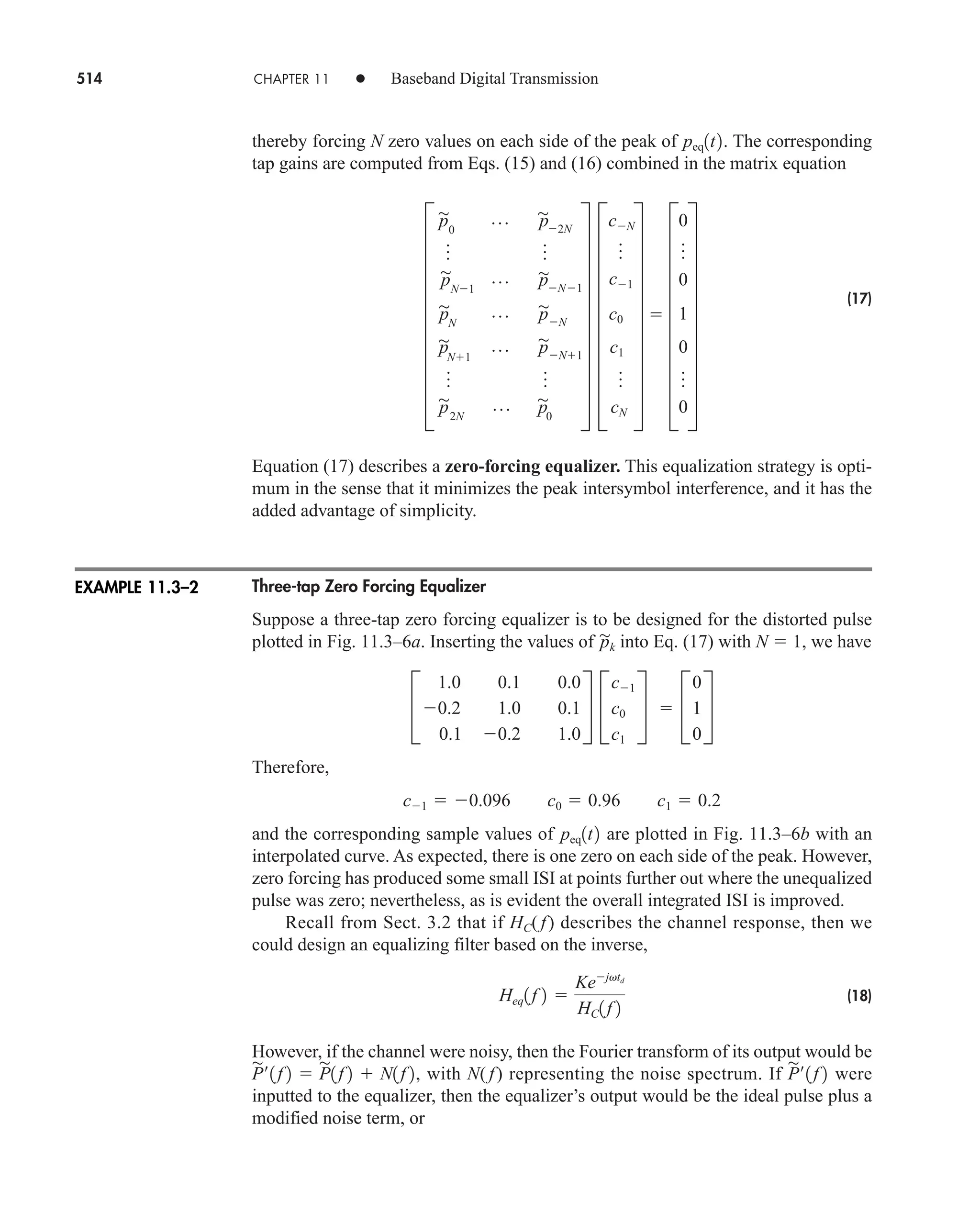
  • 491.
    10.6 Analog PulseModulation with Noise 469 A noise-limiting filter at the input passes the received pulsed signal xp(t) plus lowpass noise n(t), so v(t) xp(t) n(t). The converter measures the amplitude, duration, or position of each pulse in v(t) and generates (1) where mp is the modulation constant relating x(kTs) to xp(t) and k is the measurement error induced by the noise. We’ll assume for convenience that the reconstruction fil- ter has bandwidth B fs/2, gain K Ts 1/2B, and zero time delay. Hence, the impulse-train input yd(t) produces the final output (2a) with (2b) which represents the noise at the destination. Since the errors k are proportional to sample values of the lowpass noise n(t) spaced by Ts, and since the noise-limiting filter has BN 1/Ts, the values of k will be essentially uncorrelated and will have zero mean. We can therefore write the destina- tion noise power as and the signal power is Hence, (3) which expresses the destination signal-to-noise ratio in terms of the error variance s2 caused by reconstruction from noisy samples. Our next task is to determine and s2 for specific types of analog pulse modulation. A PAM signal contains the message samples in the modulated pulse amplitude A0[1 mx(kTs)], so the modulation constant is mp A0m A0. From Sect. 9.5, the amplitude error variance is Thus, under the best conditions of maximum modulation (m 1) and minimum noise bandwidth (BN 1/2t), we have where t is the pulse duration. When m 1 and x(t) has no DC component, the average energy per modulated pulse is Multiplying this average energy by the pulse rate fs gives the received signal power We thus obtain our final result in the form SR fs˛A0 2 11 Sx 2t. A0 2 31 x1kTs 2 42 ˛ t A0 2 11 Sx 2t. a S N b D 2A0 2 t N0 Sx s2 sA 2 N0BN . mp 2 a S N b D SD ND mp 2 s2 Sx SD m2 px2 mp 2 Sx. ND nD 2 Pk 2 s2 nD 1t2 a k Pk sinc 1 fs t k2 yD 1t2 a k 3mp x1kTs 2 Pk 4 sinc 1 fst k2 mp x1t2 nD 1t2 yd1t2 a k 3mpx1kTs 2 Pk 4d1t kTs 2 car80407_ch10_439-478.qxd 12/17/08 5:22 PM Page 469 Confirming Pages
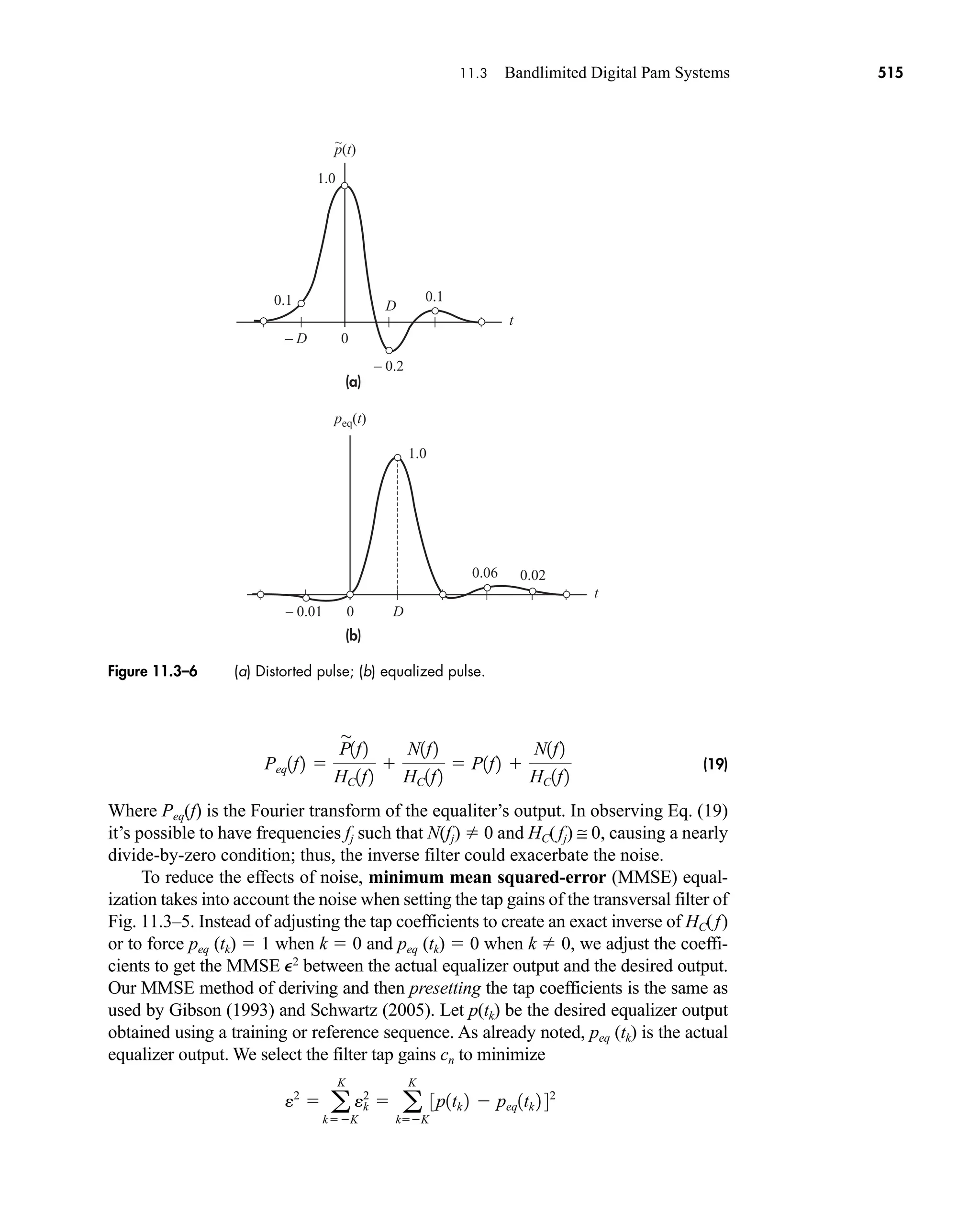
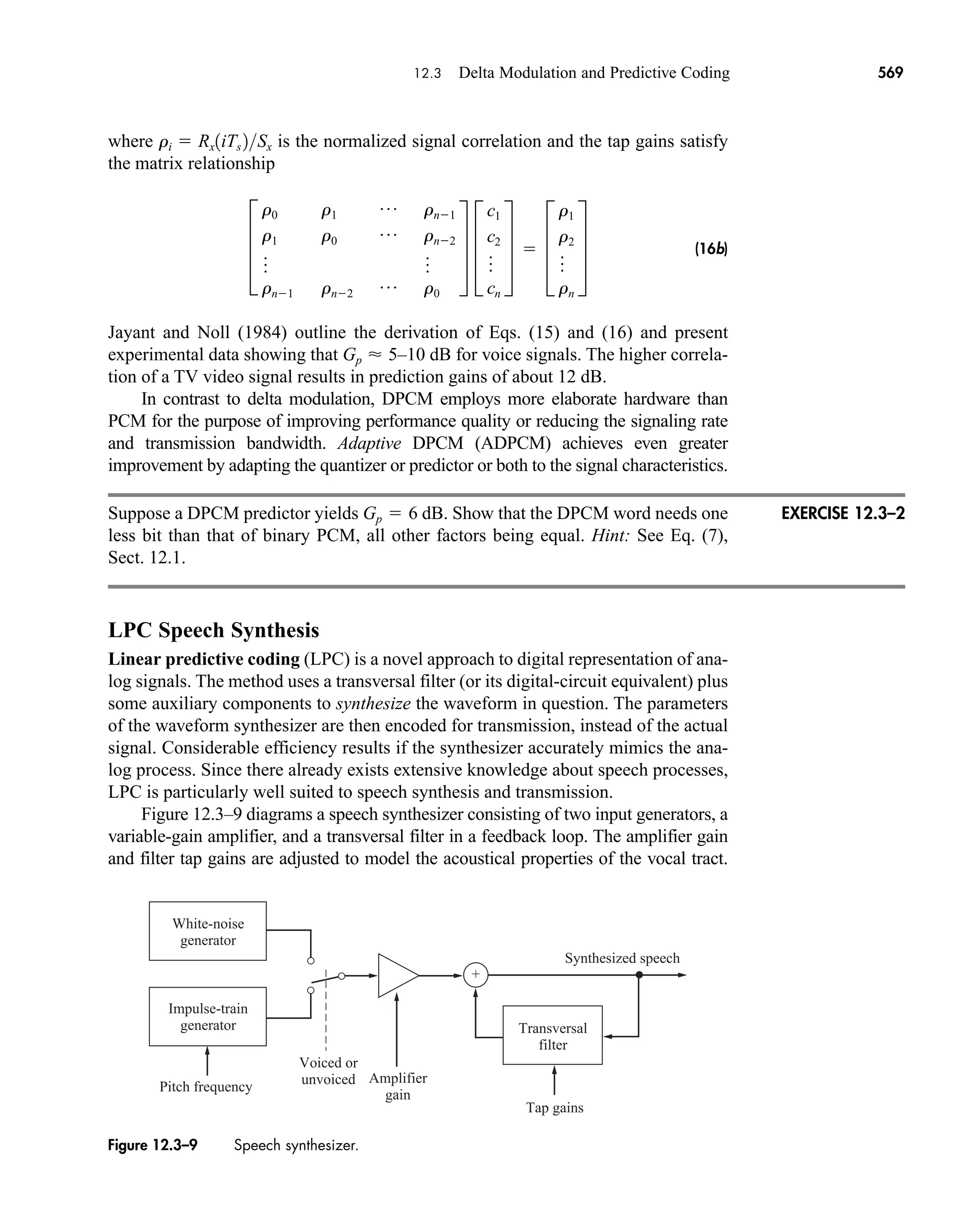
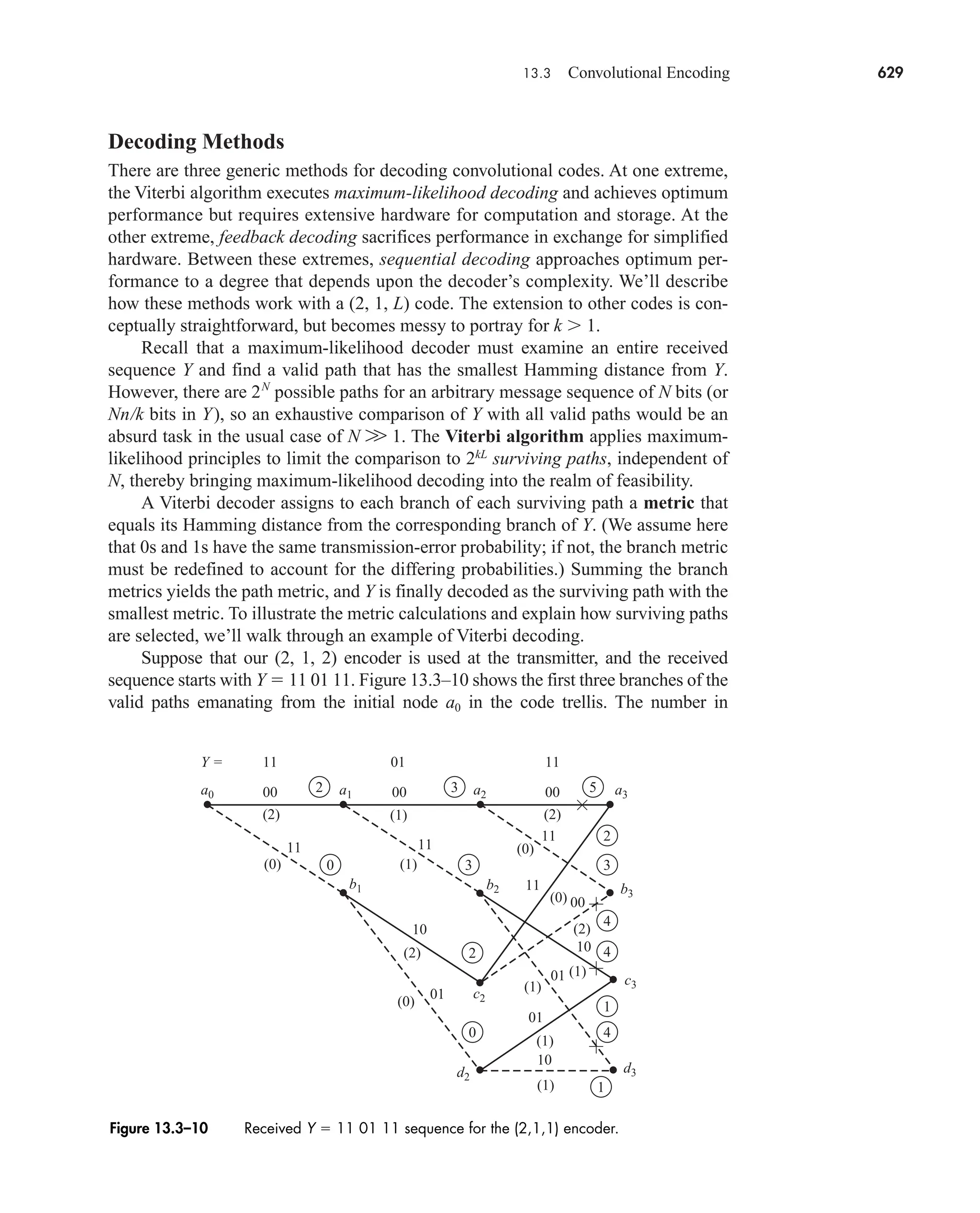
  • 492.
    470 CHAPTER 10• Noise in Analog Modulation Systems (4) This result shows that (S/N)D g/2, so that PAM performance is at least 3 dB below unmodulated baseband transmission—just like AM CW modulation. The maximum value is seldom achieved in practice, nor is it sought after. The merit of PAM resides in its simplicity for multiplexing, not in its noise performance. However, PPM and PDM do offer some improvement by virtue of wideband noise reduction. For if BN BT, the time-position error variance is Since the pulse amplitude A is a constant, the received power can be written as SR fsA2 t0, where t0 denotes the average pulse duration in PDM or the fixed pulse duration in PPM. Eq. (3) then becomes (5) This expression reveals that (S/N)D increases with increasing transmission band- width BT. The underlying physical reason should be evident from Fig. 9.5–2, with tr 1/2BT. The PPM modulation constant is the maximum pulse displacement, so mp t0. The parameters t0 and t0 are constrained by and fs 1/Ts 2W. Taking all values to be optimum with respect to noise reduction, we obtain the upper bound (6) Hence, PPM performance improves as the square of the bandwidth ratio BT/W. A similar optimization for PDM with mp mt0 t0 yields the less-impressive result (7) To approach the upper bound, a PDM wave must have a 50 percent duty cycle so that t0 Ts/2. Practical PPM and PDM systems may fall short of the maximum values pre- dicted here by 10 dB or more. Consequently, the noise reduction does not measure up to that of wideband FM. Remember, though, that the average power SR comes from short-duration high-power pulses rather than being continuously delivered as in CW modulation. Transmitter power-supply considerations may therefore favor pulsed operation in some circumstances. a S N b D 1 2 BT W Sxg PDM a S N b D 1 8 a BT W b 2 Sxg PPM t0 Ts 2 t0 t 2tr 1 BT 4mp 2 BT a W fst0 b Sxg PDM or PPM a S N b D 4mp 2 BT A2 N0 Sx 4mp 2 BT SR N0 fst0 Sx s2 st 2 N014BTA2 2. a S N b D Sx 1 Sx 2SR N0 fs Sx 1 Sx a 2W fs bg PAM car80407_ch10_439-478.qxd 12/17/08 5:22 PM Page 470 Confirming Pages
  • 493.
    10.7 Questions andProblems 471 Explain why a single-channel PDM system must have mt0 1/4W. Then derive Eq. (7) from Eq. (5) with mp mt0. False-Pulse Threshold Effect Suppose you try to increase the value of (S/N)D in a PDM or PPM system by making BT very large. Since increases with BT, the noise variations in v(t) xp(t) n(t) will eventually dominate and be mistaken for signal pulses. If these false pulses occur often, the reconstructed waveform has no relation to x(t) and the message will have been completely lost. Hence, pulse-time modulation involves a false-pulse threshold effect, analogous to the threshold effect in wideband FM. This effect does not exist in PAM with synchronization because we always know when to measure the amplitude. To determine the threshold level, we’ll say that false pulses are sufficiently infrequent if P(n A) 0.01. For gaussian noise with the corre- sponding threshold condition is approximately A 2sN, so the pulse must be strong enough to “lift” the noise by at least twice its rms value. (This is the same condition as the tangential sensitivity in pulsed radar systems.) Using the fact that A2 SR/t0 fs, we have SR/t0 fs 4N0BT or (8) This threshold level is appreciably less than that of FM, so PPM could be advanta- geous for those situations where FM would be below its threshold point. 10.7 QUESTIONS AND PROBLEMS Questions 1. What is the advantage of an envelope detector over the synchronous detector? 2. What type of detector would you choose for reception of weak AM signals? Why? 3. Describe a method to increase the (S/N)D for AM without increasing ST or vio- lating the maximum limits on the message amplitude or modulation index. 4. Why did the original astronauts have to be proficient in Morse code to commu- nicate via on-off keying? 5. At what point is it no longer possible to improve (S/N)D using FM? 6. Explain why FM station reception has a distinct cutoff when going beyond the listening range. 7. What licensing implications does neglecting FM’s threshold effect and the FCC’s maximum radiated power limit of 75 nW/MHz hold for local broadcast of FM signals? gth a SR N0W b min 4t0 fs BT W 8 sN 2 n2 N0BT, n2 EXERCISE 10.6–1 car80407_ch10_439-478.qxd 12/17/08 5:22 PM Page 471 Confirming Pages
  • 494.
    10.1–2 Do Prob.10.1–1, taking fc f2. 10.1–3* White noise is applied to a tuned circuit whose transfer function is Evaluate Gn(f) N0 at f/fc 0, 0.5, 1, 1.5, and 2. Then plot 10.1–4 The BPF in Fig. 10.1–2 will have local symmetry around fc if its lowpass equivalent function has the even-symmetry H/p1 f 2 ^ HR1 f fc 2u1 f fc 2 Gni 1 f 2. H1 f 2 c1 j ˛ 4 3 a f fc fc f b d 1 0 1 – f2 f2 – f1 f1 f1 – b f2 + 2b 2b f 472 CHAPTER 10 • Noise in Analog Modulation Systems 8. Why does PM have limited ability for increases in SNR at the destination? 9. Why are FM broadcast signals less noisy than AM ones? 11. As compared to AM broadcast signals, why does FM have a sharp threshold with respect to signal reception? 12. What parameter(s) limit the ability of FM to provide an increase to (S/N)D? 13. List and briefly describe means to send the same information over a channel that results in increased (S/N)D. 14. What advantage does AM have over other modulation types? 15. Why does DSB have the same (S/N)D as SSB, even though ? 16. What modulation type(s) would you choose if you had to conserve bandwidth but have the highest S/N? 17. What modulation type(s) would you choose if you had to transmit messages with significant DC or low-frequency content? 18. List at least two causes of why a PLL would be unable to “lock on” and provide a reference signal for detecting AM or DSB. Problems 10.1–1 White noise with N0 10 is applied to a BPF having HR( f )2 as plotted in Fig. P10.l–1. Sketch taking fc f1, and show therefrom that ni 2 n2 . Gni 1 f 2 BTDSB 2BTSSB Figure P10.1–1 car80407_ch10_439-478.qxd 12/17/08 5:22 PM Page 472 Confirming Pages
  • 495.
    10.7 Questions andProblems 473 property (a) Let and show that we can write (b) Use this result to show that 10.1–5 A tuned circuit with Q fc/BT W 1 approximates the local-symmetry property in Prob. 10.1–4, and has HR( f) 1/[1 j2(f fc)/BT] for f 0. (a) Find Gp(f). (b) Evaluate by calculating 10.1–6 Let y(t) 2n(t) cos (vct u), where n(t) is bandpass noise centered at fc. Show that y(t) consists of a lowpass component and a bandpass compo- nent. Find the mean value and variance of each component in terms of the properties of n(t). 10.1–7* Bandpass gaussian noise with sN 2 is applied to an ideal envelope detec- tor, including a DC block. Find the PDF of the output y(t) and calculate sY. 10.1–8 Bandpass gaussian noise with variance is applied to an ideal square- law device, producing Find and the PDF of y(t). 10.1–9 Let Assuming that v(t) is Fourier trans- formable, show that Vp( f) [vp(t)] V(f fc)u(f fc). Then sketch Vp( f), taking V( f) as in Fig. P10.1–1 with fc f1 b. 10.1–10* Let HR( f) in Fig. 10.1–2 be an ideal BPF with unit gain and let so fc is the center frequency. Find Rn(t) and by taking the inverse transform of Gn( f) and (j sgn f)Gn( f). Then obtain from Eq. (17) and confirm that it equals the inverse transform of 10.1–11 Do Prob. 10.1–10 with a 0, so fc is the lower cutoff frequency. 10.1–12 Suppose Gn(f) has local symmetry around fc, as detailed in Prob. 10.1–4. Write the inverse transforms of and Gn( f ) to show that Then show from Eq. (17) that 10.1–13 Derive Eq. (17) starting from E[nq(t)nq(t t)]. 10.1–14 Derive Eq. (18) starting from E[nq(t)nq(t t)]. 10.1–15 Let Gn(f) have local symmetry around fc. Prove that for all t using: (a) the correlation relations in Prob. 10.1–12; (b) the spectral relations in Prob. 10.1–4. 10.1–16* Let HR(f) in Fig. 10.1–2 be an ideal BPF with unit gain and let a 0, so fc is the lower cutoff frequency. Use Eq. (19) to find 10.1–17 Do Prob. 10.1–16 with a 1/4, so the lower cutoff frequency is fc BT/4. 10.1–18 What is the expression for the output of a synchronous detector if the input is bandpass gaussian noise? Rninq 1t2. Rninq 1t2 0 R̂n1t2 Rni 1t2 sin vct. Rni 1t2 cos vct. Rn 1t2 Gni 1 f 2 Gni 1 f 2. Rni 1t2 R̂n1t2 a 1 2 v/p1t2 1 2 3v1t2 jv̂1t2 4ejvct . y, y2 , y1t2 An 2 1t2. sN 2 ni 2 . n2 Gni 1 f 2 2G/p1 f 2. Gn1 f 2 G/p 1 f fc 2 G/p1 f fc 2 e G/p 1 f fc 2 f 7 0 G/p 1 f fc 2 f 6 0 G/p1 f 2 ^ 1N022 0H/p1 f 202 0H/p1f 20 0H/p1 f 20. car80407_ch10_439-478.qxd 12/17/08 5:22 PM Page 473 Confirming Pages
  • 496.
    474 CHAPTER 10• Noise in Analog Modulation Systems 10.2–1* A DSB signal plus noise is demodulated by synchronous detection. Find (S/N)D in dB given that SR 20 nW, W 5 MHz, and N 100. 10.2–2 An AM signal plus noise is demodulated by synchronous detection. Find (S/N)D in dB given that Sx 0.4, SR 20 nW, W 5 MHz, m 1, and N 100. 10.2–3 A DSB signal plus noise is demodulated by a product detector with phase error f . Take the local oscillator signal to be 2 cos (vct f ) and show that (S/N)D g cos2 f . 10.2–4 Rewrite Eqs. (4b) and (5) in terms of gp Sp/N0W, where Sp is the peak envelope power of the DSB or AM signal. 10.2–5* Let xc(t) have quadrature multiplexing, where x1(t) and x2(t) are inde- pendent signals and Assume an ideal receiver with AWGN and two synchronous detectors. Find the output signal plus noise for each channel, and express (S/N)D in terms of g. 10.2–6 Explain why an SSB receiver should have a nearly rectangular BPF with bandwidth BT W, whereas predetection filtering is not critical for DSB. 10.2–7 Modify Eq. (8) for LSSB when HR(f )2 has the shape in Fig. P10.1–1 with f2 fc and 2b W. 10.2–8 Some receivers have additive “one-over-f”(1/f) noise with power spectral density G( f ) N0 fc/2f for f 0. Obtain the resulting expressions for (S/N)D in terms of g and W/fc for USSB and DSB modulation. Compare your results when W/fc 1/5 and 1/50. 10.2–9‡ When a demodulated signal includes multiplicative noise or related effects, the postdetection S/N cannot be defined unambiguously. An alternative performance measure is then the normalized mean-square error where K is chosen such that KyD(t) x(t) in absence of multiplicative effects. Find yD(t) and show that when a USSB signal with AWGN is demodulated by a product detector whose local-oscillator signal is 2 cos [vct f(t)], where f(t) is a slowly drifting random phase. Hint: and since is an odd function. 10.2–10 Explain why an AM receiver should have a nearly rectangular BPF with bandwidth BT 2W for envelope detection, whereas predetection filter- ing is not critical for synchronous detection. 10.2–11* An AM system with envelope detection is operating at the threshold point. Find the power gain in dB needed at the transmitter to get up to (S/N)D 40 dB with full-load tone modulation. 10.2–12 An AM system with envelope detection has (S/N)D 30 dB under full- load tone-modulation conditions with W 8 kHz. If all bandwidths are R̂x 1t2 x x̂ R̂x 102 0 x̂2 x2 P2 231 cos f 4 1g P2 ^ E53x1t2 KyD 1t2 42 6Sx x2 1 x2 2 . car80407_ch10_439-478.qxd 12/17/08 5:22 PM Page 474 Confirming Pages
  • 497.
    10.7 Questions andProblems 475 increased accordingly, while other parameters are held fixed, what is the largest useable value of W? 10.2–13‡ Consider an AM system with envelope detection operating below thresh- old. Find 2 defined in Prob. 10.2–9 assuming that yD(t) y(t), and Express your answer in terms of g. 10.2–14 Given a DSB system with ST 100 W, Sx 0.9, and (S/N)D 30 dB. What is ST for an equivalent AM with m 0.95? 10.2–15 Prove Eqs. (2) and (12). 10.2–16 A receiver with a synchronous detector receives a barely intelligible message since the (S/N)D 4 dB. It has been determined that the trans- mitter has ST 100 W, m 0.9, and SX 0.5. What is the minimum value of ST if envelope detection were used. 10.2–17 A ST 100 DSB transmitter produces a barely intelligible signal such that (S/N)D 4 dB. What would be the necessary power for an AM transmitter with m 0.9, and SX 0.5? 10.3–1* An exponentially modulated signal plus noise has SR 10 nW, W 500 kHz, and N 10 0. Find the value of ND for PM detection, FM detec- tion, and deemphasized FM detection with Bde 5 kHz. 10.3–2 Suppose an nth-order Butterworth LPF is used for the postdetection fil- ter in an FM receiver. Obtain an upper bound on ND and simplify for n W1. 10.3–3 Find Gj(f) when the predetection BPF in an FM receiver has HR(f) as given in Prob. 10.1–5. Then calculate ND and simplify taking BT W W. 10.3–4 An FM signal plus noise has SR 1 nW, W 500 kHz, Sx 0.1, f 2 MHz, and N 100. Find (S/N)D in dB for FM detection and for deemphasized FM detection with Bde 5 kHz. 10.3–5 Obtain an expression for (S/N)D for PM with deemphasis filtering. Simplify your result taking Bde W W. 10.3–6* The signal x(t) cos 2p200t is sent via FM without preemphasis. Cal- culate (S/N)D when f 1 kHz, SR 500N0, and the postdetection filter is an ideal BPF passing 100 f 300 Hz. 10.3–7 Obtain an expression for (S/N)D for FM with a gaussian deemphasis fil- ter having Calculate the resulting deemphasis improvement factor when Bde W/7. 10.3–8 A certain PM system has (S/N)D 30 dB. Find the new value of (S/N)D when the modulation is changed to preemphasized FM with Bde W/10, while BT and all other parameters are held fixed. 10.3–9 Modify Eq. (20) to include deemphasis filtering and rework the calcula- tions in Ex. 10.3–2. 0Hde1 f 202 e1 fBde22 . x 0. x2 1, car80407_ch10_439-478.qxd 12/17/08 5:22 PM Page 475 Confirming Pages
  • 498.
    476 CHAPTER 10• Noise in Analog Modulation Systems 10.3–10* Obtain an expression like Eq. (20) for PM, and determine the upper bound on (S/N)D at threshold. 10.3–11 Consider the FMFB receiver in Fig. 10.3–7. Let v(t) be a noise-free FM signal with deviation ratio D and take the VCO output to be 2 cos [(vc vIF)t KfD(t)] where Show that the deviation ratio of the IF signal is DIF D/(1 K). 10.3–12 Let’s assume you are allowed to broadcast without a license if you stay below the ambient level of radiation is 75 nW/MHz. Measurements have determined that in the general listening area, an ordinary DSB transmis- sion is received with (S/N)R 30 dB, W 3 kHz, and SR 1 mW. Design an FM system that will enable unlicensed broadcasting for W 3 kHz messages. 10.3–13 What is the maximum value of N0 for an FM cell phone whereby ST 3 W, f 12 kHz, W 3 kHz, Sx 0.5, f 850 MHz, and cell to tower distance is 1.6 kM? 10.4–1* An analog communication system has W 10 kHz, N0 1015 W/Hz, and transmission loss L 100 dB. Calculate ST needed to get (S/N)D 40 dB when the modulation is (a) SSB; (b) AM with m 1 and m 0.5; (c) PM with f p; (d) FM with D 1, 5, and 10. Omit deemphasis in the FM case, but check for threshold limitations. 10.4–2 Do Prob. 10.4–1 with and W 20 kHz. 10.4–3 An analog communication system has W 10 kHz, ST 10 W, and N0 1013 W/Hz. Calculate the path length corresponding to (S/N)D 40 dB for a transmission cable with loss factor a 1 dB/km when the modulation is (a) SSB; (b) AM with m 1; (c) FM with D 2 and 8. 10.4–4 Do Prob. 10.4–3 for line-of-sight radio transmission at fc 300 MHz with antenna gains of 26 dB at transmitter and receiver. 10.4–5* A signal with is transmitted via AM with m 1 and (S/N)D 13 dB. If the modulation is changed to FM (without deemphasis) and the bandwidths are increased accordingly while other parameters remain fixed, what’s the largest usable deviation ratio and the resulting value of (S/N)D? 10.4–6‡ A frequency-division multiplexing system has USSB subcarrier modula- tion and FM carrier modulation without preemphasis. There are K independent input signals, each having bandwidth W0, and the subcarrier frequencies are fk (k 1)W0, k 1, 2, . . . K. The baseband signal at the FM modulator is xb(t) Σ akxk(t), where the ak are constants and xk(t) is the kth subcarrier signal, each having The discriminator at the receiver is followed by a bank of BPFs and synchronous detectors. xk 2 1. x2 12 x2 12, x2 1 x2 12, f # D1t2 2pyD1t2. car80407_ch10_439-478.qxd 12/17/08 5:22 PM Page 476 Confirming Pages
  • 499.
    10.7 Questions andProblems 477 Use the property that the predetection and postdetection S/N are equal for SSB to show that the output of the kth channel has where . 10.4–7‡ In the system described in Prob. 10.4–6, the ak are chosen such that and all channels have the same output S/N. Obtain expressions for ak and (S/N)k under these conditions. xb 2 1 Nk 13k2 3k 12N0W0 3 3SR 1SN2k f¢ 2 ak 2 Nk 10.4–8‡ Consider an FM stereo multiplexing system where, for purposes of analysis, the preemphasis filtering may be done after matrixing and the deemphasis filtering before matrixing. Let the input signals before pre- emphasis be x1(t) xL(t) xR(t) and x2(t) xL(t) xR(t), and let the deemphasized outputs before matrixing be y1(t) f x1(t) n1(t) and y2(t) f x2(t) n2(t) so the final outputs are y1(t) y2(t). (a) Show that the power spectral density of n2(t) is Hde(f)2 (N0/SR)(f 2 f 0 2 )(f/2W) where f0 38 kHz, and that when W 15 kHz and Bde 2.1 kHz. (b) Taking and —so that if the pilot is small—show that (S/N)D for each channel in stereo transmission is about 20 dB less than (S/N)D for monaural transmission. 10.4–9* Given a voice DSB signal with ST 100 W such that (S/N)D 30 dB. What output power would be required for a backup system using binary on-off keyed system with W 100 Hz, and (S/N)D 15 dB? 10.4–10 The original advanced phone systems (AMPS) used FM with f 12 kHz and ST 3 W. Assuming (S/N)D 30 dB, W 3 kHz and Sx 1, what would be ST for the equivalent DSB system. 10.4–11 Do Prob. 10.4–10 except for AM with m 0.90. 10.4–12 Show why AM and SSB are not suitable for transmitting messages with DC or low-frequency content. 10.6–1* A single-channel PPM signal plus noise has Sx 0.4, SR 10 nW, W 500 kHz, fs 1.2 MHz, t0 t0 0.1Ts, BT 10 MHz, and N 100. Find the value of (S/N)D in decibels. 10.6–2 A single-channel PDM signal plus noise has Sx 0.1, W 100 Hz, fs 250 Hz, m 0.2, t0 Ts/50, BT 3 kHz, and N 500. Find the value of SR so that (S/N)D 40 dB. 10.6–3 Calculate the upper bound on (S/N)D for PPM baseband transmission with BT 20W and compare with the actual value when t0 0.3Ts, t 0.2Ts, and fs 2.5W. 10.6–4 Eq. (5), also holds for each output of a TDM system if we write A2 in terms of average power in the multiplexed waveform. Use this method to find (S/N)D for each channel of a PPM-TDM system having nine voice signals plus a marker, Sx 1, W 3.2 kHz, fs 8 kHz, t Ts/50, BT 400 kHz, and the marker has duration 3t. Express your result in terms of g/9 since there are nine transmitted signals. xb 2 1 xL 2 xR 2 13 xLxR 0 n2 2 W n1 2 car80407_ch10_439-478.qxd 12/17/08 5:22 PM Page 477 Confirming Pages
  • 500.
    478 CHAPTER 10• Noise in Analog Modulation Systems 10.6–5 Consider an M-channel TDM-PPM system with guard time Tg t 1/BT and no synchronization marker, so SR MfsA2 t. Start with Eq. (5), to show that (S/N)D (1/8)(BT/MW)2 Sx(g/M). car80407_ch10_439-478.qxd 12/17/08 5:22 PM Page 478 Confirming Pages
  • 501.
    chapter 11 Baseband Digital Transmission CHAPTEROUTLINE 11.1 Digital Signals and Systems Digital PAM Signals Transmission Limitations Power Spectra of Digital PAM Spectral Shaping by Precoding 11.2 Noise and Errors Binary Error Probabilities Regenerative Repeaters Matched Filtering Correlation Detection M-ary Error Probabilities 11.3 Bandlimited Digital PAM Systems Nyquist Pulse Shaping Optimum Terminal Filters Equalization Correlative Coding 11.4 Synchronization Techniques Bit Synchronization Scramblers and PN Sequence Generators Frame Synchronization 479 car80407_ch11_479-542.qxd 12/17/08 6:35 PM Page 479 Confirming Pages
  • 502.
    480 CHAPTER 11• Baseband Digital Transmission This chapter launches our study of digital communication systems. We’ll first describe the advantages of digital sys- tems over analog systems. We then focus on baseband transmission to emphasize the generic concepts and prob- lems of digital communication, with or without carrier modulation, and to bring out the differences between digital and analog transmission. Following an overview of digital signals and systems, we’ll analyze the limitations imposed by additive noise and transmission bandwidth. We’ll also look at practical design considerations such as regenera- tive repeaters, equalization, and synchronization. The obvious question we should ask is: what do we gain with digital systems over analog ones? After all, an analog system can be implemented with relatively few components, whereas a digital system requires significantly more hardware. For example, a simple analog LPF is implemented with a resistor and capacitor. The equivalent digi- tal implementation requires an analog-to-digital converter (ADC), digital signal processor (DSP), digital-to-analog con- verter (DAC), and an LPF for antialiasing. Nonetheless, despite the apparent increase in hardware complexity, we gain the following advantages: 1. Stability. Digital systems are inherently time invariant. Key system parameters are embedded in algorithms that change only if reprogrammed, making for greater accuracy in signal reproduction. With analog hardware, the signal and its parameters are subject to change with component aging, external temperatures, and other environmental factors. 2. Flexibility. Once digital hardware is in place, we have a great deal of flexibility in changing the system. This enables us to employ a multitude of signal processing algorithms to more efficiently (a) improve signal fidelity, (b) do error correction/detection for data accuracy, (c) perform encryption for privacy and security, (d) employ compression algorithms to remove redundancies, and (e) allow for multiplexing of various types of signals such as voice, picture, video, text, and so on. Furthermore, an algorithm can be easily and remotely modified. 3. Reliable reproduction. An analog message traveling through a channel becomes degraded by distortion and noise. While we can employ amplifiers (repeaters) to boost the signal, they amplify the noise as well as the signal and can only increase distortion. Thus distortion becomes cumulative. Making a photocopy of another photocopy is an example of this phenomenon. As we will see, with digital communication signal reproduction is extremely reliable whether we employ regenerative repeaters for a long haul digital channel or make copies of digital audio recordings. It should be noted, however, that we can implement much of an analog communication system using digital hardware and the appropriate ADC and DAC steps, and thereby secure for an analog system many of the advantages of a dig- ital system. OBJECTIVES After studying this chapter and working the exercises, you should be able to do each of the following: 1. State the advantages of digital over analog communication. 2. Identify the format of a digital PAM waveform and calculate the mean and variance of the amplitude sequence (Sect. 11.1). 3. Find and sketch the power spectrum of a digital waveform with uncorrelated message symbols (Sect. 11.1). 4. Sketch the conditional PDFs at a digital regenerator, given the noise PDF, and formulate an expression for the error probability (Sect. 11.2). 5. Calculate the equivalent bit-error probability for an optimum M-ary system with a distortionless channel and white noise (Sect. 11.2). car80407_ch11_479-542.qxd 12/17/08 6:35 PM Page 480 Confirming Pages
  • 503.
    11.1 DIGITAL SIGNALSAND SYSTEMS Fundamentally, a digital message is nothing more than an ordered sequence of symbols produced by a discrete information source. The source draws from an alphabet of M 2 different symbols, and produces output symbols at some average rate r. For instance, a typical computer terminal has an alphabet of M 90 symbols, equal to the number of character keys multiplied by two to account for the shift key. When you operate the terminal as fast as you can, you become a discrete information source producing a digital message at a rate of perhaps r 5 symbols per second. The computer itself works with just M 2 internal symbols, represented by LOW and HIGH electrical states. We usually associate these two symbols with the binary digits 0 and 1, known as bits for short. Data transfer rates within a computer may exceed r 108 . The task of a digital communication system is to transfer a digital message from the source to the destination. But finite transmission bandwidth sets an upper limit to the symbol rate, and noise causes errors to appear in the output message. Thus, signaling rate and error probability play roles in digital communication similar to those of bandwidth and signal-to-noise ratio in analog communication. As prepara- tion for the analysis of signaling rate and error probability, we must first develop the description and properties of digital signals. Digital PAM Signals Digital message representation at baseband commonly takes the form of an amplitude-modulated pulse train. We express such signals by writing (1) where the modulating amplitude ak represents the kth symbol in the message sequence, so the amplitudes belong to a set of M discrete values. The index k ranges from q to q unless otherwise stated. Equation (1) defines a digital PAM signal, as distinguished from those rare cases when pulse-duration or pulse-position modu- lation is used for digital transmission. The unmodulated pulse p(t) may be rectangular or some other shape, subject to the conditions x1t2 a k ak p1t kD2 11.1 Digital Signals and Systems 481 6. Relate the transmission bandwidth, signaling rate, and bit rate for an M-ary system with Nyquist pulse shaping (Sect. 11.3). 7. Determine appropriate parameters for a digital baseband system to satisfy stated specifications (Sects. 11.2 and 11.3). 8. Understand when data scrambling and synchronization are appropriate and how they are accomplished (Sect. 11.4). 9. Identify the properties of a maximal-length sequence produced from an n-bit shift register with feedback (Sect. 11.4). 10. Determine the output sequence from an n-bit shift register with given set of feedback connections and initial conditions (Sect. 11.4). car80407_ch11_479-542.qxd 12/17/08 6:35 PM Page 481 Confirming Pages
  • 504.
    †The more commonnotation R for bit rate risks confusion with autocorrelation functions and with information rate defined in Chap. 16. 482 CHAPTER 11 • Baseband Digital Transmission (2) This condition ensures that we can recover the message by sampling x(t) periodically at t KD, K 0, 1, 2, . . . , since The rectangular pulse satisfies Eq. (2) if , as does any time- limited pulse with for . Note that D does not necessarily equal the pulse duration but rather the pulse-to- pulse interval or the time allotted to one symbol. Thus, the signaling rate is (3a) measured in symbols per second, or baud. In the special but important case of binary signaling (M 2), we write D Tb for the bit duration and the bit rate is† (3b) measured in bits per second, abbreviated bps or b/s. The notation Tb and rb will be used to identify results that apply only for binary signaling. Figure 11.1–1 depicts various PAM formats or line codes for the binary mes- sage 10110100, taking rectangular pulses for clarity. The simple on-off waveform in part a represents each 0 by an “off” pulse and each 1 by an “on” pulse with amplitude ak A and duration followed by a return to the zero level. We there- fore call this a return-to-zero (RZ) format. A nonreturn-to-zero (NRZ) format has “on” pulses for full bit duration Tb, as indicated by the dashed lines. Internal com- puter waveforms are usually of this type. The NRZ format puts more energy into each pulse, but requires synchronization at the receiver because there’s no separation between adjacent pulses. The unipolar nature of an on-off signal results in a DC component that carries no information and wastes power. The polar signal in part b has opposite polarity pulses, either RZ or NRZ, so its DC component will be zero if the message contains 1s and 0s in equal proportion. This property also applies to the bipolar signal in part c, where successive 1s are represented by pulses with alternating polarity. The bipo- lar format, also known as pseudo-trinary or alternate mark inversion (AMI), eliminates ambiguities that might be caused by transmission sign inversions—a problem characteristic of switched telephone links. The split-phase Manchester format in part d represents 1s with a positive half- interval pulse followed by a negative half-interval pulse, and vice versa for the rep- resentation of 0s. This format is also called twinned binary. It guarantees zero DC component regardless of the message sequence. However, it requires an absolute sense of polarity at the receiver. Tb2 1ak 02 rb 1Tb r ^ 1D 0t0 D2 p1t2 0 t D p1t2 ß1tt2 x1KD2 a k ak p1KD kD2 aK p1t2 e 1 t 0 0 t D, 2D, p car80407_ch11_479-542.qxd 12/17/08 6:35 PM Page 482 Confirming Pages
  • 505.
    (a) (b) (c) (d) (e) Tb Tb A/2 – A/2 t t t t t 1 0 0 A –A 0 A/2 A/2 – A/2 – A/2 – 3A/2 0 0 0 1 1 0 1 0 RZ 0 1 0 1 1 0 1 0 0 1 0 1 1 0 1 0 0 A D NRZ 3A/2 Figure 11.1–1 Binary PAM formats with rectangular pulses: (a) unipolar RZ and NRZ; (b) polar RZ and NRZ; (c) bipolar NRZ; (d) split-phase Manchester; (e) polar quaternary NRZ. 11.1 Digital Signals and Systems 483 Finally, Fig. 11.1–1e shows a quaternary signal derived by grouping the mes- sage bits in blocks of two and using four amplitude levels to prepresent the four pos- sible combinations 00, 01, 10, and 11. Thus, D 2Tb and . Different assignment rules or codes may relate the ak to the grouped message bits. Two such codes are listed in Table 11.1–1. The Gray code has advantages relative to noise- induced errors because only one bit changes going from level to level. Quaternary coding generalizes to M-ary coding in which blocks of n message bits are represented by an M-level waveform with (4a) Since each pulse now corresponds to n log2 M bits, the M-ary signaling rate has been decreased to M 2n r rb2 car80407_ch11_479-542.qxd 12/17/08 6:35 PM Page 483 Confirming Pages
  • 506.
    Table 11.1–1 ak NaturalCode Gray Code 3A/2 11 10 A/2 10 11 A/2 01 01 3A/2 00 00 484 CHAPTER 11 • Baseband Digital Transmission (4b) However, increased transmitted signal power is now required to maintain the same spacing between amplitude levels. Transmission Limitations Now consider the linear baseband transmission system diagrammed in Fig. 11.1–2a. We’ll assume for convenience that the transmitting amplifier compensates for the transmission loss, and we’ll lump any interference together with the additive noise. After lowpass filtering to remove out-of-band contaminations, we have the signal- plus-noise waveform where td is the transmission delay and stands for the pulse shape with transmis- sion distortion. Figure 11.1–2b illustrates what y(t) might look like when x(t) is the rectangular unipolar NRZ signal in the background. Recovering the digital message from y(t) is the task of the regenerator. An aux- iliary synchronization signal may help the regeneration process by identifying the optimum sampling times If then (5) whose first term is the desired message information. The last term of Eq. (5) is the noise contamination at tK, while the middle term represents cross talk or spillover from other signal pulses—a phenomenon given the descriptive name inter-symbol interference (ISI). More specifically, ISI is caused when the channel’s bandwidth is relatively narrow as compared to the signal’s bandwidth. Put another way, the chan- nel’s impulse-response function’s duration is relatively long as compared to the sig- nal’s pulse width. The combined effects of noise and ISI may result in errors in the regenerated message. For instance, at the sample time tK indicated in Fig. 11.1–2b, is closer to 0 even though aK A. y1tK 2 y1tK 2 aK a kK ak p 1KD kD2 n1tK 2 p 102 1 tK KD td p 1t2 y1t2 a k ak p 1t td kD2 n1t2 r rb log2 M car80407_ch11_479-542.qxd 12/17/08 6:35 PM Page 484 Confirming Pages
  • 507.
    x(t) A y(t) y(t) x(t) y(tK) tK g = L+ t 0 Interference and noise Transmitter Channel Receiver LPF Regen sync Output message BT = B Loss L (a) (b) Figure 11.1–2 (a) Baseband transmission system; (b) signal-plus-noise waveform. 11.1 Digital Signals and Systems 485 We know that if n(t) comes from a white-noise source, then its mean square value can be reduced by reducing the bandwidth of the LPF. We also know that low- pass filtering causes pulses to spread out, which would increase the ISI. Conse- quently, a fundamental limitation of digital transmission is the relationship between ISI, bandwidth, and signaling rate. This problem emerged in the early days of telegraphy, and Harry Nyquist (1924, 1928a) first stated the relationship as follows: Given an ideal lowpass channel of bandwidth B, it is possible to transmit inde- pendent symbols at a rate r 2B baud without intersymbol interference. It is not possible to transmit independent symbols at r 2B. The condition r 2B agrees with our pulse-resolution rule in Sect. 3.4 if we require p(t) to have duration . The second part of Nyquist’s statement is easily proved by assuming that . Now suppose that the message sequence happens to consist of two symbols alternating forever, such as 101010 . . . . The resulting waveform x(t) then is periodic with period and contains only the fundamental frequency f0 B and its harmonics. Since no frequency greater than B gets through the chan- nel, the output signal will be zero—aside from a possible but useless DC component. Signaling at the maximum rate r 2B requires a special pulse shape, the sinc pulse (6a) p1t2 sinc rt sinc tD 2D 2r r 21B P2 7 2B t D 1r B 12tmin car80407_ch11_479-542.qxd 12/17/08 6:35 PM Page 485 Confirming Pages
  • 508.
    Tb Tb t t (b) (a) Figure 11.1–3(a) Distorted polar binary signal; (b) eye pattern. 486 CHAPTER 11 • Baseband Digital Transmission having the bandlimited spectrum (6b) Since for , this pulse suffers no distortion from an ideal lowpass frequency response with and we can take r 2B. Although p(t) is not time- limited, it does have periodic zero crossings at , which satisfies Eq. (2). (See Fig. 6.1–6 for an illustration of this property.) Nyquist also derived other bandlimited pulses with periodic zero crossings spaced by so r 2B, a topic we set aside to pick up again in Sect. 11.3 after discussing noise and errors in Sect. 11.2. Meanwhile, note that any real channel needs equalization to approach an ideal frequency response. Such equalizers often require experimental adjustment in the field because we don’t know the channel characteristics exactly. An important exper- imental display is the so-called eye pattern, which further clarifies digital transmis- sion limitations. Consider the distorted but noise-free polar binary signal in Fig. 11.1–3a. When displayed on a long-persistence oscilloscope with appropriate synchronization and sweep time, we get the superposition of successive symbol intervals shown in Fig. 11.1–3b. The shape of this display accounts for the name “eye pattern.” A dis- torted M-ary signal would result in M 1 “eyes” stacked vertically. Figure 11.1–4 represents a generalized binary eye pattern with labels identifying significant features. The optimum sampling time corresponds to the maximum eye opening. ISI at this time partially closes the eye and thereby reduces the noise mar- gin. If synchronization is derived from the zero crossings, as it usually is, zero- crossing distortion produces jitter and results in nonoptimum sampling times. The slope of the eye pattern in the vicinity of the zero crossings indicates the sensitivity to timing error. Finally, any nonlinear transmission distortion would reveal itself in an asymmetric or “squinted” eye. Determine the relation between r and B when at. p1t2 sinc2 D 7 12B t D, 2D, p B r2 0 f 0 7 r2 P1 f 2 0 P1 f 2 3 p1t2 4 1 r ß a f r b EXERCISE 11.1–1 car80407_ch11_479-542.qxd 12/17/08 6:35 PM Page 486 Confirming Pages
  • 509.
    ISI Timing sensitivity Zero-crossing jitter Noise margin Optimum sampling time Figure11.1–4 Generalized binary eye pattern. 11.1 Digital Signals and Systems 487 Power Spectra of Digital PAM The pulse spectrum provides some hints about the power spectrum of a digital PAM signal x(t). If , as a case in point, then P(f) in Eq. (6b) implies that for . However, detailed knowledge of Gx( f) pro- vides additional and valuable information relative to digital transmission. A simplified random digital wave with was covered in Chap. 9. Under the conditions we found that . Now, substituting , we write (7) This expression holds for any digital PAM signal with pulse spectrum P(f) when the ak coefficients are uncorrelated and have zero mean value. But unipolar signal formats have and, in general, we can’t be sure that the message source produces uncorrelated symbols. A more realistic approach there- fore models the source as a discrete stationary random process. Ensemble averages of the ak s are then given by the autocorrelation function (8) analogous to writing for a stationary random signal v(t). The integers n and k in Eq. (8) reflect the time-discrete nature of a digital sequence. If a digital PAM signal x(t) has the pulse spectrum P(f) and amplitude autocor- relation , its power spectrum is Ra1n2 Rv1t2 E3v1t2v1t t2 4 Ra1n2 E3ak akn 4 ak 0 Gx1 f 2 sa 2 D 0P1 f 2 02 P1 f 2 D sinc fD Gx1 f 2 sa 2 D sinc2 fD E3ak ai 4 e sa 2 i k 0 i k p1t2 ß1tD2 0 f 0 7 r2 Gx1 f 2 0 p1t2 sinc rt P1 f 2 3p1t2 4 car80407_ch11_479-542.qxd 1/13/09 4:20 PM Page 487 Rev.Confirming Pages
  • 510.
    488 CHAPTER 11• Baseband Digital Transmission (9) Despite the formidable appearance of Eq. (9), it easily reduces to Eq. (7) when and for n 0. In the case of uncorrelated message symbols but , (10) and Then, drawing upon Poisson’s sum formula, and therefore (11) Here we have inserted and used the sampling property of impulse multiplication. The important result in Eq. (11) reveals that the power spectrum of x(t) contains impulses at harmonics of the signaling rate r, unless ma 0 or at all f nr. Hence, a synchronization signal can be obtained by applying x(t) to a narrow BPF (or PLL filter) centered at one of these harmonics. We can also calculate the total average power by integrating over all f. Thus, (12) where Ep equals the energy in p(t). For Eq. (12), and hereafter, we presume the conditions in Eq. (10), barring information to the contrary. The derivation of Eq. (9) starts with the definition of power spectrum from Eq. (7), Sect. 9.2. Specifically, we write in which is the Fourier transform of a truncated sample function for . Next, let so the limit corresponds to . Then, for , xT1t2 a K kK ak p1t kD2 K W 1 K S q T S q T 12K 12D 0t0 6 T2 xT 1t2 x1t2 XT1 f 2 Gx1 f 2 ^ lim TSq 1 T E3 0XT 1 f 2 02 4 x2 sa 2 rEp 1ma r22 a q nq 0P1nr2 02 Gx1 f 2 x2 P1 f 2 0 r 1D Gx1 f 2 sa 2 r0P1 f 2 02 1ma r22 a q nq 0P1nr2 02 d 1 f nr2 a q nq ej2pnfD 1 D a q nq daf n D b a q nq Ra1n2ej2pnfD sa 2 ma 2 a q nq ej2pnfD Ra1n2 e sa 2 ma 2 n 0 ma 2 n 0 ak ma 0 Ra1n2 0 Ra102 sa 2 Gx1 f 2 1 D 0P1 f 2 02 a q nq Ra1n2ej2pnfD car80407_ch11_479-542.qxd 12/17/08 6:35 PM Page 488 Confirming Pages
  • 511.
    11.1 Digital Signalsand Systems 489 and After interchanging the order of expectation and summation we have with where . The double summation for can be manipulated into the single sum Substituting these expressions in the definition of finally gives as stated in Eq. (9). Power Spectrum of a Unipolar RZ Signal Consider the unipolar binary RZ signal in Fig. 11.1–1a, where so If the source bits are equally likely and statistically independent, then , and Eq. (10) applies with Using Eq. (11) we find the power spectrum to be Gx1 f 2 A2 16rb sinc2 f 2rb A2 16 a q nq asinc2 n 2 bd1 f nrb 2 ma 2 sa 2 A2 4 ak A2, ak 2 A2 2 P1 f 2 1 2rb sinc f 2rb p1t2 ß12rbt2 1 D 0P1 f 2 02 a q nq Ra1n2ejvnD Gx1 f 2 lim KSq 1 12K 12D 0P1 f 2 02 rK1 f 2 Gx1 f 2 rK1 f 2 12K 12 a 2K n2K a1 0n0 2K 1 bRa 1n2ejvnD rK1 f 2 E3ak ai 4 Ra1k i2 rK1 f 2 a K kK a K iK E3ak ai 4ejv1ki2D E3 0XT1 f 2 02 4 0P1 f 2 02 rK1 f 2 0 XT 1 f 2 02 0P1 f 2 02 a a K kK akejvkD b a a K iK aiejviD b XT 1 f 2 a K kK akP1 f 2ejvkD EXAMPLE 11.1–1 car80407_ch11_479-542.qxd 12/17/08 6:35 PM Page 489 Confirming Pages
  • 512.
    A2 f 0 4p2 36p2 Gx( f) rb 2rb 3rb 4rb 16rb A2 16 A2 A2 Figure 11.1–5 Power spectrum of unipolar binary RZ signal. 490 CHAPTER 11 • Baseband Digital Transmission which is sketched in Fig. 11.1–5 for f 0. Notice the absence of impulses at the even harmonics because when n 2, 4, . . . . We could also, in principle, use Eq. (12) to calculate . However, it should be evident from the waveform that when 1s and 0s are equally likely. Modify the results of Example 11.1–1 for , corresponding to an NRZ waveform. In particular, show that the only impulse in is at f 0. Spectral Shaping by Precoding Precoding refers to operations that cause the statistics of the transmitted amplitude sequence ak to differ from the statistics of the original message sequence. Usually, the purpose of precoding is to shape the power spectrum via , as distinguished from P( f). To bring out the potential for statistical spectral shaping, we rewrite Eq. (9) in the form (13) having drawn upon the property . Now suppose that x(t) is to be transmitted over a channel having poor low- frequency response—a voice telephone channel perhaps. With appropriate precoding, we can force the bracketed term in Eq. (13) to equal zero at f 0 and thereby elimi- nate any DC component in , irrespective of the pulse spectrum P( f). The bipolar signal format back in Fig. 11.1–1c is, in fact, a precoding technique that removes DC content. The bipolar signal has three amplitude values, ak A, 0, and A. If 1s and 0s are equally likely in the message, then the amplitude probabilities are and , so the amplitude statistics differ from the P1ak A2 P1ak A2 14 P1ak 02 12 Gx1 f 2 Ra1n2 Ra1n2 Gx1 f 2 r0P1 f 2 02 cRa102 2 a q n1 Ra1n2 cos 12pnfr2 d Ra1n2 Gx1 f 2 p1t2 ß1rbt2 x2 A2 4 x2 P1nrb 2 0 EXERCISE 11.1–2 car80407_ch11_479-542.qxd 1/13/09 4:20 PM Page 490 Rev.Confirming Pages
  • 513.
    A2 f 0 Gx( f ) rb2rb 2rb Figure 11.1–6 Power spectrum of a random data bipolar signal. 11.2 Noise and Errors 491 message statistics. Furthermore, the assumption of uncorrelated message bits leads to the amplitude correlation (14a) Therefore, (14b) which is sketched in Fig. 11.1–6 taking . Two other precoding techniques that remove DC content are the split-phase Manchester format (Fig. 11.1–1d) and the family of high-density bipolar codes denoted as HDBn. The HDBn scheme is a bipolar code that also eliminates long sig- nal “gaps” by substituting a special pulse sequence whenever the source produces n successive 0s. Sketch for a bipolar signal with . Then use your sketch to show that . 11.2 NOISE AND ERRORS Here we investigate noise, errors, and error probabilities in baseband digital trans- mission, starting with the binary case and generalizing to M-ary signaling. x2 A2 2 p1t2 sinc rbt Gx1 f 2 p1t2 ß1rbt2 rb 0P1 f 2 02 A2 sin2 pfrb Gx1 f 2 rb 0P1 f 2 02 A2 2 11 cos 2pfrb 2 Ra1n2 • A2 2 n 0 A2 4 n 1 0 n 2 EXERCISE 11.1–3 car80407_ch11_479-542.qxd 12/17/08 6:35 PM Page 491 Confirming Pages
  • 514.
    xe(t) V x(t) y(t) y(tk) + + – S/H LPF H(f ) G( f ) = N0/2 Regenerator Sync Figure 11.2–1 Baseband binary receiver. 492 CHAPTER 11 • Baseband Digital Transmission We assume throughout a distortionless channel, so the received signal is free of ISI. We also assume additive white noise with zero mean value, independent of the signal. (Some of these restrictions will be lifted in the next section.) Binary Error Probabilities Figure 11.2–1 portrays the operations of a baseband binary receiver. The received signal plus noise is applied to a lowpass filter whose transfer function has been designed to remove excess noise without introducing ISI. A sample-and-hold (S/H) device triggered at the optimum times extracts from y(t) the sample values Comparing successive values of with a fixed threshold level V completes the regeneration process. If , the comparator goes HIGH to indicate a 1; if , the comparator goes LOW to indicate 0. The regenerator thereby acts as an analog-to-digital converter, converting the noisy analog waveform y(t) into a noiseless digital signal with occasional errors. We begin our analysis taking x(t) to be a unipolar signal in which ak A repre- sents the message bit 1 and ak 0 represents the message bit 0. Intuitively, then, the threshold should be set at some intermediate level, 0 V A. The regeneration process is illustrated by the waveforms in Fig. 11.2–2. Errors occur when ak 0 but a positive noise excursion results in , or when ak A but a negative noise excursion results in . To formulate the error probabilities, let the random variable Y represent at an arbitrary sampling time and let n represent . The probability density function of Y obviously involves the noise PDF, but it also depends upon the presence or absence of the signal pulse. We therefore need to work with conditional probabili- ties. In particular, if H0 denotes the hypothesis or assumption that ak 0 and Y n, we can write the conditional PDF (1a) where is the PDF of the noise alone. Similarly, if H1 denotes the hypothesis that ak A and Y A n, then pN1n2 pY 1y0H0 2 pN 1y2 n1tk 2 y1tk 2 y1tk 2 6 V y1tk 2 7 V xe1t2 y1tk 2 6 V y1tk 2 7 V y1tk 2 y1tk 2 ak n1tk 2 car80407_ch11_479-542.qxd 12/17/08 6:35 PM Page 492 Confirming Pages
  • 515.
    py(y|H0) pe1 pe0 py(y|H1) y A V 0 Figure 11.2–3 ConditionalPDFs with decision threshold and error probabilities. y(t) y(tk) xe(t) A A V t t t 0 1 0 1 1 0 1 0 0 1 0 0 (error) (error) 1 0 1 1 0 (a) (b) (c) Figure 11.2–2 Regeneration of a unipolar signal: (a) signal plus noise; (b) S/H output; (c) comparator output. 11.2 Noise and Errors 493 (1b) obtained from the linear transformation of with . Figure 11.2–3 shows typical curves of and along with a pro- posed threshold V. The comparator implements the following decision rule: Choose hypothesis H0 (ak 0) if Y V. Choose hypothesis H1 (ak A) if Y V. pY 1y0H1 2 pY 1y0H0 2 n y A pN1n2 pY 1y0H1 2 pN 1y A2 car80407_ch11_479-542.qxd 12/17/08 6:35 PM Page 493 Confirming Pages
  • 516.
    494 CHAPTER 11• Baseband Digital Transmission (We ignore the borderline case Y V whose probability of occurrence will be van- ishingly small.) The corresponding regeneration error probabilities are then given by (2a) (2b) equivalent to the shaded areas indicated in Fig. 11.2–3. The area interpretation helps bring out the significance of the threshold level when all other factors remain fixed. Clearly, lowering the threshold reduces Pe1 and simultaneously increases Pe0. Rais- ing the threshold has the opposite effect. But an error in digital transmission is an error, regardless of type. Hence, the threshold level should be adjusted to minimize the average error probability (3a) where (3b) which stand for the source digit probabilities. The optimum threshold level Vopt must therefore satisfy , and Leibniz’s rule for differentiating the integrals in Eq. (2) leads to the general relation (4) But we normally expect 1s and 0s to be equally likely in a long string of message bits, so (5a) and (5b) We’ll work hereafter with the equally likely condition, unless stated otherwise. Closer examination of Eq. (5b) reveals that Vopt corresponds to the point where the conditional PDF curves intersect. Direct confirmation of this conclusion is pro- vided by the graphical construction in Fig. 11.2–4 labeled with four relevant areas, a1 through a4. The optimum threshold yields , and . A nonoptimum threshold such as V Vopt yields Pe1 a1 and Pe0 a2 a3 a4; thus, . Next we make the usual assumption that the noise is gaussian with zero mean and variance s2 , so pN1n2 1 22ps2 en2 2s2 Pemin 1 2a4 7 Pemin Pe 1 21a1 a2 a3 a4 2 1 2 1a1 a2 a3 2 Pemin Pe1 a1 a2, Pe0 a3 PY 1Vopt 0H0 2 pY 1Vopt 0H1 2 P0 P1 1 2 Pe 1 21Pe0 Pe1 2 P0 pY 1Vopt 0H0 2 P1 pY 1Vopt 0H1 2 dPedV 0 P0 P1H0 2 P1 P1H1 2 Pe P0 Pe0 P1 Pe1 Pe1 ^ P1Y 6 V0H1 2 V q pY 1y0H1 2 dy Pe0 ^ P1Y 7 V0H0 2 q V pY 1y0H0 2 dy car80407_ch11_479-542.qxd 12/17/08 6:35 PM Page 494 Confirming Pages
  • 517.
    pY(y|H1) pY(y|H0) V1 Vopt a4 a1 a2a3 y Figure 11.2–4 Intersection of conditional PDFs for threshold value. 11.2 Noise and Errors 495 Substituting this gaussian function into Eqs. (1) and (2) gives (6a) (6b) where Q represents is the area under the gaussian tail as previously defined in Fig. 8.4–2. Since has even symmetry, the conditional PDFs and intersect at the midpoint and when . Furthermore, with V Vopt in Eq. (6), so the optimum threshold yields equal digit error probabilities as well as minimizing the net error probability. Thus, and (7) which is the minimum net error probability for binary signaling in gaussian noise when the source digits are equally likely. Based on Eq. (7), the plot of the Q function in Table T.6 in the Appendix can be interpreted now as a plot of Pe versus . This plot reveals that Pe drops off dra- matically when (proportional to the square root of the signal-to-noise ratio) increases. For instance, at whereas Pe 109 at . Although we derived Eq. (7) for the case of a unipolar signal, it also holds in the polar case if so the level spacing remains unchanged. The only differ- ence at the receiver is that Vopt 0, midway between the two levels. However, the transmitter needs less signal power to achieve a specified level spacing in the polar signal. Let’s bring out that advantage of polar signaling by expressing A in terms of the average received signal power SR. If we assume equal digit probabilities and more- or-less rectangular pulses with full-interval duration Tb, then for unipolar signaling while for polar signaling. (These relations should be obvious from the NRZ waveforms in Fig. 11.1–1.) Hence, SR A2 4 SR A2 2 ak A2 A2s 6.0 A2s 2.0 Pe 2 102 A2s A2s Pe Qa A 2s b Pe0 Pe1 Pe 1 21Pe0 Pe1 2 Pe0 Pe1 Q1A2s2 P0 P1 1 2 Vopt A2 pY 1y0H1 2 pY 1y0H0 2 pN1n2 Pe1 V q pN1y A2dy Qa A V s b Pe0 q V pN1y2dy Qa V s b car80407_ch11_479-542.qxd 12/17/08 6:35 PM Page 495 Confirming Pages
  • 518.
    496 CHAPTER 11• Baseband Digital Transmission (8) and the factor of can make a considerable difference in the value of Pe. Since the noise has zero mean, the variance s2 equals the noise power NR at the output of the filter. Therefore, we can write in terms of the signal-to-noise power ratio , namely (9) But Eq. (9) conceals the effect of the signaling rate rb. In order to pass pulses of dura- tion , the noise-limiting filter must have , so (10) Rapid signaling thus requires more signal power to maintain a given error probability Pe. Bit Error Rate Versus Signal-to-Noise Power Ratio Suppose a computer produces unipolar pulses at the rate rb 106 bps 1 Mbps for transmission over a noisy system with N0 4 1020 W/Hz. The error rate is spec- ified to be no greater than one bit per hour, or . Table T.6 in the Appendix indicates that we need , and Eqs. (9) and (10) give the corresponding signal-power requirement Clearly, any reasonable signal power ensures almost errorless transmission insofar as additive noise is concerned. Hardware glitches and other effects would be the lim- iting factors on system performance. Consider a unipolar system with equally likely digits and . Calculate , and Pe when the threshold is set at the nonoptimum value V 0.4A. Com- pare Pe with the minimum value from Eq. (7). Regenerative Repeaters Long-haul transmission requires repeaters, be it for analog or digital communica- tion. But unlike analog-message repeaters, digital repeaters can be regenerative. If the error probability per repeater is reasonably low and the number of hops m is Pe0 , Pe1 1SN2R 50 SR 2a A 2s b 2 NR 1.5 1012 1.5 pW A2s 6.2 Pe 13600rb 3 1010 NR N0BN N0rb2 BN rb2 Tb 1rb a A 2s b 2 A2 4NR e 1 21SN2R Unipolar 1SN2R Polar 1SN2R SRNR A2s 22 A e 22SR Unipolar 24SR Polar EXAMPLE 11.2–1 EXERCISE 11.2–1 car80407_ch11_479-542.qxd 12/17/08 6:35 PM Page 496 Confirming Pages
  • 519.
    11.2 Noise andErrors 497 large, the regeneration advantage turns out to be rather spectacular. This will be demonstrated for the case of polar binary transmission. When analog repeaters are used and Eq. (11), Sect. 9.4 applies, the final signal- to-noise ratio is and (11) where is the signal-to-noise ratio after one hop. Therefore, the transmitted power per repeater must be increased linearly with m just to stay even, a factor not to be sneezed at since, for example, it takes 100 or more repeaters to cross the conti- nent. The 1/m term in Eq. (11) stems from the fact that the contaminating noise pro- gressively builds up from repeater to repeater. In contrast, a regenerative repeater station consists of a complete receiver and transmitter back to back in one package. The receiving portion converts incoming signals to message digits, making a few errors in the process; the digits are then delivered to the transmitting portion, which in turn generates a new signal for trans- mission to the next station. The regenerated signal is thereby completely stripped of random noise but does contain some errors. To analyze the performance, let a be the error probability at each repeater, namely, assuming identical units. As a given digit passes from station to station, it may suffer cumulative conversion errors. If the number of erroneous conversions is even, they cancel out, and a correct digit is delivered to the destination. (Note that this is true only for binary digits.) The probability of i errors in m successive conversions is given by the binomial frequency function, Since we have a destination error only when i is odd, where the approximation applies for a V 1 and m not too large. Hence, (12) so Pe increases linearly with m, which generally requires a much smaller power increase to counteract than Eq. (11). Pe mQ c B a S N b 1 d ma a m 1 ba11 a2m1 a m 3 ba3 11 a2m3 p Pe a i odd PI1i2 PI1i2 a m i bai 11 a2mi a Q c B a S N b 1 d 1SN21 Pe Q c B 1 m a S N b 1 d 1SN2R 11m21SN21 car80407_ch11_479-542.qxd 12/17/08 6:35 PM Page 497 Confirming Pages
  • 520.
    m 100 50 20 10 5 2 1 20 15 10 5 0 Power saving, dB Figure 11.2–5 Powersaving gained by m regenerative repeaters when Pe 105 . 498 CHAPTER 11 • Baseband Digital Transmission Figure 11.2–5 illustrates the power saving provided by regeneration as a function of m, the error probability being fixed at Pe 105 . Thus, for example, a 10-station nonregenerative baseband system requires about 8.5 dB more transmitted power (per repeater) than a regenerative system. Matched Filtering Every baseband digital receiver—whether at the destination or part of a regenerative repeater—should include a lowpass filter designed to remove excess noise without introducing ISI. But what’s the optimum filter design for this purpose? For the case of timelimited pulses in white noise, the answer is a matched filter. We’ll pursue that case here and develop the resulting minimum error probability for binary signal- ing in white noise. Let the received signal be a single timelimited pulse of duration t centered at time t kD, so where for , and t D. Maximizing the output ratio at time tk kD td will minimize the error probability. As we learned in Sect. 9.5, this maximization calls for a matched filter whose impulse response is proportional to . In particular, we take (13a) with (13b) The delay is the minimum value that yields a causal impulse response, and the proportionality constant has been chosen so that the peak output amplitude 1teq td t2 teq q q p2 1t2dt td t2 h1t2 1 teq p1td t2 p1td t2 1aks22 0 t 0 7 t2 p102 1, p1t2 0 x1t2 ak p1t kD2 car80407_ch11_479-542.qxd 12/17/08 6:35 PM Page 498 Confirming Pages
  • 521.
    x(t) ak ak t0 t0 +t tk – t tk + t tk t 1/t t 0 h(t) t 0 y(t) t 0 (a) (b) (c) Figure 11.2–6 Matched filtering with rectangular pulses: (a) received pulse; (b) impulse response; (c) output pulse. 11.2 Noise and Errors 499 equals ak. The parameter teq can be interpreted from the property that equals the energy of the pulse x(t). In absence of noise, the resulting output pulse is , with peak value as desired. This peak occurs seconds after the peak of x(t). Thus, matched filtering introduces an unavoidable delay. However, it does not intro- duce ISI at the sampling times for adjacent pulses since outside of tk t. Figure 11.2–6 illustrates these points taking a rectangular shape for p(t), in which case teq t and y(t) has a triangular shape. When x(t) is accompanied by white noise, the output noise power from the matched filter will be (14) This result agrees with the lower bound in Eq. (10) since, for binary signaling, . We’ll use this result to evaluate the maximum value of and the corresponding minimum binary error probability when the noise is white and 1A2s22 teq Tb 1rb N0 2 q q 0h1t2 02 dt N0 2teq NR s2 N0 2 q q 0H1 f 2 02 df y1t2 0 t2 y1tk 2 ak y1t2 h1t2 * x1t2 ak 2 teq car80407_ch11_479-542.qxd 12/17/08 6:35 PM Page 499 Confirming Pages
  • 522.
    500 CHAPTER 11• Baseband Digital Transmission gaussian and the receiver has an optimum filter matched to the timelimited pulse shape. Consider a binary transmission system with rate rb, average received power SR, and noise density N0. We can characterize this system in terms of two new parame- ters Eb and gb defined by (15a) (15b) The quantity Eb corresponds to the average energy per bit, while gb represents the ratio of bit energy to noise density. If the signal consists of timelimited pulses p(t) with amplitude sequence ak, then where for a unipolar signal or for a polar signal. Thus, since the output noise power from a matched filter is , we have and Eq. (7) becomes (16) This is the minimum possible error probability, attainable only with matched filtering. Finally, we should give some attention to the implementation of a matched filter as described by Eq. (13). The impulse response for an arbitrary p(t) can be approxi- mated with passive circuit elements, but considerable design effort must be expended to get for t t. Otherwise, the filter may produce significant ISI. For a rectangular pulse shape, you can use an active circuit such as the one dia- grammed in Fig. 11.2–7a, called an integrate-and-dump filter. The op-amp integra- tor integrates each incoming pulse so that at the end of the pulse, after which the dump switch resets the integrator to zero—thereby ensuring no ISI at sub- sequent sampling times. The integrate-and-dump filter is probably the best practical implementation of matched filtering. Figure 11.2–7b illustrates its operation with a polar M-ary waveform. Let x(t) be the unipolar RZ signal in Fig. 11.1–1a. (a) Sketch the corresponding output waveform from a matched filter and from an integrate-and-dump filter. (b) Confirm that matched filtering yields even though s2 N0rb so . NR 7 N0rb2 1A2s22 gb y1tk 2 ak h1t2 0 Pe e Q12gb 2 Unipolar Q122gb 2 Polar 1A2s22 e EbN0 gb Unipolar 2EbN0 2gb Polar s2 N02teq ak 2 A2 4 ak 2 A2 2 Eb ak 2 q q p2 1t2 dt ak 2 teq gb ^ SRN0rb EbN0 Eb ^ SRrb EXERCISE 11.2–2 car80407_ch11_479-542.qxd 12/17/08 6:35 PM Page 500 Confirming Pages
  • 523.
    – + xe(t) Vr (threshold) x(t) y(tk) y(t) kTb (k +1)Tb Ks1(t – kTb) ( )dt + X S/H G( f ) = N0/2 Bit sync and reset Reset Sample Figure 11.2–8 Correlation detector for antipodal binary signals. + – – x(t) x(t) y(t) y(t) R t t sync (a) (b) C RC Figure 11.2–7 Integrate-and-dump filter: (a) op-amp circuit; (b) polar M-ary waveforms. 11.2 Noise and Errors 501 Correlation Detector An equivalent alternative to the matched filter for detection of binary signals is the correlation detector as shown in Fig. 11.2–8. Here we replace the LPF or matched fil- ter of Fig. 11.2–1 by a multiplier, an integrator that acts to correlate the received sig- nal with a noise-free copy of one of the signal waveforms, hence the term correlation detector. We note the matched filter and correlation filter have a similar mathematical implementation in that both involve an integation of the input signal and a replica of itself. This particular implementation is well suited to detect antipodal signals. Signals x1(t) and x0(t) are antipodal if x0(t) x1(t) so that inputs of x1(t) and x0(t) will produce integrator outputs that are of opposite polarity from each other (e.g., 1) as shown in Fig. 11.2–9b and c. On the other hand, if the input signals x1(t) car80407_ch11_479-542.qxd 12/17/08 6:35 PM Page 501 Confirming Pages
  • 524.
    502 CHAPTER 11• Baseband Digital Transmission and x0(t) are orthogonal, then the integrator output would be either a signal or the absence of a signal (e.g., 1 or 0). With input x(t) being an antipodal polar signal of Fig. 11.2–9a and we get the outputs from the various stages of the correlation detector as shown in Fig. 11.2–9b and c. Chapter 14 discusses how both the matched filter and correlation detector can also be used to detect binary modulated signals. M-ary Error Probabilities Binary signaling provides the greatest immunity to noise for a given S/N because it has only two amplitude levels—and you can’t send information with fewer than two levels. Multilevel M-ary signaling requires more signal power but less transmission bandwidth because the signaling rate will be smaller than the bit rate of an equivalent binary signal. Consequently, M-ary signaling suits applications such as digital trans- mission over voice channels where the available bandwidth is limited and the signal- to-noise ratio is relatively large. Here we calculate M-ary error probabilities in zero-mean gaussian noise. We’ll take the most common case of polar signaling with an even number of equispaced levels at (17) ak A2, 3A2 , p 1M 12A2 B 2 Tb 3u1t2 u1t kTb 2 4, Ks11t kTb 2 (a) (b) (c) (d) t t t t 2 Tb 2 Tb – x(t) y(t) y(tk ) xe (t) Tb / 2 –1 1 1 1 1 Vr = 0 Tb 2Tb 3Tb 4Tb 1 1 0 1 1 1 0 1 Figure 11.2–9 Correlation detector waveforms with polar input message 1101: (a) input message; (b) integrator output; (c) S/H output; (d) comparator output. car80407_ch11_479-542.qxd 1/13/09 4:20 PM Page 502 Rev.Confirming Pages
  • 525.
    pY(y|H0) pY(y|H1) pY(y|H2)pY(y|H3) y 0 – 3A/2 – A – A/2 A/2 A 3A/2 Figure 11.2–10 Conditional PDFs for a quaternary polar signal with gaussian noise. 11.2 Noise and Errors 503 We’ll also assume equally likely M-ary symbols, so that (18) which is the M-ary version of Eq. (5a). Figure 11.2–10 shows the conditional PDFs for a quaternary polar sig- nal plus gaussian noise. The decision rule for regeneration now involves three threshold levels, indicated in the figure at y A, 0, and A. These are the opti- mum thresholds for minimizing Pe, but they do not result in equal error probabilities for all symbols. For the two extreme levels at we get whereas because both positive and negative noise excursions produce errors for the inner lev- els at . The resulting average error probability is or 50 percent greater than binary signaling with the same level spacing. The foregoing analysis readily generalizes to an arbitrary even value of M with M 1 decision thresholds at (19) Then while the M 2 inner levels have doubled error probability, yielding the average error probability (20) Pe 1 M c 2 Qa A 2s b 1M 22 2Qa A 2s b d Pe0 PeM1 Q1A2s2 y 0, A, 2A, p , M 2 2 A Pe 1 4 6Qa A 2s b 3 2 Qa A 2s b ak A2 Pe1 Pe2 2Qa A 2s b Pe0 Pe3 Qa A 2s b ak 3A2 1M 42 Pe 1 M 1Pe0 Pe1 p PeM1 2 car80407_ch11_479-542.qxd 12/17/08 6:35 PM Page 503 Confirming Pages
  • 526.
    504 CHAPTER 11• Baseband Digital Transmission Equation (20) clearly reduces to Eq. (7) when M 2, whereas when M W2. Next, we relate to the signal power and noise density, assuming a time- limited pulse shape p(t) so the average energy per M-ary digit is where as before. If the M amplitude levels are equally likely and given by Eq. (17), then (21) Hence, since SR rEM, (22) where the upper bound corresponds to obtained with matched filter- ing. Equations (20) and (22) constitute our final result for error probability in a polar M-ary system with gaussian white noise. More often than not, M-ary signaling is used to transmit binary messages and the value of M is selected by the system engineer to best fit the available channel. We should therefore investigate the design considerations in the selection of M, espe- cially the impact on error probability. Unfortunately Eqs. (20) and (22) fail to tell the full story for two reasons: first, the M-ary signaling rate differs from the bit rate rb; second, the M-ary error probability differs from the bit error probability. We can easily account for the signaling-rate difference when the message bits are encoded in blocks of length log2 M. Then rb and r are related by (23) from Eq. (4b), Sect. 11.1. To relate the M-ary symbol error probability Pe to the resulting error probability per bit, we’ll assume a Gray code and a reasonably large signal-to-noise ratio. Under these conditions a noise excursion seldom goes beyond one amplitude level in the M-ary waveform, which corresponds to just one erroneous bit in the block of log2 M bits. Therefore, (24) where Pbe stands for the equivalent bit error probability, also called the bit error rate (BER). Pbe Pelog2 M rb r log2 M NR N02teq 3 M2 1 1 rteq SR NR 6 M2 1 SR N0r a A 2s b 2 3 M2 1 EM teqs2 ak 2 2 1 M a M2 i1 12i 122 a A 2 b 2 M2 1 12 A2 teq q q p2 1t2 dt EM ak 2 teq A2s Pe 2Q1A2s2 2M 2 M Qa A 2s b 2a1 1 M bQa A 2s b car80407_ch11_479-542.qxd 12/17/08 6:35 PM Page 504 Confirming Pages
  • 527.
    Table 11.2–1 M-arysignaling with r 3 kilobaud and (S/N)R 400 M rb (kbps) A/2S Pbe 2 3 20.0 3 1089 4 6 8.9 1 1019 8 9 4.4 4 106 16 12 2.2 7 103 32 15 1.1 6 102 11.2 Noise and Errors 505 Combining Eqs. (23) and (24) with our previous M-ary expressions, we finally have (25a) in which (25b) Notice that the upper bound with matched filtering has been written in terms of . This facilitates the subsequent study of M-ary signaling as a function of energy per message bit. Comparison of Binary and M-ary Signaling Suppose the channel in question has a fixed signaling rate r 3000 baud 3 kbaud and a fixed signal-to-noise ratio dB. (These values would be typical of a voice telephone channel, for instance.) We’ll assume matched filtering of NRZ rectangular pulses, so rteq 1 and which follow from Eqs. (22) and (25b). Binary signaling yields a vanishingly small error probability when , but at the rather slow rate rb r 3 kbps. M-ary signaling increases the bit rate, per Eq. (23), but the error probability also increases because the spacing between amplitude levels gets smaller when you increase M with the signal power held fixed. Table 11.2–1 brings out the inherent tradeoff between bit rate and error probability for this channel. Another type of tradeoff is illustrated by Table 11.2–2, where the bit rate and error probability are both held fixed. Increasing M then yields a lower signaling rate r—implying a smaller transmission bandwidth requirement. However, the 1SN2R 400 a A 2s b 2 3 M2 1 1SN2R 6 log2 M M2 1 gb 1SN2R 400 26 gb SRN0rb SR1N0r log2 M2 a A 2s b 2 6 M2 1 SR N0r 6 log2 M M2 1 gb Pbe 2 M 1 M log2 M Qa A 2s b EXAMPLE 11.2–2 car80407_ch11_479-542.qxd 12/17/08 6:35 PM Page 505 Confirming Pages
  • 528.
    Table 11.2–2 M-arysignaling with rb 9 kbps and Pbe 4 106 M r (kbaud) Gb 2 9.00 10 4 4.50 24 8 3.00 67 16 2.25 200 32 1.80 620 506 CHAPTER 11 • Baseband Digital Transmission energy per bit must now be increased to keep the error probability unchanged. Observe that going from M 2 to M 32 reduces r by a factor of 5 but increases gb by more than a factor of 60. This type of tradeoff will be reconsidered from the broader viewpoint of information theory in Chap. 16. Consider the three-level bipolar binary format in Fig. 11.1–1c with amplitude proba- bilities and . Make a sketch similar to Fig. 11.2–10 and find Pe in terms of A and s when the decision thresholds are at . Then calculate SR and express Pe in a form like Eq. (16). 11.3 BANDLIMITED DIGITAL PAM SYSTEMS This section develops design procedures for baseband digital systems when the transmission channel imposes a bandwidth limitation. By this we mean that the available transmission bandwidth is not large compared to the desired signaling rate and, consequently, rectangular signaling pulses would be severely distorted. Instead, we must use bandlimited pulses specially shaped to avoid ISI. Accordingly, we begin with Nyquist’s strategy for bandlimited pulse shaping. Then we consider the optimum terminal filters needed to minimize error probability. The assumption that the noise has a gaussian distribution with zero mean value will be continued, but we’ll allow an arbitrary noise power spectrum. We’ll also make allowance for linear transmission distortion, which leads to the subject of equaliza- tion for digital systems. The section closes with an introductory discussion of correl- ative coding techniques that increase the signaling rate on a bandlimited channel. Nyquist Pulse Shaping Our presentation of Nyquist pulse shaping will be couched in general terms of M-ary signaling with M 2 and symbol interval . In order to focus on potential ISI problems at the receiver, we’ll let p(t) be the pulse shape at the output of the receiv- ing filter. Again assuming that the transmitter gain compensates for transmission loss, the output waveform in absence of noise is D 1r y A2 P1ak A2 P1ak A2 14 P1ak 02 12 EXERCISE 11.2–3 car80407_ch11_479-542.qxd 12/17/08 6:35 PM Page 506 Confirming Pages
  • 529.
    11.3 Bandlimited DigitalPam Systems 507 As before, we want p(t) to have the property (1a) which eliminates ISI. Now we impose the additional requirement that the pulse spectrum be bandlimited, such that (1b) where This spectral requirement permits signaling at the rate (2) in which B may be interpreted as the minimum required transmission bandwidth, so that BT B. Nyquist’s vestigial-symmetry theorem states that Eq. (1) is satisfied if p(t) has the form (3a) with (3b) Clearly, p(t) has the time-domain properties of Eq. (1a). It also has the frequency- domain properties of Eq. (1b) since and the convolution of two bandlimited spectra produces a new bandlimited spectrum whose bandwidth equals the sum of the bandwidths, namely, . Usually we take to be an even function so is real and even; then P(f) has vestigial symmetry around , like the symmetry of a vestigial-sideband filter. Infinitely many functions satisfy Nyquist’s conditions, including the case when so b 0 and , as in Eq. (6), Sect. 11.1. We know that this pulse shape allows bandlimited signaling at the maximum rate r 2B. However, synchronization turns out to be a very touchy matter because the pulse shape falls off no faster than as . Consequently, a small timing error e results in the sample value 0 t 0 S q 1 0 t 0 p1t2 sinc rt pb1t2 1 f r2 Pb1 f 2 pb1t2 B b r2 P1 f 2 Pb1 f 2 * 311r2ß1 fr2 4 pb102 q q Pb1 f 2 df 1 3 pb1t2 4 Pb1 f 2 0 0 f 0 7 b p1t2 pb1t2 sinc rt r 21B b2 B r 2B B r 2 b 0 b r 2 P1 f 2 0 0 f 0 B p1t2 e 1 t 0 0 t D, 2D, p y1t2 a k ak p1t td kD2 car80407_ch11_479-542.qxd 1/16/09 10:20 AM Page 507 Rev.Confirming Pages
  • 530.
    508 CHAPTER 11• Baseband Digital Transmission and the ISI in the second term can be quite large. Synchronization problems are eased by reducing the signaling rate and using pulses with a cosine rolloff spectrum. Specifically, if (4a) then (4b) and the corresponding pulse shape is (5) Plots of P(f) and p(t) are shown in Fig. 11.3–1 for two values of b along with b 0. When b 0, the spectrum has a smooth rolloff and the leading and trailing oscilla- tions of p(t) decay more rapidly than those of sinc rt. Further consideration of Eqs. (4) and (5) reveals two other helpful properties of p(t) in the special case when , known as 100-percent rolloff. The spectrum then reduces to the raised cosine shape (6a) and P1 f 2 1 r cos2 pf 2r 1 2r c1 cos a pf r b d 0 f 0 r b r2 p1t2 cos 2pbt 1 14bt22 sinc rt P1 f 2 f 1 r 0 f 0 6 r 2 b 1 r cos2 p 4b 1 0 f 0 r 2 b2 r 2 b 6 0 f 0 6 r 2 b 0 0 f 0 7 r 2 b Pb1 f 2 p 4b cos pf 2b ß a f 2b b y1tK 2 aK sinc rP a k K ak sinc 1KD kD rP2 p(t) t f 0 2D D 3D 0 r/2 r P( f ) b = 0 b = r/4 (50%) b = r/2 (100%) b = 0 b = r/4 b = r/2 (b) (a) Figure 11.3–1 Nyquist pulse shaping versus values of b: (a) spectra; (b) waveforms. car80407_ch11_479-542.qxd 12/17/08 6:35 PM Page 508 Confirming Pages
  • 531.
    D t –1 1 0 Figure 11.3–2 Basebandwaveform for 10110100 using Nyquist pulses with b r/2. 11.3 Bandlimited Digital Pam Systems 509 (6b) The half-amplitude width of this pulse exactly equals the symbol interval D, that is, , and there are additional zero crossings at t 1.5D, 2.5D, . . . A polar signal constructed with this pulse shape will therefore have zero cross- ings precisely halfway between the pulse centers whenever the amplitude changes polarity. Figure 11.3–2 illustrates this feature with the binary message 10110100. These zero crossings make it a simple task to extract a synchronization signal for timing purposes at the receiver. However, the penalty is a 50 percent reduction of signaling speed since r B rather than 2B. Nyquist proved that the pulse shape defined by Eq. (6a) and (6b) is the only one possessing all of the aforementioned properties. Sketch P( f) and find p(t) for the Nyquist pulse generated by taking Compare your results with Eq. (6). Optimum Terminal Filters Having abandoned rectangular pulses, we must likewise abandon the conventional matched filter and reconsider the design of the optimum receiving filter that mini- mizes error probability. This turns out to be a relatively straightforward problem under the following reasonable conditions: 1. The signal format is polar, and the amplitudes ak are uncorrelated and equally likely. 2. The transmission channel is linear but not necessarily distortionless (i.e., spec- tality flat). 3. The filtered output pulse p(t) is to be Nyquist-shaped. 4. The noise is additive and has a zero-mean gaussian distribution but may have a nonwhite power spectrum. To allow for possible channel distortion and/or nonwhite noise, our optimization must involve filters at both the transmitter and receiver. As a bonus, the source wave- form x(t) may have a more-or-less arbitrary pulse shape px(t). 12r2¶12fr2. Pb1 f 2 p10.5D2 12 p1t2 sinc 2rt 1 12rt22 EXERCISE 11.3–1 car80407_ch11_479-542.qxd 12/17/08 6:35 PM Page 509 Confirming Pages
  • 532.
    x(t) y(t) + ST HR( f) HC ( f ) HT ( f ) Gn( f ) Figure 11.3–3 Transmitter-channel-receiver system. 510 CHAPTER 11 • Baseband Digital Transmission Figure 11.3–3 lays out the system diagram, including a transmitting filter function , a channel function , and a receiving filter function . The input signal has the form (7a) and its power spectrum is (7b) where and (7c) These relations follow from Eq. (12), Sect. 11.1, and Eq. (21), Sect. 11.2, with our stated conditions on ak. Thus, the transmitted signal power will be (8) a result we’ll need shortly. At the output of the receiving filter we want the input pulse to produce a Nyquist-shaped pulse , where td represents any transmission time delay. The transfer functions in Fig. 11.3–3 must therefore obey the relationship (9) so both terminal filters help shape p(t). Note that only the receiving filter controls the output noise power (10) where is the noise power spectrum at the input to the receiver. Equations (7)–(10) constitute the information relevant to our design problem. Specifically, since the error probability decreases as increases, we seek the ter- minal filters that maximize subject to two constraints: (1) the transmitted power must be held fixed at some specified value ST, and (2) the filter transfer func- tions must satisfy Eq. (9). 1A2s22 A2s Gn1 f 2 NR s2 q q 0HR1 f 2 02 Gn1 f 2 df Px1 f 2HT1 f 2HC1 f 2HR1 f 2 P1 f 2ejvtd p1t td 2 px1t2 ST q q 0HT1 f 2 02 Gx1 f 2 df M2 1 12 A2 r q q 0HT1 f 2Px1 f 2 02 df sa 2 ak 2 M2 1 12 A2 Px1 f 2 3px1t2 4 Gx1 f 2 sa 2 r0Px1 f 2 02 x1t2 a k ak px1t kD2 HR1 f 2 HC1 f 2 HT 1 f 2 car80407_ch11_479-542.qxd 12/17/08 6:35 PM Page 510 Confirming Pages
  • 533.
    11.3 Bandlimited DigitalPam Systems 511 We incorporate Eq. (9) and temporarily eliminate by writing (11) Then we use Eqs. (8) and (10) to express as (12a) where (12b) Maximizing thus boils down to minimizing the product of integrals IHR, in which is the only function under our control. Now observe that Eq. (12b) has the form of the right-hand side of Schwarz’s inequality as stated in Eq. 17, Sect. 3.6. The minimum value of IHR therefore occurs when the two integrands are proportional. Consequently, the optimum receiving fil- ter has (13a) where g is an arbitrary gain constant. Equation (11) then gives the optimum trans- mitting filter characteristic (13b) These expressions specify the optimum amplitude ratios for the terminal filters. Note that the receiving filter deemphasizes those frequencies where is large, and the transmitting filter supplies the corresponding preemphasis. The phase shifts are arbi- trary, provided that they satisfy Eq. (9). Substituting Eq. (13) into Eq. (12) yields our final result (14) from which the error probability can be calculated using Eq. (20), Sect. 11.2. As a check of Eq. (14), take the case of white noise with and a distortion- less channel with transmission loss L so ; then a A 2s b max 2 6STL 1M2 12rN0 c q q 0P1 f 2 0 dfd 2 0HC1 f 2 02 1L Gn1 f 2 N02 a A 2s b max 2 3ST 1M2 12r c q q 0P1 f 2 0 2Gn1 f 2 0HC1 f 2 0 dfd 2 Gn1 f 2 0HT1 f 2 02 0P1 f 2 0 2Gn1 f 2 g0Px1 f 2 02 0HC1 f 2 0 0HR1 f 2 02 g0P1 f 2 0 2Gn1 f 2 0HC1 f 2 0 HR1 f 2 1A2s22 IHR q q 0HR1 f 2 02 Gn1 f 2 df q q 0P1 f 2 02 0HC1 f 2HR1 f 2 02 df a A 2s b 2 3ST 1M2 12r 1 IHR 1A2s22 0HT 1 f 2 0 0P1 f 2 0 0Px1 f 2HC 1 f 2HR1 f 2 0 HT1 f 2 car80407_ch11_479-542.qxd 12/17/08 6:35 PM Page 511 Confirming Pages
  • 534.
    rt L f r 0 1 |HR( f )| |HT(f )| × ––– Figure 11.3–4 Amplitude ratio of optimum filters in Example 11.3–1. 512 CHAPTER 11 • Baseband Digital Transmission But since and Nyquist-shaped pulses have we thus obtain which confirms that the optimum terminal filters yield the same upper bound as matched filtering—see Eqs. (22) and (25), Sect. 11.2. Optimum Terminal Filters Consider a system with white noise, transmission loss L, and a distortionless channel response over where BT r. This transmission bandwidth allows us to use the pulse shape p(t) in Eq. (6), thereby simplifying synchronization. Simplicity also suggests using the rectangular input pulse with , so . Taking the gain constant g in Eq. (13) such that , we have as plotted in Fig. 11.3–4. Notice the slight high-frequency rise in compared to . If the input pulses have a small duration , then this rise becomes negligible and , so one circuit design serves for both filters. Carry out the details going from Eq. (12) to Eqs. (13) and (14). 0HT1 f 2 0 0HR1 f 2 0 t V 1r 0HR1 f 2 0 0HT1 f 2 0 0HR1 f 2 0 cos pf 2r 0HT 1 f 2 0 2L cos 1pf2r2 rt sinc ft 0 f 0 r 0HR102 0 1 Px1 f 2 t sinc ft t 1r px1t2 ß1tt2 0 f 0 BT a A 2s b max 2 6 M2 1 SR N0r 6 log2 M M2 1 gb q q 0P1 f 2 0 df 1 STL SR EXAMPLE 11.3–1 EXERCISE 11.3–2 car80407_ch11_479-542.qxd 12/17/08 6:35 PM Page 512 Confirming Pages
  • 535.
    p(t) peq(t) + Total delay 2ND ·· · · · · + + ~ D D c–N cN Figure 11.3–5 Transversal equalizer with 2N 1 taps. 11.3 Bandlimited Digital Pam Systems 513 Equalization Regardless of which particular pulse shape has been chosen, some amount of resid- ual ISI inevitably remains in the output signal as a result of channel distortion, imperfect filter design, incomplete knowledge of the channel characteristics, and so on. Hence, an adjustable equalizing filter is often inserted between the receiving fil- ter and the regenerator. These “mop-up” or channel-correction equalizers usually have the structure of a transversal filter as previously discussed in Sect. 3.2 relative to linear distortion of analog signals. However, mop-up equalization of digital sig- nals involves different design strategies that deserve attention here. Figure 11.3–5 shows a transversal equalizer with 2N 1 taps and total delay 2ND. The distorted pulse shape at the input to the equalizer is assumed to have its peak at t 0 and ISI on both sides. The equalized output pulse will be and sampling at tk kD ND yields (15) where we’ve introduced the shorthand notation . Equation (15) thus takes the form of a discrete convolution. Ideally, we would like the equalizer to eliminate all ISI, resulting in Unfortunately, this cannot be achieved, in general, because the 2N 1 tap gains are the only variables at our disposal. We might settle instead for choosing the tap gains such that (16) peq1tk 2 e 1 k 0 0 k 1, 2, p , N peq1tk 2 e 1 k 0 0 k 0 p kn p 31k n2D4 peq1tk 2 a N nN cn p 1kD nD2 a N nN cn p kn peq1t2 a N n N cn p 1t nD ND2 p 1t2 car80407_ch11_479-542.qxd 12/17/08 6:35 PM Page 513 Confirming Pages
  • 536.
    514 CHAPTER 11• Baseband Digital Transmission thereby forcing N zero values on each side of the peak of . The corresponding tap gains are computed from Eqs. (15) and (16) combined in the matrix equation (17) Equation (17) describes a zero-forcing equalizer. This equalization strategy is opti- mum in the sense that it minimizes the peak intersymbol interference, and it has the added advantage of simplicity. Three-tap Zero Forcing Equalizer Suppose a three-tap zero forcing equalizer is to be designed for the distorted pulse plotted in Fig. 11.3–6a. Inserting the values of into Eq. (17) with N 1, we have Therefore, and the corresponding sample values of are plotted in Fig. 11.3–6b with an interpolated curve. As expected, there is one zero on each side of the peak. However, zero forcing has produced some small ISI at points further out where the unequalized pulse was zero; nevertheless, as is evident the overall integrated ISI is improved. Recall from Sect. 3.2 that if HC( f) describes the channel response, then we could design an equalizing filter based on the inverse, (18) However, if the channel were noisy, then the Fourier transform of its output would be with N( f) representing the noise spectrum. If were inputted to the equalizer, then the equalizer’s output would be the ideal pulse plus a modified noise term, or P ¿1f 2 P ¿1f 2 P 1f 2 N1f 2, Heq1f 2 Kejvtd HC1f 2 peq1t2 c1 0.096 c0 0.96 c1 0.2 C 1.0 0.1 0.0 0.2 1.0 0.1 0.1 0.2 1.0 S C c1 c0 c1 S C 0 1 0 S p k I p 0 p p 2N o o p N1 p p N1 p N p p N p N1 p p N1 o o p 2N p p 0 Y I cN o c1 c0 c1 o cN Y I 0 o 0 1 0 o 0 Y peq1t2 EXAMPLE 11.3–2 car80407_ch11_479-542.qxd 9/1/09 9:55 AM Page 514
  • 537.
    peq(t) t 0.1 1.0 1.0 0.02 0.06 0 – 0.01 – 0.2 0 0.1 p(t) –D D D ~ (a) (b) t Figure 11.3–6 (a) Distorted pulse; (b) equalized pulse. 11.3 Bandlimited Digital Pam Systems 515 (19) Where Peq(f) is the Fourier transform of the equaliter’s output. In observing Eq. (19) it’s possible to have frequencies fj such that N(fj) 0 and HC(fj) ≅ 0, causing a nearly divide-by-zero condition; thus, the inverse filter could exacerbate the noise. To reduce the effects of noise, minimum mean squared-error (MMSE) equal- ization takes into account the noise when setting the tap gains of the transversal filter of Fig. 11.3–5. Instead of adjusting the tap coefficients to create an exact inverse of HC(f) or to force peq (tk) 1 when k 0 and peq (tk) 0 when k 0, we adjust the coeffi- cients to get the MMSE e2 between the actual equalizer output and the desired output. Our MMSE method of deriving and then presetting the tap coefficients is the same as used by Gibson (1993) and Schwartz (2005). Let p(tk) be the desired equalizer output obtained using a training or reference sequence. As already noted, peq (tk) is the actual equalizer output. We select the filter tap gains cn to minimize e2 a K kK ek 2 a K kK 3p1tk 2 peq1tk 2 42 Peq1f2 P 1f2 HC1f2 N1f2 HC1f2 P1f2 N1f2 HC1f2 car80407_ch11_479-542.qxd 9/1/09 9:55 AM Page 515
  • 538.
    516 CHAPTER 11• Baseband Digital Transmission (20) with cm the particular coefficient we want to calculate. To get the MMSE we take the partial derivative of Eq. (20) with respect to cm, setting it to zero, and then we get (21) Note, in taking the derivative with respect to cm, that cm is the coefficient for Rearranging terms, Eq. (21) becomes and then (22) To implement Eq. (22), we will use the [0,0 . . 1, 0, 0. . . 0] output of Eq. (17) to obtain p(tk). The unqualized signal samples are obtained by measuring the filter outputs. As you will observe in doing Probs. 11.3–20 and 11.3–21, using Eq. (17) to get p(tk) for Eq. (22) is not the same as implementing the zero forcing algorithm previously discussed. With 2N 1 equations and 2N 1 unknowns we can then compute the 2N 1 tap coefficients. Also, when setting up the terms of Eq. (22), each of the 2N 1 equations corresponds to a fixed value of m. For example, let’s say we want to implement a three-tap equalization filter of Example 11.3–2; Eq. (22) is set up as follows (Gibson, 1993): The ci coefficients are then obtained by solving the above equations using the given values of , and p(tk). An alternative approach to this MMSE method discussed in the literature uses the signal’s autocorrelation and cross-correlation statistics. During the transmission, the channel characteristics may vary, and it would be desirable to have the filter track these changes in order to update the coefficients and thus create an adaptive equalizer. This can work if the channel is a switched telephone link or some other path with slowly changing conditions. The reference signal p(tk) p ' k , p ' k ; 1 c1 a k p ' k1p ' k1 c0 a k p ' k p ' k1 c1 a k p ' k1 2 a k p1tk 2p ' k1 m 1 c1 a k p ' k1p ' k c0 a k p ' k 2 c1 a k p ' k1p ' k a k p1tk 2p ' k m 0 c1 a k p ' k1 2 c0 a k p ' k p ' k1 c1 a k p ' k1 p ' k1 a k p1tk 2p ' k1 m 1 p ' kn a N nN cn a K kK p ' kn˛ p ' km a K kK p1tk 2p ' km a K kK a N nN cn p ' kn˛p ' km a K kK p1tk 2p ' km p ' km . 0e2 0cm 0 2 a K kK cp1tk 2 a N nN cn p ' kn dp ' km a K kK cp1tk 2 a N nN cn p ' kn d 2 car80407_ch11_479-542.qxd 9/1/09 9:55 AM Page 516
  • 539.
    Transversal filter Tap coefficient algorithm Regenerator/ detector Output symbol Unequalized channeloutput ~ p(t) – + peq (tk) mk ck –N→N ~ p–N→N ˆ ∆ ∆ek Figure 11.3–7 Decision-directed adaptive equalizer. 11.3 Bandlimited Digital Pam Systems 517 could still be supplied by data embedded in the transmission. Alternatively, we could obtain an updated estimate of p(tk) based on differences between the present equalizer output and the regenerator output and then use this information to update the tap coef- ficients. The assumption for success is that the original equalizer output was accurate and the system is making only incremental updates. This method of coefficient adjust- ment, called decision-directed equalization, is shown in Fig. 11.3–7. When the kth message is received, the tap coefficients are then updated as follows: (23a) and (23b) where is the (k 1) estimate of the nth tap coefficient, is the output of trans- versal filter’s nth delay element, is a step-size constant, and is the kth message symbol at the output of the regenerator. Constant is determined experimentally. There may be times when we would want to use a known message symbol mk when using Eq. (23) to update the coefficients. A further enhancement to the decision-directed equalizer is the decision feed- back equalizer (DFE) as shown in Fig. 11.3–8. Here we take the output symbol and run it through a separate transversal filter, where the output is then subtracted from the next equalized filter output, hence removing the distortion components of the past signal from the next one. This is, thus, a nonlinear filter. The weights of this feedback filter are set in a similar way as the feedforward filter of the decision- directed transveral filter. See Lucky, Salz, Weldon (1968), Sklar (2001), and Proakis Saleihi (2005) for more information on equalization methods. Correlative Coding Correlative coding, also known as partial-response signaling, is a strategy for bandlimited transmission at r 2B that avoids the problems associated with p1t2 sinc rt. ¢ m̂k ¢ p ' n cn k1 ek m̂1tk 2 peq1tk 2 cn k1 cn k ¢ekp ' n car80407_ch11_479-542.qxd 12/17/08 6:35 PM Page 517 Confirming Pages
  • 540.
    Transversal filter Tap coefficient algorithm Transversalfilter Tap coefficient algorithm Regenerator/ detector Output symbol Unequalized channel output ~ p(t) – + + – peq (tk) ck –N → N ~ p–N → N mk ˆ ∆ ∆ek Figure 11.3–8 Decision feedback equalizer. 518 CHAPTER 11 • Baseband Digital Transmission The strategy involves two key functional operations, correlative filtering and digital precoding. Correlative filtering purposely introduces controlled intersymbol inter- ference, resulting in a pulse train with an increased number of amplitude levels and a correlated amplitude sequence. Nyquist’s signaling-rate limitation no longer applies because the correlated symbols are not independent, and therefore higher signaling rates are possible. Digital precoding of the message sequence before waveform gen- eration facilitates message recovery from the correlative-filtered pulse train. Figure 11.3–9a shows the general model of a transmission system with correla- tive coding, omitting noise. The digital precoder takes the sequence of message sym- bols mk and produces a coded sequence applied to an impulse generator. (In practice, the impulses would be replaced by short rectangular pulses with duration t V D.) The resulting input signal is an impulse train whose weights ak represent the The terminal filters and channel have the overall transfer function H(f), producing the output waveform (24) where . h1t2 1 3H1 f 2 4 y1t2 a k ak h1t kD2 mk œ . x1t2 a k ak d1t kD2 mk œ car80407_ch11_479-542.qxd 12/17/08 6:35 PM Page 518 Confirming Pages
  • 541.
    x(t) x(t) y(t) mk mk m ′ Digital precoder Impulse generator H(f ) = HT( f )HC( f )HR( f ) Regen • • • • • • Ideal LPF B = r/2 Total delay ND c0 c1 D D cN Σ y(t) (a) (b) k Figure 11.3–9 (a) Transmission system with correlative coding; (b) equivalent correlative filter. 11.3 Bandlimited Digital Pam Systems 519 Although a correlative filter does not appear as a distinct block in Fig. 11.3–9a, the transfer function H(f) must be equivalent to that of Fig. 11.3–9b—which consists of a transversal filter and an ideal LPF. The transversal filter has total delay ND and N 1 tap gains. Since the impulse response of the LPF is sinc rt and , the cascade combination yields the overall impulse response (25) Hence, Eq. (24) becomes (26a) where (26b) Message regeneration must then be based on the sample values . Equation (26) brings out the fact that correlative filtering changes the amplitude sequence ak into the modified sequence We say that this sequence has a correlation span of N symbols, since each depends on the previous N values of ak. Furthermore, when the ak sequence has M levels, the sequence has M M ak œ ak œ ak œ . y1tk 2 a¿ k a¿ k ^ c0 ak c1 ak1 p cN akN a N n0 cn akn a k a¿ k sinc 1rt k2 y1t2 a k ak c a N n0 cn sinc 1rt n k2 d h1t2 a N n0 cn sinc 1rt n2 r 1D car80407_ch11_479-542.qxd 12/17/08 6:35 PM Page 519 Confirming Pages
  • 542.
    x(t) h(t) y(t) Tb sinc rb tsinc (rb t – 1) 2Tb 3Tb Tb – Tb t f Delay LPF B = rb/2 – rb/2 rb/2 2/rb 0 0 1 |H( f )| (a) (b) (c) Σ Figure 11.3–10 Duobinary signaling: (a) equivalent correlative filter; (b) impulse response; (c) amplitude ratio. 520 CHAPTER 11 • Baseband Digital Transmission levels. To demonstrate that these properties of correlative filtering lead to practical bandlimited transmission at r 2B, we now look at an important specific case. Duobinary signaling is the simplest type of correlative coding, having M 2, N 1, and c0 c1 1. The equivalent correlative filter is diagrammed in Fig. 11.3–10 along with its impulse response (27a) and the magnitude of the transfer function (27b) The smooth rolloff of H( f) is similar to the spectrum of a Nyquist-shaped pulse and can be synthesized to a good approximation. But, unlike Nyquist pulse shaping, duobinary signaling achieves this rolloff without increasing the bandwidth require- ment above . In exchange for the signaling rate advantage, a duobinary B rb2 H1 f 2 2 rb cos pf rb ejpfrb 0 f 0 rb2 h1t2 sinc rbt sinc 1rbt 12 car80407_ch11_479-542.qxd 12/17/08 6:35 PM Page 520 Confirming Pages
  • 543.
    11.3 Bandlimited DigitalPam Systems 521 waveform has intentional ISI and M 3 levels—attributed to the property of the impulse response that at both t 0 and t Tb. To bring out the ISI effect, let the amplitude sequence ak be related to the pre- coded binary message sequence by (28) which is equivalent to a polar binary format with level spacing A. Equation (26) then gives the corresponding output levels (29a) (29b) In principle, you could use Eq. (29b) to recover from if you have previously recovered . However, when noise causes an erroneous value of , all subse- quent message bits will then be in error until the next noise-induced error—a phe- nomenon called error propagation. The digital precoder for duobinary signaling shown in Fig. 11.3–11a prevents error propagation and makes it possible to recover the input message sequence mk from . The precoder consists of an exclusive-OR gate with feedback through a D-type flip-flop. Figure 11.3–11b lists the coding truth table along with the algebraic sum that appears in Eq. (29a). Substitution now yields (30) which does not involve mk 1 thanks to the precoder. When y(t) includes additive gaussian white noise, the appropriate decision rule for message regeneration is: Choose mk 0 if y A/2. Choose mk 1 if y A/2. This rule is easily implemented with a rectifier and a single decision threshold set at A/2. Optimum terminal filter design gives the minimum error probability (31) which is somewhat higher than that of a polar binary system. When the transmission channel has poor DC response, (e.g., a phone line or some RF links), modified duobinary signaling may be employed. The correlative filter has N 2, c0 1, c1 0, and c2 1, so that Pe 3 2 Qa p 4 22gb b y1tk 2 e A mk 0 0 mk 1 mk œ mk1 œ y1tk 2 mk1 œ mk1 œ y1tk 2 mk œ • A m¿ k m¿ k1 1 0 m¿ k m¿ k1 A m¿ k m¿ k1 0 y1tk 2 a¿ k ak ak1 1m¿ k m¿ k1 12A ak 1m¿k 122A e A2 m¿ k 1 A2 m¿ k 0 mk œ h1t2 1 car80407_ch11_479-542.qxd 12/17/08 6:35 PM Page 521 Confirming Pages
  • 544.
    Table 11.3–1 Duobinarysignaling example with precoding mk 0 0 0 0 1 0 0 1 1 0 0 0 mk 1 0 0 0 0 0 1 1 1 0 1 1 1 mk 0 0 0 0 1 1 1 0 1 1 1 1 ak 1 1 1 1 1 1 1 1 1 1 1 1 ak1 1 1 1 1 1 1 1 1 1 1 1 1 2 2 2 2 0 2 2 0 0 2 2 2 0 0 0 0 1 0 0 1 1 0 0 0 m̂k y1tk 2 mk m′ – 1 mk – 1 + m′k – 1 Exclusive-OR gate 0 0 1 1 0 1 0 1 0 1 1 0 0 2 1 1 D-type flip-flop (a) (b) m ′ k k m ′ k m ′ k m ′ k Figure 11.3–11 (a) Digital precoder for duobinary signaling; (b) truth table. 522 CHAPTER 11 • Baseband Digital Transmission (32) Figure 11.3–12 shows and the block diagram of the resulting correlative fil- ter. The precoder takes the form of Fig. 11.3–11 with two flip-flops in series to feed back If the pulse generation is in accordance with Eq. (28), then (33) which can be compared with Eqs. (29) and (30). Duobinary System With Precoding Consider a duobinary system that uses the precoding of Fig. 11.3–11 and has binary message mk 000010011000. For the purposes of initial conditions, we set the ini- tial values of and ak 1 to 0 and A, respectively. Table 11.3–1 shows the message input, mk; the precoded output, the input to the correlative filter, ak, with A 2; and finally the correlative filter output, . Note that if we apply the rule of Eq. (30), we will recover the original message from . Now let’s consider the modified duobinary system of Fig. 11.3–12 that includes precoding with two y1tk 2 S m̂k y1tk 2 mk œ ; mk1 œ e 0 mk 0 A mk 1 y1tk 2 ak ak2 1m¿ k m¿ k2 2A mk2 œ . 0H1 f 2 0 H1 f 2 2j rb sin 2pf rb ej2pfrb 0 f 0 rb2 EXAMPLE 11.3–3 car80407_ch11_479-542.qxd 12/17/08 6:35 PM Page 522 Confirming Pages
  • 545.
    Table 11.3–2 Modifiedduobinary signaling example with precoding mk 0 0 0 0 1 0 0 1 1 0 0 0 mk 2 0 0 0 0 0 0 1 0 1 1 0 1 mk 0 0 0 0 1 0 1 1 0 1 0 1 ak 1 1 1 1 1 1 1 1 1 1 1 1 ak2 1 1 1 1 1 1 1 1 1 1 1 1 2 2 2 2 0 2 2 0 0 2 2 2 0 0 0 0 1 0 0 1 1 0 0 0 m̂k y1tk 2 x(t) y(t) –1 f 0 2/rb rb/2 LPF B = rb/2 Tb Tb |H( f )| (a) (b) Σ Figure 11.3–12 Correlative filter for modified duobinary signaling: (a) amplitude ratio of correlative filter; (b) block diagram. 11.4 Synchronization Techniques 523 flip-flops. Here we set the initial values of and ak2 to 0 and A, respectively. The results are shown below Table 11.3–2. Construct a truth table like Fig. 11.3–11b for the case of modified duobinary signaling and use it to obtain Eq. (27). 11.4 SYNCHRONIZATION TECHNIQUES Synchronization is in essence the art of making clocks tick together. The clocks in a digital communication system are at the transmitter and receiver, and allowance must be made for the transmission time delay between them. Besides symbol syn- chronization, most systems also require frame synchronization to identify the start of a message or various subdivisions within the message sequence. Additionally, carrier synchronization is essential for digital transmission with coherent carrier modula- tion—a topic to be discussed in Chap. 14. Here we’ll just consider symbol and frame synchronization in baseband binary systems. Our attention will be focused on extracting synchronization from the received signal itself, rather than using an auxiliary sync signal. By way of an overview, Fig. 11.4–1 illustrates the position of the bit synchronizer relative to the mk2 œ EXERCISE 11.3–3 car80407_ch11_479-542.qxd 12/17/08 6:35 PM Page 523 Confirming Pages
  • 546.
    y(t) Regenerator Output message LPF Bit sync Clock Frame sync Frame indicator Figure 11.4–1Synchronization in a binary receiver. 524 CHAPTER 11 • Baseband Digital Transmission clock and regenerator. Framing information is usually derived from the regenerated message and the clock, as indicated by the location of the frame synchronizer. We’ll look at typical synchronization techniques, along with the related topics of shift-register operations for message scrambling and pseudonoise (PN) sequences for framing purposes. Our coverage of synchronization will be primarily descriptive and illustrative. Detailed treatments of digital synchronization with additive noise are given by Mengali and D’Andrea (1997). Bit Synchronization Bit-sync generation becomes almost trivial when y(t) has unipolar RZ format so its power spectrum includes , like Fig. 11.1–5. A PLL or narrow BPF tuned to will then extract a sinusoid proportional to cos , and phase adjustment yields a sync signal for the clock. The same technique works with a polar format if y(t) is first processed by a square-law device, as diagrammed in Fig. 11.4–2a. The resulting unipolar waveform shown in Fig. 11.4–2b now has the desired sinusoidal component at . Various other nonlinear polar-to- unipolar operations on y(t) achieve like results in open-loop bit synchronizers. However, a closed-loop configuration that incorporates the clock in a feedback loop provides more reliable synchronization. Figure 11.4–3 gives the diagram and explanatory waveforms for a representative closed-loop bit synchronizer. Here a zero-crossing detector generates a rectangular pulse with half-bit duration start- ing at each zero-crossing in y(t). The pulsed waveform z(t) then multiplies the square-wave clock signal c(t) coming back from the voltage-controlled clock (VCC). The control voltage v(t) is obtained by integrating and lowpass-filtering the product z(t)c(t). The loop reaches steady-state conditions when the edges of c(t) and z(t) are synchronized and offset by , so the product has zero area and v(t) remains con- stant. Practical implementations of this system usually feature digital components in place of the analog multiplier and integrator. Both of the foregoing techniques work best when the zero-crossings of y(t) are spaced by integer multiples of Tb. Otherwise, the synchronization will suffer from timing jitter. An additional problem arises if the message includes a long string of 1s or 0s, so y(t) has no zero-crossings, and synchronism may be lost. Message scram- blers, discussed shortly, are used to help alleviate this problem. Tb4 Tb2 f rb y2 1t2 12prbt f2 f rb d1 f rb 2 Gy1 f 2 car80407_ch11_479-542.qxd 12/17/08 6:35 PM Page 524 Confirming Pages
  • 547.
    y(t) y(t) z(t) c(t) z(t)c(t) z(t) c(t) c(t) v(t) v(t) Tb Tb/2 Tb/4 t t t t t Zero crossing detector LPF VCC (a) (b) Figure11.4–3 Closed-loop bit synchronization with a voltage-controlled clock: (a) block diagram; (b) waveforms. cos (2prbt + f) cos 2prbt Tb Tb y(t) y(t) y2(t) y2(t) t t t BPF f0 rb Phase adj To clock (a) (b) Figure 11.4–2 Bit synchronization by polar to unipolar conversion: (a) block diagram; (b) waveforms. 11.4 Synchronization Techniques 525 car80407_ch11_479-542.qxd 12/17/08 6:35 PM Page 525 Confirming Pages
  • 548.
    + – y(t) y(t) c(t) v(t) + tk – d Delay tb+ d |y(tk + d)| |y(tk – d)| Delay tb – d tk + d tk t S/H Rect S/H Rect VCC (a) (b) Figure 11.4–4 Early-late bit synchronization: (a) waveform; (b) block diagram. 526 CHAPTER 11 • Baseband Digital Transmission A different approach to synchronization, independent of zero-crossings, relies on the fact that a properly filtered digital signal has peaks at the optimum sampling times and is reasonably symmetric on either side. Thus, if is synchronized and , then However, a late sync signal produces the situation shown in Fig. 11.4–4a, where , while an early sync signal would result in . The early-late synchronizer in Fig. 11.4–4b uses these properties to develop the control voltage for a VCC in a feedback loop. A late sync signal results in , which speeds up the clock, and, conversely, an early sync signal slows down the VCC. Scramblers and PN Sequence Generators Scrambling is a coding operation applied to the message at the transmitter that “randomizes” the bit stream, eliminating long strings of like bits that might impair receiver synchronization. Scrambling also eliminates most periodic bit patterns that could produce undesirable discrete-frequency components (including DC) in the power spectrum. Needless to say, the scrambled sequence must be unscrambled at the receiver so as to preserve overall bit sequence transparency. v1t2 0 y1tk d2 0 0 y1tk d2 0 7 0 0 y1tk d2 0 6 0 y1tk d2 0 0 y1tk d2 0 7 0 y1tk d2 0 0 y1tk d2 0 0 y1tk d2 0 6 0 y1tk 2 0 d 6 Tb2 tk car80407_ch11_479-542.qxd 12/17/08 6:35 PM Page 526 Confirming Pages
  • 549.
    bk bk–1 bk–2bk–n b′ k Binary tap gains • • • Clock Mod-2 adders n-stage shift register a1 a2 an Figure 11.4–5 Tapped shift register. 11.4 Synchronization Techniques 527 Simple but effective scramblers and unscramblers are built from tapped shift reg- isters having the generic form of Fig. 11.4–5, the digital counterpart of a tapped delay line. Successive bits from the binary input sequence bk enter the register and shift from one stage to the next at each tick of the clock. The output is formed by com- bining the bits in the register through a set of tap gains and (mod-2) adders, yielding (1) The tap gains themselves are binary digits, so a1 1 simply means a direct connec- tion while a1 0 means no connection. The symbol stands for modulo-2 addition, defined by the properties (2a) and (2b) where and are arbitrary binary digits. Mod-2 addition is implemented with exclusive-OR gates, and obeys the rules of ordinary addition except that . Figure 11.4–6 shows an illustrative scrambler and unscrambler, each employing a 4-stage shift register with tap gains a1 a2 0 and a3 a4 1. (For clarity, we omit the clock line here and henceforth.) The binary message sequence mk at the input to the scrambler is mod-2 added to the register output m k to form the scrambled message m k which is also fed back to the register input. Thus, and (3a) The unscrambler has essentially the reverse structure of the scrambler and repro- duces the original message sequence, since (3b) mk 1m– k m– k 2 mk 0 mk m¿k m– k 1mk m– k 2 m– k m¿k mk m– k m– k m¿ k3 m¿ k4 11 0 b3 b1, b2, b1 b2 b3 1b1 b2 2 b3 b1 1b2 b3 2 b1 b2 e 0 b1 b2 1 b1 b2 b¿ k a1bk1 a2bk2 p an bkn bk œ car80407_ch11_479-542.qxd 12/17/08 6:35 PM Page 527 Confirming Pages
  • 550.
    m′ k – 1 m′ k– 2 m′ k – 3 m′ k – 4 m′ k – 1 m′ k – 2 m′ k – 3 m′ k – 4 m′′ m′ k m′ k mk mk (a) (b) k m′′ k Figure 11.4–6 (a) Binary scrambler; (b) unscrambler. 528 CHAPTER 11 • Baseband Digital Transmission Equations (3a) and (3b) hold for any shift-register configuration as long as the scrambler and unscrambler have identical registers. The exact scrambling action does, of course, depend on the shift-register config- uration. Table 11.4–1 portrays the scrambling produced by our illustrative scrambler when the initial state of the register is all 0s. Note that the string of nine 0s in mk has been eliminated in Nonetheless, there may be some specific message sequence that will result in a long string of like bits in Of more serious concern is error propagation at the unscrambler, since one erroneous bit in will cause several output bit errors. Error propagation stops when the unscrambler register is full of correct bits. Next, in preparation for the subsequent discussion of frame synchronization, we consider shift register sequence generation. When a shift register has a nonzero ini- tial state and the output is fed back to the input, the unit acts as a periodic sequence generator. Figure 11.4–7 shows an illustrative sequence generator using a five-stage mk œ mk œ . mk œ . Table 11.4–1 Register contents, inputs and outputs for the scrambler/unscrambler of Fig. 11.4–6. mk 1 0 1 0 1 0 1 1 1 1 0 0 0 1 0 Registers mk 2 0 0 1 0 1 0 1 1 1 1 0 0 0 1 Contents mk 3 0 0 0 1 0 1 0 1 1 1 1 0 0 0 mk 4 0 0 0 0 1 0 1 0 1 1 1 1 0 0 Register Output m k 0 0 0 1 1 1 1 1 0 0 0 1 0 0 Input Sequence mk 1 0 1 1 0 0 0 0 0 0 0 0 0 1 Output Sequence mk 1 0 1 0 1 1 1 1 0 0 0 1 0 1 car80407_ch11_479-542.qxd 12/17/08 6:35 PM Page 528 Confirming Pages
  • 551.
    + m1 1 m2 1 m3 1 Output sequence 111010... m4 1 m5 1 Figure 11.4–7Shift register sequence generator with [5, 2] configuration. 11.4 Synchronization Techniques 529 shift register where the second and fifth cells are tapped and mod-2 added, and the result is fed back to the first stage so (4) and the sequence output is m5. For shorthand purposes this can also be referred to as a [5, 2] configuration. If the initial state of the register is 11111, it then produces a 31-bit sequence 1111100110100100001010111011000, which repeats periodically thereafter. In general (5) If the appropriate feedback tap connections are made, then an n-bit register can produce a maximal-length (ML) sequence per Eq. (5). (Figure 11.4–7 is, in fact, an ML sequence generator with n 5 and N 31.) An ML sequence has the following properties: 1. Balance. The number of ones generated is one more than the number of zeros generated. 2. Run. A run is a sequence of a single type of digit. An ML sequence will have one-half of its runs of length 1, one-quarter of its runs of length 2, one-eighth of its runs of length 3, and so on. 3. Autocorrelation. Its autocorrelation function has properties similar to the corre- lation properties of random noise, in that there is a single autocorrelation peak. 4. The mod-2 addition of an ML sequence and any shifted version of it results in a shifted version of the original sequence. 5. Except for the zero state, all of the 2n possible states will exist during the sequence generation. Maximal-length sequences are all also called pseudonoise (PN) sequences. The name pseudonoise comes from the correlation properties of PN sequences. To develop this point, let a PN sequence sk be used to form a binary polar NRZ signal (6) where p(t) is a rectangular pulse and the amplitude of the kth pulse is (7) c1t2 2sk 1 e 1 sk 1 1 sk 0 s1t2 a k 12sk 12p1t kTc 2 N 2n 1 m1 m2 m5 car80407_ch11_479-542.qxd 12/17/08 6:35 PM Page 529 Confirming Pages
  • 552.
    Table 11.4–2 t Original/shiftedv(T) (matches–mismatches) R[3,1](T) v(T)/N 0 1110100 7.00 1.00 1110100 1 1110100 1.00 0.14 0111010 2 1110100 1.00 0.14 0011101 3 1110100 1.00 0.14 1001110 4 1110100 1.00 0.14 0100111 5 1110100 1.00 0.14 1010011 6 1110100 1.00 0.14 1101001 0 1110100 7.00 1.00 1110100 530 CHAPTER 11 • Baseband Digital Transmission The signal s(t) is deterministic and periodic, with period NTc, and has a periodic autocorrelation function given by (8) which is plotted in Fig. 11.4–8. If N is very large and Tc very small, then (9) so the PN signal acts essentially like white noise with a small DC component. This noiselike correlation property leads to practical applications in test instruments, radar ranging, spread-spectrum communications (described in Chap. 15), and digital framing. When we do use PN generators to operate on a data stream, to avoid significant DC con- tent in the PN sequence and minimize information loss to the signal we are operating on, we use the function c(t) instead of the polar for our scrambling sequence. Autocorrelation of a [3,1] Shift Register A 3-bit, [3, 1] shift register configuration with values of 111 produces a periodic ML sequence of 1110100 with N 7. A simple way used by Dixon (1994) to calculate the autocorrelation function for the comparable c(t) sequence is to compare the orig- inal sk sequence to each of its N 1 shifted versions (t 0 to 6Tc). Then, for each pair, let v(t) be the difference between the number of bit matches and mismatches, so the autocorrelation function is and hence the results shown in Table 11.4–2. R33, 141t2 v1t2N sk Rs1t2 Tcd1t2 1N 0t0 NTc2 Rc1t2 31N 12¶1tTc 2 14N 0t0 NTc2 EXAMPLE 11.4–1 car80407_ch11_479-542.qxd 12/17/08 6:35 PM Page 530 Confirming Pages
  • 553.
    t Prefix Start ofmessage Message bits N-bit sync