SEGMENTATION AND
TARGETING
 Basics
 Market Definition
 Segmentation Research
and Methods
 Behavior-Based
Segmentation
PROJECT REPORT FINAL REPORT
Presented by:-
NAME OF STUDENT:
ROLL NO:
Batch:
Market Segmentation
 Market segmentation is the
subdividing of a market into distinct
subsets of customers.
Segments
 Members are different between
segments but similar within.
Segmentation Marketing
Definition
Differentiating your product and
marketing efforts to meet the needs
of different segments, that is,
applying the marketing concept to
market segmentation.
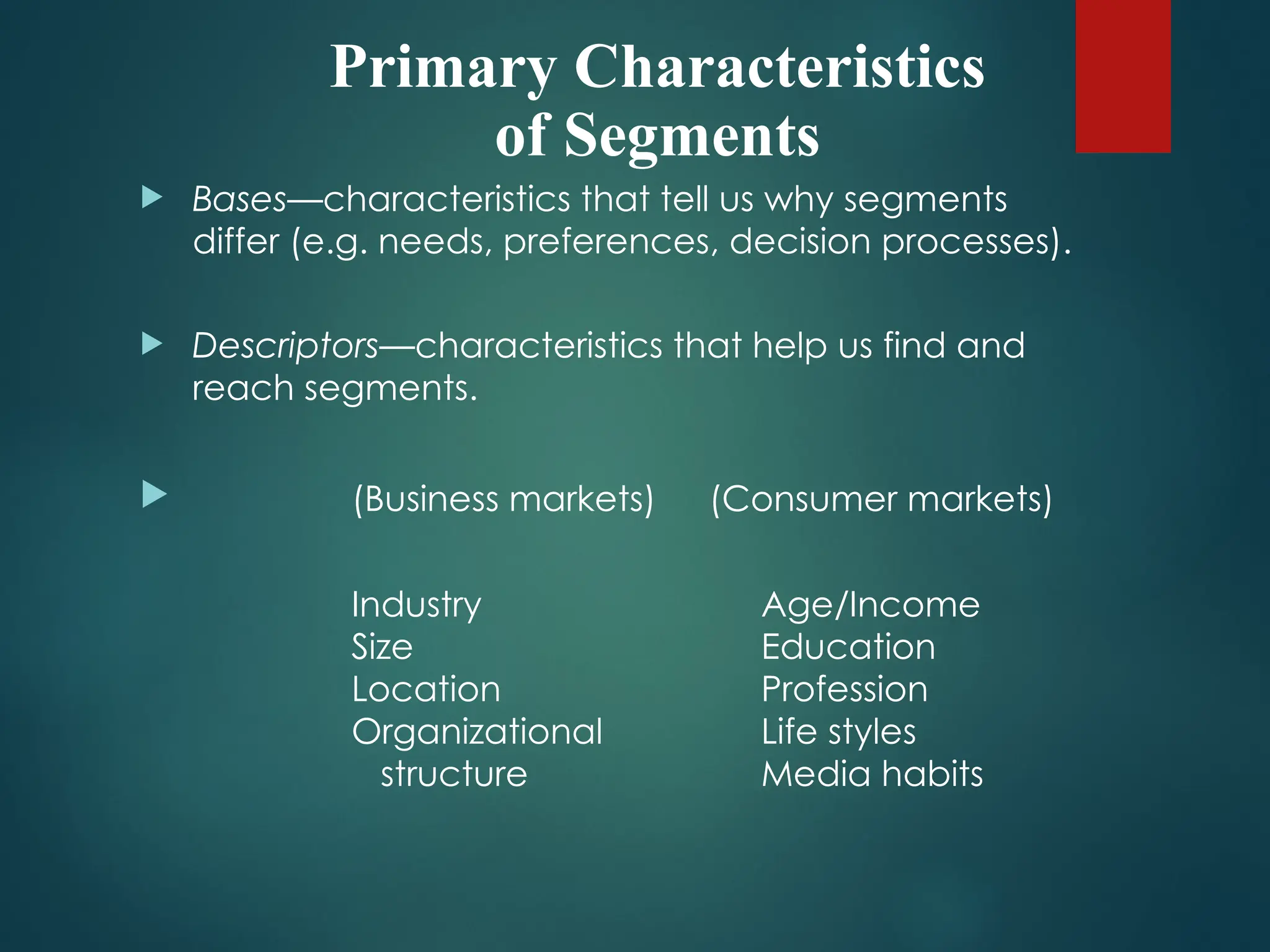
Primary Characteristics
of Segments
 Bases—characteristics that tell us why segments
differ (e.g. needs, preferences, decision processes).
 Descriptors—characteristics that help us find and
reach segments.
 (Business markets) (Consumer markets)
Industry Age/Income
Size Education
Location Profession
Organizational Life styles
structure Media habits
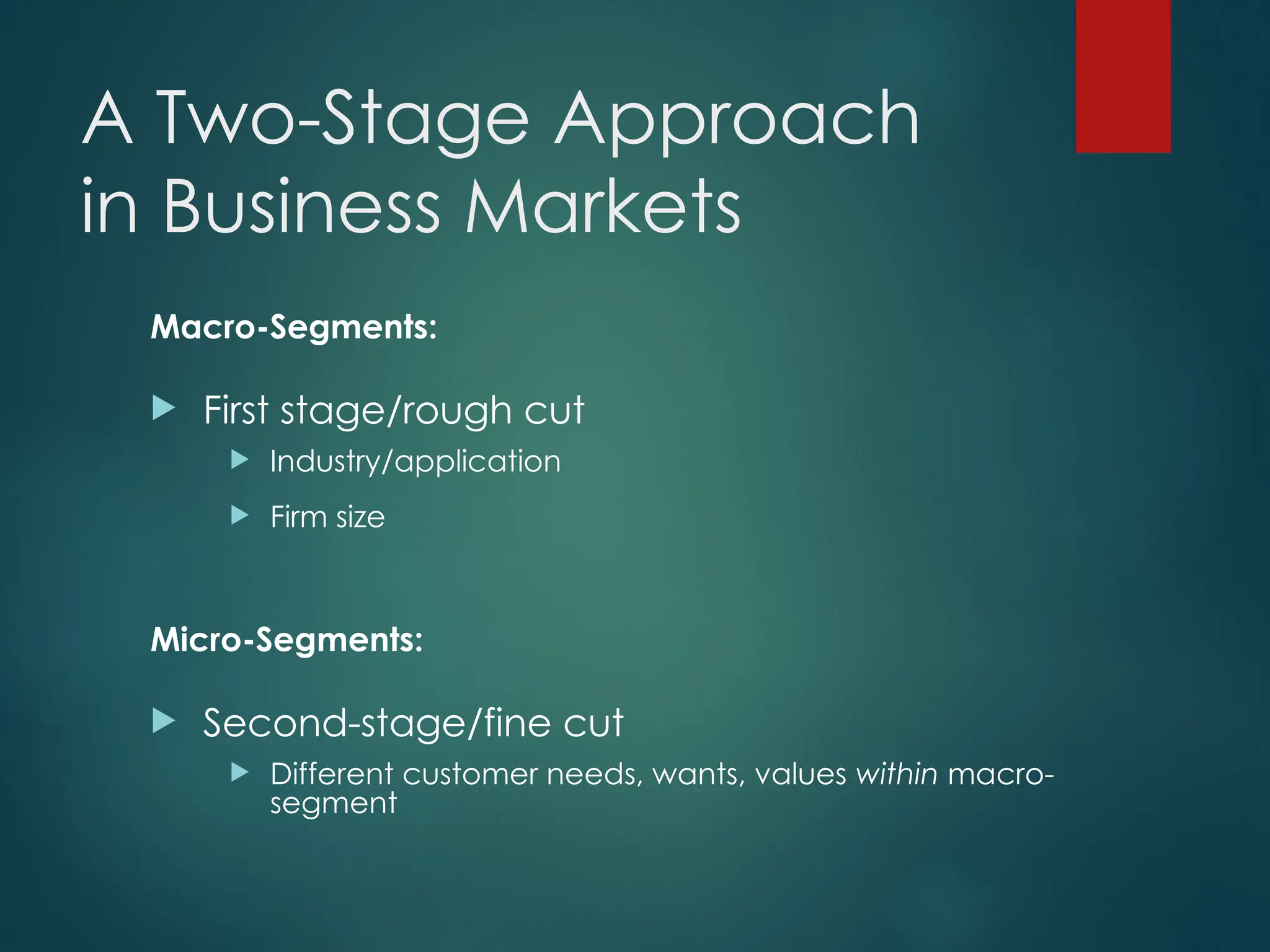
A Two-Stage Approach
in Business Markets
Macro-Segments:
 First stage/rough cut
 Industry/application
 Firm size
Micro-Segments:
 Second-stage/fine cut
 Different customer needs, wants, values within macro-
segment
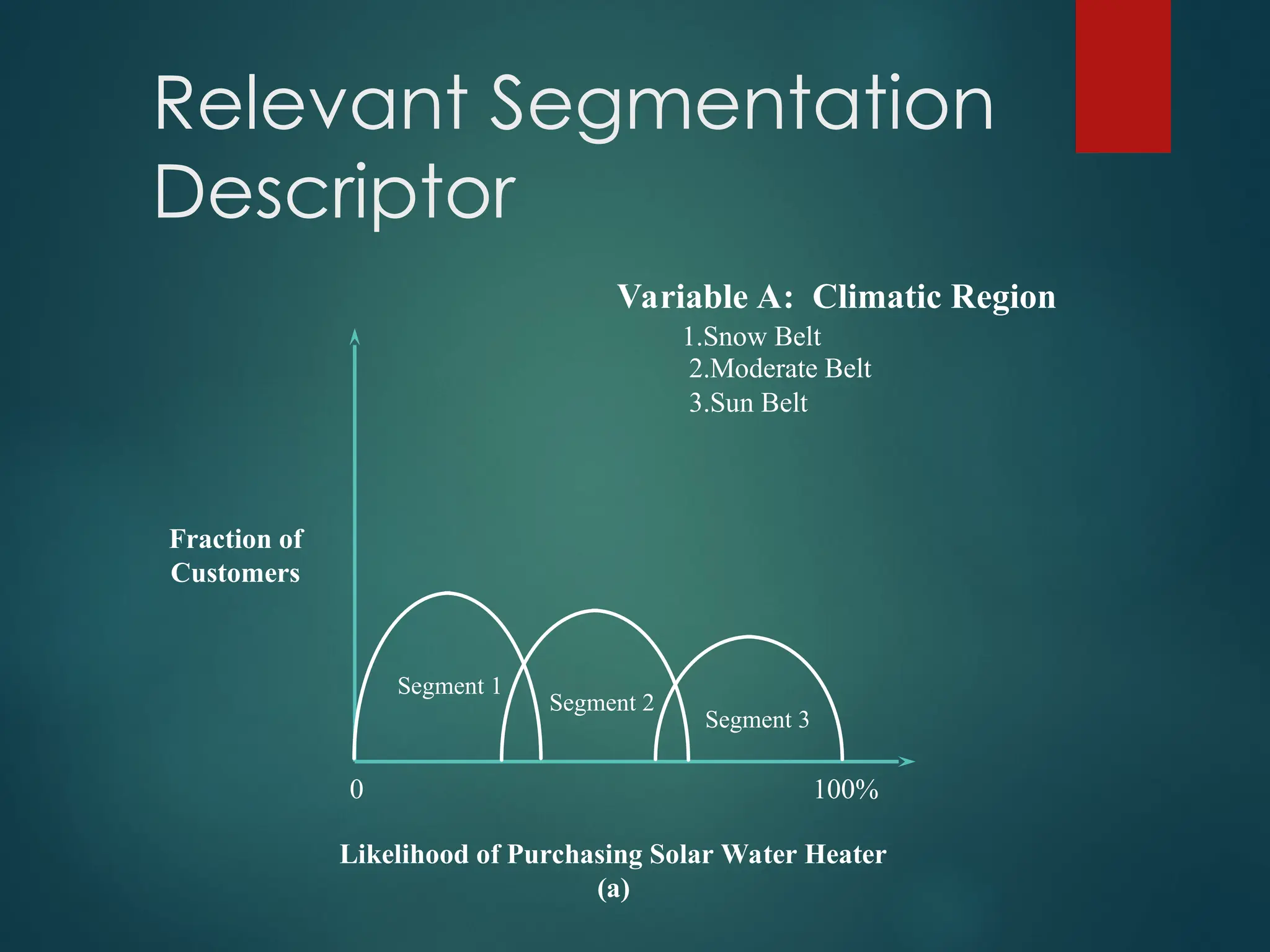
Relevant Segmentation
Descriptor
Variable A: Climatic Region
1.Snow Belt
2.Moderate Belt
3.Sun Belt
Fraction of
Customers
Likelihood of Purchasing Solar Water Heater
(a)
0 100%
Segment 1
Segment 2
Segment 3
Likelihood of Purchasing Solar Water Heater
(b)
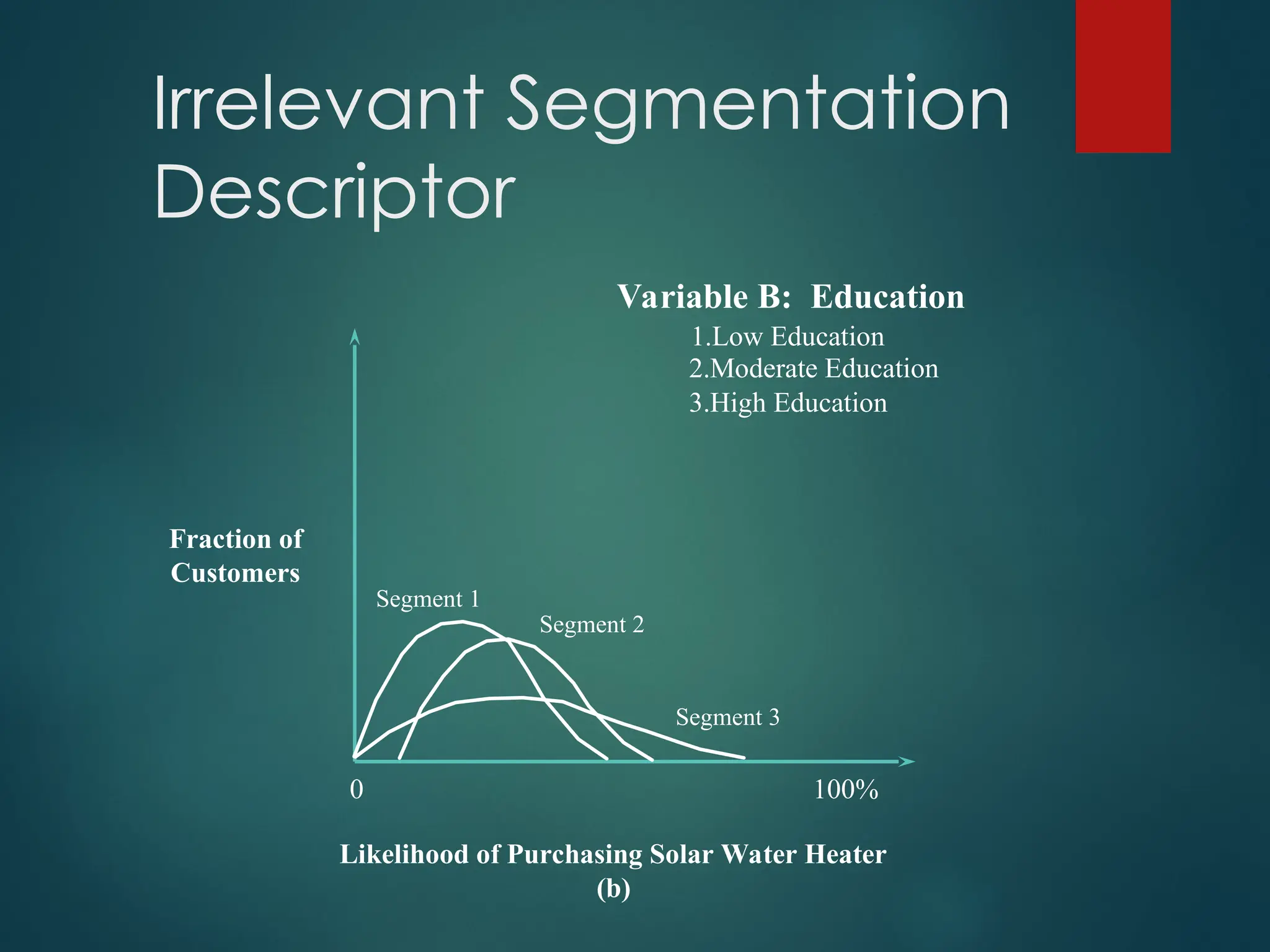
Irrelevant Segmentation
Descriptor
Fraction of
Customers
0 100%
Variable B: Education
1.Low Education
2.Moderate Education
3.High Education
Segment 1
Segment 2
Segment 3
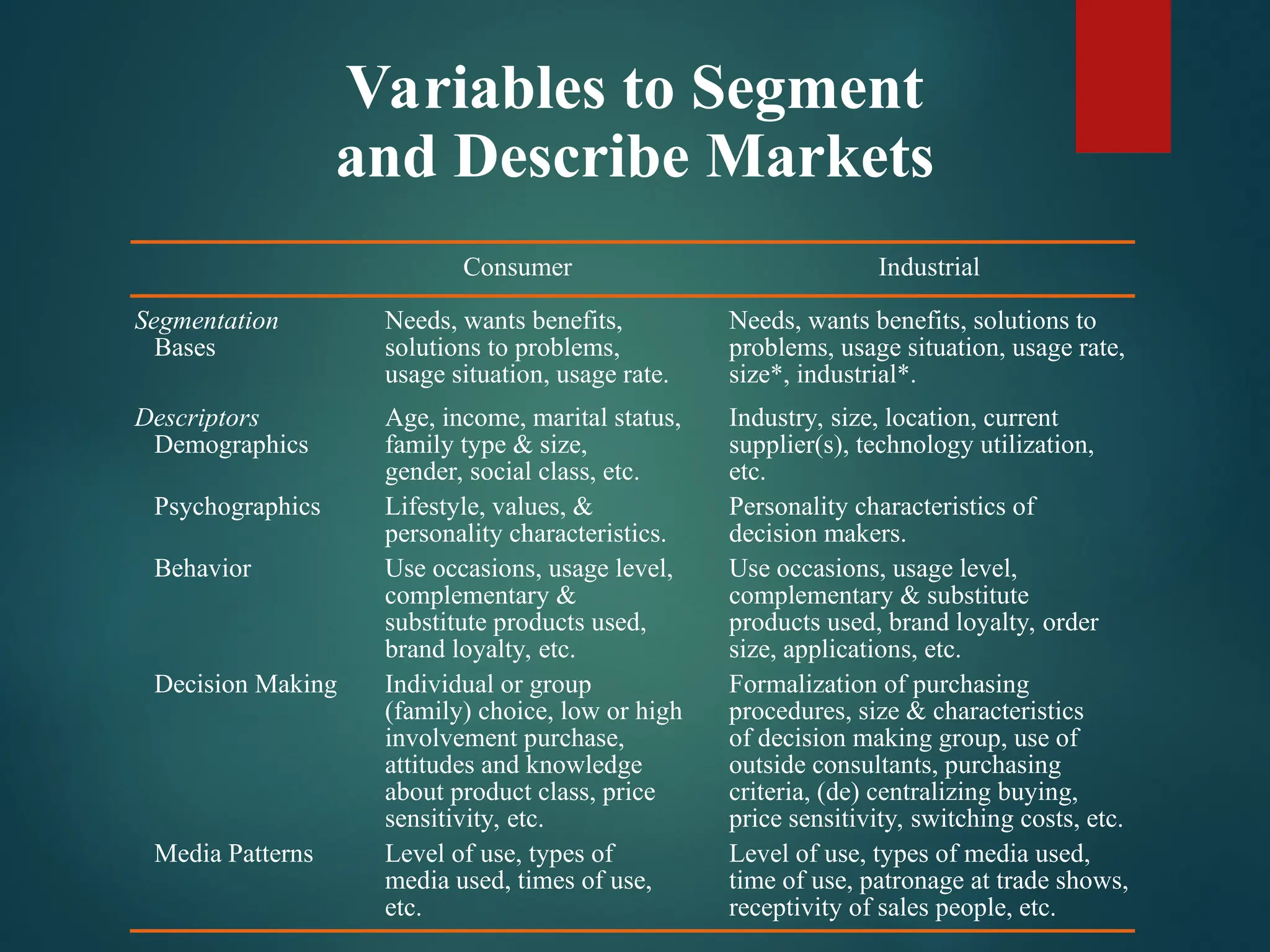
Variables to Segment
and Describe Markets
Consumer Industrial
Segmentation Needs, wants benefits, Needs, wants benefits, solutions to
Bases solutions to problems, problems, usage situation, usage rate,
usage situation, usage rate. size*, industrial*.
Descriptors Age, income, marital status, Industry, size, location, current
Demographics family type & size, supplier(s), technology utilization,
gender, social class, etc. etc.
Psychographics Lifestyle, values, & Personality characteristics of
personality characteristics. decision makers.
Behavior Use occasions, usage level, Use occasions, usage level,
complementary & complementary & substitute
substitute products used, products used, brand loyalty, order
brand loyalty, etc. size, applications, etc.
Decision Making Individual or group Formalization of purchasing
(family) choice, low or high procedures, size & characteristics
involvement purchase, of decision making group, use of
attitudes and knowledge outside consultants, purchasing
about product class, price criteria, (de) centralizing buying,
sensitivity, etc. price sensitivity, switching costs, etc.
Media Patterns Level of use, types of Level of use, types of media used,
media used, times of use, time of use, patronage at trade shows,
etc. receptivity of sales people, etc.
Segmentation in Action
We segment our customers by letter volume, by
postage volume, by the type of equipment they use.
Then we segment on whether they buy or lease
equipment.
Based on this knowledge, we target our marketing
messages, fine tune our sales tactics, learn which
benefits appeal to which customers and zero in on key
decision makers at a company.
—Kathleen Synnot, VP, Worldwide Marketing
Mailing Systems Division, Pitney Bowes, Inc.
[quoted in Marketing Masters (Walden and Lawler)]
Segmentation
If you’re not thinking segments, you’re not
thinking. To think segments means you have to
think about what drives customers, customer
groups, and the choices that are or might be
available to them.
—Levitt, Marketing Imagination
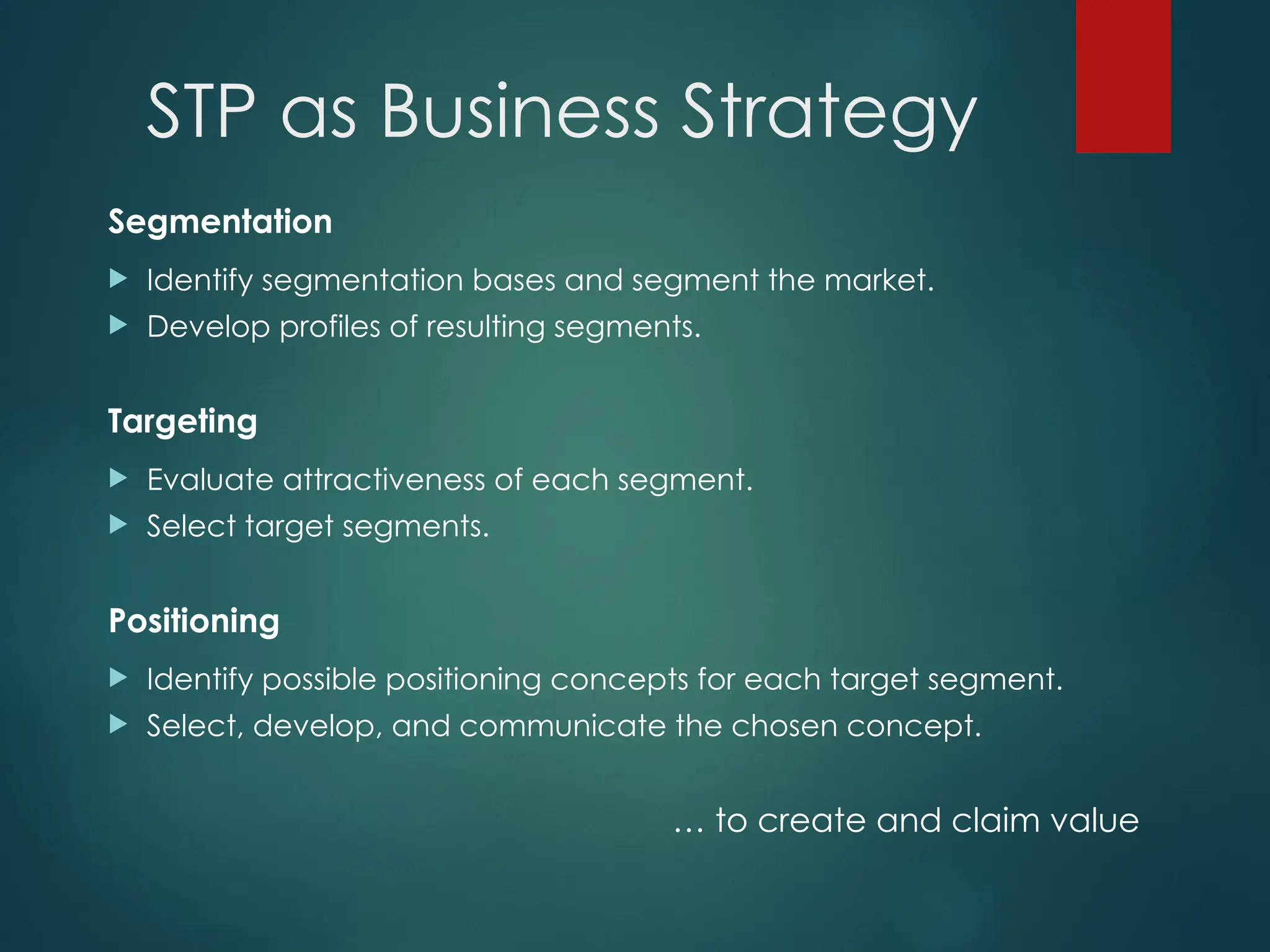
STP as Business Strategy
Segmentation
 Identify segmentation bases and segment the market.
 Develop profiles of resulting segments.
Targeting
 Evaluate attractiveness of each segment.
 Select target segments.
Positioning
 Identify possible positioning concepts for each target segment.
 Select, develop, and communicate the chosen concept.
… to create and claim value
Overview of Methods for STP
 Clustering and discriminant
analysis
 Choice-based segmentation
 Perceptual mapping
- later
..
.
D
.
.
..
.
.
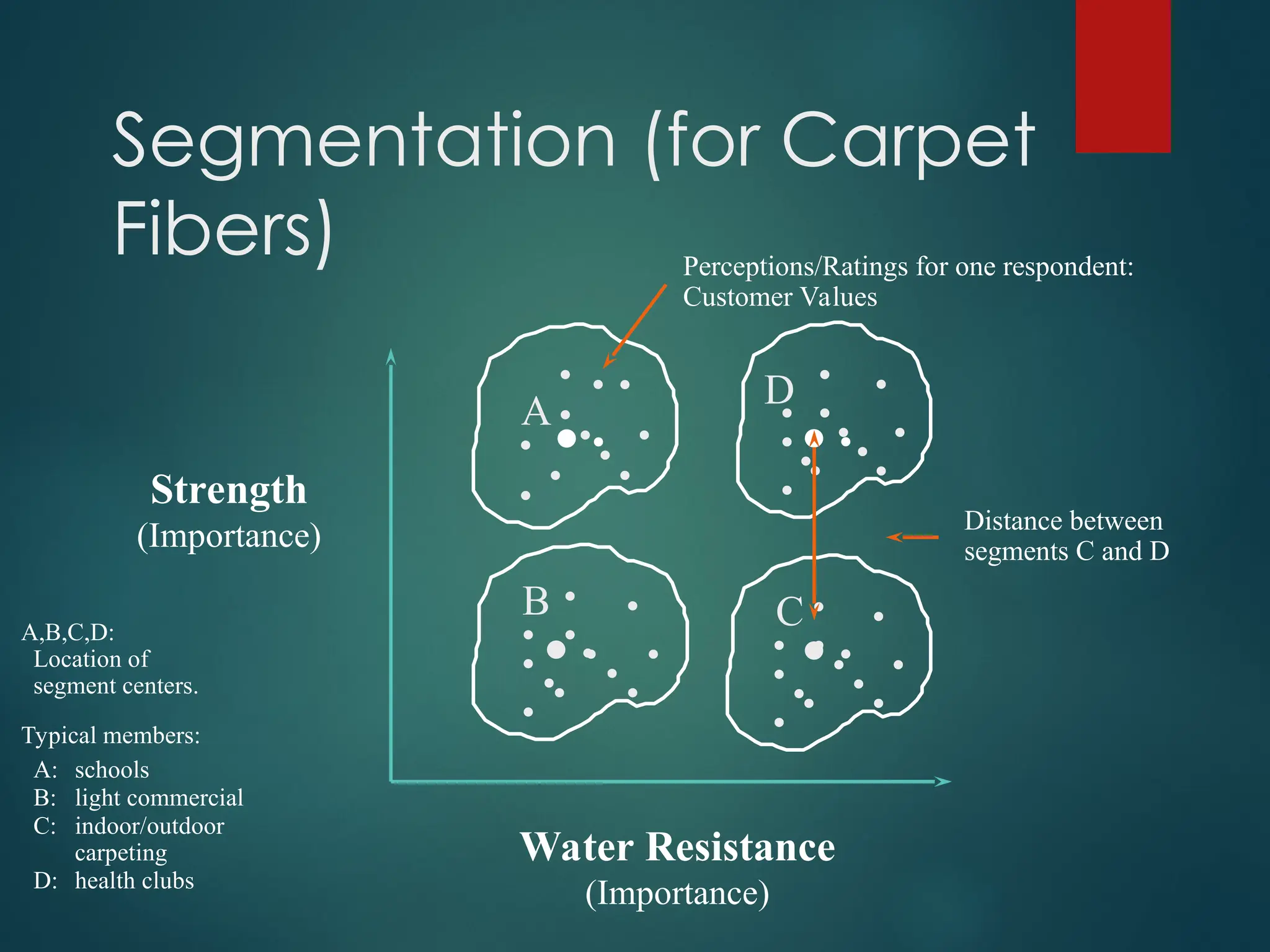
Segmentation (for Carpet
Fibers)
A,B,C,D:
Location of
segment centers.
Typical members:
A: schools
B: light commercial
C: indoor/outdoor
carpeting
D: health clubs
Distance between
segments C and D
.
..
. .
.
Strength
(Importance)
Water Resistance
(Importance)
.....
.
..
A
.....
.
..
. .
.
.
.....
.
..
. .
.
.
...
..
.. C
B
Perceptions/Ratings for one respondent:
Customer Values
.
.....
.
..
. .
.
.
.....
.
..
.
.
. .
Water Resistance
(Importance)
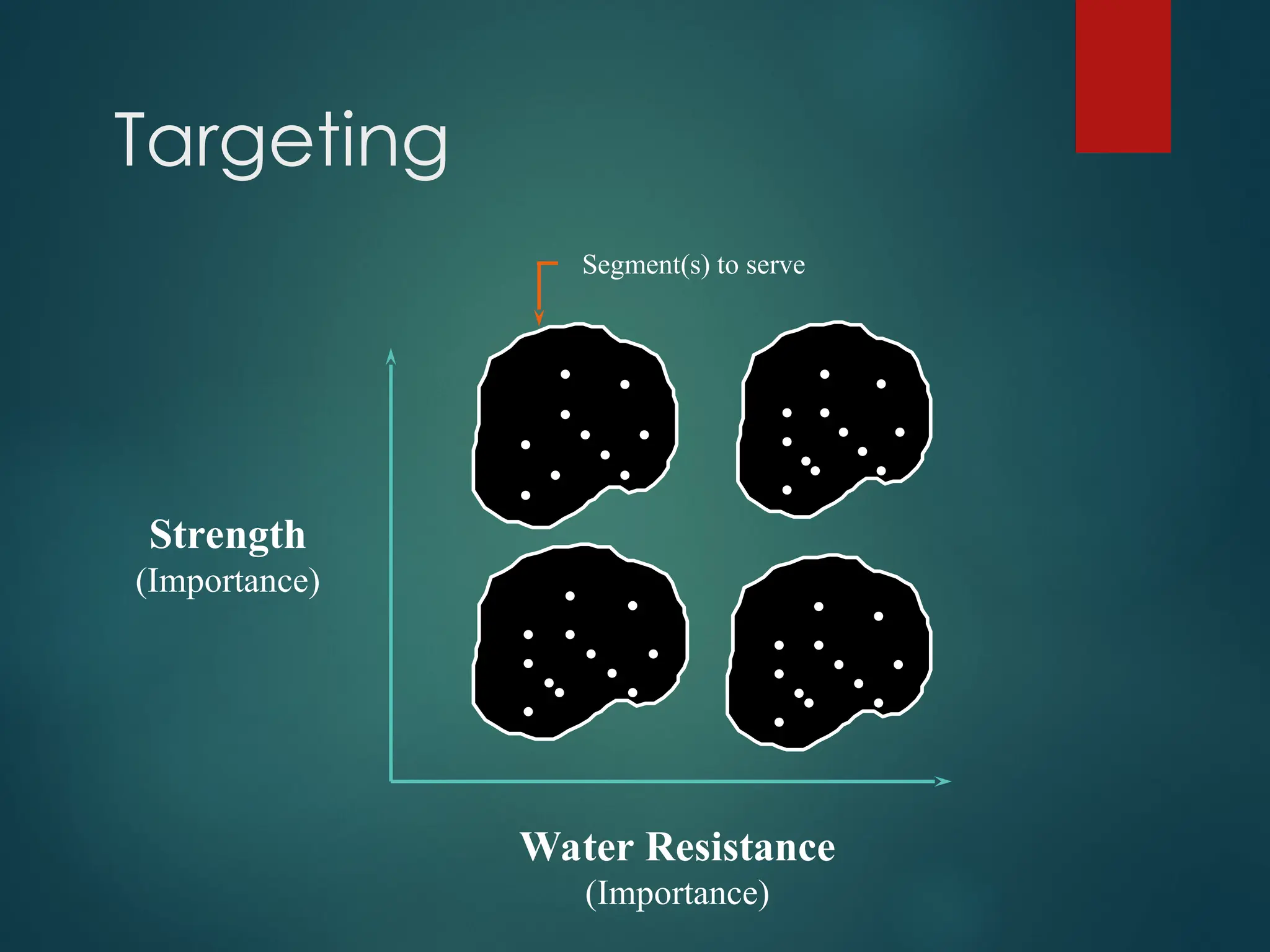
Targeting
Segment(s) to serve
.....
.
..
.
.
.....
.
..
. .
.
.
Strength
(Importance)
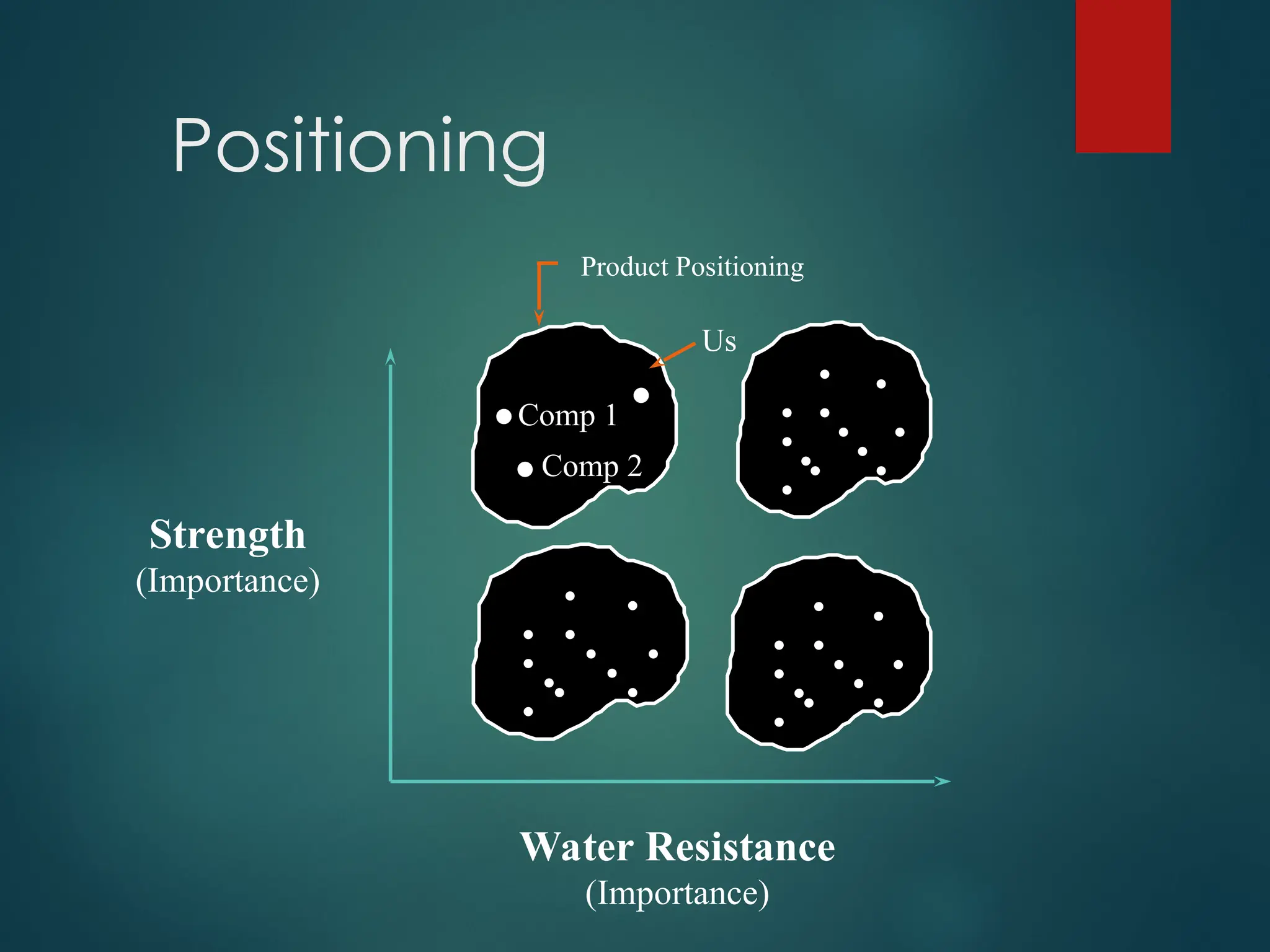
Product Positioning
.Comp 1
Comp 2
Us
Water Resistance
(Importance)
Positioning
. .
Strength
(Importance)
.....
.
..
. .
.
.
.....
.
..
.
.
. .
.....
.
..
. .
.
.
A Note on Positioning
Positioning involves designing an offering so that the target
segment members perceive it in a distinct and valued way
relative to competitors.
Three ways to position an offering:
1. Unique (“Only product/service with XXX”)
2. Difference (“More than twice the [feature] vs.
[competitor]”)
3. Similarities (“Same functionality as
[competitor];
lower price”)
What are you telling your targeted segments?
Behavior-Based
Segmentation
 Traditional segmentation
(eg, demographic,
psychographic)
 Needs-based segmentation
 Behavior-based segmentation
(choice models)
Steps in a Segmentation
Study
 Articulate a strategic rationale for segmentation (ie,
why are we segmenting this market?).
 Select a set of needs-based segmentation variables
most useful for achieving the strategic goals.
 Select a cluster analysis procedure for aggregating (or
disaggregating customers) into segments.
 Group customers into a defined number of different
segments.
 Choose the segments that will best serve the firm’s
strategy, given its capabilities and the likely reactions of
competitors.
Segmentation: Methods
Overview
 Factor analysis (to reduce data before
cluster analysis).
 Cluster analysis to form segments.
 Discriminant analysis to describe
segments.
Cluster Analysis for
Segmenting Markets
 Define a measure to assess the similarity of customers
on the basis of their needs.
 Group customers with similar needs. Recommend:
the “Ward’s minimum variance criterion” and, as an
option, the K-Means algorithm for doing this.
 Select the number of segments using numeric and
strategic criteria, and your judgment.
 Profile the needs of the selected segments (e.g.,
using cluster means).
Cluster Analysis Issues
 Defining a measure of similarity (or distance) between
segments.
 Identifying “outliers.”
 Selecting a clustering procedure
 Hierarchical clustering (e.g., Single linkage, average linkage, and minimum
variance methods)
 Partitioning methods (e.g., K-Means)
 Cluster profiling
 Univariate analysis
 Multiple discriminant analysis
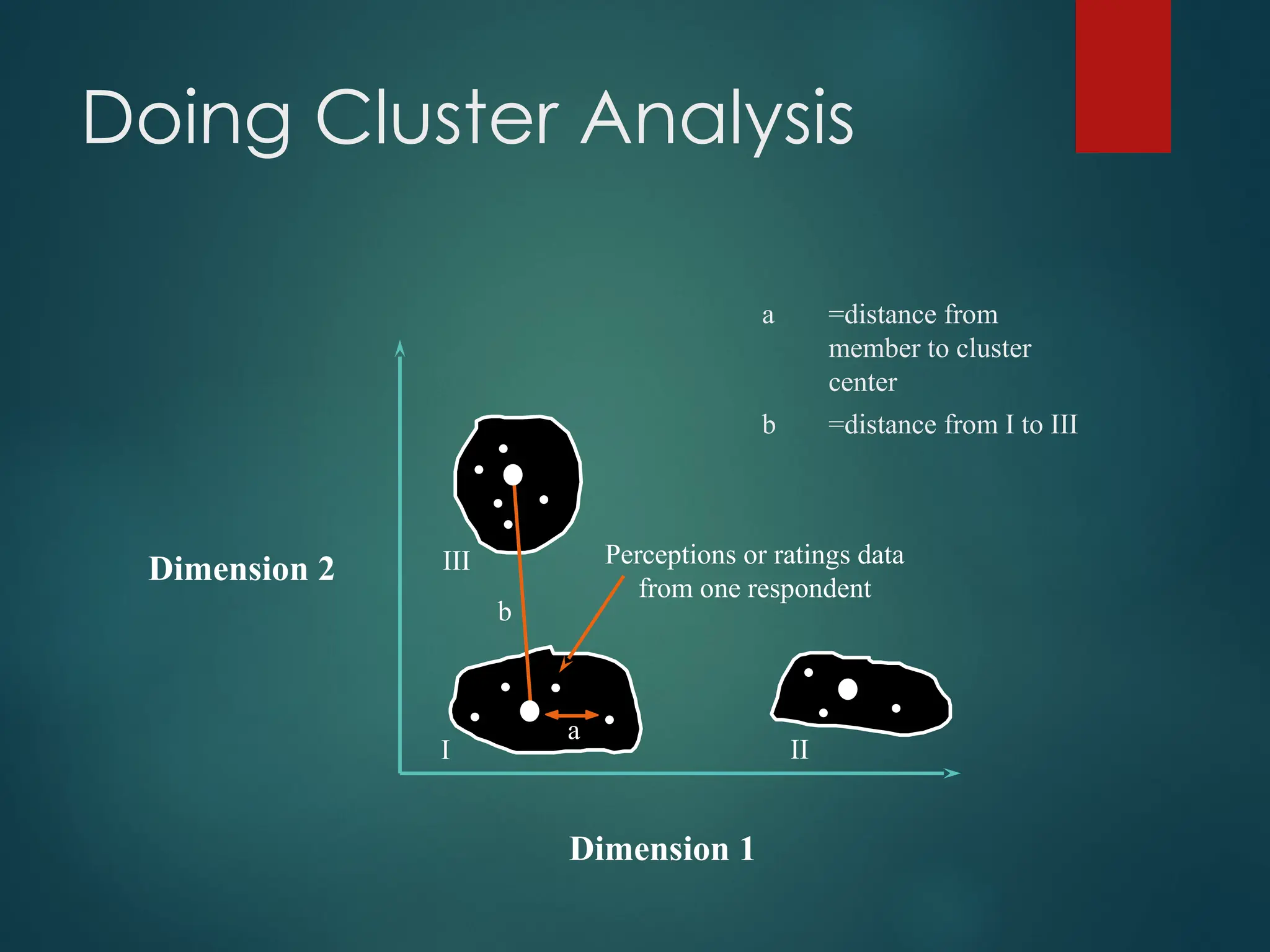
Doing Cluster Analysis
Dimension 2
Dimension 1
•
•
•
•
•
•
•
•
•
•
• •
Perceptions or ratings data
from one respondent
III
a
I II
b
a =distance from
member to cluster
center
b =distance from I to III
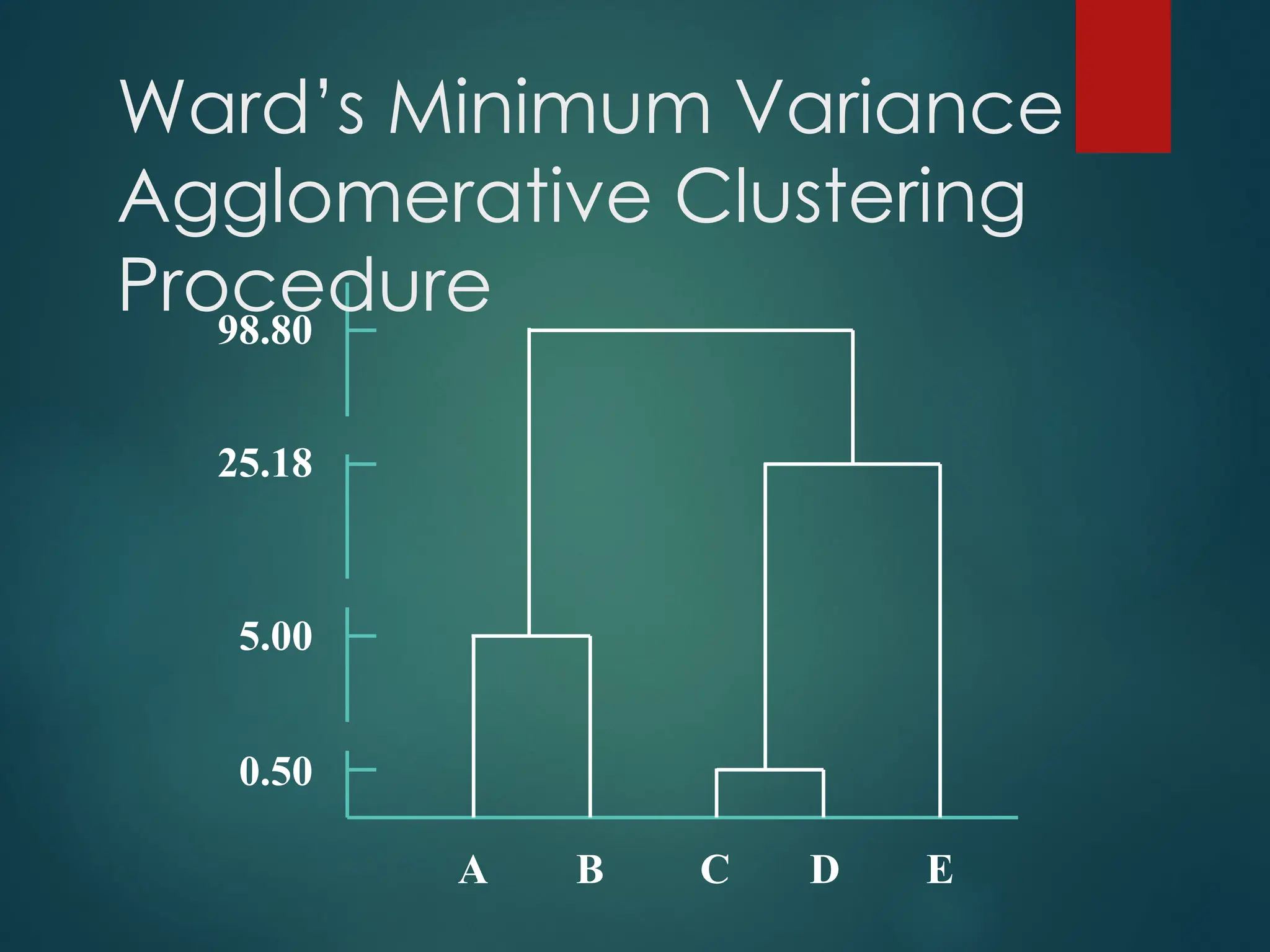
Ward’s Minimum Variance
Agglomerative Clustering
Procedure
First Stage: A = 2 B = 5 C = 9 D = 10 E = 15
Second Stage: AB = 4.5 BD = 12.5
AC = 24.5 BE = 50.0
AD = 32.0 CD = 0.5
AE = 84.5 CE = 18.0
BC = 8.0 DE = 12.5
Third Stage: CDA = 38.0 CDB = 14.0 CDE = 20.66 AB = 5.0
AE = 85.0 BE = 50.5
Fourth Stage: ABCD = 41.0 ABE= 93.17 CDE = 25.18
Fifth Stage: ABCDE = 98.8
A
98.80
Ward’s Minimum Variance
Agglomerative Clustering
Procedure
B C D E
25.18
5.00
0.50
Discriminant Analysis for
Describing Market Segments
 Identify a set of “observable” variables that
helps you to understand how to reach and
serve the needs of selected clusters.
 Use discriminant analysis to identify
underlying dimensions (axes) that maximally
differentiate between the selected clusters.
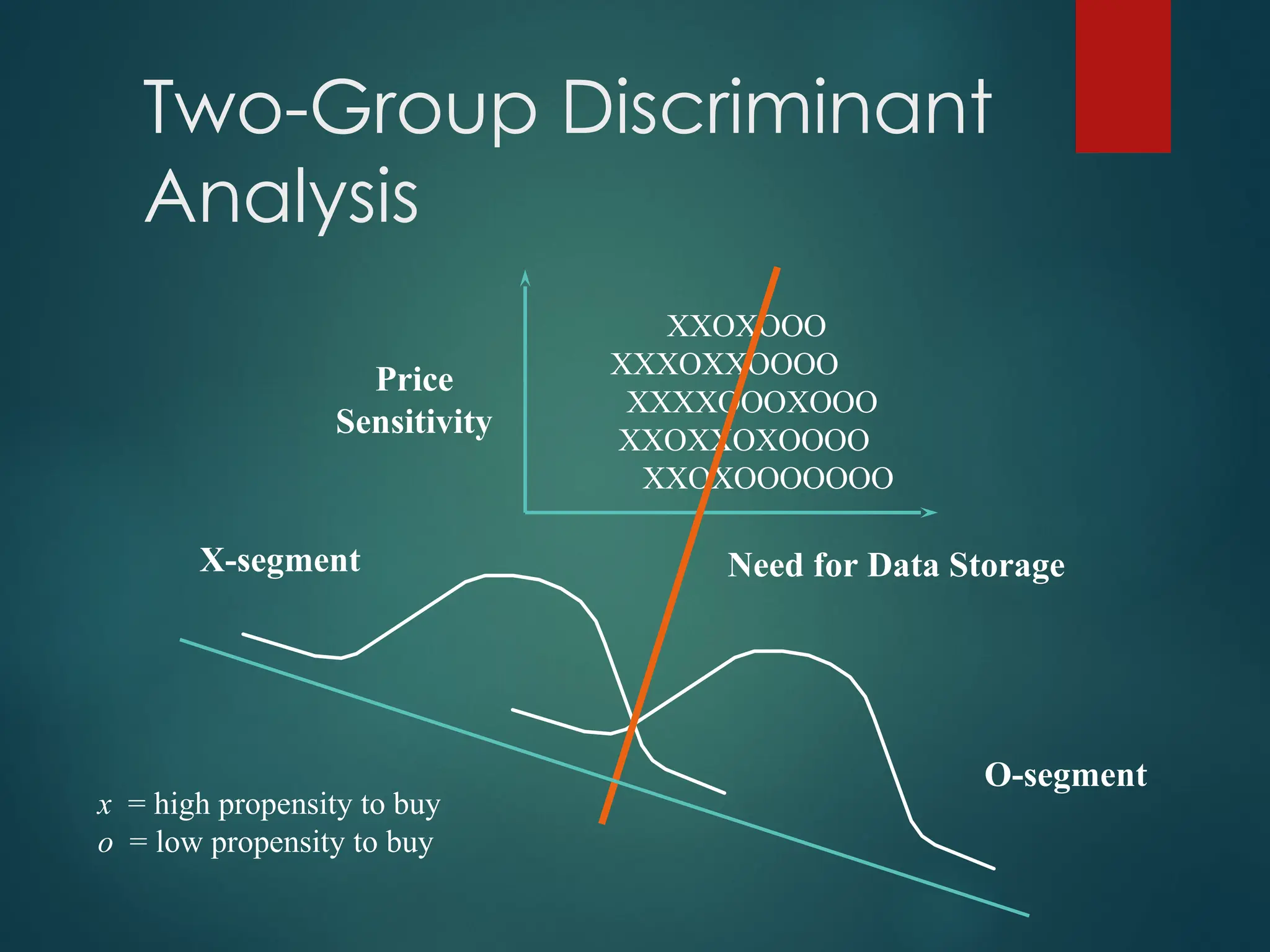
Two-Group Discriminant
Analysis
Need for Data Storage
Price
Sensitivity
XXOXOOO
XXXOXXOOOO
XXXXOOOXOOO
XXOXXOXOOOO
XXOXOOOOOOO
X-segment
O-segment
x = high propensity to buy
o = low propensity to buy
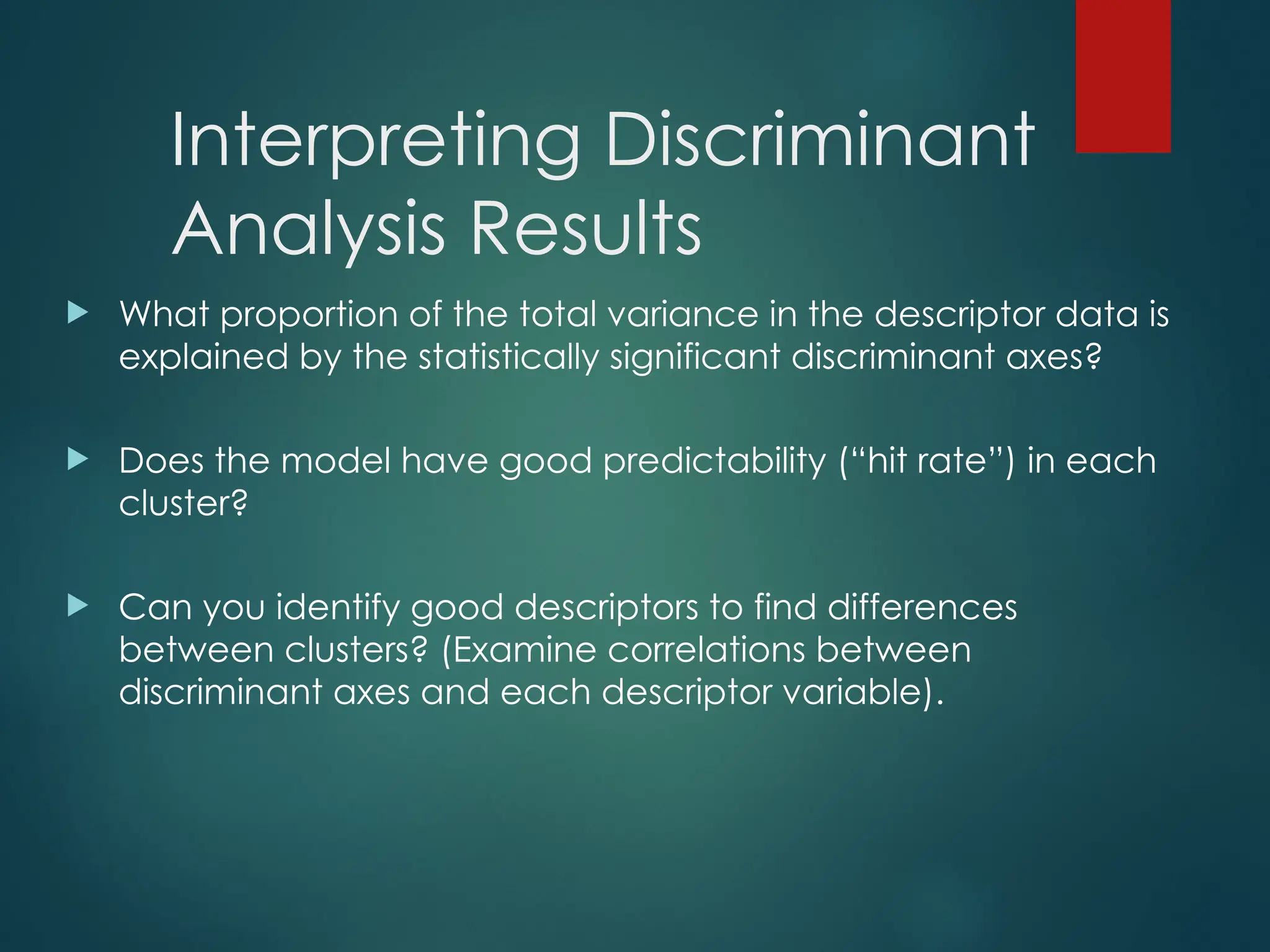
Interpreting Discriminant
Analysis Results
 What proportion of the total variance in the descriptor data is
explained by the statistically significant discriminant axes?
 Does the model have good predictability (“hit rate”) in each
cluster?
 Can you identify good descriptors to find differences
between clusters? (Examine correlations between
discriminant axes and each descriptor variable).
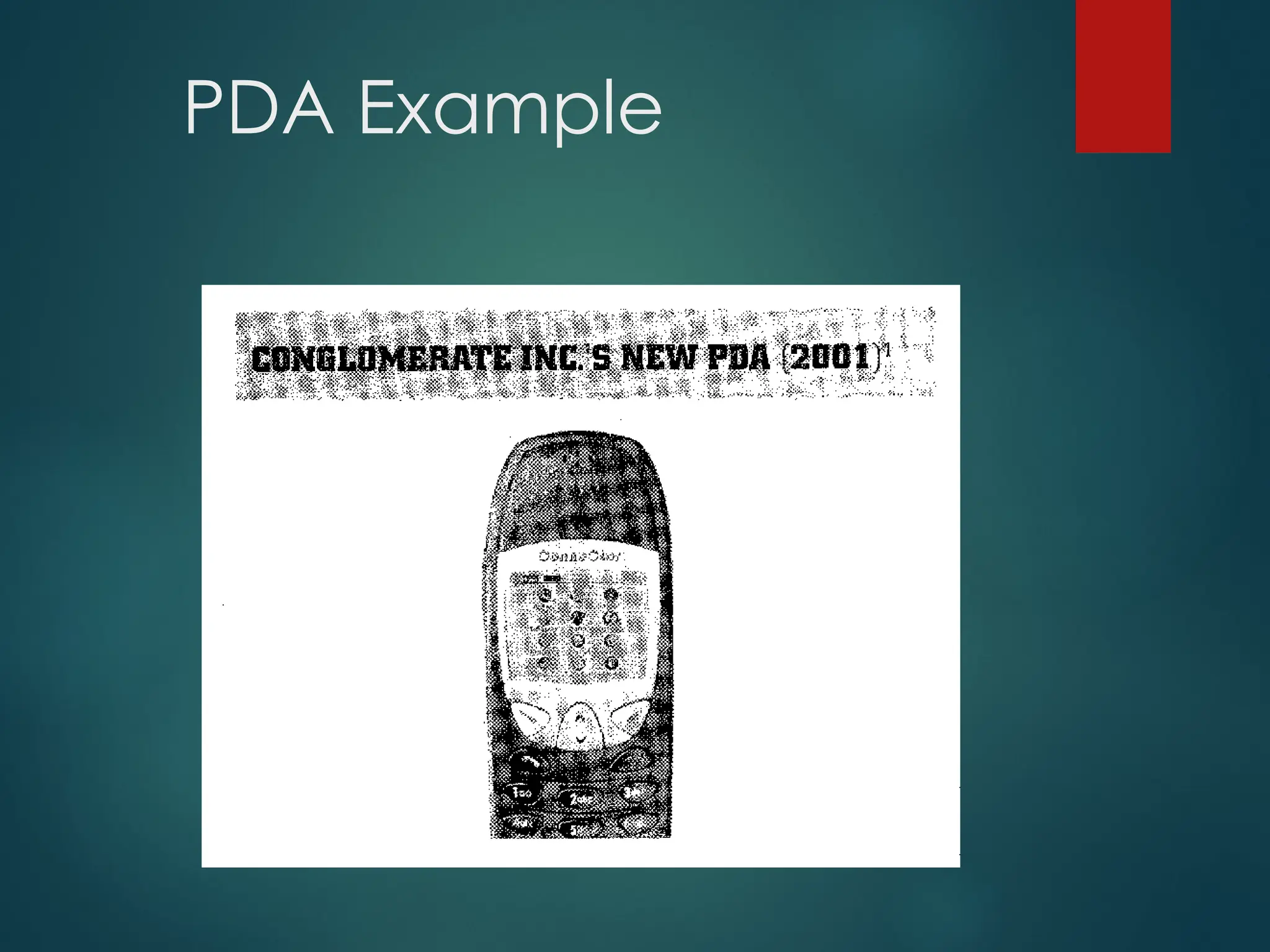
PDA Example
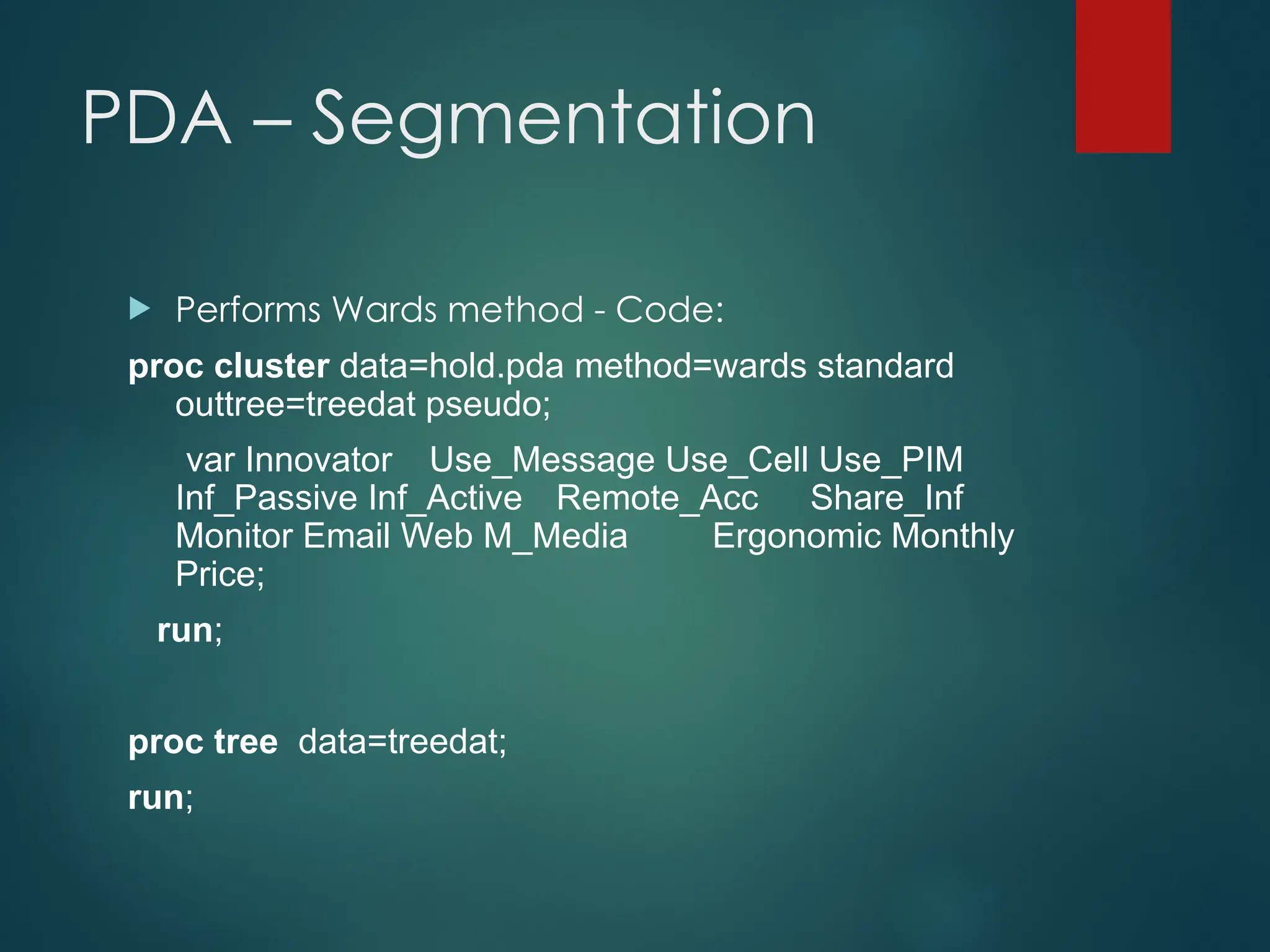
PDA – Segmentation
 Performs Wards method - Code:
proc cluster data=hold.pda method=wards standard
outtree=treedat pseudo;
var Innovator Use_Message Use_Cell Use_PIM
Inf_Passive Inf_Active Remote_Acc Share_Inf
Monitor Email Web M_Media Ergonomic Monthly
Price;
run;
proc tree data=treedat;
run;
PDA – Segmentation
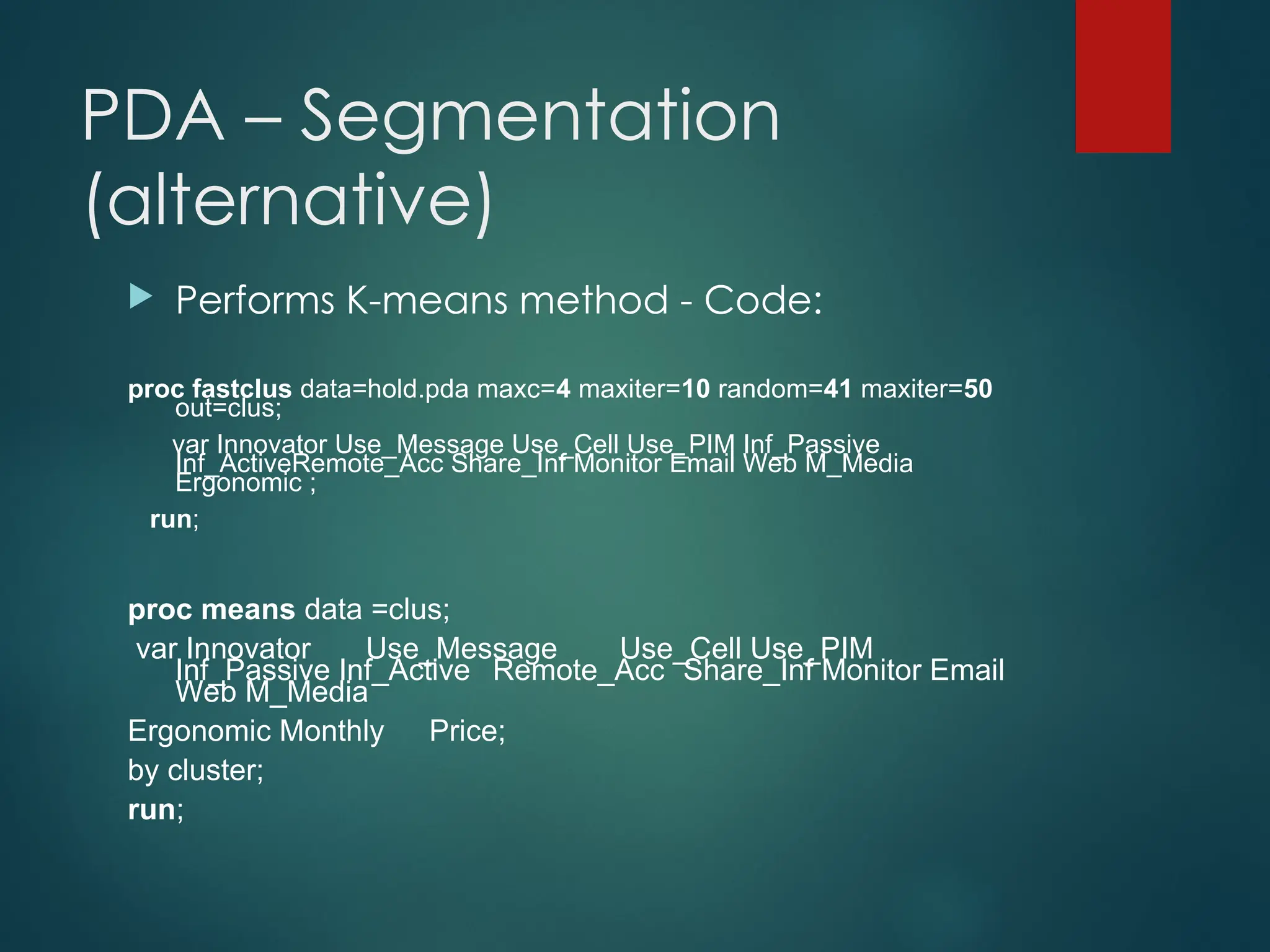
(alternative)
 Performs K-means method - Code:
proc fastclus data=hold.pda maxc=4 maxiter=10 random=41 maxiter=50
out=clus;
var Innovator Use_Message Use_Cell Use_PIM Inf_Passive
Inf_ActiveRemote_Acc Share_Inf Monitor Email Web M_Media
Ergonomic ;
run;
proc means data =clus;
var Innovator Use_Message Use_Cell Use_PIM
Inf_Passive Inf_Active Remote_Acc Share_Inf Monitor Email
Web M_Media
Ergonomic Monthly Price;
by cluster;
run;
Output
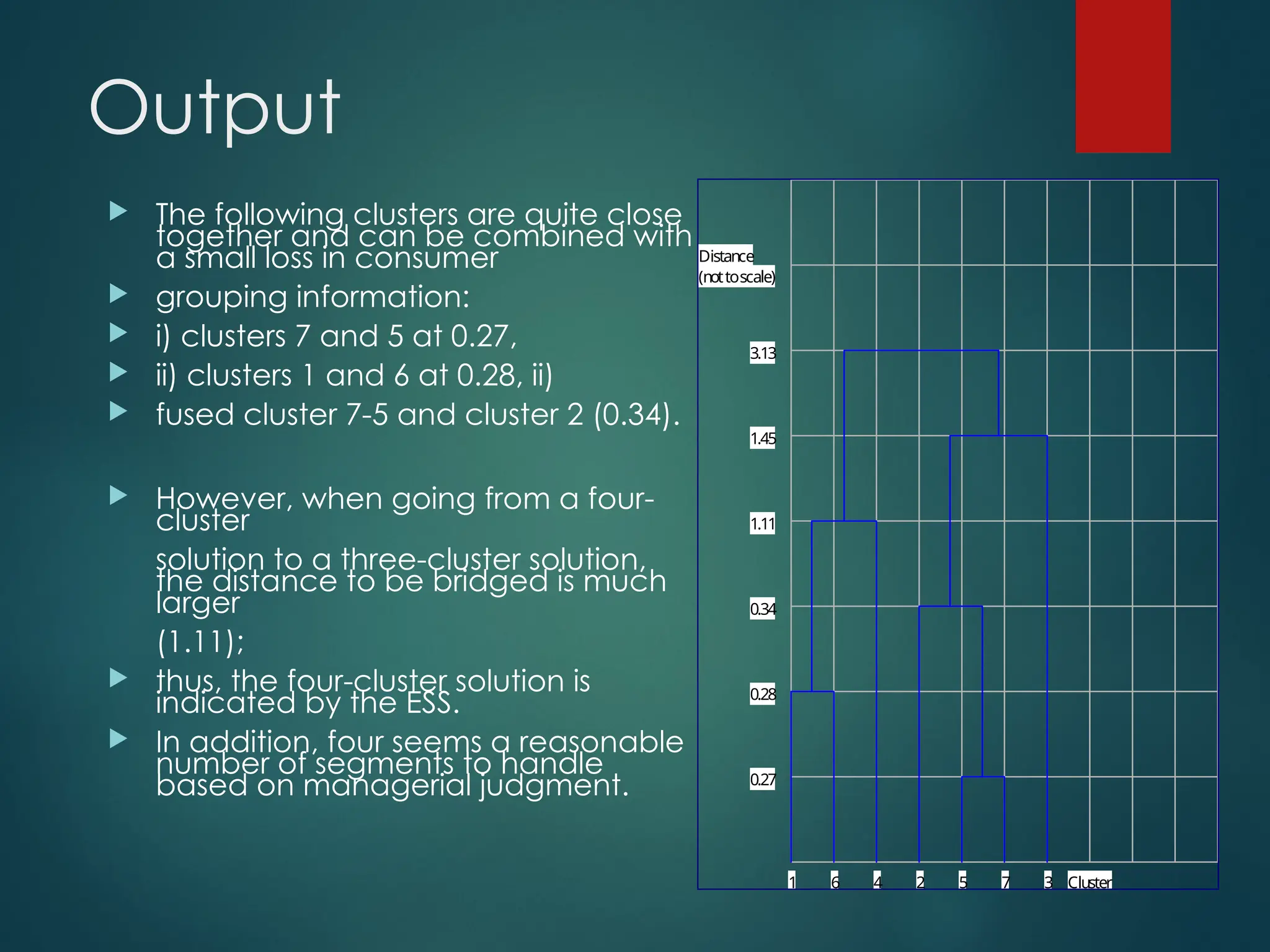
 The following clusters are quite close
together and can be combined with
a small loss in consumer
 grouping information:
 i) clusters 7 and 5 at 0.27,
 ii) clusters 1 and 6 at 0.28, ii)
 fused cluster 7-5 and cluster 2 (0.34).
 However, when going from a four-
cluster
solution to a three-cluster solution,
the distance to be bridged is much
larger
(1.11);
 thus, the four-cluster solution is
indicated by the ESS.
 In addition, four seems a reasonable
number of segments to handle
based on managerial judgment. 0.27
0.28
0.34
1.11
1.45
3.13
7
6 5
4 3
2
1 Cluster
(nottoscale)
Distance
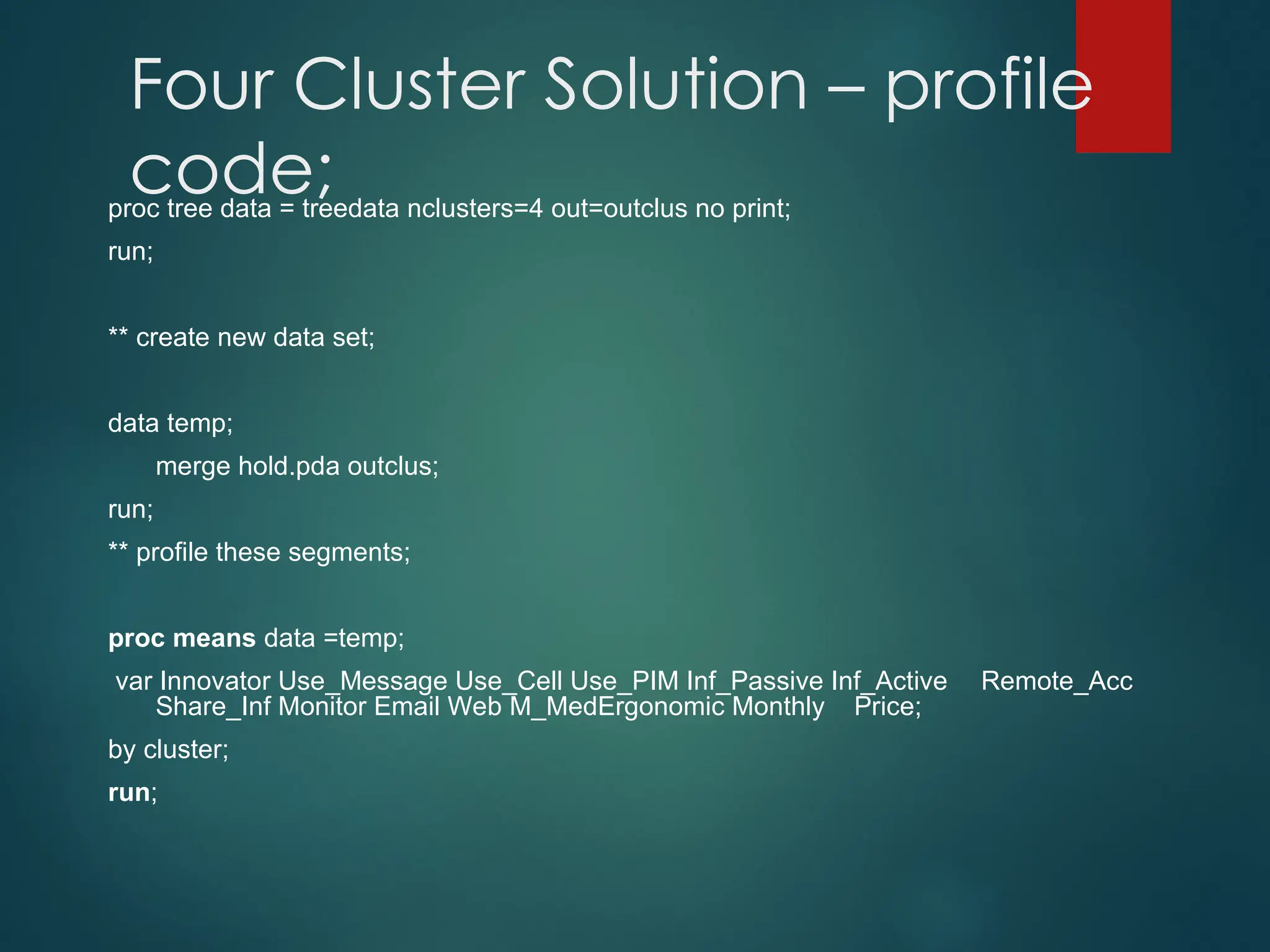
Four Cluster Solution – profile
code;
proc tree data = treedata nclusters=4 out=outclus no print;
run;
** create new data set;
data temp;
merge hold.pda outclus;
run;
** profile these segments;
proc means data =temp;
var Innovator Use_Message Use_Cell Use_PIM Inf_Passive Inf_Active Remote_Acc
Share_Inf Monitor Email Web M_MedErgonomic Monthly Price;
by cluster;
run;
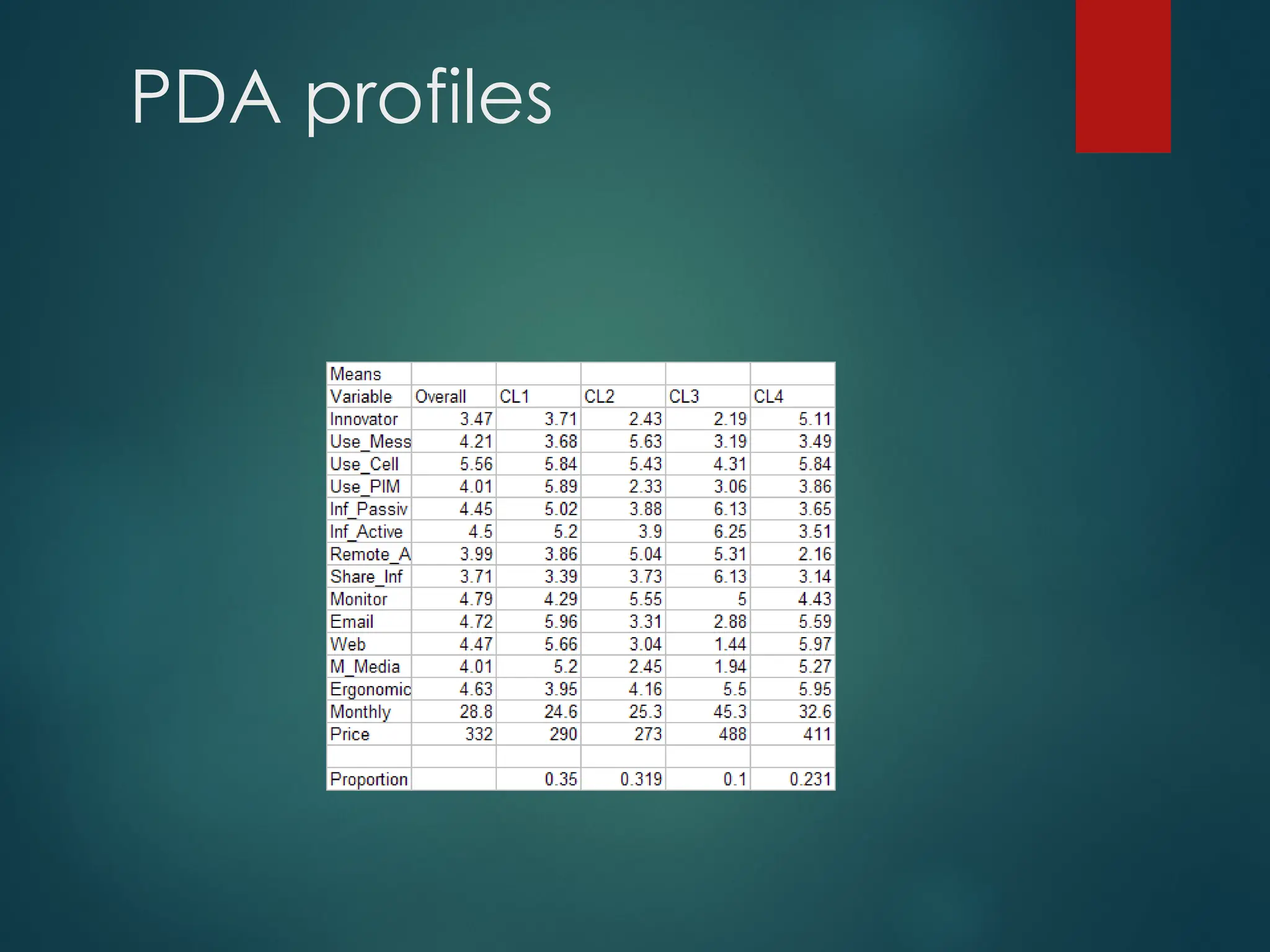
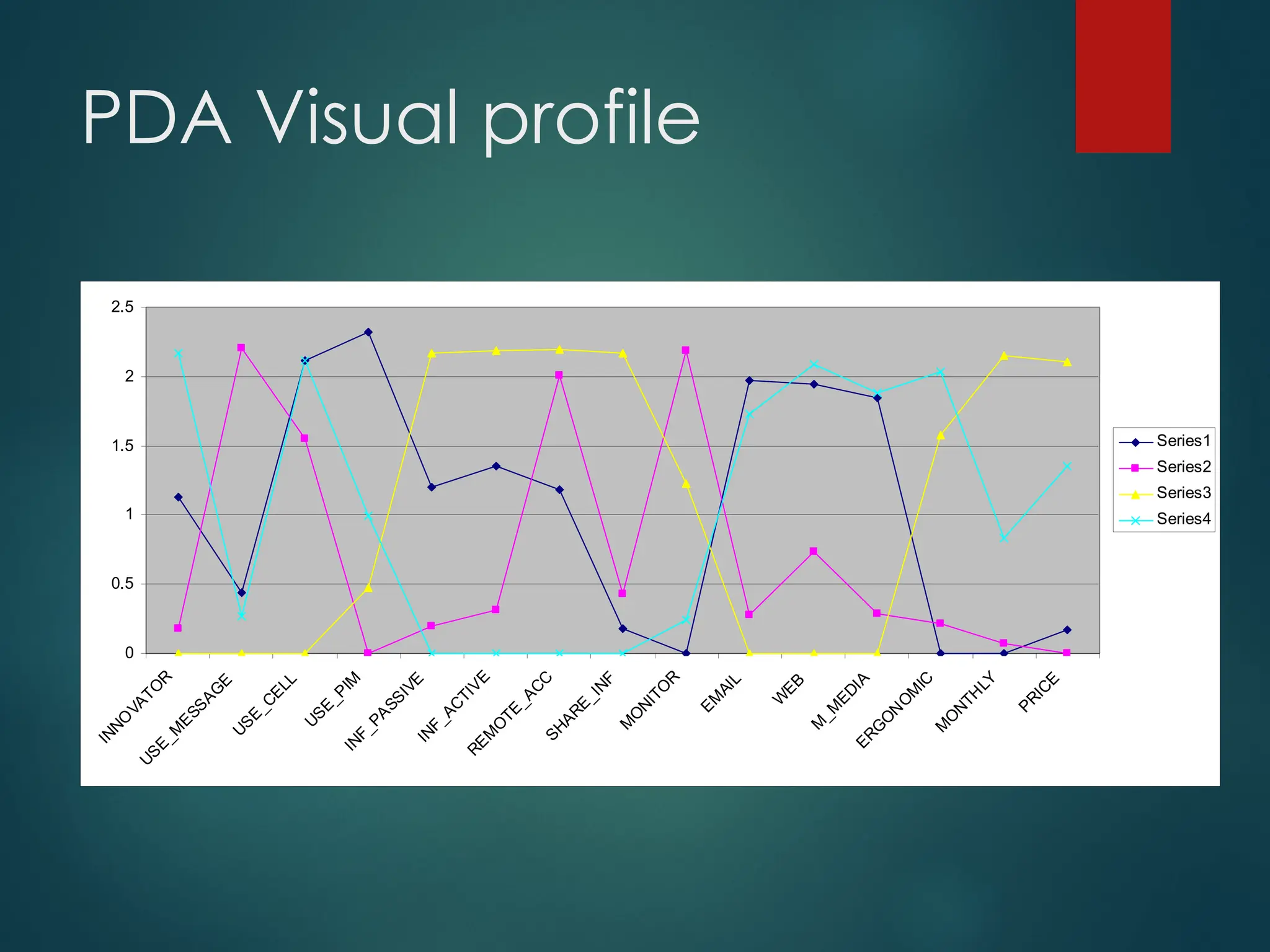
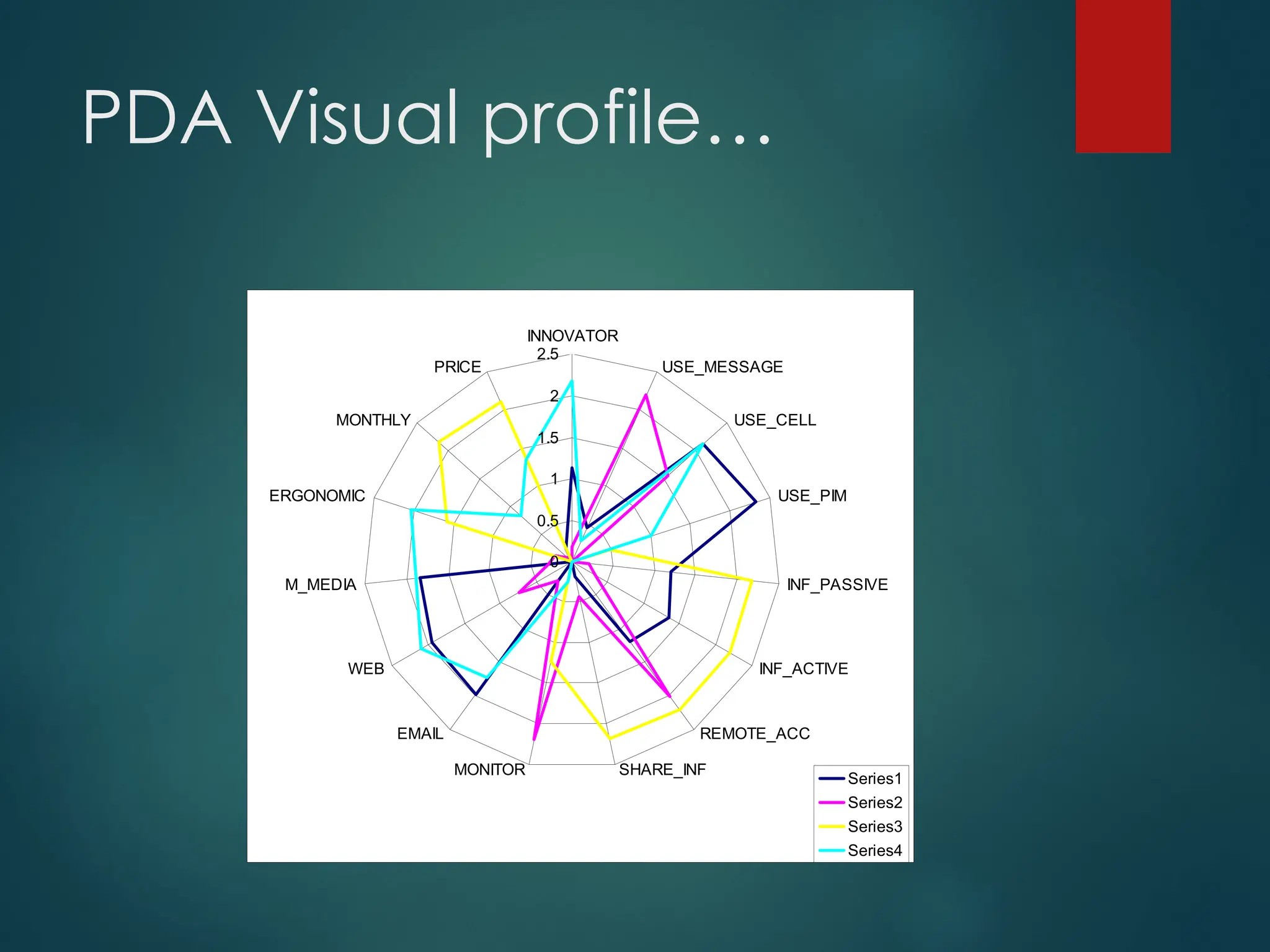
PDA profiles
PDA Visual profile
0
0.5
1
1.5
2
2.5
I
N
N
O
V
A
T
O
R
U
S
E
_
M
E
S
S
A
G
E
U
S
E
_
C
E
L
L
U
S
E
_
P
I
M
I
N
F
_
P
A
S
S
I
V
E
I
N
F
_
A
C
T
I
V
E
R
E
M
O
T
E
_
A
C
C
S
H
A
R
E
_
I
N
F
M
O
N
I
T
O
R
E
M
A
I
L
W
E
B
M
_
M
E
D
I
A
E
R
G
O
N
O
M
I
C
M
O
N
T
H
L
Y
P
R
I
C
E
Series1
Series2
Series3
Series4
PDA Visual profile…
0
0.5
1
1.5
2
2.5
INNOVATOR
USE_MESSAGE
USE_CELL
USE_PIM
INF_PASSIVE
INF_ACTIVE
REMOTE_ACC
SHARE_INF
MONITOR
EMAIL
WEB
M_MEDIA
ERGONOMIC
MONTHLY
PRICE
Series1
Series2
Series3
Series4
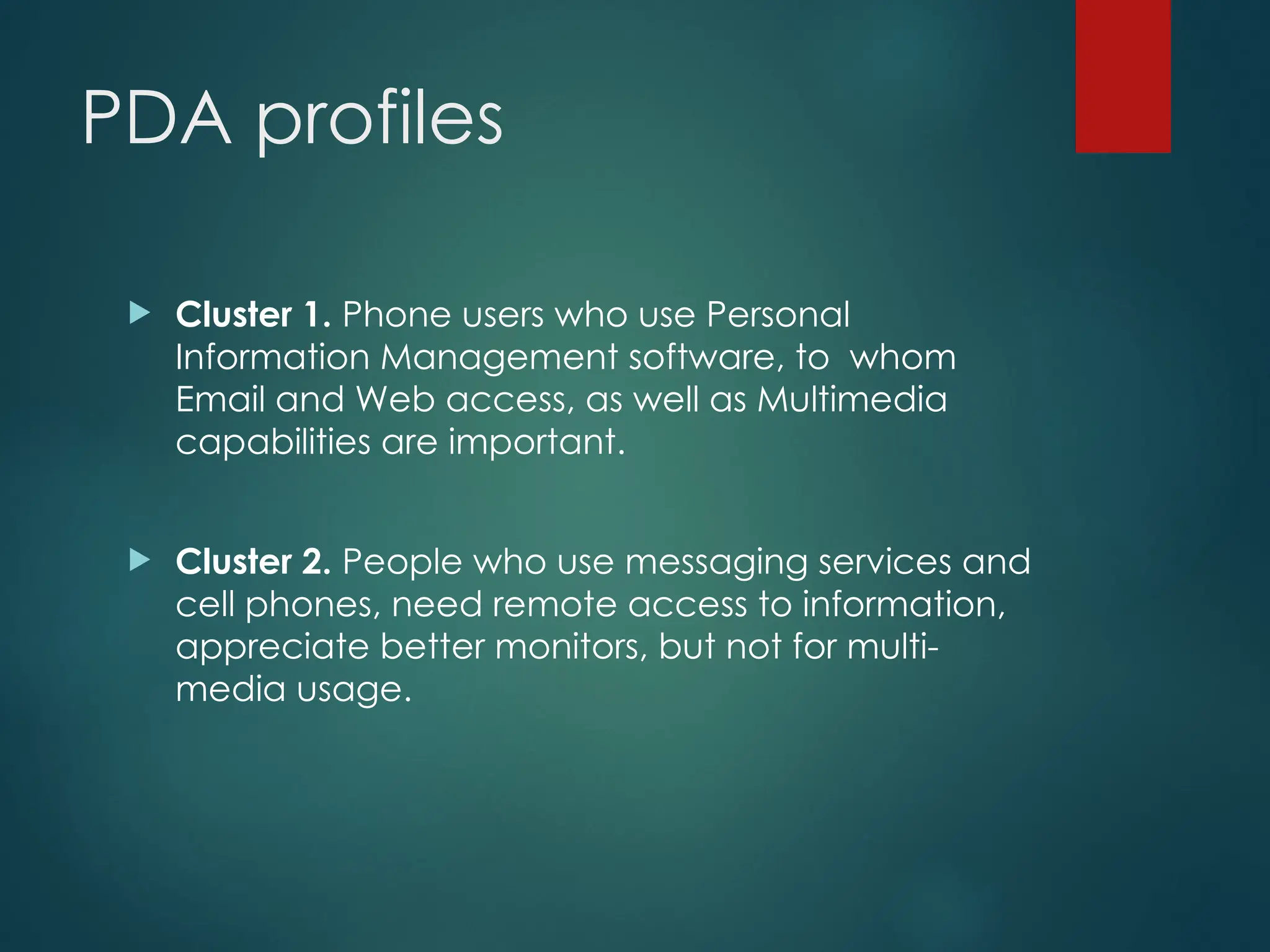
PDA profiles
 Cluster 1. Phone users who use Personal
Information Management software, to whom
Email and Web access, as well as Multimedia
capabilities are important.
 Cluster 2. People who use messaging services and
cell phones, need remote access to information,
appreciate better monitors, but not for multi-
media usage.
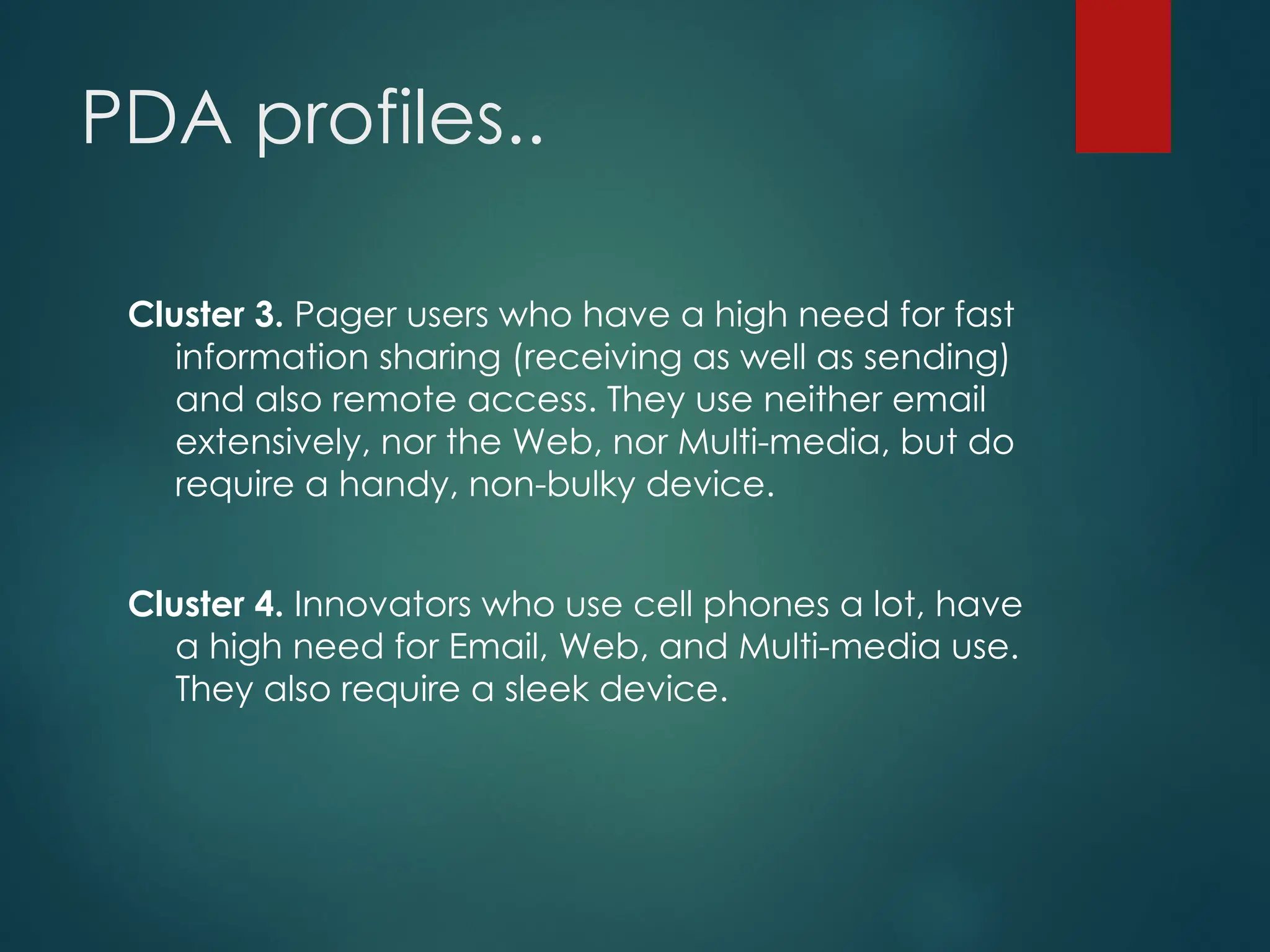
PDA profiles..
Cluster 3. Pager users who have a high need for fast
information sharing (receiving as well as sending)
and also remote access. They use neither email
extensively, nor the Web, nor Multi-media, but do
require a handy, non-bulky device.
Cluster 4. Innovators who use cell phones a lot, have
a high need for Email, Web, and Multi-media use.
They also require a sleek device.
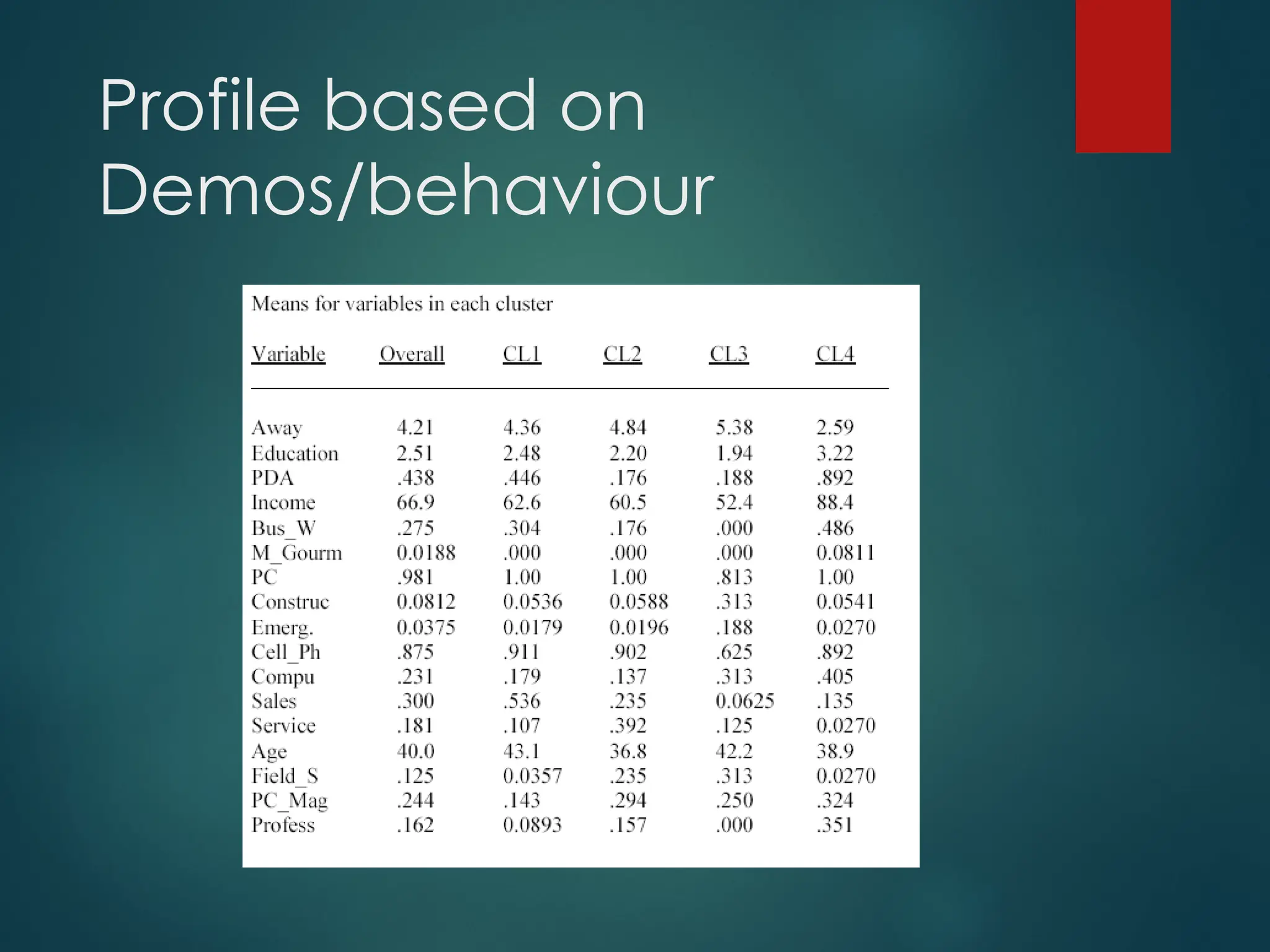
Profile based on
Demos/behaviour
Name the segments
Cluster 1 - Sales Pros:
Cluster 1 consists mainly of sales professionals: 54% of the cluster members
indicated Sales as their occupation. They use the cell phone heavily, and many
(45%) own a PDA already; practically all have access to a PC. Their work often
takes them away from the office. They mostly read two of the selected
magazines: 30% read BW. From the needs data, we see that they are quite price
sensitive.
Cluster 2 – Service Pros:
Cluster 2 is made up primarily of service personnel (39%) and secondarily of
sales personnel (23%). They use cell phones heavily, but only about one fifth
currently use a PDA. They spend much time on the road and in remote locations.
They read PC Magazine, 29%. From the needs data, we see that they are quite
price sensitive.
Name the segments…
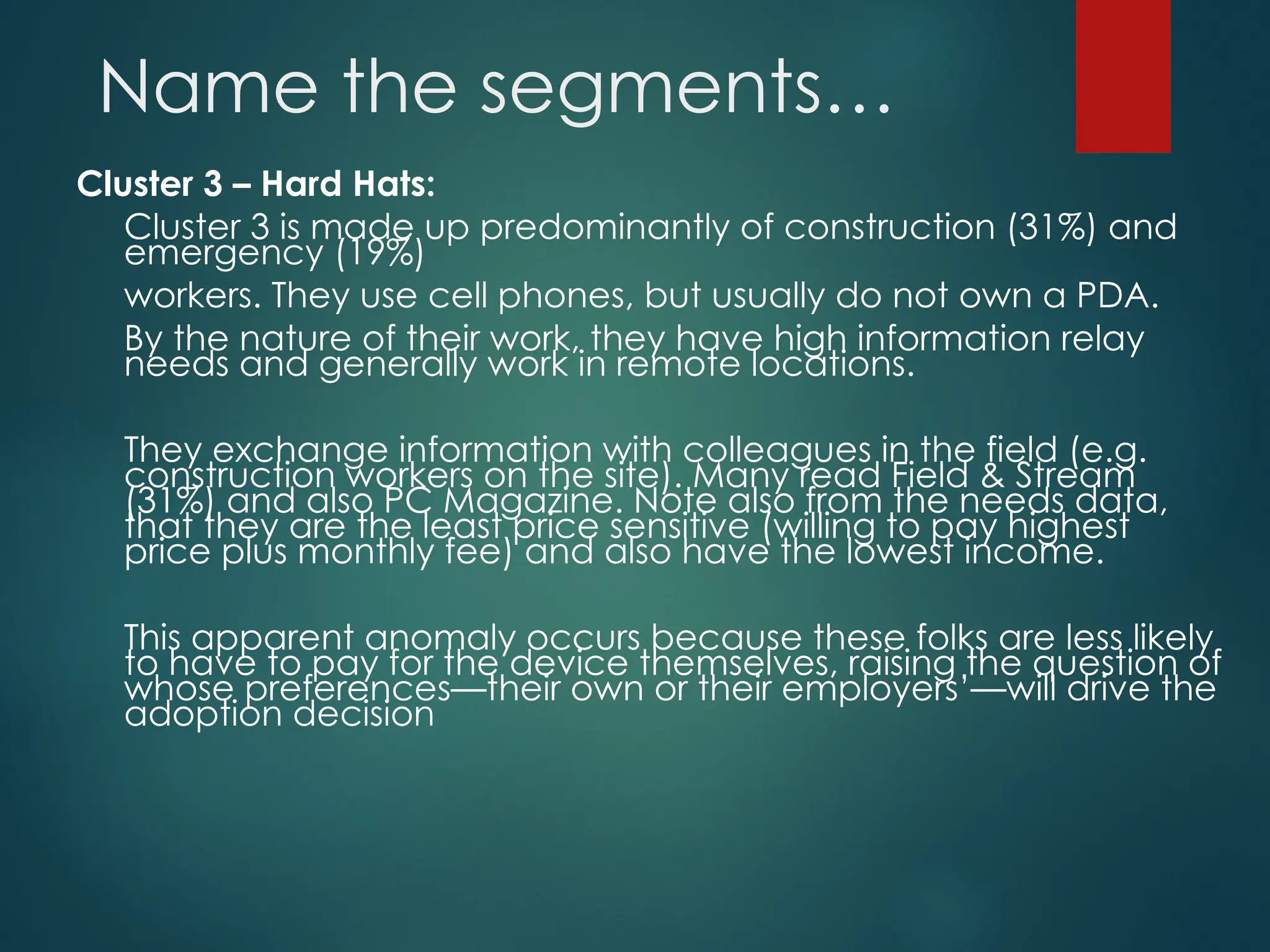
Cluster 3 – Hard Hats:
Cluster 3 is made up predominantly of construction (31%) and
emergency (19%)
workers. They use cell phones, but usually do not own a PDA.
By the nature of their work, they have high information relay
needs and generally work in remote locations.
They exchange information with colleagues in the field (e.g.
construction workers on the site). Many read Field & Stream
(31%) and also PC Magazine. Note also from the needs data,
that they are the least price sensitive (willing to pay highest
price plus monthly fee) and also have the lowest income.
This apparent anomaly occurs because these folks are less likely
to have to pay for the device themselves, raising the question of
whose preferences—their own or their employers’—will drive the
adoption decision
Name the segments…
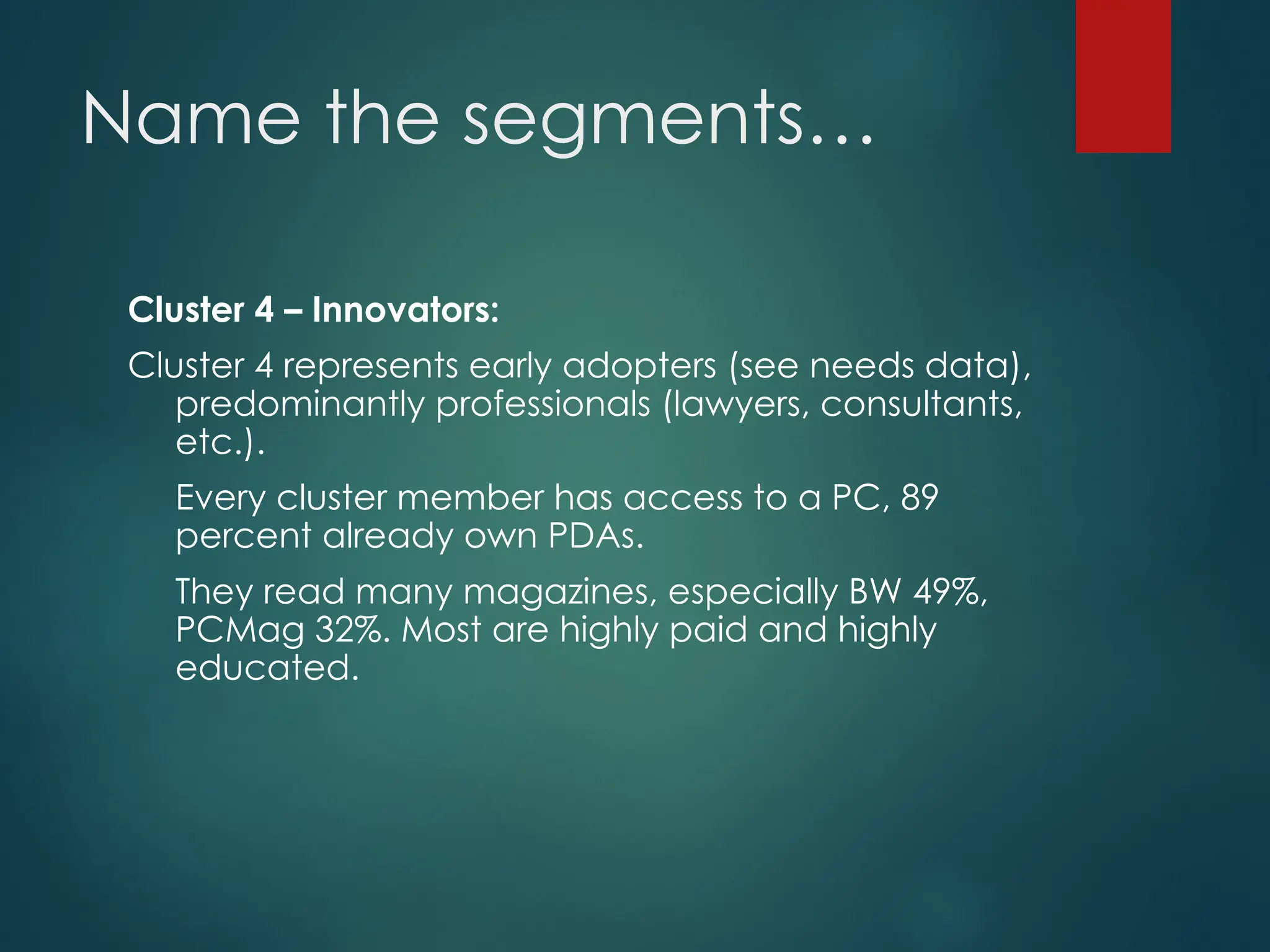
Cluster 4 – Innovators:
Cluster 4 represents early adopters (see needs data),
predominantly professionals (lawyers, consultants,
etc.).
Every cluster member has access to a PC, 89
percent already own PDAs.
They read many magazines, especially BW 49%,
PCMag 32%. Most are highly paid and highly
educated.
Who to target…
 Discuss.
Interpreting Cluster
Analysis Results
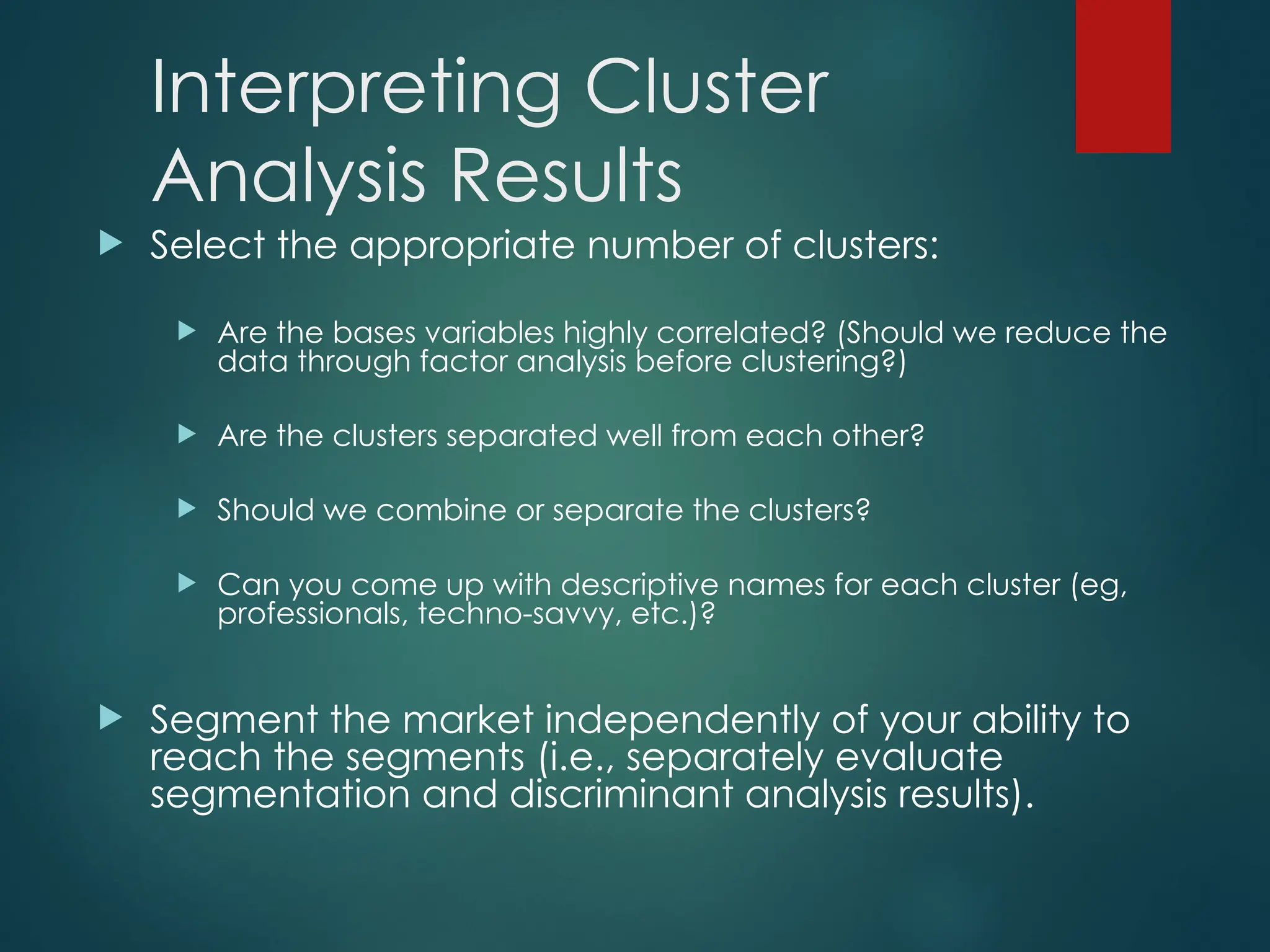
 Select the appropriate number of clusters:
 Are the bases variables highly correlated? (Should we reduce the
data through factor analysis before clustering?)
 Are the clusters separated well from each other?
 Should we combine or separate the clusters?
 Can you come up with descriptive names for each cluster (eg,
professionals, techno-savvy, etc.)?
 Segment the market independently of your ability to
reach the segments (i.e., separately evaluate
segmentation and discriminant analysis results).
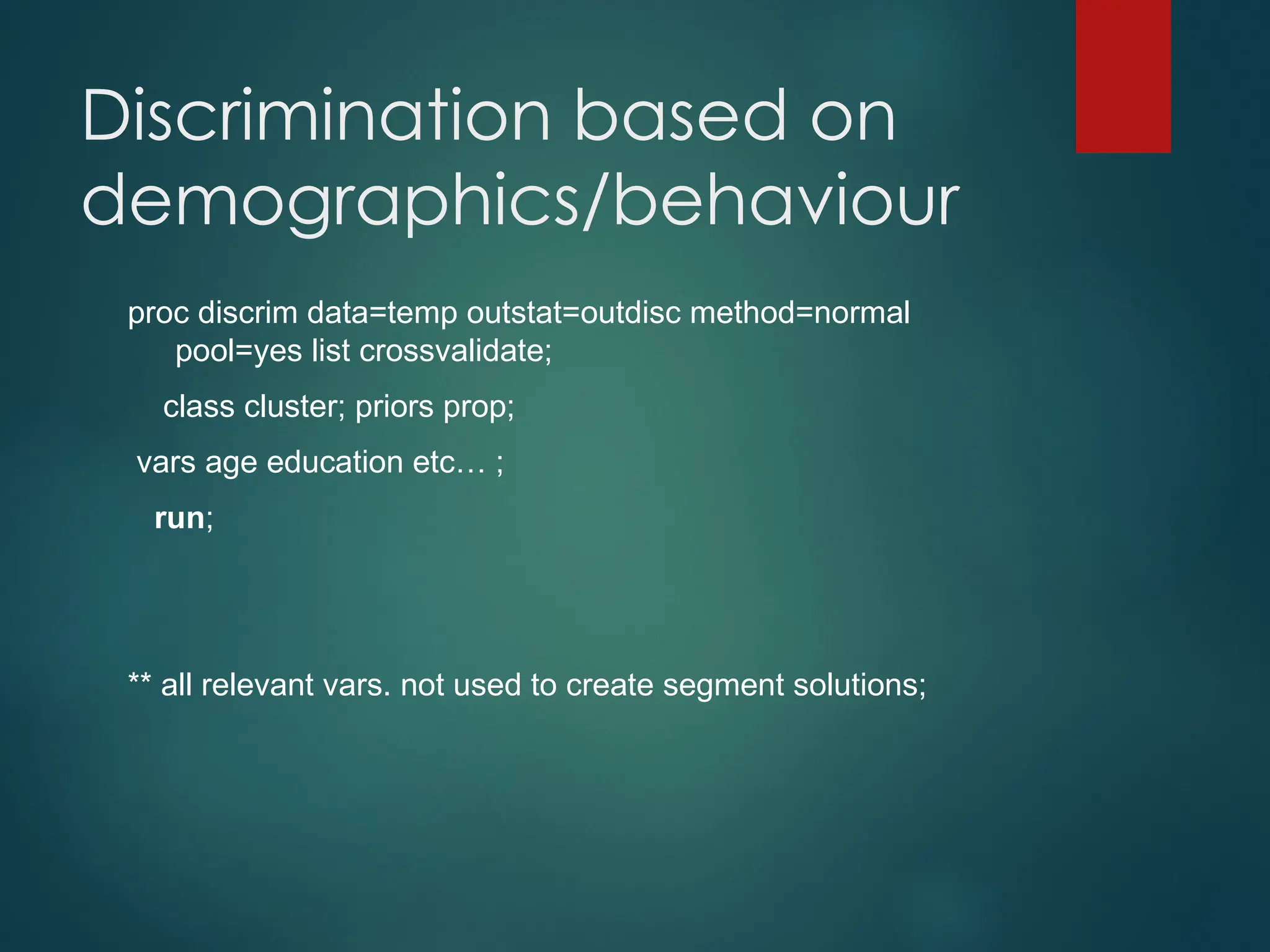
Discrimination based on
demographics/behaviour
proc discrim data=temp outstat=outdisc method=normal
pool=yes list crossvalidate;
class cluster; priors prop;
vars age education etc… ;
run;
** all relevant vars. not used to create segment solutions;
Discrimination based on
demographics/behaviour
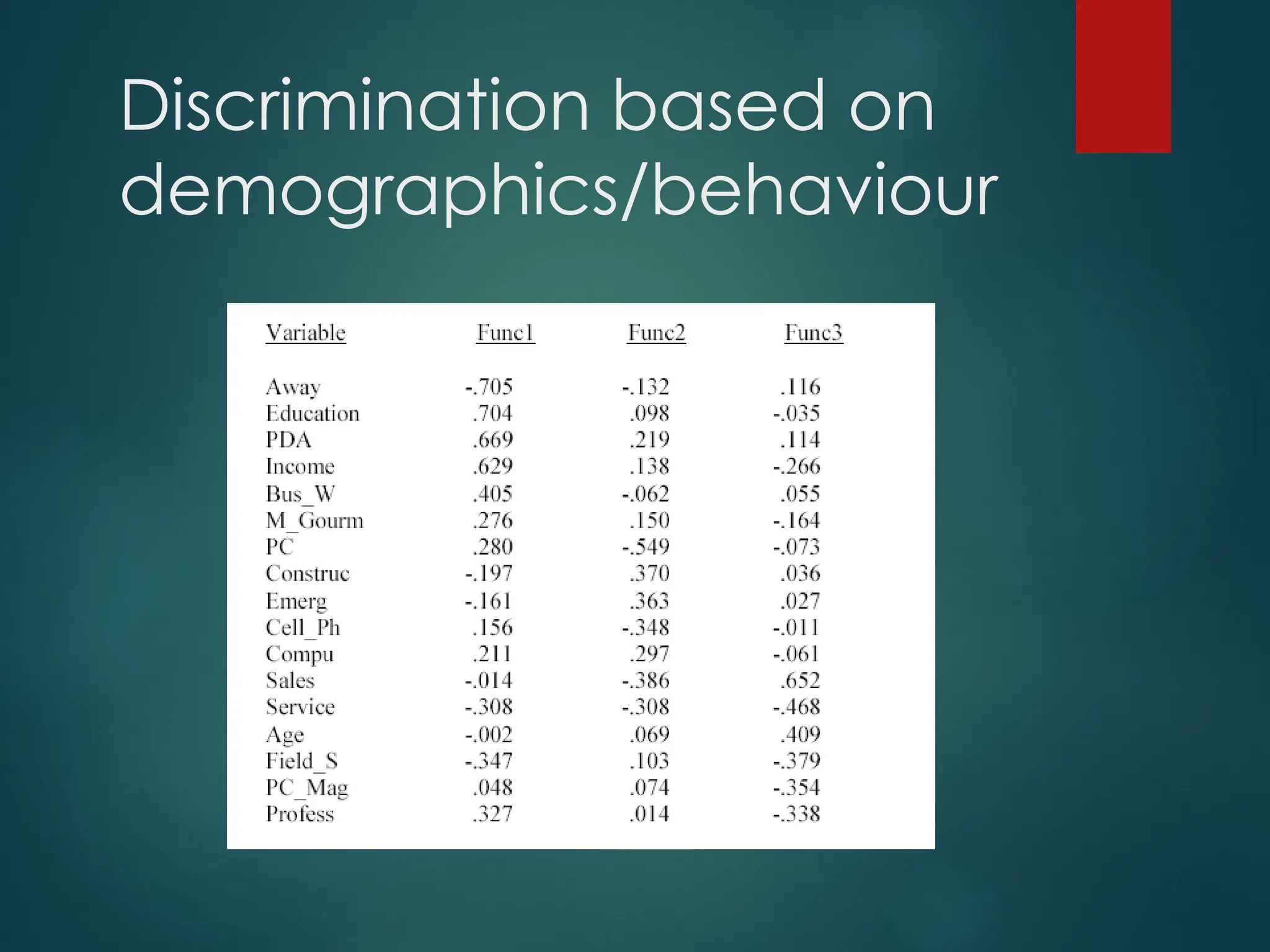
This allows us a way to
target and profile
future customers:
Discrimination based on
demographics/behaviour
Discrimination based on
demographics/behaviour
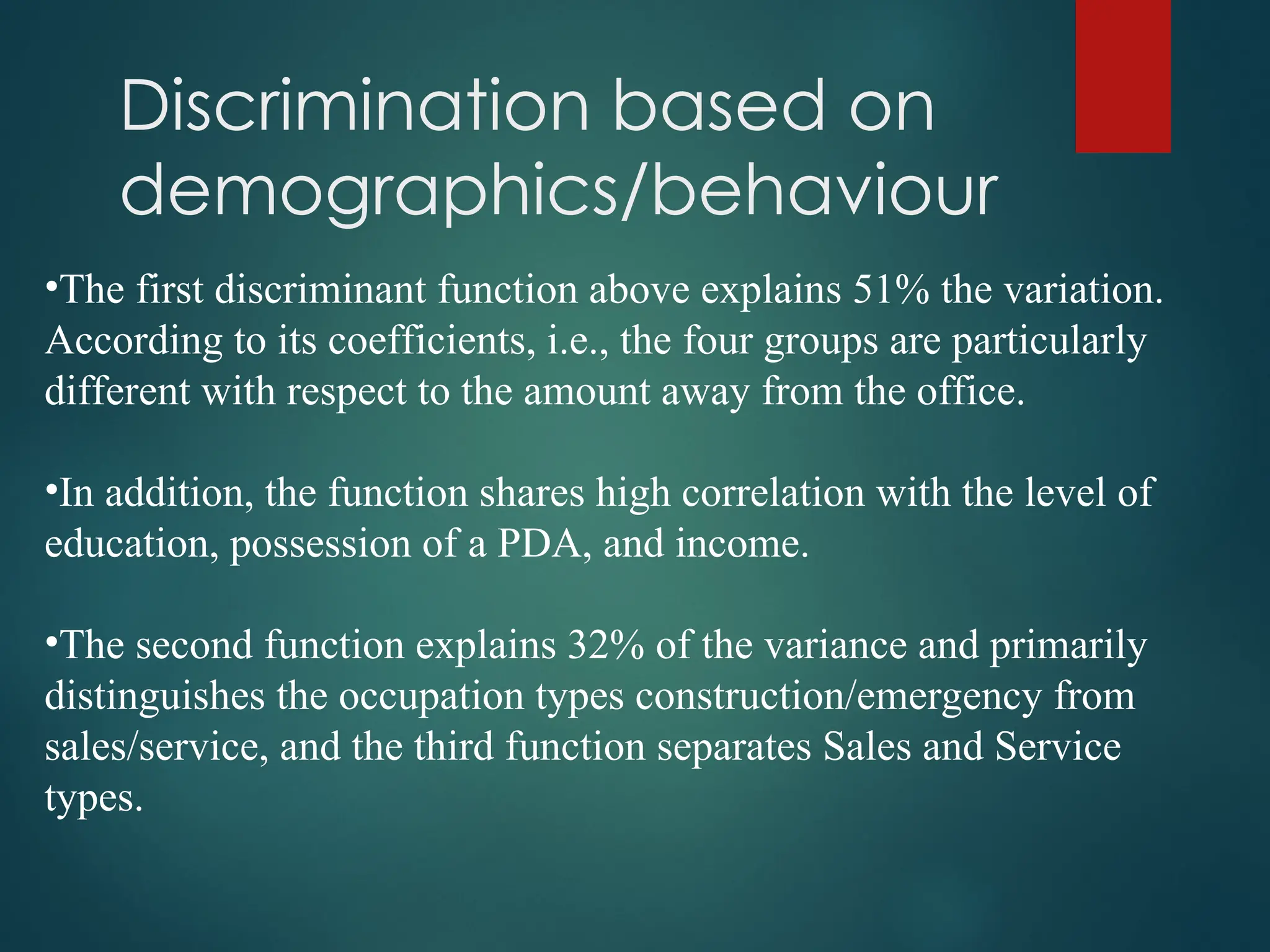
•The first discriminant function above explains 51% the variation.
According to its coefficients, i.e., the four groups are particularly
different with respect to the amount away from the office.
•In addition, the function shares high correlation with the level of
education, possession of a PDA, and income.
•The second function explains 32% of the variance and primarily
distinguishes the occupation types construction/emergency from
sales/service, and the third function separates Sales and Service
types.
Visualising relationships
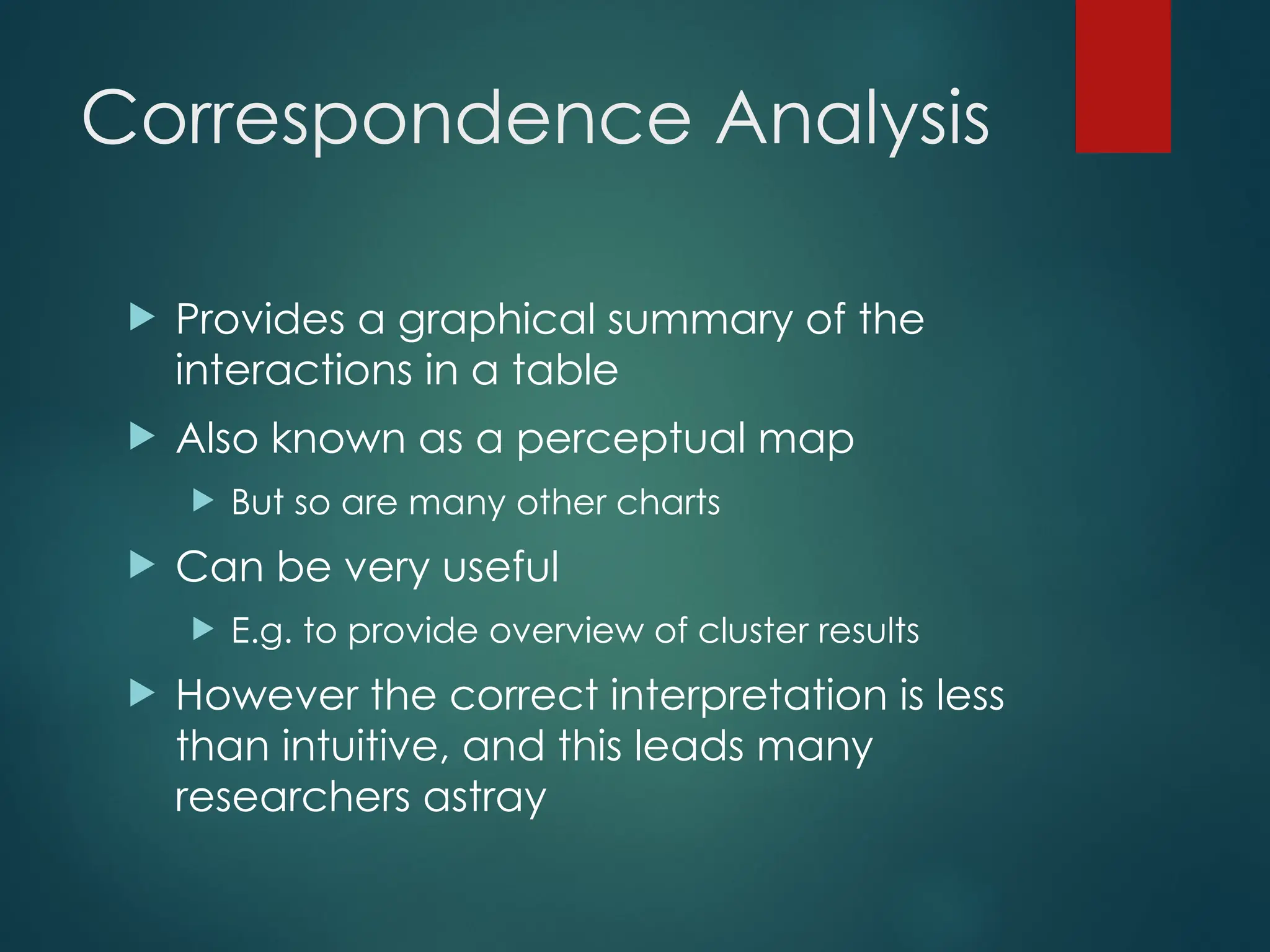
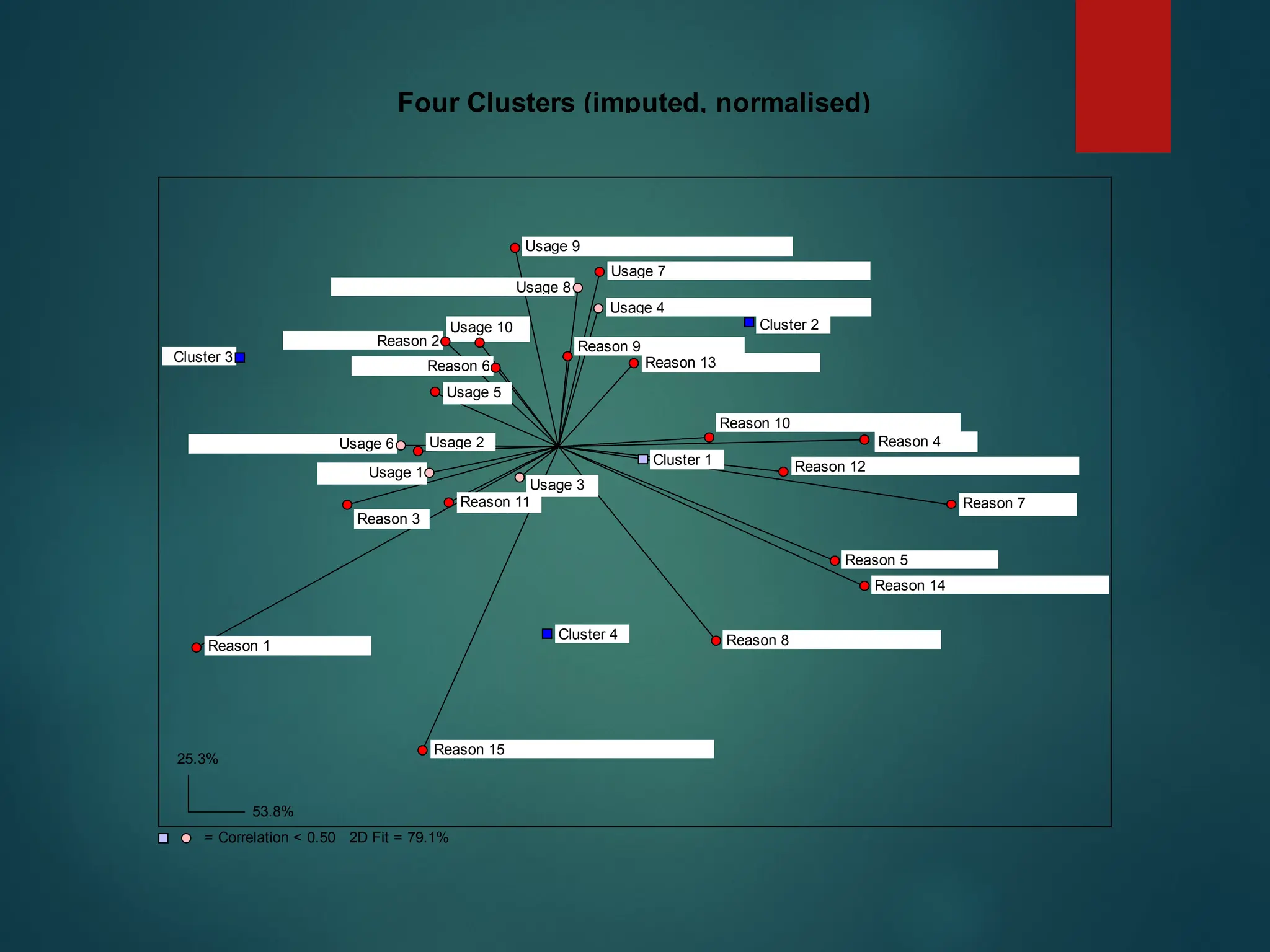
Correspondence Analysis
 Provides a graphical summary of the
interactions in a table
 Also known as a perceptual map
 But so are many other charts
 Can be very useful
 E.g. to provide overview of cluster results
 However the correct interpretation is less
than intuitive, and this leads many
researchers astray
Reason 1
Reason 2
Reason 3
Reason 4
Reason 5
Reason 6
Reason 7
Reason 8
Reason 9
Reason 10
Reason 11
Reason 12
Reason 13
Reason 14
Reason 15
Usage 1
Usage 2
Usage 3
Usage 4
Usage 5
Usage 6
Usage 7
Usage 8
Usage 9
Usage 10
Cluster 1
Cluster 2
Cluster 3
Cluster 4
25.3%
53.8%
2D Fit = 79.1%
Four Clusters (imputed, normalised)
= Correlation < 0.50
Interpretation
 Correspondence analysis plots should be
interpreted by looking at points relative to
the origin
 Points that are in similar directions are
positively associated
 Points that are on opposite sides of the origin
are negatively associated
 Points that are far from the origin exhibit the
strongest associations
 Also the results reflect relative
associations, not just which rows are
highest or lowest overall
Software for
Correspondence Analysis
 Earlier chart was created using a specialised
package called BRANDMAP
 Can also do correspondence analysis in most major
statistical packages
 For example, using PROC CORRESP in SAS:
*---Perform Simple Correspondence Analysis—Example 1 in SAS
OnlineDoc;
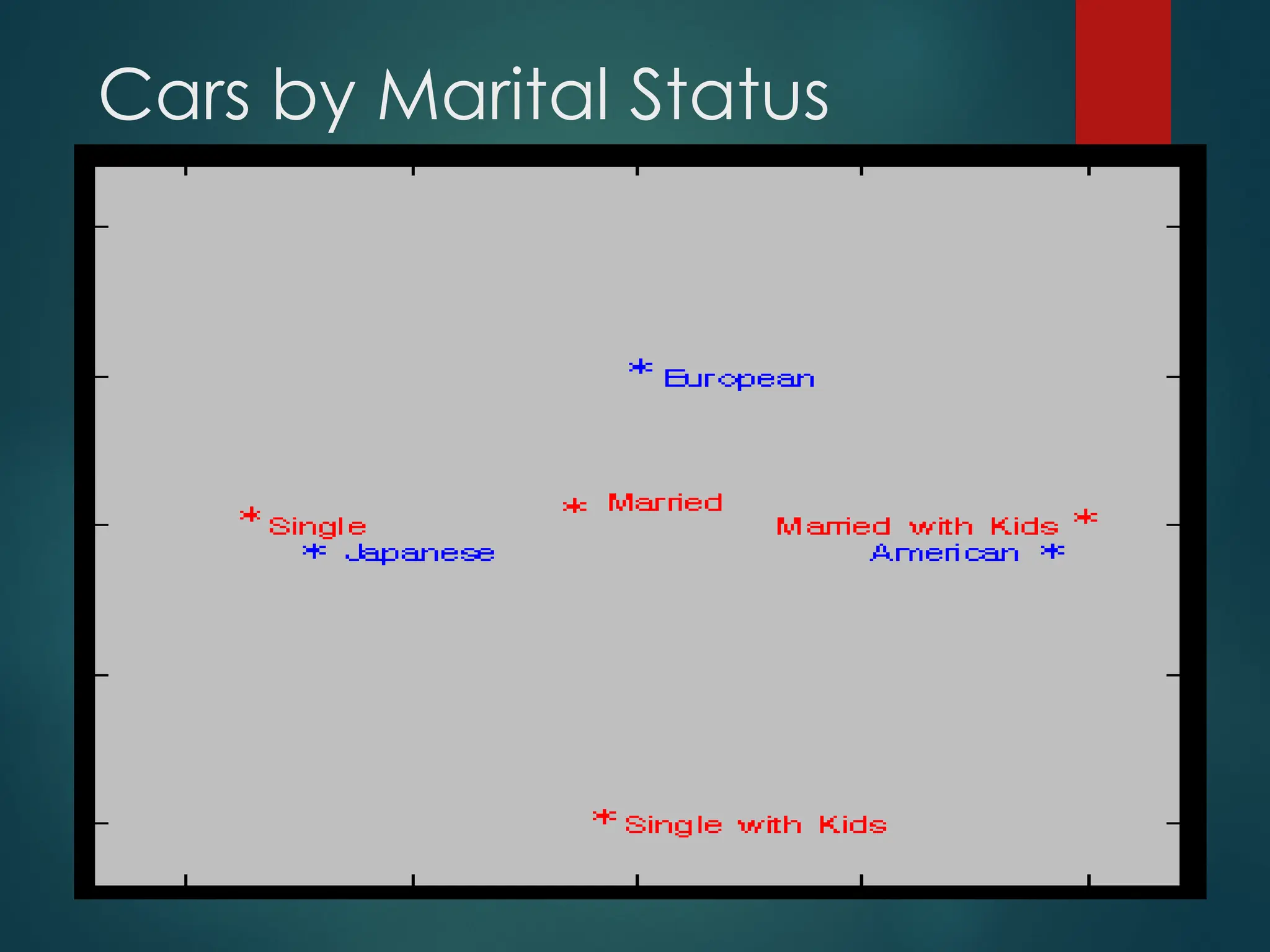
proc corresp all data=Cars outc=Coor;
tables Marital, Origin;
run;
*---Plot the Simple Correspondence Analysis Results---;
%plotit(data=Coor, datatype=corresp)
Cars by Marital Status
Segmentation
s
OTHER DETAILS
Tandem Segmentation
 One general method is to conduct a factor
analysis, followed by a cluster analysis
 This approach has been criticised for losing
information and not yielding as much
discrimination as cluster analysis alone
 However it can make it easier to design the
distance function, and to interpret the results
Tandem k-means Example
proc factor data=datafile n=6 rotate=varimax round reorder flag=.54 scree
out=scores;
var reasons1-reasons15 usage1-usage10;
run;
proc fastclus data=scores maxc=4 seed=109162319 maxiter=50;
var factor1-factor6;
run;
 Have used the default unweighted Euclidean
distance function, which is not sensible in every
context
 Also note that k-means results depend on the
initial cluster centroids (determined here by the
seed)
 Typically k-means is very prone to local maxima
 Run at least 20 times to ensure reasonable maximum
Cluster Analysis Options
 There are several choices of how to form
clusters in hierarchical cluster analysis
 Single linkage
 Average linkage
 Density linkage
 Ward’s method
 Many others
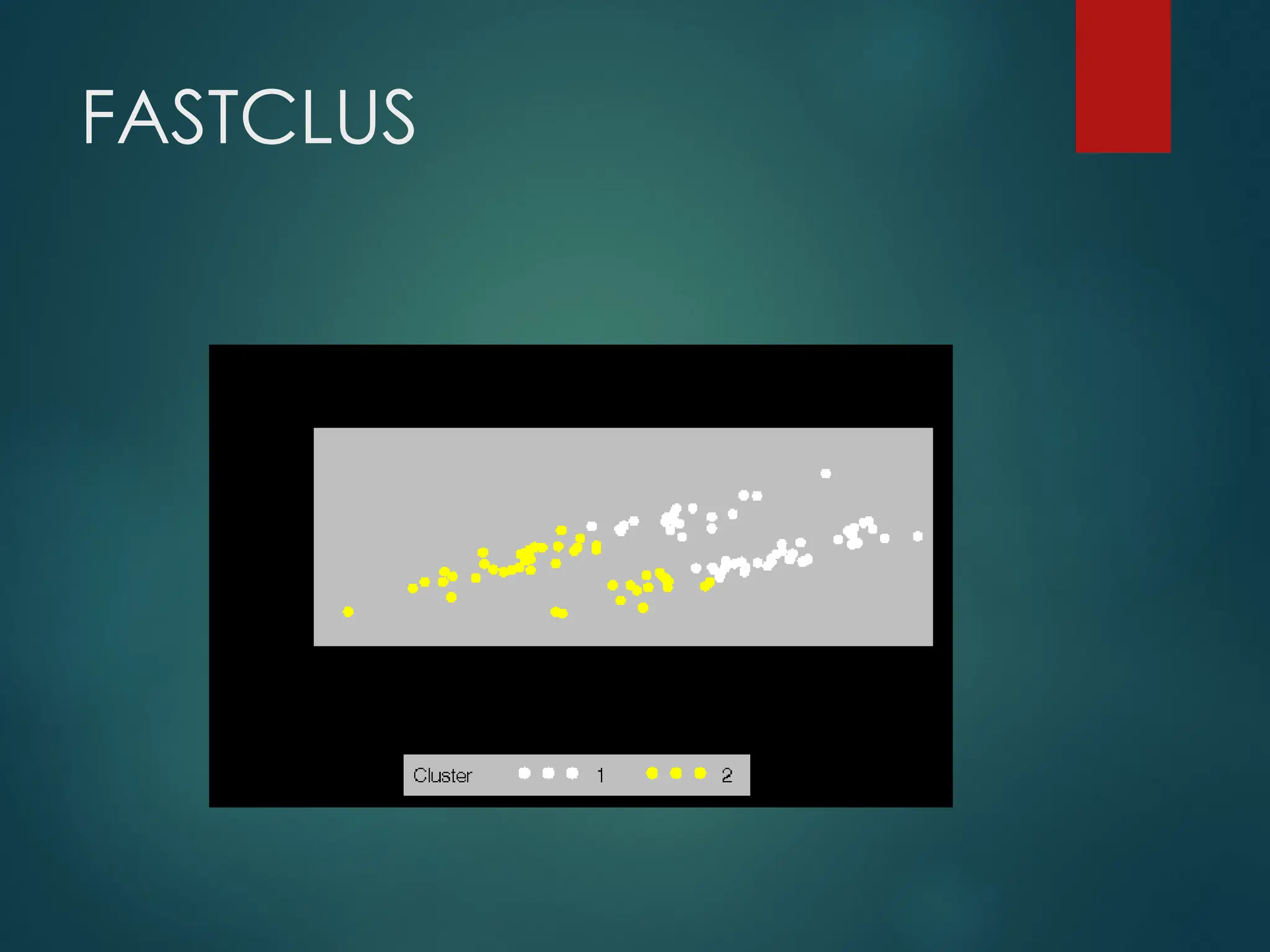
 Ward’s method (like k-means) tends to form
equal sized, roundish clusters
 Average linkage generally forms roundish
clusters with equal variance
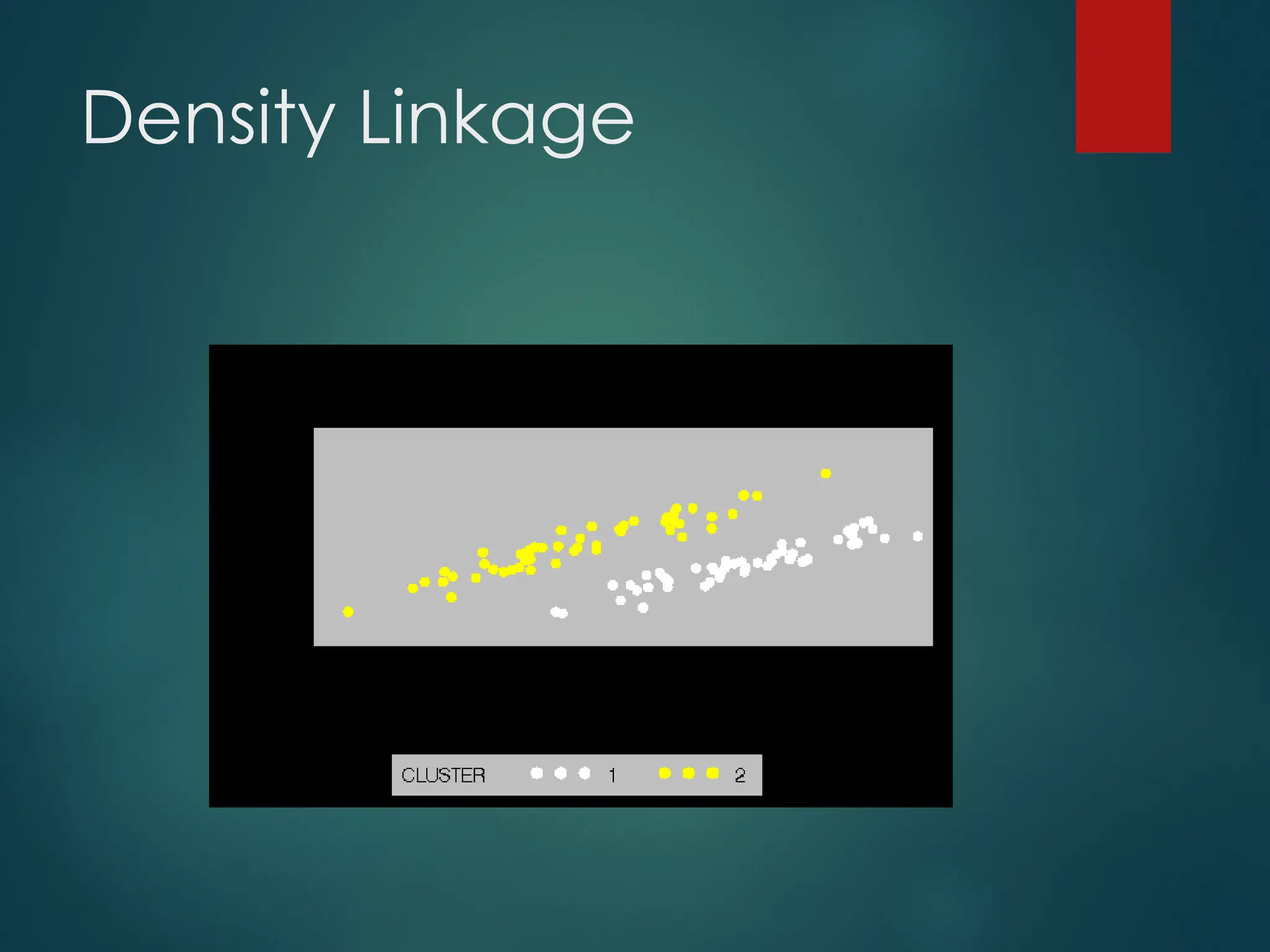
 Density linkage can identify clusters of
different shapes
FASTCLUS
Density Linkage
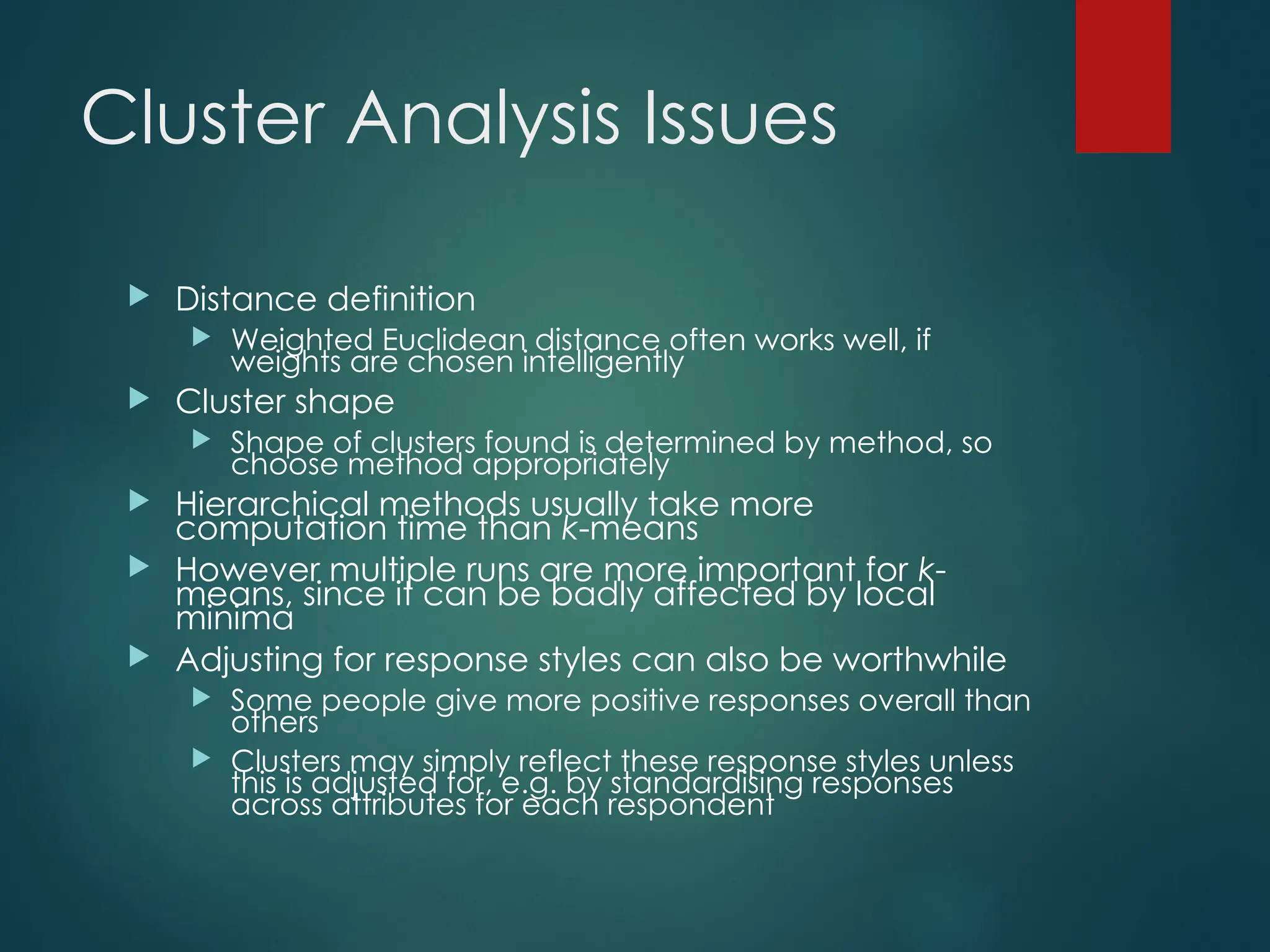
Cluster Analysis Issues
 Distance definition
 Weighted Euclidean distance often works well, if
weights are chosen intelligently
 Cluster shape
 Shape of clusters found is determined by method, so
choose method appropriately
 Hierarchical methods usually take more
computation time than k-means
 However multiple runs are more important for k-
means, since it can be badly affected by local
minima
 Adjusting for response styles can also be worthwhile
 Some people give more positive responses overall than
others
 Clusters may simply reflect these response styles unless
this is adjusted for, e.g. by standardising responses
across attributes for each respondent
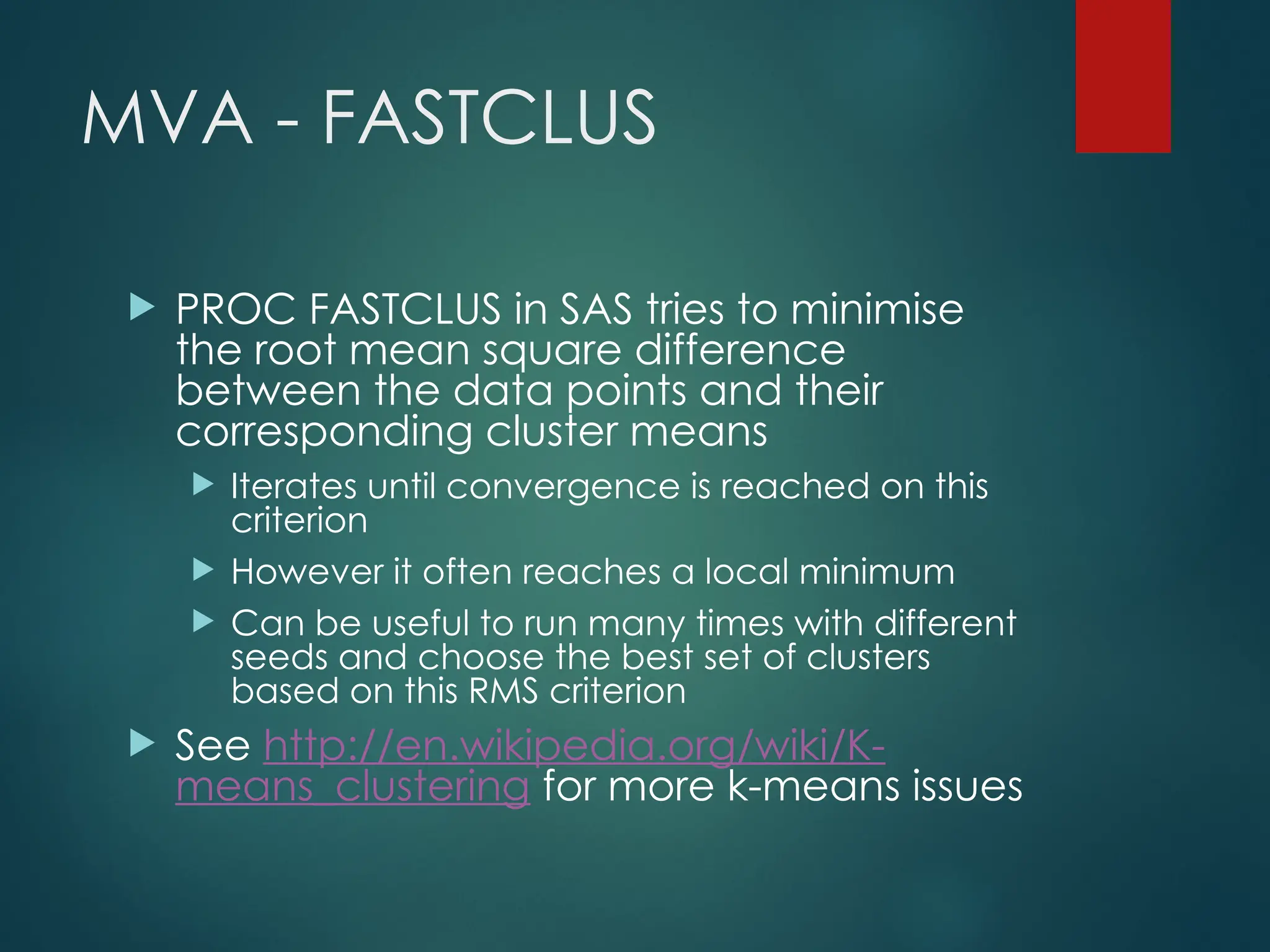
MVA - FASTCLUS
 PROC FASTCLUS in SAS tries to minimise
the root mean square difference
between the data points and their
corresponding cluster means
 Iterates until convergence is reached on this
criterion
 However it often reaches a local minimum
 Can be useful to run many times with different
seeds and choose the best set of clusters
based on this RMS criterion
 See http://en.wikipedia.org/wiki/K-
means_clustering for more k-means issues
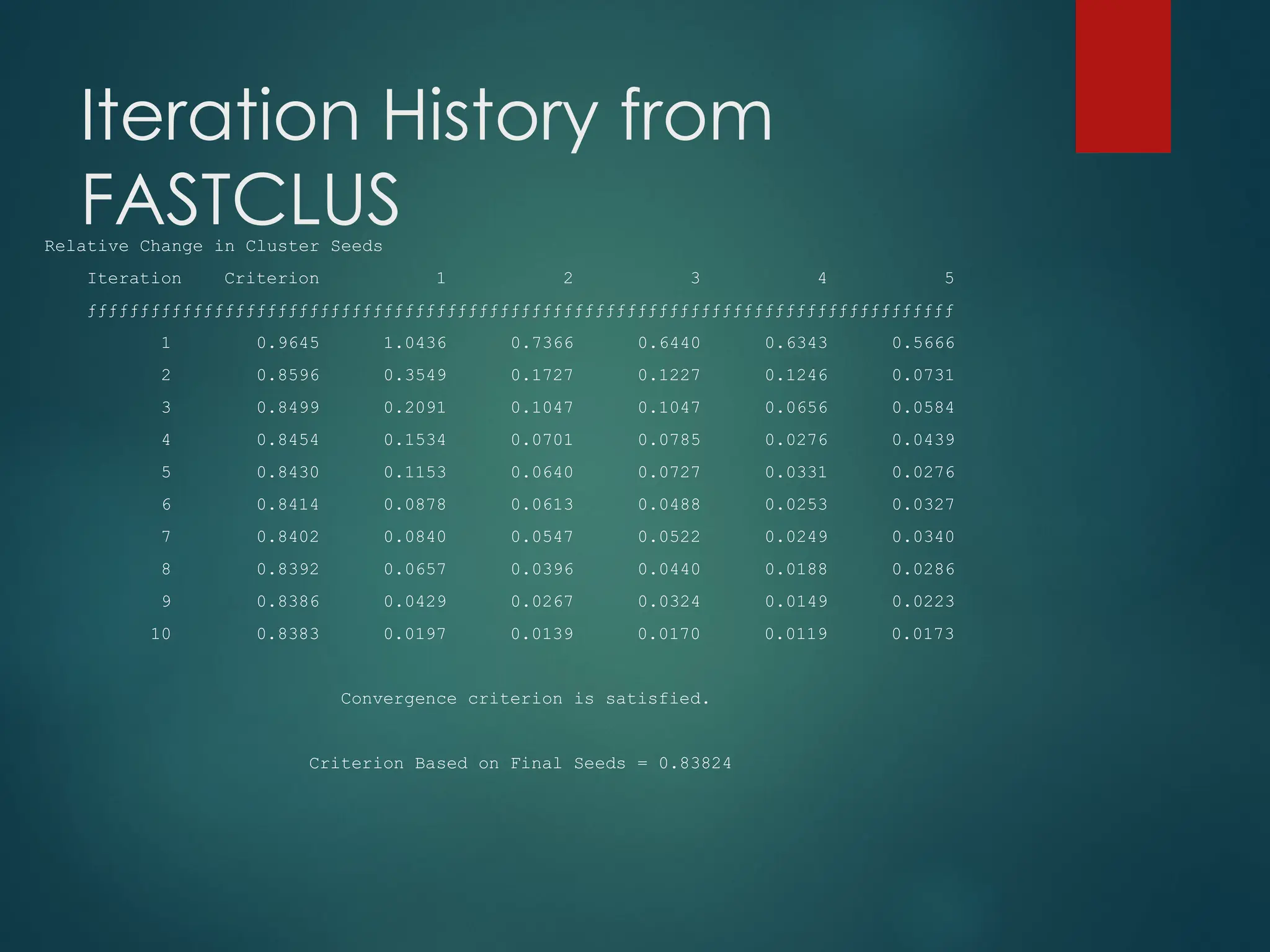
Iteration History from
FASTCLUS
Relative Change in Cluster Seeds
Iteration Criterion 1 2 3 4 5
ƒƒƒƒƒƒƒƒƒƒƒƒƒƒƒƒƒƒƒƒƒƒƒƒƒƒƒƒƒƒƒƒƒƒƒƒƒƒƒƒƒƒƒƒƒƒƒƒƒƒƒƒƒƒƒƒƒƒƒƒƒƒƒƒƒƒƒƒƒƒƒƒƒƒƒƒƒƒƒƒƒƒ
1 0.9645 1.0436 0.7366 0.6440 0.6343 0.5666
2 0.8596 0.3549 0.1727 0.1227 0.1246 0.0731
3 0.8499 0.2091 0.1047 0.1047 0.0656 0.0584
4 0.8454 0.1534 0.0701 0.0785 0.0276 0.0439
5 0.8430 0.1153 0.0640 0.0727 0.0331 0.0276
6 0.8414 0.0878 0.0613 0.0488 0.0253 0.0327
7 0.8402 0.0840 0.0547 0.0522 0.0249 0.0340
8 0.8392 0.0657 0.0396 0.0440 0.0188 0.0286
9 0.8386 0.0429 0.0267 0.0324 0.0149 0.0223
10 0.8383 0.0197 0.0139 0.0170 0.0119 0.0173
Convergence criterion is satisfied.
Criterion Based on Final Seeds = 0.83824
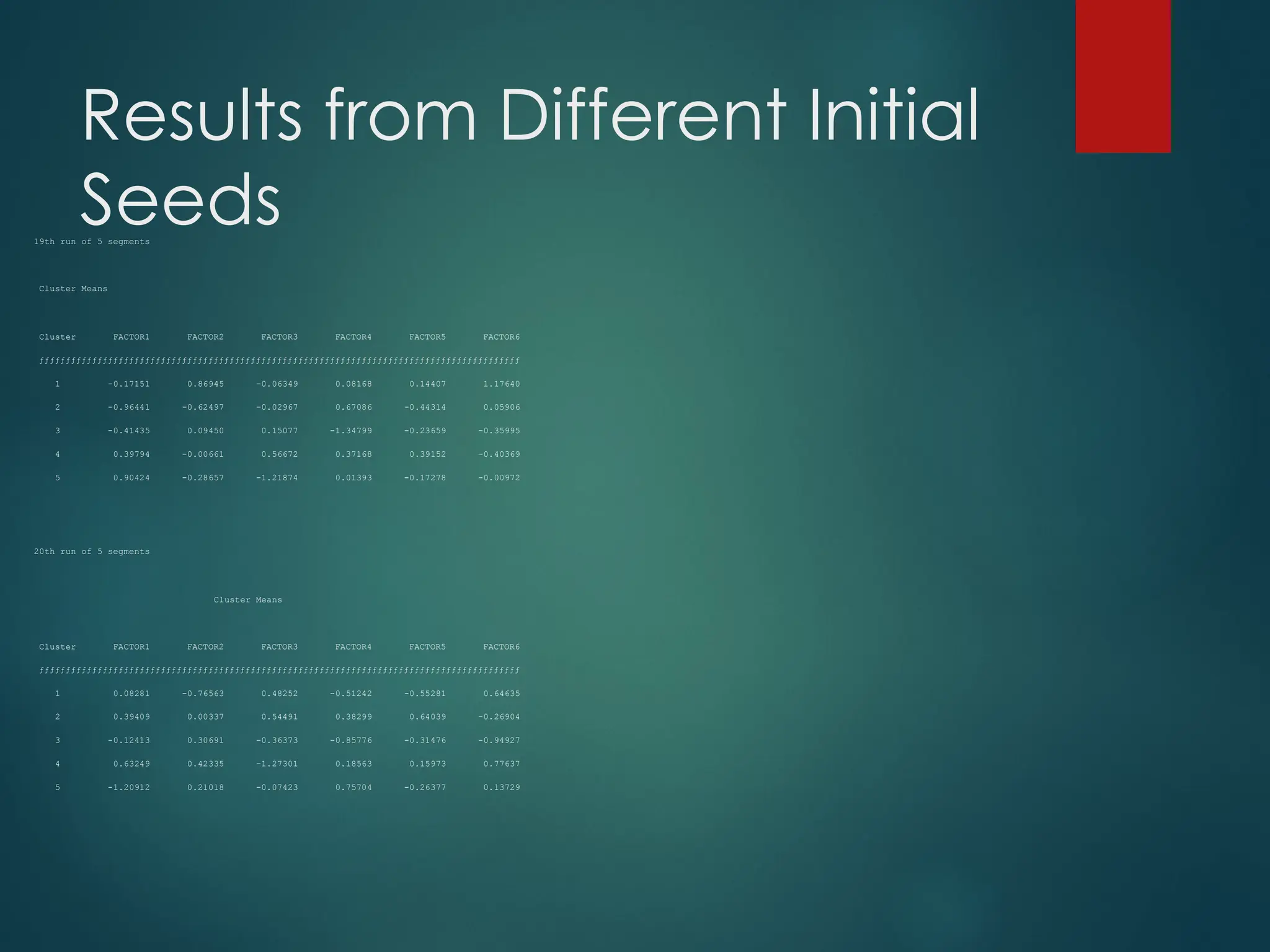
Results from Different Initial
Seeds
19th run of 5 segments
Cluster Means
Cluster FACTOR1 FACTOR2 FACTOR3 FACTOR4 FACTOR5 FACTOR6
ƒƒƒƒƒƒƒƒƒƒƒƒƒƒƒƒƒƒƒƒƒƒƒƒƒƒƒƒƒƒƒƒƒƒƒƒƒƒƒƒƒƒƒƒƒƒƒƒƒƒƒƒƒƒƒƒƒƒƒƒƒƒƒƒƒƒƒƒƒƒƒƒƒƒƒƒƒƒƒƒƒƒƒƒƒƒƒƒƒƒƒ
1 -0.17151 0.86945 -0.06349 0.08168 0.14407 1.17640
2 -0.96441 -0.62497 -0.02967 0.67086 -0.44314 0.05906
3 -0.41435 0.09450 0.15077 -1.34799 -0.23659 -0.35995
4 0.39794 -0.00661 0.56672 0.37168 0.39152 -0.40369
5 0.90424 -0.28657 -1.21874 0.01393 -0.17278 -0.00972
20th run of 5 segments
Cluster Means
Cluster FACTOR1 FACTOR2 FACTOR3 FACTOR4 FACTOR5 FACTOR6
ƒƒƒƒƒƒƒƒƒƒƒƒƒƒƒƒƒƒƒƒƒƒƒƒƒƒƒƒƒƒƒƒƒƒƒƒƒƒƒƒƒƒƒƒƒƒƒƒƒƒƒƒƒƒƒƒƒƒƒƒƒƒƒƒƒƒƒƒƒƒƒƒƒƒƒƒƒƒƒƒƒƒƒƒƒƒƒƒƒƒƒ
1 0.08281 -0.76563 0.48252 -0.51242 -0.55281 0.64635
2 0.39409 0.00337 0.54491 0.38299 0.64039 -0.26904
3 -0.12413 0.30691 -0.36373 -0.85776 -0.31476 -0.94927
4 0.63249 0.42335 -1.27301 0.18563 0.15973 0.77637
5 -1.20912 0.21018 -0.07423 0.75704 -0.26377 0.13729
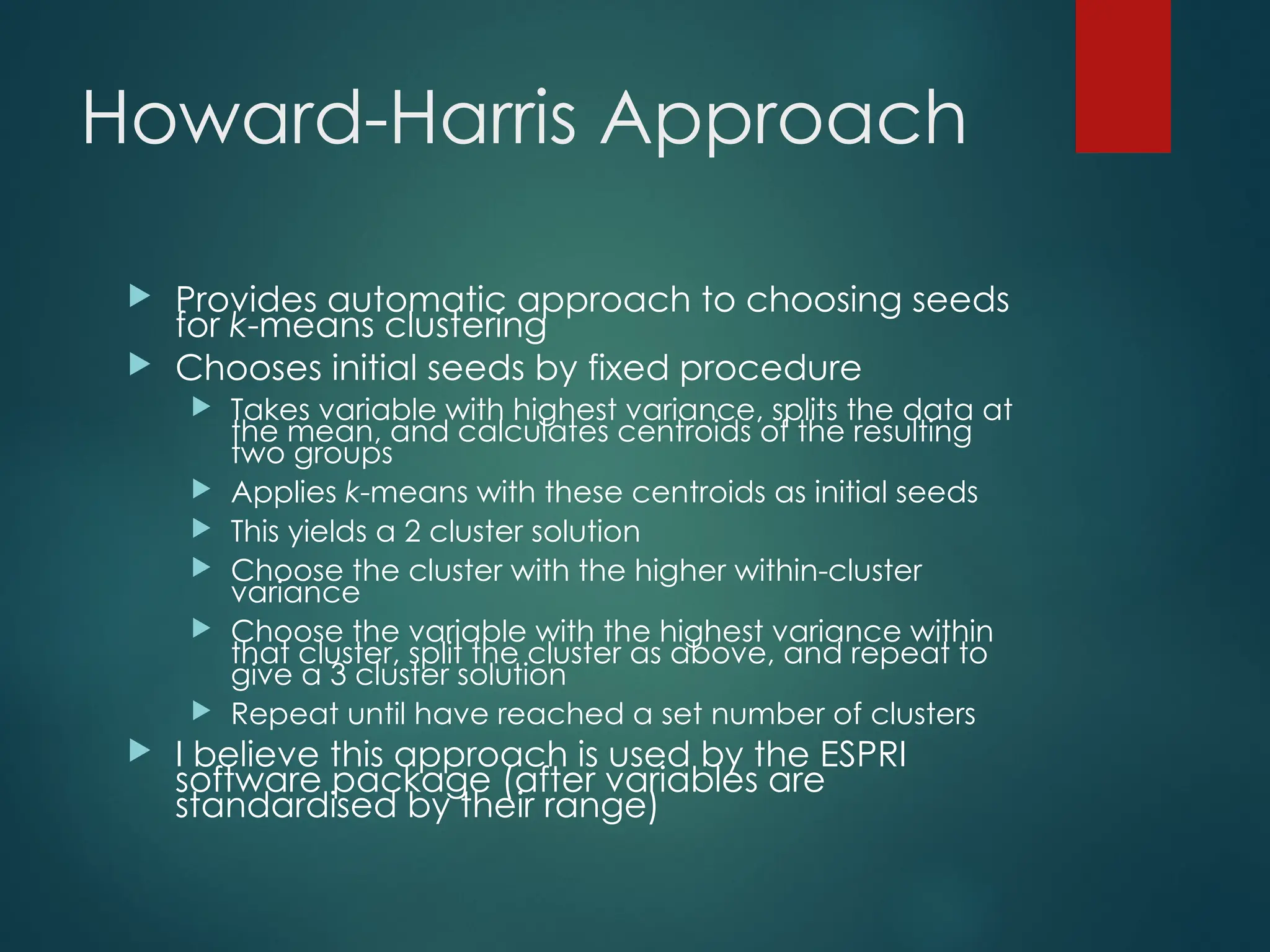
Howard-Harris Approach
 Provides automatic approach to choosing seeds
for k-means clustering
 Chooses initial seeds by fixed procedure
 Takes variable with highest variance, splits the data at
the mean, and calculates centroids of the resulting
two groups
 Applies k-means with these centroids as initial seeds
 This yields a 2 cluster solution
 Choose the cluster with the higher within-cluster
variance
 Choose the variable with the highest variance within
that cluster, split the cluster as above, and repeat to
give a 3 cluster solution
 Repeat until have reached a set number of clusters
 I believe this approach is used by the ESPRI
software package (after variables are
standardised by their range)
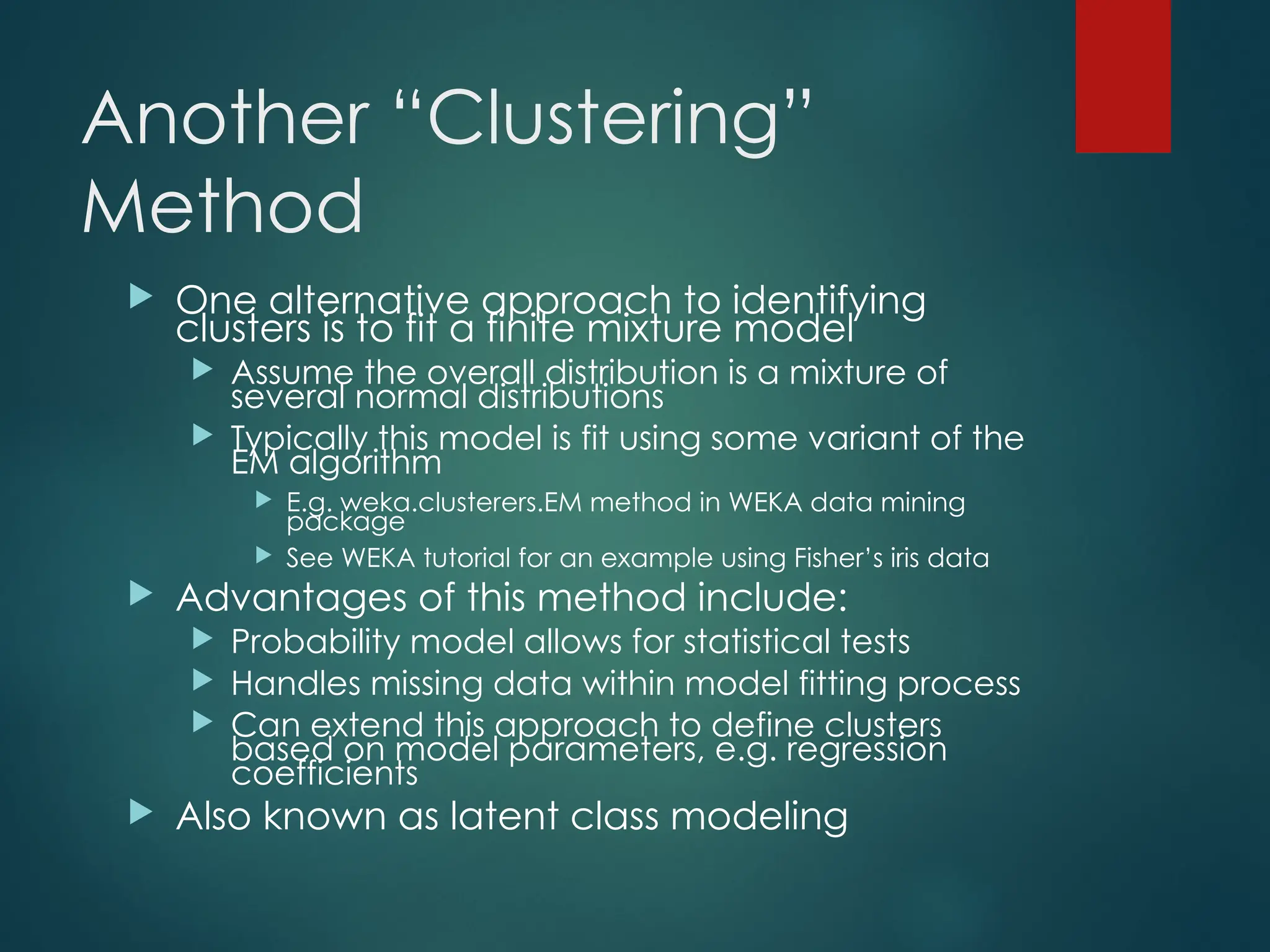
Another “Clustering”
Method
 One alternative approach to identifying
clusters is to fit a finite mixture model
 Assume the overall distribution is a mixture of
several normal distributions
 Typically this model is fit using some variant of the
EM algorithm
 E.g. weka.clusterers.EM method in WEKA data mining
package
 See WEKA tutorial for an example using Fisher’s iris data
 Advantages of this method include:
 Probability model allows for statistical tests
 Handles missing data within model fitting process
 Can extend this approach to define clusters
based on model parameters, e.g. regression
coefficients
 Also known as latent class modeling
Segmentations via Choice
Modelling
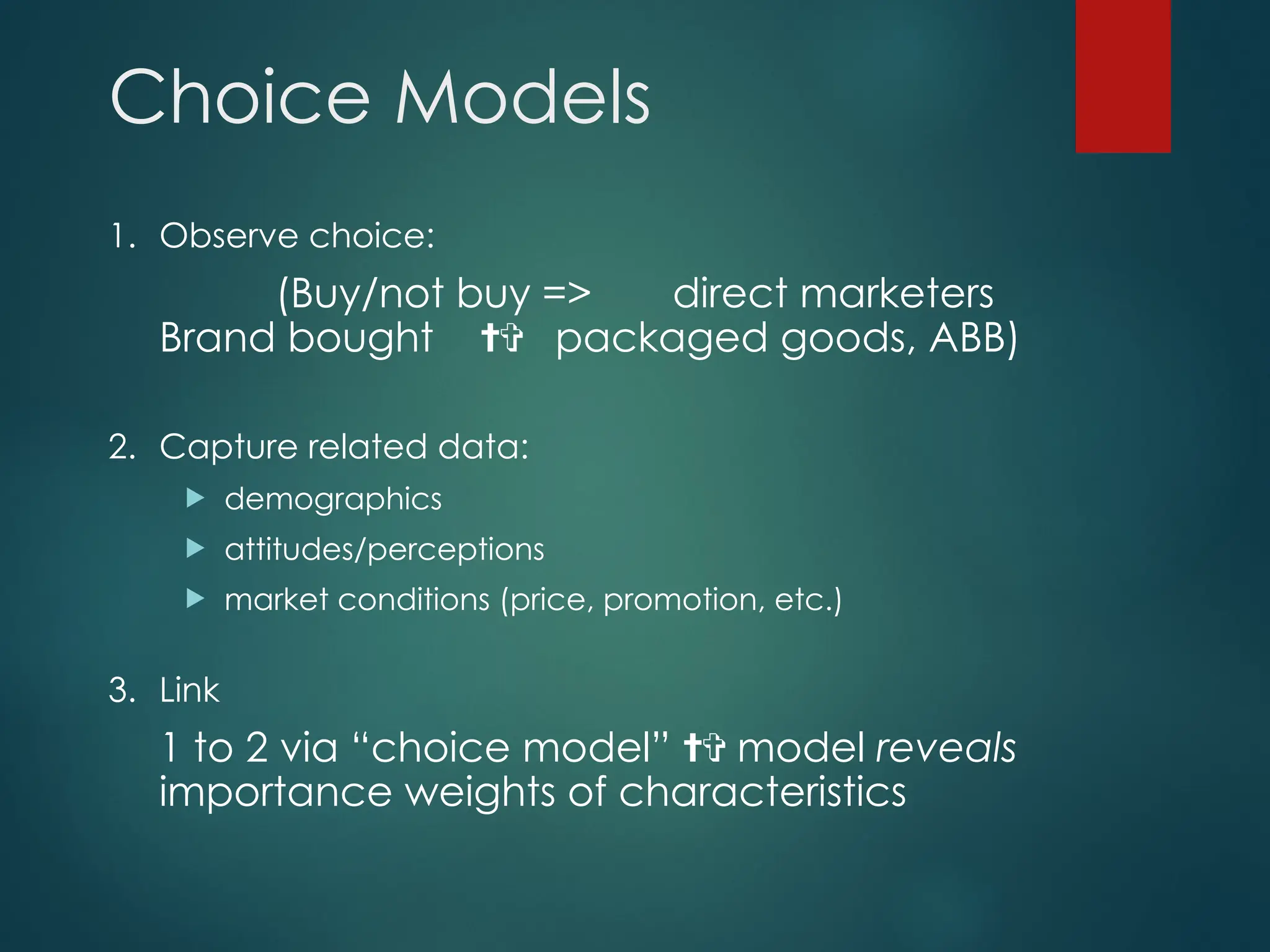
Choice Models
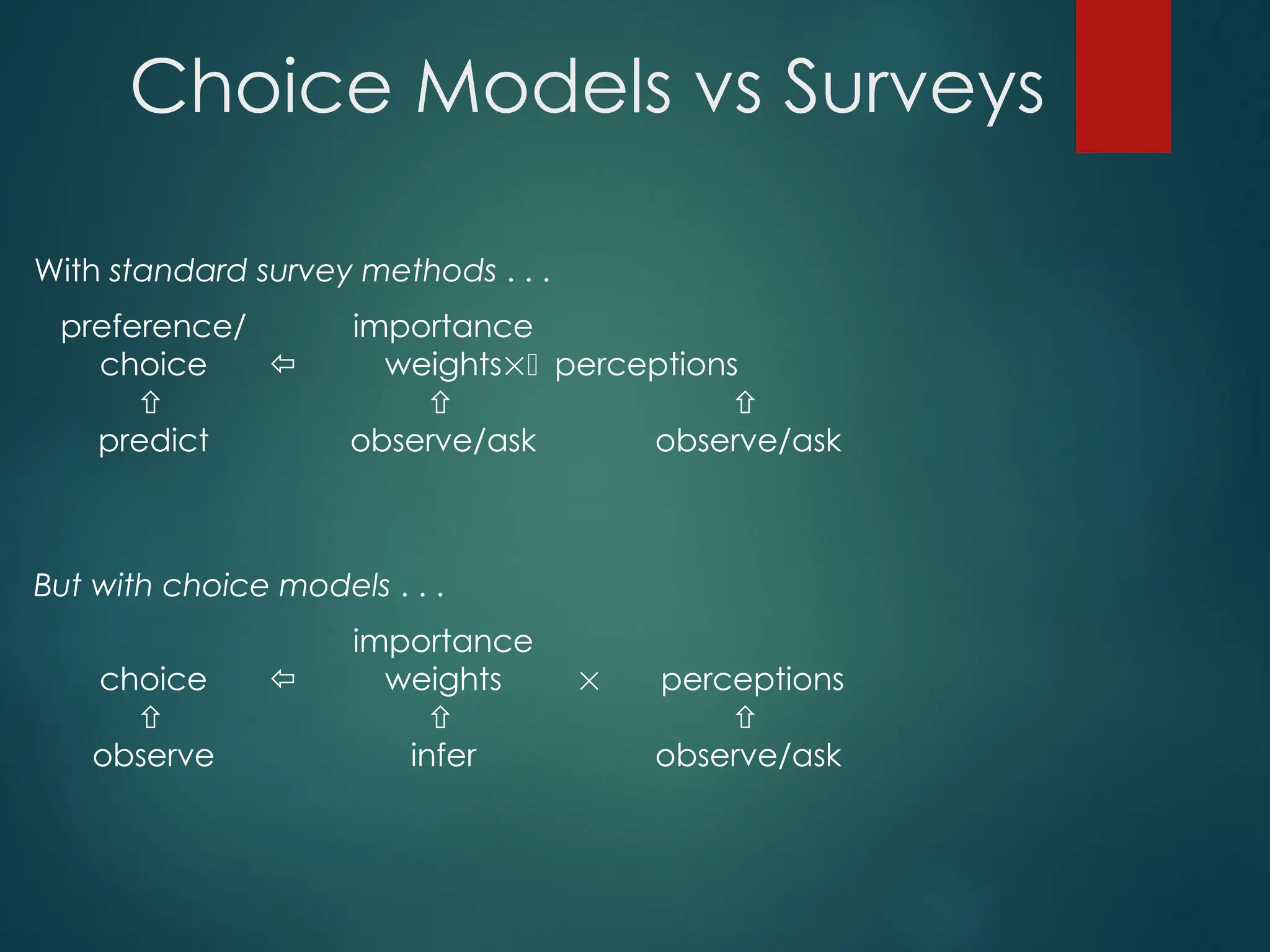
1. Observe choice:
(Buy/not buy => direct marketers
Brand bought 
 packaged goods, ABB)
2. Capture related data:
 demographics
 attitudes/perceptions
 market conditions (price, promotion, etc.)
3. Link
1 to 2 via “choice model”  model reveals
importance weights of characteristics
Choice Models vs Surveys
With standard survey methods . . .
preference/ importance
choice  weightsperceptions
  
predict observe/ask observe/ask
But with choice models . . .
importance
choice  weights  perceptions
  
observe infer observe/ask
Behavior-Based
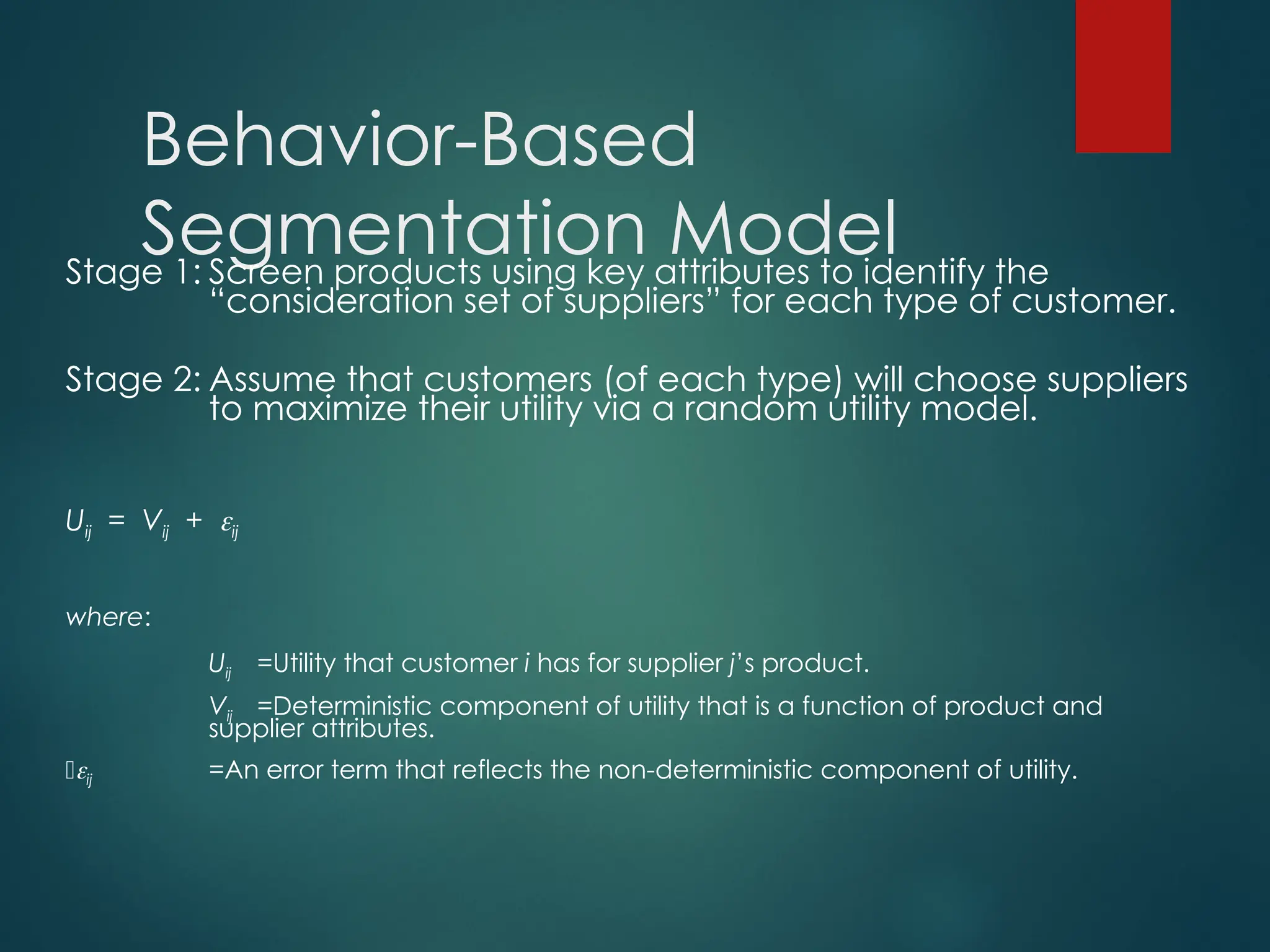
Segmentation Model
Stage 1: Screen products using key attributes to identify the
“consideration set of suppliers” for each type of customer.
Stage 2: Assume that customers (of each type) will choose suppliers
to maximize their utility via a random utility model.
Uij = Vij + ij
where:
Uij =Utility that customer i has for supplier j’s product.
Vij =Deterministic component of utility that is a function of product and
supplier attributes.
ij =An error term that reflects the non-deterministic component of utility.
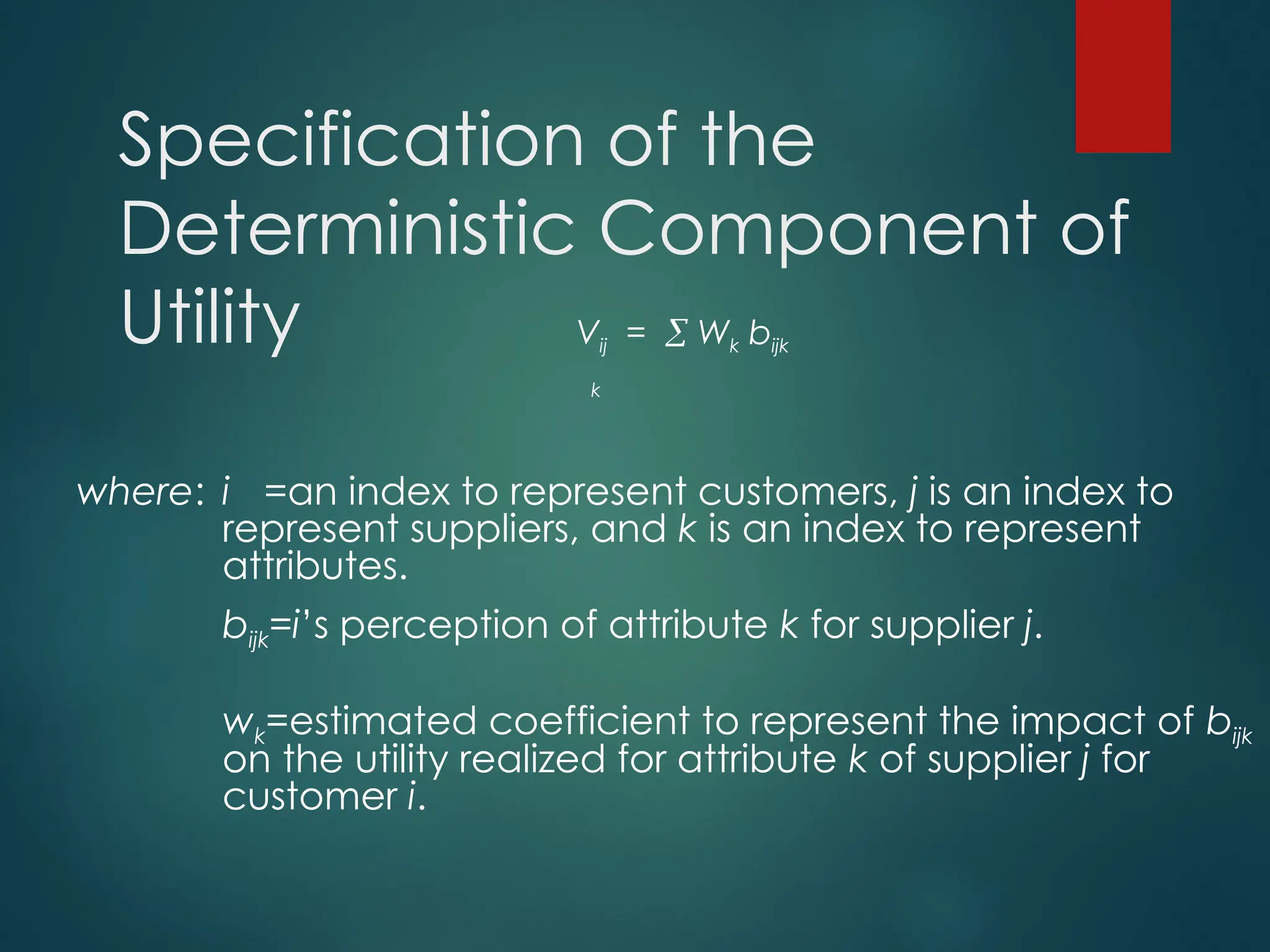
Specification of the
Deterministic Component of
Utility Vij =  Wk bijk
k
where: i =an index to represent customers, j is an index to
represent suppliers, and k is an index to represent
attributes.
bijk=i’s perception of attribute k for supplier j.
wk=estimated coefficient to represent the impact of bijk
on the utility realized for attribute k of supplier j for
customer i.
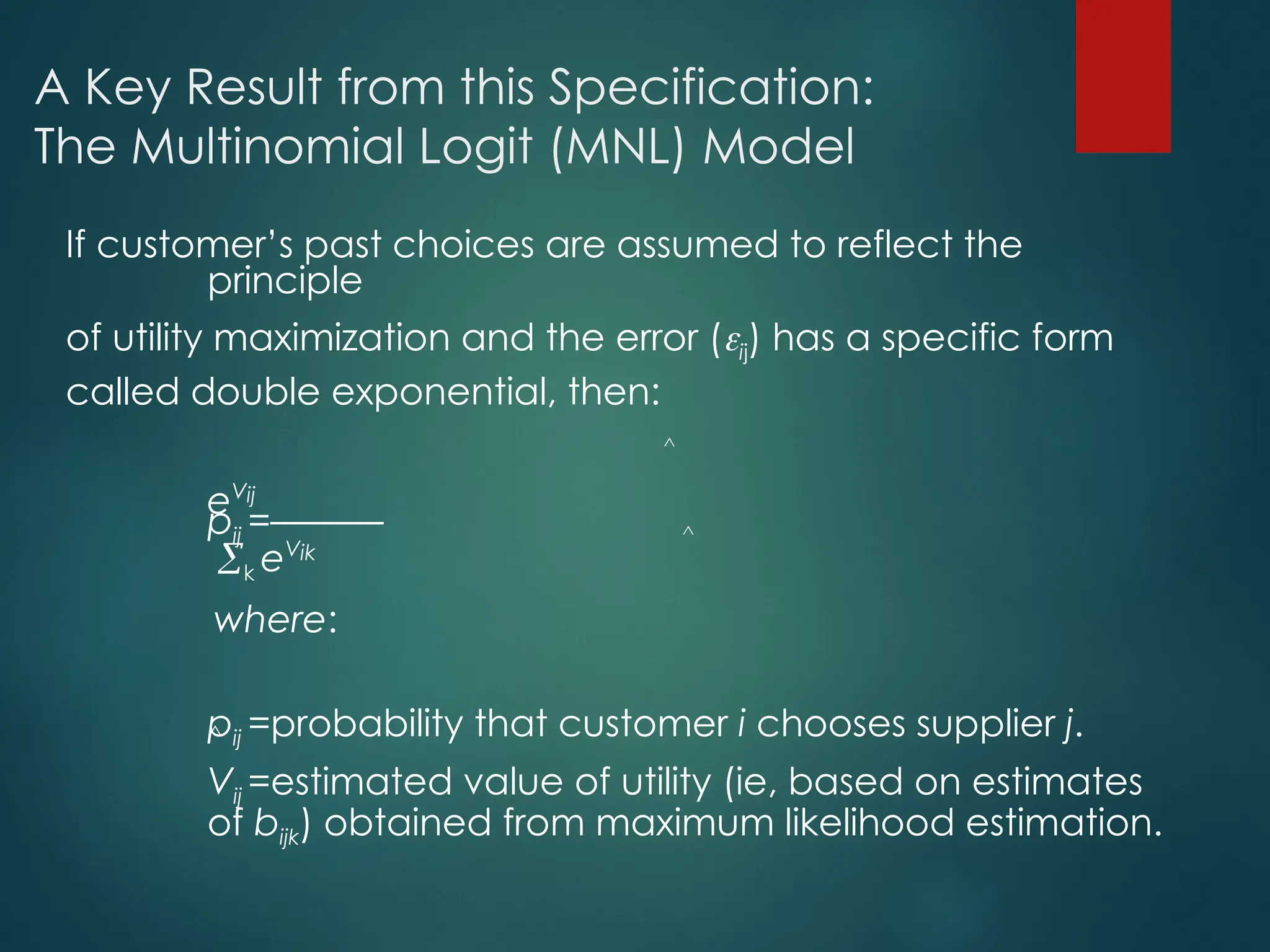
A Key Result from this Specification:
The Multinomial Logit (MNL) Model
If customer’s past choices are assumed to reflect the
principle
of utility maximization and the error (ij) has a specific form
called double exponential, then:
eVij
pij =––––––
k eVik
where:
pij =probability that customer i chooses supplier j.
Vij =estimated value of utility (ie, based on estimates
of bijk) obtained from maximum likelihood estimation.
^
^
^
Key idea: Segment on
the basis of probability of
choice—
1.Loyal to us
2.Loyal to competitor
3.Switchables:
loseable/winnable
customers
Applying the MNL Model in
Segmentation Studies
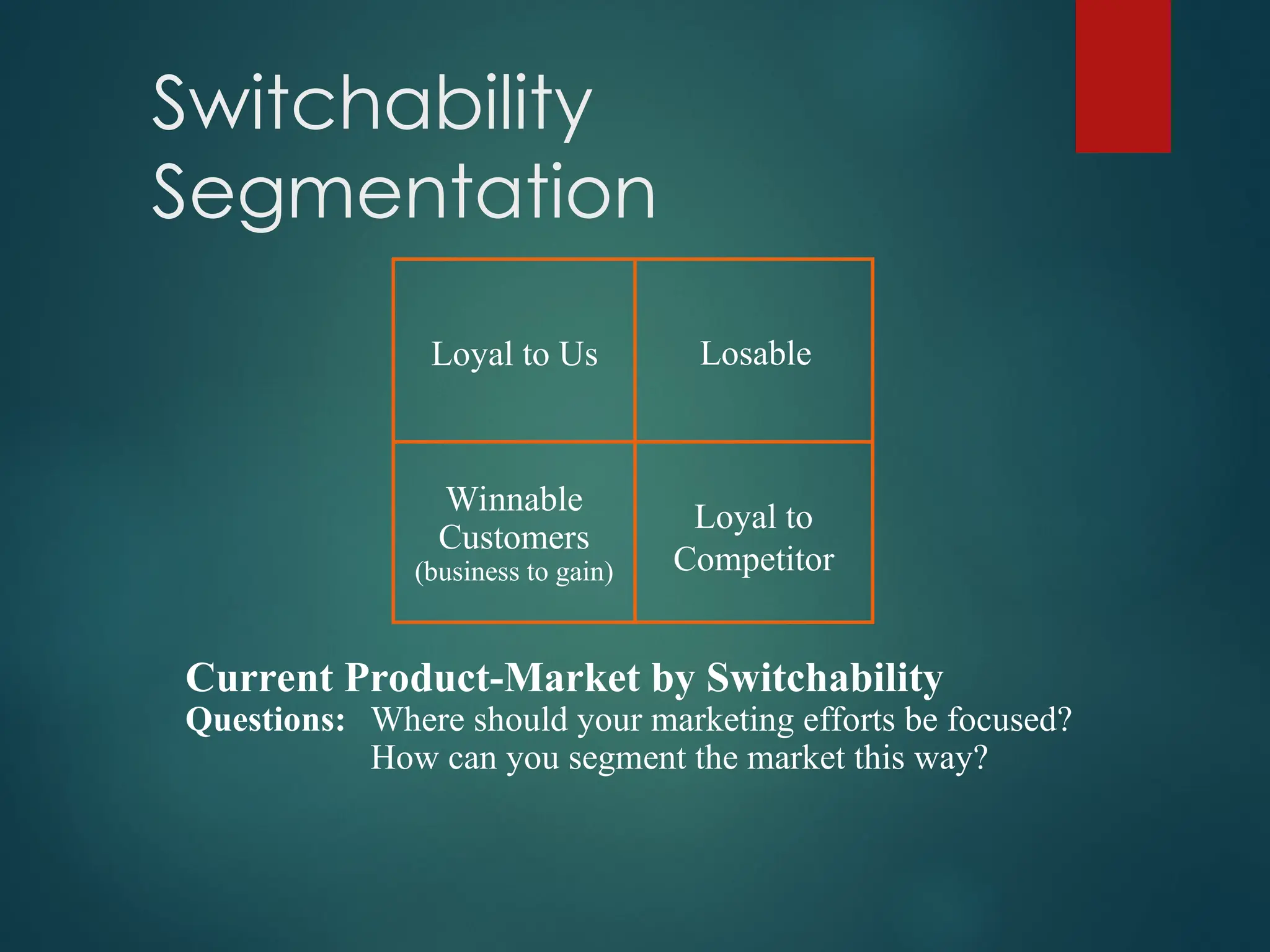
Switchability
Segmentation
Current Product-Market by Switchability
Questions: Where should your marketing efforts be focused?
How can you segment the market this way?
Loyal to Us Losable
Winnable
Customers
(business to gain)
Loyal to
Competitor
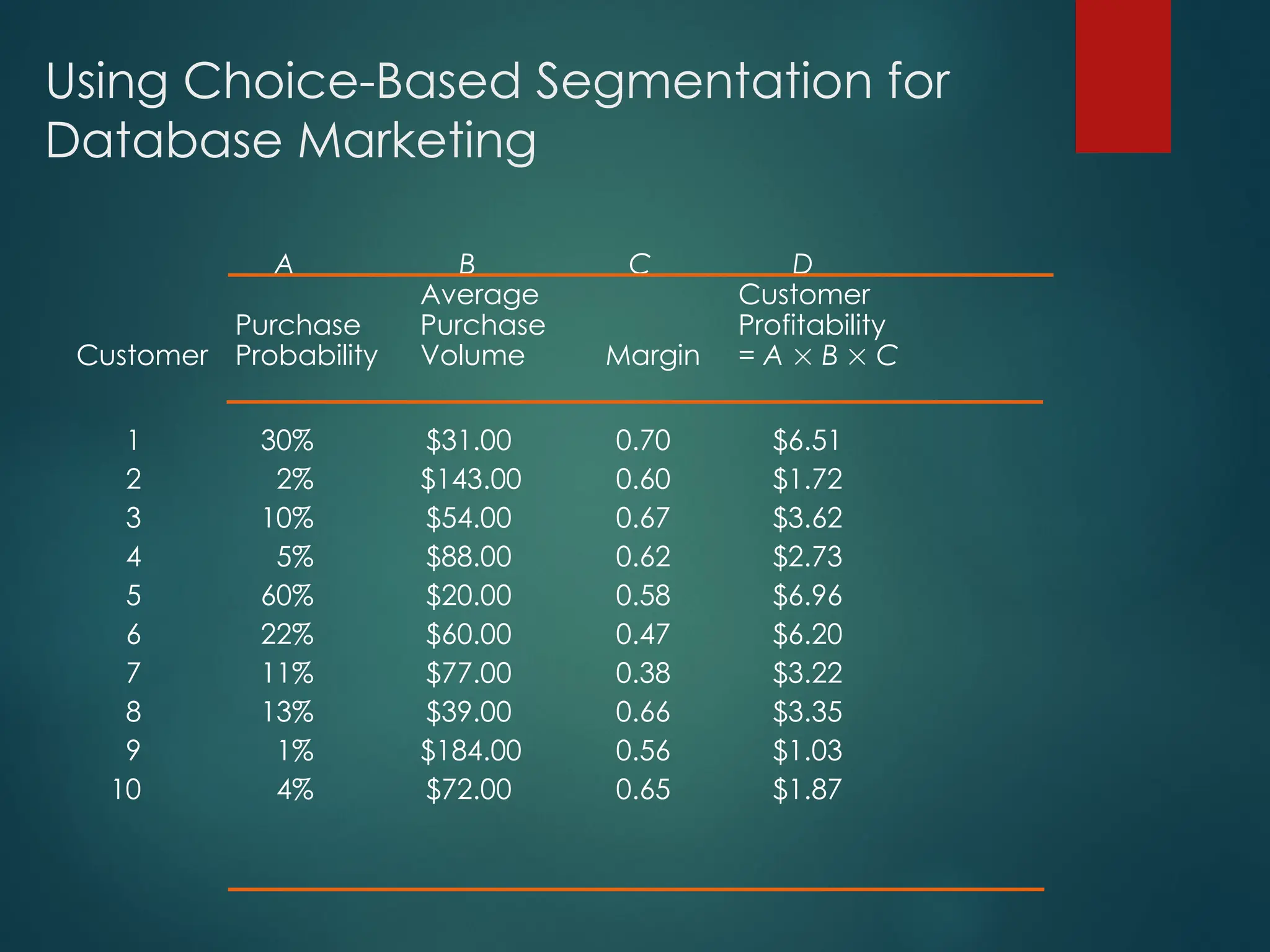
Using Choice-Based Segmentation for
Database Marketing
A B C D
Average Customer
Purchase Purchase Profitability
Customer Probability Volume Margin = A  B  C
1 30% $31.00 0.70 $6.51
2 2% $143.00 0.60 $1.72
3 10% $54.00 0.67 $3.62
4 5% $88.00 0.62 $2.73
5 60% $20.00 0.58 $6.96
6 22% $60.00 0.47 $6.20
7 11% $77.00 0.38 $3.22
8 13% $39.00 0.66 $3.35
9 1% $184.00 0.56 $1.03
10 4% $72.00 0.65 $1.87
Managerial Uses of
Segmentation Analysis
 Select attractive segments for focused effort
(Can use models such as Analytic Hierarchy
Process or GE Planning Matrix).
 Develop a marketing plan (4P’s and positioning)
to target selected segments.
 In consumer markets, we typically rely on advertising and
channel members to selectively reach targeted segments.
 In business markets, we use sales force and direct marketing.
You can use the results from the discriminant analysis to
assign new customers to one of the segments.
Checklist for Segmentation
Studies
 Is it values, needs, or choice-based? Whose values and needs?
 Is it a projectable sample?
 Is the study valid? (Does it use multiple methods and multiple
measures)
 Are the segments stable?
 Does the study answer important marketing questions (product
design, positioning, channel selection, sales force strategy, sales
forecasting)
 Are segmentation results linked to databases?
 Is this a one-time study or is it a part of a long-term program?
Concluding Remarks
In summary,
 Use needs variables to segment markets.
 Select segments taking into account both the
attractiveness of segments and the strengths of the firm.
 Use descriptor variables to develop a marketing plan to
reach and serve chosen segments.
 Develop mechanisms to implement the segmentation
strategy on a routine basis (one way to do this is through
information technology).
MANOJ FINAL PPT welingkar institution of mumbai

  • 1.
    SEGMENTATION AND TARGETING  Basics Market Definition  Segmentation Research and Methods  Behavior-Based Segmentation PROJECT REPORT FINAL REPORT Presented by:- NAME OF STUDENT: ROLL NO: Batch:
  • 2.
    Market Segmentation  Marketsegmentation is the subdividing of a market into distinct subsets of customers. Segments  Members are different between segments but similar within.
  • 3.
    Segmentation Marketing Definition Differentiating yourproduct and marketing efforts to meet the needs of different segments, that is, applying the marketing concept to market segmentation.
  • 4.
    Primary Characteristics of Segments Bases—characteristics that tell us why segments differ (e.g. needs, preferences, decision processes).  Descriptors—characteristics that help us find and reach segments.  (Business markets) (Consumer markets) Industry Age/Income Size Education Location Profession Organizational Life styles structure Media habits
  • 5.
    A Two-Stage Approach inBusiness Markets Macro-Segments:  First stage/rough cut  Industry/application  Firm size Micro-Segments:  Second-stage/fine cut  Different customer needs, wants, values within macro- segment
  • 6.
    Relevant Segmentation Descriptor Variable A:Climatic Region 1.Snow Belt 2.Moderate Belt 3.Sun Belt Fraction of Customers Likelihood of Purchasing Solar Water Heater (a) 0 100% Segment 1 Segment 2 Segment 3
  • 7.
    Likelihood of PurchasingSolar Water Heater (b) Irrelevant Segmentation Descriptor Fraction of Customers 0 100% Variable B: Education 1.Low Education 2.Moderate Education 3.High Education Segment 1 Segment 2 Segment 3
  • 8.
    Variables to Segment andDescribe Markets Consumer Industrial Segmentation Needs, wants benefits, Needs, wants benefits, solutions to Bases solutions to problems, problems, usage situation, usage rate, usage situation, usage rate. size*, industrial*. Descriptors Age, income, marital status, Industry, size, location, current Demographics family type & size, supplier(s), technology utilization, gender, social class, etc. etc. Psychographics Lifestyle, values, & Personality characteristics of personality characteristics. decision makers. Behavior Use occasions, usage level, Use occasions, usage level, complementary & complementary & substitute substitute products used, products used, brand loyalty, order brand loyalty, etc. size, applications, etc. Decision Making Individual or group Formalization of purchasing (family) choice, low or high procedures, size & characteristics involvement purchase, of decision making group, use of attitudes and knowledge outside consultants, purchasing about product class, price criteria, (de) centralizing buying, sensitivity, etc. price sensitivity, switching costs, etc. Media Patterns Level of use, types of Level of use, types of media used, media used, times of use, time of use, patronage at trade shows, etc. receptivity of sales people, etc.
  • 9.
    Segmentation in Action Wesegment our customers by letter volume, by postage volume, by the type of equipment they use. Then we segment on whether they buy or lease equipment. Based on this knowledge, we target our marketing messages, fine tune our sales tactics, learn which benefits appeal to which customers and zero in on key decision makers at a company. —Kathleen Synnot, VP, Worldwide Marketing Mailing Systems Division, Pitney Bowes, Inc. [quoted in Marketing Masters (Walden and Lawler)]
  • 10.
    Segmentation If you’re notthinking segments, you’re not thinking. To think segments means you have to think about what drives customers, customer groups, and the choices that are or might be available to them. —Levitt, Marketing Imagination
  • 11.
    STP as BusinessStrategy Segmentation  Identify segmentation bases and segment the market.  Develop profiles of resulting segments. Targeting  Evaluate attractiveness of each segment.  Select target segments. Positioning  Identify possible positioning concepts for each target segment.  Select, develop, and communicate the chosen concept. … to create and claim value
  • 12.
    Overview of Methodsfor STP  Clustering and discriminant analysis  Choice-based segmentation  Perceptual mapping - later
  • 13.
    .. . D . . .. . . Segmentation (for Carpet Fibers) A,B,C,D: Locationof segment centers. Typical members: A: schools B: light commercial C: indoor/outdoor carpeting D: health clubs Distance between segments C and D . .. . . . Strength (Importance) Water Resistance (Importance) ..... . .. A ..... . .. . . . . ..... . .. . . . . ... .. .. C B Perceptions/Ratings for one respondent: Customer Values .
  • 14.
    ..... . .. . . . . ..... . .. . . . . WaterResistance (Importance) Targeting Segment(s) to serve ..... . .. . . ..... . .. . . . . Strength (Importance)
  • 15.
    Product Positioning .Comp 1 Comp2 Us Water Resistance (Importance) Positioning . . Strength (Importance) ..... . .. . . . . ..... . .. . . . . ..... . .. . . . .
  • 16.
    A Note onPositioning Positioning involves designing an offering so that the target segment members perceive it in a distinct and valued way relative to competitors. Three ways to position an offering: 1. Unique (“Only product/service with XXX”) 2. Difference (“More than twice the [feature] vs. [competitor]”) 3. Similarities (“Same functionality as [competitor]; lower price”) What are you telling your targeted segments?
  • 17.
    Behavior-Based Segmentation  Traditional segmentation (eg,demographic, psychographic)  Needs-based segmentation  Behavior-based segmentation (choice models)
  • 18.
    Steps in aSegmentation Study  Articulate a strategic rationale for segmentation (ie, why are we segmenting this market?).  Select a set of needs-based segmentation variables most useful for achieving the strategic goals.  Select a cluster analysis procedure for aggregating (or disaggregating customers) into segments.  Group customers into a defined number of different segments.  Choose the segments that will best serve the firm’s strategy, given its capabilities and the likely reactions of competitors.
  • 19.
    Segmentation: Methods Overview  Factoranalysis (to reduce data before cluster analysis).  Cluster analysis to form segments.  Discriminant analysis to describe segments.
  • 20.
    Cluster Analysis for SegmentingMarkets  Define a measure to assess the similarity of customers on the basis of their needs.  Group customers with similar needs. Recommend: the “Ward’s minimum variance criterion” and, as an option, the K-Means algorithm for doing this.  Select the number of segments using numeric and strategic criteria, and your judgment.  Profile the needs of the selected segments (e.g., using cluster means).
  • 21.
    Cluster Analysis Issues Defining a measure of similarity (or distance) between segments.  Identifying “outliers.”  Selecting a clustering procedure  Hierarchical clustering (e.g., Single linkage, average linkage, and minimum variance methods)  Partitioning methods (e.g., K-Means)  Cluster profiling  Univariate analysis  Multiple discriminant analysis
  • 22.
    Doing Cluster Analysis Dimension2 Dimension 1 • • • • • • • • • • • • Perceptions or ratings data from one respondent III a I II b a =distance from member to cluster center b =distance from I to III
  • 23.
    Ward’s Minimum Variance AgglomerativeClustering Procedure First Stage: A = 2 B = 5 C = 9 D = 10 E = 15 Second Stage: AB = 4.5 BD = 12.5 AC = 24.5 BE = 50.0 AD = 32.0 CD = 0.5 AE = 84.5 CE = 18.0 BC = 8.0 DE = 12.5 Third Stage: CDA = 38.0 CDB = 14.0 CDE = 20.66 AB = 5.0 AE = 85.0 BE = 50.5 Fourth Stage: ABCD = 41.0 ABE= 93.17 CDE = 25.18 Fifth Stage: ABCDE = 98.8
  • 24.
    A 98.80 Ward’s Minimum Variance AgglomerativeClustering Procedure B C D E 25.18 5.00 0.50
  • 25.
    Discriminant Analysis for DescribingMarket Segments  Identify a set of “observable” variables that helps you to understand how to reach and serve the needs of selected clusters.  Use discriminant analysis to identify underlying dimensions (axes) that maximally differentiate between the selected clusters.
  • 26.
    Two-Group Discriminant Analysis Need forData Storage Price Sensitivity XXOXOOO XXXOXXOOOO XXXXOOOXOOO XXOXXOXOOOO XXOXOOOOOOO X-segment O-segment x = high propensity to buy o = low propensity to buy
  • 27.
    Interpreting Discriminant Analysis Results What proportion of the total variance in the descriptor data is explained by the statistically significant discriminant axes?  Does the model have good predictability (“hit rate”) in each cluster?  Can you identify good descriptors to find differences between clusters? (Examine correlations between discriminant axes and each descriptor variable).
  • 28.
  • 29.
    PDA – Segmentation Performs Wards method - Code: proc cluster data=hold.pda method=wards standard outtree=treedat pseudo; var Innovator Use_Message Use_Cell Use_PIM Inf_Passive Inf_Active Remote_Acc Share_Inf Monitor Email Web M_Media Ergonomic Monthly Price; run; proc tree data=treedat; run;
  • 30.
    PDA – Segmentation (alternative) Performs K-means method - Code: proc fastclus data=hold.pda maxc=4 maxiter=10 random=41 maxiter=50 out=clus; var Innovator Use_Message Use_Cell Use_PIM Inf_Passive Inf_ActiveRemote_Acc Share_Inf Monitor Email Web M_Media Ergonomic ; run; proc means data =clus; var Innovator Use_Message Use_Cell Use_PIM Inf_Passive Inf_Active Remote_Acc Share_Inf Monitor Email Web M_Media Ergonomic Monthly Price; by cluster; run;
  • 31.
    Output  The followingclusters are quite close together and can be combined with a small loss in consumer  grouping information:  i) clusters 7 and 5 at 0.27,  ii) clusters 1 and 6 at 0.28, ii)  fused cluster 7-5 and cluster 2 (0.34).  However, when going from a four- cluster solution to a three-cluster solution, the distance to be bridged is much larger (1.11);  thus, the four-cluster solution is indicated by the ESS.  In addition, four seems a reasonable number of segments to handle based on managerial judgment. 0.27 0.28 0.34 1.11 1.45 3.13 7 6 5 4 3 2 1 Cluster (nottoscale) Distance
  • 32.
    Four Cluster Solution– profile code; proc tree data = treedata nclusters=4 out=outclus no print; run; ** create new data set; data temp; merge hold.pda outclus; run; ** profile these segments; proc means data =temp; var Innovator Use_Message Use_Cell Use_PIM Inf_Passive Inf_Active Remote_Acc Share_Inf Monitor Email Web M_MedErgonomic Monthly Price; by cluster; run;
  • 33.
  • 34.
  • 35.
  • 36.
    PDA profiles  Cluster1. Phone users who use Personal Information Management software, to whom Email and Web access, as well as Multimedia capabilities are important.  Cluster 2. People who use messaging services and cell phones, need remote access to information, appreciate better monitors, but not for multi- media usage.
  • 37.
    PDA profiles.. Cluster 3.Pager users who have a high need for fast information sharing (receiving as well as sending) and also remote access. They use neither email extensively, nor the Web, nor Multi-media, but do require a handy, non-bulky device. Cluster 4. Innovators who use cell phones a lot, have a high need for Email, Web, and Multi-media use. They also require a sleek device.
  • 38.
  • 39.
    Name the segments Cluster1 - Sales Pros: Cluster 1 consists mainly of sales professionals: 54% of the cluster members indicated Sales as their occupation. They use the cell phone heavily, and many (45%) own a PDA already; practically all have access to a PC. Their work often takes them away from the office. They mostly read two of the selected magazines: 30% read BW. From the needs data, we see that they are quite price sensitive. Cluster 2 – Service Pros: Cluster 2 is made up primarily of service personnel (39%) and secondarily of sales personnel (23%). They use cell phones heavily, but only about one fifth currently use a PDA. They spend much time on the road and in remote locations. They read PC Magazine, 29%. From the needs data, we see that they are quite price sensitive.
  • 40.
    Name the segments… Cluster3 – Hard Hats: Cluster 3 is made up predominantly of construction (31%) and emergency (19%) workers. They use cell phones, but usually do not own a PDA. By the nature of their work, they have high information relay needs and generally work in remote locations. They exchange information with colleagues in the field (e.g. construction workers on the site). Many read Field & Stream (31%) and also PC Magazine. Note also from the needs data, that they are the least price sensitive (willing to pay highest price plus monthly fee) and also have the lowest income. This apparent anomaly occurs because these folks are less likely to have to pay for the device themselves, raising the question of whose preferences—their own or their employers’—will drive the adoption decision
  • 41.
    Name the segments… Cluster4 – Innovators: Cluster 4 represents early adopters (see needs data), predominantly professionals (lawyers, consultants, etc.). Every cluster member has access to a PC, 89 percent already own PDAs. They read many magazines, especially BW 49%, PCMag 32%. Most are highly paid and highly educated.
  • 42.
  • 43.
    Interpreting Cluster Analysis Results Select the appropriate number of clusters:  Are the bases variables highly correlated? (Should we reduce the data through factor analysis before clustering?)  Are the clusters separated well from each other?  Should we combine or separate the clusters?  Can you come up with descriptive names for each cluster (eg, professionals, techno-savvy, etc.)?  Segment the market independently of your ability to reach the segments (i.e., separately evaluate segmentation and discriminant analysis results).
  • 44.
    Discrimination based on demographics/behaviour procdiscrim data=temp outstat=outdisc method=normal pool=yes list crossvalidate; class cluster; priors prop; vars age education etc… ; run; ** all relevant vars. not used to create segment solutions;
  • 45.
    Discrimination based on demographics/behaviour Thisallows us a way to target and profile future customers:
  • 46.
  • 47.
    Discrimination based on demographics/behaviour •Thefirst discriminant function above explains 51% the variation. According to its coefficients, i.e., the four groups are particularly different with respect to the amount away from the office. •In addition, the function shares high correlation with the level of education, possession of a PDA, and income. •The second function explains 32% of the variance and primarily distinguishes the occupation types construction/emergency from sales/service, and the third function separates Sales and Service types.
  • 48.
  • 49.
    Correspondence Analysis  Providesa graphical summary of the interactions in a table  Also known as a perceptual map  But so are many other charts  Can be very useful  E.g. to provide overview of cluster results  However the correct interpretation is less than intuitive, and this leads many researchers astray
  • 50.
    Reason 1 Reason 2 Reason3 Reason 4 Reason 5 Reason 6 Reason 7 Reason 8 Reason 9 Reason 10 Reason 11 Reason 12 Reason 13 Reason 14 Reason 15 Usage 1 Usage 2 Usage 3 Usage 4 Usage 5 Usage 6 Usage 7 Usage 8 Usage 9 Usage 10 Cluster 1 Cluster 2 Cluster 3 Cluster 4 25.3% 53.8% 2D Fit = 79.1% Four Clusters (imputed, normalised) = Correlation < 0.50
  • 51.
    Interpretation  Correspondence analysisplots should be interpreted by looking at points relative to the origin  Points that are in similar directions are positively associated  Points that are on opposite sides of the origin are negatively associated  Points that are far from the origin exhibit the strongest associations  Also the results reflect relative associations, not just which rows are highest or lowest overall
  • 52.
    Software for Correspondence Analysis Earlier chart was created using a specialised package called BRANDMAP  Can also do correspondence analysis in most major statistical packages  For example, using PROC CORRESP in SAS: *---Perform Simple Correspondence Analysis—Example 1 in SAS OnlineDoc; proc corresp all data=Cars outc=Coor; tables Marital, Origin; run; *---Plot the Simple Correspondence Analysis Results---; %plotit(data=Coor, datatype=corresp)
  • 53.
  • 54.
  • 55.
    Tandem Segmentation  Onegeneral method is to conduct a factor analysis, followed by a cluster analysis  This approach has been criticised for losing information and not yielding as much discrimination as cluster analysis alone  However it can make it easier to design the distance function, and to interpret the results
  • 56.
    Tandem k-means Example procfactor data=datafile n=6 rotate=varimax round reorder flag=.54 scree out=scores; var reasons1-reasons15 usage1-usage10; run; proc fastclus data=scores maxc=4 seed=109162319 maxiter=50; var factor1-factor6; run;  Have used the default unweighted Euclidean distance function, which is not sensible in every context  Also note that k-means results depend on the initial cluster centroids (determined here by the seed)  Typically k-means is very prone to local maxima  Run at least 20 times to ensure reasonable maximum
  • 57.
    Cluster Analysis Options There are several choices of how to form clusters in hierarchical cluster analysis  Single linkage  Average linkage  Density linkage  Ward’s method  Many others  Ward’s method (like k-means) tends to form equal sized, roundish clusters  Average linkage generally forms roundish clusters with equal variance  Density linkage can identify clusters of different shapes
  • 58.
  • 59.
  • 60.
    Cluster Analysis Issues Distance definition  Weighted Euclidean distance often works well, if weights are chosen intelligently  Cluster shape  Shape of clusters found is determined by method, so choose method appropriately  Hierarchical methods usually take more computation time than k-means  However multiple runs are more important for k- means, since it can be badly affected by local minima  Adjusting for response styles can also be worthwhile  Some people give more positive responses overall than others  Clusters may simply reflect these response styles unless this is adjusted for, e.g. by standardising responses across attributes for each respondent
  • 61.
    MVA - FASTCLUS PROC FASTCLUS in SAS tries to minimise the root mean square difference between the data points and their corresponding cluster means  Iterates until convergence is reached on this criterion  However it often reaches a local minimum  Can be useful to run many times with different seeds and choose the best set of clusters based on this RMS criterion  See http://en.wikipedia.org/wiki/K- means_clustering for more k-means issues
  • 62.
    Iteration History from FASTCLUS RelativeChange in Cluster Seeds Iteration Criterion 1 2 3 4 5 ƒƒƒƒƒƒƒƒƒƒƒƒƒƒƒƒƒƒƒƒƒƒƒƒƒƒƒƒƒƒƒƒƒƒƒƒƒƒƒƒƒƒƒƒƒƒƒƒƒƒƒƒƒƒƒƒƒƒƒƒƒƒƒƒƒƒƒƒƒƒƒƒƒƒƒƒƒƒƒƒƒƒ 1 0.9645 1.0436 0.7366 0.6440 0.6343 0.5666 2 0.8596 0.3549 0.1727 0.1227 0.1246 0.0731 3 0.8499 0.2091 0.1047 0.1047 0.0656 0.0584 4 0.8454 0.1534 0.0701 0.0785 0.0276 0.0439 5 0.8430 0.1153 0.0640 0.0727 0.0331 0.0276 6 0.8414 0.0878 0.0613 0.0488 0.0253 0.0327 7 0.8402 0.0840 0.0547 0.0522 0.0249 0.0340 8 0.8392 0.0657 0.0396 0.0440 0.0188 0.0286 9 0.8386 0.0429 0.0267 0.0324 0.0149 0.0223 10 0.8383 0.0197 0.0139 0.0170 0.0119 0.0173 Convergence criterion is satisfied. Criterion Based on Final Seeds = 0.83824
  • 63.
    Results from DifferentInitial Seeds 19th run of 5 segments Cluster Means Cluster FACTOR1 FACTOR2 FACTOR3 FACTOR4 FACTOR5 FACTOR6 ƒƒƒƒƒƒƒƒƒƒƒƒƒƒƒƒƒƒƒƒƒƒƒƒƒƒƒƒƒƒƒƒƒƒƒƒƒƒƒƒƒƒƒƒƒƒƒƒƒƒƒƒƒƒƒƒƒƒƒƒƒƒƒƒƒƒƒƒƒƒƒƒƒƒƒƒƒƒƒƒƒƒƒƒƒƒƒƒƒƒƒ 1 -0.17151 0.86945 -0.06349 0.08168 0.14407 1.17640 2 -0.96441 -0.62497 -0.02967 0.67086 -0.44314 0.05906 3 -0.41435 0.09450 0.15077 -1.34799 -0.23659 -0.35995 4 0.39794 -0.00661 0.56672 0.37168 0.39152 -0.40369 5 0.90424 -0.28657 -1.21874 0.01393 -0.17278 -0.00972 20th run of 5 segments Cluster Means Cluster FACTOR1 FACTOR2 FACTOR3 FACTOR4 FACTOR5 FACTOR6 ƒƒƒƒƒƒƒƒƒƒƒƒƒƒƒƒƒƒƒƒƒƒƒƒƒƒƒƒƒƒƒƒƒƒƒƒƒƒƒƒƒƒƒƒƒƒƒƒƒƒƒƒƒƒƒƒƒƒƒƒƒƒƒƒƒƒƒƒƒƒƒƒƒƒƒƒƒƒƒƒƒƒƒƒƒƒƒƒƒƒƒ 1 0.08281 -0.76563 0.48252 -0.51242 -0.55281 0.64635 2 0.39409 0.00337 0.54491 0.38299 0.64039 -0.26904 3 -0.12413 0.30691 -0.36373 -0.85776 -0.31476 -0.94927 4 0.63249 0.42335 -1.27301 0.18563 0.15973 0.77637 5 -1.20912 0.21018 -0.07423 0.75704 -0.26377 0.13729
  • 64.
    Howard-Harris Approach  Providesautomatic approach to choosing seeds for k-means clustering  Chooses initial seeds by fixed procedure  Takes variable with highest variance, splits the data at the mean, and calculates centroids of the resulting two groups  Applies k-means with these centroids as initial seeds  This yields a 2 cluster solution  Choose the cluster with the higher within-cluster variance  Choose the variable with the highest variance within that cluster, split the cluster as above, and repeat to give a 3 cluster solution  Repeat until have reached a set number of clusters  I believe this approach is used by the ESPRI software package (after variables are standardised by their range)
  • 65.
    Another “Clustering” Method  Onealternative approach to identifying clusters is to fit a finite mixture model  Assume the overall distribution is a mixture of several normal distributions  Typically this model is fit using some variant of the EM algorithm  E.g. weka.clusterers.EM method in WEKA data mining package  See WEKA tutorial for an example using Fisher’s iris data  Advantages of this method include:  Probability model allows for statistical tests  Handles missing data within model fitting process  Can extend this approach to define clusters based on model parameters, e.g. regression coefficients  Also known as latent class modeling
  • 66.
  • 67.
    Choice Models 1. Observechoice: (Buy/not buy => direct marketers Brand bought   packaged goods, ABB) 2. Capture related data:  demographics  attitudes/perceptions  market conditions (price, promotion, etc.) 3. Link 1 to 2 via “choice model”  model reveals importance weights of characteristics
  • 68.
    Choice Models vsSurveys With standard survey methods . . . preference/ importance choice  weightsperceptions    predict observe/ask observe/ask But with choice models . . . importance choice  weights  perceptions    observe infer observe/ask
  • 69.
    Behavior-Based Segmentation Model Stage 1:Screen products using key attributes to identify the “consideration set of suppliers” for each type of customer. Stage 2: Assume that customers (of each type) will choose suppliers to maximize their utility via a random utility model. Uij = Vij + ij where: Uij =Utility that customer i has for supplier j’s product. Vij =Deterministic component of utility that is a function of product and supplier attributes. ij =An error term that reflects the non-deterministic component of utility.
  • 70.
    Specification of the DeterministicComponent of Utility Vij =  Wk bijk k where: i =an index to represent customers, j is an index to represent suppliers, and k is an index to represent attributes. bijk=i’s perception of attribute k for supplier j. wk=estimated coefficient to represent the impact of bijk on the utility realized for attribute k of supplier j for customer i.
  • 71.
    A Key Resultfrom this Specification: The Multinomial Logit (MNL) Model If customer’s past choices are assumed to reflect the principle of utility maximization and the error (ij) has a specific form called double exponential, then: eVij pij =–––––– k eVik where: pij =probability that customer i chooses supplier j. Vij =estimated value of utility (ie, based on estimates of bijk) obtained from maximum likelihood estimation. ^ ^ ^
  • 72.
    Key idea: Segmenton the basis of probability of choice— 1.Loyal to us 2.Loyal to competitor 3.Switchables: loseable/winnable customers Applying the MNL Model in Segmentation Studies
  • 73.
    Switchability Segmentation Current Product-Market bySwitchability Questions: Where should your marketing efforts be focused? How can you segment the market this way? Loyal to Us Losable Winnable Customers (business to gain) Loyal to Competitor
  • 74.
    Using Choice-Based Segmentationfor Database Marketing A B C D Average Customer Purchase Purchase Profitability Customer Probability Volume Margin = A  B  C 1 30% $31.00 0.70 $6.51 2 2% $143.00 0.60 $1.72 3 10% $54.00 0.67 $3.62 4 5% $88.00 0.62 $2.73 5 60% $20.00 0.58 $6.96 6 22% $60.00 0.47 $6.20 7 11% $77.00 0.38 $3.22 8 13% $39.00 0.66 $3.35 9 1% $184.00 0.56 $1.03 10 4% $72.00 0.65 $1.87
  • 75.
    Managerial Uses of SegmentationAnalysis  Select attractive segments for focused effort (Can use models such as Analytic Hierarchy Process or GE Planning Matrix).  Develop a marketing plan (4P’s and positioning) to target selected segments.  In consumer markets, we typically rely on advertising and channel members to selectively reach targeted segments.  In business markets, we use sales force and direct marketing. You can use the results from the discriminant analysis to assign new customers to one of the segments.
  • 76.
    Checklist for Segmentation Studies Is it values, needs, or choice-based? Whose values and needs?  Is it a projectable sample?  Is the study valid? (Does it use multiple methods and multiple measures)  Are the segments stable?  Does the study answer important marketing questions (product design, positioning, channel selection, sales force strategy, sales forecasting)  Are segmentation results linked to databases?  Is this a one-time study or is it a part of a long-term program?
  • 77.
    Concluding Remarks In summary, Use needs variables to segment markets.  Select segments taking into account both the attractiveness of segments and the strengths of the firm.  Use descriptor variables to develop a marketing plan to reach and serve chosen segments.  Develop mechanisms to implement the segmentation strategy on a routine basis (one way to do this is through information technology).