
What can we do? Why do we need a strategy?
Why digital?
Where is it all heading…
Will digital save us?
Who are we? Our core values? Who is our customer? Audience?
…who is the digital Strategist?
Adopting a new thinking…
What business are we in? But Why?
#Context
#Goals and
Objectives
#Strategic
Formulation
#Implementation
#Monitoring
…what is marketing?
Marketing consists of individual and organizational activities that facilitate and
expedite satisfying exchange relationships in a dynamic environment through the
creation, distribution, promotion and pricing of goods, services and ideas.
Marketing is the management process which identifies, anticipates and supplies
customer requirements efficiently and profitably.
Marketing is a social and managerial process by which individuals and
organizations obtain what they want and need through creating and exchanging
value with others.
Armstrong and Kotler, 2007
CIM, 2010
Dibb, et.al., 2012
e-marketing involves the marketing side of e-commerce and features
a company’s efforts to communicate about, promote and sell
products and services over the internet.
Kotler et.al., 2007
…what is e-marketing?
…what is digital marketing?
digital Marketing is the management and execution of marketing
using electronic media (such as the web, e-mail, interactive TV and
wireless media) in conjunction with digital data about customers’
characteristics and behaviours.
Chaffey et.al., 2006
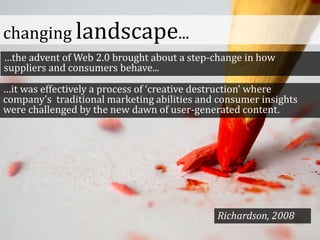
changing landscape...
…the advent of Web 2.0 brought about a step-change in how
suppliers and consumers behave...
…it was effectively a process of ‘creative destruction’ where
company’s traditional marketing abilities and consumer insights
were challenged by the new dawn of user-generated content.
Richardson, 2008
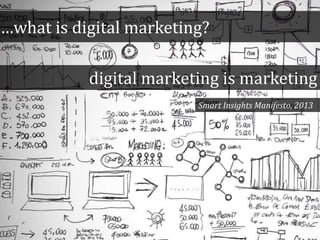
digital marketing is marketing
…what is digital marketing?
Smart Insights Manifesto, 2013
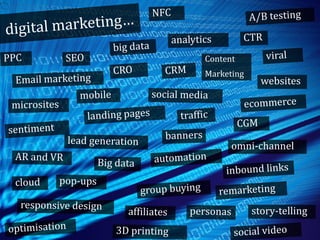
websites
Content
Marketing
story-telling
omni-channel
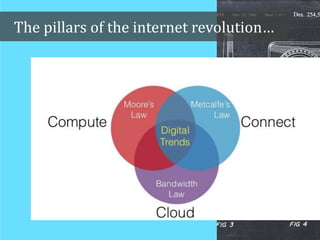
The pillars of the internet revolution…
…Who owns the world?
Technological changes are exponential not linear.
we’re doubling the rate of progress every decade.
we’ll see a century of progress–at today’s rate–in
only 25 calendar years.
What time has to do with it? How does that affect
business capabilities? How to build competitive
advantage in a ever-changing technology-based
world?
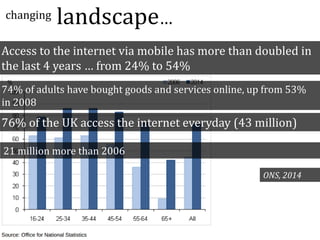
changing landscape…
76% of the UK access the internet everyday (43 million)
21 million more than 2006
74% of adults have bought goods and services online, up from 53%
in 2008
Access to the internet via mobile has more than doubled in
the last 4 years … from 24% to 54%
ONS, 2014
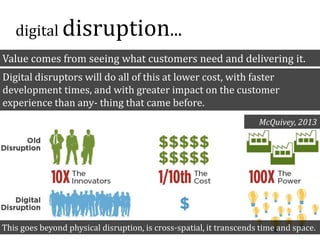
Value comes from seeing what customers need and delivering it.
Digital disruptors will do all of this at lower cost, with faster
development times, and with greater impact on the customer
experience than any- thing that came before.
McQuivey, 2013
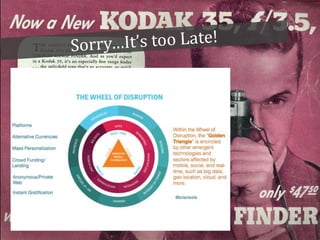
This goes beyond physical disruption, is cross-spatial, it transcends time and space.
digital disruption...
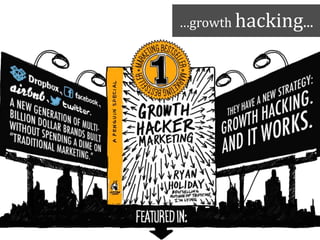
…growth hacking...
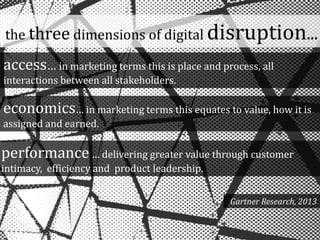
access… in marketing terms this is place and process, all
interactions between all stakeholders.
economics… in marketing terms this equates to value, how it is
assigned and earned.
performance… delivering greater value through customer
intimacy, efficiency and product leadership.
Gartner Research, 2013
the three dimensions of digital disruption...
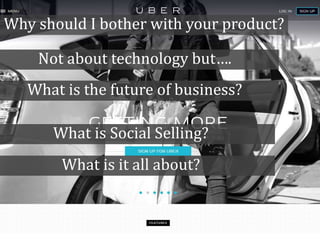
Why should I bother with your product?
Not about technology but….
What is the future of business?
What is Social Selling?
What is it all about?
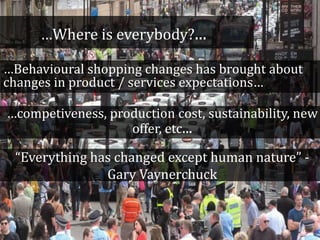
…Where is everybody?...
…Behavioural shopping changes has brought about
changes in product / services expectations…
…competiveness, production cost, sustainability, new
offer, etc...
“Everything has changed except human nature” -
Gary Vaynerchuck
References and reading
Armstrong, G & Kotler, P. (2008) Marketing- An Introduction. 9th ed Pearson
Education: London
Baines, Fill & Page (2010) Marketing. 2nd ed Oxford University Press: Oxford
Chaffey (2010) http://www.davechaffey.com/ [accessed 10-01-11]
Dibb, S., Simkin, L., Pride, W.M. & Ferrell, O.C. (2012) Marketing: Concepts and
Strategies. 5th European ed. Houghton Mifflin: Abingdon
Kotler, P., Armstrong, G., Wong, V. & Saunders, J. (2008) Principles of Marketing.
5th European ed. FT Prentice Hall: Harlow
McQuivey, J., 2013, Digital Disruption, Las Vegas: Amazon Publishing
Qualman, E. (2011) Socialnomics: How Social Media Transforms the Way We
Live and Do Business New Jersey: John Wiley and Sons
Ryan, D. and Jones, C. (2009) Understanding Digital Marketing: Marketing
Strategies for Engaging the Digital Generation London: Kogan Page
http://blogs.gartner.com/mark_mcdonald/2012/07/16/the-dimensions-of-
digital-disruption/
http://solutions.forrester.com/disruption
http://www.smartinsights.com/digital-marketing-strategy/online-business-
revenue-models/dealing-with-digital-disruption/
http://www.smartinsights.com/digital-marketing-strategy/sostac-model/
http://www.kurzweilai.net/the-law-of-accelerating-returns

Digital Strategy - Lecture 1 - The New Digital Landscape

  • 4.
    What can wedo? Why do we need a strategy? Why digital?
  • 5.
    Where is itall heading…
  • 6.
  • 7.
    Who are we?Our core values? Who is our customer? Audience? …who is the digital Strategist? Adopting a new thinking… What business are we in? But Why?
  • 8.
  • 9.
    …what is marketing? Marketingconsists of individual and organizational activities that facilitate and expedite satisfying exchange relationships in a dynamic environment through the creation, distribution, promotion and pricing of goods, services and ideas. Marketing is the management process which identifies, anticipates and supplies customer requirements efficiently and profitably. Marketing is a social and managerial process by which individuals and organizations obtain what they want and need through creating and exchanging value with others. Armstrong and Kotler, 2007 CIM, 2010 Dibb, et.al., 2012
  • 10.
    e-marketing involves themarketing side of e-commerce and features a company’s efforts to communicate about, promote and sell products and services over the internet. Kotler et.al., 2007 …what is e-marketing? …what is digital marketing? digital Marketing is the management and execution of marketing using electronic media (such as the web, e-mail, interactive TV and wireless media) in conjunction with digital data about customers’ characteristics and behaviours. Chaffey et.al., 2006
  • 12.
    changing landscape... …the adventof Web 2.0 brought about a step-change in how suppliers and consumers behave... …it was effectively a process of ‘creative destruction’ where company’s traditional marketing abilities and consumer insights were challenged by the new dawn of user-generated content. Richardson, 2008
  • 13.
    digital marketing ismarketing …what is digital marketing? Smart Insights Manifesto, 2013
  • 14.
  • 15.
    The pillars ofthe internet revolution…
  • 16.
    …Who owns theworld? Technological changes are exponential not linear. we’re doubling the rate of progress every decade. we’ll see a century of progress–at today’s rate–in only 25 calendar years. What time has to do with it? How does that affect business capabilities? How to build competitive advantage in a ever-changing technology-based world?
  • 17.
    changing landscape… 76% ofthe UK access the internet everyday (43 million) 21 million more than 2006 74% of adults have bought goods and services online, up from 53% in 2008 Access to the internet via mobile has more than doubled in the last 4 years … from 24% to 54% ONS, 2014
  • 18.
    Value comes fromseeing what customers need and delivering it. Digital disruptors will do all of this at lower cost, with faster development times, and with greater impact on the customer experience than any- thing that came before. McQuivey, 2013 This goes beyond physical disruption, is cross-spatial, it transcends time and space. digital disruption...
  • 19.
  • 20.
    access… in marketingterms this is place and process, all interactions between all stakeholders. economics… in marketing terms this equates to value, how it is assigned and earned. performance… delivering greater value through customer intimacy, efficiency and product leadership. Gartner Research, 2013 the three dimensions of digital disruption...
  • 22.
    Why should Ibother with your product? Not about technology but…. What is the future of business? What is Social Selling? What is it all about?
  • 23.
    …Where is everybody?... …Behaviouralshopping changes has brought about changes in product / services expectations… …competiveness, production cost, sustainability, new offer, etc... “Everything has changed except human nature” - Gary Vaynerchuck
  • 24.
    References and reading Armstrong,G & Kotler, P. (2008) Marketing- An Introduction. 9th ed Pearson Education: London Baines, Fill & Page (2010) Marketing. 2nd ed Oxford University Press: Oxford Chaffey (2010) http://www.davechaffey.com/ [accessed 10-01-11] Dibb, S., Simkin, L., Pride, W.M. & Ferrell, O.C. (2012) Marketing: Concepts and Strategies. 5th European ed. Houghton Mifflin: Abingdon Kotler, P., Armstrong, G., Wong, V. & Saunders, J. (2008) Principles of Marketing. 5th European ed. FT Prentice Hall: Harlow McQuivey, J., 2013, Digital Disruption, Las Vegas: Amazon Publishing Qualman, E. (2011) Socialnomics: How Social Media Transforms the Way We Live and Do Business New Jersey: John Wiley and Sons Ryan, D. and Jones, C. (2009) Understanding Digital Marketing: Marketing Strategies for Engaging the Digital Generation London: Kogan Page http://blogs.gartner.com/mark_mcdonald/2012/07/16/the-dimensions-of- digital-disruption/ http://solutions.forrester.com/disruption http://www.smartinsights.com/digital-marketing-strategy/online-business- revenue-models/dealing-with-digital-disruption/ http://www.smartinsights.com/digital-marketing-strategy/sostac-model/ http://www.kurzweilai.net/the-law-of-accelerating-returns