DIGITAL LITERACY PROGRAM for PM
SHRI AFFILATED SCHOOL IN SIKKIM
NATIONAL INSTITUTE OF ELECTRONICS & INFORMATION TECHNOLOGY, GANGTOK
INTRODUCTION TO COMPUTER
Introduction
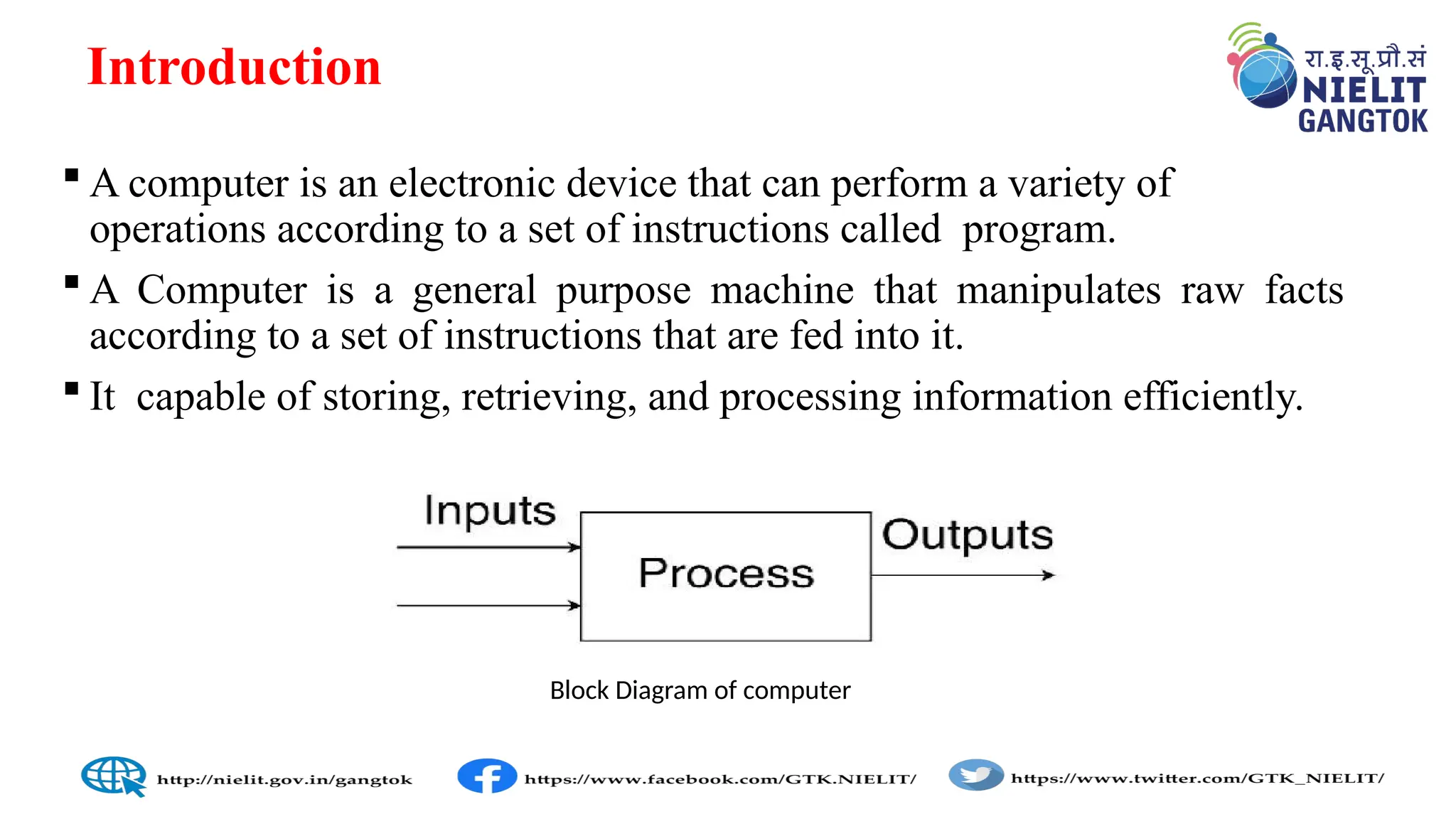
 A computer is an electronic device that can perform a variety of
operations according to a set of instructions called program.
 A Computer is a general purpose machine that manipulates raw facts
according to a set of instructions that are fed into it.
 It capable of storing, retrieving, and processing information efficiently.
Block Diagram of computer
Applications of Computers
• Education
• Business & Finance
• Healthcare
• Entertainment
• Communication
IT Gadgets and Their Uses
• Laptops & Desktops: Personal and professional work
• Smartphones & Tablets: Communication and mobile
computing
• Smartwatches & Wearables: Health tracking, notifications
• IoT Devices (Smart Home, AI Assistants): Automation
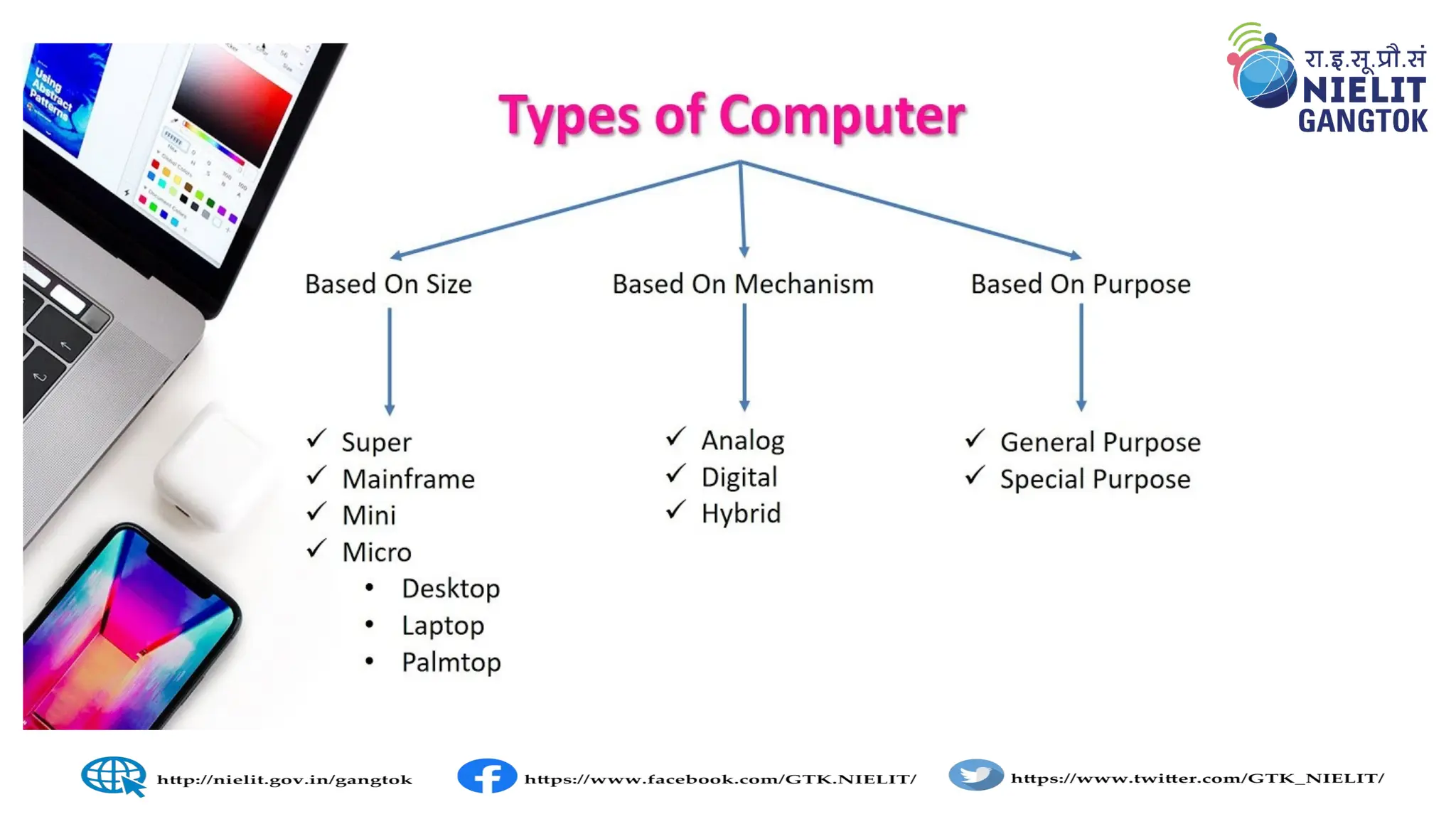
Types of Computer
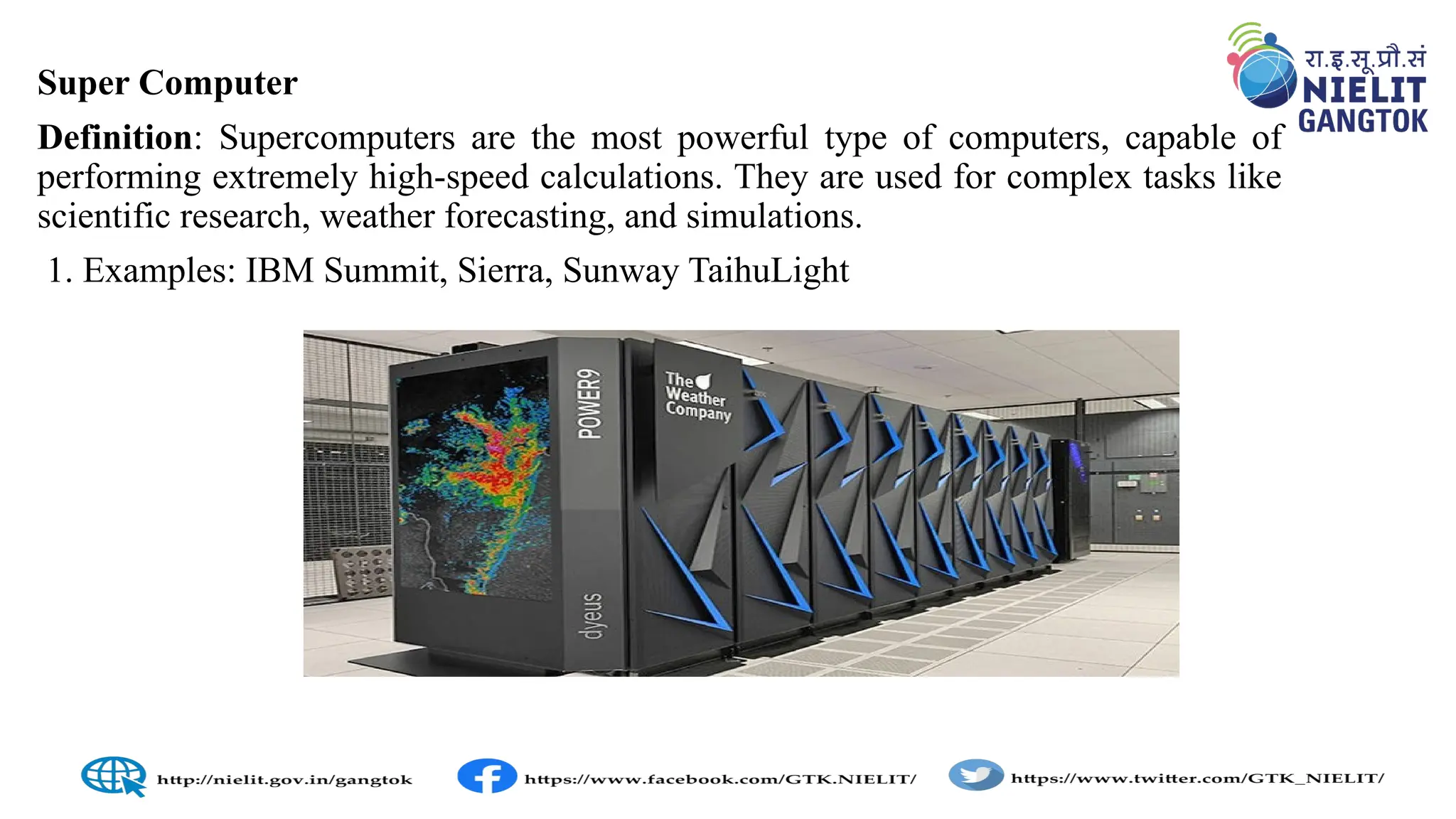
Super Computer
Definition: Supercomputers are the most powerful type of computers, capable of
performing extremely high-speed calculations. They are used for complex tasks like
scientific research, weather forecasting, and simulations.
1. Examples: IBM Summit, Sierra, Sunway TaihuLight
Mainframe Computer
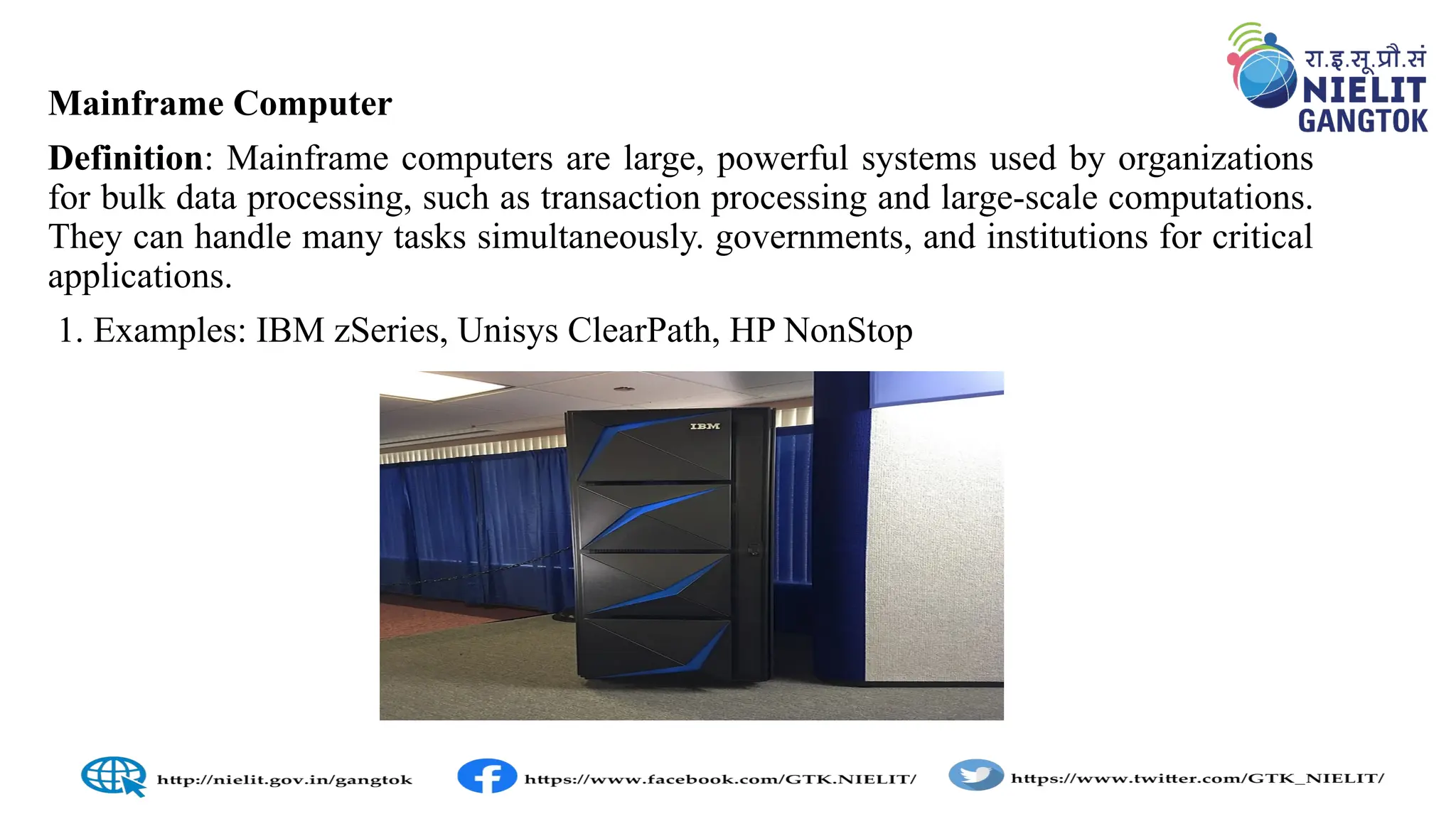
Definition: Mainframe computers are large, powerful systems used by organizations
for bulk data processing, such as transaction processing and large-scale computations.
They can handle many tasks simultaneously. governments, and institutions for critical
applications.
1. Examples: IBM zSeries, Unisys ClearPath, HP NonStop
Minicomputer
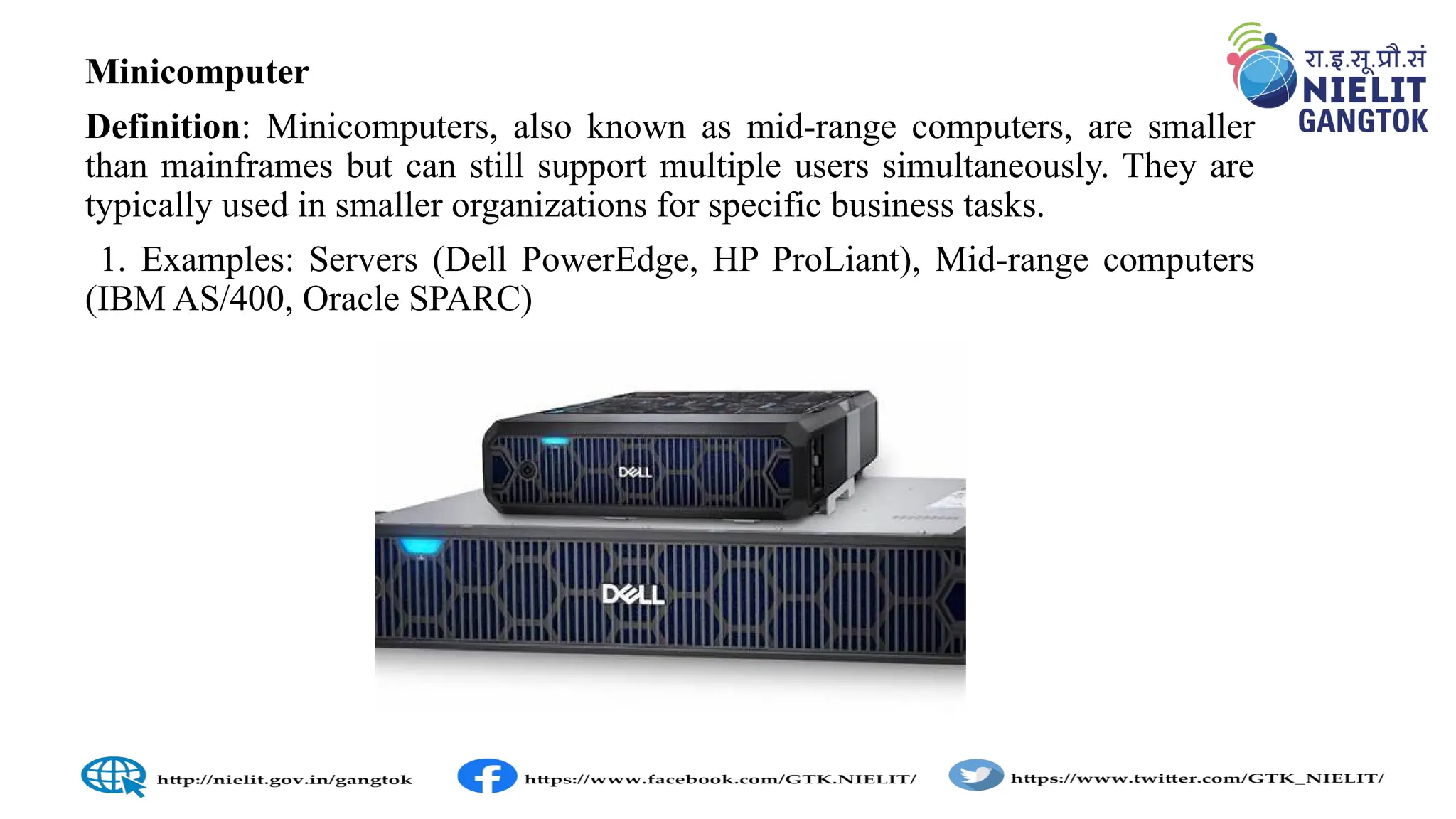
Definition: Minicomputers, also known as mid-range computers, are smaller
than mainframes but can still support multiple users simultaneously. They are
typically used in smaller organizations for specific business tasks.
1. Examples: Servers (Dell PowerEdge, HP ProLiant), Mid-range computers
(IBM AS/400, Oracle SPARC)
Micro Computer
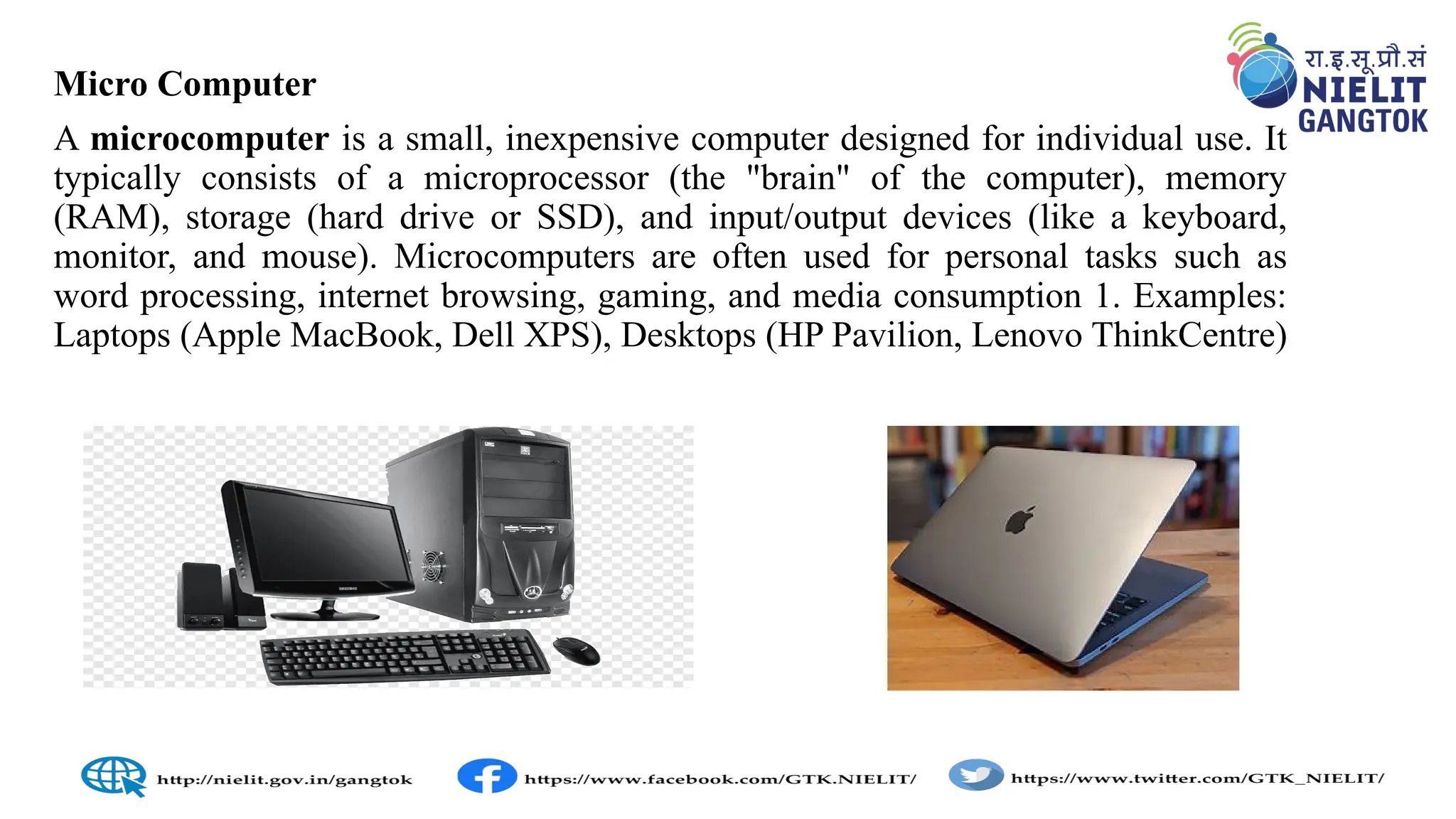
A microcomputer is a small, inexpensive computer designed for individual use. It
typically consists of a microprocessor (the "brain" of the computer), memory
(RAM), storage (hard drive or SSD), and input/output devices (like a keyboard,
monitor, and mouse). Microcomputers are often used for personal tasks such as
word processing, internet browsing, gaming, and media consumption 1. Examples:
Laptops (Apple MacBook, Dell XPS), Desktops (HP Pavilion, Lenovo ThinkCentre)
Analog Computer
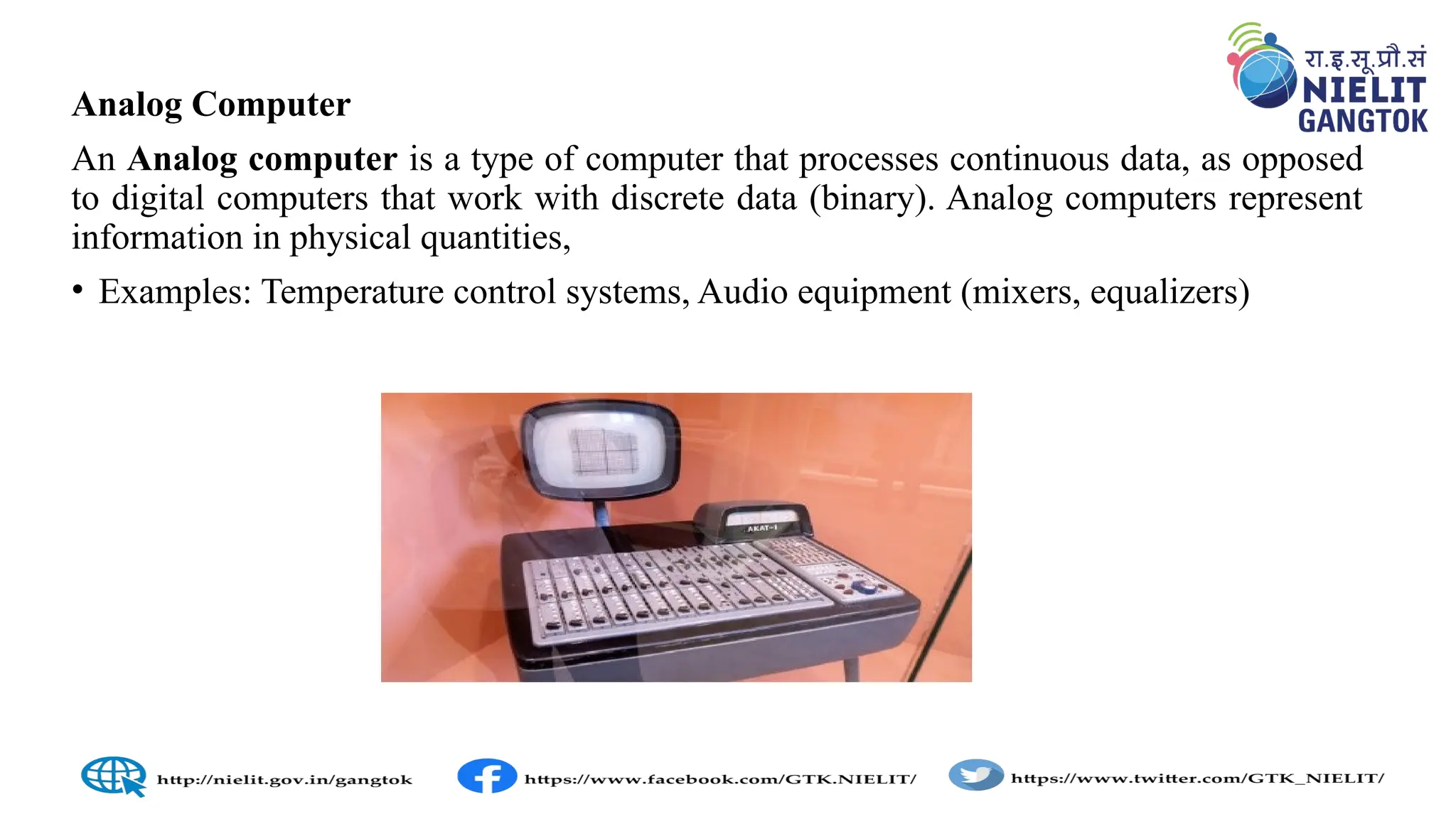
An Analog computer is a type of computer that processes continuous data, as opposed
to digital computers that work with discrete data (binary). Analog computers represent
information in physical quantities,
• Examples: Temperature control systems, Audio equipment (mixers, equalizers)
Digital Computer
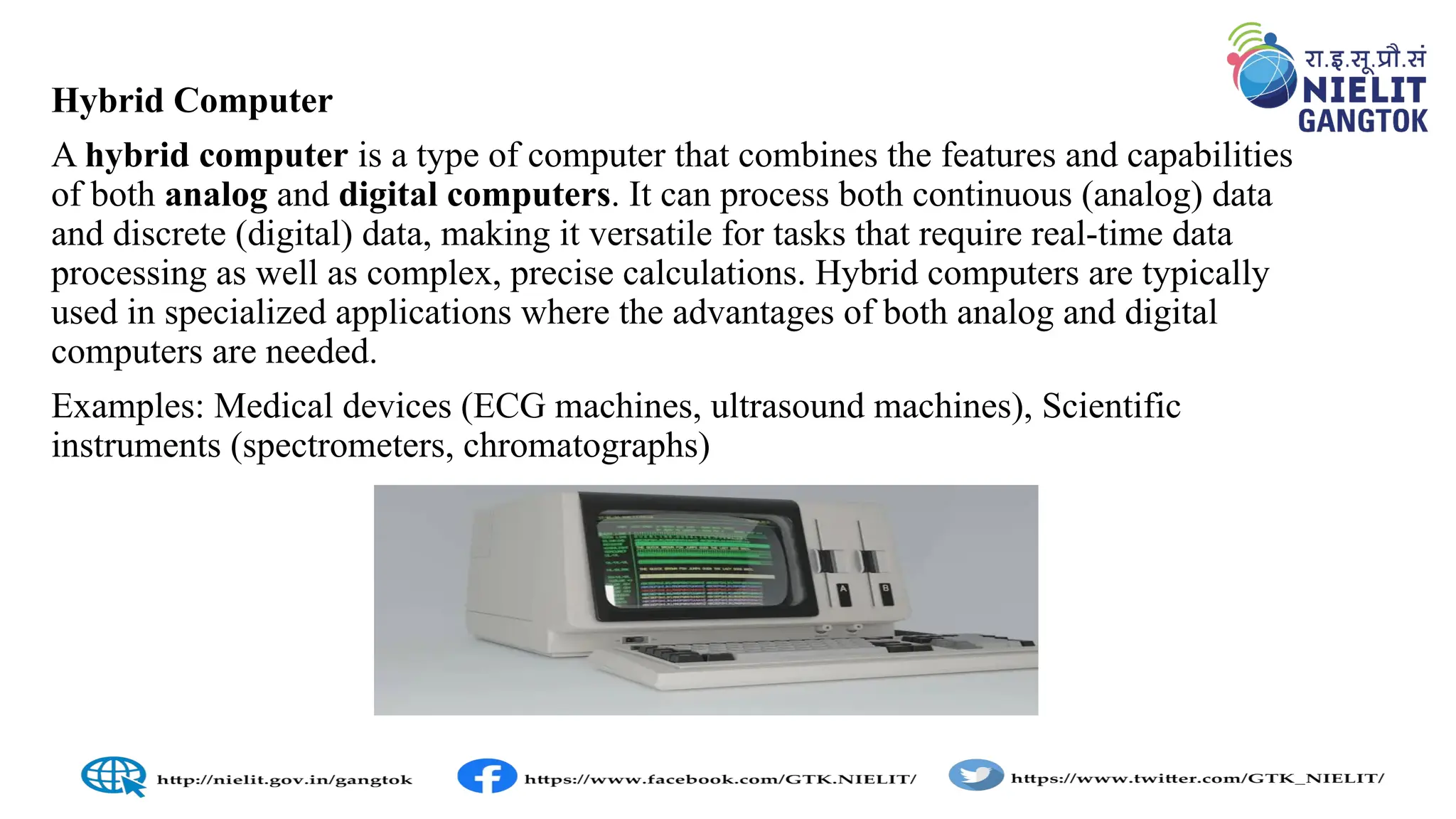
Digital computer is a type of computer that processes data in the form of discrete
digits, typically binary (0s and 1s). It uses a sequence of discrete values to represent data
and perform operations. Unlike analog computers, which work with continuous data,
digital computers process information in a step-by-step, binary fashion, making them
suitable for general-purpose computing tasks.
Hybrid Computer
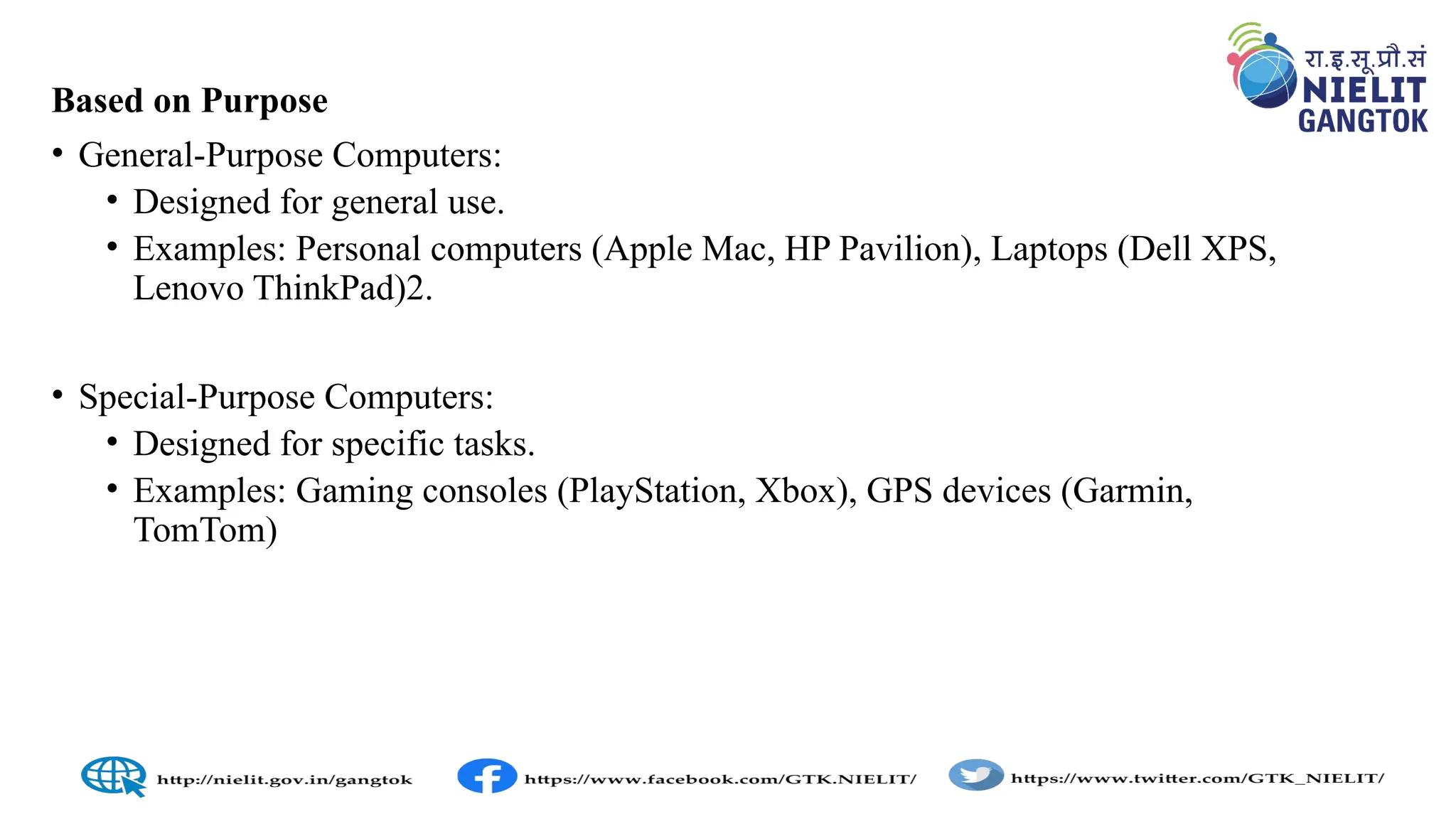
A hybrid computer is a type of computer that combines the features and capabilities
of both analog and digital computers. It can process both continuous (analog) data
and discrete (digital) data, making it versatile for tasks that require real-time data
processing as well as complex, precise calculations. Hybrid computers are typically
used in specialized applications where the advantages of both analog and digital
computers are needed.
Examples: Medical devices (ECG machines, ultrasound machines), Scientific
instruments (spectrometers, chromatographs)
Based on Purpose
• General-Purpose Computers:
• Designed for general use.
• Examples: Personal computers (Apple Mac, HP Pavilion), Laptops (Dell XPS,
Lenovo ThinkPad)2.
• Special-Purpose Computers:
• Designed for specific tasks.
• Examples: Gaming consoles (PlayStation, Xbox), GPS devices (Garmin,
TomTom)
Evolution Of Computer
"From mechanical calculators to artificial intelligence, computers have
come a long way."
Evolution Of Computer
• Ancient & Mechanical Computers
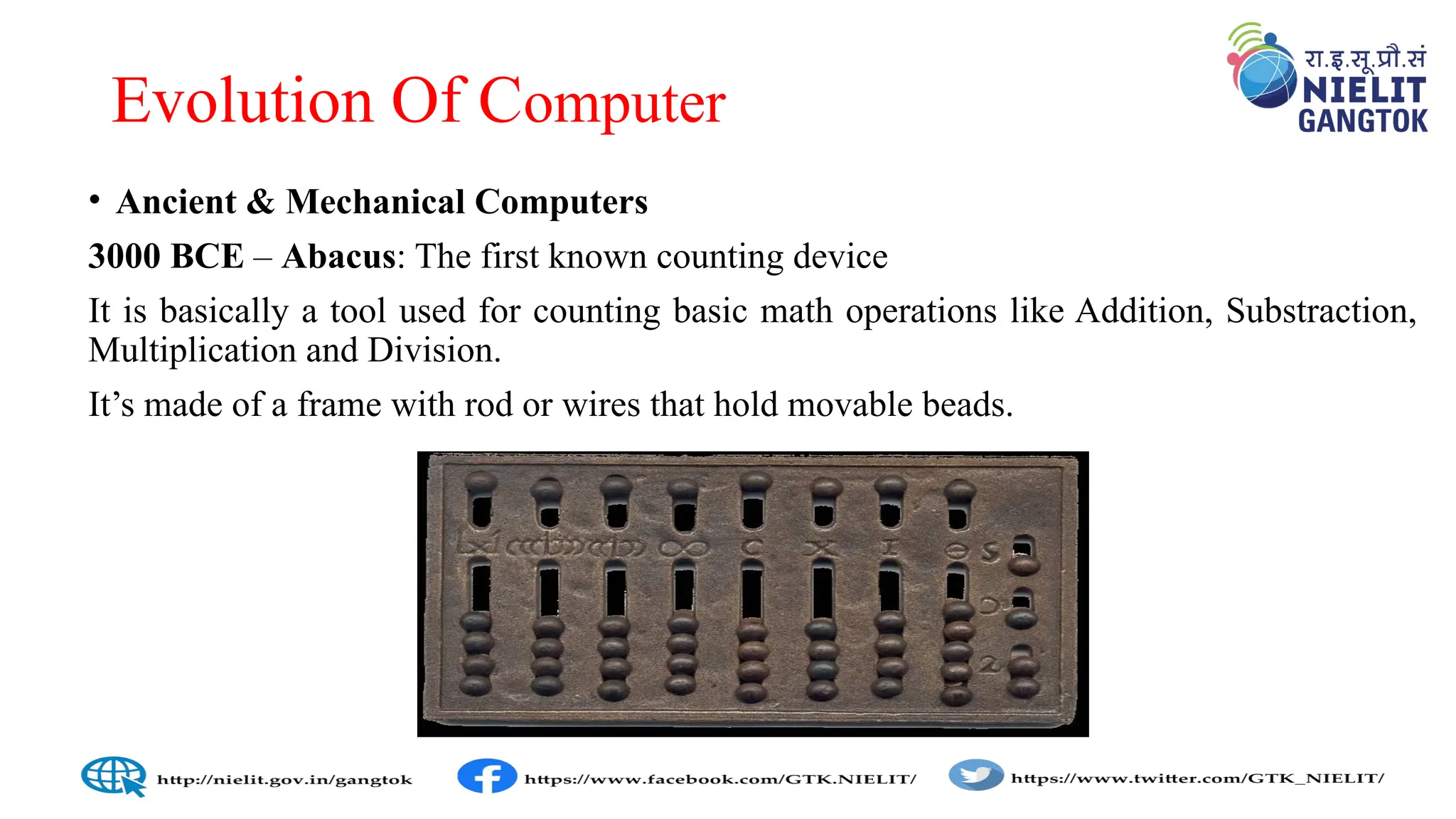
3000 BCE – Abacus: The first known counting device
It is basically a tool used for counting basic math operations like Addition, Substraction,
Multiplication and Division.
It’s made of a frame with rod or wires that hold movable beads.
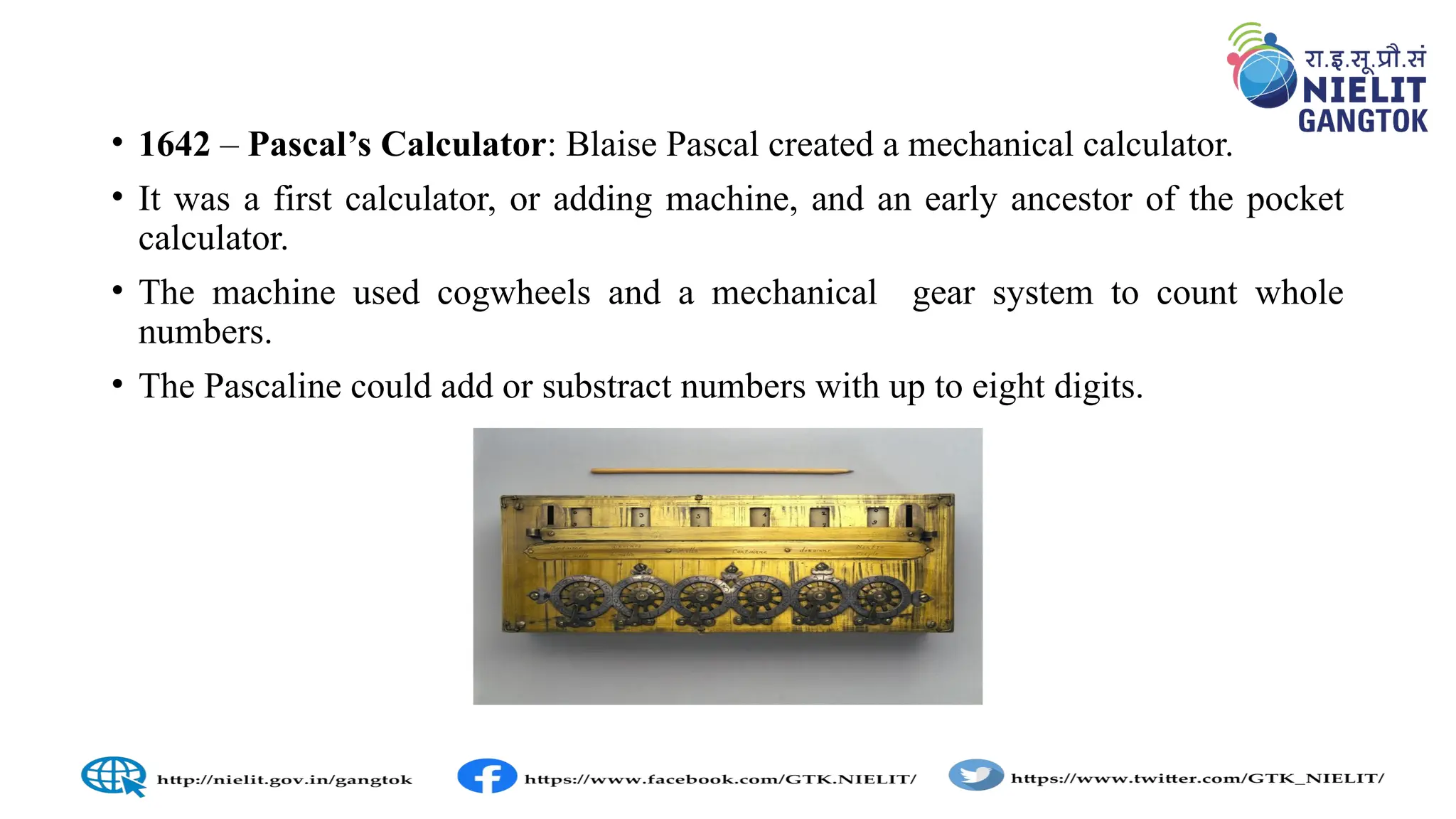
• 1642 – Pascal’s Calculator: Blaise Pascal created a mechanical calculator.
• It was a first calculator, or adding machine, and an early ancestor of the pocket
calculator.
• The machine used cogwheels and a mechanical gear system to count whole
numbers.
• The Pascaline could add or substract numbers with up to eight digits.
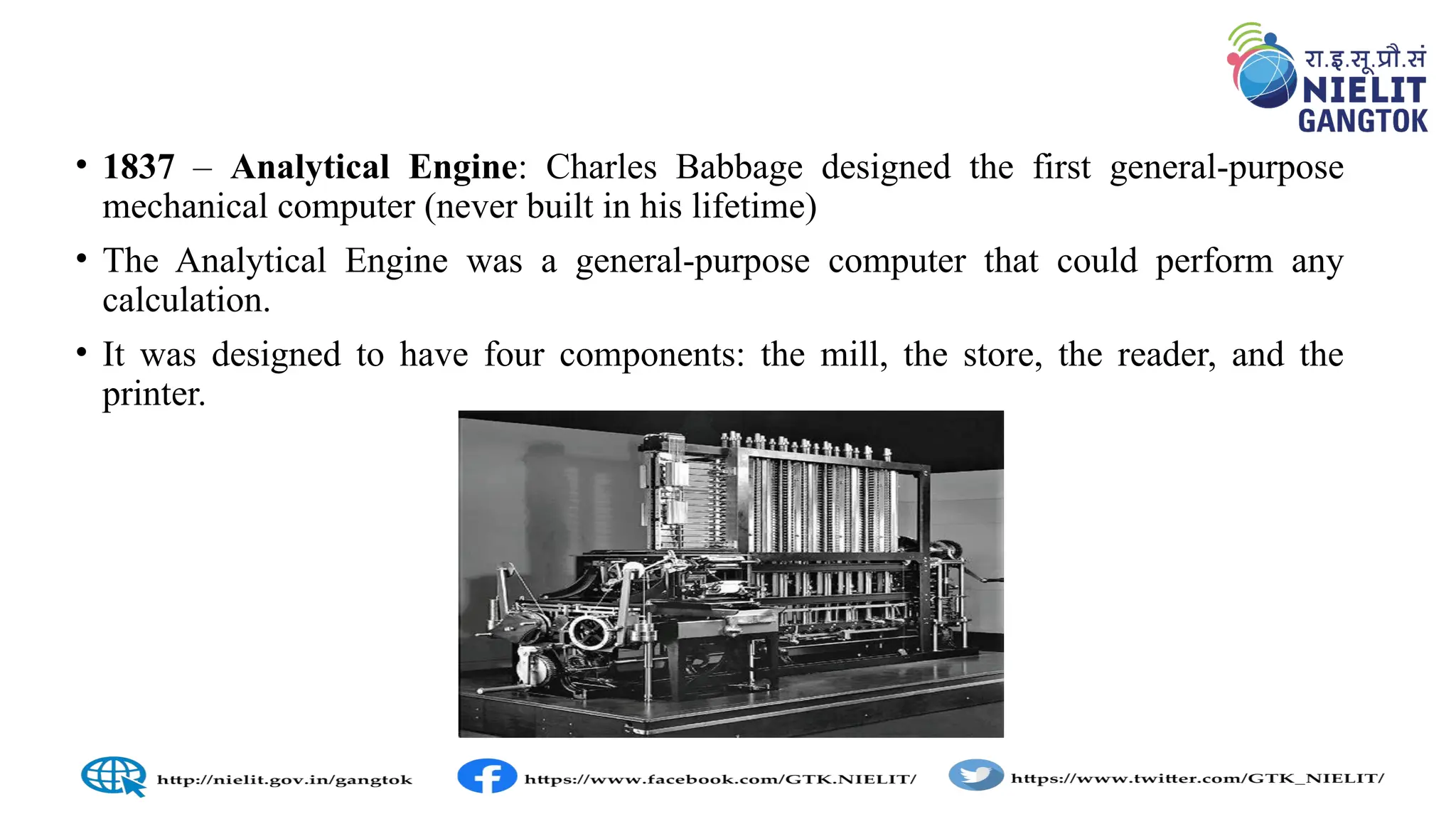
• 1837 – Analytical Engine: Charles Babbage designed the first general-purpose
mechanical computer (never built in his lifetime)
• The Analytical Engine was a general-purpose computer that could perform any
calculation.
• It was designed to have four components: the mill, the store, the reader, and the
printer.
Generation of Computer
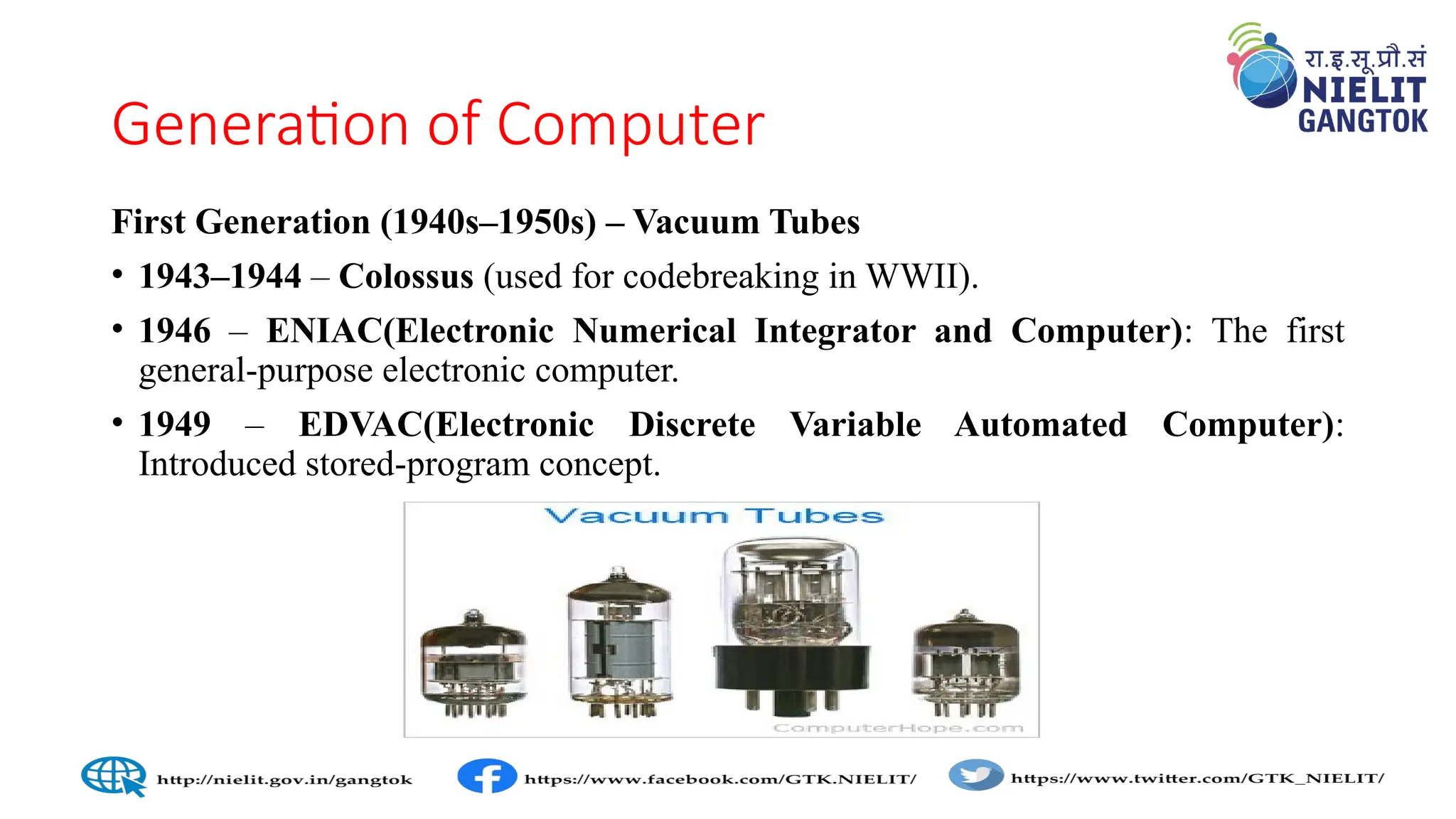
First Generation (1940s–1950s) – Vacuum Tubes
• 1943–1944 – Colossus (used for codebreaking in WWII).
• 1946 – ENIAC(Electronic Numerical Integrator and Computer): The first
general-purpose electronic computer.
• 1949 – EDVAC(Electronic Discrete Variable Automated Computer):
Introduced stored-program concept.
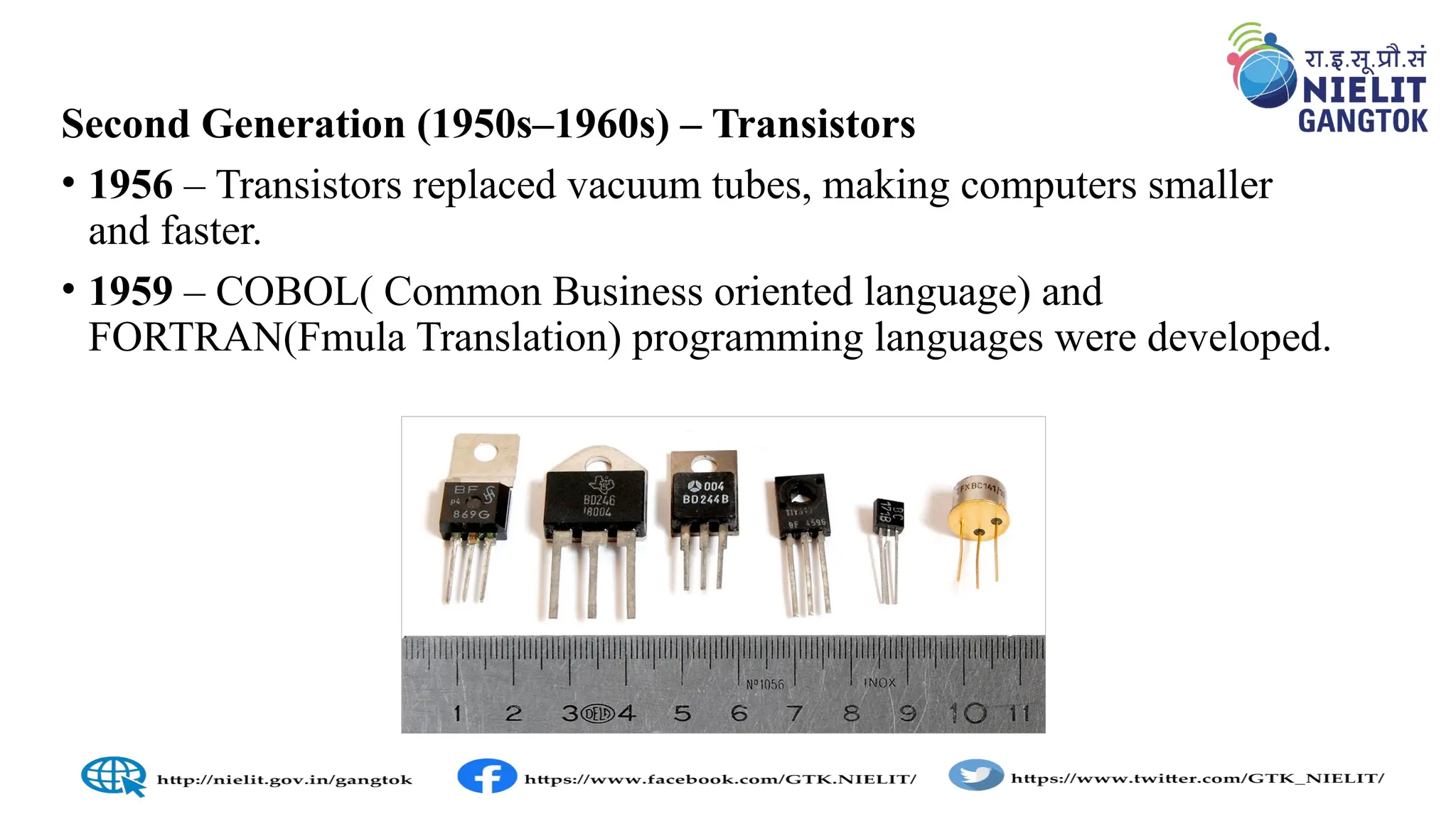
Second Generation (1950s–1960s) – Transistors
• 1956 – Transistors replaced vacuum tubes, making computers smaller
and faster.
• 1959 – COBOL( Common Business oriented language) and
FORTRAN(Fmula Translation) programming languages were developed.
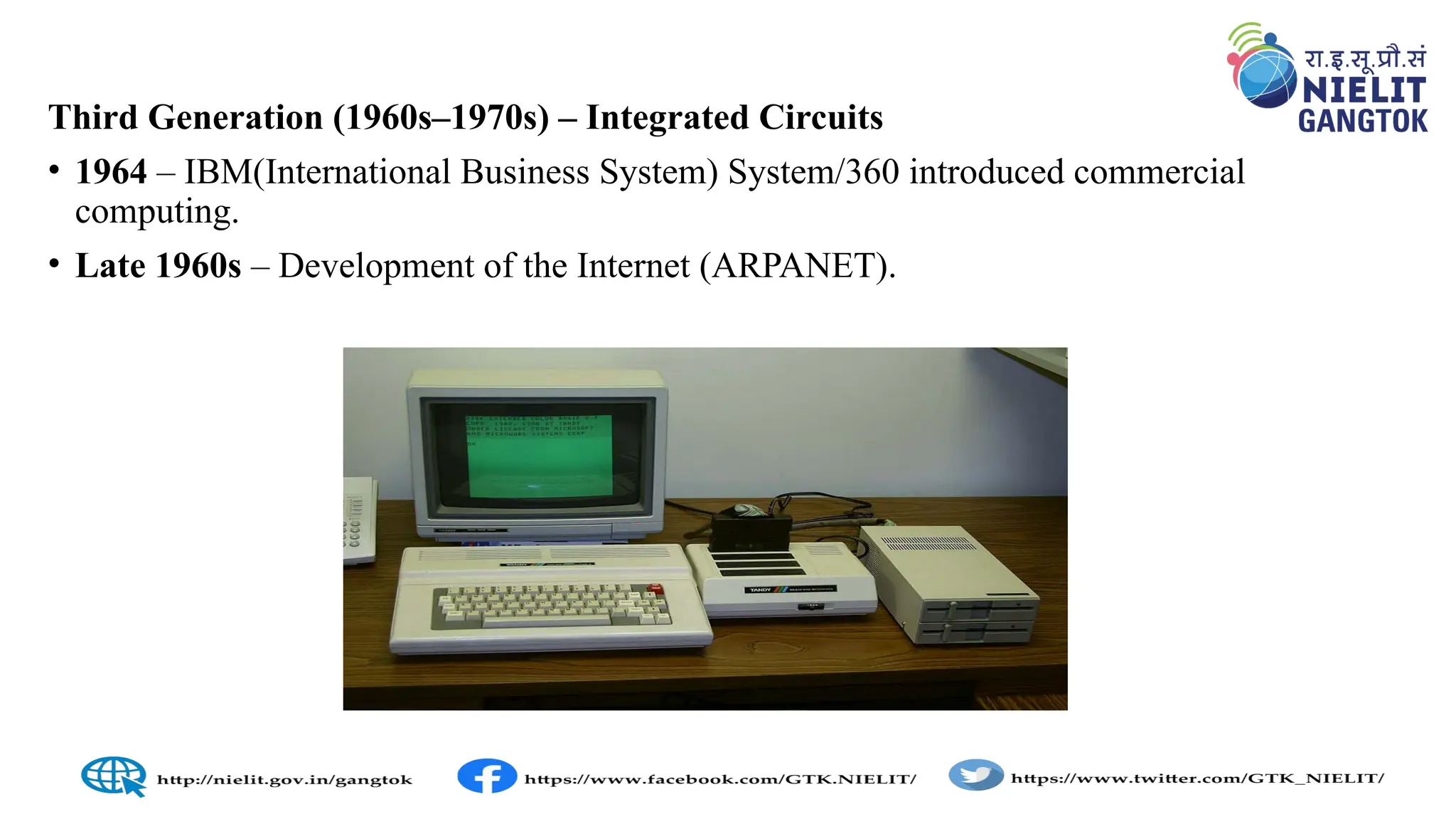
Third Generation (1960s–1970s) – Integrated Circuits
• 1964 – IBM(International Business System) System/360 introduced commercial
computing.
• Late 1960s – Development of the Internet (ARPANET).
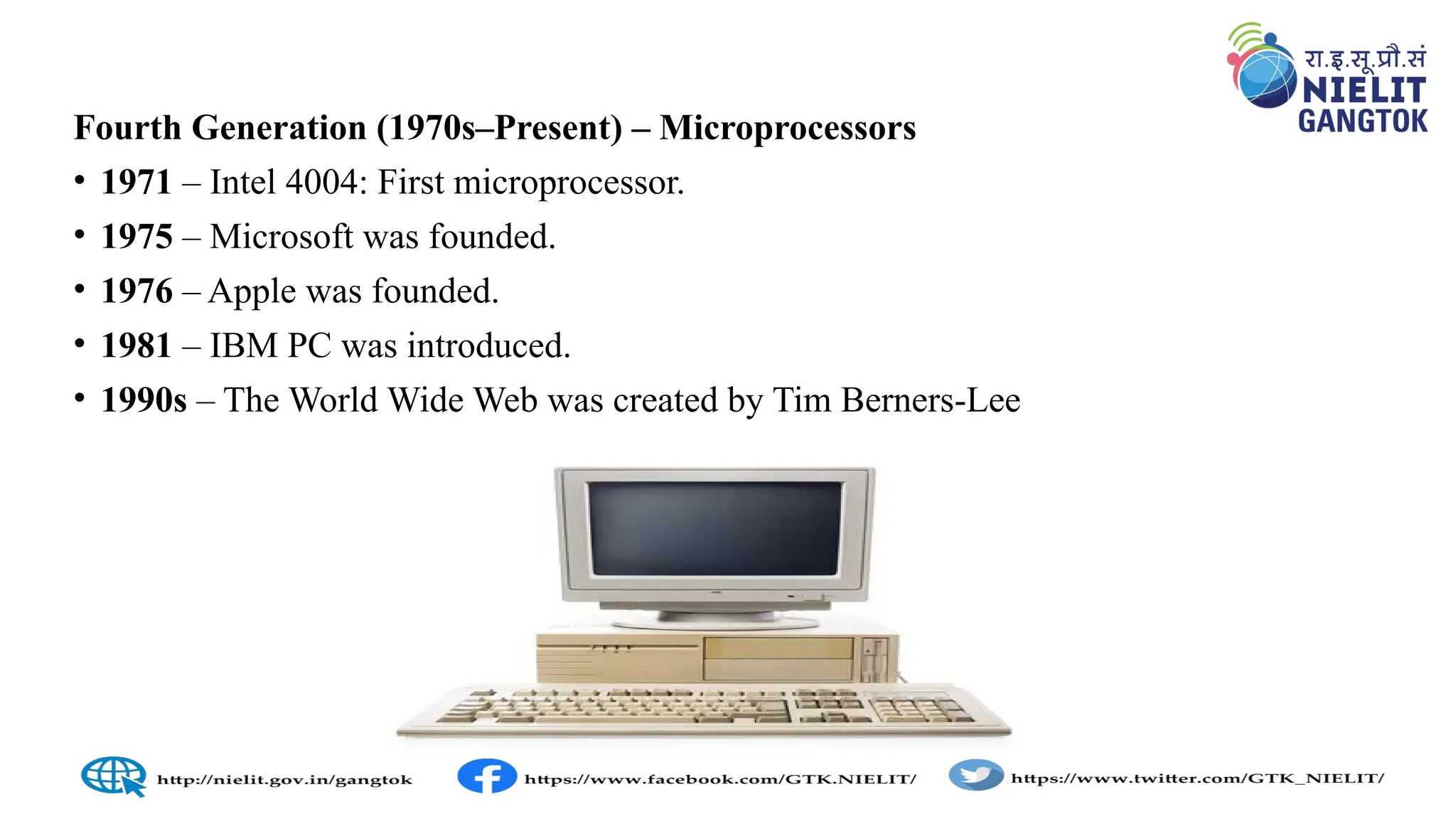
Fourth Generation (1970s–Present) – Microprocessors
• 1971 – Intel 4004: First microprocessor.
• 1975 – Microsoft was founded.
• 1976 – Apple was founded.
• 1981 – IBM PC was introduced.
• 1990s – The World Wide Web was created by Tim Berners-Lee
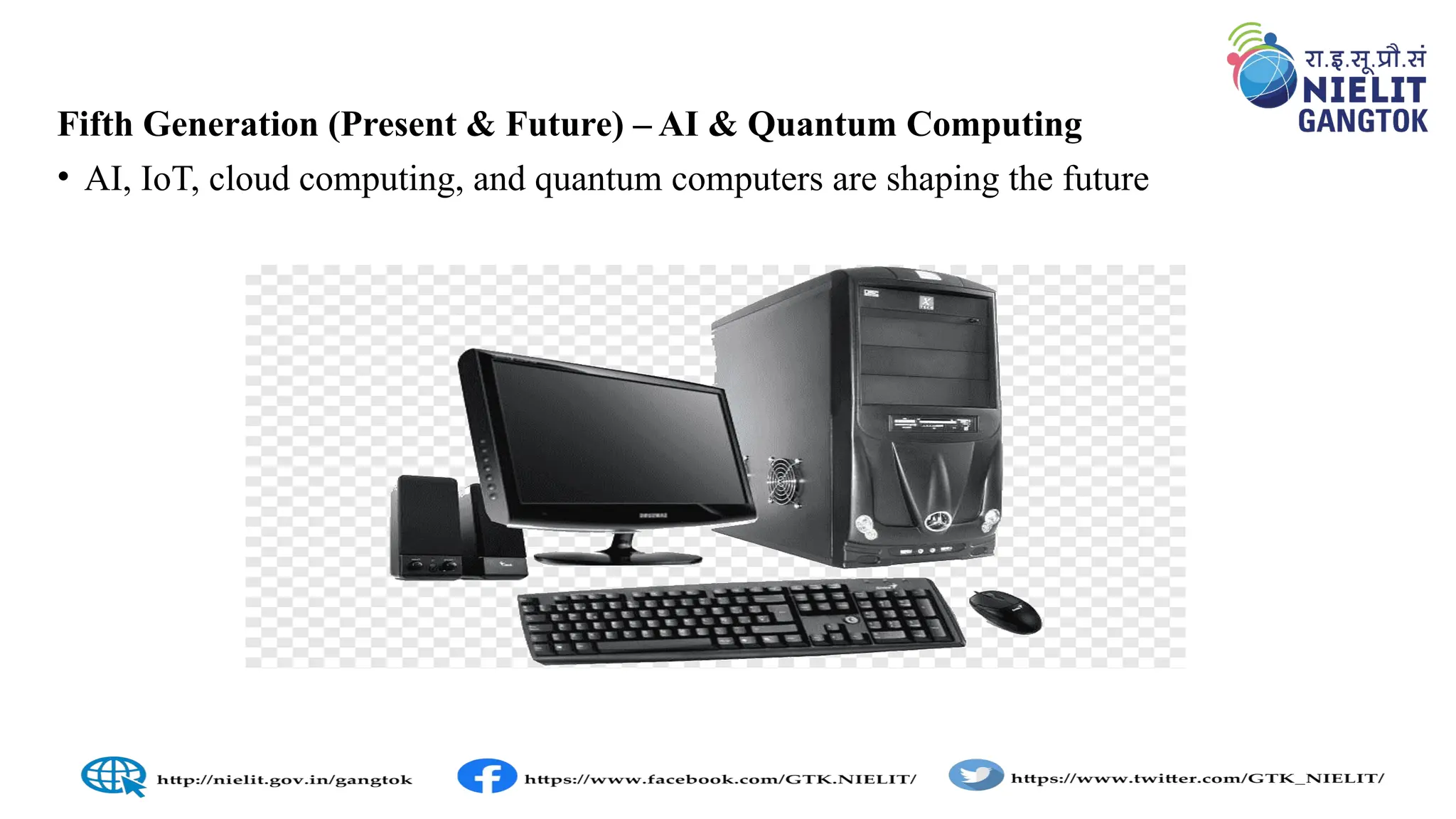
Fifth Generation (Present & Future) – AI & Quantum Computing
• AI, IoT, cloud computing, and quantum computers are shaping the future
Any Questions?

DIGITAL LITERACY PROGRAM for PM SHRI AFFILATED SCHOOL IN SIKKIM.pptx

  • 1.
    DIGITAL LITERACY PROGRAMfor PM SHRI AFFILATED SCHOOL IN SIKKIM NATIONAL INSTITUTE OF ELECTRONICS & INFORMATION TECHNOLOGY, GANGTOK INTRODUCTION TO COMPUTER
  • 2.
    Introduction  A computeris an electronic device that can perform a variety of operations according to a set of instructions called program.  A Computer is a general purpose machine that manipulates raw facts according to a set of instructions that are fed into it.  It capable of storing, retrieving, and processing information efficiently. Block Diagram of computer
  • 3.
    Applications of Computers •Education • Business & Finance • Healthcare • Entertainment • Communication
  • 4.
    IT Gadgets andTheir Uses • Laptops & Desktops: Personal and professional work • Smartphones & Tablets: Communication and mobile computing • Smartwatches & Wearables: Health tracking, notifications • IoT Devices (Smart Home, AI Assistants): Automation
  • 5.
  • 6.
    Super Computer Definition: Supercomputersare the most powerful type of computers, capable of performing extremely high-speed calculations. They are used for complex tasks like scientific research, weather forecasting, and simulations. 1. Examples: IBM Summit, Sierra, Sunway TaihuLight
  • 7.
    Mainframe Computer Definition: Mainframecomputers are large, powerful systems used by organizations for bulk data processing, such as transaction processing and large-scale computations. They can handle many tasks simultaneously. governments, and institutions for critical applications. 1. Examples: IBM zSeries, Unisys ClearPath, HP NonStop
  • 8.
    Minicomputer Definition: Minicomputers, alsoknown as mid-range computers, are smaller than mainframes but can still support multiple users simultaneously. They are typically used in smaller organizations for specific business tasks. 1. Examples: Servers (Dell PowerEdge, HP ProLiant), Mid-range computers (IBM AS/400, Oracle SPARC)
  • 9.
    Micro Computer A microcomputeris a small, inexpensive computer designed for individual use. It typically consists of a microprocessor (the "brain" of the computer), memory (RAM), storage (hard drive or SSD), and input/output devices (like a keyboard, monitor, and mouse). Microcomputers are often used for personal tasks such as word processing, internet browsing, gaming, and media consumption 1. Examples: Laptops (Apple MacBook, Dell XPS), Desktops (HP Pavilion, Lenovo ThinkCentre)
  • 10.
    Analog Computer An Analogcomputer is a type of computer that processes continuous data, as opposed to digital computers that work with discrete data (binary). Analog computers represent information in physical quantities, • Examples: Temperature control systems, Audio equipment (mixers, equalizers)
  • 11.
    Digital Computer Digital computeris a type of computer that processes data in the form of discrete digits, typically binary (0s and 1s). It uses a sequence of discrete values to represent data and perform operations. Unlike analog computers, which work with continuous data, digital computers process information in a step-by-step, binary fashion, making them suitable for general-purpose computing tasks.
  • 12.
    Hybrid Computer A hybridcomputer is a type of computer that combines the features and capabilities of both analog and digital computers. It can process both continuous (analog) data and discrete (digital) data, making it versatile for tasks that require real-time data processing as well as complex, precise calculations. Hybrid computers are typically used in specialized applications where the advantages of both analog and digital computers are needed. Examples: Medical devices (ECG machines, ultrasound machines), Scientific instruments (spectrometers, chromatographs)
  • 13.
    Based on Purpose •General-Purpose Computers: • Designed for general use. • Examples: Personal computers (Apple Mac, HP Pavilion), Laptops (Dell XPS, Lenovo ThinkPad)2. • Special-Purpose Computers: • Designed for specific tasks. • Examples: Gaming consoles (PlayStation, Xbox), GPS devices (Garmin, TomTom)
  • 14.
    Evolution Of Computer "Frommechanical calculators to artificial intelligence, computers have come a long way."
  • 15.
    Evolution Of Computer •Ancient & Mechanical Computers 3000 BCE – Abacus: The first known counting device It is basically a tool used for counting basic math operations like Addition, Substraction, Multiplication and Division. It’s made of a frame with rod or wires that hold movable beads.
  • 16.
    • 1642 –Pascal’s Calculator: Blaise Pascal created a mechanical calculator. • It was a first calculator, or adding machine, and an early ancestor of the pocket calculator. • The machine used cogwheels and a mechanical gear system to count whole numbers. • The Pascaline could add or substract numbers with up to eight digits.
  • 17.
    • 1837 –Analytical Engine: Charles Babbage designed the first general-purpose mechanical computer (never built in his lifetime) • The Analytical Engine was a general-purpose computer that could perform any calculation. • It was designed to have four components: the mill, the store, the reader, and the printer.
  • 18.
    Generation of Computer FirstGeneration (1940s–1950s) – Vacuum Tubes • 1943–1944 – Colossus (used for codebreaking in WWII). • 1946 – ENIAC(Electronic Numerical Integrator and Computer): The first general-purpose electronic computer. • 1949 – EDVAC(Electronic Discrete Variable Automated Computer): Introduced stored-program concept.
  • 19.
    Second Generation (1950s–1960s)– Transistors • 1956 – Transistors replaced vacuum tubes, making computers smaller and faster. • 1959 – COBOL( Common Business oriented language) and FORTRAN(Fmula Translation) programming languages were developed.
  • 20.
    Third Generation (1960s–1970s)– Integrated Circuits • 1964 – IBM(International Business System) System/360 introduced commercial computing. • Late 1960s – Development of the Internet (ARPANET).
  • 21.
    Fourth Generation (1970s–Present)– Microprocessors • 1971 – Intel 4004: First microprocessor. • 1975 – Microsoft was founded. • 1976 – Apple was founded. • 1981 – IBM PC was introduced. • 1990s – The World Wide Web was created by Tim Berners-Lee
  • 22.
    Fifth Generation (Present& Future) – AI & Quantum Computing • AI, IoT, cloud computing, and quantum computers are shaping the future
  • 23.