The Importance of Brain Health
The brain is the control center of our bodies, responsible for everything from thought and emotion to
movement and sensation. Brain tumors can disrupt these vital functions, making early detection and treatment
crucial.
1. Impact on Human Health
Brain tumors can affect human health due to their location, potentially leading to neurological
impairments and other complications.
2. Role of AI
Artificial intelligence (AI) plays a vital role in improving brain tumor diagnosis and treatment by
analyzing brain imaging data and assisting physicians in making informed decisions.
3. Early Detection and Treatment
AI-powered tools can help detect tumors earlier, enabling more effective treatment plans and
potentially improving patient outcomes.
Dataset and Methodology
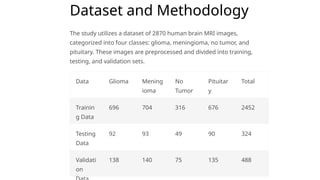
The study utilizes a dataset of 2870 human brain MRI images,
categorized into four classes: glioma, meningioma, no tumor, and
pituitary. These images are preprocessed and divided into training,
testing, and validation sets.
Data Glioma Mening
ioma
No
Tumor
Pituitar
y
Total
Trainin
g Data
696 704 316 676 2452
Testing
Data
92 93 49 90 324
Validati
on
138 140 75 135 488
Deep Learning: Convolutional
Neural Networks (CNN)
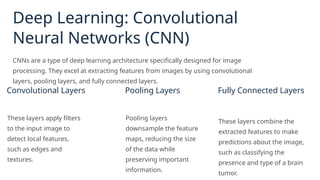
CNNs are a type of deep learning architecture specifically designed for image
processing. They excel at extracting features from images by using convolutional
layers, pooling layers, and fully connected layers.
Convolutional Layers
These layers apply filters
to the input image to
detect local features,
such as edges and
textures.
Pooling Layers
Pooling layers
downsample the feature
maps, reducing the size
of the data while
preserving important
information.
Fully Connected Layers
These layers combine the
extracted features to make
predictions about the image,
such as classifying the
presence and type of a brain
tumor.
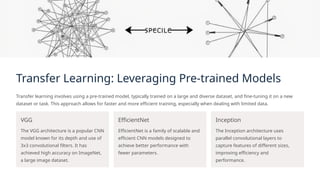
Transfer Learning: Leveraging Pre-trained Models
Transfer learning involves using a pre-trained model, typically trained on a large and diverse dataset, and fine-tuning it on a new
dataset or task. This approach allows for faster and more efficient training, especially when dealing with limited data.
VGG
The VGG architecture is a popular CNN
model known for its depth and use of
3x3 convolutional filters. It has
achieved high accuracy on ImageNet,
a large image dataset.
EfficientNet
EfficientNet is a family of scalable and
efficient CNN models designed to
achieve better performance with
fewer parameters.
Inception
The Inception architecture uses
parallel convolutional layers to
capture features of different sizes,
improving efficiency and
performance.
Model Evaluation: Metrics and
Performance
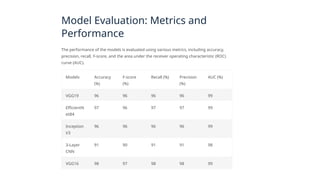
The performance of the models is evaluated using various metrics, including accuracy,
precision, recall, F-score, and the area under the receiver operating characteristic (ROC)
curve (AUC).
Models Accuracy
(%)
F-score
(%)
Recall (%) Precision
(%)
AUC (%)
VGG19 96 96 96 96 99
EfficientN
etB4
97 96 97 97 99
Inception
V3
96 96 96 96 99
3-Layer
CNN
91 90 91 91 98
VGG16 98 97 98 98 99
Results and Discussion
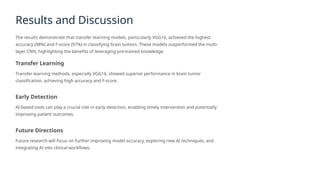
The results demonstrate that transfer learning models, particularly VGG16, achieved the highest
accuracy (98%) and F-score (97%) in classifying brain tumors. These models outperformed the multi-
layer CNN, highlighting the benefits of leveraging pre-trained knowledge.
Transfer Learning
Transfer learning methods, especially VGG16, showed superior performance in brain tumor
classification, achieving high accuracy and F-score.
Early Detection
AI-based tools can play a crucial role in early detection, enabling timely intervention and potentially
improving patient outcomes.
Future Directions
Future research will focus on further improving model accuracy, exploring new AI techniques, and
integrating AI into clinical workflows.
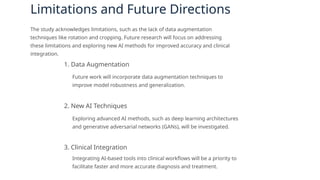
Limitations and Future Directions
The study acknowledges limitations, such as the lack of data augmentation
techniques like rotation and cropping. Future research will focus on addressing
these limitations and exploring new AI methods for improved accuracy and clinical
integration.
1. Data Augmentation
Future work will incorporate data augmentation techniques to
improve model robustness and generalization.
2. New AI Techniques
Exploring advanced AI methods, such as deep learning architectures
and generative adversarial networks (GANs), will be investigated.
3. Clinical Integration
Integrating AI-based tools into clinical workflows will be a priority to
facilitate faster and more accurate diagnosis and treatment.
Conclusion
This study demonstrates the effectiveness of transfer learning
methods, particularly VGG16, in classifying brain tumors from
MRI images. AI has the potential to revolutionize brain tumor
diagnosis and treatment, enabling faster, more accurate, and
personalized care for patients.
References:
1. Digital Image Processing for Medical Applications.
2. Brain tumor detection from images

Digital image processing in brain tumor.pptx

  • 2.
    The Importance ofBrain Health The brain is the control center of our bodies, responsible for everything from thought and emotion to movement and sensation. Brain tumors can disrupt these vital functions, making early detection and treatment crucial. 1. Impact on Human Health Brain tumors can affect human health due to their location, potentially leading to neurological impairments and other complications. 2. Role of AI Artificial intelligence (AI) plays a vital role in improving brain tumor diagnosis and treatment by analyzing brain imaging data and assisting physicians in making informed decisions. 3. Early Detection and Treatment AI-powered tools can help detect tumors earlier, enabling more effective treatment plans and potentially improving patient outcomes.
  • 3.
    Dataset and Methodology Thestudy utilizes a dataset of 2870 human brain MRI images, categorized into four classes: glioma, meningioma, no tumor, and pituitary. These images are preprocessed and divided into training, testing, and validation sets. Data Glioma Mening ioma No Tumor Pituitar y Total Trainin g Data 696 704 316 676 2452 Testing Data 92 93 49 90 324 Validati on 138 140 75 135 488
  • 4.
    Deep Learning: Convolutional NeuralNetworks (CNN) CNNs are a type of deep learning architecture specifically designed for image processing. They excel at extracting features from images by using convolutional layers, pooling layers, and fully connected layers. Convolutional Layers These layers apply filters to the input image to detect local features, such as edges and textures. Pooling Layers Pooling layers downsample the feature maps, reducing the size of the data while preserving important information. Fully Connected Layers These layers combine the extracted features to make predictions about the image, such as classifying the presence and type of a brain tumor.
  • 5.
    Transfer Learning: LeveragingPre-trained Models Transfer learning involves using a pre-trained model, typically trained on a large and diverse dataset, and fine-tuning it on a new dataset or task. This approach allows for faster and more efficient training, especially when dealing with limited data. VGG The VGG architecture is a popular CNN model known for its depth and use of 3x3 convolutional filters. It has achieved high accuracy on ImageNet, a large image dataset. EfficientNet EfficientNet is a family of scalable and efficient CNN models designed to achieve better performance with fewer parameters. Inception The Inception architecture uses parallel convolutional layers to capture features of different sizes, improving efficiency and performance.
  • 6.
    Model Evaluation: Metricsand Performance The performance of the models is evaluated using various metrics, including accuracy, precision, recall, F-score, and the area under the receiver operating characteristic (ROC) curve (AUC). Models Accuracy (%) F-score (%) Recall (%) Precision (%) AUC (%) VGG19 96 96 96 96 99 EfficientN etB4 97 96 97 97 99 Inception V3 96 96 96 96 99 3-Layer CNN 91 90 91 91 98 VGG16 98 97 98 98 99
  • 7.
    Results and Discussion Theresults demonstrate that transfer learning models, particularly VGG16, achieved the highest accuracy (98%) and F-score (97%) in classifying brain tumors. These models outperformed the multi- layer CNN, highlighting the benefits of leveraging pre-trained knowledge. Transfer Learning Transfer learning methods, especially VGG16, showed superior performance in brain tumor classification, achieving high accuracy and F-score. Early Detection AI-based tools can play a crucial role in early detection, enabling timely intervention and potentially improving patient outcomes. Future Directions Future research will focus on further improving model accuracy, exploring new AI techniques, and integrating AI into clinical workflows.
  • 8.
    Limitations and FutureDirections The study acknowledges limitations, such as the lack of data augmentation techniques like rotation and cropping. Future research will focus on addressing these limitations and exploring new AI methods for improved accuracy and clinical integration. 1. Data Augmentation Future work will incorporate data augmentation techniques to improve model robustness and generalization. 2. New AI Techniques Exploring advanced AI methods, such as deep learning architectures and generative adversarial networks (GANs), will be investigated. 3. Clinical Integration Integrating AI-based tools into clinical workflows will be a priority to facilitate faster and more accurate diagnosis and treatment.
  • 9.
    Conclusion This study demonstratesthe effectiveness of transfer learning methods, particularly VGG16, in classifying brain tumors from MRI images. AI has the potential to revolutionize brain tumor diagnosis and treatment, enabling faster, more accurate, and personalized care for patients.
  • 10.
    References: 1. Digital ImageProcessing for Medical Applications. 2. Brain tumor detection from images