DIGIPARTY – A DECENTRALIZED MULTI-PARTY
                                     VIDEO CONFERENCING SYSTEM

                                       Ling Chen, Chong Luo, Jiang Li, and Shipeng Li

                                                       Microsoft Research Asia

                         ABSTRACT                                    communications are based on independent one-to-one
                                                                     connections only. Conference control mechanisms are not
     Increased speeds of PCs and networks have made media            supported in both modes of iVisit. Strictly speaking, iVisit is not
communication possible on the Internet. However, nearly ten          a conferencing application; rather, it is just a multiple one-to-one
years after the first release of Microsoft NetMeeting, Internet      communications tool.
video telephony is still limited to the point-to-point                     WebEx [6] is another famous system that provides online
communication mode. Today, people have a need for an easy-to-        meeting services for global business. A powerful
use multi-party video conferencing tool that will connect families   communications tool, it supports a full range of online meeting
and friends around the world over the Internet. In this paper,       services, such as application sharing, white board, and video
DigiParty, a fully distributed multi-party video conferencing        conferencing. However, a general purpose system can never
system, is presented. DigiParty employs full mesh conferencing       excel in every specific feature. The video conferencing service,
architecture and adopts a loosely coupled conferencing mode. A       therefore, is just an assistant tool in WebEx, and is mutually
novel conference control protocol is designed with the system.       exclusive with participants label and polling label. WebEx
DigiParty can be integrated with any existing instant messaging      leverages the MediaTone technology to deliver media data. The
services and is applicable to all types of Internet connections.     idea is to build up a number of switching centers worldwide,
                                                                     which are responsible for routing communications among end
                                                                     users. This strategy is efficient for a large number of
                                                                     simultaneously video conferences. However, they are technically
                    1. INTRODUCTION                                  over-engineered for small-scale personal communications. Even
                                                                     in the case where two members are in the same domain, data is
                                                                     still transmitted from switching centers, which incurs an
When Microsoft NetMeeting [1] was first released in 1996, it         intolerable delay for video communications.
was the first commercial real-time communication client that               It has been noticed that most video conferencing approaches
enables more than two users to share data over the Internet. A       so far employ central servers either for conference management
few months later, the video communication service was                or for data distribution. Obviously, such an approach may create
integrated into NetMeeting. Although people then expected a          performance bottlenecks for a large number of participants.
multi-party video conferencing system that enables families and      Furthermore, the cost of maintaining central servers makes the
friends around the world to keep in touch over the Internet,         service too expensive to be used by individuals. As an alternative,
almost ten years have passed and Internet video telephony is still   distributed architectures can resolve the problems mentioned
limited to the antiquated point-to-point mode. Multi-party video     above. There are two kinds of distributed architectures which are
conferencing systems are only available on LAN (e.g.                 slightly different from each other. One is peer-to-peer
MERMAID [2]), ATM (e.g. GCSVA [3]) or MBone (e.g. VIC                conferencing, where each end system has a direct connection
[4]). In recent years, with the evolution of broadband technology,   with only a subset of its peers and talks with other members
there have emerged several multi-party video conferencing            through a sequence of intermediate hops.
systems running on WAN ([5], [6]). However, none is ready to               The other distributed architecture is full mesh conferencing,
be used by the general public for everyday communications.           where each conference member has direct communication
      iVisit [5] is a server-based communication tool. Central       channel with each other. While peer-to-peer conferencing is
servers are used to provide membership registration and              suitable for large scale video conferencing systems, full mesh
verification. A user can set up an A/V session with any buddy on     conferencing is more suitable for small scale systems because of
his friend list. Other than Netmeeting, iVisit allows a user to      its simplicity in control. In this paper, DigiParty, a multi-party
make multiple connections as well as view multiple videos at the     video conferencing system is presented. It is a fully distributed
same time. However, if we want to hold a multi-party conference,     system built on full mesh conferencing architecture. A specific
connections have to be manually made one by one. On the other        conference control protocol is designed for it. The rest of this
hand, iVisit maintains an Internet video community, which is         paper is organized as follows. Section 2 describes the system
partitioned into different categories and separate rooms. Each       architecture of DigiParty. In Section 3, a new conference control
room is a rendezvous point, where each user is aware of any          protocol is illustrated. Section 4 presents extensive experimental
other presences in the same room. In this mode, although instant     results on protocol verification. We conclude and indicate future
messages can be made to be seen publicly, video                      research directions in Section 5.
2. DIGIPARTY – A MULTI-PARTY VIDEO                                          desired attendees. Then, invitations are sent via MSN instant
             CONFERENCING SYSTEM                                                  messages, which also include the inviter’s IP address and a
                                                                                  unique conference ID. Upon receiving such an invitation, the
DigiParty is not only a protocol but also a real system that is                   user can join the conference by simply clicking on the link
ready to be used for everyday communications. It supports all                     provided in the instant message.
types of Internet connections, including LAN, broadband, and
even dial-up. It can be integrated with all kinds of instant                               3. CONFERENCE CONTROL PROTOCOL
messaging services, and a version for MSN messenger has been
developed. Figure 1 depicts the system architecture of DigiParty.                 Much research has been done on conference control protocols,
                                                                                  such as the conference control channel protocol (CCCP) [8], the
                               User Interface                                     simple conference control protocol (SCCP) [9], and a protocol
                                                                                  for reliable decentralized conferencing [7]. Among all these
                                                                                  protocols, [7] is architecturally closest to ours. However, our
                                                                                  protocol is designed along with the application scenarios and it
                                                          messaging service

         Media Stream Engine                                                      should provide the quality of service (QoS) needed by a multi-
                                                            Interface with


                                                                                  party video conferencing system. As we all know, video
                                     Conference Control
                                                                                  conferencing is highly bandwidth demanding and has very
                                                                                  stringent requirements on transmission delay. No matter which
         Transmission Module
                                                                                  media transmission structure we use, Unicast or application-level
                                                                                  multicast, more members in a conference leads to a lower level of
                                                                                  QoS. Therefore, in our protocol, we provide a mechanism to
                                 TCP / UDP                                        control the number of conference members, so that we can
                                                                                  provide better service to those members who joined the meeting
                                                                                  earlier than others. While we use the limit of 5 in our
        Figure 1: The system architecture of DigiParty
                                                                                  implemented system, this number is flexible and can be adjusted
                                                                                  to the user’s satisfaction.
      DigiParty is composed of five modules. The core modules
                                                                                        In the next subsections, we will first give an overview of the
are the media stream engine and the full mesh conferencing
                                                                                  protocol, after which the design challenges and our solutions will
protocol. The media stream engine is responsible for audio/video
                                                                                  be stated.
capture and playback. The conferencing control defines a set of
conventions governing the structure and behavior of
communication messages. The details of the protocol will be                       3.1. Full mesh control protocol
introduced in the next section.
      The full mesh conferencing structure is first introduced in                 Our protocol is designed based on the full mesh architecture,
[7], where Lennox et al. also point out that the full mesh                        where conference members are united by a fully connected
conferencing architecture is not suitable for bandwidth-limited                   communication mesh. And all the members are equivalent in
end systems, such as wireless devices and users with 56 kbps                      terms of position in topology or rights in the conference.
modems. To break this limitation, in our system, we entirely                      Different from [7], our protocol is so concise that it uses only
separate the transmission module from the media stream engine                     four communication messages:
and define a whole set of APIs that are open for both Unicast and
application-level multicast (ALM). When there are multiple data               ♦   JOIN: This message is sent from a new user (e.g. N) to an
receivers, multicast allows data replication to be performed                      existing conference member (e.g. M). It contains the member
outside of the data source. Application-level multicast is different              information of the new user, such as the display name in MSN
from traditional IP multicast in that data replication is conducted               messenger.
at end systems instead of multicast-enabled routers. With a                   ♦   ACCEPT: This message is in reply to the JOIN message, if the
proper ALM algorithm, we are able to alleviate the scalability                    conference member M wants to accept the newcomer N. It
problem of full mesh conferencing architecture.                                   consists of M’s member information, as well as the member list
      The interface with messaging services is one of the most                    in M’s view.
important features of DigiParty. It is designed out of usability              ♦   REJECT: This message is also in reply to the JOIN message, if
considerations: People today are overburdened by dozens of                        for any possible reason, member M rejects N’s join request.
accounts and passwords in multifarious Internet tools or                      ♦   LEAVE: This message is sent from a leaving member to all the
communities. This can even cause hesitation in signing up for                     other conferencing members to politely inform them of his
new services. Most Internet users are just using instant                          leaving.
messaging services (MSN, Yahoo, etc.) to communicate with
their families, friends and co-workers. Based on this observation,                     A typical scenario is when a new user N is invited to an
we arranged a few pins attached to our main modules so that                       existing conference. N is required to build communication
DigiParty can be plugged into any existing instant messaging                      channels with all the other conference members in order to keep
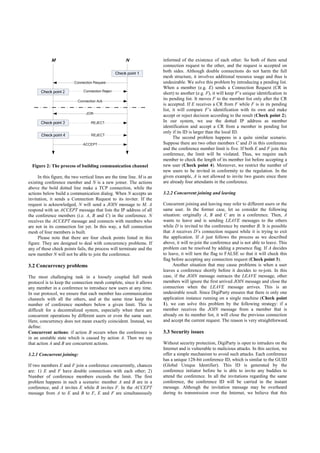
services, as long as an open programming interface is provided.                   the full mesh complete. Figure 2 illustrates the process of making
Presently, the version that works with MSN Messenger has been                     connections between N and M (an existing member). Supposing
implemented. DigiParty is able to extract a local user’s MSN                      there are three attendees (A, B and C) in this conference before N
buddy list, from which the conference initiator can choose the                    joins, this process will be executed three times.
informed of the existence of each other. So both of them send
                                                                         connection request to the other, and the request is accepted on
                                                                         both sides. Although double connections do not harm the full
                                                                         mesh structure, it involves additional resource usage and thus is
                                                                         undesirable. We solve this problem by introducing a pending list.
                                                                         When a member (e.g. E) sends a Connection Request (CR in
                                                                         short) to another (e.g. F), it will keep F’s unique identification in
                                                                         its pending list. It moves F to the member list only after the CR
                                                                         is accepted. If E receives a CR from F while F is in its pending
                                                                         list, it will compare F’s identification with its own and make
                                                                         accept or reject decision according to the result (Check point 2).
                                                                         In our system, we use the dotted IP address as member
                                                                         identification and accept a CR from a member in pending list
                                                                         only if its ID is larger than the local ID.
                                                                               The second problem happens in a quite similar scenario.
                                                                         Suppose there are two other members C and D in this conference
                                                                         and the conference number limit is five. If both E and F join this
                                                                         conference, the limit will be violated. Thus, we require each
                                                                         member to check the length of its member list before accepting a
  Figure 2: The process of building communication channel                new user (Check point 4). Moreover, we restrict the number of
                                                                         new users to be invited in conformity to the regulation. In the
     In this figure, the two vertical lines are the time line. M is an   given example, A is not allowed to invite two guests since there
existing conference member and N is a new joiner. The actions            are already four attendants in the conference.
above the bold dotted line make a TCP connection, while the
actions below build a communication dialog. When N accepts an            3.2.2 Concurrent joining and leaving
invitation, it sends a Connection Request to its inviter. If the
request is acknowledged, N will send a JOIN message to M. A              Concurrent joining and leaving may refer to different users or the
respond with an ACCEPT message that lists the IP address of all          same user. In the former case, let us consider the following
the conference members (i.e. A, B and C) in the conference. N            situation: originally A, B and C are in a conference. Then, A
receives the ACCEPT message and connects with members who                wants to leave and is sending LEAVE messages to the others
are not in its connection list yet. In this way, a full connection       while D is invited to the conference by member B. It is possible
mesh of four members is built.                                           that A receives D’s connection request while it is trying to exit
     Please note that there are four check points listed in this         the application. If A just follows the process as we described
figure. They are designed to deal with concurrency problems. If          above, it will re-join the conference and is not able to leave. This
any of these check points fails, the process will terminate and the      problem can be resolved by adding a presence flag. If A decides
new member N will not be able to join the conference.                    to leave, it will turn the flag to FALSE so that it will check this
                                                                         flag before accepting any connection request (Check point 3).
3.2 Concurrency problems                                                      Another situation that may cause problems is when a user
                                                                         leaves a conference shortly before it decides to re-join. In this
The most challenging task in a loosely coupled full mesh                 case, if the JOIN message outraces the LEAVE message, other
protocol is to keep the connection mesh complete, since it allows        members will ignore the first arrived JOIN message and close the
any member in a conference to introduce new users at any time.           connection when the LEAVE message arrives. This is an
In our protocol, we ensure that each member has communication            undesirable result. Since DigiParty ensures that there is only one
channels with all the others, and at the same time keep the              application instance running on a single machine (Check point
number of conference members below a given limit. This is                1), we can solve this problem by the following strategy: if a
difficult for a decentralized system, especially when there are          member receives the JOIN message from a member that is
concurrent operations by different users or even the same user.          already on its member list, it will close the previous connection
Here, concurrency does not mean exactly coincident. Instead, we          and accept the current request. The reason is very straightforward.
define:
Concurrent actions: if action B occurs when the conference is            3.3 Security issues
in an unstable state which is caused by action A. Then we say
that action A and B are concurrent actions.                              Without security protection, DigiParty is open to intruders on the
                                                                         Internet and is vulnerable to malicious attacks. In this section, we
3.2.1 Concurrent joining:                                                offer a simple mechanism to avoid such attacks. Each conference
                                                                         has a unique 128-bit conference ID, which is similar to the GUID
If two members E and F join a conference concurrently, chances           (Global Unique Identifier). This ID is generated by the
are: 1) E and F have double connections with each other; 2)              conference initiator before he is able to invite any buddies to
Number of conference members exceeds the limit. The first                attend the conference. In all the invitations regarding the same
problem happens in such a scenario: member A and B are in a              conference, the conference ID will be carried in the instant
conference, and A invites E while B invites F. In the ACCEPT             message. Although the invitation message may be overheard
message from A to E and B to F, E and F are simultaneously               during its transmission over the Internet, we believe that this
level of protection is adequate for a conferencing system that         invited by different members and each inviter tries to “protect”
mainly serves for personal communications. Since computer              his own invitee, our protocol rejects both joining attempts and
security in the real world is not only the matter of locks, but also   allows the inviters to negotiate before they send another
related to the comparison of value and costs.                          invitation.
                                                                            We did experiments for all the 15 situations. After each run,
4. EXPERIMENTS ON PROTOCOL VERIFICATION                                we carefully check the connection status at every live site. With
                                                                       no surprise, our protocol passed all the 15 tests and every
The verification of a conferencing protocol, especially a multi-       conference member stabilizes with exactly a single active
party conferencing protocol, is difficult. The reason is that a        connection with every other member.
protocol’s behavior strongly depends on the order in which
events occur, and the number of possible orders is, in fact,                                 5. CONCLUSION
exponential in the size of the group and the number of actions.
Thus, it is not always possible to use a custom program to             In this paper, we presented a multi-party video conferencing
explore every possibility, as the potential conference size is         system named DigiParty. It is a powerful extension to existing
unlimited.                                                             messenger services and can be used by most Internet users
     Our verification work is done by validating the conference        including dial-up users. The accompanying conferencing
control protocol in all possible concurrent scenarios. As we have      protocol is elaborately designed to handle all the possible
mentioned in the previous section, the concurrency of joining          concurrent situations. The chief advantages of DigiParty arises
and leaving events tends to create instability in a conference.        from its reliability, flexibility and low cost. We believe that
While concurrent joining can certainly happen on distinct ends,        DigiParty will bring Internet video telephony to a new level of
concurrent joining and leaving may happen on the same machine,         quality and will lead to a new trend in everyday communications.
as well as on different machines. Therefore, we define four types           Future works may be conducted in the following directions:
of events: JOIN, LEAVE, BRIEF JOIN (join and then leave                1) Increasing the security level so that DigiParty can be used in
immediately) and BRIEF LEAVE (leave and then re-join                   the field of business; 2) Transplant DigiParty to mobile devices
immediately). Thus, all the concurrency situations are the             and enable mobile conferencing.
combinations of these four events, which are summarized in
Table 1.
                                                                                       6. ACKNOWLEDGEMENT
                   Table 1: Concurrency tests
                                                                       The authors would like to acknowledge Keman Yu for helpful
   Test    Initial State   Action                   Final State        discussions and Steve Lin for proofreading the paper.
                                                    (A,B,C,D,E)
      1    (A,B,C,D)       J(E, F)                  (A,B,C,D,F)                               7. REFERENCES
                                                    (A,B,C,D)
     2     (A,B,C,D)       L(C,D)                   (A,B)              [1] NetMeeting, http://www.microsoft.com/netmeeting/
     3     (A,B,C,D)       BJ (E)                   (A,B,C,D)          [2] J. S. Park, S. H. Lee, S. C. Kim, J. Y. Lee, S. B. Lee, “A
     4     (A,B,C,D)       BL(D)                    (A,B,C)            conferencing system for real-time, multiparty, multimedia
     5     (A,B,C)         J(D), L(C)               (A,B,D)            services”, IEEE Transactions on Consumer Electronics, pp. 857-
     6     (A,B,C)         J(D), BJ(E)              (A,B,C,D)          865, Vol. 44, No. 3, 1998.
     7     (A,B,C)         J(D), BL(C)              (A,B,C,D)          [3] I. Beier, H. Koenig, “GCSVA - a multiparty
     8     (A,B,C,D)       L(D), BJ(E)              (A,B,C)            videoconferencing system with distributed group and QoS
     9     (A,B,C,D)       L(D), BL(C)              (A,B,C)            management”, In Proc of 7th International Conference on
    10     (A,B,C,D)       BJ(E), BL(D)             (A,B,C,D)          Computer Communications and Networks, pp. 594-598, 1998.
    11     (A,B,C)         J(D), L(C), BJ(E)        (A,B,D)            [4] Networked Multimedia Research Group at University
    12     (A,B,C,D)       J(E), L(D), BL(C)        (A,B,C,E)          College London, Video Conferencing Tool, http://www-
    13     (A,B,C)         J(D), BJ(E), L(C)        (A,B,D)            mice.cs.ucl.ac.uk/multimedia/software/vic/
    14     (A,B,C,D)       L(D), BJ(E), BL(C)       (A,B,C)
                                                                       [5] iVisit, http://www.ivisit.info/
                           J(D), L(C), BJ(E),
    15     (A,B,C)                                  (A,B,D)
                           BL(B)                                       [6] WebEx, http://www.webex.com/
                                                                       [7] J. Lennox, H. Schulzrinne, “A protocol for reliable
      In this table, each row represents a test run. In the initial    decentralized conferencing”, In Proc of 13th international
state, some members are already in the conference. Then, actions       workshop on network and operating systems support for digital
listed in the 3rd column are taken place concurrently. Here, J, L,     audio and video, pp. 72-81, 2003.
BJ and BL represent JOIN, LEAVE, BRIEF JOIN and BRIEF
LEAVE respectively. A valid protocol should lead the                   [8] M. Handley, I. Wakeman, J. Crowcroft, “The conference
conference to the final state described in the last column. All        control channel protocol (CCCP): a scalable base for building
these tests have a definite final state except for the first one. As   conference control applications”, In Proc of ACM SIGCOMM,
mentioned earlier, we have a mechanism to control the number           pp. 275-287, 1995.
of conference members and the current limit is 5. Thus, in the         [9] C. Bormann, J. Ott, C. Reichert, “SCCP: simple conference
first test run, only one of the two joiners is allowed to attend the   control protocol”, Internet Draft. Draft-ietf-mmusic-sccp-00.txt,
conference. There is an extreme case when the two joiners are          Work in Progress, June 1996.

DIGIPARTY – A DECENTRALIZED MULTI-PARTY VIDEO CONFERENCING SYSTEM

  • 1.
    DIGIPARTY – ADECENTRALIZED MULTI-PARTY VIDEO CONFERENCING SYSTEM Ling Chen, Chong Luo, Jiang Li, and Shipeng Li Microsoft Research Asia ABSTRACT communications are based on independent one-to-one connections only. Conference control mechanisms are not Increased speeds of PCs and networks have made media supported in both modes of iVisit. Strictly speaking, iVisit is not communication possible on the Internet. However, nearly ten a conferencing application; rather, it is just a multiple one-to-one years after the first release of Microsoft NetMeeting, Internet communications tool. video telephony is still limited to the point-to-point WebEx [6] is another famous system that provides online communication mode. Today, people have a need for an easy-to- meeting services for global business. A powerful use multi-party video conferencing tool that will connect families communications tool, it supports a full range of online meeting and friends around the world over the Internet. In this paper, services, such as application sharing, white board, and video DigiParty, a fully distributed multi-party video conferencing conferencing. However, a general purpose system can never system, is presented. DigiParty employs full mesh conferencing excel in every specific feature. The video conferencing service, architecture and adopts a loosely coupled conferencing mode. A therefore, is just an assistant tool in WebEx, and is mutually novel conference control protocol is designed with the system. exclusive with participants label and polling label. WebEx DigiParty can be integrated with any existing instant messaging leverages the MediaTone technology to deliver media data. The services and is applicable to all types of Internet connections. idea is to build up a number of switching centers worldwide, which are responsible for routing communications among end users. This strategy is efficient for a large number of simultaneously video conferences. However, they are technically 1. INTRODUCTION over-engineered for small-scale personal communications. Even in the case where two members are in the same domain, data is still transmitted from switching centers, which incurs an When Microsoft NetMeeting [1] was first released in 1996, it intolerable delay for video communications. was the first commercial real-time communication client that It has been noticed that most video conferencing approaches enables more than two users to share data over the Internet. A so far employ central servers either for conference management few months later, the video communication service was or for data distribution. Obviously, such an approach may create integrated into NetMeeting. Although people then expected a performance bottlenecks for a large number of participants. multi-party video conferencing system that enables families and Furthermore, the cost of maintaining central servers makes the friends around the world to keep in touch over the Internet, service too expensive to be used by individuals. As an alternative, almost ten years have passed and Internet video telephony is still distributed architectures can resolve the problems mentioned limited to the antiquated point-to-point mode. Multi-party video above. There are two kinds of distributed architectures which are conferencing systems are only available on LAN (e.g. slightly different from each other. One is peer-to-peer MERMAID [2]), ATM (e.g. GCSVA [3]) or MBone (e.g. VIC conferencing, where each end system has a direct connection [4]). In recent years, with the evolution of broadband technology, with only a subset of its peers and talks with other members there have emerged several multi-party video conferencing through a sequence of intermediate hops. systems running on WAN ([5], [6]). However, none is ready to The other distributed architecture is full mesh conferencing, be used by the general public for everyday communications. where each conference member has direct communication iVisit [5] is a server-based communication tool. Central channel with each other. While peer-to-peer conferencing is servers are used to provide membership registration and suitable for large scale video conferencing systems, full mesh verification. A user can set up an A/V session with any buddy on conferencing is more suitable for small scale systems because of his friend list. Other than Netmeeting, iVisit allows a user to its simplicity in control. In this paper, DigiParty, a multi-party make multiple connections as well as view multiple videos at the video conferencing system is presented. It is a fully distributed same time. However, if we want to hold a multi-party conference, system built on full mesh conferencing architecture. A specific connections have to be manually made one by one. On the other conference control protocol is designed for it. The rest of this hand, iVisit maintains an Internet video community, which is paper is organized as follows. Section 2 describes the system partitioned into different categories and separate rooms. Each architecture of DigiParty. In Section 3, a new conference control room is a rendezvous point, where each user is aware of any protocol is illustrated. Section 4 presents extensive experimental other presences in the same room. In this mode, although instant results on protocol verification. We conclude and indicate future messages can be made to be seen publicly, video research directions in Section 5.
  • 2.
    2. DIGIPARTY –A MULTI-PARTY VIDEO desired attendees. Then, invitations are sent via MSN instant CONFERENCING SYSTEM messages, which also include the inviter’s IP address and a unique conference ID. Upon receiving such an invitation, the DigiParty is not only a protocol but also a real system that is user can join the conference by simply clicking on the link ready to be used for everyday communications. It supports all provided in the instant message. types of Internet connections, including LAN, broadband, and even dial-up. It can be integrated with all kinds of instant 3. CONFERENCE CONTROL PROTOCOL messaging services, and a version for MSN messenger has been developed. Figure 1 depicts the system architecture of DigiParty. Much research has been done on conference control protocols, such as the conference control channel protocol (CCCP) [8], the User Interface simple conference control protocol (SCCP) [9], and a protocol for reliable decentralized conferencing [7]. Among all these protocols, [7] is architecturally closest to ours. However, our protocol is designed along with the application scenarios and it messaging service Media Stream Engine should provide the quality of service (QoS) needed by a multi- Interface with party video conferencing system. As we all know, video Conference Control conferencing is highly bandwidth demanding and has very stringent requirements on transmission delay. No matter which Transmission Module media transmission structure we use, Unicast or application-level multicast, more members in a conference leads to a lower level of QoS. Therefore, in our protocol, we provide a mechanism to TCP / UDP control the number of conference members, so that we can provide better service to those members who joined the meeting earlier than others. While we use the limit of 5 in our Figure 1: The system architecture of DigiParty implemented system, this number is flexible and can be adjusted to the user’s satisfaction. DigiParty is composed of five modules. The core modules In the next subsections, we will first give an overview of the are the media stream engine and the full mesh conferencing protocol, after which the design challenges and our solutions will protocol. The media stream engine is responsible for audio/video be stated. capture and playback. The conferencing control defines a set of conventions governing the structure and behavior of communication messages. The details of the protocol will be 3.1. Full mesh control protocol introduced in the next section. The full mesh conferencing structure is first introduced in Our protocol is designed based on the full mesh architecture, [7], where Lennox et al. also point out that the full mesh where conference members are united by a fully connected conferencing architecture is not suitable for bandwidth-limited communication mesh. And all the members are equivalent in end systems, such as wireless devices and users with 56 kbps terms of position in topology or rights in the conference. modems. To break this limitation, in our system, we entirely Different from [7], our protocol is so concise that it uses only separate the transmission module from the media stream engine four communication messages: and define a whole set of APIs that are open for both Unicast and application-level multicast (ALM). When there are multiple data ♦ JOIN: This message is sent from a new user (e.g. N) to an receivers, multicast allows data replication to be performed existing conference member (e.g. M). It contains the member outside of the data source. Application-level multicast is different information of the new user, such as the display name in MSN from traditional IP multicast in that data replication is conducted messenger. at end systems instead of multicast-enabled routers. With a ♦ ACCEPT: This message is in reply to the JOIN message, if the proper ALM algorithm, we are able to alleviate the scalability conference member M wants to accept the newcomer N. It problem of full mesh conferencing architecture. consists of M’s member information, as well as the member list The interface with messaging services is one of the most in M’s view. important features of DigiParty. It is designed out of usability ♦ REJECT: This message is also in reply to the JOIN message, if considerations: People today are overburdened by dozens of for any possible reason, member M rejects N’s join request. accounts and passwords in multifarious Internet tools or ♦ LEAVE: This message is sent from a leaving member to all the communities. This can even cause hesitation in signing up for other conferencing members to politely inform them of his new services. Most Internet users are just using instant leaving. messaging services (MSN, Yahoo, etc.) to communicate with their families, friends and co-workers. Based on this observation, A typical scenario is when a new user N is invited to an we arranged a few pins attached to our main modules so that existing conference. N is required to build communication DigiParty can be plugged into any existing instant messaging channels with all the other conference members in order to keep services, as long as an open programming interface is provided. the full mesh complete. Figure 2 illustrates the process of making Presently, the version that works with MSN Messenger has been connections between N and M (an existing member). Supposing implemented. DigiParty is able to extract a local user’s MSN there are three attendees (A, B and C) in this conference before N buddy list, from which the conference initiator can choose the joins, this process will be executed three times.
  • 3.
    informed of theexistence of each other. So both of them send connection request to the other, and the request is accepted on both sides. Although double connections do not harm the full mesh structure, it involves additional resource usage and thus is undesirable. We solve this problem by introducing a pending list. When a member (e.g. E) sends a Connection Request (CR in short) to another (e.g. F), it will keep F’s unique identification in its pending list. It moves F to the member list only after the CR is accepted. If E receives a CR from F while F is in its pending list, it will compare F’s identification with its own and make accept or reject decision according to the result (Check point 2). In our system, we use the dotted IP address as member identification and accept a CR from a member in pending list only if its ID is larger than the local ID. The second problem happens in a quite similar scenario. Suppose there are two other members C and D in this conference and the conference number limit is five. If both E and F join this conference, the limit will be violated. Thus, we require each member to check the length of its member list before accepting a Figure 2: The process of building communication channel new user (Check point 4). Moreover, we restrict the number of new users to be invited in conformity to the regulation. In the In this figure, the two vertical lines are the time line. M is an given example, A is not allowed to invite two guests since there existing conference member and N is a new joiner. The actions are already four attendants in the conference. above the bold dotted line make a TCP connection, while the actions below build a communication dialog. When N accepts an 3.2.2 Concurrent joining and leaving invitation, it sends a Connection Request to its inviter. If the request is acknowledged, N will send a JOIN message to M. A Concurrent joining and leaving may refer to different users or the respond with an ACCEPT message that lists the IP address of all same user. In the former case, let us consider the following the conference members (i.e. A, B and C) in the conference. N situation: originally A, B and C are in a conference. Then, A receives the ACCEPT message and connects with members who wants to leave and is sending LEAVE messages to the others are not in its connection list yet. In this way, a full connection while D is invited to the conference by member B. It is possible mesh of four members is built. that A receives D’s connection request while it is trying to exit Please note that there are four check points listed in this the application. If A just follows the process as we described figure. They are designed to deal with concurrency problems. If above, it will re-join the conference and is not able to leave. This any of these check points fails, the process will terminate and the problem can be resolved by adding a presence flag. If A decides new member N will not be able to join the conference. to leave, it will turn the flag to FALSE so that it will check this flag before accepting any connection request (Check point 3). 3.2 Concurrency problems Another situation that may cause problems is when a user leaves a conference shortly before it decides to re-join. In this The most challenging task in a loosely coupled full mesh case, if the JOIN message outraces the LEAVE message, other protocol is to keep the connection mesh complete, since it allows members will ignore the first arrived JOIN message and close the any member in a conference to introduce new users at any time. connection when the LEAVE message arrives. This is an In our protocol, we ensure that each member has communication undesirable result. Since DigiParty ensures that there is only one channels with all the others, and at the same time keep the application instance running on a single machine (Check point number of conference members below a given limit. This is 1), we can solve this problem by the following strategy: if a difficult for a decentralized system, especially when there are member receives the JOIN message from a member that is concurrent operations by different users or even the same user. already on its member list, it will close the previous connection Here, concurrency does not mean exactly coincident. Instead, we and accept the current request. The reason is very straightforward. define: Concurrent actions: if action B occurs when the conference is 3.3 Security issues in an unstable state which is caused by action A. Then we say that action A and B are concurrent actions. Without security protection, DigiParty is open to intruders on the Internet and is vulnerable to malicious attacks. In this section, we 3.2.1 Concurrent joining: offer a simple mechanism to avoid such attacks. Each conference has a unique 128-bit conference ID, which is similar to the GUID If two members E and F join a conference concurrently, chances (Global Unique Identifier). This ID is generated by the are: 1) E and F have double connections with each other; 2) conference initiator before he is able to invite any buddies to Number of conference members exceeds the limit. The first attend the conference. In all the invitations regarding the same problem happens in such a scenario: member A and B are in a conference, the conference ID will be carried in the instant conference, and A invites E while B invites F. In the ACCEPT message. Although the invitation message may be overheard message from A to E and B to F, E and F are simultaneously during its transmission over the Internet, we believe that this
  • 4.
    level of protectionis adequate for a conferencing system that invited by different members and each inviter tries to “protect” mainly serves for personal communications. Since computer his own invitee, our protocol rejects both joining attempts and security in the real world is not only the matter of locks, but also allows the inviters to negotiate before they send another related to the comparison of value and costs. invitation. We did experiments for all the 15 situations. After each run, 4. EXPERIMENTS ON PROTOCOL VERIFICATION we carefully check the connection status at every live site. With no surprise, our protocol passed all the 15 tests and every The verification of a conferencing protocol, especially a multi- conference member stabilizes with exactly a single active party conferencing protocol, is difficult. The reason is that a connection with every other member. protocol’s behavior strongly depends on the order in which events occur, and the number of possible orders is, in fact, 5. CONCLUSION exponential in the size of the group and the number of actions. Thus, it is not always possible to use a custom program to In this paper, we presented a multi-party video conferencing explore every possibility, as the potential conference size is system named DigiParty. It is a powerful extension to existing unlimited. messenger services and can be used by most Internet users Our verification work is done by validating the conference including dial-up users. The accompanying conferencing control protocol in all possible concurrent scenarios. As we have protocol is elaborately designed to handle all the possible mentioned in the previous section, the concurrency of joining concurrent situations. The chief advantages of DigiParty arises and leaving events tends to create instability in a conference. from its reliability, flexibility and low cost. We believe that While concurrent joining can certainly happen on distinct ends, DigiParty will bring Internet video telephony to a new level of concurrent joining and leaving may happen on the same machine, quality and will lead to a new trend in everyday communications. as well as on different machines. Therefore, we define four types Future works may be conducted in the following directions: of events: JOIN, LEAVE, BRIEF JOIN (join and then leave 1) Increasing the security level so that DigiParty can be used in immediately) and BRIEF LEAVE (leave and then re-join the field of business; 2) Transplant DigiParty to mobile devices immediately). Thus, all the concurrency situations are the and enable mobile conferencing. combinations of these four events, which are summarized in Table 1. 6. ACKNOWLEDGEMENT Table 1: Concurrency tests The authors would like to acknowledge Keman Yu for helpful Test Initial State Action Final State discussions and Steve Lin for proofreading the paper. (A,B,C,D,E) 1 (A,B,C,D) J(E, F) (A,B,C,D,F) 7. REFERENCES (A,B,C,D) 2 (A,B,C,D) L(C,D) (A,B) [1] NetMeeting, http://www.microsoft.com/netmeeting/ 3 (A,B,C,D) BJ (E) (A,B,C,D) [2] J. S. Park, S. H. Lee, S. C. Kim, J. Y. Lee, S. B. Lee, “A 4 (A,B,C,D) BL(D) (A,B,C) conferencing system for real-time, multiparty, multimedia 5 (A,B,C) J(D), L(C) (A,B,D) services”, IEEE Transactions on Consumer Electronics, pp. 857- 6 (A,B,C) J(D), BJ(E) (A,B,C,D) 865, Vol. 44, No. 3, 1998. 7 (A,B,C) J(D), BL(C) (A,B,C,D) [3] I. Beier, H. Koenig, “GCSVA - a multiparty 8 (A,B,C,D) L(D), BJ(E) (A,B,C) videoconferencing system with distributed group and QoS 9 (A,B,C,D) L(D), BL(C) (A,B,C) management”, In Proc of 7th International Conference on 10 (A,B,C,D) BJ(E), BL(D) (A,B,C,D) Computer Communications and Networks, pp. 594-598, 1998. 11 (A,B,C) J(D), L(C), BJ(E) (A,B,D) [4] Networked Multimedia Research Group at University 12 (A,B,C,D) J(E), L(D), BL(C) (A,B,C,E) College London, Video Conferencing Tool, http://www- 13 (A,B,C) J(D), BJ(E), L(C) (A,B,D) mice.cs.ucl.ac.uk/multimedia/software/vic/ 14 (A,B,C,D) L(D), BJ(E), BL(C) (A,B,C) [5] iVisit, http://www.ivisit.info/ J(D), L(C), BJ(E), 15 (A,B,C) (A,B,D) BL(B) [6] WebEx, http://www.webex.com/ [7] J. Lennox, H. Schulzrinne, “A protocol for reliable In this table, each row represents a test run. In the initial decentralized conferencing”, In Proc of 13th international state, some members are already in the conference. Then, actions workshop on network and operating systems support for digital listed in the 3rd column are taken place concurrently. Here, J, L, audio and video, pp. 72-81, 2003. BJ and BL represent JOIN, LEAVE, BRIEF JOIN and BRIEF LEAVE respectively. A valid protocol should lead the [8] M. Handley, I. Wakeman, J. Crowcroft, “The conference conference to the final state described in the last column. All control channel protocol (CCCP): a scalable base for building these tests have a definite final state except for the first one. As conference control applications”, In Proc of ACM SIGCOMM, mentioned earlier, we have a mechanism to control the number pp. 275-287, 1995. of conference members and the current limit is 5. Thus, in the [9] C. Bormann, J. Ott, C. Reichert, “SCCP: simple conference first test run, only one of the two joiners is allowed to attend the control protocol”, Internet Draft. Draft-ietf-mmusic-sccp-00.txt, conference. There is an extreme case when the two joiners are Work in Progress, June 1996.