ANATOMY and PHYSIOLOGY
OF DIGESTIVE SYSTEM
1. Layers of Digestive system
2. Nerve innervation of Digestive system
Presented by
Dr. Ayesha Fatima
Assistant Professor
Dept of Pharmacy Practice
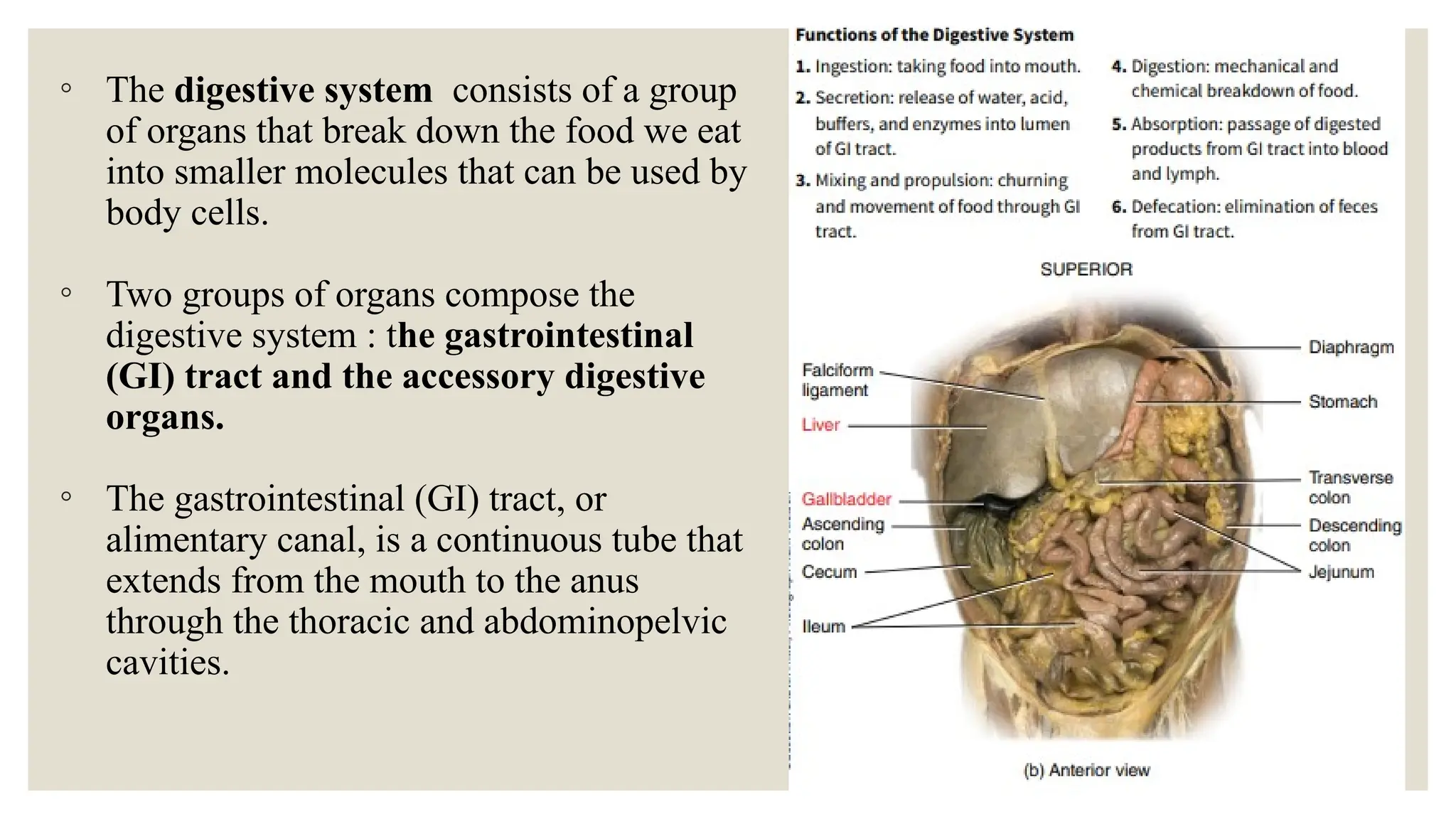
◦ The digestive system consists of a group
of organs that break down the food we eat
into smaller molecules that can be used by
body cells.
◦ Two groups of organs compose the
digestive system : the gastrointestinal
(GI) tract and the accessory digestive
organs.
◦ The gastrointestinal (GI) tract, or
alimentary canal, is a continuous tube that
extends from the mouth to the anus
through the thoracic and abdominopelvic
cavities.
GASTROINTESTINAL TRACT
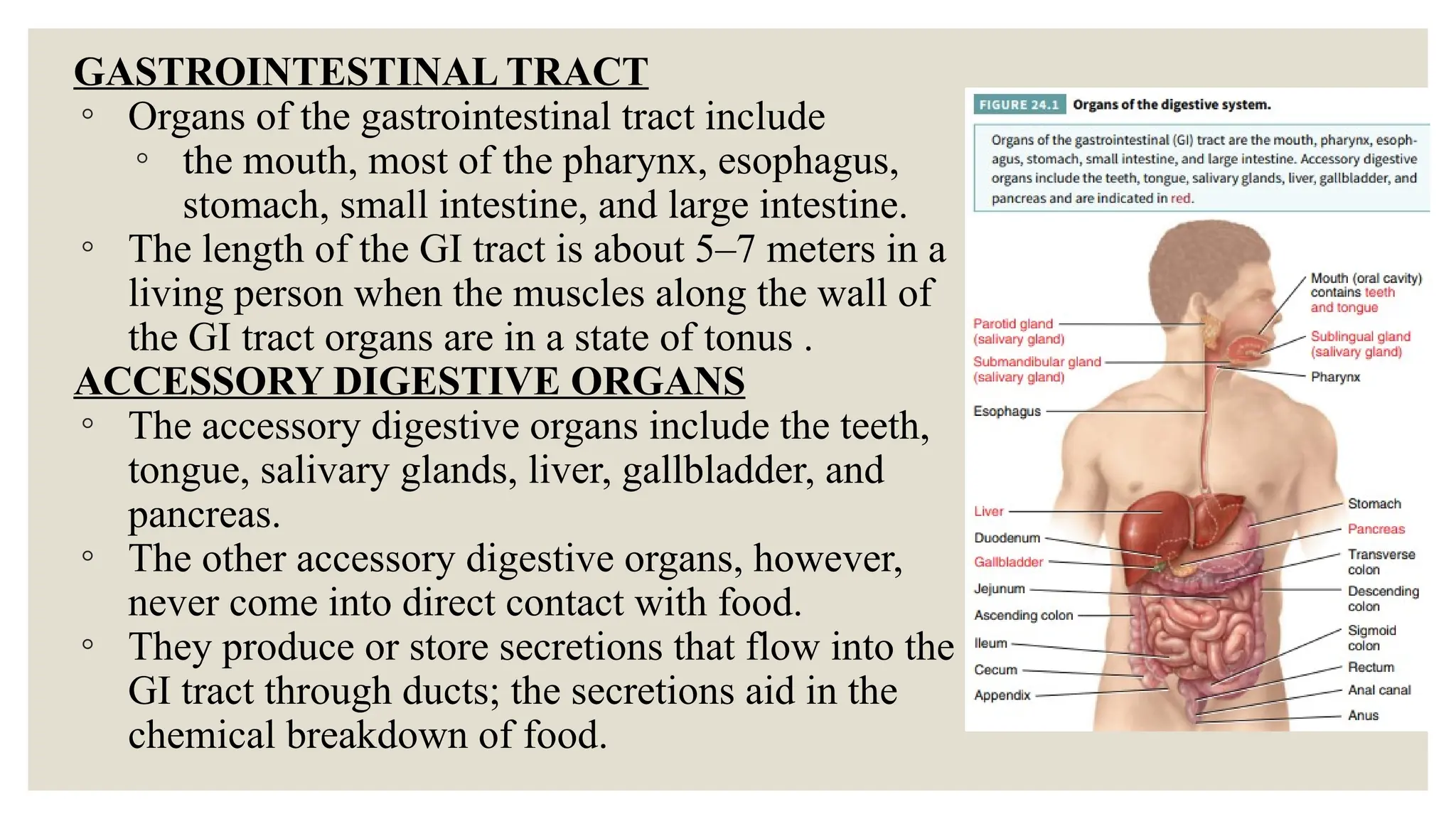
◦ Organs of the gastrointestinal tract include
◦ the mouth, most of the pharynx, esophagus,
stomach, small intestine, and large intestine.
◦ The length of the GI tract is about 5–7 meters in a
living person when the muscles along the wall of
the GI tract organs are in a state of tonus .
ACCESSORY DIGESTIVE ORGANS
◦ The accessory digestive organs include the teeth,
tongue, salivary glands, liver, gallbladder, and
pancreas.
◦ The other accessory digestive organs, however,
never come into direct contact with food.
◦ They produce or store secretions that flow into the
GI tract through ducts; the secretions aid in the
chemical breakdown of food.
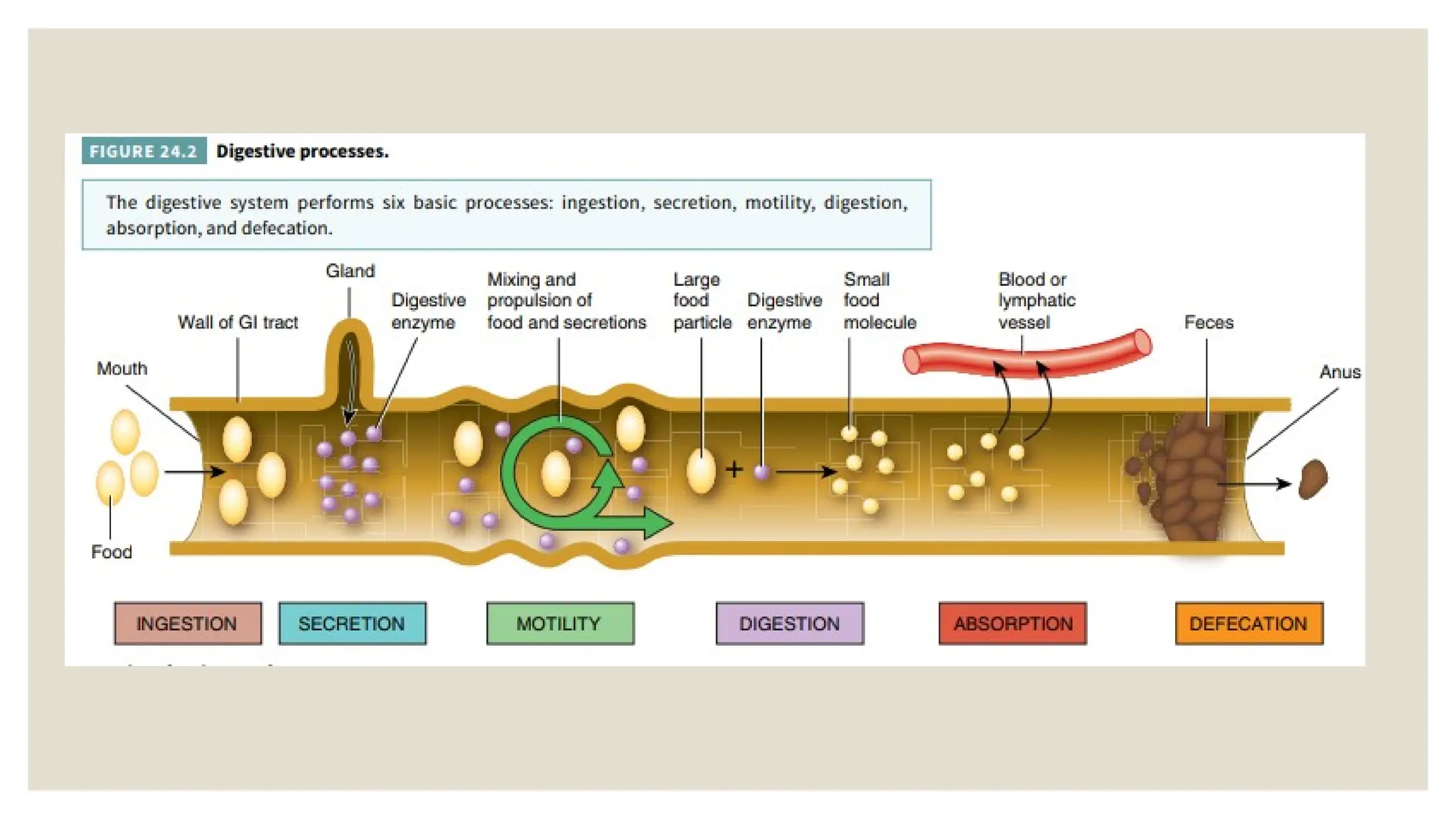
1. Ingestion. This process involves taking foods and liquids into the mouth (eating).
2. Secretion. Each day, cells within the walls of the GI tract and accessory digestive organs secrete a
total of about 7 liters of water, acid, buffers, and enzymes into the lumen of the tract.
3. Motility. Alternating contractions and relaxations of smooth muscle in the walls of the GI tract
mix food and secretions and move them toward the anus. This capability of the GI tract to mix and
move material along its length is called motility .
4. Digestion. Digestion is the process of breaking down ingested food into small molecules that can
be used by body cells.
In mechanical digestion the teeth cut and grind food before it is swallowed, and then smooth muscles
of the stomach and small intestine churn the food to further assist the process. As a result, food
molecules become dissolved and thoroughly mixed with digestive enzymes.
In chemical digestion the large carbohydrate, lipid, protein, and nucleic acid molecules in food are
split into smaller molecules by hydrolysis . Digestive enzymes produced by the salivary glands,
tongue, stomach, pancreas, and small intestine catalyze these catabolic reactions.
Digestive system performs six basic processes
5. Absorption. The movement of the products of digestion from the lumen
of the GI tract into blood or lymph is called absorption. Once absorbed,
these substances circulate to cells throughout the body. A few substances in
food can be absorbed without undergoing digestion. These include
vitamins, ions, cholesterol, and water.
6. Defecation. Wastes, indigestible substances, bacteria, cells sloughed
from the lining of the GI tract, and digested materials that were not
absorbed in their journey through the digestive tract leave the body through
the anus in a process called defecation. The eliminated material is termed
feces or stool.
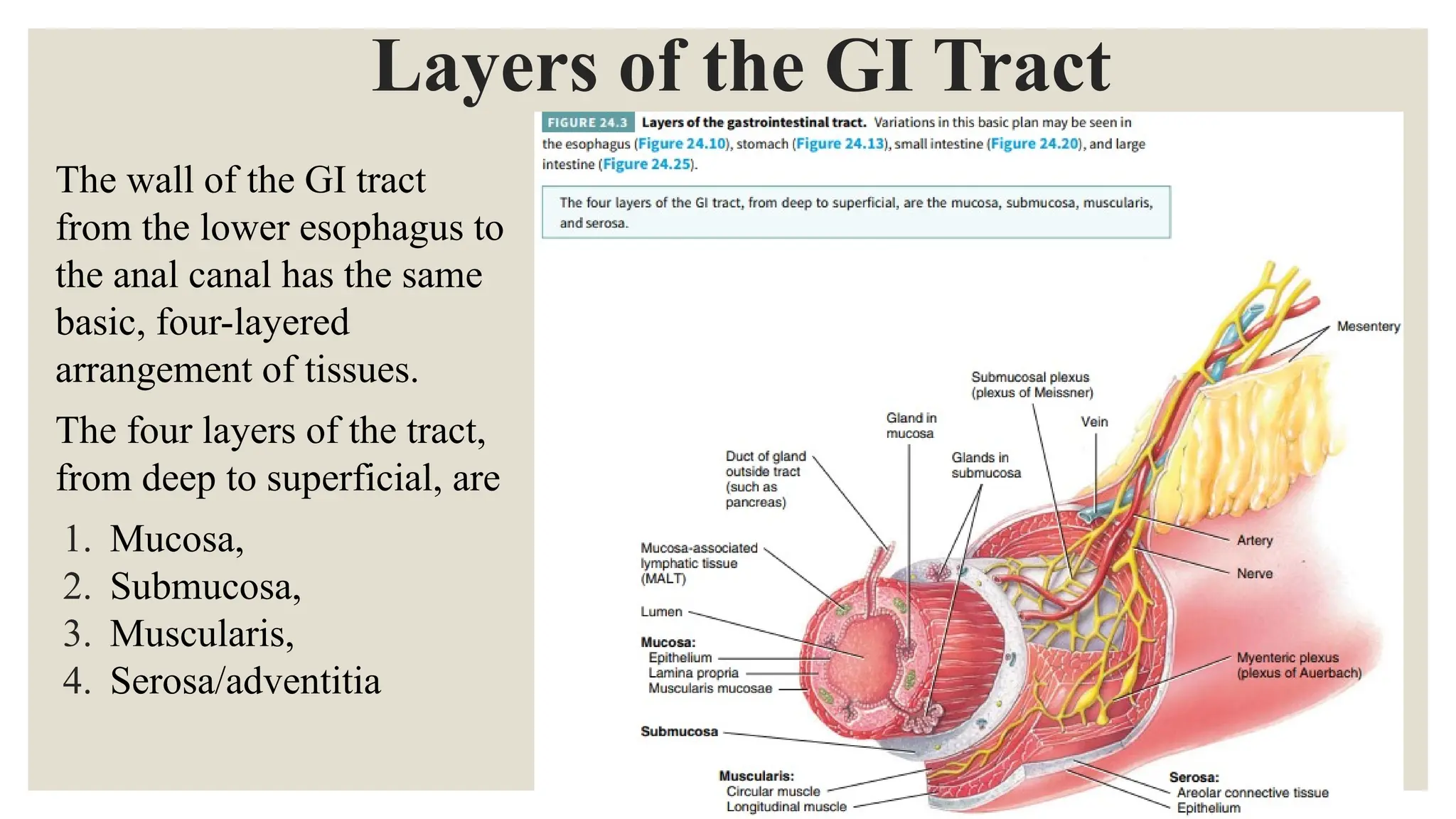
Layers of the GI Tract
The wall of the GI tract
from the lower esophagus to
the anal canal has the same
basic, four-layered
arrangement of tissues.
The four layers of the tract,
from deep to superficial, are
1. Mucosa,
2. Submucosa,
3. Muscularis,
4. Serosa/adventitia
Mucosa
The mucosa, or inner lining of the GI tract, is a mucous membrane.
It is composed of (1) a layer of epithelium in direct contact with the contents of the GI tract,
(2) a layer of connective tissue called the lamina propria, and
(3) a thin layer of smooth muscle (muscularis mucosae).
1. The epithelium in the mouth, pharynx, esophagus, and anal canal is mainly nonkeratinized
stratified squamous epithelium that serves a protective function.
◦ Simple columnar epithelium, which functions in secretion and absorption, lines the stomach
and intestines.
◦ The tight junctions that firmly seal neighboring simple columnar epithelial cells to one
another restrict leakage between the cells.
◦ The rate of renewal of GI tract epithelial cells is rapid: Every 5 to 7 days they slough off and
are replaced by new cells.
◦ Located among the epithelial cells are exocrine cells that secrete mucus and fluid into the
lumen of the tract, and several types of endocrine cells, collectively called enteroendocrine
cells, which secrete hormones.
2. The lamina propria is areolar connective tissue containing many blood and
lymphatic vessels, which are the routes by which nutrients absorbed into the GI
tract reach the other tissues of the body.
◦ This layer supports the epithelium and binds it to the muscularis mucosae.
◦ The lamina propria also contains the majority of the cells of the mucosa-
associated lymphatic tissue (MALT). These prominent lymphatic nodules
contain immune system cells that protect against disease.
◦ MALT is present all along the GI tract, especially in the tonsils, small intestine,
appendix, and large intestine.
3. A thin layer of smooth muscle fibers called the muscularis mucosae.
Movements of the muscularis mucosae ensure that all absorptive cells are fully
exposed to the contents of the GI tract
Submucosa
◦ The submucosa consists of areolar connective tissue that binds the mucosa to the muscularis.
◦ It contains many blood and lymphatic vessels that receive absorbed food molecules. Also
located in the submucosa is an extensive network of neurons known as the submucosal plexus.
◦ The submucosa may also contain glands and lymphatic tissue.
Muscularis
◦ The muscularis of the mouth, pharynx, and superior and middle parts of the esophagus
contains skeletal muscle that produces voluntary swallowing.
◦ Skeletal muscle also forms the external anal sphincter, which permits voluntary control of
defecation.
◦ Throughout the rest of the tract, the muscularis consists of smooth muscle that is generally
found in two sheets: an inner sheet of circular fibers and an outer sheet of longitudinal
fibers.
◦ Involuntary contractions of the smooth muscle help break down food, mix it with digestive
secretions, and propel it along the tract.
◦ Between the layers of the muscularis is a second plexus of neurons—the myenteric plexus.
Serosa
● Those portions of the GI tract that are suspended in the abdominal cavity
have a superficial layer called the serosa.
● The serosa is a serous membrane composed of areolar connective tissue and
simple squamous epithelium (mesothelium).
● The serosa is also called the visceral peritoneum because it forms a portion
of the peritoneum.
● The esophagus lacks a serosa; instead, only a single layer of areolar
connective tissue called the adventitia forms the superficial layer of this
organ.
Neural Innervation of the GI Tract
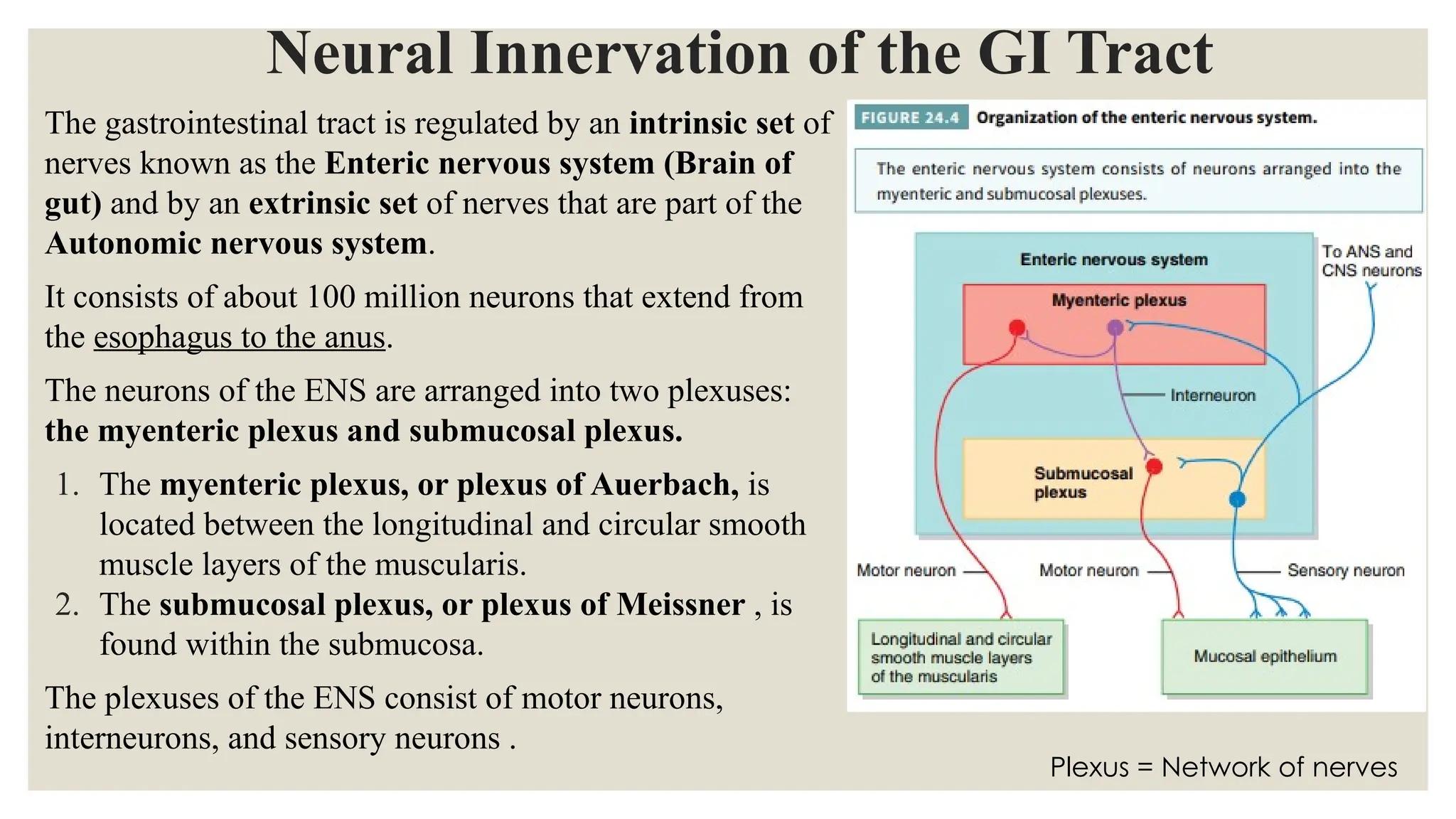
The gastrointestinal tract is regulated by an intrinsic set of
nerves known as the Enteric nervous system (Brain of
gut) and by an extrinsic set of nerves that are part of the
Autonomic nervous system.
It consists of about 100 million neurons that extend from
the esophagus to the anus.
The neurons of the ENS are arranged into two plexuses:
the myenteric plexus and submucosal plexus.
1. The myenteric plexus, or plexus of Auerbach, is
located between the longitudinal and circular smooth
muscle layers of the muscularis.
2. The submucosal plexus, or plexus of Meissner , is
found within the submucosa.
The plexuses of the ENS consist of motor neurons,
interneurons, and sensory neurons .
Plexus = Network of nerves
◦ Because the motor neurons of the myenteric plexus supply the longitudinal
and circular smooth muscle layers of the muscularis, this plexus mostly
controls GI tract motility (movement), particularly the frequency and
strength of contraction of the muscularis.
◦ The motor neurons of the submucosal plexus supply the secretory cells of the
mucosal epithelium, controlling the secretions of the organs of the GI tract.
◦ The interneurons of the ENS interconnect the neurons of the myenteric and
submucosal plexuses.
◦ The sensory neurons of the ENS supply the mucosal epithelium and contain
receptors that detect stimuli in the lumen of the GI tract.
◦ The wall of the GI tract contains two major types of sensory receptors:
(1) chemoreceptors, which respond to certain chemicals in the food present
in the lumen, and
(2) mechanoreceptors, such as stretch receptors, that are activated when
food distends (stretches) the wall of a GI organ.
Autonomic Nervous System:-
◦ The vagus (X) nerves supply parasympathetic fibers to most parts of the GI tract, with the
exception of the last half of the large intestine, which is supplied with parasympathetic fibers from
the sacral spinal cord.
◦ Parasympathetic preganglionic neurons of the vagus or pelvic splanchnic nerves synapse with
parasympathetic postganglionic neurons located in the myenteric and submucosal plexuses.
◦ Some of the parasympathetic postganglionic neurons in turn synapse with neurons in the ENS;
others directly innervate smooth muscle and glands within the wall of the GI tract.
◦ In general, stimulation of the parasympathetic nerves that innervate the GI tract causes an
increase in GI secretion and motility by increasing the activity of ENS neurons.
◦ Sympathetic nerves that supply the GI tract arise from the thoracic and upper lumbar regions of
the spinal cord.
◦ Sympathetic postganglionic neurons synapse with neurons located in the myenteric plexus and the
submucosal plexus.
◦ In general, the sympathetic nerves that supply the GI tract cause a decrease in GI secretion
and motility by inhibiting the neurons of the ENS.
◦ Emotions such as anger, fear, and anxiety may slow digestion because they stimulate the
sympathetic nerves that supply the GI tract.
Gastrointestinal Reflex Pathways
Many neurons of the ENS are components of GI (gastrointestinal) reflex
pathways that regulate GI secretion and motility in response to stimuli present in
the lumen of the GI tract.
◦ The initial components of a typical GI reflex pathway are sensory
receptors (such as chemoreceptors and stretch receptors) that are
associated with the sensory neurons of the ENS.
◦ The axons of these sensory neurons can synapse with other neurons
located in the ENS, CNS, or ANS, informing these regions about the
nature of the contents and the degree of distension (stretching) of the
GI tract.
◦ The neurons of the ENS, CNS, or ANS subsequently activate or inhibit
GI glands and smooth muscle, altering GI secretion and motility.

Digestive System with its layers .pptx

  • 1.
    ANATOMY and PHYSIOLOGY OFDIGESTIVE SYSTEM 1. Layers of Digestive system 2. Nerve innervation of Digestive system Presented by Dr. Ayesha Fatima Assistant Professor Dept of Pharmacy Practice
  • 2.
    ◦ The digestivesystem consists of a group of organs that break down the food we eat into smaller molecules that can be used by body cells. ◦ Two groups of organs compose the digestive system : the gastrointestinal (GI) tract and the accessory digestive organs. ◦ The gastrointestinal (GI) tract, or alimentary canal, is a continuous tube that extends from the mouth to the anus through the thoracic and abdominopelvic cavities.
  • 3.
    GASTROINTESTINAL TRACT ◦ Organsof the gastrointestinal tract include ◦ the mouth, most of the pharynx, esophagus, stomach, small intestine, and large intestine. ◦ The length of the GI tract is about 5–7 meters in a living person when the muscles along the wall of the GI tract organs are in a state of tonus . ACCESSORY DIGESTIVE ORGANS ◦ The accessory digestive organs include the teeth, tongue, salivary glands, liver, gallbladder, and pancreas. ◦ The other accessory digestive organs, however, never come into direct contact with food. ◦ They produce or store secretions that flow into the GI tract through ducts; the secretions aid in the chemical breakdown of food.
  • 5.
    1. Ingestion. Thisprocess involves taking foods and liquids into the mouth (eating). 2. Secretion. Each day, cells within the walls of the GI tract and accessory digestive organs secrete a total of about 7 liters of water, acid, buffers, and enzymes into the lumen of the tract. 3. Motility. Alternating contractions and relaxations of smooth muscle in the walls of the GI tract mix food and secretions and move them toward the anus. This capability of the GI tract to mix and move material along its length is called motility . 4. Digestion. Digestion is the process of breaking down ingested food into small molecules that can be used by body cells. In mechanical digestion the teeth cut and grind food before it is swallowed, and then smooth muscles of the stomach and small intestine churn the food to further assist the process. As a result, food molecules become dissolved and thoroughly mixed with digestive enzymes. In chemical digestion the large carbohydrate, lipid, protein, and nucleic acid molecules in food are split into smaller molecules by hydrolysis . Digestive enzymes produced by the salivary glands, tongue, stomach, pancreas, and small intestine catalyze these catabolic reactions. Digestive system performs six basic processes
  • 6.
    5. Absorption. Themovement of the products of digestion from the lumen of the GI tract into blood or lymph is called absorption. Once absorbed, these substances circulate to cells throughout the body. A few substances in food can be absorbed without undergoing digestion. These include vitamins, ions, cholesterol, and water. 6. Defecation. Wastes, indigestible substances, bacteria, cells sloughed from the lining of the GI tract, and digested materials that were not absorbed in their journey through the digestive tract leave the body through the anus in a process called defecation. The eliminated material is termed feces or stool.
  • 7.
    Layers of theGI Tract The wall of the GI tract from the lower esophagus to the anal canal has the same basic, four-layered arrangement of tissues. The four layers of the tract, from deep to superficial, are 1. Mucosa, 2. Submucosa, 3. Muscularis, 4. Serosa/adventitia
  • 8.
    Mucosa The mucosa, orinner lining of the GI tract, is a mucous membrane. It is composed of (1) a layer of epithelium in direct contact with the contents of the GI tract, (2) a layer of connective tissue called the lamina propria, and (3) a thin layer of smooth muscle (muscularis mucosae). 1. The epithelium in the mouth, pharynx, esophagus, and anal canal is mainly nonkeratinized stratified squamous epithelium that serves a protective function. ◦ Simple columnar epithelium, which functions in secretion and absorption, lines the stomach and intestines. ◦ The tight junctions that firmly seal neighboring simple columnar epithelial cells to one another restrict leakage between the cells. ◦ The rate of renewal of GI tract epithelial cells is rapid: Every 5 to 7 days they slough off and are replaced by new cells. ◦ Located among the epithelial cells are exocrine cells that secrete mucus and fluid into the lumen of the tract, and several types of endocrine cells, collectively called enteroendocrine cells, which secrete hormones.
  • 9.
    2. The laminapropria is areolar connective tissue containing many blood and lymphatic vessels, which are the routes by which nutrients absorbed into the GI tract reach the other tissues of the body. ◦ This layer supports the epithelium and binds it to the muscularis mucosae. ◦ The lamina propria also contains the majority of the cells of the mucosa- associated lymphatic tissue (MALT). These prominent lymphatic nodules contain immune system cells that protect against disease. ◦ MALT is present all along the GI tract, especially in the tonsils, small intestine, appendix, and large intestine. 3. A thin layer of smooth muscle fibers called the muscularis mucosae. Movements of the muscularis mucosae ensure that all absorptive cells are fully exposed to the contents of the GI tract
  • 10.
    Submucosa ◦ The submucosaconsists of areolar connective tissue that binds the mucosa to the muscularis. ◦ It contains many blood and lymphatic vessels that receive absorbed food molecules. Also located in the submucosa is an extensive network of neurons known as the submucosal plexus. ◦ The submucosa may also contain glands and lymphatic tissue. Muscularis ◦ The muscularis of the mouth, pharynx, and superior and middle parts of the esophagus contains skeletal muscle that produces voluntary swallowing. ◦ Skeletal muscle also forms the external anal sphincter, which permits voluntary control of defecation. ◦ Throughout the rest of the tract, the muscularis consists of smooth muscle that is generally found in two sheets: an inner sheet of circular fibers and an outer sheet of longitudinal fibers. ◦ Involuntary contractions of the smooth muscle help break down food, mix it with digestive secretions, and propel it along the tract. ◦ Between the layers of the muscularis is a second plexus of neurons—the myenteric plexus.
  • 11.
    Serosa ● Those portionsof the GI tract that are suspended in the abdominal cavity have a superficial layer called the serosa. ● The serosa is a serous membrane composed of areolar connective tissue and simple squamous epithelium (mesothelium). ● The serosa is also called the visceral peritoneum because it forms a portion of the peritoneum. ● The esophagus lacks a serosa; instead, only a single layer of areolar connective tissue called the adventitia forms the superficial layer of this organ.
  • 12.
    Neural Innervation ofthe GI Tract The gastrointestinal tract is regulated by an intrinsic set of nerves known as the Enteric nervous system (Brain of gut) and by an extrinsic set of nerves that are part of the Autonomic nervous system. It consists of about 100 million neurons that extend from the esophagus to the anus. The neurons of the ENS are arranged into two plexuses: the myenteric plexus and submucosal plexus. 1. The myenteric plexus, or plexus of Auerbach, is located between the longitudinal and circular smooth muscle layers of the muscularis. 2. The submucosal plexus, or plexus of Meissner , is found within the submucosa. The plexuses of the ENS consist of motor neurons, interneurons, and sensory neurons . Plexus = Network of nerves
  • 13.
    ◦ Because themotor neurons of the myenteric plexus supply the longitudinal and circular smooth muscle layers of the muscularis, this plexus mostly controls GI tract motility (movement), particularly the frequency and strength of contraction of the muscularis. ◦ The motor neurons of the submucosal plexus supply the secretory cells of the mucosal epithelium, controlling the secretions of the organs of the GI tract. ◦ The interneurons of the ENS interconnect the neurons of the myenteric and submucosal plexuses. ◦ The sensory neurons of the ENS supply the mucosal epithelium and contain receptors that detect stimuli in the lumen of the GI tract. ◦ The wall of the GI tract contains two major types of sensory receptors: (1) chemoreceptors, which respond to certain chemicals in the food present in the lumen, and (2) mechanoreceptors, such as stretch receptors, that are activated when food distends (stretches) the wall of a GI organ.
  • 14.
    Autonomic Nervous System:- ◦The vagus (X) nerves supply parasympathetic fibers to most parts of the GI tract, with the exception of the last half of the large intestine, which is supplied with parasympathetic fibers from the sacral spinal cord. ◦ Parasympathetic preganglionic neurons of the vagus or pelvic splanchnic nerves synapse with parasympathetic postganglionic neurons located in the myenteric and submucosal plexuses. ◦ Some of the parasympathetic postganglionic neurons in turn synapse with neurons in the ENS; others directly innervate smooth muscle and glands within the wall of the GI tract. ◦ In general, stimulation of the parasympathetic nerves that innervate the GI tract causes an increase in GI secretion and motility by increasing the activity of ENS neurons. ◦ Sympathetic nerves that supply the GI tract arise from the thoracic and upper lumbar regions of the spinal cord. ◦ Sympathetic postganglionic neurons synapse with neurons located in the myenteric plexus and the submucosal plexus. ◦ In general, the sympathetic nerves that supply the GI tract cause a decrease in GI secretion and motility by inhibiting the neurons of the ENS. ◦ Emotions such as anger, fear, and anxiety may slow digestion because they stimulate the sympathetic nerves that supply the GI tract.
  • 15.
    Gastrointestinal Reflex Pathways Manyneurons of the ENS are components of GI (gastrointestinal) reflex pathways that regulate GI secretion and motility in response to stimuli present in the lumen of the GI tract. ◦ The initial components of a typical GI reflex pathway are sensory receptors (such as chemoreceptors and stretch receptors) that are associated with the sensory neurons of the ENS. ◦ The axons of these sensory neurons can synapse with other neurons located in the ENS, CNS, or ANS, informing these regions about the nature of the contents and the degree of distension (stretching) of the GI tract. ◦ The neurons of the ENS, CNS, or ANS subsequently activate or inhibit GI glands and smooth muscle, altering GI secretion and motility.