Differentiation with Technology
What is Differentiation?
Differentiation means tailoring instruction to meet individual needs.
Whenever a you reach out to an individual or small group to vary your teaching in
order to create the best learning experience possible, you are differentiating
instruction.
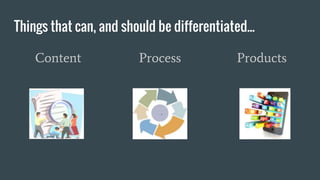
Things that can, and should be differentiated...
Content Process Products
Differentiating Content
The material students are expected master.
Different students in your class will access different materials that are most
appropriate for their readiness at the depth that is right for them.
All are working towards mastery of the same standard.
Differentiating Process
These are the learning activities that take place in your class and connect the
content to the learner. Differentiating the process takes into account:
Learning style differences.
Multiple intelligences.
Multiple formats for students to access the material to be learned - Options
are important!
Differentiating Products
The evidence students produce to demonstrate mastery.
OPTIONS are key
Let’s look a little deeper into each of these
and the different ways that technology can help us achieve that differentiation
Differentiating Content
Reading levels
Sometimes, all students
can understand the
concepts, but reading
ability is a barrier.
Complexity
Students may require
varying degrees of
depth to their
understanding of
concepts
Readiness
Students may lack the
background knowledge
necessary (including
the vocabulary) to
engage in higher level
questions about a
concept.
Differentiating Content - Reading levels
Providing rich reading experiences for all students.
Newsela
https://newsela.com/
Articles searchable by
content, each at
different reading
levels and lexiles.
Differentiating Content - Reading levels
Providing rich reading experiences for all students.
Smithsonian
Tween
Tribune
http://tweentribune.com/
Also searchable by
content, each at
different reading
levels and lexiles.
Differentiating Content - Reading levels
Providing rich reading experiences for all students.
BirdbrainScience
BirdbrainHistory
https://www.birdbrainscience.com/ https://www.birdbrainhistory.com/
After a diagnostic, any
article you assign is
presented at the
appropriate reading level
Differentiating Content - Reading
accessibility
Speak-It
Chrome Extension
Install the extension and
have any website read to
your students!
Differentiating Content - Complexity
https://www.tes.com/lessons
Blendspace
Create different paths
for students.
Add different
presentations and
content.
Differentiating Content - Complexity
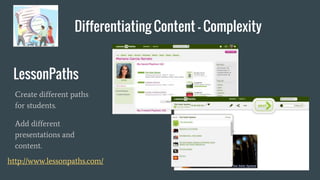
http://www.lessonpaths.com/
LessonPaths
Create different paths
for students.
Add different
presentations and
content.
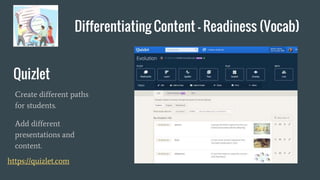
Differentiating Content - Readiness (Vocab)
https://quizlet.com
Quizlet
Create different paths
for students.
Add different
presentations and
content.
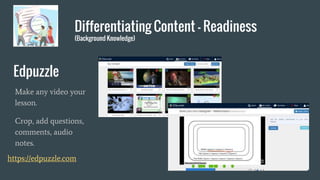
Differentiating Content - Readiness
(Background Knowledge)
https://edpuzzle.com
Edpuzzle
Make any video your
lesson.
Crop, add questions,
comments, audio
notes.
Differentiating Process
Organization
Students often lack the
organization skills
necessary to retain
ideas. (losing papers,
materials, access)
Response time
How can tech help the:
shy
slow processing
physical
impediments
Reteaching
Students may need
more practice to:
attain mastery
retain mastery
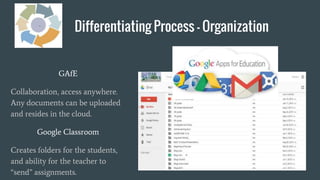
Differentiating Process - Organization
GAfE
Collaboration, access anywhere.
Any documents can be uploaded
and resides in the cloud.
Google Classroom
Creates folders for the students,
and ability for the teacher to
“send” assignments.
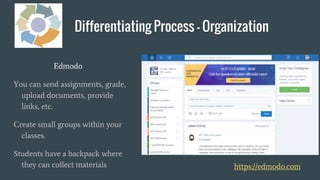
Differentiating Process - Organization
Edmodo
You can send assignments, grade,
upload documents, provide
links, etc.
Create small groups within your
classes.
Students have a backpack where
they can collect materials https://edmodo.com
Differentiating Process - Response time
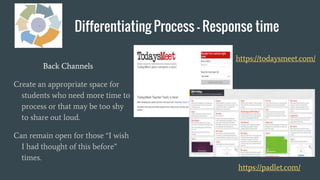
Back Channels
Create an appropriate space for
students who need more time to
process or that may be too shy
to share out loud.
Can remain open for those “I wish
I had thought of this before”
times.
https://padlet.com/
https://todaysmeet.com/
Differentiating Process - Reteaching
You’ve pre-assessed, taught, done formative assessed and now you know some students need
further instruction or simply need to revisit the content
Make use of some of the technology tools we have seen.
Add an appropriate edpuzzle video to your padlet.
Embed your presentation or a video you took while teaching/created afterwards to
a blendspace or lesson-path.
Differentiating Process - Reteaching
You’ve pre-assessed, taught, done formative assessed and now you know some students need
further instruction or simply need to revisit the content
https://tackk.com https://www.hstry.co/ http://app.wizer.me/
Differentiating Products
Multiple means of expression and action.
Many of the tools we have already seen can be used by students to organize and
create their products.
Differentiating Products - Organization
Keep all notes w/links in a Google Document (or within a Drive Folder).
Students can create a Padlet page and post all their work/links/etc.
Students can create Folders in their Edmodo backpack to keep all their work
for a project.
Anything that is not digital can be digitized through pictures.
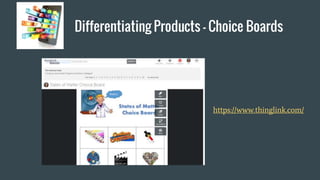
Differentiating Products - Choice Boards
https://www.thinglink.com/
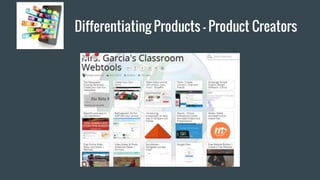
Differentiating Products - Product Creators

Differentiation with technology

  • 1.
  • 2.
    What is Differentiation? Differentiationmeans tailoring instruction to meet individual needs. Whenever a you reach out to an individual or small group to vary your teaching in order to create the best learning experience possible, you are differentiating instruction.
  • 3.
    Things that can,and should be differentiated... Content Process Products
  • 4.
    Differentiating Content The materialstudents are expected master. Different students in your class will access different materials that are most appropriate for their readiness at the depth that is right for them. All are working towards mastery of the same standard.
  • 5.
    Differentiating Process These arethe learning activities that take place in your class and connect the content to the learner. Differentiating the process takes into account: Learning style differences. Multiple intelligences. Multiple formats for students to access the material to be learned - Options are important!
  • 6.
    Differentiating Products The evidencestudents produce to demonstrate mastery. OPTIONS are key
  • 7.
    Let’s look alittle deeper into each of these and the different ways that technology can help us achieve that differentiation
  • 8.
    Differentiating Content Reading levels Sometimes,all students can understand the concepts, but reading ability is a barrier. Complexity Students may require varying degrees of depth to their understanding of concepts Readiness Students may lack the background knowledge necessary (including the vocabulary) to engage in higher level questions about a concept.
  • 9.
    Differentiating Content -Reading levels Providing rich reading experiences for all students. Newsela https://newsela.com/ Articles searchable by content, each at different reading levels and lexiles.
  • 10.
    Differentiating Content -Reading levels Providing rich reading experiences for all students. Smithsonian Tween Tribune http://tweentribune.com/ Also searchable by content, each at different reading levels and lexiles.
  • 11.
    Differentiating Content -Reading levels Providing rich reading experiences for all students. BirdbrainScience BirdbrainHistory https://www.birdbrainscience.com/ https://www.birdbrainhistory.com/ After a diagnostic, any article you assign is presented at the appropriate reading level
  • 12.
    Differentiating Content -Reading accessibility Speak-It Chrome Extension Install the extension and have any website read to your students!
  • 13.
    Differentiating Content -Complexity https://www.tes.com/lessons Blendspace Create different paths for students. Add different presentations and content.
  • 14.
    Differentiating Content -Complexity http://www.lessonpaths.com/ LessonPaths Create different paths for students. Add different presentations and content.
  • 15.
    Differentiating Content -Readiness (Vocab) https://quizlet.com Quizlet Create different paths for students. Add different presentations and content.
  • 16.
    Differentiating Content -Readiness (Background Knowledge) https://edpuzzle.com Edpuzzle Make any video your lesson. Crop, add questions, comments, audio notes.
  • 17.
    Differentiating Process Organization Students oftenlack the organization skills necessary to retain ideas. (losing papers, materials, access) Response time How can tech help the: shy slow processing physical impediments Reteaching Students may need more practice to: attain mastery retain mastery
  • 18.
    Differentiating Process -Organization GAfE Collaboration, access anywhere. Any documents can be uploaded and resides in the cloud. Google Classroom Creates folders for the students, and ability for the teacher to “send” assignments.
  • 19.
    Differentiating Process -Organization Edmodo You can send assignments, grade, upload documents, provide links, etc. Create small groups within your classes. Students have a backpack where they can collect materials https://edmodo.com
  • 20.
    Differentiating Process -Response time Back Channels Create an appropriate space for students who need more time to process or that may be too shy to share out loud. Can remain open for those “I wish I had thought of this before” times. https://padlet.com/ https://todaysmeet.com/
  • 21.
    Differentiating Process -Reteaching You’ve pre-assessed, taught, done formative assessed and now you know some students need further instruction or simply need to revisit the content Make use of some of the technology tools we have seen. Add an appropriate edpuzzle video to your padlet. Embed your presentation or a video you took while teaching/created afterwards to a blendspace or lesson-path.
  • 22.
    Differentiating Process -Reteaching You’ve pre-assessed, taught, done formative assessed and now you know some students need further instruction or simply need to revisit the content https://tackk.com https://www.hstry.co/ http://app.wizer.me/
  • 23.
    Differentiating Products Multiple meansof expression and action. Many of the tools we have already seen can be used by students to organize and create their products.
  • 24.
    Differentiating Products -Organization Keep all notes w/links in a Google Document (or within a Drive Folder). Students can create a Padlet page and post all their work/links/etc. Students can create Folders in their Edmodo backpack to keep all their work for a project. Anything that is not digital can be digitized through pictures.
  • 25.
    Differentiating Products -Choice Boards https://www.thinglink.com/
  • 26.

Editor's Notes

  • #10 Each article has a slightly different URL so you can send the corresponding article to different students. There are test sets aligned to different standards, offering prompts and quizzes.
  • #11 Each article has a slightly different URL so you can send the corresponding article to different students. There are test sets aligned to different standards, offering prompts and quizzes.
  • #12 BirdbrainScience ($4 per student); BirdbrainHistory in Beta (free for the remainder of the schoolyear)
  • #14 Requires a little bit more preparation on your part
  • #15 Each student receives a different path… Add popquizzes.
  • #16 paid service (24.99/yr) to be able to include images. Requires parent permission if your student is under 13.
  • #17 paid service (24.99/yr) to be able to include images. Requires parent permission if your student is under 13.
  • #21 Padlet is “better” in that it also allows uploading of documents, images, etc. http://betterlesson.com/lesson/reflection/19125/padlet-the-online-bulletin-board