Differentiation using Python
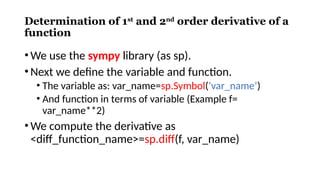
Determination of 1st
and 2nd
order derivative of a
function
•We use the sympy library (as sp).
•Next we define the variable and function.
• The variable as: var_name=sp.Symbol(‘var_name’)
• And function in terms of variable (Example f=
var_name**2)
•We compute the derivative as
<diff_function_name>=sp.diff(f, var_name)
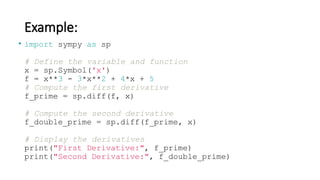
Example:
• import sympy as sp
# Define the variable and function
x = sp.Symbol('x')
f = x**3 - 3*x**2 + 4*x + 5
# Compute the first derivative
f_prime = sp.diff(f, x)
# Compute the second derivative
f_double_prime = sp.diff(f_prime, x)
# Display the derivatives
print("First Derivative:", f_prime)
print("Second Derivative:", f_double_prime)
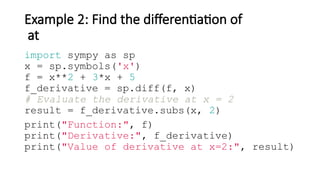
Example 2: Find the differentiation of
at
import sympy as sp
x = sp.symbols('x')
f = x**2 + 3*x + 5
f_derivative = sp.diff(f, x)
# Evaluate the derivative at x = 2
result = f_derivative.subs(x, 2)
print("Function:", f)
print("Derivative:", f_derivative)
print("Value of derivative at x=2:", result)
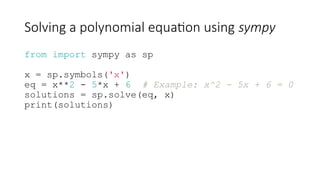
Solving a polynomial equation using sympy
from import sympy as sp
x = sp.symbols('x')
eq = x**2 - 5*x + 6 # Example: x^2 - 5x + 6 = 0
solutions = sp.solve(eq, x)
print(solutions)
Determining the local Minimum and Maximum of a function
• Example
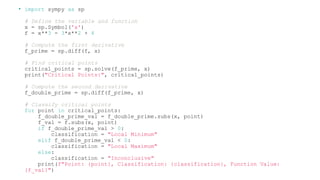
• import sympy as sp
# Define the variable and function
x = sp.Symbol('x')
f = x**3 - 3*x**2 + 4
# Compute the first derivative
f_prime = sp.diff(f, x)
# Find critical points
critical_points = sp.solve(f_prime, x)
print("Critical Points:", critical_points)
# Compute the second derivative
f_double_prime = sp.diff(f_prime, x)
# Classify critical points
for point in critical_points:
f_double_prime_val = f_double_prime.subs(x, point)
f_val = f.subs(x, point)
if f_double_prime_val > 0:
classification = "Local Minimum"
elif f_double_prime_val < 0:
classification = "Local Maximum"
else:
classification = "Inconclusive"
print(f"Point: {point}, Classification: {classification}, Function Value:
{f_val}")

Differentiation using Python which will help

  • 1.
  • 2.
    Determination of 1st and2nd order derivative of a function •We use the sympy library (as sp). •Next we define the variable and function. • The variable as: var_name=sp.Symbol(‘var_name’) • And function in terms of variable (Example f= var_name**2) •We compute the derivative as <diff_function_name>=sp.diff(f, var_name)
  • 3.
    Example: • import sympyas sp # Define the variable and function x = sp.Symbol('x') f = x**3 - 3*x**2 + 4*x + 5 # Compute the first derivative f_prime = sp.diff(f, x) # Compute the second derivative f_double_prime = sp.diff(f_prime, x) # Display the derivatives print("First Derivative:", f_prime) print("Second Derivative:", f_double_prime)
  • 4.
    Example 2: Findthe differentiation of at import sympy as sp x = sp.symbols('x') f = x**2 + 3*x + 5 f_derivative = sp.diff(f, x) # Evaluate the derivative at x = 2 result = f_derivative.subs(x, 2) print("Function:", f) print("Derivative:", f_derivative) print("Value of derivative at x=2:", result)
  • 5.
    Solving a polynomialequation using sympy from import sympy as sp x = sp.symbols('x') eq = x**2 - 5*x + 6 # Example: x^2 - 5x + 6 = 0 solutions = sp.solve(eq, x) print(solutions)
  • 6.
    Determining the localMinimum and Maximum of a function • Example
  • 7.
    • import sympyas sp # Define the variable and function x = sp.Symbol('x') f = x**3 - 3*x**2 + 4 # Compute the first derivative f_prime = sp.diff(f, x) # Find critical points critical_points = sp.solve(f_prime, x) print("Critical Points:", critical_points) # Compute the second derivative f_double_prime = sp.diff(f_prime, x) # Classify critical points for point in critical_points: f_double_prime_val = f_double_prime.subs(x, point) f_val = f.subs(x, point) if f_double_prime_val > 0: classification = "Local Minimum" elif f_double_prime_val < 0: classification = "Local Maximum" else: classification = "Inconclusive" print(f"Point: {point}, Classification: {classification}, Function Value: {f_val}")