



DIFFERENTIAL EQUATION IN CSE & REAL LIFE
Presented by:
➤ Md.Noman Hasan
ID:182-15-2172.
History of the Differential Equation :
• Period of the invention.
->differential equations first came into existence with the invention
of calculus by Newton and Leibniz.
• Who developed the methods.
->The Euler–Lagrange equation was developed in the 1750s by Euler.
• Who invented the idea.
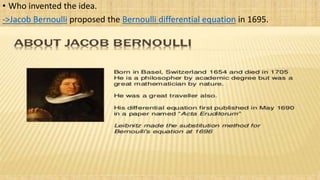
->Jacob Bernoulli proposed the Bernoulli differential equation in 1695.
Many types of DE:
• Ordinary differential equations.
• Partial differential equations.
• Non-linear differential equations.
• Complex differential equation.
• Exact differential equation .
• Homogeneous/Inhomogeneous.
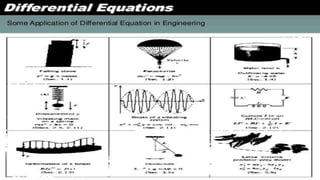
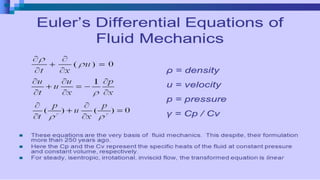
• Fluid mechanics.
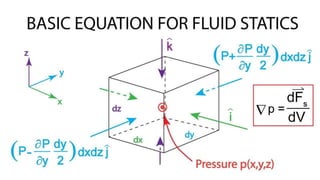
• Statics/dynamics.
• Mass transfer.
• Signals and systems.
Biologycal term:
 Verhulst equation – biological population growth
 von Bertalanffy model – biological individual growth
 Replicator dynamics – found in theoretical biology
 Hodgkin–Huxley model – neural action potentials
Applications of DE
• Software.
->computer hardware.
• Logic programming.
->To create a logic we also use DE.
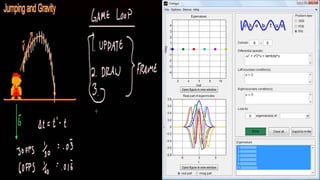
• Making Game FEATURES .
->Differential equation is used to model the velocity of a character.
• Networking
->To understand a outcome of a edge creation model like preferential
attachment which says that nodes with probability proportional to
their existing degrees.
• Artificial Intelligence.
->MR images demonstrate, thin-plate spline , Images generated using
sensitivity encoding.
• In THEORIES & Explanations
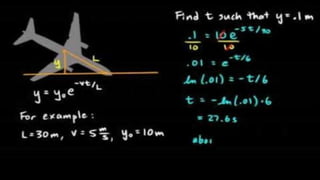
->Exponential Decay The rate of decay of a radioactive substance at a
time t is proportional to the mass x(t) of the substance left at that time.
Differential Equations in our every day life!!
In medicine.
->for modelling cancer growth or the spread of disease.
In chemistry.
->for modelling chemical reactions and to computer radioactive half
life.
In economics.
-> to find optimum investment strategies.
In physics.
-> to describe the motion of waves, pendulums or chaotic systems.
Differential equation in CSE &; real life

Differential equation in CSE &; real life

  • 2.
    DIFFERENTIAL EQUATION INCSE & REAL LIFE
  • 3.
    Presented by: ➤ Md.NomanHasan ID:182-15-2172.
  • 4.
    History of theDifferential Equation : • Period of the invention. ->differential equations first came into existence with the invention of calculus by Newton and Leibniz. • Who developed the methods. ->The Euler–Lagrange equation was developed in the 1750s by Euler.
  • 5.
    • Who inventedthe idea. ->Jacob Bernoulli proposed the Bernoulli differential equation in 1695.
  • 6.
    Many types ofDE: • Ordinary differential equations. • Partial differential equations. • Non-linear differential equations. • Complex differential equation. • Exact differential equation . • Homogeneous/Inhomogeneous.
  • 8.
    • Fluid mechanics. •Statics/dynamics. • Mass transfer. • Signals and systems.
  • 11.
    Biologycal term:  Verhulstequation – biological population growth  von Bertalanffy model – biological individual growth  Replicator dynamics – found in theoretical biology  Hodgkin–Huxley model – neural action potentials
  • 13.
    Applications of DE •Software. ->computer hardware. • Logic programming. ->To create a logic we also use DE.
  • 14.
    • Making GameFEATURES . ->Differential equation is used to model the velocity of a character. • Networking ->To understand a outcome of a edge creation model like preferential attachment which says that nodes with probability proportional to their existing degrees.
  • 16.
    • Artificial Intelligence. ->MRimages demonstrate, thin-plate spline , Images generated using sensitivity encoding. • In THEORIES & Explanations ->Exponential Decay The rate of decay of a radioactive substance at a time t is proportional to the mass x(t) of the substance left at that time.
  • 17.
    Differential Equations inour every day life!! In medicine. ->for modelling cancer growth or the spread of disease. In chemistry. ->for modelling chemical reactions and to computer radioactive half life.
  • 19.
    In economics. -> tofind optimum investment strategies. In physics. -> to describe the motion of waves, pendulums or chaotic systems.