
Difference between ECC 4.7 and ECC 6.0
ECC means Enterprise Central component
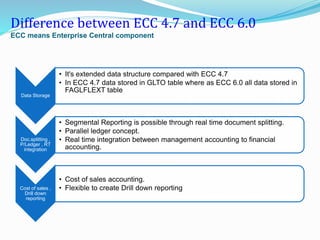
Data Storage
• It's extended data structure compared with ECC 4.7
• In ECC 4.7 data stored in GLTO table where as ECC 6.0 all data stored in
FAGLFLEXT table
Doc.splitting ,
P/Ledger , RT
integration
• Segmental Reporting is possible through real time document splitting.
• Parallel ledger concept.
• Real time integration between management accounting to financial
accounting.
Cost of sales ,
Drill down
reporting
• Cost of sales accounting.
• Flexible to create Drill down reporting
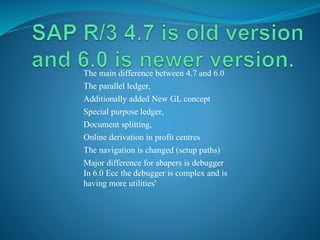
The main difference between 4.7 and 6.0
The parallel ledger,
Additionally added New GL concept
Special purpose ledger,
Document splitting,
Online derivation in profit centres
The navigation is changed (setup paths)
Major difference for abapers is debugger
In 6.0 Ecc the debugger is complex and is
having more utilities'
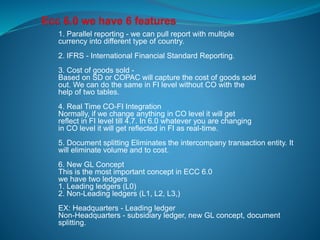
1. Parallel reporting - we can pull report with multiple
currency into different type of country.
2. IFRS - International Financial Standard Reporting.
3. Cost of goods sold -
Based on SD or COPAC will capture the cost of goods sold
out. We can do the same in FI level without CO with the
help of two tables.
4. Real Time CO-FI Integration
Normally, if we change anything in CO level it will get
reflect in FI level till 4.7. In 6.0 whatever you are changing
in CO level it will get reflected in FI as real-time.
5. Document splitting Eliminates the intercompany transaction entity. It
will eliminate volume and to cost.
6. New GL Concept
This is the most important concept in ECC 6.0
we have two ledgers
1. Leading ledgers (L0)
2. Non-Leading ledgers (L1, L2, L3,)
EX: Headquarters - Leading ledger
Non-Headquarters - subsidiary ledger, new GL concept, document
splitting.
Though the New G/L uses a broad, unified data basis,
 so that G/L account, functional area, and profit centre are
 contained in a single data record.
This enhances data quality and obviates the need for
 reconciliation measures (previously, the reconciliation ledger
had to be used to reconcile CO with FI).
The period-end closing now can be completed more quickly.
Thus, using New G/L removes the need to use several
separate components.
It enables Business area posting - Segment reporting
made easy.
 Profit centre accounting is through new GL.
 Split of entry to post assets and liabilities to
respective profit centres. (Balance sheet items) (document splitting ).
 Enables commitment of FM
END

Difference between ecc 4.7 and ecc 6.0

  • 2.
    Difference between ECC4.7 and ECC 6.0 ECC means Enterprise Central component Data Storage • It's extended data structure compared with ECC 4.7 • In ECC 4.7 data stored in GLTO table where as ECC 6.0 all data stored in FAGLFLEXT table Doc.splitting , P/Ledger , RT integration • Segmental Reporting is possible through real time document splitting. • Parallel ledger concept. • Real time integration between management accounting to financial accounting. Cost of sales , Drill down reporting • Cost of sales accounting. • Flexible to create Drill down reporting
  • 3.
    The main differencebetween 4.7 and 6.0 The parallel ledger, Additionally added New GL concept Special purpose ledger, Document splitting, Online derivation in profit centres The navigation is changed (setup paths) Major difference for abapers is debugger In 6.0 Ecc the debugger is complex and is having more utilities'
  • 4.
    1. Parallel reporting- we can pull report with multiple currency into different type of country. 2. IFRS - International Financial Standard Reporting. 3. Cost of goods sold - Based on SD or COPAC will capture the cost of goods sold out. We can do the same in FI level without CO with the help of two tables. 4. Real Time CO-FI Integration Normally, if we change anything in CO level it will get reflect in FI level till 4.7. In 6.0 whatever you are changing in CO level it will get reflected in FI as real-time. 5. Document splitting Eliminates the intercompany transaction entity. It will eliminate volume and to cost. 6. New GL Concept This is the most important concept in ECC 6.0 we have two ledgers 1. Leading ledgers (L0) 2. Non-Leading ledgers (L1, L2, L3,) EX: Headquarters - Leading ledger Non-Headquarters - subsidiary ledger, new GL concept, document splitting.
  • 5.
    Though the NewG/L uses a broad, unified data basis,  so that G/L account, functional area, and profit centre are  contained in a single data record. This enhances data quality and obviates the need for  reconciliation measures (previously, the reconciliation ledger had to be used to reconcile CO with FI). The period-end closing now can be completed more quickly. Thus, using New G/L removes the need to use several separate components. It enables Business area posting - Segment reporting made easy.  Profit centre accounting is through new GL.  Split of entry to post assets and liabilities to respective profit centres. (Balance sheet items) (document splitting ).  Enables commitment of FM
  • 6.