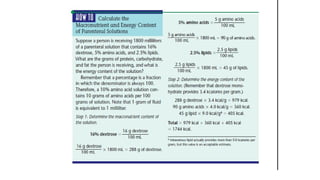
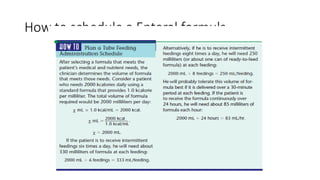
How to schedule a Enteral formuls
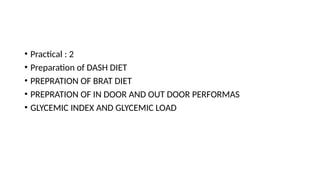
• Practical : 2
• Preparation of DASH DIET
• PREPRATION OF BRAT DIET
• PREPRATION OF IN DOOR AND OUT DOOR PERFORMAS
• GLYCEMIC INDEX AND GLYCEMIC LOAD
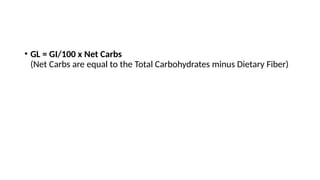
• GL = GI/100 x Net Carbs
(Net Carbs are equal to the Total Carbohydrates minus Dietary Fiber)
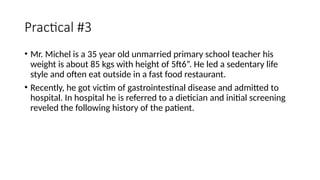
Practical #3
• Mr. Michel is a 35 year old unmarried primary school teacher his
weight is about 85 kgs with height of 5ft6”. He led a sedentary life
style and often eat outside in a fast food restaurant.
• Recently, he got victim of gastrointestinal disease and admitted to
hospital. In hospital he is referred to a dietician and initial screening
reveled the following history of the patient.
History
• Diabetes in his family
• Previously utilizing the antacid tablets
• Consuming no supplements
• Alcholisim
• Smoking
CONTI….
• After your interviewing you compile the following informations
• Excessive Fast foods consumption in previous one year
• More utilization of red meat
• More fatty and sugary meals
• Less fruit and vegetable consumption
CONTI….
• Pale skin
• Waist to hip ratio is 1.05
• MAMC is less than the normal
• TSF deviate from the normal
• T.B.F is 36
• Less consumption of fluid
• Watching T.V in most of time
• Has disturb sleep/wake cycle
Your task
• Develop a MNT sketch by these informations
• Utilizing the appended informations prepared four kind of history
• What are the critical point that as a dietician you must taken into account?
• Conduct a 24 hrs dietary recall and conduct a food diary for that patient
• If we miss diet drug interaction, food allergies and post operative
conditions in near past what happened
• Prepare a suitable diet plan considering all his needs
• What is your primary diagnosis and what are the tests you preferred to
advise in order to further explore the disease.
• What types of supplements you preferred considering the diet drug
interactions
• If his G.I.T track is functional but unable to chew and swallow than
what is your recommended oral route
• Enlist the Food avoided and allowed in considering the particular case
• Which special diet you want to recommend him considering his
potential needs
12
Atherogenic Index and Cardiac risk factor
ratios
03/03/2025 Dietetics II
• Atherogenic Index
• Plasma (AIP) is a strong marker to predict the risk of atherosclerosis and coronary
heart disease, we assessed the correlation between AIP and other important
factors.
• Formula
• TC/HDL
• LDL/HDL
• AI= TC-HDL/HDL*100
• AIP value of under 0.11 is associated with low risk of CVD; the values between
0.11 to 0.21 and upper than 0.21 are associated with intermediate and increased
risks, respectively
13
03/03/2025 Dietetics II
• Abnormal levels of lipids (fats) in the blood are risk factors for
cardiovascular disease. ... High levels of LDL cholesterol lead to
atherosclerosis increasing the risk of heart attack and ischemic stroke.
HDL cholesterol reduces the risk of cardiovascular disease as it
carries cholesterol away from the blood stream.

Dietetics Practical by dn javeria Dawood

  • 2.
    How to schedulea Enteral formuls
  • 4.
    • Practical :2 • Preparation of DASH DIET • PREPRATION OF BRAT DIET • PREPRATION OF IN DOOR AND OUT DOOR PERFORMAS • GLYCEMIC INDEX AND GLYCEMIC LOAD
  • 5.
    • GL =GI/100 x Net Carbs (Net Carbs are equal to the Total Carbohydrates minus Dietary Fiber)
  • 6.
    Practical #3 • Mr.Michel is a 35 year old unmarried primary school teacher his weight is about 85 kgs with height of 5ft6”. He led a sedentary life style and often eat outside in a fast food restaurant. • Recently, he got victim of gastrointestinal disease and admitted to hospital. In hospital he is referred to a dietician and initial screening reveled the following history of the patient.
  • 7.
    History • Diabetes inhis family • Previously utilizing the antacid tablets • Consuming no supplements • Alcholisim • Smoking
  • 8.
    CONTI…. • After yourinterviewing you compile the following informations • Excessive Fast foods consumption in previous one year • More utilization of red meat • More fatty and sugary meals • Less fruit and vegetable consumption
  • 9.
    CONTI…. • Pale skin •Waist to hip ratio is 1.05 • MAMC is less than the normal • TSF deviate from the normal • T.B.F is 36 • Less consumption of fluid • Watching T.V in most of time • Has disturb sleep/wake cycle
  • 10.
    Your task • Developa MNT sketch by these informations • Utilizing the appended informations prepared four kind of history • What are the critical point that as a dietician you must taken into account? • Conduct a 24 hrs dietary recall and conduct a food diary for that patient • If we miss diet drug interaction, food allergies and post operative conditions in near past what happened • Prepare a suitable diet plan considering all his needs • What is your primary diagnosis and what are the tests you preferred to advise in order to further explore the disease.
  • 11.
    • What typesof supplements you preferred considering the diet drug interactions • If his G.I.T track is functional but unable to chew and swallow than what is your recommended oral route • Enlist the Food avoided and allowed in considering the particular case • Which special diet you want to recommend him considering his potential needs
  • 12.
    12 Atherogenic Index andCardiac risk factor ratios 03/03/2025 Dietetics II • Atherogenic Index • Plasma (AIP) is a strong marker to predict the risk of atherosclerosis and coronary heart disease, we assessed the correlation between AIP and other important factors. • Formula • TC/HDL • LDL/HDL • AI= TC-HDL/HDL*100 • AIP value of under 0.11 is associated with low risk of CVD; the values between 0.11 to 0.21 and upper than 0.21 are associated with intermediate and increased risks, respectively
  • 13.
    13 03/03/2025 Dietetics II •Abnormal levels of lipids (fats) in the blood are risk factors for cardiovascular disease. ... High levels of LDL cholesterol lead to atherosclerosis increasing the risk of heart attack and ischemic stroke. HDL cholesterol reduces the risk of cardiovascular disease as it carries cholesterol away from the blood stream.