Fundamental of Nursing 2
Unit-5
Concept Of Nutrition &
dietary
Presented to:
Madam Nuzhat Firdous
Presented by:
Amna
Roll no: 02
Srssion 2021----2025
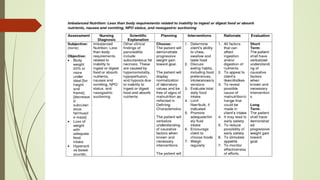
Nutrition interventions:
 Nutrition intervention is purposeful planned actions intended to positively
change a nutrition related behavior, environmental conditions or aspect of
health status.
 Two inter-related components:
 Planning
 Implementation
 Planning:
 Set goals and determine expected outcomes.
 Major goals for client with or at risk for nutritional problems include
the following:
 Maintain or restore optimal nutritional status.
 Promote healthy nutritional practices.
 Prevent from malnutrition .
Implementation:
 It is the phase in which nurse implement or carry out the plan of care .
Nursing interventions
Nursing interventions:
Assisting client with special diets:
 Clear liquid diet
 Full liquid diet
 Soft diet
 Diet as tolerated
 Low calorie diet
 Low cholesterol diet
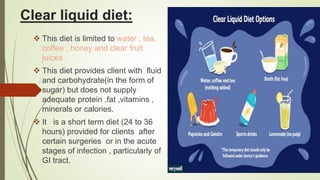
Clear liquid diet:
 This diet is limited to water , tea,
coffee , honey and clear fruit
juices .
 This diet provides client with fluid
and carbohydrate(in the form of
sugar) but does not supply
adequate protein ,fat ,vitamins ,
minerals or calories.
 It is a short term diet (24 to 36
hours) provided for clients after
certain surgeries or in the acute
stages of infection , particularly of
GI tract.
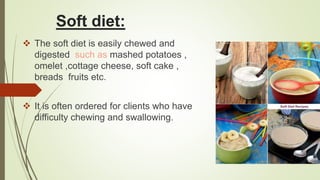
Soft diet:
 The soft diet is easily chewed and
digested such as mashed potatoes ,
omelet ,cottage cheese, soft cake ,
breads fruits etc.
 It is often ordered for clients who have
difficulty chewing and swallowing.
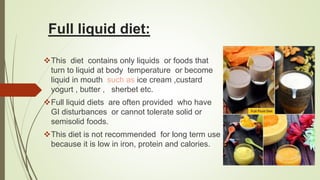
Full liquid diet:
This diet contains only liquids or foods that
turn to liquid at body temperature or become
liquid in mouth such as ice cream ,custard
yogurt , butter , sherbet etc.
Full liquid diets are often provided who have
GI disturbances or cannot tolerate solid or
semisolid foods.
This diet is not recommended for long term use
because it is low in iron, protein and calories.
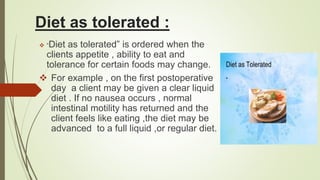
Diet as tolerated :
 “Diet as tolerated” is ordered when the
clients appetite , ability to eat and
tolerance for certain foods may change.
 For example , on the first postoperative
day a client may be given a clear liquid
diet . If no nausea occurs , normal
intestinal motility has returned and the
client feels like eating ,the diet may be
advanced to a full liquid ,or regular diet.
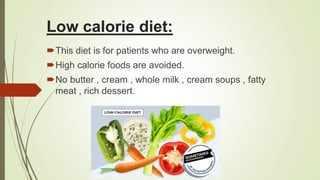
Low calorie diet:
This diet is for patients who are overweight.
High calorie foods are avoided.
No butter , cream , whole milk , cream soups , fatty
meat , rich dessert.
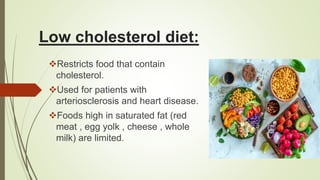
Low cholesterol diet:
Restricts food that contain
cholesterol.
Used for patients with
arteriosclerosis and heart disease.
Foods high in saturated fat (red
meat , egg yolk , cheese , whole
milk) are limited.
Nutrition support
Routes of nutrition support:
 Enteral nutrition
 Parenteral nutrition
Enteral nutrition :
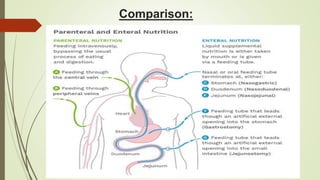
Enteral nutrition (EN) also referred to as total enteral nutrition
(TEN) , is provided when the client cannot ingests food or the
upper GI tract is impaired and the transport of food to the small
intestine is interrupted .
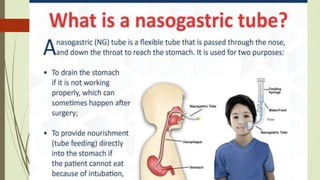
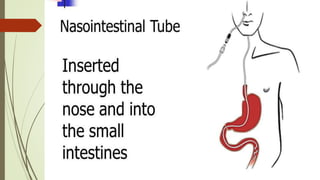
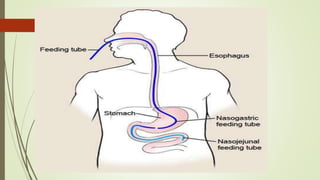
Enteral access devices:
Enteral feedings are administered by means of:
 Nasogastric or nasointestinal tubes
 Gastrostomy or jejunostomy tubes
Gastrostomy and jejunostomy tubes:
 Gastrostomy and jejunostomy devices are used for long term
nutritional support , generally more than 6 to 8 weeks.
 Tubes are placed surgically or by laparoscopy through the
abdominal wall into the stomach (gastrostomy) or into the
jejunum (jejunostomy).
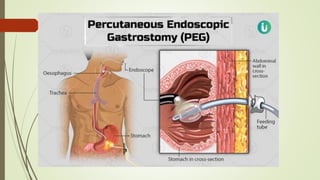
A percutaneous endoscopic gastrostomy (PEG) or
percutaneous endoscopic jejunostomy (PEJ) is
created by using an endoscope to visualize the
inside of stomach , making a puncture through the
skin and subcutaneous tissues of abdomen into
the stomach , and inserting the PEG or PEJ
catheter through the puncture.
Method:
Enteral feeding formula :
 A standard formula provides 1 Kcal per milliliter of solution with
protein , fat , carbohydrates , minerals ,and vitamins in specified
proportions.
 Enteral feedings can be given intermittently or continuously.
 Intermittently feedings are the administrations of 300 to 500ml of
enteral formula several times per day.
 Continuous feedings are generally administered over a 24 hour
period using an infusion pump that guarantees a constant flow rate.
Parenteral nutrition:
Parenteral nutrition also referred to as total parenteral nutrition
(TPN) is the IV infusion of dextrose , water , fat , proteins ,
electrolytes , vitamins and trace elements.
Because TPN solutions are hypertonic ( highly concentrated in
comparison to the solute concentration of blood ) they are in
injected only into high flow central veins , where they are diluted by
the clients blood.
TPN solutions :
TPN solutions are 10 % to 15% dextrose in water , plus a
mixture of amino acids and special additives such as
vitamins ( e.g. B .complex , C ,D, K , ) minerals ( e . g
potassium , sodium , chloride , calcium , phosphate ,
magnesium) and trace elements ( e . g cobalt , zinc .)
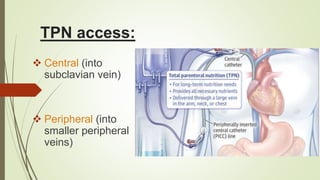
TPN access:
 Central (into
subclavian vein)
 Peripheral (into
smaller peripheral
veins)
Comparison:
Step 4 : Nutrition Monitoring and Evaluation:
 Determine whether the patient is meeting
the nutrition intervention goals or desired
outcomes.
 A nutrition reassessment is needed to
identify whether the nutrition-related
problem still exists and evaluate the
progress made toward resolving the
problem.
Thank you