
DIETARY CHANGE IN CRETE Eleni Tourlouki Crete MEDIS team  Christos, Lionis, Foteini, Anastasiou, Evangelia, Ladoukaki, Maria, Antonopoulou, Ioanna, Tsiligianni, Nikos, Tsakountakis, Kornillia, Makri, Demosthenes, Panagiotakos  Affiliations Department of Nutrition and Dietetics, Harokopio University, Athens, Greece Clinic of Social and Family Medicine, School of Medicine, University of Crete, Heraklion, Greece
Interest in the Cretan Diet Highest Life Expectancies In 1961, the Greek population had the overall highest life expectancy at the age of 45y compared to any other national group tracked by the World Health Organization. In 1991, overall second highest life expectancy at the age of 45y in Greece  (Nestle, 1995) . Lowest rates of chronic diseases Seven Countries Study (Menotti et al. 1999) Lyon Diet Heart Study (de Lorgeril et al. 1996)
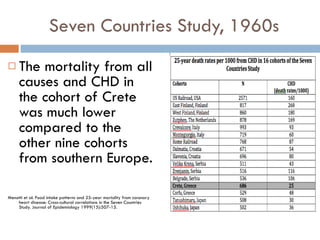
Seven Countries Study, 1960s The mortality from all causes and CHD in the cohort of Crete was much lower compared to the other nine cohorts from southern Europe. Menotti et al. Food intake patterns and 25-year mortality from coronary heart disease: Cross-cultural correlations in the Seven Countries Study. Journal of Epidemiology 1999(15):507-15.
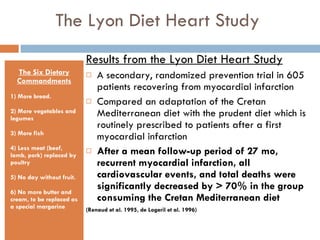
The Lyon Diet Heart Study  The Six Dietary Commandments 1) More bread. 2) More vegetables and legumes 3) More fish 4) Less meat (beef, lamb, pork) replaced by poultry 5) No day without fruit. 6) No more butter and cream, to be replaced as a special margarine Results from the Lyon Diet Heart Study A secondary, randomized prevention trial in 605 patients recovering from myocardial infarction  Compared an adaptation of the Cretan Mediterranean diet with the prudent diet which is routinely prescribed to patients after a first myocardial infarction After a mean follow-up period of 27 mo, recurrent myocardial infarction, all cardiovascular events, and total deaths were significantly decreased by > 70% in the group consuming the Cretan Mediterranean diet (Renaud et al. 1995, de Logeril et al. 1996)
Diets are Changing Throughout the 20 th  century food and food systems have undergone major changes.  Populations worldwide are shifting from whole-food diets based on traditional food systems to refined-food diets established by the food industry.
The Nutrition Transition A shift from under-nutrition, towards malnutrition Complex carbohydrates and fiber replaced by diets with a higher proportion of fats, saturated fats and sugars. The nutrition transition is accelerated by high  urbanization rates  (Drewnowski and Popkin, 1997) Demographic characteristics of Cretans are also changing. Occupations have shifted from farming to business and tourism (Kafatos, 1991)
Aim of Present Work To examine dietary change in Crete by making dietary comparisons between previous data (Survey of Crete, conducted in 1948) used as a reference of ‘past’ dietary patterns, and recent data collected as part of the Mediterranean Island Study (MEDIS in 2006-2007).
The Survey of Crete, 1948 To determine how best to raise the population’s standard of living. Dietary habits for every 1 of 150 households were carefully studied and recorded. Information on composition of the household, dietary patterns, household income, mortality, health, education, employment, land and capital resources, etc.  Food frequency questionnaires (765 households) Seven-day diet surveys Weighed food inventories (128 households)  Dietary intake records (>500 individuals) Food balance data (food supply) for Greece
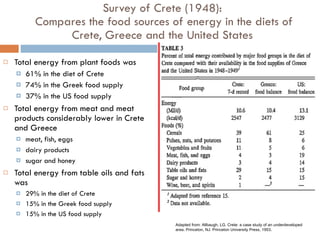
Survey of Crete (1948):  Compares the food sources of energy in the diets of Crete, Greece and the United States  Total energy from plant foods was 61% in the diet of Crete 74% in the Greek food supply  37% in the US food supply Total energy from meat and meat products considerably lower in Crete and Greece  meat, fish, eggs dairy products sugar and honey Total energy from table oils and fats was 29% in the diet of Crete 15% in the Greek food supply  15% in the US food supply Adapted from: Allbaugh, LG. Crete: a case study of an underdeveloped area. Princeton, NJ: Princeton University Press, 1953.
Survey of Crete (1948):  Cretan Diet Basic Foods Olives Cereal grains Pulses Wild greens Herbs Fruit Consumed in limited quantities  Goat meat and milk Game Fish “ No meal was complete without bread.”  Olives and olive oil contributed heavily to energy intake Wine was consumed frequently, with midmorning, noon and evening meals.
The Mediterranean Island Study (MEDIS), 2006 - 2007 Health and Nutrition Survey Examined bioclinical, lifestyle, behavioral, and dietary characteristics in elders Total MEDIS sample – 1812 876 men (aged 75 ± 7 years)  936 women (aged 74 ± 7 years)  From the following twelve Mediterranean islands:  Republic of Malta, Republic of Cyprus, and the Greek islands of Mitilini, Samothraki, Cephalonia, Crete, Corfu, Limnos, Ikaria, Syros, Naxos and Zakynthos.  Crete (n = 131) A semi-quantitative, validated and reproducible food-frequency questionnaire was used to assess dietary intake  (Tyrovolas et al., 2010)
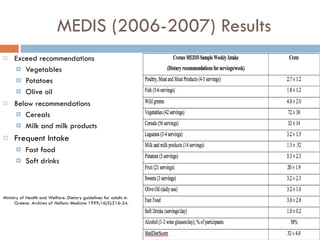
MEDIS (2006-2007) Results Exceed recommendations Vegetables Potatoes Olive oil Below recommendations Cereals Milk and milk products Frequent Intake Fast food Soft drinks Ministry of Health and Welfare. Dietary guidelines for adults in Greece . Archives of Hellenic Medicine  1999;16(5):516-24.
MEDIS Study (2006-2007):  Cretan Diet Vegetables and wild greens are the basic foods present in the diet Olive oil is also an essential source of calories  Milk and milk product intake is low (compared to dietary recommendations) Potatoes abundantly present in diet  (roughly 5 servings/weekly) Social drinking during meals (1-2 serving of alcohol consumed daily by 38% of sample) Fast food -  consumed 3 times weekly Soft Drink intake -  Consumed once daily
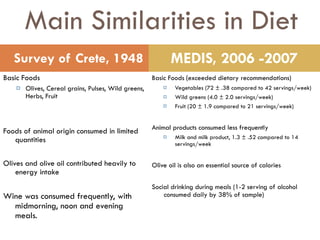
Main Similarities in Diet Basic Foods Olives, Cereal grains, Pulses, Wild greens, Herbs, Fruit Foods of animal origin consumed in limited quantities  Olives and olive oil contributed heavily to energy intake Wine was consumed frequently, with midmorning, noon and evening meals. Basic Foods  ( exceeded dietary recommendations) Vegetables (72 ± .38 compared to 42 servings/week) Wild greens (4.0 ± 2.0 servings/week) Fruit (20 ± 1.9 compared to 21 servings/week) Animal products consumed less frequently Milk and milk product, 1.3 ± .52 compared to 14 servings/week Olive oil is also an essential source of calories  Social drinking during meals (1-2 serving of alcohol consumed daily by 38% of sample) Survey of Crete, 1948 MEDIS, 2006 -2007
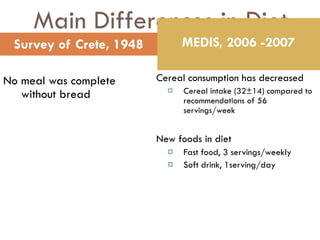
Main Differences in Diet No meal was complete without bread Cereal consumption has decreased Cereal intake (32±14) compared to recommendations of 56 servings/week New foods in diet Fast food, 3 servings/weekly Soft drink, 1serving/day Survey of Crete, 1948 MEDIS, 2006 -2007
Dietary Change in Crete Several studies have reported dietary change throughout Crete and other Mediterranean regions  Kafatos  et al . 1997, Tessier and Gerber 2005, Tyrovolas  et al . 2008, Polychronopoulos 2010 This change in dietary habits has been associated with increased rates of cardiovascular disease Mortality from cardiovascular disease is increasing in Greece, in contrast to trends observed in northern Europe and the USA  (Kromhout 2001, Chimonas 2001) In 2000, life expectancy was 75.7, ranking twelfth globally  (WHO 2007)
Dietary Change in Crete New food products are increasingly challenging the traditional Cretan diet Regular consumption of plant foods has upheld, but fast food and soft-drink consumption has increased
Live Long, Eat Cretan Local and regional interventions to preserve and promote the Cretan diet are necessary Schools and supermarkets can promote traditional dishes and products Educational programs on traditional diet and lifestyle – gathering of wild greens
References Nestle, Marion. Mediterranean diets: historical and research overview. Am J Clin Nutr 1995; 61(suppl):1313S-20S. Menotti et al. Food intake patterns and 25-year mortality from coronary heart disease: Cross-cultural correlations in the Seven Countries Study. Journal of Epidemiology 1999(15):507-15. De Lorgeril et al. Effect of a Mediterranean type of diet on the rate of cardiovascular complications in patients with coronary artery disease. J Am Coll Cardiol. 1996;28:1103–1108.30.  Renaud et al. Cretan Mediterranena diet for prevention of coronary heart disease. Am J Clin Nutr 1995;61:1360S-7S. Drewnowski, Adam, and Barry M. Popkin. The Nutrition Transition: New Trends in the Global Diet.  Nutrition Reviews , 1997;55(2), 31-43. Allbaugh, LG. Crete: a case study of an underdeveloped area. Princeton, NJ: Princeton University Press, 1953.  Tyrovolas et al . Level of adherence to the Mediterranean diet among elderly individuals living in Mediterranean Islands: nutritional report from the MEDIS study.  Ecology of Food and Nutrition  2008;48, 76-87. Ministry of Health and Welfare. Dietary guidelines for adults in Greece . Archives of Hellenic Medicine  1999;16(5):516-24. Kafatos et al. Coronary-heart-disease risk-factor status of the Cretan urban population in the 1980s.  Am J Clin Nutr  1991;54: 591-8.  Kafatos et al. Heart Disease Risk Status and Dietary Changes in the Cretan Population Over the Past 30 y: The Seven Countries Study.  American Journal of Clinical Nutrition  1997;65, 1882-86. Tessier S, M. Gerber. Factors determining the nutrition transition in two Mediterranean islands: Sardinia and Malta.  Public Health Nutrition  2005;8, 1286-92. Tyrovolas et al. Repeatability and validation of a short, semi-quantitative food frequency questionnaire designed for older adults living in Mediterranean areas: the MEDIS-FFQ.  Journal of Nutrition in Gerontology and Geriatrics  2011;29(3), 311-24. Polychronopoulos et al. Dietary meat fats and burden of cardiovascular disease risk factors, in the elderly: a report from the MEDIS study.  Lipids in Health and Disease  2010;9(30).  Kromhout D. Epidemiology of cardiovascular diseases in Europe. 
 Public Health Nutr  2001;4:441-457.  Chimonas E. The treatment of coronary heart disease: An update. Part 2: Mortality trends and main causes of death in the Greek population. 
 Curr Med Res Op  2001;17:27-33.

Diet in crete r2

  • 1.
    DIETARY CHANGE INCRETE Eleni Tourlouki Crete MEDIS team Christos, Lionis, Foteini, Anastasiou, Evangelia, Ladoukaki, Maria, Antonopoulou, Ioanna, Tsiligianni, Nikos, Tsakountakis, Kornillia, Makri, Demosthenes, Panagiotakos Affiliations Department of Nutrition and Dietetics, Harokopio University, Athens, Greece Clinic of Social and Family Medicine, School of Medicine, University of Crete, Heraklion, Greece
  • 2.
    Interest in theCretan Diet Highest Life Expectancies In 1961, the Greek population had the overall highest life expectancy at the age of 45y compared to any other national group tracked by the World Health Organization. In 1991, overall second highest life expectancy at the age of 45y in Greece (Nestle, 1995) . Lowest rates of chronic diseases Seven Countries Study (Menotti et al. 1999) Lyon Diet Heart Study (de Lorgeril et al. 1996)
  • 3.
    Seven Countries Study,1960s The mortality from all causes and CHD in the cohort of Crete was much lower compared to the other nine cohorts from southern Europe. Menotti et al. Food intake patterns and 25-year mortality from coronary heart disease: Cross-cultural correlations in the Seven Countries Study. Journal of Epidemiology 1999(15):507-15.
  • 4.
    The Lyon DietHeart Study The Six Dietary Commandments 1) More bread. 2) More vegetables and legumes 3) More fish 4) Less meat (beef, lamb, pork) replaced by poultry 5) No day without fruit. 6) No more butter and cream, to be replaced as a special margarine Results from the Lyon Diet Heart Study A secondary, randomized prevention trial in 605 patients recovering from myocardial infarction Compared an adaptation of the Cretan Mediterranean diet with the prudent diet which is routinely prescribed to patients after a first myocardial infarction After a mean follow-up period of 27 mo, recurrent myocardial infarction, all cardiovascular events, and total deaths were significantly decreased by > 70% in the group consuming the Cretan Mediterranean diet (Renaud et al. 1995, de Logeril et al. 1996)
  • 5.
    Diets are ChangingThroughout the 20 th century food and food systems have undergone major changes. Populations worldwide are shifting from whole-food diets based on traditional food systems to refined-food diets established by the food industry.
  • 6.
    The Nutrition TransitionA shift from under-nutrition, towards malnutrition Complex carbohydrates and fiber replaced by diets with a higher proportion of fats, saturated fats and sugars. The nutrition transition is accelerated by high urbanization rates (Drewnowski and Popkin, 1997) Demographic characteristics of Cretans are also changing. Occupations have shifted from farming to business and tourism (Kafatos, 1991)
  • 7.
    Aim of PresentWork To examine dietary change in Crete by making dietary comparisons between previous data (Survey of Crete, conducted in 1948) used as a reference of ‘past’ dietary patterns, and recent data collected as part of the Mediterranean Island Study (MEDIS in 2006-2007).
  • 8.
    The Survey ofCrete, 1948 To determine how best to raise the population’s standard of living. Dietary habits for every 1 of 150 households were carefully studied and recorded. Information on composition of the household, dietary patterns, household income, mortality, health, education, employment, land and capital resources, etc. Food frequency questionnaires (765 households) Seven-day diet surveys Weighed food inventories (128 households) Dietary intake records (>500 individuals) Food balance data (food supply) for Greece
  • 9.
    Survey of Crete(1948): Compares the food sources of energy in the diets of Crete, Greece and the United States Total energy from plant foods was 61% in the diet of Crete 74% in the Greek food supply 37% in the US food supply Total energy from meat and meat products considerably lower in Crete and Greece meat, fish, eggs dairy products sugar and honey Total energy from table oils and fats was 29% in the diet of Crete 15% in the Greek food supply 15% in the US food supply Adapted from: Allbaugh, LG. Crete: a case study of an underdeveloped area. Princeton, NJ: Princeton University Press, 1953.
  • 10.
    Survey of Crete(1948): Cretan Diet Basic Foods Olives Cereal grains Pulses Wild greens Herbs Fruit Consumed in limited quantities Goat meat and milk Game Fish “ No meal was complete without bread.” Olives and olive oil contributed heavily to energy intake Wine was consumed frequently, with midmorning, noon and evening meals.
  • 11.
    The Mediterranean IslandStudy (MEDIS), 2006 - 2007 Health and Nutrition Survey Examined bioclinical, lifestyle, behavioral, and dietary characteristics in elders Total MEDIS sample – 1812 876 men (aged 75 ± 7 years) 936 women (aged 74 ± 7 years) From the following twelve Mediterranean islands: Republic of Malta, Republic of Cyprus, and the Greek islands of Mitilini, Samothraki, Cephalonia, Crete, Corfu, Limnos, Ikaria, Syros, Naxos and Zakynthos. Crete (n = 131) A semi-quantitative, validated and reproducible food-frequency questionnaire was used to assess dietary intake (Tyrovolas et al., 2010)
  • 12.
    MEDIS (2006-2007) ResultsExceed recommendations Vegetables Potatoes Olive oil Below recommendations Cereals Milk and milk products Frequent Intake Fast food Soft drinks Ministry of Health and Welfare. Dietary guidelines for adults in Greece . Archives of Hellenic Medicine 1999;16(5):516-24.
  • 13.
    MEDIS Study (2006-2007): Cretan Diet Vegetables and wild greens are the basic foods present in the diet Olive oil is also an essential source of calories Milk and milk product intake is low (compared to dietary recommendations) Potatoes abundantly present in diet (roughly 5 servings/weekly) Social drinking during meals (1-2 serving of alcohol consumed daily by 38% of sample) Fast food - consumed 3 times weekly Soft Drink intake - Consumed once daily
  • 14.
    Main Similarities inDiet Basic Foods Olives, Cereal grains, Pulses, Wild greens, Herbs, Fruit Foods of animal origin consumed in limited quantities Olives and olive oil contributed heavily to energy intake Wine was consumed frequently, with midmorning, noon and evening meals. Basic Foods ( exceeded dietary recommendations) Vegetables (72 ± .38 compared to 42 servings/week) Wild greens (4.0 ± 2.0 servings/week) Fruit (20 ± 1.9 compared to 21 servings/week) Animal products consumed less frequently Milk and milk product, 1.3 ± .52 compared to 14 servings/week Olive oil is also an essential source of calories Social drinking during meals (1-2 serving of alcohol consumed daily by 38% of sample) Survey of Crete, 1948 MEDIS, 2006 -2007
  • 15.
    Main Differences inDiet No meal was complete without bread Cereal consumption has decreased Cereal intake (32±14) compared to recommendations of 56 servings/week New foods in diet Fast food, 3 servings/weekly Soft drink, 1serving/day Survey of Crete, 1948 MEDIS, 2006 -2007
  • 16.
    Dietary Change inCrete Several studies have reported dietary change throughout Crete and other Mediterranean regions Kafatos et al . 1997, Tessier and Gerber 2005, Tyrovolas et al . 2008, Polychronopoulos 2010 This change in dietary habits has been associated with increased rates of cardiovascular disease Mortality from cardiovascular disease is increasing in Greece, in contrast to trends observed in northern Europe and the USA (Kromhout 2001, Chimonas 2001) In 2000, life expectancy was 75.7, ranking twelfth globally (WHO 2007)
  • 17.
    Dietary Change inCrete New food products are increasingly challenging the traditional Cretan diet Regular consumption of plant foods has upheld, but fast food and soft-drink consumption has increased
  • 18.
    Live Long, EatCretan Local and regional interventions to preserve and promote the Cretan diet are necessary Schools and supermarkets can promote traditional dishes and products Educational programs on traditional diet and lifestyle – gathering of wild greens
  • 19.
    References Nestle, Marion.Mediterranean diets: historical and research overview. Am J Clin Nutr 1995; 61(suppl):1313S-20S. Menotti et al. Food intake patterns and 25-year mortality from coronary heart disease: Cross-cultural correlations in the Seven Countries Study. Journal of Epidemiology 1999(15):507-15. De Lorgeril et al. Effect of a Mediterranean type of diet on the rate of cardiovascular complications in patients with coronary artery disease. J Am Coll Cardiol. 1996;28:1103–1108.30.  Renaud et al. Cretan Mediterranena diet for prevention of coronary heart disease. Am J Clin Nutr 1995;61:1360S-7S. Drewnowski, Adam, and Barry M. Popkin. The Nutrition Transition: New Trends in the Global Diet. Nutrition Reviews , 1997;55(2), 31-43. Allbaugh, LG. Crete: a case study of an underdeveloped area. Princeton, NJ: Princeton University Press, 1953. Tyrovolas et al . Level of adherence to the Mediterranean diet among elderly individuals living in Mediterranean Islands: nutritional report from the MEDIS study. Ecology of Food and Nutrition 2008;48, 76-87. Ministry of Health and Welfare. Dietary guidelines for adults in Greece . Archives of Hellenic Medicine 1999;16(5):516-24. Kafatos et al. Coronary-heart-disease risk-factor status of the Cretan urban population in the 1980s. Am J Clin Nutr 1991;54: 591-8.  Kafatos et al. Heart Disease Risk Status and Dietary Changes in the Cretan Population Over the Past 30 y: The Seven Countries Study. American Journal of Clinical Nutrition 1997;65, 1882-86. Tessier S, M. Gerber. Factors determining the nutrition transition in two Mediterranean islands: Sardinia and Malta. Public Health Nutrition 2005;8, 1286-92. Tyrovolas et al. Repeatability and validation of a short, semi-quantitative food frequency questionnaire designed for older adults living in Mediterranean areas: the MEDIS-FFQ. Journal of Nutrition in Gerontology and Geriatrics 2011;29(3), 311-24. Polychronopoulos et al. Dietary meat fats and burden of cardiovascular disease risk factors, in the elderly: a report from the MEDIS study. Lipids in Health and Disease 2010;9(30). Kromhout D. Epidemiology of cardiovascular diseases in Europe. 
 Public Health Nutr 2001;4:441-457. Chimonas E. The treatment of coronary heart disease: An update. Part 2: Mortality trends and main causes of death in the Greek population. 
 Curr Med Res Op 2001;17:27-33.

Editor's Notes

  • #3 Interest in the Cretan diet due to health benefits it produced. According to the WHO, adult populations in Mediterranean regions display life expectancies that are amongst the highest in the world and r ates of chronic diseases that are amongst the lowest. In 1961, the Greek population had the overall highest life expectancy at the age of 45y compared to any other national group tracked by the World Health Organization. More recently, in 1991, life expectancy at the age of 45y in Greece was 32.5y , ranking second to Japan’s 33.3y.
  • #4 Epidemiological study that examined diet and disease… Southern Med, had lowest rates of CHD compared to Northern Europe and US. Therefore, if any Mediterranean diet should be duplicated as a model of healthy eating, it should be the Cretan diet.
  • #5 No doubt the Cretan diet is cardioprotective
  • #7 Diets are Changing worldwide The nutrition transition refers to a shift from under-nutrition, marked by limited food availability and expendable income, towards malnutrition, distinguished by low-quality foods. Diets high in complex carbohydrates and fiber are replaced by diets with a higher proportion of fats, saturated fats and sugars.
  • #9 The study was conducted in 1948, by the Rockefeller Foundation, on the island of Crete in order to determine how best to raise the population’s standard of living. Obtained extensive amount or information on composition of the household, dietary patterns, household income, mortality, health, education, employment, land and capital resources, amongst other variables . This was the first systematic attempt to investigate dietary intake in the Mediterranean reg ion.
  • #10 This tables displays dietary intake data from Crete, but reports food balance data for Greece and the United States, even though these methods are not truly compatible. Therefore the results can only be interpreted as indicating that…
  • #11 Table 2 and 3 constitute the basis of the report’s conclusion that
  • #12 Health and nutrition survey that examined bioclinical, lifestyle, behavioral, and dietary characteristics in a sample of 1812 elderly people living on the Mediterranean Islands. Total MEDIS sample – 1812, 876 men and 936 women aged roughly 75 y.
  • #13 To facilitate comparison, the guidelines for adults in Greece (Ministry of Health and Welfare, 1999) were used. MedDietScore, moderate adherence. Wild greens played an essential role in the diet, still today. Olive oil main source of fat.
  • #16 If we convert the grams of potatoes to servings and we estimate an average potato is 1 5 0g then approximately 7 servings were eaten weekly. IN agreement with Kafatos and colleagues results who reported a decrease in potato intake by 53% and bread by 70% as compared with data from the Seven Countries Study collected in the early 1960s (Kafatos et al., 1991).
  • #18 Although the Cretan diet has been a product of accumulated social and ecological wisdom that has withstood the test of time, study results suggest that new food products and habits are increasingly challenging dietary traditions. the presence of plants in the diet is holding strong and regular consumption of these products has been upheld, fast food, soft-drink and sweet consumption have increased. undoubtedly foodways will continue to evolve through travel, modern technology and trade, and new food products and habits will continue to compete with traditional ones. promotion efforts to preserve the health promoting traditional Cretan diet are warranted.