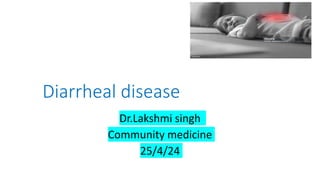
Diarrheal disease
Dr.Lakshmi singh
Community medicine
25/4/24
• DEFINITION:Diarrhea is defined as a change in consistency and frequency
of stools, i.e. liquid or watery stools, that occur >3 times a day.
• Acute diarrhea may persist for >2 weeks in 5-15% cases, which is labeled as
persistent diarrhea.
• Diarrhea accounts for over 20% of all deaths in under-five children. The
two most important consequences of diarrhea in children are malnutrition
and dehydration. Malnutrition and diarrhea form a vicious cycle, since
malnutrition increases the risk and severity of diarrhea. Impaired
absorption, loss of nutrients, increased catabolism and improper feeding in
diarrhea aggravate the severity of malnutrition
Causes:
Bacterial:
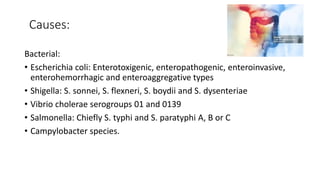
• Escherichia coli: Enterotoxigenic, enteropathogenic, enteroinvasive,
enterohemorrhagic and enteroaggregative types
• Shigella: S. sonnei, S. flexneri, S. boydii and S. dysenteriae
• Vibrio cholerae serogroups 01 and 0139
• Salmonella: Chiefly S. typhi and S. paratyphi A, B or C
• Campylobacter species.
Viral:
• Rotavirus
• Human caliciviruses: Norovirus spp.; Sapovirus spp.
• Enteric adenoviruses serotypes 40 and 41
• Others: Astroviruses, coronaviruses, cytomegalovirus, picornavirus
Parasitic Giardia lamblia, Cryptosporidium parvum, Entamoeba
histolytica ,Cyclospora cayetanensis ,lsospora belIi
Risk Factors:
Factors determining susceptibility to diarrhea include
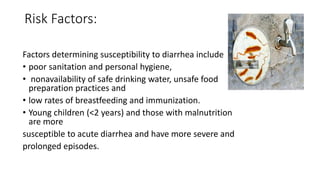
• poor sanitation and personal hygiene,
• nonavailability of safe drinking water, unsafe food
preparation practices and
• low rates of breastfeeding and immunization.
• Young children (<2 years) and those with malnutrition
are more
susceptible to acute diarrhea and have more severe and
prolonged episodes.
• Risk factors for prolonged and recurrent episodes of diarrhea include
presence of hypo or achlorhydria (due to Helicobacter pylori infection
or
therapy with proton pump inhibitors),
• selective IgA deficiency,
• infection with human immunodeficiency virus (HIV) and other
chronic conditions.
• Alteration of normal intestinal microflora by antibiotics can
predispose to C.difficile infection.
Pathogenesis:
• Approximately 60% of a child's body weight is water, present in two
fluid compartments:
• The extracellular fluid (ECF) and intracellular fluid (ICF). The ECF
includes circulating blood, intestinal fluid and secretions. Diarrheal
losses come from ECF, which is relatively rich in sodium and has low
potassium.
• Loss of water from the body causes a reduction or shrinkage of ECF
volume. sodium is lost in the stools leading to a relative decline in
serum sodium (hyponatremia) and a fall in ECF osmolality. This causes
movement of water from the ECF to ICF compartment, causing
further shrinkage of the already reduced extracellular compartment
volume in hyponatremic dehydration
• As the ECF compartment is depleted, the blood volume is reduced.
This results in a weak, thready pulse, low blood pressure and cold
extremities. Because of low hydrostatic pressure in the renal
glomeruli, the filtration of urine is reduced. This is ominous because
poorly functioning kidneys cannot regulate metabolic derangements.
Severe cases are associated with renal failure.
• Diarrheal stools contain large amounts of potassium. Therefore,
serum level of potassium invariably falls, if diarrhea persists for more
than a few days. Affected children present with abdominal distension,
paralytic ileus and muscle hypotonia.
• Since intestinal secretions are alkaline, considerable bicarbonate is
lost in diarrheal stools and acidosis usually accompanies dehydration
CLINICAL FEATURES:
• The child is thirsty and slightly irritable in early and mild cases of diarrhea.
• As the diarrhea continues and dehydration worsens, the child becomes
more irritable and develops a pinched look.
• The fontanelle, if open, is depressed, the eyes appear sunken and the
tongue and the inner side of cheeks appear dry.
• Abdomen may become distended in hypokalemia.
• The child passes urine at longer intervals. As acidosis worsens, the
breathing becomes deep and rapid.
• In extreme cases, the child appears moribund, with weak and thready
pulses, low blood pressure and reduced urine output. Children with severe
dehydration may succumb rapidly, if not treated promptly.
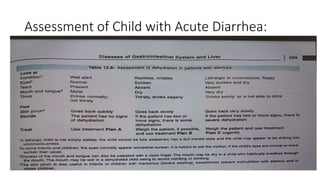
Assessment of Child with Acute Diarrhea:
Laboratory investigations:
1. Stool microscopy :such as cholera (darting motion suggests Vibrio
cholerae) and giardiasis (trophozoites).
2. Stool culture is of little value in routine management of acute diarrhea. It
is useful to decide on antibiotic therapy in patients with Shigella
dysentery who do not respond to the initial empiric antibiotics.
3. Tests for stool pH and reducing substances are not indicated in acute
diarrhea.
4. Hemogram
5. serum electrolytes,
6. renal function tests are indicated only if the patient has associated
findings like pallor, labored breathing etc.
MANAGEMENT:
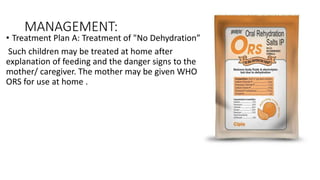
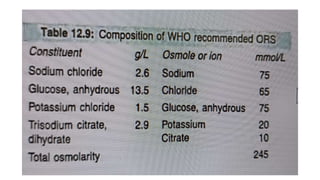
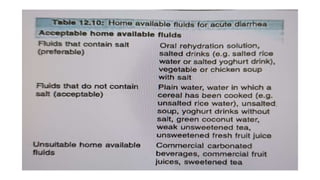
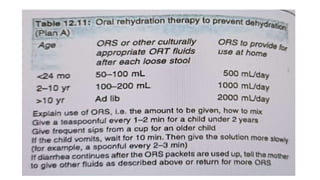
• Treatment Plan A: Treatment of "No Dehydration”
Such children may be treated at home after
explanation of feeding and the danger signs to the
mother/ caregiver. The mother may be given WHO
ORS for use at home .
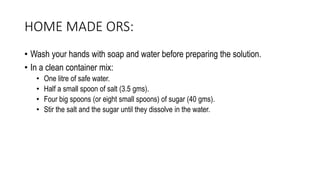
HOME MADE ORS:
• Wash your hands with soap and water before preparing the solution.
• In a clean container mix:
• One litre of safe water.
• Half a small spoon of salt (3.5 gms).
• Four big spoons (or eight small spoons) of sugar (40 gms).
• Stir the salt and the sugar until they dissolve in the water.
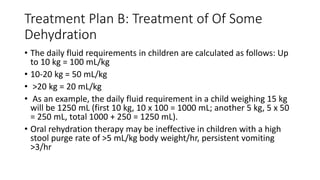
Treatment Plan B: Treatment of Of Some
Dehydration
• The daily fluid requirements in children are calculated as follows: Up
to 10 kg = 100 mL/kg
• 10-20 kg = 50 mL/kg
• >20 kg = 20 mL/kg
• As an example, the daily fluid requirement in a child weighing 15 kg
will be 1250 mL (first 10 kg, 10 x 100 = 1000 mL; another 5 kg, 5 x 50
= 250 mL, total 1000 + 250 = 1250 mL).
• Oral rehydration therapy may be ineffective in children with a high
stool purge rate of >5 mL/kg body weight/hr, persistent vomiting
>3/hr
• Deficit replacement or rehydration therapy is calculated as 75 mL/kg
of ORS, to be given over 4 hours.
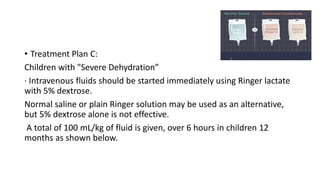
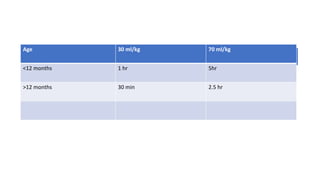
• Treatment Plan C:
Children with "Severe Dehydration”
· Intravenous fluids should be started immediately using Ringer lactate
with 5% dextrose.
Normal saline or plain Ringer solution may be used as an alternative,
but 5% dextrose alone is not effective.
A total of 100 mL/kg of fluid is given, over 6 hours in children 12
months as shown below.
age 30 ml/kg 70 ml/kg
Age 30 ml/kg 70 ml/kg
<12 months 1 hr 5hr
>12 months 30 min 2.5 hr
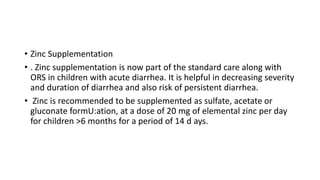
• Zinc Supplementation
• . Zinc supplementation is now part of the standard care along with
ORS in children with acute diarrhea. It is helpful in decreasing severity
and duration of diarrhea and also risk of persistent diarrhea.
• Zinc is recommended to be supplemented as sulfate, acetate or
gluconate formU:ation, at a dose of 20 mg of elemental zinc per day
for children >6 months for a period of 14 d ays.
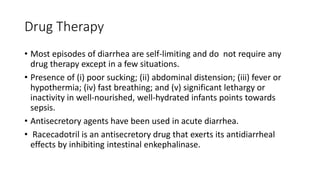
Drug Therapy
• Most episodes of diarrhea are self-limiting and do not require any
drug therapy except in a few situations.
• Presence of (i) poor sucking; (ii) abdominal distension; (iii) fever or
hypothermia; (iv) fast breathing; and (v) significant lethargy or
inactivity in well-nourished, well-hydrated infants points towards
sepsis.
• Antisecretory agents have been used in acute diarrhea.
• Racecadotril is an antisecretory drug that exerts its antidiarrheal
effects by inhibiting intestinal enkephalinase.
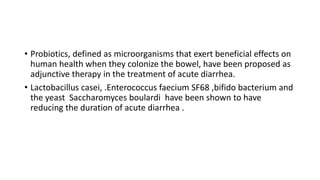
• Probiotics, defined as microorganisms that exert beneficial effects on
human health when they colonize the bowel, have been proposed as
adjunctive therapy in the treatment of acute diarrhea.
• Lactobacillus casei, .Enterococcus faecium SF68 ,bifido bacterium and
the yeast Saccharomyces boulardi have been shown to have
reducing the duration of acute diarrhea .
Prevention of Diarrhea and Malnutrition
• i. Proper nutrition
• ii. Adequate sanitation Three 'Cs; clean hands, clean container and
clean environment are the key messages.
• iii. Vaccination
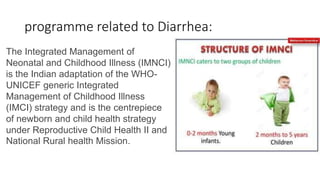
programme related to Diarrhea:
The Integrated Management of
Neonatal and Childhood Illness (IMNCI)
is the Indian adaptation of the WHO-
UNICEF generic Integrated
Management of Childhood Illness
(IMCI) strategy and is the centrepiece
of newborn and child health strategy
under Reproductive Child Health II and
National Rural health Mission.
• IMCI identifies general danger signs that may call for
hospitalization of the child and then bases its assessment on
the presence of
• 1) cough and difficulty breathing,
• 2) diarrhea,
• 3) fever,
• 4) measles,
• 5) ear infection, and
• 6) malnutrition.
• Because many children have more than one condition, each
illness is classified according to whether it requires: urgent pre-
referral treatment and referral (pink), or.
• specific medical treatment and advice (yellow), or.
• simple advice on home management (green).
diarrheal diseases UG PRACTICAL class.pptx

diarrheal diseases UG PRACTICAL class.pptx

  • 1.
  • 2.
    • DEFINITION:Diarrhea isdefined as a change in consistency and frequency of stools, i.e. liquid or watery stools, that occur >3 times a day. • Acute diarrhea may persist for >2 weeks in 5-15% cases, which is labeled as persistent diarrhea. • Diarrhea accounts for over 20% of all deaths in under-five children. The two most important consequences of diarrhea in children are malnutrition and dehydration. Malnutrition and diarrhea form a vicious cycle, since malnutrition increases the risk and severity of diarrhea. Impaired absorption, loss of nutrients, increased catabolism and improper feeding in diarrhea aggravate the severity of malnutrition
  • 3.
    Causes: Bacterial: • Escherichia coli:Enterotoxigenic, enteropathogenic, enteroinvasive, enterohemorrhagic and enteroaggregative types • Shigella: S. sonnei, S. flexneri, S. boydii and S. dysenteriae • Vibrio cholerae serogroups 01 and 0139 • Salmonella: Chiefly S. typhi and S. paratyphi A, B or C • Campylobacter species.
  • 4.
    Viral: • Rotavirus • Humancaliciviruses: Norovirus spp.; Sapovirus spp. • Enteric adenoviruses serotypes 40 and 41 • Others: Astroviruses, coronaviruses, cytomegalovirus, picornavirus Parasitic Giardia lamblia, Cryptosporidium parvum, Entamoeba histolytica ,Cyclospora cayetanensis ,lsospora belIi
  • 5.
    Risk Factors: Factors determiningsusceptibility to diarrhea include • poor sanitation and personal hygiene, • nonavailability of safe drinking water, unsafe food preparation practices and • low rates of breastfeeding and immunization. • Young children (<2 years) and those with malnutrition are more susceptible to acute diarrhea and have more severe and prolonged episodes.
  • 6.
    • Risk factorsfor prolonged and recurrent episodes of diarrhea include presence of hypo or achlorhydria (due to Helicobacter pylori infection or therapy with proton pump inhibitors), • selective IgA deficiency, • infection with human immunodeficiency virus (HIV) and other chronic conditions. • Alteration of normal intestinal microflora by antibiotics can predispose to C.difficile infection.
  • 7.
    Pathogenesis: • Approximately 60%of a child's body weight is water, present in two fluid compartments: • The extracellular fluid (ECF) and intracellular fluid (ICF). The ECF includes circulating blood, intestinal fluid and secretions. Diarrheal losses come from ECF, which is relatively rich in sodium and has low potassium.
  • 8.
    • Loss ofwater from the body causes a reduction or shrinkage of ECF volume. sodium is lost in the stools leading to a relative decline in serum sodium (hyponatremia) and a fall in ECF osmolality. This causes movement of water from the ECF to ICF compartment, causing further shrinkage of the already reduced extracellular compartment volume in hyponatremic dehydration
  • 9.
    • As theECF compartment is depleted, the blood volume is reduced. This results in a weak, thready pulse, low blood pressure and cold extremities. Because of low hydrostatic pressure in the renal glomeruli, the filtration of urine is reduced. This is ominous because poorly functioning kidneys cannot regulate metabolic derangements. Severe cases are associated with renal failure.
  • 10.
    • Diarrheal stoolscontain large amounts of potassium. Therefore, serum level of potassium invariably falls, if diarrhea persists for more than a few days. Affected children present with abdominal distension, paralytic ileus and muscle hypotonia. • Since intestinal secretions are alkaline, considerable bicarbonate is lost in diarrheal stools and acidosis usually accompanies dehydration
  • 11.
    CLINICAL FEATURES: • Thechild is thirsty and slightly irritable in early and mild cases of diarrhea. • As the diarrhea continues and dehydration worsens, the child becomes more irritable and develops a pinched look. • The fontanelle, if open, is depressed, the eyes appear sunken and the tongue and the inner side of cheeks appear dry. • Abdomen may become distended in hypokalemia. • The child passes urine at longer intervals. As acidosis worsens, the breathing becomes deep and rapid. • In extreme cases, the child appears moribund, with weak and thready pulses, low blood pressure and reduced urine output. Children with severe dehydration may succumb rapidly, if not treated promptly.
  • 12.
    Assessment of Childwith Acute Diarrhea:
  • 13.
    Laboratory investigations: 1. Stoolmicroscopy :such as cholera (darting motion suggests Vibrio cholerae) and giardiasis (trophozoites). 2. Stool culture is of little value in routine management of acute diarrhea. It is useful to decide on antibiotic therapy in patients with Shigella dysentery who do not respond to the initial empiric antibiotics. 3. Tests for stool pH and reducing substances are not indicated in acute diarrhea. 4. Hemogram 5. serum electrolytes, 6. renal function tests are indicated only if the patient has associated findings like pallor, labored breathing etc.
  • 14.
    MANAGEMENT: • Treatment PlanA: Treatment of "No Dehydration” Such children may be treated at home after explanation of feeding and the danger signs to the mother/ caregiver. The mother may be given WHO ORS for use at home .
  • 17.
    HOME MADE ORS: •Wash your hands with soap and water before preparing the solution. • In a clean container mix: • One litre of safe water. • Half a small spoon of salt (3.5 gms). • Four big spoons (or eight small spoons) of sugar (40 gms). • Stir the salt and the sugar until they dissolve in the water.
  • 19.
    Treatment Plan B:Treatment of Of Some Dehydration • The daily fluid requirements in children are calculated as follows: Up to 10 kg = 100 mL/kg • 10-20 kg = 50 mL/kg • >20 kg = 20 mL/kg • As an example, the daily fluid requirement in a child weighing 15 kg will be 1250 mL (first 10 kg, 10 x 100 = 1000 mL; another 5 kg, 5 x 50 = 250 mL, total 1000 + 250 = 1250 mL). • Oral rehydration therapy may be ineffective in children with a high stool purge rate of >5 mL/kg body weight/hr, persistent vomiting >3/hr
  • 20.
    • Deficit replacementor rehydration therapy is calculated as 75 mL/kg of ORS, to be given over 4 hours.
  • 21.
    • Treatment PlanC: Children with "Severe Dehydration” · Intravenous fluids should be started immediately using Ringer lactate with 5% dextrose. Normal saline or plain Ringer solution may be used as an alternative, but 5% dextrose alone is not effective. A total of 100 mL/kg of fluid is given, over 6 hours in children 12 months as shown below.
  • 22.
    age 30 ml/kg70 ml/kg Age 30 ml/kg 70 ml/kg <12 months 1 hr 5hr >12 months 30 min 2.5 hr
  • 23.
    • Zinc Supplementation •. Zinc supplementation is now part of the standard care along with ORS in children with acute diarrhea. It is helpful in decreasing severity and duration of diarrhea and also risk of persistent diarrhea. • Zinc is recommended to be supplemented as sulfate, acetate or gluconate formU:ation, at a dose of 20 mg of elemental zinc per day for children >6 months for a period of 14 d ays.
  • 24.
    Drug Therapy • Mostepisodes of diarrhea are self-limiting and do not require any drug therapy except in a few situations. • Presence of (i) poor sucking; (ii) abdominal distension; (iii) fever or hypothermia; (iv) fast breathing; and (v) significant lethargy or inactivity in well-nourished, well-hydrated infants points towards sepsis. • Antisecretory agents have been used in acute diarrhea. • Racecadotril is an antisecretory drug that exerts its antidiarrheal effects by inhibiting intestinal enkephalinase.
  • 25.
    • Probiotics, definedas microorganisms that exert beneficial effects on human health when they colonize the bowel, have been proposed as adjunctive therapy in the treatment of acute diarrhea. • Lactobacillus casei, .Enterococcus faecium SF68 ,bifido bacterium and the yeast Saccharomyces boulardi have been shown to have reducing the duration of acute diarrhea .
  • 26.
    Prevention of Diarrheaand Malnutrition • i. Proper nutrition • ii. Adequate sanitation Three 'Cs; clean hands, clean container and clean environment are the key messages. • iii. Vaccination
  • 27.
    programme related toDiarrhea: The Integrated Management of Neonatal and Childhood Illness (IMNCI) is the Indian adaptation of the WHO- UNICEF generic Integrated Management of Childhood Illness (IMCI) strategy and is the centrepiece of newborn and child health strategy under Reproductive Child Health II and National Rural health Mission.
  • 28.
    • IMCI identifiesgeneral danger signs that may call for hospitalization of the child and then bases its assessment on the presence of • 1) cough and difficulty breathing, • 2) diarrhea, • 3) fever, • 4) measles, • 5) ear infection, and • 6) malnutrition.
  • 29.
    • Because manychildren have more than one condition, each illness is classified according to whether it requires: urgent pre- referral treatment and referral (pink), or. • specific medical treatment and advice (yellow), or. • simple advice on home management (green).