Dr. P.K. Gupta, Prof. & Head
Dr. A.K. Singh, Assoc. Prof.
Dr. Umesh Chandra , Asstt. Prof
Department Of Entomology
Mun mun Mohapatra,
M.Sc.Ag.(Entomology)
A-8184/14
 Scientific Name: Plutella
xylostella
 Order: Lepidoptera
 Family: Yponomeutidae
 Damaging Stage:
Larvae
(Caterpillars)
 It is one of the most destructive cosmopolitan pests of cruciferous
crops such as cauliflower, cabbage, radish, knoll-khol & mustard
etc.
 It causes significant economic losses upto 52% approximately
with an estimate of 4- 5 billion US $ per year globally.
 It is most widely distributed pest among the other lepidopterans.
 The larvae feeds on the foliage at growth stage of the crop and
greatly reduce quality and yield as well.
 In past 50 years, it has becomes one of the most difficult insect in
the world because of resistance to every class of insecticides used
extensively against it.
 In India, it is one of the major constraints in the profitable
cultivation of cole- crops.
 DBM has probably originated in the
Mediterranean region.
 Accidentally introduced from Europe in
1746, it was 1st reported in N. America in
Illionis in 1854 & from Western Canada in
1885.
 It is found over much of N. America, S.
America, Southern Africa, Europe, India, S-
E Asia, New Zealand and parts of Australia.
 In India, DBM was reported in 1914 on
cruciferous vegetables.
 In India, it is also most devastating pest in
the states of Punjab, Haryana, Himachala-
Pradesh, Delhi, Uttar-Pradesh, Bihar, Tamil-
nadu, Maharastra and Karnatak
 The Diamondback moth feeds only on members of the family
Cruciferae/ Brassicaceae.
 Study on food plant preference of DBM revealed that the larvae
have marked preference for cauliflower & cabbage among the 40
species of crucifers.
 This is due to the fact that both plants posses fleshy & succulent
leaves and provide olfactory & gustatory stimuli for successful
host selection & development.
 Alternate weed hosts are especially important in maintaining in
DBM population in temperate regions in spring before cruciferous
crops are planted.
 The host range of DBM is limited to crucifers that contain mustard
oil & their glucosides.
 The glucosides such as sinigrin, sinalbin & glucocheirolin act as
specific feeding stimulants for DBM.
 Certain chemicals such as sulfur-containing glucosinolates or its
metabolites and allyl-isothiocyanates are present in crucifers & act
as oviposition stimulants.
 Sulfur deficient plants are not attractive to DBM for oviposition.
 Allyl-isothiocyanates also stimulates egg production in
diamondback moth adults.
•6 mm in length and
light brown in color
• Small, grayish brown color
moth ,the fore wings have 3
triangular, white spots
along inner margin & at rest
these give diamond shape
& hind wings have fringed
long hairs
•Neonates are pale
brown with dark head
while full-grown are
light green in color
&10 mm in length
• Flat, oval-shaped eggs,
whitish – yellow & 0.5
mm in length & 0.26 mm
in width
EGG LARVAE
PUPAEADULT
FEMALE MALE
 Eggs are laid singly or in groups of 2-40 on the under surface of
leaves. The eggs hatch in 3-9 days.
 The larval period is completed in 8- 17 days.
 Before pupation the larvae construct a barrel shaped silken
cocoon, which is opened at both ends & is attached to leaf
surface.
 Pupal period lasts for 4 days in hot & rainy season and 5 days in
cold season.
 Adult longevity ranges from 6-13 days, females live shorter than
male.
 Adults begin to mate at dusk on the same day of emergence and
mating lasts only 1-2 hours, females mate only once.
 Females lay eggs after mating and oviposition continues for 10
days with a peak on the first day of emergence.
 2-4 generations occur in colder parts of India and 13-14
generations in South India.
 The biology significantly varies on cauliflower, cabbage, radish,
turnip, knol-khol, beetroot, amaranthus and weed hosts.
 There is no variation in egg period.
 Pupal- period is shorter and adult emergence is more on
cauliflower.
 Fecundity is higher on mustard(366eggs/female) followed by
cauliflower, cabbage, radish & knol-khol.
 The larvae consume and gain more weight on cauliflower than on
other host plants.
 The consumption index, growth rate, efficiency of conversion of
ingested food, efficiency of conversion of digested food and
approximate digestibility are more on cauliflower than on other
host plants.
1st instars
• They cause small mines & feed in these tunnels
• At first their presence can be detected only from blackish
excreta that appear at each mouth tunnel
2nd & 3rd
instars
• In 2nd instars the mines become more prominent
• In 3rd instars the caterpillars usually feed outside the tunnels
4th instars
• They feed from underside of the leaves leaving intact a
parchment like transparent cuticular layer on the dorsal surface
• They bite holes in the leaves & feed on curds
 Many countries are still continously plagued by P. xyllostella and
there is strong evidence that this is due to lack of crucially
important parasites.
 Host plant availability and action of its natural enemies are two key
biotic factors that regulate DBM populations in the field.
 In countries, synthetic insecticides are used to control DBM, which
often eliminates natural enemies.
 This in turn, can lead to continued intensive use of insecticides,
eventual insecticides resistance & control failure.
 DBM was the 1st crop pest in the world to be reported resistant to
DDT in 1953 in Java, Indonesia.
 In addition, DBM have distinction of being the 1st insects to
develop resistance in the field to bacterial insecticide, Bacillus
thuringiensis.
 This has prompted increased efforts worldwide to develop
integrated pest management (IPM) programmes principally based
on manipulation of natural enemies.
 DBM populations native to different regions have genetic &
biological differences and specific parasitoid strains may be
associated with the specific DBM strains.
 Therefore accurate identification based on genetic studies of both
host & parasitoid is of crucial importance to attaining successful
control of DBM through innoculative or innundative releases.
 All stages of Diamondback moth are attacked by numerous
parasitoids and predators.
 Although over 90 parasitoids attack DBM, only about 60 of them
appear to be important.
 Among these, 6 species attack DBM eggs, 38 attack larvae and 13
attack pupae.
 The majority of these species came from Europe where DBM is
believed to have originated.
PREDATORS PARASITOIDS
 Among predators spiders, wasps,
coccinellid beetles, pentatomid
bugs, phytoseiulus mites,
chrysopids, ophionea beetle and
bird predators are important.
 It has been observed to build up in
later phase of the crop, causing as
much as 68-70% larval mortality.
 Although predators have been
suggested as mortality factors,
they have not been commercially
exploited against DBM.
 Larval parasitoids are most
predominant and effective.
 Egg parasitoids belonging to poly-
phagous genera Trichogramma and
Trichogrammatoidea contribute
little to natural control and require
frequent mass releases.
 The most efficaceous larval
parasitoids belong to two major
genera, Diadegma insulare &
Cotesia(=Apanteles) plutellae
were found causing 16-70% larval
parasitism in India.
STAGES
OF DBM
PARASITOIDS ATTACKING THESE
STAGES
Egg stage Trichogramma brasiliensis, T. minutum, T. pretiosum,
Trichogrammatoidea armigera
Larval
stage
Antrocephalus sp, Apanteles aciculatus, A. albipennis, A.
halfordi, A. plutellae, A. ruficrus, A. sicarius, A. vestalis,
Apanteles sp, Apanteles sp, Brachymeria phyta, D. eucerophaga,
D. fenestralis, D. insularis, D. neocerophaga, D. plutelllae,
Diadegma sp, Diadromus erythrostomus , Habrocytus sp,
ltoplectis sp, Macrobracon hebetor, Macromalon orientale,
Microplitis plutellae, Tetrastichus sp.
Pupal
stage
Diadromus plutellae, D. subtilicornis, Dibrachys cavus,
Euptromalus viridescens , Celis tenellus, Habrocytus sp,
Itoplectis maculator, Phaeogenes sp, Spilochalcis albifrons,
Stomatoceras sp, Tetrastichus ayyari, Tetrastichus sokolowskii,
Thyraeella collaris
STAG
ES OF
DBM
PREDATORS
ATTACKING THESE
STAGES
PATHOGEN
ATTACKING THESE
STAGES
Egg
stage
Chrysoperla carnea
Larval
stage  ANTS:
Componatus sericus,
Tapinoma melanocephalum
Pheidole sp
 BIRDS:
Yellow wag tail (Motacilla
flava)
Cattle egret (Bulbueus ibis)
Bacillus thuringiensis var.
Kurstaki
Nuclear polyhedrosis virus
(NPV)
 Granulosis virus (GV)
Paecilomyces farinosus (Fungus)
Beauveria bassiana (Fungus)
Zoophthora radicans (Fungus)
Metarhizium anisopilae(Fungus)
Variriomorpha sp. (Protazoa)
Nematode
• Five commercially
available are
Trichogramma
pretiosum, T. ostriniae,
T. plationeri, T.
minutum, T. brassicae.
• These wasps cause
mortality by laying
eggs in them & also
by host feeding.
• T. bactrae, T.
pretiosum & T.
minutum causes 95-
98% mortality.
• T. bactrae & T.
pretiosum causes
highest rate of
mortality (69-72%)
EGG
PARASITOID
• Diadegma insulare is most important
larval-parasitoid as it is an efficient host
searcher & has ability to avoid multi-
parasitism & superparasitism.
• It is solitary, host-specific & larval
endoparasitoid of DBM.
• It can parasitize 70-90% of DBM larvae
& parasitized larvae consume 35-70%
less food than non-parasitized larvae.
• It pupate inside the cocoon of mature
DBM larvae & these cocoon turns into
white instead of green.
• Depending upon the food sources, the
no. of DBM larvae parasitized vary
from 0-150.
• Microplitis plutellae is also an
important & efficient parasitoid as D.
insulare .
• But there is exception that, D. insulare
is better in large scale infestations
whereas M. plutellae is better in small
scale infestations.
PUPAL
PARASITOID
•Diadromus collaris is a
solitary endo-parasitoid that
supplements the control
achieved by other parasitoids.
•It spends its egg, larval and
pupal stages inside the DBM
pupa while the adult is free-
living.
•The presence of a silken
cocoon surrounding the host
pupa plays an appreciable
role in the acceptance and
parasitization of a particular
host.
•This species exhibits
superparasitism but not
multiparasitism.
LARVAL
PARASITOID
 If naturally occurring bio-control agents fail to colonize infested
fields, or colonize too late in the season to provide effective pest
control, augmentive/innundative releases of natural enemies may be
effective for reducing pest damage.
 In contrast, innoculative releases entail the release of relatively low
numbers of bio-control agents early in the season allowing them to
establish successfully for pest control later on.
 This strategy may prove to be an effective tool where DBM is
known to overwinter and causes predictable infestations and
damage later in the season
Bt, Bacillus thuringiensis is a bacterium that is highly effective
against larvae of DBM.
Among Bt strains, Bt var. aizurai & Bt var. kurstaki are effective
particularly against DBM
 Bt products are registered for use on brassica crops that kills only
caterpillars and are very valuable in managing diamondback moth
(DBM).
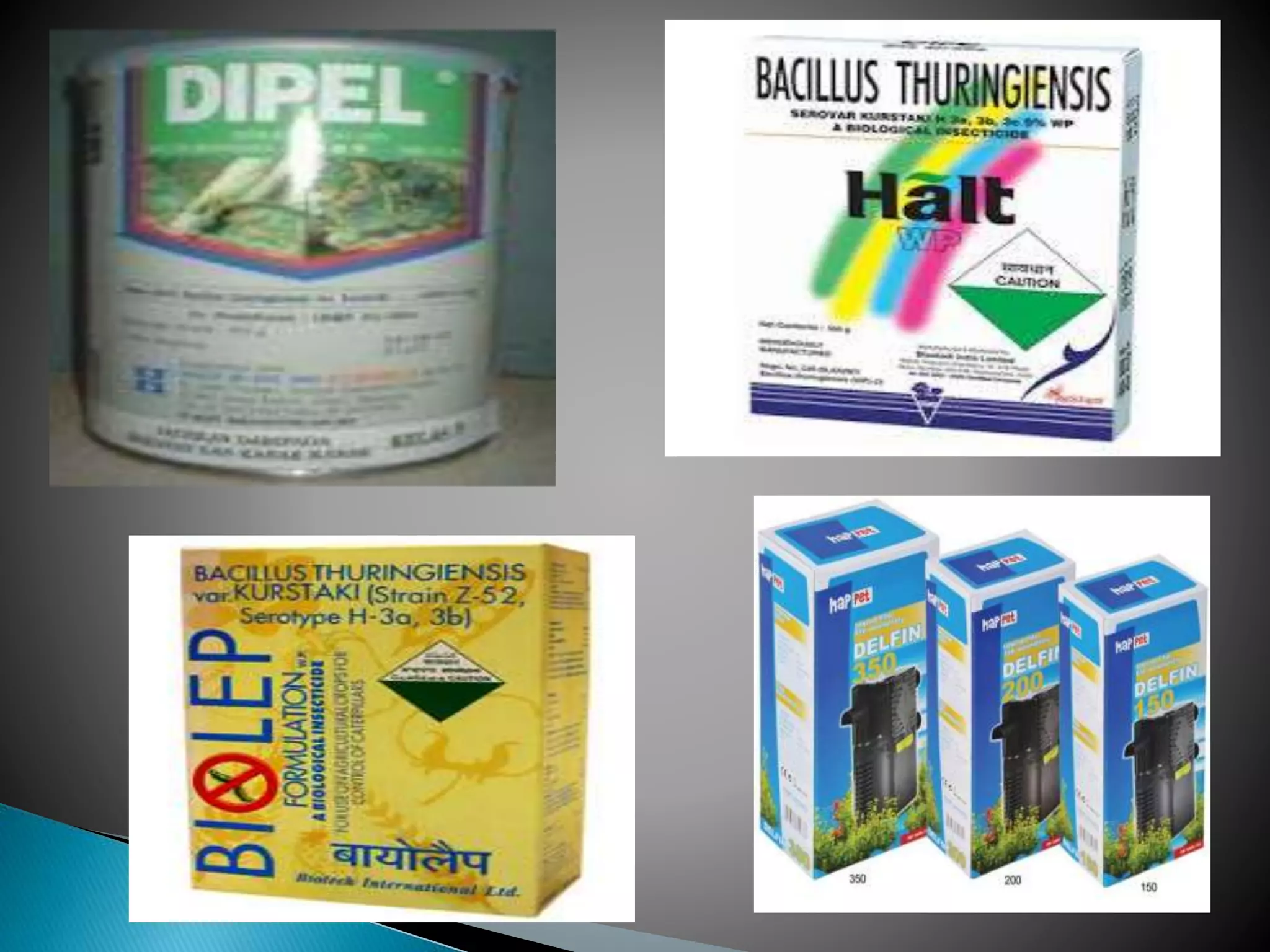
These products include Dipel®, Delfin®, Halt®, Xentari®,
Novosol®, Agree®, Biobit® and Thuricide®.
Bt is applied at 500gm a.i /ha. at 10 days interval.
•The caterpillars eat the Bt, which contains
spores and crystals.
•The crystal toxin is activated by gut enzymes.
•The toxin binds to receptors on the gut lining.
•The caterpillar stops feeding 20 to 30 minutes
after eating the Bt.
•The gut lining is destroyed.
•Spores move into the body cavity and start to
multiply.
•The caterpillar dies in 1 to 3 days
 Bt and fungi are quite dissimilar in their mode of action.
 The spores of the bacterium must be ingested by a larva to elicit an
effect.
 while conidia of the fungus must contact insect cuticle, germinate,
and penetrate it through enzymatic action and mechanical
pressure, and initiate mycelial growth, resulting in death of insect
in a few days.
 Zoopthora radicans and Beauveria bassiana are two most
effective fungus against larvae of DBM.
 It is an important entomo-pathogenic fungus
isolated from DBM, reported to cause
epizootics under favourable environmental
conditions and can reduce local populations to
zero.
 The moths infected contaminated with Z.
radicans can serve as a source of fungal
innoculum in the field and airborne conidia
lead to epizootics as a result of auto-
dissemination in DBM populations.
 Although infected insects can survive for
sometime, a reduction in feeding damage may
occur sooner as the fungus is robust & long-
lived.
 For example, third instars infected larvae
consumed 44% less foliage than healthy
larvae.
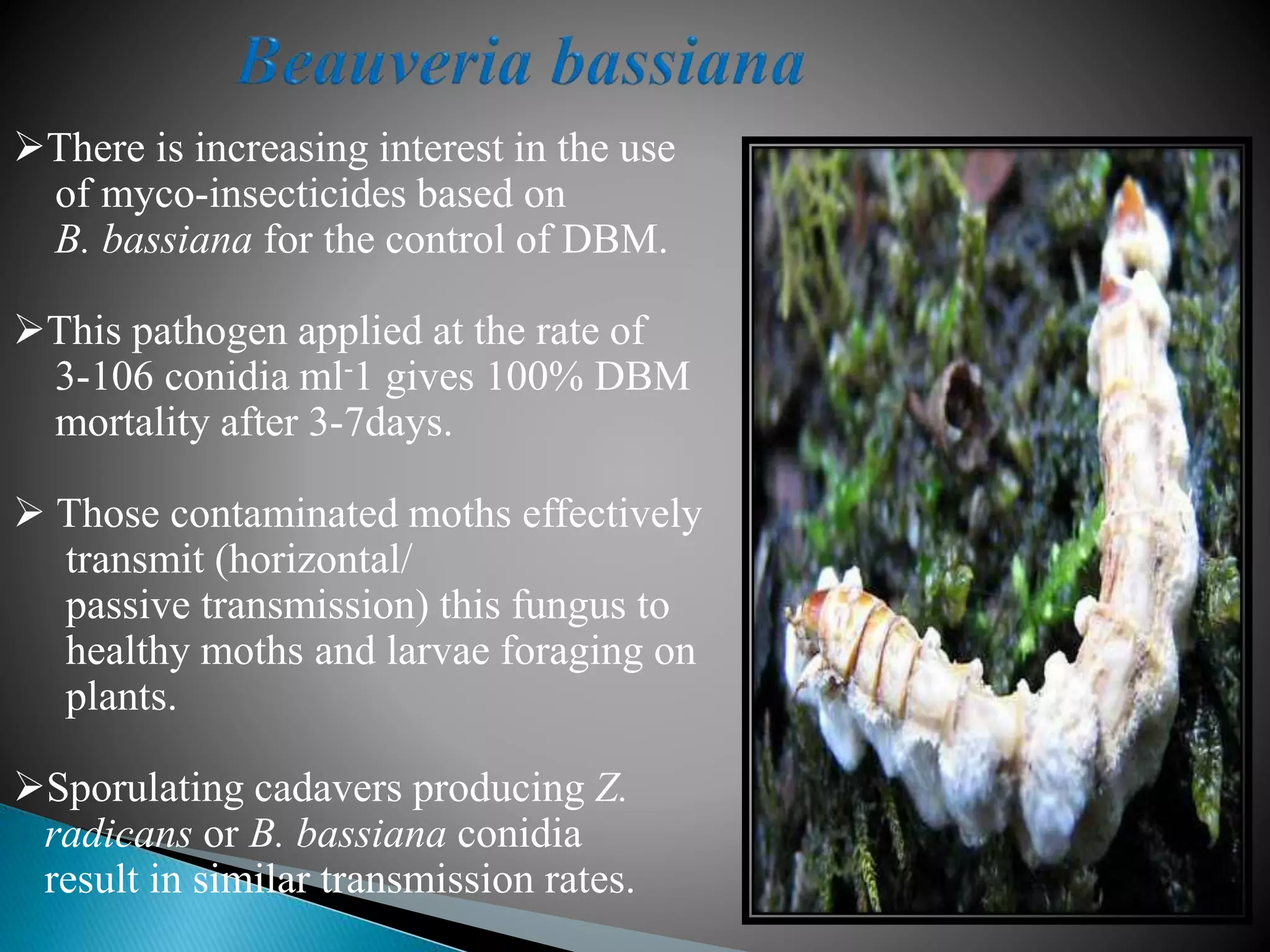
There is increasing interest in the use
of myco-insecticides based on
B. bassiana for the control of DBM.
This pathogen applied at the rate of
3-106 conidia ml-1 gives 100% DBM
mortality after 3-7days.
 Those contaminated moths effectively
transmit (horizontal/
passive transmission) this fungus to
healthy moths and larvae foraging on
plants.
Sporulating cadavers producing Z.
radicans or B. bassiana conidia
result in similar transmission rates.
Myco-insecticides are useful tools that are compatible with IPM of
DBM depending on their target specificity.
It involves the attraction of male moths in response to synthetic
female sex pheromone into specially designed inoculation
chambers containing infective fungal spores.
Once inside the chamber they become contaminated with conidia
and then return to the crop, disseminating the pathogen in the local
population.
 A number of baculoviruses have been
reported to infect P. xylostella.
 Granulo-viruses (GVs) showed promising
levels of pathogenicity.
A Kenyan isolate of PlxGV (Nyathuna, Nya-
01) applied in the field at 3.0-1013 occlusion
bodies (OB) ha-1 controlled DBM on kale with
82 and 90% infection rates for second and 1st
instars, respectively.
 The NPVs isolated from Anagrapha falcifera
(AfNPV), Autographa californica (AcNPV),
and Galleria melonella (GmNPV) were also
infectious to DBM but their potency was
moderate to low.
 Bio-control of DBM is an important measure that can be
integrated into modern IPM programs, particularly when the pest
complex is simple and DBM is the dominant species.
 Crucifer growers should choose cultivars that are partially resistant
to DBM and more attractive to its natural enemies.
Ex. Cabbage (All season, Red drum head), Cauliflower ( Early
patna, KW-5, KW-8).
 They should avoid unnecessary use of fertilizers as it results in
higher infestations of DBM and other crucifer pests such as Delia
species.
 Bt-transgenic crops grown in conjunction with refugia may also
enhance sustainable pest management.
 Intercropping should be done which also
provide sufficient resorvoir for natural
enemies. Ex. cabbage+carrot,
cabbage+tomato/mustard.
 During application of insecticides ETL
should be considered (10 larvae/plant at
seedling stage) & also safe to both host
& natural enemies. Ex. Phosalone,
Permethrin, Deltamethrin, Fenvalerate,
NSKE etc.
 Different traps should be used using sex
pheromone for attracting male moth ,
which is also helpful in successful
establishment of natural enemies.
NASTURTIUM
SWEET ALLYSUM
PHACELIA
 Diamondback moth is most devastating pest of cole-crops.
 As it shows resistance to every class of insecticides, its control is most
difficult job.
 So, modern IPM programme is developed principally based on natural
enemies.
 But only single biological control or chemical control can’t be
effective against this devastating pest.
 So by keeping biological control in our mind we should also use
other tactics such as resistant variety, trap crops, intercropping, safer
insecticides that will act as synergists for natural enemies.
Diamond back moth & its biological control

Diamond back moth & its biological control

  • 2.
    Dr. P.K. Gupta,Prof. & Head Dr. A.K. Singh, Assoc. Prof. Dr. Umesh Chandra , Asstt. Prof Department Of Entomology Mun mun Mohapatra, M.Sc.Ag.(Entomology) A-8184/14
  • 3.
     Scientific Name:Plutella xylostella  Order: Lepidoptera  Family: Yponomeutidae  Damaging Stage: Larvae (Caterpillars)
  • 4.
     It isone of the most destructive cosmopolitan pests of cruciferous crops such as cauliflower, cabbage, radish, knoll-khol & mustard etc.  It causes significant economic losses upto 52% approximately with an estimate of 4- 5 billion US $ per year globally.  It is most widely distributed pest among the other lepidopterans.  The larvae feeds on the foliage at growth stage of the crop and greatly reduce quality and yield as well.  In past 50 years, it has becomes one of the most difficult insect in the world because of resistance to every class of insecticides used extensively against it.  In India, it is one of the major constraints in the profitable cultivation of cole- crops.
  • 5.
     DBM hasprobably originated in the Mediterranean region.  Accidentally introduced from Europe in 1746, it was 1st reported in N. America in Illionis in 1854 & from Western Canada in 1885.  It is found over much of N. America, S. America, Southern Africa, Europe, India, S- E Asia, New Zealand and parts of Australia.  In India, DBM was reported in 1914 on cruciferous vegetables.  In India, it is also most devastating pest in the states of Punjab, Haryana, Himachala- Pradesh, Delhi, Uttar-Pradesh, Bihar, Tamil- nadu, Maharastra and Karnatak
  • 6.
     The Diamondbackmoth feeds only on members of the family Cruciferae/ Brassicaceae.  Study on food plant preference of DBM revealed that the larvae have marked preference for cauliflower & cabbage among the 40 species of crucifers.  This is due to the fact that both plants posses fleshy & succulent leaves and provide olfactory & gustatory stimuli for successful host selection & development.  Alternate weed hosts are especially important in maintaining in DBM population in temperate regions in spring before cruciferous crops are planted.  The host range of DBM is limited to crucifers that contain mustard oil & their glucosides.
  • 7.
     The glucosidessuch as sinigrin, sinalbin & glucocheirolin act as specific feeding stimulants for DBM.  Certain chemicals such as sulfur-containing glucosinolates or its metabolites and allyl-isothiocyanates are present in crucifers & act as oviposition stimulants.  Sulfur deficient plants are not attractive to DBM for oviposition.  Allyl-isothiocyanates also stimulates egg production in diamondback moth adults.
  • 8.
    •6 mm inlength and light brown in color • Small, grayish brown color moth ,the fore wings have 3 triangular, white spots along inner margin & at rest these give diamond shape & hind wings have fringed long hairs •Neonates are pale brown with dark head while full-grown are light green in color &10 mm in length • Flat, oval-shaped eggs, whitish – yellow & 0.5 mm in length & 0.26 mm in width EGG LARVAE PUPAEADULT
  • 10.
  • 11.
     Eggs arelaid singly or in groups of 2-40 on the under surface of leaves. The eggs hatch in 3-9 days.  The larval period is completed in 8- 17 days.  Before pupation the larvae construct a barrel shaped silken cocoon, which is opened at both ends & is attached to leaf surface.  Pupal period lasts for 4 days in hot & rainy season and 5 days in cold season.
  • 12.
     Adult longevityranges from 6-13 days, females live shorter than male.  Adults begin to mate at dusk on the same day of emergence and mating lasts only 1-2 hours, females mate only once.  Females lay eggs after mating and oviposition continues for 10 days with a peak on the first day of emergence.  2-4 generations occur in colder parts of India and 13-14 generations in South India.
  • 14.
     The biologysignificantly varies on cauliflower, cabbage, radish, turnip, knol-khol, beetroot, amaranthus and weed hosts.  There is no variation in egg period.  Pupal- period is shorter and adult emergence is more on cauliflower.  Fecundity is higher on mustard(366eggs/female) followed by cauliflower, cabbage, radish & knol-khol.  The larvae consume and gain more weight on cauliflower than on other host plants.  The consumption index, growth rate, efficiency of conversion of ingested food, efficiency of conversion of digested food and approximate digestibility are more on cauliflower than on other host plants.
  • 15.
    1st instars • Theycause small mines & feed in these tunnels • At first their presence can be detected only from blackish excreta that appear at each mouth tunnel 2nd & 3rd instars • In 2nd instars the mines become more prominent • In 3rd instars the caterpillars usually feed outside the tunnels 4th instars • They feed from underside of the leaves leaving intact a parchment like transparent cuticular layer on the dorsal surface • They bite holes in the leaves & feed on curds
  • 19.
     Many countriesare still continously plagued by P. xyllostella and there is strong evidence that this is due to lack of crucially important parasites.  Host plant availability and action of its natural enemies are two key biotic factors that regulate DBM populations in the field.  In countries, synthetic insecticides are used to control DBM, which often eliminates natural enemies.  This in turn, can lead to continued intensive use of insecticides, eventual insecticides resistance & control failure.  DBM was the 1st crop pest in the world to be reported resistant to DDT in 1953 in Java, Indonesia.
  • 20.
     In addition,DBM have distinction of being the 1st insects to develop resistance in the field to bacterial insecticide, Bacillus thuringiensis.  This has prompted increased efforts worldwide to develop integrated pest management (IPM) programmes principally based on manipulation of natural enemies.  DBM populations native to different regions have genetic & biological differences and specific parasitoid strains may be associated with the specific DBM strains.  Therefore accurate identification based on genetic studies of both host & parasitoid is of crucial importance to attaining successful control of DBM through innoculative or innundative releases.
  • 21.
     All stagesof Diamondback moth are attacked by numerous parasitoids and predators.  Although over 90 parasitoids attack DBM, only about 60 of them appear to be important.  Among these, 6 species attack DBM eggs, 38 attack larvae and 13 attack pupae.  The majority of these species came from Europe where DBM is believed to have originated.
  • 22.
    PREDATORS PARASITOIDS  Amongpredators spiders, wasps, coccinellid beetles, pentatomid bugs, phytoseiulus mites, chrysopids, ophionea beetle and bird predators are important.  It has been observed to build up in later phase of the crop, causing as much as 68-70% larval mortality.  Although predators have been suggested as mortality factors, they have not been commercially exploited against DBM.  Larval parasitoids are most predominant and effective.  Egg parasitoids belonging to poly- phagous genera Trichogramma and Trichogrammatoidea contribute little to natural control and require frequent mass releases.  The most efficaceous larval parasitoids belong to two major genera, Diadegma insulare & Cotesia(=Apanteles) plutellae were found causing 16-70% larval parasitism in India.
  • 23.
    STAGES OF DBM PARASITOIDS ATTACKINGTHESE STAGES Egg stage Trichogramma brasiliensis, T. minutum, T. pretiosum, Trichogrammatoidea armigera Larval stage Antrocephalus sp, Apanteles aciculatus, A. albipennis, A. halfordi, A. plutellae, A. ruficrus, A. sicarius, A. vestalis, Apanteles sp, Apanteles sp, Brachymeria phyta, D. eucerophaga, D. fenestralis, D. insularis, D. neocerophaga, D. plutelllae, Diadegma sp, Diadromus erythrostomus , Habrocytus sp, ltoplectis sp, Macrobracon hebetor, Macromalon orientale, Microplitis plutellae, Tetrastichus sp. Pupal stage Diadromus plutellae, D. subtilicornis, Dibrachys cavus, Euptromalus viridescens , Celis tenellus, Habrocytus sp, Itoplectis maculator, Phaeogenes sp, Spilochalcis albifrons, Stomatoceras sp, Tetrastichus ayyari, Tetrastichus sokolowskii, Thyraeella collaris
  • 24.
    STAG ES OF DBM PREDATORS ATTACKING THESE STAGES PATHOGEN ATTACKINGTHESE STAGES Egg stage Chrysoperla carnea Larval stage  ANTS: Componatus sericus, Tapinoma melanocephalum Pheidole sp  BIRDS: Yellow wag tail (Motacilla flava) Cattle egret (Bulbueus ibis) Bacillus thuringiensis var. Kurstaki Nuclear polyhedrosis virus (NPV)  Granulosis virus (GV) Paecilomyces farinosus (Fungus) Beauveria bassiana (Fungus) Zoophthora radicans (Fungus) Metarhizium anisopilae(Fungus) Variriomorpha sp. (Protazoa) Nematode
  • 27.
    • Five commercially availableare Trichogramma pretiosum, T. ostriniae, T. plationeri, T. minutum, T. brassicae. • These wasps cause mortality by laying eggs in them & also by host feeding. • T. bactrae, T. pretiosum & T. minutum causes 95- 98% mortality. • T. bactrae & T. pretiosum causes highest rate of mortality (69-72%) EGG PARASITOID • Diadegma insulare is most important larval-parasitoid as it is an efficient host searcher & has ability to avoid multi- parasitism & superparasitism. • It is solitary, host-specific & larval endoparasitoid of DBM. • It can parasitize 70-90% of DBM larvae & parasitized larvae consume 35-70% less food than non-parasitized larvae. • It pupate inside the cocoon of mature DBM larvae & these cocoon turns into white instead of green. • Depending upon the food sources, the no. of DBM larvae parasitized vary from 0-150. • Microplitis plutellae is also an important & efficient parasitoid as D. insulare . • But there is exception that, D. insulare is better in large scale infestations whereas M. plutellae is better in small scale infestations. PUPAL PARASITOID •Diadromus collaris is a solitary endo-parasitoid that supplements the control achieved by other parasitoids. •It spends its egg, larval and pupal stages inside the DBM pupa while the adult is free- living. •The presence of a silken cocoon surrounding the host pupa plays an appreciable role in the acceptance and parasitization of a particular host. •This species exhibits superparasitism but not multiparasitism. LARVAL PARASITOID
  • 30.
     If naturallyoccurring bio-control agents fail to colonize infested fields, or colonize too late in the season to provide effective pest control, augmentive/innundative releases of natural enemies may be effective for reducing pest damage.  In contrast, innoculative releases entail the release of relatively low numbers of bio-control agents early in the season allowing them to establish successfully for pest control later on.  This strategy may prove to be an effective tool where DBM is known to overwinter and causes predictable infestations and damage later in the season
  • 31.
    Bt, Bacillus thuringiensisis a bacterium that is highly effective against larvae of DBM. Among Bt strains, Bt var. aizurai & Bt var. kurstaki are effective particularly against DBM  Bt products are registered for use on brassica crops that kills only caterpillars and are very valuable in managing diamondback moth (DBM). These products include Dipel®, Delfin®, Halt®, Xentari®, Novosol®, Agree®, Biobit® and Thuricide®. Bt is applied at 500gm a.i /ha. at 10 days interval.
  • 33.
    •The caterpillars eatthe Bt, which contains spores and crystals. •The crystal toxin is activated by gut enzymes. •The toxin binds to receptors on the gut lining. •The caterpillar stops feeding 20 to 30 minutes after eating the Bt. •The gut lining is destroyed. •Spores move into the body cavity and start to multiply. •The caterpillar dies in 1 to 3 days
  • 34.
     Bt andfungi are quite dissimilar in their mode of action.  The spores of the bacterium must be ingested by a larva to elicit an effect.  while conidia of the fungus must contact insect cuticle, germinate, and penetrate it through enzymatic action and mechanical pressure, and initiate mycelial growth, resulting in death of insect in a few days.  Zoopthora radicans and Beauveria bassiana are two most effective fungus against larvae of DBM.
  • 35.
     It isan important entomo-pathogenic fungus isolated from DBM, reported to cause epizootics under favourable environmental conditions and can reduce local populations to zero.  The moths infected contaminated with Z. radicans can serve as a source of fungal innoculum in the field and airborne conidia lead to epizootics as a result of auto- dissemination in DBM populations.  Although infected insects can survive for sometime, a reduction in feeding damage may occur sooner as the fungus is robust & long- lived.  For example, third instars infected larvae consumed 44% less foliage than healthy larvae.
  • 36.
    There is increasinginterest in the use of myco-insecticides based on B. bassiana for the control of DBM. This pathogen applied at the rate of 3-106 conidia ml-1 gives 100% DBM mortality after 3-7days.  Those contaminated moths effectively transmit (horizontal/ passive transmission) this fungus to healthy moths and larvae foraging on plants. Sporulating cadavers producing Z. radicans or B. bassiana conidia result in similar transmission rates.
  • 37.
    Myco-insecticides are usefultools that are compatible with IPM of DBM depending on their target specificity. It involves the attraction of male moths in response to synthetic female sex pheromone into specially designed inoculation chambers containing infective fungal spores. Once inside the chamber they become contaminated with conidia and then return to the crop, disseminating the pathogen in the local population.
  • 38.
     A numberof baculoviruses have been reported to infect P. xylostella.  Granulo-viruses (GVs) showed promising levels of pathogenicity. A Kenyan isolate of PlxGV (Nyathuna, Nya- 01) applied in the field at 3.0-1013 occlusion bodies (OB) ha-1 controlled DBM on kale with 82 and 90% infection rates for second and 1st instars, respectively.  The NPVs isolated from Anagrapha falcifera (AfNPV), Autographa californica (AcNPV), and Galleria melonella (GmNPV) were also infectious to DBM but their potency was moderate to low.
  • 39.
     Bio-control ofDBM is an important measure that can be integrated into modern IPM programs, particularly when the pest complex is simple and DBM is the dominant species.  Crucifer growers should choose cultivars that are partially resistant to DBM and more attractive to its natural enemies. Ex. Cabbage (All season, Red drum head), Cauliflower ( Early patna, KW-5, KW-8).  They should avoid unnecessary use of fertilizers as it results in higher infestations of DBM and other crucifer pests such as Delia species.  Bt-transgenic crops grown in conjunction with refugia may also enhance sustainable pest management.
  • 40.
     Intercropping shouldbe done which also provide sufficient resorvoir for natural enemies. Ex. cabbage+carrot, cabbage+tomato/mustard.  During application of insecticides ETL should be considered (10 larvae/plant at seedling stage) & also safe to both host & natural enemies. Ex. Phosalone, Permethrin, Deltamethrin, Fenvalerate, NSKE etc.  Different traps should be used using sex pheromone for attracting male moth , which is also helpful in successful establishment of natural enemies.
  • 41.
  • 42.
     Diamondback mothis most devastating pest of cole-crops.  As it shows resistance to every class of insecticides, its control is most difficult job.  So, modern IPM programme is developed principally based on natural enemies.  But only single biological control or chemical control can’t be effective against this devastating pest.  So by keeping biological control in our mind we should also use other tactics such as resistant variety, trap crops, intercropping, safer insecticides that will act as synergists for natural enemies.