⇨ Asy Ronen (A.K.A Async) 
⇨ Eran Harel (@eran_ha)
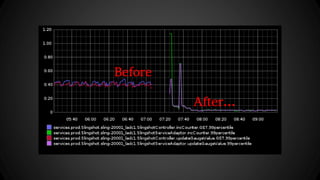
Before OB1K... 
● Multitenancy on a single Tomcat JVM 
● Our API hosts actually executed 8 modules 
on a single JVM
Before OB1K... 
● Applicative logs clutter 
● Monitoring clutter
Before OB1K... 
● Hard to troubleshoot performance issues 
● Hard to fine tune JVMs 
● Shared configuration
Before OB1K... 
● Deployments means start / stop for several 
modules 
● Sub optimal for CD environment...
Before OB1K... 
● The container (Tomcat) was installed by 
Chef, and had a different life cycle then the 
web-modules 
● Container upgrades were a nightmare
What is OB1K?
Asynchronous IO based on Netty
Synchronous Modules based on Jetty 9
Drop-in replacement for Tomcat 
apps
Kick A$$ Performance :)
Self Contained
Isolated Services 
● Own JVM 
● Own JVM settings 
● Own configuration 
● Own port 
● Own logs directory 
● Own log configuration
Full control over your module 
● JVM options 
● Configuration properties 
● Logging 
● Ports 
● Compression 
● Threads 
● SSL 
● Etc
Seamless RPC 
● Strongly Typed RPC Client
Seamless RPC 
● RPC complexity is transparent to the client
Seamless RPC 
● Server implementation only worries about 
the business logic
Seamless RPC 
● Configurable client behavior (e.g. retries)
Seamless RPC 
● Built-In serialization support 
o MsgPack 
o JSON 
o Compression
HTTP Streams
Configuration as code
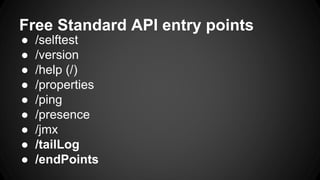
Free Standard API entry points 
● /selftest 
● /version 
● /help (/) 
● /properties 
● /ping 
● /presence 
● /jmx 
● /tailLog 
● /endPoints
Free Service Monitoring
Service Discovery Integration
Easier upgrades, easier deployment
Same execution path for 
Dev / Prod / JUnit
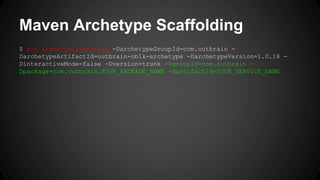
Maven Archetype Scaffolding 
$ mvn archetype:generate -DarchetypeGroupId=com.outbrain - 
DarchetypeArtifactId=outbrain-ob1k-archetype -DarchetypeVersion=1.0.18 - 
DinteractiveMode=false -Dversion=trunk -DgroupId=com.outbrain - 
Dpackage=com.outbrain.YOUR_PACKAGE_NAME -DartifactId=YOUR_SERVICE_NAME
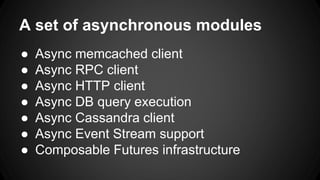
A set of asynchronous modules 
● Async memcached client 
● Async RPC client 
● Async HTTP client 
● Async DB query execution 
● Async Cassandra client 
● Async Event Stream support 
● Composable Futures infrastructure
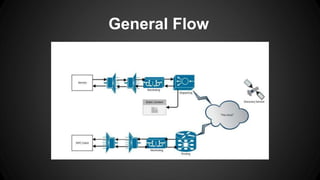
General Flow
The main class
Jetty Server 
public class GruffaloServer { 
private static final Logger logger = LoggerFactory.getLogger(GruffaloServer.class); 
public static void main(String[] args) { 
new GruffaloServer().build().start(); 
logger.info("******** Gruffalo started ********"); 
} 
public Server build() { 
return new JettyServerBuilder().useConfigurationPorts().setContextPath("/Gruffalo"); 
}}
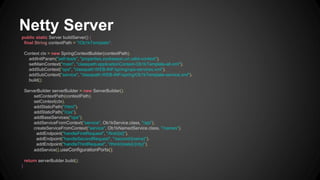
Netty Server 
public static Server buildServer() { 
final String contextPath = "/Ob1kTemplate"; 
Context ctx = new SpringContextBuilder(contextPath). 
addInitParam("self-tests", "properties,zookeeper,url,valid-context"). 
setMainContext("main", "classpath:applicationContext-Ob1kTemplate-all.xml"). 
addSubContext("ops", "classpath:WEB-INF/spring/ops-services.xml"). 
addSubContext("service", "classpath:WEB-INF/spring/Ob1kTemplate-service.xml"). 
build(); 
ServerBuilder serverBuilder = new ServerBuilder(). 
setContextPath(contextPath). 
setContext(ctx). 
addStaticPath("/html"). 
addStaticPath("/css"). 
addBaseServices("ops"). 
addServiceFromContext("service", Ob1kService.class, "/api"). 
createServiceFromContext("service", Ob1kNamedService.class, "/names"). 
addEndpoint("handleFirstRequest", "/first/{id}"). 
addEndpoint("handleSecondRequest", "/second/{name}"). 
addEndpoint("handleThirdRequest", "/third/{state}/{city}"). 
addService().useConfigurationPorts(); 
return serverBuilder.build(); 
}
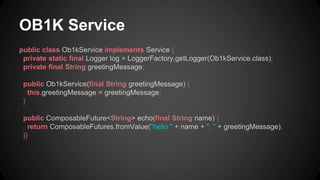
OB1K Service 
public class Ob1kService implements Service { 
private static final Logger log = LoggerFactory.getLogger(Ob1kService.class); 
private final String greetingMessage; 
public Ob1kService(final String greetingMessage) { 
this.greetingMessage = greetingMessage; 
} 
public ComposableFuture<String> echo(final String name) { 
return ComposableFutures.fromValue("hello " + name + ". " + greetingMessage); 
}}
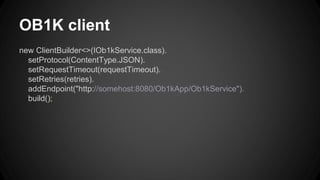
OB1K client 
new ClientBuilder<>(IOb1kService.class). 
setProtocol(ContentType.JSON). 
setRequestTimeout(requestTimeout). 
setRetries(retries). 
addEndpoint("http://somehost:8080/Ob1kApp/Ob1kService"). 
build();
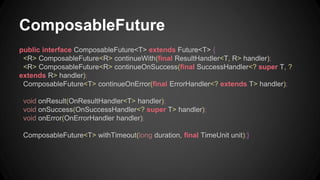
ComposableFuture 
public interface ComposableFuture<T> extends Future<T> { 
<R> ComposableFuture<R> continueWith(final ResultHandler<T, R> handler); 
<R> ComposableFuture<R> continueOnSuccess(final SuccessHandler<? super T, ? 
extends R> handler); 
ComposableFuture<T> continueOnError(final ErrorHandler<? extends T> handler); 
void onResult(OnResultHandler<T> handler); 
void onSuccess(OnSuccessHandler<? super T> handler); 
void onError(OnErrorHandler handler); 
ComposableFuture<T> withTimeout(long duration, final TimeUnit unit);}
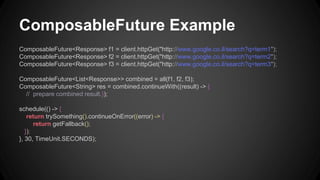
ComposableFuture Example 
ComposableFuture<Response> f1 = client.httpGet("http://www.google.co.il/search?q=term1"); 
ComposableFuture<Response> f2 = client.httpGet("http://www.google.co.il/search?q=term2"); 
ComposableFuture<Response> f3 = client.httpGet("http://www.google.co.il/search?q=term3"); 
ComposableFuture<List<Response>> combined = all(f1, f2, f3); 
ComposableFuture<String> res = combined.continueWith((result) -> { 
// prepare combined result.}); 
schedule(() -> { 
return trySomething().continueOnError((error) -> { 
return getFallback(); 
}); 
}, 30, TimeUnit.SECONDS);
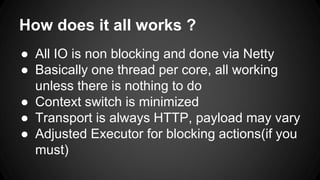
How does it all works ? 
● All IO is non blocking and done via Netty 
● Basically one thread per core, all working 
unless there is nothing to do 
● Context switch is minimized 
● Transport is always HTTP, payload may vary 
● Adjusted Executor for blocking actions(if you 
must)
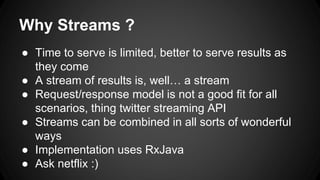
Why Streams ? 
● Time to serve is limited, better to serve results as 
they come 
● A stream of results is, well… a stream 
● Request/response model is not a good fit for all 
scenarios, thing twitter streaming API 
● Streams can be combined in all sorts of wonderful 
ways 
● Implementation uses RxJava 
● Ask netflix :)
What is the catch? 
● Blocking code is (almost)forbidden in the 
async mode 
● Writing asynchronous code has a learning 
curve 
● Libraries have to be adapted
Alternatives 
Finagle 
Drop Wizard 
Vert.x 
Play Framework 
RESTEasy 
Etc
Future Features 
● Client Side Load Balancing 
● Client Side Discovery (Consul based) 
● Aggregation 
● Scatter-Gather 
● Throttling 
● Session Tracing (a-la Zipkin)
Ob1k presentation at Java.IL

Ob1k presentation at Java.IL

  • 1.
    ⇨ Asy Ronen(A.K.A Async) ⇨ Eran Harel (@eran_ha)
  • 2.
    Before OB1K... ●Multitenancy on a single Tomcat JVM ● Our API hosts actually executed 8 modules on a single JVM
  • 3.
    Before OB1K... ●Applicative logs clutter ● Monitoring clutter
  • 4.
    Before OB1K... ●Hard to troubleshoot performance issues ● Hard to fine tune JVMs ● Shared configuration
  • 5.
    Before OB1K... ●Deployments means start / stop for several modules ● Sub optimal for CD environment...
  • 6.
    Before OB1K... ●The container (Tomcat) was installed by Chef, and had a different life cycle then the web-modules ● Container upgrades were a nightmare
  • 7.
  • 8.
  • 9.
  • 10.
  • 11.
  • 13.
  • 14.
    Isolated Services ●Own JVM ● Own JVM settings ● Own configuration ● Own port ● Own logs directory ● Own log configuration
  • 15.
    Full control overyour module ● JVM options ● Configuration properties ● Logging ● Ports ● Compression ● Threads ● SSL ● Etc
  • 16.
    Seamless RPC ●Strongly Typed RPC Client
  • 17.
    Seamless RPC ●RPC complexity is transparent to the client
  • 18.
    Seamless RPC ●Server implementation only worries about the business logic
  • 19.
    Seamless RPC ●Configurable client behavior (e.g. retries)
  • 20.
    Seamless RPC ●Built-In serialization support o MsgPack o JSON o Compression
  • 21.
  • 22.
  • 23.
    Free Standard APIentry points ● /selftest ● /version ● /help (/) ● /properties ● /ping ● /presence ● /jmx ● /tailLog ● /endPoints
  • 24.
  • 25.
  • 26.
  • 27.
    Same execution pathfor Dev / Prod / JUnit
  • 28.
    Maven Archetype Scaffolding $ mvn archetype:generate -DarchetypeGroupId=com.outbrain - DarchetypeArtifactId=outbrain-ob1k-archetype -DarchetypeVersion=1.0.18 - DinteractiveMode=false -Dversion=trunk -DgroupId=com.outbrain - Dpackage=com.outbrain.YOUR_PACKAGE_NAME -DartifactId=YOUR_SERVICE_NAME
  • 29.
    A set ofasynchronous modules ● Async memcached client ● Async RPC client ● Async HTTP client ● Async DB query execution ● Async Cassandra client ● Async Event Stream support ● Composable Futures infrastructure
  • 30.
  • 32.
  • 33.
    Jetty Server publicclass GruffaloServer { private static final Logger logger = LoggerFactory.getLogger(GruffaloServer.class); public static void main(String[] args) { new GruffaloServer().build().start(); logger.info("******** Gruffalo started ********"); } public Server build() { return new JettyServerBuilder().useConfigurationPorts().setContextPath("/Gruffalo"); }}
  • 34.
    Netty Server publicstatic Server buildServer() { final String contextPath = "/Ob1kTemplate"; Context ctx = new SpringContextBuilder(contextPath). addInitParam("self-tests", "properties,zookeeper,url,valid-context"). setMainContext("main", "classpath:applicationContext-Ob1kTemplate-all.xml"). addSubContext("ops", "classpath:WEB-INF/spring/ops-services.xml"). addSubContext("service", "classpath:WEB-INF/spring/Ob1kTemplate-service.xml"). build(); ServerBuilder serverBuilder = new ServerBuilder(). setContextPath(contextPath). setContext(ctx). addStaticPath("/html"). addStaticPath("/css"). addBaseServices("ops"). addServiceFromContext("service", Ob1kService.class, "/api"). createServiceFromContext("service", Ob1kNamedService.class, "/names"). addEndpoint("handleFirstRequest", "/first/{id}"). addEndpoint("handleSecondRequest", "/second/{name}"). addEndpoint("handleThirdRequest", "/third/{state}/{city}"). addService().useConfigurationPorts(); return serverBuilder.build(); }
  • 35.
    OB1K Service publicclass Ob1kService implements Service { private static final Logger log = LoggerFactory.getLogger(Ob1kService.class); private final String greetingMessage; public Ob1kService(final String greetingMessage) { this.greetingMessage = greetingMessage; } public ComposableFuture<String> echo(final String name) { return ComposableFutures.fromValue("hello " + name + ". " + greetingMessage); }}
  • 36.
    OB1K client newClientBuilder<>(IOb1kService.class). setProtocol(ContentType.JSON). setRequestTimeout(requestTimeout). setRetries(retries). addEndpoint("http://somehost:8080/Ob1kApp/Ob1kService"). build();
  • 37.
    ComposableFuture public interfaceComposableFuture<T> extends Future<T> { <R> ComposableFuture<R> continueWith(final ResultHandler<T, R> handler); <R> ComposableFuture<R> continueOnSuccess(final SuccessHandler<? super T, ? extends R> handler); ComposableFuture<T> continueOnError(final ErrorHandler<? extends T> handler); void onResult(OnResultHandler<T> handler); void onSuccess(OnSuccessHandler<? super T> handler); void onError(OnErrorHandler handler); ComposableFuture<T> withTimeout(long duration, final TimeUnit unit);}
  • 38.
    ComposableFuture Example ComposableFuture<Response>f1 = client.httpGet("http://www.google.co.il/search?q=term1"); ComposableFuture<Response> f2 = client.httpGet("http://www.google.co.il/search?q=term2"); ComposableFuture<Response> f3 = client.httpGet("http://www.google.co.il/search?q=term3"); ComposableFuture<List<Response>> combined = all(f1, f2, f3); ComposableFuture<String> res = combined.continueWith((result) -> { // prepare combined result.}); schedule(() -> { return trySomething().continueOnError((error) -> { return getFallback(); }); }, 30, TimeUnit.SECONDS);
  • 39.
    How does itall works ? ● All IO is non blocking and done via Netty ● Basically one thread per core, all working unless there is nothing to do ● Context switch is minimized ● Transport is always HTTP, payload may vary ● Adjusted Executor for blocking actions(if you must)
  • 40.
    Why Streams ? ● Time to serve is limited, better to serve results as they come ● A stream of results is, well… a stream ● Request/response model is not a good fit for all scenarios, thing twitter streaming API ● Streams can be combined in all sorts of wonderful ways ● Implementation uses RxJava ● Ask netflix :)
  • 41.
    What is thecatch? ● Blocking code is (almost)forbidden in the async mode ● Writing asynchronous code has a learning curve ● Libraries have to be adapted
  • 42.
    Alternatives Finagle DropWizard Vert.x Play Framework RESTEasy Etc
  • 43.
    Future Features ●Client Side Load Balancing ● Client Side Discovery (Consul based) ● Aggregation ● Scatter-Gather ● Throttling ● Session Tracing (a-la Zipkin)