CONFIDENTIAL: The information in this document belongs to Boston Institute of Analytics LLC. Any unauthorized sharing of this
material is prohibited and subject to legal action under breach of IP and confidentiality clauses.
Predicting Diabetes Using ML
CONFIDENTIAL: The information in this document belongs to Boston Institute of Analytics LLC. Any unauthorized sharing of this
material is prohibited and subject to legal action under breach of IP and confidentiality clauses.
Agenda
• Project Overview
• Key Objectives
• Data Source
• Exploratory Data Analysis
• Predictive Modeling
CONFIDENTIAL: The information in this document belongs to Boston Institute of Analytics LLC. Any unauthorized sharing of this
material is prohibited and subject to legal action under breach of IP and confidentiality clauses.
Project Overview
The project focuses on developing a machine learning-based e-diagnosis
system for diabetes prediction using the Pima Indian Diabetes dataset. It
aims to leverage machine learning algorithms to identify individuals at
risk for diabetes and assist healthcare professionals in making early
diagnoses. The system aims to help address the gap in early detection,
especially in underserved regions, and provide feedback for patient self-
care.
CONFIDENTIAL: The information in this document belongs to Boston Institute of Analytics LLC. Any unauthorized sharing of this
material is prohibited and subject to legal action under breach of IP and confidentiality clauses.
Key Objectives
• To build an e-diagnosis system capable of detecting and classifying diabetes using machine
learning models.
• To evaluate multiple machine learning models for predicting diabetes risk.
• To address the challenge of early diagnosis in the absence of comprehensive medical testing
and support clinicians in high-risk situations.
• To identify significant features that contribute to diabetes prediction for better model
interpretability and trust.
• To explore and analyze the Pima Indian Diabetes dataset, perform data preprocessing, and
enhance the model's performance using feature selection.
CONFIDENTIAL: The information in this document belongs to Boston Institute of Analytics LLC. Any unauthorized sharing of this
material is prohibited and subject to legal action under breach of IP and confidentiality clauses.
Data Source
• The Pima Indian Diabetes dataset is
used in this project. The dataset was
sourced from Kaggle.
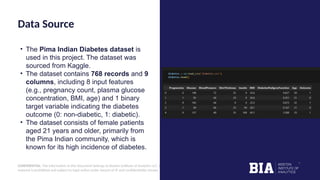
• The dataset contains 768 records and 9
columns, including 8 input features
(e.g., pregnancy count, plasma glucose
concentration, BMI, age) and 1 binary
target variable indicating the diabetes
outcome (0: non-diabetic, 1: diabetic).
• The dataset consists of female patients
aged 21 years and older, primarily from
the Pima Indian community, which is
known for its high incidence of diabetes.
CONFIDENTIAL: The information in this document belongs to Boston Institute of Analytics LLC. Any unauthorized sharing of this
material is prohibited and subject to legal action under breach of IP and confidentiality clauses.
Exploratory Data Analysis (EDA)
• EDA was performed to understand the distribution of features, detect missing values, and identify
patterns related to diabetes risk.
• The analysis included summary statistics, visualizations of the data distribution (e.g., histograms,
box plots), and checking for outliers or anomalies.
• Missing values were handled through imputation, and the data was standardized for better model
performance.
Feature Extraction
• The dataset comprises 8 primary input features: Pregnancies, Glucose, BloodPressure,
SkinThickness, Insulin, BMI, DiabetesPedigreeFunction, and Age.
• Feature selection was performed using techniques like correlation analysis to identify the most
predictive features, enhancing the model’s interpretability and reducing overfitting.
CONFIDENTIAL: The information in this document belongs to Boston Institute of Analytics LLC. Any unauthorized sharing of this
material is prohibited and subject to legal action under breach of IP and confidentiality clauses.
Predictive Modeling
• SVM
• KNN
• Random Forest
Models Used
Best Model
• The Random Forest classifier performed best among the evaluated models, achieving the highest
accuracy and robust performance across various metrics.
• Feature importance analysis revealed key predictive features that significantly impact the model’s
decision-making process.
CONFIDENTIAL: The information in this document belongs to Boston Institute of Analytics LLC. Any unauthorized sharing of this
material is prohibited and subject to legal action under breach of IP and confidentiality clauses.
Thank You!

Diabetes Prediction Using Machine Learning: A Data-Driven Approach

  • 1.
    CONFIDENTIAL: The informationin this document belongs to Boston Institute of Analytics LLC. Any unauthorized sharing of this material is prohibited and subject to legal action under breach of IP and confidentiality clauses. Predicting Diabetes Using ML
  • 2.
    CONFIDENTIAL: The informationin this document belongs to Boston Institute of Analytics LLC. Any unauthorized sharing of this material is prohibited and subject to legal action under breach of IP and confidentiality clauses. Agenda • Project Overview • Key Objectives • Data Source • Exploratory Data Analysis • Predictive Modeling
  • 3.
    CONFIDENTIAL: The informationin this document belongs to Boston Institute of Analytics LLC. Any unauthorized sharing of this material is prohibited and subject to legal action under breach of IP and confidentiality clauses. Project Overview The project focuses on developing a machine learning-based e-diagnosis system for diabetes prediction using the Pima Indian Diabetes dataset. It aims to leverage machine learning algorithms to identify individuals at risk for diabetes and assist healthcare professionals in making early diagnoses. The system aims to help address the gap in early detection, especially in underserved regions, and provide feedback for patient self- care.
  • 4.
    CONFIDENTIAL: The informationin this document belongs to Boston Institute of Analytics LLC. Any unauthorized sharing of this material is prohibited and subject to legal action under breach of IP and confidentiality clauses. Key Objectives • To build an e-diagnosis system capable of detecting and classifying diabetes using machine learning models. • To evaluate multiple machine learning models for predicting diabetes risk. • To address the challenge of early diagnosis in the absence of comprehensive medical testing and support clinicians in high-risk situations. • To identify significant features that contribute to diabetes prediction for better model interpretability and trust. • To explore and analyze the Pima Indian Diabetes dataset, perform data preprocessing, and enhance the model's performance using feature selection.
  • 5.
    CONFIDENTIAL: The informationin this document belongs to Boston Institute of Analytics LLC. Any unauthorized sharing of this material is prohibited and subject to legal action under breach of IP and confidentiality clauses. Data Source • The Pima Indian Diabetes dataset is used in this project. The dataset was sourced from Kaggle. • The dataset contains 768 records and 9 columns, including 8 input features (e.g., pregnancy count, plasma glucose concentration, BMI, age) and 1 binary target variable indicating the diabetes outcome (0: non-diabetic, 1: diabetic). • The dataset consists of female patients aged 21 years and older, primarily from the Pima Indian community, which is known for its high incidence of diabetes.
  • 6.
    CONFIDENTIAL: The informationin this document belongs to Boston Institute of Analytics LLC. Any unauthorized sharing of this material is prohibited and subject to legal action under breach of IP and confidentiality clauses. Exploratory Data Analysis (EDA) • EDA was performed to understand the distribution of features, detect missing values, and identify patterns related to diabetes risk. • The analysis included summary statistics, visualizations of the data distribution (e.g., histograms, box plots), and checking for outliers or anomalies. • Missing values were handled through imputation, and the data was standardized for better model performance. Feature Extraction • The dataset comprises 8 primary input features: Pregnancies, Glucose, BloodPressure, SkinThickness, Insulin, BMI, DiabetesPedigreeFunction, and Age. • Feature selection was performed using techniques like correlation analysis to identify the most predictive features, enhancing the model’s interpretability and reducing overfitting.
  • 7.
    CONFIDENTIAL: The informationin this document belongs to Boston Institute of Analytics LLC. Any unauthorized sharing of this material is prohibited and subject to legal action under breach of IP and confidentiality clauses. Predictive Modeling • SVM • KNN • Random Forest Models Used Best Model • The Random Forest classifier performed best among the evaluated models, achieving the highest accuracy and robust performance across various metrics. • Feature importance analysis revealed key predictive features that significantly impact the model’s decision-making process.
  • 8.
    CONFIDENTIAL: The informationin this document belongs to Boston Institute of Analytics LLC. Any unauthorized sharing of this material is prohibited and subject to legal action under breach of IP and confidentiality clauses. Thank You!