Diabetes Mellitus(DM)
Presented by Saim Soleja
Pharm-d (DOW UNIVERSITY OF HEALTH SCIENCS)
1
What is a DM?
Diabetes mellitus (DM) is a group of diseases characterized by high
levels of blood glucose resulting from defects in insulin production,
insulin action, or both.
2
• In 2019, Approximately 463 million adults (20-79 years) were living
with diabetes; by 2045 this will rise to 700 million.
• The proportion of people with type 2 diabetes is increasing in most
countries.
• 79% of adults with diabetes were living in low- and middle-income
countries.
3https://www.idf.org/aboutdiabetes/what-is-diabetes/facts-figures.html
Types of DM
❖ Type 1 Diabetes Mellitus
❖ Type 2 Diabetes Mellitus
❖ Gestational Diabetes
❖ Other types:
❖ LADA (Latent Autoimmune Diabetes in Adults)
❖ MODY (maturity-onset diabetes of youth)
❖ Secondary Diabetes Mellitus
4
Type 1 DM:
❖ Insulin-dependent diabetes mellitus (IDDM) or juvenile- onset
diabetes.
❖ Develops when the body’s immune system destroys pancreatic
beta cells, the only cells in the body that make the hormone
insulin that regulates blood glucose.
❖ Usually strikes children and young adults,
❖ May account for 5% to 10%
5
Type 2 DM:
❖ Non-insulin-dependent diabetes mellitus (NIDDM) or adult onset
diabetes.
❖ May account for about 90% to 95%
❖ It usually begins as insulin resistance, a disorder in which the cells
do not use insulin properly. As the need for insulin rises, the
pancreas gradually loses its ability to produce insulin.
❖ Associated with older age, obesity, family history of diabetes,
history of gestational diabetes, impaired glucose metabolism,
physical inactivity.
6
Gestational diabetes
• Diagnosed in some women during pregnancy.
• After pregnancy, 5% to 10% of women with gestational diabetes are
found to have type 2 diabetes OR 20% to 50% chance of developing
diabetes in the next 5-10 years
7
Other types of DM
❖Maturity-onset diabetes of youth (MODY) –(genetic conditions)
❖May account for 1% to 5%
❖Latent Autoimmune Diabetes in Adults (LADA) is a form of
autoimmune (type 1 diabetes)
8
Secondary DM:
Secondary causes of Diabetes mellitus include:
❖ Acromegaly,
❖ Cushing syndrome,
❖ Thyrotoxicosis,
❖ Chronic pancreatitis,
❖ Cancer
9
Secondary DM Drug induced hyperglycemia
✓ Atypical Antipsychotics
✓ Beta-blockers
✓ Calcium Channel Blockers
✓ Corticosteroids
✓ Fluoroquinolones
✓ Naicin
✓ Protease Inhibitors
✓ Thiazide Diuretics
10
HOW TO DIFFERENTATE IN DM TYPES
Type 1 DM
• Polyuria
• Polydipsia
• Polyphagia
• Weight loss
• Weakness
• Dry skin
• Ketoacidosis
Type 2 DM
❖ Patients can be asymptomatic
❖ Polyuria
❖ Polydipsia
❖ Polyphagia
❖ Fatigue
❖ Weight loss
❖ Most patients are discovered while
performing urine glucose screening
11
DM Complication
• Diabetes retinopathy
• Diabetes nephropathy
• Diabetes neuropathy
• Peripheral vascular disease and foot ulcer
12
Diagnosis of
Diabetes Mellitus
1
3
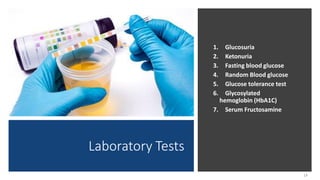
Laboratory Tests
1. Glucosuria
2. Ketonuria
3. Fasting blood glucose
4. Random Blood glucose
5. Glucose tolerance test
6. Glycosylated
hemoglobin (HbA1C)
7. Serum Fructosamine
14
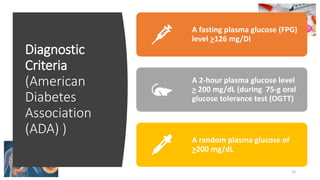
Diagnostic
Criteria
(American
Diabetes
Association
(ADA) )
15
A fasting plasma glucose (FPG)
level >126 mg/Dl
A 2-hour plasma glucose level
> 200 mg/dL (during 75-g oral
glucose tolerance test (OGTT)
A random plasma glucose of
>200 mg/dL
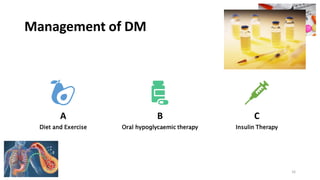
Management of DM
A
Diet and Exercise
B
Oral hypoglycaemic therapy
C
Insulin Therapy
16
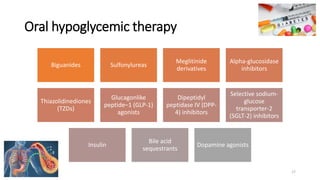
Oral hypoglycemic therapy
Biguanides Sulfonylureas
Meglitinide
derivatives
Alpha-glucosidase
inhibitors
Thiazolidinediones
(TZDs)
Glucagonlike
peptide–1 (GLP-1)
agonists
Dipeptidyl
peptidase IV (DPP-
4) inhibitors
Selective sodium-
glucose
transporter-2
(SGLT-2) inhibitors
Insulin
Bile acid
sequestrants
Dopamine agonists
17
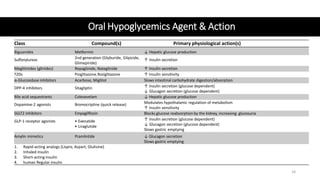
Oral Hypoglycemics Agent & Action
Class Compound(s) Primary physiological action(s)
Biguanides Metformin ↓ Hepatic glucose production
Sulfonylureas 2nd generation (Glyburide, Glipizide,
Glimepiride)
↑ Insulin secretion
Meglitinides (glinides) Repaglinide, Nateglinide ↑ Insulin secretion
TZDs Pioglitazone,Rosiglitazone ↑ Insulin sensitivity
α-Glucosidase inhibitors Acarbose, Miglitol Slows intestinal carbohydrate digestion/absorption
DPP-4 inhibitors Sitagliptin ↑ Insulin secretion (glucose dependent)
↓ Glucagon secretion (glucose dependent)
Bile acid sequestrants Colesevelam ↓ Hepatic glucose production
Dopamine-2 agonists Bromocriptine (quick release) Modulates hypothalamic regulation of metabolism
↑ Insulin sensitivity
SGLT2 inhibitors Empagliflozin Blocks glucose reabsorption by the kidney, increasing glucosuria
GLP-1 receptor agonists • Exenatide
• Liraglutide
↑ Insulin secretion (glucose dependent)
↓ Glucagon secretion (glucose dependent)
Slows gastric emptying
Amylin mimetics Pramlintide ↓ Glucagon secretion
Slows gastric emptying
1. Rapid-acting analogs (Lispro, Aspart, Glulisine)
2. Inhaled insulin
3. Short-acting insulin
4. human Regular insulin
18
Diabetes Management Algorithm
19
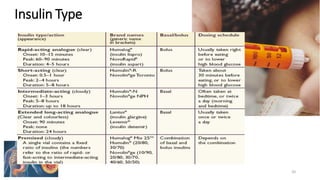
Insulin Type
20
Diabetes Management with Insulin Algorithm
21
Self care
22
Blood glucose monitoring
Body weight monitoring
Foot-care
Personal hygiene
Healthy lifestyle/diet or physical activity
Identify targets for control
Stopping smoking
Reference
• Pages 227-237,Thyroid Disorder, Chapter 20 Pharmacotherapy
handbook, 7th edition J T Dipiro, Barbara G Wells, Terry L
Schwinghammer
• Pages 447- 462 ,Epilepsy Chapter 37Clinical Pharmacy and
Therapeutics, 4th edition Roger Walker, Cate Whittlesea
• https://www.aace.com/publications/algorithm
23
Thank you
24

Diabetes mellitus

  • 1.
    Diabetes Mellitus(DM) Presented bySaim Soleja Pharm-d (DOW UNIVERSITY OF HEALTH SCIENCS) 1
  • 2.
    What is aDM? Diabetes mellitus (DM) is a group of diseases characterized by high levels of blood glucose resulting from defects in insulin production, insulin action, or both. 2
  • 3.
    • In 2019,Approximately 463 million adults (20-79 years) were living with diabetes; by 2045 this will rise to 700 million. • The proportion of people with type 2 diabetes is increasing in most countries. • 79% of adults with diabetes were living in low- and middle-income countries. 3https://www.idf.org/aboutdiabetes/what-is-diabetes/facts-figures.html
  • 4.
    Types of DM ❖Type 1 Diabetes Mellitus ❖ Type 2 Diabetes Mellitus ❖ Gestational Diabetes ❖ Other types: ❖ LADA (Latent Autoimmune Diabetes in Adults) ❖ MODY (maturity-onset diabetes of youth) ❖ Secondary Diabetes Mellitus 4
  • 5.
    Type 1 DM: ❖Insulin-dependent diabetes mellitus (IDDM) or juvenile- onset diabetes. ❖ Develops when the body’s immune system destroys pancreatic beta cells, the only cells in the body that make the hormone insulin that regulates blood glucose. ❖ Usually strikes children and young adults, ❖ May account for 5% to 10% 5
  • 6.
    Type 2 DM: ❖Non-insulin-dependent diabetes mellitus (NIDDM) or adult onset diabetes. ❖ May account for about 90% to 95% ❖ It usually begins as insulin resistance, a disorder in which the cells do not use insulin properly. As the need for insulin rises, the pancreas gradually loses its ability to produce insulin. ❖ Associated with older age, obesity, family history of diabetes, history of gestational diabetes, impaired glucose metabolism, physical inactivity. 6
  • 7.
    Gestational diabetes • Diagnosedin some women during pregnancy. • After pregnancy, 5% to 10% of women with gestational diabetes are found to have type 2 diabetes OR 20% to 50% chance of developing diabetes in the next 5-10 years 7
  • 8.
    Other types ofDM ❖Maturity-onset diabetes of youth (MODY) –(genetic conditions) ❖May account for 1% to 5% ❖Latent Autoimmune Diabetes in Adults (LADA) is a form of autoimmune (type 1 diabetes) 8
  • 9.
    Secondary DM: Secondary causesof Diabetes mellitus include: ❖ Acromegaly, ❖ Cushing syndrome, ❖ Thyrotoxicosis, ❖ Chronic pancreatitis, ❖ Cancer 9
  • 10.
    Secondary DM Druginduced hyperglycemia ✓ Atypical Antipsychotics ✓ Beta-blockers ✓ Calcium Channel Blockers ✓ Corticosteroids ✓ Fluoroquinolones ✓ Naicin ✓ Protease Inhibitors ✓ Thiazide Diuretics 10
  • 11.
    HOW TO DIFFERENTATEIN DM TYPES Type 1 DM • Polyuria • Polydipsia • Polyphagia • Weight loss • Weakness • Dry skin • Ketoacidosis Type 2 DM ❖ Patients can be asymptomatic ❖ Polyuria ❖ Polydipsia ❖ Polyphagia ❖ Fatigue ❖ Weight loss ❖ Most patients are discovered while performing urine glucose screening 11
  • 12.
    DM Complication • Diabetesretinopathy • Diabetes nephropathy • Diabetes neuropathy • Peripheral vascular disease and foot ulcer 12
  • 13.
  • 14.
    Laboratory Tests 1. Glucosuria 2.Ketonuria 3. Fasting blood glucose 4. Random Blood glucose 5. Glucose tolerance test 6. Glycosylated hemoglobin (HbA1C) 7. Serum Fructosamine 14
  • 15.
    Diagnostic Criteria (American Diabetes Association (ADA) ) 15 A fastingplasma glucose (FPG) level >126 mg/Dl A 2-hour plasma glucose level > 200 mg/dL (during 75-g oral glucose tolerance test (OGTT) A random plasma glucose of >200 mg/dL
  • 16.
    Management of DM A Dietand Exercise B Oral hypoglycaemic therapy C Insulin Therapy 16
  • 17.
    Oral hypoglycemic therapy BiguanidesSulfonylureas Meglitinide derivatives Alpha-glucosidase inhibitors Thiazolidinediones (TZDs) Glucagonlike peptide–1 (GLP-1) agonists Dipeptidyl peptidase IV (DPP- 4) inhibitors Selective sodium- glucose transporter-2 (SGLT-2) inhibitors Insulin Bile acid sequestrants Dopamine agonists 17
  • 18.
    Oral Hypoglycemics Agent& Action Class Compound(s) Primary physiological action(s) Biguanides Metformin ↓ Hepatic glucose production Sulfonylureas 2nd generation (Glyburide, Glipizide, Glimepiride) ↑ Insulin secretion Meglitinides (glinides) Repaglinide, Nateglinide ↑ Insulin secretion TZDs Pioglitazone,Rosiglitazone ↑ Insulin sensitivity α-Glucosidase inhibitors Acarbose, Miglitol Slows intestinal carbohydrate digestion/absorption DPP-4 inhibitors Sitagliptin ↑ Insulin secretion (glucose dependent) ↓ Glucagon secretion (glucose dependent) Bile acid sequestrants Colesevelam ↓ Hepatic glucose production Dopamine-2 agonists Bromocriptine (quick release) Modulates hypothalamic regulation of metabolism ↑ Insulin sensitivity SGLT2 inhibitors Empagliflozin Blocks glucose reabsorption by the kidney, increasing glucosuria GLP-1 receptor agonists • Exenatide • Liraglutide ↑ Insulin secretion (glucose dependent) ↓ Glucagon secretion (glucose dependent) Slows gastric emptying Amylin mimetics Pramlintide ↓ Glucagon secretion Slows gastric emptying 1. Rapid-acting analogs (Lispro, Aspart, Glulisine) 2. Inhaled insulin 3. Short-acting insulin 4. human Regular insulin 18
  • 19.
  • 20.
  • 21.
    Diabetes Management withInsulin Algorithm 21
  • 22.
    Self care 22 Blood glucosemonitoring Body weight monitoring Foot-care Personal hygiene Healthy lifestyle/diet or physical activity Identify targets for control Stopping smoking
  • 23.
    Reference • Pages 227-237,ThyroidDisorder, Chapter 20 Pharmacotherapy handbook, 7th edition J T Dipiro, Barbara G Wells, Terry L Schwinghammer • Pages 447- 462 ,Epilepsy Chapter 37Clinical Pharmacy and Therapeutics, 4th edition Roger Walker, Cate Whittlesea • https://www.aace.com/publications/algorithm 23
  • 24.