Challenging Cases
                                                              2012: in the Treatment of Type 2 Diabetes
                                                                                                                             Faculty
                                                                                                                             Rattan Juneja, MD
                                                                                                                             Associate Professor of Clinical Medicine
                                                                                                                             Indiana University School of Medicine
                                                                                                                             Medical Director, Indiana University Diabetes Center
Case #1: Joan Sullivan: 52-year-old woman,                                                                                   Chief of Endocrinology, Wishard Memorial Hospital
maternal history of type 2 diabetes                                                                                          Indianapolis, IN

                                                                                                                             Learning Objectives
Vital signs and clinical and laboratory findings
                                                                                                                             This activity is designed for specialists in primary care and endocrinology.
                                                    Initial presentation                 One year later, after counseling,   There are no prerequisites for this activity. At the conclusion of this
                                                                                         diet, and exercise                  activity, participants should be able to:

 Age, years                                         52                                   53                                  •	 Preserve beta cell function, delay disease progression, and
                                                                                                                                minimize the risk of diabetes-related complications by formulating
 Body weight, kg (lb.)                              77.6 (171)                           78.5 (173)                             an individualized treatment plan that addresses the multiple
 Hb A1c                                             7.0%                                 7.5%                                   pathophysiologic mechanisms of diabetes.
 Blood pressure, mm Hg                              118/78                               122/82                              •	 Recognize the fundamental features, benefits, and risks underlying
 Fasting plasma glucose, mg/dL                      122                                  140 (retest: 145)                      current treatment recommendations when developing individualized
                                                                                                                                treatment plans.
 Total cholesterol, mg/dL                           195                                  212
                                                                                                                             •	 Employ multiple strategies to identify and reduce clinical inertia to
 LDL cholesterol, mg/dL                             119                                  136                                    achieve optimal patient outcomes.
 HDL cholesterol, mg/dL                             35                                   34
                                                                                                                             •	 Foster good patient self-management by establishing a
 Triglycerides, mg/dL                               205                                  212                                    collaborative relationship with patients based on respect for
 Proteinuria                                        Negative                             Negative                               individual patient preferences, needs, and values.
                                                                                                                             •	 Establish a comprehensive conceptual framework for disease
                                                                                                                                management of diabetes, hypertension, and hypercholesterolemia
At her initial presentation, Mrs Sullivan                        There may also be biological reasons for                       so as to provide effective primary care based on current standards.
was prescribed a program of counseling,                          the difficulty in losing weight, such as a
diet, and exercise based on her laboratory                       mismatch between insulin production and                     CME Information
results and weight. However, despite                             blood glucose peaks. This mismatch is due                   Release Date: June 25, 2012.
                                                                                                                             Valid for credit through June 24, 2013.
counseling for diet and exercise, she has                        to a reduction or loss of first-phase insulin
                                                                                                                             This activity has been planned and implemented in accordance with the
been unsuccessful in her attempts to lose                        production. The diminution of first-phase                   Essential Areas and Policies of the Accreditation Council for Continuing
weight, her weight has increased, and her                        insulin release occurs because: (1) the                     Medical Education (ACCME) through the joint sponsorship of Indiana
glycemic control has worsened. On her                            patient is producing maximal quantities                     University School of Medicine and Heath Focus, Inc. Indiana University
                                                                                                                             School of Medicine is accredited by the ACCME to provide continuing
return visit 1 year later, her fasting plasma                    of insulin to take care of the glucose the                  medical education for physicians. Indiana University School of Medicine
glucose value was 140 mg/dL. On repeat, it                       body is producing from gluconeogenesis                      designates this enduring activity for a maximum of 4 AMA PRA Category
                                                                                                                             1 Credits™. Physicians should claim only the credit commensurate with
was 145 mg/dL. She therefore satisfies the                       (basal glucose production); and (2) there                   the extent of their participation in the activity.
criteria for type 2 diabetes.1 Most likely, her                  is a loss of meal-stimulated insulin release                To receive credit, participants must review the slides and audio
                                                                                                                             components of this website, and submit the activity evaluation form
beta cell function has continued to decline.                     (loss of the incretin effect) (see Figure 1).               and posttest (passing score = 75% or higher).
                                                                 As a result, insulin release in response                    Length of time to complete the activity: 4 hours
This scenario is common in patients                              to food ingestion is delayed, which in                      Disclosure Information
with insulin resistance. Regardless of                           some instances may even precipitate late                    Commercial Support
their sincerity and intent to carry out                          postprandial hypoglycemia, which in turn                    Indiana University School of Medicine and Health Focus, Inc.
                                                                                                                             gratefully acknowledge the unrestricted educational grant provided by
the required lifestyle modifications,                            could precipitate hunger. This loss of first-               Eli Lilly & Company, Merck, Novo Nordisk, Sanofi.
patients’ efforts often produce little                           phase insulin release is considered to be
success. There are many reasons for this,                        the earliest detectable evidence of impaired                Faculty Disclosure
                                                                                                                             In accordance with the Accreditation Council for Continuing Medical
including social and environmental                               beta cell function.                                         Education (ACCME) Standards for Commercial Support, educational
factors, such as the time required for                                                                                       programs sponsored by Indiana University School of Medicine (IUSM) must
                                                                                                                             demonstrate balance, independence, objectivity, and scientific rigor. All
exercise, familial and social patterns                           What is the best therapeutic approach                       faculty, authors, editors, and planning committee members participating
of overeating and underactivity,                                 to improve Mrs Sullivan’s glycemic                          in an IUSM-sponsored activity are required to disclose any relevant
lack of access to skilled counseling                             control in the short term AND to                            financial interest or other relationship with the manufacturer(s) of any
                                                                                                                             commercial product(s) and/or provider(s) of commercial services that
and support, unhealthy nutritional                               maintain or improve her beta cell                           are discussed in an educational activity. Dr. Juneja reported that he has
environments (eg, the higher cost                                function in the long term?                                  received consulting fees and/or honoraria from Alere, Amylin, Boehringer
                                                                                                                             Ingelheim, Merck, Eli Lilly & Company, and Sanofi.
of healthy foods and the ubiquitous
                                                                                                                             Staff: Hassan Danesh, PhD, Monica Armin, and Dr. Deborah Teplow have
presence of cheap fast foods and junk                            According to current guidelines from                        disclosed that they have no potential or actual conflicts of interest.
foods), and other barriers that challenge                        the American Diabetes Association                           CME Reviewer: Statements of disclosure of relevant financial
patients’ achievement of their goals.                            (ADA; Figure 2), initiation of metformin                    relationships have been obtained from Charles Clark Jr, MD. Dr. Clark
                                                                                                                             has disclosed that he has no potential or actual conflicts of interest.
                                                                                                                             Note: Although it offers CME credits, this activity is not intended to

1          C M E c a se st u di es av ai l abl e at: w w w. 2012chall e n g i n g c a s e s i n d i a b e te s . c o m       provide extensive training or certification in the field.
monotherapy is the recommended
approach.2,3 Metformin monotherapy                                               The Incretin Effect in Subjects Without and
is usually successful in lowering                                                           With Type 2 Diabetes
hemoglobin A1c (Hb A1c) levels to less
than 7.0% in patients whose initial Hb                                                 Control Subjects                                                                        Patients with Type 2 Diabetes
A1c levels are equal to or greater than                                                     (n=8)                                                                                          (n=14)
7.5%. However, it may not be the most
advantageous approach because it is
                                                                                                                                      0.6                                                                                0.6
                                                                            80                                                                                            80
                                                                                                        Incretin                                                                     The incretin effect
not likely to achieve the dual goals of                                                                  Effect                       0.5                                               is diminished                    0.5
therapy: improve glycemic control and                                                                                                                                                in type 2 diabetes.


                                                         IR Insulin, mU/L


                                                                                                                                                       IR Insulin, mU/L
                                                                            60                                                                                            60
preserve beta cell function.                                                                                                          0.4                                                                                0.4


                                                                                                                                                                                                                               nmol/L
                                                                                                                                            nmol / L
                                                                            40                                                        0.3                                 40                                             0.3
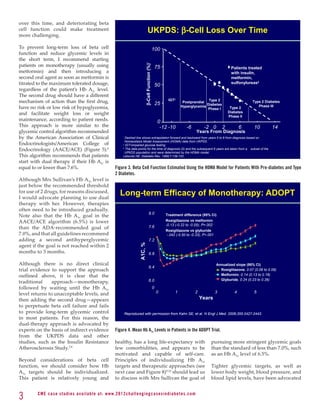
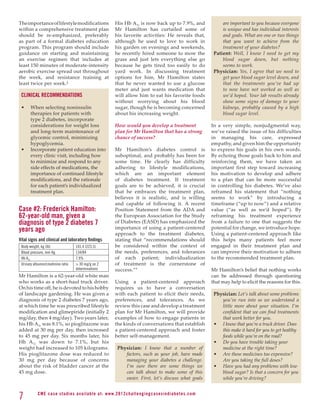
Figure 3 shows beta cell function over
time, estimated using Homeostasis                                                                                                     0.2                                                                                0.2

Model Assessment (HOMA), in patients                                        20
                                                                                                                                      0.1
                                                                                                                                                                          20
                                                                                                                                                                                                                         0.1
who participated in the United Kingdom
Prospective Diabetes Study (UKPDS).4                                         0                                                        0                                   0                                              0

Time zero represents the time at which                                             0           60             120              180                                              0        60       120             180

patients were given the diagnosis of                                                           Time, min                                                                                 Time, min
type 2 diabetes and started treatment.                                            Oral glucose load
It was estimated that beta cell function                                          Intravenous (IV) glucose infusion
had already declined by approximately
50% in these patients, but treatment with
                                                                            Adapted with permission from Nauck M et al. Diabetologia. 1986;29:46–52. Copyright © 1986 Springer-Verlag.

metformin, a sulfonylurea, or insulin
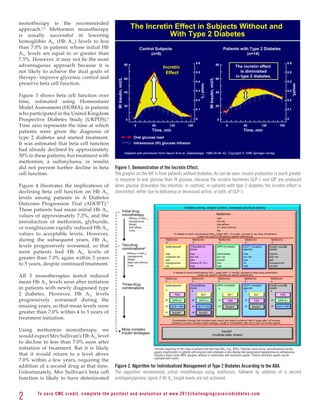
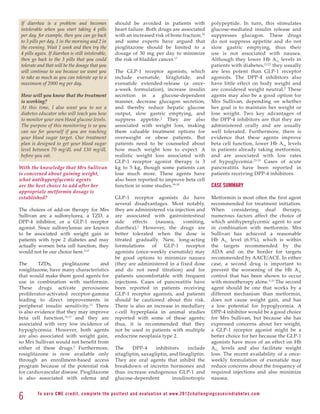
did not prevent further decline in beta               Figure 1. Demonstration of the Incretin Effect.
cell function.                                        The graphic on the left is from patients without diabetes. As can be seen, insulin production is much greater
                                                      in response to oral glucose than IV glucose, because the incretin hormones GLP-1 and GIP are produced
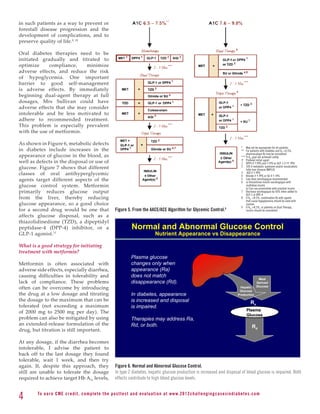
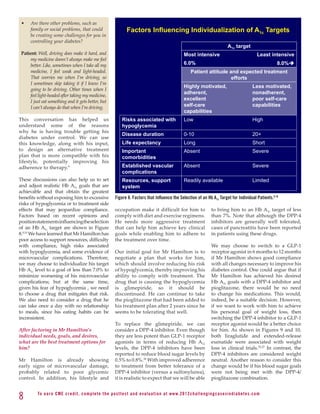
Figure 4 illustrates the implications of              when glucose stimulates the intestine. In contrast, in patients with type 2 diabetes the incretin effect is
declining beta cell function on Hb A1c                diminished, either due to deficiency or decreased action, or both, of GLP-1.
levels among patients in A Diabetes                Position Statement
Outcome Progression Trial (ADOPT).5
These patients had mean initial Hb A1c
values of approximately 7.3%, and the
introduction of metformin, glyburide,
or rosiglitazone rapidly reduced Hb A1c
values to acceptable levels. However,
during the subsequent years, Hb A1c
levels progressively worsened, so that
most patients had Hb A1c levels of
greater than 7.0% again within 3 years
to 5 years, despite continued treatment.

All 3 monotherapies tested reduced
mean Hb A1c levels soon after initiation
in patients with newly diagnosed type
2 diabetes. However, Hb A1c levels
progressively worsened during the
ensuing years, so that mean levels were
greater than 7.0% within 4 to 5 years of
treatment initiation.

Using metformin monotherapy, we
would expect Mrs Sullivan’s Hb A1c level
to decline to less than 7.0% soon after
initiation of treatment. But it is likely                                                       a
                                                                                                 Consider beginning at this stage in patients with very high HbA1c (e.g., $9%). bConsider rapid-acting, nonsulfonylurea secreta-
                                                   Figure 2dAntihyperglycemic therapy in type 2 diabetes: general recommendations. Moving from the top to the bottom of the figure, potential
                                                                                       gogues (meglitinides) in patients with irregular meal schedules or who develop late postprandial hypoglycemia on sulfonylureas.
that it would return to a level above              sequences of antihyperglycemic therapy. In most patients,glargine, detemir) in combination with noninsulin agents. dCertain noninsulin agents mayafter, diagnosis
                                                                                       c
                                                                                        Usually a basal insulin (NPH, begin with lifestyle changes; metformin monotherapy is added at, or soon be
7.0% within a few years, requiring the             (unless there are explicit contraindications). insulin.
                                                                                       continued with If the HbA1c target is not achieved after ;3 months, consider one of the five treatment options combined
                                                   with metformin: a sulfonylurea, TZD, DPP-4 inhibitor, GLP-1 receptor agonist, or basal insulin. (The order in the chart is determined by historical
addition of a second drug at that time.            introduction 2. Algorithm for Individualized Management of Type 2 Diabetes According to the drug characteristics, with
                                                      Figure and route of administration and is not meant to denote any specific preference.) Choice is based on patient and ADA.
Unfortunately, Mrs Sullivan’s beta cell            the over-riding goal of improving glycemic control while minimizing side effects. Shared decision making with the patient may help in the selection of
                                                      The algorithm recommends initial monotherapy using metformin, followed by addition of a second
                                                   therapeutic options. The figure displays drugs commonly used both in the U.S. and/or Europe. Rapid-acting secretagogues (meglitinides) may be
function is likely to have deteriorated            used in place of sulfonylureas. Other drugsA1c target levels are not achieved.
                                                      antihyperglycemic agent if Hb not shown (a-glucosidase inhibitors, colesevelam, dopamine agonists, pramlintide) may be used where
                                                   available in selected patients but have modest efficacy and/or limiting side effects. In patients intolerant of, or with contraindications for, metformin,
                                                   select initial drug from other classes depicted and proceed accordingly. In this circumstance, while published trials are generally lacking, it is
                                                   reasonable to consider three-drug combinations other than metformin. Insulin is likely to be more effective than most other agents as a third-line

2       To e a r n C M E c redi t, compl ete the   pos ttes t and whenaHbA1ctiisovery high (e.g., 2 0 1 2 c h a l ltherapeutic c a s e s ishould includessome m insulin before moving to more
                                                   therapy, especially e v l u a            n a t www. $9.0%). The e n g i n g regimen n d i a b e te . c o basal
                                                   complex insulin strategies (Fig. 3). Dashed arrow line on the left-hand side of the figure denotes the option of a more rapid progression from a two-
                                                   drug combination directly to multiple daily insulin doses, in those patients with severe hyperglycemia (e.g., HbA1c $10.0–12.0%). DPP-4-i, DPP-4
                                                   inhibitor; Fx’s, bone fractures; GI, gastrointestinal; GLP-1-RA, GLP-1 receptor agonist; HF, heart failure; SU, sulfonylurea. aConsider beginning at this
                                                   stage in patients with very high HbA1c (e.g., $9%). bConsider rapid-acting, nonsulfonylurea secretagogues (meglitinides) in patients with irregular
                                                   meal schedules or who develop late postprandial hypoglycemia on sulfonylureas. cSee Table 1 for additional potential adverse effects and risks, under
over this time, and deteriorating beta
cell function could make treatment
more challenging.
                                                                                          UKPDS: β-Cell Loss Over Time
To prevent long-term loss of beta cell                                                                    100
function and reduce glycemic levels in
the short term, I recommend starting
patients on monotherapy (usually using


                                                                                   β-Cell Function (%)*
                                                                                                              75                                             Patients treated
metformin) and then introducing a                                                                                                                            with insulin,
second oral agent as soon as metformin is                                                                                                                    metformin,
titrated to the maximum tolerated dosage,                                                                     50                                             sulfonylureas‡
regardless of the patient’s Hb A1c level.
The second drug should have a different
mechanism of action than the first drug,                                                                      25
                                                                                                                    IGT†
                                                                                                                              Postprandial
                                                                                                                                            Type 2                       Type 2 Diabetes
                                                                                                                                           Diabetes
have no risk or low risk of hypoglycemia,                                                                                    Hyperglycemia
                                                                                                                                           Phase I           Type 2         Phase III

and facilitate weight loss or weight                                                                                                                        Diabetes
                                                                                                                                                            Phase II
maintenance, according to patient needs.                                                                       0
This approach is more similar to the                                                                            -12 -10         -6         -2 0         2          6      10         14
glycemic control algorithm recommended                                                                                                Years From Diagnosis
by the American Association of Clinical                          *
                                                                   Dashed line shows extrapolation forward and backward from years 0 to 6 from diagnosis based on

Endocrinologists/American College of
                                                                   Homeostasis Model Assessment (HOMA) data from UKPDS.
                                                                 †
                                                                   IGT=impaired glucose testing
Endocrinology (AACE/ACE) (Figure 5).6                            ‡
                                                                   The data points for the time of diagnosis (0) and the subsequent 6 years are taken from a subset of the
                                                                   UPKDS population and were determined by the HOMA model.
This algorithm recommends that patients                          Lebovitz HE. Diabetes Rev. 1999;7:139-153.
start with dual therapy if their Hb A1c is
equal to or lower than 7.6%.                                Figure 3. Beta Cell Function Estimated Using the HOMA Model for Patients With Pre-diabetes and Type
                                                            2 Diabetes.
Although Mrs Sullivan’s Hb A1c level is
just below the recommended threshold                                                         Long-term Efficacy of Monotherapy: ADOPT
for use of 2 drugs, for reasons discussed,
I would advocate planning to use dual
                                                               Long-term Efficacy of Monotherapy: ADOPT
therapy with her. However, therapies
often need to be introduced gradually.
                                                                                             8.0
Note also that the Hb A1c goal in the                                                                              Treatment difference (95% Cl)
AACE/ACE algorithm (6.5%) is lower                                                                                 Rosiglitazone vs metformin
                                                                                                                   -0.13 (-0.22 to -0.05); P=.002
than the ADA-recommended goal of                                                             7.6
                                                                                                                   Rosiglitazone vs glyburide
7.0%, and that all guidelines recommend                                                                            -.042 (-0.50 to -0.33); P<.001
adding a second antihyperglycemic                                                            7.2
agent if the goal is not reached within 2
                                                                              A1C, %


months to 3 months.                                                                          6.8

Although there is no direct clinical                                                                                                                Annualized slope (95% Cl)
                                                                                             6.4
trial evidence to support the approach                                                                                                                Rosiglitazone, 0.07 (0.06 to 0.09)
outlined above, it is clear that the                                                                                                                  Metformin, 0.14 (0.13 to 0.16)

traditional     approach—monotherapy,                                                        6.0                                                      Glyburide, 0.24 (0.23 to 0.26)

followed by waiting until the Hb A1c                                                                      0
level returns to unacceptable levels, and                                                                     0          1           2              3          4          5
then adding the second drug—appears                                                                                                      Years
to perpetuate beta cell failure and fails
to provide long-term glycemic control                                Reproduced with permission from Kahn SE, et al. N Engl J Med. 2006;355:2427-2443.
in most patients. For this reason, the
dual-therapy approach is advocated by
experts on the basis of indirect evidence                   Figure 4. Mean Hb A1c Levels in Patients in the ADOPT Trial.
from the UKPDS data and other
studies, such as the Insulin Resistance                     healthy, has a long life-expectancy with                                            pursuing more stringent glycemic goals
Atherosclerosis Study.7,8                                   few comorbidities, and appears to be                                                than the standard of less than 7.0%, such
                                                            motivated and capable of self-care.                                                 as an Hb A1c level of 6.5%.
Beyond considerations of beta cell                          Principles of individualizing Hb A1c
function, we should consider how Hb                         targets and therapeutic approaches (see                                             Tighter glycemic targets, as well as
A1c targets should be individualized.                       next case and Figure 8)9,10 should lead us                                          lower body weight, blood pressure, and
This patient is relatively young and                        to discuss with Mrs Sullivan the goal of                                            blood lipid levels, have been advocated


3       C M E c a se st u di es av ai l abl e at: w w w. 2012chall e n g i n g c a s e s i n d i a b e te s . c o m
in such patients as a way to prevent or
forestall disease progression and the
development of complications, and to
preserve quality of life.9, 10

Oral diabetes therapies need to be
initiated gradually and titrated to
optimize     compliance,    minimize
adverse effects, and reduce the risk
of hypoglycemia. One important
barrier to good self-management
is adverse effects. By immediately
beginning dual-agent therapy at full
dosages, Mrs Sullivan could have
adverse effects that she may consider
intolerable and be less motivated to
adhere to recommended treatment.
This problem is especially prevalent
with the use of metformin.

As shown in Figure 6, metabolic defects
                                                                                                                                                 *	 May not be appropriate for all patients
in diabetes include increases in the                                                                                                             **	 patients with diabetes and A1c 6.5%,
                                                                                                                                                     For
appearance of glucose in the blood, as                                                                                                               pharmacologix Rx may be considered
                                                                                                                                                 *** f A1c goal not achieved safely
                                                                                                                                                     I
well as defects in the disposal or use of                                                                                                        	 Prefered initial agent
                                                                                                                                                 1	 DPP4 if  PPG and  FPG or GLP-1 if  PPG
glucose. Figure 7 shows that different                                                                                                           2	 if metabolic syndrome and/or nonalcoholic
                                                                                                                                                     TZD
                                                                                                                                                     fatty liver disease (NAFLD)
classes of oral antihyperglycemic                                                                                                                3	 AGI if  PPG	
                                                                                                                                                 4	 Blinide if  PPG or SU if  FPG
agents target different aspects of the                                                                                                           5	 Low-dose secretagogue recommended
                                                                                                                                                 6	 Discontinue insulin secretagogue with
                                                                                                                                                     a)
glucose control system. Metformin                                                                                                                    multidose insulin
                                                                                                                                                     b) Can use pramlintide with prandial insulin
primarily reduces glucose output                                                                                                                 7	 Decrease secretagogue by 50% when added to
                                                                                                                                                     GLP-1 or DPP-4
from the liver, thereby reducing                                                                                                                 8	If A 8.5%, combination Rx with agents
                                                                                                                                              © AACE 1ccause hypoglycemia Update.used with be reproduced
                                                                                                                                                         December 2009 should be May not
                                                                                                                                                     that
glucose appearance, so a good choice                                                                                                                 caution
                                                                                                                                                 9	If A1c 8.5%, in patients on Dual Therapy,
for a second drug would be one that                         Figure 5. From the AACE/ACE Algorithm for Glycemic Control.6                             insulin should be considered
affects glucose disposal, such as a
thiazolidinedione (TZD), a dipeptidyl
peptidase-4 (DPP-4) inhibitor, or a                                    Normal and Abnormal Glucose Control
GLP-1 agonist. 11                                                                      Nutrient Appearance vs Disappearance

What is a good strategy for initiating
treatment with metformin?
                                                                       Plasma glucose
Metformin is often associated with                                     changes only when
adverse side effects, especially diarrhea,                             appearance (Ra)
causing difficulties in tolerability and                               does not match
                                                                                                                                                             Meal
lack of compliance. These problems                                     disappearance (Rd).                                                                  Derived
often can be overcome by introducing                                                                                                            Hepatic     Glucose
                                                                                                                                                Glucose
the drug at a low dosage and titrating                                 In diabetes, appearance                                                 Production
the dosage to the maximum that can be                                  is increased and disposal                                                       Ra
tolerated (not exceeding a maximum                                     is impaired.
of 2000 mg to 2500 mg per day). The                                                                                                                  Plasma
                                                                                                                                                     Glucose
problem can also be mitigated by using                                 Therapies may address Ra,
an extended-release formulation of the                                 Rd, or both.                                                                     Rd
drug, but titration is still important.

At any dosage, if the diarrhea becomes
intolerable, I advise the patient to
back off to the last dosage they found
tolerable, wait 1 week, and then try
again. If, despite this approach, they                      Figure 6. Normal and Abnormal Glucose Control.
still are unable to tolerate the dosage                     In type 2 diabetes, hepatic glucose production is increased and disposal of blood glucose is impaired. Both
required to achieve target Hb A1c levels,                   effects contribute to high blood glucose levels.


4       To e a r n C M E c redi t, compl ete the pos ttes t and e v a l u a ti o n a t www. 2 0 1 2 c h a l l e n g i n g c a s e s i n d i a b e te s . c o m
especially if they are already taking an
extended-release formulation, I might                                                No Single Class of Oral Antihyperglycemic
consider a metformin formulation                                                   Monotherapy Targets All Key Pathophysiologies
that is released more slowly in the
intestines, such as Glumetza.                                                                                                                                                                 Incretin
                                                                                                               Alpha-       Meglitinides3    SUs4,5                                          Mimetics/
How would you discuss the treatment                                                                         Glucosidase                                    TZDs    6,7
                                                                                                                                                                          Metformin     8
                                                                                                                                                                                               DPP-4
                                                                                                            Inhibitors1,2                                                                    Inhibitors
plan with Mrs Sullivan?


                                                                 Major Pathophysiologies
It is important to combine active
                                                                                           Insulin
                                                                                           deficiency                                                                                            
pharmacologic treatment with patient
education and counseling about the                                                                                                                                              
goals of therapies, the therapeutic
                                                                                           Insulin
                                                                                           resistance                                                                                             *
strategy, and future treatment plans,
such as the plan to introduce a second                                                     Excess hepatic
                                                                                                                                                                                                 
agent after metformin therapy is                                                           glucose output

established. The goals of education
                                                                                           Intestinal
and counseling are to increase Mrs
Sullivan’s understanding of the disease
                                                                                           glucose
                                                                                           absorption                                                                           
process and the potential of her diabetes                     1. Glyset [package insert]. New York, NY: Pfizer Inc; 2004. 2. Precose [package insert]. West Haven, Conn: Bayer; 2004.
to worsen, and enhance her confidence                         3. Prandin [package insert]. Princeton, NJ: Novo Nordisk; 2006. 4. Diabeta [package insert]. Bridgewater, NJ: Sanofi-Aventis; 2007.
                                                              5. Glucotrol [package insert]. New York, NY: Pfizer Inc; 2006. 6. Actos [package insert]. Lincolnshire, Ill: Takeda Pharmaceuticals; 2004.
in her ability to follow an effective                         7. Avandia [package insert]. Research Triangle Park, NC: GlaxoSmithKline; 2005.
                                                              8. Glucophage [package insert]. Princeton, NJ: Bristol-Myers Squibb; 2004.
treatment plan.                                               * Applies only to GLP1 agonists


My discussion with Mrs Sullivan                              Figure 7. Pathophysiologic Processes Targeted by Different Antihyperglycemic Agents.
will include several important topics,                       Although metformin improves insulin resistance, its main effect is to reduce hepatic glucose output.
including:

•	   Why treatment is necessary and                            amount of glucose that enters your body,                                     Because metformin can cause diarrhea, I’m
     important                                                 and (2) improve the way your body uses the                                   going to start you at a low dosage and then
•	   Goals of treatment                                        glucose to produce the energy you need to                                    gradually increase it, because the diarrhea
•	   Rationale for the treatment plan                          carry out your daily activities.                                             goes away in most people once their body
•	   How to manage side effects                                                                                                             gets used to the medication. I want you to
•	   Plans for monitoring                                      What is the rationale for the treatment                                      start taking 500 mg metformin as a single
•	   Managing any barriers or challenges                       plan?                                                                        pill with every evening meal. Taking it
     she anticipates                                           To achieve these goals, we need to use 2                                     with the evening meal does 2 things: (1) it
                                                               different drugs that work together. The                                      makes the diarrhea less bothersome, and (2)
More specifically, here is an example of                       safest drug – the one that has been around                                   your liver tends to make the most glucose
how I would cover these issues with Mrs                        for the longest time – is metformin. Its main                                at nighttime, so taking metformin in the
Sullivan:                                                      effect is to reduce the amount of glucose                                    evening will have the greatest effect.
                                                               that your liver produces. Our first step is
 Why is treatment necessary and                                to get you started on metformin during                                       Metformin will lower your blood sugar
 important?                                                    this first month. After 2 to 3 months,                                       without making it go below normal limits
 Your blood sugar level (known as Hb A1c)                      your Hb A1c level may drop below 7.0% or                                     because it only reduces the glucose your
 is 7.5%, indicating that your blood sugar                     even 6.5%. But from the results of many                                      liver is making, and, therefore, doesn’t
 level is above the level known to increase                    studies, I know that it is likely that your                                  carry the risk of making your blood sugar
 your risk for damage to your eyes, nerves,                    blood sugar level may not stay low for very                                  bottom out. The goal is to eventually get
 and kidneys. So, we need to bring this                        long; therefore, we also need to use a drug                                  you on the maximum dosage because it
 blood sugar level down.                                       that improves how your body uses glucose.                                    is most effective that way. So, I will ask
                                                                                                                                            you to gradually increase the amount you
 What are our goals of treatment?                              So, I plan to introduce a second drug at your                                take in weekly increments. You start now
 There are 2 main goals in bringing this blood                 next visit. This drug targets a different part                               by taking 500 mg for the first week with
 sugar down. One goal is to reduce the chances                 of the disease process in a different way than                               your evening meal. Next week, you’ll take
 that you’ll have complications related to high                metformin. We will, however, need to make                                    500 mg in the morning with breakfast
 glucose values. Keeping your Hb A1c values                    sure that the 2 drugs together do not cause                                  and 500 mg in the evening with dinner.
 below 7.0% will do that.                                      your blood sugar to go too low.                                              During the third week, you’ll take 500 mg
                                                                                                                                            in the morning and 1000 mg (2 pills) in
 The second goal is to help your body use                      What are the possible side effects of the                                    the evening. And by the fourth week, you’ll
 glucose efficiently for energy. To do this,                   medicine and how can they be avoided                                         take 1000 mg (2 pills) in the morning and
 we need to do 2 things: (1) decrease the                      or managed?                                                                  1000 mg (2 pills) in the evening.


5        C M E c a se st u di es av ai l abl e at: w w w. 2012chall e n g i n g c a s e s i n d i a b e te s . c o m
If diarrhea is a problem and becomes                         should be avoided in patients with                               polypeptide. In turn, this stimulates
 intolerable when you start taking 4 pills                    heart failure. Both drugs are associated                         glucose-mediated insulin release and
 per day, for example, then you can go back                   with an increased risk of bone fracture,16                       suppresses glucagon. These drugs
 to 3 pills per day, 1 in the morning and 2 in                and some experts have argued that                                do not suppress appetite and do not
 the evening. Wait 1 week and then try the                    pioglitazone should be limited to a                              slow gastric emptying, thus their
 4 pills again. If diarrhea is still intolerable,             dosage of 30 mg per day to minimize                              use is not associated with nausea.
 then go back to the 3 pills that you could                   the risk of bladder cancer.17                                    Although they lower Hb A 1c levels in
 tolerate and that will be the dosage that you                                                                                 patients with diabetes, 21,22 they usually
 will continue to use because we want you                     The GLP-1 receptor agonists, which                               are less potent than GLP-1 receptor
 to take as much as you can tolerate up to a                  include exenatide, liraglutide, and                              agonists. The DPP-4 inhibitors also
 maximum of 2000 mg per day.                                  exenatide extended-release (a once-                              have little effect on body weight and
                                                              a-week formulation), increase insulin                            are considered weight neutral. 2 These
 How will you know that the treatment                         secretion in a glucose-dependent                                 agents may also be a good option for
 is working?                                                  manner, decrease glucagon secretion,                             Mrs Sullivan, depending on whether
 At this time, I also want you to see a                       and thereby reduce hepatic glucose                               her goal is to maintain her weight or
 diabetes educator who will teach you how                     output, slow gastric emptying, and                               lose weight. Two key advantages of
 to monitor your own blood glucose levels.                    suppress appetite.2 They are also                                the DPP-4 inhibitors are that they are
 The purpose of this monitoring is so you                     associated with weight loss, making                              administered orally and are usually
 can see for yourself if you are reaching                     them valuable treatment options for                              well tolerated. Furthermore, there is
 your blood sugar target. Our treatment                       overweight or obese patients. But                                evidence that these agents improve
 plan is designed to get your blood sugar                     patients need to be counseled about                              beta cell function, lower Hb A 1c levels
 level between 70 mg/dL and 130 mg/dL                         how much weight loss to expect. A                                in patients already taking metformin,
 before you eat.                                              realistic weight loss associated with                            and are associated with low rates
                                                              GLP-1 receptor agonist therapy is 3                              of hypoglycemia. 23-25 Cases of acute
With the knowledge that Mrs Sullivan                          kg to 5 kg, though some patients can                             pancreatitis have been reported in
is concerned about gaining weight,                            lose much more. These agents have                                patients receiving DPP-4 inhibitors.
what antihyperglycemic agents                                 also been reported to improve beta cell
are the best choice to add after her                          function in some studies.18-20                                   CASE SUMMARY
appropriate metformin dosage is
established?                                                  GLP-1 receptor agonists do have                                  Metformin is most often the first agent
                                                              several disadvantages. Most notably,                             recommended for treatment initiation.
The choices of add-on therapy for Mrs                         they are administered via injection and                          When considering dual therapy,
Sullivan are a sulfonylurea, a TZD, a                         are associated with gastrointestinal                             numerous factors affect the choice of
DPP-4 inhibitor, or a GLP-1 receptor                          side    effects   (nausea,    vomiting,                          which antihyperglycemic agent to use
agonist. Since sulfonylureas are known                        diarrhea).2 However, the drugs are                               in combination with metformin. Mrs
to be associated with weight gain in                          better tolerated when the dose is                                Sullivan has achieved a reasonable
patients with type 2 diabetes and may                         titrated gradually. New, long-acting                             Hb A1c level (6.5%), which is within
actually worsen beta cell function, they                      formulations    of   GLP-1     receptor                          the targets recommended by the
would not be our choice here.2,12                             agonists (once-weekly exenatide) may                             ADA and on the border for targets
                                                              be good options to minimize nausea                               recommended by AACE/ACE. In either
The      TZDs,      pioglitazone     and                      (they are administered in a fixed dose                           case, a second drug is important to
rosiglitazone, have many characteristics                      and do not need titration) and for                               prevent the worsening of the Hb A1c
that would make them good agents for                          patients uncomfortable with frequent                             control that has been shown to occur
use in combination with metformin.                            injections. Cases of pancreatitis have                           with monotherapy alone.5,15 The second
These drugs activate peroxisome                               been reported in patients receiving                              agent should be one that works by a
proliferator-activated receptor-gamma                         GLP-1 receptor agonists, and patients                            different mechanism than metformin,
leading to direct improvements in                             should be cautioned about this risk.                             does not cause weight gain, and has
peripheral insulin sensitivity.13 There                       There is also an increase in medullary                           a low potential for hypoglycemia. A
is also evidence that they may improve                        c-cell hyperplasia in animal studies                             DPP-4 inhibitor would be a good choice
beta cell function,14,15 and they are                         reported with some of these agents;                              for Mrs Sullivan, but because she has
associated with very low incidence of                         thus, it is recommended that they                                expressed concerns about her weight,
hypoglycemia. However, both agents                            not be used in patients with multiple                            a GLP-1 receptor agonist might be a
are also associated with weight gain,                         endocrine neoplasia type 2.                                      better choice for her because the GLP-1
so Mrs Sullivan would not benefit from                                                                                         agonists have more of an effect on Hb
either of these drugs.2 Furthermore,                          The     DPP-4      inhibitors     include                        A1c levels and also facilitate weight
rosiglitazone is now available only                           sitagliptin, saxagliptin, and linagliptin.                       loss. The recent availability of a once-
through an enrollment-based access                            They are oral agents that inhibit the                            weekly formulation of exenatide may
program because of the potential risk                         breakdown of incretin hormones and                               reduce concerns about the frequency of
for cardiovascular disease. Pioglitazone                      thus increase endogenous GLP-1 and                               required injections and also minimize
is also associated with edema and                             glucose-dependent          insulinotropic                        nausea.


6         To e a r n C M E c redi t, compl ete the pos ttes t and e v a l u a ti o n a t www. 2 0 1 2 c h a l l e n g i n g c a s e s i n d i a b e te s . c o m
The importance of lifestyle modifications                       His Hb A1c is now back up to 7.9%, and                         are important to you because everyone
within a comprehensive treatment plan                           Mr Hamilton has curtailed some of                              is unique and has individual interests
should be re-emphasized, preferably                             his favorite activities: He reveals that,                      and goals. What are one or two things
as part of a formal diabetes education                          although he used to love to work in                            that you want to achieve from the
program. This program should include                            his garden on evenings and weekends,                           treatment of your diabetes?
guidance on starting and maintaining                            he recently hired someone to mow the                       Patient: Well, I know I need to get my
an exercise regimen that includes at                            grass and just lets everything else go                         blood sugar down, but nothing
least 150 minutes of moderate-intensity                         because he gets tired too easily to do                         seems to work.
aerobic exercise spread out throughout                          yard work. In discussing treatment                         Physician: Yes, I agree that we need to
the week, and resistance training at                            options for him, Mr Hamilton states                            get your blood sugar level down, and
least twice per week.2                                          that he never wanted to use a glucose                          that the treatments you’ve had up
                                                                meter and just wants medication that                           to now have not worked as well as
 CLINICAL RECOMMENDATIONS                                       will allow him to eat his favorite foods                       we’d hoped. Your lab results already
                                                                without worrying about his blood                               show some signs of damage to your
 •	    When selecting noninsulin                                sugar, though he is becoming concerned                         kidneys, probably caused by a high
       therapies for patients with                              about his increasing weight.                                   blood sugar level.
       type 2 diabetes, incorporate
       considerations for weight loss                           How would you develop a treatment                         In a very simple, nonjudgmental way,
       and long-term maintenance of                             plan for Mr Hamilton that has a strong                    we’ve raised the issue of his difficulties
       glycemic control, minimizing                             chance of success?                                        in managing his care, expressed
       hypoglycemia.                                                                                                      empathy, and given him the opportunity
 •	    Incorporate patient education into                       Mr Hamilton’s diabetes control is                         to express his goals in his own words.
       every clinic visit, including how                        suboptimal, and probably has been for                     By echoing those goals back to him and
       to minimize and respond to any                           some time. He clearly has difficulty                      reinforcing them, we have taken an
       side effects of medications, the                         adhering to lifestyle modifications,                      important first step toward increasing
       importance of continued lifestyle                        which are an important element                            his motivation to develop and adhere
       modifications, and the rationale                         of diabetes treatment. If treatment                       to a plan that can be more successful
       for each patient’s individualized                        goals are to be achieved, it is crucial                   in controlling his diabetes. We’ve also
       treatment plan.                                          that he embraces the treatment plan,                      reframed his statement that “nothing
                                                                believes it is realistic, and is willing                  seems to work” by introducing a
                                                                and capable of following it. A recent                     timeframe (“up to now”) and a relative
Case #2: Frederick Hamilton:                                    Position Statement from the ADA and                       value (“as well as we’d hoped”). By
62-year-old man, given a                                        the European Association for the Study                    reframing his treatment experience
diagnosis of type 2 diabetes 7                                  of Diabetes (EASD) has emphasized the                     from a failure to one that suggests the
years ago                                                       importance of using a patient-centered                    potential for change, we introduce hope.
                                                                approach to the treatment diabetes,                       Using a patient-centered approach like
Vital signs and clinical and laboratory findings                stating that “recommendations should                      this helps many patients feel more
 Body weight, kg (lb)                101.4 (223.5)              be considered within the context of                       engaged in their treatment plan and
 Blood pressure, mm Hg               134/84                     the needs, preferences, and tolerances                    can improve their motivation to adhere
 Hb A1c                              7.9%                       of each patient; individualization                        to the recommended treatment plan.
 Urinary albumin/creatinine ratio     30 mg/g on 2             of treatment is the cornerstone of
                                     determinations             success.”9                                                Mr Hamilton’s belief that nothing works
Mr Hamilton is a 62-year-old white man                                                                                    can be addressed through questioning
who works as a short-haul truck driver.                         Using a patient-centered approach                         that may help to elicit the reasons for this.
On his time off, he is devoted to his hobby                     requires us to have a conversation
of landscape gardening. He was given a                          with each patient to elicit their needs,                   Physician: Let’s talk about some problems
diagnosis of type 2 diabetes 7 years ago,                       preferences, and tolerances. As we                            you’ve run into so we understand a
at which time he was prescribed lifestyle                       review this case and develop a treatment                      little more about your situation. I’m
modification and glimepiride (initially 2                       plan for Mr Hamilton, we will provide                         confident that we can find treatments
mg/day, then 4 mg/day). Two years later,                        examples of how to engage patients in                         that work better for you.
his Hb A1c was 8.1%, so pioglitazone was                        the kinds of conversations that establish                  •	 I know that you’re a truck driver. Does
added at 30 mg per day, then increased                          a patient-centered approach and foster                        this make it hard for you to get healthy
to 45 mg per day. Six months later, his                         better self-management.                                       foods while you’re on the road?
Hb A1c was down to 7.1%, but his                                                                                           •	 Do you have trouble taking your
weight had increased to 105 kilograms.                            Physician: I know that a number of                          medicine at the right time?
His pioglitazone dose was reduced to                                 factors, such as your job, have made                  •	 Are these medicines too expensive?
30 mg per day because of concerns                                    managing your diabetes a challenge.                      Are you taking the full doses?
about the risk of bladder cancer at the                              I’m sure there are some things we                     •	 Have you had any problems with low
45 mg dose.                                                          can talk about to make some of this                      blood sugar? Is that a concern for you
                                                                     easier. First, let’s discuss what goals                  while you’re driving?


7           C M E c a se st u di es av ai l abl e at: w w w. 2012chall e n g i n g c a s e s i n d i a b e te s . c o m
•	   Are there other problems, such as
      family or social problems, that could                           Factors Influencing Individualization of A1c Targets
      be creating some challenges for you in
      controlling your diabetes?
                                                                                                                                          A1c target
 Patient: Well, driving does make it hard, and                                                              Most intensive                                    Least intensive
      my medicine doesn’t always make me feel
      better. Like, sometimes when I take all my                                                            6.0%                                                      8.0%è
      medicine, I feel weak and light-headed.                                                                    Patient attitude and expected treatment
      That worries me when I’m driving, so                                                                                         efforts
      I sometimes skip taking it if I know I’m
                                                                                                            Highly motivated,                              Less motivated,
      going to be driving. Other times when I
                                                                                                            adherent,                                      nonadherent,
      feel light-headed after taking my medicine,
      I just eat something and it gets better, but
                                                                                                            excellent                                      poor self-care
      I can’t always do that when I’m driving.                                                              self-care                                      capabilities
                                                                                                            capabilities
This conversation has helped us                                    Risks associated with                    Low                                            High
understand some of the reasons                                     hypoglycemia
why he is having trouble getting his
                                                                   Disease duration                         0-10                                           20+
diabetes under control. We can use
this knowledge, along with his input,                              Life expectancy                          Long                                           Short
to design an alternative treatment                                 Important                                Absent                                         Severe
plan that is more compatible with his                              comorbidities
lifestyle, potentially improving his
adherence to therapy.9                                             Established vascular                     Absent                                         Severe
                                                                   complications
These discussions can also help us to set                          Resources, support                       Readily available                              Limited
and adjust realistic Hb A1c goals that are                         system
achievable and that obtain the greatest
benefits without exposing him to excessive                    Figure 8. Factors that Influence the Selection of an Hb A1c Target for Individual Patients.9,10
risks of hypoglycemia or to treatment side
effects that may jeopardize compliance.                       occupation make it difficult for him to                          to bring him to an Hb A1c target of less
Factors based on recent opinions and                          comply with diet and exercise regimens.                          than 7%. Note that although the DPP-4
position statements influencing the selection                 He needs more aggressive treatment                               inhibitors are generally well tolerated,
of an Hb A1c target are shown in Figure                       that can help him achieve key clinical                           cases of pancreatitis have been reported
8.9,10 We have learned that Mr Hamilton has                   goals while enabling him to adhere to                            in patients using these drugs.
poor access to support resources, difficulty                  the treatment over time.
with compliance, high risks associated                                                                                         We may choose to switch to a GLP-1
with hypoglycemia, and some evidence of                       Our initial goal for Mr Hamilton is to                           receptor agonist in 6 months to 12 months
microvascular complications. Therefore,                       negotiate a plan that works for him,                             if Mr Hamilton shows good compliance
we may choose to individualize his target                     which should involve reducing his risk                           with all changes necessary to improve his
Hb A1c level to a goal of less than 7.0% to                   of hypoglycemia, thereby improving his                           diabetes control. One could argue that if
minimize worsening of his microvascular                       ability to comply with treatment. The                            Mr Hamilton has achieved his desired
complications; but at the same time,                          drug that is causing the hypoglycemia                            Hb A1c goals with a DPP-4 inhibitor and
given his fear of hypoglycemia , we need                      is glimepiride, so it should be                                  pioglitazone, there would be no need
to choose a drug that mitigates that risk.                    discontinued. He can continue to take                            to change his medications. This would,
We also need to consider a drug that he                       the pioglitazone that had been added to                          indeed, be a suitable decision. However,
can take once a day with no relationship                      his treatment plan after 2 years since he                        if we want to work with him to achieve
to meals, since his eating habits can be                      seems to be tolerating that well.                                his personal goal of weight loss, then
inconsistent.                                                                                                                  switching the DPP-4 inhibitor to a GLP-1
                                                              To replace the glimepiride, we can                               receptor agonist would be a better choice
After factoring in Mr Hamilton’s                              consider a DPP-4 inhibitor. Even though                          for him. As shown in Figures 9 and 10,
individual needs, goals, and desires,                         they are less potent than GLP-1 receptor                         both liraglutide and extended-release
what are the best treatment options for                       agonists in terms of reducing Hb A1c                             exenatide were associated with weight
him?                                                          levels, the DPP-4 inhibitors have been                           loss in clinical trials.22,27 In contrast, the
                                                              reported to reduce blood sugar levels by                         DPP-4 inhibitors are considered weight
Mr Hamilton is already showing                                0.5% to 0.8%.26 With improved adherence                          neutral. Another reason to consider this
early signs of microvascular damage,                          to treatment from better tolerance of a                          change would be if his blood sugar goals
probably related to poor glycemic                             DPP-4 inhibitor (versus a sulfonylurea),                         were not being met with the DPP-4/
control. In addition, his lifestyle and                       it is realistic to expect that we will be able                   pioglitazone combination.


8         To e a r n C M E c redi t, compl ete the pos ttes t and e v a l u a ti o n a t www. 2 0 1 2 c h a l l e n g i n g c a s e s i n d i a b e te s . c o m
Although short-acting exenatide is
likely to reduce Mr Hamilton’s Hb A1c                              Liraglutide and Sitagliptin: Weight from Baseline
to desirable levels, it has a number of
characteristics that would be drawbacks
for this particular patient. He mentioned
that he doesn’t always know when he
will be able to eat because of his driving                           Liraglutide or sitagliptin added to metformin in patients not achieving adequate
schedule.      Short-acting     exenatide,                           glycemic control on metformin alone
however, needs to be administered
within a 60-minute window before                                                                                                       0        4       8       12     16    20    24

meals.28 Furthermore, when beginning                                                                                        0


                                                                                        Change in bodyweight (kg)
treatment with short-acting exenatide,                                                                              -0.5

many patients experience nausea.
                                                                                                                    -1.0
                                                                                                                    -1.5
This side effect could be especially
                                                                                                                                                                                             Both
                                                                                                                    -2.0                                                                     P0.0001

problematic considering Mr Hamilton’s                                                                               -2.5
occupation and history of skipping                                                                                  -3.0
treatment doses to avoid potential side                                                                             -3.5

effects.                                                                                                            -4.0
                                                                                                                    -4.5

CASE SUMMARY                                                                      LAG 1.2 mg                                                                         LAG 1.8 mg                         SITA 100 mg

My approach would be to discontinue
glimepiride and start one of the                                     Pratley R et al. Lancet. 2010;375:1447-1456.

established DPP-4 inhibitors at full
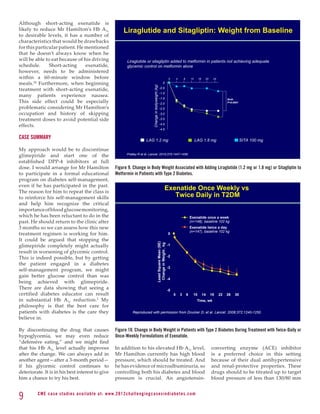
dose. I would arrange for Mr Hamilton                        Figure 9. Change in Body Weight Associated with Adding Liraglutide (1.2 mg or 1.8 mg) or Sitagliptin to
to participate in a formal educational                       Metformin in Patients with Type 2 Diabetes.
program on diabetes self-management,
even if he has participated in the past.
The reason for him to repeat the class is
                                                                                                                                 Exenatide Once Weekly vs
to reinforce his self-management skills                                                                                             Twice Daily in T2DM
and help him recognize the critical
importance of blood glucose monitoring,
which he has been reluctant to do in the                                                                                                                        Exenatide once a week
past. He should return to the clinic after                                                                                                                      (n=148), baseline 102 kg
3 months so we can assess how this new                                                                                                                          Exenatide twice a day
treatment regimen is working for him.
                                                                                                                                                                (n=147), baseline 102 kg
                                                                                                                                       0
It could be argued that stopping the
                                                                                                              Least Square Mean (SE)


glimepiride completely might actually
                                                                                                               Change in Weight , kg


                                                                                                                                       -1
result in worsening of glycemic control.
This is indeed possible, but by getting                                                                                                -2

the patient engaged in a diabetes
self-management program, we might
                                                                                                                                       -3

gain better glucose control than was
                                                                                                                                       -4
being achieved with glimepiride.
There are data showing that seeing a                                                                                                   -5
certified diabetes educator can result                                                                                                      0       3       6     10        14    18    22   26   30
in substantial Hb A1c reduction.2 My                                                                                                                                  Time, wk
philosophy is that the best care for
patients with diabetes is the care they                                  Reproduced with permission from Drucker D, et al. Lancet. 2008;372:1240-1250.
believe in.

By discontinuing the drug that causes                        Figure 10. Change in Body Weight in Patients with Type 2 Diabetes During Treatment with Twice-Daily or
hypoglycemia, we may even reduce                             Once-Weekly Formulations of Exenatide.
“defensive eating,” and we might find
that his Hb A1c level actually improves                      In addition to his elevated Hb A1c level,                                                                            converting enzyme (ACE) inhibitor
after the change. We can always add in                       Mr Hamilton currently has high blood                                                                                 is a preferred choice in this setting
another agent—after a 3-month period—                        pressure, which should be treated. And                                                                               because of their dual antihypertensive
if his glycemic control continues to                         he has evidence of microalbuminuria, so                                                                              and renal-protective properties. These
deteriorate. It is in his best interest to give              controlling both his diabetes and blood                                                                              drugs should to be titrated up to target
him a chance to try his best.                                pressure is crucial. An angiotensin-                                                                                 blood pressure of less than 130/80 mm


9        C M E c a se st u di es av ai l abl e at: w w w. 2012chall e n g i n g c a s e s i n d i a b e te s . c o m
Hg and until his urine albumin declines
into the normal range.                                                                                                     Low HDL-C
                                                                                            Elevated BP                                             Inflammation
 CLINICAL RECOMMENDATIONS

 •	       Identify each patient’s goals
          for treatment, preferences, and                                                                                   Abdominal                                   Insulin
          tolerances to optimize the chances                               Smoking                                           adiposity                                resistance
          for long-term success in the
          treatment of type 2 diabetes.
 •	       Use a nonjudgmental
          conversational style to prompt                                                 Elevated LDL-C                                            Elevated blood
                                                                                                                              Elevated                glucose
          patients to openly discuss their
                                                                                                                           triglycerides
          individual concerns and barriers,
          and echo those challenges back
          to them, so they recognize that                        Figure 11. Hallmarks of Metabolic Syndrome.
          you are incorporating their
          concerns into the treatment plan
          and working to overcome their
          barriers.                                                                         Goals to Prevent Complications
 •	       Use existing guidelines as
          a starting point for clinical                                Measure                                        ADA Standard/Goal
          decision-making, then
          individualize glycemic targets                               A1c                                            7%
          and treatment strategies to
                                                                       Blood pressure                                 130/80, lower if kidney disease
          develop a plan that works best
          for each patient.                                            Dilated eye exam                               At least once a year

                                                                       Foot exam                                      Check feet every day
Case #3: Frank Molson:
51-year-old man, metabolic                                             Smoking                                        Stop!!!
syndrome                                                                                                              100 md/dL if no known CVC
                                                                       LDL (mg/dL)
Vital signs and clinical and laboratory findings                                                                      70 mg/dL if known CVD
 Height, cm (in)                     175 (5’9”)                        Triglycerides (mg/dL)                          150
 Body weight, kg (lb)                91.4 kg (201)
                                                                                                                      45 (men)
 Waist circumference, cm (in)        104 cm (41)                       HDL (mg/dL)
                                                                                                                      55 (women)
 Blood pressure, mm Hg               138/86
                                                                      American Diabetes Association. Diabetes Care . 2011;34(supp 1):S11-S61
 Hb A1c                              7.6%
 Fasting plasma glucose, mg/dL       146                         Figure 12. Clinical Goals for Each Risk Factor According to the ADA.
 LDL cholesterol, mg/dL              137
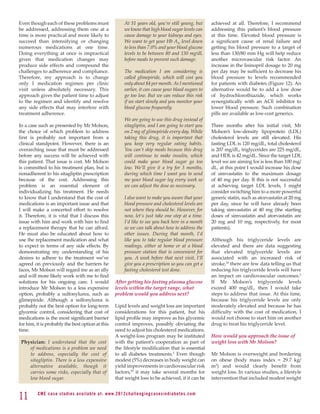
 HDL cholesterol, mg/dL              39                          Mr Molson was prescribed the following                                Mr Molson has most of the hallmarks
                                                                 medications:                                                          of metabolic syndrome (Figure 11),
 Total cholesterol, mg/dL            220
                                                                                                                                       including a waist circumference
 Triglycerides, mg/dL                220                         •	    Lisinopril: 10 mg per day                                       greater than 40 inches ( 102 cm), type
 Urine albumin                       Negative                    •	    Metformin: 1000 mg twice daily                                  2 diabetes mellitus with ongoing poor
 Serum creatinine                    1.1 mg/dL (reference
                                                                 •	    Sitagliptin: 100 mg once daily                                  glycemic control, hypertension (blood
                                     range = 0.9-1.3             •	    Simvastatin: 20 mg once daily                                   pressure  130/85 while taking an
                                     mg/dL)                                                                                            ACE inhibitor), elevated triglycerides
                                                                 Because of his budgetary restrictions,                                (≥ 150 mg/dL), and low high-density
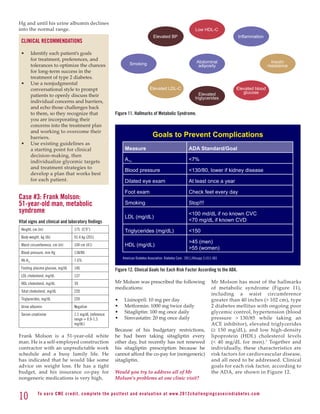
Frank Molson is a 51-year-old white                              he had been taking sitagliptin every                                  lipoprotein (HDL) cholesterol levels
man. He is a self-employed construction                          other day, but recently has not renewed                               ( 40 mg/dL for men). 1 Together and
contractor with an unpredictable work                            his sitagliptin prescription because he                               individually, these characteristics are
schedule and a busy family life. He                              cannot afford the co-pay for (nongeneric)                             risk factors for cardiovascular disease,
has indicated that he would like some                            sitagliptin.                                                          and all need to be addressed. Clinical
advice on weight loss. He has a tight                                                                                                  goals for each risk factor, according to
budget, and his insurance co-pay for                             Would you try to address all of Mr                                    the ADA, are shown in Figure 12.
nongeneric medications is very high.                             Molson’s problems at one clinic visit?


10           To e a r n C M E c redi t, compl ete the pos ttes t and e v a l u a ti o n a t www. 2 0 1 2 c h a l l e n g i n g c a s e s i n d i a b e te s . c o m
Even though each of these problems must                            At 51 years old, you’re still young, but            achieved at all. Therefore, I recommend
be addressed, addressing them one at a                             we know that high blood sugar levels can            addressing this patient’s blood pressure
time is more practical and more likely to                          cause damage to your kidneys and eyes.              at this time. Elevated blood pressure is
succeed than intensifying or changing                              We want to get your Hb A1c level down               a significant cause of renal failure and
numerous medications at one time.                                  to less than 7.0% and your blood glucose            getting his blood pressure to a target of
Doing everything at once is impractical                            levels to be between 80 and 130 mg/dL               less than 130/80 mm Hg will help reduce
given that medication changes may                                  before meals to prevent such damage.                another microvascular risk factor. An
produce side effects and compound the                                                                                  increase in the lisinopril dosage to 20 mg
challenges to adherence and compliance.                            The medication I am considering is                  per day may be sufficient to decrease his
Therefore, my approach is to change                                called glimepiride, which will cost you             blood pressure to levels recommended
only 1 medication regimen per clinic                               only about $4 per month. As I mentioned             for patients with diabetes (Figure 12). An
visit unless absolutely necessary. This                            earlier, it can cause your blood sugars to          alternative would be to add a low dose
approach gives the patient time to adjust                          go too low. But we can reduce this risk             of hydrochlorothiazide, which works
to the regimen and identify and resolve                            if we start slowly and you monitor your             synergistically with an ACE inhibitor to
any side effects that may interfere with                           blood glucose frequently.                           lower blood pressure. Such combination
treatment adherence.                                                                                                   pills are available as low-cost generics.
                                                                   We are going to use this drug instead of
In a case such as presented by Mr Molson,                          sitagliptin, and I am going to start you            Three months after his initial visit, Mr
the choice of which problem to address                             on 2 mg of glimepiride every day. While             Molson’s low-density lipoprotein (LDL)
first is probably not important from a                             taking this drug, it is important that              cholesterol levels are still elevated. His
clinical standpoint. However, there is an                          you keep very regular eating habits.                fasting LDL is 120 mg/dL, total cholesterol
overarching issue that must be addressed                           You can’t skip meals because this drug              is 207 mg/dL, triglycerides are 225 mg/dL,
before any success will be achieved with                           will continue to make insulin, which                and HDL is 42 mg/dL. Since the target LDL
this patient. That issue is cost. Mr Molson                        could make your blood sugar go too                  level we are aiming for is less than 100 mg/
is committed to his treatment plan, but is                         low. We’ll give it a try for 3 months,              dL, at this point I would increase his dose
nonadherent to his sitagliptin prescription                        during which time I want you to send                of simvastatin to the maximum dosage
because of the cost. Addressing this                               me your blood sugar log every week so               of 40 mg per day. If this is not successful
problem is an essential element of                                 we can adjust the dose as necessary.                at achieving target LDL levels, I might
individualizing his treatment. He needs                                                                                consider switching him to a more powerful
to know that I understand that the cost of                         I also want to make you aware that your             generic statin, such as atorvastatin at 20 mg
medications is an important issue and that                         blood pressure and cholesterol levels are           per day, since he will have already been
I will make a concerted effort to resolve                          not where they should be. However, for              taking simvastatin at 40 mg (the starting
it. Therefore, it is vital that I discuss this                     now, let’s just take one step at a time.            doses of simvastatin and atorvastatin are
issue with him and work with him to find                           I’d like to see you back here in a month            20 mg and 10 mg, respectively, for most
a replacement therapy that he can afford.                          so we can talk about how to address the             patients).
He must also be educated about how to                              other issues. During that month, I’d
use the replacement medication and what                            like you to take regular blood pressure             Although his triglyceride levels are
to expect in terms of any side effects. By                         readings, either at home or at a blood              elevated and there are data suggesting
demonstrating my understanding of his                              pressure station that is convenient for             that elevated triglyceride levels are
desires to adhere to the treatment we’ve                           you. A week before that next visit, I’ll            associated with an increased risk of
agreed on previously and the barriers he                           give you a prescription so you can get a            stroke,30 there are few data telling us that
faces, Mr Molson will regard me as an ally                         fasting cholesterol test done.                      reducing his triglyceride levels will have
and will more likely work with me to find                                                                              an impact on cardiovascular outcomes.2
solutions for his ongoing care. I would                      After getting his fasting plasma glucose                  If Mr Molson’s triglyceride levels
introduce Mr Molson to a less expensive                      levels within the target range, what                      exceed 400 mg/dL, then I would take
option, probably a sulfonylurea, such as                     problem would you address next?                           steps to address that issue. At this time,
glimepiride. Although a sulfonylurea is                                                                                because his triglyceride levels are only
probably not the best option for long-term                   Lipid levels and weight loss are important                moderately elevated and because he has
glycemic control, considering that cost of                   considerations for this patient, but his                  difficulty with the cost of medication, I
medications is the most significant barrier                  lipid profile may improve as his glycemic                 would not choose to start him on another
for him, it is probably the best option at this              control improves, possibly obviating the                  drug to treat his triglyceride level.
time.                                                        need to adjust his cholesterol medications.
                                                             A weight-loss program may be instituted                   How would you approach the issue of
 Physician: I understand that the cost                       with the patient’s cooperation as part of                 weight loss with Mr Molson?
    of medications is a problem we need                      the lifestyle modification that is essential
    to address, especially the cost of                       to all diabetes treatments.2 Even though                  Mr Molson is overweight and bordering
    sitagliptin. There is a less expensive                   modest (5%) decreases in body weight can                  on obese (body mass index = 29.7 kg/
    alternative available, though it                         yield improvements in cardiovascular risk                 m2) and would clearly benefit from
    carries some risks, especially that of                   factors,29 it may take several months for                 weight loss. In various studies, a lifestyle
    low blood sugar.                                         that weight loss to be achieved, if it can be             intervention that included modest weight


11       C M E c a se st u di es av ai l abl e at: w w w. 2012chall e n g i n g c a s e s i n d i a b e te s . c o m
loss was associated with improved                            goal setting and other practical aspects                         at suppertime, but given that he is
insulin sensitivity, decrease in fasting                     involved in increasing physical activity,                        already taking a sulfonylurea, starting
blood glucose levels, and reduction in the                   dietary intervention, and behavioral                             basal insulin alone at this time should
incidence of new-onset type 2 diabetes or                    intervention for weight loss, so every                           be enough to provide coverage.
need for diabetes medications in people                      office should have these on hand to give
with an established diagnosis.31-37 He                       to patients.38                                                   Although starting basal insulin is the
has indicated a readiness to address                                                                                          correct approach for this patient, starting
the issue, so I would use his interest as                    Case #3, continued: Frank                                        insulin is not a trivial endeavor for the
a hook to initiate a discussion about                        Molson, 3 years later                                            patient, and I am not in favor of a weight-
it and tailor the intervention to Mr                                                                                          based introduction of insulin. It is always
Molson’s individual needs. For example,                      During the ensuing 3 years, Mr Molson’s                          a guessing game to determine how
although he has been counseled about                         glimepiride dose was incrementally                               much insulin a patient needs, and there
strategies for weight loss in the past, it is                increased to a maximum of 8 mg, and                              is no hurry to get his glucose levels to
important to ask him about his previous                      he continued to take metformin 1000 mg                           target immediately. My goal is to get the
experiences and attempts at weight                           twice daily. Despite efforts to lose weight,                     patient comfortable with giving himself
loss. The discussion should touch on                         his weight continued to increase to 220                          injections and learning how to self-titrate.
strategies that have worked for him and                      pounds. He again has microalbuminuria                            As his comfort level increases, he is more
those that haven’t. By engaging him in                       and has had laser treatment for diabetic                         likely to be compliant with the therapy
this conversation, I can begin to develop                    retinopathy.                                                     and less likely to get hypoglycemia. A
a plan for weight loss that incorporates                                                                                      single episode of hypoglycemia is often
dietary modification, physical exercise,                     Key clinical values, 3 years later                               sufficient to scare the patient into backing
and behavioral therapy.38 In addition, by                     Blood pressure, mm Hg              150/90                       off therapy, and then it becomes more
having a perspective on his past successes                    Hb A1c                             9.5%
                                                                                                                              difficult to achieve goals. Also, insulin
and failures, I can capitalize on his                                                                                         therapy is likely to cause the patient’s
                                                              LDL cholesterol, mg/dL             130
unique strengths and help him manage                                                                                          weight to increase, and that issue is likely
                                                              Albumin/creatinine ratio, mg/g     155, 180 (on 2
his weaknesses. However, because                                                                                              to worsen if he is eating more to ward
                                                                                                 successive tests)
sulfonylureas are associated with weight                                                                                      off potential hypoglycemia. Gradual
                                                              Serum creatinine                   1.1 mg/dL (reference
gain, whereas his previous medication                                                            range = 0.9-1.3 mg/          titration of the insulin dose is, therefore,
(sitagliptin) is considered weight neutral,                                                      dL)                          my preferred approach.
weight loss may be especially challenging                     eGFR, mL/min                       76
with this new treatment regimen.                                                                                              Mr Molson should titrate the dose
                                                             What would you consider to be the best                           in weekly increments on the basis of
A simple, but effective, strategy that has                   treatment regimen for Mr Molson at this                          his fasting blood sugar levels. This
demonstrated effectiveness in helping                        time?                                                            is my preferred approach for this
patients lose weight is a food diary. By                                                                                      patient for 2 reasons. First, neutral
writing down everything that he eats over                    This is an example of the all-too-common                         protamine Hagedorn (NPH) insulin is
a period of 1 or 2 weeks will help give Mr                   situation in which successive use of oral                        inexpensive and does not even require
Molson a new perspective on his eating                       antihyperglycemic agents fails to prevent                        a prescription. Second, he can be given
habits. Regardless of what dietary plan he                   worsening glycemic control, probably                             instructions to self-titrate his insulin
ultimately chooses to follow, a fundamental                  accompanied by declines in beta cell                             dose based on a simple algorithm:
understanding of what, when, how much,                       function.                                                        increase insulin by 4 units every week
and why he eats will increase Mr Molson’s                                                                                     until his fasting blood glucose level
mindfulness about his eating, and set the                    As shown in Figure 13, the combination                           is less than 140 mg/dL, and then by
stage for more intensive interventions.39                    of basal and bolus insulin is designed                           2 units every week until it is below
Some readily available Web-based food                        to mimic the physiologic secretion of                            130 mg/dL (target range = 80 mg/dL
diary tools may be found at: www.                            insulin from the healthy pancreas.                               -130 mg/dL). Even though the ADA
myfooddiary.com,           www.my-calorie-                                                                                    recommends a target range of 70 mg/dL
counter.com, and www.mynetdiary.com/                         However, switching to a basal plus                               to 130 mg/dL, in patients taking
mobile-calorie-counters.html.                                bolus regimen all at once can be                                 insulin, I prefer to leave a little buffer
                                                             complex for many patients, so it is often                        to minimize the risk for hypoglycemia.
Current guidelines from the ADA                              advantageous to start insulin therapy                            Because NPH insulin has a peak blood
recommend that patients receive                              by adding basal insulin to existing                              concentration, I ask my patients using
medical nutrition therapy (MNT) from                         oral agents. As shown in Figure 14,                              this formulation to check their blood
a registered dietitian who is familiar                       adding basal insulin to existing oral                            glucose levels in the middle of the
with MNT for patients with diabetes.32                       agents typically yields decreases in Hb                          night (generally around 2:00 or 3:00
Furthermore, lifestyle interventions and                     A1c levels of approximately 2.0%, even                           am ) to make sure they are not getting
weight-loss strategies and goals should                      in patients already taking metformin                             hypoglycemic. Patients can call/fax/
be individualized to the needs, tolerances,                  in combination with a sulfonylurea.40                            email their blood glucose readings to
and desires of each patient. Valuable                        Some experts might argue that Mr                                 the clinic every week and then come
patient handouts are available to guide                      Molson could use a premixed insulin                              in, if necessary. Once a patient is


12       To e a r n C M E c redi t, compl ete the pos ttes t and e v a l u a ti o n a t www. 2 0 1 2 c h a l l e n g i n g c a s e s i n d i a b e te s . c o m
taking approximately 30 units of NPH                              Mimicking Nature by Combining Basal and Bolus
before bedtime, I would then consider
adding another dose of NPH in the                                                    Insulins
morning to get daytime glucose levels
on target. An alternative approach
would be to consider a long-acting                                                                                                                                                  Endogenous Insulin
insulin analog, such as insulin glargine
                                                                                                                                                                                    Bolus Insulin
or insulin detemir, which needs to be
administered only once a day.                                                                                                                                                       Basal Insulin


                                                                                      Insulin Effect
The 3 choices of basal insulin and their
approximate durations of action are
shown in Figure 15 and Figure 16.41 These
kinetic parameters can vary among
different patients and even within an
individual patient, as well as according
to dosage.

These insulin analogs are significantly                                                                      B            L              S
more expensive than NPH insulin, but
                                                                                  Adapted with permission from McCall A. In: Leahy J, Cefalu W, eds. Insulin Therapy.
NPH insulin has a shorter duration                                                New York, NY: Marcel Dekker Inc;2002:193
of action than insulin glargine or
insulin detemir, making it a less
attractive option for mimicking basal
insulin secretion from the pancreas.                        Figure 13. Combination of Bolus and Basal Insulin to Mimic Secretion of Insulin.
Also, the vial of NPH insulin must be
rolled approximately 20 times before
administration to ensure uniform
distribution    of    the   suspension.                             Start with Basal Insulin: Add Bedtime NPH to
Although all insulins can be associated                                 Various Oral Agents (FINFAT Study)
with hypoglycemia, the hypoglycemia
associated with the use of NPH insulin
is often unpredictable. If NPH insulin
is chosen because of cost considerations
                                                                                      0                                                                     25             (5/24)
(as in the case of Mr Molson), the                                                                                                                                           21                     NPH at HS+:
                                                                                                                                                            20
patient should be educated about the
                                                                                                                                         Dropouts (%)


                                                                                                                                                                                                      Glyburide
                                                                        HbA1c (%)


                                                                                  −1
unpredictable nature of hypoglycemic                                                                                                                        15
                                                                                                                                                                  (2/24)                              Metformin
episodes, and about the potential                                                 −2
                                                                                                                                                            10      8
                                                                                                                                                                                    (1/24)
                                                                                                       − 1.9                     − 2.0                                                                Gly + Met
need to use more than 1 injection per                                                                                    − 2.1                              5                         4    (0/24)
                                                                                                                 − 2.5                                                                       0        NPH at AM
day.3 Between the other 2 long-acting                                             −3                                                                        0
insulins, insulin glargine is often the                                               5                                          4.6                        60                              53
                                                                                                                                         Insulin Dose (U)


preferred option because it seems to                                                  4
                                                                                                       3.9
                                                                        Weight (kg)


                                                                                                                         3.6
have a longer duration of action than                                                 3                                                                     40              36
insulin detemir.                                                                                                                                                   24
                                                                                                                                                                                     20
                                                                                      2
                                                                                                                 0.9                                        20
                                                                                      1
After 3 months, Mr Molson has titrated
                                                                                      0                                                                      0
his basal insulin to 42 units per day
at bedtime without experiencing
any hypoglycemic episodes. His Hb                                   Yki-Järvinen, et al. Ann Intern Med. 1999;1:389-396.

A 1c level has declined from 9.5% to
7.8%, and his fasting blood glucose,
determined by self-monitoring, has                          Figure 14. Addition of Oral Agents to Basal Insulin.40
generally been between 90mg/dL
and 140 mg/dL. His body weight has                          Mr Molson’s fasting blood glucose levels                                                             He already has evidence of diabetic
increased from 220 to 225 pounds.                           have been close to the target range of                                                               retinopathy and nephropathy, so, yes,
                                                            80 mg/dL to 130 mg/dL, but his Hb A1c                                                                it is important that we continue to work
Do you recommend continuing to titrate                      level is still elevated; so, it is likely that                                                       to reduce his Hb A1c levels, preferably
his basal insulin dose until his Hb A1c                     either his postprandial glucose levels                                                               to below 7.0%. Because his fasting
level is lower than 7.0%?                                   are high or he does not have sufficient                                                              glucose appears to be reasonably
                                                            basal insulin coverage during the day.                                                               well-controlled in the morning, this


13      C M E c a se st u di es av ai l abl e at: w w w. 2012chall e n g i n g c a s e s i n d i a b e te s . c o m
necessitates checking his blood glucose
levels during the day. These readings                                                                  Basal Insulin Formulations
                                                                                                          Basal Insulin
                                                                                                                        Formulations
are likely to show that his pre-meal
readings, especially at dinnertime, are
outside the target range. Adding bolus
insulin at dinnertime would be an
option, but my preferred approach is                                    Insulin                              Onset of Action   Peak                    Duration of
to maximize basal insulin replacement                                   Preparations                                                                   Action
first. It may be worthwhile to have him                                 Human NPH                            1-2 hours         4-8 hours               10-20 hours
extend his self-monitoring of blood                                     Insulin
glucose to 2 hours after meals in order                                 Insulin detemir                      1-2 hours         flat                    ~24 hours
to confirm that his postprandial blood
glucose levels are elevated, but if his
                                                                        Insulin glargine                     1-2 hours         flat                    ~24 hours
pre-lunch and pre-dinner readings are
high, I would introduce a morning
dose of NPH insulin, starting at 10 mg
per dose and using the same titration
schedule as for the evening dose.

Discontinuation (or tapering to discon-
tinuation) of glimepiride is a prudent
step once bolus insulin is started, but it
is premature at this time. Discontinuing
metformin, however, is not recommended
for several reasons:3 (1) metformin does                    Figure 15. Three Choices of Basal Insulin and Their Approximate Duration of Action.41
not increase the risk of hypoglycemia
in most people, (2) it can help blunt the
increase in weight gain associated with
insulin therapy,40 and (3) it targets a
                                                                                                                 Insulin Profiles
                                                                                                                  Insulin Profiles
different functional pathway than does
insulin.
                                                                                                     Aspart, Glulisine, Lispro (4–5 hr)
What is the most practical approach for
introducing bolus (mealtime) insulin to                                                                 Regular (6–10 hr)
most patients?
                                                                         Plasma Insulin Levels


                                                                                                                 NPH (10–20 hr)
It can be challenging to introduce
patients to the use of bolus (mealtime)
insulin, and the adage “start low and go                                                                                                     Glargine/Detemir
slow” is valuable advice and the most                                                                                                         (~24 hr)
practical approach in most cases. The
goal of therapy is long-term control of
blood glucose levels, and there is no need
to achieve glycemic targets immediately.3
Thus, to avoid the risk of hypoglycemia,
                                                                                                 0      2    4     6     8   10       12   14     16      18     20   22   24
it is usually most practical to introduce
                                                                                                                               Time (hr)
bolus insulin at a low dose before the                                 Rosenstock J. Clin Cornerstone. 2001;4:50

largest meal of the day. As patients
learn to dose their bolus insulin without
inducing hypoglycemia, then dosing can
be extended to other mealtimes.                             Figure 16. Pharmacokinetic Profiles of Different Insulin Formulations.41

Figure 17 shows an algorithm from ADA                       bolus insulin should be introduced at                                 administered at bedtime.) In any case,
guidelines for initiating and adjusting                     the preceding meal (dinner or breakfast,                              patients often need time to understand
bolus insulin therapy.3 This algorithm                      respectively). If blood glucose levels are                            and adjust to a bolus insulin regimen,
relies on self-monitoring of glucose                        elevated before dinner, then the algorithm                            so it is advisable to initiate this phase of
levels to select the meal at which to                       recommends adding NPH insulin at                                      treatment at a single meal.
initiate bolus insulin. According to this                   breakfast or rapid-acting insulin at lunch.
algorithm, if blood glucose levels are                      (Presumably, pre-breakfast glucose levels                             A common scenario is to introduce
elevated at bedtime or before lunch, then                   are adequately managed by basal insulin                               bolus insulin at dinnertime. The first


14      To e a r n C M E c redi t, compl ete the pos ttes t and e v a l u a ti o n a t www. 2 0 1 2 c h a l l e n g i n g c a s e s i n d i a b e te s . c o m
Consensus Statement


consideration is which formulation
to use. As shown in Figure 16, regular
human insulin has a slower onset of action
than the rapid-acting insulin analogs
currently on the market. The rapid-
acting analogs can be administered just
before a meal or even during the meal;
whereas, NPH should be administered
30 minutes to 60 minutes before the
meal. If the meal is further delayed, it
can lead to hypoglycemia. NPH also has
a longer half-life in the blood, leading
to the potential for late postprandial
hypoglycemia. Patients may still choose
to use regular human insulin because of
its lower cost, but they must be educated
about the risk of hypoglycemia and how
to avoid it.

The next consideration is how to dose
bolus insulin. Two dosing strategies
are used: (1) adjusted dosing based
on pre-meal glucose levels and
carbohydrate       consumption,        and
(2) fixed dosing with controlled
carbohydrate       consumption.        The
first option often seems daunting to
patients, though most can learn how to
calculate the required dose and adapt
to it without too much difficulty. For
simplicity, however, it is often easier
to start with a fixed dose of insulin
and teach the patient how to measure
and     control     their    carbohydrate
consumption. A typical approach is to
introduce 4 units of bolus insulin at
(or before) dinner and concomitantly
reduce their basal insulin dose by the
same amount (4 units). In that scenario,
the patient should consume about Figure 1—Initiation and adjustment of insulin regimens. Insulin regimens should be designed taking lifestyle and meal schedule into account. The
50 g to 60 g carbohydrates (roughly insulins not recommended during adjustment of doses; however, adjustmentBolus Insulin.3 usually beforemore detailed instructions. proportion
                                                                                                                                                                                   a
                                               Figure 17. ADA Algorithm for Initiating and Adjusting used conveniently,
                                           algorithm can only provide basic guidelines for initiation and
                                                                                                          they can be
                                                                                                                      of insulin. See reference 90 for
                                                                                                                                                       breakfast and/or dinner, if
                                                                                                                                                                                     Premixed

12 g - 15 g per unit of insulin). Again, of rapid- and intermediate-acting insulins is similar to the fixed proportions available. bg, blood glucose.
patients should be educated about how 198Once the bedtime glycemic targets are tolerable, as long as theyVOLUME 32, NUMBER 1,severe         DIABETES CARE,
                                                                                                                                                           were not too JANUARY 2009
to avoid hypoglycemia. For example, achieved and hypoglycemia has been and the patient was able to quickly restore
if they inject their usual 4-unit dose of avoided, then Mr Molson can begin euglycemia. Since then, we have learned
insulin and then just consume a light introducing bolus insulin at another meal about hypoglycemia-associated autonomic
meal instead of the expected 50 g to by following a similar strategy. At some failure, in which hypoglycemia blunts the
60 g carbohydrates, they are at risk of point, it is often worthwhile to introduce metabolic, neuroendocrine, and autonomic
hypoglycemia.                                  patients to the concepts of carbohydrate responses to subsequent hypoglycemic
                                               counting so they can adjust their insulin episodes.41,42 As a consequence, patients
As with basal insulin, target blood glucose dose at each meal. Patients will vary who have had a previous hypoglycemic
levels should be set and insulin dosages in their ability or motivation to adopt episode become unable to recognize
titrated accordingly. For Mr Molson, carbohydrate counting.                                                           the symptoms of hypoglycemia to take
I would recommend a bedtime blood                                                                                     corrective action, setting up a vicious
glucose level of 150 mg/dL, for example. What frequency of hypoglycemic                                               cycle of hypoglycemic episodes. Thus, no
If that is not reached with the initial episodes should be considered                                                 number of hypoglycemic episodes should
insulin dosage of 4 units at dinnertime, acceptable or tolerable?                                                     be considered acceptable or tolerable. I
then the dose of dinnertime insulin can be                                                                            tell my patients to contact me if they have
increased by 2 units, and bedtime basal In the past, we often told patients that 1 or more than 1 episode of hypoglycemia
insulin decreased by the same amount. 2 hypoglycemic episodes per week were (blood glucose  70 mg/dL).


15          C M E c a se st u di es av ai l abl e at: w w w. 2012chall e n g i n g c a s e s i n d i a b e te s . c o m
Just as important is that patients and                      many types of insulin now available                              REFERENCES
those around them know how to                               allow patients to mimic physiologic                              1.	 American Diabetes Association. Diabetes Care. 2010;33 (suppl 1):
respond to a hypoglycemic episode.                          insulin secretion to a reasonable degree,                             S62-S699.
A simple rule of thumb is known as                          but this goal requires the eventual use                          2.	 American Diabetes Association. Diabetes Care. 2012;35 (suppl
                                                                                                                                  1):S11-S63.
the “rule of 15.”43 For a hypoglycemic                      of both basal and bolus insulin in most                          3.	 Nathan DM, et al. Diabetes Care. 2009;32(1):193-203. Epub 2008
episode, take 15 g simple carbohydrates                     patients. As with all stages of diabetes                              Oct 22.
(eg, fruit juice, hard candy, pretzels, or                  therapy, thorough patient education is                           4.	 Prospective Diabetes Study Group. Diabetes. 1995;44(11):1249-1258.
                                                                                                                             5.	 Kahn SE, et al. N Engl J Med. 2006;355(23):2427-2443.
crackers) and wait 15 minutes, during                       crucial for patients initiating insulin
                                                                                                                             6.	 Rodbard HW, et al. Endocr Pract. 2009;15(6):540-559.
which other essential functions (eg,                        therapy.                                                         7.	 Festa A, et al. Diabetes. 2006;55(4):1114-1120.
airway, breathing, circulation, and so                                                                                       8.	 Gale EA. Diabet Med. 2008;25(suppl 2):9-12
forth) should be monitored. Check the                       Finally, this case illustrates the importance                    9.	 Inzucchi SE, et al. Diabetes Care. 2012;35(6):1364-1379. Epub
                                                                                                                                  2012 Apr 19.
blood glucose level again after those 15                    of establishing and maintaining trusting                         10.	smail-Beigi F, et al. Ann Intern Med. 2011;154(8):554-559.
                                                                                                                                  I
minutes, and if still hypoglycemic, take                    relationships so your patients know that                         11.	Deacon CF, et al. Diabetes Obes Metab. 2012;14(8):762-7.
another 15 g carbohydrates. Repeat this                     you are aware of their concerns regarding                        12.	 aedler K, et al. J Clin Endocrinol Metab. 2005;90(1):501-506.
                                                                                                                                  M
                                                                                                                                  Epub 2004 Oct 13.
process until hypoglycemia resolves. A                      treatment costs, whether a particular
                                                                                                                             13.	 apanas N, et al. Expert Opin Pharmacother. 2011;12(10):1457-1461.
                                                                                                                                  P
very useful source of information about                     therapy fits with their lifestyle, and any                       14.	DeFronzo RA, et al. N Engl J Med. 2011;364(12):1104-1115.
foods containing 15 g carbohydrates                         potential side effects. This awareness                           15.	 .K. Prospective Diabetes Study Group, et al. Diabetes.
                                                                                                                                  U
can be found at http://iuhealth.org/                        should translate into a willingness to                                1995;44(11):1249-1258.
                                                                                                                             16.	Meier C, et al. Arch Intern Med. 2008;168(8):820-825.
images/ril-doc-upl/Carbohydrate%20                          work collaboratively with patients                               17.	 iccinni C, et al. Diabetes Care. 2011;34(6):1369-1371. Epub
                                                                                                                                  P
Counting%20Food%20List.pdf. Another                         to develop a strategy that the patient                                2011 Apr 22.
list available on the same website                          embraces.                                                        18.	Bunck MC, et al. Diabetes Care. 2011;34(9):2041-2047.
provides the carbohydrate content of                                                                                         19.	 unck MC, et al. Diabetes Care. 2009;32(5):762-768. Epub 2009
                                                                                                                                  B
                                                                                                                                  Feb 5.
popular candies: http://iuhealth.org/                        CLINICAL RECOMMENDATIONS                                        20.	Derosa G, et al. Diabet Med. April 30, 2012. [Epub ahead of print]
images/ril-doc-upl/Halloween%20                                                                                              21.	Amori RE, et al. JAMA. 2007;298(2):194-206.
Candy%20List.pdf.                                            •	     For patients with a limited budget,                      22.	Pratley RE, et al. Lancet. 2010;375(9724):1447-1456.
                                                                                                                             23.	Aschner P, et al. Diabetes Care. 2006;29(12):2632-2637.
                                                                    find an affordable medication that
                                                                                                                             24.	Charbonnel B, et al. Diabetes Care. 2006;29(12):2638-2643.
CASE SUMMARY                                                        will increase compliance with the                        25.	 auck M, et al. Diabetes Care. 2009;32(1):84-90. Epub 2008 Oct 17.
                                                                                                                                  N
                                                                    chosen regimen.                                          26.	Davidson JA. Mayo Clin Proc. 2010;85(12 suppl):S27-S37. Epub
Mr Molson’s case illustrates a practical                     •	     Unless medically necessary to                                 2010 Nov 26.
                                                                                                                             27.	Drucker DJ, et al. Lancet. 2008;372(9645):1240-1250.
approach for addressing the medical                                 make changes quickly, make                               28.	 inelli NR, et al. J Clin Pharmacol. 2011;51(2):165-172. Epub
                                                                                                                                  P
needs of someone who has multiple                                   changes to complex medication                                 2010 May 19.
problems related to the metabolic                                   regimens gradually, allowing                             29.	Klein S, et al. Diabetes Care. 2004;27(8):2067-2073.
syndrome. It also demonstrates the                                  patients to adjust and detect and                        30.	 arbo A, et al. Ann Neurol. 2011;69(4):628-634. Epub 2011 Feb 18.
                                                                                                                                  V
                                                                                                                             31	 K Prospective Diabetes Study 7. Metabolism. 1990;39(9):905-912..
                                                                                                                                  U
importance of adapting therapeutic                                  resolve any side effects that may                        32.	Bantle JP, et al. Diabetes Care. 2008;31 (suppl 1):S61-S78.
strategies to accommodate a patient’s                               hinder compliance.                                       33.	Knowler WC, et al. N Engl J Med. 2002;346(6):393-403.
financial situation and other lifestyle                      •	     Work collaboratively with each                           34.	Penn L, et al. BMC Public Health. 2009;9:342.
                                                                                                                             35.	Tuomilehto J, et al. N Engl J Med. 2001;344(18):1343-1350.
factors that can affect his or her ability                          patient to develop goals and                             36	 Williams KV, et al. Diabetes Obes Metab. 2000;2(3):121-129.
to comply with treatment. It is usually                             strategies for weight loss that                          37	 iebenhofer A, et al. Cochrane Database Syst Rev (Online).
                                                                                                                                  S
impractical to solve all of a patient’s                             are achievable and sensitive to                               2011(9):CD008274.
metabolic problems in a single clinic                               the patient’s needs, desires, and                        38.	 he Practical Guide: Identification, Evaluation, and Treatment
                                                                                                                                  T
                                                                                                                                  of Overweight and Obesity in Adults. Rockville, MD: 2000. NIH
visit. Furthermore, determining the                                 tolerances.                                                   Publication Number 00-4084. Available at: www.nhlbi.nih.gov/
diabetes therapy with which each patient                     •	     If not using a weight-based                                   guidelines/obesity/prctgd_c.pdf. Accessed June 30, 2012.
can most easily comply may reduce the                               regimen for basal insulin, a                             39.	Hollis JF, et al. Am J Prev Med.. 2008;35(2):118-126.
                                                                                                                             40.	Yki-Järvinen H, et al. Ann Intern Med. 1999;130(5):389-396.
severity of related metabolic complaints,                           simple approach is to initiate
                                                                                                                             41.	Cryer PE. Am J Physiol Endocrinol Metab. 2001;281(6):E1115-
such as dyslipidemia, making those                                  treatment using 10 units per                                  E1121.
problems easier to address in subsequent                            day at bedtime and to titrate the                        42.	Diedrich L, et al.Clin Auton Res. 2002;12(5):358-365.
visits.                                                             dose up in weekly increments                             43.	 merican Diabetes Association website. Living with Diabetes:
                                                                                                                                  A
                                                                                                                                  Hypoglycemia. Available at: http://www.diabetes.org/living-with-
                                                                    (2-4 units per week) until target                             diabetes/treatment-and-care/blood-glucose-control/hypoglyce-
Mr Molson is typical in that, like                                  fasting blood glucose levels are                              mia-low-blood.html. Accessed June 30, 2012.
most patients, he continues to exhibit                              achieved (or a maximum dosage
declines in glycemic control and beta                               of 30-40 units is reached).
                                                                                                                             Read this newsletter and receive 4.0 hours of CME credit.
cell function even while receiving oral                      •	     In most cases, continue metformin
therapy. Physicians should closely                                  therapy when patients begin both                         To get your CME credit immediately, simply log onto:
monitor patients for poor glycemic                                  basal insulin and basal plus bolus                       www.2012challengingcasesindiabetes.com
                                                                                                                             to take the posttest and download your certificate.
control and be prepared to initiate                                 insulin therapy.
insulin therapy when target Hb A1c                           •	     All patients using insulin should                        To access the complete case study tutorial, go to:
levels are no longer achieved using oral                            be educated about avoiding                               www.2012challengingcasesindiabetes.com
therapy alone. Although insulin therapy                             hypoglycemia and about how to
                                                                                                                             © 2012. Indiana University and Health Focus, Inc.
is complex, most patients can adapt if                              manage a hypoglycemic episode.                           All rights reserved.
the insulin is introduced gradually. The


16      To e a r n C M E c redi t, compl ete the pos ttes t and e v a l u a ti o n a t www. 2 0 1 2 c h a l l e n g i n g c a s e s i n d i a b e te s . c o m

Diabetes challenging cases

  • 1.
    Challenging Cases 2012: in the Treatment of Type 2 Diabetes Faculty Rattan Juneja, MD Associate Professor of Clinical Medicine Indiana University School of Medicine Medical Director, Indiana University Diabetes Center Case #1: Joan Sullivan: 52-year-old woman, Chief of Endocrinology, Wishard Memorial Hospital maternal history of type 2 diabetes Indianapolis, IN Learning Objectives Vital signs and clinical and laboratory findings This activity is designed for specialists in primary care and endocrinology. Initial presentation One year later, after counseling, There are no prerequisites for this activity. At the conclusion of this diet, and exercise activity, participants should be able to: Age, years 52 53 • Preserve beta cell function, delay disease progression, and minimize the risk of diabetes-related complications by formulating Body weight, kg (lb.) 77.6 (171) 78.5 (173) an individualized treatment plan that addresses the multiple Hb A1c 7.0% 7.5% pathophysiologic mechanisms of diabetes. Blood pressure, mm Hg 118/78 122/82 • Recognize the fundamental features, benefits, and risks underlying Fasting plasma glucose, mg/dL 122 140 (retest: 145) current treatment recommendations when developing individualized treatment plans. Total cholesterol, mg/dL 195 212 • Employ multiple strategies to identify and reduce clinical inertia to LDL cholesterol, mg/dL 119 136 achieve optimal patient outcomes. HDL cholesterol, mg/dL 35 34 • Foster good patient self-management by establishing a Triglycerides, mg/dL 205 212 collaborative relationship with patients based on respect for Proteinuria Negative Negative individual patient preferences, needs, and values. • Establish a comprehensive conceptual framework for disease management of diabetes, hypertension, and hypercholesterolemia At her initial presentation, Mrs Sullivan There may also be biological reasons for so as to provide effective primary care based on current standards. was prescribed a program of counseling, the difficulty in losing weight, such as a diet, and exercise based on her laboratory mismatch between insulin production and CME Information results and weight. However, despite blood glucose peaks. This mismatch is due Release Date: June 25, 2012. Valid for credit through June 24, 2013. counseling for diet and exercise, she has to a reduction or loss of first-phase insulin This activity has been planned and implemented in accordance with the been unsuccessful in her attempts to lose production. The diminution of first-phase Essential Areas and Policies of the Accreditation Council for Continuing weight, her weight has increased, and her insulin release occurs because: (1) the Medical Education (ACCME) through the joint sponsorship of Indiana glycemic control has worsened. On her patient is producing maximal quantities University School of Medicine and Heath Focus, Inc. Indiana University School of Medicine is accredited by the ACCME to provide continuing return visit 1 year later, her fasting plasma of insulin to take care of the glucose the medical education for physicians. Indiana University School of Medicine glucose value was 140 mg/dL. On repeat, it body is producing from gluconeogenesis designates this enduring activity for a maximum of 4 AMA PRA Category 1 Credits™. Physicians should claim only the credit commensurate with was 145 mg/dL. She therefore satisfies the (basal glucose production); and (2) there the extent of their participation in the activity. criteria for type 2 diabetes.1 Most likely, her is a loss of meal-stimulated insulin release To receive credit, participants must review the slides and audio components of this website, and submit the activity evaluation form beta cell function has continued to decline. (loss of the incretin effect) (see Figure 1). and posttest (passing score = 75% or higher). As a result, insulin release in response Length of time to complete the activity: 4 hours This scenario is common in patients to food ingestion is delayed, which in Disclosure Information with insulin resistance. Regardless of some instances may even precipitate late Commercial Support their sincerity and intent to carry out postprandial hypoglycemia, which in turn Indiana University School of Medicine and Health Focus, Inc. gratefully acknowledge the unrestricted educational grant provided by the required lifestyle modifications, could precipitate hunger. This loss of first- Eli Lilly & Company, Merck, Novo Nordisk, Sanofi. patients’ efforts often produce little phase insulin release is considered to be success. There are many reasons for this, the earliest detectable evidence of impaired Faculty Disclosure In accordance with the Accreditation Council for Continuing Medical including social and environmental beta cell function. Education (ACCME) Standards for Commercial Support, educational factors, such as the time required for programs sponsored by Indiana University School of Medicine (IUSM) must demonstrate balance, independence, objectivity, and scientific rigor. All exercise, familial and social patterns What is the best therapeutic approach faculty, authors, editors, and planning committee members participating of overeating and underactivity, to improve Mrs Sullivan’s glycemic in an IUSM-sponsored activity are required to disclose any relevant lack of access to skilled counseling control in the short term AND to financial interest or other relationship with the manufacturer(s) of any commercial product(s) and/or provider(s) of commercial services that and support, unhealthy nutritional maintain or improve her beta cell are discussed in an educational activity. Dr. Juneja reported that he has environments (eg, the higher cost function in the long term? received consulting fees and/or honoraria from Alere, Amylin, Boehringer Ingelheim, Merck, Eli Lilly & Company, and Sanofi. of healthy foods and the ubiquitous Staff: Hassan Danesh, PhD, Monica Armin, and Dr. Deborah Teplow have presence of cheap fast foods and junk According to current guidelines from disclosed that they have no potential or actual conflicts of interest. foods), and other barriers that challenge the American Diabetes Association CME Reviewer: Statements of disclosure of relevant financial patients’ achievement of their goals. (ADA; Figure 2), initiation of metformin relationships have been obtained from Charles Clark Jr, MD. Dr. Clark has disclosed that he has no potential or actual conflicts of interest. Note: Although it offers CME credits, this activity is not intended to 1 C M E c a se st u di es av ai l abl e at: w w w. 2012chall e n g i n g c a s e s i n d i a b e te s . c o m provide extensive training or certification in the field.
  • 2.
    monotherapy is therecommended approach.2,3 Metformin monotherapy The Incretin Effect in Subjects Without and is usually successful in lowering With Type 2 Diabetes hemoglobin A1c (Hb A1c) levels to less than 7.0% in patients whose initial Hb Control Subjects Patients with Type 2 Diabetes A1c levels are equal to or greater than (n=8) (n=14) 7.5%. However, it may not be the most advantageous approach because it is 0.6 0.6 80 80 Incretin The incretin effect not likely to achieve the dual goals of Effect 0.5 is diminished 0.5 therapy: improve glycemic control and in type 2 diabetes. IR Insulin, mU/L IR Insulin, mU/L 60 60 preserve beta cell function. 0.4 0.4 nmol/L nmol / L 40 0.3 40 0.3 Figure 3 shows beta cell function over time, estimated using Homeostasis 0.2 0.2 Model Assessment (HOMA), in patients 20 0.1 20 0.1 who participated in the United Kingdom Prospective Diabetes Study (UKPDS).4 0 0 0 0 Time zero represents the time at which 0 60 120 180 0 60 120 180 patients were given the diagnosis of Time, min Time, min type 2 diabetes and started treatment. Oral glucose load It was estimated that beta cell function Intravenous (IV) glucose infusion had already declined by approximately 50% in these patients, but treatment with Adapted with permission from Nauck M et al. Diabetologia. 1986;29:46–52. Copyright © 1986 Springer-Verlag. metformin, a sulfonylurea, or insulin did not prevent further decline in beta Figure 1. Demonstration of the Incretin Effect. cell function. The graphic on the left is from patients without diabetes. As can be seen, insulin production is much greater in response to oral glucose than IV glucose, because the incretin hormones GLP-1 and GIP are produced Figure 4 illustrates the implications of when glucose stimulates the intestine. In contrast, in patients with type 2 diabetes the incretin effect is declining beta cell function on Hb A1c diminished, either due to deficiency or decreased action, or both, of GLP-1. levels among patients in A Diabetes Position Statement Outcome Progression Trial (ADOPT).5 These patients had mean initial Hb A1c values of approximately 7.3%, and the introduction of metformin, glyburide, or rosiglitazone rapidly reduced Hb A1c values to acceptable levels. However, during the subsequent years, Hb A1c levels progressively worsened, so that most patients had Hb A1c levels of greater than 7.0% again within 3 years to 5 years, despite continued treatment. All 3 monotherapies tested reduced mean Hb A1c levels soon after initiation in patients with newly diagnosed type 2 diabetes. However, Hb A1c levels progressively worsened during the ensuing years, so that mean levels were greater than 7.0% within 4 to 5 years of treatment initiation. Using metformin monotherapy, we would expect Mrs Sullivan’s Hb A1c level to decline to less than 7.0% soon after initiation of treatment. But it is likely a Consider beginning at this stage in patients with very high HbA1c (e.g., $9%). bConsider rapid-acting, nonsulfonylurea secreta- Figure 2dAntihyperglycemic therapy in type 2 diabetes: general recommendations. Moving from the top to the bottom of the figure, potential gogues (meglitinides) in patients with irregular meal schedules or who develop late postprandial hypoglycemia on sulfonylureas. that it would return to a level above sequences of antihyperglycemic therapy. In most patients,glargine, detemir) in combination with noninsulin agents. dCertain noninsulin agents mayafter, diagnosis c Usually a basal insulin (NPH, begin with lifestyle changes; metformin monotherapy is added at, or soon be 7.0% within a few years, requiring the (unless there are explicit contraindications). insulin. continued with If the HbA1c target is not achieved after ;3 months, consider one of the five treatment options combined with metformin: a sulfonylurea, TZD, DPP-4 inhibitor, GLP-1 receptor agonist, or basal insulin. (The order in the chart is determined by historical addition of a second drug at that time. introduction 2. Algorithm for Individualized Management of Type 2 Diabetes According to the drug characteristics, with Figure and route of administration and is not meant to denote any specific preference.) Choice is based on patient and ADA. Unfortunately, Mrs Sullivan’s beta cell the over-riding goal of improving glycemic control while minimizing side effects. Shared decision making with the patient may help in the selection of The algorithm recommends initial monotherapy using metformin, followed by addition of a second therapeutic options. The figure displays drugs commonly used both in the U.S. and/or Europe. Rapid-acting secretagogues (meglitinides) may be function is likely to have deteriorated used in place of sulfonylureas. Other drugsA1c target levels are not achieved. antihyperglycemic agent if Hb not shown (a-glucosidase inhibitors, colesevelam, dopamine agonists, pramlintide) may be used where available in selected patients but have modest efficacy and/or limiting side effects. In patients intolerant of, or with contraindications for, metformin, select initial drug from other classes depicted and proceed accordingly. In this circumstance, while published trials are generally lacking, it is reasonable to consider three-drug combinations other than metformin. Insulin is likely to be more effective than most other agents as a third-line 2 To e a r n C M E c redi t, compl ete the pos ttes t and whenaHbA1ctiisovery high (e.g., 2 0 1 2 c h a l ltherapeutic c a s e s ishould includessome m insulin before moving to more therapy, especially e v l u a n a t www. $9.0%). The e n g i n g regimen n d i a b e te . c o basal complex insulin strategies (Fig. 3). Dashed arrow line on the left-hand side of the figure denotes the option of a more rapid progression from a two- drug combination directly to multiple daily insulin doses, in those patients with severe hyperglycemia (e.g., HbA1c $10.0–12.0%). DPP-4-i, DPP-4 inhibitor; Fx’s, bone fractures; GI, gastrointestinal; GLP-1-RA, GLP-1 receptor agonist; HF, heart failure; SU, sulfonylurea. aConsider beginning at this stage in patients with very high HbA1c (e.g., $9%). bConsider rapid-acting, nonsulfonylurea secretagogues (meglitinides) in patients with irregular meal schedules or who develop late postprandial hypoglycemia on sulfonylureas. cSee Table 1 for additional potential adverse effects and risks, under
  • 3.
    over this time,and deteriorating beta cell function could make treatment more challenging. UKPDS: β-Cell Loss Over Time To prevent long-term loss of beta cell 100 function and reduce glycemic levels in the short term, I recommend starting patients on monotherapy (usually using β-Cell Function (%)* 75 Patients treated metformin) and then introducing a with insulin, second oral agent as soon as metformin is metformin, titrated to the maximum tolerated dosage, 50 sulfonylureas‡ regardless of the patient’s Hb A1c level. The second drug should have a different mechanism of action than the first drug, 25 IGT† Postprandial Type 2 Type 2 Diabetes Diabetes have no risk or low risk of hypoglycemia, Hyperglycemia Phase I Type 2 Phase III and facilitate weight loss or weight Diabetes Phase II maintenance, according to patient needs. 0 This approach is more similar to the -12 -10 -6 -2 0 2 6 10 14 glycemic control algorithm recommended Years From Diagnosis by the American Association of Clinical * Dashed line shows extrapolation forward and backward from years 0 to 6 from diagnosis based on Endocrinologists/American College of Homeostasis Model Assessment (HOMA) data from UKPDS. † IGT=impaired glucose testing Endocrinology (AACE/ACE) (Figure 5).6 ‡ The data points for the time of diagnosis (0) and the subsequent 6 years are taken from a subset of the UPKDS population and were determined by the HOMA model. This algorithm recommends that patients Lebovitz HE. Diabetes Rev. 1999;7:139-153. start with dual therapy if their Hb A1c is equal to or lower than 7.6%. Figure 3. Beta Cell Function Estimated Using the HOMA Model for Patients With Pre-diabetes and Type 2 Diabetes. Although Mrs Sullivan’s Hb A1c level is just below the recommended threshold Long-term Efficacy of Monotherapy: ADOPT for use of 2 drugs, for reasons discussed, I would advocate planning to use dual Long-term Efficacy of Monotherapy: ADOPT therapy with her. However, therapies often need to be introduced gradually. 8.0 Note also that the Hb A1c goal in the Treatment difference (95% Cl) AACE/ACE algorithm (6.5%) is lower Rosiglitazone vs metformin -0.13 (-0.22 to -0.05); P=.002 than the ADA-recommended goal of 7.6 Rosiglitazone vs glyburide 7.0%, and that all guidelines recommend -.042 (-0.50 to -0.33); P<.001 adding a second antihyperglycemic 7.2 agent if the goal is not reached within 2 A1C, % months to 3 months. 6.8 Although there is no direct clinical Annualized slope (95% Cl) 6.4 trial evidence to support the approach Rosiglitazone, 0.07 (0.06 to 0.09) outlined above, it is clear that the Metformin, 0.14 (0.13 to 0.16) traditional approach—monotherapy, 6.0 Glyburide, 0.24 (0.23 to 0.26) followed by waiting until the Hb A1c 0 level returns to unacceptable levels, and 0 1 2 3 4 5 then adding the second drug—appears Years to perpetuate beta cell failure and fails to provide long-term glycemic control Reproduced with permission from Kahn SE, et al. N Engl J Med. 2006;355:2427-2443. in most patients. For this reason, the dual-therapy approach is advocated by experts on the basis of indirect evidence Figure 4. Mean Hb A1c Levels in Patients in the ADOPT Trial. from the UKPDS data and other studies, such as the Insulin Resistance healthy, has a long life-expectancy with pursuing more stringent glycemic goals Atherosclerosis Study.7,8 few comorbidities, and appears to be than the standard of less than 7.0%, such motivated and capable of self-care. as an Hb A1c level of 6.5%. Beyond considerations of beta cell Principles of individualizing Hb A1c function, we should consider how Hb targets and therapeutic approaches (see Tighter glycemic targets, as well as A1c targets should be individualized. next case and Figure 8)9,10 should lead us lower body weight, blood pressure, and This patient is relatively young and to discuss with Mrs Sullivan the goal of blood lipid levels, have been advocated 3 C M E c a se st u di es av ai l abl e at: w w w. 2012chall e n g i n g c a s e s i n d i a b e te s . c o m
  • 4.
    in such patientsas a way to prevent or forestall disease progression and the development of complications, and to preserve quality of life.9, 10 Oral diabetes therapies need to be initiated gradually and titrated to optimize compliance, minimize adverse effects, and reduce the risk of hypoglycemia. One important barrier to good self-management is adverse effects. By immediately beginning dual-agent therapy at full dosages, Mrs Sullivan could have adverse effects that she may consider intolerable and be less motivated to adhere to recommended treatment. This problem is especially prevalent with the use of metformin. As shown in Figure 6, metabolic defects * May not be appropriate for all patients in diabetes include increases in the ** patients with diabetes and A1c 6.5%, For appearance of glucose in the blood, as pharmacologix Rx may be considered *** f A1c goal not achieved safely I well as defects in the disposal or use of  Prefered initial agent 1 DPP4 if  PPG and  FPG or GLP-1 if  PPG glucose. Figure 7 shows that different 2 if metabolic syndrome and/or nonalcoholic TZD fatty liver disease (NAFLD) classes of oral antihyperglycemic 3 AGI if  PPG 4 Blinide if  PPG or SU if  FPG agents target different aspects of the 5 Low-dose secretagogue recommended 6 Discontinue insulin secretagogue with a) glucose control system. Metformin multidose insulin b) Can use pramlintide with prandial insulin primarily reduces glucose output 7 Decrease secretagogue by 50% when added to GLP-1 or DPP-4 from the liver, thereby reducing 8 If A 8.5%, combination Rx with agents © AACE 1ccause hypoglycemia Update.used with be reproduced December 2009 should be May not that glucose appearance, so a good choice caution 9 If A1c 8.5%, in patients on Dual Therapy, for a second drug would be one that Figure 5. From the AACE/ACE Algorithm for Glycemic Control.6 insulin should be considered affects glucose disposal, such as a thiazolidinedione (TZD), a dipeptidyl peptidase-4 (DPP-4) inhibitor, or a Normal and Abnormal Glucose Control GLP-1 agonist. 11 Nutrient Appearance vs Disappearance What is a good strategy for initiating treatment with metformin? Plasma glucose Metformin is often associated with changes only when adverse side effects, especially diarrhea, appearance (Ra) causing difficulties in tolerability and does not match Meal lack of compliance. These problems disappearance (Rd). Derived often can be overcome by introducing Hepatic Glucose Glucose the drug at a low dosage and titrating In diabetes, appearance Production the dosage to the maximum that can be is increased and disposal Ra tolerated (not exceeding a maximum is impaired. of 2000 mg to 2500 mg per day). The Plasma Glucose problem can also be mitigated by using Therapies may address Ra, an extended-release formulation of the Rd, or both. Rd drug, but titration is still important. At any dosage, if the diarrhea becomes intolerable, I advise the patient to back off to the last dosage they found tolerable, wait 1 week, and then try again. If, despite this approach, they Figure 6. Normal and Abnormal Glucose Control. still are unable to tolerate the dosage In type 2 diabetes, hepatic glucose production is increased and disposal of blood glucose is impaired. Both required to achieve target Hb A1c levels, effects contribute to high blood glucose levels. 4 To e a r n C M E c redi t, compl ete the pos ttes t and e v a l u a ti o n a t www. 2 0 1 2 c h a l l e n g i n g c a s e s i n d i a b e te s . c o m
  • 5.
    especially if theyare already taking an extended-release formulation, I might No Single Class of Oral Antihyperglycemic consider a metformin formulation Monotherapy Targets All Key Pathophysiologies that is released more slowly in the intestines, such as Glumetza. Incretin Alpha- Meglitinides3 SUs4,5 Mimetics/ How would you discuss the treatment Glucosidase TZDs 6,7 Metformin 8 DPP-4 Inhibitors1,2 Inhibitors plan with Mrs Sullivan? Major Pathophysiologies It is important to combine active Insulin deficiency    pharmacologic treatment with patient education and counseling about the   goals of therapies, the therapeutic Insulin resistance * strategy, and future treatment plans, such as the plan to introduce a second Excess hepatic    agent after metformin therapy is glucose output established. The goals of education Intestinal and counseling are to increase Mrs Sullivan’s understanding of the disease glucose absorption   process and the potential of her diabetes 1. Glyset [package insert]. New York, NY: Pfizer Inc; 2004. 2. Precose [package insert]. West Haven, Conn: Bayer; 2004. to worsen, and enhance her confidence 3. Prandin [package insert]. Princeton, NJ: Novo Nordisk; 2006. 4. Diabeta [package insert]. Bridgewater, NJ: Sanofi-Aventis; 2007. 5. Glucotrol [package insert]. New York, NY: Pfizer Inc; 2006. 6. Actos [package insert]. Lincolnshire, Ill: Takeda Pharmaceuticals; 2004. in her ability to follow an effective 7. Avandia [package insert]. Research Triangle Park, NC: GlaxoSmithKline; 2005. 8. Glucophage [package insert]. Princeton, NJ: Bristol-Myers Squibb; 2004. treatment plan. * Applies only to GLP1 agonists My discussion with Mrs Sullivan Figure 7. Pathophysiologic Processes Targeted by Different Antihyperglycemic Agents. will include several important topics, Although metformin improves insulin resistance, its main effect is to reduce hepatic glucose output. including: • Why treatment is necessary and amount of glucose that enters your body, Because metformin can cause diarrhea, I’m important and (2) improve the way your body uses the going to start you at a low dosage and then • Goals of treatment glucose to produce the energy you need to gradually increase it, because the diarrhea • Rationale for the treatment plan carry out your daily activities. goes away in most people once their body • How to manage side effects gets used to the medication. I want you to • Plans for monitoring What is the rationale for the treatment start taking 500 mg metformin as a single • Managing any barriers or challenges plan? pill with every evening meal. Taking it she anticipates To achieve these goals, we need to use 2 with the evening meal does 2 things: (1) it different drugs that work together. The makes the diarrhea less bothersome, and (2) More specifically, here is an example of safest drug – the one that has been around your liver tends to make the most glucose how I would cover these issues with Mrs for the longest time – is metformin. Its main at nighttime, so taking metformin in the Sullivan: effect is to reduce the amount of glucose evening will have the greatest effect. that your liver produces. Our first step is Why is treatment necessary and to get you started on metformin during Metformin will lower your blood sugar important? this first month. After 2 to 3 months, without making it go below normal limits Your blood sugar level (known as Hb A1c) your Hb A1c level may drop below 7.0% or because it only reduces the glucose your is 7.5%, indicating that your blood sugar even 6.5%. But from the results of many liver is making, and, therefore, doesn’t level is above the level known to increase studies, I know that it is likely that your carry the risk of making your blood sugar your risk for damage to your eyes, nerves, blood sugar level may not stay low for very bottom out. The goal is to eventually get and kidneys. So, we need to bring this long; therefore, we also need to use a drug you on the maximum dosage because it blood sugar level down. that improves how your body uses glucose. is most effective that way. So, I will ask you to gradually increase the amount you What are our goals of treatment? So, I plan to introduce a second drug at your take in weekly increments. You start now There are 2 main goals in bringing this blood next visit. This drug targets a different part by taking 500 mg for the first week with sugar down. One goal is to reduce the chances of the disease process in a different way than your evening meal. Next week, you’ll take that you’ll have complications related to high metformin. We will, however, need to make 500 mg in the morning with breakfast glucose values. Keeping your Hb A1c values sure that the 2 drugs together do not cause and 500 mg in the evening with dinner. below 7.0% will do that. your blood sugar to go too low. During the third week, you’ll take 500 mg in the morning and 1000 mg (2 pills) in The second goal is to help your body use What are the possible side effects of the the evening. And by the fourth week, you’ll glucose efficiently for energy. To do this, medicine and how can they be avoided take 1000 mg (2 pills) in the morning and we need to do 2 things: (1) decrease the or managed? 1000 mg (2 pills) in the evening. 5 C M E c a se st u di es av ai l abl e at: w w w. 2012chall e n g i n g c a s e s i n d i a b e te s . c o m
  • 6.
    If diarrhea isa problem and becomes should be avoided in patients with polypeptide. In turn, this stimulates intolerable when you start taking 4 pills heart failure. Both drugs are associated glucose-mediated insulin release and per day, for example, then you can go back with an increased risk of bone fracture,16 suppresses glucagon. These drugs to 3 pills per day, 1 in the morning and 2 in and some experts have argued that do not suppress appetite and do not the evening. Wait 1 week and then try the pioglitazone should be limited to a slow gastric emptying, thus their 4 pills again. If diarrhea is still intolerable, dosage of 30 mg per day to minimize use is not associated with nausea. then go back to the 3 pills that you could the risk of bladder cancer.17 Although they lower Hb A 1c levels in tolerate and that will be the dosage that you patients with diabetes, 21,22 they usually will continue to use because we want you The GLP-1 receptor agonists, which are less potent than GLP-1 receptor to take as much as you can tolerate up to a include exenatide, liraglutide, and agonists. The DPP-4 inhibitors also maximum of 2000 mg per day. exenatide extended-release (a once- have little effect on body weight and a-week formulation), increase insulin are considered weight neutral. 2 These How will you know that the treatment secretion in a glucose-dependent agents may also be a good option for is working? manner, decrease glucagon secretion, Mrs Sullivan, depending on whether At this time, I also want you to see a and thereby reduce hepatic glucose her goal is to maintain her weight or diabetes educator who will teach you how output, slow gastric emptying, and lose weight. Two key advantages of to monitor your own blood glucose levels. suppress appetite.2 They are also the DPP-4 inhibitors are that they are The purpose of this monitoring is so you associated with weight loss, making administered orally and are usually can see for yourself if you are reaching them valuable treatment options for well tolerated. Furthermore, there is your blood sugar target. Our treatment overweight or obese patients. But evidence that these agents improve plan is designed to get your blood sugar patients need to be counseled about beta cell function, lower Hb A 1c levels level between 70 mg/dL and 130 mg/dL how much weight loss to expect. A in patients already taking metformin, before you eat. realistic weight loss associated with and are associated with low rates GLP-1 receptor agonist therapy is 3 of hypoglycemia. 23-25 Cases of acute With the knowledge that Mrs Sullivan kg to 5 kg, though some patients can pancreatitis have been reported in is concerned about gaining weight, lose much more. These agents have patients receiving DPP-4 inhibitors. what antihyperglycemic agents also been reported to improve beta cell are the best choice to add after her function in some studies.18-20 CASE SUMMARY appropriate metformin dosage is established? GLP-1 receptor agonists do have Metformin is most often the first agent several disadvantages. Most notably, recommended for treatment initiation. The choices of add-on therapy for Mrs they are administered via injection and When considering dual therapy, Sullivan are a sulfonylurea, a TZD, a are associated with gastrointestinal numerous factors affect the choice of DPP-4 inhibitor, or a GLP-1 receptor side effects (nausea, vomiting, which antihyperglycemic agent to use agonist. Since sulfonylureas are known diarrhea).2 However, the drugs are in combination with metformin. Mrs to be associated with weight gain in better tolerated when the dose is Sullivan has achieved a reasonable patients with type 2 diabetes and may titrated gradually. New, long-acting Hb A1c level (6.5%), which is within actually worsen beta cell function, they formulations of GLP-1 receptor the targets recommended by the would not be our choice here.2,12 agonists (once-weekly exenatide) may ADA and on the border for targets be good options to minimize nausea recommended by AACE/ACE. In either The TZDs, pioglitazone and (they are administered in a fixed dose case, a second drug is important to rosiglitazone, have many characteristics and do not need titration) and for prevent the worsening of the Hb A1c that would make them good agents for patients uncomfortable with frequent control that has been shown to occur use in combination with metformin. injections. Cases of pancreatitis have with monotherapy alone.5,15 The second These drugs activate peroxisome been reported in patients receiving agent should be one that works by a proliferator-activated receptor-gamma GLP-1 receptor agonists, and patients different mechanism than metformin, leading to direct improvements in should be cautioned about this risk. does not cause weight gain, and has peripheral insulin sensitivity.13 There There is also an increase in medullary a low potential for hypoglycemia. A is also evidence that they may improve c-cell hyperplasia in animal studies DPP-4 inhibitor would be a good choice beta cell function,14,15 and they are reported with some of these agents; for Mrs Sullivan, but because she has associated with very low incidence of thus, it is recommended that they expressed concerns about her weight, hypoglycemia. However, both agents not be used in patients with multiple a GLP-1 receptor agonist might be a are also associated with weight gain, endocrine neoplasia type 2. better choice for her because the GLP-1 so Mrs Sullivan would not benefit from agonists have more of an effect on Hb either of these drugs.2 Furthermore, The DPP-4 inhibitors include A1c levels and also facilitate weight rosiglitazone is now available only sitagliptin, saxagliptin, and linagliptin. loss. The recent availability of a once- through an enrollment-based access They are oral agents that inhibit the weekly formulation of exenatide may program because of the potential risk breakdown of incretin hormones and reduce concerns about the frequency of for cardiovascular disease. Pioglitazone thus increase endogenous GLP-1 and required injections and also minimize is also associated with edema and glucose-dependent insulinotropic nausea. 6 To e a r n C M E c redi t, compl ete the pos ttes t and e v a l u a ti o n a t www. 2 0 1 2 c h a l l e n g i n g c a s e s i n d i a b e te s . c o m
  • 7.
    The importance oflifestyle modifications His Hb A1c is now back up to 7.9%, and are important to you because everyone within a comprehensive treatment plan Mr Hamilton has curtailed some of is unique and has individual interests should be re-emphasized, preferably his favorite activities: He reveals that, and goals. What are one or two things as part of a formal diabetes education although he used to love to work in that you want to achieve from the program. This program should include his garden on evenings and weekends, treatment of your diabetes? guidance on starting and maintaining he recently hired someone to mow the Patient: Well, I know I need to get my an exercise regimen that includes at grass and just lets everything else go blood sugar down, but nothing least 150 minutes of moderate-intensity because he gets tired too easily to do seems to work. aerobic exercise spread out throughout yard work. In discussing treatment Physician: Yes, I agree that we need to the week, and resistance training at options for him, Mr Hamilton states get your blood sugar level down, and least twice per week.2 that he never wanted to use a glucose that the treatments you’ve had up meter and just wants medication that to now have not worked as well as CLINICAL RECOMMENDATIONS will allow him to eat his favorite foods we’d hoped. Your lab results already without worrying about his blood show some signs of damage to your • When selecting noninsulin sugar, though he is becoming concerned kidneys, probably caused by a high therapies for patients with about his increasing weight. blood sugar level. type 2 diabetes, incorporate considerations for weight loss How would you develop a treatment In a very simple, nonjudgmental way, and long-term maintenance of plan for Mr Hamilton that has a strong we’ve raised the issue of his difficulties glycemic control, minimizing chance of success? in managing his care, expressed hypoglycemia. empathy, and given him the opportunity • Incorporate patient education into Mr Hamilton’s diabetes control is to express his goals in his own words. every clinic visit, including how suboptimal, and probably has been for By echoing those goals back to him and to minimize and respond to any some time. He clearly has difficulty reinforcing them, we have taken an side effects of medications, the adhering to lifestyle modifications, important first step toward increasing importance of continued lifestyle which are an important element his motivation to develop and adhere modifications, and the rationale of diabetes treatment. If treatment to a plan that can be more successful for each patient’s individualized goals are to be achieved, it is crucial in controlling his diabetes. We’ve also treatment plan. that he embraces the treatment plan, reframed his statement that “nothing believes it is realistic, and is willing seems to work” by introducing a and capable of following it. A recent timeframe (“up to now”) and a relative Case #2: Frederick Hamilton: Position Statement from the ADA and value (“as well as we’d hoped”). By 62-year-old man, given a the European Association for the Study reframing his treatment experience diagnosis of type 2 diabetes 7 of Diabetes (EASD) has emphasized the from a failure to one that suggests the years ago importance of using a patient-centered potential for change, we introduce hope. approach to the treatment diabetes, Using a patient-centered approach like Vital signs and clinical and laboratory findings stating that “recommendations should this helps many patients feel more Body weight, kg (lb) 101.4 (223.5) be considered within the context of engaged in their treatment plan and Blood pressure, mm Hg 134/84 the needs, preferences, and tolerances can improve their motivation to adhere Hb A1c 7.9% of each patient; individualization to the recommended treatment plan. Urinary albumin/creatinine ratio 30 mg/g on 2 of treatment is the cornerstone of determinations success.”9 Mr Hamilton’s belief that nothing works Mr Hamilton is a 62-year-old white man can be addressed through questioning who works as a short-haul truck driver. Using a patient-centered approach that may help to elicit the reasons for this. On his time off, he is devoted to his hobby requires us to have a conversation of landscape gardening. He was given a with each patient to elicit their needs, Physician: Let’s talk about some problems diagnosis of type 2 diabetes 7 years ago, preferences, and tolerances. As we you’ve run into so we understand a at which time he was prescribed lifestyle review this case and develop a treatment little more about your situation. I’m modification and glimepiride (initially 2 plan for Mr Hamilton, we will provide confident that we can find treatments mg/day, then 4 mg/day). Two years later, examples of how to engage patients in that work better for you. his Hb A1c was 8.1%, so pioglitazone was the kinds of conversations that establish • I know that you’re a truck driver. Does added at 30 mg per day, then increased a patient-centered approach and foster this make it hard for you to get healthy to 45 mg per day. Six months later, his better self-management. foods while you’re on the road? Hb A1c was down to 7.1%, but his • Do you have trouble taking your weight had increased to 105 kilograms. Physician: I know that a number of medicine at the right time? His pioglitazone dose was reduced to factors, such as your job, have made • Are these medicines too expensive? 30 mg per day because of concerns managing your diabetes a challenge. Are you taking the full doses? about the risk of bladder cancer at the I’m sure there are some things we • Have you had any problems with low 45 mg dose. can talk about to make some of this blood sugar? Is that a concern for you easier. First, let’s discuss what goals while you’re driving? 7 C M E c a se st u di es av ai l abl e at: w w w. 2012chall e n g i n g c a s e s i n d i a b e te s . c o m
  • 8.
    Are there other problems, such as family or social problems, that could Factors Influencing Individualization of A1c Targets be creating some challenges for you in controlling your diabetes? A1c target Patient: Well, driving does make it hard, and Most intensive Least intensive my medicine doesn’t always make me feel better. Like, sometimes when I take all my 6.0% 8.0%è medicine, I feel weak and light-headed. Patient attitude and expected treatment That worries me when I’m driving, so efforts I sometimes skip taking it if I know I’m Highly motivated, Less motivated, going to be driving. Other times when I adherent, nonadherent, feel light-headed after taking my medicine, I just eat something and it gets better, but excellent poor self-care I can’t always do that when I’m driving. self-care capabilities capabilities This conversation has helped us Risks associated with Low High understand some of the reasons hypoglycemia why he is having trouble getting his Disease duration 0-10 20+ diabetes under control. We can use this knowledge, along with his input, Life expectancy Long Short to design an alternative treatment Important Absent Severe plan that is more compatible with his comorbidities lifestyle, potentially improving his adherence to therapy.9 Established vascular Absent Severe complications These discussions can also help us to set Resources, support Readily available Limited and adjust realistic Hb A1c goals that are system achievable and that obtain the greatest benefits without exposing him to excessive Figure 8. Factors that Influence the Selection of an Hb A1c Target for Individual Patients.9,10 risks of hypoglycemia or to treatment side effects that may jeopardize compliance. occupation make it difficult for him to to bring him to an Hb A1c target of less Factors based on recent opinions and comply with diet and exercise regimens. than 7%. Note that although the DPP-4 position statements influencing the selection He needs more aggressive treatment inhibitors are generally well tolerated, of an Hb A1c target are shown in Figure that can help him achieve key clinical cases of pancreatitis have been reported 8.9,10 We have learned that Mr Hamilton has goals while enabling him to adhere to in patients using these drugs. poor access to support resources, difficulty the treatment over time. with compliance, high risks associated We may choose to switch to a GLP-1 with hypoglycemia, and some evidence of Our initial goal for Mr Hamilton is to receptor agonist in 6 months to 12 months microvascular complications. Therefore, negotiate a plan that works for him, if Mr Hamilton shows good compliance we may choose to individualize his target which should involve reducing his risk with all changes necessary to improve his Hb A1c level to a goal of less than 7.0% to of hypoglycemia, thereby improving his diabetes control. One could argue that if minimize worsening of his microvascular ability to comply with treatment. The Mr Hamilton has achieved his desired complications; but at the same time, drug that is causing the hypoglycemia Hb A1c goals with a DPP-4 inhibitor and given his fear of hypoglycemia , we need is glimepiride, so it should be pioglitazone, there would be no need to choose a drug that mitigates that risk. discontinued. He can continue to take to change his medications. This would, We also need to consider a drug that he the pioglitazone that had been added to indeed, be a suitable decision. However, can take once a day with no relationship his treatment plan after 2 years since he if we want to work with him to achieve to meals, since his eating habits can be seems to be tolerating that well. his personal goal of weight loss, then inconsistent. switching the DPP-4 inhibitor to a GLP-1 To replace the glimepiride, we can receptor agonist would be a better choice After factoring in Mr Hamilton’s consider a DPP-4 inhibitor. Even though for him. As shown in Figures 9 and 10, individual needs, goals, and desires, they are less potent than GLP-1 receptor both liraglutide and extended-release what are the best treatment options for agonists in terms of reducing Hb A1c exenatide were associated with weight him? levels, the DPP-4 inhibitors have been loss in clinical trials.22,27 In contrast, the reported to reduce blood sugar levels by DPP-4 inhibitors are considered weight Mr Hamilton is already showing 0.5% to 0.8%.26 With improved adherence neutral. Another reason to consider this early signs of microvascular damage, to treatment from better tolerance of a change would be if his blood sugar goals probably related to poor glycemic DPP-4 inhibitor (versus a sulfonylurea), were not being met with the DPP-4/ control. In addition, his lifestyle and it is realistic to expect that we will be able pioglitazone combination. 8 To e a r n C M E c redi t, compl ete the pos ttes t and e v a l u a ti o n a t www. 2 0 1 2 c h a l l e n g i n g c a s e s i n d i a b e te s . c o m
  • 9.
    Although short-acting exenatideis likely to reduce Mr Hamilton’s Hb A1c Liraglutide and Sitagliptin: Weight from Baseline to desirable levels, it has a number of characteristics that would be drawbacks for this particular patient. He mentioned that he doesn’t always know when he will be able to eat because of his driving Liraglutide or sitagliptin added to metformin in patients not achieving adequate schedule. Short-acting exenatide, glycemic control on metformin alone however, needs to be administered within a 60-minute window before 0 4 8 12 16 20 24 meals.28 Furthermore, when beginning 0 Change in bodyweight (kg) treatment with short-acting exenatide, -0.5 many patients experience nausea. -1.0 -1.5 This side effect could be especially Both -2.0 P0.0001 problematic considering Mr Hamilton’s -2.5 occupation and history of skipping -3.0 treatment doses to avoid potential side -3.5 effects. -4.0 -4.5 CASE SUMMARY LAG 1.2 mg LAG 1.8 mg SITA 100 mg My approach would be to discontinue glimepiride and start one of the Pratley R et al. Lancet. 2010;375:1447-1456. established DPP-4 inhibitors at full dose. I would arrange for Mr Hamilton Figure 9. Change in Body Weight Associated with Adding Liraglutide (1.2 mg or 1.8 mg) or Sitagliptin to to participate in a formal educational Metformin in Patients with Type 2 Diabetes. program on diabetes self-management, even if he has participated in the past. The reason for him to repeat the class is Exenatide Once Weekly vs to reinforce his self-management skills Twice Daily in T2DM and help him recognize the critical importance of blood glucose monitoring, which he has been reluctant to do in the Exenatide once a week past. He should return to the clinic after (n=148), baseline 102 kg 3 months so we can assess how this new Exenatide twice a day treatment regimen is working for him. (n=147), baseline 102 kg 0 It could be argued that stopping the Least Square Mean (SE) glimepiride completely might actually Change in Weight , kg -1 result in worsening of glycemic control. This is indeed possible, but by getting -2 the patient engaged in a diabetes self-management program, we might -3 gain better glucose control than was -4 being achieved with glimepiride. There are data showing that seeing a -5 certified diabetes educator can result 0 3 6 10 14 18 22 26 30 in substantial Hb A1c reduction.2 My Time, wk philosophy is that the best care for patients with diabetes is the care they Reproduced with permission from Drucker D, et al. Lancet. 2008;372:1240-1250. believe in. By discontinuing the drug that causes Figure 10. Change in Body Weight in Patients with Type 2 Diabetes During Treatment with Twice-Daily or hypoglycemia, we may even reduce Once-Weekly Formulations of Exenatide. “defensive eating,” and we might find that his Hb A1c level actually improves In addition to his elevated Hb A1c level, converting enzyme (ACE) inhibitor after the change. We can always add in Mr Hamilton currently has high blood is a preferred choice in this setting another agent—after a 3-month period— pressure, which should be treated. And because of their dual antihypertensive if his glycemic control continues to he has evidence of microalbuminuria, so and renal-protective properties. These deteriorate. It is in his best interest to give controlling both his diabetes and blood drugs should to be titrated up to target him a chance to try his best. pressure is crucial. An angiotensin- blood pressure of less than 130/80 mm 9 C M E c a se st u di es av ai l abl e at: w w w. 2012chall e n g i n g c a s e s i n d i a b e te s . c o m
  • 10.
    Hg and untilhis urine albumin declines into the normal range. Low HDL-C Elevated BP Inflammation CLINICAL RECOMMENDATIONS • Identify each patient’s goals for treatment, preferences, and Abdominal Insulin tolerances to optimize the chances Smoking adiposity resistance for long-term success in the treatment of type 2 diabetes. • Use a nonjudgmental conversational style to prompt Elevated LDL-C Elevated blood Elevated glucose patients to openly discuss their triglycerides individual concerns and barriers, and echo those challenges back to them, so they recognize that Figure 11. Hallmarks of Metabolic Syndrome. you are incorporating their concerns into the treatment plan and working to overcome their barriers. Goals to Prevent Complications • Use existing guidelines as a starting point for clinical Measure ADA Standard/Goal decision-making, then individualize glycemic targets A1c 7% and treatment strategies to Blood pressure 130/80, lower if kidney disease develop a plan that works best for each patient. Dilated eye exam At least once a year Foot exam Check feet every day Case #3: Frank Molson: 51-year-old man, metabolic Smoking Stop!!! syndrome 100 md/dL if no known CVC LDL (mg/dL) Vital signs and clinical and laboratory findings 70 mg/dL if known CVD Height, cm (in) 175 (5’9”) Triglycerides (mg/dL) 150 Body weight, kg (lb) 91.4 kg (201) 45 (men) Waist circumference, cm (in) 104 cm (41) HDL (mg/dL) 55 (women) Blood pressure, mm Hg 138/86 American Diabetes Association. Diabetes Care . 2011;34(supp 1):S11-S61 Hb A1c 7.6% Fasting plasma glucose, mg/dL 146 Figure 12. Clinical Goals for Each Risk Factor According to the ADA. LDL cholesterol, mg/dL 137 HDL cholesterol, mg/dL 39 Mr Molson was prescribed the following Mr Molson has most of the hallmarks medications: of metabolic syndrome (Figure 11), Total cholesterol, mg/dL 220 including a waist circumference Triglycerides, mg/dL 220 • Lisinopril: 10 mg per day greater than 40 inches ( 102 cm), type Urine albumin Negative • Metformin: 1000 mg twice daily 2 diabetes mellitus with ongoing poor Serum creatinine 1.1 mg/dL (reference • Sitagliptin: 100 mg once daily glycemic control, hypertension (blood range = 0.9-1.3 • Simvastatin: 20 mg once daily pressure 130/85 while taking an mg/dL) ACE inhibitor), elevated triglycerides Because of his budgetary restrictions, (≥ 150 mg/dL), and low high-density Frank Molson is a 51-year-old white he had been taking sitagliptin every lipoprotein (HDL) cholesterol levels man. He is a self-employed construction other day, but recently has not renewed ( 40 mg/dL for men). 1 Together and contractor with an unpredictable work his sitagliptin prescription because he individually, these characteristics are schedule and a busy family life. He cannot afford the co-pay for (nongeneric) risk factors for cardiovascular disease, has indicated that he would like some sitagliptin. and all need to be addressed. Clinical advice on weight loss. He has a tight goals for each risk factor, according to budget, and his insurance co-pay for Would you try to address all of Mr the ADA, are shown in Figure 12. nongeneric medications is very high. Molson’s problems at one clinic visit? 10 To e a r n C M E c redi t, compl ete the pos ttes t and e v a l u a ti o n a t www. 2 0 1 2 c h a l l e n g i n g c a s e s i n d i a b e te s . c o m
  • 11.
    Even though eachof these problems must At 51 years old, you’re still young, but achieved at all. Therefore, I recommend be addressed, addressing them one at a we know that high blood sugar levels can addressing this patient’s blood pressure time is more practical and more likely to cause damage to your kidneys and eyes. at this time. Elevated blood pressure is succeed than intensifying or changing We want to get your Hb A1c level down a significant cause of renal failure and numerous medications at one time. to less than 7.0% and your blood glucose getting his blood pressure to a target of Doing everything at once is impractical levels to be between 80 and 130 mg/dL less than 130/80 mm Hg will help reduce given that medication changes may before meals to prevent such damage. another microvascular risk factor. An produce side effects and compound the increase in the lisinopril dosage to 20 mg challenges to adherence and compliance. The medication I am considering is per day may be sufficient to decrease his Therefore, my approach is to change called glimepiride, which will cost you blood pressure to levels recommended only 1 medication regimen per clinic only about $4 per month. As I mentioned for patients with diabetes (Figure 12). An visit unless absolutely necessary. This earlier, it can cause your blood sugars to alternative would be to add a low dose approach gives the patient time to adjust go too low. But we can reduce this risk of hydrochlorothiazide, which works to the regimen and identify and resolve if we start slowly and you monitor your synergistically with an ACE inhibitor to any side effects that may interfere with blood glucose frequently. lower blood pressure. Such combination treatment adherence. pills are available as low-cost generics. We are going to use this drug instead of In a case such as presented by Mr Molson, sitagliptin, and I am going to start you Three months after his initial visit, Mr the choice of which problem to address on 2 mg of glimepiride every day. While Molson’s low-density lipoprotein (LDL) first is probably not important from a taking this drug, it is important that cholesterol levels are still elevated. His clinical standpoint. However, there is an you keep very regular eating habits. fasting LDL is 120 mg/dL, total cholesterol overarching issue that must be addressed You can’t skip meals because this drug is 207 mg/dL, triglycerides are 225 mg/dL, before any success will be achieved with will continue to make insulin, which and HDL is 42 mg/dL. Since the target LDL this patient. That issue is cost. Mr Molson could make your blood sugar go too level we are aiming for is less than 100 mg/ is committed to his treatment plan, but is low. We’ll give it a try for 3 months, dL, at this point I would increase his dose nonadherent to his sitagliptin prescription during which time I want you to send of simvastatin to the maximum dosage because of the cost. Addressing this me your blood sugar log every week so of 40 mg per day. If this is not successful problem is an essential element of we can adjust the dose as necessary. at achieving target LDL levels, I might individualizing his treatment. He needs consider switching him to a more powerful to know that I understand that the cost of I also want to make you aware that your generic statin, such as atorvastatin at 20 mg medications is an important issue and that blood pressure and cholesterol levels are per day, since he will have already been I will make a concerted effort to resolve not where they should be. However, for taking simvastatin at 40 mg (the starting it. Therefore, it is vital that I discuss this now, let’s just take one step at a time. doses of simvastatin and atorvastatin are issue with him and work with him to find I’d like to see you back here in a month 20 mg and 10 mg, respectively, for most a replacement therapy that he can afford. so we can talk about how to address the patients). He must also be educated about how to other issues. During that month, I’d use the replacement medication and what like you to take regular blood pressure Although his triglyceride levels are to expect in terms of any side effects. By readings, either at home or at a blood elevated and there are data suggesting demonstrating my understanding of his pressure station that is convenient for that elevated triglyceride levels are desires to adhere to the treatment we’ve you. A week before that next visit, I’ll associated with an increased risk of agreed on previously and the barriers he give you a prescription so you can get a stroke,30 there are few data telling us that faces, Mr Molson will regard me as an ally fasting cholesterol test done. reducing his triglyceride levels will have and will more likely work with me to find an impact on cardiovascular outcomes.2 solutions for his ongoing care. I would After getting his fasting plasma glucose If Mr Molson’s triglyceride levels introduce Mr Molson to a less expensive levels within the target range, what exceed 400 mg/dL, then I would take option, probably a sulfonylurea, such as problem would you address next? steps to address that issue. At this time, glimepiride. Although a sulfonylurea is because his triglyceride levels are only probably not the best option for long-term Lipid levels and weight loss are important moderately elevated and because he has glycemic control, considering that cost of considerations for this patient, but his difficulty with the cost of medication, I medications is the most significant barrier lipid profile may improve as his glycemic would not choose to start him on another for him, it is probably the best option at this control improves, possibly obviating the drug to treat his triglyceride level. time. need to adjust his cholesterol medications. A weight-loss program may be instituted How would you approach the issue of Physician: I understand that the cost with the patient’s cooperation as part of weight loss with Mr Molson? of medications is a problem we need the lifestyle modification that is essential to address, especially the cost of to all diabetes treatments.2 Even though Mr Molson is overweight and bordering sitagliptin. There is a less expensive modest (5%) decreases in body weight can on obese (body mass index = 29.7 kg/ alternative available, though it yield improvements in cardiovascular risk m2) and would clearly benefit from carries some risks, especially that of factors,29 it may take several months for weight loss. In various studies, a lifestyle low blood sugar. that weight loss to be achieved, if it can be intervention that included modest weight 11 C M E c a se st u di es av ai l abl e at: w w w. 2012chall e n g i n g c a s e s i n d i a b e te s . c o m
  • 12.
    loss was associatedwith improved goal setting and other practical aspects at suppertime, but given that he is insulin sensitivity, decrease in fasting involved in increasing physical activity, already taking a sulfonylurea, starting blood glucose levels, and reduction in the dietary intervention, and behavioral basal insulin alone at this time should incidence of new-onset type 2 diabetes or intervention for weight loss, so every be enough to provide coverage. need for diabetes medications in people office should have these on hand to give with an established diagnosis.31-37 He to patients.38 Although starting basal insulin is the has indicated a readiness to address correct approach for this patient, starting the issue, so I would use his interest as Case #3, continued: Frank insulin is not a trivial endeavor for the a hook to initiate a discussion about Molson, 3 years later patient, and I am not in favor of a weight- it and tailor the intervention to Mr based introduction of insulin. It is always Molson’s individual needs. For example, During the ensuing 3 years, Mr Molson’s a guessing game to determine how although he has been counseled about glimepiride dose was incrementally much insulin a patient needs, and there strategies for weight loss in the past, it is increased to a maximum of 8 mg, and is no hurry to get his glucose levels to important to ask him about his previous he continued to take metformin 1000 mg target immediately. My goal is to get the experiences and attempts at weight twice daily. Despite efforts to lose weight, patient comfortable with giving himself loss. The discussion should touch on his weight continued to increase to 220 injections and learning how to self-titrate. strategies that have worked for him and pounds. He again has microalbuminuria As his comfort level increases, he is more those that haven’t. By engaging him in and has had laser treatment for diabetic likely to be compliant with the therapy this conversation, I can begin to develop retinopathy. and less likely to get hypoglycemia. A a plan for weight loss that incorporates single episode of hypoglycemia is often dietary modification, physical exercise, Key clinical values, 3 years later sufficient to scare the patient into backing and behavioral therapy.38 In addition, by Blood pressure, mm Hg 150/90 off therapy, and then it becomes more having a perspective on his past successes Hb A1c 9.5% difficult to achieve goals. Also, insulin and failures, I can capitalize on his therapy is likely to cause the patient’s LDL cholesterol, mg/dL 130 unique strengths and help him manage weight to increase, and that issue is likely Albumin/creatinine ratio, mg/g 155, 180 (on 2 his weaknesses. However, because to worsen if he is eating more to ward successive tests) sulfonylureas are associated with weight off potential hypoglycemia. Gradual Serum creatinine 1.1 mg/dL (reference gain, whereas his previous medication range = 0.9-1.3 mg/ titration of the insulin dose is, therefore, (sitagliptin) is considered weight neutral, dL) my preferred approach. weight loss may be especially challenging eGFR, mL/min 76 with this new treatment regimen. Mr Molson should titrate the dose What would you consider to be the best in weekly increments on the basis of A simple, but effective, strategy that has treatment regimen for Mr Molson at this his fasting blood sugar levels. This demonstrated effectiveness in helping time? is my preferred approach for this patients lose weight is a food diary. By patient for 2 reasons. First, neutral writing down everything that he eats over This is an example of the all-too-common protamine Hagedorn (NPH) insulin is a period of 1 or 2 weeks will help give Mr situation in which successive use of oral inexpensive and does not even require Molson a new perspective on his eating antihyperglycemic agents fails to prevent a prescription. Second, he can be given habits. Regardless of what dietary plan he worsening glycemic control, probably instructions to self-titrate his insulin ultimately chooses to follow, a fundamental accompanied by declines in beta cell dose based on a simple algorithm: understanding of what, when, how much, function. increase insulin by 4 units every week and why he eats will increase Mr Molson’s until his fasting blood glucose level mindfulness about his eating, and set the As shown in Figure 13, the combination is less than 140 mg/dL, and then by stage for more intensive interventions.39 of basal and bolus insulin is designed 2 units every week until it is below Some readily available Web-based food to mimic the physiologic secretion of 130 mg/dL (target range = 80 mg/dL diary tools may be found at: www. insulin from the healthy pancreas. -130 mg/dL). Even though the ADA myfooddiary.com, www.my-calorie- recommends a target range of 70 mg/dL counter.com, and www.mynetdiary.com/ However, switching to a basal plus to 130 mg/dL, in patients taking mobile-calorie-counters.html. bolus regimen all at once can be insulin, I prefer to leave a little buffer complex for many patients, so it is often to minimize the risk for hypoglycemia. Current guidelines from the ADA advantageous to start insulin therapy Because NPH insulin has a peak blood recommend that patients receive by adding basal insulin to existing concentration, I ask my patients using medical nutrition therapy (MNT) from oral agents. As shown in Figure 14, this formulation to check their blood a registered dietitian who is familiar adding basal insulin to existing oral glucose levels in the middle of the with MNT for patients with diabetes.32 agents typically yields decreases in Hb night (generally around 2:00 or 3:00 Furthermore, lifestyle interventions and A1c levels of approximately 2.0%, even am ) to make sure they are not getting weight-loss strategies and goals should in patients already taking metformin hypoglycemic. Patients can call/fax/ be individualized to the needs, tolerances, in combination with a sulfonylurea.40 email their blood glucose readings to and desires of each patient. Valuable Some experts might argue that Mr the clinic every week and then come patient handouts are available to guide Molson could use a premixed insulin in, if necessary. Once a patient is 12 To e a r n C M E c redi t, compl ete the pos ttes t and e v a l u a ti o n a t www. 2 0 1 2 c h a l l e n g i n g c a s e s i n d i a b e te s . c o m
  • 13.
    taking approximately 30units of NPH Mimicking Nature by Combining Basal and Bolus before bedtime, I would then consider adding another dose of NPH in the Insulins morning to get daytime glucose levels on target. An alternative approach would be to consider a long-acting Endogenous Insulin insulin analog, such as insulin glargine Bolus Insulin or insulin detemir, which needs to be administered only once a day. Basal Insulin Insulin Effect The 3 choices of basal insulin and their approximate durations of action are shown in Figure 15 and Figure 16.41 These kinetic parameters can vary among different patients and even within an individual patient, as well as according to dosage. These insulin analogs are significantly B L S more expensive than NPH insulin, but Adapted with permission from McCall A. In: Leahy J, Cefalu W, eds. Insulin Therapy. NPH insulin has a shorter duration New York, NY: Marcel Dekker Inc;2002:193 of action than insulin glargine or insulin detemir, making it a less attractive option for mimicking basal insulin secretion from the pancreas. Figure 13. Combination of Bolus and Basal Insulin to Mimic Secretion of Insulin. Also, the vial of NPH insulin must be rolled approximately 20 times before administration to ensure uniform distribution of the suspension. Start with Basal Insulin: Add Bedtime NPH to Although all insulins can be associated Various Oral Agents (FINFAT Study) with hypoglycemia, the hypoglycemia associated with the use of NPH insulin is often unpredictable. If NPH insulin is chosen because of cost considerations 0 25 (5/24) (as in the case of Mr Molson), the 21 NPH at HS+: 20 patient should be educated about the Dropouts (%) Glyburide HbA1c (%) −1 unpredictable nature of hypoglycemic 15 (2/24) Metformin episodes, and about the potential −2 10 8 (1/24) − 1.9 − 2.0 Gly + Met need to use more than 1 injection per − 2.1 5 4 (0/24) − 2.5 0 NPH at AM day.3 Between the other 2 long-acting −3 0 insulins, insulin glargine is often the 5 4.6 60 53 Insulin Dose (U) preferred option because it seems to 4 3.9 Weight (kg) 3.6 have a longer duration of action than 3 40 36 insulin detemir. 24 20 2 0.9 20 1 After 3 months, Mr Molson has titrated 0 0 his basal insulin to 42 units per day at bedtime without experiencing any hypoglycemic episodes. His Hb Yki-Järvinen, et al. Ann Intern Med. 1999;1:389-396. A 1c level has declined from 9.5% to 7.8%, and his fasting blood glucose, determined by self-monitoring, has Figure 14. Addition of Oral Agents to Basal Insulin.40 generally been between 90mg/dL and 140 mg/dL. His body weight has Mr Molson’s fasting blood glucose levels He already has evidence of diabetic increased from 220 to 225 pounds. have been close to the target range of retinopathy and nephropathy, so, yes, 80 mg/dL to 130 mg/dL, but his Hb A1c it is important that we continue to work Do you recommend continuing to titrate level is still elevated; so, it is likely that to reduce his Hb A1c levels, preferably his basal insulin dose until his Hb A1c either his postprandial glucose levels to below 7.0%. Because his fasting level is lower than 7.0%? are high or he does not have sufficient glucose appears to be reasonably basal insulin coverage during the day. well-controlled in the morning, this 13 C M E c a se st u di es av ai l abl e at: w w w. 2012chall e n g i n g c a s e s i n d i a b e te s . c o m
  • 14.
    necessitates checking hisblood glucose levels during the day. These readings Basal Insulin Formulations Basal Insulin Formulations are likely to show that his pre-meal readings, especially at dinnertime, are outside the target range. Adding bolus insulin at dinnertime would be an option, but my preferred approach is Insulin Onset of Action Peak Duration of to maximize basal insulin replacement Preparations Action first. It may be worthwhile to have him Human NPH 1-2 hours 4-8 hours 10-20 hours extend his self-monitoring of blood Insulin glucose to 2 hours after meals in order Insulin detemir 1-2 hours flat ~24 hours to confirm that his postprandial blood glucose levels are elevated, but if his Insulin glargine 1-2 hours flat ~24 hours pre-lunch and pre-dinner readings are high, I would introduce a morning dose of NPH insulin, starting at 10 mg per dose and using the same titration schedule as for the evening dose. Discontinuation (or tapering to discon- tinuation) of glimepiride is a prudent step once bolus insulin is started, but it is premature at this time. Discontinuing metformin, however, is not recommended for several reasons:3 (1) metformin does Figure 15. Three Choices of Basal Insulin and Their Approximate Duration of Action.41 not increase the risk of hypoglycemia in most people, (2) it can help blunt the increase in weight gain associated with insulin therapy,40 and (3) it targets a Insulin Profiles Insulin Profiles different functional pathway than does insulin. Aspart, Glulisine, Lispro (4–5 hr) What is the most practical approach for introducing bolus (mealtime) insulin to Regular (6–10 hr) most patients? Plasma Insulin Levels NPH (10–20 hr) It can be challenging to introduce patients to the use of bolus (mealtime) insulin, and the adage “start low and go Glargine/Detemir slow” is valuable advice and the most (~24 hr) practical approach in most cases. The goal of therapy is long-term control of blood glucose levels, and there is no need to achieve glycemic targets immediately.3 Thus, to avoid the risk of hypoglycemia, 0 2 4 6 8 10 12 14 16 18 20 22 24 it is usually most practical to introduce Time (hr) bolus insulin at a low dose before the Rosenstock J. Clin Cornerstone. 2001;4:50 largest meal of the day. As patients learn to dose their bolus insulin without inducing hypoglycemia, then dosing can be extended to other mealtimes. Figure 16. Pharmacokinetic Profiles of Different Insulin Formulations.41 Figure 17 shows an algorithm from ADA bolus insulin should be introduced at administered at bedtime.) In any case, guidelines for initiating and adjusting the preceding meal (dinner or breakfast, patients often need time to understand bolus insulin therapy.3 This algorithm respectively). If blood glucose levels are and adjust to a bolus insulin regimen, relies on self-monitoring of glucose elevated before dinner, then the algorithm so it is advisable to initiate this phase of levels to select the meal at which to recommends adding NPH insulin at treatment at a single meal. initiate bolus insulin. According to this breakfast or rapid-acting insulin at lunch. algorithm, if blood glucose levels are (Presumably, pre-breakfast glucose levels A common scenario is to introduce elevated at bedtime or before lunch, then are adequately managed by basal insulin bolus insulin at dinnertime. The first 14 To e a r n C M E c redi t, compl ete the pos ttes t and e v a l u a ti o n a t www. 2 0 1 2 c h a l l e n g i n g c a s e s i n d i a b e te s . c o m
  • 15.
    Consensus Statement consideration iswhich formulation to use. As shown in Figure 16, regular human insulin has a slower onset of action than the rapid-acting insulin analogs currently on the market. The rapid- acting analogs can be administered just before a meal or even during the meal; whereas, NPH should be administered 30 minutes to 60 minutes before the meal. If the meal is further delayed, it can lead to hypoglycemia. NPH also has a longer half-life in the blood, leading to the potential for late postprandial hypoglycemia. Patients may still choose to use regular human insulin because of its lower cost, but they must be educated about the risk of hypoglycemia and how to avoid it. The next consideration is how to dose bolus insulin. Two dosing strategies are used: (1) adjusted dosing based on pre-meal glucose levels and carbohydrate consumption, and (2) fixed dosing with controlled carbohydrate consumption. The first option often seems daunting to patients, though most can learn how to calculate the required dose and adapt to it without too much difficulty. For simplicity, however, it is often easier to start with a fixed dose of insulin and teach the patient how to measure and control their carbohydrate consumption. A typical approach is to introduce 4 units of bolus insulin at (or before) dinner and concomitantly reduce their basal insulin dose by the same amount (4 units). In that scenario, the patient should consume about Figure 1—Initiation and adjustment of insulin regimens. Insulin regimens should be designed taking lifestyle and meal schedule into account. The 50 g to 60 g carbohydrates (roughly insulins not recommended during adjustment of doses; however, adjustmentBolus Insulin.3 usually beforemore detailed instructions. proportion a Figure 17. ADA Algorithm for Initiating and Adjusting used conveniently, algorithm can only provide basic guidelines for initiation and they can be of insulin. See reference 90 for breakfast and/or dinner, if Premixed 12 g - 15 g per unit of insulin). Again, of rapid- and intermediate-acting insulins is similar to the fixed proportions available. bg, blood glucose. patients should be educated about how 198Once the bedtime glycemic targets are tolerable, as long as theyVOLUME 32, NUMBER 1,severe DIABETES CARE, were not too JANUARY 2009 to avoid hypoglycemia. For example, achieved and hypoglycemia has been and the patient was able to quickly restore if they inject their usual 4-unit dose of avoided, then Mr Molson can begin euglycemia. Since then, we have learned insulin and then just consume a light introducing bolus insulin at another meal about hypoglycemia-associated autonomic meal instead of the expected 50 g to by following a similar strategy. At some failure, in which hypoglycemia blunts the 60 g carbohydrates, they are at risk of point, it is often worthwhile to introduce metabolic, neuroendocrine, and autonomic hypoglycemia. patients to the concepts of carbohydrate responses to subsequent hypoglycemic counting so they can adjust their insulin episodes.41,42 As a consequence, patients As with basal insulin, target blood glucose dose at each meal. Patients will vary who have had a previous hypoglycemic levels should be set and insulin dosages in their ability or motivation to adopt episode become unable to recognize titrated accordingly. For Mr Molson, carbohydrate counting. the symptoms of hypoglycemia to take I would recommend a bedtime blood corrective action, setting up a vicious glucose level of 150 mg/dL, for example. What frequency of hypoglycemic cycle of hypoglycemic episodes. Thus, no If that is not reached with the initial episodes should be considered number of hypoglycemic episodes should insulin dosage of 4 units at dinnertime, acceptable or tolerable? be considered acceptable or tolerable. I then the dose of dinnertime insulin can be tell my patients to contact me if they have increased by 2 units, and bedtime basal In the past, we often told patients that 1 or more than 1 episode of hypoglycemia insulin decreased by the same amount. 2 hypoglycemic episodes per week were (blood glucose 70 mg/dL). 15 C M E c a se st u di es av ai l abl e at: w w w. 2012chall e n g i n g c a s e s i n d i a b e te s . c o m
  • 16.
    Just as importantis that patients and many types of insulin now available REFERENCES those around them know how to allow patients to mimic physiologic 1. American Diabetes Association. Diabetes Care. 2010;33 (suppl 1): respond to a hypoglycemic episode. insulin secretion to a reasonable degree, S62-S699. A simple rule of thumb is known as but this goal requires the eventual use 2. American Diabetes Association. Diabetes Care. 2012;35 (suppl 1):S11-S63. the “rule of 15.”43 For a hypoglycemic of both basal and bolus insulin in most 3. Nathan DM, et al. Diabetes Care. 2009;32(1):193-203. Epub 2008 episode, take 15 g simple carbohydrates patients. As with all stages of diabetes Oct 22. (eg, fruit juice, hard candy, pretzels, or therapy, thorough patient education is 4. Prospective Diabetes Study Group. Diabetes. 1995;44(11):1249-1258. 5. Kahn SE, et al. N Engl J Med. 2006;355(23):2427-2443. crackers) and wait 15 minutes, during crucial for patients initiating insulin 6. Rodbard HW, et al. Endocr Pract. 2009;15(6):540-559. which other essential functions (eg, therapy. 7. Festa A, et al. Diabetes. 2006;55(4):1114-1120. airway, breathing, circulation, and so 8. Gale EA. Diabet Med. 2008;25(suppl 2):9-12 forth) should be monitored. Check the Finally, this case illustrates the importance 9. Inzucchi SE, et al. Diabetes Care. 2012;35(6):1364-1379. Epub 2012 Apr 19. blood glucose level again after those 15 of establishing and maintaining trusting 10. smail-Beigi F, et al. Ann Intern Med. 2011;154(8):554-559. I minutes, and if still hypoglycemic, take relationships so your patients know that 11. Deacon CF, et al. Diabetes Obes Metab. 2012;14(8):762-7. another 15 g carbohydrates. Repeat this you are aware of their concerns regarding 12. aedler K, et al. J Clin Endocrinol Metab. 2005;90(1):501-506. M Epub 2004 Oct 13. process until hypoglycemia resolves. A treatment costs, whether a particular 13. apanas N, et al. Expert Opin Pharmacother. 2011;12(10):1457-1461. P very useful source of information about therapy fits with their lifestyle, and any 14. DeFronzo RA, et al. N Engl J Med. 2011;364(12):1104-1115. foods containing 15 g carbohydrates potential side effects. This awareness 15. .K. Prospective Diabetes Study Group, et al. Diabetes. U can be found at http://iuhealth.org/ should translate into a willingness to 1995;44(11):1249-1258. 16. Meier C, et al. Arch Intern Med. 2008;168(8):820-825. images/ril-doc-upl/Carbohydrate%20 work collaboratively with patients 17. iccinni C, et al. Diabetes Care. 2011;34(6):1369-1371. Epub P Counting%20Food%20List.pdf. Another to develop a strategy that the patient 2011 Apr 22. list available on the same website embraces. 18. Bunck MC, et al. Diabetes Care. 2011;34(9):2041-2047. provides the carbohydrate content of 19. unck MC, et al. Diabetes Care. 2009;32(5):762-768. Epub 2009 B Feb 5. popular candies: http://iuhealth.org/ CLINICAL RECOMMENDATIONS 20. Derosa G, et al. Diabet Med. April 30, 2012. [Epub ahead of print] images/ril-doc-upl/Halloween%20 21. Amori RE, et al. JAMA. 2007;298(2):194-206. Candy%20List.pdf. • For patients with a limited budget, 22. Pratley RE, et al. Lancet. 2010;375(9724):1447-1456. 23. Aschner P, et al. Diabetes Care. 2006;29(12):2632-2637. find an affordable medication that 24. Charbonnel B, et al. Diabetes Care. 2006;29(12):2638-2643. CASE SUMMARY will increase compliance with the 25. auck M, et al. Diabetes Care. 2009;32(1):84-90. Epub 2008 Oct 17. N chosen regimen. 26. Davidson JA. Mayo Clin Proc. 2010;85(12 suppl):S27-S37. Epub Mr Molson’s case illustrates a practical • Unless medically necessary to 2010 Nov 26. 27. Drucker DJ, et al. Lancet. 2008;372(9645):1240-1250. approach for addressing the medical make changes quickly, make 28. inelli NR, et al. J Clin Pharmacol. 2011;51(2):165-172. Epub P needs of someone who has multiple changes to complex medication 2010 May 19. problems related to the metabolic regimens gradually, allowing 29. Klein S, et al. Diabetes Care. 2004;27(8):2067-2073. syndrome. It also demonstrates the patients to adjust and detect and 30. arbo A, et al. Ann Neurol. 2011;69(4):628-634. Epub 2011 Feb 18. V 31 K Prospective Diabetes Study 7. Metabolism. 1990;39(9):905-912.. U importance of adapting therapeutic resolve any side effects that may 32. Bantle JP, et al. Diabetes Care. 2008;31 (suppl 1):S61-S78. strategies to accommodate a patient’s hinder compliance. 33. Knowler WC, et al. N Engl J Med. 2002;346(6):393-403. financial situation and other lifestyle • Work collaboratively with each 34. Penn L, et al. BMC Public Health. 2009;9:342. 35. Tuomilehto J, et al. N Engl J Med. 2001;344(18):1343-1350. factors that can affect his or her ability patient to develop goals and 36 Williams KV, et al. Diabetes Obes Metab. 2000;2(3):121-129. to comply with treatment. It is usually strategies for weight loss that 37 iebenhofer A, et al. Cochrane Database Syst Rev (Online). S impractical to solve all of a patient’s are achievable and sensitive to 2011(9):CD008274. metabolic problems in a single clinic the patient’s needs, desires, and 38. he Practical Guide: Identification, Evaluation, and Treatment T of Overweight and Obesity in Adults. Rockville, MD: 2000. NIH visit. Furthermore, determining the tolerances. Publication Number 00-4084. Available at: www.nhlbi.nih.gov/ diabetes therapy with which each patient • If not using a weight-based guidelines/obesity/prctgd_c.pdf. Accessed June 30, 2012. can most easily comply may reduce the regimen for basal insulin, a 39. Hollis JF, et al. Am J Prev Med.. 2008;35(2):118-126. 40. Yki-Järvinen H, et al. Ann Intern Med. 1999;130(5):389-396. severity of related metabolic complaints, simple approach is to initiate 41. Cryer PE. Am J Physiol Endocrinol Metab. 2001;281(6):E1115- such as dyslipidemia, making those treatment using 10 units per E1121. problems easier to address in subsequent day at bedtime and to titrate the 42. Diedrich L, et al.Clin Auton Res. 2002;12(5):358-365. visits. dose up in weekly increments 43. merican Diabetes Association website. Living with Diabetes: A Hypoglycemia. Available at: http://www.diabetes.org/living-with- (2-4 units per week) until target diabetes/treatment-and-care/blood-glucose-control/hypoglyce- Mr Molson is typical in that, like fasting blood glucose levels are mia-low-blood.html. Accessed June 30, 2012. most patients, he continues to exhibit achieved (or a maximum dosage declines in glycemic control and beta of 30-40 units is reached). Read this newsletter and receive 4.0 hours of CME credit. cell function even while receiving oral • In most cases, continue metformin therapy. Physicians should closely therapy when patients begin both To get your CME credit immediately, simply log onto: monitor patients for poor glycemic basal insulin and basal plus bolus www.2012challengingcasesindiabetes.com to take the posttest and download your certificate. control and be prepared to initiate insulin therapy. insulin therapy when target Hb A1c • All patients using insulin should To access the complete case study tutorial, go to: levels are no longer achieved using oral be educated about avoiding www.2012challengingcasesindiabetes.com therapy alone. Although insulin therapy hypoglycemia and about how to © 2012. Indiana University and Health Focus, Inc. is complex, most patients can adapt if manage a hypoglycemic episode. All rights reserved. the insulin is introduced gradually. The 16 To e a r n C M E c redi t, compl ete the pos ttes t and e v a l u a ti o n a t www. 2 0 1 2 c h a l l e n g i n g c a s e s i n d i a b e te s . c o m