Chapter 2
Beliefs, Values and Health
Learning Objectives
• At the end of class, you should:
– understand the concept of health and disease
– know the determinants of health
– know the American beliefs and values in the
delivery of health care
– understand the promotion of health and the
prevention of disease
– develop a position on the equitable
distribution of health care
– know basic measures of health and its utilization
Beliefs, Values and Health
• Beliefs and values in US have remained mostly
private
– not a tax financed national health care program
For Managers and Policy Makers
1. Health of a population determines health care
utilization
a) planning a health service is determined by health
trends and demographics
2. The health appraisal should determine
a) education, prevention and therapies
3. Evaluating health care organizations on
contributions made to community
For Managers and Policy Makers
4) Use of justice and equity a concern
5) Measure of health status and utilization to
evaluate:
a) existing programs, plan new strategies, measure
progress, discontinue a service
What Is Health?
• Absence of illness and disease
• “A state of physical and mental well-being
that facilitates the achievements of individual
and societal goals”
– Society for Academic Medicine
• A return to an illness free or disease free state
after an ill spell.
What Is Health?
• “A complete state of physical, mental and social well
being, not just merely the absence of disease”
– WHO
• Biopsychosocial model of health
– “Social”
•positive relationships
•support network for life stresses, self-esteem
•responsible for community and population’s
well-being
– To promote, restore and maintain health
What Is Health?
• U.S. health care has followed a
medical/biomedical model
– the existence of illness or disease
– have a clinical diagnosis and medical
interventions
What Is Health?
• Biomedical Model
• Governs the U.S. concept of health and health care
1. The existence of an illness or disease
2. Seek and use care
3. Find relief of symptoms and discomfort
4. Diagnosis of illness and treatment of disease to
restoration
5. Once relief is obtained, the person is considered well,
whether or not the disease is cured
• Therefore, clinical intervention once disease is
diagnosed.
Illness vs. Disease
• Illness
– identified by a person’s perception and evaluation
of how he/she is feeling
– people are ill when they infer a diminished
capacity to perform tasks and roles that are
expected by society
• Disease
– based on a professional evaluation
– caused by more than one single factor (e.g.,
tuberculosis, poverty, overcrowding)
An Explanation of Disease Occurrence
• Tripartite or Epidemiology Model
1) Host
– the organism
– usually a human
– for host to be ill, an agent must be present
2) Agent
– (i.e. TB, tobacco smoke, bad diet...)
– presence of tuberculosis does not assure host will
be ill
3) Environment
– external to the host to enhance or reduce disease
Tripartite or Epidemiology Model
• Risk Factors
– attributes that increase the likelihood of
developing a disease or negative health
condition
•Agent: (i.e. tobacco smoke, poor diet)
•Host: (i.e. genetic make up, level of fitness)
•Environment: (i.e. poor sanitation, low
socioeconomics)
• Prevention
– to rid risk factors
Behavioral Risk Factors
• Smoking
– increases risk of heart disease, stroke, lung
cancer, lung disease (CDC)
• Substance abuse
• Lack of physical exercise
• High fat diet
• Improper use of motor vehicles
• Unsafe intimate relations
– See Table 2-1
Interventions to Counteract Key Risk
Factors
• Behavior modification
– education
– personal motivation
– financial incentives
– environmental inducements
Acute, Subacute, & Chronic Conditions
• Acute
– relatively severe, episodic (of short duration) and
often treatable (i.e. myocardial infarct, sudden
kidney interruption)
• Subacute
– some acute features
– post acute treatment after discharge (i.e. head
trauma, ventilator)
• Chronic
– less severe, but long and continuous
– can be controlled, but can be serious (i.e. asthma,
diabetes, hypertension)
Holistic Health
• The well-being of all aspects that make a person
whole and complete
• Growing interest
• Holistic medicine
– treat the whole person
– spiritual is added to medical, mental and social
• Literature shows that religious & spiritual belief has a
positive impact on overall well-being
Wellness Model
• Efforts and programs that prevent disease and
optimize well-being
• Built on three factors:
1) understand risk factors
•done through a health risk appraisal
•when known, interventions can take place
2) intervention
•behavior modifications
•therapeutic (primary, secondary, tertiary
prevention)
3) adequate public health and social services
Therapeutic Preventions
• Primary: activities to decrease or restrain the
problem or develop that a disease will occur
– Smoking cessation to prevent lung disease
– Handwashing to decrease spread of infection
• Secondary: early detection and treatment of disease
to block progression of disease or injury
– Pap smears, mammograms, prostate exams
• Tertiary: rehabilitation and monitoring to prevent
further injury or complications
– Turning bed-bound patients
Public Health
• To fulfill “society’s interest in assuring
conditions in which people can be healthy”
(IOM)
• Deals with broad societal concerns promoting
optimum health for the society as a whole
• A health-related service to minimize risk
factors to prevent, control and contain
disease
Public Health
• The science and art of preventing disease,
prolonging life, and promoting health and
efficiency through organized community
effort
• Seeks to apply current knowledge of health
and disease in ways that will have the
maximum impact on a population’s health
status
Public Health Roles
1. Prevention
2. Health Promotion
3. Health Protection (new- due to 20th century
industrialization)
– Environmental Protection Agency (EPA)
– Occupational Safety and Health Administration
(OSHA)
– Bioterrorism, Homeland Security Act 2002
•the use of chemical, biological & nuclear agents
to harm populations
•training, civil defense, countermeasures &
cooperation between interagency groups (i.e.
anthrax, small pox)
Medicine vs. Public Health
• Medicine
– focuses on the individual patient
– biological causes of disease with treatment
– treat disease and recover health
• Public Health
– focuses on the populations
– identify environment, social & behavior then develop
population-based interventions
– prevent disease and promote health through influence
– provides education to pass laws
– disseminate information
Medicine vs. Public Health
• Medicine
– Physicians, nurses, dentists, therapists, social
workers, psychologists, nutritionists, health
educators, pharmacists, laboratory,
administration
• Public Health
– same as above, but also includes sanitarians,
epidemiologists, statisticians, hygienists,
environmental health specialists, food/drug
inspectors, toxicologists, and economists
Environmental Health
• Aims to prevent the spread of disease through
water, air & food
• 1900s top three killers:
– pneumonia, tuberculosis, diarrhea
• 1999 top three killers:
– heart disease, cancer, lung disease
• New challenges in the 21st century
– hazards of chemicals, asbestos, industrial waste,
infectious waste, radiation
Quality of Life
• Overall satisfaction with life during and following a
person’s encounter with the health care delivery
system
• An indicator of how satisfied a person was with the
experiences while receiving health care
• Comfort, respect, privacy, security, autonomy
• A person’s overall satisfaction with life and self-
perceptions of health, especially after a medical
intervention
• Goal: have a positive effect on an individual ability to
function, meet obligations, feeling of self-worth
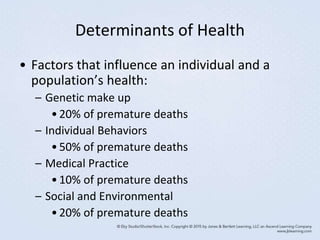
Determinants of Health
• Factors that influence an individual and a
population’s health:
– Genetic make up
•20% of premature deaths
– Individual Behaviors
•50% of premature deaths
– Medical Practice
•10% of premature deaths
– Social and Environmental
•20% of premature deaths
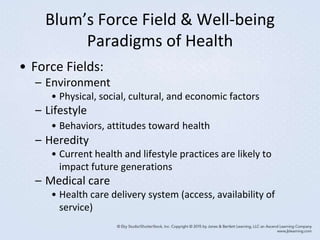
Blum’s Force Field & Well-being
Paradigms of Health
• Force Fields:
– Environment
• Physical, social, cultural, and economic factors
– Lifestyle
• Behaviors, attitudes toward health
– Heredity
• Current health and lifestyle practices are likely to
impact future generations
– Medical care
• Health care delivery system (access, availability of
service)
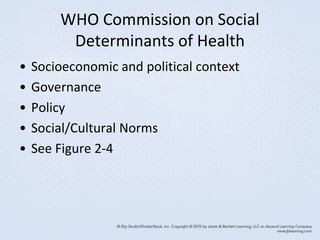
WHO Commission on Social
Determinants of Health
• Socioeconomic and political context
• Governance
• Policy
• Social/Cultural Norms
• See Figure 2-4
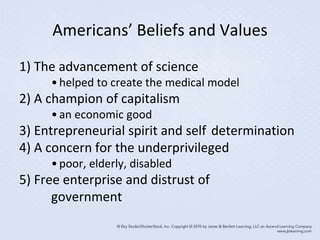
Americans’ Beliefs and Values
1) The advancement of science
•helped to create the medical model
2) A champion of capitalism
•an economic good
3) Entrepreneurial spirit and self determination
4) A concern for the underprivileged
•poor, elderly, disabled
5) Free enterprise and distrust of
government
The Equitable Distribution of Health
• We have scarce resources.
1. How much health care should be
produced?
2. How should health care be distributed?
– Distribution creates inequalities
– Need justice and fairness
Theories of Equitable Distribution
• Two Contrasting Principles:
– Market Justice
•The Economic Good
– Social Justice
•A Social Good
Market Justice: The Economic Good
• Fair distribution of health care to the market
forces in a free economy
– Medical services distributed on the basis of
people’s willingness and ability to pay.
Principles of Market Justice
• Health care is an economic good governed by free
market forces and supply and demand
• Individuals are responsible for their own
achievements
• People make rational choices in their decision to buy
health care products and services
• People consult with their physicians who know what
is best for them
• The market works best without interference from
government
Market Justice
• In association with Classical Ethical Theory
– A physician is duty-bound to do whatever is
necessary to restore a patient’s health
– An individual is responsible for paying the
physician for his/her service
– The poor can be served by charity
– Ignores the societal good and people’s
responsibility to the community at large
Market Justice
• In association with Libertarianism:
– Equity is achieved when resources are distributed
according to merits
– Health care distributed according to minimal
standards and financed through willingness to
pay
– Health care is not a central priority
Market Justice
• The production of health care is determined
by how much the consumers are willing and
able to buy at the prevailing price.
• Those not able to pay have barriers to health
care
– “rationing by ability to pay”
• Focus on individual rather than a collective
responsibility for health
Social Justice: The Good Society
• Theory is at odds with capitalism and market
justice
• The equitable distribution of health care is
society’ responsibility
– Best when a central agency is responsible for the
production and distribution of health care
• Health care is a social good
– Should be collectively financed and available to
every citizen.
Principles of Social Justice
• Health care should be based on need rather
than cost
• There is a shared responsibility for health
– Factors outside a person’s control might have
brought on the condition
• There is an obligation to the collective good
– The well being of the community is superior than
that of the individual
Principles of Social Justice
• Government rather than the market can
better decide
– Through planning how much health care to
provide and how to distribute among all citizens
– See Table 2-4
Community Health Assessment
• An assessment of the population at a local or
state level
• Collaboration with:
– public health agencies
– hospitals
– other providers
• A JCAHO requirement, especially for
community not-for-profit hospitals
Healthy People 2020
• 10 year plans
• Key national health objectives
• Founded on the integration of medical care
and prevention, health promotion and
education
• Action model to achieve overarching goals
– See Figure 2-6
– See Table 2-5
Evaluation of Health Status
• Health status is an indicator of health and
well-being interpreted through:
– Morbidity
•Disease or Disability
– Mortality
•Death rate
Evaluation of Health Status
• Longevity
– Life expectancy
•A prediction of how long a person will live
– Life expectancy at birth
•How long a newborn can expect to live
•See Table 2-5
– Life expectancy at age 65
•Expected remaining years of life for a 65 year
old
Evaluation of Health Status
• Morbidity
– At risk population: all people in the same
community or group who can acquire a disease or
a condition
– Incidence: number of new cases
occurring/population at risk
– Epidemic: large number of people who acquire a
specific disease from a common source
– Prevalence: measure the total number of cases at
specific point in time/specified population
Evaluation of Health Status
• Activities of Daily Living (ADL) Scale evaluates
seven activities of self care & mobility:
– feeding
– bathing
– dressing
– using the toilet
– transferring
– grooming
– walking eight feet
Evaluation of Health Status
• Instrumental activities of daily living (IADL) evaluates
activities necessary for independent living
– using phone
– driving a car, traveling alone on bus, taxi
– shopping
– preparing meals
– doing heavy housework
– taking medications
– handling money
– walk up/down stairs
– walk 1/2 mi without assistance
Evaluation of Health Status
• Crude Death Rate
– Total deaths/Total population
• Age Specific
– Number of deaths within a certain age
group/Total # of persons in that age group
• Cause Specific
– Number of deaths from a specific disease/Total
population
• Infant Mortality
– Number of deaths from birth to one year of
age/Number of live births that same year
Demographic Change
• Changes in the composition of a population over time
• Births
– Natality
•birth rate
•measured by crude birth rate (number of live
births / total population)
– Fertility
•capacity of a population to reproduce
•measured by fertility rate (number of live births /
number of females 15-44 years old)
Demographic Change
• Migration: the geographic movement of
populations between defined geographic
units and a permanent change of address
– immigration
•in migration
– emigration
•out migration
Measures of Health Service Utilization
• Utilization
– the consumption of health care services or the
extent to which health care services are used
•Crude Measure of Utilization
•Specific Measure of Utilization
•Institution-Specific Utilization
ACA Takeaway
• Insurance plans are required to cover
preventive services with no out-of-pocket
costs.
• Allocate funds to expand preventive national
efforts.
• Will move US health care toward social
justice, although unlikely to achieve universal
access.

DHCA-Chapter2

  • 2.
  • 3.
    Learning Objectives • Atthe end of class, you should: – understand the concept of health and disease – know the determinants of health – know the American beliefs and values in the delivery of health care – understand the promotion of health and the prevention of disease – develop a position on the equitable distribution of health care – know basic measures of health and its utilization
  • 4.
    Beliefs, Values andHealth • Beliefs and values in US have remained mostly private – not a tax financed national health care program
  • 5.
    For Managers andPolicy Makers 1. Health of a population determines health care utilization a) planning a health service is determined by health trends and demographics 2. The health appraisal should determine a) education, prevention and therapies 3. Evaluating health care organizations on contributions made to community
  • 6.
    For Managers andPolicy Makers 4) Use of justice and equity a concern 5) Measure of health status and utilization to evaluate: a) existing programs, plan new strategies, measure progress, discontinue a service
  • 7.
    What Is Health? •Absence of illness and disease • “A state of physical and mental well-being that facilitates the achievements of individual and societal goals” – Society for Academic Medicine • A return to an illness free or disease free state after an ill spell.
  • 8.
    What Is Health? •“A complete state of physical, mental and social well being, not just merely the absence of disease” – WHO • Biopsychosocial model of health – “Social” •positive relationships •support network for life stresses, self-esteem •responsible for community and population’s well-being – To promote, restore and maintain health
  • 9.
    What Is Health? •U.S. health care has followed a medical/biomedical model – the existence of illness or disease – have a clinical diagnosis and medical interventions
  • 10.
    What Is Health? •Biomedical Model • Governs the U.S. concept of health and health care 1. The existence of an illness or disease 2. Seek and use care 3. Find relief of symptoms and discomfort 4. Diagnosis of illness and treatment of disease to restoration 5. Once relief is obtained, the person is considered well, whether or not the disease is cured • Therefore, clinical intervention once disease is diagnosed.
  • 11.
    Illness vs. Disease •Illness – identified by a person’s perception and evaluation of how he/she is feeling – people are ill when they infer a diminished capacity to perform tasks and roles that are expected by society • Disease – based on a professional evaluation – caused by more than one single factor (e.g., tuberculosis, poverty, overcrowding)
  • 12.
    An Explanation ofDisease Occurrence • Tripartite or Epidemiology Model 1) Host – the organism – usually a human – for host to be ill, an agent must be present 2) Agent – (i.e. TB, tobacco smoke, bad diet...) – presence of tuberculosis does not assure host will be ill 3) Environment – external to the host to enhance or reduce disease
  • 13.
    Tripartite or EpidemiologyModel • Risk Factors – attributes that increase the likelihood of developing a disease or negative health condition •Agent: (i.e. tobacco smoke, poor diet) •Host: (i.e. genetic make up, level of fitness) •Environment: (i.e. poor sanitation, low socioeconomics) • Prevention – to rid risk factors
  • 14.
    Behavioral Risk Factors •Smoking – increases risk of heart disease, stroke, lung cancer, lung disease (CDC) • Substance abuse • Lack of physical exercise • High fat diet • Improper use of motor vehicles • Unsafe intimate relations – See Table 2-1
  • 15.
    Interventions to CounteractKey Risk Factors • Behavior modification – education – personal motivation – financial incentives – environmental inducements
  • 16.
    Acute, Subacute, &Chronic Conditions • Acute – relatively severe, episodic (of short duration) and often treatable (i.e. myocardial infarct, sudden kidney interruption) • Subacute – some acute features – post acute treatment after discharge (i.e. head trauma, ventilator) • Chronic – less severe, but long and continuous – can be controlled, but can be serious (i.e. asthma, diabetes, hypertension)
  • 17.
    Holistic Health • Thewell-being of all aspects that make a person whole and complete • Growing interest • Holistic medicine – treat the whole person – spiritual is added to medical, mental and social • Literature shows that religious & spiritual belief has a positive impact on overall well-being
  • 18.
    Wellness Model • Effortsand programs that prevent disease and optimize well-being • Built on three factors: 1) understand risk factors •done through a health risk appraisal •when known, interventions can take place 2) intervention •behavior modifications •therapeutic (primary, secondary, tertiary prevention) 3) adequate public health and social services
  • 19.
    Therapeutic Preventions • Primary:activities to decrease or restrain the problem or develop that a disease will occur – Smoking cessation to prevent lung disease – Handwashing to decrease spread of infection • Secondary: early detection and treatment of disease to block progression of disease or injury – Pap smears, mammograms, prostate exams • Tertiary: rehabilitation and monitoring to prevent further injury or complications – Turning bed-bound patients
  • 20.
    Public Health • Tofulfill “society’s interest in assuring conditions in which people can be healthy” (IOM) • Deals with broad societal concerns promoting optimum health for the society as a whole • A health-related service to minimize risk factors to prevent, control and contain disease
  • 21.
    Public Health • Thescience and art of preventing disease, prolonging life, and promoting health and efficiency through organized community effort • Seeks to apply current knowledge of health and disease in ways that will have the maximum impact on a population’s health status
  • 22.
    Public Health Roles 1.Prevention 2. Health Promotion 3. Health Protection (new- due to 20th century industrialization) – Environmental Protection Agency (EPA) – Occupational Safety and Health Administration (OSHA) – Bioterrorism, Homeland Security Act 2002 •the use of chemical, biological & nuclear agents to harm populations •training, civil defense, countermeasures & cooperation between interagency groups (i.e. anthrax, small pox)
  • 23.
    Medicine vs. PublicHealth • Medicine – focuses on the individual patient – biological causes of disease with treatment – treat disease and recover health • Public Health – focuses on the populations – identify environment, social & behavior then develop population-based interventions – prevent disease and promote health through influence – provides education to pass laws – disseminate information
  • 24.
    Medicine vs. PublicHealth • Medicine – Physicians, nurses, dentists, therapists, social workers, psychologists, nutritionists, health educators, pharmacists, laboratory, administration • Public Health – same as above, but also includes sanitarians, epidemiologists, statisticians, hygienists, environmental health specialists, food/drug inspectors, toxicologists, and economists
  • 25.
    Environmental Health • Aimsto prevent the spread of disease through water, air & food • 1900s top three killers: – pneumonia, tuberculosis, diarrhea • 1999 top three killers: – heart disease, cancer, lung disease • New challenges in the 21st century – hazards of chemicals, asbestos, industrial waste, infectious waste, radiation
  • 26.
    Quality of Life •Overall satisfaction with life during and following a person’s encounter with the health care delivery system • An indicator of how satisfied a person was with the experiences while receiving health care • Comfort, respect, privacy, security, autonomy • A person’s overall satisfaction with life and self- perceptions of health, especially after a medical intervention • Goal: have a positive effect on an individual ability to function, meet obligations, feeling of self-worth
  • 27.
    Determinants of Health •Factors that influence an individual and a population’s health: – Genetic make up •20% of premature deaths – Individual Behaviors •50% of premature deaths – Medical Practice •10% of premature deaths – Social and Environmental •20% of premature deaths
  • 28.
    Blum’s Force Field& Well-being Paradigms of Health • Force Fields: – Environment • Physical, social, cultural, and economic factors – Lifestyle • Behaviors, attitudes toward health – Heredity • Current health and lifestyle practices are likely to impact future generations – Medical care • Health care delivery system (access, availability of service)
  • 29.
    WHO Commission onSocial Determinants of Health • Socioeconomic and political context • Governance • Policy • Social/Cultural Norms • See Figure 2-4
  • 30.
    Americans’ Beliefs andValues 1) The advancement of science •helped to create the medical model 2) A champion of capitalism •an economic good 3) Entrepreneurial spirit and self determination 4) A concern for the underprivileged •poor, elderly, disabled 5) Free enterprise and distrust of government
  • 31.
    The Equitable Distributionof Health • We have scarce resources. 1. How much health care should be produced? 2. How should health care be distributed? – Distribution creates inequalities – Need justice and fairness
  • 32.
    Theories of EquitableDistribution • Two Contrasting Principles: – Market Justice •The Economic Good – Social Justice •A Social Good
  • 33.
    Market Justice: TheEconomic Good • Fair distribution of health care to the market forces in a free economy – Medical services distributed on the basis of people’s willingness and ability to pay.
  • 34.
    Principles of MarketJustice • Health care is an economic good governed by free market forces and supply and demand • Individuals are responsible for their own achievements • People make rational choices in their decision to buy health care products and services • People consult with their physicians who know what is best for them • The market works best without interference from government
  • 35.
    Market Justice • Inassociation with Classical Ethical Theory – A physician is duty-bound to do whatever is necessary to restore a patient’s health – An individual is responsible for paying the physician for his/her service – The poor can be served by charity – Ignores the societal good and people’s responsibility to the community at large
  • 36.
    Market Justice • Inassociation with Libertarianism: – Equity is achieved when resources are distributed according to merits – Health care distributed according to minimal standards and financed through willingness to pay – Health care is not a central priority
  • 37.
    Market Justice • Theproduction of health care is determined by how much the consumers are willing and able to buy at the prevailing price. • Those not able to pay have barriers to health care – “rationing by ability to pay” • Focus on individual rather than a collective responsibility for health
  • 38.
    Social Justice: TheGood Society • Theory is at odds with capitalism and market justice • The equitable distribution of health care is society’ responsibility – Best when a central agency is responsible for the production and distribution of health care • Health care is a social good – Should be collectively financed and available to every citizen.
  • 39.
    Principles of SocialJustice • Health care should be based on need rather than cost • There is a shared responsibility for health – Factors outside a person’s control might have brought on the condition • There is an obligation to the collective good – The well being of the community is superior than that of the individual
  • 40.
    Principles of SocialJustice • Government rather than the market can better decide – Through planning how much health care to provide and how to distribute among all citizens – See Table 2-4
  • 41.
    Community Health Assessment •An assessment of the population at a local or state level • Collaboration with: – public health agencies – hospitals – other providers • A JCAHO requirement, especially for community not-for-profit hospitals
  • 42.
    Healthy People 2020 •10 year plans • Key national health objectives • Founded on the integration of medical care and prevention, health promotion and education • Action model to achieve overarching goals – See Figure 2-6 – See Table 2-5
  • 43.
    Evaluation of HealthStatus • Health status is an indicator of health and well-being interpreted through: – Morbidity •Disease or Disability – Mortality •Death rate
  • 44.
    Evaluation of HealthStatus • Longevity – Life expectancy •A prediction of how long a person will live – Life expectancy at birth •How long a newborn can expect to live •See Table 2-5 – Life expectancy at age 65 •Expected remaining years of life for a 65 year old
  • 45.
    Evaluation of HealthStatus • Morbidity – At risk population: all people in the same community or group who can acquire a disease or a condition – Incidence: number of new cases occurring/population at risk – Epidemic: large number of people who acquire a specific disease from a common source – Prevalence: measure the total number of cases at specific point in time/specified population
  • 46.
    Evaluation of HealthStatus • Activities of Daily Living (ADL) Scale evaluates seven activities of self care & mobility: – feeding – bathing – dressing – using the toilet – transferring – grooming – walking eight feet
  • 47.
    Evaluation of HealthStatus • Instrumental activities of daily living (IADL) evaluates activities necessary for independent living – using phone – driving a car, traveling alone on bus, taxi – shopping – preparing meals – doing heavy housework – taking medications – handling money – walk up/down stairs – walk 1/2 mi without assistance
  • 48.
    Evaluation of HealthStatus • Crude Death Rate – Total deaths/Total population • Age Specific – Number of deaths within a certain age group/Total # of persons in that age group • Cause Specific – Number of deaths from a specific disease/Total population • Infant Mortality – Number of deaths from birth to one year of age/Number of live births that same year
  • 49.
    Demographic Change • Changesin the composition of a population over time • Births – Natality •birth rate •measured by crude birth rate (number of live births / total population) – Fertility •capacity of a population to reproduce •measured by fertility rate (number of live births / number of females 15-44 years old)
  • 50.
    Demographic Change • Migration:the geographic movement of populations between defined geographic units and a permanent change of address – immigration •in migration – emigration •out migration
  • 51.
    Measures of HealthService Utilization • Utilization – the consumption of health care services or the extent to which health care services are used •Crude Measure of Utilization •Specific Measure of Utilization •Institution-Specific Utilization
  • 52.
    ACA Takeaway • Insuranceplans are required to cover preventive services with no out-of-pocket costs. • Allocate funds to expand preventive national efforts. • Will move US health care toward social justice, although unlikely to achieve universal access.