BMTC - Varna 1
Classification – in Vol 1, Ch
2.
Learning
objectives:
A basic knowledge of chemistry
so that you are able to understand
the terms used in the IMDG Code
A general knowledge of the
hazard associated with the DG you
are dealing with.
A knowledge to determine which
goods are dangerous and which are
not; a good knowledge of the nine
groups or classes the substances
are divided into.
BMTC - Varna 2
Basic Physics and Chemistry
When browsing the
IMDG Code you will
found a number of
terms:
Elements
Mixtures
Compounds
Materials
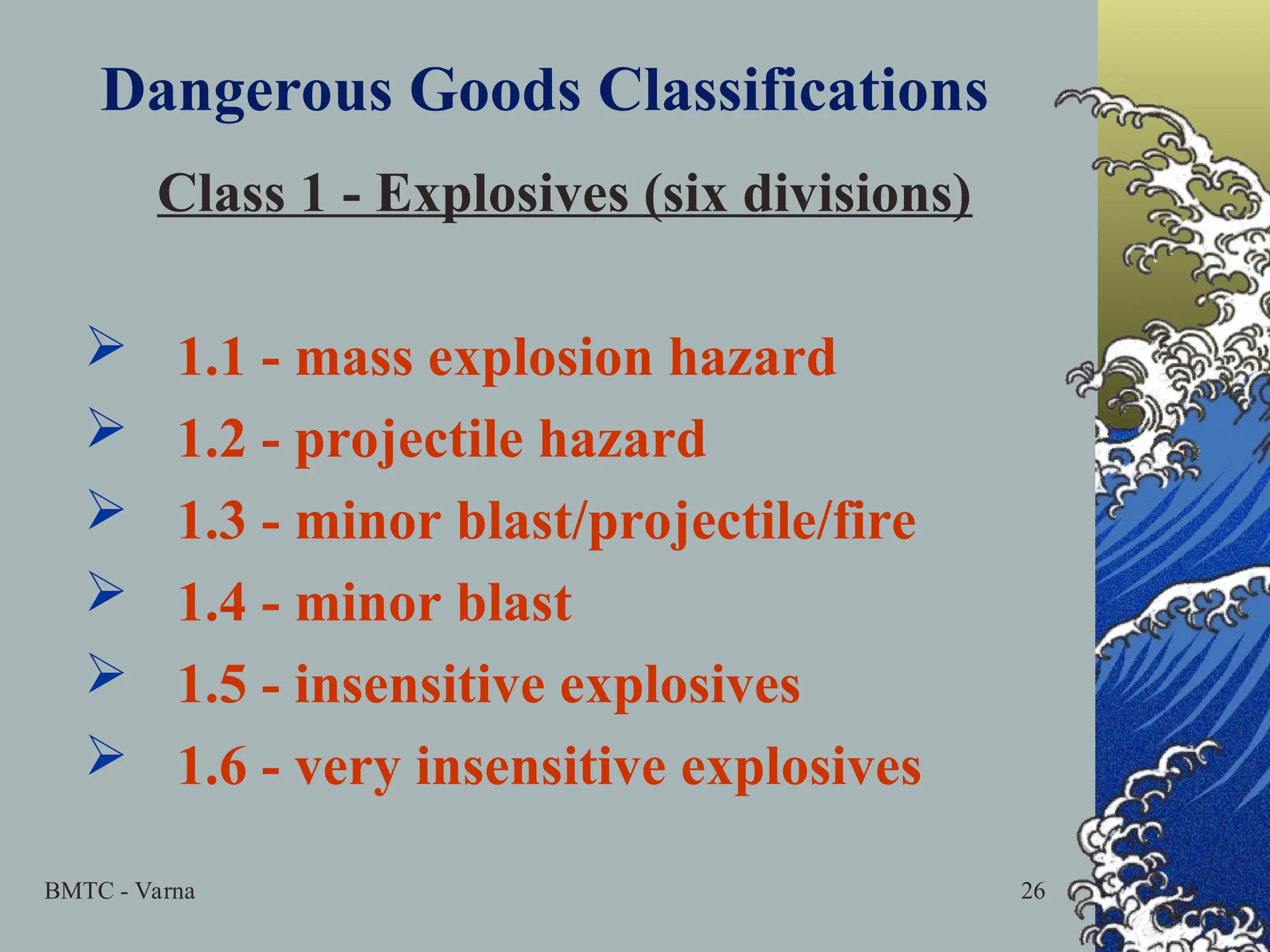
Substances
Articles
BMTC - Varna 3
Elements
Elements are the basics
building blocks from which
all chemical structures are
made. They cannot be
broken into simpler
substances and are
composed of identical
atoms, which are the
smallest particles of an
element that can chemically
exist.
BMTC - Varna 4
Mixture
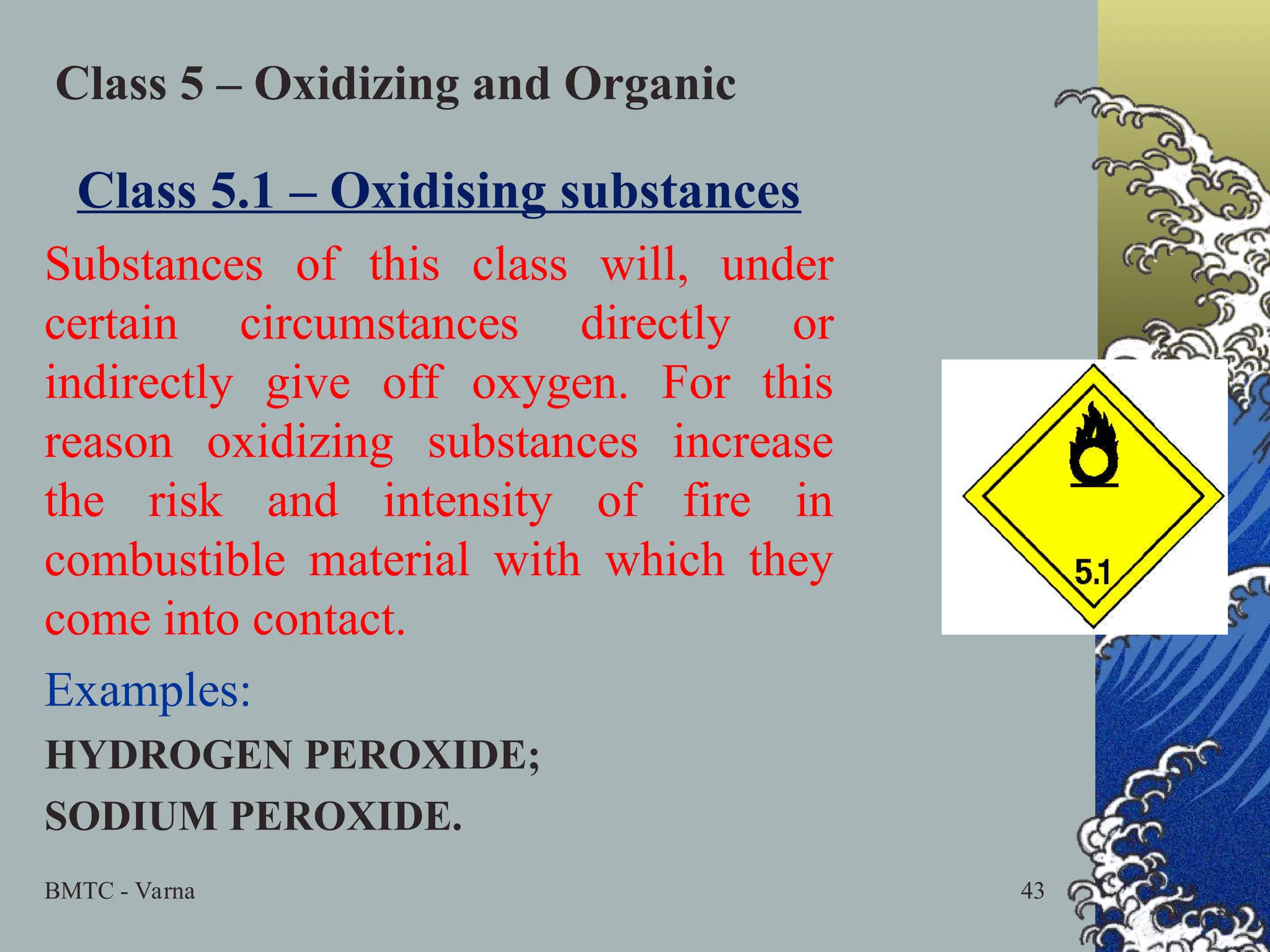
If the elements iron and
sulphur are blended
together, then a mixture
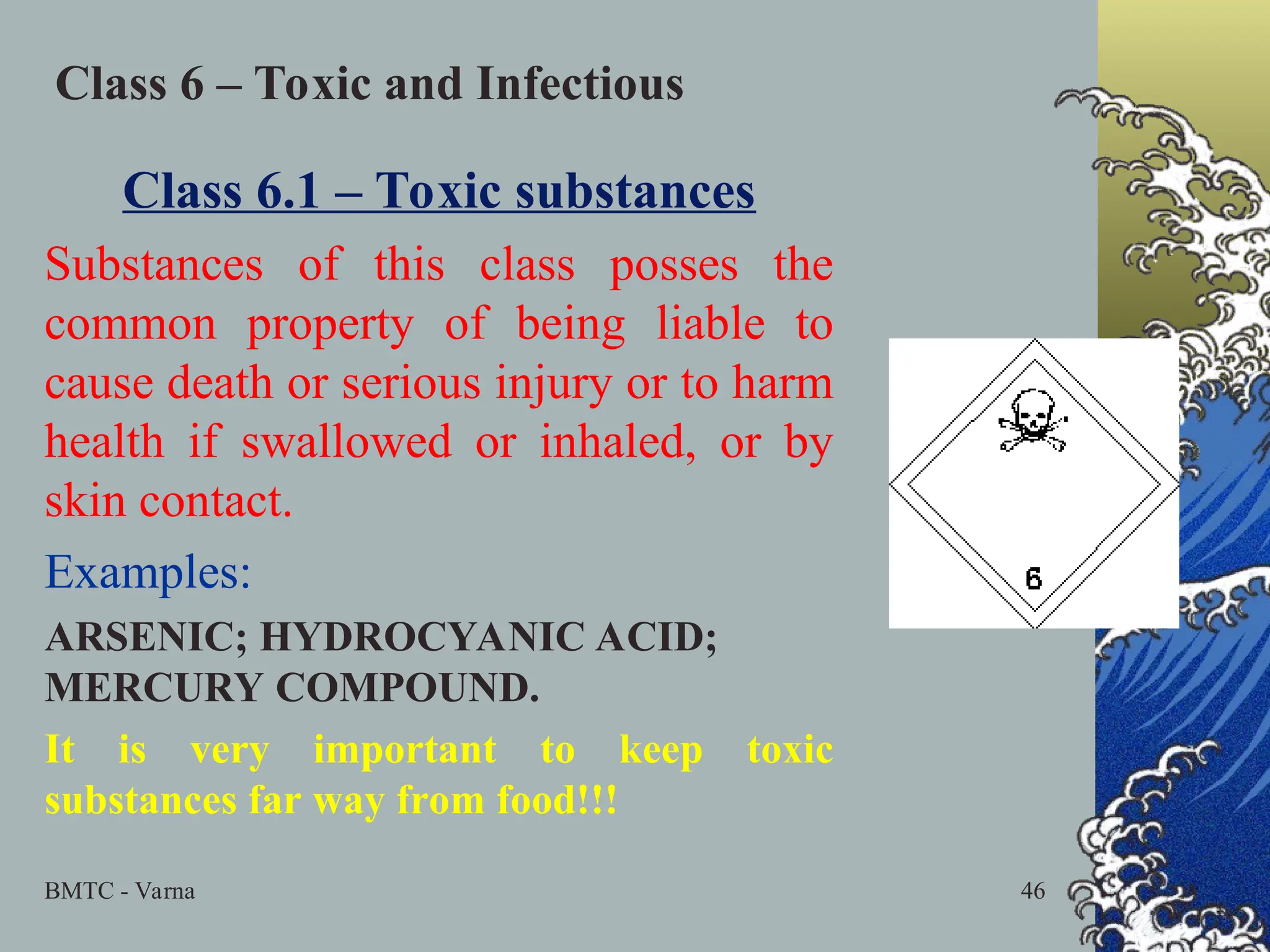
is formed. The two
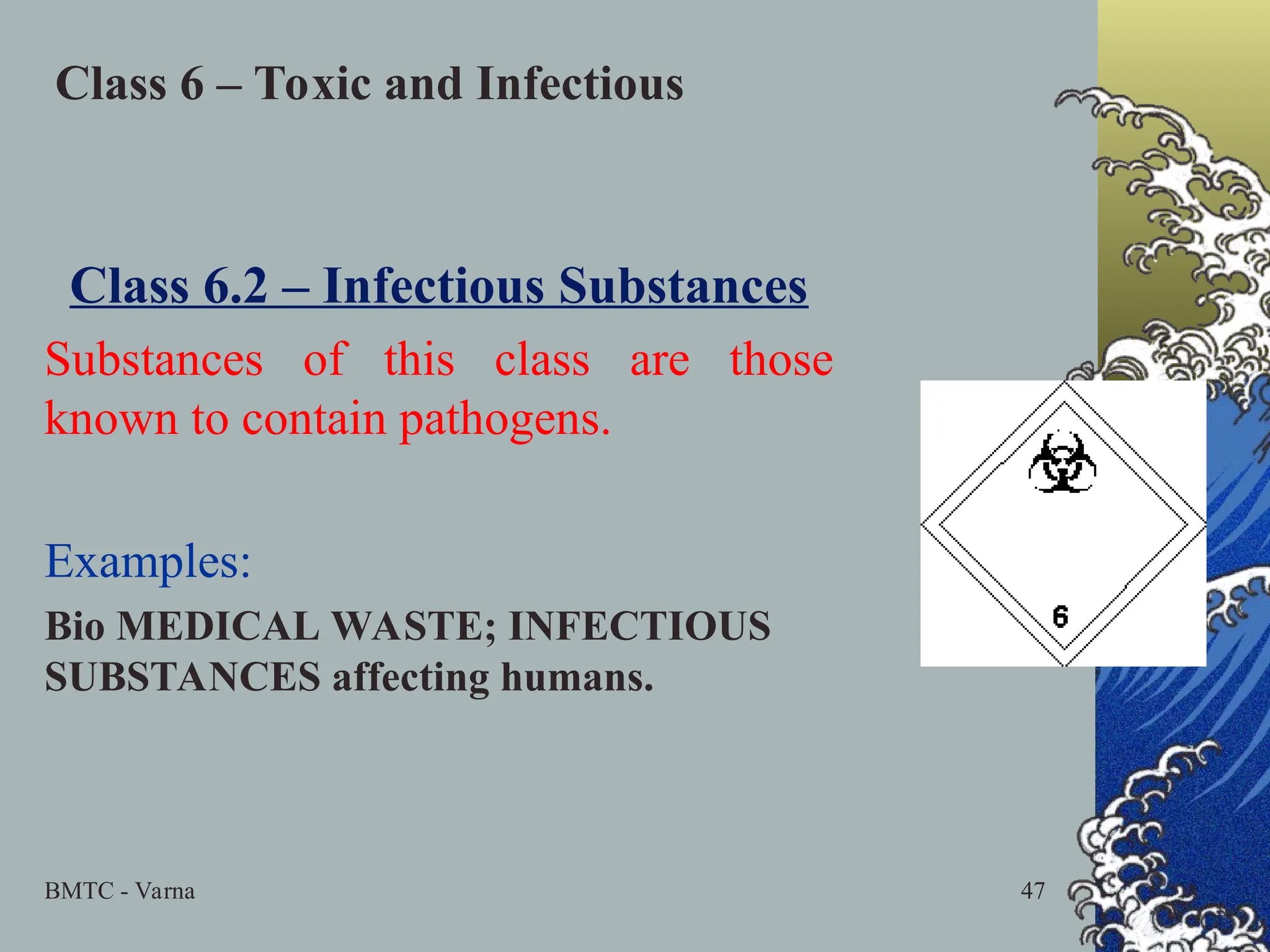
components retain their
individual chemical and
physical characteristics
and can be separated
from each other again.
BMTC - Varna 5
Compounds
If the mixture of iron and
sulphur powders is heated
together, their atoms combine
to form molecules of a new
substance called a chemical
compound, in this instance the
substances is called ferrous
sulphide.
The compounds can have
properties which may be
significantly different from the
substances from which they
have been formed.
BMTC - Varna 6
Materials
A material is defined as
having some general
properties but these may
vary depending upon
the composition.
For example: wood has
the same general
properties, but different
colours and textures.
BMTC - Varna 7
Substances
The IMDG Code refers to
the term SUBSTANCES,
which covers chemical
compositions that do not
vary significantly from one
sample to another. Many
substances are compounds
and some are elements.
Example of substances are:
SALT and CANE SUGAR.
BMTC - Varna 8
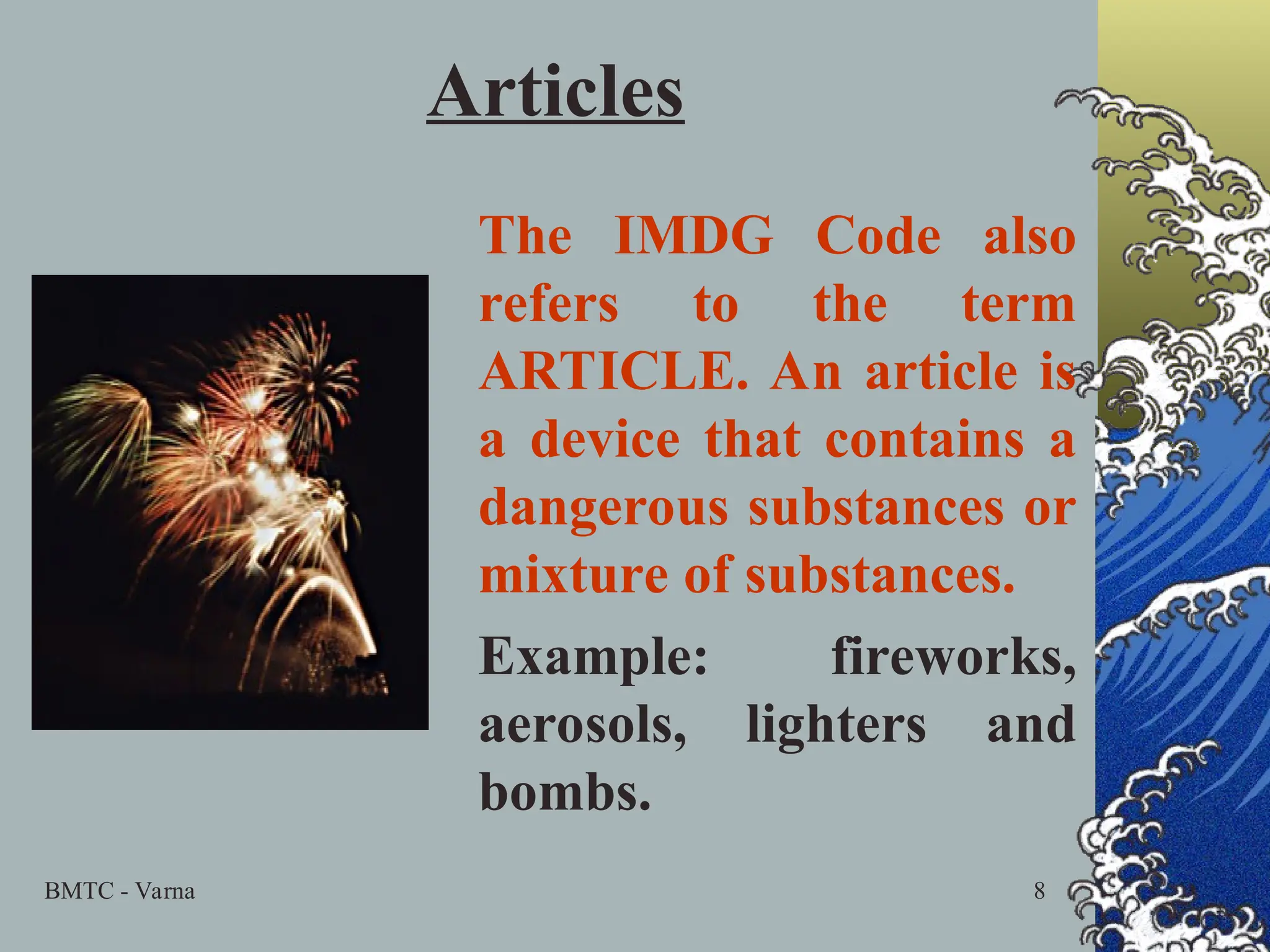
Articles
The IMDG Code also
refers to the term
ARTICLE. An article is
a device that contains a
dangerous substances or
mixture of substances.
Example: fireworks,
aerosols, lighters and
bombs.
BMTC - Varna 9
Physical state of MATTER
“Matter” exists in three states:
Solids
Liquids
Gases
The physical state of many substances will
vary depending upon the temperature and
pressure applied to them.
BMTC - Varna 10
Solids
Many solids, such as
common salt, have a
regular shape and are
crystalline. Some solids
take water from the air
and become damp. It is
difficult to compress
solids.
BMTC - Varna 11
Liquids
Liquids have definite
mass and volume but
not shape. The Code
recognises that
increasing viscosity can
reduce hazard and effect
packing. Liquids are
difficult to compress.
BMTC - Varna 12
Gases
Gases, like air has a definite
mass but no defined volume
and will expand to fill the
volume of the containment
vessel. Some gases, like
chorine are heavier than air,
others like hydrogen is
lighter. Gases are easily
compressed and are available
in pressure-resistant gas
cylinders.
BMTC - Varna 13
Chemistry - Physical Properties
Chemicals are identified and characterised by
their properties. Physical properties are used to
assist in the classification of substances and
articles within the Code and some important
physical properties are also specified in the Code
on individual schedules.
BMTC - Varna 14
Physical properties can be defined as follows:
 Boiling point
 Vapour pressure
 Flashpoint
 Auto-ignition point
 Explosive limit
 Melting point
 Density
 Solubility
 Odour
BMTC - Varna 15
Boiling point
This is the temperature at
which a liquid boils and
begins to turn into vapour.
The boiling point will vary
depending upon the pressure
applied. Boiling point criteria
are used together with
flashpoint to allocate
flammable liquids into
packing groups.
BMTC - Varna 16
Vapour Pressure
All solids and liquids give off
vapour consisting of atoms or
molecules of the substance that
have evaporated from the surface.
The pressure, which the vapour
exerts under specified conditions,
is known as the vapour pressure.
Vapour pressure is an important
consideration in defining whether
a particular substance should be
classified as a gas and also in
determining the toxicity of
substances if inhaled.
BMTC - Varna 17
Flashpoint
Flash point is the lowest
temperature of a liquid at which
its vapour forms an ignitable
mixture with air. A flammable
liquid cannot be ignited so long
as its temperature remains
below the flashpoint.???
BMTC - Varna 18
Auto-ignition point
This is the temperature to
which a liquid must be raised
to cause a sustained fire or
explosion when touched by a
flame or hot object or by the
heat generated during the
reaction or by friction.
BMTC - Varna 19
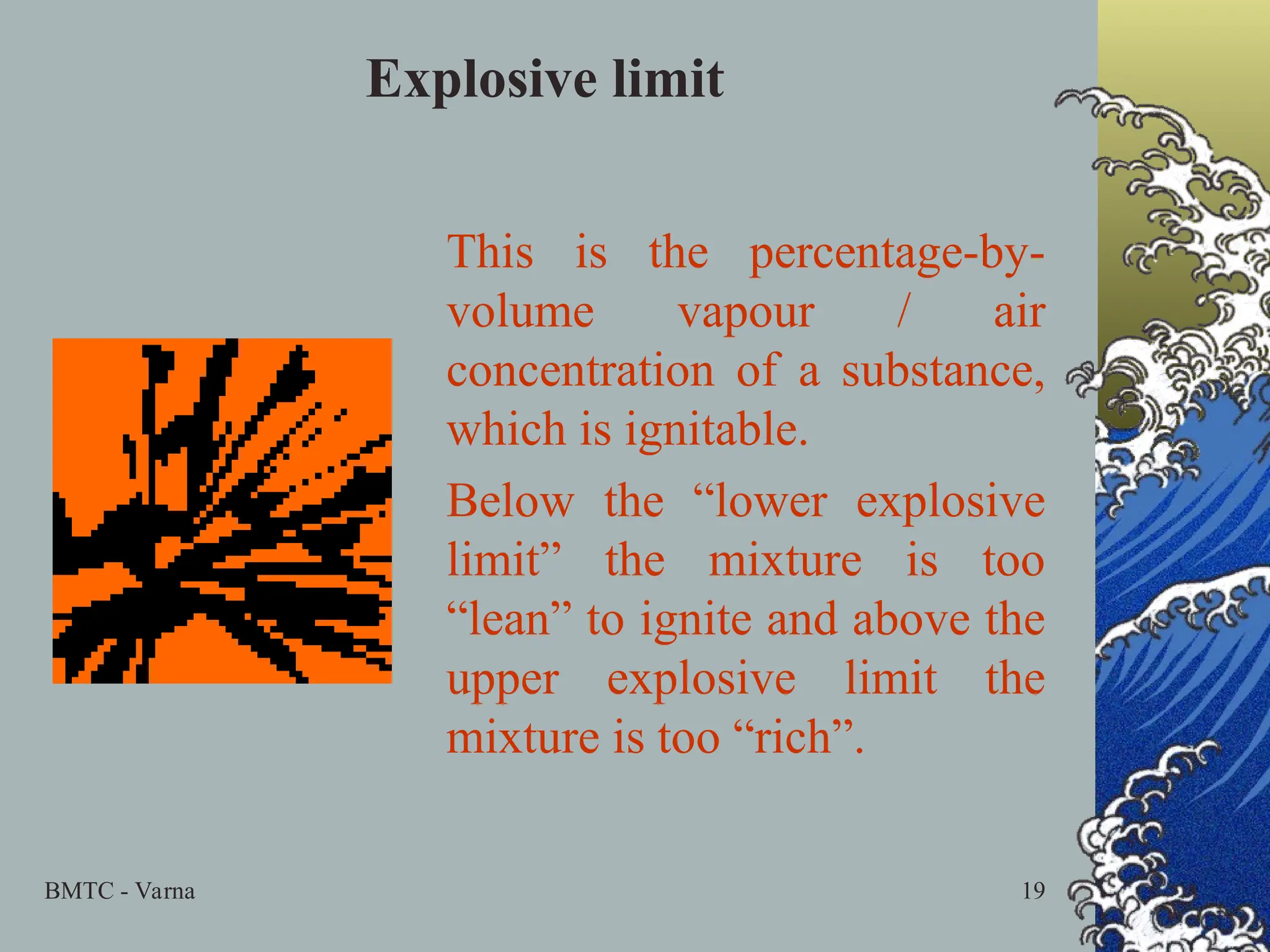
Explosive limit
This is the percentage-by-
volume vapour / air
concentration of a substance,
which is ignitable.
Below the “lower explosive
limit” the mixture is too
“lean” to ignite and above the
upper explosive limit the
mixture is too “rich”.
BMTC - Varna 20
Melting point
The melting point is the
lowest temperature at which a
solid will change into a liquid
when heated, for example ice
turning to water.
Care must be exercised in the
section of packing materials
for solids, which have a
relative low melting point
(transport from northern areas
to a tropical climate).
BMTC - Varna 21
Density
The density of a sample of a substance is
determined by dividing its mass by the volume
it occupies.
The UN package performance test recognise,
that product relative density can effect
container performance, particularly impact
strength and therefore the drop height.
For example: the toxic gas arsine, which has a
relative vapour density of 2.8 compared to air,
would not be stowed below deck, where it
could not easily disperse.
BMTC - Varna 22
Solubility
When a solid or a gas dissolves
in a liquid, a homogeneous
mixture or solution is formed.
Eventually, as more solute is
added, the solution cannot
dissolve any more and is said to
be saturated.
BMTC - Varna 23
Odour
Many substances have a
characteristic smell, which
may be the first indication of
product escape. Any unusual
odour should be treated as a
warning and appropriate
emergency action taken.
BMTC - Varna 24
The purpose of Classification
The purpose of the
classification is to divide
hazardous goods into
broad groups having the
same properties, viz:
Reactivity
Flammability
Toxicity
Corrosiveness
BMTC - Varna 25
Classification of DG
There are nine classes defined. The class
numbers do not indicate the degree of
hazard but only the type of hazard.
The classification should be made by the
shipper/consignor or by the appropriate
competent authority where specified in
this Code.
BMTC - Varna 26
Dangerous Goods Classifications
Class 1 - Explosives (six divisions)
 1.1 - mass explosion hazard
 1.2 - projectile hazard
 1.3 - minor blast/projectile/fire
 1.4 - minor blast
 1.5 - insensitive explosives
 1.6 - very insensitive explosives
BMTC - Varna 27
Class 1: Explosives
Division 1.1: substances and articles
which have a mass explosion hazard
A cargo has a mass
explosion when the
explosion is
instantaneously released
in the total cargo.
For example:
NITROGLYCERINE;
BOMBS.
BMTC - Varna 28
Class 1: Explosives
Division 1.2: substances and articles
which have a projection hazard but not
a mass explosion hazard
Examples of substances
in this group are
PYROTECHNICS,
FIREWORKS and
certain types of SMALL
ARMS AMMUNITION.
BMTC - Varna 29
Class 1: Explosives
Division 1.3: substances and articles which
have a fire hazard and either a minor blast
hazard or a minor projection hazard or both,
but not a mass explosion hazard
This division comprises substances and
articles:
Which give rise to considerable radiant
heat, or
Which burns one after another, producing
minor blast or projection effects or both.
Examples of substances in this group are
certain types of GUNPOWDER.
BMTC - Varna 30
Class 1: Explosives
Division 1.4: substances and articles
which present no significant hazard
This division comprises substances
and articles, which present only a
small hazard in the event of ignition
or ignition during transport.
Example of substances in this group
are different types of FUSE,
SMOKE and LIGHT SIGNALS.
BMTC - Varna 31
Class 1: Explosives
Division 1.5: very insensitive
substances which have a mass
explosion hazard
This division comprises substances
and articles, which have a mass
explosion hazard but are so
insensitive that there is very little
probability of initiation or of
transition from burning to
detonation under normal conditions
of transport.
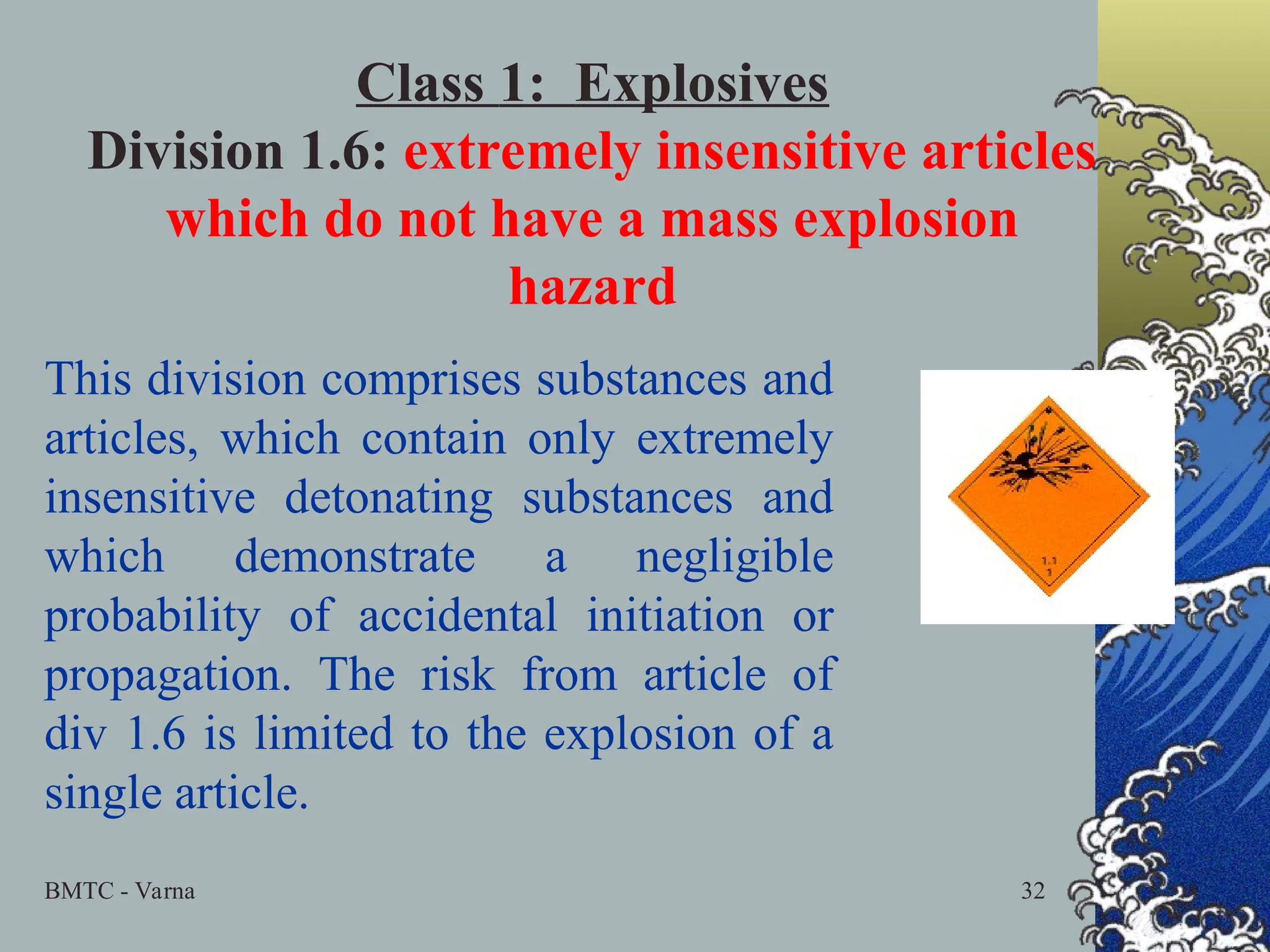
BMTC - Varna 32
Class 1: Explosives
Division 1.6: extremely insensitive articles
which do not have a mass explosion
hazard
This division comprises substances and
articles, which contain only extremely
insensitive detonating substances and
which demonstrate a negligible
probability of accidental initiation or
propagation. The risk from article of
div 1.6 is limited to the explosion of a
single article.
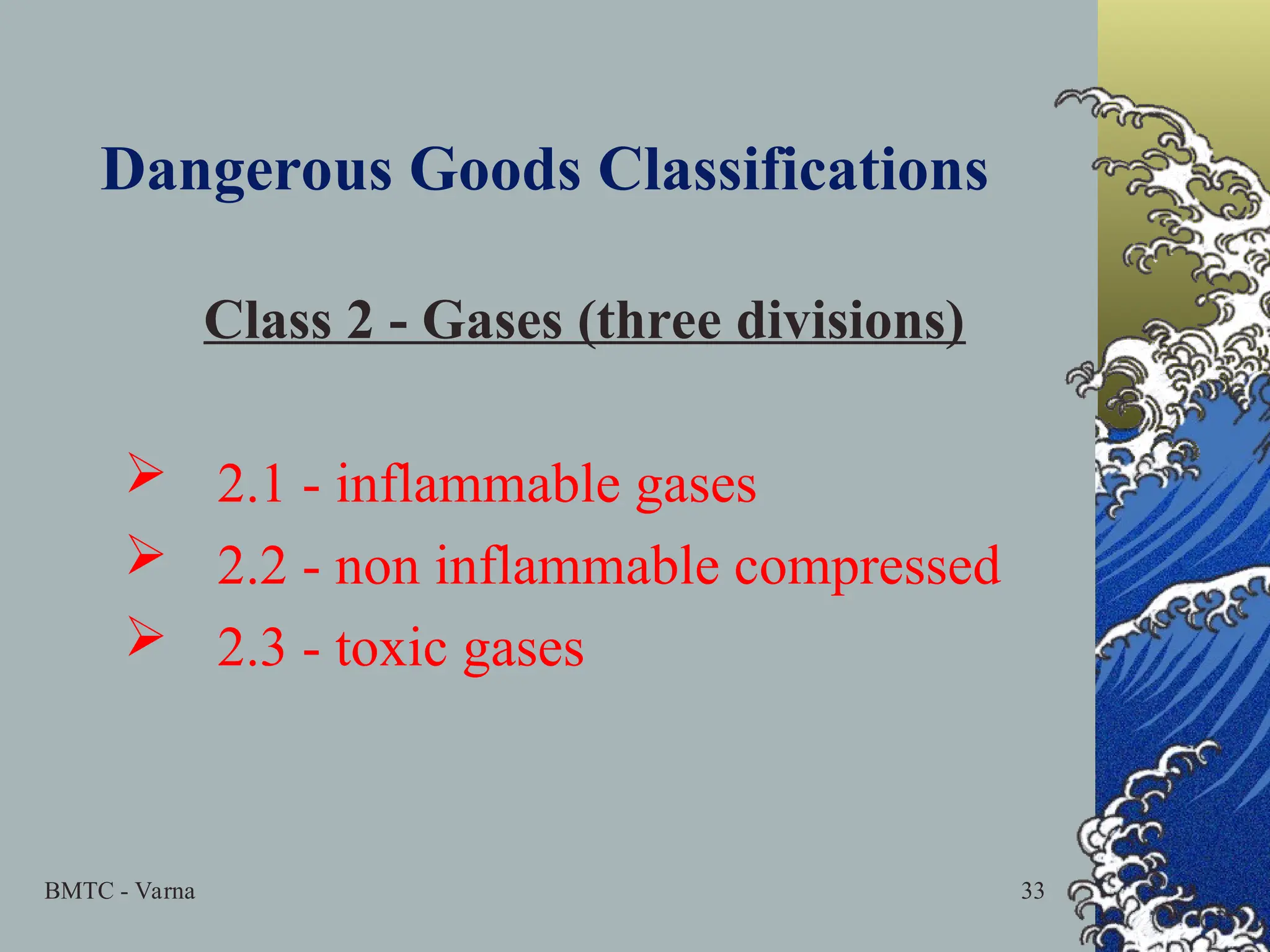
BMTC - Varna 33
Dangerous Goods Classifications
Class 2 - Gases (three divisions)
 2.1 - inflammable gases
 2.2 - non inflammable compressed
 2.3 - toxic gases
BMTC - Varna 34
Class 2 – Gases
Class 2.1
This class is flammable gases
which at 20 deg C and standard
pressure of 101.3 kPa are
ignitable when in a mixture of
13% or less by volume with air.
Examples: BUTANE and
PROPANE.
Note: (Inflammable means the
same as flammable)
BMTC - Varna 35
Class 2 – Gases
Class 2.2
Non – flammable, non toxic
gases, which are transported at a
pressure not less than 280 kPa at
20 deg C, or as refrigerated
liquids.
Examples of substances in this
class are NITROGEN, CARBON
DIOXIDE and OXYGEN.
BMTC - Varna 36
Class 2 – Gases
Class 2.3
This class of 2.2 is a toxic gases
that are known to be so toxic or
corrosive to humans as to pose a
hazard to health. (poisonous has the
same meaning as toxic).
Examples: CHLORINE and
SULPHUR DIOXIDE.
BMTC - Varna 37
Dangerous Goods Classifications
Class 3 – Flammable liquids
Class 3 contains:
 Liquids
 Mixture of liquids
 Solids in solution or suspension
BMTC - Varna 38
Dangerous Goods Classifications
Class 4 – Flammable solids
Class 4 comprises both inorganic and organic
substances and is divided into three sub-
classes:
 Class 4.1 – Inflammable solids
 Class 4.2 – Spontaneously combustible substances
 Class 4.3 – Substances emitting inflammable
gases when wet.
BMTC - Varna 39
Class 4 - Flammable solids
Class 4.1 – Inflammable
solids group
These are solids possessing the
properties of being ignited by
external sources, such as sparks
or flame, and being readily
combustible.
Examples: MAGNESIUM
POWDER; MATCHES;
SULPHUR;JUTE.
BMTC - Varna 40
Class 4 - Flammable solids
Class 4.2 – Spontaneously
combustible substances
These are either liquids or solids,
which are liable to spontaneous
heating and then being liable to
catch fire.
Examples:
SODIUM SULPHIDES;
POTASSIUM SULPHIDES; WHITE
and YELLOW PHOSPHORUS.
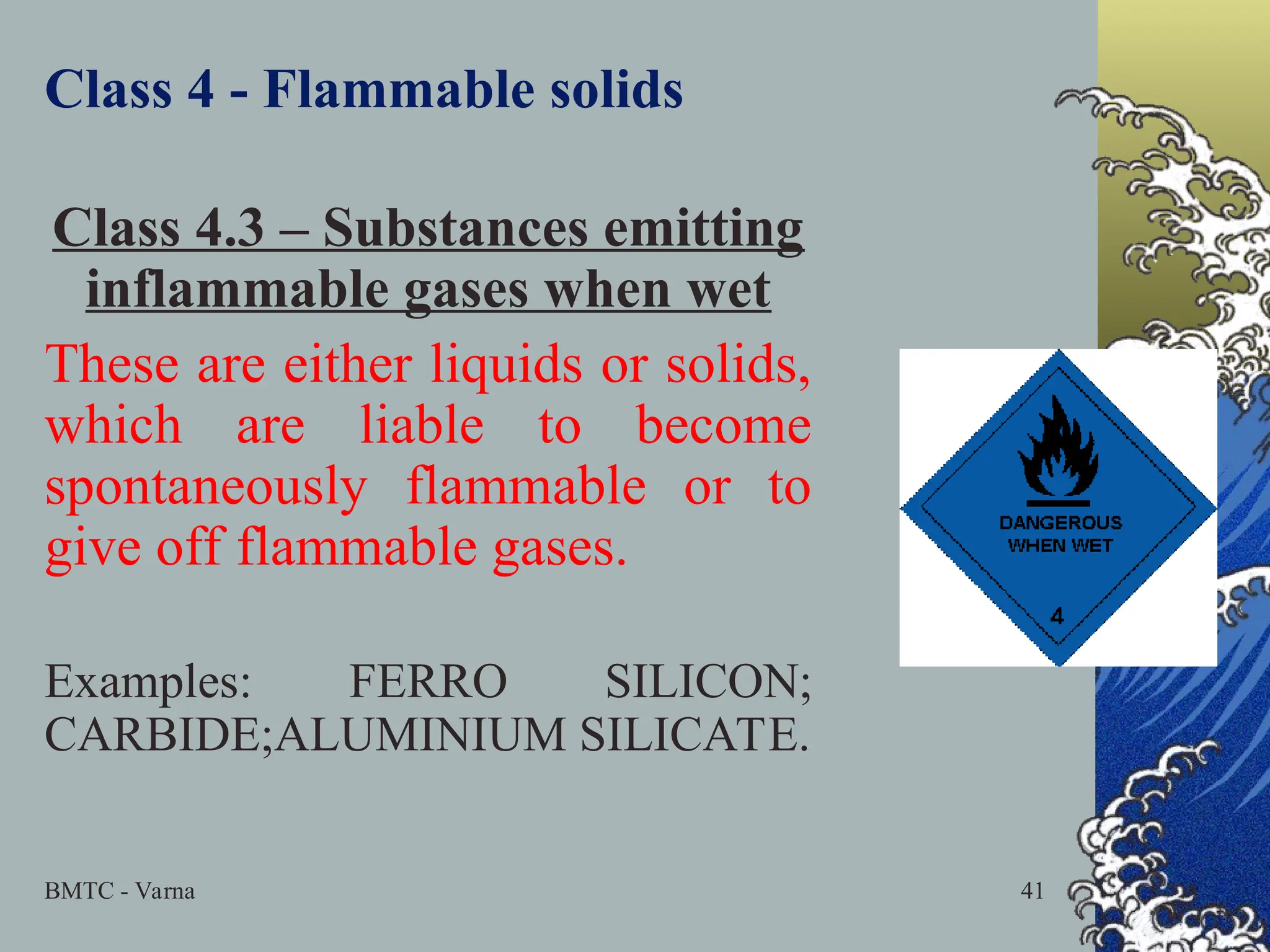
BMTC - Varna 41
Class 4 - Flammable solids
Class 4.3 – Substances emitting
inflammable gases when wet
These are either liquids or solids,
which are liable to become
spontaneously flammable or to
give off flammable gases.
Examples: FERRO SILICON;
CARBIDE;ALUMINIUM SILICATE.
BMTC - Varna 42
Dangerous Goods Classifications
Class 5 – Oxidizing and Organic
Class 5 is divided into two groups:
 Class 5.1 – Oxidizing substances
 Class 5.2 – Organic peroxides
BMTC - Varna 43
Class 5 – Oxidizing and Organic
Class 5.1 – Oxidising substances
Substances of this class will, under
certain circumstances directly or
indirectly give off oxygen. For this
reason oxidizing substances increase
the risk and intensity of fire in
combustible material with which they
come into contact.
Examples:
HYDROGEN PEROXIDE;
SODIUM PEROXIDE.
BMTC - Varna 44
Class 5 – Oxidizing and Organic
Class 5.2 – Organic peroxides
Substances of this class are liable to
exothermic decomposition at normal or
elevated temperatures. The
decomposition can be initiated by heat,
contact with impurities, friction or
impact. Decomposition may result in
the evolution of harmful or flammable
gases or vapours.
Examples:
ORGANIC PEROXIDES CLASS B to F.
BMTC - Varna 45
Dangerous Goods Classifications
Class 6 – Toxic and Infections
Class 6 is divided into two groups:
 Class 6.1 – Toxic substances
 Class 6.2 – Infectious substances
BMTC - Varna 46
Class 6 – Toxic and Infectious
Class 6.1 – Toxic substances
Substances of this class posses the
common property of being liable to
cause death or serious injury or to harm
health if swallowed or inhaled, or by
skin contact.
Examples:
ARSENIC; HYDROCYANIC ACID;
MERCURY COMPOUND.
It is very important to keep toxic
substances far way from food!!!
BMTC - Varna 47
Class 6 – Toxic and Infectious
Class 6.2 – Infectious Substances
Substances of this class are those
known to contain pathogens.
Examples:
Bio MEDICAL WASTE; INFECTIOUS
SUBSTANCES affecting humans.
BMTC - Varna 48
Dangerous Goods Classifications
Class 7 - Radioactive
Class 7 is divided into the following Low
Specific Activity (LSA) materials:
 LSA I
 LSA II
 LSA III
BMTC - Varna 49
Class 7 - Radioactive
Class 7 – Category I
Lowest hazard
Transport index: 0 (1)
Maximum radiation level at any point
on the external surface:
Not more than 5 m Sv/h 0.5 mrem/h
BMTC - Varna 50
Class 7 - Radioactive
Class 7 – Category II
Transport index: More than 0 but not
more than 1 (1)
Maximum radiation level at any point
on the external surface:
More than 5 m Sv/h (0.5 mrem/h), but
not more than 0=5 mSv/h (50 mrem/h)
BMTC - Varna 51
Class 7 - Radioactive
Class 7 – Category III
Highest hazard
Transport index: More than 1 but not
more than 10.
BMTC - Varna 52
Dangerous Goods Classifications
Class 8 - Corrosive
Examples:
Different types of ACIDS;
SODIUM HYDROXIDE
BMTC - Varna 53
Dangerous Goods Classifications
Class 9 - Miscellaneous
Examples:
ASBESTOS FIBRE;
FISHMEAL (STABILISED);
CARBON DIOXIDE (SOLID)
BMTC - Varna 54
Marine Pollutant
Marine pollutants means substances
which, because of their potential to
bioaccumulate in seafood or because of
their high toxicity to aquatic life, are
subject to the regulations in Annex III
of MARPOL 73/78.
BMTC - Varna 55
Hazard Classifications
Discussion Points
What are the characteristics of the 6
divisions of Class 1 explosives?
What are the characteristics of the 3
divisions of Class 2 gases?
What classes are explosives; poison?
BMTC - Varna 56
Hazard Classifications
Discussion Points
Without looking, describe the
placard for a 5.1 oxidizer?
What are some common examples of
each class of Dangerous goods?

DG Clasiffication HAZMAT Dangerous Goods

  • 1.
    BMTC - Varna1 Classification – in Vol 1, Ch 2. Learning objectives: A basic knowledge of chemistry so that you are able to understand the terms used in the IMDG Code A general knowledge of the hazard associated with the DG you are dealing with. A knowledge to determine which goods are dangerous and which are not; a good knowledge of the nine groups or classes the substances are divided into.
  • 2.
    BMTC - Varna2 Basic Physics and Chemistry When browsing the IMDG Code you will found a number of terms: Elements Mixtures Compounds Materials Substances Articles
  • 3.
    BMTC - Varna3 Elements Elements are the basics building blocks from which all chemical structures are made. They cannot be broken into simpler substances and are composed of identical atoms, which are the smallest particles of an element that can chemically exist.
  • 4.
    BMTC - Varna4 Mixture If the elements iron and sulphur are blended together, then a mixture is formed. The two components retain their individual chemical and physical characteristics and can be separated from each other again.
  • 5.
    BMTC - Varna5 Compounds If the mixture of iron and sulphur powders is heated together, their atoms combine to form molecules of a new substance called a chemical compound, in this instance the substances is called ferrous sulphide. The compounds can have properties which may be significantly different from the substances from which they have been formed.
  • 6.
    BMTC - Varna6 Materials A material is defined as having some general properties but these may vary depending upon the composition. For example: wood has the same general properties, but different colours and textures.
  • 7.
    BMTC - Varna7 Substances The IMDG Code refers to the term SUBSTANCES, which covers chemical compositions that do not vary significantly from one sample to another. Many substances are compounds and some are elements. Example of substances are: SALT and CANE SUGAR.
  • 8.
    BMTC - Varna8 Articles The IMDG Code also refers to the term ARTICLE. An article is a device that contains a dangerous substances or mixture of substances. Example: fireworks, aerosols, lighters and bombs.
  • 9.
    BMTC - Varna9 Physical state of MATTER “Matter” exists in three states: Solids Liquids Gases The physical state of many substances will vary depending upon the temperature and pressure applied to them.
  • 10.
    BMTC - Varna10 Solids Many solids, such as common salt, have a regular shape and are crystalline. Some solids take water from the air and become damp. It is difficult to compress solids.
  • 11.
    BMTC - Varna11 Liquids Liquids have definite mass and volume but not shape. The Code recognises that increasing viscosity can reduce hazard and effect packing. Liquids are difficult to compress.
  • 12.
    BMTC - Varna12 Gases Gases, like air has a definite mass but no defined volume and will expand to fill the volume of the containment vessel. Some gases, like chorine are heavier than air, others like hydrogen is lighter. Gases are easily compressed and are available in pressure-resistant gas cylinders.
  • 13.
    BMTC - Varna13 Chemistry - Physical Properties Chemicals are identified and characterised by their properties. Physical properties are used to assist in the classification of substances and articles within the Code and some important physical properties are also specified in the Code on individual schedules.
  • 14.
    BMTC - Varna14 Physical properties can be defined as follows:  Boiling point  Vapour pressure  Flashpoint  Auto-ignition point  Explosive limit  Melting point  Density  Solubility  Odour
  • 15.
    BMTC - Varna15 Boiling point This is the temperature at which a liquid boils and begins to turn into vapour. The boiling point will vary depending upon the pressure applied. Boiling point criteria are used together with flashpoint to allocate flammable liquids into packing groups.
  • 16.
    BMTC - Varna16 Vapour Pressure All solids and liquids give off vapour consisting of atoms or molecules of the substance that have evaporated from the surface. The pressure, which the vapour exerts under specified conditions, is known as the vapour pressure. Vapour pressure is an important consideration in defining whether a particular substance should be classified as a gas and also in determining the toxicity of substances if inhaled.
  • 17.
    BMTC - Varna17 Flashpoint Flash point is the lowest temperature of a liquid at which its vapour forms an ignitable mixture with air. A flammable liquid cannot be ignited so long as its temperature remains below the flashpoint.???
  • 18.
    BMTC - Varna18 Auto-ignition point This is the temperature to which a liquid must be raised to cause a sustained fire or explosion when touched by a flame or hot object or by the heat generated during the reaction or by friction.
  • 19.
    BMTC - Varna19 Explosive limit This is the percentage-by- volume vapour / air concentration of a substance, which is ignitable. Below the “lower explosive limit” the mixture is too “lean” to ignite and above the upper explosive limit the mixture is too “rich”.
  • 20.
    BMTC - Varna20 Melting point The melting point is the lowest temperature at which a solid will change into a liquid when heated, for example ice turning to water. Care must be exercised in the section of packing materials for solids, which have a relative low melting point (transport from northern areas to a tropical climate).
  • 21.
    BMTC - Varna21 Density The density of a sample of a substance is determined by dividing its mass by the volume it occupies. The UN package performance test recognise, that product relative density can effect container performance, particularly impact strength and therefore the drop height. For example: the toxic gas arsine, which has a relative vapour density of 2.8 compared to air, would not be stowed below deck, where it could not easily disperse.
  • 22.
    BMTC - Varna22 Solubility When a solid or a gas dissolves in a liquid, a homogeneous mixture or solution is formed. Eventually, as more solute is added, the solution cannot dissolve any more and is said to be saturated.
  • 23.
    BMTC - Varna23 Odour Many substances have a characteristic smell, which may be the first indication of product escape. Any unusual odour should be treated as a warning and appropriate emergency action taken.
  • 24.
    BMTC - Varna24 The purpose of Classification The purpose of the classification is to divide hazardous goods into broad groups having the same properties, viz: Reactivity Flammability Toxicity Corrosiveness
  • 25.
    BMTC - Varna25 Classification of DG There are nine classes defined. The class numbers do not indicate the degree of hazard but only the type of hazard. The classification should be made by the shipper/consignor or by the appropriate competent authority where specified in this Code.
  • 26.
    BMTC - Varna26 Dangerous Goods Classifications Class 1 - Explosives (six divisions)  1.1 - mass explosion hazard  1.2 - projectile hazard  1.3 - minor blast/projectile/fire  1.4 - minor blast  1.5 - insensitive explosives  1.6 - very insensitive explosives
  • 27.
    BMTC - Varna27 Class 1: Explosives Division 1.1: substances and articles which have a mass explosion hazard A cargo has a mass explosion when the explosion is instantaneously released in the total cargo. For example: NITROGLYCERINE; BOMBS.
  • 28.
    BMTC - Varna28 Class 1: Explosives Division 1.2: substances and articles which have a projection hazard but not a mass explosion hazard Examples of substances in this group are PYROTECHNICS, FIREWORKS and certain types of SMALL ARMS AMMUNITION.
  • 29.
    BMTC - Varna29 Class 1: Explosives Division 1.3: substances and articles which have a fire hazard and either a minor blast hazard or a minor projection hazard or both, but not a mass explosion hazard This division comprises substances and articles: Which give rise to considerable radiant heat, or Which burns one after another, producing minor blast or projection effects or both. Examples of substances in this group are certain types of GUNPOWDER.
  • 30.
    BMTC - Varna30 Class 1: Explosives Division 1.4: substances and articles which present no significant hazard This division comprises substances and articles, which present only a small hazard in the event of ignition or ignition during transport. Example of substances in this group are different types of FUSE, SMOKE and LIGHT SIGNALS.
  • 31.
    BMTC - Varna31 Class 1: Explosives Division 1.5: very insensitive substances which have a mass explosion hazard This division comprises substances and articles, which have a mass explosion hazard but are so insensitive that there is very little probability of initiation or of transition from burning to detonation under normal conditions of transport.
  • 32.
    BMTC - Varna32 Class 1: Explosives Division 1.6: extremely insensitive articles which do not have a mass explosion hazard This division comprises substances and articles, which contain only extremely insensitive detonating substances and which demonstrate a negligible probability of accidental initiation or propagation. The risk from article of div 1.6 is limited to the explosion of a single article.
  • 33.
    BMTC - Varna33 Dangerous Goods Classifications Class 2 - Gases (three divisions)  2.1 - inflammable gases  2.2 - non inflammable compressed  2.3 - toxic gases
  • 34.
    BMTC - Varna34 Class 2 – Gases Class 2.1 This class is flammable gases which at 20 deg C and standard pressure of 101.3 kPa are ignitable when in a mixture of 13% or less by volume with air. Examples: BUTANE and PROPANE. Note: (Inflammable means the same as flammable)
  • 35.
    BMTC - Varna35 Class 2 – Gases Class 2.2 Non – flammable, non toxic gases, which are transported at a pressure not less than 280 kPa at 20 deg C, or as refrigerated liquids. Examples of substances in this class are NITROGEN, CARBON DIOXIDE and OXYGEN.
  • 36.
    BMTC - Varna36 Class 2 – Gases Class 2.3 This class of 2.2 is a toxic gases that are known to be so toxic or corrosive to humans as to pose a hazard to health. (poisonous has the same meaning as toxic). Examples: CHLORINE and SULPHUR DIOXIDE.
  • 37.
    BMTC - Varna37 Dangerous Goods Classifications Class 3 – Flammable liquids Class 3 contains:  Liquids  Mixture of liquids  Solids in solution or suspension
  • 38.
    BMTC - Varna38 Dangerous Goods Classifications Class 4 – Flammable solids Class 4 comprises both inorganic and organic substances and is divided into three sub- classes:  Class 4.1 – Inflammable solids  Class 4.2 – Spontaneously combustible substances  Class 4.3 – Substances emitting inflammable gases when wet.
  • 39.
    BMTC - Varna39 Class 4 - Flammable solids Class 4.1 – Inflammable solids group These are solids possessing the properties of being ignited by external sources, such as sparks or flame, and being readily combustible. Examples: MAGNESIUM POWDER; MATCHES; SULPHUR;JUTE.
  • 40.
    BMTC - Varna40 Class 4 - Flammable solids Class 4.2 – Spontaneously combustible substances These are either liquids or solids, which are liable to spontaneous heating and then being liable to catch fire. Examples: SODIUM SULPHIDES; POTASSIUM SULPHIDES; WHITE and YELLOW PHOSPHORUS.
  • 41.
    BMTC - Varna41 Class 4 - Flammable solids Class 4.3 – Substances emitting inflammable gases when wet These are either liquids or solids, which are liable to become spontaneously flammable or to give off flammable gases. Examples: FERRO SILICON; CARBIDE;ALUMINIUM SILICATE.
  • 42.
    BMTC - Varna42 Dangerous Goods Classifications Class 5 – Oxidizing and Organic Class 5 is divided into two groups:  Class 5.1 – Oxidizing substances  Class 5.2 – Organic peroxides
  • 43.
    BMTC - Varna43 Class 5 – Oxidizing and Organic Class 5.1 – Oxidising substances Substances of this class will, under certain circumstances directly or indirectly give off oxygen. For this reason oxidizing substances increase the risk and intensity of fire in combustible material with which they come into contact. Examples: HYDROGEN PEROXIDE; SODIUM PEROXIDE.
  • 44.
    BMTC - Varna44 Class 5 – Oxidizing and Organic Class 5.2 – Organic peroxides Substances of this class are liable to exothermic decomposition at normal or elevated temperatures. The decomposition can be initiated by heat, contact with impurities, friction or impact. Decomposition may result in the evolution of harmful or flammable gases or vapours. Examples: ORGANIC PEROXIDES CLASS B to F.
  • 45.
    BMTC - Varna45 Dangerous Goods Classifications Class 6 – Toxic and Infections Class 6 is divided into two groups:  Class 6.1 – Toxic substances  Class 6.2 – Infectious substances
  • 46.
    BMTC - Varna46 Class 6 – Toxic and Infectious Class 6.1 – Toxic substances Substances of this class posses the common property of being liable to cause death or serious injury or to harm health if swallowed or inhaled, or by skin contact. Examples: ARSENIC; HYDROCYANIC ACID; MERCURY COMPOUND. It is very important to keep toxic substances far way from food!!!
  • 47.
    BMTC - Varna47 Class 6 – Toxic and Infectious Class 6.2 – Infectious Substances Substances of this class are those known to contain pathogens. Examples: Bio MEDICAL WASTE; INFECTIOUS SUBSTANCES affecting humans.
  • 48.
    BMTC - Varna48 Dangerous Goods Classifications Class 7 - Radioactive Class 7 is divided into the following Low Specific Activity (LSA) materials:  LSA I  LSA II  LSA III
  • 49.
    BMTC - Varna49 Class 7 - Radioactive Class 7 – Category I Lowest hazard Transport index: 0 (1) Maximum radiation level at any point on the external surface: Not more than 5 m Sv/h 0.5 mrem/h
  • 50.
    BMTC - Varna50 Class 7 - Radioactive Class 7 – Category II Transport index: More than 0 but not more than 1 (1) Maximum radiation level at any point on the external surface: More than 5 m Sv/h (0.5 mrem/h), but not more than 0=5 mSv/h (50 mrem/h)
  • 51.
    BMTC - Varna51 Class 7 - Radioactive Class 7 – Category III Highest hazard Transport index: More than 1 but not more than 10.
  • 52.
    BMTC - Varna52 Dangerous Goods Classifications Class 8 - Corrosive Examples: Different types of ACIDS; SODIUM HYDROXIDE
  • 53.
    BMTC - Varna53 Dangerous Goods Classifications Class 9 - Miscellaneous Examples: ASBESTOS FIBRE; FISHMEAL (STABILISED); CARBON DIOXIDE (SOLID)
  • 54.
    BMTC - Varna54 Marine Pollutant Marine pollutants means substances which, because of their potential to bioaccumulate in seafood or because of their high toxicity to aquatic life, are subject to the regulations in Annex III of MARPOL 73/78.
  • 55.
    BMTC - Varna55 Hazard Classifications Discussion Points What are the characteristics of the 6 divisions of Class 1 explosives? What are the characteristics of the 3 divisions of Class 2 gases? What classes are explosives; poison?
  • 56.
    BMTC - Varna56 Hazard Classifications Discussion Points Without looking, describe the placard for a 5.1 oxidizer? What are some common examples of each class of Dangerous goods?

Editor's Notes

  • #22 If a liquid mixes completely with another liquid then it is said to be miscible. Miscibility and relative density are important criteria used in determining what medium should be used infighting fires involving chemicals. For example: water would not be suitable for fighting fires involving petrol, which would float on the water and spread the fire.
  • #24 All chemicals are hazardous to human health or the environment. Mainly the hazard arises from the substances when changing its storage or transport condition, or by reaction of the substances with other substances. United Nations has divided these families of hazardous substances into 9 classes based on the type of hazard that they can represent.
  • #26 Substances (including mixtures and solutions) and articles subject to the provisions of this Code are assigned to one of the classes 1 -9 according to the hazard or the most predominant of the hazards they present. Some of these classes are subdivided into divisions. These classes or divisions are as listed in this slide.
  • #31 Note: The probability of transition from burning to detonation is greater when large quantities are carried in a ship. As a consequence, the stowage requirements for explosive substance in devision 1.1 and for those in div 1.5 are identical.
  • #32 Note: The probability of transition from burning to detonation is greater when large quantities are carried in a ship. As a consequence, the stowage requirements for explosive substance in devision 1.1 and for those in div 1.5 are identical.
  • #33 Class 2 is subdivided further according to the primary hazard of the gas during transport. The transport condition of gas is described according to its physical state as: Compressed gas which when packaged under pressure for transport is entirely gaseous at 20 deg C. Liquefied gas which when packaged for transport is partially liquid at 20 deg. C. Refrigerated liquefied gas which when packaged for transport is partially liquid because of its low temperature. Gas in solution is compressed gas which when packaged for transport is dissolved in a solvent.
  • #37 This class comprises liquids that have a flashpoint of 61 deg C or below. It also includes any substances that is transported as a liquid at an elevated temperature at or above its flashpoint even if the flashpoint is above 61 deg. C.
  • #38 This class comprises liquids that have a flashpoint of 61 deg C or below. It also includes any substances that is transported as a liquid at an elevated temperature at or above its flashpoint even if the flashpoint is above 61 deg. C.
  • #42 This class includes substances that easily yield oxygen, and can support combustion without air supply. This can make the fire in other substances become more severe. Substances in this group are probably among the most dangerous substances transported by ship.
  • #44 This is by far the most dangerous group. Substances in this group are forbidden to be transported on passenger ships. On cargo ships only “on deck” stowage is allowed.
  • #45 This class deals with toxic and infectious substances.
  • #47 Pathogens are defined as microorganisms, including bacteria, viruses, parasites or recombinant microorganisms like hybrid or mutant that are expected tp cause infectious disease in humans or animals.
  • #48 All radioactive materials are dangerous to a greater or lesser degree because they emit invisible radiation, which may damage body tissue.
  • #52 The substances in this class are solids or liquids possessing in their original state, the common property of being able, more or less severely to damage living tissue. The escape of such substance from its packaging may also cause damage to other cargo or to the ship.
  • #53 In the IMDG Code, class 9 comprises: Substances and articles not covered by other classes which experience has shown that they are of such a dangerous character that the provisions of part A of ch VII of Solas 74 as amended should apply. Harmful substances not subject to the provisions of part A of ch VII of Solas 74, but to which the provisions of Annex III of Marpol 73/78 apply.
  • #54 Or said in plain English – substances of all classes may be classified as marine pollutants. A distinction is made between substances, which are marine pollutants and those, which are severe marine pollutants. Marine pollutants and severe marine pollutants should be transported under the appropriate entry according to their properties if they fall within the criteria of any of the classes 1 to 8. If they do not fall within the criteria of any of these classes, they should be transported under the entry: ENVIRONMENTALLY HAZARDOUS SUBSTANCE, SOLID, N.O.S., UN 3077 or ENVIRONMENTALLY HAZARDOUS SUBSTANCE, LIQUID, N.O.S., UN 3082, as appropriate, unless there is a specific entry in class 9.