Devsecops
development, security, and operations
16010421083 - Mustafa Poonawala
16010421084 - Sharandee
TABLE OF CONTENTS
01
02
03 08
DevSecOps
Case Study
Breakdown/
Tools
Analysis
07
Challenges
and pitfalls
06
Tutorial
05
Overview
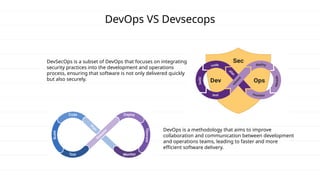
DevSecOps is a subset of DevOps that focuses on integrating
security practices into the development and operations
process, ensuring that software is not only delivered quickly
but also securely.
DevOps VS Devsecops
DevOps is a methodology that aims to improve
collaboration and communication between development
and operations teams, leading to faster and more
efficient software delivery.
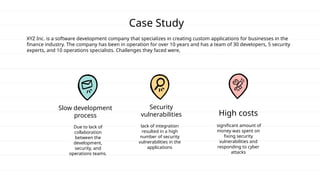
Due to lack of
collaboration
between the
development,
security, and
operations teams.
lack of integration
resulted in a high
number of security
vulnerabilities in the
applications
significant amount of
money was spent on
fixing security
vulnerabilities and
responding to cyber
attacks
Case Study
Slow development
process
Security
vulnerabilities High costs
XYZ Inc. is a software development company that specializes in creating custom applications for businesses in the
finance industry. The company has been in operation for over 10 years and has a team of 30 developers, 5 security
experts, and 10 operations specialists. Challenges they faced were,
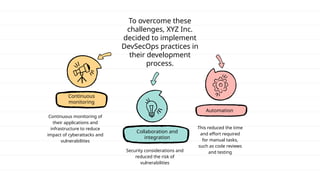
To overcome these
challenges, XYZ Inc.
decided to implement
DevSecOps practices in
their development
process.
Continuous monitoring of
their applications and
infrastructure to reduce
impact of cyberattacks and
vulnerabilities
Continuous
monitoring
Security considerations and
reduced the risk of
vulnerabilities
Collaboration and
integration
This reduced the time
and effort required
for manual tasks,
such as code reviews
and testing
Automation
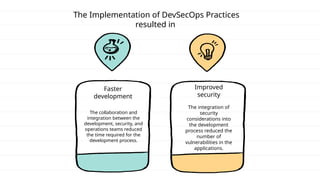
The collaboration and
integration between the
development, security, and
operations teams reduced
the time required for the
development process.
The integration of
security
considerations into
the development
process reduced the
number of
vulnerabilities in the
applications.
Faster
development
Improved
security
The Implementation of DevSecOps Practices
resulted in
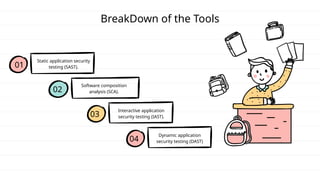
BreakDown of the Tools
Static application security
testing (SAST).
02
Software composition
analysis (SCA).
03
Interactive application
security testing (IAST).
04
Dynamic application
security testing (DAST)
01
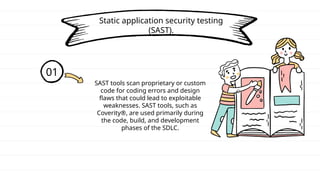
Static application security testing
(SAST).
01
SAST tools scan proprietary or custom
code for coding errors and design
flaws that could lead to exploitable
weaknesses. SAST tools, such as
Coverityยฎ, are used primarily during
the code, build, and development
phases of the SDLC.
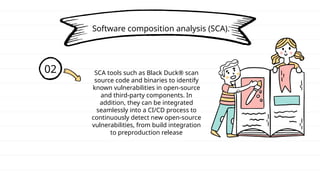
Software composition analysis (SCA).
02 SCA tools such as Black Duckยฎ scan
source code and binaries to identify
known vulnerabilities in open-source
and third-party components. In
addition, they can be integrated
seamlessly into a CI/CD process to
continuously detect new open-source
vulnerabilities, from build integration
to preproduction release
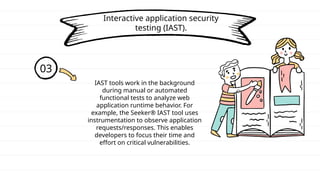
Interactive application security
testing (IAST).
03
IAST tools work in the background
during manual or automated
functional tests to analyze web
application runtime behavior. For
example, the Seekerยฎ IAST tool uses
instrumentation to observe application
requests/responses. This enables
developers to focus their time and
effort on critical vulnerabilities.
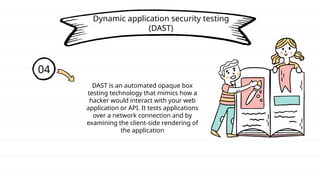
Dynamic application security testing
(DAST)
04
DAST is an automated opaque box
testing technology that mimics how a
hacker would interact with your web
application or API. It tests applications
over a network connection and by
examining the client-side rendering of
the application
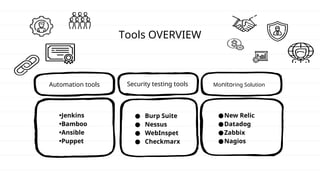
Tools OVERVIEW
Automation tools
โ€ขJenkins
โ€ขBamboo
โ€ขAnsible
โ€ขPuppet
Security testing tools Monitoring Solution
โ— Burp Suite
โ— Nessus
โ— WebInspet
โ— Checkmarx
โ—New Relic
โ—Datadog
โ—Zabbix
โ—Nagios
Tutotrial On Implementation of DevSecOps
01
Identify the current development processes and
tools in use, and assess their
security capabilities.
Tutotrial On Implementation of
DevSecOps
02
Engage with the development team to
understand their needs and concerns
regarding security.
03
Develop a security strategy that aligns with
the development processes and tools, and
integrates security controls at every stage
of the development lifecycle.
04
Implement automated security testing tools, such
as static analysis, dynamic analysis, and
penetration testing, to identify and remediate
security vulnerabilities in the code.
Tutotrial On Implementation of
DevSecOps
05
Collaborate with the development team to integrate security
testing into the continuous integration/continuous delivery
(CI/CD) pipeline, ensuring that security is considered as part
of the development process
06
Monitor and assess the effectiveness of the
security controls, and provide feedback to the
development team to improve security practices
and reduce vulnerabilities.
07
Educate and train the development team on best
practices for secure coding, and provide guidance
on how to incorporate security into the
development process.
Tutotrial On Implementation of
DevSecOps
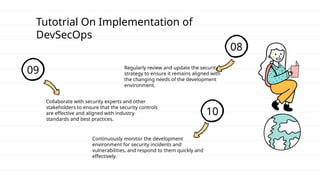
08
Regularly review and update the security
strategy to ensure it remains aligned with
the changing needs of the development
environment.
09
Collaborate with security experts and other
stakeholders to ensure that the security controls
are effective and aligned with industry
standards and best practices.
10
Continuously monitor the development
environment for security incidents and
vulnerabilities, and respond to them quickly and
effectively.
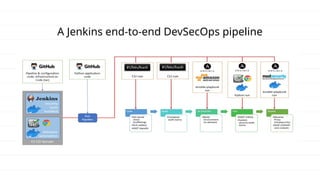
A Jenkins end-to-end DevSecOps pipeline
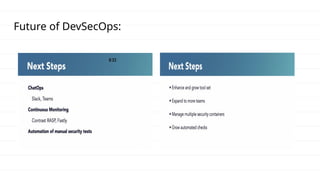
Future of DevSecOps:
Because companies these days
are trying to shift towards the
continious integratiuon /
monitering, collaboration and
automation and for that
purpose the Devsecop
Engineers are in very high
demand throughout the world
especially in USA
Avg PayScale of
DevSecOps in USA
DID YOU KNOW...?
$119k-$160k
$115k-
$171k
$90k-$100k
CREDITS: This presentation template was created by
Slidesgo, including icons by Flaticon, and infographics &
images by Freepik.
THANKS!
Do you have
any questions?

DevSecOps Powerpoint Presentation for Students

  • 1.
    Devsecops development, security, andoperations 16010421083 - Mustafa Poonawala 16010421084 - Sharandee
  • 2.
    TABLE OF CONTENTS 01 02 0308 DevSecOps Case Study Breakdown/ Tools Analysis 07 Challenges and pitfalls 06 Tutorial 05 Overview
  • 3.
    DevSecOps is asubset of DevOps that focuses on integrating security practices into the development and operations process, ensuring that software is not only delivered quickly but also securely. DevOps VS Devsecops DevOps is a methodology that aims to improve collaboration and communication between development and operations teams, leading to faster and more efficient software delivery.
  • 4.
    Due to lackof collaboration between the development, security, and operations teams. lack of integration resulted in a high number of security vulnerabilities in the applications significant amount of money was spent on fixing security vulnerabilities and responding to cyber attacks Case Study Slow development process Security vulnerabilities High costs XYZ Inc. is a software development company that specializes in creating custom applications for businesses in the finance industry. The company has been in operation for over 10 years and has a team of 30 developers, 5 security experts, and 10 operations specialists. Challenges they faced were,
  • 5.
    To overcome these challenges,XYZ Inc. decided to implement DevSecOps practices in their development process. Continuous monitoring of their applications and infrastructure to reduce impact of cyberattacks and vulnerabilities Continuous monitoring Security considerations and reduced the risk of vulnerabilities Collaboration and integration This reduced the time and effort required for manual tasks, such as code reviews and testing Automation
  • 6.
    The collaboration and integrationbetween the development, security, and operations teams reduced the time required for the development process. The integration of security considerations into the development process reduced the number of vulnerabilities in the applications. Faster development Improved security The Implementation of DevSecOps Practices resulted in
  • 7.
    BreakDown of theTools Static application security testing (SAST). 02 Software composition analysis (SCA). 03 Interactive application security testing (IAST). 04 Dynamic application security testing (DAST) 01
  • 8.
    Static application securitytesting (SAST). 01 SAST tools scan proprietary or custom code for coding errors and design flaws that could lead to exploitable weaknesses. SAST tools, such as Coverityยฎ, are used primarily during the code, build, and development phases of the SDLC.
  • 9.
    Software composition analysis(SCA). 02 SCA tools such as Black Duckยฎ scan source code and binaries to identify known vulnerabilities in open-source and third-party components. In addition, they can be integrated seamlessly into a CI/CD process to continuously detect new open-source vulnerabilities, from build integration to preproduction release
  • 10.
    Interactive application security testing(IAST). 03 IAST tools work in the background during manual or automated functional tests to analyze web application runtime behavior. For example, the Seekerยฎ IAST tool uses instrumentation to observe application requests/responses. This enables developers to focus their time and effort on critical vulnerabilities.
  • 11.
    Dynamic application securitytesting (DAST) 04 DAST is an automated opaque box testing technology that mimics how a hacker would interact with your web application or API. It tests applications over a network connection and by examining the client-side rendering of the application
  • 12.
    Tools OVERVIEW Automation tools โ€ขJenkins โ€ขBamboo โ€ขAnsible โ€ขPuppet Securitytesting tools Monitoring Solution โ— Burp Suite โ— Nessus โ— WebInspet โ— Checkmarx โ—New Relic โ—Datadog โ—Zabbix โ—Nagios
  • 13.
    Tutotrial On Implementationof DevSecOps 01 Identify the current development processes and tools in use, and assess their security capabilities.
  • 14.
    Tutotrial On Implementationof DevSecOps 02 Engage with the development team to understand their needs and concerns regarding security. 03 Develop a security strategy that aligns with the development processes and tools, and integrates security controls at every stage of the development lifecycle. 04 Implement automated security testing tools, such as static analysis, dynamic analysis, and penetration testing, to identify and remediate security vulnerabilities in the code.
  • 15.
    Tutotrial On Implementationof DevSecOps 05 Collaborate with the development team to integrate security testing into the continuous integration/continuous delivery (CI/CD) pipeline, ensuring that security is considered as part of the development process 06 Monitor and assess the effectiveness of the security controls, and provide feedback to the development team to improve security practices and reduce vulnerabilities. 07 Educate and train the development team on best practices for secure coding, and provide guidance on how to incorporate security into the development process.
  • 16.
    Tutotrial On Implementationof DevSecOps 08 Regularly review and update the security strategy to ensure it remains aligned with the changing needs of the development environment. 09 Collaborate with security experts and other stakeholders to ensure that the security controls are effective and aligned with industry standards and best practices. 10 Continuously monitor the development environment for security incidents and vulnerabilities, and respond to them quickly and effectively.
  • 17.
    A Jenkins end-to-endDevSecOps pipeline
  • 18.
  • 19.
    Because companies thesedays are trying to shift towards the continious integratiuon / monitering, collaboration and automation and for that purpose the Devsecop Engineers are in very high demand throughout the world especially in USA Avg PayScale of DevSecOps in USA DID YOU KNOW...? $119k-$160k $115k- $171k $90k-$100k
  • 20.
    CREDITS: This presentationtemplate was created by Slidesgo, including icons by Flaticon, and infographics & images by Freepik. THANKS! Do you have any questions?