DevSecOps Foundation: A Practical Guide for
Secure Software Delivery
Modern software development demands speed, scalability, and continuous innovation. However,
delivering applications rapidly without embedding security at every stage exposes organizations
to significant operational and reputational risks. This is where DevSecOps becomes critical,
integrating security seamlessly into development and operations rather than treating it as a final
review step.
This guide is created for professionals, beginners, and decision-makers seeking a clear,
practical understanding of DevSecOps fundamentals, lifecycle, tools, best practices,
certifications, and career pathways. Structured specifically for PDF consumption, the content is
concise, well-organized, and grounded in real-world industry practices to support both learning
and implementation.
What Does DevSecOps Stand For?
DevSecOps stands for Development, Security, and Operations.
It is an evolution of DevOps that embeds security into every phase of software delivery
planning, coding, testing, deployment, and operations.
Key idea:
Security is built in, not bolted on.
DevSecOps Fundamentals
DevSecOps is built on a few core principles:
●​ Shift-left security – Identify vulnerabilities early
●​ Automation-first mindset – Reduce manual security checks
●​ Shared accountability – Developers, security, and operations collaborate
●​ Continuous monitoring – Security doesn’t stop after deployment
Why it matters in real life
A vulnerability found during production can cost millions. The same issue caught during coding
costs almost nothing to fix.
DevSecOps in Software Development
In traditional models, security reviews happen late. In DevSecOps in software development,
security starts at the design phase.
How it fits into daily development:
●​ Secure coding standards during development
●​ Automated security tests during builds
●​ Policy enforcement during deployment
●​ Real-time monitoring in production
DevSecOps Lifecycle
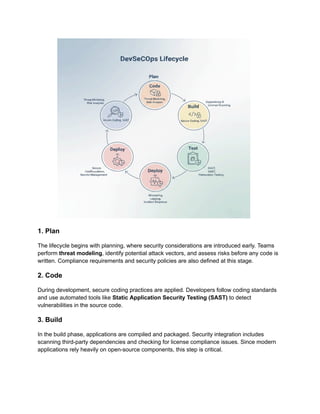
The DevSecOps lifecycle integrates security into every phase of the DevOps process. Instead
of treating security as a separate checkpoint, it becomes a continuous activity that evolves
alongside development and operations. Each stage contributes to building secure, resilient, and
scalable software.
1. Plan
The lifecycle begins with planning, where security considerations are introduced early. Teams
perform threat modeling, identify potential attack vectors, and assess risks before any code is
written. Compliance requirements and security policies are also defined at this stage.
2. Code
During development, secure coding practices are applied. Developers follow coding standards
and use automated tools like Static Application Security Testing (SAST) to detect
vulnerabilities in the source code.
3. Build
In the build phase, applications are compiled and packaged. Security integration includes
scanning third-party dependencies and checking for license compliance issues. Since modern
applications rely heavily on open-source components, this step is critical.
4. Test
Security testing continues with Dynamic Application Security Testing (DAST), penetration
testing, and API security validation. These tests simulate real-world attacks on running
applications.
5. Deploy
Before deployment, configurations are validated, secrets are securely managed, and
infrastructure settings are reviewed. Security policies are enforced within CI/CD pipelines to
ensure only approved builds reach production.
6. Operate
After deployment, security remains active through continuous monitoring, logging, and incident
response processes. Real-time alerts and automated responses help detect and mitigate
threats quickly.
DevSecOps Tools and Technologies
The right tools make DevSecOps practical and scalable.
Common DevSecOps tools by category:
Category Purpose
SAST Tools Scan source code for
vulnerabilities
DAST Tools Test running applications
Container Security Scan container images
Secrets
Management
Protect API keys and credentials
Monitoring Tools Detect threats in production
DevSecOps CI/CD Security
CI/CD pipelines are the backbone of DevSecOps.
Key security practices in CI/CD:
●​ Automated code scanning on every commit
●​ Dependency checks during build
●​ Security gates before deployment
●​ Infrastructure-as-Code (IaC) validation
DevSecOps Security Automation
Manual security reviews don’t scale. DevSecOps security automation solves this.
What gets automated:
●​ Vulnerability scanning
●​ Compliance checks
●​ Secrets detection
●​ Configuration validation
Real-world example:​
A cloud-native team runs automated scans on every pull request, preventing insecure code
merges without slowing developers.
DevSecOps Roles and Responsibilities
DevSecOps changes how teams work together.
Role Responsibility
Developers Write secure code, fix vulnerabilities
Security Teams Define policies, guide risk decisions
Operations Secure infrastructure and deployments
DevSecOps
Engineers
Automate security across pipelines
DevSecOps Skills Required
To succeed in DevSecOps, professionals need a blend of skills.
Core DevSecOps skills required:
●​ Secure coding practices
●​ CI/CD pipeline design
●​ Cloud and container security
●​ Automation and scripting
●​ Risk and compliance awareness
DevSecOps for Beginners
Beginner-friendly learning path:
1.​ Understand DevOps concepts
2.​ Learn basic application security
3.​ Practice CI/CD automation
4.​ Explore common security tools
5.​ Study real-world use cases
DevSecOps Best Practices
These proven practices help organizations succeed:
●​ Embed security early in design
●​ Automate everything possible
●​ Use least-privilege access
●​ Monitor continuously
●​ Educate teams regularly
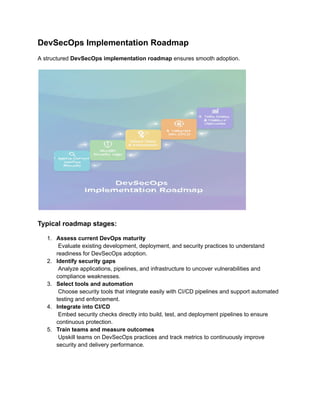
DevSecOps Implementation Roadmap
A structured DevSecOps implementation roadmap ensures smooth adoption.
Typical roadmap stages:
1.​ Assess current DevOps maturity​
Evaluate existing development, deployment, and security practices to understand
readiness for DevSecOps adoption.
2.​ Identify security gaps​
Analyze applications, pipelines, and infrastructure to uncover vulnerabilities and
compliance weaknesses.
3.​ Select tools and automation​
Choose security tools that integrate easily with CI/CD pipelines and support automated
testing and enforcement.
4.​ Integrate into CI/CD​
Embed security checks directly into build, test, and deployment pipelines to ensure
continuous protection.
5.​ Train teams and measure outcomes​
Upskill teams on DevSecOps practices and track metrics to continuously improve
security and delivery performance.
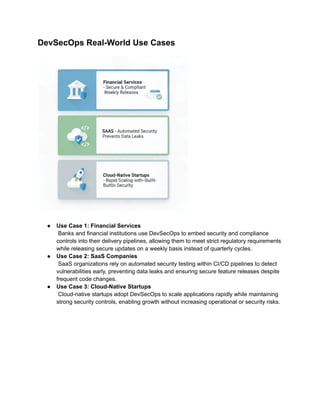
DevSecOps Real-World Use Cases
●​ Use Case 1: Financial Services​
Banks and financial institutions use DevSecOps to embed security and compliance
controls into their delivery pipelines, allowing them to meet strict regulatory requirements
while releasing secure updates on a weekly basis instead of quarterly cycles.
●​ Use Case 2: SaaS Companies​
SaaS organizations rely on automated security testing within CI/CD pipelines to detect
vulnerabilities early, preventing data leaks and ensuring secure feature releases despite
frequent code changes.
●​ Use Case 3: Cloud-Native Startups​
Cloud-native startups adopt DevSecOps to scale applications rapidly while maintaining
strong security controls, enabling growth without increasing operational or security risks.
DevSecOps Foundation Certification
The DevSecOps Foundation Certification validates your understanding of core principles,
tools, and workflows.
What it covers:
●​ DevSecOps fundamentals
●​ Lifecycle and automation
●​ CI/CD security
●​ Roles, tools, and best practices
This certification is ideal for professionals entering security-focused DevOps roles.
DevSecOps Course and Training
A structured DevSecOps Course accelerates learning with guided labs and examples.
Benefits of DevSecOps training:
●​ Practical, job-ready skills
●​ Hands-on tool exposure
●​ Clear understanding of workflows
Training bridges the gap between theory and real-world execution.
DevSecOps Exam and Certification Path
●​ Begins with DevOps fundamentals to understand CI/CD, automation, and collaboration
●​ Progresses to DevSecOps Foundation, focusing on integrating security across the
DevOps lifecycle
●​ Advances to cloud or security certifications for deeper specialization
●​ The DevSecOps exam emphasizes concepts, practices, lifecycle understanding, and
real-world use cases
●​ Coding depth is minimal; focus is on applied knowledge and decision-making
DevSecOps Certification Cost
●​ Varies based on the training provider
●​ Depends on the exam format (online or classroom)
●​ Influenced by the region and certification body
●​ Most foundation-level certifications are cost-effective
●​ Offers strong return on investment (ROI) through improved career prospects
PDF Summary
●​ Clear explanation of DevSecOps fundamentals and core principles
●​ Detailed breakdown of the DevSecOps lifecycle from planning to operations
●​ Overview of essential DevSecOps tools and technologies
●​ Practical insights into DevSecOps CI/CD security and automation
●​ Step-by-step DevSecOps implementation roadmap
●​ Defined DevSecOps roles and responsibilities within teams
●​ Key DevSecOps skills required for career growth
●​ Real-world industry DevSecOps use cases
●​ Guidance on DevSecOps best practices for secure delivery
●​ Overview of DevSecOps Foundation Certification, exam, training, and certification
path
●​ Insights into DevSecOps certification cost and career benefits
Conclusion
DevSecOps has become essential for delivering secure, high-quality software at speed. By
integrating security across the entire development lifecycle, organizations reduce risk, improve
compliance, and accelerate innovation.
To build these in-demand skills, SterlingNext offers a comprehensive DevSecOps
Certification Training program designed for beginners and experienced professionals alike.
The course focuses on practical DevSecOps fundamentals, CI/CD security, automation, and
real-world implementation—helping you prepare confidently for the DevSecOps Foundation
Certification.
Learn more about the course:​
https://www.sterlingnext.com/course/devsecops-certification-training
Explore all professional training programs by SterlingNext:​
https://www.sterlingnext.com/
About Sterling Next
Sterling Next is a professional training and certification provider focused on helping individuals
build practical skills and advance their careers. With industry-aligned course content,
experienced mentors, and flexible learning options, Sterling Next supports learners from
foundational concepts to certification success.
📍Company Name: Sterling Next
🌐Website: https://www.sterlingnext.com
📘DevSecOps Foundation CertificationTraining Page:
https://www.sterlingnext.com/course/pmp-certification-training
📞Contact: +1832-957-9587
📧Email: support@sterlingnext.com
🎯Mission: To deliver high-quality, practical training that empowers professionals to achieve
certification and excel in their careers.

The Continuous DevSecOps Lifecycle: Security at Every Step

  • 1.
    DevSecOps Foundation: APractical Guide for Secure Software Delivery Modern software development demands speed, scalability, and continuous innovation. However, delivering applications rapidly without embedding security at every stage exposes organizations to significant operational and reputational risks. This is where DevSecOps becomes critical, integrating security seamlessly into development and operations rather than treating it as a final review step. This guide is created for professionals, beginners, and decision-makers seeking a clear, practical understanding of DevSecOps fundamentals, lifecycle, tools, best practices, certifications, and career pathways. Structured specifically for PDF consumption, the content is concise, well-organized, and grounded in real-world industry practices to support both learning and implementation.
  • 2.
    What Does DevSecOpsStand For? DevSecOps stands for Development, Security, and Operations. It is an evolution of DevOps that embeds security into every phase of software delivery planning, coding, testing, deployment, and operations. Key idea: Security is built in, not bolted on. DevSecOps Fundamentals DevSecOps is built on a few core principles: ●​ Shift-left security – Identify vulnerabilities early ●​ Automation-first mindset – Reduce manual security checks ●​ Shared accountability – Developers, security, and operations collaborate ●​ Continuous monitoring – Security doesn’t stop after deployment Why it matters in real life A vulnerability found during production can cost millions. The same issue caught during coding costs almost nothing to fix. DevSecOps in Software Development In traditional models, security reviews happen late. In DevSecOps in software development, security starts at the design phase. How it fits into daily development: ●​ Secure coding standards during development ●​ Automated security tests during builds ●​ Policy enforcement during deployment ●​ Real-time monitoring in production DevSecOps Lifecycle The DevSecOps lifecycle integrates security into every phase of the DevOps process. Instead of treating security as a separate checkpoint, it becomes a continuous activity that evolves alongside development and operations. Each stage contributes to building secure, resilient, and scalable software.
  • 3.
    1. Plan The lifecyclebegins with planning, where security considerations are introduced early. Teams perform threat modeling, identify potential attack vectors, and assess risks before any code is written. Compliance requirements and security policies are also defined at this stage. 2. Code During development, secure coding practices are applied. Developers follow coding standards and use automated tools like Static Application Security Testing (SAST) to detect vulnerabilities in the source code. 3. Build In the build phase, applications are compiled and packaged. Security integration includes scanning third-party dependencies and checking for license compliance issues. Since modern applications rely heavily on open-source components, this step is critical.
  • 4.
    4. Test Security testingcontinues with Dynamic Application Security Testing (DAST), penetration testing, and API security validation. These tests simulate real-world attacks on running applications. 5. Deploy Before deployment, configurations are validated, secrets are securely managed, and infrastructure settings are reviewed. Security policies are enforced within CI/CD pipelines to ensure only approved builds reach production. 6. Operate After deployment, security remains active through continuous monitoring, logging, and incident response processes. Real-time alerts and automated responses help detect and mitigate threats quickly. DevSecOps Tools and Technologies The right tools make DevSecOps practical and scalable. Common DevSecOps tools by category: Category Purpose SAST Tools Scan source code for vulnerabilities DAST Tools Test running applications Container Security Scan container images Secrets Management Protect API keys and credentials Monitoring Tools Detect threats in production
  • 5.
    DevSecOps CI/CD Security CI/CDpipelines are the backbone of DevSecOps. Key security practices in CI/CD: ●​ Automated code scanning on every commit ●​ Dependency checks during build ●​ Security gates before deployment ●​ Infrastructure-as-Code (IaC) validation DevSecOps Security Automation Manual security reviews don’t scale. DevSecOps security automation solves this. What gets automated: ●​ Vulnerability scanning ●​ Compliance checks ●​ Secrets detection ●​ Configuration validation Real-world example:​ A cloud-native team runs automated scans on every pull request, preventing insecure code merges without slowing developers. DevSecOps Roles and Responsibilities DevSecOps changes how teams work together. Role Responsibility Developers Write secure code, fix vulnerabilities Security Teams Define policies, guide risk decisions Operations Secure infrastructure and deployments DevSecOps Engineers Automate security across pipelines
  • 6.
    DevSecOps Skills Required Tosucceed in DevSecOps, professionals need a blend of skills. Core DevSecOps skills required: ●​ Secure coding practices ●​ CI/CD pipeline design ●​ Cloud and container security ●​ Automation and scripting ●​ Risk and compliance awareness DevSecOps for Beginners Beginner-friendly learning path: 1.​ Understand DevOps concepts 2.​ Learn basic application security 3.​ Practice CI/CD automation 4.​ Explore common security tools 5.​ Study real-world use cases DevSecOps Best Practices These proven practices help organizations succeed: ●​ Embed security early in design ●​ Automate everything possible ●​ Use least-privilege access ●​ Monitor continuously ●​ Educate teams regularly
  • 7.
    DevSecOps Implementation Roadmap Astructured DevSecOps implementation roadmap ensures smooth adoption. Typical roadmap stages: 1.​ Assess current DevOps maturity​ Evaluate existing development, deployment, and security practices to understand readiness for DevSecOps adoption. 2.​ Identify security gaps​ Analyze applications, pipelines, and infrastructure to uncover vulnerabilities and compliance weaknesses. 3.​ Select tools and automation​ Choose security tools that integrate easily with CI/CD pipelines and support automated testing and enforcement. 4.​ Integrate into CI/CD​ Embed security checks directly into build, test, and deployment pipelines to ensure continuous protection. 5.​ Train teams and measure outcomes​ Upskill teams on DevSecOps practices and track metrics to continuously improve security and delivery performance.
  • 8.
    DevSecOps Real-World UseCases ●​ Use Case 1: Financial Services​ Banks and financial institutions use DevSecOps to embed security and compliance controls into their delivery pipelines, allowing them to meet strict regulatory requirements while releasing secure updates on a weekly basis instead of quarterly cycles. ●​ Use Case 2: SaaS Companies​ SaaS organizations rely on automated security testing within CI/CD pipelines to detect vulnerabilities early, preventing data leaks and ensuring secure feature releases despite frequent code changes. ●​ Use Case 3: Cloud-Native Startups​ Cloud-native startups adopt DevSecOps to scale applications rapidly while maintaining strong security controls, enabling growth without increasing operational or security risks.
  • 9.
    DevSecOps Foundation Certification TheDevSecOps Foundation Certification validates your understanding of core principles, tools, and workflows. What it covers: ●​ DevSecOps fundamentals ●​ Lifecycle and automation ●​ CI/CD security ●​ Roles, tools, and best practices This certification is ideal for professionals entering security-focused DevOps roles. DevSecOps Course and Training A structured DevSecOps Course accelerates learning with guided labs and examples. Benefits of DevSecOps training: ●​ Practical, job-ready skills ●​ Hands-on tool exposure ●​ Clear understanding of workflows Training bridges the gap between theory and real-world execution. DevSecOps Exam and Certification Path ●​ Begins with DevOps fundamentals to understand CI/CD, automation, and collaboration ●​ Progresses to DevSecOps Foundation, focusing on integrating security across the DevOps lifecycle ●​ Advances to cloud or security certifications for deeper specialization ●​ The DevSecOps exam emphasizes concepts, practices, lifecycle understanding, and real-world use cases ●​ Coding depth is minimal; focus is on applied knowledge and decision-making DevSecOps Certification Cost ●​ Varies based on the training provider ●​ Depends on the exam format (online or classroom) ●​ Influenced by the region and certification body ●​ Most foundation-level certifications are cost-effective ●​ Offers strong return on investment (ROI) through improved career prospects
  • 10.
    PDF Summary ●​ Clearexplanation of DevSecOps fundamentals and core principles ●​ Detailed breakdown of the DevSecOps lifecycle from planning to operations ●​ Overview of essential DevSecOps tools and technologies ●​ Practical insights into DevSecOps CI/CD security and automation ●​ Step-by-step DevSecOps implementation roadmap ●​ Defined DevSecOps roles and responsibilities within teams ●​ Key DevSecOps skills required for career growth ●​ Real-world industry DevSecOps use cases ●​ Guidance on DevSecOps best practices for secure delivery ●​ Overview of DevSecOps Foundation Certification, exam, training, and certification path ●​ Insights into DevSecOps certification cost and career benefits
  • 11.
    Conclusion DevSecOps has becomeessential for delivering secure, high-quality software at speed. By integrating security across the entire development lifecycle, organizations reduce risk, improve compliance, and accelerate innovation. To build these in-demand skills, SterlingNext offers a comprehensive DevSecOps Certification Training program designed for beginners and experienced professionals alike. The course focuses on practical DevSecOps fundamentals, CI/CD security, automation, and real-world implementation—helping you prepare confidently for the DevSecOps Foundation Certification. Learn more about the course:​ https://www.sterlingnext.com/course/devsecops-certification-training Explore all professional training programs by SterlingNext:​ https://www.sterlingnext.com/ About Sterling Next Sterling Next is a professional training and certification provider focused on helping individuals build practical skills and advance their careers. With industry-aligned course content, experienced mentors, and flexible learning options, Sterling Next supports learners from foundational concepts to certification success. 📍Company Name: Sterling Next 🌐Website: https://www.sterlingnext.com 📘DevSecOps Foundation CertificationTraining Page: https://www.sterlingnext.com/course/pmp-certification-training 📞Contact: +1832-957-9587 📧Email: support@sterlingnext.com 🎯Mission: To deliver high-quality, practical training that empowers professionals to achieve certification and excel in their careers.