DEVELOPMENT OF SURFACES
A layout of the complete surface of a three dimensional object on a plane
surface is called its developments or pattern. Practically the development
consists of drawing the successive surfaces of the object in their true shape
and size with common edges joined. In other word the development of a
geometric solid represents the true shape and size of all its surfaces which
when folded at fold lines, would form the required solid.
The principle of development of surfaces is very much useful in sheet
metal working.
There are three methods of developments of surfaces
1. Parallel line development
2. Radial line Development.
3. Triangular Development.
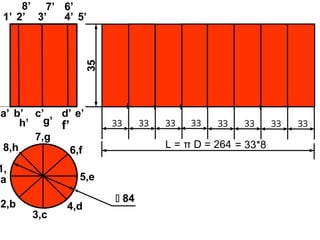
1. Parallel line development : This method can only be used to develop objects
Having a constant cross section for their full length, for example, prisms and
Cylinders and related forms.
20 20 20 20
20 20 20 20
20
20 20 20 20
20
20 20 20 20
20 20 20 20
30
20 10 20 10
30
20 10 20 10
30
30 30 30
50
30 30 30
50
20 20 20
35
20 20
20 20 20
35
20 20 20
33 33 33
35
33 33 33 33 33
a
1,
a’
1’
2,b
3,c
4,d
5,e
6,f
7,g
8,h
b’
2’
c’
3’
d’
4’
e’
5’
f’
6’
g’
7’
h’
8’
 84
L = π D = 264 = 33*8

DEVELOPMENT OF SURFACE FIRST YEAR ENGINEERING

  • 1.
  • 2.
    DEVELOPMENT OF SURFACES Alayout of the complete surface of a three dimensional object on a plane surface is called its developments or pattern. Practically the development consists of drawing the successive surfaces of the object in their true shape and size with common edges joined. In other word the development of a geometric solid represents the true shape and size of all its surfaces which when folded at fold lines, would form the required solid. The principle of development of surfaces is very much useful in sheet metal working.
  • 3.
    There are threemethods of developments of surfaces 1. Parallel line development 2. Radial line Development. 3. Triangular Development. 1. Parallel line development : This method can only be used to develop objects Having a constant cross section for their full length, for example, prisms and Cylinders and related forms.
  • 6.
  • 7.
    20 20 2020 20
  • 8.
    20 20 2020 20
  • 9.
  • 10.
    20 20 2020 30
  • 11.
    20 10 2010 30
  • 12.
    20 10 2010 30
  • 13.
  • 14.
  • 16.
  • 17.
  • 18.
    33 33 33 35 3333 33 33 33 a 1, a’ 1’ 2,b 3,c 4,d 5,e 6,f 7,g 8,h b’ 2’ c’ 3’ d’ 4’ e’ 5’ f’ 6’ g’ 7’ h’ 8’  84 L = π D = 264 = 33*8