DEVELOPMENT OF SNS
Ezreen
Fatimah
Husna
Maisarah
WHAT IS SNS?
Abbreviation for social network service or social networking site
Generally defined as Internet- or mobile-device-based social spaces
designed to facilitate communication, collaboration and content sharing
across networks of contacts.
To simplify, it is an online platform that enables users to create a public
profile and interact with other users virtually within the site.
CONT.
It typically support the public display of networks, although they
may offer privacy restrictions or enable closed communities.
Example of social networking sites are Facebook, Twitter, Live
Journal, Flickr, Instagram, LinkedIn, Google + and etc
THE HISTORY AND EVOLUTION OF
SOCIAL MEDIA
The history of social networking site begins when the concept of
computer-mediated-communication has been widely accepted as a
part of technology innovation.
there are few online services were established in the effort to
support social network via CMC.
1) USENET SYSTEMS
Usenet system is one of the early online services to support social
networks via computer-mediated communication.
It were first conceived of in 1979 by Tom Truscott and Jim Ellis.
It allows users to post articles or posts to their newsgroup.
Group sites such as Google Groups and Yahoo! Groups use many of
the conventions established by the original Usenet systems.
2) BULLETIN BOARD SYSTEMS
Bulletin Board Systems (BBS) is another early online service that was
established in late 70s.
BBSs allow users to log on and interact with one another.
These systems were small servers powered by personal computers
attached to a telephone modem, where one person at a time could
dial in and get access.
It had social discussions on message boards, community-
contributed file downloads, and online games.
CONT.
BBS Systems How game looked like in BBS system.
3) ONLINE SERVICES
CompuServe, Prodigy, Genie and AOL were the first real “corporate”
attempts to bring an interactive, “social” online experience to the
masses.
CompuServe incorporate a chat program into their service.
Genie is a competitor for CompuServe in which it offered not only
chat program but games, shopping and even mail.
Prodigy can be called as the most affordable online service compare
to CompuServe.
CONT.
Prodigy login site
4) IRC, ICQ, & INSTANT MESSAGING
In 1988, Internet Relay Chat (IRC) was developed to make
communication and file sharing become easier.
However, it has limitation access to most people as it run mostly in
UNIX-based operating system. UNIX is a popular multi-user,
multitasking operating system developed at Bell Labs in the early
1970s.
ICQ is the first instant messaging program that can run under PC. It
was developed in 90s by Mirabilis Company.
CONT.
After the invention of ICQ, Internet Messaging (IM) followed.
It is a real-time text based communication happen between two or
more users via Internet or any other network.
It allows immediate receipt of acknowledgment or reply to the user.
Webcams or talking over the internet using microphone made IM
become popular among user.
CONT.
Example of
IM
EARLY SOCIAL NETWORK
1) Forums
 Descendant of BBSs but with more user friendly interface.
 Various forum platforms such as vBulletin and phpBB
 Still remain a part of popular social networks in these days.
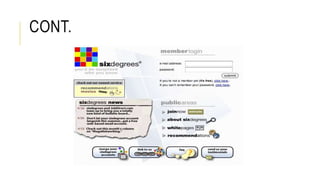
2) Six Degrees
 The first modern social network created in 1997.
 Had almost one million members during its time.
 Allowed users to create their own profile and become friend with other users.
CONT.
CONT.
3) LiveJournal
 Launched in 1999 with a different approach than common social networking sites
during that time.
 It allows users to follow one another and create a group to interact.
 It was a social network built around constantly-updated blogs.
4) Role-playing games
 Popular part of online culture in 2000s
 Allows users to play game and in a same time interact with other players virtually.
 World of Warcraft is a famous role-playing online game that encourage the player to
form a team and create their own tactical plans for the game.
CONT.
Role-playing game
MAJOR ADVANCES IN SOCIAL
NETWORKING
1. Friendster
 Launched in 2002, the first modern, general an user friendly social network.
 It allows users to discover their friend and also friends-of-friends to expand
their networks.
 Also known as a new kind of dating site.
2. Myspace
 Founded in 2003 and became a major competitor for Friendster.
 Apart from creating profile, Myspace allowed it users to customize their own
profiles by adjusting background template and adding music and videos.
 Introduced Myspace IM to let users chatting with their friends.
CONT.
CONT.
3. LinkedIn
 Founded in 2003 and solely devoted to use of business and expanding ones
networks.
 Allows client to create their own profile by posting resume and advertising
themselves.
 It also includes groups, question and answer forums and real-time updates.
4. Facebook
 Created back in 2004 as a Harvard only social network but grown popular in
2008.
 It surpasses competitors like Myspace, Hi5 and Friendster.
 Despite not allowing its users to customize their own profile, Facebook lets its
CONT.
 Over the past few years, Facebook has added several new features such as IM and
countless app for games.
 Private messaging is available as well as writing on another user’s wall.
 Other than that, Facebook also allows its user to control their privacy setting such
as allowing certain people to view their post and profile details.
 Users can also comment on or, more recently, “like” the posts of their friends,
and conversations often occur within the comment sections among multiple
people.
CONT.
MEDIA SHARING
1. Flickr
 It is a photo sharing site in which allowing its user to create their own profile, add
friend and organize their uploaded photos and videos into albums.
 Its forte is allowing users to license their photos through Creative Commons, as well
as retaining all copyrights.
CONT.
CONT.
2. YouTube
 Founded in 2005 and become a major video hosting and sharing site until
recent.
 Users can upload videos and share it to any social network that enable video
posting such as Facebook, blog, forum and etc.
 social features include ratings, comments, and the option to subscribe to the
channels of a user’s favorite video creators.
CONT.
REAL-TIME UPDATES
1. Twitter
 Become popular in 2007 and a major competitor for Facebook.
 Twitter has developed a cult-like following and has a number of famous users.
 There are Twitter clients for updating and managing followers; services that track
Twitter trends; and services for posting photos and videos directly to Twitter.
2. Tumblr
 Founded in 2007 and let users to post and reblog photos, videos, texts, audios, links
on a blog-like site.
 User friendly and also known as microblogging similar with Twitter.
MAIN FOCUS: FACEBOOK
BRIEF HISTORY OF FACEBOOK
Facebook was founded in February, 2004 by Mark Zuckerberg, a
psychology student from Harvard University.
Mark stated that he wanted to create a website that can connect people
around the university thus Thefacebook.com was launched.
Within a month, half of the undergraduate population signed up for
Thefacebook.com.
 It was an instant hit that Mark decided to extend the site to other Boston
universities, the Ivy League and eventually all US universities.
On August 2005, it officially become Facebook.com.
A month later, the site spread across to UK universities thus making
it a part of popular internet culture among students.
At the same year, every high schools in US could sign up for the site.
On September 2006, the site has extended its user to anyone with a
registered email address.
Facebook is a free site and only making its profit based on
advertisement revenue.
Several big companies like Yahoo and Google are interested in
buying Facebook but the owner remain steadfast and refused the
offers.
Over the years, Facebook has updated the site and adding a lot of
new features which increase the number of registration.
In 2009, the News Feed was replaced with a Real-Time Stream.
Later, a real-time activity feed was added to the homepage of
Facebook allowing friends to know latest update about the user.
IM and video calling are one the features added by Facebook to
smoothen the process of communication via internet.
In 2011, Facebook enabled subscribed as their features by allowing
users to see people's public status updates and posts.
To satisfy its increasingly mobile audience, in 2012 Facebook rolled
out the App Center. The App Center featured about 500 facebook
apps as an entertainment for user. Various games and platforms were
built to satisfy the users.
In the spring of 2012, Facebook acquired photosharing site
Instagram for one billion dollars.
Thefacebook back in 2004
Facebook in 2006
the News Feed was replaced with a Real-Time Stream
Facebook Ticker
Facebook video
calling
REFERENCES
http://www.theguardian.com/technology/2007/jul/25/media.newm
edia
http://www.webdesignerdepot.com/2009/10/the-history-and-
evolution-of-social-media/
http://www.techopedia.com/definition/4956/social-networking-
site-sns
http://www.digizen.org/socialnetworking/sn.aspx

Development of SNS

  • 1.
  • 2.
    WHAT IS SNS? Abbreviationfor social network service or social networking site Generally defined as Internet- or mobile-device-based social spaces designed to facilitate communication, collaboration and content sharing across networks of contacts. To simplify, it is an online platform that enables users to create a public profile and interact with other users virtually within the site.
  • 3.
    CONT. It typically supportthe public display of networks, although they may offer privacy restrictions or enable closed communities. Example of social networking sites are Facebook, Twitter, Live Journal, Flickr, Instagram, LinkedIn, Google + and etc
  • 4.
    THE HISTORY ANDEVOLUTION OF SOCIAL MEDIA The history of social networking site begins when the concept of computer-mediated-communication has been widely accepted as a part of technology innovation. there are few online services were established in the effort to support social network via CMC.
  • 5.
    1) USENET SYSTEMS Usenetsystem is one of the early online services to support social networks via computer-mediated communication. It were first conceived of in 1979 by Tom Truscott and Jim Ellis. It allows users to post articles or posts to their newsgroup. Group sites such as Google Groups and Yahoo! Groups use many of the conventions established by the original Usenet systems.
  • 6.
    2) BULLETIN BOARDSYSTEMS Bulletin Board Systems (BBS) is another early online service that was established in late 70s. BBSs allow users to log on and interact with one another. These systems were small servers powered by personal computers attached to a telephone modem, where one person at a time could dial in and get access. It had social discussions on message boards, community- contributed file downloads, and online games.
  • 7.
    CONT. BBS Systems Howgame looked like in BBS system.
  • 8.
    3) ONLINE SERVICES CompuServe,Prodigy, Genie and AOL were the first real “corporate” attempts to bring an interactive, “social” online experience to the masses. CompuServe incorporate a chat program into their service. Genie is a competitor for CompuServe in which it offered not only chat program but games, shopping and even mail. Prodigy can be called as the most affordable online service compare to CompuServe.
  • 9.
  • 10.
    4) IRC, ICQ,& INSTANT MESSAGING In 1988, Internet Relay Chat (IRC) was developed to make communication and file sharing become easier. However, it has limitation access to most people as it run mostly in UNIX-based operating system. UNIX is a popular multi-user, multitasking operating system developed at Bell Labs in the early 1970s. ICQ is the first instant messaging program that can run under PC. It was developed in 90s by Mirabilis Company.
  • 11.
    CONT. After the inventionof ICQ, Internet Messaging (IM) followed. It is a real-time text based communication happen between two or more users via Internet or any other network. It allows immediate receipt of acknowledgment or reply to the user. Webcams or talking over the internet using microphone made IM become popular among user.
  • 12.
  • 13.
    EARLY SOCIAL NETWORK 1)Forums  Descendant of BBSs but with more user friendly interface.  Various forum platforms such as vBulletin and phpBB  Still remain a part of popular social networks in these days. 2) Six Degrees  The first modern social network created in 1997.  Had almost one million members during its time.  Allowed users to create their own profile and become friend with other users.
  • 14.
  • 15.
    CONT. 3) LiveJournal  Launchedin 1999 with a different approach than common social networking sites during that time.  It allows users to follow one another and create a group to interact.  It was a social network built around constantly-updated blogs. 4) Role-playing games  Popular part of online culture in 2000s  Allows users to play game and in a same time interact with other players virtually.  World of Warcraft is a famous role-playing online game that encourage the player to form a team and create their own tactical plans for the game.
  • 16.
  • 17.
    MAJOR ADVANCES INSOCIAL NETWORKING 1. Friendster  Launched in 2002, the first modern, general an user friendly social network.  It allows users to discover their friend and also friends-of-friends to expand their networks.  Also known as a new kind of dating site. 2. Myspace  Founded in 2003 and became a major competitor for Friendster.  Apart from creating profile, Myspace allowed it users to customize their own profiles by adjusting background template and adding music and videos.  Introduced Myspace IM to let users chatting with their friends.
  • 18.
  • 19.
    CONT. 3. LinkedIn  Foundedin 2003 and solely devoted to use of business and expanding ones networks.  Allows client to create their own profile by posting resume and advertising themselves.  It also includes groups, question and answer forums and real-time updates. 4. Facebook  Created back in 2004 as a Harvard only social network but grown popular in 2008.  It surpasses competitors like Myspace, Hi5 and Friendster.  Despite not allowing its users to customize their own profile, Facebook lets its
  • 20.
    CONT.  Over thepast few years, Facebook has added several new features such as IM and countless app for games.  Private messaging is available as well as writing on another user’s wall.  Other than that, Facebook also allows its user to control their privacy setting such as allowing certain people to view their post and profile details.  Users can also comment on or, more recently, “like” the posts of their friends, and conversations often occur within the comment sections among multiple people.
  • 21.
  • 22.
    MEDIA SHARING 1. Flickr It is a photo sharing site in which allowing its user to create their own profile, add friend and organize their uploaded photos and videos into albums.  Its forte is allowing users to license their photos through Creative Commons, as well as retaining all copyrights.
  • 23.
  • 24.
    CONT. 2. YouTube  Foundedin 2005 and become a major video hosting and sharing site until recent.  Users can upload videos and share it to any social network that enable video posting such as Facebook, blog, forum and etc.  social features include ratings, comments, and the option to subscribe to the channels of a user’s favorite video creators.
  • 25.
  • 26.
    REAL-TIME UPDATES 1. Twitter Become popular in 2007 and a major competitor for Facebook.  Twitter has developed a cult-like following and has a number of famous users.  There are Twitter clients for updating and managing followers; services that track Twitter trends; and services for posting photos and videos directly to Twitter. 2. Tumblr  Founded in 2007 and let users to post and reblog photos, videos, texts, audios, links on a blog-like site.  User friendly and also known as microblogging similar with Twitter.
  • 28.
  • 29.
    BRIEF HISTORY OFFACEBOOK Facebook was founded in February, 2004 by Mark Zuckerberg, a psychology student from Harvard University. Mark stated that he wanted to create a website that can connect people around the university thus Thefacebook.com was launched. Within a month, half of the undergraduate population signed up for Thefacebook.com.  It was an instant hit that Mark decided to extend the site to other Boston universities, the Ivy League and eventually all US universities.
  • 30.
    On August 2005,it officially become Facebook.com. A month later, the site spread across to UK universities thus making it a part of popular internet culture among students. At the same year, every high schools in US could sign up for the site. On September 2006, the site has extended its user to anyone with a registered email address. Facebook is a free site and only making its profit based on advertisement revenue. Several big companies like Yahoo and Google are interested in buying Facebook but the owner remain steadfast and refused the offers.
  • 31.
    Over the years,Facebook has updated the site and adding a lot of new features which increase the number of registration. In 2009, the News Feed was replaced with a Real-Time Stream. Later, a real-time activity feed was added to the homepage of Facebook allowing friends to know latest update about the user. IM and video calling are one the features added by Facebook to smoothen the process of communication via internet. In 2011, Facebook enabled subscribed as their features by allowing users to see people's public status updates and posts.
  • 32.
    To satisfy itsincreasingly mobile audience, in 2012 Facebook rolled out the App Center. The App Center featured about 500 facebook apps as an entertainment for user. Various games and platforms were built to satisfy the users. In the spring of 2012, Facebook acquired photosharing site Instagram for one billion dollars.
  • 33.
  • 35.
  • 36.
    the News Feedwas replaced with a Real-Time Stream
  • 37.
  • 38.
  • 39.