WHITE PAPER
Fiberstore (FS.COM) | Development of 40GBASE-iSR4 QSFP+ Transceiver
Nowadays, 40G QSFP+ transceiver modules are widely deployed in optical network with various
advantages, such as delivering excellent high speed optical/electrical performance coupled with low
power dissipation. Using bundled fiber cables and MPO connectors, the port density of QSFP+
modules is triple that of SFP+ modules. Moreover, the power consumption is reduced from 1000
mW maximum per lane for SFP+ to 375 mW maximum per lane for QSFP+.
In order to further expand the portfolio of innovative parallel fiber optic transceivers, a new QSFP+
transceiver was launched, which is named 40GBASE-iSR4 QSFP+ transceiver. The letter “i” refers to
the ability of inter-operation. It is not only 40Gb Ethernet compliant, but also inter-operable with
any 10GBASE-SR compliant transceiver at link distances up to 100 meters over OM3 multimode fiber.
This article will focus on the development process of this 40GBASE-iSR4 QSFP+ transceiver.
Background
The volume of digital information flowing through data network develops at an ever increasing rate
day by day. So the growth of cloud computing, server virtualization and the trend toward network
convergence is forcing today’s networks to be more efficient and faster than ever. 1Gbps Ethernet
access links have been replaced by 10Gbps links due to the increases in server utilization obtained
through Virtualization. To keep up, higher performance switching hardware is needed to provide
sufficient I/O (Input/Output) bandwidth to avoid blocking. In order to meet this demand, many
newer access switches could support 48 ports of 10G Ethernet for connection to downstream
servers, and 2 or 4 ports of 40G Ethernet for connection to the core switches. These 40G
interconnects are implemented by using QSFP+ transceivers and could provide sufficient bandwidth
to enable fully non-blocking switch fabrics.
Potential Opportunity
The release of IEEE 802.3ba-2010 standard for 40G Ethernet specifies the optical and electrical
requirements for various physical layer link implementations. The 40GBASE-SR4 PMD (physical
medium dependent) variant defines a 4-lane parallel optical interconnect for operation over OM3
multimode fiber with transmission distance up to 100 meters. Each of the four lanes works at a data
rate of 10.3125 Gbps which is the same serial bit rate that was defined for 10G Ethernet links.
Development of
40GBASE-iSR4 QSFP+
Transceiver
WHITE PAPER
Fiberstore (FS.COM) | Development of 40GBASE-iSR4 QSFP+ Transceiver
The 40GBASE-SR4 PMD addresses the need for 40Gbps interconnects in the data center. It takes
advantage of the widely-deployed and low-cost 850nm VCSEL (vertical cavity surface emitting laser)
technology. Because each of the 4 lanes in 40GBASE-SR4 have the same serial bit rate of 10G
Ethernet link, there is an opportunity for switching hardware vendors to utilize 40GBASE-SR4 as 4
separate 10G Ethernet interconnects.
The Issue
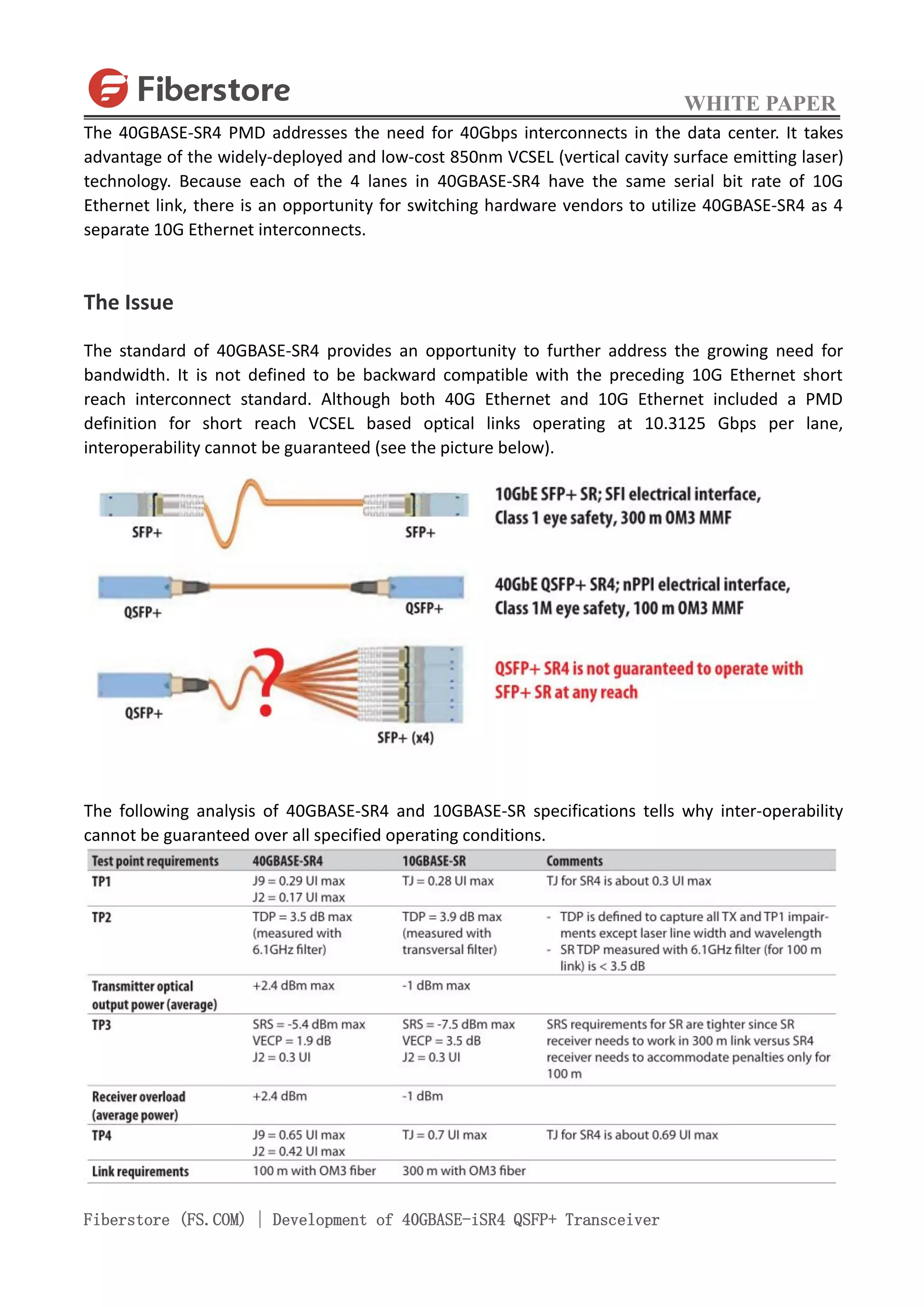
The standard of 40GBASE-SR4 provides an opportunity to further address the growing need for
bandwidth. It is not defined to be backward compatible with the preceding 10G Ethernet short
reach interconnect standard. Although both 40G Ethernet and 10G Ethernet included a PMD
definition for short reach VCSEL based optical links operating at 10.3125 Gbps per lane,
interoperability cannot be guaranteed (see the picture below).
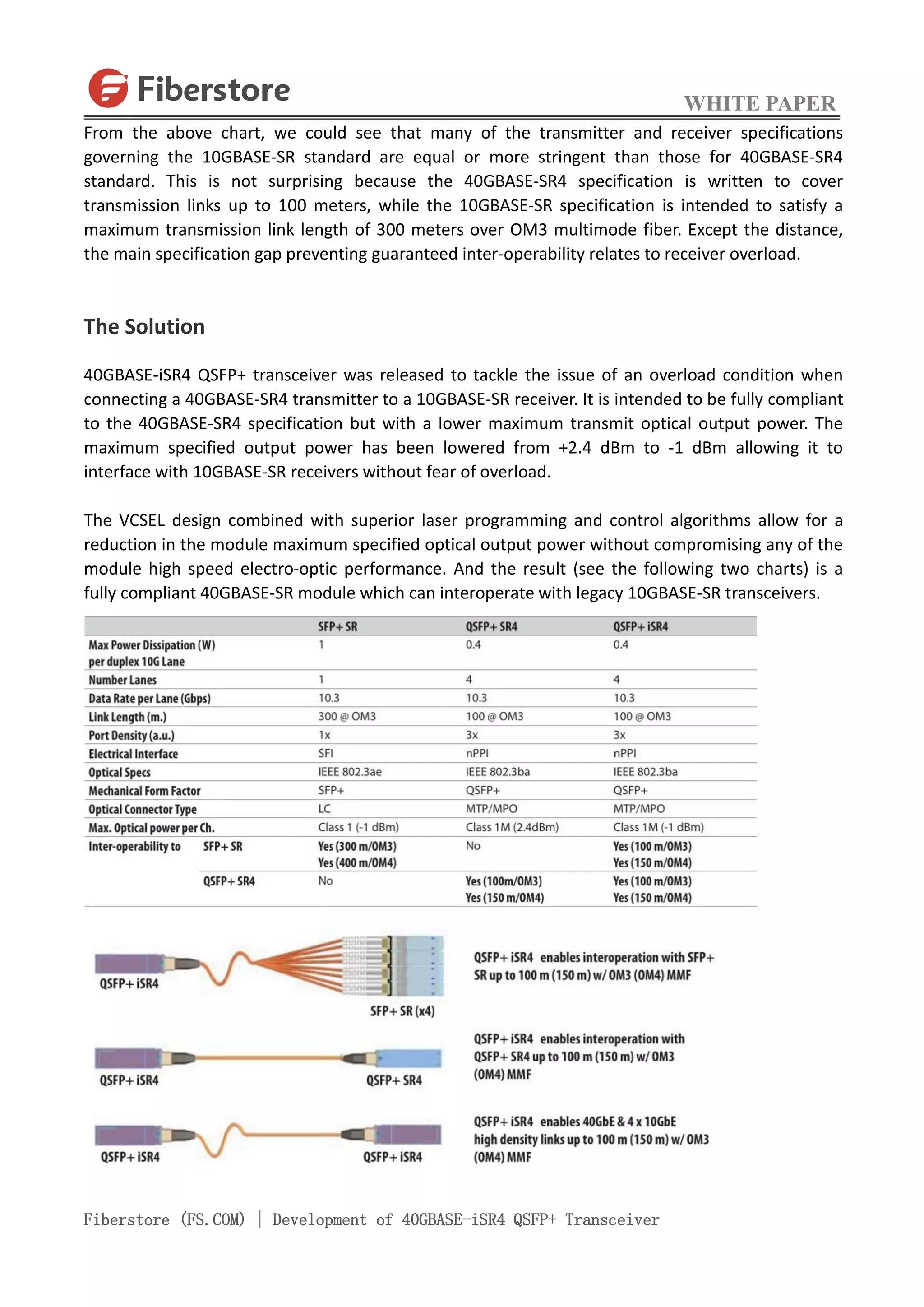
The following analysis of 40GBASE-SR4 and 10GBASE-SR specifications tells why inter-operability
cannot be guaranteed over all specified operating conditions.
WHITE PAPER
Fiberstore (FS.COM) | Development of 40GBASE-iSR4 QSFP+ Transceiver
From the above chart, we could see that many of the transmitter and receiver specifications
governing the 10GBASE-SR standard are equal or more stringent than those for 40GBASE-SR4
standard. This is not surprising because the 40GBASE-SR4 specification is written to cover
transmission links up to 100 meters, while the 10GBASE-SR specification is intended to satisfy a
maximum transmission link length of 300 meters over OM3 multimode fiber. Except the distance,
the main specification gap preventing guaranteed inter-operability relates to receiver overload.
The Solution
40GBASE-iSR4 QSFP+ transceiver was released to tackle the issue of an overload condition when
connecting a 40GBASE-SR4 transmitter to a 10GBASE-SR receiver. It is intended to be fully compliant
to the 40GBASE-SR4 specification but with a lower maximum transmit optical output power. The
maximum specified output power has been lowered from +2.4 dBm to -1 dBm allowing it to
interface with 10GBASE-SR receivers without fear of overload.
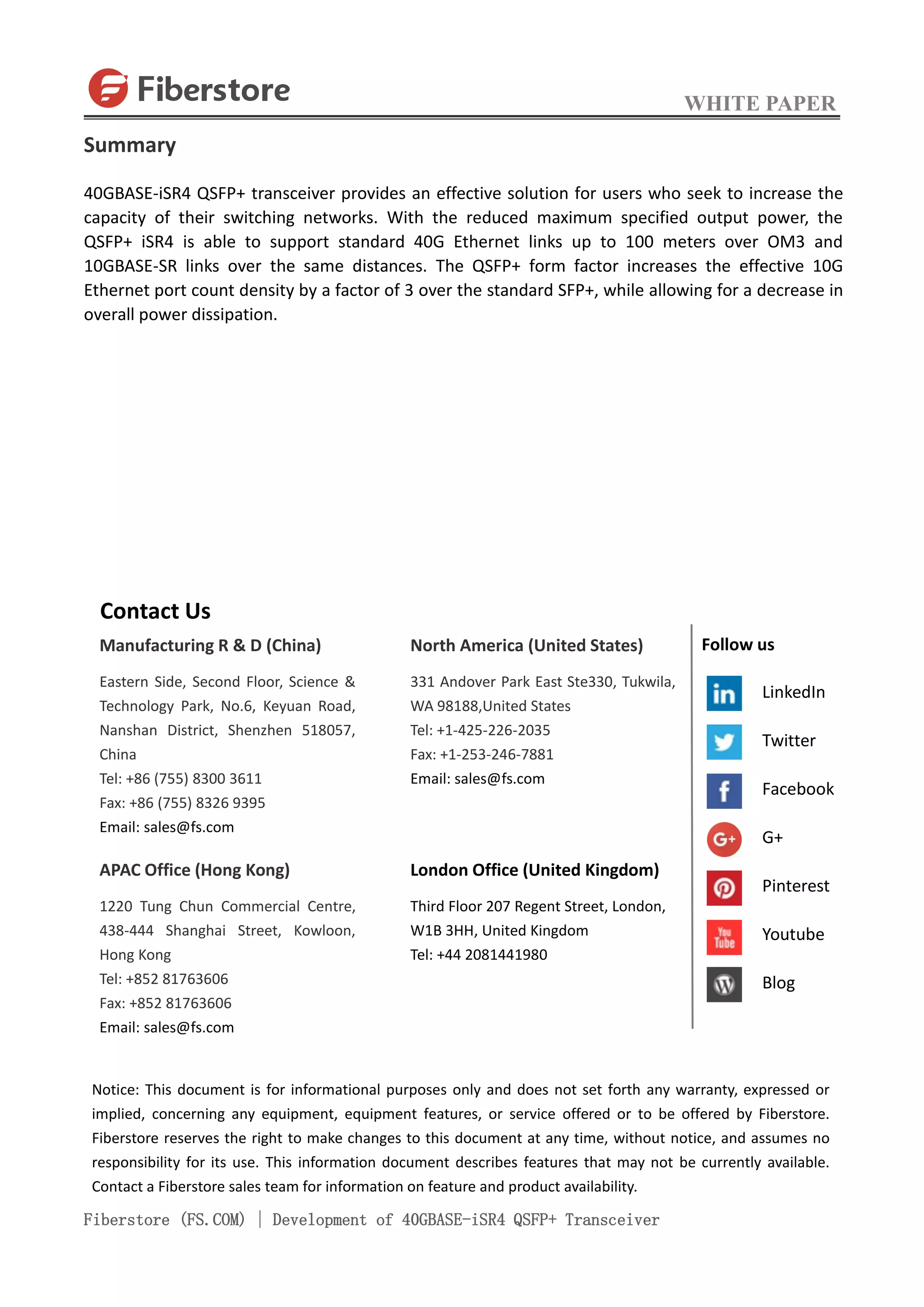
The VCSEL design combined with superior laser programming and control algorithms allow for a
reduction in the module maximum specified optical output power without compromising any of the
module high speed electro-optic performance. And the result (see the following two charts) is a
fully compliant 40GBASE-SR module which can interoperate with legacy 10GBASE-SR transceivers.
WHITE PAPER
Fiberstore (FS.COM) | Development of 40GBASE-iSR4 QSFP+ Transceiver
Summary
40GBASE-iSR4 QSFP+ transceiver provides an effective solution for users who seek to increase the
capacity of their switching networks. With the reduced maximum specified output power, the
QSFP+ iSR4 is able to support standard 40G Ethernet links up to 100 meters over OM3 and
10GBASE-SR links over the same distances. The QSFP+ form factor increases the effective 10G
Ethernet port count density by a factor of 3 over the standard SFP+, while allowing for a decrease in
overall power dissipation.
Contact Us
Manufacturing R & D (China)
Eastern Side, Second Floor, Science &
Technology Park, No.6, Keyuan Road,
Nanshan District, Shenzhen 518057,
China
Tel: +86 (755) 8300 3611
Fax: +86 (755) 8326 9395
Email: sales@fs.com
APAC Office (Hong Kong)
1220 Tung Chun Commercial Centre,
438-444 Shanghai Street, Kowloon,
Hong Kong
Tel: +852 81763606
Fax: +852 81763606
Email: sales@fs.com
North America (United States)
331 Andover Park East Ste330, Tukwila,
WA 98188,United States
Tel: +1-425-226-2035
Fax: +1-253-246-7881
Email: sales@fs.com
London Office (United Kingdom)
Third Floor 207 Regent Street, London,
W1B 3HH, United Kingdom
Tel: +44 2081441980
Notice: This document is for informational purposes only and does not set forth any warranty, expressed or
implied, concerning any equipment, equipment features, or service offered or to be offered by Fiberstore.
Fiberstore reserves the right to make changes to this document at any time, without notice, and assumes no
responsibility for its use. This information document describes features that may not be currently available.
Contact a Fiberstore sales team for information on feature and product availability.
Follow us
LinkedIn
Twitter
Facebook
G+
Pinterest
Youtube
Blog

Development of 40 gbase isr4 qsfp+ transceiver

  • 1.
    WHITE PAPER Fiberstore (FS.COM)| Development of 40GBASE-iSR4 QSFP+ Transceiver Nowadays, 40G QSFP+ transceiver modules are widely deployed in optical network with various advantages, such as delivering excellent high speed optical/electrical performance coupled with low power dissipation. Using bundled fiber cables and MPO connectors, the port density of QSFP+ modules is triple that of SFP+ modules. Moreover, the power consumption is reduced from 1000 mW maximum per lane for SFP+ to 375 mW maximum per lane for QSFP+. In order to further expand the portfolio of innovative parallel fiber optic transceivers, a new QSFP+ transceiver was launched, which is named 40GBASE-iSR4 QSFP+ transceiver. The letter “i” refers to the ability of inter-operation. It is not only 40Gb Ethernet compliant, but also inter-operable with any 10GBASE-SR compliant transceiver at link distances up to 100 meters over OM3 multimode fiber. This article will focus on the development process of this 40GBASE-iSR4 QSFP+ transceiver. Background The volume of digital information flowing through data network develops at an ever increasing rate day by day. So the growth of cloud computing, server virtualization and the trend toward network convergence is forcing today’s networks to be more efficient and faster than ever. 1Gbps Ethernet access links have been replaced by 10Gbps links due to the increases in server utilization obtained through Virtualization. To keep up, higher performance switching hardware is needed to provide sufficient I/O (Input/Output) bandwidth to avoid blocking. In order to meet this demand, many newer access switches could support 48 ports of 10G Ethernet for connection to downstream servers, and 2 or 4 ports of 40G Ethernet for connection to the core switches. These 40G interconnects are implemented by using QSFP+ transceivers and could provide sufficient bandwidth to enable fully non-blocking switch fabrics. Potential Opportunity The release of IEEE 802.3ba-2010 standard for 40G Ethernet specifies the optical and electrical requirements for various physical layer link implementations. The 40GBASE-SR4 PMD (physical medium dependent) variant defines a 4-lane parallel optical interconnect for operation over OM3 multimode fiber with transmission distance up to 100 meters. Each of the four lanes works at a data rate of 10.3125 Gbps which is the same serial bit rate that was defined for 10G Ethernet links. Development of 40GBASE-iSR4 QSFP+ Transceiver
  • 2.
    WHITE PAPER Fiberstore (FS.COM)| Development of 40GBASE-iSR4 QSFP+ Transceiver The 40GBASE-SR4 PMD addresses the need for 40Gbps interconnects in the data center. It takes advantage of the widely-deployed and low-cost 850nm VCSEL (vertical cavity surface emitting laser) technology. Because each of the 4 lanes in 40GBASE-SR4 have the same serial bit rate of 10G Ethernet link, there is an opportunity for switching hardware vendors to utilize 40GBASE-SR4 as 4 separate 10G Ethernet interconnects. The Issue The standard of 40GBASE-SR4 provides an opportunity to further address the growing need for bandwidth. It is not defined to be backward compatible with the preceding 10G Ethernet short reach interconnect standard. Although both 40G Ethernet and 10G Ethernet included a PMD definition for short reach VCSEL based optical links operating at 10.3125 Gbps per lane, interoperability cannot be guaranteed (see the picture below). The following analysis of 40GBASE-SR4 and 10GBASE-SR specifications tells why inter-operability cannot be guaranteed over all specified operating conditions.
  • 3.
    WHITE PAPER Fiberstore (FS.COM)| Development of 40GBASE-iSR4 QSFP+ Transceiver From the above chart, we could see that many of the transmitter and receiver specifications governing the 10GBASE-SR standard are equal or more stringent than those for 40GBASE-SR4 standard. This is not surprising because the 40GBASE-SR4 specification is written to cover transmission links up to 100 meters, while the 10GBASE-SR specification is intended to satisfy a maximum transmission link length of 300 meters over OM3 multimode fiber. Except the distance, the main specification gap preventing guaranteed inter-operability relates to receiver overload. The Solution 40GBASE-iSR4 QSFP+ transceiver was released to tackle the issue of an overload condition when connecting a 40GBASE-SR4 transmitter to a 10GBASE-SR receiver. It is intended to be fully compliant to the 40GBASE-SR4 specification but with a lower maximum transmit optical output power. The maximum specified output power has been lowered from +2.4 dBm to -1 dBm allowing it to interface with 10GBASE-SR receivers without fear of overload. The VCSEL design combined with superior laser programming and control algorithms allow for a reduction in the module maximum specified optical output power without compromising any of the module high speed electro-optic performance. And the result (see the following two charts) is a fully compliant 40GBASE-SR module which can interoperate with legacy 10GBASE-SR transceivers.
  • 4.
    WHITE PAPER Fiberstore (FS.COM)| Development of 40GBASE-iSR4 QSFP+ Transceiver Summary 40GBASE-iSR4 QSFP+ transceiver provides an effective solution for users who seek to increase the capacity of their switching networks. With the reduced maximum specified output power, the QSFP+ iSR4 is able to support standard 40G Ethernet links up to 100 meters over OM3 and 10GBASE-SR links over the same distances. The QSFP+ form factor increases the effective 10G Ethernet port count density by a factor of 3 over the standard SFP+, while allowing for a decrease in overall power dissipation. Contact Us Manufacturing R & D (China) Eastern Side, Second Floor, Science & Technology Park, No.6, Keyuan Road, Nanshan District, Shenzhen 518057, China Tel: +86 (755) 8300 3611 Fax: +86 (755) 8326 9395 Email: sales@fs.com APAC Office (Hong Kong) 1220 Tung Chun Commercial Centre, 438-444 Shanghai Street, Kowloon, Hong Kong Tel: +852 81763606 Fax: +852 81763606 Email: sales@fs.com North America (United States) 331 Andover Park East Ste330, Tukwila, WA 98188,United States Tel: +1-425-226-2035 Fax: +1-253-246-7881 Email: sales@fs.com London Office (United Kingdom) Third Floor 207 Regent Street, London, W1B 3HH, United Kingdom Tel: +44 2081441980 Notice: This document is for informational purposes only and does not set forth any warranty, expressed or implied, concerning any equipment, equipment features, or service offered or to be offered by Fiberstore. Fiberstore reserves the right to make changes to this document at any time, without notice, and assumes no responsibility for its use. This information document describes features that may not be currently available. Contact a Fiberstore sales team for information on feature and product availability. Follow us LinkedIn Twitter Facebook G+ Pinterest Youtube Blog