Developing your own Swift middleware
OpenStack Summit Atlanta, May 2014
About me
● Christian Schwede
● Developer @ eNovance
● Mostly working on Swift, testing and automation
● Started using Swift in 2012
Agenda
● Using middlewares to extend Swift functionality
● Introduction to wsgi, middlewares and paste.deploy
● Developing our own middleware for Swift Proxy
● Testing & Packaging
● References
Writing Swift middlewares?
Swift middlewares?
● Most of Swift features are implemented as a middleware
○ logging, tempurl, dlo, ratelimit, tempauth, quotas, ...
● Flexibility to extend existing functionality
● No need to fork or modify existing code
● Several additional middlewares outside of Swift
wsgi and middlewares?
wsgi
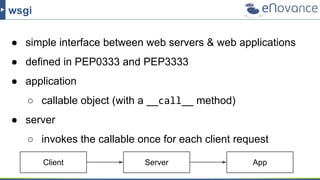
● simple interface between web servers & web applications
● defined in PEP0333 and PEP3333
● application
○ callable object (with a __call__ method)
● server
○ invokes the callable once for each client request
Client Server App
application objects
● must accept two positional arguments
○ environ: Python dictionary
○ start_response: callable
■ status = „200 OK“
■ headers = [(„header_name“, „header_value“), ]
environ
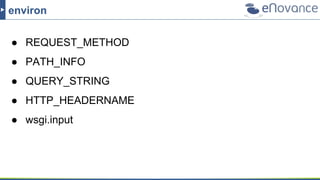
● REQUEST_METHOD
● PATH_INFO
● QUERY_STRING
● HTTP_HEADERNAME
● wsgi.input
from wsgiref.simple_server import make_server
def myapp(environ, start_response):
body = []
body.append("PATH_INFO: '%s'n" % environ.get('PATH_INFO'))
headers = [('Content-Type', 'text/plain')]
start_response('200 OK', headers)
return body
srv = make_server('localhost', 8000, myapp)
srv.serve_forever()
Sample server
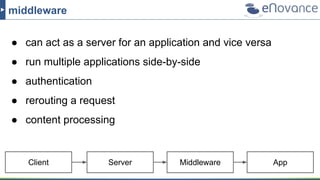
middleware
● can act as a server for an application and vice versa
● run multiple applications side-by-side
● authentication
● rerouting a request
● content processing
Client Server AppMiddleware
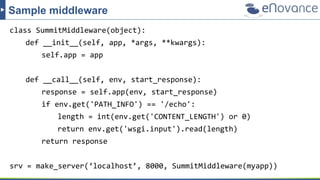
class SummitMiddleware(object):
def __init__(self, app, *args, **kwargs):
self.app = app
def __call__(self, env, start_response):
response = self.app(env, start_response)
if env.get('PATH_INFO') == '/echo':
length = int(env.get('CONTENT_LENGTH') or 0)
return env.get('wsgi.input').read(length)
return response
srv = make_server(‘localhost’, 8000, SummitMiddleware(myapp))
Sample middleware
Testing, packaging & deploying
class FakeApp(object):
def __call__(self, env, start_response):
start_response('200 OK', [])
return ""
class TestSummitMiddleware(unittest.TestCase):
def test_simple_request(self):
environ = {'REQUEST_METHOD': 'PUT'}
req = Request.blank('/echo', environ, body="Hello World")
mw = SummitMiddleware(FakeApp())
resp = req.get_response(mw)
self.assertEqual("Hello World", resp.body)
Testing a middleware
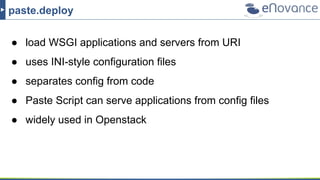
paste.deploy
● load WSGI applications and servers from URI
● uses INI-style configuration files
● separates config from code
● Paste Script can serve applications from config files
● widely used in Openstack
[app:sample]
use = egg:sample#app
[filter:middleware]
use = egg:sample#middleware
suffix = /echoresponse
[pipeline:main]
pipeline = middleware sample
[server:main]
use = egg:Paste#http
port = 8000
config.ini for paste.deploy
setup(name='sample',
packages=['sample', ],
zip_safe=False,
entry_points={
'paste.app_factory': ['app=sample.app:app_factory'],
'paste.filter_factory': ['middleware = sample.middleware:
filter_factory']
})
setup.py
Writing a Swift middleware
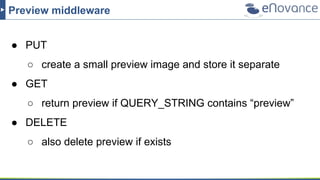
Preview middleware
● PUT
○ create a small preview image and store it separate
● GET
○ return preview if QUERY_STRING contains “preview”
● DELETE
○ also delete preview if exists
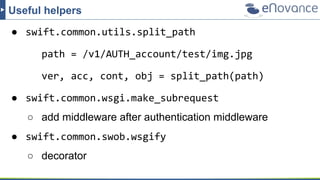
Useful helpers
● swift.common.utils.split_path
path = /v1/AUTH_account/test/img.jpg
ver, acc, cont, obj = split_path(path)
● swift.common.wsgi.make_subrequest
○ add middleware after authentication middleware
● swift.common.swob.wsgify
○ decorator
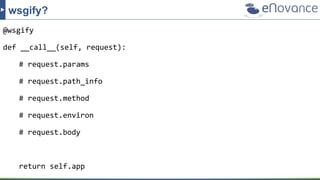
@wsgify
def __call__(self, request):
# request.params
# request.path_info
# request.method
# request.environ
# request.body
return self.app
wsgify?
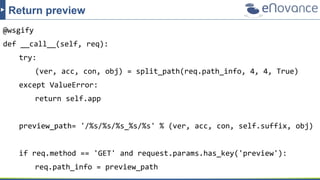
@wsgify
def __call__(self, req):
try:
(ver, acc, con, obj) = split_path(req.path_info, 4, 4, True)
except ValueError:
return self.app
preview_path= '/%s/%s/%s_%s/%s' % (ver, acc, con, self.suffix, obj)
if req.method == 'GET' and request.params.has_key('preview'):
req.path_info = preview_path
Return preview
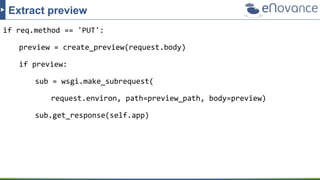
Extract preview
if req.method == 'PUT':
preview = create_preview(request.body)
if preview:
sub = wsgi.make_subrequest(
request.environ, path=preview_path, body=preview)
sub.get_response(self.app)
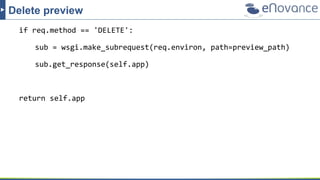
Delete preview
if req.method == 'DELETE':
sub = wsgi.make_subrequest(req.environ, path=preview_path)
sub.get_response(self.app)
return self.app
References
3rd party middlewares
● swauth - github.com/gholt/swauth
● swift3 - github.com/stackforge/swift3
● CDMI - github.com/osaddon/cdmi
● Swift informant - github.com/pandemicsyn/swift-informant
● Swift Origin Server - github.com/dpgoetz/sos
● Ceilometer - ceilometer/objectstore/swift_middleware.py
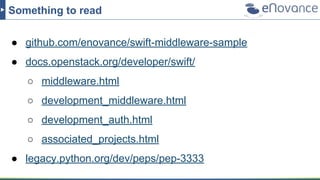
● github.com/enovance/swift-middleware-sample
● docs.openstack.org/developer/swift/
○ middleware.html
○ development_middleware.html
○ development_auth.html
○ associated_projects.html
● legacy.python.org/dev/peps/pep-3333
Something to read
THANK YOU!
christian@enovance.com | @cschwede_de | OpenStack Juno Summit | May 2014, Atlanta

Developing your own OpenStack Swift middleware

  • 1.
    Developing your ownSwift middleware OpenStack Summit Atlanta, May 2014
  • 2.
    About me ● ChristianSchwede ● Developer @ eNovance ● Mostly working on Swift, testing and automation ● Started using Swift in 2012
  • 3.
    Agenda ● Using middlewaresto extend Swift functionality ● Introduction to wsgi, middlewares and paste.deploy ● Developing our own middleware for Swift Proxy ● Testing & Packaging ● References
  • 4.
  • 5.
    Swift middlewares? ● Mostof Swift features are implemented as a middleware ○ logging, tempurl, dlo, ratelimit, tempauth, quotas, ... ● Flexibility to extend existing functionality ● No need to fork or modify existing code ● Several additional middlewares outside of Swift
  • 6.
  • 7.
    wsgi ● simple interfacebetween web servers & web applications ● defined in PEP0333 and PEP3333 ● application ○ callable object (with a __call__ method) ● server ○ invokes the callable once for each client request Client Server App
  • 8.
    application objects ● mustaccept two positional arguments ○ environ: Python dictionary ○ start_response: callable ■ status = „200 OK“ ■ headers = [(„header_name“, „header_value“), ]
  • 9.
    environ ● REQUEST_METHOD ● PATH_INFO ●QUERY_STRING ● HTTP_HEADERNAME ● wsgi.input
  • 10.
    from wsgiref.simple_server importmake_server def myapp(environ, start_response): body = [] body.append("PATH_INFO: '%s'n" % environ.get('PATH_INFO')) headers = [('Content-Type', 'text/plain')] start_response('200 OK', headers) return body srv = make_server('localhost', 8000, myapp) srv.serve_forever() Sample server
  • 11.
    middleware ● can actas a server for an application and vice versa ● run multiple applications side-by-side ● authentication ● rerouting a request ● content processing Client Server AppMiddleware
  • 12.
    class SummitMiddleware(object): def __init__(self,app, *args, **kwargs): self.app = app def __call__(self, env, start_response): response = self.app(env, start_response) if env.get('PATH_INFO') == '/echo': length = int(env.get('CONTENT_LENGTH') or 0) return env.get('wsgi.input').read(length) return response srv = make_server(‘localhost’, 8000, SummitMiddleware(myapp)) Sample middleware
  • 13.
  • 14.
    class FakeApp(object): def __call__(self,env, start_response): start_response('200 OK', []) return "" class TestSummitMiddleware(unittest.TestCase): def test_simple_request(self): environ = {'REQUEST_METHOD': 'PUT'} req = Request.blank('/echo', environ, body="Hello World") mw = SummitMiddleware(FakeApp()) resp = req.get_response(mw) self.assertEqual("Hello World", resp.body) Testing a middleware
  • 15.
    paste.deploy ● load WSGIapplications and servers from URI ● uses INI-style configuration files ● separates config from code ● Paste Script can serve applications from config files ● widely used in Openstack
  • 16.
    [app:sample] use = egg:sample#app [filter:middleware] use= egg:sample#middleware suffix = /echoresponse [pipeline:main] pipeline = middleware sample [server:main] use = egg:Paste#http port = 8000 config.ini for paste.deploy
  • 17.
  • 18.
    Writing a Swiftmiddleware
  • 19.
    Preview middleware ● PUT ○create a small preview image and store it separate ● GET ○ return preview if QUERY_STRING contains “preview” ● DELETE ○ also delete preview if exists
  • 20.
    Useful helpers ● swift.common.utils.split_path path= /v1/AUTH_account/test/img.jpg ver, acc, cont, obj = split_path(path) ● swift.common.wsgi.make_subrequest ○ add middleware after authentication middleware ● swift.common.swob.wsgify ○ decorator
  • 21.
    @wsgify def __call__(self, request): #request.params # request.path_info # request.method # request.environ # request.body return self.app wsgify?
  • 22.
    @wsgify def __call__(self, req): try: (ver,acc, con, obj) = split_path(req.path_info, 4, 4, True) except ValueError: return self.app preview_path= '/%s/%s/%s_%s/%s' % (ver, acc, con, self.suffix, obj) if req.method == 'GET' and request.params.has_key('preview'): req.path_info = preview_path Return preview
  • 23.
    Extract preview if req.method== 'PUT': preview = create_preview(request.body) if preview: sub = wsgi.make_subrequest( request.environ, path=preview_path, body=preview) sub.get_response(self.app)
  • 24.
    Delete preview if req.method== 'DELETE': sub = wsgi.make_subrequest(req.environ, path=preview_path) sub.get_response(self.app) return self.app
  • 25.
  • 26.
    3rd party middlewares ●swauth - github.com/gholt/swauth ● swift3 - github.com/stackforge/swift3 ● CDMI - github.com/osaddon/cdmi ● Swift informant - github.com/pandemicsyn/swift-informant ● Swift Origin Server - github.com/dpgoetz/sos ● Ceilometer - ceilometer/objectstore/swift_middleware.py
  • 27.
    ● github.com/enovance/swift-middleware-sample ● docs.openstack.org/developer/swift/ ○middleware.html ○ development_middleware.html ○ development_auth.html ○ associated_projects.html ● legacy.python.org/dev/peps/pep-3333 Something to read
  • 28.
    THANK YOU! christian@enovance.com |@cschwede_de | OpenStack Juno Summit | May 2014, Atlanta