© 2014 Primary Care Commissioning CIC
Development and support programme
Transforming primary care
Commissioning, federations and collaborative ways of
working
© 2014 Primary Care Commissioning CIC
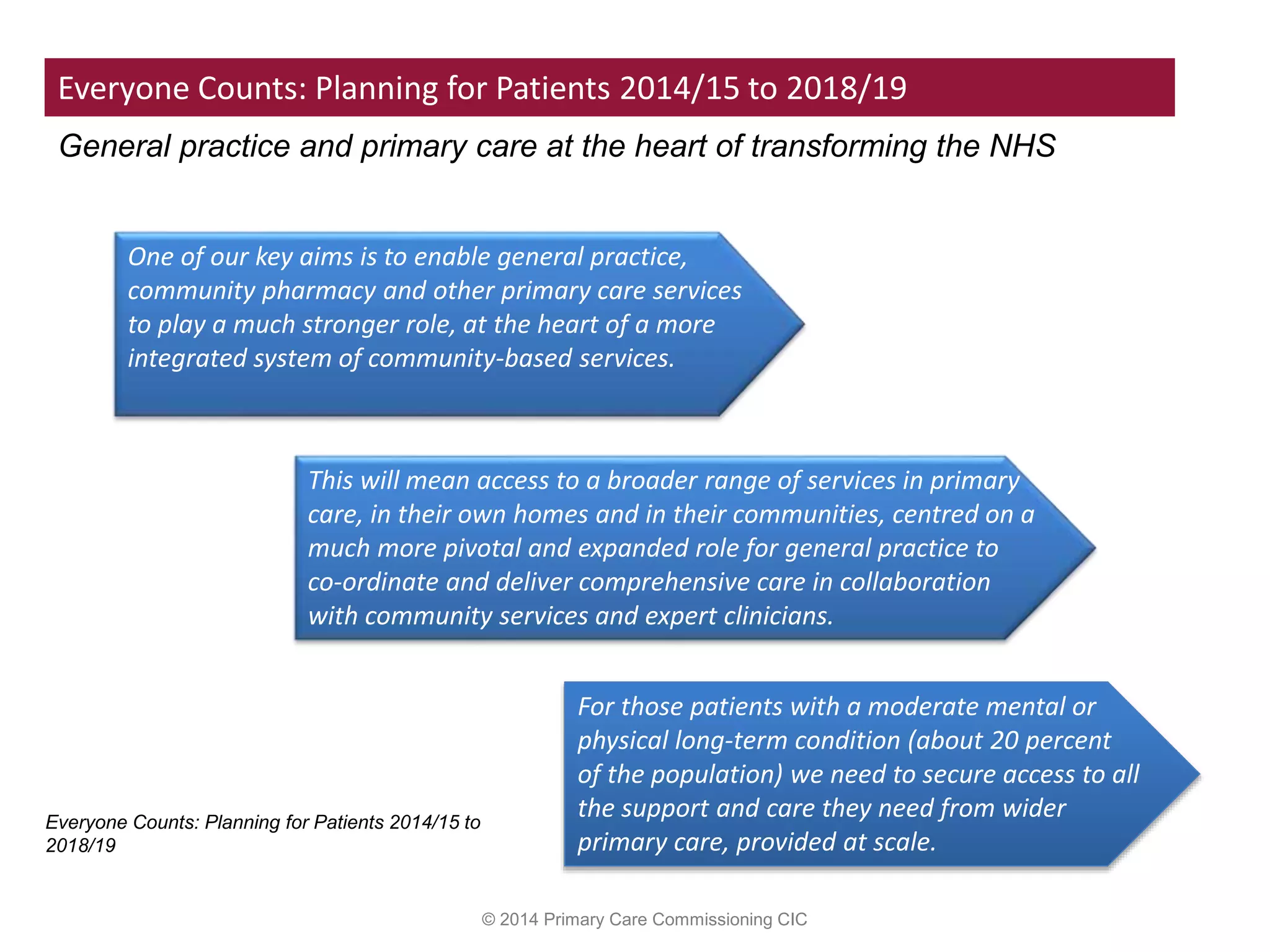
One of our key aims is to enable general practice,
community pharmacy and other primary care services
to play a much stronger role, at the heart of a more
integrated system of community-based services.
This will mean access to a broader range of services in primary
care, in their own homes and in their communities, centred on a
much more pivotal and expanded role for general practice to
co-ordinate and deliver comprehensive care in collaboration
with community services and expert clinicians.
Everyone Counts: Planning for Patients 2014/15 to 2018/19
General practice and primary care at the heart of transforming the NHS
For those patients with a moderate mental or
physical long-term condition (about 20 percent
of the population) we need to secure access to all
the support and care they need from wider
primary care, provided at scale.
Everyone Counts: Planning for Patients 2014/15 to
2018/19
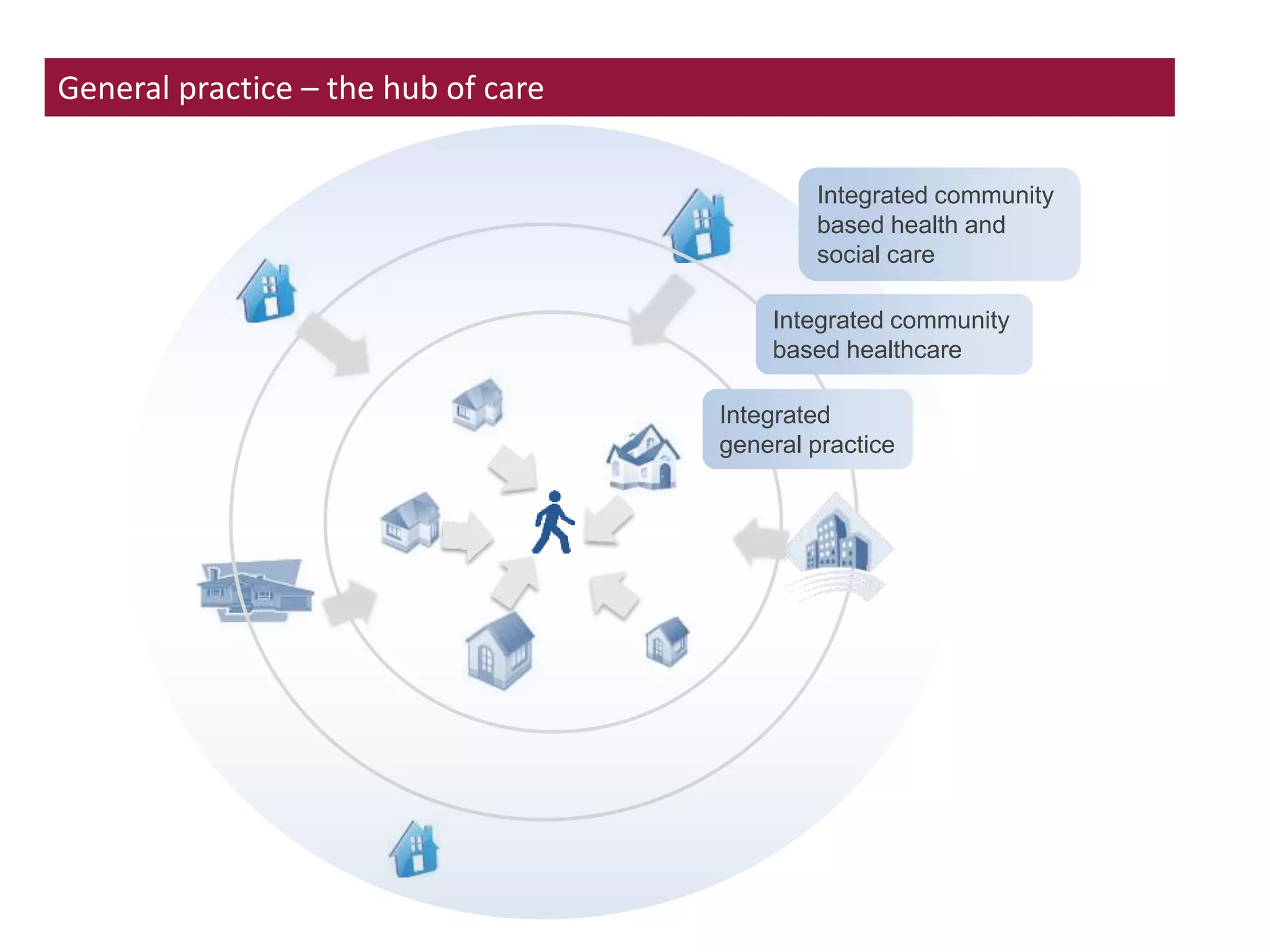
General practice – the hub of care
Integrated
general practice
Integrated community
based healthcare
Integrated community
based health and
social care
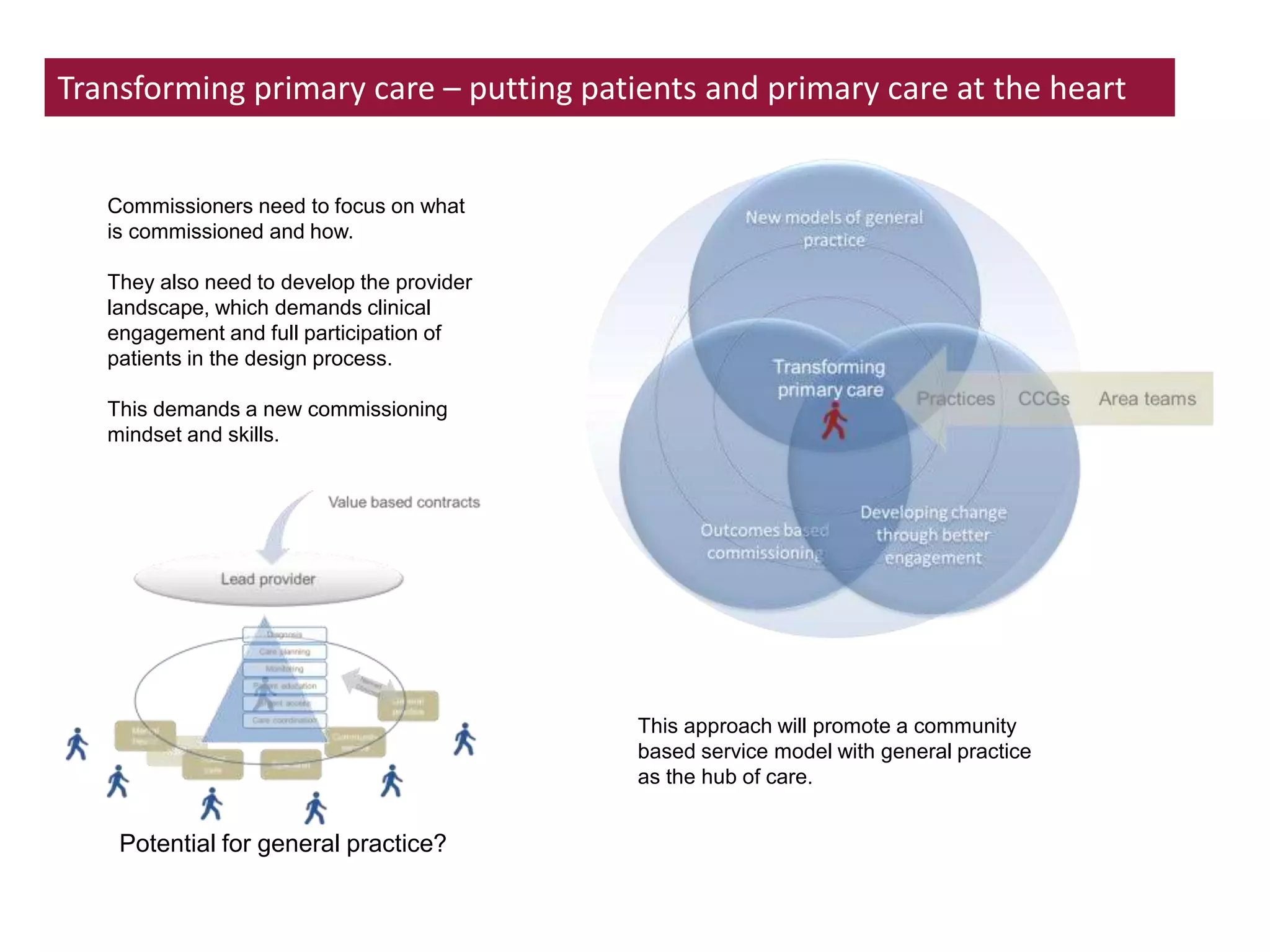
Transforming primary care – putting patients and primary care at the heart
Commissioners need to focus on what
is commissioned and how.
They also need to develop the provider
landscape, which demands clinical
engagement and full participation of
patients in the design process.
This demands a new commissioning
mindset and skills.
This approach will promote a community
based service model with general practice
as the hub of care.
Potential for general practice?
© 2014 Primary Care Commissioning CIC
Developing general practice programme design
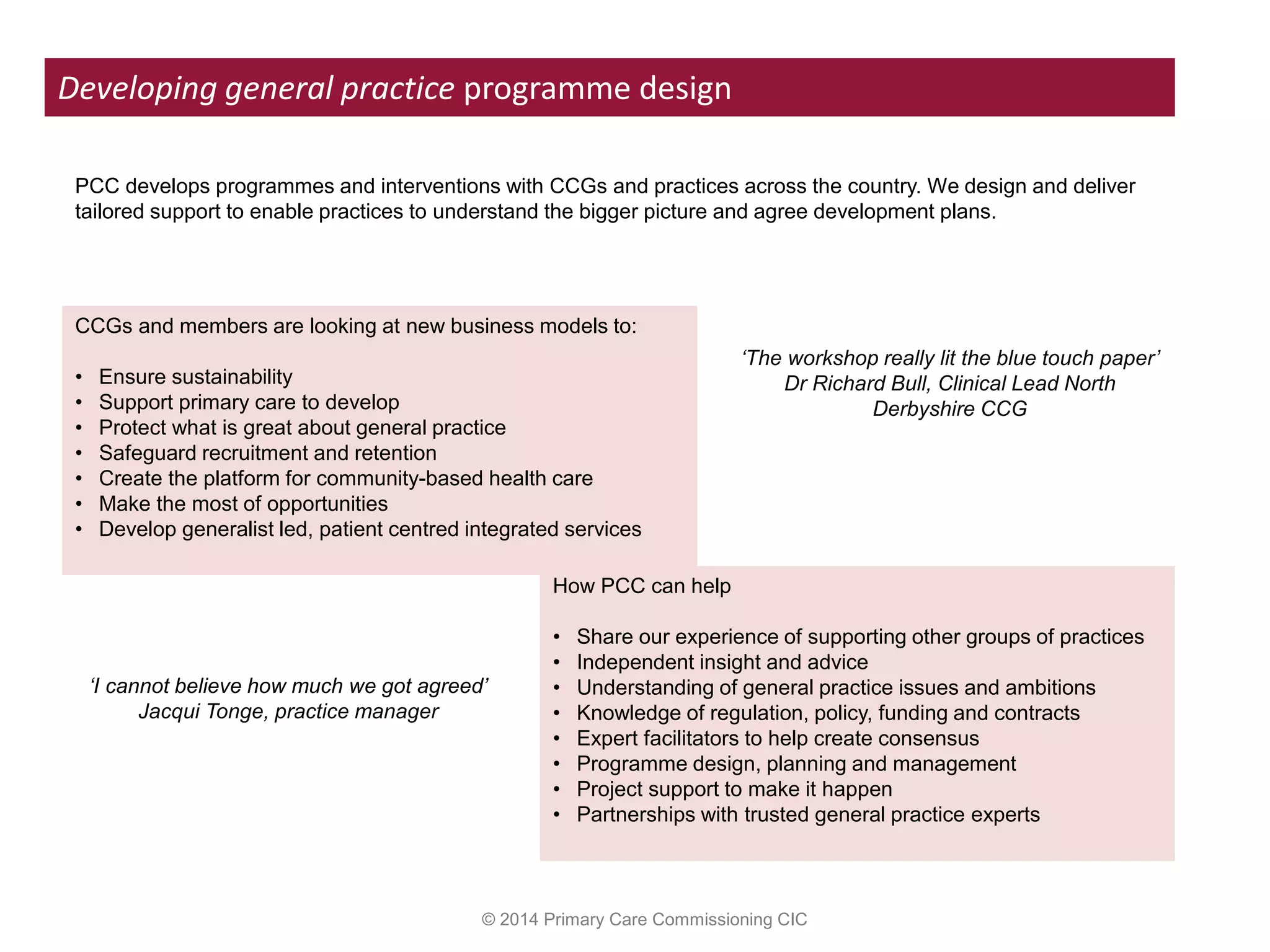
CCGs and members are looking at new business models to:
• Ensure sustainability
• Support primary care to develop
• Protect what is great about general practice
• Safeguard recruitment and retention
• Create the platform for community-based health care
• Make the most of opportunities
• Develop generalist led, patient centred integrated services
How PCC can help
• Share our experience of supporting other groups of practices
• Independent insight and advice
• Understanding of general practice issues and ambitions
• Knowledge of regulation, policy, funding and contracts
• Expert facilitators to help create consensus
• Programme design, planning and management
• Project support to make it happen
• Partnerships with trusted general practice experts
PCC develops programmes and interventions with CCGs and practices across the country. We design and deliver
tailored support to enable practices to understand the bigger picture and agree development plans.
‘The workshop really lit the blue touch paper’
Dr Richard Bull, Clinical Lead North
Derbyshire CCG
‘I cannot believe how much we got agreed’
Jacqui Tonge, practice manager
© 2014 Primary Care Commissioning CIC
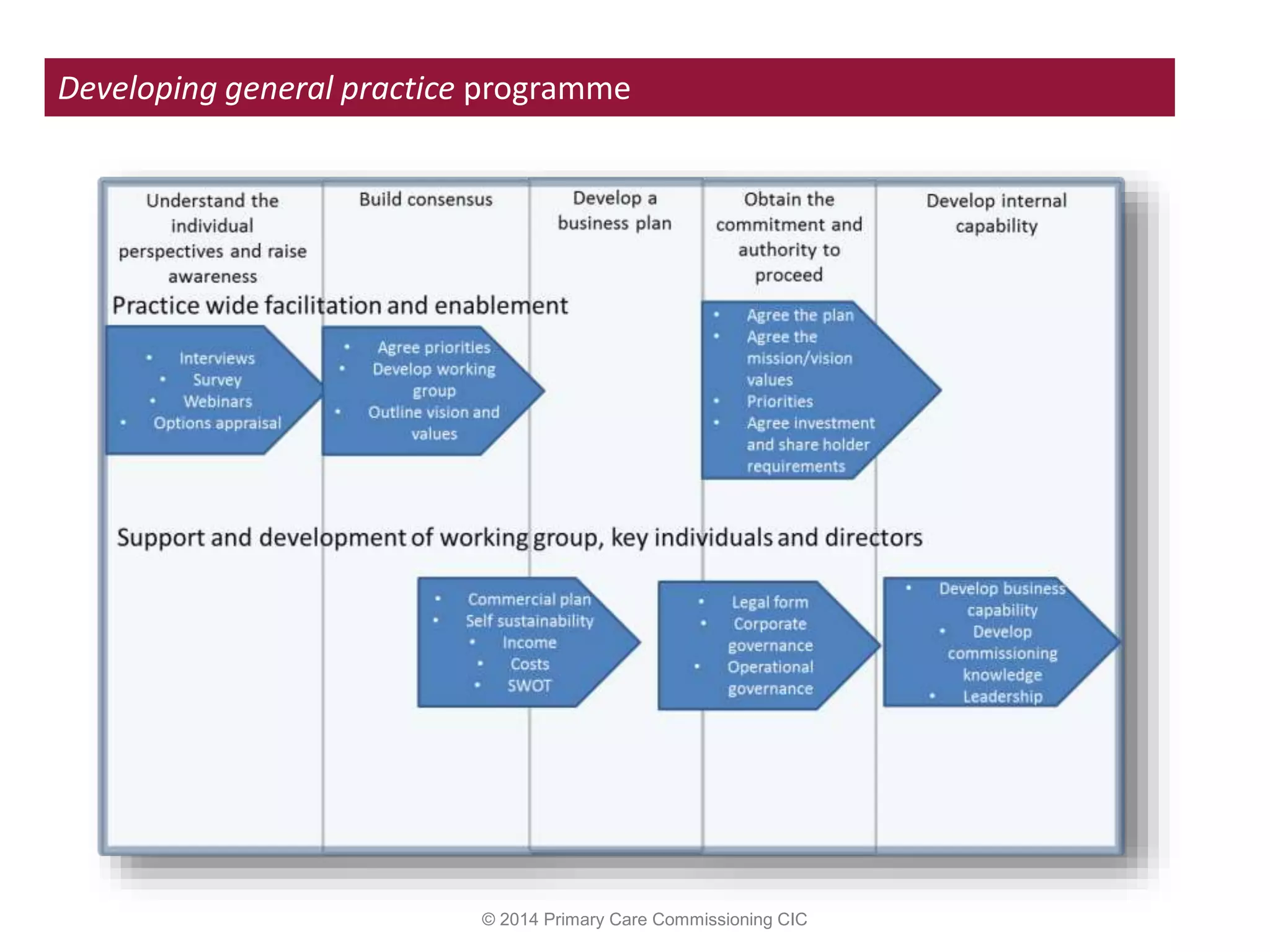
Developing general practice programme
© 2014 Primary Care Commissioning CIC
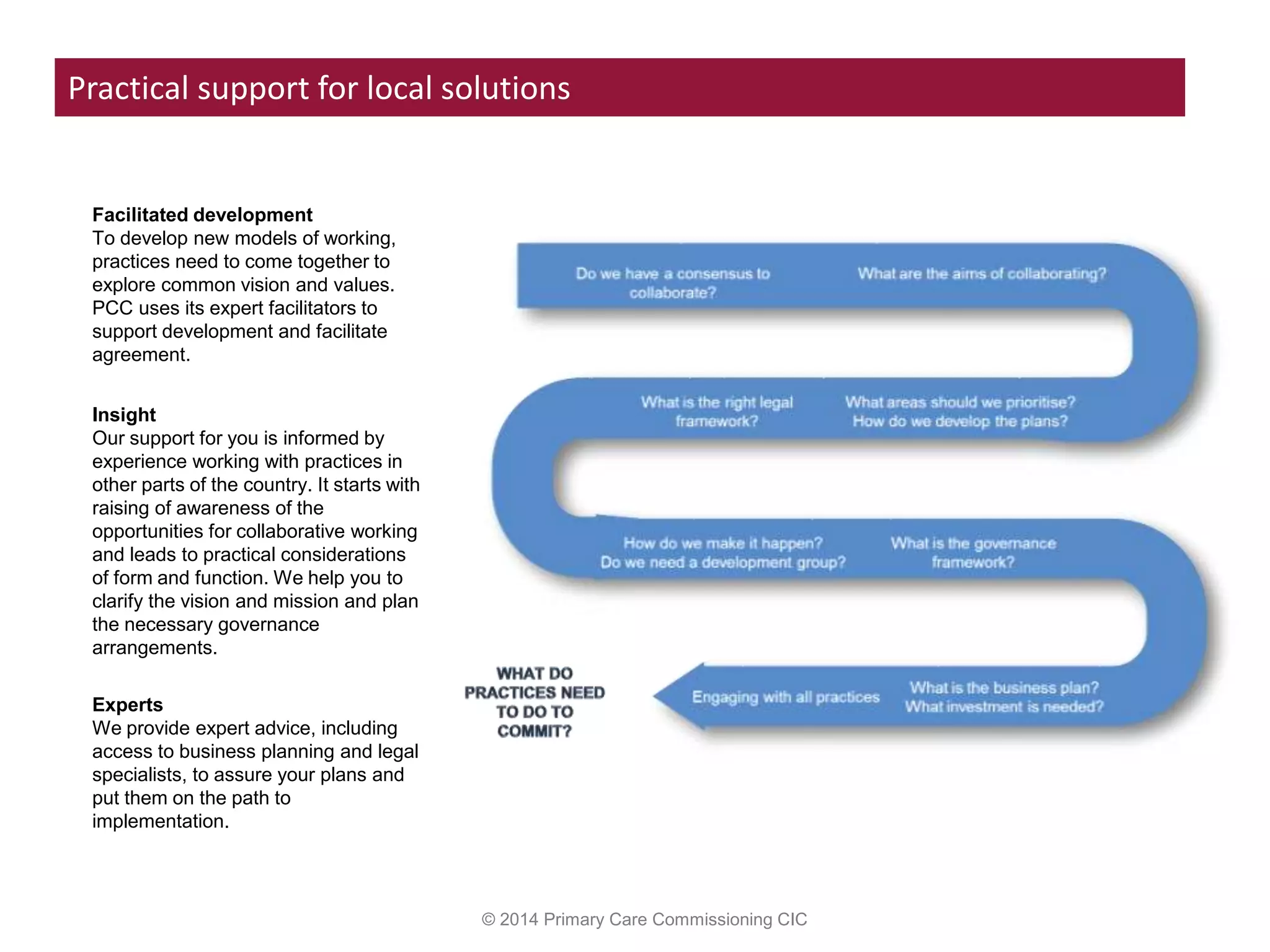
Practical support for local solutions
Facilitated development
To develop new models of working,
practices need to come together to
explore common vision and values.
PCC uses its expert facilitators to
support development and facilitate
agreement.
Insight
Our support for you is informed by
experience working with practices in
other parts of the country. It starts with
raising of awareness of the
opportunities for collaborative working
and leads to practical considerations
of form and function. We help you to
clarify the vision and mission and plan
the necessary governance
arrangements.
Experts
We provide expert advice, including
access to business planning and legal
specialists, to assure your plans and
put them on the path to
implementation.
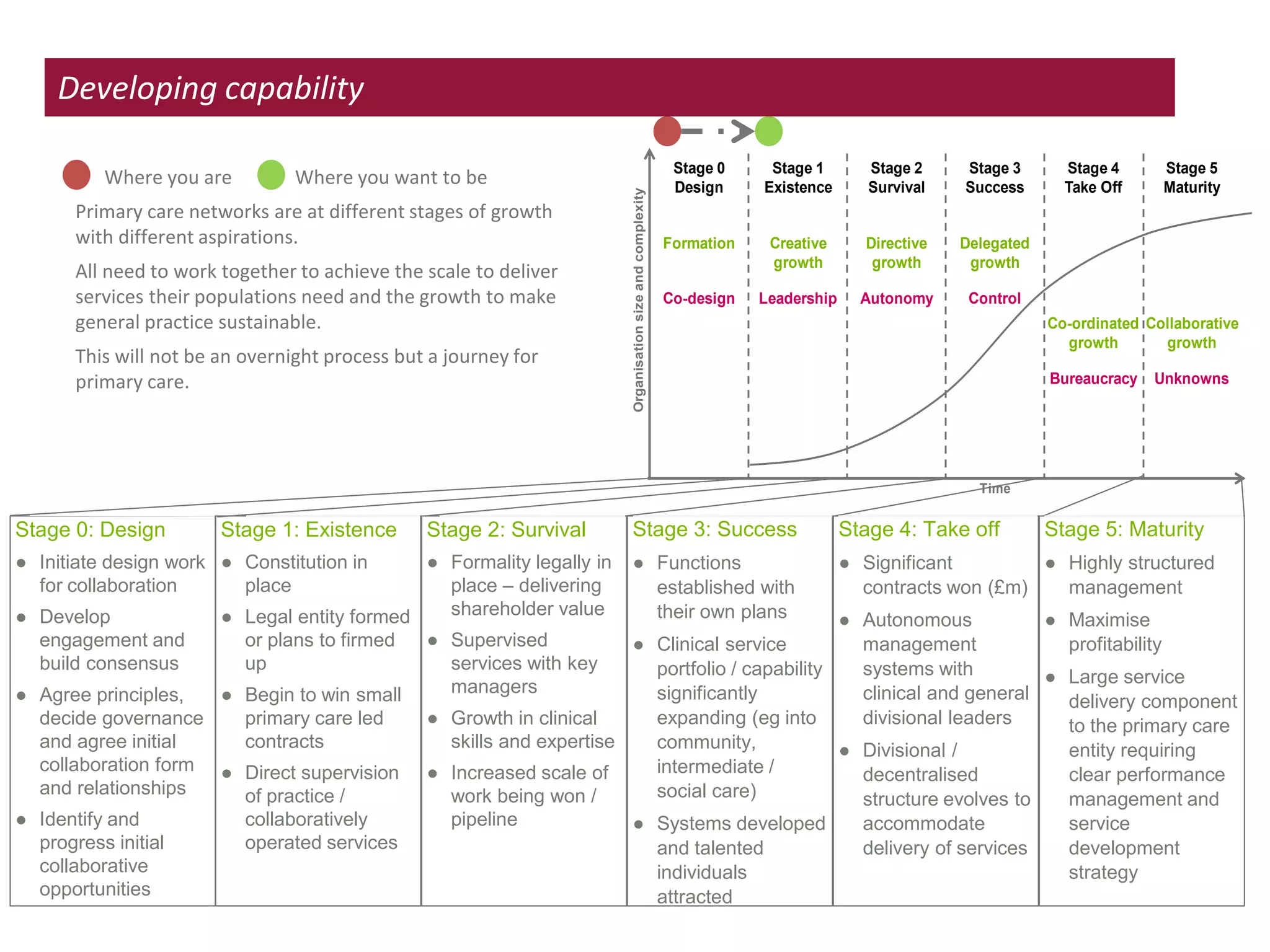
Where you are Where you want to be
Primary care networks are at different stages of growth
with different aspirations.
All need to work together to achieve the scale to deliver
services their populations need and the growth to make
general practice sustainable.
This will not be an overnight process but a journey for
primary care.
Stage 1: Existence
● Constitution in
place
● Legal entity formed
or plans to firmed
up
● Begin to win small
primary care led
contracts
● Direct supervision
of practice /
collaboratively
operated services
Stage 2: Survival
● Formality legally in
place – delivering
shareholder value
● Supervised
services with key
managers
● Growth in clinical
skills and expertise
● Increased scale of
work being won /
pipeline
Stage 3: Success
● Functions
established with
their own plans
● Clinical service
portfolio / capability
significantly
expanding (eg into
community,
intermediate /
social care)
● Systems developed
and talented
individuals
attracted
Stage 5: Maturity
● Highly structured
management
● Maximise
profitability
● Large service
delivery component
to the primary care
entity requiring
clear performance
management and
service
development
strategy
Stage 4: Take off
● Significant
contracts won (£m)
● Autonomous
management
systems with
clinical and general
divisional leaders
● Divisional /
decentralised
structure evolves to
accommodate
delivery of services
Stage 0: Design
● Initiate design work
for collaboration
● Develop
engagement and
build consensus
● Agree principles,
decide governance
and agree initial
collaboration form
and relationships
● Identify and
progress initial
collaborative
opportunities
Stage 1
Existence
Stage 2
Survival
Stage 3
Success
Stage 4
Take Off
Stage 5
Maturity
Creative
growth
Directive
growth
Delegated
growth
Co-ordinated
growth
Collaborative
growth
Leadership Autonomy Control
Bureaucracy Unknowns
Organisationsizeandcomplexity
Time
Stage 0
Design
Formation
Co-design
Developing capability
© 2014 Primary Care Commissioning CIC
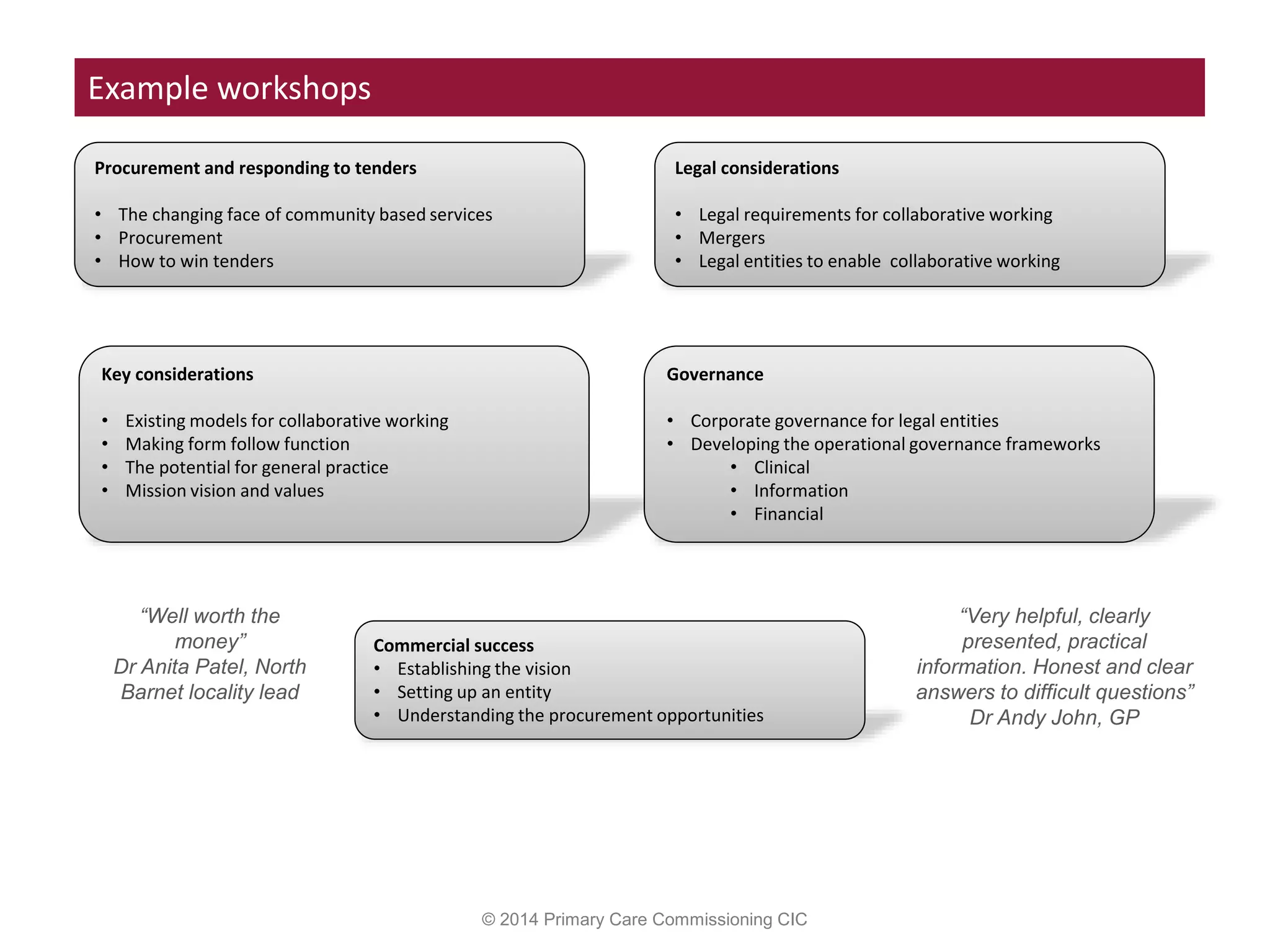
Procurement and responding to tenders
• The changing face of community based services
• Procurement
• How to win tenders
Example workshops
Key considerations
• Existing models for collaborative working
• Making form follow function
• The potential for general practice
• Mission vision and values
Legal considerations
• Legal requirements for collaborative working
• Mergers
• Legal entities to enable collaborative working
Governance
• Corporate governance for legal entities
• Developing the operational governance frameworks
• Clinical
• Information
• Financial
Commercial success
• Establishing the vision
• Setting up an entity
• Understanding the procurement opportunities
“Very helpful, clearly
presented, practical
information. Honest and clear
answers to difficult questions”
Dr Andy John, GP
“Well worth the
money”
Dr Anita Patel, North
Barnet locality lead
© 2014 Primary Care Commissioning CIC
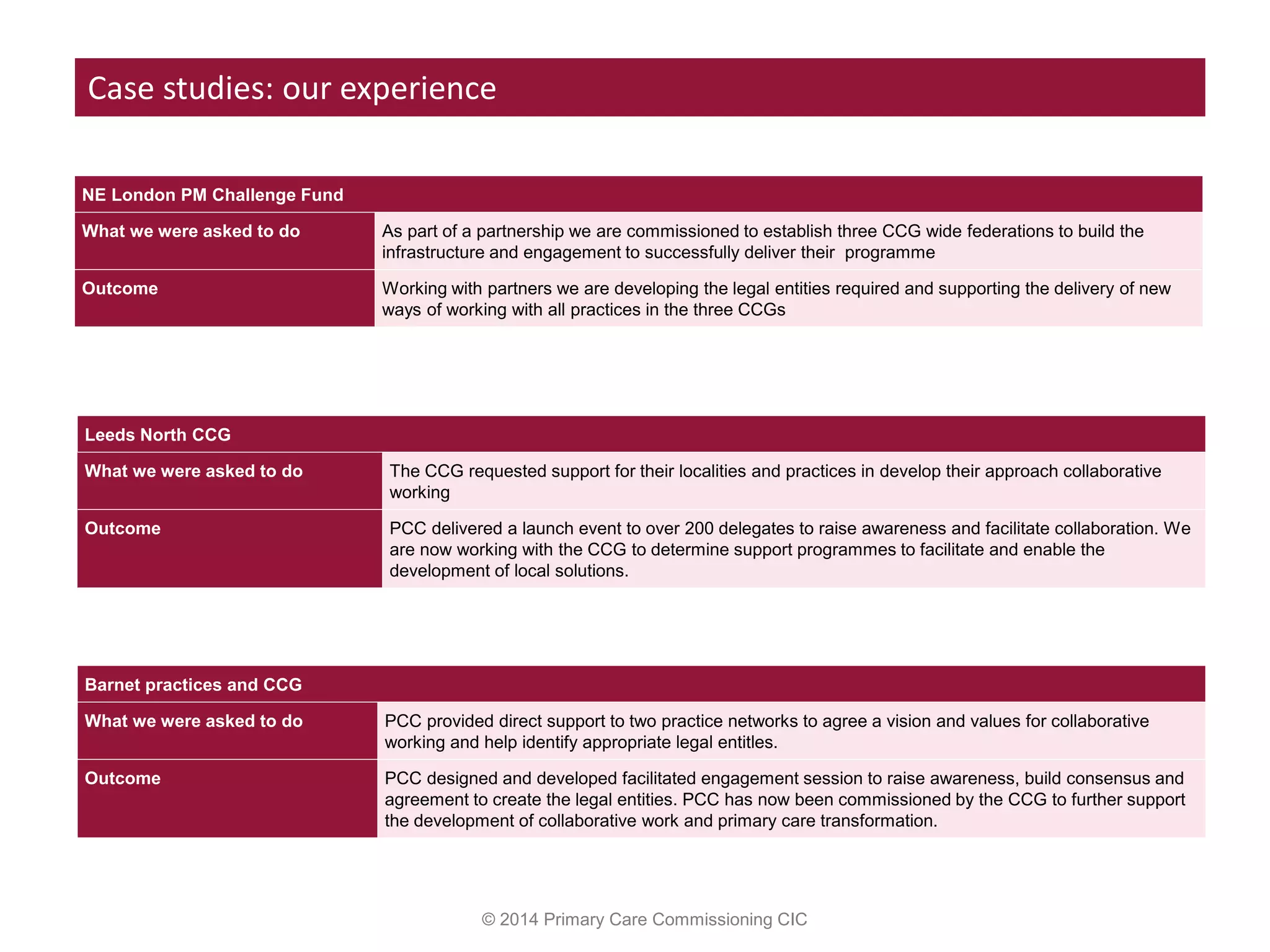
Case studies: our experience
NE London PM Challenge Fund
What we were asked to do As part of a partnership we are commissioned to establish three CCG wide federations to build the
infrastructure and engagement to successfully deliver their programme
Outcome Working with partners we are developing the legal entities required and supporting the delivery of new
ways of working with all practices in the three CCGs
Leeds North CCG
What we were asked to do The CCG requested support for their localities and practices in develop their approach collaborative
working
Outcome PCC delivered a launch event to over 200 delegates to raise awareness and facilitate collaboration. We
are now working with the CCG to determine support programmes to facilitate and enable the
development of local solutions.
Barnet practices and CCG
What we were asked to do PCC provided direct support to two practice networks to agree a vision and values for collaborative
working and help identify appropriate legal entitles.
Outcome PCC designed and developed facilitated engagement session to raise awareness, build consensus and
agreement to create the legal entities. PCC has now been commissioned by the CCG to further support
the development of collaborative work and primary care transformation.
© 2014 Primary Care Commissioning CIC
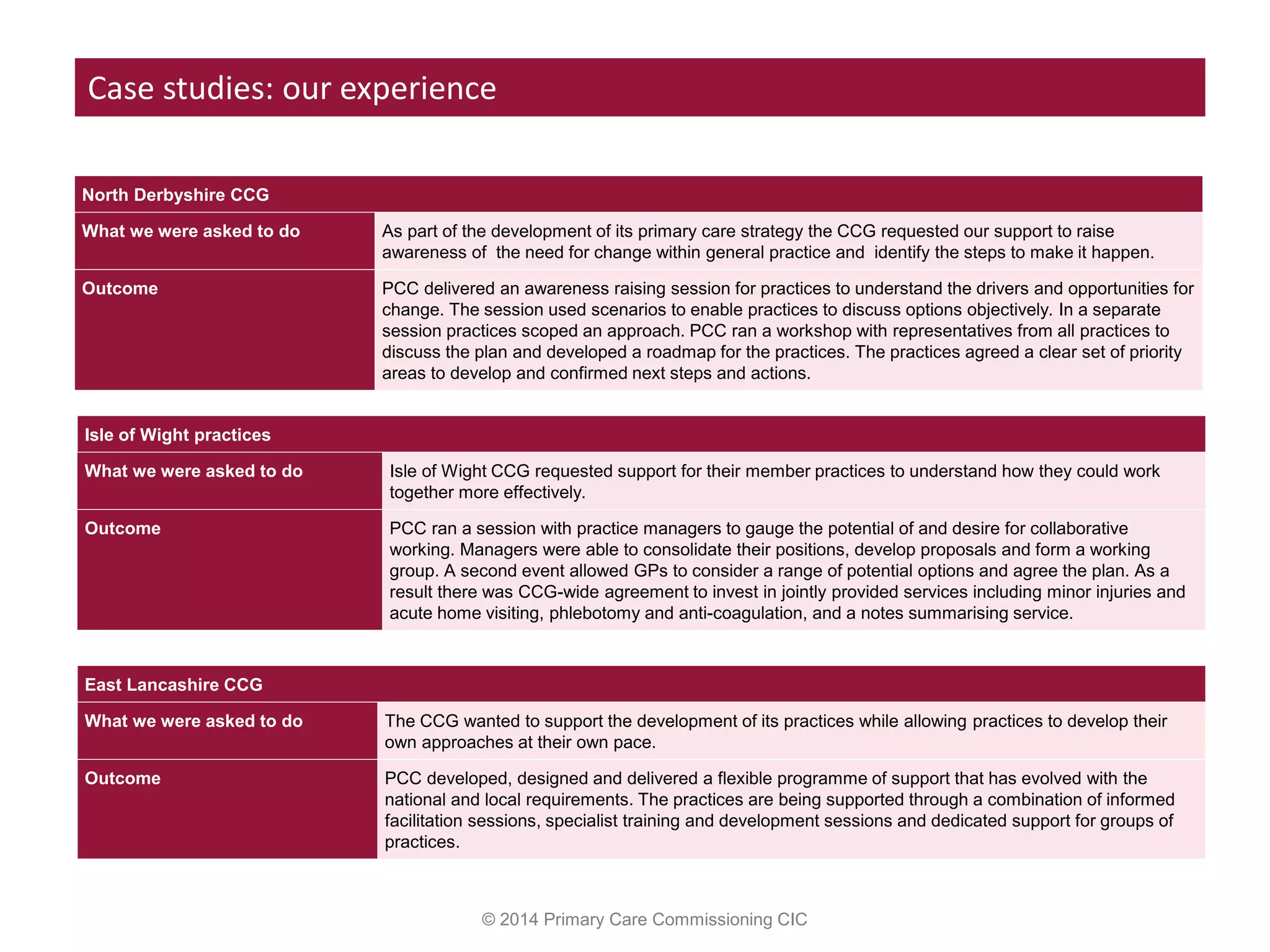
Case studies: our experience
North Derbyshire CCG
What we were asked to do As part of the development of its primary care strategy the CCG requested our support to raise
awareness of the need for change within general practice and identify the steps to make it happen.
Outcome PCC delivered an awareness raising session for practices to understand the drivers and opportunities for
change. The session used scenarios to enable practices to discuss options objectively. In a separate
session practices scoped an approach. PCC ran a workshop with representatives from all practices to
discuss the plan and developed a roadmap for the practices. The practices agreed a clear set of priority
areas to develop and confirmed next steps and actions.
Isle of Wight practices
What we were asked to do Isle of Wight CCG requested support for their member practices to understand how they could work
together more effectively.
Outcome PCC ran a session with practice managers to gauge the potential of and desire for collaborative
working. Managers were able to consolidate their positions, develop proposals and form a working
group. A second event allowed GPs to consider a range of potential options and agree the plan. As a
result there was CCG-wide agreement to invest in jointly provided services including minor injuries and
acute home visiting, phlebotomy and anti-coagulation, and a notes summarising service.
East Lancashire CCG
What we were asked to do The CCG wanted to support the development of its practices while allowing practices to develop their
own approaches at their own pace.
Outcome PCC developed, designed and delivered a flexible programme of support that has evolved with the
national and local requirements. The practices are being supported through a combination of informed
facilitation sessions, specialist training and development sessions and dedicated support for groups of
practices.
© 2014 Primary Care Commissioning CIC
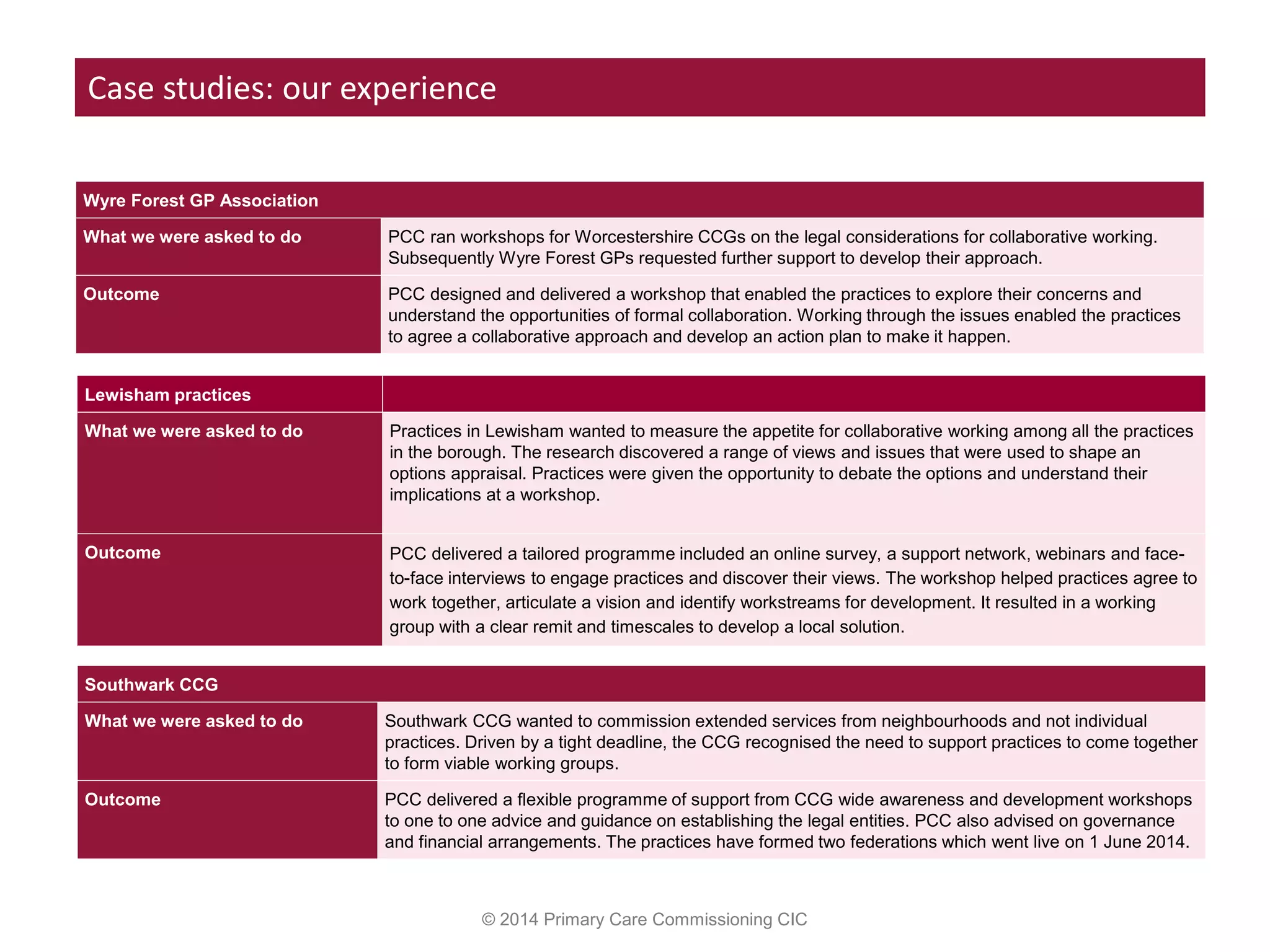
Case studies: our experience
Lewisham practices
What we were asked to do Practices in Lewisham wanted to measure the appetite for collaborative working among all the practices
in the borough. The research discovered a range of views and issues that were used to shape an
options appraisal. Practices were given the opportunity to debate the options and understand their
implications at a workshop.
Outcome PCC delivered a tailored programme included an online survey, a support network, webinars and face-
to-face interviews to engage practices and discover their views. The workshop helped practices agree to
work together, articulate a vision and identify workstreams for development. It resulted in a working
group with a clear remit and timescales to develop a local solution.
Wyre Forest GP Association
What we were asked to do PCC ran workshops for Worcestershire CCGs on the legal considerations for collaborative working.
Subsequently Wyre Forest GPs requested further support to develop their approach.
Outcome PCC designed and delivered a workshop that enabled the practices to explore their concerns and
understand the opportunities of formal collaboration. Working through the issues enabled the practices
to agree a collaborative approach and develop an action plan to make it happen.
Southwark CCG
What we were asked to do Southwark CCG wanted to commission extended services from neighbourhoods and not individual
practices. Driven by a tight deadline, the CCG recognised the need to support practices to come together
to form viable working groups.
Outcome PCC delivered a flexible programme of support from CCG wide awareness and development workshops
to one to one advice and guidance on establishing the legal entities. PCC also advised on governance
and financial arrangements. The practices have formed two federations which went live on 1 June 2014.
© 2014 Primary Care Commissioning CIC
“Very helpful in allowing us to
express our ideas and helping
organise our thoughts and actions.”
Julie Mackenzie, practice manager,
Isle of Wight
“The workshop really helped us
understand how we can work
together and develop a plan to
make it happen”
Dr Roy Williams, chair, Wyre
Forest GP Association
“Great day, brilliant insight and
opportunity to develop thoughts”
Dr Andy Havercroft, GP South
Worcestershire
Get in touch: peter.bullivant@pcc.nhs.uk

Developing primary care v7

  • 1.
    © 2014 PrimaryCare Commissioning CIC Development and support programme Transforming primary care Commissioning, federations and collaborative ways of working
  • 2.
    © 2014 PrimaryCare Commissioning CIC One of our key aims is to enable general practice, community pharmacy and other primary care services to play a much stronger role, at the heart of a more integrated system of community-based services. This will mean access to a broader range of services in primary care, in their own homes and in their communities, centred on a much more pivotal and expanded role for general practice to co-ordinate and deliver comprehensive care in collaboration with community services and expert clinicians. Everyone Counts: Planning for Patients 2014/15 to 2018/19 General practice and primary care at the heart of transforming the NHS For those patients with a moderate mental or physical long-term condition (about 20 percent of the population) we need to secure access to all the support and care they need from wider primary care, provided at scale. Everyone Counts: Planning for Patients 2014/15 to 2018/19
  • 3.
    General practice –the hub of care Integrated general practice Integrated community based healthcare Integrated community based health and social care
  • 4.
    Transforming primary care– putting patients and primary care at the heart Commissioners need to focus on what is commissioned and how. They also need to develop the provider landscape, which demands clinical engagement and full participation of patients in the design process. This demands a new commissioning mindset and skills. This approach will promote a community based service model with general practice as the hub of care. Potential for general practice?
  • 5.
    © 2014 PrimaryCare Commissioning CIC Developing general practice programme design CCGs and members are looking at new business models to: • Ensure sustainability • Support primary care to develop • Protect what is great about general practice • Safeguard recruitment and retention • Create the platform for community-based health care • Make the most of opportunities • Develop generalist led, patient centred integrated services How PCC can help • Share our experience of supporting other groups of practices • Independent insight and advice • Understanding of general practice issues and ambitions • Knowledge of regulation, policy, funding and contracts • Expert facilitators to help create consensus • Programme design, planning and management • Project support to make it happen • Partnerships with trusted general practice experts PCC develops programmes and interventions with CCGs and practices across the country. We design and deliver tailored support to enable practices to understand the bigger picture and agree development plans. ‘The workshop really lit the blue touch paper’ Dr Richard Bull, Clinical Lead North Derbyshire CCG ‘I cannot believe how much we got agreed’ Jacqui Tonge, practice manager
  • 6.
    © 2014 PrimaryCare Commissioning CIC Developing general practice programme
  • 7.
    © 2014 PrimaryCare Commissioning CIC Practical support for local solutions Facilitated development To develop new models of working, practices need to come together to explore common vision and values. PCC uses its expert facilitators to support development and facilitate agreement. Insight Our support for you is informed by experience working with practices in other parts of the country. It starts with raising of awareness of the opportunities for collaborative working and leads to practical considerations of form and function. We help you to clarify the vision and mission and plan the necessary governance arrangements. Experts We provide expert advice, including access to business planning and legal specialists, to assure your plans and put them on the path to implementation.
  • 8.
    Where you areWhere you want to be Primary care networks are at different stages of growth with different aspirations. All need to work together to achieve the scale to deliver services their populations need and the growth to make general practice sustainable. This will not be an overnight process but a journey for primary care. Stage 1: Existence ● Constitution in place ● Legal entity formed or plans to firmed up ● Begin to win small primary care led contracts ● Direct supervision of practice / collaboratively operated services Stage 2: Survival ● Formality legally in place – delivering shareholder value ● Supervised services with key managers ● Growth in clinical skills and expertise ● Increased scale of work being won / pipeline Stage 3: Success ● Functions established with their own plans ● Clinical service portfolio / capability significantly expanding (eg into community, intermediate / social care) ● Systems developed and talented individuals attracted Stage 5: Maturity ● Highly structured management ● Maximise profitability ● Large service delivery component to the primary care entity requiring clear performance management and service development strategy Stage 4: Take off ● Significant contracts won (£m) ● Autonomous management systems with clinical and general divisional leaders ● Divisional / decentralised structure evolves to accommodate delivery of services Stage 0: Design ● Initiate design work for collaboration ● Develop engagement and build consensus ● Agree principles, decide governance and agree initial collaboration form and relationships ● Identify and progress initial collaborative opportunities Stage 1 Existence Stage 2 Survival Stage 3 Success Stage 4 Take Off Stage 5 Maturity Creative growth Directive growth Delegated growth Co-ordinated growth Collaborative growth Leadership Autonomy Control Bureaucracy Unknowns Organisationsizeandcomplexity Time Stage 0 Design Formation Co-design Developing capability
  • 9.
    © 2014 PrimaryCare Commissioning CIC Procurement and responding to tenders • The changing face of community based services • Procurement • How to win tenders Example workshops Key considerations • Existing models for collaborative working • Making form follow function • The potential for general practice • Mission vision and values Legal considerations • Legal requirements for collaborative working • Mergers • Legal entities to enable collaborative working Governance • Corporate governance for legal entities • Developing the operational governance frameworks • Clinical • Information • Financial Commercial success • Establishing the vision • Setting up an entity • Understanding the procurement opportunities “Very helpful, clearly presented, practical information. Honest and clear answers to difficult questions” Dr Andy John, GP “Well worth the money” Dr Anita Patel, North Barnet locality lead
  • 10.
    © 2014 PrimaryCare Commissioning CIC Case studies: our experience NE London PM Challenge Fund What we were asked to do As part of a partnership we are commissioned to establish three CCG wide federations to build the infrastructure and engagement to successfully deliver their programme Outcome Working with partners we are developing the legal entities required and supporting the delivery of new ways of working with all practices in the three CCGs Leeds North CCG What we were asked to do The CCG requested support for their localities and practices in develop their approach collaborative working Outcome PCC delivered a launch event to over 200 delegates to raise awareness and facilitate collaboration. We are now working with the CCG to determine support programmes to facilitate and enable the development of local solutions. Barnet practices and CCG What we were asked to do PCC provided direct support to two practice networks to agree a vision and values for collaborative working and help identify appropriate legal entitles. Outcome PCC designed and developed facilitated engagement session to raise awareness, build consensus and agreement to create the legal entities. PCC has now been commissioned by the CCG to further support the development of collaborative work and primary care transformation.
  • 11.
    © 2014 PrimaryCare Commissioning CIC Case studies: our experience North Derbyshire CCG What we were asked to do As part of the development of its primary care strategy the CCG requested our support to raise awareness of the need for change within general practice and identify the steps to make it happen. Outcome PCC delivered an awareness raising session for practices to understand the drivers and opportunities for change. The session used scenarios to enable practices to discuss options objectively. In a separate session practices scoped an approach. PCC ran a workshop with representatives from all practices to discuss the plan and developed a roadmap for the practices. The practices agreed a clear set of priority areas to develop and confirmed next steps and actions. Isle of Wight practices What we were asked to do Isle of Wight CCG requested support for their member practices to understand how they could work together more effectively. Outcome PCC ran a session with practice managers to gauge the potential of and desire for collaborative working. Managers were able to consolidate their positions, develop proposals and form a working group. A second event allowed GPs to consider a range of potential options and agree the plan. As a result there was CCG-wide agreement to invest in jointly provided services including minor injuries and acute home visiting, phlebotomy and anti-coagulation, and a notes summarising service. East Lancashire CCG What we were asked to do The CCG wanted to support the development of its practices while allowing practices to develop their own approaches at their own pace. Outcome PCC developed, designed and delivered a flexible programme of support that has evolved with the national and local requirements. The practices are being supported through a combination of informed facilitation sessions, specialist training and development sessions and dedicated support for groups of practices.
  • 12.
    © 2014 PrimaryCare Commissioning CIC Case studies: our experience Lewisham practices What we were asked to do Practices in Lewisham wanted to measure the appetite for collaborative working among all the practices in the borough. The research discovered a range of views and issues that were used to shape an options appraisal. Practices were given the opportunity to debate the options and understand their implications at a workshop. Outcome PCC delivered a tailored programme included an online survey, a support network, webinars and face- to-face interviews to engage practices and discover their views. The workshop helped practices agree to work together, articulate a vision and identify workstreams for development. It resulted in a working group with a clear remit and timescales to develop a local solution. Wyre Forest GP Association What we were asked to do PCC ran workshops for Worcestershire CCGs on the legal considerations for collaborative working. Subsequently Wyre Forest GPs requested further support to develop their approach. Outcome PCC designed and delivered a workshop that enabled the practices to explore their concerns and understand the opportunities of formal collaboration. Working through the issues enabled the practices to agree a collaborative approach and develop an action plan to make it happen. Southwark CCG What we were asked to do Southwark CCG wanted to commission extended services from neighbourhoods and not individual practices. Driven by a tight deadline, the CCG recognised the need to support practices to come together to form viable working groups. Outcome PCC delivered a flexible programme of support from CCG wide awareness and development workshops to one to one advice and guidance on establishing the legal entities. PCC also advised on governance and financial arrangements. The practices have formed two federations which went live on 1 June 2014.
  • 13.
    © 2014 PrimaryCare Commissioning CIC “Very helpful in allowing us to express our ideas and helping organise our thoughts and actions.” Julie Mackenzie, practice manager, Isle of Wight “The workshop really helped us understand how we can work together and develop a plan to make it happen” Dr Roy Williams, chair, Wyre Forest GP Association “Great day, brilliant insight and opportunity to develop thoughts” Dr Andy Havercroft, GP South Worcestershire Get in touch: peter.bullivant@pcc.nhs.uk

Editor's Notes

  • #4 The first important aspect about the potential for collaboration is how practices can work together to provide more effective of efficient services. What areas could they do better by working together? Are there admin and support services that would be better provided together? Can they develop policies and procedures together? Are there any aspects of contract management and claims that would be more efficient? Are there any services that may be provided together to improve patient access and free up resources in practices? What can general practice do together to look at more efficient and effective ways of providing services? Can practices share their existing work load in more effective ways to continue to provide services for patients?
  • #5 The first important aspect about the potential for collaboration is how practices can work together to provide more effective of efficient services. What areas could they do better by working together? Are there admin and support services that would be better provided together? Can they develop policies and procedures together? Are there any aspects of contract management and claims that would be more efficient? Are there any services that may be provided together to improve patient access and free up resources in practices? What can general practice do together to look at more efficient and effective ways of providing services? Can practices share their existing work load in more effective ways to continue to provide services for patients?