*
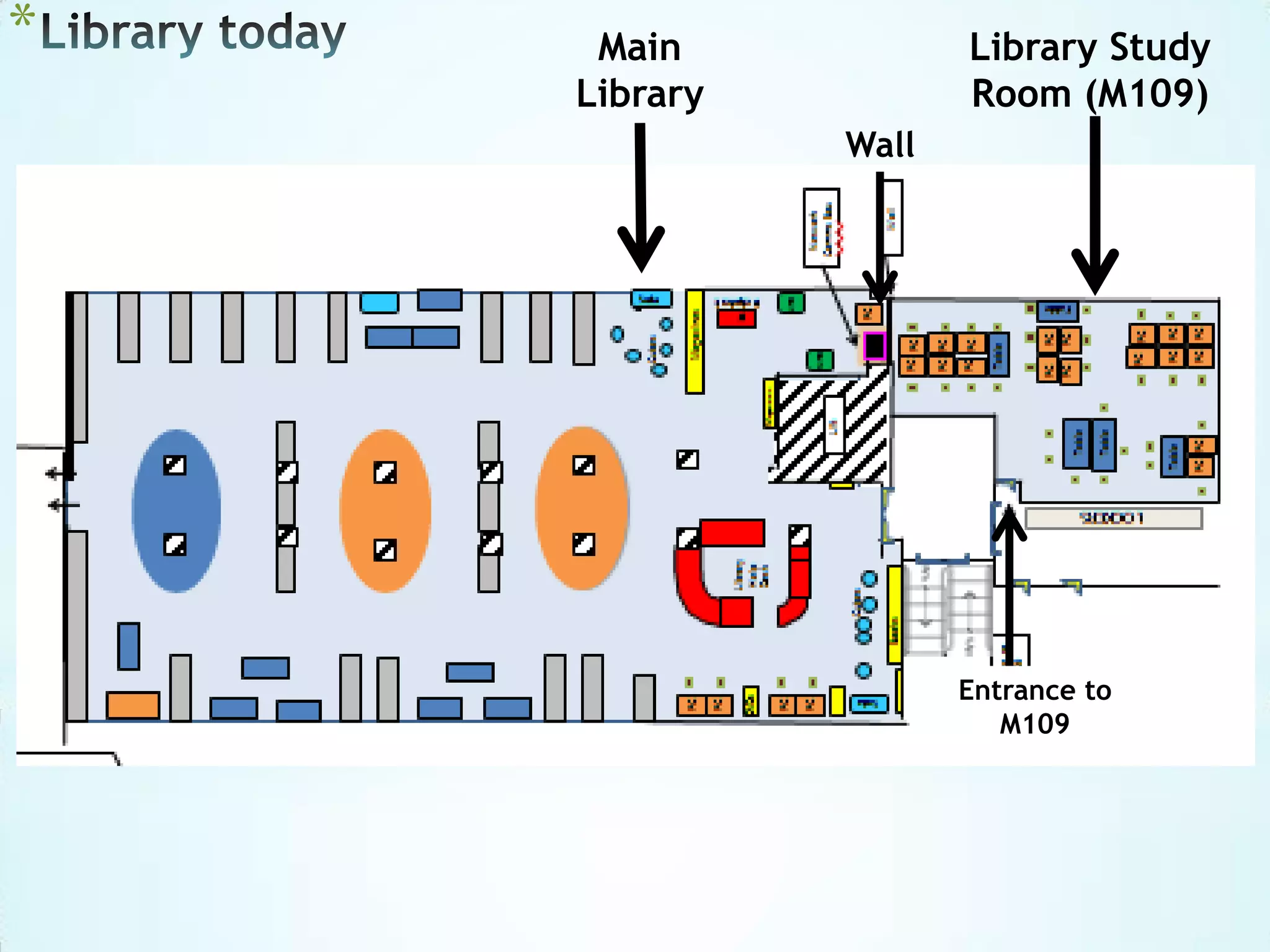
* Main
Library
Library Study
Room (M109)
Wall
Entrance to
M109
*
*Lack of informal learning
spaces in College (John
Curry)
*Lack of group working
space in College (Paul
Score)
*Lack of study space in the
Library (Student
feedback)
*Nowhere for teachers to work
with students within the Library
without disturbing other users
(Ashleigh Taylor)
*Not enough variety of learning
spaces within Library
environment (Mark Pennington)
*Complaints that Library is
too noisy (Student
feedback) *Nowhere flexible in College
to encourage experimenting
with technology (Teacher
Training Team)
*Not enough space to
work together on projects
(Student feedback)
* Problems
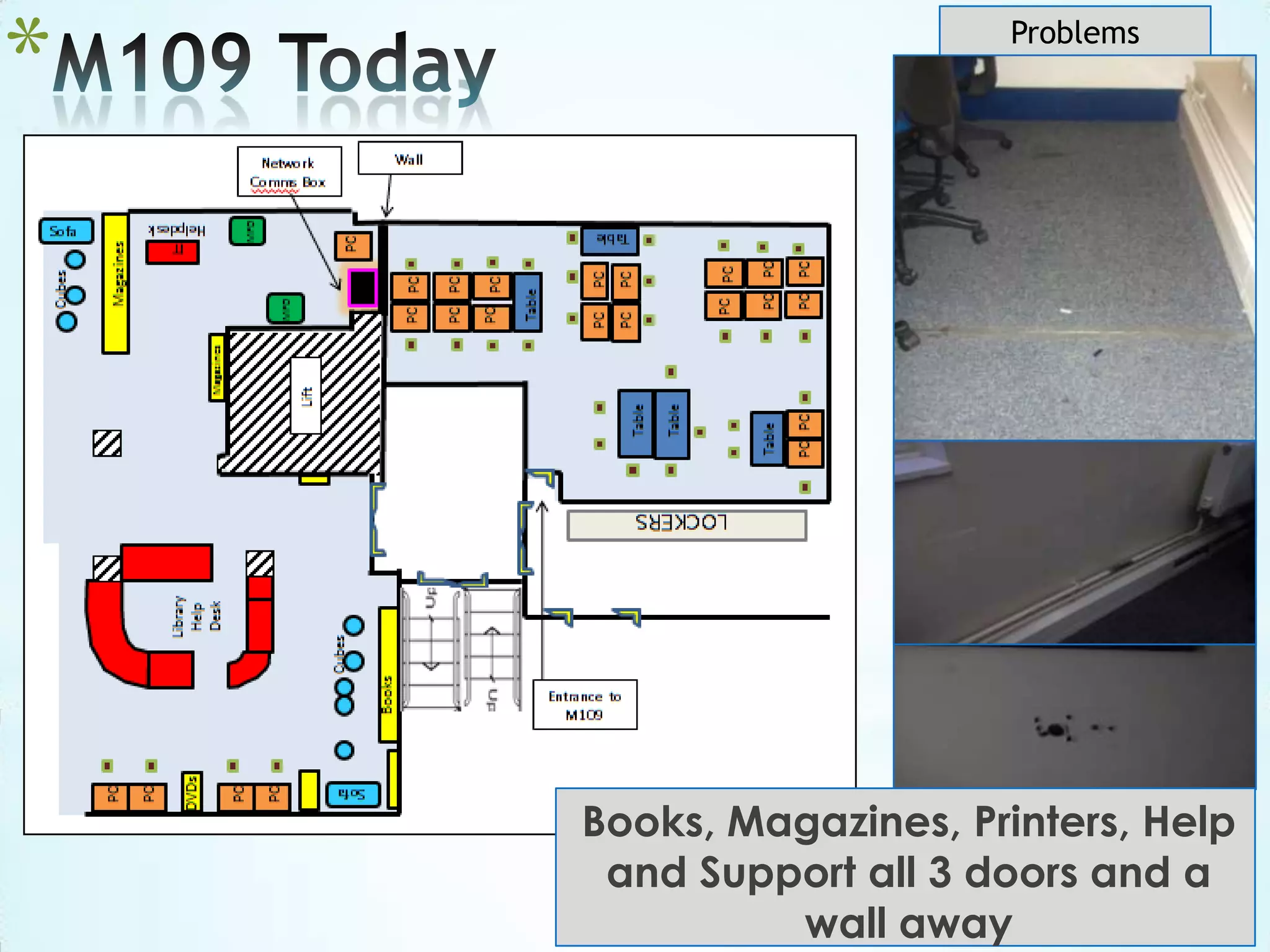
Books, Magazines, Printers, Help
and Support all 3 doors and a
wall away
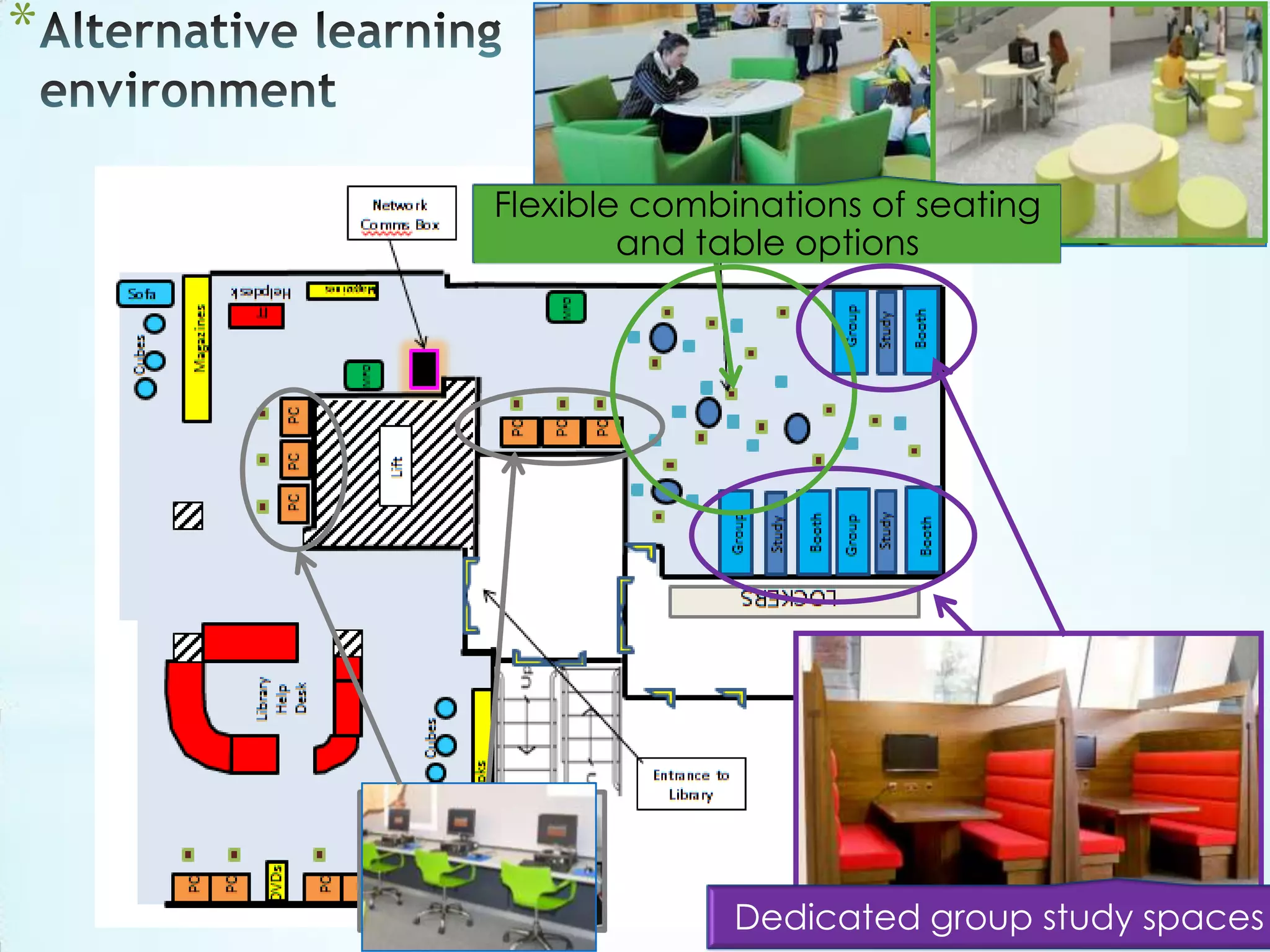
Dedicated group study spaces
Flexible combinations of seating
and table options
*
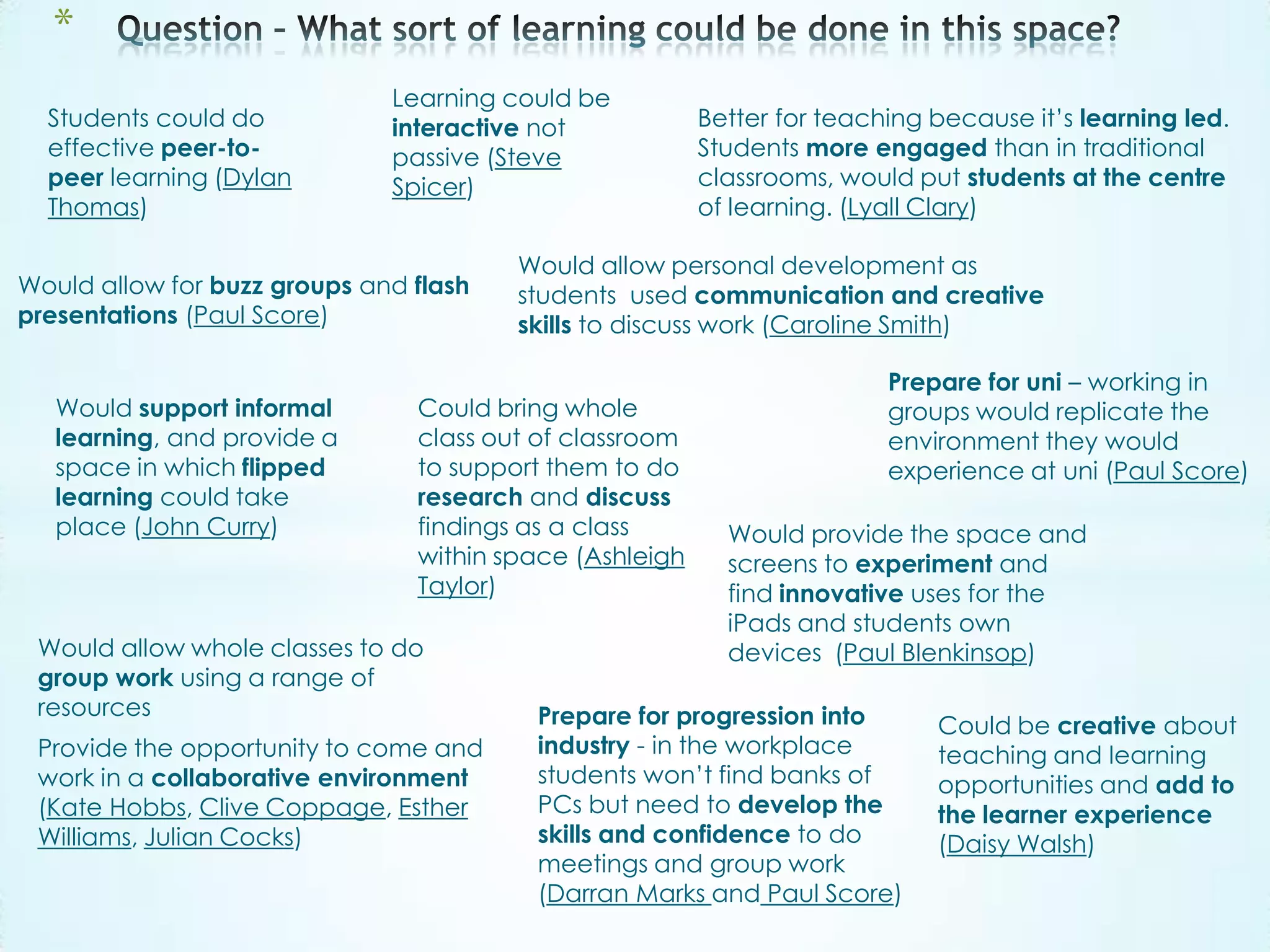
Learning could be
interactive not
passive (Steve
Spicer)
*
Would allow whole classes to do
group work using a range of
resources
Provide the opportunity to come and
work in a collaborative environment
(Kate Hobbs, Clive Coppage, Esther
Williams, Julian Cocks)
Students could do
effective peer-to-
peer learning (Dylan
Thomas)
Would provide the space and
screens to experiment and
find innovative uses for the
iPads and students own
devices (Paul Blenkinsop)
Prepare for uni – working in
groups would replicate the
environment they would
experience at uni (Paul Score)
Better for teaching because it’s learning led.
Students more engaged than in traditional
classrooms, would put students at the centre
of learning. (Lyall Clary)
Would support informal
learning, and provide a
space in which flipped
learning could take
place (John Curry)
Would allow personal development as
students used communication and creative
skills to discuss work (Caroline Smith)
Could bring whole
class out of classroom
to support them to do
research and discuss
findings as a class
within space (Ashleigh
Taylor)
Would allow for buzz groups and flash
presentations (Paul Score)
Prepare for progression into
industry - in the workplace
students won’t find banks of
PCs but need to develop the
skills and confidence to do
meetings and group work
(Darran Marks and Paul Score)
Could be creative about
teaching and learning
opportunities and add to
the learner experience
(Daisy Walsh)
*
Hex
?
*
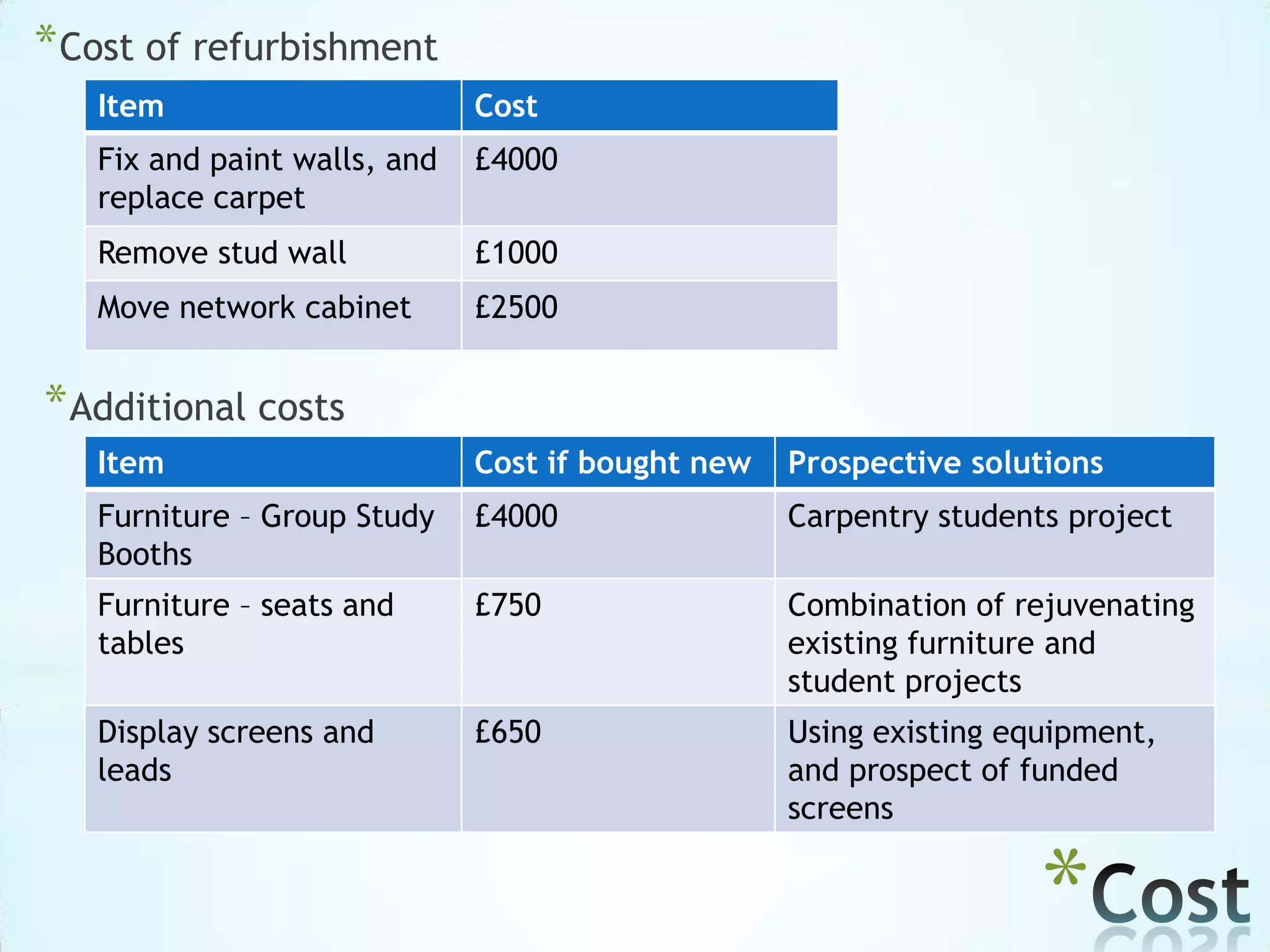
*Cost of refurbishment
*Additional costs
Item Cost
Fix and paint walls, and
replace carpet
£4000
Remove stud wall £1000
Move network cabinet £2500
Item Cost if bought new Prospective solutions
Furniture – Group Study
Booths
£4000 Carpentry students project
Furniture – seats and
tables
£750 Combination of rejuvenating
existing furniture and
student projects
Display screens and
leads
£650 Using existing equipment,
and prospect of funded
screens

Developing learning spaces presentation

  • 1.
  • 2.
    * Main Library Library Study Room(M109) Wall Entrance to M109
  • 3.
    * *Lack of informallearning spaces in College (John Curry) *Lack of group working space in College (Paul Score) *Lack of study space in the Library (Student feedback) *Nowhere for teachers to work with students within the Library without disturbing other users (Ashleigh Taylor) *Not enough variety of learning spaces within Library environment (Mark Pennington) *Complaints that Library is too noisy (Student feedback) *Nowhere flexible in College to encourage experimenting with technology (Teacher Training Team) *Not enough space to work together on projects (Student feedback)
  • 4.
    * Problems Books, Magazines,Printers, Help and Support all 3 doors and a wall away
  • 5.
    Dedicated group studyspaces Flexible combinations of seating and table options *
  • 6.
    Learning could be interactivenot passive (Steve Spicer) * Would allow whole classes to do group work using a range of resources Provide the opportunity to come and work in a collaborative environment (Kate Hobbs, Clive Coppage, Esther Williams, Julian Cocks) Students could do effective peer-to- peer learning (Dylan Thomas) Would provide the space and screens to experiment and find innovative uses for the iPads and students own devices (Paul Blenkinsop) Prepare for uni – working in groups would replicate the environment they would experience at uni (Paul Score) Better for teaching because it’s learning led. Students more engaged than in traditional classrooms, would put students at the centre of learning. (Lyall Clary) Would support informal learning, and provide a space in which flipped learning could take place (John Curry) Would allow personal development as students used communication and creative skills to discuss work (Caroline Smith) Could bring whole class out of classroom to support them to do research and discuss findings as a class within space (Ashleigh Taylor) Would allow for buzz groups and flash presentations (Paul Score) Prepare for progression into industry - in the workplace students won’t find banks of PCs but need to develop the skills and confidence to do meetings and group work (Darran Marks and Paul Score) Could be creative about teaching and learning opportunities and add to the learner experience (Daisy Walsh)
  • 7.
  • 8.
    * *Cost of refurbishment *Additionalcosts Item Cost Fix and paint walls, and replace carpet £4000 Remove stud wall £1000 Move network cabinet £2500 Item Cost if bought new Prospective solutions Furniture – Group Study Booths £4000 Carpentry students project Furniture – seats and tables £750 Combination of rejuvenating existing furniture and student projects Display screens and leads £650 Using existing equipment, and prospect of funded screens

Editor's Notes

  • #2 I know we have no money, and we’re not going to find lots of extra space and that’s there’s a big demand it, so I’ve been looking at what’s currently possible with the space we have in the Library and how we can make it the sort of environment that’s going to allow students to develop all of those skills they’re going to need in life – the creativity, teamworking, listening, original thinking, risk taking. Because in order to change the way people learn, you need to change the learning spaces too.Basically, part of creating a new model of learning that will better prepare students for working life, means changing the space to match the vision because flexible teaching and learning will require flexible spaces.There’s a JISC quote about designing learning spaces about how the vision should be of “a space that is inspirational for learners and staff, yet practical because it will meet the multifarious needs of a variety of users, and that will future-proof for tomorrow’s technology” and that’s what I kept in mind when looking at our learning spaces and how they could do more to meet the learning and teaching needs of the College.
  • #3 If you look at an outline of the Library & Study Room (M109) as it currently is basically the coloured blocks are anything grey is shelves, dark blue is tables, orange is PCs and as you can see the space is pretty much fullBut that’s not really the important thing, if we forget about the furniture that’s in it for a minute, and look at what we’re trying to do with the space – and the sort of environment this is to learn in and what sort of learning you can do in it – that’s the important thingIt’s lots of individual spaces to work individually on computers or with resources, and a few corners where you can try and create the sort of environment you actually want to study with and maybe do some quiet groupwork. The space is too limited to balance all the different learning styles students have. Currently we have individual work, group study, teachers discussing things with students and social interaction all happening right on top of each other. Learning’s got to be about being innovative and creative and developing employability skills, and this doesn’t really support that because it’s people doing traditional learning in traditional ways because that’s all the environment allows for.
  • #4 And I’ve spoken to some teaching staff, and there are a few themes that come up regularly when we talk about learning spaces, and it’s basically that there’s a lack of informal learning space in College, a lack of group study space, a lack of clear direction about what sort of learning can be done where, and student feedback always complains about how there’s no space in the Library, or it’s too noisy, or they can’t work effectively in groups.
  • #5 M109 – current environment. Rooms needs investment anyway (torn carpet and holes in wall and exposed pipes). Security, ICT (vandalism), concerns cos it’s unsupervised. But the worst thing about it isn’t the fact that it’s a space that’s seen a lot better days, it’s that it’s a space that confines the sort of learning you can do, doesn’t give you space to be innovative or get creative, Because it’s 16 PCs piled on top of each other, where if you do group work on one PC you take up the Pcs around you as well. With no access to plugs because they’re all used by the PCs, so if you BYOD you’ve no table space or plugs to use them with. And if you want help, or want to find your teacher or other students, or get your printing, or remember that you’ve not clicked the ok button and go back and forwards from the printer, you’ve got to pass 3 doors to get there. And you can’t easily get books or magazines into the room because there’s the physical barrier of the security gate in the way, so you’ve got to borrow a book before you can use it in M109.You don’t change behaviour by telling people to change, you change the space and the behaviour changes itself. By having two completely disconnected spaces you impact on them both, and limit the learning that can happen in either.
  • #6 But imagine the different sorts of learning which would happen if you take out the wall, take out the PCs, transform the space and create one continuous learning space – Where you have bookable (by staff or students) group study booths, with display monitors (Apple TV, with the leads to plug in own devices), so instead of investing in technology which will ultimately always go out of date, you invest in the screens for them to use whatever technology they want. Somewhere they can present, where discussion and collaboration are welcomed and put on an equal footing with solitary learning, it’s not confined to cornersAnd you put in a few tables, chairs and cube seats in the rest of the space and you’ve got a flexible space which can be used by students individually or in groups, can be easily redesigned as they want it. The students can choose how they want to learn.And this is a progression of what we’ve already seen in the Library. We introduced the sofas and beanbags and little cubes to the Library entrance area two years ago, and you often see students trying to create a little group space by using one cube as a table for their laptop and the rest of them huddling round it to look, and what you end up with at the end of the day is cubes all over the Library as students take them off to make their own work spaces in the shelves This space would be a space to be proud of – which students would find stimulating and comfortable – a positive learning environment. It’s taking out 12 PCs to give them the opportunity of using 32 iPads, laptops, which we could lend directly to students to use anywhere within the Library space . Or they can use any device they own. We give them the choice, not dictate what they should learn on, or putting all our money into one device in the hope it will be the right one for everyone.
  • #7 So, I asked the teaching staff about what benefits this idea would have on their students learning, and they came up with these few things:And a lot of them said about how the study booths would give their students a chance to work in a collaborative environment, that it’d be somewhere where they could develop their communication skills, start preparing for the sort of work and environments you get in universities and workplaces, where it’s not banks of PCs but meetings. That instead of borrowing equipment from the Library and going to find a space elsewhere in a classroom to use it, they could stay and let their students experiment and discover new ways of using them. And it wasn’t just teachers, Careers said they could host CV workshops with multiple students in them instead of 1-to-1 sessions downstairs, and in the evenings when we’re not so busy, classes like the Italian Love2Learn one could have the whole space to develop their skills in a more relaxed environment than a classroom would beJohn Curry thought that this space would support informal learning, give the students chance to be creativeThey could prepare lessons in advance knowing that there was going to be space in the Library for their class to work (Sally’s Art class, Ashleigh’s H&SC class)Prepare Replicate the sort of environment they would experience at university or in the workplace, you don’t get banks of PCs there, you’re expected to do group work and do meetingsLet students bring their own devices – Esther and John – students have their own laptopsStudents could do peer-to-peer learning (Caroline), they book the space, work togetherScreens would make learning interactiveCareers could hold CV workshops, not just offer 1-to-1 supportLove2Learn evening classes – Italian A space like this has an impact on learning, the current one doesn’t.Then you get learning like …, Group study – (Paul, Clive, John, Kate) have to do group work, Ashleigh – enables you to manage bigger class sizes betterPaul S. – HE centre great for banks of PCs, but not for buzz groups or flash presentations which they’re meant to do on the course, and will be expected to do . Paul has to ask them to research and then report back to the classroom. During consolidation week it would be somewhere a lecturer could deal with small groups, as there is nowhere else in College to do this. Would prepare them for industry, the students could hold meetings, book a space, hire relevant equipment, set agendas, and keep to a timeframe to complete their work in. Learning that you can’t do in classrooms, you can’t do anywhere in College at the momentAnd teachers would use it like this … which they can’t do at the momentCareers – moving to do CV workshops
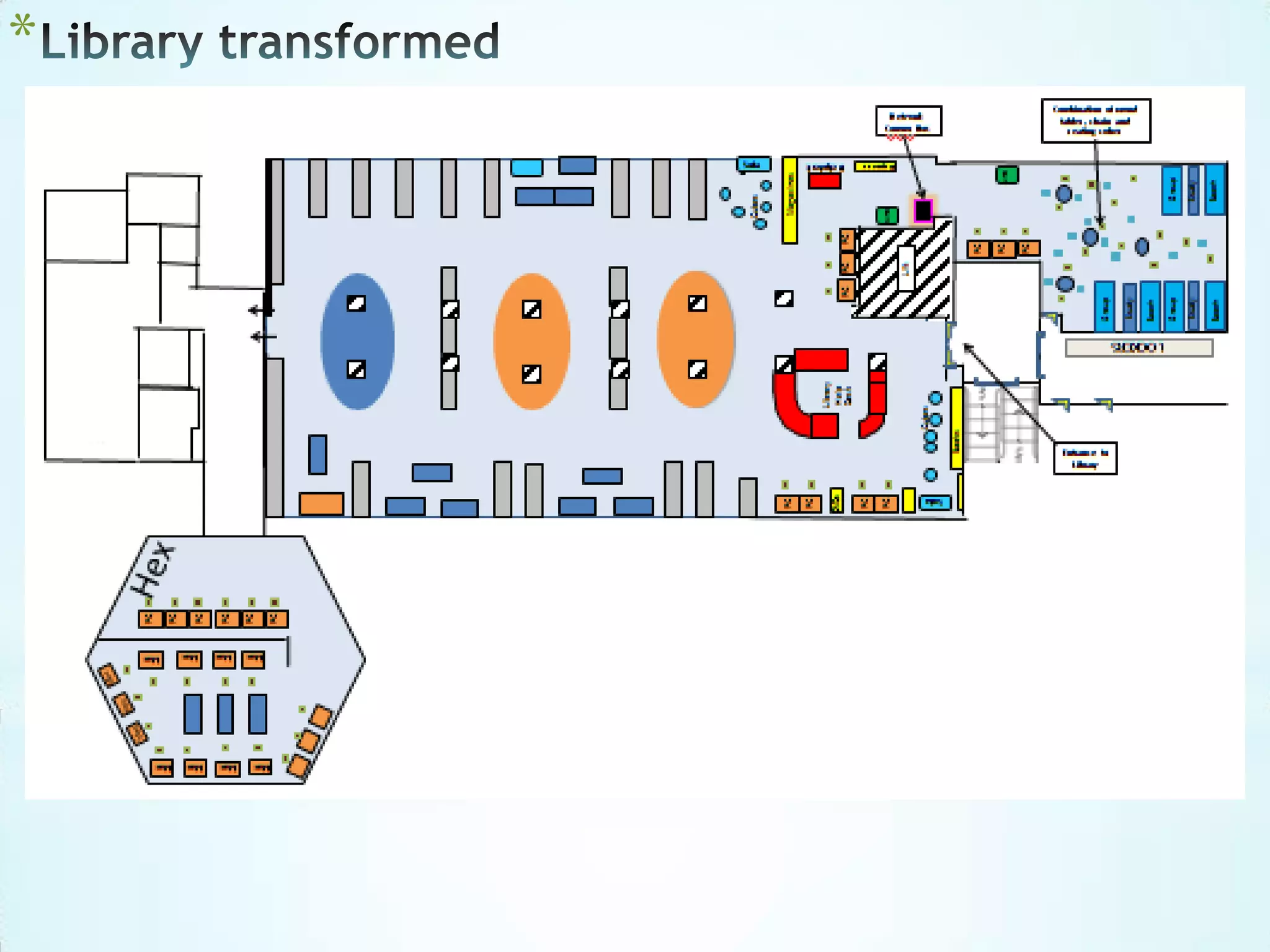
  • #8 And if we made those changes we’d end up with one space, one entrance, clear zones of learning throughout itUltimately, nobody would choose to come to the College because of current M109, no teacher or student will find a positive learning experience within it, or go away feeling enriched and enthusiastic about learning because of it, but make a few small changes, and we can provide students with the space they need to discover how they learn best, give them a space which is dedicated to allowing them to experiment and be collaborative and innovativeQuestions?
  • #9 Yes it’ll cost money, but most of the costs are ones you’ll incur in the near future anyway, regardless of what you do with the room. And if you keep it like it is it will cost ** in upkeep while having a very limited positive impact on learning in CollegeIt’s the same cost as another case of iPads, and economically this is more efficientIf the only barrier, the only thing stopping this is money then would you consider using everything from my budget that we were going to use to replace some of the older stock, overhaul the fiction section, to start building up the ebook collection, everything I’ve saved by reviewing every single magazines, every online resource, and putting it towards this. We want the resources, but we need a space everyone can use resources in more. Resources, like technology, go out of date quickly, the space not so much.
  • #10 Keeping a room of PCs is a risk, it’s not innovative, it’s not forward thinking, it will drain resources in maintaining them, and monopolise space while doing so. Clearly there is a still a current need for PCs in College, but it’s strongest in classrooms. So you should take the 12 PCs out of M109 and put them in the Hex, bring the Hex back into the classroom pool but not as an ordinary traditional eyes to the front classroom, but a technology enhanced active learning centre, with a mix of PCs, Macs, a smartboard, lecture capture capabilities built in, right next to and above experts on using technology and teaching methods who can assistPlan 1 – Put them in the HexPlan 2 – Split the Office, create a PC drop-in zone (would need extensive Estates and ICT work)Plan 3 – Esther needs PCs, M306(?) can split into spaces. She can have the PCs.Plan 4 – Keep them as “portable PCs” and set up IT classrooms on a weekly/monthly basis as and where you need them