DEVELOPING GENDER-RESPONSIVE NDCS
MEETING CAPACITY AND KNOWLEDGE GAPS
October 2018
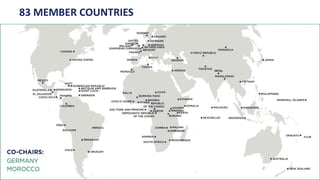
83 MEMBER COUNTRIES
2
3
19 INTERNATIONAL INSTITUTIONS
ASSOCIATE MEMBERS HOSTED BY
WHY INTEGRATE GENDER EQUALITY INTO NDCS?
More equitable,
sustainable
development
and climate
impact
NDCs
Gender
SDGs
4
DEVELOPING GENDER-RESPONSIVE CLIMATE ACTION
5
SCOPING ASSESSMENT (UGA, KEN, RMI, CIV, PER, PHI)
Key Challenges
• Lack of sex-disaggregated data and gender analysis to
identify country-specific inequalities and barriers
• Complex and siloed coordination of national climate
change and NDC processes
• Limited engagement of gender specialists
• Inadequate technical capacity on gender and climate
change
• Inadequate information on where and how to access
gender resources and tools
• Insufficient financing for gender-responsive climate
action
• Limited knowledge sharing across countries and
institutions on gender-responsive approaches
Critical Enabling Factors
• Strong political commitment to drive action
• Institutional arrangements to support GMS
• Strong national gender agency and focal point system
across ministries
• Participatory consultations with women’s groups and
other disadvantaged groups
• Technical capacity on gender and climate change at
national and subnational levels and across
ministries/sectors for context-specific gender analysis
• Targeted financial resources or gender-responsive
budgeting
COMMONLY REQUESTED KNOWLEDGE RESOURCES FOR
GENDER-RESPONSIVE APPROACHES IN CLIMATE ACTION
• Training tools for conducting a gender diagnostic and integrating gender
• Analysis tools for gender in sectors
• Safeguards for indigenous and vulnerable groups
• Skills building tools for women’s organizations working on NDCs
• Capacity building workshops for discussing issues and sharing experiences
• Monitoring tools
• Tools to build skills to receiving financing for climate change or NDC projects
• Institutional guidance for coordinating gender focal points within climate
6
DEVELOPING GENDER-RESPONSIVE NDCS
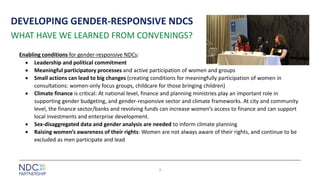
Enabling conditions for gender-responsive NDCs:
• Leadership and political commitment
• Meaningful participatory processes and active participation of women and groups
• Small actions can lead to big changes (creating conditions for meaningfully participation of women in
consultations: women-only focus groups, childcare for those bringing children)
• Climate finance is critical: At national level, finance and planning ministries play an important role in
supporting gender budgeting, and gender-responsive sector and climate frameworks. At city and community
level, the finance sector/banks and revolving funds can increase women’s access to finance and can support
local investments and enterprise development.
• Sex-disaggregated data and gender analysis are needed to inform climate planning
• Raising women’s awareness of their rights: Women are not always aware of their rights, and continue to be
excluded as men participate and lead
7
WHAT HAVE WE LEARNED FROM CONVENINGS?
GENDER RESOURCES ON THE
KNOWLEDGE PORTAL
• Redesigned to improve user interface
• Expanded new resources (including
from UNFCCC’s Gender Knowledge
Platform)
• Curated, catalogued gender resources,
tagged to enable easier search of
relevant resources
• Case study database (with GIZ, LEDSGP,
UNDP)
8
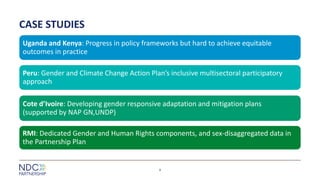
CASE STUDIES
Uganda and Kenya: Progress in policy frameworks but hard to achieve equitable
outcomes in practice
Peru: Gender and Climate Change Action Plan’s inclusive multisectoral participatory
approach
Cote d’Ivoire: Developing gender responsive adaptation and mitigation plans
(supported by NAP GN,UNDP)
RMI: Dedicated Gender and Human Rights components, and sex-disaggregated data in
the Partnership Plan
9
HOW IS NDCP FILLING KNOWLEDGE & CAPACITY GAPS?
• Continue to document country learning needs and obstacles; share with members to pair country
learning needs with relevant knowledge resources /capacity building support
• Provide curated gender resources available through the Knowledge Portal (mainly member
contributions) and encourage uptake
• Developing a directory of technical gender expertise as a resource for countries.
• Facilitate peer exchanges responding to common NDC implementation challenges
• Developing case studies on country NDC implementation challenges
• Deliver gender knowledge resources in tandem with in-country capacity building
• Work with members to identify a streamlined set support services for countries to integrate gender
into NDCs and where members’ can provide corresponding capacity building support (eg, strengthen
country capacity to collect sex-disaggregated data, conduct gender analyses, track progress, technical
gender capacity building)
10
THANK YOU
11

Developing Gender-Responsive NDCs: Meeting Capacity and Knowledge Gaps

  • 1.
    DEVELOPING GENDER-RESPONSIVE NDCS MEETINGCAPACITY AND KNOWLEDGE GAPS October 2018
  • 2.
  • 3.
  • 4.
    WHY INTEGRATE GENDEREQUALITY INTO NDCS? More equitable, sustainable development and climate impact NDCs Gender SDGs 4
  • 5.
    DEVELOPING GENDER-RESPONSIVE CLIMATEACTION 5 SCOPING ASSESSMENT (UGA, KEN, RMI, CIV, PER, PHI) Key Challenges • Lack of sex-disaggregated data and gender analysis to identify country-specific inequalities and barriers • Complex and siloed coordination of national climate change and NDC processes • Limited engagement of gender specialists • Inadequate technical capacity on gender and climate change • Inadequate information on where and how to access gender resources and tools • Insufficient financing for gender-responsive climate action • Limited knowledge sharing across countries and institutions on gender-responsive approaches Critical Enabling Factors • Strong political commitment to drive action • Institutional arrangements to support GMS • Strong national gender agency and focal point system across ministries • Participatory consultations with women’s groups and other disadvantaged groups • Technical capacity on gender and climate change at national and subnational levels and across ministries/sectors for context-specific gender analysis • Targeted financial resources or gender-responsive budgeting
  • 6.
    COMMONLY REQUESTED KNOWLEDGERESOURCES FOR GENDER-RESPONSIVE APPROACHES IN CLIMATE ACTION • Training tools for conducting a gender diagnostic and integrating gender • Analysis tools for gender in sectors • Safeguards for indigenous and vulnerable groups • Skills building tools for women’s organizations working on NDCs • Capacity building workshops for discussing issues and sharing experiences • Monitoring tools • Tools to build skills to receiving financing for climate change or NDC projects • Institutional guidance for coordinating gender focal points within climate 6
  • 7.
    DEVELOPING GENDER-RESPONSIVE NDCS Enablingconditions for gender-responsive NDCs: • Leadership and political commitment • Meaningful participatory processes and active participation of women and groups • Small actions can lead to big changes (creating conditions for meaningfully participation of women in consultations: women-only focus groups, childcare for those bringing children) • Climate finance is critical: At national level, finance and planning ministries play an important role in supporting gender budgeting, and gender-responsive sector and climate frameworks. At city and community level, the finance sector/banks and revolving funds can increase women’s access to finance and can support local investments and enterprise development. • Sex-disaggregated data and gender analysis are needed to inform climate planning • Raising women’s awareness of their rights: Women are not always aware of their rights, and continue to be excluded as men participate and lead 7 WHAT HAVE WE LEARNED FROM CONVENINGS?
  • 8.
    GENDER RESOURCES ONTHE KNOWLEDGE PORTAL • Redesigned to improve user interface • Expanded new resources (including from UNFCCC’s Gender Knowledge Platform) • Curated, catalogued gender resources, tagged to enable easier search of relevant resources • Case study database (with GIZ, LEDSGP, UNDP) 8
  • 9.
    CASE STUDIES Uganda andKenya: Progress in policy frameworks but hard to achieve equitable outcomes in practice Peru: Gender and Climate Change Action Plan’s inclusive multisectoral participatory approach Cote d’Ivoire: Developing gender responsive adaptation and mitigation plans (supported by NAP GN,UNDP) RMI: Dedicated Gender and Human Rights components, and sex-disaggregated data in the Partnership Plan 9
  • 10.
    HOW IS NDCPFILLING KNOWLEDGE & CAPACITY GAPS? • Continue to document country learning needs and obstacles; share with members to pair country learning needs with relevant knowledge resources /capacity building support • Provide curated gender resources available through the Knowledge Portal (mainly member contributions) and encourage uptake • Developing a directory of technical gender expertise as a resource for countries. • Facilitate peer exchanges responding to common NDC implementation challenges • Developing case studies on country NDC implementation challenges • Deliver gender knowledge resources in tandem with in-country capacity building • Work with members to identify a streamlined set support services for countries to integrate gender into NDCs and where members’ can provide corresponding capacity building support (eg, strengthen country capacity to collect sex-disaggregated data, conduct gender analyses, track progress, technical gender capacity building) 10
  • 11.