Money Matters  Developing Financial Capability Student Funding Office
Aim of the session   To help you understand the basics of financial management and budgeting To encourage you to actively take control of your finances To provide some practical hints and tips on managing your money
Learning Outcomes   Make informed decisions in relation to money Develop a sense of financial responsibility Expand your skills through budget preparation and an awareness of cashflow
Our role   We are  not  financial experts We are here to teach you basic money management skills We can also provide information, advice and guidance on sources of student finance and other means of support
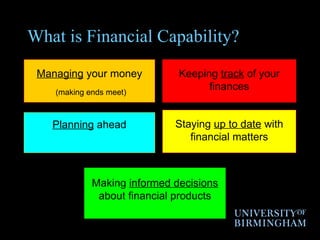
What is   Financial Capability? Planning  ahead Keeping  track  of your finances Making  informed decisions  about financial products Staying  up to date  with financial matters Managing  your money (making ends meet)
Why are these skills important?   Evidence of strong association between financial capability and psychological well-being Students now face more financial responsibilities than ever before Need to be able to maximize entitlements and know where to seek advice when financial difficulties arise Students more confident about their finances may also be more likely to complete their course and get a job in the future
Down-shifting your groceries Alternatives to branded goods do exist. So, rather than going without, down-shifting may be an option. Give it a try and see what works for you: £0.86 Tesco Pure Orange £1.99 Tropicana  £0.68 Tesco Value Reds £1.25 Braeburns (6) £0.75 Tesco W/meal £1.22 Hovis W/meal £1.21 Tesco Value Mince £2.88 Mince Beef £1.58 Fairtrade Tea £2.20 PG Tips (80)
Your bank account   Open up a student account (or transfer existing one) to take advantage of any offers and lower banking charges, but choose one that suits your needs  Don’t assume you have an interest free overdraft – you need to ask first Don’t go over your agreed overdraft limit!  You won’t enjoy it and it can be a painful experience on your wallet as you will be charged a hefty penalty
Your cash card Always use a cash machine that doesn’t charge you for withdrawals  Don’t take money out of your account you don’t need Check bank statements regularly and keep receipts.  Sign up for internet banking or arrange to have your statements sent to you at regular intervals Report a loss straight away, even if you think it’s in your own house.  Fraud can occur anytime,  reporting it does not cost you anything. Consider leaving your card at home if going out for the evening.
What are credit/store cards? How do they work? You can spend money instantly and repay the money back to the company at a later date. Companies make money from the cards by charging you interest on the money you do not pay by the set date Annual Percentage Rate (APR) applied to instalments late penalties
Benefits of credit and store cards Cards are a simple and handy way to pay for goods rather than carrying cash  Credit cards can provide an easy way to get short term credit for free if you pay off the amount you owe monthly and you can build up a good credit history Some card providers give special discounted offers, cash back or loyalty points to card holders for purchases Enables you to shop on-line with confidence Purchases are protected
The risks of using cards You could run up debts you cannot afford to repay or overspend and start using your overdraft without realising If you only pay the minimum amount each month this is an extremely expensive way to borrow money Late payment fees are added to your overall debt and store card interest rates are very high  ( typical  APR  of 29.9 %) Ultimately if you fail to make the minimum payments the outstanding balance can be demanded and you could be taken to court if you cannot pay CCJ may be served House is black listed
The Golden Rule TO PAY THE CARD OFF IN FULL EACH MONTH, SO YOU’LL NEVER PAY INTEREST.
Credit card choice Loyalty credit cards are ‘ the  best’ way to spend Choice the right card for you: www.moneysavingexpert.com/cards/cashback-credit-cards Find out the true cost of not clearing your credit card by using the calculator:  www.whatsthecost.com/creditcard.aspx
Budgeting The principles of budgeting are simple…it’s putting them into practice which can be hard Most people don’t know what they spend on items each month An accurate personal budget will help you make the most of your money It will show you what your income and expenses are, help cut out unnecessary expenses, save money or stop running up big debts!
How to budget Start by working out what you have coming in Then make a list of things you need to pay; check recent bank statements, including direct debits and standing orders and recent bills Finally, include estimated amounts for unexpected and occasional costs e.g. Christmas, birthdays, dentist, going out etc
How to budget cont’d Remember:  you may have different circumstances over the summer    e.g. no statutory support, wages, no course costs,     parental rent etc. so you will have to bear this in mind    when calculating your budget Work out the total income/expenditure for a full year by multiplying your weekly income/expenditure by 52 (for weekly) or 12 (for monthly) Tips Be honest and take it seriously Look at your priorities  if there is a shortfall can you cut costs Are you entitled to other support Where possible, pay in instalments
Personal financial records These should generally be kept for at least 1 year Bank/savings account statements, credit card statements, loan agreements (including SLC notifications) and wage slips  P60s and P45s (should be kept for 7 years) Receipts and guarantees Utility/phone bills, car/home insurance, etc.  Enables you to manage your debts, prevent fraud, check for mistakes, assist with budgeting, make sure you get paid what you are entitled to For tax returns and queries In case you need to return items and to check for any mistakes Makes sure you are getting the bests deals. Assists with  budgeting and to check for mistakes
Top Ten Tips  Use a budget planner Put money aside for bills and pay them on time Don’t go over your overdraft limit  Remember the Golden Rule when using credit/store cards Use the library or buy second hand books Take advantage of student discounts, online vouchers and shop around for the best deals on services e.g. mobile phone contracts Prepare a shopping list, stick to it and don’t be a brand snob  and never shop when hungry Make your own sandwiches and cut out the takeaways and ready meals…you’ll save a fortune  Choose wisely – if you can’t afford it don’t have it or choose an alternative COMMUNICATE  – with family, relatives, friends &  your bank
Where to go for money advice & support Finance Office Monitor & collect all your tuition and accommodation payments The ARC in the Guild Offer free advice & representation on a wide range of issues including finance Student Accommodation Offer a wide selection of accommodation and services to suit most budgets Student Funding Office Provide information & advice about financial support available ISAS Provide support & advice to international students including your finances Academic & Student Admin Provide front-of-house support to you via Enquiry Services
Useful   links… www.as.bham.ac.uk /funding www.moneymatters.bham.ac.uk www.payments.bham.ac.uk www.direct.gov.uk/studentfinance www.moneysavingexpert.com

Developing Financial Capability

  • 1.
    Money Matters Developing Financial Capability Student Funding Office
  • 2.
    Aim of thesession To help you understand the basics of financial management and budgeting To encourage you to actively take control of your finances To provide some practical hints and tips on managing your money
  • 3.
    Learning Outcomes Make informed decisions in relation to money Develop a sense of financial responsibility Expand your skills through budget preparation and an awareness of cashflow
  • 4.
    Our role We are not financial experts We are here to teach you basic money management skills We can also provide information, advice and guidance on sources of student finance and other means of support
  • 5.
    What is Financial Capability? Planning ahead Keeping track of your finances Making informed decisions about financial products Staying up to date with financial matters Managing your money (making ends meet)
  • 6.
    Why are theseskills important? Evidence of strong association between financial capability and psychological well-being Students now face more financial responsibilities than ever before Need to be able to maximize entitlements and know where to seek advice when financial difficulties arise Students more confident about their finances may also be more likely to complete their course and get a job in the future
  • 7.
    Down-shifting your groceriesAlternatives to branded goods do exist. So, rather than going without, down-shifting may be an option. Give it a try and see what works for you: £0.86 Tesco Pure Orange £1.99 Tropicana £0.68 Tesco Value Reds £1.25 Braeburns (6) £0.75 Tesco W/meal £1.22 Hovis W/meal £1.21 Tesco Value Mince £2.88 Mince Beef £1.58 Fairtrade Tea £2.20 PG Tips (80)
  • 8.
    Your bank account Open up a student account (or transfer existing one) to take advantage of any offers and lower banking charges, but choose one that suits your needs Don’t assume you have an interest free overdraft – you need to ask first Don’t go over your agreed overdraft limit! You won’t enjoy it and it can be a painful experience on your wallet as you will be charged a hefty penalty
  • 9.
    Your cash cardAlways use a cash machine that doesn’t charge you for withdrawals Don’t take money out of your account you don’t need Check bank statements regularly and keep receipts. Sign up for internet banking or arrange to have your statements sent to you at regular intervals Report a loss straight away, even if you think it’s in your own house. Fraud can occur anytime, reporting it does not cost you anything. Consider leaving your card at home if going out for the evening.
  • 10.
    What are credit/storecards? How do they work? You can spend money instantly and repay the money back to the company at a later date. Companies make money from the cards by charging you interest on the money you do not pay by the set date Annual Percentage Rate (APR) applied to instalments late penalties
  • 11.
    Benefits of creditand store cards Cards are a simple and handy way to pay for goods rather than carrying cash Credit cards can provide an easy way to get short term credit for free if you pay off the amount you owe monthly and you can build up a good credit history Some card providers give special discounted offers, cash back or loyalty points to card holders for purchases Enables you to shop on-line with confidence Purchases are protected
  • 12.
    The risks ofusing cards You could run up debts you cannot afford to repay or overspend and start using your overdraft without realising If you only pay the minimum amount each month this is an extremely expensive way to borrow money Late payment fees are added to your overall debt and store card interest rates are very high ( typical APR of 29.9 %) Ultimately if you fail to make the minimum payments the outstanding balance can be demanded and you could be taken to court if you cannot pay CCJ may be served House is black listed
  • 13.
    The Golden RuleTO PAY THE CARD OFF IN FULL EACH MONTH, SO YOU’LL NEVER PAY INTEREST.
  • 14.
    Credit card choiceLoyalty credit cards are ‘ the best’ way to spend Choice the right card for you: www.moneysavingexpert.com/cards/cashback-credit-cards Find out the true cost of not clearing your credit card by using the calculator: www.whatsthecost.com/creditcard.aspx
  • 15.
    Budgeting The principlesof budgeting are simple…it’s putting them into practice which can be hard Most people don’t know what they spend on items each month An accurate personal budget will help you make the most of your money It will show you what your income and expenses are, help cut out unnecessary expenses, save money or stop running up big debts!
  • 16.
    How to budgetStart by working out what you have coming in Then make a list of things you need to pay; check recent bank statements, including direct debits and standing orders and recent bills Finally, include estimated amounts for unexpected and occasional costs e.g. Christmas, birthdays, dentist, going out etc
  • 17.
    How to budgetcont’d Remember: you may have different circumstances over the summer e.g. no statutory support, wages, no course costs, parental rent etc. so you will have to bear this in mind when calculating your budget Work out the total income/expenditure for a full year by multiplying your weekly income/expenditure by 52 (for weekly) or 12 (for monthly) Tips Be honest and take it seriously Look at your priorities if there is a shortfall can you cut costs Are you entitled to other support Where possible, pay in instalments
  • 18.
    Personal financial recordsThese should generally be kept for at least 1 year Bank/savings account statements, credit card statements, loan agreements (including SLC notifications) and wage slips P60s and P45s (should be kept for 7 years) Receipts and guarantees Utility/phone bills, car/home insurance, etc. Enables you to manage your debts, prevent fraud, check for mistakes, assist with budgeting, make sure you get paid what you are entitled to For tax returns and queries In case you need to return items and to check for any mistakes Makes sure you are getting the bests deals. Assists with budgeting and to check for mistakes
  • 19.
    Top Ten Tips Use a budget planner Put money aside for bills and pay them on time Don’t go over your overdraft limit Remember the Golden Rule when using credit/store cards Use the library or buy second hand books Take advantage of student discounts, online vouchers and shop around for the best deals on services e.g. mobile phone contracts Prepare a shopping list, stick to it and don’t be a brand snob and never shop when hungry Make your own sandwiches and cut out the takeaways and ready meals…you’ll save a fortune Choose wisely – if you can’t afford it don’t have it or choose an alternative COMMUNICATE – with family, relatives, friends & your bank
  • 20.
    Where to gofor money advice & support Finance Office Monitor & collect all your tuition and accommodation payments The ARC in the Guild Offer free advice & representation on a wide range of issues including finance Student Accommodation Offer a wide selection of accommodation and services to suit most budgets Student Funding Office Provide information & advice about financial support available ISAS Provide support & advice to international students including your finances Academic & Student Admin Provide front-of-house support to you via Enquiry Services
  • 21.
    Useful links… www.as.bham.ac.uk /funding www.moneymatters.bham.ac.uk www.payments.bham.ac.uk www.direct.gov.uk/studentfinance www.moneysavingexpert.com