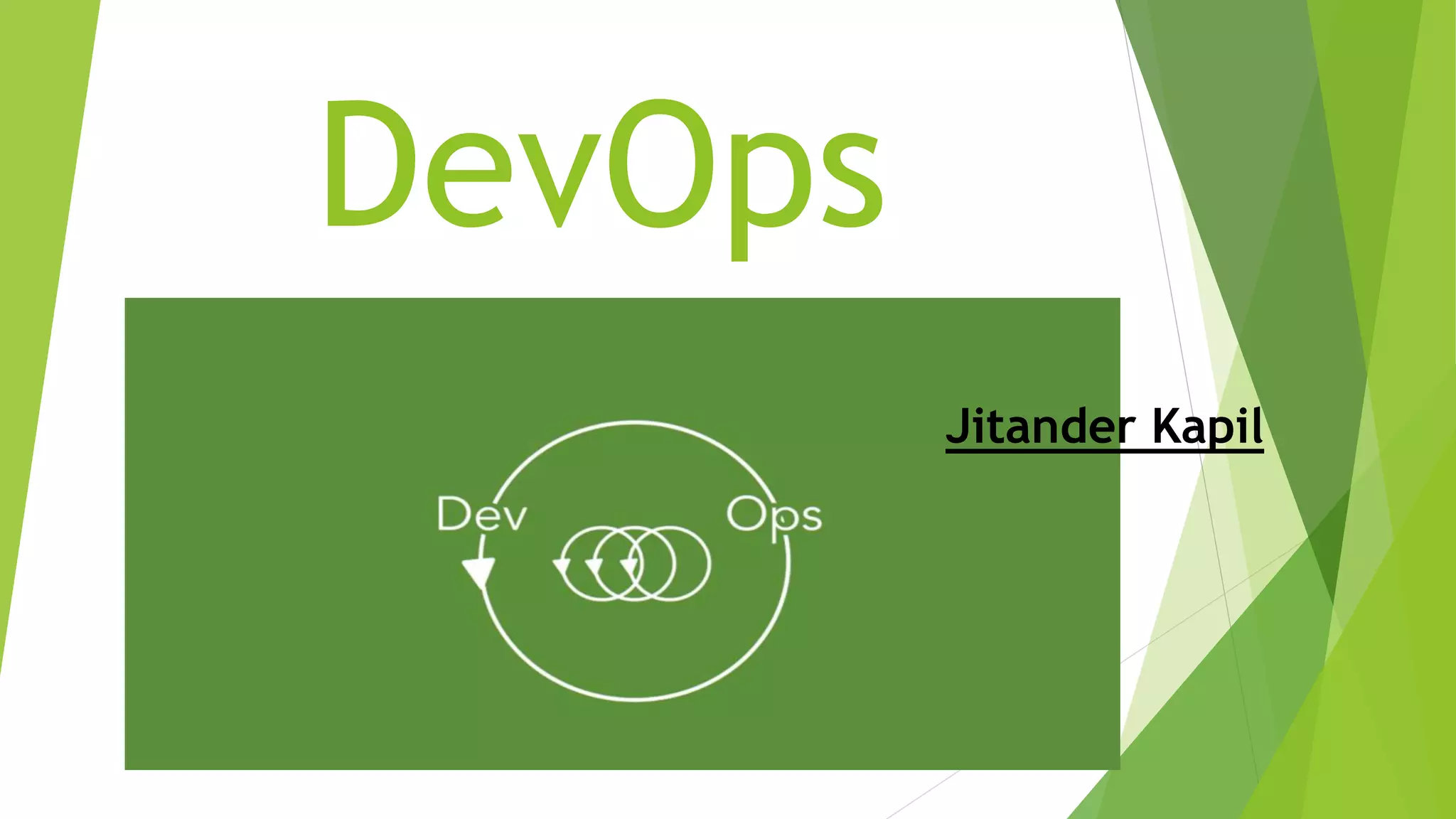
DevOps
Jitander Kapil
Agenda
 Why DevOps
 History of DevOps
 DevOps Stakeholders
 DevOps Lifecycle
 DevOps Tools
 DevOps Goals
 Case Study-CI and CD
 Q & A
Why DevOps?
 Before DevOps (SDLC/Waterfall days)
The development and operation team worked in complete
isolation.
Testing and Deployment were isolated activities after design-
build. Consumed more time than actual build cycles
Team members are spending a large amount of their time in
testing, deploying, and designing instead of building the
project (Not so in DevOps)
Manual code deployment leads to human errors in
production.
Coding & operation teams have their separate timelines and
are not in synch causing further delays.
Why DevOps ?
 After DevOps
A culture change that improves IT service delivery agility on
the basis of
Communication
Collaboration
Integration
Better resource management (No QA ,IT team waiting)
Reduced human errors (Lower the application failure rate
with multiple deployments in production)
Stable Environment and early defect mitigation, faster
deliveries
Quality and delivery now is shared Responsibility
DevOps Is/Not?
 The term DevOps has been used in multiple context
- is a software engineering culture ?
- practice focusing on software development (Dev) and software
operation (Ops) ?
- A Mindset
- a cross-functional mode of working
- A culture changes based on Lean and Agile
- ≠ Scrum,Others
- Not a Tool – (We do DevOps as we use Jenkins or Ansible?)
- is Not a distinct role or a team rather describes an approach to work
- Is Not Automation or CI or Continuous Delivery
History of DevOps
 The idea began in 2008 with a discussion between Patrick
Debois and Andrew concerned over the concept of Agile
Infrastructure.
 The idea only started to spread in 2009 with the advent of the
first DevOpsDays event held in Belgium
 Later Actually evolved as feedback oriented system
 It actually covers every aspect of software development from
coding all the way through the various stakeholders to
deployment.
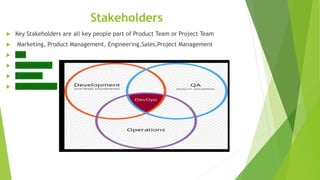
Stakeholders
 Key Stakeholders are all key people part of Product Team or Project Team
 Marketing, Product Management, Engineering,Sales,Project Management
 DBA
 Security Eng.
 Customer
 Production Sup
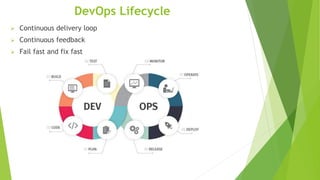
DevOps Lifecycle
 Continuous delivery loop
 Continuous feedback
 Fail fast and fix fast
DevOps Lifecycle
 DevOps Lifecycle can be broadly broken down into the below
DevOps Stages:
 Continuous Development
 Continuous Integration
 Continuous Testing
 Continuous Monitoring
 Operations(Virtualization and Containerization)
These stages are the building blocks to achieve DevOps as a whole.
DevOps Tools
 The most popular DevOps tools are, though these are not limited and number
of open source tools available
 Git : Version Control System tool
 Jenkins : Continuous Integration tool
 Selenium : Continuous Testing tool
 Puppet, Chef, Ansible : Configuration Management and Deployment tools
 Nagios : Continuous Monitoring tool
 Docker : Containerization tool
DevOps Tools are expected to fit into one or more of these categories Code, Build
,Test ,Package, Release ,Configure , Monitor
DevOps Goals
 A handful of DevOps goals that we keep seeing over and over again
 Release on demand
 Eliminate technical debt and unplanned work
 Fail smart/fast/safe
DevOps Success Mantra
Culture,Culrure,Culture
Case Study:
 Case 1:
 In our IT Company Deployment used to take 12 Hours and release cycle used
to take 3 weeks and 1 week at stagging
After this devops delivery pipeline implementation
Deployment =40 min , R Cycle=3d and customer site deployment=1
Case2:NetFlix
One of best DevOps Technology implementer
 Contribution in open source tools development and implementation at
enterprise level
 22 Cassandra Nodes replaced with Zero downtime
Top Key companies Amazon,Netflix,Facebook,Etsy etc
Thank You

Dev ops

  • 1.
  • 2.
    Agenda  Why DevOps History of DevOps  DevOps Stakeholders  DevOps Lifecycle  DevOps Tools  DevOps Goals  Case Study-CI and CD  Q & A
  • 3.
    Why DevOps?  BeforeDevOps (SDLC/Waterfall days) The development and operation team worked in complete isolation. Testing and Deployment were isolated activities after design- build. Consumed more time than actual build cycles Team members are spending a large amount of their time in testing, deploying, and designing instead of building the project (Not so in DevOps) Manual code deployment leads to human errors in production. Coding & operation teams have their separate timelines and are not in synch causing further delays.
  • 4.
    Why DevOps ? After DevOps A culture change that improves IT service delivery agility on the basis of Communication Collaboration Integration Better resource management (No QA ,IT team waiting) Reduced human errors (Lower the application failure rate with multiple deployments in production) Stable Environment and early defect mitigation, faster deliveries Quality and delivery now is shared Responsibility
  • 5.
    DevOps Is/Not?  Theterm DevOps has been used in multiple context - is a software engineering culture ? - practice focusing on software development (Dev) and software operation (Ops) ? - A Mindset - a cross-functional mode of working - A culture changes based on Lean and Agile - ≠ Scrum,Others - Not a Tool – (We do DevOps as we use Jenkins or Ansible?) - is Not a distinct role or a team rather describes an approach to work - Is Not Automation or CI or Continuous Delivery
  • 6.
    History of DevOps The idea began in 2008 with a discussion between Patrick Debois and Andrew concerned over the concept of Agile Infrastructure.  The idea only started to spread in 2009 with the advent of the first DevOpsDays event held in Belgium  Later Actually evolved as feedback oriented system  It actually covers every aspect of software development from coding all the way through the various stakeholders to deployment.
  • 7.
    Stakeholders  Key Stakeholdersare all key people part of Product Team or Project Team  Marketing, Product Management, Engineering,Sales,Project Management  DBA  Security Eng.  Customer  Production Sup
  • 8.
    DevOps Lifecycle  Continuousdelivery loop  Continuous feedback  Fail fast and fix fast
  • 9.
    DevOps Lifecycle  DevOpsLifecycle can be broadly broken down into the below DevOps Stages:  Continuous Development  Continuous Integration  Continuous Testing  Continuous Monitoring  Operations(Virtualization and Containerization) These stages are the building blocks to achieve DevOps as a whole.
  • 10.
    DevOps Tools  Themost popular DevOps tools are, though these are not limited and number of open source tools available  Git : Version Control System tool  Jenkins : Continuous Integration tool  Selenium : Continuous Testing tool  Puppet, Chef, Ansible : Configuration Management and Deployment tools  Nagios : Continuous Monitoring tool  Docker : Containerization tool DevOps Tools are expected to fit into one or more of these categories Code, Build ,Test ,Package, Release ,Configure , Monitor
  • 11.
    DevOps Goals  Ahandful of DevOps goals that we keep seeing over and over again  Release on demand  Eliminate technical debt and unplanned work  Fail smart/fast/safe DevOps Success Mantra Culture,Culrure,Culture
  • 12.
    Case Study:  Case1:  In our IT Company Deployment used to take 12 Hours and release cycle used to take 3 weeks and 1 week at stagging After this devops delivery pipeline implementation Deployment =40 min , R Cycle=3d and customer site deployment=1 Case2:NetFlix One of best DevOps Technology implementer  Contribution in open source tools development and implementation at enterprise level  22 Cassandra Nodes replaced with Zero downtime Top Key companies Amazon,Netflix,Facebook,Etsy etc
  • 13.