LOGO
Introduction to DevOps
中科大移 云 算系 室动 计 统实验
孟宁
LOGO
Page  2
Agenda
 Introduce DevOps
 DevOp Patterns
 How to Start Adopting DevOps
LOGO
Page  3
How the DevOps Movement Took Place
 The origins of the DevOps movement took place around 2009:
 “10+ Deploys Per Day: Dev and Ops Cooperation at Flickr”
presentation.
 “Infrastructure as code".
 The Lean Startup.
 Continuous Integration.
 Cloud and Platform as a Service (PaaS) technologies.
LOGO
Page  4
Delivery Challenges
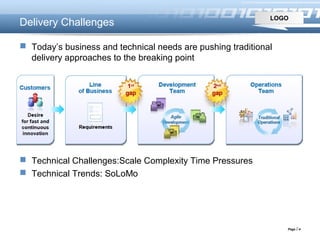
 Today’s business and technical needs are pushing traditional
delivery approaches to the breaking point
 Technical Challenges:Scale Complexity Time Pressures
 Technical Trends: SoLoMo
LOGO
Page  5
Reduce Delivery Gaps
 Design and Deployment Planning
 Integrate and automate deployment planning processes across
development & operations
 Ensure asset & configuration details are shared and synchronized
across asset stores.
 Environment Setup, Testing,Deployment and Monitoring
 Leverage integrated tools for discovery & accelerating provisioning of
test lab & production environments.
 Improving test performance by replicating “real world” environments -
faster testing & problem resolution
 Issue Identification and Resolution Management
 Resolving problems quicker by sharing problem & ticket information
 Ensuring tracking tools for production problems and application fixes
remain synchronized
LOGO
Page  6
DevOps Typical Stories
 Software Delivery Lifecycle (Integrated Development and Operations Lifecycles)
 Story 0: Dev and Ops collaborate to develop environment definitions
 Value: Ensures that Dev understands and deals with production-like environments; avoids
architectural miscommunications
 Story 1: Dev continuously delivers application changes to a realistic environment for
testing
 Value: Shared technology ensures testable environments and script reuse for repeatable
delivery; Test org always has known good builds,properly deployed.
 Story 2: Release Applications from Test /Staging to production
 Value: Shared technology and automation ensures no gratuitous differences between
dev/test and prod.
 Story 3: Collaborative incident management
 Value: ensures an integrated process for reproducing and resolving defects and issues
between dev, test,and ops.
 Story 4: Dev and Ops use the same analysis and instrumentation in dev, test,
 and ops
 Value: Ensures a common understanding of quality and performance (and no fingerpointing)
 Story 5: Manage the entire delivery pipeline with end-to-end visibility and dashboards
 Value: Enables end-to-end delivery metrics and visibility into bottlenecks.
LOGO
Page  7
What is DevOps?
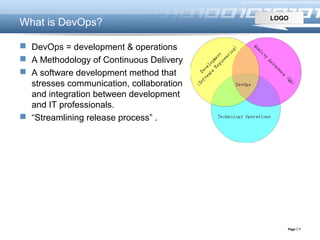
 DevOps = development & operations
 A Methodology of Continuous Delivery
 A software development method that
stresses communication, collaboration
and integration between development
and IT professionals.
 “Streamlining release process” .
LOGO
Page  8
The adoption of DevOps is being driven by factors:
 Use of agile and other development processes and methodologies
 Demand for an increased rate of production releases from
application and business unit stakeholders
 Wide availability of virtualized and cloud infrastructure from internal
and external providers
 Increased usage of data center automation and configuration
management tools
LOGO
Page  9
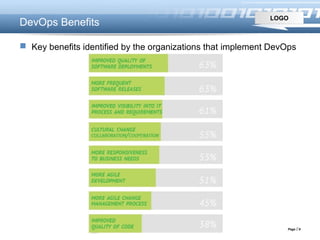
DevOps Benefits
 Key benefits identified by the organizations that implement DevOps
LOGO
Page  10
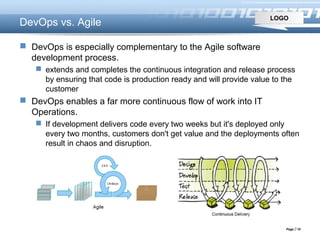
DevOps vs. Agile
 DevOps is especially complementary to the Agile software
development process.
 extends and completes the continuous integration and release process
by ensuring that code is production ready and will provide value to the
customer
 DevOps enables a far more continuous flow of work into IT
Operations.
 If development delivers code every two weeks but it's deployed only
every two months, customers don't get value and the deployments often
result in chaos and disruption.
LOGO
Page  11
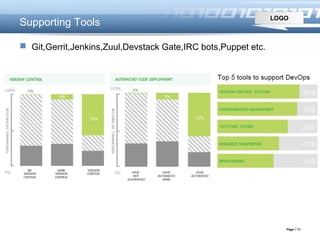
Supporting Tools
 Git,Gerrit,Jenkins,Zuul,Devstack Gate,IRC bots,Puppet etc.
LOGO
Page  12
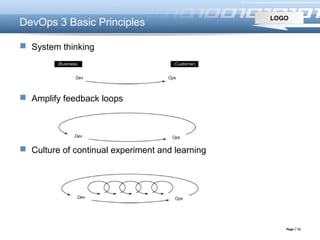
DevOps 3 Basic Principles
 System thinking
 Amplify feedback loops
 Culture of continual experiment and learning
LOGO
Page  13
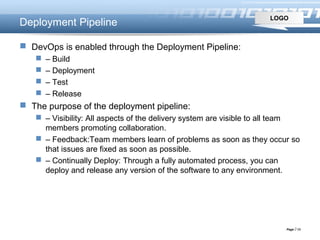
Deployment Pipeline
 DevOps is enabled through the Deployment Pipeline:
 – Build
 – Deployment
 – Test
 – Release
 The purpose of the deployment pipeline:
 – Visibility: All aspects of the delivery system are visible to all team
members promoting collaboration.
 – Feedback:Team members learn of problems as soon as they occur so
that issues are fixed as soon as possible.
 – Continually Deploy: Through a fully automated process, you can
deploy and release any version of the software to any environment.
LOGO
Page  14
DevOps Patterns
 TODO
LOGO
Page  15
How to Start Adopting DevOps?
 Start Small: Start from experiments implementing small
enhancements.
 Create Champions: Get executive sponsors; Give credit to people.
 Build Confidence: Identify KPIs to support the changes.
 Celebrate Success.
LOGO
Page  16
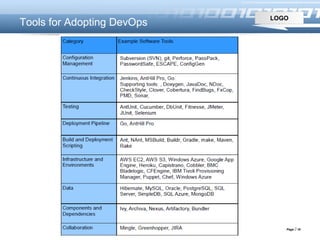
Tools for Adopting DevOps
LOGO
Page  17
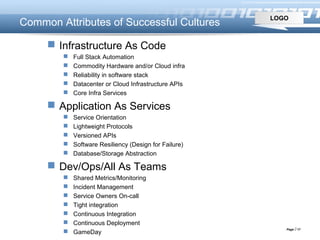
Common Attributes of Successful Cultures
 Infrastructure As Code
 Full Stack Automation
 Commodity Hardware and/or Cloud infra
 Reliability in software stack
 Datacenter or Cloud Infrastructure APIs
 Core Infra Services
 Application As Services
 Service Orientation
 Lightweight Protocols
 Versioned APIs
 Software Resiliency (Design for Failure)
 Database/Storage Abstraction
 Dev/Ops/All As Teams
 Shared Metrics/Monitoring
 Incident Management
 Service Owners On-call
 Tight integration
 Continuous Integration
 Continuous Deployment
 GameDay
LOGO
Page  18
Acknowledgement
 Jun Guan,IBM China
 John Allspaw & Paul Hammond,Flickr.com
 Puppet labs
 OpenStack Project
 etc.

Dev ops intro

  • 1.
    LOGO Introduction to DevOps 中科大移云 算系 室动 计 统实验 孟宁
  • 2.
    LOGO Page  2 Agenda Introduce DevOps  DevOp Patterns  How to Start Adopting DevOps
  • 3.
    LOGO Page  3 Howthe DevOps Movement Took Place  The origins of the DevOps movement took place around 2009:  “10+ Deploys Per Day: Dev and Ops Cooperation at Flickr” presentation.  “Infrastructure as code".  The Lean Startup.  Continuous Integration.  Cloud and Platform as a Service (PaaS) technologies.
  • 4.
    LOGO Page  4 DeliveryChallenges  Today’s business and technical needs are pushing traditional delivery approaches to the breaking point  Technical Challenges:Scale Complexity Time Pressures  Technical Trends: SoLoMo
  • 5.
    LOGO Page  5 ReduceDelivery Gaps  Design and Deployment Planning  Integrate and automate deployment planning processes across development & operations  Ensure asset & configuration details are shared and synchronized across asset stores.  Environment Setup, Testing,Deployment and Monitoring  Leverage integrated tools for discovery & accelerating provisioning of test lab & production environments.  Improving test performance by replicating “real world” environments - faster testing & problem resolution  Issue Identification and Resolution Management  Resolving problems quicker by sharing problem & ticket information  Ensuring tracking tools for production problems and application fixes remain synchronized
  • 6.
    LOGO Page  6 DevOpsTypical Stories  Software Delivery Lifecycle (Integrated Development and Operations Lifecycles)  Story 0: Dev and Ops collaborate to develop environment definitions  Value: Ensures that Dev understands and deals with production-like environments; avoids architectural miscommunications  Story 1: Dev continuously delivers application changes to a realistic environment for testing  Value: Shared technology ensures testable environments and script reuse for repeatable delivery; Test org always has known good builds,properly deployed.  Story 2: Release Applications from Test /Staging to production  Value: Shared technology and automation ensures no gratuitous differences between dev/test and prod.  Story 3: Collaborative incident management  Value: ensures an integrated process for reproducing and resolving defects and issues between dev, test,and ops.  Story 4: Dev and Ops use the same analysis and instrumentation in dev, test,  and ops  Value: Ensures a common understanding of quality and performance (and no fingerpointing)  Story 5: Manage the entire delivery pipeline with end-to-end visibility and dashboards  Value: Enables end-to-end delivery metrics and visibility into bottlenecks.
  • 7.
    LOGO Page  7 Whatis DevOps?  DevOps = development & operations  A Methodology of Continuous Delivery  A software development method that stresses communication, collaboration and integration between development and IT professionals.  “Streamlining release process” .
  • 8.
    LOGO Page  8 Theadoption of DevOps is being driven by factors:  Use of agile and other development processes and methodologies  Demand for an increased rate of production releases from application and business unit stakeholders  Wide availability of virtualized and cloud infrastructure from internal and external providers  Increased usage of data center automation and configuration management tools
  • 9.
    LOGO Page  9 DevOpsBenefits  Key benefits identified by the organizations that implement DevOps
  • 10.
    LOGO Page  10 DevOpsvs. Agile  DevOps is especially complementary to the Agile software development process.  extends and completes the continuous integration and release process by ensuring that code is production ready and will provide value to the customer  DevOps enables a far more continuous flow of work into IT Operations.  If development delivers code every two weeks but it's deployed only every two months, customers don't get value and the deployments often result in chaos and disruption.
  • 11.
    LOGO Page  11 SupportingTools  Git,Gerrit,Jenkins,Zuul,Devstack Gate,IRC bots,Puppet etc.
  • 12.
    LOGO Page  12 DevOps3 Basic Principles  System thinking  Amplify feedback loops  Culture of continual experiment and learning
  • 13.
    LOGO Page  13 DeploymentPipeline  DevOps is enabled through the Deployment Pipeline:  – Build  – Deployment  – Test  – Release  The purpose of the deployment pipeline:  – Visibility: All aspects of the delivery system are visible to all team members promoting collaboration.  – Feedback:Team members learn of problems as soon as they occur so that issues are fixed as soon as possible.  – Continually Deploy: Through a fully automated process, you can deploy and release any version of the software to any environment.
  • 14.
    LOGO Page  14 DevOpsPatterns  TODO
  • 15.
    LOGO Page  15 Howto Start Adopting DevOps?  Start Small: Start from experiments implementing small enhancements.  Create Champions: Get executive sponsors; Give credit to people.  Build Confidence: Identify KPIs to support the changes.  Celebrate Success.
  • 16.
    LOGO Page  16 Toolsfor Adopting DevOps
  • 17.
    LOGO Page  17 CommonAttributes of Successful Cultures  Infrastructure As Code  Full Stack Automation  Commodity Hardware and/or Cloud infra  Reliability in software stack  Datacenter or Cloud Infrastructure APIs  Core Infra Services  Application As Services  Service Orientation  Lightweight Protocols  Versioned APIs  Software Resiliency (Design for Failure)  Database/Storage Abstraction  Dev/Ops/All As Teams  Shared Metrics/Monitoring  Incident Management  Service Owners On-call  Tight integration  Continuous Integration  Continuous Deployment  GameDay
  • 18.
    LOGO Page  18 Acknowledgement Jun Guan,IBM China  John Allspaw & Paul Hammond,Flickr.com  Puppet labs  OpenStack Project  etc.