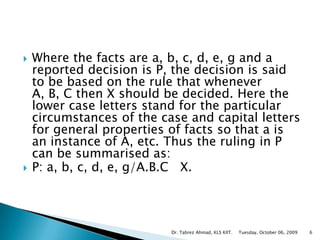

The document discusses different approaches to determining the ratio decidendi, or binding legal principle, of a case with multiple judgments. It analyzes the Indian Supreme Court case Golak Nath v. State of Punjab, which had five separate judgments. Three approaches are examined: 1) identifying the propositions necessary for the decision, 2) counting the number of judges supporting each proposition, and 3) using the reasons of the majority of the majority. The document concludes that the third approach limits the ratio of Golak Nath to the single majority judgment delivered by the Chief Justice, with one other Justice concurring.


