JEE Main 2015 question paper detailed analysis
OVERALL PAPER:
1.Overview (general theme setting and touching upon briefly on all points). We can have a
JEE 2014 vs 2015 approach
2.Class XI and XII break-up of syllabus
3.Difficulty level analysis - by section and overall
o Question-wise difficulty level break-up
o Section-wise difficulty level break-up
o Questions that should've been attempted first
o Questions that should've been avoided in first go
4.Time management analysis - by section and overall
o Question-wise time spent break-up
o Section-wise time spent break-up
o Questions that should've been attempted first
o Questions that should've been avoided in first go
5.Special Insights and Tricks that could've been used
o 2 questions that were wrong, why?
o Speed tips that could've saved time
o Trick questions?
 Seemingly difficult but easy questions
 Seemingly easy but difficult questions
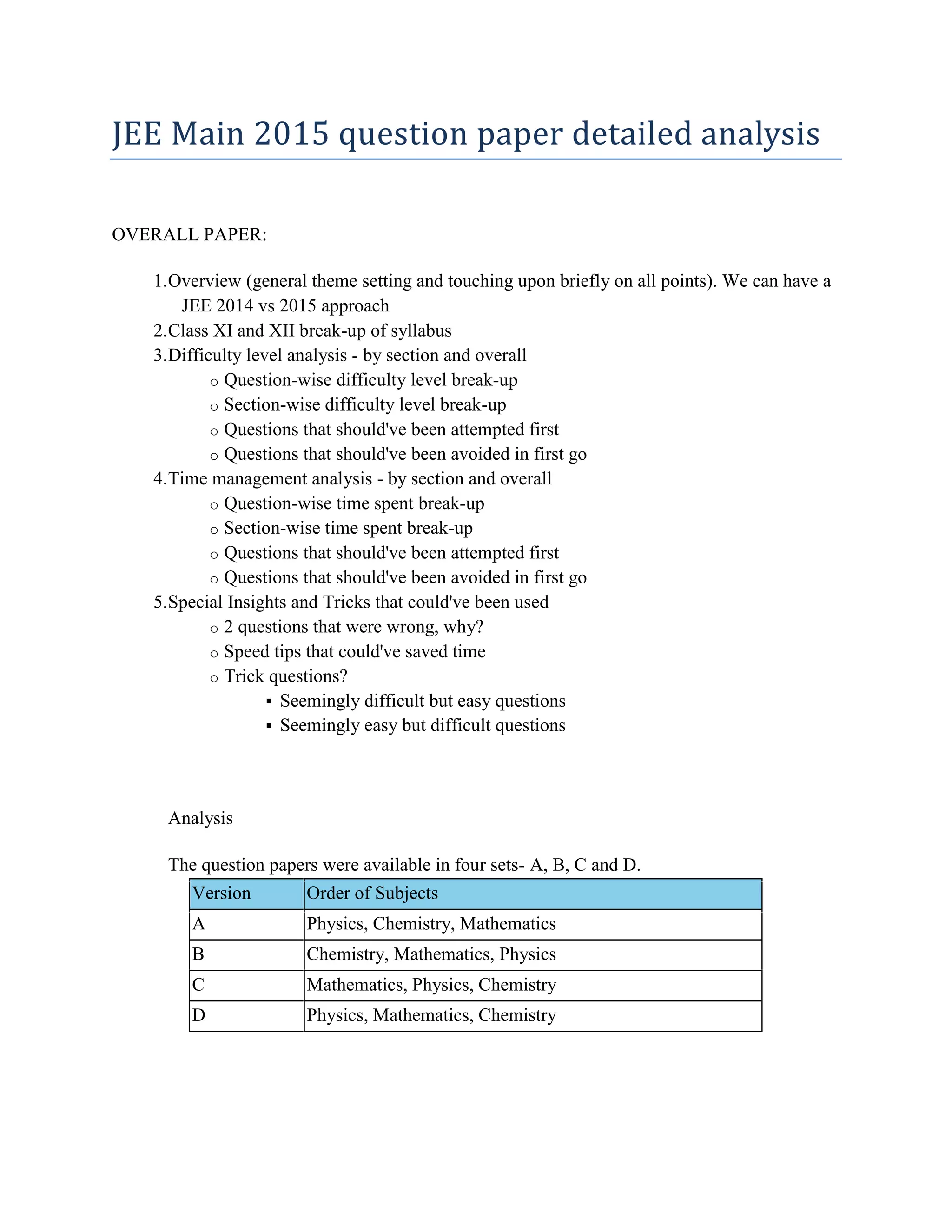
Analysis
The question papers were available in four sets- A, B, C and D.
Version Order of Subjects
A Physics, Chemistry, Mathematics
B Chemistry, Mathematics, Physics
C Mathematics, Physics, Chemistry
D Physics, Mathematics, Chemistry
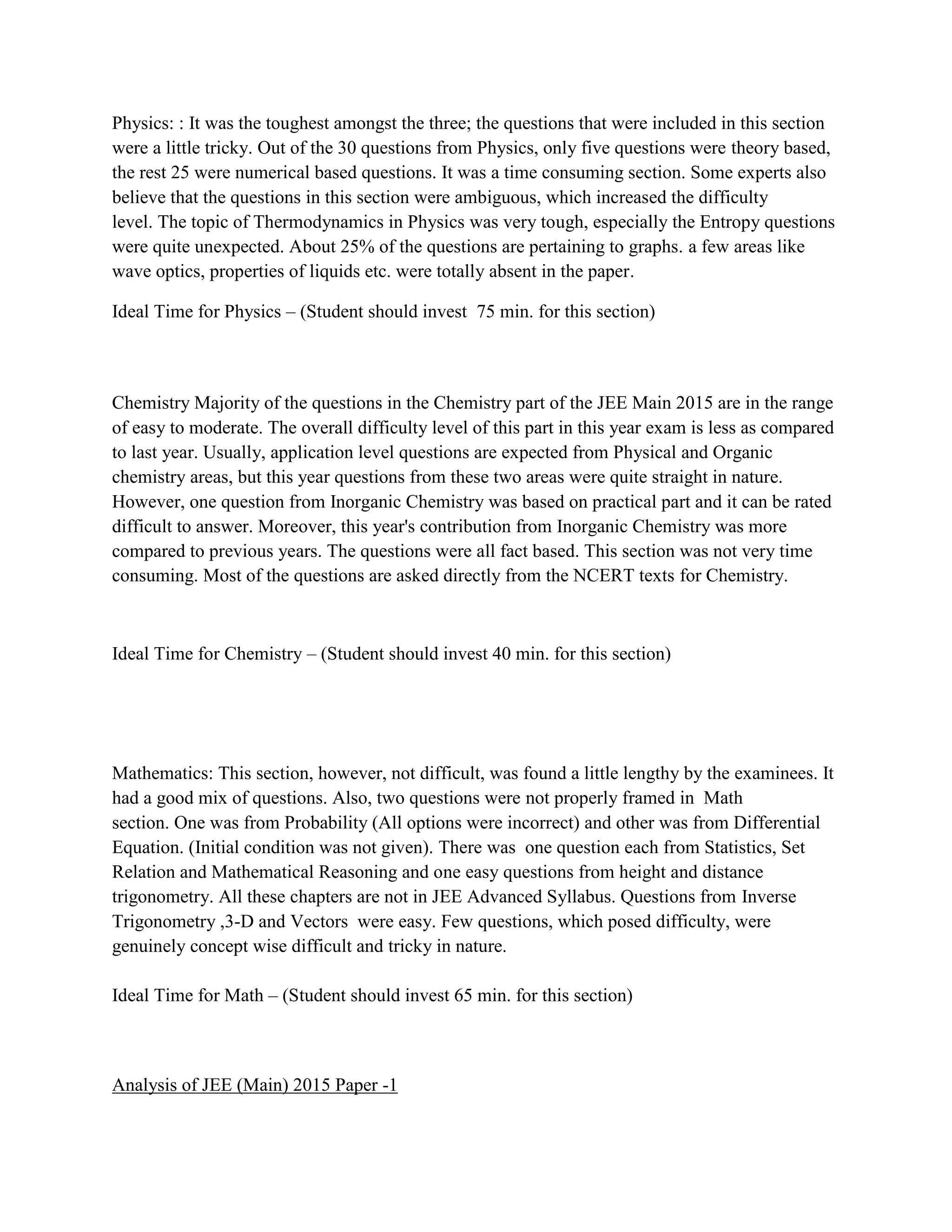
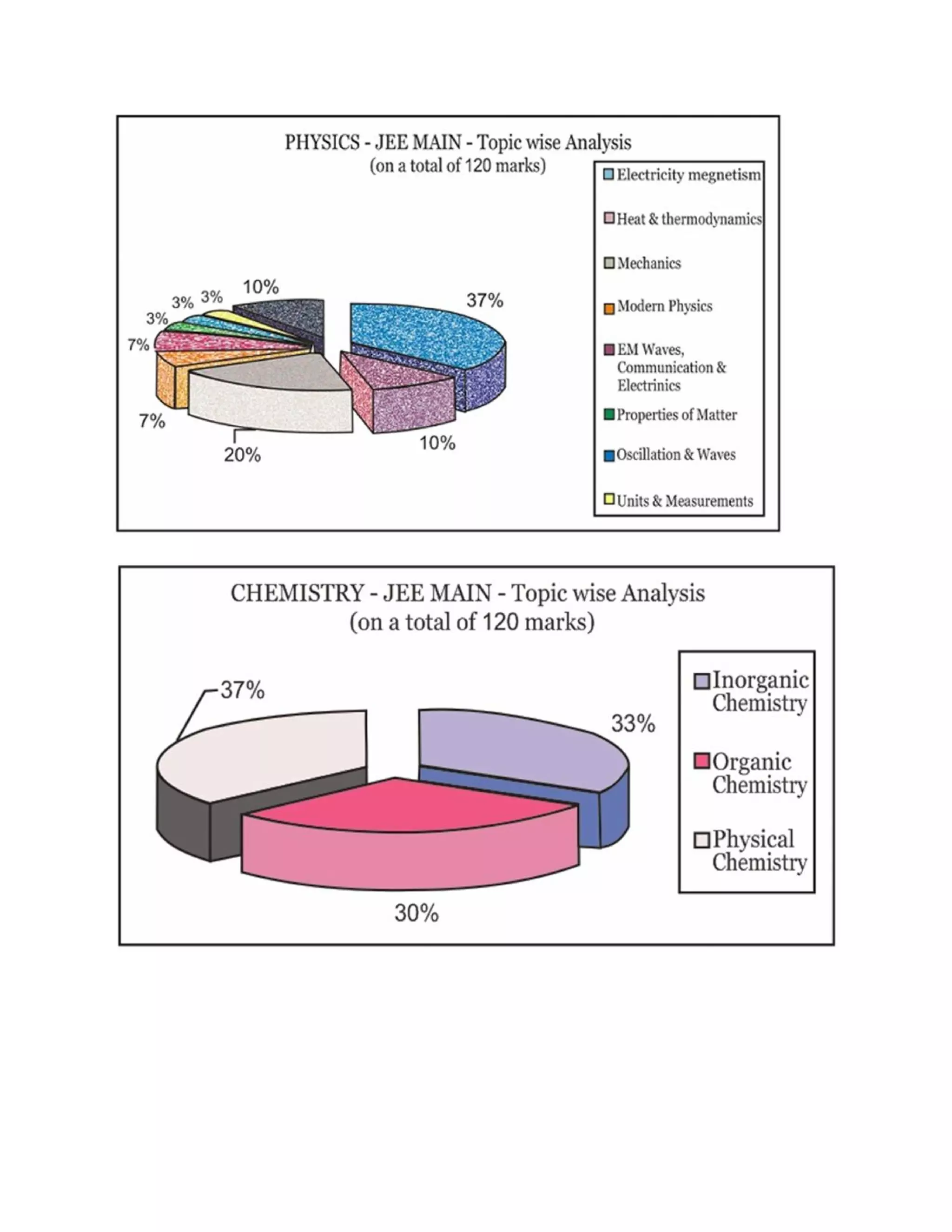
Physics: : It was the toughest amongst the three; the questions that were included in this section
were a little tricky. Out of the 30 questions from Physics, only five questions were theory based,
the rest 25 were numerical based questions. It was a time consuming section. Some experts also
believe that the questions in this section were ambiguous, which increased the difficulty
level. The topic of Thermodynamics in Physics was very tough, especially the Entropy questions
were quite unexpected. About 25% of the questions are pertaining to graphs. a few areas like
wave optics, properties of liquids etc. were totally absent in the paper.
Ideal Time for Physics – (Student should invest 75 min. for this section)
Chemistry Majority of the questions in the Chemistry part of the JEE Main 2015 are in the range
of easy to moderate. The overall difficulty level of this part in this year exam is less as compared
to last year. Usually, application level questions are expected from Physical and Organic
chemistry areas, but this year questions from these two areas were quite straight in nature.
However, one question from Inorganic Chemistry was based on practical part and it can be rated
difficult to answer. Moreover, this year's contribution from Inorganic Chemistry was more
compared to previous years. The questions were all fact based. This section was not very time
consuming. Most of the questions are asked directly from the NCERT texts for Chemistry.
Ideal Time for Chemistry – (Student should invest 40 min. for this section)
Mathematics: This section, however, not difficult, was found a little lengthy by the examinees. It
had a good mix of questions. Also, two questions were not properly framed in Math
section. One was from Probability (All options were incorrect) and other was from Differential
Equation. (Initial condition was not given). There was one question each from Statistics, Set
Relation and Mathematical Reasoning and one easy questions from height and distance
trigonometry. All these chapters are not in JEE Advanced Syllabus. Questions from Inverse
Trigonometry ,3-D and Vectors were easy. Few questions, which posed difficulty, were
genuinely concept wise difficult and tricky in nature.
Ideal Time for Math – (Student should invest 65 min. for this section)
Analysis of JEE (Main) 2015 Paper -1
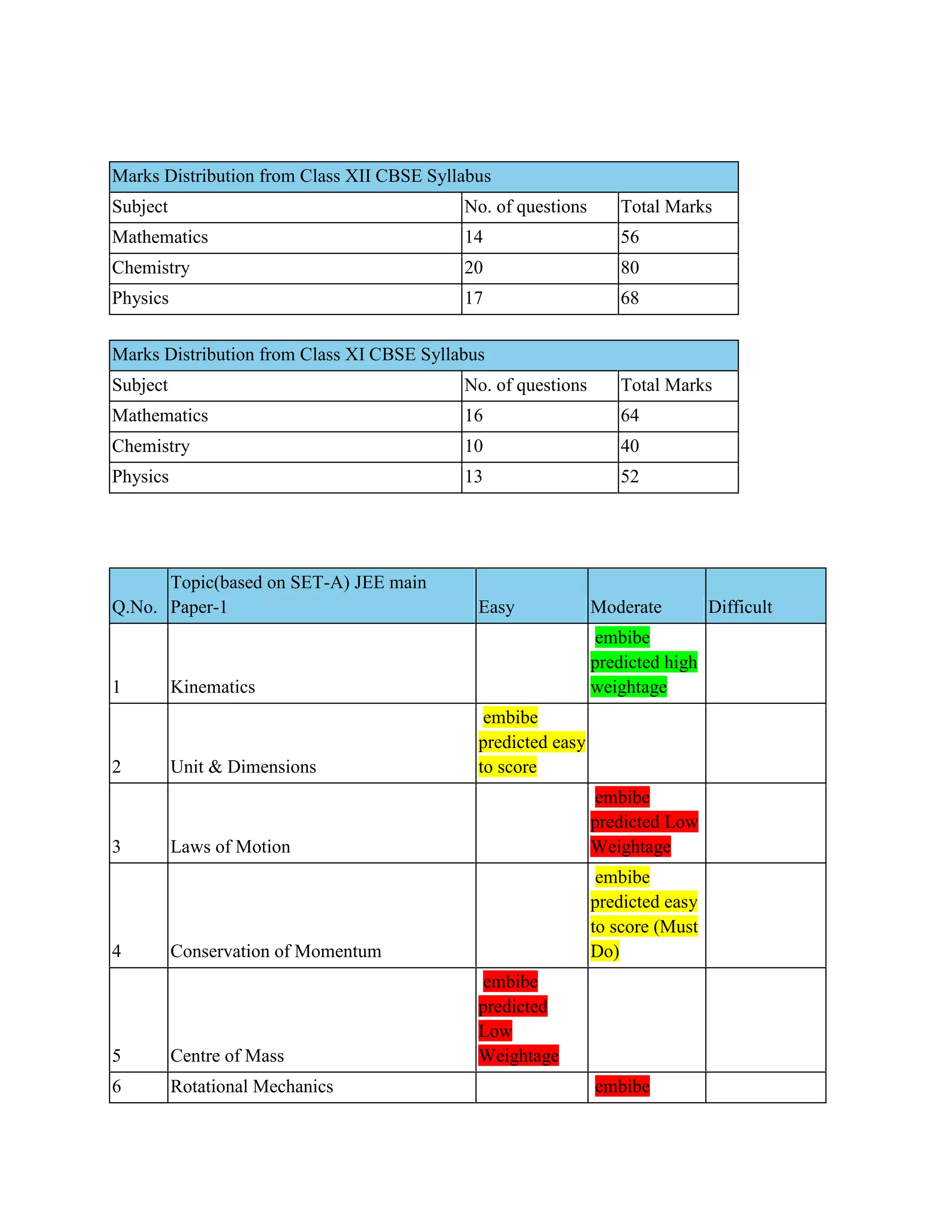
Marks Distribution from Class XII CBSE Syllabus
Subject No. of questions Total Marks
Mathematics 14 56
Chemistry 20 80
Physics 17 68
Marks Distribution from Class XI CBSE Syllabus
Subject No. of questions Total Marks
Mathematics 16 64
Chemistry 10 40
Physics 13 52
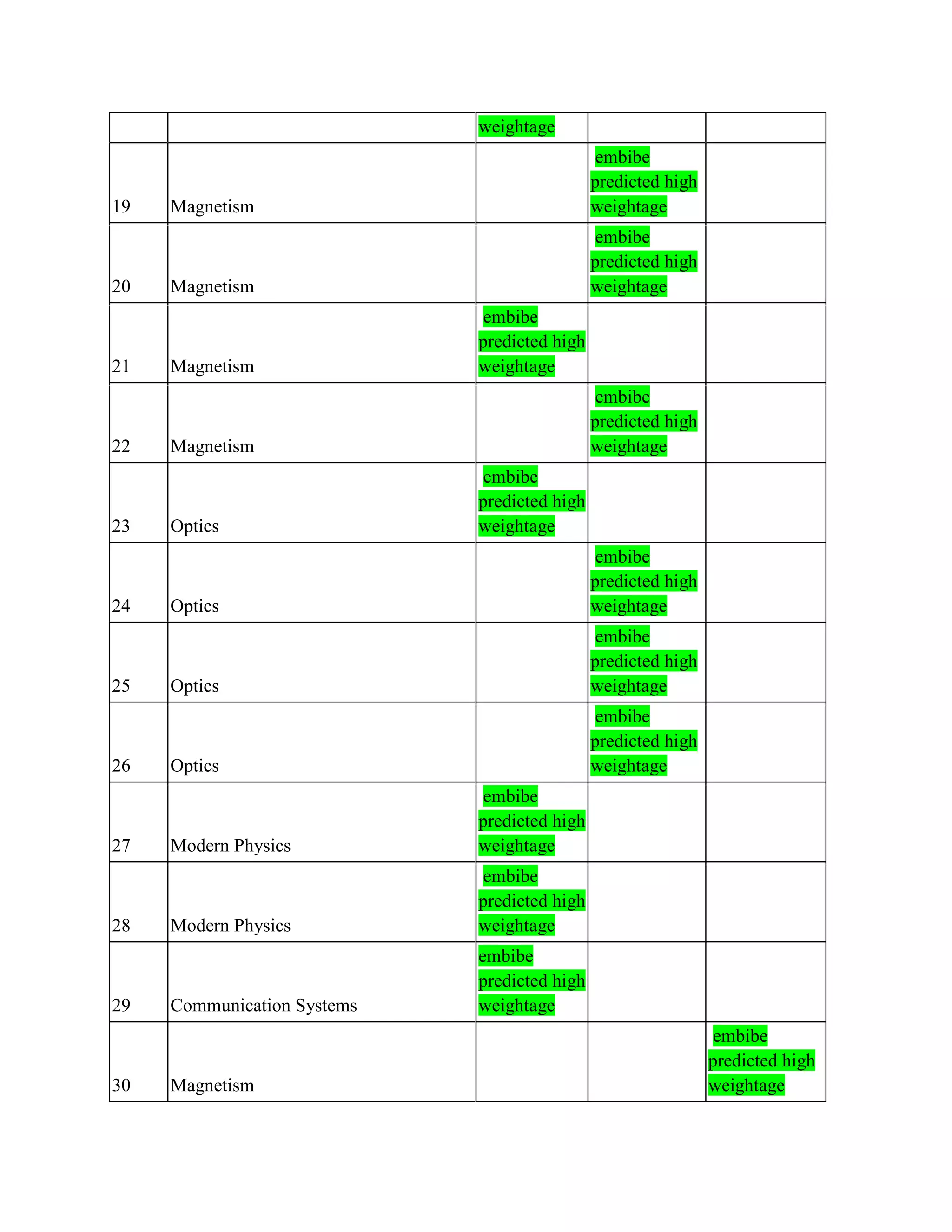
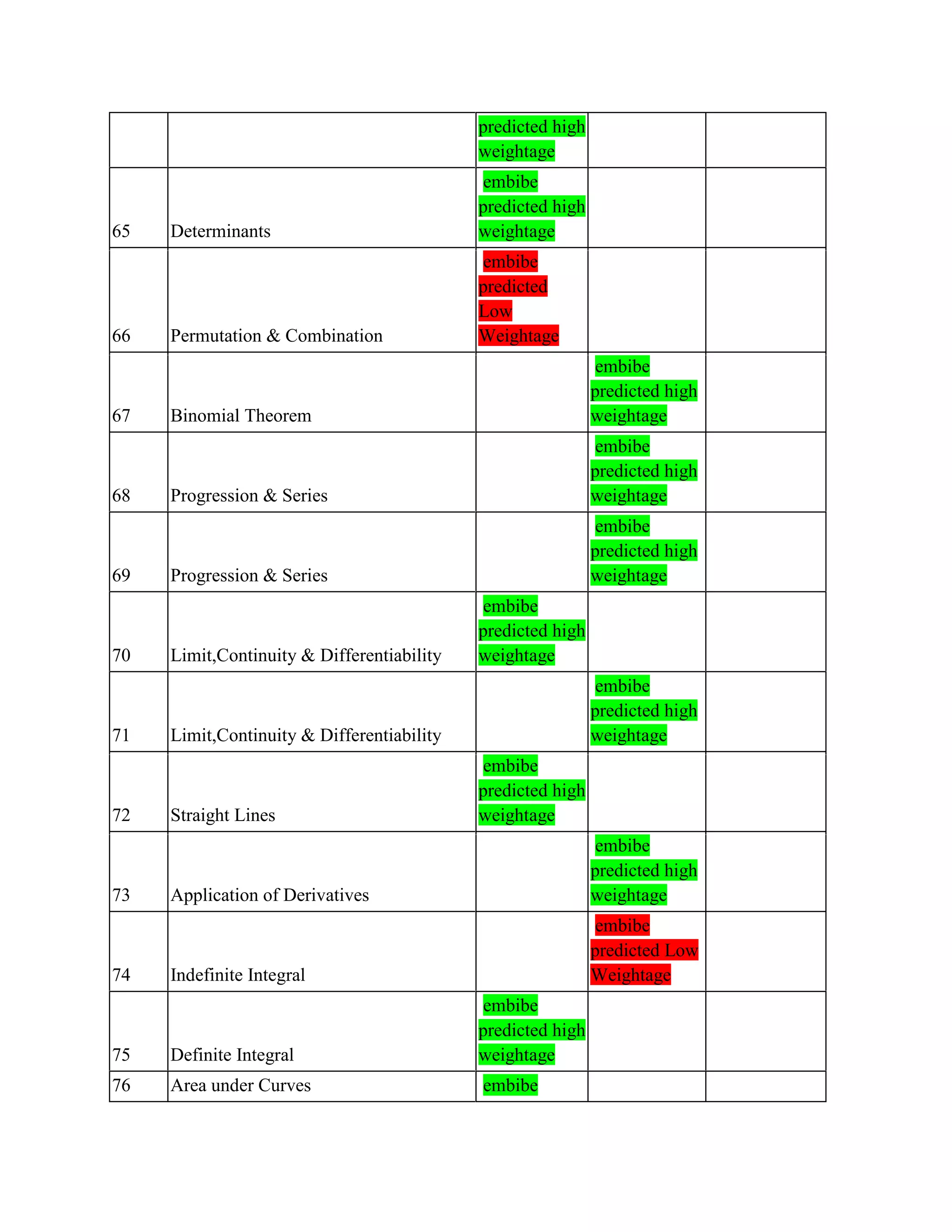
Q.No.
Topic(based on SET-A) JEE main
Paper-1 Easy Moderate Difficult
1 Kinematics
embibe
predicted high
weightage
2 Unit & Dimensions
embibe
predicted easy
to score
3 Laws of Motion
embibe
predicted Low
Weightage
4 Conservation of Momentum
embibe
predicted easy
to score (Must
Do)
5 Centre of Mass
embibe
predicted
Low
Weightage
6 Rotational Mechanics embibe
predicted Low
Weightage
7 Gravitation
embibe
predicted high
weightage
8 Simple Harmonic Motion
embibe
predicted high
weightage
9 Heat &Thermodynamics
embibe
predicted high
weightage
10 Heat &Thermodynamics
embibe
predicted high
weightage
11 Heat &Thermodynamics
embibe
predicted high
weightage
12 Simple Harmonic Motion
embibe
predicted high
weightage
13 Wave & Sound
embibe
predicted high
weightage
14 Electrostatics
embibe
predicted high
weightage
15 Electrostatics
embibe
predicted high
weightage
16 Electrostatics
embibe
predicted high
weightage
17 Electrostatics
embibe
predicted high
weightage
18 Electrostatics
embibe
predicted high
weightage
19 Magnetism
embibe
predicted high
weightage
20 Magnetism
embibe
predicted high
weightage
21 Magnetism
embibe
predicted high
weightage
22 Magnetism
embibe
predicted high
weightage
23 Optics
embibe
predicted high
weightage
24 Optics
embibe
predicted high
weightage
25 Optics
embibe
predicted high
weightage
26 Optics
embibe
predicted high
weightage
27 Modern Physics
embibe
predicted high
weightage
28 Modern Physics
embibe
predicted high
weightage
29 Communication Systems
embibe
predicted high
weightage
30 Magnetism
embibe
predicted high
weightage
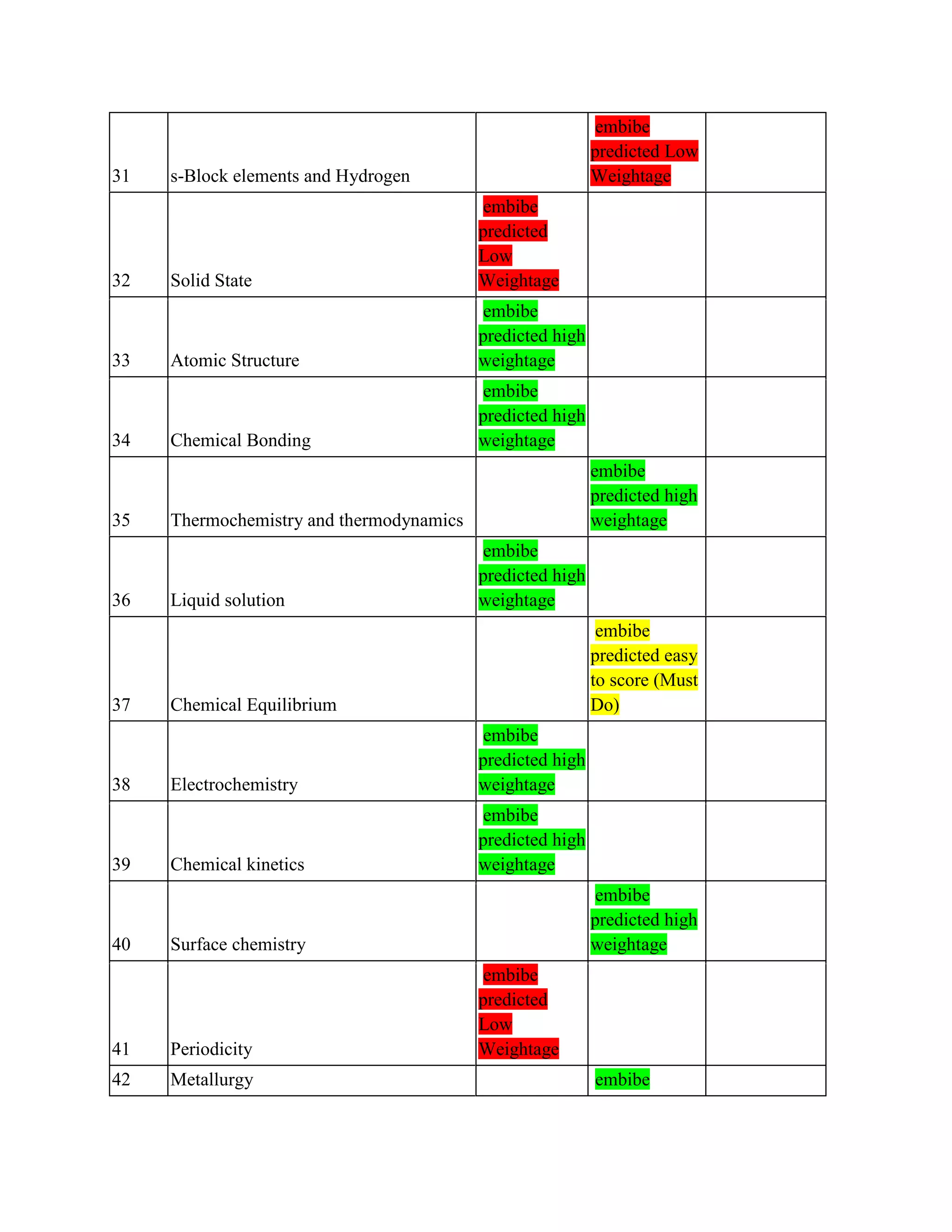
31 s-Block elements and Hydrogen
embibe
predicted Low
Weightage
32 Solid State
embibe
predicted
Low
Weightage
33 Atomic Structure
embibe
predicted high
weightage
34 Chemical Bonding
embibe
predicted high
weightage
35 Thermochemistry and thermodynamics
embibe
predicted high
weightage
36 Liquid solution
embibe
predicted high
weightage
37 Chemical Equilibrium
embibe
predicted easy
to score (Must
Do)
38 Electrochemistry
embibe
predicted high
weightage
39 Chemical kinetics
embibe
predicted high
weightage
40 Surface chemistry
embibe
predicted high
weightage
41 Periodicity
embibe
predicted
Low
Weightage
42 Metallurgy embibe
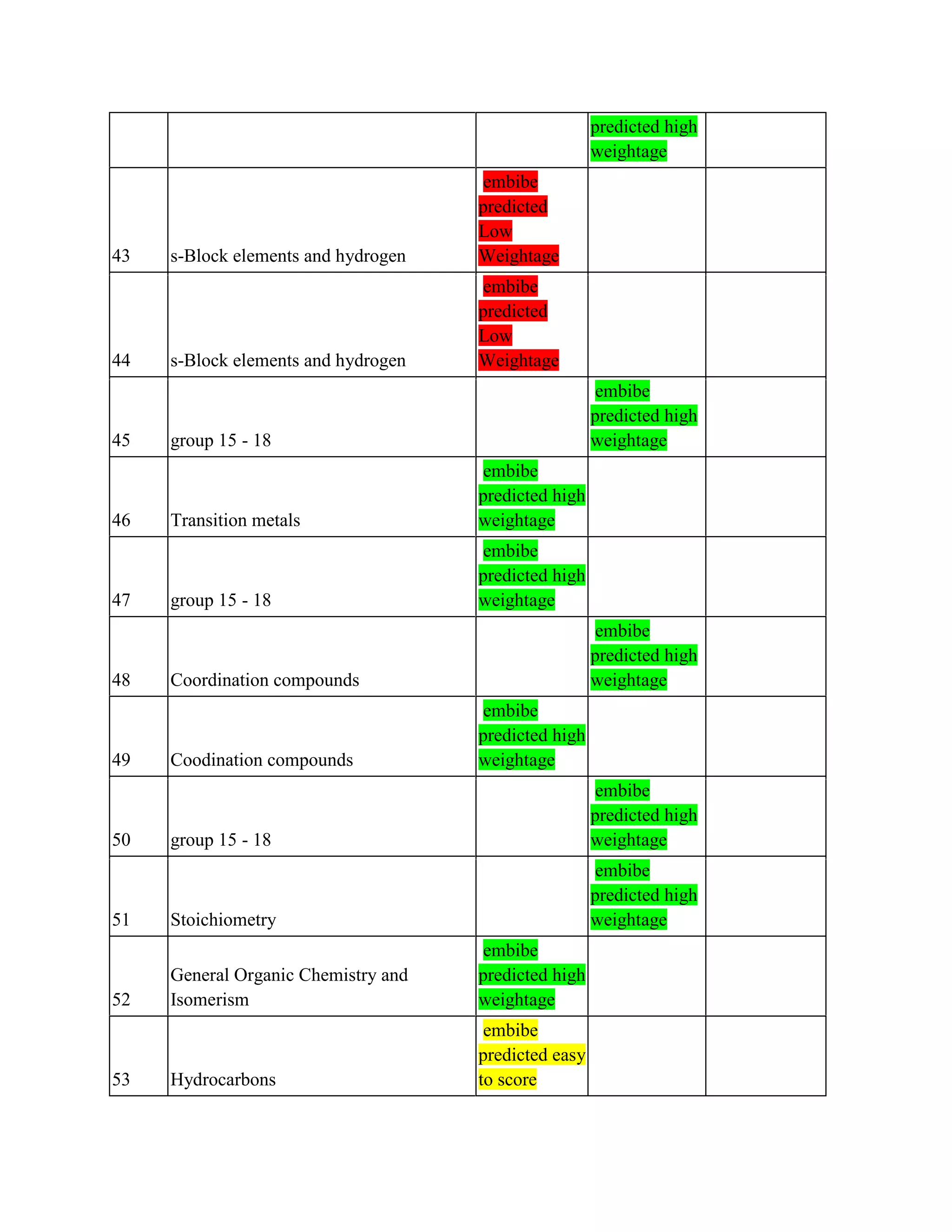
predicted high
weightage
43 s-Block elements and hydrogen
embibe
predicted
Low
Weightage
44 s-Block elements and hydrogen
embibe
predicted
Low
Weightage
45 group 15 - 18
embibe
predicted high
weightage
46 Transition metals
embibe
predicted high
weightage
47 group 15 - 18
embibe
predicted high
weightage
48 Coordination compounds
embibe
predicted high
weightage
49 Coodination compounds
embibe
predicted high
weightage
50 group 15 - 18
embibe
predicted high
weightage
51 Stoichiometry
embibe
predicted high
weightage
52
General Organic Chemistry and
Isomerism
embibe
predicted high
weightage
53 Hydrocarbons
embibe
predicted easy
to score
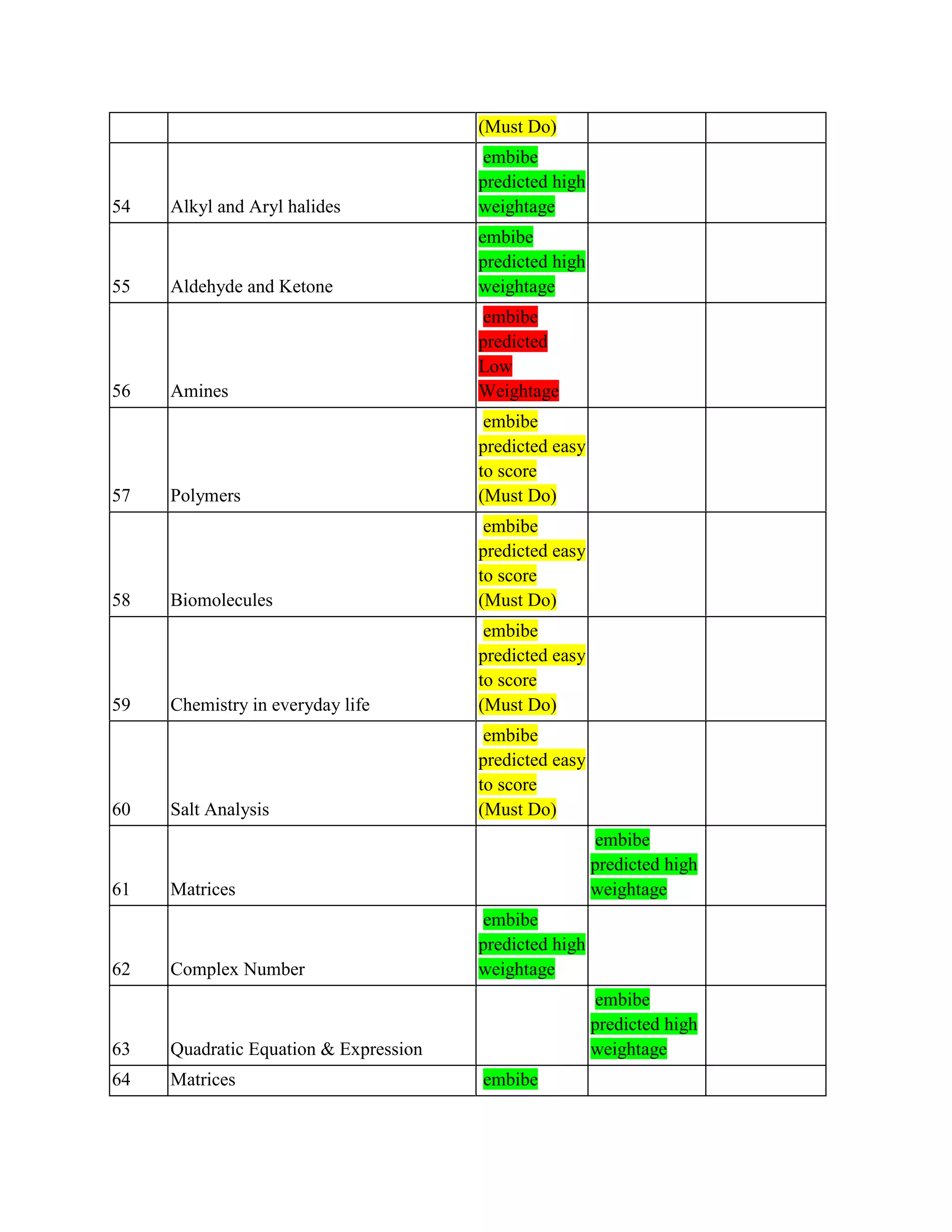
(Must Do)
54 Alkyl and Aryl halides
embibe
predicted high
weightage
55 Aldehyde and Ketone
embibe
predicted high
weightage
56 Amines
embibe
predicted
Low
Weightage
57 Polymers
embibe
predicted easy
to score
(Must Do)
58 Biomolecules
embibe
predicted easy
to score
(Must Do)
59 Chemistry in everyday life
embibe
predicted easy
to score
(Must Do)
60 Salt Analysis
embibe
predicted easy
to score
(Must Do)
61 Matrices
embibe
predicted high
weightage
62 Complex Number
embibe
predicted high
weightage
63 Quadratic Equation & Expression
embibe
predicted high
weightage
64 Matrices embibe
predicted high
weightage
65 Determinants
embibe
predicted high
weightage
66 Permutation & Combination
embibe
predicted
Low
Weightage
67 Binomial Theorem
embibe
predicted high
weightage
68 Progression & Series
embibe
predicted high
weightage
69 Progression & Series
embibe
predicted high
weightage
70 Limit,Continuity & Differentiability
embibe
predicted high
weightage
71 Limit,Continuity & Differentiability
embibe
predicted high
weightage
72 Straight Lines
embibe
predicted high
weightage
73 Application of Derivatives
embibe
predicted high
weightage
74 Indefinite Integral
embibe
predicted Low
Weightage
75 Definite Integral
embibe
predicted high
weightage
76 Area under Curves embibe
predicted high
weightage
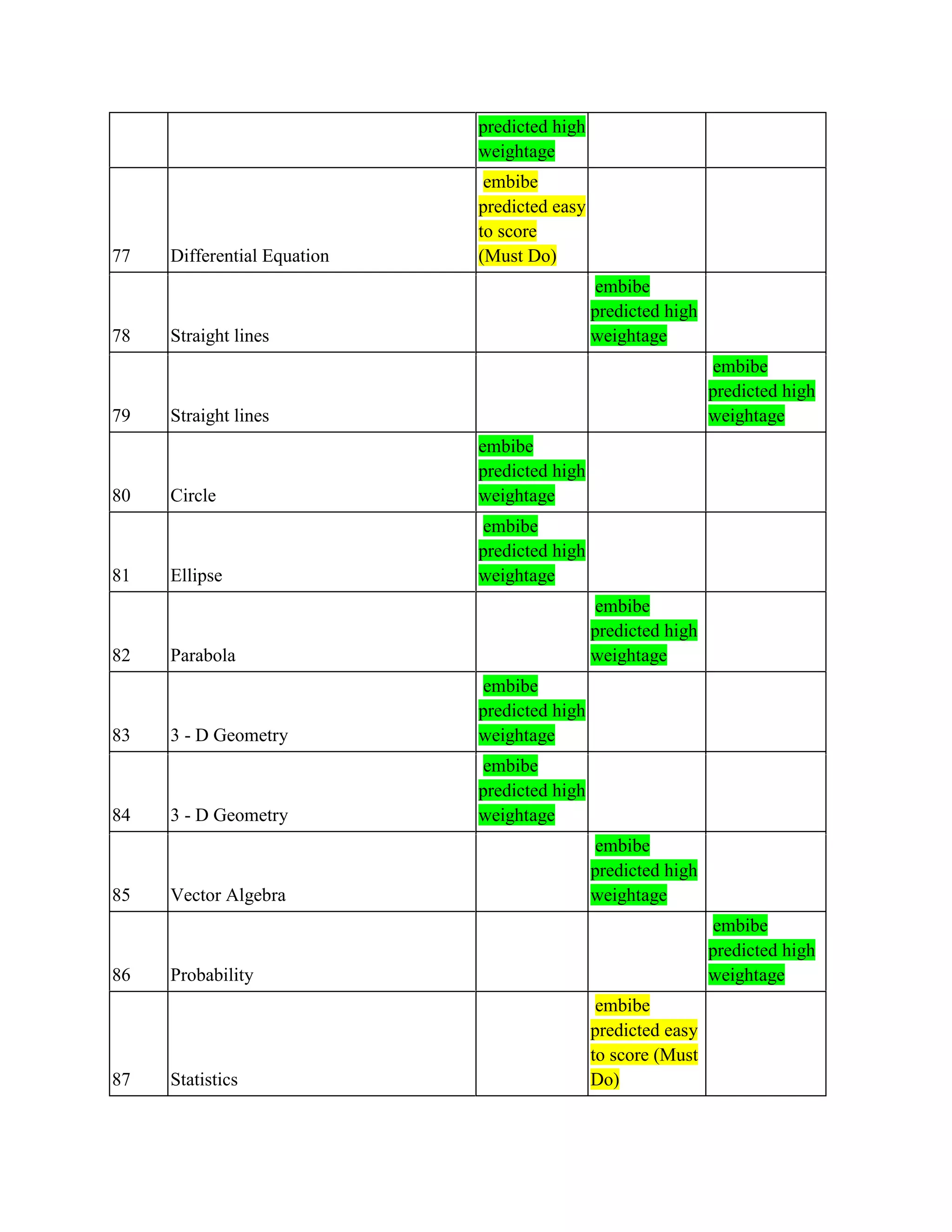
77 Differential Equation
embibe
predicted easy
to score
(Must Do)
78 Straight lines
embibe
predicted high
weightage
79 Straight lines
embibe
predicted high
weightage
80 Circle
embibe
predicted high
weightage
81 Ellipse
embibe
predicted high
weightage
82 Parabola
embibe
predicted high
weightage
83 3 - D Geometry
embibe
predicted high
weightage
84 3 - D Geometry
embibe
predicted high
weightage
85 Vector Algebra
embibe
predicted high
weightage
86 Probability
embibe
predicted high
weightage
87 Statistics
embibe
predicted easy
to score (Must
Do)
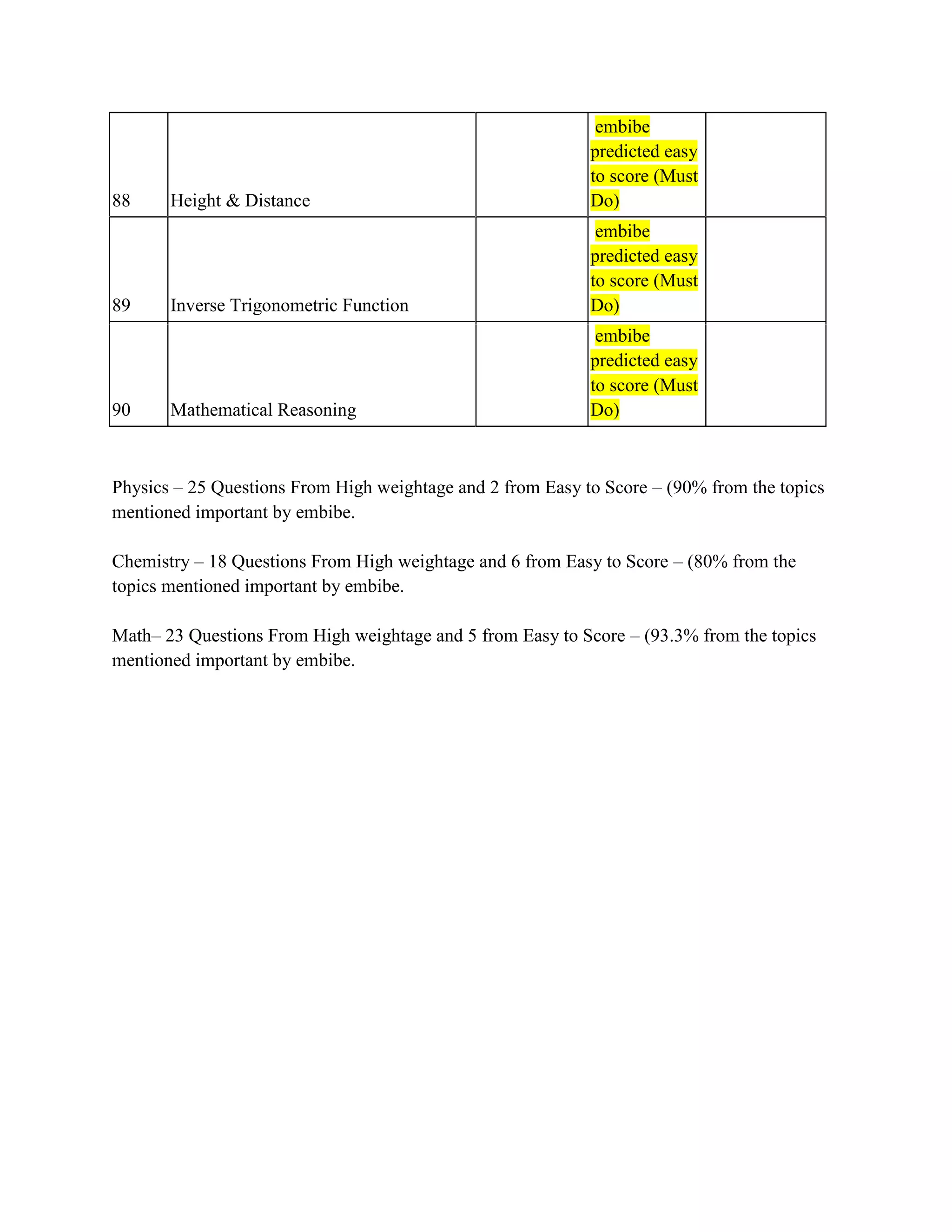
88 Height & Distance
embibe
predicted easy
to score (Must
Do)
89 Inverse Trigonometric Function
embibe
predicted easy
to score (Must
Do)
90 Mathematical Reasoning
embibe
predicted easy
to score (Must
Do)
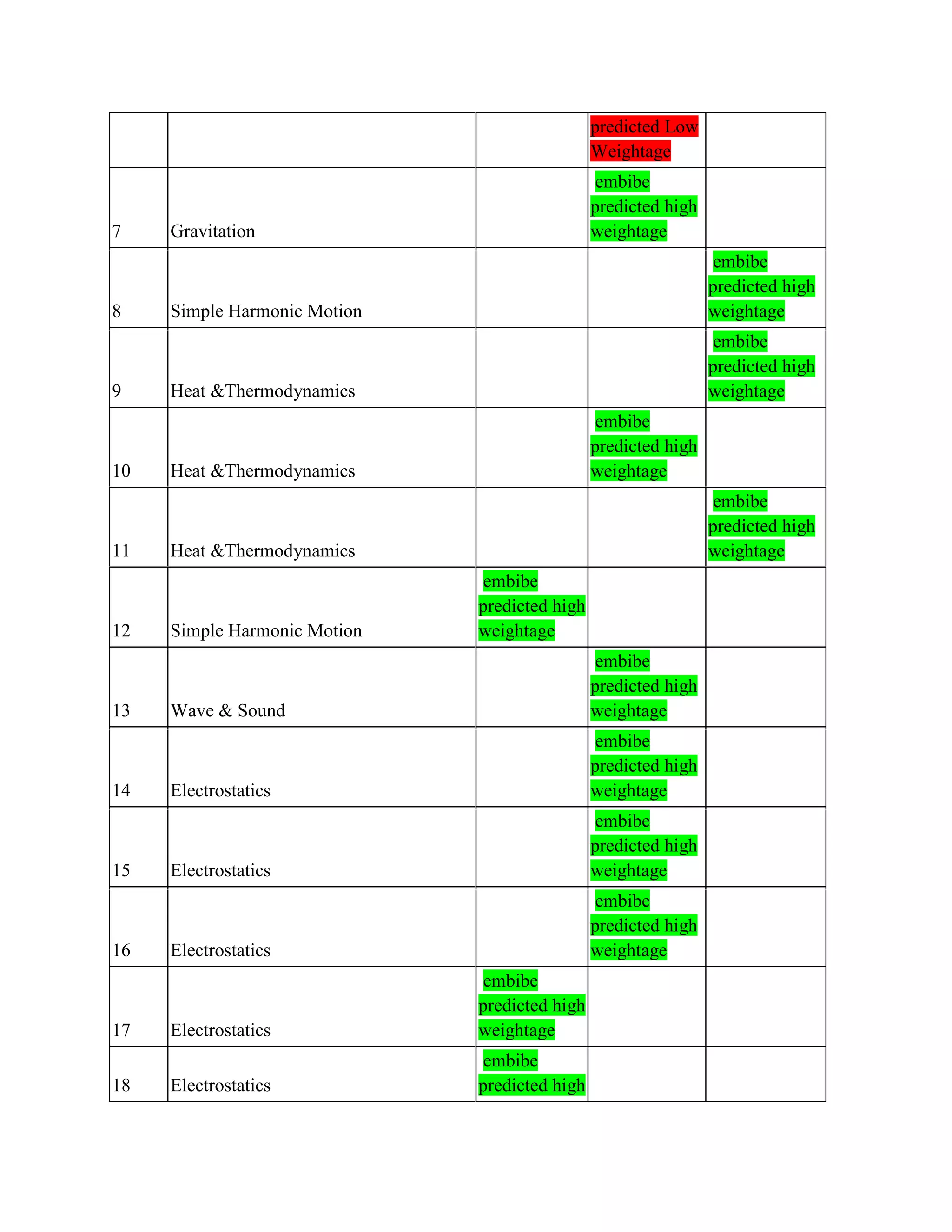
Physics – 25 Questions From High weightage and 2 from Easy to Score – (90% from the topics
mentioned important by embibe.
Chemistry – 18 Questions From High weightage and 6 from Easy to Score – (80% from the
topics mentioned important by embibe.
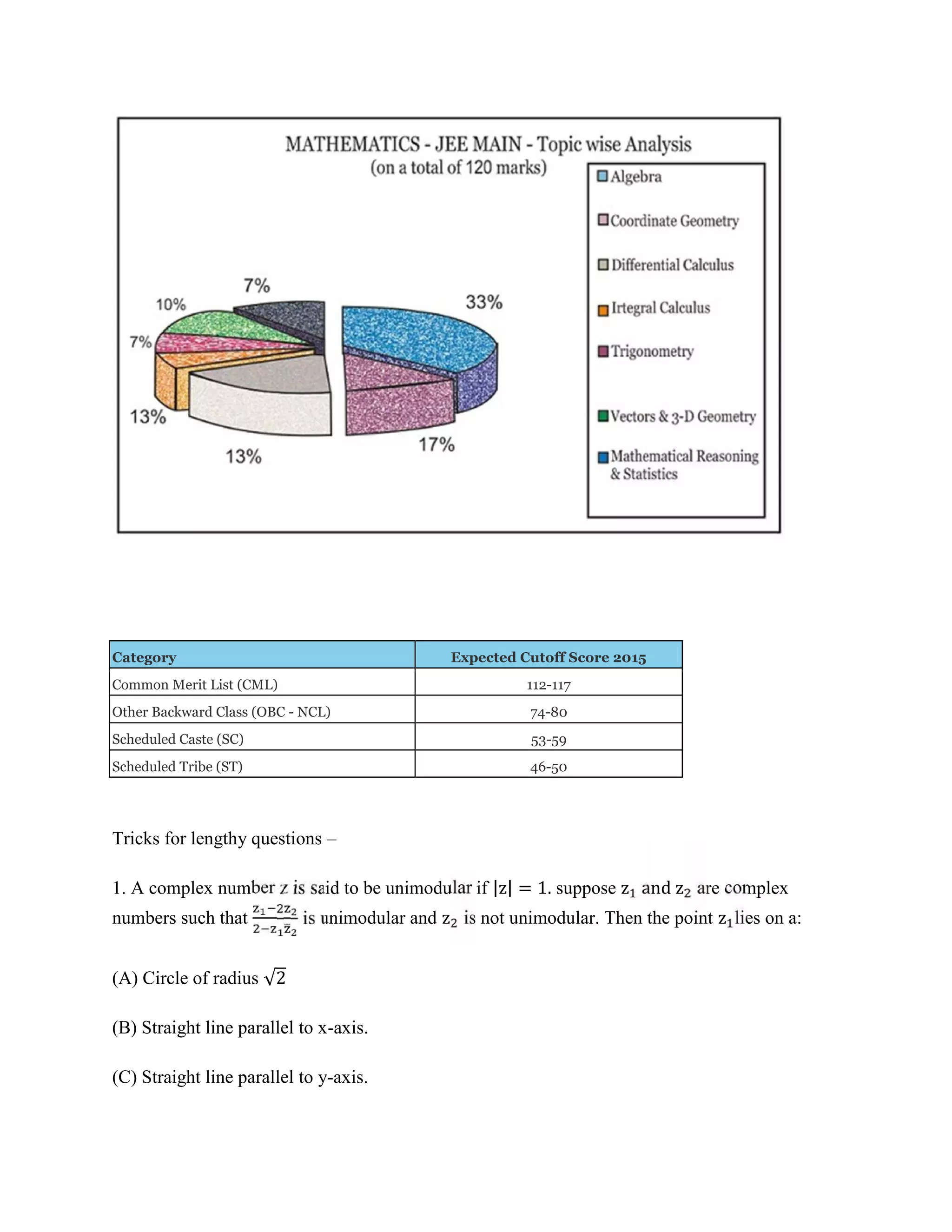
Math– 23 Questions From High weightage and 5 from Easy to Score – (93.3% from the topics
mentioned important by embibe.
Category Expected Cutoff Score 2015
Common Merit List (CML) 112-117
Other Backward Class (OBC - NCL) 74-80
Scheduled Caste (SC) 53-59
Scheduled Tribe (ST) 46-50
Tricks for lengthy questions –
1. A complex number z is said to be unimodular if |z| = 1. suppose z and z are complex
numbers such that is unimodular and z is not unimodular. Then the point z lies on a:
(A) Circle of radius √2
(B) Straight line parallel to x-axis.
(C) Straight line parallel to y-axis.
(D) Circle of radius 2
Answer: (D)
Sol. – Put z = 0, as it is not unimodular, we can assume z = 0, so we will get as unimodular
which will give us |z | = 2. Hence Option (D) is correct.
2. The normal to the curve, x + 2xy − 3y = 0, at (1, 1):
(A) Meets the curve again in the fourth quadrant.
(B) Does not meet the curve again.
(C) Meets the curve again in the second quadrant.
(D) Meets the curve
again in the third quadrant.
Answer: (A)
Its Pair of straight lines passing through origin.
x + 3y = 0 or x − y = 0 so normal at (1,1) will meets the curve again in the
fourth quadrant. (Draw Diagram).
3. The negation of ~s ∨ (~r ∧ s) is equivalent to:
(A) s ∧ r
(B) s ∧∼ r
(C) s ∧ (r ∧ ∼ s)
(D) s ∨ (r ∨ ∼ s)
Answer: (A)
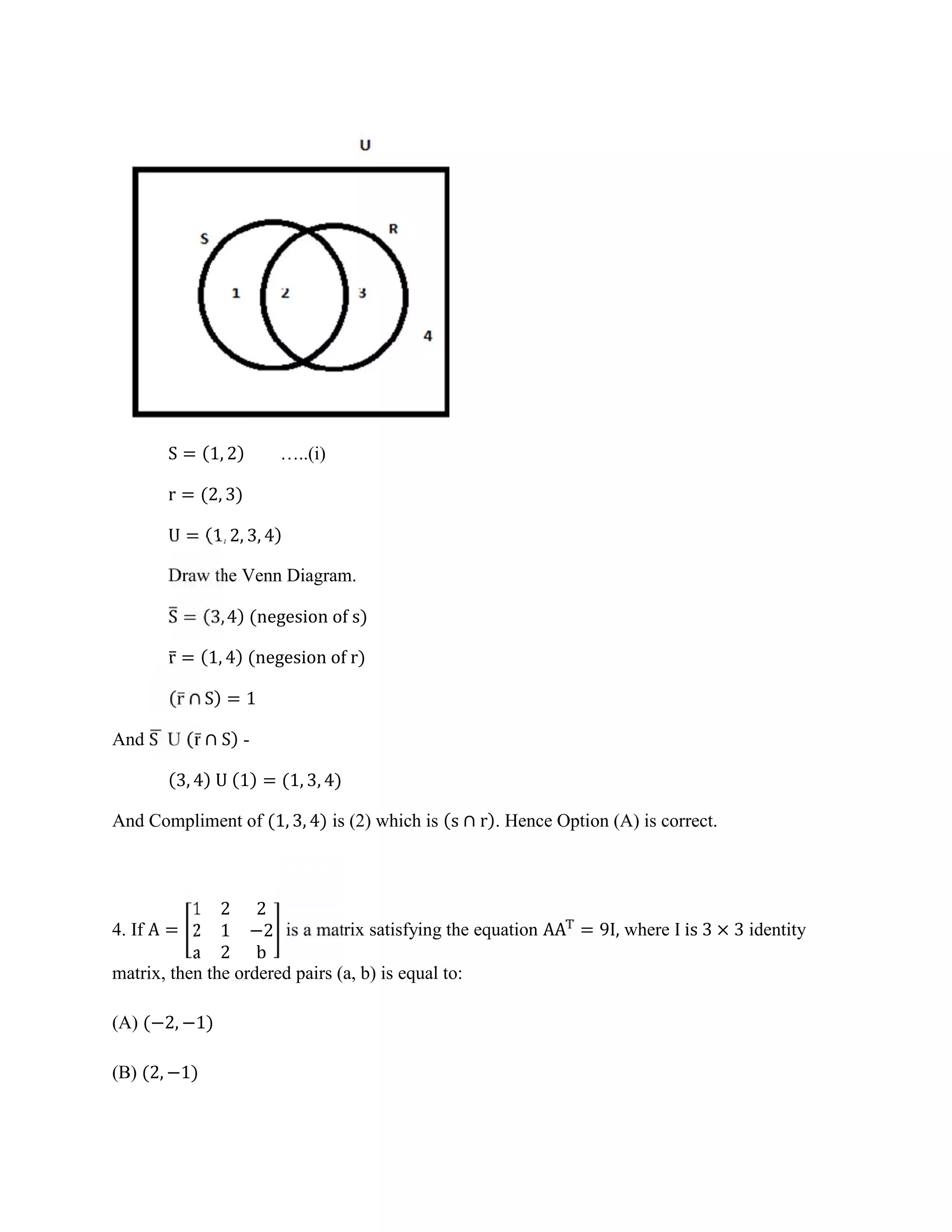
Consider it as Sets.
S = (1, 2) …..(i)
r = (2, 3)
U = (1, 2, 3, 4)
Draw the Venn Diagram.
S = (3, 4) (negesion of s)
r̅ = (1, 4) (negesion of r)
(r̅ ∩ S) = 1
And S U (r̅ ∩ S) -
(3, 4) U (1) = (1, 3, 4)
And Compliment of (1, 3, 4) is (2) which is (s ∩ r). Hence Option (A) is correct.
4. If A =
1 2 2
2 1 −2
a 2 b
is a matrix satisfying the equation AA = 9I, where I is 3 × 3 identity
matrix, then the ordered pairs (a, b) is equal to:
(A) (−2, −1)
(B) (2, −1)
(C) (−2, 1)
(D) (2, 1)
Answer: (A)
1 2 2
2 1 −2
2
1 2
2 1 2
2 −2
=
9 0 0
0 9 0
0 0 9
Multiply first row of A [1 ,2,2] by last column of . We will get + 4 + 2 = 0
Only option (A) satisfies it.
5. If m is the A.M. of two distinct real numbers ( , > 1) , are three
geometric means between , ℎ + 2 + equals.
(A) 4
(B) 4
(C) 4
(D) 4
Answer: (C)
From Dimension Analysis (A) is incorrect as giving dimension of (length) the power 6. From
Symmetry (C) is the answer. Links.
6. Let O be the vertex and Q be any point on the parabola, = 8 . If the point P divides the
line segment OQ internally in the ratio 1 : 3, then the locus of P is:
(A) = 2
(B) =
(C) =
(D) = 2
Answer: (A)
Sol. Find any one point on the locus and substitute in answers. Like (4,2) is a point on the curve
and (1,1/2) divides OQ in the ratio 1:3. Hence (1,1/2) will satisfy the options.
7. The equation of the plane containing the line 2 − 5 + = 3 ; + + 4 = 5, and parallel
to the plane, + 3 + 6 = 1, is:
(A) 2 + 6 + 12 = −13
(B) 2 + 6 + 12 = 13
(C) + 3 + 6 = −7
(D) + 3 + 6 = 7
Solution (D) Let the plane be + 3 + 6 = ,
As it contains the common line of line 2 − 5 + = 3 ; + + 4 = 5, we can find any point
on the line and substitute it in the our plane and find the value of K.
Put z = 0,
2 − 5 = 3 ; + = 5
We will get x =4 and y=1. Put (4, 1, 0) in + 3 + 6 = , you will get K=7.
Hence (D) is the Correct option.
8. The sum of coefficients of integral powers of x in the binomial expansion of 1 − 2√ is:
(A) (2 + 1)
(B) (3 + 1)
(C) (3 )
(D) (3 − 1)
Solution: (B)
It’s an easy question but if it is not striking to you then you can do it by Simulation Technique.
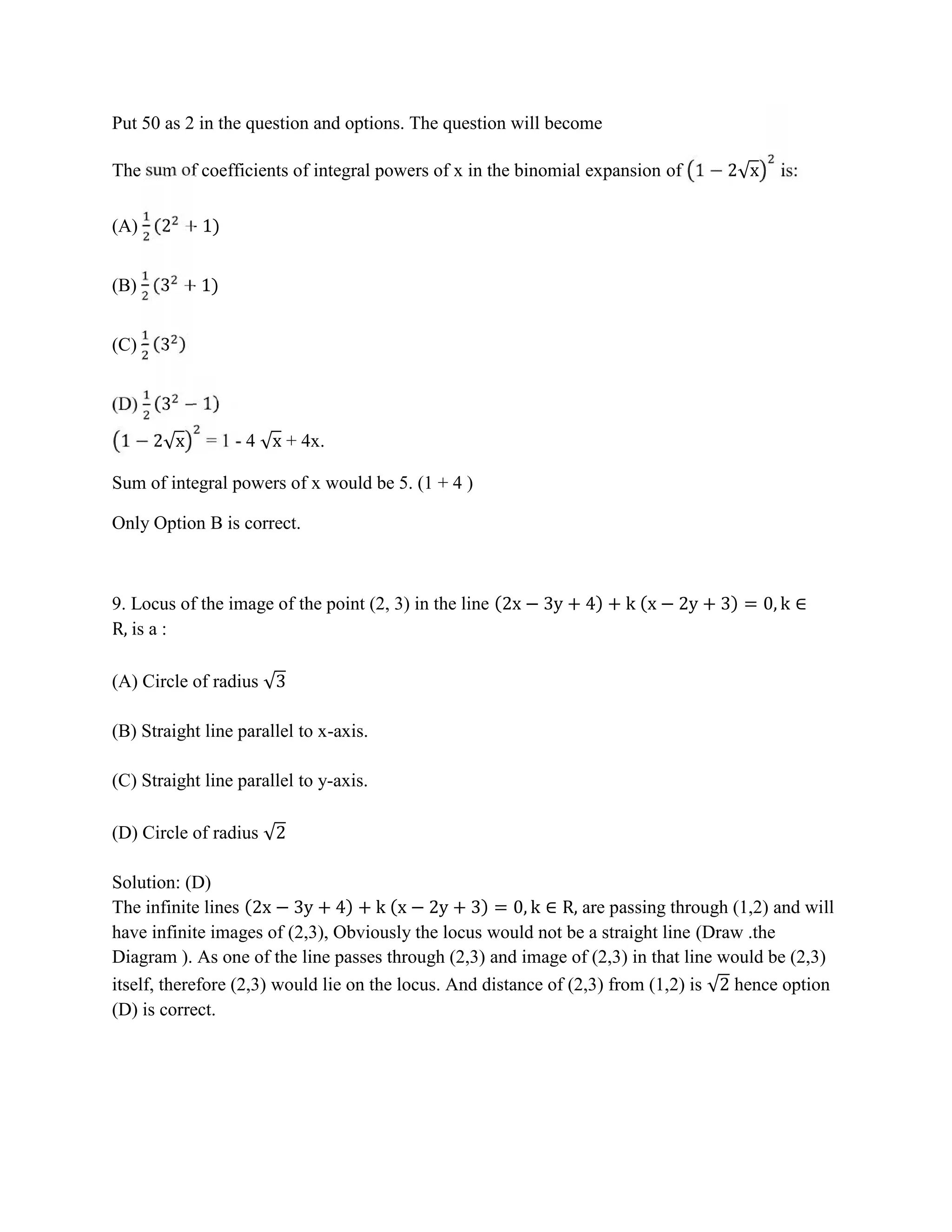
Put 50 as 2 in the question and options. The question will become
The sum of coefficients of integral powers of x in the binomial expansion of 1 − 2√x is:
(A) (2 + 1)
(B) (3 + 1)
(C) (3 )
(D) (3 − 1)
1 − 2√x = 1 - 4 √x + 4x.
Sum of integral powers of x would be 5. (1 + 4 )
Only Option B is correct.
9. Locus of the image of the point (2, 3) in the line (2x − 3y + 4) + k (x − 2y + 3) = 0, k ∈
R, is a :
(A) Circle of radius √3
(B) Straight line parallel to x-axis.
(C) Straight line parallel to y-axis.
(D) Circle of radius √2
Solution: (D)
The infinite lines (2x − 3y + 4) + k (x − 2y + 3) = 0, k ∈ R, are passing through (1,2) and will
have infinite images of (2,3), Obviously the locus would not be a straight line (Draw .the
Diagram ). As one of the line passes through (2,3) and image of (2,3) in that line would be (2,3)
itself, therefore (2,3) would lie on the locus. And distance of (2,3) from (1,2) is √2 hence option
(D) is correct.
Detailed Analysis of JEE Main 2015

Detailed Analysis of JEE Main 2015

  • 1.
    JEE Main 2015question paper detailed analysis OVERALL PAPER: 1.Overview (general theme setting and touching upon briefly on all points). We can have a JEE 2014 vs 2015 approach 2.Class XI and XII break-up of syllabus 3.Difficulty level analysis - by section and overall o Question-wise difficulty level break-up o Section-wise difficulty level break-up o Questions that should've been attempted first o Questions that should've been avoided in first go 4.Time management analysis - by section and overall o Question-wise time spent break-up o Section-wise time spent break-up o Questions that should've been attempted first o Questions that should've been avoided in first go 5.Special Insights and Tricks that could've been used o 2 questions that were wrong, why? o Speed tips that could've saved time o Trick questions?  Seemingly difficult but easy questions  Seemingly easy but difficult questions Analysis The question papers were available in four sets- A, B, C and D. Version Order of Subjects A Physics, Chemistry, Mathematics B Chemistry, Mathematics, Physics C Mathematics, Physics, Chemistry D Physics, Mathematics, Chemistry
  • 2.
    Physics: : Itwas the toughest amongst the three; the questions that were included in this section were a little tricky. Out of the 30 questions from Physics, only five questions were theory based, the rest 25 were numerical based questions. It was a time consuming section. Some experts also believe that the questions in this section were ambiguous, which increased the difficulty level. The topic of Thermodynamics in Physics was very tough, especially the Entropy questions were quite unexpected. About 25% of the questions are pertaining to graphs. a few areas like wave optics, properties of liquids etc. were totally absent in the paper. Ideal Time for Physics – (Student should invest 75 min. for this section) Chemistry Majority of the questions in the Chemistry part of the JEE Main 2015 are in the range of easy to moderate. The overall difficulty level of this part in this year exam is less as compared to last year. Usually, application level questions are expected from Physical and Organic chemistry areas, but this year questions from these two areas were quite straight in nature. However, one question from Inorganic Chemistry was based on practical part and it can be rated difficult to answer. Moreover, this year's contribution from Inorganic Chemistry was more compared to previous years. The questions were all fact based. This section was not very time consuming. Most of the questions are asked directly from the NCERT texts for Chemistry. Ideal Time for Chemistry – (Student should invest 40 min. for this section) Mathematics: This section, however, not difficult, was found a little lengthy by the examinees. It had a good mix of questions. Also, two questions were not properly framed in Math section. One was from Probability (All options were incorrect) and other was from Differential Equation. (Initial condition was not given). There was one question each from Statistics, Set Relation and Mathematical Reasoning and one easy questions from height and distance trigonometry. All these chapters are not in JEE Advanced Syllabus. Questions from Inverse Trigonometry ,3-D and Vectors were easy. Few questions, which posed difficulty, were genuinely concept wise difficult and tricky in nature. Ideal Time for Math – (Student should invest 65 min. for this section) Analysis of JEE (Main) 2015 Paper -1
  • 3.
    Marks Distribution fromClass XII CBSE Syllabus Subject No. of questions Total Marks Mathematics 14 56 Chemistry 20 80 Physics 17 68 Marks Distribution from Class XI CBSE Syllabus Subject No. of questions Total Marks Mathematics 16 64 Chemistry 10 40 Physics 13 52 Q.No. Topic(based on SET-A) JEE main Paper-1 Easy Moderate Difficult 1 Kinematics embibe predicted high weightage 2 Unit & Dimensions embibe predicted easy to score 3 Laws of Motion embibe predicted Low Weightage 4 Conservation of Momentum embibe predicted easy to score (Must Do) 5 Centre of Mass embibe predicted Low Weightage 6 Rotational Mechanics embibe
  • 4.
    predicted Low Weightage 7 Gravitation embibe predictedhigh weightage 8 Simple Harmonic Motion embibe predicted high weightage 9 Heat &Thermodynamics embibe predicted high weightage 10 Heat &Thermodynamics embibe predicted high weightage 11 Heat &Thermodynamics embibe predicted high weightage 12 Simple Harmonic Motion embibe predicted high weightage 13 Wave & Sound embibe predicted high weightage 14 Electrostatics embibe predicted high weightage 15 Electrostatics embibe predicted high weightage 16 Electrostatics embibe predicted high weightage 17 Electrostatics embibe predicted high weightage 18 Electrostatics embibe predicted high
  • 5.
    weightage 19 Magnetism embibe predicted high weightage 20Magnetism embibe predicted high weightage 21 Magnetism embibe predicted high weightage 22 Magnetism embibe predicted high weightage 23 Optics embibe predicted high weightage 24 Optics embibe predicted high weightage 25 Optics embibe predicted high weightage 26 Optics embibe predicted high weightage 27 Modern Physics embibe predicted high weightage 28 Modern Physics embibe predicted high weightage 29 Communication Systems embibe predicted high weightage 30 Magnetism embibe predicted high weightage
  • 6.
    31 s-Block elementsand Hydrogen embibe predicted Low Weightage 32 Solid State embibe predicted Low Weightage 33 Atomic Structure embibe predicted high weightage 34 Chemical Bonding embibe predicted high weightage 35 Thermochemistry and thermodynamics embibe predicted high weightage 36 Liquid solution embibe predicted high weightage 37 Chemical Equilibrium embibe predicted easy to score (Must Do) 38 Electrochemistry embibe predicted high weightage 39 Chemical kinetics embibe predicted high weightage 40 Surface chemistry embibe predicted high weightage 41 Periodicity embibe predicted Low Weightage 42 Metallurgy embibe
  • 7.
    predicted high weightage 43 s-Blockelements and hydrogen embibe predicted Low Weightage 44 s-Block elements and hydrogen embibe predicted Low Weightage 45 group 15 - 18 embibe predicted high weightage 46 Transition metals embibe predicted high weightage 47 group 15 - 18 embibe predicted high weightage 48 Coordination compounds embibe predicted high weightage 49 Coodination compounds embibe predicted high weightage 50 group 15 - 18 embibe predicted high weightage 51 Stoichiometry embibe predicted high weightage 52 General Organic Chemistry and Isomerism embibe predicted high weightage 53 Hydrocarbons embibe predicted easy to score
  • 8.
    (Must Do) 54 Alkyland Aryl halides embibe predicted high weightage 55 Aldehyde and Ketone embibe predicted high weightage 56 Amines embibe predicted Low Weightage 57 Polymers embibe predicted easy to score (Must Do) 58 Biomolecules embibe predicted easy to score (Must Do) 59 Chemistry in everyday life embibe predicted easy to score (Must Do) 60 Salt Analysis embibe predicted easy to score (Must Do) 61 Matrices embibe predicted high weightage 62 Complex Number embibe predicted high weightage 63 Quadratic Equation & Expression embibe predicted high weightage 64 Matrices embibe
  • 9.
    predicted high weightage 65 Determinants embibe predictedhigh weightage 66 Permutation & Combination embibe predicted Low Weightage 67 Binomial Theorem embibe predicted high weightage 68 Progression & Series embibe predicted high weightage 69 Progression & Series embibe predicted high weightage 70 Limit,Continuity & Differentiability embibe predicted high weightage 71 Limit,Continuity & Differentiability embibe predicted high weightage 72 Straight Lines embibe predicted high weightage 73 Application of Derivatives embibe predicted high weightage 74 Indefinite Integral embibe predicted Low Weightage 75 Definite Integral embibe predicted high weightage 76 Area under Curves embibe
  • 10.
    predicted high weightage 77 DifferentialEquation embibe predicted easy to score (Must Do) 78 Straight lines embibe predicted high weightage 79 Straight lines embibe predicted high weightage 80 Circle embibe predicted high weightage 81 Ellipse embibe predicted high weightage 82 Parabola embibe predicted high weightage 83 3 - D Geometry embibe predicted high weightage 84 3 - D Geometry embibe predicted high weightage 85 Vector Algebra embibe predicted high weightage 86 Probability embibe predicted high weightage 87 Statistics embibe predicted easy to score (Must Do)
  • 11.
    88 Height &Distance embibe predicted easy to score (Must Do) 89 Inverse Trigonometric Function embibe predicted easy to score (Must Do) 90 Mathematical Reasoning embibe predicted easy to score (Must Do) Physics – 25 Questions From High weightage and 2 from Easy to Score – (90% from the topics mentioned important by embibe. Chemistry – 18 Questions From High weightage and 6 from Easy to Score – (80% from the topics mentioned important by embibe. Math– 23 Questions From High weightage and 5 from Easy to Score – (93.3% from the topics mentioned important by embibe.
  • 13.
    Category Expected CutoffScore 2015 Common Merit List (CML) 112-117 Other Backward Class (OBC - NCL) 74-80 Scheduled Caste (SC) 53-59 Scheduled Tribe (ST) 46-50 Tricks for lengthy questions – 1. A complex number z is said to be unimodular if |z| = 1. suppose z and z are complex numbers such that is unimodular and z is not unimodular. Then the point z lies on a: (A) Circle of radius √2 (B) Straight line parallel to x-axis. (C) Straight line parallel to y-axis.
  • 14.
    (D) Circle ofradius 2 Answer: (D) Sol. – Put z = 0, as it is not unimodular, we can assume z = 0, so we will get as unimodular which will give us |z | = 2. Hence Option (D) is correct. 2. The normal to the curve, x + 2xy − 3y = 0, at (1, 1): (A) Meets the curve again in the fourth quadrant. (B) Does not meet the curve again. (C) Meets the curve again in the second quadrant. (D) Meets the curve again in the third quadrant. Answer: (A) Its Pair of straight lines passing through origin. x + 3y = 0 or x − y = 0 so normal at (1,1) will meets the curve again in the fourth quadrant. (Draw Diagram). 3. The negation of ~s ∨ (~r ∧ s) is equivalent to: (A) s ∧ r (B) s ∧∼ r (C) s ∧ (r ∧ ∼ s) (D) s ∨ (r ∨ ∼ s) Answer: (A) Consider it as Sets.
  • 15.
    S = (1,2) …..(i) r = (2, 3) U = (1, 2, 3, 4) Draw the Venn Diagram. S = (3, 4) (negesion of s) r̅ = (1, 4) (negesion of r) (r̅ ∩ S) = 1 And S U (r̅ ∩ S) - (3, 4) U (1) = (1, 3, 4) And Compliment of (1, 3, 4) is (2) which is (s ∩ r). Hence Option (A) is correct. 4. If A = 1 2 2 2 1 −2 a 2 b is a matrix satisfying the equation AA = 9I, where I is 3 × 3 identity matrix, then the ordered pairs (a, b) is equal to: (A) (−2, −1) (B) (2, −1)
  • 16.
    (C) (−2, 1) (D)(2, 1) Answer: (A) 1 2 2 2 1 −2 2 1 2 2 1 2 2 −2 = 9 0 0 0 9 0 0 0 9 Multiply first row of A [1 ,2,2] by last column of . We will get + 4 + 2 = 0 Only option (A) satisfies it. 5. If m is the A.M. of two distinct real numbers ( , > 1) , are three geometric means between , ℎ + 2 + equals. (A) 4 (B) 4 (C) 4 (D) 4 Answer: (C) From Dimension Analysis (A) is incorrect as giving dimension of (length) the power 6. From Symmetry (C) is the answer. Links. 6. Let O be the vertex and Q be any point on the parabola, = 8 . If the point P divides the line segment OQ internally in the ratio 1 : 3, then the locus of P is: (A) = 2 (B) = (C) = (D) = 2 Answer: (A)
  • 17.
    Sol. Find anyone point on the locus and substitute in answers. Like (4,2) is a point on the curve and (1,1/2) divides OQ in the ratio 1:3. Hence (1,1/2) will satisfy the options. 7. The equation of the plane containing the line 2 − 5 + = 3 ; + + 4 = 5, and parallel to the plane, + 3 + 6 = 1, is: (A) 2 + 6 + 12 = −13 (B) 2 + 6 + 12 = 13 (C) + 3 + 6 = −7 (D) + 3 + 6 = 7 Solution (D) Let the plane be + 3 + 6 = , As it contains the common line of line 2 − 5 + = 3 ; + + 4 = 5, we can find any point on the line and substitute it in the our plane and find the value of K. Put z = 0, 2 − 5 = 3 ; + = 5 We will get x =4 and y=1. Put (4, 1, 0) in + 3 + 6 = , you will get K=7. Hence (D) is the Correct option. 8. The sum of coefficients of integral powers of x in the binomial expansion of 1 − 2√ is: (A) (2 + 1) (B) (3 + 1) (C) (3 ) (D) (3 − 1) Solution: (B) It’s an easy question but if it is not striking to you then you can do it by Simulation Technique.
  • 18.
    Put 50 as2 in the question and options. The question will become The sum of coefficients of integral powers of x in the binomial expansion of 1 − 2√x is: (A) (2 + 1) (B) (3 + 1) (C) (3 ) (D) (3 − 1) 1 − 2√x = 1 - 4 √x + 4x. Sum of integral powers of x would be 5. (1 + 4 ) Only Option B is correct. 9. Locus of the image of the point (2, 3) in the line (2x − 3y + 4) + k (x − 2y + 3) = 0, k ∈ R, is a : (A) Circle of radius √3 (B) Straight line parallel to x-axis. (C) Straight line parallel to y-axis. (D) Circle of radius √2 Solution: (D) The infinite lines (2x − 3y + 4) + k (x − 2y + 3) = 0, k ∈ R, are passing through (1,2) and will have infinite images of (2,3), Obviously the locus would not be a straight line (Draw .the Diagram ). As one of the line passes through (2,3) and image of (2,3) in that line would be (2,3) itself, therefore (2,3) would lie on the locus. And distance of (2,3) from (1,2) is √2 hence option (D) is correct.