1
Designing Accessible EV Charging Systems
10 October 2023
Chloe Livingstone
Deputy Head of Stakeholder Engagement and International
UK Office for Zero Emission Vehicles
Purpose of meeting
UK ZEV Landscape
• Over 1.2 million plug-in vehicles registered in the UK, majority of are BEVs
• By 2035 all new light duty vehicles sold must be fully zero emission
• Over 48,100 public charging devices, including more than 8,900 rapid or above.
Recent policy announcements:
• New non-zero emission cars and vans sold in the UK between 2030 and 2035 will no
longer be required to offer drivers a significant zero emission capability. This
continues to require 80% of new cars to be zero emission by 2030 and is still the
most ambitious path to electric in Europe.
• Regulations have been laid to improve the consumer experience across the public
charging network; ensuring that pricing information and payment methods are
simplified, chargepoints are reliable, and public chargepoint data is freely available
• Launched the full Local EV Infrastructure Fund, supporting local authorities in
England to work with industry and transform the availability of charging for drivers
without off-street parking; committing a further £343m capital and £37.8m resource
funding over the next two financial years.
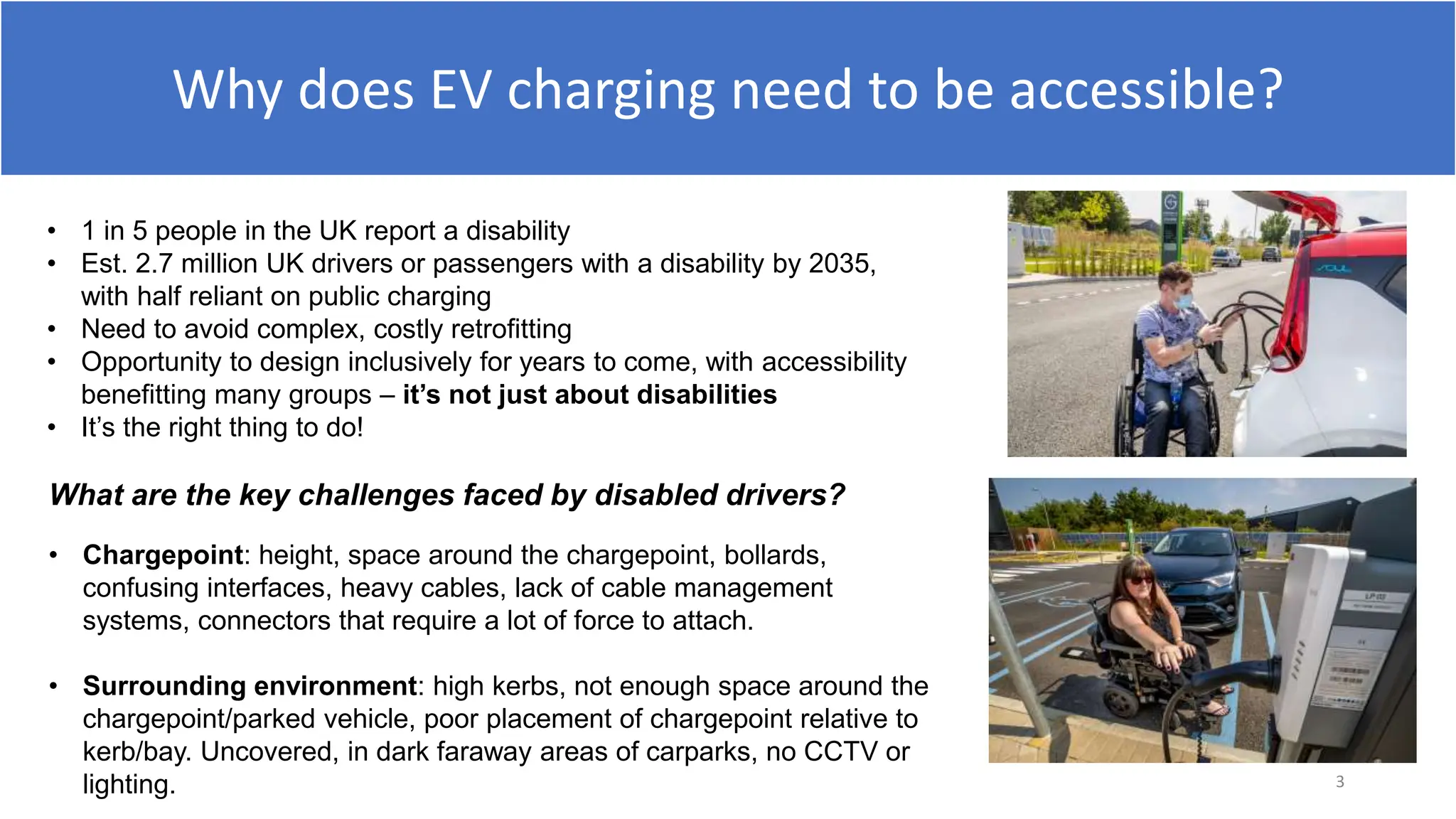
• 1 in 5 people in the UK report a disability
• Est. 2.7 million UK drivers or passengers with a disability by 2035,
with half reliant on public charging
• Need to avoid complex, costly retrofitting
• Opportunity to design inclusively for years to come, with accessibility
benefitting many groups – it’s not just about disabilities
• It’s the right thing to do!
Purpose of meeting
3
Why does EV charging need to be accessible?
What are the key challenges faced by disabled drivers?
• Chargepoint: height, space around the chargepoint, bollards,
confusing interfaces, heavy cables, lack of cable management
systems, connectors that require a lot of force to attach.
• Surrounding environment: high kerbs, not enough space around the
chargepoint/parked vehicle, poor placement of chargepoint relative to
kerb/bay. Uncovered, in dark faraway areas of carparks, no CCTV or
lighting.
Purpose of meeting
4
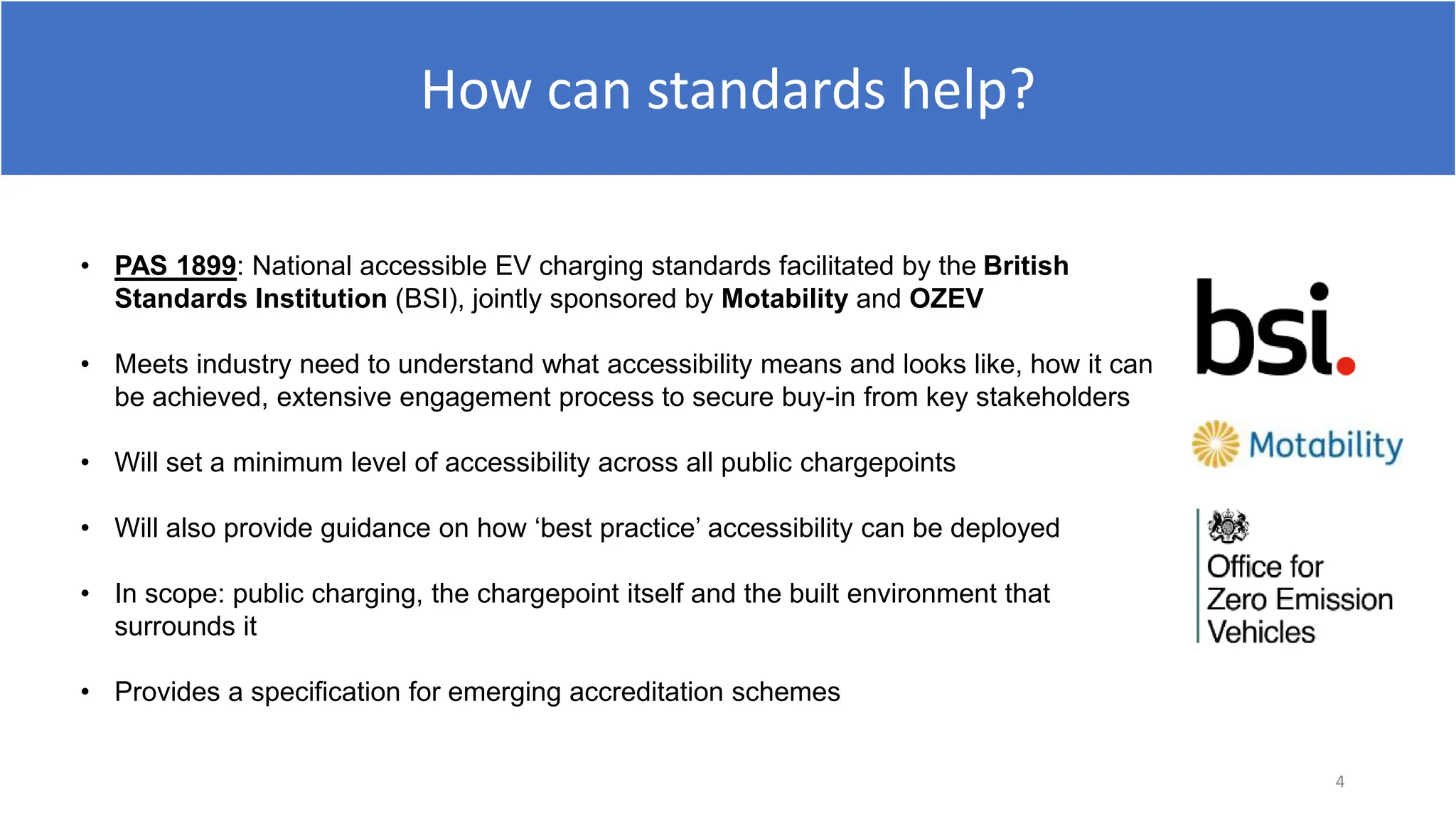
How can standards help?
• PAS 1899: National accessible EV charging standards facilitated by the British
Standards Institution (BSI), jointly sponsored by Motability and OZEV
• Meets industry need to understand what accessibility means and looks like, how it can
be achieved, extensive engagement process to secure buy-in from key stakeholders
• Will set a minimum level of accessibility across all public chargepoints
• Will also provide guidance on how ‘best practice’ accessibility can be deployed
• In scope: public charging, the chargepoint itself and the built environment that
surrounds it
• Provides a specification for emerging accreditation schemes
Purpose of meeting
PAS 1899 – development timeline
June 2021
OZEV/Motability
partnership
announced; work
commences on
draft PAS 1899
November 2021
Steering Group
convenes for the
first time
February 2022
First Steering
Group meetings
held to discuss the
draft PAS
March-May 2022
Draft PAS 1899 in
public consultation
May-July 2022
Second Steering
Group meetings to
resolve
consultation
feedback
Sept-Oct 2022
Typesetting and
publication of PAS
1899
Purpose of meeting
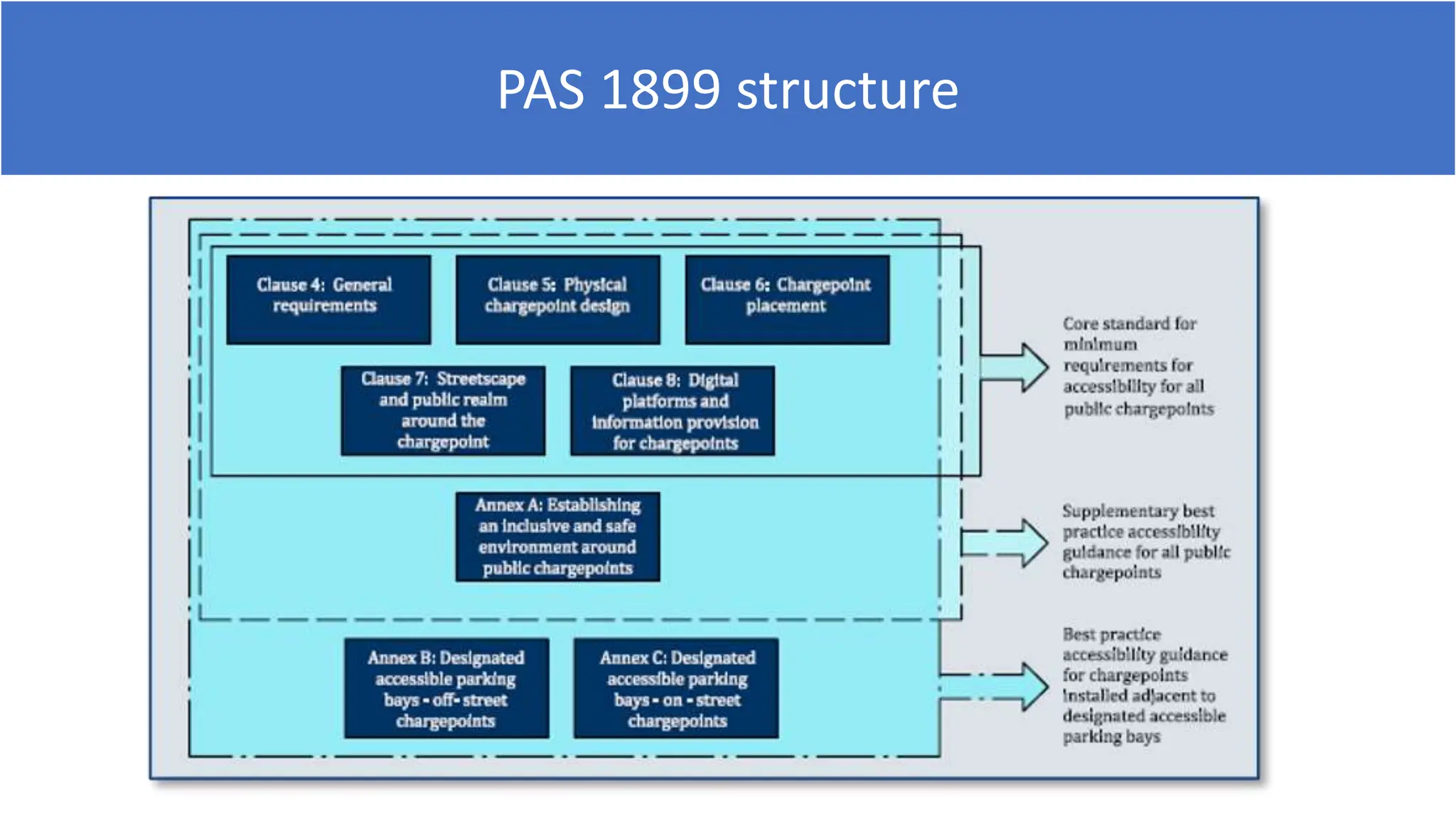
PAS 1899 structure
Purpose of meeting
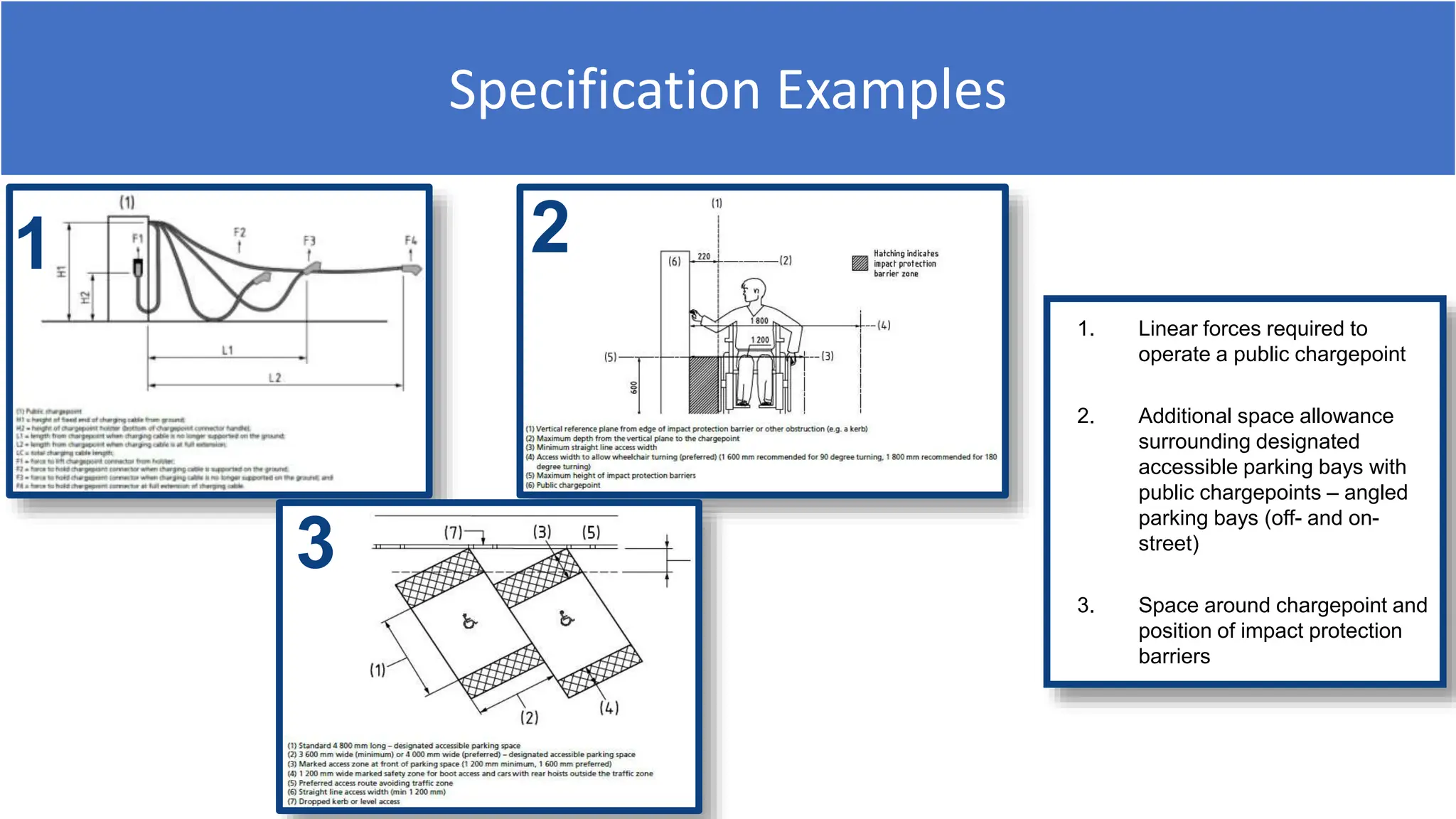
Specification Examples
1. Linear forces required to
operate a public chargepoint
2. Additional space allowance
surrounding designated
accessible parking bays with
public chargepoints – angled
parking bays (off- and on-
street)
3. Space around chargepoint and
position of impact protection
barriers
1 2
3
Purpose of meeting
Implementation of PAS 1899 and next steps
• PAS 1899 will be voluntary by default
• The UK is working to maximise uptake and drive progress in the
market, reserving option to regulate if sufficient progress not made:
1. Strongly encourage industry to uptake PAS 1899 and include accessibility
metrics in open data
2. Support Local Authorities to incorporate accessibility into their procurement
models
3. Continue to work with industry and others to ensure effective implementation
and discuss any technical or logistical challenges with compliance
4. Wider M&E (consumer surveys, feedback from disabled drivers and industry
5. 2024 – engage with the BSI on 24-month review of PAS 1899 and potential
upgrading to a full British/International standard
Purpose of meeting
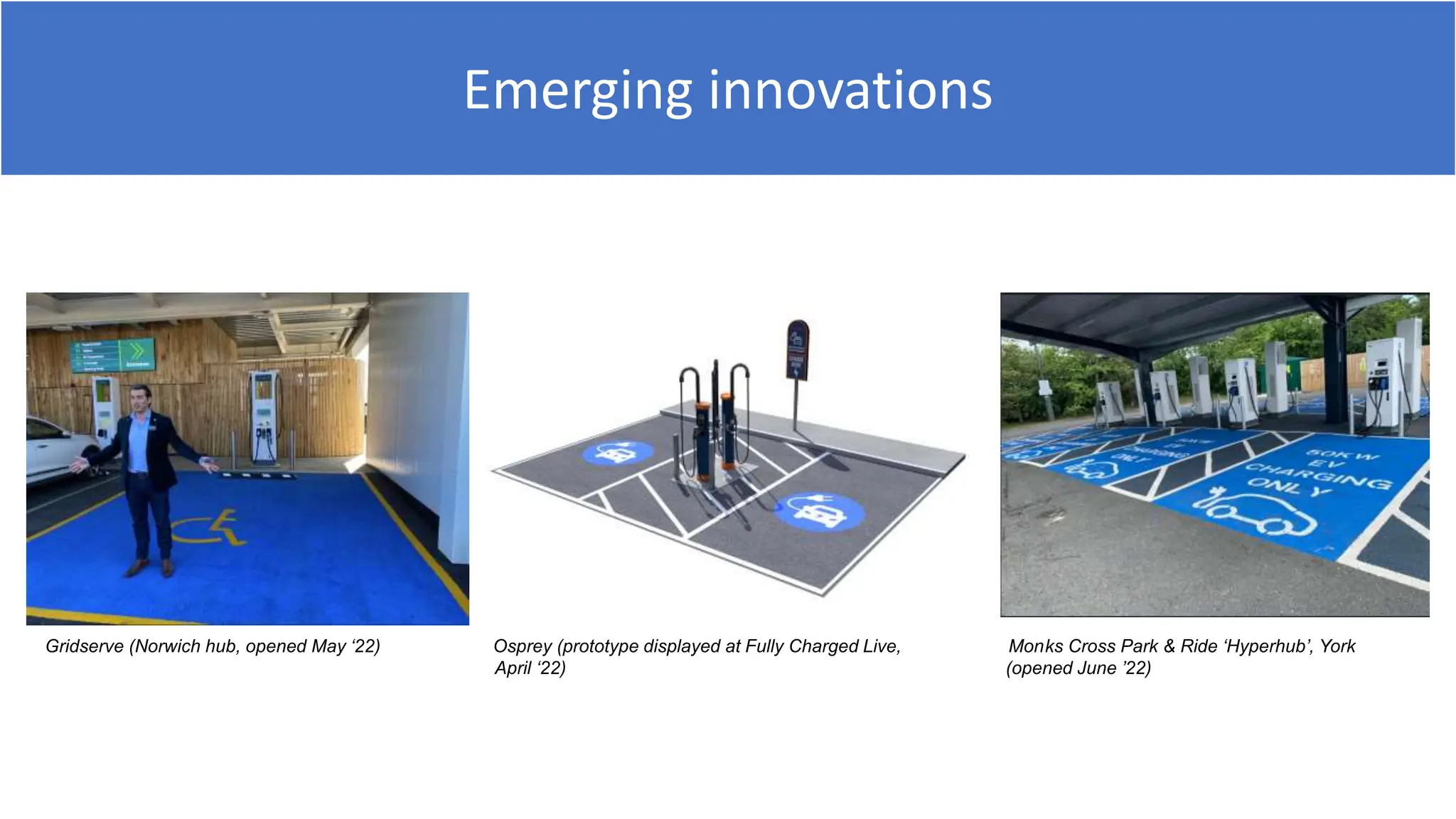
Emerging innovations
Gridserve (Norwich hub, opened May ‘22) Osprey (prototype displayed at Fully Charged Live, Monks Cross Park & Ride ‘Hyperhub’, York
April ‘22) (opened June ’22)
Purpose of meeting
Useful Resources
• Publicly Available Standard 1899:2022, Electric vehicles – Accessible charging – Specification
https://www.bsigroup.com/en-GB/standards/pas-1899/
• Motability & Ricardo, Electric Vehicle charging infrastructure for people living with disabilities
https://www.motability.org.uk/media/nghmmyu0/electric_vehicle_charging_infrastructure_for_people_living_
with_disabilities_ricardo_energy_and_environment.pdf
• Energy Saving Trust, Electric vehicle adoption for disabled consumers: Barriers and solutions for
disabled consumers getting and using electric vehicles https://energysavingtrust.org.uk/wp-
content/uploads/2022/03/Electric-vehicle-adoption-for-disabled-consumers_Energy-Saving-Trust_final-
version.pdf
• Energy Saving Trust, Summary: Electric vehicle accessible charging standard PAS 1899
https://energysavingtrust.org.uk/wp-content/uploads/2023/03/PAS-1899-
Summary_Doc_Energy_Saving_Trust.pdf
• Designability, Charging unit prototypes https://accessibleevcharging.designability.org.uk/design-
guidance/our-charging-unit-prototypes/
Thank you
Chloe Livingstone
Office for Zero Emission Vehicles (OZEV)
Chloe.Livingstone@ozev.gov.uk

Designing Accessible EV Charging Systems by Chloe Livingstone

  • 1.
    1 Designing Accessible EVCharging Systems 10 October 2023 Chloe Livingstone Deputy Head of Stakeholder Engagement and International UK Office for Zero Emission Vehicles
  • 2.
    Purpose of meeting UKZEV Landscape • Over 1.2 million plug-in vehicles registered in the UK, majority of are BEVs • By 2035 all new light duty vehicles sold must be fully zero emission • Over 48,100 public charging devices, including more than 8,900 rapid or above. Recent policy announcements: • New non-zero emission cars and vans sold in the UK between 2030 and 2035 will no longer be required to offer drivers a significant zero emission capability. This continues to require 80% of new cars to be zero emission by 2030 and is still the most ambitious path to electric in Europe. • Regulations have been laid to improve the consumer experience across the public charging network; ensuring that pricing information and payment methods are simplified, chargepoints are reliable, and public chargepoint data is freely available • Launched the full Local EV Infrastructure Fund, supporting local authorities in England to work with industry and transform the availability of charging for drivers without off-street parking; committing a further £343m capital and £37.8m resource funding over the next two financial years.
  • 3.
    • 1 in5 people in the UK report a disability • Est. 2.7 million UK drivers or passengers with a disability by 2035, with half reliant on public charging • Need to avoid complex, costly retrofitting • Opportunity to design inclusively for years to come, with accessibility benefitting many groups – it’s not just about disabilities • It’s the right thing to do! Purpose of meeting 3 Why does EV charging need to be accessible? What are the key challenges faced by disabled drivers? • Chargepoint: height, space around the chargepoint, bollards, confusing interfaces, heavy cables, lack of cable management systems, connectors that require a lot of force to attach. • Surrounding environment: high kerbs, not enough space around the chargepoint/parked vehicle, poor placement of chargepoint relative to kerb/bay. Uncovered, in dark faraway areas of carparks, no CCTV or lighting.
  • 4.
    Purpose of meeting 4 Howcan standards help? • PAS 1899: National accessible EV charging standards facilitated by the British Standards Institution (BSI), jointly sponsored by Motability and OZEV • Meets industry need to understand what accessibility means and looks like, how it can be achieved, extensive engagement process to secure buy-in from key stakeholders • Will set a minimum level of accessibility across all public chargepoints • Will also provide guidance on how ‘best practice’ accessibility can be deployed • In scope: public charging, the chargepoint itself and the built environment that surrounds it • Provides a specification for emerging accreditation schemes
  • 5.
    Purpose of meeting PAS1899 – development timeline June 2021 OZEV/Motability partnership announced; work commences on draft PAS 1899 November 2021 Steering Group convenes for the first time February 2022 First Steering Group meetings held to discuss the draft PAS March-May 2022 Draft PAS 1899 in public consultation May-July 2022 Second Steering Group meetings to resolve consultation feedback Sept-Oct 2022 Typesetting and publication of PAS 1899
  • 6.
    Purpose of meeting PAS1899 structure
  • 7.
    Purpose of meeting SpecificationExamples 1. Linear forces required to operate a public chargepoint 2. Additional space allowance surrounding designated accessible parking bays with public chargepoints – angled parking bays (off- and on- street) 3. Space around chargepoint and position of impact protection barriers 1 2 3
  • 8.
    Purpose of meeting Implementationof PAS 1899 and next steps • PAS 1899 will be voluntary by default • The UK is working to maximise uptake and drive progress in the market, reserving option to regulate if sufficient progress not made: 1. Strongly encourage industry to uptake PAS 1899 and include accessibility metrics in open data 2. Support Local Authorities to incorporate accessibility into their procurement models 3. Continue to work with industry and others to ensure effective implementation and discuss any technical or logistical challenges with compliance 4. Wider M&E (consumer surveys, feedback from disabled drivers and industry 5. 2024 – engage with the BSI on 24-month review of PAS 1899 and potential upgrading to a full British/International standard
  • 9.
    Purpose of meeting Emerginginnovations Gridserve (Norwich hub, opened May ‘22) Osprey (prototype displayed at Fully Charged Live, Monks Cross Park & Ride ‘Hyperhub’, York April ‘22) (opened June ’22)
  • 10.
    Purpose of meeting UsefulResources • Publicly Available Standard 1899:2022, Electric vehicles – Accessible charging – Specification https://www.bsigroup.com/en-GB/standards/pas-1899/ • Motability & Ricardo, Electric Vehicle charging infrastructure for people living with disabilities https://www.motability.org.uk/media/nghmmyu0/electric_vehicle_charging_infrastructure_for_people_living_ with_disabilities_ricardo_energy_and_environment.pdf • Energy Saving Trust, Electric vehicle adoption for disabled consumers: Barriers and solutions for disabled consumers getting and using electric vehicles https://energysavingtrust.org.uk/wp- content/uploads/2022/03/Electric-vehicle-adoption-for-disabled-consumers_Energy-Saving-Trust_final- version.pdf • Energy Saving Trust, Summary: Electric vehicle accessible charging standard PAS 1899 https://energysavingtrust.org.uk/wp-content/uploads/2023/03/PAS-1899- Summary_Doc_Energy_Saving_Trust.pdf • Designability, Charging unit prototypes https://accessibleevcharging.designability.org.uk/design- guidance/our-charging-unit-prototypes/
  • 11.
    Thank you Chloe Livingstone Officefor Zero Emission Vehicles (OZEV) Chloe.Livingstone@ozev.gov.uk