Design Principles in a Nutshell
Dmytro Panin & Anton Udovychenko
12.2015
Agenda
▪ What is a good design?
▪ Complexity and simplicity
▪ KISS
▪ YAGNI
▪ Cohesiveness and coupling
▪ SOLID
▪ Q&A
Good design
▪ Design is good when a cost of changing of a design is minimum
Good design
▪ Design is good when a cost of changing of a design is minimum
▪ Easy to change
Good design
▪ Design is good when a cost of changing of a design is minimum
▪ Easy to change
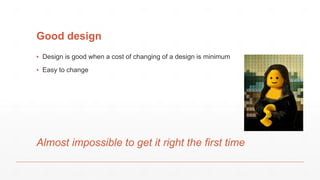
Almost impossible to get it right the first time
How to make a good design?
▪ Let go of the ego
How to make a good design?
▪ Let go of the ego
▪ Be unemotional
How to make a good design?
▪ Let go of the ego
▪ Be unemotional
▪ Do code reviews
How to make a good design?
▪ Let go of the ego
▪ Be unemotional
▪ Do code reviews
▪ A good design is the one that hides inherited complexity and eliminates the
accidental complexity
How to make a good design?
▪ Let go of the ego
▪ Be unemotional
▪ Do code reviews
▪ A good design is the one that hides inherited complexity and eliminates the
accidental complexity
Software is never written, it is always rewritten. As the
software that is relevant always must be changed
Complexity
▪ Inherited from a domain
▪ Accidental complexity
KISS - Keep it simple and stupid
What is simple?
What is simple?
▪ Simple makes you concentrated
What is simple?
▪ Simple makes you concentrated
▪ Simple resolves only actual issues we know about
What is simple?
▪ Simple makes you concentrated
▪ Simple resolves only actual issues we know about
▪ Simple fails less
What is simple?
▪ Simple makes you concentrated
▪ Simple resolves only actual issues we know about
▪ Simple fails less
▪ Simple is easier to understand
Simple is not necessarily familiar.
Think YAGNI
Do we
need
it?
Day
1
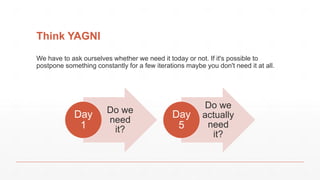
We have to ask ourselves whether we need it today or not. If it's possible to
postpone something constantly for a few iterations maybe you don't need it at all.
Think YAGNI
Do we
need
it?
Day
1
Do we
actually
need
it?
Day
5
We have to ask ourselves whether we need it today or not. If it's possible to
postpone something constantly for a few iterations maybe you don't need it at all.
Think YAGNI
Do we
need
it?
Day
1
Do we
actually
need
it?
Day
5
We do
not
need it
Day
9
We have to ask ourselves whether we need it today or not. If it's possible to
postpone something constantly for a few iterations maybe you don't need it at all.
Cost of implementing
Smart Smarter
Much
smarter
Now correlation Later Result
X > Y Postpone
X == Y Postpone
X < Y ?
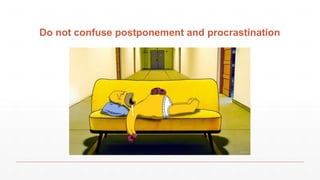
Do not confuse postponement and procrastination
Coupling
▪ Coupling is what you depend on...
Coupling
▪ Coupling is what you depend on...
▪ Inheritance is the worst form of coupling
Coupling
▪ Coupling is what you depend on...
▪ Inheritance is the worst form of coupling
▪ "knock out before mock out“
Coupling
▪ Coupling is what you depend on....
▪ Inheritance is the worst form of coupling
▪ "knock out before mock out“
▪ Depending on a class is a tight coupling
Coupling
▪ Coupling is what you depend on....
▪ Inheritance is the worst form of coupling
▪ "knock out before mock out“
▪ Depending on a class is a tight coupling
▪ Depending on an interface is a loose coupling
Coupling
▪ Coupling is what you depend on....
▪ Inheritance is the worst form of coupling
▪ "knock out before mock out“
A good design has high cohesion and low coupling
▪ Depending on a class is a tight coupling
▪ Depending on an interface is a loose coupling
DRY ( Do not Repeat Yourself )
▪ Every piece of knowledge in a system should have a single unambiguous
authoritative representation
▪ It reduces the cost of development
SOLID
▪ Single responsibility principle
▪ Open-Closed Principle
▪ Liskov substitution principle
▪ Interface segregation principle
▪ Dependency inversion principle
Single responsibility principle
▪ A class should have only a single responsibility
Single responsibility principle
▪ A class should have only a single responsibility
▪ Cohesive class has single responsibility
Single responsibility principle
▪ A class should have only a single responsibility
▪ Cohesive class has single responsibility
▪ When you say "this class does this AND that" you have violated SRP
Single responsibility principle
▪ A class should have only a single responsibility
▪ Cohesive class has single responsibility
▪ When you say "this class does this AND that" you have violated SRP
▪ Long methods are bad
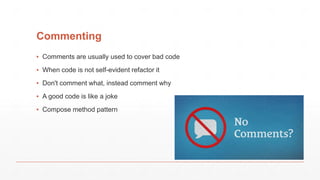
Commenting
Commenting
▪ Comments are usually used to cover bad code
Commenting
▪ Comments are usually used to cover bad code
▪ When code is not self-evident refactor it
Commenting
▪ Comments are usually used to cover bad code
▪ When code is not self-evident refactor it
▪ Don't comment what, instead comment why
Commenting
▪ Comments are usually used to cover bad code
▪ When code is not self-evident refactor it
▪ Don't comment what, instead comment why
▪ A good code is like a joke
Commenting
▪ Comments are usually used to cover bad code
▪ When code is not self-evident refactor it
▪ Don't comment what, instead comment why
▪ A good code is like a joke
▪ Compose method pattern
Open-Closed Principle
▪ Two options - to make an enhancement
1. Change existing code
2. Add a small new module of code
Open-Closed Principle
▪ Two options - to make an enhancement
1. Change existing code
2. Add a small new module of code
▪ Nobody likes existing code
Open-Closed Principle
▪ Two options - to make an enhancement
1. Change existing code
2. Add a small new module of code
▪ Nobody likes existing code
▪ Software module should be open for extension but closed from modification
Open-Closed Principle
▪ Two options - to make an enhancement
1. Change existing code
2. Add a small new module of code
▪ Nobody likes existing code
▪ Software module should be open for extension but closed from modification
▪ Rely on abstraction and polymorphism
Liskov substitution principle
▪ Inheritance is overused
Liskov substitution principle
▪ Inheritance is overused
▪ If an object of B should be used anywhere an object of A is used then use inheritance
Liskov substitution principle
▪ Inheritance is overused
▪ If an object of B should be used anywhere an object of A is used then use inheritance
▪ If an object of B should use an object of A, then use composition / delegation
Liskov substitution principle
▪ Inheritance is overused
▪ If an object of B should be used anywhere an object of A is used then use inheritance
▪ If an object of B should use an object of A, then use composition / delegation
▪ Inheritance demands more from a developer than composition or delegation does
Liskov substitution principle
▪ Objects in a program should be replaceable with instances of their
subtypes without altering the correctness of that program
▪ The user of a base class should be able to use an instance of a derived class
without knowing the difference
Interface segregation principle
▪ Many client-specific interfaces are better than one general-purpose interface
Alarm
Clock PCPhone TV Rooster…
Clock vs
Dependency inversion principle
▪ High-level modules should not depend on low-level modules. Both should depend
on abstractions
Dependency inversion principle
▪ High-level modules should not depend on low-level modules. Both should depend
on abstractions
▪ Abstractions should not depend upon details. Details should depend upon
abstractions
Dependency injection pattern
▪ Dependency inversion ≠ dependency injection
▪ Dependency injection pattern is an implementation of Dependency inversion
principle
Questions?
Thank you
Inspired by: Core Design Principles for Software Developers by Venkat Subramaniam

Design principles in a nutshell

  • 1.
    Design Principles ina Nutshell Dmytro Panin & Anton Udovychenko 12.2015
  • 2.
    Agenda ▪ What isa good design? ▪ Complexity and simplicity ▪ KISS ▪ YAGNI ▪ Cohesiveness and coupling ▪ SOLID ▪ Q&A
  • 3.
    Good design ▪ Designis good when a cost of changing of a design is minimum
  • 4.
    Good design ▪ Designis good when a cost of changing of a design is minimum ▪ Easy to change
  • 5.
    Good design ▪ Designis good when a cost of changing of a design is minimum ▪ Easy to change Almost impossible to get it right the first time
  • 6.
    How to makea good design?
  • 7.
    How to makea good design? ▪ Let go of the ego
  • 8.
    How to makea good design? ▪ Let go of the ego ▪ Be unemotional
  • 9.
    How to makea good design? ▪ Let go of the ego ▪ Be unemotional ▪ Do code reviews
  • 10.
    How to makea good design? ▪ Let go of the ego ▪ Be unemotional ▪ Do code reviews ▪ A good design is the one that hides inherited complexity and eliminates the accidental complexity
  • 11.
    How to makea good design? ▪ Let go of the ego ▪ Be unemotional ▪ Do code reviews ▪ A good design is the one that hides inherited complexity and eliminates the accidental complexity Software is never written, it is always rewritten. As the software that is relevant always must be changed
  • 12.
    Complexity ▪ Inherited froma domain ▪ Accidental complexity
  • 13.
    KISS - Keepit simple and stupid
  • 14.
  • 15.
    What is simple? ▪Simple makes you concentrated
  • 16.
    What is simple? ▪Simple makes you concentrated ▪ Simple resolves only actual issues we know about
  • 17.
    What is simple? ▪Simple makes you concentrated ▪ Simple resolves only actual issues we know about ▪ Simple fails less
  • 18.
    What is simple? ▪Simple makes you concentrated ▪ Simple resolves only actual issues we know about ▪ Simple fails less ▪ Simple is easier to understand
  • 19.
    Simple is notnecessarily familiar.
  • 20.
    Think YAGNI Do we need it? Day 1 Wehave to ask ourselves whether we need it today or not. If it's possible to postpone something constantly for a few iterations maybe you don't need it at all.
  • 21.
    Think YAGNI Do we need it? Day 1 Dowe actually need it? Day 5 We have to ask ourselves whether we need it today or not. If it's possible to postpone something constantly for a few iterations maybe you don't need it at all.
  • 22.
    Think YAGNI Do we need it? Day 1 Dowe actually need it? Day 5 We do not need it Day 9 We have to ask ourselves whether we need it today or not. If it's possible to postpone something constantly for a few iterations maybe you don't need it at all.
  • 23.
    Cost of implementing SmartSmarter Much smarter Now correlation Later Result X > Y Postpone X == Y Postpone X < Y ?
  • 24.
    Do not confusepostponement and procrastination
  • 25.
    Coupling ▪ Coupling iswhat you depend on...
  • 26.
    Coupling ▪ Coupling iswhat you depend on... ▪ Inheritance is the worst form of coupling
  • 27.
    Coupling ▪ Coupling iswhat you depend on... ▪ Inheritance is the worst form of coupling ▪ "knock out before mock out“
  • 28.
    Coupling ▪ Coupling iswhat you depend on.... ▪ Inheritance is the worst form of coupling ▪ "knock out before mock out“ ▪ Depending on a class is a tight coupling
  • 29.
    Coupling ▪ Coupling iswhat you depend on.... ▪ Inheritance is the worst form of coupling ▪ "knock out before mock out“ ▪ Depending on a class is a tight coupling ▪ Depending on an interface is a loose coupling
  • 30.
    Coupling ▪ Coupling iswhat you depend on.... ▪ Inheritance is the worst form of coupling ▪ "knock out before mock out“ A good design has high cohesion and low coupling ▪ Depending on a class is a tight coupling ▪ Depending on an interface is a loose coupling
  • 31.
    DRY ( Donot Repeat Yourself ) ▪ Every piece of knowledge in a system should have a single unambiguous authoritative representation ▪ It reduces the cost of development
  • 32.
    SOLID ▪ Single responsibilityprinciple ▪ Open-Closed Principle ▪ Liskov substitution principle ▪ Interface segregation principle ▪ Dependency inversion principle
  • 33.
  • 34.
    Single responsibility principle ▪A class should have only a single responsibility
  • 35.
    Single responsibility principle ▪A class should have only a single responsibility ▪ Cohesive class has single responsibility
  • 36.
    Single responsibility principle ▪A class should have only a single responsibility ▪ Cohesive class has single responsibility ▪ When you say "this class does this AND that" you have violated SRP
  • 37.
    Single responsibility principle ▪A class should have only a single responsibility ▪ Cohesive class has single responsibility ▪ When you say "this class does this AND that" you have violated SRP ▪ Long methods are bad
  • 38.
  • 39.
    Commenting ▪ Comments areusually used to cover bad code
  • 40.
    Commenting ▪ Comments areusually used to cover bad code ▪ When code is not self-evident refactor it
  • 41.
    Commenting ▪ Comments areusually used to cover bad code ▪ When code is not self-evident refactor it ▪ Don't comment what, instead comment why
  • 42.
    Commenting ▪ Comments areusually used to cover bad code ▪ When code is not self-evident refactor it ▪ Don't comment what, instead comment why ▪ A good code is like a joke
  • 43.
    Commenting ▪ Comments areusually used to cover bad code ▪ When code is not self-evident refactor it ▪ Don't comment what, instead comment why ▪ A good code is like a joke ▪ Compose method pattern
  • 44.
  • 45.
    Open-Closed Principle ▪ Twooptions - to make an enhancement 1. Change existing code 2. Add a small new module of code
  • 46.
    Open-Closed Principle ▪ Twooptions - to make an enhancement 1. Change existing code 2. Add a small new module of code ▪ Nobody likes existing code
  • 47.
    Open-Closed Principle ▪ Twooptions - to make an enhancement 1. Change existing code 2. Add a small new module of code ▪ Nobody likes existing code ▪ Software module should be open for extension but closed from modification
  • 48.
    Open-Closed Principle ▪ Twooptions - to make an enhancement 1. Change existing code 2. Add a small new module of code ▪ Nobody likes existing code ▪ Software module should be open for extension but closed from modification ▪ Rely on abstraction and polymorphism
  • 50.
  • 51.
    Liskov substitution principle ▪Inheritance is overused
  • 52.
    Liskov substitution principle ▪Inheritance is overused ▪ If an object of B should be used anywhere an object of A is used then use inheritance
  • 53.
    Liskov substitution principle ▪Inheritance is overused ▪ If an object of B should be used anywhere an object of A is used then use inheritance ▪ If an object of B should use an object of A, then use composition / delegation
  • 54.
    Liskov substitution principle ▪Inheritance is overused ▪ If an object of B should be used anywhere an object of A is used then use inheritance ▪ If an object of B should use an object of A, then use composition / delegation ▪ Inheritance demands more from a developer than composition or delegation does
  • 55.
    Liskov substitution principle ▪Objects in a program should be replaceable with instances of their subtypes without altering the correctness of that program ▪ The user of a base class should be able to use an instance of a derived class without knowing the difference
  • 57.
    Interface segregation principle ▪Many client-specific interfaces are better than one general-purpose interface Alarm Clock PCPhone TV Rooster… Clock vs
  • 58.
    Dependency inversion principle ▪High-level modules should not depend on low-level modules. Both should depend on abstractions
  • 59.
    Dependency inversion principle ▪High-level modules should not depend on low-level modules. Both should depend on abstractions ▪ Abstractions should not depend upon details. Details should depend upon abstractions
  • 61.
    Dependency injection pattern ▪Dependency inversion ≠ dependency injection ▪ Dependency injection pattern is an implementation of Dependency inversion principle
  • 62.
    Questions? Thank you Inspired by:Core Design Principles for Software Developers by Venkat Subramaniam

Editor's Notes

  • #33 *Single responsibility principle* Cohesive class has single responsibility When you say "this class does this AND that" you have violated SRP Long methods are bad *Open-Closed Principle* Two options - to make an enhancement 1. change existing code 2. add a small new module of code nobody like existing code Software module should be open for extension but closed from modification Rely on abstraction and polymorhism *Liskov substitution principle* Inheretence is overused If an object of B should be used anywhere an object of A is used then use inheritance If an object of B should use an object of A, then use composition / delegation Inheritance demands more from a developer than composition or delegation does. “objects in a program should be replaceable with instances of their subtypes without altering the correctness of that program.” The user of a base class should be able to use an instance of a derived class without knowing the difference. *Interface segregation principle* many client-specific interfaces are better than one general-purpose interface Clock example Alarm ^ | __________________________________________________________ | | | ....... | TV Clock SPhone Wife *Dependency injection principle* A class should not depende on another class, they both have to depend on an abstraction (interface)
  • #34 i.e. only one potential change in the software's specification should be able to affect the specification of the class
  • #35 i.e. only one potential change in the software's specification should be able to affect the specification of the class
  • #36 i.e. only one potential change in the software's specification should be able to affect the specification of the class
  • #37 i.e. only one potential change in the software's specification should be able to affect the specification of the class
  • #38 i.e. only one potential change in the software's specification should be able to affect the specification of the class